EP1219734B2 - Leitfähige kern-mantel-verbundfaser - Google Patents
Leitfähige kern-mantel-verbundfaser Download PDFInfo
- Publication number
- EP1219734B2 EP1219734B2 EP00957018.5A EP00957018A EP1219734B2 EP 1219734 B2 EP1219734 B2 EP 1219734B2 EP 00957018 A EP00957018 A EP 00957018A EP 1219734 B2 EP1219734 B2 EP 1219734B2
- Authority
- EP
- European Patent Office
- Prior art keywords
- sheath
- component
- core
- fiber
- conductive
- Prior art date
- Legal status (The legal status is an assumption and is not a legal conclusion. Google has not performed a legal analysis and makes no representation as to the accuracy of the status listed.)
- Expired - Lifetime
Links
- 239000000835 fiber Substances 0.000 title claims abstract description 59
- 239000002131 composite material Substances 0.000 title claims abstract description 43
- 239000000306 component Substances 0.000 claims abstract description 86
- 239000008358 core component Substances 0.000 claims abstract description 32
- 229920000642 polymer Polymers 0.000 claims abstract description 31
- VNWKTOKETHGBQD-UHFFFAOYSA-N methane Chemical compound C VNWKTOKETHGBQD-UHFFFAOYSA-N 0.000 claims abstract description 21
- 229920001634 Copolyester Polymers 0.000 claims abstract description 18
- 229920000728 polyester Polymers 0.000 claims abstract description 15
- 239000006229 carbon black Substances 0.000 claims abstract description 11
- LLLVZDVNHNWSDS-UHFFFAOYSA-N 4-methylidene-3,5-dioxabicyclo[5.2.2]undeca-1(9),7,10-triene-2,6-dione Chemical compound C1(C2=CC=C(C(=O)OC(=C)O1)C=C2)=O LLLVZDVNHNWSDS-UHFFFAOYSA-N 0.000 claims abstract description 10
- 239000000470 constituent Substances 0.000 claims abstract description 5
- 239000000203 mixture Substances 0.000 claims abstract description 4
- QQVIHTHCMHWDBS-UHFFFAOYSA-N isophthalic acid Chemical compound OC(=O)C1=CC=CC(C(O)=O)=C1 QQVIHTHCMHWDBS-UHFFFAOYSA-N 0.000 claims description 18
- 238000007334 copolymerization reaction Methods 0.000 claims description 13
- XNGIFLGASWRNHJ-UHFFFAOYSA-N phthalic acid Chemical compound OC(=O)C1=CC=CC=C1C(O)=O XNGIFLGASWRNHJ-UHFFFAOYSA-N 0.000 claims description 7
- KYTZHLUVELPASH-UHFFFAOYSA-N naphthalene-1,2-dicarboxylic acid Chemical compound C1=CC=CC2=C(C(O)=O)C(C(=O)O)=CC=C21 KYTZHLUVELPASH-UHFFFAOYSA-N 0.000 claims description 6
- 238000000034 method Methods 0.000 description 24
- 229920001940 conductive polymer Polymers 0.000 description 19
- 229920000139 polyethylene terephthalate Polymers 0.000 description 19
- 239000005020 polyethylene terephthalate Substances 0.000 description 19
- 238000011156 evaluation Methods 0.000 description 15
- -1 for example Polymers 0.000 description 15
- 230000000052 comparative effect Effects 0.000 description 9
- 239000008041 oiling agent Substances 0.000 description 9
- 238000005406 washing Methods 0.000 description 9
- 235000019241 carbon black Nutrition 0.000 description 8
- 229940105289 carbon black Drugs 0.000 description 8
- BDAGIHXWWSANSR-UHFFFAOYSA-N methanoic acid Natural products OC=O BDAGIHXWWSANSR-UHFFFAOYSA-N 0.000 description 8
- 238000009987 spinning Methods 0.000 description 7
- YLZOPXRUQYQQID-UHFFFAOYSA-N 3-(2,4,6,7-tetrahydrotriazolo[4,5-c]pyridin-5-yl)-1-[4-[2-[[3-(trifluoromethoxy)phenyl]methylamino]pyrimidin-5-yl]piperazin-1-yl]propan-1-one Chemical compound N1N=NC=2CN(CCC=21)CCC(=O)N1CCN(CC1)C=1C=NC(=NC=1)NCC1=CC(=CC=C1)OC(F)(F)F YLZOPXRUQYQQID-UHFFFAOYSA-N 0.000 description 5
- LYCAIKOWRPUZTN-UHFFFAOYSA-N Ethylene glycol Chemical compound OCCO LYCAIKOWRPUZTN-UHFFFAOYSA-N 0.000 description 5
- 229920002292 Nylon 6 Polymers 0.000 description 5
- OSWFIVFLDKOXQC-UHFFFAOYSA-N 4-(3-methoxyphenyl)aniline Chemical compound COC1=CC=CC(C=2C=CC(N)=CC=2)=C1 OSWFIVFLDKOXQC-UHFFFAOYSA-N 0.000 description 4
- JHWNWJKBPDFINM-UHFFFAOYSA-N Laurolactam Chemical compound O=C1CCCCCCCCCCCN1 JHWNWJKBPDFINM-UHFFFAOYSA-N 0.000 description 4
- 229920000299 Nylon 12 Polymers 0.000 description 4
- 230000015572 biosynthetic process Effects 0.000 description 4
- 235000019253 formic acid Nutrition 0.000 description 4
- 239000002202 Polyethylene glycol Substances 0.000 description 3
- GWEVSGVZZGPLCZ-UHFFFAOYSA-N Titan oxide Chemical compound O=[Ti]=O GWEVSGVZZGPLCZ-UHFFFAOYSA-N 0.000 description 3
- 239000002253 acid Substances 0.000 description 3
- MTHSVFCYNBDYFN-UHFFFAOYSA-N diethylene glycol Chemical compound OCCOCCO MTHSVFCYNBDYFN-UHFFFAOYSA-N 0.000 description 3
- 238000004090 dissolution Methods 0.000 description 3
- 238000010438 heat treatment Methods 0.000 description 3
- 239000002245 particle Substances 0.000 description 3
- 229920001223 polyethylene glycol Polymers 0.000 description 3
- 229920005989 resin Polymers 0.000 description 3
- 239000011347 resin Substances 0.000 description 3
- KKEYFWRCBNTPAC-UHFFFAOYSA-L terephthalate(2-) Chemical compound [O-]C(=O)C1=CC=C(C([O-])=O)C=C1 KKEYFWRCBNTPAC-UHFFFAOYSA-L 0.000 description 3
- 239000004753 textile Substances 0.000 description 3
- OGIDPMRJRNCKJF-UHFFFAOYSA-N titanium oxide Inorganic materials [Ti]=O OGIDPMRJRNCKJF-UHFFFAOYSA-N 0.000 description 3
- VZSRBBMJRBPUNF-UHFFFAOYSA-N 2-(2,3-dihydro-1H-inden-2-ylamino)-N-[3-oxo-3-(2,4,6,7-tetrahydrotriazolo[4,5-c]pyridin-5-yl)propyl]pyrimidine-5-carboxamide Chemical compound C1C(CC2=CC=CC=C12)NC1=NC=C(C=N1)C(=O)NCCC(N1CC2=C(CC1)NN=N2)=O VZSRBBMJRBPUNF-UHFFFAOYSA-N 0.000 description 2
- YZTJKOLMWJNVFH-UHFFFAOYSA-N 2-sulfobenzene-1,3-dicarboxylic acid Chemical compound OC(=O)C1=CC=CC(C(O)=O)=C1S(O)(=O)=O YZTJKOLMWJNVFH-UHFFFAOYSA-N 0.000 description 2
- MKYBYDHXWVHEJW-UHFFFAOYSA-N N-[1-oxo-1-(2,4,6,7-tetrahydrotriazolo[4,5-c]pyridin-5-yl)propan-2-yl]-2-[[3-(trifluoromethoxy)phenyl]methylamino]pyrimidine-5-carboxamide Chemical compound O=C(C(C)NC(=O)C=1C=NC(=NC=1)NCC1=CC(=CC=C1)OC(F)(F)F)N1CC2=C(CC1)NN=N2 MKYBYDHXWVHEJW-UHFFFAOYSA-N 0.000 description 2
- NIPNSKYNPDTRPC-UHFFFAOYSA-N N-[2-oxo-2-(2,4,6,7-tetrahydrotriazolo[4,5-c]pyridin-5-yl)ethyl]-2-[[3-(trifluoromethoxy)phenyl]methylamino]pyrimidine-5-carboxamide Chemical compound O=C(CNC(=O)C=1C=NC(=NC=1)NCC1=CC(=CC=C1)OC(F)(F)F)N1CC2=C(CC1)NN=N2 NIPNSKYNPDTRPC-UHFFFAOYSA-N 0.000 description 2
- AFCARXCZXQIEQB-UHFFFAOYSA-N N-[3-oxo-3-(2,4,6,7-tetrahydrotriazolo[4,5-c]pyridin-5-yl)propyl]-2-[[3-(trifluoromethoxy)phenyl]methylamino]pyrimidine-5-carboxamide Chemical compound O=C(CCNC(=O)C=1C=NC(=NC=1)NCC1=CC(=CC=C1)OC(F)(F)F)N1CC2=C(CC1)NN=N2 AFCARXCZXQIEQB-UHFFFAOYSA-N 0.000 description 2
- 229920003171 Poly (ethylene oxide) Polymers 0.000 description 2
- WNLRTRBMVRJNCN-UHFFFAOYSA-N adipic acid Chemical compound OC(=O)CCCCC(O)=O WNLRTRBMVRJNCN-UHFFFAOYSA-N 0.000 description 2
- WPYMKLBDIGXBTP-UHFFFAOYSA-N benzoic acid Chemical compound OC(=O)C1=CC=CC=C1 WPYMKLBDIGXBTP-UHFFFAOYSA-N 0.000 description 2
- 239000011248 coating agent Substances 0.000 description 2
- 238000000576 coating method Methods 0.000 description 2
- 150000001991 dicarboxylic acids Chemical class 0.000 description 2
- 150000002009 diols Chemical class 0.000 description 2
- 239000004744 fabric Substances 0.000 description 2
- 150000002334 glycols Chemical class 0.000 description 2
- 239000010954 inorganic particle Substances 0.000 description 2
- 238000004898 kneading Methods 0.000 description 2
- 239000010410 layer Substances 0.000 description 2
- 238000004519 manufacturing process Methods 0.000 description 2
- 238000002844 melting Methods 0.000 description 2
- 230000008018 melting Effects 0.000 description 2
- 229910052751 metal Inorganic materials 0.000 description 2
- 239000002184 metal Substances 0.000 description 2
- 230000003287 optical effect Effects 0.000 description 2
- 229920001707 polybutylene terephthalate Polymers 0.000 description 2
- CXMXRPHRNRROMY-UHFFFAOYSA-N sebacic acid Chemical compound OC(=O)CCCCCCCCC(O)=O CXMXRPHRNRROMY-UHFFFAOYSA-N 0.000 description 2
- 239000000126 substance Substances 0.000 description 2
- UBMFKCXHXWPONW-UHFFFAOYSA-N 2-[2-(2-hydroxyethoxy)ethoxy]ethanol;2-[2-[2-(2-hydroxyethoxy)ethoxy]ethoxy]ethanol Chemical compound OCCOCCOCCO.OCCOCCOCCOCCO UBMFKCXHXWPONW-UHFFFAOYSA-N 0.000 description 1
- ALRHLSYJTWAHJZ-UHFFFAOYSA-N 3-hydroxypropionic acid Chemical compound OCCC(O)=O ALRHLSYJTWAHJZ-UHFFFAOYSA-N 0.000 description 1
- 239000004229 Alkannin Substances 0.000 description 1
- OKTJSMMVPCPJKN-UHFFFAOYSA-N Carbon Chemical compound [C] OKTJSMMVPCPJKN-UHFFFAOYSA-N 0.000 description 1
- 229910021595 Copper(I) iodide Inorganic materials 0.000 description 1
- OFOBLEOULBTSOW-UHFFFAOYSA-N Malonic acid Chemical compound OC(=O)CC(O)=O OFOBLEOULBTSOW-UHFFFAOYSA-N 0.000 description 1
- 239000004677 Nylon Substances 0.000 description 1
- 235000011037 adipic acid Nutrition 0.000 description 1
- 239000001361 adipic acid Substances 0.000 description 1
- 229910052799 carbon Inorganic materials 0.000 description 1
- BVKZGUZCCUSVTD-UHFFFAOYSA-N carbonic acid Chemical compound OC(O)=O BVKZGUZCCUSVTD-UHFFFAOYSA-N 0.000 description 1
- 239000004020 conductor Substances 0.000 description 1
- 238000011109 contamination Methods 0.000 description 1
- 229920001577 copolymer Polymers 0.000 description 1
- LSXDOTMGLUJQCM-UHFFFAOYSA-M copper(i) iodide Chemical compound I[Cu] LSXDOTMGLUJQCM-UHFFFAOYSA-M 0.000 description 1
- 230000006866 deterioration Effects 0.000 description 1
- WGCNASOHLSPBMP-UHFFFAOYSA-N hydroxyacetaldehyde Natural products OCC=O WGCNASOHLSPBMP-UHFFFAOYSA-N 0.000 description 1
- 238000007654 immersion Methods 0.000 description 1
- 238000009940 knitting Methods 0.000 description 1
- 239000000463 material Substances 0.000 description 1
- 239000000155 melt Substances 0.000 description 1
- 238000002074 melt spinning Methods 0.000 description 1
- 238000001000 micrograph Methods 0.000 description 1
- 229920001778 nylon Polymers 0.000 description 1
- 230000000704 physical effect Effects 0.000 description 1
- 239000002356 single layer Substances 0.000 description 1
- 239000002344 surface layer Substances 0.000 description 1
- 229920005992 thermoplastic resin Polymers 0.000 description 1
- 238000009941 weaving Methods 0.000 description 1
Images
Classifications
-
- D—TEXTILES; PAPER
- D01—NATURAL OR MAN-MADE THREADS OR FIBRES; SPINNING
- D01F—CHEMICAL FEATURES IN THE MANUFACTURE OF ARTIFICIAL FILAMENTS, THREADS, FIBRES, BRISTLES OR RIBBONS; APPARATUS SPECIALLY ADAPTED FOR THE MANUFACTURE OF CARBON FILAMENTS
- D01F8/00—Conjugated, i.e. bi- or multicomponent, artificial filaments or the like; Manufacture thereof
-
- D—TEXTILES; PAPER
- D01—NATURAL OR MAN-MADE THREADS OR FIBRES; SPINNING
- D01F—CHEMICAL FEATURES IN THE MANUFACTURE OF ARTIFICIAL FILAMENTS, THREADS, FIBRES, BRISTLES OR RIBBONS; APPARATUS SPECIALLY ADAPTED FOR THE MANUFACTURE OF CARBON FILAMENTS
- D01F1/00—General methods for the manufacture of artificial filaments or the like
- D01F1/02—Addition of substances to the spinning solution or to the melt
- D01F1/09—Addition of substances to the spinning solution or to the melt for making electroconductive or anti-static filaments
-
- D—TEXTILES; PAPER
- D01—NATURAL OR MAN-MADE THREADS OR FIBRES; SPINNING
- D01F—CHEMICAL FEATURES IN THE MANUFACTURE OF ARTIFICIAL FILAMENTS, THREADS, FIBRES, BRISTLES OR RIBBONS; APPARATUS SPECIALLY ADAPTED FOR THE MANUFACTURE OF CARBON FILAMENTS
- D01F8/00—Conjugated, i.e. bi- or multicomponent, artificial filaments or the like; Manufacture thereof
- D01F8/04—Conjugated, i.e. bi- or multicomponent, artificial filaments or the like; Manufacture thereof from synthetic polymers
- D01F8/12—Conjugated, i.e. bi- or multicomponent, artificial filaments or the like; Manufacture thereof from synthetic polymers with at least one polyamide as constituent
-
- D—TEXTILES; PAPER
- D01—NATURAL OR MAN-MADE THREADS OR FIBRES; SPINNING
- D01F—CHEMICAL FEATURES IN THE MANUFACTURE OF ARTIFICIAL FILAMENTS, THREADS, FIBRES, BRISTLES OR RIBBONS; APPARATUS SPECIALLY ADAPTED FOR THE MANUFACTURE OF CARBON FILAMENTS
- D01F8/00—Conjugated, i.e. bi- or multicomponent, artificial filaments or the like; Manufacture thereof
- D01F8/04—Conjugated, i.e. bi- or multicomponent, artificial filaments or the like; Manufacture thereof from synthetic polymers
- D01F8/14—Conjugated, i.e. bi- or multicomponent, artificial filaments or the like; Manufacture thereof from synthetic polymers with at least one polyester as constituent
-
- Y—GENERAL TAGGING OF NEW TECHNOLOGICAL DEVELOPMENTS; GENERAL TAGGING OF CROSS-SECTIONAL TECHNOLOGIES SPANNING OVER SEVERAL SECTIONS OF THE IPC; TECHNICAL SUBJECTS COVERED BY FORMER USPC CROSS-REFERENCE ART COLLECTIONS [XRACs] AND DIGESTS
- Y10—TECHNICAL SUBJECTS COVERED BY FORMER USPC
- Y10T—TECHNICAL SUBJECTS COVERED BY FORMER US CLASSIFICATION
- Y10T428/00—Stock material or miscellaneous articles
- Y10T428/29—Coated or structually defined flake, particle, cell, strand, strand portion, rod, filament, macroscopic fiber or mass thereof
- Y10T428/2913—Rod, strand, filament or fiber
- Y10T428/2927—Rod, strand, filament or fiber including structurally defined particulate matter
-
- Y—GENERAL TAGGING OF NEW TECHNOLOGICAL DEVELOPMENTS; GENERAL TAGGING OF CROSS-SECTIONAL TECHNOLOGIES SPANNING OVER SEVERAL SECTIONS OF THE IPC; TECHNICAL SUBJECTS COVERED BY FORMER USPC CROSS-REFERENCE ART COLLECTIONS [XRACs] AND DIGESTS
- Y10—TECHNICAL SUBJECTS COVERED BY FORMER USPC
- Y10T—TECHNICAL SUBJECTS COVERED BY FORMER US CLASSIFICATION
- Y10T428/00—Stock material or miscellaneous articles
- Y10T428/29—Coated or structually defined flake, particle, cell, strand, strand portion, rod, filament, macroscopic fiber or mass thereof
- Y10T428/2913—Rod, strand, filament or fiber
- Y10T428/2929—Bicomponent, conjugate, composite or collateral fibers or filaments [i.e., coextruded sheath-core or side-by-side type]
Definitions
- the present invention relates to a sheath-core composite conductive fiber.
- Composite fibers produced by coating a conductive component containing conductive particles with a non-conductive component have conventionally been used as conductive fibers.
- a method of measuring a resistance value while contacting an electrode with two positions on the surface of a textile product (hereinafter referred to a surface resistance measuring method) has recently been employed as a means for evaluating the conductivity without breaking the textile product.
- This method has the problem that the measured apparent conductivity is low, namely, the measured resistance value becomes higher in case of a conductive yarn wherein a conductive yarn to be mixed with a textile product has not a surface conductive layer because a conductive component is not contacted with an electrode.
- WO98/14647 A describes an antistatic bicomponent fiber comprising a nonconductive first component made of a first polymer and a conductive second component made of a second polymer which contains a conductive material, wherein the second polymer has a lower melting point than the first polymer.
- JP 06 294014 A describes a method for producing an electrically conductive fiber by the composite spinning of an electrically conductive polymer containing 15 to 20 weight percent of electrically conductive carbon black and a fiber-forming nonconductive polymer.
- the surface layer is made of a conductive component in order to solve such a drawback, and various suggestions have been made.
- a method of coating the surface with a metal such as titanium oxide or cuprous iodide has been suggested.
- the resulting product has insufficient washing durability and exhibits high conductivity at an initial stage, but the metal is peeled off during washing, thereby to lower conductive performances. Therefore, the method is not suited for use in dust-free clothes which indispensably require washing.
- sheath-core composite fiber comprising a sheath composed of a conductive layer containing carbon black incorporated therein
- it was not a product suited for practical use because sheath-core formation of the sheath-core composite fiber is not easily performed.
- the presence of carbon black drastically lowers the spinnability of a thermoplastic resin, a core portion and a sheath portion of a composite component differ in thermal fluidity, and thus the spinnability drastically becomes worse.
- the operability is also lowered in post processes such as drawing process and weaving/knitting process because the sheath-core composite shape partially becomes un-uniform due to the same reason.
- An object of the present invention is to provide a sheath-core composite conductive fiber which is superior in conductivity in a surface resistance measuring method and durability of conductivity, and also which has good passableness in the spinning process and the post process.
- the present inventors have studied with paying attention to the fact that the coherency and waviness of a conductive fiber are improved and the passableness in the post process is remarkably improved by controlling the center of an inscribed circle of a sheath component in a cross section of a sheath-core composite fiber obtained by a melt-spinning process, which comprises a sheath component made of a fiber-forming polymer containing conductive carbon black, within a specific range, thus completing the present invention.
- a first invention of the present invention provides a sheath-core composite conductive fiber comprising a sheath component made of a fiber-forming polymer containing conductive carbon black, characterized in that, with respect to an inscribed circle of a core component and an inscribed circle of a sheath component in a cross section of the fiber, a radius (R) of the inscribed circle of the sheath component and a distance (r) between the centers of two inscribed circles satisfy the following relationship: r / R ⁇ 0.03
- the core component is made of a polyester containing ethylene terephthalate as a main component
- the sheath component is made of a mixture of a copolyester wherein ethylene terephthalate accounts for 10 to 90 mol % of constituent units thereof and carbon black.
- the sheath component is a polyester prepared by copolymerizing isophthalic acid and/or orthophthalic acid and/or naphthalenedicarboxylic acid as the copolymer of the acid component.
- a copolymerization ratio of isophthalic acid and/or orthophthalic acid and/or naphthalenedicarboxylic acid as the copolymerization component is within a range from 10 to 50 mol %.
- the carbon black content of the sheath component is within a range from 10 to 50% by weight.
- a core-sheath ratio is within a range from 20:1 to 1:2 in terms of an area ratio of the core component to the sheath component.
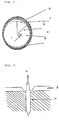
- FIG. 1 is a view showing a cross-sectional shape of a fiber of the present invention
- FIG. 2 is a view showing an example of a spinneret used in the production of the fiber of the present invention.
- reference numerals denote the followings.
- the present invention relates to a sheath-core composite conductive fiber comprising a core component made of a fiber-forming polymer and a sheath component made of a fiber-forming polymer containing conductive carbon black.
- the fiber-forming polymer, which constitutes the core component is located at the inside of the fiber-forming polymer containing conductive carbon black, which constitutes the sheath component.
- a radius R of an inscribed circle of the sheath component and a distance r between the center of an inscribed circle of the sheath component and the center of an inscribed circle of the core component has a specific relationship.
- polyester is useful as the fiber-forming polymer, which constitutes the core component.
- polyester for example, polyethylene terephthalate, polybutylene terephthalate, polyethylene oxide benzoate, and copolyester containing the polyester as a main component are well known.
- the core component is made of a polyester containing ethylene terephthalate as a main component.
- the polymer may contain inorganic particles such as titanium oxide particles.
- polyester is useful as the conductive carbon black-containing fiber-forming polymer, which constitutes the sheath component.
- polyester for example, polyethylene terephthalate, polybutylene terephthalate, polyethylene oxide benzoate, and copolyester containing the polyester as a main component are well known.
- the sheath component is made of a mixture of a copolyester wherein ethylene terephthalate accounts for 10 to 90 mol % of constituent units thereof and carbon black.
- the sheath-core composite conductive fiber which does not satisfy the relationship 1 between r and R, has poor coherency of yarn because of decentering of the core component, and also has poor passableness of the post process because of the waviness. With respect to the sheath-core composite conductive fiber, which satisfies the relationship, decentering of the core component does not occur and the passableness of the spinning process and post process is excellent because of less waviness.
- the roughness of the wall surface H of a lead hole of a flow channel of the fiber-forming polymer, which constitutes the sheath component, of a spinneret nozzle is controlled to 1.6S or less. Furthermore, when the flow channel of the polymer in the vicinity of a capillary portion inlet is narrow down or the flow channel is streamlined, the fluidity of the polymer is further improved and the spinnability becomes superior.
- the content of the conductive carbon black in the fiber-forming polymer, which constitutes the sheath component is preferably within a range from 10 to 50% by weight, and more preferably from 15 to 40% by weight.
- the content of the conductive carbon black is within the above range, the resulting fiber is superior in fiber-forming performances and conductivity. Therefore, it is preferred.
- the conductive carbon black can be mixed with the fiber-forming polymer by a publicly known method, for example, kneading with heating using a twin-screw extruder.
- the core-sheath ratio of the sheath-core composite conductive fiber of the present invention is preferably within a range from 20:1 to 1:2 in terms of an area ratio of the core component to the sheath component.
- the core-sheath ratio is within the above range, the resulting fiber is superior in strength of the fiber and sheath-core formation.
- This invention relates to a polyester fiber among the sheath-core composite conductive fiber wherein the sheath component is a conductive component.
- the use of a polyester material makes it possible to improve the conductivity, durability of conductivity and passableness of the spinning process and post process, and to obtain a conductive fiber having excellent chemical resistance.
- the copolyester as the sheath component of the sheath-core composite conductive fiber of the present invention is a copolyester wherein ethylene terephthalate accounts for 10 to 90 mol % of constituent units thereof.
- Various components can be used as the copolymerization component of the copolyester, as the sheath component.
- examples thereof include dicarboxylic acids such as isophthalic acid, orthophthalic acid and naphthalenedicarboxylic acid; and glycols (diols) such as polyethylene glycol.
- dicarboxylic acids such as isophthalic acid, orthophthalic acid and naphthalenedicarboxylic acid
- glycols (diols) such as polyethylene glycol.
- isophthalic acid, orthophthalic acid and naphthalenedicarboxylic acid are preferably used.
- a copolymerization ratio thereof is preferably within a range from 10 to 50 mol %, and more preferably from 10 to 40 mol %.
- This copolymerization ratio means a ratio in an acid component in case of dicarboxylic acids, while it means a ratio in a glycol component in case of glycols.
- the copolymerization ratio is smaller than 10 mol %, a sheath-core structure is not formed. In this case, protrusions are formed on the surface of the fiber and, furthermore, the polymer does not penetrate into the sheath portion of a single layer of a portion of the fiber and the resulting fiber is composed of only a core component. Such a fiber is drastically inferior in process passableness such as spinnability, drawability or post processability.
- the copolymerization ratio exceeds 90 mol %, the melting point is reduced and the polymer is deteriorated by heating to the spinning temperature required to the core component, thereby to cause yarn breakage and to drastically lower the spinnability.
- the core component in the sheath-core composite conductive fiber of the present invention is a homoester or copolyester containing ethylene terephthalate as a main component, and is preferably a homo PET (polyethylene terephthalate).
- the copolymerization component used in the copolyester include dicarboxylic acid component such as adipic acid, sebacic acid, phthalic acid, naphthalenedicarboxylic acid, or sulfoisophthalic acid; hydroxycarboxylic acid component such as 1-hydroxy-2-carboxyethane; and diol component such as ethylene glycol, diethylene glycol, or triethylene glycol tetraethylene glycol.
- the copolymerization ratio of the copolyester is preferably within a range from 10 to 30 mol %.
- the copolyester may contain inorganic particles such as titanium oxide particles.
- the content of carbon black of the sheath component in the sheath-core composite conductive fiber is preferably within a range from 10 to 50% by weight. When the content of carbon black is within the range described above, a fiber having excellent fiber-forming capability and conductivity can be obtained.
- the conductive carbon black can be mixed with the copolyester by a publicly known method, for example, kneading with heating using a twin-screw extruder.
- FIG. 1 is a view showing an example of a composite structure suited for use in the present invention.
- the core-sheath ratio of the sheath-core composite conductive fiber of the present invention is preferably within a range from 1:2 to 20:1 (core:sheath) in terms of an area ratio of the core component to the sheath component.
- core:sheath a fiber having excellent fiber-forming properties and conductivity can be obtained. Therefore, it is preferred.
- the surface resistance was measured in the following manner. Using a sample (60 mm in a weft direction, 50 mm in a warp direction) made of a cloth produced by mixing, as a warp, a sheath-core composite conductive fiber at a pitch of 10 mm, an electrode contacted with the whole 50 mm in the warp direction was brought into contact with the cloth, 50 mm apart in the weft direction, a resistance value was measured under the conditions in the absence of a conductive paste. A high resistance meter 4329A manufactured by Hewlett-Packard Company was used as a resistance meter.
- the MI value was measured by using a meter type C-5059D manufactured by Toyo Seiki Seisaku-Sho, Ltd. A resin was melted at a specific temperature and the molten resin was extruded through an orifice having a diameter of 0.5 mm for 10 minutes, and then the weight of the resin discharged was taken as the MI value.
- the washing durability was evaluated whether or not an increase in resistance value was recognized after washing 100 times, using the method defined in JIS L0217 E103. The case where an increase in resistance value was not recognized after washing 100 times was rated "good ( ⁇ )", while the case where an increase in resistance value was recognized was rated "poor ( ⁇ )".
- the acid resistance was evaluated whether or not dissolution occurred after immersing in 95% formic acid. The case where dissolution did not occur after about 5 minutes have passed since the beginning of immersion was rated "good ( ⁇ )", while dissolution occurred was rated “poor ( ⁇ )",
- the sheath-core formation state of the fiber was evaluated. The case where the whole filaments have a sheath-core structure were rated "good ( ⁇ )", while the other cases were rated “poor ( ⁇ )".
- the strength of the fiber was measured by Autograph AGS-1KNG manufactured by Shimadzu Corporation.
- a conductive polymer prepared by dispersing 26% by weight of conductive carbon black into polyethylene terephthalate prepared by copolymerizing 12 mol % of isophthalic acid, as a sheath component, and homopolyethylene terephthalate, as a core component, are combined in a core/sheath ratio shown in Table 1-1.
- the resulting composite material was melt-spun through a spinneret orifice having a bore diameter of 0.5 mm at 285°C under the condition that the roughness of the wall surface H of a lead hole of a flow channel of a conductive polymer is not more than 1.6S, and then taken up at a speed of 1000 m/min while oiling with an oiling agent to obtain an undrawn yarn of 12 filaments with a circular cross section.
- the undrawn yarn was further drawn by passing through a drawing roller at 100°C, heat-treated on a hot plate at 140°C and then taken up to obtain a drawn yarn having 84 decitex per 12 filaments.
- Table 1-1 Reference Example 1-2
- a conductive polymer prepared by dispersing 33% by weight of conductive carbon black into nylon 12, as a sheath component, and nylon 12, as a core component, are combined in a core/sheath ratio shown in Table 1.
- the resulting composite material was melt-spun through a spinneret orifice having a bore diameter of 0. 7 mm at 270°C under the condition that the roughness of the wall surface H of a lead hole of a flow channel of a conductive polymer is not more than 1.6S, and then taken up at a speed of 700 m/min while oiling with an oiling agent to obtain an undrawn yarn of 24 filaments with a circular cross section.
- the undrawn yarn was further drawn by passing through a drawing roller at 90°C, heat-treated on a hot plate at 150°C and then taken up to obtain a drawn yarn having 167 decitex per 24 filaments.
- Table 1-1 The evaluation results are shown in Table 1-1.
- a conductive polymer prepared by dispersing 30% by weight of conductive carbon black into nylon 6, as a sheath component, and nylon 6, as a core component, are combined in a core/sheath ratio shown in Table 1.
- the resulting composite material was melt-spun through a spinneret orifice having a bore diameter of 0.5 mm at 270°C under the condition that the roughness of the wall surface H of a lead hole of a flow channel of a conductive polymer is not more than 1.6S, and then taken up at a speed of 700 m/min while oiling with an oiling agent to obtain an undrawn yarn of 24 filaments with a circular cross section.
- the undrawn yarn was further drawn by passing through a drawing roller at 90°C, heat-treated on a hot plate at 150°C and then taken up to obtain a drawn yarn having 160 decitex per 24 filaments.
- Table 1-1 The evaluation results are shown in Table 1-1.
- a conductive polymer prepared by dispersing 23% by weight of conductive carbon black into polyethylene terephthalate prepared by copolymerizing polyethylene glycol, as a sheath component, and homopolyethylene terephthalate, as a core component, are combined in a core/sheath ratio shown in Table 1.
- the resulting composite material was melt-spun through a spinneret orifice having a bore diameter of 0.5 mm at 285°C under the condition that the roughness of the wall surface H of a lead hole of a flow channel of a conductive polymer is not more than 1.6S, and then taken up at a speed of 1000 m/min while oiling with an oiling agent to obtain an undrawn yarn of 12 filaments with a circular cross section.
- the undrawn yarn was further drawn by passing through a drawing roller at 100°C, heat-treated on a hot plate at 140°C and then taken up to obtain a drawn yarn having 84 decitex per 12 filaments.
- Table 1-1 The
- a conductive polymer prepared by dispersing 26% by weight of conductive carbon black into polyethylene terephthalate prepared by copolymerizing 12 mol % of isophthalic acid, as a sheath component, and homopolyethylene terephthalate, as a core component, are combined in a core-sheath ratio shown in Table 1-1.
- the resulting composite material was melt-spun through a spinneret orifice having a bore diameter of 0.5 mm at 285°C under the condition that the roughness of the wall surface H of a lead hole of a flow channel of a conductive polymer is not less than 3.2S, and then taken up at a speed of 1000 m/min while oiling with an oiling agent to obtain an undrawn yarn of 12 filaments with a circular cross section.
- the undrawn yarn was further drawn by passing through a drawing roller at 100°C, heat-treated on a hot plate at 140°C and then taken up to obtain a drawn yarn having 84 decitex per 12 filaments.
- Table 1-1 The evaluation results are shown in Table 1-1.
- a conductive polymer prepared by dispersing 33% by weight of conductive carbon black into nylon 12, as a sheath component, and nylon 12, as a core component, are combined in a core-sheath ratio shown in Table 1.
- the resulting composite material was melt-spun through a spinneret orifice having a bore diameter of 0.7 mm at 270°C under the condition that the roughness of the wall surface H of a lead hole of a flow channel of a conductive polymer is not less than 3.2S, and then taken up at a speed of 700 m/min while oiling with an oiling agent to obtain an undrawn yarn of 24 filaments with a circular cross section.
- the undrawn yarn was further drawn by passing through a drawing roller at 90°C, heat-treated on a hot plate at 150°C and then taken up to obtain a drawn yarn having 167 decitex per 24 filaments.
- Table 1-1 The evaluation results are shown in Table 1-1.
- a conductive polymer prepared by dispersing 30% by weight of conductive carbonblack into nylon 6, as a sheath component, and nylon 6, as a core component, are combined in a core-sheath ratio shown in Table 1.
- the resulting composite material was melt-spun through a spinneret orifice having a bore diameter of 0.5 mm at 270°C under the condition that the roughness of the wall surface H of a lead hole of a flow channel of a conductive polymer is not less than 3.2S, and then taken up at a speed of 700 m/min while oiling with an oiling agent to obtain an undrawn yarn of 24 filaments with a circular cross section.
- the undrawn yarn was further drawn by passing through a drawing roller at 90°C, heat-treated on a hot plate at 150°C and then taken up to obtain a drawn yarn having 160 decitex per 24 filaments.
- the evaluation results are shown in Table 1-1.
- a conductive polymer prepared by dispersing 23% by weight of conductive carbon black into polyethylene terephthalate prepared by copolymerizing polyethylene glycol, as a sheath component, and polyethylene terephthalate, as a core component, are combined in a core/sheath ratio shown in Table 1-1.
- the resulting composite material was melt-spun through a spinneret orifice having a bore diameter of 0.5 mm at 285°C under the condition that the roughness of the wall surface H of a lead hole of a flow channel of a conductive polymer is not less than 3.2S, and then taken up at a speed of 1000 m/min while oiling with an oiling agent to obtain an undrawn yarn of 12 filaments with a circular cross section.
- the undrawn yarn was further drawn by passing through a drawing roller at 100°C, heat-treated on a hot plate at 140°C and then taken up to obtain a drawn yarn having 84 decitex per 12 filaments.
- the evaluation results are
- a conductive polymer having a MI value of 0.02 prepared by dispersing 26% by weight of conductive carbon black into polyethylene terephthalate prepared by copolymerizing 30 mol % of isophthalic acid, as a sheath component, and polyethylene terephthalate (PET) having a MI value of 2.1, as a core component, are combined in a core-sheath ratio shown in Table 1-1.
- the resulting composite material was melt-spun through a spinneret orifice having a bore diameter of 0.25 mm at 290°C and then taken up at a speed of 700 m/min while oiling with an oiling agent to obtain an undrawn yarn of 12 filaments with a circular cross section.
- the undrawn yarn was further drawn by passing through a drawing roller at 100°C, heat-treated on a hot plate at 140°C and then taken up to obtain a drawn yarn having 84 desitex per 12 filaments.
- the evaluation results are shown in Table 2-1.
- Example 2-1 The same operation as in Example 2-1 was repeated, except that the copolyester was changed as shown in Table 2-1.
- the evaluation results are shown in Table 2-1.
- Example 2-1 The same operation as in Example 2-1 was repeated, except that the copolyester and the core-sheath ratio in Example 2-1 were changed as shown in Table 2-1.
- the evaluation results are shown in Table 2-1. Since a yarn could not be obtained under the conditions of Comparative Example 2-1, the surface resistance, strength, washing durability and formic acid resistance could not be evaluated.
- Example 2-1 The same operation as in Example 2-1 was repeated, except that the copolyester in Example 2-1 was changed as shown in Table 2-1.
- the evaluation results are shown in Table 2-1. Since a yarn could not be obtained under the conditions of Comparative Example 2-2, the surface resistance, strength, washing durability and formic acid resistance could not be evaluated.
- Example 2-1 The same operation as in Example 2-1 was repeated, except that the sheath-core ratio in Example 2-1 was changed as shown in Table 2-1. The evaluation results are shown in Table 2-1.
- Example 2-1 The same operation as in Example 2-1 was repeated, except that the core component in Example 2-1 was changed to 6 nylon (6 Ny) and the core-sheath ratio was changed as shown in Table 2-1. The evaluation results are shown in Table 2-1. [Table 2-1] Reference Example 2-1 Reference Example 2-2 Reference Example 2-3 Comp. Example 2-1 Comp. Example 2-2 Comp.
- the sheath-core composite conductive fiber of the present invention is in the form that the conductive component completely surrounds the non-conductive component and the conductive component is exposed to the whole surface in a cross-sectional shape of the fiber, and has good passableness of the spinning process and post process. Furthermore, a composite conductive fiber having excellent chemical resistance can be obtained by constituting the core component and the sheath component using a specific polyester.
- the conductive fiber of the present invention can be used alone or in combination with other fibers in various applications.
- Examples of the purpose for which the conductive fiber of the present invention used include special working clothes such as dust-free clothes, and interiors such as carpets.
Landscapes
- Engineering & Computer Science (AREA)
- Chemical & Material Sciences (AREA)
- Chemical Kinetics & Catalysis (AREA)
- General Chemical & Material Sciences (AREA)
- Textile Engineering (AREA)
- Manufacturing & Machinery (AREA)
- Multicomponent Fibers (AREA)
Claims (5)
- Leitfähige Mantel-Kern-Verbundfaser, umfassend eine Mantelkomponente, hergestellt aus einem Faser-bildenden Polymer, enthaltend leitfähigen Ruß, dadurch gekennzeichnet, daß eine Kernkomponente und eine Mantelkomponente die folgende Beziehung erfüllt:

die Mantelkomponente aus einem Gemisch eines Copolyesters, wobei Ethylenterephthalat 10 bis 90 Molprozent der aufbauenden Einheiten davon ausmacht, und Ruß hergestellt ist. - Leitfähige Mantel-Kern-Verbundfaser nach Anspruch 1, wobei die Mantelkomponente ein Polyester ist, hergestellt durch Copolymerisieren einer Copolymerisationskomponente, ausgewählt aus der Gruppe, bestehend aus Isophthalsäure, Orthophthalsäure und Napththalindicarbonsäure.
- Leitfähige Mantel-Kern-Verbundfaser nach Anspruch 1, wobei ein Copolymerisationsverhältnis der Copolymerisationskomponente der Mantelkomponente im Bereich von 10 bis 50 Molprozent liegt.
- Leitfähige Mantel-Kern-Verbundfaser nach Anspruch 1, wobei der Ruß-Gehalt der Mantelkomponente im Bereich von 10 bis 50 Gew.-% liegt.
- Leitfähige Mantel-Kern-Verbundfaser nach Anspruch 1, wobei ein Kern-Mantel-Verhältnis im Bereich von 20:1 bis 1:2 liegt, bezogen auf ein Flächenverhältnis der Kernkomponente zu der Mantelkomponente.
Applications Claiming Priority (3)
| Application Number | Priority Date | Filing Date | Title |
|---|---|---|---|
| JP26341399 | 1999-09-17 | ||
| JP26341399 | 1999-09-17 | ||
| PCT/JP2000/006112 WO2001021867A1 (en) | 1999-09-17 | 2000-09-07 | Core-sheath composite conductive fiber |
Publications (4)
| Publication Number | Publication Date |
|---|---|
| EP1219734A1 EP1219734A1 (de) | 2002-07-03 |
| EP1219734A4 EP1219734A4 (de) | 2005-06-29 |
| EP1219734B1 EP1219734B1 (de) | 2011-01-26 |
| EP1219734B2 true EP1219734B2 (de) | 2017-09-13 |
Family
ID=17389160
Family Applications (1)
| Application Number | Title | Priority Date | Filing Date |
|---|---|---|---|
| EP00957018.5A Expired - Lifetime EP1219734B2 (de) | 1999-09-17 | 2000-09-07 | Leitfähige kern-mantel-verbundfaser |
Country Status (12)
| Country | Link |
|---|---|
| US (1) | US6710242B1 (de) |
| EP (1) | EP1219734B2 (de) |
| JP (2) | JP4790954B2 (de) |
| KR (1) | KR100429481B1 (de) |
| CN (1) | CN1265038C (de) |
| AT (1) | ATE497037T1 (de) |
| AU (1) | AU6874400A (de) |
| CA (1) | CA2385034C (de) |
| DE (1) | DE60045581D1 (de) |
| ES (1) | ES2360428T5 (de) |
| TW (1) | TW517105B (de) |
| WO (1) | WO2001021867A1 (de) |
Families Citing this family (29)
| Publication number | Priority date | Publication date | Assignee | Title |
|---|---|---|---|---|
| US7045211B2 (en) * | 2003-07-31 | 2006-05-16 | Kimberly-Clark Worldwide, Inc. | Crimped thermoplastic multicomponent fiber and fiber webs and method of making |
| US20050170177A1 (en) * | 2004-01-29 | 2005-08-04 | Crawford Julian S. | Conductive filament |
| WO2005100651A1 (en) | 2004-03-23 | 2005-10-27 | Solutia, Inc. | Bi-component electrically conductive drawn polyester fiber and method for making same |
| CN1314845C (zh) * | 2005-05-26 | 2007-05-09 | 天津工业大学 | 一种微波屏蔽纤维及其制造方法 |
| CN101278080B (zh) * | 2005-09-28 | 2012-04-04 | 东丽株式会社 | 聚酯纤维及使用了该聚酯纤维的纤维制品 |
| CN101331251B (zh) * | 2005-10-21 | 2012-12-05 | 可乐丽股份有限公司 | 导电性复合纤维及其制备方法 |
| DE102006006944A1 (de) * | 2006-02-14 | 2007-08-23 | TRüTZSCHLER GMBH & CO. KG | Vorrichtung an einer Karde für Baumwolle, Chemiefasern u. dgl., bei der mindestens ein Deckelstab mit einer Deckelgarnitur vorhanden ist. |
| US20070274738A1 (en) * | 2006-05-23 | 2007-11-29 | Kabushiki Kaisha Toshiba | Conductive brush, process cartridge and image forming apparatus |
| US20080003430A1 (en) * | 2006-06-28 | 2008-01-03 | 3M Innovative Properties Company | Particulate-loaded polymer fibers and extrusion methods |
| TW200815514A (en) * | 2006-09-18 | 2008-04-01 | Nyco Minerals Inc | Wollastonite-based electrically-conductive reinforcing materials |
| WO2009053470A1 (en) * | 2007-10-24 | 2009-04-30 | Queen Mary And Westfield College, University Of London | Conductive polymer composite |
| CN101434739B (zh) * | 2008-12-08 | 2011-12-14 | 苏州贤聚新材料科技有限公司 | 一种导电高分子树脂以及皮芯复合结构可染色抗静电纤维 |
| US8192316B2 (en) * | 2009-02-03 | 2012-06-05 | The Gates Corporation | Belt with wear-resistant anti-static fabric |
| CN102766987A (zh) * | 2011-05-05 | 2012-11-07 | 绍兴豪德斯电暖科技有限公司 | 一种高性能导电纤维的生产方法 |
| CN103320891B (zh) * | 2013-05-24 | 2015-05-13 | 宁波三邦日用品有限公司 | 抗静电涤丙复合超细纤维及生产方法 |
| KR102113351B1 (ko) * | 2013-12-23 | 2020-05-20 | 도레이첨단소재 주식회사 | 전자파 차폐 및 흡음성능이 우수한 복합섬유집합체 및 이의 제조방법 |
| US20160338645A1 (en) * | 2014-01-28 | 2016-11-24 | Nippon Telegraph And Telephone Corporation | Electrode material and device |
| JP2015181896A (ja) * | 2014-03-26 | 2015-10-22 | 帝人株式会社 | こたつ用繊維製品 |
| CN106592015B (zh) * | 2016-11-21 | 2020-03-24 | 厦门安踏体育用品有限公司 | 一种聚酯纤维的制造方法、聚酯纤维、面料及服装 |
| CN107142554B (zh) * | 2017-06-28 | 2023-08-08 | 棉联(北京)网络科技有限公司 | 一种压阻纤维、纱线及压阻传感器和织物 |
| CN107354533B (zh) * | 2017-08-23 | 2022-07-01 | 厦门翔鹭化纤股份有限公司 | 一种导电聚酯纤维 |
| KR102431255B1 (ko) * | 2017-10-18 | 2022-08-11 | 유니버시티 오브 센트럴 플로리다 리서치 파운데이션, 인코포레이티드 | 전기 전도성 코어 및 변색 코팅을 갖는 섬유 |
| CN108823678A (zh) * | 2018-05-24 | 2018-11-16 | 东华大学 | 一种均质纤维及其制备方法 |
| US20210047756A1 (en) * | 2019-08-12 | 2021-02-18 | Universal Fibers, Inc. | Eco-friendly polyester fibers and microfiber shed-resistance polyester textiles |
| CN110409017B (zh) * | 2019-08-12 | 2022-01-14 | 杭州高烯科技有限公司 | 一种高导电的锦涤复合纤维及其制备方法 |
| KR102282527B1 (ko) * | 2020-05-15 | 2021-07-27 | 한국화학연구원 | 미세먼지 제거 장치 |
| US11708649B2 (en) | 2020-05-21 | 2023-07-25 | University Of Central Florida Research Foundation, Inc. | Color-changing fabric having printed pattern |
| US11479886B2 (en) | 2020-05-21 | 2022-10-25 | University Of Central Florida Research Foundation, Inc. | Color-changing fabric and applications |
| CN120273061B (zh) * | 2025-06-11 | 2025-08-26 | 江苏国望高科纤维有限公司 | 一种导电聚酯纤维及其制备方法和应用 |
Citations (3)
| Publication number | Priority date | Publication date | Assignee | Title |
|---|---|---|---|---|
| JPS5147200A (ja) † | 1974-10-17 | 1976-04-22 | Mitsubishi Rayon Co | Dodenseiseni |
| JPS51109321A (de) † | 1975-03-03 | 1976-09-28 | Ici Ltd | |
| JPH1165227A (ja) † | 1997-08-14 | 1999-03-05 | Kanebo Ltd | 導電性複合繊維及びそれからなる接触帯電ブラシ |
Family Cites Families (21)
| Publication number | Priority date | Publication date | Assignee | Title |
|---|---|---|---|---|
| JPS60444B2 (ja) * | 1975-11-04 | 1985-01-08 | 三菱レイヨン株式会社 | 導電性繊維 |
| AU503665B1 (en) * | 1977-08-08 | 1979-09-13 | Kanebo Limited | Conductive composite filaments |
| JPS551337A (en) * | 1978-06-15 | 1980-01-08 | Toray Ind Inc | Electrically conducitive synthetic fiber and its production |
| JPS5615415A (en) * | 1979-07-13 | 1981-02-14 | Toray Ind Inc | Electrically conductive synthetic fiber |
| JPS5725647A (en) | 1980-07-23 | 1982-02-10 | Hitachi Ltd | Manufacture of fluorescent lamp |
| JPS57111874U (de) * | 1980-12-26 | 1982-07-10 | ||
| JPS6019811B2 (ja) | 1981-11-06 | 1985-05-18 | 株式会社日立製作所 | アドレス変換装置 |
| JPS61132624A (ja) * | 1984-11-28 | 1986-06-20 | Toray Ind Inc | 高導電性複合繊維 |
| JPH0639728B2 (ja) * | 1985-03-01 | 1994-05-25 | 東レ・モノフィラメント株式会社 | 導電性モノフイラメントの製造方法 |
| NL8502811A (nl) | 1985-10-15 | 1987-05-04 | Philips Nv | Geintegreerde geheugenschakeling. |
| JPH0639688A (ja) * | 1992-09-16 | 1994-02-15 | Asahi Chem Ind Co Ltd | 鏡面化タンタル |
| JPH06294014A (ja) * | 1993-04-05 | 1994-10-21 | Toray Ind Inc | 導電性繊維の製造方法 |
| US5593778A (en) * | 1993-09-09 | 1997-01-14 | Kanebo, Ltd. | Biodegradable copolyester, molded article produced therefrom and process for producing the molded article |
| JP3110633B2 (ja) * | 1994-02-02 | 2000-11-20 | 東レ株式会社 | ポリエステル組成物、モノフィラメントおよび工業用織物 |
| JPH07278956A (ja) * | 1994-03-31 | 1995-10-24 | Toray Ind Inc | 導電性ポリエステルモノフィラメントおよび工業用織物 |
| JP3281726B2 (ja) | 1994-08-30 | 2002-05-13 | 東レ株式会社 | 導電性ポリエステルモノフィラメントおよび工業用織物 |
| JPH08269816A (ja) * | 1995-03-30 | 1996-10-15 | Toray Ind Inc | ポリアミド高強力糸の製造方法 |
| JPH09300428A (ja) * | 1996-05-20 | 1997-11-25 | Toray Ind Inc | 口 金 |
| US5916506A (en) * | 1996-09-30 | 1999-06-29 | Hoechst Celanese Corp | Electrically conductive heterofil |
| JPH11111874A (ja) * | 1997-09-30 | 1999-04-23 | Hitachi Ltd | 半導体集積回路装置及びその製造方法 |
| US5924920A (en) * | 1998-01-15 | 1999-07-20 | Flow Safe, Inc. | Fume hood having a bi-stable vortex |
-
2000
- 2000-09-07 EP EP00957018.5A patent/EP1219734B2/de not_active Expired - Lifetime
- 2000-09-07 CN CNB008129231A patent/CN1265038C/zh not_active Expired - Lifetime
- 2000-09-07 ES ES00957018.5T patent/ES2360428T5/es not_active Expired - Lifetime
- 2000-09-07 WO PCT/JP2000/006112 patent/WO2001021867A1/ja not_active Ceased
- 2000-09-07 CA CA002385034A patent/CA2385034C/en not_active Expired - Lifetime
- 2000-09-07 AT AT00957018T patent/ATE497037T1/de active
- 2000-09-07 JP JP2001525021A patent/JP4790954B2/ja not_active Expired - Lifetime
- 2000-09-07 AU AU68744/00A patent/AU6874400A/en not_active Abandoned
- 2000-09-07 KR KR10-2002-7003532A patent/KR100429481B1/ko not_active Expired - Lifetime
- 2000-09-07 DE DE60045581T patent/DE60045581D1/de not_active Expired - Lifetime
- 2000-09-07 US US10/070,885 patent/US6710242B1/en not_active Expired - Lifetime
- 2000-09-15 TW TW089118924A patent/TW517105B/zh not_active IP Right Cessation
-
2008
- 2008-02-12 JP JP2008030008A patent/JP4916460B2/ja not_active Expired - Lifetime
Patent Citations (3)
| Publication number | Priority date | Publication date | Assignee | Title |
|---|---|---|---|---|
| JPS5147200A (ja) † | 1974-10-17 | 1976-04-22 | Mitsubishi Rayon Co | Dodenseiseni |
| JPS51109321A (de) † | 1975-03-03 | 1976-09-28 | Ici Ltd | |
| JPH1165227A (ja) † | 1997-08-14 | 1999-03-05 | Kanebo Ltd | 導電性複合繊維及びそれからなる接触帯電ブラシ |
Non-Patent Citations (2)
| Title |
|---|
| M. WATANABE: "Special-Function Fibers", 28 November 1983, CMC, TOKYO, pages: 134-137 - 144-145 † |
| S.G. Barker; Overview of " The Physical Significance of Crimp or Waviness in the wool fibre" Transactions of the Faraday Society. Vol. 29, 1933 † |
Also Published As
| Publication number | Publication date |
|---|---|
| US6710242B1 (en) | 2004-03-23 |
| JP2008156810A (ja) | 2008-07-10 |
| DE60045581D1 (de) | 2011-03-10 |
| CA2385034A1 (en) | 2001-03-29 |
| EP1219734B1 (de) | 2011-01-26 |
| KR20020048410A (ko) | 2002-06-22 |
| EP1219734A1 (de) | 2002-07-03 |
| ATE497037T1 (de) | 2011-02-15 |
| TW517105B (en) | 2003-01-11 |
| CA2385034C (en) | 2005-04-12 |
| JP4916460B2 (ja) | 2012-04-11 |
| EP1219734A4 (de) | 2005-06-29 |
| ES2360428T5 (es) | 2018-01-29 |
| WO2001021867A1 (en) | 2001-03-29 |
| CN1375019A (zh) | 2002-10-16 |
| KR100429481B1 (ko) | 2004-05-03 |
| JP4790954B2 (ja) | 2011-10-12 |
| AU6874400A (en) | 2001-04-24 |
| ES2360428T3 (es) | 2011-06-03 |
| CN1265038C (zh) | 2006-07-19 |
Similar Documents
| Publication | Publication Date | Title |
|---|---|---|
| EP1219734B2 (de) | Leitfähige kern-mantel-verbundfaser | |
| CA1158816A (en) | Conductive composite filaments and methods for producing said composite filaments | |
| JPWO2001021867A1 (ja) | 芯鞘複合型導電性繊維 | |
| EP2037015B1 (de) | Leitende hülle-kern-konjugatfaser und herstellungsverfahren dafür | |
| US5318845A (en) | Conductive composite filament and process for producing the same | |
| US5213892A (en) | Antistatic core-sheath filament | |
| JP4367038B2 (ja) | 繊維および布帛 | |
| US5820805A (en) | Process for making multicomponent antistatic fibers | |
| JP3778088B2 (ja) | スクリーン紗用芯鞘型複合ポリエステルモノフィラメントおよびその製造方法 | |
| EP0343496B1 (de) | Leitfähiges zusammengesetztes Filament und Verfahren zur Herstellung desselben | |
| JP7340183B1 (ja) | 芯鞘型ポリエステル複合繊維、及びその製造方法 | |
| JP2010059589A (ja) | 複合導電性繊維 | |
| EP1143050A1 (de) | Monofilament aus polyester für siebdruckraster | |
| JP2011157647A (ja) | ワイピングクロス | |
| JPS6240444B2 (de) | ||
| JP2004036040A (ja) | 制電性織編物及び防塵衣 | |
| JP3299500B2 (ja) | スクリーン紗用ポリエステルモノフィラメント | |
| JP2008081881A (ja) | 制電性複合繊維 | |
| KR900004912B1 (ko) | 도전성 폴리에스테르 섬유의 제조방법 | |
| JP2004211221A (ja) | スクリーン紗用芯鞘型複合ポリエステルモノフィラメントおよびその製造方法ならびにスクリーン印刷用メッシュ織物 | |
| JP2007119975A (ja) | 導電性混繊糸 | |
| JP2019026991A (ja) | 黒原着ポリエステル繊維 | |
| JPWO2018079567A1 (ja) | ナノボイドポリエステル繊維 | |
| JP4726318B2 (ja) | 制電性複合モノフィラメント | |
| CN117813425A (zh) | 芯鞘型聚酯复合纤维及其制造方法 |
Legal Events
| Date | Code | Title | Description |
|---|---|---|---|
| PUAI | Public reference made under article 153(3) epc to a published international application that has entered the european phase |
Free format text: ORIGINAL CODE: 0009012 |
|
| 17P | Request for examination filed |
Effective date: 20020307 |
|
| AK | Designated contracting states |
Kind code of ref document: A1 Designated state(s): AT BE CH CY DE DK ES FI FR GB GR IE IT LI LU MC NL PT SE |
|
| AX | Request for extension of the european patent |
Free format text: AL;LT;LV;MK;RO;SI |
|
| A4 | Supplementary search report drawn up and despatched |
Effective date: 20050513 |
|
| RAP1 | Party data changed (applicant data changed or rights of an application transferred) |
Owner name: KB SEIREN, LTD. |
|
| GRAP | Despatch of communication of intention to grant a patent |
Free format text: ORIGINAL CODE: EPIDOSNIGR1 |
|
| GRAS | Grant fee paid |
Free format text: ORIGINAL CODE: EPIDOSNIGR3 |
|
| GRAA | (expected) grant |
Free format text: ORIGINAL CODE: 0009210 |
|
| AK | Designated contracting states |
Kind code of ref document: B1 Designated state(s): AT BE CH CY DE DK ES FI FR GB GR IE IT LI LU MC NL PT SE |
|
| REG | Reference to a national code |
Ref country code: GB Ref legal event code: FG4D |
|
| REG | Reference to a national code |
Ref country code: CH Ref legal event code: EP |
|
| REG | Reference to a national code |
Ref country code: CH Ref legal event code: NV Representative=s name: PATENTANWAELTE SCHAAD, BALASS, MENZL & PARTNER AG |
|
| REG | Reference to a national code |
Ref country code: IE Ref legal event code: FG4D |
|
| REF | Corresponds to: |
Ref document number: 60045581 Country of ref document: DE Date of ref document: 20110310 Kind code of ref document: P |
|
| REG | Reference to a national code |
Ref country code: DE Ref legal event code: R096 Ref document number: 60045581 Country of ref document: DE Effective date: 20110310 |
|
| REG | Reference to a national code |
Ref country code: NL Ref legal event code: T3 |
|
| REG | Reference to a national code |
Ref country code: ES Ref legal event code: FG2A Ref document number: 2360428 Country of ref document: ES Kind code of ref document: T3 Effective date: 20110603 |
|
| PG25 | Lapsed in a contracting state [announced via postgrant information from national office to epo] |
Ref country code: SE Free format text: LAPSE BECAUSE OF FAILURE TO SUBMIT A TRANSLATION OF THE DESCRIPTION OR TO PAY THE FEE WITHIN THE PRESCRIBED TIME-LIMIT Effective date: 20110126 Ref country code: GR Free format text: LAPSE BECAUSE OF FAILURE TO SUBMIT A TRANSLATION OF THE DESCRIPTION OR TO PAY THE FEE WITHIN THE PRESCRIBED TIME-LIMIT Effective date: 20110427 Ref country code: PT Free format text: LAPSE BECAUSE OF FAILURE TO SUBMIT A TRANSLATION OF THE DESCRIPTION OR TO PAY THE FEE WITHIN THE PRESCRIBED TIME-LIMIT Effective date: 20110526 |
|
| PG25 | Lapsed in a contracting state [announced via postgrant information from national office to epo] |
Ref country code: FI Free format text: LAPSE BECAUSE OF FAILURE TO SUBMIT A TRANSLATION OF THE DESCRIPTION OR TO PAY THE FEE WITHIN THE PRESCRIBED TIME-LIMIT Effective date: 20110126 Ref country code: CY Free format text: LAPSE BECAUSE OF FAILURE TO SUBMIT A TRANSLATION OF THE DESCRIPTION OR TO PAY THE FEE WITHIN THE PRESCRIBED TIME-LIMIT Effective date: 20110126 |
|
| PLBI | Opposition filed |
Free format text: ORIGINAL CODE: 0009260 |
|
| PG25 | Lapsed in a contracting state [announced via postgrant information from national office to epo] |
Ref country code: DK Free format text: LAPSE BECAUSE OF FAILURE TO SUBMIT A TRANSLATION OF THE DESCRIPTION OR TO PAY THE FEE WITHIN THE PRESCRIBED TIME-LIMIT Effective date: 20110126 |
|
| PGFP | Annual fee paid to national office [announced via postgrant information from national office to epo] |
Ref country code: CH Payment date: 20110913 Year of fee payment: 12 |
|
| PLAX | Notice of opposition and request to file observation + time limit sent |
Free format text: ORIGINAL CODE: EPIDOSNOBS2 |
|
| 26 | Opposition filed |
Opponent name: KURARAY CO., LTD. Effective date: 20111024 |
|
| REG | Reference to a national code |
Ref country code: DE Ref legal event code: R026 Ref document number: 60045581 Country of ref document: DE Effective date: 20111024 |
|
| PLBB | Reply of patent proprietor to notice(s) of opposition received |
Free format text: ORIGINAL CODE: EPIDOSNOBS3 |
|
| PG25 | Lapsed in a contracting state [announced via postgrant information from national office to epo] |
Ref country code: MC Free format text: LAPSE BECAUSE OF NON-PAYMENT OF DUE FEES Effective date: 20110930 |
|
| REG | Reference to a national code |
Ref country code: IE Ref legal event code: MM4A |
|
| PG25 | Lapsed in a contracting state [announced via postgrant information from national office to epo] |
Ref country code: IE Free format text: LAPSE BECAUSE OF NON-PAYMENT OF DUE FEES Effective date: 20110907 |
|
| PGFP | Annual fee paid to national office [announced via postgrant information from national office to epo] |
Ref country code: AT Payment date: 20120829 Year of fee payment: 13 |
|
| PG25 | Lapsed in a contracting state [announced via postgrant information from national office to epo] |
Ref country code: LU Free format text: LAPSE BECAUSE OF NON-PAYMENT OF DUE FEES Effective date: 20110907 |
|
| REG | Reference to a national code |
Ref country code: CH Ref legal event code: PL |
|
| REG | Reference to a national code |
Ref country code: AT Ref legal event code: MM01 Ref document number: 497037 Country of ref document: AT Kind code of ref document: T Effective date: 20130907 |
|
| PG25 | Lapsed in a contracting state [announced via postgrant information from national office to epo] |
Ref country code: LI Free format text: LAPSE BECAUSE OF NON-PAYMENT OF DUE FEES Effective date: 20130930 Ref country code: CH Free format text: LAPSE BECAUSE OF NON-PAYMENT OF DUE FEES Effective date: 20130930 |
|
| PG25 | Lapsed in a contracting state [announced via postgrant information from national office to epo] |
Ref country code: AT Free format text: LAPSE BECAUSE OF NON-PAYMENT OF DUE FEES Effective date: 20130907 |
|
| PLAY | Examination report in opposition despatched + time limit |
Free format text: ORIGINAL CODE: EPIDOSNORE2 |
|
| PLBC | Reply to examination report in opposition received |
Free format text: ORIGINAL CODE: EPIDOSNORE3 |
|
| REG | Reference to a national code |
Ref country code: FR Ref legal event code: PLFP Year of fee payment: 17 |
|
| RIC2 | Information provided on ipc code assigned after grant |
Ipc: D01F 8/14 20060101ALI20161128BHEP Ipc: D01F 8/00 20060101AFI20161128BHEP Ipc: D01F 1/09 20060101ALI20161128BHEP Ipc: D01F 8/12 20060101ALI20161128BHEP |
|
| PUAH | Patent maintained in amended form |
Free format text: ORIGINAL CODE: 0009272 |
|
| STAA | Information on the status of an ep patent application or granted ep patent |
Free format text: STATUS: PATENT MAINTAINED AS AMENDED |
|
| 27A | Patent maintained in amended form |
Effective date: 20170913 |
|
| AK | Designated contracting states |
Kind code of ref document: B2 Designated state(s): AT BE CH CY DE DK ES FI FR GB GR IE IT LI LU MC NL PT SE |
|
| REG | Reference to a national code |
Ref country code: DE Ref legal event code: R102 Ref document number: 60045581 Country of ref document: DE |
|
| REG | Reference to a national code |
Ref country code: FR Ref legal event code: PLFP Year of fee payment: 18 |
|
| REG | Reference to a national code |
Ref country code: NL Ref legal event code: FP |
|
| REG | Reference to a national code |
Ref country code: ES Ref legal event code: DC2A Ref document number: 2360428 Country of ref document: ES Kind code of ref document: T5 Effective date: 20180129 |
|
| REG | Reference to a national code |
Ref country code: FR Ref legal event code: PLFP Year of fee payment: 19 |
|
| PGFP | Annual fee paid to national office [announced via postgrant information from national office to epo] |
Ref country code: NL Payment date: 20190918 Year of fee payment: 20 Ref country code: IT Payment date: 20190925 Year of fee payment: 20 Ref country code: FR Payment date: 20190925 Year of fee payment: 20 Ref country code: DE Payment date: 20190918 Year of fee payment: 20 |
|
| PGFP | Annual fee paid to national office [announced via postgrant information from national office to epo] |
Ref country code: BE Payment date: 20190918 Year of fee payment: 20 |
|
| PGFP | Annual fee paid to national office [announced via postgrant information from national office to epo] |
Ref country code: GB Payment date: 20190920 Year of fee payment: 20 |
|
| PGFP | Annual fee paid to national office [announced via postgrant information from national office to epo] |
Ref country code: ES Payment date: 20191022 Year of fee payment: 20 |
|
| REG | Reference to a national code |
Ref country code: DE Ref legal event code: R071 Ref document number: 60045581 Country of ref document: DE |
|
| REG | Reference to a national code |
Ref country code: NL Ref legal event code: MK Effective date: 20200906 |
|
| REG | Reference to a national code |
Ref country code: GB Ref legal event code: PE20 Expiry date: 20200906 |
|
| REG | Reference to a national code |
Ref country code: BE Ref legal event code: MK Effective date: 20200907 |
|
| PG25 | Lapsed in a contracting state [announced via postgrant information from national office to epo] |
Ref country code: GB Free format text: LAPSE BECAUSE OF EXPIRATION OF PROTECTION Effective date: 20200906 |
|
| REG | Reference to a national code |
Ref country code: ES Ref legal event code: FD2A Effective date: 20220128 |
|
| PG25 | Lapsed in a contracting state [announced via postgrant information from national office to epo] |
Ref country code: ES Free format text: LAPSE BECAUSE OF EXPIRATION OF PROTECTION Effective date: 20200908 |