EP1221475B1 - Compositions détergentes liquides contenant des polymères contenant de l'azote quarternaire et/ou des polymères zwittérioniques comme activateurs de mousse - Google Patents
Compositions détergentes liquides contenant des polymères contenant de l'azote quarternaire et/ou des polymères zwittérioniques comme activateurs de mousse Download PDFInfo
- Publication number
- EP1221475B1 EP1221475B1 EP02447003A EP02447003A EP1221475B1 EP 1221475 B1 EP1221475 B1 EP 1221475B1 EP 02447003 A EP02447003 A EP 02447003A EP 02447003 A EP02447003 A EP 02447003A EP 1221475 B1 EP1221475 B1 EP 1221475B1
- Authority
- EP
- European Patent Office
- Prior art keywords
- suds
- units
- group
- alkyl
- enhancer
- Prior art date
- Legal status (The legal status is an assumption and is not a legal conclusion. Google has not performed a legal analysis and makes no representation as to the accuracy of the status listed.)
- Expired - Lifetime
Links
- 0 CC*(CC)C(CC(C)(CC)CC)C(OCC(C)N)=O Chemical compound CC*(CC)C(CC(C)(CC)CC)C(OCC(C)N)=O 0.000 description 5
Classifications
-
- C—CHEMISTRY; METALLURGY
- C11—ANIMAL OR VEGETABLE OILS, FATS, FATTY SUBSTANCES OR WAXES; FATTY ACIDS THEREFROM; DETERGENTS; CANDLES
- C11D—DETERGENT COMPOSITIONS; USE OF SINGLE SUBSTANCES AS DETERGENTS; SOAP OR SOAP-MAKING; RESIN SOAPS; RECOVERY OF GLYCEROL
- C11D3/00—Other compounding ingredients of detergent compositions covered in group C11D1/00
- C11D3/0005—Other compounding ingredients characterised by their effect
- C11D3/0094—High foaming compositions
-
- C—CHEMISTRY; METALLURGY
- C11—ANIMAL OR VEGETABLE OILS, FATS, FATTY SUBSTANCES OR WAXES; FATTY ACIDS THEREFROM; DETERGENTS; CANDLES
- C11D—DETERGENT COMPOSITIONS; USE OF SINGLE SUBSTANCES AS DETERGENTS; SOAP OR SOAP-MAKING; RESIN SOAPS; RECOVERY OF GLYCEROL
- C11D3/00—Other compounding ingredients of detergent compositions covered in group C11D1/00
- C11D3/16—Organic compounds
- C11D3/37—Polymers
-
- C—CHEMISTRY; METALLURGY
- C11—ANIMAL OR VEGETABLE OILS, FATS, FATTY SUBSTANCES OR WAXES; FATTY ACIDS THEREFROM; DETERGENTS; CANDLES
- C11D—DETERGENT COMPOSITIONS; USE OF SINGLE SUBSTANCES AS DETERGENTS; SOAP OR SOAP-MAKING; RESIN SOAPS; RECOVERY OF GLYCEROL
- C11D3/00—Other compounding ingredients of detergent compositions covered in group C11D1/00
- C11D3/16—Organic compounds
- C11D3/37—Polymers
- C11D3/3746—Macromolecular compounds obtained by reactions only involving carbon-to-carbon unsaturated bonds
- C11D3/3769—(Co)polymerised monomers containing nitrogen, e.g. carbonamides, nitriles or amines
- C11D3/3773—(Co)polymerised monomers containing nitrogen, e.g. carbonamides, nitriles or amines in liquid compositions
-
- C—CHEMISTRY; METALLURGY
- C11—ANIMAL OR VEGETABLE OILS, FATS, FATTY SUBSTANCES OR WAXES; FATTY ACIDS THEREFROM; DETERGENTS; CANDLES
- C11D—DETERGENT COMPOSITIONS; USE OF SINGLE SUBSTANCES AS DETERGENTS; SOAP OR SOAP-MAKING; RESIN SOAPS; RECOVERY OF GLYCEROL
- C11D3/00—Other compounding ingredients of detergent compositions covered in group C11D1/00
- C11D3/16—Organic compounds
- C11D3/37—Polymers
- C11D3/3746—Macromolecular compounds obtained by reactions only involving carbon-to-carbon unsaturated bonds
- C11D3/3769—(Co)polymerised monomers containing nitrogen, e.g. carbonamides, nitriles or amines
- C11D3/3776—Heterocyclic compounds, e.g. lactam
-
- C—CHEMISTRY; METALLURGY
- C11—ANIMAL OR VEGETABLE OILS, FATS, FATTY SUBSTANCES OR WAXES; FATTY ACIDS THEREFROM; DETERGENTS; CANDLES
- C11D—DETERGENT COMPOSITIONS; USE OF SINGLE SUBSTANCES AS DETERGENTS; SOAP OR SOAP-MAKING; RESIN SOAPS; RECOVERY OF GLYCEROL
- C11D3/00—Other compounding ingredients of detergent compositions covered in group C11D1/00
- C11D3/16—Organic compounds
- C11D3/37—Polymers
- C11D3/3796—Amphoteric polymers or zwitterionic polymers
Definitions
- the present invention relates to liquid detergent compositions suitable for hand dishwashing comprising a polymeric suds volume and suds duration enhancer wherein the polymeric suds volume and suds duration enhancer comprises one or more quaternary nitrogen-containing monomeric units and/or zwitterionic monomeric units.
- the polymeric suds enhancers (suds boosters) suitable for use in the compositions of the present invention comprise have an average cationic charge density of 2.8 or less, preferably from about 0.01 to about 2.8, more preferably from about 0.1 to about 2.75, most preferably from about 0.75 to about 2.25 units per 100 daltons molecular weight at a pH of from about 4 to about 12.
- the present invention further relates to methods for providing enhanced suds volume and suds duration during hand washing.
- Liquid detergent compositions which are suitable for hand dishwashing must satisfy several criteria in order to be effective. These compositions must be effective in cutting grease and greasy food material and once removed, must keep the greasy material from re-depositing on the dishware.
- WO00/71659 relates to a liquid detergent composition having pH of from 4 to 12 and comprising a polymeric suds stabilizer comprising units capable of having a cationic charge density at pH 4-12, surfactant and carriers, provided that the suds stabilizer has an average cationic charge density of 2.77 or less units per 100 daltons molecular weight at a pH of 4-12.
- WO00/71660 also relates to a liquid detergent composition having pH of from 4 to 12 and comprising a polymeric suds stabilizer, surfactant and carriers, said suds stabilizer comprising one or more cationic group-containing units.
- polymeric materials comprising one or more quaternary nitrogen-containing monomeric units and/or zwitterionic monomeric units have the capacity to provide liquid hand wash detergent compositions with extended suds volume and suds duration benefits.
- polymeric materials are polymeric suds enhancers (suds boosters).
- liquid detergent compositions having increased suds volume and suds retention suitable for use in hand dishwashing, said compositions comprising:
- liquid detergent compositions having increased suds volume and suds retention suitable for use in hand dishwashing, said compositions comprising:
- liquid detergent compositions having increased suds volume and suds retention suitable for use in hand dishwashing, said compositions comprising:
- Polymeric suds enhancers (suds boosters)" - “Polymeric suds enhancers (suds boosters)” as used herein means polymeric materials comprising one or more quaternary nitrogen-containing monomeric units which are cationic monomeric units and/or zwitterionic monomeric units.
- the different types of polymeric materials which fall within this definition are set forth below:
- Effective amount of a polymeric suds enhancer means a sufficient amount of the polymeric suds enhancer such that greasy and/or composite soils are removed and/or reduced from a substrate coming into contact with the polymeric suds enhancer.
- the present invention relates to polymeric materials which provide enhanced suds duration and enhanced suds volume when formulated into liquid detergent compositions suitable for hand dishwashing.
- the polymeric material comprises one or more quaternary nitrogen-containing monomeric units and/or zwitterionic monomeric units, preferably wherein said polymeric material comprises an average cationic charge density of 2.8 or less, preferably from about 0.01 to about 2.8, more preferably from about 0.1 to about 2.75, most preferably from about 0.75 to about 2.25 units per 100 daltons molecular weight at a pH of from about 4 to about 12.
- liquid detergent compositions of the present invention comprise:
- polymeric suds enhancer (a) preferably further comprises one or more of the following:
- polymeric suds enhancer (a) further optionally, but preferably comprises one or more of the following:
- the polymeric suds enhancers of the present invention are polymers as defined in claim 1.
- the polymeric suds enhancers also include units capable of influencing the average cationic charge density of the quaternary nitrogen-containing or zwitterionic polymeric suds enhancers, preferably by decreasing the average cationic charge density of the quaternary nitrogen-containing or zwitterionic polymeric suds enhancers.
- Such units capable of influencing the average cationic charge density of the polymeric suds enhancers may, and preferably do, provide additional advantageous properties to the polymeric suds enhancers that increase their cleaning and/or suds boosting and/or suds retention properties. Further, such units may increase the interactions between the polymer, which is neutral or positively charged, and the soil which is negatively charged.
- polymeric suds enhancer can be present as the free base or as a salt.
- Typical counter ions include, acetate, citrate, maleate, sulfate, chloride, etc.
- polymeric suds enhancers of the present invention may be copolymers, terpolymers with random and/or repeating units, and/or block polymers such as di-, tri- and multi-block polymers.
- a copolymer can be made from two monomers, G and H, such that G and H are randomly distributed in the copolymer, such as GHGGHGGGGGHHG etc. or G and H can be in repeating distributions in the copolymer, for example GHGHGHGHGHGH Vietnamese minispools, or GGGGGHHGGGGGHH togetheretc.,
- the distribution of the three monomers can be either random or repeating.
- the polymeric suds enhancers (suds boosters) of the present invention preferably have a molecular weight in the range of from about 1,000 to about 2,000,000, preferably from about 5,000 to about 1,000,000, more preferably from about 10,000 to about 750,000, more preferably from about 10,000 to about 500,000, even more preferably from about 15,000 to about 300,000 daltons. Most preferably, the molecular weight of the polymeric suds enhancers is about 50,000 daltons or less.
- the molecular weight of the polymeric suds enhancers of the present invention are determined using a Gel Filtration Chromatography (GFC) Method. Under this GFC Method, polymers are separated using GFC columns to determine molecular weight distribution. The molecular weight and distributions are measured through separation of the polymer species based on their hydrodynamic volumes. The hydrodynamic volume is related to molecular weight.
- GFC Gel Filtration Chromatography
- a detailed example of how the molecular weights of the polymeric suds enhancers of the present invention are determined follows. A 0.2% solution of the polymeric suds enhancer is first prepared in the aqueous mobile phase, 80/20 0.5M Ammonium Acetate/Methanol at pH 3.7. The solution is then injected onto the GFC column at 60 °C and its absolute molecular weight and molecular weight distribution are calculated using both multi-angle laser light scattering (MALLS) and refractive index (RI) detection.
- MALLS multi-angle laser light scattering
- RI refractive index
- the quaternary nitrogen-containing group can be used as a monomeric unit of the polymeric suds enhancers of the present invention.
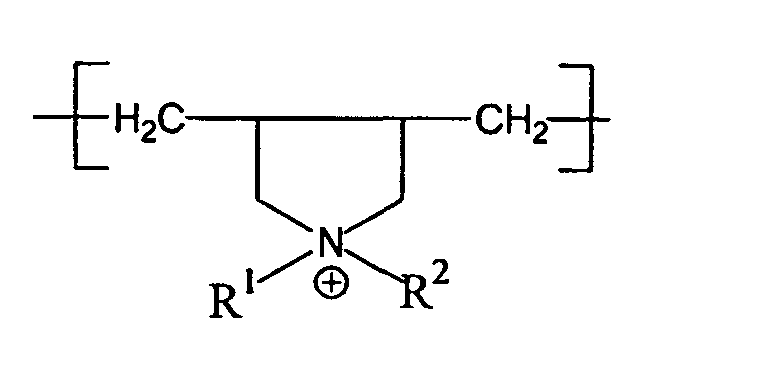
- the quaternary nitrogen-containing monomeric units suitable for the polymeric suds enhancers of the present invention are selected from the group consisting of units having the formula wherein R 1 and R 2 are independently H or a C 1 -C 4 alkyl group, preferably a methyl group.
- Any suitable zwitterionic group can be used as a monomeric unit of the suds enhancers of the present invention in addition to the groups according to claim 1.
- Nonlimiting examples of zwitterionic monomeric units suitable for the suds enhancers of the present invention include: wherein R 9 , R 10 and R 11 are independently H, or a C 1 -C 4 alkyl group, preferably a methyl group; and m is an integer from 1 to 4, preferably 2.
- Nonlimiting examples of zwitterionic monomeric units in accordance with the present invention include:
- the suds enhancers of the present invention may, and preferably do include one or more other monomeric units, other than quaternary nitrogen-containing monomeric units and zwitterionic monomeric units, such as amine oxide monomeric units, other cationic monomeric units, hydroxyl-containing monomeric units, hydrophobic monomeric units, hydrophilic monomeric units, anionic monomeric units and nonionic monomeric units.
- the polymeric suds enhancers of the present invention may comprise an amine oxide monomeric unit having the formula: wherein R 3 is an alkyl, hydroxyalkyl, or alkyl phenyl group or mixtures thereof containing from about 8 to about 22 carbon atoms; R 4 is an alkylene or hydroxyalkylene group containing from about 2 to about 3 carbon atoms or mixtures thereof; x is from 0 to about 3; and each R 5 is an alkyl or hydroxyalkyl group containing from about 1 to about 3 carbon atoms or a polyethylene oxide group containing from about 1 to about 3 ethylene oxide groups.
- the R 5 groups can be attached to each other, e.g., through an oxygen or nitrogen atom, to form a ring structure.
- a preferred class of amine oxide monomer units suitable for use as a polymeric suds volume and suds duration enhancer has the formula: wherein X is either O or N, n is an integer from 1 to 10, preferably from 2 to 6, more preferably 2 to 4.
- cationic monomeric unit is defined as "a moiety which when incorporated into the structure of the suds enhancers of the present invention, is capable of maintaining a cationic charge within the pH range of from about 4 to about 12.
- the cationic monomeric unit is not required to be protonated at every pH value within the range of about 4 to about 12."
- Non-limiting examples of monomeric units which comprise a cationic moiety, other than a quaternary nitrogen-containing moiety include the cationic monomeric units having the formula: wherein each of R 1 , R 2 and R 3 are independently selected from the group consisting of hydrogen, C 1 to C 6 alkyl, and mixtures thereof, preferably hydrogen, C 1 to C 3 alkyl, more preferably, hydrogen or methyl.
- T is selected from the group consisting of substituted or unsubstituted, saturated or unsaturated, linear or branched radicals selected from the group consisting of alkyl, cycloalkyl, aryl, alkaryl, aralkyl, heterocyclic ring, silyl, nitro, halo, cyano, sulfonato, alkoxy, keto, ester, ether, carbonyl, amido, amino, glycidyl, carbanato, carbamate, carboxylic, and carboalkoxy radicals and mixtures thereof.
- R 4 and R 5 are selected from the group consisting of hydrogen, C 1 to C 6 alkyl and mixtures thereof, preferably hydrogen, methyl, ethyl and mixtures thereof;
- z is an integer selected from about 0 to about 12, preferably about 2 to about 10, more preferably about 2 to about 6.
- A is NR 6 R 7 or NR 6 R 7 R 8 .
- each of R 6 , R 7 and R 8 when present, are independently selected from the group consisting of H, C 1 -C 8 linear or branched alkyl, alkyleneoxy having the formula: -(R 9 O) y R 10 wherein R 9 is C 2 -C 4 linear or branched alkylene, and mixtures thereof; R 10 is hydrogen, C 1 -C 4 alkyl, and mixtures thereof; y is from 1 to about 10.
- R 6 , R 7 and R 8 when present, are independently, hydrogen, C 1 to C 4 alkyl.
- NR 6 R 7 or NR 6 R 7 R 8 can form a heterocyclic ring containing from 4 to 7 carbon atoms, optionally containing additional hetero atoms, optionally fused to a benzene ring, and optionally substituted by C 1 to C 8 hydrocarbyl, and/or acetates.
- heterocycles both substituted and unsubstituted are indolyl, isoindolinyl imidazolyl, imidazolinyl, piperidinyl pyrazolyl, pyrazolinyl, pyridinyl, piperazinyl, pyrrolidinyl, pyrrolidinyl, guanidino, amidino, quinidinyl, thiazolinyl, morpholine and mixtures thereof, with morpholino and piperazinyl being preferred.
- cationic unit of formula [I] examples include, but are not limited to, the following structures:
- DMAM 2-dimethylaminoethyl methacrylate
- Nonlimiting examples of cationic monomeric units include: methyl chloride quats of dimethylethyl(meth)acrylates, methyl chloride quats of dimethylaminopropyl(meth)acrylamides, dimethyl- and diethylsulfate quats of dimethylaminoethyl(meth)acrylates, dimethyl- and diethylsulfate quats of dimethylaminopropyl(meth)acrylamides, and diallydimethylammonium halides, such as bromide and/or chloride salts.
- hydroxyl group density of a quaternary nitrogen-containing monomer- and/or zwitterionic monomer-containing polymeric suds enhancer of the present invention is determined by the following calculation.
- Hydroxyl Group Density [Molecular Weight of Hydroxyl Group] [Total Monomer Molecular Weight]
- the quaternary nitrogen-containing or zwitterionic polymeric suds enhancers of the present invention have a Hydroxyl Group Density of about 0.5 or less, preferably from about 0.0001 to about 0.4.
- Nonlimiting examples of such hydroxyl group-containing units include, but are not limited to the following: wherein n is an integer from 2 to 100, preferably 2 to 50, more preferably 2 to 30,
- Suitable hydrophobic group-containing monomeric units for use in the present invention include, but are not limited to, hydrophobic groups preferably selected from the group consisting of non-hydroxyl groups, non-cationic groups, non-anionic groups, non-carbonyl groups, and/or non-H-bonding groups, more preferably selected from the group consisting of alkyls, cycloalkyls, aryls, alkaryls, aralkyls and mixtures thereof.
- hydrophobic group-containing monomeric units include, but are not limited to the following:
- Suitable hydrophilic group-containing monomeric units for use in the present invention include, but are not limited to, hydrophilic groups preferably selected from the group consisting of carboxyl groups, carboxylic acids and their salts, sulfonic acids and their salts, heteroatom-containing moieties present in a ring or linear form and mixtures thereof.
- hydrophilic group-containing monomeric units include, but are not limited to the following:
- anionic monomeric unit is defined as "a moiety which when incorporated into the structure of the suds enhancers of the present invention, is capable of maintaining an anionic charge within the pH range of from about 4 to about 12.
- the anionic monomeric unit is not required to be de-protonated at every pH value within the range of about 4 to about 12.”
- Nonlimiting examples of anionic monomeric units include: acrylic acid, methacrylic acid, AMPS, vinyl sulfonate, styrene vinyl sulfonate, vinyl phosphonic acid, ethylene glycol methacrylate phosphate, maleic anhydride and acid, fumaric acid, itaconic acid, glutamic acid, aspartic acid, the monomeric unit having the formula: and the monomeric unit having the formula: the latter of which also comprises a moiety capable of having a cationic charge at a pH of about 4 to about 12.
- This latter unit is defined herein as "a unit capable of having an anionic and a cationic charge
- nonionic monomeric unit is defined as "a moiety which when incorporated into the structure of the suds enhancers of the present invention, has no charge within the pH range of from about 4 to about 12."
- units which are "nonionic monomeric units” are styrene, ethylene, propylene, butylene, 1,2-phenylene, esters, amides, ketones, ethers, acrylamide and the N-monosubstituted- (e.g., N-isopropylacrylamide) and N,N-disubstituted (e.g., N,N-dimethylacrylamide) acrylamides, hydroxyethyl(meth)acrylate, hydroxypropyl(meth)acrylate, vinyl pyrrolidone, alkyl substituted alkoxylated (meth)acrylate, dimelhylaminoethyl(meth)acrylate, dimethylaminopropyl
- the units which comprise the polymers of the present invention may, as single units or monomers, have any pK a value.
- the quaternary nitrogen-containing monomer- or zwitterionic monomer-containing polymeric suds enhancers are selected from copolymers, which can optionally be crosslinked, terpolymers and other polymers (or multimers).
- Preferred polymers of the present invention comprise:
- a preferred terpolymer and/or multimer of the present invention comprises at least one said monomeric unit A, at least one said monomeric unit B and at least one said monomeric unit C.
- At least one monomeric unit B is selected from the group consisting of: wherein R 30 is H or -CH 3 , wherein R 31 is a bond or and R 32 and R 33 are -CH 3 or -C 2 H 5 .
- the polymer is a terpolymer in which:
- the polymer has at least one monomeric unit C which has the formula: wherein q ranges from 1 to 12, preferably 1 to 10, more preferably 1 to 9.
- the polymer is a terpolymer, in which at least one monomeric unit B is selected from the group consisting of: wherein R 10 is H or CH 3 ; R 11 is a bond or and R 12 and R 13 are -CH 3 or -C 2 H 5 , and said polymer comprises said at least one monomeric unit D.
- At least one monomeric unit B has a formula selected from the group consisting of:
- At least one monomeric unit B has a formula selected from the group consisting of:
- At least one one monomeric unit C is selected from the group consisting of: wherein n is an integer from 2 to 50, preferably 2 to 30, more preferably 2 to 27;
- Nonlimiting examples of such copolymers, which can optionally be crosslinked, terpolymers and multimers have the following formulas:
- Examples of preferred polymers of the present invention are the following:
- the liquid detergent compositions according to the present invention comprise at least an effective amount of the quaternary nitrogen-containing or zwitterionic polymeric suds enhancers described herein, preferably from about 0.01% to about 10%, more preferably from about 0.001% to about 5%, most preferably from about 0.1% to about 2% by weight, of said composition.
- an effective amount quaternary nitrogen-containing or zwitterionic polymeric suds enhancers is that the suds volume and suds duration produced by the presently described compositions are sustained for an increased amount of time relative to a composition which does not comprise one or more of the quaternary nitrogen-containing or zwitterionic polymeric suds enhancer described herein.
- the quaternary nitrogen-containing or zwitterionic polymeric suds enhancer can be present as the free base or as a salt.
- Typical counter ions include, acetate, citrate, maleate, sulfate, chloride, etc.
- the proteinaceous suds enhancers of the present invention can be peptides, polypeptides, amino acid containing copolymers, terpolymers etc., and mixtures thereof. Any suitable amino acid can be used to form the backbone of the peptides, polypeptides, or amino acid, wherein the polymers have an average cationic charge density of 2.8 or less, preferably from about 0.01 to about 2.8, more preferably from about 0.1 to about 2.75, most preferably from about 0.75 to about 2.25 units per 100 daltons molecular weight at a pH of from about 4 to about 12.
- amino acids suitable for use in forming the proteinaceous suds enhancers of the present invention have the formula: wherein R and R 1 are each independently hydrogen, C 1 -C 6 linear or branched alkyl, C 1 -C 6 substituted alkyl, and mixtures thereof.
- R and R 1 are each independently hydrogen, C 1 -C 6 linear or branched alkyl, C 1 -C 6 substituted alkyl, and mixtures thereof.
- suitable moieties for substitution on the C 1 -C 6 alkyl units include amino, hydroxy, carboxy, amido, thio, thioalkyl, phenyl, substituted phenyl, wherein said phenyl substitution is hydroxy, halogen, amino, carboxy, amido, and mixtures thereof.
- suitable moieties for substitution on the R and R 1 C 1 -C 6 alkyl units include 3-imidazolyl, 4-imidazolyl, 2-imidazolinyl, 4-imidazolinyl, 2-piperidinyl, 3-piperidinyl, 4-piperidinyl, 1-pyrazolyl, 3-pyrazoyl, 4-pyrazoyl, 5-pyrazoyl, 1-pyrazolinyl, 3-pyrazolinyl, 4-pyrazolinyl, 5-pyrazolinyl, 2-pyridinyl, 3-pyridinyl, 4-pyridinyl, piperazinyl, 2-pyrrolidinyl, 3-pyrrolidinyl, guanidino, amidino, and mixtures thereof.
- R 1 is hydrogen and at least 10% of R units are moieties which are capable of having a positive or negative charge at a pH of from about 4 to about 12.
- Each R 2 is independently hydrogen, hydroxy, amino, guanidino, C 1 -C 4 alkyl, or comprises a carbon chain which can be taken together with R, R 1 any R 2 units to form an aromatic or non-aromatic ring having from 5 to 10 carbon atoms wherein said ring may be a single ring or two fused rings, each ring being aromatic, non-aromatic, or mixtures thereof.
- R, R 1 , and one or more R 2 units will provide the necessary carbon-carbon bonds to accommodate the formation of said ring.
- R is hydrogen
- R 1 is not hydrogen, and vice versa; preferably at least one R 2 is hydrogen.
- the indices x and y are each independently from 0 to 2.
- An example of an amino acid according to the present invention which contains a ring as part of the amino acid backbone is 2-aminobenzoic acid (anthranilic acid) having the formula: wherein x is equal to 1, y is equal to 0 and R, R 1 , and 2 R 2 units from the same carbon atom are taken together to form a benzene ring.
- a further example of an amino acid according to the present invention which contains a ring as part of the amino acid backbone is 3-aminobenzoic acid having the formula: wherein x and y are each equal to 1, R is hydrogen and R 1 and four R 2 units are taken together to form a benzene ring.
- Non-limiting examples of amino acids suitable for use in the proteinaceous suds enhancers of the present invention wherein at least one x or y is not equal to 0 include 2-aminobenzoic acid, 3-aminobenzoic acid, 4-aminobenzoic acid, b-alanine, and b-hydroxyaminobutyric acid.
- R and R 1 are independently hydrogen or a moiety as describe herein above preferably R 1 is hydrogen and R comprise a moiety having a positive charge at a pH of from about 4 to about 12 wherein the polymers have an average cationic charge density of 2.8 or less, preferably from about 0.01 to about 2.8, more preferably from about 0.1 to about 2.75, most preferably from about 0.75 to about 2.25 units per 100 daltons molecular weight at a pH of from about 4 to about 12.
- More preferred amino acids which comprise the proteinaceous suds enhancers of the present invention have the formula: wherein R hydrogen, C 1 -C 6 linear or branched alkyl, C 1 -C 6 substituted alkyl, and mixtures thereof.
- R is preferably C 1 -C 6 substituted alkyl wherein preferred moieties which are substituted on said C 1 -C 6 alkyl units include amino, hydroxy, carboxy, amido, thio, C 1 -C 4 thioalkyl, 3-imidazolyl, 4-imidazolyl, 2-imidazolinyl, 4-imidazolinyl, 2-piperidinyl, 3-piperidinyl, 4-piperidinyl, 1-pyrazolyl, 3-pyrazoyl, 4-pyrazoyl, 5-pyrazoyl, 1-pyrazolinyl, 3-pyrazolinyl, 4-pyrazolinyl, 5-pyrazolinyl, 2-pyridinyl, 3-pyridinyl, 4-pyri
- amino acid lysine having the formula: wherein R is a substituted C 1 alkyl moiety, said substituent is 4-imidazolyl.
- Non-limiting examples of preferred amino acids include alanine, arginine, asparagine, aspartic acid, cysteine, glutamine, glutamic acid, glycine, histidine, isoleucine, leucine, lysine, methionine, phenylalanine, proline, serine, threonine, tryptophan, tyrosine, valine, and mixtures thereof.
- the proteinaceous suds enhancers of the present invention may comprise any amino acid having an R unit which together with the aforementioned amino acids serves to adjust the cationic charge density of the proteinaceous suds enhancers to a range of 2.8 or less, preferably from about 0.01 to about 2.8, more preferably from about 0.1 to about 2.75, most preferably from about 0.75 to about 2.25 units per 100 daltons molecular weight at a pH of from about 4 to about 12.
- amino acids include homoserine, hydroxyproline, norleucine, norvaline, ornithine, penicillamine, and phenylglycine, preferably ornithine.
- R units preferably comprise moieties which are capable of a cationic or anionic charges within the range of pH from about 4 to about 12.
- preferred amino acids having anionic R units include glutamic acid, aspartic acid, and g-carboxyglutamic acid.
- both optical isomers of any amino acid having a chiral center serve equally well for inclusion into the backbone of the peptide, polypeptide, or amino acid copolymers.
- Racemic mixtures of one amino acid may be suitably combined with a single optical isomer of one or more other amino acids depending upon the desired properties of the final proteinaceous suds enhancer.
- amino acids capable of forming diasteriomeric pairs for example, threonine.
- Nonlimiting examples of suitable proteinaceous suds enhancers are described in PCT Application Serial No. PCT/US98/24707.
- Polyamino Acid Proteinaceous Suds enhancer - One type of suitable proteinaceous suds enhancer according to the present invention is comprised entirely of the amino acids described herein above.
- Said polyamino acid compounds may be naturally occurring peptides, polypeptides, enzymes, and the like, provided that the polymers have an average cationic charge density of 2.8 or less, preferably from about 0.01 to about 2.8, more preferably from about 0.1 to about 2.75, most preferably from about 0.75 to about 2.25 units per 100 daltons molecular weight at a pH of from about 4 to about 12.
- An example of a polyamino acid which is suitable as a proteinaceous suds enhancer according to the present invention is the enzyme lysozyme.
- polymers have an average cationic charge density of 2.8 or less, preferably from about 0.01 to about 2.8, more preferably from about 0.1 to about 2.75, most preferably from about 0.75 to about 2.25 units per 100 daltons molecular weight at a pH of from about 4 to about 12.
- polyamino acid compound is the synthetic peptide having a molecular weight of at least about 1500 daltons.
- the polymers have an average cationic charge density of 2.8 or less, preferably from about 0.01 to about 2.8, more preferably from about 0.1 to about 2.75, most preferably from about 0.75 to about 2.25 units per 100 daltons molecular weight at a pH of from about 4 to about 12.
- polyamino acid synthetic peptide suitable for use as a proteinaceous suds enhancer according to the present invention is the copolymer of the amino acids lysine, alanine, glutamic acid, and tyrosine having an average molecular weight of 52,000 daltons and a ratio of lys:ala:glu:tyr of approximately 5:6:2:1.
- the presence of one or more cationic amino acids is required to insure increased suds stabilization and suds volume.
- the relative amount of cationic amino acid present, as well as the average cationic charge density of the polyamino acid are key to the effectiveness of the resulting material.
- poly L-lysine having a molecular weight of approximately 18,000 daltons comprises 100% amino acids which have the capacity to possess a positive charge in the pH range of from about 4 to about 12, with the result that this material is ineffective as a suds extender and as a greasy soil removing agent.
- Peptide Copolymers Another class of materials suitable for use as proteinaceous suds enhancers according to the present invention are peptide copolymers.
- peptide copolymers are defined as "polymeric materials with a molecular weight greater than or equal to about 1500 daltons wherein at least about 10% by weight of said polymeric material comprises one or more amino acids”.
- Peptide copolymers suitable for use as proteinaceous suds enhancers may include segments of polyethylene oxide which are linked to segments of peptide or polypeptide to form a material which has increased suds retention as well as formulatability.
- Nonlimiting examples of amino acid copolymer classes include the following.
- Polyalkyleneimine copolymers comprise random segments of polyalkyleneimine, preferably polyethyleneimine, together with segments of amino acid residues. For example, tetraethylenepentamine is reacted together with polyglutamic acid and polyalanine to form a copolymer having the formula: wherein m is equal to 3, n is equal to 0, i is equal to 3, j is equal to 5, x is equal to 3, y is equal to 4, and z is equal to 7.
- the formulator may substitute other polyamines for polyalkyleneimines, for example, polyvinyl amines, or other suitable polyamine which provides for a source of cationic charge at a pH of from 4 to abut 12 and which results in a copolymer having an average cationic charge density of 2.8 or less, preferably from about 0.01 to about 2.8, more preferably from about 0.1 to about 2.75, most preferably from about 0.75 to about 2.25 units per 100 daltons molecular weight at a pH of from about 4 to about 12.
- polyvinyl amines or other suitable polyamine which provides for a source of cationic charge at a pH of from 4 to abut 12 and which results in a copolymer having an average cationic charge density of 2.8 or less, preferably from about 0.01 to about 2.8, more preferably from about 0.1 to about 2.75, most preferably from about 0.75 to about 2.25 units per 100 daltons molecular weight at a pH of from about 4 to about 12.
- the formulator may combine non-amine polymers with protonatable as well as non-protonatable amino acids.
- a carboxylate-containing homo-polymer may be reacted with one or more amino acids, for example, histidine and glycine, to form an amino acid containing amido copolymer having the formula: wherein said copolymer has a molecular weight of at least 1500 daltons and a ratio of x : y : z of approximately 2 : 3 : 6.
- the quaternary nitrogen-containing or zwitterionic polymeric suds enhancers of the present invention are homopolymers or copolymers wherein the monomers which comprise said homopolymers or copolymers contain a moiety capable of being protonated at a pH of from about 4 to about 12, or a moiety capable of being de-protonated at a pH of from about 4 to about 12, of a mixture of both types of moieties.
- a preferred class of zwitterionic polymers suitable for use as a suds volume and suds duration enhancer has the formula: wherein R is C 1 -C 12 linear alkylene, C 1 -C 12 branched alkylene, and mixtures thereof; preferably C 1 -C 4 linear alkylene, C 3 -C 4 branched alkylene; more preferably methylene and 1,2-propylene.
- the index x is from 0 to 6; y is 0 or 1; z is 0 or 1.
- the index n has the value such that the zwitterionic polymers of the present invention have an average molecular weight of from about 1,000 to about 2,000,000 preferably from about 5,000 to about 1,000,000, more preferably from about 10,000 to about 750,000, more preferably from about 20,000 to about 500,000, even more preferably from about 35,000 to about 300,000 daltons.
- the molecular weight of the quaternary nitrogen-containing or zwitterionic polymeric suds boosters can be determined via conventional gel permeation chromatography.
- Nonlimiting examples of suitable zwitterionic polymers are described in PCT Application Serial No. PCT/US98/24699
- cationic charge density is defined as "the total number of units that are protonated at a specific pH per 100 daltons mass of polymer, or otherwise stated, the total number of charges divided by the dalton molecular weight of the monomer unit or polymer.”
- Polymers have been shown to be effective for delivering sudsing benefits in a hand dishwashing context, provided the polymer contains a cationic moiety, either permanent via a quaternary nitrogen or temporary via protonation. Without being limited by theory, it is believed that the cationic charge must be sufficient to attract the polymer to negatively charged soils but not so large as to cause negative interactions with available anionic surfactants.
- the cationic charge density may be determined as follows, where the cationic charge density is defined as the amount of cationic charge on a given polymer, either by permanent cationic groups or via protonated groups, as a weight percent of the total polymer at the desired wash pH.
- the cationic charge density is defined as the amount of cationic charge on a given polymer, either by permanent cationic groups or via protonated groups, as a weight percent of the total polymer at the desired wash pH.
- DMAM/ hydroxyethylacrylate (HEA)/acrylic acid (AA) where the ratio of monomers is 1 mole of DMAM for 3 moles of HEA for 0.33 moles of AA
- pKa see hereinafter as to how pKa is measured, of this polymer to be 8.2.
- the cationic charge density can be calculated as follows:
- 1.32% of the polymer contains cationic charges. Otherwise stated, the cationic charge density is 1.32 per 100 daltons molecular weight.
- DMAM DMAM with hydroxyethylacrylate
- HSA hydroxyethylacrylate
- the DMAM monomer has a molecular weight of approximately 157 and the HEA monomer has a molecular weight of 116 grams/mole.
- the pKa has been measured to be 7.6.
- the cationic charge density is 2.77 per 100 daltons molecular weight.
- the minimum repeating unit is considered 1 DMAM monomer plus 3 HEA monomers.
- the cationic charge density can be determined as follows: where the cationic charge density is defined as the total number of charges divided by the dalton molecular weight of the polymer at the desired wash pH. It can be calculated from the following equation where n i is the number of charged unit. f i is the fraction of unit being charged. In the case of protonated species (AH + ), f i can be calculated from the measured pH and pKa.
- polyDMAM has a cationic charge density of 0.318 charge per 100 dalton molecular weight.
- DMA dimethyl methacrylate
- the DMA monomer has a molecular weight of 99 grams/mole.
- the pKa has been measured to be 7.6.
- a copolymer of DMAM with DMA has a charge density of 0.22 charge per 100 dalton molecular weight. Notice that in this example, the minimum repeating unit is considered 1 DMAM monomer plus 3 DMA monomers.
- a key aspect of this calculation is the pKa measurement for any protonatable species which will result in a cationic charge on the heteroatom. Since the pKa is dependent on the polymer structure and various monomers present, this must be measure to determine the percentage of protonatable sites to count as a function of the desired wash pH. This is an easy exercise for one skilled in the art. Based on this calculation, the percent of cationic charge is independent of polymer molecular weight.
- the pKa of a polymeric suds booster is determined in the following manner. Make at least 50 mls of a 5% polymer solution, such as a polymer prepared according to any of Examples 1 to 5 as described hereinafter, in ultra pure water(i.e. no added salt). At 25° C, take initial pH of the 5% polymer solution with a pH meter and record when a steady reading is achieved. Maintain temperature throughout the test at 25° C with a water bath and stir continuously. Raise pH of 50 mls of the aqueous polymer solution to 12 using NaOH (IN, 12.5M). Titrate 5 mls of 0.1N HCI into the polymer solution. Record pH when steady reading is achieved. Repeat steps 4 and 5 until pH is below 3. The pKa was determined from a plot of pH vs. volume of titrant using the standard procedure as disclosed in Quantitative Chemical Analysis, Daniel C. Harris, W.H. Freeman & Chapman, San Francisco, USA 1982.
- the molecular weight of the polymeric suds booster is preferably in the range of from about 1,000 to about 2,000,000, more preferably from about 5,000 to about 500,000, even more preferably from about 10,000 to about 100,000, most preferably from about 20,000 to about 50,000 daltons.
- the present invention relates to a method for providing increased suds volume and increased suds retention in suds-forming and/or foam-forming compositions, such as liquid dishwashing compositions, personal care compositions (i.e., shampoos, hand washing compositions, body washing composition, hair removal compositions, etc.), laundry detergent compositions, especially laundry bars and/or high suds phosphate laundry compositions, hard surface cleaning compositions, agrochemical foaming compositions, oil-field foaming compositions and/or fire-firefighting foaming compositions.
- liquid dishwashing compositions i.e., shampoos, hand washing compositions, body washing composition, hair removal compositions, etc.
- laundry detergent compositions especially laundry bars and/or high suds phosphate laundry compositions
- hard surface cleaning compositions i.e., agrochemical foaming compositions, oil-field foaming compositions and/or fire-firefighting foaming compositions.
- liquid detergent compositions according to the present invention comprise at least an effective amount of one or more quaternary nitrogen-containing or zwitterionic polymeric suds enhancers described herein, preferably from about 0.01% to about 10%, more preferably from about 0.001% to about 5%, most preferably from about 0.1% to about 2% by weight, of said composition and optionally, but typically, the balance comprising one or more cleaning adjuncts.
- Nonlimiting examples of suitable cleaning adjuncts include surfactants including diamines, amine oxides, betaines and/or sultaines, enzymes, builders, solvents such as water and/or other carriers, hydrotropes, calcium and/or magnesium ion-containing materials, pH agents, perfumes, chelants, soil release polymers, polymeric dispersants, polysaccharides, abrasives, bactericides, tarnish inhibitors, opacifiers, dyes, buffers, antifungal or mildew control agents, thickeners, processing aids, suds boosters, brighteners, anti-corrosive aids, stabilizers, antioxidants and other suitable adjuncts known by those of ordinary skill in the art.
- surfactants including diamines, amine oxides, betaines and/or sultaines, enzymes, builders, solvents such as water and/or other carriers, hydrotropes, calcium and/or magnesium ion-containing materials, pH agents, perfumes, chelants, soil release polymers
- compositions of this invention can be used to form aqueous washing solutions for use in hand dishwashing.
- an effective amount of such compositions is added to water to form such aqueous cleaning or soaking solutions.
- the aqueous solution so formed is then contacted with the dishware, tableware, and cooking utensils.
- An effective amount of the detergent compositions herein added to water to form aqueous cleaning solutions can comprise amounts sufficient to form from about 500 to 20,000 ppm of composition in aqueous solution. More preferably, from about 800 to 5,000 ppm of the detergent compositions herein will be provided in aqueous cleaning liquor.
- the liquid dishwashing compositions of the present invention also provide a means for preventing the redeposition of grease, oils, and dirt, especially grease, from the hand washing solution onto dishware.
- This method comprises contacting an aqueous solution of the compositions of the present invention with soiled dishware and washing said dishware with said aqueous solution.
- An effective amount of the detergent compositions herein added to water to form aqueous cleaning solutions according to the method of the present invention comprises amounts sufficient to form from about 500 to 20,000 ppm of composition in aqueous solution. More preferably, from about 800 to 2,500 ppm of the detergent compositions herein will be provided in aqueous cleaning liquor.
- liquid detergent compositions of the present invention are effective for preventing the redeposition of grease from the wash solution back onto the dishware during washing.
- One measure of effectiveness of the compositions of the present invention involves redeposition tests. The following test and others of similar nature are used to evaluate the suitability of the formulas described herein.
- a synthetic greasy soil composition is then added to the cylinder and the solution is agitated. After a period of time the solution is decanted from the graduated cylinder and the interior walls of the graduated cylinder are rinsed with a suitable solvent or combination of solvents to recover any re-deposited greasy soil. The solvent is removed and the weight of greasy soil which remains in solution is determined by subtracting the amount of soil recovered from the amount initially added to the aqueous solution.
- re-deposition test include immersion of tableware, flatware, and the like and recovering any re-deposited soil.
- the above test can be further modified to determine the increased amount of suds volume and suds duration.
- the solution is first agitated then subsequently challenged with portions of greasy soil with agitation between each subsequent soil addition.
- the suds volume can be easily determined by using the vacant volume of the 2 L cylinder as a guide.
- the above example is the synthesis of a terpolymer of acrylamide:acrylic acid:MAPTAC of a molar ratio of 2: 6:2.
- Many other polymers of various compositions can be synthesized according to the above typical procedure or with few modifications such as reaction temperature (60° -90° C), amount of initiator, pH, and the ways of introducing the monomers to the reactor.
- neutral monomers examples include acrylamide and the N-monosubstituted- (e.g N-isopropylacrylamide) and N,N-disubstituted (N,N-dimethylacrylamide) acrylamides, hydroxyethyl(meth)acrylate, hydroxypropyl(meth) acrylate, vinyl pyrrolidone, alkyl substitutred alkoxylated (meth)acrylate, dimethylaminoethyl(meth)acrylate, dimethylaminopropyl(meth)acrylamide, and vinyl formamide.
- N-monosubstituted- e.g N-isopropylacrylamide
- N,N-disubstituted (N,N-dimethylacrylamide) acrylamides examples include acrylamide and the N-monosubstituted- (e.g N-isopropylacrylamide) and N,N-disubstituted (N,N-dimethyl
- anionic monomers are acrylic acid, methacrylic acid, AMPS, vinyl sulfonate, styrene vinyl sulfonate, vinyl phosphonic acid, ethylene glycol methacrylate phosphate, maleic anhydride and acid, furmaic acid, and itaconic acid.
- Cationic monomers are methyl chloride quats of dimethylethyl(meth)acrylates, methyl chloride quats of dimethylaminopropyl(meth)acrylamides, dimethyl-and diethylsulfate quats of dimethylaminoethyl(meth)acrylates, dimethyl-and diethylsulfate quats of dimethyaminopropyl(meth)acrylamides, and diallydimethylammonium halides (such as bromide and chloride salts).
- the suds boosting polymer can be any of the suds boosting polymers described herein, preferably one of the suds boosting polymers according to Synthesis Examples 1-2 above.
- a liquid dishwasing composition according to the present invention is formulated as follows: INGREDIENTS (weight%) # 1 # 2 # 3 Surfactant Alkyl ethoxy sulfate 27.0 27.0 27.0 Amine oxide 6.5 6.5 6.5 Alcohol ethoxylate 3.0 3.0 3.0 Diamine Technology Diamine 0.50 0.50 0.50 Suds Boosting Polymer Technology Suds Boosting Compound 0.5 1.0 2.0 Buffers / Alkalinity NaOH to pH to pH to pH Solvent / Hydrotropes / Salts Ethanol 6.5 5.0 8.0 Propylene Glycol 1.5 2.5 0.5 NaCl 0.8 0 0.1 Sodium Cumene Sulfonate 3.0 4.5 1.5 Poly Propylene Glycol (Mw 2000 or 2600) 0 3.0 2.0 Perfume Perfume 0.36 0.36 0.36 pH (10%pc) 8.9 8.7 8.5
- compositions of the present invention can be suitably prepared by any process chosen by the formulator, non-limiting examples of which are described in U.S. 5,691,297 Nassano et al., issued November 11, 1997; U.S. 5,574,005 Welch et al., issued November 12, 1996; U.S. 5,569,645 Dinniwell et al., issued October 29, 1996; U.S. 5,565,422 Del Greco et al., Issued October 15, 1996; U.S. 5,516,448 Capeci et al., issued May 14, 1996; U.S. 5,489,392 Capeci et al., issued February 6, 1996; U.S. 5,486,303 Capeci et al., issued January 23, 1996.
- the cleaning compositions of the present invention can be formulated into any suitable laundry detergent composition, non-limiting examples of which are described in U.S. 5,679,630 BaecK et al., issued October 21, 1997; U.S. 5,565,145 Watson et al., issued October 15, 1996; U.S. 5,478,489 Fredj et al., issued December 26, 1995; U.S. 5,470,507 Fredj et al., issued November 28, 1996; U.S. 5,466,802 Panandiker et al., issued November 14, 1995; U.S. 5,460,752 Fredj et al., issued October 24, 1995; U.S. 5,458,810 Fredj et al., issued October 17, 1995; U.S. 5,458,809 Fredj et al., issued October 17, 1995; U.S. 5,288,431 Huber et al., issued February 22, 1994.
Landscapes
- Chemical & Material Sciences (AREA)
- Life Sciences & Earth Sciences (AREA)
- Engineering & Computer Science (AREA)
- Chemical Kinetics & Catalysis (AREA)
- Oil, Petroleum & Natural Gas (AREA)
- Wood Science & Technology (AREA)
- Organic Chemistry (AREA)
- Detergent Compositions (AREA)
- Addition Polymer Or Copolymer, Post-Treatments, Or Chemical Modifications (AREA)
Claims (11)
- Composition détergente liquide ayant un volume de mousse et une rétention de mousse accrus appropriés pour une utilisation dans le lavage de la vaisselle à la main, lesdites compositions caractérisées par:à condition qu'une solution aqueuse à 10 % de ladite composition détergente ait un pH allant de 4 à 12.a) une quantité efficace d'un amplificateur de mousse polymère contenant un azote quaternaire contenant un motif monomère ou un motif monomère zwittérionique, ledit amplificateur caractérisé par:des motifs choisi dans le groupe constitué par des motifs de formule:dans laquelle R1 et R2 sont indépendamment H ou un groupe alkyle en C1 à C4;
 dans laquelle R9 et R10 sont indépendamment H, ou un groupe alkyle en C1 à C4; et m est un entier de 1 à 4; et leurs mélanges;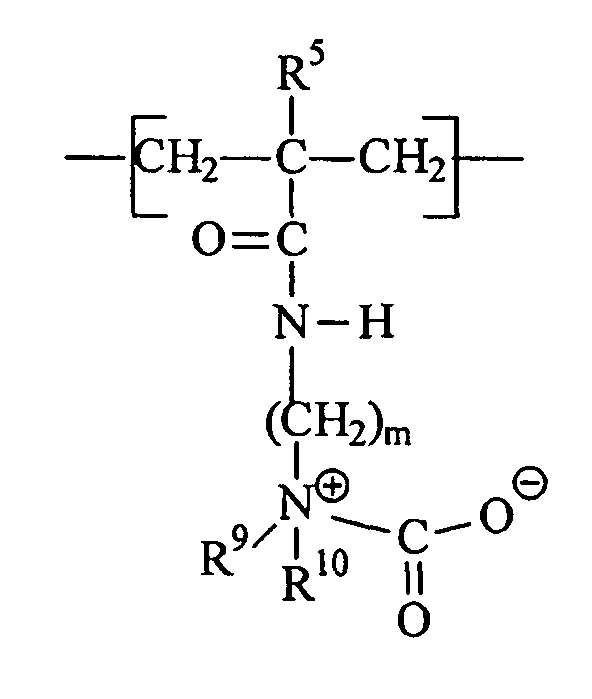
à condition que ledit amplificateur de mousse ait une densité de charge cationique moyenne de 2,8 unités ou moins par poids moléculaire de 0,00017 ag (100 daltons) à un pH allant de 4 à 12;b) une quantité efficace d'un agent tensioactif détersif; etc) pour le reste, des véhicules et d'autres ingrédients additifs; - Composition selon la revendication 1 dans laquelle ledit amplificateur de mousse contenant un azote quaternaire ou de type polymère zwittérionique (a) est en outre caractérisé par:ii) un ou plusieurs motifs ayant un ou plusieurs groupes hydroxyle, à condition que ledit amplificateur de mousse ait une densité de groupe hydroxyle de 0,5 ou moins, de préférence de 0,0001 à 0,4.
- Composition selon la revendication 1 dans laquelle ledit amplificateur de mousse contenant un azote quaternaire ou de type polymère zwittérionique (a) est en outre caractérisé par:iii) un ou plusieurs motifs ayant un ou plusieurs groupes hydrophobes choisis dans le groupe constitué par des groupes non-hydroxyle, des groupes non-cationiques, des groupes non-anioniques, des groupes non-carbonyle, et/ou des groupes sans liaison de H.
- Composition selon la revendication 1 dans laquelle ledit amplificateur de mousse contenant un azote quaternaire ou de type polymère zwittérionique a une densité de charge cationique moyenne allant de 0,01 à 2,8, de préférence de 0,1 à 2,75, plus préférablement 0,75 à 2,25 motifs par poids moléculaire de 0,00017 ag (100 daltons) à un pH allant de 4 à 12.
- Composition selon la revendication 1 dans laquelle ledit amplificateur de mousse contenant un azote quaternaire ou de type polymère zwittérionique (a) est en outre caractérisé par un motif contenant un groupe hydrophile et/ou un motif anionique et/ou des motifs capables d'avoir une charge anionique à un pH allant de 4 à 12 et/ou des motifs capables d'avoir une charge anionique et une charge cationique à un pH allant de 4 à 12 et/ou des motifs n'ayant aucune charge à un pH allant de 4 à 12.
- Composition selon la revendication 1 dans laquelle ledit agent stabilisant de mousse contenant un azote quaternaire ou de type polymère zwittérionique a un poids moléculaire moyen allant de 0,0017 à 3,32 ag (1000 à 2 000 000 daltons).
- Composition selon la revendication 1 en outre caractérisé par ce qu'elle contient de 0,25 % à 15 % d'une diamine ayant un poids moléculaire inférieur ou égal à 400 g/mol, de préférence dans laquelle la diamine est de la 1,3-bis(méthylamine)-cyclohexane ou dans laquelle ladite diamine est de formule:dans laquelle chaque R20 est choisi de manière indépendante dans le groupe constitué par l'hydrogène, un groupe alkyle linéaire ou ramifié en C1 à C4, et alkylène-oxy de formule:
 i) un alkylène linaire en C3 à C10, un alkylène ramifié en C3 à C10, un alkylène cyclique en C3 à C10, un alkylène cyclique ramifié en C3 à C10, un alkylèneoxyalkylène de formule:ii) un alkylène linaire en C3 à C10, linéaire ramifié en C3 à C10, cyclique en C3 à C10, cyclique ramifié en C3 à C10, un arylène en C6 à C10, où ledit motif comprend un ou plusieurs fragments donneurs d'électrons ou attracteurs d'électrons qui donnent à ladite diamine un pKa supérieur à 8; etiii) des mélanges de (i) et (ii) à condition que ladite diamine ait un pKa d'au moins 8, de préférence dans laquelle chaque R20 est un hydrogène et X est un alkylène linéaire en C3 à C6, un alkylène ramifié en C3 à C6, et leurs mélanges.
 - Composition selon la revendication 1 dans laquelle l'agent tensioactif détersif (b) est choisi dans le groupe constitué par des sulfonates d'alkylbenzène linéaires, des a-oléfinesulfonates, des sulfonates de paraffine, des sulfonates de méthylester, des alkyl sulfates, des alkyl alkoxy sulfates, des alkyl sulfonates, des alkyl alkoxy carboxylates, des alkyl alkoxylé sulfates, des sarcosinates, des taurinates, et leurs mélanges, de préférence choisi dans le groupe constitué par des oxydes d'amine, des amides d'acide gras polyhydroxyle, des bétaïnes, des sulfobétaïnes, des alkyl polyglycosides, des éthoxylates d'alkyle, et leurs mélanges.
- Composition selon la revendication 1, dans laquelle lesdits autres ingrédients additifs (c) sont choisis dans le groupe constitué par: des polymères antisalissures, des dispersants polymères, des polysaccharides, des abrasifs, des bactéricides, des inhibiteurs du ternissement, des adjuvants, des enzymes, des opacifiants, des teintures, des parfums, des épaississants, des antioxydants, des auxiliaires de traitement, des renforçateurs de mousse, des tampons, des agents antifongiques ou de contrôle des moisissures, des agents répulsifs contre les insectes, des adjuvants anti-corrosion, des agents chélatants et leurs mélanges.
- Composition selon la revendication 1 dans laquelle ledit agent stabilisant de mousse contenant un azote quaternaire ou de type polymère zwittérionique (a) est un amplificateur de mousse protéique.
- Utilisation de la composition détergente liquide selon l'une quelconque des revendications 1 à 10 pour fournir un volume de mousse et une durée de mousse accrus lorsque de la vaisselle devant être nettoyée est lavée, caractérisée par l'étape de mise en contact de ladite vaisselle avec une solution aqueuse de la composition détergente liquide.
Applications Claiming Priority (2)
| Application Number | Priority Date | Filing Date | Title |
|---|---|---|---|
| US25996201P | 2001-01-05 | 2001-01-05 | |
| US259962P | 2001-01-05 |
Publications (3)
| Publication Number | Publication Date |
|---|---|
| EP1221475A2 EP1221475A2 (fr) | 2002-07-10 |
| EP1221475A3 EP1221475A3 (fr) | 2002-07-31 |
| EP1221475B1 true EP1221475B1 (fr) | 2005-11-23 |
Family
ID=22987207
Family Applications (1)
| Application Number | Title | Priority Date | Filing Date |
|---|---|---|---|
| EP02447003A Expired - Lifetime EP1221475B1 (fr) | 2001-01-05 | 2002-01-04 | Compositions détergentes liquides contenant des polymères contenant de l'azote quarternaire et/ou des polymères zwittérioniques comme activateurs de mousse |
Country Status (6)
| Country | Link |
|---|---|
| US (2) | US6645925B2 (fr) |
| EP (1) | EP1221475B1 (fr) |
| JP (1) | JP4430843B2 (fr) |
| AT (1) | ATE310796T1 (fr) |
| DE (1) | DE60207450T2 (fr) |
| ES (1) | ES2254637T3 (fr) |
Cited By (3)
| Publication number | Priority date | Publication date | Assignee | Title |
|---|---|---|---|---|
| US10626350B2 (en) | 2015-12-08 | 2020-04-21 | Ecolab Usa Inc. | Pressed manual dish detergent |
| US11118142B2 (en) | 2017-07-24 | 2021-09-14 | Rohm And Haas Company | Detergent formulation containing mixed-charge polymers and nonionic surfactant |
| US11230616B2 (en) | 2017-07-24 | 2022-01-25 | Rohm And Haas Company | Chloride-free cationic polymers using acetate anions |
Families Citing this family (43)
| Publication number | Priority date | Publication date | Assignee | Title |
|---|---|---|---|---|
| US6827795B1 (en) * | 1999-05-26 | 2004-12-07 | Procter & Gamble Company | Detergent composition comprising polymeric suds enhancers which have improved mildness and skin feel |
| US20050124738A1 (en) * | 1999-05-26 | 2005-06-09 | The Procter & Gamble Company | Compositions and methods for using zwitterionic polymeric suds enhancers |
| US7241729B2 (en) * | 1999-05-26 | 2007-07-10 | Rhodia Inc. | Compositions and methods for using polymeric suds enhancers |
| WO2000071591A1 (fr) * | 1999-05-26 | 2000-11-30 | Rhodia Inc. | Polymeres sequences, compositions et procedes d'utilisation de mousses, detergents a lessive, rinçages de douches et coagulants |
| US6903064B1 (en) * | 1999-05-26 | 2005-06-07 | Procter & Gamble Company | Detergent composition comprising polymeric suds volume and suds duration enhancers |
| US7939601B1 (en) | 1999-05-26 | 2011-05-10 | Rhodia Inc. | Polymers, compositions and methods of use for foams, laundry detergents, shower rinses, and coagulants |
| JP2003003197A (ja) * | 2001-01-05 | 2003-01-08 | Procter & Gamble Co:The | アミンオキシドモノマー単位含有高分子石鹸泡増進剤を使用する組成物および方法 |
| TWI276682B (en) * | 2001-11-16 | 2007-03-21 | Mitsubishi Chem Corp | Substrate surface cleaning liquid mediums and cleaning method |
| CA2682799A1 (fr) * | 2002-06-04 | 2003-12-11 | The Procter & Gamble Company | Compositions de shampooing conditionneur contenant une combinaison d'agent tensio-actif et de copolymere cationique qui forment des cristaux liquides |
| DE602006013369D1 (de) * | 2005-03-04 | 2010-05-20 | Rohm & Haas | Waschmittel und deren Verwendung |
| US7666963B2 (en) | 2005-07-21 | 2010-02-23 | Akzo Nobel N.V. | Hybrid copolymers |
| WO2011017223A1 (fr) | 2009-07-31 | 2011-02-10 | Akzo Nobel N.V. | Compositions de copolymère hybride pour des applications de soin personnel |
| US7807766B2 (en) * | 2005-09-21 | 2010-10-05 | Cognis Ip Management Gmbh | Polymers for use in cleaning compositions |
| US7348301B2 (en) * | 2006-02-16 | 2008-03-25 | Buckman Laboratories International, Inc. | Lysozyme-based method and composition to control the growth of microorganisms in aqueous systems |
| NO20073834L (no) | 2006-07-21 | 2008-01-22 | Akzo Nobel Chemicals Int Bv | Sulfonerte podede kopolymerer |
| US20080020961A1 (en) | 2006-07-21 | 2008-01-24 | Rodrigues Klin A | Low Molecular Weight Graft Copolymers |
| ES2461892T3 (es) * | 2009-02-02 | 2014-05-21 | The Procter & Gamble Company | Composición detergente líquida para lavado de vajillas a mano |
| ES2484002T3 (es) * | 2009-02-02 | 2014-08-08 | The Procter & Gamble Company | Composición detergente líquida para lavado de vajillas a mano |
| EP2216391A1 (fr) * | 2009-02-02 | 2010-08-11 | The Procter & Gamble Company | Composition de détergent liquide pour lavage de la vaisselle à la main |
| EP2213715A1 (fr) * | 2009-02-02 | 2010-08-04 | The Procter & Gamble Company | Composition de détergent liquide pour lavage de la vaisselle à la main |
| EP2216392B1 (fr) * | 2009-02-02 | 2013-11-13 | The Procter and Gamble Company | Composition de détergent liquide pour lavage de la vaisselle à la main |
| EP2216390B1 (fr) * | 2009-02-02 | 2013-11-27 | The Procter and Gamble Company | Méthode pour lavage de la vaisselle à la main |
| US8853144B2 (en) | 2011-08-05 | 2014-10-07 | Ecolab Usa Inc. | Cleaning composition containing a polysaccharide graft polymer composition and methods of improving drainage |
| US8679366B2 (en) | 2011-08-05 | 2014-03-25 | Ecolab Usa Inc. | Cleaning composition containing a polysaccharide graft polymer composition and methods of controlling hard water scale |
| US8636918B2 (en) | 2011-08-05 | 2014-01-28 | Ecolab Usa Inc. | Cleaning composition containing a polysaccharide hybrid polymer composition and methods of controlling hard water scale |
| US8841246B2 (en) | 2011-08-05 | 2014-09-23 | Ecolab Usa Inc. | Cleaning composition containing a polysaccharide hybrid polymer composition and methods of improving drainage |
| JP2014532791A (ja) | 2011-11-04 | 2014-12-08 | アクゾ ノーベル ケミカルズ インターナショナル ベスローテン フエンノートシャップAkzo Nobel Chemicals International B.V. | ハイブリッド樹状コポリマー、その組成物及びそれを製造する方法 |
| US9051406B2 (en) | 2011-11-04 | 2015-06-09 | Akzo Nobel Chemicals International B.V. | Graft dendrite copolymers, and methods for producing the same |
| US8945314B2 (en) | 2012-07-30 | 2015-02-03 | Ecolab Usa Inc. | Biodegradable stability binding agent for a solid detergent |
| US9365805B2 (en) | 2014-05-15 | 2016-06-14 | Ecolab Usa Inc. | Bio-based pot and pan pre-soak |
| CN108779418B (zh) * | 2016-03-04 | 2021-07-30 | 巴斯夫欧洲公司 | 阳离子聚合物用于改善衣物洗涤剂组合物的起泡特征的用途 |
| EP3771339A1 (fr) * | 2019-07-29 | 2021-02-03 | The Procter & Gamble Company | Composition désinfectante |
| WO2021072411A1 (fr) | 2019-10-08 | 2021-04-15 | Dow Silicones Corporation | Formulation détergente liquide aqueuse pour laver la vaisselle à la main |
| CN117677689A (zh) | 2021-05-18 | 2024-03-08 | 诺力昂化学品国际有限公司 | 在清洁应用中的聚酯聚季铵盐 |
| EP4341317A1 (fr) | 2021-05-20 | 2024-03-27 | Nouryon Chemicals International B.V. | Polymères fabriqués présentant une fonctionnalité d'oligosaccharide ou de polysaccharide modifiée ou une distribution rétrécie d'oligosaccharides, procédés pour leur préparation, compositions les contenant et procédés pour leur utilisation |
| WO2023275269A1 (fr) | 2021-06-30 | 2023-01-05 | Nouryon Chemicals International B.V. | Concentrés liquides tensioactifs amphotères de chélates et leur utilisation dans des applications de nettoyage |
| JP7760429B2 (ja) * | 2022-03-29 | 2025-10-27 | 株式会社フジミインコーポレーテッド | 表面処理組成物、表面処理方法、および半導体基板の製造方法 |
| US20240240111A1 (en) * | 2023-01-13 | 2024-07-18 | The Procter & Gamble Company | Liquid hand dishwashing detergent composition |
| EP4400566A1 (fr) | 2023-01-13 | 2024-07-17 | The Procter & Gamble Company | Composition détergente liquide pour le lavage de la vaisselle à la main |
| EP4400565A1 (fr) | 2023-01-13 | 2024-07-17 | The Procter & Gamble Company | Composition détergente liquide pour le lavage de la vaisselle à la main |
| EP4400568A1 (fr) | 2023-01-13 | 2024-07-17 | The Procter & Gamble Company | Compositions liquides pour laver la vaisselle à la main |
| EP4400567A1 (fr) | 2023-01-13 | 2024-07-17 | The Procter & Gamble Company | Composition détergente liquide pour le lavage de la vaisselle à la main |
| EP4667553A1 (fr) | 2024-06-20 | 2025-12-24 | The Procter & Gamble Company | Composition détergente liquide pour le lavage de la vaisselle à la main |
Family Cites Families (7)
| Publication number | Priority date | Publication date | Assignee | Title |
|---|---|---|---|---|
| US4622378A (en) * | 1982-12-23 | 1986-11-11 | The Procter & Gamble Company | Zwitterionic polymers having clay soil removal/anti-redeposition properties useful in detergent compositions |
| US4661288A (en) * | 1982-12-23 | 1987-04-28 | The Procter & Gamble Company | Zwitterionic compounds having clay soil removal/anti/redeposition properties useful in detergent compositions |
| DE3708451A1 (de) * | 1987-03-16 | 1988-10-06 | Henkel Kgaa | Zwitterionische polymere und deren verwendung in haarbehandlungsmitteln |
| US5863880A (en) * | 1997-09-19 | 1999-01-26 | Isp Investments Inc. | Laundry detergent compositions containing water soluble dye complexing polymers |
| EP1180130A1 (fr) * | 1999-05-26 | 2002-02-20 | The Procter & Gamble Company | Compositions de detergent liquide contenant des activateurs polymeres bloc de mousse |
| EP1180129B1 (fr) * | 1999-05-26 | 2007-09-26 | The Procter & Gamble Company | Compositions de detergent liquide contenant des activateurs polymeres bloc de mousse |
| CN1237162C (zh) * | 2000-02-23 | 2006-01-18 | 宝洁公司 | 具有增强泥土清除益处的液体衣用洗涤剂组合物 |
-
2001
- 2001-12-28 JP JP2001401291A patent/JP4430843B2/ja not_active Expired - Fee Related
-
2002
- 2002-01-04 US US10/037,383 patent/US6645925B2/en not_active Expired - Lifetime
- 2002-01-04 DE DE60207450T patent/DE60207450T2/de not_active Expired - Lifetime
- 2002-01-04 EP EP02447003A patent/EP1221475B1/fr not_active Expired - Lifetime
- 2002-01-04 ES ES02447003T patent/ES2254637T3/es not_active Expired - Lifetime
- 2002-01-04 AT AT02447003T patent/ATE310796T1/de not_active IP Right Cessation
-
2003
- 2003-08-27 US US10/650,019 patent/US6825157B2/en not_active Expired - Lifetime
Cited By (6)
| Publication number | Priority date | Publication date | Assignee | Title |
|---|---|---|---|---|
| US10626350B2 (en) | 2015-12-08 | 2020-04-21 | Ecolab Usa Inc. | Pressed manual dish detergent |
| US11268045B2 (en) | 2015-12-08 | 2022-03-08 | Ecolab Usa Inc. | Pressed manual dish detergent |
| US11746304B2 (en) | 2015-12-08 | 2023-09-05 | Ecolab Usa Inc. | Pressed manual dish detergent |
| US12227717B2 (en) | 2015-12-08 | 2025-02-18 | Ecolab Usa Inc. | Pressed manual dish detergent |
| US11118142B2 (en) | 2017-07-24 | 2021-09-14 | Rohm And Haas Company | Detergent formulation containing mixed-charge polymers and nonionic surfactant |
| US11230616B2 (en) | 2017-07-24 | 2022-01-25 | Rohm And Haas Company | Chloride-free cationic polymers using acetate anions |
Also Published As
| Publication number | Publication date |
|---|---|
| US20030134770A1 (en) | 2003-07-17 |
| US6645925B2 (en) | 2003-11-11 |
| ES2254637T3 (es) | 2006-06-16 |
| US6825157B2 (en) | 2004-11-30 |
| DE60207450T2 (de) | 2006-08-03 |
| ATE310796T1 (de) | 2005-12-15 |
| EP1221475A2 (fr) | 2002-07-10 |
| JP4430843B2 (ja) | 2010-03-10 |
| JP2002309292A (ja) | 2002-10-23 |
| DE60207450D1 (de) | 2005-12-29 |
| US20040102347A1 (en) | 2004-05-27 |
| EP1221475A3 (fr) | 2002-07-31 |
Similar Documents
| Publication | Publication Date | Title |
|---|---|---|
| EP1221475B1 (fr) | Compositions détergentes liquides contenant des polymères contenant de l'azote quarternaire et/ou des polymères zwittérioniques comme activateurs de mousse | |
| US6656900B2 (en) | Compositions and methods for using amine oxide monomeric unit-containing polymeric suds enhancers | |
| US6573234B1 (en) | Liquid detergent compositions comprising polymeric suds enhancers | |
| US6528477B2 (en) | Liquid detergent compositions comprising polymeric suds enhancers | |
| EP1767554B1 (fr) | Polymère amphotère et son utilisation | |
| CN102076838B (zh) | 用于处理硬表面的两性聚合物 | |
| US6528476B1 (en) | Liquid detergent compositions comprising block polymeric suds enhancers | |
| CA2372894A1 (fr) | Compositions detergents comprenant des renforcateurs de savonnage polymeres offrant une plus grande douceur et une meilleure sensation au contact de la peau | |
| JP2003505534A (ja) | 水溶性又は水分散性コポリマーを含む清浄用組成物 | |
| ES2880486T3 (es) | Copolímeros y su uso en composiciones de agentes de limpieza | |
| BR112019009866A2 (pt) | composições de agentes de limpeza contendo copolímeros | |
| AU5399299A (en) | Animo acid copolymers having pendent polysaccharide moieties and uses thereof | |
| JP6227872B2 (ja) | 親水化処理剤及び親水化処理方法 | |
| EP3771339A1 (fr) | Composition désinfectante | |
| JP2017510694A (ja) | 液体洗剤組成物 | |
| JPH09500673A (ja) | 洗浄での染料移りを抑制する洗剤組成物 | |
| RU2736718C2 (ru) | Сополимеры, содержащие полиалкиленоксидные группы и четвертичные атомы азота | |
| JP5234701B2 (ja) | 硬質表面用洗浄剤組成物 | |
| WO2022162221A1 (fr) | Composition de détergent | |
| JP2001131590A (ja) | 洗浄剤組成物 | |
| ES2874024T3 (es) | Composición de limpieza para el lavado de vajillas | |
| JP2023146755A (ja) | 硬質表面用油汚れ洗浄剤及び洗浄方法 | |
| MXPA00004958A (en) | Liquid detergent compositions comprising polymeric suds enhancers | |
| JP2003522301A (ja) | 織物のコンディショニング組成物 |
Legal Events
| Date | Code | Title | Description |
|---|---|---|---|
| PUAI | Public reference made under article 153(3) epc to a published international application that has entered the european phase |
Free format text: ORIGINAL CODE: 0009012 |
|
| PUAL | Search report despatched |
Free format text: ORIGINAL CODE: 0009013 |
|
| AK | Designated contracting states |
Kind code of ref document: A2 Designated state(s): AT BE CH CY DE DK ES FI FR GB GR IE IT LI LU MC NL PT SE TR |
|
| AX | Request for extension of the european patent |
Free format text: AL;LT;LV;MK;RO;SI |
|
| RIN1 | Information on inventor provided before grant (corrected) |
Inventor name: SIVIK, MARK ROBERT Inventor name: YEUNG, DOMINIC WAI-KWING Inventor name: BODET, JEAN-FRANCOIS Inventor name: SCHEPER, WILLIAM MICHAEL Inventor name: KLEUSENER, BERNHARD WILLIAM Inventor name: BERGERON, VANCE (NMN) |
|
| AK | Designated contracting states |
Kind code of ref document: A3 Designated state(s): AT BE CH CY DE DK ES FI FR GB GR IE IT LI LU MC NL PT SE TR |
|
| AX | Request for extension of the european patent |
Free format text: AL;LT;LV;MK;RO;SI |
|
| 17P | Request for examination filed |
Effective date: 20030108 |
|
| AKX | Designation fees paid |
Designated state(s): AT BE CH CY DE DK ES FI FR GB GR IE IT LI LU MC NL PT SE TR |
|
| 17Q | First examination report despatched |
Effective date: 20031210 |
|
| GRAP | Despatch of communication of intention to grant a patent |
Free format text: ORIGINAL CODE: EPIDOSNIGR1 |
|
| GRAS | Grant fee paid |
Free format text: ORIGINAL CODE: EPIDOSNIGR3 |
|
| GRAA | (expected) grant |
Free format text: ORIGINAL CODE: 0009210 |
|
| AK | Designated contracting states |
Kind code of ref document: B1 Designated state(s): AT BE CH CY DE DK ES FI FR GB GR IE IT LI LU MC NL PT SE TR |
|
| PG25 | Lapsed in a contracting state [announced via postgrant information from national office to epo] |
Ref country code: NL Free format text: LAPSE BECAUSE OF FAILURE TO SUBMIT A TRANSLATION OF THE DESCRIPTION OR TO PAY THE FEE WITHIN THE PRESCRIBED TIME-LIMIT Effective date: 20051123 Ref country code: CH Free format text: LAPSE BECAUSE OF FAILURE TO SUBMIT A TRANSLATION OF THE DESCRIPTION OR TO PAY THE FEE WITHIN THE PRESCRIBED TIME-LIMIT Effective date: 20051123 Ref country code: BE Free format text: LAPSE BECAUSE OF FAILURE TO SUBMIT A TRANSLATION OF THE DESCRIPTION OR TO PAY THE FEE WITHIN THE PRESCRIBED TIME-LIMIT Effective date: 20051123 Ref country code: FI Free format text: LAPSE BECAUSE OF FAILURE TO SUBMIT A TRANSLATION OF THE DESCRIPTION OR TO PAY THE FEE WITHIN THE PRESCRIBED TIME-LIMIT Effective date: 20051123 Ref country code: AT Free format text: LAPSE BECAUSE OF FAILURE TO SUBMIT A TRANSLATION OF THE DESCRIPTION OR TO PAY THE FEE WITHIN THE PRESCRIBED TIME-LIMIT Effective date: 20051123 Ref country code: LI Free format text: LAPSE BECAUSE OF FAILURE TO SUBMIT A TRANSLATION OF THE DESCRIPTION OR TO PAY THE FEE WITHIN THE PRESCRIBED TIME-LIMIT Effective date: 20051123 |
|
| REG | Reference to a national code |
Ref country code: GB Ref legal event code: FG4D |
|
| REG | Reference to a national code |
Ref country code: CH Ref legal event code: EP |
|
| REF | Corresponds to: |
Ref document number: 60207450 Country of ref document: DE Date of ref document: 20051229 Kind code of ref document: P |
|
| REG | Reference to a national code |
Ref country code: IE Ref legal event code: FG4D |
|
| PG25 | Lapsed in a contracting state [announced via postgrant information from national office to epo] |
Ref country code: IE Free format text: LAPSE BECAUSE OF NON-PAYMENT OF DUE FEES Effective date: 20060104 |
|
| PG25 | Lapsed in a contracting state [announced via postgrant information from national office to epo] |
Ref country code: MC Free format text: LAPSE BECAUSE OF NON-PAYMENT OF DUE FEES Effective date: 20060131 Ref country code: LU Free format text: LAPSE BECAUSE OF NON-PAYMENT OF DUE FEES Effective date: 20060131 |
|
| REG | Reference to a national code |
Ref country code: SE Ref legal event code: TRGR |
|
| PG25 | Lapsed in a contracting state [announced via postgrant information from national office to epo] |
Ref country code: GR Free format text: LAPSE BECAUSE OF FAILURE TO SUBMIT A TRANSLATION OF THE DESCRIPTION OR TO PAY THE FEE WITHIN THE PRESCRIBED TIME-LIMIT Effective date: 20060223 Ref country code: DK Free format text: LAPSE BECAUSE OF FAILURE TO SUBMIT A TRANSLATION OF THE DESCRIPTION OR TO PAY THE FEE WITHIN THE PRESCRIBED TIME-LIMIT Effective date: 20060223 |
|
| PG25 | Lapsed in a contracting state [announced via postgrant information from national office to epo] |
Ref country code: PT Free format text: LAPSE BECAUSE OF FAILURE TO SUBMIT A TRANSLATION OF THE DESCRIPTION OR TO PAY THE FEE WITHIN THE PRESCRIBED TIME-LIMIT Effective date: 20060424 |
|
| NLV1 | Nl: lapsed or annulled due to failure to fulfill the requirements of art. 29p and 29m of the patents act | ||
| REG | Reference to a national code |
Ref country code: CH Ref legal event code: PL |
|
| REG | Reference to a national code |
Ref country code: ES Ref legal event code: FG2A Ref document number: 2254637 Country of ref document: ES Kind code of ref document: T3 |
|
| ET | Fr: translation filed | ||
| PLBE | No opposition filed within time limit |
Free format text: ORIGINAL CODE: 0009261 |
|
| STAA | Information on the status of an ep patent application or granted ep patent |
Free format text: STATUS: NO OPPOSITION FILED WITHIN TIME LIMIT |
|
| REG | Reference to a national code |
Ref country code: IE Ref legal event code: MM4A |
|
| 26N | No opposition filed |
Effective date: 20060824 |
|
| PGFP | Annual fee paid to national office [announced via postgrant information from national office to epo] |
Ref country code: SE Payment date: 20070105 Year of fee payment: 6 |
|
| PG25 | Lapsed in a contracting state [announced via postgrant information from national office to epo] |
Ref country code: TR Free format text: LAPSE BECAUSE OF FAILURE TO SUBMIT A TRANSLATION OF THE DESCRIPTION OR TO PAY THE FEE WITHIN THE PRESCRIBED TIME-LIMIT Effective date: 20051123 |
|
| EUG | Se: european patent has lapsed | ||
| PG25 | Lapsed in a contracting state [announced via postgrant information from national office to epo] |
Ref country code: CY Free format text: LAPSE BECAUSE OF FAILURE TO SUBMIT A TRANSLATION OF THE DESCRIPTION OR TO PAY THE FEE WITHIN THE PRESCRIBED TIME-LIMIT Effective date: 20051123 |
|
| PG25 | Lapsed in a contracting state [announced via postgrant information from national office to epo] |
Ref country code: SE Free format text: LAPSE BECAUSE OF NON-PAYMENT OF DUE FEES Effective date: 20080105 |
|
| REG | Reference to a national code |
Ref country code: GB Ref legal event code: 732E Free format text: REGISTERED BETWEEN 20110811 AND 20110817 |
|
| REG | Reference to a national code |
Ref country code: DE Ref legal event code: R081 Ref document number: 60207450 Country of ref document: DE Owner name: RHODIA INC. (N.D.GES.D. STAATES DELAWARE), CRA, US Free format text: FORMER OWNER: THE PROCTER & GAMBLE COMPANY, RHODIA, INC., , CA Effective date: 20110905 Ref country code: DE Ref legal event code: R081 Ref document number: 60207450 Country of ref document: DE Owner name: RHODIA INC. (N.D.GES.D. STAATES DELAWARE), US Free format text: FORMER OWNER: THE PROCTER & GAMBLE COMPANY, RHODIA, INC., , CA Effective date: 20110905 Ref country code: DE Ref legal event code: R081 Ref document number: 60207450 Country of ref document: DE Owner name: RHODIA INC. (N.D.GES.D. STAATES DELAWARE), CRA, US Free format text: FORMER OWNERS: THE PROCTER & GAMBLE COMPANY, CINCINNATI, OHIO, US; RHODIA, INC., MISSISSAUGA, ONTARIO, CA Effective date: 20110905 |
|
| REG | Reference to a national code |
Ref country code: FR Ref legal event code: TP Owner name: RHODIA INC., US Effective date: 20111011 |
|
| REG | Reference to a national code |
Ref country code: ES Ref legal event code: PC2A Owner name: RHODIA INC Effective date: 20120522 |
|
| PGFP | Annual fee paid to national office [announced via postgrant information from national office to epo] |
Ref country code: IT Payment date: 20150113 Year of fee payment: 14 |
|
| REG | Reference to a national code |
Ref country code: FR Ref legal event code: PLFP Year of fee payment: 15 |
|
| PGFP | Annual fee paid to national office [announced via postgrant information from national office to epo] |
Ref country code: ES Payment date: 20151211 Year of fee payment: 15 |
|
| REG | Reference to a national code |
Ref country code: FR Ref legal event code: PLFP Year of fee payment: 16 |
|
| PG25 | Lapsed in a contracting state [announced via postgrant information from national office to epo] |
Ref country code: IT Free format text: LAPSE BECAUSE OF NON-PAYMENT OF DUE FEES Effective date: 20160104 |
|
| REG | Reference to a national code |
Ref country code: FR Ref legal event code: PLFP Year of fee payment: 17 |
|
| PG25 | Lapsed in a contracting state [announced via postgrant information from national office to epo] |
Ref country code: ES Free format text: LAPSE BECAUSE OF NON-PAYMENT OF DUE FEES Effective date: 20170105 |
|
| REG | Reference to a national code |
Ref country code: ES Ref legal event code: FD2A Effective date: 20181114 |
|
| REG | Reference to a national code |
Ref country code: DE Ref legal event code: R082 Ref document number: 60207450 Country of ref document: DE Representative=s name: TER MEER STEINMEISTER & PARTNER PATENTANWAELTE, DE |
|
| PGFP | Annual fee paid to national office [announced via postgrant information from national office to epo] |
Ref country code: GB Payment date: 20201223 Year of fee payment: 20 Ref country code: FR Payment date: 20201210 Year of fee payment: 20 |
|
| PGFP | Annual fee paid to national office [announced via postgrant information from national office to epo] |
Ref country code: DE Payment date: 20201222 Year of fee payment: 20 |
|
| REG | Reference to a national code |
Ref country code: DE Ref legal event code: R071 Ref document number: 60207450 Country of ref document: DE |
|
| REG | Reference to a national code |
Ref country code: GB Ref legal event code: PE20 Expiry date: 20220103 |
|
| PG25 | Lapsed in a contracting state [announced via postgrant information from national office to epo] |
Ref country code: GB Free format text: LAPSE BECAUSE OF EXPIRATION OF PROTECTION Effective date: 20220103 |