EP1222437B1 - Bleifreies kleinkaliber-vollgeschoss - Google Patents
Bleifreies kleinkaliber-vollgeschoss Download PDFInfo
- Publication number
- EP1222437B1 EP1222437B1 EP00964121A EP00964121A EP1222437B1 EP 1222437 B1 EP1222437 B1 EP 1222437B1 EP 00964121 A EP00964121 A EP 00964121A EP 00964121 A EP00964121 A EP 00964121A EP 1222437 B1 EP1222437 B1 EP 1222437B1
- Authority
- EP
- European Patent Office
- Prior art keywords
- lead
- projectile
- environment
- sleeve
- small
- Prior art date
- Legal status (The legal status is an assumption and is not a legal conclusion. Google has not performed a legal analysis and makes no representation as to the accuracy of the status listed.)
- Expired - Lifetime
Links
Images
Classifications
-
- F—MECHANICAL ENGINEERING; LIGHTING; HEATING; WEAPONS; BLASTING
- F42—AMMUNITION; BLASTING
- F42B—EXPLOSIVE CHARGES, e.g. FOR BLASTING, FIREWORKS, AMMUNITION
- F42B12/00—Projectiles, missiles or mines characterised by the warhead, the intended effect, or the material
- F42B12/72—Projectiles, missiles or mines characterised by the warhead, the intended effect, or the material characterised by the material
- F42B12/74—Projectiles, missiles or mines characterised by the warhead, the intended effect, or the material characterised by the material of the core or solid body
- F42B12/745—Projectiles, missiles or mines characterised by the warhead, the intended effect, or the material characterised by the material of the core or solid body the core being made of plastics; Compounds or blends of plastics and other materials, e.g. fillers
-
- F—MECHANICAL ENGINEERING; LIGHTING; HEATING; WEAPONS; BLASTING
- F42—AMMUNITION; BLASTING
- F42B—EXPLOSIVE CHARGES, e.g. FOR BLASTING, FIREWORKS, AMMUNITION
- F42B12/00—Projectiles, missiles or mines characterised by the warhead, the intended effect, or the material
- F42B12/72—Projectiles, missiles or mines characterised by the warhead, the intended effect, or the material characterised by the material
- F42B12/74—Projectiles, missiles or mines characterised by the warhead, the intended effect, or the material characterised by the material of the core or solid body
Definitions
- the invention relates to a small-caliber full floor.
- Small caliber bullets are usually made of lead and lead alloys produced, for example, by cutting pieces into pieces cut from a lead wire Matrices are deformed to projectiles.
- Small bore shooting is a sport that is carried out both outdoors and in halls.
- the shooting of Lead bullets produce gases containing lead dust that are harmful to health. Therefore, when shooting in halls, special regulations regarding the Ventilation must be observed.
- the for Lead residues of the projectiles which are harmful to the environment, are collected and disposed of become.
- the measures required when firing lead bullets Protection of people and the environment is complex and expensive.
- a projectile which is made of zinc or Zinc alloys is made.
- the Kem enclosed with a coat tailored to this purpose. For example, if you don't want the story to disassemble, the core is with one Enclosed copper sheath.
- the projectile core is for practice purposes enclosed in a plastic jacket, preferably made of nylon. The rear surface of the The bullet is straight and is only encompassed by the coat at the edge.
- a small-caliber bullet made of a lead-free material is proposed according to the invention, the density of which is> 5 g / cm 3. Because of its density, such a material has sufficient trajectory stability. When firing, there are no toxic pencils and when firing outdoors, the bullet remains do not have to be collected as they do not contaminate the environment.
- the metals tin or zinc or alloys of these two materials belong as particularly suitable materials, which are suitable both in terms of their hardness, their density and their harmlessness to the environment.
- Tin has a density of about 7.2 g / cm 3 and zinc of about 7.3 g / cm 3 .
- the material can also be a plastic, preferably a Thermoplastic that can easily be molded into a projectile by injection molding. Plastics that rot in nature are particularly advantageous. These bullets are eliminated naturally, so that no time-consuming collection is required is required.
- Lead is compared to the materials mentioned for the projectile according to the invention usually softer. Therefore, the deformation of the rear floor causes a good eyebrows.
- Soft lead has a Vickers hardness of around 5 HV. The Vickers hardness of tin is also around 5 HV, while the hardness of pure zinc is 35 HV is.
- depth and Diameter can be matched to the material used. This The depression generally has the shape of a spherical cap. Only an optimal eyelid results a precise shot. The indentation of a storey from the rear lead-free material is therefore usually much more pronounced than in a lead bullet.
- the depression can be hard Make up materials up to 65% of the length of the sleeve holder. This is in the Usually about 3 mm long.
- the sleeve receptacle of the projectile has a sleeve insertion groove on. This is the only way a pinch with a fixed projectile seat and a high Tool life can be achieved. The pinching causes a uniform projectile pull-out force. This has a positive effect on the precision of the Shot and thus on the accuracy.
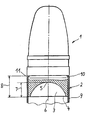
- the figure shows a small-caliber full floor 1 according to the invention, here from one Zinc alloy, on an enlarged scale.
- the sleeve receptacle 2 has the following differences: by one in the hard Zinc material to achieve optimal lids penetrates the deepening in the form of a Dome 3 from the rear 4 deep into the sleeve receptacle 2. This will make the remaining walls of the sleeve receptacle 2, in particular in the area of the tail 4, thin and therefore light even with zinc as a harder material than lead deformable.
- the calotte 3 From the rear 4 of the floor 1 to the pole 5 of the calotte 3, which on the Axis 6 of the projectile lies, the calotte 3 extends over a depth 7 into the Shell receptacle 2 of the projectile.
- the depth is 7 in the present Embodiment 65% of the total length 8 of the sleeve receptacle 2.
- the sleeve receptacle 2 a sleeve feed groove 10.
- the sleeve edge 11 is in this sleeve insertion groove 10 indented, which causes a sleeve pinch with a fixed projectile seat.
Landscapes
- Engineering & Computer Science (AREA)
- Physics & Mathematics (AREA)
- Thermal Sciences (AREA)
- Chemical & Material Sciences (AREA)
- Combustion & Propulsion (AREA)
- General Engineering & Computer Science (AREA)
- Toys (AREA)
- Floor Finish (AREA)
- Glass Compositions (AREA)
- Housing For Livestock And Birds (AREA)
- Processing Of Solid Wastes (AREA)
- Inorganic Compounds Of Heavy Metals (AREA)
Description
Claims (3)
- Kleinkaliber-Vollgeschoss (1) aus einem bleifreien Werkstoff mit einer Dichte >5g/cm3, dadurch gekennzeichnet, dass die Hülsenaufnahme (2) des mantellosen Geschosses (1 ) eine vom Heck (4) ausgehende Vertiefung (3) aufweist, deren Tiefe (7) in Abhängigkeit von der Härte des Werkstoffs bis zu 65 % der Länge (8) der Hülsenaufnahme (2) ausmacht.
- Kleinkaliber-Vollgeschoss nach Anspruch 2, dadurch gekennzeichnet, dass die Vertiefung (3) die Form einer Kalotte aufweist.
- Kleinkaliber-Vollgeschoss nach einem der Ansprüche 1 oder 2, dadurch gekennzeichnet, dass die Hütsenaufnahme in (2) eine Hülseneinzugsnut (10) aufweist.
Applications Claiming Priority (5)
| Application Number | Priority Date | Filing Date | Title |
|---|---|---|---|
| DE19943590 | 1999-09-11 | ||
| DE19943590 | 1999-09-11 | ||
| DE10023162 | 2000-05-11 | ||
| DE10023162 | 2000-05-11 | ||
| PCT/EP2000/008682 WO2001020246A1 (de) | 1999-09-11 | 2000-09-06 | Bleifreies kleinkaliber-vollgeschoss |
Publications (2)
| Publication Number | Publication Date |
|---|---|
| EP1222437A1 EP1222437A1 (de) | 2002-07-17 |
| EP1222437B1 true EP1222437B1 (de) | 2003-12-03 |
Family
ID=26005639
Family Applications (1)
| Application Number | Title | Priority Date | Filing Date |
|---|---|---|---|
| EP00964121A Expired - Lifetime EP1222437B1 (de) | 1999-09-11 | 2000-09-06 | Bleifreies kleinkaliber-vollgeschoss |
Country Status (6)
| Country | Link |
|---|---|
| EP (1) | EP1222437B1 (de) |
| AT (1) | ATE255719T1 (de) |
| AU (1) | AU7515400A (de) |
| DE (2) | DE10043819A1 (de) |
| ES (1) | ES2209989T3 (de) |
| WO (1) | WO2001020246A1 (de) |
Families Citing this family (3)
| Publication number | Priority date | Publication date | Assignee | Title |
|---|---|---|---|---|
| DE102005020988A1 (de) * | 2005-05-03 | 2006-11-09 | Strauß, Rupert | Ecobrass-Geschoss |
| US10222183B2 (en) | 2015-03-02 | 2019-03-05 | Timothy G. Smith | Lead-free rimfire projectile |
| USD778392S1 (en) | 2015-03-02 | 2017-02-07 | Timothy G. Smith | Lead-free rimfire projectile |
Family Cites Families (7)
| Publication number | Priority date | Publication date | Assignee | Title |
|---|---|---|---|---|
| US4016817A (en) * | 1975-10-10 | 1977-04-12 | Moises Arciniega Blanco | Bullet for hunting shotguns |
| US4517898A (en) * | 1979-12-14 | 1985-05-21 | Davis Dale M | Highly accurate projectile for use with small arms |
| US5237930A (en) * | 1992-02-07 | 1993-08-24 | Snc Industrial Technologies, Inc. | Frangible practice ammunition |
| US5913256A (en) * | 1993-07-06 | 1999-06-15 | Lockheed Martin Energy Systems, Inc. | Non-lead environmentally safe projectiles and explosive container |
| GB9318437D0 (en) * | 1993-09-06 | 1993-10-20 | Gardner John Christopher | High specific gravity material |
| US5535495A (en) * | 1994-11-03 | 1996-07-16 | Gutowski; Donald A. | Die cast bullet manufacturing process |
| AU693557B2 (en) * | 1995-01-26 | 1998-07-02 | Federal Cartridge Company | Non-toxic bullet |
-
2000
- 2000-09-06 ES ES00964121T patent/ES2209989T3/es not_active Expired - Lifetime
- 2000-09-06 EP EP00964121A patent/EP1222437B1/de not_active Expired - Lifetime
- 2000-09-06 DE DE10043819A patent/DE10043819A1/de not_active Withdrawn
- 2000-09-06 DE DE50004672T patent/DE50004672D1/de not_active Expired - Lifetime
- 2000-09-06 AT AT00964121T patent/ATE255719T1/de active
- 2000-09-06 WO PCT/EP2000/008682 patent/WO2001020246A1/de not_active Ceased
- 2000-09-06 AU AU75154/00A patent/AU7515400A/en not_active Abandoned
Also Published As
| Publication number | Publication date |
|---|---|
| ES2209989T3 (es) | 2004-07-01 |
| AU7515400A (en) | 2001-04-17 |
| EP1222437A1 (de) | 2002-07-17 |
| ATE255719T1 (de) | 2003-12-15 |
| DE10043819A1 (de) | 2001-03-22 |
| DE50004672D1 (de) | 2004-01-15 |
| WO2001020246A1 (de) | 2001-03-22 |
Similar Documents
| Publication | Publication Date | Title |
|---|---|---|
| DE69831422T2 (de) | Bleifreies geschoss aus zinn | |
| DE69718452T2 (de) | Bleifreie geschosse | |
| DE69004570T2 (de) | Nicht giftiges schrot und damit gefüllte jagdpatrone. | |
| DE69512118T2 (de) | Geschoss, insbesondere nicht tötende Patrone | |
| DE69824548T3 (de) | Zerbrechliches geschoss aus eisenpulver | |
| DE69419581T2 (de) | Auf Sn basierter Legierung hergestelltes Kugelgeschoss | |
| DE10257590B4 (de) | Büchsengeschoss für Jagdzwecke | |
| EP2295927B1 (de) | Flugkörper mit einem pyrotechnischen Satz | |
| DE102007039532A1 (de) | Patrone | |
| DE2919358A1 (de) | Geschoss fuer feuerwaffe | |
| EP1222436B1 (de) | Deformationsgeschoss mit penetrator im geschossbug | |
| WO2003027602A1 (de) | Sich zerlegendes jagdgeschoss | |
| DE2422085B2 (de) | Uebungsmunition fuer schusswaffen | |
| WO2001020246A1 (de) | Bleifreies kleinkaliber-vollgeschoss | |
| EP0636853B1 (de) | Geschoss für Handfeurerwaffen | |
| CH661978A5 (de) | Geschoss fuer uebungsmunition. | |
| DE3408476A1 (de) | Vollkalibriges uebungsgeschoss | |
| DE2747977A1 (de) | Elektrisch ausloesbares kraftelement mit ausstossendem kolben | |
| EP0106411A2 (de) | Kleinkalibermunition und Verfahren zu ihrer Herstellung | |
| DE4403725A1 (de) | Geschoß | |
| DE611842C (de) | Brandgeschoss | |
| DE3314751A1 (de) | Spitzenkoerper fuer ein wuchtgeschoss | |
| DE202018104528U1 (de) | Vollmantelgeschoß mit Kernen | |
| DE69609251T2 (de) | Kurzbahngeschoss | |
| DE3104234A1 (de) | Geschoss fuer handfeuerwaffen |
Legal Events
| Date | Code | Title | Description |
|---|---|---|---|
| PUAI | Public reference made under article 153(3) epc to a published international application that has entered the european phase |
Free format text: ORIGINAL CODE: 0009012 |
|
| 17P | Request for examination filed |
Effective date: 20020411 |
|
| AK | Designated contracting states |
Kind code of ref document: A1 Designated state(s): AT BE CH CY DE DK ES FI FR GB GR IE IT LI LU MC NL PT SE |
|
| AX | Request for extension of the european patent |
Free format text: AL;LT;LV;MK;RO;SI |
|
| GRAH | Despatch of communication of intention to grant a patent |
Free format text: ORIGINAL CODE: EPIDOS IGRA |
|
| GRAH | Despatch of communication of intention to grant a patent |
Free format text: ORIGINAL CODE: EPIDOS IGRA |
|
| RAP1 | Party data changed (applicant data changed or rights of an application transferred) |
Owner name: RUAG AMMOTEC GMBH |
|
| GRAS | Grant fee paid |
Free format text: ORIGINAL CODE: EPIDOSNIGR3 |
|
| GRAA | (expected) grant |
Free format text: ORIGINAL CODE: 0009210 |
|
| AK | Designated contracting states |
Kind code of ref document: B1 Designated state(s): AT BE CH CY DE DK ES FI FR GB GR IE IT LI LU MC NL PT SE |
|
| PG25 | Lapsed in a contracting state [announced via postgrant information from national office to epo] |
Ref country code: IE Free format text: LAPSE BECAUSE OF FAILURE TO SUBMIT A TRANSLATION OF THE DESCRIPTION OR TO PAY THE FEE WITHIN THE PRESCRIBED TIME-LIMIT Effective date: 20031203 Ref country code: CY Free format text: LAPSE BECAUSE OF FAILURE TO SUBMIT A TRANSLATION OF THE DESCRIPTION OR TO PAY THE FEE WITHIN THE PRESCRIBED TIME-LIMIT Effective date: 20031203 Ref country code: NL Free format text: LAPSE BECAUSE OF FAILURE TO SUBMIT A TRANSLATION OF THE DESCRIPTION OR TO PAY THE FEE WITHIN THE PRESCRIBED TIME-LIMIT Effective date: 20031203 |
|
| REG | Reference to a national code |
Ref country code: GB Ref legal event code: FG4D Free format text: NOT ENGLISH |
|
| REG | Reference to a national code |
Ref country code: CH Ref legal event code: EP |
|
| REG | Reference to a national code |
Ref country code: IE Ref legal event code: FG4D Free format text: GERMAN |
|
| REF | Corresponds to: |
Ref document number: 50004672 Country of ref document: DE Date of ref document: 20040115 Kind code of ref document: P |
|
| REG | Reference to a national code |
Ref country code: CH Ref legal event code: NV Representative=s name: ISLER & PEDRAZZINI AG |
|
| PG25 | Lapsed in a contracting state [announced via postgrant information from national office to epo] |
Ref country code: DK Free format text: LAPSE BECAUSE OF FAILURE TO SUBMIT A TRANSLATION OF THE DESCRIPTION OR TO PAY THE FEE WITHIN THE PRESCRIBED TIME-LIMIT Effective date: 20040303 Ref country code: GR Free format text: LAPSE BECAUSE OF FAILURE TO SUBMIT A TRANSLATION OF THE DESCRIPTION OR TO PAY THE FEE WITHIN THE PRESCRIBED TIME-LIMIT Effective date: 20040303 |
|
| REG | Reference to a national code |
Ref country code: SE Ref legal event code: TRGR |
|
| GBT | Gb: translation of ep patent filed (gb section 77(6)(a)/1977) |
Effective date: 20040303 |
|
| NLV1 | Nl: lapsed or annulled due to failure to fulfill the requirements of art. 29p and 29m of the patents act | ||
| LTIE | Lt: invalidation of european patent or patent extension |
Effective date: 20031203 |
|
| REG | Reference to a national code |
Ref country code: ES Ref legal event code: FG2A Ref document number: 2209989 Country of ref document: ES Kind code of ref document: T3 |
|
| ET | Fr: translation filed | ||
| REG | Reference to a national code |
Ref country code: IE Ref legal event code: FD4D |
|
| PG25 | Lapsed in a contracting state [announced via postgrant information from national office to epo] |
Ref country code: LU Free format text: LAPSE BECAUSE OF NON-PAYMENT OF DUE FEES Effective date: 20040906 |
|
| PG25 | Lapsed in a contracting state [announced via postgrant information from national office to epo] |
Ref country code: MC Free format text: LAPSE BECAUSE OF NON-PAYMENT OF DUE FEES Effective date: 20040930 |
|
| PLBE | No opposition filed within time limit |
Free format text: ORIGINAL CODE: 0009261 |
|
| STAA | Information on the status of an ep patent application or granted ep patent |
Free format text: STATUS: NO OPPOSITION FILED WITHIN TIME LIMIT |
|
| 26N | No opposition filed |
Effective date: 20040906 |
|
| REG | Reference to a national code |
Ref country code: CH Ref legal event code: PCAR Free format text: ISLER & PEDRAZZINI AG;POSTFACH 1772;8027 ZUERICH (CH) |
|
| PG25 | Lapsed in a contracting state [announced via postgrant information from national office to epo] |
Ref country code: PT Free format text: LAPSE BECAUSE OF NON-PAYMENT OF DUE FEES Effective date: 20040503 |
|
| REG | Reference to a national code |
Ref country code: FR Ref legal event code: PLFP Year of fee payment: 17 |
|
| REG | Reference to a national code |
Ref country code: FR Ref legal event code: PLFP Year of fee payment: 18 |
|
| REG | Reference to a national code |
Ref country code: DE Ref legal event code: R082 Ref document number: 50004672 Country of ref document: DE Representative=s name: BOEHMERT & BOEHMERT ANWALTSPARTNERSCHAFT MBB -, DE |
|
| REG | Reference to a national code |
Ref country code: FR Ref legal event code: PLFP Year of fee payment: 19 |
|
| PGFP | Annual fee paid to national office [announced via postgrant information from national office to epo] |
Ref country code: DE Payment date: 20191120 Year of fee payment: 20 Ref country code: FI Payment date: 20191220 Year of fee payment: 20 Ref country code: SE Payment date: 20191129 Year of fee payment: 20 |
|
| PGFP | Annual fee paid to national office [announced via postgrant information from national office to epo] |
Ref country code: ES Payment date: 20191220 Year of fee payment: 20 Ref country code: BE Payment date: 20191129 Year of fee payment: 20 Ref country code: IT Payment date: 20191129 Year of fee payment: 20 Ref country code: FR Payment date: 20191129 Year of fee payment: 20 |
|
| PGFP | Annual fee paid to national office [announced via postgrant information from national office to epo] |
Ref country code: CH Payment date: 20191219 Year of fee payment: 20 Ref country code: AT Payment date: 20191202 Year of fee payment: 20 |
|
| PGFP | Annual fee paid to national office [announced via postgrant information from national office to epo] |
Ref country code: GB Payment date: 20191129 Year of fee payment: 20 |
|
| REG | Reference to a national code |
Ref country code: DE Ref legal event code: R071 Ref document number: 50004672 Country of ref document: DE |
|
| REG | Reference to a national code |
Ref country code: CH Ref legal event code: PL |
|
| REG | Reference to a national code |
Ref country code: GB Ref legal event code: PE20 Expiry date: 20200905 |
|
| REG | Reference to a national code |
Ref country code: FI Ref legal event code: MAE |
|
| REG | Reference to a national code |
Ref country code: BE Ref legal event code: MK Effective date: 20200906 Ref country code: AT Ref legal event code: MK07 Ref document number: 255719 Country of ref document: AT Kind code of ref document: T Effective date: 20200906 |
|
| PG25 | Lapsed in a contracting state [announced via postgrant information from national office to epo] |
Ref country code: GB Free format text: LAPSE BECAUSE OF EXPIRATION OF PROTECTION Effective date: 20200905 |
|
| PG25 | Lapsed in a contracting state [announced via postgrant information from national office to epo] |
Ref country code: ES Free format text: LAPSE BECAUSE OF EXPIRATION OF PROTECTION Effective date: 20200907 |