EP1225618B3 - Spectromètre de masse et méthodes de spectrométrie - Google Patents
Spectromètre de masse et méthodes de spectrométrie Download PDFInfo
- Publication number
- EP1225618B3 EP1225618B3 EP01305040.6A EP01305040A EP1225618B3 EP 1225618 B3 EP1225618 B3 EP 1225618B3 EP 01305040 A EP01305040 A EP 01305040A EP 1225618 B3 EP1225618 B3 EP 1225618B3
- Authority
- EP
- European Patent Office
- Prior art keywords
- mass
- ion
- ions
- daughter
- parent
- Prior art date
- Legal status (The legal status is an assumption and is not a legal conclusion. Google has not performed a legal analysis and makes no representation as to the accuracy of the status listed.)
- Expired - Lifetime
Links
Images





Classifications
-
- H—ELECTRICITY
- H01—ELECTRIC ELEMENTS
- H01J—ELECTRIC DISCHARGE TUBES OR DISCHARGE LAMPS
- H01J49/00—Particle spectrometers or separator tubes
- H01J49/004—Combinations of spectrometers, tandem spectrometers, e.g. MS/MS, MSn
- H01J49/0045—Combinations of spectrometers, tandem spectrometers, e.g. MS/MS, MSn characterised by the fragmentation or other specific reaction
Definitions
- the present invention relates to a method and apparatus for mass spectrometry.
- Tandem mass spectrometry is the name given to the method of mass spectrometry wherein parent ions generated from a sample are selected by a first mass filter/analyser and are then passed to a collision cell wherein they are fragmented by collisions with neutral gas molecules to yield daughter (or "product") ions. The daughter ions are then mass analysed by a second mass filter/analyser, and the resulting daughter ion spectra can be used to determine the structure and hence identify the parent (or "precursor") ion. Tandem mass spectrometry is particularly useful for the analysis of complex mixtures such as biomolecules since it avoids the need for chemical clean-up prior to mass spectral analysis.
- a particular form of tandem mass spectrometry referred to as parent ion scanning is known, wherein in a first step the second mass filter/analyser is arranged to act as a mass filter so that it will only transmit and detect daughter ions having a specific mass-to-charge ratio.
- the specific mass-to-charge ratio is set so as to correspond with the mass-to-charge ratio of daughter ions which are known to be characteristic products which result from the fragmentation of a particular parent ion or type of parent ion.
- the first mass filter/analyser upstream of the collision cell is then scanned whilst the second mass filter/analyser remains fixed to monitor for the presence of daughter ions having the specificmass-to-charge ratio.
- the parent ion mass-to-charge ratios which yield the characteristic daughter ions can then be determined.
- a complete daughter ion spectrum for each of the parent ion mass-to-charge ratios which produce characteristic daughter ions may then be obtained by operating the first mass filter/analyser so that it selects parent ions having a particular mass-to-charge ratio, and scanning the second mass filter/analyser to record the resulting full daughter ion spectrum. This can then be repeated for the other parent ions of interest.
- Parent ion scanning is useful when it is not possible to identify parent ions in a direct mass spectrum due to the presence of chemical noise, which is frequently encountered, for example, in the electrospray mass spectra of biomolecules.
- Triple quadrupole mass spectrometers having a first quadrupole mass filter/analyser, a quadrupole collision cell into which a collision gas is introduced, and a second quadrupole mass filter/analyser are well known.
- Anothertype of mass spectrometer (a hybrid quadrupole-time of flight mass spectrometer) is known wherein the second quadrupole mass filter/analyser is replaced by an orthogonal time of flight mass analyser.
- both types of mass spectrometers when usedto perform conventional methods of parent ion scanning and subsequently obtaining a daughter ion spectrum of a candidate parent ion suffer from low duty cycles which render them unsuitable for use in applications which require a higher duty cycle such as on-line chromatography applications.
- Quadrupoles have a duty cycle of approximately 100% when being used as a mass filter, but their duty cycle drops to around 0.1% when then are used in a scanning mode as a mass analyser, for example, to mass analyse a mass range of 500 mass units with peaks one mass unit wide at their base.
- Orthogonal acceleration time of flight analysers typically have a duty cycle within the range 1-20% depending upon the relative mass to charge ("m/z") values of the different ions In the spectrum.
- the duty cycle remains the same irrespective of whether the time of flight analyser is being used as a mass filter to transmit ions having a particular mass to charge ratio, or whether the time of flight analyser is being used to record a full mass spectrum. This is due to the nature of operation of time of flight analysers.
- the duty cycle of a time of flight analyser is typically around 5%.
- the conventional duty cycle when seeking to discover candidate parent ions using a triple quadrupole mass spectrometer is approximately 0.1% (the first quadrupole mass filter/analyser is scanned with a duty cycle of 0.1% and the second quadrupole mass filter/analyser acts as a mass filter with a duty cycle of 100%).
- the duty cycle when then obtaining a daughter ion spectrum for a particular candidate parent ion is also approximately 0.1 % (the first quadrupole mass filter/analyser acts as a mass filter with a duty cycle of 100%, and the second quadrupole mass filter/analyser is scanned with a duty cycle of approximately 0.1 %).
- the duty cycle of a quadrupole-time of flight mass spectrometer for discovering candidate parent ions is approximately 0.005% (the quadrupole is scanned with a duty cycle of approximately 0.1 % and the time of flight analyser acts a mass filter with a duty cycle of approximately 5%).
- a daughter ion spectrum of a candidate parent ion can be obtained with an duty cycle of 5% (the quad-rupole acts as a mass filter with a duty cycle of approximately 100% and the time of flight analyser is scanned with a duty cycle of 5%).
- the resultant duty cycle therefore of discovering a number of candidate parent ions and producing a daughter spectrum of one of the candidate parent ions is approximately 0.005% (since 0.005% ⁇ 5%).
- a triple quadrupole has approximately an order higher duty cycle than a quadrupole-time of flight mass spectrometer for performing conventional methods of parent ion scanning and obtaining confirmatory daughter ion spectra of discovered candidate parent ions.
- duty cycles are not high enough to be used practically and efficiently for analysing real time data which is required when the source of ions is the eluent from a chromatography device.
- Electrospray and laser desorption techniques have made it possible to generate molecular ions having very high molecular weights, and time of flight mass analysers are advantageous for the analysis of such large mass biomolecules by virtue of their high efficiency at recording a full mass spectrum. They also have a high resolution and mass accuracy.
- mass analysers such as quadrupole ion traps are similar in some ways to time of flight analysers, in that like time of flight analysers, they can not provide a continuous output and hence have a low efficiency if used as a mass filter to continuously transmit ions which is an important feature of the conventional methods of parent ion scanning.
- time of flight mass analysers and quadrupole ion traps may be termed “discontinuous output mass analysers”.
- Parent ions that belong to a particular class of parent ions, and which are recognisable by a characteristic daughter ion or characteristic "neural loss", are traditionally discovered by the methods of "parention” scanning or "constant neutral loss” scanning.
- a tandem quadrupole orthogonal TOF mass spectrometer is used.
- candidate parent ions are discovered using a method in which sequential low and high collision energy mass spectra are recorded. The switching back and forth is not interrupted. Instead a complete set of data is acquired, and this is then processed afterwards. Fragment ions are associated with parent ions by closeness of fit of their respective elution times. In this way candidate parent ions may be confirmed or otherwise without interrupting the acquisition of data, and information need not be lost.
- the high and low fragmentation mass spectra are then pest-processed.
- Parent ions are recognised by comparing a high fragmentation mass spectrum with a low fragmentation mass spectrum obtained at substantially the same time, and noting ions having a greater intensity in the low fragmentation mass spectrum relative to the high fragmentation mass spectrum.
- daughter ions may be recognised by noting ions having a greater intensity in the high fragmentation mass spectrum relative to the low fragmentation mass spectrum.
- a sub-group of possible candidate parent ions may be selected from all of the parent ions.
- possible candidate parent ions may be selected on the basis of their relationship to a predetermined daughter ion.
- the predetermined daughter ion may comprise, for example, ions selected from the group comprising (i) immonium ions from peptides; (ii) functional groups including phosphate group PO 3 - ions from phosphorylated peptides; and (iii) mass tags which are intended to cleave from a specific molecule or class of molecule and to be subsequently identified thus reporting the presence of the specific molecule or class of molecule.
- a parent ion may be short listed as a possible candidate parent ion by generating a mass chromatogram for the predetermined daughterion using high fragmentation mass spectra.
- each peak in the mass chromatogram is then determined together with the corresponding predetermined daughter ion elution time(s). Then for each peak in the predetermined daughter ion mass chromatogram both the low fragmentation mass spectrum obtained immediately before the predetermined daughter ion elution time and the low fragmentation mass spectrum obtained immediately after the predetermined daughter ion elution time are interrogated for the presence of previously recognised parent ions.
- a mass chromatogram for any previously recognised parent ion found to be present in both the low fragmentation mass spectrum obtained immediately before the predetermined daughter ion elution time and the low fragmentation mass spectrum obtained immediately after the predetermined daughter ion elution time is then generated and the centre of each peak in each mass chromatogram is determined together with the corresponding possible candidate parent ion elution time(s).
- the possible candidate parent ions may then be ranked according to the closeness of fit of their elution time with the predetermined daughter ion elution time, and a list of final candidate parent ions may be formed by rejecting possible candidate parent ions if their elution time precedes or exceeds the predetermined daughter ion elution time by more than a predetermined amount.
- a parent ion may be shortlisted as a possible candidate parent ion on the basis of it giving rise to a predetermined mass loss.
- a list of target daughter ion mass to charge values that would result from the loss of a predetermined ion or neutral particle from each previously recognised parent ion present in the low fragmentation mass spectrum is generated. Then both the high fragmentation mass spectrum obtained immediately before the low fragmentation mass spectrum and the high fragmentation mass spectrum obtained immediately after the low fragmentation mass spectrum are interrogated for the presence of daughter ions having a mass to charge value corresponding with a target daughter ion mass to charge value.
- a list of possible candidate parent ions (optionally including their corresponding daughter ions) is then formed by including in the list a parent ion if a daughter ion having a mass to charge value corresponding with a target daughter ion mass to charge value is found to be present in both the high fragmentation mass spectrum immediately before the low fragmentation mass spectrum and the high fragmentation mass spectrum immediately after the low fragmentation mass spectrum.
- a mass loss chromatogram may then be generated based upon possible candidate parent ions and their corresponding daughter ions. The centre of each peak in the mass loss chromatogram is determined together with the corresponding mass loss elution time(s). Then for each possible candidate parent ion a mass chromatogram is generated using the low fragmentation mass spectra.
- a corresponding daughter ion mass chromatogram is also generated for the corresponding daughter ion.
- the centre of each peak in the possible candidate parent ion mass chromatogram and the corresponding daughter ion mass ch romatogram are then determined together with the corresponding possible candidate parent ion elution time(s) and corresponding daughter ion elution time(s).
- a list of final candidate parent ions may then be formed by rejecting possible candidate parent ions if the elution time of a possible candidate parent ion precedes or exceeds the corresponding daughter ion elution time by more than a predetermined amount.
- each final candidate parent ion can then be identified.
- Identification of parent ions may be achieved by making use of a combination of information. This may include the accurately determined mass of the parent ion. It may also include the masses of the fragment ions. In some instances the accurately determined masses of the daughter ions may be preferred. It is known that a protein may be identified from the masses, preferably the exact masses, of the peptide products from proteins that have been enzymatically digested. These may be compared to those expected from a library of known proteins. It is also known that when the results of this comparison suggest more than one possible protein then the ambiguity can be resolved by analysis of the fragments of one or more of the peptides. The preferred embodiment allows a mixture of proteins, which have been enzymati-cally digested, to be identified in a single analysis.
- the masses, or exact masses, of all the peptides and their associated fragment ions may be searched against a library of known proteins.
- the peptide masses, or exact masses may be searched against the library of known proteins, and where more than one protein is suggested the correct protein may be confirmed by searching for fragment ions which match those to be expected from the relevant peptides from each candidate protein.
- the step of identifying each final candidate parent ion preferably comprises: recalling the elution time of the final candidate parent ion, generating a list of possible candidate daughter ions which comprises previously recognised daughter ions which are present in both the low fragmentation mass spectrum obtained immediately before the elution time of the final candidate parent ion and the low fragmentation mass spectrum obtained immediately after the elution time of the final candidate parent ion, generating a mass chromatogram of each possible candidate daughter ion, determining the centre of each peak in each possible candidate daughter ion mass chromatogram, and determining the corresponding possible candidate daughter ion elution time(s).
- the possible candidate daughter ions may then be ranked according to the closeness of fit of their elution time with the elution time of the final candidate parent ion.
- a list of final candidate daughter ions may then be formed by rejecting possible candidate daughter ions if the elution time of the possible candidate daughter ion precedes or exceeds the elution time of the final candidate parent ion by more than a predetermined amount.
- the list of final candidate daughter ions may be yetfurther refined or reduced by generating a list of neigh-bouring parent ions which are present in the low fragmentation mass spectrum obtained nearest in time to the elution time of the final candidate parent ion.
- a mass chromatogram of each parent ion contained in the list is then generated and the centre of each mass chromatogram is determined along with the corresponding neigh-bouring parent ion elution time(s).
- Any final candidate daughter ion having an elution time which corresponds more closely with a neighbouring parent ion elution time than with the elution time of the final candidate parent ion may then be rejected from the list of final candidate daughter ions.
- Final candidate daughter ions may be assigned to a final candidate parent ion according to the closeness of fit of their elution times, and all final candidate daughter ions which have been associated with the final candidate parent ion may be listed.
- ions generated by the ion source may be passed through a mass filter, preferably a quadrupole mass filter, prior to being passed to the fragmentation means.
- a mass filter preferably a quadrupole mass filter
- a daughter ion may be recognised by recognising ions in a high fragmentation mass spectrum which have a mass to charge ratio which is not transmitted by the fragmentation means i.e. daughter ions are recognised by virtue of their having a mass to charge ratio falling outside of the transmission window of the mass filter. If the ions would not be transmitted by the mass filter then they must have been produced in the fragmentation means.
- the ion source may be either an electrospray, atmospheric pressure chemical ionization or matrix assisted laser desorption ionization ("MALDI") ion source.
- MALDI matrix assisted laser desorption ionization
- Such ion sources may be provided with an eluent over a period of time, the eluent having been separated from a mixture by means of liquid chromatography or capillary electrophoresis.
- the ion source maybe an electron impact, chemical ionization or field ionisation ion source.
- Such ion sources may be provided with an eluent over a period of time, the eluent having been separated from a mixture by means of gas chromatography.
- a mass filter preferably a quadrupole mass filter, may be provided upstream of the collision cell.
- a mass filter is not essential to the present invention.
- the mass filter may have a highpass filter characteristic and, for example, be arranged to transmit ions having a mass to charge ratio selected from the group comprising: (i) ⁇ 100; (ii) ⁇ 150; (iii) ⁇ 200; (iv) ⁇ 250; (v) ⁇ 300; (vi) ⁇ 350; (vii) ⁇ 400;(viii) ⁇ 450; and (ix) ⁇ 500.
- the mass filter may have a lowpass or bandpass filter characteristic.
- the ion guide is provided upstream of the collision cell.
- the ion guide may be either a hexapole, quadrupole or octapole.
- the ion guide may comprise a plurality of ring electrodes having substantially constant internal diameters ("ion tunnel") or a plurality of ring electrodes having substantially tapering internal diameters ("ion funnel").
- the mass analyser is preferably either a quadrupole mass filter, a time-of-flight mass analyser (preferably an orthogonal acceleration time-of-flight mass analyser), an ion trap, a magnetic sector analyser or a Fourier Transform ion Cyclotron Resonance ("FTICR”) mass analyser.
- the collision cell may be either a quadrupole rod set, a hexapole rod set or an octopole rod set wherein neighbouring rods are maintained at substantially the same DC voltage, and a R F voltage is applied to the rods.
- the collision cell forms a substantially gas-tight enclosure apart from an ion entrance and ion exit aperture.
- a collision gas such as helium, argon, nitrogen, air or methane, is introduced into the collision cell.
- a voltage may be supplied to the collision cell selected from the group comprising: (i) ⁇ 15V; (ii) ⁇ 20V; (iii) ⁇ 25V; (iv) ⁇ 30V; (v) ⁇ 50V; (via) ⁇ 100V; (vii) ⁇ 150V; and (viii) ⁇ 200V.
- a second mode of operation i.e.
- a voltage may be supplied to the collision cell selected from the group comprising: (i) ⁇ 5V; (ii) ⁇ 4.5V; (iii) ⁇ 4V; (iv) ⁇ 3.5V; (v) ⁇ 3V; (vi) ⁇ 2.5V; (vii) ⁇ 2V; (viii) ⁇ 1.5V; (ix) ⁇ 1V; (x) ⁇ 0.5V; and (xi) substantially OV.
- voltages below 15V may be supplied in the first mode and/or voltages above 5V may be supplied in the second mode.
- a voltage of around 10V may be supplied.
- the voltage difference between the two modes is at least 5V, 10V, 15V, 20V, 25V, 30V, 35V, 40V, 50V or more than 50V.
- a mass spectrometer 6 comprises an ion source 1, preferably an electrospray ionization source, an ion guide 2, a quadrupole mass filter 3, a collision cell 4 and an orthogonal acceleration time-of-flight mass analyser 5 incorporating a reflectron.
- the mass filter 3 may be omitted if necessary.
- the mass spectrometer 6 is preferably interfaced with a chromatograph, such as a liquid chromatograph (not shown) sothatthe sample entering the ion source 1 may be taken from the eluent of the liquid chromatograph.
- the quadrupole mass filter 3 is disposed in an evacuated chamber which is maintained at a relatively low pressure e.g. less than 10 -5 mbar.
- the rod electrodes comprising the mass filter 3 are connected to a power supply which generates both RF and DC potentials which determine the range of mass-to-charge values that are transmitted by the mass filter 3.
- the collision cell 4 may comprise either a quadrupole or hexapole rod set enclosed in a substantially gas-tight casing (other than a small ion entrance and exit orifice) into which a collision gas such as helium, argon, nitrogen, air or methane may be introduced at a pressure of between 10 -4 and 10 -1 mbar, further preferably 10 -3 mbar to 10 -2 mbar.
- a collision gas such as helium, argon, nitrogen, air or methane
- Suitable RF potentials for the electrodes comprising the collision cell 4 are provided by a power supply (not shown).
- Ions generated by the ion source 1 are transmitted by ion guide 2 and pass via an interchamber orifice 7 into a vacuum chamber 8.
- Ion guide 2 is maintained at a pressure intermediate that of the ion source and vacuum chamber 8, in the embodiment shown, ions are mass filtered by mass filter 3 before entering collision cell 4.
- mass filtering is not essential to the present invention.
- Ions exiting from the collision cell 4 pass into a time-of-flight mass analyser 5.
- Other ion optical components such as further ion guides and/or electrostatic lenses, may be present (which are not shown in the figures or described herein) to maximise ion transmission between various parts or stages of the apparatus.
- Various vacuum pumps (not shown) may be provided for maintaining optimal vacuum conditions in the device.
- the time-of-flight mass analyser 5 incorporating a reflectron operates in a known way by measuring the transit time of the ions comprised in a packet of ions so that their mass-to-charge ratios can be determined.
- a control means (not shown) provides control signals for the various power supplies (not shown) which respectively provide the necessary operating potentials for the ion source 1, ion guide 2, quadrupole mass filter 3, collision cell 4 and the time-of-flight mass analyser 5. These control signals determine the operating parameters of the instrument, for example the mass-to-charge ratios transmitted through the mass filter 3 and the operation of the analyser 5.
- the control means is typically controlled by signals from a computer (not shown) which may also be used to process the mass spectral data acquired.
- the computer can also display and store mass spectra produced from the analyser 5 and receive and process commands from an operator.
- the control means may be automatically set to perform various methods and make various determinations without operator intervention, or may optionally require operator input at various stages.
- the control means is also arranged to switch the collision cell 4 back and forth between at least two different modes.
- a relatively high voltage such as ⁇ 15V is applied to the collision cell which in combination with the effect of various other ion optical devices upstream of the collision cell 4 is sufficient to cause a fair degree of fragmentation of ions passing therethrough.
- a relatively low voltage such as ⁇ 5V is applied which causes relatively little (if any) significant fragmentation of ions passing therethrough.
- the control means switches between modes according to the preferred embodiment approximately every second.
- the mass spectrometer When the mass spectrometer is used in conjunction with an ion source being provided with an eluent separated from a mixture by means of liquid or gas chromatography, the mass spectrometer 6 may be run for several tens of minutes over which period of time several hundred high fragmentation mass spectra and several hundred low fragmentation mass spectra maybe obtained.
- the data which has been obtained is analysed and parent ions and daughter ions are recognised on the basis of the relative intensity of a peak in a mass spectrum obtained when the collision cell 4 was in one mode compared with the intensity of the same peak in a mass spectrum obtained approximately a second later in time when the collision cell 4 was in the second mode.
- mass chromatograms for each parent and daughter ion are generated and daughter ions are assigned to parent ions on the basis of their relative elution times.
- An advantage of this method is that since all the data is acquired and subsequently processed then all fragment ions may be associated with a parent ion by closeness of fit of their respective elution times. This allows all the parent ions to be identified from their fragment ions, irrespective of whether or not they have been discovered by the presence of a characteristic daughter ion or characteristic "neutral loss".
- an attempt is made to reduce the number of parent ions of interest.
- a list of possible (i.e. not yet finalised) candidate parent ions is formed by looking for parent ions which may have given rise to a predetermined daughter ion of interest e.g. an immonium ion from a peptide.
- a search may be made for parent and daughter ions wherein the parent ion could have fragmented into a first component comprising a predetermined ion or neutral particle and a second component comprising a daughter ion.
- Various steps may then be taken to further reduce/refine the list of possible candidate parent ions to leave a number of final candidate parent ions which are then subsequently identified by comparing elution times of the parent and daughter ions.
- two ions could have similar mass to charge ratios but different chemical structures and hence would most likely fragment differently enabling a parent ion to be identified on the basis of a daughter ion.
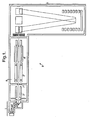
- samples were introduced into the mass spectrometer by means of a Micromass modular CapLC system.
- Samples were loaded onto a C18 cartridge (0.3 mm x 5 mm) and desalted with 0.1% HCOOH for 3 minutes at a flow rate of 30 ⁇ L per minute (see Fig. 2 ).
- the ten port valve was then switched such that the peptides were eluted onto the an-alytical column for separation, see inset Fig. 2 .
- the flow from pumps A and B were split to produce a flow rate through the column of approximately 200nL/min.
- the analytical column used was a PicoFritTM (www.newobjective.com) column packed with Waters Symmetry TM C18 (www.waters.com). This was set up to spray directly into the mass spectrometer.
- the electrospray potential (ca. 3kV) was applied to the liquid via a low dead volume stainless steel union. A small amount (ca. 5 psi (3.4 x 10 4 Nm -2 ) of nebulising gas was introduced around the spray tip to aid the electrospray process.
- the instrument was calibrated with a multi-point calibration using selected fragment ions that resulted from the collision-induced decomposition (CID) of Glufibrinopeptide b. All data were processed using the Mass-Lynx suite of software.
- CID collision-induced decomposition
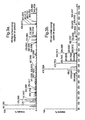
- Figs. 3(a) and 3(b) show respectively daughter and parent ion spectra of a tryptic digest of ADH known as alcohol dehydrogenase.
- the daughter ion spectrum shown in Fig. 3(a) was obtained while the collision cell voltage was high, e.g around 30V, which resulted in significant fragmentation of ions passing therethrough.
- the parent ion spectrum shown in Fig. 3(b) was obtained at low collision energy e.g ⁇ 5V.
- the data presented in Fig. 3(b) was obtained using a mass filter 3 set to transmit ions having a mass to charge value > 350.
- the mass spectra in this particular example were obtained from a sample eluting from a liquid chromatograph, and the spectra were obtained sufficiently rapidly and close together in time that they essentially correspond to the same component or components eluting from the liquid chromatograph.
- Fig. 3(b) there are several high intensity peaks in the parent ion spectrum, e.g. the peaks at 418.7724 and 568.7813, which are substantially less intense in the corresponding daughter ion spectrum. These peaks may therefore be recognised as being parent ions. Likewise, ions which are more intense in the daughter ion spectrum than in the parent ion spectrum may be recognised as being daughter ions (or indeed are not present in the parent ion spectrum due to the operation of a mass filter upstream of the collision cell). All the ions having a mass to charge value ⁇ 350 in Fig. 3(a) can therefore be readily recognised as daughter ions either on the basis that they have a mass to charge value less than 350 or more preferably on the basis of their relative intensity with respect to the corresponding parent ion spectrum.
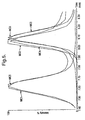
- Figs. 4(a)-(e) show respectively mass chromatograms (i.e. plots of detected ion intensity versus acquisition time) for three parent ions and two daughter ions.
- the parent ions were determined to have mass tocharge ratios of 406.2 (peak “MC1"), 418.7 (peak “MC2”) and 568.8 (peak “MC3") and the two daughter ions were determined to have mass to charge ratios of 136.1 (peaks "MC4" and "MC5") and 120.1 (peak “MC6").
- parent ion peaks MC2 and MC3 correlate well with daughter ion peaks MC4 and MC6, but it is difficult to determine which parent ion corresponds with which daughter ion.
- Fig. 5 shows the peaks of Figs. 4(a)-(e) overlaid on top of one other (drawn at a different scale).
- This cross-correlation of mass chromatograms can be carried out by an operator or more preferably by automatic peak comparison means such as a suitable peak comparison software program running on a suitable computer.
- Fig. 6 show the mass chromatogram for m/z 87.04 extracted from a HPLC separation and mass analysis obtained using Micromass' Q-TOF mass spectrometer.
- the immonium ion for the amino acid Asparagine has a m/z value of 87.04. This chromatogram was ex-tracted from all the high energy spectra recorded on the Q-TOF.
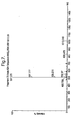
- Fig. 7 shows the full mass spectrum corresponding to scan number 604. This was a low energy mass spectrum recorded on the Q-TOF, and is the low energy spectrum next to the high energy spectrum at scan 605 that corresp onds to the largest peak in the mass chromatogram of m/z 87.04. This shows that the parent ion for the Asparagine immonlum ion at m/z 87.04 has a mass of 1012.54 since it shows the singly charged (M+H) ion at m/z 1013.54, and the doubly charged (M+2H) ++ ion at m/z 507.27.
- Fig. 8 shows a mass spectrum from the low energy spectra recorded on a Q-TOF mass spectrometer of a tryptic digest of the protein ⁇ -Caesin.
- the protein digest products were separated by HPLC and mass analysed.
- the mass spectra were recorded on the Q-TOF operating in the MS mode and alternating between low and high collision energy in the gas collision cell for successive spectra.
- Fig. 9 shows the mass spectrum from the high energy spectra recorded during the same period of the HPLC separation as that in Fig. 8 above.
- Fig. 10 shows a processed and expanded view of the same spectrum as in Fig. 9 above.
- the continuum data has been processed such to identify peaks and display as lines with heights proportional to the peak area, and annotated with masses corresponding to their centroided masses.
- the peak at m/z 1031.4395 is the doubly charged (M+2H) ++ ion of a peptide
- the peak at m/z 982.4515 is a doubly charged fragment ion. It has to be a fragment ion since it is not present in the low energy spectrum.
- the mass difference between these ions is 48.9880.
- the theoretical mass for H 3 PO 4 is 97.9769
- the m/z value for the doubly charged H 3 PO 4 ++ ion is 48.9884, a difference of only 8 ppm from that observed.
Landscapes
- Chemical & Material Sciences (AREA)
- Chemical Kinetics & Catalysis (AREA)
- Analytical Chemistry (AREA)
- Other Investigation Or Analysis Of Materials By Electrical Means (AREA)
- Electron Tubes For Measurement (AREA)
Claims (66)
- Procédé de spectrométrie de masse comprenant les étapes:(a) de mise à disposition d'une source d'ions (1) en vue de la génération d'ions, de la transmission d'ions par un guide d'ions (2) et du transfert d'ions depuis le guide d'ions (2) par le biais d'un orifice entre chambres (7) jusque dans une chambre à vide (8), puis;(b) de passage desdits ions ayant de multiples valeurs masse à charge différentes à un moyen de fragmentation comprenant une cellule de collision (4) formant une enceinte substantiellement étanche aux gaz dans laquelle a été introduit un gaz de collision;(c) d'utilisation dudit moyen de fragmentation dans un premier mode dans lequel au moins une portion desdits ions sont fragmentés pour donner des ions fils associés à de multiples ions parents de différentes valeurs masse à charge qui sont présents simultanément dans la cellule de collision dans le premier mode;(d) d'enregistrement d'un spectre de masse des ions émergeant dudit moyen de fragmentation opérant dans ledit premier mode en tant que spectre de masse à fragmentation élevée avec des pics multiples;(e) de commutation dudit moyen de fragmentation pour opérer dans un deuxième mode dans lequel substantiellement moins d'ions sont fragmentés;(f) d'enregistrement d'un spectre de masse des ions émergeant dudit moyen de fragmentation opérant dans ledit deuxième mode en tant que spectre de masse à fragmentation faible avec des pics multiples; et(g) de répétition des étapes (c) - (f) à raison d'une pluralité de reprises sans interrompre l'acquisition de données.
- Procédé de spectrométrie de masse selon la revendication 1, comprenant en outre l'étape de reconnaissance des ions parents.
- Procédé de spectrométrie de masse selon la revendication 2, comprenant l'étape:de comparaison d'un spectre de masse à fragmentation élevée avec un spectre de masse à fragmentation faible obtenu substantiellement au même moment ; etde reconnaissance en tant qu'ions parents, des ions ayant une intensité supérieure dans le spectre de masse à fragmentation basse par rapport au spectre de masse à fragmentation élevée.
- Procédé de spectrométrie de masse selon la revendication 1, 2 ou 3, comprenant en outre l'étape de reconnaissance des ions fils.
- Procédé de spectrométrie de masse selon la revendication 4, comprenant l'étape:de comparaison d'un spectre de masse à fragmentation élevée avec un spectre de masse à fragmentation faible obtenu substantiellement au même moment ; etde reconnaissance, en tant qu'ions fils, des ions ayant une intensité supérieure dans le spectre de masse à fragmentation élevée par rapport au spectre de masse à fragmentation basse.
- Procédé de spectrométrie de masse selon les revendications 3 et 5, comprenant en outre l'étape de sélection d'un sous-groupe d'ions parents candidats possibles en provenance de l'ensemble de tous les ions parents.
- Procédé de spectrométrie de masse selon la revendication 6, comprenant en outre la sélection des ions parents candidats possibles sur la base de leur relation à un ion fils prédéterminé.
- Procédé de spectrométrie de masse selon la revendication 7, comprenant l'étape:de génération d'un chromatogramme de masse d'un ion fils prédéterminé pour ledit ion fils prédéterminé en utilisant des spectres de masse à fragmentation élevée;de détermination du centre de chaque pic dans ledit chromatogramme de masse d'un ion fils prédéterminé ; etde détermination du ou des temps d'élution correspondants de l'ion fils prédéterminé.
- Procédé de spectrométrie de masse selon la revendication 8, comprenant en outre, pour chaque pic, dans ledit chromatogramme de masse d'ions fils prédéterminés, les étapes:d'interrogation tout à la fois du spectre de masse à fragmentation basse obtenu immédiatement avant le temps d'élution d'ions fils prédéterminés et le spectre de masse à fragmentation basse obtenu immédiatement après le temps d'élution d'ions fils prédéterminés pour ce qui est de la présence d'ions parents reconnus antérieurement;de génération d'un chromatogramme de masse d'ions parents candidats possibles pour ce qui est d'un ion parent quelconque reconnu antérieurement, constaté comme étant présent tout à la fois dans le spectre de masse à fragmentation basse obtenu immédiatement avant le temps d'élution d'ions fils prédéterminés et le spectre de masse à fragmentation basse obtenu immédiatement après le temps d'élution d'ions fils prédéterminés;de détermination du centre de chaque pic dans chaque dit chromatogramme de masse d'ions parents candidats possibles; etde détermination du ou des temps d'élution correspondants des ions parents candidats possibles.
- Procédé de spectrométrie de masse selon la revendication 9, comprenant en outre l'étape de classement des ions parents candidats possibles en fonction de la précision de concordance de leur temps d'élution avec ledit temps d'élution d'ions fils prédéterminé.
- Procédé de spectrométrie de masse selon la revendication 10, comprenant en outre l'étape de formation d'une liste des ions parents candidats ultimes à partir desdits ions parents candidats possibles, en rejetant les ions parents candidats possibles si le temps d'élution d'un ion parent candidat possible est inférieur ou supérieur audit temps d'élution de l'ion fils prédéterminé par plus une quantité prédéterminée.
- Procédé selon la revendication 11, comprenant en outre l'étape d'identification de chaque ion parent candidat ultime.
- Procédé selon la revendication 11 ou 12, dans lequel ladite quantité prédéterminée est sélectionnée parmi le groupe comprenant: (i) 0,25 seconde; (ii) 0,5 seconde; (iii) 0,75 seconde; (iv) 1 seconde; (v) 2,5 secondes; (vi) 5 secondes; (vii) 10 secondes; et (viii) un temps correspondant à 5% de la largeur d'un pic de chromatographie mesuré à mi-hauteur.
- Procédé de spectrométrie de masse selon la revendication 6, comprenant en outre la sélection des ions parents candidats possibles sur la base de leur capacité à conduire à une perte de masse prédéterminée.
- Procédé de spectrométrie de masse selon la revendication 14, comprenant en outre, pour chaque spectre de masse à fragmentation basse, les étapes:de génération d'une liste de valeurs de charge cible d'ions fils qui résulterait de la perte d'un ion oud'une particule neutre prédéterminé(e) en provenance de chaque ion parent reconnu antérieurement, présent dans ledit spectre de masse à fragmentation basse;d'interrogation tout à la fois du spectre de masse à fragmentation élevée obtenu immédiatement avant ledit spectre de masse à fragmentation basse et le spectre de masse à fragmentation élevée obtenu immédiatement après ledit spectre de masse à fragmentation basse pour ce qui est de la présence d'ions fils ayant une valeur masse à charge correspondant à une dite valeur cible masse à charge d'un ion fils; etde formation d'une liste d'ions parents candidats possibles, en option avec leurs ions fils correspondants, en incluant dans ladite liste un ion parent si un ion fils ayant une valeur masse à charge correspondant à une dite valeur cible masse à charge d'un ion fils s'avère être présente tout à la fois dans le spectre de masse à fragmentation élevée immédiatement avant ledit spectre de masse à fragmentation basse et le spectre de masse à fragmentation élevée immédiatement avant ledit spectre de masse à fragmentation basse.
- Procédé de spectrométrie de masse selon la revendication 15, comprenant en outre les étapes:de génération d'un chromatogramme de perte de masse basé sur des ions parents candidats possible et leurs ions fils correspondants;de détermination du centre de chaque pic dans ledit chromatogramme de masse; etde détermination du ou des temps d'élution de perte de masse correspondants.
- Procédé de spectrométrie de masse selon la revendication 15 ou 16, comprenant en outre, pour chaque ion parent candidat possible,
la génération d'un chromatogramme de masse d'ions parents candidats possibles pour l'ion parent candidat possible en utilisant les spectres de masse à fragmentation basse;
la génération d'un chromatogramme de masse d'un ion fils correspondant pour l'ion fils correspondant;
la détermination du centre de chaque pic dans ledit chromatogramme de masse d'un ion parent candidat possible et dudit chromatogramme de masse d'un ion fils correspondant; et
la détermination du ou des temps d'élution d'un ion parent candidat possible correspondant et du ou des temps d'élution d'un ion fils correspondant. - Procédé de spectrométrie de masse selon la revendication 17, comprenant en outre l'étape de formation d'une liste des ions parents candidats ultimes à partir desdits ions parents candidats possibles, en rejetant les ions parents candidats possibles si le temps d'élution d'un ion parent candidat possible est inférieur ou supérieur au temps d'élution de l'ion fils correspondant par plus une quantité prédéterminée.
- Procédé selon la revendication 18, dans lequel ladite quantité prédéterminée est sélectionnée parmi le groupe comprenant: (i) 0,25 seconde; (ii) 0,5 seconde; (iii) 0,75 seconde; (iv) 1 seconde; (v) 2,5 secondes; (vi) 5 secondes; (vii) 10 secondes; et (viii) un temps correspondant à 5% de la largeur d'un pic de chromatographie mesuré à mi-hauteur.
- Procédé selon la revendication 18 ou 19, comprenant en outre l'étape d'identification de chaque ion parent candidat ultime.
- Procédé selon la revendication 20, comprenant en outre, pour chaque ion parent candidat ultime, les étapes:de rappel du temps d'élution dudit ion parent candidat ultime;de génération d'une liste d'ions fils candidats possibles qui comprend des ions fils antérieurement reconnus qui sont présents tout à la fois dans le spectre de masse à fragmentation basse obtenu immédiatement avant le temps d'élution dudit ion parent candidat ultime et le spectre de masse à fragmentation basse obtenu immédiatement après le temps d'élution dudit ion parent candidat ultime;de génération d'un chromatogramme de masse d'ions fils candidats possibles;de détermination du centre de chaque pic dans chaque dit chromatogramme de masse d'ions fils candidats possibles; etde détermination du ou des temps d'élution correspondants des ions fils candidats possibles.
- Procédé de spectrométrie de masse selon la revendication 21, comprenant en outre l'étape de classement des ions fils candidats possibles en fonction de la précision de concordance de leur temps d'élution avec ledit temps d'élution dudit ion parent candidat ultime.
- Procédé de spectrométrie de masse selon la revendication 21 ou 22, comprenant en outre l'étape de formation d'une liste des ions fils candidats ultimes à partir desdits ions fils candidats possibles en rejetant les ions fils candidats possibles si le temps d'élution d'un ion fils candidat possible est inférieur ou supérieur au temps d'élution dudit ion parent candidat ultime par plus une quantité prédéterminée.
- Procédé selon la revendication 23, dans lequel ladite quantité prédéterminée est sélectionnée parmi le groupe comprenant: (i) 0,25 seconde; (ii) 0,5 seconde; (iii) 0,75 seconde; (iv) 1 seconde; (v) 2,5 secondes; (vi) 5 secondes; (vii) 10 secondes; et (viii) un temps correspondant à 5% de la largeur d'un pic de chromatographie mesuré à mi-hauteur.
- Procédé selon la revendication 23 ou 24, comprenant en outre les étapes:de génération d'une liste d'ions parents voisins qui sont présents dans le spectre de masse à fragmentation basse obtenu le plus près en terme de temps du temps d'élution dudit ion parent candidat ultime;de génération d'un chromatogramme de masse d'un ion parent voisin de chaque ion parent contenu dans la ladite liste;de détermination du centre de chaque chromatogramme de masse d'ions parents voisins; etde détermination du ou des temps d'élution correspondants de l'ion parent voisin.
- Procédé selon la revendication 25, comprenant en outre l'étape de rejet de ladite liste d'ions fils candidats ultimes d'un ion fils candidat ultime quelconque ayant un temps d'élution qui correspond plus précisément à un temps d'élution d'un ion parent voisin qu'au temps d'élution dudit ion parent candidat ultime.
- Procédé selon l'une quelconque des revendications 23-26, comprenant en outre l'étape d'attribution des ions fils candidats ultimes audit ion parent candidat ultime en fonction de la précision de concordance de leurs temps d'élution.
- Procédé selon la revendication 27, comprenant en outre l'étape d'énumération de tous les ions fils candidats possibles qui ont été associés audit ion parent candidat ultime.
- Procédé selon la revendication 3 ou 5, se composant en outre de l'étape:de génération d'un chromatogramme de masse d'ions parents pour chaque ion parent reconnu;de détermination du centre de chaque pic dans ledit chromatogramme de masse d'un ion parent;de détermination du ou des temps d'élution correspondants de l'ion parent,de génération d'un chromatogramme de masse d'ions fils pour chaque ion fils reconnu;de détermination du centre de chaque pic dans ledit chromatogramme de masse d'un ion fils; etde détermination du ou des temps d'élution correspondants de l'ion fils.
- Procédé selon la revendication 29, comprenant en outre l'attribution des ions fils aux ions parents en fonction de la précision de concordance de leurs temps d'élution respectifs.
- Procédé selon la revendication 30, comprenant en outre l'étape d'énumération de tous les ions fils candidats qui ont été associés à chaque ion parent.
- Procédé selon l'une quelconque des revendications précédentes, comprenant en outre le passage d'ions engendrés par ladite source d'ions à travers un filtre de masse avant de les faire passer audit moyen de fragmentation, ledit filtre de masse transmettant substantiellement des ions ayant une valeur masse à charge tombant dans un certain domaine et atténuant substantiellement les ions ayant une valeur masse à charge tombant à l'extérieur dudit domaine.
- Procédé selon la revendication 32, dans lequel ledit filtre de masse est un filtre de masse quadrupole.
- Procédé selon la revendication 32 ou 33 et la revendication 4, comprenant en outre la reconnaissance d'ions en tant qu'ions fils si lesdits ions sont présents dans un spectre de masse à fragmentation élevée et s'ils ont une valeur masse à charge tombant à l'extérieur dudit domaine.
- Procédé de spectrométrie de masse selon la revendication 1, comprenant les étapes:(h) de reconnaissance des ions parents et des ions fils à partir des spectres de masse à fragmentation élevée et des spectres de masse à fragmentation basse.
- Procédé selon la revendication 35, se composant en outre des étapes:(i) de génération d'un chromatogramme de masse d'ions parents pour chaque ion parent;(j) de détermination du centre de chaque pic dans ledit chromatogramme de masse d'un ion parent;(k) de détermination du ou des temps d'élution correspondants de l'ion parent,(l) de génération d'un chromatogramme de masse d'ions fils pour chaque ion fils;(m) de détermination du centre de chaque pic dans ledit chromatogramme de masse d'un ion fils; et(n) de détermination du ou des temps d'élution correspondants de l'ion fils.
- Procédé selon la revendication 36, comprenant en outre l'attribution des ions fils aux ions parents en fonction de la précision de concordance de leurs temps d'élution respectifs.
- Procédé selon la revendication 35, 36 ou 37, comprenant en outre la mise à disposition d'un filtre de masse ayant une fenêtre de transmission de rapport masse à charge en amont de ladite cellule de collision.
- Procédé selon la revendication 38, dans lequel les ions fils sont reconnus en reconnaissant les ions présents dans un spectre à fragmentation élevée ayant une valeur masse à charge qui tombe à l'extérieur de la fenêtre de transmission dudit filtre de masse.
- Procédé selon l'une quelconque des revendications précédentes, comprenant en outre l'identification d'un ion parent sur la base du rapport masse à charge dudit ion parent.
- Procédé selon l'une quelconque des revendications précédentes, comprenant en outre l'identification d'un ion parent sur la base du rapport masse à charge d'un ou de plusieurs ions fils.
- Procédé selon l'une quelconque des revendications précédentes, comprenant en outre l'identification d'une protéine par détermination du rapport masse à charge d'un ou de plusieurs ions parents.
- Procédé selon la revendication 42, dans lequel ledit un ou lesdits plusieurs ions parents comprennent des peptides de ladite protéine.
- Procédé selon l'une quelconque des revendications précédentes, comprenant en outre l'identification d'une protéine par détermination du rapport masse à charge d'un ou de plusieurs ions fils.
- Procédé selon la revendication 44, dans lequel ledit un ou lesdits plusieurs ions fils comprennent des fragments de peptides de ladite protéine.
- Procédé selon l'une quelconque des revendications 42-45, dans lequel les rapports masse à charge dudit un ou desdits plusieurs ions parents et/ou dudit un ou desdits plusieurs ions fils sont examinés en mode de recherche par comparaison à une banque de données.
- Procédé selon la revendication 42 ou 43, comprenant en outre la recherche du rapport masse à charge dudit un ou desdits plusieurs ions parents par comparaison à une banque de données.
- Procédé selon la revendication 47, comprenant en outre la recherche de spectres de masse à fragmentation élevée pour ce qui est de la présence d'ions fils desquels on pourrait s'attendre à ce qu'ils résultent de la fragmentation d'un ion parent.
- Procédé selon la revendication 46, 47 or 48, dans lequel ladite banque de données comprend des protéines connues.
- Procédé selon l'une quelconque des revendications précédentes, comprenant en outre l'introduction d'un gaz de collision comprenant l'hélium, l'argon, l'azote ou le méthane dans ladite cellule de collision (4).
- Spectromètre de masse comprenant:une source d'ions (1);un guide d'ions (2) ;une chambre à vide (8) ;un orifice entre chambres (7) entre le guide d'ions etla chambre à vide par le biais duquel des ions sont transférés, pendant l'utilisation, du guide d'ions (2) jusque dans la chambre à vide (8) ;une cellule de collision (4) qui reçoit des ions après qu'ils ont été transférés jusque dans la chambre à vide, la cellule de collision formant une enceinte substantiellement étanche aux gaz ;le spectromètre de masse pouvant être utilisé sans filtration de masse desdits ions ;la cellule de collision (4) pouvant être utilisée dans un premier mode où au moins une portion desdits ions non filtrés est fragmentée pour produire des ions fils associés à de multiples ions parents de différentes valeurs masse à charge et un deuxième mode où substantiellement moins d'ions sont fragmentés; etun analyseur de masse;caractérisé en ce que ledit spectromètre de masse comprend en outre:un système de contrôle qui, en cours d'utilisation,commute ladite cellule de collision (4), d'une manière répétée, en mode bascule, entre lesdits premiers modes et lesdits deuxième modes sans interrompre l'acquisition de données.
- Spectromètre de masse selon la revendication 51, dans lequel ladite source d'ions (1) est sélectionnée parmi le groupe comprenant: (i) une source d'ions du type electrospray; (ii) une source d'ions à ionisation chimique à la pression atmosphérique; et (iii) une source d'ions à désorption laser à matrice.
- Spectromètre de masse selon la revendication 52, dans lequel ladite source d'ions (1) est pourvue d'un éluant au cours d'une période de temps, ledit éluant ayant été séparé d'un mélange au moyen d'une chromotographie en phase liquide ou au moyen d'une électrophorèse capillaire.
- Spectromètre de masse selon la revendication 51, dans lequle ladite source d'ions (1) est sélectionnée parmi le groupe comprenant: (i) une source d'ion à impact d'électrons; (ii) une source d'ions à ionisation chimique; et (iii) une source d'ions à ionisation de champs.
- Spectromètre de masse selon la revendication 54, dans lequel ladite source d'ions (1) est pourvue d'un éluant au cours d'une période de temps, ledit éluant ayant été séparé d'un mélange au moyen d'une chromatographie en phase gazeuse.
- Spectromètre de masse selon l'une quelconque des revendications 51-55, comprenant un filtre de masse en amont de ladite cellule de collision (4).
- Spectromètre de masse selon la revendication 56, dans lequel ledit filtre de masse est un filtre de masse quadrupole (3).
- Spectromètre de masse selon la revendication 56 ou 57, dans lequel ledit filtre de masse a une caractéristique de filtre passe-haut.
- Spectromètre de masse selon la revendication 58, dans lequel ledit filtre de masse est arrangé pour transmettre les ions ayant un rapport masse à charge sélectionné parmi le groupe comprenant: (i) ≥ 100; (ii) ≥ 150; (iii) ≥ 200; (iv) ≥ 250; (v) ≥ 300; (vi) ≥ 350; (vii) ≥ 400; (viii) ≥ 450; et (ix) ≥ 500.
- Spectromètre de masse selon la revendication 56 ou 57, dans lequel ledit filtre de masse a une caractéristique de filtre passe-bas ou de filtre passe-bande.
- Spectromètre de masse selon l'une quelconque des revendications 51-60, ledit guide d'ions (2) étant sélectionné parmi le groupe comprenant: (i) un hexapole; (ii) un quadrupole; (iii) un octapole; (iv) une pluralité d'électrodes annulaires ayant des diamètres internes substantiellement constants; et (v) une pluralité d'électrodes annulaires ayant des diamètre internes substantiellement dégressifs.
- Spectromètre de masse selon l'une quelconque des revendications 51-61, dans lequel ledit analyseur de masse est sélectionné parmi le groupe comprenant: (i) un filtre de masse quadrupole ; (ii) un analyseur de masse du type à temps-de-vol; (iii) un piège à ions; (iv) un analyseur à secteurs magnétiques; et (v) un analyseur de masse dit 'Fourier Transform Ion Cyclotron Resonance' ("FTICR").
- Spectromètre de masse selon l'une quelconque des revendications 51-62, dans lequel ladite cellule de collision (4) est sélectionnée parmi le groupe comprenant: (i) un jeu de tiges quadrupole; (ii) un jeu de tiges hexapole ; et (iii) un jeu de tiges octopole.
- Spectromètre de masse selon l'une quelconque des revendications 51-63, dans lequel, dans undit premier mode, ledit système de contrôle fait en sorte de fournir une tension à ladite cellule de collision (4) sélectionnée parmi le groupe comprenant: (i) ≥ 15V; (ii) ≥ 20V; (iii) ≥ 25V; (iv) ≥ 30V; (v) ≥ 50V; (vi) ≥ 100V; (vii) ≥ 150V; et (viii) ≥ 200V.
- Spectromètre de masse selon l'une quelconque des revendications 51-64, dans lequel, dans ledit deuxième mode, ledit système de contrôle s'arrange pour fournir une tension à ladite cellule de collision (4) sélectionnée parmi le groupe comprenant : (i) ≤ 5 V; (ii) ≤ 4,5 V; (iii) ≤ 4 V; (iv) ≤ 3,5 V; (v) ≤ 3 V; (vi) ≤ 2,5 V; (vii) ≤ 2 V; (viii) ≤ 1,5 V; (ix) ≤ 1 V; (x) ≤ 0,5 V; et (xi) substantiellement 0 V.
- Spectromètre de masse selon l'une quelconque des revendications 51-65, dans lequel un gaz de collision comprenant l'hélium, l'argon, l'azote ou le méthane est introduit dans ladite cellule de collision (4).
Priority Applications (4)
| Application Number | Priority Date | Filing Date | Title |
|---|---|---|---|
| EP05025116A EP1638133B3 (fr) | 2000-06-09 | 2001-06-11 | Méthodes et appareil pour la spectrométrie de masse |
| EP09002434.0A EP2056334B1 (fr) | 2000-06-09 | 2001-06-11 | Cellule de collision pour spectromètre de masse |
| DE2001626055 DE60126055T3 (de) | 2000-06-09 | 2001-06-11 | Massenspektrometer und massenspektrometrisches Verfahren |
| EP10182678.2A EP2299469B1 (fr) | 2000-06-09 | 2001-06-11 | Spectromètre de masse avec une cellule de collision, méthode de spectrométrie de masse |
Applications Claiming Priority (6)
| Application Number | Priority Date | Filing Date | Title |
|---|---|---|---|
| GB0014062A GB0014062D0 (en) | 2000-06-09 | 2000-06-09 | Methods and apparatus for tandem mass spectrometry |
| GB0014062 | 2000-06-09 | ||
| GB1001048 | 2001-01-15 | ||
| GB0101048A GB0101048D0 (en) | 2001-01-15 | 2001-01-15 | Methods and apparatus for tandem mass spectrometry |
| GB1005227 | 2001-03-02 | ||
| GB0105227A GB2364168B (en) | 2000-06-09 | 2001-03-02 | Methods and apparatus for mass spectrometry |
Related Child Applications (6)
| Application Number | Title | Priority Date | Filing Date |
|---|---|---|---|
| EP09002434.0A Division EP2056334B1 (fr) | 2000-06-09 | 2001-06-11 | Cellule de collision pour spectromètre de masse |
| EP09002434.0A Division-Into EP2056334B1 (fr) | 2000-06-09 | 2001-06-11 | Cellule de collision pour spectromètre de masse |
| EP10182678.2A Division-Into EP2299469B1 (fr) | 2000-06-09 | 2001-06-11 | Spectromètre de masse avec une cellule de collision, méthode de spectrométrie de masse |
| EP10182678.2A Division EP2299469B1 (fr) | 2000-06-09 | 2001-06-11 | Spectromètre de masse avec une cellule de collision, méthode de spectrométrie de masse |
| EP05025116A Division EP1638133B3 (fr) | 2000-06-09 | 2001-06-11 | Méthodes et appareil pour la spectrométrie de masse |
| EP05025116A Division-Into EP1638133B3 (fr) | 2000-06-09 | 2001-06-11 | Méthodes et appareil pour la spectrométrie de masse |
Publications (4)
| Publication Number | Publication Date |
|---|---|
| EP1225618A2 EP1225618A2 (fr) | 2002-07-24 |
| EP1225618A3 EP1225618A3 (fr) | 2004-03-31 |
| EP1225618B1 EP1225618B1 (fr) | 2007-01-17 |
| EP1225618B3 true EP1225618B3 (fr) | 2015-02-18 |
Family
ID=27255755
Family Applications (4)
| Application Number | Title | Priority Date | Filing Date |
|---|---|---|---|
| EP01302377A Expired - Lifetime EP1220290B1 (fr) | 2000-06-09 | 2001-03-14 | Méthode et dispositif pour spectrométrie de masse |
| EP05022407A Expired - Lifetime EP1622188B1 (fr) | 2000-06-09 | 2001-03-14 | Méthodes et appareil pour la spectrométrie de masse |
| EP05025116A Expired - Lifetime EP1638133B3 (fr) | 2000-06-09 | 2001-06-11 | Méthodes et appareil pour la spectrométrie de masse |
| EP01305040.6A Expired - Lifetime EP1225618B3 (fr) | 2000-06-09 | 2001-06-11 | Spectromètre de masse et méthodes de spectrométrie |
Family Applications Before (3)
| Application Number | Title | Priority Date | Filing Date |
|---|---|---|---|
| EP01302377A Expired - Lifetime EP1220290B1 (fr) | 2000-06-09 | 2001-03-14 | Méthode et dispositif pour spectrométrie de masse |
| EP05022407A Expired - Lifetime EP1622188B1 (fr) | 2000-06-09 | 2001-03-14 | Méthodes et appareil pour la spectrométrie de masse |
| EP05025116A Expired - Lifetime EP1638133B3 (fr) | 2000-06-09 | 2001-06-11 | Méthodes et appareil pour la spectrométrie de masse |
Country Status (7)
| Country | Link |
|---|---|
| US (1) | US6717130B2 (fr) |
| EP (4) | EP1220290B1 (fr) |
| JP (2) | JP2002100318A (fr) |
| AT (2) | ATE329369T1 (fr) |
| CA (2) | CA2340150C (fr) |
| DE (2) | DE60120337T2 (fr) |
| GB (1) | GB2363249B (fr) |
Families Citing this family (110)
| Publication number | Priority date | Publication date | Assignee | Title |
|---|---|---|---|---|
| US6586727B2 (en) * | 2000-06-09 | 2003-07-01 | Micromass Limited | Methods and apparatus for mass spectrometry |
| US20020115056A1 (en) * | 2000-12-26 | 2002-08-22 | Goodlett David R. | Rapid and quantitative proteome analysis and related methods |
| US7038197B2 (en) * | 2001-04-03 | 2006-05-02 | Micromass Limited | Mass spectrometer and method of mass spectrometry |
| CA2476597C (fr) * | 2002-02-28 | 2011-05-17 | Metanomics Gmbh & Co. Kgaa | Procede de spectrometrie de masse pour analyser des melanges de substances |
| JP3743717B2 (ja) * | 2002-06-25 | 2006-02-08 | 株式会社日立製作所 | 質量分析データの解析方法および質量分析データの解析装置および質量分析データの解析プログラムならびにソリューション提供システム |
| GB0305796D0 (en) | 2002-07-24 | 2003-04-16 | Micromass Ltd | Method of mass spectrometry and a mass spectrometer |
| US7041968B2 (en) * | 2003-03-20 | 2006-05-09 | Science & Technology Corporation @ Unm | Distance of flight spectrometer for MS and simultaneous scanless MS/MS |
| US7202473B2 (en) | 2003-04-10 | 2007-04-10 | Micromass Uk Limited | Mass spectrometer |
| CA2523107C (fr) * | 2003-04-25 | 2009-06-23 | Griffin Analytical Technologies, Inc. | Appareillage, articles manufactures et methodes d'analyse |
| JP4690641B2 (ja) * | 2003-07-28 | 2011-06-01 | 株式会社日立ハイテクノロジーズ | 質量分析計 |
| GB0322356D0 (en) * | 2003-09-24 | 2003-10-22 | Micromass Ltd | Mass spectrometer |
| US7022980B2 (en) * | 2004-02-02 | 2006-04-04 | Agilent Technologies, Inc. | Spectral axis transform |
| US20060186028A1 (en) * | 2004-02-06 | 2006-08-24 | Micromass Uk Limited | Mass spectrometer |
| DE202005001630U1 (de) * | 2004-02-06 | 2005-06-23 | Micromass Uk Ltd. | Massenspektrometer |
| EP1749272A4 (fr) * | 2004-02-13 | 2010-08-25 | Waters Technologies Corp | Appareil et procede d'identification de pics dans des donnes de spectrometrie de masse/chromatographie liquide et de formation de spectres et de chromatogrammes |
| US7994474B2 (en) * | 2004-02-23 | 2011-08-09 | Andreas Hieke | Laser desorption ionization ion source with charge injection |
| US8003934B2 (en) * | 2004-02-23 | 2011-08-23 | Andreas Hieke | Methods and apparatus for ion sources, ion control and ion measurement for macromolecules |
| DE112005001166B4 (de) * | 2004-05-20 | 2014-10-09 | Waters Technologies Corp. (N.D.Ges.D. Staates Delaware) | Verfahren und Vorrichtung zum Identifizieren von Proteinen in Gemischen |
| US7800055B2 (en) * | 2004-05-20 | 2010-09-21 | Waters Technologies Corporation | System and method for grouping precursor and fragment ions using selected ion chromatograms |
| WO2006002027A2 (fr) | 2004-06-15 | 2006-01-05 | Griffin Analytical Technologies, Inc. | Instruments analytiques, assemblages et methodes associees |
| GB0416288D0 (en) * | 2004-07-21 | 2004-08-25 | Micromass Ltd | Mass spectrometer |
| DE102004045534B4 (de) * | 2004-09-20 | 2010-07-22 | Bruker Daltonik Gmbh | Tochterionenspektren mit Flugzeitmassenspektrometern |
| US7197402B2 (en) * | 2004-10-14 | 2007-03-27 | Highchem, Ltd. | Determination of molecular structures using tandem mass spectrometry |
| GB0508239D0 (en) * | 2005-04-23 | 2005-06-01 | Smiths Group Plc | Detection apparatus |
| CN101317246A (zh) | 2005-04-25 | 2008-12-03 | 格里芬分析技术有限责任公司 | 分析仪器、装置和方法 |
| US8105838B2 (en) | 2005-06-03 | 2012-01-31 | Waters Technologies Corporation | Generation and use of a catalog of polypeptide-related information for chemical analyses |
| US8165820B2 (en) | 2005-06-03 | 2012-04-24 | Waters Technologies Corporation | Methods and apparatus for performing retention-time matching |
| DE102005025497B4 (de) | 2005-06-03 | 2007-09-27 | Bruker Daltonik Gmbh | Leichte Bruckstückionen mit Ionenfallen messen |
| US7417223B2 (en) * | 2005-10-28 | 2008-08-26 | Mds Inc. | Method, system and computer software product for specific identification of reaction pairs associated by specific neutral differences |
| GB0523806D0 (en) * | 2005-11-23 | 2006-01-04 | Micromass Ltd | Mass spectrometer |
| GB0523811D0 (en) * | 2005-11-23 | 2006-01-04 | Micromass Ltd | Mass stectrometer |
| GB2432712B (en) * | 2005-11-23 | 2007-12-27 | Micromass Ltd | Mass spectrometer |
| GB0524972D0 (en) * | 2005-12-07 | 2006-01-18 | Micromass Ltd | Mass spectrometer |
| WO2007076606A1 (fr) * | 2006-01-05 | 2007-07-12 | Mds Analytical Technologies, A Business Unit Of Mds Inc., Doing Business Through Its Sciex Division | Acquisition dépendante de l'information déclenchée par défaut de masse |
| US7528365B2 (en) * | 2006-02-07 | 2009-05-05 | Applera Corporation | Chemical noise reduction for mass spectrometry |
| JP4782579B2 (ja) * | 2006-02-15 | 2011-09-28 | 株式会社日立ハイテクノロジーズ | タンデム型質量分析システム及び方法 |
| DE112007000931B4 (de) | 2006-04-13 | 2014-05-22 | Thermo Fisher Scientific (Bremen) Gmbh | Ionenenergiestreuungsreduzierung für ein Massenspektrometer |
| GB0607542D0 (en) * | 2006-04-13 | 2006-05-24 | Thermo Finnigan Llc | Mass spectrometer |
| GB0609253D0 (en) | 2006-05-10 | 2006-06-21 | Micromass Ltd | Mass spectrometer |
| US7479629B2 (en) * | 2006-08-24 | 2009-01-20 | Agilent Technologies, Inc. | Multichannel rapid sampling of chromatographic peaks by tandem mass spectrometer |
| US7992424B1 (en) | 2006-09-14 | 2011-08-09 | Griffin Analytical Technologies, L.L.C. | Analytical instrumentation and sample analysis methods |
| JP4835695B2 (ja) * | 2006-10-31 | 2011-12-14 | 株式会社島津製作所 | クロマトグラフ質量分析装置 |
| US7511267B2 (en) * | 2006-11-10 | 2009-03-31 | Thermo Finnigan Llc | Data-dependent accurate mass neutral loss analysis |
| JP5194212B2 (ja) * | 2006-12-26 | 2013-05-08 | ブリガム・ヤング・ユニバーシティ | 血清プロテオミクスシステムと関連する方法 |
| KR20120116993A (ko) | 2007-04-18 | 2012-10-23 | 신닛뽄세이테쯔 카부시키카이샤 | 하이드로 포밍 가공 방법 |
| EP2147732B1 (fr) | 2007-04-18 | 2015-11-18 | Nippon Steel & Sumitomo Metal Corporation | Procédé pour la fabrication d'un article hydroformé |
| WO2009146345A1 (fr) | 2008-05-29 | 2009-12-03 | Waters Technologies Corporation | Techniques pour effectuer une correspondance rétention-temps d'ions précurseurs et produits et pour construire des spectres d'ions précurseurs et produits |
| WO2010002819A1 (fr) | 2008-07-01 | 2010-01-07 | Waters Technologies Corporation | Dispositif de fragmentation de peptides à électrodes empilées |
| US8304719B2 (en) * | 2009-02-22 | 2012-11-06 | Xin Wang | Precise and thorough background subtraction |
| CN102413907B (zh) * | 2009-04-13 | 2015-06-17 | 萨莫芬尼根有限责任公司 | 质谱仪中混合的离子布居的获取与分析 |
| GB0915474D0 (en) * | 2009-09-04 | 2009-10-07 | Micromass Ltd | Multiple reaction monitoring with a time-of-flight based mass spectrometer |
| GB0919870D0 (en) | 2009-11-13 | 2009-12-30 | Micromass Ltd | A method to detect and quantitatively profile organic species using a mass spectrometer |
| WO2011082376A1 (fr) * | 2009-12-31 | 2011-07-07 | Indiana University Research And Technology Corporation | Méthode d'identification de peptides |
| WO2011091023A1 (fr) | 2010-01-20 | 2011-07-28 | Waters Technologies Corporation | Techniques de fragmentation efficace de peptides |
| US8809770B2 (en) * | 2010-09-15 | 2014-08-19 | Dh Technologies Development Pte. Ltd. | Data independent acquisition of product ion spectra and reference spectra library matching |
| CN103109346B (zh) * | 2010-11-08 | 2016-09-28 | Dh科技发展私人贸易有限公司 | 用于通过质谱分析快速筛选样本的系统及方法 |
| US8935101B2 (en) | 2010-12-16 | 2015-01-13 | Thermo Finnigan Llc | Method and apparatus for correlating precursor and product ions in all-ions fragmentation experiments |
| CA2821669C (fr) * | 2010-12-29 | 2018-11-27 | Dh Technologies Development Pte. Ltd. | Procede de declenchement de spectres dependants pour acquisition de donnees |
| SG193361A1 (en) * | 2011-03-11 | 2013-10-30 | Agency Science Tech & Res | A method, an apparatus, and a computer program product for identifying metabolites from liquid chromatography-mass spectrometry measurements |
| GB201104225D0 (en) | 2011-03-14 | 2011-04-27 | Micromass Ltd | Pre scan for mass to charge ratio range |
| JP5967078B2 (ja) * | 2011-04-04 | 2016-08-10 | 株式会社島津製作所 | 質量分析装置及び質量分析方法 |
| EP2697655A2 (fr) | 2011-04-15 | 2014-02-19 | Micromass UK Limited | Procédé et appareil pour l'analyse d'échantillons biologiques |
| GB201116065D0 (en) * | 2011-09-16 | 2011-11-02 | Micromass Ltd | Encoding of precursor ion beam to aid product ion assignment |
| WO2013081852A1 (fr) | 2011-11-28 | 2013-06-06 | Waters Technologies Corporation | Techniques pour quantification d'échantillons |
| GB201122178D0 (en) | 2011-12-22 | 2012-02-01 | Thermo Fisher Scient Bremen | Method of tandem mass spectrometry |
| US9048072B2 (en) | 2012-03-12 | 2015-06-02 | Micromass Uk Limited | Method of mass spectrometry and a mass spectrometer |
| WO2013150351A1 (fr) * | 2012-04-02 | 2013-10-10 | Dh Technologies Development Pte. Ltd. | Systèmes et méthodes d'acquisition séquentielle par fenêtres sur une gamme de masse grâce à un piège à ions |
| GB201208961D0 (en) | 2012-05-18 | 2012-07-04 | Micromass Ltd | 2 dimensional MSMS |
| GB2506713B (en) * | 2012-05-18 | 2016-09-07 | Micromass Ltd | Improved method of MSe mass spectrometry |
| CA2873806A1 (fr) | 2012-05-18 | 2013-11-21 | Micromass Uk Limited | Procede de spectrometrie de masse en tandem ms/ms |
| GB2510837B (en) | 2013-02-14 | 2017-09-13 | Thermo Fisher Scient (Bremen) Gmbh | Method of operating a mass filter in mass spectrometry |
| JP6044385B2 (ja) | 2013-02-26 | 2016-12-14 | 株式会社島津製作所 | タンデム型質量分析装置 |
| US20140252218A1 (en) * | 2013-03-05 | 2014-09-11 | David A. Wright | Methods and Apparatus for Decomposing Tandem Mass Spectra Generated by All-Ions Fragmentation |
| GB201319939D0 (en) * | 2013-11-12 | 2013-12-25 | Micromass Ltd | Data Dependent MS/MS analysis |
| US10615014B2 (en) | 2013-11-12 | 2020-04-07 | Micromass Uk Limited | Data dependent MS/MS analysis |
| US9881778B2 (en) | 2014-04-17 | 2018-01-30 | Micromass Uk Limited | Hybrid acquisition method incorporating multiple dissociation techniques |
| US11404258B2 (en) * | 2014-06-09 | 2022-08-02 | Water Technologies Corporation | Method to remove ion interferences |
| WO2015189544A1 (fr) | 2014-06-11 | 2015-12-17 | Micromass Uk Limited | Modes d'acquisition ms/ms bidimensionnelle |
| US10768151B2 (en) * | 2014-09-16 | 2020-09-08 | Waters Technologies Corporation | Techniques for display and processing of mass spectral data |
| JP6698668B2 (ja) * | 2015-02-05 | 2020-05-27 | ディーエイチ テクノロジーズ デベロップメント プライベート リミテッド | 断片化エネルギーを切り替えながらの幅広い四重極rf窓の高速スキャニング |
| US10591448B2 (en) | 2015-04-14 | 2020-03-17 | Waters Technologies Corporation | Structural elucidation of isotopically labeled analytes |
| JP6831337B2 (ja) | 2015-05-29 | 2021-02-17 | ウオーターズ・テクノロジーズ・コーポレイシヨン | 質量スペクトルデータを処理する技術 |
| GB2565238A (en) | 2015-06-09 | 2019-02-06 | Waters Technologies Corp | Molecular diagnostics in personalized dermatology, dermatopathology and cosmetics |
| GB2544834A (en) | 2015-06-09 | 2017-05-31 | Waters Technologies Corp | Profile diagnositcs in personalized dermatology, dermatopathology and cosmetics |
| US10229823B2 (en) | 2015-08-06 | 2019-03-12 | Shimadzu Corporation | Mass spectrometer |
| EP3519831A1 (fr) | 2016-09-27 | 2019-08-07 | Waters Technologies Corporation | Méthodologies de surveillance d'attributs multiples pour échantillons complexes |
| GB2559395B (en) | 2017-02-03 | 2020-07-01 | Thermo Fisher Scient Bremen Gmbh | High resolution MS1 based quantification |
| JP6835210B2 (ja) * | 2017-04-10 | 2021-02-24 | 株式会社島津製作所 | イオン分析装置及びイオン解離方法 |
| EP3410463B1 (fr) | 2017-06-02 | 2021-07-28 | Thermo Fisher Scientific (Bremen) GmbH | Spectromètre de masse hybride |
| JP6465190B2 (ja) * | 2017-10-31 | 2019-02-06 | 株式会社島津製作所 | 質量分析方法及び質量分析装置 |
| CN109830426B (zh) | 2017-11-23 | 2021-04-02 | 株式会社岛津制作所 | 质谱数据采集方法 |
| CN109828068B (zh) | 2017-11-23 | 2021-12-28 | 株式会社岛津制作所 | 质谱数据采集及分析方法 |
| GB2585372B (en) | 2019-07-04 | 2022-03-02 | Thermo Fisher Scient Bremen Gmbh | Methods and apparatus for mass spectrometry |
| US12033843B2 (en) * | 2020-03-26 | 2024-07-09 | Agilent Technologies, Inc. | Mass spectrometry ION source |
| CN113552204B (zh) | 2020-04-02 | 2024-06-21 | 株式会社岛津制作所 | 质谱分析方法和质谱系统 |
| GB202005715D0 (en) | 2020-04-20 | 2020-06-03 | Micromass Ltd | Calibration of analytical instrument |
| US12163936B2 (en) | 2020-04-24 | 2024-12-10 | Waters Technologies Ireland Limited | Methods, mediums, and systems to compare data within and between cohorts |
| US11728149B2 (en) | 2020-08-26 | 2023-08-15 | Waters Technologies Ireland Limited | Methods, mediums, and systems for selecting values for parameters when tuning a mass spectrometry apparatus |
| CN116868272A (zh) | 2020-10-13 | 2023-10-10 | 沃特世科技爱尔兰有限公司 | 通过向量比较来识别感兴趣的样本的方法、介质和系统 |
| CN114169365B (zh) * | 2020-11-25 | 2025-07-15 | 摩赛恩科技(苏州)有限公司 | 质谱数据处理系统及方法 |
| EP4248384B1 (fr) | 2020-12-18 | 2026-04-15 | Waters Technologies Ireland Limited | Procédés, supports et systèmes pour générer et exécuter un flux de travail de chromatographie |
| WO2022137179A1 (fr) | 2020-12-23 | 2022-06-30 | Waters Technologies Ireland Limited | Procédés, supports et systèmes de stockage et de récupération de données de chromatographie |
| EP4248205B1 (fr) | 2020-12-23 | 2025-12-17 | Waters Technologies Ireland Limited | Procédés et systèmes pour la génération d'une carte d'activité de traitement de chromatographie |
| US12092619B2 (en) | 2021-04-09 | 2024-09-17 | Waters Technologies Ireland Limited | Methods, mediums, and systems for linking chromatography data and metadata to compliance risks |
| US20220404371A1 (en) | 2021-06-18 | 2022-12-22 | Waters Technologies Ireland Limited | Comparing a modeled molecule fragmentation to an experimental molecule fragmentation |
| EP4356386A1 (fr) | 2021-06-18 | 2024-04-24 | Waters Technologies Ireland Limited | Procédés, milieux et systèmes pour prédire des modifications de molécule |
| US20230090556A1 (en) | 2021-09-17 | 2023-03-23 | Waters Technologies Ireland Limited | Methods, mediums, and systems for establishing a quality control record chain for laboratory analytical instruments |
| CN118984935A (zh) | 2022-02-02 | 2024-11-19 | 沃特世科技爱尔兰有限公司 | 用于发现液相色谱仪器中的错误和系统就绪条件的机器学习技术 |
| EP4494154A1 (fr) | 2022-03-16 | 2025-01-22 | Waters Technologies Ireland Limited | Procédés, supports et systèmes pour déterminer une variation relative à des structures de composés |
| WO2024216093A2 (fr) | 2023-04-12 | 2024-10-17 | Waters Technologies Corporation | Détecteurs d'aérosol chargés améliorés |
Family Cites Families (25)
| Publication number | Priority date | Publication date | Assignee | Title |
|---|---|---|---|---|
| JPS62168331A (ja) * | 1985-12-20 | 1987-07-24 | Shimadzu Corp | 質量分析装置 |
| JPS6486437A (en) * | 1987-04-24 | 1989-03-31 | Shimadzu Corp | Cleavage ion measuring device |
| US4851669A (en) | 1988-06-02 | 1989-07-25 | The Regents Of The University Of California | Surface-induced dissociation for mass spectrometry |
| JPH02158048A (ja) * | 1988-12-09 | 1990-06-18 | Shimadzu Corp | 質量分析装置 |
| EP0476062B1 (fr) * | 1989-06-06 | 1996-08-28 | Viking Instruments Corp. | Systeme de spectrometrie de masse miniaturise |
| US5073713A (en) * | 1990-05-29 | 1991-12-17 | Battelle Memorial Institute | Detection method for dissociation of multiple-charged ions |
| GB2250632B (en) * | 1990-10-18 | 1994-11-23 | Unisearch Ltd | Tandem mass spectrometry systems based on time-of-flight analyser |
| JPH04171650A (ja) * | 1990-11-02 | 1992-06-18 | Hitachi Ltd | 質量分析計 |
| US5182451A (en) * | 1991-04-30 | 1993-01-26 | Finnigan Corporation | Method of operating an ion trap mass spectrometer in a high resolution mode |
| DE4305363A1 (de) * | 1993-02-23 | 1994-08-25 | Hans Bernhard Dr Linden | Massenspektrometer zur flugzeitabhängigen Massentrennung |
| JPH07211282A (ja) * | 1994-01-19 | 1995-08-11 | Shimadzu Corp | 質量分析計 |
| AU2622195A (en) * | 1994-05-31 | 1995-12-21 | University Of Warwick | Tandem mass spectrometry apparatus |
| JPH08124519A (ja) * | 1994-10-21 | 1996-05-17 | Shimadzu Corp | Ms/ms質量分析装置用データ処理装置 |
| GB9510052D0 (en) | 1995-05-18 | 1995-07-12 | Fisons Plc | Mass spectrometer |
| GB9518429D0 (en) * | 1995-09-08 | 1995-11-08 | Pharmacia Biosensor | A rapid method for providing kinetic and structural data in molecular interaction analysis |
| US6323482B1 (en) * | 1997-06-02 | 2001-11-27 | Advanced Research And Technology Institute, Inc. | Ion mobility and mass spectrometer |
| GB9717926D0 (en) * | 1997-08-22 | 1997-10-29 | Micromass Ltd | Methods and apparatus for tandem mass spectrometry |
| CA2227806C (fr) * | 1998-01-23 | 2006-07-18 | University Of Manitoba | Spectrometre muni d'une source d'ions pulsee et dispositif de transmission pour amortir la vitesse des ions, et methode d'utilisation |
| JP2002502085A (ja) * | 1998-01-23 | 2002-01-22 | アナリティカ オブ ブランフォード インコーポレーテッド | 多極イオンガイドを用いた質量分光測定法 |
| US6331702B1 (en) * | 1999-01-25 | 2001-12-18 | University Of Manitoba | Spectrometer provided with pulsed ion source and transmission device to damp ion motion and method of use |
| JP2002502086A (ja) * | 1998-01-23 | 2002-01-22 | アナリティカ オブ ブランフォード インコーポレーテッド | 表面からの質量分光測定 |
| JP3405919B2 (ja) * | 1998-04-01 | 2003-05-12 | 株式会社日立製作所 | 大気圧イオン化質量分析計 |
| ATE460744T1 (de) * | 1998-09-25 | 2010-03-15 | Oregon State | Tandemflugzeitmassenspektrometer |
| CA2255122C (fr) | 1998-12-04 | 2007-10-09 | Mds Inc. | Ameliorations des methodes ms/ms pour un spectrometre de masse en tandem quadrupolaire/a temps de vol |
| US6489608B1 (en) | 1999-04-06 | 2002-12-03 | Micromass Limited | Method of determining peptide sequences by mass spectrometry |
-
2001
- 2001-03-09 CA CA002340150A patent/CA2340150C/fr not_active Expired - Fee Related
- 2001-03-14 DE DE60120337T patent/DE60120337T2/de not_active Expired - Lifetime
- 2001-03-14 EP EP01302377A patent/EP1220290B1/fr not_active Expired - Lifetime
- 2001-03-14 AT AT01302377T patent/ATE329369T1/de not_active IP Right Cessation
- 2001-03-14 EP EP05022407A patent/EP1622188B1/fr not_active Expired - Lifetime
- 2001-06-08 US US09/876,122 patent/US6717130B2/en not_active Expired - Lifetime
- 2001-06-08 CA CA002350041A patent/CA2350041C/fr not_active Expired - Lifetime
- 2001-06-11 DE DE2001626055 patent/DE60126055T3/de not_active Expired - Lifetime
- 2001-06-11 EP EP05025116A patent/EP1638133B3/fr not_active Expired - Lifetime
- 2001-06-11 EP EP01305040.6A patent/EP1225618B3/fr not_active Expired - Lifetime
- 2001-06-11 GB GB0114166A patent/GB2363249B/en not_active Expired - Lifetime
- 2001-06-11 JP JP2001175716A patent/JP2002100318A/ja active Pending
- 2001-06-11 AT AT01305040T patent/ATE352097T1/de not_active IP Right Cessation
- 2001-06-11 JP JP2001175747A patent/JP4588925B2/ja not_active Expired - Lifetime
Also Published As
| Publication number | Publication date |
|---|---|
| US20020063206A1 (en) | 2002-05-30 |
| DE60120337T2 (de) | 2007-05-24 |
| EP1638133B1 (fr) | 2009-10-07 |
| ATE352097T1 (de) | 2007-02-15 |
| DE60126055T3 (de) | 2015-05-13 |
| EP1622188A2 (fr) | 2006-02-01 |
| GB0114166D0 (en) | 2001-08-01 |
| JP2002100318A (ja) | 2002-04-05 |
| EP1638133B3 (fr) | 2012-06-13 |
| DE60126055T2 (de) | 2007-08-23 |
| EP1225618A3 (fr) | 2004-03-31 |
| ATE329369T1 (de) | 2006-06-15 |
| JP2002110081A (ja) | 2002-04-12 |
| EP1225618B1 (fr) | 2007-01-17 |
| EP1220290A3 (fr) | 2004-03-31 |
| CA2350041C (fr) | 2008-01-08 |
| DE60126055D1 (de) | 2007-03-08 |
| GB2363249B (en) | 2002-08-28 |
| DE60120337D1 (de) | 2006-07-20 |
| GB2363249A (en) | 2001-12-12 |
| CA2340150C (fr) | 2005-11-22 |
| EP1638133A2 (fr) | 2006-03-22 |
| EP1638133A3 (fr) | 2007-12-05 |
| JP4588925B2 (ja) | 2010-12-01 |
| CA2340150A1 (fr) | 2001-12-09 |
| CA2350041A1 (fr) | 2001-12-09 |
| EP1220290B1 (fr) | 2006-06-07 |
| EP1225618A2 (fr) | 2002-07-24 |
| EP1622188A3 (fr) | 2007-12-19 |
| EP1622188B1 (fr) | 2012-06-13 |
| US6717130B2 (en) | 2004-04-06 |
| EP1220290A2 (fr) | 2002-07-03 |
Similar Documents
| Publication | Publication Date | Title |
|---|---|---|
| EP1225618B3 (fr) | Spectromètre de masse et méthodes de spectrométrie | |
| EP2056334B1 (fr) | Cellule de collision pour spectromètre de masse | |
| US10083825B2 (en) | Mass spectrometer with bypass of a fragmentation device | |
| GB2432712A (en) | Method of identifying parent and daughter ions in mass spectrometry |
Legal Events
| Date | Code | Title | Description |
|---|---|---|---|
| PUAI | Public reference made under article 153(3) epc to a published international application that has entered the european phase |
Free format text: ORIGINAL CODE: 0009012 |
|
| AK | Designated contracting states |
Kind code of ref document: A2 Designated state(s): AT BE CH CY DE DK ES FI FR GB GR IE IT LI LU MC NL PT SE TR |
|
| AX | Request for extension of the european patent |
Free format text: AL;LT;LV;MK;RO;SI |
|
| RAP1 | Party data changed (applicant data changed or rights of an application transferred) |
Owner name: MICROMASS UK LIMITED |
|
| PUAL | Search report despatched |
Free format text: ORIGINAL CODE: 0009013 |
|
| AK | Designated contracting states |
Kind code of ref document: A3 Designated state(s): AT BE CH CY DE DK ES FI FR GB GR IE IT LI LU MC NL PT SE TR |
|
| AX | Request for extension of the european patent |
Extension state: AL LT LV MK RO SI |
|
| RIC1 | Information provided on ipc code assigned before grant |
Ipc: 7H 01J 49/42 A Ipc: 7H 01J 49/40 B |
|
| 17P | Request for examination filed |
Effective date: 20040827 |
|
| AKX | Designation fees paid |
Designated state(s): AT BE CH CY DE DK ES FI FR GB GR IE IT LI LU MC NL PT SE TR |
|
| 17Q | First examination report despatched |
Effective date: 20050705 |
|
| GRAP | Despatch of communication of intention to grant a patent |
Free format text: ORIGINAL CODE: EPIDOSNIGR1 |
|
| GRAS | Grant fee paid |
Free format text: ORIGINAL CODE: EPIDOSNIGR3 |
|
| GRAA | (expected) grant |
Free format text: ORIGINAL CODE: 0009210 |
|
| AK | Designated contracting states |
Kind code of ref document: B1 Designated state(s): AT BE CH CY DE DK ES FI FR GR IE IT LI LU MC NL PT SE TR |
|
| PG25 | Lapsed in a contracting state [announced via postgrant information from national office to epo] |
Ref country code: FI Free format text: LAPSE BECAUSE OF FAILURE TO SUBMIT A TRANSLATION OF THE DESCRIPTION OR TO PAY THE FEE WITHIN THE PRESCRIBED TIME-LIMIT Effective date: 20070117 Ref country code: NL Free format text: LAPSE BECAUSE OF FAILURE TO SUBMIT A TRANSLATION OF THE DESCRIPTION OR TO PAY THE FEE WITHIN THE PRESCRIBED TIME-LIMIT Effective date: 20070117 Ref country code: LI Free format text: LAPSE BECAUSE OF FAILURE TO SUBMIT A TRANSLATION OF THE DESCRIPTION OR TO PAY THE FEE WITHIN THE PRESCRIBED TIME-LIMIT Effective date: 20070117 Ref country code: DK Free format text: LAPSE BECAUSE OF FAILURE TO SUBMIT A TRANSLATION OF THE DESCRIPTION OR TO PAY THE FEE WITHIN THE PRESCRIBED TIME-LIMIT Effective date: 20070117 Ref country code: AT Free format text: LAPSE BECAUSE OF FAILURE TO SUBMIT A TRANSLATION OF THE DESCRIPTION OR TO PAY THE FEE WITHIN THE PRESCRIBED TIME-LIMIT Effective date: 20070117 Ref country code: CH Free format text: LAPSE BECAUSE OF FAILURE TO SUBMIT A TRANSLATION OF THE DESCRIPTION OR TO PAY THE FEE WITHIN THE PRESCRIBED TIME-LIMIT Effective date: 20070117 |
|
| REG | Reference to a national code |
Ref country code: CH Ref legal event code: EP |
|
| REG | Reference to a national code |
Ref country code: IE Ref legal event code: FG4D |
|
| REF | Corresponds to: |
Ref document number: 60126055 Country of ref document: DE Date of ref document: 20070308 Kind code of ref document: P |
|
| PG25 | Lapsed in a contracting state [announced via postgrant information from national office to epo] |
Ref country code: SE Free format text: LAPSE BECAUSE OF FAILURE TO SUBMIT A TRANSLATION OF THE DESCRIPTION OR TO PAY THE FEE WITHIN THE PRESCRIBED TIME-LIMIT Effective date: 20070417 |
|
| PG25 | Lapsed in a contracting state [announced via postgrant information from national office to epo] |
Ref country code: ES Free format text: LAPSE BECAUSE OF FAILURE TO SUBMIT A TRANSLATION OF THE DESCRIPTION OR TO PAY THE FEE WITHIN THE PRESCRIBED TIME-LIMIT Effective date: 20070428 |
|
| PG25 | Lapsed in a contracting state [announced via postgrant information from national office to epo] |
Ref country code: PT Free format text: LAPSE BECAUSE OF FAILURE TO SUBMIT A TRANSLATION OF THE DESCRIPTION OR TO PAY THE FEE WITHIN THE PRESCRIBED TIME-LIMIT Effective date: 20070618 |
|
| NLV1 | Nl: lapsed or annulled due to failure to fulfill the requirements of art. 29p and 29m of the patents act | ||
| REG | Reference to a national code |
Ref country code: CH Ref legal event code: PL |
|
| PLBE | No opposition filed within time limit |
Free format text: ORIGINAL CODE: 0009261 |
|
| 26N | No opposition filed |
Effective date: 20071018 |
|
| PG25 | Lapsed in a contracting state [announced via postgrant information from national office to epo] |
Ref country code: BE Free format text: LAPSE BECAUSE OF FAILURE TO SUBMIT A TRANSLATION OF THE DESCRIPTION OR TO PAY THE FEE WITHIN THE PRESCRIBED TIME-LIMIT Effective date: 20070117 |
|
| PG25 | Lapsed in a contracting state [announced via postgrant information from national office to epo] |
Ref country code: MC Free format text: LAPSE BECAUSE OF NON-PAYMENT OF DUE FEES Effective date: 20070630 |
|
| PG25 | Lapsed in a contracting state [announced via postgrant information from national office to epo] |
Ref country code: IT Free format text: LAPSE BECAUSE OF FAILURE TO SUBMIT A TRANSLATION OF THE DESCRIPTION OR TO PAY THE FEE WITHIN THE PRESCRIBED TIME-LIMIT Effective date: 20070117 Ref country code: GR Free format text: LAPSE BECAUSE OF FAILURE TO SUBMIT A TRANSLATION OF THE DESCRIPTION OR TO PAY THE FEE WITHIN THE PRESCRIBED TIME-LIMIT Effective date: 20070418 Ref country code: FR Free format text: LAPSE BECAUSE OF FAILURE TO SUBMIT A TRANSLATION OF THE DESCRIPTION OR TO PAY THE FEE WITHIN THE PRESCRIBED TIME-LIMIT Effective date: 20070907 |
|
| PGFP | Annual fee paid to national office [announced via postgrant information from national office to epo] |
Ref country code: FR Payment date: 20070618 Year of fee payment: 7 |
|
| PG25 | Lapsed in a contracting state [announced via postgrant information from national office to epo] |
Ref country code: IE Free format text: LAPSE BECAUSE OF NON-PAYMENT OF DUE FEES Effective date: 20070611 |
|
| PG25 | Lapsed in a contracting state [announced via postgrant information from national office to epo] |
Ref country code: CY Free format text: LAPSE BECAUSE OF FAILURE TO SUBMIT A TRANSLATION OF THE DESCRIPTION OR TO PAY THE FEE WITHIN THE PRESCRIBED TIME-LIMIT Effective date: 20070117 |
|
| PG25 | Lapsed in a contracting state [announced via postgrant information from national office to epo] |
Ref country code: LU Free format text: LAPSE BECAUSE OF NON-PAYMENT OF DUE FEES Effective date: 20070611 |
|
| PG25 | Lapsed in a contracting state [announced via postgrant information from national office to epo] |
Ref country code: TR Free format text: LAPSE BECAUSE OF FAILURE TO SUBMIT A TRANSLATION OF THE DESCRIPTION OR TO PAY THE FEE WITHIN THE PRESCRIBED TIME-LIMIT Effective date: 20070117 |
|
| REG | Reference to a national code |
Ref country code: DE Ref legal event code: R055 Ref document number: 60126055 Country of ref document: DE |
|
| PLCP | Request for limitation filed |
Free format text: ORIGINAL CODE: EPIDOSNLIM1 |
|
| PLCQ | Request for limitation of patent found admissible |
Free format text: ORIGINAL CODE: 0009231 |
|
| LIM1 | Request for limitation found admissible |
Free format text: SEQUENCE NO: 1; FILED AFTER OPPOSITION PERIOD Filing date: 20131212 Effective date: 20131212 |
|
| REG | Reference to a national code |
Ref country code: DE Ref legal event code: R082 Ref document number: 60126055 Country of ref document: DE Representative=s name: KUDLEK & GRUNERT PATENTANWAELTE PARTNERSCHAFT, DE |
|
| REG | Reference to a national code |
Ref country code: DE Ref legal event code: R081 Ref document number: 60126055 Country of ref document: DE Owner name: MICROMASS UK LIMITED, GB Free format text: FORMER OWNER: MICROMASS UK LTD., SIMONSWAY, MANCHESTER, GB Effective date: 20140606 Ref country code: DE Ref legal event code: R082 Ref document number: 60126055 Country of ref document: DE Representative=s name: KUDLEK & GRUNERT PATENTANWAELTE PARTNERSCHAFT, DE Effective date: 20140606 Ref country code: DE Ref legal event code: R082 Ref document number: 60126055 Country of ref document: DE Representative=s name: DEHNS GERMANY, DE Effective date: 20140606 |
|
| PLCO | Limitation procedure: reply received to communication from examining division + time limit |
Free format text: ORIGINAL CODE: EPIDOSNLIR3 |
|
| REG | Reference to a national code |
Ref country code: DE Ref legal event code: R097 Ref document number: 60126055 Country of ref document: DE Ref country code: DE Ref legal event code: R056 Ref document number: 60126055 Country of ref document: DE |
|
| PLCR | Communication despatched that request for limitation of patent was allowed |
Free format text: ORIGINAL CODE: 0009245 |
|
| PLCN | Payment of fee for limitation of patent |
Free format text: ORIGINAL CODE: EPIDOSNRAL3 |
|
| PUAM | (expected) publication of b3 document |
Free format text: ORIGINAL CODE: 0009410 |
|
| STAA | Information on the status of an ep patent application or granted ep patent |
Free format text: STATUS: THE PATENT HAS BEEN LIMITED |
|
| REG | Reference to a national code |
Ref country code: DE Ref legal event code: R056 Ref document number: 60126055 Country of ref document: DE Effective date: 20141124 |
|
| REG | Reference to a national code |
Ref country code: DE Ref legal event code: R097 Ref document number: 60126055 Country of ref document: DE Ref country code: DE Ref legal event code: R056 Ref document number: 60126055 Country of ref document: DE |
|
| REG | Reference to a national code |
Ref country code: CH Ref legal event code: AELM |
|
| REG | Reference to a national code |
Ref country code: DE Ref legal event code: R039 Ref document number: 60126055 Country of ref document: DE Ref country code: DE Ref legal event code: R008 Ref document number: 60126055 Country of ref document: DE |
|
| REG | Reference to a national code |
Ref country code: DE Ref legal event code: R082 Ref document number: 60126055 Country of ref document: DE Representative=s name: DEHNS GERMANY, DE |
|
| REG | Reference to a national code |
Ref country code: DE Ref legal event code: R040 Ref document number: 60126055 Country of ref document: DE |
|
| PGFP | Annual fee paid to national office [announced via postgrant information from national office to epo] |
Ref country code: DE Payment date: 20200519 Year of fee payment: 20 |
|
| REG | Reference to a national code |
Ref country code: DE Ref legal event code: R071 Ref document number: 60126055 Country of ref document: DE |