EP1229392A2 - Bildträger, Verfahren zur dessen Herstellung und damit versehene Bilderzeugungsvorrichtung - Google Patents
Bildträger, Verfahren zur dessen Herstellung und damit versehene Bilderzeugungsvorrichtung Download PDFInfo
- Publication number
- EP1229392A2 EP1229392A2 EP02001922A EP02001922A EP1229392A2 EP 1229392 A2 EP1229392 A2 EP 1229392A2 EP 02001922 A EP02001922 A EP 02001922A EP 02001922 A EP02001922 A EP 02001922A EP 1229392 A2 EP1229392 A2 EP 1229392A2
- Authority
- EP
- European Patent Office
- Prior art keywords
- charge injection
- image carrier
- writing
- image
- charge
- Prior art date
- Legal status (The legal status is an assumption and is not a legal conclusion. Google has not performed a legal analysis and makes no representation as to the accuracy of the status listed.)
- Withdrawn
Links
Images










Classifications
-
- B—PERFORMING OPERATIONS; TRANSPORTING
- B41—PRINTING; LINING MACHINES; TYPEWRITERS; STAMPS
- B41J—TYPEWRITERS; SELECTIVE PRINTING MECHANISMS, i.e. MECHANISMS PRINTING OTHERWISE THAN FROM A FORME; CORRECTION OF TYPOGRAPHICAL ERRORS
- B41J2/00—Typewriters or selective printing mechanisms characterised by the printing or marking process for which they are designed
- B41J2/385—Typewriters or selective printing mechanisms characterised by the printing or marking process for which they are designed characterised by selective supply of electric current or selective application of magnetism to a printing or impression-transfer material
- B41J2/41—Typewriters or selective printing mechanisms characterised by the printing or marking process for which they are designed characterised by selective supply of electric current or selective application of magnetism to a printing or impression-transfer material for electrostatic printing
- B41J2/415—Typewriters or selective printing mechanisms characterised by the printing or marking process for which they are designed characterised by selective supply of electric current or selective application of magnetism to a printing or impression-transfer material for electrostatic printing by passing charged particles through a hole or a slit
-
- G—PHYSICS
- G03—PHOTOGRAPHY; CINEMATOGRAPHY; ANALOGOUS TECHNIQUES USING WAVES OTHER THAN OPTICAL WAVES; ELECTROGRAPHY; HOLOGRAPHY
- G03G—ELECTROGRAPHY; ELECTROPHOTOGRAPHY; MAGNETOGRAPHY
- G03G15/00—Apparatus for electrographic processes using a charge pattern
- G03G15/22—Apparatus for electrographic processes using a charge pattern involving the combination of more than one step according to groups G03G13/02 - G03G13/20
- G03G15/32—Apparatus for electrographic processes using a charge pattern involving the combination of more than one step according to groups G03G13/02 - G03G13/20 in which the charge pattern is formed dotwise, e.g. by a thermal head
- G03G15/321—Apparatus for electrographic processes using a charge pattern involving the combination of more than one step according to groups G03G13/02 - G03G13/20 in which the charge pattern is formed dotwise, e.g. by a thermal head by charge transfer onto the recording material in accordance with the image
-
- G—PHYSICS
- G03—PHOTOGRAPHY; CINEMATOGRAPHY; ANALOGOUS TECHNIQUES USING WAVES OTHER THAN OPTICAL WAVES; ELECTROGRAPHY; HOLOGRAPHY
- G03G—ELECTROGRAPHY; ELECTROPHOTOGRAPHY; MAGNETOGRAPHY
- G03G5/00—Recording-members for original recording by exposure, e.g. to light, to heat or to electrons; Manufacture thereof; Selection of materials therefor
- G03G5/02—Charge-receiving layers
- G03G5/0202—Dielectric layers for electrography
-
- G—PHYSICS
- G03—PHOTOGRAPHY; CINEMATOGRAPHY; ANALOGOUS TECHNIQUES USING WAVES OTHER THAN OPTICAL WAVES; ELECTROGRAPHY; HOLOGRAPHY
- G03G—ELECTROGRAPHY; ELECTROPHOTOGRAPHY; MAGNETOGRAPHY
- G03G5/00—Recording-members for original recording by exposure, e.g. to light, to heat or to electrons; Manufacture thereof; Selection of materials therefor
- G03G5/02—Charge-receiving layers
- G03G5/0202—Dielectric layers for electrography
- G03G5/0205—Macromolecular components
- G03G5/0211—Macromolecular components obtained otherwise than by reactions only involving carbon-to-carbon unsaturated bonds
-
- G—PHYSICS
- G03—PHOTOGRAPHY; CINEMATOGRAPHY; ANALOGOUS TECHNIQUES USING WAVES OTHER THAN OPTICAL WAVES; ELECTROGRAPHY; HOLOGRAPHY
- G03G—ELECTROGRAPHY; ELECTROPHOTOGRAPHY; MAGNETOGRAPHY
- G03G5/00—Recording-members for original recording by exposure, e.g. to light, to heat or to electrons; Manufacture thereof; Selection of materials therefor
- G03G5/02—Charge-receiving layers
- G03G5/0202—Dielectric layers for electrography
- G03G5/0217—Inorganic components
-
- G—PHYSICS
- G03—PHOTOGRAPHY; CINEMATOGRAPHY; ANALOGOUS TECHNIQUES USING WAVES OTHER THAN OPTICAL WAVES; ELECTROGRAPHY; HOLOGRAPHY
- G03G—ELECTROGRAPHY; ELECTROPHOTOGRAPHY; MAGNETOGRAPHY
- G03G5/00—Recording-members for original recording by exposure, e.g. to light, to heat or to electrons; Manufacture thereof; Selection of materials therefor
- G03G5/14—Inert intermediate or cover layers for charge-receiving layers
- G03G5/142—Inert intermediate layers
-
- G—PHYSICS
- G03—PHOTOGRAPHY; CINEMATOGRAPHY; ANALOGOUS TECHNIQUES USING WAVES OTHER THAN OPTICAL WAVES; ELECTROGRAPHY; HOLOGRAPHY
- G03G—ELECTROGRAPHY; ELECTROPHOTOGRAPHY; MAGNETOGRAPHY
- G03G5/00—Recording-members for original recording by exposure, e.g. to light, to heat or to electrons; Manufacture thereof; Selection of materials therefor
- G03G5/14—Inert intermediate or cover layers for charge-receiving layers
- G03G5/142—Inert intermediate layers
- G03G5/144—Inert intermediate layers comprising inorganic material
-
- G—PHYSICS
- G03—PHOTOGRAPHY; CINEMATOGRAPHY; ANALOGOUS TECHNIQUES USING WAVES OTHER THAN OPTICAL WAVES; ELECTROGRAPHY; HOLOGRAPHY
- G03G—ELECTROGRAPHY; ELECTROPHOTOGRAPHY; MAGNETOGRAPHY
- G03G2215/00—Apparatus for electrophotographic processes
- G03G2215/01—Apparatus for electrophotographic processes for producing multicoloured copies
- G03G2215/0103—Plural electrographic recording members
- G03G2215/0119—Linear arrangement adjacent plural transfer points
-
- G—PHYSICS
- G03—PHOTOGRAPHY; CINEMATOGRAPHY; ANALOGOUS TECHNIQUES USING WAVES OTHER THAN OPTICAL WAVES; ELECTROGRAPHY; HOLOGRAPHY
- G03G—ELECTROGRAPHY; ELECTROPHOTOGRAPHY; MAGNETOGRAPHY
- G03G2215/00—Apparatus for electrophotographic processes
- G03G2215/01—Apparatus for electrophotographic processes for producing multicoloured copies
- G03G2215/0167—Apparatus for electrophotographic processes for producing multicoloured copies single electrographic recording member
- G03G2215/017—Apparatus for electrophotographic processes for producing multicoloured copies single electrographic recording member single rotation of recording member to produce multicoloured copy
-
- Y—GENERAL TAGGING OF NEW TECHNOLOGICAL DEVELOPMENTS; GENERAL TAGGING OF CROSS-SECTIONAL TECHNOLOGIES SPANNING OVER SEVERAL SECTIONS OF THE IPC; TECHNICAL SUBJECTS COVERED BY FORMER USPC CROSS-REFERENCE ART COLLECTIONS [XRACs] AND DIGESTS
- Y10—TECHNICAL SUBJECTS COVERED BY FORMER USPC
- Y10T—TECHNICAL SUBJECTS COVERED BY FORMER US CLASSIFICATION
- Y10T428/00—Stock material or miscellaneous articles
- Y10T428/12—All metal or with adjacent metals
- Y10T428/12493—Composite; i.e., plural, adjacent, spatially distinct metal components [e.g., layers, joint, etc.]
-
- Y—GENERAL TAGGING OF NEW TECHNOLOGICAL DEVELOPMENTS; GENERAL TAGGING OF CROSS-SECTIONAL TECHNOLOGIES SPANNING OVER SEVERAL SECTIONS OF THE IPC; TECHNICAL SUBJECTS COVERED BY FORMER USPC CROSS-REFERENCE ART COLLECTIONS [XRACs] AND DIGESTS
- Y10—TECHNICAL SUBJECTS COVERED BY FORMER USPC
- Y10T—TECHNICAL SUBJECTS COVERED BY FORMER US CLASSIFICATION
- Y10T428/00—Stock material or miscellaneous articles
- Y10T428/24—Structurally defined web or sheet [e.g., overall dimension, etc.]
- Y10T428/24802—Discontinuous or differential coating, impregnation or bond [e.g., artwork, printing, retouched photograph, etc.]
-
- Y—GENERAL TAGGING OF NEW TECHNOLOGICAL DEVELOPMENTS; GENERAL TAGGING OF CROSS-SECTIONAL TECHNOLOGIES SPANNING OVER SEVERAL SECTIONS OF THE IPC; TECHNICAL SUBJECTS COVERED BY FORMER USPC CROSS-REFERENCE ART COLLECTIONS [XRACs] AND DIGESTS
- Y10—TECHNICAL SUBJECTS COVERED BY FORMER USPC
- Y10T—TECHNICAL SUBJECTS COVERED BY FORMER US CLASSIFICATION
- Y10T428/00—Stock material or miscellaneous articles
- Y10T428/26—Web or sheet containing structurally defined element or component, the element or component having a specified physical dimension
- Y10T428/263—Coating layer not in excess of 5 mils thick or equivalent
- Y10T428/264—Up to 3 mils
- Y10T428/265—1 mil or less
Definitions
- the present invention belongs to a technical field of an image forming apparatus which writes an electrostatic latent image onto an image carrier by writing electrodes of a writing device thereby to form an image and, particularly, to a technical field of an image forming apparatus which writes an electrostatic latent image onto an image carrier by charge injection between writing electrodes and the image carrier.
- the image forming apparatus disclosed in this publication has a charge injection layer on a photo-conductive layer of a photosensitive drum.
- a contact charging member is in contact with the charge injection layer to inject charge to the charge injection layer, thereby uniformly charging the photosensitive drum.
- the charge injection layer is formed by a binder resin composed of a phosphazene resin and a conductive filler of SnO 2 dispersed in the binder resin so as to have a predetermined thickness.
- an image forming apparatus which employs electrodes as a writing device and writes an electrostatic latent image onto an image carrier by the electrodes has been proposed by Japanese Unexamined Patent Publication No. S59-33969.
- the image forming apparatus disclosed in this publication comprises a large number of pin electrodes, and a recording drum which is a metallic drum having a dielectric layer formed on the surface thereof. All pin electrodes are driven to make discharge phenomenon between the pin electrodes and the recording drum which are spaced apart from the other, thereby forming a solid black latent image for every line onto the surface of the recording drum.
- an image forming apparatus which writes an electrostatic latent image onto a surface of a recording medium in the ion flow system as a writing device has been proposed in Japanese Unexamined Patent Publication No. H6-8510.
- the image forming apparatus disclosed in this publication comprises a corona charger and an aperture electrode which controls a flow of corona ions generated from wires of the corona charger.
- an electrostatic latent image is formed on the surface of the recording medium by the controlled ion flow.
- the charge injection layer is formed in a wide range of the photo-conductive layer of the photosensitive drum and the conductive filler of SnO 2 is dispersed in the binder resin.
- the surface resistivity of the charge injection layer should be too low, leading to drifts of latent image charge.
- the dispersed amount of SnO 2 is too small, the surface of the charge injection layer has poor exposure of SnO 2 , leading to poor injection of charge and thereby partially producing insufficient charged portions. Therefore, there are disadvantages that the lateral leakage of latent image charge can not be securely prevented, that the setting of dispersed amount of SnO 2 is troublesome, that the stable charge is hardly achieved, and that the manufacturing of this image carrier is difficult.
- the present invention was made in the light of the above described problems and the object of the present invention is to provide an image carrier which is capable of securely preventing the leakage of charge in lateral direction so as to stably conduct the application or removal of charge and which can be easily manufactured.
- an image carrier of the present invention comprises a dielectric layer, wherein charge is transferred between said dielectric layer and a charge-transfer controlling means so as to apply charge to or remove charge from said dielectric layer, and is characterized in that said dielectric layer has a low-resistance layer formed on the outer surface thereof, said low-resistance layer comprises a large number of conductive portions, charge is transferred between said conductive portions and said charge-transfer controlling means so as to apply charge to or remove charge from said conductive portions, and said conductive portions are arranged to be dispersed separately from each other.
- the image carrier of the present invention is further characterized in that said conductive portions are a large number of dots which are dispersedly arranged, that said large number of conductive portions are at least partially exposed on the surface of said low-resistance layer, that the electric resistance of said low-resistance layer is anisotropic in such a manner as to satisfy "resistance in a direction perpendicular to the plane direction of said low-resistance layer (i.e. in vertical direction) ⁇ resistance in the plane direction of said low-resistance layer (i.e. in lateral direction)", and that the thickness of said low-resistance layer is set to be 1 ⁇ m or less.
- the image carrier of the present invention since the large number of conductive portions which are separately and dispersedly formed in the outer surface of the dielectric layer and the application or removal of charge can be conducted dominantly by charge injection between the conductive portions and the charge-transfer controlling means, the voltage to be applied can be significantly reduced as compared with the conventional device which applies or removes charge by discharge phenomenon.
- the conductive portions are a large number of dots separately dispersed, the stable application or removal of charge can be conducted with higher precision. Further, the large number of conductive portions are partially exposed, thereby further reliably conducting the stable application or removal of charge relative to the image carrier.
- the electric resistance of the low-resistance layer of the image carrier is set such that the resistance in the vertical direction is smaller than the resistance in the lateral direction, the leakage of charge in the lateral direction can be further securely prevented in the low-resistance layer so that charge can be effectively transferred between the charge-transfer controlling means and the low-resistance layer, thereby achieving the reliable application or removal of charge relative to the image carrier.
- the thickness of the low-resistance layer is set to be 1 ⁇ m or less, the electric resistance can be easily set such that the difference between the resistance in the lateral direction and the resistance in the vertical direction is enlarged by just forming the low-resistance layer to have a small thickness. Therefore, the potential contrast of the electrostatic latent image can be larger, thereby further improving the precision in writing latent images.
- the method of manufacturing the image carrier of the present invention comprises previously forming a large number of concavities in the outer surface of the dielectric layer so that the concavities are dispersed separately from each other, coating conductive material onto the surface of the dielectric layer formed with the concavities, and then grinding the coated conductive material.
- the large number of conductive portions separately dispersed can be easily formed. Therefore, the image carrier can be easily manufactured.
- a liquid, prepared by dispersing conductive particles dispersed into the predetermined liquid is splayed onto predetermined positions of the outer surface of a image carrier made of an insulating material which is soluble relative to the predetermined liquid, thereby forming the conductive portions. Also according to this method, the large number of conductive portions separately dispersed can be easily formed. Therefore, the image carrier can be easily manufactured.
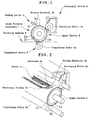
- FIG. 1 is an illustration schematically showing the basic structure of an image forming apparatus employing an embodiment of the image carrier according to the present invention
- Fig. 2 is a perspective view partially illustrating the basic structure of the image forming apparatus shown in Fig. 1.
- an image forming apparatus 1 of this embodiment comprises, at least, an image carrier 2 on which an electrostatic latent image and a developing powder image are formed, a writing device 3 which is arranged in contact with the image carrier 2 to write the electrostatic latent image onto the image carrier 2, a developing device 4 which develops the electrostatic latent image on the image carrier 2 with developing powder carried by a developing roller 4a, and a transferring device 6 which transfers the developing power image on the image carrier 2 developed by the developing device to a receiving medium 5 such as a paper by a transferring roller 6a.
- the image carrier 2 is formed in a drum shape having a multi-layer structure comprising a conductive substrate 2a which is made of a conductive material such as aluminium, positioned near the axis of the image carrier 2, and grounded, a dielectric layer 2b formed on the outer surface of the conductive substrate 2a, and a low-resistance layer having a large number of conductive portions 2c formed on the outer surface of the dielectric layer 2b.
- the image carrier 2 may be formed in a belt shape.
- the large number of conductive portions 2c are formed just like islands (hereinafter, sometimes called as “islands-in-sea structure") on the outer surface of the dielectric layer 2b in such a manner that these conductive portions 2c are electrically separated from, independent of each other, and dispersed from each other. That is, a number of indented concavities 2b 1 are formed to be dispersed separately from each other in the outer surface of the dielectric layer 2b and a conductive material 2c 1 (shown in Figs.
- a conductive resin or a conductive filler such as a conductive resin or a conductive filler is filled in the indented concavities 2b 1 , thereby forming the conductive portions 2c, just like islands in the sea, on the outer surface of the dielectric layer 2b, the conductive portions 2c being composed of local conductive portions dispersed separately from each other.
- Parts of the large number of conductive portions 2c may be exposed on the surface of the dielectric layer 2b and the other parts may be embedded in the surface of the dielectric layer 2b. That is, the conductive portions 2c are provided in such a manner that at least parts thereof are exposed on the surface. The exposed parts of the conductive portions 2c ensure the stable application or removal of charge relative to the image carrier.
- the dielectric layer 2b exhibits a role as the inside of a condenser and has a function of placing charge to the image carrier 2 in a spot manner. Therefore, the dielectric layer 2b is preferably set to have electric resistance of 10 16 ⁇ or less.
- the material for the dielectric layer 2b there are polyester resin, polycarbonate resin, polyethylene resin, fluoride resin, cellulose, vinyl chloride resin, polyurethane resin, acrylic resin, epoxy resin, silicone resin, alkyd resin, vinyl chloride-vinyl acetate copolymer resin, polyamide resin (nylon), and the like.
- the material for the conductive portions 2c is a material of which resistance is in a range lower than the resistance of the dielectric layer 2b which is about 10 10 ⁇ in maximum. In this case, too large electric resistance of the conductive portions 2c leads to defect in writing of an latent image due to some delay of writing. Therefore, the electric resistance of the conductive portions 2c is preferably lower as the process speed is increased.
- conductive resin or conductive filler can be employed as the material used for the conductive portions 2c.
- a conductive high-molecular powder such as a high-molecular complex made of polyacetylene doped with iodine, a high-molecular complex made of polythiopene doped with iodine, and a high-molecular complex made of polypyrrole doped with iodine, and a combination thereof may be employed.
- the content of conductive particles/conductive filler is from 10 to 100 % by weight for regulating the resistance.
- the charge injection between the conductive portions 2c and the writing electrodes 3b is conducted by the contact of the writing electrodes (corresponding to the charge-transfer controlling means of the present invention) 3b with the plurality of conductive portions 2c. It should be understood that there are a case where charge is injected (transferred) from the writing electrodes 3b to the conductive portions 2c and a case where charge is injected (transferred) from the conductive portions 2c to the writing electrodes 3b and that the former case means that charge is applied to the image carrier and the latter case means that charge is removed from the image carrier 2.
- each conductive portion 2c is set to satisfy "electric resistance in vertical direction (i.e. the depth direction perpendicular to the plane direction of the conductive portion 2c) ⁇ electric resistance in lateral direction (i.e. the plane direction of the conductive portion 2c)". That is, the conductive portions are anisotropic, thereby making the lateral movement of charge difficult, i.e. making the leakage difficult during charge injection between the writing electrodes 3b and the conductive portion 2c. Therefore, charge can be effectively transferred in the vertical direction. This ensures the application of charge and the removal of charge relative to the image carrier 2.
- the difference between the electro resistance in lateral direction and the electro resistance in vertical direction is larger. Further, a relation "the ratio of lateral resistance /vertical resistance > 10 5 " is preferable.
- Figs. 4(a)-4(g) are illustrations for explaining an example of methods for manufacturing the image carrier according to the present invention.
- a conductive substrate 2a of a conductive material such as Al is prepared.
- a dielectric layer 2b is formed onto the conductive substrate 2a by coating.
- a large number of concavities 2b 1 which are suitably rough and dispersed separately from each other, are formed in the outer surface of the dielectric layer 2b by surface treatment such as blasting the surface of the dielectric layer 2b.
- the concavities 2b 1 may be aligned or formed at random, just in such a manner that they are separately dispersed.
- a conductive material 2c 1 such as a conductive resin or a conductive filler is coated on the surface of the dielectric layer 2b with the concavities 2b 1 .
- at least a surface of the coated conductive material 2c 1 is ground such that the conductive material 2c 1 remains in the concavities 2b 1 , thereby forming a large number of local conductive portions.
- the latent carrier 2 is formed which has the dielectric layer 2b of a predetermined thickness (for example, 10-30 ⁇ m) formed on the conductive substrate 2a, and the large number of local conductive portions i.e. the conductive portions 2c separately and dispersedly formed in the surface of the dielectric layer 2b as shown in Fig. 4(f).
- the surface area A 1 of each conductive portion 2c is set to be smaller than the contact area A 2 of each writing electrode 3b when the writing electrode 3b is in contact with the surface of the dielectric layer 2b and also smaller than the contact area A 3 of toner supplied from the developing device 4 to the surface of the dielectric layer 2b.
- Figs. 5(a)-5(c) are illustrations for explaining another example of methods for manufacturing the image carrier according to the present invention.
- a conductive substrate 2a of a conductive material such as Al is prepared.
- a large number of concavities 2a 1 which are suitably rough and dispersed separately from each other, are formed in the outer surface of the conductive substrate 2a by surface treatment such as blasting the surface of the conductive substrate 2a.
- a dielectric layer 2b is formed on the conductive substrate 2a by coating.
- the surface area A 1 of each conductive portion 2c is set to be smaller than the contact area A 2 of each writing electrode 3b when the writing electrode 3b is in contact with the surface of the dielectric layer 2b and also smaller than the contact area A 3 of toner supplied from the developing device 4 to the surface of the dielectric layer 2b.
- the present invention is not limited thereto so that other materials may be employed.
- a paint (coat) composed of a binder resin and conductive particles or conductive filler of a suitable amount to be dispersed in the binder resin may be used, so this paint is coated on the surface of the dielectric layer 2b formed with the concavities 2a 1 , and then the resultant coating layer is ground, thereby forming the latent carrier 2 is formed which has the dielectric layer 2b formed on the conductive substrate 2a, and the local conductive portions i.e. the conductive portions 2c separately and dispersedly formed in the surface of the dielectric layer 2b.
- polyester resin examples include polyester resin, polycarbonate resin, polyethylene resin, fluoride resin, cellulose, vinyl chloride resin, polyurethane resin, acrylic resin, epoxy resin, silicone resin, alkyd resin, vinyl chloride-vinyl acetate copolymer resin, polyamide resin (nylon), and the like.
- the material used as the conductive particles/conductive filler there are metallic powder of Cu, Al, or Ni, metallic oxide powder of ZnO, tin oxide, antimony oxide, or TiO 2 (treated to have conductivity), conductive high-molecular powder such as a high-molecular complex made of polyacetylene doped with iodine, a high-molecular complex made of polythiopene doped with iodine, and a high-molecular complex made of polypyrrole doped with iodine, and a combination thereof.
- the content of conductive particles/conductive filler is from 10 to 100 % by weight for regulating the resistance.
- Table 1 Values shown in Table 1 are results of the measurements of resistances.
- a polyamide resin ⁇ FR-104 (trade code) available from Namariichi Chemical Industrial Co., Ltd. ⁇ as the binder resin, and a conductive titanium dioxide as the conductive filler ⁇ EC-300 (trade code) available from Titan Kogyo K.K. ⁇ were mixed in the ratio by weight of 1:1.3, dispersed by ultrasonic vibration technique with ethanol solvent, and applied on a substrate of Al to form layers of 1-100 ⁇ m in thickness. The measurements were made for the resultant layers by using a "HIRESTA" manufactured by Mitsubishi Petrochemical Co., Ltd..
- the volume resistivity and the surface resistivity were measured by the HIRESTA.
- the vertical resistance and the lateral resistance can be calculated from the measured values of the volume resistivity and the surface resistivity, the thickness of the layer, and the surface area of the electrodes of the HIRESTA.
- the results are generally as shown in Table 1. It can be found also from experiments as will be described later that the conductive portions 2c of smaller thickness are advantageous in improving the precision for writing latent images. Even with thickness more than 1 ⁇ m, the conductive portions 2c can apply or remove charge as desired, but the thickness is preferably set to be smaller than 1 ⁇ m.
- the charge injection layer 2c is formed in such a manner that conductive particles are as continuously aligned in the vertical direction from the surface thereof to the dielectric layer 2b as possible as shown in Fig. 6(a). Even when the conductive material has conductive particles having needle-like crystals like titanium dioxide, the charge injection layer 2c is formed in such a manner that the particles are as continuously aligned in the vertical direction as possible, similarly to the above case, as shown in Fig. 6(b). A plurality of lines of conductive particles which are aligned vertically as described above are separately dispersed, that is, are arranged in a matrix structure (described later).
- the conductive portions 2c may be formed by spraying a liquid, prepared by dispersing conductive particles in the alkali liquid, onto an insulating binder layer 2d (a part of the dielectric layer 2b), as the outermost layer of the image carrier which is soluble relative to alkali, at equal intervals defined by the ink jet printing method.
- a liquid of another kind and a dielectric layer 2b made of an insulating material which is soluble relative to the liquid may be employed.
- a large number of conductive portions 2c which are separately dispersed can be formed in the outer surface of the dielectric layer 2b in another method besides the aforementioned methods.
- Charge injection between the writing electrodes 3b of the writing device 3 and the conductive portions 2c can be conducted dominantly by contacts of the writing electrodes 3b of the writing device 3 with the conductive portions 2c.
- the description will be made on the assumption that the conductive substrate 2a of the image carrier 2 is grounded, this assumption is just for facilitation of explanation.
- the present invention is not limited to the condition that the conductive substrate 2a of the image carrier 2 is grounded, a voltage of lower absolute value than the absolute value of the predetermined voltage V 0 to be applied for writing may be applied to the conductive substrate 2a as described later.
- the electric writing device 3 comprises a flexible substrate 3a, having high insulation property and being relatively soft and elastic, such as a FPC (Flexible Print Circuit) or a PET (polyethylene terephthalate: hereinafter, referred to as "PET") film, a plurality of writing electrodes 3b which are supported by the substrate 3a and which are pressed lightly against the image carrier 2 by weak elastic restoring force created by deflection of the substrate 3a so that the writing electrodes 3b write electrostatic latent image, drivers 11 which are supported by the substrate 3a to control the operation of the writing electrodes 3b, and a stationary portion 3c of which an end opposite to the writing electrodes 3b of the substrate 3a is fixed to the body (not shown) of the image forming apparatus.
- FPC Flexible Print Circuit
- PET polyethylene terephthalate
- the substrate 3a is formed in a rectangular shape having substantially the same axial length as the axial length of the conductive portions 2c of the image carrier 2.
- the substrate 3a is arranged to extend from the left side in Fig. 1 in the same direction as the rotational direction (the clockwise direction shown by arrow) of the image carrier 2.
- the substrate 3a may be arranged to extend from the right side in Fig. 1 in the opposite direction of the rotational direction of the image carrier 2.
- the requirement for material of the writing electrodes 3b is conductive and having electric resistance of 10 10 ⁇ or less. Too large electric resistance leads to defect in writing of an latent image due to some delay of writing, similarly to the aforementioned conductive portions 2c. Therefore, the electric resistance of the writing electrodes 3b is preferably lower as the process speed is increased.
- writing electrodes made of Al and writing electrodes made of Al of which surface is coated with fluororesin to have electric resistance of 10 6 ⁇ were both used. It was found from the results of the experiments that the writing electrodes of both type can write a latent image. Accordingly, it is preferable that the electric resistance of the writing electrodes is 10 6 ⁇ or less.
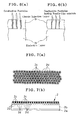
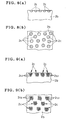
- Figs. 8(a), 8(b) and Figs. 9(a), 9(b) show different embodiments of the present invention, respectively, wherein Figs. 8(a), 9(a) are sectional views partially showing the section along the axial direction of the image carrier and Figs. 8(b), 9(b) are views partially showing the outer surface of the image carrier.
- a large number of conductive portions 2c are formed and arranged like dots separately dispersed.
- a large number of conductive portions 2c which are formed and arranged like dots separately dispersed and each conductive portion 2c is composed of a predetermined number of gathered conductive particles 2c 2 .
- Such an arrangement that a large number of conductive portions 2c are formed and arranged like dots which are separately dispersed ensures stable and more precise application or removal of charge relative to the image carrier 2.
- the large number of conductive portions 2c are formed to be at least partially exposed to the surface.
- Fig. 10 shows an array pattern for arranging a plurality of electrodes 3b in the axial direction of the image carrier 2.
- the writing electrodes 3b are each formed in circle and are aligned in the axial direction (the vertical direction in Fig. 10) of the image carrier 2.
- the writing electrodes 3b are arranged in two parallel rows (first and second rows) in a zigzag fashion.
- the electrodes are arranged such that electrodes which are in different rows but adjacent to each other are partially overlapped with each other in the direction perpendicular to the axial direction of the image carrier 2.
- This array pattern can eliminate such portions in the surfaces of the conductive portions 2c of the image carrier 2 that are not subjected to the application or removal of charge, thereby achieving application or removal of charge relative to the entire surfaces of the conductive portions 2c of the image carrier 2.
- a predetermined number of drivers 11 are provided to extend in the axial direction of the image carrier 2 on the substrate 3a.
- plural units are each formed of a predetermined number of electrodes 3b some of which are in the first row and the other are in the second row by connecting these electrodes 3b to one driver 11 and are aligned parallel to the axial direction of the image carrier 2.
- the respective drivers 11 are electrically connected by conductive patterns 9 made of copper (Cu) foil which is formed on the substrate 3a and each line of which is formed into a thin flat bar-like shape having a rectangular section.
- the drivers 11 are electrically connected to the corresponding writing electrodes 3b by the conductive patterns 9 formed on the substrate 3a.
- the conductive patterns 9 can be formed by a conventional known film pattern forming method such as etching.
- line data, writing timing signals, and high voltage power are supplied to the respective drivers 11 from the upper side in Fig. 10. Further, a predetermined voltage V 0 at the high voltage (based on the absolute value) side and a ground voltage V 1 at the low voltage (based on the absolute value) side are supplied from each driver 11 to the corresponding writing electrodes 3b.
- Fig. 11 is a diagram showing a switching circuit for switching the voltage to be connected to the writing electrodes 3b between the predetermined voltage V 0 and the ground voltage V 1 .
- the writing electrodes 3b are connected to corresponding high voltage switches (H.V.S.W.) 15, respectively.
- Each of the high voltage switches 15 can switch the voltage to be supplied to the corresponding electrode 3b between the predetermined voltage V 0 at the high voltage (based on the absolute value) side and the ground voltage V 1 at the low voltage (based on the absolute value) side.
- An image writing control signal is inputted into each high voltage switch 15 from a shift resistor (S.R.) 16, to which an image signal stored in a buffer 17 and a clock signal from a clock 18 are inputted.
- the image writing control signal is inputted into each high voltage switch 15 through each AND circuit 19 in accordance with a writing timing signal from an encoder 20.
- the high voltage switch 15 and the AND circuit 19 cooperate together to form the aforementioned driver 11 which controls the corresponding electrodes 3b by switching the supply voltage.
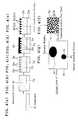
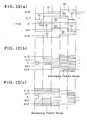
- Figs. 12(a)-12(c) show profiles when the supply voltage for each electrode 3b is selectively controlled into the predetermined voltage V 0 or the ground voltage V 1 by switching operation of the corresponding high voltage switch 15, wherein Fig. 12(a) is a diagram showing the voltage profiles of the respective electrodes, Fig. 12(b) is a diagram showing a developing powder image obtained by normal developing with the voltage profiles shown in Fig. 12(a), and Fig. 12(c) is a diagram showing a developing powder image obtained by reverse developing with the voltage profiles shown in Fig. 12(a).
- the electrodes 3b for example as shown in Figs. 12(a)-12(c), five electrodes indicated by n-2, n-1, n, n+1, and n+2, respectively, are controlled to be into the voltage profiles shown in Fig. 12(a) by switching operation of the respective high voltage switches 15.
- the developing powder (or toner) 8 adheres to portions at the predetermined voltage V 0 of the image carrier 2, thereby obtaining a developing powder image (or a toner image) as shown by hatched portions in Fig. 12(b).
- the developing powder 8 adheres to portions at the ground voltage V 1 of the image carrier 2, thereby obtaining a developing powder image as shown by hatched portions in Fig. 12(c).
- the image forming apparatus 1 employing the electric writing device 3 having the aforementioned structure, charge is injected to the conduct portions 2c of the image carrier 2 by the writing electrodes 3b of the writing device 3 which are in contact with the image carrier 2 so that charge injection is conducted dominantly, thereby achieving the writing of an electrostatic latent image on the image carrier 2. Then, the electrostatic latent image on the image carrier 2 is developed with developing powder 8 conveyed by the developing roller 4a of the developing device 4 to form a developing powder image and the developing powder image is subsequently transferred to the receiving medium 5 by the transferring device 6.
- the image carrier 2 of this embodiment a large number of the conductive portions 2c which are dispersed separately from each other are formed in the outer surface of the dielectric layer 2b and the application or removal of charge can be conducted dominantly by charge injection between the conductive portions and the charge-transfer controlling means. Therefore, the voltage to be applied can be significantly reduced as compared with the conventional device which applies or removes charge by discharge phenomenon.
- each conductive portion 2c is set to be smaller than the contact area of each writing electrode 3b and also smaller than the contact area of toner, stable application or removal of charge by charge injection can be more effectively conducted so as to reliably forming a high-quality image. Particularly for application of charge, well writing can be secured.
- the method of manufacturing the image carrier 2 of this embodiment comprises previously forming the large number of concavities 2b 1 such that these are dispersed separately from each other, coating the surface of the dielectric layer 2b including these concavities 2b 1 with the conductive material 2c 1 , and then grinding the coated conductive material 2c 1 .
- the large number of conductive portions 2c separately dispersed can be easily formed. Therefore, the image carrier 2 can be easily manufactured.
- the conductive portions 2c are formed by spraying a liquid, prepared by dispersing conductive particles in the alkali liquid, onto an insulating binder layer 2d, as the outermost layer of the image carrier 2 which is soluble relative to alkali, at equal intervals defined by the ink jet printing method. Also according to this method, the large number of conductive portions 2c separately dispersed can be easily formed. Therefore, the image carrier 2 can be easily manufactured.
- the present invention is not limited thereto.
- the present invention may be applied to an image carrier to be uniformly charged or uniformly discharged by a charge-transfer controlling means prior to the writing of a latent image.
- binder resin The binder resin, the conductive filler, and the solvent used for Examples (1) and (2) are the same and shown in Table 2.
- Materials of charge injection layer Binder Resin Polyamide resin (available from Namariichi Chemical Industrial Co., Ltd., Trade Code: FR-104) Conductive Filler Conductive titanium dioxide (available from Titan Kogyo K.K., Trade Code: EC-300) Solvent Ethanol
- Example (2) polyamide resin ⁇ available from Namariichi Chemical Industrial Co., Ltd., Trade code: FR-104 ⁇ was used as the binder resin, conductive titanium dioxide ⁇ available from Titan Kogyo K.K., Trade code: EC-300 ⁇ was used as the conductive filler, and ethanol was used as the solvent.
- the ratio (gr.) of the polyamide resin as the binder resin and the conductive titanium dioxide as the conductive filler (c-TiO 2 ), the content (%) of the conductive titanium dioxide, and the thickness of the coated layer are shown in Table 3 with respect to Examples (1) and (2), respectively.
- Liquid coat for charge injection layer and electric resistance of the coated layer made of the same No. B/c-TiO2 (gr.) Content (%) of c-TiO 2 Rv ( ⁇ ) Rs ( ⁇ ) Thickness of layer ( ⁇ m) (1) 5.0/2.5 33.0 1.3 ⁇ 10 9 7.6 ⁇ 10 13 1 (2) 5.0/2.5 33.0 1.3 ⁇ 10 10 7.6 ⁇ 10 12 10
- Example (1) As shown in Table 3, in Example (1), the ratio of the polyamide resin and the conductive titanium dioxide was 5.0/2.5 (gr.), the content of the conductive titanium dioxide was 33.0 (%), and the thickness of the coated layer was 1 ( ⁇ m).
- Example (1) had a volume resistance Rv ( ⁇ ) of 1.3 ⁇ 10 9 ( ⁇ ) and a surface resistance Rs ( ⁇ ) of 7.6 ⁇ 10 13 ( ⁇ ).
- Example (2) the ratio of the polyamide resin and the conductive titanium dioxide was 5.0/2.5 (gr.), the content of the conductive titanium dioxide was 33.0 (%), and the thickness of the coated layer was 10 ( ⁇ m).
- Example (2) had a volume resistance Rv ( ⁇ ) of 1.3 ⁇ 10 10 ( ⁇ ) and a surface resistance Rs ( ⁇ ) of 7.6 ⁇ 10 12 ( ⁇ ).
- An aluminium drum of ⁇ 30 (mm) was used as the conductive substrate 2a of the image carrier 2, PET was applied to the aluminium drum to form a dielectric layer 2b of 100 ⁇ m in thickness.
- Each liquid coat was prepared by mixing the materials shown in Table 2 at the ratio shown in Table 3, and uniformly dispersed by the ultrasonic dispersion. The liquid coat was applied to the PET layer by a wire bar. After that, by holding it in a vacuum dryer at 150 °C for 3 hours, a charge injection layer 2c was formed on the conductive substrate 2a. In this manner, the image carrier 2 was manufactured.
- Some writing electrodes 3b were made of Al and the other writing electrodes 3b were made of Cu. All writing electrodes 3b were set to be ⁇ 50 ⁇ m and arranged to be spaced apart by 50 ⁇ m and aligned parallel to the axial direction of the image carrier 2.
- the voltage V 0 at the high voltage (based on the absolute value) side was set to be -400V and the voltage V 1 at the low voltage (based on the absolute value) side was set to be 0V.
- the peripheral velocity of the image carrier 2 was set to be 30 mm/sec.
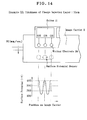
- Example (1) As for each of Example (1) and Example (2), the surface potential of an image portion where writing was conducted at -400V and the surface potential of a non-image portion which is the nearest to the image portion among non-image portions where writing was not conducted on the developed position were measured by a surface potential sensor. As shown in Fig. 13 and Fig. 14, the surface potential of the image portion was -400V in either case of Example (1) and Example (2), the potential of the non-image portion was -30V in the case of Example (1) and -120V in the case of example (2). That is, Example (1) made less leakage of voltage in the abscissa, i.e. in the axial direction of the image carrier 2, than Example (2).
- a charge injection layer 2c having smaller thickness is preferable because it can obtain larger potential contrast.
- the thickness of the charge injection layer 2c is preferably set to be 1 ⁇ m or less.
- Example (1) can form a stable image as compared to Example (2). It should be understood that the image forming apparatus 1 of Example (2) also can form an image.
- the area based on the average distance between adjacent conductive particles is set to be smaller than the contact area of each writing electrode 3b.
- the contact area S of each writing electrode 3b is set to be satisfy "S > (d/2) 2 ⁇ ".
- the average sectional area of toner particles is "S toner”
- each writing electrode 3b relative to the charge injection layer 2c is larger than the sectional area of each conductive particle, conductive particles as the charge injection layer which are in contact with the writing electrodes 3b can be securely charged by charge injection, thereby securely reproducing an electrostatic latent image to be written on the image carrier 2 and thus improving the precision for writing latent images.
- each writing electrode 3b when the contact area of each writing electrode 3b relative to the charge injection layer 2c is smaller than the sectional area of each conductive particle and the maximum dimension Lb of the section of each conductive particle is smaller than the distance La between adjacent writing electrodes 3b, 3b (La > Lb), even if the writing electrode 3b is in contact with a very small area of the conductive particle, the apparatus can form a latent image larger than the very small contact area. In addition, this design prevents conduction between the adjacent electrodes 3b, 3b.
- this design allows the writing electrodes 3b to be arranged to have greater distance therebetween and also allows the wirings for applying voltage to the writing electrodes 3b to have greater distance therebetween, thus reducing the possibility of crosstalk (electromagnetic field hindrance) between the electrodes.
- Figs. 16(a), 16(b) show another example of the image carrier of the present invention, wherein Fig. 16(a) is a sectional view taken along a line A-A in Fig. 16(b) and Fig. 16(b) is a plan view thereof.
- an image carrier 2 of this embodiment has no dielectric layer 2b as described with respect to the aforementioned embodiment and is formed a single layer structure in which a charge injection layer 2c is directly formed on a conductive substrate 2a which is grounded.
- the charge injection layer 2c of this embodiment comprises a large number of dielectric portions 2b' (non-charge injection portions) which extend in the vertical direction and have high insulating property, and a large number of charge injection portions 2c' which extend in the vertical direction, wherein the dielectric portions 2b' and the charge injection portions 2c' are alternately arranged at equal intervals.
- the large number of charge injection portions 2c' are arranged in a matrix structure i.e. dispersed separately from each other. That is, the charge injection portions 2c' are arranged in such a structure that they are formed just like islands in the sea.
- the electric resistance in the vertical direction is set to be relatively small by the large number of charge injection portions 2c' extending in the vertical direction, while the electric resistance in the lateral direction is set to be relatively large by the large number of dielectric portions 2b' (non-charge injection portions) having high insulating property and the large number of charge injection portions 2c' which are alternately arranged at equal intervals. That is, the charge injection layer 2c of this example also satisfies the relation "electric resistance in vertical direction ⁇ electric resistance in lateral direction".
- the image carrier 2 since the image carrier 2 has the charge injection layer 2c, charge for the writing of the last image can be removed at the same time as the next writing.
- each charge injection portion 2c' (the area of a surface to be in contact with the writing electrode 3b) and the area of the dielectric portion (non-charge injection portions) 2b' between one charge injection portion 2c' and an adjacent charge injection portion 2c' are both set to be smaller than the contact area of each writing electrode 3b relative to the dielectric layer 2b.
- one writing electrode 3b can be positioned in contact with a plurality of charge injection portions 2c', charge injection between the writing electrodes 3b and the charge injection portions 2c' can be stably conducted so that application or removal of charge relative to the image carrier 2 can be stably conducted. Therefore, writing can be successfully conducted by charge injection.
- the method of manufacturing the image carrier 2 of the single-layer structure comprises:
- the electric resistance of the image carrier 2 is set to be such an electric resistance to hold a toner image after writing an latent image during the developing, transferring, and following processes and this setting of resistance depends on the process speed. Therefore, the potential of image portions gradually decreases after the writing of the latent image.
- Each writing electrode 3b may be made of metallic material such as Cu or Al to be formed in a head-like configuration and may be made of a conductive resin to be formed in a head-like configuration.
- each writing electrode is manufactured by dispersing conductive particles/conductive filler in a binder resin to make its material and forming the material in a head-like configuration, alternatively, by dispersing conductive particles/conductive filler in a binder resin to make its material and applying the material on the surface of a conductive member (made of Cu or the like).
- Figs. 17(a), 17(b) show another embodiment of the image carrier of the present invention, wherein Fig. 17(a) is a sectional view taken along a line A-A in Fig. 17(b) and Fig. 17(b) is a plan view thereof.
- the image carrier 2 of this embodiment is a combination of the embodiment shown in Figs. 3(a), 3(b) and the embodiment shown in Figs. 16(a), 16(b), wherein instead of the charge injection layer 2c of the image carrier 2 of the embodiment shown Figs. 3(a), 3(b), the charge injection layer 2c of the islands-in-sea structure shown in Figs. 16(a), 16(b) is employed. That is, the image carrier 2 of this embodiment formed a multi (double)-layer structure has a charge injection layer 2c having charge injection portions 2c' as shown in Figs.
- the charge injection layer 2c is in the islands-in-sea structure in which a large number of the dielectric portions 2b' (non-charge injection portions) and a large number of the charge injection portions 2c' are alternately arranged at equal intervals.
- the electric resistance in the vertical direction is set to be relatively low by the large number of charge injection portions 2c' which extends in the vertical direction, while the electric resistance in the lateral direction is set to be relatively high by the large dielectric portions 2b' (non-charge injection portions), having high insulation property, and the large number of charge injection portions 2c' which are alternately arranged at equal intervals. That is, the charge injection layer 2c of this embodiment is also set to satisfy "electric resistance in vertical direction ⁇ electric resistance in lateral direction".
- charge injection layer 2c also similarly to the aforementioned embodiments, voltage can be locally applied when the large number of writing electrodes 3b are in contact with the image carrier 2 uniformly in the axial positions of the image carrier 2. According to the local application, the stable selective application or removal of charge can be conducted relative to the image carrier. Therefore, stable precise writing of latent images is achieved.
- the image carrier 2 since the image carrier 2 has the charge injection layer 2c, charge for the writing of the last image can be removed at the same time as the next writing.
- each charge injection portion 2c' and the area of the dielectric portion (non-charge injection portions) 2b' between one charge injection portion 2c' and an adjacent charge injection portion 2c' are both set to be smaller than the contact area of each writing electrode 3b relative to the dielectric layer 2b. Therefore, the leakage of charge in the lateral direction in a charging range can be prevented, thus minimizing the drifts of electrostatic latent image in the lateral direction.
- one writing electrode 3b can be positioned in contact with a plurality of charge injection portions 2c', charge injection between the writing electrodes 3b and the charge injection portions 2c' can be stably conducted so that application or removal of charge relative to the image carrier 2 can be stably conducted. Therefore, writing can be successfully conducted by charge injection.
- the method of manufacturing the image carrier 2 of the multi-layer structure comprises:
- the electric resistance of the image carrier 2 is set to be such an electric resistance to hold a toner image after writing an latent image during the developing, transferring, and following processes and this setting of resistance depends on the process speed. Therefore, the potential of image portions gradually decreases after the writing of the latent image.
- the materials used in the writing electrodes 3b and the method of manufacturing the writing electrodes 3b of this embodiment are the same as those of the embodiment shown in Figs. 16(a), 16(b).
- the writing of an electrostatic latent image to the image carrier 2 can be conducted dominantly by charge injection between the writing electrodes 3b and the charge injection layer 2c because of the contacts of the writing electrodes 3b and the charge injection layer 2c. Therefore, the voltage to be applied to the writing electrodes 3b can be significantly reduced, based on the absolute value, as compared with the conventional device which applies or removes charge by discharge phenomenon.
- the writing by charge injection does not depend on the environmental conditions such as temperature and humidity because charge performs the role of carrier, the positions of a latent image to be written are never distorted, thereby improving the stability in controlling the latent image writing positions.
- the electric resistance of the charge injection layer 2c of the image carrier 2 is set such that the resistance in the vertical direction is smaller than the resistance in the lateral direction, the leakage of charge in the lateral direction can be prevented in the charge injection layer 2c so that charge can be effectively injected between the writing electrodes 3b and the charge injection layer 2c, thereby achieving the reliable application or removal of charge relative to the image carrier 2. Therefore, an electrostatic latent image can be written on the image carrier 2 with high precision by charge injection.
- the voltage to be applied to the writing electrodes 3b can be further reduced so as not to occur discharge phenomenon between the writing electrodes 3b and the charge injection layer 2c, thereby preventing irregularity of the latent image and generation of ozone.
- the thickness of the charge injection layer 2c is set to be 1 ⁇ m or less, the electric resistance can be easily set such that the difference between the resistance in the lateral direction and the resistance in the vertical direction is enlarged by just forming the charge injection layer 2c to have a small thickness. Therefore, the potential contrast of the electrostatic latent image can be larger, thereby further improving the precision in writing latent images.
- the large number of charge injection portions 2c' which are dispersed separately from each other are formed in the charge injection layer 2c , the leakage of charge, applied to the charge injection portions 2c', in the lateral direction can be securely prevented.
- the stable application or removal of charge relative to the image carrier 2 can be conducted by charge injection.
- the large number of concavities 2b 1 are formed to be dispersed separately from each other in the charge injection layer 2c and the charge injection portions 2c' are formed in the large number of concavities 2b 1 , the large number of charge injection portions 2c' can be formed just by coating a conductive material 2c 1 to the charge injection layer 2c with the concavities 2b 1 and grinding the coated conductive material 2c 1 . Accordingly, the image carrier 2 can be easily manufactured.
- each charge injection portion 2c' to be in contact with the writing electrode 3b can be set to be smaller than the contact area of each writing electrode 3b relative to the charge injection layer 2c. Therefore, the stable application or removal of charge can be effectively conducted by charge injection and a high-quality image can be reliably formed.
- the writing electrodes 3b are in contact with the image carrier 2 uniformly in the axial positions of the image carrier 2, voltage can be locally applied. According to the local application, the stable selective application or removal of charge can be conducted relative to the image carrier. Therefore, stable precise writing of latent images is achieved. In addition, charge for the writing of the last image can be removed at the same time as the next writing. Therefore, charge cleaning step for the image carrier 2 before the next writing can be eliminated, thereby simplifying the process.
- the average sectional area of toner particles for developing an electrostatic latent image written on the image carrier 2 is set to be smaller than the contact area of each writing electrode 3b relative to the charge injection layer 2c, the reproducibility of digital data is improved.
- the image carrier 2 may be a photoreceptor.
- the charge injection layer 2c is designed to have light transmitting property.
- the image forming apparatus 1 of this embodiment may be of a type of normal developing with negative charge, just like the aforementioned examples (1), (2) and also may be of a type of normal developing with positive charge, of a type of reversal developing with positive charge or a type of reversal developing with negative charge.
- the image forming apparatus of the present invention may also be applied to an image forming apparatus which writes a latent image by removing charge from a positively charged or negatively charged image carrier 2 by writing electrodes 3b.
- Figs. 18(a)-18(h) are illustrations each showing an example of the basic process of forming an image in the image forming apparatus 1 of the present invention.
- a process shown in Fig. 18(g) is an example of this image forming process.
- a photoreceptor 2a is employed as the image carrier 2 and a charging roller 7c is employed as the charge control device 7.
- a bias voltage composed of an alternating current superimposed on a direct current of a negative (-) polarity is applied to the charging roller 7c so that the charging roller 7c uniformly negatively (-) charges the surface of the photoreceptor 2a.
- a bias voltage composed only of a direct current of a negative (-) polarity may be applied to the charging roller 7c.
- the writing electrodes 3b of the writing device 3 are in contact with the photoreceptor 2a so that negative (-) charge is removed from the image portions of the photoreceptor 2a.
- Other structures of this example are the same as those of the aforementioned example shown in Fig. 18(a).
- the charging roller 7c is arranged in contact with the photoreceptor 2a to negatively (-) charge the surface of the photoreceptor 2a to make the surface into the uniformly charged state with a predetermined voltage and, after that, negative (-) charge is removed from the image portions of the photoreceptor 2a by the writing electrodes 3b of the writing device 3, thereby writing an electrostatic latent image onto the photoreceptor 2a.
- negatively (-) charged developing powder 8 conveyed by the developing roller 4a of the developing device 4 adheres to the image portions, not negatively (-) charged, of the photoreceptor 2a, thereby reversely developing the electrostatic latent image.
- a process illustrated in Fig. 18(h) is another example of this image forming process.
- a dielectric body 2b is employed as the image carrier 2 and a corona charging device 7d is employed as the charge control device 7.
- a bias voltage composed of a direct current of a positive (+) polarity or a bias voltage composed of an alternating current superimposed on a direct current of a positive (+) polarity is applied to the corona charging device 7d, but not illustrated.
- Other structures of this example are the same as those of the aforementioned example shown in Fig. 18(f).
- the surface of the dielectric body 2b is positively (+) charged by the corona charging device 7d to make the surface of the dielectric body 2b into the uniformly charged state with the predetermined voltage and, after that, positive (+) charge is removed from the image portions of the dielectric body 2b by the writing electrodes 3b of the writing device 3, thereby writing an electrostatic latent image onto the dielectric body 2b.
- positively (+) charged developing powder 8 conveyed by the developing roller 4a of the developing device 4 adheres to the image portions, not positively (+) charged, of the dielectric body 2b, thereby reversely developing the electrostatic latent image.
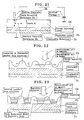
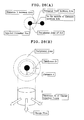
- Fig. 19(A) is a schematic illustration showing the function of a charge injection layer 2a through application or removal of charge of the writing electrodes 3b of the writing device 3
- Fig. 19(B) is a graph showing the relation between the voltage applied to electrodes and the surface potential of the charge injection layer 2a.
- Fig. 19(A) As voltage V is applied to a writing electrode 3b, injection of negative (-) charge is conducted directly from a lower voltage side to a higher voltage side between the writing electrode 3b and the charge injection layer 2a. This means that charge is applied to or removed from the charge injection layer 2a via the charge injection.
- the surface potential of the charge injection layer 2a is proportional to the voltage V applied to the electrode 3b so that charge is injected in proportion to the applied voltage.
- Figs. 20(A), 20(B) show a comparative example relative to the present invention, wherein Fig. 20(A) is a schematic illustration showing the function of a case without charge injection layer 2a in Fig. 19(A) and Fig. 20(B) is a graph showing the relation between the voltage applied to electrodes and the surface potential of a dielectric layer.
- Fig. 21 is a schematic illustration for explaining the characteristic of the present invention.
- the requirement for the writing method of electrostatic latent image by charge injection is that charge injected directly below the writing electrode 3b is larger than leakage charge around the writing electrode 3b (hereinafter, such difference will be referred to as "contrast potential").
- Equation (1) ⁇ / d 1 > ⁇ ⁇ d 1 that is, d 1 2 ⁇ 1 so that the requirement is that d 1 2 is smaller than the unit area of the electrode.
- the volume resistivity of the charge injection layer 2a is anisotropic. That is, the volume resistivity in the depth direction of the charge injection layer 2a is ⁇ v and the volume resistivity in the surface direction of the charge injection layer 2a is ⁇ s , the following equation is obtained from Equation (1): ⁇ s / d 1 > ⁇ v ⁇ d 1 that is, the requirement is to satisfy d 1 2 ⁇ ⁇ s / ⁇ v
- the thickness d 1 of the charge injection layer 2a can be set larger than d 1 .
- the large thickness improves the resistance against abrasion by the writing electrodes 3b and the like, thereby prolonging the life of the charge injection layer 2a.
- a charge injection layer 2a has volume resistivity p which is common to the depth direction and the surface direction thereof.
- the surface potential was -300 V when the thickness of the charge injection layer was 100 ⁇ m and also -300 V when the thickness of the charge injection layer was 120 ⁇ m. There was no potential difference.
- the surface potential was-300 V when the thickness of the charge injection layer was 200 ⁇ m so that there was no potential difference.
- convexoconcaves each of which is smaller than each electrode were formed in the surface of a charge injection layer 2a so as to set the volume resistivity ⁇ s in the surface direction to be larger than the volume resistivity ⁇ v in the depth direction.
- convexoconcaves each of which is smaller than each electrode were formed in the surface of a dielectric layer 2b and resistive material is filled in the concavities so as to set the volume resistivity ⁇ s in the surface direction to be larger than the volume resistivity ⁇ v in the depth direction.
- convexoconcaves are formed in the surface of the dielectric layer 2b and then a conductive coat is applied to the surface.
- a conductive coat is impregnated in or applied to a porous dielectric body (a drawn or foamed porous high polymer, an alumite honeycomb body, a porous ceramic).
- conductive fibers carbon fibers, graphite, iron fibers, stainless steel fibers, copper fibers
- a polymeric material was mixed and dispersed and the fibers are oriented in the depth direction of the charge injection layer by drawing or shrinking.
- a polymer alloy sheet is made of poly (acrylonitrile) and another polymeric material and is locally burned in the depth direction by electric energy to form carbon fibers.
- the material itself is anisotropic, that is, a conductive polymeric material is drawn or shrunk to orient the easy-to-carry-current direction of its molecules in the depth direction of a charge injection layer.
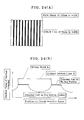
- Fig. 24(A) shows an example of the stripe gray-reproducing pattern, in which, for example, black lines of 64 ⁇ m in width are aligned to form white blanks of 120 ⁇ m in width therebetween.
- Fig. 24(B) shows absolute values of the surface potential corresponding to positions on the charge injection layer in the stripe gray-reproducing pattern shown in Fig. 24(A).
- is that the potential produced by injected charge in a writing width l o of the writing electrode 3b is larger than the potential produced by injected charge at the middle between lines (l 1 /2).
- the thickness condition of the charge injection layer for a case of a gray-reproducing pattern composed of dots for reproducing a gray (gradation) which is neither a solid black nor a solid white will be described with reference to Figs. 25(A), 25(B) and Figs. 26(A), 26(B).
- Fig. 25(A) shows an example of the dot gray-reproducing pattern which is composed, for example, of black dots of 60 ⁇ m in diameter and in interval.
- Fig. 25(B) shows absolute values of the surface potential corresponding to positions on the charge injection layer in the dot gray-reproducing pattern shown in Fig. 25(A).
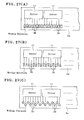
- Figs. 27(A)-27(C) show array patterns for arranging a plurality of writing electrodes 3b in the axial direction of the image carrier 2.
- the simplest array pattern for the writing electrodes 3b is shown in Fig. 27(A).
- a plurality of rectangular writing electrodes 3b are aligned in one row extending in the axial direction of the image carrier 2 as shown in Fig. 27(A).
- a predetermined number (eight in the illustrated example) of writing electrodes 3b are connected to and thus united by a driver 11 which controls the corresponding electrodes 3b by switching the supply voltage between the predetermined voltage or the ground voltage.
- Plural units of writing electrodes 3b are aligned in the same row extending in the axial direction of the image carrier 2.
- the writing electrodes 3b are each formed in triangle and are alternately arranged in such a manner that the orientations of the adjacent electrodes 3b are opposite to each other.
- the electrodes are arranged such that ends of the triangle bases of adjacent electrodes which are opposed to each other are overlapped with each other in a direction perpendicular to the axial direction of the image carrier 2 (the rotational direction of the image carrier).
- the design of partially overlapping adjacent electrodes in the direction perpendicular to the axial direction of the image carrier 2 can eliminate such portions that are not subjected to the application or removal of charge as mentioned above, thereby achieving application or removal of charge relative to the entire surface of the image carrier 2.
- each electrode 3b may be formed in any configuration that allows adjacent electrodes to be partially overlapped with each other in the direction perpendicular to the axial direction of the image carrier, for example, trapezoid, parallelogram, and a configuration having at least one angled side among sides opposed to adjacent electrodes 3b.
- the writing electrodes 3b are each formed in circle and are aligned in two parallel rows (first and second rows) extending in the axial direction of the image carrier 2 in such a manner that the writing electrodes 3b are arranged in a zigzag fashion.
- the electrodes are arranged such that electrodes which are in different rows but adjacent to each other are partially overlapped with each other in the direction perpendicular to the axial direction of the image carrier 2.
- this array pattern can eliminate such portions in the surface of the image carrier 2 that are not subjected to the application or removal of charge as mentioned above, thereby achieving application or removal of charge relative to the entire surface of the image carrier 2.
- plural units are each formed of a predetermined number of electrodes 3b some of which are in the first row and the other are in the second row by connecting these electrodes 3b to one driver 11 and are aligned parallel to the axial direction of the image carrier 2.
- the respective drivers 11 are disposed on the same side of the corresponding electrodes 3b.
- Fig. 28(A) is a schematic illustration showing the function of a charge injection layer 2a through application or removal of charge of the writing electrodes 3b of the writing device 3
- Fig. 28(B) is a graph showing the relation between the voltage applied to electrodes and the surface potential of the charge injection layer.
- Fig. 28(A) As voltage V is applied to a writing electrode 3b, injection of negative (-) charge is conducted directly from a lower voltage side to a higher voltage side between the writing electrode 3b and the charge injection layer 2a. This means that charge is applied to or removed from the charge injection layer 2a via the charge injection.
- the surface potential of the charge injection layer 2a is proportional to the voltage V applied to the electrode 3b so that charge is injected in proportion to the applied voltage.
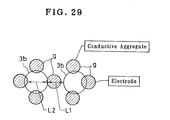
- Fig. 29 is a schematic illustration for explaining a problem of the embodiment shown in Figs. 28(A), 28(B).
- the size of the conductive aggregates g is required to be smaller than the distance L1 between electrodes in order to prevent crosstalk and the distance L2 between adjacent conductive aggregates is required to be smaller than the width of each electrode in order to secure the injection of charge by ON/OFF of the electrodes.
- This comparative example was the same as the above example, except that the agitating time was 1 minute during the formation of a charge injection layer in step (2).
- the average diameter of dispersed aggregates was 80 ⁇ m and the distance between adjacent aggregates was 100 ⁇ m.
- An image was formed by using the image carrier and the writing electrodes at a process speed 30 mm/sec. A dot pattern with dot diameter of 60 ⁇ m and interval of 60 ⁇ m was unsuccessfully formed with 44% blanks. As the formation of image was repeated, crosstalk was caused so that some electrodes were burned.
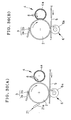
- Figs. 30(A) and 30(B) show examples of the image forming apparatus employing the writing electrodes of the present invention, wherein Fig. 30(A) is an illustration showing an image forming apparatus with a cleaner, and Fig. 30 (B) is an illustration showing an image forming apparatus without a cleaner, that is, it is a cleaner-less image forming apparatus.
- the image forming apparatus 1 shown in Fig. 30(A) is a monochrome image forming apparatus, a substrate 3a of a writing device 3 extends from the upstream toward the downstream in the rotational direction of an image carrier 2, and writing electrodes 3b are fixed to the end of the substrate 3a.
- a cleaning device 21 is arranged at a downstream side than a transferring device 6 in the rotational direction of the image carrier 2.
- a charge control device 7 may be arranged between the writing device 3 and the cleaning device 21, but not illustrated. In case of no charge control device 7, a new latent image is substituted on the former latent image, but the number of parts and the apparatus size can be reduced because of the elimination of the charge control device 7.
- the writing electrodes 3b of the writing device 3 write an electrostatic latent image by applying charge to or removing charge from the surface of the image carrier 2.
- the latent image on the image carrier 2 is subsequently developed with developing powder by the developing roller 4a of the developing device 4, which is spaced apart from the image carrier 2, to form a developing powder image.
- the developing powder image on the image carrier 2 is transferred to a receiving medium 5 by the transferring device 6. Residual developing powder on the image carrier 2 after the transfer is removed by a cleaning blade 21a of the cleaning device 21 and cleaned surface of the image carrier 2 is uniformly charged by the charge control device 7 again.
- the image forming apparatus 1 can be manufactured to have a smaller size and simple structure because it employs the writing device 3 of the present invention.
- the image forming apparatus 1 shown in Fig. 30(B) is similar to the image forming apparatus 1 shown in Fig. 30(A), but without the cleaning device 21, that is, it is a cleaner-less image forming apparatus.
- the developing roller 4a of the developing device 4 is in contact with the image carrier 2 so as to conduct contact developing.
- the surface of the image carrier 2 is made into the uniformly charged state by the charge control device 7, not shown, together with residual developing powder on the image carrier after the former transfer. Then, the writing electrodes 3b of the writing device 3 write an electrostatic latent image on the surface of the image carrier 2 and on the residual developing powder by applying charge to or removing charge from the surface of the image carrier 2 and the surface of the residual developing powder. By the developing device 4, the latent image is developed.
- a brush may be arranged at a downstream side than the transferring device 6 in the rotational direction of the image carrier 2, but not illustrated. In this case, the residual developing powder can be scattered to be uniformly distributed on the image carrier 2 by this brush, thus further effectively transferring the residual developing powder on the non-image portions to the developing device 4.
- the other actions for forming an image of the image forming apparatus 1 of this example are the same as those of the image forming apparatus 1 shown in Fig. 30(A). Employment of the writing device 3 of the present invention achieves reduction in size and simplification of the structure of the image forming apparatus 1. Particularly, since it is a cleaner-less image forming apparatus without the cleaning device 21, further simple structure can be achieved.
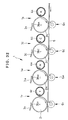
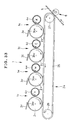
- Fig. 31 is an illustration schematically showing another example of the image forming apparatus employing the writing device according to the present invention.
- the image forming apparatus 1 of this example is an image forming apparatus for developing full color image by superposing developing powder images in four colors of black K, yellow Y, magenta M, and cyan C on an image carrier 2 where in the image carrier is in an endless belt-like form.
- This endless belt-like image carrier 2 is tightly held by two rollers 22, 23 and is rotatable in the clockwise direction in Fig. 31 by a driven roller, i.e. one of the rollers 22, 23.
- Writing devices 3 K , 3 Y , 3 M , 3 C and developing devices 4 K , 4 Y , 4 M , 4 C for the respective colors are arranged along a straight portion of the endless belt of the image carrier 2, in the order of colors K, Y, M, C from the upstream of the rotational direction of the image carrier 2. It should be understood that the developing devices 4 K , 4 Y , 4 M , 4 C may be arranged in any order other than the illustrated one.
- All of the respective writing electrodes 3b K , 3b Y , 3b M , 3b C of the writing devices 3 K , 3 Y , 3 M , 3 C are formed on flexible substrates 3a K , 3a Y , 3a M , 3a C as mentioned above. Also in the image forming apparatus of this example, a charge control device as mentioned above is disposed adjacent to a straight portion of the endless belt of the image carrier 2, at a side opposite to the side where the writing devices 3 K , 3 Y , 3 M , 3 C are arranged, but not illustrated.
- an electrostatic latent image for black K is written on the surface of the image carrier 2 by electrodes 3b K of the writing device 3 K for black K.
- the electrostatic latent image for black K is then developed by the developing device 4 K so as to form a black developing powder image on the surface of the image carrier 2.
- An electrostatic latent image for yellow Y is subsequently written on the surface of the image carrier 2 and on the black developing powder image, already formed, by the electrodes 3b Y of the writing device 3 Y for yellow Y such that the electrostatic latent image for yellow Y is partly superposed on the black developing powder image.
- the electrostatic latent image for yellow Y is then developed by the developing device 4 Y so as to form a yellow developing powder image on the surface of the image carrier 2.
- an electrostatic latent image for magenta M is subsequently written on the surface of the image carrier 2 and on the black and yellow developing powder images, already formed, by the electrodes 3b M of the writing device 3 M for magenta M such that the electrostatic latent image for magenta M is partly superposed on the black and yellow developing powder images.
- the electrostatic latent image for magenta M is then developed by the developing device 4 M so as to form a magenta developing powder image on the black and yellow developing powder images and the surface of the image carrier 2.
- an electrostatic latent image for cyan C is subsequently written on the surface of the image carrier 2 and on the black, yellow and magenta developing powder images, already formed, by the electrodes 3b C of the writing device 3 C for cyan C such that the electrostatic latent image for cyan C is partly superposed on the black, yellow and magenta developing powder images.
- the electrostatic latent image for cyan C is then developed by the developing device 4 c so as to form a cyan developing powder image on the black, yellow and magenta developing powder images and the surface of the image carrier 2. These developing powder images are toned. Then, these developing powder images are transferred to the receiving medium 5 by the transferring device 6 to form a multicolored developing powder image on the receiving medium 5. It should be understood that the developing powder of colors may be deposited in any order other than the aforementioned order.
- Fig. 32 is a view schematically showing still another example of the image forming apparatus employing the writing device according to the present invention.
- the image forming apparatus 1 of this example comprises image forming units 1 K , 1 C , 1 M , 1 Y for the respective colors which are arranged in tandem in this order from the upstream in the feeding direction of a receiving medium 5. It should be understood that the image forming units 1 K , 1 C , 1 M , 1 Y may be arranged in any order.
- the image forming units 1 K , 1 C , 1 M , 1 Y comprise image carriers 2 K , 2 C , 2 M , 2 Y , writing devices 3 K , 3 C , 3 M , 3 Y , developing devices 4 K , 4 C , 4 M , 4 Y , and transferring devices 6 K , 6 C , 6 M , 6 Y , respectively.
- charge control devices 7 as mentioned above may be disposed on the upstream sides of the writing devices 3 K , 3 C , 3 M , 3 Y in the rotational direction of the image carriers 2 K , 2 C , 2 M , 2 Y , respectively.
- an electrostatic latent image for cyan C is written on the surface of the image carrier 2 C by the electrodes 3b C of the writing device 3 C .
- the electrostatic latent image for cyan C is then developed by the developing device 4 C so as to form a cyan developing powder image on the surface of the image carrier 2 C .
- the cyan developing powder image on the image carrier 2 C is transferred to the receiving medium 5 by the transferring device 6 C , supplied and already having the black developing powder image thereon, such that the cyan developing powder image is formed to be partly superposed on the black developing powder image on the receiving medium 5.
- an electrostatic latent image for magenta M is written on the surface of the image carrier 2 M by the electrodes 3b M of the writing device 3 M and then developed by the developing device 4 M to form a magenta developing powder image, and the magenta developing powder image is transferred to the receiving medium 5 by the transferring device 6 M such that the magenta developing powder image is formed and partly superposed on the developing powder images already formed on the receiving medium 5.
- an electrostatic latent image for yellow Y is written on the surface of the image carrier 2 Y by the electrodes 3b Y of the writing device 3 Y and then developed by the developing device 4 Y to form a yellow developing powder image on the image carrier 2Y, and the yellow developing powder image is transferred to the receiving medium 5 by the transferring device 6 Y , thereby superposing the developing powder images for the respective colors to produce a toned multicolored developing powder image on the receiving medium 5.
- Fig. 33 is a view schematically showing further another example of the image forming apparatus employing the writing device according to the present invention.
- the image forming apparatus 1 of the example shown in Fig. 32 comprising the image forming units 1 K , 1 C , 1 M , 1 Y for the respective colors which are arranged in tandem, respective color developing powder images formed on the image carriers 2 K , 2 C , 2 M , 2 Y of the image forming units 1 K , 1 C , 1 M , 1 Y are transferred to the receiving medium 5 at every unit 1 K , 1 C , 1 M , 1 Y .
- the respective color developing powder images are temporally transferred to another medium before transferred to the receiving medium 5 as shown in Fig. 33. That is, the image forming apparatus 1 of this example is different from the image forming apparatus 1 of the example shown in Fig. 32 by including an intermediate transferring device 24.
- the intermediate transferring device 24 comprises an intermediate transferring member 25 taking the form as an endless belt. This intermediate transferring member 25 is tightly held by two rollers 26, 27 and is rotated in the counter-clockwise direction in Fig. 33 by the drive of one of the rollers 26, 27.
- Image forming units 1 K , 1 C , 1 M , 1 Y are arranged along a straight portion of the intermediate transferring member 25. Further, the image forming apparatus 1 has a transferring device 6 disposed adjacent to the roller 27.
- the other structures of the image forming apparatus 1 of this example are the same as those of the image forming apparatus 1 of the example shown in Fig. 32.
- developing powder images for the respective colors are formed on the image carriers 2 K , 2 C , 2 M , 2 Y in the same manner as the image forming apparatus 1 of the example shown in Fig. 32, and the developing powder images for the respective colors are transferred to the intermediate transferring member 25 to be superposed and toned on each other in the same manner as the case of transferring developing powder images to the receiving medium 5 as shown in Fig. 32.
- the developing powder images for the respective colors temporally transferred to the intermediate transferring member 25 are transferred to the receiving medium 5 by the transferring device 6 so as to form a multicolored developing powder image on the receiving medium 5.
- the other actions of the image forming apparatus 1 of this example are the same as those of the image forming apparatus 1 of the example shown in Fig. 32.
Landscapes
- Physics & Mathematics (AREA)
- General Physics & Mathematics (AREA)
- Chemical & Material Sciences (AREA)
- Inorganic Chemistry (AREA)
- Chemical Kinetics & Catalysis (AREA)
- Spectroscopy & Molecular Physics (AREA)
- Electrophotography Using Other Than Carlson'S Method (AREA)
- Printers Or Recording Devices Using Electromagnetic And Radiation Means (AREA)
- Electrostatic Charge, Transfer And Separation In Electrography (AREA)
Applications Claiming Priority (10)
| Application Number | Priority Date | Filing Date | Title |
|---|---|---|---|
| JP2001023601A JP2002225330A (ja) | 2001-01-31 | 2001-01-31 | 画像形成装置 |
| JP2001024048A JP2002225332A (ja) | 2001-01-31 | 2001-01-31 | 画像形成装置 |
| JP2001024048 | 2001-01-31 | ||
| JP2001023601 | 2001-01-31 | ||
| JP2001024050A JP2002225334A (ja) | 2001-01-31 | 2001-01-31 | 画像形成装置 |
| JP2001023602 | 2001-01-31 | ||
| JP2001024051 | 2001-01-31 | ||
| JP2001024051A JP2002229311A (ja) | 2001-01-31 | 2001-01-31 | 像担持体およびその製造方法 |
| JP2001024050 | 2001-01-31 | ||
| JP2001023602A JP2002229224A (ja) | 2001-01-31 | 2001-01-31 | 画像形成装置 |
Publications (2)
| Publication Number | Publication Date |
|---|---|
| EP1229392A2 true EP1229392A2 (de) | 2002-08-07 |
| EP1229392A3 EP1229392A3 (de) | 2006-08-02 |
Family
ID=27531797
Family Applications (1)
| Application Number | Title | Priority Date | Filing Date |
|---|---|---|---|
| EP02001922A Withdrawn EP1229392A3 (de) | 2001-01-31 | 2002-01-31 | Bildträger, Verfahren zur dessen Herstellung und damit versehene Bilderzeugungsvorrichtung |
Country Status (2)
| Country | Link |
|---|---|
| US (2) | US6646663B2 (de) |
| EP (1) | EP1229392A3 (de) |
Families Citing this family (12)
| Publication number | Priority date | Publication date | Assignee | Title |
|---|---|---|---|---|
| US7748620B2 (en) | 2002-01-11 | 2010-07-06 | Hand Held Products, Inc. | Transaction terminal including imaging module |
| CN2629069Y (zh) * | 2002-03-29 | 2004-07-28 | 精工爱普生株式会社 | 写入头和使用它的图像形成装置 |
| DE102004003543A1 (de) * | 2004-01-23 | 2005-10-27 | OCé PRINTING SYSTEMS GMBH | Endloser Zwischenbildträger für einen elektrofotografischen Drucker oder Kopierer |
| US7209154B2 (en) * | 2004-11-19 | 2007-04-24 | Fukuoka Technoken Kogyo, Co., Ltd. | Method for controlling ion generation, ion generator, and image forming apparatus equipped therewith |
| US7342596B2 (en) * | 2004-12-14 | 2008-03-11 | Palo Alto Research Center Incorporated | Method for direct xerography |
| US7325987B2 (en) * | 2004-12-14 | 2008-02-05 | Palo Alto Research Center Incorporated | Printing method using quill-jet |
| US7286149B2 (en) * | 2004-12-14 | 2007-10-23 | Palo Alto Research Center Incorporated | Direct xerography system |
| US7325903B2 (en) * | 2004-12-14 | 2008-02-05 | Palo Alto Research Center Incorporated | Quill-jet printer |
| US20080030566A1 (en) * | 2006-08-04 | 2008-02-07 | Seiko Epson Corporation | Line Head and Image Forming Apparatus Using the Same |
| US20080100534A1 (en) * | 2006-10-26 | 2008-05-01 | Hewlett-Packard Development Company Lp | Switch |
| US7995081B2 (en) * | 2008-06-25 | 2011-08-09 | Palo Alto Research Center Incorporated | Anisotropically conductive backside addressable imaging belt for use with contact electrography |
| EP3894227A4 (de) * | 2018-12-12 | 2022-07-06 | Hewlett-Packard Development Company, L.P. | Übertragung von druckflüssigkeit auf ein substrat |
Family Cites Families (23)
| Publication number | Priority date | Publication date | Assignee | Title |
|---|---|---|---|---|
| US3944705A (en) * | 1973-07-26 | 1976-03-16 | Kanzaki Paper Manufacturing Company, Ltd. | Electrostatic recording material and manufacture thereof |
| JPS5834466A (ja) * | 1981-08-24 | 1983-02-28 | Ricoh Co Ltd | 画像再生装置 |
| JPS5933969A (ja) | 1982-08-20 | 1984-02-24 | Fujitsu Ltd | 静電記録方法 |
| US4775611A (en) * | 1983-11-10 | 1988-10-04 | Sullivan Donald F | Additive printed circuit boards with flat surface and indented primary wiring conductors |
| JPS6345104A (ja) | 1986-08-11 | 1988-02-26 | Kawasaki Steel Corp | スリツプキヤステイング用窒化硼素粉末及びその製造方法 |
| US4920356A (en) * | 1988-12-19 | 1990-04-24 | Eastman Kodak Company | Electrographic recording receiver |
| FR2653241B1 (fr) * | 1989-10-13 | 1994-03-11 | Ricoh Cy Ltd | Procede de developpement et appareil associe utilisant un support de revelateur qui peut former des micro-champs a sa surface. |
| US5096796A (en) * | 1990-05-31 | 1992-03-17 | Xerox Corporation | Blocking and overcoating layers for electroreceptors |
| JP3107924B2 (ja) * | 1991-10-24 | 2000-11-13 | 株式会社リコー | トナー担持体及びその製造方法 |
| US5266431A (en) * | 1991-12-31 | 1993-11-30 | Xerox Corporation | Electrographic imaging members |
| JPH063921A (ja) * | 1992-06-17 | 1994-01-14 | Canon Inc | 電子写真装置及びこの装置に着脱可能なプロセスカートリッジ |
| JPH068510A (ja) | 1992-06-29 | 1994-01-18 | Nippon Telegr & Teleph Corp <Ntt> | 静電記録装置 |
| US5688581A (en) * | 1996-03-14 | 1997-11-18 | Rexam Graphics, Incorporated | Electrographic image transfer element having a protective layer |
| US5581290A (en) * | 1993-12-13 | 1996-12-03 | Kuehnle; Manfred R. | Heating and cooling roller for electrostratic printing |
| US6031552A (en) * | 1994-11-18 | 2000-02-29 | Heidelberger Druckmaschinen Ag | Printing device with patterned recording surface |
| US5812170A (en) * | 1996-01-29 | 1998-09-22 | Heidelberger Druckmaschinen Ag | Electrostatic printing method and apparatus employing a whisker write head |
| US5965243A (en) * | 1997-04-04 | 1999-10-12 | 3M Innovative Properties Company | Electrostatic receptors having release layers with texture and means for providing such receptors |
| JP4126851B2 (ja) * | 1999-07-21 | 2008-07-30 | 富士ゼロックス株式会社 | 画像表示媒体、画像形成方法、及び画像形成装置 |
| JP3675241B2 (ja) * | 1999-07-21 | 2005-07-27 | 富士ゼロックス株式会社 | 画像表示媒体、画像形成方法、画像形成装置、及びイニシャライズ装置 |
| JP2001350365A (ja) * | 2000-06-05 | 2001-12-21 | Minolta Co Ltd | 画像形成装置 |
| JP2002178554A (ja) * | 2000-09-29 | 2002-06-26 | Seiko Epson Corp | 画像形成装置 |
| US6362845B1 (en) * | 2000-12-01 | 2002-03-26 | Xerox Corporation | Method and apparatus for electrostatographic printing utilizing an electrode array and a charge retentive imaging member |
| JP4708574B2 (ja) * | 2001-01-15 | 2011-06-22 | キヤノン株式会社 | 画像形成装置 |
-
2002
- 2002-01-31 US US10/060,016 patent/US6646663B2/en not_active Expired - Fee Related
- 2002-01-31 EP EP02001922A patent/EP1229392A3/de not_active Withdrawn
-
2003
- 2003-06-24 US US10/601,676 patent/US20040021759A1/en not_active Abandoned
Also Published As
| Publication number | Publication date |
|---|---|
| US6646663B2 (en) | 2003-11-11 |
| EP1229392A3 (de) | 2006-08-02 |
| US20040021759A1 (en) | 2004-02-05 |
| US20020146558A1 (en) | 2002-10-10 |
Similar Documents
| Publication | Publication Date | Title |
|---|---|---|
| EP0091780B1 (de) | Entwicklungsgerät für latente elektrostatische Bilder | |
| US6646663B2 (en) | Image carrier and writing electrodes, method for manufacturing the same, and image forming apparatus using the same | |
| US5812170A (en) | Electrostatic printing method and apparatus employing a whisker write head | |
| EP1193574B1 (de) | Bilderzeugungsvorrichtung | |
| EP1193069B1 (de) | Bilderzeugungsgerät | |
| EP1193071B1 (de) | Bilderzeugungsgerät | |
| EP1193070B1 (de) | Bilderzeugungsgerät | |
| US6031552A (en) | Printing device with patterned recording surface | |
| EP0055599B1 (de) | Direktes Bildaufnahmeverfahren und elektrostatisches Druckgerät | |
| EP1348563B1 (de) | Schreibkopf und damit versehenes Bilderzeugungsgerät | |
| US5821973A (en) | Printing device and method | |
| JP2002229224A (ja) | 画像形成装置 | |
| JP2004239940A (ja) | 像担持体およびこれを用いた画像形成装置 | |
| JP2002225334A (ja) | 画像形成装置 | |
| JP2002225332A (ja) | 画像形成装置 | |
| JP2003162075A (ja) | 画像形成装置における像担持体 | |
| JP2004239939A (ja) | 像担持体およびこれを用いた画像形成装置 | |
| JP2002229235A (ja) | 画像形成装置およびこれに用いる像担持体の製造方法 | |
| JP2003291399A (ja) | 画像形成装置 | |
| JP2003295587A (ja) | 画像形成装置 | |
| JP2003089235A (ja) | 画像形成装置 | |
| JP2004268386A (ja) | 書込ヘッド | |
| JPH01259954A (ja) | インク転写型多色記録装置 | |
| JP2002225333A (ja) | 画像形成装置 | |
| JP2002103676A (ja) | 画像形成装置 |
Legal Events
| Date | Code | Title | Description |
|---|---|---|---|
| PUAI | Public reference made under article 153(3) epc to a published international application that has entered the european phase |
Free format text: ORIGINAL CODE: 0009012 |
|
| AK | Designated contracting states |
Kind code of ref document: A2 Designated state(s): AT BE CH CY DE DK ES FI FR GB GR IE IT LI LU MC NL PT SE TR |
|
| AX | Request for extension of the european patent |
Free format text: AL;LT;LV;MK;RO;SI |
|
| PUAL | Search report despatched |
Free format text: ORIGINAL CODE: 0009013 |
|
| AK | Designated contracting states |
Kind code of ref document: A3 Designated state(s): AT BE CH CY DE DK ES FI FR GB GR IE IT LI LU MC NL PT SE TR |
|
| AX | Request for extension of the european patent |
Extension state: AL LT LV MK RO SI |
|
| 17P | Request for examination filed |
Effective date: 20061228 |
|
| AKX | Designation fees paid |
Designated state(s): AT BE CH CY DE DK ES FI FR GB GR IE IT LI LU MC NL PT SE TR |
|
| 17Q | First examination report despatched |
Effective date: 20070820 |
|
| STAA | Information on the status of an ep patent application or granted ep patent |
Free format text: STATUS: THE APPLICATION IS DEEMED TO BE WITHDRAWN |
|
| 18D | Application deemed to be withdrawn |
Effective date: 20080103 |