EP1232216B1 - Zusammensetzungen auf basis schlagzähmodifizierten polyethylenterephthalat/polycarbonat blends - Google Patents
Zusammensetzungen auf basis schlagzähmodifizierten polyethylenterephthalat/polycarbonat blends Download PDFInfo
- Publication number
- EP1232216B1 EP1232216B1 EP00975924A EP00975924A EP1232216B1 EP 1232216 B1 EP1232216 B1 EP 1232216B1 EP 00975924 A EP00975924 A EP 00975924A EP 00975924 A EP00975924 A EP 00975924A EP 1232216 B1 EP1232216 B1 EP 1232216B1
- Authority
- EP
- European Patent Office
- Prior art keywords
- weight
- bis
- parts
- composition according
- graft
- Prior art date
- Legal status (The legal status is an assumption and is not a legal conclusion. Google has not performed a legal analysis and makes no representation as to the accuracy of the status listed.)
- Expired - Lifetime
Links
- 239000000203 mixture Substances 0.000 title claims abstract description 96
- 229920000515 polycarbonate Polymers 0.000 title claims abstract description 61
- 239000004417 polycarbonate Substances 0.000 title claims abstract description 60
- 229920000139 polyethylene terephthalate Polymers 0.000 title claims abstract description 45
- 239000005020 polyethylene terephthalate Substances 0.000 title claims abstract description 30
- 230000035939 shock Effects 0.000 title 1
- 239000000454 talc Substances 0.000 claims abstract description 26
- 229910052623 talc Inorganic materials 0.000 claims abstract description 26
- 239000012764 mineral filler Substances 0.000 claims abstract description 15
- 239000011265 semifinished product Substances 0.000 claims abstract description 11
- -1 polyethylene terephthalate Polymers 0.000 claims description 65
- 229920000578 graft copolymer Polymers 0.000 claims description 30
- 239000000178 monomer Substances 0.000 claims description 24
- 229920000642 polymer Polymers 0.000 claims description 23
- 229920001400 block copolymer Polymers 0.000 claims description 21
- 125000003118 aryl group Chemical group 0.000 claims description 17
- 239000002245 particle Substances 0.000 claims description 16
- 239000000945 filler Substances 0.000 claims description 13
- NIXOWILDQLNWCW-UHFFFAOYSA-M Acrylate Chemical compound [O-]C(=O)C=C NIXOWILDQLNWCW-UHFFFAOYSA-M 0.000 claims description 7
- 229920001971 elastomer Polymers 0.000 claims description 7
- 230000009477 glass transition Effects 0.000 claims description 6
- 239000005060 rubber Substances 0.000 claims description 6
- 150000001252 acrylic acid derivatives Chemical class 0.000 claims description 4
- 150000002734 metacrylic acid derivatives Chemical class 0.000 claims 1
- 239000000463 material Substances 0.000 abstract description 10
- 238000009757 thermoplastic moulding Methods 0.000 abstract description 7
- 238000000465 moulding Methods 0.000 description 39
- 238000000034 method Methods 0.000 description 27
- 235000012222 talc Nutrition 0.000 description 23
- VPWNQTHUCYMVMZ-UHFFFAOYSA-N 4,4'-sulfonyldiphenol Chemical class C1=CC(O)=CC=C1S(=O)(=O)C1=CC=C(O)C=C1 VPWNQTHUCYMVMZ-UHFFFAOYSA-N 0.000 description 21
- 229930185605 Bisphenol Natural products 0.000 description 20
- 239000000654 additive Substances 0.000 description 20
- 125000004432 carbon atom Chemical group C* 0.000 description 18
- PPBRXRYQALVLMV-UHFFFAOYSA-N Styrene Chemical compound C=CC1=CC=CC=C1 PPBRXRYQALVLMV-UHFFFAOYSA-N 0.000 description 17
- LYCAIKOWRPUZTN-UHFFFAOYSA-N Ethylene glycol Chemical compound OCCO LYCAIKOWRPUZTN-UHFFFAOYSA-N 0.000 description 15
- KKEYFWRCBNTPAC-UHFFFAOYSA-N Terephthalic acid Chemical compound OC(=O)C1=CC=C(C(O)=O)C=C1 KKEYFWRCBNTPAC-UHFFFAOYSA-N 0.000 description 15
- 125000000217 alkyl group Chemical group 0.000 description 15
- 238000002360 preparation method Methods 0.000 description 13
- IISBACLAFKSPIT-UHFFFAOYSA-N bisphenol A Chemical compound C=1C=C(O)C=CC=1C(C)(C)C1=CC=C(O)C=C1 IISBACLAFKSPIT-UHFFFAOYSA-N 0.000 description 12
- 239000002585 base Substances 0.000 description 11
- 229920001283 Polyalkylene terephthalate Polymers 0.000 description 10
- 239000004793 Polystyrene Substances 0.000 description 10
- 239000006085 branching agent Substances 0.000 description 10
- 230000009021 linear effect Effects 0.000 description 10
- 229920000728 polyester Polymers 0.000 description 10
- 229920002223 polystyrene Polymers 0.000 description 10
- NLHHRLWOUZZQLW-UHFFFAOYSA-N Acrylonitrile Chemical compound C=CC#N NLHHRLWOUZZQLW-UHFFFAOYSA-N 0.000 description 9
- 229920003023 plastic Polymers 0.000 description 9
- 239000004033 plastic Substances 0.000 description 9
- 150000001875 compounds Chemical class 0.000 description 8
- 238000002425 crystallisation Methods 0.000 description 8
- 230000008025 crystallization Effects 0.000 description 8
- 125000002496 methyl group Chemical group [H]C([H])([H])* 0.000 description 8
- RRHGJUQNOFWUDK-UHFFFAOYSA-N Isoprene Chemical compound CC(=C)C=C RRHGJUQNOFWUDK-UHFFFAOYSA-N 0.000 description 7
- VVQNEPGJFQJSBK-UHFFFAOYSA-N Methyl methacrylate Chemical compound COC(=O)C(C)=C VVQNEPGJFQJSBK-UHFFFAOYSA-N 0.000 description 7
- NIXOWILDQLNWCW-UHFFFAOYSA-N acrylic acid group Chemical group C(C=C)(=O)O NIXOWILDQLNWCW-UHFFFAOYSA-N 0.000 description 7
- 238000004132 cross linking Methods 0.000 description 7
- 150000002009 diols Chemical class 0.000 description 7
- RFFLAFLAYFXFSW-UHFFFAOYSA-N 1,2-dichlorobenzene Chemical compound ClC1=CC=CC=C1Cl RFFLAFLAYFXFSW-UHFFFAOYSA-N 0.000 description 6
- OKTJSMMVPCPJKN-UHFFFAOYSA-N Carbon Chemical compound [C] OKTJSMMVPCPJKN-UHFFFAOYSA-N 0.000 description 6
- ISWSIDIOOBJBQZ-UHFFFAOYSA-N Phenol Chemical compound OC1=CC=CC=C1 ISWSIDIOOBJBQZ-UHFFFAOYSA-N 0.000 description 6
- CQEYYJKEWSMYFG-UHFFFAOYSA-N butyl acrylate Chemical compound CCCCOC(=O)C=C CQEYYJKEWSMYFG-UHFFFAOYSA-N 0.000 description 6
- 238000004519 manufacturing process Methods 0.000 description 6
- 239000000155 melt Substances 0.000 description 6
- 229920001169 thermoplastic Polymers 0.000 description 6
- 239000004416 thermosoftening plastic Substances 0.000 description 6
- KAKZBPTYRLMSJV-UHFFFAOYSA-N Butadiene Chemical compound C=CC=C KAKZBPTYRLMSJV-UHFFFAOYSA-N 0.000 description 5
- 239000005062 Polybutadiene Substances 0.000 description 5
- 239000002253 acid Substances 0.000 description 5
- WPYMKLBDIGXBTP-UHFFFAOYSA-N benzoic acid Chemical class OC(=O)C1=CC=CC=C1 WPYMKLBDIGXBTP-UHFFFAOYSA-N 0.000 description 5
- 229910052799 carbon Inorganic materials 0.000 description 5
- 239000003795 chemical substances by application Substances 0.000 description 5
- 150000002148 esters Chemical class 0.000 description 5
- 239000006082 mold release agent Substances 0.000 description 5
- 229920002857 polybutadiene Polymers 0.000 description 5
- 239000000047 product Substances 0.000 description 5
- 238000005809 transesterification reaction Methods 0.000 description 5
- UMPGNGRIGSEMTC-UHFFFAOYSA-N 4-[1-(4-hydroxyphenyl)-3,3,5-trimethylcyclohexyl]phenol Chemical compound C1C(C)CC(C)(C)CC1(C=1C=CC(O)=CC=1)C1=CC=C(O)C=C1 UMPGNGRIGSEMTC-UHFFFAOYSA-N 0.000 description 4
- LFQSCWFLJHTTHZ-UHFFFAOYSA-N Ethanol Chemical compound CCO LFQSCWFLJHTTHZ-UHFFFAOYSA-N 0.000 description 4
- CERQOIWHTDAKMF-UHFFFAOYSA-N Methacrylic acid Chemical compound CC(=C)C(O)=O CERQOIWHTDAKMF-UHFFFAOYSA-N 0.000 description 4
- 150000001298 alcohols Chemical class 0.000 description 4
- 125000003342 alkenyl group Chemical group 0.000 description 4
- 125000005250 alkyl acrylate group Chemical group 0.000 description 4
- QMKYBPDZANOJGF-UHFFFAOYSA-N benzene-1,3,5-tricarboxylic acid Chemical compound OC(=O)C1=CC(C(O)=O)=CC(C(O)=O)=C1 QMKYBPDZANOJGF-UHFFFAOYSA-N 0.000 description 4
- WERYXYBDKMZEQL-UHFFFAOYSA-N butane-1,4-diol Chemical compound OCCCCO WERYXYBDKMZEQL-UHFFFAOYSA-N 0.000 description 4
- 125000001495 ethyl group Chemical group [H]C([H])([H])C([H])([H])* 0.000 description 4
- 229910052736 halogen Inorganic materials 0.000 description 4
- 150000002367 halogens Chemical class 0.000 description 4
- QQVIHTHCMHWDBS-UHFFFAOYSA-N isophthalic acid Chemical compound OC(=O)C1=CC=CC(C(O)=O)=C1 QQVIHTHCMHWDBS-UHFFFAOYSA-N 0.000 description 4
- 238000005259 measurement Methods 0.000 description 4
- 239000002667 nucleating agent Substances 0.000 description 4
- 239000003973 paint Substances 0.000 description 4
- XNGIFLGASWRNHJ-UHFFFAOYSA-N phthalic acid Chemical compound OC(=O)C1=CC=CC=C1C(O)=O XNGIFLGASWRNHJ-UHFFFAOYSA-N 0.000 description 4
- 229920001707 polybutylene terephthalate Polymers 0.000 description 4
- 238000012552 review Methods 0.000 description 4
- 239000000126 substance Substances 0.000 description 4
- VEORPZCZECFIRK-UHFFFAOYSA-N 3,3',5,5'-tetrabromobisphenol A Chemical compound C=1C(Br)=C(O)C(Br)=CC=1C(C)(C)C1=CC(Br)=C(O)C(Br)=C1 VEORPZCZECFIRK-UHFFFAOYSA-N 0.000 description 3
- ISAVYTVYFVQUDY-UHFFFAOYSA-N 4-tert-Octylphenol Chemical compound CC(C)(C)CC(C)(C)C1=CC=C(O)C=C1 ISAVYTVYFVQUDY-UHFFFAOYSA-N 0.000 description 3
- 239000005711 Benzoic acid Substances 0.000 description 3
- 229920001634 Copolyester Polymers 0.000 description 3
- YMWUJEATGCHHMB-UHFFFAOYSA-N Dichloromethane Chemical compound ClCCl YMWUJEATGCHHMB-UHFFFAOYSA-N 0.000 description 3
- UFHFLCQGNIYNRP-UHFFFAOYSA-N Hydrogen Chemical compound [H][H] UFHFLCQGNIYNRP-UHFFFAOYSA-N 0.000 description 3
- 229920002633 Kraton (polymer) Polymers 0.000 description 3
- OFOBLEOULBTSOW-UHFFFAOYSA-N Malonic acid Chemical compound OC(=O)CC(O)=O OFOBLEOULBTSOW-UHFFFAOYSA-N 0.000 description 3
- GYCMBHHDWRMZGG-UHFFFAOYSA-N Methylacrylonitrile Chemical compound CC(=C)C#N GYCMBHHDWRMZGG-UHFFFAOYSA-N 0.000 description 3
- ZMXDDKWLCZADIW-UHFFFAOYSA-N N,N-Dimethylformamide Chemical compound CN(C)C=O ZMXDDKWLCZADIW-UHFFFAOYSA-N 0.000 description 3
- 239000004698 Polyethylene Substances 0.000 description 3
- YXFVVABEGXRONW-UHFFFAOYSA-N Toluene Chemical compound CC1=CC=CC=C1 YXFVVABEGXRONW-UHFFFAOYSA-N 0.000 description 3
- 125000001931 aliphatic group Chemical group 0.000 description 3
- XYLMUPLGERFSHI-UHFFFAOYSA-N alpha-Methylstyrene Chemical compound CC(=C)C1=CC=CC=C1 XYLMUPLGERFSHI-UHFFFAOYSA-N 0.000 description 3
- 235000010233 benzoic acid Nutrition 0.000 description 3
- 150000004649 carbonic acid derivatives Chemical class 0.000 description 3
- 150000001735 carboxylic acids Chemical class 0.000 description 3
- 238000000635 electron micrograph Methods 0.000 description 3
- 239000003063 flame retardant Substances 0.000 description 3
- 238000010348 incorporation Methods 0.000 description 3
- 239000002184 metal Substances 0.000 description 3
- 229910052751 metal Inorganic materials 0.000 description 3
- 238000002156 mixing Methods 0.000 description 3
- 150000002763 monocarboxylic acids Chemical class 0.000 description 3
- 229920003251 poly(α-methylstyrene) Polymers 0.000 description 3
- 229920001195 polyisoprene Polymers 0.000 description 3
- 238000006116 polymerization reaction Methods 0.000 description 3
- 239000003381 stabilizer Substances 0.000 description 3
- 229920001935 styrene-ethylene-butadiene-styrene Polymers 0.000 description 3
- 238000005199 ultracentrifugation Methods 0.000 description 3
- FQXGHZNSUOHCLO-UHFFFAOYSA-N 2,2,4,4-tetramethyl-1,3-cyclobutanediol Chemical compound CC1(C)C(O)C(C)(C)C1O FQXGHZNSUOHCLO-UHFFFAOYSA-N 0.000 description 2
- JCTXKRPTIMZBJT-UHFFFAOYSA-N 2,2,4-trimethylpentane-1,3-diol Chemical compound CC(C)C(O)C(C)(C)CO JCTXKRPTIMZBJT-UHFFFAOYSA-N 0.000 description 2
- BJELTSYBAHKXRW-UHFFFAOYSA-N 2,4,6-triallyloxy-1,3,5-triazine Chemical compound C=CCOC1=NC(OCC=C)=NC(OCC=C)=N1 BJELTSYBAHKXRW-UHFFFAOYSA-N 0.000 description 2
- BSWWXRFVMJHFBN-UHFFFAOYSA-N 2,4,6-tribromophenol Chemical compound OC1=C(Br)C=C(Br)C=C1Br BSWWXRFVMJHFBN-UHFFFAOYSA-N 0.000 description 2
- UIAFKZKHHVMJGS-UHFFFAOYSA-N 2,4-dihydroxybenzoic acid Chemical compound OC(=O)C1=CC=C(O)C=C1O UIAFKZKHHVMJGS-UHFFFAOYSA-N 0.000 description 2
- CJWNFAKWHDOUKL-UHFFFAOYSA-N 2-(2-phenylpropan-2-yl)phenol Chemical compound C=1C=CC=C(O)C=1C(C)(C)C1=CC=CC=C1 CJWNFAKWHDOUKL-UHFFFAOYSA-N 0.000 description 2
- RWLALWYNXFYRGW-UHFFFAOYSA-N 2-Ethyl-1,3-hexanediol Chemical compound CCCC(O)C(CC)CO RWLALWYNXFYRGW-UHFFFAOYSA-N 0.000 description 2
- GOXQRTZXKQZDDN-UHFFFAOYSA-N 2-Ethylhexyl acrylate Chemical compound CCCCC(CC)COC(=O)C=C GOXQRTZXKQZDDN-UHFFFAOYSA-N 0.000 description 2
- ICPXIRMAMWRMAD-UHFFFAOYSA-N 2-[3-[2-[3-(2-hydroxyethoxy)phenyl]propan-2-yl]phenoxy]ethanol Chemical compound C=1C=CC(OCCO)=CC=1C(C)(C)C1=CC=CC(OCCO)=C1 ICPXIRMAMWRMAD-UHFFFAOYSA-N 0.000 description 2
- WUQYBSRMWWRFQH-UHFFFAOYSA-N 2-prop-1-en-2-ylphenol Chemical compound CC(=C)C1=CC=CC=C1O WUQYBSRMWWRFQH-UHFFFAOYSA-N 0.000 description 2
- ZEKCYPANSOJWDH-UHFFFAOYSA-N 3,3-bis(4-hydroxy-3-methylphenyl)-1H-indol-2-one Chemical compound C1=C(O)C(C)=CC(C2(C3=CC=CC=C3NC2=O)C=2C=C(C)C(O)=CC=2)=C1 ZEKCYPANSOJWDH-UHFFFAOYSA-N 0.000 description 2
- CPHURRLSZSRQFS-UHFFFAOYSA-N 3-[4-[2-[4-(3-hydroxypropoxy)phenyl]propan-2-yl]phenoxy]propan-1-ol Chemical compound C=1C=C(OCCCO)C=CC=1C(C)(C)C1=CC=C(OCCCO)C=C1 CPHURRLSZSRQFS-UHFFFAOYSA-N 0.000 description 2
- RBQLGIKHSXQZTB-UHFFFAOYSA-N 3-methylpentane-2,4-diol Chemical compound CC(O)C(C)C(C)O RBQLGIKHSXQZTB-UHFFFAOYSA-N 0.000 description 2
- NEQFBGHQPUXOFH-UHFFFAOYSA-N 4-(4-carboxyphenyl)benzoic acid Chemical compound C1=CC(C(=O)O)=CC=C1C1=CC=C(C(O)=O)C=C1 NEQFBGHQPUXOFH-UHFFFAOYSA-N 0.000 description 2
- BRPSWMCDEYMRPE-UHFFFAOYSA-N 4-[1,1-bis(4-hydroxyphenyl)ethyl]phenol Chemical compound C=1C=C(O)C=CC=1C(C=1C=CC(O)=CC=1)(C)C1=CC=C(O)C=C1 BRPSWMCDEYMRPE-UHFFFAOYSA-N 0.000 description 2
- CDBAMNGURPMUTG-UHFFFAOYSA-N 4-[2-(4-hydroxycyclohexyl)propan-2-yl]cyclohexan-1-ol Chemical compound C1CC(O)CCC1C(C)(C)C1CCC(O)CC1 CDBAMNGURPMUTG-UHFFFAOYSA-N 0.000 description 2
- QHPQWRBYOIRBIT-UHFFFAOYSA-N 4-tert-butylphenol Chemical compound CC(C)(C)C1=CC=C(O)C=C1 QHPQWRBYOIRBIT-UHFFFAOYSA-N 0.000 description 2
- WKBOTKDWSSQWDR-UHFFFAOYSA-N Bromine atom Chemical compound [Br] WKBOTKDWSSQWDR-UHFFFAOYSA-N 0.000 description 2
- IRIAEXORFWYRCZ-UHFFFAOYSA-N Butylbenzyl phthalate Chemical compound CCCCOC(=O)C1=CC=CC=C1C(=O)OCC1=CC=CC=C1 IRIAEXORFWYRCZ-UHFFFAOYSA-N 0.000 description 2
- ZAMOUSCENKQFHK-UHFFFAOYSA-N Chlorine atom Chemical compound [Cl] ZAMOUSCENKQFHK-UHFFFAOYSA-N 0.000 description 2
- 239000004641 Diallyl-phthalate Substances 0.000 description 2
- QIGBRXMKCJKVMJ-UHFFFAOYSA-N Hydroquinone Chemical compound OC1=CC=C(O)C=C1 QIGBRXMKCJKVMJ-UHFFFAOYSA-N 0.000 description 2
- 239000004609 Impact Modifier Substances 0.000 description 2
- UQSXHKLRYXJYBZ-UHFFFAOYSA-N Iron oxide Chemical compound [Fe]=O UQSXHKLRYXJYBZ-UHFFFAOYSA-N 0.000 description 2
- 229920000877 Melamine resin Polymers 0.000 description 2
- IPRJXAGUEGOFGG-UHFFFAOYSA-N N-butylbenzenesulfonamide Chemical compound CCCCNS(=O)(=O)C1=CC=CC=C1 IPRJXAGUEGOFGG-UHFFFAOYSA-N 0.000 description 2
- ALQSHHUCVQOPAS-UHFFFAOYSA-N Pentane-1,5-diol Chemical compound OCCCCCO ALQSHHUCVQOPAS-UHFFFAOYSA-N 0.000 description 2
- YGYAWVDWMABLBF-UHFFFAOYSA-N Phosgene Chemical compound ClC(Cl)=O YGYAWVDWMABLBF-UHFFFAOYSA-N 0.000 description 2
- JUJWROOIHBZHMG-UHFFFAOYSA-N Pyridine Chemical compound C1=CC=NC=C1 JUJWROOIHBZHMG-UHFFFAOYSA-N 0.000 description 2
- VYPSYNLAJGMNEJ-UHFFFAOYSA-N Silicium dioxide Chemical compound O=[Si]=O VYPSYNLAJGMNEJ-UHFFFAOYSA-N 0.000 description 2
- KYPYTERUKNKOLP-UHFFFAOYSA-N Tetrachlorobisphenol A Chemical compound C=1C(Cl)=C(O)C(Cl)=CC=1C(C)(C)C1=CC(Cl)=C(O)C(Cl)=C1 KYPYTERUKNKOLP-UHFFFAOYSA-N 0.000 description 2
- GWEVSGVZZGPLCZ-UHFFFAOYSA-N Titan oxide Chemical compound O=[Ti]=O GWEVSGVZZGPLCZ-UHFFFAOYSA-N 0.000 description 2
- 150000007513 acids Chemical class 0.000 description 2
- 229910052784 alkaline earth metal Inorganic materials 0.000 description 2
- 229940058905 antimony compound for treatment of leishmaniasis and trypanosomiasis Drugs 0.000 description 2
- 150000001463 antimony compounds Chemical class 0.000 description 2
- LJCFOYOSGPHIOO-UHFFFAOYSA-N antimony pentoxide Chemical compound O=[Sb](=O)O[Sb](=O)=O LJCFOYOSGPHIOO-UHFFFAOYSA-N 0.000 description 2
- ADCOVFLJGNWWNZ-UHFFFAOYSA-N antimony trioxide Chemical compound O=[Sb]O[Sb]=O ADCOVFLJGNWWNZ-UHFFFAOYSA-N 0.000 description 2
- 125000004429 atom Chemical group 0.000 description 2
- 230000015572 biosynthetic process Effects 0.000 description 2
- QUDWYFHPNIMBFC-UHFFFAOYSA-N bis(prop-2-enyl) benzene-1,2-dicarboxylate Chemical compound C=CCOC(=O)C1=CC=CC=C1C(=O)OCC=C QUDWYFHPNIMBFC-UHFFFAOYSA-N 0.000 description 2
- 150000004651 carbonic acid esters Chemical class 0.000 description 2
- 239000003054 catalyst Substances 0.000 description 2
- 238000006243 chemical reaction Methods 0.000 description 2
- 239000007795 chemical reaction product Substances 0.000 description 2
- 238000013329 compounding Methods 0.000 description 2
- 238000010276 construction Methods 0.000 description 2
- 238000007796 conventional method Methods 0.000 description 2
- 125000004122 cyclic group Chemical group 0.000 description 2
- 150000001993 dienes Chemical class 0.000 description 2
- 125000000118 dimethyl group Chemical group [H]C([H])([H])* 0.000 description 2
- UKMSUNONTOPOIO-UHFFFAOYSA-N docosanoic acid Chemical compound CCCCCCCCCCCCCCCCCCCCCC(O)=O UKMSUNONTOPOIO-UHFFFAOYSA-N 0.000 description 2
- 239000000835 fiber Substances 0.000 description 2
- 239000000446 fuel Substances 0.000 description 2
- 238000005227 gel permeation chromatography Methods 0.000 description 2
- 239000010439 graphite Substances 0.000 description 2
- 229910002804 graphite Inorganic materials 0.000 description 2
- 150000002391 heterocyclic compounds Chemical class 0.000 description 2
- 229910052739 hydrogen Inorganic materials 0.000 description 2
- 239000001257 hydrogen Substances 0.000 description 2
- 125000004464 hydroxyphenyl group Chemical group 0.000 description 2
- 238000001746 injection moulding Methods 0.000 description 2
- 238000005304 joining Methods 0.000 description 2
- 239000004922 lacquer Substances 0.000 description 2
- 239000000314 lubricant Substances 0.000 description 2
- FPYJFEHAWHCUMM-UHFFFAOYSA-N maleic anhydride Chemical compound O=C1OC(=O)C=C1 FPYJFEHAWHCUMM-UHFFFAOYSA-N 0.000 description 2
- JDSHMPZPIAZGSV-UHFFFAOYSA-N melamine Chemical compound NC1=NC(N)=NC(N)=N1 JDSHMPZPIAZGSV-UHFFFAOYSA-N 0.000 description 2
- 125000005395 methacrylic acid group Chemical group 0.000 description 2
- XJRBAMWJDBPFIM-UHFFFAOYSA-N methyl vinyl ether Chemical compound COC=C XJRBAMWJDBPFIM-UHFFFAOYSA-N 0.000 description 2
- RXOHFPCZGPKIRD-UHFFFAOYSA-N naphthalene-2,6-dicarboxylic acid Chemical compound C1=C(C(O)=O)C=CC2=CC(C(=O)O)=CC=C21 RXOHFPCZGPKIRD-UHFFFAOYSA-N 0.000 description 2
- SLCVBVWXLSEKPL-UHFFFAOYSA-N neopentyl glycol Chemical compound OCC(C)(C)CO SLCVBVWXLSEKPL-UHFFFAOYSA-N 0.000 description 2
- BDJRBEYXGGNYIS-UHFFFAOYSA-N nonanedioic acid Chemical compound OC(=O)CCCCCCCC(O)=O BDJRBEYXGGNYIS-UHFFFAOYSA-N 0.000 description 2
- QIQXTHQIDYTFRH-UHFFFAOYSA-N octadecanoic acid Chemical compound CCCCCCCCCCCCCCCCCC(O)=O QIQXTHQIDYTFRH-UHFFFAOYSA-N 0.000 description 2
- 239000003960 organic solvent Substances 0.000 description 2
- 238000010422 painting Methods 0.000 description 2
- 150000002989 phenols Chemical class 0.000 description 2
- 150000003018 phosphorus compounds Chemical class 0.000 description 2
- 239000000049 pigment Substances 0.000 description 2
- 239000004014 plasticizer Substances 0.000 description 2
- XRVCFZPJAHWYTB-UHFFFAOYSA-N prenderol Chemical compound CCC(CC)(CO)CO XRVCFZPJAHWYTB-UHFFFAOYSA-N 0.000 description 2
- 238000012545 processing Methods 0.000 description 2
- FBCQUCJYYPMKRO-UHFFFAOYSA-N prop-2-enyl 2-methylprop-2-enoate Chemical compound CC(=C)C(=O)OCC=C FBCQUCJYYPMKRO-UHFFFAOYSA-N 0.000 description 2
- YPFDHNVEDLHUCE-UHFFFAOYSA-N propane-1,3-diol Chemical compound OCCCO YPFDHNVEDLHUCE-UHFFFAOYSA-N 0.000 description 2
- 239000002994 raw material Substances 0.000 description 2
- GHMLBKRAJCXXBS-UHFFFAOYSA-N resorcinol Chemical compound OC1=CC=CC(O)=C1 GHMLBKRAJCXXBS-UHFFFAOYSA-N 0.000 description 2
- 150000003839 salts Chemical class 0.000 description 2
- 229920006395 saturated elastomer Polymers 0.000 description 2
- 238000005029 sieve analysis Methods 0.000 description 2
- 229920003048 styrene butadiene rubber Polymers 0.000 description 2
- 239000000725 suspension Substances 0.000 description 2
- 238000003786 synthesis reaction Methods 0.000 description 2
- 238000012360 testing method Methods 0.000 description 2
- 238000002076 thermal analysis method Methods 0.000 description 2
- ARCGXLSVLAOJQL-UHFFFAOYSA-N trimellitic acid Chemical compound OC(=O)C1=CC=C(C(O)=O)C(C(O)=O)=C1 ARCGXLSVLAOJQL-UHFFFAOYSA-N 0.000 description 2
- 125000000391 vinyl group Chemical group [H]C([*])=C([H])[H] 0.000 description 2
- 229920002554 vinyl polymer Polymers 0.000 description 2
- 239000001993 wax Substances 0.000 description 2
- DNIAPMSPPWPWGF-VKHMYHEASA-N (+)-propylene glycol Chemical compound C[C@H](O)CO DNIAPMSPPWPWGF-VKHMYHEASA-N 0.000 description 1
- OWICEWMBIBPFAH-UHFFFAOYSA-N (3-diphenoxyphosphoryloxyphenyl) diphenyl phosphate Chemical compound C=1C=CC=CC=1OP(OC=1C=C(OP(=O)(OC=2C=CC=CC=2)OC=2C=CC=CC=2)C=CC=1)(=O)OC1=CC=CC=C1 OWICEWMBIBPFAH-UHFFFAOYSA-N 0.000 description 1
- 125000004400 (C1-C12) alkyl group Chemical group 0.000 description 1
- 125000006833 (C1-C5) alkylene group Chemical group 0.000 description 1
- 125000004169 (C1-C6) alkyl group Chemical group 0.000 description 1
- KOMNUTZXSVSERR-UHFFFAOYSA-N 1,3,5-tris(prop-2-enyl)-1,3,5-triazinane-2,4,6-trione Chemical compound C=CCN1C(=O)N(CC=C)C(=O)N(CC=C)C1=O KOMNUTZXSVSERR-UHFFFAOYSA-N 0.000 description 1
- UNEATYXSUBPPKP-UHFFFAOYSA-N 1,3-Diisopropylbenzene Chemical compound CC(C)C1=CC=CC(C(C)C)=C1 UNEATYXSUBPPKP-UHFFFAOYSA-N 0.000 description 1
- 150000005207 1,3-dihydroxybenzenes Chemical class 0.000 description 1
- UYLBMRPUAFDIKO-UHFFFAOYSA-N 1,4,5,5,6,6-hexakis[4-[2-(4-hydroxyphenyl)propan-2-yl]phenyl]cyclohex-2-ene-1,4-dicarboxylic acid Chemical compound CC(C)(C1=CC=C(C=C1)C2(C=CC(C(C2(C3=CC=C(C=C3)C(C)(C)C4=CC=C(C=C4)O)C5=CC=C(C=C5)C(C)(C)C6=CC=C(C=C6)O)(C7=CC=C(C=C7)C(C)(C)C8=CC=C(C=C8)O)C9=CC=C(C=C9)C(C)(C)C1=CC=C(C=C1)O)(C1=CC=C(C=C1)C(C)(C)C1=CC=C(C=C1)O)C(=O)O)C(=O)O)C1=CC=C(C=C1)O UYLBMRPUAFDIKO-UHFFFAOYSA-N 0.000 description 1
- 150000005208 1,4-dihydroxybenzenes Chemical class 0.000 description 1
- 150000000190 1,4-diols Chemical class 0.000 description 1
- FYBFGAFWCBMEDG-UHFFFAOYSA-N 1-[3,5-di(prop-2-enoyl)-1,3,5-triazinan-1-yl]prop-2-en-1-one Chemical compound C=CC(=O)N1CN(C(=O)C=C)CN(C(=O)C=C)C1 FYBFGAFWCBMEDG-UHFFFAOYSA-N 0.000 description 1
- YIYBRXKMQFDHSM-UHFFFAOYSA-N 2,2'-Dihydroxybenzophenone Chemical class OC1=CC=CC=C1C(=O)C1=CC=CC=C1O YIYBRXKMQFDHSM-UHFFFAOYSA-N 0.000 description 1
- RNFJDJUURJAICM-UHFFFAOYSA-N 2,2,4,4,6,6-hexaphenoxy-1,3,5-triaza-2$l^{5},4$l^{5},6$l^{5}-triphosphacyclohexa-1,3,5-triene Chemical compound N=1P(OC=2C=CC=CC=2)(OC=2C=CC=CC=2)=NP(OC=2C=CC=CC=2)(OC=2C=CC=CC=2)=NP=1(OC=1C=CC=CC=1)OC1=CC=CC=C1 RNFJDJUURJAICM-UHFFFAOYSA-N 0.000 description 1
- DFOLZQISJZKWBT-UHFFFAOYSA-N 2,3-dihydro-1h-indene;phenol Chemical compound OC1=CC=CC=C1.OC1=CC=CC=C1.C1=CC=C2CCCC2=C1 DFOLZQISJZKWBT-UHFFFAOYSA-N 0.000 description 1
- VPVTXVHUJHGOCM-UHFFFAOYSA-N 2,4-bis[2-(4-hydroxyphenyl)propan-2-yl]phenol Chemical compound C=1C=C(O)C(C(C)(C)C=2C=CC(O)=CC=2)=CC=1C(C)(C)C1=CC=C(O)C=C1 VPVTXVHUJHGOCM-UHFFFAOYSA-N 0.000 description 1
- MAQOZOILPAMFSW-UHFFFAOYSA-N 2,6-bis[(2-hydroxy-5-methylphenyl)methyl]-4-methylphenol Chemical compound CC1=CC=C(O)C(CC=2C(=C(CC=3C(=CC=C(C)C=3)O)C=C(C)C=2)O)=C1 MAQOZOILPAMFSW-UHFFFAOYSA-N 0.000 description 1
- VXHYVVAUHMGCEX-UHFFFAOYSA-N 2-(2-hydroxyphenoxy)phenol Chemical class OC1=CC=CC=C1OC1=CC=CC=C1O VXHYVVAUHMGCEX-UHFFFAOYSA-N 0.000 description 1
- BLDLRWQLBOJPEB-UHFFFAOYSA-N 2-(2-hydroxyphenyl)sulfanylphenol Chemical class OC1=CC=CC=C1SC1=CC=CC=C1O BLDLRWQLBOJPEB-UHFFFAOYSA-N 0.000 description 1
- XSVZEASGNTZBRQ-UHFFFAOYSA-N 2-(2-hydroxyphenyl)sulfinylphenol Chemical class OC1=CC=CC=C1S(=O)C1=CC=CC=C1O XSVZEASGNTZBRQ-UHFFFAOYSA-N 0.000 description 1
- QUWAJPZDCZDTJS-UHFFFAOYSA-N 2-(2-hydroxyphenyl)sulfonylphenol Chemical class OC1=CC=CC=C1S(=O)(=O)C1=CC=CC=C1O QUWAJPZDCZDTJS-UHFFFAOYSA-N 0.000 description 1
- SMZOUWXMTYCWNB-UHFFFAOYSA-N 2-(2-methoxy-5-methylphenyl)ethanamine Chemical compound COC1=CC=C(C)C=C1CCN SMZOUWXMTYCWNB-UHFFFAOYSA-N 0.000 description 1
- HIXDQWDOVZUNNA-UHFFFAOYSA-N 2-(3,4-dimethoxyphenyl)-5-hydroxy-7-methoxychromen-4-one Chemical group C=1C(OC)=CC(O)=C(C(C=2)=O)C=1OC=2C1=CC=C(OC)C(OC)=C1 HIXDQWDOVZUNNA-UHFFFAOYSA-N 0.000 description 1
- KAIRTVANLJFYQS-UHFFFAOYSA-N 2-(3,5-dimethylheptyl)phenol Chemical compound CCC(C)CC(C)CCC1=CC=CC=C1O KAIRTVANLJFYQS-UHFFFAOYSA-N 0.000 description 1
- KYGLCUAXJICESS-UHFFFAOYSA-N 2-[2,3-di(propan-2-yl)phenyl]phenol Chemical class CC(C)C1=CC=CC(C=2C(=CC=CC=2)O)=C1C(C)C KYGLCUAXJICESS-UHFFFAOYSA-N 0.000 description 1
- WTPYFJNYAMXZJG-UHFFFAOYSA-N 2-[4-(2-hydroxyethoxy)phenoxy]ethanol Chemical compound OCCOC1=CC=C(OCCO)C=C1 WTPYFJNYAMXZJG-UHFFFAOYSA-N 0.000 description 1
- XBQRPFBBTWXIFI-UHFFFAOYSA-N 2-chloro-4-[2-(3-chloro-4-hydroxyphenyl)propan-2-yl]phenol Chemical compound C=1C=C(O)C(Cl)=CC=1C(C)(C)C1=CC=C(O)C(Cl)=C1 XBQRPFBBTWXIFI-UHFFFAOYSA-N 0.000 description 1
- WHBAYNMEIXUTJV-UHFFFAOYSA-N 2-chloroethyl prop-2-enoate Chemical compound ClCCOC(=O)C=C WHBAYNMEIXUTJV-UHFFFAOYSA-N 0.000 description 1
- BSUKKOMNQGNSGP-UHFFFAOYSA-N 2-ethylidenehexanoic acid Chemical compound CCCCC(=CC)C(O)=O BSUKKOMNQGNSGP-UHFFFAOYSA-N 0.000 description 1
- ACOQOLIJGGKILA-UHFFFAOYSA-N 2-methylpentane-1,1-diol Chemical compound CCCC(C)C(O)O ACOQOLIJGGKILA-UHFFFAOYSA-N 0.000 description 1
- YMTYZTXUZLQUSF-UHFFFAOYSA-N 3,3'-Dimethylbisphenol A Chemical compound C1=C(O)C(C)=CC(C(C)(C)C=2C=C(C)C(O)=CC=2)=C1 YMTYZTXUZLQUSF-UHFFFAOYSA-N 0.000 description 1
- ZDWSNKPLZUXBPE-UHFFFAOYSA-N 3,5-ditert-butylphenol Chemical compound CC(C)(C)C1=CC(O)=CC(C(C)(C)C)=C1 ZDWSNKPLZUXBPE-UHFFFAOYSA-N 0.000 description 1
- VWGKEVWFBOUAND-UHFFFAOYSA-N 4,4'-thiodiphenol Chemical compound C1=CC(O)=CC=C1SC1=CC=C(O)C=C1 VWGKEVWFBOUAND-UHFFFAOYSA-N 0.000 description 1
- CUAUDSWILJWDOD-UHFFFAOYSA-N 4-(3,5-dimethylheptyl)phenol Chemical compound CCC(C)CC(C)CCC1=CC=C(O)C=C1 CUAUDSWILJWDOD-UHFFFAOYSA-N 0.000 description 1
- SUCTVKDVODFXFX-UHFFFAOYSA-N 4-(4-hydroxy-3,5-dimethylphenyl)sulfonyl-2,6-dimethylphenol Chemical compound CC1=C(O)C(C)=CC(S(=O)(=O)C=2C=C(C)C(O)=C(C)C=2)=C1 SUCTVKDVODFXFX-UHFFFAOYSA-N 0.000 description 1
- KJWMCPYEODZESQ-UHFFFAOYSA-N 4-Dodecylphenol Chemical compound CCCCCCCCCCCCC1=CC=C(O)C=C1 KJWMCPYEODZESQ-UHFFFAOYSA-N 0.000 description 1
- AZZWZMUXHALBCQ-UHFFFAOYSA-N 4-[(4-hydroxy-3,5-dimethylphenyl)methyl]-2,6-dimethylphenol Chemical compound CC1=C(O)C(C)=CC(CC=2C=C(C)C(O)=C(C)C=2)=C1 AZZWZMUXHALBCQ-UHFFFAOYSA-N 0.000 description 1
- BWCAVNWKMVHLFW-UHFFFAOYSA-N 4-[1-(4-hydroxy-3,5-dimethylphenyl)cyclohexyl]-2,6-dimethylphenol Chemical compound CC1=C(O)C(C)=CC(C2(CCCCC2)C=2C=C(C)C(O)=C(C)C=2)=C1 BWCAVNWKMVHLFW-UHFFFAOYSA-N 0.000 description 1
- IIQVXZZBIGSGIL-UHFFFAOYSA-N 4-[1-(4-hydroxyphenyl)-3,3-dimethylcyclohexyl]phenol Chemical compound C1C(C)(C)CCCC1(C=1C=CC(O)=CC=1)C1=CC=C(O)C=C1 IIQVXZZBIGSGIL-UHFFFAOYSA-N 0.000 description 1
- GYLZMVYMSPSPDA-UHFFFAOYSA-N 4-[1-(4-hydroxyphenyl)-3-methylcyclohexyl]phenol Chemical compound C1C(C)CCCC1(C=1C=CC(O)=CC=1)C1=CC=C(O)C=C1 GYLZMVYMSPSPDA-UHFFFAOYSA-N 0.000 description 1
- IPHDZYSMEITSBA-UHFFFAOYSA-N 4-[1-(4-hydroxyphenyl)-4-methylcyclohexyl]phenol Chemical compound C1CC(C)CCC1(C=1C=CC(O)=CC=1)C1=CC=C(O)C=C1 IPHDZYSMEITSBA-UHFFFAOYSA-N 0.000 description 1
- ZBMWIKZBITYTCF-UHFFFAOYSA-N 4-[2,3-di(propan-2-yl)phenyl]phenol Chemical compound CC(C)C1=CC=CC(C=2C=CC(O)=CC=2)=C1C(C)C ZBMWIKZBITYTCF-UHFFFAOYSA-N 0.000 description 1
- WJZHBPSXJJQGJO-UHFFFAOYSA-N 4-[2,6-di(propan-2-yl)phenyl]phenol Chemical compound CC(C)C1=CC=CC(C(C)C)=C1C1=CC=C(O)C=C1 WJZHBPSXJJQGJO-UHFFFAOYSA-N 0.000 description 1
- ODJUOZPKKHIEOZ-UHFFFAOYSA-N 4-[2-(4-hydroxy-3,5-dimethylphenyl)propan-2-yl]-2,6-dimethylphenol Chemical compound CC1=C(O)C(C)=CC(C(C)(C)C=2C=C(C)C(O)=C(C)C=2)=C1 ODJUOZPKKHIEOZ-UHFFFAOYSA-N 0.000 description 1
- XJGTVJRTDRARGO-UHFFFAOYSA-N 4-[2-(4-hydroxyphenyl)propan-2-yl]benzene-1,3-diol Chemical compound C=1C=C(O)C=C(O)C=1C(C)(C)C1=CC=C(O)C=C1 XJGTVJRTDRARGO-UHFFFAOYSA-N 0.000 description 1
- PVFQHGDIOXNKIC-UHFFFAOYSA-N 4-[2-[3-[2-(4-hydroxyphenyl)propan-2-yl]phenyl]propan-2-yl]phenol Chemical compound C=1C=CC(C(C)(C)C=2C=CC(O)=CC=2)=CC=1C(C)(C)C1=CC=C(O)C=C1 PVFQHGDIOXNKIC-UHFFFAOYSA-N 0.000 description 1
- RQTDWDATSAVLOR-UHFFFAOYSA-N 4-[3,5-bis(4-hydroxyphenyl)phenyl]phenol Chemical compound C1=CC(O)=CC=C1C1=CC(C=2C=CC(O)=CC=2)=CC(C=2C=CC(O)=CC=2)=C1 RQTDWDATSAVLOR-UHFFFAOYSA-N 0.000 description 1
- OBZFGWBLZXIBII-UHFFFAOYSA-N 4-[3-(4-hydroxy-3,5-dimethylphenyl)-3-methylbutyl]-2,6-dimethylphenol Chemical compound CC1=C(O)C(C)=CC(CCC(C)(C)C=2C=C(C)C(O)=C(C)C=2)=C1 OBZFGWBLZXIBII-UHFFFAOYSA-N 0.000 description 1
- NIRYBKWMEWFDPM-UHFFFAOYSA-N 4-[3-(4-hydroxyphenyl)-3-methylbutyl]phenol Chemical compound C=1C=C(O)C=CC=1C(C)(C)CCC1=CC=C(O)C=C1 NIRYBKWMEWFDPM-UHFFFAOYSA-N 0.000 description 1
- CIEGINNQDIULCT-UHFFFAOYSA-N 4-[4,6-bis(4-hydroxyphenyl)-4,6-dimethylheptan-2-yl]phenol Chemical compound C=1C=C(O)C=CC=1C(C)CC(C)(C=1C=CC(O)=CC=1)CC(C)(C)C1=CC=C(O)C=C1 CIEGINNQDIULCT-UHFFFAOYSA-N 0.000 description 1
- IQNDEQHJTOJHAK-UHFFFAOYSA-N 4-[4-[2-[4,4-bis(4-hydroxyphenyl)cyclohexyl]propan-2-yl]-1-(4-hydroxyphenyl)cyclohexyl]phenol Chemical compound C1CC(C=2C=CC(O)=CC=2)(C=2C=CC(O)=CC=2)CCC1C(C)(C)C(CC1)CCC1(C=1C=CC(O)=CC=1)C1=CC=C(O)C=C1 IQNDEQHJTOJHAK-UHFFFAOYSA-N 0.000 description 1
- LIDWAYDGZUAJEG-UHFFFAOYSA-N 4-[bis(4-hydroxyphenyl)-phenylmethyl]phenol Chemical compound C1=CC(O)=CC=C1C(C=1C=CC(O)=CC=1)(C=1C=CC(O)=CC=1)C1=CC=CC=C1 LIDWAYDGZUAJEG-UHFFFAOYSA-N 0.000 description 1
- BOCLKUCIZOXUEY-UHFFFAOYSA-N 4-[tris(4-hydroxyphenyl)methyl]phenol Chemical compound C1=CC(O)=CC=C1C(C=1C=CC(O)=CC=1)(C=1C=CC(O)=CC=1)C1=CC=C(O)C=C1 BOCLKUCIZOXUEY-UHFFFAOYSA-N 0.000 description 1
- DBCAQXHNJOFNGC-UHFFFAOYSA-N 4-bromo-1,1,1-trifluorobutane Chemical compound FC(F)(F)CCCBr DBCAQXHNJOFNGC-UHFFFAOYSA-N 0.000 description 1
- WXNZTHHGJRFXKQ-UHFFFAOYSA-N 4-chlorophenol Chemical compound OC1=CC=C(Cl)C=C1 WXNZTHHGJRFXKQ-UHFFFAOYSA-N 0.000 description 1
- 125000004203 4-hydroxyphenyl group Chemical group [H]OC1=C([H])C([H])=C(*)C([H])=C1[H] 0.000 description 1
- 235000021357 Behenic acid Nutrition 0.000 description 1
- VOWWYDCFAISREI-UHFFFAOYSA-N Bisphenol AP Chemical compound C=1C=C(O)C=CC=1C(C=1C=CC(O)=CC=1)(C)C1=CC=CC=C1 VOWWYDCFAISREI-UHFFFAOYSA-N 0.000 description 1
- GIXXQTYGFOHYPT-UHFFFAOYSA-N Bisphenol P Chemical compound C=1C=C(C(C)(C)C=2C=CC(O)=CC=2)C=CC=1C(C)(C)C1=CC=C(O)C=C1 GIXXQTYGFOHYPT-UHFFFAOYSA-N 0.000 description 1
- SDDLEVPIDBLVHC-UHFFFAOYSA-N Bisphenol Z Chemical compound C1=CC(O)=CC=C1C1(C=2C=CC(O)=CC=2)CCCCC1 SDDLEVPIDBLVHC-UHFFFAOYSA-N 0.000 description 1
- 125000000882 C2-C6 alkenyl group Chemical group 0.000 description 1
- 239000004215 Carbon black (E152) Substances 0.000 description 1
- BVKZGUZCCUSVTD-UHFFFAOYSA-L Carbonate Chemical compound [O-]C([O-])=O BVKZGUZCCUSVTD-UHFFFAOYSA-L 0.000 description 1
- MQIUGAXCHLFZKX-UHFFFAOYSA-N Di-n-octyl phthalate Natural products CCCCCCCCOC(=O)C1=CC=CC=C1C(=O)OCCCCCCCC MQIUGAXCHLFZKX-UHFFFAOYSA-N 0.000 description 1
- 238000005727 Friedel-Crafts reaction Methods 0.000 description 1
- 229920004049 Makrolon® 2805 Polymers 0.000 description 1
- AFCARXCZXQIEQB-UHFFFAOYSA-N N-[3-oxo-3-(2,4,6,7-tetrahydrotriazolo[4,5-c]pyridin-5-yl)propyl]-2-[[3-(trifluoromethoxy)phenyl]methylamino]pyrimidine-5-carboxamide Chemical compound O=C(CCNC(=O)C=1C=NC(=NC=1)NCC1=CC(=CC=C1)OC(F)(F)F)N1CC2=C(CC1)NN=N2 AFCARXCZXQIEQB-UHFFFAOYSA-N 0.000 description 1
- JPYHHZQJCSQRJY-UHFFFAOYSA-N Phloroglucinol Natural products CCC=CCC=CCC=CCC=CCCCCC(=O)C1=C(O)C=C(O)C=C1O JPYHHZQJCSQRJY-UHFFFAOYSA-N 0.000 description 1
- 239000004721 Polyphenylene oxide Chemical group 0.000 description 1
- 229920000388 Polyphosphate Polymers 0.000 description 1
- 239000004743 Polypropylene Substances 0.000 description 1
- QOSMNYMQXIVWKY-UHFFFAOYSA-N Propyl levulinate Chemical compound CCCOC(=O)CCC(C)=O QOSMNYMQXIVWKY-UHFFFAOYSA-N 0.000 description 1
- BLRPTPMANUNPDV-UHFFFAOYSA-N Silane Chemical compound [SiH4] BLRPTPMANUNPDV-UHFFFAOYSA-N 0.000 description 1
- 229920013623 Solprene Polymers 0.000 description 1
- 235000021355 Stearic acid Nutrition 0.000 description 1
- 239000012963 UV stabilizer Substances 0.000 description 1
- XTXRWKRVRITETP-UHFFFAOYSA-N Vinyl acetate Chemical compound CC(=O)OC=C XTXRWKRVRITETP-UHFFFAOYSA-N 0.000 description 1
- 229920000800 acrylic rubber Polymers 0.000 description 1
- 229920000122 acrylonitrile butadiene styrene Polymers 0.000 description 1
- 238000004026 adhesive bonding Methods 0.000 description 1
- 150000001335 aliphatic alkanes Chemical class 0.000 description 1
- 239000003513 alkali Substances 0.000 description 1
- 229910001413 alkali metal ion Inorganic materials 0.000 description 1
- 229910001420 alkaline earth metal ion Inorganic materials 0.000 description 1
- 150000001342 alkaline earth metals Chemical class 0.000 description 1
- 125000005907 alkyl ester group Chemical group 0.000 description 1
- 230000029936 alkylation Effects 0.000 description 1
- 238000005804 alkylation reaction Methods 0.000 description 1
- PNEYBMLMFCGWSK-UHFFFAOYSA-N aluminium oxide Inorganic materials [O-2].[O-2].[O-2].[Al+3].[Al+3] PNEYBMLMFCGWSK-UHFFFAOYSA-N 0.000 description 1
- 150000001408 amides Chemical class 0.000 description 1
- 150000003863 ammonium salts Chemical class 0.000 description 1
- 238000004458 analytical method Methods 0.000 description 1
- 150000008064 anhydrides Chemical class 0.000 description 1
- 150000004056 anthraquinones Chemical class 0.000 description 1
- 239000003963 antioxidant agent Substances 0.000 description 1
- 230000003078 antioxidant effect Effects 0.000 description 1
- 239000002216 antistatic agent Substances 0.000 description 1
- 238000000149 argon plasma sintering Methods 0.000 description 1
- 125000000732 arylene group Chemical group 0.000 description 1
- 125000004104 aryloxy group Chemical group 0.000 description 1
- IRERQBUNZFJFGC-UHFFFAOYSA-L azure blue Chemical compound [Na+].[Na+].[Na+].[Na+].[Na+].[Na+].[Na+].[Na+].[Al+3].[Al+3].[Al+3].[Al+3].[Al+3].[Al+3].[S-]S[S-].[O-][Si]([O-])([O-])[O-].[O-][Si]([O-])([O-])[O-].[O-][Si]([O-])([O-])[O-].[O-][Si]([O-])([O-])[O-].[O-][Si]([O-])([O-])[O-].[O-][Si]([O-])([O-])[O-] IRERQBUNZFJFGC-UHFFFAOYSA-L 0.000 description 1
- 229940116226 behenic acid Drugs 0.000 description 1
- UHOVQNZJYSORNB-UHFFFAOYSA-N benzene Substances C1=CC=CC=C1 UHOVQNZJYSORNB-UHFFFAOYSA-N 0.000 description 1
- UWCPYKQBIPYOLX-UHFFFAOYSA-N benzene-1,3,5-tricarbonyl chloride Chemical compound ClC(=O)C1=CC(C(Cl)=O)=CC(C(Cl)=O)=C1 UWCPYKQBIPYOLX-UHFFFAOYSA-N 0.000 description 1
- 150000001555 benzenes Chemical class 0.000 description 1
- 150000001558 benzoic acid derivatives Chemical class 0.000 description 1
- 239000012965 benzophenone Chemical class 0.000 description 1
- 150000008366 benzophenones Chemical class 0.000 description 1
- 150000001565 benzotriazoles Chemical class 0.000 description 1
- 229940114055 beta-resorcylic acid Drugs 0.000 description 1
- 230000001588 bifunctional effect Effects 0.000 description 1
- VCCBEIPGXKNHFW-UHFFFAOYSA-N biphenyl-4,4'-diol Chemical group C1=CC(O)=CC=C1C1=CC=C(O)C=C1 VCCBEIPGXKNHFW-UHFFFAOYSA-N 0.000 description 1
- BJQHLKABXJIVAM-UHFFFAOYSA-N bis(2-ethylhexyl) phthalate Chemical compound CCCCC(CC)COC(=O)C1=CC=CC=C1C(=O)OCC(CC)CCCC BJQHLKABXJIVAM-UHFFFAOYSA-N 0.000 description 1
- 150000001642 boronic acid derivatives Chemical class 0.000 description 1
- GDTBXPJZTBHREO-UHFFFAOYSA-N bromine Substances BrBr GDTBXPJZTBHREO-UHFFFAOYSA-N 0.000 description 1
- 229910052794 bromium Inorganic materials 0.000 description 1
- 125000000484 butyl group Chemical group [H]C([*])([H])C([H])([H])C([H])([H])C([H])([H])[H] 0.000 description 1
- 229910052791 calcium Inorganic materials 0.000 description 1
- 239000006229 carbon black Substances 0.000 description 1
- 125000003178 carboxy group Chemical group [H]OC(*)=O 0.000 description 1
- 150000001732 carboxylic acid derivatives Chemical class 0.000 description 1
- 125000002843 carboxylic acid group Chemical group 0.000 description 1
- 229920002678 cellulose Polymers 0.000 description 1
- 239000003153 chemical reaction reagent Substances 0.000 description 1
- 239000000460 chlorine Substances 0.000 description 1
- 229910052801 chlorine Inorganic materials 0.000 description 1
- 125000004218 chloromethyl group Chemical group [H]C([H])(Cl)* 0.000 description 1
- 125000000068 chlorophenyl group Chemical group 0.000 description 1
- YACLQRRMGMJLJV-UHFFFAOYSA-N chloroprene Chemical compound ClC(=C)C=C YACLQRRMGMJLJV-UHFFFAOYSA-N 0.000 description 1
- 239000011248 coating agent Substances 0.000 description 1
- 238000000576 coating method Methods 0.000 description 1
- 239000000084 colloidal system Substances 0.000 description 1
- 239000002131 composite material Substances 0.000 description 1
- 229920001940 conductive polymer Polymers 0.000 description 1
- 238000001816 cooling Methods 0.000 description 1
- 229920001577 copolymer Polymers 0.000 description 1
- MGNCLNQXLYJVJD-UHFFFAOYSA-N cyanuric chloride Chemical compound ClC1=NC(Cl)=NC(Cl)=N1 MGNCLNQXLYJVJD-UHFFFAOYSA-N 0.000 description 1
- 238000013500 data storage Methods 0.000 description 1
- UCVPKAZCQPRWAY-UHFFFAOYSA-N dibenzyl benzene-1,2-dicarboxylate Chemical compound C=1C=CC=C(C(=O)OCC=2C=CC=CC=2)C=1C(=O)OCC1=CC=CC=C1 UCVPKAZCQPRWAY-UHFFFAOYSA-N 0.000 description 1
- 229920003244 diene elastomer Polymers 0.000 description 1
- 239000000539 dimer Substances 0.000 description 1
- DMBHHRLKUKUOEG-UHFFFAOYSA-N diphenylamine Chemical class C=1C=CC=CC=1NC1=CC=CC=C1 DMBHHRLKUKUOEG-UHFFFAOYSA-N 0.000 description 1
- 238000009826 distribution Methods 0.000 description 1
- 239000000975 dye Substances 0.000 description 1
- 238000004870 electrical engineering Methods 0.000 description 1
- 239000003995 emulsifying agent Substances 0.000 description 1
- 239000000839 emulsion Substances 0.000 description 1
- 230000002708 enhancing effect Effects 0.000 description 1
- RTZKZFJDLAIYFH-UHFFFAOYSA-N ether Substances CCOCC RTZKZFJDLAIYFH-UHFFFAOYSA-N 0.000 description 1
- 125000004494 ethyl ester group Chemical group 0.000 description 1
- STVZJERGLQHEKB-UHFFFAOYSA-N ethylene glycol dimethacrylate Substances CC(=C)C(=O)OCCOC(=O)C(C)=C STVZJERGLQHEKB-UHFFFAOYSA-N 0.000 description 1
- 238000011156 evaluation Methods 0.000 description 1
- 238000001125 extrusion Methods 0.000 description 1
- 230000002349 favourable effect Effects 0.000 description 1
- 239000003365 glass fiber Substances 0.000 description 1
- 125000001188 haloalkyl group Chemical group 0.000 description 1
- 230000026030 halogenation Effects 0.000 description 1
- 238000005658 halogenation reaction Methods 0.000 description 1
- 239000012760 heat stabilizer Substances 0.000 description 1
- 238000010438 heat treatment Methods 0.000 description 1
- 125000005842 heteroatom Chemical group 0.000 description 1
- 229930195733 hydrocarbon Natural products 0.000 description 1
- 150000002430 hydrocarbons Chemical class 0.000 description 1
- 150000002431 hydrogen Chemical class 0.000 description 1
- 125000002887 hydroxy group Chemical group [H]O* 0.000 description 1
- WGCNASOHLSPBMP-UHFFFAOYSA-N hydroxyacetaldehyde Natural products OCC=O WGCNASOHLSPBMP-UHFFFAOYSA-N 0.000 description 1
- 239000012535 impurity Substances 0.000 description 1
- 238000002347 injection Methods 0.000 description 1
- 239000007924 injection Substances 0.000 description 1
- 229910052500 inorganic mineral Inorganic materials 0.000 description 1
- 230000002427 irreversible effect Effects 0.000 description 1
- ZFSLODLOARCGLH-UHFFFAOYSA-N isocyanuric acid Chemical compound OC1=NC(O)=NC(O)=N1 ZFSLODLOARCGLH-UHFFFAOYSA-N 0.000 description 1
- 150000002576 ketones Chemical class 0.000 description 1
- 238000004898 kneading Methods 0.000 description 1
- 150000004668 long chain fatty acids Chemical class 0.000 description 1
- VTHJTEIRLNZDEV-UHFFFAOYSA-L magnesium dihydroxide Chemical compound [OH-].[OH-].[Mg+2] VTHJTEIRLNZDEV-UHFFFAOYSA-L 0.000 description 1
- 239000000347 magnesium hydroxide Substances 0.000 description 1
- 229910001862 magnesium hydroxide Inorganic materials 0.000 description 1
- ZQKXQUJXLSSJCH-UHFFFAOYSA-N melamine cyanurate Chemical compound NC1=NC(N)=NC(N)=N1.O=C1NC(=O)NC(=O)N1 ZQKXQUJXLSSJCH-UHFFFAOYSA-N 0.000 description 1
- 239000011707 mineral Substances 0.000 description 1
- 239000012170 montan wax Substances 0.000 description 1
- 125000004108 n-butyl group Chemical group [H]C([H])([H])C([H])([H])C([H])([H])C([H])([H])* 0.000 description 1
- 239000002071 nanotube Substances 0.000 description 1
- 125000001624 naphthyl group Chemical group 0.000 description 1
- 229910017464 nitrogen compound Inorganic materials 0.000 description 1
- 150000002830 nitrogen compounds Chemical class 0.000 description 1
- OQCDKBAXFALNLD-UHFFFAOYSA-N octadecanoic acid Natural products CCCCCCCC(C)CCCCCCCCC(O)=O OQCDKBAXFALNLD-UHFFFAOYSA-N 0.000 description 1
- 239000003921 oil Substances 0.000 description 1
- 150000002896 organic halogen compounds Chemical class 0.000 description 1
- 150000002897 organic nitrogen compounds Chemical class 0.000 description 1
- 150000002903 organophosphorus compounds Chemical class 0.000 description 1
- WXZMFSXDPGVJKK-UHFFFAOYSA-N pentaerythritol Chemical compound OCC(CO)(CO)CO WXZMFSXDPGVJKK-UHFFFAOYSA-N 0.000 description 1
- RNGPDYJPLDLVJI-UHFFFAOYSA-N pentan-2-yl prop-2-enoate Chemical compound CCCC(C)OC(=O)C=C RNGPDYJPLDLVJI-UHFFFAOYSA-N 0.000 description 1
- 125000005003 perfluorobutyl group Chemical group FC(F)(F)C(F)(F)C(F)(F)C(F)(F)* 0.000 description 1
- 125000005007 perfluorooctyl group Chemical group FC(C(C(C(C(C(C(C(F)(F)F)(F)F)(F)F)(F)F)(F)F)(F)F)(F)F)(F)* 0.000 description 1
- 150000002979 perylenes Chemical class 0.000 description 1
- 239000003208 petroleum Substances 0.000 description 1
- 125000001997 phenyl group Chemical group [H]C1=C([H])C([H])=C(*)C([H])=C1[H] 0.000 description 1
- QCDYQQDYXPDABM-UHFFFAOYSA-N phloroglucinol Chemical compound OC1=CC(O)=CC(O)=C1 QCDYQQDYXPDABM-UHFFFAOYSA-N 0.000 description 1
- 229960001553 phloroglucinol Drugs 0.000 description 1
- AQSJGOWTSHOLKH-UHFFFAOYSA-N phosphite(3-) Chemical class [O-]P([O-])[O-] AQSJGOWTSHOLKH-UHFFFAOYSA-N 0.000 description 1
- 150000004714 phosphonium salts Chemical class 0.000 description 1
- XZTOTRSSGPPNTB-UHFFFAOYSA-N phosphono dihydrogen phosphate;1,3,5-triazine-2,4,6-triamine Chemical compound NC1=NC(N)=NC(N)=N1.OP(O)(=O)OP(O)(O)=O XZTOTRSSGPPNTB-UHFFFAOYSA-N 0.000 description 1
- XFZRQAZGUOTJCS-UHFFFAOYSA-N phosphoric acid;1,3,5-triazine-2,4,6-triamine Chemical compound OP(O)(O)=O.NC1=NC(N)=NC(N)=N1 XFZRQAZGUOTJCS-UHFFFAOYSA-N 0.000 description 1
- 230000000704 physical effect Effects 0.000 description 1
- 230000035479 physiological effects, processes and functions Effects 0.000 description 1
- 229920000058 polyacrylate Polymers 0.000 description 1
- 229920000570 polyether Chemical group 0.000 description 1
- 229920000573 polyethylene Polymers 0.000 description 1
- 229920001223 polyethylene glycol Polymers 0.000 description 1
- 229920002959 polymer blend Polymers 0.000 description 1
- 229920005862 polyol Polymers 0.000 description 1
- 150000003077 polyols Chemical class 0.000 description 1
- 229920006324 polyoxymethylene Polymers 0.000 description 1
- 239000001205 polyphosphate Substances 0.000 description 1
- 235000011176 polyphosphates Nutrition 0.000 description 1
- 229920001155 polypropylene Polymers 0.000 description 1
- 229920000166 polytrimethylene carbonate Polymers 0.000 description 1
- 239000002243 precursor Substances 0.000 description 1
- 238000003672 processing method Methods 0.000 description 1
- 239000001294 propane Substances 0.000 description 1
- 125000001436 propyl group Chemical group [H]C([*])([H])C([H])([H])C([H])([H])[H] 0.000 description 1
- UMJSCPRVCHMLSP-UHFFFAOYSA-N pyridine Natural products COC1=CC=CN=C1 UMJSCPRVCHMLSP-UHFFFAOYSA-N 0.000 description 1
- 239000012744 reinforcing agent Substances 0.000 description 1
- 229920005989 resin Polymers 0.000 description 1
- 239000011347 resin Substances 0.000 description 1
- 238000005096 rolling process Methods 0.000 description 1
- 239000005336 safety glass Substances 0.000 description 1
- 150000003873 salicylate salts Chemical class 0.000 description 1
- 238000004062 sedimentation Methods 0.000 description 1
- 229910000077 silane Inorganic materials 0.000 description 1
- 239000000377 silicon dioxide Substances 0.000 description 1
- 238000004513 sizing Methods 0.000 description 1
- HHJJPFYGIRKQOM-UHFFFAOYSA-N sodium;oxido-oxo-phenylphosphanium Chemical compound [Na+].[O-][P+](=O)C1=CC=CC=C1 HHJJPFYGIRKQOM-UHFFFAOYSA-N 0.000 description 1
- 229940071182 stannate Drugs 0.000 description 1
- 239000007858 starting material Substances 0.000 description 1
- 239000008117 stearic acid Substances 0.000 description 1
- SJMYWORNLPSJQO-UHFFFAOYSA-N tert-butyl 2-methylprop-2-enoate Chemical compound CC(=C)C(=O)OC(C)(C)C SJMYWORNLPSJQO-UHFFFAOYSA-N 0.000 description 1
- 125000000999 tert-butyl group Chemical group [H]C([H])([H])C(*)(C([H])([H])[H])C([H])([H])[H] 0.000 description 1
- ISXSCDLOGDJUNJ-UHFFFAOYSA-N tert-butyl prop-2-enoate Chemical compound CC(C)(C)OC(=O)C=C ISXSCDLOGDJUNJ-UHFFFAOYSA-N 0.000 description 1
- BFKJFAAPBSQJPD-UHFFFAOYSA-N tetrafluoroethene Chemical group FC(F)=C(F)F BFKJFAAPBSQJPD-UHFFFAOYSA-N 0.000 description 1
- 229920002725 thermoplastic elastomer Polymers 0.000 description 1
- 150000003606 tin compounds Chemical class 0.000 description 1
- 239000004408 titanium dioxide Substances 0.000 description 1
- 229920000428 triblock copolymer Polymers 0.000 description 1
- QXJQHYBHAIHNGG-UHFFFAOYSA-N trimethylolethane Chemical compound OCC(C)(CO)CO QXJQHYBHAIHNGG-UHFFFAOYSA-N 0.000 description 1
- XZZNDPSIHUTMOC-UHFFFAOYSA-N triphenyl phosphate Chemical compound C=1C=CC=CC=1OP(OC=1C=CC=CC=1)(=O)OC1=CC=CC=C1 XZZNDPSIHUTMOC-UHFFFAOYSA-N 0.000 description 1
- XHGIFBQQEGRTPB-UHFFFAOYSA-N tris(prop-2-enyl) phosphate Chemical compound C=CCOP(=O)(OCC=C)OCC=C XHGIFBQQEGRTPB-UHFFFAOYSA-N 0.000 description 1
- 235000013799 ultramarine blue Nutrition 0.000 description 1
- 238000011179 visual inspection Methods 0.000 description 1
- 238000005406 washing Methods 0.000 description 1
- 238000005303 weighing Methods 0.000 description 1
- 238000003466 welding Methods 0.000 description 1
- 150000003752 zinc compounds Chemical class 0.000 description 1
- XOOUIPVCVHRTMJ-UHFFFAOYSA-L zinc stearate Chemical compound [Zn+2].CCCCCCCCCCCCCCCCCC([O-])=O.CCCCCCCCCCCCCCCCCC([O-])=O XOOUIPVCVHRTMJ-UHFFFAOYSA-L 0.000 description 1
Classifications
-
- C—CHEMISTRY; METALLURGY
- C08—ORGANIC MACROMOLECULAR COMPOUNDS; THEIR PREPARATION OR CHEMICAL WORKING-UP; COMPOSITIONS BASED THEREON
- C08L—COMPOSITIONS OF MACROMOLECULAR COMPOUNDS
- C08L53/00—Compositions of block copolymers containing at least one sequence of a polymer obtained by reactions only involving carbon-to-carbon unsaturated bonds; Compositions of derivatives of such polymers
- C08L53/02—Compositions of block copolymers containing at least one sequence of a polymer obtained by reactions only involving carbon-to-carbon unsaturated bonds; Compositions of derivatives of such polymers of vinyl-aromatic monomers and conjugated dienes
-
- C—CHEMISTRY; METALLURGY
- C08—ORGANIC MACROMOLECULAR COMPOUNDS; THEIR PREPARATION OR CHEMICAL WORKING-UP; COMPOSITIONS BASED THEREON
- C08L—COMPOSITIONS OF MACROMOLECULAR COMPOUNDS
- C08L51/00—Compositions of graft polymers in which the grafted component is obtained by reactions only involving carbon-to-carbon unsaturated bonds; Compositions of derivatives of such polymers
- C08L51/003—Compositions of graft polymers in which the grafted component is obtained by reactions only involving carbon-to-carbon unsaturated bonds; Compositions of derivatives of such polymers grafted on to macromolecular compounds obtained by reactions only involving unsaturated carbon-to-carbon bonds
-
- C—CHEMISTRY; METALLURGY
- C08—ORGANIC MACROMOLECULAR COMPOUNDS; THEIR PREPARATION OR CHEMICAL WORKING-UP; COMPOSITIONS BASED THEREON
- C08L—COMPOSITIONS OF MACROMOLECULAR COMPOUNDS
- C08L67/00—Compositions of polyesters obtained by reactions forming a carboxylic ester link in the main chain; Compositions of derivatives of such polymers
- C08L67/02—Polyesters derived from dicarboxylic acids and dihydroxy compounds
-
- C—CHEMISTRY; METALLURGY
- C08—ORGANIC MACROMOLECULAR COMPOUNDS; THEIR PREPARATION OR CHEMICAL WORKING-UP; COMPOSITIONS BASED THEREON
- C08L—COMPOSITIONS OF MACROMOLECULAR COMPOUNDS
- C08L69/00—Compositions of polycarbonates; Compositions of derivatives of polycarbonates
Definitions
- the present invention relates to compositions based on impact-modified polyethylene terephthalate / polycarbonate blends which contain talc as a mineral filler. Moreover, the present invention relates to the use of the thermoplastic molding compositions for the production of semi-finished products and moldings, as well as the semifinished products and moldings obtainable from the thermoplastic molding compositions.
- Filler-containing polycarbonate molding compositions containing partially crystalline polyesters, graft copolymers and mineral fillers are known. Such molding compositions are used for example in the automotive sector.
- DE-A 19 753 541 discloses polycarbonate molding compositions which contain partly aromatic polyesters, graft copolymers and mineral fillers which have a toughness which is sufficient for exterior body parts. However, the claimed molding compositions show insufficient heat resistance.
- EP-A 135 904 describes polycarbonate molding compositions which comprise polyethylene terephthalate, polybutadiene-based graft copolymers and talc in an amount of up to 4% by weight. As an advantage, a favorable property combination of low warpage and good toughness is disclosed.
- JP-A 08 176 339 describes polycarbonate molding compositions which contain talc as a mineral filler. ABS resins, polyethylene terephthalate and polybutylene terephthalate can be used as further blend partners. As an advantage of the molding compositions good impact resistance and surface quality are highlighted.
- JP-A 07 025 241 describes polycarbonate molding compositions which have high rigidity and good surface quality.
- the molding compositions contain 60 to 70 wt .-% polycarbonate, 20 to 30 wt .-% polyester, 5 to 10 wt .-% acrylate rubber and 5 to 10 wt .-% talc and 0.1 to 1 part by weight (based to 100 parts of polymer components) antioxidant.
- JP-A 63 132 961 discloses polycarbonate molding compositions containing polybutylene terephthalate, polyesters, graft copolymers and mineral fillers for automotive applications.
- EP-A-0 709 432 discloses compositions of polycarbonate, polyethylene terephthalate, talc and a graft polymer.
- JP-A 06 293 859 describes compositions of polyester, polycarbonates, inorganic nucleating reagents and a graft polymer.
- Plastic body panels must usually be painted. In the case of colored plastics dyed in cartoons, the body parts produced therefrom are usually coated with one or more layers of transparent lacquers. In the case of non-cart colored plastics, the body parts produced therefrom are lacquered with a plurality of lacquer layers, wherein at least one of the layers is colored.
- the applied paint layers must be baked and cured at elevated temperature usually. The required temperature, which can be up to 200 ° C, and duration depend on the coating systems used.
- the plastic material of the bodywork components must during the curing or baking process as possible no changes, such as irreversible deformations show.
- thermoplastic polycarbonate molding compositions having improved heat distortion resistance.
- the molding compositions used to produce the body exterior parts must also have a good flowability in the melt.
- the compositions of the invention additionally exhibit an unexpectedly low drop in impact strength at low temperatures.
- the polycarbonate molding compounds should have an excellent overall property profile for plastic body components with respect to the requirements mentioned in the section above.
- the polycarbonate molding compositions should also be easy to process large-scale moldings that are suitable for use as bodywork components.
- compositions comprising polyethylene terephthalate in combination with polycarbonate, impact modifiers and talc as mineral filler have the required properties.
- compositions according to the invention contain one or a mixture of two or more different polyethylene terephthalates.
- Polyethylene terephthalates in the context of the invention are polyalkylene terephthalates which are derived from terephthalic acid (or its reactive derivatives) and alkanediols based on ethylene glycol.
- PET polyethylene terephthalates
- terephthalic acid or its reactive derivatives
- aliphatic or cycloaliphatic diols with ethylene glycol unit by known methods (Kunststoff-Handbuch, Vol. VIII, p. 695 FF, Karl-Hanser-Verlag , Kunststoff 1973).
- Preferred polyethylene terephthalates contain at least 80, preferably 90, mol%, based on the dicarboxylic acid, of terephthalic acid residues and at least 80, preferably at least 90, mol%, based on the diol component, of ethylene glycol residues.
- the preferred polyethylene terephthalates may contain up to 20 mol% of residues of other aromatic dicarboxylic acids having 8 to 14 C atoms or aliphatic dicarboxylic acids having 4 to 12 C atoms, preferably Phthalic acid, isophthalic acid, naphthalene-2,6-dicarboxylic acid, 4,4'-diphenyldicarboxylic acid, succinic, adipic, sebacic, azelaic, cyclohexanediacetic.
- the preferred polyethylene terephthalates may contain, in addition to ethylene glycol, up to 20 mole% of other aliphatic diols having from 3 to 12 carbon atoms or cycloaliphatic diols having from 6 to 21 carbon atoms, e.g.
- the polyethylene terephthalates may be prepared by incorporation of relatively small amounts of trihydric or trihydric alcohols or tri or tetrabasic carboxylic acids, e.g. in DE-A 19 00 270 and US-A 3,692,744 are branched.
- preferred branching agents are trimesic acid, trimellitic acid, trimethylolethane and -propane and pentaerythritol. It is advisable to use no more than 1 mol% of the branching agent, based on the acid component.
- Preferred polyethylene terephthalates are also copolyesters which are prepared from at least two acid components and / or from at least two alcohol components; particularly preferred copolyesters are poly (ethylene glycol / butanediol-1,4) terephthalates.
- polyethylene terephthalates which have been prepared solely from terephthalic acid and its reactive derivatives (eg dialkyl esters) and ethylene glycol.
- the polyethylene terephthalates generally have an intrinsic viscosity of about 0.3 to 1.5 dl / g, preferably 0.4 to 1.3 dl / g, particularly preferably 0.5 to 0.8 dl / g, each measured in phenol / o-dichlorobenzene (1: 1 parts by weight) at 25 ° C.
- polyethylene terephthalates that is to say polyethylene terephthalates which, according to the DSC method for isothermal crystallization, have crystallization times generally less than 15 minutes, preferably less than 10 minutes and more preferably less than 5 minutes, at 215 ° C.
- Rapid crystallization of the polyethylene terephthalates according to the invention is preferably carried out by adding crystallization agents to the polyethylene terephthalate during its preparation or subsequently, e.g. achieved by mixing in the polyethylene terephthalate melt.
- crystallizing agent metal salts of organic carboxylic acids are preferably used, e.g. Alkali or alkaline earth metal salts of benzoic acid or substituted benzoic acid.
- polyethylene terephthalate can be replaced by other thermoplastic polyesters, preferably polybutylene terephthalate.
- polybutylene terephthalate In general, up to 50% by weight, preferably up to 10%, based on polyethylene terephthalate) of polyethylene terephthalate can be replaced by other thermoplastic polyesters, preferably polyalkylene terephthalates.
- Thermoplastic polyesters are reaction products of aromatic dicarboxylic acid or its reactive derivatives (e.g., dimethyl esters or anhydrides) and aliphatic, cycloaliphatic or araliphatic diols and mixtures of these reaction products.
- thermoplastic polyesters are polyalkylene terephthalates which are known from terephthalic acid (or its reactive derivatives) and aliphatic or cycloaliphatic diols having 3 to 10 carbon atoms Methods can be prepared (Plastics Handbook, Vol. VIII, p. 695 FF, Karl Hanser Verlag, Kunststoff 1973).
- Preferred polyalkylene terephthalates contain at least 80, preferably 90 mol .-%, based on the dicarboxylic acid, terephthalic acid residues and at least 80, preferably at least 90 mol .-%, based on the diol component, butanediol-1,4 radicals.
- the preferred polyalkylene terephthalates may contain, in addition to terephthalic acid radicals, up to 20 mol% of radicals of other aromatic dicarboxylic acids having 8 to 14 carbon atoms or aliphatic dicarboxylic acids having 4 to 12 carbon atoms, such as radicals of phthalic acid, isophthalic acid, naphthalene-2,6-dicarboxylic acid, 4,4'-diphenyldicarboxylic acid, succinic, adipic, sebacic, azelaic, cyclohexanediacetic.
- radicals of phthalic acid isophthalic acid, naphthalene-2,6-dicarboxylic acid, 4,4'-diphenyldicarboxylic acid, succinic, adipic, sebacic, azelaic, cyclohexanediacetic.
- the preferred polyalkylene terephthalates may contain, in addition to 1,4-butanediol glycol radicals, up to 20 mole% of other aliphatic diols having 3 to 12 carbon atoms or cycloaliphatic diols having 6 to 21 carbon atoms, e.g.
- the polyalkylene terephthalates can - as already described above - also by incorporation of relatively small amounts of trihydric or trihydric alcohols or 3- or 4-basic carboxylic acid, branched.
- polyalkylene terephthalates prepared from terephthalic acid alone and their reactive derivatives (e.g., their dialkyl esters) and 1,4-butanediol (polybutylene terephthalate).
- Preferred polyalkylene terephthalates are also copolyesters which are prepared from at least two of the abovementioned acid components and / or from at least two of the abovementioned alcohol components.
- the polyalkylene terephthalates generally have an intrinsic viscosity of about 0.3 to 1.5 dl / g, preferably 0.4 to 1.3 dl / g, each measured in phenol / o-dichlorobenzene (1: 1 wt. Parts) at 25 ° C.
- compositions according to the invention comprise a polycarbonate or a mixture of polycarbonates.
- Preferred polycarbonates are those homopolycarbonates and copolycarbonates based on the bisphenols of the general formula (I), HO-Z-OH (I) wherein Z is a divalent organic radical having 6 to 30 carbon atoms, which contains one or more aromatic groups.
- bisphenols according to the general formula (I) are bisphenols belonging to the following groups: dihydroxydiphenyls, bis (hydroxyphenyl) alkanes, bis (hydroxyphenyl) -cycloalkanes, indanebisphenols, bis (hydroxyphenyl) sulfides, bis- (hydroxyphenyl) ethers, bis (hydroxyphenyl) ketones, bis (hydroxyphenyl) sulfones, bis (hydroxyphenyl) sulfoxides, and ⁇ , ⁇ '-bis (hydroxyphenyl) diisopropylbenzenes.
- Also derivatives of said bisphenols, which are accessible for example by alkylation or halogenation on the aromatic rings of said bisphenols, are examples of bisphenols according to the general formula (I).
- Examples of bisphenols according to the general formula (I) are, in particular, the following compounds: hydroquinone, resorcinol, 4,4'-dihydroxydiphenyl, bis (4-hydroxyphenyl) sulfide, bis (4-hydroxyphenyl) sulfone, bis (3,5 -dimethyl-4-hydroxyphenyl) -methane, bis (3,5-dimethyl-4-hydroxyphenyl) sulfone, 1,1-bis (3,5-dimethyl-4-hydroxyphenyl) -p / m-diisopropylbenzene, 1,1-bis (4-hydroxyphenyl) -1-phenylethane, 1,1-bis (3,5-dimethyl-4-hydroxyphenyl) cyclohexane, 1,1-bis (4-hydroxyphenyl) -3- methylcyclohexane, 1,1-bis (4-hydroxyphenyl) -3,3-dimethylcyclohexane, 1,1-bis (4
- Particularly preferred polycarbonates are the homopolycarbonate based on bisphenol A, the homopolycarbonate based on 1,1-bis (4-hydroxyphenyl) -3,3,5-trimethylcyclohexane and the copolycarbonates based on the two monomers bisphenol A and 1,1-bis (4-hydroxyphenyl) -3,3,5-trimethylcyclohexane.
- the described bisphenols according to the general formula (I) can be prepared by known methods, e.g. from the corresponding phenols and ketones.
- 1,1-Bis- (4-hydroxyphenyl) -3,3,5-trimethylcyclohexane and its preparation is e.g. described in US-A 4,982,014.
- Indanibisphenols and their preparation are described, for example, in US Pat. No. 3,288,864, JP-A 60 035 150 and US Pat. No. 4,334,106.
- Indanebisphenols can be prepared, for example, from isopropenylphenol or its derivatives or from dimers of isopropenylphenol or derivatives thereof
- Present a Friedel-Craft catalyst can be prepared in organic solvents.
- Polycarbonates can be prepared by known methods. Suitable processes for the preparation of polycarbonates are, for example, the preparation from bisphenols with phosgene by the phase boundary process or from bisphenols with phosgene by the homogeneous-phase process, the so-called pyridine process, or from bisphenols with carbonic acid esters by the melt transesterification process. These methods of preparation are described, for example, in H. Schnell, “Chemistry and Physiology of Polycarbonates", Polymer Reviews, Vol. 9, pp. 31-76, Interscience Publishers, New York, London, Sidney, 1964. The production methods mentioned are also described in D Freitag, U. Grigo, PR Muller, H.
- melt transesterification process is specifically described in H. Schnell, "Chemistry and Physics of Polycarbonates", Polymer Reviews, Vol. 9, pp. 44 to 51, Interscience Publishers, New York, London, Sidney, 1964 and in DE-A 1 031 512, in US-A 3 022 272, in US-A 5 340 905 and in US-A 5 399 659.
- the bisphenols used and the carbonic acid derivatives used should be as free as possible of alkali metal ions and alkaline earth metal ions. Pure raw materials of this kind are obtainable, for example, by recrystallizing, washing or distilling the carbonic acid derivatives, for example carbonic acid esters, and the bisphenols.
- suitable polycarbonates preferably have a weight-average molar mass (M W) which can be determined by ultracentrifugation or scattered light measurement, for example, from 10,000 to 200,000 g / mol. More preferably, they have a weight average molecular weight of 12,000 to 80,000 g / mol, more preferably 20,000 to 35,000 g / mol.
- M W weight-average molar mass
- the average molar mass of the polycarbonates according to the invention can be adjusted, for example, in a known manner by an appropriate amount of chain terminators.
- the chain terminators can be used individually or as a mixture of different chain terminators.
- Suitable chain terminators are both monophenols and monocarboxylic acids.
- Suitable monophenols are e.g. Phenol, p-chlorophenol, p-tert-butylphenol, cumylphenol or 2,4,6-tribromophenol, as well as long-chain alkylphenols, e.g. 4- (1,1,3,3-tetramethylbutyl) -phenol or monoalkylphenols or dialkylphenols having a total of 8 to 20 carbon atoms in the alkyl substituents, e.g.
- Suitable monocarboxylic acids are benzoic acid, alkylbenzoic acids and halobenzoic acids.
- Preferred chain terminators are phenol, p-tert-butylphenol, 4- (1,1,3,3-tetramethylbutyl) phenol and cumylphenol.
- the amount of chain terminators is preferably between 0.25 and 10 mol%, based on the sum of the bisphenols used in each case.
- polycarbonates which are suitable according to the invention can be branched in a known manner, preferably by the incorporation of trifunctional or more than trifunctional branching agents.
- Suitable branching agents are e.g. those having three or more than three phenolic groups or those having three or more than three carboxylic acid groups.
- Suitable branching agents are, for example, phloroglucinol, 4,6-dimethyl-2,4,6-tri- (4-hydroxyphenyl) -heptene-2, 4,6-dimethyl-2,4,6-tri- (4-hydroxyphenyl) - heptane, 1,3,5-tris (4-hydroxyphenyl) benzene, 1,1,1-tris (4-hydroxyphenyl) ethane, tri- (4-hydroxyphenyl) -phenylmethane, 2,2-bis- [4,4-bis (4-hydroxyphenyl) cyclohexyl] -propane, 2,4-bis (4-hydroxyphenyl-isopropyl) -phenol, 2,6-Bis (2-hydroxy-5'-methyl-benzyl) -4-methylphenol, 2- (4-hydroxyphenyl) -2- (2,4-dihydroxyphenyl) -propane, hexa- (4- (4 -hydroxyphenyl-isopropyl) -
- Preferred branching agents are 1,1,1-tris (4-hydroxyphenyl) ethane and 3,3-bis (3-methyl-4-hydroxyphenyl) -2-oxo-2,3-dihydroindole.
- the amount of optionally used branching agent is preferably from 0.05 mol% to 2 mol%, based on moles of bisphenols used.
- the branching agents may be initially charged with the bisphenols and the chain terminators in the aqueous alkaline phase, or may be added in an organic solvent dissolved together with the carbonic acid derivatives.
- the branching agents are preferably metered together with the dihydroxyaromatics or bisphenols.
- Preferred catalysts to be used in the preparation of polycarbonate by the melt transesterification process are the ammonium salts and phosphonium salts known from the literature (see, for example, US Pat. No. 3,442,864, JP-A-14742/72, US Pat. No. 5,399,659 and DE-A-19 539 290).
- Copolycarbonates can also be used.
- Copolycarbonates according to the invention are in particular polydiorganosiloxane-polycarbonate block copolymers, the weight average molecular weight (Mw) is preferably 10,000 to 200,000 g / mol, particularly preferably 20,000 to 80,000 g / mol (determined by gel chromatography after prior calibration by light scattering or ultracentrifugation).
- the content of aromatic carbonate structural units in the polydiorganosiloxane-polycarbonate block copolymers is preferably 75 to 97.5% by weight, more preferably 85 to 97% by weight.
- the content of polydiorganosiloxane structural units in the polydiorganosiloxane-polycarbonate block copolymers is preferably 25 to 2.5% by weight, more preferably 15 to 3% by weight.
- the polydiorganosiloxane-polycarbonate block polymers may also be a mixture of polydiorganosiloxane-polycarbonate block copolymers with conventional polysiloxane-free thermoplastic polycarbonates, wherein the total content of polydiorganosiloxane structural units in this mixture is preferably 2.5 to 25% by weight.
- Alkyl in the above formula (2) is preferably C 1 -C 20 alkyl, alkenyl in the above formula (2) is preferably C 2 -C 6 alkenyl; Aryl in the above formula (2) is preferably C 6 -C 14 aryl.
- Halogenated in the above formula means partially or fully chlorinated, brominated or fluorinated.
- alkyls, alkenyls, aryls, halogenated alkyls and halogenated aryls are methyl, ethyl, propyl, n-butyl, tert-butyl, vinyl, phenyl, naphthyl, chloromethyl, perfluorobutyl, perfluorooctyl and chlorophenyl.
- Such polydiorganosiloxane polycarbonate block copolymers and their preparation are described, for example, in US-A 3,189,662, US-A 3,821,325 and US-A 3,832,419.
- Preferred polydiorganosiloxane-polycarbonate block copolymers can be prepared, for example, by reacting ⁇ , ⁇ -bishydroxyaryloxy end groups containing polydiorganosiloxanes together with other bisphenols, optionally with the use of branching agents in the usual amounts, for example by the two-phase interface process (as described, for example, in H. Schnell , Chemistry and Physi- cal of Polycarbonates, Polymer Reviews, Vol. 9, pp. 31-76, Interscience Publishers, New York, London, Sidney, 1964).
- the ⁇ , ⁇ -bishydroxyaryloxy end-group-containing polydiorganosiloxanes used as starting materials for this synthesis and their preparation are described, for example, in US Pat. No. 3,419,634.
- the polycarbonates may contain conventional additives such as e.g. Mold release agents are mixed in the melt or applied to the surface.
- the polycarbonates used already contain mold release agents before compounding with the other components of the molding compositions according to the invention.
- the compositions according to the invention comprise one or a mixture of two or more different graft polymers having a graft base based on acrylates having a glass transition temperature below -5 ° C (such graft polymers are generally referred to as acrylate rubbers and are known in the art) or one or a mixture of two or more different elastic block polymers, in particular two- or three-block copolymers based on vinylaromatics and dienes, or mixtures of graft polymers and elastic block polymers.
- Component C) comprises graft copolymers having rubbery elastic properties which are essentially obtainable from at least 2 of the following monomers: (meth) acrylic esters having 1 to 18 carbon atoms in the alcohol component, chloroprene, 1,3-butadiene, isoprene, styrene , Acrylonitrile, ethylene, propylene and vinyl acetate, wherein the graft base contains at least one (meth) acrylic acid ester, ie polymers, such as in Methods of Organic Chemistry "(Houben-Weyl), Vol. 14/1, Georg Thieme-Verlag, Stuttgart 1961, pp. 393-406 and in CB Bucknall," Thoughened Plastics ", Appl., Science Publishers, London 1977 are.
- (meth) acrylic esters having 1 to 18 carbon atoms in the alcohol component chloroprene, 1,3-butadiene, isoprene, styrene , Acrylonitrile, ethylene, propylene and vinyl
- Preferred polymers C) are partially crosslinked and have gel contents of more than 5% by weight, preferably 20% by weight, preferably more than 40% by weight, in particular more than 60% by weight.
- the acrylate rubbers according to C.2 are preferably polymers of acrylic acid alkyl esters or methacrylic acid alkyl esters, optionally with up to 40% by weight, based on C.2, of other polymerisable, ethylenically unsaturated monomers.
- the preferred acrylic or methacrylic esters include C 1 -C 8 alkyl esters, especially methyl, ethyl, butyl, n-octyl and 2-ethylhexyl esters; and haloalkyl esters, preferably halo-C 1 -C 8 -alkyl esters, such as chloroethyl acrylate, and mixtures of these monomers.
- Acrylic acid alkyl esters and methacrylic esters are preferably esters of acrylic acid or methacrylic acid with monohydric alcohols having 1 to 18 carbon atoms. Particularly preferred are methyl methacrylate, ethyl ester and propyl ester, n-butyl acrylate, t-butyl acrylate and t-butyl methacrylate.
- Graft monomers of the graft C.1. are preferably selected from at least one monomer, preferably 2 or 3 monomers of the group consisting of styrene, ⁇ -methylstyrene, halogen- or methylene-substituted styrenes, (meth) acrylic acid-C 1 -C 8 -alkyl esters, acrylonitrile, methacrylonitrile, maleic anhydride, C C 1 -C 4 -alkyl or phenyl-N-substituted maleimides or mixtures thereof.
- Preferred graft polymers C) are e.g. with (meth) acrylic acid alkyl esters and / or styrene and / or acrylonitrile grafted bases C.2). Acrylic rubbers based on n-butyl acrylate are particularly preferred as the graft base C.2).
- Particularly preferred graft polymers C) are in particular those which contain less than 5% by weight of polystyrene units, preferably less than 1% by weight of polystyrene units, based on the total weight of the graft, particularly preferably no polystyrene units.
- Component C) may also be a mixture of different graft copolymers.
- the gel content of the graft base ⁇ is generally at least 20% by weight, preferably 40% by weight (measured in toluene) and the degree of grafting G is generally 0.15 to 0.55.
- the average particle diameter of the graft polymer C) is preferably 0.01 to 2 microns, more preferably 0.1 to 0.6, in particular 0.2 to 0.4 microns.
- the average particle diameter is determined, for example, on electron micrographs (TEM) of ultra-thin sections of the molding compositions according to the invention, treated with OsO 4 and RuO 4 , by measuring a representative amount (about 50) of particles.
- TEM electron micrographs
- the average particle size d 50 determined by ultracentrifugation is the diameter above and below which each 50 wt .-% of the particles are ,
- the average particle size d 50 of the graft polymers C) is preferably 0.1 to 0.6 microns.
- the gel content of the graft base C.2 is determined at 25 ° C. in dimethylformamide (M. Hoffinann, H. Kroemer, R. Kuhn, Polymeranalytik I and II, Georg Thieme Verlag, Stuttgart 1977).
- the graft degree G denotes the weight ratio of grafted graft monomers to the graft base and is dimensionless.
- crosslinking monomers having more than one polymerizable double bond can be copolymerized.
- Preferred examples of crosslinking monomers are esters of unsaturated monocarboxylic acids having 3 to 8 C atoms and unsaturated monohydric alcohols having 3 to 12 C atoms or saturated polyols having 2 to 4 OH groups and 2 to 20 C atoms, such as ethylene glycol dimethacrylate, allyl methacrylate ; polyunsaturated heterocyclic compounds, such as trivinyl and triallyl cyanurate; polyfunctional vinyl compounds such as di- and trivinylbenzenes; but also triallyl phosphate and diallyl phthalate.
- Preferred crosslinking monomers are allyl methacrylate, ethylene glycol dimethyl acrylate, diallyl phthalate and heterocyclic compounds having at least 3 ethylenically unsaturated groups.
- Particularly preferred crosslinking monomers are the cyclic monomers triallyl cyanurate, triallyl isocyanurate, trivinyl cyanurate, triacryloyl hexahydro-s-triazine, triallyl benzenes, acrylic esters of tricyclodecenyl alcohol.
- the amount of crosslinking monomers is preferably 0.02 to 5, in particular 0.05 to 2 wt .-%, based on the graft C.2.
- cyclic crosslinking monomers having at least 3 ethylenically unsaturated groups it is advantageous to limit the amount to less than 1 wt .-% of the graft C.2.
- the graft polymers C) can be prepared by known processes such as mass, suspension, emulsion or bulk suspension processes.
- graft polymers C) also include those products which are obtained by polymerization of the grafting monomers in the presence of the grafting base.
- the graft polymers C) are preferably used in compacted form.
- Component C according to the invention furthermore comprises block polymers having rubbery elastic properties, in particular, for example, two (A-B) and triblock copolymers (A-B-A).
- Block copolymers of types A-B and A-B-A may show typical behavior of thermoplastic elastomers.
- the preferred AB and ABA block copolymers contain one or two vinyl aromatic blocks (preferably based on styrene) and one rubber block (preferably a diene rubber block, especially polybutadiene block or isoprene block) which may optionally be partially or fully hydrogenated can.
- Suitable block copolymers of the type AB and ABA are described, for example, in US Pat. Nos. 3,078,254, 3,402,159, 3,297,793, 3,265,765 and 3,594,452 and in GB-A 1 264 741.
- polystyrene-polybutadiene SBR
- polystyrene-poly (ethylene-propylene) polystyrene-polyisoprene
- poly ( ⁇ -methylstyrene) -polybutadiene polystyrene-polybutadiene-polystyrene (SBR)
- polystyrene-poly (ethylene-propylene) -polystyrene polystyrene-poly (ethylene-propylene) -polystyrene
- polystyrene-polyisoprene-polystyrene poly ( ⁇ -methylstyrene) -polybutadiene-poly ( ⁇ -methylstyrene)
- hydrogenated versions thereof such as, for example, and preferably hydrogenated polystyrene-polybutadiene Polystyrene (SEBS) and hydrogenated polystyrene polyisopre
- Mixtures of the mentioned block polymers can also be used.
- partially or fully hydrogenated block copolymers particularly preferred are hydrogenated polystyrene-polybutadiene-polystyrene (SEBS) and hydrogenated polystyrene-polyisoprene (SEP).
- SEBS hydrogenated polystyrene-polybutadiene-polystyrene
- SEP hydrogenated polystyrene-polyisoprene
- Such block polymers of types A-B and A-B-A are commercially available from a number of sources, e.g. from Phillips Petroleum under the trade name SOLPRENE, from Shell Chemical Co. under the trade name KRATON, from Dexco under the trade name VECTOR and from Kuraray under the trade name SEPTON.
- the thermoplastic molding compositions according to the invention contain one or a mixture of two or more different mineral fillers based on talc having an upper particle size d 97 smaller than 50 microns.
- the blends contain the mineral filler, in particular in an amount of from 1.5 to 34, very particularly preferably in an amount of from 1.5 to 25 parts by weight.
- Suitable mineral fillers based on talcum in the sense of the invention are all particulate fillers which the person skilled in the art combines with talc or talc. Also come all particulate fillers that are commercially available and whose product descriptions contain the terms talc or talcum as characterizing features.
- mineral fillers which have a content of talc according to DIN 55920 of greater than 50% by weight, preferably greater than 80% by weight, more preferably greater than 95% by weight and particularly preferably greater than 98% by weight, based on the total mass have on filler.
- the mineral fillers may also be surface treated. They can be treated with a suitable sizing system comprising, for example, a primer system, e.g. Silane-based, be equipped.
- a primer system e.g. Silane-based
- the particulate fillers preferably have an upper particle or particle size d 97 of less than 25, particularly preferably less than 10 and especially preferably less than 6 ⁇ m .
- the mean grain size d 50 is preferably chosen to be less than 10, preferably less than 6, more preferably less than 2, and most preferably less than 1 ⁇ m .
- the d 97 and d 50 values of the fillers D are determined by sedimentation analysis SEDIGRAPH D 5 000 or according to sieve analysis DIN 66 165.
- the average aspect ratio (diameter to thickness) of the particulate fillers is preferably in the range 1 to 100, particularly preferably 2 to 25 and particularly preferably 5 to 25, determined by electron micrographs of ultrathin sections of the finished products and measurement of a representative amount (about 50). of filler particles.
- the fillers may have a smaller d 97 - or d 50 value than the originally used fillers due to the processing of the molding compound or molding in the molding compound or in the molding.
- the particle diameters on the finished product can be determined, for example, by taking up electron micrographs of thin sections of the polymer mixture and using at least 25, preferably at least 50 filler particles for the evaluation.
- compositions of the invention may further contain conventional additives, which are generally up to 15, preferably in an amount of 0.01 to 10, particularly preferably 0.05 to 5, particularly preferably 0.1 to 3 wt .-%, based on the total weight the molding compositions, can be added.
- additives e.g. Stabilizers (for example UV stabilizers, heat stabilizers), antistatic agents, flow aids, mold release agents, fire protection additives, emulsifiers, nucleating agents, plasticizers, lubricants, pH-lowering additives (eg carboxyl-containing compounds), additives for increasing the conductivity, dyes and pigments are suitable .
- Stabilizers for example UV stabilizers, heat stabilizers
- antistatic agents for example UV stabilizers, heat stabilizers
- flow aids for example UV stabilizers, heat stabilizers
- flow aids for example UV stabilizers, heat stabilizers
- mold release agents for example UV stabilizers, heat stabilizers
- fire protection additives emulsifiers
- nucleating agents e.g., plasticizers, lubricants
- pH-lowering additives eg carboxyl-containing compounds
- additives for increasing the conductivity, dyes and pigments are suitable .
- stabilizers for example, sterically hindered phenols and / or phosphites, hydroquinones, aromatic secondary amines such as diphenylamines, substituted resorcinols, salicylates, benzotriazoles and benzophenones, as well as various substituted representatives of these groups and mixtures thereof can be used.
- titanium dioxide ultramarine blue, iron oxide, carbon black, phthalocyanines, quinacridones, perylenes, nigrosine and anthraquinones can be used as pigments.
- nucleating agents e.g. Sodium phenylphosphinate, alumina, silica and preferably talc and the nucleating agents described earlier are used.
- Suitable lubricants and mold release agents are ester waxes, penteritstyrene stearate (PETS), long-chain fatty acids (eg stearic acid or behenic acid), their salts (eg Ca or Zn stearate) and amide derivatives (eg ethylene-bis-stearylamide) or montan waxes (mixtures of straight-chain, saturated carboxylic acids having chain lengths of 28 to 32 carbon atoms) and low molecular weight polyethylene or polypropylene waxes are used.
- PETS penteritstyrene stearate
- long-chain fatty acids eg stearic acid or behenic acid
- their salts eg Ca or Zn stearate
- amide derivatives eg ethylene-bis-stearylamide
- montan waxes mixturetures of straight-chain, saturated carboxylic acids having chain lengths of 28 to 32 carbon atoms
- plasticizers for example, dioctyl phthalate, dibenzyl phthalate, butyl benzyl phthalate, hydrocarbon oils, N- (n-butyl) benzenesulfonamide can be used.
- conductive molding compositions Russian, conductive blacks, carbon fibrils, nanoscale graphite fibers (nanotubes), graphite, conductive polymers, metal fibers and other conventional conductivity enhancing additives can be added.
- organic halogen compounds with synergists or commercially available organic nitrogen compounds or organic / inorganic phosphorus compounds can be used singly or in admixture as flame retardants.
- mineral flame retardant additives such as magnesium hydroxide or Ca-Mg-carbonate hydrates (eg DE-OS 4,236,122) can be used.
- brominated and chlorinated compounds are exemplified: ethylene-1,2-bistetrabromophthalimide, epoxidized tetrabromobisphenol A resin, tetrabromobisphenol A oligocarbonate, tetrachlorobisphenol A oligocarbonate, Pentabrompolyacrylat, brominated polystyrene.
- Suitable organic phosphorus compounds are the phosphorus compounds according to WO98 / 17720 (PCT / EP / 05705), for example triphenyl phosphate (TPP), resorcinol bis (diphenyl phosphate) including oligomers and also bisphenol A bis-diphenyl phosphate including oligomers (cf., for example, EP-A 363 608 and EP-A 640 655), melamine phosphate, melamine pyrophosphate, melamine polyphosphate and mixtures thereof.
- TPP triphenyl phosphate
- resorcinol bis diphenyl phosphate
- diophosphate bisphenol A bis-diphenyl phosphate including oligomers
- nitrogen compounds in particular melamine and melamine cyanurate are suitable.
- Suitable synergists are, for example, antimony compounds, especially antimony trioxide and antimony pentoxide, zinc compounds, tin compounds such as tin stannate and borates. Carbon formers and tetrafluoroethylene polymers can be added.
- the flame retardants, optionally with a synergist, such as antimony compounds, and anti-dripping agents are generally used up to an amount of 30, preferably 20 wt .-% (based on the total composition).
- reinforcing agents e.g. be added in the form of glass fibers.
- the invention further relates to a process for the preparation of the compositions, the use of the composition according to the invention for the production of semi-finished products and molded parts as well as semifinished products and molded parts produced therefrom.
- compositions according to the invention is carried out according to methods known per se by mixing the components. It may be advantageous to premix individual components. Preferably, the mixing of components A to D and other components at temperatures of 220 to 330 ° C by kneading, extruding or rolling of the components is done.
- compositions of the invention can be processed by conventional methods to form semi-finished products or moldings of all kinds.
- processing methods include extrusion methods and injection molding methods.
- semi-finished products are called films and plates.
- the molded parts can be small or large parts and used for exterior or interior applications. Preference is given to large-size molded parts for vehicle construction, in particular the automotive sector.
- exterior body parts such. Mudguards, tailgates, hoods, bumpers, cargo beds, covers for cargo areas, car roofs or other bodywork components are manufactured.
- Moldings or semi-finished products of the molding compositions / compositions of the invention may also be used in combination with other materials, such as Metal or plastic are located. After a possible painting of e.g. Exterior body parts paint layers can be located directly on the molding compositions of the invention and / or on the materials used in the composite.
- the molding compositions according to the invention or the molded parts / semi-finished products of the molding compositions according to the invention can be prepared by conventional techniques of joining and joining several components or parts, such as e.g. Coextrusion, film back-injection, insert molding, gluing, welding, bolting or stapling in combination with other materials or by itself for the manufacture of precast products, such as Body Exterior parts are used.
- the molding compositions according to the invention can also be used for numerous other applications. Examples include the use in electrical engineering, in the construction sector or in data storage. In the applications mentioned moldings from the molding compositions according to the invention, for example, as lamp covers, as bobbins, as safety glass, as housing material for electronic devices, as a housing material for household appliances, as plates for the production of covers can be used.
- compositions according to the invention are distinguished by excellent heat resistance and thermal stability.
- the compositions of the invention additionally exhibit an unexpectedly low drop in impact strength at low temperatures.
- they meet high Requirements for processing stability, melt flow, toughness, low temperature toughness, stiffness, thermal expansion, surface quality, paintability, chemical resistance and fuel resistance.
- Polyethylene terephthalate type 1 It is polyethylene terephthalate having an intrinsic viscosity IV of about 0.69 cm 3 / g and an isothermal crystallization time at 215 ° C of about 7 minutes.
- Polyethylene terephthalate type 2 It is polyethylene terephthalate having an intrinsic viscosity IV of about 0.73 cm 3 / g and an isothermal crystallization time at 215 ° C of about 3 minutes.
- the intrinsic viscosity is measured in phenol / o-dichlorobenzene (1: 1 parts by weight) at 25 ° C.
- Linear polycarbonate (Makrolon 2805 from Bayer AG, Leverkusen, Germany) based on bisphenol A with a viscosity ⁇ rel. of about 1.29 (measurement conditions: 5 g of polycarbonate per liter of methylene chloride, 25 ° C) and a molecular weight Mw of about 29 000 g / mol (determined by GPC methods against polycarbonate standard).
- the acrylate graft polymer used is Paraloid EXL 2300 from Rohm and Haas Kunststoff GmbH, Frankfurt.
- the block copolymers used are Kraton G 1651 (SEBS, type 1) and Kraton G 1702 (SEP, type 2) from Shell Chemical.
- the d 50 and d 97 values were determined from particle size distribution measurements according to Sedigraph 5000 D and sieve analysis DIN 66 165, respectively.
- the additives used were customary stabilizers, nucleating agents and mold release agents.
- test specimens were sprayed on an injection molding machine of the type Arburg 320-210-500 at melt temperatures of 260 to 280 ° C and mold temperatures of 70 to 90 ° C.
- thermoplastic molding compositions according to the invention Composition and properties of the thermoplastic molding compositions according to the invention are shown in Tables 1 to 5.
- thermoplastic molding compositions for large body exterior parts in terms of rigidity (tensile modulus), ductility (elongation at break), thermal expansion (linear thermal expansion coefficient), melt flowability (MVR) and paintability (surface quality).
Landscapes
- Chemical & Material Sciences (AREA)
- Health & Medical Sciences (AREA)
- Chemical Kinetics & Catalysis (AREA)
- Medicinal Chemistry (AREA)
- Polymers & Plastics (AREA)
- Organic Chemistry (AREA)
- Compositions Of Macromolecular Compounds (AREA)
- Manufacture Of Macromolecular Shaped Articles (AREA)
Abstract
Description
- Die vorliegende Erfindung betrifft Zusammensetzungen auf Basis schlagzähmodifizierten Polyethylenterephthalat/Polycarbonat-Blends die als mineralischen Füllstoff Talk enthalten. Darüber hinaus betrifft die vorliegende Erfindung die Verwendung der thermoplastischen Formmassen zur Herstellung von Halbzeugen und Formteilen, sowie die aus den thermoplastischen Formmassen erhältlichen Halbzeuge und Formteile.
- Füllstoffhaltige Polycarbonatformmassen, die teilkristalline Polyester, Pfropfcopolymerisate und mineralische Füllstoffe enthalten, sind bekannt. Derartige Formmassen werden zum Beispiel im Automobilsektor eingesetzt.
- In der DE-A 19 753 541 werden Polycarbonatformmassen, die teilaromatische Polyester, Pfropfcopolymerisate und mineralische Füllstoffe enthalten, offenbart, die eine für Karosserieaußenteile ausreichende Zähigkeit, aufweisen. Jedoch zeigen die beanspruchten Formmassen unzureichende Wärmeformbeständigkeiten auf.
- In EP-A 135 904 werden Polycarbonatformmassen, die Polyethylenterephthalat, Pfropfcopolymerisate auf Polybutadien-Basis und Talk einer Menge bis zu 4 Gew.-% enthalten, beschrieben. Als Vorteil wird eine günstige Eigenschaftskombination aus geringem Verzug ("warpage") und guter Zähigkeit offentbart.
- In JP-A 08 176 339 werden Polycarbonatformmassen, die Talk als mineralischen Füllstoff enthalten, beschrieben. ABS-Harze, Polyethylenterephthalat und Polybutylenterephthalat können als weitere Blendpartner eingesetzt werden. Als Vorteil der Formmassen werden gute Schlagzähigkeit und Oberflächenqualität herausgestellt.
- In JP-A 07 025 241 werden Polycarbonatformmassen beschrieben, die eine hohe Steifigkeit und gute Oberflächenqualität aufweisen. Die Formmassen enthalten 60 bis 70 Gew.-% Polycarbonat, 20 bis 30 Gew.-% Polyester, 5 bis 10 Gew.-% Acrylatkautschuk und 5 bis 10 Gew.-% Talk sowie 0,1 bis 1 Gew.-Teil (bezogen auf 100 Teile Polymer-Komponenten) Antioxidans. JP-A 63 132 961 offenbart Polycarbonatformmassen, die Polybutylenterephthalat, Polyester, Pfropfcopolymerisate und mineralische Füllstoffe enthalten, für Anwendungen im Automobilbereich. EP-A 0 709 432 offenbart Zusammensetzungen aus Polycarbonat, Polyethylenterephthalat, Talk und einem Pfropfpolymerisat. JP-A 06 293 859 beschreibt Zusammensetzungen aus Polyester, Polycarbonaten, anorganischen Nukleierungsreagenzien und einem Pfropfpolymerisat.
Karosserieaußenteile aus Kunststoffen müssen in der Regel lackiert werden. Im Falle wagenfarbig eingefärbter Kunststoffe werden die daraus hergestellten Karosserieanbauteile in der Regel mit einer oder mehreren Schichten durchsichtiger Lacke überzogen. Im Falle nicht wagenfarbig eingefärbter Kunststoffe werden die daraus hergestellten Karosserieanbauteile mit mehreren Lackschichten lackiert, wobei mindestens eine der Schichten farbgebend ist. Die aufgetragenen Lackschichten müssen in der Regel bei erhöhter Temperatur eingebrannt und ausgehärtet werden. Die dafür benötigte Temperatur, die bis zu 200°C betragen kann, und Dauer sind abhängig von den verwendeten Lacksystemen. Das Kunststoffmaterial der Karosserieanbauteile darf während dem Aushärt- bzw. Einbrennvorgang möglichst keine Veränderungen, wie z.B. irreversible Verformungen, aufzeigen. Daher ist es erforderlich, thermoplastische Polycarbonatformmassen mit verbesserter Wärmeformbeständigkeit bereitzustellen.
Weitere Anforderungen, die an Karosserieanbauteile aus Kunststoffen gestellt werden, sind gute Zähigkeit bei Schlag- und Zugbelastung, insbesondere auch bei tiefen Temperaturen, ausreichende Steifigkeit, geringe thermische Ausdehnung, gute Oberflächenqualität, gute Lackierbarkeit mit guter Lackhaftung und gute Chemikalien- und Kraftstoffbeständigkeit. Die zur Herstellung der Karosserieaußenteile verwendeten Formmassen müssen zudem eine gute Fließfähigkeit in der Schmelze aufweisen. - Die Erfahrung aus der Praxis zeigt, dass für Karosserieanbauteile eingesetzte Materialien je nach konkretem Einsatzgebiet große Variationen in den aufgezählten Eigenschaften aufweisen können. Letztendlich entscheidend und sehr wichtig bei allen Materialien ist jedoch eine ausreichende Wärmeformbeständigkeit, um eine problemlose Lackierung zu ermöglichen.
- Aufgabe der vorliegenden Erfindung war es daher, Polycarbonatformmassen zur Verfügung zu stellen, die eine ausgezeichnete Wärmeformbeständigkeit und Lackierbarkeit aufweisen. Die erfindungsgemäßen Zusammensetzungen weisen zusätzlich einen unerwartet niedrigen Abfall der Schlagzähigkeit bei tiefen Temperaturen auf. Weiterhin sollten die Polycarbonatformmassen ein ausgezeichnetes Gesamteigenschaftsprofil für Karosserieanbauteile aus Kunststoffen in Bezug auf die im Abschnitt vorher genannte Anforderungen aufweisen. Die Polycarbonatformmassen sollten sich zudem leicht zu großteiligen Formteilen verarbeiten lassen, die für den Einsatz als Karosserieanbauteile geeignet sind.
- Es wurde nun gefunden, dass Zusammensetzungen enthaltend Polyethylenterephthalat in Kombination mit Polycarbonat, Schlagzähmodifikatoren und Talk als mineralischen Füllstoff die geforderten Eigenschaften aufweisen.
- Die vorliegende Erfindung betrifft Zusammensetzungen, enthaltend
- A) 4 bis 80, vorzugsweise größer 10 bis 60, besonders bevorzugt 12 bis 40, insbesondere 19 bis 29 Gew.-Teile, mindestens ein Polyethylenterephthalat,
- B) 10 bis 90, vorzugsweise 20 bis 80, besonders bevorzugt 25 bis 55, insbesondere 30 bis 50 Gew.-Teile, mindestens ein aromatisches Polycarbonat,
- C) 1,5 bis 30, vorzugsweise 3 bis 25, besonders bevorzugt 6 bis 20, insbesondere 8 bis 17 Gew.-Teile, mindestens ein Pfropfpolymerisat mit einer Pfropfgrundlage auf Basis von Acrylaten mit einer Glasübergangstemperatur von unter -5°C oder mindestens ein elastomeres Blockpolymer, insbesondere Zwei- oder Dreiblockcopolymere auf Basis von Vinylaromaten und Dienen, oder Mischungen hieraus,
- D) 1,5 bis 54, vorzugsweise 3 bis 34, besonders bevorzugt 6 bis 25, insbesondere 8 bis 21 Gew.-Teile, mindestens einen mineralischen Füllstoff auf Basis von Talk mit einer oberen Korngröße d97 kleiner 50 µm,
- Als Komponente A enthalten die Zusammensetzungen erfindungsgemäß ein oder eine Mischung aus zwei oder mehr unterschiedlichen Polyethylenterephthalaten. Polyethylenterephthalate im Sinne der Erfindung sind Polyalkylenterephthalate, die sich von Terephthalsäure (oder ihren reaktionsfähigen Derivaten) und Alkandiolen auf Basis von Ethylenglykol ableiten.
- Bevorzugte Polyethylenterephthalate (im folgenden auch abgekürzt: PET) lassen sich aus Terephthalsäure (oder ihren reaktionsfähigen Derivaten) und aliphatischen oder cycloaliphatischen Diolen mit Ethylenglycoleinheit nach bekannten Methoden herstellen (Kunststoff-Handbuch, Bd. VIII, S. 695 FF, Karl-Hanser-Verlag, München 1973).
- Bevorzugte Polyethylenterephthalate enthalten mindestens 80, vorzugsweise 90 Mol.-%, bezogen auf die Dicarbonsäure, Terephthalsäurereste und mindestens 80, vorzugsweise mindestens 90 Mol.-%, bezogen auf die Diolkomponente, Ethylenglykolreste.
- Die bevorzugten Polyethylenterephthalate können neben Terephthalsäureresten bis zu 20 Mol-% Reste anderer aromatischer Dicarbonsäuren mit 8 bis 14 C-Atomen oder aliphatischer Dicarbonsäuren mit 4 bis 12 C-Atomen enthalten, vorzugsweise Phthalsäure, Isophthalsäure, Naphthalin-2,6-dicarbonsäure, 4,4'-Diphenyldicarbonsäure, Bernstein-, Adipin-, Sebacinsäure, Azelainsäure, Cyclohexandiessigsäure.
- Die bevorzugten Polyethylenterephthalate können neben Ethylenglykol bis zu 20 Mol.-% anderer aliphatischer Diole mit 3 bis 12 C-Atomen oder cycloaliphatischer Diole mit 6 bis 21 C-Atomen enthalten, z.B. Propandiol-1,3, 2-Ethylpropandiol-1,3, Neopentylglykol, Pentan-diol-1,5, Hexandiol-1.6, Cyclohexan-dimethanol-1,4, 3-Methylpentandiol-2,4, 2-Methylpentandiol-2,4, 2,2,4-Trimethylpentandiol-1,3 und -1,6,2-Ethylhexandiol-1,3 2,2-Diethylpropandiol-1,3, Hexandiol-2,5, 1,4-Di-(β-hydroxyethoxy)-benzol, 2,2-Bis-(4-hydroxycyclohexyl)-propan, 2,4-Dihydroxy-1,1,3,3-tetramethyl-cyclobutan, 2,2-bis-(3-β-hydroxyethoxyphenyl)-propan und 2,2-bis-(4-hydroxypropoxyphenyl)-propan (DE-A 24 07 674, 24 07 776, 27 15 932). Polyethylenterephthalate können weiterhin auch bis zu 20 Mol.-% Ether- bzw. Polyetherstrukturen enthalten.
- Die Polyethylenterephthalate können durch Einbau relativ kleiner Mengen 3- oder 4- wertiger Alkohole oder 3- oder 4-basischer Carbonsäure, wie sie z.B. in der DE-A 19 00 270 und der US-A 3 692 744 beschrieben sind, verzweigt werden. Beispiele bevorzugter Verzweigungsmittel sind Trimesinsäure, Trimellitsäure, Trimethylolethan und -propan und Pentaerythrit. Es ist ratsam, nicht mehr als 1 Mol.-% des Verzweigungsmittels, bezogen auf die Säurekomponente, zu verwenden.
- Bevorzugte Polyethylenterephthalate sind auch Copolyester, die aus mindestens zwei Säurekomponenten und/oder aus mindestens zwei Alkoholkomponenten hergestellt sind, besonders bevorzugte Copolyester sind Poly-(ethylenglykol/butandiol-1,4)-terephthalate.
- Besonders bevorzugt sind Polyethylenterephthalate, die allein aus Terephthalsäure und deren reaktionsfähigen Derivaten (z.B. deren Dialkylestem) und Ethylenglykol hergestellt worden sind.
- Die Polyethylenterephthalate besitzen im allgemeinen eine Intrinsic-Viskosität von ca. 0,3 bis 1,5 dl/g, bevorzugt 0,4 bis 1,3 dl/g, insbesondere bevorzugt 0,5 bis 0,8 dl/g, jeweils gemessen in Phenol/o-Dichlorbenzol (1:1 Gew.-Teile) bei 25°C.
- Besonders bevorzugt sind schnell kristallisierende Polyethylcnterephthalate, dass heißt Polyethylenterephthalate, die nach der DSC-Methode für isotherme Kristallisation bei 215°C Kristallisationszeiten im allgemeinen kleiner 15 Minuten, bevorzugt von kleiner 10 Minuten und besonders bevorzugt von kleiner 5 Minuten aufweisen.
- Eine schnelle Kristallisation der erfindungsgemäßen Polyethylenterephthalate wird bevorzugt durch Zusatz von Kristallisationsmitteln zum Polyethylenterephthalat bei dessen Herstellung oder im Anschluss z.B. durch Einmischen in die Polyethylenterephthalat-Schmelze erreicht. Als Kristallisationsmittel werden bevorzugt Metallsalze organischer Carbonsäuren verwendet, wie z.B. Alkali- oder Erdalkalimetallsalze der Benzoesäure oder substituierten Benzoesäure.
- Ein Teil des Polyethylenterephthalates kann durch andere thermoplastische Polyester, bevorzugt Polybutylenterephthalat ersetzt werden. Im allgemeinen kommen bis zu 50 Gew.-%, vorzugsweise bis zu 10, bezogen auf Polyethylenterephthalat) Polyethylenterephthalat durch andere thermoplastische Polyester, bevorzugt Polyalkylenterephthalate, ersetzt werden.
- Thermoplastische Polyester sind Reaktionsprodukte aus aromatischen Dicarbonsäure oder ihren reaktionsfähigen Derivaten (z.B. Dimethylestern oder Anhydriden) und aliphatischen, cycloaliphatischen oder araliphatischen Diolen und Mischungen dieser Reaktionsprodukte.
- Bevorzugte weitere thermoplastische Polyester stellen Polyalkylenterephthalate dar, die sich aus Terephthalsäure (oder ihren reaktionsfähigen Derivaten) und aliphatischen oder cycloaliphatischen Diolen mit 3 bis 10 C-Atomen nach bekannten Methoden herstellen lassen (Kunststoff-Handbuch, Bd. VIII, S. 695 FF, Karl-Hanser-Verlag, München 1973).
- Bevorzugte Polyalkylenterephthalate enthalten mindestens 80, vorzugsweise 90 Mol.-%, bezogen auf die Dicarbonsäure, Terephthalsäurereste und mindestens 80, vorzugsweise mindestens 90 Mol.-%, bezogen auf die Diolkomponente, Butandiol-1,4-Reste.
- Die bevorzugten Polyalkylenterephthalate können neben Terephthalsäureresten bis zu 20 Mol-% Reste anderer aromatischer Dicarbonsäuren mit 8 bis 14 C-Atomen oder aliphatischer Dicarbonsäuren mit 4 bis 12 C-Atomen enthalten, wie Reste von Phthalsäure, Isophthalsäure, Naphthalin-2,6-dicarbonsäure, 4,4'-Diphenyldicarbonsäure, Bernstein-, Adipin-, Sebacinsäure, Azelainsäure, Cyclohexandiessigsäure.
- Die bevorzugten Polyalkylenterephthalate können neben Butandiol-1,4-glykolresten bis zu 20 Mol.-% anderer aliphatischer Diole mit 3 bis 12 C-Atomen oder cycloaliphatischer Diole mit 6 bis 21 C-Atomen enthalten, z.B. Reste von Propandiol-1,3, 2-Ethylpropandiol-1,3, Neopentylglykol, Pentan-diol-1,5, Hexandiol-1.6, Cyclohexan-dimethanol-1,4, 3-Methylpentandiol-2,4, 2-Methylpentandiol-2,4, 2,2,4-Trimethylpentandiol-1,3 und -1,6,2-Ethylhexandiol-1,3 2,2-Diethylpropandiol-1,3, Hexandiol-2,5, 1,4-Di-(β-hydroxyethoxy)-benzol, 2,2-Bis-(4-hydroxycyclohexyl)-propan, 2,4-Dihydroxy-1,1,3,3-tetramethyl-cyclobutan, 2,2-bis-(3-β-hydroxyethoxyphenyl)-propan und 2,2-bis-(4-hydroxypropoxyphenyl)-propan (DE-A 24 07 674, 24 07 776, 27 15 932).
- Die Polyalkylenterephthalate können - wie oben bereits beschrieben ist - ebenfalls durch Einbau relativ kleiner Mengen 3- oder 4-wertiger Alkohole oder 3- oder 4- basischer Carbonsäure, verzweigt werden.
- Besonders bevorzugt sind Polyalkylenterephthalate, die allein aus Terephthalsäure und deren reaktionsfähigen Derivaten (z.B. deren Dialkylestem) und Butandiol-1,4 hergestellt worden sind (Polybutylentherephthalat).
- Bevorzugte Polyalkylenterephthalate sind auch Copolyester, die aus mindestens zwei der oben genannten Säurekomponenten und/oder aus mindestens zwei der oben genannten Alkoholkomponenten hergestellt sind.
- Die Polyalkylenterephthalate besitzen im allgemeinen eine Intrisic-Viskosität von ca. 0,3 bis 1,5 dl/g, vorzugsweise 0,4 bis 1,3 dl/g, jeweils gemessen in Phenol/o-Dichlorbenzol (1:1 Gew.-Teile) bei 25°C.
- Als Komponente B enthalten die erfindungsgemäßen Zusammensetzungen erfindungsgemäß ein Polycarbonat oder eine Mischung von Polycarbonaten.
- Bevorzugte Polycarbonate sind solche Homopolycarbonate und Copolycarbonate auf Basis der Bisphenole der allgemeinen Formel (I),
HO-Z-OH (I)
worin Z ein divalenter organischen Rest mit 6 bis 30 C-Atomen ist, der eine oder mehrere aromatische Gruppen enthält. - Bevorzugt sind Bisphenole der Formel (Ia)

- A
- eine Einfachbindung, C1-C5-Alkylen, C2-C5-Alkyliden, C5-C6-Cycloalkyliden, -O-, SO-, -CO-, -S-, -SO2-, C6-C12-Arylen, an das weitere aromatische gegebenenfalls Heteroatome enthaltende Ringe kondensiert sein können,
oder ein Rest der Formel (II) oder (III)
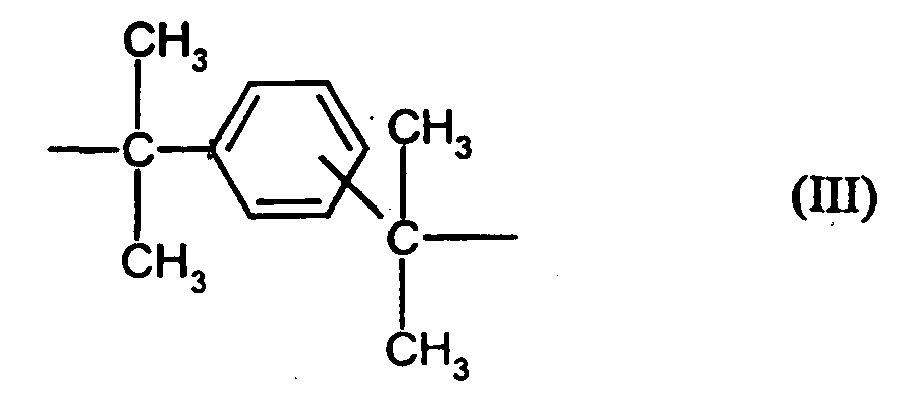
- B
- jeweils C1-C12-Alkyl, vorzugsweise Methyl, Halogen, vorzugsweise Chlor und/oder Brom
- x
- jeweils unabhängig voneinander 0, 1 oder 2,
- p
- 1 oder 0 sind, und
- R1 und R2
- für jedes X1 individuell wählbar, unabhängig voneinander Wasserstoff oder C1-C6-Alkyl, vorzugsweise Wasserstoff, Methyl oder Ethyl,
- X1
- Kohlenstoff und
- m
- eine ganze Zahl von 4 bis 7, bevorzugt 4 oder 5 bedeuten, mit der Maßgabe, dass an mindestens einen Atom X1, R1 und R2 gleichzeitig Alkyl sind.
- Beispiele für Bisphenole gemäß der allgemeinen Formel (I) sind Bisphenole, die zu den folgenden Gruppen gehören: Dihydroxydiphenyle, Bis-(hydroxyphenyl)-alkane, Bis-(hydroxyphenyl)-cycloalkane, Indanbisphenole, Bis-(hydroxyphenyl)-sulfide, Bis-(hydroxyphenyl)-ether, Bis-(hydroxyphenyl)-ketone, Bis-(hydroxyphenyl)-sulfone, Bis-(hydroxyphenyl)-sulfoxide und α,α'-Bis-(hydroxyphenyl)-diisopropylbenzole.
- Auch Derivate der genannten Bisphenole, die zum Beispiel durch Alkylierung oder Halogenierung an den aromatischen Ringen der genannten Bisphenole zugänglich sind, sind Beispiele für Bisphenole gemäß der allgemeinen Formel (I).
- Beispiele für Bisphenole gemäß der allgemeinen Formel (I) sind insbesondere die folgenden Verbindungen: Hydrochinon, Resorcin, 4,4'-Dihydroxydiphenyl, Bis-(4 hydroxyphenyl)sulfid, Bis-(4-hydroxyphenyl)sulfon, Bis-(3,5-dimethyl-4-hydroxyphenyl)-methan, Bis-(3,5-dimethyl-4-hydroxyphenyl)-sulfon, 1,1-Bis-(3,5-dimethyl-4-hydroxyphenyl)-p/m-diisopropylbenzol, 1,1-Bis-(4-hydroxyphenyl)-1-phenylethan, 1,1-Bis-(3,5-dimethyl-4-hydroxyphenyl)-cyclohexan, 1,1-Bis-(4-hydroxyphenyl)-3-methylcyclohexan, 1,1-Bis-(4-hydroxyphenyl)-3,3-dimethylcyclohexan, 1,1-Bis-(4-hydroxyphenyl)-4-methylcyclohexan. 1,1-Bis-(4-hydroxyphenyl)-cyclohexan, 1,1-Bis-(4-hydroxyphenyl)-3,3,5-trimethylcyclohexan, 2,2-Bis-(3,5-dichlor-4-hydroxyphenyl)-propan, 2,2-Bis-(3-methyl-4-hydroxyphenyl)-propan, 2,2-Bis-(3,5-dimethyl-4-hydroxyphenyl)-propan, 2,2-Bis-(4-hydroxyphenyl)-propan (d.h. Bisphenol A), 2,2-Bis-(3-chlor-4-hydroxyphenyl)-propan, 2,2-Bis-(3,5-dibrom-4-hydroxyphenyl)-propan, 2,4-Bis-(4-hydroxyphenyl)-2-methylbutan, 2,4-Bis-(3,5-dimethyl-4-hydroxyphenyl)-2-methylbutan, α,α'-Bis-(4-hydroxyphenyl)-o-diisopropylbenzol, α,α'-Bis-(4-hydroxyphenyl)-m-diisopropylbenzol (d. h. Bisphenol M), α,α'-Bis-(4-hydroxyphenyl)-p-diisopropylbenzol und Indanbisphenol.
- Besonders bevorzugte Polycarbonate sind das Homopolycarbonat auf Basis von Bisphenol A, das Homopolycarbonat auf Basis von 1,1-Bis-(4-hydroxyphenyl)-3,3,5-trimethylcyclohexan und die Copolycarbonate auf Basis der beiden Monomere Bisphenol A und 1,1-Bis-(4-hydroxyphenyl)-3,3,5-trimethylcyclohexan.
- Die beschriebenen Bisphenole gemäß der allgemeinen Formel (I) können nach bekannten Verfahren, z.B. aus den entsprechenden Phenolen und Ketonen, hergestellt werden.
- Die genannten Bisphenole und Verfahren zu ihrer Herstellung sind zum Beispiel beschrieben in der Monographie H. Schnell, "Chemistry and Physics of Polycarbonates", Polymer Reviews, Band 9, S. 77-98, Interscience Publishers, New York, London, Sidney, 1964 und in US-A 3 028 635, in US-A 3 062 781, in US-A 2 999 835, in US-A 3 148 172, in US-A 2 991 273, in US-A 3 271 367, in US-A 4 982 014, in US-A 2 999 846, in DE-A 1 570 703, in DE-A 2 063 050, in DE-A 2 036 052, in DE-A 2 211 956, in DE-A 3 832 396, und in FR-A 1 561 518 sowie in den Japanischen Offenlegungsschriften mit den Anmeldenummern 62039/1986, 62040/1986 und 105550/1986.
- 1,1-Bis-(4-hydroxyphenyl)-3,3,5-trimethylcyclohexan und seine Herstellung ist z.B. beschrieben in US-A 4 982 014.
- Indanbisphenole und ihre Herstellung sind zum Beispiel beschrieben in US-A 3 288 864, in JP-A 60 035 150 und in US-A 4 334 106. Indanbisphenole können zum Beispiel aus Isopropenylphenol oder dessen Derivaten oder aus Dimeren des Isopropenylphenols oder dessen Derivaten in Gegenwart eines Friedel-Craft-Katalysators in organischen Lösungsmitteln hergestellt werden.
- Polycarbonate können nach bekannten Verfahren hergestellt werden. Geeignete Verfahren zur Herstellung von Polycarbonaten sind zum Beispiel die Herstellung aus Bisphenolen mit Phosgen nach dem Phasengrenzflächenverfahren oder aus Bisphenolen mit Phosgen nach dem Verfahren in homogener Phase, dem sogenannten Pyridinverfahren, oder aus Bisphenolen mit Kohlensäureestern nach dem Schmelzeumesterungsverfahren. Diese Herstellverfahren sind z.B. beschrieben in H. Schnell, "Chemistry and Physis of Polycarbonates", Polymer Reviews, Band 9, S. 31-76, Interscience Publishers, New York, London, Sidney, 1964. Die genannten Herstellverfahren sind auch beschrieben in D. Freitag, U. Grigo, P. R. Müller, H. Nouvertne, "Polycarbonates" in Encyclopedia of Polymer Science and Engineering, Volume 11, Second Edition, 1988, Seiten 648 bis 718 und in U. Grigo, K. Kircher und P.R. Müller "Polycarbonate" in Becker, Braun, Kunststoff-Handbuch, Band 3/1, Polycarbonate, Polyacetale, Polyester, Celluloseester, Carl Hanser Verlag München, Wien 1992, Seiten 117 bis 299 und in D.C. Prevorsek, B.T. Debona und Y. Kesten, Corporate Research Center, Allied Chemical Corporation, Morristown, New Jersey 07960, "Synthesis of Poly(estercarbonate) Copolymers" in Journal of Polymer Science, Polymer Chemistry Edition, Vol. 19, 75-90 (1980).
- Das Schmelzeumesterungsverfahren ist insbesondere beschrieben in H. Schnell, "Chemistry and Physics of Polycarbonates", Polymer Reviews, Band 9, S. 44 bis 51, Interscience Publishers, New York, London, Sidney, 1964 sowie in DE-A 1 031 512, in US-A 3 022 272, in US-A 5 340 905 und in US-A 5 399 659.
- Bei der Herstellung von Polycarbonat werden bevorzugt Rohstoffe und Hilfsstoffe mit einem geringen Grad an Verunreinigungen eingesetzt. Insbesondere bei der Herstellung nach dem Schmelzeumesterungsverfahren sollen die eingesetzten Bisphenole und die eingesetzten Kohlensäurederivate möglichst frei von Alkaliionen und Erdalkaliionen sein. Derart reine Rohstoffe sind zum Beispiel erhältlich, indem man die Kohlensäurederivate, zum Beispiel Kohlensäureester, und die Bisphenole umkristallisiert, wäscht oder destilliert.
- Die erfindungsgemäß geeigneten Polycarbonate haben bevorzugt ein Gewichtsmittel der molaren Masse (M̅W), welches sich z.B. durch Ultrazentrifugation oder Streulichtmessung bestimmen lässt, von 10 000 bis 200 000 g/mol. Besonders bevorzugt haben sie ein Gewichtsmittel der molaren Masse von 12 000 bis 80 000 g/mol, insbesondere bevorzugt 20 000 bis 35 000 g/mol.
- Die mittlere molare Masse der erfindungsgemäßen Polycarbonate kann zum Beispiel in bekannter Weise durch eine entsprechende Menge an Kettenabbrechern eingestellt werden. Die Kettenabbrecher können einzeln oder als Mischung verschiedener Kettenabbrecher ,eingesetzt werden.
- Geeignete Kettenabbrecher sind sowohl Monophenole als auch Monocarbonsäuren. Geeignete Monophenole sind z.B. Phenol, p-Chlorphenol, p-tert.-Butylphenol, Cumylphenol oder 2,4,6-Tribromphenol, sowie langkettige Alkylphenole, wie z.B. 4-(1,1,3,3-Tetramethylbutyl)-phenol oder Monoalkylphenole bzw. Dialkylphenole mit insgesamt 8 bis 20 C-Atomen in den Alkylsubstituenten wie z.B. 3,5-di-tert.-Butylphenol, p-tert.-Octylphenol, p-Dodecylphenol, 2-(3,5-Dimethyl-heptyl)-phenol oder 4-(3,5-Dimethyl-heptyl)-phenol. Geeignete Monocarbonsäuren sind Benzoesäure, Alkylbenzoesäuren und Halogenbenzoesäuren.
- Bevorzugte Kettenabbrecher sind Phenol, p-tert.-Butylphenol, 4-(1,1,3,3-Tetramethylbutyl)-phenol und Cumylphenol.
- Die Menge an Kettenabbrechern beträgt bevorzugt zwischen 0,25 und 10 Mol-%, bezogen auf die Summe der jeweils eingesetzten Bisphenole.
- Die erfindungsgemäß geeigneten Polycarbonate können in bekannter Weise verzweigt sein, und zwar vorzugsweise durch den Einbau von trifunktionellen oder mehr als trifunktionellen Verzweigern. Geeignete Verzweiger sind z.B. solche mit drei oder mehr als drei phenolischen Gruppen oder solche mit drei oder mehr als drei Carbonsäuregruppen.
- Geeignete Verzweiger sind beispielsweise Phloroglucin, 4,6-Dimethyl-2,4,6-tri-(4-hydroxyphenyl)-hepten-2, 4,6-Dimethyl-2,4,6-tri-(4-hydroxyphenyl)-heptan, 1,3,5-Tri-(4-hydroxyphenyl)-benzol, 1,1,1-Tris-(4-hydroxyphenyl)-ethan, Tri-(4-hydroxyphenyl)-phenylmethan, 2,2-Bis-[4,4-bis-(4-hydroxyphenyl)-cyclohexyl]-propan, 2,4-Bis-(4-hydroxyphenyl-isopropyl)-phenol, 2,6-Bis-(2-hydroxy-5'-methyl-benzyl)-4-methylphenol, 2-(4-Hydroxyphenyl)-2-(2,4-dihydroxyphenyl)-propan, Hexa-(4-(4-hydroxyphenyl-isopropyl)-phenyl)-terephthalsäureester, Tetra-(4-hydroxyphenyl)-methan, Tetra-(4-(4-hydroxyphenyl-isopropyl)-phenoxy)-methan und 1,4-Bis-(4',4"-dihydroxytriphenyl)-methylbenzol sowie 2,4-Dihydroxybenzoesäure, Trimesinsäure, Cyanurchlorid, 3,3-Bis-(3-methyl-4-hydroxyphenyl)-2-oxo-2,3-dihydroindol, Trimesinsäuretrichlorid und α,α',α''-Tris-(4-hydroxyphenol)-1,3,5-triisopropylbenzol.
- Bevorzugte Verzweiger sind 1,1,1-Tris-(4-hydroxyphenyl)-ethan und 3,3-Bis-(3-methyl-4-hydroxyphenyl)-2-oxo-2,3-dihydroindol.
- Die Menge der gegebenenfalls einzusetzenden Verzweiger beträgt bevorzugt 0,05 Mol-% bis 2 Mol-%, bezogen auf Mole an eingesetzten Bisphenolen.
- Die Verzweiger können zum Beispiel im Falle der Herstellung des Polycarbonates nach dem Phasengrenzflächenverfahren mit den Bisphenolen und den Kettenabbrechern in der wässrig alkalischen Phase vorgelegt werden, oder in einem organischen Lösungsmittel gelöst zusammen mit den Kohlensäurederivaten zugegeben werden. Im Falle des Umesterungsverfahrens werden die Verzweiger bevorzugt zusammen mit den Dihydroxyaromaten oder Bisphenolen dosiert.
- Bevorzugt einzusetzende Katalysatoren bei der Herstellung von Polycarbonat nach dem Schmelzeumesterungsverfahren sind die literaturbekannten Ammoniumsalze und Phosphoniumsalze (siehe beispielsweise US-A 3 442 864, JP-A-14742/72, US-A 5 399 659 und DE-A 19 539 290).
- Copolycarbonate können auch verwendet werden. Copolycarbonate im Sinne der Erfindung sind insbesondere Polydiorganosiloxan-Polycarbonat-Blockcopolymere, deren Gewichtsmittel der molaren Masse (M̅W) bevorzugt 10 000 bis 200 000 g/mol, besonders bevorzugt 20 000 bis 80 000 g/mol beträgt (ermittelt durch Gelchromatographie nach vorheriger Eichung durch Lichtstreuungsmessung oder Ultrazentrifugation). Der Gehalt an aromatischen Carbonatstruktureinheiten in den Polydiorganosiloxan-Polycarbonat-Blockcopolymeren beträgt vorzugsweise 75 bis 97,5 Gew.-%, besonders bevorzugt 85 bis 97 Gew.-%. Der Gehalt an Polydiorganosiloxanstruktureinheiten in den Polydiorganosiloxan-Polycarbonat-Blockcopolymeren beträgt vorzugsweise 25 bis 2,5 Gew.-%, besonders bevorzugt 15 bis 3 Gew.-%. Die Polydiorganosiloxan-Polycarbonat-Blockcopolymeren können zum Beispiel ausgehend von α,ω-Bishydroxyaryloxyendgruppen-haltigen Polydiorganosiloxanen mit einem mittleren Polymerisationsgrad von bevorzugt Pn = 5 bis 100, besonders bevorzugt Pn = 20 bis 80, hergestellt werden.
- Die Polydiorganosiloxan-Polycarbonat-Blockpolymere können auch eine Mischung aus Polydiorganosiloxan-Polycarbonat-Blockcopolymeren mit üblichen polysiloxanfreien, thermoplastischen Polycarbonaten sein, wobei der Gesamtgehalt an Polydiorganosiloxanstruktureinheiten in dieser Mischung bevorzugt 2,5 bis 25 Gew.-% beträgt.
- Solche Polydiorganosiloxan-Polycarbonat-Blockcopolymere sind dadurch gekennzeichnet, dass sie in der Polymerkette einerseits aromatische Carbonatstruktur-Einheiten (1) und andererseits Aryloxyendgruppen-haltige Polydiorganosiloxane (2) enthalten,


- Ar
- gleiche oder verschiedene difunktionelle aromatische Reste sind und
- R und R1
- gleich oder verschieden sind und lineares Alkyl, verzweigtes Alkyl, Alkenyl, halogeniertes lineares Alkyl, halogeniertes verzweigtes Alkyl, Aryl oder halogeniertes Aryl, vorzugsweise Methyl, bedeuten und
- n
- den mittleren Polymerisationsgrad von bevorzugt 5 bis 100, besonders bevorzugt 20 bis 80, bedeutet.
- Alkyl ist in vorstehender Formel (2) vorzugsweise C1-C20-Alkyl, Alkenyl ist in vorstehender Formel (2) vorzugsweise C2-C6-Alkenyl; Aryl ist in vorstehender Formel (2) vorzugsweise C6-C14-Aryl. Halogeniert bedeutet in vorstehender Formel teilweise oder vollständig chloriert, bromiert oder fluoriert.
- Beispiele für Alkyle, Alkenyle, Aryle, halognierte Alkyle und halogenierte Aryle sind Methyl, Ethyl, Propyl, n-Butyl, tert.-Butyl, Vinyl, Phenyl, Naphthyl, Chlormethyl, Perfluorbutyl, Perfluoroctyl und Chlorphenyl.
- Derartige Polydiorganosiloxan-Polycarbonat-Blockcopolymere und ihre Herstellung werden zum Beispiel in US-A 3 189 662, US-A 3 821 325 und US-A 3 832 419 beschrieben.
- Bevorzugte Polydiorganosiloxan-Polycarbonat-Blockcopolymere können z.B. hergestellt werden, indem man α,ω-Bishydroxyaryloxyendgruppen-haltige Polydiorganosiloxane zusammen mit anderen Bisphenolen, gegebenenfalls unter Mitverwendung von Verzweigern in den üblichen Mengen, z.B. nach dem Zweiphasengrenzflächenverfahren umsetzt (wie zum Beispiel beschrieben in H. Schnell, "Chemistry and Physis of Polycarbonates", Polymer Reviews, Band 9, S. 31-76, Interscience Publishers, New York, London, Sidney, 1964). Die als Edukte für diese Synthese verwendeten α,ω-Bishydroxyaryloxyendgruppen-haltige Polydiorganosiloxane und ihre Herstellung sind zum Beispiel in US-A 3 419 634 beschrieben.
- Den Polycarbonaten könne übliche Additive wie z.B. Entformungsmittel in der Schmelze zugemischt oder auf der Oberfläche aufgebracht werden. Bevorzugt enthalten die verwendeten Polycarbonate bereits Entformungsmittel vor Compoundierung mit den anderen Komponenten der erfindungsgemäßen Formmassen.
- Als Komponente C) enthalten die Zusammensetzungen erfindungsgemäß ein oder eine Mischung aus zwei oder mehr unterschiedlichen Pfropfpolymerisaten mit einer Pfropfgrundlage auf Basis von Acrylaten mit einer Glasübergangstemperatur von unter -5°C (solche Pfropfpolymerisate werden im allgemeinen als Acrylatkautschuke bezeichnet und sind dem Fachmann bekannt) oder ein oder eine Mischung aus zwei oder mehr unterschiedlichen elastischen Blockpolymeren, insbesondere Zwei- oder Dreiblockcopolymere auf Basis von Vinylaromaten und Dienen, oder Mischungen aus Pfropfpolymerisaten und elastischen Blockpolymeren.
- Die erfindungsgemäße Komponente C) umfasst Pfropfcopolymerisate mit kautschukelastischen Eigenschaften, die im wesentlichen aus mindestens 2 der folgenden Monomeren erhältlich sind: (Meth)-Acrylsäureester mit 1 bis 18 C-Atomen in der Alkoholkomponente, Chloropren, Butadien-1,3, Isopropen, Styrol, Acrylnitril, Ethylen, Propylen und Vinylacetat, wobei die Pfropfbasis mindestens einen (Meth)Acrylsäureester enthält, also Polymerisate, wie sie z.B. in Methoden der Organischen Chemie" (Houben-Weyl), Bd. 14/1, Georg Thieme-Verlag, Stuttgart 1961, S. 393-406 und in C.B. Bucknall, "Thoughened Plastics", Appl. Science Publishers, London 1977, beschrieben sind.
- Bevorzugte Polymerisate C) sind partiell vernetzt und besitzen Gelgehalte von über 5 Gew.-%, bevorzugt 20 Gew.-%, vorzugsweise über 40 Gew.-%, insbesondere über 60 Gew.-%.
- Bevorzugte Polymerisate C) sind Pfropfpolymerisate enthaltend
- C.1) 95 bis 5, vorzugsweise 10 bis 80 Gew.-%, bezogen auf Komponente C, Pfropfauflage basierend auf mindestens einem polymerisierbaren, ethylenisch ungesättigten Monomeren als Pfropfmonomere und
- C.2) 5 bis 95, vorzugsweise 20 bis 90 Gew.-%, bezogen auf Komponente C, Acrylatkautschuk mit einer Glasübergangstemperatur <-10°C, vorzugsweise <-20°C als Pfropfgrundlage.
- Die Acrylatkautschuke gemäß C.2 sind vorzugsweise Polymerisate aus Acrylsäurealkylestern oder Meth-Acrylsäurealkylestern, gegebenenfalls mit bis zu 40 Gew.-%, bezogen auf C.2, anderen polymerisierbaren, ethylenisch ungesättigten Monomeren. Zu den bevorzugten Acrylsäureestern oder Meth-Acrylsäureestem gehören C1-C8-Alkylester, insbesondere Methyl-, Ethyl-, Butyl-, n-Octyl- und 2-Ethylhexylester; sowie Halogenalkylester, vorzugsweise Halogen-C1-C8-alkylester, wie Chlorethylacrylat, sowie Mischungen dieser Monomeren.
- Acrylsäurealkylester und Methacrylsäureester sind vorzugsweise Ester der Acrylsäure oder Methacrylsäure mit einwertigen Alkoholen mit 1 bis 18 C-Atomen. Besonders bevorzugt sind Methacrylsäuremethylester, -ethylester und -propylester, n-Butylacrylat, t-Butylacrylat und t-Butylmethacrylat.
- Pfropfmonomere der Pfropfauflage C.1. sind vorzugsweise ausgewählt aus mindestens einem Monomer, vorzugsweise 2 oder 3 Monomeren der Gruppe bestehend aus Styrol, α-Methylstyrol, halogen- oder methylkernsubstituierten Styrolen, (Meth)-Acrylsäure-C1-C8-alkylester, Acrylnitril, Methacrylnitril, Maleinsäureanhydrid, C1-C4-Alkyl- bzw. phenyl-N-substituierten Maleinimiden oder Mischungen hieraus.
- Besonders bevorzugte Pfropfpolymerisate C) umfassen Pfropfpolymerisate aus:
- C.1) 5 bis 95, vorzugsweise10 bis 80, insbesondere 30 bis 80 Gew.-Teile, einer Mischung aus
- C.1.1 50 bis 99, vorzugsweise 65 bis 90 Gew.-% Methylmethacrylat, Styrol, α-Methylstyrol, halogen- oder methylkernsubstituierten Styrolen oder Mischungen dieser Verbindungen und
- C.1.2 1 bis 50, vorzugsweise 35 bis 10 Gew.-% Methylmethacrylat, Acrylnitril, Methacrylnitril, Maleinsäureanhydrid, C1-C4-alkyl- bzw. -phenyl-N-substituierten Maleinimiden oder Mischungen dieser Verbindungen auf
- C.2) 5 bis 95, vorzugsweise 20 bis 90, insbesondere 20 bis 70 Gew.-Teilen Polymerisat auf Alkylacrylat-Basis mit einer Glasübergangstemperatur unter -10°C, vorzugsweise kleiner -20°C,
- Insbesonders sind Pfropfpolymerisate C) bevorzugt, die erhältlich sind durch Pfropfreaktion von
- α
- 10 bis 70, vorzugsweise 15 bis 50, insbesondere 20 bis 40 Gew.-%, bezogen auf Pfropfpolymisat C, mindestens eines (Meth)-Acrylsäureesters oder 10 bis 70, vorzugsweise 15 bis 50, insbesondere 20 bis 40 Gew.-% eines Gemisches aus 10 bis 50, vorzugsweise 20 bis 35 Gew.-%, bezogen auf Gemisch, Acrylnitril oder (Meth)-Acrylsäureester und 50 bis 90, vorzugsweise 65 bis 80 Gew.-%, bezogen auf Gemisch, Styrol, als Pfropfauflage C.1 auf
- β
- 30 bis 90, vorzugsweise 50 bis 85, insbesondere 60 bis 80 Gew.-%, bezogen auf Pfropfpolymerisat C), eine Pfropfgrundlage C.2), die 70 bis 100 Gew.-% mindestens eines Alkylacrylates mit 1 bis 8 C-Atomen im Alkyrest, vorzugsweise n-Butylacrylat und/oder Methyl-n-Butylacrylat und/oder 2-Ethylhexylacrylat, insbesondere n-Butylacrylat als alleiniges Alkylacrylat, 0 bis 30, vorzugsweise 0 bis 15 Gew.-% eines weiteren copolymerisierbaren monoethylenisch ungesättigten Monomeren, wie Butadien, Isopren. Styrol, Acrylnitril, Methylmethacrylat oder Vinylmethylether oder deren Mischungen, 0 bis 5 Gew.-% eines copolymerisierbaren, polyfunktionellen, vorzugsweise bi- und trifunktionellen, die Vernetzung bewirkenden Monomeren, wobei sich die Gewichtsangaben auf das Gesamtgewicht der Pfropfgrundlage beziehen.
- Bevorzugte Pfropfpolymerisate C) sind z.B. mit (Meth)-Acrylsäurealkylestern und/oder Styrol und/oder Acrylnitril gepfropfte Grundlagen C.2). Acrylatkautschuke auf n-Butylacrylatbasis sind als Pfropfbasis C.2) besonders bevorzugt.
- Besonders bevorzugte Pfropfpolymerisate C) sind insbesondere solche, die weniger als 5 Gew.-% Polystyroleinheiten, bevorzugt weniger als 1 Gew.-% Polystyroleinheiten bezogen auf das Gesamtgewicht des Pfropfes, insbesondere bevorzugt keine Polystyroleinheiten enthalten.
- Die Komponente C) kann auch eine Mischung verschiedener Pfropfcopolymerisate sein.
- Der Gelanteil der Pfropfgrundlage β beträgt im allgemeinen mindestens 20 Gew.-%, vorzugsweise 40 Gew.-% (in Toluol gemessen) und der Pfropfgrad G im allgemeinen 0,15 bis 0,55.
- Der mittlere Teilchendurchmesser des Pfropfpolymerisats C) beträgt bevorzugt 0,01 bis 2 µm, besonders bevorzugt 0,1 bis 0,6, insbesondere 0,2 bis 0,4 µm.
- Der mittlere Teilchendurchmesser wird beispielsweise an elektronenmikroskopischen Aufnahmen (TEM) von Ultra-Dünnschnitten der erfindungsgemäßen Formmassen, mit OsO4 und RuO4 behandelt, durch Ausmessen einer repräsentativen Menge (ca. 50) von Partikeln bestimmt.
- Die mittlere Teilchengröße d50 bestimmt mittels Ultrazentrifugation (W. Scholtan, H. Lange, Kolloid, Z. und Z. Polymere 250 (1972), 782-796) ist der Durchmesser oberhalb und unterhalb dessen jeweils 50 Gew.-% der Teilchen liegen. Die mittlere Teilchengröße d50 der Pfropfpolymerisate C) beträgt bevorzugt 0,1 bis 0,6 µm.
- Der Gelgehalt der Pfropfgrundlage C.2 wird bei 25°C in Dimethylformamid bestimmt (M. Hoffinann, H. Krömer, R. Kuhn, Polymeranalytik I und II, Georg Thieme-Verlag, Stuttgart 1977).
- Der Pfropfgrad G bezeichnet das Gewichtsverhältnis von aufgepfropften Pfropfmonomeren zur Pfropfgrundlage und ist dimensionslos.
- Zur Vernetzung können Monomere mit mehr als einer polymerisierbaren Doppelbindung copolymerisiert werden. Bevorzugte Beispiele für vernetzende Monomere sind Ester ungesättigter Monocarbonsäuren mit 3 bis 8 C-Atomen und ungesättigter einwertiger Alkohole mit 3 bis 12 C-Atomen oder gesättigter Polyole mit 2 bis 4 OH-Gruppen und 2 bis 20 C-Atomen, wie z.B. Ethylenglykoldimethacrylat, Allylmethacrylat; mehrfach ungesättigte heterocyclische Verbindungen, wie z.B. Trivinyl- und Triallylcyanurat; polyfunktionelle Vinylverbindungen, wie Di- und Trivinylbenzole; aber auch Triallylphosphat und Diallylphthalat. Bevorzugt vernetzende Monomere sind Allylmethacrylat, Ethylenglykoldimethylacrylat, Diallylphthalat und heterocyclische Verbindungen, die mindestens 3 ethylenisch ungesättigte Gruppen aufweisen. Besonders bevorzugte vernetzende Monomere sind die cyclischen Monomere Triallylcyanurat, Triallylisocyanurat, Trivinylcyanurat, Triacryloylhexahydro-s-triazin, Triallylbenzole, Acrylsäureester des Tricyclodecenylalkohols.
- Die Menge der vemetzenden Monomere beträgt vorzugsweise 0,02 bis 5, insbesondere 0,05 bis 2 Gew.-%, bezogen auf die Pfropfgrundlage C.2.
- Bei cyclischen vernetzenden Monomeren mit mindestens 3 ethylenisch ungesättigten Gruppen ist es vorteilhaft, die Menge auf unter 1 Gew.-% der Pfropfgrundlage C.2 zu beschränken.
- Die Pfropfpolymerisate C) können nach bekannten Verfahren wie Masse-, Suspensions-, Emulsions- oder Masse-Suspensionsverfahren hergestellt werden.
- Da bei der Pfropfreaktion die Pfropfmonomeren bekanntlich nicht unbedingt vollständig auf die Pfropfgrundlage aufgepfropft werden, werden erfindungsgemäß unter Pfropfpolymerisaten C) auch solche Produkte verstanden, die durch Polymerisation der Pfropfmonomere in Gegenwart der Pfropfgrundlage gewonnen werden.
- Die Pfropfpolymerisate C) werden bevorzugt in kompaktierter Form eingesetzt.
- Die erfindungsgemäße Komponente C umfasst weiterhin Blockpolymere mit kautschukelastischen Eigenschaften, insbesondere zum Beispiel Zwei- (A-B) und Dreiblockcopolymere (A-B-A). Blockcopolymere des Typs A-B und A-B-A können typisches Verhalten thermoplastischer Elastomere zeigen. Die bevorzugten Blockcopolymere des Typs A-B und A-B-A enthalten ein oder zwei vinylaromatische Blöcke (vorzugsweise basierend auf Styrol) und einen Kautschuk-Block (vorzugsweise ein Dien-Kautschuk-Block, insbesondere Polybutadien-Block oder Isopren-Block) die gegebenenfalls teilweise oder vollständig hydriert sein können.
- Geeignete Blockcopolymere des Typs A-B und A-B-A sind z.B. beschrieben in US-A 3 078 254, 3 402 159, 3 297 793, 3 265 765 und 3 594 452 und in GB-A 1 264 741. Beispiele typischer Blockcoplymere des Typs A-B und A-B-A sind: Polystyrol-Polybutadien (SBR), Polystyrol-Poly(ethylen-propylen), Polystyrol-Polyisopren, Poly(α-Methylstyrol)-Polybutadien, Polystyrol-Polybutadien-Polystyrol (SBR), Polystyrol-Poly(ethylen-propylen)-Polystyrol, Polystyrol-Polyisopren-Polystyrol und Poly(α-Methylstyrol)-Polybutadien-Poly(α-Methylstyrol), sowie hydrierte Versionen davon wie zum Beispiel und bevorzugt hydriertes Polystyrol-Polybutadien-Polystyrol (SEBS) und hydriertes Polystyrol-Polyisopren (SEP). Die Verwendung entsprechender hydrierter Blockcopolymerisate gegebenenfalls im Gemisch mit der nicht hydrierten Vorstufe als Schlagzähmodifier ist beispielweise beschrieben in DE-A2750515, DE-A 2434848, DE-A 038551, EP-A 0 080 666 und WO 83/01254. Auf die Offenbarung der genannten Druckschriften wird hiermit ausdrücklich Bezug genommen.
- Mischungen der erwähnten Blockpolymere können ebenfalls eingesetzt werden.
- Besonders bevorzugt sind teilweise oder vollständig hydrierte Blockcopolymere, insbesondere bevorzugt sind hydriertes Polystyrol-Polybutadien-Polystyrol (SEBS) und hydriertes Polystyrol-Polyisopren (SEP).
- Solche Blockpolymere des Typs A-B und A-B-A sind kommerziell aus einer Reihe von Quellen erhältlich, wie z.B. von Phillips Petroleum unter dem Handelsnamen SOLPRENE, von Shell Chemical Co. unter dem Handelsnamen KRATON, von Dexco unter dem Handelsnamen VECTOR und von Kuraray unter dem Handelsnamen SEPTON.
- Als Komponente D enthalten die thermoplastischen Formmassen erfindungsgemäß ein oder eine Mischung aus zwei oder mehr unterschiedlichen mineralischen Füllstoffen auf Basis von Talk mit einer oberen Korngröße d97 kleiner 50 µm. Im Falle dass Komponente C ein Blockcopolymer ist, enthalten die Blends den mineralischen Füllstoff insbesondere in einer Menge von 1,5 bis 34, ganz besonders bevorzugt in einer Menge von 1,5 bis 25 Gew.-Teilen.
- Als mineralische Füllstoffe auf Basis von Talk im Sinne der Erfindung kommen alle teilchenförmigen Füllstoffe infrage, die der Fachmann mit Talk bzw. Talkum verbindet. Ebenfalls kommen alle teilchenförmigen Füllstoffe, die kommerziell angeboten werden und deren Produktbeschreibungen als charakterisierende Merkmale die Begriffe Talk bzw. Talkum enthalten, infrage.
- Bevorzugt sind mineralische Füllstoffe, die einen Gehalt an Talk nach DIN 55920 von größer 50 Gew.-%, bevorzugt größer 80 Gew.-%, besonders bevorzugt größer 95 Gew.-% und insbesondere bevorzugt größer 98 Gew.-% bezogen auf die Gesamtmasse an Füllstoff aufweisen.
- Die mineralischen Füllstoffe können auch oberflächenbehandelt sein. Sie können mit einem geeigneten Schlichtesystem, das zum Beispiel einem Haftvermittler bzw. Haftvermittlersystem z.B. auf Silanbasis enthält, ausgerüstet sein.
- Die teilchenförmigen Füllstoffe haben bevorzugt eine obere Teilchen- bzw. Korngröße d97 kleiner 25, besonders bevorzugt kleiner 10 und insbesondere bevorzugt kleiner 6 µm. Als mittlere Korngröße d50 wird bevorzugt ein Wert kleiner 10, bevorzugt kleiner 6, besonders bevorzugt kleiner 2 und insbesondere bevorzugt kleiner 1 µm gewählt. Die d97- und d50-Werte von den Füllstoffen D werden nach Sedimentationsanalyse SEDIGRAPH D 5 000 bzw. nach Siebanalyse DIN 66 165 bestimmt.
- Das mittlere Aspektverhältnis (Durchmesser zu Dicke) der teilchenförmigen Füllstoffe liegt bevorzugt im Bereich 1 bis 100, besonders bevorzugt 2 bis 25 und insbesondere bevorzugt 5 bis 25, bestimmt an elektronenmikroskopischen Aufnahmen von Ultradünnschnitten der fertigen Produkte und Ausmessen einer repräsentativen Menge (ca. 50) von Füllstoffpartikeln.
- Die Füllstoffe können bedingt durch die Verarbeitung zur Formmasse bzw. Formkörper in der Formmasse bzw. im Formkörper einen kleineren d97- bzw. d50-Wert aufweisen als die ursprünglich eingesetzten Füllstoffe.
- Die Teilchendurchmesser am fertigen Produkt können dabei zum Beispiel dadurch bestimmt werden, dass elektronenmikroskopische Aufnahmen von Dünnschnitten der Polymermischung aufgenommen und mindestens 25, bevorzugt mindestens 50 Füllstoffteilchen für die Auswertung herangezogen werden.
- Die erfindungsgemäßen Zusammensetzungen können weiterhin übliche Zusatzstoffe enthalten, die im allgemeinen bis 15, vorzugsweise in einer Menge von 0,01 bis 10, besonders bevorzugt 0,05 bis 5, insbesondere bevorzugt 0,1 bis 3 Gew.-%, bezogen auf das Gesamtgewicht der Formmassen, zugesetzt werden können.
- Alle üblichen Additive wie z.B. Stabilisatoren (zum Beispiel UV-Stabilisatoren, Thermostabilisatoren), Antistatika, Fließhilfsmittel, Entformungsmittel, Brandschutzadditive, Emulgatoren, Nukleierungsmittel, Weichmacher, Gleitmittel, pH-Wert erniedrigende Additive (z.B. Carboxylgruppen enthaltende Verbindungen), Additive zur Erhöhung der Leitfähigkeit, Farbstoffe und Pigmente kommen infrage. Die genannten und weitere geeignete Additive sind zum Beispiel beschrieben in Gächter, Müller, Kunststoff-Additive, 3. Ausgabe, Hanser-Verlag, München, Wien, 1989. Die Additive können alleine oder in Mischung bzw. in Form von Masterbatchen eingesetzt werden. Die Additive können zugemischt und/oder auf die Oberfläche aufgebracht werden.
- Als Stabilisatoren können zum Beispiel sterisch gehinderte Phenole und/oder Phosphite, Hydrochinone, aromatische sekundäre Amine wie Diphenylamine, substituierte Resorcine, Salicylate, Benzotriazole und Benzophenone, sowie verschieden substituierte Vertreter dieser Gruppen und deren Mischungen eingesetzt werden.
- Als Pigmente können z.B. Titandioxid, Ultramarinblau, Eisenoxid, Russ, Phthalocyanine, Chinacridone, Perylene, Nigrosin und Anthrachinone eingesetzt werden.
- Als Nukleierungsmittel können z.B. Natriumphenylphosphinat, Aluminiumoxid, Siliziumdioxid sowie bevorzugt Talkum und die weiter vorne beschriebenen Nukleierungsmittel eingesetzt werden.
- Als Gleit- und Entformungsmittel können Esterwachse, Penteritrytstearat (PETS), langkettige Fettsäuren (z.B. Stearinsäure oder Behensäure), deren Salze (z.B. Ca- oder Zn-Stearat) sowie Amidderivate (z.B. Ethylen-bis-stearylamid) oder Montanwachse (Mischungen aus geradkettigen, gesättigten Carbonsäuren mit Kettenlängen von 28 bis 32 C-Atomen) sowie niedermolekulare Polyethylen- bzw. Polypropylenwachse eingesetzt werden.
- Als Weichmacher können zum Beispiel Phthalsäuredioctylester, Phthalsäuredibenzylester, Phthalsäurebutylbenzylester, Kohlenwasserstofföle, N-(n-Butyl)benzolsulfonamid eingesetzt werden.
- Um leitfähige Formmassen zu erhalten, können Russe, Leitfähigkeitsrusse, Carbonfibrillen, nanoskalige Graphitfasern (Nanotubes), Graphit, leitfähige Polymere, Metallfasern sowie andere übliche Additive zur Erhöhung der Leitfähigkeit zugesetzt werden.
- Als Flammschutzmittel können handelsübliche organische Halogenverbindungen mit Synergisten oder handelsübliche organische Stickstoffverbindungen oder organisch/anorganische Phosphorverbindungen einzeln oder im Gemisch eingesetzt werden. Auch mineralische Flammschutzadditive wie Magnesiumhydroxid oder Ca-Mg-Carbonat-Hydrate (z.B. DE-OS 4 236 122) können eingesetzt werden. Als halogenhaltige, insbesondere bromierte und chlorierte Verbindungen seien beispielhaft genannt: Ethylen-1,2-bistetrabromphthalimid, epoxidiertes Tetrabrombisphenol A-Harz, Tetrabrombisphenol-A-oligocarbonat, Tetrachlorbisphenol-A-oligocarbonat, Pentabrompolyacrylat, bromiertes Polystyrol. Als organische Phosphorverbindungen sind die Phosphorverbindungen gemäß WO98/17720 (PCT/EP/05705) geeignet, z.B. Triphenylphosphat (TPP), Resorcinol-bis-(diphenylphosphat) einschließlich Oligomere sowie Bisphenol-A-bis-diphenylphosphat einschließlich Oligomere (vgl. z.B. EP-A 363 608 und EP-A 640 655), Melaminphosphat, Melaminpyrophosphat, Melaminpolyphosphat und deren Mischungen. Als Stickstoffverbindungen kommen insbesondere Melamin und Melamincyanurat infrage. Als Synergisten sind z.B. Antimonverbindungen, insbesondere Antimontrioxid und Antimonpentoxid, Zinkverbindungen, Zinnverbindungen wie z.B. Zinnstannat und Borate geeignet. Kohlenstoffbildner und und Tetrafluorethylenpolymerisate können zugesetzt werden. Die Flammschutzmittel, gegebenenfalls mit einem Synergisten, wie Antimonverbindungen, und Antidripping-Mittel werden im allgemeinen bis zu einer Menge von 30, vorzugsweise 20 Gew.-% (bezogen auf die Gesamtzusammensetzung) eingesetzt.
- Als Zusatzstoffe können auch Verstärkungsstoffe z.B. in Form von Glasfasern zugesetzt werden.
- Gegenstand der Erfindung sind weiterhin ein Verfahren zur Herstellung der Zusammensetzungen, die Verwendung der erfindungsgemäßen Zusammensetzung zur Herstellung von Halbzeugen und Formteilen sowie daraus hergestellte Halbzeuge und Formteile.
- Die Herstellung der erfindungsgemäßen Zusammensetzungen erfolgt nach an sich bekannten Verfahren durch Mischen der Komponenten. Es kann vorteilhaft sein, einzelne Komponenten vorzumischen. Vorzugsweise geschieht das Mischen der Komponenten A bis D sowie weiterer Bestandteile bei Temperaturen von 220 bis 330°C durch gemeinsames Kneten, Extrudieren oder Verwalzen der Komponenten.
- Die erfindungsgemäßen Zusammensetzungen können nach üblichen Verfahren zu Halbzeugen oder Formteilen aller Art verarbeitet werden. Als Beispiele für Verarbeitungsverfahren seien Extrusionsverfahren und Spritzgussverfahren genannt. Als Beispiele für Halbzeuge seien genannt Folien und Platten.
- Die Formteile können klein- oder großteilig sein und für Außen- oder Innenanwendungen eingesetzt werden. Bevorzugt werden großteilige Formteile für den Fahrzeugbau, insbesondere den Automobilsektor hergestellt. Insbesondere können aus den erfindungsgemäßen Formmassen Karosserieaußenteile wie z.B. Kotflügel, Heckklappen, Motorhauben, Stoßstangen, Ladeflächen, Abdeckungen für Ladeflächen, Autodächer oder andere Karosserieanbauteile gefertigt werden.
- Formteile bzw. Halbzeuge aus den erfindungsgemäßen Formmassen/Zusammensetzungen können sich auch im Verbund mit weiteren Werkstoffen wie z.B. Metall oder Kunststoff befinden. Nach einer eventuellen Lackierung von z.B. Karosserieaußenteilen können sich Lackschichten direkt auf den erfindungsgemäßen Formmassen und/oder auf den im Verbund eingesetzten Werkstoffen befinden. Die erfindungsgemäßen Formmassen bzw. die Formteile/Halbzeuge aus den erfindungsgemäßen Formmassen können durch übliche Techniken des Verbinden und Zusammenfügen mehrerer Komponenten oder Teile wie z.B. Coextrusion, Folienhinterspritzen, Umspritzen von Einlegeteilen, Kleben, Verschweißen, Verschrauben oder Klammern im Verbund mit anderen Werkststoffen oder sich selbst für die Herstellung von Fertigteilen wie z.B. Karosserieaußenteilen eingesetzt werden.
- Die erfindungsgemäßen Formmassen können auch für zahlreiche weitere Anwendungen verwendet werden. Beispielsweise seien genannt die Verwendung in der Elektrotechnik, im Bausektor oder in der Datenspeicherung. In den genannten Einsatzgebieten können Formteile aus den erfindungsgemäßen Formmassen zum Beispiel als Lampenabdeckungen, als Spulenkörper, als Sicherheitsscheiben, als Gehäusematerial für elektronische Geräte, als Gehäusematerial für Haushaltsgeräte, als Platten zur Herstellung von Abdeckungen verwendet werden.
- Die erfindungsgemäßen Zusammensetzungen zeichnen sich durch eine ausgezeichnete Wärmeformbeständigkeit und Wärmeformstabilität aus. Die erfindungsgemäßen Zusammensetzungen weisen zusätzlich einen unerwartet niedrigen Abfall der Schlagzähigkeit bei tiefen Temperaturen auf. Darüber hinaus erfüllen sie hohe Anforderungen hinsichtlich Verarbeitungsstabilität, Fließfähigkeit der Schmelze, Zähigkeit, Tieftemperaturzähigkeit, Steifigkeit, thermische Ausdehnung, Oberflächenqualität, Lackierbarkeit, Chemikalienbeständigkeit und Kraftstoffbeständigkeit.
- Polyethylenterephthalat Typ 1: Es handelt sich um Polyethylenterephthalat mit einer intrinsischen Viskosität IV von ca. 0,69 cm3/g und einer isothermen Kristallisationszeit bei 215°C von ca. 7 Minuten.
- Polyethylenterephthalat Typ 2: Es handelt sich um Polyethylenterephthalat mit einer intrinsischen Viskosität IV von ca. 0,73 cm3/g und einer isothermen Kristallisationszeit bei 215°C von ca. 3 Minuten.
- Die intrinsische Viskosität wird gemessen in Phenol/o-Dichlorbenzol (1:1 Gew.-Teile) bei 25°C.
- Die Bestimmung der isothermen Kristallisationszeit von PET mit der DSC-Methode (differential scanning calometry) erfolgt mit einem PERKIN ELMER DSC 7 Differential Scanning Calometer (Einwaage ca. 10 mg, gelochtes Al-Pfännchen) mit folgendem Temperaturprogramm:
- 1. Aufheizen von 30°C bis 290°C mit 40°C/min,
- 2. 5 min. isotherm bei 290°C,
- 3. Kühlen von 290°C auf 215°C mit 160°C/min,
- 4. 30 min isotherm bei 215°C (Kristallisationstemperatur).
- Lineares Polycarbonat (Makrolon 2805 von Bayer AG, Leverkusen, Deutschland) auf Basis Bisphenol A mit einer Viskosität ηrel. von ca. 1,29 (Messbedingungen: 5 g Polycarbonat pro Liter Methylenchlorid, 25°C) und einem Molekulargewicht Mw von ca. 29 000 g/mol (bestimmt mit GPC-Methoden gegen Polycarbonatstandard).
- Bei dem verwendeten Acrylat-Pfropfpolymerisat handelt es sich um Paraloid EXL 2300 von Rohm und Haas Deutschland GmbH, Frankfurt.
- Bei den verwendeten Blockcopolymeren handelt es sich um Kraton G 1651 (SEBS, Typ 1) und Kraton G 1702 (SEP, Typ 2) von Shell Chemical.
-
- Talk Typ 1:
- Es handelt sich um Tital 5 der Incemin AG (Schweiz) mit einem d50-Wert von ca. 0,9 µm und einem d97-Wert von kleiner 5 µm.
- Talk Typ 2:
- Es handelt sich um Naintsch A 10 der Naintsch Mineralwerke (Österreich) mit einem d50-Wert von ca. 2,2 µm und einem d97-Wert von kleiner 10 µm.
- Talk Typ 3:
- Es handelt sich um Naintsch A 60 der Naintsch Mineralwerke (Österreich) mit einem d50-Wert von ca. 12 µm und einem d97-Wert von kleiner 80 µm.
- Die d50- und d97-Werte wurden aus Korngrößenverteilungsmessungen nach Sedigraph 5000 D bzw. Siebanalyse DIN 66 165 bestimmt.
- Als Additive wurden übliche Stabilisatoren, Nukleierungsmittel und Entformungsmittel verwendet.
- Compoundierungen erfolgten auf einem Zweiwellenextruder des Typs ZSK32 (Werner und Pfleiderer) bei Massetemperaturen von 250 bis 290°C.
- Die Prüfkörper wurden auf einer Spritzgießmaschine des Typs Arburg 320-210-500 bei Massetemperaturen von 260 bis 280°C und Werkzeugtemperaturen von 70 bis 90°C verspritzt.
- Die Ausprüfungen der erfindungsgemäßen Formmassen erfolgte nach folgenden Methoden:
- Vicat B: Wärmefonnstabilität bzw. Wärmevormbeständigkeit nach DIN ISO 306/B 120 in Silikonöl.
- HDT A: Wärmeformstabilität bzw. Wärmeformbeständigkeit nach DIN ISO 75-2 Methode Af.
- Izod-Schlagzähigkeit: Zähigkeit nach ISO 180 Methode 1 U.
- Zugmodul: Steifigkeit nach DIN / EN / ISO 527-2/1A.
- Reißdehnung: Dehnbarkeit bestimmt nach DIN/EN/ISO 527-2/1A.
- Thermischer Längenausdehnungskoeffizient: Bestimmt nach DIN 53 752/B im Temperaturbereich von 0 bis 55°C.
- MVR: Fließfähigkeit nach DIN/ISO 1133 bei 280°C und 2,16 kg.
- Oberflächenqualität: Bestimmung der Oberflächenqualität durch optische Begutachtung. ++ bedeutet eine ansprechende, glatte Oberfläche, die sehr gut lackierbar ist.
- Zusammensetzung und Eigenschaften der erfindungsgemäßen thermoplastischen Formmassen gehen aus den Tabellen 1 bis 5 hervor.
- Aus den Tabellen 1 bis 5 geht hervor, dass die erfindungsgemäßen Formmassen eine ausgezeichnete Wärmeformbeständigkeit/Wärmeformstabilität (Vicat B, HDT A) aufweisen und einen unerwartet niedrigen Abfall der Schlagzähigkeit bei niedrigen Temperaturen (Izod-Schlagzähigkeit) zeigen.
- Darüber hinaus erfüllen sie die an thermoplastische Formmassen für großflächige Karosserieaußenteile gestellten Anforderungen im Bezug auf Steifigkeit (Zugmodul), Dehnbarkeit (Reißdehnung), thermische Ausdehnung (linearer thermischer Ausdehnungskoeffizient), Fließfähigkeit in der Schmelze (MVR) und Lackierbarkeit (Oberflächenqualität).
Tabelle 1 Beispiel 1 2 3 Polycarbonat [%] 40 40 40 Polyethylenterephthalat,Typ2 [%] 29,2 24,2 19,2 Pfropfkautschuk [%] 10 15 20 Talk, Typ1 [%] 20 20 20 Additive [%] 0.8 0,8 0,8 Vicat B [°C] 143 140 134 HDT A [°C] 111 111 109 Izod-Schlagzähigkeit 23°C [kJ/m2] 77 116 119 Izod-Schlagzähigkeit-10°C [kJ/m2] 80 67 123 Izod-Schlagzähigkeit -20°C [kJ/m2] 70 69 92 Zugmodul [MPa] 4500 3940 3560 Reißdehnung [%] 8 14 13 Thermischer Längenausdehnungskoeffizient (l/q) [10^-6/K] 54/84 44/76 41/66 MVR(280°C/2,16 k [cm3/10min] 9 4 2 Oberflächenqualität ++ ++ ++ l/q = längs/quer n.g. = nicht gebrochen Tabelle 2 Beispiel 4 5 6 7 Polycarbonat [%] 50 50 50 50 Polyethylenterephthalat, Typ 1 [%] 27,1 22,1 17,1 12,1 Pfropfkautschuk [%] 12 12 12 12 Talk, Typ 1 [%] 10 15 20 25 Additive [%] 0,9 0,9 0,9 0,9 Vicat B [°C] 140 142 140 138 HDT A [°C] 101 106 118 120 Izod-Schlagzähigkeit 23°C [kJ/m2] n.g. 49 62 81 Izod-Schlagzähigkeit -10°C [kJ/m2] - 59 59 87 Izod-Schlagzähigkeit-20°C [kJ/m2] n.g. 53 62 55 Zugmodul [MPa] 3000 3630 4040 4190 Reißdehnung [%] 47 6 8 7 Thermischer Längenausdehnungskoeffizient (l/q) [10^-6/K] 59/85 54/76 48/81 47/72 MVR (280°C/2,16 kg) [cm3/10min] 12 15 5 3 Oberflächenqualität ++ ++ ++ ++ l/q = längs/quer n.g. = nicht gebrochen Tabelle 3 Beispiel 8 9 10 Polycarbonat [%] 40 40 40 Polyethylenterephthalat, Typ 1 [%] 37,1 32,1 27,1 Pfropfkautschuk [%] 12 12 12 Talk, Typ 1 [%] 10 15 20 Additive [%] 0,9 0,9 0,9 Vicat B [°C] 140 141 140 HDT A [°C] 98 103 111 Izod-Schlagzähigkeit 23°C [kJ/m2] n.g. 174 58 Izod-Schlagzähigkeit -10°C [kJ/m2] 167 87 56 Izod-Schlagzähigkeit -20°C [kJ/m2] 156 93 62 Zugmodul [MPa] 3090 3610 4140 Reißdehnung [%] 22 20 8 Thermischer Längenausdehnungskoeffizient (l/q) [10^-6/K] 73/81 69/78 50/71 MVR(280°C/2,16 kg) [cm2/10min] 16 12 9 Oberflächenqualität ++ ++ ++ l/q = längs/quer n.g. = nicht gebrochen Tabelle 4 Beispiel 11 12 13 Polycarbonat [%] 30 30 30 Polyethylenterephthalat, Typ 1 [%] 47,1 42,1 37,1 Pfropfkautschuk [%] 12 12 12 Talk, Typ 1 [%] 10 15 20 Additive [%] 0,9 0,9 0,9 Vicat B [°C] 142 142 141 HDT A [°C] 90 93 106 Izod-Schlagzähigkeit 23°C [kJ/m2] 73 67 24 Izod-Schlagzähigkeit -10°C [kJ/m2] 66 63 32 Izod-Schlagzähigkeit -20°C [kJ/m2] 63 57 33 Zugmodul [MPa] 3140 3680 4300 Reißdehnung [%] 8 5 3 Thermischer Längenausdehnungskoeffizient (l/q) [10^-6/K] 66/90 62/60 48/72 MVR (280°C/2,16 kg) [cm3/10min] 22 17 12 Oberflächenqualität ++ ++ ++ ++ l/q = Längs/quer n.g. = nicht gebrochen Tabelle 5 Beispiel 14 15 16 Vergl. 17 18 19 Vergl. Polycarbonat [%] 50 50 50 50 50 50 Polyethylenterephthalat Typ 1 [%] 27,2 27,2 27,2 -- -- -- Polyethyleneterephthalat Typ 2 [%] - - - 27,2 27,2 27,2 Pfropfkautschuk [%] 12 12 12 12 12 12 Talk, Typ 1 [%] 10 -- -- 10 -- -- Talk, Typ 2 [%] -- 10 -- -- 10 -- Talk, Typ 3 [%] -- -- 10 -- -- 10 Additive [%] 0,8 0,8 0,8 0,8 0,8 0,8 Vicat B [°C] 140 140 138 139 139 138 HDT A [°C] 107 - - 105 - - Izod-Schlagzähigkeit 23°C [kJ/m2] n.g. n.g. 166 n.g. n.g. n.g. Izod-Schlagzähigkeit-10°C [kJ/m2] -- 286 -- -- -- -- Izod-Schlagzähigkeit-20°C [kJ/m2] n.g. 198 122 n.g. n.g. 127 Zugmodul [MPa] 3020 3040 3040 3020 2990 2990 Reißdehnung [%] 43 33 15 38 44 19 MVR (280°C/2,16 kg) [cm3/10min] 11 10 11 7 8 8 Oberflächenqualität ++ ++ ++ ++ ++ ++ n.g. = nicht gebrochen Tabelle 6 Beispiel 20 21 22 23 24 Polycarbonat [%] 47 47 50 50 43 Polyethylenterephthalat, Typ 2 [%] 34,2 34,2 37,2 26,9 21,3 Blockcopolymer, Typ 1 [%] 12 0 12 0 15 Blockcopolymer, Typ 2 [%] 0 12 0 12 0 Talk, Typ 1 [%] 3 3 10 10 20 Additive [%] 0,8 0,8 0,8 1,1 0,7 Vicat B [°C] 136 133 140 138 140 HDT A [°C] 90 95 107 108 112 Izod-Schlagzähigkeit 23°C [kJ/m2] n.g. n.g. n.g. n.g. 92 Izod-Schlagzähigkeit-10°C [kJ/m2] n.g. n.g. n.g. n.g. 79 Izod-Schlagzähigkeit -20°C [kJ/m2] n.g. n.g. n.g. n.g. 76 Zugmodul [MPa] 2200 2190 2900 2900 3940 Reißdehnung [%] 110 120 50 54 9 Thermischer Längenausdehnungskoeffizient (l/g) [10^-6/K] - - 71/82 - 53/65 MVR(300°C/2,16 kg) [cm3/10min] 24 27 21 24 11 Oberflächenqualität ++ ++ ++ ++ ++ l/q = längs/quer n.g. - nicht gebrochen
Claims (13)
- Zusammensetzung enthaltendA) 4 bis 80 Gew.-Teile mindestens ein Polyethylenterephthalat,B) 10 bis 90 Gew.-Teile mindestens ein aromatisches Polycarbonat,C) 1,5 bis 30 Gew.-Teile mindestens ein Pfropfpolymerisat mit einer Pfropfgrundlage auf Basis von Acrylaten mit einer Glasübergangstemperatur von unter -5°C oder Mischungen aus Pfropfpolymerisat und Blockcopolymer, undD) 1,5 bis 54 Gew.-Teile mindestens einen mineralischen Füllstoff auf Basis von Talk mit einer oberen Korngröße d97 kleiner 50 µm,wobei die Summe der Gewichtsteile aller Komponenten 100 ergibt.
- Zusammensetzung gemäß Anspruch 1, wobei der mineralische Füllstoff D) einen Gehalt an Talk von größer als 50 Gew.-% aufweist (bezogen auf die Gesamtmenge an Füllstoff D).
- Zusammensetzung gemäß Anspruch 1 bis 2, wobei Komponente D) eine mittlere Korngröße d50 kleiner10 µm aufweist.
- Zusammensetzung nach einem oder mehreren der vorhergehenden Ansprüche enthaltend größer 10 bis 60 Gew.-Teile mindestens ein Polyethylenterephthalat.
- Zusammensetzung nach einem oder mehreren der vorhergehenden Ansprüche enthaltend 12 bis 40 Gew.-Teile mindestens ein Polyethylenterephthalat.
- Zusammensetzung nach einem oder mehreren der vorhergehenden Ansprüche enthaltend 19 bis 29 Gew.-Teile mindestens ein Polyethylenterephthalat.
- Zusammensetzung nach einem oder mehreren der vorhergehenden Ansprüche enthaltend 20 bis 80 Gew.-Teile mindestens ein aromatisches Polycarbonat.
- Zusammensetzung nach einem oder mehreren der vorhergehenden Ansprüche enthaltend 3 bis 25 Gew.-Teile Pfropfpolymerisat.
- Zusammensetzung nach einem oder mehreren der vorhergehenden Ansprüche enthaltend 3 bis 34 Gew.-Teile mindestens einen Füllstoff gemäß Komponente D).
- Zusammensetzung nach einem oder mehreren der vorhergehenden Ansprüche enthaltend als Komponente C) Pfropfpolymerisate ausC.1) 95 bis 5 Gew.-%, bezogen auf Komponente C), Pfropfauflage basierend auf mindestens einem polymerisierbaren, ethylenisch ungesättigten Monomeren als Pfropfmonomere undC.2) 5 bis 95 Gew.-%, bezogen auf Komponente C), Acrylatkautschuk mit einer Glasübergangstemperatur <-10°C als Pfropfgrundlage.
- Zusammensetzung gemäß Anspruch 10, wobei C.2) Polymerisate aus Acrylsäureestern oder Methacrylsäureestern, die bis zu 40 Gew.-%, bezogen auf C.2) andere ethylenisch ungesättigte Monomere enthalten können.
- Formteile oder Halbzeuge, erhältlich aus Zusammensetzungen gemäß der Ansprüche 1 bis 10.
- Karosserieaußenteile oder Karosserieanbauteile gemäß Anspruch 12.
Applications Claiming Priority (5)
| Application Number | Priority Date | Filing Date | Title |
|---|---|---|---|
| DE19953545 | 1999-11-08 | ||
| DE19953545 | 1999-11-08 | ||
| DE10016190 | 2000-03-31 | ||
| DE10016190A DE10016190A1 (de) | 1999-11-08 | 2000-03-31 | Zusammensetzungen auf Basis schlagzähmodifizierten Polyethylenterephthalat/Polycarbonat Blends |
| PCT/EP2000/010549 WO2001034703A1 (de) | 1999-11-08 | 2000-10-26 | Zusammensetzungen auf basis schlagzähmodifizierten polyethylenterephthalat/polycarbonat blends |
Publications (2)
| Publication Number | Publication Date |
|---|---|
| EP1232216A1 EP1232216A1 (de) | 2002-08-21 |
| EP1232216B1 true EP1232216B1 (de) | 2006-11-22 |
Family
ID=26005134
Family Applications (1)
| Application Number | Title | Priority Date | Filing Date |
|---|---|---|---|
| EP00975924A Expired - Lifetime EP1232216B1 (de) | 1999-11-08 | 2000-10-26 | Zusammensetzungen auf basis schlagzähmodifizierten polyethylenterephthalat/polycarbonat blends |
Country Status (14)
| Country | Link |
|---|---|
| EP (1) | EP1232216B1 (de) |
| JP (1) | JP2003514094A (de) |
| CN (1) | CN100467537C (de) |
| AR (1) | AR026297A1 (de) |
| AT (1) | ATE346119T1 (de) |
| AU (1) | AU779213B2 (de) |
| BR (1) | BR0015378B1 (de) |
| CA (1) | CA2390124A1 (de) |
| CZ (1) | CZ20021583A3 (de) |
| DE (1) | DE50013789D1 (de) |
| ES (1) | ES2275559T3 (de) |
| HU (1) | HUP0203481A2 (de) |
| PL (1) | PL355755A1 (de) |
| WO (1) | WO2001034703A1 (de) |
Families Citing this family (15)
| Publication number | Priority date | Publication date | Assignee | Title |
|---|---|---|---|---|
| US6500890B2 (en) | 2000-12-15 | 2002-12-31 | Wellman, Inc. | Polyester bottle resins having reduced frictional properties and methods for making the same |
| US20030039783A1 (en) | 2001-03-30 | 2003-02-27 | Stafford Steven Lee | Polyesters and polyester containers having a reduced coefficient of friction and improved clarity |
| USH2132H1 (en) | 2001-06-29 | 2005-11-01 | Eastman Chemical Company | Polyester containers having a reduced coefficient of friction |
| WO2004099295A1 (ja) † | 2003-05-12 | 2004-11-18 | Teijin Chemicals, Ltd. | シート状窓部材および窓構造体 |
| DE102004022108A1 (de) * | 2003-11-18 | 2005-06-09 | Bayer Materialscience Ag | Homogen durchfärbte, bewitterungsstabile Zusammensetzungen auf Basis schlagzähmodifizierter Polyalkylenterephthalat/Polycarbonat Blends |
| US7718733B2 (en) * | 2004-12-20 | 2010-05-18 | Sabic Innovative Plastics Ip B.V. | Optically clear polycarbonate polyester compositions |
| JP4705388B2 (ja) * | 2005-03-16 | 2011-06-22 | 帝人化成株式会社 | 車両外装材およびその製造方法 |
| US20060270767A1 (en) * | 2005-05-26 | 2006-11-30 | Van Gisbergen Josephus Gerardu | Mineral filled polyester polycarbonate composition |
| KR20100088130A (ko) * | 2007-11-16 | 2010-08-06 | 오꾸라 고교 가부시키가이샤 | 태양 전지 모듈용 이면 보호 시트 및 그것으로 보호한 태양 전지 모듈 |
| CN103772934A (zh) * | 2012-10-22 | 2014-05-07 | 黑龙江鑫达企业集团有限公司 | 一种高抗冲、高耐热pc/pbt合金材料及其制备工艺 |
| CN105838051A (zh) * | 2015-01-16 | 2016-08-10 | 苏州汉扬精密电子有限公司 | Pc/pet复合材料及其产品 |
| CN109135204B (zh) * | 2018-08-13 | 2020-09-01 | 四川大学 | 一种自增强透明pet/pc合金及其制备方法 |
| CN111363338B (zh) * | 2020-05-07 | 2022-05-10 | 吉林庭然景观材料科技有限公司 | 一种含pet、pc的合金型材及其制备方法 |
| CN116710519A (zh) * | 2021-01-04 | 2023-09-05 | Sabic环球技术有限责任公司 | 耐热芳族聚碳酸酯-聚酯组合物 |
| CN114292499B (zh) * | 2021-11-30 | 2023-09-08 | 广东基烁新材料股份有限公司 | 一种petg导电母粒及其制备方法和应用 |
Family Cites Families (6)
| Publication number | Priority date | Publication date | Assignee | Title |
|---|---|---|---|---|
| DE3337295A1 (de) * | 1983-07-28 | 1985-02-07 | Bayer Ag, 5090 Leverkusen | Thermoplastische formmassen |
| JPS6248760A (ja) * | 1985-08-27 | 1987-03-03 | Nissan Motor Co Ltd | 成形用熱可塑性組成物 |
| JP3201836B2 (ja) * | 1992-08-03 | 2001-08-27 | 三菱化学株式会社 | ポリカーボネート樹脂組成物 |
| JPH06271754A (ja) * | 1993-03-17 | 1994-09-27 | Mitsubishi Kasei Corp | 難燃性ポリカーボネート樹脂組成物 |
| JP3278082B2 (ja) * | 1993-04-08 | 2002-04-30 | 電気化学工業株式会社 | 熱可塑性樹脂組成物およびその製造方法 |
| JP3002394B2 (ja) * | 1994-10-31 | 2000-01-24 | 出光石油化学株式会社 | ポリカーボネート樹脂組成物及びそれを用いた自動車外装部材 |
-
2000
- 2000-10-26 DE DE50013789T patent/DE50013789D1/de not_active Expired - Lifetime
- 2000-10-26 AU AU13879/01A patent/AU779213B2/en not_active Ceased
- 2000-10-26 BR BRPI0015378-8A patent/BR0015378B1/pt not_active IP Right Cessation
- 2000-10-26 WO PCT/EP2000/010549 patent/WO2001034703A1/de not_active Ceased
- 2000-10-26 HU HU0203481A patent/HUP0203481A2/hu unknown
- 2000-10-26 CZ CZ20021583A patent/CZ20021583A3/cs unknown
- 2000-10-26 ES ES00975924T patent/ES2275559T3/es not_active Expired - Lifetime
- 2000-10-26 AT AT00975924T patent/ATE346119T1/de not_active IP Right Cessation
- 2000-10-26 JP JP2001537408A patent/JP2003514094A/ja active Pending
- 2000-10-26 CA CA002390124A patent/CA2390124A1/en not_active Abandoned
- 2000-10-26 PL PL00355755A patent/PL355755A1/xx not_active Application Discontinuation
- 2000-10-26 EP EP00975924A patent/EP1232216B1/de not_active Expired - Lifetime
- 2000-10-26 CN CNB00818190XA patent/CN100467537C/zh not_active Expired - Fee Related
- 2000-10-30 AR ARP000105720A patent/AR026297A1/es unknown
Also Published As
| Publication number | Publication date |
|---|---|
| CN1420910A (zh) | 2003-05-28 |
| CN100467537C (zh) | 2009-03-11 |
| CZ20021583A3 (cs) | 2002-08-14 |
| AU1387901A (en) | 2001-06-06 |
| ATE346119T1 (de) | 2006-12-15 |
| BR0015378A (pt) | 2002-07-09 |
| WO2001034703A1 (de) | 2001-05-17 |
| DE50013789D1 (de) | 2007-01-04 |
| AR026297A1 (es) | 2003-02-05 |
| ES2275559T3 (es) | 2007-06-16 |
| BR0015378B1 (pt) | 2011-05-17 |
| JP2003514094A (ja) | 2003-04-15 |
| HUP0203481A2 (en) | 2003-01-28 |
| EP1232216A1 (de) | 2002-08-21 |
| AU779213B2 (en) | 2005-01-13 |
| CA2390124A1 (en) | 2001-05-17 |
| PL355755A1 (en) | 2004-05-17 |
Similar Documents
| Publication | Publication Date | Title |
|---|---|---|
| EP1576046B1 (de) | Leitfähige thermoplaste mit russ und kohlenstoff-nanofibrillen | |
| EP1992662B1 (de) | Formmassen auf Basis eines thermoplastischen Polyesters mit verbesserter Fließfähigkeit | |
| EP1355987B1 (de) | Flammwidrige; mineralverstärkte polycarbonatzusammensetzungen mit hoher bindenahtfestigkeit | |
| EP1490436B1 (de) | Schlagzähmodifizierte polycarbonat-zusammensetzung, enthaltend kalzinierten talk | |
| EP1232216B1 (de) | Zusammensetzungen auf basis schlagzähmodifizierten polyethylenterephthalat/polycarbonat blends | |
| EP1383836B1 (de) | Schlagzähmodifizierte blends aus polyethylenterephthalat und mindestens einem auf dihydroxydiarylcyclohexan basierenden polycarbonat | |
| EP2225320B1 (de) | Flammgeschützte schlagzähmodifizierte polyalkylenterephthalat/polycarbonat-zusammensetzungen | |
| EP0704488B1 (de) | Polycarbonat-Formmassen mit verbesserter Zähigkeit | |
| EP2556114B1 (de) | Flammgeschützte polycarbonat-zusammensetzungen | |
| DE10128174A1 (de) | Schlagzähmodifizierte Polymer-Zusammensetzung | |
| DE19962929A1 (de) | Polycarbonat-Formmassen mit speziellem Talk | |
| EP2609153B1 (de) | SCHLAGZÄHMODIFIZIERTE POLYESTER/POLYCARBONAT-ZUSAMMENSETZUNGEN MIT VERBESSERTER REIßDEHNUNG | |
| EP1523520B1 (de) | Mit polymeren phosphorigsäureestern stabilisierte thermoplaste | |
| EP1790692A2 (de) | Formmassen auf Basis eines thermoplastischen Polyesters mit verbesserter Fliessfähigkeit | |
| EP2262853B1 (de) | Schlagzählmodifizierte polyalkylenterephthalat/polycarbonat-zusammensetzungen | |
| EP1597316B1 (de) | Verwendung von zusammensetzungen auf basis schlagzähmodifizierter polyalkylenterephtalat/polycarbonat blends zur herstellung von formkörpern | |
| EP0685518A2 (de) | Mineralisch gefüllte, flammgeschützte Formmassen auf Basis von Polyalkylenterephtalat | |
| EP1583799B1 (de) | Homogen durchgefärbte zusammensetzungen auf basis schlagzähmodifizierten polyalkylenterephthalat/polycarbonat blends | |
| KR100669278B1 (ko) | 내충격성 개질 폴리에틸렌 테레프탈레이트/폴리카보네이트블렌드 기재의 조성물 | |
| DE10309452A1 (de) | Verwendung von Zusammensetzungen auf Basis schlagzähmodifizierter Polyalkylenterephthalat/Polycarbonat Blends zur Herstellung von Formkörpern | |
| EP4074718A1 (de) | Stabilisatoren für polymere | |
| DE102005009201A1 (de) | Formmassen auf Basis eines thermoplastischen Polyesters mit verbesserter Fließfähigkeit |
Legal Events
| Date | Code | Title | Description |
|---|---|---|---|
| PUAI | Public reference made under article 153(3) epc to a published international application that has entered the european phase |
Free format text: ORIGINAL CODE: 0009012 |
|
| 17P | Request for examination filed |
Effective date: 20020610 |
|
| AK | Designated contracting states |
Kind code of ref document: A1 Designated state(s): AT BE CH CY DE DK ES FI FR GB GR IE IT LI LU MC NL PT SE |
|
| AX | Request for extension of the european patent |
Free format text: AL;LT;LV;MK;RO;SI |
|
| 17Q | First examination report despatched |
Effective date: 20040427 |
|
| RAP1 | Party data changed (applicant data changed or rights of an application transferred) |
Owner name: LANXESS DEUTSCHLAND GMBH |
|
| GRAP | Despatch of communication of intention to grant a patent |
Free format text: ORIGINAL CODE: EPIDOSNIGR1 |
|
| RIC1 | Information provided on ipc code assigned before grant |
Ipc: C08L 67/02 20060101ALI20060515BHEP Ipc: C08L 69/00 20060101AFI20060515BHEP |
|
| GRAS | Grant fee paid |
Free format text: ORIGINAL CODE: EPIDOSNIGR3 |
|
| GRAA | (expected) grant |
Free format text: ORIGINAL CODE: 0009210 |
|
| AK | Designated contracting states |
Kind code of ref document: B1 Designated state(s): AT BE CH CY DE DK ES FI FR GB GR IE IT LI LU MC NL PT SE |
|
| PG25 | Lapsed in a contracting state [announced via postgrant information from national office to epo] |
Ref country code: IT Free format text: LAPSE BECAUSE OF FAILURE TO SUBMIT A TRANSLATION OF THE DESCRIPTION OR TO PAY THE FEE WITHIN THE PRESCRIBED TIME-LIMIT;WARNING: LAPSES OF ITALIAN PATENTS WITH EFFECTIVE DATE BEFORE 2007 MAY HAVE OCCURRED AT ANY TIME BEFORE 2007. THE CORRECT EFFECTIVE DATE MAY BE DIFFERENT FROM THE ONE RECORDED. Effective date: 20061122 Ref country code: IE Free format text: LAPSE BECAUSE OF FAILURE TO SUBMIT A TRANSLATION OF THE DESCRIPTION OR TO PAY THE FEE WITHIN THE PRESCRIBED TIME-LIMIT Effective date: 20061122 Ref country code: NL Free format text: LAPSE BECAUSE OF FAILURE TO SUBMIT A TRANSLATION OF THE DESCRIPTION OR TO PAY THE FEE WITHIN THE PRESCRIBED TIME-LIMIT Effective date: 20061122 Ref country code: FI Free format text: LAPSE BECAUSE OF FAILURE TO SUBMIT A TRANSLATION OF THE DESCRIPTION OR TO PAY THE FEE WITHIN THE PRESCRIBED TIME-LIMIT Effective date: 20061122 |
|
| REG | Reference to a national code |
Ref country code: GB Ref legal event code: FG4D Free format text: NOT ENGLISH |
|
| REG | Reference to a national code |
Ref country code: CH Ref legal event code: EP |
|
| REG | Reference to a national code |
Ref country code: IE Ref legal event code: FG4D Free format text: LANGUAGE OF EP DOCUMENT: GERMAN |
|
| REF | Corresponds to: |
Ref document number: 50013789 Country of ref document: DE Date of ref document: 20070104 Kind code of ref document: P |
|
| PG25 | Lapsed in a contracting state [announced via postgrant information from national office to epo] |
Ref country code: SE Free format text: LAPSE BECAUSE OF FAILURE TO SUBMIT A TRANSLATION OF THE DESCRIPTION OR TO PAY THE FEE WITHIN THE PRESCRIBED TIME-LIMIT Effective date: 20070222 Ref country code: DK Free format text: LAPSE BECAUSE OF FAILURE TO SUBMIT A TRANSLATION OF THE DESCRIPTION OR TO PAY THE FEE WITHIN THE PRESCRIBED TIME-LIMIT Effective date: 20070222 |
|
| GBT | Gb: translation of ep patent filed (gb section 77(6)(a)/1977) |
Effective date: 20070219 |
|
| PG25 | Lapsed in a contracting state [announced via postgrant information from national office to epo] |
Ref country code: PT Free format text: LAPSE BECAUSE OF FAILURE TO SUBMIT A TRANSLATION OF THE DESCRIPTION OR TO PAY THE FEE WITHIN THE PRESCRIBED TIME-LIMIT Effective date: 20070423 |
|
| NLV1 | Nl: lapsed or annulled due to failure to fulfill the requirements of art. 29p and 29m of the patents act | ||
| ET | Fr: translation filed | ||
| REG | Reference to a national code |
Ref country code: ES Ref legal event code: FG2A Ref document number: 2275559 Country of ref document: ES Kind code of ref document: T3 |
|
| REG | Reference to a national code |
Ref country code: IE Ref legal event code: FD4D |
|
| PLBE | No opposition filed within time limit |
Free format text: ORIGINAL CODE: 0009261 |
|
| STAA | Information on the status of an ep patent application or granted ep patent |
Free format text: STATUS: NO OPPOSITION FILED WITHIN TIME LIMIT |
|
| 26N | No opposition filed |
Effective date: 20070823 |
|
| BERE | Be: lapsed |
Owner name: LANXESS DEUTSCHLAND G.M.B.H. Effective date: 20071031 |
|
| PG25 | Lapsed in a contracting state [announced via postgrant information from national office to epo] |
Ref country code: GR Free format text: LAPSE BECAUSE OF FAILURE TO SUBMIT A TRANSLATION OF THE DESCRIPTION OR TO PAY THE FEE WITHIN THE PRESCRIBED TIME-LIMIT Effective date: 20070223 |
|
| PG25 | Lapsed in a contracting state [announced via postgrant information from national office to epo] |
Ref country code: MC Free format text: LAPSE BECAUSE OF NON-PAYMENT OF DUE FEES Effective date: 20071031 |
|
| REG | Reference to a national code |
Ref country code: CH Ref legal event code: PL |
|
| PG25 | Lapsed in a contracting state [announced via postgrant information from national office to epo] |
Ref country code: LI Free format text: LAPSE BECAUSE OF NON-PAYMENT OF DUE FEES Effective date: 20071031 Ref country code: CH Free format text: LAPSE BECAUSE OF NON-PAYMENT OF DUE FEES Effective date: 20071031 |
|
| PG25 | Lapsed in a contracting state [announced via postgrant information from national office to epo] |
Ref country code: BE Free format text: LAPSE BECAUSE OF NON-PAYMENT OF DUE FEES Effective date: 20071031 |
|
| PG25 | Lapsed in a contracting state [announced via postgrant information from national office to epo] |
Ref country code: AT Free format text: LAPSE BECAUSE OF NON-PAYMENT OF DUE FEES Effective date: 20071026 |
|
| PG25 | Lapsed in a contracting state [announced via postgrant information from national office to epo] |
Ref country code: LU Free format text: LAPSE BECAUSE OF NON-PAYMENT OF DUE FEES Effective date: 20071026 Ref country code: CY Free format text: LAPSE BECAUSE OF FAILURE TO SUBMIT A TRANSLATION OF THE DESCRIPTION OR TO PAY THE FEE WITHIN THE PRESCRIBED TIME-LIMIT Effective date: 20061122 |
|
| REG | Reference to a national code |
Ref country code: FR Ref legal event code: PLFP Year of fee payment: 16 |
|
| REG | Reference to a national code |
Ref country code: FR Ref legal event code: PLFP Year of fee payment: 17 |
|
| REG | Reference to a national code |
Ref country code: FR Ref legal event code: PLFP Year of fee payment: 18 |
|
| REG | Reference to a national code |
Ref country code: FR Ref legal event code: PLFP Year of fee payment: 19 |
|
| PGFP | Annual fee paid to national office [announced via postgrant information from national office to epo] |
Ref country code: FR Payment date: 20180913 Year of fee payment: 19 |
|
| PGFP | Annual fee paid to national office [announced via postgrant information from national office to epo] |
Ref country code: DE Payment date: 20181016 Year of fee payment: 19 |
|
| PGFP | Annual fee paid to national office [announced via postgrant information from national office to epo] |
Ref country code: GB Payment date: 20181024 Year of fee payment: 19 Ref country code: ES Payment date: 20181102 Year of fee payment: 19 |
|
| REG | Reference to a national code |
Ref country code: DE Ref legal event code: R119 Ref document number: 50013789 Country of ref document: DE |
|
| PG25 | Lapsed in a contracting state [announced via postgrant information from national office to epo] |
Ref country code: DE Free format text: LAPSE BECAUSE OF NON-PAYMENT OF DUE FEES Effective date: 20200501 |
|
| GBPC | Gb: european patent ceased through non-payment of renewal fee |
Effective date: 20191026 |
|
| PG25 | Lapsed in a contracting state [announced via postgrant information from national office to epo] |
Ref country code: GB Free format text: LAPSE BECAUSE OF NON-PAYMENT OF DUE FEES Effective date: 20191026 Ref country code: FR Free format text: LAPSE BECAUSE OF NON-PAYMENT OF DUE FEES Effective date: 20191031 |
|
| REG | Reference to a national code |
Ref country code: ES Ref legal event code: FD2A Effective date: 20210302 |
|
| PG25 | Lapsed in a contracting state [announced via postgrant information from national office to epo] |
Ref country code: ES Free format text: LAPSE BECAUSE OF NON-PAYMENT OF DUE FEES Effective date: 20191027 |