EP1233048A2 - Verfahren und Vorrichtung zur kombinierten Entsorgung von Schredderschrott und Schlämmen - Google Patents
Verfahren und Vorrichtung zur kombinierten Entsorgung von Schredderschrott und Schlämmen Download PDFInfo
- Publication number
- EP1233048A2 EP1233048A2 EP01870287A EP01870287A EP1233048A2 EP 1233048 A2 EP1233048 A2 EP 1233048A2 EP 01870287 A EP01870287 A EP 01870287A EP 01870287 A EP01870287 A EP 01870287A EP 1233048 A2 EP1233048 A2 EP 1233048A2
- Authority
- EP
- European Patent Office
- Prior art keywords
- thermolysis
- sludge
- heat treatment
- residues
- kcal
- Prior art date
- Legal status (The legal status is an assumption and is not a legal conclusion. Google has not performed a legal analysis and makes no representation as to the accuracy of the status listed.)
- Withdrawn
Links
Images


Classifications
-
- B—PERFORMING OPERATIONS; TRANSPORTING
- B09—DISPOSAL OF SOLID WASTE; RECLAMATION OF CONTAMINATED SOIL
- B09B—DISPOSAL OF SOLID WASTE NOT OTHERWISE PROVIDED FOR
- B09B3/00—Destroying solid waste or transforming solid waste into something useful or harmless
- B09B3/30—Destroying solid waste or transforming solid waste into something useful or harmless involving mechanical treatment
- B09B3/35—Shredding, crushing or cutting
-
- C—CHEMISTRY; METALLURGY
- C02—TREATMENT OF WATER, WASTE WATER, SEWAGE, OR SLUDGE
- C02F—TREATMENT OF WATER, WASTE WATER, SEWAGE, OR SLUDGE
- C02F11/00—Treatment of sludge; Devices therefor
-
- B—PERFORMING OPERATIONS; TRANSPORTING
- B01—PHYSICAL OR CHEMICAL PROCESSES OR APPARATUS IN GENERAL
- B01D—SEPARATION
- B01D53/00—Separation of gases or vapours; Recovering vapours of volatile solvents from gases; Chemical or biological purification of waste gases, e.g. engine exhaust gases, smoke, fumes, flue gases, aerosols
- B01D53/34—Chemical or biological purification of waste gases
- B01D53/38—Removing components of undefined structure
- B01D53/44—Organic components
-
- B—PERFORMING OPERATIONS; TRANSPORTING
- B01—PHYSICAL OR CHEMICAL PROCESSES OR APPARATUS IN GENERAL
- B01D—SEPARATION
- B01D53/00—Separation of gases or vapours; Recovering vapours of volatile solvents from gases; Chemical or biological purification of waste gases, e.g. engine exhaust gases, smoke, fumes, flue gases, aerosols
- B01D53/34—Chemical or biological purification of waste gases
- B01D53/46—Removing components of defined structure
- B01D53/64—Heavy metals or compounds thereof, e.g. mercury
-
- B—PERFORMING OPERATIONS; TRANSPORTING
- B09—DISPOSAL OF SOLID WASTE; RECLAMATION OF CONTAMINATED SOIL
- B09B—DISPOSAL OF SOLID WASTE NOT OTHERWISE PROVIDED FOR
- B09B3/00—Destroying solid waste or transforming solid waste into something useful or harmless
- B09B3/30—Destroying solid waste or transforming solid waste into something useful or harmless involving mechanical treatment
-
- B—PERFORMING OPERATIONS; TRANSPORTING
- B09—DISPOSAL OF SOLID WASTE; RECLAMATION OF CONTAMINATED SOIL
- B09C—RECLAMATION OF CONTAMINATED SOIL
- B09C1/00—Reclamation of contaminated soil
- B09C1/06—Reclamation of contaminated soil thermally
-
- C—CHEMISTRY; METALLURGY
- C10—PETROLEUM, GAS OR COKE INDUSTRIES; TECHNICAL GASES CONTAINING CARBON MONOXIDE; FUELS; LUBRICANTS; PEAT
- C10B—DESTRUCTIVE DISTILLATION OF CARBONACEOUS MATERIALS FOR PRODUCTION OF GAS, COKE, TAR, OR SIMILAR MATERIALS
- C10B53/00—Destructive distillation, specially adapted for particular solid raw materials or solid raw materials in special form
-
- C—CHEMISTRY; METALLURGY
- C10—PETROLEUM, GAS OR COKE INDUSTRIES; TECHNICAL GASES CONTAINING CARBON MONOXIDE; FUELS; LUBRICANTS; PEAT
- C10J—PRODUCTION OF PRODUCER GAS, WATER-GAS, SYNTHESIS GAS FROM SOLID CARBONACEOUS MATERIAL, OR MIXTURES CONTAINING THESE GASES; CARBURETTING AIR OR OTHER GASES
- C10J3/00—Production of combustible gases containing carbon monoxide from solid carbonaceous fuels
- C10J3/58—Production of combustible gases containing carbon monoxide from solid carbonaceous fuels combined with pre-distillation of the fuel
- C10J3/60—Processes
- C10J3/62—Processes with separate withdrawal of the distillation products
-
- C—CHEMISTRY; METALLURGY
- C10—PETROLEUM, GAS OR COKE INDUSTRIES; TECHNICAL GASES CONTAINING CARBON MONOXIDE; FUELS; LUBRICANTS; PEAT
- C10K—PURIFYING OR MODIFYING THE CHEMICAL COMPOSITION OF COMBUSTIBLE GASES CONTAINING CARBON MONOXIDE
- C10K1/00—Purifying combustible gases containing carbon monoxide
- C10K1/02—Dust removal
- C10K1/024—Dust removal by filtration
-
- C—CHEMISTRY; METALLURGY
- C10—PETROLEUM, GAS OR COKE INDUSTRIES; TECHNICAL GASES CONTAINING CARBON MONOXIDE; FUELS; LUBRICANTS; PEAT
- C10K—PURIFYING OR MODIFYING THE CHEMICAL COMPOSITION OF COMBUSTIBLE GASES CONTAINING CARBON MONOXIDE
- C10K1/00—Purifying combustible gases containing carbon monoxide
- C10K1/02—Dust removal
- C10K1/026—Dust removal by centrifugal forces
-
- F—MECHANICAL ENGINEERING; LIGHTING; HEATING; WEAPONS; BLASTING
- F23—COMBUSTION APPARATUS; COMBUSTION PROCESSES
- F23G—CREMATION FURNACES; CONSUMING WASTE PRODUCTS BY COMBUSTION
- F23G5/00—Incineration of waste; Incinerator constructions; Details, accessories or control therefor
- F23G5/08—Incineration of waste; Incinerator constructions; Details, accessories or control therefor having supplementary heating
- F23G5/12—Incineration of waste; Incinerator constructions; Details, accessories or control therefor having supplementary heating using gaseous or liquid fuel
-
- F—MECHANICAL ENGINEERING; LIGHTING; HEATING; WEAPONS; BLASTING
- F23—COMBUSTION APPARATUS; COMBUSTION PROCESSES
- F23G—CREMATION FURNACES; CONSUMING WASTE PRODUCTS BY COMBUSTION
- F23G5/00—Incineration of waste; Incinerator constructions; Details, accessories or control therefor
- F23G5/44—Details; Accessories
- F23G5/46—Recuperation of heat
-
- F—MECHANICAL ENGINEERING; LIGHTING; HEATING; WEAPONS; BLASTING
- F23—COMBUSTION APPARATUS; COMBUSTION PROCESSES
- F23G—CREMATION FURNACES; CONSUMING WASTE PRODUCTS BY COMBUSTION
- F23G7/00—Incinerators or other apparatus for consuming industrial waste, e.g. chemicals
- F23G7/001—Incinerators or other apparatus for consuming industrial waste, e.g. chemicals for sludges or waste products from water treatment installations
-
- F—MECHANICAL ENGINEERING; LIGHTING; HEATING; WEAPONS; BLASTING
- F23—COMBUSTION APPARATUS; COMBUSTION PROCESSES
- F23J—REMOVAL OR TREATMENT OF COMBUSTION PRODUCTS OR COMBUSTION RESIDUES; FLUES
- F23J15/00—Arrangements of devices for treating smoke or fumes
- F23J15/006—Layout of treatment plant
-
- C—CHEMISTRY; METALLURGY
- C02—TREATMENT OF WATER, WASTE WATER, SEWAGE, OR SLUDGE
- C02F—TREATMENT OF WATER, WASTE WATER, SEWAGE, OR SLUDGE
- C02F11/00—Treatment of sludge; Devices therefor
- C02F11/06—Treatment of sludge; Devices therefor by oxidation
-
- C—CHEMISTRY; METALLURGY
- C02—TREATMENT OF WATER, WASTE WATER, SEWAGE, OR SLUDGE
- C02F—TREATMENT OF WATER, WASTE WATER, SEWAGE, OR SLUDGE
- C02F11/00—Treatment of sludge; Devices therefor
- C02F11/10—Treatment of sludge; Devices therefor by pyrolysis
-
- C—CHEMISTRY; METALLURGY
- C10—PETROLEUM, GAS OR COKE INDUSTRIES; TECHNICAL GASES CONTAINING CARBON MONOXIDE; FUELS; LUBRICANTS; PEAT
- C10J—PRODUCTION OF PRODUCER GAS, WATER-GAS, SYNTHESIS GAS FROM SOLID CARBONACEOUS MATERIAL, OR MIXTURES CONTAINING THESE GASES; CARBURETTING AIR OR OTHER GASES
- C10J2300/00—Details of gasification processes
- C10J2300/12—Heating the gasifier
- C10J2300/1207—Heating the gasifier using pyrolysis gas as fuel
-
- C—CHEMISTRY; METALLURGY
- C10—PETROLEUM, GAS OR COKE INDUSTRIES; TECHNICAL GASES CONTAINING CARBON MONOXIDE; FUELS; LUBRICANTS; PEAT
- C10J—PRODUCTION OF PRODUCER GAS, WATER-GAS, SYNTHESIS GAS FROM SOLID CARBONACEOUS MATERIAL, OR MIXTURES CONTAINING THESE GASES; CARBURETTING AIR OR OTHER GASES
- C10J2300/00—Details of gasification processes
- C10J2300/16—Integration of gasification processes with another plant or parts within the plant
- C10J2300/1625—Integration of gasification processes with another plant or parts within the plant with solids treatment
- C10J2300/1628—Ash post-treatment
-
- F—MECHANICAL ENGINEERING; LIGHTING; HEATING; WEAPONS; BLASTING
- F23—COMBUSTION APPARATUS; COMBUSTION PROCESSES
- F23G—CREMATION FURNACES; CONSUMING WASTE PRODUCTS BY COMBUSTION
- F23G2205/00—Waste feed arrangements
- F23G2205/12—Waste feed arrangements using conveyors
- F23G2205/121—Screw conveyor
-
- F—MECHANICAL ENGINEERING; LIGHTING; HEATING; WEAPONS; BLASTING
- F23—COMBUSTION APPARATUS; COMBUSTION PROCESSES
- F23G—CREMATION FURNACES; CONSUMING WASTE PRODUCTS BY COMBUSTION
- F23G2206/00—Waste heat recuperation
- F23G2206/20—Waste heat recuperation using the heat in association with another installation
- F23G2206/203—Waste heat recuperation using the heat in association with another installation with a power/heat generating installation
-
- Y—GENERAL TAGGING OF NEW TECHNOLOGICAL DEVELOPMENTS; GENERAL TAGGING OF CROSS-SECTIONAL TECHNOLOGIES SPANNING OVER SEVERAL SECTIONS OF THE IPC; TECHNICAL SUBJECTS COVERED BY FORMER USPC CROSS-REFERENCE ART COLLECTIONS [XRACs] AND DIGESTS
- Y02—TECHNOLOGIES OR APPLICATIONS FOR MITIGATION OR ADAPTATION AGAINST CLIMATE CHANGE
- Y02E—REDUCTION OF GREENHOUSE GAS [GHG] EMISSIONS, RELATED TO ENERGY GENERATION, TRANSMISSION OR DISTRIBUTION
- Y02E20/00—Combustion technologies with mitigation potential
- Y02E20/12—Heat utilisation in combustion or incineration of waste
-
- Y—GENERAL TAGGING OF NEW TECHNOLOGICAL DEVELOPMENTS; GENERAL TAGGING OF CROSS-SECTIONAL TECHNOLOGIES SPANNING OVER SEVERAL SECTIONS OF THE IPC; TECHNICAL SUBJECTS COVERED BY FORMER USPC CROSS-REFERENCE ART COLLECTIONS [XRACs] AND DIGESTS
- Y02—TECHNOLOGIES OR APPLICATIONS FOR MITIGATION OR ADAPTATION AGAINST CLIMATE CHANGE
- Y02W—CLIMATE CHANGE MITIGATION TECHNOLOGIES RELATED TO WASTEWATER TREATMENT OR WASTE MANAGEMENT
- Y02W10/00—Technologies for wastewater treatment
- Y02W10/40—Valorisation of by-products of wastewater, sewage or sludge processing
Definitions
- the present invention relates to a new treatment and recovery process for light metal grinding (RBL) and sludge, coming from example of treatment plants and dredging.
- RBL light metal grinding
- the invention also relates to the installation allowing the implementation of the method.
- RBL light grinding waste
- Class 1 waste is waste hazardous with a PCB content> 50 ppm and hydrocarbons of at least 1.5%.
- Thermolysis therefore does not appear as a end in itself, but a technological means to register in a sector allowing this optimal recovery sought.
- thermolysis process for the treatment of the grainy fraction of RBL, namely of grain size greater than 13 mm.
- This waste presents a significant calorific value and contain a quantity appreciable of non-ferrous metals to recover.
- the process proposed in the context of the invention makes it possible to couple the treatment of RBLs with decontamination of sludge in order to recycle it.
- Patent application FR-A-2 197 148 has already proposed a waste treatment process consisting of two consecutive heat treatments.
- Coke is then mixed with sewage sludge from stations purification, possibly acidified, heated and neutralized and a pyrolysis of this mixture is carried out and household waste.
- the purified coking gas is used as fuel to power the two ovens.
- Dredging sludge by its composition specific (especially with high lead contents), does not are not necessarily compatible with the processes of the state of the art.
- this method presents the following disadvantages: need to purify gas from thermolysis, need to treat the coke / sludge mixture, before introduction into the oven, by filtration, dehydration, acidification and addition of lime milk, low installation throughput, production of slag discharge and lack of recovery of by-products obtained.
- the present invention aims to provide a new waste treatment and recovery process light metal grinding, constituting a solution alternative and sustainable to landfill.
- a further aim of the invention is to perform this processing and recovery on the basis of pyrolysis or thermolysis techniques, the final product solid obtained being a "clean" product, with metal content heavy, especially lead, reduced, and recoverable, at through different sectors (road techniques, brickyard, etc.).
- Another aim of the invention is to develop the refined coal obtained.
- An alternative object of the invention is to recovery of sludge through heat treatment.
- a complementary object of the invention is the production of electricity thanks to the energy contained in fumes from heat treatment of sludge.
- the grinding residues include the grainy fraction of grinding residue light, in particular particle size greater than 13 mm.
- Sludge is station sludge sewage treatment or dredging sludge or a mixture of both.
- An important feature of the invention is that the process processing processing capacity is around 50,000 tonnes / year in grinding residue and 150,000 tonnes / year in sludge.
- thermolysis is carried out at a temperature such as purified coal and thermolysis are produced in the 1: 1 mass ratio, the PCI of said grinding residue being between 3500 and 4500 kcal / kg.
- thermolysis is carried out so as to obtain, on the one hand, thermolysis whose PCI is between 6500 and 7500 kcal / kg and, on the other hand, purified coal whose PCI is between 1000 and 2000 kcal / kg.
- the PCI of the sludge used is between 650 and 750 kcal / kg.
- the treatment final thermal preferably includes the steps successive passages in at least one cyclone, at least a combustion chamber, at least one boiler, at the through an injection of lime, activated carbon and into at least one bag filter.
- the fumes from final heat treatment are controlled against their concentration of heavy metals, dioxins and furans.
- the co-combustion of coal and thermolysis gas at a 1: 1 mass ratio is about 1400 ° C, the temperature reached during final heat treatment depending on the mass ratio sludge / purified coal, and is preferably between 1050 and 1250 ° C.
- the temperature of the final heat treatment is around 1100 ° C with a sludge / purified coal mass ratio of approximately 5.
- the mechanical means for the separation of the metals present in said residues solids include a 3 mm screening device followed two cylinder mills installed in cascade, preferably open at 500 ⁇ m and 250 ⁇ m respectively, in which the passerby is sent by gravity and which are followed by a second screening device, preferably 500 ⁇ m.
- the means for loading of said sludge comprises at least one hopper pad fitted with screws without cores distributed parallel to regularly, a recovery screw and an inclined screw.
- the means of smoke decontamination include at least one cyclone followed by a boiler including an anteroom for the performing post-combustion, said boiler being itself followed by a reactor for the neutralization of smoke and the capture of heavy metals by injection of milk of lime, and preferably activated carbon, said reactor followed by a bag filter.
- said boiler is a steam generator supplying a turbine coupled to a alternator for electricity production.
- the means of resumption of dust include a bulk carrier with insulation, placed under the cyclone, the boiler and the bag filter, as well as a "big-bag” device.
- Figure 1 shows schematically the combined heat treatment process for light grinding and sludge treatment plant and dredging according to the invention.
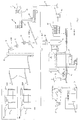
- Figure 2 shows schematically a combined heat treatment plant for light grinding and sludge treatment plant and dredging, corresponding to the process of figure 1.
- Figure 3 shows the simulation theoretical evolution of the oven temperature during co-combustion of coal and thermolysis gas in function of the coal / gas mass ratio, in the heat treatment of the invention.
- Figure 4 shows the simulation theoretical evolution of the oven temperature and the energy released by the co-combustion of coal, gas and sludge depending on the amount of sludge incorporated into the heat treatment of the invention.
- thermolysis The basic diagram of the process of the invention is depicted in Figure 1 using a flow diagram.
- the principle underlying the invention is to enhance the RBL at the start of a thermolysis. Considering the availability of thermolysis gas on the one hand and on the other leaves in purified coal, following this thermolysis, it it is possible to use the energy contained in these two types of fuel to process other products or waste, preferably in a single installation or on the same site.
- the first step of the process is therefore a thermolysis 5 of RBL 1 at 500-600 ° C under an atmosphere containing between 1 and 2% O 2 .
- the average PCI of RBLs is typically 4,000 kcal / kg .
- Clean coal produces 6, of which the PCI is typically 1,500 kcal / kg, then undergoes treatment mechanical 8 for extracting metals 4 mainly non-ferrous it contains. At the end of this treatment, treated carbon is obtained 9. This step allows to obtain a scrap with high added value can for example be recovered in the circuit steel or metallurgical.
- the interest of sludge is, in addition to their high calorific value, to have a particle size of around 40 to 50 ⁇ m, which facilitates homogenization with thermolysis carbon.
- This heat treatment 10 is to dry sludge, remove organic matter and volatiles contained in dredging sludge, to eliminate a maximum of heavy metals present in the mixture coal / sludge, while using the reducing nature of coal.
- the heat treatment 10 comprises by example, in a conventional manner and known per se, the steps successive passage of smoke in a cyclone, a post-combustion chamber, a boiler, through a injection of lime, activated carbon and finally in a bag filter. Ultimately we obtain filtered fumes 12 escaping into the atmosphere and ash 11.
- the energy contained in the gases from the heat treatment of the mixture is recovered by example in the form of electricity via production, in a boiler, live steam supplying a turbo-alternator.
- electricity via production, in a boiler, live steam supplying a turbo-alternator.
- it pay special attention to treatment of "gases" 12 from heat treatment 10. Indeed, it is important to ensure the condensation of heavy metals and the elimination of dioxins and furans.
- thermolysis process was selected on the basis of the quality of residual products, namely up to 50% of loaded thermolysis gas of hydrocarbons and 50% of carbon residues constituting the thermolysis coke or purified coal.
- thermolysis is sized for a amount of waste amounting to around 50,000 tonnes / year and this, so that we can respond to the amount of residue grinding produced annually in the geographic area concerned by the processing site.
- thermolysis gas 6900 kcal / kg typically
- PCI 6900 kcal / kg typically
- coal refined we have expediently studied the use that can be made of this energy, for heat treatment other waste.
- the products selected in term of this reflection are the station sludge treatment plant 2 as well as dredging sludge 3.
- the temperature reached during the treatment of these three types of waste depends in particular on the mass ratio of sludge 2.3 / purified coal 9.
- the temperature of this heat treatment is higher than the thermolysis temperature, for an oxygen level of maximum 3%.
- the reducing nature of the coal allows evaporation of heavy metals, in the form of chlorides mainly in combustion gases. So we have found the presence of chlorine in the coals, which precisely promotes this formation of chlorides.
- Figure 2 shows an example diagram of installation for the implementation of the process of the invention.
- Thermolysis 13 of the grainy fraction of RBL (grain size> 13 mm) produced, in a 1: 1 ratio of preferably a thermolysis gas and a residue carbonaceous, carbon or thermolysis coke.
- Coke is routed via a mass transporter 14 to an elevator bucket 15 which feeds a first screening 16 to 3 mm.
- This screening eliminates a significant part of the metals present in coal.
- the refusal therefore constitutes a recoverable fraction while the passer-by is sent by gravity to two roller mills installed in cascade.
- the first mill 17 is open at 500 ⁇ m and the second 18 at 250 ⁇ m.
- the product thus burst goes through a second screens 19 to 500 ⁇ m so as to eliminate the maximum of heavy metals still present in coal.
- the passer is then sent to a mixer 20 via a transporter mass 21.
- Wastewater treatment plant sludge is brought from the storage site to a buffer hopper 22, provided with screws without souls distributed in a regular parallel 23.
- the treatment plant sludge is then sent to the mixer by means of a recovery screw 24 followed by a inclined screw 25.
- dredging sludge is brought in from storage site to a buffer hopper 26, also provided of screw without souls.
- the dredging sludge is then directed to the mixer by means of a recovery screw 27 followed by an inclined screw 28.
- the mixer 20 feeds a rotary oven 31 for heat treatment.
- Gases from thermolysis RBLs are used as fuel and are injected into the oven burner level 32 with combustion air.
- the fumes from this combustion provide calories necessary for heat treatment of the mixture.
- ash from heat treatment are extracted using a double envelope conveyor 33.
- This conveyor allows indirect cooling of ashes during transport.
- Water, used as coolant, circulates in a closed circuit and is cooled by means of an air exchanger group 34.
- the fumes from the heat treatment of coals and sludge pass through cyclone 36, where are separate the fines, before being sent to a boiler 37.
- Post-combustion is carried out in the anteroom of the boiler 37 and the fumes are then neutralized in a reactor 38 by spraying milk of lime. Upstream of the reactor, an injection of coal active 39 makes it possible to capture the heavy metals present in the fumes.
- Lime milk is pumped from a buffer tank. Lime milk is prepared in an extinguishing tank 40 in which quicklime is mixed and the water. Quicklime is stored in a silo and dosed before being sent to the extinguishing tank. After neutralization in reactor 38, the fumes pass through a bag filter 47 before being released to the atmosphere via a fan 46 in a chimney 41.
- the recovery of dust under cyclone 36, the boiler 37 and the bag filter 47 is done using of a bulk carrier with insulation 42 and are sent to a big-bag installation 43.
- the superheated steam produced at the boiler passes through a turbine 44. This is coupled to an alternator which produces electricity and the condensed vapors are returned to the boiler via the water station 45.
- Table 1 shows an example of composition of the various products entering the heat treatment: purified coal, station sludge sewage treatment and dredging sludge.
- the composition of the sludge dredging is very different from that of sludge treatment.
- the content of heavy metals such as lead is significantly higher (factor 13 in table 1).
- Table 2 shows an example of composition of the gas from thermolysis.
- FIG. 3 shows the possibility of reaching a co-combustion temperature of the order of 1400 ° C. at this mass ratio (under 6% O 2 and with 10% losses).
- the recovery scheme for RBLs and sludge can be completed by the specification of the quantities of sludge that can be treated simultaneously with the coal produced by a thermolysis of RBL with a capacity of 50,000 tonnes / year.
- the percentage of coal produced by this process is 50% by mass and therefore represents a flow of 25,000 tonnes / year.
- the residual quantity obtained from treated coal, possibly wet can go up to 30,000 tonnes / year, in the presence of washing water.
- the quantity of sludge can be heat treated using the process of the invention reaches 150,000 tonnes / year.
- the process can therefore accept a flow of 130,000 tonnes / year of sludge dredging.
- Table 4 presents the results of chemical composition, after heat treatment a mixture of sludge, in the proportion of 18% of sludge wastewater treatment plant and 82% dredging sludge, one temperature of 1100 ° C and under a reducing atmosphere.
- Table 5 presents the comparative composition results, at the end of the heat treatment of a mixture of sewage treatment plant sludge and dredging sludge (18 and 82% respectively) and a complete mixture of sludge and coal from thermolysis.
- the products resulting from the global treatment of RBL and sludge that is to say the ashes, meet the requirements of regional regulations (Decree of the Walloon Government, Belgian Monitor of 18.06.99), for the classification of decontaminated land.
Landscapes
- Engineering & Computer Science (AREA)
- Chemical & Material Sciences (AREA)
- Environmental & Geological Engineering (AREA)
- Oil, Petroleum & Natural Gas (AREA)
- Organic Chemistry (AREA)
- Combustion & Propulsion (AREA)
- General Engineering & Computer Science (AREA)
- Mechanical Engineering (AREA)
- General Chemical & Material Sciences (AREA)
- Chemical Kinetics & Catalysis (AREA)
- Analytical Chemistry (AREA)
- Biomedical Technology (AREA)
- Health & Medical Sciences (AREA)
- Life Sciences & Earth Sciences (AREA)
- Water Supply & Treatment (AREA)
- Physics & Mathematics (AREA)
- Thermal Sciences (AREA)
- Soil Sciences (AREA)
- Hydrology & Water Resources (AREA)
- Materials Engineering (AREA)
- Manufacture And Refinement Of Metals (AREA)
- Treatment Of Sludge (AREA)
Priority Applications (1)
| Application Number | Priority Date | Filing Date | Title |
|---|---|---|---|
| EP20010870287 EP1233048A3 (de) | 2000-12-22 | 2001-12-21 | Verfahren und Vorrichtung zur kombinierten Entsorgung von Schredderschrott und Schlämmen |
Applications Claiming Priority (3)
| Application Number | Priority Date | Filing Date | Title |
|---|---|---|---|
| EP20000870327 EP1217059A1 (de) | 2000-12-22 | 2000-12-22 | Verfahren und Vorrichtung zur kombinierten Entsorgung von Schredderschrott und Schlämmen |
| EP00870327 | 2000-12-22 | ||
| EP20010870287 EP1233048A3 (de) | 2000-12-22 | 2001-12-21 | Verfahren und Vorrichtung zur kombinierten Entsorgung von Schredderschrott und Schlämmen |
Publications (2)
| Publication Number | Publication Date |
|---|---|
| EP1233048A2 true EP1233048A2 (de) | 2002-08-21 |
| EP1233048A3 EP1233048A3 (de) | 2003-07-09 |
Family
ID=26074322
Family Applications (1)
| Application Number | Title | Priority Date | Filing Date |
|---|---|---|---|
| EP20010870287 Withdrawn EP1233048A3 (de) | 2000-12-22 | 2001-12-21 | Verfahren und Vorrichtung zur kombinierten Entsorgung von Schredderschrott und Schlämmen |
Country Status (1)
| Country | Link |
|---|---|
| EP (1) | EP1233048A3 (de) |
Cited By (2)
| Publication number | Priority date | Publication date | Assignee | Title |
|---|---|---|---|---|
| EP1849755A4 (de) * | 2005-01-06 | 2011-05-11 | Sanki Eng Co Ltd | Verfahren zur herstellung von phosphatdünger und gerät hierfür |
| CN113351619A (zh) * | 2021-05-24 | 2021-09-07 | 中国科学院过程工程研究所 | 一种可控气氛复合动态热解装置及基于该装置的废物料无害化处理方法 |
Family Cites Families (4)
| Publication number | Priority date | Publication date | Assignee | Title |
|---|---|---|---|---|
| DE2242012C3 (de) * | 1972-08-23 | 1975-10-16 | Mannesmann Ag, 4000 Duesseldorf | Verfahren zur gemeinsamen Entsorgung von aus Industriemüll und Haushaltsmüll bestehenden Abfällen sowie Klärschlamm |
| US4781944A (en) * | 1986-02-20 | 1988-11-01 | Jones Bradford H | Process and apparatus for fixing, encapsulating, stabilizing and detoxifying heavy metals and the like in metal-containing sludges, soils, ash and similar materials |
| DE4112593C2 (de) * | 1991-04-17 | 1995-03-23 | Pka Umwelttech Gmbh & Co Kg | Verfahren und Anlage zum thermischen Aufbereiten von mit organischen Komponenten verunreinigten Metallschrott |
| DE4136438C2 (de) * | 1991-11-01 | 1995-04-27 | Sbw Sonderabfallentsorgung Bad | Verfahren zur thermischen Steuerung von Drehrohrverbrennungsanlagen |
-
2001
- 2001-12-21 EP EP20010870287 patent/EP1233048A3/de not_active Withdrawn
Cited By (2)
| Publication number | Priority date | Publication date | Assignee | Title |
|---|---|---|---|---|
| EP1849755A4 (de) * | 2005-01-06 | 2011-05-11 | Sanki Eng Co Ltd | Verfahren zur herstellung von phosphatdünger und gerät hierfür |
| CN113351619A (zh) * | 2021-05-24 | 2021-09-07 | 中国科学院过程工程研究所 | 一种可控气氛复合动态热解装置及基于该装置的废物料无害化处理方法 |
Also Published As
| Publication number | Publication date |
|---|---|
| EP1233048A3 (de) | 2003-07-09 |
Similar Documents
| Publication | Publication Date | Title |
|---|---|---|
| EP1217059A1 (de) | Verfahren und Vorrichtung zur kombinierten Entsorgung von Schredderschrott und Schlämmen | |
| EP0692677B1 (de) | Verfahren und Einrichtung für die Thermolyse von Abfall | |
| JP3095739B2 (ja) | 樹脂または有機化合物、あるいはそれらを含む廃プラスチックの処理方法 | |
| EP0359209A2 (de) | Verfahren und Vorrichtung zur Anwendung von gefährlichem Abfall für die Erzeugung von ungefährlichem Aggregat | |
| EP2964694B1 (de) | Verarbeitungsverfahren für carbonierte materialien durch thermolyse mit dampf | |
| EP0250475A1 (de) | Verfahren und anlage für die rückgewinnung von energie aus abfall. | |
| FR2745585A1 (fr) | Procede de valorisation de residus et de dechets ainsi que de combustibles a faible pouvoir calorifique dans un four a ciment | |
| CN1009807B (zh) | 废渣中重金属的固化和解毒的方法和装置 | |
| EP0856492B1 (de) | Anlage zur Verwertung von Hausmüll und ähnlichem | |
| FR2863920A1 (fr) | Procede de traitement et de valorisation de dechets | |
| HRP920882A2 (en) | Apparatus for using hazardous waste to form non hazardous aggregate | |
| CH684484A5 (fr) | Procédé de fabrication d'un matériau combustible solide à partir de déchets solides urbains et/ou de déchets industriels assimilables à des déchets urbains et/ou agricoles. | |
| FR2694567A1 (fr) | Procédé pour la gestion de déchets solides et liquides selon un processus de gazéification sous pression sur lit solide. | |
| CN1111674C (zh) | 热处理垃圾的方法和设备 | |
| EP0921352B1 (de) | Verfahren für Verbrennung von Abfällen und Behandlung von Flugstäuben und Vorrichtung zur Durchführung des Verfahrens | |
| RU2133408C1 (ru) | Способ сжигания городских отходов и применение образующейся при сжигании золы | |
| AU635224B2 (en) | Method and apparatus for using hazardous waste to form non-hazardous aggregate | |
| EP0779082B1 (de) | Verfahren zur Behandlung von Metall enthaltenden festen Rückständen insbesondere von Rückständen der Reinigung von Müllverbrennungsabgasen | |
| FR2754747A1 (fr) | Procede de traitement de residus d'incineration des ordures menageres et le dispositif de mise en oeuvre | |
| EP0814304B1 (de) | Verfahren um die Qualität der Schlacken aus einer Müllverbrennungsanlage zu verbessern und Müllverbrennungsanlage zur Ausführung des Verfahrens | |
| FR2694566A1 (fr) | Procédé combiné pour la gazéification de matières résiduelles et/ou de matières de rejet solides, pâteuses et liquides. | |
| EP2679658B1 (de) | Versiegelung von Inertabfällen, und Reinigung der Gase, die bei der Pyrovergasung von Abfällen entstehen | |
| FR2696472A1 (fr) | Procédé pour réduire les effluents polluants contenus dans les gaz de combustion d'une unité de four. | |
| BE1012918A3 (fr) | Procede de traitement et de valorisation de dechets. | |
| EP0851906A1 (de) | Verfahren zur behandlung von festem brennbarem hausmüll durch vergasung |
Legal Events
| Date | Code | Title | Description |
|---|---|---|---|
| PUAI | Public reference made under article 153(3) epc to a published international application that has entered the european phase |
Free format text: ORIGINAL CODE: 0009012 |
|
| AK | Designated contracting states |
Kind code of ref document: A2 Designated state(s): AT BE CH CY DE DK ES FI FR GB GR IE IT LI LU MC NL PT SE TR |
|
| AX | Request for extension of the european patent |
Free format text: AL;LT;LV;MK;RO;SI |
|
| PUAL | Search report despatched |
Free format text: ORIGINAL CODE: 0009013 |
|
| AK | Designated contracting states |
Designated state(s): AT BE CH CY DE DK ES FI FR GB GR IE IT LI LU MC NL PT SE TR |
|
| AX | Request for extension of the european patent |
Extension state: AL LT LV MK RO SI |
|
| RIC1 | Information provided on ipc code assigned before grant |
Ipc: 7A 62D 3/00 B Ipc: 7B 01D 53/64 B Ipc: 7B 01D 53/40 B Ipc: 7F 23G 7/00 B Ipc: 7F 23G 5/027 B Ipc: 7B 09B 3/00 B Ipc: 7C 02F 11/10 B Ipc: 7C 10B 53/00 A |
|
| AKX | Designation fees paid | ||
| REG | Reference to a national code |
Ref country code: DE Ref legal event code: 8566 |
|
| STAA | Information on the status of an ep patent application or granted ep patent |
Free format text: STATUS: THE APPLICATION IS DEEMED TO BE WITHDRAWN |
|
| 18D | Application deemed to be withdrawn |
Effective date: 20040110 |