EP1233438A2 - Ecran à plasma à luminance accrue - Google Patents
Ecran à plasma à luminance accrue Download PDFInfo
- Publication number
- EP1233438A2 EP1233438A2 EP02100135A EP02100135A EP1233438A2 EP 1233438 A2 EP1233438 A2 EP 1233438A2 EP 02100135 A EP02100135 A EP 02100135A EP 02100135 A EP02100135 A EP 02100135A EP 1233438 A2 EP1233438 A2 EP 1233438A2
- Authority
- EP
- European Patent Office
- Prior art keywords
- layer
- plasma
- light
- light reflecting
- reflecting layer
- Prior art date
- Legal status (The legal status is an assumption and is not a legal conclusion. Google has not performed a legal analysis and makes no representation as to the accuracy of the status listed.)
- Withdrawn
Links
- 239000010410 layer Substances 0.000 claims abstract description 85
- 239000011521 glass Substances 0.000 claims abstract description 13
- 239000011241 protective layer Substances 0.000 claims abstract description 8
- 239000002245 particle Substances 0.000 claims description 35
- 229910052751 metal Inorganic materials 0.000 claims description 16
- 239000002184 metal Substances 0.000 claims description 16
- 210000004180 plasmocyte Anatomy 0.000 claims description 11
- 125000005341 metaphosphate group Chemical group 0.000 claims description 9
- 239000000463 material Substances 0.000 claims description 7
- 229920000388 Polyphosphate Polymers 0.000 claims description 6
- 239000001205 polyphosphate Substances 0.000 claims description 6
- 235000011176 polyphosphates Nutrition 0.000 claims description 6
- 238000003491 array Methods 0.000 claims description 3
- 229910003460 diamond Inorganic materials 0.000 claims description 3
- 239000010432 diamond Substances 0.000 claims description 3
- 150000004820 halides Chemical class 0.000 claims description 3
- QSHDDOUJBYECFT-UHFFFAOYSA-N mercury Chemical compound [Hg] QSHDDOUJBYECFT-UHFFFAOYSA-N 0.000 claims description 3
- 229910052756 noble gas Inorganic materials 0.000 claims description 3
- 150000001642 boronic acid derivatives Chemical class 0.000 claims description 2
- 229910001512 metal fluoride Inorganic materials 0.000 claims description 2
- 229910044991 metal oxide Inorganic materials 0.000 claims description 2
- 150000004706 metal oxides Chemical class 0.000 claims description 2
- 229910001463 metal phosphate Inorganic materials 0.000 claims description 2
- 230000005540 biological transmission Effects 0.000 abstract 1
- 239000007789 gas Substances 0.000 description 17
- 239000000725 suspension Substances 0.000 description 13
- OAICVXFJPJFONN-UHFFFAOYSA-N Phosphorus Chemical compound [P] OAICVXFJPJFONN-UHFFFAOYSA-N 0.000 description 12
- 229910019142 PO4 Inorganic materials 0.000 description 8
- 235000021317 phosphate Nutrition 0.000 description 8
- 150000003013 phosphoric acid derivatives Chemical class 0.000 description 8
- -1 LaF 3 Chemical class 0.000 description 6
- 229910004298 SiO 2 Inorganic materials 0.000 description 6
- 150000004673 fluoride salts Chemical class 0.000 description 6
- 229910018072 Al 2 O 3 Inorganic materials 0.000 description 5
- 239000011734 sodium Substances 0.000 description 5
- 229910052693 Europium Inorganic materials 0.000 description 4
- KRHYYFGTRYWZRS-UHFFFAOYSA-M Fluoride anion Chemical compound [F-] KRHYYFGTRYWZRS-UHFFFAOYSA-M 0.000 description 4
- 238000000576 coating method Methods 0.000 description 4
- 238000000034 method Methods 0.000 description 4
- 239000000203 mixture Substances 0.000 description 4
- 239000002243 precursor Substances 0.000 description 4
- 150000003839 salts Chemical class 0.000 description 4
- 238000007650 screen-printing Methods 0.000 description 4
- QTBSBXVTEAMEQO-UHFFFAOYSA-N Acetic acid Chemical compound CC(O)=O QTBSBXVTEAMEQO-UHFFFAOYSA-N 0.000 description 3
- HEMHJVSKTPXQMS-UHFFFAOYSA-M Sodium hydroxide Chemical compound [OH-].[Na+] HEMHJVSKTPXQMS-UHFFFAOYSA-M 0.000 description 3
- 238000007792 addition Methods 0.000 description 3
- 239000003086 colorant Substances 0.000 description 3
- 239000002270 dispersing agent Substances 0.000 description 3
- 238000004519 manufacturing process Methods 0.000 description 3
- 150000002739 metals Chemical class 0.000 description 3
- 229920000642 polymer Polymers 0.000 description 3
- 230000005855 radiation Effects 0.000 description 3
- 239000000243 solution Substances 0.000 description 3
- 238000007669 thermal treatment Methods 0.000 description 3
- 239000002562 thickening agent Substances 0.000 description 3
- XLYOFNOQVPJJNP-UHFFFAOYSA-N water Substances O XLYOFNOQVPJJNP-UHFFFAOYSA-N 0.000 description 3
- 229910052727 yttrium Inorganic materials 0.000 description 3
- QGZKDVFQNNGYKY-UHFFFAOYSA-N Ammonia Chemical compound N QGZKDVFQNNGYKY-UHFFFAOYSA-N 0.000 description 2
- 229910015999 BaAl Inorganic materials 0.000 description 2
- 229910052684 Cerium Inorganic materials 0.000 description 2
- 229910052688 Gadolinium Inorganic materials 0.000 description 2
- 229910005793 GeO 2 Inorganic materials 0.000 description 2
- 229910021193 La 2 O 3 Inorganic materials 0.000 description 2
- 229910018068 Li 2 O Inorganic materials 0.000 description 2
- 229910052765 Lutetium Inorganic materials 0.000 description 2
- 229910020068 MgAl Inorganic materials 0.000 description 2
- 239000004372 Polyvinyl alcohol Substances 0.000 description 2
- 229910052772 Samarium Inorganic materials 0.000 description 2
- 229910006404 SnO 2 Inorganic materials 0.000 description 2
- 229910052771 Terbium Inorganic materials 0.000 description 2
- 229910010413 TiO 2 Inorganic materials 0.000 description 2
- 229910052769 Ytterbium Inorganic materials 0.000 description 2
- 239000000654 additive Substances 0.000 description 2
- 239000007864 aqueous solution Substances 0.000 description 2
- 229910052792 caesium Inorganic materials 0.000 description 2
- 229910052791 calcium Inorganic materials 0.000 description 2
- 150000001768 cations Chemical class 0.000 description 2
- 210000004027 cell Anatomy 0.000 description 2
- 239000011248 coating agent Substances 0.000 description 2
- 229910052735 hafnium Inorganic materials 0.000 description 2
- 238000010438 heat treatment Methods 0.000 description 2
- 150000002500 ions Chemical class 0.000 description 2
- 229910052747 lanthanoid Inorganic materials 0.000 description 2
- 150000002602 lanthanoids Chemical class 0.000 description 2
- 229910052746 lanthanum Inorganic materials 0.000 description 2
- 229910052744 lithium Inorganic materials 0.000 description 2
- 229910052749 magnesium Inorganic materials 0.000 description 2
- 230000003647 oxidation Effects 0.000 description 2
- 238000007254 oxidation reaction Methods 0.000 description 2
- 229920002451 polyvinyl alcohol Polymers 0.000 description 2
- 229910052700 potassium Inorganic materials 0.000 description 2
- 238000002360 preparation method Methods 0.000 description 2
- 238000000197 pyrolysis Methods 0.000 description 2
- 229910052701 rubidium Inorganic materials 0.000 description 2
- 229910052706 scandium Inorganic materials 0.000 description 2
- 229910052708 sodium Inorganic materials 0.000 description 2
- 238000004528 spin coating Methods 0.000 description 2
- 229910052712 strontium Inorganic materials 0.000 description 2
- 229910052719 titanium Inorganic materials 0.000 description 2
- 229910052725 zinc Inorganic materials 0.000 description 2
- 229910052726 zirconium Inorganic materials 0.000 description 2
- MOMKYJPSVWEWPM-UHFFFAOYSA-N 4-(chloromethyl)-2-(4-methylphenyl)-1,3-thiazole Chemical compound C1=CC(C)=CC=C1C1=NC(CCl)=CS1 MOMKYJPSVWEWPM-UHFFFAOYSA-N 0.000 description 1
- 229910016569 AlF 3 Inorganic materials 0.000 description 1
- 229910017119 AlPO Inorganic materials 0.000 description 1
- USFZMSVCRYTOJT-UHFFFAOYSA-N Ammonium acetate Chemical compound N.CC(O)=O USFZMSVCRYTOJT-UHFFFAOYSA-N 0.000 description 1
- 239000005695 Ammonium acetate Substances 0.000 description 1
- 229910016036 BaF 2 Inorganic materials 0.000 description 1
- FIPWRIJSWJWJAI-UHFFFAOYSA-N Butyl carbitol 6-propylpiperonyl ether Chemical compound C1=C(CCC)C(COCCOCCOCCCC)=CC2=C1OCO2 FIPWRIJSWJWJAI-UHFFFAOYSA-N 0.000 description 1
- 229910004261 CaF 2 Inorganic materials 0.000 description 1
- 229910016509 CuF 2 Inorganic materials 0.000 description 1
- 239000001856 Ethyl cellulose Substances 0.000 description 1
- ZZSNKZQZMQGXPY-UHFFFAOYSA-N Ethyl cellulose Chemical compound CCOCC1OC(OC)C(OCC)C(OCC)C1OC1C(O)C(O)C(OC)C(CO)O1 ZZSNKZQZMQGXPY-UHFFFAOYSA-N 0.000 description 1
- 229910016655 EuF 3 Inorganic materials 0.000 description 1
- 229910005690 GdF 3 Inorganic materials 0.000 description 1
- 229910017768 LaF 3 Inorganic materials 0.000 description 1
- 229910018119 Li 3 PO 4 Inorganic materials 0.000 description 1
- 229910015312 LiMgF Inorganic materials 0.000 description 1
- 229910017855 NH 4 F Inorganic materials 0.000 description 1
- NBIIXXVUZAFLBC-UHFFFAOYSA-N Phosphoric acid Chemical class OP(O)(O)=O NBIIXXVUZAFLBC-UHFFFAOYSA-N 0.000 description 1
- 229910052777 Praseodymium Inorganic materials 0.000 description 1
- XBDQKXXYIPTUBI-UHFFFAOYSA-N Propionic acid Chemical class CCC(O)=O XBDQKXXYIPTUBI-UHFFFAOYSA-N 0.000 description 1
- 229910004283 SiO 4 Inorganic materials 0.000 description 1
- GEIAQOFPUVMAGM-UHFFFAOYSA-N ZrO Inorganic materials [Zr]=O GEIAQOFPUVMAGM-UHFFFAOYSA-N 0.000 description 1
- 238000010521 absorption reaction Methods 0.000 description 1
- 150000001242 acetic acid derivatives Chemical class 0.000 description 1
- 230000002378 acidificating effect Effects 0.000 description 1
- 150000004703 alkoxides Chemical class 0.000 description 1
- OVKDFILSBMEKLT-UHFFFAOYSA-N alpha-Terpineol Natural products CC(=C)C1(O)CCC(C)=CC1 OVKDFILSBMEKLT-UHFFFAOYSA-N 0.000 description 1
- WUOACPNHFRMFPN-UHFFFAOYSA-N alpha-terpineol Chemical compound CC1=CCC(C(C)(C)O)CC1 WUOACPNHFRMFPN-UHFFFAOYSA-N 0.000 description 1
- 229910021529 ammonia Inorganic materials 0.000 description 1
- 229940043376 ammonium acetate Drugs 0.000 description 1
- 235000019257 ammonium acetate Nutrition 0.000 description 1
- 150000003863 ammonium salts Chemical class 0.000 description 1
- 150000001450 anions Chemical class 0.000 description 1
- 238000000149 argon plasma sintering Methods 0.000 description 1
- 150000004648 butanoic acid derivatives Chemical class 0.000 description 1
- 150000007942 carboxylates Chemical class 0.000 description 1
- 238000006243 chemical reaction Methods 0.000 description 1
- 239000000084 colloidal system Substances 0.000 description 1
- 239000003989 dielectric material Substances 0.000 description 1
- 239000012153 distilled water Substances 0.000 description 1
- 238000009826 distribution Methods 0.000 description 1
- 238000001035 drying Methods 0.000 description 1
- 238000010410 dusting Methods 0.000 description 1
- 230000000694 effects Effects 0.000 description 1
- 239000003792 electrolyte Substances 0.000 description 1
- 238000004924 electrostatic deposition Methods 0.000 description 1
- 235000019325 ethyl cellulose Nutrition 0.000 description 1
- 229920001249 ethyl cellulose Polymers 0.000 description 1
- 230000005284 excitation Effects 0.000 description 1
- 238000001914 filtration Methods 0.000 description 1
- 238000000227 grinding Methods 0.000 description 1
- 239000011261 inert gas Substances 0.000 description 1
- 229910052745 lead Inorganic materials 0.000 description 1
- 239000007791 liquid phase Substances 0.000 description 1
- 229910052748 manganese Inorganic materials 0.000 description 1
- 230000005499 meniscus Effects 0.000 description 1
- 239000003960 organic solvent Substances 0.000 description 1
- 229960005235 piperonyl butoxide Drugs 0.000 description 1
- 229920000058 polyacrylate Polymers 0.000 description 1
- 239000000843 powder Substances 0.000 description 1
- 238000007639 printing Methods 0.000 description 1
- IKNCGYCHMGNBCP-UHFFFAOYSA-N propan-1-olate Chemical compound CCC[O-] IKNCGYCHMGNBCP-UHFFFAOYSA-N 0.000 description 1
- 238000010992 reflux Methods 0.000 description 1
- 239000012266 salt solution Substances 0.000 description 1
- 238000004062 sedimentation Methods 0.000 description 1
- 229910052709 silver Inorganic materials 0.000 description 1
- 235000019983 sodium metaphosphate Nutrition 0.000 description 1
- 238000004544 sputter deposition Methods 0.000 description 1
- 238000003756 stirring Methods 0.000 description 1
- 239000000126 substance Substances 0.000 description 1
- 239000013008 thixotropic agent Substances 0.000 description 1
- 230000009974 thixotropic effect Effects 0.000 description 1
- 229910052718 tin Inorganic materials 0.000 description 1
- 238000002604 ultrasonography Methods 0.000 description 1
- 238000007740 vapor deposition Methods 0.000 description 1
- 229910052724 xenon Inorganic materials 0.000 description 1
- FHNFHKCVQCLJFQ-UHFFFAOYSA-N xenon atom Chemical compound [Xe] FHNFHKCVQCLJFQ-UHFFFAOYSA-N 0.000 description 1
Images

Classifications
-
- H—ELECTRICITY
- H01—ELECTRIC ELEMENTS
- H01J—ELECTRIC DISCHARGE TUBES OR DISCHARGE LAMPS
- H01J11/00—Gas-filled discharge tubes with alternating current induction of the discharge, e.g. alternating current plasma display panels [AC-PDP]; Gas-filled discharge tubes without any main electrode inside the vessel; Gas-filled discharge tubes with at least one main electrode outside the vessel
- H01J11/20—Constructional details
- H01J11/34—Vessels, containers or parts thereof, e.g. substrates
- H01J11/44—Optical arrangements or shielding arrangements, e.g. filters, black matrices, light reflecting means or electromagnetic shielding means
-
- H—ELECTRICITY
- H01—ELECTRIC ELEMENTS
- H01J—ELECTRIC DISCHARGE TUBES OR DISCHARGE LAMPS
- H01J11/00—Gas-filled discharge tubes with alternating current induction of the discharge, e.g. alternating current plasma display panels [AC-PDP]; Gas-filled discharge tubes without any main electrode inside the vessel; Gas-filled discharge tubes with at least one main electrode outside the vessel
- H01J11/10—AC-PDPs with at least one main electrode being out of contact with the plasma
- H01J11/12—AC-PDPs with at least one main electrode being out of contact with the plasma with main electrodes provided on both sides of the discharge space
-
- H—ELECTRICITY
- H01—ELECTRIC ELEMENTS
- H01J—ELECTRIC DISCHARGE TUBES OR DISCHARGE LAMPS
- H01J2211/00—Plasma display panels with alternate current induction of the discharge, e.g. AC-PDPs
- H01J2211/20—Constructional details
- H01J2211/34—Vessels, containers or parts thereof, e.g. substrates
- H01J2211/44—Optical arrangements or shielding arrangements, e.g. filters or lenses
- H01J2211/442—Light reflecting means; Anti-reflection means
Definitions
- the invention relates to a plasma screen equipped with a front panel, the one Glass plate on which a dielectric layer and a protective layer are applied, has, with a carrier plate equipped with a phosphor layer, with a rib structure, the space between the front plate and the carrier plate in plasma cells, which with a gas are filled, split, with one or more electrode arrays on the Front plate and the carrier plate for generating silent electrical discharges in the Plasma cells.
- Plasma screens allow color images with high resolution, large screen diagonal and are of compact design.
- a plasma screen has a hermetic sealed glass cell, which is filled with a gas, with electrodes arranged in a grid on. Applying an electrical voltage causes a gas discharge that produces light in the ultraviolet range. This light can be absorbed by phosphors visible light converted and through the front panel of the glass cell to the viewer be emitted.
- Plasma screens are divided into two classes: DC plasma screens and AC plasma screens.
- DC plasma screens the electrodes are in the direct Contact with the plasma.
- AC plasma screens the electrodes are through a dielectric layer separated from the plasma.
- the dielectric layer is still with one layer covered with MgO.
- MgO has a high ion-induced secondary electron emission coefficient and thus reduces the ignition voltage of the gas. Moreover MgO is resistant to sputtering due to positively charged plasma ions.
- an inert gas mixture with xenon as the component generating UV light is mostly used as the gas.
- the light generated during the plasma discharge is in the vacuum ultraviolet (VUV) range.
- the emission wavelength of Xe is 147 nm and the emission wavelength of the excited Xe 2 excimer is 172 nm.
- the luminance of a plasma display largely depends on the efficiency of the VUV light off to stimulate the phosphors.
- To increase the luminance is in JP 2000-011895 describes a plasma screen which emits UV light on the dielectric layer has a reflective layer.
- the UV light reflecting layer contains one Layer sequence of materials with different refractive indices. The production these layers are very complex and expensive.
- the disadvantage is that there is no layer of MgO on the layer reflecting UV light can be applied because the layer of MgO is not transparent to VUV light
- the invention has for its object a plasma screen with improved To provide luminance.
- a plasma screen equipped with a front panel, which is a glass plate on which a dielectric layer, a UV light reflecting layer and a protective layer are applied, equipped with a carrier plate a layer of fluorescent material, with a ribbed structure that covers the space between the front panel and Carrier plate divided into plasma cells, which are filled with a gas, with or several electrode arrays on the front plate and the carrier plate for generating silent electrical discharges in which UV light with a wavelength> 172 nm arises in the plasma cells.
- the silent electrical discharges have UV light with a wavelength between 200 and 350 nm.
- UV light with a wavelength> 172 nm, especially in the range from 200 to 350 nm, for excitation of the phosphors can be found on the front panel a protective layer can be applied to the UV light reflecting layer, which has an advantageous effect on the ignition voltage of the gas. It is also by the UV light reflective layer increases the luminance of the plasma screen, because UV light, which in Was emitted towards the front panel through the UV light reflecting layer Direction of the phosphors is reflected.
- the gas is selected from the group of mercury vapor, Ne / N 2 and the noble gas halides.
- these gases emit light with a wavelength> 172 nm.
- the UV light reflecting layer selects a material from the group of metal oxides, metal fluorides, metal phosphates, metal polyphosphates, the metal metaphosphate, which contains metal borates and diamond.
- the UV light reflecting layer has particles with a Contains particle diameter less than 300 nm.
- the UV light reflecting layer contains particles contains a particle diameter between 20 nm and 150 nm.
- Particles of this diameter have a significantly larger light scattering in the UV wavelength range than in the visible wavelength range.
- the UV light reflecting layer has a thickness of 0.5 ⁇ m to 5 ⁇ m having.
- the thickness of the layer of scattering particles also plays a role.
- a UV light reflecting layer is obtained in the wavelength range the plasma emission is strongly reflected and in the visible emission range Phosphors transmitted.
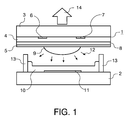
- the front panel 1 shows a plasma cell of an AC plasma screen with a coplanar Arrangement of the electrodes on a front plate 1 and a carrier plate 2.
- the front panel 1 contains a glass plate 3, on which a dielectric layer 4, on the dielectric layer a UV light reflecting layer 8 and a protective layer 5 are applied thereon.
- the Protective layer 5 is preferably made of MgO and the dielectric layer 4 is made of, for example PbO-containing glass.
- On the glass plate 3 are parallel, strip-shaped Discharge electrodes 6, 7 applied, which are covered by the dielectric layer 4.
- the Discharge electrodes 6, 7 are made of metal or ITO, for example.
- the carrier plate 2 is off Glass and on the carrier plate 2 are parallel, strip-shaped, perpendicular to the discharge electrodes 6.7 extending address electrodes 11 made of Ag, for example. These are of a phosphor layer 10 that emits light in one of the three primary colors red, green or emitted blue, covered. To do this, the phosphor layer is available in several color segments divided. The red, green or blue emitting color segments are usually the Fluorescent layer 10 applied in the form of vertical strip triplets. The single ones Plasma cells are preferred due to a rib structure 13 with separating ribs dielectric material separated.
- the maximum of the emitted wavelength> 172 nm is.
- Light in a wavelength range is preferably used in the plasma discharge generated between 200 and 350 nm.
- a plasma forms in the plasma region 9, depending on the The composition of the gas generates radiation 12 in the UV range. This radiation 12 stimulates the phosphor layer 10 to glow, the visible light 14 in one of the three Primary colors emitted, which emerges through the front panel 1 and thus one represents a luminous pixel on the screen.
- the discharge electrodes 6, 7 are applied by means of vapor deposition. Then the dielectric layer 4 applied.
- oxides, fluorides, phosphates, metaphosphates or polyphosphates of various main group or sub group metals can be used as particles.
- oxides for example, the oxides of the 1st main group such as Li 2 O or oxides of the 2nd main group such as MgO, CaO, SrO and BaO or oxides of the 3rd main group such as B 2 O 3 and Al 2 O 3 or oxides of 3rd subgroup such as Sc 2 O 3 , Y 2 O 3 and La 2 O 3 or oxides of the 4th main group such as SiO 2 , GeO 2 and SnO 2 or oxides of the 4th subgroup such as TiO 2 , ZrO 2 and HfO 2 or mixed oxides such as MgAl 2 O 4 , CaAl 2 O 4 or BaAl 2 O 4 can be used.
- Fluorides of the 1st main group such as LiF, NaF, KF, RbF and CsF or fluorides of the 1st subgroup such as AgF or fluorides of the 2nd main group such as MgF 2 , CaF 2 , SrF 2 and BaF 2 or fluorides of the 3rd Main group such as AlF 3 or fluoride of the 4th main group such as PbF 2 or fluoride of the 1st subgroup such as CuF 2 or fluoride of the 2nd subgroup such as ZnF 2 or fluoride of the lanthanides such as LaF 3 , CeF 4 , PrF 3 , SmF 3 , EuF 3 , EuF 2 , GdF 3 , YbF 3 and LuF 3 or mixed fluorides such as LiMgF 3 , Na 3 AlF 6 and KMgF 3 are used.
- Phosphates of the 1st main group such as Li 3 PO 4 , Na 3 PO 4 , K 3 PO 4 , Rb 3 PO 4 and Cs 3 PO 4 or phosphates of the 2nd main group such as Mg 3 (PO 4 ) 2 , Ca.
- Metaphosphates with a chain length n between 3 and 9 can, for example, be metaphosphates of the 1st main group such as Li 3 (PO 3 ) 3 , Na 3 (PO 3 ) 3 , K 3 (PO 3 ) 3 , Rb 3 (PO 3 ) 3 and Cs 3 (PO 3 ) 3 or metaphosphates of the 2nd main group such as Mg (PO 3 ) 2 , Ca (PO 3 ) 2 , Sr (PO 3 ) 2 and Ba (PO 3 ) 2 or metaphosphates of the 3rd main group such as Al (PO 3 ) 3 or metaphosphates of the 3rd subgroup such as Sc (PO 3 ) 3 , Y (PO 3 ) 3 and La (PO 3 ) 3 or metaphosphates of the 4th subgroup such as Ti 3 (PO 3 ) 4 , Zr 3 ( PO 3 ) 4 and Hf 3 (PO 3 ) 4 or Zn (PO 3 ) 2 can be used.
- the 1st main group
- metal cations can also be partially replaced by protons.
- hydrogen phosphates such as KH 2 PO 4 , NaH 2 PO 4 and NH 4 H 2 PO 4 or diamond can also be used in the UV light reflecting layer 8.
- the particle diameter of the materials used should be less than 300 nm and is preferably in a range between 20 and 150 nm. It is particularly advantageous if there is a wide distribution over this range of particle diameters as this is the Ratio of reflection of UV light to reflection of the visible in the desired direction affected.
- the suspensions can also contain precursors to the particles according to the invention, which are then converted into the desired particles by thermal treatment.
- a suspension with Mg (OH) 2 can be thermally converted into a layer of MgO after application to the dielectric layer 4.
- the suspensions are preferably prepared in aqueous solution. In some cases it may be necessary to work with organic solvent systems, for example if the powder used reacts chemically with water or dissolves in it.
- the suspensions are produced depending on the material and particle diameter different ways.
- One possibility is that the particles are from suitable precursors be synthesized.
- the other possibility is that the particles are used directly.
- metal salts are first dissolved in water.
- the metal salts have the composition MX n ⁇ yH 2 O, where M is, for example, one or more metals selected from the group Li, Na, K, Rb, Cs, Mg, Ca, Sr, Ba, Al, Sc, La, Y , Sn, Ti, Zr, Hf, Ag, Pb, Cu, Pr, Sm, Eu, Gd, Yb, Lu and Zn.
- X is, for example, one or more of the anions NO 3 - , RO - , R-COO - , - O 2 C-CO 2 - while y is a number greater than or equal to zero and n is an integer between 1 and 4 depending on the oxidation state of the metal cation M is n + .
- propoxide and butoxide can be used as alkoxides RO - .
- Acetates, propionates or butyrates, for example, can be used as carboxylates.
- the particles according to the invention with a particle diameter smaller than 300 nm are then either by thermal treatment such as heating under reflux, by acidic treatment such as adding acetic acid, by alkaline treatment such as addition of sodium hydroxide solution or by passing in ammonia and / or by adding the desired counterion receive.
- the counterions are added as salts to the aqueous metal salt solution and can be, for example, ammonium salts such as NH 4 F or phosphates such as sodium metaphosphate or long-chain polyphosphate salts.
- the suspensions obtained are with an associative thickener and / or Dispersant added.
- particles such as Li 2 O, MgO, CaO, SrO, BaO, B 2 O 3 , Al 2 O 3 , Sc 2 O 3 , Y 2 O 3 , La 2 O 3 , SiO 2 , GeO 2 , SnO 2 , TiO 2 , ZrO 2 , HfO 2 or MgAl 2 O 4 with a particle diameter smaller than 300 nm also suspended directly in aqueous solution and then mixed with an associative thickener and / or a dispersant.
- the particles can be stirred by grinding with a ball mill with and without an agitator with a dissolver, shear dispersing with an Ultraturrax device, an ultrasonic bath or an ultrasonic sonotrode can be dispersed.
- the suspensions can also be mixed with additives that improve the flow properties modify the suspensions and give them thixotropic properties.
- additives can include small additions of organic, soluble polymers such as Polyvinyl alcohol, polyacrylate derivatives, associative thickeners or completely dispersed colloids can be used.
- suspensions obtained in these different ways can be made in a wide variety of ways Processes such as spin coating, meniscus coating, blade coating, screen printing or Flexographic printing can be applied to the dielectric layer 4 of the front plate 1.
- the layers are thermally treated again. By heating the Layers at 450 ° C can be removed without leaving any residues. In some cases it may be necessary to apply temperatures of 600 ° C to complete pyrolysis to achieve the polymers. In the event that the applied suspension is a precursor to one contains particles according to the invention, also takes place in the thermal treatment appropriate conversion instead.
- a noble gas halide such as ArF, KrCl, KrF, XeBr, XeCl, XeF, a Ne / N 2 mixture or mercury vapor, for example, can be used as the gas for the plasma discharge.
- phosphors are used which differ from wavelengths> Excite 172 nm, especially in a wavelength range between 200 and 350 nm to let.
- BaMgAl 10 O 17 Eu
- (Ba 1-x Sr x ) 5 (PO 4 ) 3 (F, Cl): Eu with 0 ⁇ x ⁇ 1 or (Ba 1-xy Sr x Ca y ) 5 (PO 4 ) 3 (F, Cl): Eu with 0 ⁇ x ⁇ 1 can be used.
- Zn 2 SiO 4 Mn, BaAl 12 O 19 : Mn, Y 2 SiO 5 : Tb, CeMgAl 11 O 19 : Tb, (Y 1-x Gd x ) BO 3 : Tb with 0, for example, can be used as the green-emitting phosphor ⁇ x ⁇ 1, InBO 3 : Tb GdMgB 5 O 10 : Ce, Tb or LaPO 4 : Ce, Tb.
- Y 2 O 3 Eu
- Y 2 O 2 S Eu
- YVO 4 Eu
- Y (V 1-x P x ) O 4 Eu with 0 ⁇ x ⁇ 1
- Known methods are used to produce a segmented phosphor layer 10 a phosphor preparation with a green, red or blue emitting phosphor manufactured and this by means of dry coating processes, for. B. electrostatic deposition or electrostatically assisted dusting, as well as by means of wet coating processes, z. B. screen printing, dispenser processes in which a phosphor preparation with a nozzle moving along the channels, or sedimentation the liquid phase, equipped with a rib structure 12 on a carrier plate 2 Separating ribs and address electrodes 10 applied. Then this procedure is for the other two colors performed.
- the carrier plate 2 is together with other components such as one Front plate 1 and a gas used to produce a plasma screen.
- the UV light reflecting layer 8 is preferred in the case of AC plasma picture screens where the plasma cells are controlled by AC voltage and where the Discharge electrodes 6, 7 are covered by a dielectric layer 4.
- a layer reflecting UV light can also be used with DC plasma screens are used in which the discharge electrodes 6,7 are not of a dielectric Layer 4 are covered.
- a screen printing paste 100 g of p- menth-1-en-8-ol, which contained 5% by weight of ethyl cellulose, 2.7 g of a thixotropic agent and 12 g of SiO 2 with a particle diameter between 20 and 110 nm were mixed and then by two passes dispersed in a three-roll mill.
- a layer of SiO 2 particles was applied as a UV light reflecting layer 8 to the dielectric layer 4 of a front plate 1, which has a glass plate 3, a dielectric layer 4 and two discharge electrodes 6, 7.
- the dielectric layer 4 contained PbO and the two discharge electrodes 6, 7 were made of ITO.
- the front plate 1 was first dried and then subjected to a thermal aftertreatment at 450 ° C. for 2 hours.
- the layer thickness of the UV-reflecting layer 8 made of SiO 2 was 4.0 ⁇ m.
- the UV light reflecting layer 8 was evaporated with a layer of MgO, which had a layer thickness of 730 nm.
- the finished front plate 1 was used together with a carrier plate 2 and a gas to build a plasma screen that had increased luminance.
- the gas contained 90 vol% Ne and 10 vol% N 2 .
- line 15 shows the reflection of the 4.0 ⁇ m SiO 2 -containing UV light-reflecting layer 8 as a function of the wavelength.
- Line 16 shows the reflection after the 730 nm thick protective layer 5 made of MgO was evaporated onto the UV light reflecting 8.
- a layer of Al 2 O 3 particles was applied as a UV light reflecting layer 8 to the dielectric layer 4 of a front plate 1, which has a glass plate 3, a dielectric layer 4 and two discharge electrodes 6, 7.
- the dielectric layer 4 contained PbO and the two discharge electrodes 6, 7 were made of ITO.
- the front plate 1 was first dried and then subjected to a thermal aftertreatment at 450 ° C. for 2 hours.
- the layer thickness of the UV-reflecting layer 8 made of Al 2 O 3 was 2.0 ⁇ m.
- the UV light reflecting layer 8 was vapor-deposited with a layer of MgO, which had a layer thickness of 600 nm.
- the finished front plate 1 was used together with a carrier plate 2 and a gas to build a plasma screen that had increased luminance.
- the gas contained KrF
Landscapes
- Physics & Mathematics (AREA)
- Engineering & Computer Science (AREA)
- Plasma & Fusion (AREA)
- Electromagnetism (AREA)
- Gas-Filled Discharge Tubes (AREA)
- Luminescent Compositions (AREA)
Applications Claiming Priority (2)
| Application Number | Priority Date | Filing Date | Title |
|---|---|---|---|
| DE10106963 | 2001-02-15 | ||
| DE10106963A DE10106963A1 (de) | 2001-02-15 | 2001-02-15 | Plasmabildschirm mit erhöhter Luminanz |
Publications (1)
| Publication Number | Publication Date |
|---|---|
| EP1233438A2 true EP1233438A2 (fr) | 2002-08-21 |
Family
ID=7674088
Family Applications (1)
| Application Number | Title | Priority Date | Filing Date |
|---|---|---|---|
| EP02100135A Withdrawn EP1233438A2 (fr) | 2001-02-15 | 2002-02-14 | Ecran à plasma à luminance accrue |
Country Status (7)
| Country | Link |
|---|---|
| US (1) | US20020113542A1 (fr) |
| EP (1) | EP1233438A2 (fr) |
| JP (1) | JP2002279907A (fr) |
| KR (1) | KR20020067632A (fr) |
| CN (1) | CN1371115A (fr) |
| DE (1) | DE10106963A1 (fr) |
| TW (1) | TW564463B (fr) |
Cited By (2)
| Publication number | Priority date | Publication date | Assignee | Title |
|---|---|---|---|---|
| EP1310976A2 (fr) * | 2001-11-09 | 2003-05-14 | Hitachi, Ltd. | Panneau d'affichage à plasma |
| CN106839124A (zh) * | 2017-03-30 | 2017-06-13 | 谢红卫 | 单向等离子静电净化新风机及运行方法 |
Families Citing this family (8)
| Publication number | Priority date | Publication date | Assignee | Title |
|---|---|---|---|---|
| CN100338716C (zh) * | 2002-12-28 | 2007-09-19 | 鸿富锦精密工业(深圳)有限公司 | 电浆显示器及其前基板的制造方法 |
| JP4415578B2 (ja) * | 2003-06-30 | 2010-02-17 | パナソニック株式会社 | プラズマディスプレイ装置 |
| JP4244727B2 (ja) | 2003-06-30 | 2009-03-25 | パナソニック株式会社 | プラズマディスプレイ装置 |
| JP4244726B2 (ja) * | 2003-06-30 | 2009-03-25 | パナソニック株式会社 | プラズマディスプレイ装置 |
| KR101256387B1 (ko) * | 2005-04-14 | 2013-04-25 | 코닌클리즈케 필립스 일렉트로닉스 엔.브이. | Uvc 방사선을 발생시키는 장치 |
| KR100755855B1 (ko) * | 2006-01-11 | 2007-09-07 | 엘지전자 주식회사 | 플라즈마 디스플레이 패널 및 그 제조방법 |
| JP2009224032A (ja) * | 2008-03-13 | 2009-10-01 | Hitachi Ltd | 表示装置およびプラズマディスプレイパネル |
| WO2012041252A1 (fr) * | 2010-09-30 | 2012-04-05 | 四川虹欧显示器件有限公司 | Écran à plasma et procédé de préparation associé |
Family Cites Families (5)
| Publication number | Priority date | Publication date | Assignee | Title |
|---|---|---|---|---|
| US6100633A (en) * | 1996-09-30 | 2000-08-08 | Kabushiki Kaisha Toshiba | Plasma display panel with phosphor microspheres |
| KR100247821B1 (ko) * | 1997-08-30 | 2000-03-15 | 손욱 | 플라즈마표시장치 |
| TW423006B (en) * | 1998-03-31 | 2001-02-21 | Toshiba Corp | Discharge type flat display device |
| JP3657869B2 (ja) * | 1999-10-29 | 2005-06-08 | 株式会社巴川製紙所 | 低反射部材 |
| JP4248721B2 (ja) * | 2000-02-22 | 2009-04-02 | 三菱電機株式会社 | 紫外線変換材料とこの紫外線変換材料を用いた表示装置 |
-
2001
- 2001-02-15 DE DE10106963A patent/DE10106963A1/de not_active Withdrawn
-
2002
- 2002-02-08 TW TW091102444A patent/TW564463B/zh not_active IP Right Cessation
- 2002-02-08 KR KR1020020007391A patent/KR20020067632A/ko not_active Withdrawn
- 2002-02-11 CN CN02108033A patent/CN1371115A/zh active Pending
- 2002-02-12 US US10/074,758 patent/US20020113542A1/en not_active Abandoned
- 2002-02-12 JP JP2002034060A patent/JP2002279907A/ja active Pending
- 2002-02-14 EP EP02100135A patent/EP1233438A2/fr not_active Withdrawn
Cited By (2)
| Publication number | Priority date | Publication date | Assignee | Title |
|---|---|---|---|---|
| EP1310976A2 (fr) * | 2001-11-09 | 2003-05-14 | Hitachi, Ltd. | Panneau d'affichage à plasma |
| CN106839124A (zh) * | 2017-03-30 | 2017-06-13 | 谢红卫 | 单向等离子静电净化新风机及运行方法 |
Also Published As
| Publication number | Publication date |
|---|---|
| TW564463B (en) | 2003-12-01 |
| DE10106963A1 (de) | 2002-08-29 |
| KR20020067632A (ko) | 2002-08-23 |
| CN1371115A (zh) | 2002-09-25 |
| US20020113542A1 (en) | 2002-08-22 |
| JP2002279907A (ja) | 2002-09-27 |
Similar Documents
| Publication | Publication Date | Title |
|---|---|---|
| EP1085554B1 (fr) | Ecran à plasma avec plaque frontale munie d'un revêtement réfléchissant la lumière UV | |
| DE69630004T2 (de) | Plasmaanzeigetafel geeignet für Anzeige hoher Qualität | |
| DE69837500T2 (de) | Phosphormaterial und Plasma-Anzeigetafel | |
| DE602004009645T2 (de) | Leuchtstoff und Plasma-Anzeigevorrichtung | |
| DE10009915A1 (de) | Plasmabildschirm mit UV-Licht emittierender Schicht | |
| DE19937420C1 (de) | Plasmabildschirm mit Leuchtstoffzubereitung, Leuchtstoffzubereitung und Verfahren zu Herstellung einer Leuchtstoffzubereitung | |
| EP1215698B1 (fr) | Ecran à plasma avec une couche luminescente | |
| EP1256616B1 (fr) | Panneau de visualisation à plasma avec luminophore bleu | |
| EP1253624B1 (fr) | Lampe à décharge avec matière luminescente | |
| EP1233438A2 (fr) | Ecran à plasma à luminance accrue | |
| DE19962029A1 (de) | Plasmabildschirm mit rotem Leuchtstoff | |
| EP1130621A2 (fr) | Panneau de visualisation à plasma avec luminophore bleu | |
| EP1253625B1 (fr) | Lampe à décharge avec matière luminescente | |
| EP1254943B1 (fr) | Luminophore, et lampe à décharge avec ce luminophore | |
| DE102004054091B4 (de) | Durch Vakuum-ultraviolett angeregtes grünes Phosphormaterial und eine dieses Material verwendende Vorrichtung | |
| DE19952242A1 (de) | Plasmabildschirm mit rotem Leuchtstoff | |
| DE10104364A1 (de) | Plasmabildschirm mit einer Leuchtstoffschicht | |
| DE60204724T2 (de) | Plasmabildschirm mit grünem phosphor | |
| DE60305253T2 (de) | Leuchtstoff für Licht emittierendes Element angeregt durch Vakuum UV-Licht | |
| EP2351065B1 (fr) | Lampe à décharge basse pression | |
| EP1258902A2 (fr) | Panneau d'affichage à plasma ayant un point de couleur blanche amélioré | |
| DE2607888A1 (de) | Leuchtstoff | |
| DE10215891A1 (de) | Plasmabildschirm mit erhöhter Effizienz |
Legal Events
| Date | Code | Title | Description |
|---|---|---|---|
| PUAI | Public reference made under article 153(3) epc to a published international application that has entered the european phase |
Free format text: ORIGINAL CODE: 0009012 |
|
| AK | Designated contracting states |
Kind code of ref document: A2 Designated state(s): AT BE CH CY DE DK ES FI FR GB GR IE IT LI LU MC NL PT SE TR |
|
| AX | Request for extension of the european patent |
Free format text: AL;LT;LV;MK;RO;SI |
|
| RAP1 | Party data changed (applicant data changed or rights of an application transferred) |
Owner name: PHILIPS CORPORATE INTELLECTUAL PROPERTY GMBH Owner name: KONINKLIJKE PHILIPS ELECTRONICS N.V. |
|
| RAP1 | Party data changed (applicant data changed or rights of an application transferred) |
Owner name: PHILIPS INTELLECTUAL PROPERTY & STANDARDS GMBH Owner name: KONINKLIJKE PHILIPS ELECTRONICS N.V. |
|
| STAA | Information on the status of an ep patent application or granted ep patent |
Free format text: STATUS: THE APPLICATION HAS BEEN WITHDRAWN |
|
| 18W | Application withdrawn |
Effective date: 20040315 |