EP1236962B1 - Procédé et dispositif de fabrication d'un produit lyophilisé - Google Patents
Procédé et dispositif de fabrication d'un produit lyophilisé Download PDFInfo
- Publication number
- EP1236962B1 EP1236962B1 EP01308802A EP01308802A EP1236962B1 EP 1236962 B1 EP1236962 B1 EP 1236962B1 EP 01308802 A EP01308802 A EP 01308802A EP 01308802 A EP01308802 A EP 01308802A EP 1236962 B1 EP1236962 B1 EP 1236962B1
- Authority
- EP
- European Patent Office
- Prior art keywords
- freeze
- dry ice
- frozen
- sublimation
- dried
- Prior art date
- Legal status (The legal status is an assumption and is not a legal conclusion. Google has not performed a legal analysis and makes no representation as to the accuracy of the status listed.)
- Expired - Lifetime
Links
- 238000000034 method Methods 0.000 title claims description 21
- CURLTUGMZLYLDI-UHFFFAOYSA-N Carbon dioxide Chemical compound O=C=O CURLTUGMZLYLDI-UHFFFAOYSA-N 0.000 claims description 126
- 239000000463 material Substances 0.000 claims description 105
- 235000011089 carbon dioxide Nutrition 0.000 claims description 86
- 238000010438 heat treatment Methods 0.000 claims description 62
- 238000000859 sublimation Methods 0.000 claims description 50
- 230000008022 sublimation Effects 0.000 claims description 50
- 238000004108 freeze drying Methods 0.000 claims description 43
- 238000012545 processing Methods 0.000 claims description 28
- 238000007710 freezing Methods 0.000 claims description 12
- 230000008014 freezing Effects 0.000 claims description 12
- 230000033001 locomotion Effects 0.000 claims description 12
- 238000002156 mixing Methods 0.000 claims description 6
- 239000000203 mixture Substances 0.000 claims description 5
- 238000005096 rolling process Methods 0.000 claims description 5
- 238000001816 cooling Methods 0.000 claims description 4
- 230000005855 radiation Effects 0.000 claims description 4
- 230000003595 spectral effect Effects 0.000 claims description 3
- 239000000047 product Substances 0.000 description 77
- 229910002092 carbon dioxide Inorganic materials 0.000 description 21
- 239000007789 gas Substances 0.000 description 21
- 239000001569 carbon dioxide Substances 0.000 description 19
- 238000004925 denaturation Methods 0.000 description 5
- 230000036425 denaturation Effects 0.000 description 5
- QVGXLLKOCUKJST-UHFFFAOYSA-N atomic oxygen Chemical compound [O] QVGXLLKOCUKJST-UHFFFAOYSA-N 0.000 description 4
- 229910052760 oxygen Inorganic materials 0.000 description 4
- 239000001301 oxygen Substances 0.000 description 4
- 238000001291 vacuum drying Methods 0.000 description 4
- 238000010521 absorption reaction Methods 0.000 description 3
- 230000007850 degeneration Effects 0.000 description 3
- 230000006866 deterioration Effects 0.000 description 3
- 230000000694 effects Effects 0.000 description 3
- 230000002349 favourable effect Effects 0.000 description 3
- 239000012634 fragment Substances 0.000 description 3
- 230000000717 retained effect Effects 0.000 description 3
- 239000000126 substance Substances 0.000 description 3
- 102000004190 Enzymes Human genes 0.000 description 2
- 108090000790 Enzymes Proteins 0.000 description 2
- 238000009825 accumulation Methods 0.000 description 2
- 239000000919 ceramic Substances 0.000 description 2
- 239000003814 drug Substances 0.000 description 2
- 229940079593 drug Drugs 0.000 description 2
- 238000001035 drying Methods 0.000 description 2
- 235000013305 food Nutrition 0.000 description 2
- 239000004615 ingredient Substances 0.000 description 2
- 230000001788 irregular Effects 0.000 description 2
- 238000004519 manufacturing process Methods 0.000 description 2
- 239000002994 raw material Substances 0.000 description 2
- XLYOFNOQVPJJNP-UHFFFAOYSA-N water Substances O XLYOFNOQVPJJNP-UHFFFAOYSA-N 0.000 description 2
- 235000016623 Fragaria vesca Nutrition 0.000 description 1
- 240000009088 Fragaria x ananassa Species 0.000 description 1
- 235000011363 Fragaria x ananassa Nutrition 0.000 description 1
- 230000005540 biological transmission Effects 0.000 description 1
- 229910052799 carbon Inorganic materials 0.000 description 1
- 230000006835 compression Effects 0.000 description 1
- 238000007906 compression Methods 0.000 description 1
- 238000010276 construction Methods 0.000 description 1
- 239000002826 coolant Substances 0.000 description 1
- 230000003247 decreasing effect Effects 0.000 description 1
- 239000004744 fabric Substances 0.000 description 1
- 239000012467 final product Substances 0.000 description 1
- 125000000524 functional group Chemical group 0.000 description 1
- 238000010348 incorporation Methods 0.000 description 1
- 238000007689 inspection Methods 0.000 description 1
- 238000009434 installation Methods 0.000 description 1
- 230000001678 irradiating effect Effects 0.000 description 1
- 235000015110 jellies Nutrition 0.000 description 1
- 239000008274 jelly Substances 0.000 description 1
- 239000007788 liquid Substances 0.000 description 1
- 239000002184 metal Substances 0.000 description 1
- 239000004745 nonwoven fabric Substances 0.000 description 1
- 239000000123 paper Substances 0.000 description 1
- 239000000088 plastic resin Substances 0.000 description 1
- 239000000843 powder Substances 0.000 description 1
- 230000002441 reversible effect Effects 0.000 description 1
- 239000002002 slurry Substances 0.000 description 1
- 229910001220 stainless steel Inorganic materials 0.000 description 1
- 239000010935 stainless steel Substances 0.000 description 1
- 238000012360 testing method Methods 0.000 description 1
- 238000001931 thermography Methods 0.000 description 1
- 238000012546 transfer Methods 0.000 description 1
- 230000002747 voluntary effect Effects 0.000 description 1
Images

Classifications
-
- F—MECHANICAL ENGINEERING; LIGHTING; HEATING; WEAPONS; BLASTING
- F26—DRYING
- F26B—DRYING SOLID MATERIALS OR OBJECTS BY REMOVING LIQUID THEREFROM
- F26B11/00—Machines or apparatus for drying solid materials or objects with movement which is non-progressive
- F26B11/18—Machines or apparatus for drying solid materials or objects with movement which is non-progressive on or in moving dishes, trays, pans, or other mainly-open receptacles
- F26B11/181—Machines or apparatus for drying solid materials or objects with movement which is non-progressive on or in moving dishes, trays, pans, or other mainly-open receptacles the receptacle being a foraminous, perforated or open-structured drum or drum-like container, e.g. rotating around a substantially horizontal or vertical axis; the receptacle being multiple perforated drums, e.g. in superimposed arrangement
-
- F—MECHANICAL ENGINEERING; LIGHTING; HEATING; WEAPONS; BLASTING
- F26—DRYING
- F26B—DRYING SOLID MATERIALS OR OBJECTS BY REMOVING LIQUID THEREFROM
- F26B3/00—Drying solid materials or objects by processes involving the application of heat
- F26B3/28—Drying solid materials or objects by processes involving the application of heat by radiation, e.g. from the sun
- F26B3/30—Drying solid materials or objects by processes involving the application of heat by radiation, e.g. from the sun from infrared-emitting elements
-
- F—MECHANICAL ENGINEERING; LIGHTING; HEATING; WEAPONS; BLASTING
- F26—DRYING
- F26B—DRYING SOLID MATERIALS OR OBJECTS BY REMOVING LIQUID THEREFROM
- F26B5/00—Drying solid materials or objects by processes not involving the application of heat
- F26B5/04—Drying solid materials or objects by processes not involving the application of heat by evaporation or sublimation of moisture under reduced pressure, e.g. in a vacuum
- F26B5/06—Drying solid materials or objects by processes not involving the application of heat by evaporation or sublimation of moisture under reduced pressure, e.g. in a vacuum the process involving freezing
-
- F—MECHANICAL ENGINEERING; LIGHTING; HEATING; WEAPONS; BLASTING
- F26—DRYING
- F26B—DRYING SOLID MATERIALS OR OBJECTS BY REMOVING LIQUID THEREFROM
- F26B9/00—Machines or apparatus for drying solid materials or objects at rest or with only local agitation; Domestic airing cupboards
- F26B9/006—Removable covering devices, e.g. pliable or flexible
Definitions
- the present invention relates to a freeze-dried product produced from a frozen product of a material to be freeze-dried, and to a process and an apparatus for the production thereof.
- Methods have heretofore been proposed for producing freeze-dried products which are obtained from frozen products of materials to be freeze-dried frozen with dry ice and are produced by removing dry ice and contained ice therefrom.
- a process has been proposed in Japanese Patent No. 3005657 C, which comprises mixing the material to be freeze-dried, such as a raw biotic material, drug, food or industrial raw material, with dry ice under compression to form a frozen mass, crushing the frozen mass into disintegrated frozen fragments and drying the frozen fragments under vacuum condition.
- the freeze-dried product of the material which retains the original quality and properties of the material as such, can be obtained using a simple apparatus with easy operation without suffering from denaturation of the material due to the influences of oxygen, enzymes and heat.
- the resulting freeze-dried product which is an inactive matter retaining the quality and properties of the original material, is permissible of being stored, transported and utilized without suffering from denaturation by the action of oxygen, heat etc.
- Conventionally employed freeze-drying apparatuses have a construction in which a plurality of heating shelves in a form of a multistage unit are installed in a tightly sealed vessel provided with an exhaustion manifold and a flap closure lid for opening and closing the open end of the vessel.
- the frozen material to be freeze-dried is placed on each shelf and the shelves holding the frozen material are brought in the internal chamber of the sealed vessel via the open end.
- the vessel is closed and the tightly sealed chamber retaining the shelves is evacuated to vacuum, whereupon the shelves are heated to effect vacuum drying of the frozen material on the shelves, while the gases and moisture given off under sublimation from the frozen material are sucked out into a cold trap via the exhaustion manifold to condense the condensible ingredients, such as moisture etc., to remove them.
- a freeze-dried product of slices of strawberry or the like may suffer from a problematic phenomenon of adhesion of slices to each other at the mutual contact faces when the slices are held put together one over another, whereby the performance of freeze-drying may considerably be reduced due to reduction of free surfaces of the material.
- a rotary pump has heretofore been used for the vacuum pump connected to the exhaust manifold
- a higher vacuum in the tightly sealed vessel may difficultly be attained in case the material to be freeze-dried is present as a mixture with dry ice, since a considerable amount of carbon dioxide gas is evolved by sublimation of dry ice, so that efficient freeze-drying will not be realized due to the reduction in the vacuum-drying efficiency.
- US-A-2,388,917 describes a process for producing freeze-dried product of a material to be freeze-dried comprising the steps of placing one or more frozen products of the material to be freeze-dried which are obtained by freezing the material with dry ice, in a rotary cage; heating the frozen product by a heating device in the freeze drying apparatus under vacuum conditions and evacuating the sealed vessel to vacuum so as to cause sublimation of dry ice and frozen moisture included in the material under heating to produce the freeze-dried product.
- An object of the present invention is to provide a process for producing a high quality freeze-dried product of a material to be freeze-dried, in which the material mixed and frozen with dry ice to form a frozen product can be deprived of its moisture, while effecting an efficient removal of carbon dioxide gas evolved from dry ice by sublimation in a considerable amount and while excluding any adhesion of individuals of the frozen product to each other by maintaining the frozen product under rotation, whereby the time required for freeze-drying the material can be reduced and a uniform heating of the material can be realized.
- Another object of the present invention is to provide an apparatus for producing a high quality freeze-dried product of various materials, in which the material mixed and frozen with dry ice to form a frozen product can be deprived of its moisture, while effecting an efficient removal of carbon dioxide gas evolved from dry ice by sublimation in a considerable amount and while excluding any adhesion of individuals of the frozen product to each other by maintaining the frozen product under rotation, whereby the time required for freeze-drying the material can be reduced and a uniform heating of the material can be realized.
- a further object of the present invention is to provide high quality freeze-dried products using the process and apparatus as given above.
- the present invention consists in the following process and apparatus for producing a high quality freeze-dried product as well as the freeze-dried product obtained thereby:
- every material which has conventionally been used as the object to be subjected to freeze-drying including organic and inorganic matters and mixtures of them, may be dealt with.
- the invention favorably deals with materials subject to denaturation, such as biotic materials, organic substances, foods, drugs, test specimens of living organisms, fodder, industrial raw materials and so on, including materials which comprise, in particular, organic matters with molecules having functional groups and/or moieties subject to chemical degeneration by the action of oxygen, heat or enzymes.
- materials may be present in every arbitrary form, for example, lumps, liquid, jelly and slurry, including crushed or ground mass, powder and the like. While such material may typically be in a moistened form, dry materials may also be freeze-dried after they have been homogenized with addition of water or water-containing ingredient.
- Dry ice is a compacted product of solidified carbon dioxide and sublimates under atmospheric pressure at a temperature of minus 78.5 °C into gaseous carbon dioxide.
- dry ice commercial products usually sold as coolant or the like may be used. Since dry ice can be crushed easily by a slight pressure impressed thereon in a mixer crusher, commercial products of voluntary forms and sizes can be employed, though granular products having grain sizes in the range from 1 to 5 cm are preferred.
- the amount of dry ice to be used for freeze-drying may vary in accordance with each specific material to be freeze-dried, moisture content thereof, properties thereof and so on, an amount of 0.01 - 100 parts by weight, preferably 0.1 to 10 parts by weight, per one part by weight of the material to be freeze-dried, may be assumed.
- a frozen product of the material to be freeze-dried prepared by mixing the material with dry ice to freeze it, is subjected to freeze-drying in a freeze-drying apparatus.
- the material is mixed with granular dry ice to thereby replace the ambient atmosphere by the carbon dioxide gas evolved from dry ice, while attaining substantially instantaneous freezing of the material.
- the material and dry ice are crushed favorably in a mixer crusher, while replacing the ambient atmosphere by carbon dioxide gas evolved from dry ice under sublimation to thereby drive off atmospheric oxygen and attaining simultaneously an instantaneous freezing of the material to form the frozen product.
- lumps of dry ice and the material are subjected to crushing in the mixer crusher, whereby dry ice lumps are disintegrated into fine grains closely intermingled with the crushed fragments of the material and the evolved carbon dioxide gas sublimated from dry ice by heat absorption expels the ambient atmosphere to establish an insulating atmosphere, while the crushed material is frozen substantially instantaneously.
- the resulting frozen product is present as a mass of mixture of the crushed material and dry ice grains.
- the frozen product in discrete pieces obtained, for example, in the manner as above is received in a flexible container made of a gas-permeable material, such as cloth, non-woven fabric or paper, which permits free permeation of carbon dioxide gas and gaseous moisture.
- a gas-permeable material such as cloth, non-woven fabric or paper
- the freeze-drying apparatus comprises a sealed vessel enclosing a processing chamber; a rotary cage installed in the processing chamber so as to permit rotating and reversing movements thereof for causing turbulent motion of the frozen product held therein; a heating device arranged so as to permit to heat the frozen product to promote sublimation of dry ice and the frozen moisture from the frozen product; and an evacuating unit connected to the processing chamber via a cold trap having cooling element to evacuate the processing chamber.
- the sealed vessel of the freeze-drying apparatus is constructed only so as to permit heating of the frozen material to be freeze-died and evacuation of the processing chamber accommodating the rotary cage held rotatably therein and no limitation is placed on the configuration thereof.
- the rotary cage is constructed so as to be installed rotatably in the processing chamber and to receive the container for containing the frozen product of the material to be freeze-dried and is made preferably in a form allowing easy transmission of radiant heat emitted from the heating elements, for example, a mesh casing or cage made of wire or filament or a perforated carton formed from punched sheet or plate, made of stainless steel or other metal or of a plastic resin.
- the rotary cage may favorably be rotatable and/or reversible at a lower revolution rate in the range from 1 to 10 r.p.m., in order to attain uniform irradiation of radiant heat emitted from the heating elements over the material to be freeze-dried retained in the rotary cage.
- the heating device may be disposed in the processing chamber so as to attain heating of the frozen product retained in the rotary cage from outside.
- the heating device may preferably be so constructed that the condition of heating can be varied in accordance with the state of sublimation of dry ice.
- the heating condition may be controlled in such a manner that the temperature of the heating device is adjusted, before termination of sublimation of dry ice, at 30 - 100 °C, preferably at 60 - 80 °C, and is adjusted, after the termination of sublimation of dry ice and, thus, after commencement of sublimation of frozen moisture (ice), at 20 - 80 °C, preferably at 20 - 40 °C, in order to cope with the variation of course intervals prevailing for the sublimation of dry ice and of the frozen moisture to perform sublimating removal of dry ice and moisture. Whether or not the sublimation of dry ice has been terminated can be judged by, for example, observing temperature change of the frozen product container, change of degree of vacuum in the processing chamber or
- the heating device is preferably composed of a far infrared ceramic heater having a high spectral radiation peak near a wave length of about 4 ⁇ m corresponding to the absorption band of carbon dioxide, in order to attain efficient heat absorption by dry ice to facilitate its sublimation.
- the heating device may preferably be controlled by a control unit which detects, for example, decrease in the carbon dioxide concentration in the sucked out gas or increase of the surface temperature of the material to be freeze-dried due to exhaustion of dry ice, by means of a CO 2 gas sensor, thermocouple, thermistor, thermography or so on and the detected change is used for controlling the heating condition of the heating device by decreasing the heating device output power so as to effect most efficient sublimation of dry ice and of frozen moisture contained in the material to be freeze-dried but not to cause any chemical or physical degeneration of the material.
- a control unit which detects, for example, decrease in the carbon dioxide concentration in the sucked out gas or increase of the surface temperature of the material to be freeze-dried due to exhaustion of dry ice, by means of a CO 2 gas sensor, thermocouple, thermistor, thermography or so on and the detected change is used for controlling the heating condition of the heating device by decreasing the heating device output power so as to effect most efficient sublimation of dry
- the evacuating unit may preferably be constructed so as to permit to change the evacuating condition at the occasion of termination of the dry ice sublimation. It is favorable to maintain the pressure in the processing chamber in the range from 1 to 1,000 Pa, preferably from 1 to 10 Pa, in order to implement freeze-drying of a material.
- the evacuating unit may preferably comprise a large evacuation capacity pump, such as a mechanical booster pump, for exhausting out a large amount of carbon dioxide evolved under sublimation from dry ice by heating, and a vacuum pump for attaining a high degree of vacuum, such as a conventionally employed rotary vacuum pump, wherein these pumps are controlled for their operational condition by the control unit.
- a large evacuation capacity pump such as a mechanical booster pump
- a vacuum pump for attaining a high degree of vacuum, such as a conventionally employed rotary vacuum pump, wherein these pumps are controlled for their operational condition by the control unit.
- the freeze-drying of the objective material by the freeze-drying apparatus described above is carried out in such a manner that a gas-permeable container containing the frozen product of the objective material which is obtained by freezing it with dry ice and which carries some dry ice rest is placed in the rotary cage in the freeze-drying apparatus, whereupon the rotary cage is rotated with occasional inversion of rotation in order to subject the frozen product(s) in the gas-permeable container to rolling motion and/or collision to bring about always refreshed surfaces of the frozen product, whereby anefficient sublimation of dry ice and of the included frozen moisture from the frozen product under facilitation by the heating of the frozen product by the heating device, namely, the freeze-drying of the material, can be realized.
- a high throughput with efficient sublimating removal of dry ice and of the included moisture can be realized, due to the technical measure of installation of the rotary cage receiving therein gas-permeable container containing a lot of the frozen product of the objective material to be freeze-dried in the processing chamber.
- the freeze-drying can be performed thereby efficiently by the efficient sublimating removal of carbon dioxide evolved in large amount from dry ice as well as of the moisture included in the objective material.
- any possibility for the material contained in the gas-permeable container in plural numbers to build up a clogging block obstructing sublimation of dry ice and the moisture included in the material is excluded, whereby an efficient vacuum drying is assured while preventing quality degeneration due to irregular heating of the frozen product of the material to be freeze-dried.
- the total sublimation efficiency is increased and the intrinsic freeze-drying of the objective material can be realized at a temperature at which any denaturation of the material is excluded.
- the evacuation can be realized under a condition adapted to the exhaustion of sublimated carbon dioxide gas and gaseous moisture, whereby an efficient freeze-drying can be attained.
- a high quality freeze-dried product of the objective material can be obtained by the freeze-drying apparatus according to the present invention, which comprises a sealed vessel enclosing a processing chamber accommodating a rotary cage receiving gas-permeable container containing the frozen product of the objective material.
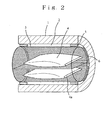
- the apparatus comprises a cylindrical sealed vessel 1 enclosing a processing chamber 2 in which a rotary cage 3 for receiving a gas-permeable container 4 containing frozen product of the material to be freez-dried, prepared preliminarily by mixing the material with dry ice, is installed rotatably under support on roller bearings 5.
- a heating device 6 surrounding the rotary cage 3 is arranged in the processing chamber 2 to heat the frozen objective material contained in the gas-permeable containers 4.
- the sealed vessel 1 is supported on a support 7 and provided at its one end with a closure lid 8 and at its another end with an electric motor 9 to serve for rotation of the rotary cage 3.
- the sealed vessel 1 is equipped at its said another end with an evacuation port 10 for evacuating the sublimated carbon dioxide gas and the moisture from the frozen objective material.
- the evacuation port 10 is connected via a conduit 11 provided with a valve V1 to a cold trap (13a, 13b, arranged here in two sets) via a connection line (12a, 12b) provided with a valve (V2, V3).
- the cold trap (13a, 13b) is constructed so as to be provided internally with a cooling element (15a, 15b) which is connected to a refrigerator 16 and on which the evacuated moisture from the processing chamber 2 is trapped under freezing.
- the cold trap (13a, 13b) is connected to a mechanical booster vacuum pump 17a via a connection line (14a, 14b) provided with a valve (V4, V5) and, then, to a oil rotary vacuum pump 17b in series, in order to maintain the finally adjusted degree of vacuum in the processing chamber 2 of, preferably, about 500 Pa.
- the heating device 6 ordinary type one may be employed, wherein preference is given to those based on heat ray radiation, though those based on heat conduction or convection may also be permissible.
- a plurality of ceramic heaters are used for the heating device 6 and are arranged over the inside face of the sealed vessel 1.
- the frozen objective materials to be freeze-dried retained in the gas-permeable container 4 are heated by exposing always refreshed surfaces thereof to the radiant heat rays of, such as far infrared, of the heating device 6 by holding them under rotational or swivelling movement in the container by the rotation of the rotary cage 3 receiving the container 4.
- that of a form of flat board may also be employed instead of the far infrared radiant ray heater.
- a control unit 20 serves for controling the operation of the apparatus in such a way that the electric power of an electric power supply unit 22 of the heating device 6 is controlled by an electric signal delivered from a CO 2 gas senser 24 located at a portion near the evacuation port 10 and/or by an electric signal delivered from a temperature detector 21a and/or by an electric signal delivered from a temperature detector 21b, such as a thermoeye, located on the sealed vessel 1 to detect the temperature through an inspection window 23.
- the refrigerator 16 of the cold trap (13a, 13b) is actuated by switching it on.
- the temperature of the cold trap (13a, 13b) reaches minus 40 °C or lower
- the gas-permeable containers 4 containing several pieces of frozen product of the objective material with their mouths 4a being sealed are placed in the rotary cage 3.
- the vacuum pumps 17a and 17b are actuated.
- the rotary cage 3 is caused to rotate at a revolution rate of 1 - 10 r.p.m., while operating the heating device 6 so as to heat uniformly the frozen product by irradiating them by the radiant heat rays.
- the sublimated large amount of carbon dioxide gas from dry ice during the dry ice sublimation period is exhausted out principally by the mechanical booster pump 17a in an efficient manner.
- the condition of sublimation of dry ice is monitored by a temperature detector 21a disposed at a position near the evacuation port 10.
- a temperature detector 21a disposed at a position near the evacuation port 10.
- an electric signal corresponding thereto is delivered from the control unit 20 to the electric power supply unit 22 to thereby adjust the electric power to the heating device 6 adaptively in accordance with the existing state of the sublimation of dry ice, in order to prevent occurrence of any deterioration of the quality of the freeze-dried product.
- the evacuation is effected mainly by the oil rotary vacuum pump 17b to cope with the change of sublimation state, whereby a highly efficient sublimation of frozen moisture is realized while maintaining a high degree of vacuum.
- the sublimated gaseous moisture from the frozen product is caught in the cold trap (13a, 13b), where it is collected by being frozen into ice, whereby the freeze-drying proceeds efficiently and the resulting freeze-dried product is preserved in the gas-permeable container 4 as the final product of manufacture.
- the processing chamber 2 is provided, on the one hand, with the heating device 6 which compensate the latent heats of sublimation of dry ice and of the included moisture from the frozen product in the gas-permeable container 4 and, on the other hand, with a rotary cage 3 which receives the gas-permeable containers 4 containing the frozen product and serves for maintaining the frozen product under rotating or swivelling movement to thereby prevent occurrence of adhesion of individuals the frozen product in the container to each other and to assure uniform irradiation of the frozen product by radiant heat rays, whereby the efficiency of freeze-drying can be increased and possible occurrence of deterioration of the quality of the freeze-dried product due to local heat accumulation can be prevented.
- the efficiency of vacuum-drying can be increased and, at the same time, any deterioration of quality of the freeze-dried product can be prevented.
- the freeze-dried objective material can be taken out from the sealed vessel 1 after it is freeze-dried and be stored in dry state.
Landscapes
- Engineering & Computer Science (AREA)
- Mechanical Engineering (AREA)
- General Engineering & Computer Science (AREA)
- Life Sciences & Earth Sciences (AREA)
- Chemical & Material Sciences (AREA)
- Combustion & Propulsion (AREA)
- Microbiology (AREA)
- Health & Medical Sciences (AREA)
- Molecular Biology (AREA)
- Drying Of Solid Materials (AREA)
- Freezing, Cooling And Drying Of Foods (AREA)
Claims (10)
- Procédé pour fabriquer un produit lyophilisé d'une substance devant être lyophilisée, comprenant les étapes consistant à
placer dans une cage rotative installée dans un récipient scellé d'un appareil de lyophilisation une pluralité de récipients perméables au gaz contenant un ou plusieurs produits congelés de la substance devant être lyophilisée qui sont obtenus en congelant la substance avec de la glace sèche et contiennent de la glace sèche et de l'humidité congelée ;
faire tourner la cage rotative pour soumettre le ou les produits congelés dans les récipients perméables au gaz à un mouvement de roulement et/ou une collision afin que les surfaces du produit congelées soient toujours rafraîchies tout en empêchant une adhérence de parties du produit congelé les unes aux autres ;
chauffer le produit congelé par un dispositif chauffant dans l'appareil de lyophilisation sous vide et
mettre le récipient scellé sous vide de manière à entraîner une sublimation de la glace sèche et de l'humidité congelée incluse dans la substance sous chauffage pour fabriquer le produit lyophilisé. - Procédé selon la revendication 1, dans lequel la lyophilisation est réalisée sous une variation de la condition de chauffage conformément à l'état de sublimation de la glace sèche.
- Procédé selon la revendication 2, dans lequel l'énergie du dispositif chauffant est réduite après que la sublimation de la glace sèche est terminée.
- Procédé selon l'une quelconque des revendications précédentes, dans lequel la lyophilisation est réalisée sous la variation de la condition d'évacuation conformément à l'état de sublimation de la glace sèche.
- Procédé selon la revendication 4, dans lequel la pression lors du chauffage et de l'évacuation se trouve dans la plage de 1 à 1 000 Pa, de préférence 1 à 10 Pa, et dans lequel la variation concerne l'élimination de gaz à une vitesse plus grande avant l'achèvement de la sublimation de la glace sèche, qu'après cela, et concerne l'obtention d'une pression plus faible après l'achèvement de la sublimation de la glace sèche qu'avant cela.
- Procédé selon l'une quelconque des revendications précédentes, comprenant l'étape préliminaire consistant à congeler la substance en la mélangeant, sous forme particulaire, avec de la glace sèche sous forme particulaire, puis à placer le mélange de substance congelée et de glace sèche dans le récipient perméable au gaz
- Appareil pour lyophiliser une substance devant être lyophilisée, comprenant
un récipient scellé (1) contenant une chambre de traitement (2), une pluralité de récipients perméables au gaz (4) destinés à contenir un ou plusieurs produits congelés de la substance devant être lyophilisée qui sont obtenus en congelant la substance avec de la glace sèche et qui contiennent de la glace sèche et de l'humidité congelée
une cage rotative (3) installée dans la chambre de traitement destinée à recevoir la pluralité de récipients perméables au gaz et tournant pour soumettre le ou les produits congelés dans les récipients perméables au gaz à un mouvement de roulement et/ou une collision afin que les surfaces du produit congelé soient toujours rafraîchies, tandis que l'adhérence de morceaux individuels du produit congelé les uns aux autres est empêchée
un dispositif chauffant (6) disposé de manière à permettre le chauffage de la substance congelée devant être lyophilisée,
un piège à froid (13a, 13b) avec un élément de refroidissement (15a, 15b), raccordé à la chambre de traitement et
une unité d'évacuation (17a, 17b) destinée à mettre la chambre de traitement à une pression réduite par l'intermédiaire du piège à froid. - Appareil selon la revendication 7, dans lequel le dispositif chauffant est construit de manière à permettre la variation de la condition de chauffage conformément à l'état de sublimation de la glace sèche.
- Appareil selon la revendication 7 ou 8, dans lequel l'unité d'évacuation est construite de manière à permettre la variation de la condition de l'évacuation conformément à l'état de sublimation de la glace sèche.
- Appareil selon l'une quelconque des revendications 7 à 9, dans lequel le dispositif chauffant est un réchauffeur à infrarouges lointains ayant un pic de rayonnement spectral élevé d'environ 4 µm.
Applications Claiming Priority (2)
| Application Number | Priority Date | Filing Date | Title |
|---|---|---|---|
| JP2001057345 | 2001-03-01 | ||
| JP2001057345 | 2001-03-01 |
Publications (3)
| Publication Number | Publication Date |
|---|---|
| EP1236962A2 EP1236962A2 (fr) | 2002-09-04 |
| EP1236962A3 EP1236962A3 (fr) | 2002-12-04 |
| EP1236962B1 true EP1236962B1 (fr) | 2006-06-07 |
Family
ID=18917237
Family Applications (1)
| Application Number | Title | Priority Date | Filing Date |
|---|---|---|---|
| EP01308802A Expired - Lifetime EP1236962B1 (fr) | 2001-03-01 | 2001-10-16 | Procédé et dispositif de fabrication d'un produit lyophilisé |
Country Status (3)
| Country | Link |
|---|---|
| US (1) | US6543154B2 (fr) |
| EP (1) | EP1236962B1 (fr) |
| DE (1) | DE60120346T2 (fr) |
Families Citing this family (22)
| Publication number | Priority date | Publication date | Assignee | Title |
|---|---|---|---|---|
| US20070294912A1 (en) * | 2006-05-11 | 2007-12-27 | Ernesto Renzi | Integrated heater/cooler |
| US8365432B2 (en) * | 2008-03-19 | 2013-02-05 | Morimoto-Pharma Co., Ltd. | Freeze-drying method and freeze-drying apparatus |
| US8056256B2 (en) * | 2008-09-17 | 2011-11-15 | Slack Associates, Inc. | Method for reconditioning FCR APG-68 tactical radar units |
| US8701307B2 (en) | 2008-09-17 | 2014-04-22 | Howard C. Slack | Method for cleaning and reconditioning FCR APG-68 tactical radar units |
| KR101067014B1 (ko) | 2009-04-10 | 2011-09-22 | 주식회사 제이오텍 | 동결 건조장치 |
| WO2010124375A1 (fr) * | 2009-04-28 | 2010-11-04 | Enwave Corporation | Appareil et procédé pour la déshydratation de matières biologiques |
| DE102010050281A1 (de) * | 2010-11-02 | 2012-05-03 | Hof Sonderanlagenbau Gmbh | Verfahren zur Überwachung eines Gefriertrocknungsprozesses und Gefriertrocknungsanlage hierfür |
| CN102183125A (zh) * | 2011-03-13 | 2011-09-14 | 烟台欧立特制药装备有限公司 | 一种冻干机的冷阱捕冰系统及捕冰方法 |
| US9845988B2 (en) | 2014-02-18 | 2017-12-19 | Supercooler Technologies, Inc. | Rapid spinning liquid immersion beverage supercooler |
| US9631856B2 (en) | 2013-01-28 | 2017-04-25 | Supercooler Technologies, Inc. | Ice-accelerator aqueous solution |
| US10302354B2 (en) | 2013-10-28 | 2019-05-28 | Supercooler Technologies, Inc. | Precision supercooling refrigeration device |
| US10149487B2 (en) | 2014-02-18 | 2018-12-11 | Supercooler Technologies, Inc. | Supercooled beverage crystallization slush device with illumination |
| USD778687S1 (en) | 2015-05-28 | 2017-02-14 | Supercooler Technologies, Inc. | Supercooled beverage crystallization slush device with illumination |
| WO2017078639A1 (fr) * | 2015-11-05 | 2017-05-11 | Türkyilmaz Murat | Séchoir avec simulation de rayonnement solaire |
| FR3050262B1 (fr) * | 2016-04-14 | 2018-04-13 | Jean Delaveau | Dispositif et procede de lyophilisation |
| JP6894450B2 (ja) | 2016-04-14 | 2021-06-30 | ジャン・ドゥラヴォー | 凍結乾燥方法及び装置 |
| FR3050261B1 (fr) * | 2016-04-14 | 2018-04-13 | Jean Delaveau | Dispositif et procede de lyophilisation |
| ITUA20163732A1 (it) * | 2016-06-20 | 2017-12-20 | Alfredo Ricci | Contenitore integro sigillato o tappato per preparati liquidi da sottoporre a processo di liofilizzazione senza apertura, foratura o intaglio del contenitore stesso. |
| CN108854137A (zh) * | 2018-08-30 | 2018-11-23 | 杭州赛威斯真空技术有限公司 | 冷屏、装有该冷屏的有机物升华提纯设备及其提纯方法 |
| CN109186220A (zh) * | 2018-11-21 | 2019-01-11 | 耒阳市金鑫农业科技发展有限公司 | 一种油茶果用干燥装置 |
| CN113702419B (zh) * | 2021-09-06 | 2024-05-07 | 浙江安胜科技股份有限公司 | 一种不锈钢真空器皿防护识别检测装置及检测方法 |
| CN114459210B (zh) * | 2021-12-27 | 2023-03-07 | 杭州富睿捷科技有限公司 | 一种冻干工艺参数的自动获取方法、装置和冻干机 |
Family Cites Families (18)
| Publication number | Priority date | Publication date | Assignee | Title |
|---|---|---|---|---|
| US2215265A (en) * | 1937-03-19 | 1940-09-17 | Earl W Flosdorf | Apparatus for the concentration and preservation of food products and biological substances |
| US2388917A (en) * | 1941-10-13 | 1945-11-13 | Hormel & Co Geo A | Process for preservation of biological materials and products resulting therefrom |
| DE1102654B (de) * | 1958-03-19 | 1961-03-16 | Leybold Hochvakuum Anlagen | Verfahren und Vorrichtung zum Gefriertrocknen |
| FR1378749A (fr) * | 1964-01-07 | 1964-11-13 | Leybold Hochvakuum Anlagen | Procédé et dispositif de séchage par congélation |
| US4275511A (en) * | 1979-12-26 | 1981-06-30 | Bio-Vac Incorporated | Evaporator/sublimator flask apparatus |
| US4455135A (en) * | 1980-12-23 | 1984-06-19 | Bitterly Jack G | Vacuum chamber and method of creating a vacuum |
| JPS57159044A (en) | 1981-03-27 | 1982-10-01 | Toshiba Corp | Semiconductor device |
| US4590684A (en) * | 1984-11-20 | 1986-05-27 | Eden Research Laboratories, Inc. | Continuous freeze drying |
| US5309649A (en) * | 1988-05-26 | 1994-05-10 | Boehringer Mannheim Gmbh | Process and container for freeze drying under sterile conditions |
| AT398849B (de) * | 1992-09-08 | 1995-02-27 | Sitte Hellmuth | Kammer zur gefriertrocknung durch kryosorption |
| US5433020A (en) * | 1993-04-29 | 1995-07-18 | Altos Engineering, Inc. | Apparatus and method for vacuum drying |
| AU4658296A (en) * | 1995-01-20 | 1996-08-07 | Freezedry Specialties, Inc. | Freeze dryer |
| AU4755196A (en) * | 1995-04-07 | 1996-10-23 | W.L. Gore & Associates, Inc. | A freeze-drying bag and method for minimizing contamination of freeze-dried products |
| DE29621917U1 (de) * | 1996-01-16 | 1997-02-27 | MULTIMATIC Reinigungs-Systeme GmbH & Co., 49324 Melle | Trocknungsvorrichtung |
| DE19719398A1 (de) * | 1997-05-07 | 1998-11-12 | Amsco Finn Aqua Gmbh | Verfahren zur Steuerung eines Gefriertrocknungsprozesses |
| US5787716A (en) * | 1997-06-13 | 1998-08-04 | Allen, Jr.; Russel G. | Dry ice sublimation cooling system utilizing a vacuum |
| US5937536A (en) * | 1997-10-06 | 1999-08-17 | Pharmacopeia, Inc. | Rapid drying oven for providing rapid drying of multiple samples |
| JP3005657B2 (ja) * | 1997-11-19 | 2000-01-31 | 彰 堀金 | 凍結乾燥方法、装置および凍結乾燥物 |
-
2001
- 2001-10-16 DE DE60120346T patent/DE60120346T2/de not_active Expired - Fee Related
- 2001-10-16 EP EP01308802A patent/EP1236962B1/fr not_active Expired - Lifetime
- 2001-10-17 US US09/981,378 patent/US6543154B2/en not_active Expired - Fee Related
Also Published As
| Publication number | Publication date |
|---|---|
| EP1236962A3 (fr) | 2002-12-04 |
| EP1236962A2 (fr) | 2002-09-04 |
| DE60120346D1 (de) | 2006-07-20 |
| US6543154B2 (en) | 2003-04-08 |
| US20020121029A1 (en) | 2002-09-05 |
| DE60120346T2 (de) | 2007-05-16 |
Similar Documents
| Publication | Publication Date | Title |
|---|---|---|
| US6543155B2 (en) | Freeze-dried product and process and apparatus for producing it | |
| US6543154B2 (en) | Freeze-dried product and process and apparatus for producing it | |
| JP3005657B2 (ja) | 凍結乾燥方法、装置および凍結乾燥物 | |
| US4347671A (en) | Vacuum-drying method and apparatus | |
| US4967651A (en) | Apparatus for sterilization of spices and leafy herbs | |
| US4569204A (en) | Method and apparatus for simultaneously cooling and conveying a food substance | |
| US20180168203A1 (en) | Device and method of dehydration of biological products | |
| CN103585648A (zh) | 自动旋转高压灭菌器及具有连续操作阶段的处理方法 | |
| CN113662220B (zh) | 一种仔姜冻干片制备系统及方法 | |
| JP3621072B2 (ja) | 凍結乾燥物、その製造方法および装置 | |
| JPH06101999B2 (ja) | 減圧膨化乾燥装置 | |
| Rulkens et al. | Retention of volatile compounds in freeze‐drying slabs of malto‐dextrin | |
| US2930139A (en) | Vacuum drying | |
| US3453741A (en) | System for freeze-drying | |
| CH313992A (fr) | Procédé de lyophilisation continu et appareil pour la mise en oeuvre du procédé | |
| JPH0642867A (ja) | タンブラー型回転乾燥機 | |
| EP0487600B1 (fr) | Procede et installation de production de substrat ou d'engrais de croissance thermotraites | |
| WO2023281486A1 (fr) | Appareil et procédé de séchage de produits alimentaires végétaux et animaux | |
| Stapley | Freeze drying | |
| JPH0942833A (ja) | 凍結乾燥方法および凍結乾燥装置 | |
| RU2033738C1 (ru) | Устройство для термической обработки зернистых пищевых продуктов | |
| WO2021040753A1 (fr) | Système de séchage de plante | |
| RU2140169C1 (ru) | Способ производства лекарственной субстанции - перги и установка для осуществления способа | |
| JP7535772B2 (ja) | 粉末体及び粉末体の製造方法 | |
| JP3124648U (ja) | 海苔香気成分の回収装置 |
Legal Events
| Date | Code | Title | Description |
|---|---|---|---|
| PUAI | Public reference made under article 153(3) epc to a published international application that has entered the european phase |
Free format text: ORIGINAL CODE: 0009012 |
|
| AK | Designated contracting states |
Kind code of ref document: A2 Designated state(s): AT BE CH CY DE DK ES FI FR GB GR IE IT LI LU MC NL PT SE TR |
|
| AX | Request for extension of the european patent |
Free format text: AL;LT;LV;MK;RO;SI |
|
| PUAL | Search report despatched |
Free format text: ORIGINAL CODE: 0009013 |
|
| AK | Designated contracting states |
Kind code of ref document: A3 Designated state(s): AT BE CH CY DE DK ES FI FR GB GR IE IT LI LU MC NL PT SE TR |
|
| AX | Request for extension of the european patent |
Free format text: AL;LT;LV;MK;RO;SI |
|
| 17P | Request for examination filed |
Effective date: 20030523 |
|
| AKX | Designation fees paid |
Designated state(s): DE FR GB |
|
| RAP1 | Party data changed (applicant data changed or rights of an application transferred) |
Owner name: INCORPORATED ADMINISTRATIVE AGENCY NATIONAL AGRICU |
|
| 17Q | First examination report despatched |
Effective date: 20050304 |
|
| GRAP | Despatch of communication of intention to grant a patent |
Free format text: ORIGINAL CODE: EPIDOSNIGR1 |
|
| RTI1 | Title (correction) |
Free format text: PROCESS AND APPARATUS FOR PRODUCING A FREEZE-DRIED PRODUCT |
|
| GRAS | Grant fee paid |
Free format text: ORIGINAL CODE: EPIDOSNIGR3 |
|
| GRAA | (expected) grant |
Free format text: ORIGINAL CODE: 0009210 |
|
| AK | Designated contracting states |
Kind code of ref document: B1 Designated state(s): DE FR GB |
|
| REG | Reference to a national code |
Ref country code: GB Ref legal event code: FG4D |
|
| REF | Corresponds to: |
Ref document number: 60120346 Country of ref document: DE Date of ref document: 20060720 Kind code of ref document: P |
|
| ET | Fr: translation filed | ||
| PLBE | No opposition filed within time limit |
Free format text: ORIGINAL CODE: 0009261 |
|
| STAA | Information on the status of an ep patent application or granted ep patent |
Free format text: STATUS: NO OPPOSITION FILED WITHIN TIME LIMIT |
|
| 26N | No opposition filed |
Effective date: 20070308 |
|
| PGFP | Annual fee paid to national office [announced via postgrant information from national office to epo] |
Ref country code: DE Payment date: 20071011 Year of fee payment: 7 |
|
| PGFP | Annual fee paid to national office [announced via postgrant information from national office to epo] |
Ref country code: FR Payment date: 20071009 Year of fee payment: 7 Ref country code: GB Payment date: 20071010 Year of fee payment: 7 |
|
| GBPC | Gb: european patent ceased through non-payment of renewal fee |
Effective date: 20081016 |
|
| REG | Reference to a national code |
Ref country code: FR Ref legal event code: ST Effective date: 20090630 |
|
| PG25 | Lapsed in a contracting state [announced via postgrant information from national office to epo] |
Ref country code: DE Free format text: LAPSE BECAUSE OF NON-PAYMENT OF DUE FEES Effective date: 20090501 |
|
| PG25 | Lapsed in a contracting state [announced via postgrant information from national office to epo] |
Ref country code: FR Free format text: LAPSE BECAUSE OF NON-PAYMENT OF DUE FEES Effective date: 20081031 |
|
| PG25 | Lapsed in a contracting state [announced via postgrant information from national office to epo] |
Ref country code: GB Free format text: LAPSE BECAUSE OF NON-PAYMENT OF DUE FEES Effective date: 20081016 |