EP1240032B1 - Hoch- und mittelleistungsluftreifen für kraftfahrzeuge - Google Patents
Hoch- und mittelleistungsluftreifen für kraftfahrzeuge Download PDFInfo
- Publication number
- EP1240032B1 EP1240032B1 EP00987316A EP00987316A EP1240032B1 EP 1240032 B1 EP1240032 B1 EP 1240032B1 EP 00987316 A EP00987316 A EP 00987316A EP 00987316 A EP00987316 A EP 00987316A EP 1240032 B1 EP1240032 B1 EP 1240032B1
- Authority
- EP
- European Patent Office
- Prior art keywords
- grooves
- sequence
- tyre according
- pairs
- tyre
- Prior art date
- Legal status (The legal status is an assumption and is not a legal conclusion. Google has not performed a legal analysis and makes no representation as to the accuracy of the status listed.)
- Expired - Lifetime
Links
- 238000000926 separation method Methods 0.000 claims description 3
- 238000000465 moulding Methods 0.000 claims description 2
- 239000011295 pitch Substances 0.000 description 23
- 238000005096 rolling process Methods 0.000 description 14
- 230000035882 stress Effects 0.000 description 11
- 239000013536 elastomeric material Substances 0.000 description 5
- 230000003014 reinforcing effect Effects 0.000 description 4
- 238000009877 rendering Methods 0.000 description 3
- XLYOFNOQVPJJNP-UHFFFAOYSA-N water Substances O XLYOFNOQVPJJNP-UHFFFAOYSA-N 0.000 description 3
- 230000015572 biosynthetic process Effects 0.000 description 2
- 150000001875 compounds Chemical class 0.000 description 2
- 230000000694 effects Effects 0.000 description 2
- 239000000945 filler Substances 0.000 description 2
- 238000004804 winding Methods 0.000 description 2
- 208000004188 Tooth Wear Diseases 0.000 description 1
- 230000003542 behavioural effect Effects 0.000 description 1
- 230000003247 decreasing effect Effects 0.000 description 1
- 230000006866 deterioration Effects 0.000 description 1
- 238000007599 discharging Methods 0.000 description 1
- 230000006355 external stress Effects 0.000 description 1
- 230000002349 favourable effect Effects 0.000 description 1
- 238000005259 measurement Methods 0.000 description 1
- 239000000203 mixture Substances 0.000 description 1
- 238000012986 modification Methods 0.000 description 1
- 230000004048 modification Effects 0.000 description 1
- 238000005457 optimization Methods 0.000 description 1
- 230000002028 premature Effects 0.000 description 1
- 239000013589 supplement Substances 0.000 description 1
- 239000004753 textile Substances 0.000 description 1
- 230000000930 thermomechanical effect Effects 0.000 description 1
Images


Classifications
-
- B—PERFORMING OPERATIONS; TRANSPORTING
- B60—VEHICLES IN GENERAL
- B60C—VEHICLE TYRES; TYRE INFLATION; TYRE CHANGING; CONNECTING VALVES TO INFLATABLE ELASTIC BODIES IN GENERAL; DEVICES OR ARRANGEMENTS RELATED TO TYRES
- B60C11/00—Tyre tread bands; Tread patterns; Anti-skid inserts
- B60C11/03—Tread patterns
- B60C11/032—Patterns comprising isolated recesses
-
- B—PERFORMING OPERATIONS; TRANSPORTING
- B60—VEHICLES IN GENERAL
- B60C—VEHICLE TYRES; TYRE INFLATION; TYRE CHANGING; CONNECTING VALVES TO INFLATABLE ELASTIC BODIES IN GENERAL; DEVICES OR ARRANGEMENTS RELATED TO TYRES
- B60C11/00—Tyre tread bands; Tread patterns; Anti-skid inserts
- B60C11/03—Tread patterns
- B60C11/0302—Tread patterns directional pattern, i.e. with main rolling direction
-
- B—PERFORMING OPERATIONS; TRANSPORTING
- B60—VEHICLES IN GENERAL
- B60C—VEHICLE TYRES; TYRE INFLATION; TYRE CHANGING; CONNECTING VALVES TO INFLATABLE ELASTIC BODIES IN GENERAL; DEVICES OR ARRANGEMENTS RELATED TO TYRES
- B60C11/00—Tyre tread bands; Tread patterns; Anti-skid inserts
- B60C11/03—Tread patterns
- B60C11/0306—Patterns comprising block rows or discontinuous ribs
-
- B—PERFORMING OPERATIONS; TRANSPORTING
- B60—VEHICLES IN GENERAL
- B60C—VEHICLE TYRES; TYRE INFLATION; TYRE CHANGING; CONNECTING VALVES TO INFLATABLE ELASTIC BODIES IN GENERAL; DEVICES OR ARRANGEMENTS RELATED TO TYRES
- B60C11/00—Tyre tread bands; Tread patterns; Anti-skid inserts
- B60C11/03—Tread patterns
- B60C11/0327—Tread patterns characterised by special properties of the tread pattern
- B60C11/033—Tread patterns characterised by special properties of the tread pattern by the void or net-to-gross ratios of the patterns
-
- B—PERFORMING OPERATIONS; TRANSPORTING
- B60—VEHICLES IN GENERAL
- B60C—VEHICLE TYRES; TYRE INFLATION; TYRE CHANGING; CONNECTING VALVES TO INFLATABLE ELASTIC BODIES IN GENERAL; DEVICES OR ARRANGEMENTS RELATED TO TYRES
- B60C11/00—Tyre tread bands; Tread patterns; Anti-skid inserts
- B60C11/03—Tread patterns
- B60C2011/0337—Tread patterns characterised by particular design features of the pattern
- B60C2011/0339—Grooves
- B60C2011/0374—Slant grooves, i.e. having an angle of about 5 to 35 degrees to the equatorial plane
-
- B—PERFORMING OPERATIONS; TRANSPORTING
- B60—VEHICLES IN GENERAL
- B60C—VEHICLE TYRES; TYRE INFLATION; TYRE CHANGING; CONNECTING VALVES TO INFLATABLE ELASTIC BODIES IN GENERAL; DEVICES OR ARRANGEMENTS RELATED TO TYRES
- B60C11/00—Tyre tread bands; Tread patterns; Anti-skid inserts
- B60C11/03—Tread patterns
- B60C2011/0337—Tread patterns characterised by particular design features of the pattern
- B60C2011/0386—Continuous ribs
- B60C2011/0388—Continuous ribs provided at the equatorial plane
-
- Y—GENERAL TAGGING OF NEW TECHNOLOGICAL DEVELOPMENTS; GENERAL TAGGING OF CROSS-SECTIONAL TECHNOLOGIES SPANNING OVER SEVERAL SECTIONS OF THE IPC; TECHNICAL SUBJECTS COVERED BY FORMER USPC CROSS-REFERENCE ART COLLECTIONS [XRACs] AND DIGESTS
- Y10—TECHNICAL SUBJECTS COVERED BY FORMER USPC
- Y10S—TECHNICAL SUBJECTS COVERED BY FORMER USPC CROSS-REFERENCE ART COLLECTIONS [XRACs] AND DIGESTS
- Y10S152/00—Resilient tires and wheels
- Y10S152/903—Non-directional tread pattern having non-circumferential transverse groove following smooth curved path
Definitions
- the invention relates to a high and medium performance tyre for vehicles and, more particularly, to a tyre having characteristics that are especially though not exclusively suitable for use on winding circuits and dry roads.
- a tyre in its more general form comprises: a casing structure including a central crown portion and two axially opposite sides terminating in a pair of ribs for the attachment to the rim of a wheel; a belt structure coaxially associated with the casing structure and a tread band extended coaxially around the belt structure.
- the tread band comprises a raised pattern formed by a plurality of transversal and longitudinal grooves giving rise overall to a plurality of ribs distributed according to configurations of differing types, for example along a central zone straddling the equatorial plane and in at least two shoulder zones extending in positions coaxially opposite the central zone.
- the ribs on the tread strip are subjected to a set of thermo-mechanical stresses, which are all the greater the more severe the conditions of use and which result in changes to their geometry and, over varying time periods, to a deterioration in the tyre's performance.
- JP 53 100503 corresponding with the preamble of claim 1, relates to a tire for motor bicycle, having on its surface subsidiary grooves extending with inclination angle of 0° - 40° to the line perpendicular to the rotational direction of tire, wherein two back angles of said subsidiary grooves are made different from each other to make wear of tire uniform all over the surface.
- the patent application WO 98/25776 refers to a tyre comprising a tread band provided with transversal grooves in three distinct zones, a central zone straddling the equatorial plane and two shoulder zones, so as to define a directional type tread profile, i.e. one having a preferential direction of rotation.
- Each transversal groove comprises a first stretch extending within a shoulder zone according to a direction perpendicular to the equatorial plane and a second stretch extending obliquely inside the equatorial zone.
- transversal grooves are distributed circumferentially with a pitch "p" and extend alternatively from opposite shoulder zones.
- the transversal grooves are distributed in groups; and more specifically, the tread band comprises a first group of three grooves, parallel to one another, repeated circumferentially with a pitch "P" on the left of the equatorial plane and alternating with a second group of three grooves, parallel to one another, and repeated with an identical pitch "P" on the right of the equatorial plane.
- each group the grooves are of decreasing length in the direction of motion of the tyre, such that one of the grooves passes through the equatorial plane whereas the remaining two grooves are terminated in the vicinity of the equatorial plane, at a different distance from the latter.
- the configuration of the transversal grooves is such as to produce, in the space between the alternating groups, a central rib extending circumferentially in continuously zigzag fashion and a plurality of
- transversal blocks that leave from the central rib and stretch obliquely right and left of the equatorial plane in the direction opposite that of rolling of the tyre.
- the state of the art has not fully solved the problem of producing a tyre provided with a tread pattern that may regardlessly be of the symmetrical, asymmetrical or directional type and at the same time be capable of minimizing and rendering even the wear of the tread band while the tyre is rolling, and of improving and rendering uniform the longitudinal and transversal rigidity so as to ensure an effective stability both on the straight and in bends on dry roads, all of which without impairing the characteristics of low rolling resistance, of sufficiently quiet operation and of good driveability including on terrains that are not dry, for example on roads that are wet or covered in snow.
- the tyre described in patent WO 98/25776 has transversal grooves extending with continuity and great density from the shoulder zones to the zone straddling the equatorial plane, thereby giving rise to a plurality of narrow and elongated blocks, arranged obliquely to the equatorial plane and excessively deformable. In this way, uneven wear may occur of the elastomeric material delimiting these grooves, particularly under conditions where the tyre is rolling on a straight, dry road or at any rate under conditions where the stresses acting along the equatorial plane are considerably greater than those acting in a direction perpendicular to this plane.
- a preferred solution consists in providing each intermediate zone, at a predetermined distance from the equatorial zone, with a plurality of transversal grooves, arranged in groups axially opposite each other and at a reciprocal predetermined distance, in such a way that in the space between said grooves a circumferential, continuous rib is defined having a typically zigzag configuration.
- the solution found may be optimized by giving to the central zone of the tread band particular geometric characteristics not present in the other zones (intermediate and/or shoulder) and/or at any rate a pattern different from that of the intermediate and/or shoulder zones in such a way as to obtain an effect of synergy suitable to improve or supplement the performances offered by the patterns of those zones.
- the Applicant has found particular advantage in the differentiating of the density of the transversal grooves possessed by the shoulder zones and by the intermediate zones adjacent thereto, in such a way as to distribute the grooves of the intermediate zones according to a module repeated circumferentially with a pitch different from that with which said grooves are distributed in the shoulder zones.
- the invention relates to a tyre for vehicles according to claim 1.
- Each intermediate zone advantageously comprises a continuous, zigzagging rib and a plurality of continuous, i.e. full, portions of elastomeric material which leave transversally from both sides of each zigzagging rib.
- the reciprocal configuration of the two sequences of transversal grooves means that it is possible to move from one end of each intermediate zone to the other (i.e. from the a-a plane to the b-b plane, or vice versa) without intersecting any groove. Accordingly ample transversal zones are obtained in said intermediate zones that confer undeformability characteristics on the tread band that are particularly favourable for resisting the stresses acting in a bend when the tyre is rolling.
- each pair of grooves has one groove that is longer than the other. Therefore, for the sake of simplicity in the remainder of this description, where reference is made to the abovementioned preferred embodiment, the transversal grooves of each pair shall be indicated as long groove and short groove. In addition, the two ends of each transversal groove shall be indicated respectively as the terminal end and the starting end, both when referring to a groove in position inside the intermediate zone and when considering an opposite groove.
- terminal ends of the long grooves of a pair of grooves belonging to a given sequence are aligned with the terminal ends of the short grooves of a consecutive pair of grooves belonging to the other sequence, and vice versa.
- the pairs of grooves belonging to a given sequence comprise blind grooves.
- blind groove means a groove surrounded by continuous walls without any way in and/or out of the groove in question.
- the grooves of said sequence of pairs are of like shape and, still more preferably, said shape is elliptical.
- transversal grooves of the intermediate zones and the adjacent ones possessed by the shoulder zones may or may not be staggered with respect to each other.
- pairs of transversal grooves of the sequence nearest to the shoulder zone, adjacent to the intermediate zone to which said pairs belong are joined consecutively to the transversal grooves possessed by said shoulder zone.
- the shoulder transversal grooves are arranged perpendicularly to the equatorial plane of the tyre.
- the succession of a pair of transversal grooves respectively of the first and of the second sequence gives rise in the intermediate zone to a module that is repeated circumferentially with a pitch twice the pitch of the transversal grooves found in the shoulder zone.
- the difference between said pitches creates a discontinuity of the edges of the tread along the footprint area which, to its greater advantage, improves noiselessness of the tyre.
- the central zone of the tread band straddling the equatorial plane comprises two circumferential grooves delimiting therein a central rib.
- said central zone comprises a single circumferential groove, preferably of the rectilinear type.
- said one or more central grooves promote the draining of water during rolling of the tyre on wet roads avoiding the formation of a film of water between tyre and road.
- the invention in a second aspect, relates to a premoulded tread band for the re-moulding of worn tyres according to claim 26.
- the transversal grooves of said intermediate zones have an elliptical configuration; still more preferably, the greater axes of said ellipses together form a predetermined angle ⁇ of between 80° and 100°.
- the greater axes of the ellipses corresponding to the transversal grooves of the pairs of grooves of said first sequence form an angle ⁇ of between 35° and 55° with respect to a plane parallel to the equatorial plane Y-Y.
- the grooves of each pair are of different lengths and each of the terminal ends of the grooves of a pair of said sequence is aligned with a like number of terminal ends of the grooves of an axially opposite pair of the other sequence. More particularly, the terminal ends of the longer grooves of the first sequence are aligned with the terminal ends of the shorter grooves axially opposite, that is to say belonging to the second sequence and, by the same token, the terminal ends of the shorter grooves of the first sequence are aligned with the terminal ends of the longer grooves belonging to the second sequence.
- the tread band is characterized in that all the transversal grooves with starting ends near the central zone are blind.
- the tread band according to the invention has a ratio between the width of the central zone and the width (W) of the tread band that is between 0.10 and 0.20 and a ratio between the width of an intermediate zone (L 0 ) and the width of the same tread band of between 0.17 and 0.30.
- the two intermediate zones are of equal width.
- each intermediate zone of the tread band has a full/empty ratio that is between 0.75 and 0.90.
- a high performance tyre for vehicles is generically indicated with the numeral 1, in particular a tyre intended to be fitted on the front axle of a motor vehicle.
- the tyre 1 comprises a casing structure 2, including a central crown portion 3 and two sides 4, 5, said casing structure being provided with a reinforcing ply 2a the opposite ends of which 2b, 2c are wound around corresponding rings 6, 7.
- An elastomeric filler 8 occupying the space defined between the reinforcing ply 2a and the corresponding ends 2b, 2c of the reinforcing ply 2a, is applied to the radially external perimeter edge of the rings 6, 7, arranged in correspondence with the radially internal ends of said sides 4, 5.
- the opposite zones of the tyre 1, each comprising a ring 6, 7 and the filler 8, form the so-called ribs, globally indicated with the numerals 9 and 10, adapted for the attachment of the tyre 1 to a corresponding mounting rim 11 of the wheel of a vehicle.
- a belt structure 12 Coaxially associated with the abovementioned casing structure 2 is a belt structure 12 comprising one or more reinforcing strips 13, made from textile or metallic cords coated in a given compound.
- the tread band 14 is subdivided into a plurality of zones, more precisely:
- the central zone E comprises a central rib 15 with width between 12 and 20 mm and two longitudinal grooves 16 disposed respectively on either side of said rib 15.
- the rib 15 confers on the tyre 1 a suitable longitudinal stability during rolling and the two longitudinal grooves 16 promote the expulsion of water under conditions of travelling on wet roads.
- the central zone E straddles the equatorial plane Y-Y for a stretch equal to at least 10% of the axial width W of the tread band 14, measured between the planes c-c disposed in correspondence with the lateral edges of said tread band.
- the tread band 14 comprises a plurality of transversal grooves, preferably of elongated elliptical shape, according to a configuration comprising two sequences of pairs of grooves repeated circumferentially.
- each intermediate zone F comprises a first sequence of pairs of grooves 17 and a second sequence of pairs of grooves 18 consecutively arranged along the circumferential direction, said second sequence being axially opposite said first sequence along all of the circumferential development.
- each pair of said sequences is made from two distinct grooves, a long one and a short one, at least partly parallel.
- the grooves of said second pairs 18 are of the blind type.
- each pair 17, 18 the longitudinal axis of the short groove has a length that is between 30% and 70% of the length of the long groove. Furthermore the distance "1" between the long groove and the short groove of each pair is between 15 mm and 40 mm, said distance being measured perpendicularly to the longitudinal axis of each groove.
- ⁇ is of 90°.
- all the transversal grooves of the pairs 17 of the first sequence start from the axial planes b-b of separation from the shoulder zones G and terminate with ends 19, 20 at a distance "d" from the longitudinal axis of the respective long grooves of the pairs 18 of the second sequence.
- all the transversal grooves of the pairs 18 of the second sequence start from ends of the intermediate zone F axially opposite the pairs 17 of the first sequence and terminate with ends 21, 22 at distance "d" from the longitudinal axis of the respective long grooves of the pairs 17 of the first sequence.
- the distance "d” is between 5 mm and 25 mm.
- the starting ends of the grooves of the pairs 18 are aligned on one and the same plane, the distance "D" of which from the equatorial plane Y-Y is between 14 mm and 32 mm.
- all the transversal grooves of said pairs 17, 18 have a width of between 3.5 mm and 10 mm and a maximum depth of between 5 mm and 10 mm.
- the tread band 14 comprises further transversal grooves in the shoulder zones G, each of said grooves comprising at least one rectilinear stretch 24 which, with respect to the equatorial plane Y-Y, forms an angle not less than 85° and preferably of 90°.
- each shoulder transversal groove is formed from two stretches 23 and 24, the first (23) approximately 8 mm wide and between 5 mm and 10 mm deep and the second (24) approximately 4 mm wide and between 1 mm and 6 mm deep. Moreover the ratio between the lengths of said two stretches 23, 24 is between 30% and 50%.
- the stretches 23 of the shoulder grooves are joined by a curving stretch to the abovementioned transversal stretches of the pairs 17 of the first sequence belonging to the intermediate zone F.
- this joining stretch is an arc of a circle with radius between 30 mm and 60 mm.
- the pattern of the tread band 14 in the shoulder zones G is discerned mainly from a plurality of transversal grooves 23, 24 repeated circumferentially with a pitch "p".
- the abovementioned joining sections, which join the grooves of the shoulder zones G and the transversal grooves of the pairs 17 of the intermediate zones F, are repeated circumferentially with a like pitch "p".
- the pattern of the intermediate zones F is discerned from pairs of transversal grooves 17, 18 which alternate along the circumferential direction giving rise to a module which is repeated along the circumferential development of the tread band, with a pitch "P" different from the pitch "p" of the shoulder transversal grooves.
- the pitch "P” has a value substantially twice that of the pitch "p".
- a tread band having a single pitch "p” has been described but it will be obvious that the above also applies for tread bands with a pitch "p" circumferentially variable according to a predetermined law, for example with alternations of pitches "p" of two different lengths, respectively a long pitch and a short pitch.
- pitches "p" of between 25 mm and 50 mm when the circumferential development of the tyre, measured along the equatorial plane at the outermost point of the tread band, is between 1750 mm and 2200 mm.
- each shoulder zone G the tread band 14 of the tyre 1 comprises a longitudinal notch 25, also called “disconnection notch” and a longitudinal incision 26.
- the notch 25 and the incision 26 are extended circumferentially in a direction substantially perpendicular to the shoulder transversal grooves 23, 24.
- the longitudinal notch 25 has a depth of about 2 mm and a width of about 3 mm, whereas the longitudinal incision 26 has a width of about 1.5 mm and a depth of between 3 mm and 7 mm.
- Said incisions and notches advantageously improve handling on the wet.
- each shoulder zone G the tyre 1 also comprises a plurality of transversal notches 27 placed between two consecutive shoulder transversal grooves 23,24.
- These notches 27 have a depth of approximately 4 mm and a width of approximately 3 mm and extend axially along a section between the longitudinal notch 25 and the longitudinal incision 26.
- a further embodiment of the invention is illustrated in figure 3 concerning a particular tyre 28 of the directional type, that is to say provided with an overall pattern having a predetermined direction of rolling (indicated with the arrow R in figure 3) and two intermediate F and shoulder G zones of the tread band, located at the sides of the equatorial plane Y-Y, which are repeated specularly on either side of said equatorial plane.
- the two halves of the tread band 28 comprise the same pattern characteristics as described previously, therefore the elements of the tyre 28 structurally or functionally the same as those already illustrated with reference to the tyre 1 shown in figures 1 and 2 will be indicated using the same reference numerals and will not be described any further.
- the intermediate F and shoulder G zones of the tread band 28, as well as being specular with respect to the equatorial plane Y-Y, are also staggered in the circumferential direction by an amount equal to approximately 50% of the pitch "p" of the shoulder transversal grooves.
- each shoulder zone G having been defined with L and the width of the tread band measured between the planes c-c with W
- the preferred embodiments of the tyre according to this invention envisage a ratio L/W of preferably between 0.10 and 0.28.
- a first advantage consists, for example, in the fact that by having defined a system of transversal grooves which never intersect in the two intermediate zones .F, the tread band is endowed with a considerable ability of reaction in relation to the external stress forces.
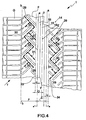
- the intermediate zones F of the tread band 1 comprise a particular pattern the geometrical characteristics of which depend, among other things, on the distance "1" between the two grooves of a same pair (17, 18), on the particular conformation of the space between the two grooves of a same pair, on the distance "d” between the two pairs of transversal grooves 17, 18 distributed in a pitch "P”, and on the orientation of all the pairs among themselves and in relation to the equatorial plane Y-Y.
- These characteristics result in the formation, in each intermediate zone F, of a rib extending in zigzag fashion for the entire circumferential development and a plurality of continuous portions of elastomeric material which depart obliquely from both sides of said zigzagging rib.
- the two zigzag ribs 29 and the oblique portions 30, 31 are formed from continuous parts of elastomeric material allowing them to oppose the stresses exerted by the ground on the tyre during rolling.
- the resulting stresses have a direction on the tyre depending both on the resistance characteristics of the compound used in the tread band and on the prevalence of one of the two forces directed in the running direction or in the transversal direction.
- the plurality of oblique portions 30, 31 disposed as illustrated in figure 4 constitute "struts" suitable for discharging the quoted resultant stresses along their axis.
- these ribs with their resistance will also contribute to elastically balancing the stresses acting on the tyre.
- the active struts will be those relative to the plurality of portions 30 also oriented in the direction of said resulting inside the two intermediate zones.
- the tyre according to the invention is favourably suitable for use on winding circuits.
- the uniform rigidity of the two intermediate zones F contributes greatly to minimizing the phenomena of tread band wear and to rendering said phenomena even so as to avoid uneven wear of said band.
- a further advantage of the tyre according to the invention consists of the fact that, thanks to the alternating distribution of the pairs of transversal grooves of the first and second sequence belonging to said intermediate zones and the great density of the transversal grooves in the shoulder zones, the number of transversal grooves present in the footprint area during the rolling of the tyre is maintained advantageously constant.
- This aspect signifies the optimization of the distribution of the pressures in the footprint area during rolling of the tyre.
- a further advantage of this invention consists of the fact that the pattern of the tread band has a high of full/empty ratio.
- the high full/empty ratio is determined not only by the presence of the continuous zigzagging ribs of elastomeric material 29 and of the oblique portions 30, 31 which depart obliquely therefrom, but also by the presence of longitudinal ribs 33, 34 included between the starting ends of the grooves of the pairs 18 of the second sequence of the intermediate zones F and the planes a-a of separation of the intermediate zones F from the central zone E.
- the width "T" of the ribs 33, 34 is between 3 mm and 21 mm.
- the presence of the continuous ribs 33, 34 ensures that the portion of intermediate zone F closest to the central zone E has a greater rigidity than that possessed by the remainder of the intermediate zone F adjacent to the shoulder zone G.
- the high full/empty ratio with values between 0.65 and 0.85 entails low values of the specific pressures in the footprint area and low deformability of the tread band in this area with resultant advantageous attenuation of the noise of the tyre of the invention.
- the tyre according to the invention having transversal grooves in the intermediate zones F mutually isolated and separated from the equatorial plane Y-Y through the central zone E has lesser deformability than tyres not provided with transversal grooves running from the shoulder zones up to near the equatorial plane, and sometimes beyond. Therefore, thanks to a tread band of greater mass than the known tyres, this tyre is advantageously endowed not only with less noise, but also with less resistance to rolling.
- said tyre comprises a tread band provided in the intermediate zones with a plurality of blind transversal grooves capable of capturing and retaining the snow, substituting the rubber-snow friction with a snow-snow friction, the latter as is known being much greater than the former.
Landscapes
- Engineering & Computer Science (AREA)
- Mechanical Engineering (AREA)
- Tires In General (AREA)
- Connection Of Motors, Electrical Generators, Mechanical Devices, And The Like (AREA)
Claims (26)
- Reifen für Fahrzeugräder- mit einem Karkassenaufbau (2), der einen zentralen Kronenabschnitt (3) und zwei axial gegenüberliegende Seiten (4, 5) hat, die in einem Paar von Rippen zum Festlegen des Reifens an einer entsprechenden Radfelge enden;- mit einem Gurtaufbau (12), der dem Karkassenaufbau (2) koaxial zugeordnet ist; und- mit einem Laufflächenband (14), das sich koaxial um den Gurtaufbau (12) herum erstreckt und mit einem Reliefmuster ausgeformt ist, dasdadurch gekennzeichnet,-- eine zentrale Zone (E), die die Äquatorialebene (Y-Y) des Reifens rittlings überspannt und sich zwischen zwei zentralen Ebenen (a-a) erstreckt, die im Wesentlichen parallel zu der Äquatorialebene sind,-- zwei Zwischenzonen (F), von denen sich jede zwischen einer Seite der zentralen Zone (E) und einer Zwischenebene (b-b) erstreckt, die im Wesentlichen parallel zur Äquatorialebene (Y-Y) ist, und-- zwei Schulterzonen (G) aufweist, von denen sich jede zwischen der axial äußersten Seite einer der Zwischenzonen (F) und einer axial äußeren Ebene (c-c) erstreckt, die im Wesentlichen parallel zu der Äquatorialebene (Y-Y) ist und in Übereinstimmung mit dem Seitenrand des Laufflächenbandes angeordnet ist,-- wobei die Zwischenzonen (F) und die Schulterzonen (G) eine Vielzahl von Quernuten (23, 24) aufweisen,-- wobei jede Zwischenzone (F) zwei Folgen von Paaren (17, 18) von Quernuten, nämlich eine erste bzw. eine zweite Folge aufweist,-- wobei die Paare (17) der ersten Sequenz sich über der gesamten Umfangslänge des Reifens mit den Paaren (18) der zweiten Sequenz aufeinanderfolgend abwechseln und-- wobei die Nuten der ersten Sequenz von axial gegenüberliegenden Enden der Zwischenzonen (F) ausgehen und mit Enden innerhalb der Letzteren enden,- dass jedes Paar (17, 18) zwei unterschiedliche, wenigstens teilweise parallele Nuten aufweist,- wobei die Nuten eines jeden Paars (17) der ersten Sequenz mit einem vorgegebenen Winkel (α) zu den Nuten eines jeden Paars (18) der zweiten Sequenz geneigt sind,- wobei die inneren Enden eines Paars (17, 18) einer gegebenen Sequenz sich in einem vorgegebenen Abstand (d) von der Nut des Paars (17, 18) der anderen Sequenz in nächster Nähe zu den Enden befinden,- wobei der vorgegebene Abstand (d) am Umfang eine fortlaufende Zickzack-Rippe entstehen lässt, von der fortlaufende schräge Abschnitte abwechselnd von gegenüberliegenden Enden ausgehen, und- wobei jeder schräge Abschnitt von den Nuten eines der Paare (17, 18) begrenzt wird.
- Reifen nach Anspruch 1, dadurch gekennzeichnet, dass die Quernuten der Zwischenzone (F) längenmäßig durch im Wesentlichen geradlinige Wände begrenzt werden und zueinander parallel sind.
- Reifen nach Anspruch 1, dadurch gekennzeichnet, dass der vorgegebene Winkel (α) zwischen 80° und 100° liegt.
- Reifen nach Anspruch 3, dadurch gekennzeichnet, dass die Nuten der Paare (17) der ersten Sequenz bezüglich einer zu der Äquatorialebene (Y-Y) parallelen Ebene einen Winkel (γ) zwischen 35° und 55° bilden.
- Reifen nach Anspruch 1, dadurch gekennzeichnet, dass jedes der Paare (17, 18) eine Nut aufweist, die länger als die andere ist.
- Reifen nach Anspruch 5, dadurch gekennzeichnet, dass die kurze Nut eines jeden Paars (17, 18) eine Länge hat, die zwischen 30% und 70% der langen Nut beträgt.
- Reifen nach Anspruch 1, dadurch gekennzeichnet, dass die Abschlussenden (19, 21) der langen Nuten eines Paars (17, 18) fluchtend zu den Abschlussenden der kurzen Nuten (20, 22) des anderen Paars (17, 18) und umgekehrt ausgerichtet sind.
- Reifen nach Anspruch 7, dadurch gekennzeichnet, dass die Abschlussenden (19) der langen Nuten der Paare (17) der ersten Sequenz und die Abschlussenden (22) der kurzen Nuten der zweiten Sequenz fluchtend auf einer Umfangsebene ausgerichtet sind, deren Abstand (D1) von der Äquatorialebene jeweils zwischen 22 mm und 82 mm beträgt.
- Reifen nach Anspruch 7, dadurch gekennzeichnet, dass die Abschlussenden (20) der kurzen Nuten der Paare (17) der ersten Sequenz und die Abschlussenden (21) der langen Nuten der Paare (18) der zweiten Sequenz fluchtend auf einer Umfangsebene ausgerichtet sind, deren Abstand (D2) von der Äquatorialebene zwischen 30 mm und 95 mm beträgt.
- Reifen nach Anspruch 1, dadurch gekennzeichnet, dass die Nuten der Paare (18) der zweiten Sequenz zu der Innenseite der Zwischenzone (F) ausgehend von einer Ebene verlängert sind, deren Abstand (D) von der Äquatorialebene (Y-Y) zwischen 14 mm und 32 mm beträgt.
- Reifen nach Anspruch 1, dadurch gekennzeichnet, dass die Nuten der Paare (18) der zweiten Sequenz blind sind.
- Reifen nach Anspruch 1, dadurch gekennzeichnet, dass der vorgegebene Abstand zwischen den Innenenden eines Paars (17, 18) und der Längsachse der nächsten Nut des axial gegenüberliegenden Paars (17, 18) auf der ganzen Umfangsabwicklung konstant ist.
- Reifen nach Anspruch 1, dadurch gekennzeichnet, dass die Quernuten der Zwischenzone (F) eine Tiefe zwischen 5 mm und 10 mm haben.
- Reifen nach Anspruch 1, dadurch gekennzeichnet, dass die Quernuten der Zwischenzone (F) eine Breite zwischen 3,5 mm und 10 mm haben.
- Reifen nach Anspruch 1, dadurch gekennzeichnet, dass die Nuten der Paare (17) der ersten Sequenz der Zwischenzone (F) und die Quernuten der Schulterzone (G) geradlinig sind und miteinander durch eine gekrümmte Strecke mit einem Krümmungsradius zwischen 30 mm und 60 mm verbunden sind.
- Reifen nach Anspruch 1, dadurch gekennzeichnet, dass die Quernuten der Schulterzone (G) eine zur Äquatorialebene (Y-Y) senkrechte Strecke aufweisen.
- Reifen nach Anspruch 1, dadurch gekennzeichnet, dass die Teilung der Quernuten der Zwischenzone (G) zweimal so groß wie die der Schulterquemuten ist.
- Reifen nach Anspruch 1, dadurch gekennzeichnet, dass die Quernuten der Schulterzone (G) eine Tiefe zwischen 5 mm und 10 mm haben.
- Reifen nach Anspruch 1, dadurch gekennzeichnet, dass die Quernuten der Schulterzone (G) eine Breite zwischen 3,5 mm und 10 mm haben.
- Reifen nach Anspruch 1, dadurch gekennzeichnet, dass das Verhältnis der Breite (L0) einer jeden Zwischenzone (F) zu der Breite (W) des Laufflächenbandes zwischen 0,17 und 0,30 liegt.
- Reifen nach Anspruch 1, dadurch gekennzeichnet, dass das Verhältnis der Breite der zentralen Zone (E) zu der Breite (W) des Laufflächenbandes zwischen 0,10 und 0,20 liegt.
- Reifen nach Anspruch 1, dadurch gekennzeichnet, dass die zentrale Zone (E) zwei Umfangsnuten aufweist, die innen eine zentrale Rippe begrenzen.
- Reifen nach Anspruch 1, dadurch gekennzeichnet, dass der Teil des Laufflächenbandes (14) auf der linken Seite der Äquatorialebene (Y-Y) bei einer Drehung um 180° den rechtsseitigen Teil bildet.
- Reifen nach Anspruch 1, dadurch gekennzeichnet, dass der Teil des Laufflächenbandes (14) auf der linken Seite der Äquatorialebene (Y-Y) zu dem rechtsseitigen Teil spiegelnd ist.
- Reifen nach Anspruch 1, dadurch gekennzeichnet, dass die Quernuten der Paare (17) der ersten Sequenz von den Axialebenen (b-b) der Trennung von den Schulterzonen (G) ausgehen und mit Enden (19, 20) in einem Abstand "d" von der Längsachse der jeweiligen langen Nuten der Paare (18) der zweiten Sequenz abschließen.
- Vorgeformtes Laufflächenband zum Runderneuern von verschlissenen Reifen, dadurch gekennzeichnet, dass es ein Laufflächenmuster nach einem der vorhergehenden Ansprüche aufweist.
Applications Claiming Priority (5)
| Application Number | Priority Date | Filing Date | Title |
|---|---|---|---|
| ITMI992516 | 1999-12-01 | ||
| IT1999MI002516A IT1314249B1 (it) | 1999-12-01 | 1999-12-01 | Pneumatico per vetture ed alte e medie prestazioni. |
| US18737700P | 2000-03-07 | 2000-03-07 | |
| US187377P | 2000-03-07 | ||
| PCT/EP2000/011897 WO2001039572A1 (en) | 1999-12-01 | 2000-11-29 | High and medium performance tyre for vehicles |
Publications (2)
| Publication Number | Publication Date |
|---|---|
| EP1240032A1 EP1240032A1 (de) | 2002-09-18 |
| EP1240032B1 true EP1240032B1 (de) | 2008-01-09 |
Family
ID=26331695
Family Applications (1)
| Application Number | Title | Priority Date | Filing Date |
|---|---|---|---|
| EP00987316A Expired - Lifetime EP1240032B1 (de) | 1999-12-01 | 2000-11-29 | Hoch- und mittelleistungsluftreifen für kraftfahrzeuge |
Country Status (8)
| Country | Link |
|---|---|
| US (1) | US7131475B2 (de) |
| EP (1) | EP1240032B1 (de) |
| AT (1) | ATE383251T1 (de) |
| AU (1) | AU2360701A (de) |
| DE (1) | DE60037751T2 (de) |
| ES (1) | ES2300283T3 (de) |
| PT (1) | PT1240032E (de) |
| WO (1) | WO2001039572A1 (de) |
Families Citing this family (9)
| Publication number | Priority date | Publication date | Assignee | Title |
|---|---|---|---|---|
| US9873290B2 (en) * | 2004-07-16 | 2018-01-23 | Pirelli Tyre S.P.A. | High-performance tyre for a motor vehicle |
| ES2310749T3 (es) * | 2004-07-16 | 2009-01-16 | Pirelli Tyre S.P.A. | Neumatico de alto rendimiento para vehiculo motor. |
| US7360568B2 (en) * | 2005-01-27 | 2008-04-22 | Bridgestone Firestone North American Tire, Llc | Tire having narrowing sipes |
| TR201010790T1 (tr) * | 2008-06-30 | 2011-05-23 | Pirelli Tyre S.P.A. | Yağmurda kullanım için dış lastik. |
| USD608724S1 (en) | 2009-03-16 | 2010-01-26 | Trek Bicycle Corporation | Bicycle tire tread |
| US8971452B2 (en) | 2012-05-29 | 2015-03-03 | Magnolia Broadband Inc. | Using 3G/4G baseband signals for tuning beamformers in hybrid MIMO RDN systems |
| FR3035822A1 (fr) * | 2015-05-07 | 2016-11-11 | Michelin & Cie | Bande de roulement comportant un bloc presentant une pluralite de decoupures |
| CN106166924B (zh) * | 2016-08-26 | 2023-10-27 | 四川远星橡胶有限责任公司 | 一种摩托车用轮胎 |
| JP6521115B1 (ja) * | 2018-01-30 | 2019-05-29 | 横浜ゴム株式会社 | 空気入りタイヤ |
Family Cites Families (12)
| Publication number | Priority date | Publication date | Assignee | Title |
|---|---|---|---|---|
| NL66975C (de) * | 1932-11-04 | |||
| GB488496A (en) * | 1937-01-05 | 1938-07-05 | Firestone Tire & Rubber Co | Improvements in or relating to tyres for vehicle wheels |
| JPS53100503A (en) * | 1977-02-14 | 1978-09-02 | Yokohama Rubber Co Ltd:The | Tire for motor bicycle |
| FR2463687A1 (fr) * | 1979-08-20 | 1981-02-27 | Uniroyal Englebert Pneu | Sculpture de bande de roulement pour enveloppes de pneumatique |
| JPH0399906A (ja) * | 1989-09-13 | 1991-04-25 | Yokohama Rubber Co Ltd:The | 空気入りラジアルタイヤ |
| JPH0655912A (ja) * | 1992-08-07 | 1994-03-01 | Bridgestone Corp | 空気入りタイヤ |
| JPH07251609A (ja) | 1994-03-15 | 1995-10-03 | Bridgestone Corp | 偏平空気入りタイヤ |
| DE19650655C2 (de) * | 1996-12-06 | 2000-08-24 | Continental Ag | Fahrzeugreifen mit Einschnitten im Laufstreifen |
| EP0913274B2 (de) | 1996-12-10 | 2007-03-28 | The Yokohama Rubber Co., Ltd. | Luftreifen und luftreifenset |
| US6656300B1 (en) * | 1997-09-26 | 2003-12-02 | Pirelli Pneumatici S.P.A. | High performance tire for vehicles |
| EP0904961A1 (de) * | 1997-09-26 | 1999-03-31 | PIRELLI PNEUMATICI S.p.A. | Hochleistungsreifen für Fahrzeuge |
| ES2274821T3 (es) * | 1999-12-01 | 2007-06-01 | Pirelli Tyre S.P.A. | Neumatico para vehiculo de altas prestaciones. |
-
2000
- 2000-11-29 DE DE60037751T patent/DE60037751T2/de not_active Expired - Lifetime
- 2000-11-29 AT AT00987316T patent/ATE383251T1/de not_active IP Right Cessation
- 2000-11-29 US US10/148,597 patent/US7131475B2/en not_active Expired - Lifetime
- 2000-11-29 ES ES00987316T patent/ES2300283T3/es not_active Expired - Lifetime
- 2000-11-29 PT PT00987316T patent/PT1240032E/pt unknown
- 2000-11-29 WO PCT/EP2000/011897 patent/WO2001039572A1/en not_active Ceased
- 2000-11-29 AU AU23607/01A patent/AU2360701A/en not_active Abandoned
- 2000-11-29 EP EP00987316A patent/EP1240032B1/de not_active Expired - Lifetime
Also Published As
| Publication number | Publication date |
|---|---|
| US20030111149A1 (en) | 2003-06-19 |
| PT1240032E (pt) | 2008-04-07 |
| US7131475B2 (en) | 2006-11-07 |
| ES2300283T3 (es) | 2008-06-16 |
| WO2001039572A1 (en) | 2001-06-07 |
| EP1240032A1 (de) | 2002-09-18 |
| AU2360701A (en) | 2001-06-12 |
| ATE383251T1 (de) | 2008-01-15 |
| DE60037751T2 (de) | 2009-01-15 |
| DE60037751D1 (de) | 2008-02-21 |
Similar Documents
| Publication | Publication Date | Title |
|---|---|---|
| EP0089306B1 (de) | Reifenlauffläche | |
| EP1363790B1 (de) | Reifenlauffläche für kraftfahrzeuge, insbesondere für wintereinsatz | |
| US5361814A (en) | Asymmetric tire | |
| KR100212334B1 (ko) | 사계절용 타이어 트레드 | |
| EP0522416B1 (de) | Lauffläche mit Profilrille in Umfang-Richtung | |
| EP0602989A1 (de) | Luftreifen | |
| CN107972414A (zh) | 轮胎 | |
| EP1930185B1 (de) | Luftreifen mit spiralförmigen Rillen | |
| EP2748017A1 (de) | Winterreifen | |
| US7131475B2 (en) | High and medium performance tire for vehicles | |
| EP1147022B1 (de) | Luftreifen für fahrzeugräder | |
| CN108819621B (zh) | 一种汽车用充气轮胎 | |
| EP1237737B1 (de) | Reifen für hochleistungs-autos | |
| US5109901A (en) | Pneumatic radial tires having a tread including isolated sipes | |
| CA1221607A (en) | Pneumatic tire | |
| EP4540076A1 (de) | Luftreifen für fahrzeugräder | |
| US4572261A (en) | Pneumatic tire tread | |
| EP0752326B1 (de) | Luftreifen | |
| EP4338984B1 (de) | Reifen mit variabler anzahl von seitlichen blöcken pro neigung | |
| JPH0419202A (ja) | 空気入りラジアルタイヤ | |
| RU2776721C2 (ru) | Шина для колес транспортных средств | |
| JP2024542529A (ja) | 車両ホイール用のタイヤ | |
| WO2001039993A1 (en) | Tyre for vehicle wheels, particularly for heavy duty vehicles such as lorries and the like |
Legal Events
| Date | Code | Title | Description |
|---|---|---|---|
| PUAI | Public reference made under article 153(3) epc to a published international application that has entered the european phase |
Free format text: ORIGINAL CODE: 0009012 |
|
| 17P | Request for examination filed |
Effective date: 20020624 |
|
| AK | Designated contracting states |
Kind code of ref document: A1 Designated state(s): AT BE CH CY DE DK ES FI FR GB GR IE IT LI LU MC NL PT SE |
|
| AX | Request for extension of the european patent |
Free format text: AL;LT;LV;MK;RO;SI |
|
| RAP1 | Party data changed (applicant data changed or rights of an application transferred) |
Owner name: PIRELLI TYRE S.P.A. |
|
| 17Q | First examination report despatched |
Effective date: 20061212 |
|
| GRAP | Despatch of communication of intention to grant a patent |
Free format text: ORIGINAL CODE: EPIDOSNIGR1 |
|
| RBV | Designated contracting states (corrected) |
Designated state(s): AT BE CH CY DE DK ES FI FR GB GR IE IT LI LU MC NL PT SE TR |
|
| GRAS | Grant fee paid |
Free format text: ORIGINAL CODE: EPIDOSNIGR3 |
|
| GRAA | (expected) grant |
Free format text: ORIGINAL CODE: 0009210 |
|
| AK | Designated contracting states |
Kind code of ref document: B1 Designated state(s): AT BE CH CY DE DK ES FI FR GB GR IE IT LI LU MC NL PT SE TR |
|
| REG | Reference to a national code |
Ref country code: GB Ref legal event code: FG4D |
|
| REG | Reference to a national code |
Ref country code: CH Ref legal event code: EP |
|
| REG | Reference to a national code |
Ref country code: IE Ref legal event code: FG4D |
|
| REF | Corresponds to: |
Ref document number: 60037751 Country of ref document: DE Date of ref document: 20080221 Kind code of ref document: P |
|
| REG | Reference to a national code |
Ref country code: PT Ref legal event code: SC4A Free format text: AVAILABILITY OF NATIONAL TRANSLATION Effective date: 20080327 |
|
| REG | Reference to a national code |
Ref country code: SE Ref legal event code: TRGR |
|
| REG | Reference to a national code |
Ref country code: CH Ref legal event code: NV Representative=s name: FIAMMENGHI-FIAMMENGHI |
|
| REG | Reference to a national code |
Ref country code: ES Ref legal event code: FG2A Ref document number: 2300283 Country of ref document: ES Kind code of ref document: T3 |
|
| PG25 | Lapsed in a contracting state [announced via postgrant information from national office to epo] |
Ref country code: FI Free format text: LAPSE BECAUSE OF FAILURE TO SUBMIT A TRANSLATION OF THE DESCRIPTION OR TO PAY THE FEE WITHIN THE PRESCRIBED TIME-LIMIT Effective date: 20080109 |
|
| ET | Fr: translation filed | ||
| PG25 | Lapsed in a contracting state [announced via postgrant information from national office to epo] |
Ref country code: DK Free format text: LAPSE BECAUSE OF FAILURE TO SUBMIT A TRANSLATION OF THE DESCRIPTION OR TO PAY THE FEE WITHIN THE PRESCRIBED TIME-LIMIT Effective date: 20080109 |
|
| PLBE | No opposition filed within time limit |
Free format text: ORIGINAL CODE: 0009261 |
|
| STAA | Information on the status of an ep patent application or granted ep patent |
Free format text: STATUS: NO OPPOSITION FILED WITHIN TIME LIMIT |
|
| 26N | No opposition filed |
Effective date: 20081010 |
|
| PGFP | Annual fee paid to national office [announced via postgrant information from national office to epo] |
Ref country code: AT Payment date: 20081103 Year of fee payment: 9 Ref country code: ES Payment date: 20081126 Year of fee payment: 9 Ref country code: PT Payment date: 20081031 Year of fee payment: 9 |
|
| PGFP | Annual fee paid to national office [announced via postgrant information from national office to epo] |
Ref country code: SE Payment date: 20081128 Year of fee payment: 9 |
|
| PG25 | Lapsed in a contracting state [announced via postgrant information from national office to epo] |
Ref country code: MC Free format text: LAPSE BECAUSE OF NON-PAYMENT OF DUE FEES Effective date: 20081130 |
|
| REG | Reference to a national code |
Ref country code: CH Ref legal event code: PL |
|
| PG25 | Lapsed in a contracting state [announced via postgrant information from national office to epo] |
Ref country code: CY Free format text: LAPSE BECAUSE OF FAILURE TO SUBMIT A TRANSLATION OF THE DESCRIPTION OR TO PAY THE FEE WITHIN THE PRESCRIBED TIME-LIMIT Effective date: 20080109 |
|
| PG25 | Lapsed in a contracting state [announced via postgrant information from national office to epo] |
Ref country code: LI Free format text: LAPSE BECAUSE OF NON-PAYMENT OF DUE FEES Effective date: 20081130 Ref country code: CH Free format text: LAPSE BECAUSE OF NON-PAYMENT OF DUE FEES Effective date: 20081130 Ref country code: IE Free format text: LAPSE BECAUSE OF NON-PAYMENT OF DUE FEES Effective date: 20081201 |
|
| REG | Reference to a national code |
Ref country code: PT Ref legal event code: MM4A Free format text: LAPSE DUE TO NON-PAYMENT OF FEES Effective date: 20100531 |
|
| EUG | Se: european patent has lapsed | ||
| PG25 | Lapsed in a contracting state [announced via postgrant information from national office to epo] |
Ref country code: PT Free format text: LAPSE BECAUSE OF NON-PAYMENT OF DUE FEES Effective date: 20100531 Ref country code: LU Free format text: LAPSE BECAUSE OF NON-PAYMENT OF DUE FEES Effective date: 20081129 |
|
| PG25 | Lapsed in a contracting state [announced via postgrant information from national office to epo] |
Ref country code: AT Free format text: LAPSE BECAUSE OF NON-PAYMENT OF DUE FEES Effective date: 20091129 |
|
| PG25 | Lapsed in a contracting state [announced via postgrant information from national office to epo] |
Ref country code: GR Free format text: LAPSE BECAUSE OF FAILURE TO SUBMIT A TRANSLATION OF THE DESCRIPTION OR TO PAY THE FEE WITHIN THE PRESCRIBED TIME-LIMIT Effective date: 20080410 |
|
| REG | Reference to a national code |
Ref country code: ES Ref legal event code: FD2A Effective date: 20110323 |
|
| PG25 | Lapsed in a contracting state [announced via postgrant information from national office to epo] |
Ref country code: SE Free format text: LAPSE BECAUSE OF NON-PAYMENT OF DUE FEES Effective date: 20091130 |
|
| PG25 | Lapsed in a contracting state [announced via postgrant information from national office to epo] |
Ref country code: ES Free format text: LAPSE BECAUSE OF NON-PAYMENT OF DUE FEES Effective date: 20110310 |
|
| PG25 | Lapsed in a contracting state [announced via postgrant information from national office to epo] |
Ref country code: ES Free format text: LAPSE BECAUSE OF NON-PAYMENT OF DUE FEES Effective date: 20091130 |
|
| REG | Reference to a national code |
Ref country code: FR Ref legal event code: PLFP Year of fee payment: 16 |
|
| REG | Reference to a national code |
Ref country code: FR Ref legal event code: PLFP Year of fee payment: 17 |
|
| PGFP | Annual fee paid to national office [announced via postgrant information from national office to epo] |
Ref country code: NL Payment date: 20161126 Year of fee payment: 17 |
|
| PGFP | Annual fee paid to national office [announced via postgrant information from national office to epo] |
Ref country code: BE Payment date: 20161128 Year of fee payment: 17 |
|
| PGFP | Annual fee paid to national office [announced via postgrant information from national office to epo] |
Ref country code: TR Payment date: 20161108 Year of fee payment: 17 |
|
| REG | Reference to a national code |
Ref country code: FR Ref legal event code: PLFP Year of fee payment: 18 |
|
| REG | Reference to a national code |
Ref country code: NL Ref legal event code: MM Effective date: 20171201 |
|
| REG | Reference to a national code |
Ref country code: BE Ref legal event code: MM Effective date: 20171130 |
|
| PG25 | Lapsed in a contracting state [announced via postgrant information from national office to epo] |
Ref country code: NL Free format text: LAPSE BECAUSE OF NON-PAYMENT OF DUE FEES Effective date: 20171201 |
|
| PG25 | Lapsed in a contracting state [announced via postgrant information from national office to epo] |
Ref country code: BE Free format text: LAPSE BECAUSE OF NON-PAYMENT OF DUE FEES Effective date: 20171130 |
|
| PGFP | Annual fee paid to national office [announced via postgrant information from national office to epo] |
Ref country code: DE Payment date: 20191127 Year of fee payment: 20 |
|
| PGFP | Annual fee paid to national office [announced via postgrant information from national office to epo] |
Ref country code: IT Payment date: 20191125 Year of fee payment: 20 Ref country code: FR Payment date: 20191125 Year of fee payment: 20 |
|
| PGFP | Annual fee paid to national office [announced via postgrant information from national office to epo] |
Ref country code: GB Payment date: 20191127 Year of fee payment: 20 |
|
| REG | Reference to a national code |
Ref country code: DE Ref legal event code: R071 Ref document number: 60037751 Country of ref document: DE |
|
| REG | Reference to a national code |
Ref country code: GB Ref legal event code: PE20 Expiry date: 20201128 |
|
| PG25 | Lapsed in a contracting state [announced via postgrant information from national office to epo] |
Ref country code: GB Free format text: LAPSE BECAUSE OF EXPIRATION OF PROTECTION Effective date: 20201128 |
|
| PG25 | Lapsed in a contracting state [announced via postgrant information from national office to epo] |
Ref country code: TR Free format text: LAPSE BECAUSE OF NON-PAYMENT OF DUE FEES Effective date: 20171129 |