EP1246837B1 - Oligomere von konformationsbeschränkten, nicht-peptidischen di- oder tripeptid-mimetika, und ihre verwendung zur synthese von künstlichen polypeptiden und proteinen - Google Patents
Oligomere von konformationsbeschränkten, nicht-peptidischen di- oder tripeptid-mimetika, und ihre verwendung zur synthese von künstlichen polypeptiden und proteinen Download PDFInfo
- Publication number
- EP1246837B1 EP1246837B1 EP01903924A EP01903924A EP1246837B1 EP 1246837 B1 EP1246837 B1 EP 1246837B1 EP 01903924 A EP01903924 A EP 01903924A EP 01903924 A EP01903924 A EP 01903924A EP 1246837 B1 EP1246837 B1 EP 1246837B1
- Authority
- EP
- European Patent Office
- Prior art keywords
- group
- oligomer
- glu
- protein
- dbt
- Prior art date
- Legal status (The legal status is an assumption and is not a legal conclusion. Google has not performed a legal analysis and makes no representation as to the accuracy of the status listed.)
- Expired - Lifetime
Links
- 108090000765 processed proteins & peptides Proteins 0.000 title claims abstract description 44
- 102000004169 proteins and genes Human genes 0.000 title claims abstract description 44
- 108090000623 proteins and genes Proteins 0.000 title claims abstract description 44
- 102000004196 processed proteins & peptides Human genes 0.000 title claims abstract description 32
- 229920001184 polypeptide Polymers 0.000 title claims abstract description 29
- 108010016626 Dipeptides Proteins 0.000 title claims abstract description 10
- 238000003786 synthesis reaction Methods 0.000 title abstract description 21
- 230000015572 biosynthetic process Effects 0.000 title abstract description 18
- 239000012634 fragment Substances 0.000 claims abstract description 29
- 238000000034 method Methods 0.000 claims abstract description 28
- 150000001413 amino acids Chemical class 0.000 claims abstract description 22
- 239000007790 solid phase Substances 0.000 claims abstract description 13
- 238000010647 peptide synthesis reaction Methods 0.000 claims abstract description 6
- 102000007079 Peptide Fragments Human genes 0.000 claims abstract description 5
- 108010033276 Peptide Fragments Proteins 0.000 claims abstract description 5
- 229920005989 resin Polymers 0.000 claims description 68
- 239000011347 resin Substances 0.000 claims description 68
- 238000005859 coupling reaction Methods 0.000 claims description 43
- 235000018102 proteins Nutrition 0.000 claims description 41
- 230000008878 coupling Effects 0.000 claims description 33
- 238000010168 coupling process Methods 0.000 claims description 33
- 150000001875 compounds Chemical class 0.000 claims description 23
- 239000000178 monomer Substances 0.000 claims description 23
- 235000001014 amino acid Nutrition 0.000 claims description 22
- 125000003277 amino group Chemical group 0.000 claims description 17
- -1 9-fluorenylmethyl group Chemical group 0.000 claims description 15
- 238000006116 polymerization reaction Methods 0.000 claims description 14
- 125000002496 methyl group Chemical group [H]C([H])([H])* 0.000 claims description 13
- 125000003367 polycyclic group Polymers 0.000 claims description 10
- 235000008206 alpha-amino acids Nutrition 0.000 claims description 9
- 125000002950 monocyclic group Chemical group 0.000 claims description 9
- 150000001371 alpha-amino acids Chemical class 0.000 claims description 8
- 125000001424 substituent group Chemical group 0.000 claims description 8
- 101000895481 Homo sapiens Corticoliberin Proteins 0.000 claims description 7
- 125000001797 benzyl group Chemical group [H]C1=C([H])C([H])=C(C([H])=C1[H])C([H])([H])* 0.000 claims description 7
- 125000000217 alkyl group Chemical group 0.000 claims description 6
- 238000006243 chemical reaction Methods 0.000 claims description 6
- 150000001370 alpha-amino acid derivatives Chemical group 0.000 claims description 5
- 125000003118 aryl group Chemical group 0.000 claims description 5
- 210000004899 c-terminal region Anatomy 0.000 claims description 5
- 125000002252 acyl group Chemical group 0.000 claims description 4
- 125000000999 tert-butyl group Chemical group [H]C([H])([H])C(*)(C([H])([H])[H])C([H])([H])[H] 0.000 claims description 4
- 125000004432 carbon atom Chemical group C* 0.000 claims description 3
- 125000004435 hydrogen atom Chemical group [H]* 0.000 claims description 3
- 125000004433 nitrogen atom Chemical group N* 0.000 claims description 3
- 125000001997 phenyl group Chemical group [H]C1=C([H])C([H])=C(*)C([H])=C1[H] 0.000 claims description 3
- 125000002924 primary amino group Chemical group [H]N([H])* 0.000 claims description 3
- DDJAULOAZLAGTI-YFKPBYRVSA-N (3s)-3-amino-1-(2-oxoethenyl)pyrrolidin-2-one Chemical compound N[C@H]1CCN(C=C=O)C1=O DDJAULOAZLAGTI-YFKPBYRVSA-N 0.000 claims description 2
- PNMZQWKBJIQQJL-FAUHKOHMSA-N chembl440057 Chemical compound C([C@@H](C(=O)N[C@@H](CO)C(=O)N[C@@H](CC(N)=O)C(=O)N[C@@H](CCCN=C(N)N)C(=O)N[C@@H](CCCCN)C(=O)N[C@@H](CC(C)C)C(=O)N[C@@H](CCSC)C(=O)N[C@@H](CCC(O)=O)C(=O)N[C@H](C(=O)N[C@@H]([C@@H](C)CC)C(O)=O)[C@@H](C)CC)NC(=O)[C@H](C)NC(=O)[C@H](CCC(N)=O)NC(=O)[C@H](CCC(N)=O)NC(=O)[C@H](C)NC(=O)[C@H](CC(C)C)NC(=O)[C@H](CCC(N)=O)NC(=O)[C@H](CCC(O)=O)NC(=O)[C@H](C)NC(=O)[C@H](CCCN=C(N)N)NC(=O)[C@H](C)NC(=O)[C@H](CCSC)NC(=O)[C@H](CCC(O)=O)NC(=O)[C@H](CC(C)C)NC(=O)[C@@H](NC(=O)[C@H](CCC(O)=O)NC(=O)[C@H](CCCN=C(N)N)NC(=O)[C@H](CC(C)C)NC(=O)[C@H](CC(C)C)NC(=O)[C@H](CC=1N=CNC=1)NC(=O)[C@H](CC=1C=CC=CC=1)NC(=O)[C@@H](NC(=O)[C@H](CC(C)C)NC(=O)[C@H](CC(O)=O)NC(=O)[C@H](CC(C)C)NC(=O)[C@H](CO)NC(=O)[C@@H](NC(=O)[C@H]1N(CCC1)C(=O)[C@H]1N(CCC1)C(=O)[C@H](CCC(O)=O)NC(=O)[C@H](CCC(O)=O)NC(=O)[C@@H](N)CO)[C@@H](C)CC)[C@@H](C)O)C(C)C)C1=CNC=N1 PNMZQWKBJIQQJL-FAUHKOHMSA-N 0.000 claims 4
- 125000000623 heterocyclic group Chemical group 0.000 claims 4
- 230000001939 inductive effect Effects 0.000 claims 2
- 239000000411 inducer Substances 0.000 abstract description 3
- YMWUJEATGCHHMB-UHFFFAOYSA-N Dichloromethane Chemical compound ClCCl YMWUJEATGCHHMB-UHFFFAOYSA-N 0.000 description 74
- 0 *C(*)N(CCC(*N)=CC1)C1=O Chemical compound *C(*)N(CCC(*N)=CC1)C1=O 0.000 description 57
- ZMXDDKWLCZADIW-UHFFFAOYSA-N N,N-Dimethylformamide Chemical compound CN(C)C=O ZMXDDKWLCZADIW-UHFFFAOYSA-N 0.000 description 54
- DTQVDTLACAAQTR-UHFFFAOYSA-N Trifluoroacetic acid Chemical compound OC(=O)C(F)(F)F DTQVDTLACAAQTR-UHFFFAOYSA-N 0.000 description 38
- 238000004128 high performance liquid chromatography Methods 0.000 description 19
- OKKJLVBELUTLKV-UHFFFAOYSA-N methanol Natural products OC OKKJLVBELUTLKV-UHFFFAOYSA-N 0.000 description 17
- 238000010511 deprotection reaction Methods 0.000 description 15
- RDOXTESZEPMUJZ-UHFFFAOYSA-N anisole Chemical compound COC1=CC=CC=C1 RDOXTESZEPMUJZ-UHFFFAOYSA-N 0.000 description 12
- 125000003088 (fluoren-9-ylmethoxy)carbonyl group Chemical group 0.000 description 9
- JGFZNNIVVJXRND-UHFFFAOYSA-N N,N-Diisopropylethylamine (DIPEA) Chemical compound CCN(C(C)C)C(C)C JGFZNNIVVJXRND-UHFFFAOYSA-N 0.000 description 9
- 239000000047 product Substances 0.000 description 9
- 238000000825 ultraviolet detection Methods 0.000 description 9
- NQRYJNQNLNOLGT-UHFFFAOYSA-N Piperidine Chemical compound C1CCNCC1 NQRYJNQNLNOLGT-UHFFFAOYSA-N 0.000 description 8
- 239000007822 coupling agent Substances 0.000 description 8
- 239000000203 mixture Substances 0.000 description 8
- HBAHZZVIEFRTEY-UHFFFAOYSA-N 2-heptylcyclohex-2-en-1-one Chemical group CCCCCCCC1=CCCCC1=O HBAHZZVIEFRTEY-UHFFFAOYSA-N 0.000 description 7
- RTZKZFJDLAIYFH-UHFFFAOYSA-N Diethyl ether Chemical compound CCOCC RTZKZFJDLAIYFH-UHFFFAOYSA-N 0.000 description 7
- 229920001367 Merrifield resin Polymers 0.000 description 7
- 239000002253 acid Substances 0.000 description 7
- 230000003278 mimic effect Effects 0.000 description 7
- 238000002360 preparation method Methods 0.000 description 7
- IAZDPXIOMUYVGZ-UHFFFAOYSA-N Dimethylsulphoxide Chemical compound CS(C)=O IAZDPXIOMUYVGZ-UHFFFAOYSA-N 0.000 description 6
- 150000001412 amines Chemical class 0.000 description 6
- UZKWTJUDCOPSNM-UHFFFAOYSA-N methoxybenzene Substances CCCCOC=C UZKWTJUDCOPSNM-UHFFFAOYSA-N 0.000 description 6
- 238000005406 washing Methods 0.000 description 6
- 239000012043 crude product Substances 0.000 description 5
- 238000004821 distillation Methods 0.000 description 5
- 238000004949 mass spectrometry Methods 0.000 description 5
- DYHSDKLCOJIUFX-UHFFFAOYSA-N tert-butoxycarbonyl anhydride Chemical compound CC(C)(C)OC(=O)OC(=O)OC(C)(C)C DYHSDKLCOJIUFX-UHFFFAOYSA-N 0.000 description 5
- LFQSCWFLJHTTHZ-UHFFFAOYSA-N Ethanol Chemical compound CCO LFQSCWFLJHTTHZ-UHFFFAOYSA-N 0.000 description 4
- KRHYYFGTRYWZRS-UHFFFAOYSA-N Fluorane Chemical compound F KRHYYFGTRYWZRS-UHFFFAOYSA-N 0.000 description 4
- 238000003776 cleavage reaction Methods 0.000 description 4
- GBONBLHJMVUBSJ-FAUHKOHMSA-N corticorelin Chemical compound C([C@@H](C(=O)N[C@@H](CO)C(=O)N[C@@H](CC(N)=O)C(=O)N[C@@H](CCCNC(N)=N)C(=O)N[C@@H](CCCCN)C(=O)N[C@@H](CC(C)C)C(=O)N[C@@H](CCSC)C(=O)N[C@@H](CCC(O)=O)C(=O)N[C@H](C(=O)N[C@@H]([C@@H](C)CC)C(N)=O)[C@@H](C)CC)NC(=O)[C@H](C)NC(=O)[C@H](CCC(N)=O)NC(=O)[C@H](CCC(N)=O)NC(=O)[C@H](C)NC(=O)[C@H](CC(C)C)NC(=O)[C@H](CCC(N)=O)NC(=O)[C@H](CCC(O)=O)NC(=O)[C@H](C)NC(=O)[C@H](CCCNC(N)=N)NC(=O)[C@H](C)NC(=O)[C@H](CCSC)NC(=O)[C@H](CCC(O)=O)NC(=O)[C@H](CC(C)C)NC(=O)[C@@H](NC(=O)[C@H](CCC(O)=O)NC(=O)[C@H](CCCNC(N)=N)NC(=O)[C@H](CC(C)C)NC(=O)[C@H](CC(C)C)NC(=O)[C@H](CC=1N=CNC=1)NC(=O)[C@H](CC=1C=CC=CC=1)NC(=O)[C@@H](NC(=O)[C@H](CC(C)C)NC(=O)[C@H](CC(O)=O)NC(=O)[C@H](CC(C)C)NC(=O)[C@H](CO)NC(=O)[C@@H](NC(=O)[C@H]1N(CCC1)C(=O)[C@H]1N(CCC1)C(=O)[C@H](CCC(O)=O)NC(=O)[C@H](CCC(O)=O)NC(=O)[C@@H](N)CO)[C@@H](C)CC)[C@@H](C)O)C(C)C)C1=CNC=N1 GBONBLHJMVUBSJ-FAUHKOHMSA-N 0.000 description 4
- 125000006239 protecting group Chemical group 0.000 description 4
- 230000007017 scission Effects 0.000 description 4
- XLYOFNOQVPJJNP-UHFFFAOYSA-N water Substances O XLYOFNOQVPJJNP-UHFFFAOYSA-N 0.000 description 4
- OTKXCALUHMPIGM-FQEVSTJZSA-N (2s)-2-(9h-fluoren-9-ylmethoxycarbonylamino)-5-[(2-methylpropan-2-yl)oxy]-5-oxopentanoic acid Chemical compound C1=CC=C2C(COC(=O)N[C@@H](CCC(=O)OC(C)(C)C)C(O)=O)C3=CC=CC=C3C2=C1 OTKXCALUHMPIGM-FQEVSTJZSA-N 0.000 description 3
- FDNMLANBNJDIRG-LBPRGKRZSA-N (2s)-5-cyclohexyloxy-2-[(2-methylpropan-2-yl)oxycarbonylamino]-5-oxopentanoic acid Chemical compound CC(C)(C)OC(=O)N[C@H](C(O)=O)CCC(=O)OC1CCCCC1 FDNMLANBNJDIRG-LBPRGKRZSA-N 0.000 description 3
- CCQYQIWYZCOFOW-UHFFFAOYSA-N 2-(4-oxo-2,3-dihydro-1,5-benzothiazepin-5-yl)acetamide Chemical compound S1CCC(=O)N(CC(=O)N)C2=CC=CC=C21 CCQYQIWYZCOFOW-UHFFFAOYSA-N 0.000 description 3
- WFDIJRYMOXRFFG-UHFFFAOYSA-N Acetic anhydride Chemical compound CC(=O)OC(C)=O WFDIJRYMOXRFFG-UHFFFAOYSA-N 0.000 description 3
- 229920000361 Poly(styrene)-block-poly(ethylene glycol) Polymers 0.000 description 3
- 150000001408 amides Chemical class 0.000 description 3
- 150000001576 beta-amino acids Chemical class 0.000 description 3
- 239000003153 chemical reaction reagent Substances 0.000 description 3
- 239000003795 chemical substances by application Substances 0.000 description 3
- 238000001914 filtration Methods 0.000 description 3
- 229920000642 polymer Polymers 0.000 description 3
- ZPGDWQNBZYOZTI-SFHVURJKSA-N (2s)-1-(9h-fluoren-9-ylmethoxycarbonyl)pyrrolidine-2-carboxylic acid Chemical compound OC(=O)[C@@H]1CCCN1C(=O)OCC1C2=CC=CC=C2C2=CC=CC=C21 ZPGDWQNBZYOZTI-SFHVURJKSA-N 0.000 description 2
- ZQEBQGAAWMOMAI-ZETCQYMHSA-N (2s)-1-[(2-methylpropan-2-yl)oxycarbonyl]pyrrolidine-2-carboxylic acid Chemical compound CC(C)(C)OC(=O)N1CCC[C@H]1C(O)=O ZQEBQGAAWMOMAI-ZETCQYMHSA-N 0.000 description 2
- DMBKPDOAQVGTST-LBPRGKRZSA-N (2s)-2-[(2-methylpropan-2-yl)oxycarbonylamino]-3-phenylmethoxypropanoic acid Chemical compound CC(C)(C)OC(=O)N[C@H](C(O)=O)COCC1=CC=CC=C1 DMBKPDOAQVGTST-LBPRGKRZSA-N 0.000 description 2
- BDHUTRNYBGWPBL-HNNXBMFYSA-N (2s)-2-[(2-methylpropan-2-yl)oxycarbonylamino]-6-(phenylmethoxycarbonylamino)hexanoic acid Chemical compound CC(C)(C)OC(=O)N[C@H](C(O)=O)CCCCNC(=O)OCC1=CC=CC=C1 BDHUTRNYBGWPBL-HNNXBMFYSA-N 0.000 description 2
- QJCNLJWUIOIMMF-YUMQZZPRSA-N (2s,3s)-3-methyl-2-[(2-methylpropan-2-yl)oxycarbonylamino]pentanoic acid Chemical compound CC[C@H](C)[C@@H](C(O)=O)NC(=O)OC(C)(C)C QJCNLJWUIOIMMF-YUMQZZPRSA-N 0.000 description 2
- MYRTYDVEIRVNKP-UHFFFAOYSA-N 1,2-Divinylbenzene Chemical compound C=CC1=CC=CC=C1C=C MYRTYDVEIRVNKP-UHFFFAOYSA-N 0.000 description 2
- WSDQBPKLJRZOAD-ONEGZZNKSA-N CCC1NC1/C=C/C(O)=O Chemical compound CCC1NC1/C=C/C(O)=O WSDQBPKLJRZOAD-ONEGZZNKSA-N 0.000 description 2
- KDXKERNSBIXSRK-YFKPBYRVSA-N L-lysine Chemical compound NCCCC[C@H](N)C(O)=O KDXKERNSBIXSRK-YFKPBYRVSA-N 0.000 description 2
- DXMACCILKJGOLU-LUFONEFESA-N NC/C(/F)=C(/CCC1)\[C@@H]1C(O)=O Chemical compound NC/C(/F)=C(/CCC1)\[C@@H]1C(O)=O DXMACCILKJGOLU-LUFONEFESA-N 0.000 description 2
- 239000004809 Teflon Substances 0.000 description 2
- 229920006362 Teflon® Polymers 0.000 description 2
- 229920001577 copolymer Polymers 0.000 description 2
- 230000000694 effects Effects 0.000 description 2
- 125000001495 ethyl group Chemical group [H]C([H])([H])C([H])([H])* 0.000 description 2
- NPZTUJOABDZTLV-UHFFFAOYSA-N hydroxybenzotriazole Substances O=C1C=CC=C2NNN=C12 NPZTUJOABDZTLV-UHFFFAOYSA-N 0.000 description 2
- 238000002953 preparative HPLC Methods 0.000 description 2
- 239000012264 purified product Substances 0.000 description 2
- 239000012429 reaction media Substances 0.000 description 2
- 238000000926 separation method Methods 0.000 description 2
- 238000006467 substitution reaction Methods 0.000 description 2
- 125000005931 tert-butyloxycarbonyl group Chemical group [H]C([H])([H])C(OC(*)=O)(C([H])([H])[H])C([H])([H])[H] 0.000 description 2
- REITVGIIZHFVGU-IBGZPJMESA-N (2s)-2-(9h-fluoren-9-ylmethoxycarbonylamino)-3-[(2-methylpropan-2-yl)oxy]propanoic acid Chemical compound C1=CC=C2C(COC(=O)N[C@@H](COC(C)(C)C)C(O)=O)C3=CC=CC=C3C2=C1 REITVGIIZHFVGU-IBGZPJMESA-N 0.000 description 1
- CBPJQFCAFFNICX-IBGZPJMESA-N (2s)-2-(9h-fluoren-9-ylmethoxycarbonylamino)-4-methylpentanoic acid Chemical compound C1=CC=C2C(COC(=O)N[C@@H](CC(C)C)C(O)=O)C3=CC=CC=C3C2=C1 CBPJQFCAFFNICX-IBGZPJMESA-N 0.000 description 1
- BUBGAUHBELNDEW-SFHVURJKSA-N (2s)-2-(9h-fluoren-9-ylmethoxycarbonylamino)-4-methylsulfanylbutanoic acid Chemical compound C1=CC=C2C(COC(=O)N[C@@H](CCSC)C(O)=O)C3=CC=CC=C3C2=C1 BUBGAUHBELNDEW-SFHVURJKSA-N 0.000 description 1
- UMRUUWFGLGNQLI-QFIPXVFZSA-N (2s)-2-(9h-fluoren-9-ylmethoxycarbonylamino)-6-[(2-methylpropan-2-yl)oxycarbonylamino]hexanoic acid Chemical compound C1=CC=C2C(COC(=O)N[C@@H](CCCCNC(=O)OC(C)(C)C)C(O)=O)C3=CC=CC=C3C2=C1 UMRUUWFGLGNQLI-QFIPXVFZSA-N 0.000 description 1
- IMUSLIHRIYOHEV-ZETCQYMHSA-N (2s)-2-[(2-methylpropan-2-yl)oxycarbonylamino]-4-methylsulfanylbutanoic acid Chemical compound CSCC[C@@H](C(O)=O)NC(=O)OC(C)(C)C IMUSLIHRIYOHEV-ZETCQYMHSA-N 0.000 description 1
- URQQEIOTRWJXBA-QRPNPIFTSA-N (2s)-4-methyl-2-[(2-methylpropan-2-yl)oxycarbonylamino]pentanoic acid;hydrate Chemical compound O.CC(C)C[C@@H](C(O)=O)NC(=O)OC(C)(C)C URQQEIOTRWJXBA-QRPNPIFTSA-N 0.000 description 1
- HNICLNKVURBTKV-NDEPHWFRSA-N (2s)-5-[[amino-[(2,2,4,6,7-pentamethyl-3h-1-benzofuran-5-yl)sulfonylamino]methylidene]amino]-2-(9h-fluoren-9-ylmethoxycarbonylamino)pentanoic acid Chemical compound C12=CC=CC=C2C2=CC=CC=C2C1COC(=O)N[C@H](C(O)=O)CCCN=C(N)NS(=O)(=O)C1=C(C)C(C)=C2OC(C)(C)CC2=C1C HNICLNKVURBTKV-NDEPHWFRSA-N 0.000 description 1
- QXVFEIPAZSXRGM-DJJJIMSYSA-N (2s,3s)-2-(9h-fluoren-9-ylmethoxycarbonylamino)-3-methylpentanoic acid Chemical compound C1=CC=C2C(COC(=O)N[C@@H]([C@@H](C)CC)C(O)=O)C3=CC=CC=C3C2=C1 QXVFEIPAZSXRGM-DJJJIMSYSA-N 0.000 description 1
- DHBXNPKRAUYBTH-UHFFFAOYSA-N 1,1-ethanedithiol Chemical compound CC(S)S DHBXNPKRAUYBTH-UHFFFAOYSA-N 0.000 description 1
- IUVCFHHAEHNCFT-INIZCTEOSA-N 2-[(1s)-1-[4-amino-3-(3-fluoro-4-propan-2-yloxyphenyl)pyrazolo[3,4-d]pyrimidin-1-yl]ethyl]-6-fluoro-3-(3-fluorophenyl)chromen-4-one Chemical compound C1=C(F)C(OC(C)C)=CC=C1C(C1=C(N)N=CN=C11)=NN1[C@@H](C)C1=C(C=2C=C(F)C=CC=2)C(=O)C2=CC(F)=CC=C2O1 IUVCFHHAEHNCFT-INIZCTEOSA-N 0.000 description 1
- ZNJRONVKWRHYBF-UHFFFAOYSA-N 2-[2-[2-(1-azatricyclo[7.3.1.05,13]trideca-5,7,9(13)-trien-7-yl)ethenyl]-6-methylpyran-4-ylidene]propanedinitrile Chemical compound O1C(C)=CC(=C(C#N)C#N)C=C1C=CC1=CC(CCCN2CCC3)=C2C3=C1 ZNJRONVKWRHYBF-UHFFFAOYSA-N 0.000 description 1
- YEDUAINPPJYDJZ-UHFFFAOYSA-N 2-hydroxybenzothiazole Chemical compound C1=CC=C2SC(O)=NC2=C1 YEDUAINPPJYDJZ-UHFFFAOYSA-N 0.000 description 1
- KRALIWHSYUMALL-UHFFFAOYSA-N CC(C(O)=O)N(CC(C)C1N)C1=O Chemical compound CC(C(O)=O)N(CC(C)C1N)C1=O KRALIWHSYUMALL-UHFFFAOYSA-N 0.000 description 1
- BRKIXZWSBAWPOJ-UHFFFAOYSA-N CC(C)(CSCC1N)N(CC(O)=O)C1=O Chemical compound CC(C)(CSCC1N)N(CC(O)=O)C1=O BRKIXZWSBAWPOJ-UHFFFAOYSA-N 0.000 description 1
- TWDPWZFLIINRJX-WAYWQWQTSA-N CC(C)CC(/C=C\C(CC(C)C)N)C(O)=O Chemical compound CC(C)CC(/C=C\C(CC(C)C)N)C(O)=O TWDPWZFLIINRJX-WAYWQWQTSA-N 0.000 description 1
- TWDPWZFLIINRJX-XBYJYJGASA-N CC(C)C[C@@H](/C=C\C(CC(C)C)N)C(O)=O Chemical compound CC(C)C[C@@H](/C=C\C(CC(C)C)N)C(O)=O TWDPWZFLIINRJX-XBYJYJGASA-N 0.000 description 1
- ZXENKZOLYVXWKU-UHFFFAOYSA-N CCC(C(CCN(C(C(C)CC(O)=O)O)c1ccccc1)=C)N Chemical compound CCC(C(CCN(C(C(C)CC(O)=O)O)c1ccccc1)=C)N ZXENKZOLYVXWKU-UHFFFAOYSA-N 0.000 description 1
- AHMLETHNIVPEBE-UHFFFAOYSA-N CCN(CC1N)C1=O Chemical compound CCN(CC1N)C1=O AHMLETHNIVPEBE-UHFFFAOYSA-N 0.000 description 1
- 101710113174 Corticoliberin Proteins 0.000 description 1
- 102100021752 Corticoliberin Human genes 0.000 description 1
- 239000000055 Corticotropin-Releasing Hormone Substances 0.000 description 1
- 108010056643 Corticotropin-Releasing Hormone Receptors Proteins 0.000 description 1
- 101500024079 Homo sapiens Corticotropin Proteins 0.000 description 1
- LHVAXHJNQPBZRS-UHFFFAOYSA-N NC(CN1CC(O)=O)C1=O Chemical compound NC(CN1CC(O)=O)C1=O LHVAXHJNQPBZRS-UHFFFAOYSA-N 0.000 description 1
- DXMACCILKJGOLU-XOQWBGJWSA-N NC/C(/F)=C(\CCC1)/[C@@H]1C(O)=O Chemical compound NC/C(/F)=C(\CCC1)/[C@@H]1C(O)=O DXMACCILKJGOLU-XOQWBGJWSA-N 0.000 description 1
- 239000004952 Polyamide Substances 0.000 description 1
- 239000002202 Polyethylene glycol Substances 0.000 description 1
- 239000004793 Polystyrene Substances 0.000 description 1
- PPBRXRYQALVLMV-UHFFFAOYSA-N Styrene Natural products C=CC1=CC=CC=C1 PPBRXRYQALVLMV-UHFFFAOYSA-N 0.000 description 1
- 230000002378 acidificating effect Effects 0.000 description 1
- 238000005917 acylation reaction Methods 0.000 description 1
- 150000008064 anhydrides Chemical class 0.000 description 1
- 125000006615 aromatic heterocyclic group Chemical group 0.000 description 1
- 125000004429 atom Chemical group 0.000 description 1
- 125000001584 benzyloxycarbonyl group Chemical group C(=O)(OCC1=CC=CC=C1)* 0.000 description 1
- 230000004071 biological effect Effects 0.000 description 1
- TVFDJXOCXUVLDH-UHFFFAOYSA-N caesium atom Chemical class [Cs] TVFDJXOCXUVLDH-UHFFFAOYSA-N 0.000 description 1
- 150000001732 carboxylic acid derivatives Chemical class 0.000 description 1
- 238000012512 characterization method Methods 0.000 description 1
- 239000007795 chemical reaction product Substances 0.000 description 1
- 125000004803 chlorobenzyl group Chemical group 0.000 description 1
- 125000004218 chloromethyl group Chemical group [H]C([H])(Cl)* 0.000 description 1
- 239000000470 constituent Substances 0.000 description 1
- 229960000765 corticorelin Drugs 0.000 description 1
- 125000000113 cyclohexyl group Chemical group [H]C1([H])C([H])([H])C([H])([H])C([H])(*)C([H])([H])C1([H])[H] 0.000 description 1
- 230000032050 esterification Effects 0.000 description 1
- 238000005886 esterification reaction Methods 0.000 description 1
- 238000001704 evaporation Methods 0.000 description 1
- 230000008020 evaporation Effects 0.000 description 1
- 238000007306 functionalization reaction Methods 0.000 description 1
- 229960001619 human corticotropin Drugs 0.000 description 1
- 125000002883 imidazolyl group Chemical group 0.000 description 1
- 230000002045 lasting effect Effects 0.000 description 1
- 230000014759 maintenance of location Effects 0.000 description 1
- 238000004519 manufacturing process Methods 0.000 description 1
- 239000012071 phase Substances 0.000 description 1
- UYWQUFXKFGHYNT-UHFFFAOYSA-N phenylmethyl ester of formic acid Natural products O=COCC1=CC=CC=C1 UYWQUFXKFGHYNT-UHFFFAOYSA-N 0.000 description 1
- 229920002647 polyamide Polymers 0.000 description 1
- 229920001223 polyethylene glycol Polymers 0.000 description 1
- 229920002223 polystyrene Polymers 0.000 description 1
- 238000001556 precipitation Methods 0.000 description 1
- 239000011814 protection agent Substances 0.000 description 1
- 238000000425 proton nuclear magnetic resonance spectrum Methods 0.000 description 1
- 125000000168 pyrrolyl group Chemical group 0.000 description 1
- 230000000306 recurrent effect Effects 0.000 description 1
- 150000003839 salts Chemical class 0.000 description 1
- 239000007787 solid Substances 0.000 description 1
- 238000010532 solid phase synthesis reaction Methods 0.000 description 1
- 239000002904 solvent Substances 0.000 description 1
- 238000009987 spinning Methods 0.000 description 1
- 239000000126 substance Substances 0.000 description 1
- 125000004213 tert-butoxy group Chemical group [H]C([H])([H])C(O*)(C([H])([H])[H])C([H])([H])[H] 0.000 description 1
- HNKJADCVZUBCPG-UHFFFAOYSA-N thioanisole Chemical compound CSC1=CC=CC=C1 HNKJADCVZUBCPG-UHFFFAOYSA-N 0.000 description 1
- JOYRKODLDBILNP-UHFFFAOYSA-N urethane group Chemical group NC(=O)OCC JOYRKODLDBILNP-UHFFFAOYSA-N 0.000 description 1
- 239000003643 water by type Substances 0.000 description 1
Classifications
-
- C—CHEMISTRY; METALLURGY
- C07—ORGANIC CHEMISTRY
- C07K—PEPTIDES
- C07K7/00—Peptides having 5 to 20 amino acids in a fully defined sequence; Derivatives thereof
- C07K7/02—Linear peptides containing at least one abnormal peptide link
-
- C—CHEMISTRY; METALLURGY
- C07—ORGANIC CHEMISTRY
- C07K—PEPTIDES
- C07K14/00—Peptides having more than 20 amino acids; Gastrins; Somatostatins; Melanotropins; Derivatives thereof
- C07K14/435—Peptides having more than 20 amino acids; Gastrins; Somatostatins; Melanotropins; Derivatives thereof from animals; from humans
- C07K14/575—Hormones
- C07K14/57509—Corticotropin releasing factor [CRF] (Urotensin)
Definitions
- the subject of the present invention is oligomers of acids amines, a process for their preparation, their use for the synthesis of polypeptides and artificial proteins, and the resulting artificial polypeptides and proteins.
- Proteins and polypeptides are polymers obtained by coupling a number of ⁇ -amino acids identical or different in a given order. They present many very interesting properties, but their structure makes them fragile and they are easily degraded.
- Polyamides obtained by acid polymerization amines having a pyrrole ring or an imidazole ring are described in WO 97/30975.
- Polymers obtained by polymerization of various ⁇ -amino acids are described in particular by Stigers Kimberley et al., ["Designed molecules that fold to mimic protein secondary structures ", Current Opinion in Chemical Biology, Vol. 3, No. 6, Dec. 1999 (714-723)], by Gellman, Samuel H., [”Foldamers A Manifesto", Acc Chem. Res. (1998) 31 (4) 173-180], or by Seebach, Dieter, et al. ["Beta-peptides A surprise at every turn", Chem. Common. (Cambridge) (1997) (21) 2015-2222].
- WO 99/48913 discloses groups with peptide mimic properties. It is also known that various groups have mimic properties of dipeptides or tripeptide. Such groups are described especially by Obrecht, et al (Advances in Medicinal Chemistry, vol. 4, p. 1-68, 1999), and Nagai et al. (Tetrahedron, Vol 49, No. 17, p.3577-3592, 1993). Compounds containing such groups are described as being useful to guide the peptide chains and mimic the conformations constrained in ⁇ -elbow in the peptides.
- the object of the invention is to obtain polypeptides artificial and artificial proteins similar to natural polypeptides and natural proteins, in which the structured peptide parts, especially in helix ⁇ , are replaced by oligomers not peptide. Said artificial polypeptides and proteins are more stable than their natural analogues which they differ in structure, especially in size.
- the subject of the invention is thus oligomers of amino acids whose recurrent units are mime constrained peptides of dipeptides or tripeptides, a method of for their obtaining, their use for the elaboration of artifical polypeptides and artificial proteins, and polypeptides and proteins obtained.
- the group -NR'-A-CO- may comprise an asymmetric center, which can be R-configuration or S-configuration.
- An oligomer of the invention may consist of units recurring -NR'-A-CO- which are all identical. he can also be constituted by different units which meet the definition above.
- the said asymmetric centers may be of R or S configuration.
- An oligomer (I) or (I ') is obtained by polymerization of at least one amino acid which constitutes a nonpeptide mimic of a dipeptide or tripeptide, which induces a ⁇ -elbow, and which responds to the NHR'-A-CO-OH formula (II) in which the groups R 'and A have the same meaning as in the oligomer (I) or (I').
- compounds (II) mention may be made of the compounds below:
- the said asymmetric centers may be of R or S configuration.
- the polymerization of the monomers (II) can be carried out in solution according to a conventional procedure for Peptide syntheses.
- a monomer (II) is dissolved protected on its acid function, an identical monomer (II) or no to the first city and protected on its amine function and a coupling agent, which causes the formation of a bond amide between the two monomers.
- the synthesis is thus continued by successive stages of selective deprotection of the N-terminal function of the oligomer, followed by coupling with an N-protected monomer, up to obtaining a oligomer of the desired size.
- the final oligomer can be deprotected in fine or selectively on the function carboxylic acid, either on the amine function, or totally.
- the terminal substituent R 1 can be obtained by using, for the last coupling step, an N-protected monomer with an R 1 group, or by carrying out an acylation reaction with the appropriate reagent.
- the terminal group -NR' 2 R" 2 of an oligomer (I ') is obtained by choosing as the first free N-protected monomer on its acid function, a compound resulting from the reaction of a compound (II) with an amide HNR ' 2 R “ 2 , responding (before protection of the amine function) to the formula NHR'-A-CO-HNR' 2 R " 2 .
- the terminal group OR 2 is obtained by choosing the protecting group of the acid function in the first monomer.
- An oligomer (I) or (I ') can also be obtained by a solid phase polymerization process, according to a conventional peptide synthesis strategy: a resin bearing amine substituents is functionalized using an amino acid, then the fragment thus fixed on the resin is elongated from the C-terminal side to the N-terminal side, the final fragment being protected on its N-terminus before being separated from the resin.
- a solid-phase method makes it possible to obtain the oligomers (I) and (I ') in which the respective substituents R 2 , R' 2 and R " 2 are H.
- each coupling step of a compound (II) [on the resin initial support in step a) or on the resin carrying a fragment derived from a compound (II) in steps b) and c)] comprises the protection of the amino group of the compound (II), the coupling reaction proper in the presence of an agent coupling, the washing of the product obtained after the coupling, then the deprotection of the amino group of the unit -NR'-A-CO- fixed.
- Protection of the amino group of the amino acid may be effected for example by a tert- butyloxycarbonyl group (hereinafter referred to as Boc-) or a 9-fluorenylmethyloxycarbonyl group (hereinafter referred to as Fmoc) represented by the formula
- Boc- tert- butyloxycarbonyl group
- Fmoc 9-fluorenylmethyloxycarbonyl group
- the protection is performed according to the known methods of the prior art.
- protection by the Boc-group can be obtained by reacting the amino acid with di-tert-butylpyrocarbonate (BoC 2 O).
- step a it is possible to use as support resin any resin conventionally used in syntheses peptide.
- any resin conventionally used in syntheses peptide By way of example, mention may be made of a 4-methylbenzydrylamine.HCl resin. (hereinafter referred to as MBHA.HCl), or a resin called Merrifield, which is a styrene copolymer and divinylbenzene functionalized with chlorobenzyl. Both resins are commercial resins distributed especially by the companies Novabiochem and Bachem.
- PAL-PEG-PS resins which are 5- (4-aminomethyl-3,5-dimethoxyphenoxy) valeric copolymers acid - polyethylene glycol - polystyrene.
- the coupling agent may be chosen from coupling agents conventionally used in peptide synthesis. For example:
- the washing of the products obtained after each phase of coupling can be carried out using the solvents used typically in solid phase peptide syntheses.
- solvents used typically in solid phase peptide syntheses By way of example, mention may be made of dimethylformamide (DMF) - methanol and dichloromethane (DCM).
- the reagent used for the deprotection of the amine group after a coupling step depends on the protection agent used. For example, if the protection is performed by a Boc group, the deprotection is advantageously carried out at using a solution of trifluoroacetic acid (TFA). If the protection is performed by a Fmoc- group, deprotection can be performed by piperidine. Generally, protecting groups and deprotection reagents used in a known manner during peptide syntheses in solid phase can be used in the synthesis of oligomers of the present invention.
- the oligomer can advantageously be separated from the resin by treatment with an acid.
- an acid for example, we can mention trifluoroacetic acid or hydrofluoric acid presence of anisole, depending on the type of resin used.
- the protection of the amino group before separation the resin is made by a stable urethane group under acidic conditions of cleavage or by an acyl group stable under the same conditions.
- the separation is trifluoroacetic acid, the amino group is protected for example by an Fmoc group defined above.
- the preparation of the oligomers in solid phase is performed advantageously in a synthesizer automatically used in a classical way for the synthesis of peptides on solid support.
- the succession of the various coupling, washing, deprotection, is controlled by a computer.
- an oligomer (I) or (I ') the invention which is obtained by coupling several molecules of the same amino acid (II) monomer or by coupling of different monomers (II), forms an organized structure rigid, for example a helical structure, which can advantageously replace the structuring fragment (s) ⁇ -helix of a natural protein or a polypeptide natural.
- An object of the present invention is therefore also constituted by an artificial protein or a polypeptide artificial analogue of a natural protein or a polypeptide natural, and by a process for their preparation.
- the process for preparing an artificial protein or an artificial polypeptide analogous to a natural protein or a natural polypeptide is to perform Peptide synthesis coupling reactions in solid phase. It is characterized in that, in the succession of coupling reactions of ⁇ -amino acids constituting the protein or the natural polypeptide, one or more ⁇ -amino acid sequences are replaced by an oligomer (I) or (I ') having a length equivalent to that of the ⁇ -amino acid sequence replaced. In one case particular, the ⁇ -amino acid sequence constituting the ⁇ helix of the natural protein or peptide is replaced by an oligomer (I) or (I ').
- the oligomer is prepared beforehand according to the method of solid phase polymerization as described above and is used in a form in which the N-terminal amine function is protected by a conditions in which the oligomer will be separated from the resin support.
- a protecting group mention may be made of 9-fluorenylmethoxycarbonyl (Fmoc).
- An artificial protein or polypeptide analogous protein or a given natural polypeptide comprises one or several structuring fragments, for example helical, and one or more peptide fragments. It is characterized in that the peptide fragment (s) are identical to those of the corresponding natural protein or polypeptide, and what the structural fragment (s) are constituted by a fragment of an oligomer (I) or (I ') which has a length substantially the same as the structuring part in ⁇ helix of the natural protein or polypeptide.
- an artificial artificial protein of human CRF or hCRF (“human corticotropin releasing factor", that is to say “human corticotropin release factor”).
- Such an artificial protein has a structure similar to that of CRF, in which the central part forming the ⁇ -helix, which is a structuring part without biological activity, has been replaced by a sequence - (NR'-A-CO) m - wherein m is 8 or 9 and -NR'-A-CO- is a -DBT-derivative derived from (3S) [amino] -5- (carbonylmethyl) -2,3-dihydro-1,5-benzothiazepine -4 (5H) -one and represented by the formula
- Boc- (DBT) 5 -MBHA resin an MBHA resin containing Boc- (DBT) 5 - fragments, hereinafter referred to as Boc- (DBT) 5 -MBHA resin, was recovered.
- a Boc- (DBT) 5 -MBHA resin obtained according to the procedure described in Example 1 were placed in a reactor.
- 5 ml of a 50/50 solution of Ac 2 O acetic anhydride in DCM was then added and the mixture was stirred at room temperature for 1 hour.
- the Ac- (DBT) 5 -MBHA resin obtained was washed once in DMF, then twice in methanol and twice in dichloromethane (DCM), and then dried under vacuum. The dried resin was then placed under vacuum.
- the dried resin Ac- (DBT) 5 -MBHA was introduced into a teflon reactor containing anisole (1 ml / g resin) and hydrofluoric acid was introduced. anhydrous by distillation in the reactor (10 ml HF / g resin). The reaction medium was stirred at 0 ° C. for 1 hour, then HF was removed by distillation, anhydrous ether was introduced, and filtered, this sequence of operations being repeated several times.
- the retention time (Rt) HPLC is 15.3 min (UV detection 214 nm, gradient: 0% (A) to 100% (B) in 25 min) which confirms the purity of the product obtained.
- Example 2 A resin obtained according to the procedure described in Example 1 was subjected to two additional protection / coupling / washing / deprotection sequences as described in Example 1, and a resin containing Boc- fragments was obtained ( DBT) 7 -. 250 mg of this resin were treated according to the procedure of Example 2, to finally obtain the oligomer Ac- (DBT) 7 -NH 2 .
- the oligomer Ac- (DBT) 9 -NH 2 and the oligomer Ac- (DBT) 11 -NH 2 were prepared by subjecting a resin obtained according to the procedure described in Example A1, respectively at 4 and 6 additional protection / coupling / washing / deprotection sequences, then treating each of the resins obtained according to the procedure of Example 2.
- the Merrifield resin carrying 0.66 mmol DBT per g resin was obtained as follows. 2.5 g (7.1 mmol) of Boc-DBT-OH was dissolved in 20 ml of 95% ethanol, water was added to the precipitation limit, and then 1.17 g ( 3.55 mmol) of Cs 2 CO 3 . The pH was maintained at 7 and the solution stirred for 30 min at room temperature. After evaporation of the ethanol, the resulting cesium salt Boc-DBT-O - Cs + was lyophilized.
- HCRF corticotropin releasing factor (human)
- hCRF corticotropin releasing factor
- the Fmoc- (DBT) 8 -OH oligomer was prepared by a solid phase polymerization process on a Merrifield resin functionalized at 0.66 mmol DBT per g of the resin obtained by the process. described in Example 4. 0.76 g of this functionalized resin was placed in the reactor of an automatic synthesizer and 6 successive couplings were carried out under conditions similar to those described in Example 1, using at each coupling 4 equivalents (0.528 g, 2 mmol) of Boc-DBT-OH and 20 ml of a solution of DCC and 1M HOBT in DMF as coupling agent. After each coupling step, the amine function of the fragment attached to the resin was deprotected with a TFA solution.
- the artificial protein was then synthesized in a Boc strategy automatic synthesizer, using an MBHA resin for generating the C-terminal amide function, according to the following synthesis scheme, in which the DBT fragment represents the fragment of the amino acid involved in the coupling reaction.
- the successively coupled amino acids are shown in the table below.
- Boc-strategy automatic synthesizer 0.625 g 0.8 mmol substituted MBHA.HCl resin and 4 equivalents of each of the requisite amino acids corresponding to the following amounts were placed in the reactor column: amino acid Quantity (mg) Boc-Ile-OH 463 Boc-Ile-OH 463 Boc-Glu (Ochx) -OH 659 Boc-Met-OH 498 Boc-Leu-OH.H 2 O 499 Boc-Lys (Z) -OH 761 Fmoc- (DBT) 8 -OH 1056 Boc-Pro-OH 430 Boc-Pro-OH 430 Boc-Glu (Ochx) -OH 659 Boc-Glu (Ochx) -OH 659 Boc-Ser (Bzl) -OH 591
- a first step the synthesis was carried out peptide-resin H-Lys (Z) -Leu-Met-Glu (Ochx) -Ile-Ile-NH-resin Automatic by performing 6 successive coupling steps lasting 60 min, using the DCC in HOBt as coupling agent, each amino acid being protected by a Boc group, each coupling reaction being followed by a step of deprotection by TFA for 30 min.
- the coupling of Fmoc- (DBT) 8 -OH was carried out according to the following process. 1056 mg (1 mmol) of H- (DBT) 8 -OH oligomer were coupled to the H-Lys (Z) -Leu-Met-Glu (OChx) -Ile-Ile-MBHA resin peptide resin using a BOP mixture. / DIEA as coupling agent, for 12 hours. The reaction product was then treated with a 20% solution of piperidine in DMF to remove the Fmoc protecting group.
- elongation by the N-protected amino acids was continued in automatic mode to obtain the compound Boc-Ser (Bzl) -Glu (Ochx) -Glu (Ochx) -Pro-Pro- ( DBT) 8 -Lys (Z) -Leu-Met-Glu (OChx) -Ile-Ile-MBHA resin.
- the artificial protein was synthesized by a method analogous to that of Example 5, but by first preparing an oligomer Fmoc- (DBT) 9 -OH and using the amino acids of the table of Example 5, to except for Boc-Lys (Z) -OH.
- a Merrifield resin was functionalized by Boc-A 1 -OH to obtain Boc-A 1 -O-Merrifield. Functionalization was carried out by esterification of a chloromethyl substituted Merrifield resin of 1 to 2 mmol / g.
- the amino acid (II) used is 3- (S) -amino-1-carbonylmethyl-pyrrolidin-2-one.
- Merrifield Resin is a resin sold by Novabiochem.
- the fragment was then extended stepwise from the C-terminus to the N-terminus by BOP and DIEA couplings and successive deprotections.
- the last mime is introduced in the form of Fmoc-A 1 -OH, then the total polymer is cleaved from the support in the form of Fmoc- (A 1 ) 5 -OH, with the aid of HF at 0 ° C. in the presence of anisole.
- the resin (1.1 g) was placed in a Teflon reactor containing 1.1 ml of anisole. After distillation of HF (11 ml) in the reactor, the mixture was stirred at 0 ° C. C for 1 h. The HF was removed by distillation and the expected peptide was precipitated with ether and filtered in the presence of the deprotected resin. The crude product was eluted with CH 3 CN / H 2 O / TFA (50/50 / 0.1) and then lyophilized to yield a white fluffy compound. The operation was repeated 3 times to yield 1.84 g of product, which was analyzed by mass spectrometry (ESI), m / z 941.
- ESI mass spectrometry
- H-Ser-Glu-Glu-Pro-Pro artificial protein preparation (A 1 ) 20 -Arg-Lys-Leu-Met-Glu-Ile-Ile-NH 2
- Emoc-PAL-PEG-PS resin substituted at 0.19 mmol / g were placed in the synthesizer reactor. 5 equivalents of each amino acid were used for the coupling (double coupling performed), corresponding to the amounts indicated in the following table: Amino acid quantity (mg) Fmoc-Ile-OH 201 Fmoc -Ile-OH 201 Fmoc-Glu (OtBu) -OH 248 Fmoc-Met-OH 212 Fmoc-Leu-OH.H 2 O 201 Fmoc-Lys (Boc) -OH 267 Fmoc-Arg (Pbf) -OH 370 Fmoc- (A 1 ) 5 -OH x 4 214 x 4 Fmoc-Pro-OH 154 Fmoc-Pro-OH 154 Fmoc-Glu (OtBu) -OH 194 Fmoc-Glu (OtBu) -OH 194 Fmoc-S-S-S
- HBTU and DIEA were used as 0.5M solutions in dimethylformamide.
- the Fmoc group was removed by the action of a piperidine solution in DMF (20/80). 2 equivalents of Fmoc- (A 1 ) 5 -OH (214 mg) were introduced using a manual reactor in the presence of BOP (100 mg) and DIEA (40 ⁇ l) in DMF. The Fmoc group was removed with 5 ml of a piperidine solution in DMF. Deprotection was carried out in 2 times: 3 min, then 7 min. The resin was washed once with DMF, twice with MeOH and twice with DCM. The last fragment was not protected and the resin was returned to the automatic synthesizer. The Fmoc group of the last amino acid (before cleavage and final deprotection) was removed.
- the resin was dried under empty, then treated with a TFA / thioanisole solution for two o'clock.
Landscapes
- Chemical & Material Sciences (AREA)
- Health & Medical Sciences (AREA)
- Organic Chemistry (AREA)
- Life Sciences & Earth Sciences (AREA)
- General Health & Medical Sciences (AREA)
- Biophysics (AREA)
- Genetics & Genomics (AREA)
- Medicinal Chemistry (AREA)
- Molecular Biology (AREA)
- Proteomics, Peptides & Aminoacids (AREA)
- Biochemistry (AREA)
- Endocrinology (AREA)
- Toxicology (AREA)
- Zoology (AREA)
- Gastroenterology & Hepatology (AREA)
- Peptides Or Proteins (AREA)
- Preparation Of Compounds By Using Micro-Organisms (AREA)
- Pyrrole Compounds (AREA)
- Polyamides (AREA)
- Nitrogen- Or Sulfur-Containing Heterocyclic Ring Compounds With Rings Of Six Or More Members (AREA)
Claims (18)
- Oligomer, das durch eine der allegemeinen Formelndie Einheit -NR'-A-CO- für ein nichtpeptidisches Mimetikum eines Dipeptid- oder Tripeptidfragments steht, das eine erzwungene Struktur aufweist und eine Induktor von β-Faltung ist, worin A für eine aromatische oder nichtaromatische heterozyklische, monozyklische oder polyzyklische, gegebenenfalls kondensierte, Gruppe steht oder die Gruppe -NR'-A-CO- für eine aromatische oder nichtaromatische heterozyklische, monozyklische oder polyzyklische, gegebenenfalls kondensierte, Gruppe steht;R1 für eine Acylgruppe R3-CO- oder eine Gruppe R3-O-CO- steht, worin R3 für eine Benzylgruppe, eine tert-Butylgruppe oder eine 9-Fluorenylmethylgruppe steht;R2 für H, eine Alkylgruppe oder eine Benzylgruppe steht;R'2 und R''2 unabhängig voneinander für H, eine Alkylgruppe oder eine Benzylgruppe stehen;R' für ein Wasserstoffatom steht oder R' eine monozyklische Gruppe oder eine, gegebenenfalls mit dem Atom N und der Gruppe A kondesierte, polyzyklische Gruppe bildet;m im Bereich von 2 bis 40 liegt.
- Oligomer nach Anspruch 1, dadurch gekennzeichnet, dass die Gruppe -NR'-A-CO ein asymmetrisches Zentrum umfasst, das in R-Konfiguration oder in S-Konfiguration vorliegen kann.
- Oligomer nach Anspruch 1, dadurch gekennzeichnet, dass die Struktureinheiten -NR'-A-CO- alle identisch sind.
- Oligomer nach Anspruch 1, dadurch gekennzeichnet, dass die Struktureinheiten -NR'-A-CO- unterschiedlich sind.
- Oligomer nach Anspruch 1, dadurch gekennzeichnet, dass die Struktureinheiten aus den folgenden Gruppen ausgewählt sind:


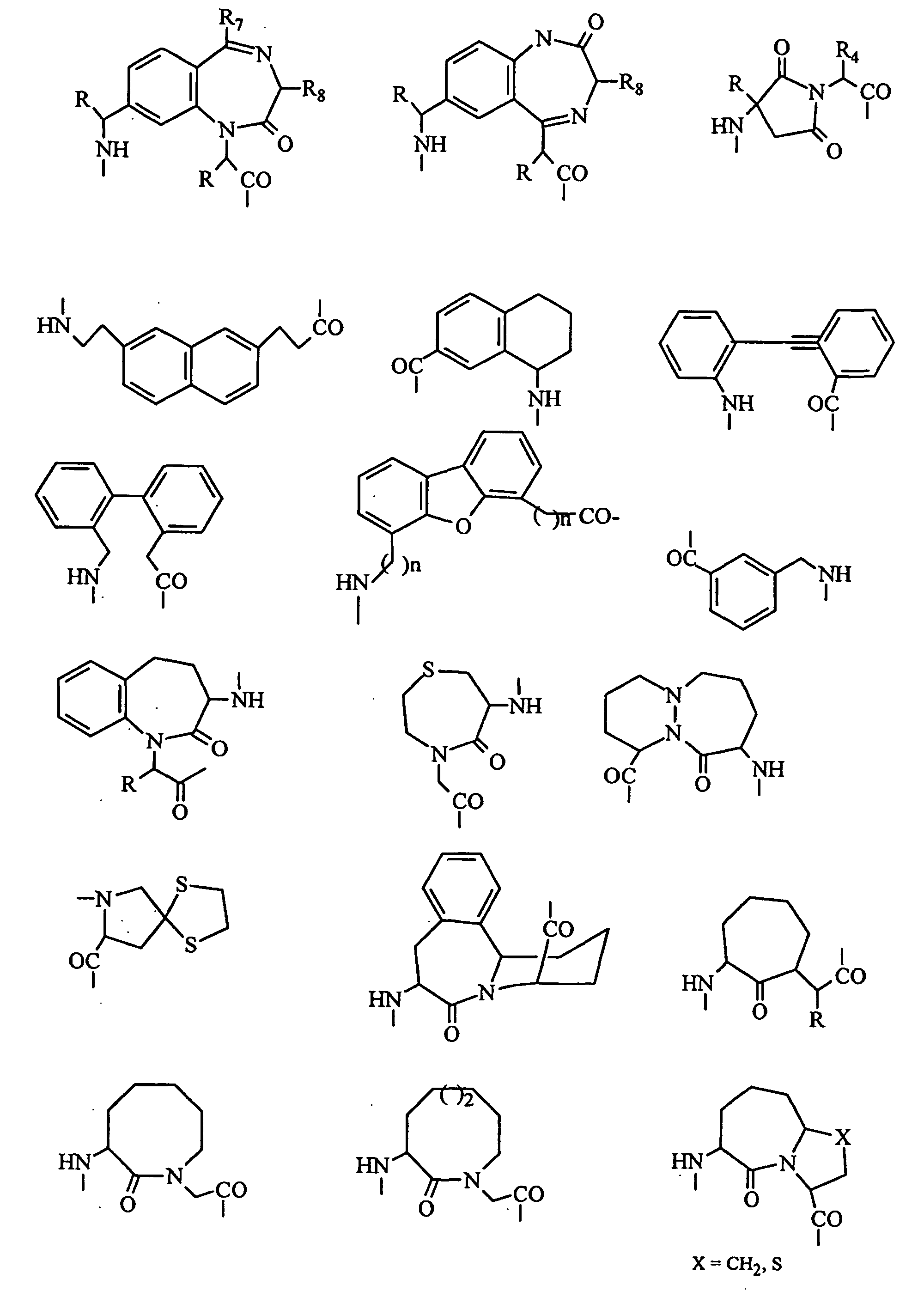
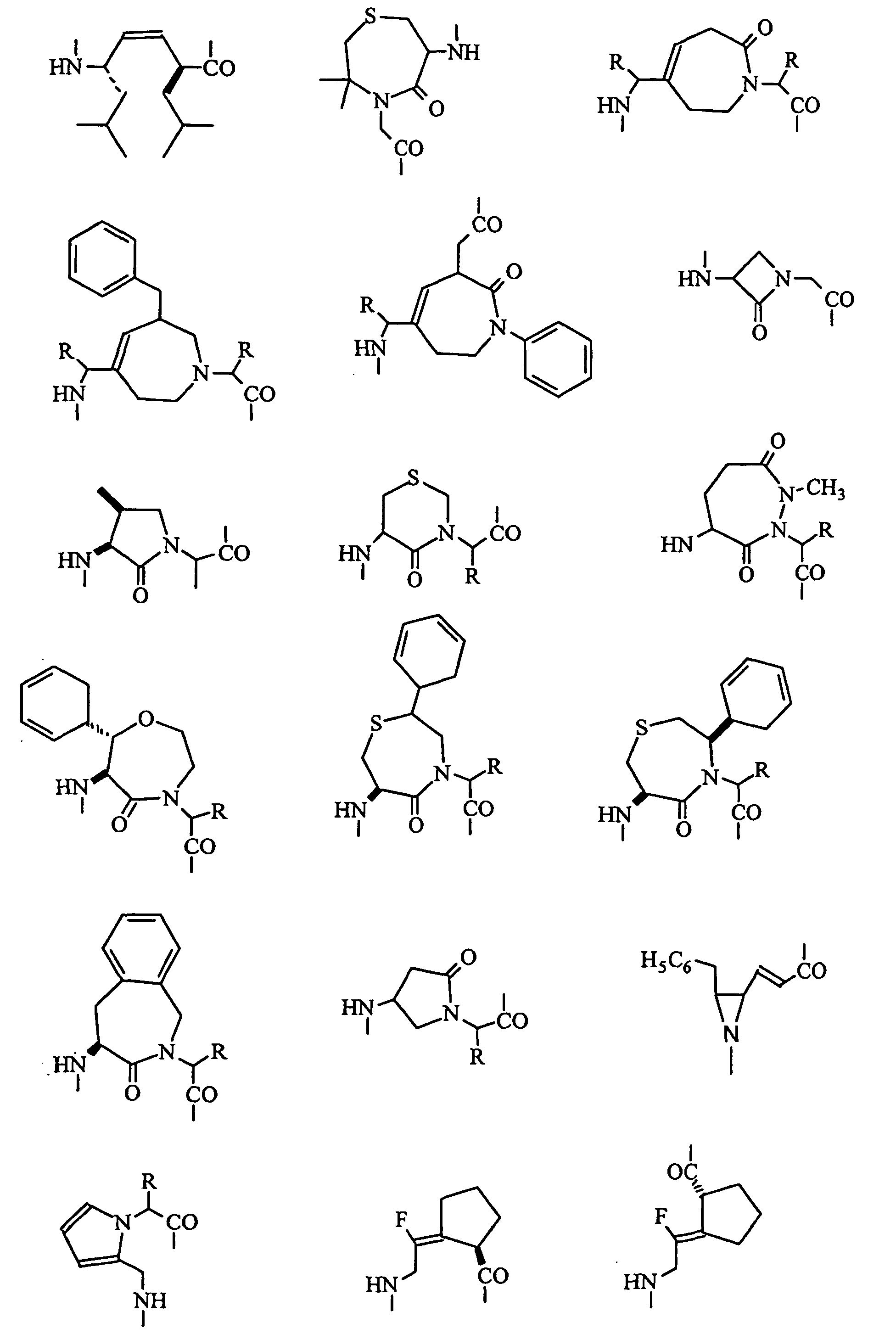

 worin:
 die R, und gegebenenfalls die R4, unabhängig voneinander aus den die Seitenketten von α-Aminosäuren bildenden Gruppen ausgewählt sind;R5 und R6 unabhängig voneinander für H, CH3- oder C6H5-CH2- stehen;R7 für H oder Phenyl steht;R8 für H, CH3-, C2H5- oder C6H5-CH2- steht;die Substituenten X und Z für jede sie enthaltende Verbindung spezifisch definiert sind;Me für eine Methylgruppe steht; undn für die Anzahl an Kohlenstoffatomen steht und 0, 1, 2 oder 3 ist.
 - Oligomer nach Anspruch 5, dadurch gekennzeichnet, dass die R, und gegebenenfalls die R4, unabhängig voneinander aus H, CH3-, (CH3)2CH-, CH3(CH2)3- oder C6H5-CH2- ausgewählt sind.
- Verfahren zur Herstellung eines Oligomers nach Anspruch 1, dadurch gekennzeichnet, dass es darin besteht, eine Polymerisation von zumindest einer Aminosäure durchzuführen, die ein nichtpeptidisches Mimetikum eines Dipeptid- oder Tripeptidfragments darstellt, das eine erzwungene Struktur aufweist, ein Induktor von β-Faltung ist und der Formel NHR'-A-CO-OH (II) entspricht, worin R' für ein Wasserstoffatom steht oder R' eine monozyklische Gruppe oder eine, gegebenenfalls mit dem Atom N und der Gruppe A kondensierte, polyzyklische Gruppe bildet.
- Verfahren nach Anspruch 7, dadurch gekennzeichnet, dass A für eine aromatische oder nichtaromatische heterozyklische, monozyklische oder, gegebenenfalls kondensierte, polyzyklische Gruppe steht.
- Verfahren nach Anspruch 7, dadurch gekennzeichnet, dass die Gruppe -NR'-A-CO- für eine aromatische oder nichtaromatische heterozyklische, monozyklische oder, gegebenenfalls kondensierte, polyzyklische Gruppe steht.
- Verfahren nach Anspruch 7, dadurch gekennzeichnet, dass die Gruppe -NR'-A-CO- ein asymmetrisches Zentrum umfasst.
- Verfahren nach Anspruch 7, dadurch gekennzeichnet, dass die Polymerisation in Lösung durchgeführt wird.
- Verfahren nach Anspruch 7, dadurch gekennzeichnet, dass die Polymerisation nach einem Festphasen-Peptidsyntheseverfahren durchgeführt wird.
- Verfahren nach Anspruch 7, dadurch gekennzeichnet, dass die Verbindung (II) aus den folgenden Verbindungen ausgewählt ist, worin:die R, und gegebenenfalls die R4, unabhängig voneinander aus den die Seitenketten von α-Aminosäuren bildenden Gruppen ausgewählt sind;R5 und R6 unabhängig voneinander für H, CH3- oder C6H5-CH2- stehen;R7 für H oder Phenyl steht;R8 für H, CH3-, C2H5- oder C6H5-CH2- steht;die Substituenten X und Z für jede sie enthaltende Verbindung spezifisch definiert sind;Me für eine Methylgruppe steht; undn für die Anzahl an Kohlenstoffatomen steht und 0, 1, 2 oder 3 ist;


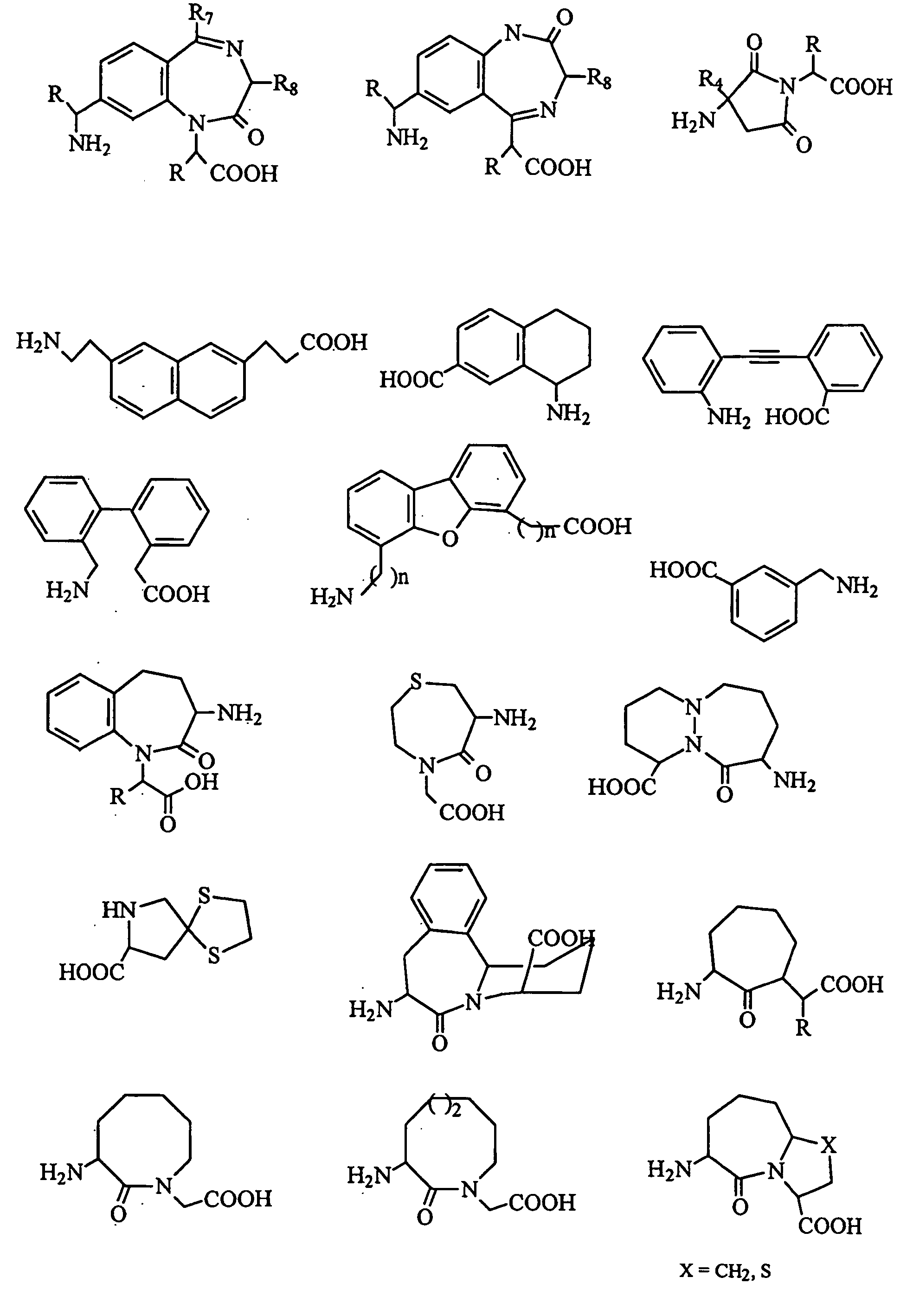
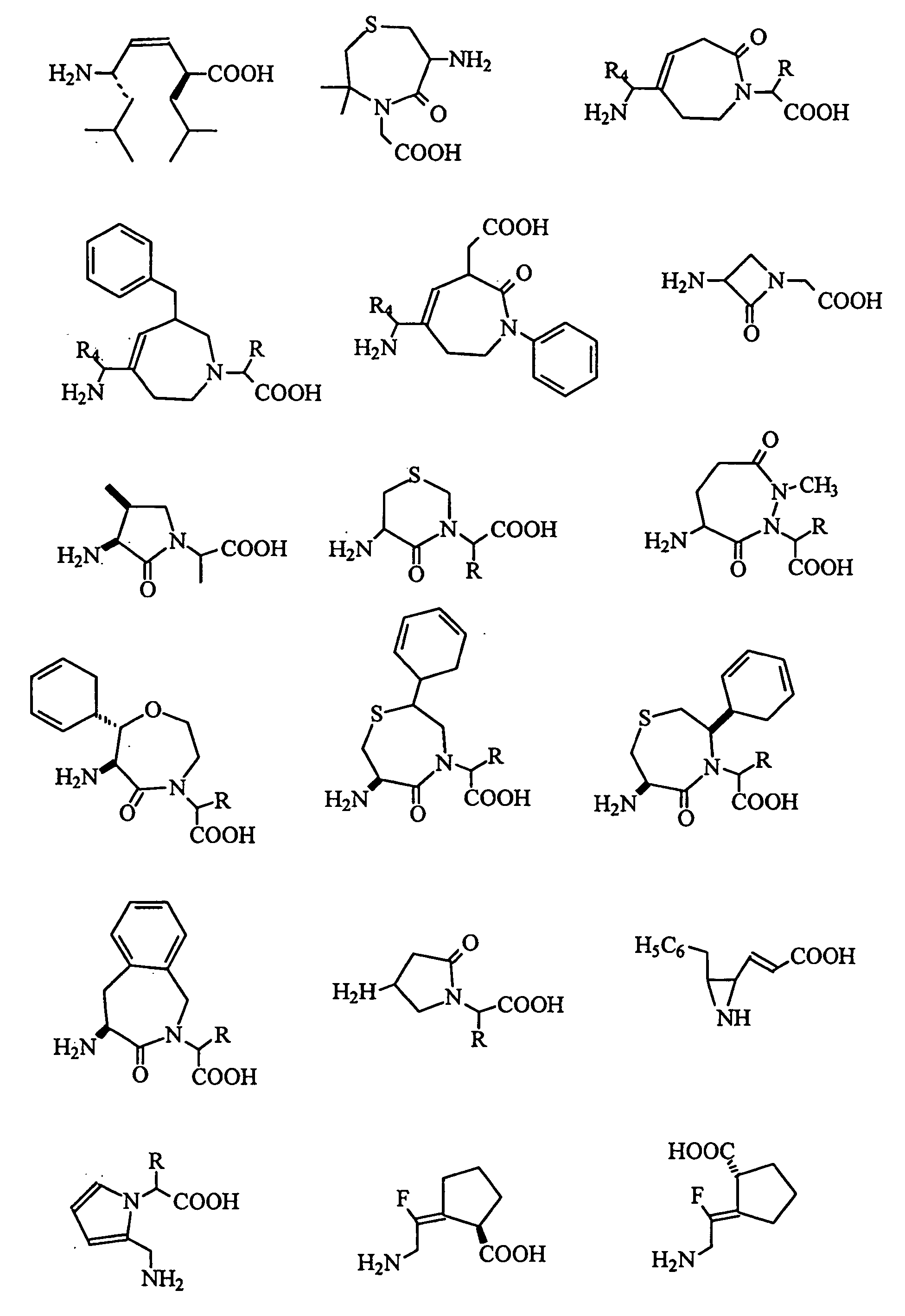

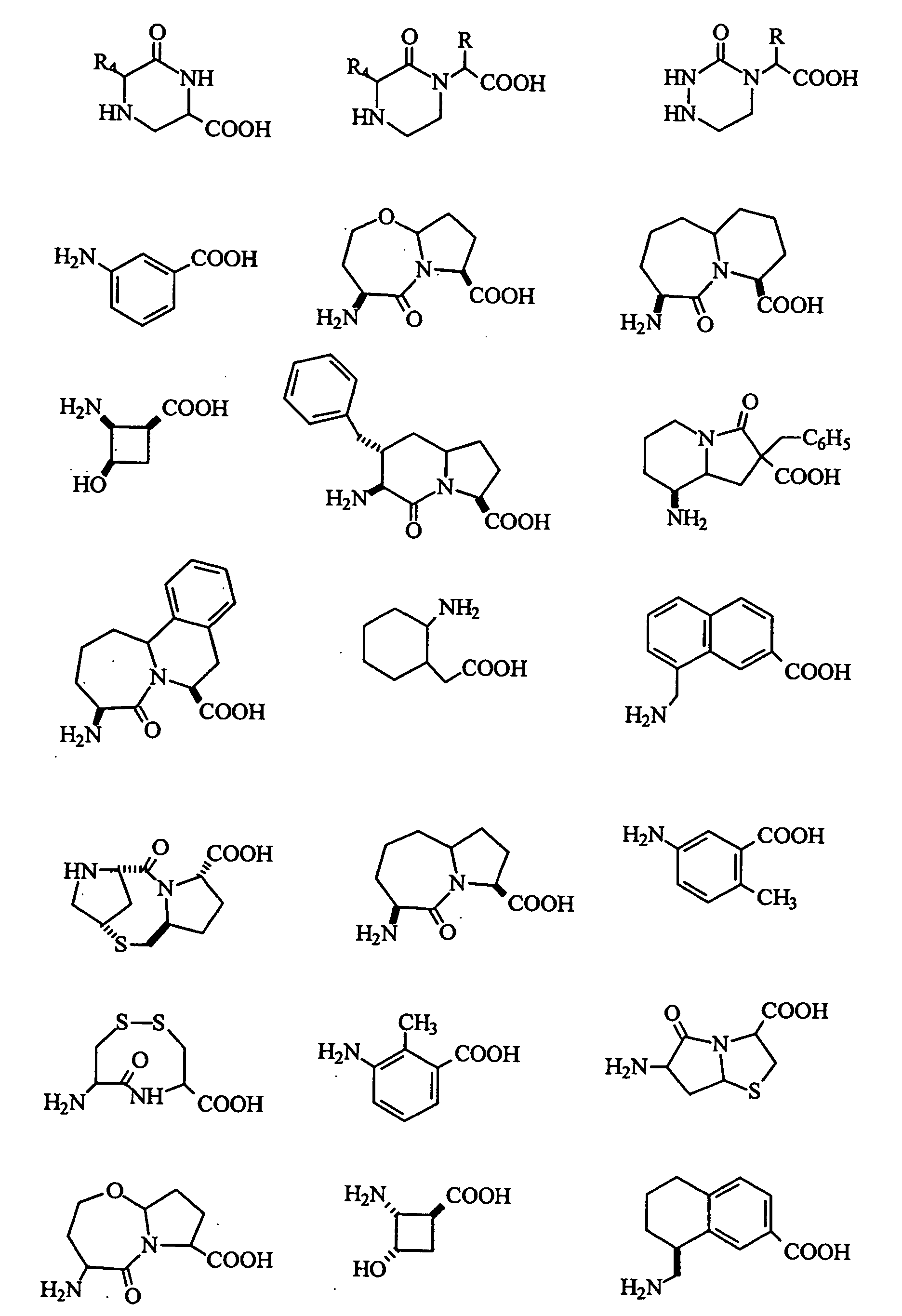
- Verfahren nach Anspruch 12, dadurch gekennzeichnet, dass:a) ein Harzträger, der Amin-Substituenten trägt, mit einer Verbindung H-NR'-A-CO-OH (II') funktionalisiert wird, die der für (II) angegebenen Definition entspricht und in der die Aminogruppe zuvor geschützt wurde;b) das so auf den Harzträger fixierte Fragment ausgehend vom C-terminalen Ende in Richtung des N-terminalen Endes durch aufeinander folgende (n-2) Kupplungsreaktionen von Monomer (II) verlängert wird, wobei das Monomer (II) im Überschuss eingesetzt wird und verschiedene Monomere (II) in den aufeinander folgenden Kupplungsschritten eingesetzt werden können;c) eine letzte Kupplungsreaktion eines an seiner N-terminalen Funktionalität mit einer Gruppe R1 geschützten Monomers durchgeführt wird, worin R1 unter jenen Bedingungen, unter denen das Oligomer vom Träger zu trennen ist, stabil ist;d) das Oligomer vom Harzträger getrennt wird.
- Verfahren zur Herstellung eines künstlichen Proteins oder eines künstlichen Polypeptids, das zu einem natürlichen Protein oder einem natürlichen Polypeptid analog ist, umfassend die Durchführung von Festphasen-Peptidsynthese-Kupplungsreaktionen, dadurch gekennzeichnet, dass in der Abfolge der Kupplungsreaktionen von α-Aminosäuren, die das natürliche Protein oder das natürliche Polypeptid bilden, eine oder mehrere α-Aminosäuresequenzen durch ein Oligomer (I) oder (I') mit einer Länge, die jener der ersetzten α-Aminosäuresequenz entspricht, ersetzt werden.
- Künstliches Protein oder künstliches Polypeptid, das zu einem bestimmten natürlichen Protein oder einem bestimmten natürlichen Polypeptid analog ist, umfassend ein oder mehrere strukturierende Fragmente und ein oder mehrere Peptidfragmente, dadurch gekennzeichnet, dass das oder die Peptidfragmente mit jenen des entsprechenden natürlichen Proteins oder natürlichen Polypeptids identisch sind, und dadurch, dass das oder die strukturierenden Fragmente aus einem Fragment eines Oligomers (I) oder (I') bestehen, das eine Länge aufweist, die mit jener des strukturierenden Teils in der α-Helix des natürlichen Proteins oder des natürlichen Polypeptids im Wesentlichen identisch ist.
- Protein, das zu hCRF (menschlichem Corticotropin freisetzendem Faktor) analog ist, dadurch gekennzeichnet, dass es einer der folgenden Formeln entspricht:
- Protein, das zu hCRF (menschlichem Corticotropin freisetzendem Faktor) analog ist, dadurch gekennzeichnet, dass es folgender Formel entspricht:dargestellt ist.

Applications Claiming Priority (3)
| Application Number | Priority Date | Filing Date | Title |
|---|---|---|---|
| FR0000288A FR2803594B1 (fr) | 2000-01-11 | 2000-01-11 | Oligomeres de mimes contraints non peptidiques de dipeptides ou de tripeptides, et leurs utilisations |
| FR0000288 | 2000-01-11 | ||
| PCT/FR2001/000088 WO2001051506A2 (fr) | 2000-01-11 | 2001-01-11 | Oligomeres de mimes contraints non peptidiques de dipeptides ou de tripeptides, et leur utilisation pour la synthese de proteines et polypeptides artificiels |
Publications (2)
| Publication Number | Publication Date |
|---|---|
| EP1246837A2 EP1246837A2 (de) | 2002-10-09 |
| EP1246837B1 true EP1246837B1 (de) | 2005-10-26 |
Family
ID=8845781
Family Applications (1)
| Application Number | Title | Priority Date | Filing Date |
|---|---|---|---|
| EP01903924A Expired - Lifetime EP1246837B1 (de) | 2000-01-11 | 2001-01-11 | Oligomere von konformationsbeschränkten, nicht-peptidischen di- oder tripeptid-mimetika, und ihre verwendung zur synthese von künstlichen polypeptiden und proteinen |
Country Status (8)
| Country | Link |
|---|---|
| US (1) | US20030191049A1 (de) |
| EP (1) | EP1246837B1 (de) |
| JP (1) | JP2003519629A (de) |
| AT (1) | ATE307826T1 (de) |
| AU (1) | AU2001231881A1 (de) |
| DE (1) | DE60114363D1 (de) |
| FR (1) | FR2803594B1 (de) |
| WO (1) | WO2001051506A2 (de) |
Cited By (1)
| Publication number | Priority date | Publication date | Assignee | Title |
|---|---|---|---|---|
| DE102009032902A1 (de) * | 2009-07-10 | 2011-01-13 | Forschungsverbund Berlin E.V. | Induktion von α-Helix-Konformationen in Proteinen und Peptiden |
Families Citing this family (14)
| Publication number | Priority date | Publication date | Assignee | Title |
|---|---|---|---|---|
| EP2175273B1 (de) * | 2005-11-09 | 2013-09-04 | Ajinomoto Co., Inc. | Kokumi-Verleihungsmittel |
| FR2948571B1 (fr) * | 2009-07-31 | 2013-02-22 | Centre Nat Rech Scient | Utilisation d'oligomeres mimes contraints de dipeptides et tripeptides en tant qu'agents de vectorisation |
| WO2012021144A1 (en) | 2010-08-12 | 2012-02-16 | New York University | Oligooxopiperazines and methods of making and using them |
| CN104334541A (zh) * | 2012-02-16 | 2015-02-04 | 纽约大学 | 使用低聚氧代哌嗪非肽螺旋模拟物对低氧诱导基因表达的控制 |
| US9546174B2 (en) | 2012-11-30 | 2017-01-17 | Sanford-Burnham Medical Research Institute | Inhibitor of apoptosis protein (IAP) antagonists |
| WO2014113794A2 (en) | 2013-01-19 | 2014-07-24 | New York University | Oligooxopiperazines for p53 reactivation |
| US10450343B2 (en) | 2013-03-21 | 2019-10-22 | Sanofi-Aventis Deutschland Gmbh | Synthesis of cyclic imide containing peptide products |
| CA2907454C (en) | 2013-03-21 | 2021-05-04 | Sanofi-Aventis Deutschland Gmbh | Synthesis of hydantoin containing peptide products |
| US11180481B2 (en) | 2014-04-15 | 2021-11-23 | New York University | Oxopiperazine helix mimetics as inhibitors of the p53-MDM2 interaction |
| US10787424B2 (en) | 2014-05-21 | 2020-09-29 | New York University | Oxopiperazine helix mimetics for control of Hypoxia-Inducible gene expression |
| IL287136B2 (en) | 2016-02-05 | 2023-09-01 | Denali Therapeutics Inc | Receptor inhibitors - interacting with protein kinase 1 |
| JP7208137B2 (ja) | 2016-12-09 | 2023-01-18 | デナリ セラピューティクス インコーポレイテッド | 化合物、組成物および方法 |
| US10822371B2 (en) | 2017-12-06 | 2020-11-03 | Bracco Imaging S.P.A. | Solid phase synthesis of NIR fluorescent probe |
| TW202334164A (zh) | 2022-01-12 | 2023-09-01 | 美商戴納立製藥公司 | (S)-5-苄基-N-(5-甲基-4-側氧基-2,3,4,5-四氫吡啶並[3,2-b][1,4]氧氮呯-3-基)-4H-1,2,4-三唑-3-甲醯胺的晶型 |
Family Cites Families (3)
| Publication number | Priority date | Publication date | Assignee | Title |
|---|---|---|---|---|
| DE3716629C2 (de) * | 1987-05-18 | 1997-06-12 | Siemens Ag | Wärmebeständige positiv arbeitende strahlungsempfindliche Gemische und Verfahren zur Herstellung wärmebeständiger Reliefstrukturen |
| US6090947A (en) * | 1996-02-26 | 2000-07-18 | California Institute Of Technology | Method for the synthesis of pyrrole and imidazole carboxamides on a solid support |
| AUPP254898A0 (en) * | 1998-03-24 | 1998-04-23 | University Of Queensland, The | Peptide turn mimetics |
-
2000
- 2000-01-11 FR FR0000288A patent/FR2803594B1/fr not_active Expired - Fee Related
-
2001
- 2001-01-11 AU AU2001231881A patent/AU2001231881A1/en not_active Abandoned
- 2001-01-11 AT AT01903924T patent/ATE307826T1/de not_active IP Right Cessation
- 2001-01-11 WO PCT/FR2001/000088 patent/WO2001051506A2/fr not_active Ceased
- 2001-01-11 DE DE60114363T patent/DE60114363D1/de not_active Expired - Lifetime
- 2001-01-11 US US10/169,907 patent/US20030191049A1/en not_active Abandoned
- 2001-01-11 JP JP2001551090A patent/JP2003519629A/ja active Pending
- 2001-01-11 EP EP01903924A patent/EP1246837B1/de not_active Expired - Lifetime
Cited By (2)
| Publication number | Priority date | Publication date | Assignee | Title |
|---|---|---|---|---|
| DE102009032902A1 (de) * | 2009-07-10 | 2011-01-13 | Forschungsverbund Berlin E.V. | Induktion von α-Helix-Konformationen in Proteinen und Peptiden |
| US8815932B2 (en) | 2009-07-10 | 2014-08-26 | Universität Zu Köln | Induction of alpha helix conformations in proteins and peptides |
Also Published As
| Publication number | Publication date |
|---|---|
| JP2003519629A (ja) | 2003-06-24 |
| WO2001051506A2 (fr) | 2001-07-19 |
| EP1246837A2 (de) | 2002-10-09 |
| FR2803594A1 (fr) | 2001-07-13 |
| DE60114363D1 (de) | 2005-12-01 |
| FR2803594B1 (fr) | 2002-07-19 |
| WO2001051506A3 (fr) | 2002-02-07 |
| AU2001231881A1 (en) | 2001-07-24 |
| ATE307826T1 (de) | 2005-11-15 |
| US20030191049A1 (en) | 2003-10-09 |
Similar Documents
| Publication | Publication Date | Title |
|---|---|---|
| EP1246837B1 (de) | Oligomere von konformationsbeschränkten, nicht-peptidischen di- oder tripeptid-mimetika, und ihre verwendung zur synthese von künstlichen polypeptiden und proteinen | |
| SU1651787A3 (ru) | Способ получени полипептида, обладающего свойствами фактора высвобождени гормона роста | |
| FR2730495A1 (fr) | Derive de proinsuline et procede pour la production d'insuline humaine | |
| EP0081408B1 (de) | Äthylendiamin funktionelle Acrylharze und Verfahren zur Herstellung | |
| JPH07165797A (ja) | 立体配座的に安定化された細胞接着ペプチド | |
| JP2010514728A (ja) | 環状ペプチドの合成方法 | |
| JPS59156284A (ja) | ヒト−レラキシンh2遺伝子 | |
| LU86697A1 (fr) | Nouveaux derives de la calcitonine,leur preparation et leur utilisation comme medicaments | |
| KR100237126B1 (ko) | 펩티드 유사체의 신속한 합성 및 검색방법 | |
| JP3407260B2 (ja) | ランチオニン架橋ペプチド | |
| JP2022527041A (ja) | プレカナチドを製造する改善された方法 | |
| JP2022526115A (ja) | グルカゴン様ペプチド-1(glp-1)受容体アゴニストとその類似体の製造プロセス | |
| JP2733591B2 (ja) | 固相ペプチド合成法 | |
| FR2677362A1 (fr) | Neuropeptides de la famille des tachykinines. | |
| JP2006501150A (ja) | ペプチド合成のためのプロセス | |
| TW200831527A (en) | Method of peptide synthesis | |
| FR2591227A1 (fr) | Peptides capables d'inhiber les interactions entre les virus lav et les lymphocytes t4, produits qui en sont derives et leurs applications | |
| JP2019533666A (ja) | 親油性に修飾されたリジン側鎖を含むペプチドの製造方法 | |
| EP0283956B1 (de) | Fluor enthaltende atriale natriuretische Peptide | |
| JPH111493A (ja) | ペプチドおよびこれを固定化してなる医療材料 | |
| CH616652A5 (de) | ||
| EP0315687A1 (de) | (n-alpha-acyl, 8-glycin, des-19-leucin)-kalcitonin. | |
| FR2522655A1 (fr) | Analogues de la somatostatine possedant une liaison du type hydrazide et medicaments en contenant | |
| CA2115972A1 (fr) | Derives cyclopeptidiques de l'angiopeptine, leur procede de preparation et les compositions pharmaceutiques qui les contiennent | |
| JP2008534639A (ja) | Peg樹脂上におけるアルファ−ヘリックスのペプチド合成 |
Legal Events
| Date | Code | Title | Description |
|---|---|---|---|
| PUAI | Public reference made under article 153(3) epc to a published international application that has entered the european phase |
Free format text: ORIGINAL CODE: 0009012 |
|
| 17P | Request for examination filed |
Effective date: 20020622 |
|
| AK | Designated contracting states |
Kind code of ref document: A2 Designated state(s): AT BE CH CY DE DK ES FI FR GB GR IE IT LI LU MC NL PT SE TR |
|
| AX | Request for extension of the european patent |
Free format text: AL;LT;LV;MK;RO;SI |
|
| RIN1 | Information on inventor provided before grant (corrected) |
Inventor name: AMBLARD, MURIEL Inventor name: BERGE, GILBERT Inventor name: MARTINEZ, JEAN |
|
| 17Q | First examination report despatched |
Effective date: 20040920 |
|
| GRAP | Despatch of communication of intention to grant a patent |
Free format text: ORIGINAL CODE: EPIDOSNIGR1 |
|
| GRAS | Grant fee paid |
Free format text: ORIGINAL CODE: EPIDOSNIGR3 |
|
| GRAA | (expected) grant |
Free format text: ORIGINAL CODE: 0009210 |
|
| AK | Designated contracting states |
Kind code of ref document: B1 Designated state(s): AT BE CH CY DE DK ES FI FR GB GR IE IT LI LU MC NL PT SE TR |
|
| PG25 | Lapsed in a contracting state [announced via postgrant information from national office to epo] |
Ref country code: IT Free format text: LAPSE BECAUSE OF FAILURE TO SUBMIT A TRANSLATION OF THE DESCRIPTION OR TO PAY THE FEE WITHIN THE PRESCRIBED TIME-LIMIT;WARNING: LAPSES OF ITALIAN PATENTS WITH EFFECTIVE DATE BEFORE 2007 MAY HAVE OCCURRED AT ANY TIME BEFORE 2007. THE CORRECT EFFECTIVE DATE MAY BE DIFFERENT FROM THE ONE RECORDED. Effective date: 20051026 Ref country code: NL Free format text: LAPSE BECAUSE OF FAILURE TO SUBMIT A TRANSLATION OF THE DESCRIPTION OR TO PAY THE FEE WITHIN THE PRESCRIBED TIME-LIMIT Effective date: 20051026 Ref country code: AT Free format text: LAPSE BECAUSE OF FAILURE TO SUBMIT A TRANSLATION OF THE DESCRIPTION OR TO PAY THE FEE WITHIN THE PRESCRIBED TIME-LIMIT Effective date: 20051026 Ref country code: GB Free format text: LAPSE BECAUSE OF FAILURE TO SUBMIT A TRANSLATION OF THE DESCRIPTION OR TO PAY THE FEE WITHIN THE PRESCRIBED TIME-LIMIT Effective date: 20051026 Ref country code: IE Free format text: LAPSE BECAUSE OF FAILURE TO SUBMIT A TRANSLATION OF THE DESCRIPTION OR TO PAY THE FEE WITHIN THE PRESCRIBED TIME-LIMIT Effective date: 20051026 Ref country code: FI Free format text: LAPSE BECAUSE OF FAILURE TO SUBMIT A TRANSLATION OF THE DESCRIPTION OR TO PAY THE FEE WITHIN THE PRESCRIBED TIME-LIMIT Effective date: 20051026 |
|
| REG | Reference to a national code |
Ref country code: GB Ref legal event code: FG4D Free format text: NOT ENGLISH |
|
| REG | Reference to a national code |
Ref country code: CH Ref legal event code: EP |
|
| REG | Reference to a national code |
Ref country code: IE Ref legal event code: FG4D Free format text: LANGUAGE OF EP DOCUMENT: FRENCH |
|
| REF | Corresponds to: |
Ref document number: 60114363 Country of ref document: DE Date of ref document: 20051201 Kind code of ref document: P |
|
| PG25 | Lapsed in a contracting state [announced via postgrant information from national office to epo] |
Ref country code: GR Free format text: LAPSE BECAUSE OF FAILURE TO SUBMIT A TRANSLATION OF THE DESCRIPTION OR TO PAY THE FEE WITHIN THE PRESCRIBED TIME-LIMIT Effective date: 20060126 Ref country code: DK Free format text: LAPSE BECAUSE OF FAILURE TO SUBMIT A TRANSLATION OF THE DESCRIPTION OR TO PAY THE FEE WITHIN THE PRESCRIBED TIME-LIMIT Effective date: 20060126 Ref country code: SE Free format text: LAPSE BECAUSE OF FAILURE TO SUBMIT A TRANSLATION OF THE DESCRIPTION OR TO PAY THE FEE WITHIN THE PRESCRIBED TIME-LIMIT Effective date: 20060126 |
|
| PG25 | Lapsed in a contracting state [announced via postgrant information from national office to epo] |
Ref country code: DE Free format text: LAPSE BECAUSE OF FAILURE TO SUBMIT A TRANSLATION OF THE DESCRIPTION OR TO PAY THE FEE WITHIN THE PRESCRIBED TIME-LIMIT Effective date: 20060127 |
|
| PG25 | Lapsed in a contracting state [announced via postgrant information from national office to epo] |
Ref country code: LU Free format text: LAPSE BECAUSE OF NON-PAYMENT OF DUE FEES Effective date: 20060131 Ref country code: LI Free format text: LAPSE BECAUSE OF NON-PAYMENT OF DUE FEES Effective date: 20060131 Ref country code: BE Free format text: LAPSE BECAUSE OF NON-PAYMENT OF DUE FEES Effective date: 20060131 Ref country code: MC Free format text: LAPSE BECAUSE OF NON-PAYMENT OF DUE FEES Effective date: 20060131 Ref country code: FR Free format text: LAPSE BECAUSE OF NON-PAYMENT OF DUE FEES Effective date: 20060131 Ref country code: CH Free format text: LAPSE BECAUSE OF NON-PAYMENT OF DUE FEES Effective date: 20060131 |
|
| PG25 | Lapsed in a contracting state [announced via postgrant information from national office to epo] |
Ref country code: ES Free format text: LAPSE BECAUSE OF FAILURE TO SUBMIT A TRANSLATION OF THE DESCRIPTION OR TO PAY THE FEE WITHIN THE PRESCRIBED TIME-LIMIT Effective date: 20060206 |
|
| PG25 | Lapsed in a contracting state [announced via postgrant information from national office to epo] |
Ref country code: PT Free format text: LAPSE BECAUSE OF FAILURE TO SUBMIT A TRANSLATION OF THE DESCRIPTION OR TO PAY THE FEE WITHIN THE PRESCRIBED TIME-LIMIT Effective date: 20060327 |
|
| NLV1 | Nl: lapsed or annulled due to failure to fulfill the requirements of art. 29p and 29m of the patents act | ||
| REG | Reference to a national code |
Ref country code: IE Ref legal event code: FD4D |
|
| GBV | Gb: ep patent (uk) treated as always having been void in accordance with gb section 77(7)/1977 [no translation filed] |
Effective date: 20051026 |
|
| PLBE | No opposition filed within time limit |
Free format text: ORIGINAL CODE: 0009261 |
|
| STAA | Information on the status of an ep patent application or granted ep patent |
Free format text: STATUS: NO OPPOSITION FILED WITHIN TIME LIMIT |
|
| REG | Reference to a national code |
Ref country code: CH Ref legal event code: PL |
|
| 26N | No opposition filed |
Effective date: 20060727 |
|
| REG | Reference to a national code |
Ref country code: FR Ref legal event code: ST Effective date: 20060929 |
|
| BERE | Be: lapsed |
Owner name: CENTRE NATIONAL DE LA RECHERCHE SCIENTIFIQUE (CNR Effective date: 20060131 |
|
| PG25 | Lapsed in a contracting state [announced via postgrant information from national office to epo] |
Ref country code: TR Free format text: LAPSE BECAUSE OF FAILURE TO SUBMIT A TRANSLATION OF THE DESCRIPTION OR TO PAY THE FEE WITHIN THE PRESCRIBED TIME-LIMIT Effective date: 20051026 |
|
| PG25 | Lapsed in a contracting state [announced via postgrant information from national office to epo] |
Ref country code: CY Free format text: LAPSE BECAUSE OF FAILURE TO SUBMIT A TRANSLATION OF THE DESCRIPTION OR TO PAY THE FEE WITHIN THE PRESCRIBED TIME-LIMIT Effective date: 20051026 |