EP1247539B1 - Proc d d'enduction automatique du corps humain - Google Patents
Proc d d'enduction automatique du corps humain Download PDFInfo
- Publication number
- EP1247539B1 EP1247539B1 EP02076966A EP02076966A EP1247539B1 EP 1247539 B1 EP1247539 B1 EP 1247539B1 EP 02076966 A EP02076966 A EP 02076966A EP 02076966 A EP02076966 A EP 02076966A EP 1247539 B1 EP1247539 B1 EP 1247539B1
- Authority
- EP
- European Patent Office
- Prior art keywords
- composition
- predetermined
- coating
- human skin
- spray
- Prior art date
- Legal status (The legal status is an assumption and is not a legal conclusion. Google has not performed a legal analysis and makes no representation as to the accuracy of the status listed.)
- Expired - Lifetime
Links
Images



Classifications
-
- A—HUMAN NECESSITIES
- A61—MEDICAL OR VETERINARY SCIENCE; HYGIENE
- A61Q—SPECIFIC USE OF COSMETICS OR SIMILAR TOILETRY PREPARATIONS
- A61Q19/00—Preparations for care of the skin
- A61Q19/04—Preparations for care of the skin for chemically tanning the skin
-
- A—HUMAN NECESSITIES
- A45—HAND OR TRAVELLING ARTICLES
- A45D—HAIRDRESSING OR SHAVING EQUIPMENT; EQUIPMENT FOR COSMETICS OR COSMETIC TREATMENTS, e.g. FOR MANICURING OR PEDICURING
- A45D34/00—Containers or accessories specially adapted for handling liquid toiletry or cosmetic substances, e.g. perfumes
- A45D34/04—Appliances specially adapted for applying liquid, e.g. using roller or ball
-
- A—HUMAN NECESSITIES
- A61—MEDICAL OR VETERINARY SCIENCE; HYGIENE
- A61K—PREPARATIONS FOR MEDICAL, DENTAL OR TOILETRY PURPOSES
- A61K8/00—Cosmetics or similar toiletry preparations
- A61K8/02—Cosmetics or similar toiletry preparations characterised by special physical form
-
- A—HUMAN NECESSITIES
- A61—MEDICAL OR VETERINARY SCIENCE; HYGIENE
- A61K—PREPARATIONS FOR MEDICAL, DENTAL OR TOILETRY PURPOSES
- A61K8/00—Cosmetics or similar toiletry preparations
- A61K8/02—Cosmetics or similar toiletry preparations characterised by special physical form
- A61K8/04—Dispersions; Emulsions
- A61K8/046—Aerosols; Foams
-
- A—HUMAN NECESSITIES
- A61—MEDICAL OR VETERINARY SCIENCE; HYGIENE
- A61K—PREPARATIONS FOR MEDICAL, DENTAL OR TOILETRY PURPOSES
- A61K8/00—Cosmetics or similar toiletry preparations
- A61K8/18—Cosmetics or similar toiletry preparations characterised by the composition
- A61K8/30—Cosmetics or similar toiletry preparations characterised by the composition containing organic compounds
- A61K8/33—Cosmetics or similar toiletry preparations characterised by the composition containing organic compounds containing oxygen
- A61K8/35—Ketones, e.g. benzophenone
-
- A—HUMAN NECESSITIES
- A61—MEDICAL OR VETERINARY SCIENCE; HYGIENE
- A61K—PREPARATIONS FOR MEDICAL, DENTAL OR TOILETRY PURPOSES
- A61K8/00—Cosmetics or similar toiletry preparations
- A61K8/18—Cosmetics or similar toiletry preparations characterised by the composition
- A61K8/30—Cosmetics or similar toiletry preparations characterised by the composition containing organic compounds
- A61K8/33—Cosmetics or similar toiletry preparations characterised by the composition containing organic compounds containing oxygen
- A61K8/35—Ketones, e.g. benzophenone
- A61K8/355—Quinones
-
- A—HUMAN NECESSITIES
- A61—MEDICAL OR VETERINARY SCIENCE; HYGIENE
- A61M—DEVICES FOR INTRODUCING MEDIA INTO, OR ONTO, THE BODY; DEVICES FOR TRANSDUCING BODY MEDIA OR FOR TAKING MEDIA FROM THE BODY; DEVICES FOR PRODUCING OR ENDING SLEEP OR STUPOR
- A61M11/00—Sprayers or atomisers specially adapted for therapeutic purposes
-
- A—HUMAN NECESSITIES
- A61—MEDICAL OR VETERINARY SCIENCE; HYGIENE
- A61M—DEVICES FOR INTRODUCING MEDIA INTO, OR ONTO, THE BODY; DEVICES FOR TRANSDUCING BODY MEDIA OR FOR TAKING MEDIA FROM THE BODY; DEVICES FOR PRODUCING OR ENDING SLEEP OR STUPOR
- A61M11/00—Sprayers or atomisers specially adapted for therapeutic purposes
- A61M11/06—Sprayers or atomisers specially adapted for therapeutic purposes of the injector type
-
- A—HUMAN NECESSITIES
- A61—MEDICAL OR VETERINARY SCIENCE; HYGIENE
- A61M—DEVICES FOR INTRODUCING MEDIA INTO, OR ONTO, THE BODY; DEVICES FOR TRANSDUCING BODY MEDIA OR FOR TAKING MEDIA FROM THE BODY; DEVICES FOR PRODUCING OR ENDING SLEEP OR STUPOR
- A61M35/00—Devices for applying media, e.g. remedies, on the human body
- A61M35/20—Non-portable devices, e.g. spraying booths
- A61M35/25—Non-portable devices, e.g. spraying booths specially adapted for the application of sunscreen, tanning or self-tanning lotions
-
- B—PERFORMING OPERATIONS; TRANSPORTING
- B05—SPRAYING OR ATOMISING IN GENERAL; APPLYING FLUENT MATERIALS TO SURFACES, IN GENERAL
- B05B—SPRAYING APPARATUS; ATOMISING APPARATUS; NOZZLES
- B05B14/00—Arrangements for collecting, re-using or eliminating excess spraying material
- B05B14/40—Arrangements for collecting, re-using or eliminating excess spraying material for use in spray booths
- B05B14/43—Arrangements for collecting, re-using or eliminating excess spraying material for use in spray booths by filtering the air charged with excess material
-
- B—PERFORMING OPERATIONS; TRANSPORTING
- B05—SPRAYING OR ATOMISING IN GENERAL; APPLYING FLUENT MATERIALS TO SURFACES, IN GENERAL
- B05B—SPRAYING APPARATUS; ATOMISING APPARATUS; NOZZLES
- B05B14/00—Arrangements for collecting, re-using or eliminating excess spraying material
- B05B14/40—Arrangements for collecting, re-using or eliminating excess spraying material for use in spray booths
- B05B14/46—Arrangements for collecting, re-using or eliminating excess spraying material for use in spray booths by washing the air charged with excess material
-
- A—HUMAN NECESSITIES
- A45—HAND OR TRAVELLING ARTICLES
- A45D—HAIRDRESSING OR SHAVING EQUIPMENT; EQUIPMENT FOR COSMETICS OR COSMETIC TREATMENTS, e.g. FOR MANICURING OR PEDICURING
- A45D2200/00—Details not otherwise provided for in A45D
- A45D2200/05—Details of containers
- A45D2200/054—Means for supplying liquid to the outlet of the container
- A45D2200/057—Spray nozzles; Generating atomised liquid
-
- A—HUMAN NECESSITIES
- A61—MEDICAL OR VETERINARY SCIENCE; HYGIENE
- A61K—PREPARATIONS FOR MEDICAL, DENTAL OR TOILETRY PURPOSES
- A61K2800/00—Properties of cosmetic compositions or active ingredients thereof or formulation aids used therein and process related aspects
- A61K2800/80—Process related aspects concerning the preparation of the cosmetic composition or the storage or application thereof
- A61K2800/83—Electrophoresis; Electrodes; Electrolytic phenomena
-
- A—HUMAN NECESSITIES
- A61—MEDICAL OR VETERINARY SCIENCE; HYGIENE
- A61M—DEVICES FOR INTRODUCING MEDIA INTO, OR ONTO, THE BODY; DEVICES FOR TRANSDUCING BODY MEDIA OR FOR TAKING MEDIA FROM THE BODY; DEVICES FOR PRODUCING OR ENDING SLEEP OR STUPOR
- A61M11/00—Sprayers or atomisers specially adapted for therapeutic purposes
- A61M11/04—Sprayers or atomisers specially adapted for therapeutic purposes operated by the vapour pressure of the liquid to be sprayed or atomised
- A61M11/041—Sprayers or atomisers specially adapted for therapeutic purposes operated by the vapour pressure of the liquid to be sprayed or atomised using heaters
- A61M11/042—Sprayers or atomisers specially adapted for therapeutic purposes operated by the vapour pressure of the liquid to be sprayed or atomised using heaters electrical
-
- Y—GENERAL TAGGING OF NEW TECHNOLOGICAL DEVELOPMENTS; GENERAL TAGGING OF CROSS-SECTIONAL TECHNOLOGIES SPANNING OVER SEVERAL SECTIONS OF THE IPC; TECHNICAL SUBJECTS COVERED BY FORMER USPC CROSS-REFERENCE ART COLLECTIONS [XRACs] AND DIGESTS
- Y02—TECHNOLOGIES OR APPLICATIONS FOR MITIGATION OR ADAPTATION AGAINST CLIMATE CHANGE
- Y02P—CLIMATE CHANGE MITIGATION TECHNOLOGIES IN THE PRODUCTION OR PROCESSING OF GOODS
- Y02P70/00—Climate change mitigation technologies in the production process for final industrial or consumer products
- Y02P70/10—Greenhouse gas [GHG] capture, material saving, heat recovery or other energy efficient measures, e.g. motor control, characterised by manufacturing processes, e.g. for rolling metal or metal working
Definitions
- the present invention relates generally to systems for automatically coating the human body or selected parts thereof with predetermined fluids. More particularly, the invention relates to an automated self-tanning system.
- US-5664593 discloses an apparatus for applying suntan lotion to the torso and limbs only of a user, whose head protrudes from a collar flange opening during use.
- Tanning by colorants is based on the color reaction which occurs between components of the skin and the colorant.
- the most commonly used chemical for artificial tanning is dihydroxy acetone (DHA). It is widely used in commercial artificial tanning products, and is recognized as safe and effective by the U.S. Food and Drug Administration (FDA). DHA reacts solely with the stratum corneum. It interacts with amines, peptides and free amino acids to generate a Maillard reaction. The resulting products are cyclic and linear polymers that have a yellow or brown color.
- WO-A-00/54892 is prior art under Article 54(3) and (4) EPC only. According to this document, which relates to electrostatically coating a human, an exhaust fan is started only after the coating process is complete.
- the present invention comprises a method of coating human skin according to claim 1 hereinafter
- the method uses apparatus which atomizes (also referred to as aerosolization, nebulization, mist generation, fog generation or spray generation) a chemical composition and deposits it uniformly over all or selected parts of the human body. It is not necessary for the individual receiving the treatment nor anyone else to manually apply any of the formulation. Also, a containment system is provided which restrains and collects residue from the application process. The system can optionally recycle the materials used.
- the invention may be practiced utilizing a unitary construction including both a coating chamber and apparatus for coating a person situated within the coating chamber.
- a door provides ingress to and egress from the coating chamber which is provided with vertically disposed arrays of spray discharging nozzles situated at spaced apart points around the periphery of the chamber.
- a blower circulates air through the coating chamber to effect drying following the coating procedure and to aid in containment of excess spray.
- An air compressor supplies liquid for coating and compressed air for spraying the coating liquid to the nozzles situated within the coating chamber.
- the system for automatically coating the human body of the present invention may comprise an automated coating system for numerous types of formulations, including but not limited to the application of:
- the first component of such a system is the chemical composition.
- the suitability of a composition for coating is strongly influenced by its viscosity, with the preferred viscosity being close to that of water (1 centipoise).
- Compositions with viscosities in the 1 to 10 centipoise range generally atomize well, and viscosities in the 10 to 100 range can be atomized, but the resulting spray is not as fine. Higher viscosities can be atomized, and will work, but the spray is not as fine.
- Most currently marketed compositions of the aforementioned applications can be made suitable for atomization either as is or with appropriate dilution.
- compositions 1, 2, 3, 4, 5, and 6. Individuals skilled in this art can create other compositions.
- COMPOSITION 1 Ingredient % Dihydroxyacetone 3 Water 97
- COMPOSITION 2 Ingredient % Dihydroxyacetone 3.0 Denatured Ethanol 20.0 Water 77.0
- COMPOSITION 3 Ingredient % Dihydroxyacetone 12.0 Denature Ethanol 20.0 Water 68.0
- COMPOSITION 4 Ingredient % Dihydroxyacetone 10.0 Commercial Sunless-Tanning Lotion 15.0 Water 75.0 COMPOSITION 5
- a suitable commercial moisturizer would include Vaseline Brand Intensive Care Aloe and Naturals lotion (Chesebrough-Ponds, Greenwich, CT), and a suitable commercial bath product would include Vaseline Brand Intensive Care Foaming Creme Bath (Chesebrough-Ponds, Greenwich, CT).
- the bronzer is a combination of FD&C dyes that yield a golden brown color.
- COMPOSITION 6 Ingredient % Bronzer 8.0 Commercial moisturizer 20.0
- Commercial bath product 0.6 Ethoxydiglycol 2.0 Water 69.4
- a suitable commercial moisturizer would include Vaseline Brand Intensive Care aloe and Naturals lotion (Chesebrough-Ponds, Greenwich, CT), and a suitable commercial bath product would include Vaseline Brand Intensive Care Foaming Creme Bath (Chesebrough-Ponds, Greenwich, CT).
- the bronzer is a combination of FD&C dyes that yield a golden brown color.
- suitable commercial preparations include Coppertone® Oil-Free Sunless Tanner (Schering-Plough, Memphis, TN), Neutrogena® Glow Sunless Tanning Lotion for Face and Body (Neutrogena, Los Angeles, CA), and Kroger® Sunless Tanning Cream (Kroger, Cincinnati, OH).
- compositions 1, 2 and 3 are greatly simplified versions of the formulations now on the market or reported in the past. This simplification is possible due to the use of the present invention for applying compositions to skin. These simplified compositions have several advantages over more complex formulations, including:
- compositions 4 and 5 illustrate how a commercial formulation not particularly well suited for atomization can be diluted, effectively atomized and uniformly coated on human skin. Similar dilutions of products representing the other aforementioned applications can be effectively atomized and coated on human skin.
- DHA is available from Rona (Hawthorne, New York). It is effective, safe, and approved by the FDA for this application.
- the preferred DHA concentration is 0.5% to 20%, with a more preferred range of 3.0% to 15.0%, and a most preferred range of 5% to 12%.
- Various dyes and UV blocking agents can be covalently linked to the colorant or can be mixed into the composition with the colorant.
- Bronzers can also be used in combination with or as an alternative to DHA.
- Bronzers which can be used include, but are not limited to, lawsone and juglone. Combinations of DHA and bronzers can also be used, and can be used to modify the resulting color (hue) and intensity of the tan.
- the preferred range for lawsone, juglone, and FD&C dyes is 0.5% to 10.0% with the more preferred range of 1.0% to 5.0%.
- Composition 6 is an example of a formulation containing only bronzers (no DHA).
- the preferred range of FD&C dyes in commercially formulated liquid form e.g., food coloring by Adams Extract Co., Austin, TX
- Ethoxydiglycol is added to enhance the penetration of the dyes into the skin, to reduce transfer to clothing, and to assist in the stabilization of the formulation.
- the preferred ethoxydiglycol range is 1 to 20%, with a more preferred range of 2 to 10%.
- Alcohol can be added to the composition to accelerate the rate of drying.
- Denatured ethanol USP grade, commodity chemical
- the preferred range for alcohol concentration is from 1.0% to 50.0%, with a more preferred range from 10.0% to 30.0%, and a most preferred concentration of 20.0%.
- the second component of the invention is the atomization of the composition.
- the required atomization can be obtained by a host of ways, most of which involve passing the composition through an orifice under pressure. Methods now used to atomize solutions include the use of the following systems:
- the configuration illustrated in Figure 2 would also work for any of the other atomization methods aforementioned, and for any of the applications aforementioned.
- the preferred atomization method is the pressure-fee air-atomization system, with an internal or external atomization configuration.
- Scalp hair can be protected with a shower cap or any other similar protective covering impervious to the coating compositions.
- hair can be coated with a water insoluble material such as petroleum jelly. Similar protection can be used to protect hair on any other parts of the body.
- atomization is from a single source, it is recommended that the person being coated turn while being coated, or that the coating apparatus be moved around the person being coated, or there be a combination of these movements.
- care must be taken that the nozzle remain at least several inches from the person being coated to prevent any possible injection of composition into the person.
- spray injection occurs at pressures greater than 3,450 kNm -2 (500 psi) with the person actually contacting the atomization orifice.
- the pressures here are less than 552 kNm -2 (80 psi), and more typically 69 to 276 kNm -2 (10 to 40 psi), and the person being coated should be 30cm (a foot) or more from the orifice.
- the issue of what to wear during coating is usually of great concern to the person being coated.
- the selection of what to wear is a matter of preference for the person being coated.
- the subject can be coated nude, with underwear, with a bikini or a bathing suit, or with some form of pasties covering their private parts.
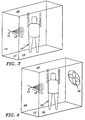
- the third component of the invention is containment of the spray. Containment is illustrated in Figure 3.
- 14 and 15 designate side panels and 16 and 17 designate the top and bottom panels, respectively.
- This type of containment is similar to the containment of spray paint using paint booths in automobile refinishing.
- spray containment can be obtained using electrostatic forces, where the atomized spray is charged and the residual charged spray is removed by activating charged collection plates. Of course, precautions must be taken so that the person being sprayed and the operator are isolated from the charged plates.
- Containment of the spray is very important for several reasons. These reasons include but are not limited to:
- This type containment facilitates the use of this invention in enclosed areas such as stores or medical facilities.
- Control of air and spray flow is very important to the quality of the skin coating. It is highly preferable to have an exhaust fan drawing the spray towards the person being coated, and the residual composition out of the booth. In Figure 4 is shown the addition of an exhaust fan 18.
- the fan offers several significant advantages to the invention. These advantages include but are not limited to:
- the fan 18 should have a flow of 3 to 1500 cubic metres per minute per square metre of opening (10 to 5000 cubic feet per minute per square foot of opening), preferably 15 to 300 m 3 per minute per m 2 (50 to 1000 cubic feet per minute per square foot), and most preferably 30 to 120 m 3 per minute per m 2 (100 to 400 cubic feet per minute per square foot). At flow rates of below 30 m 3 per minute per m 2 (100 cubic feet per minute per square foot), the air movement is sufficient to guide the atomized spray through the containment area. At flow rates of 30 to 120 m 3 per minute per m 2 (100 to 400 cubic feet per minute per square foot), the atomized spray is being actively drawn through the containment area and the application and drying process is enhanced.
- the atomized spray is being accelerated and the exhaust flow plays a much more prominent role in the application process.
- the flow rate of the air through the containment area is therefore a major parameter which can be varied to modify the characteristics of the coating of the artificial tanning composition to the skin.
- the drying time for the composition deposited on skin is also effected by flow rate, with drying time decreasing as flow rates increase. At rates above 30 m 3 per minute per m 2 (100 cubic feet per minute per square foot) the drying time (to the point of no transfer to other surfaces upon contact) is less than 5 minutes.
- the residual atomized spray is completely removed from the containment area within one second. This rapid removal is important to minimize the time the person being tanned is exposed to spray and has the potential to inhale this spray. In the absence of this air flow, the residual spray lingers in the area for several minutes, and traces can be detected hours later. This vigorous flow also protects any individuals or operators near the atomizing orifices from back spray.
- the final element of this invention is recovery, or filtering, of residual composition.
- This feature greatly enhances the utility of the invention because it allows the system to be self-contained in an indoor environment and promotes a more environmentally friendly process. Without a recovery system, there is a potential for the exhausted residue to stain anything it contacts. Also, there could be an accumulation of residue with time.
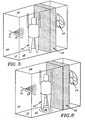
- One configuration of the recovery system is shown in Figure 5 . In this figure and subsequent figures, the recovery system or filter is denoted as 19. Recovery of both particulates and solvents is possible.
- Potential filters include a high-efficiency filter such as Binks' (Franklin Park, IL) Paint Pockets or Columbus Industries' (Ashville, OH) High-Capacity Supra Mini-Mesh, a form of a carbon filter, a water-wash filter, or an exchange-type resin.
- a high-efficiency filter such as Binks' (Franklin Park, IL) Paint Pockets or Columbus Industries' (Ashville, OH) High-Capacity Supra Mini-Mesh
- the efficiency of particulate and solvent removal should be greater than 99%.
- the spray residuals could be vented to the outside environment.
- Figure 6 there is shown the addition of a motorized turntable 20.
- This turntable 20 will rotate the person being coated, eliminating rotation by the individual as a possible source of error or problems. It also is a major convenience for the person being coated.
- the preferred rate of rotation is in the range of 1 to 60 rpm, with a more preferred range of 5 to 20 rpm, with a most preferred rate of rotation of 12 rpm.
- FIG. 7 there is shown the use of multiple atomizing orifices.
- the use of multiple orifices facilitates the automation of this process, and reduces operator effort and potential error. It also reduces the time required to fully coat an individual.
- the typical round spray pattern is about 30cm (12 inches) wide at 20 to 30cm (8 to 12 inches) from the orifices, so a preferred spacing of multiple orifices will be 20 to 30cm (8 to 12 inches) apart, but could be positioned from 2.5 to 120cm (1 to 48 inches) apart.
- Fan patterns from wide-angle nozzles at 45cm (18 inches) are typically 60cm (24 inches) long and 22.5cm (9 inches) wide. Using the preferred configuration, an individual can be coated in 5 seconds or less.
- the orifices are aligned in a vertical pattern.
- the coverage of more area at one time could also be obtained by rapidly moving one or more orifices along a track or by rapidly altering the angle of the orifice.
- Other patterns are possible, including combinations of vertical and horizontally aligned orifices.
- Orifices could also be aligned radially, with the subject being sprayed with orifices aligned from 0 to 360°.
- Another alignment is a horizontal ring containing orifices that surround the body. By vertically raising and lowering the horizontal ring, the entire body or selected parts of the body could be coated.
- a modified version of configuration illustrated in Figure 7 could be used to rapidly coat an individual. It would even be possible to have a walk-through coating system.
- An atomized spray could be produced from multiple nozzles arranged in a single line (as shown in Figure 7 ), in two single lines facing one anther and about 90 to about 120cm (about 36 to about 48 inches) apart, or multiple lines of nozzles.
- the preferred configuration is multiple lines, with 4 lines being adequate.
- the atomized spray results in an area of intense atomized solution, which would coat an individual standing in that area.
- the residual spray would then be dissipated into the surrounding environment.
- a fan could be used to accelerate the removal of the residuals from the coating area.
- Figure 8 illustrates how the system of the present invention can be used to tan a selected part of the body.
- the bottom panel of the apparatus 22 contains an opening through which one can insert his or her head.
- the top panel 23 is arched.
- the high-efficiency filter is 19.
- the fan and back panel is 15.
- the setup as shown in Figures 2-7 could be used to tan only a select part of the body by protecting the area not desired to be tanned with appropriate barrier apparel or by screens between the atomized spray and the regions of the skin not to be coated.
- the barrier apparel could be any material impervious to the atomized coating composition.
- materials appropriate for use with the aforementioned coating compositions include vinyl, polyurethane, and latex rubber.
- the screens can be sheets composed of any material impervious to the atomized artificial tanning compositions, including most metals or plastics.
- a preferred screening material is foam with an impervious aluminum foil backing. The foam is aligned with the backing away from the atomizing orifice. The foam is preferred because it absorbs much of the atomized spray, reducing back deflection.
- FIGS 9, 10, 11, and 12 illustrate an apparatus which may be utilized in then practice of the invention.
- the apparatus 30 comprises a unitary construction which includes both a coating chamber 32 adapted to receive a person to be coated with a predetermined substance and various components utilized to effect spraying of the predetermined substance onto the person situated within the coating chamber 32.
- the coating chamber 32 includes a door 34 which affords ingress to and egress from the coating chamber.
- the coating chamber 32 is further provided with a plurality of spray columns 32.
- the spray columns 36 are located at spaced apart points around the periphery of the chamber 32.
- the spray columns 36 are preferably supported for pivotal movement through predetermined arcs under the action of a pneumatic cylinder 38. In this manner the predetermined material is discharged from the spray columns 36 in such a way as to assure uniform coating of the predetermined material on a person situated within the spray chamber 32.
- the pneumatic cylinder 38 is connected to the pivoting mechanism of each of the spray columns 36 through a plurality of links 40.
- blower 46 which directs a flow of air upwardly along an air guide 48 and then laterally along a top panel 50 into engagement with a plurality of baffles 52.
- the baffles 52 direct the air from the blower 46 downwardly through the coating chamber 32, whereby the flowing air effects drying of the sprayed material and aids in recovery of the sprayed material for reuse. From the coating chamber 32 the air is directed through a plurality of filters 54 and is returned to the blower 46.
- the predetermined material which is to be coated onto a person situated within the coating chamber 32 is preferably provided in the form of a liquid which is received in a reservoir 60.
- the interior of the reservoir 60 is pressurized by compressed air which is received from an air compressor 62 through an air tank 64.
- Compressed air from the air compressor 62 in the tank 64 is also directed to an air tank 66 and to a manifold 68.
- the air tank 66 provides compressed air for operating the pneumatic cylinder ( Figure 10) .
- the manifold 68 directs compressed air the spray columns 36.
- each spray column 36 includes an inner tubular passageway 84 which receives liquid from the reservoir 60 under the action of compressed air supplied by the air compressor 62 through the tank 64 and an outer tubular passageway 86 which receives compressed air from the manifold 68.
- Each spray column 36 is provided with a plurality of nozzles 88.
- Each nozzle 88 receives compressed air from the outer tubular passageway 86 through a quick disconnect 90 and receives liquid from the inner tubular passageway 84 through a quick disconnect 92.
- a check valve 94 prevents reverse flow of liquid back through the quick disconnect 92.
- the preferred formula is a combination of water, dihydroxyacetone, bronzer, moisturizer, surfactant, and penetration enhancer.
- the formula is: water base 62.6% 36%-85.9% dihydroxyacetone self-tanning 9.0% 3% - 15% bronzer cosmetic colorant 5.0% 0% - 10% ethoxy diglycol penetration enhancer 4.0% 0% - 10% commercial moisturizer lotion film former, viscosity 18.0% 10% - 25% commercial bath product surfactant 1.2% 0% - 2% citric acid pH adjustment 0.2% 0.1% to 1.0%
- the feet are one of the most difficult parts of the body to coat uniformly. This difficulty is due in large part to the irregular structure of feet. Also, the downward motion of the atomized mist, both by gravity and from air currents, tends to cause the mist to settle on the tops of the feet. Therefore, the feet are provided with shields to assure a more uniform coating of the feet.
- the shields may take the form of a large, bottomless shoe. The shields produce a silhouette effect from the top of the feet to the toes. Holes and openings are provided in the shields which are located 0.625 to 5cm (.25 to 2 inches) from the feet, allowing the mist to result in a silhouette effect rather that defined lines
- a plastic shield shaped like a figure 8 is placed between the fleximat flooring the user stands on and the metal grating supporting the fleximat.
- Dimensions of the figure eight are two 45cm (18 inch) diameter overlapping circles with a total width of 65cm (26 inches). The total width can vary from 45cm to 90cm (18 inches to 36 inches), and the circle diameters can very from 30cm to 50cm (12 inches to 20 inches)
- a cotton bath towel 40cm by 80 cm (16 inches by 32 inches) may be used.
- the towel could vary from a hand cloth (20cm x 20cm (8" x 8") to a large beach towel 45cm x 120cm (18" x 48")). Care must be taken not to rub so hard or too much as to rub off the coating (or tan). Basically, the weight of the preferred towel is adequate, without additional pressure.
- compositions for the hair net include a cloth or plastic mesh or a continuos plastic sheet.
- this lotion can be used to prevent tanning of specific areas, such as the palms of the hands.
- Binks high-efficiency paint-pockets filter is used.
- the tanning solution trapped in the filter can be removed with a water rinse.
- the solution which is water soluble, is flushed out using water that is back-washed (water applied to the top surface opposite of the surface facing the solution) or water, preferably under moderate (greater than 414 kNm -2 (60 psi)) pressure, that is hosed on the filtered surface.
- Air flow parameters are, in the downward motion: most preferred 2.8 m 3 per minute (100 cfm) next preferred 1.4 to 5.6 m 3 per minute (50 cfm to 200 cfm) next preferred 0.7 to 8.5 m 3 per minute (25 cfm to 300 cfm)
- Atomization of liquids as done here by the nozzles results in a significant reduction in liquid temperature (as much as 11°C (20°F)).
- four halogen lamps 250 watts each can be added to the system to provide both illumination and heat.
- a coating chamber temperature of 27°C to 43°C (80°F to 110°F) is preferred, with32°C to 38°C (90°F to 100°F) being more preferred.
- Other heating devices include infrared lamps and electrical heating elements.
- a twenty year old female of type III skin tanned by this process She first applied a heart shaped sticker on her right arm. She covered her hair with a nylon mesh hair net and applied barrier cream over the palms of her hands. She tanned in the coating chamber. The formula above was coated for 7 seconds. About 300 grams of solution was applied during such time. There was a subsequent 7 second period in which the mist was circulated in the booth. The residual mist was removed from the booth and the subject dried for about 45 seconds. The subject then removed any excess lotion with a towel. The final result was that the subject was 1 to 2 shades darker after tanning. This difference was especially apparent when comparing the area under the sticker with the area with no sticker. The initial color was mainly from the bronzer, and is a deep brown color.
- a forty seven year old male with type II skin tanned by this process He first applied a heart shaped sticker on his right arm. He covered his hair with a nylon mesh hair net and applied barrier cream over the palms of his hands and the bottoms of his feet. He tanned in the coating chamber. The formula above was coated for 7 seconds. About 300 grams of solution was applied during time. There was a subsequent 7 second period in which the mist was circulated in the booth. The residual mist was removed from the booth and the subject dried for about 45 seconds. The subject then removed any excess lotion with a towel. The final result was that the subject was about 1 shade darker after tanning. This difference was especially apparent when comparing the area under the sticker with the area with no sticker.
- the initial color was mainly from the bronzer, and is a deep brown color. Color was much more intense the next day, when the color was one to two shades darker than before tanning. After the subject showered, the intensity was dropped to about 1 shade darker than prior to tanning. This color, which was mainly from the dihydroxyacetone, was golden-brown. The subject repeated the tanning process again later the second day. This time, the initial tan from the combination of previous tan and new bronzer was about 2 shades darker than before. Even after showering the next day, the tan was about two shades darker than prior to initially tanning. The color persisted about 2 shade darker for 3-4 days, and noticeable color was present for 10 days.
- Self-tanning lotions have been reported to turn body hair orange.
- the formulation and application of the present invention do not cause the hair to turn orange.
- the formulation does not penetrate the hair, but rather beads up on it.
- it is applied in a very thin coat. The net result is that the hair does not turn orange.
- the present invention facilitates the application of a thin, uniform film over the entire body. Consequently, the resulting coating and tan is far superior to manual application methods.
- the bronzer provides immediate color and a method for observing the uniformity of the tan.
- the uniformity of the bronzer application is greatly enhance because it is applied in a uniform thin film and its substantivity is enhanced because of deeper penetration into skin with the presence of a penetration enhancer.
Landscapes
- Health & Medical Sciences (AREA)
- Life Sciences & Earth Sciences (AREA)
- Veterinary Medicine (AREA)
- Animal Behavior & Ethology (AREA)
- General Health & Medical Sciences (AREA)
- Public Health (AREA)
- Birds (AREA)
- Epidemiology (AREA)
- Heart & Thoracic Surgery (AREA)
- Engineering & Computer Science (AREA)
- Anesthesiology (AREA)
- Biomedical Technology (AREA)
- Hematology (AREA)
- Emergency Medicine (AREA)
- Dermatology (AREA)
- Chemical & Material Sciences (AREA)
- Dispersion Chemistry (AREA)
- Cosmetics (AREA)
- Application Of Or Painting With Fluid Materials (AREA)
- Spray Control Apparatus (AREA)
- Nozzles (AREA)
- Materials For Medical Uses (AREA)
- Media Introduction/Drainage Providing Device (AREA)
- Details Or Accessories Of Spraying Plant Or Apparatus (AREA)
- Prostheses (AREA)
- Radiation-Therapy Devices (AREA)
- Coating Apparatus (AREA)
Claims (12)
- Procédé d'enduction de la peau humaine comprenant les étapes consistant à :a. fournir une enceinte (14, 15, 16, 17) destinée à recevoir l'ensemble du corps et la tête d'une personne (13) devant être enduite ;b. fournir une composition pour enduction de la peau humaine prédéterminée ;c. atomiser la composition pour enduction de la peau humaine selon un débit prédéterminé ;d. diriger la composition atomisée sur au moins des parties prédéterminées du corps et de la tête de la personne à enduire ;e. contenir le jet atomisé excédentaire qui n'est pas reçu sur la peau de la personne ;f. faire circuler de l'air dans toute l'enceinte lors de l'atomisation de la composition pour enduction de la peau humaine prédéterminée ; etg. éliminer le jet excédentaire contenu ; eth. après l'enduction, utiliser une serviette pour frictionner et polir sensiblement l'ensemble du corps.
- Procédé d'enduction de la peau humaine selon la revendication 1, dans lequel la composition pour enduction de la peau humaine prédéterminée comprend de la dihydroxyacétone dans une concentration comprise entre environ 0,5 % et environ 20 %, l'équilibre de la composition étant réalisé avec de l'eau.
- Procédé d'enduction de la peau humaine selon la revendication 1, dans lequel la composition pour enduction de la peau humaine prédéterminée comprend de la lawsone ou de la juglone dans une concentration comprise entre environ 0,5 % et environ 10 %, l'équilibre de la composition étant réalisé avec de l'eau.
- Procédé d'enduction de la peau humaine selon la revendication 1, dans lequel la composition pour enduction de la peau humaine prédéterminée comprend de la dihydroxyacétone dans une concentration comprise entre environ 0,5 % et environ 20 %, de la lawsone ou de la juglone dans une concentration comprise entre environ 0,5 % et environ 10 %, l'équilibre de la composition étant réalisé avec de l'eau.
- Procédé d'enduction de la peau humaine selon l'une quelconque des revendications 2, 3 ou 4, dans lequel la composition pour enduction de la peau humaine prédéterminée comprend en outre un alcool dans une concentration comprise entre environ 1 % et environ 50 %.
- Procédé d'enduction de la peau humaine selon l'une quelconque des revendications précédentes, dans lequel la composition pour enduction est une composition d'écran solaire prédéterminée, une composition de lotion bronzante prédéterminée, une composition d'accélérateur de bronzage prédéterminée, une composition de traitement des brûlures solaires prédéterminée, une composition de lotion anti-insecte prédéterminée, une composition de lotion tonique prédéterminée, une composition décolorante pour la peau prédéterminée, une composition éclaircissante pour la peau prédéterminée, une composition antimicrobienne prédéterminée, une composition hydratante prédéterminée, une composition exfoliante prédéterminée, une composition contenant des nutriments et des vitamines prédéterminée, une composition pour massages prédéterminée, une composition myorelaxante prédéterminée, une composition pour le traitement cutané prédéterminée, une composition de traitement des brûlures prédéterminée, une composition de décontamination prédéterminée, une composition cosmétique prédéterminée, ou une composition de traitement des rides prédéterminée.
- Procédé d'enduction de la peau humaine selon l'une quelconque des revendications précédentes, dans lequel l'étape consistant à atomiser la composition pour enduction comprend le refoulement de la composition par un orifice et la production d'un jet atomisé.
- Procédé d'enduction de la peau humaine selon l'une quelconque des revendications précédentes, dans lequel l'étape consistant à faire circuler de l'air dans toute l'enceinte est obtenue par une soufflante ayant un débit compris entre 3 mètres cubes par minute et 1 500 mètres cubes par minute par mètre carré d'ouverture de la soufflante.
- Procédé d'enduction de la peau humaine selon l'une quelconque des revendications précédentes, comprenant en outre l'étape consistant à faire tourner le corps de la personne à enduire autour d'un axe vertical pendant l'application de la composition pour enduction atomisée.
- Procédé d'enduction de la peau humaine selon l'une quelconque des revendications précédentes, dans lequel l'étape consistant à atomiser la composition pour enduction est en outre caractérisée par le refoulement de la composition pour enduction prédéterminée à travers une pluralité d'orifices.
- Procédé d'enduction de la peau humaine selon l'une quelconque des revendications précédentes, dans lequel l'étape consistant à éliminer le jet excédentaire contenu est réalisée en dissipant le jet excédentaire dans l'environnement voisin.
- Procédé d'enduction de la peau humaine selon l'une quelconque des revendications précédentes, dans lequel l'étape consistant à éliminer le jet excédentaire contenu est réalisée en chargeant le jet atomisé et en éliminant le jet chargé résiduel en actionnant des plaques collectrices chargées.
Applications Claiming Priority (3)
| Application Number | Priority Date | Filing Date | Title |
|---|---|---|---|
| US294689 | 1999-04-19 | ||
| US09/294,689 US6199557B1 (en) | 1997-10-08 | 1999-04-19 | Method of and apparatus for automatically coating the human body |
| EP00919814A EP1175164B1 (fr) | 1999-04-19 | 2000-03-30 | Appareil d'enduction automatique du corps humain |
Related Parent Applications (1)
| Application Number | Title | Priority Date | Filing Date |
|---|---|---|---|
| EP00919814A Division EP1175164B1 (fr) | 1999-04-19 | 2000-03-30 | Appareil d'enduction automatique du corps humain |
Publications (2)
| Publication Number | Publication Date |
|---|---|
| EP1247539A1 EP1247539A1 (fr) | 2002-10-09 |
| EP1247539B1 true EP1247539B1 (fr) | 2005-11-23 |
Family
ID=23134512
Family Applications (3)
| Application Number | Title | Priority Date | Filing Date |
|---|---|---|---|
| EP02076966A Expired - Lifetime EP1247539B1 (fr) | 1999-04-19 | 2000-03-30 | Proc d d'enduction automatique du corps humain |
| EP00919814A Revoked EP1175164B1 (fr) | 1999-04-19 | 2000-03-30 | Appareil d'enduction automatique du corps humain |
| EP03077554A Withdrawn EP1374937A1 (fr) | 1999-04-19 | 2000-03-30 | Appareil d'enduction automatique du corps humain |
Family Applications After (2)
| Application Number | Title | Priority Date | Filing Date |
|---|---|---|---|
| EP00919814A Revoked EP1175164B1 (fr) | 1999-04-19 | 2000-03-30 | Appareil d'enduction automatique du corps humain |
| EP03077554A Withdrawn EP1374937A1 (fr) | 1999-04-19 | 2000-03-30 | Appareil d'enduction automatique du corps humain |
Country Status (9)
| Country | Link |
|---|---|
| US (4) | US6199557B1 (fr) |
| EP (3) | EP1247539B1 (fr) |
| AT (2) | ATE310551T1 (fr) |
| AU (1) | AU777555B2 (fr) |
| CA (2) | CA2277499C (fr) |
| DE (2) | DE60007518T2 (fr) |
| ES (1) | ES2213005T3 (fr) |
| NZ (1) | NZ514428A (fr) |
| WO (1) | WO2000062640A1 (fr) |
Families Citing this family (70)
| Publication number | Priority date | Publication date | Assignee | Title |
|---|---|---|---|---|
| US6468508B1 (en) | 1997-10-08 | 2002-10-22 | Laughlin Products, Inc. | Method, apparatus, and composition for automatically coating the human body and skin preconditioning system for use therewith |
| US6416747B1 (en) | 1997-10-08 | 2002-07-09 | Laughlin Products, Inc. | Method, apparatus, and composition for automatically coating the human body with plural components |
| US6886572B2 (en) * | 1997-10-08 | 2005-05-03 | Laughlin Products, Inc. | Automated system for coating the human body: virtual motion |
| US7082948B2 (en) * | 1997-10-08 | 2006-08-01 | Laughlin Products, Inc. | Method of and apparatus for automatically coating the human body |
| US6431180B2 (en) * | 1997-10-08 | 2002-08-13 | Laughlin Products, Inc. | Automated system for coating the human body |
| US7041089B2 (en) * | 1997-10-08 | 2006-05-09 | Laughlin Products, Inc. | Automated system for coating the human body: virtual motion |
| US6199557B1 (en) * | 1997-10-08 | 2001-03-13 | Laughlin Products, Inc. | Method of and apparatus for automatically coating the human body |
| US6881417B1 (en) | 1997-10-08 | 2005-04-19 | Laughlin Products, Inc. | Method, apparatus, and composition for automatically coating the human body with plural components |
| US6439243B2 (en) * | 1997-10-08 | 2002-08-27 | Laughlin Products, Inc. | Method of and apparatus for automatically coating the human body |
| US6802830B1 (en) * | 2000-06-16 | 2004-10-12 | Drew Waters | Device and method that generates a fog capable of altering the color of human skin |
| FR2810761B1 (fr) * | 2000-06-26 | 2003-09-05 | Oreal | Procede et dispositif de traitement cosmetique,notamment de soin, de maquillage ou de coloration |
| US6302122B1 (en) * | 2000-09-22 | 2001-10-16 | Spectrum Products, Inc. | Apparatus for automatic application of compositions to the skin |
| US6443164B1 (en) * | 2000-09-22 | 2002-09-03 | Spectrum Products, Inc. | Apparatus for automatic application of compositions to the skin |
| US6673097B1 (en) * | 2001-02-23 | 2004-01-06 | Hollywood Tanning Systems, Inc. | Tanning booth having reduced tanning time |
| US6589541B2 (en) | 2001-05-18 | 2003-07-08 | Classified Cosmetics, Inc. | Sprayable beautifying composition |
| US20030206872A1 (en) * | 2001-05-18 | 2003-11-06 | Classified Cosmetics | Sprayable beautifying composition |
| WO2003013648A2 (fr) * | 2001-08-08 | 2003-02-20 | Spectrum Products, Inc. | Installation pour application automatique de composition autobronzante avec vestiaire attenant |
| PL353700A1 (en) | 2001-11-21 | 2003-06-02 | Hollywood Tanning Systems | Burning off booth with automatic spraying feature |
| US20030094509A1 (en) * | 2001-11-21 | 2003-05-22 | Ralph Venuto | Spray booth |
| US6554208B1 (en) | 2001-11-21 | 2003-04-29 | Hollywood Tanning Systems, Inc. | Tanning booth having automated spray |
| US7004407B2 (en) * | 2001-12-04 | 2006-02-28 | Mystic Tan, Inc. | Uniform metering system for spray applications |
| AU2003225956A1 (en) * | 2002-03-26 | 2003-10-13 | Spectrum Products, Inc. | Apparatus for automatic application of compositions to the skin |
| US20040086473A1 (en) * | 2002-06-17 | 2004-05-06 | The Procter & Gamble Company | Multi-step sebum and perspiration absorption foundation kit and associated methods |
| US20040086474A1 (en) * | 2002-06-17 | 2004-05-06 | The Procter & Gamble Company | Multi-step cosmetic benefit foundation kit and associated methods |
| DE10228462A1 (de) * | 2002-06-26 | 2004-03-04 | Wolfgang Urbasik | Vorrichtung zum Aufbringen von flüssigen Hautpflegemitteln |
| US20040073186A1 (en) * | 2002-10-15 | 2004-04-15 | Cameron Mickey G. | Apparatus for automatic application of compositions to the skin |
| AU2004210199B2 (en) * | 2003-02-07 | 2009-10-01 | Crystals Limited | Tanning booth |
| US20060163382A1 (en) * | 2003-03-21 | 2006-07-27 | Great Lakes Engineering & Design, Inc. | Spray booth method and apparatus |
| US7886684B2 (en) * | 2003-05-09 | 2011-02-15 | Mt Industries, Inc. | Gantry tower spraying system with cartridge/receptacle assembly |
| US7297211B2 (en) * | 2003-05-09 | 2007-11-20 | Mystic Tan, Inc. | Single-dose spray system for application of liquids onto the human body |
| US20040238007A1 (en) * | 2003-06-02 | 2004-12-02 | Jones Larry M. | Method and apparatus for decontaminating non-ambulatory victims or objects |
| US20040251272A1 (en) * | 2003-06-13 | 2004-12-16 | Haywood Hunter | Sunless tanning spray dispenser |
| US7582307B2 (en) | 2003-11-26 | 2009-09-01 | Harmony Labs, Inc. | Dermatological composition |
| US20100129557A1 (en) * | 2004-06-18 | 2010-05-27 | Mt Industries, Inc. | Spray coating at least one portion of a subject |
| US20050279865A1 (en) * | 2004-06-18 | 2005-12-22 | Innovative Developments, Llc | Fluid spraying system |
| US20070197982A1 (en) * | 2006-01-05 | 2007-08-23 | Scott Thomason | Automatic body spray system |
| US8920391B2 (en) * | 2004-06-18 | 2014-12-30 | Sunless, Inc. | Container for system for spray coating human subject |
| US7462242B2 (en) * | 2004-06-21 | 2008-12-09 | Mystic Tan, Inc. | Misting apparatus for electrostatic application of coating materials to body surfaces |
| US20060118039A1 (en) * | 2004-11-03 | 2006-06-08 | Cooper Steven C | Spray device with touchless controls |
| US20060124779A1 (en) * | 2004-11-12 | 2006-06-15 | Cooper Steven C | Panel-mounted electrostatic spray nozzle system |
| US7913938B2 (en) * | 2004-11-12 | 2011-03-29 | Mystic Tan, Inc. | Electrostatic spray nozzle with adjustable fluid tip and interchangeable components |
| US8157807B2 (en) | 2005-06-02 | 2012-04-17 | The Invention Science Fund I, Llc | Skin treatment including patterned light |
| WO2006107827A1 (fr) * | 2005-04-05 | 2006-10-12 | Creighton University | Processus d'adhesion cutanee |
| EP1733753A1 (fr) * | 2005-06-14 | 2006-12-20 | RIZK, Nelly Kamel | Appareil pour l'application d'une composition |
| US7378084B2 (en) * | 2005-07-01 | 2008-05-27 | Playtex Products, Inc. | Sunless tanning composition and method of sunless tanning |
| BRPI0614832A2 (pt) * | 2005-08-17 | 2011-04-19 | Mary Kay, Inc. | composições autobronzeadoras |
| GB0523385D0 (en) * | 2005-11-17 | 2005-12-28 | Potts Tariq | Sunless tanning method and apparatus |
| AU2006320483A1 (en) * | 2005-12-02 | 2007-06-07 | Kent Mcguire | Spray booth and method for coating the human body with sunscreen or the like |
| GB2432785B (en) * | 2005-12-05 | 2011-08-10 | Gerald Hipperson | A lotion application compartment |
| ITMN20060032A1 (it) * | 2006-04-21 | 2007-10-22 | Luciano Pinotti | Sistema ed apparecchiatura per autoabbronzatura |
| ES2294946B1 (es) * | 2006-09-26 | 2009-02-16 | Victor Alcocer Villaescusa | Maquina expendedora autonoma para la aplicacion de protector solar. |
| FR2949052B1 (fr) * | 2009-08-13 | 2015-03-27 | Oreal | Procede de traitement cosmetique du cuir chevelu. |
| US9032565B2 (en) | 2009-12-16 | 2015-05-19 | Kohler Co. | Touchless faucet assembly and method of operation |
| GB2494863A (en) * | 2011-09-16 | 2013-03-27 | Sunless Solutions Ltd | Inflatable sun tanning booth |
| TWI463955B (zh) * | 2012-02-20 | 2014-12-11 | Zong Jing Investment Inc | Eye makeup device |
| DE102012107928A1 (de) * | 2012-08-28 | 2014-03-06 | Harald Keßler | Personen-Sprühanlage zum Aufsprühen eines Mittels auf eine Person |
| EP2708290A2 (fr) | 2012-09-17 | 2014-03-19 | Sunless, Inc. | Système et procédé pour commander automatiquement l'application d'une solution de traitement de la peau |
| EP2708289A2 (fr) | 2012-09-17 | 2014-03-19 | Sunless, Inc. | Réservoir aéré pour un système pulvérisateur |
| CA2827099A1 (fr) | 2012-09-17 | 2014-03-17 | Sunless, Inc. | Systeme de pompage de precision pour cycles de traitement par vaporisation |
| US9021626B2 (en) * | 2013-04-02 | 2015-05-05 | Chris D. Murden | Safety shower |
| US9456777B2 (en) | 2013-08-23 | 2016-10-04 | Elwha Llc | Systems, methods, and devices for assessing microbiota of skin |
| US10152529B2 (en) | 2013-08-23 | 2018-12-11 | Elwha Llc | Systems and methods for generating a treatment map |
| US9557331B2 (en) | 2013-08-23 | 2017-01-31 | Elwha Llc | Systems, methods, and devices for assessing microbiota of skin |
| US9805171B2 (en) | 2013-08-23 | 2017-10-31 | Elwha Llc | Modifying a cosmetic product based on a microbe profile |
| US9811641B2 (en) | 2013-08-23 | 2017-11-07 | Elwha Llc | Modifying a cosmetic product based on a microbe profile |
| US9390312B2 (en) | 2013-08-23 | 2016-07-12 | Elwha Llc | Systems, methods, and devices for assessing microbiota of skin |
| US10010704B2 (en) | 2013-08-23 | 2018-07-03 | Elwha Llc | Systems, methods, and devices for delivering treatment to a skin surface |
| CN107713284A (zh) * | 2017-09-14 | 2018-02-23 | 黄芳 | 防晒液全身喷涂装置 |
| CN112336508A (zh) * | 2020-11-26 | 2021-02-09 | 刘艳娟 | 一种骨科用肢体石膏涂覆系统 |
| US12493355B2 (en) | 2022-04-14 | 2025-12-09 | Kohler Co. | Touchless plumbing control system |
Family Cites Families (26)
| Publication number | Priority date | Publication date | Assignee | Title |
|---|---|---|---|---|
| US870766A (en) | 1907-02-08 | 1907-11-12 | James B Eaton | Apparatus for treating cattle. |
| US1262638A (en) | 1917-07-05 | 1918-04-16 | John F Class | Medicinal-vapor generator. |
| US1982509A (en) | 1931-01-10 | 1934-11-27 | Frank Paul | Apparatus for applying treatment media to the living body |
| US2700384A (en) | 1952-02-01 | 1955-01-25 | Harry S Ivory | Treatment chamber apparatus |
| NL249148A (fr) | 1959-03-09 | |||
| US3868950A (en) * | 1970-09-24 | 1975-03-04 | Yoshio Kato | Body treating apparatus |
| US3932151A (en) | 1973-02-12 | 1976-01-13 | Binks Manufacturing Company | Spray booth |
| BE814319A (fr) * | 1974-04-29 | 1974-08-16 | Cabine de vaporisation de produit de protection solaire et de bronzage. | |
| US4231289A (en) | 1979-01-26 | 1980-11-04 | Alain Domicent | Painting booth |
| ATE39321T1 (de) | 1982-08-14 | 1989-01-15 | Utzinger Gustav E | Fluessigkeitsverspruehungsvorrichtung. |
| FR2586692B1 (fr) | 1985-08-30 | 1988-03-11 | Oreal | Nouveaux polyaminoamides filtrant le rayonnement ultraviolet, leur procede de preparation et leur utilisation pour proteger la peau et les cheveux |
| LU86202A1 (fr) | 1985-12-11 | 1987-07-24 | Oreal | Composition cosmetique pour la coloration de la peau renfermant de l'aldehyde mesotartrique et une ou plusieurs hydroxyquinones et procede de coloration de la peau avec cette composition |
| US5089269A (en) | 1987-11-07 | 1992-02-18 | Shiseido Company Ltd. | Cosmetic containing fine soft microcapsules |
| DE3901162C2 (de) * | 1989-01-17 | 2000-08-17 | Hansgrohe Ag | Duschkabine |
| US5153174A (en) * | 1989-10-30 | 1992-10-06 | Union Carbide Chemicals & Plastics Inc. | Polymer mixtures useful in skin care |
| GB9115275D0 (en) * | 1991-07-15 | 1991-08-28 | Unilever Plc | Colour cosmetic spray system |
| US5205490A (en) * | 1991-11-08 | 1993-04-27 | Kohler Co. | Body spray nozzle |
| US5273214A (en) | 1992-09-18 | 1993-12-28 | Huffstutler Randall L | Portable cooling device |
| WO1994012146A1 (fr) | 1992-11-23 | 1994-06-09 | Estee Lauder, Inc. | Compositions cosmetiques autobronzantes et procede d'utilisation desdites compositions |
| US5460192A (en) * | 1993-12-06 | 1995-10-24 | Mcclain; Edward T. | Apparatus for applying suntanning lotion |
| US5664593A (en) * | 1993-12-06 | 1997-09-09 | Mcclain; Edward T. | Apparatus for applying suntanning lotion mist |
| FR2726761A1 (fr) * | 1994-11-15 | 1996-05-15 | Shiseido International France | Nouvelles compositions cosmetiques autobronzantes |
| US5922333A (en) * | 1997-02-28 | 1999-07-13 | Laughlin Products, Inc. | System for automatically coating the human body |
| US6199557B1 (en) * | 1997-10-08 | 2001-03-13 | Laughlin Products, Inc. | Method of and apparatus for automatically coating the human body |
| US6298862B1 (en) * | 1997-10-08 | 2001-10-09 | Laughlin Products, Inc. | Method of and apparatus for automatically coating the human body: fogging technology |
| AU777395B2 (en) * | 1999-03-12 | 2004-10-14 | Mt Industries, Inc. | Misting apparatus for application of coating materials to skin surface |
-
1999
- 1999-04-19 US US09/294,689 patent/US6199557B1/en not_active Expired - Lifetime
- 1999-07-12 CA CA002277499A patent/CA2277499C/fr not_active Expired - Fee Related
-
2000
- 2000-03-30 EP EP02076966A patent/EP1247539B1/fr not_active Expired - Lifetime
- 2000-03-30 AT AT02076966T patent/ATE310551T1/de not_active IP Right Cessation
- 2000-03-30 AU AU40436/00A patent/AU777555B2/en not_active Ceased
- 2000-03-30 EP EP00919814A patent/EP1175164B1/fr not_active Revoked
- 2000-03-30 AT AT00919814T patent/ATE256982T1/de not_active IP Right Cessation
- 2000-03-30 ES ES00919814T patent/ES2213005T3/es not_active Expired - Lifetime
- 2000-03-30 DE DE60007518T patent/DE60007518T2/de not_active Expired - Fee Related
- 2000-03-30 CA CA002370399A patent/CA2370399A1/fr not_active Abandoned
- 2000-03-30 NZ NZ514428A patent/NZ514428A/xx unknown
- 2000-03-30 WO PCT/US2000/008329 patent/WO2000062640A1/fr not_active Ceased
- 2000-03-30 DE DE60024318T patent/DE60024318D1/de not_active Expired - Lifetime
- 2000-03-30 EP EP03077554A patent/EP1374937A1/fr not_active Withdrawn
- 2000-12-29 US US09/751,752 patent/US6305384B2/en not_active Expired - Fee Related
-
2001
- 2001-06-04 US US09/874,466 patent/US6782893B2/en not_active Expired - Fee Related
- 2001-10-11 US US09/976,382 patent/US6474343B2/en not_active Expired - Fee Related
Also Published As
| Publication number | Publication date |
|---|---|
| US6199557B1 (en) | 2001-03-13 |
| EP1175164A4 (fr) | 2002-09-25 |
| DE60024318D1 (de) | 2005-12-29 |
| EP1374937A1 (fr) | 2004-01-02 |
| CA2277499A1 (fr) | 2000-10-19 |
| ATE310551T1 (de) | 2005-12-15 |
| NZ514428A (en) | 2003-02-28 |
| WO2000062640B1 (fr) | 2001-01-25 |
| CA2370399A1 (fr) | 2000-10-26 |
| EP1175164A1 (fr) | 2002-01-30 |
| US20010003283A1 (en) | 2001-06-14 |
| ES2213005T3 (es) | 2004-08-16 |
| WO2000062640A1 (fr) | 2000-10-26 |
| AU777555B2 (en) | 2004-10-21 |
| AU4043600A (en) | 2000-11-02 |
| ATE256982T1 (de) | 2004-01-15 |
| US6305384B2 (en) | 2001-10-23 |
| US6474343B2 (en) | 2002-11-05 |
| CA2277499C (fr) | 2005-08-30 |
| US20020040721A1 (en) | 2002-04-11 |
| DE60007518D1 (de) | 2004-02-05 |
| EP1175164B1 (fr) | 2004-01-02 |
| US6782893B2 (en) | 2004-08-31 |
| US20020000236A1 (en) | 2002-01-03 |
| EP1247539A1 (fr) | 2002-10-09 |
| DE60007518T2 (de) | 2004-12-23 |
Similar Documents
| Publication | Publication Date | Title |
|---|---|---|
| EP1247539B1 (fr) | Proc d d'enduction automatique du corps humain | |
| US6416747B1 (en) | Method, apparatus, and composition for automatically coating the human body with plural components | |
| US6899108B2 (en) | Automated system for coating the human body | |
| US6439243B2 (en) | Method of and apparatus for automatically coating the human body | |
| US6468508B1 (en) | Method, apparatus, and composition for automatically coating the human body and skin preconditioning system for use therewith | |
| US5922333A (en) | System for automatically coating the human body | |
| US7041089B2 (en) | Automated system for coating the human body: virtual motion | |
| US6298862B1 (en) | Method of and apparatus for automatically coating the human body: fogging technology | |
| US6251374B1 (en) | Method, apparatus, and composition for automatically coating the human body | |
| US7082948B2 (en) | Method of and apparatus for automatically coating the human body | |
| US6886572B2 (en) | Automated system for coating the human body: virtual motion | |
| US6881417B1 (en) | Method, apparatus, and composition for automatically coating the human body with plural components |
Legal Events
| Date | Code | Title | Description |
|---|---|---|---|
| PUAI | Public reference made under article 153(3) epc to a published international application that has entered the european phase |
Free format text: ORIGINAL CODE: 0009012 |
|
| AC | Divisional application: reference to earlier application |
Ref document number: 1175164 Country of ref document: EP |
|
| AK | Designated contracting states |
Kind code of ref document: A1 Designated state(s): AT BE CH CY DE DK ES FI FR GB GR IE IT LI LU MC NL PT SE |
|
| 17P | Request for examination filed |
Effective date: 20021023 |
|
| 17Q | First examination report despatched |
Effective date: 20030129 |
|
| AKX | Designation fees paid |
Designated state(s): AT BE CH CY DE DK ES FI FR GB GR IE IT LI LU MC NL PT SE |
|
| GRAP | Despatch of communication of intention to grant a patent |
Free format text: ORIGINAL CODE: EPIDOSNIGR1 |
|
| RIC1 | Information provided on ipc code assigned before grant |
Ipc: 7A 61K 7/42 B Ipc: 7A 61M 11/00 A Ipc: 7A 45D 34/00 B |
|
| GRAS | Grant fee paid |
Free format text: ORIGINAL CODE: EPIDOSNIGR3 |
|
| GRAJ | Information related to disapproval of communication of intention to grant by the applicant or resumption of examination proceedings by the epo deleted |
Free format text: ORIGINAL CODE: EPIDOSDIGR1 |
|
| GRAL | Information related to payment of fee for publishing/printing deleted |
Free format text: ORIGINAL CODE: EPIDOSDIGR3 |
|
| GRAP | Despatch of communication of intention to grant a patent |
Free format text: ORIGINAL CODE: EPIDOSNIGR1 |
|
| GRAS | Grant fee paid |
Free format text: ORIGINAL CODE: EPIDOSNIGR3 |
|
| GRAA | (expected) grant |
Free format text: ORIGINAL CODE: 0009210 |
|
| AC | Divisional application: reference to earlier application |
Ref document number: 1175164 Country of ref document: EP Kind code of ref document: P |
|
| AK | Designated contracting states |
Kind code of ref document: B1 Designated state(s): AT BE CH CY DE DK ES FI FR GB GR IE IT LI LU MC NL PT SE |
|
| PG25 | Lapsed in a contracting state [announced via postgrant information from national office to epo] |
Ref country code: IT Free format text: LAPSE BECAUSE OF FAILURE TO SUBMIT A TRANSLATION OF THE DESCRIPTION OR TO PAY THE FEE WITHIN THE PRESCRIBED TIME-LIMIT;WARNING: LAPSES OF ITALIAN PATENTS WITH EFFECTIVE DATE BEFORE 2007 MAY HAVE OCCURRED AT ANY TIME BEFORE 2007. THE CORRECT EFFECTIVE DATE MAY BE DIFFERENT FROM THE ONE RECORDED. Effective date: 20051123 Ref country code: BE Free format text: LAPSE BECAUSE OF FAILURE TO SUBMIT A TRANSLATION OF THE DESCRIPTION OR TO PAY THE FEE WITHIN THE PRESCRIBED TIME-LIMIT Effective date: 20051123 Ref country code: AT Free format text: LAPSE BECAUSE OF FAILURE TO SUBMIT A TRANSLATION OF THE DESCRIPTION OR TO PAY THE FEE WITHIN THE PRESCRIBED TIME-LIMIT Effective date: 20051123 Ref country code: NL Free format text: LAPSE BECAUSE OF FAILURE TO SUBMIT A TRANSLATION OF THE DESCRIPTION OR TO PAY THE FEE WITHIN THE PRESCRIBED TIME-LIMIT Effective date: 20051123 Ref country code: LI Free format text: LAPSE BECAUSE OF FAILURE TO SUBMIT A TRANSLATION OF THE DESCRIPTION OR TO PAY THE FEE WITHIN THE PRESCRIBED TIME-LIMIT Effective date: 20051123 Ref country code: CH Free format text: LAPSE BECAUSE OF FAILURE TO SUBMIT A TRANSLATION OF THE DESCRIPTION OR TO PAY THE FEE WITHIN THE PRESCRIBED TIME-LIMIT Effective date: 20051123 Ref country code: FI Free format text: LAPSE BECAUSE OF FAILURE TO SUBMIT A TRANSLATION OF THE DESCRIPTION OR TO PAY THE FEE WITHIN THE PRESCRIBED TIME-LIMIT Effective date: 20051123 |
|
| REG | Reference to a national code |
Ref country code: GB Ref legal event code: FG4D |
|
| REG | Reference to a national code |
Ref country code: CH Ref legal event code: EP |
|
| REF | Corresponds to: |
Ref document number: 60024318 Country of ref document: DE Date of ref document: 20051229 Kind code of ref document: P |
|
| REG | Reference to a national code |
Ref country code: IE Ref legal event code: FG4D |
|
| PG25 | Lapsed in a contracting state [announced via postgrant information from national office to epo] |
Ref country code: GR Free format text: LAPSE BECAUSE OF FAILURE TO SUBMIT A TRANSLATION OF THE DESCRIPTION OR TO PAY THE FEE WITHIN THE PRESCRIBED TIME-LIMIT Effective date: 20060223 Ref country code: DK Free format text: LAPSE BECAUSE OF FAILURE TO SUBMIT A TRANSLATION OF THE DESCRIPTION OR TO PAY THE FEE WITHIN THE PRESCRIBED TIME-LIMIT Effective date: 20060223 Ref country code: SE Free format text: LAPSE BECAUSE OF FAILURE TO SUBMIT A TRANSLATION OF THE DESCRIPTION OR TO PAY THE FEE WITHIN THE PRESCRIBED TIME-LIMIT Effective date: 20060223 |
|
| PG25 | Lapsed in a contracting state [announced via postgrant information from national office to epo] |
Ref country code: DE Free format text: LAPSE BECAUSE OF FAILURE TO SUBMIT A TRANSLATION OF THE DESCRIPTION OR TO PAY THE FEE WITHIN THE PRESCRIBED TIME-LIMIT Effective date: 20060224 |
|
| PG25 | Lapsed in a contracting state [announced via postgrant information from national office to epo] |
Ref country code: ES Free format text: LAPSE BECAUSE OF FAILURE TO SUBMIT A TRANSLATION OF THE DESCRIPTION OR TO PAY THE FEE WITHIN THE PRESCRIBED TIME-LIMIT Effective date: 20060306 |
|
| PG25 | Lapsed in a contracting state [announced via postgrant information from national office to epo] |
Ref country code: GB Free format text: LAPSE BECAUSE OF NON-PAYMENT OF DUE FEES Effective date: 20060330 Ref country code: IE Free format text: LAPSE BECAUSE OF NON-PAYMENT OF DUE FEES Effective date: 20060330 |
|
| PG25 | Lapsed in a contracting state [announced via postgrant information from national office to epo] |
Ref country code: LU Free format text: LAPSE BECAUSE OF NON-PAYMENT OF DUE FEES Effective date: 20060331 Ref country code: MC Free format text: LAPSE BECAUSE OF NON-PAYMENT OF DUE FEES Effective date: 20060331 |
|
| PG25 | Lapsed in a contracting state [announced via postgrant information from national office to epo] |
Ref country code: PT Free format text: LAPSE BECAUSE OF FAILURE TO SUBMIT A TRANSLATION OF THE DESCRIPTION OR TO PAY THE FEE WITHIN THE PRESCRIBED TIME-LIMIT Effective date: 20060424 |
|
| NLV1 | Nl: lapsed or annulled due to failure to fulfill the requirements of art. 29p and 29m of the patents act | ||
| REG | Reference to a national code |
Ref country code: CH Ref legal event code: PL |
|
| PLBE | No opposition filed within time limit |
Free format text: ORIGINAL CODE: 0009261 |
|
| STAA | Information on the status of an ep patent application or granted ep patent |
Free format text: STATUS: NO OPPOSITION FILED WITHIN TIME LIMIT |
|
| PG25 | Lapsed in a contracting state [announced via postgrant information from national office to epo] |
Ref country code: FR Free format text: LAPSE BECAUSE OF FAILURE TO SUBMIT A TRANSLATION OF THE DESCRIPTION OR TO PAY THE FEE WITHIN THE PRESCRIBED TIME-LIMIT Effective date: 20061020 |
|
| 26N | No opposition filed |
Effective date: 20060824 |
|
| GBPC | Gb: european patent ceased through non-payment of renewal fee |
Effective date: 20060330 |
|
| REG | Reference to a national code |
Ref country code: IE Ref legal event code: MM4A |
|
| EN | Fr: translation not filed | ||
| PG25 | Lapsed in a contracting state [announced via postgrant information from national office to epo] |
Ref country code: FR Free format text: LAPSE BECAUSE OF FAILURE TO SUBMIT A TRANSLATION OF THE DESCRIPTION OR TO PAY THE FEE WITHIN THE PRESCRIBED TIME-LIMIT Effective date: 20051123 Ref country code: CY Free format text: LAPSE BECAUSE OF FAILURE TO SUBMIT A TRANSLATION OF THE DESCRIPTION OR TO PAY THE FEE WITHIN THE PRESCRIBED TIME-LIMIT Effective date: 20051123 |