EP1248366A1 - Résonateur électromécanique à poutre vibrante - Google Patents
Résonateur électromécanique à poutre vibrante Download PDFInfo
- Publication number
- EP1248366A1 EP1248366A1 EP02354052A EP02354052A EP1248366A1 EP 1248366 A1 EP1248366 A1 EP 1248366A1 EP 02354052 A EP02354052 A EP 02354052A EP 02354052 A EP02354052 A EP 02354052A EP 1248366 A1 EP1248366 A1 EP 1248366A1
- Authority
- EP
- European Patent Office
- Prior art keywords
- silicon
- layer
- germanium
- etching
- selective
- Prior art date
- Legal status (The legal status is an assumption and is not a legal conclusion. Google has not performed a legal analysis and makes no representation as to the accuracy of the status listed.)
- Granted
Links
- XUIMIQQOPSSXEZ-UHFFFAOYSA-N Silicon Chemical compound [Si] XUIMIQQOPSSXEZ-UHFFFAOYSA-N 0.000 claims abstract description 23
- 229910000577 Silicon-germanium Inorganic materials 0.000 claims abstract description 20
- 229910052710 silicon Inorganic materials 0.000 claims abstract description 20
- 239000010703 silicon Substances 0.000 claims abstract description 20
- LEVVHYCKPQWKOP-UHFFFAOYSA-N [Si].[Ge] Chemical compound [Si].[Ge] LEVVHYCKPQWKOP-UHFFFAOYSA-N 0.000 claims abstract description 17
- 238000000034 method Methods 0.000 claims abstract description 17
- 238000005530 etching Methods 0.000 claims abstract description 13
- 238000000407 epitaxy Methods 0.000 claims abstract description 12
- 229910021421 monocrystalline silicon Inorganic materials 0.000 claims abstract description 11
- 239000012212 insulator Substances 0.000 claims abstract description 8
- 238000000151 deposition Methods 0.000 claims abstract description 6
- 238000004519 manufacturing process Methods 0.000 claims description 11
- 239000000758 substrate Substances 0.000 claims description 8
- 230000003647 oxidation Effects 0.000 claims description 4
- 238000007254 oxidation reaction Methods 0.000 claims description 4
- 238000003486 chemical etching Methods 0.000 claims description 3
- 230000000284 resting effect Effects 0.000 claims description 2
- 229910052732 germanium Inorganic materials 0.000 description 3
- 239000004065 semiconductor Substances 0.000 description 3
- VYPSYNLAJGMNEJ-UHFFFAOYSA-N Silicium dioxide Chemical compound O=[Si]=O VYPSYNLAJGMNEJ-UHFFFAOYSA-N 0.000 description 2
- 238000005516 engineering process Methods 0.000 description 2
- 238000002955 isolation Methods 0.000 description 2
- 229910021420 polycrystalline silicon Inorganic materials 0.000 description 2
- 229910052814 silicon oxide Inorganic materials 0.000 description 2
- 230000008030 elimination Effects 0.000 description 1
- 238000003379 elimination reaction Methods 0.000 description 1
- 230000005284 excitation Effects 0.000 description 1
- 238000009413 insulation Methods 0.000 description 1
- 230000000873 masking effect Effects 0.000 description 1
- 239000000463 material Substances 0.000 description 1
- 238000012986 modification Methods 0.000 description 1
- 230000004048 modification Effects 0.000 description 1
- 230000035945 sensitivity Effects 0.000 description 1
- 150000003376 silicon Chemical class 0.000 description 1
- 239000000126 substance Substances 0.000 description 1
- 230000002747 voluntary effect Effects 0.000 description 1
- 238000003631 wet chemical etching Methods 0.000 description 1
Images
Classifications
-
- H—ELECTRICITY
- H03—ELECTRONIC CIRCUITRY
- H03H—IMPEDANCE NETWORKS, e.g. RESONANT CIRCUITS; RESONATORS
- H03H3/00—Apparatus or processes specially adapted for the manufacture of impedance networks, resonating circuits, resonators
-
- H—ELECTRICITY
- H03—ELECTRONIC CIRCUITRY
- H03H—IMPEDANCE NETWORKS, e.g. RESONANT CIRCUITS; RESONATORS
- H03H9/00—Networks comprising electromechanical or electro-acoustic elements; Electromechanical resonators
- H03H9/24—Constructional features of resonators of material which is not piezoelectric, electrostrictive, or magnetostrictive
Definitions
- the present invention relates to an electromechanical resonator particularly suitable for applications in the radiofrequency field, for example in the field of mobile phones.
- the present invention relates more particularly to a method of manufacturing such an electromechanical resonator which is compatible with the manufacture of an integrated circuit, by example an integrated circuit of the MOS type.
- the resonant frequency is perfectly determined. This frequency depends in particular the thickness of the beam, its length and mechanical characteristics of the material from which the beam. The sensitivity depends in particular on the distance between the beam and the excitation line.
- the present invention aims to provide such a beam which is simple to manufacture and compatible with technologies integrated circuit, and which has a frequency of well-defined and stable resonance over time.
- Another object of the present invention is to provide such a resonator which can be specially manufactured miniaturized, to be able to reach frequencies of very high resonance which can exceed one GHz.
- the present invention provides an electromechanical resonator formed on an active area of monocrystalline silicon strongly doped with a substrate, constituting a first electrode delimited by a zone insulator, comprising a layer of monocrystalline silicon resting on the insulating zone by at least one of its ends and spaced from the active area.
- the method further comprises, after the etching of the silicon-germanium, an oxidation step.
- the method includes a step of forming contacts.
- the selective chemical etching of silicon-germanium is assisted by plasma.
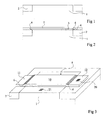
- a structure according to the present invention is constituted from an area active semiconductor 1 delimited by an insulating zone 2 filling a trench formed from the surface of the region 1.
- Active area 1 is possibly the upper part of a semiconductor substrate or may correspond to a semiconductor thin layer formed on an insulating substrate (SOI). In all cases, region 1 will preferably be heavily doped and isolated from an underlying substrate by a dielectric isolation or by junction isolation, such as this is well known in the art. Insulating zones 2 are for example made of silicon oxide.
- a first step the silicon layer 5 is etched according to a chosen contour.
- a selective etching of the silicon-germanium layer 3 is carried out.
- This etching must be selective in particular with respect to silicon 3 and 1, and also be selective with respect to silicon oxide 2.
- we For example choose a plasma-assisted chemical etching process, in which the plasma is used to create reactive chemical molecules very close to the surface of the structure.
- This process uses, for example, molecules of NF 3 , H 2 and N 2 or of CF 4 , H 2 and N 2 . It is also possible to carry out wet chemical etching in the presence of HNO 3 mixed with HF and H 2 O 2 or H 2 O.
- contacts 20 and 21 respectively on a foot 12 of the beam 10 and on the area active 1 of the substrate.
- Other means of contact with the area active 1 could be provided.
- a resonator such as that of Figure 3 whose length is of the order of 0.1 to 10 ⁇ m, whose width is of the order of 0.1 to a few ⁇ m, the thickness of which is of the order of 5 to 100 nm, and whose distance from substrate 1 is around 5 to 100 nm, all layers of silicon monocrystalline being coated with a thin oxide layer of a thickness from 1 to 5 nm.
- the present invention achieves the targeted objects. Because the built-in beam is made of silicon monocrystalline, its physical characteristics are perfectly known and therefore in particular, its Young's modulus is well defined and its characteristics are not likely to deteriorate over time. Furthermore, as the example clearly shows above, it is possible with the invention to obtain a device particularly miniaturized likely to work at very high frequencies.
Landscapes
- Engineering & Computer Science (AREA)
- Manufacturing & Machinery (AREA)
- Physics & Mathematics (AREA)
- Acoustics & Sound (AREA)
- Piezo-Electric Or Mechanical Vibrators, Or Delay Or Filter Circuits (AREA)
- Micromachines (AREA)
- Drying Of Semiconductors (AREA)
Abstract
Description
Claims (5)
- Résonateur électromécanique formé sur une zone active (1) de silicium monocristallin fortement dopée d'un substrat, constituant une première électrode délimitée par une zone isolante (2), comprenant une couche de silicium monocristallin reposant sur la zone isolante (2) par au moins une de ses extrémités et espacée de la zone active (1).
- Procédé de fabrication d'un résonateur selon la revendication 1, caractérisé en ce qu'il comprend les étapes suivantes :définir une zone active (1) de silicium monocristallin délimitée par une couche d'isolant enterré (2) ;déposer une couche de silicium-germanium (3) par un procédé d'épitaxie sélective de sorte que la couche de silicium-germanium croisse au-dessus de la zone active de silicium monocristallin ;déposer par un procédé d'épitaxie non-sélective une couche de silicium (5) et la graver selon un contour désiré ; etéliminer le silicium-germanium par une gravure sélective par rapport au silicium et à l'isolant.
- Procédé selon la revendication 2, caractérisé en ce qu'il comprend en outre, après la gravure du silicium-germanium, une étape d'oxydation.
- Procédé selon la revendication 2, caractérisé en ce qu'il comprend une étape de formation de contacts.
- Procédé selon la revendication 2, caractérisé en ce que la gravure chimique sélective du silicium-germanium est assistée par plasma.
Applications Claiming Priority (2)
| Application Number | Priority Date | Filing Date | Title |
|---|---|---|---|
| FR0104510A FR2823032B1 (fr) | 2001-04-03 | 2001-04-03 | Resonateur electromecanique a poutre vibrante |
| FR0104510 | 2001-04-03 |
Publications (2)
| Publication Number | Publication Date |
|---|---|
| EP1248366A1 true EP1248366A1 (fr) | 2002-10-09 |
| EP1248366B1 EP1248366B1 (fr) | 2006-09-06 |
Family
ID=8861880
Family Applications (1)
| Application Number | Title | Priority Date | Filing Date |
|---|---|---|---|
| EP02354052A Expired - Lifetime EP1248366B1 (fr) | 2001-04-03 | 2002-04-02 | Résonateur électromécanique à poutre vibrante |
Country Status (4)
| Country | Link |
|---|---|
| US (1) | US6873088B2 (fr) |
| EP (1) | EP1248366B1 (fr) |
| DE (1) | DE60214463D1 (fr) |
| FR (1) | FR2823032B1 (fr) |
Cited By (1)
| Publication number | Priority date | Publication date | Assignee | Title |
|---|---|---|---|---|
| WO2006013119A1 (fr) * | 2004-07-31 | 2006-02-09 | Robert Bosch Gmbh | Capteur microstructure et son procede de production |
Families Citing this family (135)
| Publication number | Priority date | Publication date | Assignee | Title |
|---|---|---|---|---|
| US6638621B2 (en) * | 2000-08-16 | 2003-10-28 | Lyotropic Therapeutics, Inc. | Coated particles, methods of making and using |
| FR2857952B1 (fr) * | 2003-07-25 | 2005-12-16 | St Microelectronics Sa | Resonateur electromecanique et procede de fabrication d'un tel resonateur |
| US7175709B2 (en) * | 2004-05-17 | 2007-02-13 | Taiwan Semiconductor Manufacturing Co., Ltd. | Epitaxy layer and method of forming the same |
| DE102004036803A1 (de) * | 2004-07-29 | 2006-03-23 | Robert Bosch Gmbh | Verfahren zum Ätzen einer Schicht auf einem Substrat |
| FR2892714B1 (fr) * | 2005-10-27 | 2007-12-21 | Commissariat Energie Atomique | Procede de gravure d'une couche sacrificielle pour une structure micro-usinee |
| FR2906238B1 (fr) * | 2006-09-27 | 2008-12-19 | Commissariat Energie Atomique | Procede de realisation d'un composant electromecanique sur un substrat plan |
| US9324576B2 (en) | 2010-05-27 | 2016-04-26 | Applied Materials, Inc. | Selective etch for silicon films |
| US10283321B2 (en) | 2011-01-18 | 2019-05-07 | Applied Materials, Inc. | Semiconductor processing system and methods using capacitively coupled plasma |
| US8999856B2 (en) | 2011-03-14 | 2015-04-07 | Applied Materials, Inc. | Methods for etch of sin films |
| US9064815B2 (en) | 2011-03-14 | 2015-06-23 | Applied Materials, Inc. | Methods for etch of metal and metal-oxide films |
| US8808563B2 (en) | 2011-10-07 | 2014-08-19 | Applied Materials, Inc. | Selective etch of silicon by way of metastable hydrogen termination |
| US9267739B2 (en) | 2012-07-18 | 2016-02-23 | Applied Materials, Inc. | Pedestal with multi-zone temperature control and multiple purge capabilities |
| US9373517B2 (en) | 2012-08-02 | 2016-06-21 | Applied Materials, Inc. | Semiconductor processing with DC assisted RF power for improved control |
| US9034770B2 (en) | 2012-09-17 | 2015-05-19 | Applied Materials, Inc. | Differential silicon oxide etch |
| US9023734B2 (en) | 2012-09-18 | 2015-05-05 | Applied Materials, Inc. | Radical-component oxide etch |
| US9390937B2 (en) | 2012-09-20 | 2016-07-12 | Applied Materials, Inc. | Silicon-carbon-nitride selective etch |
| US9132436B2 (en) | 2012-09-21 | 2015-09-15 | Applied Materials, Inc. | Chemical control features in wafer process equipment |
| US8969212B2 (en) | 2012-11-20 | 2015-03-03 | Applied Materials, Inc. | Dry-etch selectivity |
| US8980763B2 (en) | 2012-11-30 | 2015-03-17 | Applied Materials, Inc. | Dry-etch for selective tungsten removal |
| US9111877B2 (en) | 2012-12-18 | 2015-08-18 | Applied Materials, Inc. | Non-local plasma oxide etch |
| US8921234B2 (en) | 2012-12-21 | 2014-12-30 | Applied Materials, Inc. | Selective titanium nitride etching |
| US10256079B2 (en) | 2013-02-08 | 2019-04-09 | Applied Materials, Inc. | Semiconductor processing systems having multiple plasma configurations |
| US9362130B2 (en) | 2013-03-01 | 2016-06-07 | Applied Materials, Inc. | Enhanced etching processes using remote plasma sources |
| US9040422B2 (en) | 2013-03-05 | 2015-05-26 | Applied Materials, Inc. | Selective titanium nitride removal |
| US20140271097A1 (en) | 2013-03-15 | 2014-09-18 | Applied Materials, Inc. | Processing systems and methods for halide scavenging |
| US9493879B2 (en) | 2013-07-12 | 2016-11-15 | Applied Materials, Inc. | Selective sputtering for pattern transfer |
| US9773648B2 (en) | 2013-08-30 | 2017-09-26 | Applied Materials, Inc. | Dual discharge modes operation for remote plasma |
| US9236265B2 (en) * | 2013-11-04 | 2016-01-12 | Applied Materials, Inc. | Silicon germanium processing |
| US9576809B2 (en) | 2013-11-04 | 2017-02-21 | Applied Materials, Inc. | Etch suppression with germanium |
| US9520303B2 (en) | 2013-11-12 | 2016-12-13 | Applied Materials, Inc. | Aluminum selective etch |
| US9245762B2 (en) | 2013-12-02 | 2016-01-26 | Applied Materials, Inc. | Procedure for etch rate consistency |
| US9287095B2 (en) | 2013-12-17 | 2016-03-15 | Applied Materials, Inc. | Semiconductor system assemblies and methods of operation |
| US9287134B2 (en) | 2014-01-17 | 2016-03-15 | Applied Materials, Inc. | Titanium oxide etch |
| US9396989B2 (en) | 2014-01-27 | 2016-07-19 | Applied Materials, Inc. | Air gaps between copper lines |
| US9293568B2 (en) | 2014-01-27 | 2016-03-22 | Applied Materials, Inc. | Method of fin patterning |
| US9385028B2 (en) | 2014-02-03 | 2016-07-05 | Applied Materials, Inc. | Air gap process |
| US9499898B2 (en) | 2014-03-03 | 2016-11-22 | Applied Materials, Inc. | Layered thin film heater and method of fabrication |
| US9299575B2 (en) | 2014-03-17 | 2016-03-29 | Applied Materials, Inc. | Gas-phase tungsten etch |
| US9299537B2 (en) | 2014-03-20 | 2016-03-29 | Applied Materials, Inc. | Radial waveguide systems and methods for post-match control of microwaves |
| US9903020B2 (en) | 2014-03-31 | 2018-02-27 | Applied Materials, Inc. | Generation of compact alumina passivation layers on aluminum plasma equipment components |
| US9269590B2 (en) | 2014-04-07 | 2016-02-23 | Applied Materials, Inc. | Spacer formation |
| US9309598B2 (en) | 2014-05-28 | 2016-04-12 | Applied Materials, Inc. | Oxide and metal removal |
| US9406523B2 (en) | 2014-06-19 | 2016-08-02 | Applied Materials, Inc. | Highly selective doped oxide removal method |
| US9378969B2 (en) | 2014-06-19 | 2016-06-28 | Applied Materials, Inc. | Low temperature gas-phase carbon removal |
| US9425058B2 (en) | 2014-07-24 | 2016-08-23 | Applied Materials, Inc. | Simplified litho-etch-litho-etch process |
| US9378978B2 (en) | 2014-07-31 | 2016-06-28 | Applied Materials, Inc. | Integrated oxide recess and floating gate fin trimming |
| US9496167B2 (en) | 2014-07-31 | 2016-11-15 | Applied Materials, Inc. | Integrated bit-line airgap formation and gate stack post clean |
| US9659753B2 (en) | 2014-08-07 | 2017-05-23 | Applied Materials, Inc. | Grooved insulator to reduce leakage current |
| US9553102B2 (en) | 2014-08-19 | 2017-01-24 | Applied Materials, Inc. | Tungsten separation |
| US9355856B2 (en) | 2014-09-12 | 2016-05-31 | Applied Materials, Inc. | V trench dry etch |
| US9478434B2 (en) | 2014-09-24 | 2016-10-25 | Applied Materials, Inc. | Chlorine-based hardmask removal |
| US9368364B2 (en) | 2014-09-24 | 2016-06-14 | Applied Materials, Inc. | Silicon etch process with tunable selectivity to SiO2 and other materials |
| US9613822B2 (en) | 2014-09-25 | 2017-04-04 | Applied Materials, Inc. | Oxide etch selectivity enhancement |
| US9966240B2 (en) | 2014-10-14 | 2018-05-08 | Applied Materials, Inc. | Systems and methods for internal surface conditioning assessment in plasma processing equipment |
| US9355922B2 (en) | 2014-10-14 | 2016-05-31 | Applied Materials, Inc. | Systems and methods for internal surface conditioning in plasma processing equipment |
| US11637002B2 (en) | 2014-11-26 | 2023-04-25 | Applied Materials, Inc. | Methods and systems to enhance process uniformity |
| US9299583B1 (en) | 2014-12-05 | 2016-03-29 | Applied Materials, Inc. | Aluminum oxide selective etch |
| US10573496B2 (en) | 2014-12-09 | 2020-02-25 | Applied Materials, Inc. | Direct outlet toroidal plasma source |
| US10224210B2 (en) | 2014-12-09 | 2019-03-05 | Applied Materials, Inc. | Plasma processing system with direct outlet toroidal plasma source |
| US9887165B2 (en) | 2014-12-10 | 2018-02-06 | Stmicroelectronics S.R.L. | IC with insulating trench and related methods |
| US9502258B2 (en) | 2014-12-23 | 2016-11-22 | Applied Materials, Inc. | Anisotropic gap etch |
| US9343272B1 (en) | 2015-01-08 | 2016-05-17 | Applied Materials, Inc. | Self-aligned process |
| US11257693B2 (en) | 2015-01-09 | 2022-02-22 | Applied Materials, Inc. | Methods and systems to improve pedestal temperature control |
| US9373522B1 (en) | 2015-01-22 | 2016-06-21 | Applied Mateials, Inc. | Titanium nitride removal |
| US9449846B2 (en) | 2015-01-28 | 2016-09-20 | Applied Materials, Inc. | Vertical gate separation |
| US20160225652A1 (en) | 2015-02-03 | 2016-08-04 | Applied Materials, Inc. | Low temperature chuck for plasma processing systems |
| US9728437B2 (en) | 2015-02-03 | 2017-08-08 | Applied Materials, Inc. | High temperature chuck for plasma processing systems |
| US9881805B2 (en) | 2015-03-02 | 2018-01-30 | Applied Materials, Inc. | Silicon selective removal |
| US9741593B2 (en) | 2015-08-06 | 2017-08-22 | Applied Materials, Inc. | Thermal management systems and methods for wafer processing systems |
| US9691645B2 (en) | 2015-08-06 | 2017-06-27 | Applied Materials, Inc. | Bolted wafer chuck thermal management systems and methods for wafer processing systems |
| US9349605B1 (en) | 2015-08-07 | 2016-05-24 | Applied Materials, Inc. | Oxide etch selectivity systems and methods |
| US10504700B2 (en) | 2015-08-27 | 2019-12-10 | Applied Materials, Inc. | Plasma etching systems and methods with secondary plasma injection |
| US10522371B2 (en) | 2016-05-19 | 2019-12-31 | Applied Materials, Inc. | Systems and methods for improved semiconductor etching and component protection |
| US10504754B2 (en) | 2016-05-19 | 2019-12-10 | Applied Materials, Inc. | Systems and methods for improved semiconductor etching and component protection |
| US9865484B1 (en) | 2016-06-29 | 2018-01-09 | Applied Materials, Inc. | Selective etch using material modification and RF pulsing |
| US10629473B2 (en) | 2016-09-09 | 2020-04-21 | Applied Materials, Inc. | Footing removal for nitride spacer |
| US10062575B2 (en) | 2016-09-09 | 2018-08-28 | Applied Materials, Inc. | Poly directional etch by oxidation |
| US9934942B1 (en) | 2016-10-04 | 2018-04-03 | Applied Materials, Inc. | Chamber with flow-through source |
| US10062585B2 (en) | 2016-10-04 | 2018-08-28 | Applied Materials, Inc. | Oxygen compatible plasma source |
| US9721789B1 (en) | 2016-10-04 | 2017-08-01 | Applied Materials, Inc. | Saving ion-damaged spacers |
| US10546729B2 (en) | 2016-10-04 | 2020-01-28 | Applied Materials, Inc. | Dual-channel showerhead with improved profile |
| US10062579B2 (en) | 2016-10-07 | 2018-08-28 | Applied Materials, Inc. | Selective SiN lateral recess |
| US9947549B1 (en) | 2016-10-10 | 2018-04-17 | Applied Materials, Inc. | Cobalt-containing material removal |
| US9768034B1 (en) | 2016-11-11 | 2017-09-19 | Applied Materials, Inc. | Removal methods for high aspect ratio structures |
| US10163696B2 (en) | 2016-11-11 | 2018-12-25 | Applied Materials, Inc. | Selective cobalt removal for bottom up gapfill |
| US10026621B2 (en) | 2016-11-14 | 2018-07-17 | Applied Materials, Inc. | SiN spacer profile patterning |
| US10242908B2 (en) | 2016-11-14 | 2019-03-26 | Applied Materials, Inc. | Airgap formation with damage-free copper |
| US10566206B2 (en) | 2016-12-27 | 2020-02-18 | Applied Materials, Inc. | Systems and methods for anisotropic material breakthrough |
| US10431429B2 (en) | 2017-02-03 | 2019-10-01 | Applied Materials, Inc. | Systems and methods for radial and azimuthal control of plasma uniformity |
| US10403507B2 (en) | 2017-02-03 | 2019-09-03 | Applied Materials, Inc. | Shaped etch profile with oxidation |
| US10043684B1 (en) | 2017-02-06 | 2018-08-07 | Applied Materials, Inc. | Self-limiting atomic thermal etching systems and methods |
| US10319739B2 (en) | 2017-02-08 | 2019-06-11 | Applied Materials, Inc. | Accommodating imperfectly aligned memory holes |
| US10943834B2 (en) | 2017-03-13 | 2021-03-09 | Applied Materials, Inc. | Replacement contact process |
| US10319649B2 (en) | 2017-04-11 | 2019-06-11 | Applied Materials, Inc. | Optical emission spectroscopy (OES) for remote plasma monitoring |
| US11276559B2 (en) | 2017-05-17 | 2022-03-15 | Applied Materials, Inc. | Semiconductor processing chamber for multiple precursor flow |
| US11276590B2 (en) | 2017-05-17 | 2022-03-15 | Applied Materials, Inc. | Multi-zone semiconductor substrate supports |
| JP7176860B6 (ja) | 2017-05-17 | 2022-12-16 | アプライド マテリアルズ インコーポレイテッド | 前駆体の流れを改善する半導体処理チャンバ |
| US10497579B2 (en) | 2017-05-31 | 2019-12-03 | Applied Materials, Inc. | Water-free etching methods |
| US10049891B1 (en) | 2017-05-31 | 2018-08-14 | Applied Materials, Inc. | Selective in situ cobalt residue removal |
| US10920320B2 (en) | 2017-06-16 | 2021-02-16 | Applied Materials, Inc. | Plasma health determination in semiconductor substrate processing reactors |
| US10541246B2 (en) | 2017-06-26 | 2020-01-21 | Applied Materials, Inc. | 3D flash memory cells which discourage cross-cell electrical tunneling |
| US10727080B2 (en) | 2017-07-07 | 2020-07-28 | Applied Materials, Inc. | Tantalum-containing material removal |
| US10541184B2 (en) | 2017-07-11 | 2020-01-21 | Applied Materials, Inc. | Optical emission spectroscopic techniques for monitoring etching |
| US10354889B2 (en) | 2017-07-17 | 2019-07-16 | Applied Materials, Inc. | Non-halogen etching of silicon-containing materials |
| US10043674B1 (en) | 2017-08-04 | 2018-08-07 | Applied Materials, Inc. | Germanium etching systems and methods |
| US10170336B1 (en) | 2017-08-04 | 2019-01-01 | Applied Materials, Inc. | Methods for anisotropic control of selective silicon removal |
| US10297458B2 (en) | 2017-08-07 | 2019-05-21 | Applied Materials, Inc. | Process window widening using coated parts in plasma etch processes |
| US10128086B1 (en) | 2017-10-24 | 2018-11-13 | Applied Materials, Inc. | Silicon pretreatment for nitride removal |
| US10283324B1 (en) | 2017-10-24 | 2019-05-07 | Applied Materials, Inc. | Oxygen treatment for nitride etching |
| US10256112B1 (en) | 2017-12-08 | 2019-04-09 | Applied Materials, Inc. | Selective tungsten removal |
| US10903054B2 (en) | 2017-12-19 | 2021-01-26 | Applied Materials, Inc. | Multi-zone gas distribution systems and methods |
| US11328909B2 (en) | 2017-12-22 | 2022-05-10 | Applied Materials, Inc. | Chamber conditioning and removal processes |
| US10854426B2 (en) | 2018-01-08 | 2020-12-01 | Applied Materials, Inc. | Metal recess for semiconductor structures |
| US10679870B2 (en) | 2018-02-15 | 2020-06-09 | Applied Materials, Inc. | Semiconductor processing chamber multistage mixing apparatus |
| US10964512B2 (en) | 2018-02-15 | 2021-03-30 | Applied Materials, Inc. | Semiconductor processing chamber multistage mixing apparatus and methods |
| TWI766433B (zh) | 2018-02-28 | 2022-06-01 | 美商應用材料股份有限公司 | 形成氣隙的系統及方法 |
| US10593560B2 (en) | 2018-03-01 | 2020-03-17 | Applied Materials, Inc. | Magnetic induction plasma source for semiconductor processes and equipment |
| US10319600B1 (en) | 2018-03-12 | 2019-06-11 | Applied Materials, Inc. | Thermal silicon etch |
| US10497573B2 (en) | 2018-03-13 | 2019-12-03 | Applied Materials, Inc. | Selective atomic layer etching of semiconductor materials |
| US10573527B2 (en) | 2018-04-06 | 2020-02-25 | Applied Materials, Inc. | Gas-phase selective etching systems and methods |
| US10490406B2 (en) | 2018-04-10 | 2019-11-26 | Appled Materials, Inc. | Systems and methods for material breakthrough |
| US10699879B2 (en) | 2018-04-17 | 2020-06-30 | Applied Materials, Inc. | Two piece electrode assembly with gap for plasma control |
| US10886137B2 (en) | 2018-04-30 | 2021-01-05 | Applied Materials, Inc. | Selective nitride removal |
| US10755941B2 (en) | 2018-07-06 | 2020-08-25 | Applied Materials, Inc. | Self-limiting selective etching systems and methods |
| US10872778B2 (en) | 2018-07-06 | 2020-12-22 | Applied Materials, Inc. | Systems and methods utilizing solid-phase etchants |
| US10672642B2 (en) | 2018-07-24 | 2020-06-02 | Applied Materials, Inc. | Systems and methods for pedestal configuration |
| US10892198B2 (en) | 2018-09-14 | 2021-01-12 | Applied Materials, Inc. | Systems and methods for improved performance in semiconductor processing |
| US11049755B2 (en) | 2018-09-14 | 2021-06-29 | Applied Materials, Inc. | Semiconductor substrate supports with embedded RF shield |
| US11062887B2 (en) | 2018-09-17 | 2021-07-13 | Applied Materials, Inc. | High temperature RF heater pedestals |
| US11417534B2 (en) | 2018-09-21 | 2022-08-16 | Applied Materials, Inc. | Selective material removal |
| US11682560B2 (en) | 2018-10-11 | 2023-06-20 | Applied Materials, Inc. | Systems and methods for hafnium-containing film removal |
| US11121002B2 (en) | 2018-10-24 | 2021-09-14 | Applied Materials, Inc. | Systems and methods for etching metals and metal derivatives |
| US11437242B2 (en) | 2018-11-27 | 2022-09-06 | Applied Materials, Inc. | Selective removal of silicon-containing materials |
| US11721527B2 (en) | 2019-01-07 | 2023-08-08 | Applied Materials, Inc. | Processing chamber mixing systems |
| US10920319B2 (en) | 2019-01-11 | 2021-02-16 | Applied Materials, Inc. | Ceramic showerheads with conductive electrodes |
Citations (1)
| Publication number | Priority date | Publication date | Assignee | Title |
|---|---|---|---|---|
| WO2000042705A1 (fr) * | 1999-01-14 | 2000-07-20 | The Regents Of The University Of Michigan | Dispositif comportant un resonateur micromecanique caracterise par sa frequence de fonctionnement et procede de realisation associe |
Family Cites Families (10)
| Publication number | Priority date | Publication date | Assignee | Title |
|---|---|---|---|---|
| DE4332843C2 (de) * | 1993-09-27 | 1997-04-24 | Siemens Ag | Verfahren zur Herstellung einer mikromechanischen Vorrichtung und mikromechanische Vorrichtung |
| JPH10284762A (ja) * | 1995-02-16 | 1998-10-23 | Asahi Chem Ind Co Ltd | 表面弾性波を増幅するための積層構造及び増幅器 |
| ATE284091T1 (de) * | 1998-09-11 | 2004-12-15 | Texas Instruments Inc | Integrierter akustischer dünnfilmresonator |
| JP2001168092A (ja) * | 1999-01-08 | 2001-06-22 | Toshiba Corp | 半導体装置およびその製造方法 |
| US6424074B2 (en) | 1999-01-14 | 2002-07-23 | The Regents Of The University Of Michigan | Method and apparatus for upconverting and filtering an information signal utilizing a vibrating micromechanical device |
| US6600252B2 (en) | 1999-01-14 | 2003-07-29 | The Regents Of The University Of Michigan | Method and subsystem for processing signals utilizing a plurality of vibrating micromechanical devices |
| US6577040B2 (en) | 1999-01-14 | 2003-06-10 | The Regents Of The University Of Michigan | Method and apparatus for generating a signal having at least one desired output frequency utilizing a bank of vibrating micromechanical devices |
| US6566786B2 (en) | 1999-01-14 | 2003-05-20 | The Regents Of The University Of Michigan | Method and apparatus for selecting at least one desired channel utilizing a bank of vibrating micromechanical apparatus |
| FR2806833B1 (fr) * | 2000-03-27 | 2002-06-14 | St Microelectronics Sa | Procede de fabrication d'un transistor mos a deux grilles, dont l'une est enterree, et transistor correspondant |
| US6355498B1 (en) * | 2000-08-11 | 2002-03-12 | Agere Systems Guartian Corp. | Thin film resonators fabricated on membranes created by front side releasing |
-
2001
- 2001-04-03 FR FR0104510A patent/FR2823032B1/fr not_active Expired - Fee Related
-
2002
- 2002-04-01 US US10/113,789 patent/US6873088B2/en not_active Expired - Lifetime
- 2002-04-02 DE DE60214463T patent/DE60214463D1/de not_active Expired - Lifetime
- 2002-04-02 EP EP02354052A patent/EP1248366B1/fr not_active Expired - Lifetime
Patent Citations (1)
| Publication number | Priority date | Publication date | Assignee | Title |
|---|---|---|---|---|
| WO2000042705A1 (fr) * | 1999-01-14 | 2000-07-20 | The Regents Of The University Of Michigan | Dispositif comportant un resonateur micromecanique caracterise par sa frequence de fonctionnement et procede de realisation associe |
Cited By (1)
| Publication number | Priority date | Publication date | Assignee | Title |
|---|---|---|---|---|
| WO2006013119A1 (fr) * | 2004-07-31 | 2006-02-09 | Robert Bosch Gmbh | Capteur microstructure et son procede de production |
Also Published As
| Publication number | Publication date |
|---|---|
| FR2823032A1 (fr) | 2002-10-04 |
| EP1248366B1 (fr) | 2006-09-06 |
| FR2823032B1 (fr) | 2003-07-11 |
| US6873088B2 (en) | 2005-03-29 |
| US20020153808A1 (en) | 2002-10-24 |
| DE60214463D1 (de) | 2006-10-19 |
Similar Documents
| Publication | Publication Date | Title |
|---|---|---|
| EP1248366B1 (fr) | Résonateur électromécanique à poutre vibrante | |
| EP2215006B1 (fr) | Dispositif a circuit integre et n/mems encapsule et procede de realisation | |
| EP1905734B1 (fr) | Procédé de réalisation d'un composant éléctromécanique sur un substrat plan | |
| JPH03129854A (ja) | 半導体装置の製造方法 | |
| EP1406307A1 (fr) | Circuit intégré à couche enterrée fortement conductrice | |
| FR2707043A1 (fr) | ||
| EP1863174A1 (fr) | Composant contenant un filtre BAW | |
| KR20010072390A (ko) | 마이크로 미케니칼 센서 및 그 제조 방법 | |
| JP2002103299A (ja) | マイクロマシンの製造方法 | |
| CN1615543A (zh) | 用于键合并转移一种材料以形成半导体器件的方法 | |
| EP1589572B1 (fr) | Procédé de fabrication d'un circuit intégré comprenant l'élaboration de tranchées d'isolation creuses | |
| JP4000615B2 (ja) | 微小機械の製造方法 | |
| US5286341A (en) | Process for producing micro-mechanical structures | |
| EP1536439B1 (fr) | Composant incluant un condensateur variable | |
| FR2857952A1 (fr) | Resonateur electromecanique et procede de fabrication d'un tel resonateur | |
| EP0413645B1 (fr) | Procédé de fabrication de transistor MOS mésa de type silicium sur isolant | |
| KR20010043405A (ko) | 반도체 디바이스 제조 방법 | |
| FR3142289A1 (fr) | Procédé de fabrication d’un empilement comprenant une couche isolante | |
| EP0611221B1 (fr) | Micro-capteur capacitif à faible capacité parasite et procédé de fabrication | |
| EP4282543B1 (fr) | Transducteur cmut et procede de fabrication d'un transducteur cmut | |
| FR2805924A1 (fr) | Procede de gravure d'une couche de silicium polycristallin et son application a la realisation d'un emetteur auto- aligne avec la base extrinseque d'un transistor bipolaire simple ou double polysilicium | |
| KR100511900B1 (ko) | 에스오아이 기판의 제조방법 | |
| FR2879820A1 (fr) | Modulateur a jonction capacitive, jonction capacitive et son procede de realisation | |
| FR2921754A1 (fr) | Procede de fabrication d'un subtrat semiconducteur localise sur une couche isolante | |
| KR100355607B1 (ko) | 역방향 t자형의 캐패시터를 갖는 반도체 메모리 소자의 제조방법 |
Legal Events
| Date | Code | Title | Description |
|---|---|---|---|
| PUAI | Public reference made under article 153(3) epc to a published international application that has entered the european phase |
Free format text: ORIGINAL CODE: 0009012 |
|
| AK | Designated contracting states |
Kind code of ref document: A1 Designated state(s): AT BE CH CY DE DK ES FI FR GB GR IE IT LI LU MC NL PT SE TR |
|
| AX | Request for extension of the european patent |
Free format text: AL;LT;LV;MK;RO;SI |
|
| 17P | Request for examination filed |
Effective date: 20030331 |
|
| AKX | Designation fees paid |
Designated state(s): DE FR GB IT |
|
| GRAP | Despatch of communication of intention to grant a patent |
Free format text: ORIGINAL CODE: EPIDOSNIGR1 |
|
| GRAS | Grant fee paid |
Free format text: ORIGINAL CODE: EPIDOSNIGR3 |
|
| GRAA | (expected) grant |
Free format text: ORIGINAL CODE: 0009210 |
|
| AK | Designated contracting states |
Kind code of ref document: B1 Designated state(s): DE FR GB IT |
|
| PG25 | Lapsed in a contracting state [announced via postgrant information from national office to epo] |
Ref country code: IT Free format text: LAPSE BECAUSE OF FAILURE TO SUBMIT A TRANSLATION OF THE DESCRIPTION OR TO PAY THE FEE WITHIN THE PRESCRIBED TIME-LIMIT;WARNING: LAPSES OF ITALIAN PATENTS WITH EFFECTIVE DATE BEFORE 2007 MAY HAVE OCCURRED AT ANY TIME BEFORE 2007. THE CORRECT EFFECTIVE DATE MAY BE DIFFERENT FROM THE ONE RECORDED. Effective date: 20060906 |
|
| REG | Reference to a national code |
Ref country code: GB Ref legal event code: FG4D Free format text: NOT ENGLISH |
|
| REF | Corresponds to: |
Ref document number: 60214463 Country of ref document: DE Date of ref document: 20061019 Kind code of ref document: P |
|
| PG25 | Lapsed in a contracting state [announced via postgrant information from national office to epo] |
Ref country code: DE Free format text: LAPSE BECAUSE OF FAILURE TO SUBMIT A TRANSLATION OF THE DESCRIPTION OR TO PAY THE FEE WITHIN THE PRESCRIBED TIME-LIMIT Effective date: 20061207 |
|
| PLBE | No opposition filed within time limit |
Free format text: ORIGINAL CODE: 0009261 |
|
| STAA | Information on the status of an ep patent application or granted ep patent |
Free format text: STATUS: NO OPPOSITION FILED WITHIN TIME LIMIT |
|
| 26N | No opposition filed |
Effective date: 20070607 |
|
| REG | Reference to a national code |
Ref country code: FR Ref legal event code: ST Effective date: 20091231 |
|
| PG25 | Lapsed in a contracting state [announced via postgrant information from national office to epo] |
Ref country code: FR Free format text: LAPSE BECAUSE OF NON-PAYMENT OF DUE FEES Effective date: 20091222 |
|
| PGFP | Annual fee paid to national office [announced via postgrant information from national office to epo] |
Ref country code: FR Payment date: 20080429 Year of fee payment: 7 |
|
| PGFP | Annual fee paid to national office [announced via postgrant information from national office to epo] |
Ref country code: GB Payment date: 20200323 Year of fee payment: 19 |
|
| GBPC | Gb: european patent ceased through non-payment of renewal fee |
Effective date: 20210402 |
|
| PG25 | Lapsed in a contracting state [announced via postgrant information from national office to epo] |
Ref country code: GB Free format text: LAPSE BECAUSE OF NON-PAYMENT OF DUE FEES Effective date: 20210402 |