EP1249963B1 - Procédé de chiffrage à clé publique et communication chiffrée protégée contre une attaque par texte chiffré sélectionné - Google Patents
Procédé de chiffrage à clé publique et communication chiffrée protégée contre une attaque par texte chiffré sélectionné Download PDFInfo
- Publication number
- EP1249963B1 EP1249963B1 EP02002354A EP02002354A EP1249963B1 EP 1249963 B1 EP1249963 B1 EP 1249963B1 EP 02002354 A EP02002354 A EP 02002354A EP 02002354 A EP02002354 A EP 02002354A EP 1249963 B1 EP1249963 B1 EP 1249963B1
- Authority
- EP
- European Patent Office
- Prior art keywords
- side apparatus
- receiver
- sender
- ciphertext
- key
- Prior art date
- Legal status (The legal status is an assumption and is not a legal conclusion. Google has not performed a legal analysis and makes no representation as to the accuracy of the status listed.)
- Expired - Lifetime
Links
- 238000000034 method Methods 0.000 title claims description 180
- 238000004891 communication Methods 0.000 title description 81
- 230000014509 gene expression Effects 0.000 claims description 81
- 238000013507 mapping Methods 0.000 claims description 20
- 230000005540 biological transmission Effects 0.000 claims description 15
- 238000012545 processing Methods 0.000 description 78
- 230000006870 function Effects 0.000 description 59
- 238000010586 diagram Methods 0.000 description 34
- 230000015654 memory Effects 0.000 description 27
- 230000000694 effects Effects 0.000 description 20
- 238000004364 calculation method Methods 0.000 description 8
- 230000003044 adaptive effect Effects 0.000 description 7
- 230000001419 dependent effect Effects 0.000 description 2
- 238000005516 engineering process Methods 0.000 description 2
- 238000010276 construction Methods 0.000 description 1
- 238000007796 conventional method Methods 0.000 description 1
- 238000013461 design Methods 0.000 description 1
- 238000012986 modification Methods 0.000 description 1
- 230000004048 modification Effects 0.000 description 1
- 238000007781 pre-processing Methods 0.000 description 1
Images






Classifications
-
- H—ELECTRICITY
- H04—ELECTRIC COMMUNICATION TECHNIQUE
- H04L—TRANSMISSION OF DIGITAL INFORMATION, e.g. TELEGRAPHIC COMMUNICATION
- H04L9/00—Cryptographic mechanisms or cryptographic arrangements for secret or secure communications; Network security protocols
- H04L9/30—Public key, i.e. encryption algorithm being computationally infeasible to invert or user's encryption keys not requiring secrecy
- H04L9/3006—Public key, i.e. encryption algorithm being computationally infeasible to invert or user's encryption keys not requiring secrecy underlying computational problems or public-key parameters
- H04L9/302—Public key, i.e. encryption algorithm being computationally infeasible to invert or user's encryption keys not requiring secrecy underlying computational problems or public-key parameters involving the integer factorization problem, e.g. RSA or quadratic sieve [QS] schemes
Definitions
- the present invention relates to a cipher communication method using a public-key encryption scheme and being provable to be semantically-secure against an adaptive chosen-ciphertext attack.
- Micali Probabilistic Encryption, JCSS, 28, 2, pp. 270-299, (1984 )", a method described in a literature 7: " M. Blum and S. Goldwasser: An Efficient Probabilistic Public-Key Encryption Scheme which Hides All Partial Information, Proc. of Crypto' 84, LNCS196, Springer-Verlag, pp. 289-299, (1985 )", a method described in a literature 8: “ S. Goldwasser and M. Bellare: Lecture Notes on Cryptography, http:/www-cse.ucsd.edu/users/mihir/ (1997 )", a method described in a literature 9: " T. Okamoto and S. Uchiyama: A New Public-Key Cryptosystem as Secure as Factoring, Proc. of Eurocrypto' 98, LNCS1403, Springer-Verlag, pp. 308-318, (1998 )", and so on.
- transmission data is encrypted using a common-key cypher
- the secret key to the common-key cypher used for the data encryption at that time is encrypted using a public key encryption scheme.
- the length of a plaintext that can be encryption-processed at one time using the public-key encryption methods described in the above-described respective literatures is short, and is limited in proportion to the key length. For example, in the encryption method described in the literature 1, if the key length is 1024 bits, the plaintext is, at the most, 1024 bits. Moreover, in the encryption method described in the literature 3, if the base p is 160 bits, the information that can be transmitted at the one-time encryption is 160 bits.
- the identification information i.e., the ID information
- the key length to be transmitted is now getting longer and longer.
- the literature 4 has proved that the encryption method described in the literature 4 is unidirectional against the chosen-plaintext attack. This, however, means that the encryption method is weak against the chosen-ciphertext attack. Also, although the encryption method in the literature 4 is superior in the high-speed performance in the encryption processing, the method could not be expected to implement a high-speed decryption processing.
- FIG. 1 is a diagram for illustrating the system configuration in each embodiment.
- This system includes a sender-side apparatus 100 and a receiver-side apparatus 200. Moreover, the sender-side apparatus 100 and the receiver-side apparatus 200 are connected to each other via a communications line 300.
- FIG. 2 is a diagram for illustrating the inner configuration of the sender-side apparatus 100 in each embodiment.
- the sender-side apparatus 100 includes a random-number generation unit 101, a power multiplication unit 102, an arithmetic-operation unit 103, a remainder arithmetic-operation unit 104, a memory 105, a communications apparatus 106, an input apparatus 107, and an encryption unit 108.
- FIG. 3 is a diagram for illustrating the inner configuration of the receiver-side apparatus 200 in each embodiment.
- the receiver-side apparatus 200 includes a key generation unit 201, a power multiplication unit 202, a remainder arithmetic-operation unit 203, an arithmetic-operation unit 204, a memory 205, a communications apparatus 206, and a decryption unit 207.
- the above-described sender-side apparatus or receiver-side apparatus can be embodied using a common computer including a CPU and a memory. Furthermore, the CPU executes, on the memory, programs stored in a fixed storage apparatus included in the above-described computer, thereby making it possible to embody the random-number generation unit 101, the power multiplication units 102, 202, the arithmetic-operation units 103, 204, the remainder arithmetic-operation units 104, 203, the encryption unit 108, the key generation unit 201, and the decryption unit 207.
- the respective programs may be stored into the fixed storage apparatus in advance, or may be installed into the fixed storage apparatus or the memory when required from an external storage apparatus such as a FD or a CD-ROM or from a network such as the Internet via an external interface.
- FIG. 1 illustrates the system configuration in the present embodiment.
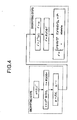
- FIG. 4 is a diagram for illustrating the outline of the processing steps in the 1st embodiment.
- the publication information is outputted via the communications line 300 or the like, then being sent to the sender-side apparatus 100 or being published.
- a well-known method e.g., the registration into a third party (i.e., a publication information management institution), is available.
- the other information is stored into the memory 205.
- the public-key encryption method according to the present embodiment can be proved to be semantically-secure against the chosen-ciphertext attack on the premise of the difficulty in determining the inverse function of the one-way trapdoor permutation f.
- the outline of the proof is as follows: If an enemy that is going to break the public-key encryption method according to the present embodiment (in the meaning of the semantical-security in the adaptive chosen-ciphertext attack, and the definition thereof has been described in, e.g., the literature 15) has an intentional purpose of obtaining information from a decryption oracle, the enemy is required to know the original plaintext in the ciphertext (y 1 , y 2 ) which is the question.
- the use of a method similar to the one described in the literature 14 easily indicates that the method in the present embodiment is IND-CPA. This makes it possible to prove that the public-key encryption method in the present embodiment is IND-CCA2.
- the method according to the present embodiment has succeeded in solving the problem in the literature 14 (i.e., the proof of the security is insufficient on the premise of the difficulty in calculating the inverse function of f) which has been pointed out in the literature 15.
- the method in the present embodiment permits the plaintext space to be extended in size with the security being maintained.
- FIG. 5 is a diagram for illustrating the outline of the steps in the 2nd embodiment.
- the manager or the receiver of the present system has determined the value of d in advance or as required, and that the above-described key generation unit fetches the value.
- the publication information is outputted via the communications line 300 or the like, then being sent to the sender-side apparatus 100 or being published.
- the well-known method e.g., the registration into the third party (i.e., the publication information management institution), is available.
- the other information is stored into the memory 205.
- the value of d (d ⁇ 1) can be modified.
- the value of d is increased in a range where the unique factorization of n into its prime factors is difficult. This increase allows the decryption processing to be executed at a high-speed.
- the complete cryptanalysis of the method according to the present embodiment is impossible on the premise of the difficulty in the unique factorization problem of n. Namely, if there exists an algorithm for solving the unique factorization problem of n, the utilization of the algorithm makes it possible to configure an algorithm for executing the complete cryptanalysis of the method according to the present embodiment. Also, if there exists the algorithm for executing the complete cryptanalysis of the method according to the present embodiment, the utilization of the algorithm makes it possible to configure the algorithm for solving the unique factorization problem of n.
- the conventional technologies i.e., the elliptic curve cypher, RSA, and OAEP + RSA
- FIG. 6 is a diagram for illustrating the outline of the steps in the 3rd embodiment.
- the manager or the receiver of the present system has determined the value of d in advance, and that the above-described key generation unit can use the value.
- the publication information is outputted via the communications line 300 or the like, then being sent to the sender-side apparatus 100 or being published.
- the well-known method e.g., the registration into the third party (i.e., the publication information management institution), is available.
- the other information is stored into the memory 205.
- the value of d (d ⁇ 1) can be modified.
- the value of d is increased in a range where the unique factorization of n into its prime factors is difficult. This increase allows the decryption processing to be executed at a high-speed.
- the complete cryptanalysis of the method according to the present embodiment is impossible on the premise of the difficulty in the unique factorization problem of n. Namely, if there exists an algorithm for solving the unique factorization problem of n, the utilization of the algorithm makes it possible to configure an algorithm for executing the complete cryptanalysis of the method according to the present embodiment. Also, if there exists the algorithm for executing the complete cryptanalysis of the method according to the present embodiment, the utilization of the algorithm makes it possible to configure the algorithm for solving the unique factorization problem of n.
- FIG. 7 is a diagram for illustrating the outline of the steps in the 4th embodiment.
- the manager or the receiver of the present system has determined the value of d in advance, and that the above-described key generation unit can use the value.
- the publication information is outputted via the communications line 300 or the like, then being sent to the sender-side apparatus 100 or being published.
- the well-known method e.g., the registration into the third party (i.e., the publication information management institution), is available.
- the other information is stored into the memory 205.
- the value of d (d > ; 1) can be modified.
- the complete cryptanalysis of the method according to the present embodiment is impossible on the premise of the difficulty in the unique factorization problem of n. Namely, if there exists an algorithm for solving the unique factorization problem of n, the utilization of the algorithm makes it possible to configure an algorithm for executing the complete cryptanalysis of the method according to the present embodiment. Also, if there exists the algorithm for executing the complete cryptanalysis of the method according to the present embodiment, the utilization of the algorithm makes it possible to configure the algorithm for solving the unique factorization problem of n.
- FIG. 1 illustrates the system configuration in the present embodiment.
- the publication information is outputted via the communications line 300 or the like, then being sent to the sender-side apparatus 100 or being published.
- the well-known method e.g., the registration into the third party (i.e., the publication information management institution), is available.
- the other information is stored into the memory 205.
- the decryption unit 207 in the receiver-side apparatus 200 uses K', performs the decryption of the ciphertext C, thereby obtaining the plaintext m.
- the publication information is outputted via the communications line 300 or the like, then being sent to the sender-side apparatus 100 or being published.
- the well-known method e.g., the registration into the third party (i.e., the publication information management institution), is available.
- the other information is stored into the memory 205.
- the decryption unit 207 in the receiver-side apparatus 200 uses K', performs the decryption of the ciphertext C, thereby obtaining the plaintext m.
- the publication information is outputted via the communications line 300 or the like, then being sent to the sender-side apparatus 100 or being published.
- the well-known method e.g., the registration into the third party (i.e., the publication information management institution), is available.
- the other information is stored into the memory 205.
- the decryption unit 207 in the receiver-side apparatus 200 uses K', performs the decryption of the ciphertext C, thereby obtaining the plaintext m.
- the publication information is outputted via the communications line 300 or the like, then being sent to the sender-side apparatus 100 or being published.
- the well-known method e.g., the registration into the third party (i.e., the publication information management institution), is available.
- the other information is stored into the memory 205.
- the receiver-side apparatus 200 using the decryption unit 207 and K', performs the decryption of the ciphertext C, thereby obtaining the plaintext m.
- FIG. 1 illustrates the system configuration in the present embodiment.
- FIG. 9 is a diagram for illustrating the outline of the processing steps in the 9th embodiment.
- the receiver uses the key generation unit 201 in the receiver-side apparatus 200 to create, in advance, a public key given by • f : 0 1 k ⁇ 0 1 k one - way trapdoor permutation , • G : 0 1 n + k 0 ⁇ 0 1 k hash function , • H : 0 1 k ⁇ 0 1 n + k 0 hash function and a secret key given by f - 1 : 0 1 k ⁇ 0 1 k trapdoor function
- the publication information is outputted via the communications line 300 or the like, then being sent to the sender-side apparatus 100 or being published.
- the well-known method e.g., the registration into the third party (i.e., the publication information management institution), is available.
- the other information is stored into the memory 205.
- the public-key encryption method according to the present embodiment can be proved to be semantically-secure against the chosen-ciphertext attack on the premise of the difficulty in determining the inverse function of the one-way trapdoor permutation f.
- the method according to the present embodiment has a feature that the length n of a plaintext can be set regardless of the function f. Namely, it is possible for the user to arbitrarily set the value of n in correspondence with the length of the message that the user wishes to transmit.
- FIG. 10 is a diagram for illustrating the outline of the steps in the 10th embodiment.
- the manager or the receiver of the present system has determined the value of d in advance, and that the above-described key generation unit can use the value.
- the publication information is outputted via the communications line 300 or the like, then being sent to the sender-side apparatus 100 or being published.
- the well-known method e.g., the registration into the third party (i.e., the publication information management institution), is available.
- the other information is stored into the memory 205.
- the value of d (d ⁇ 1) is set to be variable. Based on this condition, in the case where the bit length of the plaintext always remains short, the value of d is increased in a range where the unique factorization of n into its prime factors is difficult. This increase allows the decryption processing to be executed at a high-speed.
- the complete cryptanalysis of the method according to the present embodiment is impossible on the premise of the difficulty in the unique factorization problem of n. Namely, if there exists an algorithm for solving the unique factorization problem of n, the utilization of the algorithm makes it possible to configure an algorithm for executing the complete cryptanalysis of the method according to the present embodiment. Also, if there exists the algorithm for executing the complete cryptanalysis of the method according to the present embodiment, the utilization of the algorithm makes it possible to configure the algorithm for solving the unique factorization problem of n.
- FIG. 11 is a diagram for illustrating the outline of the steps in the 11th embodiment.
- the publication information is outputted via the communications line 300 or the like, then being sent to the sender-side apparatus 100 or being published.
- the well-known method e.g., the registration into the third party (i.e., the publication information management institution), is available.
- the other information is stored into the memory 205.
- the value of d (d ⁇ 1) is set to be variable. Based on this condition, in the case where the bit length of the plaintext always remains short, the value of d is increased in a range where the unique factorization of n into its prime factors is difficult. This increase allows the decryption processing to be executed at a high-speed.
- the complete cryptanalysis of the method according to the present embodiment is impossible on the premise of the difficulty in the unique factorization problem of n. Namely, if there exists an algorithm for solving the unique factorization problem of n, the utilization of the algorithm makes it possible to configure an algorithm for executing the complete cryptanalysis of the method according to the present embodiment. Also, if there exists the algorithm for executing the complete cryptanalysis of the method according to the present embodiment, the utilization of the algorithm makes it possible to configure the algorithm for solving the unique factorization problem of n.
- FIG. 12 is a diagram for illustrating the outline of the steps in the 12th embodiment.
- the publication information is outputted via the communications line 300 or the like, then being sent to the sender-side apparatus 100 or being published.
- the well-known method e.g., the registration into the third party (i.e., the publication information management institution), is available.
- the other information is stored into the memory 205.
- the value of d (d > ; 1) is set to be variable.
- the complete cryptanalysis of the method according to the present embodiment is impossible on the premise of the difficulty in the unique factorization problem of n. Namely, if there exists an algorithm for solving the unique factorization problem of n, the utilization of the algorithm makes it possible to configure an algorithm for executing the complete cryptanalysis of the method according to the present embodiment. Also, if there exists the algorithm for executing the complete cryptanalysis of the method according to the present embodiment, the utilization of the algorithm makes it possible to configure the algorithm for solving the unique factorization problem of n.
- FIG. 1 illustrates the system configuration in the present embodiment.
- the receiver uses the key generation unit 201 in the receiver-side apparatus 200 to create, in advance, a public key given by • f : 0 1 k ⁇ 0 1 k one - way trapdoor permutation , • G : 0 1 n + k 0 ⁇ 0 1 k hash function , • H : 0 1 k ⁇ 0 1 n + k 0 hash function and a secret key given by f - 1 : 0 1 k ⁇ 0 1 k trapdoor function
- the publication information is outputted via the communications line 300 or the like, then being sent to the sender-side apparatus 100 or being published.
- the well-known method e.g., the registration into the third party (i.e., the publication information management institution), is available.
- the other information is stored into the memory 205.
- the decryption unit 207 in the receiver-side apparatus 200 uses K', performs the decryption of the ciphertext C, thereby obtaining the plaintext m.
- the publication information is outputted via the communications line 300 or the like, then being sent to the sender-side apparatus 100 or being published.
- the well-known method e.g., the registration into the third party (i.e., the publication information management institution), is available.
- the other information is stored into the memory 205.
- the decryption unit 207 in the receiver-side apparatus 200 uses K', performs the decryption of the ciphertext C, thereby obtaining the plaintext m.
- the publication information is outputted via the communications line 300 or the like, then being sent to the sender-side apparatus 100 or being published.
- the well-known method e.g., the registration into the third party (i.e., the publication information management institution), is available.
- the other information is stored into the memory 205.
- the decryption unit 207 in the receiver-side apparatus 200 uses K', performs the decryption of the ciphertext C, thereby obtaining the plaintext m.
- the publication information is outputted via the communications line 300 or the like, then being sent to the sender-side apparatus 100 or being published.
- the well-known method e.g., the registration into the third party (i.e., the publication information management institution), is available.
- the other information is stored into the memory 205.
- the decryption unit 207 in the receiver-side apparatus 200 uses K', performs the decryption of the ciphertext C, thereby obtaining the plaintext m.
- FIG. 1 illustrates the system configuration in the present embodiment.
- FIG. 13 is a diagram for illustrating the outline of the processing steps in the 17th embodiment.
- the receiver uses the key generation unit 201 in the receiver-side apparatus 200 to create, in advance, a public key given by • f : 0 1 k ⁇ 0 1 k one - way trapdoor permutation , • G : 0 1 k ⁇ 0 1 n + k 0 hash function , • H : 0 1 n - k ⁇ 0 1 k 0 hash function and a secret key given by f - 1 : 0 1 k ⁇ 0 1 k trapdoor function
- the publication information is outputted via the communications line 300 or the like, then being sent to the sender-side apparatus 100 or being published.
- the well-known method e.g., the registration into the third party (i.e., the publication information management institution), is available.
- the other information is stored into the memory 205.
- the public-key encryption method according to the present embodiment can be proved to be semantically-secure against the chosen-ciphertext attack on the premise of the difficulty in determining the inverse function of the one-way trapdoor permutation f.
- the method according to the present embodiment has a feature of making it possible to perform a preprocessing calculation of y 1 , i.e., a part of the ciphertext. Namely, since it is possible to calculate y 1 independently of the plaintext, performing the calculation in advance allows the high-speed encryption processing to be implemented.
- the method according to the present embodiment has the feature that the length n of a plaintext can be set regardless of the function f. Namely, it is possible for the user to arbitrarily set the value of n in correspondence with the length of the message that the user wishes to transmit.
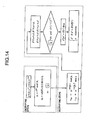
- FIG. 14 is a diagram for illustrating the outline of the steps in the 18th embodiment.
- the publication information is outputted via the communications line 300 or the like, then being sent to the sender-side apparatus 100 or being published.
- the well-known method e.g., the registration into the third party (i.e., the publication information management institution), is available.
- the other information is stored into the memory 205.
- the value of d (d ⁇ 1) is set to be variable. Based on this condition, in the case where the bit length of the plaintext always remains short, the value of d is increased in a range where the unique factorization of n into its prime factors is difficult. This increase allows the decryption processing to be executed at a high-speed.
- the complete cryptanalysis of the method according to the present embodiment is impossible on the premise of the difficulty in the unique factorization problem of n. Namely, if there exists an algorithm for solving the unique factorization problem of n, the utilization of the algorithm makes it possible to configure an algorithm for executing the complete cryptanalysis of the method according to the present embodiment. Also, if there exists the algorithm for executing the complete cryptanalysis of the method according to the present embodiment, the utilization of the algorithm makes it possible to configure the algorithm for solving the unique factorization problem of n.
- FIG. 15 is a diagram for illustrating the outline of the steps in the 19th embodiment.
- the publication information is outputted via the communications line 300 or the like, then being sent to the sender-side apparatus 100 or being published.
- the well-known method e.g., the registration into the third party (i.e., the publication information management institution), is available.
- the other information is stored into the memory 205.
- the value of d (d ⁇ 1) is set to be variable. Based on this condition, in the case where the bit length of the plaintext always remains short, the value of d is increased in a range where the unique factorization of n into its prime factors is difficult. This increase allows the decryption processing to be executed at a high-speed.
- the complete cryptanalysis of the method according to the present embodiment is impossible on the premise of the difficulty in the unique factorization problem of n. Namely, if there exists an algorithm for solving the unique factorization problem of n, the utilization of the algorithm makes it possible to configure an algorithm for executing the complete cryptanalysis of the method according to the present embodiment. Also, if there exists the algorithm for executing the complete cryptanalysis of the method according to the present embodiment, the utilization of the algorithm makes it possible to configure the algorithm for solving the unique factorization problem of n.
- the publication information is outputted via the communications line 300 or the like, then being sent to the sender-side apparatus 100 or being published.
- the well-known method e.g.
- the value of d (d > ; 1) is set to be variable.
- the complete cryptanalysis of the method according to the present embodiment is impossible on the premise of the difficulty in the unique factorization problem of n. Namely, if there exists an algorithm for solving the unique factorization problem of n, the utilization of the algorithm makes it possible to configure an algorithm for executing the complete cryptanalysis of the method according to the present embodiment. Also, if there exists the algorithm for executing the complete cryptanalysis of the method according to the present embodiment, the utilization of the algorithm makes it possible to configure the algorithm for solving the unique factorization problem of n.
- the sender is a user
- the sender-side apparatus is a computer such as a personal computer
- the receiver is a retail shop
- the receiver-side apparatus is a computer such as a personal computer.
- an order-form by the user concerning a commodity or the like is encrypted using a common-key cypher.
- the encryption key at that time is encrypted by the method according to the present embodiment, then being transmitted to the retail-shop-side apparatus.
- the apparatuses of their own are computers such as personal computers and, in many cases, a transmission text (i.e., a mail) is encrypted using a common-key cypher.
- a transmission text i.e., a mail
- the common key is encrypted by the method according to the present embodiment, then being transmitted to the computer of the receiver.
- the method in the present embodiment is also applicable to a variety of systems where the conventional public key encryption schemes have been used.
- FIG. 16 is a diagram for illustrating the processing steps in the 21st embodiment.
- the receiver uses the key generation unit 201 in the receiver-side apparatus 200, the receiver creates, in advance,
- the value of d (d ⁇ 1) can be modified.
- the value of d is increased in a range where the unique factorization of n into its prime factors is difficult. This increase allows the decryption processing to be executed at a high-speed.
- the public-key encryption method according to the present embodiment can be proved to be semantically-secure against the chosen-ciphertext attack on the premise of the difficulty in the unique factorization problem of N.
- the outline of the proof is as follows:
- information indicating a large-or-small relationship between the value of w and that of N/2 may be published by the sender-side apparatus 100 or may be transmitted to the receiver-side apparatus 200 by the sender-side apparatus.
- the receiver-side apparatus 200 uses the above-described information in the decryption processing, thereby making it possible to limit the 4 expressions, i.e., ⁇ (x p , x q ), ⁇ (-x p , x q ), ⁇ (x p , -x q ), and ⁇ (-x p , -x q ), into 2 expressions.
- the sender-side apparatus publishes the Jacobi symbol (i.e., w/N) or transmits the Jacobi symbol to the receiver-side apparatus, thereby calculating the values of the Jacobi symbols for ⁇ (x p , x q ), ⁇ (-x p , x q ), ⁇ (x p , -x q ), and ⁇ (-x p , -x q ).
- This also makes it possible to limit the 4 expressions into 2 expressions. These devices permit the efficiency to be enhanced in the decryption processing.
- the public-key encryption method according to the present embodiment is also usable simultaneously with a common-key cypher with the objective of distributing the data encryption key in the common-key cypher.
- FIG. 17 is a diagram for illustrating the processing steps in the 22nd embodiment.
- the receiver-side apparatus 200 uses the key generation unit 201 in the receiver-side apparatus 200 to create, in advance,
- the publication information is sent to the sender-side apparatus 100 or is published via the communications line 300 or the like.
- the well-known method e.g., the registration into the third party (i.e., the publication information management institution), is available.
- the other information is stored into the memory 205.
- the value of d (d ⁇ 1) can be modified.
- the value of d is increased in a range where the unique factorization of n into its prime factors is difficult. This increase allows the decryption processing to be executed at a high-speed.
- the method according to the present embodiment can be proved to be IND-CCA2 on the premise of the difficulty in the unique factorization problem of N.
- the public-key encryption method according to the present embodiment is also usable simultaneously with a common-key cypher with the objective of distributing the data encryption key in the common-key cypher.
Landscapes
- Engineering & Computer Science (AREA)
- Computing Systems (AREA)
- Theoretical Computer Science (AREA)
- Computer Security & Cryptography (AREA)
- Computer Networks & Wireless Communication (AREA)
- Signal Processing (AREA)
- Mobile Radio Communication Systems (AREA)
- Data Exchanges In Wide-Area Networks (AREA)
Claims (6)
- Procédé de cryptage par clé publique dans lequel un appareil du côté émetteur (100) crypte des données de transmission en utilisant une clé publique d'un récepteur ayant un appareil du côté récepteur (200), comportant les étapes consistant à :en tant qu'étapes de génération de clé,a) créer une clé secrète (p, q) donnée par une expression 146 :

et en outre,b) créer ladite clé publique (N, K, G, H) donnée par une expression 147 :
dans lequel
ledit appareil du côté émetteur (100)
sélectionne un nombre aléatoire r ∈ {0,1}k0 pour un texte en clair x (x ∈ {0, 1}n), etc) calcule une expression 148 :
où n1 à k1 sont des nombres entiers avec n+k0+k1 = k, et en outre,d) calcule une expression 149 :
ete) calcule une expression 150 :
etdéfinit ce résultat y en tant que texte chiffré de manière à transmettre ledit texte chiffré à un appareil du côté récepteur (200). - Procédé selon la revendication 1, dans lequel ledit appareil du côté récepteur (200), utilisant sa propre clé secrète (p, q), exécute les étapes suivantes consistant à :f) calculer, à partir dudit texte chiffré y, une expression 151 :
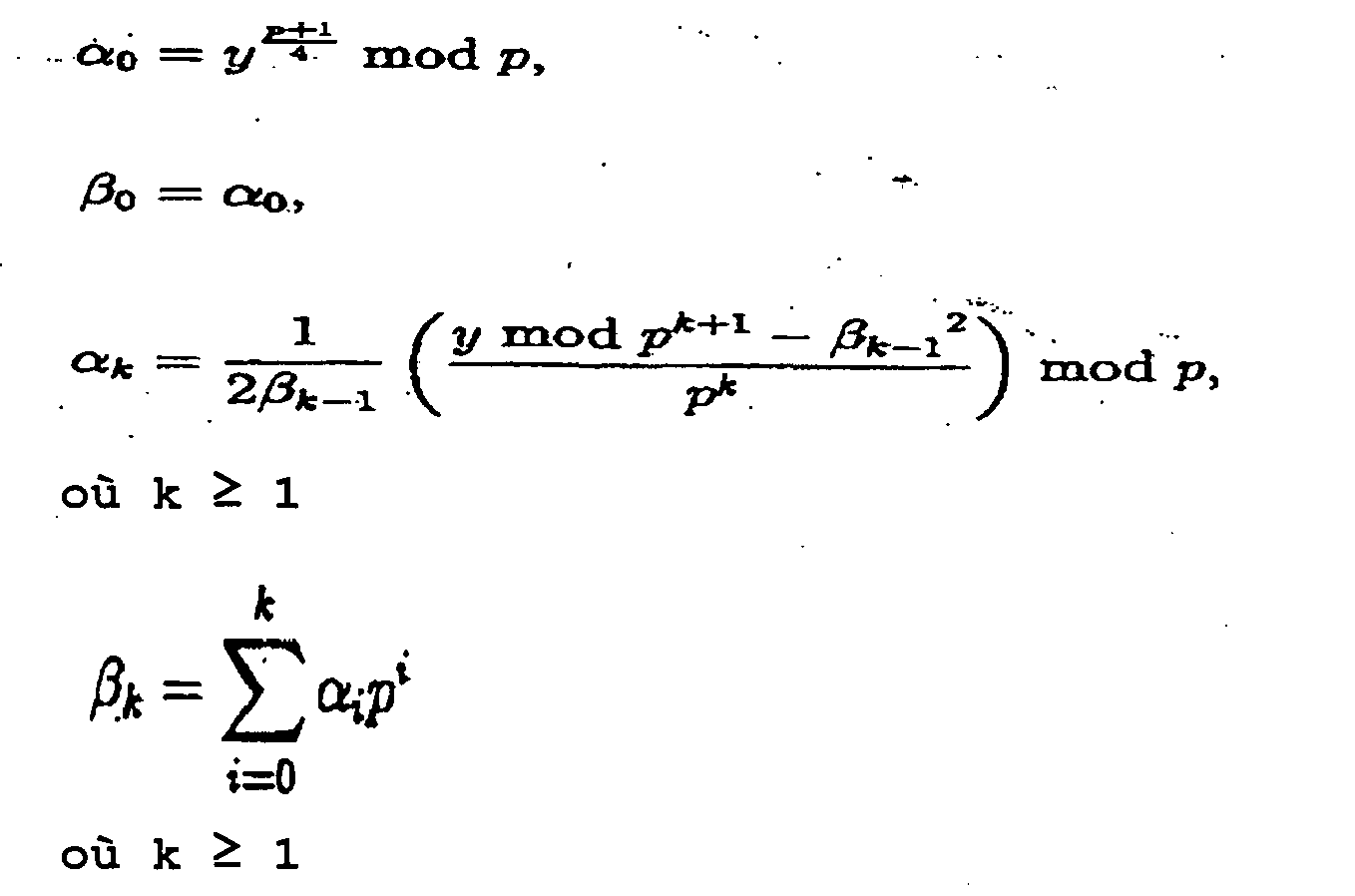
et, en utilisant ce résultat,g) calculer une expression 152 :
et en outre,h) calculer une expression 153 :
et, concernant chacune des expressions
et
ou φ désigne une représentation d'isomorphisme d'anneau de Z/(p) X Z/(q) à Z/(pq) par le théorème du reste chinois,i) établir chacune desdites expressions pour qu'elle soit comme donné par une expression 154 :
etj) calculer une expression 155 :
etk) obtenir un résultat de décryptage donné par une expression 156 :
où, il est stipulé que, dans un cas ou ledit résultat de décryptage est * ou invalide, ledit appareil du côté récepteur (200) refuse ledit texte chiffré. - Procédé selon la revendication 1 ou 2, dans lequel ledit appareil du côté émetteur (100) publie ou transmet un symbole de Jacobi (w/N), ledit appareil du côté émetteur (100) publiant également des informations ou transmettant lesdites informations audit appareil du côté récepteur(200), lesdites informations indiquant une grande ou petite relation entre une valeur de w et celle de N/2.
- Procédé selon l'une quelconque des revendications précédentes, dans lequel ledit appareil du côté récepteur (200) génère et publie lesdites informations de publication (G, H) ou (N, K, G, H).
- Procédé selon l'une quelconque des revendications précédentes, dans lequel, en tant que lesdits nombres premiers constituant ladite clé secrète, des nombres premiers sous une forme 2p' + 1 sont sélectionnés par rapport à d'autres nombres premiers p'.
- Procédé selon l'une quelconque des revendications précédentes, dans lequel une valeur de d est établie pour être variable, avec d ≥ 1.
Applications Claiming Priority (4)
| Application Number | Priority Date | Filing Date | Title |
|---|---|---|---|
| JP2001112161 | 2001-04-11 | ||
| JP2001112161 | 2001-04-11 | ||
| JP2001121969 | 2001-04-20 | ||
| JP2001121969 | 2001-04-20 |
Publications (3)
| Publication Number | Publication Date |
|---|---|
| EP1249963A2 EP1249963A2 (fr) | 2002-10-16 |
| EP1249963A3 EP1249963A3 (fr) | 2004-12-29 |
| EP1249963B1 true EP1249963B1 (fr) | 2013-01-16 |
Family
ID=26613402
Family Applications (1)
| Application Number | Title | Priority Date | Filing Date |
|---|---|---|---|
| EP02002354A Expired - Lifetime EP1249963B1 (fr) | 2001-04-11 | 2002-01-31 | Procédé de chiffrage à clé publique et communication chiffrée protégée contre une attaque par texte chiffré sélectionné |
Country Status (2)
| Country | Link |
|---|---|
| US (2) | US7164765B2 (fr) |
| EP (1) | EP1249963B1 (fr) |
Families Citing this family (18)
| Publication number | Priority date | Publication date | Assignee | Title |
|---|---|---|---|---|
| JP4284867B2 (ja) * | 2001-01-18 | 2009-06-24 | 株式会社日立製作所 | 標準モデル上で適応的選択暗号文攻撃に対して安全な公開鍵暗号方法 |
| GB2384144A (en) * | 2002-01-09 | 2003-07-16 | Hewlett Packard Co | A public key encryption system |
| GB0223692D0 (en) * | 2002-10-11 | 2002-11-20 | Multiplex Photonics Ltd | Apparatus and method of encoding and decoding information |
| US7092524B1 (en) * | 2002-11-15 | 2006-08-15 | The United States Of America As Represented By The National Security Agency | Device for and method of cryptographically wrapping information |
| FR2862454A1 (fr) * | 2003-11-18 | 2005-05-20 | Atmel Corp | Methode de reduction modulaire aleatoire et equipement associe |
| KR100530372B1 (ko) * | 2003-12-20 | 2005-11-22 | 삼성전자주식회사 | 사이드채널 공격을 방지할 수 있는 타원곡선 암호화 방법 |
| WO2005098796A1 (fr) | 2004-03-31 | 2005-10-20 | Nec Corporation | Méthode d’application de bourrage garantissant la sûreté d’une méthode de cryptage |
| KR20060134992A (ko) * | 2004-03-31 | 2006-12-28 | 마츠시타 덴끼 산교 가부시키가이샤 | 정수를 가산하는 컴퓨터 시스템 |
| JP4701381B2 (ja) * | 2005-01-24 | 2011-06-15 | 国立大学法人 奈良先端科学技術大学院大学 | 暗号鍵生成装置、暗号鍵生成方法、暗号化データ配信装置、個別暗号鍵再生成装置、暗号化データ受信装置、暗号化データ配信システム、暗号鍵生成プログラム、および記録媒体 |
| US7594116B2 (en) * | 2005-04-28 | 2009-09-22 | Proofpoint, Inc. | Mediated key exchange between source and target of communication |
| US20060251248A1 (en) * | 2005-05-03 | 2006-11-09 | Jesse Lipson | Public key cryptographic methods and systems with preprocessing |
| FR2885711B1 (fr) * | 2005-05-12 | 2007-07-06 | Atmel Corp | Procede et materiel modulaire et aleatoire pour la reduction polynomiale |
| US8520842B2 (en) * | 2010-01-07 | 2013-08-27 | Microsoft Corporation | Maintaining privacy during user profiling |
| EP2860905A1 (fr) * | 2013-10-09 | 2015-04-15 | Thomson Licensing | Méthode pour chiffrer un message au moyen d'une fonction de chiffrage avec clé, et appareil électronique et produit programme d'ordinateur correspondants |
| EP3096310B1 (fr) * | 2014-01-17 | 2018-08-01 | Nippon Telegraph And Telephone Corporation | Procèdè de calcul secret, systéme de calcul secret, dispositif de permutation alèatoire et programme |
| US11463242B2 (en) | 2020-05-19 | 2022-10-04 | International Business Machines Corporation | Padding oracle elimination in RSA encryption |
| US12192318B2 (en) * | 2021-03-10 | 2025-01-07 | Quantropi Inc. | Quantum-safe cryptographic method and system |
| WO2025221794A1 (fr) * | 2024-04-15 | 2025-10-23 | Ntt Research, Inc. | Procédés et systèmes de chiffrement déterministe à sécurité améliorée |
Family Cites Families (4)
| Publication number | Priority date | Publication date | Assignee | Title |
|---|---|---|---|---|
| US6266771B1 (en) * | 1997-02-10 | 2001-07-24 | The Regents Of The University Of California | Probabilistic signature scheme |
| US6081598A (en) * | 1997-10-20 | 2000-06-27 | Microsoft Corporation | Cryptographic system and method with fast decryption |
| DE69840959D1 (de) * | 1997-12-17 | 2009-08-20 | Nippon Telegraph & Telephone | Verschlüsselungs- und Entschlüsselungsvorrichtungen für Kryptosysteme mit öffentlichem Schlüssel und Aufzeichnungsmedium mit darauf gespeicherten zugehörigen Verarbeitungsprogrammen. |
| US6108783A (en) * | 1998-02-11 | 2000-08-22 | International Business Machines Corporation | Chameleon hashing and signatures |
-
2002
- 2002-01-31 EP EP02002354A patent/EP1249963B1/fr not_active Expired - Lifetime
- 2002-01-31 US US10/059,339 patent/US7164765B2/en not_active Expired - Fee Related
-
2006
- 2006-12-07 US US11/634,863 patent/US7649991B2/en not_active Expired - Fee Related
Non-Patent Citations (2)
| Title |
|---|
| ADVANCES IN CRYPTOLOGY- CRYPTO 2001. 21ST ANNUAL INTERNATIONAL CRYPTOLOGY CONFERENCE 19-23 AUG. 2001 SANTA BARBARA, CA, USA, ADVANCES IN CRYPTOLOGY - CRTPTO 2001. 21ST ANNUAL INTERNATIONAL CRYPTOLOGY CONFERENCE, PROCEEDINGS (LECTURE NOTES IN COMPUTER SCIENCE VOL.2139) SPRINGER-VERLAG BERLIN, GERMANY, pages 275 - 291, ISBN: 3-540-42456-3 * |
| DATABASE INSPEC [online] THE INSTITUTION OF ELECTRICAL ENGINEERS, STEVENAGE, GB; 2001, BONEH D: "Simplified OAEP for the RSA and Rabin functions", Database accession no. 7129515 * |
Also Published As
| Publication number | Publication date |
|---|---|
| US20070177727A1 (en) | 2007-08-02 |
| EP1249963A3 (fr) | 2004-12-29 |
| US7164765B2 (en) | 2007-01-16 |
| EP1249963A2 (fr) | 2002-10-16 |
| US7649991B2 (en) | 2010-01-19 |
| US20030002662A1 (en) | 2003-01-02 |
Similar Documents
| Publication | Publication Date | Title |
|---|---|---|
| EP0503119B1 (fr) | Système cryptographique à clé publique utilisant des courbes elliptiques sur des anneaux | |
| EP1249963B1 (fr) | Procédé de chiffrage à clé publique et communication chiffrée protégée contre une attaque par texte chiffré sélectionné | |
| EP0946018B1 (fr) | Procédé de réalisation rapide d'un d'un déchiffrage ou d'une authentification | |
| US20020041684A1 (en) | Public-key encryption and key-sharing methods | |
| Bleichenbacher | On the security of the KMOV public key cryptosystem | |
| WO2012156254A1 (fr) | Procédé pour exécuter une signature numérique de groupe | |
| Miyaji | A message recovery signature scheme equivalent to DSA over elliptic curves | |
| Kiltz et al. | A general construction of IND-CCA2 secure public key encryption | |
| Küsmüş et al. | A novel public-key encryption scheme based on Bass cyclic units in integral group rings | |
| Nieto et al. | A Public Key Cryptosystem Based On A Subgroup Membership Problem. | |
| Nieto et al. | A public key cryptosystem based on the subgroup membership problem | |
| US20020015491A1 (en) | Public key encryption method and communication system using public key cryptosystem | |
| Zahhafi et al. | A digitial signature scheme based simultaneously on the DSA and RSA protocols | |
| EP1148675A1 (fr) | Chiffreur a cle non protegee et procede de partage de cle | |
| Verma et al. | An improved RSA variant | |
| Djebaili et al. | A different encryption system based on the integer factorization problem | |
| JP4230162B2 (ja) | 公開鍵暗号通信方法 | |
| Mohammadi et al. | Comparison of two Public Key Cryptosystems | |
| JP4284867B2 (ja) | 標準モデル上で適応的選択暗号文攻撃に対して安全な公開鍵暗号方法 | |
| Kim et al. | CCA secure ElGamal encryption over an integer group where ICDH assumption holds | |
| JP4304896B2 (ja) | 公開鍵暗号通信方法 | |
| Dissanayake | An efficient public key cryptosystem | |
| Dissanayake | Identification of Fake Messages Using Two PKCs | |
| Gunnala et al. | An Attribute Involved Non deterministic Cryptosystem using Composite Residuosity Class Problem | |
| Chen et al. | Protocol failures related to order of encryption and signature computation of discrete logarithms in RSA groups |
Legal Events
| Date | Code | Title | Description |
|---|---|---|---|
| PUAI | Public reference made under article 153(3) epc to a published international application that has entered the european phase |
Free format text: ORIGINAL CODE: 0009012 |
|
| AK | Designated contracting states |
Kind code of ref document: A2 Designated state(s): AT BE CH CY DE DK ES FI FR GB GR IE IT LI LU MC NL PT SE TR |
|
| AX | Request for extension of the european patent |
Free format text: AL;LT;LV;MK;RO;SI |
|
| PUAL | Search report despatched |
Free format text: ORIGINAL CODE: 0009013 |
|
| AK | Designated contracting states |
Kind code of ref document: A3 Designated state(s): AT BE CH CY DE DK ES FI FR GB GR IE IT LI LU MC NL PT SE TR |
|
| AX | Request for extension of the european patent |
Extension state: AL LT LV MK RO SI |
|
| 17P | Request for examination filed |
Effective date: 20050622 |
|
| AKX | Designation fees paid |
Designated state(s): BE DE FR GB |
|
| GRAP | Despatch of communication of intention to grant a patent |
Free format text: ORIGINAL CODE: EPIDOSNIGR1 |
|
| GRAS | Grant fee paid |
Free format text: ORIGINAL CODE: EPIDOSNIGR3 |
|
| GRAA | (expected) grant |
Free format text: ORIGINAL CODE: 0009210 |
|
| AK | Designated contracting states |
Kind code of ref document: B1 Designated state(s): BE DE FR GB |
|
| REG | Reference to a national code |
Ref country code: GB Ref legal event code: FG4D |
|
| REG | Reference to a national code |
Ref country code: DE Ref legal event code: R096 Ref document number: 60244404 Country of ref document: DE Effective date: 20130314 |
|
| PLBE | No opposition filed within time limit |
Free format text: ORIGINAL CODE: 0009261 |
|
| STAA | Information on the status of an ep patent application or granted ep patent |
Free format text: STATUS: NO OPPOSITION FILED WITHIN TIME LIMIT |
|
| 26N | No opposition filed |
Effective date: 20131017 |
|
| REG | Reference to a national code |
Ref country code: DE Ref legal event code: R097 Ref document number: 60244404 Country of ref document: DE Effective date: 20131017 |
|
| REG | Reference to a national code |
Ref country code: FR Ref legal event code: PLFP Year of fee payment: 14 |
|
| PGFP | Annual fee paid to national office [announced via postgrant information from national office to epo] |
Ref country code: DE Payment date: 20150127 Year of fee payment: 14 |
|
| PGFP | Annual fee paid to national office [announced via postgrant information from national office to epo] |
Ref country code: GB Payment date: 20150128 Year of fee payment: 14 Ref country code: FR Payment date: 20150108 Year of fee payment: 14 |
|
| PGFP | Annual fee paid to national office [announced via postgrant information from national office to epo] |
Ref country code: BE Payment date: 20150112 Year of fee payment: 14 |
|
| PG25 | Lapsed in a contracting state [announced via postgrant information from national office to epo] |
Ref country code: BE Free format text: LAPSE BECAUSE OF NON-PAYMENT OF DUE FEES Effective date: 20160131 |
|
| REG | Reference to a national code |
Ref country code: DE Ref legal event code: R119 Ref document number: 60244404 Country of ref document: DE |
|
| GBPC | Gb: european patent ceased through non-payment of renewal fee |
Effective date: 20160131 |
|
| REG | Reference to a national code |
Ref country code: FR Ref legal event code: ST Effective date: 20160930 |
|
| PG25 | Lapsed in a contracting state [announced via postgrant information from national office to epo] |
Ref country code: DE Free format text: LAPSE BECAUSE OF NON-PAYMENT OF DUE FEES Effective date: 20160802 Ref country code: GB Free format text: LAPSE BECAUSE OF NON-PAYMENT OF DUE FEES Effective date: 20160131 |
|
| PG25 | Lapsed in a contracting state [announced via postgrant information from national office to epo] |
Ref country code: FR Free format text: LAPSE BECAUSE OF NON-PAYMENT OF DUE FEES Effective date: 20160201 |