EP1252006B1 - Mousse en polytetrafluoroethylene extrude - Google Patents
Mousse en polytetrafluoroethylene extrude Download PDFInfo
- Publication number
- EP1252006B1 EP1252006B1 EP01908672A EP01908672A EP1252006B1 EP 1252006 B1 EP1252006 B1 EP 1252006B1 EP 01908672 A EP01908672 A EP 01908672A EP 01908672 A EP01908672 A EP 01908672A EP 1252006 B1 EP1252006 B1 EP 1252006B1
- Authority
- EP
- European Patent Office
- Prior art keywords
- solid space
- space holder
- polytetrafluoroethylene
- foaming agent
- foam
- Prior art date
- Legal status (The legal status is an assumption and is not a legal conclusion. Google has not performed a legal analysis and makes no representation as to the accuracy of the status listed.)
- Expired - Lifetime
Links
Images
Classifications
-
- B—PERFORMING OPERATIONS; TRANSPORTING
- B29—WORKING OF PLASTICS; WORKING OF SUBSTANCES IN A PLASTIC STATE IN GENERAL
- B29C—SHAPING OR JOINING OF PLASTICS; SHAPING OF MATERIAL IN A PLASTIC STATE, NOT OTHERWISE PROVIDED FOR; AFTER-TREATMENT OF THE SHAPED PRODUCTS, e.g. REPAIRING
- B29C44/00—Shaping by internal pressure generated in the material, e.g. swelling or foaming ; Producing porous or cellular expanded plastics articles
- B29C44/34—Auxiliary operations
- B29C44/36—Feeding the material to be shaped
- B29C44/46—Feeding the material to be shaped into an open space or onto moving surfaces, i.e. to make articles of indefinite length
- B29C44/50—Feeding the material to be shaped into an open space or onto moving surfaces, i.e. to make articles of indefinite length using pressure difference, e.g. by extrusion or by spraying
- B29C44/507—Feeding the material to be shaped into an open space or onto moving surfaces, i.e. to make articles of indefinite length using pressure difference, e.g. by extrusion or by spraying extruding the compound through an annular die
-
- B—PERFORMING OPERATIONS; TRANSPORTING
- B29—WORKING OF PLASTICS; WORKING OF SUBSTANCES IN A PLASTIC STATE IN GENERAL
- B29C—SHAPING OR JOINING OF PLASTICS; SHAPING OF MATERIAL IN A PLASTIC STATE, NOT OTHERWISE PROVIDED FOR; AFTER-TREATMENT OF THE SHAPED PRODUCTS, e.g. REPAIRING
- B29C44/00—Shaping by internal pressure generated in the material, e.g. swelling or foaming ; Producing porous or cellular expanded plastics articles
- B29C44/34—Auxiliary operations
- B29C44/36—Feeding the material to be shaped
- B29C44/46—Feeding the material to be shaped into an open space or onto moving surfaces, i.e. to make articles of indefinite length
- B29C44/50—Feeding the material to be shaped into an open space or onto moving surfaces, i.e. to make articles of indefinite length using pressure difference, e.g. by extrusion or by spraying
- B29C44/505—Feeding the material to be shaped into an open space or onto moving surfaces, i.e. to make articles of indefinite length using pressure difference, e.g. by extrusion or by spraying extruding the compound through a flat die
-
- B—PERFORMING OPERATIONS; TRANSPORTING
- B29—WORKING OF PLASTICS; WORKING OF SUBSTANCES IN A PLASTIC STATE IN GENERAL
- B29K—INDEXING SCHEME ASSOCIATED WITH SUBCLASSES B29B, B29C OR B29D, RELATING TO MOULDING MATERIALS OR TO MATERIALS FOR MOULDS, REINFORCEMENTS, FILLERS OR PREFORMED PARTS, e.g. INSERTS
- B29K2027/00—Use of polyvinylhalogenides or derivatives thereof as moulding material
- B29K2027/12—Use of polyvinylhalogenides or derivatives thereof as moulding material containing fluorine
- B29K2027/18—PTFE, i.e. polytetrafluoroethylene, e.g. ePTFE, i.e. expanded polytetrafluoroethylene
-
- B—PERFORMING OPERATIONS; TRANSPORTING
- B29—WORKING OF PLASTICS; WORKING OF SUBSTANCES IN A PLASTIC STATE IN GENERAL
- B29L—INDEXING SCHEME ASSOCIATED WITH SUBCLASS B29C, RELATING TO PARTICULAR ARTICLES
- B29L2031/00—Other particular articles
- B29L2031/34—Electrical apparatus, e.g. sparking plugs or parts thereof
- B29L2031/3462—Cables
Definitions
- the present invention relates to coaxial cables for the high-frequency sector and to the production of polytetrafluoroethylene (PTFE) foam, in particular as cable insulation, a dielectric or a molded gasket.
- PTFE polytetrafluoroethylene
- Cable insulation should have the lowest possible dielectric constant ⁇ r and the lowest possible dissipation factor tan ⁇ .
- PTFE ideally pure PTFE not modified with comonomers or with long unbranched chains, because contamination with end group branching or comonomers adds additional dipoles.
- the dielectric constant of unsintered PTFE paste material is generally about 1.7 and that of sintered PTFE is generally between 2.05 and 2.1.
- Another very significant advantage of PTFE cable insulation is that, unlike polyvinyl chloride, polyethylene or polypropylene, it is incombustible.
- JP-B 57-30059 proposes adding up to 15% of foaming agents.
- the plastic (PTFE) foamed in that publication is not thermoplastically processible. It is usually only thermoplastically processible materials which are physically or chemically foamed. With an additional foaming procedure, the process is still more complicated.
- EP-A-0 271 990 describes an insulated wire comprising a conductor wire having at least one covering layer thereover of ram-extruded polytetrafluoroethylene (PTFE) containing a foaming agent.
- PTFE polytetrafluoroethylene
- EP-A-808 865 teaches that besides thermoplastic processible fluoropolymer, PTFE can also be foamed with super critical CO 2 . However, in this process the fluoropolymer is first formed into the desired shape and only subsequently foamed under sinter conditions.
- JP-A 11-124458 moreover proposes foams of suspension product. These have to be peeled from a block before they can be wound up as a tape. Again, this is a complicated process.
- WO-A-91/12123 provides a simplified process.
- the PTFE paste is extruded onto wire and then oriented.
- a disadvantage is that the cable insulation does not adhere to the wire, and the insulation becomes deformed due to lack of dimensional stability when exposed to small mechanical loads, for example if it is handled without sufficient care.
- the dimensional stability can be increased by sintering this leads to other disadvantages, such as compromising the electrical properties, shrinkage losses and elasticity losses.
- this object is achieved by extruding a not-melt processible fluoropolymer, in particular PTFE, together with a solid space holder, in particular a foaming agent, such that voids remain subsequent to the removal of the solid space holder.
- a solid space holder and in particular the solid foaming agent is used in an amount from 20 to 100 parts by weight of solid space holder or foaming agent for each 100 parts by weight of PTFE.
- PTFE cannot be processed thermoplastically, it cannot be foamed as a usual thermoplastic polymer (e.g. as disclosed in EP-A-908 487). It is thus surprising that nevertheless, PTFE can be formed into a foam using a foaming agent.
- the . foaming process in case of PTFE is fundamentally different from that of thermoplastic foams.
- the foaming agent expands in the melt thereby building pores.
- the foaming agent only fulfills the role of a solid space holder during the extrusion. Upon removal of the foaming agent or space holder, a corresponding void is left at the place where the foaming agent previously resided.
- Extrusion according to the invention provides a PTFE foam with a density of not more than 1.3 g/cm 3 , which insulates an electrical conductor without the inconvenience of winding.
- the novel process merely comprises dry mixing of PTFE, foaming agent and lubricant.
- the processing method is identical with known cable extrusion for paste PTFE.
- the foamed PTFE is substantively stress-free, and can therefore retain its dimensions during further thermal processing.
- the crystallinity is generally preserved and is in general more than 90%.
- the foamed PTFE is also flexible and dimensionally stable. As a dielectric, it adheres to the conductor. Foams of this type may also in principle be used as filter screens, filters, membranes or adsorbers. They are also suitable as gaskets, in particular between hard, brittle flanges which have uneven surfaces and would spring apart if assembled under high pressure, for example ceramics flanges or enamels. Gaskets may also be provided as sheets, rings, strips or in any other form.
- Suitable solid space holders are compounds that can be removed from an article, in particular by sublimation, evaporation, dissolution, washing out or by decomposing.
- Preferred are foaming agents that sublime, evaporate or that form volatile degradation products above the extrusion temperature.
- azo compounds such as azodicarbonamide and mixtures with plasticizers or with peroxides, and sulfohydrazides
- carbonates such as sodium carbonate, ammonium carbonate, and hydrogencarbonates, and hartshorn salts
- hydrazines such as trihydrazinotriazine, 4,4'-oxybis(benzenesulfohydrazide), and diphenyl sulfone 3,3'-disulfohydrazide
- tetrazoles such as 5-phenyltetrazole
- benzoxazines such as isatoic anhydride
- semicarbazides such as p-tolylenesulfonylsemicarbazide.
- ammonium hydrogen carbonate is used.
- PTFE for use in the invention is preferably produced via the emulsion polymerization of TFE.
- the foaming process can be applied to fluoropolymers that are not melt-processible such as for example TFM®, a fluoropolymer available from Dyneon LLC.
- Paste material such as ®Dyneon TF or TFM grades (TF 2071) is provided with a lubricant and mixed with the foaming agent, which has previously been ground to the desired grain size. This mixture is then rolled and compression molded to give a billet or stick. A ram extruder is used to press the billet through a die, through the center of which a wire runs cocurrently. The PTFE is then dried at a suitable temperature, which depends on the lubricant and foaming agent used. An extrusion example is described.
- the thickness of the insulation can be controlled via the take-off speed.
- the dielectric constant ⁇ r is preferably below 1.6 and the dissipation factor tan ⁇ below 2 ⁇ 10 -4 .
- Open-pored PTFE is converted to a PTFE with a sealed-pore surface by brief sintering at the surface. This gives the dielectric in the coaxial cable sufficient protection from soiling, dusts and liquid substances to maintain its quality in the long term.
- the semifinished product has substantial dimensional stability.
- the dielectric made from PTFE foam can be sintered. This gives slight shrinkage of the diameter of the dielectric.
- the electrical properties achievable are:
- ®Dyneon TF 2071 PTFE paste material is mixed with ammonium hydrogencarbonate from Merck, Darmstadt.
- the foaming agent is ground in advance to the grain size of 100 to 500 ⁇ m, particularly 300 ⁇ m.
- Mixtures are prepared with 100 parts by weight of PTFE and 20, 30 and 40 parts by weight of ammonium hydrogencarbonate. These mixtures are mixed with a typical petroleum spirit for paste processing, ShellSol 100/140. The mixture then stands overnight so that the petroleum spirit distributes uniformly within the PTFE.
- the PTFE paste with the foaming agent and the petroleum spirit, is then compression molded to give a stick with 63 mm diameter and 30 cm length, and a ram extruder is used to press this through a die with a diameter of 5 mm.
- the extrusion speed is 5 m/min.
- the extrusion runs with a reduction ratio of 100, with 22 parts by weight of lubricant.
- the lubricant used comprises the petroleum spirit ShellSol 100/140 usually used for paste extrusion.
- the PTFE mixture coats the wire at the die, producing a sheathed cable. This product is dried at 160°C.
- the petroleum spirit escapes and the ammonium hydrogencarbonate breaks down to give low-molecular-weight gaseous substances which escape.
- the cable insulation securely encloses the electrical conductor.
- the peel strength of the PTFE insulation on the wire in this cable insulation is 4.0 N at 3 cm, to Siemens standard SN 54 233 of January 1976. Without foaming agent, the pull-off strengths ofunsintered PTFE are about 6.5 N at 3 cm, and those of sintered PTFE cable insulation are about 8 N at 3 cm.
- the electrical properties of the unsintered foam are:
- the accuracy of measurement of tan ⁇ is of the order of size of the values measured.
- the resultant cable can be further processed to give a coaxial cable.
- a screening is applied to the cable and a protective casing is applied, the cable is cut to the desired length and, if required, provided with plugs.
- Sample preparation, extrusion and drying proceed in a manner similar to that of Example 1. After drying, the surface is sintered for about 0.5 minutes at 360°C. The surface of the open-pored film is sealed, protecting the dielectric against dirt, dust and liquid substances, so that its quality is maintained in the long term.
- the sintered cable can be further processed as in Example 1 to give coaxial cable.
- Sample preparation, extrusion and drying proceed in a manner similar to that of Example 1.
- the dielectric is sintered for from 2 to 5 minutes at 360°C (depending on the thickness of the dielectric). This gives a closed-pore foam, protecting the dielectric against dirt, dust and liquid substances, so that its quality is maintained in the long term.
- the dielectric has become significantly harder and is particularly suitable for applications in which the cable is exposed to mechanical loads.
- the sintered cable can be further processed as in Example 1 to give coaxial cable.
- the preparatory extrusion runs in a manner similar to that of Example 1.
- An extrudate is produced and directly after drying this can be used as a linear gasket, or it may be further processed.
- the extrudate is calendered until the resultant sheets have a thickness of from 1 to 2 mm and a width of from 5 to 10 cm or above.
- the gaskets are stamped out from the sheets. These sheets can also be sintered to harden the foamed and formed gasket. The foam remains in nearly unchanged form.
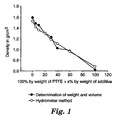
- the table below shows the porosities achieved by various proportions of foaming agent.
- the left-hand column indicates the proportion of foaming agent.
- the central and right-hand columns show the resultant densities of the PTFE by two different methods of measurement. In the central column the density is determined via the weight and volume of the sheet, and in the right-hand column it is determined by the hydrometer method to DIN 53479. The corresponding values for the cable insulation materials of Example 1 are comparable.
- Proportion of foaming agent by weight Density determination by weight and volume Density determination by hydrometer method 100% PTFE + x% in g/cm 3 in g/cm 3 0 1.592 1.526 5 1.483 1.420 10 1.450 1.360 20 1.299 1.300 30 1.219 1.183 40 1.019 1.102 60 0.965 0.958 100 0.618 0.678
- Fig. 1 illustrates the table and shows that the two methods of measurement give equally clear results.
- Example 1 and Example 4 are used to produce a sheet, this can also be used as a semipermeable material, allowing removal of solids from gases, for example.
- Suitable selection of a foaming agent in Example 1 and processing as in Example 4 permits controlled introduction of catalysts into the membrane material, so that these can purify or absorb gases separated off as in Example 5.
Landscapes
- Manufacture Of Porous Articles, And Recovery And Treatment Of Waste Products (AREA)
- Extrusion Moulding Of Plastics Or The Like (AREA)
- Organic Insulating Materials (AREA)
- Communication Cables (AREA)
- Indole Compounds (AREA)
Claims (14)
- Procédé de production d'articles en fluoropolymères non transformables par fusion, en particulier le polytétrafluoroéthylène, ayant une densité ne dépassant pas 1,3 g/cm3, qui comprend l'extrusion du fluoropolymère non transformable par fusion contenant un conservateur de pores solide, en particulier un agent moussant, et l'élimination du conservateur de pores solide.
- Procédé selon la revendication 1, dans lequel le conservateur de pores solide est éliminé après l'extrusion du fluoropolymère, en particulier dans lequel un mélange de polytétrafluoroéthylène contenant un agent moussant est transformé en mousse après l'extrusion.
- Procédé selon la revendication 1 ou 2, dans lequel le matériau est transformé en mousse à une température supérieure à la température d'extrusion.
- Procédé selon la revendication 1, dans lequel lesdits articles sont des câbles électriques, en particulier des câbles coaxiaux, le procédé comprenant l'extrusion de conducteurs électriques comprenant du polytétrafluoroéthylène contenant un conservateur de pores solide, en particulier un agent moussant, et l'élimination du conservateur de pores solide.
- Procédé selon la revendication 1, dans lequel le conservateur de pores solide est éliminé par sublimation, par évaporation, par dissolution, par lavage ou par décomposition.
- Procédé selon l'une ou plusieurs des revendications 1 à 5, dans lequel le conservateur de pores solide est sélectionné parmi les composés azoïques et leurs mélanges avec des plastifiants ou avec des peroxydes, et les sulfohydrazides ; les carbonates, les hydrazines, les tétrazoles, les benzoxazines et les semi-carbazides.
- Procédé selon l'une ou plusieurs des revendications 1 à 5, dans lequel le conservateur de pores solide est sélectionné parmi l'azodicarbonamide et ses mélanges avec des plastifiants ou avec des peroxydes, et les sulfohydrazides ; le carbonate de sodium, le carbonate d'ammonium, les hydrogénocarbonates d'ammonium, et les sesquicarbonates d'ammonium ; la trihydrazinotriazine, le 4,4'-oxybis(benzènesulfohydrazide), et le diphénylsulfone 3,3'-disulfohydrazide ; le 5-phényltétrazole ; l'anhydride isatoïque ; et le p-toluylènesulfonylsemi-carbazide.
- Procédé selon l'une ou plusieurs des revendications 1 à 5, dans lequel le conservateur de pores solide est l'hydrogénocarbonate d'ammonium.
- Procédé selon l'une ou plusieurs des revendications 1 à 8, dans lequel la mousse de fluoropolymère non transformable par fusion, en particulier la mousse de polytétrafluoroéthylène, est frittée.
- Câble électrique, comprenant une mousse de polytétrafluoroéthylène extrudée que l'on peut obtenir par mise en oeuvre d'un procédé selon l'une ou plusieurs des revendications 4 à 9.
- Câble électrique selon la revendication 10, dont l'isolation est constituée de mousse de polytétrafluoroéthylène, dans lequel la surface de la mousse a été frittée.
- Câble électrique selon la revendication 10 ou 11, ayant un facteur de dissipation tan δ ne dépassant pas 2·10-4 ou une constante diélectrique εr inférieure à 1,7.
- Mélange de fluoropolymère non transformable par fusion contenant un agent moussant, en particulier le polytétrafluoroéthylène, caractérisé en ce que le mélange contient une proportion pondérale de 100 parties de fluoropolymère et une proportion pondérale de 20 à 100 parties d'agent moussant solide.
- Utilisation d'un article que l'on peut obtenir par mise en oeuvre d'un procédé selon l'une ou plusieurs des revendications 1 à 3, comme joint d'étanchéité, comme écran filtre, comme adsorbeur de filtrage ou comme membrane.
Applications Claiming Priority (3)
| Application Number | Priority Date | Filing Date | Title |
|---|---|---|---|
| DE10003587 | 2000-01-28 | ||
| DE10003587A DE10003587A1 (de) | 2000-01-28 | 2000-01-28 | Exdrudierter Polytetrafluorethylen-Schaum |
| PCT/US2001/002303 WO2001054879A1 (fr) | 2000-01-28 | 2001-01-24 | Mousse en polytetrafluoroethylene extrude |
Publications (2)
| Publication Number | Publication Date |
|---|---|
| EP1252006A1 EP1252006A1 (fr) | 2002-10-30 |
| EP1252006B1 true EP1252006B1 (fr) | 2004-04-21 |
Family
ID=7628947
Family Applications (1)
| Application Number | Title | Priority Date | Filing Date |
|---|---|---|---|
| EP01908672A Expired - Lifetime EP1252006B1 (fr) | 2000-01-28 | 2001-01-24 | Mousse en polytetrafluoroethylene extrude |
Country Status (7)
| Country | Link |
|---|---|
| EP (1) | EP1252006B1 (fr) |
| JP (1) | JP2004500261A (fr) |
| AT (1) | ATE264737T1 (fr) |
| AU (1) | AU2001236516A1 (fr) |
| CA (1) | CA2398856A1 (fr) |
| DE (2) | DE10003587A1 (fr) |
| WO (1) | WO2001054879A1 (fr) |
Families Citing this family (2)
| Publication number | Priority date | Publication date | Assignee | Title |
|---|---|---|---|---|
| EP2065433B1 (fr) | 2006-09-22 | 2011-12-21 | Kurabe Industrial Co., Ltd | Corps poreux à base de ptfe, mélange de ptfe, procédé de production de corps poreux à base de ptfe, et fil/câble électrique utilisant le corps poreux à base de ptfe |
| EP2065156A1 (fr) | 2007-11-29 | 2009-06-03 | Nexans | Procédé destiné à la production d'un corps de formage à partir de polytétrafluorurethylènes expansés |
Family Cites Families (5)
| Publication number | Priority date | Publication date | Assignee | Title |
|---|---|---|---|---|
| JPS59109534A (ja) * | 1982-12-14 | 1984-06-25 | Nitto Electric Ind Co Ltd | ポリテトラフルオロエチレン多孔質体 |
| JPH0618087B2 (ja) * | 1986-11-19 | 1994-03-09 | 株式会社潤工社 | 押し出し延伸絶縁電線 |
| WO1995030711A1 (fr) * | 1994-05-10 | 1995-11-16 | Asahi Kasei Kogyo Kabushiki Kaisha | Mousse de fluororesine et procede de production de ladite mousse |
| WO1996034400A1 (fr) * | 1995-04-26 | 1996-10-31 | Tensolite Company | Ligne de transmission a faible obliquite |
| US5830923A (en) * | 1996-05-22 | 1998-11-03 | E. I. Du Pont De Nemours And Company | Foamed fluoropolymer |
-
2000
- 2000-01-28 DE DE10003587A patent/DE10003587A1/de not_active Ceased
-
2001
- 2001-01-24 DE DE60102893T patent/DE60102893T9/de not_active Expired - Fee Related
- 2001-01-24 EP EP01908672A patent/EP1252006B1/fr not_active Expired - Lifetime
- 2001-01-24 WO PCT/US2001/002303 patent/WO2001054879A1/fr not_active Ceased
- 2001-01-24 AT AT01908672T patent/ATE264737T1/de not_active IP Right Cessation
- 2001-01-24 AU AU2001236516A patent/AU2001236516A1/en not_active Abandoned
- 2001-01-24 JP JP2001554847A patent/JP2004500261A/ja active Pending
- 2001-01-24 CA CA002398856A patent/CA2398856A1/fr not_active Abandoned
Also Published As
| Publication number | Publication date |
|---|---|
| WO2001054879A1 (fr) | 2001-08-02 |
| DE60102893T9 (de) | 2008-10-23 |
| ATE264737T1 (de) | 2004-05-15 |
| EP1252006A1 (fr) | 2002-10-30 |
| DE60102893D1 (de) | 2004-05-27 |
| DE60102893T2 (de) | 2005-03-31 |
| CA2398856A1 (fr) | 2001-08-02 |
| JP2004500261A (ja) | 2004-01-08 |
| AU2001236516A1 (en) | 2001-08-07 |
| DE10003587A1 (de) | 2001-08-09 |
Similar Documents
| Publication | Publication Date | Title |
|---|---|---|
| JP4204015B2 (ja) | 発泡フルオロポリマー | |
| US5885494A (en) | Method of forming foamed fluoropolymer composites | |
| CA1154216A (fr) | Compositions-mousse a base de resine de perfluorocarbone | |
| AU675220B2 (en) | Improved composition of expanded polytetrafluoroethylene and similar polymers and method for producing same | |
| US4368350A (en) | Corrugated coaxial cable | |
| KR100493625B1 (ko) | 내충격 코팅된 케이블 | |
| US5750931A (en) | Electrical cable with improved insulation and process for making same | |
| EP2065433B1 (fr) | Corps poreux à base de ptfe, mélange de ptfe, procédé de production de corps poreux à base de ptfe, et fil/câble électrique utilisant le corps poreux à base de ptfe | |
| EP0340732A2 (fr) | Membranes en polymères fluorocarbonés et procédé de fabrication de membranes en polymères fluorocarbonés | |
| EP0223155B1 (fr) | Compositions expansibles de polymères fluorés et mousses fluorées obtenues ainsi | |
| US6683255B2 (en) | Extruded polytetrafluoroethylene foam | |
| CN1235692A (zh) | 同轴电缆及其制造方法 | |
| EP2217644A1 (fr) | Mousses de polymère fluoré préparées à l'aide d'agents gonflants et leurs applications | |
| US4747983A (en) | Process and apparatus for manufacturing foamed structures with integral skin | |
| KR102626455B1 (ko) | 저밀도 플루오로 중합체 발포체 | |
| EP1252006B1 (fr) | Mousse en polytetrafluoroethylene extrude | |
| JP4875613B2 (ja) | 発泡絶縁体を有する同軸ケーブル | |
| US4547328A (en) | Method for producing foamed plastic insulator | |
| JP3227091B2 (ja) | 同軸ケーブル用絶縁材料、同軸ケーブルおよび同軸ケーブルの製造方法 | |
| JPH10180787A (ja) | 発泡フルオロポリマー複合体 | |
| DE19525861A1 (de) | Isolierkörper | |
| JPS5966432A (ja) | 加橋発泡体の製造法 | |
| FR2559492A1 (fr) | Mousses de matieres polymeriques et leur procede d'obtention | |
| JPH07188444A (ja) | 発泡体の製造方法 | |
| JPH038219A (ja) | 発泡プラスチック電線の製造方法 |
Legal Events
| Date | Code | Title | Description |
|---|---|---|---|
| PUAI | Public reference made under article 153(3) epc to a published international application that has entered the european phase |
Free format text: ORIGINAL CODE: 0009012 |
|
| 17P | Request for examination filed |
Effective date: 20020822 |
|
| AK | Designated contracting states |
Kind code of ref document: A1 Designated state(s): AT BE CH CY DE DK ES FI FR GB GR IE IT LI LU MC NL PT SE TR |
|
| AX | Request for extension of the european patent |
Free format text: AL;LT;LV;MK;RO;SI |
|
| RIN1 | Information on inventor provided before grant (corrected) |
Inventor name: STEURER, ARMIN Inventor name: KOLMSCHLAG, GUNTER |
|
| 17Q | First examination report despatched |
Effective date: 20030128 |
|
| GRAP | Despatch of communication of intention to grant a patent |
Free format text: ORIGINAL CODE: EPIDOSNIGR1 |
|
| GRAS | Grant fee paid |
Free format text: ORIGINAL CODE: EPIDOSNIGR3 |
|
| GRAA | (expected) grant |
Free format text: ORIGINAL CODE: 0009210 |
|
| AK | Designated contracting states |
Kind code of ref document: B1 Designated state(s): AT BE CH CY DE DK ES FI FR GB GR IE IT LI LU MC NL PT SE TR |
|
| PG25 | Lapsed in a contracting state [announced via postgrant information from national office to epo] |
Ref country code: IT Free format text: LAPSE BECAUSE OF FAILURE TO SUBMIT A TRANSLATION OF THE DESCRIPTION OR TO PAY THE FEE WITHIN THE PRESCRIBED TIME-LIMIT;WARNING: LAPSES OF ITALIAN PATENTS WITH EFFECTIVE DATE BEFORE 2007 MAY HAVE OCCURRED AT ANY TIME BEFORE 2007. THE CORRECT EFFECTIVE DATE MAY BE DIFFERENT FROM THE ONE RECORDED. Effective date: 20040421 Ref country code: TR Free format text: LAPSE BECAUSE OF FAILURE TO SUBMIT A TRANSLATION OF THE DESCRIPTION OR TO PAY THE FEE WITHIN THE PRESCRIBED TIME-LIMIT Effective date: 20040421 Ref country code: AT Free format text: LAPSE BECAUSE OF FAILURE TO SUBMIT A TRANSLATION OF THE DESCRIPTION OR TO PAY THE FEE WITHIN THE PRESCRIBED TIME-LIMIT Effective date: 20040421 Ref country code: FI Free format text: LAPSE BECAUSE OF FAILURE TO SUBMIT A TRANSLATION OF THE DESCRIPTION OR TO PAY THE FEE WITHIN THE PRESCRIBED TIME-LIMIT Effective date: 20040421 Ref country code: NL Free format text: LAPSE BECAUSE OF FAILURE TO SUBMIT A TRANSLATION OF THE DESCRIPTION OR TO PAY THE FEE WITHIN THE PRESCRIBED TIME-LIMIT Effective date: 20040421 Ref country code: BE Free format text: LAPSE BECAUSE OF FAILURE TO SUBMIT A TRANSLATION OF THE DESCRIPTION OR TO PAY THE FEE WITHIN THE PRESCRIBED TIME-LIMIT Effective date: 20040421 |
|
| REG | Reference to a national code |
Ref country code: GB Ref legal event code: FG4D |
|
| REG | Reference to a national code |
Ref country code: CH Ref legal event code: EP |
|
| REG | Reference to a national code |
Ref country code: IE Ref legal event code: FG4D |
|
| REF | Corresponds to: |
Ref document number: 60102893 Country of ref document: DE Date of ref document: 20040527 Kind code of ref document: P |
|
| PG25 | Lapsed in a contracting state [announced via postgrant information from national office to epo] |
Ref country code: GR Free format text: LAPSE BECAUSE OF FAILURE TO SUBMIT A TRANSLATION OF THE DESCRIPTION OR TO PAY THE FEE WITHIN THE PRESCRIBED TIME-LIMIT Effective date: 20040721 Ref country code: DK Free format text: LAPSE BECAUSE OF FAILURE TO SUBMIT A TRANSLATION OF THE DESCRIPTION OR TO PAY THE FEE WITHIN THE PRESCRIBED TIME-LIMIT Effective date: 20040721 |
|
| PG25 | Lapsed in a contracting state [announced via postgrant information from national office to epo] |
Ref country code: ES Free format text: LAPSE BECAUSE OF FAILURE TO SUBMIT A TRANSLATION OF THE DESCRIPTION OR TO PAY THE FEE WITHIN THE PRESCRIBED TIME-LIMIT Effective date: 20040801 |
|
| REG | Reference to a national code |
Ref country code: SE Ref legal event code: TRGR |
|
| LTIE | Lt: invalidation of european patent or patent extension |
Effective date: 20040421 |
|
| NLV1 | Nl: lapsed or annulled due to failure to fulfill the requirements of art. 29p and 29m of the patents act | ||
| ET | Fr: translation filed | ||
| PG25 | Lapsed in a contracting state [announced via postgrant information from national office to epo] |
Ref country code: CY Free format text: LAPSE BECAUSE OF FAILURE TO SUBMIT A TRANSLATION OF THE DESCRIPTION OR TO PAY THE FEE WITHIN THE PRESCRIBED TIME-LIMIT Effective date: 20050124 Ref country code: LU Free format text: LAPSE BECAUSE OF NON-PAYMENT OF DUE FEES Effective date: 20050124 Ref country code: IE Free format text: LAPSE BECAUSE OF NON-PAYMENT OF DUE FEES Effective date: 20050124 Ref country code: GB Free format text: LAPSE BECAUSE OF NON-PAYMENT OF DUE FEES Effective date: 20050124 |
|
| PG25 | Lapsed in a contracting state [announced via postgrant information from national office to epo] |
Ref country code: MC Free format text: LAPSE BECAUSE OF NON-PAYMENT OF DUE FEES Effective date: 20050131 |
|
| PLBE | No opposition filed within time limit |
Free format text: ORIGINAL CODE: 0009261 |
|
| STAA | Information on the status of an ep patent application or granted ep patent |
Free format text: STATUS: NO OPPOSITION FILED WITHIN TIME LIMIT |
|
| 26N | No opposition filed |
Effective date: 20050124 |
|
| GBPC | Gb: european patent ceased through non-payment of renewal fee |
Effective date: 20050124 |
|
| REG | Reference to a national code |
Ref country code: IE Ref legal event code: MM4A |
|
| PGFP | Annual fee paid to national office [announced via postgrant information from national office to epo] |
Ref country code: CH Payment date: 20060125 Year of fee payment: 6 |
|
| PGFP | Annual fee paid to national office [announced via postgrant information from national office to epo] |
Ref country code: SE Payment date: 20060127 Year of fee payment: 6 |
|
| PG25 | Lapsed in a contracting state [announced via postgrant information from national office to epo] |
Ref country code: SE Free format text: LAPSE BECAUSE OF NON-PAYMENT OF DUE FEES Effective date: 20070125 |
|
| PG25 | Lapsed in a contracting state [announced via postgrant information from national office to epo] |
Ref country code: CH Free format text: LAPSE BECAUSE OF NON-PAYMENT OF DUE FEES Effective date: 20070131 Ref country code: LI Free format text: LAPSE BECAUSE OF NON-PAYMENT OF DUE FEES Effective date: 20070131 |
|
| PGFP | Annual fee paid to national office [announced via postgrant information from national office to epo] |
Ref country code: DE Payment date: 20070228 Year of fee payment: 7 |
|
| REG | Reference to a national code |
Ref country code: CH Ref legal event code: PL |
|
| EUG | Se: european patent has lapsed | ||
| PG25 | Lapsed in a contracting state [announced via postgrant information from national office to epo] |
Ref country code: PT Free format text: LAPSE BECAUSE OF NON-PAYMENT OF DUE FEES Effective date: 20040921 |
|
| PGFP | Annual fee paid to national office [announced via postgrant information from national office to epo] |
Ref country code: FR Payment date: 20070117 Year of fee payment: 7 |
|
| PG25 | Lapsed in a contracting state [announced via postgrant information from national office to epo] |
Ref country code: DE Free format text: LAPSE BECAUSE OF NON-PAYMENT OF DUE FEES Effective date: 20080801 |
|
| REG | Reference to a national code |
Ref country code: FR Ref legal event code: ST Effective date: 20081029 |
|
| PG25 | Lapsed in a contracting state [announced via postgrant information from national office to epo] |
Ref country code: FR Free format text: LAPSE BECAUSE OF NON-PAYMENT OF DUE FEES Effective date: 20080131 |