EP1258896A2 - Stosssensor mit einer Schraubenfeder für einen Selbsttest - Google Patents
Stosssensor mit einer Schraubenfeder für einen Selbsttest Download PDFInfo
- Publication number
- EP1258896A2 EP1258896A2 EP02009372A EP02009372A EP1258896A2 EP 1258896 A2 EP1258896 A2 EP 1258896A2 EP 02009372 A EP02009372 A EP 02009372A EP 02009372 A EP02009372 A EP 02009372A EP 1258896 A2 EP1258896 A2 EP 1258896A2
- Authority
- EP
- European Patent Office
- Prior art keywords
- stop
- housing
- reed switch
- electrical connection
- shock
- Prior art date
- Legal status (The legal status is an assumption and is not a legal conclusion. Google has not performed a legal analysis and makes no representation as to the accuracy of the status listed.)
- Withdrawn
Links
Images
Classifications
-
- H—ELECTRICITY
- H01—ELECTRIC ELEMENTS
- H01H—ELECTRIC SWITCHES; RELAYS; SELECTORS; EMERGENCY PROTECTIVE DEVICES
- H01H35/00—Switches operated by change of a physical condition
- H01H35/14—Switches operated by change of acceleration, e.g. by shock or vibration, inertia switch
- H01H35/147—Switches operated by change of acceleration, e.g. by shock or vibration, inertia switch the switch being of the reed switch type
Definitions
- the present invention relates to shock sensors incorporating a reed switch in general, and to shock sensors incorporating self-testing in particular.
- a typical automobile manufactured today has a number of active safety systems that function to deploy air bags, and initiate seatbelt retractors and other devices.
- the cost of air bags decreases, and the sophistication of air bags increases, the number of air bags provided in each vehicle is increasing.
- Systems now being installed or under development include multiple air bags to protect the passenger from front, rear, and side impacts, and to position the passenger's body to withstand acceleration. Deployment of safety systems requires sensors that can detect and characterize a crash as it occurs. The widespread use of safety systems results in ever increasing attention to producing systems that can be economically employed on a large number of vehicles.
- the lowest cost sensors are those formed as micro devices on an integrated circuit chip used to form electronic circuitry. This technology is used to fabricate accelerometers that can detect accelerations indicative of a vehicle crash. These sensors are particularly cost effective when the sensor can be fabricated together with the deployment logic circuitry using the same technology which is used cost effectively for large scale integrated circuit chips. However, the very small size of these devices makes them sensitive to electromagnetic interference and the like, which can result in false indications that a crash is taking place.
- macro scale mechanical devices which are less prone to false readings. Such devices are used to verify the existence of an actual crash event.
- These macro scale devices employ a sensing mass mounted on a spring or pendulum. Motion of the mass is detected by actuation of a reed switch or a magnetic field sensor.
- the typical reed switch shock sensor employs a magnet, a spring, and a reed switch mounted in a housing.
- the three components are arranged so that under an acceleration-induced load the magnet acting as an acceleration sensing mass compresses the spring and moves to a position where the magnetic field of the magnet causes the reeds of the reed switch to attract and thus close the reed switch.
- the reed switch shock sensor is a highly reliable component.
- many electronic circuits today incorporate built-in test, and the reed switch is indistinguishable from an open circuit unless the circuit board is undergoing the proper acceleration.
- the shock sensor may incorporate some method of self-testing which can verify the presence of the reed switch and which may cause the reed switch to operate.
- Such self-testing functions typically require additional parts, including the addition of a self-test electrical coil to cause the reed switch to close.
- the reed switch based shock sensor of this invention provides means for passing electrical current through the spring used to bias the shock sensing magnetic mass in the unactuated position.
- the spring extends between a first stop and a shock sensing magnetic mass that is biased against a second stop. So long as the magnetic mass is held against the second stop, the reed switch remains open. A path for electrical current is created which leads through the coil spring used to bias the sensing mass.
- the coil spring is wrapped around the reed switch, allowing the coil spring to act as an electrical coil.
- the electric coil generates a magnetic field of sufficient strength to cause the reed switch reeds to attract and so close the reed switch, thus allowing the reed switch to be tested, without the addition of an electrical test coil.
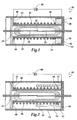
- a shock sensor 20 is shown in Figs 1.
- the shock sensor 20 has a housing 22.
- a reed switch 24 is mounted on the housing 22, and a shock sensing magnet 26 is positioned for movement on the housing.
- the shock sensing magnet 26 is in the shape of a ring which is positioned coaxially about the reed switch 24.
- a spring 32 biases a shock sensing magnet 26 against a first stop 28 formed by portions 30 of the housing 22.
- the spring 32 extends between the magnet 26 and a second stop 34 spaced from the first stop 28 and spaced axially along the reed switch 24.
- the magnet 26 compresses the spring 32 until the magnet moves to a second position adjacent the overlapping portions 36 of the reed switch reeds 38. Properly positioned, the magnet will cause the reeds to take on opposite magnetic polarities and so attract to close the switch formed by the reed switch 24.
- shock sensor of this invention 20 is arranged to pass a current through the spring 32 which is used to bias the shock sensing magnet against the first stop 28.
- a typical coil used to actuate a reed switch will employ a coil having thousands to tens of thousands of turns, and operation of the reed switch by energizing the coil will typically require a power of a small fraction of one Watt.
- coil springs having, for example, between 26 and 33 turns, can support sufficient current to cause actuation of a reed switch in a shock sensor configuration.
- Table 1 provides test results for two coil springs: part number 251-90-226-00 which has 26 coils and a resistance of 7.3 ohms; and part number 251-90-084-00 which has 27 coils and a resistance of 10.8 ohms.
- Each coil was positioned about a series of reed switches (Hamlin type MLRR-4) with different ampere turn requirements, as shown in column one of Table 1, the reed switch having ampere turn requirements of 14, 15, 16 and 23 ampere turns.
- coil spring part No. 251-90-018-00 having 29 coil turns and resistance of 6.9 ohms, and part number 251-90-071-00 having 33 coil turns and resistance of 10.6 ohms were tested with switches having ampere turn requirements between 14 and as high as 29. Again the number of ampere turns (Theoretical AT) required was calculated by taking the voltage value at switch pull in, dividing that value by the resistance of the spring to get a value for the current and finally multiplying the value of the current by the number of turns on the spring.
- an electrical voltage source 40 can be connected across the spring 32, which extends between the magnet 26 and a portion of the housing forming a second stop 34.
- the magnet 26 is shown plated with a conductive material 42 such as copper or silver so that current can readily flow between a contact 44 attached to the portion of the housing 30 forming the first stop 28 and a first end 46 of the spring 32.
- a contact 48 is formed on the second stop 34 completing the electrical circuit from the electrical voltage source 40 to the second end 49 of the spring 32.
- FIG. 2 an alternative embodiment shock sensor 50 is shown in Fig. 2.
- the shock sensor 50 employs a reed switch 52 mounted on a housing 54.
- a magnet 56 is movable on the housing and is positioned coaxially about the reed switch 52.
- This shock sensor 50 has the overall configuration of the shock sensor shown in U.S. patent No.5,212,357 to Reneau which is incorporated herein by reference.
- the housing 54 has a first stop 58 and a second stop 60 spaced a fixed distance from the first stop 58.
- the activation magnet 56 being slidably mounted on the housing 54, has a first portion 62 engaged against the first stop 58 and a second portion 64 which engages against the second stop.
- the magnet first portion 62 has a greater magnetic flux than the second portion 64.
- the reed switch 52 is responsive to the position of the activation magnet 56 such that the reed switch is activated when the magnet travels to a preselected activation position during movement of the magnet in response to acceleration applied to the sensor.
- a coil spring 66 biases the magnet 56 such that the first portion 62 engages against the first stop 58, and the coil spring 66 extends between the magnet 56 and the second stop 60.
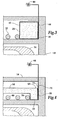
- Fig. 3 shows how a voltage source 68 is connected across the spring 66 by an electrically conducting portion 70 of the magnet, which abuts a contact 72 fixed to the portion of the housing 74 forming the first stop 58. A first end 78 of the spring 66 is thus in electrical engagement with the magnet 56.
- the electrical circuit is completed by a second contact 76 affixed to the second stop 60 which engages a second end 80 of the spring 66.
- magnet could be conducting or other means for applying electrical current to the coil spring could be employed.
- the coil spring through which the current passes must be positioned so as to result in a magnetic field that causes the reeds of the switch to attract, thus closing the reed switch.
Landscapes
- Switches Operated By Changes In Physical Conditions (AREA)
Applications Claiming Priority (2)
| Application Number | Priority Date | Filing Date | Title |
|---|---|---|---|
| US09/860,908 US6335498B1 (en) | 2001-05-18 | 2001-05-18 | Shock sensor employing a spring coil for self-test |
| US860908 | 2001-05-18 |
Publications (2)
| Publication Number | Publication Date |
|---|---|
| EP1258896A2 true EP1258896A2 (de) | 2002-11-20 |
| EP1258896A3 EP1258896A3 (de) | 2004-04-28 |
Family
ID=25334335
Family Applications (1)
| Application Number | Title | Priority Date | Filing Date |
|---|---|---|---|
| EP02009372A Withdrawn EP1258896A3 (de) | 2001-05-18 | 2002-05-06 | Stosssensor mit einer Schraubenfeder für einen Selbsttest |
Country Status (2)
| Country | Link |
|---|---|
| US (1) | US6335498B1 (de) |
| EP (1) | EP1258896A3 (de) |
Families Citing this family (3)
| Publication number | Priority date | Publication date | Assignee | Title |
|---|---|---|---|---|
| KR100616508B1 (ko) * | 2002-04-11 | 2006-08-29 | 삼성전기주식회사 | Fbar 소자 및 그 제조방법 |
| US7170019B2 (en) * | 2003-07-14 | 2007-01-30 | Cheerine Development (Hong Kong), Ltd. | Inertia switch and flashing light system |
| US7541939B2 (en) | 2007-03-15 | 2009-06-02 | Apple Inc. | Mounted shock sensor |
Family Cites Families (8)
| Publication number | Priority date | Publication date | Assignee | Title |
|---|---|---|---|---|
| DE3830782C1 (de) * | 1988-09-09 | 1990-06-07 | Audi Ag, 8070 Ingolstadt, De | |
| US4980526A (en) * | 1989-04-06 | 1990-12-25 | Hamlin Incorporated | Device and method for testing acceleration shock sensors |
| US5212357A (en) * | 1991-08-14 | 1993-05-18 | Hamlin, Inc. | Extended minimum dwell shock sensor |
| US5326945A (en) * | 1991-12-02 | 1994-07-05 | Tokin Corporation | Shock sensor |
| DE4400206A1 (de) * | 1993-01-08 | 1994-07-28 | Nippon Aleph | Stoßfeststellungseinrichtung |
| US5416293A (en) * | 1994-08-17 | 1995-05-16 | Hamlin, Inc. | Shock sensor including a compound housing and magnetically operated reed switch |
| US5770792A (en) * | 1995-10-27 | 1998-06-23 | Nippon Aleph Corporation | Shock sensors |
| JPH112642A (ja) * | 1997-06-11 | 1999-01-06 | Nippon Aleph Corp | 衝撃センサ |
-
2001
- 2001-05-18 US US09/860,908 patent/US6335498B1/en not_active Expired - Fee Related
-
2002
- 2002-05-06 EP EP02009372A patent/EP1258896A3/de not_active Withdrawn
Also Published As
| Publication number | Publication date |
|---|---|
| EP1258896A3 (de) | 2004-04-28 |
| US6335498B1 (en) | 2002-01-01 |
Similar Documents
| Publication | Publication Date | Title |
|---|---|---|
| US4980526A (en) | Device and method for testing acceleration shock sensors | |
| US7116220B2 (en) | Seat belt latch sensor assembly | |
| US7081692B2 (en) | Airbag deployment monitor and sensing electronics | |
| US20120310483A1 (en) | Belt lock with a state sensor for detection of the locking state of a safety belt system | |
| JP2004514901A (ja) | ウェビング張力センサ | |
| US5416293A (en) | Shock sensor including a compound housing and magnetically operated reed switch | |
| US3861488A (en) | Collision speed sensor | |
| US6184764B1 (en) | Pendulum mass acceleration sensor | |
| US6335498B1 (en) | Shock sensor employing a spring coil for self-test | |
| EP2541259A1 (de) | Sensor zur Erkennung von schnellen Verlangsamungs-/Beschleunigungsereignissen | |
| US5212357A (en) | Extended minimum dwell shock sensor | |
| WO1997025624A2 (en) | Mechanical shock sensor | |
| US3943390A (en) | Deceleration detecting device | |
| US5032696A (en) | Crash sensor switch | |
| US5196660A (en) | Acceleration sensor | |
| KR200358261Y1 (ko) | 안전벨트 착용 감지 장치 | |
| KR970039604A (ko) | 에어백용 안전 센서 진단 방법 | |
| US6429392B1 (en) | Magnetic bi-directional shock sensor | |
| JPH0795077B2 (ja) | 磁気作動リード・スイッチを有する衝撃センサ | |
| JP3024190U (ja) | 車両の乗員保護装置作動用衝突センサ回路 | |
| Behr | A magnetically damped crash sensor providing testability and dynamic system reconfiguration | |
| JP2004135776A (ja) | バックル装置 | |
| JPH04254762A (ja) | 衝突検知装置 | |
| JP2001289873A (ja) | 衝撃センサ | |
| HK1174975A (en) | Sensors for detecting rapid deceleration/acceleration events |
Legal Events
| Date | Code | Title | Description |
|---|---|---|---|
| PUAI | Public reference made under article 153(3) epc to a published international application that has entered the european phase |
Free format text: ORIGINAL CODE: 0009012 |
|
| 17P | Request for examination filed |
Effective date: 20020521 |
|
| AK | Designated contracting states |
Kind code of ref document: A2 Designated state(s): AT BE CH CY DE DK ES FI FR GB GR IE IT LI LU MC NL PT SE TR |
|
| AX | Request for extension of the european patent |
Free format text: AL;LT;LV;MK;RO;SI |
|
| PUAL | Search report despatched |
Free format text: ORIGINAL CODE: 0009013 |
|
| AK | Designated contracting states |
Kind code of ref document: A3 Designated state(s): AT BE CH CY DE DK ES FI FR GB GR IE IT LI LU MC NL PT SE TR |
|
| AX | Request for extension of the european patent |
Extension state: AL LT LV MK RO SI |
|
| RAP1 | Party data changed (applicant data changed or rights of an application transferred) |
Owner name: KEY SAFETY SYSTEMS, INC. |
|
| AKX | Designation fees paid |
Designated state(s): DE FR GB IT |
|
| STAA | Information on the status of an ep patent application or granted ep patent |
Free format text: STATUS: THE APPLICATION HAS BEEN WITHDRAWN |
|
| 18W | Application withdrawn |
Effective date: 20070618 |