EP1259059A2 - Verstellbares Bildaufnahmesystem - Google Patents
Verstellbares Bildaufnahmesystem Download PDFInfo
- Publication number
- EP1259059A2 EP1259059A2 EP02253155A EP02253155A EP1259059A2 EP 1259059 A2 EP1259059 A2 EP 1259059A2 EP 02253155 A EP02253155 A EP 02253155A EP 02253155 A EP02253155 A EP 02253155A EP 1259059 A2 EP1259059 A2 EP 1259059A2
- Authority
- EP
- European Patent Office
- Prior art keywords
- support
- image
- image capturing
- captured
- capturing device
- Prior art date
- Legal status (The legal status is an assumption and is not a legal conclusion. Google has not performed a legal analysis and makes no representation as to the accuracy of the status listed.)
- Withdrawn
Links
Images

Classifications
-
- H—ELECTRICITY
- H04—ELECTRIC COMMUNICATION TECHNIQUE
- H04N—PICTORIAL COMMUNICATION, e.g. TELEVISION
- H04N1/00—Scanning, transmission or reproduction of documents or the like, e.g. facsimile transmission; Details thereof
- H04N1/00795—Reading arrangements
- H04N1/00798—Circuits or arrangements for the control thereof, e.g. using a programmed control device or according to a measured quantity
- H04N1/00816—Determining the reading area, e.g. eliminating reading of margins
-
- H—ELECTRICITY
- H04—ELECTRIC COMMUNICATION TECHNIQUE
- H04N—PICTORIAL COMMUNICATION, e.g. TELEVISION
- H04N1/00—Scanning, transmission or reproduction of documents or the like, e.g. facsimile transmission; Details thereof
- H04N1/00795—Reading arrangements
-
- H—ELECTRICITY
- H04—ELECTRIC COMMUNICATION TECHNIQUE
- H04N—PICTORIAL COMMUNICATION, e.g. TELEVISION
- H04N1/00—Scanning, transmission or reproduction of documents or the like, e.g. facsimile transmission; Details thereof
- H04N1/38—Circuits or arrangements for blanking or otherwise eliminating unwanted parts of pictures
-
- H—ELECTRICITY
- H04—ELECTRIC COMMUNICATION TECHNIQUE
- H04N—PICTORIAL COMMUNICATION, e.g. TELEVISION
- H04N1/00—Scanning, transmission or reproduction of documents or the like, e.g. facsimile transmission; Details thereof
- H04N1/04—Scanning arrangements, i.e. arrangements for the displacement of active reading or reproducing elements relative to the original or reproducing medium, or vice versa
- H04N1/19—Scanning arrangements, i.e. arrangements for the displacement of active reading or reproducing elements relative to the original or reproducing medium, or vice versa using multi-element arrays
- H04N1/195—Scanning arrangements, i.e. arrangements for the displacement of active reading or reproducing elements relative to the original or reproducing medium, or vice versa using multi-element arrays the array comprising a two-dimensional [2D] array
-
- H—ELECTRICITY
- H04—ELECTRIC COMMUNICATION TECHNIQUE
- H04N—PICTORIAL COMMUNICATION, e.g. TELEVISION
- H04N2201/00—Indexing scheme relating to scanning, transmission or reproduction of documents or the like, and to details thereof
- H04N2201/04—Scanning arrangements
- H04N2201/0402—Arrangements not specific to a particular one of the scanning methods covered by groups H04N1/04 - H04N1/207
- H04N2201/0436—Scanning a picture-bearing surface lying face up on a support
Definitions
- This invention relates to an adjustable image capturing system, and in particular, to a desktop image capturing system having a camera or the like mounted on a support which holds the camera above a document or the like, thereby allowing an image of the document to be captured.
- the field of view of the camera can be changed by adjustment, manual or otherwise, of the camera relative to the support.
- EP-A-0622722 describes one such system which generates new documents by capturing information contained within a hardcopy document including text and/or images.
- the system captures the information using a camera-projector device directed at the hardcopy document as it resides on a desk or other surface.
- the system also works in conjunction with a printer or copier, and it determines which functions are to be performed based upon input from the user captured by the camera.
- US Patent No. 6,067,112 describes a similar type of desktop image capturing system, the field of view of which can be relatively easily adjusted by manipulating the feedback image which the system projects onto a source document. In response to such manipulation, the system determines the user's requirements and adjusts the field of view of the camera accordingly.
- FIG. 1A of the drawings there is illustrated a desktop image capturing system according to the prior art.
- the system comprises a camera 100 mounted to an articulated arm 102 which is connected to a rigid lower arm 103 connected to a document guide or stand 104.
- the assembly comprising the articulated arm 102, the lower arm 103 and the document guide 104 will hereinafter be referred to as 'the support'.
- the field of view 106 of the camera 100 substantially exactly matches the document 108 to be captured.
- systems do exist in which the camera 100 and arm 102 are mounted rigidly relative to one another and the document guide 104, or fixed in use, the field of view 106 being set such that it substantially matches, for example, an A4 page at a predetermined distance from the camera.
- FIG. 1B in the case where the position of the camera 100 is adjustable, when the camera position is moved (by moving the articulated arm 102 relative to the lower arm 103 and/or adjusting the orientation, pitch and altitude of the camera 100 relative to the articulated arm 102), the field of view changes and, in each case shown in Figures 1A-1D, captures a portion of the support in the image.
- Figure 1B there is illustrated the case where the camera 100 is moved closer to, for example, a 5"x3" photograph 110 in order to maximise the capture resolution.
- the field of view 106 now includes a portion of each of the document guide 104 and the lower arm 103.
- the user has moved the camera to capture a graph at the top-right of the document 108, thereby once again including in the field of view 106 a portion of each of the document guide 104 and the lower arm 103.
- the camera has been moved away from the document 108 in order to increase the size of the field of view 106.
- the field of view 106 includes the entire document guide 104 and a large portion of the lower arm 103.
- any part of the support is clearly undesirable, as it reduces the quality of the reproduced image.
- the inclusion of at least part of the support in the camera's field of view is unavoidable in some camera positions.
- European Patent Application 0924923 describes a document copying arrangement in which features of the copier itself determined to be present in its field of view (i.e not covered by the document) are suppressed.
- this arrangement would not be suitable for use with a document camera in which the camera is adjustable in the three dimensions relative to the support because in this case, the appearance of the support in the field of view would not be predictable, whereas in the arrangement described in EP0924923, once the size of the document is known the visible parts of the apparatus would be effectively known or at least easily predictable.
- an image capturing system comprising an image capturing device mounted on a support so as to be manually adjustable in three dimensions relative thereto, and means for determining the presence of any part of said support in the field of view of the image capture device and/or in an image captured by said image capturing device.
- the system includes means for detecting the presence of any part of the support and removing or masking the detected part of the support from the final image output by the image capturing device.
- the system may include means for separating the image required to be captured by the image capturing device from any background within the image captured by the image capturing device, said separating means being arranged to disregard any pixels in the image which relate to the detected part of the support, i.e. the detected part(s) of the support are treated as 'mask(s) ' and as such are ignored (or treated as part of the background) by the separating means.
- US Patent No. 6,064,762 describes a system which separates foreground information on a document from background information by superimposing (in an additive or subtractive manner) the foreground information on the background information.
- the background information can be assigned a particular colour, for example, in which case, the separating means may be arranged to 'fill in' the detected part(s) of the support with the colour assigned to the background information.
- the detecting means may include means for storing a full tri-dimensional model of the system, and means for determining (or at least estimating) the location of the camera relative to the support (or for determining the location of the support relative to the image capturing device).
- the image capturing device is preferably calibrated such that a three-dimensional object matching algorithm using the model of the system can be applied to detect the presence of the support in the field of view of the image capturing device and determine its location with respect to the image capturing device (or vice versa)
- a few features of the support within a captured image can be detected and the rest 'filled in' using an object matching algorithm.
- the support may be provided with one or more markings (for example, coloured), indentations, or similar features which are easy to detect and can be used to determine (or at least estimate) the location of the image capturing device relative to the support (or to determine the location of the support relative to the image capturing device). This makes the detection process faster, easier and more robust than if it was required to detect the frame itself within a captured image.
- markings for example, coloured
- indentations or similar features which are easy to detect and can be used to determine (or at least estimate) the location of the image capturing device relative to the support (or to determine the location of the support relative to the image capturing device).
- the position determining means may be arranged to analytically compute the appearance of the support in an image captured by the image capturing device using the determined or estimated relative locations of the image capturing device and the support, and/or one or more detected key features. Once the appearance of the support in the image has been computed, it can be removed or masked.
- the determining means is preferably arranged to take into account the constrained relative positions of the image capturing device and the support (which depends upon the type and number of joints in the structure) when determining or estimating the relative positions of the image capturing device and the support.
- the appearance of the support in a captured image can be predicted using data received from sensors which determine the camera orientation, pitch and altitude relative to the support, and/or with full feedback relating to the position of the camera (using knowledge of the joint angles, etc).
- an object matching algorithm may match one (or more) key feature(s) of the support within a captured image and estimate the position of the support in the image as a starting point for a subsequent image-based detection process to more accurately determine the appearance of the support in the image.
- the analytical computation of the appearance of the support in the image is, by its very nature, an estimation, and may be used as a starting point for a more detailed search for the true appearance of the support in the image, using, for example, simple region growth or more sophisticated methods.
- the appearance of the support in the image once the appearance of the support in the image has been determined, it can be deleted and the system may optionally be arranged to rebuild the image by analysis of the remaining image.
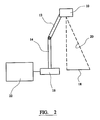
- a desktop image capturing system according to an exemplary embodiment of the present invention comprises a camera 10 which is mounted on an articulated arm 12 so as to be movable relative thereto.
- the articulated (upper) arm 12 is connected or joined to a rigid lower arm 14 mounted on a document guide or stand 16.
- a user positions the camera over a document 18 or the like to obtain an image thereof.
- the system includes detecting means 22 for detecting where, if any, part(s) of the support are included in the field of view of the camera 10 and which will, therefore be present in the image captured thereby, and for deleting them.
- the presence of part(s) of the support in the camera's field of view may be achieved by mapping the estimated field of view using predetermined data defining the relative positions of the camera 10 and the various elements of the support and information relating to the camera's position and orientation.
- the detecting means 22 includes means for applying a three-dimensional object matching algorithm to the image captured by the camera 10.
- the detecting means would have stored therein a full tri-dimensional model of at least the support, but preferably the whole system relative to the camera 10.
- the object matching algorithm is applied thereto to locate any part(s) of the support included therein. Those parts, once detected, can be deleted.
- the object matching algorithm may be based on a well-known 2D-3D model matching method, such as the one proposed by Bolles, Horaud and Hannah (Robotic Research, The first symposium, MIT Press, 1984), many variations of which have since been proposed. Such methods are based on a hypothesize-and-test strategy and are particularly suitable because they can be used to locate three-dimensional objects in an image from sparse image data, such as a few edges and junctions. Further, such methods are fairly robust to occlusions.
- the algorithm used should be tuned to the type of camera support used. For example, the camera support may be curvy, as opposed to the more preferred faceted version (which is easier to deal with).
- characteristics of the support may be used to enable model-less detection of part(s) of the support within the image captured by the camera 10.
- characteristics may comprise, for example, its colour and/or texture.
- the detection means 22 may only store a wireframe or surface model of the system (as opposed to the full tri-dimensional model referred to above) such that an object matching or recognition algorithm could be used to recognise the appearance of part(s) of the support in the image captured by the camera 10. The final determination of the exact location of such parts of the support in the image could be refined in a successive stage. Further, a multi-resolutional model could be employed, which uses its low-order representation for matching and its most precise one for re-projection and removal of any part(s) of the support from the captured image.
- markers of any sort such as indentations
- the detection means 22 preferably takes into account the constrained relative position of the camera 10 with respect to the support (which depends, among other things, on the type and number of joints used to connect the camera 10 to the support) when it is determining the location of the support relative to the camera (or vice versa).
- This embodiment could benefit from well known techniques in the field of robotics, in particular arms and manipulators, where joint constraints and the trajectory manifold are taken into account by the sensory and vision systems. See, for example, Richard P. Paul, Robot Manipulators-Mathematics, Programming, and Control, MIT Press, 1981.
Landscapes
- Engineering & Computer Science (AREA)
- Multimedia (AREA)
- Signal Processing (AREA)
- Studio Devices (AREA)
- Length Measuring Devices By Optical Means (AREA)
Applications Claiming Priority (2)
| Application Number | Priority Date | Filing Date | Title |
|---|---|---|---|
| GB0112041A GB2375675A (en) | 2001-05-17 | 2001-05-17 | System for automatically detecting and masking device features in the field of view of an imaging device. |
| GB0112041 | 2001-05-17 |
Publications (2)
| Publication Number | Publication Date |
|---|---|
| EP1259059A2 true EP1259059A2 (de) | 2002-11-20 |
| EP1259059A3 EP1259059A3 (de) | 2004-10-06 |
Family
ID=9914800
Family Applications (1)
| Application Number | Title | Priority Date | Filing Date |
|---|---|---|---|
| EP02253155A Withdrawn EP1259059A3 (de) | 2001-05-17 | 2002-05-03 | Verstellbares Bildaufnahmesystem |
Country Status (3)
| Country | Link |
|---|---|
| US (1) | US20020171757A1 (de) |
| EP (1) | EP1259059A3 (de) |
| GB (1) | GB2375675A (de) |
Cited By (2)
| Publication number | Priority date | Publication date | Assignee | Title |
|---|---|---|---|---|
| WO2009005585A1 (en) * | 2007-06-29 | 2009-01-08 | Epson America, Inc. | Document camera |
| CN102790851A (zh) * | 2011-05-20 | 2012-11-21 | 株式会社理光 | 图像输入装置、会议装置、图像处理控制方法 |
Families Citing this family (4)
| Publication number | Priority date | Publication date | Assignee | Title |
|---|---|---|---|---|
| FR2856158B1 (fr) * | 2003-06-13 | 2005-08-19 | Lionel Giacomuzzi | Dispositif pour la prise de photographie |
| JP2010175588A (ja) * | 2009-01-27 | 2010-08-12 | Seiko Epson Corp | 画像表示システム |
| US20230230280A1 (en) * | 2021-12-31 | 2023-07-20 | Creative Technology Ltd | Imaging platform with output controls |
| CN114373060B (zh) * | 2022-03-23 | 2022-06-28 | 超节点创新科技(深圳)有限公司 | 行李模型生成方法与设备 |
Citations (2)
| Publication number | Priority date | Publication date | Assignee | Title |
|---|---|---|---|---|
| JP2000115510A (ja) * | 1998-09-30 | 2000-04-21 | Hitachi Ltd | 非接触型画像読取装置及びそれを用いたシステム |
| US6721465B1 (en) * | 1998-09-30 | 2004-04-13 | Hitachi, Ltd. | Non-contact image reader and system using the same |
Family Cites Families (17)
| Publication number | Priority date | Publication date | Assignee | Title |
|---|---|---|---|---|
| US4474439A (en) * | 1982-01-26 | 1984-10-02 | Brown Garrett W | Camera support |
| US4831455A (en) * | 1986-02-21 | 1989-05-16 | Canon Kabushiki Kaisha | Picture reading apparatus |
| JP3063099B2 (ja) * | 1989-09-29 | 2000-07-12 | ミノルタ株式会社 | 原稿読み取り装置 |
| US5194729A (en) * | 1989-09-29 | 1993-03-16 | Minolta Camera Co., Ltd. | Document reading apparatus with area recognizing sensor and obstacle detection |
| JPH0813088B2 (ja) * | 1990-09-18 | 1996-02-07 | 富士ゼロックス株式会社 | 画像読取装置 |
| US5585926A (en) * | 1991-12-05 | 1996-12-17 | Minolta Co., Ltd. | Document reading apparatus capable of rectifying a picked up image data of documents |
| US5384621A (en) * | 1994-01-04 | 1995-01-24 | Xerox Corporation | Document detection apparatus |
| JP3072236B2 (ja) * | 1994-12-26 | 2000-07-31 | シャープ株式会社 | 画像入力装置 |
| JPH08331610A (ja) * | 1995-06-05 | 1996-12-13 | Mitsubishi Electric Corp | 自動画像調整装置 |
| US5933191A (en) * | 1995-06-14 | 1999-08-03 | Canon Kabushiki Kaisha | Image input apparatus having an adjustable support mechanism |
| US5764383A (en) * | 1996-05-30 | 1998-06-09 | Xerox Corporation | Platenless book scanner with line buffering to compensate for image skew |
| JPH1013669A (ja) * | 1996-06-26 | 1998-01-16 | Minolta Co Ltd | 画像読取り装置におけるデータ処理方法 |
| GB9614837D0 (en) * | 1996-07-12 | 1996-09-04 | Rank Xerox Ltd | Interactive desktop system with multiple image capture and display modes |
| JP3631333B2 (ja) * | 1996-08-23 | 2005-03-23 | シャープ株式会社 | 画像処理装置 |
| JPH11103380A (ja) * | 1997-09-26 | 1999-04-13 | Minolta Co Ltd | 画像読み取り装置 |
| US5987270A (en) * | 1997-12-17 | 1999-11-16 | Hewlett-Packard Company | Digital copying machine that automasks data for small originals if a document feeder is present |
| US6512539B1 (en) * | 1999-09-29 | 2003-01-28 | Xerox Corporation | Document periscope |
-
2001
- 2001-05-17 GB GB0112041A patent/GB2375675A/en not_active Withdrawn
-
2002
- 2002-05-03 EP EP02253155A patent/EP1259059A3/de not_active Withdrawn
- 2002-05-15 US US10/144,931 patent/US20020171757A1/en not_active Abandoned
Patent Citations (2)
| Publication number | Priority date | Publication date | Assignee | Title |
|---|---|---|---|---|
| JP2000115510A (ja) * | 1998-09-30 | 2000-04-21 | Hitachi Ltd | 非接触型画像読取装置及びそれを用いたシステム |
| US6721465B1 (en) * | 1998-09-30 | 2004-04-13 | Hitachi, Ltd. | Non-contact image reader and system using the same |
Cited By (6)
| Publication number | Priority date | Publication date | Assignee | Title |
|---|---|---|---|---|
| WO2009005585A1 (en) * | 2007-06-29 | 2009-01-08 | Epson America, Inc. | Document camera |
| US7929050B2 (en) | 2007-06-29 | 2011-04-19 | Epson America, Inc. | Document camera |
| CN102790851A (zh) * | 2011-05-20 | 2012-11-21 | 株式会社理光 | 图像输入装置、会议装置、图像处理控制方法 |
| EP2525559A1 (de) * | 2011-05-20 | 2012-11-21 | Ricoh Company, Ltd. | Vorrichtung, Verfahren und System der Bildverarbeitung |
| US8605174B2 (en) | 2011-05-20 | 2013-12-10 | Ricoh Company, Ltd. | Apparatus, method, and system of image processing, and recording medium storing image processing control program |
| CN102790851B (zh) * | 2011-05-20 | 2015-01-21 | 株式会社理光 | 图像输入装置、会议装置、图像处理控制方法 |
Also Published As
| Publication number | Publication date |
|---|---|
| GB0112041D0 (en) | 2001-07-11 |
| EP1259059A3 (de) | 2004-10-06 |
| US20020171757A1 (en) | 2002-11-21 |
| GB2375675A (en) | 2002-11-20 |
Similar Documents
| Publication | Publication Date | Title |
|---|---|---|
| CN106446815B (zh) | 一种同时定位与地图构建方法 | |
| US8326021B2 (en) | Measurement apparatus and control method | |
| US6671399B1 (en) | Fast epipolar line adjustment of stereo pairs | |
| KR101261409B1 (ko) | 영상 내 노면표시 인식시스템 | |
| US20180336407A1 (en) | Image processing system | |
| WO2022237272A1 (zh) | 用于车道线识别的道路图片标注方法和装置 | |
| EP1394743A3 (de) | Vorrichtung zur Detektion von Position/Orientierung eines Objekts aus Stereobildern | |
| KR20120014925A (ko) | 가변 자세를 포함하는 이미지를 컴퓨터를 사용하여 실시간으로 분석하는 방법 | |
| JP2008506953A5 (de) | ||
| KR20150093972A (ko) | 스테레오 카메라 기반의 3차원 얼굴 복원 방법 및 장치 | |
| JP6922348B2 (ja) | 情報処理装置、方法、及びプログラム | |
| CN110322419A (zh) | 一种遥感图像去雾方法及系统 | |
| Labrosse | Short and long-range visual navigation using warped panoramic images | |
| CN108648194A (zh) | 基于cad模型三维目标识别分割和位姿测量方法及装置 | |
| CN110503711A (zh) | 在增强现实中渲染虚拟物体的方法及装置 | |
| CN112767481A (zh) | 一种基于视觉边缘特征的高精度定位及建图方法 | |
| EP2800055A1 (de) | Verfahren und System zur Erzeugung eines 3D-Modells | |
| CN116433765A (zh) | 用于幕墙板材安装及防碰撞预警的位姿估计方法及装置 | |
| JP2002215655A (ja) | 情報検索方法、情報検索装置およびロボットの動作制御装置 | |
| KR100647750B1 (ko) | 화상 처리 장치 | |
| US20020171757A1 (en) | Adjustable image capturing system | |
| KR20120020711A (ko) | 물체 인식 시스템 및 그 물체 인식 방법 | |
| CN111198563A (zh) | 一种用于足式机器人动态运动的地形识别方法及系统 | |
| JP3170345B2 (ja) | 3次元情報抽出方法 | |
| CN109389602B (zh) | 天花板地图构建方法、构建装置以及构建程序 |
Legal Events
| Date | Code | Title | Description |
|---|---|---|---|
| PUAI | Public reference made under article 153(3) epc to a published international application that has entered the european phase |
Free format text: ORIGINAL CODE: 0009012 |
|
| AK | Designated contracting states |
Kind code of ref document: A2 Designated state(s): AT BE CH CY DE DK ES FI FR GB GR IE IT LI LU MC NL PT SE TR |
|
| AX | Request for extension of the european patent |
Free format text: AL;LT;LV;MK;RO;SI |
|
| PUAL | Search report despatched |
Free format text: ORIGINAL CODE: 0009013 |
|
| AK | Designated contracting states |
Kind code of ref document: A3 Designated state(s): AT BE CH CY DE DK ES FI FR GB GR IE IT LI LU MC NL PT SE TR |
|
| AX | Request for extension of the european patent |
Extension state: AL LT LV MK RO SI |
|
| 17P | Request for examination filed |
Effective date: 20041022 |
|
| 17Q | First examination report despatched |
Effective date: 20050203 |
|
| AKX | Designation fees paid |
Designated state(s): DE FR GB |
|
| STAA | Information on the status of an ep patent application or granted ep patent |
Free format text: STATUS: THE APPLICATION IS DEEMED TO BE WITHDRAWN |
|
| 18D | Application deemed to be withdrawn |
Effective date: 20081016 |