EP1260341A2 - Dispositif de transport d'objets - Google Patents
Dispositif de transport d'objets Download PDFInfo
- Publication number
- EP1260341A2 EP1260341A2 EP02291226A EP02291226A EP1260341A2 EP 1260341 A2 EP1260341 A2 EP 1260341A2 EP 02291226 A EP02291226 A EP 02291226A EP 02291226 A EP02291226 A EP 02291226A EP 1260341 A2 EP1260341 A2 EP 1260341A2
- Authority
- EP
- European Patent Office
- Prior art keywords
- conveyed object
- held
- stamper
- elastic member
- conveying device
- Prior art date
- Legal status (The legal status is an assumption and is not a legal conclusion. Google has not performed a legal analysis and makes no representation as to the accuracy of the status listed.)
- Granted
Links
Images

Classifications
-
- B—PERFORMING OPERATIONS; TRANSPORTING
- B29—WORKING OF PLASTICS; WORKING OF SUBSTANCES IN A PLASTIC STATE IN GENERAL
- B29C—SHAPING OR JOINING OF PLASTICS; SHAPING OF MATERIAL IN A PLASTIC STATE, NOT OTHERWISE PROVIDED FOR; AFTER-TREATMENT OF THE SHAPED PRODUCTS, e.g. REPAIRING
- B29C45/00—Injection moulding, i.e. forcing the required volume of moulding material through a nozzle into a closed mould; Apparatus therefor
- B29C45/17—Component parts, details or accessories; Auxiliary operations
- B29C45/1756—Handling of moulds or mould parts, e.g. mould exchanging means
-
- B—PERFORMING OPERATIONS; TRANSPORTING
- B29—WORKING OF PLASTICS; WORKING OF SUBSTANCES IN A PLASTIC STATE IN GENERAL
- B29C—SHAPING OR JOINING OF PLASTICS; SHAPING OF MATERIAL IN A PLASTIC STATE, NOT OTHERWISE PROVIDED FOR; AFTER-TREATMENT OF THE SHAPED PRODUCTS, e.g. REPAIRING
- B29C45/00—Injection moulding, i.e. forcing the required volume of moulding material through a nozzle into a closed mould; Apparatus therefor
- B29C45/17—Component parts, details or accessories; Auxiliary operations
- B29C45/1756—Handling of moulds or mould parts, e.g. mould exchanging means
- B29C2045/1758—Handling of moulds or mould parts, e.g. mould exchanging means exchanging stampers
Definitions
- the present invention relates to an object conveying device that mounts a conveyed object to a predetermined position while aligning it, and particularly, to an object conveying device that mounts a light-weight conveyed object to a predetermined position.
- An optical disk is generally manufactured by producing a master disk where recording information, a file structure, disk specifications such as format specifications are recorded on a glass substrate, and by duplicating the master disk into a plastic substrate.
- the duplication of the master disk into a plastic substrate is performed by an injection molding method where a definite amount of a plastic material is injected into a molding die having a plastic substrate shape, and cooled and solidified as it is.
- a stamper is used that has replicated the pit shapes on the information recording surface of a master disk by electroplating the information recording surface.
- the stamper is mounted inside the molding die with its surface on which the pit-shapes have been replicated, faced toward the inside of the molding die.
- the stamper used in this duplication process of the optical disk is stored for each kind of produced optical disk, and when the plastic substrate is to be duplicated, the stamper is replaced every time the kind of optical disk to be duplicated changes.
- the mounting of the stamper at a stamper replacement is performed by using a stamper mounting device, and the mounting of the stamper by the stamper mounting device is performed while aligning the stamper with a predetermined position of the molding die.
- the mounting of the stamper is performed by pressing the head portion of the stamper mounting device holding the stamper against the inside of the molding die.
- the alignment of the stamper is performed by a reference pin for alignment provided at the head portion of the stamper mounting device being guidedly inserted into a recess of the molding die, which is a reference pin receiving hole provided inside the molding die.
- the stamper holding surface of the head portion tilts with respect to the stamper mounting surface of the molding die
- the stamper held to the head portion is pressed against this stamper mounting surface in a state tilting with respect to the stamper mounting surface of the molding die. This creates a problem that the stamper may be deformed and/or damaged.
- an object of the present invention to provide an object conveying device capable of mounting a conveyed object such as a stamper to a predetermined position while aligning it without deforming or damaging a reference pin and/or a molding die.
- the present invention in a first aspect, provides an object conveying device that mounts a conveyed object to a predetermined position while aligning it.
- This object conveying device comprises a support portion that is provided with a power to move the conveyed object; a first elastic member held to the support portion; an aligning bearing wherein one of an inner ring and an outer ring is held to the first elastic member; and a conveyed object holding mechanism that holds the conveyed object, the conveyed object holding mechanism being held to one end of the ring that is not held to the first elastic member out of the inner and outer rings of the aligning bearing.
- the first elastic member and the aligning bearing provide the conveyed object holding mechanism with flexibility to position variations and angle variations, and thereby corrects positional deviations and tilting of the conveyed object when aligned.
- the present invention in a second aspect, provides an object conveying device that mounts a conveyed object to a predetermined position while aligning it.
- This object conveying device comprises a support portion that is provided with a power to convey the conveyed object; a first elastic member held to the support portion; an aligning bearing wherein one of an inner ring and an outer ring is held to the first elastic member; a common plate held to one end of the ring that is not held to the first elastic member out of the inner and outer rings of the aligning bearing; a second elastic member held by the common plate; a third elastic member held by the common plate; a tray held by the third elastic member, the tray holding the outer peripheral portion of the conveyed object; a conveyed object holding block held by the second elastic member, the conveyed object holding block holding the inner peripheral portion of the conveyed object at a position projecting in the direction of the conveyed object, over the conveyed object holding surface of the tray; a fourth elastic member held by the conveyed object holding block
- the conveyed object is held with the inner peripheral portion thereof projected further outward than the outer peripheral portion thereof, and the first elastic member and the aligning bearing provide the conveyed object holding mechanism and the tray with flexibility to position variations and angle variations, thereby corrects positional deviations and tilting of the conveyed object when aligned.
- the elastic force of the first elastic member be lower than that of the fourth elastic member, and that the elastic force of the fourth elastic member be lower than that of the second elastic member.
- the conveyed object holding block holds the inner peripheral portion of the conveyed object at a position projecting in the direction of the conveyed object over the conveyed object holding surface of the tray, in the range of 0.8 mm to 1.3 mm.
- the conveyed object holding block holds the inner peripheral portion of the conveyed object at a position projecting in the direction of the conveyed object over the conveyed object holding surface of the tray, in the range of 1.0 mm to 1.1 mm.
- the object conveying device preferably has a fifth elastic member that inhibits the common plate from hanging down.
- the fifth elastic member is preferably supported by the support portion, and wherein the fifth elastic member holds the lower portion of the common plate.
- the conveyed object is a stamper used for forming pits on an optical disk substrate.
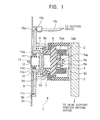
- Fig. 1 is a sectional view showing the configuration of an object conveying device 1 according to the first embodiment of the present invention.
- a stamper 20 used for forming an optical disk is taken as an example of conveyed object, and the object conveying device 1 is used as a device for mounting the stamper 20 to a molding die.
- the object conveying device 1 comprises a support portion 2 that is provided with a power to convey the conveyed object, and a case 3; a coil spring 4 as a first elastic member held to the support portion; an aligning bearing 5a wherein one of an inner ring or an outer ring is held to the first elastic member, and a bearing receiver 5b holding the aligning bearing 5a; a common plate 6 held to one end of the ring that is not held to the first elastic member out of the inner and outer rings of the aligning bearing 5a; a coil spring 7 as a second elastic member held by the common plate 6; a coil spring 8 as a third elastic member held by the common plate 6; a tray 9 held by a third elastic member, the tray 9 being a conveyed object holding mechanism that holds the outer peripheral portion of the conveyed object; a conveyed object holding block 10 held by the second elastic member, the conveyed object holding block holding 10 being a conveyed object holding mechanism that holds the inner peripheral portion of the conveyed object
- the head support portion 2 has, for example, a columnar structure such as a cylinder or a prism, and is provided with a power to move a stamper as a conveyed object by a power of a motor (not shown) or the like.
- the material constituting the head support portion 2 is not particularly limited. Any material that has a sufficient mechanical strength, including stainless steel, may be used.
- the case 3 has a shape such that one open surface in e.g., a substantially cylindrical structure is closed, and that the side surface edge portion on the open surface side thereof is folded back inward.
- the material constituting the case 3 is not particularly limited. Any material that has a sufficient mechanical strength, including stainless steel, may be used.
- the coil springs 4, 7, 8, and 11 are, for example, helical springs.
- the elastic force of the coil spring 4 is lower than that of the coil spring 11, and the elastic force of the coil spring 11 is lower than that of the coil spring 7.
- the coil spring 8 expands and contracts without interlocking with the other coil springs 4, 7, and 11, and therefore, the elastic force of the coil spring 8 is not particularly limited.
- the elastic forces of these coils have, for example, the following approximate values: the coil spring 4: 0.7 kgf, the coil spring 7: 3.0 kgf, the coil spring 8: 1.3 kgf, and the coil spring 11: 0.8 kgf.
- the aligning bearing 5a comprises an outer ring 5aa, which has a substantially cylindrical structure of which the inner wall is formed into a concave surface; an inner ring 5ac, which has a diameter smaller than that of the outer ring 5aa, and which has a substantially cylindrical structure of which the inner wall is formed into a concave surface; and a plurality of bearing balls 5ab disposed between the inner wall of the outer ring 5aa and the outer wall of the inner ring 5ac.
- the inner ring 5ac and the outer ring 5aa are arranged so as to be capable of a relative rotating motion (a substantially relative three-dimensional rotating motion) in a manner such that the angle formed by the central axes thereof can be displaced. In this substantially relative three-dimensional rotating motion, it is desirable that the aligning bearing 5a is arranged so that the solid angle rotates by approximately 5 degrees.
- the bearing receiver 5b has a substantially cylindrical structure that has a level difference portion on the inner wall thereof, and holds the coil spring 4 and the aligning bearing 5a by this level difference portion.
- the material constituting the bearing receiver 5b is not particularly limited. Any material that has a sufficient mechanical strength, including stainless steel, may be used.
- the common plate 6 has a structure wherein for example, a substantially columnar mounting shaft 6a is provided in the vicinity of the center of one surface side of a disk-like structure, and wherein a common plate cylinder portion 6b having a substantially cylindrical shape is provided on the other surface side thereof. Also, each of the inner wall and outer wall of the common plate cylinder portion 6b is formed into a level difference shape.
- the material constituting the common plate 6 is not particularly limited. Any material that has a sufficient mechanical strength, including stainless steel, may be used.
- the tray 9 has, for example, a structure that is formed into a substantially annular shape, and that has a shape such that one portion of the outer periphery thereof is folded back in one direction. Also, a tray cylinder portion 9a having, e.g., a substantially cylindrical structure of which one end is folded back inward, is adhered to one side of the tray 9.
- the material constituting the tray 9 is not particularly limited. Any material that has a sufficient mechanical strength, including stainless steel, may be used.
- the conveyed object holding block 10 has a shape such that a structure wherein one open surface in a substantially cylindrical structure is closed, and wherein the side surface edge portion on the open surface side thereof is folded back inward, and a structure wherein one open surface in the substantially cylindrical structure is closed, and wherein the side surface edge portion on the open surface side thereof is folded back outward, are adhered together so that the open surfaces thereof face away from each other.
- the material constituting the conveyed object holding block 10 is not particularly limited. Any material that has a sufficient mechanical strength, including stainless steel, may be used.
- the center guide 12 has a shape, for example, such that one open surface in a substantially cylindrical structure is closed, and that the side surface edge portion on the open surface side thereof is folded back outward.
- the material constituting the center guide 12 is not particularly limited. Any material that has a sufficient mechanical strength, including stainless steel, may be used.
- the reference pin 13 has, e.g., a substantially columnar structure of which the front end is rounded off.
- the material constituting the reference pin 13 is not particularly limited. Any material that has a sufficient mechanical strength, including stainless steel, may be used.
- the magnets 14a to 14c are preferably permanent magnets, and holds the stamper 20 by the magnetic force thereof. At least one portion of the magnets 14a to 14c may be an electromagnet, which generates a magnetic force with a current supplied.
- the holding pad 15a has, for example, a cylindrical structure that is provided with a hermeticity enhancing mechanism formed at the front end thereof, and that has vacuum sensor formed therein for detecting a held state of the conveyed object such as stamper 20.
- One end of the head support portion 2 is mounted to a head support portion driving device (not shown) having a driving source such as a motor so that the power thereof is transmitted thereto.
- a head support portion driving device (not shown) having a driving source such as a motor so that the power thereof is transmitted thereto.
- the outside of one surface closed in the case 3 is adhered to the side surface of the other end side of the head support portion 2, and one end of the coil spring 4 is held to the inner surface side of the case 3.
- the other end side of the coil spring 4 is held to the level difference portion on the inner wall of the bearing receiver 5b, which holds the outer ring 5aa of the aligning bearing 5a by another portion of the level difference portion on the inner wall thereof.
- the outer ring 5aa of the aligning bearing 5a is held to the coil spring 4 via the bearing receiver 5b.
- the inner ring 5ac of the aligning bearing 5a holds the mounting shaft 6a of the common plate 6.
- the common plate 6 is disposed so that the disk-like structure portion thereof is accommodated within the case 3.
- the common plate 6 is arranged so that it is pressurized by the coil spring 4, and that the inward folded-back portion on the open surface side of the case 3 constitutes a stopper against this pressurization.
- the common plate 6 holds one end of the coil spring 7 at the inside portion of the common plate cylinder portion 6b, while holds one end of the coil spring 8 at the front end portion of the common plate cylinder portion 6b.
- the coil spring 8 pressurizes the tray 9 by the elastic force thereof.
- the tray 9 is arranged so that the inward folded-back portion in the tray cylinder portion 9a is inserted into the level difference portion on the outer wall of the common plate cylinder portion 6b, whereby the inserted portion performs the function of a stopper against the pressurization by the coil spring 8.
- the tray 9 is held to the inner ring 5ac of the aligning bearing 5a via the common plate 6 and the coil spring 8.
- the magnet 14c and the holding pad 15a is mounted to the outer peripheral portion of the tray 9, and a suction tube 15c connected to a suction device for sucking is connected to the holding pad 15a via a suction tube mounting mechanism 15b.
- the other end of the coil spring 7 holds the conveyed object holding block 10, while the other end of the coil spring 8 holds the tray 9.
- the coil spring 7 pressurizes conveyed object holding block 10 by the elastic force thereof.
- the conveyed object holding block 10 is arranged so that the outward folded-back portion on the open surface side thereof is inserted into the level difference portion on the inner wall of the common plate cylinder portion 6b, whereby the inserted portion performs the function of a stopper against the pressurization by the coil spring 7.
- the conveyed object holding block 10 is held to the inner ring 5ac of the aligning bearing 5a via the common plate 6 and the coil spring 7.
- the magnets 14a and 14b are mounted to the inward folded-back portion on the open surface side of the conveyed object holding block 10, and the inside portion of the closed surface of the conveyed object holding block 10 holds one end of the coil spring 11.
- the other end of the coil spring 11 holds center guide 12, and the coil spring 11 pressurizes the center guide 12 by the elastic force thereof.
- the center guide 12 is arranged so that the outward folded-back portion on the open surface side thereof is inserted into the inward folded-back portion on the open surface side of the conveyed object holding block 10, whereby the inserted portion performs the function of a stopper against the pressurization by the coil spring 11.
- the reference pin 13 is adhered to the central portion outside the closed surface of the center guide 12.
- the holding surface 10a which is an annular front end portion in the conveyed object holding block 10, is disposed at a position projecting over the holding surface 9b, which is the annular held portion of the stamper 20 in the tray 9.
- the width of this projection is preferably in the range of 0.8 mm to 1.3 mm, and is more preferably, in the range of 1.0 mm to 1.1 mm.
- the stamper 20 as a conveyed object is held to the tray 9 and the conveyed object holding block 10 by the magnetic forces of the magnets 14a to 14c and the suction force of the holding pad 15a.
- the stamper 20 is a substantially annular disk having a central hole, and the stamper 20 held in this manner is positioned with respect to the tray 9 and the conveyed object holding block 10, by inserting the center guide 12 into the central hole of the stamper 20.
- the outer diameter of the center guide 12 and the inner diameter of the central hole of the stamper 20 are preferably arranged to have sizes such that, when the center guide 12 is inserted into the central hole of the stamper 20, a gap of approximately 1 to 2 (m is created therebetween.
- the tray 9 holds the outer peripheral portion of the stamper 20, while the conveyed object holding block 10 holds the inner portion of the stamper 20 at a position projecting in the direction of the stamper 20 over the stamper holding surface of the tray 9, preferably in the range of 0.8 mm to 1.3 mm, and more preferably in the range of 1.0 mm to 1.1 mm.
- the stamper 20 held in this manner is arranged so that the inner peripheral portion thereof held by the conveyed object holding block 10 becomes convex in the outward direction (i.e., in the direction from the conveyed object holding block 10 toward the common plate 6), and that the outer peripheral portion thereof held by the tray 9 warps in the inward direction (i.e., in the direction from the conveyed object holding block 10 toward the common plate 6), as compared with the inner peripheral portion thereof.
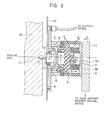
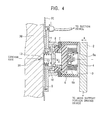
- Figs. 2 to 4 are sectional views of the object conveying device 1 according to the present embodiment wherein the mounting operation of the stamper 20 to a molding die 30 by this object conveying device 1 is shown.
- the stamper 20 to be mounted is caused to be held to the object conveying device 1 as described above.
- the stamper 20 is conveyed up to the mounting position of the molding die 30 (see Fig. 2).
- the molding die 30 to which the stamper 20 is to be mounted has a molding die recess 31, which is a hole into which the reference pin 13 of the object conveying device 1 is to be inserted for positioning.
- the object conveying device 1 is generally disposed at a position such that the position of the reference pin 13 thereof deviates from the central axis, which is coaxial with the molding die recess 31, due to a driving control error of the head support portion driving device or the like (see Fig. 2).
- the object conveying device 1 in this embodiment mounts the stamper 20 held by this device to the molding die 30 while performing an alignment to eliminate the positional deviation from the central axis.
- the head support portion 2 is now moved to the A direction shown in Fig. 2 by the head support portion driving device (not shown).
- the head support portion driving device not shown.
- the head support portion 2 is moved in the A direction, as shown in Fig. 3, first the front end portion of the reference pin 13 makes contact with the edge portion of the molding die recess 31.
- the coil spring 4 which has the lowest elastic force of the coil springs 4, 7 and 11, contracts under pressure from the edge portion of the molding die recess 31 in contact with the front end of the reference pin 13.
- the reference pin 13 in contact with the edge portion of the molding die recess 31 is applied with a force in the C direction shown in Fig. 3. This is because the front end portion of the reference pin 13 is formed so as to be round off.
- this force is transmitted to the common plate 6 via the center guide 12, the coil springs 7 and 11, and the conveyed object holding block 10.
- the common plate 6 to which such a force has been transmitted moves to the F direction shown in Fig. 3, that is, in the direction substantially parallel to the surface of the molding die 30, by the combination of a substantially rotating movement of the bearing receiver 5b in the D direction shown in Fig.
- the reference pin 13 is inserted into the molding die recess 31 while being guided in the central axis direction, and the stamper 20 is guided to an appropriate position of the molding die 30 in parallel with the surface of the molding die 30. Guiding the stamper 20 to the appropriate position of the molding die 30 substantially in parallel with the surface of the molding die 30 in this way, inhibits the stamper 20 from making contact with the surface of the molding die 30 in a tilting state, and keeping deformed under the pressure from the surface.
- the center guide 12 makes contact with the surface of the molding die 30, and further the head support portion 2 is moved in the A direction, the coil spring 11, which has an elastic force one rank higher than that of the coil spring 4, now contracts. Consequently, the center guide 12 held by this coil spring 11 moves in the G direction shown in Fig. 3. This movement of the center guide 12 is performed until the surface of the center guide 12 becomes identical with that of the stamper 20, as shown in Fig. 4.
- the coil spring 7 which has an elastic force one rank higher than that of the coil spring 11, now contracts.
- the conveyed object holding block 10 held to the coil spring 7 pressurizes the inner peripheral portion of the stamper 20 in the H direction shown in Fig. 4 by the elastic force thereof, and pressed the inner peripheral portion of the stamper 20 against the molding die 30.
- the reason why the inner peripheral portion of the stamper 20 is first pressed against the molding die 30 is because, as described above, the stamper 20 is arranged so that the inner peripheral portion thereof held by the conveyed object holding block 10 becomes convex in the outward direction, and that the outer peripheral portion thereof held by the tray 9 warps in the inward direction, as compared with the inner peripheral portion.
- the coil spring 8 now contracts.
- the tray 9 held to the coil spring 8 pressurizes the outer peripheral portion of the stamper 20 in the I direction shown in Fig. 4 by the elastic force thereof, and pressed the outer peripheral portion of the stamper 20 against the molding die 30.
- the stamper 20 is applied with a force that makes the stamper 20 parallel to the surface of the molding die 30.
- the force thus applied is accommodated by the deflection of the coil spring 4 and the three-dimensional rotation of the aligning bearing 5a, thereby allowing the stamper to be made parallel to the surface of the molding die 30, without deforming the stamper 20 by the applied force.
- the object conveying device 1 is equipped with the coil spring 4 held to the case 3, the aligning bearing 5a, of which the outer ring 5aa is held to the coil spring 4, the tray 9 and the conveyed object holding block 10, which are held to the inner ring 5ac of the aligning bearing 5a and which hold the stamper 20, the flexibilities of the tray 9 and the conveyed object holding block 10 can be enhanced, and when the reference pin 13 is guided into the molding die recess 31 at the mounting of the stamper 20 to the molding die 30, the contact portion between the reference pin 13 and the molding die recess 31 can be inhibited from being subjected to a large force more than is necessary. This allows the stamper 20 to be mounted to the predetermined position while aligning it, without deforming or damaging the reference pin 13 and/or the molding die recess 31.
- the object conveying device 1 is equipped with the coil spring 4 held to the case 3, the aligning bearing 5a, of which the outer ring 5aa is held to the coil spring 4, the tray 9 and the conveyed object holding block 10, which are held to the inner ring 5ac of the aligning bearing 5a and which hold the stamper 20, the tilting of the stamper 20 with respect to the surface of the molding die 30 can be accommodated by the coil spring 4 and the aligning bearing 5a, at the mounting of the stamper 20 to the molding die 30. This allows the stamper 20 to be inhibited from deformation and/or damage caused by its being pressed against the molding die 30 in a tilting state.
- the conveyed object holding block 10 is held by the coil spring 7, and the tray 9 is held by the coil spring 8, it is possible to absorb the shock by the coil springs 7 and 8 when the stamper 20 abuts against the surface of the molding die 30 in a tilting state, at the mounting of the stamper 20 to the molding die 30, thereby allowing the stamper 20 to be inhibited from deformation and/or damage caused by its abutting against the molding die 30 in a tilting state.
- the elastic force of the coil spring 4 is set to be lower than that of the coil spring 11, when the reference pin 13 is pressed against the edge portion of the molding die recess 31 of the molding die 30, the coil spring 4 contracts before the coil spring coil 11 contracts, under the pressure.
- the contraction of the coil spring 4 depresses the common plate 6, thereby releasing the common plate 6 from the case 3. Consequently, before the stamper 20 goes out of alignment with the tray 9 and the conveyed object holding block 10 due to the depression of the center guide 12, it is possible to align the reference pin 13 and mount the stamper 20 to an appropriate position of the molding die 30.
- the inner peripheral portion of the stamper 20 can be made convex in the outward direction, and the outer peripheral portion thereof can be disposed so as to warp in the inward direction as compared with the inner peripheral portion thereof.
- the outer peripheral portion of the stamper 20 can be pressed against the molding die 30 after the inner peripheral portion thereof has first been pressed against the molding die 30, which has become convex.
- the stamper 20 can be disposed on the molding die 30 while centering the stamper 20 with respect to the central axis positioned by inserting the reference pin 13 into the molding die recess 31.
- the inner peripheral portion of the stamper 20 can be made convex in the outward direction, and the outer peripheral portion thereof can be disposed so as to warp in the inward direction as compared with the inner peripheral portion thereof.
- the stamper 20 can be mounted on the molding die 30 by correcting the deflection while relieving the deflection outside the stamper 20.
- the present invention is not limited to the above-described embodiment.
- the arrangement is such that the outer ring 5aa of the aligning bearing 5a is held by the coil spring 4 via the bearing receiver 5b, and that the common plate 6 is held by the inner ring 5ac of the aligning bearing 5a.
- the arrangement may be such that the inner ring 5ac of the aligning bearing 5a is held by the coil spring 4, and the common plate 6 is held by the outer ring 5aa of the aligning bearing 5a.
- the tray 9 and the conveyed object holding block 10 are held by the outer ring 5aa of the aligning bearing 5a via the common plate 6 and the coil springs 7 and 8.
- the stamper 20 has been taken as an example of conveyed object.
- the preset invention may be applied to the conveyance of other objects such as optical disks.
- the second embodiment is a modification of the first embodiment.
- the second embodiment is different from the first embodiment in that there is provided a coil spring for inhibiting the common plate 6 from hanging down.
- a coil spring for inhibiting the common plate 6 from hanging down.
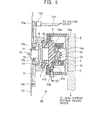
- Fig. 5 is a sectional view showing the configuration of an object conveying device 40 according to the present embodiment
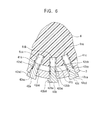
- Fig. 6 is a sectional view showing the VI-VI section in Fig. 5.
- portions common with the first embodiment in Figs. 5 and 6 are designated by the same reference numerals as those in Fig. 1.
- the object conveying device 40 comprises the support portion 2; the case 3; the aligning bearing 5a; the bearing receiver 5b; the common plate 6; the coil springs 4, 7, 8, and 11; the conveyed object holding block 10; the center guide 12; the reference pin 13; the tray 9; the magnets 14a to 14c; the holding pad 15a, the suction tube mounting mechanism 15b, the suction tube 15c; and in addition, coil springs 41a to 41c, which is fifth elastic members for inhibiting the common plate 6 from hanging down; and spring guide bolts 42a to 42c for holding the coil springs 41a to 41c.
- the coil springs 41a to 41c are, for example, the same helical springs as those in the first embodiment.
- coil springs are used as elastic members, plate springs or other springs may be employed as elastic members.
- the spring guide bolts 42a to 42c are, for example, bolts each having a shape such that cylinders mutually different in the outer diameter are coaxially combined. Taking advantage of the differences in the outer diameter, level difference portions 42aa, 42ba, and 42ca are formed.
- the spring guide bolt 42a at one end of the front end portion 42ab, which is a cylindrical portion having the smallest outer diameter, there is provided an intermediate portion 42ac, which is a cylindrical portion having a secondly small outer diameter, and a rear portion 42ad, which is a substantially hexagonal columnar portion having the largest outer diameter, is provided on the other end side of the above-mentioned intermediate portion 42ac.
- the front end portion 42ab, the intermediate portion 42ac, and the rear portion 42ad are coaxially disposed, and the level difference portion 42aa is formed by the difference in the outer diameter between the front end portion 42ab and the intermediate portion 42ac.
- the same goes for spring guide bolts 42b and 42c having front end portions 42bb and 42cb, intermediate portions 42bc and 42cc, and rear portions 42bd and 42cd, respectively.
- the lengths of the front end portions 42ab, 42bb and 42cb is preferably arranged so that, when the spring guide bolt 42a is mounted to the case 3, the tip of each of the front end portions 42ab, 42bb and 42cb does not reach the bottom surface of the common plate 6.
- the material constituting spring guide bolts 42a to 42c is not particularly limited. Any material that has some degree of strength, including stainless steel, may be used.
- spring holding holes 6ca to 6cc into which one-side ends of the coil springs 41a to 41c are to be mounted, respectively, are formed on the bottom side of the common plate 6.
- the shapes of the spring holding holes 6ca to 6cc are not particularly limited. Any shapes of these spring holding holes into which the one-side ends of the coil springs 41a to 41c can be inserted, including cylindrical shape, may be used.
- the spring guide bolts 42a to 42c are inserted to the bottom surface of the case 3, with a substantially uniform spacing thereamong.
- the front end portions 42ab, 42bb and 42cb of the spring guide bolts 42a to 42c are inserted into the one-side ends of the coil springs 41a to 41c, respectively, and the one-end sides of the coil springs 41a to 41c into which the front end portions 42ab, 42bb and 42cb of the spring guide bolts 42a to 42c have been inserted, are held by the level difference portions 42aa, 42ba, and 42ca, respectively.
- the other ends of the coil springs 41a to 41c are inserted into the spring holding holes 6ca, 6cb, and 6cc, and are held thereby, respectively.
- the operation of the object conveying device 40 is fundamentally the same as that of the object conveying device 1 according to the first embodiment.
- the present embodiment is different from the first embodiment in that, when the coil spring 4 contracts and the common plate 6 is released from the case 3, the lower portion of the common plate 6 is held by the coil springs 41a to 41c.
- the holding of the lower portion of the common plate 6 in this case is performed only by the coil springs 41a to 41c, and not by the spring guide bolts 42a to 42c. This prevents the common plate 6 from being fixed by the spring guide bolts 42a to 42c, thereby securing the flexibility of the common plate 6.
- the arrangement is such that the lower portion of the common plate 6 is held by the coil springs 41a to 41c to prevent the common plate 6 from hanging down.
- the arrangement may be, for example, such that, by adhering the one-side ends of these coil springs to the inner side surface of the case 3 (i.e., the connection portion side between the head support portion 2 and the case 3) and adhering the other ends thereof to the side surface of the common plate 6 (i.e., the surface where the mounting shaft 6a is provided), the common plate 6 is held from the side surface thereof, thereby suppressing the hanging down of the common plate 6.
- the object conveying device is arranged to comprise a support portion that is provided with a power to move a conveyed object; a first elastic member held to the support portion; an aligning bearing wherein one of an inner ring and an outer ring thereof is held to the first elastic member; and a conveyed object holding mechanism that holds the conveyed object, the conveyed object holding mechanism being held to one end of the ring that is not held to the first elastic member out of the inner and outer rings of the aligning bearing. Therefore, the conveyed object can be mounted to the predetermined position while aligning it, without deforming or damaging the reference pin and/or the molding die.
- the object conveying device is arranged to comprise the support portion that is provided with a power to move the conveyed object; the first elastic member held to the support portion; the aligning bearing where one of the inner ring and the outer ring thereof is held to the first elastic member; and the conveyed object holding mechanism that holds the conveyed object, the conveyed object holding mechanism being held to one end of the ring that is not held to the first elastic member out of the inner and outer rings of the aligning bearing, it is possible to mount the conveyed object to the predetermined position while aligning it, without deforming or damaging the conveyed object.
Landscapes
- Engineering & Computer Science (AREA)
- Manufacturing & Machinery (AREA)
- Mechanical Engineering (AREA)
- Moulds For Moulding Plastics Or The Like (AREA)
- Manufacturing Optical Record Carriers (AREA)
- Injection Moulding Of Plastics Or The Like (AREA)
- Attitude Control For Articles On Conveyors (AREA)
Applications Claiming Priority (2)
| Application Number | Priority Date | Filing Date | Title |
|---|---|---|---|
| JP2001147397 | 2001-05-17 | ||
| JP2001147397A JP3630644B2 (ja) | 2001-05-17 | 2001-05-17 | 物体運搬装置 |
Publications (3)
| Publication Number | Publication Date |
|---|---|
| EP1260341A2 true EP1260341A2 (fr) | 2002-11-27 |
| EP1260341A3 EP1260341A3 (fr) | 2003-05-02 |
| EP1260341B1 EP1260341B1 (fr) | 2009-04-22 |
Family
ID=18992893
Family Applications (1)
| Application Number | Title | Priority Date | Filing Date |
|---|---|---|---|
| EP02291226A Expired - Lifetime EP1260341B1 (fr) | 2001-05-17 | 2002-05-17 | Dispositif de transport d'objets |
Country Status (5)
| Country | Link |
|---|---|
| US (1) | US6698570B2 (fr) |
| EP (1) | EP1260341B1 (fr) |
| JP (1) | JP3630644B2 (fr) |
| AT (1) | ATE429319T1 (fr) |
| DE (1) | DE60232043D1 (fr) |
Families Citing this family (1)
| Publication number | Priority date | Publication date | Assignee | Title |
|---|---|---|---|---|
| ITMI20030622A1 (it) * | 2003-03-28 | 2004-09-29 | Univer Spa | Dispositivo di centraggio con mezzi di pulizia |
Family Cites Families (6)
| Publication number | Priority date | Publication date | Assignee | Title |
|---|---|---|---|---|
| NL9002517A (nl) * | 1990-11-19 | 1992-06-16 | Philips Nv | Werkwijze voor het vervaardigen van een optisch uitleesbare plaat, alsmede inrichting voor de uitvoering van de werkwijze. |
| US5297951A (en) * | 1992-05-13 | 1994-03-29 | Kabushiki Kaisha Meiki Seisakusho | Mold for producing molded discs |
| JPH07186194A (ja) * | 1993-12-27 | 1995-07-25 | Sony Disc Technol:Kk | スタンパーの自動交換装置 |
| NL1005663C2 (nl) * | 1997-01-31 | 1998-08-03 | Ict Axxicon Bv | Inrichting voor het door spuitgieten vervaardigen van informatie-dragers. |
| NL1005937C2 (nl) | 1997-04-29 | 1998-11-02 | Ict Axxicon Bv | Inrichting voor het door spuitgieten vervaardigen van informatie-dragers. |
| JP2001179776A (ja) | 1999-12-24 | 2001-07-03 | Sony Miyuujitsuku Entertainment:Kk | スタンパーの自動交換装置及びスタンパーの自動調芯方法 |
-
2001
- 2001-05-17 JP JP2001147397A patent/JP3630644B2/ja not_active Expired - Fee Related
-
2002
- 2002-04-30 US US10/134,788 patent/US6698570B2/en not_active Expired - Fee Related
- 2002-05-17 EP EP02291226A patent/EP1260341B1/fr not_active Expired - Lifetime
- 2002-05-17 AT AT02291226T patent/ATE429319T1/de active
- 2002-05-17 DE DE60232043T patent/DE60232043D1/de not_active Expired - Lifetime
Also Published As
| Publication number | Publication date |
|---|---|
| US20020195311A1 (en) | 2002-12-26 |
| JP2002342983A (ja) | 2002-11-29 |
| EP1260341B1 (fr) | 2009-04-22 |
| US6698570B2 (en) | 2004-03-02 |
| ATE429319T1 (de) | 2009-05-15 |
| EP1260341A3 (fr) | 2003-05-02 |
| JP3630644B2 (ja) | 2005-03-16 |
| DE60232043D1 (de) | 2009-06-04 |
Similar Documents
| Publication | Publication Date | Title |
|---|---|---|
| CN104730700A (zh) | 具有载玻片夹持组件的显微镜 | |
| NL8103820A (nl) | Cassette met buigzame magneetschijf en opneem- en/of weergeefinrichting daarvoor. | |
| EP0525742B1 (fr) | Appareil de positionnement d'un objectif | |
| JPH031311A (ja) | 磁気ヘッド用カルダン型支持体 | |
| JP4998397B2 (ja) | インプリント方法、情報記録媒体製造方法およびインプリントシステム | |
| EP1260341B1 (fr) | Dispositif de transport d'objets | |
| KR20020035776A (ko) | 자기전사방법 및 장치 및 자기기록매체 | |
| EP1052636B1 (fr) | Mecanisme de serrage de disque pour dispositif a disque | |
| EP1876485A1 (fr) | Lentille de combinaison et son procédé de fabrication | |
| US6222818B1 (en) | Disc chucking mechanism | |
| EP0632441A2 (fr) | Appareil de maintien de disque optique | |
| US20030041449A1 (en) | Inlay station with alignment assemblies and transfer tubes | |
| JPH04311870A (ja) | 情報記録再生装置 | |
| JPH07196154A (ja) | Oリングピックアップ装置 | |
| US8001558B2 (en) | Clamping apparatus for a disc player | |
| US8182258B2 (en) | Imprinting device | |
| US6246639B1 (en) | Magnetic head holding apparatus for recording a magneto-optical disc | |
| JP2975588B2 (ja) | 射出成形によって情報担体を製造するための装置 | |
| JPS639057A (ja) | カ−ド載置装置 | |
| EP1336958B1 (fr) | Appareil de transfert magnétique | |
| JPH02268560A (ja) | 読取装置 | |
| JP3084668U (ja) | 磁気テープ装置 | |
| CN1093976C (zh) | 记录媒体检测装置和使用该装置的记录媒体驱动装置 | |
| US9269402B1 (en) | BVCM hold down apparatus to prevent pivot bearing damage at TVCM installation in disk drive assembly | |
| JP4250605B2 (ja) | ディスクスタック方法及びディスクスタック装置 |
Legal Events
| Date | Code | Title | Description |
|---|---|---|---|
| PUAI | Public reference made under article 153(3) epc to a published international application that has entered the european phase |
Free format text: ORIGINAL CODE: 0009012 |
|
| AK | Designated contracting states |
Kind code of ref document: A2 Designated state(s): AT BE CH CY DE DK ES FI FR GB GR IE IT LI LU MC NL PT SE TR |
|
| AX | Request for extension of the european patent |
Free format text: AL;LT;LV;MK;RO;SI |
|
| PUAL | Search report despatched |
Free format text: ORIGINAL CODE: 0009013 |
|
| AK | Designated contracting states |
Designated state(s): AT BE CH CY DE DK ES FI FR GB GR IE IT LI LU MC NL PT SE TR |
|
| AX | Request for extension of the european patent |
Extension state: AL LT LV MK RO SI |
|
| 17P | Request for examination filed |
Effective date: 20031024 |
|
| AKX | Designation fees paid |
Designated state(s): AT DE FR GB NL |
|
| RIN1 | Information on inventor provided before grant (corrected) |
Inventor name: TAKII, KIYOSHI,SONY DISC TECHNOLOGY INC. |
|
| RAP1 | Party data changed (applicant data changed or rights of an application transferred) |
Owner name: SONY DISC AND DIGITAL SOLUTIONS INC. |
|
| 17Q | First examination report despatched |
Effective date: 20060713 |
|
| GRAP | Despatch of communication of intention to grant a patent |
Free format text: ORIGINAL CODE: EPIDOSNIGR1 |
|
| GRAS | Grant fee paid |
Free format text: ORIGINAL CODE: EPIDOSNIGR3 |
|
| GRAA | (expected) grant |
Free format text: ORIGINAL CODE: 0009210 |
|
| AK | Designated contracting states |
Kind code of ref document: B1 Designated state(s): AT DE FR GB NL |
|
| REG | Reference to a national code |
Ref country code: GB Ref legal event code: FG4D |
|
| REF | Corresponds to: |
Ref document number: 60232043 Country of ref document: DE Date of ref document: 20090604 Kind code of ref document: P |
|
| PLBE | No opposition filed within time limit |
Free format text: ORIGINAL CODE: 0009261 |
|
| STAA | Information on the status of an ep patent application or granted ep patent |
Free format text: STATUS: NO OPPOSITION FILED WITHIN TIME LIMIT |
|
| 26N | No opposition filed |
Effective date: 20100125 |
|
| PGFP | Annual fee paid to national office [announced via postgrant information from national office to epo] |
Ref country code: AT Payment date: 20120511 Year of fee payment: 11 |
|
| PGFP | Annual fee paid to national office [announced via postgrant information from national office to epo] |
Ref country code: DE Payment date: 20130522 Year of fee payment: 12 Ref country code: GB Payment date: 20130521 Year of fee payment: 12 |
|
| PGFP | Annual fee paid to national office [announced via postgrant information from national office to epo] |
Ref country code: NL Payment date: 20130521 Year of fee payment: 12 Ref country code: FR Payment date: 20130603 Year of fee payment: 12 |
|
| REG | Reference to a national code |
Ref country code: DE Ref legal event code: R119 Ref document number: 60232043 Country of ref document: DE |
|
| REG | Reference to a national code |
Ref country code: NL Ref legal event code: V1 Effective date: 20141201 |
|
| REG | Reference to a national code |
Ref country code: AT Ref legal event code: MM01 Ref document number: 429319 Country of ref document: AT Kind code of ref document: T Effective date: 20140517 |
|
| GBPC | Gb: european patent ceased through non-payment of renewal fee |
Effective date: 20140517 |
|
| PG25 | Lapsed in a contracting state [announced via postgrant information from national office to epo] |
Ref country code: NL Free format text: LAPSE BECAUSE OF NON-PAYMENT OF DUE FEES Effective date: 20141201 Ref country code: AT Free format text: LAPSE BECAUSE OF NON-PAYMENT OF DUE FEES Effective date: 20140517 |
|
| REG | Reference to a national code |
Ref country code: FR Ref legal event code: ST Effective date: 20150130 |
|
| REG | Reference to a national code |
Ref country code: DE Ref legal event code: R119 Ref document number: 60232043 Country of ref document: DE Effective date: 20141202 |
|
| PG25 | Lapsed in a contracting state [announced via postgrant information from national office to epo] |
Ref country code: DE Free format text: LAPSE BECAUSE OF NON-PAYMENT OF DUE FEES Effective date: 20141202 |
|
| PG25 | Lapsed in a contracting state [announced via postgrant information from national office to epo] |
Ref country code: FR Free format text: LAPSE BECAUSE OF NON-PAYMENT OF DUE FEES Effective date: 20140602 Ref country code: GB Free format text: LAPSE BECAUSE OF NON-PAYMENT OF DUE FEES Effective date: 20140517 |