EP1260355A1 - Structure fibreuse retenant la chaleur - Google Patents
Structure fibreuse retenant la chaleur Download PDFInfo
- Publication number
- EP1260355A1 EP1260355A1 EP01970220A EP01970220A EP1260355A1 EP 1260355 A1 EP1260355 A1 EP 1260355A1 EP 01970220 A EP01970220 A EP 01970220A EP 01970220 A EP01970220 A EP 01970220A EP 1260355 A1 EP1260355 A1 EP 1260355A1
- Authority
- EP
- European Patent Office
- Prior art keywords
- heat
- knitted fabric
- retaining
- structure according
- moisture
- Prior art date
- Legal status (The legal status is an assumption and is not a legal conclusion. Google has not performed a legal analysis and makes no representation as to the accuracy of the status listed.)
- Withdrawn
Links
Images


Classifications
-
- B—PERFORMING OPERATIONS; TRANSPORTING
- B32—LAYERED PRODUCTS
- B32B—LAYERED PRODUCTS, i.e. PRODUCTS BUILT-UP OF STRATA OF FLAT OR NON-FLAT, e.g. CELLULAR OR HONEYCOMB, FORM
- B32B5/00—Layered products characterised by the non- homogeneity or physical structure, i.e. comprising a fibrous, filamentary, particulate or foam layer; Layered products characterised by having a layer differing constitutionally or physically in different parts
- B32B5/22—Layered products characterised by the non- homogeneity or physical structure, i.e. comprising a fibrous, filamentary, particulate or foam layer; Layered products characterised by having a layer differing constitutionally or physically in different parts characterised by the presence of two or more layers which are next to each other and are fibrous, filamentary, formed of particles or foamed
- B32B5/24—Layered products characterised by the non- homogeneity or physical structure, i.e. comprising a fibrous, filamentary, particulate or foam layer; Layered products characterised by having a layer differing constitutionally or physically in different parts characterised by the presence of two or more layers which are next to each other and are fibrous, filamentary, formed of particles or foamed one layer being a fibrous or filamentary layer
- B32B5/26—Layered products characterised by the non- homogeneity or physical structure, i.e. comprising a fibrous, filamentary, particulate or foam layer; Layered products characterised by having a layer differing constitutionally or physically in different parts characterised by the presence of two or more layers which are next to each other and are fibrous, filamentary, formed of particles or foamed one layer being a fibrous or filamentary layer another layer next to it also being fibrous or filamentary
-
- A—HUMAN NECESSITIES
- A41—WEARING APPAREL
- A41D—OUTERWEAR; PROTECTIVE GARMENTS; ACCESSORIES
- A41D31/00—Materials specially adapted for outerwear
- A41D31/04—Materials specially adapted for outerwear characterised by special function or use
- A41D31/06—Thermally protective, e.g. insulating
-
- A—HUMAN NECESSITIES
- A41—WEARING APPAREL
- A41D—OUTERWEAR; PROTECTIVE GARMENTS; ACCESSORIES
- A41D31/00—Materials specially adapted for outerwear
- A41D31/04—Materials specially adapted for outerwear characterised by special function or use
- A41D31/06—Thermally protective, e.g. insulating
- A41D31/065—Thermally protective, e.g. insulating using layered materials
-
- A—HUMAN NECESSITIES
- A43—FOOTWEAR
- A43B—CHARACTERISTIC FEATURES OF FOOTWEAR; PARTS OF FOOTWEAR
- A43B17/00—Insoles for insertion, e.g. footbeds or inlays, for attachment to the shoe after the upper has been joined
- A43B17/003—Insoles for insertion, e.g. footbeds or inlays, for attachment to the shoe after the upper has been joined characterised by the material
-
- A—HUMAN NECESSITIES
- A43—FOOTWEAR
- A43B—CHARACTERISTIC FEATURES OF FOOTWEAR; PARTS OF FOOTWEAR
- A43B7/00—Footwear with health or hygienic arrangements
- A43B7/12—Special watertight footwear
- A43B7/125—Special watertight footwear provided with a vapour permeable member, e.g. a membrane
-
- B—PERFORMING OPERATIONS; TRANSPORTING
- B32—LAYERED PRODUCTS
- B32B—LAYERED PRODUCTS, i.e. PRODUCTS BUILT-UP OF STRATA OF FLAT OR NON-FLAT, e.g. CELLULAR OR HONEYCOMB, FORM
- B32B5/00—Layered products characterised by the non- homogeneity or physical structure, i.e. comprising a fibrous, filamentary, particulate or foam layer; Layered products characterised by having a layer differing constitutionally or physically in different parts
- B32B5/02—Layered products characterised by the non- homogeneity or physical structure, i.e. comprising a fibrous, filamentary, particulate or foam layer; Layered products characterised by having a layer differing constitutionally or physically in different parts characterised by structural features of a fibrous or filamentary layer
- B32B5/026—Knitted fabric
-
- D—TEXTILES; PAPER
- D03—WEAVING
- D03D—WOVEN FABRICS; METHODS OF WEAVING; LOOMS
- D03D11/00—Double or multi-ply fabrics not otherwise provided for
-
- D—TEXTILES; PAPER
- D04—BRAIDING; LACE-MAKING; KNITTING; TRIMMINGS; NON-WOVEN FABRICS
- D04B—KNITTING
- D04B1/00—Weft knitting processes for the production of fabrics or articles not dependent on the use of particular machines; Fabrics or articles defined by such processes
- D04B1/14—Other fabrics or articles characterised primarily by the use of particular thread materials
- D04B1/16—Other fabrics or articles characterised primarily by the use of particular thread materials synthetic threads
-
- D—TEXTILES; PAPER
- D04—BRAIDING; LACE-MAKING; KNITTING; TRIMMINGS; NON-WOVEN FABRICS
- D04B—KNITTING
- D04B21/00—Warp knitting processes for the production of fabrics or articles not dependent on the use of particular machines; Fabrics or articles defined by such processes
- D04B21/14—Fabrics characterised by the incorporation by knitting, in one or more thread, fleece, or fabric layers, of reinforcing, binding, or decorative threads; Fabrics incorporating small auxiliary elements, e.g. for decorative purposes
- D04B21/16—Fabrics characterised by the incorporation by knitting, in one or more thread, fleece, or fabric layers, of reinforcing, binding, or decorative threads; Fabrics incorporating small auxiliary elements, e.g. for decorative purposes incorporating synthetic threads
-
- D—TEXTILES; PAPER
- D06—TREATMENT OF TEXTILES OR THE LIKE; LAUNDERING; FLEXIBLE MATERIALS NOT OTHERWISE PROVIDED FOR
- D06M—TREATMENT, NOT PROVIDED FOR ELSEWHERE IN CLASS D06, OF FIBRES, THREADS, YARNS, FABRICS, FEATHERS OR FIBROUS GOODS MADE FROM SUCH MATERIALS
- D06M11/00—Treating fibres, threads, yarns, fabrics or fibrous goods made from such materials, with inorganic substances or complexes thereof; Such treatment combined with mechanical treatment, e.g. mercerising
- D06M11/77—Treating fibres, threads, yarns, fabrics or fibrous goods made from such materials, with inorganic substances or complexes thereof; Such treatment combined with mechanical treatment, e.g. mercerising with silicon or compounds thereof
- D06M11/79—Treating fibres, threads, yarns, fabrics or fibrous goods made from such materials, with inorganic substances or complexes thereof; Such treatment combined with mechanical treatment, e.g. mercerising with silicon or compounds thereof with silicon dioxide, silicic acids or their salts
-
- D—TEXTILES; PAPER
- D06—TREATMENT OF TEXTILES OR THE LIKE; LAUNDERING; FLEXIBLE MATERIALS NOT OTHERWISE PROVIDED FOR
- D06M—TREATMENT, NOT PROVIDED FOR ELSEWHERE IN CLASS D06, OF FIBRES, THREADS, YARNS, FABRICS, FEATHERS OR FIBROUS GOODS MADE FROM SUCH MATERIALS
- D06M15/00—Treating fibres, threads, yarns, fabrics, or fibrous goods made from such materials, with macromolecular compounds; Such treatment combined with mechanical treatment
- D06M15/19—Treating fibres, threads, yarns, fabrics, or fibrous goods made from such materials, with macromolecular compounds; Such treatment combined with mechanical treatment with synthetic macromolecular compounds
- D06M15/21—Macromolecular compounds obtained by reactions only involving carbon-to-carbon unsaturated bonds
- D06M15/263—Macromolecular compounds obtained by reactions only involving carbon-to-carbon unsaturated bonds of unsaturated carboxylic acids; Salts or esters thereof
- D06M15/27—Macromolecular compounds obtained by reactions only involving carbon-to-carbon unsaturated bonds of unsaturated carboxylic acids; Salts or esters thereof of alkylpolyalkylene glycol esters of unsaturated carboxylic acids
-
- D—TEXTILES; PAPER
- D06—TREATMENT OF TEXTILES OR THE LIKE; LAUNDERING; FLEXIBLE MATERIALS NOT OTHERWISE PROVIDED FOR
- D06M—TREATMENT, NOT PROVIDED FOR ELSEWHERE IN CLASS D06, OF FIBRES, THREADS, YARNS, FABRICS, FEATHERS OR FIBROUS GOODS MADE FROM SUCH MATERIALS
- D06M15/00—Treating fibres, threads, yarns, fabrics, or fibrous goods made from such materials, with macromolecular compounds; Such treatment combined with mechanical treatment
- D06M15/19—Treating fibres, threads, yarns, fabrics, or fibrous goods made from such materials, with macromolecular compounds; Such treatment combined with mechanical treatment with synthetic macromolecular compounds
- D06M15/21—Macromolecular compounds obtained by reactions only involving carbon-to-carbon unsaturated bonds
- D06M15/356—Macromolecular compounds obtained by reactions only involving carbon-to-carbon unsaturated bonds of other unsaturated compounds containing nitrogen, sulfur, silicon or phosphorus atoms
- D06M15/3566—Macromolecular compounds obtained by reactions only involving carbon-to-carbon unsaturated bonds of other unsaturated compounds containing nitrogen, sulfur, silicon or phosphorus atoms containing sulfur
-
- A—HUMAN NECESSITIES
- A41—WEARING APPAREL
- A41D—OUTERWEAR; PROTECTIVE GARMENTS; ACCESSORIES
- A41D2400/00—Functions or special features of garments
- A41D2400/10—Heat retention or warming
-
- B—PERFORMING OPERATIONS; TRANSPORTING
- B32—LAYERED PRODUCTS
- B32B—LAYERED PRODUCTS, i.e. PRODUCTS BUILT-UP OF STRATA OF FLAT OR NON-FLAT, e.g. CELLULAR OR HONEYCOMB, FORM
- B32B2307/00—Properties of the layers or laminate
- B32B2307/30—Properties of the layers or laminate having particular thermal properties
-
- B—PERFORMING OPERATIONS; TRANSPORTING
- B32—LAYERED PRODUCTS
- B32B—LAYERED PRODUCTS, i.e. PRODUCTS BUILT-UP OF STRATA OF FLAT OR NON-FLAT, e.g. CELLULAR OR HONEYCOMB, FORM
- B32B2437/00—Clothing
-
- B—PERFORMING OPERATIONS; TRANSPORTING
- B32—LAYERED PRODUCTS
- B32B—LAYERED PRODUCTS, i.e. PRODUCTS BUILT-UP OF STRATA OF FLAT OR NON-FLAT, e.g. CELLULAR OR HONEYCOMB, FORM
- B32B2437/00—Clothing
- B32B2437/02—Gloves, shoes
-
- D—TEXTILES; PAPER
- D10—INDEXING SCHEME ASSOCIATED WITH SUBLASSES OF SECTION D, RELATING TO TEXTILES
- D10B—INDEXING SCHEME ASSOCIATED WITH SUBLASSES OF SECTION D, RELATING TO TEXTILES
- D10B2401/00—Physical properties
- D10B2401/02—Moisture-responsive characteristics
-
- D—TEXTILES; PAPER
- D10—INDEXING SCHEME ASSOCIATED WITH SUBLASSES OF SECTION D, RELATING TO TEXTILES
- D10B—INDEXING SCHEME ASSOCIATED WITH SUBLASSES OF SECTION D, RELATING TO TEXTILES
- D10B2403/00—Details of fabric structure established in the fabric forming process
- D10B2403/01—Surface features
- D10B2403/011—Dissimilar front and back faces
- D10B2403/0114—Dissimilar front and back faces with one or more yarns appearing predominantly on one face, e.g. plated or paralleled yarns
-
- D—TEXTILES; PAPER
- D10—INDEXING SCHEME ASSOCIATED WITH SUBLASSES OF SECTION D, RELATING TO TEXTILES
- D10B—INDEXING SCHEME ASSOCIATED WITH SUBLASSES OF SECTION D, RELATING TO TEXTILES
- D10B2501/00—Wearing apparel
- D10B2501/02—Underwear
-
- Y—GENERAL TAGGING OF NEW TECHNOLOGICAL DEVELOPMENTS; GENERAL TAGGING OF CROSS-SECTIONAL TECHNOLOGIES SPANNING OVER SEVERAL SECTIONS OF THE IPC; TECHNICAL SUBJECTS COVERED BY FORMER USPC CROSS-REFERENCE ART COLLECTIONS [XRACs] AND DIGESTS
- Y10—TECHNICAL SUBJECTS COVERED BY FORMER USPC
- Y10T—TECHNICAL SUBJECTS COVERED BY FORMER US CLASSIFICATION
- Y10T442/00—Fabric [woven, knitted, or nonwoven textile or cloth, etc.]
- Y10T442/20—Coated or impregnated woven, knit, or nonwoven fabric which is not [a] associated with another preformed layer or fiber layer or, [b] with respect to woven and knit, characterized, respectively, by a particular or differential weave or knit, wherein the coating or impregnation is neither a foamed material nor a free metal or alloy layer
- Y10T442/2139—Coating or impregnation specified as porous or permeable to a specific substance [e.g., water vapor, air, etc.]
-
- Y—GENERAL TAGGING OF NEW TECHNOLOGICAL DEVELOPMENTS; GENERAL TAGGING OF CROSS-SECTIONAL TECHNOLOGIES SPANNING OVER SEVERAL SECTIONS OF THE IPC; TECHNICAL SUBJECTS COVERED BY FORMER USPC CROSS-REFERENCE ART COLLECTIONS [XRACs] AND DIGESTS
- Y10—TECHNICAL SUBJECTS COVERED BY FORMER USPC
- Y10T—TECHNICAL SUBJECTS COVERED BY FORMER US CLASSIFICATION
- Y10T442/00—Fabric [woven, knitted, or nonwoven textile or cloth, etc.]
- Y10T442/20—Coated or impregnated woven, knit, or nonwoven fabric which is not [a] associated with another preformed layer or fiber layer or, [b] with respect to woven and knit, characterized, respectively, by a particular or differential weave or knit, wherein the coating or impregnation is neither a foamed material nor a free metal or alloy layer
- Y10T442/2484—Coating or impregnation is water absorbency-increasing or hydrophilicity-increasing or hydrophilicity-imparting
-
- Y—GENERAL TAGGING OF NEW TECHNOLOGICAL DEVELOPMENTS; GENERAL TAGGING OF CROSS-SECTIONAL TECHNOLOGIES SPANNING OVER SEVERAL SECTIONS OF THE IPC; TECHNICAL SUBJECTS COVERED BY FORMER USPC CROSS-REFERENCE ART COLLECTIONS [XRACs] AND DIGESTS
- Y10—TECHNICAL SUBJECTS COVERED BY FORMER USPC
- Y10T—TECHNICAL SUBJECTS COVERED BY FORMER US CLASSIFICATION
- Y10T442/00—Fabric [woven, knitted, or nonwoven textile or cloth, etc.]
- Y10T442/30—Woven fabric [i.e., woven strand or strip material]
- Y10T442/3472—Woven fabric including an additional woven fabric layer
-
- Y—GENERAL TAGGING OF NEW TECHNOLOGICAL DEVELOPMENTS; GENERAL TAGGING OF CROSS-SECTIONAL TECHNOLOGIES SPANNING OVER SEVERAL SECTIONS OF THE IPC; TECHNICAL SUBJECTS COVERED BY FORMER USPC CROSS-REFERENCE ART COLLECTIONS [XRACs] AND DIGESTS
- Y10—TECHNICAL SUBJECTS COVERED BY FORMER USPC
- Y10T—TECHNICAL SUBJECTS COVERED BY FORMER US CLASSIFICATION
- Y10T442/00—Fabric [woven, knitted, or nonwoven textile or cloth, etc.]
- Y10T442/40—Knit fabric [i.e., knit strand or strip material]
-
- Y—GENERAL TAGGING OF NEW TECHNOLOGICAL DEVELOPMENTS; GENERAL TAGGING OF CROSS-SECTIONAL TECHNOLOGIES SPANNING OVER SEVERAL SECTIONS OF THE IPC; TECHNICAL SUBJECTS COVERED BY FORMER USPC CROSS-REFERENCE ART COLLECTIONS [XRACs] AND DIGESTS
- Y10—TECHNICAL SUBJECTS COVERED BY FORMER USPC
- Y10T—TECHNICAL SUBJECTS COVERED BY FORMER US CLASSIFICATION
- Y10T442/00—Fabric [woven, knitted, or nonwoven textile or cloth, etc.]
- Y10T442/60—Nonwoven fabric [i.e., nonwoven strand or fiber material]
- Y10T442/699—Including particulate material other than strand or fiber material
Definitions
- the present invention relates to clothing, bedding, shoes and cloth used as parts thereof, which, having comfortable heat-retaining property, are suitably used as sports closings and cold protecting closings, heat-retaining bedding, cold protecting shoes, etc.
- a raw material having an increased percentage of air content may be used to form an immovable air layer, or aluminum or the like may be used to reflect radiation heat, with the aim of improving its heat insulating property and heat-retaining property.
- Japanese Utility Model Publication SHO 61-27900 has proposed a woven knitted fabric that has a hydrophobic synthetic fiber layer on both the outside face and the inside face (skin-side face) with the single fiber fineness at one side being 1.5 times or more that at the other side to improve sweat absorbing property.
- Japanese Utility Model Publication SHO 61-45180 has proposed a circular-knitted, tubular plain stitch fabric consisting of a hydrophobic synthetic fiber layer on both the outside face and the inside face (skin-side face) with an uneven intermediate layer containing hydrophilic fiber to improve heat-retaining property and sweat absorbing property.
- the sportswear according to Japanese Utility Model Publication SHO 61-27900 described above has no improvements intended for enhanced heat-retaining property, though superior in sweat absorbing property.
- the sportswear according to Japanese Utility Model Publication SHO 61-45180 suffers problems in that it is inferior in the touch because the skin-side face comprises an uneven, tubular plain stitch fabric, inferior in heat-retaining property, and bulky to impede the wearer's motion.
- Materials that reflect radiation heat tend to have a metallic color such as aluminum color, which limit the development of products of various colors, leading to the fact that fully satisfactory sportswear or underwear products have not yet been made available.
- the object of the present invention is to provide heat-retaining fiber structures such as clothing and bedding that maximize the heat-retaining effect of water molecule adsorptive heat release while minimizing the chilly feel to the hand or the body when touched.
- the inventors have earnestly devoted themselves to research and found that a cloth structure that efficiently performs water molecule adsorptive heat release while minimizing the chilly feel to the skin when touched can be produced from cloth having water molecule adsorption/heat release capability laminated with cloth having moisture/heat release control capability for controlling the heat of vaporization.
- the invention adopts a heat-retaining structure comprising outer cloth having a moisture permeability of 300-12000g/m 2 ⁇ 24hr and lining having a exothermic energy index of 5 or more and a surface contact thermal sensation (q max) of 0.1W/cm 2 or less.
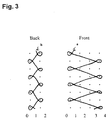
- Fig.3 is a knitting view of knitted fabric as described in Example 7.
- Fig.4 is an explanatory view of a load-stretch recovery curve.
- Fig.5 is a knitting view of knitted fabric as described in Example 8.
- Cloth for the cloth layer having moisture/heat release control capability and cloth for the cloth layer having water molecule adsorption capability to be used for the invention may be selected properly depending on intended applications.
- useful ones include, but not limited to, woven fabrics, knitted fabrics and nonwoven fabrics produced from synthetic fibers such as nylon fibers, polyester fibers and polyamide fibers, semi-synthetic fibers such as acetate fibers, and natural fibers such as cotton, hemp or wool, each of which may be used solely or together with others.
- said moisture/heat release control capability is intended to control the heat of vaporization.
- Said cloth layer having water molecule adsorption/heat release capability releases heat after adsorbing moisture released from the wearer's body through insensible perspiration, but at the same time evaporates moisture from the cloth to the outside environment while absorbing the heat of vaporization, thus causing a decrease in the net pyrogenic effect for the wearer.
- a pyrogenic effect that is sensible to the wearer is achieved only by controlling the heat of vaporization.
- the moisture permeability of the cloth layer having moisture/heat release control capability should be within 3000-12000 g/m 2 ⁇ 24hr as measured in accordance with JIS L-1099 (A-1).
- a lower moisture permeability brings about an increased stuffiness, whereas a higher moisture permeability brings about a larger quantity of heat of vaporization and a decreased water molecule adsorption/heat release performance, making the heat release effect unperceivable.
- Such fiber may be used for the invention as the cloth layer having water molecule adsorption/heat release capability, but more practically desirable ones include synthetic fiber in which a hygroscopic polymer or the like is dispersed to increase hygroscopicity, such as highly hygroscopic nylon yarns produced by spinning nylon after incorporating polyvinyl pyrrolidone, and fibers with enhanced water molecule adsorption/heat release capability produced by fixing, in an after processing process etc., a hygroscopic polymer and/or hygroscopic particulates on the surface to improve hygroscopic performance.
- synthetic fiber in which a hygroscopic polymer or the like is dispersed to increase hygroscopicity, such as highly hygroscopic nylon yarns produced by spinning nylon after incorporating polyvinyl pyrrolidone, and fibers with enhanced water molecule adsorption/heat release capability produced by fixing, in an after processing process etc., a hy
- cloth with further enhanced water molecule adsorption/heat release capability produced by fixing, in an after processing step etc., a hygroscopic polymer and/or hygroscopic particulates on the surface of the fiber is used as said highly hygroscopic synthetic fiber.
- the invention requires the skin-contact side of said cloth layer having water molecule adsorption/heat release capability to have a contact thermal sensation factor (qmax) of 0.1 W/cm 2 or less.
- a contact thermal sensation factor (qmax) of 0.1W /cm 2 or less can be achieved by, for example, providing the contact side with a rough texture to form a cloth structure having a smaller contact area, Such a small factor can also be achieved with double weave in which only the contact side comprises less hygroscopic fiber.
- a contact thermal sensation factor (qmax) of 0.1W/cm 2 or less can be achieved by using gigged or double weave to decrease the contact area.
- any method may be used, without being limited by the above examples, if it can achieve a contact thermal sensation factor (qmax) of 0.1w/cm 2 or less.
- the exothermic energy index as used for the invention is defined as the water molecule adsorption/heat release energy compared with that of a 100% polyester material, namely, the ratio relative to the value of a 100% polyester material.
- a practical measuring method is detailed in Examples, where a 3g specimen is put around an alcohol thermometer, conditioned in an environment of a temperature of 30°C and humidity of 30%RH, and then transferred to an environment with a of 30°C and 90%RH, and the changes in temperature which rises as the specimen absorbs moisture are measured, followed by plotting the measurements on a graph, with time and temperature as the horizontal and vertical axes, respectively, for the time period in which the temperature goes up from 30°C and finally falls down to 30°C, in order to determine the area.
- the above exothermic energy index should be 5 or larger.
- the exothermic energy index is preferably 8 or larger, more preferably 10 or larger. If it is less than 5, a sufficient heat release effect cannot be realized.
- a moisture permeable, waterproof product laminated with a synthetic resin coat layer to be used for the invention may comprise a polyurethane microporous coat produced by wet coagulation, a hydrophilic polyurethane non-porous coat, or a microporous polytetrafluoroethylene coat.
- Double woven fabric is often used to provide a water molecule adsorption/heat release cloth layer and a moisture/heat release control cloth layer in one sheet of fabric.
- Double woven fabric consists of two different woven fabrics combined together into one sheet of woven fabric.
- Such double fabric is doubled using either warps or wefts, or both.
- doubled fabric of this invention should have a dense outer surface and a coarse reverse surface. In such a structure with a dense outer surface and a coarse reverse surface, the cover factor of the outer surface weave is higher than that of the reverse surface weave.
- Such structure with a dense outer surface can have a moisture permeability of 3000-12000g/m 2 ⁇ 24hr and serves as a moisture/heat release control layer.
- Water molecule adsorption/heat release capability can be imparted to the coarse reverse surface by incorporating a highly hygroscopic fiber, such as a nylon yarn or the like with improved hygroscopic performance produced by incorporating polyvinyl pyrrolidone into the above-mentioned nylon followed by spinning, into the yarn to be used in the reverse surface, or by fixing a hygroscopic polymer or hygroscopic particulates to the reverse surface alone in an after processing step etc. designed for kiss-roll processing, foaming, etc.
- a highly hygroscopic fiber such as a nylon yarn or the like with improved hygroscopic performance produced by incorporating polyvinyl pyrrolidone into the above-mentioned nylon followed by spinning, into the yarn to be used in the reverse surface, or by fixing a hygroscopic polymer or hygroscopic particulates to the reverse surface alone in an after processing step etc. designed for kiss-roll processing, foaming, etc.
- a simpler procedure is to immerse the above double woven fabric in a solution of an agent with water molecule adsorption/ heat release capability by the padding method, as such an agent tends to deposited onto the coarse reverse surface more easily than onto the dense outer surface, resulting in deposition of a larger amount of the agent on the yarn forming the reverse surface weave than on that forming the outer surface weave to achieve the intended capability.
- the use of a coarse reverse surface permits the contact thermal sensation factor (qmax) to be 0.1W/cm 2 or less.
- a heat retaining fiber structure having water molecule adsorption/heat release capability can be produced by sewing the above double woven fabric.
- water molecule adsorption/heat release capability can be enhanced by increasing their hygroscopic performance, but a mere increase in the water molecule adsorption/heat release capability gives rise to a chilly feel to the skin when touched, making the fabrics unsuitable for intended heat-retaining applications.
- the skin contact side of said knitted fabrics having water molecule adsorption/heat release capability to be used for the invention should have a contact thermal sensation factor (qmax) of 0.12W/cm 2 or less.
- Knitted fabrics having a contact thermal sensation factor (qmax) of 0.12W/cm 2 or less can be produced by providing rough texture to the skin contact side to the extent that good touch to the skin doe not deteriorate to form a knitted structure with a decreased contact area. Knitted fabrics having a contact thermal sensation factor (qmax) of 0 .12W/cm 2 or less can also be produced by using a multi-woven fabric structure such as a double woven fabric structure comprising low-hygroscopic fiber only in the skin contact side.
- Useful techniques for achieving a contact thermal sensation factor (qmax) of 0.12W/cm 2 or less include, but not limited to, gigging of either side of knitted fabrics and decreasing of the contact area in multi-woven fabrics, but any other technique may be used if it can achieve a contact thermal sensation factor (qmax) of 0.12W/cm 2 or less.
- the contact thermal sensation factor (qmax) is preferably 0.1W/cm 2 or less, more preferably 0.08W/cm 2 or less.
- the skin contact side of sportswear of this invention must have a water drop adsorption time of five seconds or shorter.
- a water drop adsorption time of five seconds or shorter can be achieved by fixing a hygroscopic polymer and/or hygroscopic particulates on the surfaces of fibers constituting the knitted fabric described above to increase the water absorbing performance of the knitted fabric. If the water drop adsorption time is longer than five seconds, sweat-absorbing performance during exercise will deteriorate to cause stuffiness, making the sportswear uncomfortable.
- the water drop adsorption time is preferably three seconds or shorter, more preferably one and half seconds or shorter.
- Sportswear of this invention must comprise knitted fabric that has a bursting strength of 0.29MPa or more. If the bursting strength is less than 0.20MPa, breakage may take place during use.
- the knitted fabric of sportswear of this invention has a density of 22-82 wales/2.54cm and 24-130 courses/2.54cm, and a weight of 80-330g/cm 2 .
- Knitted fabrics with a density of 82 wales/2.54cm or less and 130 courses/2.54cm or less have comfortable texture, maintain light texture and have improved knitting performance.
- Knitted fabrics with a weight of 80g/m2 or more have a proper tension and prevent stuffiness.
- a weight of 330g/m2 or less serves to prevents hard texture and maintains light texture.
- Such knitted fabrics include warp-knitted ones such as tricot and raschel, and circular-knitted ones such as single circular knit and double circular knit.
- the knit weave may be half weave, back-half weave, queens cord weave, satin weave, meshed weave, or other derivative weaves of warp-knitted fabrics, or plain weave, circular rib weave, interlock weave, reversible weave or other derivative weaves of circular knitted fabrics, or any other weave used in ordinary sportswear.
- rough surface provided on the reverse side (skin contact side) of knitted fabric to the extent that the surface does not lose comfortable touch works to decrease the area of contact of the skin with the reverse side of underwear while forming an immovable air layer to reduce the contact thermal sensation factor (qmax) of the skin contact side and also to prevent heavy stuffiness from being caused by sweating, achieving a favorable configuration.
- Such rough texture may be formed by adopting derivative weave, a combination of thick and thin yarns, jacquard weave, gigging, or embossing.
- Knitted fabric for sportswear of this invention may comprise any of said weaves as a single layer or may be in a multilayered structure having two or three layers. If knitted fabric of a multilayered structure is used, it is desirable that spun yarns are used to produce the outer surface of the knitted fabric while using synthetic multifilament yarns in the reverse side (skin contact side), or that synthetic multifilament yarns with a small single fiber fineness are used to produce the outer surface side of the knitted fabric while using synthetic multifilament yarns with a large single fiber fineness in the reverse side (skin contact side). In addition, it is more desirable that the single fiber fineness of yarns constituting the outer surface side is 1.5 times or more that of yarns constituting the reverse side.
- a highly modified-section synthetic multifilament yarn with a cross-section in a H, I, W, X, Y or + form and having a plurality of grooves in the surfaces of synthetic multifilament yarns in the length direction of single fibers are used as the yarn that constitutes the outer surface side while using an ordinary-section synthetic multifilament yarn with a circular or triangular cross section as the yarn constituting the reverse side.
- Knitted fabric of such a multilayered structure permits not only sweat vapor but also liquid sweat to be quickly and efficiently absorbed, permeated and dispersed from the reverse side (skin contact side) to the outer surface side of the knitted fabric due to a capillary phenomenon caused by the multilayered structure having two or three layers, allowing the fabric to serve as comfortable sportswear for wearers who perform hard exercise that causes heavy liquid sweating.
- Such knitted fabric for sportswear may contain rubber elastic yarns such as polyurethane based elastic yarns .
- rubber elastic yarns are preferably applied to sportswear such as athletic underwear half pants, cycling pants, leotards, speed skating wear, and athletic skiing wear that require better stretching performance, as their stretching capability permits the wear to fit well to the body, enhances easy body movement, and improves the body line.
- Preferable polyester yarns other than polyurethane elastic yarns include those comprising polytrimethylene terephthalate as the major component, and in particular, costs can be reduced by using multifilament yarns consisting of polytrimethylene terephthalate and polyethylene terephthalate adhered side by side to each other.
- a wide variety of sportswear products can be developed by selecting proper materials and fabric structures, such as running shirts and pants, athletic shirts and pants, golf shirts, tennis shirts, cycling shirts and pants, outdoor shirts, polo shirts, T-shirts, baseball undershirts, training wear, baseball uniform shirts and pants, skiing wear, leotards, athletic underwear half pants, and speed skating wear.
- Underwear according to the invention should comprise knitted fabric with a flex rigidity of 5-30mm as measured by the cantilever method. If the flex rigidity is 300mm or more, the knitted fabric will have hard texture, making the fabric unsuitable for underwear. If it is less than 5mm, the knitted fabric will have excessively soft texture to allow the fabric to cling to a body, inhibiting easy body movement.
- underwear according to this invention should have comprised knitted fabric with a bursting strength of 0.25MPa or more. If the bursting strength is less than 0.25MP, breakage may take place while wearing.
- a flex rigidity as described above can be achieved to some extent by using yarns with a proper thickness and knitted fabric with a proper weight, but it is essential to achieve a required flex rigidity is while maintaining a required bursting strength.
- knitted fabric for underwear of this invention has a density of 22-85 wales/2.54cm and 24-138 courses/2.54cm, and a weight of 80-300g/m2.
- Knitted fabric with a MESTSUKE of 80g/m 2 or more has a proper tension and prevents clinging to the body.
- a weight of 300g/m 2 or less prevents hard feeling and maintains light texture.
- Such knitted fabrics include warp-knitted ones such as tricot and raschel, and circular-knitted ones such as single circular knit and double circular knit.
- the weave may be half weave, back-half weave, queens cord weave, satin weave, meshed weave, or a derivative weave of warp-knitted fabric, or plain weave, circular rib weave, interlock weave, mock lody weave, or a derivative weave of circular knitted fabric, or any other weave used in ordinary sportswear.
- rough surface provided on the reverse side (skin contact side) of knitted fabric to the extent that the surface does not lose comfortable touch works to decrease the area of contact of the skin with the reverse side of underwear while forming an immovable air layer to reduce the contact thermal sensation factor (qmax) of the skin contact side, achieving a favorable configuration.
- Such rough texture may be formed by adopting a derivative weave, a combination of thick and thin yarns, jacquard pattern weave, gigging, or embossing.
- Knitted fabric for underwear of this invention may comprise any of said weaves as a single layer or may be in a multilayered structure having two or three layers. If knitted fabric of a multilayered structure is used, it is desirable that spun yarns are used to produce the outer surface of the knitted fabric while using synthetic multifilament yarns in the reverse side (skin contact side), or that synthetic multifilament yarns with a small single fiber fineness are used to produce the outer surface side of the knitted fabric while using synthetic multifilament yarns with a large single fiber fineness in the reverse side (skin contact side).
- underwear products can be developed by selecting proper materials and fabric structures, such as general women's underwear products including slips, camisoles, petticoats, shirts, underpants, tights, T-shirts, turtleneck shirts, U-neck shirts, body suits, and girdles; men's underwear products including T-shirts, turtleneck shirts, running shirts, undershirts, tights, briefs, and trunks; sports-underwear products including those for athletic, outdoor or skiing applications as well as modifications of the former ones; and working underwear products including those for outdoor or cold reserving room operations.
- proper materials and fabric structures such as general women's underwear products including slips, camisoles, petticoats, shirts, underpants, tights, T-shirts, turtleneck shirts, U-neck shirts, body suits, and girdles; men's underwear products including T-shirts, turtleneck shirts, running shirts, undershirts, tights, briefs, and trunks; sports-underwear products including those for athletic,
- Lining of this invention should comprise knitted fabric with a bursting strength of 0.2MPa or more. If the bursting strength is less than 0.2MPa, breakage may take place while wearing.
- knitted fabric used as lining of this invention has a frictional static charge of 5kV or lower under the conditions of 20°C and 30%RH. Preferably, it is 3kV or lower.
- Frictional static electricity which occurs when the lining comes in contact with the outer surface material, the skin, etc., has large influence on the wearing properties including clinging tendency. Properties as described above serve to prevent the clinging of closings, the deposition of dust and sparking discharge from being caused by static electricity which occurs frequently in dry circumstances in winter.
- Knitted fabric used as lining of this invention preferably has a density of 24-85 wales/2.54cm and 28-130 courses/2.54cm, and a weight of 60-190g/m 2 .
- Knitted fabric with a MESTSUKE of 60g/m 2 or more has a proper tension and prevents clinging to the body.
- a weight of 190g/m 2 or less serves to prevent hard feeling while maintaining light texture
- Such knitted fabrics include warp-knitted ones such as tricot and raschel, and circular-knitted ones such as single circular knit and double circular knit.
- the weave may be half weave, back-half weave, queens cord weave, satin weave, meshed weave, or a derivative weave of warp-knitted fabric, or plain weave, circular rib weave, interlock weave, or a derivative weave of circular knitted fabric, or any other weave used in ordinary lining.
- Such rough texture may be formed by adopting a derivative weave, a combination of thick and thin yarns, jacquard pattern weave, gigging, or embossing.
- Knitted fabric for lining of this in vent ion may comprise any of said weaves as a single layer or may be in a multilayered structure having two or three layers. If knitted fabric of a multilayered structure is used, it is desirable that synthetic multifilament yarns with a small single fiber fineness are used to produce the outer surface side of the knitted fabric while using synthetic multifilament yarns with a large single fiber fineness in the reverse side (skin contact side).
- Knitted fabric of such a multilayered structure permits not only sweat vapor but also liquid sweat to be quickly and efficiently absorbed, permeated and dispersed from the reverse side (skin contact side) to the outer surface side of the knitted fabric due to a capillary phenomenon caused by the multilayered structure having two or three layers, allowing the fabric to serve as comfortable lining for wearers who perform hard exercise that causes heavy liquid sweating.
- lining products can be developed by selecting proper materials and fabric structures, such as sportswear, women' s wear, men's wear, child wear, formal wear, student wear, and working wear.
- a supporter of this invention should comprise knitted fabric that has a stretchability of 50% or higher and a stretch recovery of 60% or higher in either weft or warp direction.
- the stretchability represents the degree of stretch of the knitted fabric. A larger value permits easier adaptation of the supporter to the movement of the body, and quick stretch of the knitted fabric to follow body movements during hard exercise, allowing the wearer to move easily and suffer less exhaustion.
- the stretch recovery represents the degree of quick recovery of the knitted fabric to the former shape, after being elongated by the movement of the body. A larger value permits a higher degree of fitting to the body and easier movement for the wearer of the supporter.
- the stretchability and the stretch recovery should be determined in either weft or warp direction of knitted fabric. If, for example, the fabric is to be used as material for a knee supporter or elbow supporter to be worn in actual applications, it is manufactured with the direction of the higher stretchability and higher stretch recovery aligned in the length direction of the supporter to allow them to closely follow the movements of the joint and with the direction of the lower stretchability and stretch recovery aligned in the lateral direction of the supporter to protect the muscle under a proper pressure. The directions should be vice versa in the case of a belly supporter.
- the stretchability and the stretch recovery can be measured by a method described below. Specifically, the stretchability of knitted fabric is measured by the grab method under a constant stretch rate in accordance with JIS L 1018 "A Knitted Fabric Testing Method.” Thus, three test pieces with a size of 10cm x about 15cm are sampled in both the weft and warp directions . A constant stretch rate tension tester with an automatic recorder is used. Grabs with a size of 2.54cm x 2.54 for the outer side and those with a size of 2.54cm x 5.08cm for the reverse side are set at both upper and lower positions, with 7.6 cm intervals between grabs, and a test piece is fixed to the grabs after removing sagging and tension.
- the residual strain L2(%) is determined from the point where the load reaches zero in said load-stretch-recovery curve drawn by the recorder.
- the bursting strength is measured in accordance with JIS L 1018 "A Knitted Fabric Testing method.” Specifically, five test pieces having a size of 15cm x 15cm are sampled. Each test piece is set on a Mullen bursting strength tester with the outer surface up without applying tension, and the average for the five test pieces is calculated.
- Knitted fabric of this invention should have a stretchability of 50% or higher, preferably 60% or higher, and 70% or higher, in either weft or warp direction.
- the stretchability is less than 50%, the supporter cannot be put on very easily, and cannot extend easily to follow the movements of the wearer, quickly exhausting the wearer. If the stretch recovery is less than 60%, the knitted fabric, once elongated by the movements of the wearer, cannot recover from the elongated condition. Thus supporter is inferior in fitting to the body and following the movements of the body. Such a supporter will also be inferior in appearance.
- Knitted fabric for the supporter of this invention should have a bursting strength of 0.29MPa or more. If the bursting strength is less than 0.29Mpa, breakage may take place during use.
- Such knitted fabrics used in supporters of the invention include warp-knitted ones such as tricot and raschel; circular-knitted ones such as single circular knit and double circular knit; and those produced by a circular knitting machine for molding including single circular knit and double circular knit.
- the weave may be half weave, back-half weave, queens cord weave, satin weave, meshed weave, pile weave, or a derivative weave of warp-knitted fabric, or plain weave, circular rib weave, interlock weave, mock lody weave, or a derivative weave of circular knitted fabric, or any other weave used in ordinary supporters.
- rough surface provided on the reverse side (skin contact side) of knitted fabric to the extent that the surface does not lose comfortable touch works to decrease the area of contact of the skin with the reverse side of the supporter while forming an immovable air layer to reduce the contact thermal sensation factor (qmax) of the skin contact side, achieving a favorable configuration.
- Such rough texture may be formed by adopting a derivative weave, a combination of thick and thin yarns, jacquard pattern weave, pile weave, gigging, or embossing.
- Knitted fabric for supporters of this invention may comprise any of said weaves as a single layer or may be in a multilayered structure having two or three layers. If knitted fabric of a multilayered structure is used, it is desirable that spun yarns are used to produce the outer surface of the knitted fabric while using synthetic multifilament yarns in the reverse side (skin contact side), or that synthetic multifilament yarns with a small single fiber fineness are used to produce the outer surface side of the knitted fabric while using synthetic multifilament yarns with a large single fiber fineness in the reverse side (skin contact side).
- Knitted fabric of such a multilayered structure permits not only sweat vapor but also liquid sweat to be quickly and efficiently absorbed, permeated and dispersed from the reverse side (skin contact side) to the outer surface side of the knitted fabric due to a capillary phenomenon caused by the multilayered structure having two or three layers, allowing the fabric to serve as comfortable lining for wearers who perform hard exercise that causes heavy liquid sweating
- Knitted fabric for the supporter may contain ordinary rubber or rubber-like elastic yarns such as polyurethane-based elastic yarns. It is desirable that supporters that require enhanced stretching performance contain such rubber or rubber-like elastic yarns, as their stretching capability permits the wear to fit well to the body, and enhances easy body movement.
- supporters can be developed by selecting proper materials and fabric structures, such as sports protector including elbow, knee, shank, thigh, and shoulder supporters; medical protectors including elbow, knee, shank, thigh, shoulder, belly, collarbone, and vertebrae supporters; and general cold protectors including elbow, knee, shank, thigh, shoulder, and belly supporters.
- sports protector including elbow, knee, shank, thigh, and shoulder supporters
- medical protectors including elbow, knee, shank, thigh, shoulder, belly, collarbone, and vertebrae supporters
- general cold protectors including elbow, knee, shank, thigh, shoulder, and belly supporters.
- Heat-retaining fiber structures according to the invention are also useful for bedding.
- Fiber having water molecule adsorption/heat release capability to be used in a cloth layer or wadding for bedding of this invention should be hygroscopic, but as the hygroscopicity increases excessively, the fiber will have a chilly feel and less suitable for heat retention.
- said cloth layer having water molecule adsorption/heat release capability should have a contact thermal sensation factor (qmax) of 0.10W/cm 2 or less at its skin contact portions (outside surface).
- Bedding of this invention consists of an outer layer of high-density woven fabric of polyester long fiber or cotton; wadding of polyester short fiber with highly hygroscopic silica particulates fixed thereto with a binder; and lining of gigged knit of polyester long fiber with hygroscopic polymer fixed thereto; which are sewed together to produce a coverlet having water molecule adsorption/heat release capability as proposed in the present invention. Sleeping mat, kotatsu coverlets and sleeping bags can be produced by a similar procedure.
- Bedding of this invention can be favorably used as bedclothes, kotatsu coverlets and sleeping bags.
- said moisture/heat release control capability is intended to control the heat of vaporization.
- Said cloth layer having water molecule adsorption/heat release capability releases heat after adsorbing moisture released from the wearer' s body through insensible perspiration, but at the same time evaporates moisture from the cloth to the outside environment while absorbing the heat of vaporization, thus causing a decrease in the net pyrogenic effect for the wearer.
- a pyrogenic effect that is sensible to the wearer is achieved only by controlling the heat of vaporization.
- Such outer material having sensible performance for moisture/heat release control should have a moisture permeability of 12, 000g /m 2 ⁇ 24hr or less as measured according to JIS L-1099 (A-1).
- the moisture permeability of the outer layer having moisture/heat release control capability should be within 3000-12000g/m 2 ⁇ 24hr.
- a lower moisture permeability brings about an increased stuffiness, whereas a higher moisture permeability brings about a larger quantity of heat of vaporization, making the heat release effect unperceivable.
- the moisture permeability should preferably be in the range of 4,000-12,000 g/m 2 ⁇ 24hr, more preferably 6,000-12,000 g/m 2 ⁇ 24hr.
- Useful methods to control the moisture permeability within said range include, but not limited to, moisture-permeating/waterproofing treatment.
- Moisture-permeating/waterproofing treatment is carrying out by coating or laminating the foundation cloth with fine porous polyurethane film (by wet coagulation), non-porous moisture-permeable polyurethane film, or fine porous polytetrafluoroethylene film to impart both waterproofness and moisture permeability.
- the moisture permeability can also be controlled by increasing or decreasing the density of the woven fabric.
- the level of moisture permeability may be set appropriately after considering the required degree of control of heat of vaporization and required stuffiness for the intended application. Thus, the moisture permeability is set to a higher level for cloth tobe used at high ambient temperatures and high exercise intensity, while it is set to be a low level for cloth to be used at low ambient temperatures and low exercise intensity.
- fiber that constitutes a cloth layer having water molecule adsorption/heat release capability should be hygroscopic.
- Practically desirable ones include synthetic fiber in which a hygroscopic polymer or the like is dispersed to increase hygroscopicity, such as highly hygroscopic nylon yarns produced by spinning nylon after incorporating polyvinyl pyrrolidone, and cloth with enhanced water molecule adsorption/heat release capability produced by fixing, in an after processing process etc., a hygroscopic polymer and/or hygroscopic particulates on the surface to improve hygroscopic performance.
- said cloth with at least one side laminated with a synthetic resin film layer to impart moisture/heat release control performance may be moisture-permeable/waterproof material consisting of cloth with one side coated or laminated with fine porous polyurethane film (by wet coagulation), non-porous hydrophilic polyurethane film, or polytetrafluoroethylene film.
- Good moisture-permeable, waterproof heat-retaining shoes and heat-retaining gloves of this invention can be produced by using said moisture-permeable/waterproof material, with an intermediate layer of sponge and/or cloth having an exothermic energy index of 5 or larger, and lining having an exothermic energy index of 5 or larger and a contact thermal sensation factor of at its outer face of 0.1W/cm 2 or less.
- the objective of the invention is also achieved by eliminating the intermediate layer while using said moisture-permeable, waterproof material as outer layer, and said lining having an exothermic energy index of 5 or larger and a contact thermal sensation factor of its outer surface of 0.1W/cm 2 to produce light shoes.
- heat reserving material may be added to permit said cloth to retain generated heat effectively.
- Such heat reserving materials include far infrared radiation ceramics produced from inorganic compounds such as alumina, zirconia and magnesia; paraffin wax capable of utilizing latent heat from phase change; and carbon black. Heat reserving material may be added to cloth having moisture/heat release control capability to enhance the heat-retaining effect.
- An after processing step to impart water molecule adsorption/heat release capability to cloth may consist of adding a polymerization initiator to a solution of vinyl sulfonic acid and one or more of compounds represented by general formulae [I], [II], [III], applying treatment liquid by such a technique as padding, spraying, kiss roll coater, and slit coater, and polymerization by such a technique as dry heating, wet heating, microwave irradiation, and ultraviolet irradiation, to fix it on the surface of fiber.
- Vinyl sulfonic acid is low in pH, and if it is used at such a pH, such materials as cotton and nylon will become brittle. Therefore, it is previously neutralized, and used as vinyl sodium sulfonate.
- Zinc vinyl sulfonate may be used to impart deodorizing capability.
- Useful vinyl sulfonic acids include 2-acrylamide-2-methylpropane sulphonic acid (AMPS), sodium 2-acrylamide-2-methylpropane sulfonate (AMPS-Na), 2-allyloxy-2-hydroxypropane sulfonic acid, and sodium styrene sulfonate. Two or more of these monomers may be used for this invention. Particularly, AMPS is desirable because of its polymerizing efficiency and water molecule adsorption/heat release capability.
- n is an integer in the range of 5 to 40, preferably 9 to 23. Sufficient durability cannot be achieved if n is smaller than 5 or larger than 40.
- n is preferably in the range of 15 to 35 in view of antistatic performance.
- R is a hydrogen atom or CH 3 , R 1 being Cl, Br, I, OCH 3 , OC 2 H 5 , or SCH 3 , and 1+m being an integer in the range of 5 to 40, with m being preferably an integer of 0 to 9, I being preferably an integer of 10 or larger, and 1+m being preferably 20 to 30 in view of durability.
- Monomers shown by the above general formulae [I], [II], [III] can be used singly or in combination. Two or more of them can be used together without problems.
- X may be H or CH 3 , but it is preferably CH 3 for safety purposes.
- the mixture ratio by weight of vinyl sulfonic acid to one or more of the monomers represented by general formulae [I], [II], [III] is preferably 1:20 to 1:1, more preferably 1:2. If the mixture ratio by weight exceeds 1:20, the resulting water molecule adsorption/heat release capability tends to be at a low level, while if it is less than 1:1, crosslinking of the polymer will not be formed adequately, leading to poor durability. In view of antistatic capability, it is desirable that the weight of compounds of general formulae [I], [II], [III] used is larger than that of vinyl sulfonic acid.
- a polymerization initiator is used for the polymerizing reaction.
- Useful polymerization initiators include ordinary radical initiators, including inorganic polymerization initiators such as ammonium persulfate, potassium persulfate and hydrogen peroxide, and organic polymerization initiators such as 2,2'-azobis(2-amidinopropane)dihydrochloride, 2,2'-azobis(N,N-dimethyleneisobutylamidine)dihydrochlor ide, and 2-(carbamoylazo)isobuthylonitrile.
- a water-insoluble polymerization initiator such as benzoyl peroxide, and azobisisobutylonitrile may be used after being emulsified with a surface active agent such as anion and nonion.
- a surface active agent such as anion and nonion.
- ammonium persulfate is favorably used.
- a so-called redox initiator which consists of a peroxide acting as polymerization initiator and a reducing agent, may be used.
- Said peroxide is, for example, ammonium persulfate or potassium persulfate
- said reducing agent is, for example, a reactant of sodium sulfoxylate with formalin, or hydrosulfite.
- the content of said polymerization initiator to be used is preferably 0.1-3%, depending on the monomer concentration and treatment conditions to be used.
- penetrants may be used to increase compatibility with fiber.
- penetrants include alcohols such as isoprophylalcohol; anionic surface active agents such as sodium sodium dodecylbenzenesulfonate and sodium alkylnaphthalene sulphonate; and non-ionic surface active agents such as ethylene oxide addition products of octyl phenol.
- Treatment liquid used for this invention basically consists of vinyl sulfonic acid, one or more monomers represented by general formulae [I], [II], or [III], and a polymerization initiator, but finishing agents such as repellent, softening agent, fire retardant, and antibacterial-deodorant agent may be added thereto as required.
- finishing agents such as repellent, softening agent, fire retardant, and antibacterial-deodorant agent may be added thereto as required.
- a vinyl monomer having methylol groups such as N-methylol acrylamide, N-methylol methacrylamide, and N,N-methylene bisacrylamide, may be added thereto to such a degree that the resulting material will not have a heavily coarse or hard feeling.
- natural materials are favorably added thereto, such natural materials including cotton, hemp, and tea, extracted from plants; wool, silk, chitin, chitosan, and squalane, extracted from animals; and smectite, extracted from ores.
- These may be mixed in the treatment liquid for simultaneous treatment, or he above treatment is carried out first, followed by preparing another treatment liquid of natural materials alone, impregnating fiber therewith, and applying dry heat.
- These natural materials have hygroscopic property, which serves to further increase the heat-retaining effect.
- Treatment liquid may be applied to fiber material by using common means . It is desirable to use a vacuum dewatering machine to adjusting the amount to be added.
- treatment liquid may be added at the stage of filature or spinning.
- POY partially opriented yarns
- polyester filament for example, at least one compound selected from the group of a compound as described above; higher hydrocarbon; ester of a polyhydric alcoholwith 3-6 carbon atoms and a fatty acid with 14-18 carbon atoms; aliphatic amide produced by reaction of a fatty acid with 12-17 carbon atoms and an aminoalcohol; and a water soluble silicone compound; is mixed with a polyoxyethylene-based surface active agent to provide a mixed composition, which is added along with a spinning oil agent, followed by dry heat treatment in the subsequent drawing process to allow the compound to adhere strongly to the fiber, whereby imparting water molecule adsorption/heat release capability for increased resistance to washing.
- Required capability can also be obtained by depositing highly hygroscopic silica particulates on fiber surface with a binder.
- Heat-retaining fiber structures according to the invention may be subjected, at the dyeing stage, to additional treatment processes such as for dustproofing, antibacterial property, odor elimination, deodorization, sweat absorption, water repelling, or ultraviolet absorption, plus additional physical after processing such as calendaring, embossing, wrinkling, gigging, or opal finishing, which are performed depending on characteristics required for final applications.
- additional treatment processes such as for dustproofing, antibacterial property, odor elimination, deodorization, sweat absorption, water repelling, or ultraviolet absorption, plus additional physical after processing such as calendaring, embossing, wrinkling, gigging, or opal finishing, which are performed depending on characteristics required for final applications.
- the residual strain L2(%) is determined from the point where the load reaches zero in said load-stretch-recovery curve drawn by the recorder.
- Water repelling treatment was performed for nylon taffeta formed of nylon filament yarns of 77dtex, by using a fluorine-based water repellent. Specifically, the taffeta was immersed in a water-dispersed liquid containing 3% by weight of the Asahi-Guard AG710 water repellent manufactured by Meisei Kagaku Co., Ltd., taken out with a squeeze ratio of 40%, and subjected to dry heat treatment for 30 seconds at 130°C in a heat setter.
- the taffeta was coated with a polyurethane solution of Prescription 1 having the following composition by using a knife-over-roll coater with a clearance of 200 ⁇ , and then subjected to hot-air drying at 80°C to provide nonporous, moisture-permeable, waterproof outer material having a moisture permeability of 4800g/m 2 ⁇ 24hr.
- Hi-Muren Y-265 polyether-based polyurethane, with a thickness of 12 ⁇ and a moisture-permeability of 6,300g/m 2 ⁇ 24hr, manufactured by Dainichi Seika
- Rezamin X-100 crosslinking agent isocyanate-based crosslinking agent
- MEK 25 parts toluene 25 parts
- treatment liquid of Prescription 2 having the following composition was sprayed, up to a deposit rate by weight of 100%, over a web comprising of a fiber structure with a weight of 80g/m 2 formed of 100% polyethylene terephthalate having a single-yarn fiber fineness of 7.2dtex and a fiber length of 64mm, followed by predrying for two minutes at 120°C. Subsequently, heat treatment is performed for one minute at 180°C to produce wadding with silica particulates fixed over fiber surfaces and having an exothermic energy index of 22.
- silica particles Sylysia 550 (Fuji Silysia Kagaku Co., Ltd.) The silica particles used had an average particle size of 2.7 ⁇ m and an average specific surface area of 500m 2 /g. 60g/l Binder Silicone-based resin KT7014 (40% solid component) (Takamatsu Yushi Co., Ltd.) 25g/l
- a gigged cut satin tricot product formed of polyester 83 dtex-24F was immersed in a treatment liquid of Prescription 3 having the following composition, and squeezed by a mangle set at a pickup rate of 80% and dried by a dryer at 120°C for two minutes.
- Prescription 3 AMPS (2-acrylamide-2-methylpropane sulfonic acid) 20g/l PEG#1000 dimethacrylate (a brand name: Graset T303, Kyoei) 40g/l Ammonium persulfate 2g/l
- the material was treated by using a heating steamer at 105°C for five minutes, washed in hot water, and dried. Then, it is set in a dryer at 170°C for one minute to produce lining having an exothermic energy index of 15.
- Prescription 4 An adhesive shown in Prescription 4 having the following composition was applied over the coated film of the outer material produced by Example 1 by using a 30-mesh gravure roll, followed by hot drying at 100°C. Then, the lining produced in Example 1 was adhered to the material and, while pressing them together, aged for 24 hours at 40°C to produce moisture-permeable, waterproof finished cloth of a three-layer structure.
- Prescription 4 Hi-Muren Y-199 (two-liquid type polyether-based polyurethane) manufactured by Dainichi Seika Kogyo Co., Ltd. 100 parts Colonate HL (isocyanate) manufactured by Nippon polyurethane Kogyo Co., Ltd. 8 parts Axcel T (crosslink accelerator) manufactured by Dainippon Ink Kagaku Kogyo Co., Ltd. 2 parts
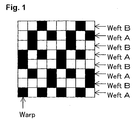
- Polyester false twist yarns of 83 dtex-72F were used as warp while polyester false twist yarns of 83 dtex-72F and 165dtex-96F were used as weft for the outer material and lining, respectively, and then a water jet loom and a two-pick dobby loom were used to weave and dye a weft double woven fabric consisting of an outer layer of plain weave and a reverse layer of 1/3 twill weave and having, after being finished, a warp density of 170 stitches/in, and a weft density of 90 stitches/in in the outer layer and 45 stitches/in in the reverse layer.
- Polyethylene terephthalate filament 84dtex-24F woolie finished yarns were used as component yarn A of the reverse layer (skin side) of knitted fabric from four yarn feeders F2, F4, F6, and F8 for knit weave with a total eight yarn feeders, as shown in the knitting diagram in Fig.2, while polyethylene terephthalate filament 110dtec-72F yarns were used as component yarn B of the outer layer of the knitted fabric from the other four yarn feeders F1, F3, F5, and F7, in order to produce, by using a 22G interlock circular knitting machine, 100% polyethylene terephthalate circular knitted fabric whose reverse layer comprises honeycomb reversible weave.
- This knitted fabric was relaxed, refined, dyed by an ordinary dyeing technique for circular knitted fabrics, and dried. Then, the dyed and dried cloth was immersed in a treatment liquid as defined in Prescription 3 having the following composition, squeezed by a mangle set at a pickup rate of 80%, and dried by a dryer at 120°C for two minutes.
- the cloth was treated by a heating steamer at 105°C for five minutes, washed in hot water, and dried. Then, it was set in a dryer at 170°C for one minute to produce knitted fabric having an exothermic energy index of 11, a contact thermal sensation factor (qmax) of the reverse layer (the skin side) of 0.055, abursting strength of 0.58MPa, a water drop absorption time of one second or shorter, densities of 38 wales/2.54cm and 53 courses/2.54cm, and a weight of 201g/m 2 .
- the knitted fabric was used to produce a long-sleeved T-shirt as sportswear of this invention. Results of its evaluation showed that the shirt was warm and agreeable to the touch, and had a comfortable dry feel during exercise. Results are shown in Table 2.
- Spun acrylic yarns 1/52 were used as component yarn B of the reverse layer (skin side) of knitted fabric from four yarn feeders F2, F4, F6, and F8 for knit weave with a total eight yarn feeders, as shown in the knitting diagram in Fig.2, while nylon filament finished yarns, 78dtec-24F, were used as component yarn A of the outer layer of the knitted fabric from the other four yarn feeders F1, F3, F5, and F7, in order to produce, by using a 22G interlock circular knitting machine, 100% polyethylene terephthalate circular knitted fabric whose reverse layer comprises honeycomb reversible weave.
- This knitted fabric was relaxed, refined, dyed by an ordinary dyeing technique for circular knitted fabrics, and dried. Then, the dyed and dried cloth was immersed in a treatment liquid as defined in Prescription 3, squeezed by a mangle set at a pickup rate of 80%, and dried by a dryer at 120°C for two minutes.
- the cloth was treated by a heating steamer at 105°C for five minutes, washed in hot water, and dried. Then, it was set in a dryer at 170°C for one minute to produce knitted fabric having an exothermic energy index of 9, a contact thermal sensation factor (qmax) of the reverse layer (the skin side) of 0.076, abursting strength of 0.52MPa, a flex rigidity of 13mm as measured by the cantilever method, densities of 36 wales/2.54cm and 48 courses/2.54cm, and a weight of 190g/m 2 .
- the knitted fabric was used to produce underwear of this invention. Results of its evaluation showed that the underwear was warm and flexible to permit easy body movements, proving its high performance. Results are shown in Table 3.
- 56dtex-24F yarns produced by incorporating polyvinyl pyrolidone, a hygroscopic polymer, into nylon were used as front yarn A and back yarn B shown in the knitting diagram of Fig.3 to produce, using a 28G single tricot machine, warp-knitted fabric for 1/3 satin weave.
- the material was treated by using a heating steamer at 105°C for five minutes, washed in hot water, and dried. Then, it is set in a dryer at 170°C for one minute. Further, gigging was carried out over the front face, or skin contact side, of the finished cloth.
- the resulting knitted fabric had an exothermic energy index of 13, a contact thermal sensation factor (qmax) of the reverse side (skin side) of 0.055, a bursting strength of 0.53MPa, a frictional static charge of 2.1kV, densities of 35 wales/2.54cm and 44 courses/2.54cm, and a weight of 80g/m 2 .
- the knitted fabric was used to produce lining for women's jackets, which was then evaluated. Results showed that it was flexible to permit easy body movements, proving its high performance. Results are shown in Table 4.
- Spun acrylic yarns 1/52 were used as component yarn B of the reverse layer (skin side) of knitted fabric from four yarn feeders F2, F4, F6, and F8 for knit weave with a total eight yarn feeders, as shown in the knitting diagram in Fig.2, while nylon filament finished yarns, 155dtec-48F, were used as component yarn A of the outer layer of the knitted fabric from the other four yarn feeders F1, F3, F5, and F7, in order to produce, by using a 22G interlock circular knitting machine, 100% polyethylene terephthalate circular knitted fabric whose reverse layer comprises honeycomb reversible weave.
- This knitted fabric was relaxed, refined, dyed by an ordinary dyeing technique for circular knitted fabrics, and dried. Then, the dyed and dried cloth was immersed in a treatment liquid as defined in Prescription 3, squeezed by a mangle set at a pickup rate of 80%, and dried by a dryer at 120°C for two minutes.
- the cloth was treated by a heating steamer at 105°C for five minutes, washed in hot water, and dried. Then, it was set in a dryer at 170°C for one minute to produce knitted fabric having an exothermic energy index of 10, a contact thermal sensation factor (qmax) of the reverse layer (the skin side) of 0.078, a stretchability and stretch recovery in the warp direction of 48% and 72%, respectively, a stretchability and stretch recovery in the weft direction of 65% and 82%, and a bursting strength of 0.54Mpa.
- qmax contact thermal sensation factor
- the knitted fabric was used to produce a knee supporter of this invention with the weft of the knitted fabric aligned in the length direction of the supporter, followed by its evaluation. Results showed that the supporter was warm and flexible to permit easy body movements, proving its high performance. Results are shown in Table 5.
- Treatment liquid of Prescription 2 having the following composition was sprayed, up to a deposit rate by weight of 100%, over a web consisting of a plain-weave outer layer formed of polyethylene terephthalate yarns of 83dtex-24F as both warp and weft with densities of 110 yarns/in and 80 yarns/in in the warp and weft directions, respectively, and a fiber structure of 100% polyethylene terephthalate with a single yarn fiber fineness of 7.2 dtex and a fiber length of 64mm, followed by predrying at 120°C for two minutes. Subsequently, heat treatment is performed at 180°C for one minute to produce wadding with silica particulates fixed over fiber surfaces and having an exothermic energy index of 22.
- the silica particles used had an average particle size of 2.7 ⁇ m and an average specific surface area of 500m 2 /g. Further, a gigged cut satin tricot product formed of polyethylene terephthalate of 83 dtex-24F was immersed in a treatment liquid of Prescription 3, squeezed by a mangle set at a pickup rate of 80%, and dried by a dryer at 120°C for two minutes. (Prescription 3)
- the material was treated by using a heating steamer at 105°C for five minutes, washed in hot water, and dried. Then, it is set in a dryer at 170°C for one minute to provide lining with an exothermic energy index of 15. A coverlet was produced from said outer material, wadding and lining produced above, and evaluated. Results are shown in Table 6.
- Water repelling treatment was performed for nylon taffeta formed of nylon filament yarns of 77dtex, by using a fluorine-based water repellent. Specifically, the taffeta was immersed in a water-dispersed liquid containing 3% by weight of the Asahi-Guard AG710 water repellent manufactured by Meisei Kagaku Co., Ltd., taken out with a squeeze ratio of 40%, subjected to dry heat treatment for 30 seconds at 130°C in a heat setter, and cured at 170°C for one minute.
- the taffeta was coated with a polyurethane solution of Prescription 1 by using a knife-over-roll coater with a clearance of 200 ⁇ , and then subjected to hot-air drying at 80°C to provide nonporous, moisture-permeable, waterproof outer material having a moisture permeability of 4800g/m 2 ⁇ 24hr.
- the treatment liquid of Prescription 2 was sprayed, up to a deposit rate by weight of 100%, over latex sponge with a thickness of 10mm, followed by predrying at 120°C for two minutes. Subsequently, heat treatment is performed at 160°C for one minute to produce sponge wadding with silica particulates fixed over fiber surfaces and having an exothermic energy index of 20.
- the silica particles used had an average particle size of 2.7 ⁇ m and an average specific surface area of 500m 2 /g. Further, a gigged cut satin tricot product formed of polyethylene terephthalate of 83 dtex-24F was immersed in a treatment liquid of Prescription 3, squeezed by a mangle set at a pickup rate of 80%, and dried by a dryer at 120°C for two minutes.
- the material was treated by using a heating steamer at 105°C for five minutes, washed in hot water, and dried. Then, it is set in a dryer at 170°C for one minute to provide lining with an exothermic energy index of 15. Shoes were produced from said outer material, sponge wadding and lining produced above, along with butadiene rubber prepared elsewhere, and evaluated. Results are shown in Table 7.
- Water repelling treatment was performed for nylon taffeta formed of nylon filament yarns of 77dtex, by using a fluorine-based water repellent. Specifically, the taffeta was immersed in a water-dispersed liquid containing 3% by weight of the Asahi-Guard AG710 water repellent manufactured by Meisei Kagaku Co., Ltd., taken out with a squeeze ratio of 40%, subjected to dry heat treatment for 30 seconds at 130°C in a heat setter, and cured at 170°C for one minute.
- the taffeta was coated with a polyurethane solution of Prescription 1 by using a knife-over-roll coater with a clearance of 200 ⁇ , and then subjected to hot-air drying at 80°C to provide nonporous, moisture-permeable, waterproof outer material having a moisture permeability of 4800g/m 2 ⁇ 24hr.
- treatment liquid of Prescription 2 was sprayed, up to a deposit rate by weight of 100%, over a web comprising of a fiber structure with a weight of 80g/m 2 formed of 100% polyethylene terephthalate having a single-yarn fiber fineness of 7.2dtex and a fiber length of 64mm, followed by predrying for two minutes at 120°C. Subsequently, heat treatment is performed for one minute at 180°C to produce wadding with silica particulates fixed over fiber surfaces and having an exothermic energy index of 22.
- a gigged cut satin tricot product formed of polyethylene terephthalate of 83dtex-24F was immersed in a treatment liquid of Prescription 3, squeeze by a mangle, and dried at 120°C for two minutes.
- the material was treated by using a heating steamer at 105°C for five minutes, washed in hot water, and dried. Then, it is set in a dryer at 170°C for one minute to provide lining with an exothermic energy index of 15. Gloves were produced from said outer material, wadding and lining produced above, and evaluated. Results are shown in Table 8.
- Example 5 The cloth produced in Example 5 was treated in a similar way to that described in Example 5, immersed in a treatment liquid of Prescription 6, squeezed by a mangle set at a pickup rate of 80%, and dried at 150°C for two minutes.
- Prescription 6 Infrared radiation ceramics (zirconia) particulates 30g/l Binder (silicone-based resin) KT7014 (40% solid content) manufactured by Takamatsu Jushi Co., Ltd. 60g/l
- the knitted fabric was used to produce a long-sleeved T-shirt as sportswear of this invention. Results of its evaluation showed that the shirt was warm and agreeable to the touch, and had a comfortable dry feel during exercise. Results are shown in Table 2.
- a compound of general formula III (R: CH3, R 1 : OCH3, 1: 23, m: 0) was deposited, up to 2 wt%, on acrylic fiber produced by wet spinning, drawing and washing, and then firmly fixed to the fiber by carrying out drying, compacting, steaming and drying to form acrylic staple of 2.2 dtex, from which a 1/60 spun acrylic yarn having water molecule adsorption/heat release capability was produced.
- the spun yarn was used as outer-side component yarn B in Example 8, and dyed in a similar way.
- a similar knee supporter was produced and evaluated, and result showed that the supporter was warm and flexible to permit easy body movements, proving its high performance. Results are shown in Table 5.
- a blouson was produced from outer material as produced in Example 1, wadding prepared by carrying out the same procedure as in Example 1 except that silica particles were not used in processing the wadding, and taffeta lining formed of cupra with warps of 83dtex and wefts of 116dtex, and evaluated. Results are shown in Table 1.
- a blouson was produced from outer material as produced in Example 1 and taffeta lining formed of cupra used in Comparative example 1, and evaluated. Results are shown in Table 1.
- a three-layer moisture-permeable waterproof product was produced from outer material as produced in Example 1 and gigged tricot lining prepared by carrying out the same procedure as in Example 3 except that the processing procedures described in Example 1 was not performed, and evaluated. Results are shown in Table 1.
- a blouson was produced from weft double woven fabric prepared by carrying out the same procedure as in Example 4 except that the processing procedure of Prescription 3 was not performed. Results are shown in Table 1.
- a circular knitted fabric formed of 100% polyethylene terephthalate similar to that produced in Example 5 was relaxed, refined, dyed by an ordinary dyeing method for circular knitted fabrics, dried, and finished by setting.
- the knitted fabric was free of gigging and processing according to Prescription 5 as in Example 5.
- the resulting knitted fabric had an exothermic energy index of 1, a contact thermal sensation factor (qmax) of the reverse side (skin contact side) of 0.134, a water drop absorption time of 6.1 seconds, a bursting strength 0.51Mpa, densities of 38 wales/2.54cm and 50 courses/2.54cm, and a weight of 195g/m 2 .
- the knitted fabric was used to produce a long-sleeved T-shirt, which was the evaluated. Results showed that the shirt was not adequately warm, failed to have a comfortable dry feel during exercise, and was not warm, indicating that it was not suitable as sportswear. Results are shown in Table 2.
- Interlock weave of polyethylene terephthalate filament yarns of 83dtex-36F was used to produce, by a 22G interlock circular knitting machine, 100% polyethylene terephthalate circular knitted fabric whose outer and reverse sides are flat.
- the fabric was relaxed, refined, dyed by an ordinary dyeing method for circular knitted fabrics, dried, and finished by setting.
- the knitted fabric was free of gigging and processing according to Prescription 3 as in Example 6.
- the resulting knitted fabric had an exothermic energy index of 1, a contact thermal sensation factor (qmax) of the reverse side (skin contact side) of 0.141, a bursting strength 0.23Mpa, a flex rigidity as 4mm as measured by the cantilever method, densities of 38 wales/2.54cm and 50 courses/2.54cm, and a weight of 118g/m 2 .
- Example 6 The knitted fabric was used to produce underwear as in Example 6, which was then evaluated. Results show that it tended to cling to the body to impede easy movements, was not very warm, or rather chilly, indicating that it was not suitable as underwear. Further, it was easy to break and inferior in mechanical strength. Results are shown in Table 3.
- Half weave of polyethylene terephthalate yarns of 56dtex-36F was used to produce, by a 28G single tricot machine, 100% polyeste warp-knitted fabric whose outer and reverse sides are flat.
- the fabric was relaxed, refined, dyed by an ordinary dyeing method for circular knitted fabrics, dried, and finished by setting.
- the knitted fabric was free of gigging and processing according to Prescription 5 as in Example 7.
- the resulting knitted fabric had an exothermic energy index of 1, a contact thermal sensation factor (qmax) of the reverse side (skin contact side) of 0.148, a bursting strength 0.55Mpa, a frictional static charge of 9.4 kV, densities of 35 wales/2.54cm and 45 courses/2.54cm, and a weight of 76g/m 2 .
- the knitted fabric was used to produce lining as in Example 7, which was then evaluated. Results show that it was not warm, or rather chilly, and it tended to cling to the body to impede easy movements, indicating that it was not suitable as lining. Results are shown in Table 4.
- Interlock weave of polyethylene terephthalate filament yarns of 83dtex-36F was used to produce, by a 20G interlock circular knitting machine, 100% polyethylene terephthalate circular knitted fabric whose outer and reverse sides are flat
- the fabric was relaxed, refined, dyed by an ordinary dyeing method for circular knitted fabrics, dried, and finished by setting.
- the knitted fabric was free of gigging and processing according to Prescription 3 as in Example 8.
- Example 9 The outer material used in Example 9 was used as both outer layer and lining while wadding as in Example 10 processed as in Example 9 without using silica particles was used, in order to produce a coverlet, which was then evaluated. Results are shown in Table 6.
- Example 11 The outer material produced in Example 11 was used while the 10mm thick latex sponge in Example 11 was used as intermediate layer without being subjected to the processing of Example 10, along with a satin tricot (without gigging) of polyethylene terephthalate of 83dtex-24F, in order to produce shoes as in Example 11, which were then evaluated. Results are shown in Table 8.
- Example 11 The outer material produced in Example 11 was used along with wadding produced as in Example 11 and processed as in Example 1 without using silica particles, and plain-weave lining with densities of 110 yarns/in and 80 yarns/in in the warp and weft directions, respectively, produced by using polyethylene terephthalate 83dtex-24F as both warp and weft, in order to produce gloves, which were then evaluated. Results are shown in Table 8.
- a heat-retaining fiber structure having water molecule adsorption capability to realize high heat-retaining effect can be provided by laminating a cloth layer having moisture/heat release control capability with another cloth layer having water molecule adsorption capability and by making use of the heat-retaining structure according to the invention which is low in contact thermal sensation factor in the skin contact side.
Landscapes
- Engineering & Computer Science (AREA)
- Textile Engineering (AREA)
- Chemical & Material Sciences (AREA)
- Chemical Kinetics & Catalysis (AREA)
- Physics & Mathematics (AREA)
- Thermal Sciences (AREA)
- General Health & Medical Sciences (AREA)
- Epidemiology (AREA)
- Health & Medical Sciences (AREA)
- Public Health (AREA)
- Life Sciences & Earth Sciences (AREA)
- Materials Engineering (AREA)
- Wood Science & Technology (AREA)
- Knitting Of Fabric (AREA)
- Professional, Industrial, Or Sporting Protective Garments (AREA)
- Laminated Bodies (AREA)
- Manufacturing Of Multi-Layer Textile Fabrics (AREA)
Applications Claiming Priority (5)
| Application Number | Priority Date | Filing Date | Title |
|---|---|---|---|
| JP2000298989 | 2000-09-29 | ||
| JP2000298989 | 2000-09-29 | ||
| JP2000342821 | 2000-11-10 | ||
| JP2000342821 | 2000-11-10 | ||
| PCT/JP2001/008377 WO2002028633A1 (fr) | 2000-09-29 | 2001-09-26 | Structure fibreuse retenant la chaleur |
Publications (2)
| Publication Number | Publication Date |
|---|---|
| EP1260355A1 true EP1260355A1 (fr) | 2002-11-27 |
| EP1260355A4 EP1260355A4 (fr) | 2007-07-11 |
Family
ID=26601127
Family Applications (1)
| Application Number | Title | Priority Date | Filing Date |
|---|---|---|---|
| EP01970220A Withdrawn EP1260355A4 (fr) | 2000-09-29 | 2001-09-26 | Structure fibreuse retenant la chaleur |
Country Status (8)
| Country | Link |
|---|---|
| US (1) | US20030068949A1 (fr) |
| EP (1) | EP1260355A4 (fr) |
| KR (1) | KR100821281B1 (fr) |
| CN (1) | CN1207141C (fr) |
| CA (1) | CA2392718A1 (fr) |
| NO (1) | NO20022524L (fr) |
| TW (1) | TWI229037B (fr) |
| WO (1) | WO2002028633A1 (fr) |
Cited By (3)
| Publication number | Priority date | Publication date | Assignee | Title |
|---|---|---|---|---|
| WO2017023956A1 (fr) | 2015-08-03 | 2017-02-09 | New York Knitworks, Llc | Vêtement thérapeutique à effets multiples, récupérant l'énergie et gérant la chaleur |
| WO2018204650A1 (fr) * | 2017-05-05 | 2018-11-08 | Nike Innovate C.V. | Élément tricoté doté d'une zone de surface formée avec un fil de haute ténacité |
| EP3715113A4 (fr) * | 2017-11-22 | 2021-08-04 | Teijin Frontier Co., Ltd. | Tissu présentant une structure multicouche et procédé de production de ce dernier, et produit fibreux |
Families Citing this family (27)
| Publication number | Priority date | Publication date | Assignee | Title |
|---|---|---|---|---|
| GB0124507D0 (en) * | 2001-10-12 | 2001-12-05 | Viktor Achter Ltd | Composite foam backed fabric |
| WO2008018122A1 (fr) * | 2006-08-09 | 2008-02-14 | Toray Industries, Inc. | Tricot extensible absorbant l'eau |
| US20080120761A1 (en) * | 2006-08-31 | 2008-05-29 | Kaiyuan Yang | Thermal Moderating Donnable Elastic Articles |
| US20110061269A1 (en) * | 2009-09-11 | 2011-03-17 | Wolverine World Wide, Inc. | Water barrier for footwear |
| CN103917368B (zh) * | 2011-11-01 | 2015-11-25 | 日本戈尔有限公司 | 层合体布帛 |
| DE102012206062B4 (de) | 2012-04-13 | 2019-09-12 | Adidas Ag | Schuhoberteil |
| CN102631034B (zh) * | 2012-04-23 | 2014-06-25 | 杭州笑雪服饰有限公司 | 一种羊绒、羊毛衫保暖内衣制作方法 |
| CN103371544A (zh) * | 2012-04-23 | 2013-10-30 | 王伟光 | 吸湿排汗干爽服 |
| CN102963041A (zh) * | 2012-12-19 | 2013-03-13 | 泉州维林森体育用品有限公司 | 高密细针功能布 |
| DE102013207156B4 (de) | 2013-04-19 | 2025-12-24 | Adidas Ag | Schuh, insbesondere ein Sportschuh |
| US12250994B2 (en) | 2013-04-19 | 2025-03-18 | Adidas Ag | Shoe |
| US11666113B2 (en) | 2013-04-19 | 2023-06-06 | Adidas Ag | Shoe with knitted outer sole |
| DE102013207163B4 (de) | 2013-04-19 | 2022-09-22 | Adidas Ag | Schuhoberteil |
| DE102013207155B4 (de) | 2013-04-19 | 2020-04-23 | Adidas Ag | Schuhoberteil |
| GB2516282B (en) | 2013-07-17 | 2017-07-26 | Vision Rt Ltd | Method of calibration of a stereoscopic camera system for use with a radio therapy treatment apparatus |
| DE102014202432B4 (de) | 2014-02-11 | 2017-07-27 | Adidas Ag | Verbesserter Fußballschuh |
| CN105019102B (zh) * | 2014-04-25 | 2017-08-25 | 福懋兴业股份有限公司 | 温度调节布料 |
| CN104188218B (zh) * | 2014-09-23 | 2016-01-27 | 常州普嘉贝尔服饰有限公司 | 自适应服装面料及服装制作方法 |
| DE102014220087B4 (de) | 2014-10-02 | 2016-05-12 | Adidas Ag | Flachgestricktes Schuhoberteil für Sportschuhe |
| GR1009117B (el) * | 2015-04-06 | 2017-09-18 | Γεωργιος Εμμανουηλ Ψιψικας | Ενδυματα εφαπτομενα στο δερμα παραγομενα απο υφασμα επικαλυμμενο απο συνθετο υλικο που βασιζεται σε οξειδια μεταλλων και ανοργανο υλικο |
| CN107667191A (zh) | 2015-05-22 | 2018-02-06 | 普莱玛有限公司 | 自热隔热材料 |
| WO2017143401A1 (fr) * | 2016-02-24 | 2017-08-31 | Deakin University | Sac de couchage pour nourrissons et enfants |
| USD886928S1 (en) | 2016-08-19 | 2020-06-09 | James C. Van Loon, III | Lacrosse mesh |
| RU2020115535A (ru) * | 2017-11-28 | 2021-11-08 | Нью-Йорк Нитворкс, Ллк | Многоцелевой тканый материал для аккумулирования энергии и теплорегулирования |
| CN111778616A (zh) * | 2020-06-24 | 2020-10-16 | 安徽丽达制衣有限公司 | 一种校服用聚酰亚胺阻燃抗菌面料制作工艺 |
| US20260007203A1 (en) * | 2023-06-14 | 2026-01-08 | Therabody, Inc. | Articles of footwear having therapeutic assemblies |
| CN119640457B (zh) * | 2025-02-12 | 2025-09-05 | 浙江申力化纤有限公司 | 一种包覆纱及其制备方法 |
Family Cites Families (13)
| Publication number | Priority date | Publication date | Assignee | Title |
|---|---|---|---|---|
| EP0077525A3 (fr) * | 1981-10-15 | 1984-08-22 | Sakashita Co., Ltd. | Tissu absorbant la sueur |
| US4510194A (en) * | 1982-04-28 | 1985-04-09 | Asahi Kasei Textiles Ltd. | Heat-retaining moisture-transmissible water-resistant fabric |
| JPH0397970A (ja) * | 1989-09-07 | 1991-04-23 | Teijin Ltd | 吸放湿性防水コーティング布帛 |
| JPH0759762B2 (ja) * | 1993-04-05 | 1995-06-28 | 美津濃株式会社 | 吸放湿吸水発熱性保温品 |
| JPH0931796A (ja) * | 1995-07-18 | 1997-02-04 | Toyobo Co Ltd | 編織物 |
| JP3691116B2 (ja) * | 1995-07-27 | 2005-08-31 | ユニチカ株式会社 | 保温性水着用編地 |
| JP3518148B2 (ja) * | 1996-03-21 | 2004-04-12 | 東レ株式会社 | 吸湿性繊維構造物 |
| JP3341985B2 (ja) * | 1998-01-28 | 2002-11-05 | 東洋紡績株式会社 | 保温性透湿防水布帛 |
| EP0933467B1 (fr) * | 1998-01-28 | 2004-08-25 | Toyo Boseki Kabushiki Kaisha | Matériau textile retenant la chaleur, perméable à l'humidité et imperméable |
| US6046119A (en) * | 1998-01-28 | 2000-04-04 | Toyo Boseki Kabushiki Kaisha | Heat-retaining, moisture-permeable, waterproof fabrics |
| JP3264366B2 (ja) * | 1998-03-18 | 2002-03-11 | グンゼ株式会社 | 保温衣料およびその加工法 |
| DE69839247D1 (de) * | 1998-06-24 | 2008-04-24 | Nihon Deshikanto K K | Feuchtigkeit absorbierendes und abgebendes, wärmeerzeugendes innentuch herstellungsverfahren und artikel |
| JP3055821U (ja) * | 1998-07-13 | 1999-01-29 | 有限会社藤原興産 | 保温性編地 |
-
2001
- 2001-09-25 TW TW90123569A patent/TWI229037B/zh not_active IP Right Cessation
- 2001-09-26 CA CA 2392718 patent/CA2392718A1/fr not_active Abandoned
- 2001-09-26 KR KR1020027006876A patent/KR100821281B1/ko not_active Expired - Fee Related
- 2001-09-26 US US10/148,245 patent/US20030068949A1/en not_active Abandoned
- 2001-09-26 WO PCT/JP2001/008377 patent/WO2002028633A1/fr not_active Ceased
- 2001-09-26 CN CNB018029442A patent/CN1207141C/zh not_active Expired - Fee Related
- 2001-09-26 EP EP01970220A patent/EP1260355A4/fr not_active Withdrawn
-
2002
- 2002-05-28 NO NO20022524A patent/NO20022524L/no not_active Application Discontinuation
Cited By (7)
| Publication number | Priority date | Publication date | Assignee | Title |
|---|---|---|---|---|
| WO2017023956A1 (fr) | 2015-08-03 | 2017-02-09 | New York Knitworks, Llc | Vêtement thérapeutique à effets multiples, récupérant l'énergie et gérant la chaleur |
| EP3331478A4 (fr) * | 2015-08-03 | 2019-04-17 | New York Knitworks, LLC | Vêtement thérapeutique à effets multiples, récupérant l'énergie et gérant la chaleur |
| US10799390B2 (en) | 2015-08-03 | 2020-10-13 | New York Knitworks, Llc | Energy harvesting, heat managing, multi-effect therapeutic garment |
| WO2018204650A1 (fr) * | 2017-05-05 | 2018-11-08 | Nike Innovate C.V. | Élément tricoté doté d'une zone de surface formée avec un fil de haute ténacité |
| EP4582603A3 (fr) * | 2017-05-05 | 2025-07-30 | NIKE Innovate C.V. | Composant tricoté doté d'une zone de surface formée avec un fil à haute ténacité |
| EP3715113A4 (fr) * | 2017-11-22 | 2021-08-04 | Teijin Frontier Co., Ltd. | Tissu présentant une structure multicouche et procédé de production de ce dernier, et produit fibreux |
| US11458711B2 (en) | 2017-11-22 | 2022-10-04 | Teijin Frontier Co., Ltd. | Fabric having multilayer structure and method for producing same, and fiber product |
Also Published As
| Publication number | Publication date |
|---|---|
| TWI229037B (en) | 2005-03-11 |
| CN1392833A (zh) | 2003-01-22 |
| HK1051984A1 (en) | 2003-08-29 |
| EP1260355A4 (fr) | 2007-07-11 |
| NO20022524D0 (no) | 2002-05-28 |
| CN1207141C (zh) | 2005-06-22 |
| US20030068949A1 (en) | 2003-04-10 |
| NO20022524L (no) | 2002-05-28 |
| CA2392718A1 (fr) | 2002-04-11 |
| WO2002028633A1 (fr) | 2002-04-11 |
| KR100821281B1 (ko) | 2008-04-10 |
| KR20020062952A (ko) | 2002-07-31 |
Similar Documents
| Publication | Publication Date | Title |
|---|---|---|
| EP1260355A1 (fr) | Structure fibreuse retenant la chaleur | |
| CN101994192B (zh) | 一种吸湿速干型提花织物、亲水速干整理剂及后处理方法 | |
| CN108026674B (zh) | 多层结构圆形针织物 | |
| JP5209972B2 (ja) | 形態変化繊維布帛 | |
| KR102059734B1 (ko) | 정합성 저밀도 플루오로중합체 섬유 혼방을 함유하는 직물 | |
| EP3478110B1 (fr) | Vêtement avec isolation à zones et perméabilité à l'air variable | |
| JP3724190B2 (ja) | 合成繊維編織物 | |
| JP4390514B2 (ja) | 多層構造編地 | |
| JP4023170B2 (ja) | 運動着 | |
| JP2002180308A (ja) | 保温衣料 | |
| CN215360307U (zh) | 一种快速干燥的纺织面料 | |
| US6524349B2 (en) | Maintaining the hydrophobicity of a polyolefin textile | |
| JP3900894B2 (ja) | 高吸湿保温性繊維構造物 | |
| CN108914350B (zh) | 一种单防单吸针织面料 | |
| JP4529291B2 (ja) | 肌着 | |
| CN223100175U (zh) | 吸湿发热导湿快干保暖的面料及其制品 | |
| CN222310088U (zh) | 一种持续凉感面料 | |
| WO2025168942A1 (fr) | Tissu à espaceurs | |
| JPH0418103A (ja) | 防寒被服セット | |
| JP2003096603A (ja) | ホームウエア | |
| JP2002220718A (ja) | 裏 地 | |
| JP2003013313A (ja) | 保温手袋 | |
| JP2025087284A (ja) | 被服用編地、及びそれを含む被服 | |
| CN120061047A (zh) | 一种不粘身的吸湿速干面料及其制备方法 | |
| JP2002146677A (ja) | 高吸湿性保温布帛 |
Legal Events
| Date | Code | Title | Description |
|---|---|---|---|
| PUAI | Public reference made under article 153(3) epc to a published international application that has entered the european phase |
Free format text: ORIGINAL CODE: 0009012 |
|
| 17P | Request for examination filed |
Effective date: 20020626 |
|
| AK | Designated contracting states |
Kind code of ref document: A1 Designated state(s): AT BE CH CY DE DK ES FI FR GB GR IE IT LI LU MC NL PT SE TR |
|
| A4 | Supplementary search report drawn up and despatched |
Effective date: 20070611 |
|
| 17Q | First examination report despatched |
Effective date: 20080723 |
|
| STAA | Information on the status of an ep patent application or granted ep patent |
Free format text: STATUS: THE APPLICATION IS DEEMED TO BE WITHDRAWN |
|
| 18D | Application deemed to be withdrawn |
Effective date: 20081203 |