EP1262545A1 - Microstructures et leur utilisation dans l'évolution visée de biomolécules - Google Patents
Microstructures et leur utilisation dans l'évolution visée de biomolécules Download PDFInfo
- Publication number
- EP1262545A1 EP1262545A1 EP01113331A EP01113331A EP1262545A1 EP 1262545 A1 EP1262545 A1 EP 1262545A1 EP 01113331 A EP01113331 A EP 01113331A EP 01113331 A EP01113331 A EP 01113331A EP 1262545 A1 EP1262545 A1 EP 1262545A1
- Authority
- EP
- European Patent Office
- Prior art keywords
- fluid
- compartments
- genotype
- microstructure
- reaction
- Prior art date
- Legal status (The legal status is an assumption and is not a legal conclusion. Google has not performed a legal analysis and makes no representation as to the accuracy of the status listed.)
- Withdrawn
Links
- 239000012530 fluid Substances 0.000 claims abstract description 91
- 238000003556 assay Methods 0.000 claims abstract description 24
- 238000012360 testing method Methods 0.000 claims abstract description 22
- 238000006243 chemical reaction Methods 0.000 claims description 55
- 238000000034 method Methods 0.000 claims description 48
- 238000001514 detection method Methods 0.000 claims description 18
- 238000000926 separation method Methods 0.000 claims description 14
- 239000003153 chemical reaction reagent Substances 0.000 claims description 10
- 239000000203 mixture Substances 0.000 claims description 8
- 108090000623 proteins and genes Proteins 0.000 claims description 7
- 239000007864 aqueous solution Substances 0.000 claims description 5
- -1 higher alkanones Chemical class 0.000 claims description 5
- 239000000126 substance Substances 0.000 claims description 5
- 239000007900 aqueous suspension Substances 0.000 claims description 4
- 229930195733 hydrocarbon Natural products 0.000 claims description 4
- 230000003287 optical effect Effects 0.000 claims description 4
- 150000002430 hydrocarbons Chemical class 0.000 claims description 3
- 239000000839 emulsion Substances 0.000 claims description 2
- 230000002616 endonucleolytic effect Effects 0.000 claims description 2
- 150000002148 esters Chemical class 0.000 claims description 2
- 150000002170 ethers Chemical class 0.000 claims description 2
- 150000001298 alcohols Chemical class 0.000 claims 1
- 150000001338 aliphatic hydrocarbons Chemical class 0.000 claims 1
- 150000004945 aromatic hydrocarbons Chemical class 0.000 claims 1
- 229920001296 polysiloxane Polymers 0.000 claims 1
- 230000004888 barrier function Effects 0.000 abstract 1
- 239000000758 substrate Substances 0.000 description 15
- 108020004414 DNA Proteins 0.000 description 14
- 238000005259 measurement Methods 0.000 description 9
- 230000008569 process Effects 0.000 description 6
- 238000012216 screening Methods 0.000 description 5
- 238000005204 segregation Methods 0.000 description 5
- 102000053602 DNA Human genes 0.000 description 4
- 102000004533 Endonucleases Human genes 0.000 description 4
- 108010042407 Endonucleases Proteins 0.000 description 4
- 235000013870 dimethyl polysiloxane Nutrition 0.000 description 4
- 239000007789 gas Substances 0.000 description 4
- 238000000338 in vitro Methods 0.000 description 4
- 238000011534 incubation Methods 0.000 description 4
- 239000000463 material Substances 0.000 description 4
- 229920000435 poly(dimethylsiloxane) Polymers 0.000 description 4
- 229920002635 polyurethane Polymers 0.000 description 4
- 239000004814 polyurethane Substances 0.000 description 4
- 239000000047 product Substances 0.000 description 4
- 230000008901 benefit Effects 0.000 description 3
- 239000000969 carrier Substances 0.000 description 3
- 238000011161 development Methods 0.000 description 3
- 230000000694 effects Effects 0.000 description 3
- 238000002955 isolation Methods 0.000 description 3
- 239000007788 liquid Substances 0.000 description 3
- 230000004044 response Effects 0.000 description 3
- PEDCQBHIVMGVHV-UHFFFAOYSA-N Glycerine Chemical compound OCC(O)CO PEDCQBHIVMGVHV-UHFFFAOYSA-N 0.000 description 2
- 230000003321 amplification Effects 0.000 description 2
- 238000013459 approach Methods 0.000 description 2
- 230000015572 biosynthetic process Effects 0.000 description 2
- 230000003197 catalytic effect Effects 0.000 description 2
- 230000006870 function Effects 0.000 description 2
- 238000004519 manufacturing process Methods 0.000 description 2
- 239000002480 mineral oil Substances 0.000 description 2
- 238000003199 nucleic acid amplification method Methods 0.000 description 2
- 102000004169 proteins and genes Human genes 0.000 description 2
- 230000035484 reaction time Effects 0.000 description 2
- 239000000243 solution Substances 0.000 description 2
- 238000004611 spectroscopical analysis Methods 0.000 description 2
- 241000588724 Escherichia coli Species 0.000 description 1
- 108091028043 Nucleic acid sequence Proteins 0.000 description 1
- 108020004682 Single-Stranded DNA Proteins 0.000 description 1
- 229920004890 Triton X-100 Polymers 0.000 description 1
- 239000013504 Triton X-100 Substances 0.000 description 1
- 238000002679 ablation Methods 0.000 description 1
- 125000001931 aliphatic group Chemical group 0.000 description 1
- 125000003118 aryl group Chemical group 0.000 description 1
- 230000000712 assembly Effects 0.000 description 1
- 238000000429 assembly Methods 0.000 description 1
- 239000000919 ceramic Substances 0.000 description 1
- 229910010293 ceramic material Inorganic materials 0.000 description 1
- 238000012512 characterization method Methods 0.000 description 1
- 239000007795 chemical reaction product Substances 0.000 description 1
- 238000010276 construction Methods 0.000 description 1
- 230000008878 coupling Effects 0.000 description 1
- 238000010168 coupling process Methods 0.000 description 1
- 238000005859 coupling reaction Methods 0.000 description 1
- 230000008021 deposition Effects 0.000 description 1
- 238000013461 design Methods 0.000 description 1
- 239000006185 dispersion Substances 0.000 description 1
- 239000013013 elastic material Substances 0.000 description 1
- 238000005516 engineering process Methods 0.000 description 1
- 238000001704 evaporation Methods 0.000 description 1
- 230000008020 evaporation Effects 0.000 description 1
- 239000011521 glass Substances 0.000 description 1
- 235000011187 glycerol Nutrition 0.000 description 1
- 150000008282 halocarbons Chemical class 0.000 description 1
- 230000002209 hydrophobic effect Effects 0.000 description 1
- 239000007791 liquid phase Substances 0.000 description 1
- 238000000691 measurement method Methods 0.000 description 1
- 229910052751 metal Inorganic materials 0.000 description 1
- 239000002184 metal Substances 0.000 description 1
- 150000002739 metals Chemical class 0.000 description 1
- 235000010446 mineral oil Nutrition 0.000 description 1
- 230000001293 nucleolytic effect Effects 0.000 description 1
- 239000012071 phase Substances 0.000 description 1
- 239000013612 plasmid Substances 0.000 description 1
- 239000002861 polymer material Substances 0.000 description 1
- SCVFZCLFOSHCOH-UHFFFAOYSA-M potassium acetate Chemical compound [K+].CC([O-])=O SCVFZCLFOSHCOH-UHFFFAOYSA-M 0.000 description 1
- 238000005086 pumping Methods 0.000 description 1
- 230000035945 sensitivity Effects 0.000 description 1
- 229910052710 silicon Inorganic materials 0.000 description 1
- 239000010703 silicon Substances 0.000 description 1
- 229920002545 silicone oil Polymers 0.000 description 1
- 230000002123 temporal effect Effects 0.000 description 1
- 238000013518 transcription Methods 0.000 description 1
- 230000035897 transcription Effects 0.000 description 1
- 238000012546 transfer Methods 0.000 description 1
- 238000013519 translation Methods 0.000 description 1
- PIEPQKCYPFFYMG-UHFFFAOYSA-N tris acetate Chemical compound CC(O)=O.OCC(N)(CO)CO PIEPQKCYPFFYMG-UHFFFAOYSA-N 0.000 description 1
- DGVVWUTYPXICAM-UHFFFAOYSA-N β‐Mercaptoethanol Chemical compound OCCS DGVVWUTYPXICAM-UHFFFAOYSA-N 0.000 description 1
Images



Classifications
-
- C—CHEMISTRY; METALLURGY
- C12—BIOCHEMISTRY; BEER; SPIRITS; WINE; VINEGAR; MICROBIOLOGY; ENZYMOLOGY; MUTATION OR GENETIC ENGINEERING
- C12N—MICROORGANISMS OR ENZYMES; COMPOSITIONS THEREOF; PROPAGATING, PRESERVING, OR MAINTAINING MICROORGANISMS; MUTATION OR GENETIC ENGINEERING; CULTURE MEDIA
- C12N15/00—Mutation or genetic engineering; DNA or RNA concerning genetic engineering, vectors, e.g. plasmids, or their isolation, preparation or purification; Use of hosts therefor
- C12N15/09—Recombinant DNA-technology
- C12N15/10—Processes for the isolation, preparation or purification of DNA or RNA
- C12N15/1034—Isolating an individual clone by screening libraries
- C12N15/1079—Screening libraries by altering the phenotype or phenotypic trait of the host
-
- B—PERFORMING OPERATIONS; TRANSPORTING
- B01—PHYSICAL OR CHEMICAL PROCESSES OR APPARATUS IN GENERAL
- B01L—CHEMICAL OR PHYSICAL LABORATORY APPARATUS FOR GENERAL USE
- B01L3/00—Containers or dishes for laboratory use, e.g. laboratory glassware; Droppers
- B01L3/50—Containers for the purpose of retaining a material to be analysed, e.g. test tubes
- B01L3/502—Containers for the purpose of retaining a material to be analysed, e.g. test tubes with fluid transport, e.g. in multi-compartment structures
- B01L3/5027—Containers for the purpose of retaining a material to be analysed, e.g. test tubes with fluid transport, e.g. in multi-compartment structures by integrated microfluidic structures, i.e. dimensions of channels and chambers are such that surface tension forces are important, e.g. lab-on-a-chip
- B01L3/502769—Containers for the purpose of retaining a material to be analysed, e.g. test tubes with fluid transport, e.g. in multi-compartment structures by integrated microfluidic structures, i.e. dimensions of channels and chambers are such that surface tension forces are important, e.g. lab-on-a-chip characterised by multiphase flow arrangements
- B01L3/502784—Containers for the purpose of retaining a material to be analysed, e.g. test tubes with fluid transport, e.g. in multi-compartment structures by integrated microfluidic structures, i.e. dimensions of channels and chambers are such that surface tension forces are important, e.g. lab-on-a-chip characterised by multiphase flow arrangements specially adapted for droplet or plug flow, e.g. digital microfluidics
-
- B—PERFORMING OPERATIONS; TRANSPORTING
- B01—PHYSICAL OR CHEMICAL PROCESSES OR APPARATUS IN GENERAL
- B01L—CHEMICAL OR PHYSICAL LABORATORY APPARATUS FOR GENERAL USE
- B01L2200/00—Solutions for specific problems relating to chemical or physical laboratory apparatus
- B01L2200/06—Fluid handling related problems
- B01L2200/0673—Handling of plugs of fluid surrounded by immiscible fluid
-
- B—PERFORMING OPERATIONS; TRANSPORTING
- B01—PHYSICAL OR CHEMICAL PROCESSES OR APPARATUS IN GENERAL
- B01L—CHEMICAL OR PHYSICAL LABORATORY APPARATUS FOR GENERAL USE
- B01L2300/00—Additional constructional details
- B01L2300/08—Geometry, shape and general structure
- B01L2300/0861—Configuration of multiple channels and/or chambers in a single devices
- B01L2300/0864—Configuration of multiple channels and/or chambers in a single devices comprising only one inlet and multiple receiving wells, e.g. for separation, splitting
-
- B—PERFORMING OPERATIONS; TRANSPORTING
- B01—PHYSICAL OR CHEMICAL PROCESSES OR APPARATUS IN GENERAL
- B01L—CHEMICAL OR PHYSICAL LABORATORY APPARATUS FOR GENERAL USE
- B01L2400/00—Moving or stopping fluids
- B01L2400/06—Valves, specific forms thereof
- B01L2400/0633—Valves, specific forms thereof with moving parts
-
- B—PERFORMING OPERATIONS; TRANSPORTING
- B01—PHYSICAL OR CHEMICAL PROCESSES OR APPARATUS IN GENERAL
- B01L—CHEMICAL OR PHYSICAL LABORATORY APPARATUS FOR GENERAL USE
- B01L2400/00—Moving or stopping fluids
- B01L2400/06—Valves, specific forms thereof
- B01L2400/0633—Valves, specific forms thereof with moving parts
- B01L2400/0661—Valves, specific forms thereof with moving parts shape memory polymer valves
-
- B—PERFORMING OPERATIONS; TRANSPORTING
- B01—PHYSICAL OR CHEMICAL PROCESSES OR APPARATUS IN GENERAL
- B01L—CHEMICAL OR PHYSICAL LABORATORY APPARATUS FOR GENERAL USE
- B01L3/00—Containers or dishes for laboratory use, e.g. laboratory glassware; Droppers
- B01L3/50—Containers for the purpose of retaining a material to be analysed, e.g. test tubes
- B01L3/502—Containers for the purpose of retaining a material to be analysed, e.g. test tubes with fluid transport, e.g. in multi-compartment structures
- B01L3/5027—Containers for the purpose of retaining a material to be analysed, e.g. test tubes with fluid transport, e.g. in multi-compartment structures by integrated microfluidic structures, i.e. dimensions of channels and chambers are such that surface tension forces are important, e.g. lab-on-a-chip
- B01L3/502753—Containers for the purpose of retaining a material to be analysed, e.g. test tubes with fluid transport, e.g. in multi-compartment structures by integrated microfluidic structures, i.e. dimensions of channels and chambers are such that surface tension forces are important, e.g. lab-on-a-chip characterised by bulk separation arrangements on lab-on-a-chip devices, e.g. for filtration or centrifugation
Definitions
- the present invention relates to microstructures and their use for the directed evolution of biomolecules.
- Directed molecular evolution methods are primarily based on Generation of a large number of DNA variants (genotype library). Starting from such a library of genotypes, the corresponding gene products are produced, with regard to their properties (Phenotype) screened and selected accordingly. For examination screening procedures prove to be flexible and general applicability to others, for example growth-linked selection process as particularly advantageous.
- Genotype variants Screening methods are based on the spatial isolation of the Genotype variants. This isolation of the genotypes ensures both the separate measurability of properties of different Phenotypes as well as the assignment of genotype and phenotype that are used for Selection and amplification of optimal genotypes is essential. Since the The number of variants to be examined can be very large Segregation of the genotypes in previous procedures in the Usually realized in sample carriers that have a variety of Summarize sample compartments. Commercial sample carriers carry, for example, 96, 384 or 1536 sample compartments. The number the sample compartments are chosen to be as large as possible by the number the required sample carrier and the amount of the required Limit assay reagents. Limiting in the development of Sample carriers with an even larger number of sample compartments is the handling of the small amounts of liquid in these Compartments. Influences of viscosity and surface tension as well Evaporation of fluid samples in larger volumes are of minor importance, limit this procedure strong.
- the object of the invention is to provide a screening method for the targeted Molecular evolution provide the disadvantages mentioned Avoids sample carrier-oriented screening procedures.
- Microstructure in the sense of the present invention three-dimensional structures with channel structure.
- the dimensions of the Channel structures are preferably in the range from 0.1 ⁇ m to 100 ⁇ m Width, particularly preferably between 1 and 10 microns.
- the Aspect ratios are preferably in the range from 0.1 to 10, particularly preferred at 1.
- Fluids in the sense of the present invention are liquids or gases. Specifically, test fluids are used to form the genotype compartments aqueous solutions or suspensions of complex composition, which, in addition to DNA, all other components for cell-free in vitro expression of the genotype included in the phenotype.
- separation media compartments are not water-miscible fluids used. These are especially hydrophobic, inert organic chemical substances which at operating room temperature and operating pressure as a liquid phase. In aliphatic or aromatic form are preferred Hydrocarbons, higher alkanols or alkanones, esters or ethers higher hydrocarbons, halogenated hydrocarbons, mineral oils, Silicone oils or mixtures of these substances are used.
- the assay fluid is a Aqueous solution, suspension or containing detection reagents Emulsion used.
- the flow rate in the channels of the microstructured reaction substrate is in a preferred embodiment between 10 -7 ms 1- and 10 -2 ms -1 , in a particularly preferred embodiment between 10 -6 ms -1 and 10 -4 ms -1 .
- each compartment contains a genotype.
- the genotypes can be segregated by purely statistical distribution or targeted by direct measurement and corresponding separation of the biomolecules bearing the genotype respectively.
- the biomolecules bearing the genotype usually exist from double-stranded DNA, if necessary also from single-stranded DNA or RNA.
- multiple genotypes are in one Compartment summarized to a higher number of variants to be able to examine. Based on the genotype, within the Compartment of the corresponding phenotype.
- the segregation fulfills both the task of separating the multitude of Phenotypes for measuring the properties as well as the coupling of Genotype and phenotype, which is followed by isolation improved genotypes.
- the compartment volumes are generally in the range between 0.01 and 10,000 fl, preferably in Range between 0.1 and 1000 fl, particularly preferably between 1 and 100 fl.
- Detection of the phenotype The determination of the phenotypic Properties of each genotype or each compartment takes place preferably with optical, particularly preferably with fluorimetric Method. Suitable measuring methods for measuring in Structural dimensions up to a few 100 nm are, for example described in DE 197 57 740.
- genotypes Selection of genotypes with positive The assessed phenotype is primarily selected by selecting the appropriate one Compartments reached. The genotype is made in the form of DNA or RNA the individual selected compartments and the process again led to.
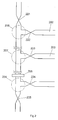
- microstructured channel structure The structure of a microstructured channel structure is schematic combines these functions and thus the directed evolution of Biomolecules enabled, shown in Fig. 1.
- the compartments for segregating the genotypes are separated by intermittent addition of at least one test fluid (102) containing the genotypes and at least one separating fluid (101) in a compartmentalization structure (106).
- the fluid (102) preferably contains all substances necessary for the expression of the genotype, the composition of such fluids and methods for their production are known to the person skilled in the art (Lesley, SA, Methods Mol. Biol. 37, 265 (1995)).
- the separating fluid can be both an aqueous solution and a non-aqueous, preferably water-immiscible liquid or a gas. Structured separation fluid compartments (111) can also be used to separate the genotype compartments (109), which necessitate the addition of several separation fluid components.
- the temperatures of the two reaction areas I (108) and II (110) can be controlled by suitable thermostat elements. Depending on the application, both reaction areas (108 and 110) can be operated at the same or different temperatures.
- the use of non-water-miscible fluids or gases as separation fluid (101) in combination with hydrodynamic flow in the microstructured reaction substrate is advantageous because this segregation of the genotype compartments can minimize diffusive mass transfer between genotype compartments (109) and between genotype compartments (109) and separation fluid (101) , It is also advantageous that the use of non-water-miscible fluids or gases as separation fluid (101) in the hydrodynamic flow minimizes the axial dispersion.
- the genotype is expressed in reaction area I (108).
- the reaction time can be freely selected by the experimenter by choosing the length of the microstructured reaction channel in reaction area I and by choosing the fluid velocity in reaction area I.
- the addition of reaction components to determine the phenotypic properties of the biomolecules formed in the genotype compartment (109) in the reaction area (108) is carried out in an area (107) of the microstructured substrate, a quantity of an assay fluid (103) with the genotype compartments (109) selected by the experimenter. united.
- the assay fluid (103) preferably consists of a fluid which is miscible with or soluble in the genotype compartments (109).
- the reaction components added with the assay fluid (103) are converted by the biomolecules present in the genotype compartments (109) in reaction area II (110).
- the reaction time can be freely selected by the experimenter by choosing the length of the microstructured reaction channel in reaction area II and by choosing the fluid velocity in reaction area II.
- Measurement of the implementation of components from assay fluid (103) and genotype compartment (109) Reaction products take place in a measuring range (105) of the Reaction substrate.
- Spectroscopic measurements are preferred Measurement method, most preferably confocal fluorescence spectroscopic methods used. Such methods are able in structure dimensions of a few 100 nm with high Sensitivity to determine the sample composition.
- the application confocal detection method for the detection of very small amounts of substances is shown for example in DE4301005 and WO9535492.
- Genotype compartments with positive in terms of the development goal Measurement results must be from those with negative measurement results be separated to advantageous variants of the library used to separate from disadvantageous. This separation takes place in one Selection area (104) of the reaction substrate by controlled steering the genotype compartments in one of at least two Selection channels 112 and 113.
- microstructure technology manufactured channel structures advantageously merged and integrated.
- Such channel structures can be made of different materials are manufactured. These include metals (e.g. silicon), amorphous materials (e.g. glass), ceramic materials and polymer materials (e.g. Polyurethanes (PU) and polydimethylsiloxanes (PDMS)).
- metals e.g. silicon
- amorphous materials e.g. glass
- ceramic materials e.g. Polyurethanes (PU) and polydimethylsiloxanes (PDMS)
- PU Polyurethanes
- PDMS polydimethylsiloxanes
- Active components can be considered as part of the microstructure Shape memory elements, piezoelectric assemblies or magnetostrictive elements. In a preferred version active components are designed as shape memory elements.
- the integrable components include valves and Pumping [Gerlach T. Schuenemann M. Wurmus H .; Journal of Micromechanics & microengineering. 5 (2): 199-201, 1995 Jun.].
- active components are used for Segregation in the fluid flow and for the selection of selected ones Compartments used.
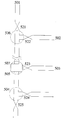
- the functional structure of a Microstructured channel structure according to the invention with active Components 221, 222, 223, 224 and 225 are shown in FIG. 2.
- the microstructured valve elements 221 and 222 are used for formation of the described compartmentalized fluid flow from the Fluid components 201 and 202 in the compartmentalizing element 206
- valve elements are alternating for opened for a period of time set by the experimenter and thus allow the passage of fluid elements of a defined volume.
- the valve element 223 controls the addition of the assay fluid 203 in the area 207.
- the control of the Valve element with the control of the valve elements 221 and 222 see above coordinates that assay reagents are added when a Genotype compartment is located within the addition area 207.
- compressible fluids or microstructured Reaction substrates made of elastic materials can coordinate the Valve elements 221, 222 and 223 may be insufficient to add the Assay reagents for a genotype compartment in the addition area 207 to ensure safe.
- optical Measuring method used are preferred for Detection of the genotype compartment in the addition area 207 optical Measuring method used.
- the invention microstructured reaction substrate is omitted Reaction area II (410) is then made such that Assay fluid addition area (507) and detection area (505) local coincide.
- Advantages of this embodiment are that fast Conversions between the gene product and assay reagents as temporal resolved series of measurements can be observed.
- Such Time series measurements allow a better one for fast implementations Characterization of phenotypic properties of the formed Gene product as the determination of a single reading after a given by the choice of the length of the reaction area II fixed response time.
- the duration of the time series measurement can depending on the application by interrupting the fluid flow in the microstructured reaction substrate by simultaneously closing the Valve elements 521 and 522 are extended.
- the valve elements 224 and 225 control the selection of the Genotype compartments after determining their phenotypic Properties in the detection area 205. For the selection of individual Genotype compartments become the valve elements of the at least two Selection channels 212 and 213 alternatively opened.
- Connections increase with hydrodynamic fluid transport Pressure loss with the length of the channel structure.
- the pressure required for hydrodynamic transport technical obstacle to the construction of the invention microstructured reaction substrate For a very long time, the pressure required for hydrodynamic transport technical obstacle to the construction of the invention microstructured reaction substrate.
- the in Fig. 3 outlined embodiment of an advantageous solution of the technical
- the reaction areas 308 and 310 are designed here as separate, controllable by opening individual valve elements 326 Reaction channels 327.
- the variety provided Reaction channels 326 can thus be filled. After a free one selectable response time can do this in the individual reaction channels Compartmental fluid present by further compartmentalized Fluid or displaced by a non-compartmentalized fluid and the each next functional element (307) or (304) are fed.
- the method is suitable for determining certain biomolecules phenotypic characteristics from a variety of variations too selektiern.
- the variants can be mutated by in vitro methods a DNA sequence of the parent phenotype.
- the method for the selection of phenotypes is not special suitable for cell-compatible phenotypes. Is not cell compatible for example a sequence specific endonuclease activity if the Cell lacks the methylase activity with the corresponding sequence specificity.
- a microstructure design according to FIG. 4 must be selected for the selection of a sequence-specific endonuclease activity.
- the channel width and depth should be about 1 ⁇ m.
- the expression fluid (402) contains a cell extract suitable for cell-free protein expression.
- An E. coli S30 extract is preferably used for time-coupled in vitro transcription / translation (Lesley, SA, Methods Mol. Biol. 37, 265 (1995)).
- the genotype library is diluted at a temperature of 4 ° C. to a concentration of 500 pM plasmid DNA.
- Low-viscosity mineral oil is used as the separating fluid (410).
- the valve elements (421 and 422) of the compartmentalizing element (406) of the microstructured reaction substrate are controlled by adding separating fluid (402) and separating fluid (401) in such a way that aqueous genotype compartments with a length of approx. 2 ⁇ m and trenfluid compartments with a length of 10 Form ⁇ m.
- separating fluid 402
- separating fluid 401
- each genotype compartment then carries on average about 0.6 DNA molecules from the library used. Accordingly, approximately 54% of the compartments formed contain no DNA molecule, 33% of the compartments contain one DNA molecule and 13% of the compartments contain two or more DNA molecules.
- the transport speed within the incubation area I (408) of the channel structure is chosen to be approximately 4.3 cm h -1 , so that each genotype compartment formed has passed the incubation distance I of 2.15 cm for protein expression after approximately 0.5 h.
- approximately 8 fl of assay fluids (403) are added to the genotype compartments.
- the assay fluid contains all components necessary for the endonucleolytic reaction and its detection.
- compositions of the assay fluid (403) are suitable for this: 150 mM KOAc, 37.5 mM Tris acetate, pH 7.6, 15 mM MgOAc, 0.75 mM ⁇ -mercaptoethanol, 515 ⁇ g / ml BSA, 0.05% Triton X-100, 0.5% glycerin, 10 nM double fluorescent labeled DNA substrate.
- the catalytic activity of an endonuclease can be determined specifically by adding double-fluorescence-labeled DNA substrates. By adding the assay fluid (403) the average fluid velocity increases to 7.2 cm h -1 .
- each genotype compartment passes through the incubation area II (410) of 3.6 cm in length to the detection element (405).
- the catalytic activity of an endonuclease can be specifically detected using fluorescence spectroscopic methods. Appropriate control of the valve elements (424 and 425) on the selection element (404) then selects positively assessed genotype compartments.
Landscapes
- Chemical & Material Sciences (AREA)
- Health & Medical Sciences (AREA)
- Life Sciences & Earth Sciences (AREA)
- Engineering & Computer Science (AREA)
- Genetics & Genomics (AREA)
- Organic Chemistry (AREA)
- Wood Science & Technology (AREA)
- Bioinformatics & Cheminformatics (AREA)
- Zoology (AREA)
- General Health & Medical Sciences (AREA)
- General Engineering & Computer Science (AREA)
- Biotechnology (AREA)
- Dispersion Chemistry (AREA)
- Biomedical Technology (AREA)
- Biophysics (AREA)
- Microbiology (AREA)
- Crystallography & Structural Chemistry (AREA)
- Bioinformatics & Computational Biology (AREA)
- Molecular Biology (AREA)
- Plant Pathology (AREA)
- Chemical Kinetics & Catalysis (AREA)
- Physics & Mathematics (AREA)
- Clinical Laboratory Science (AREA)
- Hematology (AREA)
- Biochemistry (AREA)
- Analytical Chemistry (AREA)
- Measuring Or Testing Involving Enzymes Or Micro-Organisms (AREA)
- Physical Or Chemical Processes And Apparatus (AREA)
- Prostheses (AREA)
Priority Applications (12)
| Application Number | Priority Date | Filing Date | Title |
|---|---|---|---|
| EP01113331A EP1262545A1 (fr) | 2001-05-31 | 2001-05-31 | Microstructures et leur utilisation dans l'évolution visée de biomolécules |
| US10/478,809 US20060147909A1 (en) | 2001-05-31 | 2002-05-31 | Microstructures and use thereof for the directed evolution of biomolecules |
| DK02745336T DK1390492T3 (da) | 2001-05-31 | 2002-05-31 | Dirigeret evolution af biomolekyler ved anvendelse af mikrostrukturer |
| EP02745336A EP1390492B1 (fr) | 2001-05-31 | 2002-05-31 | L'evolution orientee de biomolecules avec utilization de microstructures |
| CA002449020A CA2449020A1 (fr) | 2001-05-31 | 2002-05-31 | Microstructures et leur utilisation pour l'evolution orientee de biomolecules |
| ES02745336T ES2310207T3 (es) | 2001-05-31 | 2002-05-31 | Evolucion dirigida de biomoleculas usando microestructuras. |
| PT02745336T PT1390492E (pt) | 2001-05-31 | 2002-05-31 | Microestruturas e sua aplicação na evolução direccionada de biomoléculas |
| PCT/EP2002/005971 WO2002097130A2 (fr) | 2001-05-31 | 2002-05-31 | Microstructures et leur utilisation pour l'evolution orientee de biomolecules |
| DE50212513T DE50212513D1 (de) | 2001-05-31 | 2002-05-31 | Gerichtete evolution von biomolekülen unter der verwendung von mikrostrukturen |
| AT02745336T ATE401397T1 (de) | 2001-05-31 | 2002-05-31 | Gerichtete evolution von biomolekülen unter der verwendung von mikrostrukturen |
| AU2002316942A AU2002316942B2 (en) | 2001-05-31 | 2002-05-31 | Microstructures and use thereof for the directed evolution of biomolecules |
| US12/435,916 US20090233801A1 (en) | 2001-05-31 | 2009-05-05 | Microstructures and use thereof for the directed evolution of biomolecules |
Applications Claiming Priority (1)
| Application Number | Priority Date | Filing Date | Title |
|---|---|---|---|
| EP01113331A EP1262545A1 (fr) | 2001-05-31 | 2001-05-31 | Microstructures et leur utilisation dans l'évolution visée de biomolécules |
Publications (1)
| Publication Number | Publication Date |
|---|---|
| EP1262545A1 true EP1262545A1 (fr) | 2002-12-04 |
Family
ID=8177600
Family Applications (2)
| Application Number | Title | Priority Date | Filing Date |
|---|---|---|---|
| EP01113331A Withdrawn EP1262545A1 (fr) | 2001-05-31 | 2001-05-31 | Microstructures et leur utilisation dans l'évolution visée de biomolécules |
| EP02745336A Expired - Lifetime EP1390492B1 (fr) | 2001-05-31 | 2002-05-31 | L'evolution orientee de biomolecules avec utilization de microstructures |
Family Applications After (1)
| Application Number | Title | Priority Date | Filing Date |
|---|---|---|---|
| EP02745336A Expired - Lifetime EP1390492B1 (fr) | 2001-05-31 | 2002-05-31 | L'evolution orientee de biomolecules avec utilization de microstructures |
Country Status (10)
| Country | Link |
|---|---|
| US (2) | US20060147909A1 (fr) |
| EP (2) | EP1262545A1 (fr) |
| AT (1) | ATE401397T1 (fr) |
| AU (1) | AU2002316942B2 (fr) |
| CA (1) | CA2449020A1 (fr) |
| DE (1) | DE50212513D1 (fr) |
| DK (1) | DK1390492T3 (fr) |
| ES (1) | ES2310207T3 (fr) |
| PT (1) | PT1390492E (fr) |
| WO (1) | WO2002097130A2 (fr) |
Cited By (2)
| Publication number | Priority date | Publication date | Assignee | Title |
|---|---|---|---|---|
| WO2004103564A1 (fr) * | 2003-05-19 | 2004-12-02 | Hans-Knöll-Institut für Naturstoff-Forschung e.V. | Dispositif et procede de positionnement et d'eclusage de compartiments de fluide encastres dans un milieu de separation |
| EP2597472A2 (fr) * | 2005-04-01 | 2013-05-29 | Konica Minolta Medical & Graphic, Inc. | Système d'analyse de micro intégré, puce de test et procédé de test |
Families Citing this family (38)
| Publication number | Priority date | Publication date | Assignee | Title |
|---|---|---|---|---|
| US20060078893A1 (en) | 2004-10-12 | 2006-04-13 | Medical Research Council | Compartmentalised combinatorial chemistry by microfluidic control |
| GB0307428D0 (en) | 2003-03-31 | 2003-05-07 | Medical Res Council | Compartmentalised combinatorial chemistry |
| GB0307403D0 (en) | 2003-03-31 | 2003-05-07 | Medical Res Council | Selection by compartmentalised screening |
| CA2564211C (fr) * | 2004-01-26 | 2010-08-03 | President And Fellows Of Harvard College | Systeme et procede pour la delivrance de fluides |
| US20050221339A1 (en) | 2004-03-31 | 2005-10-06 | Medical Research Council Harvard University | Compartmentalised screening by microfluidic control |
| GB0422052D0 (en) | 2004-10-04 | 2004-11-03 | Dansico As | Enzymes |
| US7968287B2 (en) | 2004-10-08 | 2011-06-28 | Medical Research Council Harvard University | In vitro evolution in microfluidic systems |
| GB0423139D0 (en) | 2004-10-18 | 2004-11-17 | Danisco | Enzymes |
| EP2363205A3 (fr) | 2006-01-11 | 2014-06-04 | Raindance Technologies, Inc. | Dispositifs Microfluidiques Et Leurs Procédés D'utilisation Dans La Formation Et Le Contrôle De Nanoréacteurs |
| US9562837B2 (en) | 2006-05-11 | 2017-02-07 | Raindance Technologies, Inc. | Systems for handling microfludic droplets |
| EP2530168B1 (fr) | 2006-05-11 | 2015-09-16 | Raindance Technologies, Inc. | Dispositifs microfluidiques |
| EP2077912B1 (fr) | 2006-08-07 | 2019-03-27 | The President and Fellows of Harvard College | Tensioactifs fluorocarbonés stabilisateurs d'émulsions |
| US8772046B2 (en) | 2007-02-06 | 2014-07-08 | Brandeis University | Manipulation of fluids and reactions in microfluidic systems |
| US8143046B2 (en) | 2007-02-07 | 2012-03-27 | Danisco Us Inc., Genencor Division | Variant Buttiauxella sp. phytases having altered properties |
| WO2008130623A1 (fr) | 2007-04-19 | 2008-10-30 | Brandeis University | Manipulation de fluides, composants fluidiques et réactions dans des systèmes microfluidiques |
| US12038438B2 (en) | 2008-07-18 | 2024-07-16 | Bio-Rad Laboratories, Inc. | Enzyme quantification |
| WO2010009365A1 (fr) | 2008-07-18 | 2010-01-21 | Raindance Technologies, Inc. | Bibliothèque de gouttelettes |
| US8528589B2 (en) | 2009-03-23 | 2013-09-10 | Raindance Technologies, Inc. | Manipulation of microfluidic droplets |
| US10520500B2 (en) | 2009-10-09 | 2019-12-31 | Abdeslam El Harrak | Labelled silica-based nanomaterial with enhanced properties and uses thereof |
| EP2517025B1 (fr) | 2009-12-23 | 2019-11-27 | Bio-Rad Laboratories, Inc. | Procédés pour réduire l'échange de molécules entre des gouttelettes |
| US9399797B2 (en) | 2010-02-12 | 2016-07-26 | Raindance Technologies, Inc. | Digital analyte analysis |
| JP5934657B2 (ja) | 2010-02-12 | 2016-06-15 | レインダンス テクノロジーズ, インコーポレイテッド | デジタル検体分析 |
| US10351905B2 (en) | 2010-02-12 | 2019-07-16 | Bio-Rad Laboratories, Inc. | Digital analyte analysis |
| US9366632B2 (en) | 2010-02-12 | 2016-06-14 | Raindance Technologies, Inc. | Digital analyte analysis |
| WO2012045012A2 (fr) | 2010-09-30 | 2012-04-05 | Raindance Technologies, Inc. | Dosages sandwich dans des gouttelettes |
| EP3859011A1 (fr) | 2011-02-11 | 2021-08-04 | Bio-Rad Laboratories, Inc. | Procédés permettant de former des gouttelettes mélangées |
| EP2675819B1 (fr) | 2011-02-18 | 2020-04-08 | Bio-Rad Laboratories, Inc. | Compositions et méthodes de marquage moléculaire |
| WO2012154729A1 (fr) * | 2011-05-09 | 2012-11-15 | President And Fellows Of Harvard College | Module microfluidique et utilisations de celui-ci |
| DE202012013668U1 (de) | 2011-06-02 | 2019-04-18 | Raindance Technologies, Inc. | Enzymquantifizierung |
| US8841071B2 (en) | 2011-06-02 | 2014-09-23 | Raindance Technologies, Inc. | Sample multiplexing |
| US8658430B2 (en) | 2011-07-20 | 2014-02-25 | Raindance Technologies, Inc. | Manipulating droplet size |
| WO2014158367A1 (fr) | 2013-03-13 | 2014-10-02 | Opko Diagnostics, Llc | Mélange de fluides dans des systèmes fluidiques |
| US11901041B2 (en) | 2013-10-04 | 2024-02-13 | Bio-Rad Laboratories, Inc. | Digital analysis of nucleic acid modification |
| US9944977B2 (en) | 2013-12-12 | 2018-04-17 | Raindance Technologies, Inc. | Distinguishing rare variations in a nucleic acid sequence from a sample |
| US11193176B2 (en) | 2013-12-31 | 2021-12-07 | Bio-Rad Laboratories, Inc. | Method for detecting and quantifying latent retroviral RNA species |
| TWI728963B (zh) | 2014-12-12 | 2021-06-01 | 美商Opko診斷法有限責任公司 | 包含培養通道之流體系統,包括成型而成的流體系統及與其相關聯之方法 |
| US10260064B2 (en) * | 2015-03-26 | 2019-04-16 | The Johns Hopkins University | Programmed droplet rupture for directed evolution |
| US10647981B1 (en) | 2015-09-08 | 2020-05-12 | Bio-Rad Laboratories, Inc. | Nucleic acid library generation methods and compositions |
Citations (4)
| Publication number | Priority date | Publication date | Assignee | Title |
|---|---|---|---|---|
| DE19950385A1 (de) * | 1999-01-29 | 2000-08-03 | Max Planck Gesellschaft | Verfahren zur Isolation von Apoptose-induzierenden DNA-Sequenzen und Detektionssystem |
| WO2000056872A2 (fr) * | 1999-03-22 | 2000-09-28 | Pangene Corporation | Clonage de gene et criblage phenotypique a haute capacite |
| US6130098A (en) * | 1995-09-15 | 2000-10-10 | The Regents Of The University Of Michigan | Moving microdroplets |
| US6207031B1 (en) * | 1997-09-15 | 2001-03-27 | Whitehead Institute For Biomedical Research | Methods and apparatus for processing a sample of biomolecular analyte using a microfabricated device |
Family Cites Families (8)
| Publication number | Priority date | Publication date | Assignee | Title |
|---|---|---|---|---|
| FR2710256B1 (fr) * | 1993-09-24 | 1997-08-01 | Gilles Billet | Prothèse dentaire à coque de support composite et revêtement en résine, pièce de tissu préimprégné, procédé et machine de fabrication de cette prothèse. |
| WO1995035492A2 (fr) * | 1994-06-17 | 1995-12-28 | Evotec Biosystems Gmbh | Procede et dispositif permettant d'extraire de maniere selective des constituants contenus dans des melanges complexes |
| FI102945B1 (fi) * | 1995-02-24 | 1999-03-31 | Bioxid Oy | Polymeeri-kuitu -esivalmiste, menetelmä sen valmistamiseksi ja sen käyttö |
| DE19529036A1 (de) * | 1995-08-08 | 1997-03-13 | Huels Chemische Werke Ag | Biokompatibler Verbundwerkstoff und Verfahren zu seiner Herstellung |
| US5942443A (en) * | 1996-06-28 | 1999-08-24 | Caliper Technologies Corporation | High throughput screening assay systems in microscale fluidic devices |
| US6641998B2 (en) * | 1997-10-10 | 2003-11-04 | Stratagene | Methods and kits to enrich for desired nucleic acid sequences |
| EP1148947B1 (fr) * | 1999-01-08 | 2006-10-25 | Applera Corporation | Reseau de fibres destine a entrer en contact avec une espece chimique et procedes d'utilisation et de fabrication de tels reseaux de fibres |
| US20010039014A1 (en) * | 2000-01-11 | 2001-11-08 | Maxygen, Inc. | Integrated systems and methods for diversity generation and screening |
-
2001
- 2001-05-31 EP EP01113331A patent/EP1262545A1/fr not_active Withdrawn
-
2002
- 2002-05-31 AU AU2002316942A patent/AU2002316942B2/en not_active Ceased
- 2002-05-31 PT PT02745336T patent/PT1390492E/pt unknown
- 2002-05-31 WO PCT/EP2002/005971 patent/WO2002097130A2/fr not_active Ceased
- 2002-05-31 DE DE50212513T patent/DE50212513D1/de not_active Expired - Lifetime
- 2002-05-31 ES ES02745336T patent/ES2310207T3/es not_active Expired - Lifetime
- 2002-05-31 DK DK02745336T patent/DK1390492T3/da active
- 2002-05-31 EP EP02745336A patent/EP1390492B1/fr not_active Expired - Lifetime
- 2002-05-31 CA CA002449020A patent/CA2449020A1/fr not_active Abandoned
- 2002-05-31 US US10/478,809 patent/US20060147909A1/en not_active Abandoned
- 2002-05-31 AT AT02745336T patent/ATE401397T1/de active
-
2009
- 2009-05-05 US US12/435,916 patent/US20090233801A1/en not_active Abandoned
Patent Citations (4)
| Publication number | Priority date | Publication date | Assignee | Title |
|---|---|---|---|---|
| US6130098A (en) * | 1995-09-15 | 2000-10-10 | The Regents Of The University Of Michigan | Moving microdroplets |
| US6207031B1 (en) * | 1997-09-15 | 2001-03-27 | Whitehead Institute For Biomedical Research | Methods and apparatus for processing a sample of biomolecular analyte using a microfabricated device |
| DE19950385A1 (de) * | 1999-01-29 | 2000-08-03 | Max Planck Gesellschaft | Verfahren zur Isolation von Apoptose-induzierenden DNA-Sequenzen und Detektionssystem |
| WO2000056872A2 (fr) * | 1999-03-22 | 2000-09-28 | Pangene Corporation | Clonage de gene et criblage phenotypique a haute capacite |
Cited By (2)
| Publication number | Priority date | Publication date | Assignee | Title |
|---|---|---|---|---|
| WO2004103564A1 (fr) * | 2003-05-19 | 2004-12-02 | Hans-Knöll-Institut für Naturstoff-Forschung e.V. | Dispositif et procede de positionnement et d'eclusage de compartiments de fluide encastres dans un milieu de separation |
| EP2597472A2 (fr) * | 2005-04-01 | 2013-05-29 | Konica Minolta Medical & Graphic, Inc. | Système d'analyse de micro intégré, puce de test et procédé de test |
Also Published As
| Publication number | Publication date |
|---|---|
| EP1390492B1 (fr) | 2008-07-16 |
| US20090233801A1 (en) | 2009-09-17 |
| EP1390492A2 (fr) | 2004-02-25 |
| WO2002097130A3 (fr) | 2003-04-17 |
| AU2002316942B2 (en) | 2008-02-21 |
| ES2310207T3 (es) | 2009-01-01 |
| ATE401397T1 (de) | 2008-08-15 |
| PT1390492E (pt) | 2008-10-24 |
| US20060147909A1 (en) | 2006-07-06 |
| WO2002097130A2 (fr) | 2002-12-05 |
| CA2449020A1 (fr) | 2002-12-05 |
| DE50212513D1 (de) | 2008-08-28 |
| DK1390492T3 (da) | 2008-11-17 |
Similar Documents
| Publication | Publication Date | Title |
|---|---|---|
| EP1390492B1 (fr) | L'evolution orientee de biomolecules avec utilization de microstructures | |
| DE60208313T2 (de) | Mikroelektronischer Detektor auf einem Chip | |
| DE60018733T2 (de) | Vorrichtung und verfahren zur probenanalyse | |
| EP0706646B1 (fr) | Porte-echantillons et son utilisation | |
| DE60021077T2 (de) | Vorrichtung und verfahren zur probenabgabe | |
| Joensson et al. | Droplet microfluidics—A tool for single‐cell analysis | |
| DE60013848T2 (de) | Mikrofluid-vorrichtungen zur gesteuerten handhabung von kleinstvolumen | |
| EP3227023B1 (fr) | Procédé de production de gouttes | |
| EP1880766A1 (fr) | Système d'analyse basé sur un matériel poreux pour la détection de cellules individuelles | |
| US20190352698A1 (en) | Ac electrosprayed droplets for digital and emulsion pcr | |
| EP1277055B1 (fr) | Biopuce pour l'archivage et l'analyse en laboratoire medical d'un echantillon biologique | |
| WO2004103565A2 (fr) | Dispositif et procede de structuration de liquides et de dosage de liquides de reaction vers des compartiments a liquides noyes dans un fluide de separation | |
| WO2003056330A2 (fr) | Systeme de tri de cellules conçu pour trier ou separer des cellules en suspension dans un liquide en ecoulement en fonction de leur grandeur | |
| US20200055052A1 (en) | Systems and methods to encapsulate and preserve organic matter for analysis | |
| EP1693337A1 (fr) | Support macroporeux pour réactions d'amplification | |
| DE60219429T2 (de) | Biochemisches verfahren und vorrichtung zur bestimmung von eigenschaften von proteinen | |
| DE102006056694A1 (de) | Verfahren zum Durchführen einer enzymatischen Reaktion | |
| Stuber et al. | Solid-State Nanopores for Biomolecular Analysis and Detection | |
| DE102004021904B4 (de) | Verfahren und Vorrichtung zur Erzeugung einer Analyseanordnung mit diskreten, separaten Messbereichen zur biologischen, biochemischen oder chemischen Analyse | |
| EP1448798A1 (fr) | Nanostructure, notamment pour analyser des molecules individuelles | |
| EP1511856A1 (fr) | Procede de sequencage parallele d'un melange d'acide nucleique a l'aide d'un systeme d'ecoulement | |
| WO2002008457A2 (fr) | Procede et dispositif d'analyse d'echantillons chimiques ou biologiques | |
| DE29923907U1 (de) | Miniaturisierter Objektträger zur Durchführung einer Vielzahl von Testreihen im Submikroliterbereich | |
| US20240157333A1 (en) | Picoscale thin layer chromatography for analysis of single cells and microsamples | |
| DE102023212254B3 (de) | Mikrofluidisches Verfahren zur Vorbereitung einer Sequenzierbibliothek für nukleinsäurehaltige Zellen, insbesondere zirkulierender Tumorzellen, mit Partikeln |
Legal Events
| Date | Code | Title | Description |
|---|---|---|---|
| PUAI | Public reference made under article 153(3) epc to a published international application that has entered the european phase |
Free format text: ORIGINAL CODE: 0009012 |
|
| AK | Designated contracting states |
Kind code of ref document: A1 Designated state(s): AT BE CH CY DE DK ES FI FR GB GR IE IT LI LU MC NL PT SE TR |
|
| AX | Request for extension of the european patent |
Free format text: AL;LT;LV;MK;RO;SI |
|
| AKX | Designation fees paid | ||
| STAA | Information on the status of an ep patent application or granted ep patent |
Free format text: STATUS: THE APPLICATION HAS BEEN WITHDRAWN |
|
| REG | Reference to a national code |
Ref country code: DE Ref legal event code: 8566 |
|
| 18W | Application withdrawn |
Effective date: 20030904 |