EP1263813B1 - Verfahren zur einstellung der teilchengrösse von popcornpolymeren während der popcornpolymerisation - Google Patents
Verfahren zur einstellung der teilchengrösse von popcornpolymeren während der popcornpolymerisation Download PDFInfo
- Publication number
- EP1263813B1 EP1263813B1 EP01923637A EP01923637A EP1263813B1 EP 1263813 B1 EP1263813 B1 EP 1263813B1 EP 01923637 A EP01923637 A EP 01923637A EP 01923637 A EP01923637 A EP 01923637A EP 1263813 B1 EP1263813 B1 EP 1263813B1
- Authority
- EP
- European Patent Office
- Prior art keywords
- popcorn
- polymerization
- polymers
- reaction mixture
- popcorn polymers
- Prior art date
- Legal status (The legal status is an assumption and is not a legal conclusion. Google has not performed a legal analysis and makes no representation as to the accuracy of the status listed.)
- Expired - Lifetime
Links
- 235000002017 Zea mays subsp mays Nutrition 0.000 title claims abstract description 102
- 241000482268 Zea mays subsp. mays Species 0.000 title claims abstract description 102
- 229920000642 polymer Polymers 0.000 title claims abstract description 91
- 238000006116 polymerization reaction Methods 0.000 title claims abstract description 57
- 239000002245 particle Substances 0.000 title claims abstract description 27
- 238000000034 method Methods 0.000 title claims abstract description 19
- 239000000178 monomer Substances 0.000 claims abstract description 53
- 239000011541 reaction mixture Substances 0.000 claims abstract description 34
- XLYOFNOQVPJJNP-UHFFFAOYSA-N water Substances O XLYOFNOQVPJJNP-UHFFFAOYSA-N 0.000 claims abstract description 33
- 239000011261 inert gas Substances 0.000 claims abstract description 20
- 239000001301 oxygen Substances 0.000 claims abstract description 18
- 229910052760 oxygen Inorganic materials 0.000 claims abstract description 18
- QVGXLLKOCUKJST-UHFFFAOYSA-N atomic oxygen Chemical compound [O] QVGXLLKOCUKJST-UHFFFAOYSA-N 0.000 claims abstract description 16
- 238000006213 oxygenation reaction Methods 0.000 claims abstract description 11
- 239000003505 polymerization initiator Substances 0.000 claims abstract description 11
- 239000003431 cross linking reagent Substances 0.000 claims abstract description 8
- 238000012673 precipitation polymerization Methods 0.000 claims abstract description 7
- 239000002904 solvent Substances 0.000 claims abstract description 5
- 235000013361 beverage Nutrition 0.000 claims abstract description 4
- 239000003793 antidiarrheal agent Substances 0.000 claims abstract 2
- IJGRMHOSHXDMSA-UHFFFAOYSA-N Atomic nitrogen Chemical compound N#N IJGRMHOSHXDMSA-UHFFFAOYSA-N 0.000 claims description 34
- 239000000203 mixture Substances 0.000 claims description 30
- WHNWPMSKXPGLAX-UHFFFAOYSA-N N-Vinyl-2-pyrrolidone Chemical compound C=CN1CCCC1=O WHNWPMSKXPGLAX-UHFFFAOYSA-N 0.000 claims description 21
- 229910052757 nitrogen Inorganic materials 0.000 claims description 21
- HMYBDZFSXBJDGL-UHFFFAOYSA-N 1,3-bis(ethenyl)imidazolidin-2-one Chemical compound C=CN1CCN(C=C)C1=O HMYBDZFSXBJDGL-UHFFFAOYSA-N 0.000 claims description 12
- 239000003599 detergent Substances 0.000 claims description 7
- 239000003638 chemical reducing agent Substances 0.000 claims description 5
- JWYVGKFDLWWQJX-UHFFFAOYSA-N 1-ethenylazepan-2-one Chemical compound C=CN1CCCCCC1=O JWYVGKFDLWWQJX-UHFFFAOYSA-N 0.000 claims description 4
- PBGPBHYPCGDFEZ-UHFFFAOYSA-N 1-ethenylpiperidin-2-one Chemical compound C=CN1CCCCC1=O PBGPBHYPCGDFEZ-UHFFFAOYSA-N 0.000 claims description 3
- HEMHJVSKTPXQMS-UHFFFAOYSA-M Sodium hydroxide Chemical compound [OH-].[Na+] HEMHJVSKTPXQMS-UHFFFAOYSA-M 0.000 description 27
- 239000004971 Cross linker Substances 0.000 description 12
- 239000000243 solution Substances 0.000 description 11
- NIXOWILDQLNWCW-UHFFFAOYSA-N acrylic acid group Chemical group C(C=C)(=O)O NIXOWILDQLNWCW-UHFFFAOYSA-N 0.000 description 10
- 238000010438 heat treatment Methods 0.000 description 10
- 238000003756 stirring Methods 0.000 description 10
- SMZOUWXMTYCWNB-UHFFFAOYSA-N 2-(2-methoxy-5-methylphenyl)ethanamine Chemical compound COC1=CC=C(C)C=C1CCN SMZOUWXMTYCWNB-UHFFFAOYSA-N 0.000 description 8
- 150000001875 compounds Chemical class 0.000 description 8
- 238000005029 sieve analysis Methods 0.000 description 8
- JVBXVOWTABLYPX-UHFFFAOYSA-L sodium dithionite Chemical compound [Na+].[Na+].[O-]S(=O)S([O-])=O JVBXVOWTABLYPX-UHFFFAOYSA-L 0.000 description 8
- 239000012153 distilled water Substances 0.000 description 7
- 230000007717 exclusion Effects 0.000 description 7
- ZQXSMRAEXCEDJD-UHFFFAOYSA-N n-ethenylformamide Chemical class C=CNC=O ZQXSMRAEXCEDJD-UHFFFAOYSA-N 0.000 description 7
- 238000006243 chemical reaction Methods 0.000 description 6
- 239000007966 viscous suspension Substances 0.000 description 6
- BAPJBEWLBFYGME-UHFFFAOYSA-N Methyl acrylate Chemical compound COC(=O)C=C BAPJBEWLBFYGME-UHFFFAOYSA-N 0.000 description 5
- 230000000052 comparative effect Effects 0.000 description 5
- MYRTYDVEIRVNKP-UHFFFAOYSA-N 1,2-Divinylbenzene Chemical compound C=CC1=CC=CC=C1C=C MYRTYDVEIRVNKP-UHFFFAOYSA-N 0.000 description 4
- HRPVXLWXLXDGHG-UHFFFAOYSA-N Acrylamide Chemical compound NC(=O)C=C HRPVXLWXLXDGHG-UHFFFAOYSA-N 0.000 description 4
- CERQOIWHTDAKMF-UHFFFAOYSA-N Methacrylic acid Chemical compound CC(=C)C(O)=O CERQOIWHTDAKMF-UHFFFAOYSA-N 0.000 description 4
- PPBRXRYQALVLMV-UHFFFAOYSA-N Styrene Chemical compound C=CC1=CC=CC=C1 PPBRXRYQALVLMV-UHFFFAOYSA-N 0.000 description 4
- -1 acrylic ester Chemical class 0.000 description 4
- 239000007864 aqueous solution Substances 0.000 description 4
- 238000009826 distribution Methods 0.000 description 4
- 239000012535 impurity Substances 0.000 description 4
- 239000000843 powder Substances 0.000 description 4
- 229920001567 vinyl ester resin Polymers 0.000 description 4
- AZUYLZMQTIKGSC-UHFFFAOYSA-N 1-[6-[4-(5-chloro-6-methyl-1H-indazol-4-yl)-5-methyl-3-(1-methylindazol-5-yl)pyrazol-1-yl]-2-azaspiro[3.3]heptan-2-yl]prop-2-en-1-one Chemical compound ClC=1C(=C2C=NNC2=CC=1C)C=1C(=NN(C=1C)C1CC2(CN(C2)C(C=C)=O)C1)C=1C=C2C=NN(C2=CC=1)C AZUYLZMQTIKGSC-UHFFFAOYSA-N 0.000 description 3
- VVQNEPGJFQJSBK-UHFFFAOYSA-N Methyl methacrylate Chemical compound COC(=O)C(C)=C VVQNEPGJFQJSBK-UHFFFAOYSA-N 0.000 description 3
- 239000002585 base Substances 0.000 description 3
- 239000000356 contaminant Substances 0.000 description 3
- 229920001577 copolymer Polymers 0.000 description 3
- FQPSGWSUVKBHSU-UHFFFAOYSA-N methacrylamide Chemical compound CC(=C)C(N)=O FQPSGWSUVKBHSU-UHFFFAOYSA-N 0.000 description 3
- 125000005397 methacrylic acid ester group Chemical group 0.000 description 3
- 238000002360 preparation method Methods 0.000 description 3
- 239000000126 substance Substances 0.000 description 3
- 125000000391 vinyl group Chemical group [H]C([*])=C([H])[H] 0.000 description 3
- 229920002554 vinyl polymer Polymers 0.000 description 3
- OZAIFHULBGXAKX-UHFFFAOYSA-N 2-(2-cyanopropan-2-yldiazenyl)-2-methylpropanenitrile Chemical compound N#CC(C)(C)N=NC(C)(C)C#N OZAIFHULBGXAKX-UHFFFAOYSA-N 0.000 description 2
- KUDUQBURMYMBIJ-UHFFFAOYSA-N 2-prop-2-enoyloxyethyl prop-2-enoate Chemical compound C=CC(=O)OCCOC(=O)C=C KUDUQBURMYMBIJ-UHFFFAOYSA-N 0.000 description 2
- QGZKDVFQNNGYKY-UHFFFAOYSA-N Ammonia Chemical compound N QGZKDVFQNNGYKY-UHFFFAOYSA-N 0.000 description 2
- XKRFYHLGVUSROY-UHFFFAOYSA-N Argon Chemical compound [Ar] XKRFYHLGVUSROY-UHFFFAOYSA-N 0.000 description 2
- CIWBSHSKHKDKBQ-JLAZNSOCSA-N Ascorbic acid Chemical compound OC[C@H](O)[C@H]1OC(=O)C(O)=C1O CIWBSHSKHKDKBQ-JLAZNSOCSA-N 0.000 description 2
- CURLTUGMZLYLDI-UHFFFAOYSA-N Carbon dioxide Chemical compound O=C=O CURLTUGMZLYLDI-UHFFFAOYSA-N 0.000 description 2
- MYMOFIZGZYHOMD-UHFFFAOYSA-N Dioxygen Chemical compound O=O MYMOFIZGZYHOMD-UHFFFAOYSA-N 0.000 description 2
- 102000004190 Enzymes Human genes 0.000 description 2
- 108090000790 Enzymes Proteins 0.000 description 2
- PMZURENOXWZQFD-UHFFFAOYSA-L Sodium Sulfate Chemical compound [Na+].[Na+].[O-]S([O-])(=O)=O PMZURENOXWZQFD-UHFFFAOYSA-L 0.000 description 2
- UIIMBOGNXHQVGW-UHFFFAOYSA-M Sodium bicarbonate Chemical compound [Na+].OC([O-])=O UIIMBOGNXHQVGW-UHFFFAOYSA-M 0.000 description 2
- 238000010521 absorption reaction Methods 0.000 description 2
- 125000005396 acrylic acid ester group Chemical group 0.000 description 2
- 150000001298 alcohols Chemical class 0.000 description 2
- 239000003513 alkali Substances 0.000 description 2
- 229910052784 alkaline earth metal Inorganic materials 0.000 description 2
- 125000003277 amino group Chemical group 0.000 description 2
- 239000007900 aqueous suspension Substances 0.000 description 2
- 230000001588 bifunctional effect Effects 0.000 description 2
- 239000001273 butane Substances 0.000 description 2
- 125000004432 carbon atom Chemical group C* 0.000 description 2
- 239000007884 disintegrant Substances 0.000 description 2
- 150000002148 esters Chemical class 0.000 description 2
- 239000011551 heat transfer agent Substances 0.000 description 2
- 230000006698 induction Effects 0.000 description 2
- 150000002500 ions Chemical class 0.000 description 2
- 238000004519 manufacturing process Methods 0.000 description 2
- DSENQNLOVPYEKP-UHFFFAOYSA-N n-ethenyl-n-methylpropanamide Chemical compound CCC(=O)N(C)C=C DSENQNLOVPYEKP-UHFFFAOYSA-N 0.000 description 2
- 229920002959 polymer blend Polymers 0.000 description 2
- 230000000379 polymerizing effect Effects 0.000 description 2
- 229920006395 saturated elastomer Polymers 0.000 description 2
- 239000011734 sodium Substances 0.000 description 2
- GEHJYWRUCIMESM-UHFFFAOYSA-L sodium sulfite Chemical compound [Na+].[Na+].[O-]S([O-])=O GEHJYWRUCIMESM-UHFFFAOYSA-L 0.000 description 2
- FRPJTGXMTIIFIT-UHFFFAOYSA-N tetraacetylethylenediamine Chemical compound CC(=O)C(N)(C(C)=O)C(N)(C(C)=O)C(C)=O FRPJTGXMTIIFIT-UHFFFAOYSA-N 0.000 description 2
- 238000005406 washing Methods 0.000 description 2
- SGKNPYKCCQCHAE-UHFFFAOYSA-N (1-hydroxy-2-methylpropyl) 2-methylprop-2-enoate Chemical compound CC(C)C(O)OC(=O)C(C)=C SGKNPYKCCQCHAE-UHFFFAOYSA-N 0.000 description 1
- RKVMKJUCXYJHEH-UHFFFAOYSA-N (1-hydroxy-2-methylpropyl) prop-2-enoate Chemical compound CC(C)C(O)OC(=O)C=C RKVMKJUCXYJHEH-UHFFFAOYSA-N 0.000 description 1
- 229920002818 (Hydroxyethyl)methacrylate Polymers 0.000 description 1
- BDHGFCVQWMDIQX-UHFFFAOYSA-N 1-ethenyl-2-methylimidazole Chemical compound CC1=NC=CN1C=C BDHGFCVQWMDIQX-UHFFFAOYSA-N 0.000 description 1
- MMFCEMSIUPCRLD-UHFFFAOYSA-N 1-ethenyl-4-methylimidazole Chemical compound CC1=CN(C=C)C=N1 MMFCEMSIUPCRLD-UHFFFAOYSA-N 0.000 description 1
- OSSNTDFYBPYIEC-UHFFFAOYSA-N 1-ethenylimidazole Chemical compound C=CN1C=CN=C1 OSSNTDFYBPYIEC-UHFFFAOYSA-N 0.000 description 1
- QEDJMOONZLUIMC-UHFFFAOYSA-N 1-tert-butyl-4-ethenylbenzene Chemical compound CC(C)(C)C1=CC=C(C=C)C=C1 QEDJMOONZLUIMC-UHFFFAOYSA-N 0.000 description 1
- GQEKAPMWKCXNCF-UHFFFAOYSA-N 2,2-bis(ethenyl)-1,4-dioxane Chemical compound C=CC1(C=C)COCCO1 GQEKAPMWKCXNCF-UHFFFAOYSA-N 0.000 description 1
- OLQFXOWPTQTLDP-UHFFFAOYSA-N 2-(2-hydroxyethoxy)ethyl 2-methylprop-2-enoate Chemical compound CC(=C)C(=O)OCCOCCO OLQFXOWPTQTLDP-UHFFFAOYSA-N 0.000 description 1
- RWXMAAYKJDQVTF-UHFFFAOYSA-N 2-(2-hydroxyethoxy)ethyl prop-2-enoate Chemical compound OCCOCCOC(=O)C=C RWXMAAYKJDQVTF-UHFFFAOYSA-N 0.000 description 1
- QUASZQPLPKGIJY-UHFFFAOYSA-N 2-[2-[2-(2-hydroxyethoxy)ethoxy]ethoxy]ethyl prop-2-enoate Chemical compound OCCOCCOCCOCCOC(=O)C=C QUASZQPLPKGIJY-UHFFFAOYSA-N 0.000 description 1
- LTHJXDSHSVNJKG-UHFFFAOYSA-N 2-[2-[2-[2-(2-methylprop-2-enoyloxy)ethoxy]ethoxy]ethoxy]ethyl 2-methylprop-2-enoate Chemical compound CC(=C)C(=O)OCCOCCOCCOCCOC(=O)C(C)=C LTHJXDSHSVNJKG-UHFFFAOYSA-N 0.000 description 1
- OMIGHNLMNHATMP-UHFFFAOYSA-N 2-hydroxyethyl prop-2-enoate Chemical compound OCCOC(=O)C=C OMIGHNLMNHATMP-UHFFFAOYSA-N 0.000 description 1
- GNSFRPWPOGYVLO-UHFFFAOYSA-N 3-hydroxypropyl 2-methylprop-2-enoate Chemical compound CC(=C)C(=O)OCCCO GNSFRPWPOGYVLO-UHFFFAOYSA-N 0.000 description 1
- QZPSOSOOLFHYRR-UHFFFAOYSA-N 3-hydroxypropyl prop-2-enoate Chemical compound OCCCOC(=O)C=C QZPSOSOOLFHYRR-UHFFFAOYSA-N 0.000 description 1
- FYRWKWGEFZTOQI-UHFFFAOYSA-N 3-prop-2-enoxy-2,2-bis(prop-2-enoxymethyl)propan-1-ol Chemical compound C=CCOCC(CO)(COCC=C)COCC=C FYRWKWGEFZTOQI-UHFFFAOYSA-N 0.000 description 1
- DBCAQXHNJOFNGC-UHFFFAOYSA-N 4-bromo-1,1,1-trifluorobutane Chemical compound FC(F)(F)CCCBr DBCAQXHNJOFNGC-UHFFFAOYSA-N 0.000 description 1
- NDWUBGAGUCISDV-UHFFFAOYSA-N 4-hydroxybutyl prop-2-enoate Chemical compound OCCCCOC(=O)C=C NDWUBGAGUCISDV-UHFFFAOYSA-N 0.000 description 1
- NLHHRLWOUZZQLW-UHFFFAOYSA-N Acrylonitrile Chemical compound C=CC#N NLHHRLWOUZZQLW-UHFFFAOYSA-N 0.000 description 1
- KAKZBPTYRLMSJV-UHFFFAOYSA-N Butadiene Chemical group C=CC=C KAKZBPTYRLMSJV-UHFFFAOYSA-N 0.000 description 1
- JIGUQPWFLRLWPJ-UHFFFAOYSA-N Ethyl acrylate Chemical compound CCOC(=O)C=C JIGUQPWFLRLWPJ-UHFFFAOYSA-N 0.000 description 1
- IAYPIBMASNFSPL-UHFFFAOYSA-N Ethylene oxide Chemical compound C1CO1 IAYPIBMASNFSPL-UHFFFAOYSA-N 0.000 description 1
- WOBHKFSMXKNTIM-UHFFFAOYSA-N Hydroxyethyl methacrylate Chemical compound CC(=C)C(=O)OCCO WOBHKFSMXKNTIM-UHFFFAOYSA-N 0.000 description 1
- DGAQECJNVWCQMB-PUAWFVPOSA-M Ilexoside XXIX Chemical compound C[C@@H]1CC[C@@]2(CC[C@@]3(C(=CC[C@H]4[C@]3(CC[C@@H]5[C@@]4(CC[C@@H](C5(C)C)OS(=O)(=O)[O-])C)C)[C@@H]2[C@]1(C)O)C)C(=O)O[C@H]6[C@@H]([C@H]([C@@H]([C@H](O6)CO)O)O)O.[Na+] DGAQECJNVWCQMB-PUAWFVPOSA-M 0.000 description 1
- GYCMBHHDWRMZGG-UHFFFAOYSA-N Methylacrylonitrile Chemical compound CC(=C)C#N GYCMBHHDWRMZGG-UHFFFAOYSA-N 0.000 description 1
- LRHPLDYGYMQRHN-UHFFFAOYSA-N N-Butanol Chemical class CCCCO LRHPLDYGYMQRHN-UHFFFAOYSA-N 0.000 description 1
- KWYUFKZDYYNOTN-UHFFFAOYSA-M Potassium hydroxide Chemical compound [OH-].[K+] KWYUFKZDYYNOTN-UHFFFAOYSA-M 0.000 description 1
- OFOBLEOULBTSOW-UHFFFAOYSA-N Propanedioic acid Natural products OC(=O)CC(O)=O OFOBLEOULBTSOW-UHFFFAOYSA-N 0.000 description 1
- CDBYLPFSWZWCQE-UHFFFAOYSA-L Sodium Carbonate Chemical compound [Na+].[Na+].[O-]C([O-])=O CDBYLPFSWZWCQE-UHFFFAOYSA-L 0.000 description 1
- 239000004115 Sodium Silicate Substances 0.000 description 1
- XTXRWKRVRITETP-UHFFFAOYSA-N Vinyl acetate Chemical compound CC(=O)OC=C XTXRWKRVRITETP-UHFFFAOYSA-N 0.000 description 1
- 229910021536 Zeolite Inorganic materials 0.000 description 1
- 239000002253 acid Substances 0.000 description 1
- 150000007513 acids Chemical class 0.000 description 1
- 150000001252 acrylic acid derivatives Chemical class 0.000 description 1
- 125000002252 acyl group Chemical group 0.000 description 1
- 238000005054 agglomeration Methods 0.000 description 1
- 230000002776 aggregation Effects 0.000 description 1
- 238000007605 air drying Methods 0.000 description 1
- 150000001342 alkaline earth metals Chemical class 0.000 description 1
- 125000002947 alkylene group Chemical group 0.000 description 1
- 229910021529 ammonia Inorganic materials 0.000 description 1
- 230000001142 anti-diarrhea Effects 0.000 description 1
- 239000012736 aqueous medium Substances 0.000 description 1
- 229910052786 argon Inorganic materials 0.000 description 1
- 235000010323 ascorbic acid Nutrition 0.000 description 1
- 239000011668 ascorbic acid Substances 0.000 description 1
- 229960005070 ascorbic acid Drugs 0.000 description 1
- 239000011324 bead Substances 0.000 description 1
- 230000009286 beneficial effect Effects 0.000 description 1
- 230000033228 biological regulation Effects 0.000 description 1
- 238000007664 blowing Methods 0.000 description 1
- 238000009835 boiling Methods 0.000 description 1
- 239000000872 buffer Substances 0.000 description 1
- 239000000337 buffer salt Substances 0.000 description 1
- MTAZNLWOLGHBHU-UHFFFAOYSA-N butadiene-styrene rubber Chemical compound C=CC=C.C=CC1=CC=CC=C1 MTAZNLWOLGHBHU-UHFFFAOYSA-N 0.000 description 1
- 239000001569 carbon dioxide Substances 0.000 description 1
- 229910002092 carbon dioxide Inorganic materials 0.000 description 1
- 150000003857 carboxamides Chemical class 0.000 description 1
- 125000003178 carboxy group Chemical group [H]OC(*)=O 0.000 description 1
- 150000001733 carboxylic acid esters Chemical class 0.000 description 1
- 150000001735 carboxylic acids Chemical class 0.000 description 1
- 238000005119 centrifugation Methods 0.000 description 1
- 230000000536 complexating effect Effects 0.000 description 1
- 239000003085 diluting agent Substances 0.000 description 1
- 238000010790 dilution Methods 0.000 description 1
- 239000012895 dilution Substances 0.000 description 1
- HNPSIPDUKPIQMN-UHFFFAOYSA-N dioxosilane;oxo(oxoalumanyloxy)alumane Chemical compound O=[Si]=O.O=[Al]O[Al]=O HNPSIPDUKPIQMN-UHFFFAOYSA-N 0.000 description 1
- VTIIJXUACCWYHX-UHFFFAOYSA-L disodium;carboxylatooxy carbonate Chemical compound [Na+].[Na+].[O-]C(=O)OOC([O-])=O VTIIJXUACCWYHX-UHFFFAOYSA-L 0.000 description 1
- 238000004090 dissolution Methods 0.000 description 1
- GRWZHXKQBITJKP-UHFFFAOYSA-L dithionite(2-) Chemical compound [O-]S(=O)S([O-])=O GRWZHXKQBITJKP-UHFFFAOYSA-L 0.000 description 1
- 238000001035 drying Methods 0.000 description 1
- 230000000694 effects Effects 0.000 description 1
- 238000005516 engineering process Methods 0.000 description 1
- BLCTWBJQROOONQ-UHFFFAOYSA-N ethenyl prop-2-enoate Chemical compound C=COC(=O)C=C BLCTWBJQROOONQ-UHFFFAOYSA-N 0.000 description 1
- UIWXSTHGICQLQT-UHFFFAOYSA-N ethenyl propanoate Chemical compound CCC(=O)OC=C UIWXSTHGICQLQT-UHFFFAOYSA-N 0.000 description 1
- LYCAIKOWRPUZTN-UHFFFAOYSA-N ethylene glycol Natural products OCCO LYCAIKOWRPUZTN-UHFFFAOYSA-N 0.000 description 1
- STVZJERGLQHEKB-UHFFFAOYSA-N ethylene glycol dimethacrylate Substances CC(=C)C(=O)OCCOC(=O)C(C)=C STVZJERGLQHEKB-UHFFFAOYSA-N 0.000 description 1
- 125000000219 ethylidene group Chemical group [H]C(=[*])C([H])([H])[H] 0.000 description 1
- 238000001704 evaporation Methods 0.000 description 1
- 230000008020 evaporation Effects 0.000 description 1
- 238000002474 experimental method Methods 0.000 description 1
- 239000004744 fabric Substances 0.000 description 1
- 238000001914 filtration Methods 0.000 description 1
- 239000012530 fluid Substances 0.000 description 1
- 239000006260 foam Substances 0.000 description 1
- 238000009472 formulation Methods 0.000 description 1
- 125000002485 formyl group Chemical group [H]C(*)=O 0.000 description 1
- 239000003205 fragrance Substances 0.000 description 1
- 239000001307 helium Substances 0.000 description 1
- 229910052734 helium Inorganic materials 0.000 description 1
- SWQJXJOGLNCZEY-UHFFFAOYSA-N helium atom Chemical compound [He] SWQJXJOGLNCZEY-UHFFFAOYSA-N 0.000 description 1
- 229920001519 homopolymer Polymers 0.000 description 1
- 230000007062 hydrolysis Effects 0.000 description 1
- 238000006460 hydrolysis reaction Methods 0.000 description 1
- 150000004679 hydroxides Chemical class 0.000 description 1
- WGCNASOHLSPBMP-UHFFFAOYSA-N hydroxyacetaldehyde Natural products OCC=O WGCNASOHLSPBMP-UHFFFAOYSA-N 0.000 description 1
- 239000004615 ingredient Substances 0.000 description 1
- 239000003999 initiator Substances 0.000 description 1
- 238000002347 injection Methods 0.000 description 1
- 239000007924 injection Substances 0.000 description 1
- VZCYOOQTPOCHFL-UPHRSURJSA-N maleic acid Chemical compound OC(=O)\C=C/C(O)=O VZCYOOQTPOCHFL-UPHRSURJSA-N 0.000 description 1
- 239000011976 maleic acid Substances 0.000 description 1
- 229910021645 metal ion Inorganic materials 0.000 description 1
- ZIUHHBKFKCYYJD-UHFFFAOYSA-N n,n'-methylenebisacrylamide Chemical compound C=CC(=O)NCNC(=O)C=C ZIUHHBKFKCYYJD-UHFFFAOYSA-N 0.000 description 1
- HXJGFDIZSMWOGY-UHFFFAOYSA-N n-(2-azaniumylethyl)prop-2-enimidate Chemical compound NCCNC(=O)C=C HXJGFDIZSMWOGY-UHFFFAOYSA-N 0.000 description 1
- IJDNQMDRQITEOD-UHFFFAOYSA-N n-butane Chemical compound CCCC IJDNQMDRQITEOD-UHFFFAOYSA-N 0.000 description 1
- SVRSFTRQKUZLSJ-UHFFFAOYSA-N n-ethenyl-n-(2-methylpropyl)formamide Chemical compound CC(C)CN(C=C)C=O SVRSFTRQKUZLSJ-UHFFFAOYSA-N 0.000 description 1
- DFMIMUDDPBAKFS-UHFFFAOYSA-N n-ethenyl-n-ethylformamide Chemical compound CCN(C=C)C=O DFMIMUDDPBAKFS-UHFFFAOYSA-N 0.000 description 1
- PNLUGRYDUHRLOF-UHFFFAOYSA-N n-ethenyl-n-methylacetamide Chemical compound C=CN(C)C(C)=O PNLUGRYDUHRLOF-UHFFFAOYSA-N 0.000 description 1
- OFESGEKAXKKFQT-UHFFFAOYSA-N n-ethenyl-n-methylformamide Chemical compound C=CN(C)C=O OFESGEKAXKKFQT-UHFFFAOYSA-N 0.000 description 1
- BMIGLHLHYIWCCD-UHFFFAOYSA-N n-ethenyl-n-propan-2-ylformamide Chemical compound CC(C)N(C=C)C=O BMIGLHLHYIWCCD-UHFFFAOYSA-N 0.000 description 1
- RQAKESSLMFZVMC-UHFFFAOYSA-N n-ethenylacetamide Chemical compound CC(=O)NC=C RQAKESSLMFZVMC-UHFFFAOYSA-N 0.000 description 1
- OFBQJSOFQDEBGM-UHFFFAOYSA-N n-pentane Natural products CCCCC OFBQJSOFQDEBGM-UHFFFAOYSA-N 0.000 description 1
- 229910052754 neon Inorganic materials 0.000 description 1
- GKAOGPIIYCISHV-UHFFFAOYSA-N neon atom Chemical compound [Ne] GKAOGPIIYCISHV-UHFFFAOYSA-N 0.000 description 1
- 229910052756 noble gas Inorganic materials 0.000 description 1
- 150000002835 noble gases Chemical class 0.000 description 1
- 239000002736 nonionic surfactant Substances 0.000 description 1
- 230000003287 optical effect Effects 0.000 description 1
- 239000003960 organic solvent Substances 0.000 description 1
- DBSDMAPJGHBWAL-UHFFFAOYSA-N penta-1,4-dien-3-ylbenzene Chemical compound C=CC(C=C)C1=CC=CC=C1 DBSDMAPJGHBWAL-UHFFFAOYSA-N 0.000 description 1
- 239000002861 polymer material Substances 0.000 description 1
- FBCQUCJYYPMKRO-UHFFFAOYSA-N prop-2-enyl 2-methylprop-2-enoate Chemical compound CC(=C)C(=O)OCC=C FBCQUCJYYPMKRO-UHFFFAOYSA-N 0.000 description 1
- QTECDUFMBMSHKR-UHFFFAOYSA-N prop-2-enyl prop-2-enoate Chemical compound C=CCOC(=O)C=C QTECDUFMBMSHKR-UHFFFAOYSA-N 0.000 description 1
- BOQSSGDQNWEFSX-UHFFFAOYSA-N propan-2-yl 2-methylprop-2-enoate Chemical compound CC(C)OC(=O)C(C)=C BOQSSGDQNWEFSX-UHFFFAOYSA-N 0.000 description 1
- LYBIZMNPXTXVMV-UHFFFAOYSA-N propan-2-yl prop-2-enoate Chemical compound CC(C)OC(=O)C=C LYBIZMNPXTXVMV-UHFFFAOYSA-N 0.000 description 1
- PNXMTCDJUBJHQJ-UHFFFAOYSA-N propyl prop-2-enoate Chemical compound CCCOC(=O)C=C PNXMTCDJUBJHQJ-UHFFFAOYSA-N 0.000 description 1
- HNJBEVLQSNELDL-UHFFFAOYSA-N pyrrolidin-2-one Chemical compound O=C1CCCN1 HNJBEVLQSNELDL-UHFFFAOYSA-N 0.000 description 1
- 239000000376 reactant Substances 0.000 description 1
- 230000035484 reaction time Effects 0.000 description 1
- 230000001105 regulatory effect Effects 0.000 description 1
- 229920005989 resin Polymers 0.000 description 1
- 239000011347 resin Substances 0.000 description 1
- 238000007127 saponification reaction Methods 0.000 description 1
- 238000000926 separation method Methods 0.000 description 1
- 229910052708 sodium Inorganic materials 0.000 description 1
- 229910000030 sodium bicarbonate Inorganic materials 0.000 description 1
- 235000017557 sodium bicarbonate Nutrition 0.000 description 1
- 239000001509 sodium citrate Substances 0.000 description 1
- NLJMYIDDQXHKNR-UHFFFAOYSA-K sodium citrate Chemical compound O.O.[Na+].[Na+].[Na+].[O-]C(=O)CC(O)(CC([O-])=O)C([O-])=O NLJMYIDDQXHKNR-UHFFFAOYSA-K 0.000 description 1
- HRZFUMHJMZEROT-UHFFFAOYSA-L sodium disulfite Chemical compound [Na+].[Na+].[O-]S(=O)S([O-])(=O)=O HRZFUMHJMZEROT-UHFFFAOYSA-L 0.000 description 1
- 235000010262 sodium metabisulphite Nutrition 0.000 description 1
- 235000019795 sodium metasilicate Nutrition 0.000 description 1
- 229940045872 sodium percarbonate Drugs 0.000 description 1
- 239000001488 sodium phosphate Substances 0.000 description 1
- 229910000162 sodium phosphate Inorganic materials 0.000 description 1
- NTHWMYGWWRZVTN-UHFFFAOYSA-N sodium silicate Chemical compound [Na+].[Na+].[O-][Si]([O-])=O NTHWMYGWWRZVTN-UHFFFAOYSA-N 0.000 description 1
- 229910052911 sodium silicate Inorganic materials 0.000 description 1
- 229910052938 sodium sulfate Inorganic materials 0.000 description 1
- 235000011152 sodium sulphate Nutrition 0.000 description 1
- 235000010265 sodium sulphite Nutrition 0.000 description 1
- 230000002269 spontaneous effect Effects 0.000 description 1
- 239000000725 suspension Substances 0.000 description 1
- 229920001864 tannin Polymers 0.000 description 1
- 239000001648 tannin Substances 0.000 description 1
- 235000018553 tannin Nutrition 0.000 description 1
- VZCYOOQTPOCHFL-UHFFFAOYSA-N trans-butenedioic acid Natural products OC(=O)C=CC(O)=O VZCYOOQTPOCHFL-UHFFFAOYSA-N 0.000 description 1
- RYFMWSXOAZQYPI-UHFFFAOYSA-K trisodium phosphate Chemical compound [Na+].[Na+].[Na+].[O-]P([O-])([O-])=O RYFMWSXOAZQYPI-UHFFFAOYSA-K 0.000 description 1
- 238000001291 vacuum drying Methods 0.000 description 1
- 239000010457 zeolite Substances 0.000 description 1
Classifications
-
- C—CHEMISTRY; METALLURGY
- C08—ORGANIC MACROMOLECULAR COMPOUNDS; THEIR PREPARATION OR CHEMICAL WORKING-UP; COMPOSITIONS BASED THEREON
- C08F—MACROMOLECULAR COMPOUNDS OBTAINED BY REACTIONS ONLY INVOLVING CARBON-TO-CARBON UNSATURATED BONDS
- C08F2/00—Processes of polymerisation
- C08F2/12—Polymerisation in non-solvents
- C08F2/16—Aqueous medium
- C08F2/22—Emulsion polymerisation
-
- C—CHEMISTRY; METALLURGY
- C08—ORGANIC MACROMOLECULAR COMPOUNDS; THEIR PREPARATION OR CHEMICAL WORKING-UP; COMPOSITIONS BASED THEREON
- C08F—MACROMOLECULAR COMPOUNDS OBTAINED BY REACTIONS ONLY INVOLVING CARBON-TO-CARBON UNSATURATED BONDS
- C08F26/00—Homopolymers and copolymers of compounds having one or more unsaturated aliphatic radicals, each having only one carbon-to-carbon double bond, and at least one being terminated by a single or double bond to nitrogen or by a heterocyclic ring containing nitrogen
- C08F26/06—Homopolymers and copolymers of compounds having one or more unsaturated aliphatic radicals, each having only one carbon-to-carbon double bond, and at least one being terminated by a single or double bond to nitrogen or by a heterocyclic ring containing nitrogen by a heterocyclic ring containing nitrogen
Definitions
- the present invention relates to a method for adjustment the particle size of popcorn polymers during popcorn polymerization, whereby reaction mixtures forming popcorn polymers from monoethylenically unsaturated monomers and crosslinkers with the exclusion of oxygen and polymerization initiators polymerized at temperatures up to 200 ° C.
- N-vinylpyrrolidone in general in water and in numerous organic solvents easily soluble. It is also known that insoluble, more or less swellable copolymers based on N-vinylpyrrolidone can be produced by at least bifunctional vinyl or acrylic compounds that act as crosslinkers on the Polymerized in the usual way. However, it is even in use larger amounts of bifunctional component not possible, Polymers with low swellability and controllable To produce grain size in water. Polymers based on N-vinylpyrrolidone with low swellability e.g. through popcorn polymerization manufactured, cf. for example DE-A-2059484, DE-A-2255263 and US-A-3,277,066.
- US Pat. No. 4,451,582 describes a process for the preparation of insoluble, Granular polymers which are only slightly swellable in water from basic vinyl heterocycles with a pKa value of more than 4 and their copolymers with up to 30 wt .-% copolymerizable Monomer known in which the monomers in the presence of 0.1 to 10% by weight, based on the total amount of monomer, of a crosslinking agent with the exclusion of oxygen and polymerization initiators polymerized.
- the polymers are preferably by Precipitation polymerization made in water. However, you can even in the absence of solvents for the monomers by heating of the monomers at temperatures of preferably 150 to 180 ° C can be obtained. However, this reaction is difficult to control and gives only low space-time yields and relative heavily contaminated products.
- Popcorn polymers are formed. Popcorn polymers are also created in technical butadiene-styrene polymerization. Also methyl acrylate tends to form popcorn polymers. popcorn polymers have the properties that when they come into contact with the monomers, of which they consist or with other monomers, these can transform into popcorn polymers. You work so to speak as a seed for the polymerization. However, the activity is lost when they come into contact with oxygen.
- WO-A-94/11408 describes insoluble, only slightly swellable polymers known with amino groups. These polymers are produced by using open chain N-vinyl carboxamides such as N-vinyl formamide and optionally other copolymerizable therewith Monomers with 0.1 to 10 wt .-%, based on those in the polymerization monomers used, one at least two ethylenically Compound having unsaturated double bonds as crosslinker with the exclusion of oxygen and polymerization initiators polymerized to popcorn polymers and from at least 2% of polymerized N-vinylcarboxamides the formyl or acyl group to form popcorn polymers containing amino groups split off by the action of enzymes, bases or acids.
- the popcorn polymers are used as ion exchangers or as adsorber resins used for metal ions.
- the disadvantage of the methods mentioned for the production of popcorn polymers consists in a grain size that may be desired of the polymer material is more or less random and only cumbersome due to mechanical crushing or through agglomeration to the required depending on the application Grain size can be adjusted.
- the grain size setting however, it is essential for many applications.
- the object of the present invention is a method to adjust the particle size of popcorn polymers to be available during popcorn polymerization.
- the object is achieved with a method for Adjustment of particle size of popcorn polymers during the Popcorn polymerization, wherein reaction mixtures forming popcorn polymers from monoethylenically unsaturated monomers and crosslinkers in the absence of oxygen and polymerization initiators polymerized at temperatures up to 200 ° C if the popcorn polymerization as precipitation polymerization in water or carried out in bulk and the particle size of the popcorn polymers in the range of 1 ⁇ m to 10 mm by introduction regulates an inert gas flow into the reaction mixture. Needed for this for example 0.01 to 100, preferably 0.05 to 30 and in particular 0.1 to 20 liters of inert gas per hour and liter Reaction mixture.
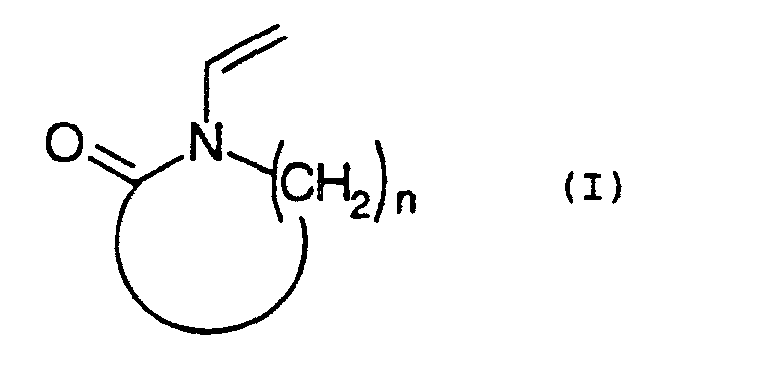
- Suitable compounds of the formula I are, for example, N-vinylpyrrolidone, N-vinyl piperidone and N-vinyl caprolactam.
- N-vinylpyrrolidone N-vinyl piperidone
- N-vinyl caprolactam N-vinyl caprolactam
- the monomers of group (b), which may be used in the preparation the popcorn polymer is used it is are others which are copolymerizable with the monomers of groups (a) and (c) monoethylenically unsaturated compounds.
- monomers of groups (a) and (c) monoethylenically unsaturated compounds include, for example, acrylamide, methacrylamide, acrylic acid, methacrylic acid, Acrylic acid esters, methacrylic acid esters and / or vinyl esters.
- the acrylic acid and methacrylic acid esters are preferably derived of saturated, monohydric alcohols with 1 to 4 carbon atoms or saturated divalent 2 to 4 carbon atoms containing alcohols.
- esters are Acrylic acid methyl ester, methacrylic acid methyl ester, acrylic acid ethyl ester, Methyl methacrylate, n-propyl acrylate, n-propyl methyl acrylate, Isopropyl acrylate, isopropyl methacrylate and the esters of acrylic acid and methacrylic acid, which are derived from the isomeric butanols, and Hydroxyethyl acrylate, hydroxyethyl methacrylate, hydroxypropyl acrylate, Hydroxypropyl methacrylate, hydroxybutyl acrylate, hydroxyisobutyl acrylate and hydroxyisobutyl methacrylate.
- vinyl esters vinyl acetate and vinyl propionate are preferred.
- Other suitable monomers of group (b) are styrene, p-tert-butylstyrene, Acrylonitrile, methacrylonitrile, N-vinylformamide, N-vinyl-N-methylformamide, N-vinyl acetamide, N-vinyl-N-methylacetamide, N-vinyl-N-ethylformamide, N-vinyl-N- (n-propyl) formamide, N-vinyl-N-isopropylformamide, N-vinyl-N-isobutylformamide, N-vinyl-N-methylpropionamide, N-vinyl-n-buty-lacetamide and N-vinyl-N-methylpropionamide, 1-vinylimidazole, 2-methyl-1-vinylimidazole and 4-methyl-1-vinylimidazole.
- the monomers of group (b) can be used alone or as a mixture with each other together with the monomers of groups (a) and (c) be polymerized.
- Popcorn polymerization for example by heating N-vinylpyrrolidone and small amounts, z. B. 0.4 to 1.2% by weight of a crosslinking agent such as N, N'-divinylethyleneurea, started in aqueous medium in the presence of alkali become.
- a crosslinking agent such as N, N'-divinylethyleneurea
- Popcorn polymerization is particularly easy with N-vinylpyrrolidone in the temperature range of about 60 to 150 ° C in the absence of oxygen and polymerization initiators.
- the monomers of group (b) are, provided they are in the preparation the popcorn polymers are used, 0.1 to 99.9 % By weight present in the monomer mixture of (a) and (b).
- crosslinker compounds used that are at least two ethylenically contain unsaturated double bonds in the molecule.
- alkylene bisacrylamides such as methylene bisacrylamide are suitable, for example and N, N'-acryloylethylenediamine, N, N'-divinylethyleneurea, N, N'-divinyl propylene urea, ethylidene bis-3- (nvinyl pyrrolidone), N, N'-divinyl-diimidazolyl (2,2 ') butane and 1,1'bis (3,3'-vinylbenzimidazolyl-2-one) 1,4-butane.
- Crosslinkers are, for example, alkylene glycol di (meth) acrylates such as Ethylene glycol diacrylate, ethylene glycol dimethacrylate, tetraethylene glycol acrylate, Tetraethylene glycol dimethacrylate, diethylene glycol acrylate, Diethylene glycol methacrylate, aromatic divinyl compounds such as divinylbenzene and divinyltoluene and vinyl acrylate, Allyl acrylate, allyl methacrylate, divinyl dioxane, pentaerythritol triallyl ether and mixtures of the crosslinkers.
- the crosslinker in amounts of 0.1 to 10, preferably 1 to 4 wt .-%, based to the monomers (a) and (b) used in the polymerization applied.
- the popcorn polymerization is carried out according to known methods, z. B. as precipitation polymerization or by polymerization in substance.
- a way of working is known at which - as described in EP-B-0 177 812 - is popcorn polymerization by starting a mixture of 99.6 to 98.8% by weight of N-vinylpyrrolidone and 0.4 to 1.2% by weight of at least one two ethylenically unsaturated double bonds Connection as a crosslinker to a temperature in the range from 100 to 150 ° C in the absence of oxygen and polymerization initiators heated.
- This polymerization is preferred due to the presence of small amounts of sodium hydroxide solution or potassium hydroxide solution initiated.
- Popcorn polymer which when added suitable other monomer mixtures, d. H. the monomers of group (a) and optionally (b) and further addition of the monomers (c) the popcorn polymerization of these monomers starts without an induction period and completed, according to the invention for regulation the particle size of the resulting popcorn polymers an inert gas stream preferably in the presented in the polymerization vessel Monomers conducts before the start of popcorn polymerization. With the introduction of the inert gas flow, however, at the latest started during the induction period of the polymerization, wherein the inert gas flow during the entire duration of the popcorn polymerization is passed through the reaction mixture.
- the monomer mixture from (a) and (c) and optionally (b) rendered inert by introducing nitrogen and then to a temperature in the range of 100 to 200, preferably heated to 150 to 180 ° C. It is beneficial even during the polymerization continues a weak stream of nitrogen through the monomers. Exclusion of oxygen will also achieved by polymerizing the batch at a pressure, which is below atmospheric pressure and at which the monomers boil. However, one can take the popcorn polymerization under reduced pressure and simultaneous introduction of an inert gas carry out. Depending on the type of monomers used and the selected Temperature polymerizes the mixture within 1 to 20 hours.
- N-vinyl carboxamides with 2% by weight of N, N'-divinylethylene urea at 150 ° C with stirring with a powerful stirrer and a Pressure of 310 mbar and nitrogen injection after 2.5 hours the first polymer particles, the amount of which slowly increases, until after 10 hours of polymerization, the reaction mixture a powder.
- the popcorn polymer is obtained in yields of over 90% in the form of a powder with an average Particle size of about 10 microns to 5 mm, preferably more than Get 400 ⁇ m to 1000 ⁇ m.
- precipitation polymerization is used to produce the popcorn polymers preferred in water.
- concentration of the monomers is expediently chosen so that the reaction mixture are stirred well over the entire reaction time can. If the concentration of the monomers in water is too high, z. B. at 95 wt .-%, the polymer beads are sticky, so that stirring becomes more difficult than in more dilute aqueous solution.
- monomer concentrations based on the aqueous Mixture from about 5 to 30, preferably 10 to 20 wt .-%. If more powerful agitators are available, the monomer concentration can be changed up to 50% by weight of the aqueous solution, if appropriate can also be increased above. In some cases it may be appropriate to use popcorn polymerization with a relative concentrated solution to begin with and then in the course of the reaction Add water for dilution.
- Popcorn polymerization is preferred at pH values above of 6 carried out to a possible hydrolysis of the monomers to avoid.
- the adjustment of the pH value can be done by Add small amounts of bases such as sodium hydroxide or ammonia or the usual buffer salts such as soda, sodium hydrogen carbonate or sodium phosphate. If necessary, the exclusion of oxygen can be achieved by doing that to be polymerized Mixture heated to boiling and an inert gas stream to regulate the particle size of the popcorn polymers passes through the reaction mixture.
- the particle size of the popcorn polymers is determined by the Amount of inert gas flow regulated by the polymerization solution is directed.
- the reaction mixture becomes little inert gas supplied, this usually results in coarse popcorn polymers, is flowed through the polymerization solution with a lot of inert gas, so finer popcorn polymers are created.
- different Framework conditions such as Boiler size, temperature and Pressure, can not be exact conditions for each individual case for setting a certain particle size for the Popcorn polymers are specified.
- the one for the individual case correct amount of inert gas passed through the reaction mixture can be easily determined by a few simple experiments become. As already stated above, these are due to the Reaction mixture to conductive amounts of inert gas in the area from 0.01 to 100, preferably 0.05 to 30, 1 inert gas / 1 reaction mixture , H.
- Noble gases such as helium, neon or argon can be used as the inert gas become.
- Carbon dioxide is also suitable.
- Nitrogen used.
- reaction mixture for the complete removal of dissolved oxygen Quantities - e.g. 0.1 to 1% by weight, based on the monomer mixture - a reducing agent such as sodium sulfite, sodium pyrosulfite, sodium dithionite, Ascorbic acid or mixtures of the reducing agents, add.
- a reducing agent such as sodium sulfite, sodium pyrosulfite, sodium dithionite, Ascorbic acid or mixtures of the reducing agents, add.
- the polymerization temperature can vary within a wide range be, e.g. B. from about 20 to 200, preferably 50 to 150 ° C.
- the precipitation polymerization becomes a water-soluble comonomer, part of the crosslinker, Water and optionally a buffer and a reducing agent heated in an inert gas stream until the first polymer particles demonstrate. Then - if desired - one beforehand mixture of a mixture inertized by blowing in nitrogen or more of the above comonomers and the rest Crosslinker and optionally water as a diluent within added from 0.2 to 5 hours.
- This way of working has the Advantage that the popcorn polymerization takes only a short time takes.
- the popcorn polymers can be isolated from the aqueous solution cleaned and then - provided the copolymerized monomers contain hydrolyzable groups, e.g. Monomers such as vinyl formamide or methyl methacrylate - are hydrolyzed. It However, it is also possible to use the aqueous suspension of the popcorn polymers hydrolyze directly.
- the popcorn polymers usually fall with a yield from about 90 to> 99% of the theoretical yield. You can from the aqueous suspension by filtration or centrifugation followed by washing with water and drying in the usual way Dryers such as circulating air or vacuum drying cabinets, paddle dryers, Tumble dryer, fluid bed dryer or current dryer be isolated.
- the popcorn polymers are in water and all Solvents are practically insoluble and only swell in them slightly.
- the average particle diameter of the dried Popcorn polymers are usually in the range of 1 ⁇ m up to 10 mm.
- Monomers forming popcorn polymers preferably N-vinylpyrrolidone, N-vinylpiperidone, N-vinylcaprolactam or mixtures thereof used.
- the preferred crosslinker is N, N'-divinylethylene urea.
- Popcorn polymers with an average particle diameter of > 400 ⁇ m to 1500 ⁇ m are used, for example, as beverage clarifiers, Antidiarrheal and as a disintegrant for tablets used:
- the use of popcorn polymers is of particular interest with an average particle diameter of 420 ⁇ m to 1,000 ⁇ m in an amount of 0.5 to 20 wt .-% in washing and Detergent tablets to increase the rate of disintegration the tablets when brought together with water.
- the percentages in the examples mean percent by weight.
- the grain size distribution of the popcorn polymers was determined by sieve analysis certainly.
- the comparative examples show that the particle size of the popcorn polymers not reproducible according to the state of the art was.
- Example 1a was repeated exactly. You determined that Particle size distribution. It is shown in the following table. As can be seen from this, the particle size distribution shows the popcorn polymers compared to example 1a only a slight deviation. The results are opposite the methods of the prior art reproducible.
- Popcorn polymerization started after about 20 Minutes and was completed after about 5 hours. The viscous The suspension was filtered off and washed with water (approx. 2000 ml) to remove impurities such as soluble polymer and residual monomers to remove. The yield of popcorn polymer was 98%.
- Popcorn polymerization started after about 20 minutes and ended after 6 hours. The viscous suspension was then filtered off and washed with water to remove contaminants such as soluble polymer and unpolymerized monomers. The yield of popcorn polymer was 94%.
- Sieve Analysis example Na dithionite [mg] N 2 [1 / h] > 500 [ ⁇ m] 250-500 [ ⁇ m] ⁇ 250 [ ⁇ m] 1 130 6 72.0 13.6 14.4 2 26 18 79.1 15.3 5.6 3 26 6 94.8 13.0 9.2 4 260 18 0 23.3 76.7 5 260 6 82.5 16.3 10.4 6 26 g 350 88.2 10.2 1.6
- a decay time tester from Erweka was used to determine the solubility.
- the tablets were moved in a disintegration test basket with a sieve bottom in a tempered water bath (30 up and down movements per minute with a lifting height of 20 mm). The time was determined after which there was no residue on the sieve bottom. The results are shown in the table.
- composition A (all figures in% by weight) alkylbenzenesulfonate 8th Kalikokosseife 1.2
- Nonionic surfactant 6 (1 mol of C 13 / C 15 fatty alcohol, reacted with 7 mol of ethylene oxide)
- Zeolite A 35 sodium 8th Sodium metasilicate x 5.5 H 2 O 6 sodium citrate 4
- Sodium percarbonate 18
- Other ingredients 2.5 fragments, foam attenuators, enzymes, optical brighteners)
Landscapes
- Chemical & Material Sciences (AREA)
- Health & Medical Sciences (AREA)
- Chemical Kinetics & Catalysis (AREA)
- Medicinal Chemistry (AREA)
- Polymers & Plastics (AREA)
- Organic Chemistry (AREA)
- Addition Polymer Or Copolymer, Post-Treatments, Or Chemical Modifications (AREA)
- Polymerisation Methods In General (AREA)
Description
in Gegenwart von
| Korngröße [µm] | Anteil [%] |
| > 500 | 97,6 |
| 250-500 | 2,4 |
| < 250 | 0 |
| Vergleichsbeispiel | 2 | 3 |
| Korngröße [µm] | Anteil [%] | [%] |
| > 500 | 80,5 | 71,2 |
| 250-500 | 14,9 | 19,5 |
| < 250 | 4,6 | 9,3 |
| Beispiel 1 | a) | b) |
| Korngröße [µm] | Anteil [%] | Anteil [%] |
| > 500 | 72,0 | 74,3 |
| 250-500 | 13,6 | 15,5 |
| < 250 | 14,4 | 10,2 |
| Korngröße [µm] | Anteil [%] |
| > 500 | 79,1 |
| 250-500 | 15,3 |
| < 250 | 5,6 |
| Korngröße [µm] | Anteil [%] |
| > 500 | 94,8 |
| 250-500 | 13,0 |
| < 250 | 9,2 |
| Korngröße [µm] | Anteil [%] |
| > 500 | 0 |
| 250-500 | 23,3 |
| < 250 | 76,7 |
| Korngröße [µm] | Anteil [%] |
| > 500 | 82,6 |
| 250-500 | 16,3 |
| < 250 | 10,4 |
| Siebanalyse | |||||
| Beispiel | Na-dithionit [mg] | N2 [1/h] | >500 [µm] | 250-500 [µm] | <250 [µm] |
| 1 | 130 | 6 | 72,0 | 13,6 | 14,4 |
| 2 | 26 | 18 | 79,1 | 15,3 | 5,6 |
| 3 | 26 | 6 | 94,8 | 13,0 | 9,2 |
| 4 | 260 | 18 | 0 | 23,3 | 76,7 |
| 5 | 260 | 6 | 82,5 | 16,3 | 10,4 |
| 6 | 26 g | 350 | 88,2 | 10,2 | 1,6 |
| Waschmittel der Zusammensetzung A (alle Angaben in Gew.-%) | |
| Alkylbenzolsulfonat | 8 |
| Kalikokosseife | 1,2 |
| Nichtionisches Tensid | 6 (1 Mol C13/C15-Fettalkohol, umgesetzt mit 7 Mol Ethylenoxid) |
| Zeolith A | 35 |
| Natriumcarbonat | 8 |
| Natriummetasilikat x 5,5 H2O | 6 |
| Natriumcitrat | 4 |
| Natriumpercarbonat | 18 |
| Tetraacetylethylendiamin (TAED) | 5 |
| Komplexbildner | 0,3 (Ethylendiamintetramethylenphosphonat) |
| Copolymer Acrylsäure/ Maleinsäure 70:30, Molmasse 70000 | 4 |
| Natriumsulfat | 3 |
| Übrige Bestandteile | 2,5 (Duftstoffe, Schaumdämpfer, Enzyme, opt. Aufheller) |
| Schüttdichte ca. 770 g/l | |
| Teilchengröße ca. 700-1000 µm |

Claims (10)
- Verfahren zur Einstellung der Teilchengröße von Popcornpolymeren während der Popcornpolymerisation, wobei man Popcornpolymerisate bildende Reaktionsmischungen aus monoethylenisch ungesättigten Monomeren und Vernetzer unter Ausschluß von Sauerstoff und Polymerisationsinitiatoren bei Temperaturen bis zu 200°C polymerisiert, dadurch gekennzeichnet, daß man die Popcornpolymerisation als Fällungspolymerisation in Wasser oder in Substanz durchführt und die Teilchengröße der Popcornpolymeren in dem Bereich von 1 µm bis 10 mm durch Einleiten eines Inertgasstroms in die Reaktionsmischung regelt.
- Verfahren nach Anspruch 1, dadurch gekennzeichnet, daß man 0,01 bis 100 1 Inertgas pro Stunde und 1 Reaktionsmischung in die Reaktionsmischung einleitet.
- Verfahren nach Anspruch 1 oder 2, dadurch gekennzeichnet, daß man die Popcornpolymerisation in Gegenwart eines Reduktionsmittels durchführt.
- Verfahren nach Anspruch 3, dadurch gekennzeichnet, daß man mit dem Einleiten des Inertgases in die Reaktionsmischung vor der Zugabe des Reduktionsmittels beginnt.
- verfahren nach einem der Ansprüche 1 bis 4, dadurch gekennzeichnet, daß man als Inertgas Stickstoff verwendet.
- Verfahren nach einem der Ansprüche 1 bis 5, dadurch gekennzeichnet, daß man als Popcornpolymerisate bildende monoethylenisch ungesättigte Monomere N-Vinyllactame einsetzt.
- Verfahren nach einem der Ansprüche 1 bis 6, dadurch gekennzeichnet, daß man als Popcornpolymerisate bildende Monomere N-Vinylpyrrolidon, N-Vinylpiperidon, N-Vinylcaprolactam oder deren Mischungen einsetzt.
- Verfahren nach einem der Ansprüche 1 bis 7, dadurch gekennzeichet, daß man als Vernetzer N,N'-Divinylethylenharnstoff einsetzt.
- Verwendung der nach den Ansprüchen 1 bis 8 erhältlichen Popcornpolymerisate mit einem mittleren Teilchendurchmesser von >400 µm bis 1 500 µm als Getränkeklärungsmittel, Antidiarrhoikum und als Zerfallsbeschleuniger für Tabletten.
- Verwendung nach Anspruch 9, dadurch gekennzeichnet, daß man Popcornpolymerisate mit einem mittleren Teilchendurchmesser von 420 µm bis 1 000 µm in einer Menge von 0,5 bis 20 Gew.-% in Waschmitteltabletten zur Erhöhung der Zerfallsgeschwindigkeit der Tabletten beim Zusammenbringen mit Wasser einsetzt.
Applications Claiming Priority (3)
| Application Number | Priority Date | Filing Date | Title |
|---|---|---|---|
| DE10011137 | 2000-03-10 | ||
| DE10011137A DE10011137A1 (de) | 2000-03-10 | 2000-03-10 | Verfahren zur Einstellung der Teilchengröße von Popcornpolymeren während der Popcornpolymerisation |
| PCT/EP2001/002490 WO2001068727A1 (de) | 2000-03-10 | 2001-03-06 | Verfahren zur einstellung der teilchengrösse von popcornpolymeren während der popcornpolymerisation |
Publications (2)
| Publication Number | Publication Date |
|---|---|
| EP1263813A1 EP1263813A1 (de) | 2002-12-11 |
| EP1263813B1 true EP1263813B1 (de) | 2004-06-02 |
Family
ID=7633872
Family Applications (1)
| Application Number | Title | Priority Date | Filing Date |
|---|---|---|---|
| EP01923637A Expired - Lifetime EP1263813B1 (de) | 2000-03-10 | 2001-03-06 | Verfahren zur einstellung der teilchengrösse von popcornpolymeren während der popcornpolymerisation |
Country Status (6)
| Country | Link |
|---|---|
| US (1) | US6677417B2 (de) |
| EP (1) | EP1263813B1 (de) |
| JP (1) | JP2003526721A (de) |
| AT (1) | ATE268343T1 (de) |
| DE (2) | DE10011137A1 (de) |
| WO (1) | WO2001068727A1 (de) |
Cited By (3)
| Publication number | Priority date | Publication date | Assignee | Title |
|---|---|---|---|---|
| DE202011005055U1 (de) | 2011-04-12 | 2011-09-12 | Basf Se | Peroxidarmes Polymer enthaltend Phosphorverbindung |
| EP2511331A1 (de) | 2011-04-12 | 2012-10-17 | Basf Se | Peroxidarmes Polymer enthaltend Phosphorverbindung |
| DE112012001679B4 (de) | 2011-04-12 | 2023-05-04 | Basf Se | Abgeschlossene, schutzgasgefüllte Verpackungsform, enthaltend ein oxidationsempfindliches, peroxidarmes Polymer, dessen Verwendung und Verfahren zur Stabilisierung von oxidationsempfindlichen Polymeren gegen Peroxidbildung |
Families Citing this family (10)
| Publication number | Priority date | Publication date | Assignee | Title |
|---|---|---|---|---|
| JP2003529636A (ja) * | 2000-03-10 | 2003-10-07 | ビーエーエスエフ アクチェンゲゼルシャフト | コンパクトな粒状洗剤および清浄剤中への崩壊剤としての架橋ポリビニルピロリドンの使用 |
| JP4578714B2 (ja) * | 2001-04-26 | 2010-11-10 | 大阪有機化学工業株式会社 | N−ビニル−2−ピロリドン含有樹脂組成物、その製法およびそれからなる化粧料 |
| DE10342862A1 (de) * | 2003-09-15 | 2005-04-21 | Basf Ag | Verwendung von polyvinylamin- und/oder polyvinylamidhaltigen Polymeren zur Geruchsverhinderung beim maschinellen Geschirrspülen |
| JP5394746B2 (ja) * | 2005-12-21 | 2014-01-22 | ビーエーエスエフ ソシエタス・ヨーロピア | 錠剤崩壊剤としての微粒子状架橋ポリビニルピロリドン |
| KR101903781B1 (ko) * | 2007-06-06 | 2018-11-13 | 바스프 에스이 | 급속 붕해 정제의 제조를 위한 제약 제제 |
| JP2010529071A (ja) * | 2007-06-06 | 2010-08-26 | ビーエーエスエフ ソシエタス・ヨーロピア | 速崩性錠剤製造のための医薬製剤 |
| US8623978B2 (en) * | 2010-11-23 | 2014-01-07 | Basf Se | Process for the preparation of low-peroxide crosslinked vinyllactam polymer |
| EP2643363B1 (de) * | 2010-11-23 | 2017-05-31 | Basf Se | Verfahren zur herstellung von peroxidarmem vernetztem vinyllactam-polymer |
| US9023931B2 (en) | 2011-04-12 | 2015-05-05 | Basf Se | Oxidation-sensitive, low-peroxide polymer comprising at least one inorganic phosphorus compound |
| WO2019219717A1 (de) * | 2018-05-16 | 2019-11-21 | Basf Se | Poly(meth)acrylsäure-popcornpolymerisate als sprengmittel für tabletten |
Family Cites Families (13)
| Publication number | Priority date | Publication date | Assignee | Title |
|---|---|---|---|---|
| US3277066A (en) | 1963-10-23 | 1966-10-04 | Gen Aniline & Film Corp | Methods of polymerizing n-vinyl lactams with a metal oxide or hydroxide and water catalyst |
| DE2059484C3 (de) | 1970-12-03 | 1974-03-07 | Basf Ag, 6700 Ludwigshafen | Verfahren zur Herstellung von unlöslichem, nur wenig quellbarem Poly-N-vinylpyrrolidon^) |
| DE2255263C3 (de) | 1972-11-11 | 1975-06-05 | Basf Ag, 6700 Ludwigshafen | Verfahren zur Herstellung von unlöslichen, vernetzten, nur wenig quellbaren Polymerisaten des N-Vinylpyrrolidon-(2) |
| DE3209224A1 (de) | 1982-03-13 | 1983-09-15 | Basf Ag | Verfahren zur herstellung von unloeslichen, nur wenig quellbaren polymerisaten von basischen vinylheterocyclen und deren verwendung |
| DE3434137A1 (de) * | 1984-09-18 | 1986-03-20 | Basf Ag, 6700 Ludwigshafen | Verfahren zur herstellung von unloeslichen, nur wenig quellbaren pulverfoermigen polymeren |
| DE3434138A1 (de) | 1984-09-18 | 1986-03-27 | Basf Ag, 6700 Ludwigshafen | Verfahren zur herstellung von unloeslichen, nur wenig quellbaren pulverfoermigen polymerisaten |
| US4956430A (en) | 1989-05-01 | 1990-09-11 | Gaf Chemicals Corporation | Process for preparing substantially pure high molecular weight vinyl lactam-quaternized acrylamide copolymers |
| DE69117490T2 (de) | 1991-04-12 | 1996-09-26 | Procter & Gamble | Polyvinylpyrrolidon enthaltendes Kompaktwaschmittel |
| DE4237439A1 (de) | 1992-11-06 | 1994-05-11 | Basf Ag | Unlösliche, nur wenig quellbare Polymerisate mit Aminogruppen, Verfahren zu ihrer Herstellung und ihre Verwendung |
| DE19636883A1 (de) * | 1996-09-11 | 1998-03-12 | Basf Ag | Unlösliche, nur wenig quellbare Polymerisate mit modifizierten Aminogruppen, Verfahren zu ihrer Herstellung und ihre Verwendung |
| DE19920944A1 (de) * | 1999-05-07 | 2000-11-09 | Basf Ag | Styrol-haltige Popcorn-Polymerisate, Verfahren zu deren Herstellung und Verwendung |
| JP2003529636A (ja) * | 2000-03-10 | 2003-10-07 | ビーエーエスエフ アクチェンゲゼルシャフト | コンパクトな粒状洗剤および清浄剤中への崩壊剤としての架橋ポリビニルピロリドンの使用 |
| DE10108386A1 (de) * | 2001-02-21 | 2002-08-29 | Basf Ag | Teilchenförmige Polymerisate als Filterhilfsmittel |
-
2000
- 2000-03-10 DE DE10011137A patent/DE10011137A1/de not_active Withdrawn
-
2001
- 2001-03-06 JP JP2001567218A patent/JP2003526721A/ja not_active Withdrawn
- 2001-03-06 EP EP01923637A patent/EP1263813B1/de not_active Expired - Lifetime
- 2001-03-06 AT AT01923637T patent/ATE268343T1/de not_active IP Right Cessation
- 2001-03-06 DE DE50102469T patent/DE50102469D1/de not_active Expired - Lifetime
- 2001-03-06 US US10/220,278 patent/US6677417B2/en not_active Expired - Lifetime
- 2001-03-06 WO PCT/EP2001/002490 patent/WO2001068727A1/de not_active Ceased
Cited By (3)
| Publication number | Priority date | Publication date | Assignee | Title |
|---|---|---|---|---|
| DE202011005055U1 (de) | 2011-04-12 | 2011-09-12 | Basf Se | Peroxidarmes Polymer enthaltend Phosphorverbindung |
| EP2511331A1 (de) | 2011-04-12 | 2012-10-17 | Basf Se | Peroxidarmes Polymer enthaltend Phosphorverbindung |
| DE112012001679B4 (de) | 2011-04-12 | 2023-05-04 | Basf Se | Abgeschlossene, schutzgasgefüllte Verpackungsform, enthaltend ein oxidationsempfindliches, peroxidarmes Polymer, dessen Verwendung und Verfahren zur Stabilisierung von oxidationsempfindlichen Polymeren gegen Peroxidbildung |
Also Published As
| Publication number | Publication date |
|---|---|
| US6677417B2 (en) | 2004-01-13 |
| ATE268343T1 (de) | 2004-06-15 |
| US20030125491A1 (en) | 2003-07-03 |
| WO2001068727A1 (de) | 2001-09-20 |
| DE50102469D1 (de) | 2004-07-08 |
| JP2003526721A (ja) | 2003-09-09 |
| EP1263813A1 (de) | 2002-12-11 |
| DE10011137A1 (de) | 2001-09-13 |
Similar Documents
| Publication | Publication Date | Title |
|---|---|---|
| DE3878533T2 (de) | Verfahren zur oberflaechenbehandlung eines wasser absorbierenden harzes. | |
| DE2454851C2 (de) | ||
| DE69212025T3 (de) | Reduzierung von Restmonomeren in superabsorbierenden Polymeren | |
| EP0177812B1 (de) | Verfahren zur Herstellung von unlöslichen, nur wenig quellbaren pulverförmigen Polymerisaten | |
| EP0667874B1 (de) | Unlösliche, nur wenig quellbare polymerisate mit aminogruppen, verafhren zu ihrer herstellung und ihre verwendung | |
| DE2255263C3 (de) | Verfahren zur Herstellung von unlöslichen, vernetzten, nur wenig quellbaren Polymerisaten des N-Vinylpyrrolidon-(2) | |
| EP1263814A1 (de) | Verwendung von quervernetztem polyvinylpyrrolidon als sprengmittel in kompakten, teilchenförmigen wasch- und reinigungsmitteln | |
| DE1103027B (de) | Verfahren zur Herstellung praktisch wasserfreier Massen, die in waessrigen Medien glatte Schleime bilden koennen | |
| EP1263813A1 (de) | Verfahren zur einstellung der teilchengrösse von popcornpolymeren während der popcornpolymerisation | |
| DE3209224A1 (de) | Verfahren zur herstellung von unloeslichen, nur wenig quellbaren polymerisaten von basischen vinylheterocyclen und deren verwendung | |
| DE3108100A1 (de) | Verfahren zur herstellung von copolymerisaten des maleinsaeureanhydrids | |
| DE1720484A1 (de) | Verfahren zur Herstellung von Vinylidenfluoridpolymerisaten | |
| EP0205910B1 (de) | Verfahren zur Herstellung von pulverförmigen wasserlöslichen Polymerisaten und deren Verwendung | |
| EP1177226B1 (de) | Styrolhaltige popcorn-polymerisate, verfahren zu deren herstellung und ihre verwendung | |
| DE3434137A1 (de) | Verfahren zur herstellung von unloeslichen, nur wenig quellbaren pulverfoermigen polymeren | |
| CH635849A5 (de) | Verfahren zur homo- oder copolymerisation eines vinylchloridmonomers oder einer mischung eines vinylchloridmonomeren und comonomeren. | |
| EP0289788B1 (de) | Wasserlösliche Copolymerisate, Verfahren zu ihrer Herstellung und ihre Verwendung | |
| DE10108386A1 (de) | Teilchenförmige Polymerisate als Filterhilfsmittel | |
| DE4110360A1 (de) | Verfahren zur herstellung eines poroesen und wasserabsorbierenden polymers | |
| DE4033219A1 (de) | Verfahren zum agglomerieren eines polymerpulvers | |
| EP0925313B1 (de) | Unlösliche, nur wenig quellbare polymerisate mit modifizierten aminogruppen, verfahren zu ihrer herstellung und ihre verwendung | |
| DE2941978A1 (de) | Verfahren zur herstellung von pulverfoermigen polymerisaten | |
| DE2243155B2 (de) | Verfahren zur Herstellug von Acrylamid-Polymerisaten und deren Verwendung als Ausflockmittel | |
| DE2621456A1 (de) | Kationische polymerisate, verfahren zu deren herstellung und deren verwendung als ausflockungsmittel | |
| DE2824313A1 (de) | Verfahren zur herstellung eines wasserloeslichen kationischen polymeren |
Legal Events
| Date | Code | Title | Description |
|---|---|---|---|
| PUAI | Public reference made under article 153(3) epc to a published international application that has entered the european phase |
Free format text: ORIGINAL CODE: 0009012 |
|
| 17P | Request for examination filed |
Effective date: 20020816 |
|
| AK | Designated contracting states |
Kind code of ref document: A1 Designated state(s): AT BE CH CY DE DK ES FI FR GB GR IE IT LI LU MC NL PT SE TR |
|
| GRAP | Despatch of communication of intention to grant a patent |
Free format text: ORIGINAL CODE: EPIDOSNIGR1 |
|
| GRAS | Grant fee paid |
Free format text: ORIGINAL CODE: EPIDOSNIGR3 |
|
| GRAA | (expected) grant |
Free format text: ORIGINAL CODE: 0009210 |
|
| AK | Designated contracting states |
Kind code of ref document: B1 Designated state(s): AT BE CH CY DE DK ES FI FR GB GR IE IT LI LU MC NL PT SE TR |
|
| PG25 | Lapsed in a contracting state [announced via postgrant information from national office to epo] |
Ref country code: NL Free format text: LAPSE BECAUSE OF FAILURE TO SUBMIT A TRANSLATION OF THE DESCRIPTION OR TO PAY THE FEE WITHIN THE PRESCRIBED TIME-LIMIT Effective date: 20040602 Ref country code: IT Free format text: LAPSE BECAUSE OF FAILURE TO SUBMIT A TRANSLATION OF THE DESCRIPTION OR TO PAY THE FEE WITHIN THE PRESCRIBED TIME-LIMIT;WARNING: LAPSES OF ITALIAN PATENTS WITH EFFECTIVE DATE BEFORE 2007 MAY HAVE OCCURRED AT ANY TIME BEFORE 2007. THE CORRECT EFFECTIVE DATE MAY BE DIFFERENT FROM THE ONE RECORDED. Effective date: 20040602 Ref country code: FI Free format text: LAPSE BECAUSE OF FAILURE TO SUBMIT A TRANSLATION OF THE DESCRIPTION OR TO PAY THE FEE WITHIN THE PRESCRIBED TIME-LIMIT Effective date: 20040602 Ref country code: IE Free format text: LAPSE BECAUSE OF FAILURE TO SUBMIT A TRANSLATION OF THE DESCRIPTION OR TO PAY THE FEE WITHIN THE PRESCRIBED TIME-LIMIT Effective date: 20040602 Ref country code: TR Free format text: LAPSE BECAUSE OF FAILURE TO SUBMIT A TRANSLATION OF THE DESCRIPTION OR TO PAY THE FEE WITHIN THE PRESCRIBED TIME-LIMIT Effective date: 20040602 |
|
| REG | Reference to a national code |
Ref country code: GB Ref legal event code: FG4D Free format text: NOT ENGLISH |
|
| REG | Reference to a national code |
Ref country code: CH Ref legal event code: EP |
|
| REF | Corresponds to: |
Ref document number: 50102469 Country of ref document: DE Date of ref document: 20040708 Kind code of ref document: P |
|
| GBT | Gb: translation of ep patent filed (gb section 77(6)(a)/1977) |
Effective date: 20040702 |
|
| REG | Reference to a national code |
Ref country code: IE Ref legal event code: FG4D Free format text: GERMAN |
|
| PG25 | Lapsed in a contracting state [announced via postgrant information from national office to epo] |
Ref country code: GR Free format text: LAPSE BECAUSE OF FAILURE TO SUBMIT A TRANSLATION OF THE DESCRIPTION OR TO PAY THE FEE WITHIN THE PRESCRIBED TIME-LIMIT Effective date: 20040902 Ref country code: DK Free format text: LAPSE BECAUSE OF FAILURE TO SUBMIT A TRANSLATION OF THE DESCRIPTION OR TO PAY THE FEE WITHIN THE PRESCRIBED TIME-LIMIT Effective date: 20040902 Ref country code: SE Free format text: LAPSE BECAUSE OF FAILURE TO SUBMIT A TRANSLATION OF THE DESCRIPTION OR TO PAY THE FEE WITHIN THE PRESCRIBED TIME-LIMIT Effective date: 20040902 |
|
| PG25 | Lapsed in a contracting state [announced via postgrant information from national office to epo] |
Ref country code: ES Free format text: LAPSE BECAUSE OF FAILURE TO SUBMIT A TRANSLATION OF THE DESCRIPTION OR TO PAY THE FEE WITHIN THE PRESCRIBED TIME-LIMIT Effective date: 20040913 |
|
| NLV1 | Nl: lapsed or annulled due to failure to fulfill the requirements of art. 29p and 29m of the patents act | ||
| REG | Reference to a national code |
Ref country code: IE Ref legal event code: FD4D |
|
| PG25 | Lapsed in a contracting state [announced via postgrant information from national office to epo] |
Ref country code: LU Free format text: LAPSE BECAUSE OF NON-PAYMENT OF DUE FEES Effective date: 20050306 Ref country code: CY Free format text: LAPSE BECAUSE OF FAILURE TO SUBMIT A TRANSLATION OF THE DESCRIPTION OR TO PAY THE FEE WITHIN THE PRESCRIBED TIME-LIMIT Effective date: 20050306 Ref country code: AT Free format text: LAPSE BECAUSE OF NON-PAYMENT OF DUE FEES Effective date: 20050306 |
|
| ET | Fr: translation filed | ||
| PG25 | Lapsed in a contracting state [announced via postgrant information from national office to epo] |
Ref country code: MC Free format text: LAPSE BECAUSE OF NON-PAYMENT OF DUE FEES Effective date: 20050331 Ref country code: LI Free format text: LAPSE BECAUSE OF NON-PAYMENT OF DUE FEES Effective date: 20050331 Ref country code: CH Free format text: LAPSE BECAUSE OF NON-PAYMENT OF DUE FEES Effective date: 20050331 |
|
| PLBE | No opposition filed within time limit |
Free format text: ORIGINAL CODE: 0009261 |
|
| STAA | Information on the status of an ep patent application or granted ep patent |
Free format text: STATUS: NO OPPOSITION FILED WITHIN TIME LIMIT |
|
| 26N | No opposition filed |
Effective date: 20050303 |
|
| REG | Reference to a national code |
Ref country code: CH Ref legal event code: PL |
|
| PG25 | Lapsed in a contracting state [announced via postgrant information from national office to epo] |
Ref country code: PT Free format text: LAPSE BECAUSE OF NON-PAYMENT OF DUE FEES Effective date: 20041102 |
|
| PGFP | Annual fee paid to national office [announced via postgrant information from national office to epo] |
Ref country code: GB Payment date: 20080305 Year of fee payment: 8 |
|
| PGFP | Annual fee paid to national office [announced via postgrant information from national office to epo] |
Ref country code: FR Payment date: 20080311 Year of fee payment: 8 |
|
| PGFP | Annual fee paid to national office [announced via postgrant information from national office to epo] |
Ref country code: BE Payment date: 20080522 Year of fee payment: 8 |
|
| BERE | Be: lapsed |
Owner name: *BASF A.G. Effective date: 20090331 |
|
| GBPC | Gb: european patent ceased through non-payment of renewal fee |
Effective date: 20090306 |
|
| REG | Reference to a national code |
Ref country code: FR Ref legal event code: ST Effective date: 20091130 |
|
| PG25 | Lapsed in a contracting state [announced via postgrant information from national office to epo] |
Ref country code: BE Free format text: LAPSE BECAUSE OF NON-PAYMENT OF DUE FEES Effective date: 20090331 |
|
| PG25 | Lapsed in a contracting state [announced via postgrant information from national office to epo] |
Ref country code: FR Free format text: LAPSE BECAUSE OF NON-PAYMENT OF DUE FEES Effective date: 20091123 Ref country code: GB Free format text: LAPSE BECAUSE OF NON-PAYMENT OF DUE FEES Effective date: 20090306 |
|
| PGFP | Annual fee paid to national office [announced via postgrant information from national office to epo] |
Ref country code: DE Payment date: 20200528 Year of fee payment: 20 |
|
| REG | Reference to a national code |
Ref country code: DE Ref legal event code: R071 Ref document number: 50102469 Country of ref document: DE |