EP1265936B1 - Materiaux superabsorbants a base caoutchouc butyle et utilisation - Google Patents
Materiaux superabsorbants a base caoutchouc butyle et utilisation Download PDFInfo
- Publication number
- EP1265936B1 EP1265936B1 EP99968008A EP99968008A EP1265936B1 EP 1265936 B1 EP1265936 B1 EP 1265936B1 EP 99968008 A EP99968008 A EP 99968008A EP 99968008 A EP99968008 A EP 99968008A EP 1265936 B1 EP1265936 B1 EP 1265936B1
- Authority
- EP
- European Patent Office
- Prior art keywords
- butyl rubber
- superabsorbent materials
- solution
- crosslinking
- process according
- Prior art date
- Legal status (The legal status is an assumption and is not a legal conclusion. Google has not performed a legal analysis and makes no representation as to the accuracy of the status listed.)
- Expired - Lifetime
Links
- 229920005549 butyl rubber Polymers 0.000 title claims abstract description 66
- 238000000034 method Methods 0.000 title claims abstract description 33
- 239000000463 material Substances 0.000 title claims abstract description 27
- 238000004132 cross linking Methods 0.000 claims abstract description 36
- 239000011324 bead Substances 0.000 claims abstract description 24
- 230000008961 swelling Effects 0.000 claims abstract description 23
- 239000003960 organic solvent Substances 0.000 claims abstract description 12
- 239000000725 suspension Substances 0.000 claims abstract description 10
- XLYOFNOQVPJJNP-UHFFFAOYSA-N water Substances O XLYOFNOQVPJJNP-UHFFFAOYSA-N 0.000 claims abstract description 8
- 238000004519 manufacturing process Methods 0.000 claims abstract description 7
- 239000002351 wastewater Substances 0.000 claims abstract description 3
- YXFVVABEGXRONW-UHFFFAOYSA-N Toluene Chemical compound CC1=CC=CC=C1 YXFVVABEGXRONW-UHFFFAOYSA-N 0.000 claims description 87
- 239000000499 gel Substances 0.000 claims description 64
- PXJJSXABGXMUSU-UHFFFAOYSA-N disulfur dichloride Chemical compound ClSSCl PXJJSXABGXMUSU-UHFFFAOYSA-N 0.000 claims description 35
- 239000000243 solution Substances 0.000 claims description 30
- 229920000642 polymer Polymers 0.000 claims description 12
- 238000003756 stirring Methods 0.000 claims description 12
- UHOVQNZJYSORNB-UHFFFAOYSA-N Benzene Chemical compound C1=CC=CC=C1 UHOVQNZJYSORNB-UHFFFAOYSA-N 0.000 claims description 9
- 239000012299 nitrogen atmosphere Substances 0.000 claims description 7
- 239000002904 solvent Substances 0.000 claims description 7
- HEDRZPFGACZZDS-UHFFFAOYSA-N Chloroform Chemical compound ClC(Cl)Cl HEDRZPFGACZZDS-UHFFFAOYSA-N 0.000 claims description 6
- FAPWRFPIFSIZLT-UHFFFAOYSA-M Sodium chloride Chemical compound [Na+].[Cl-] FAPWRFPIFSIZLT-UHFFFAOYSA-M 0.000 claims description 6
- 239000000654 additive Substances 0.000 claims description 6
- 239000007864 aqueous solution Substances 0.000 claims description 6
- 239000012528 membrane Substances 0.000 claims description 6
- VZGDMQKNWNREIO-UHFFFAOYSA-N tetrachloromethane Chemical compound ClC(Cl)(Cl)Cl VZGDMQKNWNREIO-UHFFFAOYSA-N 0.000 claims description 6
- WCUXLLCKKVVCTQ-UHFFFAOYSA-M Potassium chloride Chemical compound [Cl-].[K+] WCUXLLCKKVVCTQ-UHFFFAOYSA-M 0.000 claims description 4
- 239000012456 homogeneous solution Substances 0.000 claims description 4
- XDTMQSROBMDMFD-UHFFFAOYSA-N Cyclohexane Chemical compound C1CCCCC1 XDTMQSROBMDMFD-UHFFFAOYSA-N 0.000 claims description 3
- CTQNGGLPUBDAKN-UHFFFAOYSA-N O-Xylene Chemical compound CC1=CC=CC=C1C CTQNGGLPUBDAKN-UHFFFAOYSA-N 0.000 claims description 3
- 229920000159 gelatin Polymers 0.000 claims description 3
- 235000019322 gelatine Nutrition 0.000 claims description 3
- 239000011780 sodium chloride Substances 0.000 claims description 3
- 238000004065 wastewater treatment Methods 0.000 claims description 3
- 239000008096 xylene Substances 0.000 claims description 3
- 108010010803 Gelatin Proteins 0.000 claims description 2
- WHNWPMSKXPGLAX-UHFFFAOYSA-N N-Vinyl-2-pyrrolidone Chemical compound C=CN1CCCC1=O WHNWPMSKXPGLAX-UHFFFAOYSA-N 0.000 claims description 2
- 229910019142 PO4 Inorganic materials 0.000 claims description 2
- 229920002125 Sokalan® Polymers 0.000 claims description 2
- 229920002472 Starch Polymers 0.000 claims description 2
- 239000007900 aqueous suspension Substances 0.000 claims description 2
- 150000004649 carbonic acid derivatives Chemical class 0.000 claims description 2
- 239000000446 fuel Substances 0.000 claims description 2
- 239000008273 gelatin Substances 0.000 claims description 2
- 235000011852 gelatine desserts Nutrition 0.000 claims description 2
- 235000021317 phosphate Nutrition 0.000 claims description 2
- 150000003013 phosphoric acid derivatives Chemical class 0.000 claims description 2
- 229920002451 polyvinyl alcohol Polymers 0.000 claims description 2
- 235000011164 potassium chloride Nutrition 0.000 claims description 2
- 239000001103 potassium chloride Substances 0.000 claims description 2
- 150000003839 salts Chemical class 0.000 claims description 2
- 150000004760 silicates Chemical class 0.000 claims description 2
- 235000019698 starch Nutrition 0.000 claims description 2
- 239000008107 starch Substances 0.000 claims description 2
- 229920001600 hydrophobic polymer Polymers 0.000 claims 1
- 230000002209 hydrophobic effect Effects 0.000 abstract description 5
- 229920005597 polymer membrane Polymers 0.000 abstract 1
- 238000006243 chemical reaction Methods 0.000 description 13
- 230000015572 biosynthetic process Effects 0.000 description 11
- 238000002360 preparation method Methods 0.000 description 11
- 238000003786 synthesis reaction Methods 0.000 description 9
- IJGRMHOSHXDMSA-UHFFFAOYSA-N Atomic nitrogen Chemical compound N#N IJGRMHOSHXDMSA-UHFFFAOYSA-N 0.000 description 8
- 239000003431 cross linking reagent Substances 0.000 description 5
- 239000011521 glass Substances 0.000 description 5
- CSCPPACGZOOCGX-UHFFFAOYSA-N Acetone Chemical compound CC(C)=O CSCPPACGZOOCGX-UHFFFAOYSA-N 0.000 description 4
- 239000007788 liquid Substances 0.000 description 4
- 229910052757 nitrogen Inorganic materials 0.000 description 4
- 238000004073 vulcanization Methods 0.000 description 4
- NINIDFKCEFEMDL-UHFFFAOYSA-N Sulfur Chemical compound [S] NINIDFKCEFEMDL-UHFFFAOYSA-N 0.000 description 3
- 230000007423 decrease Effects 0.000 description 3
- 230000035484 reaction time Effects 0.000 description 3
- 239000007787 solid Substances 0.000 description 3
- RRHGJUQNOFWUDK-UHFFFAOYSA-N Isoprene Chemical group CC(=C)C=C RRHGJUQNOFWUDK-UHFFFAOYSA-N 0.000 description 2
- 230000005587 bubbling Effects 0.000 description 2
- 238000012668 chain scission Methods 0.000 description 2
- 238000002474 experimental method Methods 0.000 description 2
- 238000007654 immersion Methods 0.000 description 2
- 238000005259 measurement Methods 0.000 description 2
- 150000002978 peroxides Chemical class 0.000 description 2
- 239000012071 phase Substances 0.000 description 2
- 229910052717 sulfur Inorganic materials 0.000 description 2
- 239000011593 sulfur Substances 0.000 description 2
- FWMUJAIKEJWSSY-UHFFFAOYSA-N sulfur dichloride Chemical group ClSCl FWMUJAIKEJWSSY-UHFFFAOYSA-N 0.000 description 2
- 125000000391 vinyl group Chemical group [H]C([*])=C([H])[H] 0.000 description 2
- OMPJBNCRMGITSC-UHFFFAOYSA-N Benzoylperoxide Chemical compound C=1C=CC=CC=1C(=O)OOC(=O)C1=CC=CC=C1 OMPJBNCRMGITSC-UHFFFAOYSA-N 0.000 description 1
- KZBUYRJDOAKODT-UHFFFAOYSA-N Chlorine Chemical compound ClCl KZBUYRJDOAKODT-UHFFFAOYSA-N 0.000 description 1
- 102000004190 Enzymes Human genes 0.000 description 1
- 108090000790 Enzymes Proteins 0.000 description 1
- 239000001828 Gelatine Substances 0.000 description 1
- 244000043261 Hevea brasiliensis Species 0.000 description 1
- VQTUBCCKSQIDNK-UHFFFAOYSA-N Isobutene Chemical group CC(C)=C VQTUBCCKSQIDNK-UHFFFAOYSA-N 0.000 description 1
- 239000004698 Polyethylene Substances 0.000 description 1
- 229920002367 Polyisobutene Polymers 0.000 description 1
- 239000004793 Polystyrene Substances 0.000 description 1
- BUGBHKTXTAQXES-UHFFFAOYSA-N Selenium Chemical compound [Se] BUGBHKTXTAQXES-UHFFFAOYSA-N 0.000 description 1
- 239000002250 absorbent Substances 0.000 description 1
- 230000002745 absorbent Effects 0.000 description 1
- 238000013459 approach Methods 0.000 description 1
- 239000008346 aqueous phase Substances 0.000 description 1
- 239000000440 bentonite Substances 0.000 description 1
- 229910000278 bentonite Inorganic materials 0.000 description 1
- SVPXDRXYRYOSEX-UHFFFAOYSA-N bentoquatam Chemical compound O.O=[Si]=O.O=[Al]O[Al]=O SVPXDRXYRYOSEX-UHFFFAOYSA-N 0.000 description 1
- 235000019400 benzoyl peroxide Nutrition 0.000 description 1
- 125000000484 butyl group Chemical group [H]C([*])([H])C([H])([H])C([H])([H])C([H])([H])[H] 0.000 description 1
- 239000000969 carrier Substances 0.000 description 1
- 238000006555 catalytic reaction Methods 0.000 description 1
- 238000003889 chemical engineering Methods 0.000 description 1
- 239000003795 chemical substances by application Substances 0.000 description 1
- 239000000084 colloidal system Substances 0.000 description 1
- 150000001875 compounds Chemical class 0.000 description 1
- 229920006037 cross link polymer Polymers 0.000 description 1
- 239000011243 crosslinked material Substances 0.000 description 1
- NGDNCZPCIZNCQS-UHFFFAOYSA-N ctk3j8699 Chemical class Cl=S NGDNCZPCIZNCQS-UHFFFAOYSA-N 0.000 description 1
- 238000011161 development Methods 0.000 description 1
- 230000018109 developmental process Effects 0.000 description 1
- 238000001035 drying Methods 0.000 description 1
- 238000000605 extraction Methods 0.000 description 1
- 239000000017 hydrogel Substances 0.000 description 1
- 239000003999 initiator Substances 0.000 description 1
- 238000009413 insulation Methods 0.000 description 1
- 239000003456 ion exchange resin Substances 0.000 description 1
- 229920003303 ion-exchange polymer Polymers 0.000 description 1
- 229920003052 natural elastomer Polymers 0.000 description 1
- 229920001194 natural rubber Polymers 0.000 description 1
- 150000002832 nitroso derivatives Chemical class 0.000 description 1
- 238000000879 optical micrograph Methods 0.000 description 1
- 210000000056 organ Anatomy 0.000 description 1
- 239000002245 particle Substances 0.000 description 1
- 229920001568 phenolic resin Polymers 0.000 description 1
- 239000005011 phenolic resin Substances 0.000 description 1
- 239000001007 phthalocyanine dye Substances 0.000 description 1
- -1 polyethylene Polymers 0.000 description 1
- 229920000573 polyethylene Polymers 0.000 description 1
- 238000006116 polymerization reaction Methods 0.000 description 1
- 229920002223 polystyrene Polymers 0.000 description 1
- 230000001376 precipitating effect Effects 0.000 description 1
- 238000001243 protein synthesis Methods 0.000 description 1
- 230000008929 regeneration Effects 0.000 description 1
- 238000011069 regeneration method Methods 0.000 description 1
- 239000011347 resin Substances 0.000 description 1
- 229920005989 resin Polymers 0.000 description 1
- 238000012552 review Methods 0.000 description 1
- CQRYARSYNCAZFO-UHFFFAOYSA-N salicyl alcohol Chemical compound OCC1=CC=CC=C1O CQRYARSYNCAZFO-UHFFFAOYSA-N 0.000 description 1
- 229910052711 selenium Inorganic materials 0.000 description 1
- 239000011669 selenium Substances 0.000 description 1
- 238000000926 separation method Methods 0.000 description 1
- 238000001542 size-exclusion chromatography Methods 0.000 description 1
- 239000002689 soil Substances 0.000 description 1
- 239000007858 starting material Substances 0.000 description 1
- 239000000126 substance Substances 0.000 description 1
- 229910052714 tellurium Inorganic materials 0.000 description 1
- PORWMNRCUJJQNO-UHFFFAOYSA-N tellurium atom Chemical compound [Te] PORWMNRCUJJQNO-UHFFFAOYSA-N 0.000 description 1
- 238000012360 testing method Methods 0.000 description 1
- 230000014616 translation Effects 0.000 description 1
- 239000003643 water by type Substances 0.000 description 1
Images




Classifications
-
- B—PERFORMING OPERATIONS; TRANSPORTING
- B01—PHYSICAL OR CHEMICAL PROCESSES OR APPARATUS IN GENERAL
- B01J—CHEMICAL OR PHYSICAL PROCESSES, e.g. CATALYSIS OR COLLOID CHEMISTRY; THEIR RELEVANT APPARATUS
- B01J20/00—Solid sorbent compositions or filter aid compositions; Sorbents for chromatography; Processes for preparing, regenerating or reactivating thereof
- B01J20/22—Solid sorbent compositions or filter aid compositions; Sorbents for chromatography; Processes for preparing, regenerating or reactivating thereof comprising organic material
- B01J20/26—Synthetic macromolecular compounds
-
- B—PERFORMING OPERATIONS; TRANSPORTING
- B01—PHYSICAL OR CHEMICAL PROCESSES OR APPARATUS IN GENERAL
- B01J—CHEMICAL OR PHYSICAL PROCESSES, e.g. CATALYSIS OR COLLOID CHEMISTRY; THEIR RELEVANT APPARATUS
- B01J20/00—Solid sorbent compositions or filter aid compositions; Sorbents for chromatography; Processes for preparing, regenerating or reactivating thereof
- B01J20/22—Solid sorbent compositions or filter aid compositions; Sorbents for chromatography; Processes for preparing, regenerating or reactivating thereof comprising organic material
- B01J20/26—Synthetic macromolecular compounds
- B01J20/261—Synthetic macromolecular compounds obtained by reactions only involving carbon to carbon unsaturated bonds
-
- B—PERFORMING OPERATIONS; TRANSPORTING
- B01—PHYSICAL OR CHEMICAL PROCESSES OR APPARATUS IN GENERAL
- B01J—CHEMICAL OR PHYSICAL PROCESSES, e.g. CATALYSIS OR COLLOID CHEMISTRY; THEIR RELEVANT APPARATUS
- B01J20/00—Solid sorbent compositions or filter aid compositions; Sorbents for chromatography; Processes for preparing, regenerating or reactivating thereof
- B01J20/28—Solid sorbent compositions or filter aid compositions; Sorbents for chromatography; Processes for preparing, regenerating or reactivating thereof characterised by their form or physical properties
- B01J20/28014—Solid sorbent compositions or filter aid compositions; Sorbents for chromatography; Processes for preparing, regenerating or reactivating thereof characterised by their form or physical properties characterised by their form
- B01J20/28033—Membrane, sheet, cloth, pad, lamellar or mat
-
- C—CHEMISTRY; METALLURGY
- C02—TREATMENT OF WATER, WASTE WATER, SEWAGE, OR SLUDGE
- C02F—TREATMENT OF WATER, WASTE WATER, SEWAGE, OR SLUDGE
- C02F1/00—Treatment of water, waste water, or sewage
- C02F1/28—Treatment of water, waste water, or sewage by sorption
- C02F1/285—Treatment of water, waste water, or sewage by sorption using synthetic organic sorbents
-
- C—CHEMISTRY; METALLURGY
- C08—ORGANIC MACROMOLECULAR COMPOUNDS; THEIR PREPARATION OR CHEMICAL WORKING-UP; COMPOSITIONS BASED THEREON
- C08F—MACROMOLECULAR COMPOUNDS OBTAINED BY REACTIONS ONLY INVOLVING CARBON-TO-CARBON UNSATURATED BONDS
- C08F8/00—Chemical modification by after-treatment
-
- C—CHEMISTRY; METALLURGY
- C08—ORGANIC MACROMOLECULAR COMPOUNDS; THEIR PREPARATION OR CHEMICAL WORKING-UP; COMPOSITIONS BASED THEREON
- C08J—WORKING-UP; GENERAL PROCESSES OF COMPOUNDING; AFTER-TREATMENT NOT COVERED BY SUBCLASSES C08B, C08C, C08F, C08G or C08H
- C08J3/00—Processes of treating or compounding macromolecular substances
- C08J3/02—Making solutions, dispersions, lattices or gels by other methods than by solution, emulsion or suspension polymerisation techniques
- C08J3/03—Making solutions, dispersions, lattices or gels by other methods than by solution, emulsion or suspension polymerisation techniques in aqueous media
- C08J3/07—Making solutions, dispersions, lattices or gels by other methods than by solution, emulsion or suspension polymerisation techniques in aqueous media from polymer solutions
-
- C—CHEMISTRY; METALLURGY
- C08—ORGANIC MACROMOLECULAR COMPOUNDS; THEIR PREPARATION OR CHEMICAL WORKING-UP; COMPOSITIONS BASED THEREON
- C08J—WORKING-UP; GENERAL PROCESSES OF COMPOUNDING; AFTER-TREATMENT NOT COVERED BY SUBCLASSES C08B, C08C, C08F, C08G or C08H
- C08J3/00—Processes of treating or compounding macromolecular substances
- C08J3/24—Crosslinking, e.g. vulcanising, of macromolecules
- C08J3/26—Crosslinking, e.g. vulcanising, of macromolecules of latex
-
- C—CHEMISTRY; METALLURGY
- C02—TREATMENT OF WATER, WASTE WATER, SEWAGE, OR SLUDGE
- C02F—TREATMENT OF WATER, WASTE WATER, SEWAGE, OR SLUDGE
- C02F1/00—Treatment of water, waste water, or sewage
- C02F1/68—Treatment of water, waste water, or sewage by addition of specified substances, e.g. trace elements, for ameliorating potable water
- C02F1/681—Treatment of water, waste water, or sewage by addition of specified substances, e.g. trace elements, for ameliorating potable water by addition of solid materials for removing an oily layer on water
-
- C—CHEMISTRY; METALLURGY
- C02—TREATMENT OF WATER, WASTE WATER, SEWAGE, OR SLUDGE
- C02F—TREATMENT OF WATER, WASTE WATER, SEWAGE, OR SLUDGE
- C02F2101/00—Nature of the contaminant
- C02F2101/30—Organic compounds
- C02F2101/32—Hydrocarbons, e.g. oil
-
- C—CHEMISTRY; METALLURGY
- C08—ORGANIC MACROMOLECULAR COMPOUNDS; THEIR PREPARATION OR CHEMICAL WORKING-UP; COMPOSITIONS BASED THEREON
- C08J—WORKING-UP; GENERAL PROCESSES OF COMPOUNDING; AFTER-TREATMENT NOT COVERED BY SUBCLASSES C08B, C08C, C08F, C08G or C08H
- C08J2323/00—Characterised by the use of homopolymers or copolymers of unsaturated aliphatic hydrocarbons having only one carbon-to-carbon double bond; Derivatives of such polymers
- C08J2323/02—Characterised by the use of homopolymers or copolymers of unsaturated aliphatic hydrocarbons having only one carbon-to-carbon double bond; Derivatives of such polymers not modified by chemical after treatment
- C08J2323/18—Homopolymers or copolymers of hydrocarbons having four or more carbon atoms
- C08J2323/20—Homopolymers or copolymers of hydrocarbons having four or more carbon atoms having four to nine carbon atoms
- C08J2323/22—Copolymers of isobutene; butyl rubber
Definitions
- the present invention relates to superabsorbent materials in the form of polymer gels based on butyl rubber, to solution and suspension crosslinking processes for the production of said superabsorbent materials and to the use of said superabsorbent materials.
- butyl rubber which is commercially available since 1943, consists of poly(isobutylene) chains containing small amounts (about 0.5 to 3 mol %) isoprene units.
- the structure of butyl rubber may be represented as follows, where n is a number between 30 to 200:
- butyl rubber Due to the low degree of unsaturation in butyl rubber, its vulcanization (crosslinking) requires much powerful accelerators than the natural rubber. Butyl rubber cannot be vulcanized with peroxides due to the chain scission reactions. For the preparation of heat resistant compounds, e.g., in cable insulation stocks, its vulcanization is carried out using dioximes. For exceptional heat resistant applications such as in tires, phenolic resins are used as the vulcanization agent. In general, butyl rubber can be vulcanized by three methods:
- Polymeric gels consist of crosslinked long chain molecules immersed in a liquid medium. They play an important role in our lives and are nearly everywhere on earth. They are widely used for example as starting materials for ion-exchange resins, as absorbents in waste water treatment, as support carriers for immobilization of enzymes and cells in biotechnology and bioengineering as well as in the solid-state protein synthesis, as artificial organs, as catalysis in chemical engineering, as artificial snow, as artificial soils in agricultural engineering.
- hydrogels Although extensive works have been made in recent years on the synthesis of hydrophilic gels called hydrogels, little has been heard on their hydrophobic parents such as those based on butyl rubber. Moreover, preparation of polymeric gels based on butyl rubber by a solution crosslinking process has not been reported before.
- butyl rubber can easily be crosslinked in an organic solution using sulfur monochloride as a crosslinking agent and that, depending on the amounts of sulfur monochloride and butyl rubber in the crosslinking solution, hydrophobic gels with different swelling capacities can be synthesized.
- the gels thus obtained can be used in a variety of applications such as in oil separating processes from aqueous solutions.
- the gel For an economic oil extraction process, the gel must absorb large amounts of oil from aqueous solutions.
- the gel must be in the form of small particles for an effective oil separation - regeneration process and above all it should not sink in water.
- the present invention brings a solution to these problems.
- the present invention relates to superabsorbent materials in the form of polymer gels based on butyl rubber. These materials are hydrophobic, float on water and have a swelling capacity up to 100 g of organic solvent per gram of dry material and they are in the form of membranes, rods or beads. When they are in the form of mono-disperse, spherical gel beads they are in the size range of 0.1 to 2 mm in diameter.
- the present invention relates also to suspension crosslinking process for the production of the above superabsorbent materials.
- a homogeneous solution of butyl rubber in an organic solvent is prepared under nitrogen atmosphere; Then sulfur monochloride is added into the polymer solution.
- This solution is added by stirring into an aqueous solution, optionally containing additives, to obtain an oil-in-water suspension.
- the discontinuous oil phase is crosslinked at constant stirring rate and spherical gel beads are obtained.
- the present invention also relates to a solution crosslinking process for the production of superabsorbent materials.
- a homogeneous solution of butyl rubber in an organic solvent under nitrogen atmosphere is prepared.
- the crosslinking agent sulfur monochloride sulfur monochloride, polymer gels in the form of rods or membranes are obtained.
- the crosslinking is advantageously carried out at room temperature.
- the butyl rubber concentration is with respect to the organic solvent at most 11w/v %, preferably between 3.5 and 10w/v %, especially 5w/v % and the sulfur monochloride concentration is with respect to butyl rubber between 0.6 and 80%, preferably between 0,6 and 5.0% and especially between 0,6 and 1.0.
- the stirring rate is at least 100 rpm, preferably between 200 and 700 rpm and especially 300 rpm.
- the organic solvent used is a solvent with a solubility parameter close to that of butyl rubber, like chloroform, benzene, toluene, xylene, carbon tetrachloride and cyclohexane.
- the aqueous solution contains one or more additives chosen from the group consisting of
- the present invention also relates to the use of the above superabsorbent materials for treatment of oil containing wastewater and to the use of the superabsorbent materials coming from a wastewater treatment as a fuel.
- sulfur monochloride is an effective crosslinking agent for butyl rubber in organic solutions.
- the crosslinking agent sulfur monochloride, S 2 Cl 2 is a liquid at room temperature and soluble in the organic solvents.
- butyl rubber poly (isobutylene-co-isoprene)
- the main component in the gel synthesis is butyl rubber (purchased from Exxon Chem. Co.)
- the butyl rubber samples Butyl 268 used in this invention contained 1.5 to 1.8mol % isoprene units,.
- the weight-average molecular weight and the polydispersity index of the butyl rubber samples were 3.9x10 5 g/mol and 2.5, respectively, as determined by size exclusion chromatography with polystyrene standards (Waters, Model M - 6000A).
- sulfur monochloride was purchased from Aldrich Co. Some of the butyl rubber gel samples were prepared with sulfur monochloride synthesized from sulfur and dry chlorine gas at 50 - 80°C according to a method described by Feher (F. Feher, "Sulfur, selenium, tellurium", in Handbook of Preparative Inorganic Chemistry, Ed. G. Brauer, Vol. 1, 2 nd Ed., Academic Press, NY, 1963, p. 341). The purities of both Aldrich and home made sulfur monochlorides were higher than 98 %.
- the crosslinking process of butyl rubber can be conducted by either solution or suspension crosslinking techniques.
- solution crosslinking butyl rubber is first dissolved in an organic solvent at room temperature.
- the polymer concentration may vary between 4 and 10 w/v %.
- sulfur monochloride is added into the polymer solution.
- the crosslinking reactions proceed at room temperature and result in the formation of soft gels.
- the solution crosslinking reactions can be carried out in glass tubes or, between glass plates in order to obtain butyl rubber gels in the form of rods or membranes, respectively.
- suspension crosslinking technique an organic solution of butyl rubber containing sulfur monochloride is suspended in an aqueous phase containing additives to form a suspension of droplets and crosslinked therein at room temperature to give products in bead form having a controlled size.
- the suspension crosslinking reaction is carried out under nitrogen atmosphere in reactors, fitted with a mechanical stirrer, nitrogen inlet, and outlet.
- the amount and the type of the additives as well as the stirring speed during the crosslinking process are varied depending on the required size of the beads.
- the gels After the preparation of the gels, they are left in an excess of toluene for at least two weeks. During this period, the post crosslinking reactions take place by the attack of pendant sulfur chloride groups to the internal vinyl groups on butyl rubber. After this period, the amount of uncrosslinked polymer, i.e., the sol fraction is less than 2% indicating the high crosslinking efficiency of sulfur monochloride.
- the swelling capacity of the gels in the form of rods and membranes was measured in toluene by the gravimetric technique.
- the gel samples equilibrium swollen in toluene were weighed on an electronic balance (Sartorius BA 310 S).
- the weight swelling ratio q w was calculated as where m and m 0 are the masses of the equilibrium swollen gel in toluene and the gel after synthesis, respectively, and q F is the degree of swelling of the gel after preparation.
- the swelling capacity of the gel beads was measured by the volumetric technique.
- the diameters of the beads after synthesis (D 0 ) and after equilibrium swelling in toluene (D) were measured using an image analyzing system consisting of a stereo microscope (Olympus Stereomicroscope SZ), a video camera (TK 1381 EG) and Pentium 2 PC with a data analyzing software (BS-200 BAB).
- One gram of the gel produced in this invention absorbs up to about 100 g of toluene, whereas this value can be adjusted by changing the sulfur monochloride or butyl rubber concentrations used in the gel preparation.
- butyl rubber samples were purified by dissolving in toluene and then precipitating into an excess of acetone at room temperature.
- weight volume ratios are given with respect to butyl rubber.
- the gels formed are cut into specimens of approximately 10 mm in length and immersed in excess toluene at room temperature for two weeks.
- Figure 2 shows the swelling capacities of the gels plotted as a function of the sulfur monochloride (S 2 Cl 2 ) concentration used in the gel preparation.
- Initial butyl rubber concentration 5w/v %.
- the data points are average of at least 6 separate experiments.
- the error bars show the standard deviations.
- the beads After polymerization, the beads are separated from the water phase and washed several times, namely first with water, then with acetone and finally with toluene, always in excess amount. Then the beads are left in excess toluene for two weeks, toluene is refreshed every two days. The beads are then dried at 50°C in vacuum until constant weight. After synthesis, more than 80% of the beads are between 0.25 to 0.4 mm.
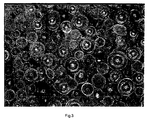
- FIG. 3 An optical micrograph of the beads taken respectively after their preparation in water and after swelling in toluene are shown in Figures 3 and 4.
- the beads In order to make the beads visible under microscope, the beads have been colored with a phthalocyanine dye.
- Figure 5 shows the beads of sizes 1 to 2 mm in a dried state obtained at 300 rpm stirring speed.
- the gel beads obtained at different initial butyl rubber and sulfur monochloride concentrations exhibit swelling capacities comparable to those obtained by solution crosslinking experiments (See Table 1 and Figure 2).
Landscapes
- Chemical & Material Sciences (AREA)
- Organic Chemistry (AREA)
- Chemical Kinetics & Catalysis (AREA)
- Health & Medical Sciences (AREA)
- Analytical Chemistry (AREA)
- Polymers & Plastics (AREA)
- Medicinal Chemistry (AREA)
- Hydrology & Water Resources (AREA)
- General Chemical & Material Sciences (AREA)
- Environmental & Geological Engineering (AREA)
- Engineering & Computer Science (AREA)
- Life Sciences & Earth Sciences (AREA)
- Dispersion Chemistry (AREA)
- Water Supply & Treatment (AREA)
- Processes Of Treating Macromolecular Substances (AREA)
- Compositions Of Macromolecular Compounds (AREA)
- Solid-Sorbent Or Filter-Aiding Compositions (AREA)
- Addition Polymer Or Copolymer, Post-Treatments, Or Chemical Modifications (AREA)
- Water Treatment By Sorption (AREA)
- Manufacture Of Macromolecular Shaped Articles (AREA)
- Removal Of Floating Material (AREA)
- Processing And Handling Of Plastics And Other Materials For Molding In General (AREA)
Claims (13)
- Matériaux superabsorbants sous la forme de gels de polymères hydrophobes qui flottent sur l'eau, caractérisés en ce qu'ils sont à base de caoutchouc butyle et ont une capacité de gonflement jusqu'à 100 grammes d'un solvant organique approprié par gramme de matériau sec.
- Matériaux superabsorbants selon la revendication 1, caractérisés en ce qu'ils se présentent sous la forme de membranes, de tiges ou de billes.
- Matériaux superabsorbants selon la revendication 1, caractérisés en ce qu'ils se présentent sous la forme de billes de gel sphériques monodispersées dans la plage de tailles de 0,1 à 2 mm de diamètre.
- Procédé de réticulation en suspension pour la production de matériaux superabsorbants selon l'une quelconque des revendication 1 à 3, caractérisé en ce qu'une solution homogène de caoutchouc butyle dans un solvant organique est préparée sous atmosphère d'azote, puis on ajoute du monochlorure de soufre dans la solution de polymère, cette solution est ajoutée sous agitation dans une solution aqueuse, contenant éventuellement des additifs, pour obtenir une suspension d'huile dans l'eau et la phase d'huile discontinue est réticulée à vitesse d'agitation constante et l'on obtient des billes de gel sphériques.
- Procédé de réticulation en solution pour la production de matériaux superabsorbants selon l'une quelconque des revendications 1 et 2, caractérisé en ce qu'une solution homogène de caoutchouc butyle dans un solvant organique sous atmosphère d'azote est préparée, puis réticulée avec du monochlorure de soufre et l'on obtient des gels de polymère sous la forme de tiges et de membranes.
- Procédé selon l'une quelconque des revendications 4 ou 5, caractérisé en ce que la réticulation est effectuée à température ambiante.
- Procédé selon l'une quelconque des revendications 4 à 6, caractérisé en ce que la concentration en caoutchouc butyle est au maximum de 11% en poids/volume, de préférence de 3,5 à 10% en poids/volume, tout particulièrement de 5% en poids/volume.
- Procédé selon l'une quelconque des revendications 4 à 7, caractérisé en ce que la concentration en monochlorure de soufre est de 0,6 à 80%, de préférence de 0,6 à 5,0%, tout particulièrement de 0,6 à 1,0%.
- Procédé selon l'une quelconque des revendications 4 à 8, caractérisé en ce que la vitesse d'agitation est au moins de 100 tr/mn, de préférence de 200 à 700 tr/mn, tout particulièrement de 300 tr/mn.
- Procédé selon l'une quelconque des revendications 4 à 9, caractérisé en ce que le solvant organique est un solvant ayant un paramètre de solubilité proche de celui du caoutchouc butyle, comme le chloroforme, le benzène, le toluène, le xylène, le tétrachlorure de carbone et le cyclohexane.
- Procédé selon l'une quelconque des revendications 4 à 10, caractérisé en ce que la solution aqueuse contient un ou plusieurs additifs choisis dans le groupe constitué a) du chlorure de sodium et du chlorure de potassium et b) de phosphates, de carbonates et de silicates alcalinoterreux, de l'amidon, de la gélatine, du poly(alcool de vinyle); d'un poly(acide acrylique) et de ses sels; ainsi que d'une polyvinylpyrrolidone.
- Utilisation des matériaux superabsorbants selon les revendications 1 à 3 pour le traitement d'eaux usées contenant de l'huile.
- Utilisation des matériaux superabsorbants provenant d'un traitement d'eaux usées selon la revendication 12 comme carburant.
Applications Claiming Priority (1)
| Application Number | Priority Date | Filing Date | Title |
|---|---|---|---|
| PCT/TR1999/000055 WO2001048042A1 (fr) | 1999-12-24 | 1999-12-24 | Materiaux superabsorbants a base caoutchouc butyle et utilisation |
Publications (2)
| Publication Number | Publication Date |
|---|---|
| EP1265936A1 EP1265936A1 (fr) | 2002-12-18 |
| EP1265936B1 true EP1265936B1 (fr) | 2004-09-08 |
Family
ID=21621811
Family Applications (1)
| Application Number | Title | Priority Date | Filing Date |
|---|---|---|---|
| EP99968008A Expired - Lifetime EP1265936B1 (fr) | 1999-12-24 | 1999-12-24 | Materiaux superabsorbants a base caoutchouc butyle et utilisation |
Country Status (10)
| Country | Link |
|---|---|
| EP (1) | EP1265936B1 (fr) |
| JP (1) | JP2003518436A (fr) |
| AT (1) | ATE275591T1 (fr) |
| AU (1) | AU2470800A (fr) |
| DE (1) | DE69920060T2 (fr) |
| DK (1) | DK1265936T3 (fr) |
| EA (1) | EA004535B1 (fr) |
| ES (1) | ES2229814T3 (fr) |
| TR (1) | TR200201623T2 (fr) |
| WO (1) | WO2001048042A1 (fr) |
Cited By (1)
| Publication number | Priority date | Publication date | Assignee | Title |
|---|---|---|---|---|
| KR20210101253A (ko) * | 2018-12-12 | 2021-08-18 | 스미토모 세이카 가부시키가이샤 | 흡수성 수지 입자, 흡수체 및 흡수성 물품 |
Families Citing this family (2)
| Publication number | Priority date | Publication date | Assignee | Title |
|---|---|---|---|---|
| JP4629420B2 (ja) * | 2004-12-03 | 2011-02-09 | 株式会社ブリヂストン | 積層体、その製造方法及びそれを用いたタイヤ |
| CN112094463B (zh) * | 2020-09-27 | 2022-10-21 | 烟台橡研材料科技有限公司 | 一种高阻尼吸声橡胶及其制备方法 |
Family Cites Families (3)
| Publication number | Priority date | Publication date | Assignee | Title |
|---|---|---|---|---|
| JPS6249914A (ja) * | 1985-08-29 | 1987-03-04 | Nippon Zeon Co Ltd | 油汚濁水の処理方法 |
| JPH09302045A (ja) * | 1996-05-14 | 1997-11-25 | Japan Synthetic Rubber Co Ltd | 吸油剤およびこれを含む吸油材 |
| JPH11342509A (ja) * | 1998-04-03 | 1999-12-14 | Mitsuboshi Belting Ltd | 粉末成形用熱可塑性エラストマー組成物の製造方法 |
-
1999
- 1999-12-24 AU AU24708/00A patent/AU2470800A/en not_active Abandoned
- 1999-12-24 AT AT99968008T patent/ATE275591T1/de not_active IP Right Cessation
- 1999-12-24 EA EA200200585A patent/EA004535B1/ru not_active IP Right Cessation
- 1999-12-24 TR TR2002/01623T patent/TR200201623T2/xx unknown
- 1999-12-24 ES ES99968008T patent/ES2229814T3/es not_active Expired - Lifetime
- 1999-12-24 EP EP99968008A patent/EP1265936B1/fr not_active Expired - Lifetime
- 1999-12-24 DE DE69920060T patent/DE69920060T2/de not_active Expired - Fee Related
- 1999-12-24 WO PCT/TR1999/000055 patent/WO2001048042A1/fr not_active Ceased
- 1999-12-24 JP JP2001548580A patent/JP2003518436A/ja active Pending
- 1999-12-24 DK DK99968008T patent/DK1265936T3/da active
Cited By (1)
| Publication number | Priority date | Publication date | Assignee | Title |
|---|---|---|---|---|
| KR20210101253A (ko) * | 2018-12-12 | 2021-08-18 | 스미토모 세이카 가부시키가이샤 | 흡수성 수지 입자, 흡수체 및 흡수성 물품 |
Also Published As
| Publication number | Publication date |
|---|---|
| DE69920060D1 (de) | 2004-10-14 |
| DE69920060T2 (de) | 2005-09-22 |
| WO2001048042A1 (fr) | 2001-07-05 |
| DK1265936T3 (da) | 2005-01-24 |
| ES2229814T3 (es) | 2005-04-16 |
| ATE275591T1 (de) | 2004-09-15 |
| EA004535B1 (ru) | 2004-06-24 |
| JP2003518436A (ja) | 2003-06-10 |
| AU2470800A (en) | 2001-07-09 |
| EA200200585A1 (ru) | 2002-12-26 |
| TR200201623T2 (tr) | 2002-11-21 |
| EP1265936A1 (fr) | 2002-12-18 |
Similar Documents
| Publication | Publication Date | Title |
|---|---|---|
| KR960001417B1 (ko) | 개선된 다공성 고분자 담체의 합성방법 | |
| Dinu et al. | Ice-templated hydrogels based on chitosan with tailored porous morphology | |
| US5288763A (en) | Porous, polymer beads and process of their preparation | |
| Stejskal et al. | Polyaniline dispersions: Preparation of spherical particles and their light-scattering characterization | |
| JP2003510422A (ja) | ヒドロゲル及びその製造方法 | |
| JPH0449563B2 (fr) | ||
| JP2002053629A (ja) | 有機・無機複合ヒドロゲル及びその製造方法 | |
| JP2002053762A (ja) | 有機・無機複合ヒドロゲル及びその製造方法 | |
| US7820729B2 (en) | Process for preparing a functionalised polyHIPE polymer | |
| Youssef et al. | Preparation of remarkably tough polyHIPE materials via polymerization of oil‐in‐water HIPEs involving 1‐vinyl‐5‐aminotetrazole | |
| EP0864540B1 (fr) | Méthode pour réaliser une réaction biocatalytique | |
| Kıvılcımdan Moral et al. | Guluronic acid content as a factor affecting turbidity removal potential of alginate | |
| WO2001048042A1 (fr) | Materiaux superabsorbants a base caoutchouc butyle et utilisation | |
| EP0298171A1 (fr) | Perles de glucomannanes réticulés et leur production | |
| Baimenov et al. | Novel amphoteric cryogels for Cd2+ ions removal from aqueous solutions | |
| KR100257293B1 (ko) | 다공성 중합체 입자의 제조방법 | |
| CN1215106C (zh) | Pmi-浆相及其在稳定不溶性添加剂方面的用途 | |
| Shirai et al. | Formation of effective channels in alginate gel for immobilization of anchorage-dependent animal cells | |
| KR100385848B1 (ko) | 수분을함유한겔의제조방법,중금속이온흡착제,색소흡착제,미생물담체및효소고정용담체 | |
| Ponrathnam et al. | Highly interconnected porous monolithic and beaded polymers using high internal phase emulsion polymerization: tuning porous architecture through synthesis variables | |
| CN113549242B (zh) | 一种用于水体净化的类海绵结构凝胶及其制备和应用 | |
| RU2190644C1 (ru) | Композиция для получения криогеля поливинилового спирта и способ получения криогеля | |
| US20120309851A1 (en) | Process for Reducing Residual Surface Material from Porous Polymers | |
| Durmaz et al. | Swelling and Mechanical Properties of Solution‐Crosslinked Poly (isobutylene) Gels | |
| JP2006070094A (ja) | ポリマーブレンド及びそれを用いた液中物質移動材料 |
Legal Events
| Date | Code | Title | Description |
|---|---|---|---|
| PUAI | Public reference made under article 153(3) epc to a published international application that has entered the european phase |
Free format text: ORIGINAL CODE: 0009012 |
|
| 17P | Request for examination filed |
Effective date: 20020702 |
|
| AK | Designated contracting states |
Kind code of ref document: A1 Designated state(s): AT BE CH CY DE DK ES FI FR GB GR IE IT LI LU MC NL PT SE |
|
| AX | Request for extension of the european patent |
Free format text: AL;LT;LV;MK;RO PAYMENT 20020625;SI |
|
| GRAP | Despatch of communication of intention to grant a patent |
Free format text: ORIGINAL CODE: EPIDOSNIGR1 |
|
| GRAS | Grant fee paid |
Free format text: ORIGINAL CODE: EPIDOSNIGR3 |
|
| GRAA | (expected) grant |
Free format text: ORIGINAL CODE: 0009210 |
|
| AK | Designated contracting states |
Kind code of ref document: B1 Designated state(s): AT BE CH CY DE DK ES FI FR GB GR IE IT LI LU MC NL PT SE |
|
| AX | Request for extension of the european patent |
Extension state: RO |
|
| PG25 | Lapsed in a contracting state [announced via postgrant information from national office to epo] |
Ref country code: LI Free format text: LAPSE BECAUSE OF FAILURE TO SUBMIT A TRANSLATION OF THE DESCRIPTION OR TO PAY THE FEE WITHIN THE PRESCRIBED TIME-LIMIT Effective date: 20040908 Ref country code: FR Free format text: LAPSE BECAUSE OF FAILURE TO SUBMIT A TRANSLATION OF THE DESCRIPTION OR TO PAY THE FEE WITHIN THE PRESCRIBED TIME-LIMIT Effective date: 20040908 Ref country code: FI Free format text: LAPSE BECAUSE OF FAILURE TO SUBMIT A TRANSLATION OF THE DESCRIPTION OR TO PAY THE FEE WITHIN THE PRESCRIBED TIME-LIMIT Effective date: 20040908 Ref country code: CY Free format text: LAPSE BECAUSE OF FAILURE TO SUBMIT A TRANSLATION OF THE DESCRIPTION OR TO PAY THE FEE WITHIN THE PRESCRIBED TIME-LIMIT Effective date: 20040908 Ref country code: CH Free format text: LAPSE BECAUSE OF FAILURE TO SUBMIT A TRANSLATION OF THE DESCRIPTION OR TO PAY THE FEE WITHIN THE PRESCRIBED TIME-LIMIT Effective date: 20040908 Ref country code: BE Free format text: LAPSE BECAUSE OF FAILURE TO SUBMIT A TRANSLATION OF THE DESCRIPTION OR TO PAY THE FEE WITHIN THE PRESCRIBED TIME-LIMIT Effective date: 20040908 Ref country code: AT Free format text: LAPSE BECAUSE OF FAILURE TO SUBMIT A TRANSLATION OF THE DESCRIPTION OR TO PAY THE FEE WITHIN THE PRESCRIBED TIME-LIMIT Effective date: 20040908 |
|
| REG | Reference to a national code |
Ref country code: GB Ref legal event code: FG4D |
|
| REG | Reference to a national code |
Ref country code: CH Ref legal event code: EP |
|
| REG | Reference to a national code |
Ref country code: IE Ref legal event code: FG4D |
|
| REF | Corresponds to: |
Ref document number: 69920060 Country of ref document: DE Date of ref document: 20041014 Kind code of ref document: P |
|
| PG25 | Lapsed in a contracting state [announced via postgrant information from national office to epo] |
Ref country code: GR Free format text: LAPSE BECAUSE OF FAILURE TO SUBMIT A TRANSLATION OF THE DESCRIPTION OR TO PAY THE FEE WITHIN THE PRESCRIBED TIME-LIMIT Effective date: 20041208 |
|
| PG25 | Lapsed in a contracting state [announced via postgrant information from national office to epo] |
Ref country code: LU Free format text: LAPSE BECAUSE OF NON-PAYMENT OF DUE FEES Effective date: 20041224 |
|
| REG | Reference to a national code |
Ref country code: SE Ref legal event code: TRGR |
|
| PG25 | Lapsed in a contracting state [announced via postgrant information from national office to epo] |
Ref country code: MC Free format text: LAPSE BECAUSE OF NON-PAYMENT OF DUE FEES Effective date: 20041231 |
|
| REG | Reference to a national code |
Ref country code: DK Ref legal event code: T3 |
|
| REG | Reference to a national code |
Ref country code: CH Ref legal event code: PL |
|
| REG | Reference to a national code |
Ref country code: ES Ref legal event code: FG2A Ref document number: 2229814 Country of ref document: ES Kind code of ref document: T3 |
|
| PLBE | No opposition filed within time limit |
Free format text: ORIGINAL CODE: 0009261 |
|
| STAA | Information on the status of an ep patent application or granted ep patent |
Free format text: STATUS: NO OPPOSITION FILED WITHIN TIME LIMIT |
|
| 26N | No opposition filed |
Effective date: 20050609 |
|
| EN | Fr: translation not filed | ||
| PG25 | Lapsed in a contracting state [announced via postgrant information from national office to epo] |
Ref country code: PT Free format text: LAPSE BECAUSE OF NON-PAYMENT OF DUE FEES Effective date: 20050208 |
|
| PGFP | Annual fee paid to national office [announced via postgrant information from national office to epo] |
Ref country code: IT Payment date: 20080926 Year of fee payment: 10 Ref country code: IE Payment date: 20080916 Year of fee payment: 10 |
|
| PGFP | Annual fee paid to national office [announced via postgrant information from national office to epo] |
Ref country code: NL Payment date: 20081231 Year of fee payment: 10 Ref country code: DK Payment date: 20081212 Year of fee payment: 10 |
|
| PGFP | Annual fee paid to national office [announced via postgrant information from national office to epo] |
Ref country code: ES Payment date: 20081126 Year of fee payment: 10 |
|
| PGFP | Annual fee paid to national office [announced via postgrant information from national office to epo] |
Ref country code: SE Payment date: 20081205 Year of fee payment: 10 |
|
| PGFP | Annual fee paid to national office [announced via postgrant information from national office to epo] |
Ref country code: DE Payment date: 20090102 Year of fee payment: 10 |
|
| PGFP | Annual fee paid to national office [announced via postgrant information from national office to epo] |
Ref country code: GB Payment date: 20081224 Year of fee payment: 10 |
|
| REG | Reference to a national code |
Ref country code: NL Ref legal event code: V1 Effective date: 20100701 |
|
| EUG | Se: european patent has lapsed | ||
| REG | Reference to a national code |
Ref country code: DK Ref legal event code: EBP |
|
| GBPC | Gb: european patent ceased through non-payment of renewal fee |
Effective date: 20091224 |
|
| REG | Reference to a national code |
Ref country code: IE Ref legal event code: MM4A |
|
| PG25 | Lapsed in a contracting state [announced via postgrant information from national office to epo] |
Ref country code: NL Free format text: LAPSE BECAUSE OF NON-PAYMENT OF DUE FEES Effective date: 20100701 Ref country code: IE Free format text: LAPSE BECAUSE OF NON-PAYMENT OF DUE FEES Effective date: 20091224 |
|
| PG25 | Lapsed in a contracting state [announced via postgrant information from national office to epo] |
Ref country code: DE Free format text: LAPSE BECAUSE OF NON-PAYMENT OF DUE FEES Effective date: 20100701 |
|
| PG25 | Lapsed in a contracting state [announced via postgrant information from national office to epo] |
Ref country code: GB Free format text: LAPSE BECAUSE OF NON-PAYMENT OF DUE FEES Effective date: 20091224 |
|
| PG25 | Lapsed in a contracting state [announced via postgrant information from national office to epo] |
Ref country code: DK Free format text: LAPSE BECAUSE OF NON-PAYMENT OF DUE FEES Effective date: 20100104 |
|
| REG | Reference to a national code |
Ref country code: ES Ref legal event code: FD2A Effective date: 20110328 |
|
| PG25 | Lapsed in a contracting state [announced via postgrant information from national office to epo] |
Ref country code: IT Free format text: LAPSE BECAUSE OF NON-PAYMENT OF DUE FEES Effective date: 20091224 |
|
| PG25 | Lapsed in a contracting state [announced via postgrant information from national office to epo] |
Ref country code: SE Free format text: LAPSE BECAUSE OF NON-PAYMENT OF DUE FEES Effective date: 20091225 |
|
| PG25 | Lapsed in a contracting state [announced via postgrant information from national office to epo] |
Ref country code: ES Free format text: LAPSE BECAUSE OF NON-PAYMENT OF DUE FEES Effective date: 20110315 |
|
| PG25 | Lapsed in a contracting state [announced via postgrant information from national office to epo] |
Ref country code: ES Free format text: LAPSE BECAUSE OF NON-PAYMENT OF DUE FEES Effective date: 20091225 |