EP1268397B1 - Verfahren zur herstellung von (2s,3r,4s)-4-hydroxyisoleucin und analoga - Google Patents
Verfahren zur herstellung von (2s,3r,4s)-4-hydroxyisoleucin und analoga Download PDFInfo
- Publication number
- EP1268397B1 EP1268397B1 EP01919554A EP01919554A EP1268397B1 EP 1268397 B1 EP1268397 B1 EP 1268397B1 EP 01919554 A EP01919554 A EP 01919554A EP 01919554 A EP01919554 A EP 01919554A EP 1268397 B1 EP1268397 B1 EP 1268397B1
- Authority
- EP
- European Patent Office
- Prior art keywords
- group
- general formula
- formula
- protecting
- compound
- Prior art date
- Legal status (The legal status is an assumption and is not a legal conclusion. Google has not performed a legal analysis and makes no representation as to the accuracy of the status listed.)
- Expired - Lifetime
Links
- 0 *[C@@]1[C@@]2C1CC[C@]1C2C1 Chemical compound *[C@@]1[C@@]2C1CC[C@]1C2C1 0.000 description 7
- NUBRNWFDTUBEOC-AKGZTFGVSA-N CC([C@H](C)O)[N]#C Chemical compound CC([C@H](C)O)[N]#C NUBRNWFDTUBEOC-AKGZTFGVSA-N 0.000 description 1
- DLGAYTIVYAYYJR-ZLUOBGJFSA-N C[C@@H]([C@H](C)O)[C@@H](C(O)=O)NC Chemical compound C[C@@H]([C@H](C)O)[C@@H](C(O)=O)NC DLGAYTIVYAYYJR-ZLUOBGJFSA-N 0.000 description 1
Images


Classifications
-
- C—CHEMISTRY; METALLURGY
- C07—ORGANIC CHEMISTRY
- C07D—HETEROCYCLIC COMPOUNDS
- C07D307/00—Heterocyclic compounds containing five-membered rings having one oxygen atom as the only ring hetero atom
- C07D307/02—Heterocyclic compounds containing five-membered rings having one oxygen atom as the only ring hetero atom not condensed with other rings
- C07D307/26—Heterocyclic compounds containing five-membered rings having one oxygen atom as the only ring hetero atom not condensed with other rings having one double bond between ring members or between a ring member and a non-ring member
- C07D307/30—Heterocyclic compounds containing five-membered rings having one oxygen atom as the only ring hetero atom not condensed with other rings having one double bond between ring members or between a ring member and a non-ring member with hetero atoms or with carbon atoms having three bonds to hetero atoms with at the most one bond to halogen, e.g. ester or nitrile radicals, directly attached to ring carbon atoms
- C07D307/32—Oxygen atoms
- C07D307/33—Oxygen atoms in position 2, the oxygen atom being in its keto or unsubstituted enol form
-
- A—HUMAN NECESSITIES
- A61—MEDICAL OR VETERINARY SCIENCE; HYGIENE
- A61P—SPECIFIC THERAPEUTIC ACTIVITY OF CHEMICAL COMPOUNDS OR MEDICINAL PREPARATIONS
- A61P3/00—Drugs for disorders of the metabolism
- A61P3/08—Drugs for disorders of the metabolism for glucose homeostasis
- A61P3/10—Drugs for disorders of the metabolism for glucose homeostasis for hyperglycaemia, e.g. antidiabetics
-
- C—CHEMISTRY; METALLURGY
- C07—ORGANIC CHEMISTRY
- C07C—ACYCLIC OR CARBOCYCLIC COMPOUNDS
- C07C227/00—Preparation of compounds containing amino and carboxyl groups bound to the same carbon skeleton
- C07C227/30—Preparation of optical isomers
- C07C227/32—Preparation of optical isomers by stereospecific synthesis
-
- C—CHEMISTRY; METALLURGY
- C07—ORGANIC CHEMISTRY
- C07C—ACYCLIC OR CARBOCYCLIC COMPOUNDS
- C07C255/00—Carboxylic acid nitriles
- C07C255/01—Carboxylic acid nitriles having cyano groups bound to acyclic carbon atoms
- C07C255/24—Carboxylic acid nitriles having cyano groups bound to acyclic carbon atoms containing cyano groups and singly-bound nitrogen atoms, not being further bound to other hetero atoms, bound to the same saturated acyclic carbon skeleton
- C07C255/26—Carboxylic acid nitriles having cyano groups bound to acyclic carbon atoms containing cyano groups and singly-bound nitrogen atoms, not being further bound to other hetero atoms, bound to the same saturated acyclic carbon skeleton containing cyano groups, amino groups and singly-bound oxygen atoms bound to the carbon skeleton
-
- C—CHEMISTRY; METALLURGY
- C07—ORGANIC CHEMISTRY
- C07C—ACYCLIC OR CARBOCYCLIC COMPOUNDS
- C07C271/00—Derivatives of carbamic acids, i.e. compounds containing any of the groups, the nitrogen atom not being part of nitro or nitroso groups
- C07C271/06—Esters of carbamic acids
- C07C271/08—Esters of carbamic acids having oxygen atoms of carbamate groups bound to acyclic carbon atoms
- C07C271/10—Esters of carbamic acids having oxygen atoms of carbamate groups bound to acyclic carbon atoms with the nitrogen atoms of the carbamate groups bound to hydrogen atoms or to acyclic carbon atoms
- C07C271/22—Esters of carbamic acids having oxygen atoms of carbamate groups bound to acyclic carbon atoms with the nitrogen atoms of the carbamate groups bound to hydrogen atoms or to acyclic carbon atoms to carbon atoms of hydrocarbon radicals substituted by carboxyl groups
-
- C—CHEMISTRY; METALLURGY
- C07—ORGANIC CHEMISTRY
- C07C—ACYCLIC OR CARBOCYCLIC COMPOUNDS
- C07C313/00—Sulfinic acids; Sulfenic acids; Halides, esters or anhydrides thereof; Amides of sulfinic or sulfenic acids, i.e. compounds having singly-bound oxygen atoms of sulfinic or sulfenic groups replaced by nitrogen atoms, not being part of nitro or nitroso groups
- C07C313/02—Sulfinic acids; Derivatives thereof
- C07C313/06—Sulfinamides
-
- C—CHEMISTRY; METALLURGY
- C07—ORGANIC CHEMISTRY
- C07D—HETEROCYCLIC COMPOUNDS
- C07D309/00—Heterocyclic compounds containing six-membered rings having one oxygen atom as the only ring hetero atom, not condensed with other rings
- C07D309/02—Heterocyclic compounds containing six-membered rings having one oxygen atom as the only ring hetero atom, not condensed with other rings having no double bonds between ring members or between ring members and non-ring members
- C07D309/08—Heterocyclic compounds containing six-membered rings having one oxygen atom as the only ring hetero atom, not condensed with other rings having no double bonds between ring members or between ring members and non-ring members with hetero atoms or with carbon atoms having three bonds to hetero atoms with at the most one bond to halogen, e.g. ester or nitrile radicals, directly attached to ring carbon atoms
- C07D309/10—Oxygen atoms
- C07D309/12—Oxygen atoms only hydrogen atoms and one oxygen atom directly attached to ring carbon atoms, e.g. tetrahydropyranyl ethers
Definitions
- the present invention relates to processes for the preparation of ⁇ -amino acids.
- This amino acid ⁇ of the following formula has also been shown to be a component of ⁇ -amanitine, a deadly cyclic peptide produced in Amanita phalloide ( Wieland et al. Liebigs Ann. Chem. 1970, 736, 95-99 ; Gieren et al. Liebigs Ann. Chem. 1974, 1561-1569 and Hasan et al. Liebigs Ann. Chem. 1976, 781-787 ), (2S, 3R, 4S) -4-hydroxyisoleucine 1 has been shown to have insulinotropic activity ( Travis et al. in "The Pharmacological Basis of Therapeutics", Goodman LS and Gilman A. ed., 1970, p. 1581.
- the asymmetric synthesis method described in the present invention makes it possible to provide (2S, 3R, 4S) -4-hydroxyisoleucine 1 and its analogues of formula (2S) -I in industrial quantities and of optically pure quality. economically very interesting and very practical way.
- the present invention therefore relates to a process for synthesizing compounds of general formula (2S) -I in which the group R 1 represents the hydrogen atom, an amino group protecting group or a group of formula -COOR 2 in which the R 2 represents a C 1 -C 6 alkyl group, an aryl or aralkyl group.
- the term "protective group of the amine group” means any C 1 -C 6 alkyl group, any aryl or aralkyl group and especially any labile group protecting the amine function and well known to humans. of the art, in particular of the type, benzyl, (S) - (+) - p-toluenesulfino (S) -1-phenylethyl (-CH (CH 3 ) Ph) and (S) -1-phenyl-2-hydroxyethyl (-CH (CH 2 OH) Ph).
- C 1 -C 6 alkyl group means any linear or branched, substituted or unsubstituted C 1 -C 6 alkyl group, in particular the methyl, ethyl or t-groups. butyl.
- aryl group means one or more aromatic rings having 5 to 8 carbon atoms, which may be contiguous or fused, substituted or unsubstituted.
- the aryl groups may be phenyl or naphthyl groups.
- aralkyl group means aryl groups as defined above, linked via an alkyl group as defined above.
- an aralkyl group is a benzyl group.
- the oxidation can be carried out by any method well known to those skilled in the art and in particular by treatment with a pyridine / sulfur trioxide (Py ⁇ SO 3 ) complex in dimethyl sulfoxide (DMSO), by Swem oxidation or by treatment with free-radical 2,2,6,6-tetramethyl-1-piperidinyloxy (TEMPO) using NaOCl as reducing agent in the presence of NaBr / NaHCO 3 / H 2 O.
- DMSO dimethyl sulfoxide
- TEMPO free-radical 2,2,6,6-tetramethyl-1-piperidinyloxy
- method B for synthesizing (2S, 3R, 4S) -4-hydroxyisoleucine 1 may have the following reaction scheme:
- method B for synthesizing (2S, 3R, 4S) -4-hydroxyisolanine 1 may also have the following reaction scheme:
- the present invention also relates to synthetic intermediates.
- the latter are in particular lactones of the following general formula VIII : in which the group R 1 represents a group of formula -COOR 2 in which the group R 2 represents a C 1 -C 6 alkyl group, an aryl or aralkyl group.
- These compounds may be present in free form or in the form of acid salts, in particular HCl or HBr type minerals. They may also be present in the form of a mixture, in particular racemic, diastereomers (3S) and (3R) or in their optically pure form (3S) or (3R).
- the group R 1 represents the group -CH (CH 3 ) Ph
- these compounds may be present in the form of a mixture of diastereomers with a ratio (3S) / (3R) of 4: 1.
- the present invention also relates to the compounds of the following general formula IV : in which : group Y represents a protective group of the OH group and the group R4 represents a C 1 -C 6 alkyl, aryl or aralkyl group.
- the present invention also relates to the compounds of general formula I below: in which the group R 1 represents a group of formula -COOR 2 in which the group R 2 represents a C 1 -C 6 alkyl group, an aryl or aralkyl group. They may be present in the form of a mixture, in particular racemic, diastereomers (2S) and (2R) or in their optically pure form (2S) or (2R). In particular in the case where the group R 1 represents the group -CH (CH 3 ) Ph, these The compounds may be present as a mixture of diastereomers of (2S) / (2R) ratio of 4: 1.
- compositions comprising as active principle a compound of general formula (2S) -1 in which the group R 1 represents an amino group protecting group or a group of formula -COOR 2 in which the group R 2 represents a C 1 -C 6 alkyl group, aryl or aralkyl group and a suitable excipient can be formulated for administration to mammals, including humans.
- the dosage varies according to the treatment and the condition in question.
- the active ingredient can be administered in unit dosage forms, in admixture with conventional pharmaceutical carriers, to animals. or to human beings.
- suitable unit dosage forms include oral forms such as tablets, capsules, powders, granules and oral solutions or suspensions, sublingual and oral forms of administration, subcutaneous forms of administration , intramuscular, intravenous, intranasal, or intraocular and forms of rectal administration,
- the main active ingredient is mixed with a pharmaceutical carrier such as gelatin, starch, lactose, magnesium stearate, talc, gum arabic or the like.
- a pharmaceutical carrier such as gelatin, starch, lactose, magnesium stearate, talc, gum arabic or the like.
- the tablets can be coated with sucrose or other materials or they can be treated in such a way that they have prolonged or delayed activity and that they continuously release a predetermined quantity of active ingredient.
- a preparation in capsules is obtained by mixing the active ingredient with a diluent and pouring the resulting mixture into soft or hard gelatin capsules.
- a syrup or elixir preparation may contain the active ingredient together with a sweetener, an antiseptic, as well as a flavoring agent and a suitable colorant.
- Water-dispersible powders or granules may contain the active ingredient in admixture with dispersing agents or wetting agents, or suspending agents, as well as with taste correctors or sweeteners.
- Figure 1 represents the GPC analysis of the mixture obtained after incubation of compound 2 with Geotrichum candidum.
- the carrier gas is helium with a pressure of 65 Kpa.
- the column used is the DB.5 of dimensions 30 m X 0.32 mm. Detection is by flame ionization detector (FID) with an isotherm at 60 ° C. This analysis makes it possible to determine the percentage of conversion of compound 2 to compound 3 and the diastereomeric excess.
- A, B and C respectively correspond to compound 2, compound 3 and ethyl (2R, 3S) -2-methyl-3-hydroxybutanoate.
- Figure la represents the GPC analysis of the mixture after 30 hours of incubation of compound 2 with Geotrichum candidum.
- Figure 1b shows the GPC analysis of the mixture obtained after 48 hours of incubation of compound 2 with Geotrichum candidum.
- FIG. 2 represents the HPLC analyzes during the enzymatic hydrolysis of lactone 11.
- a and B respectively correspond to (3R) - (11) and (3S) - (11).
- the solvent used is a mixture of 35% acetonitrile and 0.2% triethylamine in water. The detection is done by UV at 250nm.
- Figure 2a shows the analytical HPLC analysis.
- the column used is a C 18 hypersil ODS of dimensions, 5 ⁇ m, 250 X 4.6 mm.
- the flow is 1ml / min.
- Figure 2b shows the preparative HPLC analysis.
- the column used is the prep nova- pak.HR C 18 of dimensions 6 ⁇ m 60 to 10 ⁇ 2.5 cm.
- the flow rate is 6 ml / min.
- Figure 3a shows a resolution obtained with an acetone powder of pig pancreas after 48 hours of incubation.
- a and B correspond respectively to (3R) - (11) and (3S) - (11) .
- Figure 3b shows a resolution obtained with a penicillium microbial strain after 48 hours of incubation.
- a and B correspond respectively to (3R) - (11) and (3S) - (11).
- FIG. 4 represents the HPLC analyzes of the mixture of diastereomers of formula N-Bn-1 during treatment with TFA.
- a and B correspond respectively to (2S) -N-Bn-1 and (2R) -N-Bn-1.
- the solvent used is a mixture of 20% acetonitrile and 0.1% TFA in water. The detection is done by UV at 250nm.
- the column used is a C 18 hypersil ODS of dimensions, 5 ⁇ m, 250 X 4.6 mm.
- the flow is 1ml / min.
- Figure 4b shows the preparative HPLC analysis.
- the column used is the prep nova- pak.HR C 18 of dimensions 6 ⁇ m 60 to 10 ⁇ 2.5 cm.
- the flow rate is 6 ml / min.
- the strain Geotrichum candidum LCM was cultured in a sterile medium consisting (per liter of distilled water) of: KH 2 PO 4 1 g, K 2 HPO 4 2 g, MgSO 4 0.5 g, FeSO 4 20 mg, KCl 0.5 g, NaNO 3 3 g, glucose 30 g, soluble corn extract 10 g.
- the culture (6 liters) was placed on a rotary shaker for 3 days (200 rpm, 27 ° C). After growth, the mycelium was recovered by filtration, resuspended in distilled water (2 liters) and shaken for another 24 hours (200 rpm, 27 ° C.).
- the mycelium was filtered and introduced into the reaction medium (2 liters) containing ethyl 2-methylacetate (2) (10 to 20 g / l), glucose 1.5% and NaCl. 1% (% relative to the substrate).
- ethyl 2-methylacetate (2) 10 to 20 g / l
- glucose 1.5% 10 to 20 g / l
- NaCl 1%
- Fig. after 30 hours 1 ml samples were taken and analyzed from time to time by GPC to determine the percent conversion and the diastereomeric excess (from) (Fig. after 30 hours).
- the aqueous phase was separated and washed with Et 2 O (50 ml).
- the combined organic phases were washed with a solution of KI (80 mg) dissolved in 10% aqueous KHSO 4 (20 ml), then with a 10% aqueous solution of sodium thiosulfate (10 ml), brine (20 ml), and dried (MgSO 4 ). Filtration and concentration in vacuo provided the desired aldehyde 6 (1.72 g, 92%) which was used for subsequent reactions without further purification.
- Trifluoroacetic acid 200 ⁇ l was added to a solution of (2R) -N-Bn-1 (40 mg) in H 2 O (10 ml) and heated to 45 ° C. for 5 minutes. The solvent was evaporated by rotavapor at 45 ° C. The residue was dissolved in EtOAc (10 mL), washed with saturated NaHCO 3 solution, brine and dried over Na 2 SO 4 to give the lactone (3R) -11 (33 mg, 89%). .
- the second method is as follows:
- (2R, 3R, 4S) -N-benzyl-4-hydroxyisoleucine was obtained by means of a diastereoselective enzymatic hydrolysis of the lactone (11) .
- This reaction was catalyzed either by a crude enzyme preparation or with the aid of cells living microbials.
- the lactone (11) was dissolved in phosphate buffer (40 mM, pH 7.4) and stirred in a rotary shaker at 27 ° C.
- the samples were analyzed by HPLC (FIG. 2, at 00 hours, A and B respectively correspond to (3R) - (11) and (3S) - (11)).
Landscapes
- Chemical & Material Sciences (AREA)
- Organic Chemistry (AREA)
- Health & Medical Sciences (AREA)
- Diabetes (AREA)
- Emergency Medicine (AREA)
- Endocrinology (AREA)
- Engineering & Computer Science (AREA)
- Bioinformatics & Cheminformatics (AREA)
- Hematology (AREA)
- Obesity (AREA)
- Chemical Kinetics & Catalysis (AREA)
- General Chemical & Material Sciences (AREA)
- Medicinal Chemistry (AREA)
- Nuclear Medicine, Radiotherapy & Molecular Imaging (AREA)
- Pharmacology & Pharmacy (AREA)
- Life Sciences & Earth Sciences (AREA)
- Animal Behavior & Ethology (AREA)
- General Health & Medical Sciences (AREA)
- Public Health (AREA)
- Veterinary Medicine (AREA)
- Organic Low-Molecular-Weight Compounds And Preparation Thereof (AREA)
- Nitrogen Condensed Heterocyclic Rings (AREA)
- Steroid Compounds (AREA)
Claims (34)
- Verfahren zur Synthese von Verbindungen der folgenden allgemeinen Formel (2S)-I:

umfassend den Schritt (a) der diastereo- und enantioselektiven Reduktion der Verbindung der folgenden Formel 2:

- Verfahren nach Anspruch 1, dadurch gekennzeichnet, dass die diastereo- und enantioselektive Reduktion unter Verwendung eines Enzyms vorgenommen wird.
- Verfahren nach Anspruch 2, dadurch gekennzeichnet, dass man einen Mikroorganismus, der dieses Enzym enthält, insbesondere Geotrichum candidum, verwendet.
- Verfahren nach irgendeinem der vorangehenden Ansprüche, dadurch gekennzeichnet, dass es die zusätzlichen Schritte umfasst:b) Schützen der OH-Gruppe des Alkohols der Formel 3 durch eine Gruppe Y,c) Reduktion der Gruppe -COOEt zu einem Alkohol undd) Oxidation der nicht geschützten OH-Gruppe, die in c) erhalten wird, um den Aldehyd der folgenden allgemeinen Formel II zu erhalten:

- Verfahren nach Anspruch 4, dadurch gekennzeichnet, dass es einen zusätzlichen Schritt e1) der Behandlung der Verbindung der allgemeinen Formel II mit einem Sulfinamid mit (S)(+)-Konfiguration umfasst, um die Verbindung der folgenden allgemeinen Formel IV zu erhalten,

die Gruppe Y eine Schutzgruppe der OH-Gruppe darstellt und
die Gruppe R4 eine (C1 - C6)-Alkyl-, Aryl- oder Aralkylgruppe darstellt. - Verfahren nach Anspruch 5, dadurch gekennzeichnet, dass es einen zusätzlichen Schritt f1) der Behandlung der Verbindung der allgemeinen Formel IV umfasst, um das Aminonitril der folgenden allgemeinen Formel V zu erhalten:

die Gruppe Y eine Schutzgruppe der OH-Gruppe darstellt und
die Gruppe R4 eine (C1 - C6)-Alkyl-, Aryl- oder Aralkylgruppe darstellt. - Verfahren nach Anspruch 6, dadurch gekennzeichnet, dass es einen zusätzlichen Schritt g1) der Behandlung des Aminonitrils der allgemeinen Formel V mit einer Säure umfasst, um das Salz des Lactons der folgenden Formel 9 zu erhalten:

- Verfahren nach Anspruch 7, dadurch gekennzeichnet, dass es einen zusätzlichen Schritt h1) der alkalischen Hydrolyse des Salzes des Lactons der Formel 9 umfasst, um die Verbindung der allgemeinen Formel (2S)-I zu erhalten, in der die Gruppe R1 ein Wasserstoffatom darstellt.
- Verfahren nach Anspruch 4, dadurch gekennzeichnet, dass es einen zusätzlichen Schritt e2) der Behandlung der Verbindung der allgemeinen Formel II umfasst, um das Aminonitril der folgenden allgemeinen Formel III zu erhalten:
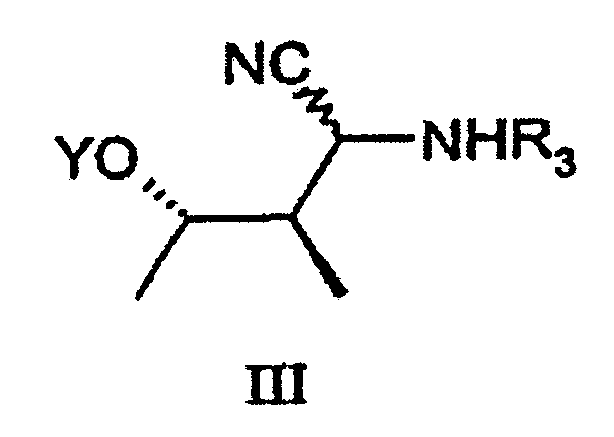
die Gruppe Y eine Schutzgruppe der OH-Gruppe darstellt und
die Gruppe R3 eine Schutzgruppe der Amingruppe darstellt. - Verfahren nach Anspruch 9, dadurch gekennzeichnet, dass es einen zusätzlichen Schritt f2) der Behandlung des Aminonitrils der allgemeinen Formel III mit einer Säure umfasst, um das Lacton der folgenden allgemeinen Formel VI zu erhalten:

gefolgt, falls erforderlich, von einem zusätzlichen Schritt f2,1) der Behandlung des Lactons der allgemeinen Formel VI, um das Lacton der folgenden allgemeinen Formel VII zu erhalten:
- Verfahren nach Anspruch 10, dadurch gekennzeichnet, dass es einen zusätzlichen Schritt g2) der diastereoselektiven Hydrolyse des Lactons der allgemeinen Formel VI oder VII umfasst, um die Verbindung der allgemeinen Formel (2S)-I zu erhalten.
- Verfahren nach Anspruch 11 für den Fall, in dem die Gruppe R3 die Schutzgruppe der Amingruppe darstellt und die Gruppe R1 eine Schutzgruppe der Amingruppe oder eine Gruppe der Formel -COOR2 darstellt, worin die Gruppe R2 eine (C1 - C6)-Alkylgruppe, eine Aryl- oder Aralkylgruppe darstellt, dadurch gekennzeichnet, dass die diastereoselektive Hydrolyse besteht aus:- der alkalischen Hydrolyse des Lactons der allgemeinen Formel VI, in der die Gruppe R3 eine Schutzgruppe der Amingruppe darstellt, oder der allgemeinen Formel VII, um eine Mischung von Diastereomeren der folgenden allgemeinen Formel I zu erhalten:
 - der Zugabe von organischer Säure, bevorzugt TFA, in Form von Spuren und Erwärmen, um die Verbindung der folgenden allgemeinen Formel (2R)-I:
zum Lacton der folgenden allgemeinen Formel (3R)-VIII zu recyclisieren: - der Extraktion des Lactons der allgemeinen Formel (3R)-VIII mit einem organischen Lösungsmittel, um die Verbindung der allgemeinen Formel (2S)-I zu gewinnen, in der die Gruppe R1 eine Schutzgruppe der Amingruppe oder eine Gruppe der Formel -COOR2 darstellt, worin die Gruppe R2 eine (C1 - C6)-Alkylgruppe, eine Aryl- oder Aralkylgruppe darstellt.
 - Verfahren nach Anspruch 11, dadurch gekennzeichnet, dass die diastereoselektive Hydrolyse besteht aus:- der diastereoselektiven enzymatischen Hydrolyse des Lactons der allgemeinen Formel (3R)-VI oder (3R)-VII, um die Verbindung der allgemeinen Formel (2R)-I zu ergeben,- der Extraktion des verbleibenden nicht hydrolysierten Lactons der folgenden allgemeinen Formel (3S)-VIII mit einem organischen Lösungsmittel:
 - der nicht-selektiven enzymatischen Hydrolyse des Lactons der allgemeinen Formel (3S)-VIII, um die Verbindung der allgemeinen Formel (2S)-1 zu erhalten, in der die Gruppe R1 ein Wasserstoffatom, eine Schutzgruppe der Amingruppe oder eine Gruppe der Formel -COOR2 darstellt, worin die Gruppe R2 eine (C1 - C6)-Alkylgruppe, eine Aryl- oder Aralkylgruppe darstellt.
 - Verfahren nach Anspruch 11 für den Fall, in dem R3 die Schutzgruppe der Amingruppe darstellt, dadurch gekennzeichnet, dass die diastereoselektive Hydrolyse besteht aus:- der Kristallisation in einem Alkohol des Lactons der allgemeinen Formel VI in einem organischen Lösungsmittel auf solche Weise, dass man das Salz der Verbindung der Formel (3S)-VIII erhält, in der die Gruppe R1 eine Schutzgruppe der Amingruppe darstellt,- der katalytischen Hydrogenolyse des Salzes der Verbindung der Formel (3S)-VIII, in der die Gruppe R1 eine Schutzgruppe der Amingruppe darstellt, um das Salz des Lactons der Formel 9 zu erhalten,- der alkalischen Hydrolyse des Salzes des Lactons der Formel 9, um die Verbindung der allgemeinen Formel (2S)-I zu erhalten, in der die Gruppe R1 ein Wasserstoffatom darstellt.
- Verfahren nach irgendeinem der Ansprüche 11 bis 13 für den Fall, in dem die Gruppe R3 eine Schutzgruppe des Amins darstellt und die Gruppe R1 eine Schutzgruppe der Amingruppe oder eine Gruppe der Formel -COOR2 darstellt, worin die Gruppe R2 eine (C1 - C6)-Alkylgruppe, eine Aryl- oder Aralkylgruppe darstellt, dadurch gekennzeichnet, dass es einen zusätzlichen Schritt h2) der katalytischen Hydrogenolyse der Verbindung der Formel (2S)-I umfasst, in der die Gruppe R1 eine Schutzgruppe der Amingruppe oder eine Gruppe der Formel -COOR2 darstellt, worin die Gruppe R2 eine (C1 - C6)-Alkylgruppe, eine Aryl- oder Aralkylgruppe darstellt, um die Verbindung der allgemeinen Formel (2S)-I zu erhalten, in der die Gruppe R1 ein Wasserstoffatom darstellt.
- Verfahren nach irgendeinem der Ansprüche 8, 11 bis 15, dadurch gekennzeichnet, dass es einen zusätzlichen Schritt der Reinigung der Verbindung der allgemeinen Formel (2S)-I umfasst, in der die Gruppe R1 ein Wasserstoffatom darstellt.
- Verfahren nach Anspruch 16, dadurch gekennzeichnet, dass der Reinigungsschritt aus der Neutralisation der Verbindung allgemeinen Formel (2S)-I, in der die Gruppe R1 ein Wasserstoffatom darstellt, mit einer organischen Säure und ihrer Kristallisation in einem Alkohol besteht, um die Verbindung der allgemeinen Formel (2S)-I zu erhalten, in der die Gruppe R1 ein reines Wasserstoffatom darstellt.
- Verfahren zur Synthese von Verbindungen der folgenden allgemeinen Formel (2S)-I:

durch diastereoselektive Hydrolyse des Lactons der folgenden allgemeinen Formel VI oder VII:
oder durch alkalische Hydrolyse des Salzes des Lactons der folgenden Formel 9: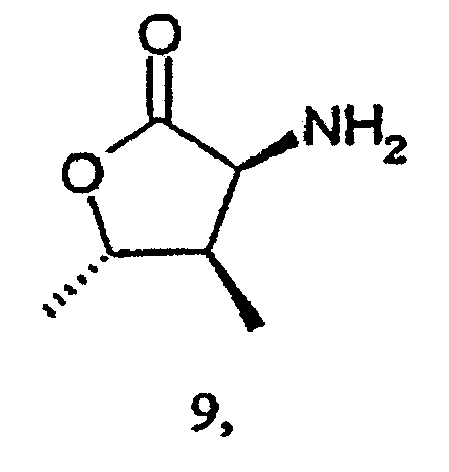
 die Gruppe Y eine Schutzgruppe der OH-Gruppe darstellt unddie Gruppe R3 eine Schutzgruppe der Amingruppe darstellt,und das Salz des Lactons der Formel 9 durch Behandlung des Aminonitrils der folgenden allgemeinen Formel V mit einer Säure erhalten wird:
 in der:die Gruppe Y eine Schutzgruppe der QH-Gruppe darstellt unddie Gruppe R4 eine (C1- C6)-Alkyl-, Aryl- oder Aralkylgruppe darstellt.
 - Verfahren nach Anspruch 18 für den Fall, in dem die Gruppe R1 eine Schutzgruppe der Amingruppe oder eine Gruppe der Formel -COOR2 darstellt, worin die Gruppe R2 eine (C1 - C6)-Alkylgruppe, eine Aryl- oder Aralkylgruppe darstellt, dadurch gekennzeichnet, dass die diastereoselektive Hydrolyse besteht aus:- der alkalischen Hydrolyse des Lactons der allgemeinen Formel VII oder VI, worin R3 eine Schutzgruppe der Amingruppe darstellt, um eine Mischung von Diastereomeren der folgenden allgemeinen Formel I zu erhalten:
 - der Zugabe von organischer Säure, bevorzugt von TFA in Form von Spuren und Erwärmen, um die Verbindung der allgemeinen Formel (2R)-I:
zum Lacton der folgenden allgemeinen Formel (3R)-VIII zu recyclisieren: - der Extraktion des Lactons der allgemeinen Formel (3R)-VIII mit einem organischen Lösungsmittel, um die Verbindung der allgemeinen Formel (2S)-1 zu gewinnen, in der die Gruppe R1 eine Schutzgruppe der Amingruppe oder eine Gruppe der Formel -COOR2 darstellt, worin die Gruppe R2 eine (C1 - C6)-Akylgruppe, eine Aryl- oder Aralkylgruppe darstellt.
 - Verfahren nach Anspruch 18, dadurch gekennzeichnet, dass die diastereoselektive Hydrolyse besteht aus:- der diastereoselektiven enzymatischen Hydrolyse des Lactons der allgemeinen Formel (3R)-VI oder (3R)-VII, um die Verbindung der allgemeinen Formel (2R)-I zu ergeben,- der Extraktion des verbleibenden nicht hydrolysierten Lactons der folgenden allgemeinen Formel (3S)-VIII mit einem organischen Lösungsmittel:
 - der nicht-selektiven enzymatischen Hydrolyse des Lactons der allgemeinen Formel (3S)-VIII, um die Verbindung der allgemeinen Formel (2S)-I zu erhalten.
 - Verfahren nach Anspruch 18 für den Fall, in dem die Gruppe R3 die Schutzgruppe der Amingruppe darstellt, dadurch gekennzeichnet, dass die diastereoselektive Hydrolyse besteht aus:- der Kristallisation in einem Alkohol des Lactons der allgemeinen Formel VI in einem organischen Lösungsmittel auf solche Weise, dass man das Salz der Verbindung der Formel (3S)-VIII erhält, in der die Gruppe R1 eine Schutzgruppe der Amingruppe darstellt,- der katalytischen Hydrogenolyse des Salzes der Verbindung der Formel (3S)-VIII, in der die Gruppe R1 eine Schutzgruppe der Amingruppe darstellt, auf solche Weise, dass man das Salz des Lactons der Formel 9 erhält,- der alkalischen Hydrolyse des Salzes des Lactons der Formel 9, um die Verbindung der allgemeinen Formel (2S)-I zu erhalten, in der die Gruppe R1 ein Wasserstoffatom darstellt.
- Verfahren nach irgendeinem der Ansprüche 18 bis 20 für den Fall, in dem die Gruppe R1 eine Schutzgruppe der Amingruppe oder eine Gruppe der Formel -COOR2 darstellt, worin die Gruppe R2 eine (C1 - C6)-Alkylgruppe, eine Aryl- oder Aralkylgruppe darstellt, dadurch gekennzeichnet, dass es einen zusätzlichen Schritt der katalytischen Hydrogenolyse der Verbindung der Formel (2S)-I umfasst, in der die Gruppe R1 eine Schutzgruppe der Amingruppe oder eine Gruppe der Formel -COOR2 darstellt, worin die Gruppe R2 eine (C1 - C6)-Alkylgruppe, eine Aryl- oder Aralkylgruppe darstellt, um die Verbindung der allgemeinen Formel (2S)-I zu erhalten, in der die Gruppe R1 ein Wasserstoffatom darstellt.
- Verfahren nach irgendeinem der Ansprüche 18 bis 22, dadurch gekennzeichnet, dass das Aminonitril der allgemeinen Formel III durch Behandlung-des Aldehyds der folgenden allgemeinen Formel II erhalten wird:

- Verfahren nach irgendeinem der Ansprüche 18 bis 22, dadurch gekennzeichnet, dass das Aminonitril der allgemeinen Formel V durch Behandlung der Verbindung der folgenden allgemeinen Formel IV erhalten wird:
 die Gruppe Y eine Schutzgruppe der OH-Gruppe darstellt unddie Gruppe R4 eine (C1 - C6)-Alkyl-, Aryl- oder Aralkylgruppe darstellt.
 - Verfahren nach Anspruch 24, dadurch gekennzeichnet, dass die Verbindung der allgemeinen Formel IV durch Behandlung des Aldehyds der allgemeinen Formel II mit einem Sulfinamid der Konfiguration (S)-(+) erhalten wird.
- Verfahren nach irgendeinem der Ansprüche 23 und 25, dadurch gekennzeichnet, dass der Aldehyd der allgemeinen Formel II erhalten wird durch die Schritte:- Schützen der OH-Gruppe des Alkohols der folgenden Formel 3:
 - Reduktion der Gruppe -COOEt zum Alkohol und- Oxidation der nicht geschützten OH-Gruppe, die im vorstehenden " Schritt erhalten wurde.
 - Verfahren nach Anspruch 26, dadurch gekennzeichnet, dass der Alkohol der Formel 3 mit einem enantiomeren Überschuss von mindestens 85 %, vorzugsweise mindestens 90 %, und einem diastereomeren Überschuss von mindestens 90 %, vorzugsweise mindestens 95 %, durch die diastereo- und enantioselektive Reduktion der Verbindung der folgenden Formel 2:

- Verfahren nach Anspruch 27, dadurch gekennzeichnet, dass die diastereo- und enantioselektive Reduktion unter Verwendung eines Enzyms vorgenommen wird.
- Verfahren nach Anspruch 28, dadurch gekennzeichnet, dass man einen Mikroorganismus, der dieses Enzym enthält, insbesondere Geotrichum candidum verwendet.
- Lacton der folgenden allgemeinen Formel VIII:

- Aminonitril der folgenden allgemeinen Formel III:
 die Gruppe Y eine Schutzgruppe der OH-Gruppe darstellt unddie Gruppe R3 eine Schutzgruppe der Amingruppe darstellt.
 - Aminonitril nach Anspruch 31, dadurch gekennzeichnet, dass es durch die folgende allgemeine Formel V dargestellt wird:
 die Gruppe Y eine Schutzgruppe der OH-Gruppe darstellt unddie Gruppe R4 eine (C1 - C6)-Alkyl-, Aryl- oder Aralkylgruppe darstellt.
 - Verbindung der folgenden allgemeinen Formel IV:

die Gruppe Y eine Schutzgruppe der OH-Gruppe darstellt und
die Gruppe R4 eine (C1- C6)-Alkyl-, Aryl- oder Aralkylgruppe darstellt. - Verbindung der folgenden allgemeinen Formel I:

Applications Claiming Priority (3)
| Application Number | Priority Date | Filing Date | Title |
|---|---|---|---|
| FR0003859A FR2806726B1 (fr) | 2000-03-27 | 2000-03-27 | Procede de preparation de la (2s,3r,4s)-4-hydroxyisoleucine et de ses analogues |
| FR0003859 | 2000-03-27 | ||
| PCT/FR2001/000885 WO2001072688A2 (fr) | 2000-03-27 | 2001-03-23 | Procede de preparation de la (2s,3r,4s)-4-hydroxyisoleucine et de ses analogues |
Publications (2)
| Publication Number | Publication Date |
|---|---|
| EP1268397A2 EP1268397A2 (de) | 2003-01-02 |
| EP1268397B1 true EP1268397B1 (de) | 2007-12-05 |
Family
ID=8848534
Family Applications (1)
| Application Number | Title | Priority Date | Filing Date |
|---|---|---|---|
| EP01919554A Expired - Lifetime EP1268397B1 (de) | 2000-03-27 | 2001-03-23 | Verfahren zur herstellung von (2s,3r,4s)-4-hydroxyisoleucin und analoga |
Country Status (8)
| Country | Link |
|---|---|
| US (2) | US20030219880A1 (de) |
| EP (1) | EP1268397B1 (de) |
| AT (1) | ATE380173T1 (de) |
| AU (1) | AU4663301A (de) |
| CA (1) | CA2404621C (de) |
| DE (1) | DE60131733T2 (de) |
| FR (1) | FR2806726B1 (de) |
| WO (1) | WO2001072688A2 (de) |
Cited By (3)
| Publication number | Priority date | Publication date | Assignee | Title |
|---|---|---|---|---|
| RU2395578C2 (ru) * | 2007-11-07 | 2010-07-27 | Закрытое акционерное общество "Научно-исследовательский институт Аджиномото-Генетика" (ЗАО АГРИ) | Способ продукции (2s,3r,4s)-4-гидрокси-l-изолейцина с использованием бактерии, в которой разрушена активность 4-гидрокси-l-изолейциндегидрогеназы |
| RU2395580C2 (ru) * | 2007-12-21 | 2010-07-27 | Закрытое акционерное общество "Научно-исследовательский институт Аджиномото-Генетика" (ЗАО АГРИ) | Способ конструирования бактерии-продуцента (2s,3r,4s)-4-гидрокси-l-изолейцина, бактерия-продуцент (2s,3r,4s)-4-гидрокси-l-изолейцина и способ продукции (2s,3r,4s)-гидрокси-l-изолейцина или его соли |
| RU2402608C2 (ru) * | 2006-09-28 | 2010-10-27 | Закрытое акционерное общество "Научно-исследовательский институт Аджиномото-Генетика" (ЗАО АГРИ) | Способ продукции 4-гидрокси-l-изолейцина |
Families Citing this family (9)
| Publication number | Priority date | Publication date | Assignee | Title |
|---|---|---|---|---|
| WO2003088947A1 (en) * | 2002-04-22 | 2003-10-30 | Experimental & Applied Sciences, Inc. | Food supplements containing 4-hydroxyisoleucine and creatine |
| FR2854629B1 (fr) | 2003-05-07 | 2005-06-17 | Centre Nat Rech Scient | Procede de synthese de la 4-hydroxyisoleucine et de ses derives |
| EP1657236A1 (de) * | 2004-11-10 | 2006-05-17 | Centre National De La Recherche Scientifique (Cnrs) | Verfahren zur Herstellung von Diastereoisomeren von 4-Hydroxyisoleucin |
| US20060199853A1 (en) * | 2005-02-18 | 2006-09-07 | Charles Mioskowski | Analogs of 4-hydroxyisoleucine and uses thereof |
| EP1874287A2 (de) * | 2005-03-22 | 2008-01-09 | Innodia Inc. | Verbindungen und zusammensetzungen zur verwendung bei der vorbeugung und behandlung von fettleibigkeit und damit zusammenhängenden syndromen |
| WO2007107008A1 (en) * | 2006-03-22 | 2007-09-27 | Innodia Inc. | Compounds and compositions for use in the prevention and treatment of disorders of fat metabolism and obesity |
| US8748631B2 (en) | 2011-05-24 | 2014-06-10 | Apicore, Llc | Process for preparing saxagliptin and its novel intermediates useful in the synthesis thereof |
| CN104152505B (zh) * | 2014-08-08 | 2016-11-23 | 江南大学 | 一种利用重组菌株转化制备4-羟基-l-异亮氨酸的方法 |
| CN105566136A (zh) * | 2016-01-19 | 2016-05-11 | 天津科技大学 | 一种从发酵液中分离提取4-羟基异亮氨酸的方法 |
Family Cites Families (1)
| Publication number | Priority date | Publication date | Assignee | Title |
|---|---|---|---|---|
| FR2745718B1 (fr) * | 1996-03-08 | 1998-05-07 | Gestion Jouvenet Soc Civ De | Composition antidiabetique a base de 4-hydroxyisoleucine |
-
2000
- 2000-03-27 FR FR0003859A patent/FR2806726B1/fr not_active Expired - Fee Related
-
2001
- 2001-03-23 AU AU46633/01A patent/AU4663301A/en not_active Abandoned
- 2001-03-23 CA CA2404621A patent/CA2404621C/fr not_active Expired - Fee Related
- 2001-03-23 DE DE60131733T patent/DE60131733T2/de not_active Expired - Lifetime
- 2001-03-23 US US10/239,194 patent/US20030219880A1/en not_active Abandoned
- 2001-03-23 EP EP01919554A patent/EP1268397B1/de not_active Expired - Lifetime
- 2001-03-23 AT AT01919554T patent/ATE380173T1/de not_active IP Right Cessation
- 2001-03-23 WO PCT/FR2001/000885 patent/WO2001072688A2/fr not_active Ceased
-
2004
- 2004-10-08 US US10/960,513 patent/US7432087B2/en not_active Expired - Fee Related
Cited By (3)
| Publication number | Priority date | Publication date | Assignee | Title |
|---|---|---|---|---|
| RU2402608C2 (ru) * | 2006-09-28 | 2010-10-27 | Закрытое акционерное общество "Научно-исследовательский институт Аджиномото-Генетика" (ЗАО АГРИ) | Способ продукции 4-гидрокси-l-изолейцина |
| RU2395578C2 (ru) * | 2007-11-07 | 2010-07-27 | Закрытое акционерное общество "Научно-исследовательский институт Аджиномото-Генетика" (ЗАО АГРИ) | Способ продукции (2s,3r,4s)-4-гидрокси-l-изолейцина с использованием бактерии, в которой разрушена активность 4-гидрокси-l-изолейциндегидрогеназы |
| RU2395580C2 (ru) * | 2007-12-21 | 2010-07-27 | Закрытое акционерное общество "Научно-исследовательский институт Аджиномото-Генетика" (ЗАО АГРИ) | Способ конструирования бактерии-продуцента (2s,3r,4s)-4-гидрокси-l-изолейцина, бактерия-продуцент (2s,3r,4s)-4-гидрокси-l-изолейцина и способ продукции (2s,3r,4s)-гидрокси-l-изолейцина или его соли |
Also Published As
| Publication number | Publication date |
|---|---|
| DE60131733T2 (de) | 2008-10-30 |
| WO2001072688A3 (fr) | 2002-04-11 |
| CA2404621C (fr) | 2012-11-20 |
| FR2806726A1 (fr) | 2001-09-28 |
| FR2806726B1 (fr) | 2003-01-03 |
| US20030219880A1 (en) | 2003-11-27 |
| WO2001072688A2 (fr) | 2001-10-04 |
| ATE380173T1 (de) | 2007-12-15 |
| DE60131733D1 (de) | 2008-01-17 |
| US7432087B2 (en) | 2008-10-07 |
| EP1268397A2 (de) | 2003-01-02 |
| CA2404621A1 (fr) | 2001-10-04 |
| AU4663301A (en) | 2001-10-08 |
| US20050079587A1 (en) | 2005-04-14 |
Similar Documents
| Publication | Publication Date | Title |
|---|---|---|
| EP0132392A2 (de) | Asymmetrische Synthese von alpha-substituierten alpha-Cyanomethylalkoholen | |
| CA2404621C (fr) | Procede de preparation de la (2s,3r,4s)-4-hydroxyisoleucine et de ses analogues | |
| Luly et al. | A convenient stereoselective synthesis of 1, 2, 3-aminodiols from. alpha.-amino acids | |
| Casara et al. | Stereospecific synthesis of (2 R, 5 R)-hept-6-yne-2, 5-diamine: a potent and selective enzyme-activated irreversible inhibitor of ornithine decarboxylase (ODC) | |
| Alcón et al. | Enantioselective synthesis of (S)-vigabatrin® | |
| CH647490A5 (fr) | Terpenoides contenant deux groupes fonctionnels, procede pour leur preparation et composition pharmaceutique contenant ces composes. | |
| EP0004493B1 (de) | Äther deren organische Reste asymmetrische Atome enthalten, Verfahren zu ihrer Herstellung und ihre Anwendung zur Spaltung von Alkoholen, Phenolen oder gewissen Verbindungen mit Laktonstruktur | |
| EP1620390B1 (de) | Verfahren zur herstellung von 4-hydroxyisoleucin und dessen derivate | |
| Besse et al. | Enantioselective synthesis of both enantiomers of cathinone via the microbiological reduction of 2-azido-1-phenyl-1-propanone | |
| LU86012A1 (fr) | Nouveaux composes naphtaleniques,leur preparation et leur application comme medicaments | |
| EP0500443B1 (de) | Phenylethanolamino- und Phenylethanolaminomethyltetraline, Verfahren zu deren Herstellung Zwischenprodukte davon und diese enthaltende pharmazeutische Zusammensetzungen | |
| EP0842148B1 (de) | Benzolsulfonamidderivate, ihre herstellung und ihre therapeutische verwendung | |
| EP0998470B1 (de) | Verfahren zur herstellung von alkoxyfuranon-amin-derivaten, durch dieses verfahren erhaltene verbindungen und verwendung dieser verbindungen | |
| EP0303545B1 (de) | Verfahren zur Herstellung von Phenyläthanolaminotetralinen | |
| FR2702220A1 (fr) | Dédoublement enzymatique de dérivés de 4-alkyl-2-pipéridine-carboxylate et utilisation des composés obtenus, comme intermédiaires de synthèse. | |
| CH638183A5 (fr) | Derives de pyrrolidine et de piperidine. | |
| Wuts et al. | Synthesis of the hydroxyethylene isostere of Leu-Val | |
| EP0915867B1 (de) | Thienylcyclohexan-derivte zur herstellung von thienylcyclohexylen | |
| CA2668026A1 (fr) | Derives d' aminobenzocycloheptene, leurs procedes de preparation et leur utilisation en therapeutique | |
| JPH0751090A (ja) | 光学活性3−アミノブタン酸の製造法及びそのエステル中間体 | |
| EP0165226B1 (de) | 4-Aminobutensäurederivate, Herstellungsverfahren und Verwendung | |
| EP0828740B1 (de) | 2-azabicyclo[2.2.1]heptan-derivate, ihre herstellung und ihre anwendung | |
| FR2610322A1 (fr) | Nouveaux derives de la pilocarpine, leur preparation et leur utilisation comme medicaments | |
| EP2300405B1 (de) | Verfahren zur asymmetrischen synthese von 6-fluor-l-dopa und analoga davon | |
| Tseng et al. | Enantioselective Synthesis of N‐[(S)‐Ethoxycarbonyl‐3‐phenylpropyl]‐L‐alanyl‐L‐proline from Chiral Synthon Prepared Enzymatically; A Practical Method for Large‐Scale Synthesis |
Legal Events
| Date | Code | Title | Description |
|---|---|---|---|
| PUAI | Public reference made under article 153(3) epc to a published international application that has entered the european phase |
Free format text: ORIGINAL CODE: 0009012 |
|
| 17P | Request for examination filed |
Effective date: 20021014 |
|
| AK | Designated contracting states |
Kind code of ref document: A2 Designated state(s): AT BE CH CY DE DK ES FI FR GB GR IE IT LI LU MC NL PT SE TR |
|
| AX | Request for extension of the european patent |
Free format text: AL;LT;LV;MK;RO;SI |
|
| 17Q | First examination report despatched |
Effective date: 20060427 |
|
| GRAP | Despatch of communication of intention to grant a patent |
Free format text: ORIGINAL CODE: EPIDOSNIGR1 |
|
| GRAS | Grant fee paid |
Free format text: ORIGINAL CODE: EPIDOSNIGR3 |
|
| GRAA | (expected) grant |
Free format text: ORIGINAL CODE: 0009210 |
|
| AK | Designated contracting states |
Kind code of ref document: B1 Designated state(s): AT BE CH CY DE DK ES FI FR GB GR IE IT LI LU MC NL PT SE TR |
|
| REG | Reference to a national code |
Ref country code: GB Ref legal event code: FG4D Free format text: NOT ENGLISH |
|
| REG | Reference to a national code |
Ref country code: IE Ref legal event code: FG4D Free format text: LANGUAGE OF EP DOCUMENT: FRENCH |
|
| REG | Reference to a national code |
Ref country code: CH Ref legal event code: EP |
|
| REF | Corresponds to: |
Ref document number: 60131733 Country of ref document: DE Date of ref document: 20080117 Kind code of ref document: P |
|
| REG | Reference to a national code |
Ref country code: CH Ref legal event code: NV Representative=s name: MICHELI & CIE SA |
|
| GBT | Gb: translation of ep patent filed (gb section 77(6)(a)/1977) |
Effective date: 20080303 |
|
| PG25 | Lapsed in a contracting state [announced via postgrant information from national office to epo] |
Ref country code: ES Free format text: LAPSE BECAUSE OF FAILURE TO SUBMIT A TRANSLATION OF THE DESCRIPTION OR TO PAY THE FEE WITHIN THE PRESCRIBED TIME-LIMIT Effective date: 20080316 Ref country code: NL Free format text: LAPSE BECAUSE OF FAILURE TO SUBMIT A TRANSLATION OF THE DESCRIPTION OR TO PAY THE FEE WITHIN THE PRESCRIBED TIME-LIMIT Effective date: 20071205 Ref country code: SE Free format text: LAPSE BECAUSE OF FAILURE TO SUBMIT A TRANSLATION OF THE DESCRIPTION OR TO PAY THE FEE WITHIN THE PRESCRIBED TIME-LIMIT Effective date: 20080305 |
|
| PG25 | Lapsed in a contracting state [announced via postgrant information from national office to epo] |
Ref country code: FI Free format text: LAPSE BECAUSE OF FAILURE TO SUBMIT A TRANSLATION OF THE DESCRIPTION OR TO PAY THE FEE WITHIN THE PRESCRIBED TIME-LIMIT Effective date: 20071205 |
|
| NLV1 | Nl: lapsed or annulled due to failure to fulfill the requirements of art. 29p and 29m of the patents act | ||
| PG25 | Lapsed in a contracting state [announced via postgrant information from national office to epo] |
Ref country code: AT Free format text: LAPSE BECAUSE OF FAILURE TO SUBMIT A TRANSLATION OF THE DESCRIPTION OR TO PAY THE FEE WITHIN THE PRESCRIBED TIME-LIMIT Effective date: 20071205 |
|
| BERE | Be: lapsed |
Owner name: CENTRE NATIONAL DE LA RECHERCHE SCIENTIFIQUE (CNR Effective date: 20080331 |
|
| PG25 | Lapsed in a contracting state [announced via postgrant information from national office to epo] |
Ref country code: PT Free format text: LAPSE BECAUSE OF FAILURE TO SUBMIT A TRANSLATION OF THE DESCRIPTION OR TO PAY THE FEE WITHIN THE PRESCRIBED TIME-LIMIT Effective date: 20080505 |
|
| REG | Reference to a national code |
Ref country code: IE Ref legal event code: FD4D |
|
| PLBE | No opposition filed within time limit |
Free format text: ORIGINAL CODE: 0009261 |
|
| STAA | Information on the status of an ep patent application or granted ep patent |
Free format text: STATUS: NO OPPOSITION FILED WITHIN TIME LIMIT |
|
| PG25 | Lapsed in a contracting state [announced via postgrant information from national office to epo] |
Ref country code: MC Free format text: LAPSE BECAUSE OF NON-PAYMENT OF DUE FEES Effective date: 20080331 Ref country code: IE Free format text: LAPSE BECAUSE OF FAILURE TO SUBMIT A TRANSLATION OF THE DESCRIPTION OR TO PAY THE FEE WITHIN THE PRESCRIBED TIME-LIMIT Effective date: 20071205 Ref country code: DK Free format text: LAPSE BECAUSE OF FAILURE TO SUBMIT A TRANSLATION OF THE DESCRIPTION OR TO PAY THE FEE WITHIN THE PRESCRIBED TIME-LIMIT Effective date: 20071205 |
|
| 26N | No opposition filed |
Effective date: 20080908 |
|
| PG25 | Lapsed in a contracting state [announced via postgrant information from national office to epo] |
Ref country code: GR Free format text: LAPSE BECAUSE OF FAILURE TO SUBMIT A TRANSLATION OF THE DESCRIPTION OR TO PAY THE FEE WITHIN THE PRESCRIBED TIME-LIMIT Effective date: 20080306 |
|
| PG25 | Lapsed in a contracting state [announced via postgrant information from national office to epo] |
Ref country code: BE Free format text: LAPSE BECAUSE OF NON-PAYMENT OF DUE FEES Effective date: 20080331 |
|
| PG25 | Lapsed in a contracting state [announced via postgrant information from national office to epo] |
Ref country code: CY Free format text: LAPSE BECAUSE OF FAILURE TO SUBMIT A TRANSLATION OF THE DESCRIPTION OR TO PAY THE FEE WITHIN THE PRESCRIBED TIME-LIMIT Effective date: 20071205 |
|
| PG25 | Lapsed in a contracting state [announced via postgrant information from national office to epo] |
Ref country code: LU Free format text: LAPSE BECAUSE OF NON-PAYMENT OF DUE FEES Effective date: 20080323 |
|
| PG25 | Lapsed in a contracting state [announced via postgrant information from national office to epo] |
Ref country code: TR Free format text: LAPSE BECAUSE OF FAILURE TO SUBMIT A TRANSLATION OF THE DESCRIPTION OR TO PAY THE FEE WITHIN THE PRESCRIBED TIME-LIMIT Effective date: 20071205 |
|
| PGFP | Annual fee paid to national office [announced via postgrant information from national office to epo] |
Ref country code: IT Payment date: 20120225 Year of fee payment: 12 |
|
| PGFP | Annual fee paid to national office [announced via postgrant information from national office to epo] |
Ref country code: GB Payment date: 20130228 Year of fee payment: 13 Ref country code: CH Payment date: 20130226 Year of fee payment: 13 Ref country code: DE Payment date: 20130221 Year of fee payment: 13 |
|
| PGFP | Annual fee paid to national office [announced via postgrant information from national office to epo] |
Ref country code: FR Payment date: 20130429 Year of fee payment: 13 |
|
| REG | Reference to a national code |
Ref country code: DE Ref legal event code: R119 Ref document number: 60131733 Country of ref document: DE |
|
| REG | Reference to a national code |
Ref country code: CH Ref legal event code: PL |
|
| GBPC | Gb: european patent ceased through non-payment of renewal fee |
Effective date: 20140323 |
|
| REG | Reference to a national code |
Ref country code: FR Ref legal event code: ST Effective date: 20141128 |
|
| REG | Reference to a national code |
Ref country code: DE Ref legal event code: R119 Ref document number: 60131733 Country of ref document: DE Effective date: 20141001 |
|
| PG25 | Lapsed in a contracting state [announced via postgrant information from national office to epo] |
Ref country code: FR Free format text: LAPSE BECAUSE OF NON-PAYMENT OF DUE FEES Effective date: 20140331 Ref country code: GB Free format text: LAPSE BECAUSE OF NON-PAYMENT OF DUE FEES Effective date: 20140323 Ref country code: DE Free format text: LAPSE BECAUSE OF NON-PAYMENT OF DUE FEES Effective date: 20141001 Ref country code: CH Free format text: LAPSE BECAUSE OF NON-PAYMENT OF DUE FEES Effective date: 20140331 Ref country code: LI Free format text: LAPSE BECAUSE OF NON-PAYMENT OF DUE FEES Effective date: 20140331 |
|
| PG25 | Lapsed in a contracting state [announced via postgrant information from national office to epo] |
Ref country code: IT Free format text: LAPSE BECAUSE OF NON-PAYMENT OF DUE FEES Effective date: 20140323 |