EP1268588B1 - Terpolymere ethylene-compose vinylique aromatique-vinyl-norbornene - Google Patents
Terpolymere ethylene-compose vinylique aromatique-vinyl-norbornene Download PDFInfo
- Publication number
- EP1268588B1 EP1268588B1 EP00983570A EP00983570A EP1268588B1 EP 1268588 B1 EP1268588 B1 EP 1268588B1 EP 00983570 A EP00983570 A EP 00983570A EP 00983570 A EP00983570 A EP 00983570A EP 1268588 B1 EP1268588 B1 EP 1268588B1
- Authority
- EP
- European Patent Office
- Prior art keywords
- group
- ethylene
- vinylnorbornene
- terpolymer
- aromatic vinyl
- Prior art date
- Legal status (The legal status is an assumption and is not a legal conclusion. Google has not performed a legal analysis and makes no representation as to the accuracy of the status listed.)
- Expired - Lifetime
Links
- 0 C[C@](NC(*)*)OC Chemical compound C[C@](NC(*)*)OC 0.000 description 1
Images


Classifications
-
- C—CHEMISTRY; METALLURGY
- C08—ORGANIC MACROMOLECULAR COMPOUNDS; THEIR PREPARATION OR CHEMICAL WORKING-UP; COMPOSITIONS BASED THEREON
- C08F—MACROMOLECULAR COMPOUNDS OBTAINED BY REACTIONS ONLY INVOLVING CARBON-TO-CARBON UNSATURATED BONDS
- C08F4/00—Polymerisation catalysts
- C08F4/42—Metals; Metal hydrides; Metallo-organic compounds; Use thereof as catalyst precursors
- C08F4/44—Metals; Metal hydrides; Metallo-organic compounds; Use thereof as catalyst precursors selected from light metals, zinc, cadmium, mercury, copper, silver, gold, boron, gallium, indium, thallium, rare earths or actinides
- C08F4/60—Metals; Metal hydrides; Metallo-organic compounds; Use thereof as catalyst precursors selected from light metals, zinc, cadmium, mercury, copper, silver, gold, boron, gallium, indium, thallium, rare earths or actinides together with refractory metals, iron group metals, platinum group metals, manganese, rhenium technetium or compounds thereof
- C08F4/62—Refractory metals or compounds thereof
- C08F4/64—Titanium, zirconium, hafnium or compounds thereof
-
- C—CHEMISTRY; METALLURGY
- C08—ORGANIC MACROMOLECULAR COMPOUNDS; THEIR PREPARATION OR CHEMICAL WORKING-UP; COMPOSITIONS BASED THEREON
- C08F—MACROMOLECULAR COMPOUNDS OBTAINED BY REACTIONS ONLY INVOLVING CARBON-TO-CARBON UNSATURATED BONDS
- C08F212/00—Copolymers of compounds having one or more unsaturated aliphatic radicals, each having only one carbon-to-carbon double bond, and at least one being terminated by an aromatic carbocyclic ring
- C08F212/02—Monomers containing only one unsaturated aliphatic radical
- C08F212/04—Monomers containing only one unsaturated aliphatic radical containing one ring
-
- C—CHEMISTRY; METALLURGY
- C08—ORGANIC MACROMOLECULAR COMPOUNDS; THEIR PREPARATION OR CHEMICAL WORKING-UP; COMPOSITIONS BASED THEREON
- C08F—MACROMOLECULAR COMPOUNDS OBTAINED BY REACTIONS ONLY INVOLVING CARBON-TO-CARBON UNSATURATED BONDS
- C08F210/00—Copolymers of unsaturated aliphatic hydrocarbons having only one carbon-to-carbon double bond
- C08F210/02—Ethene
-
- C—CHEMISTRY; METALLURGY
- C08—ORGANIC MACROMOLECULAR COMPOUNDS; THEIR PREPARATION OR CHEMICAL WORKING-UP; COMPOSITIONS BASED THEREON
- C08F—MACROMOLECULAR COMPOUNDS OBTAINED BY REACTIONS ONLY INVOLVING CARBON-TO-CARBON UNSATURATED BONDS
- C08F4/00—Polymerisation catalysts
- C08F4/42—Metals; Metal hydrides; Metallo-organic compounds; Use thereof as catalyst precursors
- C08F4/44—Metals; Metal hydrides; Metallo-organic compounds; Use thereof as catalyst precursors selected from light metals, zinc, cadmium, mercury, copper, silver, gold, boron, gallium, indium, thallium, rare earths or actinides
- C08F4/60—Metals; Metal hydrides; Metallo-organic compounds; Use thereof as catalyst precursors selected from light metals, zinc, cadmium, mercury, copper, silver, gold, boron, gallium, indium, thallium, rare earths or actinides together with refractory metals, iron group metals, platinum group metals, manganese, rhenium technetium or compounds thereof
- C08F4/62—Refractory metals or compounds thereof
- C08F4/64—Titanium, zirconium, hafnium or compounds thereof
- C08F4/659—Component covered by group C08F4/64 containing a transition metal-carbon bond
- C08F4/65912—Component covered by group C08F4/64 containing a transition metal-carbon bond in combination with an organoaluminium compound
Definitions
- the present invention relates to an ethylene/aromatic vinyl compound/vinylnorbornene terpolymer. More particularly, the present invention relates to an ethylene/aromatic vinyl compound/vinylnorbornene terpolymer with high activity, a high molecular weight and a high content of aromatic vinyl compound, which can be prepared with a small amount of co-catalyst under mild condition.
- Copolymerization of ethylene and an aromatic vinyl compound such as styrene has been studied for a couple of decades.
- a polymerization method using a heterogeneous Ziegler-Natta catalyst was introduced ( Polymer Bulletin 20, 237-241 (1988 )).
- the conventional method has shortcomings in that the catalyst has poor activity, the copolymer has a low content of styrene and poor uniformity, and the copolymer is mostly a homopolymer.
- a copolymer of ethylene and styrene has been prepared using a homogeneous Ziegler-Natta catalyst system comprising a transition metal compound and an organoaluminum compound.
- Japanese Patent Laid-Open No. 7-53618 discloses a pseudo-random styrene/ethylene copolymer prepared by using a catalyst with a constrained geometrical structure, which does not have head-to-tail bonds.
- the phenyl groups in the alternating structure of the pseudo-random styrene/ethylene copolymer do not have stereoregularity.
- the copolymer shows the same properties as an amorphous resin with no crystallinity
- Japanese Patent Laid-Open No. 6-49132 and Polymer Preprints disclose a method for producing a styrene/ethylene copolymer which is a pseudo random copolymer with no head-to-tail bonds.
- the styrene/ethylene copolymer is prepared a bridged indenyl zirconium complex and a cocatalyst.
- the Polymer Preprints the ethylene/styrene alternating structure in the pseudo random copolymer does not show stereoregularity.
- Japanese Patent Laid-Open No. 3-250007 and Stud. Surf. Sci. Catal. 517 (1990 ) disclose a styrene/ethylene alternating copolymer prepared by using a Ti complex having a substituted phenol type ligand.
- the copolymer has a styrene/ethylene alternating structure but has neither an ethylene chain nor styrene chains including head-to-head bonds and tail-to-tail bonds.
- the copolymer is a perfect alternating copolymer with an alternating degree of at least 70, preferably at least 90.
- the ratio of ethylene to styrene is 50 % to 50 % by weight, it is difficult to vary the contents of the composition.
- the phenyl groups forms isotactic streroregularity of which isotactic diad index is 0.92.
- the copolymer has a molecular weight of 20,000 or below, the physical properties are poor.
- the catalyst has poor activity and a homopolymer such as syndiotactic polystyrene is obtained. Therefore, the polymerization method is not successfully commercialized.
- Eur. Polym. J., 31, 79(1995 ) discloses a polymerization of ethylene and styrene using a catalyst of CpTiBz 3 . According to the process, homopolymers such as polystyrene and syndiotactic polystyrene are obtained instead of copolymers of styrene/ethylene.
- Macromolecules, 29, 1158 (1996 ) discloses polymerization of ethylene/styrene using CpTiCl3 as a catalyst and a boron tytpe cocatalyst, resulting to prepare a mixture of a copolymer having a high degree of alternating structure, a syndiotactic polystyrene and a polyethylene.
- the publication does not mention about stereoregularity of the phenyl groups.
- Japanese Patent Laid-Open Nos. 3-163088 and 7-53618 disclose a process of copolymerization of styrene/ethylene using a large amount of an organic aluminum.
- this process is not practical since it produces not only ethylene/styrene copolymer but also a large amount of syndiotactic polystyrene under mild condition.
- the present inventors have developed an ethylene/aromatic vinyl compound/vinylnorbornene terpolymer with high activity, a high molecular weight and a high content of aromatic vinyl compound, which can be prepared with a small amount of co-catalyst under mild polymerization condition.
- a feature of the present invention is the provision of a process of preparing ethylene/aromatic vinyl compound copolymer which is designed to improve low activity of catalyst, a low styrene content, an excess amount of homopolymers by-product and uniform composition in the heterogeneous Ziegler-Natta catalyst system.
- Another feature of the present invention is the provision of a process of preparing a large amount of ethylene/aromatic vinyl compound copolymer using a small amount of a cocatalyst.
- a further feature of the present invention is the provision of an ethylene/aromatic vinyl compound copolymer having double bonds in which branching and/or cross-linking can be carried out.
- a further feature of the present invention is the provision of an ethylene/aromatic vinyl compound copolymer having double bonds to which long chain branches can be introduced.
- a further feature of the present invention is the provision of an ethylene/aromatic vinyl compound copolymer having an improved viscosity at melting state and an improved processability by introducing long chain branches thereto.
- the object of the present invention is achieved by a method of preparing an ethylene/aromatic vinyl compound/vinylnorbornene terpolymer according to the present invention by copolymerizing 50 ⁇ 90 mol % of ethylene, at least 0.1 mol% of an aromatic vinyl compound and 0.01 - 10 mol % of a vinylnorbornene under a catalyst system consisting of a transition metal compound represented by the following formula ( I ) and a cocatalyst: where M represents a transition metal of Group IV of the Periodic Table such as titanium, zirconium or hafnium;
- the transition metal complex may be a racemic mixture of d-form or l -form. Either d-form or l -form can be used in the present invention.
- the ethylene/aromatic vinyl compound/vinylnorbornene terpolymer according to the present invention is prepared by copolymerizing 50 ⁇ 90 mol % of ethylene, at least 0.1 mol % of an aromatic vinyl compound and 0.01-10 mol % of a vinylnorbornene under a catalyst system.
- the catalyst system consists of a transition metal compound and a cocatalyst.
- the polymerization of ethylene/aromatic vinyl compound/vinylnorbornene terpolymer is preferably carried out at 1 ⁇ 1000 bar and 0 ⁇ 200 °C. Over the self-polymerization temperature of each monomer, free radical polymerization occurs to produce a small amount of homopolymer.
- the content of the aromatic vinyl compound is at least 0.1 mol %, preferably 0.5 ⁇ 55 mol %, more preferably 1.0 ⁇ 55 mol %.
- the vinylnorbornene being polymerized by catalyst system of the present invention is a non-conjugated diene which includes dicyclopentadiene, 5-ethylidene-2-norbornene and methyl hexadiene.
- the vinylnorbornene is 0.01 ⁇ 10 mol % in the copolymer.
- the ethylene/aromatic vinyl compound/vinylnorbornene terpolymer according to the present invention is prepared under a catalyst system which consists of a transition metal compound and a cocatalyst.
- the transition metal compound is represented by the following formula ( I ): where M represents a transition metal of Group IV of the Periodic Table such as titanium, zirconium or hafnium;
- the metallocene catalyst is used with a cocatalyst.
- the cocatalyst is an organometallic compound such as alkylaluminoxane and alkylaluminum compound, which are known to an ordinary person in the art.
- alkylaluminoxane are methylaluminumoxane (MAO) and modified methylaluminumoxane (MMAO).
- the molar ratio of aluminum of organometallic compound to transition metal of Group IV of metallocene catalyst of the present invention is in the range from 1 : 1 to 1 ⁇ 10 6 : 1, preferably from 10 : 1 to 1 ⁇ 10 4 : 1.
- the co-catalyst of the present invention can be a mixture of non-coordinated Lewis acid and alkylaluminum.
- the non-coordinated Lewis acid include N, N-dimethylanilinium tetrakis(pentafluorophenyl)borate, triphenylcarbenium tetrakis(pentafluorophenyl)borate, ferrocerium tetrakis (pentafluorophenyl)borate, and tris(pentafluorophenyl)borate.
- alkylaluminum examples include trimethylaluminum, triethyl aluminum, diethyl aluminum chloride, dimethyl aluminum chloride, triisobutyl aluminum, diisobutyl aluminum and dimethyl aluminum chloride, tri(n-butyl)aluminum, tri(n-propyl)aluminum, and triisopropylaluminum.
- the molar ratio of the non-coordinated Lewis acid to the transition metal in the catalyst system according to the present invention is preferably in the range from 0.1 : 1 to 20 : 1 and more preferably in the range of about 1 : 1. If the molar ratio of the alkylaluminum to transition metal in the catalyst system is less than 0.01 : 1, it tends to be difficult to effectively activate the metal complex, and if it exceeds 100 : 1, such is economically disadvantageous.
- additives or adjuvants which are commonly used for polymers, may be incorporated within a range not to adversely affect the effects of the present invention.
- Preferred additives or adjuvants include, for example, an antioxidant, a lubricant, a plasticizer, an ultraviolet ray absorber, a stabilizer, a pigment, a colorant, a filler and/or a blowing agent.
- the polymerization temperature is usually from 0 to 140 °C, preferably from 30 to 100 °C.
- a polymerization temperature of -78 °C or lower is industrially disadvantageous, and a temperature higher than 200 °C is not suitable, since decomposition of the metal complex will take place.
- the ethylene/aromatic vinyl compound/vinylnorbornene terpolymer of the present invention has an average molecular weight of more than 5,000, more preferably 10,000 and most preferably 30,000, and the melting-index(MI; ASTM D-1238; method A and condition E) of 0.001 ⁇ 1000, more preferably 0.01 ⁇ 100 and most preferably 0.1 ⁇ 30.
- Ethylene/aromatic vinyl compound/vinylnorbornene terpolymer sample of 40 ⁇ 50 mg was dissolved in mixed solution of hot trichlorobenzene and benzene-d-6 followed by putting into the 5 mm NMR column, and measured by 100MHz 13 C NMR spectrum.
- the monomers and solvent are purified by vacuum distillation or by contacting with alumina, silica or molecular sieve.
- a trialkylaluminum compound, an alkali metal and a metal alloy, especially Na/K may be used to remove the impurities.
- the terpolymer of the present invention may be blended with a synthetic or natural polymer regardless of modification.
- the present invention may be preferably blended with polyethylene, ethylene/a-olefin copolymer, polypropylene, polyamide, polyisocyanate, polyurethane, polyacrylonitrile, silicone and polyphenylene oxide, and styrene copolymer such as ethylene-styrene copolymer and polystyrene, which is used in the range from 0.5 to 50 % by weight.
- the terpolymer of the present invention preferably ethylene-styrene-vinylnorbomene terpolymer is used as a modifier for a composition of asphalt or bitumen.
- Bitumen means a hydrocarbon compound of solid, semi-solid, liquid or gas in natural.
- the present invention uses solid, semisolid or liquid bitumen.
- the bitumen is generally limited to asphalt, tar and pitch.
- the amount of the bitumen used herein is preferably 6 ⁇ 99 parts by weight, more preferably 80 ⁇ 98 parts by weight.
- the ethylene-aromatic vinyl compound-vinylnorbornene terpolymer of the present invention is a material which retracts its original length after drawing to the length of 2 times at room temperature and exhibits physical properties of as an elastomer by ASTM Special Technical Rullet in No.184, a thermoplastic or thermosetting resin.
- the terpolymer of the present invention can be easily transformed not only by branching, grafting, hydrogenation, cross-linking but also by introducing functional groups to the double bonds, for example, by sulfonation or chlorination.
- the polymerization process was conducted in the same manner as in Example 1 except adding 200 mL of styrene and 30 mL of vinylnorbornene and terminating the reaction after 15 minutes. Terpolymer of 41 g was obtained.
- the polymerization process was conducted in the same manner as in Example 1 except adding 200 mL of styrene and 10 mL of vinylnorbornene and terminating the reaction after 150 minutes. Terpolymer of 52 g was obtained.
- the polymerization process was conducted in the same manner as in Example 1 except adding 200 mL of styrene and 5 mL of vinylnorbornene and terminating the reaction after 120 minutes. Terpolymer of 39 g was obtained.
- the polymerization process was conducted in the same manner as in Example 1 except adding 100 mL of styrene and 20 mL of vinylnorbornene and terminating the reaction after 45 minutes. Terpolymer of 27 g was obtained.
- the polymerization process was conducted in the same manner as in Example 1 except adding 100 mL of styrene, 10 mL of vinylnorbornene and 100 mL of heptane and terminating the reaction after 20 minutes. Terpolymer of 22 g was obtained.
- the polymerization process was conducted in the same manner as in Example 1 except adding 100 mL of styrene, 10 mL of vinylnorbornene and 300 mL of Isopar E and terminating the reaction after 120 minutes. Terpolymer of 18 g was obtained.
- the polymerization process was conducted in the same manner as in Example 1 except adding 50 mL of styrene, 5 mL of vinylnorbornene and 150 mL of Isopar E and terminating the reaction after 120 minutes. Terpolymer of 9.1 g was obtained.
- the polymerization process was conducted in the same manner as in Example 1 except adding 1000 mL of styrene, 2 mL of vinylnorbornene and reacting for 60 minutes under the pressure of 10 bar of ethylene. Terpolymer of 126 g was obtained.
- the polymerization process was conducted in the same manner as in Example 1 except adding 750 mL of styrene, 2 mL of vinylnorbornene and reacting for 60 minutes under the pressure of 10 bar of ethylene. Terpolymer of 147 g was obtained.
- the polymerization process was conducted in the same manner as in Example 1 except adding 500 mL of styrene, 2 mL of vinylnorbornene and 500 mL of hexane and reacting for 60 minutes under the pressure of 10 bar of ethylene. Terpolymer of 137 g was obtained.
- the polymerization process was conducted in the same manner as in Example 1 except adding 250 mL of styrene, 2 mL of vinylnorbornene and 750 mL of hexane and reacting for 60 minutes under the pressure of 10 bar of ethylene. Terpolymer of 132 g was obtained.
- the polymerization process was conducted in the same manner as in Example 1 except adding 100 mL of styrene, 2 mL of vinylnorbornene and 900 mL of hexane and reacting for 60 minutes under the pressure of 10 bar of ethylene. Terpolymer of 111 g was obtained.
- the polymerization process was conducted in the same manner as in Example 1 except adding 10 mL of styrene, 2 mL of vinylnorbornene and 1000 mL of hexane and reacting for 60 minutes under the pressure of 10 bar of ethylene. Terpolymer of 124 g was obtained.
- the polymerization process was conducted in the same manner as in Comparative Example 1 except adding 150 mL of styrene and 50 mL of hexane. Copolymer of 35 g was obtained.
- the polymerization process was conducted in the same manner as in Comparative Example 1 except adding 50 mL of styrene and 150 mL of hexane. Copolymer of 24 g was obtained.
- the polymerization process was conducted in the same manner as in Comparative Example 1 except adding 1000 mL of styrene and reacting under the pressure of 10 bar of ethylene. Copolymer of 78 g was obtained.
- the polymerization process was conducted in the same manner as in Comparative Example 1 except adding 500 mL of styrene and 500 mL of hexane and reacting under the pressure of 10 bar of ethylene. Copolymer of 61 g was obtained.
- the polymerization process was conducted in the same manner as in Example 1 except adding 1000 mL of styrene and 10 mL of 1,7-octadiene instead of vinylnorbornene and reacting for 60 minutes under the pressure of 10 bar of ethylene. Terpolymer of 14.3 g was obtained.
- the polymerization process was conducted in the same manner as in Example 1 except adding 1000 mL of styrene and 5 mL of 1,7-octadiene instead of vinylnorbornene and reacting for 60 minutes under the pressure of 10 bar of ethylene. Terpolymer of 5.9 g was obtained.
- the terpolymer of the present invention showed the distinct peaks of terminal double bond near of 112 and 114 ppm, which indicates that most of the vinylnorbornene monomers in the copolymer participate in polymerization using the double bond within the ring, but not the double bond outside the ring. This indicates that the reaction rate of the double bond within the ring is faster than that of the terminal double bond, because the former is relatively unstable.
- the content of the vinylnorbornene was quantitatively analyzed by the peaks from the 13 C-NMR spectrum measurement, and the result are shown in Table 1.
- the terpolymers using 1,7-octadiene have a low activity and low content of 1,7-octadiene in the terpolymer, which indicates that the double bond within the vinylnorbornene ring participates in the polymerization.
- Fig. 2 shows a micro structure and quantitative analysis of styrene and vinylnorbornene comonomers in the terpolymer by using 13 C-NMR spectrum measurement, wherein S is secondary carbon; Vt is terminal vinyl group; [St], [E] and [VN] are content of styrene, ethylene and vinylnorbornene respectively.
- Fig.5 shows the result of gel permeation chromatography (GPC) of Example 1 and Comparative Example 1. The peaks are shown in the region of polymer.
- Example 1 has higher molecular weight distribution due to addition of vinylnorbornene unlike Comparative Example 1.
Landscapes
- Chemical & Material Sciences (AREA)
- Health & Medical Sciences (AREA)
- Chemical Kinetics & Catalysis (AREA)
- Medicinal Chemistry (AREA)
- Polymers & Plastics (AREA)
- Organic Chemistry (AREA)
- Engineering & Computer Science (AREA)
- Materials Engineering (AREA)
- Transition And Organic Metals Composition Catalysts For Addition Polymerization (AREA)
- Addition Polymer Or Copolymer, Post-Treatments, Or Chemical Modifications (AREA)
- Organic Low-Molecular-Weight Compounds And Preparation Thereof (AREA)
- Bending Of Plates, Rods, And Pipes (AREA)
- Biological Depolymerization Polymers (AREA)
Claims (11)
- Procédé de préparation d'un terpolymère d'éthylène/composé vinylique aromatique/vinylnorbornène par copolymérisation de 50-90 % en moles d'éthylène, d'au moins 0,1 % en moles d'un composé vinylique aromatique et de 0,01-10 % en moles d'un vinylnorbornène avec un système catalytique constitué d'un composé d'un métal de transition représenté par la formule (I) suivante et d'un co-catalyseur :
 Cp1 est un groupe cyclopentadiényle non substitué ; un groupe cyclopentadiényle avec 1 à 4 substituants alkyle linéaires ; un groupe indényle ; un groupe tétrahydroindényle ; un groupe indényle substitué ; un groupe fluorényle ; un groupe octahydrofluorényle ; ou un groupe fluorényle substitué ;Y est un hydrogène ou un groupe silyle en C1-10, un groupe alkyle en C1-10, un groupe aryle en C1-10, ou une combinaison de ceux-ci ;A est un groupe alkyle en C1-30, un groupe alkylamide en C1-30 ou un dérivé de groupe cyclopentadiényle qui est identique à Cp1 ; etX est choisi dans le groupe constitué d'un atome d'hydrogène, d'un atome d'halogène, d'un groupe alkyle, d'un groupe aryle ou d'un groupe diène.
 - Procédé de la revendication 1, dans lequel ledit co-catalyseur est un composé organométallique ou un mélange d'un acide de Lewis non coordiné et d'un composé d'alkylaluminium.
- Procédé de la revendication 2, dans lequel ledit composé organométallique est un alkylaluminoxane ou un composé d'organoaluminium.
- Procédé de la revendication 3, dans lequel ledit alkylaluminoxane est un méthylaluminoxane (MAO) ou un méthylaluminoxane modifié (MMAO).
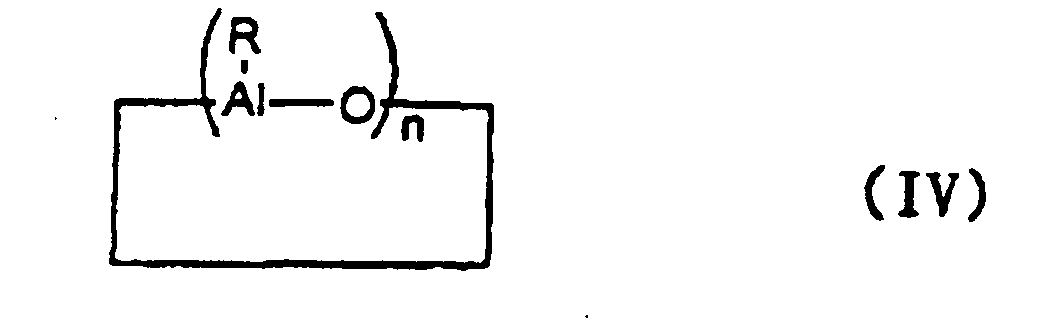
- Procédé de la revendication 3, dans lequel ledit composé d'organoaluminium inclut un alkylaluminoxane ayant un motif répétitif de formule (II) suivante, ledit alkylaluminoxane incluant un alkylaluminoxane linéaire représenté par la formule (III) suivante, et un alkylaluminoxane cyclique représenté par la formule (IV) suivante :


- Procédé de la revendication 2, dans lequel ledit acide de Lewis non coordiné est choisi dans le groupe constitué du tétrakis(pentafluorophényl)borate de N,N-diméthylanilinium, du tétrakis(pentafluorophényl)borate de triphénylcarbénium, du tétrakis(pentafluorophényl)borate de ferrocérium, et du tris(pentafluorophényl)borate.
- Terpolymère d'éthylène/composé vinylique aromatique/vinylnorbornène constitué essentiellement de 50-90 % en moles d'éthylène, d'au moins 0,1 % en moles d'un composé vinylique aromatique et de 0,01-10 % en moles d'un vinylnorbornène, qui est polymérisé avec un système catalytique constitué d'un composé d'un métal de transition représenté par la formule (I) suivante et d'un co-catalyseur :
 Cp1 est un groupe cyclopentadiényle non substitué ; un groupe cyclopentadiényle avec 1 à 4 substituants alkyle linéaires ; un groupe indényle ; un groupe tétrahydroindényle ; un groupe indényle substitué ; un groupe fluorényle ; un groupe octahydrofluorényle ; ou un groupe fluorényle substitué ;Y est un hydrogène ou un groupe silyle en C1-10, un groupe alkyle en C1-10, un groupe aryle en C1-10, ou une combinaison de ceux-ci ;A est un groupe alkyle en C1-30, un groupe alkylamide en C1-30 ou un dérivé de groupe cyclopentadiényle qui est identique à Cp1 ; etX est choisi dans le groupe constitué d'un atome d'hydrogène, d'un atome d'halogène, d'un groupe alkyle, d'un groupe aryle ou d'un groupe diène.
 - Terpolymère d'éthylène/composé vinylique aromatique/vinylnorbornène de la revendication 7, dans lequel ladite partie vinylnorbornène comporte des doubles liaisons terminales.
- Terpolymère d'éthylène/composé vinylique aromatique/vinylnorbornène de la revendication 7, dans lequel ledit terpolymère présente des pics distincts près de 112 et 114 ppm dans le spectre de RMN 13C dus aux doubles liaisons terminales.
- Terpolymère d'éthylène/composé vinylique aromatique/vinylnorbornène de la revendication 7, dans lequel ledit terpolymère présente des bandes d'étirement dues aux doubles liaisons terminales C=C et =C-H près de 1636 et 995 cm-1, respectivement, dans le spectre FTIR.
- Terpolymère d'éthylène/composé vinylique aromatique/vinylnorbornène de la revendication 7, dans lequel ledit terpolymère a un poids moléculaire moyen en poids d'au moins 5000.
Applications Claiming Priority (3)
| Application Number | Priority Date | Filing Date | Title |
|---|---|---|---|
| KR9959308 | 1999-12-20 | ||
| KR10-1999-0059308A KR100416470B1 (ko) | 1999-12-20 | 1999-12-20 | 에틸렌-방향족 비닐 화합물-비닐 노보넨 삼원공중합체 |
| PCT/KR2000/001483 WO2001046282A1 (fr) | 1999-12-20 | 2000-12-18 | Terpolymere ethylene-compose vinylique aromatique-vinyl-norbornene |
Publications (3)
| Publication Number | Publication Date |
|---|---|
| EP1268588A1 EP1268588A1 (fr) | 2003-01-02 |
| EP1268588A4 EP1268588A4 (fr) | 2006-03-29 |
| EP1268588B1 true EP1268588B1 (fr) | 2010-03-03 |
Family
ID=19627209
Family Applications (1)
| Application Number | Title | Priority Date | Filing Date |
|---|---|---|---|
| EP00983570A Expired - Lifetime EP1268588B1 (fr) | 1999-12-20 | 2000-12-18 | Terpolymere ethylene-compose vinylique aromatique-vinyl-norbornene |
Country Status (8)
| Country | Link |
|---|---|
| US (1) | US20030130446A1 (fr) |
| EP (1) | EP1268588B1 (fr) |
| JP (1) | JP2003518173A (fr) |
| KR (1) | KR100416470B1 (fr) |
| AT (1) | ATE459669T1 (fr) |
| AU (1) | AU2030801A (fr) |
| DE (1) | DE60043945D1 (fr) |
| WO (1) | WO2001046282A1 (fr) |
Families Citing this family (4)
| Publication number | Priority date | Publication date | Assignee | Title |
|---|---|---|---|---|
| US7296991B2 (en) * | 2004-12-10 | 2007-11-20 | Irwin Jere F | Adjustable extruder die assembly die lip adjustment apparatus |
| KR100969226B1 (ko) * | 2009-10-05 | 2010-07-09 | 신정옥 | 압화 장식물 및 그 제조방법 |
| WO2018191706A1 (fr) * | 2017-04-13 | 2018-10-18 | Braskem America, Inc. | Polynorbornène modifié par des azides en tant qu'agent de couplage polymère |
| WO2019078083A1 (fr) * | 2017-10-20 | 2019-04-25 | 株式会社ブリヂストン | Multi-copolymère, composition de caoutchouc, composition de caoutchouc réticulé, article en caoutchouc et pneu |
Family Cites Families (16)
| Publication number | Priority date | Publication date | Assignee | Title |
|---|---|---|---|---|
| US4123602A (en) * | 1976-05-24 | 1978-10-31 | Asahi Glass Company, Ltd. | Terpolymers of tetrafluoroethylene, ethylene and perfluoroalkyl vinyl monomer and process for producing the same |
| FR2486530B1 (fr) * | 1980-07-10 | 1985-05-31 | Charbonnages Ste Chimique | Procede de preparation de copolymeres greffes a base de styrene et d'un polymere caoutchouteux |
| JPS57177004A (en) * | 1981-04-22 | 1982-10-30 | Osaka Soda Co Ltd | Preparation of chlorinated ethylenic terpolymer |
| JPH0710900B2 (ja) * | 1982-06-18 | 1995-02-08 | エクソン リサーチ アンド エンヂニアリング コムパニー | 中級蒸留物燃料油用流動性改良剤 |
| US4847339A (en) * | 1987-02-02 | 1989-07-11 | National Distillers And Chemcial Corporation | Process for preparing interpolymers of ethylene, vinyl acetate, and reactive halogen-containing monomers |
| NZ235032A (en) | 1989-08-31 | 1993-04-28 | Dow Chemical Co | Constrained geometry complexes of titanium, zirconium or hafnium comprising a substituted cyclopentadiene ligand; use as olefin polymerisation catalyst component |
| JPH04320411A (ja) * | 1991-04-18 | 1992-11-11 | Sumitomo Chem Co Ltd | 加硫性ゴム組成物および加硫ゴム製品 |
| JP3773546B2 (ja) * | 1992-02-25 | 2006-05-10 | 出光興産株式会社 | 環状オレフィン系共重合体からなるポリオレフィン用低温耐衝撃性改良剤及び環状オレフィン系共重合体の製造方法 |
| DE19546500A1 (de) * | 1995-12-13 | 1997-06-19 | Hoechst Ag | Verfahren zur Herstellung eines Cycloolefincopolymeren |
| DE19711339B4 (de) * | 1996-03-19 | 2008-09-11 | Denki Kagaku Kogyo K.K. | Copolymer aus Ethylen und aromatischer Vinylverbindung, Verfahren zu dessen Herstellung, Formkörper daraus sowie Zusammensetzung umfassend das Copolymer |
| DE19620119C1 (de) * | 1996-05-18 | 1997-10-23 | Hoechst Ag | Terpolymerisate des Ethylens, ihre Herstellung und ihre Verwendung als Additive für Mineralöldestillate |
| DE19620118C1 (de) * | 1996-05-18 | 1997-10-23 | Hoechst Ag | Terpolymerisate des Ethylens, ihre Herstellung und ihre Verwendung als Additive für Mineralöldestillate |
| JPH11171918A (ja) * | 1997-12-11 | 1999-06-29 | Mitsui Chem Inc | ノルボルネン系ランダム共重合体の製造方法 |
| AU1688199A (en) * | 1997-12-25 | 1999-07-19 | Denki Kagaku Kogyo Kabushiki Kaisha | Polymerization catalyst and process for producing olefin polymer or copolymer with the same |
| JPH11246617A (ja) * | 1998-02-27 | 1999-09-14 | Nippon Zeon Co Ltd | ノルボルネン系重合体の製造方法及び触媒 |
| DE19826743A1 (de) * | 1998-06-16 | 1999-12-23 | Bayer Ag | Verfahren zur Herstellung von geträgerten Polymerisationskatalysatorsystemen und Verwendung dieser zur Homo- und Copolymerisation ungesättigter Monomere |
-
1999
- 1999-12-20 KR KR10-1999-0059308A patent/KR100416470B1/ko not_active Expired - Fee Related
-
2000
- 2000-12-18 DE DE60043945T patent/DE60043945D1/de not_active Expired - Lifetime
- 2000-12-18 JP JP2001547188A patent/JP2003518173A/ja active Pending
- 2000-12-18 AU AU20308/01A patent/AU2030801A/en not_active Abandoned
- 2000-12-18 US US10/129,685 patent/US20030130446A1/en not_active Abandoned
- 2000-12-18 EP EP00983570A patent/EP1268588B1/fr not_active Expired - Lifetime
- 2000-12-18 AT AT00983570T patent/ATE459669T1/de not_active IP Right Cessation
- 2000-12-18 WO PCT/KR2000/001483 patent/WO2001046282A1/fr not_active Ceased
Also Published As
| Publication number | Publication date |
|---|---|
| KR100416470B1 (ko) | 2004-01-31 |
| US20030130446A1 (en) | 2003-07-10 |
| KR20010064893A (ko) | 2001-07-11 |
| AU2030801A (en) | 2001-07-03 |
| JP2003518173A (ja) | 2003-06-03 |
| WO2001046282A1 (fr) | 2001-06-28 |
| EP1268588A4 (fr) | 2006-03-29 |
| EP1268588A1 (fr) | 2003-01-02 |
| DE60043945D1 (de) | 2010-04-15 |
| ATE459669T1 (de) | 2010-03-15 |
Similar Documents
| Publication | Publication Date | Title |
|---|---|---|
| US6472490B1 (en) | Ethylene-aromatic vinyl compound copolymer and method for its production | |
| JP4132672B2 (ja) | オレフィンを重合するための方法、そのためのメタロセン触媒およびメタロセンプロ触媒を活性化するための助触媒 | |
| US6084048A (en) | Propylene-1-butene copolymer | |
| JP3659760B2 (ja) | エチレン−芳香族ビニル化合物共重合体及びその製造方法 | |
| CA2222917C (fr) | Metallocenes; methode de preparation et utilisation dans la polymerisation d'alpha-olefines | |
| KR20050027268A (ko) | 폴리올레핀 블럭 공중합체 | |
| EP0476148B1 (fr) | Copolymere de propylene | |
| KR20020035151A (ko) | 신규한 에틸렌계 공중합체 및 그 용도 | |
| EP1268588B1 (fr) | Terpolymere ethylene-compose vinylique aromatique-vinyl-norbornene | |
| EP0718323A2 (fr) | Caoutchouc à base de copolymère de type éthylène | |
| EP0985689A1 (fr) | Copolymère d' éthylène et de composé aromatique vinylique et procédé de sa préparation | |
| WO2001046276A1 (fr) | Catalyseurs metallocenes a geometrie contrainte mutli-nucleaire et copolymeres de compose aromatique ethylene/vinyle ainsi obtenus | |
| EP0708117A1 (fr) | Procédé de production d'un élastomère de copolymère | |
| JP3489697B2 (ja) | プロピレン−芳香族ビニル化合物共重合体及びその製造方法 | |
| JP2002003553A (ja) | クロス鎖にポリエンを含むクロス共重合体及びその製造方法 | |
| JPH07165814A (ja) | プロピレン共重合体およびその製造方法 | |
| JP3506147B2 (ja) | エチレン/α−オレフィン共重合体及びそれを含有する熱可塑性樹脂組成物 | |
| KR100455842B1 (ko) | 스티렌계 공중합체 및 그 제조방법 | |
| AU3280700A (en) | Propylene copolymers containing styrene units | |
| KR102878292B1 (ko) | 고온 용액 공정에 적용 가능한 에틸렌계 중합체 제조용 촉매 조성물 및 이를 이용한 에틸렌계 중합체의 제조방법 | |
| KR100455844B1 (ko) | 스티렌계 공중합체 및 그 제조방법 | |
| KR100455843B1 (ko) | 스티렌계 공중합체 및 그 제조방법 | |
| KR101849475B1 (ko) | 에틸렌계 공중합체 | |
| JP2000119337A (ja) | 透明性芳香族ビニル化合物−エチレン共重合体及びその製造方法 | |
| JPH08225615A (ja) | エチレン系四元共重合体ゴム |
Legal Events
| Date | Code | Title | Description |
|---|---|---|---|
| PUAI | Public reference made under article 153(3) epc to a published international application that has entered the european phase |
Free format text: ORIGINAL CODE: 0009012 |
|
| 17P | Request for examination filed |
Effective date: 20020607 |
|
| AK | Designated contracting states |
Kind code of ref document: A1 Designated state(s): AT BE CH CY DE DK ES FI FR GB GR IE IT LI LU MC NL PT SE TR |
|
| AX | Request for extension of the european patent |
Free format text: AL;LT;LV;MK;RO;SI |
|
| RIN1 | Information on inventor provided before grant (corrected) |
Inventor name: ZHANG, XUEQUAN Inventor name: LEE, YOUNG, SUB Inventor name: KIM, HYUN, JOONSSANGYONG 3RD APT. 605-1103 Inventor name: LIM, JAE, GON Inventor name: YOON, SUNG, CHEOL |
|
| RIN1 | Information on inventor provided before grant (corrected) |
Inventor name: LIM, JAE, GON Inventor name: YOON, SUNG, CHEOL Inventor name: KIM, HYUN, JOONSSANGYONG 3RD APT. 605-1103 Inventor name: LEE, YOUNG, SUBC/O SAMSUNG GEN. CHEMICLAS CO.,LTD Inventor name: ZHANG, XUEQUAN |
|
| RAP1 | Party data changed (applicant data changed or rights of an application transferred) |
Owner name: SAMSUNG ATOFINA CO., LTD. |
|
| A4 | Supplementary search report drawn up and despatched |
Effective date: 20060215 |
|
| 17Q | First examination report despatched |
Effective date: 20090602 |
|
| GRAP | Despatch of communication of intention to grant a patent |
Free format text: ORIGINAL CODE: EPIDOSNIGR1 |
|
| GRAS | Grant fee paid |
Free format text: ORIGINAL CODE: EPIDOSNIGR3 |
|
| GRAA | (expected) grant |
Free format text: ORIGINAL CODE: 0009210 |
|
| AK | Designated contracting states |
Kind code of ref document: B1 Designated state(s): AT BE CH CY DE DK ES FI FR GB GR IE IT LI LU MC NL PT SE TR |
|
| REG | Reference to a national code |
Ref country code: GB Ref legal event code: FG4D |
|
| REG | Reference to a national code |
Ref country code: CH Ref legal event code: EP |
|
| REG | Reference to a national code |
Ref country code: IE Ref legal event code: FG4D |
|
| REF | Corresponds to: |
Ref document number: 60043945 Country of ref document: DE Date of ref document: 20100415 Kind code of ref document: P |
|
| REG | Reference to a national code |
Ref country code: NL Ref legal event code: VDEP Effective date: 20100303 |
|
| PG25 | Lapsed in a contracting state [announced via postgrant information from national office to epo] |
Ref country code: FI Free format text: LAPSE BECAUSE OF FAILURE TO SUBMIT A TRANSLATION OF THE DESCRIPTION OR TO PAY THE FEE WITHIN THE PRESCRIBED TIME-LIMIT Effective date: 20100303 Ref country code: AT Free format text: LAPSE BECAUSE OF FAILURE TO SUBMIT A TRANSLATION OF THE DESCRIPTION OR TO PAY THE FEE WITHIN THE PRESCRIBED TIME-LIMIT Effective date: 20100303 |
|
| PG25 | Lapsed in a contracting state [announced via postgrant information from national office to epo] |
Ref country code: SE Free format text: LAPSE BECAUSE OF FAILURE TO SUBMIT A TRANSLATION OF THE DESCRIPTION OR TO PAY THE FEE WITHIN THE PRESCRIBED TIME-LIMIT Effective date: 20100303 Ref country code: BE Free format text: LAPSE BECAUSE OF FAILURE TO SUBMIT A TRANSLATION OF THE DESCRIPTION OR TO PAY THE FEE WITHIN THE PRESCRIBED TIME-LIMIT Effective date: 20100303 Ref country code: NL Free format text: LAPSE BECAUSE OF FAILURE TO SUBMIT A TRANSLATION OF THE DESCRIPTION OR TO PAY THE FEE WITHIN THE PRESCRIBED TIME-LIMIT Effective date: 20100303 Ref country code: CY Free format text: LAPSE BECAUSE OF FAILURE TO SUBMIT A TRANSLATION OF THE DESCRIPTION OR TO PAY THE FEE WITHIN THE PRESCRIBED TIME-LIMIT Effective date: 20100303 Ref country code: ES Free format text: LAPSE BECAUSE OF FAILURE TO SUBMIT A TRANSLATION OF THE DESCRIPTION OR TO PAY THE FEE WITHIN THE PRESCRIBED TIME-LIMIT Effective date: 20100614 Ref country code: GR Free format text: LAPSE BECAUSE OF FAILURE TO SUBMIT A TRANSLATION OF THE DESCRIPTION OR TO PAY THE FEE WITHIN THE PRESCRIBED TIME-LIMIT Effective date: 20100604 |
|
| PLBE | No opposition filed within time limit |
Free format text: ORIGINAL CODE: 0009261 |
|
| STAA | Information on the status of an ep patent application or granted ep patent |
Free format text: STATUS: NO OPPOSITION FILED WITHIN TIME LIMIT |
|
| PG25 | Lapsed in a contracting state [announced via postgrant information from national office to epo] |
Ref country code: DK Free format text: LAPSE BECAUSE OF FAILURE TO SUBMIT A TRANSLATION OF THE DESCRIPTION OR TO PAY THE FEE WITHIN THE PRESCRIBED TIME-LIMIT Effective date: 20100303 Ref country code: PT Free format text: LAPSE BECAUSE OF FAILURE TO SUBMIT A TRANSLATION OF THE DESCRIPTION OR TO PAY THE FEE WITHIN THE PRESCRIBED TIME-LIMIT Effective date: 20100705 |
|
| 26N | No opposition filed |
Effective date: 20101206 |
|
| PG25 | Lapsed in a contracting state [announced via postgrant information from national office to epo] |
Ref country code: IT Free format text: LAPSE BECAUSE OF FAILURE TO SUBMIT A TRANSLATION OF THE DESCRIPTION OR TO PAY THE FEE WITHIN THE PRESCRIBED TIME-LIMIT Effective date: 20100303 |
|
| PG25 | Lapsed in a contracting state [announced via postgrant information from national office to epo] |
Ref country code: MC Free format text: LAPSE BECAUSE OF NON-PAYMENT OF DUE FEES Effective date: 20101231 |
|
| REG | Reference to a national code |
Ref country code: CH Ref legal event code: PL |
|
| PG25 | Lapsed in a contracting state [announced via postgrant information from national office to epo] |
Ref country code: IE Free format text: LAPSE BECAUSE OF NON-PAYMENT OF DUE FEES Effective date: 20101218 Ref country code: LI Free format text: LAPSE BECAUSE OF NON-PAYMENT OF DUE FEES Effective date: 20101231 Ref country code: CH Free format text: LAPSE BECAUSE OF NON-PAYMENT OF DUE FEES Effective date: 20101231 |
|
| PG25 | Lapsed in a contracting state [announced via postgrant information from national office to epo] |
Ref country code: LU Free format text: LAPSE BECAUSE OF NON-PAYMENT OF DUE FEES Effective date: 20101218 |
|
| PG25 | Lapsed in a contracting state [announced via postgrant information from national office to epo] |
Ref country code: TR Free format text: LAPSE BECAUSE OF FAILURE TO SUBMIT A TRANSLATION OF THE DESCRIPTION OR TO PAY THE FEE WITHIN THE PRESCRIBED TIME-LIMIT Effective date: 20100303 |
|
| REG | Reference to a national code |
Ref country code: DE Ref legal event code: R081 Ref document number: 60043945 Country of ref document: DE Owner name: SAMSUNG TOTAL PETROCHEMICALS CO., LTD., KR Free format text: FORMER OWNER: SAMSUNG ATOFINA CO.,LTD., SEOSAN, KR Effective date: 20140522 Ref country code: DE Ref legal event code: R082 Ref document number: 60043945 Country of ref document: DE Representative=s name: GRUENECKER, KINKELDEY, STOCKMAIR & SCHWANHAEUS, DE Effective date: 20140522 Ref country code: DE Ref legal event code: R081 Ref document number: 60043945 Country of ref document: DE Owner name: SAMSUNG TOTAL PETROCHEMICALS CO., LTD., SEOSAN, KR Free format text: FORMER OWNER: SAMSUNG ATOFINA CO.,LTD., SEOSAN, CHUNGNAM, KR Effective date: 20140522 Ref country code: DE Ref legal event code: R082 Ref document number: 60043945 Country of ref document: DE Representative=s name: GRUENECKER PATENT- UND RECHTSANWAELTE PARTG MB, DE Effective date: 20140522 Ref country code: DE Ref legal event code: R081 Ref document number: 60043945 Country of ref document: DE Owner name: HANWHA TOTAL PETROCHEMICAL CO., LTD., SEOSAN-S, KR Free format text: FORMER OWNER: SAMSUNG ATOFINA CO.,LTD., SEOSAN, CHUNGNAM, KR Effective date: 20140522 |
|
| REG | Reference to a national code |
Ref country code: FR Ref legal event code: CD Owner name: SAMSUNG TOTAL PETROCHEMICALS CO., LTD., KR Effective date: 20140602 Ref country code: FR Ref legal event code: CA Effective date: 20140602 |
|
| REG | Reference to a national code |
Ref country code: FR Ref legal event code: PLFP Year of fee payment: 16 |
|
| REG | Reference to a national code |
Ref country code: DE Ref legal event code: R082 Ref document number: 60043945 Country of ref document: DE Representative=s name: GRUENECKER PATENT- UND RECHTSANWAELTE PARTG MB, DE Ref country code: DE Ref legal event code: R081 Ref document number: 60043945 Country of ref document: DE Owner name: HANWHA TOTAL PETROCHEMICAL CO., LTD., SEOSAN-S, KR Free format text: FORMER OWNER: SAMSUNG TOTAL PETROCHEMICALS CO., LTD., SEOSAN-SI, CHUNGNAM, KR |
|
| REG | Reference to a national code |
Ref country code: FR Ref legal event code: CD Owner name: HANWHA TOTAL PETROCHEMICAL CO., LTD., KR Effective date: 20151217 |
|
| REG | Reference to a national code |
Ref country code: FR Ref legal event code: PLFP Year of fee payment: 17 |
|
| REG | Reference to a national code |
Ref country code: FR Ref legal event code: PLFP Year of fee payment: 18 |
|
| REG | Reference to a national code |
Ref country code: FR Ref legal event code: PLFP Year of fee payment: 19 |
|
| PGFP | Annual fee paid to national office [announced via postgrant information from national office to epo] |
Ref country code: FR Payment date: 20190906 Year of fee payment: 20 |
|
| PGFP | Annual fee paid to national office [announced via postgrant information from national office to epo] |
Ref country code: DE Payment date: 20190905 Year of fee payment: 20 |
|
| PGFP | Annual fee paid to national office [announced via postgrant information from national office to epo] |
Ref country code: GB Payment date: 20191008 Year of fee payment: 20 |
|
| REG | Reference to a national code |
Ref country code: DE Ref legal event code: R071 Ref document number: 60043945 Country of ref document: DE |
|
| REG | Reference to a national code |
Ref country code: GB Ref legal event code: PE20 Expiry date: 20201217 |
|
| PG25 | Lapsed in a contracting state [announced via postgrant information from national office to epo] |
Ref country code: GB Free format text: LAPSE BECAUSE OF EXPIRATION OF PROTECTION Effective date: 20201217 |