EP1269554B1 - Procede de recyclage de piles rechargeables a polymere/lithium et materiaux connexes - Google Patents
Procede de recyclage de piles rechargeables a polymere/lithium et materiaux connexes Download PDFInfo
- Publication number
- EP1269554B1 EP1269554B1 EP20010971559 EP01971559A EP1269554B1 EP 1269554 B1 EP1269554 B1 EP 1269554B1 EP 20010971559 EP20010971559 EP 20010971559 EP 01971559 A EP01971559 A EP 01971559A EP 1269554 B1 EP1269554 B1 EP 1269554B1
- Authority
- EP
- European Patent Office
- Prior art keywords
- mass
- acid
- lithium
- mother liquor
- comminuted
- Prior art date
- Legal status (The legal status is an assumption and is not a legal conclusion. Google has not performed a legal analysis and makes no representation as to the accuracy of the status listed.)
- Expired - Lifetime
Links
- 238000000034 method Methods 0.000 title claims abstract description 53
- 229910052744 lithium Inorganic materials 0.000 title claims abstract description 51
- 239000000463 material Substances 0.000 title claims abstract description 45
- 238000004064 recycling Methods 0.000 title claims abstract description 13
- 229920000642 polymer Polymers 0.000 title description 9
- 239000002253 acid Substances 0.000 claims abstract description 75
- 239000007787 solid Substances 0.000 claims abstract description 39
- WHXSMMKQMYFTQS-UHFFFAOYSA-N Lithium Chemical compound [Li] WHXSMMKQMYFTQS-UHFFFAOYSA-N 0.000 claims abstract description 30
- 239000012452 mother liquor Substances 0.000 claims abstract description 28
- 235000002918 Fraxinus excelsior Nutrition 0.000 claims abstract description 26
- 239000002956 ash Substances 0.000 claims abstract description 26
- 150000003839 salts Chemical class 0.000 claims abstract description 23
- XGZVUEUWXADBQD-UHFFFAOYSA-L lithium carbonate Chemical compound [Li+].[Li+].[O-]C([O-])=O XGZVUEUWXADBQD-UHFFFAOYSA-L 0.000 claims abstract description 17
- 229910052808 lithium carbonate Inorganic materials 0.000 claims abstract description 16
- 239000004411 aluminium Substances 0.000 claims abstract description 12
- 229910052782 aluminium Inorganic materials 0.000 claims abstract description 12
- XAGFODPZIPBFFR-UHFFFAOYSA-N aluminium Chemical compound [Al] XAGFODPZIPBFFR-UHFFFAOYSA-N 0.000 claims abstract description 12
- 229910001385 heavy metal Inorganic materials 0.000 claims abstract description 11
- 238000001816 cooling Methods 0.000 claims abstract description 10
- 150000003682 vanadium compounds Chemical class 0.000 claims abstract description 8
- 239000005518 polymer electrolyte Substances 0.000 claims abstract description 6
- QAOWNCQODCNURD-UHFFFAOYSA-N Sulfuric acid Chemical compound OS(O)(=O)=O QAOWNCQODCNURD-UHFFFAOYSA-N 0.000 claims description 66
- 239000007789 gas Substances 0.000 claims description 35
- 235000011149 sulphuric acid Nutrition 0.000 claims description 33
- 239000001117 sulphuric acid Substances 0.000 claims description 29
- 238000010438 heat treatment Methods 0.000 claims description 24
- 239000000203 mixture Substances 0.000 claims description 24
- LEONUFNNVUYDNQ-UHFFFAOYSA-N vanadium atom Chemical compound [V] LEONUFNNVUYDNQ-UHFFFAOYSA-N 0.000 claims description 20
- CURLTUGMZLYLDI-UHFFFAOYSA-N Carbon dioxide Chemical compound O=C=O CURLTUGMZLYLDI-UHFFFAOYSA-N 0.000 claims description 15
- 230000003647 oxidation Effects 0.000 claims description 15
- 238000007254 oxidation reaction Methods 0.000 claims description 15
- 229910002092 carbon dioxide Inorganic materials 0.000 claims description 10
- UFHFLCQGNIYNRP-UHFFFAOYSA-N Hydrogen Chemical compound [H][H] UFHFLCQGNIYNRP-UHFFFAOYSA-N 0.000 claims description 8
- BDAGIHXWWSANSR-UHFFFAOYSA-N Formic acid Chemical compound OC=O BDAGIHXWWSANSR-UHFFFAOYSA-N 0.000 claims description 7
- GRYLNZFGIOXLOG-UHFFFAOYSA-N Nitric acid Chemical compound O[N+]([O-])=O GRYLNZFGIOXLOG-UHFFFAOYSA-N 0.000 claims description 7
- NBIIXXVUZAFLBC-UHFFFAOYSA-N Phosphoric acid Chemical compound OP(O)(O)=O NBIIXXVUZAFLBC-UHFFFAOYSA-N 0.000 claims description 7
- 235000019253 formic acid Nutrition 0.000 claims description 7
- 239000001257 hydrogen Substances 0.000 claims description 7
- 229910052739 hydrogen Inorganic materials 0.000 claims description 7
- 229910017604 nitric acid Inorganic materials 0.000 claims description 7
- 230000001590 oxidative effect Effects 0.000 claims description 7
- VLTRZXGMWDSKGL-UHFFFAOYSA-N perchloric acid Chemical compound OCl(=O)(=O)=O VLTRZXGMWDSKGL-UHFFFAOYSA-N 0.000 claims description 7
- ITMCEJHCFYSIIV-UHFFFAOYSA-N triflic acid Chemical compound OS(=O)(=O)C(F)(F)F ITMCEJHCFYSIIV-UHFFFAOYSA-N 0.000 claims description 7
- 150000001768 cations Chemical class 0.000 claims description 6
- ATRRKUHOCOJYRX-UHFFFAOYSA-N Ammonium bicarbonate Chemical compound [NH4+].OC([O-])=O ATRRKUHOCOJYRX-UHFFFAOYSA-N 0.000 claims description 5
- 230000002378 acidificating effect Effects 0.000 claims description 5
- 239000001099 ammonium carbonate Substances 0.000 claims description 5
- 235000012501 ammonium carbonate Nutrition 0.000 claims description 5
- 239000001569 carbon dioxide Substances 0.000 claims description 5
- 229910052783 alkali metal Inorganic materials 0.000 claims description 4
- 230000005587 bubbling Effects 0.000 claims description 4
- 230000006378 damage Effects 0.000 claims description 4
- 229910052700 potassium Inorganic materials 0.000 claims description 4
- 229910052708 sodium Inorganic materials 0.000 claims description 4
- 239000003513 alkali Substances 0.000 claims description 3
- 229910052784 alkaline earth metal Inorganic materials 0.000 claims description 3
- 229910052788 barium Inorganic materials 0.000 claims description 3
- 229910052790 beryllium Inorganic materials 0.000 claims description 3
- 229910052792 caesium Inorganic materials 0.000 claims description 3
- 229910052791 calcium Inorganic materials 0.000 claims description 3
- 229910052749 magnesium Inorganic materials 0.000 claims description 3
- 229910052701 rubidium Inorganic materials 0.000 claims description 3
- 229910052712 strontium Inorganic materials 0.000 claims description 3
- 239000011261 inert gas Substances 0.000 claims description 2
- 229910052748 manganese Inorganic materials 0.000 claims 1
- 238000005201 scrubbing Methods 0.000 claims 1
- KOKKJWHERHSKEB-UHFFFAOYSA-N vanadium(3+) Chemical compound [V+3] KOKKJWHERHSKEB-UHFFFAOYSA-N 0.000 claims 1
- 238000011084 recovery Methods 0.000 abstract description 8
- 238000009273 molten salt oxidation Methods 0.000 abstract description 5
- 238000009854 hydrometallurgy Methods 0.000 abstract description 2
- 230000001376 precipitating effect Effects 0.000 abstract description 2
- 238000009853 pyrometallurgy Methods 0.000 abstract description 2
- XKRFYHLGVUSROY-UHFFFAOYSA-N Argon Chemical compound [Ar] XKRFYHLGVUSROY-UHFFFAOYSA-N 0.000 description 102
- GNTDGMZSJNCJKK-UHFFFAOYSA-N divanadium pentaoxide Chemical compound O=[V](=O)O[V](=O)=O GNTDGMZSJNCJKK-UHFFFAOYSA-N 0.000 description 72
- 239000007788 liquid Substances 0.000 description 52
- 229910052786 argon Inorganic materials 0.000 description 51
- 239000000243 solution Substances 0.000 description 51
- WMFOQBRAJBCJND-UHFFFAOYSA-M Lithium hydroxide Chemical compound [Li+].[OH-] WMFOQBRAJBCJND-UHFFFAOYSA-M 0.000 description 48
- 210000004027 cell Anatomy 0.000 description 41
- 238000006243 chemical reaction Methods 0.000 description 38
- INHCSSUBVCNVSK-UHFFFAOYSA-L lithium sulfate Chemical compound [Li+].[Li+].[O-]S([O-])(=O)=O INHCSSUBVCNVSK-UHFFFAOYSA-L 0.000 description 31
- 230000008569 process Effects 0.000 description 26
- 230000029087 digestion Effects 0.000 description 24
- 239000002244 precipitate Substances 0.000 description 24
- 238000001914 filtration Methods 0.000 description 22
- 239000000126 substance Substances 0.000 description 22
- PNEYBMLMFCGWSK-UHFFFAOYSA-N Alumina Chemical compound [O-2].[O-2].[O-2].[Al+3].[Al+3] PNEYBMLMFCGWSK-UHFFFAOYSA-N 0.000 description 20
- 238000005520 cutting process Methods 0.000 description 20
- VHUUQVKOLVNVRT-UHFFFAOYSA-N Ammonium hydroxide Chemical compound [NH4+].[OH-] VHUUQVKOLVNVRT-UHFFFAOYSA-N 0.000 description 16
- 238000001704 evaporation Methods 0.000 description 16
- 230000008020 evaporation Effects 0.000 description 16
- 238000005406 washing Methods 0.000 description 15
- FUJCRWPEOMXPAD-UHFFFAOYSA-N lithium oxide Chemical compound [Li+].[Li+].[O-2] FUJCRWPEOMXPAD-UHFFFAOYSA-N 0.000 description 14
- 229910001947 lithium oxide Inorganic materials 0.000 description 14
- MHAJPDPJQMAIIY-UHFFFAOYSA-N Hydrogen peroxide Chemical compound OO MHAJPDPJQMAIIY-UHFFFAOYSA-N 0.000 description 13
- 238000006386 neutralization reaction Methods 0.000 description 13
- VTYYLEPIZMXCLO-UHFFFAOYSA-L Calcium carbonate Chemical compound [Ca+2].[O-]C([O-])=O VTYYLEPIZMXCLO-UHFFFAOYSA-L 0.000 description 12
- RAHZWNYVWXNFOC-UHFFFAOYSA-N Sulphur dioxide Chemical compound O=S=O RAHZWNYVWXNFOC-UHFFFAOYSA-N 0.000 description 12
- 229910045601 alloy Inorganic materials 0.000 description 12
- 239000000956 alloy Substances 0.000 description 12
- QGZKDVFQNNGYKY-UHFFFAOYSA-N ammonia Natural products N QGZKDVFQNNGYKY-UHFFFAOYSA-N 0.000 description 12
- 238000004090 dissolution Methods 0.000 description 12
- 229910052751 metal Inorganic materials 0.000 description 12
- 239000002184 metal Substances 0.000 description 12
- 229910000831 Steel Inorganic materials 0.000 description 11
- 229910052760 oxygen Inorganic materials 0.000 description 11
- 239000010959 steel Substances 0.000 description 11
- 229910052720 vanadium Inorganic materials 0.000 description 11
- 239000006227 byproduct Substances 0.000 description 10
- QVGXLLKOCUKJST-UHFFFAOYSA-N atomic oxygen Chemical compound [O] QVGXLLKOCUKJST-UHFFFAOYSA-N 0.000 description 9
- 239000000428 dust Substances 0.000 description 9
- 231100001261 hazardous Toxicity 0.000 description 9
- HTXDPTMKBJXEOW-UHFFFAOYSA-N iridium(IV) oxide Inorganic materials O=[Ir]=O HTXDPTMKBJXEOW-UHFFFAOYSA-N 0.000 description 9
- 239000001301 oxygen Substances 0.000 description 9
- QCWXUUIWCKQGHC-UHFFFAOYSA-N Zirconium Chemical compound [Zr] QCWXUUIWCKQGHC-UHFFFAOYSA-N 0.000 description 8
- WNROFYMDJYEPJX-UHFFFAOYSA-K aluminium hydroxide Chemical compound [OH-].[OH-].[OH-].[Al+3] WNROFYMDJYEPJX-UHFFFAOYSA-K 0.000 description 8
- 229910021502 aluminium hydroxide Inorganic materials 0.000 description 8
- 238000006073 displacement reaction Methods 0.000 description 8
- 238000005189 flocculation Methods 0.000 description 8
- 230000016615 flocculation Effects 0.000 description 8
- 229910052726 zirconium Inorganic materials 0.000 description 8
- OSGAYBCDTDRGGQ-UHFFFAOYSA-L calcium sulfate Chemical compound [Ca+2].[O-]S([O-])(=O)=O OSGAYBCDTDRGGQ-UHFFFAOYSA-L 0.000 description 7
- 238000002485 combustion reaction Methods 0.000 description 7
- 229910001026 inconel Inorganic materials 0.000 description 7
- 229910001416 lithium ion Inorganic materials 0.000 description 7
- 239000010802 sludge Substances 0.000 description 7
- XLYOFNOQVPJJNP-UHFFFAOYSA-N water Chemical compound O XLYOFNOQVPJJNP-UHFFFAOYSA-N 0.000 description 7
- IJGRMHOSHXDMSA-UHFFFAOYSA-N Atomic nitrogen Chemical compound N#N IJGRMHOSHXDMSA-UHFFFAOYSA-N 0.000 description 6
- HEMHJVSKTPXQMS-UHFFFAOYSA-M Sodium hydroxide Chemical compound [OH-].[Na+] HEMHJVSKTPXQMS-UHFFFAOYSA-M 0.000 description 6
- 229910000019 calcium carbonate Inorganic materials 0.000 description 6
- 230000003197 catalytic effect Effects 0.000 description 6
- 238000005119 centrifugation Methods 0.000 description 6
- 229910000856 hastalloy Inorganic materials 0.000 description 6
- 239000010955 niobium Substances 0.000 description 6
- 238000007086 side reaction Methods 0.000 description 6
- 229910001220 stainless steel Inorganic materials 0.000 description 6
- 239000010935 stainless steel Substances 0.000 description 6
- 125000005287 vanadyl group Chemical group 0.000 description 6
- 229910001203 Alloy 20 Inorganic materials 0.000 description 5
- RYGMFSIKBFXOCR-UHFFFAOYSA-N Copper Chemical compound [Cu] RYGMFSIKBFXOCR-UHFFFAOYSA-N 0.000 description 5
- XHCLAFWTIXFWPH-UHFFFAOYSA-N [O-2].[O-2].[O-2].[O-2].[O-2].[V+5].[V+5] Chemical compound [O-2].[O-2].[O-2].[O-2].[O-2].[V+5].[V+5] XHCLAFWTIXFWPH-UHFFFAOYSA-N 0.000 description 5
- 239000011149 active material Substances 0.000 description 5
- 239000010949 copper Substances 0.000 description 5
- 229910052802 copper Inorganic materials 0.000 description 5
- 238000000605 extraction Methods 0.000 description 5
- 239000000706 filtrate Substances 0.000 description 5
- 230000020169 heat generation Effects 0.000 description 5
- 238000004519 manufacturing process Methods 0.000 description 5
- 229910052757 nitrogen Inorganic materials 0.000 description 5
- 239000004810 polytetrafluoroethylene Substances 0.000 description 5
- 229920001343 polytetrafluoroethylene Polymers 0.000 description 5
- 230000009257 reactivity Effects 0.000 description 5
- 239000002002 slurry Substances 0.000 description 5
- PXHVJJICTQNCMI-UHFFFAOYSA-N Nickel Chemical compound [Ni] PXHVJJICTQNCMI-UHFFFAOYSA-N 0.000 description 4
- QAOWNCQODCNURD-UHFFFAOYSA-L Sulfate Chemical compound [O-]S([O-])(=O)=O QAOWNCQODCNURD-UHFFFAOYSA-L 0.000 description 4
- BFNBIHQBYMNNAN-UHFFFAOYSA-N ammonium sulfate Chemical compound N.N.OS(O)(=O)=O BFNBIHQBYMNNAN-UHFFFAOYSA-N 0.000 description 4
- 229910052921 ammonium sulfate Inorganic materials 0.000 description 4
- 239000001166 ammonium sulphate Substances 0.000 description 4
- 235000011130 ammonium sulphate Nutrition 0.000 description 4
- AXCZMVOFGPJBDE-UHFFFAOYSA-L calcium dihydroxide Chemical compound [OH-].[OH-].[Ca+2] AXCZMVOFGPJBDE-UHFFFAOYSA-L 0.000 description 4
- 239000000920 calcium hydroxide Substances 0.000 description 4
- 229910001861 calcium hydroxide Inorganic materials 0.000 description 4
- 230000007797 corrosion Effects 0.000 description 4
- 238000005260 corrosion Methods 0.000 description 4
- 238000001035 drying Methods 0.000 description 4
- 238000004070 electrodeposition Methods 0.000 description 4
- 239000012530 fluid Substances 0.000 description 4
- 229910001679 gibbsite Inorganic materials 0.000 description 4
- 150000002739 metals Chemical class 0.000 description 4
- 238000002156 mixing Methods 0.000 description 4
- 239000002245 particle Substances 0.000 description 4
- 239000000843 powder Substances 0.000 description 4
- 229910021653 sulphate ion Inorganic materials 0.000 description 4
- PSDQQCXQSWHCRN-UHFFFAOYSA-N vanadium(4+) Chemical compound [V+4] PSDQQCXQSWHCRN-UHFFFAOYSA-N 0.000 description 4
- 229910000838 Al alloy Inorganic materials 0.000 description 3
- HBBGRARXTFLTSG-UHFFFAOYSA-N Lithium ion Chemical compound [Li+] HBBGRARXTFLTSG-UHFFFAOYSA-N 0.000 description 3
- 229910052925 anhydrite Inorganic materials 0.000 description 3
- 239000007864 aqueous solution Substances 0.000 description 3
- 229910000963 austenitic stainless steel Inorganic materials 0.000 description 3
- 238000009835 boiling Methods 0.000 description 3
- WUKWITHWXAAZEY-UHFFFAOYSA-L calcium difluoride Chemical compound [F-].[F-].[Ca+2] WUKWITHWXAAZEY-UHFFFAOYSA-L 0.000 description 3
- 239000006229 carbon black Substances 0.000 description 3
- 239000003575 carbonaceous material Substances 0.000 description 3
- 229910000428 cobalt oxide Inorganic materials 0.000 description 3
- IVMYJDGYRUAWML-UHFFFAOYSA-N cobalt(ii) oxide Chemical compound [Co]=O IVMYJDGYRUAWML-UHFFFAOYSA-N 0.000 description 3
- 229920001577 copolymer Polymers 0.000 description 3
- 239000003792 electrolyte Substances 0.000 description 3
- 238000005516 engineering process Methods 0.000 description 3
- 238000005188 flotation Methods 0.000 description 3
- 239000011521 glass Substances 0.000 description 3
- 230000005484 gravity Effects 0.000 description 3
- 239000002920 hazardous waste Substances 0.000 description 3
- 238000007654 immersion Methods 0.000 description 3
- 239000002198 insoluble material Substances 0.000 description 3
- XQHAGELNRSUUGU-UHFFFAOYSA-M lithium chlorate Chemical compound [Li+].[O-]Cl(=O)=O XQHAGELNRSUUGU-UHFFFAOYSA-M 0.000 description 3
- 150000007522 mineralic acids Chemical class 0.000 description 3
- 230000003472 neutralizing effect Effects 0.000 description 3
- 229910052758 niobium Inorganic materials 0.000 description 3
- GUCVJGMIXFAOAE-UHFFFAOYSA-N niobium atom Chemical compound [Nb] GUCVJGMIXFAOAE-UHFFFAOYSA-N 0.000 description 3
- 150000007524 organic acids Chemical class 0.000 description 3
- 235000005985 organic acids Nutrition 0.000 description 3
- 235000020030 perry Nutrition 0.000 description 3
- 238000012545 processing Methods 0.000 description 3
- 239000011734 sodium Substances 0.000 description 3
- 241000894007 species Species 0.000 description 3
- 238000002798 spectrophotometry method Methods 0.000 description 3
- 229910052715 tantalum Inorganic materials 0.000 description 3
- GUVRBAGPIYLISA-UHFFFAOYSA-N tantalum atom Chemical compound [Ta] GUVRBAGPIYLISA-UHFFFAOYSA-N 0.000 description 3
- 239000010936 titanium Substances 0.000 description 3
- 230000007704 transition Effects 0.000 description 3
- UONOETXJSWQNOL-UHFFFAOYSA-N tungsten carbide Chemical compound [W+]#[C-] UONOETXJSWQNOL-UHFFFAOYSA-N 0.000 description 3
- 238000000870 ultraviolet spectroscopy Methods 0.000 description 3
- 229910001233 yttria-stabilized zirconia Inorganic materials 0.000 description 3
- UBDHSURDYAETAL-UHFFFAOYSA-N 8-aminonaphthalene-1,3,6-trisulfonic acid Chemical compound OS(=O)(=O)C1=CC(S(O)(=O)=O)=C2C(N)=CC(S(O)(=O)=O)=CC2=C1 UBDHSURDYAETAL-UHFFFAOYSA-N 0.000 description 2
- OKTJSMMVPCPJKN-UHFFFAOYSA-N Carbon Chemical compound [C] OKTJSMMVPCPJKN-UHFFFAOYSA-N 0.000 description 2
- 235000008733 Citrus aurantifolia Nutrition 0.000 description 2
- 235000011941 Tilia x europaea Nutrition 0.000 description 2
- RTAQQCXQSZGOHL-UHFFFAOYSA-N Titanium Chemical compound [Ti] RTAQQCXQSZGOHL-UHFFFAOYSA-N 0.000 description 2
- RLTFLELMPUMVEH-UHFFFAOYSA-N [Li+].[O--].[O--].[O--].[V+5] Chemical class [Li+].[O--].[O--].[O--].[V+5] RLTFLELMPUMVEH-UHFFFAOYSA-N 0.000 description 2
- 239000012670 alkaline solution Substances 0.000 description 2
- 229910000329 aluminium sulfate Inorganic materials 0.000 description 2
- DIZPMCHEQGEION-UHFFFAOYSA-H aluminium sulfate (anhydrous) Chemical compound [Al+3].[Al+3].[O-]S([O-])(=O)=O.[O-]S([O-])(=O)=O.[O-]S([O-])(=O)=O DIZPMCHEQGEION-UHFFFAOYSA-H 0.000 description 2
- 238000004458 analytical method Methods 0.000 description 2
- 239000011575 calcium Substances 0.000 description 2
- 239000001175 calcium sulphate Substances 0.000 description 2
- 235000011132 calcium sulphate Nutrition 0.000 description 2
- 229910052799 carbon Inorganic materials 0.000 description 2
- 229910052729 chemical element Inorganic materials 0.000 description 2
- 150000001875 compounds Chemical class 0.000 description 2
- 238000005485 electric heating Methods 0.000 description 2
- 230000007613 environmental effect Effects 0.000 description 2
- 238000004880 explosion Methods 0.000 description 2
- 239000000383 hazardous chemical Substances 0.000 description 2
- 239000012535 impurity Substances 0.000 description 2
- 229910000953 kanthal Inorganic materials 0.000 description 2
- 238000010169 landfilling Methods 0.000 description 2
- 239000004571 lime Substances 0.000 description 2
- 229910052759 nickel Inorganic materials 0.000 description 2
- 239000008188 pellet Substances 0.000 description 2
- 239000004033 plastic Substances 0.000 description 2
- 229920003023 plastic Polymers 0.000 description 2
- OTYBMLCTZGSZBG-UHFFFAOYSA-L potassium sulfate Chemical compound [K+].[K+].[O-]S([O-])(=O)=O OTYBMLCTZGSZBG-UHFFFAOYSA-L 0.000 description 2
- 229910052939 potassium sulfate Inorganic materials 0.000 description 2
- 239000000047 product Substances 0.000 description 2
- 238000009877 rendering Methods 0.000 description 2
- 238000000926 separation method Methods 0.000 description 2
- CDBYLPFSWZWCQE-UHFFFAOYSA-L sodium carbonate Substances [Na+].[Na+].[O-]C([O-])=O CDBYLPFSWZWCQE-UHFFFAOYSA-L 0.000 description 2
- 239000007779 soft material Substances 0.000 description 2
- -1 such as HF Substances 0.000 description 2
- FYSNRJHAOHDILO-UHFFFAOYSA-N thionyl chloride Chemical compound ClS(Cl)=O FYSNRJHAOHDILO-UHFFFAOYSA-N 0.000 description 2
- 229910052719 titanium Inorganic materials 0.000 description 2
- 229910021532 Calcite Inorganic materials 0.000 description 1
- BVKZGUZCCUSVTD-UHFFFAOYSA-L Carbonate Chemical compound [O-]C([O-])=O BVKZGUZCCUSVTD-UHFFFAOYSA-L 0.000 description 1
- ZAMOUSCENKQFHK-UHFFFAOYSA-N Chlorine atom Chemical compound [Cl] ZAMOUSCENKQFHK-UHFFFAOYSA-N 0.000 description 1
- MYMOFIZGZYHOMD-UHFFFAOYSA-N Dioxygen Chemical compound O=O MYMOFIZGZYHOMD-UHFFFAOYSA-N 0.000 description 1
- 241000251729 Elasmobranchii Species 0.000 description 1
- KRHYYFGTRYWZRS-UHFFFAOYSA-M Fluoride anion Chemical compound [F-] KRHYYFGTRYWZRS-UHFFFAOYSA-M 0.000 description 1
- YCKRFDGAMUMZLT-UHFFFAOYSA-N Fluorine atom Chemical compound [F] YCKRFDGAMUMZLT-UHFFFAOYSA-N 0.000 description 1
- 229910018452 Li V2O5 Inorganic materials 0.000 description 1
- 229910018613 MMnO4 Inorganic materials 0.000 description 1
- CBENFWSGALASAD-UHFFFAOYSA-N Ozone Chemical compound [O-][O+]=O CBENFWSGALASAD-UHFFFAOYSA-N 0.000 description 1
- 229910006124 SOCl2 Inorganic materials 0.000 description 1
- NINIDFKCEFEMDL-UHFFFAOYSA-N Sulfur Chemical compound [S] NINIDFKCEFEMDL-UHFFFAOYSA-N 0.000 description 1
- 239000005864 Sulphur Substances 0.000 description 1
- 229910001315 Tool steel Inorganic materials 0.000 description 1
- 150000007513 acids Chemical class 0.000 description 1
- 230000001154 acute effect Effects 0.000 description 1
- 150000001450 anions Chemical class 0.000 description 1
- 238000000498 ball milling Methods 0.000 description 1
- 238000001354 calcination Methods 0.000 description 1
- 235000011116 calcium hydroxide Nutrition 0.000 description 1
- PASHVRUKOFIRIK-UHFFFAOYSA-L calcium sulfate dihydrate Chemical compound O.O.[Ca+2].[O-]S([O-])(=O)=O PASHVRUKOFIRIK-UHFFFAOYSA-L 0.000 description 1
- 239000010406 cathode material Substances 0.000 description 1
- 239000003518 caustics Substances 0.000 description 1
- 230000001413 cellular effect Effects 0.000 description 1
- 210000003850 cellular structure Anatomy 0.000 description 1
- 239000003153 chemical reaction reagent Substances 0.000 description 1
- 239000000460 chlorine Substances 0.000 description 1
- 229910052801 chlorine Inorganic materials 0.000 description 1
- 239000010941 cobalt Substances 0.000 description 1
- GUTLYIVDDKVIGB-UHFFFAOYSA-N cobalt atom Chemical compound [Co] GUTLYIVDDKVIGB-UHFFFAOYSA-N 0.000 description 1
- 229910021446 cobalt carbonate Inorganic materials 0.000 description 1
- 238000000354 decomposition reaction Methods 0.000 description 1
- 230000003247 decreasing effect Effects 0.000 description 1
- 238000013461 design Methods 0.000 description 1
- XUCJHNOBJLKZNU-UHFFFAOYSA-M dilithium;hydroxide Chemical compound [Li+].[Li+].[OH-] XUCJHNOBJLKZNU-UHFFFAOYSA-M 0.000 description 1
- 238000000909 electrodialysis Methods 0.000 description 1
- 238000006056 electrooxidation reaction Methods 0.000 description 1
- 230000005496 eutectics Effects 0.000 description 1
- 230000001747 exhibiting effect Effects 0.000 description 1
- 239000010408 film Substances 0.000 description 1
- 239000011737 fluorine Substances 0.000 description 1
- 229910052731 fluorine Inorganic materials 0.000 description 1
- 239000010436 fluorite Substances 0.000 description 1
- 239000011888 foil Substances 0.000 description 1
- 230000008014 freezing Effects 0.000 description 1
- 238000007710 freezing Methods 0.000 description 1
- 239000010440 gypsum Substances 0.000 description 1
- 229910052602 gypsum Inorganic materials 0.000 description 1
- 230000036541 health Effects 0.000 description 1
- XLYOFNOQVPJJNP-ZSJDYOACSA-N heavy water Substances [2H]O[2H] XLYOFNOQVPJJNP-ZSJDYOACSA-N 0.000 description 1
- 239000001307 helium Substances 0.000 description 1
- 229910052734 helium Inorganic materials 0.000 description 1
- SWQJXJOGLNCZEY-UHFFFAOYSA-N helium atom Chemical compound [He] SWQJXJOGLNCZEY-UHFFFAOYSA-N 0.000 description 1
- 150000002431 hydrogen Chemical class 0.000 description 1
- 230000006872 improvement Effects 0.000 description 1
- 239000010423 industrial mineral Substances 0.000 description 1
- 150000002484 inorganic compounds Chemical class 0.000 description 1
- 229910010272 inorganic material Inorganic materials 0.000 description 1
- 229910052500 inorganic mineral Inorganic materials 0.000 description 1
- 238000003780 insertion Methods 0.000 description 1
- 230000037431 insertion Effects 0.000 description 1
- 239000003456 ion exchange resin Substances 0.000 description 1
- 229920003303 ion-exchange polymer Polymers 0.000 description 1
- 229940006487 lithium cation Drugs 0.000 description 1
- 150000002642 lithium compounds Chemical class 0.000 description 1
- 229910021450 lithium metal oxide Inorganic materials 0.000 description 1
- 229910003002 lithium salt Inorganic materials 0.000 description 1
- 159000000002 lithium salts Chemical class 0.000 description 1
- 229910000686 lithium vanadium oxide Inorganic materials 0.000 description 1
- 239000000155 melt Substances 0.000 description 1
- 230000008018 melting Effects 0.000 description 1
- 238000002844 melting Methods 0.000 description 1
- 150000001247 metal acetylides Chemical class 0.000 description 1
- 229910044991 metal oxide Inorganic materials 0.000 description 1
- 150000004706 metal oxides Chemical class 0.000 description 1
- 239000011707 mineral Substances 0.000 description 1
- 235000010755 mineral Nutrition 0.000 description 1
- 238000005065 mining Methods 0.000 description 1
- 239000007773 negative electrode material Substances 0.000 description 1
- 239000003960 organic solvent Substances 0.000 description 1
- 239000000123 paper Substances 0.000 description 1
- JRKICGRDRMAZLK-UHFFFAOYSA-N peroxydisulfuric acid Chemical compound OS(=O)(=O)OOS(O)(=O)=O JRKICGRDRMAZLK-UHFFFAOYSA-N 0.000 description 1
- FHHJDRFHHWUPDG-UHFFFAOYSA-N peroxysulfuric acid Chemical compound OOS(O)(=O)=O FHHJDRFHHWUPDG-UHFFFAOYSA-N 0.000 description 1
- 238000011020 pilot scale process Methods 0.000 description 1
- 239000007774 positive electrode material Substances 0.000 description 1
- 239000001120 potassium sulphate Substances 0.000 description 1
- 235000011151 potassium sulphates Nutrition 0.000 description 1
- 230000003134 recirculating effect Effects 0.000 description 1
- 239000012487 rinsing solution Substances 0.000 description 1
- 238000012216 screening Methods 0.000 description 1
- 238000007873 sieving Methods 0.000 description 1
- 238000005549 size reduction Methods 0.000 description 1
- 229910000029 sodium carbonate Inorganic materials 0.000 description 1
- 229910000679 solder Inorganic materials 0.000 description 1
- 239000002910 solid waste Substances 0.000 description 1
- 239000002904 solvent Substances 0.000 description 1
- 238000000638 solvent extraction Methods 0.000 description 1
- 150000003467 sulfuric acid derivatives Chemical class 0.000 description 1
- 239000010409 thin film Substances 0.000 description 1
- 230000001988 toxicity Effects 0.000 description 1
- 231100000419 toxicity Toxicity 0.000 description 1
- 150000003681 vanadium Chemical class 0.000 description 1
- 238000013022 venting Methods 0.000 description 1
- 239000002699 waste material Substances 0.000 description 1
Images


Classifications
-
- H—ELECTRICITY
- H01—ELECTRIC ELEMENTS
- H01M—PROCESSES OR MEANS, e.g. BATTERIES, FOR THE DIRECT CONVERSION OF CHEMICAL ENERGY INTO ELECTRICAL ENERGY
- H01M6/00—Primary cells; Manufacture thereof
- H01M6/52—Reclaiming serviceable parts of waste cells or batteries, e.g. recycling
-
- H—ELECTRICITY
- H01—ELECTRIC ELEMENTS
- H01M—PROCESSES OR MEANS, e.g. BATTERIES, FOR THE DIRECT CONVERSION OF CHEMICAL ENERGY INTO ELECTRICAL ENERGY
- H01M10/00—Secondary cells; Manufacture thereof
- H01M10/54—Reclaiming serviceable parts of waste accumulators
-
- Y—GENERAL TAGGING OF NEW TECHNOLOGICAL DEVELOPMENTS; GENERAL TAGGING OF CROSS-SECTIONAL TECHNOLOGIES SPANNING OVER SEVERAL SECTIONS OF THE IPC; TECHNICAL SUBJECTS COVERED BY FORMER USPC CROSS-REFERENCE ART COLLECTIONS [XRACs] AND DIGESTS
- Y02—TECHNOLOGIES OR APPLICATIONS FOR MITIGATION OR ADAPTATION AGAINST CLIMATE CHANGE
- Y02P—CLIMATE CHANGE MITIGATION TECHNOLOGIES IN THE PRODUCTION OR PROCESSING OF GOODS
- Y02P10/00—Technologies related to metal processing
- Y02P10/20—Recycling
-
- Y—GENERAL TAGGING OF NEW TECHNOLOGICAL DEVELOPMENTS; GENERAL TAGGING OF CROSS-SECTIONAL TECHNOLOGIES SPANNING OVER SEVERAL SECTIONS OF THE IPC; TECHNICAL SUBJECTS COVERED BY FORMER USPC CROSS-REFERENCE ART COLLECTIONS [XRACs] AND DIGESTS
- Y02—TECHNOLOGIES OR APPLICATIONS FOR MITIGATION OR ADAPTATION AGAINST CLIMATE CHANGE
- Y02W—CLIMATE CHANGE MITIGATION TECHNOLOGIES RELATED TO WASTEWATER TREATMENT OR WASTE MANAGEMENT
- Y02W30/00—Technologies for solid waste management
- Y02W30/50—Reuse, recycling or recovery technologies
- Y02W30/84—Recycling of batteries or fuel cells
Definitions
- This invention relates to a method for recovering and recycling, by means of a pyrometallurgical and hydrometallurgical process, lithium and vanadium compounds from spent lithium metal solid and gel polymer rechargeable batteries. More particularly, the invention is concerned with the recovery of vanadium and lithium in the form of vanadium pentoxide (V 2 O 5 ) and lithium carbonate (Li 2 CO 3 ) from lithium metal solid and gel polymer electrolyte batteries, scraps therefrom and products used to produce them.
- V 2 O 5 vanadium pentoxide
- Li 2 CO 3 lithium carbonate
- the TOXCO process involves reducing the reactivity by lowering the temperature using cryogenic liquids such as nitrogen or argon.
- cryogenic liquids such as nitrogen or argon.
- the frozen batteries are then immersed under a large volume of aqueous caustic solution made of sodium hydroxide and sodium carbonate. In this bath, the still frozen battery cases are crushed. Active cell materials, such as lithium, react to release hydrogen and heat. Under these harsh conditions, hydrogen ignites burning all flammable organic solvents.
- Lithium carbonate is purified by electrodialysis and sold by a subsidiary of Toxco, LithChem International.
- TOXCO process is not specifically appropriate to the recycling of lithium metal solid and gel polymer electrolyte batteries because it focuses on alkaline solutions for dissolution and does not focus on the particular vanadium chemistry.
- the second company is BDT Inc. formerly Battery Destruction Technology which is located in Clarence, NY. BDT specializes in the destruction of hazardous wastes, particularly spent lithium batteries.
- the current processing capacity is about 350 tonnes per year of both spent lithium batteries and lithium metallic scrap.
- the process involved which is described in U.S. Pat. 4,647,928 consists in crushing the spent batteries under an alkaline aqueous solution of sodium hydroxide with a swing type hammer mill.
- the resulting sludge is clarified by sieving through a coarse screen, solid wastes are removed by filtration and recovered for disposal and landfilling, while the alkaline filtrate is pH adjusted and redirected to the mill.
- this process which only intended to neutralize hazardous materials does not allow easy separation and recovery of valuable by-products such as lithium and vanadium compounds.
- the third company is Sony Electronics Inc. which, in close collaboration with Sumitomo Metal Mining Company, has developed a process specifically devoted to recovering cobalt oxide from its own spent Li-Ion batteries used in electronic devices, such as laptop computers, camcorders, digital cameras, and cellular phones.
- the process involves the calcination of spent cells and utilizes the cogeneration resulting from burning electrolytes. It is capable of recovering cobalt oxide with a sufficiently high quality to reuse the latter directly in the fabrication of new Li-Ion batteries, and the metallic scrap consists of secondary by-product, such as copper and stainless steel.
- This technology is well established and recycling of spent lithium-ion cells is today performed in Japan with a current processing capacity of 120-150 tonnes per year.
- Lithium metal polymer batteries designated under the common acronym LMPB, are promising rechargeable power sources especially developed by the Applicant for automotive applications, such as hybrid electric vehicles (HEV), and fully electric vehicle (EV), and the stationary market, such as electric power utilities, telecommunications, etc.
- the basic electrochemical system of these secondary batteries is made of an anode consisting of an ultra-thin lithium metal foil, a solid copolymer electrolyte containing a lithium salt, a cathode comprising insertion lithium vanadium oxide compounds, and a carbon coated aluminium current collector.
- the electrochemical cell Owing to its thin film design, the electrochemical cell (EC) exhibits both high gravimetric (270 Wh/kg) and volumetric energy (415 Wh/kg) densities.
- An ultimate chemical analysis expressed in mass fraction of a typical electrochemical cell is presented in the following Table 1.
- Table 1 Ultimate chemical composition of an EC Chemical element Mass fraction Carbon 28.383 wt % Oxygen 25.562 wt % Vanadium 16.612 wt % Aluminium 11.049 wt % Lithium 10.222 wt % Hydrogen 3.879 wt % Fluorine 2.540 wt % Sulphur 1.43 8 wt % Nitrogen 0.315 wt %
- a method of recovering and recycling lithium and vanadium compounds from a material comprising spent lithium metal solid polymer rechargeable batteries, and/or scraps therefrom and/or products used to produce said batteries which comprises comminuting a hardened and cooled mass of said material under an inert atmosphere, treating the comminuted hardened cooled mass to give a mother liquor containing dissolved vanadium salts and heavy metals, extracting vanadium pentoxide (V 2 O 5 ) from the mother liquor separating heavy metals, aluminium and other metallic impurities therefrom, and precipitating lithium carbonate from the remaining solution.
- V 2 O 5 vanadium pentoxide
- the mass of material is comminuted under a flow of liquefied cryogenic gases such as liquid argon, liquid helium and liquid nitrogen.
- the hardened cooled mass is obtained by hardening the mass of the material by cooling same to a temperature below about 273 K, such as between about 77 K and about 273K, for example 85 K.
- the method comprises batch incinerating the comminuted hardened cooled mass, and treating the comminuted hardened cooled mass to give the mother liquor.
- the comminuted hardened cooled mass is cooled and the gases produced thereby are scrubbed off before treating the cooled mass to give the mother liquor.
- the liquor is obtained by digesting ashes and solid residues obtained by batch incinerating the comminuted hardened cooled mass in an acid, such as HF, HCl, HBr, HI, HNO 3 , H 3 PO 4 , H 2 SO 4 , HClO 4 , HCOOH, CF 3 SO 3 H, or mixtures thereof.
- an acid such as HF, HCl, HBr, HI, HNO 3 , H 3 PO 4 , H 2 SO 4 , HClO 4 , HCOOH, CF 3 SO 3 H, or mixtures thereof.
- the preferred acid is H 2 SO 4 .
- the mother liquor is obtained by digesting the comminuted hardened cooled mass directly without prior treatment in an acid such as HF, HCl, HBr, HI, HNO 3 , H 3 PO 4 , H 2 SO 4 , HClO 4 , HCOOH, CF 3 SO 3 H, or mixtures thereof, H 2 SO 4 being preferred, and separating a mixture of inert gas and hydrogen to give the mother liquor.
- an acid such as HF, HCl, HBr, HI, HNO 3 , H 3 PO 4 , H 2 SO 4 , HClO 4 , HCOOH, CF 3 SO 3 H, or mixtures thereof, H 2 SO 4 being preferred
- the method comprises heating the comminuted hardened cooled mass under conditions and at a temperature effective to cause oxidation of the comminuted material and removing gases produced during the oxidation, before treating the cooled mass to give the mother liquor.
- the mother liquor is obtained by digesting the ground solidified salts from which the gases produced during oxidation have been removed, in an acid such as HF, HCl, HBr, HI, HNO 3 , H 3 PO 4 , H 2 SO 4 , HClO 4 , HCOOH, CF 3 SO 3 H, or mixtures thereof, H 2 SO 4 being preferred, the mother liquor containing insoluble solids.
- an acid such as HF, HCl, HBr, HI, HNO 3 , H 3 PO 4 , H 2 SO 4 , HClO 4 , HCOOH, CF 3 SO 3 H, or mixtures thereof, H 2 SO 4 being preferred, the mother liquor containing insoluble solids.
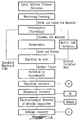
- FIGURES 1A , 1B , and 1C are flow sheets representing various steps of the process according to the invention.
- the invention relates to a method for the recovery and recycling of lithium and vanadium compounds from spent rechargeable lithium batteries, particularly lithium metal gel and solid polymer electrolyte rechargeable batteries, comprising at least one negative electrode active material, a separator, an electrolyte, one positive electrode active material, a current collector and a cell casing.
- the method After mechanical dismantling of the casing and providing a mass of cooled and hardened material, the method involves a novel recycling process, consisting of digesting with an acid its ashes obtained by incineration, or its solidified salts obtained by molten salt extraction or the comminuted mass itself to give a mother liquor.
- the process includes the steps of mechanically dismantling the batteries to remove the metal casing and the electric hardware as scrap, hardening of the soft cell materials by lowering the temperature of the free electrochemical cells (ECs) below ambient temperature., and comminuting the ECs into smaller pieces while in cold state before further processing.
- the process also includes the further steps of treating the ground cell materials as is or their ashes obtained by incineration, or their solid salts produced after molten salts oxidation (MSO).
- MSO molten salts oxidation
- the process involves collecting the solid, liquid and gaseous discharges from the reactor, dissolving the solid and liquid discharges with an appropriate solvent and absorbing the gaseous effluents with an alkaline solution, mixing the resultant wash streams, separating precipitates formed from the mixed stream and neutralizing the remaining solution.
- the last step consists in recovering efficiently, safely, and in a relatively economical manner the valuable by-products such as vanadium and lithium compounds for reuse in the manufacture of electrochemical cells.
- the first step consists in hardening the soft materials such as lithium metal and polymer contained in the mass of spent ECs by cooling below 273 K.
- the freezing step is necessarily required in order to render the soft materials contained into the electrochemical cell such as metallic lithium and gel or solid polymers more brittle and to facilitate the comminution operation unit and also based on the Arrhenius law for the kinetics rate constant to diminish the chemical reactivity of hazardous cell components during handling.
- cryogenic shredding is the preferred technique among the numerous size reduction processes.
- the combination of a cryogenic fluid with a rotary cutting mill will harden soft cell materials to render them brittle and easy to grind, and ensure safe operating conditions by maintaining an inert atmosphere around the rotary cutting mill.
- Cryogenic shredding is normally performed using a cutting mill with sharp knives made of tool steel or hard cemented carbides preferably operating under a continuous flow of liquid argon. The cuttings produced are usually smaller than 1 millimeter.
- Oversize cuttings are removed by screening under argon and are recycled to the cutting mill.
- the resulting slurry comprising undersize cuttings and liquid argon, is continuously poured into an incineration vessel. When it is completely full, the reactor is then closed and connected to a compressed air supply for batch incineration of the shredded mass. Then, argon is recovered by evaporation as is well known to those skilled in the art while releasing a mass of cool shredded spent ECs at the bottom of the reactor.
- Batch incineration is preferably carried out in a vessel made of bulk heat resistant alloy (e.g., Hastelloy®-X, Inconel®-617).
- the reaction in the reactor is initiated by heating up the spent mass. After reaching 130°C, usually an exothermic and fast reaction takes place for few seconds with a peak temperature around 1500 K. Afterwards, the combustion or incineration which is conducted, usually takes place at a temperature above about 1000 K during 8 hours.
- the pressure is about 900 to about 1500 kPa absolute.
- HHV gross or high heating value
- the off-gases produced leaving the reaction vessel with excess air or oxygen are cooled by means of a heat exchanger and are directed through a dust collector, such as baghouses, high efficiency particulate filters, or an electrostatic separator in order to remove entirely any entrained particulates, such as Li 2 O, Al 2 O 3 and V 2 O 5 .
- a dust collector such as baghouses, high efficiency particulate filters, or an electrostatic separator in order to remove entirely any entrained particulates, such as Li 2 O, Al 2 O 3 and V 2 O 5 .
- the dust free gas is directed to a wet scrubber containing a spent slaked lime solution (i.e., Ca(OH) 2 ) for absorbing all the hazardous gaseous effluents, such as CO 2 , HF, and SO 2 .
- a spent slaked lime solution i.e., Ca(OH) 2
- both the ashes and the remaining solid residues are discharged from the bottom of the incinerator and are introduced with collected dust and particulates into a stirred digestion tank. Digestion is carried out in a glass lined steel vessel or made of any other corrosion resistant materials (e.g., Alloy-20, Alloy 20 Cb, Hastelloy® C-276, zirconium and alloys, niobium or tantalum clad steel).
- the digestion reaction is initiated by adding hot inorganic or organic acids such as HF, HCl, HBr, HI, HNO 3 , H 3 PO 4 , H 2 SO 4 , HClO 4 , HCOOH, CF 3 SO 3 H, or a mixture of therm, but sulphuric acid 30wt % H 2 SO 4 is preferred.
- hot inorganic or organic acids such as HF, HCl, HBr, HI, HNO 3 , H 3 PO 4 , H 2 SO 4 , HClO 4 , HCOOH, CF 3 SO 3 H, or a mixture of therm, but sulphuric acid 30wt % H 2 SO 4 is preferred.
- the dimensionless operating acid ratio (the so-called 'acid number'), i.e., ratio of mass of sulphuric acid to the mass of ashes and solid residues is selected in order to : (i) introduce an amount of acid at least equal but preferably greater than the stoichiometric amount required for neutralizing all the cell active materials, and (ii) use the amount of acid required to absorb completely all the heat generated preventing any thermal runaways and maintaining the bath below the maximum temperature allowed in the process.
- the exothermic reaction wherein lithium sulphate is formed increases temporarily the temperature to 110-120°C.
- internal heating such as thermowell, heating coil, jacketed walls, or external circulating fluid heating is provided with a tubular or plate heat exchanger.
- soluble by-products containing for example Al, Al 2 O 3 , Li 2 O, V 2 O 5 and completion of side reactions (i.e., gas evolution, and heat generation)
- the solution containing also sludge of insoluble material is pumped with a positive displacement pump and cooled to room temperature. Then, the remaining insoluble solids are removed by hydrocycloning or centrifugation and finally filtration using a filterpress equipment. The filtration cake after washing and drying is landfilled.
- the mother liquor and rinsing solutions that contain all the valuable vanadium and lithium are adjusted if necessary to pH below 1 with concentrated sulphuric acid.
- the gelatinous precipitate is then separated by settling and filtration, it is carefully washed, dewatered, and dried at 200°C.
- the calcinate In order to recover V 2 O 5 , the calcinate must be fired above the melting point of V 2 O 5 .
- the cooled black molten mass of pure V 2 O 5 is then crushed and ground in a ball mill to produce a fine powder passing a 200 Tyler mesh sieve. The oversize particles are recycled to the mill.
- the traces of heavy metals coming from solder, wiring i.e., Cu 2+ , Pb 2+ , Sn 2+
- the traces of heavy metals coming from solder, wiring are removed by common cathodic electrodeposition onto a steel, nickel, copper, or zirconium cathode under galvanostatic conditions with a constant cathodic current density of 200 A.m -2 and using an efficient dimensionally stable anode for evolving oxygen in acidic media (i.e., DSA®-O 2 ) such as Ti/IrO 2 , but preferably Nb/IrO 2 or Ta/IrO 2 (See Cardarelli, F. - Materials Handbook. A Concise Desktop Reference. - Springer Verlag, London, New York (2001), pages 328-331 ).
- Other methods can also include a separation using solvent extraction or ion exchange resins techniques.
- the purified solution obtained after removal of heavy metals is mixed with washing solutions and concentrated by evaporation. Then, after cooling down the mother liquor to 20°C, a cold solution of lithium hydroxide, LiOH, or an aqueous ammonia 28 wt % NH 4 OH is added until reaching pH about 5 where flocculation of the gelatinous aluminium hydroxide (Al(OH) 3 ) occurs. The precipitate is then separated by settling and filtration. The carefully washed, dewatered, dried precipitate is then calcinated and ready for use or disposal.
- the purified lithium sulphate liquor obtained after extracting aluminium therefrom is mixed with washing solutions, concentrated by evaporation up to 650 kg.m -3 Li 2 SO 4 , adjusted to pH about 8 by adding lithium hydroxide (LiOH), and warmed up to 100°C. Then carbon dioxide, CO 2 is bubbled, or ammonium carbonate (NH 4 ) 2 CO 3 is added to precipitate lithium carbonate Li 2 CO 3 which is separated by filtration. The precipitate is washed and dried. The remaining liquor containing ammonium sulphate is stored for disposal.
- LiOH lithium hydroxide
- a digestion reaction vessel made of glass lined steel or made of any other corrosion resistant materials (e.g., Alloy-20, Alloy 20Cb, Hastelloy® C-276, zirconium and alloys, niobium or tantalum clad steel).
- the reactor is then closed and argon is recovered by evaporation while releasing a mass of cool shredded ECs at the bottom of the reactor.
- the digestion reaction is initiated by adding hot inorganic or organic acids such as HF, HCl, HBr, HI, HNO 3 , H 3 PO 4 , H 2 SO 4 , HClO 4 , HCOOH, CF 3 SO 3 H, or a mixture of them, but sulphuric acid 30wt % H 2 SO 4 at 80°C is preferred.
- hot inorganic or organic acids such as HF, HCl, HBr, HI, HNO 3 , H 3 PO 4 , H 2 SO 4 , HClO 4 , HCOOH, CF 3 SO 3 H, or a mixture of them, but sulphuric acid 30wt % H 2 SO 4 at 80°C is preferred.
- the dimensionless operating acid ratio (the so-called 'acid number'), i.e., ratio of mass of sulphuric acid to the mass of spent ECs is selected in order to : (i) introduce an amount of acid at least equal but preferably greater than the stoichiometric amount required for neutralizing all the cell active materials, and (ii) use the amount of acid required to absorb completely all the heat generated preventing any thermal runaways and maintaining the bath below the maximum temperature allowed in the process.
- the exothermic reaction wherein lithium sulphate is formed increases temporarily the temperature to 110-120°C.
- thermowell such as thermowell, heating coil, jacketed walls, or external circulating fluid heating
- a tubular or plate heat exchanger such as a tubular or plate heat exchanger.
- the latter is subject to batch oxidation performed in a molten salt bath.
- MSO Batch molten salt oxidation
- a reaction vessel made of corrosion and heat resistant alloy (e.g., Hastelloy®-X, Inconel®-617, nickel or copper clad steel, titanium and alloys, zirconium and alloys).
- corrosion and heat resistant alloy e.g., Hastelloy®-X, Inconel®-617, nickel or copper clad steel, titanium and alloys, zirconium and alloys.
- the elevated gross or high heating values (HHV) of spent ECs ranging from 16 to 23 MJ/kg depending on type can be efficiently used to recover heat by cogeneration.
- the acid gases generated such as HF, CO 2 , and SO 2
- HF, CO 2 , and SO 2 are scrubbed from waste and captured in the melt as fluoride, carbonate, and sulphate salts.
- Other off-gases leaving the reaction vessel, such as CO, NO x are cooled by means of a heat exchanger and directed through a dust collector, such as baghouses, high efficiency particulate filter, or electrostatic separator, in order to remove entirely any entrained particulates.
- the dusted off-gases are directed to a wet scrubber.
- the off-gases pass through a catalytic converter. The off-gases leaving the catalytic converter is very clean.
- the bath is cooled down and solidified.
- the solid salt mass is then crushed inside the reactor by means of a jack hammer, and the resulting blocks are further ground in a gyratory crusher followed by ball milling.
- the powdered salty mass is introduced with collected dust and particulates into a stirred digestion tank. Digestion is carried out in a glass lined steel vessel or a vessel made of any other corrosion resistant materials (e.g., Alloy-20, Alloy 20 Cb, Hastelloy® C-276, titanium and alloys, zirconium and alloys, niobium or tantalum clad steel).
- the digestion reaction is initiated by adding hot inorganic or organic acids such as HF, HCl, HBr, HI, HNO 3 , H 3 PO 4 , H 2 SO 4 , HClO 4 , HCOOH, CF 3 SO 3 H, or a mixture thereof, but sulphuric acid 30wt % H 2 SO 4 at 80°C is preferred.
- hot inorganic or organic acids such as HF, HCl, HBr, HI, HNO 3 , H 3 PO 4 , H 2 SO 4 , HClO 4 , HCOOH, CF 3 SO 3 H, or a mixture thereof, but sulphuric acid 30wt % H 2 SO 4 at 80°C is preferred.
- internal heating such as thermowell, heating coil, jacketed walls, or external circulating fluid heating is provided with a tubular or plate heat exchanger.
- the solution also containing sludge of insoluble material is pumped with a positive displacement pump such as Moyno® or Delasco pump and cooled to room temperature. Then, the remaining insoluble solids are removed by hydrocycloning or centrifugation and finally filtration using a filterpress equipment. The filtration cake after washing and drying are landfilled.
- a positive displacement pump such as Moyno® or Delasco pump
- the first step consisted in rendering more brittle and easy to comminute a mass of one kilogram of spent electrochemical cells (ECs) having the chemical composition listed in Table 1.
- the electrochemical cells exhibited various states of charge. Hardening occurred by immersing the spent ECs directly into liquid argon maintained at 85 K.
- liquid argon at 85K Using liquid argon at 85K and based on the following experimental parameters : (i) an average temperature T E around 260K of spent ECs which are stored in refrigerated warehouses, (ii) the specific heat capacities of liquid argon c PAr of 1058 J.kg -1 .K -1 ( Perry, R.H., and Green, D.W. - Perry's Chemical Engineers' Handbook 7th ed.
- the light spent ECs were introduced into the liquid argon using either a metallic screen basket or an expanded or a perforated metal box containing the said cell materials in order to prevent hazardous floatation at the liquid-gas interface.
- face centered cubic (fcc) metals and alloys such as aluminium alloy 6061-T6 and austenitic stainless steel grade AISI 316L were preferred and selected for designing components and vessels.
- the residence time in the Dewar flask was about 30 minutes.
- the hardened mass was directed to a shredder having knives blades made of tungsten carbide (Pulverisette 25, Fritsch GmbH).
- a continuous flow of liquid argon at 85 K circulates by gravity inside the shredding chamber maintaining sufficient hardness of the cell materials, and providing by evaporation an inert medium around the delaminated sheets.
- the final specific surface area of shredded cell materials forming delaminated pieces was measured equal to 1.5 m 2 .kg -1 compared to the initial value of 0.3 m 2 .kg -1 with expected benefits for the reaction kinetics.
- the cuttings produced were smaller than about one millimeter.
- the incinerator was safely designed according to the ASME Boiler and Pressure Vessels code in order to withstand the maximum pressure rise in the worst case of thermal runaway related to sudden decomposition reaction of one kg ECs without proper venting.
- the reactor and its cover flange were tightly bolted together using a pure annealed gold-platted copper O-ring and connected to an air compressor at 1.5 bars absolute pressure.
- liquid and gaseous argon were gently removed by displacement while releasing a mass of cool shredded spent ECs inside the reactor.
- the reaction in the incinerator was initiated by heating up the incinerator retort into an electric heating oven made with a Fibrothal® module with Kanthal® A1 heating elements.
- thermocouples B-type recorded both the inside and outer reactor surface temperature. After reaching 130°C, usually an exothermic and fast reaction occurs for few seconds with a peak temperature around 1500 K. Afterwards, the external heating was maintained constant at a temperature of about 1000 K during 8 hours.
- the off-gases produced leaving the reaction vessel were collected and cooled by means of a miniature shell and tube heat exchanger made of stainless steel grade AISI 316L (Exergy Inc.) and were directed through a high efficiency particulate filter in order to remove entirely any entrained particulates (i.e., Li 2 O, Al 2 O 3 , V 2 O 5 ). Then the dust free gas is directed to a wet scrubber containing a spent slacked lime solution (Ca(OH) 2 ) for absorbing all the hazardous gaseous effluents (i.e., CO 2 , HF, and SO 2 ).
- a spent slacked lime solution Ca(OH) 2
- the digestion reactor was made of a small jacketed glass-lined steel vessel with a capacity of 37.85 dm 3 (LBO series from Tycon®) and a large bottom discharge.
- the digestion reaction was initiated by adding a solution of sulphuric acid at ambient temperature, after which it was heated to 80°C.
- the dimensionless physical quantity called the operating acid ratio, denoted R O i.e., the mass of acid to the mass of both ashes and solid residues that can be currently used without having thermal runaway issues but sufficient to neutralize all the cell active materials is determined taking the greater value of both the neutralization and the safety acid ratio as listed below.
- R O max R N R S
- R S the safety acid ratio
- the safety acid ratio can be calculated using the following equation :
- c Pacid x water ⁇ c pwater + x H2SO4 ⁇ c PH2SO4
- m acid and m ashes are the masses expressed in kg of acid and ashes respectively
- ⁇ h reaction the specific enthalpy of the dissolution reaction in J.kg -1 , c PH2SO4 , c Pacid
- c Pwater and c Pashes are the specific heat capacities expressed in J.kg -1 .K -1 of concentrated sulphuric acid, the sulphuric acid aqueous solution, water, and ashes respectively
- T acid , T ashes , and T max are temperatures expressed in kelvin of the acid, the ashes, and the maximum temperature allowed in the process.
- a sulphuric acid concentration of 30wt % H 2 SO 4 was selected with an operating acid ratio of about 10, that is 7.11 kg of acid (ca. 6 dm 3 ) in our case.
- the operating temperature was maintained at 80°C during 2 hours by heating the jacket.
- Mixing was obtained with a PTFE-coated impeller (IKA).
- IKA PTFE-coated impeller
- the calcinate was fired at 700°C during 2 hours in an Inconel®-617 crucible.
- the cooled black molten mass of pure V 2 O 5 was then crushed and ground in a pebble mill with yttria stabilized zirconia balls of 10 mm to produce a fine red powder which passes a 200 Tyler mesh sieve.
- the final mass was 293 g with a purity of 98.5 wt %.
- V 2 O 5 The oversize particles were recycled to the pebble mill.
- the previous filtrate was mixed with washing solutions and adjusted to pH about 2 by adding concentrated acid at 98 wt %. H 2 SO 4 .
- the traces of heavy metals i.e., Cu 2+ , Pb 2+ Sn 2+
- the traces of heavy metals were removed by common cathodic electrodeposition achieved onto a zirconium cathode under galvanostatic conditions with a constant cathodic current density of 200 A.m -2 and using an expanded dimensionally stable anode for evolving oxygen in acidic media (i.e., DSA®-O 2 ) such as Ta/IrO 2 (30 g/m 2 IrO 2 ) (Magnetochemie B.V.).
- DSA®-O 2 expanded dimensionally stable anode for evolving oxygen in acidic media
- Ta/IrO 2 (30 g/m 2 IrO 2
- the electrolyzed solution was mixed with washing solutions and concentrated by evaporation in a kettle.
- the purified lithium sulphate liquor was mixed with washing solutions, concentrated by evaporation up to 650 kg/m 3 Li 2 SO 4 measured by flame spectrophotometry and adjusted to pH about 8 by adding lithium hydroxide (LiOH), and warmed up to 100°C. Then by bubbling carbon dioxide or adding ammonium carbonate (NH 4 ) 2 CO 3 , lithium carbonate Li 2 CO 3 precipitated and was separated by filtration. The precipitate was washed and dried. The 520 grams of Li 2 CO 3 obtained exhibited a purity of 98 wt %. The remaining liquor containing ammonium sulphate was discarded.
- LiOH lithium hydroxide
- the first step consisted in rendering more brittle and easy to comminute a mass of one kilogram of spent electrochemical cells (ECs) having the chemical composition listed in Table 1.
- the electrochemical cells exhibited various states of charge.
- the hardening occurred by immersing the spent ECs directly into liquid argon maintained at 85 K.
- liquid argon at 85K Using liquid argon at 85K and based on the following experimental parameters: (i) an average temperature T E around 260K of spent ECs which are stored in refrigerated warehouses, (ii) the specific heat capacities of liquid argon c PAr of 1058 J.kg -1 .K -1 ( Perry, R.H., and Green, D.W. - Perry's Chemical Engineers' Handbook 7th ed.
- the light spent ECs were introduced into the liquid argon using either a metallic screen basket or an expanded or a perforated metal box containing the said cell materials in order to prevent the hazardous flotation at the liquid-gas interface.
- face centered cubic (fcc) metals and alloys such as aluminium alloy 6061-T6 and austenitic stainless steel grade AISI 316L were preferred and selected for designing components and vessels.
- the residence time in the Dewar flask was about 30 minutes.
- the hardened mass was directed to a shredder having knives blades made of tungsten carbide (Pulverisette 25, Fritsch GmbH).
- a continuous flow of liquid argon at 85 K circulates by gravity inside the shredding chamber maintaining sufficient hardness of the cell materials, and providing by evaporation an inert medium around the delaminated sheets.
- the final specific surface area of shredded cell materials forming delaminated pieces was measured equal to 1.5 m 2 .kg - 1 compared to the initial value of 0.3 m 2 .kg -1 with expected benefits for the reaction kinetics.
- the cuttings produced were smaller than about one millimeter.
- the digestion reactor was made of a small jacketed glass-lined steel vessel with a capacity of 37.85 dm 3 (LBO series from Tycon®) with a large bottom discharge.
- the digestion reaction was initiated by adding a solution of sulphuric acid at ambient temperature then heated to 80°C.
- the spent ECs was maintained at the bottom of the reactor using an immersed and fine expanded metallic screen made of Hastelloys® C-276.
- R O The dimensionless quantity called the operating acid ratio, denoted R O , i.e., the mass of acid to the mass of spent ECs that can be currently used without having thermal runaway issues but sufficient to neutralize all the cell active materials is determined taking the greater value of both the neutralization and the safety acid ratio as listed below.
- R O max R N R S
- MM H2SO4 , MM Li , MM V2OS , and MM A1 are the atomic and molecular molar masses expressed in kg.mol -1 of sulphuric acid, lithium metal, vanadium pentaoxide, and aluminium metal, and x acid is the sulphuric concentration expressed in mass fractions.
- R S the safety acid ratio
- m acid and m EC are the masses expressed in kg of acid and spent ECs respectively
- ⁇ h reaction the specific enthalpy of the dissolution reaction in J.kg -1 , c PH2SO4 , c Pacid
- c Pwater and c PEC are the specific heat capacities expressed in J.kg -1 .K -1 of concentrated sulphuric acid, the sulphuric acid aqueous solution, water, and spent ECs respectively
- T acid , T ECs , and T max are temperatures expressed in kelvin of the acid, the spent ECs, and the maximum temperature allowed in the digestion process.
- H 2 SO 4 Neutralization acid ratio ( R N ) 1.51 4.95 14.85 Safety acid ratio ( R S ) 46.85 30.11 9.50 Operating acid ratio ( R O ) 50.00 32.00 15 Therefore, for safety and economical concerns and due to the size of the reactor vessels sulphuric acid concentration of 30wt %.
- H 2 SO 4 was selected with a corresponding operating acid ratio of about 32, that is 32 kg of acid (26 dm 3 ). After completion of the exothermic dissolution, the operating temperature was maintained at 80°C during 4 hours by heating the jacket.
- the calcinate was fired at 700°C during 2 hours in an Inconel®-617 crucible.
- the cooled black molten mass of pure V 2 O 5 was then crushed and ground in a pebble mill with yttria stabilized zirconia balls of 10 mm to produce a fine red powder which passes a 200 Tyler mesh sieve.
- the final mass was 290 g with a purity of 98.5 wt %.
- V 2 O 5 The oversize particles were recycled to the pebble mill.
- the previous filtrate was mixed with washing solutions and adjusted to pH about 2 by adding conc. H 2 SO 4 98wt %.
- the traces of heavy metals i.e., Cu 2+ , Pb 2+ Sn 2+
- the traces of heavy metals were removed by common cathodic electrodeposition achieved onto a zirconium cathode under galvanostatic conditions with a constant cathodic current density of 200 A.m -2 and using an expanded dimensionally stable anode for evolving oxygen in acidic media (i.e., DSA®-O 2 ) such as Ta/IrO 2 (30 g/m 2 IrO 2 ) (Magnetochemie B.V.).
- DSA®-O 2 expanded dimensionally stable anode for evolving oxygen in acidic media
- Ta/IrO 2 (30 g/m 2 IrO 2
- the electrolyzed solution was mixed with washing solutions and concentrated by evaporation in a kettle.
- LiOH lithium hydroxide
- the first step consisted to render more brittle and easy to comminute a mass of one kilogram of spent electrochemical cells (ECs) having the chemical composition listed in Table 1.
- the electrochemical cells exhibited various states of charge.
- the hardening occurred by immersing the spent ECs directly into liquid argon maintained at 85 K.
- liquid argon at 85K Using liquid argon at 85K and based on the following experimental parameters: (i) an average temperature T E around 260K of spent ECs which are stored in refrigerated warehouses, (ii) the specific heat capacities of liquid argon c PAr of 1058 J.kg -1 .K -1 ( Perry, R.H., and Green, D.W. - Perry's Chemical Engineers' Handbook 7th ed.
- the light spent ECs were introduced into the liquid argon using either a metallic screen basket or an expanded or a perforated metal box containing the said cell materials in order to prevent the hazardous flotation at the liquid-gas interface.
- face centered cubic (fcc) metals and alloys such as aluminium alloy 6061-T6 and austenitic stainless steel grade AISI 316L were preferred and selected for designing components and vessels.
- the residence time in the Dewar flask was about 30 minutes.
- the hardened mass was directed to a shredder having knives blades made of tungsten carbide (Pulverisette 25, Fritsch GmbH).
- a continuous flow of liquid argon at 85 K circulates by gravity inside the shredding chamber maintaining sufficient hardness of the cell materials, and providing by evaporation an inert medium around the delaminated sheets.
- the final specific surface area of shredded cell materials forming delaminated pieces was measured equal to 1.5 m 2 .kg -1 compared to the initial value of 0.3 m 2 .kg -1 with expected benefits for the reaction kinetics.
- the cuttings produced were smaller than about one millimeter.
- Oversize cuttings were removed with a stainless steel 316L wet vibrating screen with aperture of 12 Tyler meshes operated under a flow of liquid argon and directed to the cutting mill operation. Mass yield during comminution was about 98 wt %.
- the resulting cooled slurry i.e., undersize delaminated cuttings and liquid argon
- the reactor is a 0.9144 meter tall vessel with an 304.8 mm outside diameter and wall and bottom thickness of 25.4 mm.
- the normal salt load is 10 kg of a binary mixture of potassium sulphate (K 2 SO 4 ) and lithium sulphate (Li 2 SO 4 ) having an eutectic composition.
- K 2 SO 4 potassium sulphate
- Li 2 SO 4 lithium sulphate
- the reactor and its cover flange were tightly bolted together using a pure annealed gold-platted copper O-ring and connected to an air compressor at 1.5 bars absolute pressure. Then, liquid and gaseous argon were gently removed by displacement while releasing a mass of cool shredded spent ECs inside the reactor with pre-melted salt pellets.
- the molten salt oxidation (MSO) was initiated by heating up the crucible into an electric heating oven made with a Fibrothal® module with Kanthal® Al heating elements.
- thermocouples B-type recorded both the inside and outer reactor surface temperature. After reaching 130°C, usually an exothermic and fast reaction occurs for few seconds with a peak temperature around 1500 K. Afterwards, the external heating was maintained constant to temperature about 1000 K during 6 hours.
- the off-gases produced leaving the reaction vessel were collected and cooled by means of a miniature shell and tube heat exchanger made of stainless steel grade AISI 316L (Exergy Inc.) and were directed through a high efficiency particulate filter in order to remove entirely any entrained particulates (i.e., Li 2 O, Al 2 O 3 , V 2 O 5 ). Then the dust free gas is directed to a wet scrubber containing a spent slacked lime solution (Ca(OH) 2 ) for absorbing all the hazardous gaseous effluents (i.e., CO 2 , HF, and SO 2 ).
- a spent slacked lime solution Ca(OH) 2
- the digestion reactor was made of a small jacketed glass-lined steel vessel with a capacity of 37.85 dm 3 (LBO series from Tycon®) with a large bottom discharge.
- the digestion reaction was initiated by adding a solution of diluted sulphuric acid at ambient temperature then heated to 80°C.
- a sulphuric acid concentration 10 wt %.
- H 2 SO 4 was selected with an operating acid ratio of about 2, that is 20 kg of acid.
- the operating temperature was maintained at 80°C during 1 hours by heating the jacket. Mixing was obtained with a PTFE-coated impeller (IKA).
- the bath acidity was adjusted to pH below 1 by adding concentrated sulphuric acid 98 wt %.
- about 50 grams of lithium chlorate, LiClO 3 or concentrated hydrogen peroxide H 2 O 2 30%vol. was carefully added to the heated solution (80°C) in order to oxidize all vanadium (IV) and (III) cations to pentavalent vanadium (V) species.
- the addition of the oxidizing chemical continue until the deep blue solution is totally converted to a yellow solution containing all vanadium as vanadyl (V) sulphate (VO 2 ) 2 SO 4 .
- the liquor is concentrated by evaporation to a molarity of vanadium(V) above 200 mol.m -3 concentration which was determined by UV-Vis spectrophotometry.
- a positive displacement pump such as PTFE diaphragm pump (George Fisher) and let cooled to ambient temperature. Then, the few remaining insoluble solids were removed by hydrocycloning or centrifugation and finally filtration using a filterpress equipment.
- lithium hydroxide solution or aqueous ammonia 28 wt % NH 4 OH was added until reaching pH about 2 where flocculation of the hydrated red-brown precipitate of vanadium pentoxide (V 2 O 5 .250H 2 O) occurs.
- the gelatinous precipitate was separated by settling and filtration, carefully washed, dewatered, and dried at 200°C.
- the calcinate was fired at 700°C during 2 hours in an Inconel®-617 crucible.
- the cooled black molten mass of pure V 2 O 5 was then crushed and ground in a pebble mill with yttria stabilized zirconia balls of 10 mm to produce a fine red powder which passes a 200 Tyler mesh sieve.
- the final mass was 293 g with a purity of 98.5 wt % V 2 O 5 .
- the oversize particles were recycled to the pebble mill.
- the previous filtrate was mixed with washing solutions and adjusted to pH about 2 by adding conc. H 2 SO 4 98 wt %.
- the traces of heavy metals i.e., Cu 2+ , Pb 2+ Sn 2+
- the traces of heavy metals were removed by common cathodic electrodeposition achieved onto a zirconium cathode under galvanostatic conditions with a constant cathodic current density of 200 A.m -2 and using an expanded dimensionally stable anode for evolving oxygen in acidic media (i.e., DSA®-O 2 ) such as Ta/IrO 2 (30 g/m 2 IrO 2 ) (Magnetochemie B.V.).
- DSA®-O 2 expanded dimensionally stable anode for evolving oxygen in acidic media
- Ta/IrO 2 (30 g/m 2 IrO 2
- the electrolyzed solution was mixed with washing solutions and concentrated by evaporation in a kettle.
Landscapes
- Engineering & Computer Science (AREA)
- Manufacturing & Machinery (AREA)
- Chemical & Material Sciences (AREA)
- Chemical Kinetics & Catalysis (AREA)
- Electrochemistry (AREA)
- General Chemical & Material Sciences (AREA)
- Life Sciences & Earth Sciences (AREA)
- Sustainable Development (AREA)
- Manufacture And Refinement Of Metals (AREA)
- Secondary Cells (AREA)
- Inorganic Compounds Of Heavy Metals (AREA)
- Processing Of Solid Wastes (AREA)
Abstract
Claims (15)
- Procédé de récupération et de recyclage de composés de lithium et de vanadium à partir d'un matériau comprenant des batteries rechargeables épuisées à gel de métal de lithium et à électrolyte de polymère solide, et/ou des chutes de celles-ci et/ou des produits utilisés pour produire lesdites batteries, qui comprend la fourniture d'une masse dudit matériau, le durcissement de ladite masse par refroidissement à une température au-dessous de 273K, le broyage de ladite masse de matériau refroidie et durcie sous un courant de gaz cryogéniques liquéfiés, le traitement de ladite masse broyée avec un acide pour obtenir une liqueur mère acide, l'extraction de composés de vanadium de ladite liqueur mère, la séparation des métaux lourds et de l'aluminium à partir de celle-ci et le barbotage de dioxyde de carbone ou l'ajout de carbonate d'ammonium pour précipiter du carbonate de lithium à partir de la solution résiduelle.
- Procédé selon la revendication 1, dans lequel ladite masse de matériau est refroidie entre 77 K et 273 K.
- Procédé selon l'une quelconque des revendications précédentes, comprenant en outre l'incinération discontinue de ladite masse broyée avant le traitement de ladite masse broyée pour obtenir ladite liqueur mère.
- Procédé selon la revendication 3, comprenant en outre le refroidissement de ladite masse broyée après l'incinération discontinue et l'épuration des gaz produits par l'incinération de ladite masse broyée avant le traitement de celle-ci pour obtenir ladite liqueur mère.
- Procédé selon la revendication 4, dans lequel ladite liqueur est obtenue par digestion de cendres et de résidus solides obtenus par incinération discontinue de ladite masse broyée dans un acide.
- Procédé selon l'une quelconque des revendications précédentes, dans lequel ladite liqueur mère est traitée pour oxyder sensiblement tous les cations vanadium (III) et (IV) en vanadium pentavalent (V).
- Procédé selon la revendication 1, dans lequel ladite liqueur mère est obtenue par digestion de la masse broyée dans un acide, et séparation d'un mélange de gaz inerte et d'hydrogène pour obtenir ladite liqueur mère.
- Procédé selon la revendication 1, qui comprend le chauffage de ladite masse broyée dans des conditions et à une température efficace pour causer l'oxydation discontinue dans un bain de sel fondu dudit matériau broyé et l'élimination de gaz produits pendant ladite oxydation, avant le traitement de ladite masse broyée pour obtenir ladite liqueur mère.
- Procédé selon la revendication 8, dans lequel ladite oxydation est conduite par oxydation et/ou combustion de la masse broyée dans un bain de sel fondu comprenant un mélange de sels inorganiques de métal alcalin et alcalino-terreux, et la masse broyée à une température efficace pour causer la destruction du matériau broyé.
- Procédé selon la revendication 9, dans lequel lesdits sels inorganiques sont choisis dans le groupe constitué de MnXm où M = Li, Na, K, Rb, Cs, Be, Mg, Ca, Sr, Ba et X = F-, Cl-, Br-, I-, SO42-, NO3-, CO3 2-, BO3 2-, PO4 3-.
- Procédé selon la revendication 9, dans lequel ladite température est comprise entre 500 K et 2000 K.
- Procédé selon la revendication 9, dans lequel ladite température est comprise entre 700 K et 1500 K.
- Procédé selon la revendication 9, comprenant en outre la digestion de la masse broyée à partir de laquelle lesdits gaz produits pendant ladite oxydation ont été séparés, dans un acide, ladite liqueur mère contenant des matières solides insolubles.
- Procédé selon la revendication 13, dans lequel ledit acide est choisi dans le groupe constitué de HF, HCl, HBr, HI, HNO3, H3PO4, H2SO4, HClO4, HCOOH, CF3SO3H, ou des mélanges de ceux-ci.
- Procédé selon la revendication 14, dans lequel ledit acide est l'acide sulfurique H2SO4.
Applications Claiming Priority (3)
| Application Number | Priority Date | Filing Date | Title |
|---|---|---|---|
| CA2319285 | 2000-09-13 | ||
| CA 2319285 CA2319285A1 (fr) | 2000-09-13 | 2000-09-13 | Methode de neutralisation et de recyclage de batteries rechargeables de polymere de metal lithium epuisees |
| PCT/CA2001/001300 WO2002023651A1 (fr) | 2000-09-13 | 2001-09-13 | Procede de recyclage de piles rechargeables a polymere/lithium et materiaux connexes |
Publications (2)
| Publication Number | Publication Date |
|---|---|
| EP1269554A1 EP1269554A1 (fr) | 2003-01-02 |
| EP1269554B1 true EP1269554B1 (fr) | 2012-05-30 |
Family
ID=4167122
Family Applications (1)
| Application Number | Title | Priority Date | Filing Date |
|---|---|---|---|
| EP20010971559 Expired - Lifetime EP1269554B1 (fr) | 2000-09-13 | 2001-09-13 | Procede de recyclage de piles rechargeables a polymere/lithium et materiaux connexes |
Country Status (6)
| Country | Link |
|---|---|
| US (1) | US7192564B2 (fr) |
| EP (1) | EP1269554B1 (fr) |
| JP (1) | JP2004508694A (fr) |
| AU (1) | AU2001291555A1 (fr) |
| CA (1) | CA2319285A1 (fr) |
| WO (1) | WO2002023651A1 (fr) |
Cited By (4)
| Publication number | Priority date | Publication date | Assignee | Title |
|---|---|---|---|---|
| DE102015206153A1 (de) | 2015-04-07 | 2016-10-13 | Robert Bosch Gmbh | Verwertung von Lithium-Batterien |
| FR3138739A1 (fr) | 2022-08-08 | 2024-02-09 | Kemiwatt | Procédé de recyclage d’électrolyte aqueux à base de composés quinoniques de batterie rédox à flux |
| FR3138740A1 (fr) | 2022-08-08 | 2024-02-09 | Kemiwatt | Procédé de recyclage de posolyte aqueux de batterie rédox à flux |
| RU2835388C2 (ru) * | 2022-08-16 | 2025-02-25 | Корея Цинк Ко., Лтд. | Способ извлечения ценных металлов из отработанных вторичных батарей |
Families Citing this family (96)
| Publication number | Priority date | Publication date | Assignee | Title |
|---|---|---|---|---|
| KR100997349B1 (ko) * | 2002-01-09 | 2010-11-30 | 스티븐 이. 슬룹 | 초임계 유체를 이용하여 에너지 저장장치 및/또는전환장치로부터 전해질을 회수하는 시스템 및 방법 |
| US8067107B2 (en) | 2002-01-09 | 2011-11-29 | Eco-Bat Indiana, Llc | System and method for processing an end-of-life or reduced performance energy storage and/or conversion device using a supercritical fluid |
| FR2868603B1 (fr) | 2004-04-06 | 2006-07-14 | Recupyl Sa Sa | Procede de recyclage en melange de piles et batteries a base d'anode en lithium |
| JP4581553B2 (ja) * | 2004-08-20 | 2010-11-17 | 住友金属鉱山株式会社 | リチウムの回収方法 |
| CZ302457B6 (cs) * | 2005-09-16 | 2011-06-01 | Eko-Vuk, Spol. S R. O. | Zpusob separace uhlicitanu lithného z použitých baterií typu Li-MnO2 |
| JP4892236B2 (ja) * | 2005-12-27 | 2012-03-07 | プライムアースEvエナジー株式会社 | 蓄電池用極板の活物質分離方法 |
| CN100428561C (zh) * | 2006-12-08 | 2008-10-22 | 北京工业大学 | 废旧二次锂离子电池的回收处理方法 |
| JP4406845B2 (ja) * | 2007-02-20 | 2010-02-03 | トヨタ自動車株式会社 | 二次電池電極材の剥離剤及び該剥離剤を用いた二次電池の処理方法 |
| US7635534B2 (en) * | 2007-08-24 | 2009-12-22 | Basf Catalysts Llc | Simplified process for leaching precious metals from fuel cell membrane electrode assemblies |
| US8070850B2 (en) | 2008-01-11 | 2011-12-06 | E H P Technology, LLC | Process for liberating metals using direct production of leach grade acid solutions |
| US20100203366A1 (en) * | 2008-02-22 | 2010-08-12 | Sloop Steven E | Recycling of battery electrode materials |
| EP2248220B1 (fr) * | 2008-02-22 | 2015-11-04 | Steven E. Sloop | Réintroduction de lithium dans des matériaux d'électrodes recyclés pour batteries |
| JP4412412B2 (ja) * | 2008-05-28 | 2010-02-10 | トヨタ自動車株式会社 | リチウム電池の処理方法 |
| US7709135B2 (en) * | 2008-06-06 | 2010-05-04 | Basf Corporation | Efficient process for previous metal recovery from cell membrane electrode assemblies |
| CN102160220B (zh) * | 2008-07-28 | 2014-08-13 | S·E·斯鲁普 | 循环利用具有碱性电解质的电池 |
| US20100112191A1 (en) * | 2008-10-30 | 2010-05-06 | Micron Technology, Inc. | Systems and associated methods for depositing materials |
| DE102009027179A1 (de) * | 2009-06-25 | 2010-12-30 | SB LiMotive Company Ltd., Suwon | Verfahren zur sicheren Zerkleinerung von Lithium-Ionen-Batterien |
| TWI520410B (zh) * | 2009-09-25 | 2016-02-01 | 烏明克公司 | 自鋰離子電池回收再用(valorization)金屬的方法 |
| WO2011065650A2 (fr) * | 2009-11-25 | 2011-06-03 | 주식회사 엘지화학 | Anode réalisée par une combinaison de deux éléments, et batterie secondaire au lithium l'utilisant |
| JP5742130B2 (ja) * | 2010-08-04 | 2015-07-01 | 住友金属鉱山株式会社 | 五酸化バナジウムの製造方法 |
| CN101914695B (zh) * | 2010-08-11 | 2012-05-30 | 云南佰盾环保技术有限公司 | 湿法从高硅高碳钒矿中回收钒的方法 |
| KR101191154B1 (ko) * | 2010-09-20 | 2012-10-15 | 한국과학기술연구원 | 리튬이차전지용 금속산화물계 양극활물질의 재처리 및 합성 방법 |
| CN101974684B (zh) * | 2010-11-26 | 2012-04-11 | 山东明瑞化工集团有限公司 | 锂云母浸取液除杂工艺 |
| CN102417995A (zh) * | 2011-11-14 | 2012-04-18 | 山东瑞福锂业有限公司 | 锂辉石精矿氟化学提锂工艺 |
| EP2841623B1 (fr) | 2012-04-23 | 2020-10-28 | Nemaska Lithium Inc. | Procédés de préparation d'hydroxyde de lithium |
| RS57299B1 (sr) | 2012-05-30 | 2018-08-31 | Nemaska Lithium Inc | Postupci za dobijanje litijum karbonata |
| BE1021522B1 (fr) * | 2012-09-12 | 2015-12-07 | S.A. Lhoist Recherche Et Developpement | Composition de lait de chaux de grande finesse |
| HRP20210506T1 (hr) | 2013-03-15 | 2021-06-11 | Nemaska Lithium Inc. | Postupak za pripremu litijevog hidroksida |
| DE102013011470B4 (de) | 2013-07-10 | 2015-07-23 | Technische Universität Bergakademie Freiberg | Verfahren zur Sortierung von Batteriezellen mit Restladung in Wärmeemissions- oder Gefährdungsklassen entsprechend der Restladung |
| CN104419834B (zh) * | 2013-08-20 | 2017-05-03 | 加尔各答大学 | 锂离子电池阴极材料的再生 |
| EP3060522B1 (fr) | 2013-10-23 | 2019-06-12 | Nemaska Lithium Inc. | Procédés de préparation de carbonate de lithium |
| CA3275949A1 (en) * | 2014-02-24 | 2025-10-31 | Nemaska Lithium Inc. | Methods for treating lithium-containing materials |
| JP6352669B2 (ja) * | 2014-04-11 | 2018-07-04 | Jx金属株式会社 | リチウムイオン電池廃棄物の処理方法 |
| US9670565B2 (en) | 2014-06-20 | 2017-06-06 | Johnson Controls Technology Company | Systems and methods for the hydrometallurgical recovery of lead from spent lead-acid batteries and the preparation of lead oxide for use in new lead-acid batteries |
| US9533273B2 (en) | 2014-06-20 | 2017-01-03 | Johnson Controls Technology Company | Systems and methods for isolating a particulate product when recycling lead from spent lead-acid batteries |
| US10103413B2 (en) * | 2014-08-13 | 2018-10-16 | Farasis Energy (Ganzhou) Co., Ltd. | Method for removing copper and aluminum from an electrode material, and process for recycling electrode material from waste lithium-ion batteries |
| US11101507B2 (en) * | 2014-10-31 | 2021-08-24 | Albemarle Germany Gmbh | Process for recovering lithium from lithium-sulfur accumulators |
| WO2017059931A1 (fr) * | 2014-10-31 | 2017-04-13 | Rockwood Lithium GmbH | Procédé de récupération de lithium à partir d'accumulateurs lithium-soufre |
| EP3353844B1 (fr) | 2015-03-27 | 2022-05-11 | Mason K. Harrup | Solvants entièrement inorganiques pour électrolytes |
| CN105087926B (zh) * | 2015-08-11 | 2017-09-05 | 贵州大学 | 一种氢氟酸浸出富集铝质岩中锂元素的方法 |
| US10062933B2 (en) | 2015-12-14 | 2018-08-28 | Johnson Controls Technology Company | Hydrometallurgical electrowinning of lead from spent lead-acid batteries |
| CA2940509A1 (fr) | 2016-08-26 | 2018-02-26 | Nemaska Lithium Inc. | Procede de traitement de compositions aqueuses comprenant du sulfate de lithium et de l'acide sulfurique |
| US20180080133A1 (en) * | 2016-09-19 | 2018-03-22 | Bes Technologies, LLC | Recycling lithium from mixtures including radioactive metal ions and other contaminants |
| US10707531B1 (en) | 2016-09-27 | 2020-07-07 | New Dominion Enterprises Inc. | All-inorganic solvents for electrolytes |
| DE102016120046A1 (de) * | 2016-10-20 | 2018-04-26 | Duesenfeld Gmbh | Recycling-Verfahren zum Behandeln gebrauchter Batterien, insbesondere wieder aufladbarer Batterien und Batterie-Verarbeitungsanlage |
| KR102412404B1 (ko) | 2017-05-30 | 2022-06-23 | 리-싸이클 코포레이션 | 배터리로부터 물질을 회수하기 위한 방법, 장치 및 시스템 |
| CA3076688C (fr) * | 2017-09-28 | 2021-01-19 | Dominique Morin | Procede de recyclage de batteries lithium-ion |
| CN107974565B (zh) * | 2017-11-21 | 2022-03-29 | 东北大学 | 一种铝电解质中锂元素选择性硝酸浸出的方法 |
| KR20240075840A (ko) | 2017-11-22 | 2024-05-29 | 네마스카 리튬 인코포레이션 | 다양한 금속의 하이드록사이드와 옥사이드 및 이들의 유도체를 제조하는 방법 |
| DE102018102026A1 (de) * | 2018-01-30 | 2019-08-01 | Duesenfeld Gmbh | Verfahren zum Verwerten von Lithium-Batterien |
| US11251430B2 (en) | 2018-03-05 | 2022-02-15 | The Research Foundation For The State University Of New York | ϵ-VOPO4 cathode for lithium ion batteries |
| WO2019204707A1 (fr) * | 2018-04-19 | 2019-10-24 | Georgia Tech Research Corporation | Systèmes et procédés de recyclage d'électrodes |
| CN108933307A (zh) * | 2018-06-11 | 2018-12-04 | 中国矿业大学 | 一种低温综合回收利用废弃锂离子电池的方法 |
| WO2020018377A1 (fr) | 2018-07-14 | 2020-01-23 | Polyceed Inc. | Recyclage de fenêtres intelligentes |
| DE102018117237A1 (de) | 2018-07-17 | 2020-01-23 | Fraunhofer-Gesellschaft zur Förderung der angewandten Forschung e.V. | Hydrometallurgisches Recyclingverfahren von Lithium-Ionen-Traktionsbatterien |
| CN109612978B (zh) * | 2018-10-30 | 2022-02-25 | 欣旺达电子股份有限公司 | 锂离子电池电极膜片补锂量检测方法 |
| PL245349B1 (pl) * | 2019-01-08 | 2024-07-01 | Jan Hupka | Sposób rozdrabniania ogniw galwanicznych o wysokich gęstościach energii |
| CN111439821B (zh) * | 2019-01-17 | 2022-11-01 | 有研稀土新材料股份有限公司 | 一种含有机物水溶液中有机物的回收方法 |
| CN110104665B (zh) * | 2019-03-13 | 2021-10-01 | 新余赣锋锂业有限公司 | 一种利用氟化锂废液制备碳酸锂的方法 |
| CN110144461A (zh) * | 2019-05-08 | 2019-08-20 | 株洲冶炼集团股份有限公司 | 一种废旧锂电池正极片的综合回收方法 |
| FR3096178B1 (fr) * | 2019-05-15 | 2021-06-04 | Commissariat Energie Atomique | Procede de neutralisation d’un generateur electrochimique |
| CA3141478A1 (fr) | 2019-05-22 | 2020-11-26 | Nemaska Lithium Inc. | Procedes de preparation d'hydroxydes et d'oxydes de divers metaux et de leurs derives |
| EP3983578A4 (fr) | 2019-06-14 | 2024-07-24 | Battelle Energy Alliance, LLC | Procédés de récupération de matériaux actifs à partir de batteries rechargeables, et appareils associés |
| US11591670B2 (en) | 2019-06-24 | 2023-02-28 | William Marsh Rice University | Recycling Li-ion batteries using green chemicals and processes |
| CN110265744A (zh) * | 2019-07-05 | 2019-09-20 | 张进一 | 一种节能环保的家用废电池处理回收装置 |
| EP4004242A1 (fr) * | 2019-07-26 | 2022-06-01 | Duesenfeld GmbH | Procédé de recyclage de batteries au lithium |
| CN114930612B (zh) * | 2019-09-25 | 2025-08-29 | 株式会社Lg新能源 | 废旧电池处理方法 |
| IT201900018185A1 (it) * | 2019-10-08 | 2021-04-08 | Laren Srl | Dispositivo per l’inattivazione di batterie e metodo che utilizza tale dispositivo |
| US12021202B2 (en) | 2019-11-12 | 2024-06-25 | Hulico LLC | Battery deactivation |
| CN110898515B (zh) * | 2019-12-04 | 2021-06-25 | 青海东台吉乃尔锂资源股份有限公司 | 从碳酸锂浆料中去除磁性物的方法 |
| CN110898516B (zh) * | 2019-12-04 | 2021-05-14 | 青海东台吉乃尔锂资源股份有限公司 | 从碳酸锂浆料中去除磁性物的装置 |
| CN111403840B (zh) * | 2019-12-23 | 2023-04-25 | 余姚市鑫和电池材料有限公司 | 一种退役动力锂电池负极片的无损拆解法 |
| EP3854893A1 (fr) * | 2020-01-23 | 2021-07-28 | Universite de Rouen Normandie | Procédé d'extraction de lithium à partir d'un matériau comprenant du lithium et au moins un autre métal |
| US12315898B2 (en) * | 2020-02-12 | 2025-05-27 | Lohum Cleantech Private Limited | System for extracting electrode material from batteries |
| EP4103755A1 (fr) * | 2020-02-12 | 2022-12-21 | Bromine Compounds Ltd. | Procédé de récupération de métaux à partir de batteries rechargeables recyclées |
| KR20220151627A (ko) * | 2020-03-13 | 2022-11-15 | 도와 에코 시스템 가부시키가이샤 | 리튬 회수 방법 및 리튬 이온 이차전지 처리 방법 |
| KR102887845B1 (ko) * | 2020-05-25 | 2025-11-17 | 주식회사 엘지에너지솔루션 | 양극 스크랩을 이용한 활물질 재사용 방법 |
| CN112086702B (zh) * | 2020-08-11 | 2021-12-17 | 广东邦普循环科技有限公司 | 一种动力电池自动化精深分选方法及其装置 |
| EP4197043A4 (fr) * | 2020-08-17 | 2025-03-19 | Blue Whale Materials LLC | Procédé, appareil et système de recyclage de batterie au lithium-ion |
| CN112158894A (zh) * | 2020-09-24 | 2021-01-01 | 广东邦普循环科技有限公司 | 一种废旧锂电池正极材料的回收方法 |
| CN112251604B (zh) * | 2020-10-10 | 2022-06-28 | 昆明理工大学 | 一种从废旧钴酸锂电池综合回收渣中回收有价金属的方法 |
| CN112575203B (zh) * | 2020-12-07 | 2022-11-04 | 金川集团股份有限公司 | 一种回收废旧动力锂电池中锂的方法 |
| CN113061730A (zh) * | 2021-03-23 | 2021-07-02 | 北京佰利格瑞资源科技有限公司 | 一种废旧三元锂电池回收过程中除铁的方法 |
| BR112023003605A2 (pt) * | 2021-04-01 | 2023-10-10 | Li Tech Pty Ltd | Processo para a recuperação de carbonato de lítio a partir de uma solução contendo uma mistura de sulfato de lítio e hidróxido de lítio |
| CN113277489A (zh) * | 2021-05-19 | 2021-08-20 | 广东邦普循环科技有限公司 | 利用磷铁废料制备高纯度磷酸铁的方法 |
| CN113540605B (zh) * | 2021-07-16 | 2022-07-12 | 南昌航空大学 | 一种退役旧锂电池热解尾气无害化处理方法 |
| US12009511B2 (en) | 2022-02-18 | 2024-06-11 | International Business Machines Corporation | Method to protect a lithium metal anode in a rechargeable lithium metal battery |
| CN114914569A (zh) * | 2022-05-12 | 2022-08-16 | 安徽大学绿色产业创新研究院 | 利用生物质从磷酸铁锂电池正极材料选择性浸出锂的方法 |
| US11682801B1 (en) * | 2022-06-08 | 2023-06-20 | Aleon Renewable Metals, Llc. | Processes for recycling spent catalysts, recycling rechargeable batteries, and integrated processes thereof |
| CN115216630B (zh) * | 2022-07-19 | 2023-11-14 | 中南大学 | 废旧含锂铝电解质的资源化处理方法 |
| CN115029564A (zh) * | 2022-08-12 | 2022-09-09 | 矿冶科技集团有限公司 | 盐湖卤水提锂-含硫物料制酸的联产工艺和应用 |
| WO2024108911A1 (fr) * | 2022-11-21 | 2024-05-30 | 杰瑞环保科技有限公司 | Système de traitement de désorption thermique pour batteries usagées |
| CN115725858B (zh) * | 2022-12-02 | 2023-12-15 | 湖北金泉新材料有限公司 | 一种从黏土型锂矿中提取锂的方法 |
| CN118026223A (zh) * | 2024-03-27 | 2024-05-14 | 江西云威新材料股份有限公司 | 一种利用氢氧化锂循环母液制备高纯氟化锂的方法 |
| WO2026012618A1 (fr) | 2024-07-12 | 2026-01-15 | Duesenfeld Gmbh | Procédé de traitement de composants d'un accumulateur contenant un matériau actif, et système de recyclage correspondant |
| CN119839285B (zh) * | 2025-03-19 | 2025-07-29 | 广东邦普循环科技有限公司 | 一种锂电池回收材料粉末及其制备方法与应用 |
Family Cites Families (5)
| Publication number | Priority date | Publication date | Assignee | Title |
|---|---|---|---|---|
| US5352270A (en) | 1992-09-11 | 1994-10-04 | Valence Technology, Inc. | Method for recycling metal containing electrical components |
| US5888463A (en) * | 1998-01-02 | 1999-03-30 | Toxco | Li reclamation process |
| JP4144820B2 (ja) * | 1998-06-30 | 2008-09-03 | 株式会社東芝 | リチウムイオン2次電池からの正極活物質の再生方法 |
| US6686086B1 (en) * | 2000-06-30 | 2004-02-03 | Secor International Inc. | Battery reclamation system |
| US8067107B2 (en) * | 2002-01-09 | 2011-11-29 | Eco-Bat Indiana, Llc | System and method for processing an end-of-life or reduced performance energy storage and/or conversion device using a supercritical fluid |
-
2000
- 2000-09-13 CA CA 2319285 patent/CA2319285A1/fr not_active Abandoned
-
2001
- 2001-09-13 WO PCT/CA2001/001300 patent/WO2002023651A1/fr not_active Ceased
- 2001-09-13 JP JP2002527592A patent/JP2004508694A/ja active Pending
- 2001-09-13 US US10/129,112 patent/US7192564B2/en not_active Expired - Lifetime
- 2001-09-13 AU AU2001291555A patent/AU2001291555A1/en not_active Abandoned
- 2001-09-13 EP EP20010971559 patent/EP1269554B1/fr not_active Expired - Lifetime
Cited By (6)
| Publication number | Priority date | Publication date | Assignee | Title |
|---|---|---|---|---|
| DE102015206153A1 (de) | 2015-04-07 | 2016-10-13 | Robert Bosch Gmbh | Verwertung von Lithium-Batterien |
| FR3138739A1 (fr) | 2022-08-08 | 2024-02-09 | Kemiwatt | Procédé de recyclage d’électrolyte aqueux à base de composés quinoniques de batterie rédox à flux |
| FR3138740A1 (fr) | 2022-08-08 | 2024-02-09 | Kemiwatt | Procédé de recyclage de posolyte aqueux de batterie rédox à flux |
| WO2024033305A1 (fr) | 2022-08-08 | 2024-02-15 | Kemiwatt | Procédé de recyclage de posolyte aqueux de batterie rédox à flux |
| WO2024033328A1 (fr) | 2022-08-08 | 2024-02-15 | Kemiwatt | Procédé de recyclage d'électrolyte aqueux à base de composés quinoniques de batterie rédox à flux |
| RU2835388C2 (ru) * | 2022-08-16 | 2025-02-25 | Корея Цинк Ко., Лтд. | Способ извлечения ценных металлов из отработанных вторичных батарей |
Also Published As
| Publication number | Publication date |
|---|---|
| CA2319285A1 (fr) | 2002-03-13 |
| AU2001291555A1 (en) | 2002-03-26 |
| US7192564B2 (en) | 2007-03-20 |
| WO2002023651A1 (fr) | 2002-03-21 |
| US20040028585A1 (en) | 2004-02-12 |
| JP2004508694A (ja) | 2004-03-18 |
| EP1269554A1 (fr) | 2003-01-02 |
Similar Documents
| Publication | Publication Date | Title |
|---|---|---|
| EP1269554B1 (fr) | Procede de recyclage de piles rechargeables a polymere/lithium et materiaux connexes | |
| KR102905380B1 (ko) | 리튬 배터리를 재활용하는 방법 | |
| KR102548398B1 (ko) | 리튬 전지 재활용 방법 | |
| EP3746575B1 (fr) | Procédé hydrométallurgique pour le traitement des batteries au lithium et la récupération des métaux qu'elles contiennent | |
| KR102085848B1 (ko) | 배터리로부터 물질을 회수하기 위한 방법, 장치 및 시스템 | |
| AU2025100019A4 (en) | Process for recovering values from batteries | |
| KR20220136991A (ko) | 전지 폐기물의 처리 방법 | |
| CA2391865C (fr) | Une methode pour recycler des batteries rechargeables usees a polymere et lithium metallique et des materiaux apparentes | |
| EP4691989A1 (fr) | Procédé de production de carbonate de lithium et appareil de production de carbonate de lithium | |
| KR20260011760A (ko) | 리튬의 회수 방법 및 리튬의 회수 장치 | |
| HK40077483B (en) | A process, apparatus, and system for recovering materials from batteries | |
| EP4460588A1 (fr) | Procédé de récupération de li, ni et co | |
| JP2025010094A (ja) | リチウムの回収方法及びリチウムの回収装置 | |
| HK40077481A (en) | A process, apparatus, and system for recovering materials from batteries | |
| JP2024146890A (ja) | 炭酸リチウムの製造方法及び炭酸リチウムの製造装置 | |
| HK40077483A (en) | A process, apparatus, and system for recovering materials from batteries | |
| HK40063583B (zh) | 一种用於回收锂电池的方法 | |
| HK40063583A (en) | Method for recycling lithium batteries | |
| HK40011269A (en) | A process, apparatus, and system for recovering materials from batteries | |
| HK40011269B (en) | A process, apparatus, and system for recovering materials from batteries |
Legal Events
| Date | Code | Title | Description |
|---|---|---|---|
| PUAI | Public reference made under article 153(3) epc to a published international application that has entered the european phase |
Free format text: ORIGINAL CODE: 0009012 |
|
| 17P | Request for examination filed |
Effective date: 20020522 |
|
| AK | Designated contracting states |
Kind code of ref document: A1 Designated state(s): AT BE CH CY DE DK ES FI FR GB GR IE IT LI LU MC NL PT SE TR |
|
| AX | Request for extension of the european patent |
Free format text: AL;LT;LV;MK;RO;SI |
|
| RBV | Designated contracting states (corrected) |
Designated state(s): AT BE CH CY DE FR GB IT LI |
|
| RAP1 | Party data changed (applicant data changed or rights of an application transferred) |
Owner name: BATHIUM CANADA INC. |
|
| 17Q | First examination report despatched |
Effective date: 20100304 |
|
| GRAP | Despatch of communication of intention to grant a patent |
Free format text: ORIGINAL CODE: EPIDOSNIGR1 |
|
| GRAS | Grant fee paid |
Free format text: ORIGINAL CODE: EPIDOSNIGR3 |
|
| GRAA | (expected) grant |
Free format text: ORIGINAL CODE: 0009210 |
|
| RBV | Designated contracting states (corrected) |
Designated state(s): DE FR GB IT |
|
| AK | Designated contracting states |
Kind code of ref document: B1 Designated state(s): DE FR GB IT |
|
| REG | Reference to a national code |
Ref country code: GB Ref legal event code: FG4D |
|
| REG | Reference to a national code |
Ref country code: DE Ref legal event code: R096 Ref document number: 60146633 Country of ref document: DE Effective date: 20120726 |
|
| PLBE | No opposition filed within time limit |
Free format text: ORIGINAL CODE: 0009261 |
|
| STAA | Information on the status of an ep patent application or granted ep patent |
Free format text: STATUS: NO OPPOSITION FILED WITHIN TIME LIMIT |
|
| 26N | No opposition filed |
Effective date: 20130301 |
|
| REG | Reference to a national code |
Ref country code: DE Ref legal event code: R097 Ref document number: 60146633 Country of ref document: DE Effective date: 20130301 |
|
| REG | Reference to a national code |
Ref country code: FR Ref legal event code: PLFP Year of fee payment: 16 |
|
| REG | Reference to a national code |
Ref country code: FR Ref legal event code: PLFP Year of fee payment: 17 |
|
| REG | Reference to a national code |
Ref country code: FR Ref legal event code: PLFP Year of fee payment: 18 |
|
| PGFP | Annual fee paid to national office [announced via postgrant information from national office to epo] |
Ref country code: GB Payment date: 20200819 Year of fee payment: 20 Ref country code: FR Payment date: 20200819 Year of fee payment: 20 Ref country code: DE Payment date: 20200819 Year of fee payment: 20 |
|
| PGFP | Annual fee paid to national office [announced via postgrant information from national office to epo] |
Ref country code: IT Payment date: 20200824 Year of fee payment: 20 |
|
| REG | Reference to a national code |
Ref country code: DE Ref legal event code: R071 Ref document number: 60146633 Country of ref document: DE |
|
| REG | Reference to a national code |
Ref country code: GB Ref legal event code: PE20 Expiry date: 20210912 |
|
| PG25 | Lapsed in a contracting state [announced via postgrant information from national office to epo] |
Ref country code: GB Free format text: LAPSE BECAUSE OF EXPIRATION OF PROTECTION Effective date: 20210912 |