EP1270610B1 - Préparation d'un constituant de catalyseur pour la polymérisation d'oléfine - Google Patents
Préparation d'un constituant de catalyseur pour la polymérisation d'oléfine Download PDFInfo
- Publication number
- EP1270610B1 EP1270610B1 EP01115001A EP01115001A EP1270610B1 EP 1270610 B1 EP1270610 B1 EP 1270610B1 EP 01115001 A EP01115001 A EP 01115001A EP 01115001 A EP01115001 A EP 01115001A EP 1270610 B1 EP1270610 B1 EP 1270610B1
- Authority
- EP
- European Patent Office
- Prior art keywords
- process according
- oil
- complex
- magnesium
- metal
- Prior art date
- Legal status (The legal status is an assumption and is not a legal conclusion. Google has not performed a legal analysis and makes no representation as to the accuracy of the status listed.)
- Expired - Lifetime
Links
- 239000003054 catalyst Substances 0.000 title claims abstract description 38
- 150000001336 alkenes Chemical class 0.000 title claims abstract description 8
- JRZJOMJEPLMPRA-UHFFFAOYSA-N olefin Natural products CCCCCCCC=C JRZJOMJEPLMPRA-UHFFFAOYSA-N 0.000 title claims abstract description 7
- 238000002360 preparation method Methods 0.000 title claims description 8
- 238000000034 method Methods 0.000 claims abstract description 47
- 229910052751 metal Inorganic materials 0.000 claims abstract description 34
- 239000002184 metal Substances 0.000 claims abstract description 34
- 229910052723 transition metal Inorganic materials 0.000 claims abstract description 8
- 150000003623 transition metal compounds Chemical class 0.000 claims abstract description 3
- 239000011777 magnesium Substances 0.000 claims description 69
- 229910052749 magnesium Inorganic materials 0.000 claims description 39
- YXFVVABEGXRONW-UHFFFAOYSA-N Toluene Chemical compound CC1=CC=CC=C1 YXFVVABEGXRONW-UHFFFAOYSA-N 0.000 claims description 36
- FYYHWMGAXLPEAU-UHFFFAOYSA-N Magnesium Chemical compound [Mg] FYYHWMGAXLPEAU-UHFFFAOYSA-N 0.000 claims description 28
- 238000006243 chemical reaction Methods 0.000 claims description 21
- 150000001875 compounds Chemical class 0.000 claims description 21
- 239000002245 particle Substances 0.000 claims description 19
- 239000010936 titanium Substances 0.000 claims description 11
- VYPSYNLAJGMNEJ-UHFFFAOYSA-N Silicium dioxide Chemical compound O=[Si]=O VYPSYNLAJGMNEJ-UHFFFAOYSA-N 0.000 claims description 10
- 150000002736 metal compounds Chemical class 0.000 claims description 10
- 239000012429 reaction media Substances 0.000 claims description 8
- 229910052719 titanium Inorganic materials 0.000 claims description 8
- XJDNKRIXUMDJCW-UHFFFAOYSA-J titanium tetrachloride Chemical compound Cl[Ti](Cl)(Cl)Cl XJDNKRIXUMDJCW-UHFFFAOYSA-J 0.000 claims description 8
- 238000005406 washing Methods 0.000 claims description 8
- 229910003074 TiCl4 Inorganic materials 0.000 claims description 7
- RTAQQCXQSZGOHL-UHFFFAOYSA-N Titanium Chemical compound [Ti] RTAQQCXQSZGOHL-UHFFFAOYSA-N 0.000 claims description 7
- 239000007788 liquid Substances 0.000 claims description 7
- 239000002243 precursor Substances 0.000 claims description 7
- 150000003624 transition metals Chemical class 0.000 claims description 7
- TWRXJAOTZQYOKJ-UHFFFAOYSA-L Magnesium chloride Chemical compound [Mg+2].[Cl-].[Cl-] TWRXJAOTZQYOKJ-UHFFFAOYSA-L 0.000 claims description 6
- WPYMKLBDIGXBTP-UHFFFAOYSA-N benzoic acid Chemical group OC(=O)C1=CC=CC=C1 WPYMKLBDIGXBTP-UHFFFAOYSA-N 0.000 claims description 5
- 239000000377 silicon dioxide Substances 0.000 claims description 5
- BJQHLKABXJIVAM-UHFFFAOYSA-N bis(2-ethylhexyl) phthalate Chemical group CCCCC(CC)COC(=O)C1=CC=CC=C1C(=O)OCC(CC)CCCC BJQHLKABXJIVAM-UHFFFAOYSA-N 0.000 claims description 4
- 238000001035 drying Methods 0.000 claims description 4
- 150000004820 halides Chemical class 0.000 claims description 4
- 238000010438 heat treatment Methods 0.000 claims description 4
- 239000011148 porous material Substances 0.000 claims description 4
- MQIUGAXCHLFZKX-UHFFFAOYSA-N Di-n-octyl phthalate Natural products CCCCCCCCOC(=O)C1=CC=CC=C1C(=O)OCCCCCCCC MQIUGAXCHLFZKX-UHFFFAOYSA-N 0.000 claims description 3
- 150000002009 diols Chemical class 0.000 claims description 3
- 238000011065 in-situ storage Methods 0.000 claims description 3
- 239000004094 surface-active agent Substances 0.000 claims description 3
- IJCWFDPJFXGQBN-RYNSOKOISA-N [(2R)-2-[(2R,3R,4S)-4-hydroxy-3-octadecanoyloxyoxolan-2-yl]-2-octadecanoyloxyethyl] octadecanoate Chemical group CCCCCCCCCCCCCCCCCC(=O)OC[C@@H](OC(=O)CCCCCCCCCCCCCCCCC)[C@H]1OC[C@H](O)[C@H]1OC(=O)CCCCCCCCCCCCCCCCC IJCWFDPJFXGQBN-RYNSOKOISA-N 0.000 claims description 2
- 125000005234 alkyl aluminium group Chemical group 0.000 claims description 2
- 150000004945 aromatic hydrocarbons Chemical class 0.000 claims description 2
- 229910052809 inorganic oxide Inorganic materials 0.000 claims description 2
- 229910001629 magnesium chloride Inorganic materials 0.000 claims description 2
- 229920000620 organic polymer Polymers 0.000 claims description 2
- 229920005990 polystyrene resin Polymers 0.000 claims description 2
- 150000003839 salts Chemical class 0.000 claims description 2
- 239000001589 sorbitan tristearate Substances 0.000 claims description 2
- 229960004129 sorbitan tristearate Drugs 0.000 claims description 2
- 235000011078 sorbitan tristearate Nutrition 0.000 claims description 2
- 239000004711 α-olefin Substances 0.000 claims description 2
- 238000007711 solidification Methods 0.000 claims 1
- 230000008023 solidification Effects 0.000 claims 1
- -1 transition metal olefin Chemical class 0.000 abstract description 18
- 239000000839 emulsion Substances 0.000 abstract description 3
- 235000001055 magnesium Nutrition 0.000 description 35
- 239000000047 product Substances 0.000 description 16
- OFBQJSOFQDEBGM-UHFFFAOYSA-N Pentane Chemical compound CCCCC OFBQJSOFQDEBGM-UHFFFAOYSA-N 0.000 description 14
- IMNFDUFMRHMDMM-UHFFFAOYSA-N N-Heptane Chemical compound CCCCCCC IMNFDUFMRHMDMM-UHFFFAOYSA-N 0.000 description 10
- LFQSCWFLJHTTHZ-UHFFFAOYSA-N Ethanol Chemical compound CCO LFQSCWFLJHTTHZ-UHFFFAOYSA-N 0.000 description 8
- 238000003756 stirring Methods 0.000 description 8
- 125000003118 aryl group Chemical group 0.000 description 7
- 239000007795 chemical reaction product Substances 0.000 description 7
- 239000000203 mixture Substances 0.000 description 7
- 238000001556 precipitation Methods 0.000 description 7
- YIWUKEYIRIRTPP-UHFFFAOYSA-N 2-ethylhexan-1-ol Chemical compound CCCCC(CC)CO YIWUKEYIRIRTPP-UHFFFAOYSA-N 0.000 description 6
- LYCAIKOWRPUZTN-UHFFFAOYSA-N Ethylene glycol Chemical compound OCCO LYCAIKOWRPUZTN-UHFFFAOYSA-N 0.000 description 6
- 150000005846 sugar alcohols Polymers 0.000 description 6
- 150000001298 alcohols Chemical class 0.000 description 5
- VFWCMGCRMGJXDK-UHFFFAOYSA-N 1-chlorobutane Chemical compound CCCCCl VFWCMGCRMGJXDK-UHFFFAOYSA-N 0.000 description 4
- IJGRMHOSHXDMSA-UHFFFAOYSA-N Atomic nitrogen Chemical compound N#N IJGRMHOSHXDMSA-UHFFFAOYSA-N 0.000 description 4
- AMQJEAYHLZJPGS-UHFFFAOYSA-N N-Pentanol Chemical compound CCCCCO AMQJEAYHLZJPGS-UHFFFAOYSA-N 0.000 description 4
- 238000009826 distribution Methods 0.000 description 4
- 230000000694 effects Effects 0.000 description 4
- 239000011521 glass Substances 0.000 description 4
- PHTQWCKDNZKARW-UHFFFAOYSA-N isoamylol Chemical compound CC(C)CCO PHTQWCKDNZKARW-UHFFFAOYSA-N 0.000 description 4
- 150000002681 magnesium compounds Chemical class 0.000 description 4
- 239000000843 powder Substances 0.000 description 4
- HEDRZPFGACZZDS-UHFFFAOYSA-N Chloroform Chemical compound ClC(Cl)Cl HEDRZPFGACZZDS-UHFFFAOYSA-N 0.000 description 3
- YMWUJEATGCHHMB-UHFFFAOYSA-N Dichloromethane Chemical compound ClCCl YMWUJEATGCHHMB-UHFFFAOYSA-N 0.000 description 3
- PEDCQBHIVMGVHV-UHFFFAOYSA-N Glycerine Chemical compound OCC(O)CO PEDCQBHIVMGVHV-UHFFFAOYSA-N 0.000 description 3
- OKKJLVBELUTLKV-UHFFFAOYSA-N Methanol Chemical compound OC OKKJLVBELUTLKV-UHFFFAOYSA-N 0.000 description 3
- DNIAPMSPPWPWGF-UHFFFAOYSA-N Propylene glycol Chemical compound CC(O)CO DNIAPMSPPWPWGF-UHFFFAOYSA-N 0.000 description 3
- SJJCABYOVIHNPZ-UHFFFAOYSA-N cyclohexyl-dimethoxy-methylsilane Chemical compound CO[Si](C)(OC)C1CCCCC1 SJJCABYOVIHNPZ-UHFFFAOYSA-N 0.000 description 3
- MTHSVFCYNBDYFN-UHFFFAOYSA-N diethylene glycol Chemical compound OCCOCCO MTHSVFCYNBDYFN-UHFFFAOYSA-N 0.000 description 3
- QQONPFPTGQHPMA-UHFFFAOYSA-N propylene Natural products CC=C QQONPFPTGQHPMA-UHFFFAOYSA-N 0.000 description 3
- 125000004805 propylene group Chemical group [H]C([H])([H])C([H])([*:1])C([H])([H])[*:2] 0.000 description 3
- 239000007787 solid Substances 0.000 description 3
- 239000002904 solvent Substances 0.000 description 3
- 239000000725 suspension Substances 0.000 description 3
- VOITXYVAKOUIBA-UHFFFAOYSA-N triethylaluminium Chemical compound CC[Al](CC)CC VOITXYVAKOUIBA-UHFFFAOYSA-N 0.000 description 3
- PUPZLCDOIYMWBV-UHFFFAOYSA-N (+/-)-1,3-Butanediol Chemical compound CC(O)CCO PUPZLCDOIYMWBV-UHFFFAOYSA-N 0.000 description 2
- NMRPBPVERJPACX-UHFFFAOYSA-N (3S)-octan-3-ol Natural products CCCCCC(O)CC NMRPBPVERJPACX-UHFFFAOYSA-N 0.000 description 2
- KBPLFHHGFOOTCA-UHFFFAOYSA-N 1-Octanol Chemical compound CCCCCCCCO KBPLFHHGFOOTCA-UHFFFAOYSA-N 0.000 description 2
- BBMCTIGTTCKYKF-UHFFFAOYSA-N 1-heptanol Chemical compound CCCCCCCO BBMCTIGTTCKYKF-UHFFFAOYSA-N 0.000 description 2
- WOFPPJOZXUTRAU-UHFFFAOYSA-N 2-Ethyl-1-hexanol Natural products CCCCC(O)CCC WOFPPJOZXUTRAU-UHFFFAOYSA-N 0.000 description 2
- CETWDUZRCINIHU-UHFFFAOYSA-N 2-heptanol Chemical compound CCCCCC(C)O CETWDUZRCINIHU-UHFFFAOYSA-N 0.000 description 2
- YVBCULSIZWMTFY-UHFFFAOYSA-N 4-Heptanol Natural products CCCC(O)CCC YVBCULSIZWMTFY-UHFFFAOYSA-N 0.000 description 2
- KFZMGEQAYNKOFK-UHFFFAOYSA-N Isopropanol Chemical compound CC(C)O KFZMGEQAYNKOFK-UHFFFAOYSA-N 0.000 description 2
- LRHPLDYGYMQRHN-UHFFFAOYSA-N N-Butanol Chemical compound CCCCO LRHPLDYGYMQRHN-UHFFFAOYSA-N 0.000 description 2
- 150000001338 aliphatic hydrocarbons Chemical class 0.000 description 2
- 125000003545 alkoxy group Chemical group 0.000 description 2
- FYXKZNLBZKRYSS-UHFFFAOYSA-N benzene-1,2-dicarbonyl chloride Chemical compound ClC(=O)C1=CC=CC=C1C(Cl)=O FYXKZNLBZKRYSS-UHFFFAOYSA-N 0.000 description 2
- 150000001555 benzenes Chemical class 0.000 description 2
- 125000004432 carbon atom Chemical group C* 0.000 description 2
- 230000003197 catalytic effect Effects 0.000 description 2
- 239000003153 chemical reaction reagent Substances 0.000 description 2
- 239000003795 chemical substances by application Substances 0.000 description 2
- 150000008280 chlorinated hydrocarbons Chemical class 0.000 description 2
- 229960001701 chloroform Drugs 0.000 description 2
- NEHMKBQYUWJMIP-UHFFFAOYSA-N chloromethane Chemical compound ClC NEHMKBQYUWJMIP-UHFFFAOYSA-N 0.000 description 2
- MWKFXSUHUHTGQN-UHFFFAOYSA-N decan-1-ol Chemical compound CCCCCCCCCCO MWKFXSUHUHTGQN-UHFFFAOYSA-N 0.000 description 2
- 150000008282 halocarbons Chemical class 0.000 description 2
- 229910052736 halogen Inorganic materials 0.000 description 2
- 150000002367 halogens Chemical class 0.000 description 2
- BXWNKGSJHAJOGX-UHFFFAOYSA-N hexadecan-1-ol Chemical compound CCCCCCCCCCCCCCCCO BXWNKGSJHAJOGX-UHFFFAOYSA-N 0.000 description 2
- ZSIAUFGUXNUGDI-UHFFFAOYSA-N hexan-1-ol Chemical compound CCCCCCO ZSIAUFGUXNUGDI-UHFFFAOYSA-N 0.000 description 2
- 229930195733 hydrocarbon Natural products 0.000 description 2
- 150000002430 hydrocarbons Chemical class 0.000 description 2
- 239000000543 intermediate Substances 0.000 description 2
- ZXEKIIBDNHEJCQ-UHFFFAOYSA-N isobutanol Chemical compound CC(C)CO ZXEKIIBDNHEJCQ-UHFFFAOYSA-N 0.000 description 2
- 235000011147 magnesium chloride Nutrition 0.000 description 2
- KXDANLFHGCWFRQ-UHFFFAOYSA-N magnesium;butane;octane Chemical compound [Mg+2].CCC[CH2-].CCCCCCC[CH2-] KXDANLFHGCWFRQ-UHFFFAOYSA-N 0.000 description 2
- 239000000463 material Substances 0.000 description 2
- 229910052757 nitrogen Inorganic materials 0.000 description 2
- ZWRUINPWMLAQRD-UHFFFAOYSA-N nonan-1-ol Chemical compound CCCCCCCCCO ZWRUINPWMLAQRD-UHFFFAOYSA-N 0.000 description 2
- SJWFXCIHNDVPSH-UHFFFAOYSA-N octan-2-ol Chemical compound CCCCCCC(C)O SJWFXCIHNDVPSH-UHFFFAOYSA-N 0.000 description 2
- AQIXEPGDORPWBJ-UHFFFAOYSA-N pentan-3-ol Chemical compound CCC(O)CC AQIXEPGDORPWBJ-UHFFFAOYSA-N 0.000 description 2
- 238000005191 phase separation Methods 0.000 description 2
- IVDFJHOHABJVEH-UHFFFAOYSA-N pinacol Chemical compound CC(C)(O)C(C)(C)O IVDFJHOHABJVEH-UHFFFAOYSA-N 0.000 description 2
- 239000002574 poison Substances 0.000 description 2
- 231100000614 poison Toxicity 0.000 description 2
- BDERNNFJNOPAEC-UHFFFAOYSA-N propan-1-ol Chemical compound CCCO BDERNNFJNOPAEC-UHFFFAOYSA-N 0.000 description 2
- YPFDHNVEDLHUCE-UHFFFAOYSA-N propane-1,3-diol Chemical compound OCCCO YPFDHNVEDLHUCE-UHFFFAOYSA-N 0.000 description 2
- NBRKLOOSMBRFMH-UHFFFAOYSA-N tert-butyl chloride Chemical compound CC(C)(C)Cl NBRKLOOSMBRFMH-UHFFFAOYSA-N 0.000 description 2
- 125000000008 (C1-C10) alkyl group Chemical group 0.000 description 1
- 125000003837 (C1-C20) alkyl group Chemical group 0.000 description 1
- 125000006659 (C1-C20) hydrocarbyl group Chemical group 0.000 description 1
- 229940058015 1,3-butylene glycol Drugs 0.000 description 1
- 239000005968 1-Decanol Substances 0.000 description 1
- HLZKNKRTKFSKGZ-UHFFFAOYSA-N 1-Tetradecanol Natural products CCCCCCCCCCCCCCO HLZKNKRTKFSKGZ-UHFFFAOYSA-N 0.000 description 1
- BAYAKMPRFGNNFW-UHFFFAOYSA-N 2,4-dimethylpentan-3-ol Chemical compound CC(C)C(O)C(C)C BAYAKMPRFGNNFW-UHFFFAOYSA-N 0.000 description 1
- JJZZVQICFJITMO-UHFFFAOYSA-N 2,7-dimethyloctan-2-ol Chemical compound CC(C)CCCCC(C)(C)O JJZZVQICFJITMO-UHFFFAOYSA-N 0.000 description 1
- TZYRSLHNPKPEFV-UHFFFAOYSA-N 2-ethyl-1-butanol Chemical compound CCC(CC)CO TZYRSLHNPKPEFV-UHFFFAOYSA-N 0.000 description 1
- MSXVEPNJUHWQHW-UHFFFAOYSA-N 2-methylbutan-2-ol Chemical compound CCC(C)(C)O MSXVEPNJUHWQHW-UHFFFAOYSA-N 0.000 description 1
- WVYWICLMDOOCFB-UHFFFAOYSA-N 4-methyl-2-pentanol Chemical compound CC(C)CC(C)O WVYWICLMDOOCFB-UHFFFAOYSA-N 0.000 description 1
- GBZJVZOWESVSMX-UHFFFAOYSA-N CCCCCCCC[Mg]OCCCC Chemical compound CCCCCCCC[Mg]OCCCC GBZJVZOWESVSMX-UHFFFAOYSA-N 0.000 description 1
- DMVNHJNKGGFAEB-UHFFFAOYSA-N CCCCC[Mg]CCCC Chemical compound CCCCC[Mg]CCCC DMVNHJNKGGFAEB-UHFFFAOYSA-N 0.000 description 1
- UNCRKDFOOFDWDK-UHFFFAOYSA-N CCCCC[Mg]CCCCC Chemical compound CCCCC[Mg]CCCCC UNCRKDFOOFDWDK-UHFFFAOYSA-N 0.000 description 1
- HEYWGIVDJPKIAQ-UHFFFAOYSA-N CCCCO[Mg]CC Chemical compound CCCCO[Mg]CC HEYWGIVDJPKIAQ-UHFFFAOYSA-N 0.000 description 1
- MVECFARLYQAUNR-UHFFFAOYSA-N CCCC[Mg]CC Chemical compound CCCC[Mg]CC MVECFARLYQAUNR-UHFFFAOYSA-N 0.000 description 1
- IWCXHHNYQNVTHS-UHFFFAOYSA-N CCCC[Mg]CCC Chemical compound CCCC[Mg]CCC IWCXHHNYQNVTHS-UHFFFAOYSA-N 0.000 description 1
- ABXKXVWOKXSBNR-UHFFFAOYSA-N CCC[Mg]CCC Chemical compound CCC[Mg]CCC ABXKXVWOKXSBNR-UHFFFAOYSA-N 0.000 description 1
- 239000004215 Carbon black (E152) Substances 0.000 description 1
- VEXZGXHMUGYJMC-UHFFFAOYSA-M Chloride anion Chemical compound [Cl-] VEXZGXHMUGYJMC-UHFFFAOYSA-M 0.000 description 1
- ZAMOUSCENKQFHK-UHFFFAOYSA-N Chlorine atom Chemical compound [Cl] ZAMOUSCENKQFHK-UHFFFAOYSA-N 0.000 description 1
- HXQPUEQDBSPXTE-UHFFFAOYSA-N Diisobutylcarbinol Chemical compound CC(C)CC(O)CC(C)C HXQPUEQDBSPXTE-UHFFFAOYSA-N 0.000 description 1
- UFHFLCQGNIYNRP-UHFFFAOYSA-N Hydrogen Chemical compound [H][H] UFHFLCQGNIYNRP-UHFFFAOYSA-N 0.000 description 1
- OFOBLEOULBTSOW-UHFFFAOYSA-N Malonic acid Chemical compound OC(=O)CC(O)=O OFOBLEOULBTSOW-UHFFFAOYSA-N 0.000 description 1
- ALQSHHUCVQOPAS-UHFFFAOYSA-N Pentane-1,5-diol Chemical compound OCCCCCO ALQSHHUCVQOPAS-UHFFFAOYSA-N 0.000 description 1
- DKGAVHZHDRPRBM-UHFFFAOYSA-N Tert-Butanol Chemical compound CC(C)(C)O DKGAVHZHDRPRBM-UHFFFAOYSA-N 0.000 description 1
- ZJCCRDAZUWHFQH-UHFFFAOYSA-N Trimethylolpropane Chemical compound CCC(CO)(CO)CO ZJCCRDAZUWHFQH-UHFFFAOYSA-N 0.000 description 1
- QCWXUUIWCKQGHC-UHFFFAOYSA-N Zirconium Chemical compound [Zr] QCWXUUIWCKQGHC-UHFFFAOYSA-N 0.000 description 1
- 125000001931 aliphatic group Chemical group 0.000 description 1
- 125000000217 alkyl group Chemical group 0.000 description 1
- 150000004791 alkyl magnesium halides Chemical class 0.000 description 1
- 125000004429 atom Chemical group 0.000 description 1
- 230000015572 biosynthetic process Effects 0.000 description 1
- BTANRVKWQNVYAZ-UHFFFAOYSA-N butan-2-ol Chemical compound CCC(C)O BTANRVKWQNVYAZ-UHFFFAOYSA-N 0.000 description 1
- BMRWNKZVCUKKSR-UHFFFAOYSA-N butane-1,2-diol Chemical compound CCC(O)CO BMRWNKZVCUKKSR-UHFFFAOYSA-N 0.000 description 1
- 235000019437 butane-1,3-diol Nutrition 0.000 description 1
- WERYXYBDKMZEQL-UHFFFAOYSA-N butane-1,4-diol Chemical compound OCCCCO WERYXYBDKMZEQL-UHFFFAOYSA-N 0.000 description 1
- OWBTYPJTUOEWEK-UHFFFAOYSA-N butane-2,3-diol Chemical compound CC(O)C(C)O OWBTYPJTUOEWEK-UHFFFAOYSA-N 0.000 description 1
- 125000000484 butyl group Chemical group [H]C([*])([H])C([H])([H])C([H])([H])C([H])([H])[H] 0.000 description 1
- 229950005499 carbon tetrachloride Drugs 0.000 description 1
- 150000001732 carboxylic acid derivatives Chemical class 0.000 description 1
- 229960000541 cetyl alcohol Drugs 0.000 description 1
- 239000000460 chlorine Substances 0.000 description 1
- 229910052801 chlorine Inorganic materials 0.000 description 1
- HRYZWHHZPQKTII-UHFFFAOYSA-N chloroethane Chemical compound CCCl HRYZWHHZPQKTII-UHFFFAOYSA-N 0.000 description 1
- 239000003426 co-catalyst Substances 0.000 description 1
- 239000000470 constituent Substances 0.000 description 1
- 150000004696 coordination complex Chemical class 0.000 description 1
- 229910052802 copper Inorganic materials 0.000 description 1
- 150000004796 dialkyl magnesium compounds Chemical class 0.000 description 1
- 238000011156 evaluation Methods 0.000 description 1
- 238000001704 evaporation Methods 0.000 description 1
- 230000008020 evaporation Effects 0.000 description 1
- 239000012467 final product Substances 0.000 description 1
- 238000011010 flushing procedure Methods 0.000 description 1
- 229940052308 general anesthetics halogenated hydrocarbons Drugs 0.000 description 1
- 229910052735 hafnium Inorganic materials 0.000 description 1
- VBJZVLUMGGDVMO-UHFFFAOYSA-N hafnium atom Chemical compound [Hf] VBJZVLUMGGDVMO-UHFFFAOYSA-N 0.000 description 1
- 230000026030 halogenation Effects 0.000 description 1
- 238000005658 halogenation reaction Methods 0.000 description 1
- VHHHONWQHHHLTI-UHFFFAOYSA-N hexachloroethane Chemical compound ClC(Cl)(Cl)C(Cl)(Cl)Cl VHHHONWQHHHLTI-UHFFFAOYSA-N 0.000 description 1
- XXMIOPMDWAUFGU-UHFFFAOYSA-N hexane-1,6-diol Chemical compound OCCCCCCO XXMIOPMDWAUFGU-UHFFFAOYSA-N 0.000 description 1
- 239000001257 hydrogen Substances 0.000 description 1
- 229910052739 hydrogen Inorganic materials 0.000 description 1
- 229910052742 iron Inorganic materials 0.000 description 1
- QTBFPMKWQKYFLR-UHFFFAOYSA-N isobutyl chloride Chemical compound CC(C)CCl QTBFPMKWQKYFLR-UHFFFAOYSA-N 0.000 description 1
- 229960004592 isopropanol Drugs 0.000 description 1
- KJJBSBKRXUVBMX-UHFFFAOYSA-N magnesium;butane Chemical compound [Mg+2].CCC[CH2-].CCC[CH2-] KJJBSBKRXUVBMX-UHFFFAOYSA-N 0.000 description 1
- KMYFNYFIPIGQQZ-UHFFFAOYSA-N magnesium;octane Chemical compound [Mg+2].CCCCCCC[CH2-].CCCCCCC[CH2-] KMYFNYFIPIGQQZ-UHFFFAOYSA-N 0.000 description 1
- 238000004519 manufacturing process Methods 0.000 description 1
- 150000002739 metals Chemical class 0.000 description 1
- JYVLIDXNZAXMDK-UHFFFAOYSA-N methyl propyl carbinol Natural products CCCC(C)O JYVLIDXNZAXMDK-UHFFFAOYSA-N 0.000 description 1
- 229910052759 nickel Inorganic materials 0.000 description 1
- FCBBRODPXVPZAH-UHFFFAOYSA-N nonan-5-ol Chemical compound CCCCC(O)CCCC FCBBRODPXVPZAH-UHFFFAOYSA-N 0.000 description 1
- 230000006911 nucleation Effects 0.000 description 1
- 238000010899 nucleation Methods 0.000 description 1
- GLDOVTGHNKAZLK-UHFFFAOYSA-N octadecan-1-ol Chemical compound CCCCCCCCCCCCCCCCCCO GLDOVTGHNKAZLK-UHFFFAOYSA-N 0.000 description 1
- OEIJHBUUFURJLI-UHFFFAOYSA-N octane-1,8-diol Chemical compound OCCCCCCCCO OEIJHBUUFURJLI-UHFFFAOYSA-N 0.000 description 1
- 125000002347 octyl group Chemical group [H]C([*])([H])C([H])([H])C([H])([H])C([H])([H])C([H])([H])C([H])([H])C([H])([H])C([H])([H])[H] 0.000 description 1
- 239000013110 organic ligand Substances 0.000 description 1
- 239000012188 paraffin wax Substances 0.000 description 1
- BNIXVQGCZULYKV-UHFFFAOYSA-N pentachloroethane Chemical compound ClC(Cl)C(Cl)(Cl)Cl BNIXVQGCZULYKV-UHFFFAOYSA-N 0.000 description 1
- REIUXOLGHVXAEO-UHFFFAOYSA-N pentadecan-1-ol Chemical compound CCCCCCCCCCCCCCCO REIUXOLGHVXAEO-UHFFFAOYSA-N 0.000 description 1
- WXZMFSXDPGVJKK-UHFFFAOYSA-N pentaerythritol Chemical compound OCC(CO)(CO)CO WXZMFSXDPGVJKK-UHFFFAOYSA-N 0.000 description 1
- 229920000642 polymer Polymers 0.000 description 1
- 239000002244 precipitate Substances 0.000 description 1
- 238000010926 purge Methods 0.000 description 1
- 239000000376 reactant Substances 0.000 description 1
- 239000011541 reaction mixture Substances 0.000 description 1
- 238000011084 recovery Methods 0.000 description 1
- 230000010076 replication Effects 0.000 description 1
- VZGDMQKNWNREIO-UHFFFAOYSA-N tetrachloromethane Chemical compound ClC(Cl)(Cl)Cl VZGDMQKNWNREIO-UHFFFAOYSA-N 0.000 description 1
- ZIBGPFATKBEMQZ-UHFFFAOYSA-N triethylene glycol Chemical compound OCCOCCOCCO ZIBGPFATKBEMQZ-UHFFFAOYSA-N 0.000 description 1
- 150000004072 triols Chemical class 0.000 description 1
- 239000008096 xylene Substances 0.000 description 1
- 150000003738 xylenes Chemical class 0.000 description 1
- 229910052726 zirconium Inorganic materials 0.000 description 1
Images

Classifications
-
- C—CHEMISTRY; METALLURGY
- C08—ORGANIC MACROMOLECULAR COMPOUNDS; THEIR PREPARATION OR CHEMICAL WORKING-UP; COMPOSITIONS BASED THEREON
- C08F—MACROMOLECULAR COMPOUNDS OBTAINED BY REACTIONS ONLY INVOLVING CARBON-TO-CARBON UNSATURATED BONDS
- C08F110/00—Homopolymers of unsaturated aliphatic hydrocarbons having only one carbon-to-carbon double bond
- C08F110/04—Monomers containing three or four carbon atoms
- C08F110/06—Propene
-
- C—CHEMISTRY; METALLURGY
- C08—ORGANIC MACROMOLECULAR COMPOUNDS; THEIR PREPARATION OR CHEMICAL WORKING-UP; COMPOSITIONS BASED THEREON
- C08F—MACROMOLECULAR COMPOUNDS OBTAINED BY REACTIONS ONLY INVOLVING CARBON-TO-CARBON UNSATURATED BONDS
- C08F2410/00—Features related to the catalyst preparation, the catalyst use or to the deactivation of the catalyst
- C08F2410/06—Catalyst characterized by its size
Definitions
- This invention relates to a process for the preparation of a particulate olefin polymerisation catalyst component, particularly one comprising magnesium, a compound of a transition metal and an electron donor.
- the invention also relates to the use of such a catalyst component in the polymerisation of olefins.
- Processes for the preparation of such a catalyst component - as described, for instance, in WO 00/08073 and 00/08074 - usually include a step in which a magnesium-Gp IVB metal-electron donor component is recovered by precipitation from solution, typically by contacting the solution with a large amount of an aliphatic hydrocarbon.
- a magnesium-Gp IVB metal-electron donor component is recovered by precipitation from solution, typically by contacting the solution with a large amount of an aliphatic hydrocarbon.
- such precipitation leads to a tar-like reaction product of low catalytic activity, that needs to be washed several times in order to decrease the amount of inactive Gp IVB metal complex.
- Aromatic hydrocarbons have also been used for the precipitation, but they lead to a very finely divided precipitate which is difficult to deposit.
- a process for producing an olefin polymerisation catalyst component in the form of particles having a predetermined size range comprises: preparing a solution of a complex of a Gp IIA metal and an electron donor by reacting a compound of said metal with said electron donor or a precursor thereof an organic liquid reaction medium; reacting said complex, in solution, with a compound of a transition metal to produce a denser oil phase which contains more than 50 mol% of the Gp IIA metal in said complex and an oil phase immiscible therewith; preferentially sorbing said denser oil on a carrier having an average particle size of 10 to 200 ⁇ m and a pore volume of 0.5 to 4 ml/g; heating the carrier, containing said sorbed oil, to solidify said sorbed oil; and recovering, washing and drying the heated carrier to obtain said catalyst component.
- the compound of a transition metal is preferably a compound of a Group IVB metal.
- the Group IVB metal is preferably titanium, and its compound to be reacted with the complex of a Gp IIA is preferably a halide.
- a compound of a transition metal used in the process can also contain organic ligands typically used in the field known as a single site catalyst.
- a compound of a transition metal can also be selected from Group VB metals, Group VIB metals, Cu, Fe, Co, Ni and/or Pd.
- the complex of the Group IIA metal is preferably a magnesium complex.
- This preferred embodiment of the invention is a process for producing catalysts of the Ziegler-Natta type, in the form of particles having a predetermined size range, comprising: preparing a solution of magnesium complex by reacting an alkoxy magnesium compound and an electron donor or precursor thereof in a C 6 -C 10 aromatic liquid reaction medium; reacting said magnesium complex with a compound of at least one IV valent Gp IVB metal at a temperature greater than 10°C and less than 60°C, to produce a denser, TiCl 4 /toluene-insoluble, oil dispersed phase having Gp IVB metal/Mg mol ratio 0.1 to 10 and an oil immiscible therein having Gp IVB metal/Mg mol ratio 10 to 100 more preferably 20 to 80, most preferably 45 to 75; sorbing said denser oil on a carrier having an average particle size of 10 to 200 ⁇ m and a pore volume of 0.5 to 4 ml/g, heating the carrier containing said sorbed oil to solidify said so
- the two oil phases produced from the Mg complex/Gp IVB metal component reaction are thus distinguishable from one another by the fact that the denser oil, if contacted with a solution of titanium tetrachloride in toluene, will not dissolve in it.
- a suitable solution for establishing this criterion would be one having a Ti:toluene mol ratio of 0.1 to 0.3. They are also distinguishable by the fact that the great preponderance of the Mg provided (as complex) for the reaction with the Gp IVB metal compound is present in the denser oil phase, as revealed by comparison of the respective Gp IVB metal/Mg mol ratios.
- reaction product preferably a magnesium complex
- transition metal compound preferably a Gp IVB metal compound
- the carrier may be present during the reaction, added to the reaction mixture either independently or as a suspension in one of the reagent solutions. Alternatively, it may be added after reaction has been completed. When it is present during the reaction, phase separation may not be observed since the denser oil will be sorbed by the carrier as it is formed.
- the morphology of the ultimately obtained catalyst component is the same as that of the carrier itself. Accordingly, catalyst component morphology is easily predetermined, by appropriate selection of carrier. This morphology is preserved during the heating to solidify the sorbed oil, and of course throughout the final washing and drying steps. It is, by contrast, difficult to the point of impossibility to achieve such morphology through precipitation, because of the fundamental uncontrollability of nucleation and growth, and the large number of variables which affect these events.
- the electron donor is preferably an aromatic carboxylic acid ester, dioctyl phthalate being particularly preferred. It may be formed in situ by reaction of an aromatic carboxylic acid chloride precursor with a C 2 -C 16 alkanol and/or diol.
- the liquid reaction medium preferably comprises toluene.
- the Gp IVB metal is typically titanium, and is advantageously used as the halide. It is preferably reacted with the magnesium complex at a temperature of 20 to 30°C.
- the carrier may comprise a refractory inorganic oxide, a salt or an organic polymer having a softening point greater than 150°C. Examples of favoured materials include silica, magnesium chloride and cross-linked polystyrene resin.
- the process is advantageously conducted at a Gp IVB metal/Mg mol ratio of the denser oil of 2 to 4 and, of the oil immiscible therewith, 55 to 65.
- the carrier may be added to the product of the reaction between said Mg complex and said Gp IVB metal compound, although in an equally favoured procedure it is added to the Gp IVB metal compound before reaction thereof with the Mg complex.
- the mol ratio of Mg in the denser oil to Mg in the oil immiscible therewith is ⁇ 0.1.
- the carrier containing sorbed oil is heated to a temperature of 70-150°C to solidify that oil, preferably to 90-110°C.
- the preparation of the magnesium complex is suitably carried out at a temperature of 20 to 80°C, temperatures of 50 to 70°C being preferred.
- the obtained catalyst component is, like the carrier, in the form of particles having an average size range of 10 to 200 ⁇ m. Preferably at least 50 vol% of the particles have a size range of 20 to 50 ⁇ m.
- a surface active agent may be added to the solution of the magnesium complex to encourage product phase separation, sorbitan tristearate being a suitable material. Moreover, the magnesium complex and compound of a IV valent Gp IV metal may be reacted in the presence of additional electron donor.
- the invention further comprehends an olefin polymerisation catalyst comprising a catalyst component prepared as aforesaid, in association with an alkylaluminium cocatalyst: and the use of such a catalyst for the polymerisation of C 2 to C 10 ⁇ -olefins.
- the reagents can be added to the aromatic reaction medium in any order. However it is preferred that in a first step the alkoxy magnesium compound is reacted with a carboxylic acid halide precursor of the electron donor to form an intermediate which then reacts with the diol; and in a second step the obtained product is further reacted with the Gp IVB metal.
- the magnesium compound preferably contains from 1 to 20 carbon atoms per alkoxy group, and the carboxylic acid should contain at least 8 carbon atoms.
- Reaction of the magnesium compound, carboxylic acid halide and polyhydric alcohol proceeds satisfactorily at temperatures in the range 20 to 80°C, preferably 50 to 70°C.
- the product of that reaction, the "Mg complex” is however reacted with the Gp IVB metal compound at a lower temperature, contrary to previous practice, to bring about the formation of a two-phase product.
- the aromatic liquid reaction medium used as solvent in the reaction is preferably selected from hydrocarbons such as substituted and unsubstituted benzenes, preferably from alkylated benzenes, more preferably from toluene and the xylenes, and is most preferably toluene.
- the recovered particulate product is washed at least once, preferably at least twice, most preferably at least three times with a hydrocarbon, which preferably is selected from aromatic and aliphatic hydrocarbons, preferably with toluene, particularly with hot (e.g. 90°C) toluene.
- a further wash is advantageously performed with heptane, most preferably with hot (e.g. 90°C) heptane, and yet a further wash with pentane.
- a washing step typically includes several substeps.
- a favoured washing sequence is, for example, one wash with toluene at 90°C, two washes with heptane at 90°C and one or two washes with pentane at room temperature.
- the washing can be optimised to give a catalyst with novel and desirable properties.
- the washed catalyst component is dried, as by evaporation or flushing with nitrogen.
- the molar ratio of said aromatic medium to magnesium is preferably less than 10, for instance from 4 to 10, preferably from 5 to 9 and most preferably from 6 to 8.
- the intermediates as well as the final product of the process be distinct compounds with an essentially stoichiometric composition. Often, they are complexes.
- a complex is, according to Römpps Chemie-Lexicon, 7. Edition, Franckh'sche Verlags Stuttgart, W. Keller & Co., Stuttgart, 1973, page 1831, "a derived name of compounds of higher order, which originate from the combination of molecules, - unlike compounds of first order, in the creation of which atoms participate".
- the alkoxy magnesium compound group is preferably selected from the group consisting of magnesium dialkoxides, complexes of a magnesium dihalide and an alcohol, and complexes of a magnesium dihalide and a magnesium dialkoxide. It may be a reaction product of an alcohol and a magnesium compound selected from the group consisting of dialkyl magnesiums, alkyl magnesium alkoxides, alkyl magnesium halides and magnesium dihalides. It can further be selected from the group consisting of dialkyloxy magnesiums, diaryloxy magnesiums, alkyloxy magnesium halides, aryloxy magnesium halides, alkyl magnesium alkoxides, aryl magnesium alkoxides and alkyl magnesium aryloxides.
- the magnesium dialkoxide may be the reaction product of a magnesium dihalide such as magnesium dichloride or a dialkyl magnesium of the formula R 2 Mg, wherein each one of the two Rs is a similar or different C 1 -C 20 alkyl, preferably a similar or different C 4 -C 10 alkyl.
- Typical magnesium alkyls are ethylbutyl magnesium, dibutyl magnesium, dipropyl magnesium, propylbutyl magnesium, dipentyl magnesium, butylpentylmagnesium, butyloctyl magnesium and dioctyl magnesium.
- one R of the formula R 2 Mg is a butyl group and the other R is an octyl group, i.e. the dialkyl magnesium compound is butyl octyl magnesium.
- Typical alkyl-alkoxy magnesium compounds RMgOR when used, are ethyl magnesium butoxide, butyl magnesium pentoxide, octyl magnesium butoxide and octyl magnesium octoxide.
- Dialkyl magnesium, alkyl magnesium alkoxide or magnesium dihalide can react with a polyhydric alcohol R'(OH) m or a mixture thereof with a monohydric alcohol R'OH.
- R'(OH) m a polyhydric alcohol
- R'(OH) m improves the morphology of the catalyst component compared to the use of a monohydric alcohol alone.
- Typical C 2 to C 16 polyhydric alcohols may be straight-chain or branched and include ethylene glycol, propylene glycol, trimethylene glycol, 1,2-butylene glycol, 1,3-butylene glycol, 1,4-butylene glycol, 2,3-butylene glycol, 1,5-pentanediol, 1,6-hexanediol, 1,8-octanediol, pinacol, diethylene glycol, triethylene glycol, and triols such as glycerol, trimethylol propane and pentaerythritol.
- the polyhydric alcohol can be selected on the basis of the activity and morphology it gives the catalyst component. E.g. larger particle size and broader particle size distribution can be obtained by using ethylene glycol.
- the aromatic reaction medium may also contain a monohydric alcohol, which may be straight- or branched-chain.
- Typical C 1 -C 20 monohydric alcohols are methanol, ethanol, n-propanol, iso-propanol, n-butanol, iso-butanol, sec.butanol, tert.butanol, n-amyl alcohol, iso-amyl alcohol, sec.amyl alcohol, tert.amyl alcohol, diethyl carbinol, akt. amyl alcohol, sec. isoamyl alcohol, tert.butyl carbinol.
- Typical C 6 -C 10 monohydric alcohols are hexanol, 2-ethyl-1-butanol, 4-methyl-2-pentanol, 1-heptanol, 2-heptanol, 4-heptanol, 2,4-dimethyl-3-pentanol, 1-octanol, 2-octanol, 2-ethyl-1-hexanol, 1-nonanol, 5-nonanol, diisobutyl carbinol, 1-decanol and 2,7-dimethyl-2-octanol.
- Typical >C 10 monohydric alcohols are n-1-undecanol, n-1-dodecanol, n-1-tridecanol, n-1-tetradecanol, n-1-pentadecanol, 1 -hexadecanol, n-1-heptadecanol and n-1-octadecanol.
- the monohydric alcohols may be unsaturated, as long as they do not act as catalyst poisons.
- Preferable monohydric alcohols are those of formula R'OH in which R' is a C 2 -C 16 alkyl group, most preferably a C 4 -C 12 alkyl group, particularly 2-ethyl-1-hexanol.
- essentially all of the aromatic carboxylic acid ester is a reaction product of a carboxylic acid halide, preferably a dicarboxylic acid dihalide, more preferably an unsaturated ⁇ , ⁇ -dicarboxylic acid dihalide, most preferably phthalic acid dichloride, with the polyhydric alcohol.
- a carboxylic acid halide preferably a dicarboxylic acid dihalide, more preferably an unsaturated ⁇ , ⁇ -dicarboxylic acid dihalide, most preferably phthalic acid dichloride, with the polyhydric alcohol.
- the compound of a four-valent Gp IVB metal compound containing a halogen is preferably a titanium tetrahalide.
- Equivalent to titanium tetrahalide is the combination of an alkoxy titanium halide and a halogenation agent therefor, which are able to form a titanium tetrahalide in situ.
- the most preferred halide is the chloride, for zirconium and hafnium as well as for titanium.
- reaction conditions used in the claimed process may be varied according to the used reactants and agents.
- Reactive halogenated hydrocarbons preferably have the formula R'"X'" n wherein R'" is an n-valent C 1- C 20 hydrocarbyl group, particularly a C 1 -C 10 paraffin, X'" is a halogen and n is an integer from 1 to 4.
- chlorinated hydrocarbons include monochloromethane, dichloromethane, trichloromethane (chloroform), tetrachloromethane, monochloroethane, (1,1)-dichloroethane, (1,2)-dichloroethane, (1,1,1)-trichloroethane, (1,1,2)-trichloroethane, (1,1,1,2)-tetrachloroethane, (1,1,2,2)-tetrachloroethane, pentachloroethane, hexachloroethane, (1)-chloropropane, (2)-chloropropane, (1,2)-dichloropropane, (1,3)-dichloropropane, (1,2,3)-trichloropropane, (1)-chlorobutane, (2)-chlorobutane, isobutyl chloride, tert.butyl chloride, (1,4)-dichlorobutane
- R' is preferably a mono-or bivalent C 1 -C 10 alkyl group, independently, X'" is preferably chlorine and, independently, n is preferably 1 or 2.
- Preferred compounds include butyl chloride (BuCl), dichloroalkanes such as (1,4)-dichlorobutane, and tertiary butyl chloride.
- a magnesium complex solution was prepared by adding over a 40 minute period, with stirring, 110 ml of a 20% solution in toluene of BOMAG-A (Tradename) to 38.9 ml of 2-ethylhexanol which had been cooled to 5°C in a 300 ml glass reactor. During the addition the reactor contents were maintained below 15°C. The temperature was then raised to 60°C and held at that level for 30 minutes with stirring, at which time reaction was complete. 6.4 ml phthaloyl chloride was then added over an 11 minute period. The reactor contents were stirred at 60°C for 20 minutes, 12.9 ml 1-chlorobutane was added, and stirring continued for another 15 minutes at 60°C. The resulting stable, yellow Mg complex solution was cooled to room temperature.
- a magnesium complex solution was prepared by adding over a 60 minute period, with stirring, 90 ml of a 20% solution in toluene of BOMAG-A (Tradename) to 31.8 ml of 2-ethylhexanol which had been cooled to 5°C in a 300 ml glass reactor. During the addition the reactor contents were maintained below 15°C. The temperature was then raised to 60°C and held at that level for 30 minutes with stirring, at which time reaction was complete. 4.0 ml 1,2-phthaloyl chloride was then added over a 4 minute period. The reactor contents were stirred at 60°C for 90 minutes. The resulting stable, yellow Mg complex solution was allowed to fall to room temperature.
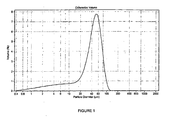
- Example 2 The solids were then recovered, washed and dried as in Example 1, yielding a yellow, air-sensitive powder.
- the particle size distribution of the powder is shown in Figure 2.
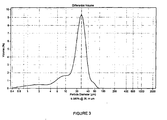
- Example 2 was repeated, but with the addition of the Mg complex to the TiCl 4 suspension being performed at 50°C, the temperature thereafter being increased to 110°C.
- the particle size distribution of the product is shown in Figure 3.
- composition of the products of Examples 1 to 3 is summarised in the following table: TABLE 1 Example Ti% Mg% DOP%* 1 2.7 7.3 8.04 2 4.1 6.4 15.0 3 5.2 10.4 15.2 * Dioctyl phthalate (internal electron donor)
- TEA triethyl aluminium
- CMMS cyclohexyl methyl dimethoxy silane
- Example 4 employed the catalyst containing component of Example 1, Example 5 that of Example 2, Example 6 that of Example 3.
Landscapes
- Chemical & Material Sciences (AREA)
- Health & Medical Sciences (AREA)
- Chemical Kinetics & Catalysis (AREA)
- Medicinal Chemistry (AREA)
- Polymers & Plastics (AREA)
- Organic Chemistry (AREA)
- Transition And Organic Metals Composition Catalysts For Addition Polymerization (AREA)
- Organic Low-Molecular-Weight Compounds And Preparation Thereof (AREA)
Claims (33)
- Procédé de production d'un composant catalytique de polymérisation d'oléfine sous forme de particules ayant une gamme de taille prédéterminée, comprenant les étapes consistant à :- préparer une solution d'un complexe d'un métal du groupe IIA et d'un donneur d'électron en faisant réagir un composé dudit métal avec ledit donneur d'électron ou un précurseur de celui-ci dans un milieu de réaction liquide organique ;- faire réagir ledit complexe, en solution, avec au moins un composé d'un métal de transition pour produire une phase huileuse plus dense qui contient plus de 50% en moles du métal du groupe IIA et une phase huileuse non miscible avec celle-ci ;- sorber ladite huile plus dense sur un support ayant une gamme de taille moyenne de particules de 10 à 200 µm et un volume de pores de 0,5 à 4 mL/g ;- solidifier ladite huile sorbée contenue par ledit support ; et récupérer, laver et sécher le support pour obtenir ledit composant catalytique.
- Procédé selon la revendication 1, dans lequel ledit métal de transition est,un métal du groupe IVB.
- Procédé selon la revendication 1 ou la revendication 2, dans lequel ledit métal du groupe IIA est le magnésium.
- Procédé selon l'une quelconque des revendications précédentes, dans lequel ledit milieu liquide organique comprend un hydrocarbure aromatique en C6 à C10.
- Procédé selon la revendication 3, dans lequel ladite huile plus dense est une huile insoluble dans TiCl4/toluène présentant un rapport molaire métal du groupe IVB/Mg supérieur à 0,1 et inférieur à 10, et ladite huile non miscible avec celle-ci présente un rapport molaire métal du groupe IVB/Mg de 10 à 100.
- Procédé selon la revendication 5, dans lequel le rapport molaire métal du groupe IVB/Mg de ladite huile non miscible est de 20 à 80.
- Procédé selon la revendication 5, dans lequel le rapport molaire métal du groupe IVB/Mg de ladite huile non miscible est de 45 à 75.
- Procédé selon l'une quelconque des revendications précédentes, dans lequel ledit complexe et ledit composé de métal de transition réagissent à une température de 10°C à 60°C.
- Procédé selon l'une quelconque des revendications précédentes, dans lequel la solidification desdites particules est réalisée par chauffage.
- Procédé selon l'une quelconque des revendications précédentes, dans lequel ledit donneur d'électron est un ester d'acide carboxylique aromatique.
- Procédé selon la revendication 10, dans lequel ledit donneur d'électron est le phtalate de dioctyle.
- Procédé selon l'une quelconque des revendications précédentes, dans lequel ledit donneur d'électron est formé in situ par la réaction d'un précurseur de chlorure d'acide carboxylique aromatique avec un alcanol et/ou un diol en C2 à C16.
- Procédé selon l'une quelconque des revendications précédentes, dans lequel ledit milieu de réaction liquide comprend du toluène.
- Procédé selon l'une quelconque des revendications précédentes, dans lequel ledit métal du groupe IVB est le titane.
- Procédé selon l'une quelconque des revendications précédentes, dans lequel ledit composé de métal du groupe IVB est un halogénure.
- Procédé selon l'une quelconque des revendications précédentes, dans lequel ledit complexe de magnésium et ledit composé de métal du groupe IVB réagissent à une température de plus de 20°C à moins de 50°C.
- Procédé selon l'une quelconque des revendications précédentes, dans lequel ledit support comprend un oxyde inorganique réfractaire, un sel ou un polymère organique ayant un point de ramollissement supérieur à 150°C.
- Procédé selon la revendication 17, dans lequel ledit support comprend de la silice, du chlorure de magnésium ou une résine polystyrène réticulée.
- Procédé selon l'une quelconque des revendications 3 à 18, dans lequel le rapport molaire métal du groupe IVB/Mg de ladite huile plus dense est de 2 à 4 et celui de l'huile non miscible avec celle-ci est de 55 à 65.
- Procédé selon l'une quelconque des revendications 3 à 19, dans lequel le support est ajouté au produit de la réaction entre ledit complexe de Mg et ledit composé de métal du groupe IVB.
- Procédé selon l'une quelconque des revendications 3 à 19, dans lequel le support est ajouté au dit composé de métal du groupe IVB avant la réaction de celui-ci avec ledit complexe de Mg.
- Procédé selon l'une quelconque des revendications 3 à 21, dans lequel le rapport molaire du Mg dans ladite huile plus dense au Mg dans ladite huile non miscible avec celle-ci est ≤ 0,1.
- Procédé selon l'une quelconque des revendications précédentes, dans lequel le support contenant l'huile sorbée est chauffé à une température de 70°C à 150°C pour solidifier cette huile.
- Procédé selon l'une quelconque des revendications précédentes, dans lequel la température à laquelle le support est chauffé va de 90°C à 110°C.
- Procédé selon l'une quelconque des revendications 3 à 24, dans lequel la préparation du complexe de magnésium est réalisée à une température de 20°C à 80°C.
- Procédé selon la revendication 25, dans lequel la préparation du complexe de magnésium est réalisée à une température de 50°C à 70°C.
- Procédé selon l'une quelconque des revendications précédentes, dans lequel ledit composant catalytique obtenu est sous forme de particules ayant une gamme de taille moyenne de 10 à 200 µm.
- Procédé selon la revendication 27, dans lequel au moins 50% en volume des particules ont une gamme de taille de 20 à 50 µm.
- Procédé selon l'une quelconque des revendications 3 à 28 dans lequel, avant la réaction avec le composé du groupe IVB, un tensio-actif est ajouté à la solution du complexe de magnésium.
- Procédé selon la revendication 29, dans lequel ledit tensio-actif est un tristéarate de sorbitan.
- Procédé selon la revendication 29 ou la revendication 30, dans lequel le complexe de magnésium et le composé de métal du groupe IV de valence IV réagissent en présence d'un donneur d'électron supplémentaire.
- Catalyseur de polymérisation d'oléfine comprenant un composant catalytique préparé selon l'une quelconque des revendications 1 à 31 et un co-catalyseur alkylaluminium.
- Utilisation d'un catalyseur selon la revendication 32 pour la polymérisation d'α-oléfines en C2 à C10.
Priority Applications (7)
| Application Number | Priority Date | Filing Date | Title |
|---|---|---|---|
| AT01115001T ATE328015T1 (de) | 2001-06-20 | 2001-06-20 | Herstellung eines katalysatorbestandteils zur olefinpolymerisation |
| ES01115001T ES2265376T3 (es) | 2001-06-20 | 2001-06-20 | Preparacion de componente catalizador para la polimerizacion de olefinas. |
| EP01115001A EP1270610B8 (fr) | 2001-06-20 | 2001-06-20 | Préparation d'un constituant de catalyseur pour la polymérisation d'oléfine |
| DE60120141T DE60120141T2 (de) | 2001-06-20 | 2001-06-20 | Herstellung einer Olefinpolymerisationskatalysatorkomponente |
| PCT/EP2002/006717 WO2003000756A1 (fr) | 2001-06-20 | 2002-06-18 | Preparation d'un constituant de catalyseur pour la polymerisation d'olefines |
| US10/481,217 US7256150B2 (en) | 2001-06-20 | 2002-06-18 | Preparation of olefin polymerization catalyst component |
| CNB028125495A CN1318458C (zh) | 2001-06-20 | 2002-06-18 | 烯烃聚合催化剂组分的制备 |
Applications Claiming Priority (1)
| Application Number | Priority Date | Filing Date | Title |
|---|---|---|---|
| EP01115001A EP1270610B8 (fr) | 2001-06-20 | 2001-06-20 | Préparation d'un constituant de catalyseur pour la polymérisation d'oléfine |
Publications (3)
| Publication Number | Publication Date |
|---|---|
| EP1270610A1 EP1270610A1 (fr) | 2003-01-02 |
| EP1270610B1 true EP1270610B1 (fr) | 2006-05-31 |
| EP1270610B8 EP1270610B8 (fr) | 2006-09-27 |
Family
ID=8177773
Family Applications (1)
| Application Number | Title | Priority Date | Filing Date |
|---|---|---|---|
| EP01115001A Expired - Lifetime EP1270610B8 (fr) | 2001-06-20 | 2001-06-20 | Préparation d'un constituant de catalyseur pour la polymérisation d'oléfine |
Country Status (7)
| Country | Link |
|---|---|
| US (1) | US7256150B2 (fr) |
| EP (1) | EP1270610B8 (fr) |
| CN (1) | CN1318458C (fr) |
| AT (1) | ATE328015T1 (fr) |
| DE (1) | DE60120141T2 (fr) |
| ES (1) | ES2265376T3 (fr) |
| WO (1) | WO2003000756A1 (fr) |
Families Citing this family (80)
| Publication number | Priority date | Publication date | Assignee | Title |
|---|---|---|---|---|
| EP1598379A1 (fr) * | 2004-05-18 | 2005-11-23 | Borealis Technology OY | Procédé pour la production de films de polypropylène |
| ATE401123T1 (de) | 2004-12-17 | 2008-08-15 | Borealis Tech Oy | Verfahren zur polymerisation von olefinen in gegenwart eines olefin polymerisationskatalysators |
| WO2010076231A1 (fr) | 2008-12-29 | 2010-07-08 | Borealis Ag | Nappe de câble en polypropylène mou modifié présentant une résistance améliorée au blanchiment sous contrainte |
| EP2216347A1 (fr) * | 2009-01-30 | 2010-08-11 | Borealis AG | Procédé de transitions de catalyseurs dans des polymérisations d'oléfine |
| ES2370689T3 (es) | 2009-02-25 | 2011-12-21 | Borealis Ag | Polímero multimodal de polipropileno, composición que comprende el mismo y un procedimiento para producir el mismo. |
| CN102365325B (zh) | 2009-04-09 | 2015-04-22 | 北欧化工公司 | 热塑性聚烯烃组合物 |
| EP2251361B1 (fr) | 2009-05-04 | 2013-10-02 | Borealis AG | Préparation de catalyseurs ZN PP précipités dotés d'une structure de pores internes utilisant des nanoparticules |
| ES2541701T3 (es) * | 2010-07-13 | 2015-07-23 | Borealis Ag | Componente de catalizador |
| EP2452975A1 (fr) | 2010-11-12 | 2012-05-16 | Borealis AG | Copolymères de propylène hétérophasique mous |
| EP2452960B1 (fr) | 2010-11-12 | 2015-01-07 | Borealis AG | Procédé pour la préparation de polymères de propylène avec un taux de fluidité ultra élevé |
| EP2452956A1 (fr) | 2010-11-12 | 2012-05-16 | Borealis AG | Procédé amélioré pour la polymérisation de propylène |
| EP2452920A1 (fr) | 2010-11-12 | 2012-05-16 | Borealis AG | Procédé pour la récupération de tétrahalogénure de métal de transition et d'hydrocarbures dans un flux de déchets |
| EP2452976A1 (fr) | 2010-11-12 | 2012-05-16 | Borealis AG | Copolymères de propylène hétérophasique dotés d'un équilibre amélioré entre rigidité, impact et fluidité |
| EP2452959B1 (fr) | 2010-11-12 | 2015-01-21 | Borealis AG | Procédé pour la production de copolymères aléatoires de propylène et leurs utilisations |
| EP2452957A1 (fr) | 2010-11-12 | 2012-05-16 | Borealis AG | Procédé amélioré pour la production de copolymères de propylène hétérophasiques |
| PT2495037T (pt) | 2011-03-02 | 2020-09-15 | Borealis Ag | Montagem de reator de alto rendimento para a polimerização de olefinas |
| EP2495038B1 (fr) | 2011-03-02 | 2020-09-02 | Borealis AG | Procédé pour la production des polymères |
| EP2535372B1 (fr) | 2011-06-15 | 2016-09-14 | Borealis AG | Mélange en réacteur in situ d'un polypropylène nucléé catalysé par Ziegler-Natta et d'un polypropylène catalysé par métallocène |
| CN103130931B (zh) * | 2011-11-30 | 2016-06-08 | 中国石油天然气股份有限公司 | 一种球形乙烯聚合固体钛催化剂及其制备和应用 |
| EP2617741B1 (fr) | 2012-01-18 | 2016-01-13 | Borealis AG | Procédé de polymérisation de polymères d'oléfine en présence d'un système de catalyseur et procédé de contrôle du procédé |
| EP2890490B1 (fr) | 2012-08-29 | 2020-05-06 | Borealis AG | Ensemble formant réacteur et procédé de polymérisation d'oléfine |
| EP2745926A1 (fr) | 2012-12-21 | 2014-06-25 | Borealis AG | Polymérisation en phase gazeuse et ensemble de réacteur comprenant un réacteur à lit fluidisé et un réacteur à lit mobile externe |
| EP2745927A1 (fr) | 2012-12-21 | 2014-06-25 | Borealis AG | Réacteur à lit fluidisé avec unité de réaction à lit mobile interne |
| EP2749580B1 (fr) | 2012-12-28 | 2016-09-14 | Borealis AG | Procédé de production de copolymères de propylène |
| EP2796473B1 (fr) | 2013-04-22 | 2017-05-31 | Borealis AG | Procédé en plusieurs étapes de production de compositions de polypropylène résistant à basse température |
| EP2796474B1 (fr) | 2013-04-22 | 2018-01-10 | Borealis AG | Procédé en plusieurs étapes de production de compositions de polypropylène |
| ES2632593T3 (es) | 2013-04-22 | 2017-09-14 | Borealis Ag | Procedimiento de dos fases de producción de composiciones de polipropileno |
| ES2651456T3 (es) | 2013-08-14 | 2018-01-26 | Borealis Ag | Composición de propileno con mejor resistencia al impacto a baja temperatura |
| MX2016001930A (es) | 2013-08-21 | 2016-05-26 | Borealis Ag | Composicion de poliolefina de alto flujo con alta rigidez y tenacidad. |
| MX2016001705A (es) | 2013-08-21 | 2016-05-18 | Borealis Ag | Composicion de poliolefina de alto flujo con alta rigidez y tenacidad. |
| EP2853562A1 (fr) | 2013-09-27 | 2015-04-01 | Borealis AG | Procédé en deux étapes pour la fabrication de compositions de polypropylène |
| PT2853563T (pt) | 2013-09-27 | 2016-07-14 | Borealis Ag | Filmes adequados para processamento de bopp a partir de polímeros com xs elevada e tm elevado |
| ES2568615T3 (es) | 2013-10-11 | 2016-05-03 | Borealis Ag | Película para etiquetas orientada en la dirección de la máquina |
| EP2865713B1 (fr) | 2013-10-24 | 2016-04-20 | Borealis AG | Article moulé par soufflage à base de copolymère aléatoire bimodale |
| ES2661108T3 (es) | 2013-10-24 | 2018-03-27 | Borealis Ag | Homopolímero de polipropileno de bajo punto de fusión con alto contenido de regioerrores y alto peso molecular |
| EP3063185B9 (fr) | 2013-10-29 | 2017-11-15 | Borealis AG | Catalyseurs solides à site unique avec une activité de polymérisation élevée |
| MX368147B (es) | 2013-11-22 | 2019-09-20 | Borealis Ag | Homopolímero de propileno de baja emisión con alto flujo de masa fundida. |
| WO2015082379A1 (fr) | 2013-12-04 | 2015-06-11 | Borealis Ag | Homopolymères pp exempts de phtalates pour fibres extrudées soufflées |
| CN105980457B (zh) | 2013-12-18 | 2019-03-22 | 博里利斯股份公司 | 具有改善的刚性/韧性平衡的bopp膜 |
| EP3094660B1 (fr) | 2014-01-17 | 2018-12-19 | Borealis AG | Procédé de préparation de copolymères de propylène/1-butène |
| US10100186B2 (en) | 2014-02-06 | 2018-10-16 | Borealis Ag | Soft and transparent impact copolymers |
| WO2015117958A1 (fr) | 2014-02-06 | 2015-08-13 | Borealis Ag | Copolymères souples à haute résistance aux chocs |
| EP2907841A1 (fr) | 2014-02-14 | 2015-08-19 | Borealis AG | Composition de polypropylène |
| TWI554402B (zh) | 2014-05-12 | 2016-10-21 | 柏列利斯股份公司 | 用於層元件之聚丙烯組成物 |
| ES2659731T3 (es) | 2014-05-20 | 2018-03-19 | Borealis Ag | Composición de polipropileno para aplicaciones en interiores de automóviles |
| EP2995631A1 (fr) | 2014-09-12 | 2016-03-16 | Borealis AG | Procédé de production de copolymères greffés à un squelette de polyoléfine |
| US9714302B2 (en) | 2014-10-10 | 2017-07-25 | W. R. Grace & Co.—Conn. | Process for preparing spherical polymerization catalyst components for use in olefin polymerizations |
| EP3018155A1 (fr) | 2014-11-05 | 2016-05-11 | Borealis AG | Polypropylène ramifié pour des applications de films |
| ES2635519T3 (es) | 2014-11-21 | 2017-10-04 | Borealis Ag | Procedimiento para producir gránulos de copolímeros blandos |
| CN107849413B (zh) | 2015-07-30 | 2019-01-04 | 博里利斯股份公司 | 具有改进的热粘力的聚丙烯组合物 |
| EP3124567A1 (fr) | 2015-07-30 | 2017-02-01 | Borealis AG | Composition adhésive thermofusible à base de polypropylène |
| EP3147324B1 (fr) | 2015-09-28 | 2018-09-26 | Borealis AG | Tuyaux de polypropylène présentant une meilleure résistance à la pression |
| US10676604B2 (en) | 2015-10-21 | 2020-06-09 | Borealis Ag | Long-branched polypropylene composition with increased melt strength stability |
| KR102114605B1 (ko) | 2015-10-28 | 2020-05-26 | 보레알리스 아게 | 층 소자용 폴리프로필렌 조성물 |
| EP3178853B1 (fr) | 2015-12-07 | 2018-07-25 | Borealis AG | Procédé pour la polymérisation de monomères d'alpha-oléfine |
| EA201800493A1 (ru) | 2016-03-14 | 2019-02-28 | Бореалис Аг | Композиция полипропилена, содержащая огнестойкие добавки |
| EP3243622B1 (fr) | 2016-05-13 | 2020-09-09 | Borealis AG | Procédé de transport hydraulique de granulés de polyoléfine |
| EP3281973A1 (fr) | 2016-08-11 | 2018-02-14 | Borealis AG | Composition de polypropylène ayant une activité ignifuge |
| MX2019003759A (es) | 2016-11-09 | 2019-07-04 | Borealis Ag | Composicion de polipropileno. |
| TW201831324A (zh) | 2017-02-01 | 2018-09-01 | 奧地利商柏列利斯股份公司 | 包含層元件的物品 |
| CN107814858A (zh) * | 2017-10-18 | 2018-03-20 | 兰州石化职业技术学院 | 一种复合载体聚丙烯催化剂的制备方法 |
| DK3473674T3 (da) | 2017-10-19 | 2022-06-20 | Abu Dhabi Polymers Co Ltd Borouge Llc | Polypropylensammensætning |
| WO2019219902A1 (fr) | 2018-05-18 | 2019-11-21 | Abu Dhabi Polymers Co. Ltd (Borouge) L.L.C. | Amélioration de propriétés rhéologiques de compositions de polyoléfine thermoplastique |
| US11990859B2 (en) | 2018-05-28 | 2024-05-21 | Borealis Ag | Devices for a photovoltaic (PV) module |
| US20210277290A1 (en) | 2018-08-06 | 2021-09-09 | Borealis Ag | Propylene random copolymer based hot melt adhesive composition |
| EP3608364A1 (fr) | 2018-08-06 | 2020-02-12 | Borealis AG | Copolymère aléatoire de propylène multimodal basé sur une composition appropriée comme composition adhésive thermofusible |
| EP3856794A1 (fr) | 2018-09-28 | 2021-08-04 | Borealis AG | PROCÉDÉ MULTI-ÉTAPES POUR LA PRODUCTION D'UNE COMPOSITION DE POLYMÈRE OLÉFINIQUE EN C2 À C8
 |
| EP3647645A1 (fr) | 2018-10-31 | 2020-05-06 | Borealis AG | Composition de polyéthylène pour tuyaux résistant à une haute pression |
| KR102593922B1 (ko) | 2018-10-31 | 2023-10-25 | 보레알리스 아게 | 개선된 균질성을 갖는 고압력 저항성 파이프용 폴리에틸렌 조성물 |
| ES2986685T3 (es) | 2018-11-30 | 2024-11-12 | Borealis Ag | Proceso de lavado |
| EP3915782B1 (fr) | 2020-05-25 | 2024-07-17 | Borealis AG | Élément de couche approprié en tant qu'élément de feuille de support intégrée d'un module photovoltaïque |
| CN115666943A (zh) | 2020-05-25 | 2023-01-31 | 北欧化工公司 | 适合作为双面光伏模块的集成背板的层元件 |
| JP7698718B2 (ja) | 2020-11-27 | 2025-06-25 | ボレアリス・アクチェンゲゼルシャフト | 触媒供給システム |
| EP4144435A1 (fr) | 2021-09-01 | 2023-03-08 | Borealis AG | Procédé de polymérisation en phase gazeuse avec recyclage amélioré de gaz |
| EP4389776A1 (fr) | 2022-12-20 | 2024-06-26 | Borealis AG | Procédé |
| EP4389783A1 (fr) | 2022-12-20 | 2024-06-26 | Borealis AG | Procédé de transition de catalyseur |
| WO2024223775A1 (fr) | 2023-04-26 | 2024-10-31 | Borealis Ag | Élément à couches approprié en tant que feuille arrière intégrée pour un module photovoltaïque bifacial |
| WO2024223777A1 (fr) | 2023-04-26 | 2024-10-31 | Borealis Ag | Élément de couche approprié en tant que feuille arrière intégrée pour un module photovoltaïque bifacial |
| WO2025125458A1 (fr) | 2023-12-12 | 2025-06-19 | Abu Dhabi Polymers Co. Ltd (Borouge) - Sole Proprietorship L.L.C. | Polyéthylène modifié ayant une résistance à la pression hydrostatique et une résistance à la propagation lente des fissures améliorées |
| EP4644436A1 (fr) | 2024-05-03 | 2025-11-05 | Borealis GmbH | Copolymère hétérophasique propylène-éthylène présentant d'excellentes propriétés optiques d'équilibre rigidité-résistance-impact, et performance de blanchiment sous contrainte |
Family Cites Families (12)
| Publication number | Priority date | Publication date | Assignee | Title |
|---|---|---|---|---|
| US4399055A (en) * | 1981-05-01 | 1983-08-16 | Mitsubishi Petrochemical Company Limited | Carrier of catalyst and catalyst component composed of the carrier, for polymerization of olefins, as well as processes for production thereof |
| GB2103627A (en) * | 1981-08-07 | 1983-02-23 | Ici Plc | Transition metal composition |
| IT1169291B (it) * | 1981-12-24 | 1987-05-27 | Montedison Spa | Componenti di catalizzatori per la polimerizzazione dell'etilene e sue miscele con olefine ed i soui catalizzatori da essi ottenuti |
| IT1169292B (it) * | 1981-12-24 | 1987-05-27 | Montedison Spa | Componenti di catalizzatori per la polimerizzazione delle alfa olefine e i catalizzatori da essi ottenuti |
| DE3765723D1 (de) * | 1986-07-31 | 1990-11-29 | Montedison Spa | Verfahren zur herstellung mikrospheroidaler fester katalysatorbestandteile oder ihrer vorlaeufer und ihre anwendung bei der herstellung von aethylenpolymeren. |
| FR2658498B1 (fr) * | 1990-02-19 | 1992-05-15 | Atochem | Particules de chlorure de magnesium a structure tronc conique, composante catalytique supportee sur ces particules, polyolefines obtenues a partir de cette composante catalytique, procedes de fabrication de ces produits. |
| IT1251679B (it) * | 1991-10-09 | 1995-05-19 | Enichem Polimeri | Catalizzatori per la polimerizzazione delle olefine |
| JP3471099B2 (ja) * | 1994-11-25 | 2003-11-25 | 昭和電工株式会社 | オレフィン重合用触媒担体の製造方法 |
| FI981717A7 (fi) | 1998-08-07 | 2000-02-08 | Borealis As | Katalysaattorikomponentti, joka käsittää magnesiumia, titaania, halogeenia ja elektronidonorin, sen valmistus ja käyttö |
| FI981718L (fi) | 1998-08-07 | 2000-02-08 | Borealis As | Katalysaattorikomponentti, joka käsittää magnesiumia, titaania, halogeenia ja elektrodonorin, sen valmistus ja käyttö |
| CN1138790C (zh) | 1999-03-30 | 2004-02-18 | 中国石油化工集团公司北京化工研究院 | 烯烃聚合用高活性催化剂及其制备方法和该催化剂的应用 |
| DE10003872A1 (de) * | 1999-11-26 | 2001-08-16 | Basell Polyolefine Gmbh | Verfahren zum Herstellen eines Poly-l-olefins in Gegenwart eines Ziegler Katalysators |
-
2001
- 2001-06-20 DE DE60120141T patent/DE60120141T2/de not_active Expired - Lifetime
- 2001-06-20 AT AT01115001T patent/ATE328015T1/de not_active IP Right Cessation
- 2001-06-20 ES ES01115001T patent/ES2265376T3/es not_active Expired - Lifetime
- 2001-06-20 EP EP01115001A patent/EP1270610B8/fr not_active Expired - Lifetime
-
2002
- 2002-06-18 US US10/481,217 patent/US7256150B2/en not_active Expired - Fee Related
- 2002-06-18 WO PCT/EP2002/006717 patent/WO2003000756A1/fr not_active Ceased
- 2002-06-18 CN CNB028125495A patent/CN1318458C/zh not_active Expired - Fee Related
Also Published As
| Publication number | Publication date |
|---|---|
| EP1270610A1 (fr) | 2003-01-02 |
| US7256150B2 (en) | 2007-08-14 |
| ES2265376T3 (es) | 2007-02-16 |
| DE60120141T2 (de) | 2007-03-29 |
| CN1518564A (zh) | 2004-08-04 |
| WO2003000756A1 (fr) | 2003-01-03 |
| CN1318458C (zh) | 2007-05-30 |
| US20050014662A1 (en) | 2005-01-20 |
| ATE328015T1 (de) | 2006-06-15 |
| DE60120141D1 (de) | 2006-07-06 |
| EP1270610B8 (fr) | 2006-09-27 |
Similar Documents
| Publication | Publication Date | Title |
|---|---|---|
| EP1270610B1 (fr) | Préparation d'un constituant de catalyseur pour la polymérisation d'oléfine | |
| EP1273595B1 (fr) | Préparation d'un constituant de catalyseur pour la polymérisation d'oléfine | |
| US6706655B2 (en) | Catalyst component comprising magnesium, titanium, a halogen and an electron donor, its preparation and use | |
| EP1114072B1 (fr) | Composant catalytique comprenant du magnesium, du titane, un halogene et un donneur d'electrons, preparation et utilisation de ce composant | |
| US7659223B2 (en) | Process for preparing an olefin polymerization catalyst component with improved high temperature activity | |
| EP1862480B1 (fr) | Procédé pour la préparation d'un catalyseur pour la polymérisation d'oléfines avec une amélioration d'activité à haute température | |
| AU2002325246A1 (en) | Preparation of olefin polymerisation catalyst component | |
| EP3212705B1 (fr) | Diamides d'acide oxalique à titre de modificateurs de catalyseurs pour polyoléfines | |
| US20100216957A1 (en) | Catalyst preparation with phosphorous compound | |
| EP1335942B1 (fr) | Composant de catalyseur contenant du magnésium, du titane, un halogène et un donneur d'électron, préparation et utilisation de celui-ci | |
| EP1229054B1 (fr) | Composé catalytique comprenant du magnésium, du titane, un halogène et un donneur d'électrons et sa préparation | |
| EP1183278B1 (fr) | Composant catalytique renfermant du magnesium, du titane, un halogene et un donneur d'electron ainsi que sa preparation et son utilisation |
Legal Events
| Date | Code | Title | Description |
|---|---|---|---|
| PUAI | Public reference made under article 153(3) epc to a published international application that has entered the european phase |
Free format text: ORIGINAL CODE: 0009012 |
|
| 17P | Request for examination filed |
Effective date: 20020109 |
|
| AK | Designated contracting states |
Kind code of ref document: A1 Designated state(s): AT BE CH CY DE DK ES FI FR GB GR IE IT LI LU MC NL PT SE TR |
|
| AX | Request for extension of the european patent |
Free format text: AL;LT;LV;MK;RO;SI |
|
| RAP1 | Party data changed (applicant data changed or rights of an application transferred) |
Owner name: BOREALIS POLYMERS OY |
|
| AKX | Designation fees paid |
Designated state(s): AT BE CH CY DE DK ES FI FR GB GR IE IT LI LU MC NL PT SE TR |
|
| GRAP | Despatch of communication of intention to grant a patent |
Free format text: ORIGINAL CODE: EPIDOSNIGR1 |
|
| GRAS | Grant fee paid |
Free format text: ORIGINAL CODE: EPIDOSNIGR3 |
|
| GRAA | (expected) grant |
Free format text: ORIGINAL CODE: 0009210 |
|
| AK | Designated contracting states |
Kind code of ref document: B1 Designated state(s): AT BE CH CY DE DK ES FI FR GB GR IE IT LI LU MC NL PT SE TR |
|
| PG25 | Lapsed in a contracting state [announced via postgrant information from national office to epo] |
Ref country code: LI Free format text: LAPSE BECAUSE OF FAILURE TO SUBMIT A TRANSLATION OF THE DESCRIPTION OR TO PAY THE FEE WITHIN THE PRESCRIBED TIME-LIMIT Effective date: 20060531 Ref country code: CH Free format text: LAPSE BECAUSE OF FAILURE TO SUBMIT A TRANSLATION OF THE DESCRIPTION OR TO PAY THE FEE WITHIN THE PRESCRIBED TIME-LIMIT Effective date: 20060531 Ref country code: BE Free format text: LAPSE BECAUSE OF FAILURE TO SUBMIT A TRANSLATION OF THE DESCRIPTION OR TO PAY THE FEE WITHIN THE PRESCRIBED TIME-LIMIT Effective date: 20060531 Ref country code: AT Free format text: LAPSE BECAUSE OF FAILURE TO SUBMIT A TRANSLATION OF THE DESCRIPTION OR TO PAY THE FEE WITHIN THE PRESCRIBED TIME-LIMIT Effective date: 20060531 |
|
| REG | Reference to a national code |
Ref country code: CH Ref legal event code: EP Ref country code: GB Ref legal event code: FG4D |
|
| RAP2 | Party data changed (patent owner data changed or rights of a patent transferred) |
Owner name: BOREALIS TECHNOLOGY OY |
|
| PG25 | Lapsed in a contracting state [announced via postgrant information from national office to epo] |
Ref country code: IE Free format text: LAPSE BECAUSE OF NON-PAYMENT OF DUE FEES Effective date: 20060620 |
|
| RAP2 | Party data changed (patent owner data changed or rights of a patent transferred) |
Owner name: BOREALIS TECHNOLOGY OY |
|
| REG | Reference to a national code |
Ref country code: IE Ref legal event code: FG4D |
|
| PG25 | Lapsed in a contracting state [announced via postgrant information from national office to epo] |
Ref country code: MC Free format text: LAPSE BECAUSE OF NON-PAYMENT OF DUE FEES Effective date: 20060630 |
|
| REG | Reference to a national code |
Ref country code: GB Ref legal event code: ERR Free format text: NOTIFICATION HAS NOW BEEN RECEIVED FROM THE EUROPEAN PATENT OFFICE THAT THE CORRECT NAME IS: BOREALIS TECHNOLOGY OY THIS CORRECTION WAS PUBLISHED IN THE EUROPEAN PATENT BULLETIN 06/23 DATED 20060607 |
|
| REF | Corresponds to: |
Ref document number: 60120141 Country of ref document: DE Date of ref document: 20060706 Kind code of ref document: P |
|
| NLT2 | Nl: modifications (of names), taken from the european patent patent bulletin |
Owner name: BOREALIS TECHNOLOGY OY Effective date: 20060607 |
|
| PG25 | Lapsed in a contracting state [announced via postgrant information from national office to epo] |
Ref country code: DK Free format text: LAPSE BECAUSE OF FAILURE TO SUBMIT A TRANSLATION OF THE DESCRIPTION OR TO PAY THE FEE WITHIN THE PRESCRIBED TIME-LIMIT Effective date: 20060831 |
|
| NLT2 | Nl: modifications (of names), taken from the european patent patent bulletin |
Owner name: BOREALIS TECHNOLOGY OY Effective date: 20060628 |
|
| REG | Reference to a national code |
Ref country code: SE Ref legal event code: TRGR |
|
| REG | Reference to a national code |
Ref country code: SE Ref legal event code: RPOT |
|
| PG25 | Lapsed in a contracting state [announced via postgrant information from national office to epo] |
Ref country code: PT Free format text: LAPSE BECAUSE OF FAILURE TO SUBMIT A TRANSLATION OF THE DESCRIPTION OR TO PAY THE FEE WITHIN THE PRESCRIBED TIME-LIMIT Effective date: 20061031 |
|
| REG | Reference to a national code |
Ref country code: CH Ref legal event code: PL |
|
| ET | Fr: translation filed | ||
| REG | Reference to a national code |
Ref country code: ES Ref legal event code: FG2A Ref document number: 2265376 Country of ref document: ES Kind code of ref document: T3 |
|
| PLBE | No opposition filed within time limit |
Free format text: ORIGINAL CODE: 0009261 |
|
| STAA | Information on the status of an ep patent application or granted ep patent |
Free format text: STATUS: NO OPPOSITION FILED WITHIN TIME LIMIT |
|
| 26N | No opposition filed |
Effective date: 20070301 |
|
| PG25 | Lapsed in a contracting state [announced via postgrant information from national office to epo] |
Ref country code: GR Free format text: LAPSE BECAUSE OF FAILURE TO SUBMIT A TRANSLATION OF THE DESCRIPTION OR TO PAY THE FEE WITHIN THE PRESCRIBED TIME-LIMIT Effective date: 20060901 |
|
| PG25 | Lapsed in a contracting state [announced via postgrant information from national office to epo] |
Ref country code: LU Free format text: LAPSE BECAUSE OF NON-PAYMENT OF DUE FEES Effective date: 20060620 Ref country code: TR Free format text: LAPSE BECAUSE OF FAILURE TO SUBMIT A TRANSLATION OF THE DESCRIPTION OR TO PAY THE FEE WITHIN THE PRESCRIBED TIME-LIMIT Effective date: 20060531 |
|
| PG25 | Lapsed in a contracting state [announced via postgrant information from national office to epo] |
Ref country code: CY Free format text: LAPSE BECAUSE OF FAILURE TO SUBMIT A TRANSLATION OF THE DESCRIPTION OR TO PAY THE FEE WITHIN THE PRESCRIBED TIME-LIMIT Effective date: 20060531 |
|
| PGFP | Annual fee paid to national office [announced via postgrant information from national office to epo] |
Ref country code: SE Payment date: 20110613 Year of fee payment: 11 |
|
| PGFP | Annual fee paid to national office [announced via postgrant information from national office to epo] |
Ref country code: FI Payment date: 20110613 Year of fee payment: 11 |
|
| REG | Reference to a national code |
Ref country code: SE Ref legal event code: EUG |
|
| PG25 | Lapsed in a contracting state [announced via postgrant information from national office to epo] |
Ref country code: FI Free format text: LAPSE BECAUSE OF NON-PAYMENT OF DUE FEES Effective date: 20120620 |
|
| PG25 | Lapsed in a contracting state [announced via postgrant information from national office to epo] |
Ref country code: SE Free format text: LAPSE BECAUSE OF NON-PAYMENT OF DUE FEES Effective date: 20120621 |
|
| REG | Reference to a national code |
Ref country code: FR Ref legal event code: PLFP Year of fee payment: 15 |
|
| PGFP | Annual fee paid to national office [announced via postgrant information from national office to epo] |
Ref country code: ES Payment date: 20150626 Year of fee payment: 15 Ref country code: DE Payment date: 20150619 Year of fee payment: 15 Ref country code: GB Payment date: 20150618 Year of fee payment: 15 |
|
| PGFP | Annual fee paid to national office [announced via postgrant information from national office to epo] |
Ref country code: FR Payment date: 20150619 Year of fee payment: 15 Ref country code: NL Payment date: 20150618 Year of fee payment: 15 Ref country code: IT Payment date: 20150622 Year of fee payment: 15 |
|
| REG | Reference to a national code |
Ref country code: DE Ref legal event code: R119 Ref document number: 60120141 Country of ref document: DE |
|
| REG | Reference to a national code |
Ref country code: NL Ref legal event code: MM Effective date: 20160701 |
|
| GBPC | Gb: european patent ceased through non-payment of renewal fee |
Effective date: 20160620 |
|
| REG | Reference to a national code |
Ref country code: FR Ref legal event code: ST Effective date: 20170228 |
|
| PG25 | Lapsed in a contracting state [announced via postgrant information from national office to epo] |
Ref country code: FR Free format text: LAPSE BECAUSE OF NON-PAYMENT OF DUE FEES Effective date: 20160630 Ref country code: DE Free format text: LAPSE BECAUSE OF NON-PAYMENT OF DUE FEES Effective date: 20170103 |
|
| PG25 | Lapsed in a contracting state [announced via postgrant information from national office to epo] |
Ref country code: GB Free format text: LAPSE BECAUSE OF NON-PAYMENT OF DUE FEES Effective date: 20160620 Ref country code: NL Free format text: LAPSE BECAUSE OF NON-PAYMENT OF DUE FEES Effective date: 20160701 |
|
| PG25 | Lapsed in a contracting state [announced via postgrant information from national office to epo] |
Ref country code: IT Free format text: LAPSE BECAUSE OF NON-PAYMENT OF DUE FEES Effective date: 20160620 |
|
| PG25 | Lapsed in a contracting state [announced via postgrant information from national office to epo] |
Ref country code: ES Free format text: LAPSE BECAUSE OF NON-PAYMENT OF DUE FEES Effective date: 20160621 |
|
| REG | Reference to a national code |
Ref country code: ES Ref legal event code: FD2A Effective date: 20181129 |