EP1271977B1 - Verfahren zum umschalten von einem ersten Funkkommunikationsmodus zu einem zweiten Funkkommunikationsmodus und Funkendgerät mit Vielfachmodus dafür - Google Patents
Verfahren zum umschalten von einem ersten Funkkommunikationsmodus zu einem zweiten Funkkommunikationsmodus und Funkendgerät mit Vielfachmodus dafür Download PDFInfo
- Publication number
- EP1271977B1 EP1271977B1 EP02291429A EP02291429A EP1271977B1 EP 1271977 B1 EP1271977 B1 EP 1271977B1 EP 02291429 A EP02291429 A EP 02291429A EP 02291429 A EP02291429 A EP 02291429A EP 1271977 B1 EP1271977 B1 EP 1271977B1
- Authority
- EP
- European Patent Office
- Prior art keywords
- radio communication
- mode
- time
- clock
- mobile terminal
- Prior art date
- Legal status (The legal status is an assumption and is not a legal conclusion. Google has not performed a legal analysis and makes no representation as to the accuracy of the status listed.)
- Expired - Lifetime
Links
- 238000004891 communication Methods 0.000 title claims abstract description 51
- 238000000034 method Methods 0.000 title claims abstract description 18
- 238000005516 engineering process Methods 0.000 claims description 65
- 238000005259 measurement Methods 0.000 description 8
- 238000012550 audit Methods 0.000 description 6
- 230000005540 biological transmission Effects 0.000 description 3
- 230000002123 temporal effect Effects 0.000 description 2
- 238000010295 mobile communication Methods 0.000 description 1
- 230000001960 triggered effect Effects 0.000 description 1
Images
Classifications
-
- H—ELECTRICITY
- H04—ELECTRIC COMMUNICATION TECHNIQUE
- H04W—WIRELESS COMMUNICATION NETWORKS
- H04W36/00—Hand-off or reselection arrangements
- H04W36/0005—Control or signalling for completing the hand-off
- H04W36/0055—Transmission or use of information for re-establishing the radio link
- H04W36/0066—Transmission or use of information for re-establishing the radio link of control information between different types of networks in order to establish a new radio link in the target network
-
- H—ELECTRICITY
- H04—ELECTRIC COMMUNICATION TECHNIQUE
- H04J—MULTIPLEX COMMUNICATION
- H04J3/00—Time-division multiplex systems
- H04J3/02—Details
- H04J3/06—Synchronising arrangements
- H04J3/0635—Clock or time synchronisation in a network
- H04J3/0682—Clock or time synchronisation in a network by delay compensation, e.g. by compensation of propagation delay or variations thereof, by ranging
Definitions
- the present invention relates to the field of mobile telecommunications and more specifically to the use of so-called multi-mode mobile radio terminals, that is to say able to communicate according to one or the other of at least two modes of radiocommunication.
- radio communication modes there may be mentioned, for example, the so-called second-generation GSM (Global System for Mobile Communication) mode or the so-called third generation Universal Mobile Telecommunications Systems (UMTS) mode, and also the PCS mode ( Personal Communication Services) in force in the United States.
- GSM Global System for Mobile Communication
- UMTS Universal Mobile Telecommunications Systems
- PCS Personal Communication Services
- a mobile radio terminal establishes its communications via base stations according to a radio transmission technology (RAT for Radio Access Technology in English).
- RAT Radio Access Technology in English
- BTS Base Transceiver Station
- UTRAN antennas UMTS Terrestrial Radio Access Network
- Other RAT technologies can nevertheless appear with other modes of radio communication and enter into the problem presented by the invention.
- a mobile radiocommunication terminal can operate according to one or the other standard associated with any mode of radiocommunication in force, that is to say with one or the other technology RAT associated with said modes.
- Such interoperability is essential for three main reasons: To maintain continuity of service during a call and out of communication when the terminal is in standby mode and for taking measurements.
- a mobile terminal To establish any communication, a mobile terminal must be associated with a base station corresponding to the geographical area in which it is located and which can be dedicated to any RAT technology in force in the territory concerned.
- the base station transmits the communication to a controller which transmits it to a switching office which directs the communication to the base station to which the destination terminal is associated or to another network of the destination terminal (Internet, Public Switched Telecommunication (Telephone Network) or other).
- a relay (known as handover) must be provided to ensure continuity of service in the current communication. This relay can take place between base stations of the same technology or between base stations of different RAT technologies.
- a mobile terminal must maintain a standby state during which it is also associated with a base station. During a trip, the mobile terminal may re-select to hang on to a base station in its new geographical area. Such re-selection is also performed when the mobile terminal communicates in data packet mode such as GPRS for example (General Packet Radio Services).
- GPRS General Packet Radio Services
- a multi-mode mobile radio terminal must be able to support regular measurements with a base station of a first mode (for example GSM) while it is in radio connection with a base station of another mode (for example UMTS).
- a base station of a first mode for example GSM
- UMTS for example
- Such measures are often imposed by the standardization bodies that regulate the various radiocommunication systems in force or planned.
- a multi-mode mobile terminal in radio communication with a base station of a first mode, must therefore be able to know the exact time in at least one other mode. It is therefore important that a multi-mode mobile terminal is able to determine the time difference between two radiocommunication modes given in order to be able to switch from one to the other, during communication, in standby mode or for the realization of measurements.
- One possible solution is to maintain a regular listening of a mode simultaneously with the use of another mode (for example to maintain a listening of the GSM stations while a communication is carried out by UMTS stations).
- Such a solution is however not optimal because it is expensive in energy and therefore in autonomy for the mobile terminal.
- the document EP 0966116 describes a method for calculating the time offset between the clocks of two radio communication modes in order to allow the synchronization of a terminal in GSM mode by using the clock signal of the other radiocommunication mode.
- radio associated respectively with each mode of radiocommunication.
- the present invention aims to enable a mobile terminal to know the time in the GSM mode while operating in a UMTS mode, and vice versa.
- the supply of at least a portion of the terminal operating in one of the radiocommunication modes is cut off, said method comprising a step of awakening said part by another party operating according to another radiocommunication mode and a step setting the awake part of the terminal.
- the counter has a clock of smaller periodicity than those of the frame counters of the two radio access technologies.
- the terminal further comprises means for switching the supply of at least a portion of the terminal on command of the control means.
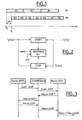
- the radio frames R1 of the first technology are thus fixed at 10 ms, whereas those R2 associated with the second technology, for example GSM, are fixed at 4.615 ms by the respective standards.
- the object of the invention is to allow a correct switching of a frame R1 to a frame R2 respectively associated with any two distinct radio access technologies.
- T 1 the beginning of a frame R1 (associated with a first mode M1) and T 2 the beginning of a frame R2 (associated with a second mode M2).
- the hours in each of the RAT technologies associated with each of the modes are given by clocks U1 and U2 composed by counters fixing on the one hand the duration of a radio frame and on the other hand allowing a temporal division of these frames thanks to finer counters.
- the corresponding U1 clock has a so-called SFN frame counter for "Super Frame Number” and more precise subframe counters such as those known as “timeslot” and “chip counters". These counters have clocks of shorter periodicity than the frame counter and are conventional and generalized in UTRAN technology.
- the corresponding U2 clock also has conventional and commonly used counters, such as T1, T2, T3 frame counters and so-called “timeslot” subframe counters and "Quater bit counters”. All these counters, perfectly known from the state of the art, make it possible to define the precise time in each standardized radiocommunication mode. The invention seeks to determine the time difference between at least these two time frames.
- a counter ⁇ K is engaged by the beginning of a frame R1 of the first mode M1 and stopped by the beginning of a frame R2 of the second mode M2.
- This counter ⁇ K is "fast" that is to say has a CLK clock of periodicity smaller than that of the frame counters of the two RAT technologies considered.
- the time T 1 is given by the frame counter associated with the first technology (for example the SFN counter of the UMTS technology), the other finer counters (Timeslot and chip counters) being set to zero.
- the time T 2 is given by the frame counter associated with the second technology (for example the T1, T2, T3 counter of the GSM technology), the other finer counters (Timeslot and quaterbit counters) being set to zero.
- the updated time T 1 ' is expressed using the subframe counters to indicate an interval of time internal to the period of the frame.
- the value of the ⁇ K counter is expressed in time units of one or the other RAT technology according to the starting point of the process.
- the invention therefore consists, at a given instant, in calculating, at the mobile terminal, the time shift ⁇ t between two modes associated with two different technologies RAT.
- This offset ⁇ t is not constant over time, but if the periods of the R1 and R2 frames associated with each of the RAT technologies are known, and the offset ⁇ t is known at a given instant, it is possible to maintain a knowledge of the time lag between the two radio modes in time.
- a multi-mode mobile radio terminal comprises different parts respectively dedicated to a communication according to different RAT technologies each associated with a given radio communication mode. To ensure good interoperability of the terminal according to one or the other RAT technology, as described above, it is necessary for said terminal to maintain a time synchronization on each of the RAT technologies that it may be required to use.
- a multi-mode mobile terminal associated with a base station depending on a first radiocommunication mode, can directly maintain, in its memory, a precise knowledge of the time of at least one other radiocommunication mode.
- a microcontroller controls the different parts associated with each mode, for example, a UMTS part and a GSM part.
- a first mode for example UTRAN
- the power supply of the party in the second mode for example GSM
- the part associated with the first mode can awaken the second via the microcontroller and put the terminal at the same time. time of said second mode.
- the part associated with the first mode can maintain the time of the second mode from a calculation of the offset ⁇ t at a given instant as previously described.
- Determining the time shift ⁇ t between the two radio communication modes requires waiting for a first event which is the start of a radio frame of the first mode and waiting for a second event which is the start of a frame second mode radio, ie in the example considered 10 + 4.615 ms.
- This may have an advantageous practical application which consists of cutting off the power of one of the parts of the terminal dedicated to an unused mode to awaken it only when this mode will be used for a measurement or a communication.
- This is obviously interesting in terms of power consumption and therefore autonomy of the mobile terminal. For example, if we simply kept the GSM part in standby, a measurement would be made every 2 ms while such a frequency is not necessary in the context of standardization.
Landscapes
- Engineering & Computer Science (AREA)
- Computer Networks & Wireless Communication (AREA)
- Signal Processing (AREA)
- Mobile Radio Communication Systems (AREA)
- Transceivers (AREA)
- Small-Scale Networks (AREA)
- Telephone Function (AREA)
- Synchronisation In Digital Transmission Systems (AREA)
- Communication Control (AREA)
Claims (7)
- Verfahren zur Umschaltung von einem ersten Funkkommunikationsmodus (M1) in einen zweiten Funkkommunikationsmodus (M2) in einem tragbaren Multimodus-Funkkommunikationsendgerät, das mindestens einen ersten und einen zweiten Teil umfasst, die gemäß einer ersten oder einer zweiten Funkzugangstechnologie (RAT) arbeiten, die jeweils mit einem ersten und einem zweiten Funkkommunikationsmodus verbunden sind und jeweils mit einer ersten und einer zweiten Uhr (U1, U2) versehen sind, wobei das Verfahren die folgenden Schritte umfasst:- Sperren eines ersten Teils des tragbaren Endgeräts in einem ersten der Funkkommunikationsmodi (M1) mit einer damit verbundenen ersten Uhr (U1);- Berechnen des Zeitunterschieds (Δt) zwischen den Uhren (U1, U2) der zwei Funkkommunikationsmodi (M1, M2) durch das tragbare Endgerät;- Korrigieren der Zeit eines zweiten Teils des Endgeräts auf Grundlage der Berechnung des Zeitunterschieds (Δt);- Umschalten eines zweiten Teils des tragbaren Endgeräts in einen zweiten der Funkkommunikationsmodi (M2) mit der damit verbundenen zweiten Uhr (U2), dadurch gekennzeichnet, dassdas Berechnen des Zeitunterschieds (Δt) die folgenden Schritte umfasst:- Erfassen des Beginns eines Funkrahmens (R1) der ersten Technologie (RAT), der mit dem ersten Funkkommunikationsmodus (M1) verbunden ist;- Aufzeichnen der Zeit (T1), die von der ersten Uhr (U1) angezeigt wird, die mit dem ersten Modus verbunden ist, und Auslösen eines Zählwerks (ΔK);- Erfassen des Beginns eines Funkrahmens (R2) der Technologie (RAT), der mit dem zweiten Funkkommunikationsmodus (M2) verbunden ist;- Aufzeichnen der aktualisierten Zeit (T1'), die von der ersten Uhr angezeigt wird, die mit dem ersten Modus verbunden ist, und der Zeit (T2), die von der zweiten Uhr (U2) angezeigt wird, die mit dem zweiten Funkkommunikationsmodus verbunden ist, und Anhalten des Zählwerks (ΔK);- Berechnen des Zeitunterschieds (Δt) auf Grundlage der aufgezeichneten Zeiten von der ersten und der zweiten Uhr (T1, T2) und des Werts des Zählwerks (ΔK).
- Verfahren nach Anspruch 1, dadurch gekennzeichnet, dass die Stromversorgung mindestens eines Teils des Endgeräts, der gemäß einem der Funkkommunikationsmodi (M2) arbeitet, abgeschaltet wird und das Verfahren einen Schritt des Aufweckens des Teils durch einen zweiten Teil, der gemäß einem anderen Funkkommunikationsmodus (M1) arbeitet, und einen Schritt des Einstellens der Zeit des aufgeweckten Teils des Endgeräts umfasst.
- Verfahren nach einem der vorhergehenden Ansprüche, dadurch gekennzeichnet, dass der erste und der zweite Funkkommunikationsmodus jeweils GSM- und/oder UMTS-Modi sind.
- Tragbares Multimodus-Funkkommunikationsendgerät, das Steuerungsmittel umfasst und mindestens zwei Teile umfasst, die jeweils gemäß einer ersten oder einer zweiten Funkzugangstechnologie (RAT) kommunizieren können, die jeweils mit einem ersten und einem zweiten Funkkommunikationsmodus (M1, M2), die unterschiedlich sind, verbunden sind und jeweils mit einer ersten und einer zweiten Uhr (U1, U2) versehen sind, wobei das Endgerät Folgendes umfasst:- Mittel zum Sperren eines ersten Teils des tragbaren Endgeräts in einem ersten der Funkkommunikationsmodi (M1) mit einer damit verbundenen ersten Uhr (U1);- Mittel zum Berechnen des Zeitunterschieds (Δt) zwischen den Uhren (U1, U2) der zwei Funkkommunikationsmodi (M1, M2) durch das tragbare Endgerät;- Mittel zum Korrigieren der Zeit eines zweiten Teils des Endgeräts auf Grundlage der Berechnung des Zeitunterschieds (Δt);- Mittel zum Umschalten eines zweiten Teils des tragbaren Endgeräts in einen zweiten der Funkkommunikationsmodi (M2) mit der damit verbundenen zweiten Uhr (U2), dadurch gekennzeichnet, dassdie Mittel zum Berechnen des Zeitunterschieds (Δt) Folgendes umfassen:- Mittel zum Erfassen des Beginns eines Funkrahmens (R1) der ersten Technologie (RAT), der mit dem ersten Funkkommunikationsmodus (M1) verbunden ist;- Mittel zum Aufzeichnen der Zeit (T1), die von der ersten Uhr (U1) angezeigt wird, die mit dem ersten Modus verbunden ist, und Auslösen eines Zählwerks (ΔK);- Mittel zum Erfassen des Beginns eines Funkrahmens (R2) der Technologie (RAT), der mit dem zweiten Funkkommunikationsmodus (M2) verbunden ist;- Mittel zum Aufzeichnen der aktualisierten Zeit (T1'), die von der ersten Uhr angezeigt wird, die mit dem ersten Modus verbunden ist, und der Zeit (T2), die von der zweiten Uhr (U2) angezeigt wird, die mit dem zweiten Funkkommunikationsmodus verbunden ist, und Anhalten des Zählwerks (ΔK);- Mittel zum Berechnen des Zeitunterschieds (Δt) auf Grundlage der aufgezeichneten Zeiten von der ersten und der zweiten Uhr (T1, T2) und des Werts des Zählwerks (ΔK).
- Tragbares Endgerät nach Anspruch 4, dadurch gekennzeichnet, dass das Zählwerk (ΔK) über eine Uhr (CLK) mit einer Periodizität verfügt, die kleiner als jene von Rahmenzählwerken der Funkzugangstechnologien ist.
- Tragbares Endgerät nach einem der Ansprüche 4 bis 5, dadurch gekennzeichnet, dass es außerdem Mittel zum Schalten der Stromversorgung von mindestens einem Teil des Endgeräts auf Befehl der Steuerungsmittel umfasst.
- Tragbares Endgerät nach einem der Ansprüche 4 bis 6, dadurch gekennzeichnet, dass es sich bei den Steuerungsmitteln des Endgeräts um ein Mikrosteuergerät handelt.
Applications Claiming Priority (2)
| Application Number | Priority Date | Filing Date | Title |
|---|---|---|---|
| FR0108538A FR2826825B1 (fr) | 2001-06-28 | 2001-06-28 | Procede de basculement d'un premier mode de radiocommunication vers un second mode de radiocommunication et terminal mobile multi-mode associe |
| FR0108538 | 2001-06-28 |
Publications (2)
| Publication Number | Publication Date |
|---|---|
| EP1271977A1 EP1271977A1 (de) | 2003-01-02 |
| EP1271977B1 true EP1271977B1 (de) | 2011-01-05 |
Family
ID=8864869
Family Applications (1)
| Application Number | Title | Priority Date | Filing Date |
|---|---|---|---|
| EP02291429A Expired - Lifetime EP1271977B1 (de) | 2001-06-28 | 2002-06-10 | Verfahren zum umschalten von einem ersten Funkkommunikationsmodus zu einem zweiten Funkkommunikationsmodus und Funkendgerät mit Vielfachmodus dafür |
Country Status (7)
| Country | Link |
|---|---|
| US (1) | US6959201B2 (de) |
| EP (1) | EP1271977B1 (de) |
| JP (2) | JP4249949B2 (de) |
| CN (1) | CN1254989C (de) |
| AT (1) | ATE494756T1 (de) |
| DE (1) | DE60238809D1 (de) |
| FR (1) | FR2826825B1 (de) |
Families Citing this family (38)
| Publication number | Priority date | Publication date | Assignee | Title |
|---|---|---|---|---|
| DE10224798A1 (de) | 2002-06-04 | 2004-01-08 | Infineon Technologies Ag | Verfahren und Vorrichtung zum Steuern von kombinierten UMTS/GSM/EDGE-Funksystemen |
| EP1574095B1 (de) * | 2002-12-19 | 2006-10-11 | Telefonaktiebolaget LM Ericsson (publ) | Zuweisung von zeitschlitzen während der sendepausen einer kommunikation nach einem ersten protokoll zu einer kommunikation nach einem zweiten protokoll |
| EP1467584A1 (de) * | 2003-04-11 | 2004-10-13 | Telefonaktiebolaget LM Ericsson (publ) | Verfahren und Gerät zur Intersystem-verbindungsweiterschaltung |
| ATE388589T1 (de) * | 2003-04-11 | 2008-03-15 | Ericsson Telefon Ab L M | Verfahren zur synchronisierung in einem mobilen funkendgerät |
| FR2854292B1 (fr) * | 2003-04-24 | 2005-06-24 | Nec Technology Uk Ltd | Procede de synchronisation temporelle et frequentielle d'un terminal multimode |
| EP1484933A1 (de) * | 2003-06-04 | 2004-12-08 | Freescale Semiconductor, Inc. | Vorrichtung und Verfahren für Dualmode in einem Endgerät eines Kommunikationssystems |
| CN1310534C (zh) * | 2003-10-24 | 2007-04-11 | 华为技术有限公司 | 一种控制多模终端接入的方法 |
| JP2005136553A (ja) * | 2003-10-29 | 2005-05-26 | Matsushita Electric Ind Co Ltd | 移動体通信端末及び通信管理装置 |
| SE0303031D0 (sv) * | 2003-11-12 | 2003-11-12 | Ericsson Telefon Ab L M | Inter-Frequency and inter-rat handover measurements |
| DE602005013354D1 (de) * | 2004-01-13 | 2009-04-30 | Nxp Bv | Synchronisation von zeitbasiseinheiten |
| GB0404194D0 (en) * | 2004-02-25 | 2004-03-31 | Ttp Communications Ltd | Wireless communication device and method of operating the same |
| JP4509181B2 (ja) * | 2004-07-02 | 2010-07-21 | フリースケール セミコンダクター インコーポレイテッド | 通信システム端末におけるデュアル・モード動作のための装置及び方法 |
| US20060040656A1 (en) * | 2004-08-17 | 2006-02-23 | Kotzin Michael D | Mechanism for hand off using access point detection of synchronized subscriber beacon transmissions |
| JP4449079B2 (ja) * | 2005-02-21 | 2010-04-14 | 株式会社カシオ日立モバイルコミュニケーションズ | マルチモード発信制御方法及びマルチモード移動通信装置 |
| US7471944B2 (en) * | 2005-07-06 | 2008-12-30 | Alcatel - Lucent Usa Inc. | Method and apparatus for identifying and tracking target subscribers in a universal mobile telephone system |
| CN100415024C (zh) * | 2005-07-11 | 2008-08-27 | 华为技术有限公司 | 具有多重用户身份的终端及其实现方法 |
| US9247467B2 (en) * | 2005-10-27 | 2016-01-26 | Qualcomm Incorporated | Resource allocation during tune-away |
| US8134977B2 (en) * | 2005-10-27 | 2012-03-13 | Qualcomm Incorporated | Tune-away protocols for wireless systems |
| US8068835B2 (en) * | 2005-10-27 | 2011-11-29 | Qualcomm Incorporated | Tune-away and cross paging systems and methods |
| US8229433B2 (en) * | 2005-10-27 | 2012-07-24 | Qualcomm Incorporated | Inter-frequency handoff |
| CN100461916C (zh) * | 2005-12-30 | 2009-02-11 | 中兴通讯股份有限公司 | 双模移动终端缩短开机和模式切换时间的方法 |
| KR100752770B1 (ko) * | 2006-02-01 | 2007-08-29 | 주식회사 팬택 | 고속 Inter-RAT 핸드오버를 위한 이동 통신단말기의 효율적인 타이머 운영 방법 및 장치 |
| US7636345B2 (en) * | 2006-02-01 | 2009-12-22 | Comsys Communication & Signal Processing Ltd. | Apparatus for and method of time related communications between multiple devices having different time bases |
| US20070263574A1 (en) * | 2006-05-10 | 2007-11-15 | Interdigital Technology Corporation | Method and apparatus for battery management in a converged wireless transmit/receive unit |
| US8472998B2 (en) * | 2006-09-05 | 2013-06-25 | Motorola Mobility Llc | System and method for achieving WLAN communications between access point and mobile device |
| JP4946428B2 (ja) * | 2006-12-27 | 2012-06-06 | 日本電気株式会社 | 携帯通信端末 |
| JP4882862B2 (ja) * | 2007-05-11 | 2012-02-22 | ソニー株式会社 | 無線通信端末、半導体デバイス、データ通信方法および無線通信システム |
| DE08780145T1 (de) * | 2007-07-11 | 2011-04-28 | Gr Intellectual Reserve, Llc | Kontinuierliche verfahren zur behandlung von flüssigkeiten und herstellung von bestimmten bestandteilen (z.b. nanopartikeln) in flüssigkeiten, vorrichtungen und sich daraus ergebende nanopartikel und nanopartikel/flüssigkeit-lösung(en) |
| EP2063682B1 (de) * | 2007-11-21 | 2016-09-14 | Telefonaktiebolaget LM Ericsson (publ) | Verfahren zur Kommunikation zwischen Plattformen |
| JP5225777B2 (ja) * | 2008-07-30 | 2013-07-03 | 京セラ株式会社 | 通信端末及び通信方法 |
| TWI400931B (zh) * | 2008-12-29 | 2013-07-01 | Mstar Semiconductor Inc | 行動通訊裝置及其通訊方法 |
| US8099091B2 (en) * | 2010-05-13 | 2012-01-17 | Apple Inc. | Method to control configuration change times in a wireless device |
| US8666341B2 (en) * | 2010-10-22 | 2014-03-04 | Ultra Electronics Tcs Inc. | Multi-mode communication unit |
| GB2504757B (en) * | 2012-08-09 | 2015-03-25 | Nvidia Corp | Reference clock calibration |
| US8788892B2 (en) * | 2012-08-27 | 2014-07-22 | Litepoint Corporation | System and method for testing radio frequency device under test capable of communicating using multiple radio access technologies |
| US9025576B2 (en) | 2012-11-01 | 2015-05-05 | Qualcomm Incorporated | Apparatus and method for employing a tune-away operation to communicate simultaneously with a plurality of channels |
| US9282093B2 (en) | 2013-04-30 | 2016-03-08 | Microsoft Technology Licensing, Llc | Synchronizing credential hashes between directory services |
| CN106487416B (zh) * | 2015-08-25 | 2019-03-12 | 深圳市中兴微电子技术有限公司 | 一种时间转换方法和终端 |
Family Cites Families (10)
| Publication number | Priority date | Publication date | Assignee | Title |
|---|---|---|---|---|
| SE9300681D0 (sv) * | 1993-03-01 | 1993-03-01 | Ericsson Telefon Ab L M | A method and an apparatusfor handing off a mobile station from a first to a second channel in a mobile communication system |
| US5422931A (en) * | 1993-09-22 | 1995-06-06 | Hughes Aircraft Company | Dual mode portable cellular telephone having switch control of the rf signal path to effectuate power savings |
| BR9609237A (pt) * | 1995-05-31 | 1999-05-18 | Siemens Ag | Aparelho receptor de rádio móvel para sistemas ceculares de telecomunição de rádio |
| JP3811874B2 (ja) * | 1997-10-28 | 2006-08-23 | 富士通株式会社 | 時刻補正方法及び該方法に使用する携帯電話端末装置 |
| US6396827B1 (en) * | 1998-06-16 | 2002-05-28 | Nokia Corporation | Multi-mode mobile apparatus and method for calculating frame/time slot offsets, and allowing mobiles to synchronize with different mobile protocols/schemes |
| EP1073303B1 (de) * | 1999-06-29 | 2005-11-09 | Siemens Aktiengesellschaft | Mobiltelefon und Verfahren zu dessen Betrieb |
| JP3406867B2 (ja) * | 1999-09-29 | 2003-05-19 | 株式会社東芝 | 移動通信端末装置 |
| WO2002017043A2 (en) * | 2000-08-23 | 2002-02-28 | Novatel Wireless, Inc. | Method and apparatus for a distributed data transfer over multiple independent wireless networks |
| GB2374765B (en) * | 2001-04-20 | 2004-08-18 | Nec Technologies | Method of compensation of doppler induced error in a GSM mobile handset |
| US6968219B2 (en) * | 2001-08-15 | 2005-11-22 | Qualcomm, Incorporated | Method for reducing power consumption in bluetooth and CDMA modes of operation |
-
2001
- 2001-06-28 FR FR0108538A patent/FR2826825B1/fr not_active Expired - Lifetime
-
2002
- 2002-06-10 AT AT02291429T patent/ATE494756T1/de not_active IP Right Cessation
- 2002-06-10 DE DE60238809T patent/DE60238809D1/de not_active Expired - Lifetime
- 2002-06-10 EP EP02291429A patent/EP1271977B1/de not_active Expired - Lifetime
- 2002-06-26 US US10/179,234 patent/US6959201B2/en not_active Expired - Lifetime
- 2002-06-27 JP JP2002187540A patent/JP4249949B2/ja not_active Expired - Fee Related
- 2002-06-27 CN CNB021249547A patent/CN1254989C/zh not_active Expired - Fee Related
-
2008
- 2008-11-04 JP JP2008282798A patent/JP2009077416A/ja active Pending
Also Published As
| Publication number | Publication date |
|---|---|
| JP4249949B2 (ja) | 2009-04-08 |
| EP1271977A1 (de) | 2003-01-02 |
| JP2003032756A (ja) | 2003-01-31 |
| JP2009077416A (ja) | 2009-04-09 |
| FR2826825A1 (fr) | 2003-01-03 |
| CN1400835A (zh) | 2003-03-05 |
| US20030003951A1 (en) | 2003-01-02 |
| FR2826825B1 (fr) | 2003-09-26 |
| CN1254989C (zh) | 2006-05-03 |
| ATE494756T1 (de) | 2011-01-15 |
| DE60238809D1 (de) | 2011-02-17 |
| US6959201B2 (en) | 2005-10-25 |
Similar Documents
| Publication | Publication Date | Title |
|---|---|---|
| EP1271977B1 (de) | Verfahren zum umschalten von einem ersten Funkkommunikationsmodus zu einem zweiten Funkkommunikationsmodus und Funkendgerät mit Vielfachmodus dafür | |
| EP0593320B1 (de) | Verfahren zur Übertragung einer Zeitverschiebungsnachricht an ein Fahrzeug das sich in einem zellularen Funkfernsprechnetz bewegt sowie Fahrzeug, Steuerungsvorrichtung, und Nachrichtenaustauschanordnung die dieses Verfahren verwenden | |
| US7299024B2 (en) | Compensation for frequency adjustment in mobile communication-positioning device with shared oscillator | |
| EP0698318B1 (de) | Verfahren zum interzellularen umlegen oder weiterreichen zwischen zwei zellen eines zellenmobilfunknetzwerkes | |
| EP0692920B1 (de) | Zellenauswahl in einem mehrschichtigen zellularen Funktelefonnetz | |
| FR2765763A1 (fr) | Procede de determination d'une information d'avance temporelle dans un systeme de radiocommunication cellulaire, procede de transfert intercellulaire et procede de localisation correspondants | |
| JP2012165409A (ja) | 低デューティサイクルネットワークコントローラ | |
| EP0918404A1 (de) | Basisstation für mobile zellulare Funkkommunikationsanordnung und Synchronisation für diese Basisstationen | |
| EP0756432A2 (de) | Einrichtung zur Funkkanalauswahl für System zur Direktübertragung zwischen Mobilen | |
| EP1032234A1 (de) | Verfahren zu vorzeitigen Übermittlung einer Information an ein sich bewegendes Mobiltelefon in einem zellularen Mobiltelefon, Basisstation sowie entsprechendes Übertragungssystem | |
| FR2854292A1 (fr) | Procede de synchronisation temporelle et frequentielle d'un terminal multimode | |
| FR2770731A1 (fr) | Procede de transfert d'une unite eloignee fonde sur les heures de debut des informations de tete | |
| JP2006500847A (ja) | システム間スキャンに関連した周波数エラーを低減する方法及び装置ハンドスキャナ | |
| EP2262314A2 (de) | Messungsverfahren während einer Weiterreichungsprozedur in einem mobilen Kommunikationssystem | |
| EP1315392A1 (de) | Verfahren für Zellenwechsel in einem Paketvermittelten zellularen Funksystem | |
| JP2003536318A (ja) | 移動システムのための同期化 | |
| JP4224686B2 (ja) | 移動無線通信装置及び動作方法 | |
| FR2836767A1 (fr) | Terminal multimode et procede de synchronisation d'un tel terminal | |
| JP4147396B2 (ja) | セルラー無線通信装置及びその動作方法 | |
| GB2402301A (en) | Increasing the standby time of a mobile | |
| EP1751876B1 (de) | Modusumschaltverfahren für einen oszillator und entsprechende oszillatoreinrichtung | |
| FR2724076A1 (fr) | Procede de conservation de la synchronisation temporelle d'une station mobile dans un systeme de radiocommunication numerique cellulaire | |
| EP0531757B1 (de) | Verfahren zur Steuerung eines mit einem Modulationseingang versehenen Frequenzsynthetisierers | |
| EP0700228B1 (de) | Verfahren und Einrichtung zur Erfassung der Frequenzdrift eines Basisstationoszillators für zellulares Funknetz | |
| EP1524877A1 (de) | Verfahren zur Steuerung des Leistungsverbrauchs eines Mobiltelefons |
Legal Events
| Date | Code | Title | Description |
|---|---|---|---|
| PUAI | Public reference made under article 153(3) epc to a published international application that has entered the european phase |
Free format text: ORIGINAL CODE: 0009012 |
|
| AK | Designated contracting states |
Kind code of ref document: A1 Designated state(s): AT BE CH CY DE DK ES FI FR GB GR IE IT LI LU MC NL PT SE TR |
|
| AX | Request for extension of the european patent |
Free format text: AL;LT;LV;MK;RO;SI |
|
| 17P | Request for examination filed |
Effective date: 20030702 |
|
| AKX | Designation fees paid |
Designated state(s): AT BE CH CY DE DK ES FI FR GB GR IE IT LI LU MC NL PT SE TR |
|
| 17Q | First examination report despatched |
Effective date: 20030825 |
|
| RAP1 | Party data changed (applicant data changed or rights of an application transferred) |
Owner name: TAM HOLDINGS LIMITED |
|
| RAP1 | Party data changed (applicant data changed or rights of an application transferred) |
Owner name: TCL & ALCATEL MOBILE PHONES LIMITED |
|
| RAP1 | Party data changed (applicant data changed or rights of an application transferred) |
Owner name: IPG ELECTRONICS 504 LIMITED |
|
| GRAP | Despatch of communication of intention to grant a patent |
Free format text: ORIGINAL CODE: EPIDOSNIGR1 |
|
| RIC1 | Information provided on ipc code assigned before grant |
Ipc: H04J 3/06 20060101ALI20100811BHEP Ipc: H04B 7/26 20060101ALI20100811BHEP Ipc: H04W 88/02 20090101AFI20100811BHEP |
|
| GRAS | Grant fee paid |
Free format text: ORIGINAL CODE: EPIDOSNIGR3 |
|
| GRAA | (expected) grant |
Free format text: ORIGINAL CODE: 0009210 |
|
| AK | Designated contracting states |
Kind code of ref document: B1 Designated state(s): AT BE CH CY DE DK ES FI FR GB GR IE IT LI LU MC NL PT SE TR |
|
| REG | Reference to a national code |
Ref country code: GB Ref legal event code: FG4D Free format text: NOT ENGLISH |
|
| REG | Reference to a national code |
Ref country code: CH Ref legal event code: EP |
|
| REG | Reference to a national code |
Ref country code: IE Ref legal event code: FG4D Free format text: LANGUAGE OF EP DOCUMENT: FRENCH |
|
| REF | Corresponds to: |
Ref document number: 60238809 Country of ref document: DE Date of ref document: 20110217 Kind code of ref document: P |
|
| REG | Reference to a national code |
Ref country code: DE Ref legal event code: R096 Ref document number: 60238809 Country of ref document: DE Effective date: 20110217 |
|
| REG | Reference to a national code |
Ref country code: NL Ref legal event code: VDEP Effective date: 20110105 |
|
| PG25 | Lapsed in a contracting state [announced via postgrant information from national office to epo] |
Ref country code: SE Free format text: LAPSE BECAUSE OF FAILURE TO SUBMIT A TRANSLATION OF THE DESCRIPTION OR TO PAY THE FEE WITHIN THE PRESCRIBED TIME-LIMIT Effective date: 20110105 Ref country code: ES Free format text: LAPSE BECAUSE OF FAILURE TO SUBMIT A TRANSLATION OF THE DESCRIPTION OR TO PAY THE FEE WITHIN THE PRESCRIBED TIME-LIMIT Effective date: 20110416 Ref country code: GR Free format text: LAPSE BECAUSE OF FAILURE TO SUBMIT A TRANSLATION OF THE DESCRIPTION OR TO PAY THE FEE WITHIN THE PRESCRIBED TIME-LIMIT Effective date: 20110406 Ref country code: PT Free format text: LAPSE BECAUSE OF FAILURE TO SUBMIT A TRANSLATION OF THE DESCRIPTION OR TO PAY THE FEE WITHIN THE PRESCRIBED TIME-LIMIT Effective date: 20110505 |
|
| REG | Reference to a national code |
Ref country code: IE Ref legal event code: FD4D |
|
| PG25 | Lapsed in a contracting state [announced via postgrant information from national office to epo] |
Ref country code: FI Free format text: LAPSE BECAUSE OF FAILURE TO SUBMIT A TRANSLATION OF THE DESCRIPTION OR TO PAY THE FEE WITHIN THE PRESCRIBED TIME-LIMIT Effective date: 20110105 Ref country code: CY Free format text: LAPSE BECAUSE OF FAILURE TO SUBMIT A TRANSLATION OF THE DESCRIPTION OR TO PAY THE FEE WITHIN THE PRESCRIBED TIME-LIMIT Effective date: 20110105 Ref country code: NL Free format text: LAPSE BECAUSE OF FAILURE TO SUBMIT A TRANSLATION OF THE DESCRIPTION OR TO PAY THE FEE WITHIN THE PRESCRIBED TIME-LIMIT Effective date: 20110105 Ref country code: AT Free format text: LAPSE BECAUSE OF FAILURE TO SUBMIT A TRANSLATION OF THE DESCRIPTION OR TO PAY THE FEE WITHIN THE PRESCRIBED TIME-LIMIT Effective date: 20110105 |
|
| PG25 | Lapsed in a contracting state [announced via postgrant information from national office to epo] |
Ref country code: DK Free format text: LAPSE BECAUSE OF FAILURE TO SUBMIT A TRANSLATION OF THE DESCRIPTION OR TO PAY THE FEE WITHIN THE PRESCRIBED TIME-LIMIT Effective date: 20110105 Ref country code: IE Free format text: LAPSE BECAUSE OF FAILURE TO SUBMIT A TRANSLATION OF THE DESCRIPTION OR TO PAY THE FEE WITHIN THE PRESCRIBED TIME-LIMIT Effective date: 20110105 |
|
| PLBE | No opposition filed within time limit |
Free format text: ORIGINAL CODE: 0009261 |
|
| STAA | Information on the status of an ep patent application or granted ep patent |
Free format text: STATUS: NO OPPOSITION FILED WITHIN TIME LIMIT |
|
| 26N | No opposition filed |
Effective date: 20111006 |
|
| PG25 | Lapsed in a contracting state [announced via postgrant information from national office to epo] |
Ref country code: IT Free format text: LAPSE BECAUSE OF FAILURE TO SUBMIT A TRANSLATION OF THE DESCRIPTION OR TO PAY THE FEE WITHIN THE PRESCRIBED TIME-LIMIT Effective date: 20110105 |
|
| BERE | Be: lapsed |
Owner name: IPG ELECTRONICS 504 LTD Effective date: 20110630 |
|
| REG | Reference to a national code |
Ref country code: CH Ref legal event code: PL |
|
| REG | Reference to a national code |
Ref country code: DE Ref legal event code: R097 Ref document number: 60238809 Country of ref document: DE Effective date: 20111006 |
|
| PG25 | Lapsed in a contracting state [announced via postgrant information from national office to epo] |
Ref country code: BE Free format text: LAPSE BECAUSE OF NON-PAYMENT OF DUE FEES Effective date: 20110630 |
|
| PG25 | Lapsed in a contracting state [announced via postgrant information from national office to epo] |
Ref country code: LI Free format text: LAPSE BECAUSE OF NON-PAYMENT OF DUE FEES Effective date: 20110630 Ref country code: CH Free format text: LAPSE BECAUSE OF NON-PAYMENT OF DUE FEES Effective date: 20110630 |
|
| REG | Reference to a national code |
Ref country code: GB Ref legal event code: 732E Free format text: REGISTERED BETWEEN 20120607 AND 20120613 |
|
| REG | Reference to a national code |
Ref country code: DE Ref legal event code: R081 Ref document number: 60238809 Country of ref document: DE Owner name: Z124, KY Free format text: FORMER OWNER: IPG ELECTRONICS 504 LTD., ST. PETER PORT, GB Effective date: 20120816 Ref country code: DE Ref legal event code: R082 Ref document number: 60238809 Country of ref document: DE Representative=s name: PATENTANWAELTE BRESSEL UND PARTNER, DE Effective date: 20120816 Ref country code: DE Ref legal event code: R081 Ref document number: 60238809 Country of ref document: DE Owner name: Z124, KY Free format text: FORMER OWNER: IPG ELECTRONICS 504 LTD., ST. PETER PORT, GUERNSEY, GB Effective date: 20120816 Ref country code: DE Ref legal event code: R082 Ref document number: 60238809 Country of ref document: DE Representative=s name: PATENTANWAELTE BRESSEL UND PARTNER MBB, DE Effective date: 20120816 |
|
| REG | Reference to a national code |
Ref country code: FR Ref legal event code: CD Owner name: Z124, GB Effective date: 20121017 Ref country code: FR Ref legal event code: TP Owner name: Z124, GB Effective date: 20121017 |
|
| PG25 | Lapsed in a contracting state [announced via postgrant information from national office to epo] |
Ref country code: MC Free format text: LAPSE BECAUSE OF NON-PAYMENT OF DUE FEES Effective date: 20110630 |
|
| PG25 | Lapsed in a contracting state [announced via postgrant information from national office to epo] |
Ref country code: LU Free format text: LAPSE BECAUSE OF NON-PAYMENT OF DUE FEES Effective date: 20110610 |
|
| PG25 | Lapsed in a contracting state [announced via postgrant information from national office to epo] |
Ref country code: TR Free format text: LAPSE BECAUSE OF FAILURE TO SUBMIT A TRANSLATION OF THE DESCRIPTION OR TO PAY THE FEE WITHIN THE PRESCRIBED TIME-LIMIT Effective date: 20110105 |
|
| REG | Reference to a national code |
Ref country code: FR Ref legal event code: PLFP Year of fee payment: 15 |
|
| REG | Reference to a national code |
Ref country code: FR Ref legal event code: PLFP Year of fee payment: 16 |
|
| PGFP | Annual fee paid to national office [announced via postgrant information from national office to epo] |
Ref country code: FR Payment date: 20170523 Year of fee payment: 16 Ref country code: DE Payment date: 20170522 Year of fee payment: 16 Ref country code: GB Payment date: 20170526 Year of fee payment: 16 |
|
| REG | Reference to a national code |
Ref country code: DE Ref legal event code: R119 Ref document number: 60238809 Country of ref document: DE |
|
| GBPC | Gb: european patent ceased through non-payment of renewal fee |
Effective date: 20180610 |
|
| PG25 | Lapsed in a contracting state [announced via postgrant information from national office to epo] |
Ref country code: GB Free format text: LAPSE BECAUSE OF NON-PAYMENT OF DUE FEES Effective date: 20180610 Ref country code: FR Free format text: LAPSE BECAUSE OF NON-PAYMENT OF DUE FEES Effective date: 20180630 Ref country code: DE Free format text: LAPSE BECAUSE OF NON-PAYMENT OF DUE FEES Effective date: 20190101 |