EP1273729A2 - Element aus Backsteinmaterial zum Erstellen vorfabrizierter Tafeln für das Bauwesen - Google Patents
Element aus Backsteinmaterial zum Erstellen vorfabrizierter Tafeln für das Bauwesen Download PDFInfo
- Publication number
- EP1273729A2 EP1273729A2 EP01810973A EP01810973A EP1273729A2 EP 1273729 A2 EP1273729 A2 EP 1273729A2 EP 01810973 A EP01810973 A EP 01810973A EP 01810973 A EP01810973 A EP 01810973A EP 1273729 A2 EP1273729 A2 EP 1273729A2
- Authority
- EP
- European Patent Office
- Prior art keywords
- elements
- brick material
- base
- projection
- brick
- Prior art date
- Legal status (The legal status is an assumption and is not a legal conclusion. Google has not performed a legal analysis and makes no representation as to the accuracy of the status listed.)
- Withdrawn
Links
- 239000011449 brick Substances 0.000 title claims abstract description 68
- 239000000463 material Substances 0.000 title claims abstract description 54
- 238000010276 construction Methods 0.000 title claims description 14
- 230000000295 complement effect Effects 0.000 claims abstract description 5
- 239000010410 layer Substances 0.000 claims description 27
- 239000004567 concrete Substances 0.000 claims description 22
- 239000004570 mortar (masonry) Substances 0.000 claims description 19
- 230000003014 reinforcing effect Effects 0.000 claims description 18
- 238000013461 design Methods 0.000 claims description 17
- 238000004519 manufacturing process Methods 0.000 claims description 13
- 239000002356 single layer Substances 0.000 claims description 12
- 238000009413 insulation Methods 0.000 claims description 10
- 230000002787 reinforcement Effects 0.000 claims description 10
- 238000003780 insertion Methods 0.000 claims description 3
- 230000037431 insertion Effects 0.000 claims description 3
- 239000006260 foam Substances 0.000 claims description 2
- 235000000396 iron Nutrition 0.000 claims description 2
- 238000009436 residential construction Methods 0.000 claims description 2
- 238000000034 method Methods 0.000 abstract description 6
- XEEYBQQBJWHFJM-UHFFFAOYSA-N Iron Chemical compound [Fe] XEEYBQQBJWHFJM-UHFFFAOYSA-N 0.000 description 20
- 229910052742 iron Inorganic materials 0.000 description 10
- 238000002955 isolation Methods 0.000 description 5
- 238000009417 prefabrication Methods 0.000 description 5
- 230000003068 static effect Effects 0.000 description 4
- 239000004568 cement Substances 0.000 description 3
- 230000015572 biosynthetic process Effects 0.000 description 2
- 238000005253 cladding Methods 0.000 description 2
- 238000001035 drying Methods 0.000 description 2
- 230000006872 improvement Effects 0.000 description 2
- 239000011505 plaster Substances 0.000 description 2
- 230000009467 reduction Effects 0.000 description 2
- QNRATNLHPGXHMA-XZHTYLCXSA-N (r)-(6-ethoxyquinolin-4-yl)-[(2s,4s,5r)-5-ethyl-1-azabicyclo[2.2.2]octan-2-yl]methanol;hydrochloride Chemical group Cl.C([C@H]([C@H](C1)CC)C2)CN1[C@@H]2[C@H](O)C1=CC=NC2=CC=C(OCC)C=C21 QNRATNLHPGXHMA-XZHTYLCXSA-N 0.000 description 1
- 229910000831 Steel Inorganic materials 0.000 description 1
- 238000005299 abrasion Methods 0.000 description 1
- 230000004888 barrier function Effects 0.000 description 1
- 238000005266 casting Methods 0.000 description 1
- 239000007795 chemical reaction product Substances 0.000 description 1
- 239000004927 clay Substances 0.000 description 1
- 230000002860 competitive effect Effects 0.000 description 1
- 238000011161 development Methods 0.000 description 1
- 239000011810 insulating material Substances 0.000 description 1
- 238000005304 joining Methods 0.000 description 1
- 239000002184 metal Substances 0.000 description 1
- 229910052751 metal Inorganic materials 0.000 description 1
- 230000000149 penetrating effect Effects 0.000 description 1
- 238000002360 preparation method Methods 0.000 description 1
- 230000008569 process Effects 0.000 description 1
- 239000000047 product Substances 0.000 description 1
- 229910001220 stainless steel Inorganic materials 0.000 description 1
- 239000010935 stainless steel Substances 0.000 description 1
- 239000010959 steel Substances 0.000 description 1
- 238000012360 testing method Methods 0.000 description 1
- 239000002023 wood Substances 0.000 description 1
Images




Classifications
-
- E—FIXED CONSTRUCTIONS
- E04—BUILDING
- E04B—GENERAL BUILDING CONSTRUCTIONS; WALLS, e.g. PARTITIONS; ROOFS; FLOORS; CEILINGS; INSULATION OR OTHER PROTECTION OF BUILDINGS
- E04B5/00—Floors; Floor construction with regard to insulation; Connections specially adapted therefor
- E04B5/16—Load-carrying floor structures wholly or partly cast or similarly formed in situ
- E04B5/32—Floor structures wholly cast in situ with or without form units or reinforcements
- E04B5/36—Floor structures wholly cast in situ with or without form units or reinforcements with form units as part of the floor
-
- E—FIXED CONSTRUCTIONS
- E04—BUILDING
- E04B—GENERAL BUILDING CONSTRUCTIONS; WALLS, e.g. PARTITIONS; ROOFS; FLOORS; CEILINGS; INSULATION OR OTHER PROTECTION OF BUILDINGS
- E04B2/00—Walls, e.g. partitions, for buildings; Wall construction with regard to insulation; Connections specially adapted to walls
- E04B2/02—Walls, e.g. partitions, for buildings; Wall construction with regard to insulation; Connections specially adapted to walls built-up from layers of building elements
- E04B2/14—Walls having cavities in, but not between, the elements, i.e. each cavity being enclosed by at least four sides forming part of one single element
- E04B2/16—Walls having cavities in, but not between, the elements, i.e. each cavity being enclosed by at least four sides forming part of one single element using elements having specially-designed means for stabilising the position
- E04B2/18—Walls having cavities in, but not between, the elements, i.e. each cavity being enclosed by at least four sides forming part of one single element using elements having specially-designed means for stabilising the position by interlocking of projections or inserts with indentations, e.g. of tongues, grooves, dovetails
-
- E—FIXED CONSTRUCTIONS
- E04—BUILDING
- E04B—GENERAL BUILDING CONSTRUCTIONS; WALLS, e.g. PARTITIONS; ROOFS; FLOORS; CEILINGS; INSULATION OR OTHER PROTECTION OF BUILDINGS
- E04B5/00—Floors; Floor construction with regard to insulation; Connections specially adapted therefor
- E04B5/02—Load-carrying floor structures formed substantially of prefabricated units
-
- E—FIXED CONSTRUCTIONS
- E04—BUILDING
- E04C—STRUCTURAL ELEMENTS; BUILDING MATERIALS
- E04C1/00—Building elements of block or other shape for the construction of parts of buildings
- E04C1/40—Building elements of block or other shape for the construction of parts of buildings built-up from parts of different materials, e.g. composed of layers of different materials or stones with filling material or with insulating inserts
- E04C1/41—Building elements of block or other shape for the construction of parts of buildings built-up from parts of different materials, e.g. composed of layers of different materials or stones with filling material or with insulating inserts composed of insulating material and load-bearing concrete, stone or stone-like material
-
- E—FIXED CONSTRUCTIONS
- E04—BUILDING
- E04C—STRUCTURAL ELEMENTS; BUILDING MATERIALS
- E04C2/00—Building elements of relatively thin form for the construction of parts of buildings, e.g. sheet materials, slabs, or panels
- E04C2/02—Building elements of relatively thin form for the construction of parts of buildings, e.g. sheet materials, slabs, or panels characterised by specified materials
- E04C2/04—Building elements of relatively thin form for the construction of parts of buildings, e.g. sheet materials, slabs, or panels characterised by specified materials of concrete or other stone-like material; of asbestos cement; of cement and other mineral fibres
- E04C2/041—Building elements of relatively thin form for the construction of parts of buildings, e.g. sheet materials, slabs, or panels characterised by specified materials of concrete or other stone-like material; of asbestos cement; of cement and other mineral fibres composed of a number of smaller elements, e.g. bricks, also combined with a slab of hardenable material
-
- E—FIXED CONSTRUCTIONS
- E04—BUILDING
- E04B—GENERAL BUILDING CONSTRUCTIONS; WALLS, e.g. PARTITIONS; ROOFS; FLOORS; CEILINGS; INSULATION OR OTHER PROTECTION OF BUILDINGS
- E04B2/00—Walls, e.g. partitions, for buildings; Wall construction with regard to insulation; Connections specially adapted to walls
- E04B2/02—Walls, e.g. partitions, for buildings; Wall construction with regard to insulation; Connections specially adapted to walls built-up from layers of building elements
- E04B2002/0202—Details of connections
- E04B2002/0204—Non-undercut connections, e.g. tongue and groove connections
- E04B2002/0208—Non-undercut connections, e.g. tongue and groove connections of trapezoidal shape
-
- E—FIXED CONSTRUCTIONS
- E04—BUILDING
- E04B—GENERAL BUILDING CONSTRUCTIONS; WALLS, e.g. PARTITIONS; ROOFS; FLOORS; CEILINGS; INSULATION OR OTHER PROTECTION OF BUILDINGS
- E04B2/00—Walls, e.g. partitions, for buildings; Wall construction with regard to insulation; Connections specially adapted to walls
- E04B2/02—Walls, e.g. partitions, for buildings; Wall construction with regard to insulation; Connections specially adapted to walls built-up from layers of building elements
- E04B2002/0256—Special features of building elements
- E04B2002/0289—Building elements with holes filled with insulating material
- E04B2002/0293—Building elements with holes filled with insulating material solid material
Definitions
- the present invention relates to a special element made of brick material to create prefabricated panels for walls and ceilings for residential buildings.
- the element made of brick material according to the prior art has a U-shaped cross-section, with a base and two wings, wherein the base and the two wings each have at least one continuous one Have longitudinal opening that extends over the entire length of the element.
- the two outer sides of the element face one One side a projection and on the other side a recess, the Contours complement each other and allow insertion over the entire length, and the two end faces of the element are opposite to the longitudinal direction of the element vertical plane at least over a Part of their surface inclined.
- the cross sections the through openings extending over the entire length of the element too small for an electrical socket, for example.
- the drying times are optimized and do not depend on the rigors of the Weather conditions, especially during the winter time, including the transportation difficulties omitted.
- the present invention therefore allows construction without limitation Designs and statics.
- Claims 2 to 9 relate to the essential shape of the Elementes and its advantages described in more detail below.
- the brick material elements according to the present invention can be assembled without special devices and equipment; all that is needed is the existing ones in pre-fabrication plants Institutions.
- the system is competitive compared to the traditional cost Construction thanks to the smaller expenses and above all thanks to the reduction the construction period.
- the development of the element according to the invention also has the basics created to develop a correct project planning method with all architectural and design details, from the foundation to the roof, including the fittings. This without certain Designs to be bound, as is usually the case with the known prefabrication systems the case is.
- the resulting panel elements are chained together, both horizontally than in the vertical direction and can also be used instead of traditional concrete structures be used.
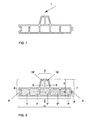
- Fig. 1 From Fig. 1 it can be seen that the cross section of the element 1 made of brick material forms an inverted open T shape, with a base 2 and a in the middle at right angles to this arranged projection 3.
- both the base 2 and the Projection 3 of the T-shape at least one through opening 4, 5, which extends over the entire length of the element 1.
- the base 2 has six through openings 4 to 4 v
- the projection 3 has two through openings 5 and 5 I.
- the number, shape and arrangement of such through openings depend on the requirements for the production of the brick elements and on considerations regarding the statics of the elements 1.
- the two sides of the projection 3 are inclined towards its center.
- the Side walls extend from the base 2 over the entire height n.
- the angle of inclination the side walls of the projection 3 is between 10 ° and 45 °.
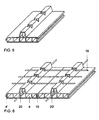
- Another basic property of the element 1 according to the invention Brick material is that on the two outer sides 6, 7 (see FIG. 3) the element 1 a longitudinal projection 8 on one side and a longitudinal recess 9 are provided on the other side, the Forms complement each other and form an insertion joint 10, when two elements 1 are pushed together (see Fig. 6).
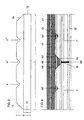
- the projection is on the two end faces 11, 12 (cf. FIG. 2) of the element 1 3 inclined with respect to the plane perpendicular to the base 2 and takes up about half of the total height H of the element 1, so that the Length of the projection 3 is shortened relative to the base 2.
- the reason for that Arrangement of the inclined areas 13, 14 on the end faces 11, 12 of the element 1 can be seen from FIG. 4, in which the connection of two according to the invention Elements are shown that are triangular, against which Base 2 form recess 15, which extends over the entire width of the Elements 1 extends. In this area, the reinforcing bars 16 to 16 'inserted after pouring with concrete mortar 17 from the individual Reinforce elements 1 assembled panel element.
- the lead 8 and the longitudinal recess 9 of the elements 1, which are mutually are complementary, have an obtuse conical shape, as shown in the Figures 1, 3, 5, 6, etc. is shown, when creating play-free joint connections requires no special precision, thanks to the introduction of the Concrete mortar 17 and the reinforcing iron 19.
- the angle of inclination ⁇ of the inclined regions 11, 12 with respect to the plane base 2 is between 30 ° and 75 °.
- the projection 3 has at least three continuous recesses of V-shaped Cross-section whose depth is a quarter of the total height H the Elements 1 corresponds, and which the inclusion of additional reinforcing bars 16 ", 16" 'allows the load capacity after grouting with concrete mortar 17 of elements 1 increase. Furthermore, the improved in the through openings 5, 5 'penetrating concrete mortar 17 the connection between the Elements made of brick material and the mortar.
- a further property of the element 1 according to the invention is preferably that the thicknesses o of the base 2 (see FIG. 3) and n of the projection 3 of the element 1 correspond approximately to half the total height H of the element 1, according to the following equation: o ⁇ n ⁇ H / 2
- the through openings within the thickness o 4 provided to improve the thermal values of the element 1 are insulated with suitable material.
- the insulation 24 extends through the entire length of the element 1, and as far as it is the dimensions of the through openings 5, 5 'of the projection 3, they can also be isolated become.
- 3 shows an insulated element made of brick material (dotted areas).
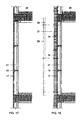
- Corner connections between two panel elements of the same type can also be made can be realized using the same elements 1 as shown in 26 is shown.
- FIG. 7 is a cross section of elements according to the invention made of brick material shown for the production of single-layer panel elements for Use as interior walls. Elements 1 are first on the work platforms lined up longitudinally and by means of the projections 8 and the depressions 9 pushed into each other laterally.
- the number of elements 1 depends on the dimensions of the items to be manufactured Board member.
- element 1 In the longitudinal direction of element 1, at least one to three and maximum six elements. In this arrangement arise accordingly the number of elements 1 aligned triangular recesses 15, the projections 3 corresponding to the required height of the panel element are aligned longitudinally.
- the reinforcing bars 16 are triangular Recesses 15 and in the transversely aligned V-shaped recesses inserted.
- the reinforcement is also through the through openings of the projection 3 is inserted in the longitudinal direction and is in the triangular Recesses 15 connected to the reinforcing iron 16.
- the reinforcing iron 16 which is characterized by the triangular recess 15 and the V-shaped recesses extend longer than the dimensions of the panel element to be created in prefabrication so that it can be combined with the next panel element can be assembled.
- Special reinforcing elements 19 connect the electrowelded network to the reinforcement iron 16.
- the pouring can begin start with the concrete mortar 17, whereby both the elements 1 as well as the reinforcement designed therein can be integrated with each other.
- the Concrete mortar 17 is delimited by special edges of the work tables, whose thickness is the height of the cross-section of the to be created in prefabrication Corresponds to the panel element.
- FIG. 8 is a cross section of elements made of brick material in one panel element according to the invention with two superimposed layers of elements intended for use as the exterior wall of a building are.
- the procedure for assembling the inventive Elements 1 can be done in two ways, with the same result to lead.
- the production of the elements according to the invention in the brick kilns (cf. FIG. 27) already takes place in superimposed ones Layers, which the arrangement of the inventive elements 1 on the Work tables relieved.
- the elements 1 according to the invention are formed one on top of the other following the same method as above for making single layer Table elements have been described.
- the fittings 20 protrude from each row of the superimposed according to the invention Items 1 out to connect to the next one Create panel element.
- Items 1 out to connect to the next one Create panel element When assembling two panel elements with a superimposed layer forms a recess (see Fig. 28), which is reinforced and integrated during the assembly of the panel elements on the construction site becomes.
- Another type, the same panel element with the elements according to the invention 1 to create consists of both steps of laying out to carry out the work tables. After laying out the first layer of Fittings 16, 16 ', 19, 20, 21 and 23 become the second layer of the invention Elements 1 designed, the projections of the elements of the second layer on the base parts of the already laid out side by side Elements are placed. Now the step of casting is carried out with Concrete mortar 17. Should a different K-value than with the wall according to FIG. 8 can be achieved, previously isolated with foam 24 according to the invention Elements 1 in one or both layers (see FIG. 12) of the elements arranged one above the other can be installed.
- the insulating layer 24 the thickness of which is selected so that a required K value is reached between the elements 1 according to the invention to be arranged, the layout being carried out in a similar manner as in the previous described case, but using special stainless Reinforcing steels 23, which connect the stacked, with an insulation layer 24 laid between them, according to the invention Ensure elements 1 (see FIG. 9).
- the elements 1 according to the invention for the Creation of various designs for use in different applications in residential construction, according to the static or thermal Requirements, is for the phase of compiling the dimensions with elements 1 according to the invention, preferably the production in applied to the factory in such a way that in a short time larger ones Square meters of panel elements can be provided, which the cost compared to conventional designs drastically let reduce.
- the quality of the element 1 according to the invention prefabricated elements is better than those of walls used in conventional Brick construction were created. Thanks to its versatility, the inventive Element 1 industrially produced by all brick factories become. A completely new range of designs of great value in terms of project planning as well as architectural and structural Design could be achieved
Landscapes
- Engineering & Computer Science (AREA)
- Architecture (AREA)
- Civil Engineering (AREA)
- Structural Engineering (AREA)
- Physics & Mathematics (AREA)
- Electromagnetism (AREA)
- Building Environments (AREA)
- Panels For Use In Building Construction (AREA)
- Finishing Walls (AREA)
Abstract
Description
- Einfaches Tafelelement für tragende Innenwände, Aussenwände oder Decken, in Abhängigkeit der eingebrachten Zement- bzw. Mörtelmenge und Armatureisen.
- Doppeltes Tafelelement für tragende Innen- oder Aussenmauern, mit oder ohne Isolation.
- Sandwich-Tafelelemente verschiedener Art, hergestellt durch Zusammenfügen einfacher Tafelelemente, oder durch Anbringen einer Zwischen-Isolation im doppelten Tafelelement.
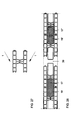
- Rollladenkästen (für Lamellenstoren oder Rollläden)
- Einsätze jeder Art für die Befestigung von Beschlägen
- Ausnehmungen für Apparate und Anlagen
- Pilaster, Balken und tragende Fensterstürze
- Standardisierte Produktion von Tafelelementen für Wände und Decken
- Möglichkeit, stark armierte Zement-Querschnitte in den Durchgangsöffnungen zu erstellen, die sich beim Zusammenfügen der Backsteinelemente ergeben, wobei diese Eigenschaften bei Bauten in erdbebengefährdeten Zonen von besonderer Wichtigkeit sind
- Möglichkeit, Leitungen im Innern der Durchgangsöffnungen in den Backsteinelementen einzubauen bzw. durchzuführen, die sich beim Zusammenfügen der Backsteinelemente ergeben, wobei genügend grosse Querschnitte für die Zement-Verfüllung frei bleiben.
- Möglichkeit, Verbindungen mittels Betonmörtel und Armierungseisen zwischen den Tafelelementen herzustellen, die auf diese Weise vollständig integriert werden.
- Möglichkeit, völlig homogene tragende Strukturen mittels eines einzigen Grundelement-Typs herzustellen.
- Reduktion der Herstelldauer der in der Fabrik hergestellten Tafelelemente dank den Dimensionen des Grundelement-Typs.
- Fig. 1
- Ein Element aus Backsteinmaterial in Stirnansicht mit den Durchgangsöffnungen im Querschnitt,
- Fig. 2
- Ein Element aus Backsteinmaterial gemäss der Fig. 1, in einer Längsansicht,
- Fig. 3
- Die in der Fig. 1 gezeigte Darstellung, wobei jedoch die Durchgangsöffnungen mit Isoliermaterial gefüllt sind,
- Fig. 4
- Verbindung zweier längsseitiger Enden von Elementen aus Backsteinmaterial mit den Stellen, an welchen die Grundarmierungseisen bei der Herstellung des einfachen Tafelelementes eingelegt werden,
- Fig. 5
- Ein Element aus Backsteinmaterial in perspektivischer Darstellung,
- Fig. 6
- Eine Perspektivansicht zweier zusammengebauten Elemente,
- Fig. 7
- Ein Querschnitt erfindungsgemässer Elemente aus Backsteinmaterial in einem einschichtigen Tafelelement, das zur Verwendung als innere oder äussere Wand oder als Decke vorgesehen ist,
- Fig. 8
- Ein Querschnitt durch die erfindungsgemässen Elemente aus Backsteinmaterial eines Tafelelementes mit zwei Schichten übereinander angeordneten Backsteinelementen, das zur Verwendung als Aussenwand eines Gebäudes vorgesehen ist,
- Fig. 9
- Ein Querschnitt durch die erfindungsgemässen Elemente aus Backsteinmaterial eines einschichtigen Tafelelementes gemäss der Fig. 7, verbunden mit einem gleichen Tafelelement, zur Verwendung als Aussenwand in Sandwich-Bauweise,
- Fig. 10
- Ein Querschnitt durch die erfindungsgemässen Elemente aus Backsteinmaterial eines einschichtigen Tafelelementes gemäss der Fig. 7, mit dazwischen eingebauten vorfabrizierten Balken der gegenwärtig üblichen Bauart,
- Fig. 11
- Ein Querschnitt durch die erfindungsgemässen Elemente aus Backsteinmaterial eines zweischichtigen Tafelelementes mit dazwischen eingebauter Wärmedämmungsschicht wählbarer Dicke zur Verbesserung des K-Wertes der Wand und zur Unterbrechung allfälliger Kältebrücken,
- Fig. 12
- Ein Querschnitt durch die erfindungsgemässen Elemente aus Backsteinmaterial gemäss der Fig. 8, jedoch mit Isolation im Raum zwischen den Grundkörpern (2) der Elemente (1),
- Fig. 13
- Ein Querschnitt durch die erfindungsgemässen Elemente aus Backsteinmaterial eines einschichtigen Tafelelementes gemäss der Fig. 7, mit einer durchgehenden Betonplatte und einer dazwischen eingebauten Isolierschicht (24), geeignet zur Herstellung eines Tafelelementes in Sandwich-Bauweise,
- Fig. 14
- Ein Querschnitt durch die erfindungsgemässen Elemente aus Backsteinmaterial eines einschichtigen Tafelelementes gemäss der Fig. 7, mit einer durchgehenden Betonplatte mit Sichtbackstein-Verkleidung und einer dazwischen eingebauten Isolierschicht (24), geeignet zur Herstellung eines Tafelelementes in Sandwich-Bauweise,
- Fig. 15
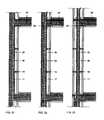
- Ein Querschnitt durch die erfindungsgemässen Elemente aus Backsteinmaterial eines einschichtigen Tafelelementes, das als Aussenwand vorgesehen ist, mit darauf aufgesetzten Holzleisten (34) Ausbildung vorgehängter hinterlüfteter Fassaden (39),
- Fig. 16
- Ein Querschnitt durch die erfindungsgemässen Elemente aus Backsteinmaterial eines einschichtigen Tafelelementes, das zur Verwendung als geneigte Dachfläche vorgesehen ist, mit aufgesetzten Trägern (33) und Holzleisten (34) und Ziegeln (36),
- Fig. 17
- Ein Querschnitt durch die erfindungsgemässen Elemente (1) aus Backsteinmaterial eines einschichtigen Tafelelementes mit Deckenelementen (26), bevor die gewünschte Wandverkleidung festgelegt ist,
- Fig. 18
- Die gleiche Anordnung wie in der Fig. 17, jedoch mit einer als Beispiel gezeigten Verwendung einer vorgehängten hinterlüfteten Fassade (39) gemäss der Fig. 15,
- Fig. 19
- Ein Querschnitt durch die erfindungsgemässen Elemente (1) aus Backsteinmaterial eines Tafelelementes mit übereinander angeordneten Schichten gemäss den Figuren 8 bzw. 12, mit Beton-Deckenplatten (26), zur Verwendung als Aussenwand,
- Fig. 20
- Ein Querschnitt durch die erfindungsgemässen Elemente (1) aus Backsteinmaterial eines Tafelelementes mit übereinander angeordneten Schichten und mit dazwischen angeordneter Isolationsschicht gemäss der Fig. 9, mit Deckenelementen (26), zur Verwendung als Aussenwand,
- Fig. 21
- Ein Querschnitt durch die erfindungsgemässen Elemente (1) aus Backsteinmaterial eines Tafelelementes in Sandwich-Bauweise gemäss der Fig. 13, mit einer durchgehenden Betonplatte und mit Beton-Deckenelementen (26), zur Verwendung als Aussenwand,
- Fig. 22
- Ein Querschnitt durch die erfindungsgemässen Elemente (1) aus Backsteinmaterial eines Tafelelementes in Sandwich-Bauweise gemäss der Fig. 14, mit einer durchgehenden Betonplatte mit Sichtbacksteinverkleidung, und mit Beton-Deckenelementen (26), zur Verwendung als Aussenwand,
- Fig. 23
- Ein Querschnitt durch die erfindungsgemässen Elemente (1) aus Backsteinmaterial eines Tafelelementes in Sandwich-Bauweise gemäss der Fig. 11, hergestellt durch Zusammenbau zweier Tafelelemente, wie sie in der Fig. 7 dargestellt sind, mit dazwischen angeord-neter Wärmedämmschicht, und mit Beton-Deckenelementen (26), zur Verwendung als Aussenwand,
- Figuren 24 und 25
- Zwei Ausführungsbeispiele von Rollladenkasten, in einfacher Ausführung, sowie mit dazwischen angeordneter Isolation (24),
- Fig. 26
- Ein Querschnitt durch die erfindungsgemässen Elemente (1) aus Backsteinmaterial eines aus zwei übereinander angeordneten Schichten aufgebauten Tafelelementes, zur Verwendung als Aussenwand an einem Gebäude mit einer Ecke (25), die mit den gleichen erfindungsgemässen Elementen (1) ausgebildet wird,
- Fig. 27
- Ein Ausführungsbeispiel und eine Herstellweise der erfindungsgemässen Elemente (1) im Backstein-Brennofen,
- Fig. 28
- Ein Querschnitt durch die erfindungsgemässen Elemente (1) aus Backsteinmaterial zweier aus zwei übereinander angeordneten Schichten aufgebauten Tafelelemente, zur Bildung einer Verbindungsfuge vorbereitet, indem zwei linke Seiten (6, 6') bzw. zwei rechte Seiten (7, 7') zur Ausbildung einer doppelten Fuge (10, 10') ineinander geschoben werden. Die Verbindung wird durch das Verfüllen der eingelegten Armierungen (19) mit Betonmörtel (17) gewährleistet.
- Die Länge I des Elementes 1 liegt zwischen 50 und 100 cm, vorzugsweise zwischen 74 und 94 cm,
- Die Breite m des Elementes 1 liegt zwischen 30 und 60 cm, vorzugsweise zwischen 42 und 60 cm,
- Die Gesamthöhe H liegt zwischen 10 und 28 cm, vorzugsweise bei 14 cm.
- 1
- Element aus Backsteinmaterial
- 2
- Basis
- 3
- Vorsprung
- 4
- Durchgangsöffnung in der Basis
- 5
- Durchgangsöffnung im Vorsprung
- 6
- Linke Aussenseite des Elementes
- 7
- Rechte Aussenseite des Elementes
- 8
- Längsgerichteter Vorsprung
- 9
- Längsgerichtete Vertiefung
- 10
- Einschiebe-Fuge
- 11
- Stirnseite
- 12
- Stirnseite
- 13
- Geneigter Bereich
- 14
- Geneigter Bereich
- 15
- Dreieckförmige Ausnehmung
- 16,
- 16' Armierungseisen
- 17
- Betonmörtel
- 18, 18'
- Trapezförmige Ausnehmung
- 19
- Längsgerichtetes Armierungseisen
- 20
- Quergerichtetes Armierungseisen
- 21
- Armierungsnetz
- 22
- Mörtel- oder Verputzschicht
- 23
- Nichtrostender Stahl
- 24
- Isolation
- 25
- Winkelelement
- 26
- Tafelelement für Decken
- 27
- Einfache einschichtige vertikale Wand
- 28
- Vertikale Wand mit übereinandergelegten Schichten
- 29
- Wand in Sandwichbauweise
- 30
- Verbindungsbügel zum Zusammenbau
- 31
- Handelsübliches Armierungsnetz
- 32
- Feuchtigkeitssperre
- 33
- Trägerelement aus Hartplastik
- 34
- Holzleiste
- 35
- Spezialarmatur für Sandwichelemente
- 36
- Ziegel
- 37
- Luftzwischenraum
- 38
- Trägerelemente aus Metall
- 39
- Hinterlüftete vorgehängte Fassade
Claims (14)
- Element aus Backsteinmaterial zur Herstellung vorfabrizierter Tafelelemente für den Wohnbau,
dadurch gekennzeichnet, dass
der Querschnitt des Elementes eine umgekehrte offene T-Form aufweist mit einer Basis (2) und einem senkrecht zur Basis (2) stehenden Vorsprung (3),
wobei sowohl die Basis (2) als auch der Vorsprung (3) der umgekehrten offenen T-Form mindestens eine längsgerichtete Durchgangsöffnung (4, 5) aufweisen, die sich über die ganze Länge des Elementes erstreckt,
und dass eine der beiden Aussenseiten (6, 7) des Elementes 1 einen längsgerichteten Vorsprung (8) aufweist, während die andere Aussenseite eine Vertiefung (9) aufweist, deren Form in solcher Weise komplementär zum Vorsprung (8) ausgebildet ist, dass eine Einschiebe-Fuge (10) gebildet wird, die sich über die ganze Länge der Elemente erstreckt,
dass die beiden Stirnseiten (11, 12) des Elementes (1) gegenüber der senkrecht zur Basis (2) stehenden Ebene in solcher Weise geneigt sind, dass die Länge des Vorsprungs (3) gegenüber der Länge der Basis (2) verkürzt ist. - Element aus Backsteinmaterial gemäss dem Anspruch 1,
dadurch gekennzeichnet, dass
sowohl die Basis (2) als auch der Vorsprung (3) des Elementes (1) eine Vielzahl von längsgerichteten Durchgangsöffnungen (4, ... 4v, 5, 5I) aufweisen, die durch eine Zwischenwand voneinander getrennt sind, die dünner ist als die Breite der Durchgangsöffnungen. - Element aus Backsteinmaterial gemäss dem Anspruch 1,
dadurch gekennzeichnet, dass
der längsgerichtete Vorsprung (8) und die längsgerichtete Vertiefung (9), mit denen die Aussenseiten (6, 7) des Elementes (1) versehen sind, komplementär geformt sind und eine stumpf konische Querschnittsform aufweisen. - Element aus Backsteinmaterial gemäss dem Anspruch 1,
dadurch gekennzeichnet, dass
sich die geneigten Bereiche (13, 14) der Stirnseiten (11, 12) des Elementes (1) über etwa die Hälfte der Höhe (H) der Stirnseiten (11, 12) erstrecken. - Element aus Backsteinmaterial gemäss dem Anspruch 1,
dadurch gekennzeichnet, dass
der Neigungswinkel (α) der gegenüber der Grundebene der Basis (2) des Elementes (1) geneigten Bereiche (11, 12) zwischen 30° und 75° beträgt. - Element aus Backsteinmaterial gemäss dem Anspruch 1,
dadurch gekennzeichnet, dass
die Länge (I) des Elementes (1) zwischen 50 und 100 cm liegt, die Breite (m) des Elementes (1) zwischen 30 und 60 cm liegt, und dass die Höhe des Elementes (1) zwischen 10 und 28 cm liegt. - Element aus Backsteinmaterial gemäss dem Anspruch 1,
dadurch gekennzeichnet, dass
die Höhe der Basis (h) im Wesentlichen der Hälfte der Höhe (H) des Elementes (1) entspricht. - Element aus Backsteinmaterial gemäss dem Anspruch 1,
dadurch gekennzeichnet, dass
die Dicke (o) der Basis des Elementes (1) und die Dicke des Vorsprungs (3) des Elementes (1) ungefähr der Hälfte der Höhe (H) des Elementes (1) entsprechen. - Element aus Backsteinmaterial gemäss dem Anspruch 1 oder 2,
dadurch gekennzeichnet, dass
die Durchgangsöffnungen (4, 4v, und 5, 5'), mit denen die Basis (2) und der Vorsprung (3) versehen sind, mit isolierendem Schaumstoff verfüllt werden, der den K-Wert (K) des Elementes (1) verbessert. - Element aus Backsteinmaterial gemäss dem Anspruch 1 oder 2,
dadurch gekennzeichnet, dass
der Vorsprung (3) mindestens drei quergerichtete Ausnehmungen aufweist, deren V-Form eine Tiefe hat, die einem Viertel der Höhe (H) des Elementes (1) entspricht, damit weitere Armierungseisen (16) eingelegt werden können, die in Verbindung mit dem Betonmörtel (17) die Tragfähigkeits-Eigenschaften des Elementes (1) verbessern. - Anwendung des Elementes aus Backsteinmaterial gemäss den Ansprüchen 1 bis 10,
dadurch gekennzeichnet, dass
dieses in solcher Weise zusammengebaut werden kann, dass Kästen verschiedener Abmessungen gebildet werden für Lamellenstoren, RoIIIaden, Fensterstürze und Pilaster. - Anwendung des Elementes aus Backsteinmaterial gemäss den Ansprüchen 1 bis 10,
dadurch gekennzeichnet, dass
dieses in solcher Weise zusammengebaut werden kann, dass verschiedene einschichtige Bauformen, zweischichtige Bauformen, Bauformen in Sandwichbauweise und mit eingefügter Isolation (24), die geeignet ist, sicherzustellen, dass in der Konstruktion keine Kältebrücken vorhanden sind, und dass verschiedene K-Werte gemäss den verschiedenen Normen erreicht werden können. - Anwendung des Elementes aus Backsteinmaterial gemäss dem Anspruch 1 oder 2,
dadurch gekennzeichnet, dass
dieses in solcher Weise zusammengebaut werden kann, dass vollständig homogene Bauten aus Wänden und Decken realisiert werden können, die unter Verwendung eines einzigen erfindungsgemässen Elementes (1) erstellt werden. - Anwendung des Elementes aus Backsteinmaterial gemäss den Ansprüchen 1 bis 10,
dadurch gekennzeichnet, dass
alle Bauten, die mittels der verschiedenen Bauformen der Tafelelemente zusammengebaut sind, einen hohen Grad der Widerstandsfähigkeit gegen allfällige Erdbeben-Beanspruchungen aufweisen, dank den eingebauten Armierungen (16, 16'; 19; 21; 35), welche die Verankerung zwischen den vertikalen Elementen der Wände und den horizontalen Elementen der Decken sicherstellen
Applications Claiming Priority (2)
| Application Number | Priority Date | Filing Date | Title |
|---|---|---|---|
| CH12082001 | 2001-07-02 | ||
| CH12082001 | 2001-07-02 |
Publications (2)
| Publication Number | Publication Date |
|---|---|
| EP1273729A2 true EP1273729A2 (de) | 2003-01-08 |
| EP1273729A3 EP1273729A3 (de) | 2003-12-03 |
Family
ID=4563064
Family Applications (1)
| Application Number | Title | Priority Date | Filing Date |
|---|---|---|---|
| EP01810973A Withdrawn EP1273729A3 (de) | 2001-07-02 | 2001-10-05 | Element aus Backsteinmaterial zum Erstellen vorfabrizierter Tafeln für das Bauwesen |
Country Status (2)
| Country | Link |
|---|---|
| US (1) | US6625948B2 (de) |
| EP (1) | EP1273729A3 (de) |
Cited By (4)
| Publication number | Priority date | Publication date | Assignee | Title |
|---|---|---|---|---|
| EP1705302A2 (de) | 2005-02-15 | 2006-09-27 | Carmine Franco Valente | Element aus Backsteinmaterial zum Erstellen von vorfabrizierten Tafeln für das Bauwesen |
| EP1881130A1 (de) * | 2006-07-19 | 2008-01-23 | BIT Technologies Limited | Transportierbare Fabrik zum Herstellen vorfabrizierter Elemente |
| CN107313539A (zh) * | 2017-08-04 | 2017-11-03 | 徐焱 | 一种预应力空心叠合板 |
| IT202200025908A1 (it) | 2022-12-19 | 2024-06-19 | Carmine Franco Valente | Pannello strutturale prefabbricato, metodo di fabbricazione e sistema strutturale |
Families Citing this family (24)
| Publication number | Priority date | Publication date | Assignee | Title |
|---|---|---|---|---|
| US20050138880A1 (en) * | 2003-12-29 | 2005-06-30 | Denis Martineau | Variable pitch corrugated support sheet with accompanying support beam |
| US7937901B2 (en) * | 2005-03-29 | 2011-05-10 | Sarkkinen Douglas L | Tendon-identifying, post tensioned concrete flat plate slab and method and apparatus for constructing same |
| US20070039265A1 (en) * | 2005-08-11 | 2007-02-22 | Groupe Canam Inc. | Prefabricated masonry covered structural wall panel |
| US7670130B2 (en) * | 2005-10-06 | 2010-03-02 | Tapco International Corporation | Cement shutter |
| US20080003398A1 (en) * | 2006-06-29 | 2008-01-03 | Tapco International Corporation | Foam core cement shutter |
| US20080022609A1 (en) * | 2006-07-28 | 2008-01-31 | Bit Technologies Limited | Mobile manufacturing plants for producing prefab elements |
| US20080022621A1 (en) * | 2006-07-28 | 2008-01-31 | Bit Technologies Limited | Element of brick material for realising prefab panels for the building industry |
| CA2596187A1 (en) * | 2006-08-07 | 2008-02-07 | Tapco International Corporation | Cement shutter hanging system |
| CH699922B1 (it) * | 2006-08-23 | 2010-05-31 | Bit Technologies Ltd | Pannello prefabbricato per costruire una parete doppia di edifici. |
| US20080141608A1 (en) * | 2006-12-19 | 2008-06-19 | Logan J Richard | Foam core cement and urethane shutters |
| US20080292868A1 (en) * | 2007-05-21 | 2008-11-27 | Logan J Richard | Foam core gypsum shutter |
| WO2010083506A1 (en) * | 2009-01-19 | 2010-07-22 | Tapco International Corporation | Molded siding having longitudinally-oriented reinforcement fibers, and system and method for making the same |
| US20100263315A1 (en) * | 2009-04-17 | 2010-10-21 | Tapco International Corporation | Molded siding having integrally-formed i-beam construction |
| CN101936061A (zh) * | 2009-05-22 | 2011-01-05 | 塞梅潘工业公司 | 结构地板面板和结合有这种地板面板的地板结构 |
| CN103827410B (zh) * | 2011-07-26 | 2016-08-17 | 旭化成住宅株式会社 | 砌体建筑物及砌体建筑物的构筑方法 |
| GB201119308D0 (en) * | 2011-11-09 | 2011-12-21 | Valtra Oy Ab | Tractor cabs |
| NO341267B1 (no) * | 2014-08-04 | 2017-10-02 | Svein Berg Holding As | Bygningselement, bygning omfattende et eller flere bygningselementer og fremgangsmåte for sammenføyning av bygningselementer og bærende elementer |
| US20220081904A1 (en) * | 2020-09-17 | 2022-03-17 | Hi-Tech Tilt Intellectual Property Management, Inc. | Structural Floor and Roof Joists |
| CN112081282A (zh) * | 2020-10-14 | 2020-12-15 | 浙江普罗住工绿建科技股份有限公司 | 新型填充楼盖 |
| CA3203545A1 (en) * | 2020-12-29 | 2022-07-07 | Joao Miguel Dos Santos Almeida Nunes | Masonry system |
| US12234639B2 (en) * | 2021-06-23 | 2025-02-25 | 9443-3638 Québec inc. | Composite ceiling and method of construction |
| US12188232B2 (en) * | 2022-06-16 | 2025-01-07 | ICF Building Systems LLC | Concrete form systems, devices, and related methods |
| US12509882B2 (en) * | 2023-01-26 | 2025-12-30 | Som Iw Holdings, Llc | Timber-concrete composite connector and ductile reinforcement chair |
| US20250237056A1 (en) * | 2024-01-19 | 2025-07-24 | Mikhail Topr | Wall panel with window aperture |
Citations (1)
| Publication number | Priority date | Publication date | Assignee | Title |
|---|---|---|---|---|
| EP0921243A2 (de) | 1997-10-03 | 1999-06-09 | Carmine Franco Valente | Element aus Backsteinmaterial zum Erstellen von modularen Tafeln für das Bauwesen |
Family Cites Families (4)
| Publication number | Priority date | Publication date | Assignee | Title |
|---|---|---|---|---|
| DE1659227A1 (de) * | 1966-12-19 | 1970-03-05 | Sachs Melvin H | Baublockkoerper,der als Form fuer die Aufnahme von Beton u. dgl. ausgebildet ist |
| DE2701135A1 (de) * | 1977-01-13 | 1978-07-20 | Heinz Hoelter | Feuerfeste deckenelemente |
| AT385543B (de) * | 1984-11-26 | 1988-04-11 | Bucher Franz | Vorgefertigtes hohlkoerper-deckenelement |
| AU668058B2 (en) * | 1994-07-18 | 1996-04-18 | Caswold Hickson Lee | Building blocks and method of building construction |
-
2001
- 2001-10-05 EP EP01810973A patent/EP1273729A3/de not_active Withdrawn
-
2002
- 2002-01-04 US US10/035,232 patent/US6625948B2/en not_active Expired - Fee Related
Patent Citations (1)
| Publication number | Priority date | Publication date | Assignee | Title |
|---|---|---|---|---|
| EP0921243A2 (de) | 1997-10-03 | 1999-06-09 | Carmine Franco Valente | Element aus Backsteinmaterial zum Erstellen von modularen Tafeln für das Bauwesen |
Cited By (7)
| Publication number | Priority date | Publication date | Assignee | Title |
|---|---|---|---|---|
| EP1705302A2 (de) | 2005-02-15 | 2006-09-27 | Carmine Franco Valente | Element aus Backsteinmaterial zum Erstellen von vorfabrizierten Tafeln für das Bauwesen |
| EP1705302A3 (de) * | 2005-02-15 | 2008-01-16 | Carmine Franco Valente | Element aus Backsteinmaterial zum Erstellen von vorfabrizierten Tafeln für das Bauwesen |
| EP1881130A1 (de) * | 2006-07-19 | 2008-01-23 | BIT Technologies Limited | Transportierbare Fabrik zum Herstellen vorfabrizierter Elemente |
| CN107313539A (zh) * | 2017-08-04 | 2017-11-03 | 徐焱 | 一种预应力空心叠合板 |
| CN107313539B (zh) * | 2017-08-04 | 2023-09-08 | 徐焱 | 一种预应力空心叠合板 |
| IT202200025908A1 (it) | 2022-12-19 | 2024-06-19 | Carmine Franco Valente | Pannello strutturale prefabbricato, metodo di fabbricazione e sistema strutturale |
| EP4389999A1 (de) | 2022-12-19 | 2024-06-26 | Carmine Franco Valente | Vorgefertigte bauplatte, herstellungsverfahren und bausystem |
Also Published As
| Publication number | Publication date |
|---|---|
| US6625948B2 (en) | 2003-09-30 |
| US20030000167A1 (en) | 2003-01-02 |
| EP1273729A3 (de) | 2003-12-03 |
Similar Documents
| Publication | Publication Date | Title |
|---|---|---|
| DE2004914A1 (de) | Verfahren zur Herstellung von Gebäuden und Bauelemente für die Durchführung des Verfahrens | |
| DE2231943A1 (de) | Baukasteneinheit und verfahren zur herstellung eines gebaeudes nach einem baukastensystem | |
| DE10043609C1 (de) | Mauerwerk | |
| DE3432940A1 (de) | Vorgefertigtes mauerwerk | |
| DE1659159A1 (de) | Mehrzweckbaustein und aus ihm hergestelltes Mauerwerk | |
| CH662849A5 (de) | Verfahren zum herstellen eines gebaeudes und ein nach diesem verfahren hergestelltes gebaeude. | |
| DE2100074A1 (de) | Durch Verbindungsbügel zusammenhaltbare verlorene Schalung | |
| DE2810317A1 (de) | Verfahren zum herstellen von gebaeuden fuer wohn-, sozial-, oder gewerbezwecke und mit diesem verfahren erzieltes gebaeude | |
| DE1911444A1 (de) | Vorgefertigtes Bauelement fuer Betondecken und Betonwaende | |
| EP1705302A2 (de) | Element aus Backsteinmaterial zum Erstellen von vorfabrizierten Tafeln für das Bauwesen | |
| DE1484067A1 (de) | Bewehrtes Mauerwerk | |
| EP0921243A2 (de) | Element aus Backsteinmaterial zum Erstellen von modularen Tafeln für das Bauwesen | |
| DE812368C (de) | Gebaeude (Wohnhaus, Fabrik o. dgl.) aus vorgefertigten Verbundbetonplatten | |
| DE2400928A1 (de) | Betonbewehrung und verfahren zum errichten einer solchen | |
| EP0717158B1 (de) | Raumbausteinsystem für das Erstellen von Bauwerken | |
| DE3400404A1 (de) | Bauelement zur herstellung von gebaeudewaenden und/oder gebaeudedecken bzw. daechern | |
| EP0034185A4 (de) | Tragende Wandelemente für Gebäude und Gebäude errichtet aus derartigen Wandelementen. | |
| DE2352250A1 (de) | Bauwerk mit vertikalen tragwaenden und horizontalen decken | |
| EP1528173A2 (de) | Vorgespannte Flachdecke mit Hohldeckenplatten | |
| DE804471C (de) | Decke aus Stahlbetonfertigbalken ohne Zwischenbauteile | |
| DE19823657B4 (de) | Verfahren zum Befüllen von Wandtafeln aus Schalungssteinen | |
| AT411610B (de) | Gross-wandbauplatte und unter deren verwendung erstelltes bauwerk | |
| DE19860171A1 (de) | Verfahren zum Herstellen eines Verbandes aus Bauelementen, insbesondere aus Kalksandstein-Planelementen, und Verband aus aufeinanderliegenden Bauelementen | |
| DE1609361C3 (de) | Gebäude mit vorgefertigten, geschlossenen, einzelligen Rahmenelementen aus Stahlbeton | |
| DE2356483A1 (de) | Isolierbauelement fuer decken und waende aus stahlbeton-fertigteilen |
Legal Events
| Date | Code | Title | Description |
|---|---|---|---|
| PUAI | Public reference made under article 153(3) epc to a published international application that has entered the european phase |
Free format text: ORIGINAL CODE: 0009012 |
|
| AK | Designated contracting states |
Kind code of ref document: A2 Designated state(s): AT BE CH CY DE DK ES FI FR GB GR IE IT LI LU MC NL PT SE TR |
|
| AX | Request for extension of the european patent |
Free format text: AL;LT;LV;MK;RO;SI |
|
| PUAL | Search report despatched |
Free format text: ORIGINAL CODE: 0009013 |
|
| AK | Designated contracting states |
Kind code of ref document: A3 Designated state(s): AT BE CH CY DE DK ES FI FR GB GR IE IT LI LU MC NL PT SE TR |
|
| AX | Request for extension of the european patent |
Extension state: AL LT LV MK RO SI |
|
| RIC1 | Information provided on ipc code assigned before grant |
Ipc: 7E 04C 1/41 B Ipc: 7E 04B 5/38 B Ipc: 7E 04B 2/18 B Ipc: 7E 04B 5/00 A |
|
| 17P | Request for examination filed |
Effective date: 20040526 |
|
| RAP1 | Party data changed (applicant data changed or rights of an application transferred) |
Owner name: WALDRON INVEST & TRADE LTD. |
|
| RIN1 | Information on inventor provided before grant (corrected) |
Inventor name: WALDRON INVEST & TRADE LTD. |
|
| AKX | Designation fees paid |
Designated state(s): AT BE CH CY DE DK ES FI FR GB GR IE IT LI LU MC NL PT SE TR |
|
| STAA | Information on the status of an ep patent application or granted ep patent |
Free format text: STATUS: THE APPLICATION IS DEEMED TO BE WITHDRAWN |
|
| 18D | Application deemed to be withdrawn |
Effective date: 20080501 |