EP1275958A1 - Verfahren zur Verringerung von Nulllinieninstabilitäten in flüssigchromatographischen Messungen und Flüssigchromatographievorrichtung - Google Patents
Verfahren zur Verringerung von Nulllinieninstabilitäten in flüssigchromatographischen Messungen und Flüssigchromatographievorrichtung Download PDFInfo
- Publication number
- EP1275958A1 EP1275958A1 EP01116298A EP01116298A EP1275958A1 EP 1275958 A1 EP1275958 A1 EP 1275958A1 EP 01116298 A EP01116298 A EP 01116298A EP 01116298 A EP01116298 A EP 01116298A EP 1275958 A1 EP1275958 A1 EP 1275958A1
- Authority
- EP
- European Patent Office
- Prior art keywords
- column
- solid body
- liquid bath
- heat
- inlet capillary
- Prior art date
- Legal status (The legal status is an assumption and is not a legal conclusion. Google has not performed a legal analysis and makes no representation as to the accuracy of the status listed.)
- Withdrawn
Links
- 239000007788 liquid Substances 0.000 title claims abstract description 26
- 238000000034 method Methods 0.000 title claims abstract description 13
- 238000005259 measurement Methods 0.000 title claims abstract description 7
- 238000004811 liquid chromatography Methods 0.000 title claims description 4
- 239000007787 solid Substances 0.000 claims abstract description 20
- 230000005526 G1 to G0 transition Effects 0.000 claims abstract description 17
- 239000000126 substance Substances 0.000 claims abstract description 10
- XLYOFNOQVPJJNP-UHFFFAOYSA-N water Substances O XLYOFNOQVPJJNP-UHFFFAOYSA-N 0.000 claims abstract description 9
- 125000000524 functional group Chemical group 0.000 claims abstract description 6
- 125000002924 primary amino group Chemical group [H]N([H])* 0.000 claims abstract description 5
- WEVYAHXRMPXWCK-UHFFFAOYSA-N Acetonitrile Chemical compound CC#N WEVYAHXRMPXWCK-UHFFFAOYSA-N 0.000 claims description 12
- 230000000694 effects Effects 0.000 claims description 6
- 238000009499 grossing Methods 0.000 claims description 5
- 238000011067 equilibration Methods 0.000 claims description 4
- 238000004458 analytical method Methods 0.000 claims description 2
- 238000001179 sorption measurement Methods 0.000 abstract description 5
- 230000001419 dependent effect Effects 0.000 abstract description 2
- 230000006641 stabilisation Effects 0.000 abstract description 2
- 238000011105 stabilization Methods 0.000 abstract description 2
- 229910052751 metal Inorganic materials 0.000 description 34
- 239000002184 metal Substances 0.000 description 34
- 229910052782 aluminium Inorganic materials 0.000 description 8
- XAGFODPZIPBFFR-UHFFFAOYSA-N aluminium Chemical compound [Al] XAGFODPZIPBFFR-UHFFFAOYSA-N 0.000 description 8
- 239000003480 eluent Substances 0.000 description 5
- 238000002835 absorbance Methods 0.000 description 3
- 239000000203 mixture Substances 0.000 description 3
- 239000002904 solvent Substances 0.000 description 3
- VYPSYNLAJGMNEJ-UHFFFAOYSA-N Silicium dioxide Chemical compound O=[Si]=O VYPSYNLAJGMNEJ-UHFFFAOYSA-N 0.000 description 2
- 125000003277 amino group Chemical group 0.000 description 2
- 230000033228 biological regulation Effects 0.000 description 2
- 238000001514 detection method Methods 0.000 description 2
- 238000010586 diagram Methods 0.000 description 2
- 238000010438 heat treatment Methods 0.000 description 2
- 229910052739 hydrogen Inorganic materials 0.000 description 2
- 239000001257 hydrogen Substances 0.000 description 2
- 238000000926 separation method Methods 0.000 description 2
- RYGMFSIKBFXOCR-UHFFFAOYSA-N Copper Chemical compound [Cu] RYGMFSIKBFXOCR-UHFFFAOYSA-N 0.000 description 1
- 229910000831 Steel Inorganic materials 0.000 description 1
- 239000000654 additive Substances 0.000 description 1
- 238000013375 chromatographic separation Methods 0.000 description 1
- 230000000295 complement effect Effects 0.000 description 1
- 238000001816 cooling Methods 0.000 description 1
- 229910052802 copper Inorganic materials 0.000 description 1
- 239000010949 copper Substances 0.000 description 1
- 230000008878 coupling Effects 0.000 description 1
- 238000010168 coupling process Methods 0.000 description 1
- 238000005859 coupling reaction Methods 0.000 description 1
- 238000013461 design Methods 0.000 description 1
- 238000005516 engineering process Methods 0.000 description 1
- 238000002474 experimental method Methods 0.000 description 1
- 238000004128 high performance liquid chromatography Methods 0.000 description 1
- 239000011810 insulating material Substances 0.000 description 1
- 239000000463 material Substances 0.000 description 1
- 230000010355 oscillation Effects 0.000 description 1
- 238000012856 packing Methods 0.000 description 1
- 239000002952 polymeric resin Substances 0.000 description 1
- 230000010349 pulsation Effects 0.000 description 1
- 238000001448 refractive index detection Methods 0.000 description 1
- 125000000467 secondary amino group Chemical group [H]N([*:1])[*:2] 0.000 description 1
- 239000000377 silicon dioxide Substances 0.000 description 1
- 125000006850 spacer group Chemical group 0.000 description 1
- 239000010959 steel Substances 0.000 description 1
- 229920003002 synthetic resin Polymers 0.000 description 1
- 125000001302 tertiary amino group Chemical group 0.000 description 1
- 210000002268 wool Anatomy 0.000 description 1
Images

Classifications
-
- G—PHYSICS
- G01—MEASURING; TESTING
- G01N—INVESTIGATING OR ANALYSING MATERIALS BY DETERMINING THEIR CHEMICAL OR PHYSICAL PROPERTIES
- G01N30/00—Investigating or analysing materials by separation into components using adsorption, absorption or similar phenomena or using ion-exchange, e.g. chromatography or field flow fractionation
- G01N30/02—Column chromatography
- G01N30/26—Conditioning of the fluid carrier; Flow patterns
- G01N30/28—Control of physical parameters of the fluid carrier
- G01N30/30—Control of physical parameters of the fluid carrier of temperature
-
- G—PHYSICS
- G01—MEASURING; TESTING
- G01N—INVESTIGATING OR ANALYSING MATERIALS BY DETERMINING THEIR CHEMICAL OR PHYSICAL PROPERTIES
- G01N30/00—Investigating or analysing materials by separation into components using adsorption, absorption or similar phenomena or using ion-exchange, e.g. chromatography or field flow fractionation
- G01N30/02—Column chromatography
- G01N30/50—Conditioning of the sorbent material or stationary liquid
- G01N30/52—Physical parameters
- G01N30/54—Temperature
-
- G—PHYSICS
- G01—MEASURING; TESTING
- G01N—INVESTIGATING OR ANALYSING MATERIALS BY DETERMINING THEIR CHEMICAL OR PHYSICAL PROPERTIES
- G01N30/00—Investigating or analysing materials by separation into components using adsorption, absorption or similar phenomena or using ion-exchange, e.g. chromatography or field flow fractionation
- G01N30/02—Column chromatography
- G01N2030/022—Column chromatography characterised by the kind of separation mechanism
- G01N2030/027—Liquid chromatography
Definitions
- the invention relates to a method of improving baseline stability in liquid chromatographic measurements and to a liquid chromatography apparatus having means for reducing baseline instabilities.
- High performance liquid chromatography is a separation technique wherein a mixture of sample substances dissolved in a solvent (mobile phase) is forced under high pressure through a separation column. Different sample substances interact differently with the stationary phase in the column and therefore elute from the column at different times.
- the separated sample substances leaving the column are detected with a suitable detector, such as an absorbance detector, refractive index detector, conductivity detector, or electrochemical detector.
- a suitable detector such as an absorbance detector, refractive index detector, conductivity detector, or electrochemical detector.
- the representation of the detector signal as a function of time is called chromatogram. Different sample substances are represented by individual peaks in the chromatogram; the peak area is a measure of the amount of the corresponding sample substance.
- a new type of baseline instability has been observed by the inventor of the present invention, in particular in connection with stationary phases comprising amino functional groups. Columns of this type are used, for example, for sugar analysis.
- the observed baseline instabilities occur in the form of "wander" in the time range of 1-10 minutes and can thus easily interfere with chromatographic peaks.
- the invention according to claim 1 is based on the surprising finding that the baseline variation originates from variations in the adsorption of water (or one of the eluent components) to the stationary phase and that this adsorption is sensitive to temperature fluctuations.
- the baseline problems are substantially reduced by coupling an additional solid body or liquid bath having a high heat capacity and heat conductance to the column and to an inlet capillary of the column such that the inlet capillary and the column are entirely enclosed by said solid body or liquid bath.
- the invention is particularly useful in connection with refractive index detection which is very sensitive to changes in the measuring conditions, but it is also advantageous for other detection methods, such as absorbance detection. It is understood that the invention is not only applicable for stationary phases with amino groups, but also for other types of stationary phases, e.g. reversed phases (RP) in connection with mobile phases containing UV absorbing additives which have a temperature dependent affinity to the stationary phase.
- RP reversed phases
- the invention also provides a general solution for temperature stabilization of the column, allowing a constancy of the column temperature of better than 0.001 degrees centigrade per minute.
- an additional solid body or liquid bath having a high heat capacity and heat conductance, is coupled to the column and to an inlet capillary of the column such that the inlet capillary and the column are enclosed by said solid body or liquid bath.
- the additional solid body and the inlet capillary are arranged in a thermostatted column compartment of the chromatograph which comprises a controlled heat source and/or heat sink.
- the heat impedance between the additional solid body and the controlled heat source/sink is optimized to ensure that equilibration times do not become too long, and to avoid cross-talk of the small, fast fluctuations from the heat source/sink which would otherwise directly influence the column temperature.
- baseline wander occurs in liquid chromatographic measurements, in particular when using columns with stationary phases having amino functional groups and when the eluent leaving the column is detected with a refractive index detector.
- the stationary phase was a silica based packing coated with polymer resin containing secondary and tertiary amino functional groups.
- the mobile phase was a mixture of acetonitrile (ACN) and water.
- a disturbing baseline wander occurred at higher ACN concentrations, typically above 65%. This baseline wander occurred, even though the column was thermostatted as it is usual practice in liquid chromatographs.
- the inventor found out that the baseline wander has to do with variations in the adsorption of water to the stationary phase and that this adsorption is sensitive to temperature fluctuations.
- the water molecules in the mobile phase form hydrogen bonds with the amino groups of the stationary phase. These hydrogen bonds are very sensitive to temperature changes so that, depending on the temperature, more or less water molecules are released into the solvent and subsequently cause a corresponding detector signal.
- refractive index detectors are sensitive to such changes of the water concentration.
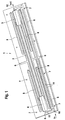
- Figure 1 illustrates a first embodiment.
- a solid metal body 1 is arranged inside the thermostated column compartment of a liquid chromatograph, for example the Agilent Technologies Series 1100 liquid chromatograph.
- the metal body 1 comprises an elongated recess 3 for receiving the column (not shown).
- the widened recess portions 4 ,5 serve for accommodating the end fittings of the column.
- the body 1 also comprises grooves 6 for receiving the inlet and outlet capillaries of the column which are connected to the end fittings, respectively. The grooves 6 are folded several times and thus allow to accommodate a relatively great length of inlet capillary within the body 1.
- a second metal body (not shown) which is substantially the mirror image of the body 1 is arranged onto the body 1 such that the column and the capillaries are enclosed by the two bodies.
- the two bodies may be connected with screws via screw holes 7.
- the metal body is made of a material which has a high heat capacity and a high heat conductance, such as aluminum.
- the body has typical dimensions of about 33 cm x 7 cm x 2 cm, wherein the latter dimension applies for the two bodies when joined together.
- the inlet capillary to the column which is typically made of steel is jammed in the grooves 6 such that it is in good heat contact with the surrounding metal. Typically, about 30 cm or more of the inlet capillary are arranged in the metal body.
- the inlet capillary enters the metal block 1 at reference numeral 10 and follows the path in the grooves 6 illustrated by the solid line 11 and after a few turns enters the column.
- the outlet capillary leaves the column at position 12.
- the outer diameter of the inlet capillary and of the outlet capillary is about 0,8 mm.
- the column is either jammed in the groove 3 or is hanging freely in a cavity larger than the column itself.
- the metal body 1 with its complementary counterpart and the enclosed column as well as inlet and outlet capillaries are arranged inside the thermostatted column compartment and it substantially fills out the space of the compartment.
- the thermostat arrangement inside the compartment comprises a heat exchanger with heat exchanger fins which project into slit openings 8 of the body 1. There is no direct contact between the heat exchanger and the body 1, a distance of 1 to 2 mm is maintained everywhere, for example by non-heat conducting spacers.
- the heat exchanger allows to adjust a desired temperature in the column compartment for a specific chromatographic separation by appropriate heating/cooling means and corresponding control circuitry. Additional heat insulating material is placed in the column compartment around the sides of the metal body not directed to the heat exchanger surfaces. This reduces ambient effects by increasing the heat impedance from ambient to the metal block.
- the distance between the metal body and the heat exchanger ensures an optimum heat impedance between the two.
- the additional heat capacity coupled to the mobile phase entering the column contributes to the smoothing of temperature fluctuations. If the column is jammed into the metal body, it is also coupled to the additional heat capacity; if the column is hanging freely inside of the essentially isothermal chamber in the metal body, it is shielded from ambient effects by the highly heat conductive metal body. Since the flow path from the point of the inlet capillary entering the metal body up to the column outlet capillary is entirely enclosed inside the metal body, ambient effects are excluded all over the relevant part of the flow path.
- the mobile phase heating due to mechanical losses (hydraulic friction) within the column is either negligible or anyway stationary.
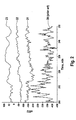
- Figure 2 illustrates the improvements in baseline stability which are achieved with the present invention. It shows the output signal of a refractive index detector (in nano refractive index units) coupled to the liquid chromatograph as a function of time.
- the curve 20 shows the baseline variation in a conventional set-up wherein the column is arranged in a thermostat.
- Curve 21 shows the baseline variation in an embodiment of the invention wherein the column is in intimate contact with an aluminum body, i.e. wherein the recess for the column has the same diameter as the column tube.
- the heat exchanger fins are close to the aluminum body, i.e. the slits 8 of the body are about 1 mm wider than the fins so that the body surface is sitting directly on the fins or has a distance of max.
- the column is in intimate contact with the aluminum body as in the previous embodiment, but the surfaces of the heat exchanger fins are at a distance of 1.5 mm from the body, i.e. the slits 8 are about 3 mm wider than the fins and the aluminum body is sitting on rubber strips over the fins.
- the column has no immediate contact with the aluminum body, but it is enclosed by it.
- the heat exchanger fins surfaces are at a distance of 1.5 mm from the aluminum body.
- the invention also provides a general solution for the problem of disturbing heat flows originating from various sources, such as (a) ambient influences , (b) temperature fluctuations in the mobile phase entering the column, (c) active temperature regulation by the thermostat. Furthermore, the invention reduces the ambient cross-talk on the temperature of the column and of the mobile phase.
- the invention smoothes the fluctuations by means of a low-pass filter, and the ambient cross-talk is reduced by placing the critical system parts into a shielded space, e.g. in a chamber with the walls being maintained at a constant temperature level.
- Figure 3 illustrates the case wherein the column 30 is in direct contact with the metal body 1
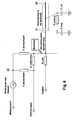
- Figure 4 illustrates the case wherein the column 40 is hanging freely in the cavity within the metal body.
- the heat flow sources in both systems are :
- the heat flow transported with the mobile phase (eluent) is coming predominantly from the heat exchanger via the low impedance R_heatex-eluent as the mobile phase passes through the heat exchanger capillary.
- the portion of the inlet capillary inside the heat exchanger is illustrated in Figures 3 and 4 with reference numerals 32 and 42, respectively.
- the heat flow transported with the mobile phase is additionally changed in the free part of the inlet capillary, illustrated with R_ext.eluent.path.
- the temperature fluctuations of the environment of the metal body and of the inlet capillary coupled to it are then smoothed by the low-pass filter formed by the heat capacity of the metal body C_body and by the impedances R_heatex-body and R_amb.
- the heat capacity of the column C_col is then connected in parallel to the heat capacity C_body of the metal body participating in the mentioned RC filter.
- the column 40 is shielded from external heat disturbances by the isothermal walls of the cavity inside the metal block surrounding the column.
- the impedance R_col-body between the walls of the cavity and the column forms, together with the capacity C_col an additional RC filter.
- the additional heat capacity can not only be provided in the form of a solid metal body (e.g., aluminum, copper), but also in the form of metal wool or filings, or as a liquid bath, with high heat capacity and high heat conductance.
- the additional heat capacity should be substantially greater than the heat capacity of the column. According to a practical example, the heat capacity of the metal body is about 10 to 20 times greater than the heat capacity of the column.
- the heat conductance should also be high, in order to ensure that the heat flow oscillations propagate and are averaged over the whole metal body in a time shorter than the characteristic fluctuation time, thus ensuring participation of the entire additional heat capacity in the smoothing.
- the invention is particularly suited for use in connection with refractive index detectors which are very sensitive to changes in the measuring conditions, such as composition and temperature of the mobile phase.
- refractive index detectors which are very sensitive to changes in the measuring conditions, such as composition and temperature of the mobile phase.
- the advantages of the invention also apply with other types of detectors, such as absorbance detectors .
Landscapes
- Physics & Mathematics (AREA)
- Health & Medical Sciences (AREA)
- Life Sciences & Earth Sciences (AREA)
- Chemical & Material Sciences (AREA)
- Analytical Chemistry (AREA)
- Biochemistry (AREA)
- General Health & Medical Sciences (AREA)
- General Physics & Mathematics (AREA)
- Immunology (AREA)
- Pathology (AREA)
- Investigating Or Analysing Materials By Optical Means (AREA)
Priority Applications (2)
| Application Number | Priority Date | Filing Date | Title |
|---|---|---|---|
| EP01116298A EP1275958A1 (de) | 2001-07-05 | 2001-07-05 | Verfahren zur Verringerung von Nulllinieninstabilitäten in flüssigchromatographischen Messungen und Flüssigchromatographievorrichtung |
| US09/907,365 US6601439B2 (en) | 2001-07-05 | 2001-07-17 | Method of reducing baseline instabilities in liquid chromatographic measurements and liquid chromatography apparatus |
Applications Claiming Priority (1)
| Application Number | Priority Date | Filing Date | Title |
|---|---|---|---|
| EP01116298A EP1275958A1 (de) | 2001-07-05 | 2001-07-05 | Verfahren zur Verringerung von Nulllinieninstabilitäten in flüssigchromatographischen Messungen und Flüssigchromatographievorrichtung |
Publications (1)
| Publication Number | Publication Date |
|---|---|
| EP1275958A1 true EP1275958A1 (de) | 2003-01-15 |
Family
ID=8177947
Family Applications (1)
| Application Number | Title | Priority Date | Filing Date |
|---|---|---|---|
| EP01116298A Withdrawn EP1275958A1 (de) | 2001-07-05 | 2001-07-05 | Verfahren zur Verringerung von Nulllinieninstabilitäten in flüssigchromatographischen Messungen und Flüssigchromatographievorrichtung |
Country Status (2)
| Country | Link |
|---|---|
| US (1) | US6601439B2 (de) |
| EP (1) | EP1275958A1 (de) |
Cited By (1)
| Publication number | Priority date | Publication date | Assignee | Title |
|---|---|---|---|---|
| CN102901785A (zh) * | 2012-10-22 | 2013-01-30 | 南通大学 | 不同长度和柱径的多根色谱柱为一体的温度均匀器 |
Families Citing this family (4)
| Publication number | Priority date | Publication date | Assignee | Title |
|---|---|---|---|---|
| US7735525B2 (en) * | 2005-11-14 | 2010-06-15 | Amgen Inc. | Thermally insulated apparatus for liquid chromatographic analysis |
| GB2586096B (en) * | 2012-07-06 | 2021-05-12 | Waters Technologies Corp | Techniques for accelerating thermal equilibrium in a chromatographic column |
| CA2942851C (en) | 2014-03-21 | 2022-10-04 | Biotage Ab | Method and apparatus for the equilibration of a packed chromatography column |
| JP6967011B2 (ja) * | 2016-04-15 | 2021-11-17 | ウオーターズ・テクノロジーズ・コーポレイシヨン | クロマトグラフィカラムを熱的に絶縁するための技術 |
Citations (3)
| Publication number | Priority date | Publication date | Assignee | Title |
|---|---|---|---|---|
| DE9114773U1 (de) * | 1991-11-27 | 1992-02-20 | Hahn, Michael, Dipl.-Chem., O-4020 Halle | Chromatographieofen |
| US5983710A (en) * | 1997-11-24 | 1999-11-16 | Brinkman Instruments, Inc. | Modular chromatography column heating system |
| JP2000111536A (ja) * | 1998-09-30 | 2000-04-21 | Shimadzu Corp | 液体クロマトグラフ用カラムオーブン |
Family Cites Families (13)
| Publication number | Priority date | Publication date | Assignee | Title |
|---|---|---|---|---|
| US3522725A (en) * | 1969-01-08 | 1970-08-04 | Waters Associates Inc | Liquid chromatograph |
| US4019372A (en) * | 1974-05-16 | 1977-04-26 | E. I. Dupont De Nemours And Company | Chromatographic detector system |
| US4312835A (en) * | 1980-04-21 | 1982-01-26 | American Cyanamid Company | Thermal control means for liquid chromatograph samples |
| DE3323744A1 (de) * | 1983-07-01 | 1985-01-17 | Bodenseewerk Perkin-Elmer & Co GmbH, 7770 Überlingen | Einrichtung zur kompensation der basisliniendrift einer chromatographischen trennsaeule |
| US4966695A (en) * | 1988-02-04 | 1990-10-30 | Henry Joshua | High pressure liquid chromatography column jacket |
| US4814089A (en) * | 1988-02-17 | 1989-03-21 | Suprex Corporation | Chromatographic separation method and associated apparatus |
| US4994096A (en) * | 1989-05-09 | 1991-02-19 | Hewlett-Packard Co. | Gas chromatograph having integrated pressure programmer |
| US5135549A (en) * | 1991-01-30 | 1992-08-04 | The Board Of Trustees Of Southern Illinois University | Chromatographic technique and apparatus |
| JPH04301763A (ja) * | 1991-03-29 | 1992-10-26 | Shimadzu Corp | 高速液体クロマトグラフ |
| US5543315A (en) * | 1992-06-30 | 1996-08-06 | Kyoto Daiichi Kagaku Co., Ltd. | Method for stabilizing measurement values by high speed liquid chromatography |
| US6131440A (en) * | 1996-10-15 | 2000-10-17 | Universite De Montreal | Selective removal of volatile substances injected into a chromatographic packing filled column |
| US6209386B1 (en) * | 1998-06-05 | 2001-04-03 | Rvm Scientific, Inc. | Electrically insulated gas chromatograph assembly and method of fabricating same |
| US6484569B1 (en) * | 2000-10-27 | 2002-11-26 | Waters Investments Limited | Tube-in-tube thermal exchanger for liquid chromatography systems |
-
2001
- 2001-07-05 EP EP01116298A patent/EP1275958A1/de not_active Withdrawn
- 2001-07-17 US US09/907,365 patent/US6601439B2/en not_active Expired - Fee Related
Patent Citations (3)
| Publication number | Priority date | Publication date | Assignee | Title |
|---|---|---|---|---|
| DE9114773U1 (de) * | 1991-11-27 | 1992-02-20 | Hahn, Michael, Dipl.-Chem., O-4020 Halle | Chromatographieofen |
| US5983710A (en) * | 1997-11-24 | 1999-11-16 | Brinkman Instruments, Inc. | Modular chromatography column heating system |
| JP2000111536A (ja) * | 1998-09-30 | 2000-04-21 | Shimadzu Corp | 液体クロマトグラフ用カラムオーブン |
Non-Patent Citations (4)
| Title |
|---|
| BIOMEDICAL CHROMATOGRAPHY., vol. 14, no. 2, April 2000 (2000-04-01), pages 72 - 76, ISSN: 0269-3879 * |
| DATABASE BIOSIS [online] BIOSCIENCES INFORMATION SERVICE, PHILADELPHIA, PA, US; April 2000 (2000-04-01), HAYAKAWA KAZUICHI ET AL: "Determination of saccharides in sake by high-performance liquid chromatography with polarized photometric detection.", XP002176523, Database accession no. PREV200000168864 * |
| MAYR G ET AL: "Influence of viscous heat dissipation on efficiency in high-speed high-performance liquid chromatography", JOURNAL OF CHROMATOGRAPHY A, ELSEVIER SCIENCE, NL, vol. 845, no. 1-2, 11 June 1999 (1999-06-11), pages 155 - 163, XP004170348, ISSN: 0021-9673 * |
| PATENT ABSTRACTS OF JAPAN vol. 2000, no. 07 29 September 2000 (2000-09-29) * |
Cited By (2)
| Publication number | Priority date | Publication date | Assignee | Title |
|---|---|---|---|---|
| CN102901785A (zh) * | 2012-10-22 | 2013-01-30 | 南通大学 | 不同长度和柱径的多根色谱柱为一体的温度均匀器 |
| CN102901785B (zh) * | 2012-10-22 | 2013-12-04 | 南通大学 | 不同长度和柱径的多根色谱柱为一体的温度均匀器 |
Also Published As
| Publication number | Publication date |
|---|---|
| US20030005753A1 (en) | 2003-01-09 |
| US6601439B2 (en) | 2003-08-05 |
Similar Documents
| Publication | Publication Date | Title |
|---|---|---|
| US11273390B2 (en) | Techniques for thermally insulating a liquid chromatographic column | |
| Walter et al. | Recent innovations in UHPLC columns and instrumentation | |
| Stevens et al. | Electroosmotic propulsion of eluent through silica-based chromatographic media | |
| US11185795B2 (en) | Techniques for thermally insulating a chromatographic column | |
| US20200139264A1 (en) | Techniques for accelerating thermal equilibrium in a chromatographic column | |
| Plumb et al. | The application of small porous particles, high temperatures, and high pressures to generate very high resolution LC and LC/MS separations | |
| CN101379393B (zh) | 基于液相色谱法的分析方法及装置 | |
| US8613216B2 (en) | Dynamic thermal focusing of chromatographic separations | |
| De Pauw et al. | Understanding and diminishing the extra-column band broadening effects in supercritical fluid chromatography | |
| JP7414783B2 (ja) | クロマトグラフィカラムを熱的に絶縁するための技術 | |
| US6601439B2 (en) | Method of reducing baseline instabilities in liquid chromatographic measurements and liquid chromatography apparatus | |
| Weise et al. | Mass spectrometry coupling of chip-based supercritical fluid chromatography enabled by make-up flow-assisted backpressure regulation | |
| Rapp et al. | Liquid flow in capillary (electro) chromatography: Generation and control of micro‐and nanoliter volumes | |
| Molander et al. | Aspects and applications of non-aqueous high temperature packed capillary liquid chromatography | |
| US11169125B2 (en) | Mass spectrometer ion source with integrated column | |
| Malan et al. | A high-repetition-rate, fast temperature-programmed gas chromatograph and its online coupling to a supercritical fluid chromatograph (SFC× GC) | |
| Prüß et al. | Evaluation of packed capillary liquid chromatography columns and comparison with conventional-size columns | |
| Kožar Logar et al. | The effects of eluent’s optothermal parameters on TLS detection in gradient HPLC | |
| Moffatt et al. | Comparison of capillary electrochromatography with high-performance liquid chromatography for the analysis of pirimicarb and related compounds | |
| Hara et al. | Investigation and optimization of the extra-column band broadening in micro-flow capillary liquid chromatography | |
| Fujimoto et al. | The use of a microconcentric column in capillary electrophoresis | |
| JPH04230850A (ja) | クロマトグラフによる試料イオンの定量的決定方法及びクロマトグラフ・カラム | |
| Brunelli et al. | A simple instrumental approach for ‘supercritical’fluid chromatography in drug discovery and its consequences for coupling with mass spectrometric and light scattering detection | |
| SU1364978A1 (ru) | Ионизационный детектор дл хроматографии | |
| CN116539785A (zh) | 一种消除不同液相色谱仪梯度延迟体积差异影响的方法 |
Legal Events
| Date | Code | Title | Description |
|---|---|---|---|
| PUAI | Public reference made under article 153(3) epc to a published international application that has entered the european phase |
Free format text: ORIGINAL CODE: 0009012 |
|
| 17P | Request for examination filed |
Effective date: 20011115 |
|
| AK | Designated contracting states |
Kind code of ref document: A1 Designated state(s): AT BE CH CY DE DK ES FI FR GB GR IE IT LI LU MC NL PT SE TR |
|
| AX | Request for extension of the european patent |
Free format text: AL;LT;LV;MK;RO;SI |
|
| AKX | Designation fees paid |
Designated state(s): CH DE FR GB LI |
|
| STAA | Information on the status of an ep patent application or granted ep patent |
Free format text: STATUS: THE APPLICATION IS DEEMED TO BE WITHDRAWN |
|
| 18D | Application deemed to be withdrawn |
Effective date: 20060720 |