EP1277355B1 - Procedes et systemes d'enregistrement dynamique de cles de routage - Google Patents
Procedes et systemes d'enregistrement dynamique de cles de routage Download PDFInfo
- Publication number
- EP1277355B1 EP1277355B1 EP01928718.4A EP01928718A EP1277355B1 EP 1277355 B1 EP1277355 B1 EP 1277355B1 EP 01928718 A EP01928718 A EP 01928718A EP 1277355 B1 EP1277355 B1 EP 1277355B1
- Authority
- EP
- European Patent Office
- Prior art keywords
- routing
- routing key
- message
- signaling
- node
- Prior art date
- Legal status (The legal status is an assumption and is not a legal conclusion. Google has not performed a legal analysis and makes no representation as to the accuracy of the status listed.)
- Expired - Lifetime
Links
- 238000000034 method Methods 0.000 title claims description 62
- 230000011664 signaling Effects 0.000 claims description 146
- 238000004891 communication Methods 0.000 claims description 46
- 230000008569 process Effects 0.000 claims description 38
- 230000003068 static effect Effects 0.000 claims description 17
- 230000004044 response Effects 0.000 claims description 14
- 230000005540 biological transmission Effects 0.000 claims description 10
- 230000000977 initiatory effect Effects 0.000 claims description 4
- 101001012669 Homo sapiens Melanoma inhibitory activity protein 2 Proteins 0.000 claims 2
- 102100029778 Melanoma inhibitory activity protein 2 Human genes 0.000 claims 2
- 238000013479 data entry Methods 0.000 claims 2
- 238000010586 diagram Methods 0.000 description 15
- 238000012545 processing Methods 0.000 description 9
- 230000006870 function Effects 0.000 description 7
- 238000012423 maintenance Methods 0.000 description 4
- 102000004528 Mannose-Binding Protein-Associated Serine Proteases Human genes 0.000 description 3
- 108010042484 Mannose-Binding Protein-Associated Serine Proteases Proteins 0.000 description 3
- 238000012546 transfer Methods 0.000 description 3
- 101150042248 Mgmt gene Proteins 0.000 description 2
- 230000001419 dependent effect Effects 0.000 description 2
- 238000012986 modification Methods 0.000 description 2
- 230000004048 modification Effects 0.000 description 2
- 238000012544 monitoring process Methods 0.000 description 2
- 238000013519 translation Methods 0.000 description 2
- 230000009471 action Effects 0.000 description 1
- 230000006978 adaptation Effects 0.000 description 1
- 239000000872 buffer Substances 0.000 description 1
- 230000003139 buffering effect Effects 0.000 description 1
- 230000008859 change Effects 0.000 description 1
- 230000009977 dual effect Effects 0.000 description 1
- 230000000694 effects Effects 0.000 description 1
- 238000005516 engineering process Methods 0.000 description 1
- 239000000284 extract Substances 0.000 description 1
- 230000002349 favourable effect Effects 0.000 description 1
- 238000009434 installation Methods 0.000 description 1
- 230000006855 networking Effects 0.000 description 1
- 230000002093 peripheral effect Effects 0.000 description 1
- 238000004540 process dynamic Methods 0.000 description 1
- 238000004578 scanning tunneling potentiometry Methods 0.000 description 1
- 238000012216 screening Methods 0.000 description 1
- 235000019832 sodium triphosphate Nutrition 0.000 description 1
- 230000001960 triggered effect Effects 0.000 description 1
- 230000035899 viability Effects 0.000 description 1
Images






Classifications
-
- H—ELECTRICITY
- H04—ELECTRIC COMMUNICATION TECHNIQUE
- H04M—TELEPHONIC COMMUNICATION
- H04M7/00—Arrangements for interconnection between switching centres
- H04M7/12—Arrangements for interconnection between switching centres for working between exchanges having different types of switching equipment, e.g. power-driven and step by step or decimal and non-decimal
- H04M7/1205—Arrangements for interconnection between switching centres for working between exchanges having different types of switching equipment, e.g. power-driven and step by step or decimal and non-decimal where the types of switching equipement comprises PSTN/ISDN equipment and switching equipment of networks other than PSTN/ISDN, e.g. Internet Protocol networks
- H04M7/125—Details of gateway equipment
-
- H—ELECTRICITY
- H04—ELECTRIC COMMUNICATION TECHNIQUE
- H04Q—SELECTING
- H04Q3/00—Selecting arrangements
- H04Q3/0016—Arrangements providing connection between exchanges
- H04Q3/0025—Provisions for signalling
-
- H—ELECTRICITY
- H04—ELECTRIC COMMUNICATION TECHNIQUE
- H04Q—SELECTING
- H04Q3/00—Selecting arrangements
- H04Q3/64—Distributing or queueing
- H04Q3/66—Traffic distributors
-
- H—ELECTRICITY
- H04—ELECTRIC COMMUNICATION TECHNIQUE
- H04Q—SELECTING
- H04Q2213/00—Indexing scheme relating to selecting arrangements in general and for multiplex systems
- H04Q2213/13095—PIN / Access code, authentication
-
- H—ELECTRICITY
- H04—ELECTRIC COMMUNICATION TECHNIQUE
- H04Q—SELECTING
- H04Q2213/00—Indexing scheme relating to selecting arrangements in general and for multiplex systems
- H04Q2213/13109—Initializing, personal profile
-
- H—ELECTRICITY
- H04—ELECTRIC COMMUNICATION TECHNIQUE
- H04Q—SELECTING
- H04Q2213/00—Indexing scheme relating to selecting arrangements in general and for multiplex systems
- H04Q2213/13141—Hunting for free outlet, circuit or channel
-
- H—ELECTRICITY
- H04—ELECTRIC COMMUNICATION TECHNIQUE
- H04Q—SELECTING
- H04Q2213/00—Indexing scheme relating to selecting arrangements in general and for multiplex systems
- H04Q2213/13166—Fault prevention
-
- H—ELECTRICITY
- H04—ELECTRIC COMMUNICATION TECHNIQUE
- H04Q—SELECTING
- H04Q2213/00—Indexing scheme relating to selecting arrangements in general and for multiplex systems
- H04Q2213/13176—Common channel signaling, CCS7
-
- H—ELECTRICITY
- H04—ELECTRIC COMMUNICATION TECHNIQUE
- H04Q—SELECTING
- H04Q2213/00—Indexing scheme relating to selecting arrangements in general and for multiplex systems
- H04Q2213/13196—Connection circuit/link/trunk/junction, bridge, router, gateway
-
- H—ELECTRICITY
- H04—ELECTRIC COMMUNICATION TECHNIQUE
- H04Q—SELECTING
- H04Q2213/00—Indexing scheme relating to selecting arrangements in general and for multiplex systems
- H04Q2213/13389—LAN, internet
Definitions
- the present invention relates to the routing of signaling messages in a converged telephony-data networking environment, and more particularly to the automatic registration of routing key information at a gateway routing node.
- PSTN public switched telephone network
- SS7 signaling system 7
- signaling within a data network is typically performed by any of a number of signaling protocols including: transport adapter layer interface (TALI), session initiation protocol (SIP), session description protocol (SDP), H. 323, M2UA, M3UA, SUA, etc.
- TALI transport adapter layer interface
- SIP session initiation protocol
- SDP session description protocol
- H. 323, M2UA, M3UA, SUA etc.
- call control signaling protocols are employed to provide a variety of converged or internetwork services. These services include providing basic call setup and teardown functionality, as well as facilitating communications-related database access.
- call control signaling protocols are typically employed to access number portability database applications, 800/toll-free number database applications, line information database applications, calling name database applications, home location register applications, presence service databases, telephony-to-WWW domain name servers, etc.
- switching points are typically involved in the successful completion of a call.
- switching points include : end offices, tandem offices, and signal transfer points.
- SS7 signaling messages are typically employed to facilitate such call setup operations.
- switching points may include: end offices, softswitches, media gateway controllers, media gateways, etc.
- a combination of SS7 and a data network-based signaling protocol e. g., SIP, H. 323, M2UA, M3UA, etc.
- the SS7 signaling protocol may be replaced completely by one or more data network signaling protocols.
- PSTN and wireless telephone network operators are finding the economics of data network operation favorable to the placement of signaling nodes within the data sub-network of the converged network environment, as opposed to the traditional PSTN-SS7 sub-network.
- signaling point elements that have traditionally resided within an SS7 signaling network and been assigned unique SS7 network addresses (point codes and subsystem numbers) are now being placed within a data network, such as a TCP/IP- based network, and consequently being assigned IP addresses and port numbers.
- Converged network 100 includes a signaling system 7 (SS7) network component 102 and an Internet protocol (IP) network component 104.
- the SS7 network component includes a service switching point (SSP) 106.
- the IP network component includes a pair of media gateway controller (MGC) nodes 108 and 110, and a media gateway (MG) node 112.
- An SS7-IP signaling gateway routing node (SG) 114 connects data network nodes and SS7 network nodes.
- an SS7 signaling protocol is employed between SSP 106 and SG 114, while a data network signaling protocol such as TALI over TCP/IP or SCTP/IP is used to facilitate communication between SG 114 and the MGC pair, 108 and 110.
- a data network signaling protocol such as TALI over TCP/IP or SCTP/IP is used to facilitate communication between SG 114 and the MGC pair, 108 and 110.
- nodes are connected via dedicated 56 kbps signaling communication links. Each signaling link provides 56 kbps of bandwidth that is dedicated to communication between a pair of connected SS7 nodes.
- nodes are typically connected via much faster links (typically on the order of megabits per second, depending on the underlying physical and datalink layer technologies). These high bandwidth links may be shared by a number of IP nodes simultaneously. A given path in an IP network may be shared by traffic from a number of connections, which can be set up and torn down dynamically.
- the addition of a new SS7 connection at SG 114 would require the physical installation of a new, dedicated 56 kbps SS7 signaling link.
- the addition of a new TCP/IP connection at SG 114 would simply require the sharing of existing broadband resources so as to create a new TCP/IP connection.
- the creation of a TCP/IP connection does not necessarily require the addition of new physical resources and, instead, can be performed dynamically via software. Consequently, the addition of and connection to a new IP based network node does not necessarily require the addition of a new physical communication link at SG 114. If existing bandwidth is sufficient, the addition of a new connection to SG 114 may only require the establishment of an additional TCP/IP connection between SG 114 and the node in the IP network with which communication is desired.
- an external provisioning platform 116 is adapted to communicate with the SG 114 for the purpose of provisioning signaling links, administering routing data and generally configuring services provided by the node.
- signaling link configuration and associated routing data/routing rules must be entered or modified manually by an operator via provisioning workstation 116 each time a new MGC node is added to the network, or a change in routing preference is indicated.
- Such manual provisioning tasks are time intensive, costly, and prone to operator error.
- WO 00/19758A discloses related art.
- WO 00/33519A discloses related art.
- An embodiment includes a signaling gateway (SG) that is capable of providing inter-network message routing services in a converged telephony-data network environment.
- the SG includes a dynamic routing key registration feature which allows Internet protocol (IP) sockets to dynamically register/de-register their routing information with the signaling gateway and subsequently direct traffic towards or away from themselves without the need for manual operator intervention.
- IP Internet protocol
- an SG in another embodiment, includes a self-registering data communication module (sDCM) that is adapted to receive and process dynamic routing key registration messages from associated IP nodes over existing transmission control protocol/IP (TCP/IP) connections.
- Such dynamic routing key registration messages may include information that is used to register a new routing key association with a TCP/IP connection, deregister an existing routing key associated with a TCP/IP connection, or modify routing key information associated with an existing TCP/IP connection.
- a TCP/IP connection may be identified locally on a signaling gateway by a data structure known as a socket.
- a signaling gateway may associate the routing keys with a local socket for the connection.
- routing key refers to a parameter or combination of parameters to be extracted from or examined in a call signaling message to determine where to route the call signaling message.
- SS7 routing keys include : originating point code (OPC), destination point code (DPC), subsystem number (SSN), and circuit identifier code (CIC). These routing keys have conventionally been used by SS7 nodes, such as signal transfer points to route call signaling messages to other SS7 signaling nodes.
- IP nodes in an IP network are permitted to dynamically register SS7 routing keys in an SS7/IP signaling gateway to direct traffic to or away from themselves. This dynamic registration capability in a signaling gateway node avoids the difficulties of manual registration associated with conventional routing solutions.
- the sDCM card employs a dual routing key table database structure that includes both a static routing key table and a dynamic routing key table.
- Received dynamic routing key registration messages are used to modify information in the dynamic routing key table only.
- the dynamic routing key table is searched first. The failure to locate a suitable or matching routing key entry in the dynamic routing key table results in a secondary or default search of the static routing key table.
- modules or processes The functions for facilitating dynamic or self-registration of IP-based network elements are described herein as modules or processes. It is understood that these modules or processes may be implemented as computer-executable instructions embodied in a computer-readable medium. Alternatively, the modules or processes described herein may be implemented entirely in hardware. In yet another alternative embodiment, the modules or processes described herein may be implemented as a combination of hardware and software.
- each card or subsystems described below may include one or more microprocessors, such as an x86 microprocessor available from Intel Corporation or a K series microprocessor available from AMD Corporation, and associated memory.
- a network element that performs functions similar to that of a traditional telecommunications network packet routing switch, such as a signaling gateway (SG) routing node.
- SG signaling gateway
- STP high performance signal transfer point
- Tekelec as the Eagle ® STP
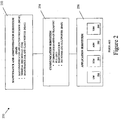
- IP 7 Secure GatewayTM A block diagram that generally illustrates the base internal architecture of the IP 7 Secure GatewayTM product is shown in Figure 2 .
- a detailed description of the IP 7 Secure GatewayTM may be found in Tekelec publication PN/909-0767-01, Rev B, August 1999, entitled Feature Notice IP 7 Secure GatewayTM Release 1.0.
- an IP7 Secure Gateway 250 includes the following subsystems: a Maintenance and Administration Subsystem (MAS) 252, a communication subsystem 254 and an application subsystem 256.
- MAS 252 provides maintenance communications, initial program load, peripheral services, alarm processing and system disks.
- Communication subsystem 254 includes an interprocessor message transport (IMT) bus that is the main communication bus among all subsystems in the IP 7 Secure GatewayTM 250. This high-speed communications system functions as two 125 Mbps counter-rotating serial buses.
- IMT interprocessor message transport
- Application subsystem 256 includes application cards that are capable of communicating with the other cards through the IMT buses. Numerous types of application cards can be incorporated into SG 250, including but not limited to: a link interface module (LIM) 258 that provides SS7 links and X. 25 links, a data communication module (DCM) 260 that provides a TCP/IP interface to external nodes and an application service module (ASM) 262 that provides global title translation, gateway screening and other services.
- a translation service module (TSM) 264 may also be provided to support triggered local number portability service.
- one or more DCM cards can be employed in a similar manner to provide for the transport of Internet Protocol (IP) encapsulated SS7 messages over an IP network, as described in the above referenced Feature Notice IP 7 Secure Gateway TM Release 1.0 publication.
- IP Internet Protocol
- FIG. 3 illustrates a signaling gateway (SG) routing node according to an embodiment of the present invention that is generally indicated by the numeral 270.
- SG routing node 270 is communicatively coupled to a signaling system 7 (SS7) signaling network 280 via an SS7 signaling link 282, and to a pair of media gateway controller nodes 284 and 286 via a plurality of TCP/IP connections 288.
- SS7 signaling system 7
- media gateway controller nodes 284 and 286 via a plurality of TCP/IP connections 288.
- the SS7 network taken together with the TCP/IP connections, effectively constitute the functional network components of a converged telephony - data network.
- SG routing node 270 includes a high-speed interprocessor message transport (IMT) communications bus 274.
- IMT interprocessor message transport
- Communicatively coupled to IMT bus 274 are a number of distributed processing modules or cards including: a pair of maintenance and administration subsystem processors (MASPs) 272, an SS7 capable link Interface module (LIM) 276, and an Internet protocol (IP) capable self-registration data communication module (sDCM) 278.
- MASPs maintenance and administration subsystem processors
- LIM link Interface module
- IP Internet protocol
- sDCM self-registration data communication module
- MASP pair 272 implement the maintenance and administration subsystem functions described above. As the MASP pair 272 are not particularly relevant to a discussion of the flexible routing attributes of the present invention, a detailed discussion of their function is not provided herein. For a comprehensive discussion of additional MASP operations and functionality, the above-referenced Tekelec IP 7 Secure GatewayTM and Eagle ® STP publications can be consulted.
- one fundamental operation of the SG 270 involves the receipt of a signaling message at LIM 276 from an SS7 network and the subsequent internal routing of this message to sDCM 278 for transmission via a TCP/IP communication socket to one of the pair of MGC nodes 284 or 286, and vice versa.
- MSUs message signaling units
- MGC nodes such as those shown in Figure 3
- network operators often prefer to designate one of the MGC nodes as a primary resource, while the other is held in reserve as a backup resource. Consequently, there is no load sharing between or simultaneous operation of the two MGC nodes.
- the active or primary MGC node is manually taken off-line or fails, the reserve or backup MGC node must be placed in service.
- the sDCM card, and more particularly, the dynamic routing key registration feature of the present invention is adapted to facilitate automatic changeover in such a scenario.
- the term "changeover” refers to the process of diverting traffic from a failed signaling link to a backup signaling link.
- TALI transport adapter layer interface
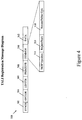
- TALI message structure 300 includes a number of fields that are common to all TALI dynamic routing key registration messages including: a synch field 302, an opcode field 304, a length field 306, a primitive field 308, a common field 310, and a data field 312.
- Common field 310 further includes an operation field 314, a request/reply field 316, a success/failure code field 318.
- synch field 302 is used to identify the message packet as being of a transport adapter layer interface (TALI) format.
- TALI refers to the transport adapter layer interface as described in Internet Engineering Task Force (IETF) Internet Draft ⁇ draftbenedyk-sigtran-tali-01. txt > entitled"Transport Adapter Layer Interface," June 2000..
- TALI is a protocol that defines procedures and message structures for communicating SS7 messages over a stream-oriented packet-based network, such as a TCP/IP network.
- the present invention is not limited to using TALI over TCP/IP to communicate between SS7 and IP nodes.
- stream control transmission protocol (SCTP) over IP may be used.
- the stream control transmission protocol is described in RFC 2960: Stream Control Transmission Protocol.
- Opcode field 304 identifies the type of operation associated with the message. For dynamic routing key registration related messages, an opcode value equal to "mgmt" is used. Length field 306 simply indicates the length of the message (e.g., bits, octets, etc.). Primitive field 308 is used to specify a group of "mgmt" operations to which the message is applicable. A primitive field value of "rkrp" signifies a dynamic routing key registration message. RKRP operation field 314 specifies a particular operation within the group of allowed operations identified by the primitive. Message data field 312 employs a structure and contains information that are dependent on the combination of opcode/primitive/operation field values (i.e., each combination could employ a different message data structure).
- RKRP operation field 314 contains an integer value that is used to identify the desired "rkrp” operation.
- Request / reply field 316 identifies whether the "rkrp" message is a request, sent by an IP node to the SG, indicating a particular type of "rkrp” action, or a reply to a previous request.
- Success / failure code field 318 provides a success/failure indication value as part of the reply back to an IP node for each processed request, while registration data field 312 includes specific information related to the creation, termination, or modification of a routing key - TCP/IP socket association.
- RKRP operation field 314, request / reply field 316, success / failure code field 318, and registration data field 312 are common to all RKRP operation related messages.
- the primary purpose of requiring the data structures for all RKRP operations to begin with these same fields, is to provide a means for a receiver to reply to unknown RKRP messages in a consistent manner.
- the success/failure code field value is used to indicate that the operation is not supported (e.g., with an RKRP reply code of 'Unsupported 'rkrp' operation, 3').
- routing key registration message is a function of the character of the particular routing key with which it is associated.
- table 330 which provides examples of routing key types 332 and the related information or data fields that are supplied by a TALI dynamic routing key registration message.
- the routing keys shown in this example can be broadly classified as either circuit identification code (CIC) based, signaling connection control part (SCCP) based, or non-CIC / non-SCCP based. Wildcard or partial routing key descriptions are permitted, several of which are presented in table 330. It will be appreciated that wildcard routing key rules could also be defined for the CIC and SCCP based classes, as well.
- table 330 defines the data content associated with a destination point code-service indictor-originating point code (DPC-SI-OPC) routing key, a DPC-SI wildcard key, a DPC wildcard key, an SI wildcard key, and a universal default wildcard key.
- DPC-SI-OPC destination point code-service indictor-originating point code
- data fields associated with TALI dynamic routing key messages include: a set of common data fields 334 (as described above), an RKRP flag field 336, an SI field 338, a DPC field 340, an OPC field 342, a CIC range start (CICS) field 344, a CIC range end (CICE) field 346, a CIC split field 348, a new CICS (NCICS) field 350, a new CICE (NCICE) field 352, and a subsystem (SSN) field 354.
- Some or all of the above described data fields may be required depending upon the particular type of routing key to be registered.
- a registration message associated with a SCCP based routing key could include the common field values (i.e., RKRP operation field 314, request / reply field 316, success / failure code field 318 ), an RKRP flag value, an SI value, a DPC value, and an SSN value.
- the RKRP flag is a 2-byte field that provides 16 possible flags that control various aspects of the dynamic routing key registration operation.
- Bit 0 serves as an override bit that is used to control how a TCP/IP socket association for a particular routing key should be manipulated.
- the RKRP flag determines if the dynamic routing key update transaction is intended to add a specified socket association in a "load-sharing" mode or if a new association should replace (i.e., override) all existing socket associations. It is through the use of the RKRP flag that a TCP/IP capable node, via an override-designated TCP/IP socket registration request, can re-direct and subsequently receive all traffic associated with a particular routing key.
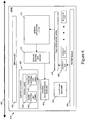
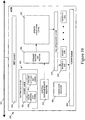
- sDCM 400 Shown in Figure 6 is a self-registration data communication module (sDCM) of the present invention, generally indicated by reference numeral 400.
- sDCM 400 is connected to IMT communication bus 402 and is comprised of a number of functional processes. These processes include: a TCP/IP socket layer 404 for administering lower level TCP/IP protocol functions associated with up to 50 TCP/IP sockets.
- TCP/IP socket layer 404 is adapted to provide the facilities necessary to send and receive digital data over a particular physical media / physical interface, such as an Ethernet type communication link.
- sDCM 400 also includes a connection manager process 406 for monitoring the status of and generally managing all TCP/IP sockets, a TCP/IP socket read / write process 408 for buffering and performing basic input / output (I/O) type operations for each socket, a TALI application layer 410 for adding / removing appropriate TALI header and/or trailer information to outgoing / incoming message packets, and an SS7IPGW application layer 412 for interpreting and processing TALI messages.
- a dynamic routing key process 414 which is adapted to process TALI dynamic routing key registration messages and communicate pertinent registration information to a routing database update manager process 416.
- Routing database update manager process 416 is adapted to administer data table updates and generally control table lookup operations within the sDCM specific routing database, which is generally indicated by the numeral 420.
- routing database 420 is comprised of a dynamic routing key table 422, a static routing key table 424, and a socket table 426.
- routing database update manager process 416 effectively controls the sequence in which the dynamic and static table lookups occur. More particularly, the dynamic routing key table 422 is always searched initially, followed by a search of the static table 424 in the event that no match is located in the dynamic data table 422.
- sDCM 400 includes a message transport part (MTP) level 3 process 430 and additional functional processes beyond those shown in Figure 6 .
- MTP message transport part
- additional functional processes beyond those shown in Figure 6 .
- MTP level 3 process and other such additional functional processes are not particularly relevant to a discussion of the present invention, and are therefore not discussed in detail herein.
- An in depth discussion of such higher level processing functionality can be found in the above-referenced Tekelec SG and STP Feature Notice Publications.
- the message packets received and transmitted by the sDCM card 400 may include TALI type messages, session initiation protocol (SIP), M2UA, M3UA, SUA, H. 323, SCTP/IP, or other signaling protocols that may be transported via TCP/IP or similar IP based protocols.
- TALI session initiation protocol
- M2UA M2UA
- M3UA SUA
- H. 323, SCTP/IP or other signaling protocols that may be transported via TCP/IP or similar IP based protocols.
- Preferred packet formats for encapsulating various types of SS7 messages in IP packets are described in the above-referenced TALI IETF Internet Draft.
- functionality associated with the TALI protocol is described in commonly-assigned, co-pending International Patent Publication No. WO 00/76134 .
- the concepts described in this disclosure are not dependent on the abovereferenced TALI signaling protocol.
- Other functionally similar signaling protocols are intended to be within the scope of the present invention.
- the IETF SUA/M3UA protocol
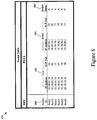
- FIG. 7 illustrates an example of dynamic routing key table 422, which contains a set of sample dynamic routing key entries.
- the table contains a plurality of routing key fields including a DPC field 450, an OPC field 452, an Si field 454, a CICS field 456, a CICE field 458, a CIC split field 460, a NCICS field 462, a NCICE field 464, and a SSN field 466.
- a TCP/IP socket identifier 468 Associated with each routing key entry in the dynamic routing key table 422.
- multiple TCP/IP socket identifiers may be associated with a single routing key entry, and, as such, signaling traffic corresponding to a particular routing key may be load shared across a plurality of provisioned TCP/IP connection, which are identified locally by their associated sockets.
- socket identifier 468 is used as an index to a particular entry in the socket table 426.
- routing keys are commonly employed in SS7 routing nodes (i.e., SGs, STPs) to determine how and where a signaling message packet should be routed. It will also be appreciated that many different combinations of signaling message parameters may be used to form a routing key, and as such, the particular structure presented in Figure 7 is simply one of many possible dynamic routing key table structures.
- socket table 426 is indexed by a socket identifier 480, which is associated with local end TCP/IP connection information 482, and distant end TCP/IP connection information 484. Also associated with each entry in the socket table is a socket status parameter 486, which indicates the availability status of each socket defined in the table.
- static routing key table 424 is similar to that of dynamic routing key table 422, illustrated in Figure 7 .
- the difference between these two routing key tables is primarily how they are updated and the order in which they are accessed during a routing key lookup operation.
- static routing key table 424 is adapted to maintain a set of routing key entries that cannot be updated or modified by routing key registration signaling messages originated by another network element. Such routing key registration type signaling messages may effect changes only in the dynamic routing key table 422.
- Figure 6 also illustrates an information flow path associated with the receipt of a TALI dynamic routing key registration request message. More particularly, the dashed line in Figure 6 illustrates an exemplary path for a dynamic routing key registration request message received from an IP node. In this example, it is assumed that the dynamic routing key registration request message originates from an IP based network element, such as a media gateway controller (MGC) node, that is connected to the signaling gateway which contains sDCM 400.
- MMC media gateway controller
- a dynamic routing key registration request message is received on the socket 0 connection via TCP/IP socket layer 404.
- Socket layer 404 performs lower protocol level processing on the incoming message packet and subsequently passes message to socket 0 R/W process 408.
- Socket 0 R/W process 408 temporarily buffers the received message and forwards the message to TALI application layer 410.
- TALI application layer 410 receives the incoming TALI dynamic routing key registration request message and performs a variety of TALI-specific message administration processes.
- TALI layer 410 subsequently directs the message to SS7IPGW application layer 412, where the message is determined to be a dynamic routing key registration request message.
- application layer 412 directs the message to the dynamic routing key registration process 414.
- dynamic routing key registration process 414 extracts and re-formats relevant information contained in the received message in a manner such that the information may be effectively used by routing database update manager 416.
- routing database update manager process 416 may be capable of receiving a dynamic routing key message and directly processing the message.
- routing database update manager process 416 uses the information contained within or gleaned from the dynamic routing key registration message to administer an update of dynamic routing key table 422.
- dynamic routing key table update operations might include the addition of a new TCP/IP socket association, the removal of an existing TCP/IP socket association, or modification of routing key information associated with an existing TCP/IP socket.
- FIG. 9 a table 500 containing a sample set of return codes that are employed by an sDCM in acknowledging the receipt and subsequent processing of a dynamic routing key registration request message.
- Each entry contained in table 500 includes a TALI return code 502, a service indicator 504 which indicates when a return code is to be used, and a message type 506 which also determines when a return code is to be used.
- TALI return code 502 a TALI dynamic routing key registration message
- a service indicator 504 which indicates when a return code is to be used
- a message type 506 which also determines when a return code is to be used.
- a dynamic routing key registration acknowledgment message would be formulated based on the original registration message, which includes a return code value of 1 ( Figure 9 ).
- a TALI dynamic routing key registration acknowledgment message is simply a copy of the received dynamic routing key registration message, with the request / reply field 316 (as shown in Figure 4 ) set to a value indicative of a "reply", and an appropriate return code included in the success / failure code field 318 ( Figure 4 ). It will be appreciated that in an alternate embodiment, an acknowledgment message could be constructed in a more compact format so as to minimize bandwidth usage.
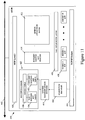
- FIG. 10 Shown in Figure 10 is an information flow diagram associated with a TALI dynamic routing key registration acknowledgment message. As in previous figures, the dashed line illustrates an exemplary message flow path. Figure 10 includes sDCM card 400 as presented in Figure 6 and previously described in the preceding section. As indicated in Figure 10 , routing database update manager process 416 is responsible for initiating an acknowledgment message. As discussed previously, the acknowledgment message is formulated in response to the receipt and subsequent processing of a dynamic routing key registration request message.
- routing database update manager process 416 directs the acknowledgment message to dynamic routing key registration process 414, which in turn passes the message to SS7IPGW application layer 412.
- SS7IPGW layer 412 determines that the message is to be transmitted via an on-card TCP/IP socket and subsequently directs the acknowledgment message to TALI application layer 410.
- TALI application layer 410 appends appropriate TALI header information to the message and passes the message to the appropriate socket R/W process.
- the acknowledgment message is passed to the socket 0 R/W process 408, and eventually transmitted to the sender of the original routing key registration message via TCP/IP socket layer 404.
- FIG. 11 Shown in Figure 11 is an information flow diagram associated with the unanticipated or non-graceful closure of a TCP/IP connection.
- Figure 11 includes sDCM card 400 as presented in Figure 6 and previously described in the preceding section.
- sDCM connection manager process 406 is responsible for monitoring the status or viability of all TCP/IP connections and subsequently notifying the routing database update manager 416 in the event of a socket failure.
- connection manager process 406 sends information regarding this connection failure to routing database update manager process 416, which in turn updates dynamic routing key table 422 and socket table 426 accordingly.
- routing database update manager process 416 which in turn updates dynamic routing key table 422 and socket table 426 accordingly.
- all entries in dynamic routing key table 422 associated with the failed connection are deleted, and the associated socket definition entry is also deleted from socket table 426.
- all entries in dynamic routing key table 422 associated with the failed connection are left intact, and the associated socket definition entry in socket table 426 is marked with a status "unavailable.”
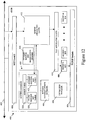
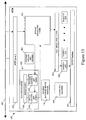
- Figures 12 and 13 are information flow diagrams associated with the routing of a signaling message.
- Figures 12 and 13 include sDCM card 400 as presented in Figure 6 and previously described in the preceding section.
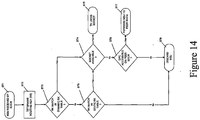
- Figure 14 includes a flow chart that illustrates the basic steps associated with routing key table access on the sDCM 400, and may be used in conjunction with Figures 12 and 13 to better understand routing database operation.
- an outbound signaling message has been sent to sDCM 400 from another communication module in a signaling gateway routing node according to an embodiment of the present invention.
- LIM 276 may internally route a signaling message to sDCM 278 via IMT bus 274, as shown in Figure 3 .
- a signaling message is received by sDCM 400 via IMT bus 402, as indicated in Figure 12 .
- the received signaling message requires routing instructions before transmission to a destination node can be performed, and as such the routing database 420 must be accessed.
- the signaling message is eventually received by the SS7IPGW application layer 412, which subsequently requests routing information from the routing database 420.
- the sequence in which the dynamic and static routing key tables 422 and 424, respectively, are accessed is a key component of the present invention.
- dynamic routing key table 422 is accessed first. If a routing key is not found in dynamic routing key table 422 that matches the relevant information contained in the outbound signaling message, then a secondary or default routing key lookup is initiated in the static routing key table 424, as generally illustrated in Figure 13 .
- the signaling message is examined and relevant routing information is gleaned (ST2).
- a lookup operation is then performed in the dynamic routing key table 422 using the routing information gleaned from the signaling message (ST3), and if a routing key match is found in the dynamic routing key table 422, the status of a selected TCP/IP socket is determined (ST4).
- SLS signaling link selector
- the signaling message is transmitted via the selected socket (ST5).
- a determination is made as to whether the destination point code associated with the destination of signaling message is accessible via a peer communication module (sDCM, DCM, LIM, etc.) that is currently provisioned in the signaling gateway routing node (ST6). If such a peer communication module exists in the routing node, the signaling message is forwarded to that communication module for routing / transmission (ST7). If such a peer communication module does not exist, the signaling message may be discarded (ST9).
- sDCM, DCM, LIM, etc. peer communication module
- a secondary or default lookup operation is performed in the static routing key table 424 (ST8). If a match is found the status of a selected TCP/IP socket is determined (ST4). Again, it will be appreciated that in the event that multiple sockets are associated with the matching static routing key, a specific TCP/IP socket may be selected based on a signaling link selector (SLS) parameter contained in the signaling message. In the event that the selected TCP/IP socket is available, the signaling message is transmitted via the selected socket (ST5).
- SLS signaling link selector
- sDCM, DCM, LIM, etc. peer communication module that is currently provisioned in the signaling gateway routing node
- FIG. 15 is a network diagram including a pair of MGCs 284 and 286 and a signaling gateway 270. These components are the same as the correspondingly-numbered components described above with respect to Figure 3 . Hence a description thereof will not be repeated herein.
- MGCs media gateway controllers
- FIG. 15 is a network diagram including a pair of MGCs 284 and 286 and a signaling gateway 270. These components are the same as the correspondingly-numbered components described above with respect to Figure 3 . Hence a description thereof will not be repeated herein.
- two stream-oriented connections 1500 and 1502 are established between MGC 284 and SG 270.
- two stream-oriented connections 1504 and 1506 are established between MGC 286 and SG 270.
- Stream oriented connections 1500, 1502, 1504, 1506, and 1508 may be TALI over TCP/IP connections or SCTP/IP connections.
- Connections 1500, 1502, 1504, 1506, and 1508 may be set up using connection establishment procedures, such as the TCP three-way handshake, when MGCs 284 and 286 are brought on line.
- connections 1500 and 1502 may be a primary connection over which communication occurs and the other connection may be a backup connection for carrying traffic in response to failure of the first connection.
- one of the connections 1504 and 1506 may be a primary connection over which communication occurs and the other connection may be a backup connection for carrying call signaling traffic only in response to failure of the first connection.
- the present invention is not limited to two connections between communicating nodes, and it is understood that any number of primary and backup connections could be used.
- MGCs 284 and 286 preferably monitor the status of primary connections 1500 and 1504. For example, MGCs 284 and 286 may determine whether the sockets associated with connections 1500 and 1504 are functioning properly. In response to detecting a failure on one of the primary connections 1500 or 1504, the MGC that manages the failed connection preferably sends a routing key registration message over the backup connection to notify sDCM 278 to start sending data over the backup connection. It would seem that this would result in two entries in dynamic routing key table 422 having the same routing keys. However, as discussed above with respect to Figure 14 , sDCM 278 checks the availability of a socket before sending the data over a TCP connection and if the socket indicates that the connection is unavailable, sDCM 278 looks for another socket within the routing key entry. In the automatic changeover situation, the other socket would be the socket associated with the backup connection. Thus, the routing key registration procedures described herein facilitate seamless changeover when one of two connections between a signaling gateway and an IP node fail.
- MGC 284 may be a primary IP node and MGC 286 may be a backup IP node. If MGC 284 fails, MGC 286 may detect this failure using inter-MGC communications and send a routing key registration request to SG 270 to direct traffic originally routed to MGC 284 to itself. It is understood that in this situation, MGC 286 would store state information of MGC 284 so that switching would occur seamlessly.
Landscapes
- Engineering & Computer Science (AREA)
- Computer Networks & Wireless Communication (AREA)
- Signal Processing (AREA)
- Data Exchanges In Wide-Area Networks (AREA)
Claims (25)
- Procédé à des fins d'utilisation dans un réseau de communication permettant à un noeud de signalisation d'effectuer une mise à jour automatique d'instructions de routage qui sont maintenues au niveau d'un noeud de routage de messages de signalisation (270) et servant à effectuer le routage d'un message de signalisation par l'intermédiaire du noeud de routage de messages de signalisation (270), le procédé comportant :(a) au niveau d'un noeud de signalisation dans un réseau de protocole Internet, l'étape consistant à générer un message d'enregistrement de clés de routage, le message d'enregistrement de clés de routage comprenant des informations se rapportant à des clés de routage de type SS7 (signal system 7 - système de signalisation 7) servant à des fins de mise à jour des informations se rapportant à des clés de routage associées au noeud de signalisation ;(b) l'étape consistant à envoyer le message d'enregistrement de clés de routage à un noeud de routage de réseau (270) en mesure d'effectuer le routage de messages entre le réseau IP et un réseau de type SS7 (280) ; et(c) au niveau du noeud de routage de messages de signalisation (270), l'étape consistant à recevoir le message d'enregistrement de clés de routage et l'étape consistant à utiliser les informations se rapportant à des clés de routage de type SS7 dans le message d'enregistrement de clés de routage à des fins de mise à jour dynamique d'une entrée de base de données de clés de routage dans une table dynamique de clés de routage (422) associée à une connexion entre le noeud de signalisation et le noeud de routage de réseau (270) ; etau niveau du noeud de routage de messages de signalisation (270) :(a) l'étape consistant à recevoir un message de signalisation qui nécessite un routage ;(b) l'étape consistant à utiliser des informations se rapportant à des clés de routage de type SS7 contenues dans le message de signalisation à des fins de recherche d'une correspondance dans la table dynamique de clés de routage (422) ;(c) en réponse au repérage d'une correspondance dans la table dynamique de clés de routage (422), l'étape consistant à effectuer le routage du message de signalisation en utilisant des informations de routage renvoyées par la table dynamique de clés de routage (422) ;(d) en réponse à l'absence de repérage d'une correspondance dans la table dynamique de clés de routage (422), l'étape consistant à utiliser les informations se rapportant à des clés de routage de type SS7 contenues dans le message de signalisation à des fins de recherche d'une correspondance dans une deuxième table de clés de routage (424) ; et(e) en réponse au repérage d'une correspondance dans la deuxième table de clés de routage (424), l'étape consistant à effectuer le routage du message de signalisation en utilisant les informations de routage renvoyées par la deuxième table de clés de routage (424) ;dans lequel l'étape consistant à rechercher une correspondance dans une deuxième table de clés de routage (424) comprend l'étape consistant à rechercher une correspondance dans une table statique de clés de routage (424), contenant des entrées de clés de routage qui sont manuellement saisies par un opérateur par l'intermédiaire d'une interface de saisie.
- Procédé selon la revendication 1, dans lequel l'étape consistant à utiliser les informations contenues dans le message d'enregistrement de clés de routage à des fins de mise à jour dynamique d'une entrée de base de données de clés de routage comprend l'étape consistant à utiliser une valeur DPC (destination point code - code de point de destination) dans le message d'enregistrement de clés de routage à des fins de mise à jour d'un DPC dans l'entrée de base de données de clés de routage.
- Procédé selon la revendication 1, dans lequel l'étape consistant à utiliser les informations contenues dans le message d'enregistrement de clés de routage à des fins de mise à jour dynamique d'une entrée de base de données de clés de routage comprend l'étape consistant à utiliser une valeur OPC (origination point code - code de point d'origine) dans le message d'enregistrement de clés de routage à des fins de mise à jour d'un OPC dans l'entrée de base de données de clés de routage.
- Procédé selon la revendication 1, dans lequel l'étape consistant à utiliser des informations contenues dans le message d'enregistrement de clés de routage à des fins de mise à jour dynamique d'une entrée de base de données de clés de routage comprend l'étape consistant à utiliser une valeur SI (service indicator - indicateur de service) dans le message d'enregistrement de clés de routage à des fins de mise à jour d'un SI dans l'entrée de base de données de clés de routage.
- Procédé selon la revendication 1, dans lequel l'étape consistant à utiliser des informations contenues dans le message d'enregistrement de clés de routage à des fins de mise à jour dynamique d'une entrée de base de données de clés de routage comprend l'étape consistant à utiliser une valeur ou plage CIC (circuit identification code - code d'identification de circuit) dans le message d'enregistrement de clés de routage à des fins de mise à jour d'une valeur ou plage CIC dans l'entrée de base de données de clés de routage.
- Procédé selon la revendication 1, dans lequel l'étape consistant à utiliser des informations contenues dans le message d'enregistrement de clés de routage à des fins de mise à jour dynamique d'une entrée de base de données de clés de routage comprend l'étape consistant à utiliser une valeur SSN (subsystem number - numéro de sous-système) dans le message d'enregistrement de clés de routage à des fins de mise à jour dynamique d'une valeur de numéro de sous-système dans l'entrée de base de données de clés de routage.
- Procédé selon la revendication 1, dans lequel l'étape consistant à recevoir un message de signalisation comprend l'étape consistant à recevoir un message de signalisation de type SS7 (signal system 7 - système de signalisation 7).
- Procédé selon la revendication 1, dans lequel l'étape consistant à recevoir un message de signalisation comprend l'étape consistant à recevoir un message de signalisation de type TALI (transport adapter layer interface - interface entre couche d'adaptateur de transport).
- Procédé selon la revendication 1, dans lequel l'étape consistant à recevoir un message de signalisation comprend l'étape consistant à recevoir un message de signalisation de type SCTP (stream control transmission protocol - protocole de transmission de commande de flux).
- Procédé selon la revendication 1, dans lequel l'étape consistant à recevoir un message de signalisation comprend l'étape consistant à recevoir un message de type SIP (session initiation protocol - protocole d'initiation de session).
- Procédé selon la revendication 1, dans lequel l'étape consistant à utiliser des informations contenues dans le message de signalisation à des fins de recherche d'une correspondance de clés de routage comprend l'étape consistant à utiliser au moins l'un parmi : un code de point de destination - DPC, un code de point d'origine - OPC, un indicateur de service - SI, un code d'identification de circuit - CIC, et un numéro de sous-système - SSN.
- Système de communication permettant à un noeud de signalisation de fournir de manière dynamique des instructions de routage à un noeud de routage de messages de signalisation (270), le système comportant :(a) un noeud de signalisation servant à générer et à envoyer un message d'enregistrement de clés de routage qui contient des informations se rapportant à des clés de routage de type SS7 associées au noeud de signalisation, les informations se rapportant à des clés de routage de type SS7 comprenant au moins un paramètre de routage de messages de type SS7 qu'il faut examiner dans des messages signalant un appel entrant servant à diriger les messages signalant l'appel au noeud de signalisation ; et(b) un noeud de routage de messages de signalisation (270) servant à recevoir le message d'enregistrement de clés de routage et servant à effectuer la mise à jour dynamique d'une entrée de base de données de clés de routage en fonction des informations se rapportant à des clés de routage de type SS7 ;dans lequel la base de données de routage comprend une table dynamique de clés de routage (422) et une table statique de clés de routage (421) ;
dans lequel le noeud de routage de messages de signalisation (270) est configuré pour(a) recevoir un message de signalisation qui nécessite un routage ;(b) utiliser des informations se rapportant à des clés de routage de type SS7 contenues dans le message de signalisation à des fins de recherche d'une correspondance dans la table dynamique de clés de routage (422) ;(c) en réponse au repérage d'une correspondance dans la table dynamique de clés de routage (422), effectuer le routage du message de signalisation en utilisant des informations de routage renvoyées par la table dynamique de clés de routage (422) ;(d) en réponse à l'absence de repérage d'une correspondance dans la table dynamique de clés de routage (422), utiliser les informations se rapportant à des clés de routage de type SS7 contenues dans le message de signalisation à des fins de recherche d'une correspondance dans une deuxième table de clés de routage (424) ; et(e) en réponse au repérage d'une correspondance dans la deuxième table de clés de routage (424), effectuer le routage du message de signalisation en utilisant des informations de routage renvoyées par la deuxième table de clés de routage (424) ;dans lequel l'étape consistant à rechercher une correspondance dans une deuxième table de clés de routage (424) comprend l'étape consistant à rechercher une correspondance dans une table statique de clés de routage (424), contenant des entrées de clés de routage qui sont saisies manuellement par un opérateur par l'intermédiaire d'une interface de saisie. - Système selon la revendication 12, dans lequel le noeud de signalisation comporte un noeud MGC (media gateway controller - contrôleur de passerelle média) (284, 286).
- Système selon la revendication 12, dans lequel le noeud de signalisation comporte un noeud SCP (service control point - point de commande de services).
- Système selon la revendication 12, dans lequel le noeud de signalisation comporte un noeud de serveur de base de données.
- Système selon la revendication 12, dans lequel les informations se rapportant à des clés de routage de type SS7 associées au noeud de signalisation comprennent au moins l'un parmi : un code de point d'origine - OPC, un code de point de destination - DPC, un indicateur de service - SI, un code d'identification de circuit - CIC, et un numéro de sous-système - SSN.
- Système selon la revendication 12, dans lequel le noeud de routage de messages de signalisation comporte un noeud de routage de passerelle SS7 à IP.
- Système selon la revendication 12, dans lequel les composants des données dynamiques de clés de routage et des données statiques de clés de routage de la table de clés de routage sont chacun indexés par un arbre binaire, b-tree.
- Système selon la revendication 12, dans lequel le noeud de routage de messages de signalisation comportant par ailleurs un module de communication servant à recevoir un message d'enregistrement de clés de routage en provenance d'un noeud IP dans un réseau IP, le message d'enregistrement de clés de routage comprenant des informations se rapportant à des clés de routage de type SS7 servant à des fins de mise à jour dynamique d'une entrée de clé de routage associée à une connexion entre le module de communication et le noeud IP ; et
dans lequel la table dynamique de clés de routage (422) est associée au module de communication à des fins de stockage des entrées de données de clés de routage, les entrées de données de clés de routage étant mises à jour de manière dynamique en fonction du message d'enregistrement de clés de routage. - Procédé, système, ou noeud de routage de réseau selon l'une quelconque des revendications 1, 12 ou 19, dans lesquels le message d'enregistrement de clés de routage comporte un message de type TALI (transport adapter layer interface - interface entre couche d'adaptateur de transport).
- Procédé, système, ou noeud de routage de réseau selon l'une quelconque des revendications 1, 12 ou 19, dans lesquels le message d'enregistrement de clés de routage comporte un message de protocole de transmission de commande de flux.
- Système selon la revendication 12, dans lequel le noeud de routage de messages de signalisation comprend un module de communication de données d'auto-enregistrement (400) comportant :(a) une interface de prises TCP/IP (404) servant à recevoir des messages de demande d'enregistrement de clés de routage en provenance d'un ou de plusieurs noeuds de signalisation sur un réseau IP ;(b) la table dynamique de clés de routage (424) servant à stocker des informations se rapportant à des clés de routage de type SS7 à des fins de routage de messages de signalisation de type SS7 jusqu'aux noeuds de signalisation dans le réseau IP en fonction de paramètres de clés de routage correspondants dans les messages de signalisation ; et(c) un processus dynamique d'enregistrement de clés de routage (414) à des fins de mise à jour dynamique des informations se rapportant à des clés de routage dans la base de données de clés de routage en réponse aux demandes d'enregistrement de clés de routage.
- Système selon la revendication 22, dans lequel l'interface de prises TCP/IP (404) est adaptée pour recevoir des messages de demandes d'enregistrement de clés de routage en provenance d'un MGC (media gateway controller - contrôleur de passerelle média).
- Système selon la revendication 22, dans lequel l'interface de prises TCP/IP (404) est adaptée pour recevoir des messages de demandes d'enregistrement de clés de routage en provenance d'un SCP (service control point - point de commande de services).
- Système selon la revendication 22, dans lequel les tables dynamiques de clés de routage permettent d'établir des associations de clés de routage de type SS7 par rapport à des prises TCP/IP pour les noeuds de signalisation dans le réseau IP.
Applications Claiming Priority (3)
| Application Number | Priority Date | Filing Date | Title |
|---|---|---|---|
| US19896700P | 2000-04-21 | 2000-04-21 | |
| US198967P | 2000-04-21 | ||
| PCT/US2001/012922 WO2001082635A1 (fr) | 2000-04-21 | 2001-04-20 | Procedes et systemes d'enregistrement dynamique de cles de routage |
Publications (2)
| Publication Number | Publication Date |
|---|---|
| EP1277355A1 EP1277355A1 (fr) | 2003-01-22 |
| EP1277355B1 true EP1277355B1 (fr) | 2016-06-08 |
Family
ID=22735644
Family Applications (1)
| Application Number | Title | Priority Date | Filing Date |
|---|---|---|---|
| EP01928718.4A Expired - Lifetime EP1277355B1 (fr) | 2000-04-21 | 2001-04-20 | Procedes et systemes d'enregistrement dynamique de cles de routage |
Country Status (4)
| Country | Link |
|---|---|
| US (1) | US7113581B2 (fr) |
| EP (1) | EP1277355B1 (fr) |
| AU (1) | AU2001255546A1 (fr) |
| WO (1) | WO2001082635A1 (fr) |
Cited By (2)
| Publication number | Priority date | Publication date | Assignee | Title |
|---|---|---|---|---|
| US10574761B2 (en) | 2017-07-06 | 2020-02-25 | International Business Machines Corporation | Managing connections for data communications following socket failure |
| US10827001B2 (en) | 2016-07-27 | 2020-11-03 | International Business Machines Corporation | Managing connections for data communications |
Families Citing this family (62)
| Publication number | Priority date | Publication date | Assignee | Title |
|---|---|---|---|---|
| US7050456B1 (en) | 1998-12-04 | 2006-05-23 | Tekelec | Methods and systems for communicating signaling system 7 (SS7) user part messages among SS7 signaling points (SPs) and internet protocol (IP) nodes using signal transfer points (STPs) |
| US6944184B1 (en) | 1998-12-04 | 2005-09-13 | Tekelec | Methods and systems for providing database node access control functionality in a communications network routing node |
| AU2024300A (en) * | 1998-12-01 | 2000-06-19 | Thor Simon | Improved signaling system for telecommunications |
| US7002988B1 (en) | 1998-12-04 | 2006-02-21 | Tekelec | Methods and systems for communicating SS7 messages over packet-based network using transport adapter layer interface |
| US7318091B2 (en) | 2000-06-01 | 2008-01-08 | Tekelec | Methods and systems for providing converged network management functionality in a gateway routing node to communicate operating status information associated with a signaling system 7 (SS7) node to a data network node |
| JP2002084363A (ja) * | 2000-09-06 | 2002-03-22 | Nec Corp | ゲートウェイシステム及びそれに用いる回線制御方法 |
| WO2002093389A1 (fr) | 2001-05-17 | 2002-11-21 | Decru, Inc. | Interconnexion a flux oriente permettant un stockage informatique en reseau |
| US7231519B2 (en) * | 2001-06-06 | 2007-06-12 | International Business Machines Corporation | Secure inter-node communication |
| US6981263B1 (en) * | 2001-06-29 | 2005-12-27 | Bellsouth Intellectual Property Corp. | Methods and systems for converged service creation and execution environment applications |
| FI115358B (fi) * | 2001-11-05 | 2005-04-15 | Nokia Corp | Tilaton kuormanjako |
| US7523218B1 (en) * | 2002-04-30 | 2009-04-21 | University Of Florida Research Foundation, Inc. | O(log n) dynamic router tables for prefixes and ranges |
| US6898276B1 (en) | 2002-05-31 | 2005-05-24 | Verizon Communications Inc. | Soft network interface device for digital broadband local carrier networks |
| US6961335B1 (en) | 2002-05-31 | 2005-11-01 | Verizon Communications Inc. | Multi-layer ring architecture for fiber-to-the-home telco carrier network |
| US6993038B2 (en) * | 2002-06-11 | 2006-01-31 | Tekelec | Methods and systems for automatically provisioning address translation information in a mobile services node address translation database |
| US7444318B2 (en) * | 2002-07-03 | 2008-10-28 | University Of Florida Research Foundation, Inc. | Prefix partitioning methods for dynamic router tables |
| EP1387589A1 (fr) * | 2002-07-29 | 2004-02-04 | Siemens Aktiengesellschaft | Passerelle de média pour fournir des services RTPC/RNIS dans des réseaux de la prochaine génération |
| US20040078772A1 (en) * | 2002-10-16 | 2004-04-22 | Cosine Communications, Inc. | Dynamic route exchange |
| US7313129B1 (en) * | 2003-02-13 | 2007-12-25 | Cisco Technologiy, Inc. | Arrangement for sharing a single signaling point code between multiple hosts in an IP-based network |
| EP1503553A1 (fr) * | 2003-08-01 | 2005-02-02 | Hewlett-Packard Development Company, L.P. | Interpréteur de clés de routage |
| US7260396B2 (en) * | 2003-08-19 | 2007-08-21 | Lucent Technologies Inc. | Methods for tracking users in a communication network |
| US7760706B2 (en) * | 2003-11-20 | 2010-07-20 | Tekelec | Methods and systems for message transfer part (MTP) load sharing using MTP load sharing groups |
| US7532647B2 (en) | 2004-07-14 | 2009-05-12 | Tekelec | Methods and systems for auto-correlating message transfer part (MTP) priority and internet protocol (IP) type of service in converged networks |
| ATE444629T1 (de) | 2004-07-23 | 2009-10-15 | Hewlett Packard Development Co | Verfahren und vorrichtung zur bereitstellung von signalisierungs-gateways zur unterstützung verschiedener netze |
| US7376134B2 (en) * | 2004-08-02 | 2008-05-20 | Novell, Inc. | Privileged network routing |
| EP1626589A1 (fr) * | 2004-08-13 | 2006-02-15 | Hewlett-Packard Development Company, L.P. | Passerelle de signalisation |
| US7822045B2 (en) * | 2004-08-31 | 2010-10-26 | Hewlett-Packard Development Company, L.P. | Routing key interpreter |
| US7633969B2 (en) * | 2004-09-10 | 2009-12-15 | Tekelec | Methods, systems, and computer program products for dynamically adjusting load sharing distributions in response to changes in network conditions |
| US7929422B2 (en) * | 2005-01-06 | 2011-04-19 | Cisco Technology, Inc. | Method of moving a transport connection among network hosts |
| CN100417126C (zh) * | 2005-01-12 | 2008-09-03 | 华为技术有限公司 | 下一代网络中媒体网关控制器和媒体网关间消息分发的方法 |
| DE602005009139D1 (de) * | 2005-03-29 | 2008-10-02 | Hewlett Packard Development Co | Router mit speziellen Funktionen |
| US9338021B2 (en) * | 2005-05-03 | 2016-05-10 | Trend Micro Incorporated | Network traffic redirection in bi-planar networks |
| US7873422B2 (en) * | 2005-09-02 | 2011-01-18 | Sap Ag | Event-based coordination of process-oriented composite applications |
| US7693586B2 (en) * | 2005-09-02 | 2010-04-06 | Sap Ag | Process model transformation for event-based coordination of composite applications |
| US8364840B2 (en) * | 2005-12-02 | 2013-01-29 | Sap Ag | Dynamic message routing |
| US20070129980A1 (en) * | 2005-12-02 | 2007-06-07 | Barros Alistair P | Transactional atomicity in service interactions of business processes |
| EP1858266B1 (fr) * | 2006-05-18 | 2013-11-13 | Hewlett-Packard Development Company, L.P. | Méthode et passerelle pour envoyer des messages de gestion SCCP "subsystem allowed" et "subsystem prohibited" pour des serveurs d'applications SCCP distribués |
| US8184798B2 (en) * | 2006-06-13 | 2012-05-22 | Tekelec | Methods, systems and computer program products for accessing number portability (NP) and E.164 number (ENUM) data using a common NP/ENUM data locator structure |
| EP1885138B1 (fr) * | 2006-07-11 | 2012-06-06 | Hewlett-Packard Development Company, L.P. | Passerelle de signalisation |
| US8254551B2 (en) | 2006-12-07 | 2012-08-28 | Tekelec, Inc. | Methods, systems, and computer program products for providing quality of service using E.164 number mapping (ENUM) data in a communications network |
| US20080310300A1 (en) * | 2007-06-12 | 2008-12-18 | Byoung-Jo Kim | Traffic Activity-Based Forwarding Table Updates For Ethernet-Based Mobile Access Networks |
| US8538000B2 (en) | 2007-08-10 | 2013-09-17 | Tekelec, Inc. | Methods, systems, and computer program products for performing message deposit transaction screening |
| EP2258128B1 (fr) | 2008-03-07 | 2017-01-11 | Tekelec Global, Inc. | Procédés, systèmes et supports lisibles sur ordinateur permettant d acheminer un message de service de messagerie dans un réseau de télécommunication |
| DK2274921T3 (da) * | 2008-04-22 | 2017-11-06 | ERICSSON TELEFON AB L M (publ) | Signalering-gateway til routing af signaleringsbeskeder |
| EP2279630A4 (fr) | 2008-04-24 | 2015-03-11 | Nokia Corp | Procédé, appareil et produit programme informatique permettant un transport de diffusion groupée à protocole internet |
| WO2010060087A2 (fr) | 2008-11-24 | 2010-05-27 | Tekelec | Systèmes, procédés et supports lisibles par ordinateur pour traduction sensible au lieu du numéro de la partie appelée dans un réseau de télécommunications |
| US8984102B2 (en) * | 2009-02-20 | 2015-03-17 | Gary Stephen Shuster | Registration and use of patterns defined by expressions as domain names |
| WO2010132436A2 (fr) | 2009-05-11 | 2010-11-18 | Tekelec | Procédés, systèmes et supports lisibles par ordinateur pour fournir un enregistreur de localisation nominal (hlr) à portabilité du numéro (np) extensible |
| GB2473849B (en) * | 2009-09-25 | 2015-06-17 | Ge Aviat Systems Ltd | Module communication |
| US20110075654A1 (en) * | 2009-09-29 | 2011-03-31 | Sonus Networks, Inc. | Method and System for Implementing Redundancy at Signaling Gateway Using Dynamic SIGTRAN Architecture |
| US20110078274A1 (en) * | 2009-09-29 | 2011-03-31 | Sonus Networks, Inc. | Method and System for Implementing Redundancy at Signaling Gateway Using Dynamic SIGTRAN Architecture |
| KR101409384B1 (ko) * | 2010-06-15 | 2014-06-18 | 테켈렉, 인코퍼레이티드 | 다이어미터 네트워크에서 동적 시발 기반 라우팅 키 등록을 제공하기 위한 방법, 시스템 및 컴퓨터 판독 가능한 매체 |
| US9313171B2 (en) * | 2013-11-19 | 2016-04-12 | Cisco Technology, Inc. | Path selection in a multi-service and multi-tenant secure cloud environment |
| US9729454B2 (en) | 2015-01-21 | 2017-08-08 | Oracle International Corporation | Methods, systems, and computer readable media for balancing diameter message traffic received over long-lived diameter connections |
| US10027577B2 (en) | 2015-07-29 | 2018-07-17 | Oracle International Corporation | Methods, systems, and computer readable media for peer aware load distribution |
| US9686404B1 (en) | 2015-08-05 | 2017-06-20 | Sorenson Ip Holdings, Llc | Methods and devices for automatically connecting to a communication service through a password protected network connection |
| US10284457B2 (en) * | 2016-07-12 | 2019-05-07 | Dell Products, L.P. | System and method for virtual link trunking |
| WO2018080564A1 (fr) | 2016-10-28 | 2018-05-03 | Level 3 Communications, Llc | Remise d'un code d'identification d'exploitant à un réseau de sortie d'un réseau de télécommunications |
| US10999202B2 (en) | 2018-11-30 | 2021-05-04 | Oracle International Corporation | Methods, systems, and computer readable media for distributing Sigtran connections among signal transfer point (STP) message processors |
| US11576072B2 (en) | 2020-09-21 | 2023-02-07 | Oracle International Corporation | Methods, systems, and computer-readable media for distributing S1 connections to mobility management entities (MMEs) and N2 connections to access and mobility management functions (AMFs) |
| CN113315698B (zh) * | 2021-05-25 | 2022-07-05 | 中国电子科技集团公司第二十九研究所 | 一种基于任务的传感器组网消息路由方法 |
| CN113726578B (zh) * | 2021-09-01 | 2024-04-12 | 网络通信与安全紫金山实验室 | 一种api网关的融合方法和网络架构系统 |
| CN119336839B (zh) * | 2024-09-18 | 2026-03-31 | 北京字跳网络技术有限公司 | 数据访问方法、装置、介质、电子设备及程序产品 |
Family Cites Families (126)
| Publication number | Priority date | Publication date | Assignee | Title |
|---|---|---|---|---|
| US5142622A (en) | 1989-01-31 | 1992-08-25 | International Business Machines Corporation | System for interconnecting applications across different networks of data processing systems by mapping protocols across different network domains |
| JPH03148940A (ja) | 1989-11-06 | 1991-06-25 | Hitachi Ltd | Lanとisdnとの相互接続方式 |
| US5008929A (en) | 1990-01-18 | 1991-04-16 | U.S. Intelco Networks, Inc. | Billing system for telephone signaling network |
| US5251205A (en) | 1990-09-04 | 1993-10-05 | Digital Equipment Corporation | Multiple protocol routing |
| US5239542A (en) | 1991-08-23 | 1993-08-24 | Redcom Laboratories, Inc. | Time division multiplex switching system for interconnecting telephone circuits which operate in accordance with different signalling systems and call formats |
| JPH05236138A (ja) | 1992-02-20 | 1993-09-10 | Nec Corp | 電子交換機 |
| FI90710C (fi) | 1992-05-29 | 1994-03-10 | Icl Personal Systems Oy | Menetelmä paikallisverkkoon tarkoitetun TCP/IP-ohjelmiston sovittamiseksi etäyhteydelle |
| US5384840A (en) | 1992-10-09 | 1995-01-24 | At&T Corp. | Telecommunications system SS7 signaling interface with signal transfer capability |
| US5315641A (en) | 1992-10-14 | 1994-05-24 | Bell Atlantic Network Services, Inc. | Public switched telephone network access to public data network |
| US5509010A (en) | 1993-06-25 | 1996-04-16 | At&T Corp. | Communications signaling protocols |
| US5701301A (en) | 1993-06-28 | 1997-12-23 | Bellsouth Corporation | Mediation of open advanced intelligent network in SS7 protocol open access environment |
| FR2713422B1 (fr) | 1993-11-30 | 1996-01-12 | Bull Sa | Procédé de conversion automatique pour le portage d'applications de télécommunication du réseau TCP/IP sur le réseau OSI-CO et module utilisé dans ledit procédé. |
| US5544163A (en) | 1994-03-08 | 1996-08-06 | Excel, Inc. | Expandable telecommunications system |
| US5577105A (en) | 1994-03-11 | 1996-11-19 | U.S. Robotics, Inc. | Telephone call routing and switching techniques for data communications |
| US5926482A (en) | 1994-05-05 | 1999-07-20 | Sprint Communications Co. L.P. | Telecommunications apparatus, system, and method with an enhanced signal transfer point |
| US5991301A (en) | 1994-05-05 | 1999-11-23 | Sprint Communications Co. L.P. | Broadband telecommunications system |
| US5920562A (en) | 1996-11-22 | 1999-07-06 | Sprint Communications Co. L.P. | Systems and methods for providing enhanced services for telecommunication call |
| EP0681405A1 (fr) * | 1994-05-06 | 1995-11-08 | International Business Machines Corporation | Système pour le déroutement du trafic dans une voie de transmission pour un système de signalisation à canal commun |
| NL9401142A (nl) | 1994-07-11 | 1996-02-01 | Nederland Ptt | Overdracht van berichten via verschillende subnetwerken. |
| US5550906A (en) | 1994-08-05 | 1996-08-27 | Lucent Technologies Inc. | Telecommunications feature server |
| SE503219C2 (sv) | 1994-09-05 | 1996-04-22 | Ericsson Telefon Ab L M | Anordning och förfarande för processbaserad meddelandehantering i ett kommunikationssystem |
| US5586177A (en) | 1995-09-06 | 1996-12-17 | Bell Atlantic Network Services, Inc. | Intelligent signal transfer point (ISTP) |
| US5680552A (en) | 1994-09-20 | 1997-10-21 | Lucent Technologies Inc. | Gateway system for interconnecting different data communication networks |
| EP0792558A1 (fr) | 1994-11-17 | 1997-09-03 | Nortel Networks Corporation | Test de reseaux intelligents |
| US5664102A (en) | 1995-02-07 | 1997-09-02 | At&T | Intelligent network internetworking access arrangement |
| US5581558A (en) | 1995-03-29 | 1996-12-03 | Lucent Technologies Inc. | Apparatus for bridging non-compatible network architectures |
| US5706286A (en) | 1995-04-19 | 1998-01-06 | Mci Communications Corporation | SS7 gateway |
| US5638431A (en) | 1995-05-01 | 1997-06-10 | Mci Corporation | Calling card validation system and method therefor |
| US5640446A (en) | 1995-05-01 | 1997-06-17 | Mci Corporation | System and method of validating special service calls having different signaling protocols |
| US5583927A (en) | 1995-05-01 | 1996-12-10 | Bell Communications Research, Inc. | Method and apparatus for integrating telephone and broadband networks |
| US5696809A (en) | 1995-06-22 | 1997-12-09 | Bell Atlantic Network Services, Inc. | Advanced intelligent network based computer architecture for concurrent delivery of voice and text data using failure management system |
| US5651002A (en) | 1995-07-12 | 1997-07-22 | 3Com Corporation | Internetworking device with enhanced packet header translation and memory |
| US5712903A (en) | 1995-08-21 | 1998-01-27 | Bell Atlantic Network Services, Inc. | Split intelligent peripheral for broadband and narrowband services |
| US5657452A (en) | 1995-09-08 | 1997-08-12 | U.S. Robotics Corp. | Transparent support of protocol and data compression features for data communication |
| US5764955A (en) | 1995-10-19 | 1998-06-09 | Oasys Group, Inc. | Gateway for using legacy telecommunications network element equipment with a common management information protocol |
| US5781534A (en) | 1995-10-31 | 1998-07-14 | Novell, Inc. | Method and apparatus for determining characteristics of a path |
| US5805587A (en) | 1995-11-27 | 1998-09-08 | At&T Corp. | Call notification feature for a telephone line connected to the internet |
| US5768361A (en) | 1995-12-29 | 1998-06-16 | Mci Corporation | Flexible enhanced signaling subsystem for a telecommunications switch |
| US5675635A (en) | 1996-01-24 | 1997-10-07 | Sprint Communications Company L.P. | System and method for conducting poll at a processor associated with the originating switch |
| WO1997028622A1 (fr) | 1996-02-02 | 1997-08-07 | Sprint Communications Company, L.P. | Systeme de passerelle mta |
| EP0792074A3 (fr) | 1996-02-20 | 1998-11-11 | Hewlett-Packard Company | Procédé assurant le service dans un système de télécommunications commuté et intercepteur de messages convenant à un tel procédé |
| US5774695A (en) | 1996-03-22 | 1998-06-30 | Ericsson Inc. | Protocol interface gateway and method of connecting an emulator to a network |
| US5732213A (en) | 1996-03-22 | 1998-03-24 | Ericsson Inc. | System and method of testing open systems interconnection (OSI) layers in telecommunication networks |
| US5852660A (en) | 1996-04-10 | 1998-12-22 | Ericsson Inc. | Network protocol conversion module within a telecommunications system |
| US5787255A (en) | 1996-04-12 | 1998-07-28 | Cisco Systems, Inc. | Internetworking device with enhanced protocol translation circuit |
| US5761500A (en) | 1996-04-18 | 1998-06-02 | Mci Communications Corp. | Multi-site data communications network database partitioned by network elements |
| US6069890A (en) | 1996-06-26 | 2000-05-30 | Bell Atlantic Network Services, Inc. | Internet telephone service |
| US6122255A (en) | 1996-04-18 | 2000-09-19 | Bell Atlantic Network Services, Inc. | Internet telephone service with mediation |
| US5870565A (en) | 1996-05-06 | 1999-02-09 | Telefonaktiebolaget L M Ericsson (Publ) | Telecommunications management network connected to a common channel signaling network |
| US5974052A (en) | 1996-05-10 | 1999-10-26 | U.S.T.N. Services | Frame relay access device and method for transporting SS7 information between signaling points |
| US5815669A (en) | 1996-05-17 | 1998-09-29 | Nko, Inc. | Method of routing a data transmission |
| US5838782A (en) | 1996-05-24 | 1998-11-17 | Ericsson, Inc. | System for converting a routing address within a telecommunications network |
| US5889782A (en) | 1996-05-28 | 1999-03-30 | Mci Worldcom, Inc. | Encapsulation of proprietary protocol information conforming to the ANSI SS7 ISUP standard |
| US6014379A (en) | 1996-06-26 | 2000-01-11 | Bell Atlantic Network Services, Inc. | Telecommunications custom calling services |
| US6021126A (en) | 1996-06-26 | 2000-02-01 | Bell Atlantic Network Services, Inc. | Telecommunication number portability |
| US5912887A (en) | 1996-06-27 | 1999-06-15 | Mciworldcom, Inc. | System and method for implementing user-to-user data transfer services |
| US5793771A (en) | 1996-06-27 | 1998-08-11 | Mci Communications Corporation | Communication gateway |
| US6011794A (en) | 1996-09-09 | 2000-01-04 | Netplus Communications Corp. | Internet based telephone apparatus and method |
| US5923659A (en) | 1996-09-20 | 1999-07-13 | Bell Atlantic Network Services, Inc. | Telecommunications network |
| US6125111A (en) | 1996-09-27 | 2000-09-26 | Nortel Networks Corporation | Architecture for a modular communications switching system |
| US5828844A (en) | 1996-10-08 | 1998-10-27 | At&T Corp. | Internet NCP over ATM |
| US5867495A (en) | 1996-11-18 | 1999-02-02 | Mci Communications Corporations | System, method and article of manufacture for communications utilizing calling, plans in a hybrid network |
| US6195425B1 (en) | 1996-11-21 | 2001-02-27 | Bell Atlantic Network Services, Inc. | Telecommunications system with wide area internetwork control |
| US6078582A (en) | 1996-12-18 | 2000-06-20 | Bell Atlantic Network Services, Inc. | Internet long distance telephone service |
| SE516244C2 (sv) * | 1996-12-20 | 2001-12-10 | Ericsson Telefon Ab L M | Internet-SS7 gateway |
| US5889954A (en) | 1996-12-20 | 1999-03-30 | Ericsson Inc. | Network manager providing advanced interconnection capability |
| US5892822A (en) | 1996-12-30 | 1999-04-06 | Mci Communications Corporation | Method of and system for call routing compliant with international regulatory routing requirements |
| US6064653A (en) | 1997-01-07 | 2000-05-16 | Bell Atlantic Network Services, Inc. | Internetwork gateway to gateway alternative communication |
| US6011803A (en) | 1997-01-13 | 2000-01-04 | Lucent Technologies Inc. | Distributed-protocol server |
| US5940598A (en) | 1997-01-28 | 1999-08-17 | Bell Atlantic Network Services, Inc. | Telecommunications network to internetwork universal server |
| US5917900A (en) | 1997-02-07 | 1999-06-29 | Mci Communications Corporation | Remote data gateway |
| US5946684A (en) | 1997-02-18 | 1999-08-31 | Ameritech Corporation | Method and system for providing computer-network related information about a calling party |
| US5878129A (en) | 1997-02-20 | 1999-03-02 | Ameritech Corporation | Method and system for distributing messages from a signal transfer point to a plurality of service control points |
| US6137869A (en) | 1997-09-16 | 2000-10-24 | Bell Atlantic Network Services, Inc. | Network session management |
| US6075783A (en) | 1997-03-06 | 2000-06-13 | Bell Atlantic Network Services, Inc. | Internet phone to PSTN cellular/PCS system |
| US6084892A (en) | 1997-03-11 | 2000-07-04 | Bell Atlantic Networks Services, Inc. | Public IP transport network |
| US6097719A (en) | 1997-03-11 | 2000-08-01 | Bell Atlantic Network Services, Inc. | Public IP transport network |
| US6144670A (en) | 1997-03-14 | 2000-11-07 | Efusion, Inc. | Method and apparatus for establishing and facilitating a voice call connection from a client computer to a PSTN extension |
| US6118780A (en) | 1997-03-17 | 2000-09-12 | International Business Machines Corporation | Communication network and method of operation for real time user selection of voice and/or data paths in the network |
| US5995608A (en) | 1997-03-28 | 1999-11-30 | Confertech Systems Inc. | Method and apparatus for on-demand teleconferencing |
| US6011780A (en) | 1997-05-23 | 2000-01-04 | Stevens Institute Of Technology | Transparant non-disruptable ATM network |
| US6137874A (en) | 1997-06-03 | 2000-10-24 | At&T Corp. | Method of using carrier information for enhanced call data processing by a telecommunications provider |
| US6122263A (en) | 1997-06-10 | 2000-09-19 | Telefonaktiebolaget Lm Ericsson | Internet access for cellular networks |
| US6324183B1 (en) | 1998-12-04 | 2001-11-27 | Tekelec | Systems and methods for communicating messages among signaling system 7 (SS7) signaling points (SPs) and internet protocol (IP) nodes using signal transfer points (STPS) |
| US5958016A (en) | 1997-07-13 | 1999-09-28 | Bell Atlantic Network Services, Inc. | Internet-web link for access to intelligent network service control |
| US6111893A (en) | 1997-07-31 | 2000-08-29 | Cisco Technology, Inc. | Universal protocol conversion |
| US6151390A (en) | 1997-07-31 | 2000-11-21 | Cisco Technology, Inc. | Protocol conversion using channel associated signaling |
| US6144667A (en) | 1997-08-07 | 2000-11-07 | At&T Corp. | Network-based method and apparatus for initiating and completing a telephone call via the internet |
| US6018515A (en) | 1997-08-19 | 2000-01-25 | Ericsson Messaging Systems Inc. | Message buffering for prioritized message transmission and congestion management |
| US6115383A (en) | 1997-09-12 | 2000-09-05 | Alcatel Usa Sourcing, L.P. | System and method of message distribution in a telecommunications network |
| US6125177A (en) | 1997-09-15 | 2000-09-26 | Nortel Networks Corporation | Telephone communications network with enhanced signaling and call routing |
| US6411632B2 (en) | 1997-09-16 | 2002-06-25 | Telefonaktiebolaget Lm Ericsson (Publ) | Network hub for interconnecting a wireless office environment with a public cellular telephone network |
| US6112090A (en) | 1997-09-16 | 2000-08-29 | Ericsson Inc. | System and method for forwarding calling party information |
| US6084956A (en) | 1997-09-19 | 2000-07-04 | Nortel Networks Corporation | SS7 mediation for data network call setup and services interworking |
| USH1896H (en) | 1997-09-26 | 2000-10-03 | Dsc/Celcore, Inc. | Network management system server and method for operation |
| US6134235A (en) | 1997-10-08 | 2000-10-17 | At&T Corp. | Pots/packet bridge |
| US6023502A (en) | 1997-10-30 | 2000-02-08 | At&T Corp. | Method and apparatus for providing telephone billing and authentication over a computer network |
| US6006098A (en) | 1997-11-06 | 1999-12-21 | Alcatel Usa Sourcing, L.P. | System and method for application location register routing in a telecommunications network |
| US6178181B1 (en) | 1997-12-01 | 2001-01-23 | Telefonaktiebolaget L M Ericsson (Publ) | Mapping function and method of transmitting signaling system 7(SS7) telecommunications messages over data networks |
| WO1999029095A1 (fr) | 1997-12-03 | 1999-06-10 | Telcordia Technologies, Inc. | Peripheriques de donnees intelligents et procedes y relatifs |
| US6154467A (en) | 1997-12-30 | 2000-11-28 | Alcatel Usa Sourcing, L.P. | High speed SS7 signaling adaptation device |
| US6047005A (en) | 1998-01-07 | 2000-04-04 | Mci Communications Corporation | Virtual bearer channel platform for processing service requests received in the form of channel data |
| US6134246A (en) | 1998-01-26 | 2000-10-17 | Samsung Electronics Co., Ltd. | Inverse multiplexing within asynchronous transfer mode communication networks |
| US8130749B2 (en) | 1998-02-17 | 2012-03-06 | Genesys Telecommunications Laboratories Inc., A Corp of California | Telephone network interface bridge between data telephony networks and dedicated connection telephony networks |
| US6122365A (en) | 1998-12-18 | 2000-09-19 | Genesys Telecommunications Laboratories, Inc. | Method and apparatus for load-balancing of call processing between multiple call-destination sites and routing of calls by way of call-destination site control |
| US6236722B1 (en) | 1998-05-01 | 2001-05-22 | Bell Canada | Method and system for using TCAP signaling for improved call setup from a virtual switching point |
| USH1880H (en) | 1998-09-25 | 2000-10-03 | Dsc/Celcore, Inc. | System and method for processing wireless voice and data telecommunications |
| FI107309B (fi) * | 1998-09-25 | 2001-06-29 | Ericsson Telefon Ab L M | Signalointi telekommuunikaatiojärjestelmässä |
| US6094437A (en) | 1998-10-09 | 2000-07-25 | Asc - Advanced Switching Communications | Layer two tunneling protocol (L2TP) merging and management |
| FI113444B (fi) | 1998-10-09 | 2004-04-15 | Teliasonera Finland Oyj | Menetelmä ja järjestelmä tietoliikenneyhteyden muodostamiseksi |
| US6119160A (en) | 1998-10-13 | 2000-09-12 | Cisco Technology, Inc. | Multiple-level internet protocol accounting |
| FI982443A0 (fi) | 1998-11-10 | 1998-11-10 | Ericsson Telefon Ab L M | Turvallisuus telekommunikaatioverkoissa |
| US6215783B1 (en) | 1998-11-13 | 2001-04-10 | Genesys Telecommunications Laboratories, Inc. | Private IP telephony backbone linking widely-distributed enterprise sites |
| US6614781B1 (en) | 1998-11-20 | 2003-09-02 | Level 3 Communications, Inc. | Voice over data telecommunications network architecture |
| AU2024300A (en) | 1998-12-01 | 2000-06-19 | Thor Simon | Improved signaling system for telecommunications |
| US6507649B1 (en) | 1998-12-18 | 2003-01-14 | Ericsson Inc. | Mechanism and method for distributing ISUP stacks over multiple loosely coupled processors |
| US6611533B1 (en) | 1999-01-13 | 2003-08-26 | Nortel Networks Limited | Public telephone network, intelligent network, and internet protocol network services interworking |
| US6192051B1 (en) * | 1999-02-26 | 2001-02-20 | Redstone Communications, Inc. | Network router search engine using compressed tree forwarding table |
| GB9905835D0 (en) | 1999-03-15 | 1999-05-05 | Lucent Technologies Inc | Telecommunications signalling using the internet protocol |
| US6515997B1 (en) * | 1999-05-17 | 2003-02-04 | Ericsson Inc. | Method and system for automatic configuration of a gateway translation function |
| US6594258B1 (en) | 1999-05-26 | 2003-07-15 | Ericsson Inc. | Integrated home location register and IP-SS7 gateway |
| US6584190B1 (en) | 1999-09-07 | 2003-06-24 | Nortel Networks Limited | Communications of telephony control signaling over data networks |
| US6674748B1 (en) * | 1999-12-21 | 2004-01-06 | Telefonaktiebolaget Lm Ericsson (Publ) | Methods, apparatuses and systems for transitioning from a signaling system 7 network to a data network at a signaling system 7 gateway |
| US6662017B2 (en) * | 1999-12-23 | 2003-12-09 | Tekelec | Methods and systems for routing messages associated with ported subscribers in a mobile communications network |
| JP2001333091A (ja) * | 2000-05-23 | 2001-11-30 | Fujitsu Ltd | 通信装置 |
| US20020048360A1 (en) | 2000-09-05 | 2002-04-25 | Zambre Rajan A. | System and methods for distributed telecommunication applications for the public switched telephone network and the public land mobile network |
-
2001
- 2001-04-20 US US09/839,394 patent/US7113581B2/en not_active Expired - Lifetime
- 2001-04-20 EP EP01928718.4A patent/EP1277355B1/fr not_active Expired - Lifetime
- 2001-04-20 AU AU2001255546A patent/AU2001255546A1/en not_active Abandoned
- 2001-04-20 WO PCT/US2001/012922 patent/WO2001082635A1/fr not_active Ceased
Non-Patent Citations (1)
| Title |
|---|
| SIDEBOTTOM G ET AL: "SS7 MTP3-User Adaptation Layer (M3UA); draft-ietf-sigtran-m3ua-02.txt", IETF STANDARD-WORKING-DRAFT, INTERNET ENGINEERING TASK FORCE, IETF, CH, vol. sigtran, no. 2, 10 March 2000 (2000-03-10), XP015027451, ISSN: 0000-0004 * |
Cited By (4)
| Publication number | Priority date | Publication date | Assignee | Title |
|---|---|---|---|---|
| US10827001B2 (en) | 2016-07-27 | 2020-11-03 | International Business Machines Corporation | Managing connections for data communications |
| US10887403B2 (en) | 2016-07-27 | 2021-01-05 | International Business Machines Corporation | Method for managing connections for data communications |
| US10574761B2 (en) | 2017-07-06 | 2020-02-25 | International Business Machines Corporation | Managing connections for data communications following socket failure |
| US10742747B2 (en) | 2017-07-06 | 2020-08-11 | International Business Machines Corporation | Managing connections for data communications following socket failure |
Also Published As
| Publication number | Publication date |
|---|---|
| US7113581B2 (en) | 2006-09-26 |
| WO2001082635A1 (fr) | 2001-11-01 |
| US20010055380A1 (en) | 2001-12-27 |
| AU2001255546A1 (en) | 2001-11-07 |
| EP1277355A1 (fr) | 2003-01-22 |
Similar Documents
| Publication | Publication Date | Title |
|---|---|---|
| US7113581B2 (en) | Methods and systems for providing dynamic routing key registration | |
| US7313129B1 (en) | Arrangement for sharing a single signaling point code between multiple hosts in an IP-based network | |
| US6611533B1 (en) | Public telephone network, intelligent network, and internet protocol network services interworking | |
| EP1290854B1 (fr) | Procedes et systemes fournissant une fonctionnalite de gestion de reseaux convergents dans un noeud de routage par passerelle | |
| US9379965B2 (en) | Organizing, managing, and selectively distributing routing information in a signaling message routing node | |
| US8606962B2 (en) | Method of operating a signalling gateway and an application server, and signalling gateway and application server | |
| EP1356686B1 (fr) | Passerelle repartie d'acheminement de messages du systeme ss7 | |
| US7136477B2 (en) | Methods and systems for providing end office support in a signaling network | |
| US6987781B1 (en) | Methods and systems for routing signaling messages in a communications network using circuit identification code (CIC) information | |
| WO2004077732A2 (fr) | Procedes et systemes pour acheminer des messages entre une paire connectee de noeuds de routage comprenant une architecture de traitement reparti et une ou plusieurs applications eloignees, connectees de maniere redondante | |
| US7477646B1 (en) | Arrangement for controlling congestion for multiple host groups sharing a single signaling point code in an IP-based network using respective group congestion levels | |
| WO2000065785A1 (fr) | Procedes et systemes d'acheminement de messages de signalisation dans un reseau de telecommunication, au moyen d'informations de codes d'identification de circuit (cic) | |
| US7519051B2 (en) | Methods and related apparatus for operating a gateway to act as a conduit for a structured transaction | |
| US7693066B2 (en) | Methods, systems, and computer program products for reducing signaling link congestion | |
| CN1210909C (zh) | 统一管理承载在不同网络上的信令传送的装置和方法 | |
| Sidebottom et al. | RFC3332: Signaling System 7 (SS7) Message Transfer Part 3 (MTP3)-User Adaptation Layer (M3UA) | |
| Sprague et al. | Tekelec's Transport Adapter Layer Interface | |
| US8271691B2 (en) | Method for coupling a telephone switched circuit network to an internet protocol network | |
| Interface | Network Working Group D. Sprague Request for Comments: 3094 R. Benedyk Category: Informational D. Brendes J. Keller Tekelec |
Legal Events
| Date | Code | Title | Description |
|---|---|---|---|
| PUAI | Public reference made under article 153(3) epc to a published international application that has entered the european phase |
Free format text: ORIGINAL CODE: 0009012 |
|
| 17P | Request for examination filed |
Effective date: 20021120 |
|
| AK | Designated contracting states |
Kind code of ref document: A1 Designated state(s): AT BE CH CY DE DK ES FI FR GB GR IE IT LI LU MC NL PT SE TR |
|
| AX | Request for extension of the european patent |
Free format text: AL;LT;LV;MK;RO;SI |
|
| 17Q | First examination report despatched |
Effective date: 20061120 |
|
| RAP1 | Party data changed (applicant data changed or rights of an application transferred) |
Owner name: TEKELEC GLOBAL, INC. |
|
| REG | Reference to a national code |
Ref country code: DE Ref legal event code: R079 Ref document number: 60149972 Country of ref document: DE Free format text: PREVIOUS MAIN CLASS: H04Q0003000000 Ipc: H04M0007120000 |
|
| GRAP | Despatch of communication of intention to grant a patent |
Free format text: ORIGINAL CODE: EPIDOSNIGR1 |
|
| INTG | Intention to grant announced |
Effective date: 20160311 |
|
| RIC1 | Information provided on ipc code assigned before grant |
Ipc: H04Q 3/00 20060101ALI20160226BHEP Ipc: H04M 7/12 20060101AFI20160226BHEP Ipc: H04Q 3/66 20060101ALI20160226BHEP |
|
| GRAS | Grant fee paid |
Free format text: ORIGINAL CODE: EPIDOSNIGR3 |
|
| GRAA | (expected) grant |
Free format text: ORIGINAL CODE: 0009210 |
|
| AK | Designated contracting states |
Kind code of ref document: B1 Designated state(s): AT BE CH CY DE DK ES FI FR GB GR IE IT LI LU MC NL PT SE TR |
|
| REG | Reference to a national code |
Ref country code: GB Ref legal event code: FG4D |
|
| REG | Reference to a national code |
Ref country code: CH Ref legal event code: EP |
|
| REG | Reference to a national code |
Ref country code: IE Ref legal event code: FG4D |
|
| REG | Reference to a national code |
Ref country code: DE Ref legal event code: R096 Ref document number: 60149972 Country of ref document: DE |
|
| REG | Reference to a national code |
Ref country code: AT Ref legal event code: REF Ref document number: 805928 Country of ref document: AT Kind code of ref document: T Effective date: 20160715 |
|
| REG | Reference to a national code |
Ref country code: NL Ref legal event code: MP Effective date: 20160608 |
|
| PG25 | Lapsed in a contracting state [announced via postgrant information from national office to epo] |
Ref country code: FI Free format text: LAPSE BECAUSE OF FAILURE TO SUBMIT A TRANSLATION OF THE DESCRIPTION OR TO PAY THE FEE WITHIN THE PRESCRIBED TIME-LIMIT Effective date: 20160608 |
|
| REG | Reference to a national code |
Ref country code: AT Ref legal event code: MK05 Ref document number: 805928 Country of ref document: AT Kind code of ref document: T Effective date: 20160608 |
|
| PG25 | Lapsed in a contracting state [announced via postgrant information from national office to epo] |
Ref country code: GR Free format text: LAPSE BECAUSE OF FAILURE TO SUBMIT A TRANSLATION OF THE DESCRIPTION OR TO PAY THE FEE WITHIN THE PRESCRIBED TIME-LIMIT Effective date: 20160909 Ref country code: SE Free format text: LAPSE BECAUSE OF FAILURE TO SUBMIT A TRANSLATION OF THE DESCRIPTION OR TO PAY THE FEE WITHIN THE PRESCRIBED TIME-LIMIT Effective date: 20160608 Ref country code: NL Free format text: LAPSE BECAUSE OF FAILURE TO SUBMIT A TRANSLATION OF THE DESCRIPTION OR TO PAY THE FEE WITHIN THE PRESCRIBED TIME-LIMIT Effective date: 20160608 Ref country code: ES Free format text: LAPSE BECAUSE OF FAILURE TO SUBMIT A TRANSLATION OF THE DESCRIPTION OR TO PAY THE FEE WITHIN THE PRESCRIBED TIME-LIMIT Effective date: 20160608 |
|
| PG25 | Lapsed in a contracting state [announced via postgrant information from national office to epo] |
Ref country code: IT Free format text: LAPSE BECAUSE OF FAILURE TO SUBMIT A TRANSLATION OF THE DESCRIPTION OR TO PAY THE FEE WITHIN THE PRESCRIBED TIME-LIMIT Effective date: 20160608 |
|
| PG25 | Lapsed in a contracting state [announced via postgrant information from national office to epo] |
Ref country code: BE Free format text: LAPSE BECAUSE OF FAILURE TO SUBMIT A TRANSLATION OF THE DESCRIPTION OR TO PAY THE FEE WITHIN THE PRESCRIBED TIME-LIMIT Effective date: 20160608 Ref country code: PT Free format text: LAPSE BECAUSE OF FAILURE TO SUBMIT A TRANSLATION OF THE DESCRIPTION OR TO PAY THE FEE WITHIN THE PRESCRIBED TIME-LIMIT Effective date: 20161010 Ref country code: AT Free format text: LAPSE BECAUSE OF FAILURE TO SUBMIT A TRANSLATION OF THE DESCRIPTION OR TO PAY THE FEE WITHIN THE PRESCRIBED TIME-LIMIT Effective date: 20160608 |
|
| REG | Reference to a national code |
Ref country code: DE Ref legal event code: R097 Ref document number: 60149972 Country of ref document: DE |
|
| REG | Reference to a national code |
Ref country code: FR Ref legal event code: PLFP Year of fee payment: 17 |
|
| PLBE | No opposition filed within time limit |
Free format text: ORIGINAL CODE: 0009261 |
|
| STAA | Information on the status of an ep patent application or granted ep patent |
Free format text: STATUS: NO OPPOSITION FILED WITHIN TIME LIMIT |
|
| 26N | No opposition filed |
Effective date: 20170309 |
|
| PG25 | Lapsed in a contracting state [announced via postgrant information from national office to epo] |
Ref country code: DK Free format text: LAPSE BECAUSE OF FAILURE TO SUBMIT A TRANSLATION OF THE DESCRIPTION OR TO PAY THE FEE WITHIN THE PRESCRIBED TIME-LIMIT Effective date: 20160608 |
|
| REG | Reference to a national code |
Ref country code: CH Ref legal event code: PL |
|
| REG | Reference to a national code |
Ref country code: IE Ref legal event code: MM4A |
|
| PG25 | Lapsed in a contracting state [announced via postgrant information from national office to epo] |
Ref country code: MC Free format text: LAPSE BECAUSE OF FAILURE TO SUBMIT A TRANSLATION OF THE DESCRIPTION OR TO PAY THE FEE WITHIN THE PRESCRIBED TIME-LIMIT Effective date: 20160608 |
|
| PG25 | Lapsed in a contracting state [announced via postgrant information from national office to epo] |
Ref country code: LI Free format text: LAPSE BECAUSE OF NON-PAYMENT OF DUE FEES Effective date: 20170430 Ref country code: CH Free format text: LAPSE BECAUSE OF NON-PAYMENT OF DUE FEES Effective date: 20170430 Ref country code: LU Free format text: LAPSE BECAUSE OF NON-PAYMENT OF DUE FEES Effective date: 20170420 |
|
| REG | Reference to a national code |
Ref country code: FR Ref legal event code: PLFP Year of fee payment: 18 |
|
| PG25 | Lapsed in a contracting state [announced via postgrant information from national office to epo] |
Ref country code: IE Free format text: LAPSE BECAUSE OF NON-PAYMENT OF DUE FEES Effective date: 20170420 |
|
| PG25 | Lapsed in a contracting state [announced via postgrant information from national office to epo] |
Ref country code: CY Free format text: LAPSE BECAUSE OF NON-PAYMENT OF DUE FEES Effective date: 20160608 |
|
| PG25 | Lapsed in a contracting state [announced via postgrant information from national office to epo] |
Ref country code: TR Free format text: LAPSE BECAUSE OF FAILURE TO SUBMIT A TRANSLATION OF THE DESCRIPTION OR TO PAY THE FEE WITHIN THE PRESCRIBED TIME-LIMIT Effective date: 20160608 |
|
| PGFP | Annual fee paid to national office [announced via postgrant information from national office to epo] |
Ref country code: FR Payment date: 20200312 Year of fee payment: 20 |
|
| PGFP | Annual fee paid to national office [announced via postgrant information from national office to epo] |
Ref country code: DE Payment date: 20200408 Year of fee payment: 20 |
|
| PGFP | Annual fee paid to national office [announced via postgrant information from national office to epo] |
Ref country code: GB Payment date: 20200408 Year of fee payment: 20 |
|
| REG | Reference to a national code |
Ref country code: DE Ref legal event code: R071 Ref document number: 60149972 Country of ref document: DE |
|
| REG | Reference to a national code |
Ref country code: GB Ref legal event code: PE20 Expiry date: 20210419 |
|
| PG25 | Lapsed in a contracting state [announced via postgrant information from national office to epo] |
Ref country code: GB Free format text: LAPSE BECAUSE OF EXPIRATION OF PROTECTION Effective date: 20210419 |