EP1281621A2 - Verfahren und Vorrichtung zum Überwachen der Siegelbedingungen in einer Verpackungsmaschine - Google Patents
Verfahren und Vorrichtung zum Überwachen der Siegelbedingungen in einer Verpackungsmaschine Download PDFInfo
- Publication number
- EP1281621A2 EP1281621A2 EP02253982A EP02253982A EP1281621A2 EP 1281621 A2 EP1281621 A2 EP 1281621A2 EP 02253982 A EP02253982 A EP 02253982A EP 02253982 A EP02253982 A EP 02253982A EP 1281621 A2 EP1281621 A2 EP 1281621A2
- Authority
- EP
- European Patent Office
- Prior art keywords
- sealing
- monitoring
- film
- packaging
- items
- Prior art date
- Legal status (The legal status is an assumption and is not a legal conclusion. Google has not performed a legal analysis and makes no representation as to the accuracy of the status listed.)
- Granted
Links
Images


Classifications
-
- B—PERFORMING OPERATIONS; TRANSPORTING
- B29—WORKING OF PLASTICS; WORKING OF SUBSTANCES IN A PLASTIC STATE IN GENERAL
- B29C—SHAPING OR JOINING OF PLASTICS; SHAPING OF MATERIAL IN A PLASTIC STATE, NOT OTHERWISE PROVIDED FOR; AFTER-TREATMENT OF THE SHAPED PRODUCTS, e.g. REPAIRING
- B29C66/00—General aspects of processes or apparatus for joining preformed parts
- B29C66/90—Measuring or controlling the joining process
- B29C66/91—Measuring or controlling the joining process by measuring or controlling the temperature, the heat or the thermal flux
- B29C66/912—Measuring or controlling the joining process by measuring or controlling the temperature, the heat or the thermal flux by measuring the temperature, the heat or the thermal flux
- B29C66/9121—Measuring or controlling the joining process by measuring or controlling the temperature, the heat or the thermal flux by measuring the temperature, the heat or the thermal flux by measuring the temperature
- B29C66/91211—Measuring or controlling the joining process by measuring or controlling the temperature, the heat or the thermal flux by measuring the temperature, the heat or the thermal flux by measuring the temperature with special temperature measurement means or methods
- B29C66/91212—Measuring or controlling the joining process by measuring or controlling the temperature, the heat or the thermal flux by measuring the temperature, the heat or the thermal flux by measuring the temperature with special temperature measurement means or methods involving measurement means being part of the welding jaws, e.g. integrated in the welding jaws
-
- B—PERFORMING OPERATIONS; TRANSPORTING
- B29—WORKING OF PLASTICS; WORKING OF SUBSTANCES IN A PLASTIC STATE IN GENERAL
- B29C—SHAPING OR JOINING OF PLASTICS; SHAPING OF MATERIAL IN A PLASTIC STATE, NOT OTHERWISE PROVIDED FOR; AFTER-TREATMENT OF THE SHAPED PRODUCTS, e.g. REPAIRING
- B29C65/00—Joining or sealing of preformed parts, e.g. welding of plastics materials; Apparatus therefor
- B29C65/02—Joining or sealing of preformed parts, e.g. welding of plastics materials; Apparatus therefor by heating, with or without pressure
-
- B—PERFORMING OPERATIONS; TRANSPORTING
- B29—WORKING OF PLASTICS; WORKING OF SUBSTANCES IN A PLASTIC STATE IN GENERAL
- B29C—SHAPING OR JOINING OF PLASTICS; SHAPING OF MATERIAL IN A PLASTIC STATE, NOT OTHERWISE PROVIDED FOR; AFTER-TREATMENT OF THE SHAPED PRODUCTS, e.g. REPAIRING
- B29C65/00—Joining or sealing of preformed parts, e.g. welding of plastics materials; Apparatus therefor
- B29C65/78—Means for handling the parts to be joined, e.g. for making containers or hollow articles, e.g. means for handling sheets, plates, web-like materials, tubular articles, hollow articles or elements to be joined therewith; Means for discharging the joined articles from the joining apparatus
- B29C65/7858—Means for handling the parts to be joined, e.g. for making containers or hollow articles, e.g. means for handling sheets, plates, web-like materials, tubular articles, hollow articles or elements to be joined therewith; Means for discharging the joined articles from the joining apparatus characterised by the feeding movement of the parts to be joined
- B29C65/7879—Means for handling the parts to be joined, e.g. for making containers or hollow articles, e.g. means for handling sheets, plates, web-like materials, tubular articles, hollow articles or elements to be joined therewith; Means for discharging the joined articles from the joining apparatus characterised by the feeding movement of the parts to be joined said parts to be joined moving in a closed path, e.g. a rectangular path
- B29C65/7882—Means for handling the parts to be joined, e.g. for making containers or hollow articles, e.g. means for handling sheets, plates, web-like materials, tubular articles, hollow articles or elements to be joined therewith; Means for discharging the joined articles from the joining apparatus characterised by the feeding movement of the parts to be joined said parts to be joined moving in a closed path, e.g. a rectangular path said parts to be joined moving in a circular path
-
- B—PERFORMING OPERATIONS; TRANSPORTING
- B29—WORKING OF PLASTICS; WORKING OF SUBSTANCES IN A PLASTIC STATE IN GENERAL
- B29C—SHAPING OR JOINING OF PLASTICS; SHAPING OF MATERIAL IN A PLASTIC STATE, NOT OTHERWISE PROVIDED FOR; AFTER-TREATMENT OF THE SHAPED PRODUCTS, e.g. REPAIRING
- B29C66/00—General aspects of processes or apparatus for joining preformed parts
- B29C66/01—General aspects dealing with the joint area or with the area to be joined
- B29C66/05—Particular design of joint configurations
- B29C66/10—Particular design of joint configurations particular design of the joint cross-sections
- B29C66/11—Joint cross-sections comprising a single joint-segment, i.e. one of the parts to be joined comprising a single joint-segment in the joint cross-section
- B29C66/112—Single lapped joints
- B29C66/1122—Single lap to lap joints, i.e. overlap joints
-
- B—PERFORMING OPERATIONS; TRANSPORTING
- B29—WORKING OF PLASTICS; WORKING OF SUBSTANCES IN A PLASTIC STATE IN GENERAL
- B29C—SHAPING OR JOINING OF PLASTICS; SHAPING OF MATERIAL IN A PLASTIC STATE, NOT OTHERWISE PROVIDED FOR; AFTER-TREATMENT OF THE SHAPED PRODUCTS, e.g. REPAIRING
- B29C66/00—General aspects of processes or apparatus for joining preformed parts
- B29C66/40—General aspects of joining substantially flat articles, e.g. plates, sheets or web-like materials; Making flat seams in tubular or hollow articles; Joining single elements to substantially flat surfaces
- B29C66/41—Joining substantially flat articles ; Making flat seams in tubular or hollow articles
- B29C66/43—Joining a relatively small portion of the surface of said articles
- B29C66/431—Joining the articles to themselves
- B29C66/4312—Joining the articles to themselves for making flat seams in tubular or hollow articles, e.g. transversal seams
- B29C66/43121—Closing the ends of tubular or hollow single articles, e.g. closing the ends of bags
-
- B—PERFORMING OPERATIONS; TRANSPORTING
- B29—WORKING OF PLASTICS; WORKING OF SUBSTANCES IN A PLASTIC STATE IN GENERAL
- B29C—SHAPING OR JOINING OF PLASTICS; SHAPING OF MATERIAL IN A PLASTIC STATE, NOT OTHERWISE PROVIDED FOR; AFTER-TREATMENT OF THE SHAPED PRODUCTS, e.g. REPAIRING
- B29C66/00—General aspects of processes or apparatus for joining preformed parts
- B29C66/40—General aspects of joining substantially flat articles, e.g. plates, sheets or web-like materials; Making flat seams in tubular or hollow articles; Joining single elements to substantially flat surfaces
- B29C66/41—Joining substantially flat articles ; Making flat seams in tubular or hollow articles
- B29C66/43—Joining a relatively small portion of the surface of said articles
- B29C66/432—Joining a relatively small portion of the surface of said articles for making tubular articles or closed loops, e.g. by joining several sheets ; for making hollow articles or hollow preforms
- B29C66/4322—Joining a relatively small portion of the surface of said articles for making tubular articles or closed loops, e.g. by joining several sheets ; for making hollow articles or hollow preforms by joining a single sheet to itself
-
- B—PERFORMING OPERATIONS; TRANSPORTING
- B29—WORKING OF PLASTICS; WORKING OF SUBSTANCES IN A PLASTIC STATE IN GENERAL
- B29C—SHAPING OR JOINING OF PLASTICS; SHAPING OF MATERIAL IN A PLASTIC STATE, NOT OTHERWISE PROVIDED FOR; AFTER-TREATMENT OF THE SHAPED PRODUCTS, e.g. REPAIRING
- B29C66/00—General aspects of processes or apparatus for joining preformed parts
- B29C66/40—General aspects of joining substantially flat articles, e.g. plates, sheets or web-like materials; Making flat seams in tubular or hollow articles; Joining single elements to substantially flat surfaces
- B29C66/49—Internally supporting the, e.g. tubular, article during joining
-
- B—PERFORMING OPERATIONS; TRANSPORTING
- B29—WORKING OF PLASTICS; WORKING OF SUBSTANCES IN A PLASTIC STATE IN GENERAL
- B29C—SHAPING OR JOINING OF PLASTICS; SHAPING OF MATERIAL IN A PLASTIC STATE, NOT OTHERWISE PROVIDED FOR; AFTER-TREATMENT OF THE SHAPED PRODUCTS, e.g. REPAIRING
- B29C66/00—General aspects of processes or apparatus for joining preformed parts
- B29C66/80—General aspects of machine operations or constructions and parts thereof
- B29C66/84—Specific machine types or machines suitable for specific applications
- B29C66/849—Packaging machines
-
- B—PERFORMING OPERATIONS; TRANSPORTING
- B29—WORKING OF PLASTICS; WORKING OF SUBSTANCES IN A PLASTIC STATE IN GENERAL
- B29C—SHAPING OR JOINING OF PLASTICS; SHAPING OF MATERIAL IN A PLASTIC STATE, NOT OTHERWISE PROVIDED FOR; AFTER-TREATMENT OF THE SHAPED PRODUCTS, e.g. REPAIRING
- B29C66/00—General aspects of processes or apparatus for joining preformed parts
- B29C66/90—Measuring or controlling the joining process
- B29C66/91—Measuring or controlling the joining process by measuring or controlling the temperature, the heat or the thermal flux
- B29C66/912—Measuring or controlling the joining process by measuring or controlling the temperature, the heat or the thermal flux by measuring the temperature, the heat or the thermal flux
- B29C66/9121—Measuring or controlling the joining process by measuring or controlling the temperature, the heat or the thermal flux by measuring the temperature, the heat or the thermal flux by measuring the temperature
-
- B—PERFORMING OPERATIONS; TRANSPORTING
- B29—WORKING OF PLASTICS; WORKING OF SUBSTANCES IN A PLASTIC STATE IN GENERAL
- B29C—SHAPING OR JOINING OF PLASTICS; SHAPING OF MATERIAL IN A PLASTIC STATE, NOT OTHERWISE PROVIDED FOR; AFTER-TREATMENT OF THE SHAPED PRODUCTS, e.g. REPAIRING
- B29C66/00—General aspects of processes or apparatus for joining preformed parts
- B29C66/90—Measuring or controlling the joining process
- B29C66/91—Measuring or controlling the joining process by measuring or controlling the temperature, the heat or the thermal flux
- B29C66/912—Measuring or controlling the joining process by measuring or controlling the temperature, the heat or the thermal flux by measuring the temperature, the heat or the thermal flux
- B29C66/9121—Measuring or controlling the joining process by measuring or controlling the temperature, the heat or the thermal flux by measuring the temperature, the heat or the thermal flux by measuring the temperature
- B29C66/91211—Measuring or controlling the joining process by measuring or controlling the temperature, the heat or the thermal flux by measuring the temperature, the heat or the thermal flux by measuring the temperature with special temperature measurement means or methods
- B29C66/91216—Measuring or controlling the joining process by measuring or controlling the temperature, the heat or the thermal flux by measuring the temperature, the heat or the thermal flux by measuring the temperature with special temperature measurement means or methods enabling contactless temperature measurements, e.g. using a pyrometer
-
- B—PERFORMING OPERATIONS; TRANSPORTING
- B29—WORKING OF PLASTICS; WORKING OF SUBSTANCES IN A PLASTIC STATE IN GENERAL
- B29C—SHAPING OR JOINING OF PLASTICS; SHAPING OF MATERIAL IN A PLASTIC STATE, NOT OTHERWISE PROVIDED FOR; AFTER-TREATMENT OF THE SHAPED PRODUCTS, e.g. REPAIRING
- B29C66/00—General aspects of processes or apparatus for joining preformed parts
- B29C66/90—Measuring or controlling the joining process
- B29C66/91—Measuring or controlling the joining process by measuring or controlling the temperature, the heat or the thermal flux
- B29C66/912—Measuring or controlling the joining process by measuring or controlling the temperature, the heat or the thermal flux by measuring the temperature, the heat or the thermal flux
- B29C66/9121—Measuring or controlling the joining process by measuring or controlling the temperature, the heat or the thermal flux by measuring the temperature, the heat or the thermal flux by measuring the temperature
- B29C66/91231—Measuring or controlling the joining process by measuring or controlling the temperature, the heat or the thermal flux by measuring the temperature, the heat or the thermal flux by measuring the temperature of the joining tool
-
- B—PERFORMING OPERATIONS; TRANSPORTING
- B29—WORKING OF PLASTICS; WORKING OF SUBSTANCES IN A PLASTIC STATE IN GENERAL
- B29C—SHAPING OR JOINING OF PLASTICS; SHAPING OF MATERIAL IN A PLASTIC STATE, NOT OTHERWISE PROVIDED FOR; AFTER-TREATMENT OF THE SHAPED PRODUCTS, e.g. REPAIRING
- B29C66/00—General aspects of processes or apparatus for joining preformed parts
- B29C66/90—Measuring or controlling the joining process
- B29C66/91—Measuring or controlling the joining process by measuring or controlling the temperature, the heat or the thermal flux
- B29C66/914—Measuring or controlling the joining process by measuring or controlling the temperature, the heat or the thermal flux by controlling or regulating the temperature, the heat or the thermal flux
- B29C66/9141—Measuring or controlling the joining process by measuring or controlling the temperature, the heat or the thermal flux by controlling or regulating the temperature, the heat or the thermal flux by controlling or regulating the temperature
- B29C66/91421—Measuring or controlling the joining process by measuring or controlling the temperature, the heat or the thermal flux by controlling or regulating the temperature, the heat or the thermal flux by controlling or regulating the temperature of the joining tools
- B29C66/91423—Measuring or controlling the joining process by measuring or controlling the temperature, the heat or the thermal flux by controlling or regulating the temperature, the heat or the thermal flux by controlling or regulating the temperature of the joining tools using joining tools having different temperature zones or using several joining tools with different temperatures
-
- B—PERFORMING OPERATIONS; TRANSPORTING
- B29—WORKING OF PLASTICS; WORKING OF SUBSTANCES IN A PLASTIC STATE IN GENERAL
- B29C—SHAPING OR JOINING OF PLASTICS; SHAPING OF MATERIAL IN A PLASTIC STATE, NOT OTHERWISE PROVIDED FOR; AFTER-TREATMENT OF THE SHAPED PRODUCTS, e.g. REPAIRING
- B29C66/00—General aspects of processes or apparatus for joining preformed parts
- B29C66/90—Measuring or controlling the joining process
- B29C66/91—Measuring or controlling the joining process by measuring or controlling the temperature, the heat or the thermal flux
- B29C66/914—Measuring or controlling the joining process by measuring or controlling the temperature, the heat or the thermal flux by controlling or regulating the temperature, the heat or the thermal flux
- B29C66/9141—Measuring or controlling the joining process by measuring or controlling the temperature, the heat or the thermal flux by controlling or regulating the temperature, the heat or the thermal flux by controlling or regulating the temperature
- B29C66/91441—Measuring or controlling the joining process by measuring or controlling the temperature, the heat or the thermal flux by controlling or regulating the temperature, the heat or the thermal flux by controlling or regulating the temperature the temperature being non-constant over time
- B29C66/91443—Measuring or controlling the joining process by measuring or controlling the temperature, the heat or the thermal flux by controlling or regulating the temperature, the heat or the thermal flux by controlling or regulating the temperature the temperature being non-constant over time following a temperature-time profile
-
- B—PERFORMING OPERATIONS; TRANSPORTING
- B29—WORKING OF PLASTICS; WORKING OF SUBSTANCES IN A PLASTIC STATE IN GENERAL
- B29C—SHAPING OR JOINING OF PLASTICS; SHAPING OF MATERIAL IN A PLASTIC STATE, NOT OTHERWISE PROVIDED FOR; AFTER-TREATMENT OF THE SHAPED PRODUCTS, e.g. REPAIRING
- B29C66/00—General aspects of processes or apparatus for joining preformed parts
- B29C66/90—Measuring or controlling the joining process
- B29C66/91—Measuring or controlling the joining process by measuring or controlling the temperature, the heat or the thermal flux
- B29C66/914—Measuring or controlling the joining process by measuring or controlling the temperature, the heat or the thermal flux by controlling or regulating the temperature, the heat or the thermal flux
- B29C66/9161—Measuring or controlling the joining process by measuring or controlling the temperature, the heat or the thermal flux by controlling or regulating the temperature, the heat or the thermal flux by controlling or regulating the heat or the thermal flux, i.e. the heat flux
- B29C66/91641—Measuring or controlling the joining process by measuring or controlling the temperature, the heat or the thermal flux by controlling or regulating the temperature, the heat or the thermal flux by controlling or regulating the heat or the thermal flux, i.e. the heat flux the heat or the thermal flux being non-constant over time
- B29C66/91643—Measuring or controlling the joining process by measuring or controlling the temperature, the heat or the thermal flux by controlling or regulating the temperature, the heat or the thermal flux by controlling or regulating the heat or the thermal flux, i.e. the heat flux the heat or the thermal flux being non-constant over time following a heat-time profile
- B29C66/91645—Measuring or controlling the joining process by measuring or controlling the temperature, the heat or the thermal flux by controlling or regulating the temperature, the heat or the thermal flux by controlling or regulating the heat or the thermal flux, i.e. the heat flux the heat or the thermal flux being non-constant over time following a heat-time profile by steps
-
- B—PERFORMING OPERATIONS; TRANSPORTING
- B29—WORKING OF PLASTICS; WORKING OF SUBSTANCES IN A PLASTIC STATE IN GENERAL
- B29C—SHAPING OR JOINING OF PLASTICS; SHAPING OF MATERIAL IN A PLASTIC STATE, NOT OTHERWISE PROVIDED FOR; AFTER-TREATMENT OF THE SHAPED PRODUCTS, e.g. REPAIRING
- B29C66/00—General aspects of processes or apparatus for joining preformed parts
- B29C66/90—Measuring or controlling the joining process
- B29C66/92—Measuring or controlling the joining process by measuring or controlling the pressure, the force, the mechanical power or the displacement of the joining tools
- B29C66/922—Measuring or controlling the joining process by measuring or controlling the pressure, the force, the mechanical power or the displacement of the joining tools by measuring the pressure, the force, the mechanical power or the displacement of the joining tools
- B29C66/9221—Measuring or controlling the joining process by measuring or controlling the pressure, the force, the mechanical power or the displacement of the joining tools by measuring the pressure, the force, the mechanical power or the displacement of the joining tools by measuring the pressure, the force or the mechanical power
- B29C66/92211—Measuring or controlling the joining process by measuring or controlling the pressure, the force, the mechanical power or the displacement of the joining tools by measuring the pressure, the force, the mechanical power or the displacement of the joining tools by measuring the pressure, the force or the mechanical power with special measurement means or methods
-
- B—PERFORMING OPERATIONS; TRANSPORTING
- B29—WORKING OF PLASTICS; WORKING OF SUBSTANCES IN A PLASTIC STATE IN GENERAL
- B29C—SHAPING OR JOINING OF PLASTICS; SHAPING OF MATERIAL IN A PLASTIC STATE, NOT OTHERWISE PROVIDED FOR; AFTER-TREATMENT OF THE SHAPED PRODUCTS, e.g. REPAIRING
- B29C66/00—General aspects of processes or apparatus for joining preformed parts
- B29C66/90—Measuring or controlling the joining process
- B29C66/96—Measuring or controlling the joining process characterised by the method for implementing the controlling of the joining process
- B29C66/961—Measuring or controlling the joining process characterised by the method for implementing the controlling of the joining process involving a feedback loop mechanism, e.g. comparison with a desired value
-
- B—PERFORMING OPERATIONS; TRANSPORTING
- B29—WORKING OF PLASTICS; WORKING OF SUBSTANCES IN A PLASTIC STATE IN GENERAL
- B29C—SHAPING OR JOINING OF PLASTICS; SHAPING OF MATERIAL IN A PLASTIC STATE, NOT OTHERWISE PROVIDED FOR; AFTER-TREATMENT OF THE SHAPED PRODUCTS, e.g. REPAIRING
- B29C66/00—General aspects of processes or apparatus for joining preformed parts
- B29C66/90—Measuring or controlling the joining process
- B29C66/96—Measuring or controlling the joining process characterised by the method for implementing the controlling of the joining process
- B29C66/967—Measuring or controlling the joining process characterised by the method for implementing the controlling of the joining process involving special data inputs or special data outputs, e.g. for monitoring purposes
- B29C66/9674—Measuring or controlling the joining process characterised by the method for implementing the controlling of the joining process involving special data inputs or special data outputs, e.g. for monitoring purposes involving special data outputs, e.g. special data display means
-
- B—PERFORMING OPERATIONS; TRANSPORTING
- B29—WORKING OF PLASTICS; WORKING OF SUBSTANCES IN A PLASTIC STATE IN GENERAL
- B29C—SHAPING OR JOINING OF PLASTICS; SHAPING OF MATERIAL IN A PLASTIC STATE, NOT OTHERWISE PROVIDED FOR; AFTER-TREATMENT OF THE SHAPED PRODUCTS, e.g. REPAIRING
- B29C65/00—Joining or sealing of preformed parts, e.g. welding of plastics materials; Apparatus therefor
- B29C65/02—Joining or sealing of preformed parts, e.g. welding of plastics materials; Apparatus therefor by heating, with or without pressure
- B29C65/18—Joining or sealing of preformed parts, e.g. welding of plastics materials; Apparatus therefor by heating, with or without pressure using heated tools
-
- B—PERFORMING OPERATIONS; TRANSPORTING
- B29—WORKING OF PLASTICS; WORKING OF SUBSTANCES IN A PLASTIC STATE IN GENERAL
- B29C—SHAPING OR JOINING OF PLASTICS; SHAPING OF MATERIAL IN A PLASTIC STATE, NOT OTHERWISE PROVIDED FOR; AFTER-TREATMENT OF THE SHAPED PRODUCTS, e.g. REPAIRING
- B29C66/00—General aspects of processes or apparatus for joining preformed parts
- B29C66/80—General aspects of machine operations or constructions and parts thereof
- B29C66/84—Specific machine types or machines suitable for specific applications
- B29C66/843—Machines for making separate joints at the same time in different planes; Machines for making separate joints at the same time mounted in parallel or in series
Definitions
- the invention relates to packaging, and especially to a method and apparatus for monitoring sealing conditions in packaging apparatus in which an item or items are wrapped in a packaging film and portions of the film are caused to adhere together to form a package.
- the packaging apparatus may be of the kind that utilises so-called "heat-sealing” technology, in which a heat-sealable packaging film is used, and seals are formed by heating and pressing together portions of the film.
- the packaging apparatus may utilise so-called “cold-sealing" in which the packaging film has an area or areas that are adhesive at ambient temperature, generally by means of the application of an adhesive composition to the packaging film, so that packages can be formed by pressing portions of the packaging film together to form seals without the application of heat.
- packaging apparatus operating either a cold-seal system or a heat-seal system
- setting up the apparatus for running at optimum sealing efficiency in any given set of circumstances has previously relied to a large extent on the expertise and experience of the operator, and to some extent on trial and error.
- different packaging films and/or different adhesive compositions may well require different sealing conditions of sealing force and sealing period (the period during which a seal is being effected).
- different heat-sealable packaging films may require different conditions of sealing force, sealing temperature and sealing period for satisfactory seals to be achieved.
- the invention provides a method of monitoring sealing conditions in packaging apparatus which wraps an item or a plurality of items in a packaging film, and has a sealing device which presses at least one portion of the film against another portion of the film for a sealing period to cause the said portions to adhere together to form a seal, the method comprising monitoring the force exerted by the said sealing device during a sealing period using a monitoring device in place of the said item or plurality of items, the monitoring device producing an output dependent on the said force exerted by the sealing device.
- the invention also provides apparatus for monitoring sealing conditions in packaging apparatus arranged to wrap an item or a plurality of items in a packaging film, the packaging apparatus comprising a sealing device for pressing at least one portion of the film against another portion of the film for a sealing period to cause the said portions to adhere together to form a seal, the monitoring apparatus comprising a monitoring device of an external configuration such that it can be used in place of the said item or items, the monitoring device comprising a sensor for monitoring the force exerted by the said sealing device.
- the apparatus and method of the invention can be used to monitor sealing conditions in packaging apparatus utilising cold-sealing technology, in which at least one of the portions of the film pressed by the sealing device is adhesive at ambient temperatures so that the portions pressed by the sealing device are caused to adhere together and form the seal.
- the apparatus and method of the invention can also be used to monitor sealing conditions in packaging apparatus in which the packaging film is a heat-sealable packaging film and the sealing device heats one or more portions of the film that it presses together.
- the monitoring device advantageously also comprises a sensor for monitoring the temperature of the sealing device, the monitoring device producing an output dependent on the temperature of the sealing device, in operation.
- the monitoring device can be sent through the packaging apparatus in place of an item or plurality of items to be packaged.
- the monitoring may be carried out whilst the packaging apparatus is operating and preferably under normal operating conditions, for example, speed.
- the packaging apparatus may wrap the monitoring device in packaging film while monitoring is taking place.
- it may be found convenient to operate the packaging apparatus without using the packaging film.
- the sensor or sensors of the monitoring device are arranged to respond to the sealing device during its sealing period, being so located on or in the monitoring device that when the monitoring device is sent through the packaging apparatus the sealing device acts on the sensor or sensors, and outputs dependent on the force exerted by the sealing device and (in the case of heat-sealing apparatus) the temperature of the sealing device are produced.
- Such a monitoring operation can be carried out to determine optimum values of sealing force and sealing period in cold-seal packaging apparatus, and sealing force, sealing temperature and sealing period in heat-seal packaging apparatus, in any given set of operating parameters, so that re-setting of the packaging apparatus for those operating parameters can be greatly facilitated, down time and waste can be reduced, and an overall saving in manufacturing costs achieved.
- packaging apparatus which is often referred to as "roll-wrap" packaging apparatus.
- Such packaging apparatus is used to package an item, or a plurality of items, for example, an assembly of biscuits arranged substantially co-axially.
- Each item or plurality of items to be packaged is wrapped in a length of packaging film, edge portions of which are brought together around the item or plurality of items and sealed by a sealing device that makes a longitudinally-extending seal.
- the longitudinal seal may be a so-called "fin” seal in which an edge portion of one surface of the packaging film is sealed to another edge portion of the same surface of the film, or it may be a so-called “lap” seal in which a portion of one surface of the packaging film is sealed to a portion of the other surface of the packaging film.
- that seal may then be folded over against the surface of the tube of packaging film and sealed thereto by another sealing device. After the formation of the longitudinal seal, the open end portions of the tube are folded and the folded portions are pressed against end surfaces of the item or items being packaged by further sealing devices that operate to form end seals at each end of the package, usually at the same time.
- the sealing device to which the said sensor or sensors of the monitoring device of the invention are responsive may be a device that operates to form a fin seal or a lap seal. It may be one that operates in the formation of one or both end seals of a package in a roll-wrap packaging apparatus, or one that is arranged to seal a fin seal to the remainder of the package by heating and pressing, or pressing, it against the package.
- the monitoring device is advantageously provided with one or more further sensors for monitoring the or each additional sealing device.
- the monitoring device advantageously has a body of substantially the same external configuration as the item or plurality of the items to be packaged.
- the monitoring device is advantageously provided with one or more sensors projecting from the body and so arranged as to be pressed between the said portions of the packaging film in operation.
- sensors are flexible, or mounted to be flexible, for example in a flexible material, relative to the body.
- the or each sensor for the sealing devices is preferably mounted on or within the said body.
- the monitoring device is arranged to produce an output dependent on the said force exerted by the or each sealing device and/or an output dependent on the temperature of the or each sealing device (in the case of a heat-sealing system) at intervals during the sealing period of the or each sealing device.
- the sealing period of each sealing device which period is sometimes referred to as its "dwell time” or its “residence time" may be within the range of from 0.3 to 1 second.
- the monitoring device advantageously comprises a logger for logging the said output or outputs during the or each sealing period. With that arrangement, data from the logger can be downloaded when the monitoring device leaves, or is removed from, the packaging apparatus.
- profiles of the force exerted by the or each sealing device throughout the sealing period, and of the temperature of the or each sealing device (in a heat-sealing system) can be obtained. If such profiles are obtained when the packaging apparatus is running satisfactorily in a given set of operating parameters, for example, using a particular packaging film, then when it is wished to re-use those parameters the monitoring operation can be repeated on setting up the apparatus and the apparatus adjusted to give the same or similar profiles.
- the arrangement may be such that the outputs dependent on the said sealing force and/or temperature are logged at a rate of up to 1000 times per second. It has been found, however, that an arrangement in which the outputs dependent on the said sealing force and/or temperature are logged at a rate within the range of from 2 to 50 times per second can give a sufficiently informative profile depending on the length of the sealing period.
- the sensor of the temperature (when provided)of the or each sealing device may be any form of temperature sensor but advantageously comprises one or more thermocouples, preferably, quick-response thermocouples, or infra-red sensors.
- the said sensor is preferably arranged to measure temperatures within the range of from 10°C to 200°C.
- the sensor of the sealing force exerted by the or each sealing device advantageously comprises one or more force transducers, but may comprise one or more strain gauges, one or more spring balances with potentiometers, or any other form of force detector.
- the sealing force sensor is preferably arranged to measure forces within the range of from 0.2kg to 1500kg.
- the monitoring device advantageously has a substantially cylindrical body (although the body may be provided with a longitudinally-extending flat surface to aid in correct orientation of the monitoring device in operation) with two end surfaces.
- each of the end surfaces of the body is advantageously provided with one or more temperature sensors, and a force sensor is preferably located between the said end surfaces, which are movable relative to each other in an axial direction in response to force exerted by the sealing device.
- the body is also advantageously provided with one or more projecting sensors for monitoring the force and temperature of the sealing device making the longitudinal seal.
- the monitoring device may be provided with a detector for measuring changes in forces acting upon the monitoring device as it travels through the packaging apparatus.
- the method and apparatus of the invention are especially advantageous when the item or plurality of items to be packaged is a food product, for example, biscuits or a snack food product.
- a food product for example, biscuits or a snack food product.
- the expression "item or plurality of items" is used in this specification to include any substance that can be packaged by the packaging apparatus.
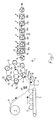
- one configuration of roll-wrap packaging apparatus comprises an endless conveyor 2 arranged to transport a succession of disc-shaped articles 3, for example, biscuits, and deliver them one at a time into a pocket wheel feeder 4 where a predetermined number of the biscuits are assembled substantially co-axially into an assembly 5.
- Heat-sealable packaging material or film 6 drawn from a supply reel 7 by reciprocating grippers 8 is pulled over the top of the assembly of biscuits 5 and an appropriate length 9 of the film 6 is cut by a reciprocating knife 10.
- the pocket wheel feeder 4 pushes the assembly 5 upwards into an empty compartment 11 in a first position 12a of a pocket wheel 12 in such a manner that the assembly takes with it the cut length 9 of film 6 which, by this action, is wrapped around the assembly with cut edge portions 9a of the film length extending parallel to the axis of the assembly and with portions of the film length extending beyond the assembly at each of its ends.
- a first fold 9b over bars (not shown) in each of the said portions of the film length 9 extending beyond the ends of the assembly 5 is also made in the first position 12a of the pocket wheel 12 by folders 13. The folders 13 tuck the folds in against the end surfaces of the assembly 5.
- the pocket wheel 12 then rotates until the compartment 11 is in a second position 12b where the cut edge portions 9a of the film length 9 are heated and pressed together to form a longitudinally-extending fin seal 9c by means of sealing jaws 14.
- a third position 12c the fin seal 9c is folded down onto the film-wrapped assembly 5 and a fold seal block 15 heats the fin seal and presses it against the film 9 on the assembly to cause it to adhere to the film.
- the pocket wheel 12 then rotates the compartment 11 through three more positions 12d, 12e and 12f before the assembly 5 exits the pocket wheel.
- a monitoring device in order to monitor sealing conditions of temperature and sealing force in the packaging apparatus 1, and in this case in each of the end sealers 18a to 18f over their respective sealing periods, a monitoring device, indicated generally by the reference numeral 19 and shown in Fig. 3, of a similar external configuration to the assembly 5 of biscuits, is used.
- the monitoring device 19 comprises a pair of disc-like end members 20a and 20b, respectively, of equal diameter, each being provided with, in this case, three quick-response thermocouples 21 (although more or less thermocouples may be provided) on their outwardly facing surfaces.
- Each end member 20a, 20b is secured to an inner disc-like member 22a and 22b, respectively, of smaller diameter by a central connecting rod 23a and 23b, respectively.
- Each of the central rods 23a and 23b is provided with a threaded bar/bolt assembly (not shown) which allows for adjustment (+/-10mm) in the length of the rods.
- the inner members 22a, 22b, and hence the outer members 20a, 20b to which they are connected by the central rods 23a, 23b, respectively, are free to move relative to each other in a longitudinal direction (along the axes of the rods) on stabilising bars 24, which prevent relative radial or transverse movement between the inner members.
- a force transducer 25 (for example, an Omega LCFA load cell) is located between the two inner members 22a and 22b and is arranged to give an output responsive to the force exerted upon it by the inner members.
- a data logger 26 is mounted on the central rod 23b and is arranged to log outputs from the thermocouples 21 and the force transducer 25 via cables 27 and 28, respectively, at a rate of 32 readings per second. The data logger 26 may also provide power for the force transducer 25, or a separate battery (not shown) for the force transducer may be provided.
- a cylindrical cover 29, only a part of which is shown in Fig. 3, is also provided to give the monitoring device the same configuration as the assembly 5 of biscuits.
- the disc-like members 20a, 20b and 22a, 22b, the connecting rods 23a, 23b and the cover 29 may be made from plastics material, for example, Peak, and incorporate a crumple zone to minimise damage to the packaging apparatus in the event of a malfunction.
- FIGs. 4 and 5 show similar monitoring devices to the monitoring device 19 with the same reference numerals being used for similar features, but the device of Fig. 4 is of larger diameter and the device of Fig. 5 is of greater length.
- the monitoring device 19 may also be provided with an accelerometer (not shown) to measure changes in forces acting upon the device as it travels through the packaging apparatus.
- the monitoring device 19 is placed on the continuous conveyor 2 of the packaging apparatus 1 instead of the biscuits 3 and is sent through the packaging apparatus, which may be arranged to operate with or without the packaging film 6.
- the thermocouples 21 produce an output dependent on the temperature of contacting surfaces of the jaws of each of the end sealers 18a to 18f while they are in contact with the monitoring device 19.
- the thermocouples 21 can measure temperatures within the range of from 10°C to 200°C but the temperature of the contacting surfaces typically lies within the range of from 80°C to 160°C.
- the force transducer 25 produces an output dependent on the force exerted on the end members 20a, 20b and hence the inner members 22a, 22b by each set of the jaws of the end sealers 18a to 18f over the same period of contact.
- the force transducer 25 can measure forces within the range of from 0.2kg to 500kg, but the force typically lies within the range of from 10kg to 20kg.
- the data logger 26 logs the outputs at a rate of 32 readings per second.
- the data from the logger 26 is down-loaded onto a computer and profiles obtained of temperature and force against time for each of the end sealers 18a to 18f as shown in Fig. 6.
- the temperature profile is shown in a dotted line and the sealing force profile is shown in a solid line.
- Such profiles can be used for re-setting the packaging apparatus.
- the monitoring device 19 may also be provided with sensors for the temperature and sealing force of the fold seal block 15.
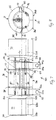
- a monitoring device indicated generally by the reference numeral 30, as shown in Figs. 7 and 8 can be used in place of the monitoring device 19 of Fig. 3.
- the monitoring device 30 comprises a body, indicated generally by the reference numeral 31, moulded from polyurethane and comprising two substantially cylindrical end sections 32 and 33, respectively, and a main casing 34 having upper and lower members 35 and 36, respectively.
- Each of the end sections 32, 33 is provided with a magnetic fastener(not shown) on its inner end surface 32a, 33a, respectively, for attachment of the end section to the main casing 34.
- each end section 32, 33 On its other end surface 32b, 33b, respectively, facing away from the main casing 34, each end section 32, 33 has a temperature sensor plate 32c and 33c, respectively, each plate incorporating a thermocouple (not shown).
- Each of the end sections 32, 33 is also formed with a conduit 32d and 33d, respectively, through which pass electrical connections (not shown) from the thermocouples.
- the upper and lower members 35 and 36 of the main casing 34 which together form a substantially cylindrical hollow central section, are removable from each other and replaceable, being held together by elastic O-rings(not shown) located in grooves 37 and 38, respectively.
- the lower member 36 has a flat longitudinally-extending surface 36a on its base (as do the end sections 32 and 33) to prevent the monitoring device 30 from rolling, in operation.
- Two metal end plates 39 and 40, respectively, and four tie rods 41 extending between the end plates are provided to give the required strength to the casing 34.
- the end section 33 attaches magnetically to the end plate 40.
- the end plate 39 forms a support plate for a load cell, indicated generally by the reference numeral 42, mounted on the casing 34.
- the load cell 42 also comprises a movable metal bearing plate 43 mounted on legs 44 which extend in an axial direction in drillings 45 in the casing 34 along which they are slidably movable.
- a point sensor 46 is mounted in the centre of the support plate 39.
- the end section 32 attaches magnetically to the bearing plate 43, movement of the end section in an axial direction towards the casing 34 causing the bearing plate 43 to move towards, contact and then bear on the point sensor 46, which is arranged to deliver an output dependent on the force exerted by the bearing plate 43 upon it.
- the upper and lower members 35 and 36 of the casing 34 define between them two circumferentially-extending apertures 47 and 48, respectively, in the casing, one aperture being located adjacent each end of the casing.
- a flexible sensor indicated generally by the reference numerals 49 and 50, respectively.
- Each flexible sensor 49, 50 comprises a flexible strip 49a and 50a, respectively, of polyester which extends from a sensor mounting block 51 located within the casing 34 to the exterior, and a composite sensor pad 49b and 50b, respectively, mounted towards the free end of each flexible strip.
- Each of the pads 49b, 50b comprises a pressure sensor, the electrical resistance of which changes when a force is exerted on it.
- a temperature sensor is bonded alongside the pressure sensor to allow for compensation if necessary.
- the pressure sensor and its accompanying temperature sensor are encased in a thin film of insulation material.
- the pads 49b, 50b also each comprises a further temperature sensor located above the film of insulation material to monitor external temperature, and the whole pad is encased in a layer of PTFE to prevent sticking of the packaging film to the pad, in operation.
- Electrical connections (not shown) for the sensor pads 49b, 50b pass through the flexible strips 49a and 50a, respectively for connection at the mounting blocks 51 within the casing 34.
- Each of the flexible sensors 49, 50 is less than 0.5mm in thickness.
- the sensor mounting blocks 51 allow some freedom of movement to the flexible sensors 49, 50, which can be pulled further out of the apertures 47, 48 and retracted to a certain extent if required.
- the width of the apertures 47, 48 also allows for adjustment of the position of the flexible sensors 49,50 to cater for any particular packaging apparatus.
- the flexible sensors 49 and 50 may be arranged to extend in the opposite direction (as shown in dotted lines in Fig. 8) out of apertures 51 (also shown in dotted lines in Fig. 8) in the casing 34.
- a logger for logging outputs from the temperature sensors 32a, 33a, the load cell 42, and the flexible sensors 49, 50.
- a power supply in the form of batteries (not shown) is also located inside the casing 34.
- the monitoring device 30 is provided with a buzzer (not shown) in order to locate it after packaging.
- the monitoring device 30 is placed on the continuous conveyor 2 on its flat surface 36a so that it is in the correct orientation for monitoring sealing conditions of the jaws 14, the flat surface preventing rolling of the device as it is carried along the continuous conveyor.
- the monitoring device 30 is sent through the packaging apparatus 1, which may be operated with or without packaging film.
- the jaws 14 grip the composite pads 49b and 50b of the flexible sensors 49 and 50, respectively, between portions of the film (if provided) and outputs dependent on the temperature of the jaws and the force exerted by the jaws are sent by the flexible sensors 49 and 50 to the logger which logs outputs at the rate of 32 readings per second during the sealing period (the period during which the jaws 14 are in contact with the flexible sensors).
- the monitoring device 30 moves on through the other stages of the packaging apparatus 1 until it reaches the end sealers 18a to 18f, where a further monitoring operation is carried out in a similar manner to that of the monitoring device 19, the temperature of the end sealers being monitored by the temperature sensors 32c and 33c, and the force exerted by the end sealers being monitored by the load cell 42. Outputs from those sensors 32c, 33c and 42 are passed to the logger, which again logs the outputs at the rate of 32 readings per second. On exiting the packaging apparatus 1, the data from the logger is down-loaded onto a computer and profiles obtained of temperature and force against time for each of the sealers 14 and 18a to 18f in a similar manner as with the monitoring device 19. Such profiles can be used for re-setting the packaging apparatus.
- the end sections 32 and 33 can be replaced by longer or shorter sections.
- the whole body 31 can be replaced by a further similar body of suitable external diameter.
Landscapes
- Engineering & Computer Science (AREA)
- Mechanical Engineering (AREA)
- Physics & Mathematics (AREA)
- Thermal Sciences (AREA)
- Package Closures (AREA)
- Packages (AREA)
- Containers And Plastic Fillers For Packaging (AREA)
- Examining Or Testing Airtightness (AREA)
Applications Claiming Priority (2)
| Application Number | Priority Date | Filing Date | Title |
|---|---|---|---|
| GB0114018 | 2001-06-08 | ||
| GB0114018A GB0114018D0 (en) | 2001-06-08 | 2001-06-08 | Improvements in and relating to packaging |
Publications (3)
| Publication Number | Publication Date |
|---|---|
| EP1281621A2 true EP1281621A2 (de) | 2003-02-05 |
| EP1281621A3 EP1281621A3 (de) | 2004-01-02 |
| EP1281621B1 EP1281621B1 (de) | 2005-10-12 |
Family
ID=9916220
Family Applications (1)
| Application Number | Title | Priority Date | Filing Date |
|---|---|---|---|
| EP02253982A Expired - Lifetime EP1281621B1 (de) | 2001-06-08 | 2002-06-07 | Verfahren und Vorrichtung zum Überwachen der Siegelbedingungen in einer Verpackungsmaschine |
Country Status (5)
| Country | Link |
|---|---|
| EP (1) | EP1281621B1 (de) |
| AT (1) | ATE306425T1 (de) |
| DE (1) | DE60206569D1 (de) |
| ES (1) | ES2249541T3 (de) |
| GB (2) | GB0114018D0 (de) |
Cited By (2)
| Publication number | Priority date | Publication date | Assignee | Title |
|---|---|---|---|---|
| US11474160B2 (en) | 2020-08-18 | 2022-10-18 | Rohde & Schwarz Gmbh & Co. Kg | Battery emulation apparatus |
| CN116632312A (zh) * | 2023-04-10 | 2023-08-22 | 广州工业技术研究院 | 一种软包锂电池铝塑膜冷热封装机 |
Family Cites Families (11)
| Publication number | Priority date | Publication date | Assignee | Title |
|---|---|---|---|---|
| NL6804634A (de) * | 1968-04-02 | 1969-10-06 | ||
| US4340610A (en) * | 1980-08-27 | 1982-07-20 | Rjr Foods, Inc. | Flexible pouch and thermocouple locator therefor |
| JPS58154634A (ja) * | 1982-03-09 | 1983-09-14 | Suntory Ltd | 瓶類の状態応力測定装置 |
| US4468135A (en) * | 1983-02-01 | 1984-08-28 | Kraft, Inc. | Retort pouch thermal simulator and method of optimizing heat transfer in retort conditions |
| DE3539181A1 (de) * | 1985-11-05 | 1987-05-07 | Lentia Gmbh | Verfahren und vorrichtung zur messung der siegelkraft bei der heissversiegelung von kunststoffbehaeltern |
| JPH01150829A (ja) * | 1987-12-07 | 1989-06-13 | Murata Mfg Co Ltd | 電子チップ部品処理時の機械的衝撃力調整方法および機械的衝撃力センサ |
| EP0406751A1 (de) * | 1989-07-07 | 1991-01-09 | Balzers Aktiengesellschaft | Verfahren und Anordnung zur Ermittlung von Messdaten während der Behandlung von Scheiben |
| EP0536447A1 (de) * | 1991-10-11 | 1993-04-14 | Koninklijke Emballage Industrie Van Leer B.V. | Aussetzungsmesser zur Anwendung beim Versiegeln von Behältern durch Induktionswärme |
| US5415050A (en) * | 1993-02-25 | 1995-05-16 | Owens-Brockway Glass Container Inc. | Method and apparatus for measuring threaded closure application torque |
| JP3983852B2 (ja) * | 1997-07-09 | 2007-09-26 | 四国化工機株式会社 | ウェブのシール方法と装置および包装容器製造方法と包装容器製造装置 |
| JP3689753B2 (ja) * | 1998-06-26 | 2005-08-31 | 株式会社吉野工業所 | 合成樹脂製壜体の口部温度測定方法 |
-
2001
- 2001-06-08 GB GB0114018A patent/GB0114018D0/en not_active Ceased
-
2002
- 2002-06-07 ES ES02253982T patent/ES2249541T3/es not_active Expired - Lifetime
- 2002-06-07 GB GB0213128A patent/GB2376658B/en not_active Revoked
- 2002-06-07 AT AT02253982T patent/ATE306425T1/de not_active IP Right Cessation
- 2002-06-07 EP EP02253982A patent/EP1281621B1/de not_active Expired - Lifetime
- 2002-06-07 DE DE60206569T patent/DE60206569D1/de not_active Expired - Lifetime
Cited By (2)
| Publication number | Priority date | Publication date | Assignee | Title |
|---|---|---|---|---|
| US11474160B2 (en) | 2020-08-18 | 2022-10-18 | Rohde & Schwarz Gmbh & Co. Kg | Battery emulation apparatus |
| CN116632312A (zh) * | 2023-04-10 | 2023-08-22 | 广州工业技术研究院 | 一种软包锂电池铝塑膜冷热封装机 |
Also Published As
| Publication number | Publication date |
|---|---|
| EP1281621A3 (de) | 2004-01-02 |
| ES2249541T3 (es) | 2006-04-01 |
| GB0114018D0 (en) | 2001-08-01 |
| GB2376658B (en) | 2004-10-20 |
| GB0213128D0 (en) | 2002-07-17 |
| EP1281621B1 (de) | 2005-10-12 |
| DE60206569D1 (de) | 2006-02-23 |
| ATE306425T1 (de) | 2005-10-15 |
| GB2376658A (en) | 2002-12-24 |
Similar Documents
| Publication | Publication Date | Title |
|---|---|---|
| AU2012203378B2 (en) | Form-fill-seal machine | |
| WO1990004541A1 (en) | Apparatus for sealing a web of film in a packaging machine | |
| EP2308669A2 (de) | Beutelherstellungs- und Verpackungsvorrichtung mit wärmegedämmten Siegelbacken | |
| DK0950608T3 (da) | Fremgangsmåde til overvågning af tværgående forsegling i en emballeringsenhed til kontinuerlig dannelse af forseglede emballager, der indeholder hældbare fødevarer, og emballeringsenhed | |
| JP3983852B2 (ja) | ウェブのシール方法と装置および包装容器製造方法と包装容器製造装置 | |
| EP3254979B1 (de) | Einheit und verfahren zum herstellen/vorschieben einer verpackung oder eines teils einer packung | |
| KR20050028042A (ko) | 허메틱 밀봉에서 문제부위의 격리 타켓팅 | |
| KR950700191A (ko) | 식료품포장장치 및 그 방법(method and apparatus for forming a slice of a food item having a heat tack seal) | |
| EP1281621B1 (de) | Verfahren und Vorrichtung zum Überwachen der Siegelbedingungen in einer Verpackungsmaschine | |
| ITBO950094A1 (it) | Metodo per apparecchiatura per la saldatura dei lembi sovrapposti di un film in materiale termosaldabile in macchine confezionatrici | |
| AU2014252685B2 (en) | Conveyor system with a regulating unit, and corresponding method | |
| US3956045A (en) | Method and apparatus for bonding layers of resinous material | |
| US10201946B2 (en) | Separation welding device and method for the sectional joining and sectional separating of weldable film layers using a separation welding device | |
| KR20070088635A (ko) | 겉포장을 밀봉하고 수축하는 멀티스테이지 히터플레이트 | |
| CN120308438A (zh) | 焊接工作站和用于生产包含热封包裹物的包装件的方法 | |
| JP3785411B2 (ja) | 磁性体粉末の連続包装機 | |
| JP2005088911A (ja) | 包装装置 | |
| WO2001081070A3 (en) | Sealing device for packaging material and measuring method for fusion temperature of plastics | |
| Al-Janan et al. | Stress and displacement analysis of powder packaging machine of capacity 2,600 pcs/hours | |
| Conselvan | Technology and innovation in food packaging | |
| JP2572230B2 (ja) | 包装機の横シ−ル装置 | |
| US4059478A (en) | Apparatus for bonding layers of resinous material | |
| JP2002128008A (ja) | 袋詰め包装方法及び包装装置 | |
| JPH03162231A (ja) | 包装機の速度制御装置 | |
| JP2009067459A (ja) | 包装充填装置 |
Legal Events
| Date | Code | Title | Description |
|---|---|---|---|
| PUAI | Public reference made under article 153(3) epc to a published international application that has entered the european phase |
Free format text: ORIGINAL CODE: 0009012 |
|
| AK | Designated contracting states |
Designated state(s): AT BE CH CY DE DK ES FI FR GB GR IE IT LI LU MC NL PT SE TR |
|
| AX | Request for extension of the european patent |
Extension state: AL LT LV MK RO SI |
|
| PUAL | Search report despatched |
Free format text: ORIGINAL CODE: 0009013 |
|
| AK | Designated contracting states |
Kind code of ref document: A3 Designated state(s): AT BE CH CY DE DK ES FI FR GB GR IE IT LI LU MC NL PT SE TR |
|
| AX | Request for extension of the european patent |
Extension state: AL LT LV MK RO SI |
|
| RIC1 | Information provided on ipc code assigned before grant |
Ipc: 7G 07C 3/00 B Ipc: 7B 65B 57/00 A Ipc: 7B 29C 65/02 B |
|
| 17P | Request for examination filed |
Effective date: 20040609 |
|
| AKX | Designation fees paid |
Designated state(s): AT BE CH CY DE DK ES FI FR GB GR IE IT LI LU MC NL PT SE TR |
|
| 17Q | First examination report despatched |
Effective date: 20041222 |
|
| GRAP | Despatch of communication of intention to grant a patent |
Free format text: ORIGINAL CODE: EPIDOSNIGR1 |
|
| GRAS | Grant fee paid |
Free format text: ORIGINAL CODE: EPIDOSNIGR3 |
|
| GRAA | (expected) grant |
Free format text: ORIGINAL CODE: 0009210 |
|
| AK | Designated contracting states |
Kind code of ref document: B1 Designated state(s): AT BE CH CY DE DK ES FI FR GB GR IE IT LI LU MC NL PT SE TR |
|
| PG25 | Lapsed in a contracting state [announced via postgrant information from national office to epo] |
Ref country code: IT Free format text: LAPSE BECAUSE OF FAILURE TO SUBMIT A TRANSLATION OF THE DESCRIPTION OR TO PAY THE FEE WITHIN THE PRESCRIBED TIME-LIMIT;WARNING: LAPSES OF ITALIAN PATENTS WITH EFFECTIVE DATE BEFORE 2007 MAY HAVE OCCURRED AT ANY TIME BEFORE 2007. THE CORRECT EFFECTIVE DATE MAY BE DIFFERENT FROM THE ONE RECORDED. Effective date: 20051012 Ref country code: AT Free format text: LAPSE BECAUSE OF FAILURE TO SUBMIT A TRANSLATION OF THE DESCRIPTION OR TO PAY THE FEE WITHIN THE PRESCRIBED TIME-LIMIT Effective date: 20051012 Ref country code: LI Free format text: LAPSE BECAUSE OF FAILURE TO SUBMIT A TRANSLATION OF THE DESCRIPTION OR TO PAY THE FEE WITHIN THE PRESCRIBED TIME-LIMIT Effective date: 20051012 Ref country code: FI Free format text: LAPSE BECAUSE OF FAILURE TO SUBMIT A TRANSLATION OF THE DESCRIPTION OR TO PAY THE FEE WITHIN THE PRESCRIBED TIME-LIMIT Effective date: 20051012 Ref country code: CH Free format text: LAPSE BECAUSE OF FAILURE TO SUBMIT A TRANSLATION OF THE DESCRIPTION OR TO PAY THE FEE WITHIN THE PRESCRIBED TIME-LIMIT Effective date: 20051012 |
|
| REG | Reference to a national code |
Ref country code: GB Ref legal event code: FG4D |
|
| REG | Reference to a national code |
Ref country code: CH Ref legal event code: EP |
|
| REG | Reference to a national code |
Ref country code: IE Ref legal event code: FG4D |
|
| PG25 | Lapsed in a contracting state [announced via postgrant information from national office to epo] |
Ref country code: DK Free format text: LAPSE BECAUSE OF FAILURE TO SUBMIT A TRANSLATION OF THE DESCRIPTION OR TO PAY THE FEE WITHIN THE PRESCRIBED TIME-LIMIT Effective date: 20060112 Ref country code: GR Free format text: LAPSE BECAUSE OF FAILURE TO SUBMIT A TRANSLATION OF THE DESCRIPTION OR TO PAY THE FEE WITHIN THE PRESCRIBED TIME-LIMIT Effective date: 20060112 Ref country code: SE Free format text: LAPSE BECAUSE OF FAILURE TO SUBMIT A TRANSLATION OF THE DESCRIPTION OR TO PAY THE FEE WITHIN THE PRESCRIBED TIME-LIMIT Effective date: 20060112 |
|
| PG25 | Lapsed in a contracting state [announced via postgrant information from national office to epo] |
Ref country code: DE Free format text: LAPSE BECAUSE OF FAILURE TO SUBMIT A TRANSLATION OF THE DESCRIPTION OR TO PAY THE FEE WITHIN THE PRESCRIBED TIME-LIMIT Effective date: 20060113 |
|
| RAP2 | Party data changed (patent owner data changed or rights of a patent transferred) |
Owner name: UNITED BISCUITS (UK) LIMITED |
|
| REF | Corresponds to: |
Ref document number: 60206569 Country of ref document: DE Date of ref document: 20060223 Kind code of ref document: P |
|
| NLT2 | Nl: modifications (of names), taken from the european patent patent bulletin |
Owner name: UNITED BISCUITS (UK) LIMITED Effective date: 20060118 |
|
| REG | Reference to a national code |
Ref country code: ES Ref legal event code: FG2A Ref document number: 2249541 Country of ref document: ES Kind code of ref document: T3 |
|
| REG | Reference to a national code |
Ref country code: CH Ref legal event code: PL |
|
| PG25 | Lapsed in a contracting state [announced via postgrant information from national office to epo] |
Ref country code: IE Free format text: LAPSE BECAUSE OF NON-PAYMENT OF DUE FEES Effective date: 20060607 |
|
| ET | Fr: translation filed | ||
| PG25 | Lapsed in a contracting state [announced via postgrant information from national office to epo] |
Ref country code: MC Free format text: LAPSE BECAUSE OF NON-PAYMENT OF DUE FEES Effective date: 20060630 |
|
| PLBE | No opposition filed within time limit |
Free format text: ORIGINAL CODE: 0009261 |
|
| STAA | Information on the status of an ep patent application or granted ep patent |
Free format text: STATUS: NO OPPOSITION FILED WITHIN TIME LIMIT |
|
| 26N | No opposition filed |
Effective date: 20060713 |
|
| REG | Reference to a national code |
Ref country code: IE Ref legal event code: MM4A |
|
| PG25 | Lapsed in a contracting state [announced via postgrant information from national office to epo] |
Ref country code: TR Free format text: LAPSE BECAUSE OF FAILURE TO SUBMIT A TRANSLATION OF THE DESCRIPTION OR TO PAY THE FEE WITHIN THE PRESCRIBED TIME-LIMIT Effective date: 20051012 Ref country code: LU Free format text: LAPSE BECAUSE OF NON-PAYMENT OF DUE FEES Effective date: 20060607 |
|
| PG25 | Lapsed in a contracting state [announced via postgrant information from national office to epo] |
Ref country code: CY Free format text: LAPSE BECAUSE OF FAILURE TO SUBMIT A TRANSLATION OF THE DESCRIPTION OR TO PAY THE FEE WITHIN THE PRESCRIBED TIME-LIMIT Effective date: 20051012 |
|
| PGFP | Annual fee paid to national office [announced via postgrant information from national office to epo] |
Ref country code: PT Payment date: 20110606 Year of fee payment: 10 |
|
| PGFP | Annual fee paid to national office [announced via postgrant information from national office to epo] |
Ref country code: ES Payment date: 20110715 Year of fee payment: 10 |
|
| REG | Reference to a national code |
Ref country code: PT Ref legal event code: MM4A Free format text: LAPSE DUE TO NON-PAYMENT OF FEES Effective date: 20121207 |
|
| PG25 | Lapsed in a contracting state [announced via postgrant information from national office to epo] |
Ref country code: PT Free format text: LAPSE BECAUSE OF NON-PAYMENT OF DUE FEES Effective date: 20121207 |
|
| PGFP | Annual fee paid to national office [announced via postgrant information from national office to epo] |
Ref country code: GB Payment date: 20130605 Year of fee payment: 12 |
|
| PGFP | Annual fee paid to national office [announced via postgrant information from national office to epo] |
Ref country code: FR Payment date: 20130624 Year of fee payment: 12 Ref country code: NL Payment date: 20130608 Year of fee payment: 12 |
|
| PGFP | Annual fee paid to national office [announced via postgrant information from national office to epo] |
Ref country code: BE Payment date: 20130614 Year of fee payment: 12 |
|
| REG | Reference to a national code |
Ref country code: ES Ref legal event code: FD2A Effective date: 20131030 |
|
| PG25 | Lapsed in a contracting state [announced via postgrant information from national office to epo] |
Ref country code: ES Free format text: LAPSE BECAUSE OF NON-PAYMENT OF DUE FEES Effective date: 20120608 |
|
| REG | Reference to a national code |
Ref country code: NL Ref legal event code: V1 Effective date: 20150101 |
|
| GBPC | Gb: european patent ceased through non-payment of renewal fee |
Effective date: 20140607 |
|
| REG | Reference to a national code |
Ref country code: FR Ref legal event code: ST Effective date: 20150227 |
|
| PG25 | Lapsed in a contracting state [announced via postgrant information from national office to epo] |
Ref country code: NL Free format text: LAPSE BECAUSE OF NON-PAYMENT OF DUE FEES Effective date: 20150101 |
|
| PG25 | Lapsed in a contracting state [announced via postgrant information from national office to epo] |
Ref country code: FR Free format text: LAPSE BECAUSE OF NON-PAYMENT OF DUE FEES Effective date: 20140630 Ref country code: GB Free format text: LAPSE BECAUSE OF NON-PAYMENT OF DUE FEES Effective date: 20140607 |
|
| PG25 | Lapsed in a contracting state [announced via postgrant information from national office to epo] |
Ref country code: BE Free format text: LAPSE BECAUSE OF NON-PAYMENT OF DUE FEES Effective date: 20140630 |