EP1281703A1 - Verfahren zur Herstellung von 5-Alkoxy-Oxazolen sowie von Pyridoxinen - Google Patents
Verfahren zur Herstellung von 5-Alkoxy-Oxazolen sowie von Pyridoxinen Download PDFInfo
- Publication number
- EP1281703A1 EP1281703A1 EP02016604A EP02016604A EP1281703A1 EP 1281703 A1 EP1281703 A1 EP 1281703A1 EP 02016604 A EP02016604 A EP 02016604A EP 02016604 A EP02016604 A EP 02016604A EP 1281703 A1 EP1281703 A1 EP 1281703A1
- Authority
- EP
- European Patent Office
- Prior art keywords
- formula
- alkoxy
- column
- conversion
- substituted oxazoles
- Prior art date
- Legal status (The legal status is an assumption and is not a legal conclusion. Google has not performed a legal analysis and makes no representation as to the accuracy of the status listed.)
- Granted
Links
- 238000000034 method Methods 0.000 title claims abstract description 84
- 230000008569 process Effects 0.000 title claims abstract description 34
- 150000003227 pyridoxines Chemical class 0.000 title claims abstract description 9
- 238000002360 preparation method Methods 0.000 title claims description 11
- 235000008160 pyridoxine Nutrition 0.000 title description 3
- 150000002148 esters Chemical class 0.000 claims abstract description 42
- -1 formamido ester Chemical class 0.000 claims abstract description 23
- 125000006239 protecting group Chemical group 0.000 claims abstract description 16
- 239000011541 reaction mixture Substances 0.000 claims abstract description 15
- 238000005698 Diels-Alder reaction Methods 0.000 claims abstract description 6
- 150000002009 diols Chemical class 0.000 claims abstract description 5
- 238000010306 acid treatment Methods 0.000 claims abstract description 4
- 150000001413 amino acids Chemical class 0.000 claims abstract description 4
- 238000006243 chemical reaction Methods 0.000 claims description 94
- 150000002916 oxazoles Chemical class 0.000 claims description 71
- 239000002253 acid Substances 0.000 claims description 37
- 239000002904 solvent Substances 0.000 claims description 21
- 239000000126 substance Substances 0.000 claims description 12
- 238000009835 boiling Methods 0.000 claims description 8
- 238000007363 ring formation reaction Methods 0.000 claims description 8
- 239000012442 inert solvent Substances 0.000 claims description 7
- 125000002887 hydroxy group Chemical group [H]O* 0.000 claims description 6
- UFHFLCQGNIYNRP-UHFFFAOYSA-N Hydrogen Chemical compound [H][H] UFHFLCQGNIYNRP-UHFFFAOYSA-N 0.000 claims description 5
- 150000001298 alcohols Chemical class 0.000 claims description 4
- 229910052739 hydrogen Inorganic materials 0.000 claims description 4
- 239000001257 hydrogen Substances 0.000 claims description 4
- 229910052740 iodine Inorganic materials 0.000 claims description 2
- 238000004519 manufacturing process Methods 0.000 abstract description 4
- 125000000217 alkyl group Chemical group 0.000 abstract 4
- 239000012752 auxiliary agent Substances 0.000 abstract 2
- 238000010438 heat treatment Methods 0.000 abstract 2
- 238000010511 deprotection reaction Methods 0.000 abstract 1
- MXEFJFDXLBCGLI-UHFFFAOYSA-N 5-butoxy-4-methyl-1,3-oxazole Chemical compound CCCCOC=1OC=NC=1C MXEFJFDXLBCGLI-UHFFFAOYSA-N 0.000 description 25
- 239000000203 mixture Substances 0.000 description 18
- LRHPLDYGYMQRHN-UHFFFAOYSA-N N-Butanol Chemical compound CCCCO LRHPLDYGYMQRHN-UHFFFAOYSA-N 0.000 description 12
- MVPPADPHJFYWMZ-UHFFFAOYSA-N chlorobenzene Chemical compound ClC1=CC=CC=C1 MVPPADPHJFYWMZ-UHFFFAOYSA-N 0.000 description 12
- IMFACGCPASFAPR-UHFFFAOYSA-N tributylamine Chemical compound CCCCN(CCCC)CCCC IMFACGCPASFAPR-UHFFFAOYSA-N 0.000 description 12
- ZCQWOFVYLHDMMC-UHFFFAOYSA-N Oxazole Chemical compound C1=COC=N1 ZCQWOFVYLHDMMC-UHFFFAOYSA-N 0.000 description 11
- 125000002496 methyl group Chemical group [H]C([H])([H])* 0.000 description 11
- 238000013461 design Methods 0.000 description 10
- 238000012856 packing Methods 0.000 description 9
- 238000010924 continuous production Methods 0.000 description 8
- 125000004108 n-butyl group Chemical group [H]C([H])([H])C([H])([H])C([H])([H])C([H])([H])* 0.000 description 7
- YMWUJEATGCHHMB-UHFFFAOYSA-N Dichloromethane Chemical compound ClCCl YMWUJEATGCHHMB-UHFFFAOYSA-N 0.000 description 6
- LFQSCWFLJHTTHZ-UHFFFAOYSA-N Ethanol Chemical compound CCO LFQSCWFLJHTTHZ-UHFFFAOYSA-N 0.000 description 6
- YXFVVABEGXRONW-UHFFFAOYSA-N Toluene Chemical compound CC1=CC=CC=C1 YXFVVABEGXRONW-UHFFFAOYSA-N 0.000 description 6
- NQUOYYARPZVTHH-UHFFFAOYSA-N butyl 2-isocyanopropanoate Chemical compound CCCCOC(=O)C(C)[N+]#[C-] NQUOYYARPZVTHH-UHFFFAOYSA-N 0.000 description 6
- 239000000546 pharmaceutical excipient Substances 0.000 description 6
- LXNHXLLTXMVWPM-UHFFFAOYSA-N pyridoxine Chemical compound CC1=NC=C(CO)C(CO)=C1O LXNHXLLTXMVWPM-UHFFFAOYSA-N 0.000 description 6
- 238000000926 separation method Methods 0.000 description 6
- 235000001014 amino acid Nutrition 0.000 description 5
- BTMVHUNTONAYDX-UHFFFAOYSA-N butyl propionate Chemical compound CCCCOC(=O)CC BTMVHUNTONAYDX-UHFFFAOYSA-N 0.000 description 5
- 241001620634 Roger Species 0.000 description 4
- 239000002671 adjuvant Substances 0.000 description 4
- 150000001412 amines Chemical class 0.000 description 4
- 239000007795 chemical reaction product Substances 0.000 description 4
- 150000001875 compounds Chemical class 0.000 description 4
- DOIRQSBPFJWKBE-UHFFFAOYSA-N dibutyl phthalate Chemical compound CCCCOC(=O)C1=CC=CC=C1C(=O)OCCCC DOIRQSBPFJWKBE-UHFFFAOYSA-N 0.000 description 4
- 238000004821 distillation Methods 0.000 description 4
- AOGQPLXWSUTHQB-UHFFFAOYSA-N hexyl acetate Chemical compound CCCCCCOC(C)=O AOGQPLXWSUTHQB-UHFFFAOYSA-N 0.000 description 4
- 239000000376 reactant Substances 0.000 description 4
- 238000003786 synthesis reaction Methods 0.000 description 4
- BZUDVELGTZDOIG-UHFFFAOYSA-N 2-ethyl-n,n-bis(2-ethylhexyl)hexan-1-amine Chemical compound CCCCC(CC)CN(CC(CC)CCCC)CC(CC)CCCC BZUDVELGTZDOIG-UHFFFAOYSA-N 0.000 description 3
- VAFSYWXFZSPBAF-UHFFFAOYSA-N 4-methyl-5-(2-methylpropoxy)-1,3-oxazole Chemical compound CC(C)COC=1OC=NC=1C VAFSYWXFZSPBAF-UHFFFAOYSA-N 0.000 description 3
- 0 C*OC(C(C)NC=O)=O Chemical compound C*OC(C(C)NC=O)=O 0.000 description 3
- XEKOWRVHYACXOJ-UHFFFAOYSA-N Ethyl acetate Chemical compound CCOC(C)=O XEKOWRVHYACXOJ-UHFFFAOYSA-N 0.000 description 3
- OKKJLVBELUTLKV-UHFFFAOYSA-N Methanol Chemical compound OC OKKJLVBELUTLKV-UHFFFAOYSA-N 0.000 description 3
- ZMANZCXQSJIPKH-UHFFFAOYSA-N Triethylamine Chemical compound CCN(CC)CC ZMANZCXQSJIPKH-UHFFFAOYSA-N 0.000 description 3
- 230000015572 biosynthetic process Effects 0.000 description 3
- 230000032050 esterification Effects 0.000 description 3
- 238000005886 esterification reaction Methods 0.000 description 3
- 125000001495 ethyl group Chemical group [H]C([H])([H])C([H])([H])* 0.000 description 3
- 125000001449 isopropyl group Chemical group [H]C([H])([H])C([H])(*)C([H])([H])[H] 0.000 description 3
- FZPXKEPZZOEPGX-UHFFFAOYSA-N n,n-dibutylaniline Chemical compound CCCCN(CCCC)C1=CC=CC=C1 FZPXKEPZZOEPGX-UHFFFAOYSA-N 0.000 description 3
- 229910052757 nitrogen Inorganic materials 0.000 description 3
- 239000000047 product Substances 0.000 description 3
- 125000002914 sec-butyl group Chemical group [H]C([H])([H])C([H])([H])C([H])(*)C([H])([H])[H] 0.000 description 3
- 125000001424 substituent group Chemical group 0.000 description 3
- 125000000999 tert-butyl group Chemical group [H]C([H])([H])C(*)(C([H])([H])[H])C([H])([H])[H] 0.000 description 3
- 229940011671 vitamin b6 Drugs 0.000 description 3
- RBCOYOYDYNXAFA-UHFFFAOYSA-L (5-hydroxy-4,6-dimethylpyridin-3-yl)methyl phosphate Chemical compound CC1=NC=C(COP([O-])([O-])=O)C(C)=C1O RBCOYOYDYNXAFA-UHFFFAOYSA-L 0.000 description 2
- SCYULBFZEHDVBN-UHFFFAOYSA-N 1,1-Dichloroethane Chemical compound CC(Cl)Cl SCYULBFZEHDVBN-UHFFFAOYSA-N 0.000 description 2
- OCJBOOLMMGQPQU-UHFFFAOYSA-N 1,4-dichlorobenzene Chemical compound ClC1=CC=C(Cl)C=C1 OCJBOOLMMGQPQU-UHFFFAOYSA-N 0.000 description 2
- CSCPPACGZOOCGX-UHFFFAOYSA-N Acetone Chemical compound CC(C)=O CSCPPACGZOOCGX-UHFFFAOYSA-N 0.000 description 2
- KMTRUDSVKNLOMY-UHFFFAOYSA-N Ethylene carbonate Chemical compound O=C1OCCO1 KMTRUDSVKNLOMY-UHFFFAOYSA-N 0.000 description 2
- KFZMGEQAYNKOFK-UHFFFAOYSA-N Isopropanol Chemical compound CC(C)O KFZMGEQAYNKOFK-UHFFFAOYSA-N 0.000 description 2
- AMIMRNSIRUDHCM-UHFFFAOYSA-N Isopropylaldehyde Chemical compound CC(C)C=O AMIMRNSIRUDHCM-UHFFFAOYSA-N 0.000 description 2
- UUIQMZJEGPQKFD-UHFFFAOYSA-N Methyl butyrate Chemical compound CCCC(=O)OC UUIQMZJEGPQKFD-UHFFFAOYSA-N 0.000 description 2
- AMQJEAYHLZJPGS-UHFFFAOYSA-N N-Pentanol Chemical compound CCCCCO AMQJEAYHLZJPGS-UHFFFAOYSA-N 0.000 description 2
- CTQNGGLPUBDAKN-UHFFFAOYSA-N O-Xylene Chemical compound CC1=CC=CC=C1C CTQNGGLPUBDAKN-UHFFFAOYSA-N 0.000 description 2
- DKGAVHZHDRPRBM-UHFFFAOYSA-N Tert-Butanol Chemical compound CC(C)(C)O DKGAVHZHDRPRBM-UHFFFAOYSA-N 0.000 description 2
- 238000010923 batch production Methods 0.000 description 2
- 230000008901 benefit Effects 0.000 description 2
- 244000309464 bull Species 0.000 description 2
- BTANRVKWQNVYAZ-UHFFFAOYSA-N butan-2-ol Chemical compound CCC(C)O BTANRVKWQNVYAZ-UHFFFAOYSA-N 0.000 description 2
- DKPFZGUDAPQIHT-UHFFFAOYSA-N butyl acetate Chemical compound CCCCOC(C)=O DKPFZGUDAPQIHT-UHFFFAOYSA-N 0.000 description 2
- 239000006227 byproduct Substances 0.000 description 2
- 229910052799 carbon Inorganic materials 0.000 description 2
- 229940117389 dichlorobenzene Drugs 0.000 description 2
- GGSUCNLOZRCGPQ-UHFFFAOYSA-N diethylaniline Chemical compound CCN(CC)C1=CC=CC=C1 GGSUCNLOZRCGPQ-UHFFFAOYSA-N 0.000 description 2
- OBNCKNCVKJNDBV-UHFFFAOYSA-N ethyl butyrate Chemical compound CCCC(=O)OCC OBNCKNCVKJNDBV-UHFFFAOYSA-N 0.000 description 2
- FKRCODPIKNYEAC-UHFFFAOYSA-N ethyl propionate Chemical compound CCOC(=O)CC FKRCODPIKNYEAC-UHFFFAOYSA-N 0.000 description 2
- ZSIAUFGUXNUGDI-UHFFFAOYSA-N hexan-1-ol Chemical compound CCCCCCO ZSIAUFGUXNUGDI-UHFFFAOYSA-N 0.000 description 2
- 238000009434 installation Methods 0.000 description 2
- 239000007788 liquid Substances 0.000 description 2
- 239000012528 membrane Substances 0.000 description 2
- 125000004123 n-propyl group Chemical group [H]C([H])([H])C([H])([H])C([H])([H])* 0.000 description 2
- 239000012454 non-polar solvent Substances 0.000 description 2
- XHXFXVLFKHQFAL-UHFFFAOYSA-N phosphoryl trichloride Chemical compound ClP(Cl)(Cl)=O XHXFXVLFKHQFAL-UHFFFAOYSA-N 0.000 description 2
- 239000003880 polar aprotic solvent Substances 0.000 description 2
- BDERNNFJNOPAEC-UHFFFAOYSA-N propan-1-ol Chemical compound CCCO BDERNNFJNOPAEC-UHFFFAOYSA-N 0.000 description 2
- RUOJZAUFBMNUDX-UHFFFAOYSA-N propylene carbonate Chemical compound CC1COC(=O)O1 RUOJZAUFBMNUDX-UHFFFAOYSA-N 0.000 description 2
- 239000011677 pyridoxine Substances 0.000 description 2
- 238000010992 reflux Methods 0.000 description 2
- 238000009666 routine test Methods 0.000 description 2
- 239000007858 starting material Substances 0.000 description 2
- 150000003512 tertiary amines Chemical class 0.000 description 2
- 239000008096 xylene Substances 0.000 description 2
- 125000005919 1,2,2-trimethylpropyl group Chemical group 0.000 description 1
- 125000005918 1,2-dimethylbutyl group Chemical group 0.000 description 1
- 125000006218 1-ethylbutyl group Chemical group [H]C([H])([H])C([H])([H])C([H])([H])C([H])(*)C([H])([H])C([H])([H])[H] 0.000 description 1
- 125000006176 2-ethylbutyl group Chemical group [H]C([H])([H])C([H])([H])C([H])(C([H])([H])*)C([H])([H])C([H])([H])[H] 0.000 description 1
- 125000004493 2-methylbut-1-yl group Chemical group CC(C*)CC 0.000 description 1
- 125000003542 3-methylbutan-2-yl group Chemical group [H]C([H])([H])C([H])(*)C([H])(C([H])([H])[H])C([H])([H])[H] 0.000 description 1
- XYHZRHOTMJVMAA-UHFFFAOYSA-N C(C)(=O)OCCCCCC.C(CCC)(=O)O Chemical compound C(C)(=O)OCCCCCC.C(CCC)(=O)O XYHZRHOTMJVMAA-UHFFFAOYSA-N 0.000 description 1
- QNAYBMKLOCPYGJ-REOHCLBHSA-N L-alanine Chemical compound C[C@H](N)C(O)=O QNAYBMKLOCPYGJ-REOHCLBHSA-N 0.000 description 1
- RJUFJBKOKNCXHH-UHFFFAOYSA-N Methyl propionate Chemical compound CCC(=O)OC RJUFJBKOKNCXHH-UHFFFAOYSA-N 0.000 description 1
- SVYKKECYCPFKGB-UHFFFAOYSA-N N,N-dimethylcyclohexylamine Chemical compound CN(C)C1CCCCC1 SVYKKECYCPFKGB-UHFFFAOYSA-N 0.000 description 1
- SECXISVLQFMRJM-UHFFFAOYSA-N N-Methylpyrrolidone Chemical compound CN1CCCC1=O SECXISVLQFMRJM-UHFFFAOYSA-N 0.000 description 1
- YGYAWVDWMABLBF-UHFFFAOYSA-N Phosgene Chemical compound ClC(Cl)=O YGYAWVDWMABLBF-UHFFFAOYSA-N 0.000 description 1
- XBDQKXXYIPTUBI-UHFFFAOYSA-M Propionate Chemical compound CCC([O-])=O XBDQKXXYIPTUBI-UHFFFAOYSA-M 0.000 description 1
- DHKHKXVYLBGOIT-UHFFFAOYSA-N acetaldehyde Diethyl Acetal Natural products CCOC(C)OCC DHKHKXVYLBGOIT-UHFFFAOYSA-N 0.000 description 1
- KXKVLQRXCPHEJC-UHFFFAOYSA-N acetic acid trimethyl ester Natural products COC(C)=O KXKVLQRXCPHEJC-UHFFFAOYSA-N 0.000 description 1
- 230000002378 acidificating effect Effects 0.000 description 1
- 230000003213 activating effect Effects 0.000 description 1
- 235000004279 alanine Nutrition 0.000 description 1
- 150000001299 aldehydes Chemical class 0.000 description 1
- 238000005899 aromatization reaction Methods 0.000 description 1
- 125000003118 aryl group Chemical group 0.000 description 1
- XUPYJHCZDLZNFP-UHFFFAOYSA-N butyl butanoate Chemical compound CCCCOC(=O)CCC XUPYJHCZDLZNFP-UHFFFAOYSA-N 0.000 description 1
- 125000003178 carboxy group Chemical group [H]OC(*)=O 0.000 description 1
- 229910052801 chlorine Inorganic materials 0.000 description 1
- 238000003776 cleavage reaction Methods 0.000 description 1
- 125000004093 cyano group Chemical group *C#N 0.000 description 1
- 238000005516 engineering process Methods 0.000 description 1
- 238000002474 experimental method Methods 0.000 description 1
- 238000000605 extraction Methods 0.000 description 1
- 229910052731 fluorine Inorganic materials 0.000 description 1
- 229910052736 halogen Inorganic materials 0.000 description 1
- 150000002367 halogens Chemical class 0.000 description 1
- 125000000623 heterocyclic group Chemical group 0.000 description 1
- 125000004051 hexyl group Chemical group [H]C([H])([H])C([H])([H])C([H])([H])C([H])([H])C([H])([H])C([H])([H])* 0.000 description 1
- GOKKOFHHJFGZHW-UHFFFAOYSA-N hexyl propanoate Chemical compound CCCCCCOC(=O)CC GOKKOFHHJFGZHW-UHFFFAOYSA-N 0.000 description 1
- 125000005027 hydroxyaryl group Chemical group 0.000 description 1
- 238000009776 industrial production Methods 0.000 description 1
- 125000000959 isobutyl group Chemical group [H]C([H])([H])C([H])(C([H])([H])[H])C([H])([H])* 0.000 description 1
- 238000006317 isomerization reaction Methods 0.000 description 1
- 150000002576 ketones Chemical class 0.000 description 1
- YKYONYBAUNKHLG-UHFFFAOYSA-N n-Propyl acetate Natural products CCCOC(C)=O YKYONYBAUNKHLG-UHFFFAOYSA-N 0.000 description 1
- 125000001971 neopentyl group Chemical group [H]C([*])([H])C(C([H])([H])[H])(C([H])([H])[H])C([H])([H])[H] 0.000 description 1
- 125000003538 pentan-3-yl group Chemical group [H]C([H])([H])C([H])([H])C([H])(*)C([H])([H])C([H])([H])[H] 0.000 description 1
- 125000001147 pentyl group Chemical group C(CCCC)* 0.000 description 1
- 239000002243 precursor Substances 0.000 description 1
- 229940090181 propyl acetate Drugs 0.000 description 1
- HUAZGNHGCJGYNP-UHFFFAOYSA-N propyl butyrate Chemical compound CCCOC(=O)CCC HUAZGNHGCJGYNP-UHFFFAOYSA-N 0.000 description 1
- 125000001436 propyl group Chemical group [H]C([*])([H])C([H])([H])C([H])([H])[H] 0.000 description 1
- MCSINKKTEDDPNK-UHFFFAOYSA-N propyl propionate Chemical compound CCCOC(=O)CC MCSINKKTEDDPNK-UHFFFAOYSA-N 0.000 description 1
- RADKZDMFGJYCBB-UHFFFAOYSA-N pyridoxal hydrochloride Natural products CC1=NC=C(CO)C(C=O)=C1O RADKZDMFGJYCBB-UHFFFAOYSA-N 0.000 description 1
- 125000002181 pyridoxine group Chemical group 0.000 description 1
- 230000007017 scission Effects 0.000 description 1
- 125000003548 sec-pentyl group Chemical group [H]C([H])([H])C([H])([H])C([H])([H])C([H])(*)C([H])([H])[H] 0.000 description 1
- 239000000243 solution Substances 0.000 description 1
- 238000010189 synthetic method Methods 0.000 description 1
- WMOVHXAZOJBABW-UHFFFAOYSA-N tert-butyl acetate Chemical compound CC(=O)OC(C)(C)C WMOVHXAZOJBABW-UHFFFAOYSA-N 0.000 description 1
- TWBUVVYSQBFVGZ-UHFFFAOYSA-N tert-butyl butanoate Chemical compound CCCC(=O)OC(C)(C)C TWBUVVYSQBFVGZ-UHFFFAOYSA-N 0.000 description 1
- JAELLLITIZHOGQ-UHFFFAOYSA-N tert-butyl propanoate Chemical compound CCC(=O)OC(C)(C)C JAELLLITIZHOGQ-UHFFFAOYSA-N 0.000 description 1
- 125000001973 tert-pentyl group Chemical group [H]C([H])([H])C([H])([H])C(*)(C([H])([H])[H])C([H])([H])[H] 0.000 description 1
- 230000007704 transition Effects 0.000 description 1
- RKBCYCFRFCNLTO-UHFFFAOYSA-N triisopropylamine Chemical compound CC(C)N(C(C)C)C(C)C RKBCYCFRFCNLTO-UHFFFAOYSA-N 0.000 description 1
- 230000007306 turnover Effects 0.000 description 1
- NQPDZGIKBAWPEJ-UHFFFAOYSA-N valeric acid Chemical compound CCCCC(O)=O NQPDZGIKBAWPEJ-UHFFFAOYSA-N 0.000 description 1
- 239000011726 vitamin B6 Substances 0.000 description 1
- 235000019158 vitamin B6 Nutrition 0.000 description 1
Images

Classifications
-
- B—PERFORMING OPERATIONS; TRANSPORTING
- B01—PHYSICAL OR CHEMICAL PROCESSES OR APPARATUS IN GENERAL
- B01D—SEPARATION
- B01D3/00—Distillation or related exchange processes in which liquids are contacted with gaseous media, e.g. stripping
- B01D3/14—Fractional distillation or use of a fractionation or rectification column
- B01D3/141—Fractional distillation or use of a fractionation or rectification column where at least one distillation column contains at least one dividing wall
-
- C—CHEMISTRY; METALLURGY
- C07—ORGANIC CHEMISTRY
- C07D—HETEROCYCLIC COMPOUNDS
- C07D213/00—Heterocyclic compounds containing six-membered rings, not condensed with other rings, with one nitrogen atom as the only ring hetero atom and three or more double bonds between ring members or between ring members and non-ring members
- C07D213/02—Heterocyclic compounds containing six-membered rings, not condensed with other rings, with one nitrogen atom as the only ring hetero atom and three or more double bonds between ring members or between ring members and non-ring members having three double bonds between ring members or between ring members and non-ring members
- C07D213/04—Heterocyclic compounds containing six-membered rings, not condensed with other rings, with one nitrogen atom as the only ring hetero atom and three or more double bonds between ring members or between ring members and non-ring members having three double bonds between ring members or between ring members and non-ring members having no bond between the ring nitrogen atom and a non-ring member or having only hydrogen or carbon atoms directly attached to the ring nitrogen atom
- C07D213/60—Heterocyclic compounds containing six-membered rings, not condensed with other rings, with one nitrogen atom as the only ring hetero atom and three or more double bonds between ring members or between ring members and non-ring members having three double bonds between ring members or between ring members and non-ring members having no bond between the ring nitrogen atom and a non-ring member or having only hydrogen or carbon atoms directly attached to the ring nitrogen atom with hetero atoms or with carbon atoms having three bonds to hetero atoms with at the most one bond to halogen, e.g. ester or nitrile radicals, directly attached to ring carbon atoms
- C07D213/62—Oxygen or sulfur atoms
- C07D213/63—One oxygen atom
- C07D213/65—One oxygen atom attached in position 3 or 5
- C07D213/66—One oxygen atom attached in position 3 or 5 having in position 3 an oxygen atom and in each of the positions 4 and 5 a carbon atom bound to an oxygen, sulphur, or nitrogen atom, e.g. pyridoxal
- C07D213/67—2-Methyl-3-hydroxy-4,5-bis(hydroxy-methyl)pyridine, i.e. pyridoxine
-
- C—CHEMISTRY; METALLURGY
- C07—ORGANIC CHEMISTRY
- C07D—HETEROCYCLIC COMPOUNDS
- C07D263/00—Heterocyclic compounds containing 1,3-oxazole or hydrogenated 1,3-oxazole rings
- C07D263/02—Heterocyclic compounds containing 1,3-oxazole or hydrogenated 1,3-oxazole rings not condensed with other rings
- C07D263/30—Heterocyclic compounds containing 1,3-oxazole or hydrogenated 1,3-oxazole rings not condensed with other rings having two or three double bonds between ring members or between ring members and non-ring members
- C07D263/34—Heterocyclic compounds containing 1,3-oxazole or hydrogenated 1,3-oxazole rings not condensed with other rings having two or three double bonds between ring members or between ring members and non-ring members with hetero atoms or with carbon atoms having three bonds to hetero atoms with at the most one bond to halogen, e.g. ester or nitrile radicals, directly attached to ring carbon atoms
- C07D263/36—One oxygen atom
- C07D263/42—One oxygen atom attached in position 5
-
- Y—GENERAL TAGGING OF NEW TECHNOLOGICAL DEVELOPMENTS; GENERAL TAGGING OF CROSS-SECTIONAL TECHNOLOGIES SPANNING OVER SEVERAL SECTIONS OF THE IPC; TECHNICAL SUBJECTS COVERED BY FORMER USPC CROSS-REFERENCE ART COLLECTIONS [XRACs] AND DIGESTS
- Y02—TECHNOLOGIES OR APPLICATIONS FOR MITIGATION OR ADAPTATION AGAINST CLIMATE CHANGE
- Y02P—CLIMATE CHANGE MITIGATION TECHNOLOGIES IN THE PRODUCTION OR PROCESSING OF GOODS
- Y02P20/00—Technologies relating to chemical industry
- Y02P20/50—Improvements relating to the production of bulk chemicals
- Y02P20/55—Design of synthesis routes, e.g. reducing the use of auxiliary or protecting groups
Definitions
- the present invention relates to a method for manufacturing of 5-alkoxy-substituted oxazoles, in particular for the preparation of 4-methyl-5-alkoxy-substituted oxazoles and a process for the preparation of pyridoxine derivatives.
- 5-alkoxy-substituted oxazoles are valuable building blocks in organic chemistry.
- 4-Methyl-5-alkoxy-substituted oxazoles are of particular importance as important precursors for the synthesis and industrial production of vitamin B 6 (Turchi et al., Chem. Rev. 1975, 75, 416).
- ⁇ -isocyanalkyl acid ester is discontinuous by thermal isomerization into the corresponding 5-alkoxy-substituted To convert oxazoles.
- JP 54-20493 describes a batch process for Preparation of 4-methyl-5-alkoxy-substituted oxazoles by thermal cyclization of ⁇ -isocyanopropionic acid ester at temperatures of 155 and 170 ° C in the presence of a tertiary amine. After the reaction has ended is the solution under reduced pressure at the lowest possible Temperatures are fractionally distilled. This will improve Selectivities achieved on the desired oxazoles (34 to 91.5%), however, the low turnover (11.1 to 49.4%) still no satisfactory yields.
- the invention was therefore based on the object of a further method for the preparation of 5-alkoxy-substituted oxazoles with to provide advantageous properties that the Disadvantages of the prior art no longer has and 5-alkoxy-substituted oxazoles with high conversions in high Selectivities and yields.
- C 1 -C 6 alkyl radical are for the radicals R 1 and R 2 are branched or independently unbranched, optionally substituted C 1 -C 6 alkyl understood, as for example, optionally substituted methyl, ethyl, propyl, 1-methylethyl , n-butyl, 1-methylpropyl, 2-methylpropyl, 1,1-dimethylethyl, pentyl, 1-methylbutyl, 2-methylbutyl, 1,2-dimethylpropyl, 1,1-dimethylpropyl, 2,2-dimethylpropyl, 1-ethylpropyl , Hexyl, 1-methylpentyl, 1,2-dimethylbutyl, 2,3-dimethylbutyl, 1,1-dimethylbutyl, 2,2-dimethylbutyl, 3,3-dimethylbutyl, 1,1,2-trimethylpropyl, 1,2,2 -Trimethylpropyl, 1-ethylbutyl, 2-
- the nature of the substituents is not critical.
- the C 1 -C 6 alkyl radicals can contain up to 6 substituents, depending on the free binding possibilities, preferably selected from the group aryl, hydroxyaryl, -NO 2 , -NH 2, -OH, -CN, -COOH, or halogen, in particular F or Cl.
- the C 1 -C 6 -alkyl radicals of the radicals R 1 and R 2 are not substituted.
- Preferred radicals for R 1 are C 1 -C 4 -alkyl radicals, such as, for example, methyl, ethyl, isopropyl, n-propyl, n-butyl, sec-butyl or tert-butyl, particularly preferably n-butyl.
- Preferred radicals for R 2 are hydrogen and C 1 -C 4 -alkyl radicals, such as, for example, methyl, ethyl, isopropyl, n-propyl, n-butyl, sec-butyl or tert-butyl, particularly preferably methyl.
- the process is n-butyl ⁇ -isocyanopropionate converted to 4-methyl-5-n-butoxy-oxazole.
- ⁇ -isocyanalkyl acid esters used in the process according to the invention can be used in any purity become.
- the ⁇ -isocyanalkyl acid esters of the formula II can be prepared in a manner known per se from the corresponding formamido acid esters of the formula V by reaction with phosphorus oxychloride or phosgene in the presence of bases.
- Common synthetic methods are described in Itov et al., Khimiko-Farmatsevticheskii Zhurnal, 1978, 12, 102-106; Maeda et al., Bull. Chem. Soc. Japan, 1971, 44, 1407-1410; Ugi et al., Chem. Ber. 1961, 94, 2814; Chem. Ber. 1960, 93, 239-248, Angew. Chem. 1965, 77, 492-504, Chem. Ber. 1975, 1580-1590, DE 30 29 231 A1 and J. Heterocyclic Chemistry 1988, 17, 705.
- auxiliaries are in the process according to the invention understood chemical compounds, preferably chemical Compounds which accelerate the cyclization reaction or the thermodynamic balance towards the desired one Move product.
- Preferred auxiliaries are cyclization auxiliaries, selected from the group consisting of bases, alcohols or Ester.
- bases are compounds understood with Brönsted base properties.
- Preferred bases are tertiary amines, such as triethylamine, triisopropylamine, Tri-n-butylamine, dimethylcyclohexylamine, Tris (2-ethylhexyl) amine, N-methyl-pyrrolidone, N, N, N'N'-tetramethyl-1,3-propanediamine, N, N-diethylaniline or N, N-dibutylaniline.
- tri-n-butylamine is particularly preferred as a base.
- Preferred alcohols are optionally substituted C 1 -C 6 -alkanols, such as, for example, methanol, ethanol, n-propanol, isopropanol, n-butanol, sec-butanol, tert-butanol, n-pentanol or n-hexanol.
- C 1 -C 6 -alkanols such as, for example, methanol, ethanol, n-propanol, isopropanol, n-butanol, sec-butanol, tert-butanol, n-pentanol or n-hexanol.
- n-butanol as alcohol is particularly preferred.
- esters are optionally substituted C 1 -C 6 alkanoic acid C 1 -C 6 alkyl esters, such as, for example, methyl acetate, ethyl acetate, propyl acetate, n-butyl acetate, tert-butyl acetate, hexyl acetate, hexyl acetate, propionic acid methyl ester, propionic acid ethyl ester, propionic acid propyl ester, propionic acid n-butyl ester, propionic acid tert-butyl ester, propionic acid hexyl ester, butanoic acid methyl ester, butanoic acid ethyl ester, butanoic acid propyl ester, butanoic acid n-butyl ester, butanoic acid tert-butyl ester or butanoic acid hexyl acetate.
- the auxiliaries can be used as individual compounds or in Form of mixtures can be used.
- the auxiliary substances are preferred used as individual connections.
- the temperature during the conversion according to the invention is therefore at least 80 ° C.
- the invention is carried out Process at temperatures from 100 to 200 ° C, particularly preferred at temperatures of 120 to 170 ° C, most preferably at Temperatures from 130 to 170 ° C.
- the molar ratio of excipient to ⁇ -isocyanalkyl acid ester Formula II is not critical and is preferably 10: 1 to 0.05: 1st
- the process according to the invention can in particular be carried out batchwise, Carry out semi-continuously or continuously.
- the process is carried out discontinuously or semi-discontinuously.
- a batchwise process is called batchwise Roger that.
- the ⁇ -isocyanalkyl acid esters are preferred of formula II and the auxiliaries presented in a reactor and the ⁇ -isocyanalkyl acid esters at temperatures greater than 80 ° C converted into the 5-alkoxy-substituted oxazoles of the formula I, the 5-alkoxy-substituted at the same time as the conversion Oxazoles of the formula I are separated from the reaction mixture.
- reactors that are preferred for the discontinuous procedure come into question.
- preferred Reactors should have the property of a conversion with simultaneous separation of a reaction product enable.
- reactors for the discontinuous Procedure back-mixed reactors such as Loop reactors and conventional batch reactors, such as for example, kettles in all configurations, with attached ones Reaction column can be used.
- Semi-batchwise is a semi-batch process Roger that.
- the ⁇ -isocyanalkyl acid esters are preferred of formula II and the auxiliaries semi-continuously fed to a reactor and the ⁇ -isocyanalkyl acid ester at temperatures greater than 80 ° C in the 5-alkoxy-substituted Converts oxazoles of the formula I, at the same time as the Conversion of the 5-alkoxy-substituted oxazoles of the formula I. be separated from the reaction mixture.
- reactors for the semi-discontinuous Procedures There are many designs of reactors for the semi-discontinuous Procedures come into question.
- preferred Reactors should have the property of converting to enable simultaneous separation of a reaction product.
- reactors for the semi-discontinuous Procedure loop reactors membrane reactors and usual semi-batch reactors, such as Boiler in all configurations, with reaction column attached be used.
- the process is carried out in a batch or semi-batch reactor with attached reaction column and separates at the same time with the conversion of the 5-alkoxy-substituted oxazoles Formula I by rectification from the reaction mixture.
- reaction columns or attached reaction columns are preferably understood columns whose internals one have hold-up, for example columns with trays, Fills, packs or packing.
- Particularly advantageous column trays allow a long residence time the liquid, the dwell time on the internals the reaction column is preferably at least 30 min.
- Preferred column trays are, for example, valve trays Bell floors or related types such as Tunnel floors, Lord steps and other internals or Thormann floors.
- Preferred structured packings are, for example structured packings of the type Mellapack® (from Sulzer), BY® (Sulzer), B1® (Montz) or A3® (Montz) or Packs with comparable designs.
- reaction columns or attached reaction columns can be of any design and installation.
- the use of a dividing wall column is particularly preferred as a reaction column.
- a reaction column or reaction column the can be designed in various ways, has the property as a reactor a conversion of reactants at the same time and separation by rectification of the 5-alkoxy-substituted ones To enable oxazoles of the formula I from the reaction mixture.
- Suitable rectification parameters are, for example Temperature, pressure, reflux ratio in the column, Design of the column and its internals, heat management or energy input, which the specialist through routine tests can optimize so that the characteristics D and E are achieved.
- discontinuous and semi-discontinuous Procedure is the pressure at the top of the column Reaction column set so that the temperature in the reactor and on the internals at least 80 ° C, preferably 100 to 200 ° C, particularly preferably 120 to 170 ° C, very particularly preferably 130 is up to 170 ° C.
- the top pressure of the column is 5 to 800 mbar is set, so that it depends on the used )
- Type of column and any type of column installation used resulting bottom pressure typically 5 mbar to more atmospheric Pressure is.
- excipients are separated from the azeotrope in this Case in a manner known per se, for example by a subsequent second rectification using another Pressure (two-pressure distillation).
- the separation of tri-n-butylamine from the azeotrope can be done in in this case, for example, by a subsequent second Rectification at a head pressure of 10 mbar.
- the discontinuous and semi-discontinuous procedure can be carried out in the presence or absence of solvents become. In a preferred embodiment, this is done Solvent-free process.
- solvents or raw mixtures to be used in the process according to the invention in addition to the ⁇ -isocyanalkyl acid ester Formula II and the excipients already Contain solvents.
- this is done Process according to the invention in the presence of an inert solvent.
- an inert solvent are preferred non-polar and polar aprotic solvents such as toluene, xylene or chlorobenzene, dichloromethane, dichloroethane, dichlorobenzene, Ethylene carbonate, propylene carbonate, especially chlorobenzene Roger that.
- the ⁇ -isocyanalkyl acid esters of formula II and the excipients either as Mixture or separately fed continuously to a reactor, in the reactor, the ⁇ -isocyanalkyl acid esters of the formula II in converted the 5-alkoxy-substituted oxazoles of the formula I. and then the reaction products continuously from the Reactor removed, the simultaneous with the conversion 5-alkoxy-substituted oxazoles of the formula I continuously be separated from the reaction mixture.
- reactors available for the particularly preferred continuous procedure in question come.
- Preferred reactors should have the property a continuous conversion with simultaneous separation enable a reaction product.
- Bubbles with attached column extraction columns, Bell-bottom columns, membrane reactors, Lord reactors or Reaction columns are used.
- Reaction columns are preferably understood to mean columns whose internals have a hold-up, for example Columns with trays, beds, packings or packing.
- the process is continuous in a reaction column as a reactor, simultaneously with the conversion of the 5-alkoxy-substituted oxazoles of the formula I. continuously by rectification from the reaction mixture separates.
- reaction columns can be of type and internals be designed arbitrarily. Use is particularly preferred a dividing wall column as a reaction column.
- a reaction column designed in various ways can have the property as a reactor at the same time conversion of reactants and separation by Rectification of the 5-alkoxy-substituted oxazoles of the formula I. to allow from the reaction mixture.
- Rectification parameter settings are, for example, temperature, pressure, Reflux ratio in the column, design of the column and their internals, heat management and dwell time, especially in Swamp or energy input, which the specialist through routine tests can optimize so that the characteristics A, B and C are achieved.
- the auxiliary can in particular also be separated from the high boilers are separated off in a second side stream.
- side flow is continuous Discharge of a substance via a side discharge from the column Roger that.
- the pressure at the top of the column is adjusted in such a way that that the temperature in the swamp and on the internals at least 80 ° C, preferably 100 to 200 ° C, particularly preferably 120 to Is 170 ° C, most preferably 130 to 170 ° C.
- the head pressure of the column is for the continuous Procedure set to 5 to 800 mbar so that depending on the type of column used and if necessary resulting column type used bottom pressure typically 5 mbar to atmospheric pressure.
- the residence time in the reaction column is for the continuous Typically between 10 minutes and 7 hours, preferably between 30 minutes and 4 hours.
- the excipient is separated from the overhead stream azeotrope in this case in a manner known per se, for example by a subsequent second rectification using another pressure (two-pressure distillation).
- the continuous procedure of the method according to the invention can in the presence or absence of solvents be performed.
- the continuous procedure of the inventive method without solvent.
- the continuous Procedure of the inventive method in Presence of an inert solvent are preferably non-polar and polar aprotic Solvents such as toluene, xylene or chlorobenzene, dichloromethane, Dichloroethane, dichlorobenzene, ethylene carbonate, propylene carbonate, especially understood chlorobenzene.
- an inert Solvents are preferably non-polar and polar aprotic Solvents such as toluene, xylene or chlorobenzene, dichloromethane, Dichloroethane, dichlorobenzene, ethylene carbonate, propylene carbonate, especially understood chlorobenzene.
- the solvent can for example with the auxiliary and the ⁇ -isocyanalkyl acid ester of the formula II in a mixture or each individual component continuously fed separately to the column.
- reaction column trays Any embodiments can be used as internals of the reaction column are used, such as column trays, Fills, packings or structured packings.
- Particularly advantageous column trays allow a long residence time the liquid, the dwell time on the internals the reaction column is preferably at least 30 min.
- Preferred column trays are, for example, valve trays Bell floors or related types such as Tunnel floors, Lord steps and other internals or Thormann floors.
- Preferred structured packings are, for example structured packings of the type Mellapack® (from Sulzer), BY® (Sulzer), B1® (Montz) or A3® (Montz) or Packs with comparable designs.
- the method according to the invention has compared to the prior art Technology the following advantages:
- the particularly preferred continuous procedure has the further advantage of a significantly greater space-time yield than in the previously known methods.
- amino acid esters of the formula IV are known per se Way, for example as described in US 3,227,721 in the Formamido acid ester of formula V converted.
- ⁇ -isocyanalkyl acid esters of formula II are as above described with the method according to the invention in the 5-alkoxy-substituted Oxazoles of formula I converted.
- this substep is preferred embodiments, as described above.
- the 5-alkoxy-substituted oxazoles of the formula I are then with protected diols of formula VI to the Diels-Alder adducts Formula VII implemented.
- This substep can follow the method according to the invention but can be in the continuous procedure of the method according to the invention also by continuous Feeding the protected diols of formula VI to the reactor of inventive method simultaneously with the conversion the ⁇ -isocyanalkyl acid ester of the formula II in the 5-alkoxy-substituted Oxazoles of the formula I take place.
- the feeder takes place either in a mixture with the ⁇ -isocyanalkyl acid ester of formula II, the excipient and optionally that Solvent or as a separate component.
- the 5-alkoxy-substituted oxazoles directly in the form removed their Diels-Alder adduct via the bottom discharge of the column.
- the radicals R 3 , R 4 are, independently of one another, a protective group, preferably an acid-labile protective group of the hydroxy function.
- any acid labile protecting group can be used.
- Preferred acid-labile protecting groups are those in the literature known acid-labile protective groups for hydroxyl groups (T.W. Greene, Protective Groups in Organic Synthesis, John Wiley & Sons New York, 1981, pages 14-71; P. J. Kocienski, Protecting Groups, Georg Thieme Verlag Stuttgart, 1994, pages 21-94).
- the radicals R 3 and R 4 together form an acid-labile protective group of the two hydroxyl functions.
- the two hydroxy functions preferably form a cyclic acetal with ketones or aldehydes, such as, for example, acetone or isobutyraldehyde.
- the alcohol R 1 -OH and the protective groups R 3 and R 4 can be recovered and used again in the overall process.
- the distillation yield was 99% (40% pure 4-methyl-5-n-butoxy-oxazole and 60% 4-methyl-5-n-butoxy-oxazole as an azeotrope that in the first Distillation was recycled).
- the pure 4-methyl-5-n-butoxy oxazole had a grade of 99.8%.
- the azeotrope was separated as in Example 1.
- Example 3 a mixture of 13.14% ⁇ -Isocyanpropionic acid n-butyl ester and 86.86% tris (2-ethylhexyl) amine closed continuously.
- Example 3 a mixture of 22.7% ⁇ -Isocyanpropionic acid iso-butyl ester and 77.3% N, N-dibutylaniline closed continuously.
- Example 5 a mixture of 11.8% ⁇ -Isocyanpropionic acid n-butyl ester and 88.2% N, N-dibutylaniline closed continuously. 4-Methyl-5-n-butoxy-oxazole is obtained with a yield of 98.7% via the top draw B and the amine via the side deduction D.
- n-butanol is removed overhead.
- the column swamp will with phthalic acid di-n-butyl ester as intermediate boiler on one kept steady.
- Example 7 Analogously to Example 7, a mixture of 35 wt .-% ⁇ -isocyanopropionic acid n-butyl ester and 65% by weight n-butyl propionate initiated continuously.
- n-butyl propionate is removed overhead.
- the Column bottom is with phthalic acid di-n-butyl ester as intermediate boiler kept up to date.
Landscapes
- Chemical & Material Sciences (AREA)
- Organic Chemistry (AREA)
- Chemical Kinetics & Catalysis (AREA)
- Heterocyclic Carbon Compounds Containing A Hetero Ring Having Nitrogen And Oxygen As The Only Ring Hetero Atoms (AREA)
- Pharmaceuticals Containing Other Organic And Inorganic Compounds (AREA)
Abstract
Description

indem man α-Isocyanalkylsäureester der Formel II
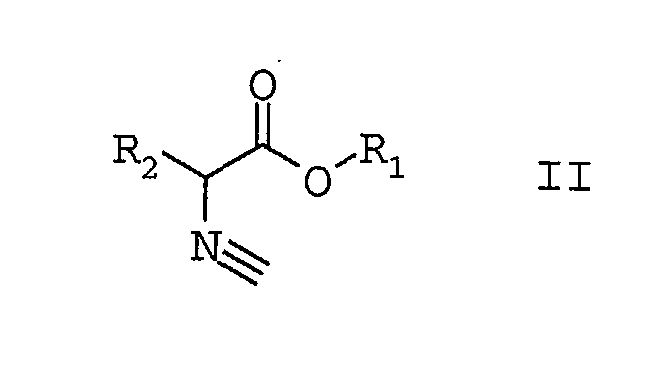
bei Temperaturen größer 80°C
in die 5-alkoxy-substituierten Oxazole der Formel I umwandelt
und gleichzeitig mit der Umwandlung die 5-alkoxy-substituierten Oxazole der Formel I aus dem Reaktionsgemisch abtrennt.

- A
- die Umwandlung der α-Isocyanalkylsäureester der Formel II in die 5-alkoxy-substituierten Oxazole der Formel I auf den Einbauten und gegebenenfalls im Sumpf der Reaktionskolonne erfolgt,
- B
- die bei der Umwandlung entstehenden 5-alkoxy-substituierten Oxazole der Formel I kontinuierlich mit dem Kopfstrom oder Seitenstrom der Reaktionskolonne abgetrennt werden und
- C
- der Hilfsstoff, sowie die bei der Umwandlung gegebenenfalls entstehenden Hochsieder kontinuierlich und unabhängig voneinander mit dem Sumpfstrom oder Seitenstrom der Reaktionskolonne abgetrennt werden.
- A
- die Umwandlung der α-Isocyanalkylsäureester der Formel II in die 5-alkoxy-substituierten Oxazole der Formel I auf den Einbauten und gegebenenfalls im Sumpf der Reaktionskolonne erfolgt,
- B1
- für den Fall, dass das Lösungsmittel einen höheren Siedepunkt als die bei der Umwandlung entstehenden 5-alkoxy-substituierten Oxazole der Formel I aufweist, die 5-alkoxy-substituierten Oxazole der Formel I kontinuierlich mit dem Kopfstrom und das Lösungsmittel kontinuierlich über den Seitenstrom oder Sumpfstrom der Reaktionskolonne abgetrennt werden,
- B2
- für den Fall, dass das Lösungsmittel einen niedrigeren Siedepunkt als die die bei der Umwandlung entstehenden 5-alkoxy-substituierten Oxazole der Formel I aufweist, die 5-alkoxy-substituierten Oxazole der Formel I kontinuierlich mit einem Seitenstrom und das Lösungsmittel kontinuierlich mit dem Kopfstrom der Reaktionskolonne abgetrennt wird und
- C
- der Hilfsstoff, sowie die bei der Umwandlung gegebenenfalls entstehenden Hochsieder kontinuierlich und unabhängig voneinander mit dem Sumpfstrom oder Seitenstrom der Reaktionskolonne abgetrennt werden.


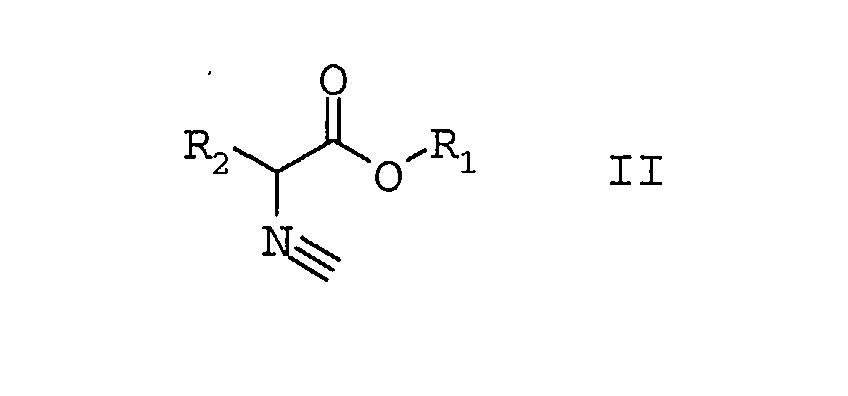
bei Temperaturen größer 80°C
in die 5-alkoxy-substituierten Oxazole der Formel I umwandelt

die 5-alkoxy-substituierten Oxazole der Formel I mit geschützten Diolen der Formel VI,

zu den Diels-Alder-Addukten der Formel VII umsetzt,

Claims (16)
- Verfahren zur Herstellung von 5-alkoxy-substituierten Oxazolen der Formel I,wobei

- R1
- einen, gegebenenfalls substituierten, C1-C6-Alkylrest und
- R2
- Wasserstoff oder einen, gegebenenfalls substituierten, C1-C6-Alkylrest
indem man α-Isocyanalkylsäureester der Formel IIin Gegenwart von Hilfsstoffen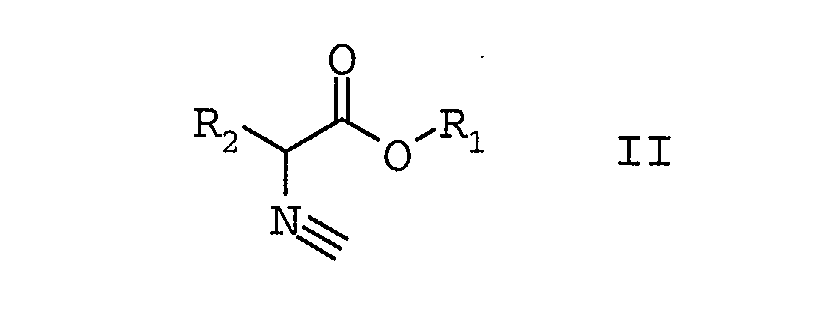
bei Temperaturen größer 80°C
in die 5-alkoxy-substituierten Oxazole der Formel I umwandelt und gleichzeitig mit der Umwandlung die 5-alkoxy-substituierten Oxazole der Formel I aus dem Reaktionsgemisch abtrennt. - Verfahren nach Anspruch 1, dadurch gekennzeichnet dass man als Hilfsstoffe Cyclisierungshilfsstoffe, ausgewählt aus der Gruppe Basen, Alkohole oder Ester verwendet.
- Verfahren nach Anspruch 1 oder 2, dadurch gekennzeichnet, dass man das Verfahren diskontinuierlich durchführt.
- Verfahren nach Anspruch 3, dadurch gekennzeichnet, dass man das Verfahren in einem diskontinuierlichen oder semidiskontinuierlichen Reaktor mit aufgesetzter Reaktionskolonne durchführt und gleichzeitig mit der Umwandlung die 5-alkoxy-substituierten Oxazole der Formel I durch Rektifikation aus dem Reaktionsgemisch abtrennt.
- Verfahren nach Anspruch 4, dadurch gekennzeichnet, dass man die Rektifikationsparameter so einstellt, dass
- D
- die Umwandlung der α-Isocyanalkylsäureester der Formel II in die 5-alkoxy-substituierten Oxazole der Formel I im Reaktor und/oder auf den Einbauten der aufgesetzten Reaktionskolonne erfolgt und
- E
- die bei der Umwandlung entstehenden 5-alkoxy-substituierten Oxazole der Formel I über die aufgesetzte Reaktionskolonne abgetrennt werden.
- Verfahren nach einem der Ansprüche 3 bis 5, dadurch gekennzeichnet, dass man die Umwandlung in Gegenwart eines inerten Lösungsmittels durchführt.
- Verfahren nach einem der Ansprüche 4 bis 6, dadurch gekennzeichnet, dass man als Reaktionskolonne eine Trennwandkolonne verwendet.
- Verfahren nach einem der Ansprüche 4 bis 7, dadurch gekennzeichnet, dass man den Kopfdruck der Kolonne auf 5 bis 800 mbar einstellt und der sich daraus je nach verwendeter Kolonnenart und gegebenenfalls verwendeter Kolonneneinbautenart ergebende Sumpfdruck 10 mbar bis atmosphärischer Druck beträgt.
- Verfahren nach Anspruch 1 oder 2, dadurch gekennzeichnet, dass man das Verfahren kontinuierlich durchführt.
- Verfahren nach Anspruch 9, dadurch gekennzeichnet, dass man das Verfahren in einer Reaktionskolonne durchführt und gleichzeitig mit der Umwandlung die 5-alkoxy-substituierten Oxazole der Formel I durch Rektifikation aus dem Reaktionsgemisch abtrennt.
- Verfahren nach Anspruch 10, dadurch gekennzeichnet, dass man die Rektifikationsparameter so einstellt, dass
- A
- die Umwandlung der α-Isocyanalkylsäureester der Formel II in die 5-alkoxy-substituierten Oxazole der Formel I auf den Einbauten und gegebenenfalls im Sumpf der Reaktionskolonne erfolgt,
- B
- die bei der Umwandlung entstehenden 5-alkoxy-substituierten Oxazole der Formel I kontinuierlich mit dem Kopfstrom oder Seitenstrom der Reaktionskolonne abgetrennt werden und
- C
- der Hilfsstoff, sowie die bei der Umwandlung gegebenenfalls entstehenden Hochsieder kontinuierlich und unabhängig voneinander mit dem Sumpfstrom oder Seitenstrom der Reaktionskolonne abgetrennt werden.
- Verfahren nach einem der Ansprüche 9 bis 11, dadurch gekennzeichnet, dass man die Umwandlung in Gegenwart eines inerten Lösungsmittels durchführt und die Reaktionsparameter so einstellt, dass
- A
- die Umwandlung der α-Isocyanalkylsäureester der Formel II in die 5-alkoxy-substituierten Oxazole der Formel I auf den Einbauten und gegebenenfalls im Sumpf der Reaktionskolonne erfolgt,
- B1
- für den Fall, dass das Lösungsmittel einen höheren Siedepunkt als die bei der Umwandlung entstehenden 5-alkoxy-substituierten Oxazole der Formel I aufweist, die 5-alkoxy-substituierten Oxazole der Formel I kontinuierlich mit dem Kopfstrom und das Lösungsmittel kontinuierlich über den Seitenstrom oder Sumpfstrom der Reaktionskolonne abgetrennt werden,
- B2
- für den Fall, dass das Lösungsmittel einen niedrigeren Siedepunkt als die bei der Umwandlung entstehenden 5-alkoxy-substituierten Oxazole der Formel I aufweist, die 5-alkoxy-substituierten Oxazole der Formel I kontinuierlich mit einem Seitenstrom und das Lösungsmittel kontinuierlich mit dem Kopfstrom der Reaktionskolonne abgetrennt wird und
- C
- der Hilfsstoff, sowie die bei der Umwandlung gegebenenfalls entstehenden Hochsieder kontinuierlich und unabhängig voneinander mit dem Sumpfstrom oder Seitenstrom der Reaktionskolonne abgetrennt werden.
- Verfahren nach einem der Ansprüche 10 bis 12, dadurch gekennzeichnet, dass man als Reaktionskolonne eine Trennwandkolonne verwendet.
- Verfahren nach einem der Ansprüche 10 bis 13, dadurch gekennzeichnet, dass man, für den Fall dass der Hilfsstoff mit den 5-alkoxy-substituierten Oxazolen der Formel I ein Azeotrop bildet, den Kopfdruck in der Kolonne, so einstellt, dass der Anteil an Hilfsstoff im Azeotrop im Kopfstrom möglichst gering ist.
- Verfahren nach einem der Ansprüche 10 bis 14, dadurch gekennzeichnet, dass man den Kopfdruck der Kolonne auf 5 bis 800 mbar einstellt und der sich daraus je nach verwendeter Kolonnenart und gegebenenfalls verwendeter Kolonneneinbautenart ergebende Sumpfdruck 10 mbar bis atmosphärischer Druck beträgt.
- Verfahren zur Herstellung von Pyridoxin-Derivaten der Formel IXwobei
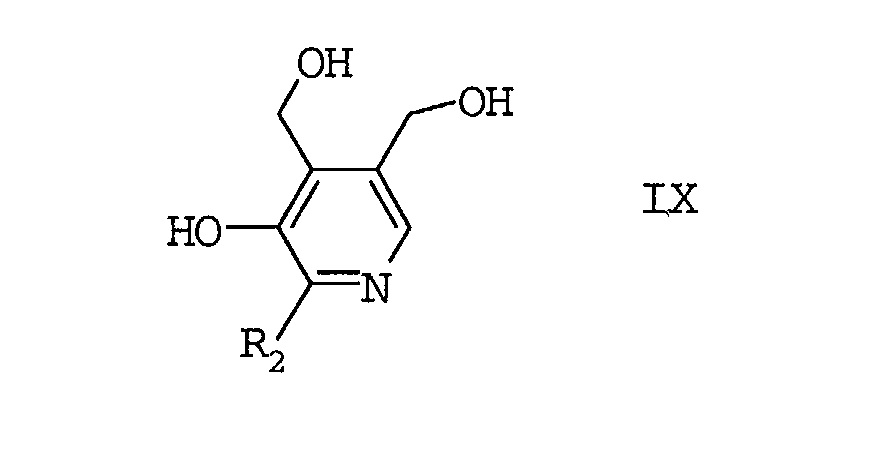
- R2
- Wasserstoff oder einen, gegebenenfalls substituierten,
C1-C6-Alkylrest bedeutet,
in dem man Aminosäuren der Formel IIIin Aminosäureester der Formel IV umwandelt, wobei
wobei
- R1
- einen, gegebenenfalls substituierten, C1-C6-Alkylrest
bedeutet,
diese in Formamidosäureester der Formel V umwandelt,diese in α-Isocyanalkylsäureester der Formel II umwandelt,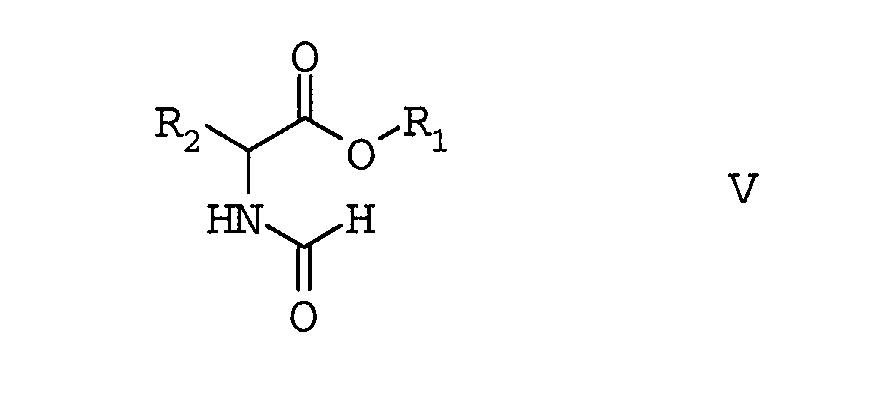 diese in Gegenwart von Hilfsstoffen
bei Temperaturen größer 80°C
in die 5-alkoxy-substituierten Oxazole der Formel I umwandeltund gleichzeitig mit der Umwandlung die 5-alkoxy-substituierten Oxazole der Formel I aus dem Reaktionsgemisch abtrennt, die 5-alkoxy-substituierten Oxazole der Formel I mit geschützten Diolen der Formel VI, wobei
wobei
- R3, R4
- unabhängig voneiunander oder R3 und R4 zusammen eine Schutzgruppe der Hydroxyfunktion
zu den Diels-Alder-Addukten der Formel VII umsetzt,und diese durch saure Behandlung und Abspaltung der Schutzgruppe in die Pyridoxin-Derivaten der Formel IX überführt.
Applications Claiming Priority (4)
| Application Number | Priority Date | Filing Date | Title |
|---|---|---|---|
| DE10137480A DE10137480A1 (de) | 2001-08-03 | 2001-08-03 | Verfahren zur Herstellung von substituierten Oxazolen |
| DE10137480 | 2001-08-03 | ||
| DE10209446 | 2002-03-05 | ||
| DE10209446A DE10209446A1 (de) | 2002-03-05 | 2002-03-05 | Verfahren zur Herstellung von substituierten Oxazolen |
Publications (2)
| Publication Number | Publication Date |
|---|---|
| EP1281703A1 true EP1281703A1 (de) | 2003-02-05 |
| EP1281703B1 EP1281703B1 (de) | 2005-01-26 |
Family
ID=26009838
Family Applications (1)
| Application Number | Title | Priority Date | Filing Date |
|---|---|---|---|
| EP02016604A Expired - Lifetime EP1281703B1 (de) | 2001-08-03 | 2002-07-25 | Verfahren zur Herstellung von 5-Alkoxy-Oxazolen sowie von Pyridoxinen |
Country Status (5)
| Country | Link |
|---|---|
| US (1) | US20030050479A1 (de) |
| EP (1) | EP1281703B1 (de) |
| CN (1) | CN1227239C (de) |
| AT (1) | ATE287877T1 (de) |
| DE (1) | DE50202096D1 (de) |
Cited By (1)
| Publication number | Priority date | Publication date | Assignee | Title |
|---|---|---|---|---|
| EP1281704B1 (de) * | 2001-08-03 | 2008-01-23 | Basf Aktiengesellschaft | Verfahren zur kontinuierlichen Herstellung von substituierten Oxazolen |
Families Citing this family (3)
| Publication number | Priority date | Publication date | Assignee | Title |
|---|---|---|---|---|
| CN102898395B (zh) * | 2011-07-24 | 2015-03-11 | 大丰海嘉诺药业有限公司 | 一种制备4-甲基-5-正丁氧基噁唑的方法 |
| CN103435568B (zh) * | 2013-08-30 | 2015-05-13 | 大丰海嘉诺药业有限公司 | 一种4-甲基-5-乙氧基噁唑酸乙酯的制备方法 |
| BE1030125B1 (nl) * | 2021-12-28 | 2023-07-26 | De Neef Chemical Proc N V | Batch-destillatiewerkwijze en batch-destillatiekolom met zij-afvoerpunt |
Citations (2)
| Publication number | Priority date | Publication date | Assignee | Title |
|---|---|---|---|---|
| JPS5420493B1 (de) * | 1970-06-06 | 1979-07-23 | ||
| SU681057A1 (ru) * | 1977-03-02 | 1979-08-25 | Всесоюзный Научно-Исследовательский Витаминный Институт | Способ получени 4-метил-5-пропоксиоксазола |
-
2002
- 2002-07-25 DE DE50202096T patent/DE50202096D1/de not_active Expired - Lifetime
- 2002-07-25 EP EP02016604A patent/EP1281703B1/de not_active Expired - Lifetime
- 2002-07-25 AT AT02016604T patent/ATE287877T1/de not_active IP Right Cessation
- 2002-08-01 US US10/209,529 patent/US20030050479A1/en not_active Abandoned
- 2002-08-05 CN CNB021254060A patent/CN1227239C/zh not_active Expired - Fee Related
Patent Citations (2)
| Publication number | Priority date | Publication date | Assignee | Title |
|---|---|---|---|---|
| JPS5420493B1 (de) * | 1970-06-06 | 1979-07-23 | ||
| SU681057A1 (ru) * | 1977-03-02 | 1979-08-25 | Всесоюзный Научно-Исследовательский Витаминный Институт | Способ получени 4-метил-5-пропоксиоксазола |
Non-Patent Citations (2)
| Title |
|---|
| DATABASE WPI Section Ch Week 197933, Derwent World Patents Index; Class B03, AN 1979-60917B, XP002217787 * |
| DATABASE WPI Section Ch Week 198017, Derwent World Patents Index; Class B03, AN 1980-30556C, XP002217786 * |
Cited By (1)
| Publication number | Priority date | Publication date | Assignee | Title |
|---|---|---|---|---|
| EP1281704B1 (de) * | 2001-08-03 | 2008-01-23 | Basf Aktiengesellschaft | Verfahren zur kontinuierlichen Herstellung von substituierten Oxazolen |
Also Published As
| Publication number | Publication date |
|---|---|
| CN1405158A (zh) | 2003-03-26 |
| ATE287877T1 (de) | 2005-02-15 |
| CN1227239C (zh) | 2005-11-16 |
| DE50202096D1 (de) | 2005-03-03 |
| EP1281703B1 (de) | 2005-01-26 |
| US20030050479A1 (en) | 2003-03-13 |
Similar Documents
| Publication | Publication Date | Title |
|---|---|---|
| EP1465859B1 (de) | Verfahren zur kontinuierlichen herstellung von alkyl(meth)acrylaten | |
| EP2162419B1 (de) | Verfahren zur herstellung von ethylenglycoldimethacrylat | |
| EP0048371B1 (de) | Verfahren zur Herstellung von N,O-disubstituierten Urethanen | |
| EP0790230A1 (de) | Verfahren zur kontinuierlichen Herstellung von Alkylestern der (Meth)acrylsäure | |
| US20040110961A1 (en) | Continuous preparation of substituted oxazoles | |
| DE102007031468A1 (de) | Verfahren zur Herstellung von Allylmethacrylat | |
| EP2162421B1 (de) | Verfahren zur herstellung von butandioldimethacrylaten | |
| DE3235933A1 (de) | Verfahren zur herstellung bicyclischer orthoesteramide | |
| WO2008061821A1 (de) | Verfahren zur herstellung von tetramethylglycolid | |
| EP1281703B1 (de) | Verfahren zur Herstellung von 5-Alkoxy-Oxazolen sowie von Pyridoxinen | |
| EP1281704B1 (de) | Verfahren zur kontinuierlichen Herstellung von substituierten Oxazolen | |
| DE10209458A1 (de) | Verrfahren zur Herstellung von substituirten Oxazolen | |
| DE2607294A1 (de) | Verfahren zur herstellung von 2-amino-1-butanol | |
| DE10209446A1 (de) | Verfahren zur Herstellung von substituierten Oxazolen | |
| DE10137480A1 (de) | Verfahren zur Herstellung von substituierten Oxazolen | |
| EP1299345B1 (de) | Vefahren zur herstellung von aminoalkyl(meth)acrylaten | |
| EP0537534B1 (de) | Verfahren zur Herstellung von N-(Hydroxyalkyl)-carbamidsäure- alkylestern | |
| DE10209447A1 (de) | Verfahren zur kontinuierlichen Herstellung von substituierten Oxazolen | |
| DE10137627A1 (de) | Verfahren zur kontinuierlichen Herstellung von substituierten Oxazolen | |
| DE10304343A1 (de) | Verfahren zur Herstellung von substituierten Oxazolderivaten | |
| EP0027580B1 (de) | Cyclohexanone und Cyclohexenone, Verfahren zu ihrer Herstellung und ihre Verwendung | |
| EP0470104A1 (de) | Verfahren zur herstellung von 2-oxazolinen | |
| EP0110432A1 (de) | Verfahren zur Herstellung von Fluoren-9-carbonsäure | |
| EP0562377B1 (de) | Herstellung von Isoxazol-3-carbonsäureamid-4-carbonsäureestern durch selektive Amidierung | |
| Hatsuno et al. | Studies on Benzylation of Phenolic Hydroxyl Groups |
Legal Events
| Date | Code | Title | Description |
|---|---|---|---|
| PUAI | Public reference made under article 153(3) epc to a published international application that has entered the european phase |
Free format text: ORIGINAL CODE: 0009012 |
|
| 17P | Request for examination filed |
Effective date: 20021114 |
|
| AK | Designated contracting states |
Designated state(s): AT BE BG CH CY CZ DE DK EE ES FI FR GB GR IE IT LI LU MC NL PT SE SK TR |
|
| AX | Request for extension of the european patent |
Extension state: AL LT LV MK RO SI |
|
| 17Q | First examination report despatched |
Effective date: 20030617 |
|
| AKX | Designation fees paid |
Designated state(s): AT BE BG CH CY CZ DE DK EE ES FI FR GB GR IE IT LI LU MC NL PT SE SK TR |
|
| AXX | Extension fees paid |
Extension state: SI Payment date: 20021114 Extension state: RO Payment date: 20021114 |
|
| GRAP | Despatch of communication of intention to grant a patent |
Free format text: ORIGINAL CODE: EPIDOSNIGR1 |
|
| GRAS | Grant fee paid |
Free format text: ORIGINAL CODE: EPIDOSNIGR3 |
|
| GRAA | (expected) grant |
Free format text: ORIGINAL CODE: 0009210 |
|
| AK | Designated contracting states |
Kind code of ref document: B1 Designated state(s): AT BE BG CH CY CZ DE DK EE ES FI FR GB GR IE IT LI LU MC NL PT SE SK TR |
|
| AX | Request for extension of the european patent |
Extension state: RO SI |
|
| PG25 | Lapsed in a contracting state [announced via postgrant information from national office to epo] |
Ref country code: IT Free format text: LAPSE BECAUSE OF FAILURE TO SUBMIT A TRANSLATION OF THE DESCRIPTION OR TO PAY THE FEE WITHIN THE PRESCRIBED TIME-LIMIT;WARNING: LAPSES OF ITALIAN PATENTS WITH EFFECTIVE DATE BEFORE 2007 MAY HAVE OCCURRED AT ANY TIME BEFORE 2007. THE CORRECT EFFECTIVE DATE MAY BE DIFFERENT FROM THE ONE RECORDED. Effective date: 20050126 Ref country code: IE Free format text: LAPSE BECAUSE OF FAILURE TO SUBMIT A TRANSLATION OF THE DESCRIPTION OR TO PAY THE FEE WITHIN THE PRESCRIBED TIME-LIMIT Effective date: 20050126 Ref country code: TR Free format text: LAPSE BECAUSE OF FAILURE TO SUBMIT A TRANSLATION OF THE DESCRIPTION OR TO PAY THE FEE WITHIN THE PRESCRIBED TIME-LIMIT Effective date: 20050126 Ref country code: SK Free format text: LAPSE BECAUSE OF FAILURE TO SUBMIT A TRANSLATION OF THE DESCRIPTION OR TO PAY THE FEE WITHIN THE PRESCRIBED TIME-LIMIT Effective date: 20050126 Ref country code: FI Free format text: LAPSE BECAUSE OF FAILURE TO SUBMIT A TRANSLATION OF THE DESCRIPTION OR TO PAY THE FEE WITHIN THE PRESCRIBED TIME-LIMIT Effective date: 20050126 Ref country code: EE Free format text: LAPSE BECAUSE OF FAILURE TO SUBMIT A TRANSLATION OF THE DESCRIPTION OR TO PAY THE FEE WITHIN THE PRESCRIBED TIME-LIMIT Effective date: 20050126 Ref country code: GB Free format text: LAPSE BECAUSE OF FAILURE TO SUBMIT A TRANSLATION OF THE DESCRIPTION OR TO PAY THE FEE WITHIN THE PRESCRIBED TIME-LIMIT Effective date: 20050126 Ref country code: FR Free format text: LAPSE BECAUSE OF NON-PAYMENT OF DUE FEES Effective date: 20050126 Ref country code: CZ Free format text: LAPSE BECAUSE OF FAILURE TO SUBMIT A TRANSLATION OF THE DESCRIPTION OR TO PAY THE FEE WITHIN THE PRESCRIBED TIME-LIMIT Effective date: 20050126 Ref country code: NL Free format text: LAPSE BECAUSE OF FAILURE TO SUBMIT A TRANSLATION OF THE DESCRIPTION OR TO PAY THE FEE WITHIN THE PRESCRIBED TIME-LIMIT Effective date: 20050126 Ref country code: BG Free format text: LAPSE BECAUSE OF FAILURE TO SUBMIT A TRANSLATION OF THE DESCRIPTION OR TO PAY THE FEE WITHIN THE PRESCRIBED TIME-LIMIT Effective date: 20050126 |
|
| REG | Reference to a national code |
Ref country code: GB Ref legal event code: FG4D Free format text: NOT ENGLISH |
|
| RIN1 | Information on inventor provided before grant (corrected) |
Inventor name: BECKER, MICHAEL, DR. Inventor name: KINDLER, ALOIS, DR. Inventor name: HENKELMANN, JOCHEM, DR. Inventor name: RUST, HARALD Inventor name: BURKART, KIRSTEN Inventor name: KNOLL, CHRISTIAN, DR. Inventor name: FAUST, TILLMANN, DR. |
|
| REG | Reference to a national code |
Ref country code: CH Ref legal event code: EP |
|
| REG | Reference to a national code |
Ref country code: IE Ref legal event code: FG4D Free format text: GERMAN |
|
| REF | Corresponds to: |
Ref document number: 50202096 Country of ref document: DE Date of ref document: 20050303 Kind code of ref document: P |
|
| PG25 | Lapsed in a contracting state [announced via postgrant information from national office to epo] |
Ref country code: DK Free format text: LAPSE BECAUSE OF FAILURE TO SUBMIT A TRANSLATION OF THE DESCRIPTION OR TO PAY THE FEE WITHIN THE PRESCRIBED TIME-LIMIT Effective date: 20050426 Ref country code: GR Free format text: LAPSE BECAUSE OF FAILURE TO SUBMIT A TRANSLATION OF THE DESCRIPTION OR TO PAY THE FEE WITHIN THE PRESCRIBED TIME-LIMIT Effective date: 20050426 Ref country code: SE Free format text: LAPSE BECAUSE OF FAILURE TO SUBMIT A TRANSLATION OF THE DESCRIPTION OR TO PAY THE FEE WITHIN THE PRESCRIBED TIME-LIMIT Effective date: 20050426 |
|
| PG25 | Lapsed in a contracting state [announced via postgrant information from national office to epo] |
Ref country code: ES Free format text: LAPSE BECAUSE OF FAILURE TO SUBMIT A TRANSLATION OF THE DESCRIPTION OR TO PAY THE FEE WITHIN THE PRESCRIBED TIME-LIMIT Effective date: 20050507 |
|
| NLV1 | Nl: lapsed or annulled due to failure to fulfill the requirements of art. 29p and 29m of the patents act | ||
| PG25 | Lapsed in a contracting state [announced via postgrant information from national office to epo] |
Ref country code: CY Free format text: LAPSE BECAUSE OF FAILURE TO SUBMIT A TRANSLATION OF THE DESCRIPTION OR TO PAY THE FEE WITHIN THE PRESCRIBED TIME-LIMIT Effective date: 20050725 Ref country code: AT Free format text: LAPSE BECAUSE OF NON-PAYMENT OF DUE FEES Effective date: 20050725 Ref country code: LU Free format text: LAPSE BECAUSE OF NON-PAYMENT OF DUE FEES Effective date: 20050725 |
|
| PG25 | Lapsed in a contracting state [announced via postgrant information from national office to epo] |
Ref country code: MC Free format text: LAPSE BECAUSE OF NON-PAYMENT OF DUE FEES Effective date: 20050731 Ref country code: BE Free format text: LAPSE BECAUSE OF NON-PAYMENT OF DUE FEES Effective date: 20050731 |
|
| GBV | Gb: ep patent (uk) treated as always having been void in accordance with gb section 77(7)/1977 [no translation filed] |
Effective date: 20050126 |
|
| REG | Reference to a national code |
Ref country code: IE Ref legal event code: FD4D |
|
| PLBE | No opposition filed within time limit |
Free format text: ORIGINAL CODE: 0009261 |
|
| STAA | Information on the status of an ep patent application or granted ep patent |
Free format text: STATUS: NO OPPOSITION FILED WITHIN TIME LIMIT |
|
| 26N | No opposition filed |
Effective date: 20051027 |
|
| EN | Fr: translation not filed | ||
| BERE | Be: lapsed |
Owner name: BASF A.G. Effective date: 20050731 |
|
| PG25 | Lapsed in a contracting state [announced via postgrant information from national office to epo] |
Ref country code: PT Free format text: LAPSE BECAUSE OF NON-PAYMENT OF DUE FEES Effective date: 20050626 |
|
| REG | Reference to a national code |
Ref country code: CH Ref legal event code: PUE Owner name: SM IP ASSETS B.V. Free format text: BASF AKTIENGESELLSCHAFT# #67056 LUDWIGSHAFEN (DE) -TRANSFER TO- DSM IP ASSETS B.V.#HET OVERLOON 1#6411 TE HEERLEN (NL) Ref country code: CH Ref legal event code: NV Representative=s name: SCHMAUDER & PARTNER AG PATENT- UND MARKENANWAELTE |
|
| PGFP | Annual fee paid to national office [announced via postgrant information from national office to epo] |
Ref country code: DE Payment date: 20170719 Year of fee payment: 16 Ref country code: CH Payment date: 20170712 Year of fee payment: 16 |
|
| REG | Reference to a national code |
Ref country code: DE Ref legal event code: R119 Ref document number: 50202096 Country of ref document: DE |
|
| REG | Reference to a national code |
Ref country code: CH Ref legal event code: PL |
|
| PG25 | Lapsed in a contracting state [announced via postgrant information from national office to epo] |
Ref country code: LI Free format text: LAPSE BECAUSE OF NON-PAYMENT OF DUE FEES Effective date: 20180731 Ref country code: CH Free format text: LAPSE BECAUSE OF NON-PAYMENT OF DUE FEES Effective date: 20180731 Ref country code: DE Free format text: LAPSE BECAUSE OF NON-PAYMENT OF DUE FEES Effective date: 20190201 |