EP1282064B1 - Verfahren und Schaltung zur Kompensation der durch die thermische Spannung induzierten Drift in einem monolithischen logarithmischen Verstärker - Google Patents
Verfahren und Schaltung zur Kompensation der durch die thermische Spannung induzierten Drift in einem monolithischen logarithmischen Verstärker Download PDFInfo
- Publication number
- EP1282064B1 EP1282064B1 EP02102091A EP02102091A EP1282064B1 EP 1282064 B1 EP1282064 B1 EP 1282064B1 EP 02102091 A EP02102091 A EP 02102091A EP 02102091 A EP02102091 A EP 02102091A EP 1282064 B1 EP1282064 B1 EP 1282064B1
- Authority
- EP
- European Patent Office
- Prior art keywords
- temperature
- logarithmic
- logarithmic amplifier
- resistor
- amplifier
- Prior art date
- Legal status (The legal status is an assumption and is not a legal conclusion. Google has not performed a legal analysis and makes no representation as to the accuracy of the status listed.)
- Expired - Lifetime
Links
Images

Classifications
-
- G—PHYSICS
- G06—COMPUTING OR CALCULATING; COUNTING
- G06G—ANALOGUE COMPUTERS
- G06G7/00—Devices in which the computing operation is performed by varying electric or magnetic quantities
- G06G7/12—Arrangements for performing computing operations, e.g. operational amplifiers specially adapted therefor
- G06G7/24—Arrangements for performing computing operations, e.g. operational amplifiers specially adapted therefor for evaluating logarithmic or exponential functions, e.g. hyperbolic functions
Definitions
- the invention relates to monolithic logarithmic amplifier integrated circuits and to methods for logarithmic conversion of an input signal.
- Logarithmic amplifiers have been used to provide various functions. The closest prior art is believed to be the assignee's hybrid integrated circuit LOG100 logarithmic and log ratio amplifier, the article " What's All This Logarithmic Stuff, Anyhow?", by Robert A. Pease, Electronic Design, June 14, 1989, pp. 111-113 . Also see the text " Function Circuits" by Wong and Ott, McGraw-Hill Publishing Company, New York, 1976, page 58 . Logarithmic amplifiers have been used in signal compression wherein the compressive effects of the logarithmic transfer function are useful. For example, use of the assignee's LOG100 logarithmic amplifier connected ahead of an eight-bit analog-to-digital converter can produce equivalent 20-bit converter dynamic range.
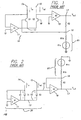
- Fig. 1 is a schematic diagram of the assignee's above mentioned hybrid integrated circuit LOG100 logarithmic amplifier.
- the logarithmic amplifier 1A includes a first operational amplifier 11 (also referred to as operational amplifier A1) having its (-) input connected to an external input terminal 14 into which an input current I in is provided by the user.
- the (+) input of operational amplifier 11 is connected to ground.
- the output of operational amplifier 11 is connected by conductor 13 to the emitter of an NPN transistor Q1, the collector of which is connected to input terminal 14.
- the emitter of transistor Q1 is also connected by conductor 13 to the emitter of a matched NPN transistor Q2 having its base connected to ground and its collector connected to both an external reference current terminal 15 into which a reference current I ref is supplied by the user, and to the (-) input of a second operational amplifier 19 (also referred to as operational amplifier A2) having its (+) input connected to ground.
- the output of operational amplifier 19 is connected to an external output conductor 17 on which an output voltage V out representative of the log ratio of I in /I ref is produced.
- the base of transistor Q1 is connected to an external terminal 16.
- V out is connected to one terminal of a thin film resistor R2, the other terminal of which is connected to conductor 16.
- a "composite" temperature-dependent resistor R1 having a large positive temperature coefficient (TC) is coupled between conductor 16 and ground.
- Resistor R1 includes a 270 ohm thin film resistor R1b connected between conductor 16 and one terminal of a 220 ohm thermistor R1a, the other terminal of which is connected to ground.
- Composite resistor R2 may be a selectable parallel combination of thin film resistors each of which has one terminal connected to terminal 16 and another terminal connected to enable the user to set the resistance of R2.
- Logarithmic amplifier 1A of Fig. 1 is implemented as a hybrid integrated circuit.
- the thermistor R1a is formed on a discrete chip that is bonded onto the hybrid integrated circuit. Because of its large size, the logarithmic amplifier 1 of prior art Fig. 1 must be packaged in a larger package.
- Fig. 2 shows a schematic diagram of another prior art logarithmic amplifier 1B similar to that of Fig. 1 except that transistors Q1 and Q2 have been replaced by (or are represented by) diodes D1 and D2, respectively.
- a thermistor which could, as a practical matter, have been provided on the same chip along with the amplifier circuitry and thin film resistors, was not available. It would have been considered impractical, in view of the benefit, to add the semiconductor processing steps that would have been needed to include a thermistor in a single-chip implementation of the LOG100.
- Patent 4,990,803 also discloses that the high temperature coefficient resistor can be a 30 ohm resistor fabricated from aluminum interconnection metallization provided during chip fabrication.
- An input attenuator is suitable for voltage inputs, but would shunt low level current inputs.
- the present invention provides apparatus as set forth in the claims.
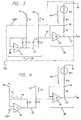
- Fig. 3 is a schematic diagram of a monolithic integrated circuit logarithmic amplifier 120 of the present invention.
- Logarithmic amplifier 120 is similar to logarithmic amplifier 1B of prior art Fig. 2 .
- all of the circuitry is included on a single monolithic chip 120A.
- Thermistor R1 of Fig. 2 . is replaced by a positive TC resistor R1 which includes a large serpentine aluminum interconnection metallization resistor R1a composed of the same kind of aluminum or aluminum alloy interconnection metallization which is used to fabricate the metal interconnections throughout the chip. (Subsequently described Fig.
- Positive TC resistor R1 also includes a conventional thin-film resistor R1b.
- resistor R2 is a thin film resistor, typically composed of nichrome (NiCr) or sichrome (SiCr), which is essentially temperature-independent.
- aluminum interconnection metallization resistor R1a has a resistance of approximately 200 ohms, which is very large compared to the resistance of any known aluminum interconnection metallization resistor, and is formed by a large serpentine arrangement of aluminum metallization approximately 0.35 mils wide and approximately 10,000 Angstrom units thick.
- the thin film resistors described herein can be composed of nichrome.
- An exemplary value of resistor R1b is 30 ohms, and a typical value of resistor R2 is 3375 ohms.
- the aluminum interconnection metallization resistor R1a occupies approximately 10 percent of the area of the integrated circuit chip on which the logarithmic amplifier is formed.
- a typical value of I in is in range of 1 nanoampere to 1 milliampere.
- a typical value of I ref also is in the range of 1 nanoampere to 1 milliampere.
- a semiconductor PN junction such as a silicon PN junction
- the base-emitter voltage of a forward-biased PN junction is a fairly accurate logarithmic function of current across the junction.
- the output voltage V3 is approximately proportional to the absolute temperature (degrees Kelvin), and has a temperature coefficient (TC) of approximately 1/298 degrees Centigrade or about 3000 ppm/degree Centigrade at room temperature.
- the first-order correction for the drift of V3 can be provided by arranging for the gain of the amplifier (A2, R1, R2) to have a compensating TC of approximately -3000 ppm per degree Centigrade at 298 degrees Centigrade.
- Composite resistor R1 can be composed of the above mentioned aluminum metallization resistor R1a and thin film resistor R1b connected in series, one resistor (e.g., R1b) having lower the lower or zero TC and the other resistor (e.g., R1a) having a TC that is substantially higher than the positive TC (3000 ppm per degree Centigrade) needed for composite resistor R1.
- R1a and R1b By selecting the ratio of resistors R1a and R1b appropriately, a series combination with the needed TC of approximately + 3000 ppm per degree Centigrade can be created. See page 58 of the above referenced Wong and Ott article.
- the physically large, positive TC resistor R1a with a resistance of roughly 200 ohms, is provided by using the same standard aluminum interconnection metallization material that is also used in the semiconductor process to provide interconnection metallization throughout the chip.
- the aluminum metallization used by the assignee has a positive TC of approximately 4000 ppm/degree Centigrade, which is suitable for this application, as will be shown by the following example. (However, other levels of interconnect metallization commonly used in other integrated circuit manufacturing processes can be used, provided such metallization has the needed temperature coefficient.)
- Fig. 4 shows a logarithmic amplifier 121 which is a variation of the circuit of Fig. 3 , modified to receive the voltage input signal V in on an external input conductor 18.
- An input resistor R in is connected between input conductor 18 and an internal conductor 14.
- logarithmic amplifier 121 of Fig. 4 is essentially identical to logarithmic amplifier 120 of Fig. 3 .
- the logarithmic amplifier 120 of Fig. 3 is configured with non-inverting amplifier circuitry A2,R1,R2 so as to provide gain and temperature compensation.
- various other logarithmic amplifier circuit configurations also can provide gain and temperature compensation in accordance with the present invention.
- the logarithmic amplifier 122 shown in Fig. 5 is configured with an operational amplifier 19 in an inverting gain stage 36A so as to provide both gain and temperature compensation by using resistor R1 as the temperature-dependent resistor.
- Resistor R1 in Fig. 5 can be a single temperature-dependent resistor as shown, or it can be a composite of an aluminum resistor R1a and a thin film resistor R1b as shown in Figs. 1-4 .
- a buffer amplifier 21 is coupled between conductor 15 and one terminal of temperature-dependent resistor R1.
- the (+) input of buffer amplifier 21 is connected to reference input conductor 15.
- the output of buffer amplifier 21 is connected to its (-) input as well as to one terminal of temperature-dependent resistor R1, the other terminal of which is connected by conductor 16 to the (-) input of operational amplifier 19 and to one terminal of feedback resistor R2.
- the (+) input of operational amplifier 19 is connected to ground.
- the output of operational amplifier 19 is connected by conductor 17 to the other terminal of feedback resistor R2.
- Fig. 6 shows another logarithmic amplifier 123 that could be formed on a single monolithic chip.
- Logarithmic amplifier 123 of Fig. 6 is similar to logarithmic amplifier 122 of Fig. 5 , but is modified to include a second cascaded gain stage 38 including amplifier 25, a feedback resistor R2, and a temperature-dependent resistor R1 connected by conductor 16B, which is connected to the (-) input of amplifier 25.
- Second cascaded gain stage 38 can be similar or identical to gain stage 36A, and has its input connected to conductor 22 and its output connected by conductor 26 to the input of gain stage 36A.
- the gain stages 36A and 38 are the same, and the R1 resistors are the temperature-dependent elements.
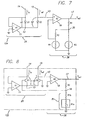
- Fig. 7 shows a logarithmic amplifier 124 including a log amplifier cell 26, the log amplifier cell 26 driving an output stage 36 with a non-inverting amplifier 19 having compound feedback.
- the (+) input of amplifier 19 is connected to conductor 15.
- the output of amplifier 19 is connected by output conductor 17 to one terminal of a resistor R4, the other terminal of which is connected by conductive 30 to 1 terminal of a resistor R2 and to one terminal of a temperature-dependent resistor R3.
- the other terminal of temperature-dependent resistor R3 is connected to ground.
- the other terminal of resistor R2 is connected to the (-) input of amplifier 19 and to one terminal of another temperature-dependent resistor R1, the other terminal of which is connected to ground.
- resistor R1 could be implemented by a P-type diffused resistor (with a temperature coefficient of approximately + 1200 ppm/degrees Centigrade) formed at the same time that the P-type base regions are formed during fabrication of the chip.
- the structure shown in Fig. 7 permits the output voltage on conductor 17 to be divided down by two or more successive voltage dividers, as shown, to a very low feedback voltage on the (-) input of amplifier 19 by using low-value temperature-dependent resistors R1 and R3 and relatively large value resistors R2 and R4 as shown to form the successive voltage dividers.
- the successive voltage divider structure shown increases the effect of the positive temperature coefficients of resistors R1 and R3, and thereby provides the desired temperature compensation of the logarithmic amplifier 124, using temperature-dependent resistors R2 and R4 having temperature coefficients which are substantially lower than the temperature coefficient of aluminum interconnection metallization material.
- resistors R1 and R3 could be temperature-dependent resistors with positive temperature coefficients, and the gain depends on the resistor ratios.
- Resistor R1 in Fig. 7 can be a single temperature-dependent resistor as shown, or it can be a composite of an aluminum resistor R1a and a thin film resistor R1b as shown in Figs. 1-4 .
- Fig. 8 shows a presently preferred embodiment of a monolithic logarithmic amplifier 125 wherein both the current input conductor 14 and the reference current conductor 15 are held at virtual ground by operational amplifiers 11 and 19, respectively.
- the difference between the logarithmic amplifier of Fig. 8 and the logarithmic amplifier of prior art Fig. 1 is that the prior art logarithmic amplifier is a hybrid integrated circuit device including a discrete thermistor on a separate chip utilized as the temperature-dependent element R1a, whereas the entire logarithmic amplifier 125 of Fig.
- Fig. 8 is provided on a single integrated circuit chip, with its temperature-dependent element R1a composed of a serpentine configuration of the ordinary aluminum interconnect metallization material that also is used throughout the chip for interconnection purposes, the large resistance of R1a notwithstanding.
- the dashed line designates the integrated circuit chip on which the entire logarithmic amplifier is provided, and the symbol for resistor R1a represents a different integrated temperature-dependent than a discrete thermistor R1a shown in prior art Fig. 1 .
- composite temperature-dependent resistor R1 which includes the serpentine aluminum metallization resistor R1a and thin film resistor R1b, is the temperature-dependent resistor.
- the (-) input of operational amplifier 11 is connected to input conductor 14.
- the (+) of operational amplifier 11 is connected to ground.
- the output of operational amplifier 11 is connected by conductor 13 to the emitters of a pair of matched NPN transistors Q1 and Q2.
- the base of transistor Q2 is connected to ground.
- the second operational amplifier 19 has its (+) input connected to ground and its (-) input connected to the reference input conductor 15.
- the output of operational amplifier 19 is connected by output conductor 17 to one terminal of thin film resistor R2.
- resistor R2 The other terminal of resistor R2 is connected by conductor 16 to the base of transistor Q1 and to one terminal of composite resistor R1, the other terminal of which is connected to ground.
- V out k * Ln I in / I ref , where k is a scale factor.
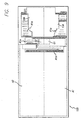
- Fig. 9 is a plan view of logarithmic amplifier 125 of Fig. 8 , implemented on a single integrated circuit chip.
- the locations of most of the circuitry of operational amplifiers 11 and 19 are indicated by reference characters A1 and A2, respectively.
- Areas 11A and 19A designate the locations of a pair of auxiliary amplifiers that can be used if desired.
- the locations of transistors Q1 and Q2 are indicated.
- the serpentine aluminum metallization resistor R1a is located in the available areas of the chip designated by the characters R1a in Fig. 9 .
- the serpentine aluminum metallization resistor R1a occupies roughly 10 percent of the area of the integrated circuit chip. However, aluminum metallization resistor R1a does not need to be configured in the same serpentine fashion illustrated in Fig.
- the same length of metallization material could be laid out as a loop or spiral configuration or the like either within or “looped around" a peripheral portion of the integrated circuit chip.
- the term “serpentine” as used herein is intended to encompass both a generally “spiraled” configuration of the metallization material and a “non-spiraled” configuration as illustrated in Fig. 9 .
- the invention provides a versatile integrated circuit logarithmic and log ratio amplifier that produces the logarithm, log ratio or anti-log of an input current or input voltage relative to a reference current or reference voltage with high precision over a wide dynamic range of input signals.
- the drift of the kT/q term of the transistors Q1 and Q2 or diodes D1 and D2 is canceled, i.e. compensated, by the use of one or more relatively large-value resistors composed only of the standard aluminum or aluminum alloy metallization utilized as the integrated circuit interconnection metallization during processing of the integrated circuit wafers.
- the described small, low-cost temperature-compensated logarithmic amplifier is especially useful for measurement of light intensities in fiber-optic devices.
- the temperature-dependent resistor element could be composed of other interconnection metal or alloy metal material than the aluminum metallization and aluminum alloy metallization described above.
- the temperature-dependent resistor element also could be composed of doped silicon or doped polycrystalline silicon material.
- the PN junctions can be PN junctions of silicon transistors, and the diodes D1 and D2 can be diode-connected transistors.
- the semiconductor junctions can be provided as a different combination of silicon diodes and silicon transistors.
- the semiconductor junctions can be provided as a transistor Q1 and a diode D2 as indicated by the dotted line structure of Q1 shown in Fig. 5 .
- the disclosed logarithmic amplifier circuits can be easily modified so that the input current I in flows out of rather than into input terminal 14, and the reference current I ref flows out of rather than into reference terminal 15.
- the high temperature coefficient interconnection material does not necessarily have to be metallization material.
- the high temperature coefficient interconnection material can be doped silicon interconnection material (such as P-type doped silicon material or N-type doped silicon material) or doped polycrystalline silicon interconnection material that is provided on the chip during fabrication thereof.
Landscapes
- Physics & Mathematics (AREA)
- Engineering & Computer Science (AREA)
- Mathematical Physics (AREA)
- Theoretical Computer Science (AREA)
- Software Systems (AREA)
- Computer Hardware Design (AREA)
- General Physics & Mathematics (AREA)
- Amplifiers (AREA)
Claims (7)
- Temperaturkompensierte logarithmische Verstärkerschaltung, mit:(a) einer logarithmischen Verstärkerzelle (26), die so konfiguriert ist, dass sie ein logarithmisches Spannungssignal (V3) erzeugt, das für eine Differenz kennzeichnend ist zwischen einer ersten Spannung (V1), die über ein erstes PN-Übergangs-Bauteil (D1) in Antwort auf ein Eingangssignal (lin) ausgebildet ist, und einer zweiten Spannung (V2), die über ein zweites PN-Übergangs-Bauteil (D2) in Antwort auf ein Referenzsignal (Iref) ausgebildet ist; und(b) einer Ausgangs-Schaltung (36), die einen Ausgangs-Verstärker (19) enthält, ein temperaturabhängiges erstes Widerstandselement (R1), das einen positiven ersten Temperaturkoeffizienten hat, und ein zweites Widerstandselement (R2), das einen zweiten Temperaturkoeffizienten hat, der von wesentlich geringerer Größe ist als der erste Temperaturkoeffizient, wobei das erste und das zweite Widerstandselement als Spannungsteiler zwischen einem Ausgang des Ausgangs-Verstärkers und einem Referenzleiter gekoppelt sind, um ein Rückkopplungssignal zu einem Eingang des Ausgangsverstärkers bereitzustellen, wobei die Ausgangsschaltung so konfiguriert ist, dass sie in Antwort auf das logarithmische Spannungssignal ein temperaturkompensiertes Ausgangssignal (Vout) erzeugt,- wobei das logarithmische Spannungssignal (V3) an den Eingang des Ausgangs-Verstärkers (19) angelegt ist;dadurch gekennzeichnet, dass:- der temperaturkompensierte logarithmische Verstärker eine monolithische Schaltung ist;- das erste Widerstandselement (R1) Verdrahtungs-Metallisierungsmaterial enthält, das auf der monolithischen logarithmischen Verstärkerschaltung gleichzeitig mit der Bildung von Verdrahtungs-Metallisierungen an anderer Stelle auf der monolithischen logarithmischen Verstärkerschaltung gebildet ist,- das Verdrahtungs-Metallisierungsmaterial des ersten Widerstandselements als eine lange Struktur mit einem ausreichend hohen Widerstand für eine Temperaturkompensation des logarithmischen Spannungssignal konfiguriert ist.
- Temperaturkompensierte logarithmische Verstärkerschaltung nach Anspruch 1, wobei das erste Widerstandselement wenigstens teilweise als eine gewundene Struktur konfiguriert ist.
- Temperaturkompensierte logarithmische Verstärkerschaltung nach Anspruch 1 oder 2, wobei das leitfähige Material Aluminium-Verdrahtungs-Metallisierungsmaterial ist.
- Temperaturkompensierte logarithmische Verstärkerschaltung nach Anspruch 1 oder Anspruch 2, wobei das leitfähige Material Aluminiumlegierungs-Verdrahtungs-Metallisierungsmaterial ist.
- Temperaturkompensierte logarithmische Verstärkerschaltung nach Anspruch 4, wobei ein Temperaturkoeffizient des Aluminiumlegierungs-Verdrahtungs-Metallisierungsmaterials ungefähr + 4000 ppm pro Grad Celsius beträgt.
- Temperaturkompensierte logarithmische Verstärkerschaltung nach einem der vorhergehenden Ansprüche, wobei ein Widerstand des ersten Widerstandselements größer als ungefähr 100 Ohm ist.
- Temperaturkompensierte logarithmische Verstärkerschaltung nach einem der vorhergehenden Ansprüche, wobei das zweite Widerstandselement aus Dünnschicht-Widerstandsmaterial besteht.
Applications Claiming Priority (2)
| Application Number | Priority Date | Filing Date | Title |
|---|---|---|---|
| US920220 | 1992-07-24 | ||
| US09/920,220 US6507233B1 (en) | 2001-08-02 | 2001-08-02 | Method and circuit for compensating VT induced drift in monolithic logarithmic amplifier |
Publications (3)
| Publication Number | Publication Date |
|---|---|
| EP1282064A2 EP1282064A2 (de) | 2003-02-05 |
| EP1282064A3 EP1282064A3 (de) | 2004-12-01 |
| EP1282064B1 true EP1282064B1 (de) | 2009-12-23 |
Family
ID=25443372
Family Applications (1)
| Application Number | Title | Priority Date | Filing Date |
|---|---|---|---|
| EP02102091A Expired - Lifetime EP1282064B1 (de) | 2001-08-02 | 2002-08-02 | Verfahren und Schaltung zur Kompensation der durch die thermische Spannung induzierten Drift in einem monolithischen logarithmischen Verstärker |
Country Status (4)
| Country | Link |
|---|---|
| US (1) | US6507233B1 (de) |
| EP (1) | EP1282064B1 (de) |
| JP (1) | JP2003078357A (de) |
| DE (1) | DE60234797D1 (de) |
Families Citing this family (8)
| Publication number | Priority date | Publication date | Assignee | Title |
|---|---|---|---|---|
| KR100393226B1 (ko) * | 2001-07-04 | 2003-07-31 | 삼성전자주식회사 | 온도변화에 따라 내부 기준전압 값을 조절할 수 있는 내부기준전압 생성회로 및 이를 구비하는 내부 공급전압생성회로 |
| US6759892B2 (en) * | 2002-03-25 | 2004-07-06 | Texas Instruments Incorporated | Temperature compensation trim method |
| US20080063027A1 (en) * | 2006-03-15 | 2008-03-13 | Giovanni Galli | Precision temperature sensor |
| US20090285261A1 (en) * | 2008-05-17 | 2009-11-19 | Lsi Corporation | Integrated Circuit System Monitor |
| WO2010038712A1 (en) * | 2008-09-30 | 2010-04-08 | Semiconductor Energy Laboratory Co., Ltd. | Semiconductor device |
| US8676521B2 (en) * | 2009-10-26 | 2014-03-18 | Fluke Corporation | System and method for handling wide dynamic range signals encountered in vibration analysis using a logarithmic amplifier |
| US8004341B1 (en) * | 2010-04-30 | 2011-08-23 | Analog Devices, Inc. | Logarithmic circuits |
| US11385267B2 (en) * | 2019-02-14 | 2022-07-12 | Psemi Corporation | Power detector with wide dynamic range |
Family Cites Families (6)
| Publication number | Priority date | Publication date | Assignee | Title |
|---|---|---|---|---|
| US4990803A (en) | 1989-03-27 | 1991-02-05 | Analog Devices, Inc. | Logarithmic amplifier |
| US5471132A (en) * | 1991-09-30 | 1995-11-28 | Sgs-Thomson Microelectronics, Inc. | Logarithmic and exponential converter circuits |
| US5481218A (en) * | 1994-09-30 | 1996-01-02 | Telefonaktiebolaget Lm Ericsson | Logarithmic converter |
| US5805011A (en) * | 1997-01-03 | 1998-09-08 | Lucent Technologies Inc. | Self-calibration system for logarithmic amplifiers |
| US5877645A (en) * | 1997-08-08 | 1999-03-02 | Lucent Technologies Inc. | Offset compensation circuit for integrated logarithmic amplifiers |
| US6229375B1 (en) * | 1999-08-18 | 2001-05-08 | Texas Instruments Incorporated | Programmable low noise CMOS differentially voltage controlled logarithmic attenuator and method |
-
2001
- 2001-08-02 US US09/920,220 patent/US6507233B1/en not_active Expired - Lifetime
-
2002
- 2002-08-02 DE DE60234797T patent/DE60234797D1/de not_active Expired - Lifetime
- 2002-08-02 EP EP02102091A patent/EP1282064B1/de not_active Expired - Lifetime
- 2002-08-02 JP JP2002225816A patent/JP2003078357A/ja active Pending
Also Published As
| Publication number | Publication date |
|---|---|
| EP1282064A2 (de) | 2003-02-05 |
| DE60234797D1 (de) | 2010-02-04 |
| EP1282064A3 (de) | 2004-12-01 |
| JP2003078357A (ja) | 2003-03-14 |
| US6507233B1 (en) | 2003-01-14 |
Similar Documents
| Publication | Publication Date | Title |
|---|---|---|
| US5774013A (en) | Dual source for constant and PTAT current | |
| US6828847B1 (en) | Bandgap voltage reference circuit and method for producing a temperature curvature corrected voltage reference | |
| US5900772A (en) | Bandgap reference circuit and method | |
| EP0429198B1 (de) | Bandgapreferenzspannungsschaltung | |
| US6225850B1 (en) | Series resistance compensation in translinear circuits | |
| US6351111B1 (en) | Circuits and methods for providing a current reference with a controlled temperature coefficient using a series composite resistor | |
| US6426669B1 (en) | Low voltage bandgap reference circuit | |
| US4329639A (en) | Low voltage current mirror | |
| JPS6269306A (ja) | 温度補償cmos電圧基準回路 | |
| US6759893B2 (en) | Temperature-compensated current source | |
| EP1282064B1 (de) | Verfahren und Schaltung zur Kompensation der durch die thermische Spannung induzierten Drift in einem monolithischen logarithmischen Verstärker | |
| US4315209A (en) | Temperature compensated voltage reference circuit | |
| US5051686A (en) | Bandgap voltage reference | |
| US4618833A (en) | Operational amplifier offset trim that does not change the offset potential temperature drift | |
| JPH07113864B2 (ja) | 電流源装置 | |
| US6310510B1 (en) | Electronic circuit for producing a reference current independent of temperature and supply voltage | |
| US4336494A (en) | Insulation resistance tester | |
| US6605987B2 (en) | Circuit for generating a reference voltage based on two partial currents with opposite temperature dependence | |
| US4675592A (en) | Voltage output circuit | |
| EP0024140B1 (de) | Umwandler für den quadratischen Mittelwert | |
| US3461380A (en) | Thermocouple reference junction compensating circuits | |
| EP0618658B1 (de) | Thermischer Schutzschaltung | |
| EP0539136B1 (de) | Spannungsgeneratoreinrichtung | |
| JP3173015B2 (ja) | Ic内の電子回路 | |
| US6566721B2 (en) | Semiconductor device |
Legal Events
| Date | Code | Title | Description |
|---|---|---|---|
| PUAI | Public reference made under article 153(3) epc to a published international application that has entered the european phase |
Free format text: ORIGINAL CODE: 0009012 |
|
| AK | Designated contracting states |
Designated state(s): AT BE BG CH CY CZ DE DK EE ES FI FR GB GR IE IT LI LU MC NL PT SE SK TR |
|
| AX | Request for extension of the european patent |
Extension state: AL LT LV MK RO SI |
|
| PUAL | Search report despatched |
Free format text: ORIGINAL CODE: 0009013 |
|
| AK | Designated contracting states |
Kind code of ref document: A3 Designated state(s): AT BE BG CH CY CZ DE DK EE ES FI FR GB GR IE IT LI LU MC NL PT SE SK TR |
|
| AX | Request for extension of the european patent |
Extension state: AL LT LV MK RO SI |
|
| RIC1 | Information provided on ipc code assigned before grant |
Ipc: 7G 06G 7/24 A Ipc: 7H 03F 1/30 B |
|
| 17P | Request for examination filed |
Effective date: 20050601 |
|
| AKX | Designation fees paid |
Designated state(s): DE FR GB |
|
| GRAP | Despatch of communication of intention to grant a patent |
Free format text: ORIGINAL CODE: EPIDOSNIGR1 |
|
| GRAS | Grant fee paid |
Free format text: ORIGINAL CODE: EPIDOSNIGR3 |
|
| GRAA | (expected) grant |
Free format text: ORIGINAL CODE: 0009210 |
|
| AK | Designated contracting states |
Kind code of ref document: B1 Designated state(s): DE FR GB |
|
| REG | Reference to a national code |
Ref country code: GB Ref legal event code: FG4D |
|
| REF | Corresponds to: |
Ref document number: 60234797 Country of ref document: DE Date of ref document: 20100204 Kind code of ref document: P |
|
| PLBE | No opposition filed within time limit |
Free format text: ORIGINAL CODE: 0009261 |
|
| STAA | Information on the status of an ep patent application or granted ep patent |
Free format text: STATUS: NO OPPOSITION FILED WITHIN TIME LIMIT |
|
| 26N | No opposition filed |
Effective date: 20100924 |
|
| REG | Reference to a national code |
Ref country code: FR Ref legal event code: PLFP Year of fee payment: 15 |
|
| REG | Reference to a national code |
Ref country code: FR Ref legal event code: PLFP Year of fee payment: 16 |
|
| PGFP | Annual fee paid to national office [announced via postgrant information from national office to epo] |
Ref country code: GB Payment date: 20170725 Year of fee payment: 16 Ref country code: FR Payment date: 20170720 Year of fee payment: 16 Ref country code: DE Payment date: 20170825 Year of fee payment: 16 |
|
| REG | Reference to a national code |
Ref country code: DE Ref legal event code: R119 Ref document number: 60234797 Country of ref document: DE |
|
| GBPC | Gb: european patent ceased through non-payment of renewal fee |
Effective date: 20180802 |
|
| PG25 | Lapsed in a contracting state [announced via postgrant information from national office to epo] |
Ref country code: DE Free format text: LAPSE BECAUSE OF NON-PAYMENT OF DUE FEES Effective date: 20190301 |
|
| PG25 | Lapsed in a contracting state [announced via postgrant information from national office to epo] |
Ref country code: FR Free format text: LAPSE BECAUSE OF NON-PAYMENT OF DUE FEES Effective date: 20180831 |
|
| PG25 | Lapsed in a contracting state [announced via postgrant information from national office to epo] |
Ref country code: GB Free format text: LAPSE BECAUSE OF NON-PAYMENT OF DUE FEES Effective date: 20180802 |