EP1282237A2 - Produktkodes- Dekodierungsverfahren und Dekodierungsapparat - Google Patents
Produktkodes- Dekodierungsverfahren und Dekodierungsapparat Download PDFInfo
- Publication number
- EP1282237A2 EP1282237A2 EP02016641A EP02016641A EP1282237A2 EP 1282237 A2 EP1282237 A2 EP 1282237A2 EP 02016641 A EP02016641 A EP 02016641A EP 02016641 A EP02016641 A EP 02016641A EP 1282237 A2 EP1282237 A2 EP 1282237A2
- Authority
- EP
- European Patent Office
- Prior art keywords
- value
- soft
- code
- decoding
- soft output
- Prior art date
- Legal status (The legal status is an assumption and is not a legal conclusion. Google has not performed a legal analysis and makes no representation as to the accuracy of the status listed.)
- Withdrawn
Links
Images




Classifications
-
- H—ELECTRICITY
- H03—ELECTRONIC CIRCUITRY
- H03M—CODING; DECODING; CODE CONVERSION IN GENERAL
- H03M13/00—Coding, decoding or code conversion, for error detection or error correction; Coding theory basic assumptions; Coding bounds; Error probability evaluation methods; Channel models; Simulation or testing of codes
- H03M13/29—Coding, decoding or code conversion, for error detection or error correction; Coding theory basic assumptions; Coding bounds; Error probability evaluation methods; Channel models; Simulation or testing of codes combining two or more codes or code structures, e.g. product codes, generalised product codes, concatenated codes, inner and outer codes
- H03M13/2906—Coding, decoding or code conversion, for error detection or error correction; Coding theory basic assumptions; Coding bounds; Error probability evaluation methods; Channel models; Simulation or testing of codes combining two or more codes or code structures, e.g. product codes, generalised product codes, concatenated codes, inner and outer codes using block codes
- H03M13/2909—Product codes
-
- H—ELECTRICITY
- H03—ELECTRONIC CIRCUITRY
- H03M—CODING; DECODING; CODE CONVERSION IN GENERAL
- H03M13/00—Coding, decoding or code conversion, for error detection or error correction; Coding theory basic assumptions; Coding bounds; Error probability evaluation methods; Channel models; Simulation or testing of codes
- H03M13/29—Coding, decoding or code conversion, for error detection or error correction; Coding theory basic assumptions; Coding bounds; Error probability evaluation methods; Channel models; Simulation or testing of codes combining two or more codes or code structures, e.g. product codes, generalised product codes, concatenated codes, inner and outer codes
- H03M13/2957—Turbo codes and decoding
- H03M13/296—Particular turbo code structure
- H03M13/2963—Turbo-block codes, i.e. turbo codes based on block codes, e.g. turbo decoding of product codes
-
- H—ELECTRICITY
- H03—ELECTRONIC CIRCUITRY
- H03M—CODING; DECODING; CODE CONVERSION IN GENERAL
- H03M13/00—Coding, decoding or code conversion, for error detection or error correction; Coding theory basic assumptions; Coding bounds; Error probability evaluation methods; Channel models; Simulation or testing of codes
- H03M13/37—Decoding methods or techniques, not specific to the particular type of coding provided for in groups H03M13/03 - H03M13/35
- H03M13/45—Soft decoding, i.e. using symbol reliability information
- H03M13/451—Soft decoding, i.e. using symbol reliability information using a set of candidate code words, e.g. ordered statistics decoding [OSD]
- H03M13/453—Soft decoding, i.e. using symbol reliability information using a set of candidate code words, e.g. ordered statistics decoding [OSD] wherein the candidate code words are obtained by an algebraic decoder, e.g. Chase decoding
-
- H—ELECTRICITY
- H03—ELECTRONIC CIRCUITRY
- H03M—CODING; DECODING; CODE CONVERSION IN GENERAL
- H03M13/00—Coding, decoding or code conversion, for error detection or error correction; Coding theory basic assumptions; Coding bounds; Error probability evaluation methods; Channel models; Simulation or testing of codes
- H03M13/65—Purpose and implementation aspects
- H03M13/6577—Representation or format of variables, register sizes or word-lengths and quantization
- H03M13/658—Scaling by multiplication or division
-
- H—ELECTRICITY
- H03—ELECTRONIC CIRCUITRY
- H03M—CODING; DECODING; CODE CONVERSION IN GENERAL
- H03M13/00—Coding, decoding or code conversion, for error detection or error correction; Coding theory basic assumptions; Coding bounds; Error probability evaluation methods; Channel models; Simulation or testing of codes
- H03M13/03—Error detection or forward error correction by redundancy in data representation, i.e. code words containing more digits than the source words
- H03M13/05—Error detection or forward error correction by redundancy in data representation, i.e. code words containing more digits than the source words using block codes, i.e. a predetermined number of check bits joined to a predetermined number of information bits
- H03M13/13—Linear codes
- H03M13/15—Cyclic codes, i.e. cyclic shifts of codewords produce other codewords, e.g. codes defined by a generator polynomial, Bose-Chaudhuri-Hocquenghem [BCH] codes
- H03M13/151—Cyclic codes, i.e. cyclic shifts of codewords produce other codewords, e.g. codes defined by a generator polynomial, Bose-Chaudhuri-Hocquenghem [BCH] codes using error location or error correction polynomials
- H03M13/1515—Reed-Solomon codes
Definitions
- the present invention relates to a decoding method and decoding apparatus of a product code for improving the reliability of a digital communication system or digital recording system.
- Fig. 1 is a diagram showing a construction of a product code. In Fig.
- a code in the vertical direction is a binary linear code C1 with a code length N1 and information length K1
- a code in the horizontal direction is a binary linear code C2 with a code length N2 and information length K2.
- the block 1 designates information data, and blocks 2-4 each designate a check (redundant check).
- K1 ⁇ K2 bit-information data are stored in the two-dimensional array (block 1) with K1 rows and K2 columns.
- N2-K2 the number of bits from the first to N1th row are provided with (N2-K2)-bit checks of the C2 code to construct a two-dimensional array with N1-rows and N2-columns (construction of the blocks 3 and 4).
- Fig. 2 is a block diagram showing a configuration of a digital communication system utilizing a product code, which is disclosed in Japanese patent application laid-open No. 7-202722.
- the reference numeral 201 designates an encoder for encoding input information data
- 202 designates a modulator for converting a product code generated by the encoder 201 into a signal suitable for a communication channel
- 203 designates the communication channel
- 204 designates a demodulator for demodulating a received signal sent via the communication channel and for converting it to demodulated data
- 205 designates a decoder for decoding the demodulated data demodulated by the demodulator to estimate the information data.
- the encoder 201 and modulator 202 constitute a transmitter
- the demodulator 204 and the decoder 205 constitute a receiver.
- the input K1 ⁇ K2-bit information data are supplied to the encoder 201 for generating the product code with N1 rows and N2 columns.
- the product code generated is represented by a matrix C of following Expression 2. Although the elements of the product code C is represented by the binary 0 or 1, the binary 0 is represented as "+1", and the binary 1 is represented by "-1" in the following.
- the product code generated by the encoder 201 is supplied to the modulator 202 to be converted into the signal suitable for the communication channel 203, and is transmitted through the communication channel. It is assumed about the communication channel 203 that additive noise is superimposed on a transmission signal.
- the signal received through the communication channel 203 is supplied to the demodulator 204 of the receiver.
- the demodulated data Y generated by the demodulator 204 is supplied to the decoder 205 for estimating the transmitted information data.
- the demodulated data Y is denoted by ⁇ Y ⁇ , and is referred to as an input matrix.
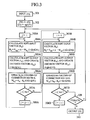
- Fig. 3 is a flowchart illustrating the operation of the decoder 205.
- 301 is a step of inputting the input matrix ⁇ Y ⁇
- 302 is a step of setting initial values into a correction matrix ⁇ W ⁇ and a decision matrix ⁇ D ⁇
- 303A is a step of setting an initial value into a counter j
- 306A is a step of updating the correction matrix ⁇ W ⁇
- 307A is a step of comparing the value of the counter j
- 308A is a step of incrementing the value of the counter j.
- 303B is a step of setting an initial value into a counter i;
- 306B is a step of updating the correction matrix ⁇ W ⁇ ;
- 307B is a step of comparing the value of the counter i;
- 308B is a step of incrementing the value of the counter i;
- 309 is a step of making a decision as to whether to iterate the decoding of the product code;
- 310 is a step of outputting the decision matrix ⁇ D ⁇ .
- step 301 the N1 ⁇ N2 input matrix ⁇ Y ⁇ given by the foregoing expression (3) is input.
- the initial value zero is stored into all the elements of the N1 ⁇ N2 correction matrix ⁇ W ⁇ given by the following expression (4).
- initial values sgn ⁇ Y ⁇ are stored into all the elements of the N1 ⁇ N2 decision matrix ⁇ D ⁇ . Specifically, the (i,j) elements D i,j of the decision matrix ⁇ D ⁇ is replaced by the code sgn(Y i,j ) of the (i,j) elements Y i,j of the input matrix ⁇ Y ⁇ , where sgn is a function defined by the following expression (5).
- step 303A the initial value one is set into the counter j.
- step 304A decoding of the C1 code is started.
- step 304A jth column of the input matrix ⁇ Y ⁇ and the jth column of the correction matrix ⁇ W ⁇ are added element by element.
- R k ⁇ Y k,j + ⁇ W k,j (k 1, 2, ⁇ , N1) where ⁇ is an appropriate normalizing constant.
- step 306A the differences obtained by subtracting the soft input vector from the soft output vector calculated at step 305A are stored in the jth column of the correction matrix ⁇ W ⁇ according to the following expression (7) .
- step 307A a decision is made as to whether the value of the counter j is less than N2. If it is less than N2, the value of the counter j is incremented at step 308A, followed by iterating the processing at step 304A and on. On the other hand, if the value of the counter j is N2, the processing proceeds to step 303B, at which the decoding of the C2 code is started. Up to this time, the update of all the elements of the correction matrix ⁇ W ⁇ has been completed.
- the initial value one is set into the counter i.
- the differences obtained by subtracting the soft input vector from the soft output vector calculated at step 305B are stored in the ith rows of the correction matrix ⁇ W ⁇ according to the following expression (9).
- W i,k ⁇ L k - R k (k 1, 2, ⁇ , N2)
- step 307B a decision is made as to whether the value of the counter i is less than N1. If it is less than N1, the value of the counter i is incremented at step 308B, followed by iterating the processing at step 304B and on. On the other hand, if the value of the counter i is N1, the processing proceeds to step 309. Up to this time, the decoding of the C1 code and C2 code constituting the product codes has been completed once.
- step 309 a decision is made as to whether the decoding of the C1 code is iterated or not. Usually, the decoding is completed when the iterated decoding has been carried out by a predetermined number of times.
- step 303A To iterate the decoding of the C1 code, the processing proceeds to step 303A to restart the decoding of the C1 code. On the other hand, to stop the decoding, the processing proceeds to step 310, at which the decision matrix ⁇ D ⁇ is output. Thus, the decoding processing is completed.
- the elements of the decision matrix ⁇ D ⁇ take a value " ⁇ 1”, the value "+1” corresponds to a binary zero, and "-1" corresponds to a binary one.
- Fig. 4 is a flowchart illustrating the details of step 305A. Referring to Fig. 4, the operation will be described. At step 401, the soft input vector [R k ] and the decision vector [D k ] are input.
- p elements with least absolute values are selected from the soft input vector [R] .
- the positions of the p elements are denoted by k1, k2, ⁇ , and kp.
- the resultant test vectors [T s ] and the decision vector [D k ] are added element by element to generate words [U s ] given by the following expression (10) for carrying out algebraic decoding of the C1 code.
- expression (10) the elements "+1" and "-1" of the decision vector [D k ] is converted to a binary zero and one, respectively, and are subjected to modulo-2 addition.
- the Euclidean distance M t between the soft input vector [R] and the candidate codewords [C t ] are given by the following expression (11).
- the codeword [C d ] that gives the minimum Euclidean distance (M t ⁇ M d ) is selected.
- the codewords [C d ] are substituted into the decision vector according to the following expression (12). [D] ⁇ [C d ]
- step 407 the counter k is set at its initial value one, and the processing proceeds to step 408.
- step 410 a codeword that gives the least Euclidean distance among such codewords, which is called a concurrent codeword and denoted by [C c ], is selected, and the processing proceeds to step 411.
- step 409 the soft output value given by the following expression (13) is calculated. L k ⁇ ⁇ C d k where ⁇ is an appropriate value.
- the soft output value given by the following expression (14) is calculated.
- M c is a Euclidean distance between the concurrent codeword [C c ] and the soft input vector [R].
- step 412 a decision is made as to whether the value of the counter k equals N1 or not. If they are not equal, the processing proceeds to step 413, at which the value of the counter k is incremented by one to iterate the processing from step 408 and on. On the other hand, if they are equal, the processing proceeds to step 414, at which the soft output vectors [L k ] and the decision vectors [D k ] are output, followed by completing the entire processing.
- the soft input/soft output decoding of the C1 code at step 305A has been completed.
- the soft input/soft output decoding of the C2 code at step 305B is the same as that of the C1 code.
- the conventional soft output value is calculated using at most two codewords among the candidate codewords generated at step 404.
- the conventional decoding method of a product code has a problem of being unable to reflect the information provided by the candidate codewords other than the codeword [C d ] and the concurrent codeword [C s ] closest to the soft input vectors in terms of the Euclidean distance among the many codewords found at the codeword generating step.
- the present invention is implemented to solve the foregoing problems. It is therefore an object of the present invention to provide a decoding method and a decoding apparatus of a product code and a digital transmission system using a product code, which are capable of calculating the soft output value by effectively using the codewords obtained at the codeword generating step, and capable of improving the decoding performance by calculating more accurate correction values.
- a decoding method of a product code consisting of a binary linear C1 code and C2 code
- the decoding method of a product code including the steps of: generating a first soft input value by adding a received value of the C1 code and a predetermined correction value; generating a first soft output value from the first soft input value by carrying out soft input/soft output decoding of the C1 code; updating the correction value by subtracting the received value of the C1 code from the first soft output value; generating a second soft input value by adding a received value of the C2 code and the correction value; generating a second soft output value from the second soft input value by carrying out soft input/soft output decoding of the C2 code; and estimating a transmitted codeword from the soft output value.
- a decoding apparatus of a product code consisting of a binary linear C1 code and C2 code
- the decoding apparatus of a product code including: an adder for adding a received value and a correction value to generate a soft input value; a soft input/soft output decoder for generating a soft output value from the soft input value; a subtracter for subtracting the received value from the soft output value to generate the correction value; and a decision circuit for deciding decoded bits from the soft output value
- the soft input/soft output decoder includes: a first and second Chase decoding circuits for generating a candidate codeword of the C1 code and C2 code from the soft input value; a candidate codeword likelihood calculation circuit for generating a likelihood of the candidate codeword of at least one of the C1 code and C2 code; and a soft output value calculation circuit for generating the soft output value from the likelihood of the candidate codeword.
- the decoding method and apparatus of a product code in accordance with the present invention offer an advantage of being able to generate a more accurate soft output value.
- they since they use the correction value that reflects the previous decoding results in generating the soft input value, they can markedly improve the decoding performance.
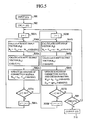
- Fig. 5 is a flowchart illustrating the decoding method of a product code in accordance with the present invention.
- 501 is a step of inputting the input matrix ⁇ Y ⁇ ;
- 502 is a step of setting an initial value into the correction matrix ⁇ W ⁇ ;
- 503A is a step of setting an initial value into a counter j;
- 506A is a step of updating the correction matrix ⁇ W ⁇ ;
- 507A is a step of comparing the value of the counter j; and
- 508A is a step of incrementing the value of the counter j.
- step 501 the N1 ⁇ N2 input matrix ⁇ Y ⁇ given by the foregoing expression (3) is input.
- the initial value zero is stored into all the elements of the N1 ⁇ N2 correction matrix ⁇ W ⁇ given by the following expression (15).
- step 503A the initial value one is set into the counter j.
- step 504A decoding of the C1 code is started.
- the jth column of the input matrix is denoted by [Y k,j ], and that of the correction matrix is denoted by [W k,j ], which are called an input vector and a correction vector, respectively.
- the correction vector [W k,j ] is updated by subtracting the soft input vector [R k ] from the soft output vector [L k ] in the prior art (step 306A of Fig. 3), it is obtained by subtracting the input vector [Y k,j ] from the soft output vector [L k ] in the present invention.
- it offers an advantage of being able to obtain more accurate correction vectors better reflecting the previous correction information in the iteration of the decoding.
- step 507A a decision is made as to whether the value of the counter j is less than N2. If it is less than N2, the value of the counter j is incremented at step 508A, followed by iterating the processing from step 504A and on. On the other hand, if the value of the counter is N2, the processing proceeds to step 503B, at which the decoding of the C2 code is started.
- the initial value one is set into the counter i.
- the ith row of the input matrix is denoted by [Y i,k ] and that of the correction matrix is denoted by [W i,k ], -which are called an input vector and a correction vector, respectively, as in the decoding of the foregoing C1 code.
- the differences obtained by subtracting the input vector from the soft output vector calculated at step 505B are stored in the ith row of the correction matrix ⁇ W ⁇ according to the following expression (19).
- W i,k ⁇ L k - Y i,k (k 1, 2, ⁇ , N2)
- step 507B a decision is made as to whether the value of the counter i is less than N1 or not. If it is less than N1, the value of the counter i is incremented at step 508B, followed by iterating the processing from step 504B and on. On the other hand, if the value of the counter i is N1, the processing proceeds to step 509. Up to this time, the decoding of the C1 code and C2 code constituting the product code has been completed once. At step 509, a decision is made as to whether to iterate the decoding or not. To iterate the decoding, the processing proceeds to step 503A to restart the decoding of the C1 code. On the other hand, to stop the decoding, the processing proceeds to step 510, at which the decision matrix ⁇ D ⁇ is output. Thus, the processing is completed.
- the step 509 can calculate the syndromes of the decision matrix ⁇ D ⁇ to check whether any error remains or not so that if a decision is made that an error is present, the decoding is iterated, or else the decoding can be completed.
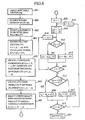
- Fig. 6 is a flowchart illustrating the details of step 505A. Referring to Fig. 6, the operation of the soft input/soft output decoding of the C1 code will be described.
- the soft input vector [R k ] is input.
- a hard decision vector [H k ] of the soft input vector [R k ] is generated according to the following expression (21).
- p elements with least absolute values are selected from the soft input vector [R k ] .
- the positions of the p elements selected are denoted by k1, k2, ⁇ , and kp.
- the inner products P t between the soft input vector [R] and the candidate codewords [C t ] are given by the following expression (23).
- the codeword [C d ] that gives the maximum value of the inner products P t calculated at step 606 is selected.
- the initial value one is set into the counter k.
- the initial value one is set in the counter t, and variables L0 and L1 are set at "- ⁇ " that indicates the minimum value the computer or hardware can represent.
- a decision is made as to whether the kth element C t k of the tth candidate codeword [C t ] is zero or not. If the element C t k is zero, the processing proceeds to step 611, or else it proceeds to step 612.
- step 612 the following expression (25) is calculated, and then the processing proceeds to step 613.
- L1 ⁇ f(L1, P t ) where the function f in the expressions (24) and (25) is given by the following expression (26).
- f ( a , b ) max( a , b ) + log(1+ e -
- step 613 a decision is made as to whether the counter t is less than the total number r of the candidate codewords generated at step 605 or not.
- the processing proceeds to step 614, at which the value of the counter t is incremented to iterate the processing from step 610 and on.
- the processing proceeds to step 615.
- step 615 a decision is made as to whether the variable L0 or L1 equals - ⁇ or not. If it is equal, the processing proceeds to step 616, or else it proceeds to step 617.
- step 616 the soft output value given by the following expression (27) is calculated. L k ⁇ R k + ⁇ C d k where ⁇ is an appropriate normalizing constant.
- step 617 the soft output value given by the following expression (28) is calculated. L k ⁇ (L0 - L1)/4
- step 618 a decision is made as to whether the value of the counter k is equal to N1 or not. If k is less than N1, the processing proceeds to step 619, at which the value of the counter k is incremented to iterate the processing from step 609 and on. On the other hand, if they are equal, the processing proceeds to step 620, at which the soft output vector [L k ] is output, followed by completing the entire processing.
- the soft input/soft output decoding of the C1 code at step 505A has been completed.
- the soft input/soft output decoding of the C2 code at step 505B is the same as that of the C1 code at step 505A.
- the present embodiment 1 is configured such that the soft output values L k are calculated using all the candidate codewords generated at step 605. Accordingly, it has an advantage of being able to achieve more accurate soft output values than the conventional techniques.
- the formulae for calculating the soft output values of the prior art and the present invention will be compared.
- the description is made by way of example of calculating the soft output values of the C1 code. It is known that when the soft input vector [R k ] is given, the accurate value of the kth soft output value L k is calculated by the following expression (29).
- the calculation of the soft output values of the prior art is based on expression (30).
- the first and second terms of the expression (31) can be recursively calculated using the relationship of the following expression (32).
- storing quantized values of the function L given by the following expression (33) into a table enables the speedup of the calculation of expression (31) .
- the present embodiment 1 of the decoding method of a product code offers an advantage of being able to generate the more accurate soft output values.
- it since it is configured such that the correction vectors take account of the previous decoding results, it can improve the decoding performance markedly.
- the present embodiment 1 can be modified in various ways.
- the decoding method of the present embodiment is applicable under the condition that the soft input values are placed at M when the hard decision is zero, and at -M when the hard decision is one, where M is an appropriate value.
- Fig. 7 is a block diagram showing a configuration of a decoding apparatus for the product code including the same C1 code and C2 code.
- the reference numeral 705a designates a syndrome calculation circuit for calculating the syndromes of the transmitted codeword to decide whether an error is present or not; and 705b is an error number calculation circuit for measuring the number of errors from the estimated transmitted codeword and the received word to monitor the state of the communication channel.
- the received word Y supplied from the demodulator is stored in the first memory 703.
- the correction value stored in the specified address of the second memory 707 is read out and supplied to the adder 701 after passing through the normalization by the normalizing circuit 708.
- the adder 701 adds the received value stored at the specified address of the first memory 703 and the correction value supplied from the normalizing circuit 708 to generate the soft input value.
- the reading from the second memory 707 is skipped, so that the adder 701 delivers the received value to the soft input/soft output decoder 704 without change.
- the soft input value generated by the adder 701 is supplied to the soft input/soft output decoder 704.
- the soft input/soft output decoder 704 starts the decoding in accordance with the flowchart of Fig. 6.
- Fig. 8 is a block diagram showing a configuration of the soft input/soft output decoder 704.
- the reference numeral 801 designates a Chase decoding circuit for generating a candidate of the transmitted codeword from the soft input vector; 802 designates a candidate codeword likelihood calculation circuit for calculating the likelihood of the candidate codeword; and 803 designates a soft output value calculation circuit for calculating the soft output value from the candidate codeword. Since the Chase decoding circuit 801 belongs to a known technique, its details will be omitted here. See, D. Chase, "A class of algorithms for decoding block codes with channel measurement information", (IEEE Trans. Inform. Theory, Vol. IT-18, pp. 170-182).
- the candidate codeword likelihood calculation circuit 802 supplies the inner products P t and the maximum likelihood codeword [C d ] to the soft output value calculation circuit 803.
- the soft output value calculation circuit 803 generates the soft output values according to the foregoing expression (27) or (28).
- Fig. 9 shows a configuration of the soft output value calculation circuit 803 for calculating the variable L0 or L1.
- the reference numeral 901 designates an input terminal to which the inner product P t is applied;
- 902 designates a register for storing a calculation result;
- 903 designates a MAX circuit for selecting a greater one of the two inputs and for outputting the selected one;
- 904 designates a MIN circuit for selecting a smaller one of the two inputs and for outputting the selected one;
- 905 designates a lookup table that stores the quantized values of the foregoing expression (33);
- 906 designates a subtracter for subtracting the output of the MIN circuit 904 from the output of the MAX circuit 903;
- 907 designates an adder for adding the output of the MAX circuit 903 and the output of the lookup table 905;
- 908 designates an
- the operation of the soft output value calculation circuit 803 of Fig. 9 will be described by way of example of calculating the variable L0.
- a sufficiently small value is placed into the register 902 as its initial value.
- the inner product P t of the candidate codeword [C t ] whose kth value C t k is zero is input from the input terminal 901.
- the MAX circuit 903 compares the inner product P t with the data stored in the register 902, and selects and supplies the greater one to the subtracter 906 and adder 907.
- the MIN circuit 904 compares the inner product P t with the data stored in the register 902, and selects and supplies the smaller one to the subtracter 906.
- the subtracter 906 subtracts the output data of the MIN circuit 904 from the output data of the MAX circuit 903, and supplies the resultant value to the lookup table 905.
- the lookup table 905 reads the logarithmic value given by expression (33), and supplies the resultant value to the adder 907.
- the adder 907 adds the output of the MAX circuit 903 and the output of the lookup table 905, and stores the sum to the register 902.
- variable L1 can be calculated in the same manner as the variable L0 using the circuit as shown in Fig. 9, the description thereof is omitted here.
- the soft output value is generated from the calculated variables L0 and L1 using the foregoing expression (28). If the variable L0 or L1 is not calculated, the soft-output value is generated from the soft input value and the element of the maximum likelihood codeword [C d ] using expression (27).
- the soft output value generated by the soft output value calculation circuit 803 of the soft input/soft output decoder 704 is supplied to the decision circuit 705 and subtracter702.
- the subtracter 702 subtracts the received value from the soft output value to generate the correction value, and stores it to a particular address of the second memory 707.
- the decision circuit 705 makes a decision of the transmitted codeword from the soft output value, and stores it to a particular address of the third memory 706.
- the decoding apparatus of a product code of the present embodiment 2 can generate highly accurate soft output values using the lookup table.
- the correction value is generated by subtracting the received value from the soft output value, the present embodiment 2 can generate more effective correction value.
- the decoding apparatus can be configured in the same manner when they are different. Specifically, it is enough for the soft input/soft output decoder to have a first Chase decoder for the C1 code and a second Chase decoder for the C2 code, with sharing the remaining circuits.
- the foregoing configuration comprises only one soft input/soft output decoder, multiple decoders installed in parallel can enhance the speed of the decoding apparatus.
- the decision circuit 705 can calculate the syndromes of the transmitted codeword to decide whether an error is present or not.
- the present embodiment 2 can iterate the decoding if the error is present, and complete the decoding otherwise.
- the decision circuit 705 can measure the number of errors from the estimated transmitted codeword and the received word to monitor the state of the communication channel. This offers an advantage of being able to facilitate the setting of the number of times of the iteration of the decoding. That is, when the state of the communication channel is bad, the number of times of the iteration is increased, and when it is good, it is reduced.
- the decoding apparatus of a product code is suitable for establishing the good digital transmission, and can implement the high performance digital transmission system by connecting the encoding apparatus of the product code with the decoding apparatus via a transmission medium.
- a transmission medium such as an optical disk
Landscapes
- Physics & Mathematics (AREA)
- Probability & Statistics with Applications (AREA)
- Engineering & Computer Science (AREA)
- Theoretical Computer Science (AREA)
- Mathematical Physics (AREA)
- Error Detection And Correction (AREA)
- Detection And Correction Of Errors (AREA)
- Detection And Prevention Of Errors In Transmission (AREA)
Applications Claiming Priority (2)
| Application Number | Priority Date | Filing Date | Title |
|---|---|---|---|
| JP2001236692A JP3876662B2 (ja) | 2001-08-03 | 2001-08-03 | 積符号の復号方法および積符号の復号装置 |
| JP2001236692 | 2001-08-03 |
Publications (2)
| Publication Number | Publication Date |
|---|---|
| EP1282237A2 true EP1282237A2 (de) | 2003-02-05 |
| EP1282237A3 EP1282237A3 (de) | 2003-12-03 |
Family
ID=19067914
Family Applications (1)
| Application Number | Title | Priority Date | Filing Date |
|---|---|---|---|
| EP02016641A Withdrawn EP1282237A3 (de) | 2001-08-03 | 2002-07-25 | Produktkodes- Dekodierungsverfahren und Dekodierungsapparat |
Country Status (3)
| Country | Link |
|---|---|
| US (1) | US7185259B2 (de) |
| EP (1) | EP1282237A3 (de) |
| JP (1) | JP3876662B2 (de) |
Cited By (1)
| Publication number | Priority date | Publication date | Assignee | Title |
|---|---|---|---|---|
| DE112009004337B4 (de) | 2008-11-26 | 2019-07-18 | Qualcomm Technologies International, Ltd. | Signalempfang |
Families Citing this family (14)
| Publication number | Priority date | Publication date | Assignee | Title |
|---|---|---|---|---|
| JP2005528840A (ja) * | 2002-05-31 | 2005-09-22 | コーニンクレッカ フィリップス エレクトロニクス エヌ ヴィ | 線形ブロック符号の軟復号化 |
| US7328395B1 (en) | 2004-04-13 | 2008-02-05 | Marvell International Ltd. | Iterative Reed-Solomon error-correction decoding |
| FR2871631B1 (fr) * | 2004-06-10 | 2006-09-22 | Centre Nat Rech Scient Cnrse | Procede de decodage iteractif de codes blocs et dispositif decodeur correspondant |
| US7310767B2 (en) * | 2004-07-26 | 2007-12-18 | Motorola, Inc. | Decoding block codes |
| US7454690B1 (en) * | 2004-10-27 | 2008-11-18 | Marvell International Ltd. | Architecture and control of reed-solomon list decoding |
| US9203438B2 (en) * | 2006-07-12 | 2015-12-01 | Ternarylogic Llc | Error correction by symbol reconstruction in binary and multi-valued cyclic codes |
| KR20090083758A (ko) * | 2008-01-30 | 2009-08-04 | 삼성전자주식회사 | 연접 부호 복호화 방법 및 장치 |
| RU2009116361A (ru) * | 2009-04-30 | 2010-11-10 | ЭлЭсАй Корпорейшн (US) | Декодер кодов рида-соломона с мягким решением на основе декодера кодов рида-соломона с исправлением ошибок и стираний |
| JP5757251B2 (ja) * | 2012-02-07 | 2015-07-29 | 株式会社Jvcケンウッド | 積符号の復号装置、積符号の復号方法、及び、プログラム |
| JP5757253B2 (ja) * | 2012-02-10 | 2015-07-29 | 株式会社Jvcケンウッド | 積符号の復号装置、積符号の復号方法、及び、プログラム |
| US9166627B2 (en) | 2013-08-07 | 2015-10-20 | International Business Machines Corporation | Combination error and erasure decoding for product codes |
| RU2541844C1 (ru) * | 2013-10-28 | 2015-02-20 | Федеральное Государственное Унитарное Предприятие Ордена Трудового Красного Знамени Научно-Исследовательский Институт Радио (Фгуп Ниир) | Способ декодирования кода-произведения с использованием упорядоченного по весу смежного класса векторов ошибок и устройство его реализующее |
| US9852022B2 (en) | 2015-09-04 | 2017-12-26 | Toshiba Memory Corporation | Memory system, memory controller and memory control method |
| US10313056B2 (en) * | 2017-02-06 | 2019-06-04 | Mitsubishi Electric Research Laboratories, Inc. | Irregular polar code encoding |
Family Cites Families (6)
| Publication number | Priority date | Publication date | Assignee | Title |
|---|---|---|---|---|
| FR2712760B1 (fr) | 1993-11-19 | 1996-01-26 | France Telecom | Procédé pour transmettre des bits d'information en appliquant des codes en blocs concaténés. |
| US5815515A (en) * | 1996-03-28 | 1998-09-29 | Lsi Logic Corporation | Edge metric calculation method and apparatus using permutations |
| US5968199A (en) * | 1996-12-18 | 1999-10-19 | Ericsson Inc. | High performance error control decoder |
| JPH1117555A (ja) * | 1997-06-26 | 1999-01-22 | Mitsubishi Electric Corp | データ伝送システム、受信装置および記録媒体 |
| US6477680B2 (en) * | 1998-06-26 | 2002-11-05 | Agere Systems Inc. | Area-efficient convolutional decoder |
| JP3246484B2 (ja) * | 1999-07-07 | 2002-01-15 | 日本電気株式会社 | ターボデコーダ |
-
2001
- 2001-08-03 JP JP2001236692A patent/JP3876662B2/ja not_active Expired - Fee Related
-
2002
- 2002-07-25 EP EP02016641A patent/EP1282237A3/de not_active Withdrawn
- 2002-08-02 US US10/209,923 patent/US7185259B2/en not_active Expired - Fee Related
Cited By (1)
| Publication number | Priority date | Publication date | Assignee | Title |
|---|---|---|---|---|
| DE112009004337B4 (de) | 2008-11-26 | 2019-07-18 | Qualcomm Technologies International, Ltd. | Signalempfang |
Also Published As
| Publication number | Publication date |
|---|---|
| US20030070131A1 (en) | 2003-04-10 |
| JP2003046395A (ja) | 2003-02-14 |
| EP1282237A3 (de) | 2003-12-03 |
| US7185259B2 (en) | 2007-02-27 |
| JP3876662B2 (ja) | 2007-02-07 |
Similar Documents
| Publication | Publication Date | Title |
|---|---|---|
| EP1282237A2 (de) | Produktkodes- Dekodierungsverfahren und Dekodierungsapparat | |
| US10326478B2 (en) | Apparatus and method for encoding and decoding data in twisted polar code | |
| JP2595372B2 (ja) | 広汎性ビテルビ復号化アルゴリズム | |
| KR101143695B1 (ko) | 트렐리스-기반 수신기와 이를 위한 프로세서 시스템, 방법 및 컴퓨터 판독가능 매체 | |
| US5844946A (en) | Soft-decision receiver and decoder for digital communication | |
| JP3328093B2 (ja) | エラー訂正装置 | |
| CN105897379B (zh) | 一种极化码级联空时码系统及其级联极化码编码方法 | |
| US20220302931A1 (en) | Iterative Bit Flip Decoding Based on Symbol Reliabilities | |
| JP2001036417A (ja) | 誤り訂正符号化装置、方法及び媒体、並びに誤り訂正符号復号装置、方法及び媒体 | |
| US5781569A (en) | Differential trellis decoding for convolutional codes | |
| JP2002509680A (ja) | 積符号の反復復号化 | |
| KR20060032464A (ko) | 효율적인 저밀도 패리티 검사 코드 복호 방법 및 장치 | |
| US7069496B2 (en) | Decoding method, decoding apparatus and digital transmission system of product code | |
| KR20050007428A (ko) | 선형 블록 코드들의 연성 디코딩 | |
| JPH0316046B2 (de) | ||
| US20070162821A1 (en) | Parity check matrix, method of generating parity check matrix, encoding method and error correction apparatus | |
| JPH0445017B2 (de) | ||
| EP1511178A1 (de) | Methode um ein Datenwort zu dekodieren | |
| US7716554B2 (en) | System and method for blind transport format detection with cyclic redundancy check | |
| CN115833848B (zh) | 译码确定方法、装置、电子设备及存储介质 | |
| JP4379329B2 (ja) | Crc生成多項式の選択方法、crc符号化方法およびcrc符号化回路 | |
| JP3045197B2 (ja) | ベクトル量子化器の符号帳設計方法 | |
| WO1995001008A1 (en) | Bit error counting method and counter | |
| CN100433836C (zh) | 使用冗余对视/音频和语音数据进行解码的方法和系统 | |
| US7962841B2 (en) | Data decoding apparatus and method in a communication system |
Legal Events
| Date | Code | Title | Description |
|---|---|---|---|
| PUAI | Public reference made under article 153(3) epc to a published international application that has entered the european phase |
Free format text: ORIGINAL CODE: 0009012 |
|
| AK | Designated contracting states |
Designated state(s): AT BE BG CH CY CZ DE DK EE ES FI FR GB GR IE IT LI LU MC NL PT SE SK TR |
|
| AX | Request for extension of the european patent |
Extension state: AL LT LV MK RO SI |
|
| PUAL | Search report despatched |
Free format text: ORIGINAL CODE: 0009013 |
|
| RIC1 | Information provided on ipc code assigned before grant |
Ipc: 7H 03M 13/37 B Ipc: 7H 03M 13/45 B Ipc: 7H 03M 13/29 A |
|
| AK | Designated contracting states |
Kind code of ref document: A3 Designated state(s): AT BE BG CH CY CZ DE DK EE ES FI FR GB GR IE IT LI LU MC NL PT SE SK TR |
|
| AX | Request for extension of the european patent |
Extension state: AL LT LV MK RO SI |
|
| 17P | Request for examination filed |
Effective date: 20040115 |
|
| 17Q | First examination report despatched |
Effective date: 20040617 |
|
| AKX | Designation fees paid |
Designated state(s): DE FR GB IT |
|
| RAP1 | Party data changed (applicant data changed or rights of an application transferred) |
Owner name: MITSUBISHI DENKI KABUSHIKI KAISHA |
|
| 17Q | First examination report despatched |
Effective date: 20040617 |
|
| STAA | Information on the status of an ep patent application or granted ep patent |
Free format text: STATUS: THE APPLICATION HAS BEEN WITHDRAWN |
|
| 18W | Application withdrawn |
Effective date: 20160721 |