EP1282700B1 - Neuronale serin-threonin-protein-kinase - Google Patents
Neuronale serin-threonin-protein-kinase Download PDFInfo
- Publication number
- EP1282700B1 EP1282700B1 EP01936370A EP01936370A EP1282700B1 EP 1282700 B1 EP1282700 B1 EP 1282700B1 EP 01936370 A EP01936370 A EP 01936370A EP 01936370 A EP01936370 A EP 01936370A EP 1282700 B1 EP1282700 B1 EP 1282700B1
- Authority
- EP
- European Patent Office
- Prior art keywords
- protein
- nucleic acid
- expression
- seq
- construct
- Prior art date
- Legal status (The legal status is an assumption and is not a legal conclusion. Google has not performed a legal analysis and makes no representation as to the accuracy of the status listed.)
- Expired - Lifetime
Links
- 102000009516 Protein Serine-Threonine Kinases Human genes 0.000 title claims abstract description 14
- 108010009341 Protein Serine-Threonine Kinases Proteins 0.000 title claims abstract description 14
- 230000001537 neural effect Effects 0.000 title claims description 4
- 108090000623 proteins and genes Proteins 0.000 claims abstract description 135
- 102000004169 proteins and genes Human genes 0.000 claims abstract description 104
- 208000006011 Stroke Diseases 0.000 claims abstract description 29
- 206010008190 Cerebrovascular accident Diseases 0.000 claims abstract description 16
- 238000011321 prophylaxis Methods 0.000 claims abstract description 7
- 238000002560 therapeutic procedure Methods 0.000 claims abstract description 7
- 150000007523 nucleic acids Chemical class 0.000 claims description 107
- 102000039446 nucleic acids Human genes 0.000 claims description 93
- 108020004707 nucleic acids Proteins 0.000 claims description 93
- 210000004027 cell Anatomy 0.000 claims description 54
- 230000014509 gene expression Effects 0.000 claims description 52
- 102000001253 Protein Kinase Human genes 0.000 claims description 40
- 108060006633 protein kinase Proteins 0.000 claims description 40
- 238000000034 method Methods 0.000 claims description 32
- 241000282414 Homo sapiens Species 0.000 claims description 30
- 230000000694 effects Effects 0.000 claims description 21
- 230000001105 regulatory effect Effects 0.000 claims description 21
- 239000000126 substance Substances 0.000 claims description 19
- 206010008120 Cerebral ischaemia Diseases 0.000 claims description 17
- 230000010410 reperfusion Effects 0.000 claims description 12
- 230000009261 transgenic effect Effects 0.000 claims description 12
- 241000124008 Mammalia Species 0.000 claims description 11
- 238000000021 kinase assay Methods 0.000 claims description 11
- 238000003745 diagnosis Methods 0.000 claims description 8
- 230000000692 anti-sense effect Effects 0.000 claims description 7
- 241000894006 Bacteria Species 0.000 claims description 6
- 206010028980 Neoplasm Diseases 0.000 claims description 6
- 239000013610 patient sample Substances 0.000 claims description 6
- 239000013612 plasmid Substances 0.000 claims description 6
- 238000012360 testing method Methods 0.000 claims description 6
- 229940043355 kinase inhibitor Drugs 0.000 claims description 4
- 210000000056 organ Anatomy 0.000 claims description 4
- 238000009007 Diagnostic Kit Methods 0.000 claims description 3
- 210000004962 mammalian cell Anatomy 0.000 claims description 3
- 239000003909 protein kinase inhibitor Substances 0.000 claims description 3
- 206010003591 Ataxia Diseases 0.000 claims description 2
- 201000009030 Carcinoma Diseases 0.000 claims description 2
- 208000023105 Huntington disease Diseases 0.000 claims description 2
- 208000018737 Parkinson disease Diseases 0.000 claims description 2
- 206010015037 epilepsy Diseases 0.000 claims description 2
- 201000006417 multiple sclerosis Diseases 0.000 claims description 2
- 230000007823 neuropathy Effects 0.000 claims description 2
- 201000001119 neuropathy Diseases 0.000 claims description 2
- 239000008194 pharmaceutical composition Substances 0.000 claims description 2
- 208000012902 Nervous system disease Diseases 0.000 claims 1
- 208000025966 Neurological disease Diseases 0.000 claims 1
- 238000002955 isolation Methods 0.000 claims 1
- 201000010901 lateral sclerosis Diseases 0.000 claims 1
- 208000005264 motor neuron disease Diseases 0.000 claims 1
- 210000005253 yeast cell Anatomy 0.000 claims 1
- 238000013459 approach Methods 0.000 abstract description 13
- 208000028867 ischemia Diseases 0.000 abstract description 10
- 238000011161 development Methods 0.000 abstract description 5
- 230000001225 therapeutic effect Effects 0.000 abstract description 5
- 235000018102 proteins Nutrition 0.000 description 83
- 108091000080 Phosphotransferase Proteins 0.000 description 31
- 102000020233 phosphotransferase Human genes 0.000 description 31
- 239000003112 inhibitor Substances 0.000 description 29
- 230000026731 phosphorylation Effects 0.000 description 23
- 238000006366 phosphorylation reaction Methods 0.000 description 23
- 239000013598 vector Substances 0.000 description 23
- 239000012634 fragment Substances 0.000 description 20
- 108020004414 DNA Proteins 0.000 description 19
- 210000004556 brain Anatomy 0.000 description 18
- 239000002299 complementary DNA Substances 0.000 description 18
- 108090000765 processed proteins & peptides Proteins 0.000 description 18
- 208000037265 diseases, disorders, signs and symptoms Diseases 0.000 description 16
- 206010008118 cerebral infarction Diseases 0.000 description 15
- 210000001519 tissue Anatomy 0.000 description 15
- 201000010099 disease Diseases 0.000 description 14
- 230000003993 interaction Effects 0.000 description 14
- 201000006474 Brain Ischemia Diseases 0.000 description 13
- 241001465754 Metazoa Species 0.000 description 13
- 241000699666 Mus <mouse, genus> Species 0.000 description 13
- 150000001413 amino acids Chemical class 0.000 description 13
- 238000009396 hybridization Methods 0.000 description 13
- 241000699670 Mus sp. Species 0.000 description 12
- 108020004999 messenger RNA Proteins 0.000 description 12
- 239000000758 substrate Substances 0.000 description 12
- 235000001014 amino acid Nutrition 0.000 description 11
- 229940024606 amino acid Drugs 0.000 description 11
- 238000003556 assay Methods 0.000 description 11
- 230000000302 ischemic effect Effects 0.000 description 11
- 240000004808 Saccharomyces cerevisiae Species 0.000 description 10
- 235000014680 Saccharomyces cerevisiae Nutrition 0.000 description 10
- 230000033228 biological regulation Effects 0.000 description 10
- 238000006243 chemical reaction Methods 0.000 description 10
- 230000006698 induction Effects 0.000 description 10
- 238000001994 activation Methods 0.000 description 9
- 230000035772 mutation Effects 0.000 description 9
- 108091032973 (ribonucleotides)n+m Proteins 0.000 description 8
- 230000004913 activation Effects 0.000 description 8
- 230000001965 increasing effect Effects 0.000 description 8
- 102000004196 processed proteins & peptides Human genes 0.000 description 8
- 238000011282 treatment Methods 0.000 description 8
- KISWVXRQTGLFGD-UHFFFAOYSA-N 2-[[2-[[6-amino-2-[[2-[[2-[[5-amino-2-[[2-[[1-[2-[[6-amino-2-[(2,5-diamino-5-oxopentanoyl)amino]hexanoyl]amino]-5-(diaminomethylideneamino)pentanoyl]pyrrolidine-2-carbonyl]amino]-3-hydroxypropanoyl]amino]-5-oxopentanoyl]amino]-5-(diaminomethylideneamino)p Chemical compound C1CCN(C(=O)C(CCCN=C(N)N)NC(=O)C(CCCCN)NC(=O)C(N)CCC(N)=O)C1C(=O)NC(CO)C(=O)NC(CCC(N)=O)C(=O)NC(CCCN=C(N)N)C(=O)NC(CO)C(=O)NC(CCCCN)C(=O)NC(C(=O)NC(CC(C)C)C(O)=O)CC1=CC=C(O)C=C1 KISWVXRQTGLFGD-UHFFFAOYSA-N 0.000 description 7
- 241000699660 Mus musculus Species 0.000 description 7
- 102000047918 Myelin Basic Human genes 0.000 description 7
- 101710107068 Myelin basic protein Proteins 0.000 description 7
- 108091034117 Oligonucleotide Proteins 0.000 description 7
- 238000010367 cloning Methods 0.000 description 7
- 238000004519 manufacturing process Methods 0.000 description 7
- 230000007246 mechanism Effects 0.000 description 7
- 230000008569 process Effects 0.000 description 7
- 238000012216 screening Methods 0.000 description 7
- 108091026890 Coding region Proteins 0.000 description 6
- LFQSCWFLJHTTHZ-UHFFFAOYSA-N Ethanol Chemical compound CCO LFQSCWFLJHTTHZ-UHFFFAOYSA-N 0.000 description 6
- ZHNUHDYFZUAESO-UHFFFAOYSA-N Formamide Chemical compound NC=O ZHNUHDYFZUAESO-UHFFFAOYSA-N 0.000 description 6
- 241000282412 Homo Species 0.000 description 6
- 108091054455 MAP kinase family Proteins 0.000 description 6
- 102000043136 MAP kinase family Human genes 0.000 description 6
- 108091028043 Nucleic acid sequence Proteins 0.000 description 6
- JLCPHMBAVCMARE-UHFFFAOYSA-N [3-[[3-[[3-[[3-[[3-[[3-[[3-[[3-[[3-[[3-[[3-[[5-(2-amino-6-oxo-1H-purin-9-yl)-3-[[3-[[3-[[3-[[3-[[3-[[5-(2-amino-6-oxo-1H-purin-9-yl)-3-[[5-(2-amino-6-oxo-1H-purin-9-yl)-3-hydroxyoxolan-2-yl]methoxy-hydroxyphosphoryl]oxyoxolan-2-yl]methoxy-hydroxyphosphoryl]oxy-5-(5-methyl-2,4-dioxopyrimidin-1-yl)oxolan-2-yl]methoxy-hydroxyphosphoryl]oxy-5-(6-aminopurin-9-yl)oxolan-2-yl]methoxy-hydroxyphosphoryl]oxy-5-(6-aminopurin-9-yl)oxolan-2-yl]methoxy-hydroxyphosphoryl]oxy-5-(6-aminopurin-9-yl)oxolan-2-yl]methoxy-hydroxyphosphoryl]oxy-5-(6-aminopurin-9-yl)oxolan-2-yl]methoxy-hydroxyphosphoryl]oxyoxolan-2-yl]methoxy-hydroxyphosphoryl]oxy-5-(5-methyl-2,4-dioxopyrimidin-1-yl)oxolan-2-yl]methoxy-hydroxyphosphoryl]oxy-5-(4-amino-2-oxopyrimidin-1-yl)oxolan-2-yl]methoxy-hydroxyphosphoryl]oxy-5-(5-methyl-2,4-dioxopyrimidin-1-yl)oxolan-2-yl]methoxy-hydroxyphosphoryl]oxy-5-(5-methyl-2,4-dioxopyrimidin-1-yl)oxolan-2-yl]methoxy-hydroxyphosphoryl]oxy-5-(6-aminopurin-9-yl)oxolan-2-yl]methoxy-hydroxyphosphoryl]oxy-5-(6-aminopurin-9-yl)oxolan-2-yl]methoxy-hydroxyphosphoryl]oxy-5-(4-amino-2-oxopyrimidin-1-yl)oxolan-2-yl]methoxy-hydroxyphosphoryl]oxy-5-(4-amino-2-oxopyrimidin-1-yl)oxolan-2-yl]methoxy-hydroxyphosphoryl]oxy-5-(4-amino-2-oxopyrimidin-1-yl)oxolan-2-yl]methoxy-hydroxyphosphoryl]oxy-5-(6-aminopurin-9-yl)oxolan-2-yl]methoxy-hydroxyphosphoryl]oxy-5-(4-amino-2-oxopyrimidin-1-yl)oxolan-2-yl]methyl [5-(6-aminopurin-9-yl)-2-(hydroxymethyl)oxolan-3-yl] hydrogen phosphate Polymers Cc1cn(C2CC(OP(O)(=O)OCC3OC(CC3OP(O)(=O)OCC3OC(CC3O)n3cnc4c3nc(N)[nH]c4=O)n3cnc4c3nc(N)[nH]c4=O)C(COP(O)(=O)OC3CC(OC3COP(O)(=O)OC3CC(OC3COP(O)(=O)OC3CC(OC3COP(O)(=O)OC3CC(OC3COP(O)(=O)OC3CC(OC3COP(O)(=O)OC3CC(OC3COP(O)(=O)OC3CC(OC3COP(O)(=O)OC3CC(OC3COP(O)(=O)OC3CC(OC3COP(O)(=O)OC3CC(OC3COP(O)(=O)OC3CC(OC3COP(O)(=O)OC3CC(OC3COP(O)(=O)OC3CC(OC3COP(O)(=O)OC3CC(OC3COP(O)(=O)OC3CC(OC3COP(O)(=O)OC3CC(OC3COP(O)(=O)OC3CC(OC3CO)n3cnc4c(N)ncnc34)n3ccc(N)nc3=O)n3cnc4c(N)ncnc34)n3ccc(N)nc3=O)n3ccc(N)nc3=O)n3ccc(N)nc3=O)n3cnc4c(N)ncnc34)n3cnc4c(N)ncnc34)n3cc(C)c(=O)[nH]c3=O)n3cc(C)c(=O)[nH]c3=O)n3ccc(N)nc3=O)n3cc(C)c(=O)[nH]c3=O)n3cnc4c3nc(N)[nH]c4=O)n3cnc4c(N)ncnc34)n3cnc4c(N)ncnc34)n3cnc4c(N)ncnc34)n3cnc4c(N)ncnc34)O2)c(=O)[nH]c1=O JLCPHMBAVCMARE-UHFFFAOYSA-N 0.000 description 6
- 230000003197 catalytic effect Effects 0.000 description 6
- 238000012217 deletion Methods 0.000 description 6
- 230000037430 deletion Effects 0.000 description 6
- 230000002401 inhibitory effect Effects 0.000 description 6
- 230000001613 neoplastic effect Effects 0.000 description 6
- 210000002569 neuron Anatomy 0.000 description 6
- 239000002773 nucleotide Substances 0.000 description 6
- 125000003729 nucleotide group Chemical group 0.000 description 6
- 239000000523 sample Substances 0.000 description 6
- 238000013519 translation Methods 0.000 description 6
- 241000588724 Escherichia coli Species 0.000 description 5
- 101001059443 Homo sapiens Serine/threonine-protein kinase MARK1 Proteins 0.000 description 5
- 108700026244 Open Reading Frames Proteins 0.000 description 5
- LDEBVRIURYMKQS-WISUUJSJSA-N Ser-Thr Chemical compound C[C@@H](O)[C@@H](C(O)=O)NC(=O)[C@@H](N)CO LDEBVRIURYMKQS-WISUUJSJSA-N 0.000 description 5
- 102100028921 Serine/threonine-protein kinase MARK1 Human genes 0.000 description 5
- 230000003321 amplification Effects 0.000 description 5
- 239000012472 biological sample Substances 0.000 description 5
- 238000001514 detection method Methods 0.000 description 5
- 210000003527 eukaryotic cell Anatomy 0.000 description 5
- 239000000499 gel Substances 0.000 description 5
- 238000011534 incubation Methods 0.000 description 5
- 230000000926 neurological effect Effects 0.000 description 5
- 238000003199 nucleic acid amplification method Methods 0.000 description 5
- 238000002360 preparation method Methods 0.000 description 5
- 239000000047 product Substances 0.000 description 5
- 238000002821 scintillation proximity assay Methods 0.000 description 5
- 230000019491 signal transduction Effects 0.000 description 5
- 230000003827 upregulation Effects 0.000 description 5
- YBJHBAHKTGYVGT-ZKWXMUAHSA-N (+)-Biotin Chemical compound N1C(=O)N[C@@H]2[C@H](CCCCC(=O)O)SC[C@@H]21 YBJHBAHKTGYVGT-ZKWXMUAHSA-N 0.000 description 4
- 229910019142 PO4 Inorganic materials 0.000 description 4
- 108091023040 Transcription factor Proteins 0.000 description 4
- 102000040945 Transcription factor Human genes 0.000 description 4
- 239000000427 antigen Substances 0.000 description 4
- 108091007433 antigens Proteins 0.000 description 4
- 102000036639 antigens Human genes 0.000 description 4
- CKLJMWTZIZZHCS-REOHCLBHSA-N aspartic acid group Chemical group N[C@@H](CC(=O)O)C(=O)O CKLJMWTZIZZHCS-REOHCLBHSA-N 0.000 description 4
- 230000008901 benefit Effects 0.000 description 4
- 230000015572 biosynthetic process Effects 0.000 description 4
- 230000030833 cell death Effects 0.000 description 4
- 230000018109 developmental process Effects 0.000 description 4
- 238000009826 distribution Methods 0.000 description 4
- 239000003814 drug Substances 0.000 description 4
- 238000005516 engineering process Methods 0.000 description 4
- 239000003623 enhancer Substances 0.000 description 4
- 239000013604 expression vector Substances 0.000 description 4
- 238000010353 genetic engineering Methods 0.000 description 4
- 230000005764 inhibitory process Effects 0.000 description 4
- 238000003780 insertion Methods 0.000 description 4
- 230000037431 insertion Effects 0.000 description 4
- 210000004072 lung Anatomy 0.000 description 4
- 239000000463 material Substances 0.000 description 4
- 238000005259 measurement Methods 0.000 description 4
- 230000000144 pharmacologic effect Effects 0.000 description 4
- 238000010561 standard procedure Methods 0.000 description 4
- 238000006467 substitution reaction Methods 0.000 description 4
- 238000013518 transcription Methods 0.000 description 4
- 230000035897 transcription Effects 0.000 description 4
- 230000002103 transcriptional effect Effects 0.000 description 4
- 206010021143 Hypoxia Diseases 0.000 description 3
- 208000026350 Inborn Genetic disease Diseases 0.000 description 3
- 108060001084 Luciferase Proteins 0.000 description 3
- 208000024556 Mendelian disease Diseases 0.000 description 3
- 102000003945 NF-kappa B Human genes 0.000 description 3
- 108010057466 NF-kappa B Proteins 0.000 description 3
- 230000003213 activating effect Effects 0.000 description 3
- 239000004480 active ingredient Substances 0.000 description 3
- 238000004458 analytical method Methods 0.000 description 3
- 238000010171 animal model Methods 0.000 description 3
- 230000035578 autophosphorylation Effects 0.000 description 3
- 230000001580 bacterial effect Effects 0.000 description 3
- 239000011324 bead Substances 0.000 description 3
- 108091005948 blue fluorescent proteins Proteins 0.000 description 3
- 239000000872 buffer Substances 0.000 description 3
- 210000004899 c-terminal region Anatomy 0.000 description 3
- 239000003153 chemical reaction reagent Substances 0.000 description 3
- 238000002474 experimental method Methods 0.000 description 3
- 239000000284 extract Substances 0.000 description 3
- 230000001605 fetal effect Effects 0.000 description 3
- 238000001415 gene therapy Methods 0.000 description 3
- 230000002209 hydrophobic effect Effects 0.000 description 3
- 238000007901 in situ hybridization Methods 0.000 description 3
- 238000000338 in vitro Methods 0.000 description 3
- 230000006882 induction of apoptosis Effects 0.000 description 3
- 125000003588 lysine group Chemical group [H]N([H])C([H])([H])C([H])([H])C([H])([H])C([H])([H])C([H])(N([H])[H])C(*)=O 0.000 description 3
- 238000002844 melting Methods 0.000 description 3
- 230000008018 melting Effects 0.000 description 3
- 239000012528 membrane Substances 0.000 description 3
- 239000010452 phosphate Substances 0.000 description 3
- 230000004952 protein activity Effects 0.000 description 3
- 230000009822 protein phosphorylation Effects 0.000 description 3
- 238000003753 real-time PCR Methods 0.000 description 3
- 230000004044 response Effects 0.000 description 3
- 235000004400 serine Nutrition 0.000 description 3
- 208000024891 symptom Diseases 0.000 description 3
- 241000701447 unidentified baculovirus Species 0.000 description 3
- 229920001817 Agar Polymers 0.000 description 2
- 206010002091 Anaesthesia Diseases 0.000 description 2
- 206010003210 Arteriosclerosis Diseases 0.000 description 2
- 208000024172 Cardiovascular disease Diseases 0.000 description 2
- HEDRZPFGACZZDS-UHFFFAOYSA-N Chloroform Chemical compound ClC(Cl)Cl HEDRZPFGACZZDS-UHFFFAOYSA-N 0.000 description 2
- 206010010904 Convulsion Diseases 0.000 description 2
- 102000001493 Cyclophilins Human genes 0.000 description 2
- 108010068682 Cyclophilins Proteins 0.000 description 2
- 108090000626 DNA-directed RNA polymerases Proteins 0.000 description 2
- 102000004163 DNA-directed RNA polymerases Human genes 0.000 description 2
- 101100276976 Drosophila melanogaster Drak gene Proteins 0.000 description 2
- 102100031480 Dual specificity mitogen-activated protein kinase kinase 1 Human genes 0.000 description 2
- 101710146526 Dual specificity mitogen-activated protein kinase kinase 1 Proteins 0.000 description 2
- 238000002965 ELISA Methods 0.000 description 2
- 102000004190 Enzymes Human genes 0.000 description 2
- 108090000790 Enzymes Proteins 0.000 description 2
- 108010043121 Green Fluorescent Proteins Proteins 0.000 description 2
- 102000004144 Green Fluorescent Proteins Human genes 0.000 description 2
- 101001018196 Homo sapiens Mitogen-activated protein kinase kinase kinase 5 Proteins 0.000 description 2
- 101001059454 Homo sapiens Serine/threonine-protein kinase MARK2 Proteins 0.000 description 2
- 208000032382 Ischaemic stroke Diseases 0.000 description 2
- KFZMGEQAYNKOFK-UHFFFAOYSA-N Isopropanol Chemical compound CC(C)O KFZMGEQAYNKOFK-UHFFFAOYSA-N 0.000 description 2
- WHUUTDBJXJRKMK-VKHMYHEASA-N L-glutamic acid Chemical compound OC(=O)[C@@H](N)CCC(O)=O WHUUTDBJXJRKMK-VKHMYHEASA-N 0.000 description 2
- OUYCCCASQSFEME-QMMMGPOBSA-N L-tyrosine Chemical compound OC(=O)[C@@H](N)CC1=CC=C(O)C=C1 OUYCCCASQSFEME-QMMMGPOBSA-N 0.000 description 2
- 239000005089 Luciferase Substances 0.000 description 2
- 229940124647 MEK inhibitor Drugs 0.000 description 2
- 102100033127 Mitogen-activated protein kinase kinase kinase 5 Human genes 0.000 description 2
- 241001529936 Murinae Species 0.000 description 2
- 206010028851 Necrosis Diseases 0.000 description 2
- 239000004677 Nylon Substances 0.000 description 2
- 108700020796 Oncogene Proteins 0.000 description 2
- 238000012408 PCR amplification Methods 0.000 description 2
- ISWSIDIOOBJBQZ-UHFFFAOYSA-N Phenol Chemical compound OC1=CC=CC=C1 ISWSIDIOOBJBQZ-UHFFFAOYSA-N 0.000 description 2
- NBIIXXVUZAFLBC-UHFFFAOYSA-N Phosphoric acid Chemical compound OP(O)(O)=O NBIIXXVUZAFLBC-UHFFFAOYSA-N 0.000 description 2
- 102100033479 RAF proto-oncogene serine/threonine-protein kinase Human genes 0.000 description 2
- 241000700159 Rattus Species 0.000 description 2
- 241000700157 Rattus norvegicus Species 0.000 description 2
- 101150055709 SNF1 gene Proteins 0.000 description 2
- MTCFGRXMJLQNBG-UHFFFAOYSA-N Serine Natural products OCC(N)C(O)=O MTCFGRXMJLQNBG-UHFFFAOYSA-N 0.000 description 2
- 102100028904 Serine/threonine-protein kinase MARK2 Human genes 0.000 description 2
- FAPWRFPIFSIZLT-UHFFFAOYSA-M Sodium chloride Chemical compound [Na+].[Cl-] FAPWRFPIFSIZLT-UHFFFAOYSA-M 0.000 description 2
- AYFVYJQAPQTCCC-UHFFFAOYSA-N Threonine Natural products CC(O)C(N)C(O)=O AYFVYJQAPQTCCC-UHFFFAOYSA-N 0.000 description 2
- 239000004473 Threonine Substances 0.000 description 2
- 241000700605 Viruses Species 0.000 description 2
- 230000002159 abnormal effect Effects 0.000 description 2
- 239000008272 agar Substances 0.000 description 2
- 230000037005 anaesthesia Effects 0.000 description 2
- 125000000637 arginyl group Chemical group N[C@@H](CCCNC(N)=N)C(=O)* 0.000 description 2
- 208000011775 arteriosclerosis disease Diseases 0.000 description 2
- 229940009098 aspartate Drugs 0.000 description 2
- 210000001130 astrocyte Anatomy 0.000 description 2
- 229960002685 biotin Drugs 0.000 description 2
- 235000020958 biotin Nutrition 0.000 description 2
- 239000011616 biotin Substances 0.000 description 2
- 210000004369 blood Anatomy 0.000 description 2
- 239000008280 blood Substances 0.000 description 2
- 230000036772 blood pressure Effects 0.000 description 2
- 210000004004 carotid artery internal Anatomy 0.000 description 2
- 210000001627 cerebral artery Anatomy 0.000 description 2
- 210000004978 chinese hamster ovary cell Anatomy 0.000 description 2
- 238000003776 cleavage reaction Methods 0.000 description 2
- 230000006552 constitutive activation Effects 0.000 description 2
- 230000007423 decrease Effects 0.000 description 2
- 208000035475 disorder Diseases 0.000 description 2
- 229940079593 drug Drugs 0.000 description 2
- 230000002526 effect on cardiovascular system Effects 0.000 description 2
- 238000004520 electroporation Methods 0.000 description 2
- 230000008030 elimination Effects 0.000 description 2
- 238000003379 elimination reaction Methods 0.000 description 2
- 208000005053 encephalomalacia Diseases 0.000 description 2
- 229940088598 enzyme Drugs 0.000 description 2
- 238000011156 evaluation Methods 0.000 description 2
- 238000011049 filling Methods 0.000 description 2
- 230000006870 function Effects 0.000 description 2
- 230000004927 fusion Effects 0.000 description 2
- 108020001507 fusion proteins Proteins 0.000 description 2
- 102000037865 fusion proteins Human genes 0.000 description 2
- 210000004602 germ cell Anatomy 0.000 description 2
- 229930195712 glutamate Natural products 0.000 description 2
- 125000000291 glutamic acid group Chemical group N[C@@H](CCC(O)=O)C(=O)* 0.000 description 2
- 239000005090 green fluorescent protein Substances 0.000 description 2
- 230000012010 growth Effects 0.000 description 2
- 230000000971 hippocampal effect Effects 0.000 description 2
- 210000004408 hybridoma Anatomy 0.000 description 2
- 230000001900 immune effect Effects 0.000 description 2
- 208000026278 immune system disease Diseases 0.000 description 2
- 238000001727 in vivo Methods 0.000 description 2
- 230000002779 inactivation Effects 0.000 description 2
- PHTQWCKDNZKARW-UHFFFAOYSA-N isoamylol Chemical compound CC(C)CCO PHTQWCKDNZKARW-UHFFFAOYSA-N 0.000 description 2
- 125000000741 isoleucyl group Chemical group [H]N([H])C(C(C([H])([H])[H])C([H])([H])C([H])([H])[H])C(=O)O* 0.000 description 2
- 230000001404 mediated effect Effects 0.000 description 2
- 230000003278 mimic effect Effects 0.000 description 2
- 239000000203 mixture Substances 0.000 description 2
- 238000010369 molecular cloning Methods 0.000 description 2
- 230000017074 necrotic cell death Effects 0.000 description 2
- 230000000626 neurodegenerative effect Effects 0.000 description 2
- 229920001778 nylon Polymers 0.000 description 2
- 230000002018 overexpression Effects 0.000 description 2
- 230000008506 pathogenesis Effects 0.000 description 2
- 230000001991 pathophysiological effect Effects 0.000 description 2
- 230000037361 pathway Effects 0.000 description 2
- NBIIXXVUZAFLBC-UHFFFAOYSA-K phosphate Chemical compound [O-]P([O-])([O-])=O NBIIXXVUZAFLBC-UHFFFAOYSA-K 0.000 description 2
- 239000003757 phosphotransferase inhibitor Substances 0.000 description 2
- 229920001184 polypeptide Polymers 0.000 description 2
- 238000000746 purification Methods 0.000 description 2
- 239000011535 reaction buffer Substances 0.000 description 2
- 230000009467 reduction Effects 0.000 description 2
- 230000007017 scission Effects 0.000 description 2
- 150000003384 small molecules Chemical class 0.000 description 2
- 239000000243 solution Substances 0.000 description 2
- 210000001082 somatic cell Anatomy 0.000 description 2
- 238000010186 staining Methods 0.000 description 2
- 238000003786 synthesis reaction Methods 0.000 description 2
- 102000013498 tau Proteins Human genes 0.000 description 2
- 108010026424 tau Proteins Proteins 0.000 description 2
- 210000001550 testis Anatomy 0.000 description 2
- 108700020534 tetracycline resistance-encoding transposon repressor Proteins 0.000 description 2
- 238000004448 titration Methods 0.000 description 2
- 238000012546 transfer Methods 0.000 description 2
- 238000011830 transgenic mouse model Methods 0.000 description 2
- 238000010396 two-hybrid screening Methods 0.000 description 2
- 125000002987 valine group Chemical group [H]N([H])C([H])(C(*)=O)C([H])(C([H])([H])[H])C([H])([H])[H] 0.000 description 2
- 238000001086 yeast two-hybrid system Methods 0.000 description 2
- ZAUYNCUCMJDAHW-UHFFFAOYSA-N 1-ethenylpyrrolidin-2-one;hydrogen peroxide;molecular iodine Chemical compound OO.II.C=CN1CCCC1=O ZAUYNCUCMJDAHW-UHFFFAOYSA-N 0.000 description 1
- JKMHFZQWWAIEOD-UHFFFAOYSA-N 2-[4-(2-hydroxyethyl)piperazin-1-yl]ethanesulfonic acid Chemical compound OCC[NH+]1CCN(CCS([O-])(=O)=O)CC1 JKMHFZQWWAIEOD-UHFFFAOYSA-N 0.000 description 1
- RYCSNJCJOVQGBC-UHFFFAOYSA-N 3-(1-cyclopropyl-2h-pyridin-4-yl)-1h-quinolin-2-one Chemical compound O=C1NC2=CC=CC=C2C=C1C(C=C1)=CCN1C1CC1 RYCSNJCJOVQGBC-UHFFFAOYSA-N 0.000 description 1
- -1 42 ° C in 5 x SSC Chemical compound 0.000 description 1
- 102100036009 5'-AMP-activated protein kinase catalytic subunit alpha-2 Human genes 0.000 description 1
- PBCZSGKMGDDXIJ-HQCWYSJUSA-N 7-hydroxystaurosporine Chemical compound N([C@H](O)C1=C2C3=CC=CC=C3N3C2=C24)C(=O)C1=C2C1=CC=CC=C1N4[C@H]1C[C@@H](NC)[C@@H](OC)[C@]3(C)O1 PBCZSGKMGDDXIJ-HQCWYSJUSA-N 0.000 description 1
- PBCZSGKMGDDXIJ-UHFFFAOYSA-N 7beta-hydroxystaurosporine Natural products C12=C3N4C5=CC=CC=C5C3=C3C(O)NC(=O)C3=C2C2=CC=CC=C2N1C1CC(NC)C(OC)C4(C)O1 PBCZSGKMGDDXIJ-UHFFFAOYSA-N 0.000 description 1
- 102220473482 Alpha-1B-glycoprotein_K90A_mutation Human genes 0.000 description 1
- 208000024827 Alzheimer disease Diseases 0.000 description 1
- 102000013455 Amyloid beta-Peptides Human genes 0.000 description 1
- 108010090849 Amyloid beta-Peptides Proteins 0.000 description 1
- 102000000412 Annexin Human genes 0.000 description 1
- 108050008874 Annexin Proteins 0.000 description 1
- 244000105975 Antidesma platyphyllum Species 0.000 description 1
- 101000835846 Arabidopsis thaliana Sucrose nonfermenting 4-like protein Proteins 0.000 description 1
- 101001007348 Arachis hypogaea Galactose-binding lectin Proteins 0.000 description 1
- 206010003178 Arterial thrombosis Diseases 0.000 description 1
- 241000228212 Aspergillus Species 0.000 description 1
- 108090001008 Avidin Proteins 0.000 description 1
- 241000193830 Bacillus <bacterium> Species 0.000 description 1
- OGBVRMYSNSKIEF-UHFFFAOYSA-N Benzylphosphonic acid Chemical class OP(O)(=O)CC1=CC=CC=C1 OGBVRMYSNSKIEF-UHFFFAOYSA-N 0.000 description 1
- 241000283690 Bos taurus Species 0.000 description 1
- 102000004219 Brain-derived neurotrophic factor Human genes 0.000 description 1
- 108090000715 Brain-derived neurotrophic factor Proteins 0.000 description 1
- 101150071146 COX2 gene Proteins 0.000 description 1
- 101100114534 Caenorhabditis elegans ctc-2 gene Proteins 0.000 description 1
- 102000004657 Calcium-Calmodulin-Dependent Protein Kinase Type 2 Human genes 0.000 description 1
- 108010003721 Calcium-Calmodulin-Dependent Protein Kinase Type 2 Proteins 0.000 description 1
- CURLTUGMZLYLDI-UHFFFAOYSA-N Carbon dioxide Chemical compound O=C=O CURLTUGMZLYLDI-UHFFFAOYSA-N 0.000 description 1
- 102000014914 Carrier Proteins Human genes 0.000 description 1
- 102000003952 Caspase 3 Human genes 0.000 description 1
- 108090000397 Caspase 3 Proteins 0.000 description 1
- 108010076667 Caspases Proteins 0.000 description 1
- 102000011727 Caspases Human genes 0.000 description 1
- 206010057248 Cell death Diseases 0.000 description 1
- 206010008089 Cerebral artery occlusion Diseases 0.000 description 1
- 108020004638 Circular DNA Proteins 0.000 description 1
- 102100038385 Coiled-coil domain-containing protein R3HCC1L Human genes 0.000 description 1
- 206010009944 Colon cancer Diseases 0.000 description 1
- 206010010071 Coma Diseases 0.000 description 1
- 108091035707 Consensus sequence Proteins 0.000 description 1
- 102000008130 Cyclic AMP-Dependent Protein Kinases Human genes 0.000 description 1
- 108010049894 Cyclic AMP-Dependent Protein Kinases Proteins 0.000 description 1
- 102000004127 Cytokines Human genes 0.000 description 1
- 108090000695 Cytokines Proteins 0.000 description 1
- 102000053602 DNA Human genes 0.000 description 1
- 102100037373 DNA-(apurinic or apyrimidinic site) endonuclease Human genes 0.000 description 1
- 102100038605 Death-associated protein kinase 2 Human genes 0.000 description 1
- KCXVZYZYPLLWCC-UHFFFAOYSA-N EDTA Chemical compound OC(=O)CN(CC(O)=O)CCN(CC(O)=O)CC(O)=O KCXVZYZYPLLWCC-UHFFFAOYSA-N 0.000 description 1
- 206010014513 Embolism arterial Diseases 0.000 description 1
- 241000196324 Embryophyta Species 0.000 description 1
- 101000944251 Emericella nidulans (strain FGSC A4 / ATCC 38163 / CBS 112.46 / NRRL 194 / M139) Calcium/calmodulin-dependent protein kinase cmkA Proteins 0.000 description 1
- 241000701959 Escherichia virus Lambda Species 0.000 description 1
- 108700039887 Essential Genes Proteins 0.000 description 1
- 108700024394 Exon Proteins 0.000 description 1
- 101150097844 F2r gene Proteins 0.000 description 1
- 241000233866 Fungi Species 0.000 description 1
- 102100039556 Galectin-4 Human genes 0.000 description 1
- 102100028652 Gamma-enolase Human genes 0.000 description 1
- 101710191797 Gamma-enolase Proteins 0.000 description 1
- 208000034826 Genetic Predisposition to Disease Diseases 0.000 description 1
- 102100039289 Glial fibrillary acidic protein Human genes 0.000 description 1
- 101710193519 Glial fibrillary acidic protein Proteins 0.000 description 1
- WQZGKKKJIJFFOK-GASJEMHNSA-N Glucose Natural products OC[C@H]1OC(O)[C@H](O)[C@@H](O)[C@@H]1O WQZGKKKJIJFFOK-GASJEMHNSA-N 0.000 description 1
- 102000018899 Glutamate Receptors Human genes 0.000 description 1
- 108010027915 Glutamate Receptors Proteins 0.000 description 1
- 102100036263 Glutamyl-tRNA(Gln) amidotransferase subunit C, mitochondrial Human genes 0.000 description 1
- 102100031181 Glyceraldehyde-3-phosphate dehydrogenase Human genes 0.000 description 1
- 239000007995 HEPES buffer Substances 0.000 description 1
- 241001446459 Heia Species 0.000 description 1
- 206010019468 Hemiplegia Diseases 0.000 description 1
- 102100021519 Hemoglobin subunit beta Human genes 0.000 description 1
- 108091005904 Hemoglobin subunit beta Proteins 0.000 description 1
- 208000032843 Hemorrhage Diseases 0.000 description 1
- 108010033040 Histones Proteins 0.000 description 1
- 101000783681 Homo sapiens 5'-AMP-activated protein kinase catalytic subunit alpha-2 Proteins 0.000 description 1
- 101000743767 Homo sapiens Coiled-coil domain-containing protein R3HCC1L Proteins 0.000 description 1
- 101000608765 Homo sapiens Galectin-4 Proteins 0.000 description 1
- 101001001786 Homo sapiens Glutamyl-tRNA(Gln) amidotransferase subunit C, mitochondrial Proteins 0.000 description 1
- 101001059429 Homo sapiens MAP/microtubule affinity-regulating kinase 3 Proteins 0.000 description 1
- 101000969594 Homo sapiens Modulator of apoptosis 1 Proteins 0.000 description 1
- 101000979249 Homo sapiens Neuromodulin Proteins 0.000 description 1
- 101000661819 Homo sapiens Serine/threonine-protein kinase 17B Proteins 0.000 description 1
- 206010020772 Hypertension Diseases 0.000 description 1
- 108060003951 Immunoglobulin Proteins 0.000 description 1
- 102000008394 Immunoglobulin Fragments Human genes 0.000 description 1
- 108010021625 Immunoglobulin Fragments Proteins 0.000 description 1
- 102100034343 Integrase Human genes 0.000 description 1
- 201000008450 Intracranial aneurysm Diseases 0.000 description 1
- 102000000079 Kainic Acid Receptors Human genes 0.000 description 1
- 108010069902 Kainic Acid Receptors Proteins 0.000 description 1
- QNAYBMKLOCPYGJ-REOHCLBHSA-N L-alanine Chemical compound C[C@H](N)C(O)=O QNAYBMKLOCPYGJ-REOHCLBHSA-N 0.000 description 1
- KDXKERNSBIXSRK-YFKPBYRVSA-N L-lysine Chemical compound NCCCC[C@H](N)C(O)=O KDXKERNSBIXSRK-YFKPBYRVSA-N 0.000 description 1
- 239000004472 Lysine Substances 0.000 description 1
- KDXKERNSBIXSRK-UHFFFAOYSA-N Lysine Natural products NCCCCC(N)C(O)=O KDXKERNSBIXSRK-UHFFFAOYSA-N 0.000 description 1
- 102000001291 MAP Kinase Kinase Kinase Human genes 0.000 description 1
- 108060006687 MAP kinase kinase kinase Proteins 0.000 description 1
- 102100028920 MAP/microtubule affinity-regulating kinase 3 Human genes 0.000 description 1
- 101150018665 MAPK3 gene Proteins 0.000 description 1
- 206010073734 Microembolism Diseases 0.000 description 1
- 102100026888 Mitogen-activated protein kinase kinase kinase 7 Human genes 0.000 description 1
- 102220523178 Mitogen-activated protein kinase kinase kinase 7_K63W_mutation Human genes 0.000 description 1
- 102100021440 Modulator of apoptosis 1 Human genes 0.000 description 1
- 108091061960 Naked DNA Proteins 0.000 description 1
- 208000005289 Neoplastic Cell Transformation Diseases 0.000 description 1
- 208000008636 Neoplastic Processes Diseases 0.000 description 1
- 102000008730 Nestin Human genes 0.000 description 1
- 108010088225 Nestin Proteins 0.000 description 1
- 102100023206 Neuromodulin Human genes 0.000 description 1
- 108091092724 Noncoding DNA Proteins 0.000 description 1
- 238000000636 Northern blotting Methods 0.000 description 1
- 101150000187 PTGS2 gene Proteins 0.000 description 1
- 108090000526 Papain Proteins 0.000 description 1
- 206010061334 Partial seizures Diseases 0.000 description 1
- 208000037273 Pathologic Processes Diseases 0.000 description 1
- 241001494479 Pecora Species 0.000 description 1
- 102000057297 Pepsin A Human genes 0.000 description 1
- 108090000284 Pepsin A Proteins 0.000 description 1
- 239000004365 Protease Substances 0.000 description 1
- 108010076504 Protein Sorting Signals Proteins 0.000 description 1
- 108010029869 Proto-Oncogene Proteins c-raf Proteins 0.000 description 1
- 241000589516 Pseudomonas Species 0.000 description 1
- 101710141955 RAF proto-oncogene serine/threonine-protein kinase Proteins 0.000 description 1
- 108010092799 RNA-directed DNA polymerase Proteins 0.000 description 1
- 102000007056 Recombinant Fusion Proteins Human genes 0.000 description 1
- 108010008281 Recombinant Fusion Proteins Proteins 0.000 description 1
- 108700005075 Regulator Genes Proteins 0.000 description 1
- 229910003798 SPO2 Inorganic materials 0.000 description 1
- 101100434411 Saccharomyces cerevisiae (strain ATCC 204508 / S288c) ADH1 gene Proteins 0.000 description 1
- 101100361282 Schizosaccharomyces pombe (strain 972 / ATCC 24843) rpm1 gene Proteins 0.000 description 1
- 101100478210 Schizosaccharomyces pombe (strain 972 / ATCC 24843) spo2 gene Proteins 0.000 description 1
- 206010040030 Sensory loss Diseases 0.000 description 1
- 102100037959 Serine/threonine-protein kinase 17B Human genes 0.000 description 1
- 102220507178 Serine/threonine-protein kinase 17B_K62A_mutation Human genes 0.000 description 1
- 108050007496 Shikimate kinase 2 Proteins 0.000 description 1
- 241000710960 Sindbis virus Species 0.000 description 1
- 108020004682 Single-Stranded DNA Proteins 0.000 description 1
- VMHLLURERBWHNL-UHFFFAOYSA-M Sodium acetate Chemical compound [Na+].CC([O-])=O VMHLLURERBWHNL-UHFFFAOYSA-M 0.000 description 1
- 241000187747 Streptomyces Species 0.000 description 1
- 241000282887 Suidae Species 0.000 description 1
- 210000001744 T-lymphocyte Anatomy 0.000 description 1
- 102000004357 Transferases Human genes 0.000 description 1
- 108090000992 Transferases Proteins 0.000 description 1
- 208000032109 Transient ischaemic attack Diseases 0.000 description 1
- 108060008682 Tumor Necrosis Factor Proteins 0.000 description 1
- 102000000852 Tumor Necrosis Factor-alpha Human genes 0.000 description 1
- 108091000117 Tyrosine 3-Monooxygenase Proteins 0.000 description 1
- 102000048218 Tyrosine 3-monooxygenases Human genes 0.000 description 1
- 108010075653 Utrophin Proteins 0.000 description 1
- 206010053649 Vascular rupture Diseases 0.000 description 1
- 241000251539 Vertebrata <Metazoa> Species 0.000 description 1
- FZNCGRZWXLXZSZ-CIQUZCHMSA-N Voglibose Chemical compound OCC(CO)N[C@H]1C[C@](O)(CO)[C@@H](O)[C@H](O)[C@H]1O FZNCGRZWXLXZSZ-CIQUZCHMSA-N 0.000 description 1
- 108091005764 adaptor proteins Proteins 0.000 description 1
- 102000035181 adaptor proteins Human genes 0.000 description 1
- 101150102866 adc1 gene Proteins 0.000 description 1
- 238000007605 air drying Methods 0.000 description 1
- 235000004279 alanine Nutrition 0.000 description 1
- VREFGVBLTWBCJP-UHFFFAOYSA-N alprazolam Chemical compound C12=CC(Cl)=CC=C2N2C(C)=NN=C2CN=C1C1=CC=CC=C1 VREFGVBLTWBCJP-UHFFFAOYSA-N 0.000 description 1
- 230000004075 alteration Effects 0.000 description 1
- 229910000147 aluminium phosphate Inorganic materials 0.000 description 1
- 229960000723 ampicillin Drugs 0.000 description 1
- AVKUERGKIZMTKX-NJBDSQKTSA-N ampicillin Chemical compound C1([C@@H](N)C(=O)N[C@H]2[C@H]3SC([C@@H](N3C2=O)C(O)=O)(C)C)=CC=CC=C1 AVKUERGKIZMTKX-NJBDSQKTSA-N 0.000 description 1
- 206010002026 amyotrophic lateral sclerosis Diseases 0.000 description 1
- 238000004873 anchoring Methods 0.000 description 1
- 210000004102 animal cell Anatomy 0.000 description 1
- 230000000259 anti-tumor effect Effects 0.000 description 1
- 210000000628 antibody-producing cell Anatomy 0.000 description 1
- 239000002246 antineoplastic agent Substances 0.000 description 1
- 229940045988 antineoplastic drug protein kinase inhibitors Drugs 0.000 description 1
- 230000001640 apoptogenic effect Effects 0.000 description 1
- 230000006907 apoptotic process Effects 0.000 description 1
- 239000012062 aqueous buffer Substances 0.000 description 1
- 210000001367 artery Anatomy 0.000 description 1
- 238000000211 autoradiogram Methods 0.000 description 1
- 238000000376 autoradiography Methods 0.000 description 1
- 125000002619 bicyclic group Chemical group 0.000 description 1
- 108091008324 binding proteins Proteins 0.000 description 1
- 230000003851 biochemical process Effects 0.000 description 1
- 210000000133 brain stem Anatomy 0.000 description 1
- 208000003362 bronchogenic carcinoma Diseases 0.000 description 1
- 239000007853 buffer solution Substances 0.000 description 1
- 238000010805 cDNA synthesis kit Methods 0.000 description 1
- 239000001506 calcium phosphate Substances 0.000 description 1
- 229910000389 calcium phosphate Inorganic materials 0.000 description 1
- 235000011010 calcium phosphates Nutrition 0.000 description 1
- 201000011510 cancer Diseases 0.000 description 1
- 238000005251 capillar electrophoresis Methods 0.000 description 1
- 235000011089 carbon dioxide Nutrition 0.000 description 1
- 210000001715 carotid artery Anatomy 0.000 description 1
- 239000000969 carrier Substances 0.000 description 1
- 238000005341 cation exchange Methods 0.000 description 1
- 230000022131 cell cycle Effects 0.000 description 1
- 230000024245 cell differentiation Effects 0.000 description 1
- 230000032823 cell division Effects 0.000 description 1
- 230000010261 cell growth Effects 0.000 description 1
- 230000006037 cell lysis Effects 0.000 description 1
- 238000001516 cell proliferation assay Methods 0.000 description 1
- 210000004671 cell-free system Anatomy 0.000 description 1
- 230000001413 cellular effect Effects 0.000 description 1
- 230000008614 cellular interaction Effects 0.000 description 1
- 230000004640 cellular pathway Effects 0.000 description 1
- 230000033077 cellular process Effects 0.000 description 1
- 230000036755 cellular response Effects 0.000 description 1
- 230000004715 cellular signal transduction Effects 0.000 description 1
- 208000026106 cerebrovascular disease Diseases 0.000 description 1
- 230000008859 change Effects 0.000 description 1
- 150000004697 chelate complex Chemical class 0.000 description 1
- 229960005091 chloramphenicol Drugs 0.000 description 1
- 230000004186 co-expression Effects 0.000 description 1
- 238000000749 co-immunoprecipitation Methods 0.000 description 1
- 230000000295 complement effect Effects 0.000 description 1
- 150000001875 compounds Chemical class 0.000 description 1
- 238000002591 computed tomography Methods 0.000 description 1
- 108091036078 conserved sequence Proteins 0.000 description 1
- 238000010276 construction Methods 0.000 description 1
- 238000007796 conventional method Methods 0.000 description 1
- 230000009089 cytolysis Effects 0.000 description 1
- 230000034994 death Effects 0.000 description 1
- 231100000517 death Toxicity 0.000 description 1
- 230000007850 degeneration Effects 0.000 description 1
- 208000009190 disseminated intravascular coagulation Diseases 0.000 description 1
- 238000009510 drug design Methods 0.000 description 1
- 238000009509 drug development Methods 0.000 description 1
- 238000007876 drug discovery Methods 0.000 description 1
- 230000008482 dysregulation Effects 0.000 description 1
- 210000001671 embryonic stem cell Anatomy 0.000 description 1
- 230000002708 enhancing effect Effects 0.000 description 1
- 230000002255 enzymatic effect Effects 0.000 description 1
- 230000009088 enzymatic function Effects 0.000 description 1
- ZMMJGEGLRURXTF-UHFFFAOYSA-N ethidium bromide Chemical compound [Br-].C12=CC(N)=CC=C2C2=CC=C(N)C=C2[N+](CC)=C1C1=CC=CC=C1 ZMMJGEGLRURXTF-UHFFFAOYSA-N 0.000 description 1
- 229960005542 ethidium bromide Drugs 0.000 description 1
- 230000005284 excitation Effects 0.000 description 1
- 238000000605 extraction Methods 0.000 description 1
- 238000003348 filter assay Methods 0.000 description 1
- 230000037433 frameshift Effects 0.000 description 1
- 230000002538 fungal effect Effects 0.000 description 1
- 239000007789 gas Substances 0.000 description 1
- 238000010363 gene targeting Methods 0.000 description 1
- 230000002068 genetic effect Effects 0.000 description 1
- 210000005046 glial fibrillary acidic protein Anatomy 0.000 description 1
- 239000008103 glucose Substances 0.000 description 1
- 108020004445 glyceraldehyde-3-phosphate dehydrogenase Proteins 0.000 description 1
- ZJYYHGLJYGJLLN-UHFFFAOYSA-N guanidinium thiocyanate Chemical compound SC#N.NC(N)=N ZJYYHGLJYGJLLN-UHFFFAOYSA-N 0.000 description 1
- 235000009424 haa Nutrition 0.000 description 1
- BCQZXOMGPXTTIC-UHFFFAOYSA-N halothane Chemical compound FC(F)(F)C(Cl)Br BCQZXOMGPXTTIC-UHFFFAOYSA-N 0.000 description 1
- 229960003132 halothane Drugs 0.000 description 1
- 238000012203 high throughput assay Methods 0.000 description 1
- 238000013537 high throughput screening Methods 0.000 description 1
- 238000012188 high-throughput screening assay Methods 0.000 description 1
- 238000002744 homologous recombination Methods 0.000 description 1
- 230000006801 homologous recombination Effects 0.000 description 1
- 125000002887 hydroxy group Chemical group [H]O* 0.000 description 1
- 230000007954 hypoxia Effects 0.000 description 1
- 210000000987 immune system Anatomy 0.000 description 1
- 102000018358 immunoglobulin Human genes 0.000 description 1
- 238000001114 immunoprecipitation Methods 0.000 description 1
- 238000010348 incorporation Methods 0.000 description 1
- 230000010354 integration Effects 0.000 description 1
- 230000000968 intestinal effect Effects 0.000 description 1
- 230000003834 intracellular effect Effects 0.000 description 1
- 230000008606 intracellular interaction Effects 0.000 description 1
- 238000004255 ion exchange chromatography Methods 0.000 description 1
- 150000002500 ions Chemical class 0.000 description 1
- 208000023589 ischemic disease Diseases 0.000 description 1
- 210000003734 kidney Anatomy 0.000 description 1
- 235000021109 kimchi Nutrition 0.000 description 1
- 238000011813 knockout mouse model Methods 0.000 description 1
- 101150066555 lacZ gene Proteins 0.000 description 1
- 231100000225 lethality Toxicity 0.000 description 1
- 210000004185 liver Anatomy 0.000 description 1
- 230000004807 localization Effects 0.000 description 1
- 238000009593 lumbar puncture Methods 0.000 description 1
- 230000000527 lymphocytic effect Effects 0.000 description 1
- 238000013507 mapping Methods 0.000 description 1
- 238000000816 matrix-assisted laser desorption--ionisation Methods 0.000 description 1
- 238000000691 measurement method Methods 0.000 description 1
- 201000001441 melanoma Diseases 0.000 description 1
- QSHDDOUJBYECFT-UHFFFAOYSA-N mercury Chemical compound [Hg] QSHDDOUJBYECFT-UHFFFAOYSA-N 0.000 description 1
- 229910052753 mercury Inorganic materials 0.000 description 1
- MYWUZJCMWCOHBA-VIFPVBQESA-N methamphetamine Chemical compound CN[C@@H](C)CC1=CC=CC=C1 MYWUZJCMWCOHBA-VIFPVBQESA-N 0.000 description 1
- 244000005700 microbiome Species 0.000 description 1
- 201000007309 middle cerebral artery infarction Diseases 0.000 description 1
- 230000004048 modification Effects 0.000 description 1
- 238000012986 modification Methods 0.000 description 1
- 125000002950 monocyclic group Chemical group 0.000 description 1
- 210000001616 monocyte Anatomy 0.000 description 1
- 101150096914 mttp gene Proteins 0.000 description 1
- 239000013642 negative control Substances 0.000 description 1
- 210000005055 nestin Anatomy 0.000 description 1
- 210000003061 neural cell Anatomy 0.000 description 1
- 230000004770 neurodegeneration Effects 0.000 description 1
- 208000015122 neurodegenerative disease Diseases 0.000 description 1
- 230000004766 neurogenesis Effects 0.000 description 1
- 238000010984 neurological examination Methods 0.000 description 1
- 230000016273 neuron death Effects 0.000 description 1
- 230000003961 neuronal insult Effects 0.000 description 1
- 210000004248 oligodendroglia Anatomy 0.000 description 1
- 230000003287 optical effect Effects 0.000 description 1
- 230000003647 oxidation Effects 0.000 description 1
- 238000007254 oxidation reaction Methods 0.000 description 1
- 229910052760 oxygen Inorganic materials 0.000 description 1
- 210000000496 pancreas Anatomy 0.000 description 1
- 229940055729 papain Drugs 0.000 description 1
- 235000019834 papain Nutrition 0.000 description 1
- 101150093826 par1 gene Proteins 0.000 description 1
- 230000036961 partial effect Effects 0.000 description 1
- 239000002245 particle Substances 0.000 description 1
- 230000009054 pathological process Effects 0.000 description 1
- 230000035778 pathophysiological process Effects 0.000 description 1
- 229940111202 pepsin Drugs 0.000 description 1
- 239000000546 pharmaceutical excipient Substances 0.000 description 1
- 125000002467 phosphate group Chemical group [H]OP(=O)(O[H])O[*] 0.000 description 1
- 230000035790 physiological processes and functions Effects 0.000 description 1
- 239000013600 plasmid vector Substances 0.000 description 1
- 229920000729 poly(L-lysine) polymer Polymers 0.000 description 1
- 229920002401 polyacrylamide Polymers 0.000 description 1
- 230000008488 polyadenylation Effects 0.000 description 1
- 230000029279 positive regulation of transcription, DNA-dependent Effects 0.000 description 1
- 230000001376 precipitating effect Effects 0.000 description 1
- 230000000750 progressive effect Effects 0.000 description 1
- 230000035755 proliferation Effects 0.000 description 1
- 238000002331 protein detection Methods 0.000 description 1
- 229940121649 protein inhibitor Drugs 0.000 description 1
- 239000012268 protein inhibitor Substances 0.000 description 1
- 238000000734 protein sequencing Methods 0.000 description 1
- 230000017854 proteolysis Effects 0.000 description 1
- 125000004076 pyridyl group Chemical class 0.000 description 1
- 238000011002 quantification Methods 0.000 description 1
- 238000004445 quantitative analysis Methods 0.000 description 1
- 125000002294 quinazolinyl group Chemical class N1=C(N=CC2=CC=CC=C12)* 0.000 description 1
- 239000002516 radical scavenger Substances 0.000 description 1
- 230000002285 radioactive effect Effects 0.000 description 1
- 102000005962 receptors Human genes 0.000 description 1
- 108020003175 receptors Proteins 0.000 description 1
- 230000008929 regeneration Effects 0.000 description 1
- 238000011069 regeneration method Methods 0.000 description 1
- 230000014493 regulation of gene expression Effects 0.000 description 1
- 230000022532 regulation of transcription, DNA-dependent Effects 0.000 description 1
- 102000037983 regulatory factors Human genes 0.000 description 1
- 108091008025 regulatory factors Proteins 0.000 description 1
- 230000008844 regulatory mechanism Effects 0.000 description 1
- 238000003571 reporter gene assay Methods 0.000 description 1
- 238000011160 research Methods 0.000 description 1
- 238000002165 resonance energy transfer Methods 0.000 description 1
- 230000000717 retained effect Effects 0.000 description 1
- 210000001995 reticulocyte Anatomy 0.000 description 1
- 201000009410 rhabdomyosarcoma Diseases 0.000 description 1
- 210000003705 ribosome Anatomy 0.000 description 1
- 238000003345 scintillation counting Methods 0.000 description 1
- 150000003346 selenoethers Chemical class 0.000 description 1
- 230000035945 sensitivity Effects 0.000 description 1
- 230000001953 sensory effect Effects 0.000 description 1
- 238000012163 sequencing technique Methods 0.000 description 1
- 150000003355 serines Chemical class 0.000 description 1
- 230000035939 shock Effects 0.000 description 1
- 238000002741 site-directed mutagenesis Methods 0.000 description 1
- 239000001632 sodium acetate Substances 0.000 description 1
- 235000017281 sodium acetate Nutrition 0.000 description 1
- 239000011780 sodium chloride Substances 0.000 description 1
- 239000001509 sodium citrate Substances 0.000 description 1
- NLJMYIDDQXHKNR-UHFFFAOYSA-K sodium citrate Chemical compound O.O.[Na+].[Na+].[Na+].[O-]C(=O)CC(O)(CC([O-])=O)C([O-])=O NLJMYIDDQXHKNR-UHFFFAOYSA-K 0.000 description 1
- 238000002415 sodium dodecyl sulfate polyacrylamide gel electrophoresis Methods 0.000 description 1
- 201000008417 spastic hemiplegia Diseases 0.000 description 1
- 241000894007 species Species 0.000 description 1
- 230000002966 stenotic effect Effects 0.000 description 1
- 230000000638 stimulation Effects 0.000 description 1
- 125000005504 styryl group Chemical group 0.000 description 1
- 239000006228 supernatant Substances 0.000 description 1
- 230000001629 suppression Effects 0.000 description 1
- 230000009897 systematic effect Effects 0.000 description 1
- 108091008743 testicular receptors 4 Proteins 0.000 description 1
- 210000001103 thalamus Anatomy 0.000 description 1
- 230000000451 tissue damage Effects 0.000 description 1
- 231100000827 tissue damage Toxicity 0.000 description 1
- 238000003325 tomography Methods 0.000 description 1
- 238000012085 transcriptional profiling Methods 0.000 description 1
- 238000010361 transduction Methods 0.000 description 1
- 230000026683 transduction Effects 0.000 description 1
- 238000001890 transfection Methods 0.000 description 1
- 230000009466 transformation Effects 0.000 description 1
- 201000010875 transient cerebral ischemia Diseases 0.000 description 1
- 230000001052 transient effect Effects 0.000 description 1
- QORWJWZARLRLPR-UHFFFAOYSA-H tricalcium bis(phosphate) Chemical compound [Ca+2].[Ca+2].[Ca+2].[O-]P([O-])([O-])=O.[O-]P([O-])([O-])=O QORWJWZARLRLPR-UHFFFAOYSA-H 0.000 description 1
- 210000004881 tumor cell Anatomy 0.000 description 1
- OUYCCCASQSFEME-UHFFFAOYSA-N tyrosine Natural products OC(=O)C(N)CC1=CC=C(O)C=C1 OUYCCCASQSFEME-UHFFFAOYSA-N 0.000 description 1
- 238000002604 ultrasonography Methods 0.000 description 1
- 238000011144 upstream manufacturing Methods 0.000 description 1
- 239000013603 viral vector Substances 0.000 description 1
- 230000003612 virological effect Effects 0.000 description 1
- 238000005406 washing Methods 0.000 description 1
Images





Classifications
-
- A—HUMAN NECESSITIES
- A61—MEDICAL OR VETERINARY SCIENCE; HYGIENE
- A61K—PREPARATIONS FOR MEDICAL, DENTAL OR TOILETRY PURPOSES
- A61K51/00—Preparations containing radioactive substances for use in therapy or testing in vivo
- A61K51/02—Preparations containing radioactive substances for use in therapy or testing in vivo characterised by the carrier, i.e. characterised by the agent or material covalently linked or complexing the radioactive nucleus
- A61K51/04—Organic compounds
- A61K51/0491—Sugars, nucleosides, nucleotides, oligonucleotides, nucleic acids, e.g. DNA, RNA, nucleic acid aptamers
-
- A—HUMAN NECESSITIES
- A61—MEDICAL OR VETERINARY SCIENCE; HYGIENE
- A61P—SPECIFIC THERAPEUTIC ACTIVITY OF CHEMICAL COMPOUNDS OR MEDICINAL PREPARATIONS
- A61P1/00—Drugs for disorders of the alimentary tract or the digestive system
- A61P1/04—Drugs for disorders of the alimentary tract or the digestive system for ulcers, gastritis or reflux esophagitis, e.g. antacids, inhibitors of acid secretion, mucosal protectants
-
- A—HUMAN NECESSITIES
- A61—MEDICAL OR VETERINARY SCIENCE; HYGIENE
- A61P—SPECIFIC THERAPEUTIC ACTIVITY OF CHEMICAL COMPOUNDS OR MEDICINAL PREPARATIONS
- A61P19/00—Drugs for skeletal disorders
- A61P19/02—Drugs for skeletal disorders for joint disorders, e.g. arthritis, arthrosis
-
- A—HUMAN NECESSITIES
- A61—MEDICAL OR VETERINARY SCIENCE; HYGIENE
- A61P—SPECIFIC THERAPEUTIC ACTIVITY OF CHEMICAL COMPOUNDS OR MEDICINAL PREPARATIONS
- A61P21/00—Drugs for disorders of the muscular or neuromuscular system
-
- A—HUMAN NECESSITIES
- A61—MEDICAL OR VETERINARY SCIENCE; HYGIENE
- A61P—SPECIFIC THERAPEUTIC ACTIVITY OF CHEMICAL COMPOUNDS OR MEDICINAL PREPARATIONS
- A61P25/00—Drugs for disorders of the nervous system
-
- A—HUMAN NECESSITIES
- A61—MEDICAL OR VETERINARY SCIENCE; HYGIENE
- A61P—SPECIFIC THERAPEUTIC ACTIVITY OF CHEMICAL COMPOUNDS OR MEDICINAL PREPARATIONS
- A61P25/00—Drugs for disorders of the nervous system
- A61P25/08—Antiepileptics; Anticonvulsants
-
- A—HUMAN NECESSITIES
- A61—MEDICAL OR VETERINARY SCIENCE; HYGIENE
- A61P—SPECIFIC THERAPEUTIC ACTIVITY OF CHEMICAL COMPOUNDS OR MEDICINAL PREPARATIONS
- A61P25/00—Drugs for disorders of the nervous system
- A61P25/14—Drugs for disorders of the nervous system for treating abnormal movements, e.g. chorea, dyskinesia
-
- A—HUMAN NECESSITIES
- A61—MEDICAL OR VETERINARY SCIENCE; HYGIENE
- A61P—SPECIFIC THERAPEUTIC ACTIVITY OF CHEMICAL COMPOUNDS OR MEDICINAL PREPARATIONS
- A61P25/00—Drugs for disorders of the nervous system
- A61P25/14—Drugs for disorders of the nervous system for treating abnormal movements, e.g. chorea, dyskinesia
- A61P25/16—Anti-Parkinson drugs
-
- A—HUMAN NECESSITIES
- A61—MEDICAL OR VETERINARY SCIENCE; HYGIENE
- A61P—SPECIFIC THERAPEUTIC ACTIVITY OF CHEMICAL COMPOUNDS OR MEDICINAL PREPARATIONS
- A61P31/00—Antiinfectives, i.e. antibiotics, antiseptics, chemotherapeutics
- A61P31/12—Antivirals
-
- A—HUMAN NECESSITIES
- A61—MEDICAL OR VETERINARY SCIENCE; HYGIENE
- A61P—SPECIFIC THERAPEUTIC ACTIVITY OF CHEMICAL COMPOUNDS OR MEDICINAL PREPARATIONS
- A61P31/00—Antiinfectives, i.e. antibiotics, antiseptics, chemotherapeutics
- A61P31/12—Antivirals
- A61P31/14—Antivirals for RNA viruses
- A61P31/18—Antivirals for RNA viruses for HIV
-
- A—HUMAN NECESSITIES
- A61—MEDICAL OR VETERINARY SCIENCE; HYGIENE
- A61P—SPECIFIC THERAPEUTIC ACTIVITY OF CHEMICAL COMPOUNDS OR MEDICINAL PREPARATIONS
- A61P35/00—Antineoplastic agents
-
- A—HUMAN NECESSITIES
- A61—MEDICAL OR VETERINARY SCIENCE; HYGIENE
- A61P—SPECIFIC THERAPEUTIC ACTIVITY OF CHEMICAL COMPOUNDS OR MEDICINAL PREPARATIONS
- A61P35/00—Antineoplastic agents
- A61P35/02—Antineoplastic agents specific for leukemia
-
- A—HUMAN NECESSITIES
- A61—MEDICAL OR VETERINARY SCIENCE; HYGIENE
- A61P—SPECIFIC THERAPEUTIC ACTIVITY OF CHEMICAL COMPOUNDS OR MEDICINAL PREPARATIONS
- A61P37/00—Drugs for immunological or allergic disorders
- A61P37/02—Immunomodulators
- A61P37/06—Immunosuppressants, e.g. drugs for graft rejection
-
- A—HUMAN NECESSITIES
- A61—MEDICAL OR VETERINARY SCIENCE; HYGIENE
- A61P—SPECIFIC THERAPEUTIC ACTIVITY OF CHEMICAL COMPOUNDS OR MEDICINAL PREPARATIONS
- A61P37/00—Drugs for immunological or allergic disorders
- A61P37/08—Antiallergic agents
-
- A—HUMAN NECESSITIES
- A61—MEDICAL OR VETERINARY SCIENCE; HYGIENE
- A61P—SPECIFIC THERAPEUTIC ACTIVITY OF CHEMICAL COMPOUNDS OR MEDICINAL PREPARATIONS
- A61P43/00—Drugs for specific purposes, not provided for in groups A61P1/00-A61P41/00
-
- C—CHEMISTRY; METALLURGY
- C12—BIOCHEMISTRY; BEER; SPIRITS; WINE; VINEGAR; MICROBIOLOGY; ENZYMOLOGY; MUTATION OR GENETIC ENGINEERING
- C12N—MICROORGANISMS OR ENZYMES; COMPOSITIONS THEREOF; PROPAGATING, PRESERVING, OR MAINTAINING MICROORGANISMS; MUTATION OR GENETIC ENGINEERING; CULTURE MEDIA
- C12N9/00—Enzymes; Proenzymes; Compositions thereof; Processes for preparing, activating, inhibiting, separating or purifying enzymes
- C12N9/10—Transferases (2.)
- C12N9/12—Transferases (2.) transferring phosphorus containing groups, e.g. kinases (2.7)
- C12N9/1205—Phosphotransferases with an alcohol group as acceptor (2.7.1), e.g. protein kinases
-
- A—HUMAN NECESSITIES
- A01—AGRICULTURE; FORESTRY; ANIMAL HUSBANDRY; HUNTING; TRAPPING; FISHING
- A01K—ANIMAL HUSBANDRY; AVICULTURE; APICULTURE; PISCICULTURE; FISHING; REARING OR BREEDING ANIMALS, NOT OTHERWISE PROVIDED FOR; NEW BREEDS OF ANIMALS
- A01K2217/00—Genetically modified animals
- A01K2217/05—Animals comprising random inserted nucleic acids (transgenic)
-
- A—HUMAN NECESSITIES
- A61—MEDICAL OR VETERINARY SCIENCE; HYGIENE
- A61K—PREPARATIONS FOR MEDICAL, DENTAL OR TOILETRY PURPOSES
- A61K38/00—Medicinal preparations containing peptides
Definitions
- the present invention relates to a serine-threonine protein kinase, nucleic acids encoding this kinase and their use for the diagnosis and therapy of neuronal and neoplastic diseases.
- Apoplexy also known as stroke, stroke, apoplectic insult, is involved in approximately 15% of all deaths, affecting men and women alike. Symptoms include dysregulation to coma, often spastic hemiplegia, various central motor, sensory and sensory deficits, and focal or generalized seizures. In each case an apoplexy is an oxygen deficiency-associated circulatory disorder in the region of a circumscribed brain region.
- the trigger is two fundamental mechanisms. First, a mass hemorrhage, encephalorrhagia, which is involved in 15% of cases, which occurs after vascular rupture mostly of the stri-lenticular arteries, thereby destroying limited brain regions. This mechanism results in a high lethality.
- Hypertension, arteriosclerosis, intracranial aneurysm and, in rarer cases, consumption coagulopathy may be considered as the underlying causes.
- the second mechanism involved a cerebral infarction, encephalomalacia, which is considered the cause in 85% of the cases. It usually comes to the formation of necrosis. This is due, inter alia, to arterial thrombosis, thromboembolism or functional ischaemia in the case of an open vessel lumen, eg as a consequence of a fall in blood pressure.
- the cerebral infarct "ischemic necrosis" is about 70 - 80% the cause of apoplexy.
- Arteriosclerosis is often the underlying causative disorder.
- the rare, slowly developing symptoms of encephalomalacia are referred to as "progressive stroke".
- Forerunners of a Himinfarkts are passing neurological failure symptoms without formation of tissue damage ("transient ischemic attacks").
- the cause is a temporary stenotic or microembolism-induced limited circulatory disturbance.
- the diagnosis also includes cranial computer tomography, cerebrovascular Doppler ultrasound examination, lumbar puncture, dynamic brain szinthigraphy, EEG and magnetic resonance tomography.
- the present invention was based on the technical problem of identifying genes that are involved in the development of apoplexy as a result of local oxygen deficiency, and thus to open up new prophylaxis and treatment options for apoplexy. Furthermore, the technical problem underlying the present invention was to identify proteins that are involved in the development of apoplexy.
- arginine residues are exchanged for lysine residues, valine residues for isoleucine residues and aspartic acid residues for glutamic acid residues.
- the physicochemical properties of the exchanged and exchanging amino acid are very similar (eg the space filling, Basicity, hydrophobicity).
- one or more amino acids may also be interchanged, added or removed in their order, or several of these measures may be combined.
- the proteins thus modified with respect to SEQ ID Nos. 5-8 have, preferably at least 70% and more preferably at least 90% sequence identity to the sequences SEQ ID Nos. 5-8, calculated according to the algorithm of Altschul et al., J. Mol.
- the isolated protein and its functional variants can be advantageously isolated from the brain of mammals such as Homo sapiens, Rattus norvegicus or Mus musculus. Even homologues from other mammals are to be understood by functional variants.
- nucleic acids according to the invention according to SEQ ID Nos. 1-4 show nucleic acids as isolated from mouse (SEQ ID No. 1 and 2) or human (SEQ ID No. 3 and 4).
- the nucleic acids according to SEQ ID No. 2 and SEQ ID No. 4 are longer splice variants of SEQ ID No. 1 or SEQ ID No. 3.
- those nucleic acids are also coded which preferably encode at least 70 %, most preferably at least 90% identity to one of the proteins as encoded by SEQ ID Nos. 1-4.
- Derivatives of the above nucleic acids according to the invention e.g. Allelic variants differ from the stated nucleic acids according to SEQ ID Nos. 1-4 by substitution, addition, inversion and / or deletion of one or more bases, but the kinase activity is retained.
- Derivatives such as homologs or sequence-related nucleic acid sequences, can be isolated from any mammalian species, including humans, by standard techniques by hybridization with any of the nucleic acid sequences of the invention or fragments thereof.
- “Functional equivalents” are also to be understood as meaning homologs of the nucleic acid according to SEQ ID Nos. 1-4, for example homologs from other mammals, truncated sequences, single-stranded DNA or RNA or PNA of the coding and non-coding nucleic acid sequence.
- Such functional equivalents can be isolated from other vertebrates, such as mammals, starting from the nucleic acids of SEQ ID Nos. 1-4, for example by conventional hybridization methods or the PCR technique.
- oligonucleotides of conserved regions which can be determined by the person skilled in the art in a known manner are advantageously used. However, it is also possible to use longer fragments of the nucleic acids according to the invention or the complete sequence for the hybridization.
- DNA hybrids are about 10 ° lower than those of DNA-RNA hybrids of the same length.
- the hybridization conditions for DNA are 0.1X SSC and temperatures between about 20 ° C to 45 ° C, preferably between about 30 ° C to 45 ° C.
- the hybridization conditions are advantageously 0.1 x SSC and temperatures between about 30 ° C to 55 ° C, preferably between about 45 ° C to 55 ° C.
- temperatures for the hybridization are exemplary calculated melting temperature values for a nucleic acid with a length of about 100 nucleotides and a G + C content of 50% in the absence of formamide.
- the experimental conditions for DNA hybridization are in relevant textbooks of genetics such as Sambrook et al., Molecular Cloning, Cold Spring Harbor Laboratory, 1989 , and can be calculated according to formulas known to those skilled in the art, for example, depending on the length of the nucleic acids, the type of hybrids or the G + C content. Further information on the hybridization can be found in the following textbooks by the person skilled in the art: Ausubel et al.
- derivatives of the sequences according to the invention according to SEQ ID Nos. 1 to 4 are also to be understood as meaning promoter variants which precede the coding regions of the sequences according to the invention; these can be altered by one or more nucleotide exchanges by insertion, addition and / or deletion, without affecting the promoter properties, in particular the promoter strength and inducibility.
- derivative also includes those promoter variants which are amplified in their activity starting from the sequences according to the invention by nucleotide exchange (e).
- Neoplastic diseases are those that have to do with abnormal growth behavior of cells, elimination of intercellular inhibitory mechanisms, etc. These include e.g. Carcinomas as abnormal proliferations of endodermal cells, lymphocytic diseases, melanomas, etc.
- a preferred nucleic acid encodes a protein having a sequence according to SEQ ID Nos. 5-8 or a protein which has at least 70% identity to one of said sequences.
- the nucleic acid is at least 70% identical to the coding sections of one of the sequences according to one of SEQ ID Nos. 1-4.
- the nucleic acid encodes a protein sequence according to one of SEQ ID Nos. 5-8, wherein a nucleic acid encoding SEQ ID N ° 7 particularly preferred.
- the nucleic acid according to the invention is preferably a DNA, but RNA or PNA are also suitable.
- Preferred nucleic acids according to the invention are those which are suitable for inhibiting the expression of a serine-threonine kinase in antisense orientation to a promoter after introduction into a host cell.
- Constructs according to the invention contain the nucleic acid sequence according to the invention in combination with other sequences with which they are usually not associated in the genome of a host cell.
- Such "foreign sequences” are preferably genetic regulatory elements, the transcriptional and translational signals (also referred to as “expression regulating elements” or vector-derived sequences). With these elements, the sequences of the invention are functionally linked.
- this linkage can lead to an increase or decrease in gene expression.
- host organisms can be transformed.
- the natural regulation of these sequences may still be present before the actual structural genes and may have been genetically altered so that natural regulation is eliminated and expression of genes increased.
- the gene construct can also be constructed more simply, ie no additional regulatory signals are inserted before the sequences and the natural promoter with its regulation is not removed. Instead, the natural regulatory sequence can be mutated so that regulation stops and gene expression is increased. Additional advantageous regulatory elements can also be inserted at the 3 'end of the nucleic acid sequences according to the invention.
- 1-4 and / or sequences coding for the corresponding proteins according to SEQ ID NOS: 5-8 may be contained in one or more copies in the gene construct, or be located on separate gene constructs.
- Advantageous regulatory sequences are, for example, in promoters such as cos, tac, trp, tet, trp tet, Ipp, lac, Ipp-lac, laclq, T7, T5, T3, gal, trc, ara, SP6, I-PR or in the I-PL promoter, which are preferably used in Gram-negative bacteria.
- regulatory sequences are, for example, in the gram-positive promoters such as amy and SPO2, in the yeast promoters such as ADC1, MFa, AC, P-60, CYC1, GAPDH or in mammalian promoters such as CaM kinase 11, CMV, nestin, L7, BDNF, NF, MBP, NSE, beta globin, GFAP, GAP43, tyrosine hydroxylase, kainate receptor subunit 1, glutamate receptor subunit B are included.
- all natural promoters with their regulatory sequences such as those mentioned above can be used.
- synthetic promoters can also be used to advantage.
- this may mean, for example, that the gene is only expressed or overexpressed after induction, or that it is expressed and / or overexpressed immediately.
- the regulatory sequences or factors may preferably have a positive influence on the expression and thereby increase.
- enhancement of the regulatory elements can advantageously be done at the transcriptional level by using strong transcription signals such as promoters and / or enhancers.
- an enhancement of the translation is possible by, for example, the stability of the mRNA is improved.
- “enhancer” are meant, for example, DNA sequences which cause an increased expression via an improved interaction between RNA polymerase and DNA.
- nucleic acid constructs which may be mentioned by way of example are the "locus control regions", “silencers” or respective partial sequences thereof. These sequences can be used to advantage for tissue-specific expression.
- a preferred embodiment is the linkage of the nucleic acid sequence according to the invention with a promoter, wherein the promoter 5 'comes to lie "upstream”.
- Other regulatory signals such as 3'-termed terminators or polyadenylation signals or enhancers may be functionally employed in the nucleic acid construct.
- the term also means complete vector constructs. These vector constructs or vectors are used for expression in a suitable host organism.
- nucleic acids according to the invention and / or the genes for the Ser-Thr protein kinase are inserted into a host-specific vector which enables optimal expression of the genes in the selected host.
- Vectors are well known to those skilled in the art and may be taken, for example, from the book Cloning Vectors (Eds. Pouwels PH et al., Elsevier, Amsterdam-New York-Oxford, 1985, ISBN 0 444 904018).
- Vectors are plasmids in addition to all other vectors known in the art such as phages, viruses such as SV40, CMV, baculovirus, A-denovirus, Sindbis virus, transposons, IS elements, phasmids, phagemids, cosmids, linear or circular DNA to understand. These vectors can be autonomous in the host organism replicated or replicated chromosomally. For integration into mammalia, linear DNA is advantageously used.
- the expression of the nucleic acid sequences according to the invention or of the recombinant nucleic acid construct can advantageously be increased by increasing the gene copy number and / or by enhancing regulatory factors which positively influence gene expression.
- enhancement of regulatory elements may preferably be at the transcriptional level by using stronger transcription signals such as promoters and enhancers.
- an enhancement of the translation is possible, for example by improving the stability of the mRNA, or the reading efficiency of this mRNA is increased at the ribosomes.
- the nucleic acid sequences or homologous genes can be incorporated, for example, into a nucleic acid fragment or into a vector, which preferably contains the regulatory gene sequences assigned to the respective genes or analogously acting promoter activity. In particular, those regulatory sequences are used that enhance gene expression.
- nucleic acid sequences according to the invention can be cloned into a single vector and subsequently expressed in the desired organism.
- each of the potentially interacting nucleic acid sequences and the sequences coding for m30 can each be brought into a single vector and these can be transferred separately into the respective organism via customary methods such as transformation, transfection, transduction, electroporation or particle gun.
- the nucleic acid construct according to the invention or the nucleic acids according to the invention can also be expressed in the form of therapeutically or diagnostically suitable fragments.
- vector systems or oligonucleotides can be used which extend the nucleic acids or the nucleic acid construct by specific nucleotide sequences and thus code for modified polypeptides which serve for easier purification.
- tags are in the literature z. Hexa-histidine-Anker known or epitopes that can be recognized as antigens of various antibodies ( Studier et al., Meth. Enzymol., 185, 1990: 60-89 and Ausubel et al. (eds.) 1998, Current Protocols in Molecular Biology, John Wiley & Sons, New York ).
- host cells are meant, for example, bacteria, fungi, yeasts, plant or animal cells.
- Preferred host cells / organisms are bacteria such as Escherichia coli, Streptomyces, Bacillus or Pseudomonas, eukaryotic microorganisms such as Saccharomyces cerevisiae, Aspergillus, higher human or animal eukaryotic cells, for example COS, Heia, HEK293, Sf9 or CHO cells.
- the combination of the host organisms and the vectors suitable for the organisms such as plasmids, viruses or phages such as plasmids with the RNA polymerase / promoter system, the phage 1, Mu or other temperate phages or transposons and / or further advantageous regulatory sequences form expression system.
- expression systems is preferably to be understood as meaning the combination of mammalian cells such as CHO cells and vectors such as pcDNA3neo vector or HEK293 cells and CMV vector which are suitable for mammalian cells.
- cell-free in vitro expression systems are also considered.
- Suitable hosts according to the invention for expression of the nucleic acids according to the invention are also mammalian tissue, mammalian organs or non-human transgenic mammals.
- the hosts mentioned differ from the wild type preferably in that they contain an altered amount of the protein according to the invention or a new protein variant of the protein protein kinase according to the invention.
- host organisms are also included in which the naturally occurring nucleic acid coding for a protein according to the invention has either been completely or partially removed or has been altered so that it is transcriptionally inactive.
- said organisms contain the nucleic acid according to the invention or the construct according to the invention integrated in a site of the genome which does not correspond to its natural position as present in the wild type.
- non-human transgenic mammals are preferably mice, rats, sheep, cattle or pigs, but also non-mammalian organisms, such as plants, as Recipients of the sequences of the invention come into consideration.
- the transgenic organisms may also be so-called knock-out animals.
- the transgenic animals may contain a functional or non-functional nucleic acid sequence according to the invention or a functional or non-functional nucleic acid construct.
- Another embodiment of the transgenic animals described above according to the invention are non-human transgenic animals, in their germ cells or in the whole or part of the somatic cells; or in whose germ cells and the whole or part of the somatic cells the nucleotide sequence of the invention has been altered by genetic engineering or interrupted by the introduction of DNA elements.
- nucleotide sequence or parts thereof Another possibility of using the nucleotide sequence or parts thereof is the generation of transgenic or knock-out or conditional or region-specific knock-out animals or specific mutations in genetically modified animals ( Ausubel et al. (eds.) 1998, Current Protocols in Molecular Biology, John Wiley & Sons, New York and Torres et al., (Eds.) 1997, Laboratory Protocols for Conditional Gene Targeting, Oxford University Press, Oxford ).
- transgenic overexpression or genetic mutation nucleot al. (eds.) 1998, Current Protocols in Molecular Biology, John Wiley & Sons, New York and Torres et al., (Eds.) 1997, Laboratory Protocols for Conditional Gene Targeting, Oxford University Press, Oxford ).
- the proteins according to the invention are obtainable by expression of one of the nucleic acids according to the invention in a suitable expression system, preference being given to expression systems comprising intact cells.
- the protein according to the invention is preferably a protein selected from a protein having one of the sequences according to SEQ ID Nos. 5-8 or a protein which is identical to the said sequences at least 70%, particularly preferably at least 90%.
- the "% identity" is calculated to the sequences according to SEQ ID Nos. 5-8 according to the algorithm of Altschul et al., J. Mol. Biol.
- the protein according to the invention and functional variants thereof can also be isolated from the brain of mammals such as Homo sapiens, Rattus norvegicus or Mus musculus.
- Efindungssiee proteins are also those which are derived from a protein according to one of SEQ ID Nos. 5-8 by amino acid exchange, wherein the Protein kinase activity remains essentially unchanged.
- amino acids in the parent protein of SEQ ID Nos: 5-8 may be replaced with those of similar physicochemical properties (space-filling, basicity, hydrophobicity, etc.).
- arginine residues can be exchanged for lysine residues, valine residues for isoleucine residues or aspartic acid residues for glutamic acid residues.
- one or more amino acids can also be exchanged, added or removed in their sequence, or several of the measures mentioned can be combined with one another.
- the measures for changing a given amino acid sequence to a desired sequence are familiar to the person skilled in the art.
- the preparation of the antibodies according to the invention which react with a protein according to the invention is known to the person skilled in the art. For this purpose he may, for example, resort to the production of polyclonal antisera or the hybridoma technology for the production of monoclonal antibodies.
- Inhibitors according to the invention are those low molecular weight or else also proteinaceous substances which can selectively inhibit or completely switch off the protein kinase activity of the protein according to the invention.
- suitable inhibitors are readily possible for the person skilled in the art using conventional protein kinase assays for the screening of substances. Suitable screening methods and protein kinase assays are described below.
- suitable substances with desired binding affinity can be identified using computer-aided drug development (CAD) (for example, Böhm, Klebe, Kubinyi, 1996, Wirkstoffdesign, Spektrum-Verlag, Heidelberg).
- CAD computer-aided drug development
- the inhibitors of the protein kinase according to the invention are suitable, for example, for the prophylaxis and / or therapy of stroke and other neurological (in particular neurodegenerative) or neoplastic diseases.
- peptides and proteins which can undergo a specific interaction with the protein kinase inhibitor according to the invention are also suitable as inhibitors.
- Such peptide or protein inhibitors can be identified, for example, by means of the two-hybrid system or else other assays. These assays allow the delimitation of the amino acids that are specific for a specific amino acid Interaction with other interaction partners are responsible.
- the protein according to the invention and its protein kinase activity can be easily tested in a test system, wherein the activity of the protein is measured in the presence of the substance to be tested.
- test systems preferably simple measurement methods (colorimetric, luminometric, fluorescence-based or radioactive techniques) that allow the rapid measurement of a variety of test substances (see Böhm, Klebe, Kubinyi, 1996, drug design, Spektrum-Verlag, Heidelberg).
- the test systems described allow the screening of chemical libraries for substances which have inhibitory or else activating effects on proteins according to the invention. With these inhibitors, the signal transduction chain which is induced in ischemia and which proceeds via the protein according to the invention can be inhibited. This makes it possible to inhibit or prevent the ischemic sequelae.
- the intracellular physiological interaction partners of the protein kinase according to the invention such as the phosphorylation substrate, and the kinase activity-regulating intracellular interaction partners.
- Another object of the invention is a method for quantifying the protein activity of a protein having one of the sequences SEQ ID Nos. 5-8.
- synthetic peptides can be generated, which are used as antigens for the production of antibodies. It is also possible to use the polypeptide or fragments thereof for the generation of antibodies.
- antibodies is meant both polyclonal, monoclonal, human or humanized or recombinant antibodies or fragments thereof, single chain antibodies or synthetic antibodies.
- antibodies according to the invention or their fragments are to be understood as meaning all immunoglobulin classes such as IgM, IgG, IgD, IgE, IgA or their subclasses, such as the subclasses of IgG or mixtures thereof.
- IgG and its subclasses such as IgG1, IgG2, IgG2a, IgG2b, IgG3 or IgGM.
- Fragments may be any truncated or altered antibody fragments having one or two antigen-complementary binding sites, such as antibody moieties having a binding site corresponding to the antibody of light and heavy chain, such as Fv, Fab or F (ab ') 2 fragments or single stranded fragments. called. Preference is given to shortened double-stranded fragments such as Fv, Fab or F (ab ') 2. These fragments can be obtained, for example, enzymatically by cleavage of the Fc portion of the antibodies with enzymes such as papain or pepsin, by chemical oxidation or by genetic manipulation of the antibody genes. Also genetically engineered non-truncated fragments can be used to advantage.
- the antibodies or fragments may be used alone or in mixtures.
- the antibody genes for the genetic manipulations can be isolated in a manner known to the person skilled in the art, for example from the hybridoma cells ( Harlow, E. and Lane, D. 1988, Antibodies: A Laboratory Manual, Cold Spring Harbor Press, NY . Ausubel et al., (Eds), 1998, Current Protocols in Molecular Biology, John Wiley & Sons, New York ).
- antibody-producing cells are grown and the mRNA with sufficient optical density of the cells via cell lysis with guanidinium thiocyanate, acidified with sodium acetate, extraction with phenol, chloroform / isoamyl alcohol, precipitating with isopropanol and washing with ethanol from the cells isolated in a known manner.
- cDNA from the mRNA is synthesized with the aid of reverse transcriptase.
- the synthesized cDNA can be inserted directly or after genetic manipulation, for example, by "site-directed mutagenesis", introduction of insertions, inversions, deletions or base exchanges into suitable animal, fungal, bacterial or viral vectors and expressed in the corresponding host organisms.
- bacterial or yeast vectors such as pBR322, pUC18 / 19, pA-CYC184, lambda or yeast mu vectors for cloning the genes and expression in bacteria such as E. coli or in yeast such as Saccharomyces cerevisiae.
- Specific antibodies against the proteins of the invention may be useful both as diagnostic reagents and as therapeutics in diseases in which the protein of the invention is of pathophysiological importance.
- the diagnostic kit according to the invention contains one of the nucleic acids according to the invention, or a construct containing them, a protein according to the invention and / or an antibody which is specific for the protein according to the invention, as well as the other reagents, which are usually part of diagnostic kits. These include suitable buffer solutions and other detection reagents.
- the patient sample is brought into contact with a nucleic acid according to the invention and determines the nucleic acid hybridizing in the patient sample.
- An elevated level of nucleic acid that hybridizes with the nucleic acid of the invention is an indicator of an increased risk of apoplexy.
- the amount of protein according to the invention can also be determined as an indicator of an apoplexy risk.
- the antibodies according to the invention can be used for protein detection.
- An elevated protein level in the patient sample examined is also an indicator of an increased risk of apoplexy.
- nucleic acid according to the invention and the protein or oligonucleotides encoded therefrom and peptides thereof and antibodies directed against it can be used for the diagnosis of further diseases, in particular neurological or cardiovascular or immunological or tumor diseases.
- these materials can be used for the diagnosis of genetic predispositions for certain neurological, neoplastic, cardiovascular and immunological disorders. Furthermore, these materials can be used to monitor the treatment of said diseases.
- a method for qualitatively and quantitatively detecting a nucleic acid according to the invention in a biological sample comprises the following steps: a) incubation of a biological sample with a known amount of nucleic acid according to the invention or a known amount of oligonucleotides which are suitable as primers for amplification of the nucleic acid according to the invention b) detection of the nucleic acid according to the invention by specific hybridization or PCR amplification, c) comparison of the amount of hybridizing nucleic acid or of nucleic acid obtained by PCR amplification with a quantitative standard.
- a method for Qualitative and quantitative detection of a protein heteromer or protein according to the invention in a biological sample comprises the following steps: a) incubation of a biological sample with an antibody which is specifically directed against the protein or protein of the invention, b) detection of the antibody / antigen complex, c) comparison of the amounts of the antibody / antigen complex with a quantitative standard.
- a biological sample is usually taken from a healthy organism.
- the property of the nucleic acid according to SEQ ID Nos. 1 to 4 which is set out below, can be used to be upregulated according to certain pathophysiological stimuli, such as, for example, cerebral ischaemias. This concerns, for example, the course assessment of diseases (such as stroke), the assessment of therapeutic success, the graduation of a disease.
- the pharmaceutical composition according to the invention contains a nucleic acid according to the invention, a construct containing these, a host cell containing said objects, a protein according to the invention, an antibody directed against it and / or an inhibitor according to the invention optionally together with the customary excipients and carriers.
- Therapeutic applications of the subject invention relate to the modulation of processes associated with the phosphorylation of endogenous proteins. These include the following physiological or pathophysiological processes: influencing immunological activation processes (for example, activation of monocytes, T cells); the influence of cell death processes, e.g. Cascades that cause cell death or processes that lead to unrestrained growth.
- the treatable cell types include in particular neural cells, tumor cells and cells of the immune system.
- the cell interactions involving protein kinases e.g. affect cell division, cell differentiation, plasticity and regeneration.
- nucleic acid according to the invention and the construct containing these, the corresponding host cells as well as the protein according to the invention, the antibodies according to the invention and / or the inhibitor according to the invention can in particular be used for the prophylaxis and / or therapy of neurological, especially neurodegenerative diseases.
- neurological diseases include, in particular, stroke, multiple sclerosis, Parkinson's disease, amyotrophic lateral sclerosis, heterodegenerative ataxias, Huntington's disease, neuropathies and epilepsies.
- tumor diseases are e.g. Colon carcinomas, rhabdomyosarcomas, bronchial carcinomas.
- nucleic acids according to the invention can also be used in the context of gene therapy in mammals and in particular humans.
- the sequences of the invention may be introduced either into the body or parts thereof, or the expression of the body's own sequences may be regulated, such as by anti-sense technology.
- oligonucleotides e.g. with antisense orientation or hybrid RNA DNA oligonucleotides containing sequences of the invention.
- viral constructs containing a sequence according to the invention can be used.
- naked DNA containing a nucleic acid according to the invention can be used.
- the SNPs identified in the nucleic acids of the invention are also useful in the diagnosis of human hereditary diseases.
- the nucleic acids according to the invention can be used to isolate and characterize further genes for homologous mRNAs in the murine and in the human genome by conventional methods by homology screening and with known human markers Hereditary diseases to correlate. This allows the identification of other genes as the cause of certain hereditary diseases.
- the murine protein sequences (SEQ ID NOs: 5 and 6) are incomplete at the 5 'end.
- the human sequences according to SEQ ID Nos. 7 and 8 are full-length clones. This also results from alignments with homologous protein kinases.
- h9B5 results in an open reading frame encoding a protein of 752 amino acids (82.5 kD molecular weight, isoelectric point at pH 9.7).
- the PSORT II program gives no significant signal sequences, and predicts no transmembrane areas.
- a Kyte-Doolittle Hydrophobicity Plot ( Fig. 9 ) also shows a high proportion of hydrophilic areas and only a larger hydrophobic area (about AS 240-255), but does not seem sufficiently hydrophobic for a transmembrane region (index> -3).
- sequence h9B5_b results in an open reading frame of 688 A-mion yarn with a molecular weight of 75.3 kD and an isoelectric point at pH 9.8.
- the insertion of exon 16 causes a frame shift, which leads to an earlier translation stop.
- EMK was also called "ELKL-motif kinase”. It can be assumed that protein kinases similar to 9B5 in the carboxy-terminus still exist and can be identified by homology screens. A search with the program "tblastn" against the EMBL nucleotide database has so far revealed no evidence for already known homologs in the carboxyterminus region.
- the physiological substrate of the protein according to the invention may be proteins with the target sequence KXGS and / or KVGS. Accordingly, the tau protein or proteins MAP1 and 2 may be a physiological substrate of the protein kinase of the present invention.
- Subdomains of the catalytic domain: 9B5 is a serine-threonine protein kinase
- the important catalytic subdomains can be defined by comparison with other protein kinases (see Fig. 6 ).
- the activation sites can be identified (a threonine and a serine which can be phosphorylated, pos 211 and 215 in h9B5, Fig. 6 ).
- a mutation of these amino acids eg to alanine leads to a constitutive inactivation.
- the mutation of the lysine residue (ATP binding) in subdomain II see Fig. 6 ) to an inactivation. This knowledge can be used for further experiments, eg using dominant negative effects.
- a mutation of pos is a mutation of pos.
- Subdomain I is known to act as a type of clamp anchoring the nontransferable phosphate groups of ATP.
- GXGXXGXV consensus-motive GXGXXGXV
- Subdomain II especially the lysine (marked with "A" in Fig. 6 ) important; this anchors and orients the alpha- and beta-phosphates of ATP and is essential for the enzyme function.
- Subdomain Vlb is characterized by the consensus sequence HRDLKXXN. This is also very well preserved in 9B5: HRDLKAEN.
- the aspartate (D) is probably the proton acceptor for the attacking hydroxyl group during the phosphotransfer reaction ( Hanks and Hunter, Faseb J, 9, 576-96, (1995 )).
- Subdomain VII forms a chelate complex with Mg2 + ions, which includes the gamma-phosphate and thus orientates this group for transfer. Practically invariable is the sequence DFG. Likewise obtained is the conserved sequence APE in subdomain VIII. This domain is responsible for peptide recognition. Here also inhibitor peptides can bind. Many protein kinases are activated by phosphorylation within this subdomain. This domain is fully conserved in EMK, p78 and MARK1.
- the tissue expression of 9B5 has been studied in mouse and human.
- a "multiple tissue northern" with different tissues was performed ( Fig. 2 ).
- a fragment from the 3 'region of the mouse cDNA was used.
- Here is expression in the brain, testes and lungs.
- the serine-threonine kinase 9B5 of the present invention was identified by a method for cloning differentially regulated genes (RMDD) in the ischemic hemisphere of mice after focal cerebral ischemia.
- the animal model of focal cerebral ischemia represents a valid model for human ischemic stroke.
- the so-called thread model was used, in which a coated nylon thread was advanced through the internal carotid artery to the exit of the cerebral artery is induced and an ischemic stroke ( Clark, et al., Neurol. Res., 19, 641-648, (1997) ).
- 9B5 is predominantly expressed in neurons, where it is subject to regulation.
- 9B5 plays an important role in the pathogenesis of stroke.
- the up-regulation of 9B5 plays a similar role as e.g. in known serine-threonine kinases (e.g., JNK, p38).
- ASK1 FIG. Tobium, et al., Biochem Biophys Res Commun, 239, 905-10 , ( 1997, Berestetskaya, et al., J Biol Chem.
- Examples of successful interventions in such signal cascades are, for example, inhibitors of caspases, which can block apoptosis processes for a longer time after a triggering stimulus.
- Special attention has also been given to the transcription factor NF-kappaB and these activating processes.
- the cloning of the 1-kappaB kinases has been pursued with the aim of finding specific inhibitors of NF-kappaB-mediated gene transcription.
- Differential transcriptional profiling has recently become very important in drug discovery to identify potential new approaches for drugs.
- Transcriptional regulation, i. Regulation of the mRNA level of a gene in the cell is an essential step for cell response to stimuli, in addition to protein phosphorylation, protein degradation, etc. 9B5 is apparently subject to very rapid regulation by transcriptional activation, as shown above. Often, such rapidly regulated genes are involved in critical key positions for cellular processes.
- a pharmacological influence of 9B5 is possible as follows: 1. an influence on the amount of transcript in the cell, for example the suppression of rapid up-regulation after pathological processes (eg by means of antisense technology); 2. the inhibition of the enzymatic activity of 9B5, in particular of the kinase activity (eg by means of a kinase inhibitor, 3. the inhibition of an interaction with one or more other molecules, eg downstream protein kinases, or adapters. More recently, specific inhibitors against some MAP protein kinases have been developed. An example of this is PD98059, an inhibitor of MEK1. This prevents the phosphorylation of tau by the stimulation with beta-amyloid. This has potential significance for the treatment of Alzheimer's disease.
- the antitumor substance UCN-01 is an inhibitor of cdc25c phosphorylation ( Graves, et al., J Biol Chem, 275, 5600-5, (2000) ).
- Inhibitors of the protein kinase of the present invention are readily identified by conventional protein kinase assays and provide an effective means of combating the sequelae of cerebral ischemia.
- the experimental data on 9B5 demonstrate its central involvement in processes related to neuronal cell death, excitation, plasticity, and neurogenesis.
- the protein according to the invention represents an important target molecule for the inhibition or reduction of the consequences of focal ischemia.
- the protein according to the invention could also be an important target molecule in the treatment of neoplastic diseases such as cancer, represent.
- the protein of the invention or its gene could be the target molecule for anticancer agents.
- the gene may play an important role in the diagnosis and treatment of cardiovascular disease, as there are some common mechanisms in ischemic diseases.
- the level or activity of the protein kinase according to the invention is lowered for the prophylaxis and therapy of the stroke. This can be done, for example, at the level of expression by inhibiting or lowering the expression / translation of the corresponding nucleic acids, or at the level of protein activity, by lowering or inhibiting protein kinase activity by suitable inhibitors.
- the level of the endogenous nucleic acid can be influenced by either directly influencing its transcription or by influencing its translation into protein according to the invention.
- gene therapy approaches in question in which the translation of endogenous transcripts is lowered by means of co-suppression or antisense technology.
- new approaches at the level of protein activity in that the protein according to the invention represents, for example, the target molecule of pharmaceutical active ingredients.
- the activity of the protein kinase according to the invention can be modified in order to obtain the mechanism of apoplexy to intervene regulatively.
- One class of such pharmaceutical active ingredients is the abovementioned protein kinase inhibitors.
- the provision of the nucleic acid or of the protein according to the invention makes it possible to obtain completely new ways of prophylaxis or therapy of stroke.
- mice To induce focal cerebral ischemia in c57 / bl6 mice, 3-month-old mice were used. After induction of inhalation anesthesia (70% N 2 O, 30% O 2, 0.8-1% Halothane), a 5-0 prole thread (Ethicon) coated with 0.1% poly-L-lysine was passed over the carotid artery externa into the internal carotid artery until the exit of the cerebral artery. The correct position of the thread is indicated by a drop in the laser Doppler signal (Perimed) to 10 - 20% of the output signal. After performing this operation and optionally determining additional physiological parameters (blood pressure, pulse, blood gases, blood glucose), the mice will wake up from anesthesia.
- inhalation anesthesia 70% N 2 O, 30% O 2, 0.8-1% Halothane
- mice After certain occlusion times, the mice are re-anesthetized and the thread withdrawn. As a result, reperfusion of the tissue takes place. After certain reperfusion times, the mice are killed by cervical dislocation and the brain immediately prepared and frozen on dry ice.
- the isolated 3 'PCR fragment was used to hybridize a mouse himbank. Several clones containing sequence parts of SEQ ID No. 1 and SEQ ID No. 2 were found. A mouse 5'-region probe was used to screen a human fetal brain in lambda Zapll (Stratagene). Two different sequences, which are probably splice variants of the same gene, were also obtained from several clones (SEQ ID Nos. 3 and 4). The following is the detailed preparation of the human cDNA library used:
- cDNA libraries were prepared starting from 2 ⁇ g of human fetal brain mRNA (Clontech) and 5 ⁇ g of mRNA from adult mouse brain. The procedure was essentially according to the manufacturer's instructions. To synthesize the first strand cDNA, an oligodT primer was used according to the manufacturer's instructions. The cloning-compatible (E-coRI / Xhol) double-stranded cDNA fragments were size-selected (according to the manufacturer / Stratagene) and ligated into the plasmid vector pBluescript SKII (Stratagene). The ligation was transformed by electroporation into E.
- DH10B human brain cDNA library
- the complexity of single clones was 4 million for the fetal human brain cDNA library. From each cDNA library, 24 individual clones were randomly analyzed for insert sizes showing a size distribution of 800 bp to 4.5 kb, the average length of the cDNA inserts was approximately 1.2 kb for the human library.
- the obtained sequence of 9B5 can be used to gain insight into the association of the protein in signal transduction cascades.
- the open reading frame of the gene is cloned into a common expression vector (for example pCMV-tag, from Stratagene).
- This construct can be co-transfected with other constructs into eukaryotic cells (e.g., by the calcium phosphate method, see Ausubel et al., Current Protocols in Molecular Biology, New York, 1997).
- reporter constructs e.g. a luciferase gene under the control of a minimal promoter with multiple binding sites for e.g. the transcription factor NF-kappaB or AP-1.
- Extracts from the cells may then be subjected to measurement in the luminometer (e.g., Bertold).
- An increase in the luciferase value indicates an influence on the signal transduction pathway, which leads to the activation of a specific transcription factor.
- Combinations with expression constructs for other genes e.g., MAP kinases
- MAP kinases can provide clues about the exact position of 9B5 in signaling cascades.
- These reporter assays can also be performed with other systems, e.g. lacZ or chloramphenicol transferase (CAT assays) without affecting the principle of the assay.
- Tet repressor is expressed in fusion with the transactivator domain of a phosphorylation target (transcription factors, eg Jun).
- a phosphorylation target transcription factors, eg Jun.
- the activation of a luciferase construct under the control of a Tet repressor element occurs only when specific phosphorylation of the transactivator domain occurs through a kinase (eg, 9B5). In this way the classification into a cellular signal transduction pathway is possible.
- Protein kinases are well characterized biochemically.
- the kinase activity of 9B5 can be detected by cloning the open reading frame of 9B5 into an expression vector with an epitope tag (eg, pcDNA-myc-his) and transfecting it into eukaryotic cells (eg Cos cells). After 48 hours, extracts can be obtained from these cells and immunoprecipitated with a myc-specific antibody and protein A beads. In a kinase buffer in the presence of ⁇ - 32 P-ATP, a kinase reaction is performed. The proteins are then denatured and separated on an SDS-PAGE gel. Thereafter, an autoradiography is performed. Labeled bands indicate the kinase activity of 9B5. Autophosphorylation of the kinase itself is also frequently found. Cotransfections with potential targets, for example different MAP kinases, which can also be tagged and immunoprecipitated, also give indications of possible phosphorylation targets.
- Kinase assays can also be performed with 9B5 that has been transcribed / translated in vitro (e.g., T7 reticulocyte system from Promega). Also, protein expressed in E. coli, e.g. as a GST fusion protein or as a HIS-tagged construct. The tags can be used to purify the protein. The purified proteins can then be incubated in kinase buffer with potential substrates. Often, MBP (myelin basic protein) is used here, which is frequently unspecifically phosphorylated by Ser-Thr kinases.
- MBP myelin basic protein
- the kinase domain of protein kinases is very well defined. Frequently, the mutation of individual amino acids in the phosphate transfer domain is sufficient for the loss of function of the protein (eg K709M in ASK1 ( FIG. Chang, et al., Science, 281, 1860-3, (1998) ); K90A in DRAK 1, K62A in DRAK2 ( Sanjo, et al., J Biol Chem, 273, 29066-71, (1998) ) ; KK429-430AA in NIK ( Sanjo, et al., J Biol Chem, 273, 29066-71, (1998) ) ; K63W in TAK1 ( Ninomiya-Tsuji, et al., Nature, 398, 252-6, (1999) ) ).
- inactive kinases are often of great importance as dominant-negative inhibitors for the evaluation of the cellular pathway, eg in cotransfection experiments and kinase assays ( Ninomiya-Tsuji, et al., Nature, 398, 252-6, (1999) ). Such a mutation can also be performed on 9B5.
- Specific phosphorylation of target protein can also be detected with phosphorylation-specific antibodies, e.g. Phospho-SerThr / Tyr monoclonal antibody, mouse IgG2b, from Clontech.
- phosphorylation-specific antibodies e.g. Phospho-SerThr / Tyr monoclonal antibody, mouse IgG2b, from Clontech.
- the identification of phosphorylation targets of 9B5 may be via interaction screening.
- more conventional peptide expression libraries can be used in bacteriophage lambda (the most frequently used system is the vector lambda-gt11, see Ausubel et al., Current protocols in molecular biology, New York, 1997).
- One approach is the cloning of 9B5 into a bacterial expression vector involving a purification tag (eg, poly-histidine or GST) and a consensus phosphorylation site for protein kinase A (RRASV sequence). 9B5 can thus be expressed and purified in bacteria according to standard procedures.
- a purification tag eg, poly-histidine or GST
- RRASV sequence consensus phosphorylation site for protein kinase A
- 9B5 can be labeled as a scavenger with 33 P or 32 P by incubation with protein kinaseA.
- the expression library can then be incubated with the labeled 9B5.
- positive clones can be identified and isolated and sequenced by standard procedures.
- This procedure can also be modified in the following way: The autophosphorylation property of 9B5 can be exploited to label 9B5 with 33 P- ⁇ ATP via simple incubation.
- the method can also be modified so that the expression library with purified 9B5 and 33 P- ⁇ ATP are incubated under phospholorizing conditions (phosphorylation buffer, etc.), and expressed peptides are actively labeled by 9B5.
- this method is more unstable than the one described above.
- Sequenced peptides can be used to construct a consensus recognition and phosphorylation sequence. This allows the discovery of potential substrates via bioinformatic methods. Candidates can be verified by expression and incubation with 9B5. Examples of successful implementation of these forms of expression screening can be found in ( Mochly-Rosen and Gordon, Faseb J, 12, 35-42 , ( 1998, Blanar and Rutter, Science, 256, 1014-8 , ( 1992, Chapline, et al., J Biol Chem, 268, 6858-61 , ( 1993, Chapline, et al., J Biol Chem, 271, 6417-22 , ( 1996, Kaelin, et al., Cell, 70, 351-64 , (1992, Songyang, et al., Curr Biol, 4, 973-82, (1994) ).
- the phosphorylation target of 9B5 can also be isolated in a yeast-two-hybrid screen ( Fields and Song, Nature, 340, 245-6, (1989) ) .
- a yeast-two-hybrid screen Fields and Song, Nature, 340, 245-6, (1989)
- Ras and c-Raf a Ser-Thr kinase
- SNF1 Ser-Thr kinase SNF1
- SNF4 is virtually a prototype for the y2h system ( Fields and Song, Nature, 340, 245-6, (1989) ).
- yeast screens also mammalian systems can be used ( Fields and Song, Nature, 340, 245-6, (1989) ) .
- the open reading frame of 9B5 is cloned into a so-called "bait vector" with the GAL4 binding domain (eg, pGBT10, Clontech).
- a so-called "prey-library” in a yeast strain can be searched for interacting proteins according to several common protocols. Often, it may be useful to use kinase-negative mutants as they often interact more stably with the phosphorylation targets.
- Serine-threonine kinases in a synthetic pathway can be brought close together by adapter molecules to better perform specific phosphorylation ( Chang, et al., Science, 281, 1860-3, (1998) ) Yasuda, et al., Mol Cell Biol, 19, 7245-54 , ( 1999, Whitmarsh and Davis, Trends Biochem Sci, 23, 481-5 , (1998 , Whitmarsh, et al., Science, 281, 1671-4, (1998) ) It is therefore also possible to push through two steps in the yeast two-hybrid system to the phosphorylation targets by first cloned an adapter protein, and "bait" with this as is the specific target molecule. Overall, mapping experiments for interaction domains can also be performed with the y2h system.
- apoptosis may be cell-type specific, therefore several cell lines and primary cells must be examined.
- the induction of apoptosis may also be stimulus-specific, therefore several stress situations may be helpful in answering this question, eg heat shock, hypoxia conditions, cytokine treatments (eg II-1, II-6, TNFalpha), H 2 O 2 treatment.
- Cell types include several common lines, eg Cos cells, HEK cells, PC12 cells, THP-1 cells and primary cells such as neurons, Astrocytes in question, as well as other immortalized and primary cell lines as needed.
- 9B5 can be used to find inhibitors of interaction with its interaction partners (e.g., adapter molecules). This can be e.g. with the frequency resonance energy transfer (FRET) system by fusion-expressing 9B5 with GFP (green fluorescent protein) and its interaction partner with BFP (blue fluorescent protein). In a cell-free system, then, the decrease in BFP emission can be used as an indicator of the presence of an inhibitor when screening complex chemical libraries.
- FRET frequency resonance energy transfer
- Protein kinases are in principle suitable for carrying out high-throughput assays for the identification of inhibitors (small-molecule inhibitors) of the kinase property of the protein, since the enzyme property itself can easily be used as an indicator (see also Example 3, kinase assays). ,
- a simple implementation of a HTS system for 9B5 can be performed by the filter assay method of Reuter et al. ( Reuter et al., Methods in Enzymology, 255: 245 (1995 )) carry out.
- MBP is used as non-specific substrate. This is applied to 96-well plates suitable for ELISA (eg FlashPlates, NEN Life Science Products, or NUNC).
- Reaction buffer is added (3x kinase reaction buffer contains: 60 mM HEPES (pH 7.5), 30 mM MgAc, 0.15 mM gamma ATP, 3 mM DTT, 0.03 mM Na-orthovanadate).
- 0.25 ⁇ Ci of 33P-gamma ATP and the described kinase are added at a concentration of not more than 1 ⁇ g / ml (a titration should be performed first).
- the potential inhibitor eg small molecules from a chemical bank
- the reaction is incubated for 1 h at 30 °.
- the total reaction volume is 100 ⁇ l.
- the reaction is by addition from EDTA (pH 7) to a final concentration of 80 mM.
- the samples are then centrifuged and 50 ⁇ l of the supernatant are applied to a p81 cation exchange paper (Whatman).
- MAP kinase SPA offer with the scintillation proximity assay (SPA) to (Fa;. ( Zhang, et al., Proc Natl Acad Sci USA, 96, 8511-5, (1999) ), ( Ichijo, et al., Science, 275, 90-4, (1997 )) ).
- McDonald describes an assay setup for the Raf / MEK / ERK cascade that can identify inhibitors of the entire cascade.
- the substrate used here is a biotinylated peptide which, after phosphorylation with 33 P, can bind to avidin-coated SPA beads.
- the MAP cascade is here reconstituted in vitro, expressed with the individual components as GST fusion protein in E. coli or produced in the case of cRAF1 with the baculovirus system.
- the first element of the cascade (MAP-KKK) must be constantly constantly activated in order to reliably screen inhibitors. This was achieved in this case by co-expression of src in the baculovirus system. This achieves a ras-analogous activation of cRaf. It is also conceivable in principle another way to activate a MAP kinase by phosphorylation. Another possibility for the constitutive activation of a MAP kinase is the mutation of the amino acids to be phosphorylated.
- Purified (eg, bacterially produced) 9B5 protein is added to the reaction, and gamma-32P ATP is added. This can be done in microtiter scale. Under normal conditions, the target peptide will be phosphorylated and trigger a scintillation response. Before adding the target peptide, one will now pre-incubate from a library of chemical substances with the reaction. After addition of the target peptide, the szinitillation response can then be measured. A drop in response means the presence of a potential inhibitor.
- the searched library should be as complex as possible, and contain many different substance classes. Examples of a substance class of specific inhibitors of a protein kinase (p38) can be found, for example, in US Pat US Pat No.
- the specificity of the assay is determined solely by the identity of the described Ser-Thr kinase.
- Various substrates can be used. These can in different forms of o.a. Assay principle can be used. However, the key point is always the use of the kinase activity of 9B5 for screening purposes.
- the substrate may be in free solution, as well as coupled to a phase, as noted above.
- the substrate may also be carried on a cell surface, or even offered intracellularly. This has no influence on the underlying assay principle
- 9B5 can be used to produce genetically engineered mice (or other animals).
- a constitutively inactive mutant of 9B5 is expressed in transgenic mice, eg under an NSE promoter in neurons, under an MBP promoter in oligodendrocytes, etc. This should have a dominant negative effect and thus mimic 9B5 inhibition. This can be valuable Evidence of possible pharmacological effects of inhibitors in vivo.
- a constitutively active kinase can be expressed.
- knock-out animals may have evidence of the effects of inhibitors.
- the production of these genetically modified mice or other animals is carried out according to standard methods known to those skilled in the art.
- the genetically modified animals can then be screened in different disease models (e.g., experimentally induced stroke, MCAO) or tumor models.
- disease models e.g., experimentally induced stroke, MCAO
- tumor models e.g., tumor models
Landscapes
- Health & Medical Sciences (AREA)
- Life Sciences & Earth Sciences (AREA)
- Chemical & Material Sciences (AREA)
- Medicinal Chemistry (AREA)
- Organic Chemistry (AREA)
- General Health & Medical Sciences (AREA)
- Engineering & Computer Science (AREA)
- Animal Behavior & Ethology (AREA)
- Pharmacology & Pharmacy (AREA)
- Bioinformatics & Cheminformatics (AREA)
- Public Health (AREA)
- Veterinary Medicine (AREA)
- Nuclear Medicine, Radiotherapy & Molecular Imaging (AREA)
- General Chemical & Material Sciences (AREA)
- Chemical Kinetics & Catalysis (AREA)
- Molecular Biology (AREA)
- Biomedical Technology (AREA)
- Neurology (AREA)
- Neurosurgery (AREA)
- Immunology (AREA)
- Zoology (AREA)
- Wood Science & Technology (AREA)
- Genetics & Genomics (AREA)
- Biotechnology (AREA)
- Biochemistry (AREA)
- Oncology (AREA)
- Virology (AREA)
- Optics & Photonics (AREA)
- Physical Education & Sports Medicine (AREA)
- General Engineering & Computer Science (AREA)
- Microbiology (AREA)
- Communicable Diseases (AREA)
- Proteomics, Peptides & Aminoacids (AREA)
- Physics & Mathematics (AREA)
- Psychology (AREA)
- Epidemiology (AREA)
- Orthopedic Medicine & Surgery (AREA)
- Hematology (AREA)
- Tropical Medicine & Parasitology (AREA)
- Pulmonology (AREA)
Description
- Die vorliegende Erfindung betrifft eine Serin-Threonin-Protein-Kinase, Nukleinsäuren, die diese Kinase kodieren und deren Verwendung zur Diagnose und Therapie neuronaler und neoplastischer Erkrankungen.
- Apoplexie, auch Schlaganfall, Gehirnschlag, apoplektischer Insult genannt, ist bei ca. 15% aller Todesfälle beteiligt, wobei Männer und Frauen gleichermaßen betroffen sind. Die Symptome umfassen Bewußtseinsstörungen bis zum Koma, häufig auch spastische Hemiplegie, verschiedenste zentrale motorische, sensible und sensorische Ausfallerscheinungen sowie fokale oder generalisierte Krampfanfälle. In jedem Fall einer Apoplexie handelt es sich um eine mit Sauerstoffmangel einhergehende Kreislaufstörung im Bereich einer umschriebenen Hirnregion. Als Auslöser kommen zwei grundsätzliche Mechanismen in Betracht. Erstens, eine Massenblutung, Enzephalorrhagie, die in 15% der Fälle beteiligt ist, wobei diese nach Gefäßruptur meist der strio-lentikulären Arterien auftritt, wodurch begrenzte Hirnregionen zerstört werden. Dieser Mechanismus hat eine hohe Letalität zur Folge. Als Grundleiden kommen insbesondere Hypertonie, Arteriosklerose, Intrakranielles Aneurysma und in selteneren Fällen eine Verbrauchskoagulopathie in Frage. Als zweiter Mechanismus ist ein Hirninfarkt, Enzephalomalazie, beteiligt, wobei dies in 85% der Fälle als Ursache angesehen wird. Dabei kommt es in der Regel zur Ausbildung einer Nekrose. Ursache hierfür sind u.a. eine arterielle Thrombose, Thromboembolie oder funktionelle Ischämie bei offenem Gefäßlumen, z.B. in Folge eines Blutdruckabfalls. Der Hirninfarkt "ischämische Nekrose" ist zu etwa 70 - 80% die Ursache der Apoplexie. Häufig stellt Arteriosklerose das zugrundeliegende ursächliche Leiden dar. Die seltene, sich langsam entwickelnde Symptomatik einer Enzephalomalazie wird als "progressive stroke" bezeichnet. Als Vorboten eines Himinfarkts sind passager auftretende neurologische Ausfallssymptome ohne Ausbildung von Gewebsschäden zu bewerten ("transitorische ischämische Attacken"). Als Ursache wird eine vorübergehende stenotisch bedingte oder durch Mikroembolien verursachte begrenzte Durchblutungsstörung angenommen. Die Diagnose umfasst neben einer allgemeinen und neurologischen Untersuchung auch kraniale Computer-Tomographie, zerebrovaskuläre Doppler-Ultraschalluntersuchung, Lumbalpunktion, dynamische Hirnszinthigraphie, EEG sowie Kemspinresonanz-Tomographie.
- Die molekularen Grundlagen der Ischämie und der damit verbundenen Folgeerscheinungen sind bis zum heutigen Tage nahezu unbekannt. Es ist jedoch davon auszugehen, dass eine komplexe Folge an biochemischen Vorgängen bis zum Auftreten der Apoplexie erforderlich ist.
- Der vorliegenden Erfindung lag das technische Problem zugrunde, Gene zu identifizieren, die an der Entstehung der Apoplexie in Folge lokalen Sauerstoffmangels beteiligt sind, und somit neue Prophylaxe- und Therapiemöglichkeiten der Apoplexie zu eröffnen. Ferner lag der vorliegenden Erfindung das technische Problem zugrunde, Proteine zu identifizieren, die an der Entstehung der Apoplexie beteiligt sind.
- Die genannten technischen Probleme werden gelöst durch eine Nukleinsäure, die für eine Serin-Threonin-Protein-Kinase kodiert, wobei die Nukleinsäure ausgewählt wird aus:
- a) Nukleinsäure, mit einer der Sequenzen nach SEQ ID Nr. 1 - 4 und Nukleinsäure, die für ein Protein mit einer Sequenz gemäß einer der SEQ ID Nr. 5 - 8 kodiert;
- b) Nukleinsäure, die für ein Protein kodiert, das mindestens 70% Identität zu einem Protein gemäß einer der SEQ ID Nr. 5 - 8 aufweist, und dessen Expression durch fokale cerebrale Ischämie und Reperfusion induziert werden kann.
- Weiterhin werden folgende Nukleinsäuren beschrieben:
- i) Nukleinsäure, die mit einer Nukleinsäure nach a) hybridisiert;
- ii) Nukleinsäure, die unter Berücksichtigung der Degeneration des genetischen Codes mit einer Nukleinsäure nach a) hybridisieren würde;
- iii) durch Substitution, Addition, Inversion und/oder Deletion einer oder mehrerer Basen erhaltener Derivate einer Nukleinsäure nach a) - c); und komplementäre Nukleinsäure zu einer Nukleinsäure nach a) - d).
- Beispielsweise werden in Derivaten der Proteine gemäß SEQ ID Nr. 5 - 8 Argininreste gegen Lysinreste, Valinreste gegen Isoleucinreste und Asparaginsäurereste gegen Glutaminsäurereste ausgetauscht. Dabei sind die physikochemischen Eigenchaften der ausgetauschten und austauschenden Aminosäure sehr ähnlich (z.B. die Raumerfüllung, Basizität, Hydrophobizität). Es können aber auch eine oder mehrere Aminosäuren in ihrer Reihenfolge vertauscht, hinzugefügt oder entfernt werden, oder es können mehrere dieser Maßnahmen miteinander kombiniert werden. Die solchermaßen gegenüber der SEQ ID Nr. 5-8 veränderten Proteine besitzen, bevorzugt wenigstens 70% und besonders bevorzugt wenigstens 90% Sequenzidentität zu den Sequenzen SEQ ID Nr. 5-8, berechnet nach dem Algorithmus von Altschul et al., J. Mol. Biol., 215, 403-410, 1990. Das isolierte Protein und seine funktionellen Varianten lassen sich vorteilhafterweise aus dem Gehirn von Mammalia wie Homo sapiens, Rattus norvegicus oder Mus musculus isolieren. Auch Homologe aus anderen Mammalia sind unter funktionellen Varianten zu verstehen.
- Die erfindungsgemäßen Nukleinsäuren gemäß SEQ ID Nr. 1 - 4 stellen Nukleinsäuren dar, wie sie aus Maus (SEQ ID Nr. 1 und 2) bzw. Mensch (SEQ ID Nr. 3 und 4) isoliert werden. Dabei sind die Nukleinsäuren gemäß SEQ ID Nr. 2 und SEQ ID Nr. 4 längere Spleissvarianten der SEQ ID Nr. 1 bzw. SEQ ID Nr. 3. Als erfindungsgemäß werden auch solche Nukleinsäuren angesehen, die für ein Protein kodieren, das vorzugsweise mindestens 70%, ganz besonders bevorzugt mindestens 90% Identität zu einem der Proteine wie durch SEQ ID Nr. 1 - 4 kodiert aufweist.
- Erfindungsgemäße "Derivate" der oben genannten Nukleinsäuren, z.B. Allelvarianten, unterscheiden sich von den genannten Nukleinsäuren gemäß SEQ ID Nr. 1 - 4 durch Substitution, Addition, Inversion und/oder Deletion einer oder mehrerer Basen, wobei jedoch die Kinase-Aktivität beibehalten wird. Derivate, wie Homologe oder sequenzverwandte Nukleinsäuresequenzen können aus allen Säugerspezies, einschließlich Mensch, nach gängigen Verfahren durch Hybridisierung mit einer der erfindungsgemäßen Nukleinsäuresequenzen oder Fragmenten davon isoliert werden.
- Unter "funktionellen Äquivalenten" sind auch Homologe der Nukleinsäure gemäß SEQ ID Nr. 1 - 4, beispielsweise Homologe aus anderen Mammalia, verkürzte Sequenzen, Einzelstrang - DNA oder RNA oder PNA der codierenden und nicht codierenden Nukleinsäuresequenz zu verstehen. Solche funktionellen Äquivalente lassen sich ausgehend von den Nukleinsäuren der SEQ ID Nr. 1 - 4, beispielsweise mit üblichen Hybridisierungsverfahren oder der PCR-Technik, aus anderen Vertebraten, wie Mammalia, isolieren. Zur Hybridisierung werden vorteilhaft Oligonukleotide konservierter Bereiche, die vom Fachmann in bekannter Weise ermittelt werden können, verwendet. Es können aber auch längere Fragmente der erfindungsgemäßen Nukleinsäuren oder die vollständige Sequenz für die Hybridisierung verwendet werden. Je nach der verwendeten Nukleinsäure - Oligonukleotid, längeres Fragment oder vollständige Sequenz - oder je nachdem, welche Nukleinsäureart - DNA oder RNA - für die Hybridisierung verwendet werden, variieren die Standardbedingungen zur Hybridisierung. So liegen beispielsweise Schmelztemperaturen für DNA: DNA-Hybride ca. 10° niedriger als die von DNA-RNA-Hybriden gleicher Länge.
- Unter "Standardbedingungen" sind beispielsweise je nach Nukleinsäuretemperaturen zwischen 42 und 58°C in einer wässrigen Pufferlösung mit einer Konzentration zwischen 0,1 bis 5 x SSC (1 X SSC = 0,15 M NaCl, 15 mM Natriumcitrat, pH 7,2) oder zusätzlich in Gegenwart von 50% Formamid wie beispielsweise 42 °C in 5 x SSC, 50% Formamid zu verstehen. Vorteilhafterweise liegen die Hybridisierungsbedingungen für DNA:DNA-Hybride bei 0,1 x SSC und Temperaturen zwischen etwa 20 °C bis 45 °C, bevorzugt zwischen etwa 30 °C bis 45 °C. Für DNA:RNA-Hybride liegen die Hybridisierungsbedingungen vorteilhaft bei 0,1 x SSC und Temperaturen zwischen etwa 30 °C bis 55 °C, bevorzugt zwischen etwa 45 °C bis 55 °C. Diese angegebenen Temperaturen für die Hybridisierung sind beispielhaft kalkulierte Schmelztemperaturwerte für eine Nukleinsäure mit einer Länge von ca. 100 Nukleotiden und einem G + C-Gehalt von 50 % in Abwesenheit von Formamid. Die experimentellen Bedingungen für die DNA-Hybridisierung sind in einschlägigen Lehrbüchern der Genetik wie beispielsweise Sambrook et al., "Molecular Cloning", Cold Spring Harbor Laboratory, 1989, beschrieben und lassen sich nach dem Fachmann bekannten Formeln beispielsweise abhängig von der Länge der Nukleinsäuren, der Art der Hybride oder dem G + C-Gehalt berechnen. Weitere Informationen zur Hybridisierung kann der Fachmann folgenden Lehrbüchern entnehmen: Ausubel et al. (eds), 1985, Current Protocols in Molecular Biology, John Wiley & Sons, New York; Hames and Higgins (eds), 1985, Nucleic Acids Hybridization: A Practical Approach, IRL Press at Oxford University Press, Oxford; Brown (ed), 1991, Essential Molecular Biology: A Practical Approach, IRL Press at Oxford University Press, Oxford.
- Unter dem Begriff "Derivate" der erfindungsgemäßen Sequenzen nach SEQ ID Nr. 1 - 4 sind auch Promotor-Varianten zu verstehen, die den kodierenden Bereichen der erfindungsgemäßen Sequenzen vorgeschaltet sind; diese können durch ein oder mehrere Nukleotidaustausche durch Insertion, Addition und/oder Deletion verändert sein, ohne dass die Promotor-Eigenschaften, insbesondere die Promotorstärke und Induzierbarkeit beeinträchtigt wird. Der Begriff Derivat umfasst jedoch auch solche Promotor-Varianten, die ausgehend von den erfindungsgemäßen Sequenzen durch Nukleotidaustausch(e) in ihrer Aktivität verstärkt werden.
- "Neoplastische Erkrankungen" sind solche, die mit abnormen Wachstumsverhalten von Zellen, Wegfall interzellulärer Hemmmechanismen etc. zu tun haben. Dazu zählen z.B. Carcinome als abnorme Proliferationen endodermaler Zellen, lymphoneoplastische Erkrankungen, Melanome etc.
- Eine bevorzugte Nukleinsäure kodiert für ein Protein mit einer Sequenz gemäß einer SEQ ID Nr. 5 - 8 oder eine Protein, das mindestens 70% Identität zu einer der genannten Sequenzen aufweist.
- Bei einer weiteren bevorzugten Ausführungsform ist die Nukleinsäure zu mindestens 70% identisch zu den kodierenden Abschnitten einer der Sequenzen nach einer der SEQ ID Nr. 1 - 4.
- Bei einer weiteren bevorzugten Ausführungsform kodiert die Nukleinsäure eine Proteinsequenz nach einem der SEQ ID Nr. 5 - 8, wobei eine Nukleinsäure, die für die SEQ ID Nr. 7 kodiert besonders bevorzugt.
- Vorzugsweise ist die erfindungsgemäße Nukleinsäure eine DNA, es kommen jedoch auch RNA oder PNA in Betracht.
- Als erfindungsgemäße Nukleinsäure sind insbesondere solche bevorzugt, die geeignet sind, in Antisinnorientierung zu einem Promotor nach Einbringen in eine Wirtszelle die Expression einer Serin-Threonin-Kinase zu hemmen.
- Erfindungsgemäße Konstrukte enthalten die erfindungsgemäße Nukleinsäuresequenz in Kombination mit weiteren Sequenzen, mit denen sie üblicherweise im Genom einer Wirtszelle nicht assoziiert sind. Solche "Fremdsequenzen" sind vorzugsweise genetische Regulationselemente, die Transkriptions- und Translationssignale (auch als "Expression regulierende Elemente" bezeichnet oder von Vektoren abgeleitete Sequenzen). Mit diesen Elementen sind die erfindungsgemäßen Sequenzen funktionell verknüpft.
- Diese Verknüpfung kann je nach gewünschter Anwendung zu einer Erhöhung oder Erniedrigung der Genexpression führen. Mit den solchermaßen hergestellten rekombinanten Nukleinsäurekonstrukten können Wirtsorganismen transformiert werden. Zusätzlich zu diesen Regulationssequenzen kann die natürliche Regulation dieser Sequenzen vor den eigentlichen Strukturgenen noch vorhanden sein und gegebenenfalls genetisch verändert worden sein, so daß die natürliche Regulation ausgeschaltet und die Expression der Gene erhöht wurde. Das Genkonstrukt kann aber auch einfacher aufgebaut sein, das heißt es werden keine zusätzlichen Regulationssignale vor die Sequenzen inseriert und der natürliche Promotor mit seiner Regulation wird nicht entfernt. Stattdessen kann die natürliche Regulationssequenz so mutiert werden, daß keine Regulation mehr erfolgt und die Genexpression gesteigert wird. Auch am 3'-Ende der erfindungsgemäßen Nukleinsäure-Sequenzen können zusätzliche vorteilhafte regulatorische Elemente inseriert werden. Die Nukleinsäuresequenzen nach SEQ ID Nr. 1 - 4 und/oder für die entsprechenden Proteine kodierende Sequenzen nach SEQ ID Nr. 5 - 8 können in einer oder mehreren Kopien im Genkonstrukt enthalten sein, oder auf getrennten Genkonstrukten lokalisiert sein. Vorteilhafte Regulationssequenzen sind beispielsweise in Promotoren wie cos-, tac-, trp-, tet-, trp-tet-, Ipp-, lac-, Ipp-lac-, laclq-, T7-, T5-, T3-, gal-, trc-, ara-, SP6-, I-PR- oder im I-PL-Promotor enthalten, die vorzugsweise in gramnegativen Bakterien Anwendung finden. Weitere vorteilhafte Regulationssequenzen sind beispielsweise in den gram-positiven Promotoren wie amy und SPO2, in den Hefepromotoren wie ADC1, MFa , AC, P-60, CYC1, GAPDH oder in Mammaliapromotoren wie CaM-Kinase 11, CMV, Nestin, L7, BDNF, NF, MBP, NSE, beta-Globin, GFAP, GAP43, Tyrosin Hydroxylase, Kainat-Rezeptor-Untereinheit 1, Glutamat-Rezeptor-Untereinheit B enthalten. Prinzipiell können alle natürlichen Promotoren mit ihren Regulationssequenzen wie die oben genannten verwendet werden. Darüberhinaus können auch synthetische Promotoren vorteilhaft verwendet werden. Diese regulatorischen Sequenzen sollen die gezielte Expression der Nukleinsäuresequenzen und der Proteinexpression ermöglichen. Dies kann beispielsweise je nach Wirtsorganismus bedeuten, daß das Gen erst nach Induktion exprimiert oder überexprimiert wird, oder daß es sofort exprimiert und/oder überexprimiert wird. Die regulatorischen Sequenzen bzw. Faktoren können dabei vorzugsweise die Expression positiv beeinflussen und dadurch erhöhen. So kann eine Verstärkung der regulatorischen Elemente vorteilhafterweise auf der Transkriptionsebene erfolgen, indem starke Transkriptionssignale wie Promotoren und/oder "Enhancer" verwendet werden. Daneben ist aber auch eine Verstärkung der Translation möglich, indem beispielsweise die Stabilität der mRNA verbessert wird. Unter "Enhancer" sind beispielsweise DNA-Sequenzen zu verstehen, die über eine verbesserte Wechselwirkung zwischen RNA-Polymerase und DNA eine erhöhte Expression bewirken. Als weitere Regulationssequenzen seien beispielhaft die "locus control regions", "silencer" oder jeweilige Teilsequenzen davon genannt. Diese Sequenzen können vorteilhaft für eine gewebespezifische Expression verwendet werden. Eine bevorzugte Ausführungsform ist die Verknüpfung der erfindungsgemäßen Nukleinsäuresequenz mit einem Promotor, wobei der Promotor 5' "upstream" zu liegen kommt. Weitere Regulationssignale wie 3'gelegene Terminatoren oder Polyadenylierungssignale oder Enhancer können funktionell in dem Nukleinsäurekonstrukt Anwendung finden. Unter dem Begriff sind auch komplette Vektorkonstrukte zu verstehen. Diese Vektorkonstrukte oder Vektoren werden zur Expression in einem geeigneten Wirtsorganismus verwendet. Vorteilhafterweise werden die erfindungsgemäßen Nukleinsäuren und/oder die Gene für die Ser-Thr-Proteinkinase in einen wirtsspezifischen Vektor inseriert, der eine optimale Expression der Gene im ausgesuchten Wirt ermöglicht. Vektoren sind dem Fachmann wohl bekannt und können beispielsweise aus dem Buch Cloning Vectors (Eds. Pouwels P. H. et al. Elsevier, Amsterdam-New York-Oxford, 1985, ISBN 0 444 904018) entnommen werden. Unter Vektoren sind außer Plasmiden auch alle anderen dem Fachmann bekannten Vektoren wie beispielsweise Phagen, Viren wie SV40, CMV, Baculovirus, A-denovirus, Sindbisvirus, Transposons, IS-Elemente, Phasmide, Phagemide, Cosmide, lineare oder zirkuläre DNA zu verstehen. Diese Vektoren können autonom im Wirtsorganismus repliziert oder chromosomal repliziert werden. Für die Integration in Mammalia wird vorteilhaft lineare DNA verwendet. Die Expression der erfindungsgemäßen Nukleinsäuresequenzen bzw. des rekombinanten Nukleinsäurekonstrukts kann vorteilhaft durch Erhöhen der Genkopienzahl und/oder durch Verstärkung regulatorischer Faktoren, die die Genexpression positiv beeinflussen, erhöht werden. So kann eine Verstärkung regulatorischer Elemente vorzugsweise auf der Transkriptionsebene erfolgen, indem stärkere Transkriptionssignale wie Promotoren und Enhancer verwendet werden. Daneben ist aber auch eine Verstärkung der Translation möglich, indem beispielsweise die Stabilität der mRNA verbessert, oder die Ableseeffizienz dieser mRNA an den Ribosomen erhöht wird. Zur Erhöhung der Genkopienzahl können die Nukleinsäuresequenzen oder homologe Gene, beispielsweise in ein Nukleinsäurefragment bzw. in einen Vektor eingebaut werden, der vorzugsweise die den jeweiligen Genen zugeordnete, regulatorische Gensequenzen oder analog wirkende Promotoraktivität enthält. lnsbesondere werden solche regulatorische Sequenzen verwendet, die die Genexpression verstärken. Die erfindungsgemäßen Nukleinsäuresequenzen können zusammen mit den für interagierende Proteine kodierenden Sequenzen in einen einzelnen Vektor kloniert werden und anschließend in dem gewünschten Organismus exprimiert werden. Alternativ kann auch jede der potentiell interagierenden Nukleinsäuresequenzen und die für m30 kodierenden Sequenzen in je einen einzelnen Vektor gebracht und diese getrennt in den jeweiligen Organismus über übliche Methoden wie Transformation, Transfektion, Transduktion, Elektroporation oder Partikel-Gun verbracht werden. Darüberhinaus kann das erfindungsgemäße Nukleinsäurekonstrukt oder die erfinungsgemäßen Nukleinsäuren auch in Form therapeutisch oder diagnostisch geeigneter Fragmente exprimiert werden. Zur Generierung des rekombinanten Proteins können Vektorsysteme oder Oligonukleotide verwendet werden, die die Nukleinsäuren oder das Nukleinsäurekonstrukt um bestimmte Nukleotidsequenzen verlängern und damit für veränderte Polypeptide kodieren, die einer einfacheren Reinigung dienen. Als solche "Tags" sind in der Literatur z. B. Hexa-Histidin -Anker bekannt oder Epitope, die als Antigene verschiedener Antikörper erkannt werden können (Studier et al., Meth. Enzymol., 185, 1990: 60 - 89 und Ausubel et al. (eds.) 1998, Current Protocols in Molecular Biology, John Wiley & Sons, New York).
- Als Wirtszelle sind prinzipiell alle Zellen geeignet, die eine Expression der erfindungsgemäßen Nukleinsäuren, ihrer Allelvarianten, ihrer funktionellen Äquivalente oder Derivate oder des rekombinanten Nukieinsäurekonstrukts ermöglichen. Unter Wirtszellen sind beispielsweise Bakterien, Pilze, Hefen, pflanzliche oder tierische Zellen zu verstehen. Bevorzugte Wirtszellen/Organismen sind Bakterien wie Escherichia coli, Streptomyces, Bacillus oder Pseudomonas, eukaryotische Mikroorganismen wie Saccharomyces cerevisiae, Aspergillus, höhere eukaryotische Zellen aus Mensch oder Tier, beispielsweise COS-, Heia-, HEK293-, Sf9- oder CHO-Zellen. Die Kombination aus dem Wirtsorganismen und den zu den Organismen passenden Vektoren wie Plasmide, Viren oder Phagen wie beispielsweise Plasmide mit dem RNA-Polymerase/Promoter System, die Phagen 1, Mu oder andere temperänte Phagen oder Transposons und/oder weiteren vorteilhaften regulatorischen Sequenzen bilden ein Expressionssystem. Bevorzugt sind unter dem Begriff Expressionssysteme beispielsweise die Kombination aus Säugetierzellen wie CHO-Zellen und Vektoren wie pcDNA3neo-Vektor oder HEK293-Zellen und CMV-Vektor, die für Säugetierzellen geeignet sind, zu verstehen. Zellfreie, in vitro-Expressionssysteme kommen jedoch auch in Betracht.
- Als erfindungsgemäße Wirte zur Expression der erfindungsgemäßen Nukleinsäuren kommt auch Säugergewebe, Säugerorgane bzw nicht-humane transgene Säuger in Betracht Die genannten Wirte unterscheiden sich vom Wildtyp vorzugsweise dadurch, dass sie im Vergleich zum Wildtyp eine veränderte Menge des erfindungsgemäßen Proteins enthalten oder aber eine neue Proteinvariante der erfindungsgemäßen Protein-Kinase. Umfasst sind jedoch auch Wirtsorganismen, bei denen die natürlich vorkommende Nukleinsäure, die für ein erfindungsgemäßes Protein kodiert entweder vollständig oder teilweise entfernt wurde oder so verändert wurde, dass sie transkriptionsinaktiv ist.
- Vorzugsweise enthalten die genannten Organismen die erfindungsgemäße Nukleinsäure bzw. das erfindungsgemäße Konstrukt in einer Stelle des Genoms integriert, die nicht seiner natürlichen Position, wie im Wildtyp vorhanden, entspricht.
- Als nicht-humane transgene Säuger kommen vorzugsweise Mäuse, Ratten, Schafe, Rinder oder Schweine in Betracht, wobei jedoch auch Nichtsäugerorganismen, wie Pflanzen, als Empfänger der erfindungsgemäßen Sequenzen in Betracht kommen. Bei den transgenen Organismen kann es sich auch um sogenannte Knock-Out Tiere handeln. Dabei können die transgenen Tiere eine funktionelle oder nicht funktionelle erfindungsgemäße Nukleinsäuresequenz oder ein funktionelles oder nicht funktionelles Nuldeinsäurekonstrukt enthalten. Eine weitere erfindungsgemäße Ausgestaltung der oben beschriebenen transgenen Tiere sind nicht-humane transgene Tiere, in deren Keimzellen oder der Gesamtheit oder einem Teil der somatischen Zellen; oder in dessen Keimzellen und der Gesamtheit oder einem Teil der somatischen Zellen die erfindungsgemäßen Nukleotidsequenz durch gentechnische Verfahren verändert oder durch Einfügen von DNA-Elementen unterbrochen wurden. Eine weitere Möglichkeit des Einsatzes der Nukleotidsequenz oder Teilen davon ist die Erzeugung transgener oder knock-out- oder konditioneller oder regionenspezfischer knock-out Tiere oder spezifischer Mutationen in gentechnisch veränderten Tieren (Ausubel et al. (eds.) 1998, Current Protocols in Molecular Biology, John Wiley & Sons, New York und Torres et al., (eds.) 1997, Laboratory protocols for conditional gene targeting, Oxford University Press, Oxford). Über transgene Überexpression oder genetische Mutation (Nullmutation oder spezifische Deletionen, Insertionen oder Veränderungen) durch homologe Rekombination in embryonalen Stammzellen kann man Tiermodelle erzeugen, die wertvolle weitere Informationen über die Pathogenese der Apoplexie liefern können. Solchermaßen hergestellte Tiermodelle können essentielle Testsysteme zur Evaluierung neuartiger Therapeutika darstellen.
- Die erfindungsgemäßen Proteine sind erhältlich durch Expression einer der erfindungsgemäßen Nukleinsäuren in einem geeigneten Expressionssystem, wobei vorzugsweise intakte Zellen umfassende Expressionssysteme in Betracht kommen. Vorzugsweise ist das erfindungsgemäße Protein ein Protein ausgewählt aus einem Protein mit einer der Sequenzen nach SEQ ID Nr. 5 - 8 oder einem Protein, das zu den genannten Sequenzen mindestens 70%, besonders bevorzugt mindestens 90°% identisch ist. Dabei berechnet sich die "%-Identität" zu den Sequenzen nach SEQ ID Nr. 5 - 8 nach dem Algorithmus von Altschul et al., J. Mol. Biol, 250, 403 - 410, 1990. Das erfindungsgemäße Protein und funktionelle Varianten davon lässt sich jedoch auch aus dem Gehim von Mammalia wie Homo sapiens, Rattus norvegicus oder Mus musculus isolieren. Efindungsgemäße Proteine sind auch solche, die sich von einem Protein nach einer der SEQ ID Nr. 5 - 8 durch Aminosäureaustausch ableiten, wobei die Protein-Kinase-Aktivität im Wesentlichen unverändert bleibt. Beispielsweise können Aminosäuren in dem Ausgangsprotein gemäß SEQ ID Nr. 5 - 8 durch solche mit ähnlichen physikochemischen Eigenschaften (Raumerfüllung, Basizität, Hydrophobizität usw.) ersetzt werden. Beispielsweise können Argininreste gegen Lysinreste, Valinreste gegen Isoleucinreste oder Asparaginsäurereste gegen Glutaminsäurereste ausgetauscht werden. Es können aber auch eine oder mehrere Aminosäuren in ihrer Reihenfolge vertauscht, hinzugefügt oder entfernt werden, oder es können mehrere der genannten Maßnahmen miteinander kombiniert werden. Die Maßnahmen zum Verändern einer vorgegebenen Aminosäuresequenz zu einer gewünschten Sequenz sind dem Fachmann geläufig.
- Das Herstellen der erfindungsgemäßen Antikörper, die mit einem erfindungsgemäßen Protein reagieren, ist dem Fachmann bekannt. Zu diesem Zweck kann er beispielsweise auf das Herstellen von polyklonalen Antiseren oder aber die Hybridom-Technologie zu Herstellung monoklonaler Antikörper zurückgreifen.
- Erfindungsgemäße Inhibitoren sind solche niedermolekularen oder aber auch proteinartige Substanzen, die die Protein-Kinase-Aktivität des erfindungsgemäßen Proteins selektiv hemmen bzw. vollkommen ausschalten können. Das Identifizieren und Herstellen geeigneter Inhibitoren ist dem Fachmann unter Verwendung herkömmlicher Protein-Kinase-Assays zum Screenen von Substanzen ohne Weiteres möglich. Geeignete Screeningverfahren und Protein-Kinase-Assays werden unten beschrieben. Auch lassen sich geeignete Substanzen mit gewünschter Bindungsaffinität unter Einsatz der Computer-gestützten Wirkstoffentwicklung (CAD) identifizieren (Vergleich z.B. Böhm, Klebe, Kubinyi, 1996, Wirkstoffdesign, Spektrum-Verlag, Heidelberg). Die so identifizierten Inhibitoren der erfindungsgemäßen Protein-Kinase sind beispielsweise geeignet zur Prophylaxe und/oder Therapie des Schlaganfalls und anderer neurologischer (insbesondere neurodegenerativer) oder neoplastischer Erkrankungen. Für die genannten niedermolekularen Substanzen kommen als Inhibitoren auch Peptide und Proteine in Betracht, die eine spezifische Wechselwirkung mit dem erfindungsgemäßen Protein-Kinase-Inhibitor eingehen können. Solche Peptid- bzw. Proteininhibitoren lassen sich beispielsweise mit Hilfe des Two-Hybrid-Systems oder aber auch anderen Assays identifizieren. Diese Assays erlauben die Eingrenzung der Aminosäuren, die für eine spezifische Wechselwirkung mit weiteren Interaktionspartnern verantwortlich sind. Ferner lässt sich das erfindungsgemäße Protein und dessen Protein-Kinase-Aktivität einfach in einem Testsystem austesten, wobei die Aktivität des Proteins in Anwesenheit der zu testenden Substanz gemessen wird. Hierbei handelt es sich vorzugsweise um einfache Meßmethoden (kolorimetrische, luminometrische, auf Fluoreszenz beruhende oder radioaktive Techniken), die die schnelle Messung einer Vielzahl von Testsubstanzen erlauben (vergleiche Böhm, Klebe, Kubinyi, 1996, Wirkstoffdesign, Spektrum-Verlag, Heidelberg). Die beschriebenen Testsysteme erlauben das Durchsuchen von chemischen Bibliotheken nach Substanzen, die hemmende oder aber auch aktivierende Wirkungen auf erfindungsgemäße Proteine haben. Mit diesen Inhibitoren lässt sich die Signaltransduktionskette, die bei Ischämie induziert wird und über das erfindungsgemäße Protein verläuft, hemmen. Dies ermöglicht das Hemmen bzw. Verhindern der ischämischen Folgeerscheinungen.
- Mittels des oben erwähnten Two-Hybrid-Selektions-Systems lassen sich auch die Intrazellulären physiologischen Interaktionspartner der erfindungsgemäßen Protein-Kinase, wie das Phosphorylierungssubstrat, sowie die Kinase-Aktivität regulierende intrazelluläre Interaktionspartner identifizieren.
- Mit Hilfe von Antikörpern kann die Proteinmenge und auch die Aktivität (z. B. spezifische Phosphorylierungen) der Proteine mit den Sequenzen der SEQ ID Nr. 5-8 bestimmt werden. Daher ist ein weiterer Gegenstand der Erfindung ein Verfahren zur Quantifizierung der Proteinaktivität eines Proteins mit einer der Sequenzen SEQ ID Nr. 5-8. Ausgehend von den Aminosäuresequenzen nach SEQ ID Nr. 5-8 können synthetische Peptide generiert werden, die als Antigene für die Produktion von Antikörpern eingesetzt werden. Es ist auch möglich, das Polypeptid oder Bruchstücke davon zur Generierung von Antikörpern einzusetzen. Mit "Antikörpern" sind sowohl polyklonale, monoklonale, humane oder humanisierte oder rekombinante Antikörper oder Fragmente davon, single chain Antikörper oder auch synthetische Antikörper gemeint. Unter erfindungsgemäßen Antikörpern oder deren Fragmenten sind prinzipiell alle Immunoglobulinklassen wie IgM, IgG, IgD, IgE, IgA oder ihre Subklassen wie die Subklassen des IgG oder deren Mischungen zu verstehen. Bevorzugt sind IgG und seine Subklassen wie beispielsweise IgG1, IgG2, IgG2a, IgG2b, IgG3 oder IgGM. Besonders bevorzugt sind die IgG Subtypen IgG1/k oder IgG2b/k. Als Fragmente seien alle verkürzten oder veränderten Antikörperfragmente mit einer oder zwei dem Antigen-komplementären Bindungsstellen, wie Antikörperteile mit einer den Antikörper entsprechenden von leichter und schwerer Kette gebildeten Bindungsstelle wie Fv-, Fab- oder F(ab')2-Fragmente oder Einzelstrangfragmente, genannt. Bevorzugt sind verkürzte Doppelstrangfragmente wie Fv-, Fab- oder F(ab')2. Diese Fragmente können beispielsweise auf enzymatischem Wege durch Abspaltung des Fc-Teils der Antikörper mit Enzymen wie Papain oder Pepsin, durch chemische Oxidation oder durch gentechnische Manipulation der Antikörpergene erhalten werden. Auch genmanipulierte nichtverkürzte Fragmente können vorteilhaft verwendet werden. Die Antikörper oder Fragmente können allein oder in Mischungen verwendet werden. Die Antikörpergene für die gentechnischen Manipulationen lassen sich in dem Fachmann bekannter Weise, beispielsweise aus den Hybridomzellen, isolieren (Harlow, E. and Lane, D. 1988, Antibodies: A Laboratory Manual, Cold Spring Harbor Press, N.Y.; Ausubel et al., (eds), 1998, Current Protocols in Molecular Biology, John Wiley & Sons, New York). Dazu werden Antikörper-produzierende Zellen angezogen und die mRNA bei ausreichender optischer Dichte der Zellen über Zellyse mit Guanidiniumthiocyanat, Ansäuern mit Natriumacetat, Extraktion mit Phenol, Chloroform/Isoamylalkohol, Fällungen mit Isopropanol und Waschen mit Ethanol aus den Zellen in bekannter Weise isoliert. Anschließend wird mit Hilfe der Reversen Transcriptase cDNA aus der mRNA synthetisiert. Die synthetisierte cDNA kann direkt oder nach genetischer Manipulation beispielsweise durch "site directed mutagenesis", Einführung von Insertionen, Inversionen, Deletionen oder Basenaustausche in geeignete tierische, pilzliche, bakterielle oder virale Vektoren inseriert und in den entsprechenden Wirtsorganismen exprimiert werden. Bevorzugt werden bakterielle oder Hefe-Vektoren wie pBR322, pUC18/19, pA-CYC184, Lambda oder Hefe-mu-Vektoren zur Klonierung der Gene und die Expression in Bakterien wie E. coli bzw. in der Hefe wie Saccharomyces cerevisiae. Spezifische Antikörper gegen die erfindungsgemäßen Proteine können sich sowohl als diagnostische Reagenzien als auch als Therapeutika bei Erkrankungen eignen, bei denen das erfindungsgemäße Protein von pathophysiologischer Bedeutung ist.
- Der erfindungsgemäße Diagnosekit enthält eine der erfindungsgemäßen Nukleinsäuren, oder ein Konstrukt enthaltend diese, ein erfindungsgemäßes Protein und/oder einen Antikörper, der für das erfindungsgemäße Protein spezifisch ist, sowie die weiteren Reagenzien, die üblicherweise Bestandteil diagnostischer Kits sind. Hierzu zählen geeignete Pufferlösungen und weitere Nachweisreagenzien.
- Bei dem erfindungsgemäßen Verfahren zur Diagnose eines Apoplexierisikos oder der Verlaufsbeurteilung eines Himinfarktes wird die Patientenprobe mit einer erfindungsgemäßen Nukleinsäure in Kontakt gebracht und die damit hybridisierende Nukleinsäure in der Patientenprobe bestimmt. Ein erhöhter Spiegel an Nukleinsäure, die mit der erfindungsgemäßen Nukleinsäure hybridisiert ist ein Indikator für ein erhöhtes Risiko des Auftretens einer Apoplexie. Alternativ zu dem Nachweis von Nukleinsäure in der Patientenprobe kann auch die Menge an erfindungsgemäßem Protein als Indikator eines Apoplexierisikos bestimmt werden. Für den Proteinnachweis können beispielsweise die erfindungsgemäßen Antikörper herangezogen werden. Ein erhöhter Proteinspiegel in der untersuchten Patientenprobe ist ebenfalls ein Indikator für ein erhöhtes Apoplexierisiko. Diese Bestimmungen sind auch ohne weiteres quantitativ durchführbar, wobei die Negativkontrolle Material eines gesunden Patienten darstellt.
- Ferner können die erfindungsgemäße Nukleinsäure sowie das davon kodierte Protein bzw. Oligonukleotide und Peptide hiervon sowie dagegen gerichtete Antikörper zur Diagnose weiterer Erkrankungen, insbesondere neurologischer oder kardiovaskulärer oder immunologischer oder Tumorerkrankungen, verwendet werden. Ferner können diese Materialien für die Diagnose von genetischen Prädispositionen für bestimmte neurologische, neoplastische, kardiovaskuläre und immunologische Erkrankungen herangezogen werden. Weiterhin lässt sich mit diesen Materialien ein Monitoring der Behandlung der genannten Erkrankungen durchführen.
- Ein Verfahren zum qualitativen und quantitativen Nachweis einer erfindungsgemäßen Nukleinsäure in einer biologischen Probe, umfasst folgende Schritte: a) Inkubation einer biologischen Probe mit einer bekannten Menge an erfindungsgemäßer Nukleinsäure oder einer bekannten Menge an Oligonukleotiden, die als Primer für eine Amplifikation der erfindungsgemäßen Nukleinsäure geeignet sind, b) Nachweis der erfindungsgemäßen Nukleinsäure durch spezifische Hybridisierung oder PCR-Amplifikation, c) Vergleich der Menge an hybridisierender Nukleinsäure oder an durch PCR Amplifikation gewonnener Nukleinsäure mit einem Mengenstandard. Ein Verfahren zum qualitativen und quantitativen Nachweis eines erfindungsgemäßen Proteinheteromers oder eines erfindungsgemäßen Proteins in einer biologischen Probe umfasst folgende Schritte: a) Inkubation einer biologischen Probe mit einem Antikörper, der spezifisch gegen das Proteinheteromer oder gegen das erfindungsgemäße Protein gerichtet ist, b) Nachweis des Antikörper / Antigenkomplexes, c) Vergleich der Mengen des Antikörper/Antigenkomplexes mit einem Mengenstandard. Als Standard wird üblicherweise eine biologische Probe aus einem gesunden Organismus entnommen. Insbesondere kann hier die unten ausgeführte Eigenschaft der Nukleinsäure gemäß SEQ ID Nr. 1 - 4 benutzt werden, nach bestimmten pathophysiologischen Stimuli, wie z.B. cerebralen I-schämien, hochreguliert zu werden. Dies betrifft z.B. die Verlaufsbeurteilung von Krankheiten (wie z.B. des Schlaganfalls), die Beurteilung von Therapieerfolgen, die Graduierung einer Krankheit.
- Die erfindungsgemäße pharmazeutische Zusammensetzung enthält eine erfindungsgemäße Nukleinsäure, ein Konstrukt enthaltend diese, eine Wirtszelle enthaltend die genannten Gegenstände, ein erfindungsgemäßes Protein, einen dagegen gerichteten Antikörper und/oder einen erfindungsgemäßen Inhibitor gegebenenfalls zusammen mit den üblichen Hilfs- und Trägerstoffen.
- Therapeutische Anwendungen der erfindungsgemäßen Gegenstände betreffen die Modulation von Prozessen, die mit der Phosphorylierung von körpereigenen Proteinen zusammenhängen. Hierzu zählen auch die folgenden physiologischen bzw. pathophysiologischen Vorgänge: Beeinflussung immunologischer Aktivierungsprozesse (z.B. Aktivierung von Monozyten, T-Zellen); die Beeinflussung von Zelltodprozessen, z.B. Kaskaden, die zu Zelltod führen, oder von Prozessen, die zu ungehemmtem Wachstum führen. Zu den behandelbaren Zelltypen zählen insbesondere neurale Zellen, Tumorzellen und Zellen des Immunsystems. Schließlich lässt sich mit den erfindungsgemäßen Materialien die Zellinteraktionen, an denen Protein-Kinasen beteiligt sind, z.B. die Zellteilung, Zelldifferenzierung, Plastizität und Regeneration beeinflussen.
- Die erfindungsgemäße Nukleinsäure sowie das Konstrukt enthaltend diese, die entsprechenden wirtszellen sowie das erfindungsgemäße Protein, der erfindungsgemäße Antikörper und/oder der erfindungsgemäße Inhibitor können insbesondere zur Prophylaxe und/oder Therapie neurologischer, insbesondere neurodegenerativer Erkrankungen eingesetzt werden. Hierzu zählen insbesondere Schlaganfall, Multiple Sklerose, Morbus Parkinson, Amyotrophe Lateralsklerose, Heterodegenerative Ataxien, Morbus Huntington, Neuropathien und Epilepsien.
- Ebenso können bevorzugt damit Tumorerkrankungen diagnostiziert/therapiert werden. Beispiele für solche Tumorerkrankungen sind z.B. Kolonkarzinome, Rhabdomyosarkome, Bronchialkarzinome.
- Die erfindungsgemäßen Nukleinsäuren lassen sich auch im Rahmen der Gentherapie bei Säugern und insbesondere den Menschen einsetzen. Bei der Gentherapie können die erfindungsgemäßen Sequenzen entweder in den Körper oder Teile davon eingebracht werden oder die Expression der körpereigenen Sequenzen kann reguliert werden, wie beispielsweise mittels der Antisensetechnologie. Zu diesem Zweck können Oligonukleotide, z.B. mit Antisinnorientierung oder Hybrid-RNA-DNA-Oligonukleotide, die erfindungsgemäße Sequenzen enthalten, benutzt werden. Ferner können virale Konstrukte, enthaltend eine erfindungsgemäße Sequenz, eingesetzt werden. Schließlich kann nackte DNA, enthaltend eine erfindungsgemäße Nukleinsäure, eingesetzt werden.
- Die in den erfindungsgemäßen Nukleinsäuren identifizierten SNPs sind ebenfalls in der Diagnose unter Erforschung humaner Erbkrankheiten nützlich. Die erfindungsgemäßen Nukleinsäuren können dazu verwendet werden, weitere Gene für homologe mRNAs im murinen und im menschlichen Genom mit gängigen Methoden durch Homologiescreening zu isolieren und zu charakterisieren und mit bereits bekannten Markem für humane Erbkrankheiten zu korrelieren. Dies ermöglicht die Identifizierung weiterer Gene als Ursache für bestimmte Erbkrankheiten.
-
- Fig. 1
- zeigt das Prinzip des Restriction-mediated Differential Display (RMDD)-Verfahrens.
- Fig. 2
- Gewebeverteilung des erfindungsgemäßen Proteins in der Ratte:
- Die obere Abbildung zeigt einen Northern-Blot der mit einer Maussonde aus dem 3'-Bereich der SEQ ID Nr. 1 erhalten wurde. Die untere Abbildung zeigt die Ethidiumbromidfärbung des im oberen Teil gezeigten RNA-Gels.
- Es wird eine einzige Bande von der Probe detektiert. Die weitaus stärkste Expression des erfindungsgemäßen Proteins zeigt sich im Gehirn; in Testis und Lunge finden sich ebenfalls noch deutliche Transkripte, während die anderen Gewebe nur sehr schwache Banden aufweisen.
- Fig. 3
- zeigt die Gewebeverteilung des erfindungsgemäßen Proteins beim Menschen.
Gezeigt ist eine quantitative PCR mit Hilfe des Light-Cycler-Systems und der Benutzung des MTC (multiple tissue cDNA) Kits der Firma Clontech. Die stärkste Expression befindet sich im Gehirn und der Lunge und den Intestinalorganen. - Fig. 4
- zeigt die Induktion des erfindungsgemäßen Proteins durch fokale cerebrale Ischämie.
Gezeigt ist die Quantifizierung von 9B5 mRNA mit Hilfe des Light-Cycler-Systems nach Induktion einer fokalen cerebralen Ischämie an Mäusen. Die erfindungsgemäße Nukleinsäure wird zwei Stunden nach einer ischämischen Episode hochreguliert. Sechs Stunden nach Ischämie ist diese Induktion nicht mehr nachweisbar. - Fig. 5
- zeigt die Induktion des erfindungsgemäßen Proteins durch fokale cerebrale Ischämie (in situ Hybridisierung von Mausgehim)
Gezeigt ist eine in situ-Hybridisierung von 9B5 nach Induktion einer fokalen cerebralen Ischämie an Mäusen. Die erfindungsgemäße Nukleinsäure wird zwei Stunden nach einer ischämischen Episode hochreguliert (linke = ischämische = induzierte Seite). Man sieht ausserdem, dass 9B5 in Neuronen exprimiert wird. Besondere Induktion findet man im Kortex und im hippocampalen Gebiet. - Fig. 6
- zeigt die katalytische Region der SEQ ID Nr. 7. Dabei besitzen die Symbole folgende Bedeutung: I = Phosphatanker, VIb = katalytische Region, VII - VIII = Aktivierungsloop, V-XI = katalytische Domäne mit Subdomänen (nach Hanks und Hunter, 1995, FASEB J., 9, 576-596); * = Aktivierungsstelle, A = ATP-Bindungsstelle; C = aktives Zentrum.
- Fig. 7
- zeigt den physiologischen Baum zu homologen Protein-Kinasen. H9B5 ist das phylogenetisch jüngste Protein und am engsten verwandt zu P78/c-TAK 1. Klar gezeigt ist auch die frühe Abspaltung des C.elegans-Proteins Par-1.
- Fig. 8
- zeigt den Domänenaufbau von 9B5.
- Fig. 9
- ist ein Hydrophobizitätsblot nach Kyte-Doolittle.
- Fig. 10
- zeigt die genomische Struktur von 9B5 beim Menschen.
Gezeigt sind die 18 Exone des 9B5-Gens. Exon 16 unterliegt differenziellem Spleißen. Die Variante 9B5 entsteht ohne Exon 16; die Variante 9B5A enthält Exon 16. - Die murinen Proteinsequenzen (SEQ ID Nr. 5 und 6) sind am 5' Ende unvollständig. Bei den humanen Sequenzen gemäß SEQ ID Nr. 7 und 8 handelt es sich um Voll-längen-Klone. Dies ergibt sich auch aus Alignments mit homologen Protein-Kinasen.
- Für h9B5 (SEQ ID Nr. 7) ergibt sich ein offenes Leseraster, das für ein Protein mit 752 Aminosäuren kodiert (82.5 kD Molekulargewicht; isoelektr. Punkt bei pH 9,7). Das Programm PSORT II ergibt keine signifikanten Signalsequenzen, und sagt keine Transmembranbereiche vorher. Ein Kyte-Doolittle Hydrophobizitätsplot (
Fig. 9 ) zeigt ebenfalls einen hohen Anteil an hydrophilen Bereichen und nur einen grösseren hydrophoben Bereich (ca. AS 240-255), der jedoch nicht ausreichend hydrophob für eine Transmembranregion scheint (Index > -3). Interessant ist jedoch in diesem Zusammenhang die berichtete membranassoziierte Lokalisation von einigen verwandten Proteinen (p78/c-TAK1, par1). - Für die Sequenz h9B5_b (SEQ ID Nr. 8) ergibt sich ein offenes Leseraster von 688 A-mionsäuren mit einem Molekulargewicht von 75,3 kD und einem isoelektrischen Punkt bei pH 9,8. Durch die Insertion von Exon 16 findet eine Rasterverschiebung statt, die zu einem früheren Translationsstopp führt.
- Ein Vergleich mit bekannten Protein-Kinasen erlaubt die Zuordnung des erfindungsgemäßen Proteins zu der Subgruppe "CaMK Gruppe II" nach Hanks mttp://www.sdsc.edu/Kinases/pkr/pk catalytic/pk hanks seq align long.html), (Vergleich Hanks and Lindberg, Methods Enzymol, 200, 525-32, (1991); Hanks and Hunter, Faseb J, 9, 576-96, (1995)) ). Drewes et al. ( Drewes, et al., Cell, 89, 297-308, (1997)) postulierten bereits für MARK1/MARK2 und p78 eine neue Subgruppe in der bereits definierten SNF1/AMPK Subgruppe der CaMKII Gruppe. Nach dem Alignment der am stärksten homologen Proteine (9B5, Par1, cTAK1/p78, MARK1, EMK) und dem phylogenetischen Baum (
Fig. 7 ) besteht die Möglichkeit, dass 9B5 eine neue Subgruppe definiert. Am Carboxyterminus weicht 9B5 stark von den anderen Protein-Kinasen ab. Die in dieser Gruppe befindlichen Kinasen zeichnen sich durch eine stark konservierte carboxyterminale Domäne aus, die mit der Sequenz "ELKL" endet. Deshalb wurde EMK auch als "ELKL-motif kinase" bezeichnet. Es ist davon auszugehen, dass noch Protein-Kinasen existieren, die 9B5 im Carboxyterminus ähnlich sind, und die sich über Homologiescreens identifizieren lassen. Eine Suche mit dem Programm "tblastn" gegen die EMBL-Nucleotiddatenbank ergab bislang keine Hinweise auf bereits bekannte Homologe im Carboxyterminusbereich. - Weiter ist aus der Veröffentlichung
WO9801756 - Das physiologische Substrat des erfindungsgemäßen Proteins können Proteine mit der Zielsequenz KXGS und/oder KVGS sein. Demzufolge kann das Tauprotein oder die Proteine MAP1 und 2 ein physiologisches Substrat der erfindungsgemäßen Protein-Kinase darstellen.
- Eindeutig lassen sich über Vergleiche mit anderen Protein-Kinasen die wichtigen katalytischen Subdomänen definieren (siehe
Fig. 6 ). Ebenso lassen sich die Aktivierungsstellen aufzeigen (ein Threonin und ein Serin die phosphoryliert werden können; pos. 211 und 215 in h9B5,Fig. 6 ). Eine Mutation dieser Aminosäuren z.B. zu Alanin führt zu einer konstitutiven Inaktivierung. Ebenso führt die Mutation des Lysinrestes (ATP-Bindung) in Subdomäne II (sieheFig. 6 ) zu einer Inaktivierung. Diese Kenntnis kann für weitere Experimente benutzt werde, z.B. unter Benutzung dominant negativer Effekte. Eine Mutation von Pos. 211 (Ser) und 215 (Thr) zu Glutamat oder Aspartat sollte zu konstitutiver Aktivierung führen, da die negativ geladenen Gruppen eine Phosphorylierung imitieren können ( Huang and Erikson, Proc Natl Acad Sci U S A, 91, 8960-3, (1994) ). Diese Mutanten können für Überexpression der spezifischen Kinase-Aktivität in Zellen oder transgenen Tieren ausgenutzt werden. - Von Subdomäne I ist bekannt, dass sie als eine Art Klammer wirkt, die die nichttransferierbaren Phosphatgruppen von ATP verankert. Dabei passt die Peptidsequenz GKGNFAKV in 9B5 gut zum Konsensusmotiv GXGXXGXV ( Hanks and Hunter, Faseb J, 9, 576-96, (1995) ). In der Subdomäne II ist v.a. das Lysin (markiert mit "A" in
Fig. 6 ) wichtig; dieses verankert und orientiert die alpha- und beta-Phosphate von ATP und ist essentiell für die Enzymfunktion. Subdomäne Vlb ist durch die Konsensussequenz HRDLKXXN charakterisiert. Diese ist auch in 9B5 sehr gut konserviert: HRDLKAEN.
Dabei ist das Aspartat (D) wahrscheinlich der Protonenakzeptor für die angreifende Hydroxylgruppe während der Phosphotransferreaktion ( Hanks and Hunter, Faseb J, 9, 576-96, (1995)). Subdomäne VII bildet mit Mg2+-lonen einen Chelatkomplex, der das gamma-Phosphat einschliesst und somit diese Gruppe für den Transfer orientiert. Praktisch invariabel ist die Sequenz DFG. Ebenso erhalten ist die konservierte Sequenz APE in Subdomäne VIII. Diese Domäne ist für die Peptiderkennung zuständig. Hier können auch Inhibitorpeptide binden.Viele Protein-Kinasen werden durch Phosphorylierung innerhalb dieser Subdömäne aktiviert. Diese Domäne ist vollständig konserviert in EMK, p78 und MARK1. Bei MARK1 wurde durch direkte Sequenzierung bereits gezeigt, dass Threonin (T) und Serin (S) phosphoryliert werden können, und MARK1 dadurch aktiviert wird. Es kann wegen dieser Konservierung mit höchster Wahrscheinlichkeit davon ausgegangen werden, dass 9B5 ebenfalls an diesen Stellen phosphoryliert und damit reguliert werden kann. Möglicherweise findet Autophosphorylierung statt, eine Aktivierung durch eine andere Kinase ist auch denkbar. Möglicherweise ist auch das Tyrosin (Y) in dieser Domäne eine Phosphorylierungsstelle (wie z.B. bei Erk1/2). Subdomäne IX ist ebenfalls an der Peptidbindung beteiligt (hydrophobe Wechselwirkung).
Aufgrund dieser Strukturentwicklung kann mit Sicherheit davon ausgegangen werden, dass 9B5 eine aktive Protein-Kinase (Serin-Threonin-Kinase) ist. - Die Gewebeexpression von 9B5 wurde bei der Maus und beim Menschen untersucht. Bei der Maus wurde ein "multiple tissue northern" mit verschiedenen Geweben durchgeführt (
Fig. 2 ). Als Probe wurde ein Fragment aus dem 3' Bereich der Maus cDNA verwendet. Hier findet sich Expression in Gehirn, Hoden und Lunge. - Beim Menschen wurde initial ein "multiple tissue northern" (Clontech) mit 2 verschiedenen Sonden (aus dem 3' und aus dem 5' Bereich) durchgeführt. Es war jedoch kein deutliches Signal zu erhalten, was auf das geringe Vorkommen von 9B5 beim Menschen zurückgeführt wurde. Deshalb wurde eine quantitative PCR mit Hilfe des Light-Cyclers (Roche Diagnostics, Mannheim) durchgeführt. Es wurden cDNA-Proben von 8 humanen Geweben verwendet, die bereits mengenstandardisiert auf 4 verschiedene Housekeeping Gene sind (Fa. Clontech). Als Kontrolle verwendet wurde Plasmid h9B5-663, das ein amplifiziertes Fragment humaner 9B5-cDNA enthielt. Als PCR-Programm wurde ein touchdown-Protokoll gewählt. Es fand in allen Gewebeproben Amplifikation eines Produktes mit dem Schmelzpunkt 90°C statt, dieser deckte sich mit der Kontroll-PCR. Eine darauffolgende Gelanalyse der Fragmente erbrachte ein Produkt von ca. 660 bp, also die erwartete Größe. 9B5 beim Menschen ist tatsächlich nicht sehr stark exprimiert, die Amplifikation wird im LightCycler erst um Zyklus 32 sichtbar. Folgende Primer wurden verwendet:
- seq_h9b5_s1 GTTGCCATCAAGATTATC (in Exon 3)
- seq_h9b5_a4 CATGATTTGCTCGAGAGTAC (in Exon 9)
- Die erfindungsgemäße Serin-Threonin-Kinase 9B5 wurde durch ein Verfahren zur Klonierung differentiell regulierter Gene (RMDD) in der ischämischen Hemisphäre von Mäusen nach fokaler cerebraler Ischämie identifiziert. Das Tiermodell der fokalen cerebralen Ischämie stellt ein valides Modell für den humanen ischämischen Schlaganfall dar. Zur Herbeiführung der fokalen cerebralen Ischmämie wurde das sog. Fadenmodell benutzt, bei dem ein beschichteter Nylonfaden durch die A. carotis interna an den Abgang der A. cerebri media vorgeschoben wird und einen ischämischen Schlaganfall induziert ( Clark, et al., Neurol. Res., 19, 641-648, (1997) ). Die Regulation der Genexpression spielt bei der cerebralen Ischämie eine entscheidende Rolle für den Ablauf und das Ausmass des Neuronenschadens (Koistinaho and Hokfelt, Neuroreport, 8, i-viii, (1997, Schneider, et al., Nat Med, 5, 554-9, (1999) ). Insbesondere "immediate early" Gene spielen hier eine Rolle ( Atkins, et al., Stroke, 27, 1682-1687, (1996) ), wie z.B. cox-2, ( Nogawa, et al., J. Neurosci., 17, 2746-2755, (1997) ).
- Die 9B5 Expression wurde nach einer fokalen cerebralen Ischämie in drei Zeitverläufen untersucht: Zum einen in einer transienten Ischämie nach zwei Reperfusionszeiten (90 min Ischämie, 2 h und 6 h Reperfusion), und zum anderen in einer permanenten Ischämie von 24 h (
Fig. 4 ). RNA wurde aus den beiden Hemisphärenhälften von 3-4 Gehirnen ohne Hirnstamm und Kleinhim gewonnen (Fasttrack kit, Invitrogen). Mit Hilfe des LightCycler™ Systems (Roche Diagnostics, Mannheim) wurde eine quantitative PCR durchgeführt. Der cDNA Gehalt der Proben wurde auf die Expression von Cyclophilin und S20 normiert ( Schneider, et al., Proc Natl Acad Sci U S A, 92, 4447-51, (1995) ). Benutzte Primer zur Amplfikation von Cyclophilin waren: - cyc5 ACCCCACCGTGTTCTTCGAC
- acyc300 CATTTGCCATGGACAAGATG
- und zur Amplifikation von Maus 9B5:
- 9_B5_(1)_1s TATGATCGAACCTCCTTCATGCC
- 9_B5_(1)_1a ATGTCCAGAACTGGGCCTAGCG (Diese Primer amplifizieren ein Amplimer von 556 bp, das am 3' Ende der Maus-cDNA liegt).
- Tatsächlich zeigt sich eine deutliche Hochregulation um den Faktor 7-8 von 9B5-RNA auf der ischämischen (linken) Hirnhälfte 2h nach dem ischämischen Ereignis (middle cerebral artery occlusion von 90 min und 2 h Reperfusion; (
Fig. 4 ); die Fehlerbalken zeigen Standardabweichungen, diese ergeben sich aus Messungen mit 3-fach seriell verdünnten cDNA-Proben und spiegelt damit die Zuverlässigkeit der Messergebnisse dar). Nach 24 h (in einem permanenten Modell) hingegen konnte kein Unterschied mehr festgestellt werden. - Ebenfalls durchgeführt wurde eine in-situ-Hybridisierung mit einer 1,6 kb langen Sonde aus dem 3' Bereich der Maus-9B5-cDNA (jeweils sense und antisense). Es wurde dabei im Wesentlichen nach dem Protokoll der Firma Roche Diagnostics (Digoxigeninsystem) nach Modifikationen von Rossner et al. (Mol Cell Neurosci, 9, 460-475, (1997)) verfahren. Es zeigt sich eine deutliche Induktion auf der ischämische Seite (links) besonders in Neuronen der hippocampalen Region und des Cortex, geringer im Thalamus (
Fig. 5 ). - Ebenso wird deutlich, dass 9B5 überwiegend in Neuronen exprimiert wird, und dort einer Regulation unterliegt.
- Dies zeigt, dass 9B5 eine wichtige Rolle in der Pathogenese des Schlaganfalls spielt. Die Hochregulation von 9B5 hierbei eine ähnliche Rolle wie z.B. bei bekannten Serin-Threonin-Kinasen (z.B. JNK, p38).
- Eine Vielzahl an Serin-Threonin-Kinasen sind an Zelltodprozessen beteiligt (z.B. ASK1 ( Tobiume, et al., Biochem Biophys Res Commun, 239, 905-10 , ( 1997, Berestetskaya, et al., J Biol Chem, 273, 27816-23 , (1998, Chen, et al., Oncogene, 18, 173-80, (1999) ), DAP ( Inbal, et al., Nature, 390, 180-4 , (1997, Levy-Strumpf and Kimchi, Oncogene, 17, 3331-40, (1998) ), DRAKs ( Sanjo, et al., J Biol Chem, 273, 29066-71, (1998 )) , ZIP ( Kawai, et al., Mol Cell Biol, 18, 1642-51, (1998) ) ), DRP-1 ( Inbal, et al., Mol Cell Biol, 20, 1044-54, (2000) ).
- Diese Hochregulation ist ein Beweis für einen neuen transkriptionellen Regulationsmechanismus bei Protein-Kinasen, und bislang das einzige bekannte Beispiel dafür im Säugetiersystem. Interessanterweise fand sich erst jüngst die Hochregulation mehrerer MAP-Kinasen in einer systematischen Untersuchung des Hefetranskriptoms ( Roberts, et al., Science, 287, 873-80, (2000) ). Dies könnte einen neuen generellen Mechanismus zur Regulation von Protein-Kinasen darstellen.
- In jüngerer Zeit gewinnen Ansätze zur Inhibierung / Beeinflussung von Signaltransduktionswegen "downstream" eines membranständigen Rezeptors in der pharmakologischen Forschung zunehmend Bedeutung. Diese Ansätze werden wahrscheinlich in Zukunft einen wichtigen Anteil in der Therapie humaner Erkrankungen haben, insbesondere bei bis jetzt schlecht oder nicht therapierbaren Erkrankungen ( Kletsas and Papavassiliou, Exp. Opin. Invest. Drugs, 8, 737-746, (1999) ). Vorteile dieser Ansätze sind, dass sie erstens Ereignisse beeinflussen können, die von mehreren Stimuli hervorgerufen werden können, und eine gemeinsame Endstrecke haben; zweitens, dass zelluläre Ereignisse zeitlich nach dem auslösenden Stimulus liegen, und deshalb länger einer Intervention zugänglich sind.
- Beispiele für erfolgreiche Eingriffe in solche Signalkaskaden sind beispielsweise Inhibitoren für Caspasen, die Apoptoseprozesse noch längere Zeit nach einem auslösenden Stimulus blockieren können. Besondere Aufmerksamkeit hat auch der Transkriptionsfaktor NF-kappaB und diesen aktivierende Prozesse gefunden. Beispielsweise wurde die Klonierung der 1-kappaB-Kinasen mit dem Ziel verfolgt, spezifische Inhibitoren für NF-kappaB vermittelte Gentranskription zu finden. Differentielle Transkriptionsprofilierungen gewinnen in der Pharmaforschung zur Identifizierung möglicher neuer Ansatzpunkte für Pharmaka in letzter Zeit grosse Bedeutung. Transkriptionelle Regulation, d.h. Regulation der mRNA-Menge eines Gens in der Zelle, ist ein wesentlicher Schritt für die Reaktion der Zelle auf Stimuli, neben Proteinphosphorylierungen, Proteindegradation etc. 9B5 unterliegt offensichtlich einer sehr raschen Regulation durch transkriptionelle Aktivierung, wie oben gezeigt wurde. Oft sind solche schnell regulierten Gene an kritischen Schlüsselstellungen für zelluläre Vorgänge beteiligt.
- Eine pharmakologische Beeinflussung von 9B5 ist wie folgt möglich: 1. eine Beeinflussung der Transkriptmenge in der Zelle, beispielsweise die Suppression der schnellen Hochregulation nach pathologischen Prozessen (z.B. mittels Antisense-Technologie); 2. die Inhibierung der enzymatischen Aktivität von 9B5, im Besonderen der Kinase-Aktivität (z.B. mittels eines Kinase-Inhibitors; 3. die Inhibierung einer Interaktion mit einem oder mehreren anderen Molekülen, z.B. downstream befindlichen Protein Kinasen, oder Adaptoren.
In jüngster Zeit wurden spezifische Inhibitoren gegen einige MAP-Protein Kinasen entwickelt. Ein Beispiel dafür ist PD98059, ein Inhibitor von MEK1. Dieser verhindert die Phosphorylierung von Tau durch die Stimulation mit beta-amyloid. Dies hat mögliche Bedeutung für die Therapie der Alzheimer'schen Erkrankung. - Die Antitumorsubstanz UCN-01 ist ein Inhibitor der cdc25c-Phosphorylierung ( Graves, et al., J Biol Chem, 275, 5600-5, (2000) ).
- Inhibitoren der erfindungsgemäßen Protein-Kinase lassen sich einfach mit herkömmlichen Protein-Kinase-Assays identifizieren und stellen ein wirksames Mittel zum Bekämpfen der Folgeerscheinungen cerebraler Ischämie dar.
- Die experimentellen Daten über 9B5 belegen dessen zentrale Beteiligung an Vorgängen, die mit neuronalem Zelltod, Excitation, Plastizität und Neurogenese zusammenhängen. Das erfindungsgemäße Protein stellt ein wichtiges Zielmolekül für die Hemmung bzw. Verringerung der Folgeerscheinungen einer fokalen Ischämie dar. Neben dieser zentralen Rolle bei der Entstehung von Apoplexie als Folge fokaler Ischämie könnte das erfindungsgemäße Protein auch ein wichtiges Zielmolekül bei der Behandlung neoplastischer Erkrankungen, wie Krebs, darstellen. Auch hier könnte das erfindungsgemäße Protein bzw. sein Gen das Zielmolekül für Antikrebsmittel darstellen. Ebenso könnte das Gen eine wichtige Rolle bei Diagnose und Therapie kardiovaskulärer Erkrankungen sein, da es einige gemeinsame Mechanismen bei ischämisch bedingten Krankheiten gibt.
- Bei einer besonders bevorzugten erfindungsgemäßen Ausführungsform wird zur Prophylaxe und Therapie des Schlaganfalls der Spiegel bzw. die Aktivität der erfindungsgemäßen Protein-Kinase gesenkt. Dies kann beispielsweise auf der Ebene der Expression erfolgen, indem die Expression/Translation der entsprechenden Nukleinsäuren gehemmt bzw. erniedrigt wird, oder auf der Ebene der Proteinaktivität erfolgen, indem die Protein-Kinase-Aktivität durch geeignete Inhibitoren erniedrigt bzw. gehemmt wird.
- Die erfindungsgemäße Nukleinsäure und das hiervon kodierte Protein eröffnen neue Therapieansätze. So kann beispielsweise der Spiegel der endogenen Nukleinsäure beeinflußt werden, indem entweder direkt auf deren Transkription Einfluß genommen wird oder aber deren Translation zu erfindungsgemäßem Protein beeinflußt wird. Hierfür kommen beispielsweise gentherapeutische Ansätze in Frage, bei denen mittels Co-Supression oder Antisensetechnologie die Translation endogener Transkripte erniedrigt wird. Auch bieten sich neue Ansätze auf Ebene der Proteinaktivität, indem das erfindungsgemäße Protein beispielsweise das Zielmolekül von pharmazeutischen Wirkstoffen darstellt. So lassen sich mittels pharmazeutischer Wirkstoffe die Aktivität der erfindungsgemäßen Proteinkinase modifizieren, um so in den Mechanismus der Apoplexie regulierend einzugreifen. Eine Klasse solcher pharmazeutischer Wirkstoffe stellen die oben erwähnten Proteinkinaseinhibitoren dar. Grundsätzlich ermöglicht also die Bereitsstellung der erfindungsgemäßen Nukleinsäure bzw. des erfindungsgemäßen Proteins vollkommen neue Wege der Prophylaxe bzw. Therapie des Schlaganfalls.
- Die folgenden Beispiele erläutern die Erfindung:
- Zum Herbeiführen einer fokalen cerebralen Ischämie in c57/bl6 Mäusen wurden 3 Monate alte Mäuse benutzt. Nach Herbeiführen einer Inhalationsnarkose (70% N20, 30% 02, 0,8 - 1 % Halothan) wurde ein 5-0 Prolenefaden (Fa. Ethicon), der mit 0.1 % Poly-L-Lysin beschichtet war, über die A. carotis externa in die A. carotis interna bis zum Abgang der A. cerebri media vorgeschoben. Die richtige Position des Fadens wird durch einen Abfall des Laser-Doppler-Signals (Fa. Perimed) auf 10 - 20% des Ausgangssignals angezeigt. Nach Durchführung dieser Operation und gegebenenfalls Bestimmung zusätzlicher physiologischer Parameter (Blutdruck, Puls, Blutgase, Blutglukose) erwachen die Mäuse aus der Narkose. Nach bestimmten Okklusionszeiten werden die Mäuse wieder einer Narkose unterzogen', und der Faden zurückgezogen. Dadurch findet eine Reperfusion des Gewebes statt. Nach bestimmten Reperfusionszeiten werden die Mäuse durch Genickbruch getötet, und das Gehirn sofort präpariert und auf Trockeneis weggefroren.
- Im vorliegenden Fall wurden keine Reperfusionen durchgeführt, sondern nur eine Okklusion von 90 min bzw. 24 h.
- Dazu wurde das mRNA Präparationskit von der Fa. Invitrogen (Fasttrack) verwendet.
- Dabei wurde im wesentlichen nach Pat. Nr.
EP 0 743 367 A2 ;US 5,876,932 verfahren, mit der Änderung, dass 2 µg polyA-RNA für die Erststrangsynthese eingesetzt wurden. Nach Durchführung von Erststrang-, Zweitstrangsynthese, Mbol-Restriktion wird eine Ligation mit Adaptoren durchgeführt. Zwei aufeinanderfolgende PCR-Reaktionen mit Subsets von Primerkombinationen schliessen sich an. Die PCR-Reaktionen werden danach auf ein denaturierendes Polyacrylamid-Gel geladen und auf eine Nylonmembran geblottet (Fa. GATC). Die biotin-markierten Banden werden mit Hilfe einer gebräuchlichen Streptavidin-Peroxidase-Reaktion visualisiert. Auf das Gel wurden jeweils PCR-Proben von der ischämischen und kontralateralen Hemisphäre zusammen aufgetragen (24 h MCAO rechts und links und 90 min MCAO rechts und links). Banden unterschiedlicher Intensität in der rechten oder linken Hemisphäre werden ausgeschnitten, und eine Reamplifikation des entsprechenden PCR-Produktes durchgeführt. Erhaltene amplifizierte Produkte werden in den TOPO TA Vektor pcDNA 2.1 (Fa. Invitrogen) kloniert und mit T7 und M13rev-Primem sequenziert (ABI 3700 Kapillarelektrophoresesequencer). - Bei Durchführung dieses Verfahrens fiel eine Sequenz auf, die nach 90 min auf der ischämischen Seite hochreguliert schien. Diese wurde 9B5 genannt Eine Lightcycler-Analyse bestätigte eine schnelle Regulation nach MCAO (90 min MCAO und 2 h Reperfusion) (
Fig. 4 ). - Das isolierte 3'-gelegene PCR-Fragment wurde benutzt, um eine Maushimbank zu hybridisieren. Dabei fanden sich mehrere Klone, die Sequenzteile von SEQ ID Nr. 1 und SEQ ID Nr. 2 enthielten. Eine Maus Probe aus dem 5'- Bereich wurde benutzt, um eine humane fetale Himbank in lambdaZapll (Stratagene) zu screenen. Dabei ergaben sich aus mehreren Klonen ebenfalls 2 verschiedene Sequenzen, die vermutlich Spleissvarianten desselben Gens darstellen (SEQ ID Nr. 3 und 4). Im Folgenden ist die detaillierte Herstellung der benutzten humanen cDNA-Bibliothek aufgeführt:
- Mit dem cDNA-Synthese Kit der Fa. Stratagene wurde ausgehend von 2 µg humaner fötaler Gehim-mRNA (Fa. Clontech) und von 5 µg mRNA aus adultem Mausgehirn entsprechende cDNA-Bibliotheken hergestellt. Dabei wurde im wesentlichen entsprechend der Angaben des Herstellers verfahren. Zur Synthese der Erststrang cDNA wurde nach den Herstellerangaben ein oligodT-Primer verwendet. Die klonierungs-kompatiblen (E-coRI/Xhol) doppel-strängigen cDNA Fragmente wurden größenselektioniert (nach Herstellerangaben/ Fa. Stratagene) und in den Plasmidvektor pBluescript SKII (Stratagene) ligiert. Die Ligation wurde durch Elektroporation in E.coli (DH10B, Gibco) transformiert und auf LB-Ampizillin Agar-Platten amplifiziert. Die Plasmid-DNA wurde mittels alkalischer Lyse und lonenaustauscher-Chromatographie isoliert (QlAfilter-Kit, Fa. Qiagen).
Die Komplexität an Einzelklonen betrug für die fetale humane Gehirn cDNA-Bank 4 Millionen. Von jeder cDNA-Bank wurden zufallsmäßig 24 Einzelklone nach Insertgrößen analysiert, die eine Größenverteilung von 800 bp bis zu 4.5 kB zeigten, die durchschnittliche Länge der cDNA-Inserts betrug für die humane Bank ca. 1.2 kB. - Die erhaltene Sequenz von 9B5 kann dazu benutzt werden, Aufschlüsse über die Einordnung des Proteins in Signaltransduktionskaskaden zu gewinnen. Dazu wird das offene Leseraster des Gens in einen gängigen Expressionsvektor (z.B. pCMV-tag, Fa. Stratagene) kloniert. Dieses Konstrukt kann mit anderen Konstrukten zusammen in eukaryontische Zellen transfiziert werden (z.B. mit der Calciumphosphatmethode, siehe Ausubel et al., Current Protocols in Molecular Biology, New York, 1997). Dies können Reporterkonstrukte sein, z.B. ein Luciferasegen unter Kontrolle eines Minimalpromotors mit mehreren Bindungsstellen für z.B. den Transkriptionsfaktor NF-kappaB oder AP-1. Extrakte aus den Zellen können dann einer Messung im Luminometer (z.B. Fa. Bertold) unterzogen werden. Eine Erhöhung des Luciferasewertes deutet auf eine Beeinflussung des Signaltransduktionsweges hin, der in der Aktivierung eines bestimmten Transkriptionsfaktors mündet. Kombinationen mit Expressionskonstrukten für andere Gene (z.B. MAP-Kinasen) können Aufschlüsse über die genaue Position von 9B5 in Signalkaskaden geben. Diese Reporterassays können auch mit anderen Systemen durchgeführt werden, z.B. lacZ oder Chloramphenicoltransferase (CAT-assays), ohne dass das Prinzip des Assays beeinflusst wird.
- In derselben Weise können auch vorgefertigte Kits (z.B. Mercury in vivo kinase assay kits, Fa. Clontech) benutzt werden. Dabei wird der Tet-Repressor in Fusion mit der Transaktivatordomäne eines Phosphorylierungstargets (Transkriptionsfaktoren, z.B. Jun) exprimiert. Die Aktivierung eines Luciferasekonstruktes unter Kontrolle eines Tet-Repressor-Elements findet nur statt, wenn eine spezifische Phosphorylierung der Transaktivatordomäne durch eine Kinase (z.B. 9B5) erfolgt. Auf diese Weise ist die Einordnung in einen zellulären Signaltransduktionsweg möglich.
- Protein-Kinasen sind biochemisch sehr gut charakterisiert. Die Kinase-Aktivität von 9B5 kann nachgewiesen werden, indem das offene Leseraster von 9B5 in einen Expressionsvektor mit einem Epitop-Tag kloniert wird (z.B. pcDNA-myc-his), und in eukaryontische Zellen transfiziert wird (z.B. Cos-Zellen). Nach 48 h können Extrakte aus diesen Zellen gewonnen werden und eine Immunpräzipitation mit einem myc-spezifischen Antikörper und ProteinA-Beads durchgeführt werden. In einem Kinasepuffer in Anwesenheit von γ-32P-ATP wird eine Kinase-Reaktion durchgeführt. Die Proteine werden daraufhin denaturiert und auf einem SDS-PAGE Gel aufgetrennt. Danach wird eine Autoradiographie durchgeführt. Markierte Banden geben Hinweise auf die Kinase-Aktivität von 9B5. Häufig findet sich auch eine Autophosphorylierung der Kinase selbst. Hinweise auf mögliche Phosphorylierungstargets geben auch Kotransfektionen mit potentiellen Targets, z.B. verschiedenen MAP-Kinasen, die ebenfalls mit einem Tag versehen werden und immunpräzipitiert werden können.
- Kinase-Assays können auch mit 9B5 durchgeführt werden, das in vitro transkribiert /translatiert wurde (z.B. T7-Reticulozytensystem der Fa. Promega). Ebenfalls kann Protein benutzt werden, das in E.coli exprimiert wurde, z.B. als GST-Fusionsprotein oder als HIS-getagtes Konstrukt. Die Tags können dabei zur Aufreinigung des Proteins benutzt werden. Die gereinigten Proteine können dann in Kinasepuffer mit potentiellen Substraten inkubiert werden. Häufig wird hier MBP (myelin basic protein) verwendet, das häufig von Ser-Thr-Kinasen unspezifisch phosphoryliert wird.
- Die Kinasedomäne von Protein-Kinasen ist sehr gut definiert. Häufig genügt die Mutation einzelner Aminosäuren in der Phospatübertragungsdomäne für den Funktionsverlust des Proteins (z. B. K709M bei ASK1 ( Chang, et al., Science, 281, 1860-3, (1998) ) ; K90A in DRAK 1, K62A in DRAK2 ( Sanjo, et al., J Biol Chem, 273, 29066-71, (1998) ) ; KK429-430AA in NIK ( Sanjo, et al., J Biol Chem, 273, 29066-71, (1998) ); K63W in TAK1 ( Ninomiya-Tsuji, et al., Nature, 398, 252-6, (1999) ) ). Diese inaktiven Kinasen sind oft als dominant-negative Inhibitoren für die Evaluation des zellulären Pathways von grosser Bedeutung, z.B. in Kotransfektionsexperimenten und Kinaseassays ( Ninomiya-Tsuji, et al., Nature, 398, 252-6, (1999) ). Eine solche Mutation lässt sich auch bei 9B5 durchführen.
- Die spezifische Phosphorylierung von Zielprotein lässt sich auch mit Phosphorylierungsspezifischen Antikörpern nachweisen, z.B. Phospho-SerThr/Tyr monoclonal antibody, mouse IgG2b, Fa. Clontech.
- Weitere Beispiele für Kinaseassays, die in der Fachwelt gängig sind, sind z.B. dem Buch Protein Phosphorylation, A practical approach, ed. D.G.Hardie, 2nd ed., Oxford, 1999 zu entnehmen, insbesondere den Kapiteln 9 und 10.
- Die Identifikation von Phosphorylierungstargets von 9B5 kann zum Beispiel über Interaktionsscreening verlaufen. Dabei können zum einen eher klassische Peptidexpressionsbanken im Bakteriophagen lambda (das meistbenutzte System ist der Vektor lambda-gt11, siehe Ausubel et al., Current protocols in molecular biology, New York, 1997) benutzt werden. Ein Ansatz ist die Klonierung von 9B5 in einen bakteriellen Expressionsvektor unter Einbeziehung eines Aufreinigungstags (z.B. poly-Histidin oder GST) und einer Konsensusphosphorylierungsstelle für Protein-Kinase A (Sequenz RRASV). 9B5 kann damit in Bakterien nach Standardverfahren exprimiert und aufgereinigt werden. Damit kann 9B5 als Fänger mit 33P oder 32P durch Inkubation mit Protein-KinaseA markiert werden. Die Expressionsbank kann dann mit dem markierten 9B5 inkubiert werden. Nach Exposition auf Autoradiogramme können positive Klone identifiziert werden und nach Standardverfahren isoliert und sequenziert werden. Dieses Verfahren kann auch auf folgende Weise abgewandelt werden: Die Autophosphorylierungseigenschaft von 9B5 kann ausgenutzt werden, um 9B5 mit 33P-γATP über einfache Inkubation zu markieren. Das Verfahren kann auch so modifiziert werden, dass die Expressionsbank mit aufgereinigtem 9B5 und 33P-γATP unter Phopsphorylierungsbedingungen (Phosphorylierungspuffer etc.) inkubiert wird, und exprimierte Peptide aktiv von 9B5 markiert werden. Dieses Verfahren ist allerdings instabiler als das oben beschriebene. Sequenzierte Peptide können zur Erstellung einer Konsensuserkennungs- und -phosphorylierungssequenz benutzt werden. Dies ermöglicht die Auffindung potentieller Substrate über bioinformatische Methoden. Kandidaten können durch Expression und Inkubation mit 9B5 verifiziert werden. Beispiele für erfolgreiche Durchführung dieser Formen des Expressionsscreenings finden sich in ( Mochly-Rosen and Gordon, Faseb J, 12, 35-42 , ( 1998, Blanar and Rutter, Science, 256, 1014-8 , ( 1992, Chapline, et al., J Biol Chem, 268, 6858-61 , ( 1993, Chapline, et al., J Biol Chem, 271, 6417-22 , ( 1996, Kaelin, et al., Cell, 70, 351-64 , (1992, Songyang, et al., Curr Biol, 4, 973-82, (1994) ).
- Das Phosphorylierungstarget von 9B5 lässt sich auch in einem yeast-two-hybrid screen ( Fields and Song, Nature, 340, 245-6, (1989) ) auffinden. So wurde z.B. die Interaktion von Ras und c-Raf (einer Ser-Thr-Kinase) in einem y2h-System entdeckt ( Fields and Song, Nature, 340, 245-6, (1989) ). Ebenso ist die Interaktion der Ser-Thr-Kinase SNF1 mit SNF4 geradezu ein Prototyp für das y2h-System ( Fields and Song, Nature, 340, 245-6, (1989) ). Im Prinzip äquivalent zu den Hefescreens können auch Säugetiersysteme verwendet werden ( Fields and Song, Nature, 340, 245-6, (1989) ). Für einen y2h-screen wird das offene Leseraster von 9B5 in einen sog. "bait-Vektor" mit der GAL4-Bindungsdomäne kloniert (z.B. pGBT10, Fa. Clontech). Damit kann eine sogenannte "prey-library" in einem Hefestamm nach mehreren gängigen Protokollen auf interagierende Proteine durchsucht werden. Dabei kann es oft nützlich sein, kinase-negative Mutanten einzusetzen, da diese oft stabiler mit den Phosphorylierungstargets interagieren. Serin-Threonin-Kinasen in einem Syntheseweg können durch Adaptermoleküle in räumliche Nähe gebracht werden, um spezifische Phosphorylierungen besser durchführen zu können ( Chang, et al., Science, 281, 1860-3, (1998) ), ( Yasuda, et al., Mol Cell Biol, 19, 7245-54 , ( 1999, Whitmarsh and Davis, Trends Biochem Sci, 23, 481-5 , (1998, Whitmarsh, et al., Science, 281, 1671-4, (1998) ) Es ist deshalb auch möglich, über zwei Schritte im yeast-two-hybrid System auf die Phosphorylierungstargets zu stossen, indem man zunächst ein Adapterprotein kloniert, und mit diesem als "bait" das spezifische Zielmolekül findet. Insgesamt können mit dem y2h-System auch Kartierungs-Experimente für Interaktionsdomänen durchgeführt werden.
- Es ist ebenfalls möglich, Co-Immunpräzipitationen aus mit 9B5-Expressionsvektoren transfizierten Zellen zu benutzen, um daran bindende Proteine aufzureinigen, und über Proteinsequenzierungsmethoden (z.B. MALDI) die Gene zu identifizieren.
- Ebenfalls möglich ist es, nach einer lmmunpräzipitation mit anschliessendem Kinaseassay aus einem Zellextrakt die phosphorylierten Banden aufzureinigen, und diese zu sequenzieren.
- Weitere Beispiele für die Identifikation von Protein-Kinase-Substraten, die in der Fachwelt gängig sind, sind z.B. dem Buch Protein Phosphorylation, A practical approach, ed. D.G.Hardie, 2nd ed., Oxford, 1999 zu entnehmen.
- Sehr viele bisher identifizierter Serin-Threonin-Kinasen sind an apoptotischen Prozessen beteiligt, z.B. ASK1 ( Zhang, et al., Proc Natl Acad Sci U S A, 96, 8511-5, (1999) ), ( Ichijo, et al., Science, 275, 90-4, (1997) ) , DRAKs ( Zhang, et al., Proc Natl Acad Sci U S A, 96, 8511-5, (1999) ) , ( Ichijo, et al., Science, 275, 90-4, (1997) ). Die Beteiligung von 9B5 an apoptotischen Kaskaden kann weiterhin untersucht werden, indem Expressionskonstrukte mit 9B5 in eukaryontische Zellen transfiziert werden, und danach die Induktion von Apoptose untersucht wird. Dies kann z.B. durch Anfärbung mit Annexin geschehen (Fa. Roche Diagnostics), durch Antikörper, die die aktive Form von Caspase-3 erkennen (Fa. New England Biolabs), oder durch ELISAs, die DNA-Histon-Bruchstücke erkennen (cell-death elisa, Roche Diagnostics). Diese Induktion von Apoptose kann zelltyp-spezifisch sein, deshalb müssen mehrere Zelllinien und primäre Zellen untersucht werden. Die Induktion von Apoptose kann ebenfalls stimulus-spezifisch sein, deshalb können mehrere Stressituationen für die Beantwortung dieser Frage hilfreich sein, z.B. Hitzeschock, Hypoxiebedingungen, Cytokinbehandlungen (z.B. II-1, II-6, TNFalpha), H2O2-Behandlung. An Zelltypen kommen mehrere gebräuchliche Linien, z.B. Cos-Zellen, HEK-Zellen, PC12-Zellen, THP-1-Zellen und primäre Zellen wie z.B. Neurone, Astrozyten in Frage, ebenso wie andere immortalisierte und primäre Zellinien nach Bedarf.
- 9B5 kann eingesetzt werden, um Inhibitoren der Interaktion mit seinen Interaktionspartnern (z.B. Adaptormolekülen) zu finden. Dies läßt sich z.B. mit dem FRET-System (frequence resonance energy transfer) durchführen, indem 9B5 mit GFP (green fluorescent protein) und sein Interaktionspartner mit BFP (blue fluorescent protein) in Fusion exprimiert und aufgereinigt wird. In einem zellfreien System kann dann die Abnahme der Emission von BFP als Indikator für die Gegenwart eines Inhibitors benutzt werden beim Absuchen komplexer chemischer Banken.
- Das Hauptziel bei der therapeutischen Ausnutzung der entdeckten Proteinkinase ist jedoch zunächst die Ausschaltung der Proteinkinasefunktion, da dies am einfachsten durchzuführen ist. Protein-Kinasen bieten sich prinzipiell für die Durchführung von High-Throughput-Assays zur Identifikation von Inhibitoren (small-molecule-inhibitors) der Kinaseeigenschaft des Proteins an, da sich die Enzymeigenschaft selbst leicht als Indikator verwenden lässt (siehe auch Beispiel 3, Kinaseassays).
- Eine einfache Implementierung eines HTS-Systems für 9B5 läßt sich nach der Filterassaymethode von Reuter et al. (Reuter et al., Methods in Enzymology, 255: 245 (1995)) durchführen. Dabei benutzt man MBP als unspezifisches Substrat. Dieses wird auf 96-Loch-Platten, die sich für ELISA eignen (z.B. FlashPlates, NEN Life Science Products, oder NUNC) aufgebracht. Zugegeben wird Reaktionspuffer (3x Kinase Reaktions Puffer enthält: 60 mM HEPES (pH 7.5), 30 mM MgAc, 0.15 mM gammaATP, 3 mM DTT, 0.03 mM Na-Orthovanadat). 0.25 µCi 33P-Gamma-ATP und die beschriebene Kinase werden mit einer Konzentration von nicht mehr als 1 µg/ml zugesetzt (eine Titration sollte zunächst durchgeführt werden). In Gegenwart des potentiellen Inhibitors (z.B. small molecules aus einer chemischen Bank) (z.B. 10 µM) wird die Reaktion für 1 h bei 30° inkubiert. Das gesamte Reaktionsvolumen beträgt 100 µl. Die Reaktion wird durch Zugabe von EDTA (pH 7) bis zu einer Endkonzentration von 80 mM gestoppt. Die Proben werden dann zentrifugiert, und 50 µl des Überstandes auf ein p81 Kationenaustauscherpapier (Fa. Whatman) aufgebracht. Die Filter werden dann 3 mal gewaschen in 200 ml 180 mM Phosphorsäure (je 5 min), und einmal in 200 ml 96% Ethanol. Nach Lufttrocknen wird die Radioaktivität der Filter durch Szintillationszählung bestimmt. Stoffe, die die Kinaseaktivität um >= 50% reduzieren (bei 10 µM) fallen durch eine >50%ige Reduktion der Inkorporation auf. Spezifität und Sensitivität der möglichen Inhibitoren werden durch Titration zur Bestimmung der IC50, und durch Substituion anderer Kinasen im Assay bestimmt. Relative Vergleiche der Inhibitionswirkung auf andere Kinasen erlauben so ein Mass für die Spezifität.
Für die Durchführung von Screens auf Kinaseinhibitoren bieten sich auch modernere Systeme mit dem scintillation proximity assay (SPA) an (Fa. Amersham Life Science, MAP kinase SPA; ( Zhang, et al., Proc Natl Acad Sci U S A, 96, 8511-5, (1999) ), ( Ichijo, et al., Science, 275, 90-4, (1997 )) ). McDonald beschreibt einen Assayaufbau für die Raf/MEK/ERK Kaskade, die Inhibitoren der ganzen Kaskade identifizieren kann. Als Substrat wird hier ein biotinyliertes Peptid benutzt, das nach Phosphorylierung mit 33P an Avidin-beschichtete SPA-beads binden kann. Die MAP-Kaskade wird hier in vitro rekonstituiert, mit den einzelnen Bestandteilen als GST-Fusionsprotein in E. coli exprimiert oder im Falle von cRAF1 mit dem Baculovirussystem hergestellt. Das erste Element der Kaskade (MAP-KKK) muss hierbei ständig gleichmässig aktiviert sein, um verlässlich Inhibitoren screenen zu können. Dies wurde in diesem Fall durch Coexpression von src im Baculovirussystem erreicht. Dadurch wird eine ras-analoge Aktivierung von cRaf erreicht. Denkbar ist auch prinzipiell eine andere Art, eine MAP-Kinase durch Phosphorylierung zu aktivieren. Eine andere Möglichkeit der konstitutiven Aktivierung einer MAP-Kinase besteht in der Mutierung der zu phosphorylierenden Aminosäuren. Dies war im Falle von MEK1 z.B. möglich durch Austausch der Serine Ser218 und Ser222 durch Glutamat ( Zhang, et al., Proc Natl Acad Sci U S A, 96, 8591-5, (1999 )), ( Ichijo, et al., Science, 275, 90-4, (1997) ). Im Falle von 9B5 kann man zunächst einen Interaktionsscreen (z.B. y2h-System) durchführen, um ein Phosphorylierungstarget zu identifizieren, oder direkt MBP (myelin basic protein) als Substrat verwenden. Danach kann ein Peptid aus der Zielsequenz mit einem Biotinanker synthetisiert werden. Dieses kann an Avidingekoppelte SPA-beads der Fa. Amersham binden. In die Reaktion wird noch aufgereinigtes (z.B. bakteriell produziertes) 9B5-Protein zugegeben und gamma-32P-ATP. Dies kann im Microtitermasstab erfolgen. Unter Normalbedingungen wird das Ziel-Peptid phosphoryliert und eine Szintillationsantwort auslösen. Vor Zugabe des Ziel-Peptids wird man nun aus einer Bibliothek chemischer Substanzen solche mit der Reaktion vorinkubieren. Nach Zugabe des Ziel-Peptids kann dann die Szinitillationsantwort gemessen werden. Ein Abfall der Antwort bedeutet die Gegenwart eines potentiellen Inhibitors. Die durchsuchte Bibliothek sollte möglichst komplex sein, und viele unterschiedliche Substanzklassen, enthalten. Beispiele für eine Substanzklasse spezifischer Inhibitoren für eine Proteinkinase (p38) finden sich beispielsweise inUS Pat Nr. 5,945,418 . Andere Substanzklassen die Proteinkinasen inhibieren können sind z.B. bis monocyclische, bicyclische oder heterocyclische Arylverbindungen (WO 92/20642 WO 94/14808 US-Patent No. 5,330,992 ), Styrylverbindungen (US Patent No. 5,217,999 ), styryl-substituierte Pyridyl-Verbindungen (US Patent No. 5,302,606 ), bestimmte Quinazolin-Derivate (EP-Anmeldung No 0 566 266 A1 ), Seleoindole und Selenide (WO 94/03427 WO 92/21660 WO 91/15495 - Das Spezifische des Assays ist allein bestimmt durch die Identität der beschriebenen Ser-Thr-Kinase. Es können verschiedene Substrate benutzt werden. Diese können in verschiedenen Ausformungen des o.a. Assayprinzips eingesetzt werden. Dabei ist der wesentliche Punkt jedoch immer die Benutzung der Kinaseaktivität von 9B5 zu Screeningzwecken. Beispielsweise kann das Substrat in freier Lösung vorkommen, wie auch an eine Phase gekoppelt sein, wie oben angeführt. Das Substrat kann jedoch auch auf einer Zelloberfläche getragen werden, oder sogar intrazellulär angeboten werden. Dies hat keinen Einfluß auf das zugrundeliegende Assayprinzip
- Die Kenntnis der Sequenz von 9B5 kann dazu benutzt werden, genetisch veränderte Mäuse (oder andere Tiere) herzustellen. Dazu wird z.B. eine konstitutiv inaktive Mutante von 9B5 in transgenen Mäusen exprimiert, z.B. unter einem NSE-Promotor in Neuronen, unter einem MBP-Promotor in Oligodendrozyten etc. Dies sollte einen dominantnegativen Effekt haben, und so eine Inhibition von 9B5 imitieren. Dies kann wertvolle Hinweise auf mögliche pharmakologische Auswirkungen von Inhibitoren in vivo haben. Ebenso kann eine konstitutiv aktive Kinase exprimiert werden.
- Ebenso kann die Herstellung von knock-out Tieren Hinweise auf die Auswirkungen von Inhibitoren haben. Die Herstellung dieser genetisch veränderten Mäuse oder anderer Tiere erfolgt nach Standardverfahren, die dem Fachmann bekannt sind.
- Die genetisch veränderten Tiere können danach in unterschiedlichen Krankheitsmodellen untersucht werden (z.B. experimentell herbeigeführtem Schlaganfall, MCAO), oder Tumormodellen.
- Viele der bisher bekannten Serin-Threonin-Kinasen sind an neoplastischen Prozessen beteiligt. Die Beteiligung von 9B5 beim Wachstum von Zellen, dem Zellzyklus, der tumorigenen Transformation kann weiter untersucht werden, indem Expressionskonstrukte mit 9B5 in eukaryontische Zellen transfiziert werden, und danach die Induktion von Tumorigenizität untersucht wird, z.B. in einem Soft-Agar-Test ( Zhang, et al., Proc Natl Acad Sci U S A, 96, 8511-5, (1999) ), ( Ichijo, et al., Science, 275, 90-4, (1997) ). An Zelltypen kommen mehrere gebräuchliche Linien, z.B. Cos-Zellen, HEK-Zellen, PC12-Zellen, THP-1-Zellen und primäre Zellen, wie z.B. Neurone, Astrozyten in Frage, ebenso wie andere immortalisierte und primäre Zellinien nach Bedarf.
-
- <110> BASF-LYNX Bioscience
- <120> Neuronale Serin-Threonin-Proteinkinase
- <130> p31560
- <140>
<141> - <160> 8
- <170> PatentIn Ver. 2.1
- <210> 1
<211> 3170
<212> DNA
<213> Mus musculus - <220>
<221> polyA_signal
<222> (3094)..(3099) - <220>
<223> Kodierende Sequenz: (1)...(2172) - <400> 1


- <210> 2
<211> 3250
<212> DNA
<213> Mus musculus - <220>
<221> polyA__signal
<222> (3174)..(3179) - <220>
<223> Kodierende Sequenz: (1)...(1980) - <400> 2

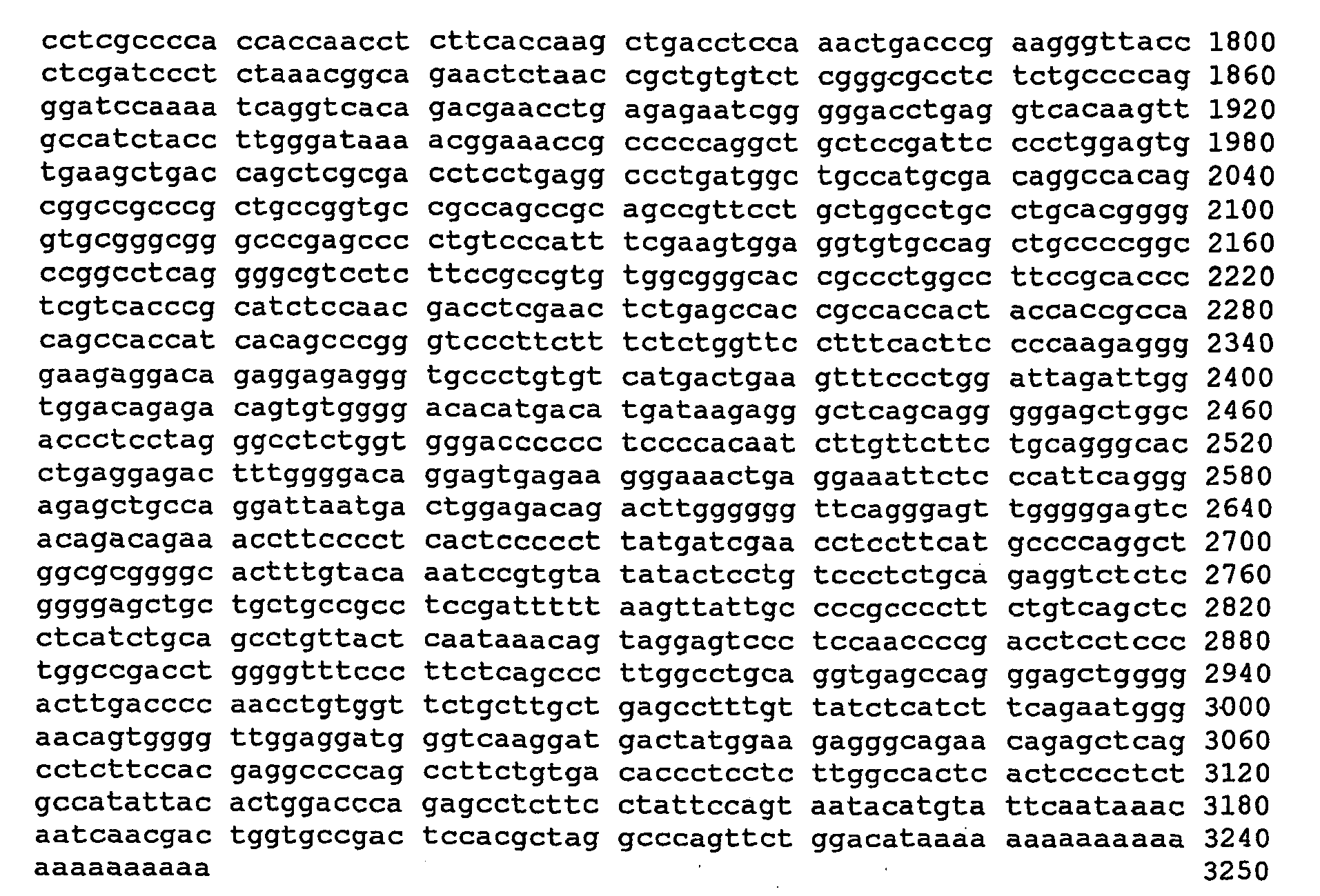
- <210> 3
<211> 3312
<212> DNA
<213> Homo sapiens - <220>
<221> polyA_signal
<222> (3275)..(3280) - <220>
<223> Kodierende Sequenz: (64)...(2319) - <400> 3


- <210> 4
<211> 3392
<212> DNA
<213> Homo sapiens - <220>
<221> polyA_signal
<222> (3355)..(3360) - <220>
<223> Kodierende Sequenz: (64)...(2127) - <400> 4


- <210> 5
<211> 724
<212> PRT
<213> Mus musculus - <400> 5


- <210> 6
<211> 660
<212> PRT
<213> Mus musculus - <400> 6


- <210> 7
<211> 752
<212> PRT
<213> Homo sapiens - <400> 7


- <210> 8
<211> 688
<212> PRT
<213> Homo sapiens - <400> 8


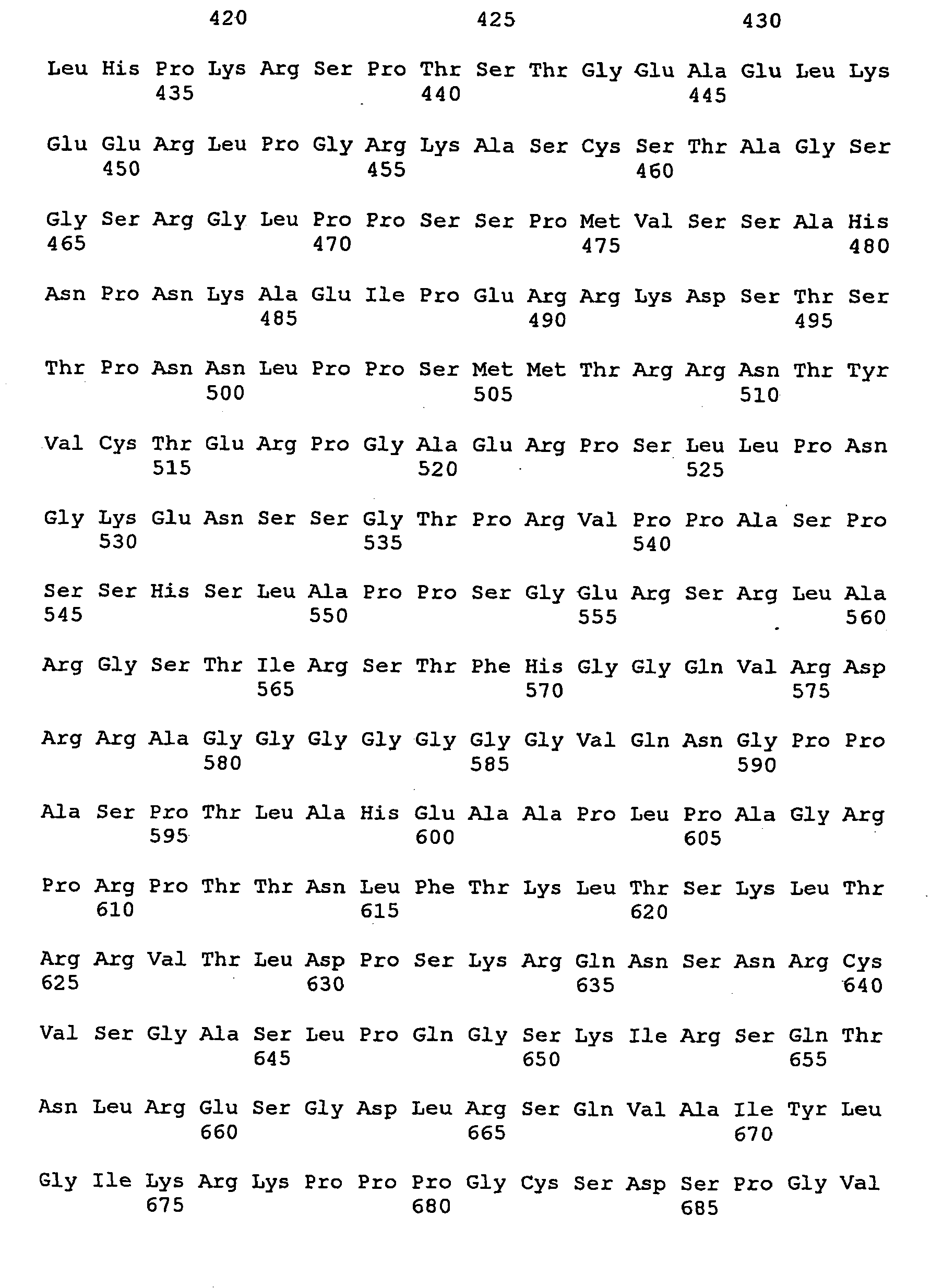
Claims (21)
- Nukleinsäure, die für eine neuronale Serin-Threonin-Protein-Kinase kodiert, ausgewählt ausa) Nukleinsäure, mit einer der Sequenzen nach SEQ ID Nr. 1-4 und Nukleinsäure, die für ein Protein mit einer Sequenz gemäß einer der SEQ ID Nr. 5-8 kodiert;b) Nukleinsäure, die für ein Protein kodiert, das mindestens 70 % Identität zu einem Protein gemäß einer der SEQ ID Nr. 5-8 aufweist, und dessen Expression durch fokale cerebrale Ischämie und Reperfusion induziert werden kann.
- Nukleinsäure nach Anspruch 1, dadurch gekennzeichnet, dass sie für eine Proteinsequenz nach einer der SEQ ID Nr. 5-8 kodiert.
- Nukleinsäure nach einem der Ansprüche 1 bis 2, dadurch gekennzeichnet, dass sie eine DNA ist.
- Konstrukt, enthaltend eine Nukleinsäure, nach einem der Ansprüche 1 bis 3, vorzugsweise unter der Kontrolle von die Expression regulierenden Elementen.
- Konstrukt, enthaltend eine Nukleinsäure, nach Anspruch 4, dadurch gekennzeichnet, dass sich die Nukleinsäure in Antisinnorientierung zu dem regulatorischen Element befindet.
- Konstrukt nach einem der vorhergehenden Ansprüche, dadurch gekennzeichnet, dass es in einem Plasmid vorliegt.
- Wirtszelle, enthaltend ein Konstrukt nach einem der Ansprüche 4 bis 5.
- Wirtszelle nach Anspruch 7, dadurch gekennzeichnet, dass sie ausgewählt wird aus Bakterien, Hefezellen und Säugerzellen.
- Isoliertes Säugergewebe-, organ und/oder nicht-menschlicher transgener Säuger, enthaltend ein Konstrukt nach einem der Ansprüche 4 bis 5.
- Wirtszelle und/oder Säugergewebe und/oder Säugerorgan und/oder nicht-menschlicher transgener Säuger nach einem der vorhergehenden Ansprüche, dadurch gekennzeichnet, dass die Nukleinsäure bzw. das Konstrukt in einer Stelle des Genoms integriert ist, die nicht seiner natürlichen Position entspricht.
- Protein, erhältlich durch Expression einer Nukleinsäure nach einem der Ansprüche 1 bis 3 in einem Expressionssystem, vorzugsweise einer Wirtszelle.
- Protein, dessen Expression durch fokale cerebrale Ischämie und Reperfusion induziert werden kann, erhältlich durch Expression einer Nukleinsäure nach einem der Ansprüche 1 bis 3 in einem Expressionssystem, vorzugsweise einer Wirtszelle.
- Protein nach Anspruch 11 oder 12, dadurch gekennzeichnet, dass es ausgewählt wird aus einem Protein mit einer der Sequenzen gemäß SEQ ID Nr. 5 bis 8 und Proteinen, die zu einem der genannten Proteine zu mindestens 70 % identisch sind und deren Expression durch fokale cerebrale Ischämie und Reperfusion induziert werden kann.
- Antikörper, der mit einem Protein nach einem der Ansprüche 11 bis 13 spezifisch reagiert.
- Diagnosekit, enthaltend eine Nukleinsäure nach einem der Ansprüche 1 bis 3 und/oder ein Konstrukt nach einem der Ansprüche 4 bis 5 und/oder ein Protein nach einem der Ansprüche 11 bis 13 und/oder einen Antikörper nach Anspruch 14.
- Verfahren zur Diagnose eines Apoplexierisikos, umfassend den Schritt: Bestimmen des Expressionsspiegels einer Nukleinsäure nach einem der Ansprüche 1 bis 3 oder der Menge an Protein nach einem der Ansprüche 11 bis 13 in einer Patientenprobe.
- Verfahren nach Anspruch 16, dadurch gekennzeichnet, dass die Patientenprobe mit einer Nukleinsäure nach einem der Ansprüche 1 bis 3 und/oder einem Antikörper nach Anspruch 14 in Kontakt gebracht wird.
- Verfahren zum Identifizieren und/oder Isolieren eines Protein-Kinaseinhibitors, dadurch gekennzeichnet, dass die Protein-Kinaseaktivität eines Proteins nach einem der Ansprüche 11 bis 13 in Anwesenheit und Abwesenheit der Testsubstanz bestimmt wird und die so als geeignet identifizierte Substanz isoliert wird.
- Protein-Kinaseassay, dadurch gekennzeichnet, das die untersuchte Protein-Kinase ein Protein nach einem der Ansprüche 11 bis 13 umfasst.
- Pharmazeutische Zusammensetzung, enthaltend eine Nukleinsäure, ein Konstrukt, eine Wirtszelle, Protein und/oder einen Antikörper nach einem der Ansprüche 1 bis 14.
- Verwendung einer Nukleinsäure, eines Konstrukts, einer Wirtszelle, eines Proteins und/oder eines Antikörpers nach einem der Ansprüche 1 bis 14 zur Herstellung eines Medikaments für die Prophylaxe und/oder Therapie neurologischer Erkrankungen, einschließlich Schlaganfall, Multiple Sklerose, Morbus Parkinson, Amyotrophe Lateralsklerose; Heterodegenerative Ataxien, Morbus Huntington, Neuropathien und Epilepsien und/oder Tumorerkrankungen, insbesondere Karzinome.
Applications Claiming Priority (3)
| Application Number | Priority Date | Filing Date | Title |
|---|---|---|---|
| DE10024171A DE10024171A1 (de) | 2000-05-17 | 2000-05-17 | Neuronale Serin-Threonin-Protein-Kinase |
| DE10024171 | 2000-05-17 | ||
| PCT/EP2001/005660 WO2001088108A1 (de) | 2000-05-17 | 2001-05-17 | Neuronale serin-threonin-protein-kinase |
Publications (2)
| Publication Number | Publication Date |
|---|---|
| EP1282700A1 EP1282700A1 (de) | 2003-02-12 |
| EP1282700B1 true EP1282700B1 (de) | 2008-02-27 |
Family
ID=7642396
Family Applications (1)
| Application Number | Title | Priority Date | Filing Date |
|---|---|---|---|
| EP01936370A Expired - Lifetime EP1282700B1 (de) | 2000-05-17 | 2001-05-17 | Neuronale serin-threonin-protein-kinase |
Country Status (9)
| Country | Link |
|---|---|
| US (2) | US7361502B2 (de) |
| EP (1) | EP1282700B1 (de) |
| JP (1) | JP2003533226A (de) |
| AT (1) | ATE387499T1 (de) |
| AU (2) | AU2001262296B2 (de) |
| CA (1) | CA2410193C (de) |
| DE (2) | DE10024171A1 (de) |
| ES (1) | ES2305077T3 (de) |
| WO (1) | WO2001088108A1 (de) |
Families Citing this family (3)
| Publication number | Priority date | Publication date | Assignee | Title |
|---|---|---|---|---|
| DE60237917D1 (de) | 2001-06-05 | 2010-11-18 | Exelixis Inc | Gfats als modifikatoren des p53-wegs und verwendungsverfahren |
| MX2010003371A (es) | 2007-09-28 | 2010-05-05 | Intrexon Corp | Constructos interruptores genicos terapeuticos y biorreactores para la expresion de moleculas bioterapeuticas y usos de los mismos. |
| CN108771731B (zh) * | 2018-07-06 | 2021-01-15 | 于国录 | 一种治疗脑梗塞后遗症的中药制剂及其制备方法 |
Citations (2)
| Publication number | Priority date | Publication date | Assignee | Title |
|---|---|---|---|---|
| EP1130094A2 (de) * | 1999-07-08 | 2001-09-05 | Helix Research Institute | Primer zur Synthese von vollständigen cDNA Klonen und ihre Verwendung |
| WO2002064791A2 (en) * | 2000-12-08 | 2002-08-22 | Curagen Corporation | Proteins and nucleic acids encoding same |
Family Cites Families (5)
| Publication number | Priority date | Publication date | Assignee | Title |
|---|---|---|---|---|
| GB9214873D0 (en) * | 1992-07-13 | 1992-08-26 | Medical Res Council | Process for categorising nucleotide sequence populations |
| EP0870033B1 (de) * | 1995-12-21 | 2010-04-21 | Sunnybrook & Women's College Health Sciences Centre | Integrin-gekoppelte kinase, ihre hemmstoffe und deren gebrauch für verfahren zur therapeutischen behandlung; gentherapie und bereitstellung von hemmstoffen, die als pseudosubstrate wirken |
| US5863729A (en) * | 1996-07-09 | 1999-01-26 | Washington University | DNA sequences encoding human TcAK1 kinase |
| US6162613A (en) * | 1998-02-18 | 2000-12-19 | Vertex Pharmaceuticals, Inc. | Methods for designing inhibitors of serine/threonine-kinases and tyrosine kinases |
| US20040018185A1 (en) * | 2001-04-20 | 2004-01-29 | Henry Yue | Human kinases |
-
2000
- 2000-05-17 DE DE10024171A patent/DE10024171A1/de not_active Ceased
-
2001
- 2001-05-17 AT AT01936370T patent/ATE387499T1/de active
- 2001-05-17 DE DE50113667T patent/DE50113667D1/de not_active Expired - Lifetime
- 2001-05-17 ES ES01936370T patent/ES2305077T3/es not_active Expired - Lifetime
- 2001-05-17 US US10/276,645 patent/US7361502B2/en not_active Expired - Fee Related
- 2001-05-17 CA CA2410193A patent/CA2410193C/en not_active Expired - Fee Related
- 2001-05-17 AU AU2001262296A patent/AU2001262296B2/en not_active Ceased
- 2001-05-17 JP JP2001585316A patent/JP2003533226A/ja active Pending
- 2001-05-17 WO PCT/EP2001/005660 patent/WO2001088108A1/de not_active Ceased
- 2001-05-17 EP EP01936370A patent/EP1282700B1/de not_active Expired - Lifetime
- 2001-05-17 AU AU6229601A patent/AU6229601A/xx active Pending
-
2008
- 2008-03-27 US US12/079,441 patent/US20080182314A1/en not_active Abandoned
Patent Citations (2)
| Publication number | Priority date | Publication date | Assignee | Title |
|---|---|---|---|---|
| EP1130094A2 (de) * | 1999-07-08 | 2001-09-05 | Helix Research Institute | Primer zur Synthese von vollständigen cDNA Klonen und ihre Verwendung |
| WO2002064791A2 (en) * | 2000-12-08 | 2002-08-22 | Curagen Corporation | Proteins and nucleic acids encoding same |
Also Published As
| Publication number | Publication date |
|---|---|
| US20080182314A1 (en) | 2008-07-31 |
| US7361502B2 (en) | 2008-04-22 |
| EP1282700A1 (de) | 2003-02-12 |
| DE10024171A1 (de) | 2001-12-20 |
| JP2003533226A (ja) | 2003-11-11 |
| US20040087784A1 (en) | 2004-05-06 |
| CA2410193C (en) | 2011-02-22 |
| DE50113667D1 (de) | 2008-04-10 |
| WO2001088108A8 (de) | 2001-12-20 |
| AU2001262296B2 (en) | 2005-03-03 |
| ATE387499T1 (de) | 2008-03-15 |
| CA2410193A1 (en) | 2001-11-22 |
| ES2305077T3 (es) | 2008-11-01 |
| WO2001088108A1 (de) | 2001-11-22 |
| AU6229601A (en) | 2001-11-26 |
Similar Documents
| Publication | Publication Date | Title |
|---|---|---|
| Wong et al. | Sprouty2 attenuates epidermal growth factor receptor ubiquitylation and endocytosis, and consequently enhances Ras/ERK signalling | |
| DE69926731T2 (de) | Diagnose und behandlung von aur1 und/oder aur2 verwandten erkrankungen | |
| DE69534568T2 (de) | Säugetier-telomerase | |
| Ino et al. | Expression of proliferating cell nuclear antigen (PCNA) in the adult and developing mouse nervous system | |
| US5880261A (en) | Transcription factor Islet-Brain 1 (IB1) | |
| EP1305636B1 (de) | Screeningverfahren | |
| Masana et al. | The stress-inducible actin-interacting protein DRR1 shapes social behavior | |
| Kaliman et al. | Myotonic dystrophy protein kinase phosphorylates phospholamban and regulates calcium uptake in cardiomyocyte sarcoplasmic reticulum | |
| Paletzki | Cloning and characterization of guanine deaminase from mouse and rat brain | |
| Butcher et al. | Light‐and clock‐dependent regulation of ribosomal S6 kinase activity in the suprachiasmatic nucleus | |
| EP1082416B1 (de) | Poly(adp-ribose)polymerase-gene | |
| EP1282700B1 (de) | Neuronale serin-threonin-protein-kinase | |
| Eisenhardt et al. | The AmCREB gene is an ortholog of the mammalian CREB/CREM family of transcription factors and encodes several splice variants in the honeybee brain | |
| Ureña et al. | Expression, synaptic localization, and developmental regulation of Ack1/Pyk1, a cytoplasmic tyrosine kinase highly expressed in the developing and adult brain | |
| Mircescu et al. | Identification and characterization of a novel activated RhoB binding protein containing a PDZ domain whose expression is specifically modulated in thyroid cells by cAMP | |
| EP1282827A2 (de) | Verfahren zum selektieren von inhibitoren für enzyme | |
| WO2002021138A2 (de) | Die m30-genfamilie und ihre verwendung | |
| WO2003016343A2 (en) | USE OF αCP1, αCP2, AND HUR FOR MODULATING GENE EXPRESSION AND INDUCING ANGIOGENESIS | |
| US20100242127A1 (en) | Methods to identify modulators of b-raf protein kinase and their use for the treatment of anxiety and depression | |
| DE69823022T2 (de) | Neues, menschliches tumorsuppressorgen. | |
| JP4018304B2 (ja) | 高親和性コリントランスポーター | |
| DE4236358A1 (de) | Nachweis und Inhibierung von Malatenzym in Tumorzellen | |
| DE10211369A1 (de) | Screeningverfahren zum Identifizieren protektiver Substanzen für die Behandlung neurodegenerativer und/oder ischämischer Erkrankungen | |
| Hori et al. | Cdc7 kinase is required for postnatal brain development | |
| WO2002022681A2 (de) | Neuronal exprimiertes protein und seine verwendung |
Legal Events
| Date | Code | Title | Description |
|---|---|---|---|
| PUAI | Public reference made under article 153(3) epc to a published international application that has entered the european phase |
Free format text: ORIGINAL CODE: 0009012 |
|
| 17P | Request for examination filed |
Effective date: 20021206 |
|
| AK | Designated contracting states |
Designated state(s): AT BE CH CY DE DK ES FI FR GB GR IE IT LI LU MC NL PT SE TR |
|
| AX | Request for extension of the european patent |
Extension state: AL LT LV MK RO SI |
|
| 17Q | First examination report despatched |
Effective date: 20030411 |
|
| 17Q | First examination report despatched |
Effective date: 20030411 |
|
| GRAP | Despatch of communication of intention to grant a patent |
Free format text: ORIGINAL CODE: EPIDOSNIGR1 |
|
| GRAS | Grant fee paid |
Free format text: ORIGINAL CODE: EPIDOSNIGR3 |
|
| GRAA | (expected) grant |
Free format text: ORIGINAL CODE: 0009210 |
|
| AK | Designated contracting states |
Kind code of ref document: B1 Designated state(s): AT BE CH CY DE DK ES FI FR GB GR IE IT LI LU MC NL PT SE TR |
|
| REG | Reference to a national code |
Ref country code: GB Ref legal event code: FG4D Free format text: NOT ENGLISH |
|
| REG | Reference to a national code |
Ref country code: CH Ref legal event code: EP |
|
| REG | Reference to a national code |
Ref country code: IE Ref legal event code: FG4D Free format text: LANGUAGE OF EP DOCUMENT: GERMAN |
|
| REF | Corresponds to: |
Ref document number: 50113667 Country of ref document: DE Date of ref document: 20080410 Kind code of ref document: P |
|
| BECA | Be: change of holder's address |
Owner name: *SYGNIS BIOSCIENCE G.M.B.H. & CO. K.G.IM NEUENHEIM Effective date: 20080723 |
|
| PG25 | Lapsed in a contracting state [announced via postgrant information from national office to epo] |
Ref country code: FI Free format text: LAPSE BECAUSE OF FAILURE TO SUBMIT A TRANSLATION OF THE DESCRIPTION OR TO PAY THE FEE WITHIN THE PRESCRIBED TIME-LIMIT Effective date: 20080227 |
|
| REG | Reference to a national code |
Ref country code: CH Ref legal event code: PUE Owner name: SYGNIS BIOSCIENCE GMBH & CO. KG Free format text: AXARON BIOSCIENCE AG#CARL-BOSCH-STR. 38#67056 LUDWIGSHAFEN (DE) -TRANSFER TO- SYGNIS BIOSCIENCE GMBH & CO. KG#IM NEUENHEIMER FELD 515#69120 HEIDELBERG (DE) Ref country code: CH Ref legal event code: PFA Owner name: AXARON BIOSCIENCE AG Free format text: AXARON BIOSCIENCE AG#IM NEUENHEIMER FELD 515#69120 HEIDELBERG (DE) -TRANSFER TO- AXARON BIOSCIENCE AG#CARL-BOSCH-STR. 38#67056 LUDWIGSHAFEN (DE) Ref country code: CH Ref legal event code: NV Representative=s name: ISLER & PEDRAZZINI AG |
|
| NLV1 | Nl: lapsed or annulled due to failure to fulfill the requirements of art. 29p and 29m of the patents act | ||
| PG25 | Lapsed in a contracting state [announced via postgrant information from national office to epo] |
Ref country code: DK Free format text: LAPSE BECAUSE OF FAILURE TO SUBMIT A TRANSLATION OF THE DESCRIPTION OR TO PAY THE FEE WITHIN THE PRESCRIBED TIME-LIMIT Effective date: 20080227 Ref country code: SE Free format text: LAPSE BECAUSE OF FAILURE TO SUBMIT A TRANSLATION OF THE DESCRIPTION OR TO PAY THE FEE WITHIN THE PRESCRIBED TIME-LIMIT Effective date: 20080527 Ref country code: NL Free format text: LAPSE BECAUSE OF FAILURE TO SUBMIT A TRANSLATION OF THE DESCRIPTION OR TO PAY THE FEE WITHIN THE PRESCRIBED TIME-LIMIT Effective date: 20080227 Ref country code: PT Free format text: LAPSE BECAUSE OF FAILURE TO SUBMIT A TRANSLATION OF THE DESCRIPTION OR TO PAY THE FEE WITHIN THE PRESCRIBED TIME-LIMIT Effective date: 20080721 |
|
| REG | Reference to a national code |
Ref country code: ES Ref legal event code: FG2A Ref document number: 2305077 Country of ref document: ES Kind code of ref document: T3 |
|
| ET | Fr: translation filed | ||
| PLBE | No opposition filed within time limit |
Free format text: ORIGINAL CODE: 0009261 |
|
| STAA | Information on the status of an ep patent application or granted ep patent |
Free format text: STATUS: NO OPPOSITION FILED WITHIN TIME LIMIT |
|
| 26N | No opposition filed |
Effective date: 20081128 |
|
| PG25 | Lapsed in a contracting state [announced via postgrant information from national office to epo] |
Ref country code: CY Free format text: LAPSE BECAUSE OF FAILURE TO SUBMIT A TRANSLATION OF THE DESCRIPTION OR TO PAY THE FEE WITHIN THE PRESCRIBED TIME-LIMIT Effective date: 20080227 |
|
| PG25 | Lapsed in a contracting state [announced via postgrant information from national office to epo] |
Ref country code: TR Free format text: LAPSE BECAUSE OF FAILURE TO SUBMIT A TRANSLATION OF THE DESCRIPTION OR TO PAY THE FEE WITHIN THE PRESCRIBED TIME-LIMIT Effective date: 20080227 |
|
| PG25 | Lapsed in a contracting state [announced via postgrant information from national office to epo] |
Ref country code: GR Free format text: LAPSE BECAUSE OF FAILURE TO SUBMIT A TRANSLATION OF THE DESCRIPTION OR TO PAY THE FEE WITHIN THE PRESCRIBED TIME-LIMIT Effective date: 20080528 |
|
| REG | Reference to a national code |
Ref country code: GB Ref legal event code: 732E Free format text: REGISTERED BETWEEN 20110317 AND 20110323 |
|
| PGFP | Annual fee paid to national office [announced via postgrant information from national office to epo] |
Ref country code: LU Payment date: 20110526 Year of fee payment: 11 Ref country code: FR Payment date: 20110706 Year of fee payment: 11 Ref country code: ES Payment date: 20110627 Year of fee payment: 11 Ref country code: CH Payment date: 20110527 Year of fee payment: 11 Ref country code: IE Payment date: 20110523 Year of fee payment: 11 Ref country code: MC Payment date: 20110531 Year of fee payment: 11 |
|
| PGFP | Annual fee paid to national office [announced via postgrant information from national office to epo] |
Ref country code: AT Payment date: 20110531 Year of fee payment: 11 Ref country code: GB Payment date: 20110531 Year of fee payment: 11 |
|
| PGFP | Annual fee paid to national office [announced via postgrant information from national office to epo] |
Ref country code: BE Payment date: 20110624 Year of fee payment: 11 Ref country code: IT Payment date: 20110528 Year of fee payment: 11 |
|
| PGFP | Annual fee paid to national office [announced via postgrant information from national office to epo] |
Ref country code: DE Payment date: 20110728 Year of fee payment: 11 |
|
| REG | Reference to a national code |
Ref country code: FR Ref legal event code: TP Owner name: SYGNIS BIOSCIENCE GMBH & CO KG, DE Effective date: 20120305 |
|
| BERE | Be: lapsed |
Owner name: *SYGNIS BIOSCIENCE G.M.B.H. & CO. K.G. Effective date: 20120531 |
|
| PG25 | Lapsed in a contracting state [announced via postgrant information from national office to epo] |
Ref country code: MC Free format text: LAPSE BECAUSE OF NON-PAYMENT OF DUE FEES Effective date: 20120531 |
|
| REG | Reference to a national code |
Ref country code: CH Ref legal event code: PL |
|
| REG | Reference to a national code |
Ref country code: AT Ref legal event code: MM01 Ref document number: 387499 Country of ref document: AT Kind code of ref document: T Effective date: 20120517 |
|
| GBPC | Gb: european patent ceased through non-payment of renewal fee |
Effective date: 20120517 |
|
| PG25 | Lapsed in a contracting state [announced via postgrant information from national office to epo] |
Ref country code: CH Free format text: LAPSE BECAUSE OF NON-PAYMENT OF DUE FEES Effective date: 20120531 Ref country code: LI Free format text: LAPSE BECAUSE OF NON-PAYMENT OF DUE FEES Effective date: 20120531 Ref country code: AT Free format text: LAPSE BECAUSE OF NON-PAYMENT OF DUE FEES Effective date: 20120517 |
|
| REG | Reference to a national code |
Ref country code: IE Ref legal event code: MM4A |
|
| PG25 | Lapsed in a contracting state [announced via postgrant information from national office to epo] |
Ref country code: BE Free format text: LAPSE BECAUSE OF NON-PAYMENT OF DUE FEES Effective date: 20120531 Ref country code: IT Free format text: LAPSE BECAUSE OF NON-PAYMENT OF DUE FEES Effective date: 20120517 |
|
| REG | Reference to a national code |
Ref country code: FR Ref legal event code: ST Effective date: 20130131 |
|
| REG | Reference to a national code |
Ref country code: DE Ref legal event code: R119 Ref document number: 50113667 Country of ref document: DE Effective date: 20121201 |
|
| PG25 | Lapsed in a contracting state [announced via postgrant information from national office to epo] |
Ref country code: IE Free format text: LAPSE BECAUSE OF NON-PAYMENT OF DUE FEES Effective date: 20120517 Ref country code: GB Free format text: LAPSE BECAUSE OF NON-PAYMENT OF DUE FEES Effective date: 20120517 Ref country code: FR Free format text: LAPSE BECAUSE OF NON-PAYMENT OF DUE FEES Effective date: 20120531 |
|
| PG25 | Lapsed in a contracting state [announced via postgrant information from national office to epo] |
Ref country code: DE Free format text: LAPSE BECAUSE OF NON-PAYMENT OF DUE FEES Effective date: 20121201 |
|
| REG | Reference to a national code |
Ref country code: ES Ref legal event code: FD2A Effective date: 20130820 |
|
| PG25 | Lapsed in a contracting state [announced via postgrant information from national office to epo] |
Ref country code: ES Free format text: LAPSE BECAUSE OF NON-PAYMENT OF DUE FEES Effective date: 20120518 |
|
| PG25 | Lapsed in a contracting state [announced via postgrant information from national office to epo] |
Ref country code: LU Free format text: LAPSE BECAUSE OF NON-PAYMENT OF DUE FEES Effective date: 20120517 |