EP1283511A2 - Etikett mit erhöhter Fälschungssicherheit - Google Patents
Etikett mit erhöhter Fälschungssicherheit Download PDFInfo
- Publication number
- EP1283511A2 EP1283511A2 EP02016049A EP02016049A EP1283511A2 EP 1283511 A2 EP1283511 A2 EP 1283511A2 EP 02016049 A EP02016049 A EP 02016049A EP 02016049 A EP02016049 A EP 02016049A EP 1283511 A2 EP1283511 A2 EP 1283511A2
- Authority
- EP
- European Patent Office
- Prior art keywords
- layer
- adhesive
- label
- lacquer
- laser
- Prior art date
- Legal status (The legal status is an assumption and is not a legal conclusion. Google has not performed a legal analysis and makes no representation as to the accuracy of the status listed.)
- Granted
Links
Images

Classifications
-
- G—PHYSICS
- G09—EDUCATION; CRYPTOGRAPHY; DISPLAY; ADVERTISING; SEALS
- G09F—DISPLAYING; ADVERTISING; SIGNS; LABELS OR NAME-PLATES; SEALS
- G09F3/00—Labels, tag tickets, or similar identification or indication means; Seals; Postage or like stamps
- G09F3/02—Forms or constructions
- G09F3/0291—Labels or tickets undergoing a change under particular conditions, e.g. heat, radiation, passage of time
- G09F3/0292—Labels or tickets undergoing a change under particular conditions, e.g. heat, radiation, passage of time tamper indicating labels
-
- C—CHEMISTRY; METALLURGY
- C09—DYES; PAINTS; POLISHES; NATURAL RESINS; ADHESIVES; COMPOSITIONS NOT OTHERWISE PROVIDED FOR; APPLICATIONS OF MATERIALS NOT OTHERWISE PROVIDED FOR
- C09J—ADHESIVES; NON-MECHANICAL ASPECTS OF ADHESIVE PROCESSES IN GENERAL; ADHESIVE PROCESSES NOT PROVIDED FOR ELSEWHERE; USE OF MATERIALS AS ADHESIVES
- C09J7/00—Adhesives in the form of films or foils
- C09J7/30—Adhesives in the form of films or foils characterised by the adhesive composition
- C09J7/35—Heat-activated
-
- C—CHEMISTRY; METALLURGY
- C09—DYES; PAINTS; POLISHES; NATURAL RESINS; ADHESIVES; COMPOSITIONS NOT OTHERWISE PROVIDED FOR; APPLICATIONS OF MATERIALS NOT OTHERWISE PROVIDED FOR
- C09J—ADHESIVES; NON-MECHANICAL ASPECTS OF ADHESIVE PROCESSES IN GENERAL; ADHESIVE PROCESSES NOT PROVIDED FOR ELSEWHERE; USE OF MATERIALS AS ADHESIVES
- C09J7/00—Adhesives in the form of films or foils
- C09J7/30—Adhesives in the form of films or foils characterised by the adhesive composition
- C09J7/38—Pressure-sensitive adhesives [PSA]
-
- C—CHEMISTRY; METALLURGY
- C09—DYES; PAINTS; POLISHES; NATURAL RESINS; ADHESIVES; COMPOSITIONS NOT OTHERWISE PROVIDED FOR; APPLICATIONS OF MATERIALS NOT OTHERWISE PROVIDED FOR
- C09J—ADHESIVES; NON-MECHANICAL ASPECTS OF ADHESIVE PROCESSES IN GENERAL; ADHESIVE PROCESSES NOT PROVIDED FOR ELSEWHERE; USE OF MATERIALS AS ADHESIVES
- C09J2203/00—Applications of adhesives in processes or use of adhesives in the form of films or foils
- C09J2203/334—Applications of adhesives in processes or use of adhesives in the form of films or foils as a label
-
- C—CHEMISTRY; METALLURGY
- C09—DYES; PAINTS; POLISHES; NATURAL RESINS; ADHESIVES; COMPOSITIONS NOT OTHERWISE PROVIDED FOR; APPLICATIONS OF MATERIALS NOT OTHERWISE PROVIDED FOR
- C09J—ADHESIVES; NON-MECHANICAL ASPECTS OF ADHESIVE PROCESSES IN GENERAL; ADHESIVE PROCESSES NOT PROVIDED FOR ELSEWHERE; USE OF MATERIALS AS ADHESIVES
- C09J2301/00—Additional features of adhesives in the form of films or foils
- C09J2301/20—Additional features of adhesives in the form of films or foils characterized by the structural features of the adhesive itself
- C09J2301/21—Additional features of adhesives in the form of films or foils characterized by the structural features of the adhesive itself the adhesive layer being formed by alternating adhesive areas of different nature
-
- Y—GENERAL TAGGING OF NEW TECHNOLOGICAL DEVELOPMENTS; GENERAL TAGGING OF CROSS-SECTIONAL TECHNOLOGIES SPANNING OVER SEVERAL SECTIONS OF THE IPC; TECHNICAL SUBJECTS COVERED BY FORMER USPC CROSS-REFERENCE ART COLLECTIONS [XRACs] AND DIGESTS
- Y10—TECHNICAL SUBJECTS COVERED BY FORMER USPC
- Y10T—TECHNICAL SUBJECTS COVERED BY FORMER US CLASSIFICATION
- Y10T428/00—Stock material or miscellaneous articles
- Y10T428/28—Web or sheet containing structurally defined element or component and having an adhesive outermost layer
Definitions
- the invention relates to a label with increased protection against forgery from a carrier layer, in particular lacquer layer, very particularly made of thermosetting lacquer Laser inscription, with an adhesive layer on the lower side of the carrier layer is available.
- the labeling with laser labels is especially in the automotive industry, especially important for high-quality markings.
- To this Information and instructions such as tire pressure or the type of fuel are used for the later users placed on various components of the automobile.
- Even in the Upstream manufacturing stages can store important production data using a laser label be transported.
- the label can be labeled with a barcode.
- a suitable reading device Through a suitable reading device, an assembly team is given the opportunity to directly on the Production line, information about model, color and special equipment by the Read out barcode.
- a peeled label can easily give a stolen vehicle a different identity (new chassis number). This means that the vehicle can be traced almost impossible.
- the label material used must therefore be tampered with counteract, be as counterfeit-proof as possible. It must not be destroyed by Peel off the adhesive base.
- a multilayer label is made up of a thin and a thick one self-supporting, opaque pigmented paint layer revealed. Both layers exist from an electron-beam-hardened, solvent-free lacquer, the Layer thicknesses are different.
- the label is labeled by using With the help of a laser, the upper, thinner lacquer layer is burned away, so that the lower one thicker lacquer layer is visible, the lower layer preferably a contrasting color has the former.
- This label is a type of engraving with which Manipulation options as with traditional printing with colors and inks omitted.
- the label is like this due to the raw materials used and the manufacturing process brittle that a removal of the same from the prison surfaces almost always only is possible under destruction.
- Laser labels of this type are used in particular for efficient and variable labeling Manufacture of label sets used.
- These label sets contain the complete set Number of labels that, for example, in a motor vehicle are subject to labeling Components are required (VIN plate, plates about tire pressure, trunk loading, Characteristics for engines and units etc.).
- a laser film such as that from DE G 81 30 861 offers is known and available for example as tesa 6930 ® from Beiersdorf, due to their very brittle product structure, good conditions, possibly Document attempts at manipulation and thus thwart them.
- the laser-inscribed label is only with great effort and certain Non-destructive requirements in one piece from its original Remove the adhesive surface.
- EP 0 645 747 A describes a laser-inscribable multilayer label material shown that optical from a first layer, a second, from the first layer differing layer composed, the first layer by means of laser radiation according to a desired typeface or printed image with visualization of the Surface of the second layer is removable. There is still one between the layers a transparent plastic film forming a carrier layer is arranged.
- DE 44 21 865 A1 shows a single-layer laser label made of a carrier layer made of plastic, which contains an additive that shows a color change under laser irradiation.
- the backing layer is coated on one side with a self-adhesive, which optionally covered with a release paper or a release film.
- DE 199 09 723 A1 discloses a security film which has a carrier layer has in which an identification medium is contained. With the help of a non-contact Labeling process can change the diffusion properties of this identification medium be selectively and locally changed.
- the security film labeled in this way is on a When the workpiece is glued on, the identification medium diffuses towards the substrate surface and causes a detectable reaction there. This diffusion or reaction takes place only in those areas of the substrate surface where the marking process the ability to diffuse was triggered or not hindered. Thus, the Security film clear labeling and identification of the workpiece.
- the security film is labeled using a non-contact process. So can In the factory environment, insensitive, quick, flexibly variable labeling can be achieved.
- the labeling of the security film - and thus the change in Diffusion properties of the identification medium - can be especially with the help electromagnetic radiation.
- Particularly advantageous for labeling the Safety film is the use of a laser, with the help of which both a temperature and light-sensitive labeling can also be used (the term "light” in this case the entire range of the electromagnetic spectrum accessible to the laser comprises). Lasers have the additional advantage of high-contrast labeling with a to allow any choice of pattern to quickly change the To allow labeling patterns and to be used reliably in the factory environment.
- labels succeed to separate from the substrate.
- plastic substrates such as polyethylene or Polypropylene shows weaknesses in the bond between adhesive and substrate.
- the first attempts at solving the label's individual material are in DE 199 04 823 A1.
- a method for producing a film is described in which is first embossed with a support sheet using an embossing tool, the Embossing tool has holographic structures. Then a film is placed on the embossed support film, so that there is at least one hologram on the film looming.
- the object of the invention is to provide a label that meets the stated requirement of improved counterfeit security, especially the counterfeit security of the laser-inscribable films to increase the modification of the adhesive To improve the adhesive properties of the film so that a glued label, even with the help of a cutting tool, can not be removed non-destructively, in particular high contrast, high resolution, high temperature resistance and simple Has application possibility.
- the invention relates to a label with increased security against forgery at least one carrier layer, one on the lower side of the carrier layer Adhesive layer is present.
- the adhesive layer consists of a pressure sensitive adhesive and / or Hot glue and a heat-activated reactive adhesive.
- the pressure sensitive adhesive is in the adhesive layer and / or hot glue mixed with the heat-activated reactive adhesive.
- the pressure-sensitive adhesive and / or hot-melt adhesive and the through are also advantageous in the adhesive layer Reactive adhesives that can be activated by heat are alternately arranged in strips.
- the heat-reactive reactive adhesive forms a bridge between the backing layer and Bonding substrate, so that the reactive adhesive when activated to both direct Has connection.
- any other are also possible partial geometrical arrangements and shapes possible, especially punctiform, with changing distances of the glue etc.
- the selection of the arrangement depends on the respective application and Location of the label.
- the reactive adhesive is in partial strips or dots laminated or printed onto the carrier, in particular laser lacquer layer.
- the adhesive is then applied to the modified carrier layer in a second coating step coated.
- the advantage of this variant lies in the permanent tack that is present over the entire surface.
- the carrier layer preferably has a thickness of 10 to 200 ⁇ m, in particular 50 up to 100 ⁇ m.
- Suitable backing layers also consist of plastics such as polyester, poly (meth) acrylates, Polycarbonate and polyolefins as well as radiation-curable systems such as unsaturated polyester, epoxy, polyester and urethane acrylates, such as those used for UV printing inks Find application, especially those made from a base polymer DE G 81 30 861, namely aliphatic urethane acrylate oligomers.
- plastics such as polyester, poly (meth) acrylates, Polycarbonate and polyolefins
- radiation-curable systems such as unsaturated polyester, epoxy, polyester and urethane acrylates, such as those used for UV printing inks Find application, especially those made from a base polymer DE G 81 30 861, namely aliphatic urethane acrylate oligomers.
- the additive can be a pigment, in particular copper hydroxide phosphate or iriodin, and titanium dioxide can be used in addition to the additive.
- Suitable additives are, in particular, color pigments and metal salts, especially Copper hydroxide phosphate or iriodin, a pearlescent pigment, as it is from the company Merck is commercially available. These additives are added to the base polymer (such as Example described in DE G 81 30 861), in particular on the order of a few Per thousand up to a maximum of 10% by weight, preferably in amounts of 0.1 to 10% by weight, in particular from 0.5 to 5% by weight based on the total weight of the carrier layer. To Production of flat material by known processes such as extrusion, casting, Coating etc., with subsequent radiation crosslinking, if necessary such films coated with the adhesive layer.
- a cover with siliconized release paper then gives the typical structure for Material from which labels can be made.
- the backing layer consists of a lacquer, in particular from a hardened lacquer, preferably a radiation-hardened lacquer, particularly preferably from an electron-beam-hardened polyurethane acrylate lacquer.
- the carrier layer is made of one Polybutylene terephthalate.
- an outer in particular self-supporting, opaque pigmented lacquer layer preferably solvent-free applied, which is then particularly electron beam hardened.
- the upper lacquer layer formed by a hardened, ie cross-linked lacquer, has preferably a thickness of 1 to 20 microns, in particular 5 to 15 microns, the paint layer preferably a thickness of 20 to 500 microns, especially 30 to 100 microns.
- paints In principle, four types of paint can be used, provided their stability is sufficient, for example acid-curing alkyd melamine resins, addition-crosslinking polyurethanes, free-radical curing Polystyrene paints and the like.
- radiation-curing paints are particularly advantageous because they very quickly without lengthy evaporation of solvents or exposure to heat Harden.
- varnishes have been described, for example, by A. Vrancken (color and Lack 83.3 (1977) 171).
- both layers of paint have one against the other maximum color contrast.
- the label according to the invention preferably consists of an opaque one upper layer, which can be easily burned by a laser beam, a lower one Layer in particular in a contrasting color to the first, the lower layer so is that it is not easily burned by the laser beam.
- either on the lacquer layer or on the second layer of paint is a color with a fluorescent or phosphorescent Additively printed, in such a way that in the finished label the color layer between the is two layers of paint.
- the lacquer layer relevant for the font can be used a suitable additive can be incorporated.
- the outer layer of paint itself for example for the high-gloss nameplates, remains unchanged until laser engraving the paint layer partially exposed at the locations of the lettering.
- the coloring particles can be fine color pigments or else also preferably around visible particles in the order of 0.1 to 5 mm. at Use of finely ground color pigments will result in a slight change in color Lettering creates a characteristic color mosaic with the visible particles. at Using daylight fluorescent colors, the "fingerprint" can be seen without any tools is often undesirable. Color pigments or particles are therefore preferably used, that do not absorb in the range of visible light and are therefore normally invisible are - only when the label is illuminated with a lamp of a suitable wavelength the color pigments stimulate and shine in a characteristic way.
- luminescent materials are also suitable Electron beams, X-rays, etc. as well as thermochromic pigments, which change color reversibly when the temperature changes - but in these cases it is Carrying out the identification on the glued label is cumbersome and in practice more complex than visualization using light of a suitable wavelength.
- Labels film production, adhesive coating
- these mostly sensitive phosphors are embedded in a polymer matrix and are additionally protected by the cover layer. Further measures against mechanical abrasion and protection against direct oxygen and water contact are not necessary.
- the integration into a solid polymer matrix is particularly favorable in Regarding luminosity and stability.
- recipes can be used with RADGLO® pigments from Radiant Color N.V./Holland or Lumilux ® CD pigments from Riedel-de-Haen.
- Inorganic phosphors are also suitable; as Long afterglow substances, especially with emission of light in the yellow area, have become Metal sulfides and oxides, mostly in connection with. suitable activators, as cheap proved.
- These are for example under the trade name Lumilux ® N or as improved luminous pigments with regard to stability, luminosity and persistence the trade name LumiNova ® available from Nemoto / Japan.
- These dyes / pigments listed as examples are included in the recipe of the respective Lacquer layer in amounts of 0.1 to 50 wt .-%, preferably with 1 to 25 wt .-%, whole particularly preferably 7% by weight, incorporated and coated. After the final Adhesive coating of the lacquer layer and, if necessary, covering with release paper or Separating film is the label material for customer-specific use.
- the label After punching / laser cutting the desired label geometries as well as the final inscription using a laser beam with lettering, barcodes, logos etc. the label in its final form.
- the label shows pigments in the lacquer layer Illuminating pigments a characteristic afterglow in the area of laser marking and on the edges, which allows easy and quick identification as an original label.
- the label In addition to the special light source and, if necessary, a privacy screen against disturbing No additional complex equipment is required for ambient light - after the test the label remains unchanged.
- Such labels, the phosphors in the lacquer layer, especially those only after UV or IR excitation emitting in the visible wavelength range are also suitable for a tailor-made production (printing, punching, application, etc.). Instead of separately Print or control markings to be applied can be processed during processing Light emission of the lacquer layer can be used for this: especially after labeling and cutting the labels with a laser beam from uncut punched material can in the excitation in a downstream control unit at a defined position on the label and emission with suitable equipment as a tax stamp for further processing steps or for the production of the next label.
- the entire paint layer must be consistently three-dimensional conductive, which is only within the scope of the original Manufacturing process can ensure.
- a laser-inscribable label can be manufacture by adding electrically conductive substances to the recipe of the paint layer be added; this can be in addition to the previous pigments or else done at least partly in the replacement of the existing pigments to the good ones Maintain processing properties of the paint pastes.
- conductive additives principally electrically conductive metallic, organic, polymeric and inorganic Substances are suitable, the use of metals being preferred. Especially for white or light-colored layers of paint, the intrinsic color of the conductive additive must be selected consider. Conductive carbon black is also suitable, but only for black ones or dark layers of paint.
- a minimum limit concentration should be set Additively ensure that there are sufficient particles in the paint layer to touch and have contact with each other. When falling below this Limit concentration is a conductive one in the three-dimensional structure of the base layer No longer ensured from A to B. Metallic particles are therefore preferred used, fibers with a high length to cross-section ratio preferred because with lower concentrations there is a three-dimensional conductivity can be ensured than with spherical particles; besides, the falls Color change of the lacquer layer with the fibers less.
- metals preferred from cost-benefit considerations copper, iron, aluminum and steel and their Alloys used, but also expensive, highly conductive metals such as silver, gold suitable.
- the fiber dimensions are 0.1 to 50 mm in length and cross sections from 1 to 100 ⁇ m, preferably metal fibers with a diameter of 2 to 20 ⁇ m at a Cross-sectional to length ratio of approx. 1: 100 to 1: 1000 are used.
- Such Fibers are 0.5 to 25 wt .-%, preferably 2 to 10 wt .-% in the known Recipe incorporated homogeneously and coated and cured according to DE G 81 30 861.
- label material is available Available, which can be labeled with a laser beam.
- the layer of lacquer becomes the lettering of the lacquer layer in the area of laser marking exposed - when a voltage is applied to two via suitable electrode contacts A and B are measured at different points A and B of these logos is characteristic of the lacquer layer and among other things by the amount and type of conductive additive is determined. There is thus the possibility of using defined recipes to produce customer-specific label stock.
- This additional marking is not from the front in the area of the laser marking recognizable (except for a transparent or translucent layer), but only round around the label on the edge. To make it clearly recognizable at the label edge ensure strong luminous color pigments in sufficient layer thickness printed. Nevertheless, the additional security is hidden and therefore inconspicuous.
- This Security marking is protected from external access because of the pressure embedded between the label film and the adhesive layer: subsequent Manipulations are not to be feared, as a replacement of the known laser labels only destruction of the paint film is possible.
- Customer-specific "fingerprints" of the labels can be realized by different colors or patterns can be printed. Especially regular lines and line patterns leave characteristic patterns of Illuminated dots are created and are also particularly material and cost-saving. After Punching or laser cutting of the label and the application on the When choosing a suitable lighting source, the adhesive surface is on the edge of the label to recognize a pattern that is characteristic of colors and geometries.
- Luminous pigments are preferably applied by screen printing to achieve layer thicknesses in the range to achieve from 0.5 to 50 microns, preferably 2 to 25 microns.
- the label material for the desired formats and sizes punched or cut out by laser beam After the adhesive coating and covering, the label material for the desired formats and sizes punched or cut out by laser beam.
- labels are no indication of a hidden level of counterfeiting recognize, if phosphors are selected, their light emission by excitation with Light is generated outside the visible range; only after irradiation with Suitable light sources find excitation of the luminous pigments on the edges of the Labels instead.
- markings that can be recognized visually result in a predetermined pattern of luminous dots. Through different stroke widths and -heights can be designed differently large. So it’s easy to cost-effective and, if required, customer-specific via geometry and color selection Realize easily detectable security level.
- the label that consists of at least one Lacquer layer exists, obtainable by the fact that on a printed or embossed Support carrier film, the varnish layer preferably applied without solvent and is then cured.
- a hologram can be applied to the lacquer layer be upset.
- the lacquer layer is self-supporting and covering is pigmented and when the lacquer layer is electron beam hardened.
- the support carrier film is a plastic film is, especially polyester.
- the support carrier film is printed in particular using the flexographic printing process, because the UV flexographic printing process has one regarding the design of geometries very high degree of freedom and can be used especially for sheet-like materials from paper to Provide good print quality at the lowest possible price. With this technology it is possible to line fields, pictures, logos, fonts etc. in different sizes and types transferred from the cliché to the printing substrate.
- a cliché with the logos and fonts is wetted with printing ink and transfer this onto a plastic film.
- the printing ink can then be replaced by physical Activation (thermal, radiation chemical) can be cured on the film.
- the Color form a high bond to the film substrate; this is for the further Processing indispensable.
- a pressure anchor must be checked before further processing.
- the cross-cut test (DIN EN ISO 2409) is used for this.
- the print is said to Cross-cut test achieve at least a rating of Gt 02.
- the printing ink depending on the Foil material and / or the use of a pretreatment process for the printing foil necessary.
- the corona treatment which is inline, can preferably be selected here the printing can be used.
- the Surface tension can be set to> 50 mN / m. This can be done with standard test inks be measured.
- the UV curing should have a percentage power setting between Have 50% to 100% to have sufficient flexibility in printing for that to ensure further processing processes.
- the printing should have a height of 0.1 ⁇ m to 15 ⁇ m. Preferably choose a height of 1 to 5 ⁇ m.
- the impression and expression of pressure can also be caused by the course of the pressure points can be varied.
- the other conventional printing processes can also be used to implement the invention are used, which are known as high pressure processes. These include book and Screen printing.
- the support sheet can be printed with a variety of motifs, for example Company logos or advertising.
- the printing of the support carrier film creates a Negative impression on the visible surface of the first layer of lacquer label according to the invention.
- the impression of the printed is in the first lacquer layer Support carrier film is present as a recess from 0.1 to 15 ⁇ m, preferably from 1 to 5 ⁇ m.
- the label according to the invention can be produced on an embossed support film take place, for example on a polyester film of preferably 25 to 100 ⁇ m thickness, in particular 50 microns.
- the support foil can be embossed, for example, with an embossing plate (available from Gerhardt) in different strengths or depths.
- the embossing depth depends on the embossing pressure that is set on the in the Stamping process used magnetic cylinder acts and the type of The impression cylinder.
- a jacket of the impression cylinder (for example with tesaprint ® or with a polyester film) causes a strong embossing.
- the embossing tool used can have holographic structures, so that the structure is formed on the lacquer layer and results in at least one hologram.
- the side of the embossing tool facing the embossed material is thus shaped such that one Structure arises, which is a diffraction grating or a holographic Includes illustration.
- the hologram is generated in the lacquer layer itself, it is harmful Multi-layer structure is not given, and the diffraction grating produced in this way has the same Durability and laserability like the paint layer itself.
- the support carrier film consists of a thermosetting or thermoplastic material that is permanently shaped, namely especially made of polyester or polyamide.
- the Paint layer applied and by the action of an electron beam with high energy (150 to 500 kV) hardened under effectively oxygen-free conditions can be particularly low dose or with a little oxygen set a slightly sticky surface become.
- the second layer is applied to this first layer and also by means of an electron beam hardened. If necessary, this is then coated with the adhesive and then, if desired, the cover with the protective paper. After that the Polyester film peeled off so that the free surface of the first, upper layer for Comes out. Depending on the shape of the surface of the polyester film, it is shiny, smooth, matt or embossed.
- this identification medium can be selectively and locally changed. If so labeled carrier film glued to a workpiece, this diffuses Identification medium towards the substrate surface and causes a detectable there Reaction. This diffusion or reaction occurs only in such areas the substrate surface, in which the diffusion ability was triggered or not hindered.
- the carrier layer thus enables clear labeling and identification of the workpiece.
- the carrier layer is labeled using a non-contact process. So can In the factory environment, insensitive, quick, flexibly variable labeling can be achieved.
- the labeling of the carrier layer - and thus the change in Diffusion properties of the identification medium - can be especially with the help electromagnetic radiation.
- lasers are particularly advantageous for inscribing the carrier layer With the help of both temperature and light sensitive labeling (in this case the term "light” means the entire area of the laser beam accessible to the laser electromagnetic spectrum includes). Lasers have the additional advantage enable high-contrast labels with any choice of pattern, allow rapid changes to the labeling pattern and are reliable in the process Factory environment.
- a substance is selected as the identification medium that has a detectable substance on the substrate Triggers reaction.
- the identification medium must match the material properties of the Be adapted substrate. So the identification medium can be on the substrate matched - contain dye that diffuses locally into the substrate surface and colors them. Alternatively, the identification medium can contain a substance that is associated with the Chemical reaction occurs.
- reactions in which the substrate surface is locally worn or locally inflated is, so that the inscription of the substrate after removal of the film optically or tactilely can be demonstrated.
- an identification medium choose its influence on the underlying substrate not with the naked eye is recognizable. This can be achieved with an identification medium that the Absorption and reflection properties of the substrate z. B. only in the UV or IR range, but not affected in the visible range.
- the substrate contains no visible traces of the marking.
- the affected areas still contain the marking, which is simply done by informed security personnel with the help of e.g. B. a UV or IR viewer can be detected.
- the identification medium can be chosen so that the detectability, e.g. B. UV fluorescence, only at certain wavelengths of the test light.
- the film For industrial use of the carrier layer, especially in the automotive industry, the film must be extremely robust against the effects of temperature and light. These requirements can best be met if the security film has physical barriers that in the unwritten state of the support layer Inhibit diffusion of the identification medium.
- these barriers are locally destroyed or weakened so that a selective diffusion of the Identification medium can take place.
- To a high temperature respectively To achieve lightfastness of the lettering must destroy the barriers required temperatures or light intensities are significantly higher than those to whom the object to be marked is in use - even under extreme conditions Ambient conditions - subject to.
- Such diffusion inhibition of the identification medium by a contactless Labeling can be canceled, can be advantageous by microencapsulation of the Identification medium can be realized in the carrier layer.
- the identification medium is enclosed in capsules, the walls of which, for. B. consist of wax and / or fat and z. B. by the local influence of heat in the affected areas of the film can be broken open so that the identification medium contained therein escape and - upon contact with the substrate - diffuse into it or can react with it.
- a particularly high temperature resistance of the lettering can be achieved if the barrier is formed by a barrier layer, which is flat between the support layer and an adhesive layer is arranged and the diffusion in the unlabelled state of the film of the identification medium prevented from the carrier layer.
- the barrier layer is locally broken, so that the Identification medium locally at these breakthrough points out of the carrier layer can escape and diffuse into the adhesive layer.
- the carrier layer represents a kind of matrix in which the Identification medium is embedded.
- the material of the backing layer itself can do that Represent identification medium so that the carrier layer of identification medium consists.
- the reactive adhesive is a mixture of reactive resins at room temperature network and form a three-dimensional, high-strength polymer network, and of permanently elastic elastomers that counteract embrittlement of the product and thus allow permanent loads (compressions, strains) on the product.
- the elastomer preferably comes from the group of polyolefins, polyesters, polyurethanes or polyamides or can be a modified rubber such as nitrile rubber or also polyvinyl butyral, polyvinyl formal, polyvinyl acetate, carboxylated or epoxylated SEBS polymer.
- Nitrile rubber is very particularly preferably used.
- thermoplastic polyurethanes are made as reaction products Polyester or polyether polyols and organic diisocyanants such as Diphenylmethane diisocyanate known. They are made up of predominantly linear macromolecules built up. Such products are usually commercially available in the form of elastic granules, for example from Bayer AG under the trade name "Desmocoll”.
- the Softening temperature can be reduced sufficiently. In parallel, there is even an increase of adhesion. Certain rosin, Hydrocarbon and coumarone resins proven.
- the combination can reduce the softening temperature of TPU with selected epoxy resins based on bisphenol A and / or F and a latent hardener can be achieved.
- the addition of the reactive resin / hardener systems also leads to a reduction in the Softening temperature of the above polymers, what their processing temperature and speed advantageously reduces.
- the reactive adhesive is a at room temperature or slightly elevated temperature self-adhesive product. When heating the product comes it also lowers the viscosity in the short term, making the product rough Can wet surfaces.
- compositions of the reactive adhesive can be changed by The type and proportion of raw material vary widely. Likewise, others Product properties such as color, thermal or electrical conductivity through targeted additions of dyes, mineral or organic fillers, for example silicon dioxide, and / or carbon or metal powders can be achieved.
- soft or elastic, spherical, metallized particles the core of which is made of metal or plastic and which can adapt to the thickness of the adhesive layer after pressing, since the Core can be deformed at the bonding temperatures.
- These particles can Metal balls - for example made of gold, nickel, silver -, silver-plated metal balls or preferably metallized or metal-coated polymer or Elastomer balls - such as plastic balls, styrofoam balls - the coating with a highly conductive metal (gold, silver, copper, nickel).
- the Metal or plastic balls can be coated with conductive polymer.
- the spacer particles are of spherical geometry and are made of a hard material which is used in the increased adhesive temperature does not melt and is difficult or not deformable.
- the Spacer particles can also be conductive, but they should be harder than that metallized particles.
- the pressure sensitive adhesive and / or hot melt adhesive is, for example, a pressure sensitive adhesive, as disclosed in DE 15 69 898 C. The content of the entire revelation of this Scripture is therefore part of this invention.
- an acrylic adhesive with a mass of 25 to 35 g / m 2 is applied.
- the adhesive layer designed according to the invention does not adversely affect the label.
- the physical and chemical resistance are not changed. From the point of view of application, the label does not experience any losses in terms of the ability to be labeled with a laser or the legibility of the information.
- a non-destructive detachment is particularly due to the strip-like arrangement of the Reactive adhesive made impossible in the adhesive layer.
- the reactive adhesive forms a Obstacle that prevents the blade from closing the lower layers of the adhesive cut.
- Figure 1 the structure of a label according to the invention is shown, and the label with the heat-activated reactive adhesive, which mixes with a pressure sensitive pressure sensitive adhesive.
- the second lacquer layer 3 is located in the label on the thicker lacquer layer 2, and this on a layer of an adhesive 1 which is glued to the substrate 4.
- the adhesive layer 1 is composed of a mixture of a pressure-sensitive pressure sensitive adhesive and the heat activated glue.
- Figure 2 differs from Figure 1 only in that the adhesive layer 1 one has a different structure.
- the adhesive layer 1 is essentially formed by the pressure-sensitive adhesive 11 the three strips of reactive adhesive 12 are applied.
- the reactive adhesive 12 is located that is, between the lacquer layer 2 and the pressure-sensitive adhesive 12.
- the adhesive layer 1 is produced by the reactive adhesive 12 in the form of a strip is printed or laminated on the pressure sensitive adhesive 11.
- the reactive adhesive 12 is thus in direct contact with the substrate 4.
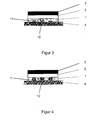
- Figure 4 is characterized in that reactive adhesive 12 and more sensitive to pressure Pressure sensitive adhesives 11 are alternately arranged in strips on the lacquer layer 2.
- a possible one The production process of the strips is printing or lamination.
- a particularly advantageous label is to be disclosed, which can be found under Using a printed support sheet is made so that on the Embossed label surfaces result in a further high safety factor Consequence.
- the support film to be printed here a polyester film (Hostaphan RN 75®) from the company Mitsubishi is corona treated accordingly before printing desired surface tension treated. This can be done with a VETAPHON-Corona-Plus corona station DK - E-Treater ET 2 - with an output of 0.2 to 2.0 kW. Setting the surface tension to> 50 is advantageous for further processing mN / m.
- a cationic, curable UV varnish SICPA 360076 from the company is used SICPA, Aarberg, which is tinted blue. By adding 5% by weight The cylinder's ink is optimized for processing.
- the pretreated is treated with an ARSOMA em 410 or em 510 UV flexographic printing machine Polyester film at a machine speed of 30 m / min via a flexographic printing station printed.
- the precisely defined color transfer to the flexographic printing plate is achieved using a corresponding anilox roller in the negative doctor blade process.
- the paint application on the film substrate is made using powerful UV lamp tubes hardened.
- a UV station Micro UV station GEW with a lamp output is used of 110 W / cm and a wavelength of 365 nm.
- the support sheet is now for prepared for further processing.
- Paste A is 10 ⁇ m thick on a 50 ⁇ m thick biaxially stretched and embossed Painted polyester film and passed through an electron beam of 350 keV with a dose of 1 Mrad hardened under inert gas.
- a pressure sensitive adhesive according to DE 15 69 898 A1 is coated on this product, see above that the layer has a thickness of 20 microns after drying.
- the pressure sensitive adhesive comes with commercially available release paper covered.
- polyester film is removed so that the embossed and otherwise the mirror-like black surface of the product appears.
- Heating the material at 200 ° C for 1 hour leads to shrinkage of less than 10% in Longitudinal and transverse direction.
- Immersion in water and / or weathering in the weatherometer for 500 h leads to no impairment.
Landscapes
- Chemical & Material Sciences (AREA)
- Organic Chemistry (AREA)
- Physics & Mathematics (AREA)
- General Physics & Mathematics (AREA)
- Engineering & Computer Science (AREA)
- Theoretical Computer Science (AREA)
- Credit Cards Or The Like (AREA)
- Laminated Bodies (AREA)
- Adhesive Tapes (AREA)
- Adhesives Or Adhesive Processes (AREA)
Abstract
Description
Um die Fälschungssicherheit der Etiketten nochmals zu erhöhen, ist zunehmend an die Etiketten selbst die Forderung gestellt worden, durch eine besondere Ausgestaltung zur Sicherheit beizutragen.
- Es soll schnell beschriftbar sein.
- Es soll ein hohes räumliches Auflösungsvermögen erreicht werden.
- Es soll in der Anwendung möglichst einfach sein.
- Die Zersetzungsprodukte sollen nicht korrosiv wirken.
- Die mittels Belaserung hergestellten Zeichen sollen so kontrastreich sein, daß sie auch unter ungünstigen Bedingungen über weite Entfernungen fehlerfrei gelesen werden können.
- Hohe Temperaturbeständigkeit soll gegeben sein, beispielsweise bis über 200 °C.
- Gute Beständigkeit gegen Bewitterung, Wasser und Lösungsmittel ist erwünscht.
- das Etikett muß leicht und schnell identifizierbar sein und
- das Etikett darf nicht nachstellbar sein.
- Druckvorstufe (reprotechnisch Ausarbeitung des Druckklischees)
- Druckplatte
- Druckformataufbau
- Bedruckstoff
- Rasterwalze
- Druckfarbe
- Farbgebung
- Druckspannung
Aus der Anwendungssicht erfährt das Etikett keine Einbußen bezüglich Beschriftbarkeit mit einem Laser, Lesbarkeit der Informationen.
- Die Etiketten sind nach dem Applizieren schnell zu erkennen, sie sind optisch sichtbar und fühlbar.
- Die Identifikation ist ohne Hilfsmittel möglich, d.h., eine Authentizitätsprüfung kann ohne UV-, IR-Lampen etc. vorgenommen werden.
- Da die Identifikation eindeutig ist, ist die Gefahr einer Fehlbeurteilung gering.
- Das Etikett ist nur unter Zerstörung desselben vom Untergrund ablösbar.
- Nach der Aktivierung des Reaktivklebvers sind die Hafteigenschaften wesentlich verbessert.
- Figur 1
- das Etikett mit dem mittels Hitze aktivierbaren Reaktivkleber, wobei sich dieser in einer Mischung mit einem druckempfindlichen Haftkleber befindet,
- Figur 2
- das Etikett mit dem mittels Hitze aktivierbaren Reaktivkleber, wobei dieser in Streifenform auf einer Lackschicht angeordnet ist,
- Figur 3
- das Etikett mit dem mittels Hitze aktivierbaren Reaktivkleber, wobei dieser in Streifenform auf dem druckempfindlichen Kleber angeordnet ist,
- Figur 4
- das Etikett mit dem mittels Hitze aktivierbaren Reaktivkleber, wobei der druckempfindliche Haftkleber und der durch Hitze aktivierbare Reaktivkleber in Streifen oder Punkten angeordnet sind.
Aus dieser wird hergestellt:
- Eine Schwarzpaste A durch Anreiben mit 12% Ruß FCF (mittlerer Teilchendurchmesser 23 µm) am Dreiwalzenstuhl und
- eine Weißpaste B durch Anreiben mit 45% eines Al und Si stabilisierten Rutilpigments (TiO2-Gehalt 90%, Dichte 3,9 g/cm3).
Claims (10)
- Etikett mit erhöhter Fälschungssicherheit aus zumindest einer Trägerschicht, wobei auf der unteren Seite der Trägerschicht eine Klebeschicht vorhanden ist, dadurch gekennzeichnet, daß sich die Klebeschicht aus einem Haftkleber und/oder Heißkleber und einem durch Hitze aktivierbaren Reaktivkleber zusammensetzt.
- Etikett nach Anspruch 1, dadurch gekennzeichnet, daß in der Klebeschicht der Haftkleber und/oder Heißkleber mit dem durch Hitze aktivierbaren Reaktivkleber vermischt sind.
- Etikett nach den Ansprüchen 1 und 2, dadurch gekennzeichnet, daß in der Klebeschicht der Haftkleber und/oder Heißkleber und der durch Hitze aktivierbare Reaktivkleber partiell in Streifen oder Punkten angeordnet sind
- Etikett nach den Ansprüchen 1 bis 3, dadurch gekennzeichnet, daß in der Klebeschicht der durch Hitze aktivierbare Reaktivkleber auf den Haftkleber und/oder Heißkleber partiell in Streifen oder Punkten auflaminiert oder aufgedruckt ist.
- Etikett nach den Ansprüchen 1 bis 3, dadurch gekennzeichnet, daß in der Klebeschicht der durch Hitze aktivierbare Reaktivkleber partiell in Streifen oder Punkten auf die Träger- insbesondere Laserlackschicht auflaminiert oder aufgedruckt ist, wobei der Haftkleber und/oder Heißkleber auf die modifizierte Trägerschicht beschichtet ist.
- Etikett nach den Ansprüchen 1 bis 5, dadurch gekennzeichnet, daß die Trägerschicht aus einem Lack, insbesondere aus einem gehärteten Lack, vorzugsweise einem strahlengehärteten Lack, besonders vorzugsweise aus einem elektronenstrahlengehärteten Polyurethanacrylat-Lack besteht.
- Etikett nach Anspruch 6, dadurch gekennzeichnet, daß auf der Lackschicht eine zweite Lackschicht aufgetragen wird, die anschließend ausgehärtet wird.
- Etikett nach den Ansprüchen 6 und 7, dadurch gekennzeichnet, daß die zweite Lackschicht eine Stärke von 1 bis 20 µm, insbesondere 5 bis 15 µm, aufweist und die Lackschicht eine Stärke von 20 bis 500 µm, insbesondere 30 bis 100 µm.
- Etikett nach den Ansprüchen 6 bis 8, dadurch gekennzeichnet, daß.beide Lackschichten gegeneinander maximalen Farbkontrast aufweisen.
- Verwendung eines Etiketts nach zumindest einem der vorherigen Ansprüche im Automobilbau.
Applications Claiming Priority (2)
| Application Number | Priority Date | Filing Date | Title |
|---|---|---|---|
| DE10139653A DE10139653A1 (de) | 2001-08-11 | 2001-08-11 | Etikett mit erhöhter Fälschungssicherheit |
| DE10139653 | 2001-08-11 |
Publications (3)
| Publication Number | Publication Date |
|---|---|
| EP1283511A2 true EP1283511A2 (de) | 2003-02-12 |
| EP1283511A3 EP1283511A3 (de) | 2007-05-30 |
| EP1283511B1 EP1283511B1 (de) | 2008-05-14 |
Family
ID=7695255
Family Applications (1)
| Application Number | Title | Priority Date | Filing Date |
|---|---|---|---|
| EP02016049A Expired - Lifetime EP1283511B1 (de) | 2001-08-11 | 2002-07-19 | Etikett mit erhöhter Fälschungssicherheit |
Country Status (5)
| Country | Link |
|---|---|
| US (1) | US20030031861A1 (de) |
| EP (1) | EP1283511B1 (de) |
| JP (1) | JP2003114621A (de) |
| DE (2) | DE10139653A1 (de) |
| ES (1) | ES2305155T3 (de) |
Cited By (5)
| Publication number | Priority date | Publication date | Assignee | Title |
|---|---|---|---|---|
| WO2007071545A1 (de) * | 2005-12-19 | 2007-06-28 | Tesa Ag | Etikett |
| WO2009075966A1 (en) * | 2007-12-05 | 2009-06-18 | Pepsico, Inc. | Process for affixing a label to a container |
| EP2550156A2 (de) * | 2010-03-25 | 2013-01-30 | 3M Innovative Properties Company | Verbundschicht |
| CN109153893A (zh) * | 2016-04-12 | 2019-01-04 | 株式会社Lg化学 | 多层标记膜和多层标记膜的制造方法 |
| CN111559572A (zh) * | 2020-06-12 | 2020-08-21 | 山东泰宝信息科技集团有限公司 | 点光源识读激光加密全息防伪垫片及其制备方法 |
Families Citing this family (60)
| Publication number | Priority date | Publication date | Assignee | Title |
|---|---|---|---|---|
| DE19909723C5 (de) * | 1999-03-05 | 2004-04-15 | Daimlerchrysler Ag | Sicherheits - Klebefolie als Identifizierungsträger |
| DE10142638A1 (de) | 2001-08-31 | 2003-05-08 | Tesa Ag | Verfahren zum Herstellen einer laserbeschriftbaren Folie |
| WO2003046866A1 (de) * | 2001-11-26 | 2003-06-05 | Tesa Ag | Etikett mit erhöhter fälschungssicherheit |
| DE10163589A1 (de) * | 2001-12-21 | 2003-08-07 | Tesa Ag | Selbstklebend ausgerüstete Etiketten, Verfahren zur Herstellung dieser sowie ihre Verwendung |
| US20040026921A1 (en) * | 2002-03-14 | 2004-02-12 | Tesa Aktiengesellschaft | Label for concealing information |
| US8867134B2 (en) | 2003-11-21 | 2014-10-21 | Visual Physics, Llc | Optical system demonstrating improved resistance to optically degrading external effects |
| EP2397883B1 (de) | 2003-11-21 | 2018-10-24 | Visual Physics, LLC | Mikrooptisches Sicherheits- und Bilddarstellungssystem |
| US20050156318A1 (en) * | 2004-01-15 | 2005-07-21 | Douglas Joel S. | Security marking and security mark |
| US7267280B2 (en) * | 2004-03-01 | 2007-09-11 | International Barcode Coporation | Diffractive optical variable image including barcode |
| US20050273434A1 (en) * | 2004-04-18 | 2005-12-08 | Allen Lubow | System and method for managing security in a supply chain |
| DE102004022232A1 (de) * | 2004-05-04 | 2005-12-01 | Infineon Technologies Ag | Viskoses Klebematerial zur Befestigung elektronischer Bauelemente |
| DE102004038774A1 (de) * | 2004-08-09 | 2006-02-23 | Tesa Ag | Laserfilm aus einer zumindest einschichtigen Trägerschicht aus einer transparenten Folie, die einseitig mit einer Selbstklebemasse beschichtet ist |
| AT502160B1 (de) * | 2005-07-12 | 2013-07-15 | Hueck Folien Gmbh | Sicherheitsfolie zur sicherung von dokumenten |
| DE102005053508B4 (de) * | 2005-11-09 | 2019-06-13 | Tesa Scribos Gmbh | Aufkleber zum Aufkleben auf ein Objekt |
| US7777770B2 (en) * | 2005-12-08 | 2010-08-17 | Ncr Corporation | Dual-sided two-ply direct thermal image element |
| US8067335B2 (en) * | 2006-03-07 | 2011-11-29 | Ncr Corporation | Multisided thermal media combinations |
| US8721202B2 (en) | 2005-12-08 | 2014-05-13 | Ncr Corporation | Two-sided thermal print switch |
| US8670009B2 (en) * | 2006-03-07 | 2014-03-11 | Ncr Corporation | Two-sided thermal print sensing |
| US8367580B2 (en) * | 2006-03-07 | 2013-02-05 | Ncr Corporation | Dual-sided thermal security features |
| US8222184B2 (en) * | 2006-03-07 | 2012-07-17 | Ncr Corporation | UV and thermal guard |
| US8043993B2 (en) * | 2006-03-07 | 2011-10-25 | Ncr Corporation | Two-sided thermal wrap around label |
| DE102005061124A1 (de) * | 2005-12-19 | 2007-06-21 | Tesa Ag | Etikett mit erhöhter Fälschungssicherheit |
| US8083423B2 (en) * | 2006-03-01 | 2011-12-27 | Ncr Corporation | Thermal indicators |
| US9024986B2 (en) * | 2006-03-07 | 2015-05-05 | Ncr Corporation | Dual-sided thermal pharmacy script printing |
| DE102006031189B4 (de) * | 2006-07-04 | 2014-01-30 | Bischoff Gmbh | Verfahren zur Herstellung von selbstklebenden Folienprodukten wie Aufklebern, Aufklebeetiketten, selbstklebenden Sicherheitskennzeichnungen, selbstklebenden Folien und dergleichen |
| US9056488B2 (en) | 2007-07-12 | 2015-06-16 | Ncr Corporation | Two-side thermal printer |
| US8848010B2 (en) * | 2007-07-12 | 2014-09-30 | Ncr Corporation | Selective direct thermal and thermal transfer printing |
| US8182161B2 (en) | 2007-08-31 | 2012-05-22 | Ncr Corporation | Controlled fold document delivery |
| DE102007052326A1 (de) | 2007-10-31 | 2009-05-07 | Bundesdruckerei Gmbh | Verfahren zur Herstellung eines Sicherheitsmerkmals für ein Dokument |
| DE102007055356A1 (de) * | 2007-11-19 | 2009-05-20 | Tesa Ag | Laserbeschriftbare Folie |
| DE102008046462A1 (de) * | 2008-09-09 | 2010-03-11 | Tesa Se | Verfahren zur Herstellung einer mehrschichtigen Folie |
| RU2541433C9 (ru) | 2009-08-12 | 2015-10-10 | Визуал Физикс, Ллс. | Защитное устройство с оптической индикацией несанкционированного вмешательства |
| US9777193B2 (en) * | 2009-12-25 | 2017-10-03 | Yupo Corporation | Thermosensitive adhesive label and labeled container with the same |
| US20110159218A1 (en) * | 2009-12-25 | 2011-06-30 | Yupo Corporation | Thermosensitive adhesive label and labeled container with same |
| IT1400005B1 (it) * | 2010-04-19 | 2013-05-09 | Minova Labels Srl | Procedimento per la produzione di etichette e/oppure tape che rilasciano un messaggio o un logo nascosti nel "sottostrato" qualora si tenti di rimuoverle, ed etichette e tape ottenuti con tale procedimento. |
| CN102009537B (zh) * | 2010-10-12 | 2015-05-13 | 杨建华 | 一种橡胶制品光学变色防伪标签及其制作方法 |
| CA2825655C (en) | 2011-01-28 | 2019-04-30 | Crane & Co., Inc. | A laser marked device |
| EP2745165B9 (de) | 2011-08-19 | 2018-07-18 | Visual Physics, LLC | Optional übertragbares optisches system mit reduzierter dicke |
| JP5889587B2 (ja) * | 2011-09-29 | 2016-03-22 | 株式会社東芝 | 転写型保護層、転写型保護層の製造方法、個人認証媒体、及び個人認証媒体の製造方法 |
| KR102014576B1 (ko) | 2012-08-17 | 2019-08-26 | 비쥬얼 피직스 엘엘씨 | 미세구조물을 최종 기판에 전사하기 위한 프로세스 |
| WO2014093246A1 (en) * | 2012-12-14 | 2014-06-19 | Alfred E. Mann Institute For Biomedical Engineering At The University Of Southern California | Adhesive articles |
| BR112015022369A2 (pt) | 2013-03-15 | 2017-07-18 | Visual Physics Llc | dispositivo de segurança óptica |
| US9873281B2 (en) | 2013-06-13 | 2018-01-23 | Visual Physics, Llc | Single layer image projection film |
| ES2959453T3 (es) | 2014-03-27 | 2024-02-26 | Visual Physics Llc | Un dispositivo óptico que produce efectos ópticos similares a parpadeos |
| US10766292B2 (en) | 2014-03-27 | 2020-09-08 | Crane & Co., Inc. | Optical device that provides flicker-like optical effects |
| WO2015182435A1 (ja) * | 2014-05-29 | 2015-12-03 | 株式会社ユポ・コーポレーション | ラベル、ラベルの製造方法、ラベルの使用方法、およびラベル付き被着体 |
| CN106715141B (zh) | 2014-07-17 | 2020-03-17 | 光学物理有限责任公司 | 用于制造聚合物安全文件例如银行票据的改善的聚合物片材 |
| US10902752B2 (en) | 2014-08-19 | 2021-01-26 | Avery Dennison Corporation | Label stiffener system for shelving and product displays |
| US10195890B2 (en) | 2014-09-16 | 2019-02-05 | Crane Security Technologies, Inc. | Secure lens layer |
| WO2016130822A1 (en) | 2015-02-11 | 2016-08-18 | Crane & Co., Inc. | Method for the surface application of a security device to a substrate |
| KR102063543B1 (ko) * | 2016-03-28 | 2020-01-09 | 주식회사 엘지화학 | 다층 레이저 마킹 필름 및 이의 제조방법 |
| KR102060804B1 (ko) * | 2016-03-28 | 2019-12-31 | 주식회사 엘지화학 | 다층 레이저 마킹 필름 및 이의 제조방법 |
| KR102063538B1 (ko) * | 2016-03-28 | 2020-01-09 | 주식회사 엘지화학 | 다층 레이저 마킹 필름 및 이의 제조방법 |
| KR102046529B1 (ko) * | 2016-04-06 | 2019-11-19 | 주식회사 엘지화학 | 다층 레이저 마킹 필름 및 이의 제조방법 |
| US11590791B2 (en) | 2017-02-10 | 2023-02-28 | Crane & Co., Inc. | Machine-readable optical security device |
| KR102165099B1 (ko) * | 2017-06-01 | 2020-10-13 | 주식회사 엘지화학 | 다층 마킹 필름 |
| DE102017127618A1 (de) * | 2017-11-22 | 2019-05-23 | Faist Chemtec Gmbh | Klebeelement, Öffnung, wie ein Konstruktionsloch, ein Karosserieloch, ein Lackablaufloch und/oder eine Lackablauföffnung, und System aus Klebeelement und Trägerelement |
| CN111739427B (zh) * | 2020-07-06 | 2022-05-31 | 武汉华星光电半导体显示技术有限公司 | 一种显示模组及显示装置 |
| JP6971511B1 (ja) | 2021-06-01 | 2021-11-24 | 株式会社ユーロックテクノパーツ | レーザ刻印シール |
| US12498274B2 (en) | 2022-07-26 | 2025-12-16 | StarKrug LLC | Multifunctional thermal exposure indicator |
Family Cites Families (29)
| Publication number | Priority date | Publication date | Assignee | Title |
|---|---|---|---|---|
| DE8130861U1 (de) * | 1981-10-22 | Beiersdorf Ag, 2000 Hamburg | Mehrschichtiges Etikett | |
| ATE124153T1 (de) * | 1989-06-05 | 1995-07-15 | Landis & Gyr Betriebs Ag | Schichtverbund mit beugungstrukturen. |
| DE4021908C2 (de) * | 1990-07-10 | 2002-04-25 | Gao Ges Automation Org | Verfahren zur Herstellung eines Substrats mit einem optisch variablen Element und Verwendung des Substrats |
| ES2036924B1 (es) * | 1991-01-16 | 1994-04-01 | Arysearch Arylan Ag | Precinto transparente anti-falsificacion aplicable a la proteccion de documentos y textos con firma autografa. |
| DE4122450A1 (de) * | 1991-06-12 | 1992-12-17 | Beiersdorf Ag | Reaktiver warmschmelzklebstoff |
| DE4134271C1 (de) * | 1991-10-17 | 1992-12-24 | Leonhard Kurz Gmbh & Co, 8510 Fuerth, De | |
| US5346259A (en) * | 1992-07-16 | 1994-09-13 | Avery Dennison Corporation | Anti-theft label construction |
| GB9300205D0 (en) * | 1993-01-07 | 1993-03-03 | Pago Ltd | Product labelling |
| DE19525299A1 (de) * | 1994-08-03 | 1996-02-08 | Basf Ag | Hitzeaktivierbare Haftklebstoffe |
| DE4432903C1 (de) * | 1994-09-15 | 1996-04-18 | Drescher Geschaeftsdrucke | Einlagiges Papiererzeugnis und dessen Verwendung |
| DE4439031C2 (de) * | 1994-11-02 | 1996-08-22 | Siegfried Lanitz | Polymerbeschichtetes Mehrschichtmaterial und Verfahren zu seiner Herstellung |
| DE19509505C1 (de) * | 1995-03-16 | 1996-01-25 | Beiersdorf Ag | Mehrschichtiges Etikett |
| DE19605535A1 (de) * | 1996-02-15 | 1997-08-21 | Beiersdorf Ag | Langnachleuchtendes Klebeband |
| JPH09230791A (ja) * | 1996-02-22 | 1997-09-05 | Kao Corp | 熱活性型ラベル及びラベル付き成形体の製造方法 |
| DE19746998B4 (de) * | 1997-10-24 | 2008-06-05 | Tesa Ag | Laseretiketten und ihre Verwendung |
| DE29803159U1 (de) * | 1998-02-23 | 1998-04-23 | Schreiner Etiketten und Selbstklebetechnik GmbH & Co., 85764 Oberschleißheim | Etikett und Flaschenkasten |
| DE19904823A1 (de) * | 1999-02-05 | 2000-08-10 | Beiersdorf Ag | Fälschungssicheres laserbeschriftbares Etikett erzeugt durch Beugungsgitter |
| DE19905468C1 (de) * | 1999-02-10 | 2000-07-13 | Toepfer Kulmbach Gmbh | Etikett für und seine Applikation auf ein Verpackungsmaterial |
| DE19909723C5 (de) * | 1999-03-05 | 2004-04-15 | Daimlerchrysler Ag | Sicherheits - Klebefolie als Identifizierungsträger |
| DE19929679C5 (de) * | 1999-06-28 | 2005-01-20 | Schreiner Etiketten Und Selbstklebetechnik Gmbh & Co. | Materialbahn mit Überdeckungsetikett sowie Verfahren und Vorrichtung zur Verarbeitung einer solchen Materialbahn |
| EP1124213A1 (de) * | 2000-02-08 | 2001-08-16 | Heineken Technical Services B.V. | Etikettenmaterial |
| DE10017799A1 (de) * | 2000-04-10 | 2001-10-11 | Schreiner Gmbh & Co Kg | Materialbahn mit Etiketten und Überdeckungsetiketten |
| DE10022876B4 (de) * | 2000-05-10 | 2006-09-28 | Schreiner Gmbh & Co Kg | Etikettenanordnung und Verfahren zu deren Herstellung |
| DE10036707A1 (de) * | 2000-07-27 | 2002-04-18 | Tesa Ag | Klebeband insbesondere zu Verpackungszwecken |
| US6824849B2 (en) * | 2000-08-07 | 2004-11-30 | 3M Innovative Properties Company | Laser-cuttable multi-layer sheet material |
| DE10048665B4 (de) * | 2000-09-30 | 2019-06-13 | Tesa Se | Verfahren zur Herstellung eines Etiketts mit erhöhter Fälschungssicherheit |
| US20030017293A1 (en) * | 2001-07-23 | 2003-01-23 | Franko Joseph D. | Deformation-resistant in-mold labels and method of manufacture thereof |
| WO2003046866A1 (de) * | 2001-11-26 | 2003-06-05 | Tesa Ag | Etikett mit erhöhter fälschungssicherheit |
| US20040026921A1 (en) * | 2002-03-14 | 2004-02-12 | Tesa Aktiengesellschaft | Label for concealing information |
-
2001
- 2001-08-11 DE DE10139653A patent/DE10139653A1/de not_active Withdrawn
-
2002
- 2002-05-08 US US10/140,653 patent/US20030031861A1/en not_active Abandoned
- 2002-07-19 DE DE50212257T patent/DE50212257D1/de not_active Expired - Lifetime
- 2002-07-19 EP EP02016049A patent/EP1283511B1/de not_active Expired - Lifetime
- 2002-07-19 ES ES02016049T patent/ES2305155T3/es not_active Expired - Lifetime
- 2002-08-01 JP JP2002224595A patent/JP2003114621A/ja active Pending
Cited By (8)
| Publication number | Priority date | Publication date | Assignee | Title |
|---|---|---|---|---|
| WO2007071545A1 (de) * | 2005-12-19 | 2007-06-28 | Tesa Ag | Etikett |
| WO2009075966A1 (en) * | 2007-12-05 | 2009-06-18 | Pepsico, Inc. | Process for affixing a label to a container |
| US7857937B2 (en) | 2007-12-05 | 2010-12-28 | Pepsico, Inc. | Thermosetting hot-melt polyurethane adhesive for labeling a structure |
| EP2550156A2 (de) * | 2010-03-25 | 2013-01-30 | 3M Innovative Properties Company | Verbundschicht |
| CN109153893A (zh) * | 2016-04-12 | 2019-01-04 | 株式会社Lg化学 | 多层标记膜和多层标记膜的制造方法 |
| CN109153893B (zh) * | 2016-04-12 | 2021-09-17 | 株式会社Lg化学 | 多层标记膜和多层标记膜的制造方法 |
| CN111559572A (zh) * | 2020-06-12 | 2020-08-21 | 山东泰宝信息科技集团有限公司 | 点光源识读激光加密全息防伪垫片及其制备方法 |
| CN111559572B (zh) * | 2020-06-12 | 2023-06-02 | 山东泰宝信息科技集团有限公司 | 点光源识读激光加密全息防伪垫片及其制备方法 |
Also Published As
| Publication number | Publication date |
|---|---|
| DE10139653A1 (de) | 2003-02-20 |
| DE50212257D1 (de) | 2008-06-26 |
| US20030031861A1 (en) | 2003-02-13 |
| EP1283511B1 (de) | 2008-05-14 |
| ES2305155T3 (es) | 2008-11-01 |
| EP1283511A3 (de) | 2007-05-30 |
| JP2003114621A (ja) | 2003-04-18 |
Similar Documents
| Publication | Publication Date | Title |
|---|---|---|
| EP1283511B1 (de) | Etikett mit erhöhter Fälschungssicherheit | |
| EP1345195B1 (de) | Etikett zur Verdeckung von Informationen | |
| DE19747000C1 (de) | Laseretiketten und ihre Verwendung | |
| EP1274585B1 (de) | Verfahren zur herstellung laserbeschriftbarer datenträger und damit hergestellte datenträger | |
| EP1966338A1 (de) | Etikett mit erhöhter fälschungssicherheit | |
| EP0911786B1 (de) | Laseretiketten und ihre Verwendung | |
| EP1440133B1 (de) | Verfahren zum herstellen einer laserbeschriftbaren folie | |
| DE4313519C2 (de) | Heißprägefolie zur Herstellung von Kraftfahrzeug-Nummernschilder | |
| DE102007034636A1 (de) | Lasersensitives Etikett mit einer Trägerschicht aus Polyolefin | |
| EP1321919A2 (de) | Selbstklebend ausgerüstete Etiketten, Verfahren zur Herstellung dieser sowie ihre Verwendung | |
| DE102004038774A1 (de) | Laserfilm aus einer zumindest einschichtigen Trägerschicht aus einer transparenten Folie, die einseitig mit einer Selbstklebemasse beschichtet ist | |
| EP1451791B1 (de) | Etikett mit erhöhter fälschungssicherheit | |
| DE10048665B4 (de) | Verfahren zur Herstellung eines Etiketts mit erhöhter Fälschungssicherheit | |
| DE19909723C5 (de) | Sicherheits - Klebefolie als Identifizierungsträger | |
| DE10213111A1 (de) | Mehrschichtige Laser-Transferfolie zum dauerhaften Beschriften von Bauteilen | |
| WO2007071545A1 (de) | Etikett | |
| WO2007071547A1 (de) | Etikett mit erhöhter fälschungssicherheit | |
| DE10227084A1 (de) | Verfahren zur Herstellung einer Großrolle Etikettenmaterial sowie Verfahren zur Herstellung von Etiketten aus der Großrolle | |
| EP1565323B1 (de) | Sicherheitselemente mit durch energieeintrag aktivierbaren eigenschaften | |
| DE10217120A1 (de) | Etikett zur Verdeckung von Informationen | |
| EP3653396A1 (de) | Folienverbund zur beschichtung einer kennzeichenplatine sowie kennzeichenplatine, verfahren und vorrichtung zu deren herstellung | |
| DE102017100256A1 (de) | Rohling für ein retroreflektierendes Schild sowie Verfahren zu dessen Herstellung, retroreflektierendes Schild Verfahren zu dessen Herstellung |
Legal Events
| Date | Code | Title | Description |
|---|---|---|---|
| PUAI | Public reference made under article 153(3) epc to a published international application that has entered the european phase |
Free format text: ORIGINAL CODE: 0009012 |
|
| AK | Designated contracting states |
Designated state(s): AT BE BG CH CY CZ DE DK EE ES FI FR GB GR IE IT LI LU MC NL PT SE SK TR |
|
| AX | Request for extension of the european patent |
Extension state: AL LT LV MK RO SI |
|
| RAP1 | Party data changed (applicant data changed or rights of an application transferred) |
Owner name: TESA AG |
|
| PUAL | Search report despatched |
Free format text: ORIGINAL CODE: 0009013 |
|
| AK | Designated contracting states |
Kind code of ref document: A3 Designated state(s): AT BE BG CH CY CZ DE DK EE ES FI FR GB GR IE IT LI LU MC NL PT SE SK TR |
|
| AX | Request for extension of the european patent |
Extension state: AL LT LV MK RO SI |
|
| 17P | Request for examination filed |
Effective date: 20070430 |
|
| GRAP | Despatch of communication of intention to grant a patent |
Free format text: ORIGINAL CODE: EPIDOSNIGR1 |
|
| GRAS | Grant fee paid |
Free format text: ORIGINAL CODE: EPIDOSNIGR3 |
|
| AKX | Designation fees paid |
Designated state(s): DE ES FR GB IT |
|
| GRAA | (expected) grant |
Free format text: ORIGINAL CODE: 0009210 |
|
| AK | Designated contracting states |
Kind code of ref document: B1 Designated state(s): DE ES FR GB IT |
|
| REG | Reference to a national code |
Ref country code: GB Ref legal event code: FG4D Free format text: NOT ENGLISH |
|
| REF | Corresponds to: |
Ref document number: 50212257 Country of ref document: DE Date of ref document: 20080626 Kind code of ref document: P |
|
| REG | Reference to a national code |
Ref country code: ES Ref legal event code: FG2A Ref document number: 2305155 Country of ref document: ES Kind code of ref document: T3 |
|
| PLBE | No opposition filed within time limit |
Free format text: ORIGINAL CODE: 0009261 |
|
| STAA | Information on the status of an ep patent application or granted ep patent |
Free format text: STATUS: NO OPPOSITION FILED WITHIN TIME LIMIT |
|
| 26N | No opposition filed |
Effective date: 20090217 |
|
| REG | Reference to a national code |
Ref country code: FR Ref legal event code: CJ Ref country code: FR Ref legal event code: CD |
|
| REG | Reference to a national code |
Ref country code: ES Ref legal event code: PC2A Owner name: TESA SE Effective date: 20110415 |
|
| PGFP | Annual fee paid to national office [announced via postgrant information from national office to epo] |
Ref country code: GB Payment date: 20120719 Year of fee payment: 11 |
|
| PGFP | Annual fee paid to national office [announced via postgrant information from national office to epo] |
Ref country code: IT Payment date: 20120723 Year of fee payment: 11 Ref country code: DE Payment date: 20120731 Year of fee payment: 11 Ref country code: ES Payment date: 20120726 Year of fee payment: 11 Ref country code: FR Payment date: 20120806 Year of fee payment: 11 |
|
| GBPC | Gb: european patent ceased through non-payment of renewal fee |
Effective date: 20130719 |
|
| REG | Reference to a national code |
Ref country code: FR Ref legal event code: ST Effective date: 20140331 |
|
| PG25 | Lapsed in a contracting state [announced via postgrant information from national office to epo] |
Ref country code: GB Free format text: LAPSE BECAUSE OF NON-PAYMENT OF DUE FEES Effective date: 20130719 Ref country code: DE Free format text: LAPSE BECAUSE OF NON-PAYMENT OF DUE FEES Effective date: 20140201 |
|
| REG | Reference to a national code |
Ref country code: DE Ref legal event code: R119 Ref document number: 50212257 Country of ref document: DE Effective date: 20140201 |
|
| PG25 | Lapsed in a contracting state [announced via postgrant information from national office to epo] |
Ref country code: IT Free format text: LAPSE BECAUSE OF NON-PAYMENT OF DUE FEES Effective date: 20130719 Ref country code: FR Free format text: LAPSE BECAUSE OF NON-PAYMENT OF DUE FEES Effective date: 20130731 |
|
| REG | Reference to a national code |
Ref country code: ES Ref legal event code: FD2A Effective date: 20140908 |
|
| PG25 | Lapsed in a contracting state [announced via postgrant information from national office to epo] |
Ref country code: ES Free format text: LAPSE BECAUSE OF NON-PAYMENT OF DUE FEES Effective date: 20130720 |