EP1284237B1 - Méthode de préparation de monocristaux de zéolite à mésopores rectilignes - Google Patents
Méthode de préparation de monocristaux de zéolite à mésopores rectilignes Download PDFInfo
- Publication number
- EP1284237B1 EP1284237B1 EP01119566A EP01119566A EP1284237B1 EP 1284237 B1 EP1284237 B1 EP 1284237B1 EP 01119566 A EP01119566 A EP 01119566A EP 01119566 A EP01119566 A EP 01119566A EP 1284237 B1 EP1284237 B1 EP 1284237B1
- Authority
- EP
- European Patent Office
- Prior art keywords
- zeolite
- single crystals
- crystals
- straight
- mesopores
- Prior art date
- Legal status (The legal status is an assumption and is not a legal conclusion. Google has not performed a legal analysis and makes no representation as to the accuracy of the status listed.)
- Expired - Lifetime
Links
- 239000010457 zeolite Substances 0.000 title claims abstract description 78
- 229910021536 Zeolite Inorganic materials 0.000 title claims abstract description 67
- HNPSIPDUKPIQMN-UHFFFAOYSA-N dioxosilane;oxo(oxoalumanyloxy)alumane Chemical compound O=[Si]=O.O=[Al]O[Al]=O HNPSIPDUKPIQMN-UHFFFAOYSA-N 0.000 title claims abstract description 67
- 239000013078 crystal Substances 0.000 title claims abstract description 45
- 238000000034 method Methods 0.000 title claims abstract description 22
- OKTJSMMVPCPJKN-UHFFFAOYSA-N Carbon Chemical compound [C] OKTJSMMVPCPJKN-UHFFFAOYSA-N 0.000 claims abstract description 34
- 239000011159 matrix material Substances 0.000 claims abstract description 28
- 239000000463 material Substances 0.000 claims abstract description 25
- 239000011148 porous material Substances 0.000 claims abstract description 23
- 238000003786 synthesis reaction Methods 0.000 claims abstract description 16
- 230000015572 biosynthetic process Effects 0.000 claims abstract description 13
- 229910052799 carbon Inorganic materials 0.000 claims abstract description 13
- 239000000203 mixture Substances 0.000 claims abstract description 11
- 238000005470 impregnation Methods 0.000 claims abstract description 6
- 239000002243 precursor Substances 0.000 claims abstract description 3
- 239000012690 zeolite precursor Substances 0.000 claims abstract 4
- 239000002041 carbon nanotube Substances 0.000 claims description 18
- 229910021393 carbon nanotube Inorganic materials 0.000 claims description 18
- 230000003197 catalytic effect Effects 0.000 claims description 10
- 238000005342 ion exchange Methods 0.000 claims description 5
- 238000002485 combustion reaction Methods 0.000 claims description 4
- 238000004090 dissolution Methods 0.000 claims description 3
- 238000001704 evaporation Methods 0.000 claims description 3
- 230000008020 evaporation Effects 0.000 claims description 3
- 238000005984 hydrogenation reaction Methods 0.000 claims description 3
- XLYOFNOQVPJJNP-UHFFFAOYSA-N water Substances O XLYOFNOQVPJJNP-UHFFFAOYSA-N 0.000 description 32
- MUBZPKHOEPUJKR-UHFFFAOYSA-N Oxalic acid Chemical compound OC(=O)C(O)=O MUBZPKHOEPUJKR-UHFFFAOYSA-N 0.000 description 31
- 239000000243 solution Substances 0.000 description 21
- LFQSCWFLJHTTHZ-UHFFFAOYSA-N Ethanol Chemical compound CCO LFQSCWFLJHTTHZ-UHFFFAOYSA-N 0.000 description 18
- 239000000725 suspension Substances 0.000 description 14
- VYPSYNLAJGMNEJ-UHFFFAOYSA-N Silicium dioxide Chemical compound O=[Si]=O VYPSYNLAJGMNEJ-UHFFFAOYSA-N 0.000 description 12
- BOTDANWDWHJENH-UHFFFAOYSA-N Tetraethyl orthosilicate Chemical compound CCO[Si](OCC)(OCC)OCC BOTDANWDWHJENH-UHFFFAOYSA-N 0.000 description 10
- 235000006408 oxalic acid Nutrition 0.000 description 10
- 239000012153 distilled water Substances 0.000 description 9
- 238000005341 cation exchange Methods 0.000 description 7
- NLXLAEXVIDQMFP-UHFFFAOYSA-N Ammonia chloride Chemical compound [NH4+].[Cl-] NLXLAEXVIDQMFP-UHFFFAOYSA-N 0.000 description 6
- KKCBUQHMOMHUOY-UHFFFAOYSA-N Na2O Inorganic materials [O-2].[Na+].[Na+] KKCBUQHMOMHUOY-UHFFFAOYSA-N 0.000 description 6
- GRYLNZFGIOXLOG-UHFFFAOYSA-N Nitric acid Chemical compound O[N+]([O-])=O GRYLNZFGIOXLOG-UHFFFAOYSA-N 0.000 description 6
- PNEYBMLMFCGWSK-UHFFFAOYSA-N aluminium oxide Inorganic materials [O-2].[O-2].[O-2].[Al+3].[Al+3] PNEYBMLMFCGWSK-UHFFFAOYSA-N 0.000 description 6
- 229910052593 corundum Inorganic materials 0.000 description 6
- 229910017604 nitric acid Inorganic materials 0.000 description 6
- LPSKDVINWQNWFE-UHFFFAOYSA-M tetrapropylazanium;hydroxide Chemical compound [OH-].CCC[N+](CCC)(CCC)CCC LPSKDVINWQNWFE-UHFFFAOYSA-M 0.000 description 6
- 229910001845 yogo sapphire Inorganic materials 0.000 description 6
- 239000006229 carbon black Substances 0.000 description 5
- 229910052681 coesite Inorganic materials 0.000 description 5
- 229910052906 cristobalite Inorganic materials 0.000 description 5
- 238000002425 crystallisation Methods 0.000 description 5
- 238000009792 diffusion process Methods 0.000 description 5
- 229920006395 saturated elastomer Polymers 0.000 description 5
- 239000000377 silicon dioxide Substances 0.000 description 5
- 229910001388 sodium aluminate Inorganic materials 0.000 description 5
- 229910052682 stishovite Inorganic materials 0.000 description 5
- 229910052905 tridymite Inorganic materials 0.000 description 5
- VHUUQVKOLVNVRT-UHFFFAOYSA-N Ammonium hydroxide Chemical compound [NH4+].[OH-] VHUUQVKOLVNVRT-UHFFFAOYSA-N 0.000 description 4
- 239000002253 acid Substances 0.000 description 4
- QGZKDVFQNNGYKY-UHFFFAOYSA-N ammonia Natural products N QGZKDVFQNNGYKY-UHFFFAOYSA-N 0.000 description 4
- 235000011114 ammonium hydroxide Nutrition 0.000 description 4
- 239000003795 chemical substances by application Substances 0.000 description 4
- 230000004048 modification Effects 0.000 description 4
- 238000012986 modification Methods 0.000 description 4
- 239000002071 nanotube Substances 0.000 description 4
- HEMHJVSKTPXQMS-UHFFFAOYSA-M Sodium hydroxide Chemical compound [OH-].[Na+] HEMHJVSKTPXQMS-UHFFFAOYSA-M 0.000 description 3
- XAGFODPZIPBFFR-UHFFFAOYSA-N aluminium Chemical compound [Al] XAGFODPZIPBFFR-UHFFFAOYSA-N 0.000 description 3
- 229910052782 aluminium Inorganic materials 0.000 description 3
- 239000004411 aluminium Substances 0.000 description 3
- ANBBXQWFNXMHLD-UHFFFAOYSA-N aluminum;sodium;oxygen(2-) Chemical compound [O-2].[O-2].[Na+].[Al+3] ANBBXQWFNXMHLD-UHFFFAOYSA-N 0.000 description 3
- 238000001354 calcination Methods 0.000 description 3
- 238000012512 characterization method Methods 0.000 description 3
- 230000029087 digestion Effects 0.000 description 3
- 238000010438 heat treatment Methods 0.000 description 3
- 239000002245 particle Substances 0.000 description 3
- 229910052573 porcelain Inorganic materials 0.000 description 3
- 238000000634 powder X-ray diffraction Methods 0.000 description 3
- 238000004627 transmission electron microscopy Methods 0.000 description 3
- USFZMSVCRYTOJT-UHFFFAOYSA-N Ammonium acetate Chemical compound N.CC(O)=O USFZMSVCRYTOJT-UHFFFAOYSA-N 0.000 description 2
- 239000005695 Ammonium acetate Substances 0.000 description 2
- 238000005054 agglomeration Methods 0.000 description 2
- 230000002776 aggregation Effects 0.000 description 2
- 230000032683 aging Effects 0.000 description 2
- 229940043376 ammonium acetate Drugs 0.000 description 2
- 235000019257 ammonium acetate Nutrition 0.000 description 2
- VBIXEXWLHSRNKB-UHFFFAOYSA-N ammonium oxalate Chemical compound [NH4+].[NH4+].[O-]C(=O)C([O-])=O VBIXEXWLHSRNKB-UHFFFAOYSA-N 0.000 description 2
- 239000007864 aqueous solution Substances 0.000 description 2
- 230000008901 benefit Effects 0.000 description 2
- 238000006555 catalytic reaction Methods 0.000 description 2
- 238000002474 experimental method Methods 0.000 description 2
- 239000002638 heterogeneous catalyst Substances 0.000 description 2
- 239000002048 multi walled nanotube Substances 0.000 description 2
- 238000010899 nucleation Methods 0.000 description 2
- 230000006911 nucleation Effects 0.000 description 2
- 238000002360 preparation method Methods 0.000 description 2
- 239000000376 reactant Substances 0.000 description 2
- 239000007787 solid Substances 0.000 description 2
- 229910001220 stainless steel Inorganic materials 0.000 description 2
- 239000010935 stainless steel Substances 0.000 description 2
- 239000000126 substance Substances 0.000 description 2
- QGZKDVFQNNGYKY-UHFFFAOYSA-O Ammonium Chemical compound [NH4+] QGZKDVFQNNGYKY-UHFFFAOYSA-O 0.000 description 1
- 238000003917 TEM image Methods 0.000 description 1
- 150000007513 acids Chemical class 0.000 description 1
- 235000019270 ammonium chloride Nutrition 0.000 description 1
- 238000004458 analytical method Methods 0.000 description 1
- 239000007853 buffer solution Substances 0.000 description 1
- 150000001768 cations Chemical class 0.000 description 1
- 239000002738 chelating agent Substances 0.000 description 1
- 238000006243 chemical reaction Methods 0.000 description 1
- 230000000052 comparative effect Effects 0.000 description 1
- 238000001816 cooling Methods 0.000 description 1
- 239000002178 crystalline material Substances 0.000 description 1
- 238000002003 electron diffraction Methods 0.000 description 1
- OCLXJTCGWSSVOE-UHFFFAOYSA-N ethanol etoh Chemical compound CCO.CCO OCLXJTCGWSSVOE-UHFFFAOYSA-N 0.000 description 1
- 238000001914 filtration Methods 0.000 description 1
- 229910021389 graphene Inorganic materials 0.000 description 1
- 230000007062 hydrolysis Effects 0.000 description 1
- 238000006460 hydrolysis reaction Methods 0.000 description 1
- 239000012535 impurity Substances 0.000 description 1
- 229910052500 inorganic mineral Inorganic materials 0.000 description 1
- 150000002500 ions Chemical class 0.000 description 1
- 239000011707 mineral Substances 0.000 description 1
- -1 oxalate compound Chemical class 0.000 description 1
- NIFHFRBCEUSGEE-UHFFFAOYSA-N oxalic acid Chemical compound OC(=O)C(O)=O.OC(=O)C(O)=O NIFHFRBCEUSGEE-UHFFFAOYSA-N 0.000 description 1
- 238000002459 porosimetry Methods 0.000 description 1
- 239000011164 primary particle Substances 0.000 description 1
- 238000010791 quenching Methods 0.000 description 1
- 230000000171 quenching effect Effects 0.000 description 1
- 239000002109 single walled nanotube Substances 0.000 description 1
- 238000001179 sorption measurement Methods 0.000 description 1
- 229940073455 tetraethylammonium hydroxide Drugs 0.000 description 1
- LRGJRHZIDJQFCL-UHFFFAOYSA-M tetraethylazanium;hydroxide Chemical compound [OH-].CC[N+](CC)(CC)CC LRGJRHZIDJQFCL-UHFFFAOYSA-M 0.000 description 1
- 238000005199 ultracentrifugation Methods 0.000 description 1
- 239000011800 void material Substances 0.000 description 1
Images

Classifications
-
- C—CHEMISTRY; METALLURGY
- C30—CRYSTAL GROWTH
- C30B—SINGLE-CRYSTAL GROWTH; UNIDIRECTIONAL SOLIDIFICATION OF EUTECTIC MATERIAL OR UNIDIRECTIONAL DEMIXING OF EUTECTOID MATERIAL; REFINING BY ZONE-MELTING OF MATERIAL; PRODUCTION OF A HOMOGENEOUS POLYCRYSTALLINE MATERIAL WITH DEFINED STRUCTURE; SINGLE CRYSTALS OR HOMOGENEOUS POLYCRYSTALLINE MATERIAL WITH DEFINED STRUCTURE; AFTER-TREATMENT OF SINGLE CRYSTALS OR A HOMOGENEOUS POLYCRYSTALLINE MATERIAL WITH DEFINED STRUCTURE; APPARATUS THEREFOR
- C30B29/00—Single crystals or homogeneous polycrystalline material with defined structure characterised by the material or by their shape
- C30B29/10—Inorganic compounds or compositions
- C30B29/34—Silicates
-
- B—PERFORMING OPERATIONS; TRANSPORTING
- B01—PHYSICAL OR CHEMICAL PROCESSES OR APPARATUS IN GENERAL
- B01J—CHEMICAL OR PHYSICAL PROCESSES, e.g. CATALYSIS OR COLLOID CHEMISTRY; THEIR RELEVANT APPARATUS
- B01J29/00—Catalysts comprising molecular sieves
- B01J29/03—Catalysts comprising molecular sieves not having base-exchange properties
- B01J29/035—Microporous crystalline materials not having base exchange properties, such as silica polymorphs, e.g. silicalites
-
- B—PERFORMING OPERATIONS; TRANSPORTING
- B01—PHYSICAL OR CHEMICAL PROCESSES OR APPARATUS IN GENERAL
- B01J—CHEMICAL OR PHYSICAL PROCESSES, e.g. CATALYSIS OR COLLOID CHEMISTRY; THEIR RELEVANT APPARATUS
- B01J29/00—Catalysts comprising molecular sieves
- B01J29/04—Catalysts comprising molecular sieves having base-exchange properties, e.g. crystalline zeolites
- B01J29/06—Crystalline aluminosilicate zeolites; Isomorphous compounds thereof
- B01J29/40—Crystalline aluminosilicate zeolites; Isomorphous compounds thereof of the pentasil type, e.g. types ZSM-5, ZSM-8 or ZSM-11, as exemplified by patent documents US3702886, GB1334243 and US3709979, respectively
-
- B—PERFORMING OPERATIONS; TRANSPORTING
- B01—PHYSICAL OR CHEMICAL PROCESSES OR APPARATUS IN GENERAL
- B01J—CHEMICAL OR PHYSICAL PROCESSES, e.g. CATALYSIS OR COLLOID CHEMISTRY; THEIR RELEVANT APPARATUS
- B01J29/00—Catalysts comprising molecular sieves
- B01J29/04—Catalysts comprising molecular sieves having base-exchange properties, e.g. crystalline zeolites
- B01J29/06—Crystalline aluminosilicate zeolites; Isomorphous compounds thereof
- B01J29/70—Crystalline aluminosilicate zeolites; Isomorphous compounds thereof of types characterised by their specific structure not provided for in groups B01J29/08 - B01J29/65
- B01J29/7007—Zeolite Beta
-
- B—PERFORMING OPERATIONS; TRANSPORTING
- B01—PHYSICAL OR CHEMICAL PROCESSES OR APPARATUS IN GENERAL
- B01J—CHEMICAL OR PHYSICAL PROCESSES, e.g. CATALYSIS OR COLLOID CHEMISTRY; THEIR RELEVANT APPARATUS
- B01J37/00—Processes, in general, for preparing catalysts; Processes, in general, for activation of catalysts
- B01J37/0009—Use of binding agents; Moulding; Pressing; Powdering; Granulating; Addition of materials ameliorating the mechanical properties of the product catalyst
- B01J37/0018—Addition of a binding agent or of material, later completely removed among others as result of heat treatment, leaching or washing,(e.g. forming of pores; protective layer, desintegrating by heat)
-
- C—CHEMISTRY; METALLURGY
- C01—INORGANIC CHEMISTRY
- C01B—NON-METALLIC ELEMENTS; COMPOUNDS THEREOF; METALLOIDS OR COMPOUNDS THEREOF NOT COVERED BY SUBCLASS C01C
- C01B37/00—Compounds having molecular sieve properties but not having base-exchange properties
- C01B37/02—Crystalline silica-polymorphs, e.g. silicalites dealuminated aluminosilicate zeolites
-
- C—CHEMISTRY; METALLURGY
- C01—INORGANIC CHEMISTRY
- C01B—NON-METALLIC ELEMENTS; COMPOUNDS THEREOF; METALLOIDS OR COMPOUNDS THEREOF NOT COVERED BY SUBCLASS C01C
- C01B39/00—Compounds having molecular sieve and base-exchange properties, e.g. crystalline zeolites; Their preparation; After-treatment, e.g. ion-exchange or dealumination
- C01B39/02—Crystalline aluminosilicate zeolites; Isomorphous compounds thereof; Direct preparation thereof; Preparation thereof starting from a reaction mixture containing a crystalline zeolite of another type, or from preformed reactants; After-treatment thereof
- C01B39/026—After-treatment
-
- C—CHEMISTRY; METALLURGY
- C01—INORGANIC CHEMISTRY
- C01B—NON-METALLIC ELEMENTS; COMPOUNDS THEREOF; METALLOIDS OR COMPOUNDS THEREOF NOT COVERED BY SUBCLASS C01C
- C01B39/00—Compounds having molecular sieve and base-exchange properties, e.g. crystalline zeolites; Their preparation; After-treatment, e.g. ion-exchange or dealumination
- C01B39/02—Crystalline aluminosilicate zeolites; Isomorphous compounds thereof; Direct preparation thereof; Preparation thereof starting from a reaction mixture containing a crystalline zeolite of another type, or from preformed reactants; After-treatment thereof
- C01B39/36—Pentasil type, e.g. types ZSM-5, ZSM-8 or ZSM-11
- C01B39/38—Type ZSM-5
- C01B39/40—Type ZSM-5 using at least one organic template directing agent
-
- C—CHEMISTRY; METALLURGY
- C01—INORGANIC CHEMISTRY
- C01B—NON-METALLIC ELEMENTS; COMPOUNDS THEREOF; METALLOIDS OR COMPOUNDS THEREOF NOT COVERED BY SUBCLASS C01C
- C01B39/00—Compounds having molecular sieve and base-exchange properties, e.g. crystalline zeolites; Their preparation; After-treatment, e.g. ion-exchange or dealumination
- C01B39/02—Crystalline aluminosilicate zeolites; Isomorphous compounds thereof; Direct preparation thereof; Preparation thereof starting from a reaction mixture containing a crystalline zeolite of another type, or from preformed reactants; After-treatment thereof
- C01B39/46—Other types characterised by their X-ray diffraction pattern and their defined composition
- C01B39/48—Other types characterised by their X-ray diffraction pattern and their defined composition using at least one organic template directing agent
-
- C—CHEMISTRY; METALLURGY
- C30—CRYSTAL GROWTH
- C30B—SINGLE-CRYSTAL GROWTH; UNIDIRECTIONAL SOLIDIFICATION OF EUTECTIC MATERIAL OR UNIDIRECTIONAL DEMIXING OF EUTECTOID MATERIAL; REFINING BY ZONE-MELTING OF MATERIAL; PRODUCTION OF A HOMOGENEOUS POLYCRYSTALLINE MATERIAL WITH DEFINED STRUCTURE; SINGLE CRYSTALS OR HOMOGENEOUS POLYCRYSTALLINE MATERIAL WITH DEFINED STRUCTURE; AFTER-TREATMENT OF SINGLE CRYSTALS OR A HOMOGENEOUS POLYCRYSTALLINE MATERIAL WITH DEFINED STRUCTURE; APPARATUS THEREFOR
- C30B5/00—Single-crystal growth from gels
-
- B—PERFORMING OPERATIONS; TRANSPORTING
- B01—PHYSICAL OR CHEMICAL PROCESSES OR APPARATUS IN GENERAL
- B01J—CHEMICAL OR PHYSICAL PROCESSES, e.g. CATALYSIS OR COLLOID CHEMISTRY; THEIR RELEVANT APPARATUS
- B01J2229/00—Aspects of molecular sieve catalysts not covered by B01J29/00
- B01J2229/10—After treatment, characterised by the effect to be obtained
- B01J2229/16—After treatment, characterised by the effect to be obtained to increase the Si/Al ratio; Dealumination
-
- B—PERFORMING OPERATIONS; TRANSPORTING
- B01—PHYSICAL OR CHEMICAL PROCESSES OR APPARATUS IN GENERAL
- B01J—CHEMICAL OR PHYSICAL PROCESSES, e.g. CATALYSIS OR COLLOID CHEMISTRY; THEIR RELEVANT APPARATUS
- B01J2229/00—Aspects of molecular sieve catalysts not covered by B01J29/00
- B01J2229/30—After treatment, characterised by the means used
- B01J2229/32—Reaction with silicon compounds, e.g. TEOS, siliconfluoride
-
- B—PERFORMING OPERATIONS; TRANSPORTING
- B01—PHYSICAL OR CHEMICAL PROCESSES OR APPARATUS IN GENERAL
- B01J—CHEMICAL OR PHYSICAL PROCESSES, e.g. CATALYSIS OR COLLOID CHEMISTRY; THEIR RELEVANT APPARATUS
- B01J2229/00—Aspects of molecular sieve catalysts not covered by B01J29/00
- B01J2229/30—After treatment, characterised by the means used
- B01J2229/42—Addition of matrix or binder particles
-
- B—PERFORMING OPERATIONS; TRANSPORTING
- B01—PHYSICAL OR CHEMICAL PROCESSES OR APPARATUS IN GENERAL
- B01J—CHEMICAL OR PHYSICAL PROCESSES, e.g. CATALYSIS OR COLLOID CHEMISTRY; THEIR RELEVANT APPARATUS
- B01J29/00—Catalysts comprising molecular sieves
- B01J29/04—Catalysts comprising molecular sieves having base-exchange properties, e.g. crystalline zeolites
- B01J29/06—Crystalline aluminosilicate zeolites; Isomorphous compounds thereof
Definitions
- the present invention relates to a method of preparing zeolite crystals with a pore system of straight mesopores.
- MCM-41 type materials e.g. Beck, J.S. et al. J.Am.Chem.Soc. Vol.114 (1992) 10834, both articles of which are incorporated herein by reference.
- MCM-41 type materials only exhibit a strict two-dimensional order and consequently do not posses the same acidity as zeolites with three-dimensional order.
- This invention provides a method for preparing zeolite single crystals with a tuneable pore system of straight mesopores through the individual zeolite crystals.
- the invention provides also zeolite single crystals and hence catalytic material with straight mesopores prepared according to the method of the invention.
- the invention provides furthermore activated catalytic material comprising zeolite single crystals with straight mesopores that have been subjected to dealumination and/or ion-exchange.
- the method according to the invention involves crystallisation of the zeolite within and on surface of a matrix consisting of particles of which a majority is in the size range of 10-500 nm. In this way it is possible for the zeolite to grow into large single crystals encapsulating part of the matrix particles.
- the zeolite is impregnated both inside and on the surface of the matrix, if the amount of impregnation solution (zeolite gel) applied is higher than the pore volume characteristic of the matrix (excess of gel compared to incipient wetness).
- the zeolite crystals can be isolated by removal of the carbon either by controlled combustion or by hydrogenation.
- Other matrices can be used and removed e.g. by selective dissolution or by hydrolysis etc.
- heterogeneous catalysts such pores are essential to allow unhindered transport of reactants and products to and from the active catalytic sites.
- the resulting mesoporous zeolite single crystals contain footprints from the carbon matrix.
- the carbon matrix dictates the mesopore system and the pore size can be tuned by proper choice of the carbon.
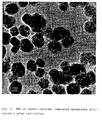
- Applying carbon black as a mesopore template results typically in intracrystalline mesopores with a high degree of tortuousity.
- the mesoporosity of the zeolite crystals can be controlled by adjusting the amount of zeolite gel relative to the amount of the carbon matrix. During crystallisation it is essential that the zeolite gel precursor is located both around and inside the pore system of the matrix. Otherwise, large single crystals are not formed but small isolated crystals can instead be obtained as described in Chem. Comm. (1999), (673).
- the matrix is preferably inert and stable under zeolite synthesis conditions and exhibits appropriate pore morphology. By removing the matrix from the large single crystals, mesopores are created inside the individual large crystals, i.e. intracrystalline mesopores.
- zeolite crystals with intracrystalline mesopores are easily separated from the synthesis medium by means of filtration, whereas micro zeolite crystals (being able to create intercrystalline mesopores) require ultracentrifugation in order to be separated from the synthesis medium.
- Another advantage of large single zeolite crystals is that the hydrothermal stability of the zeolite is increased.
- the matrix it is preferred to remove the matrix to an extent, which does not hinder transport of reactants and products in the mesopores. However, complete removal of the matrix is not required. Preferably, the remaining amount of matrix material inside the zeolite crystals is as low as possible.
- the inventive method is generally applicable in preparation of mesoporous zeolite single crystals and in the preparation of crystalline material where the material crystallises within and around the pore system of a removable matrix.
- the matrix can be removed by combustion hydrogenation, selective dissolution and evaporation.
- Typical tortuosity factors for pores created by agglomeration of primary particles are 3-5, which means the diffusion in an ideal straight channel of similar diameter is 3-5 times faster. This illustrates the benefits of having straight intracrystalline mesopores compared to tortuous mesopores with similar diameter.
- the active sites available for catalytic reaction are thus more easily accessible in a mesoporous crystal with straight pores, than in a crystal with tortuous pores.
- Carbon fibres can be used for producing a pore system of straight channels, and by applying, for example, carbon nanotubes as a mesopore template i.e. crystallise the zeolite around the mesopores, zeolites with intracrystalline mesopore systems with straight channels or pores can be obtained.
- a high degree of control over the diameter of carbon nanotubes improves the control of the mesopore characteristics of the resulting zeolite.
- Carbon nanotubes are potentially cheap templating materials with low concentrations of impurities.
- tubular-shaped materials with diameters between 2 nm and 50 nm and a length-to-diameter aspect ratio greater than 5 can also be used as templates for straight mesopores.
- the mesoporous zeolites exemplified are prepared by sequential impregnation of carbon nanotubes or whiskers.
- the carbon nanotubes have an average diameter of 12 nm, with the multi-walled nanotubes consisting of 6-8 graphene layers. Typically, the nanotubes are several micrometers long.
- nucleation of the zeolite takes place exclusively between the carbon nanotubes. Nucleation between the nanotubes will not occur if the nanotubes are simply dip-coated with a zeolite synthesis gel. The zeolite is therefore synthesised in the void between the nanotubes by sequential impregnation of the individual synthesis gel components.
- Dealumination of zeolites is generally obtained by selective removal of M 3+ elements from the zeolite framework or crystal structure, and it is typically obtained by removal of Al 3+ ions.
- the Si to Al ratio in the zeolite is important for its catalytic activity, sorption and ion-exchange capacity, and control of this ratio is therefore essential for a zeolite's catalytic properties.
- Dealuminizing agents include mineral and polyvalent acids and chelating agents.
- Cation-exchange of zeolites is generally obtained by contacting the zeolite with an aqueous solution of the cation-exchange agent, typically an ammonium-containing agent, under conditions sufficient to exchange the cations in the zeolite.
- an aqueous solution of the cation-exchange agent typically an ammonium-containing agent
- Carbon nanotubes (CNT's) were supplied by Hyperion Catalysis International, and carbon black pearls 2000 were supplied by Carbot Corp.
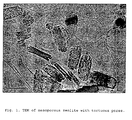
- the impregnated carbon black was introduced into a stainless steel autoclave containing enough water to produce saturated steam and heated to 180°C for 72 hours. After cooling the autoclave to room-temperature, the product was suspended in water, filtered by suction, resuspended in water and filtered again. This procedure was repeated four times. Finally the product was dried at 110° for 10 hours. The carbon black matrix was removed by combustion in a muffle furnace at 550°C for 8 hours. Transmission electron micrographs of the resulting zeolite are shown in Fig. 1.
- the sample was aged for 10 hours at ambient temperature. The sample was then transferred to a porcelain cup in autoclave, which had been charged with sufficient water to create a saturated steam atmosphere at the hydrothermal crystallisation conditions. The autoclave was heated to 175°C and held at this temperature for 24 hours. The cooled sample was washed with distilled water, filtered on a Büchner filter and dried at 110°C. Subsequently, the matrix was removed by heating (calcining) the sample to 600°C at 2°C/min., and held at this temperature for 11 hours.
- XRPD characterisation verified the presence of a crystalline MFI-type material, and a TEM of the resulting zeolite crystals is shown in Fig. 2.
- the zeolite crystals are recognisable as dark elements with brighter dots and channels upon them. These straight channels, created by matrix removal, reflect the size of the carbon nanotube.
- Electron diffraction verified that the mesopores were not a result of agglomeration of small crystals, but rather intracrystalline mesopores, i.e. each of the micronsized domains are individual crystals.
- the individual crystals created in Example 2 were typically of the size 0.5 ⁇ 0.5 ⁇ 0.7 ⁇ m 3 .
- the sample was aged for 10 hours at ambient temperature, and thereafter transferred to a porcelain cup in an autoclave, which had been charged with sufficient water to create a saturated steam atmosphere at the hydrothermal crystallisation conditions.
- the autoclave was heated to 175°C and held at this temperature for 72 hours.
- the cooled sample was washed with distilled water filtered on a Büchner filter and dried at 110°C. Subsequently, the matrix was removed by heating the sample to 600°C at 2°C/min. and held at this temperature for 11 hours.
- This material were similar to the mesoporous silicalite-1 obtained in Example 2, except for the content of framework-incorporated aluminium, known for introducing a capacity for ion-exchange and potential acidity.
- the impregnated carbon nanotubes were transferred to a stainless steel autoclave containing sufficient water to produce saturated steam and heated to 140°C for 5 days. After quenching, the product was re-suspended in water and subsequently filtered by suction. This procedure was repeated four times. Finally, the carbon nanotube matrix was removed by calcination at 600°C for 11 hours.
- Fig. 3 shows a TEM of carbon nanotube templated mesoporous silicalite-1 after calcination.
- the lattice fringes of the crystalline zeolite observed are extended throughout the crystal, demonstrating that a high crystallinity is achieved, and the mesopores from the carbon nanotubes are observed as bright spots within the zeolite crystals.
- Carbon whiskers solid filamentous carbon with a typical diameter around 20 nm and longer than 5 ⁇ m
- 2.5 g predried overnight at 130°C
- TEOS TEOS
- the sample was subsequently placed in a dessicator over a 25 wt% aqueous ammonia solution for 10 hours allowing TEOS to hydrolyse.
- 1.35 g H 2 O was added and after digestion for 3 hours a premixed clear solution comprising 4.0 g 40 wt% TPAOH, 0.036 g sodium aluminate (i.e. NaAlO 2 consisting of 54 wt% Al 2 O 3 , and 41 wt% Na 2 O), 0.5 g H 2 O, and 1.0 g ethanol (EtOH) was added dropwise without exceeding the porevolume.
- the resulting gel had the molar composition: 1 Al 2 O 3 : 20 TPA 2 O : 1.25 Na 2 O : 100 SiO 2 : 1230 H 2 O.
- the sample was aged for 10 hours at ambient temperature and then transferred to a porcelain cup in autoclave, which had been charged with sufficient water to create a saturated steam atmosphere at the hydrothermal crystallisation conditions.
- the autoclave was heated to 175°C and held at this temperature for 72 hours.
- the cooled sample was washed with distilled water, filtered on a Büchner filter and dried at 110°C. Subsequently, the matrix was removed by heating the sample to 600°C at 2°C/min. and held at this temperature for 11 hours.
- this material was similar to the mesoporous ZSM5 obtained in Example 3, except for a different average intracrystalline mesopore morphology, i.e. diameter and connectivity, consistent with the differences of the fibrous templating materials.
- Table 1 The Si/Al ratios and percentage aluminium obtained from chemical analysis in mesoporous ZSM-5 and mesoporous Zeolite Beta before and after the dealumination tests above are given in Table 1 below.
- Table 1 Ai/Al ratio and percentage aluminium before and after dealumination.
Landscapes
- Chemical & Material Sciences (AREA)
- Organic Chemistry (AREA)
- Materials Engineering (AREA)
- Engineering & Computer Science (AREA)
- General Life Sciences & Earth Sciences (AREA)
- Chemical Kinetics & Catalysis (AREA)
- Life Sciences & Earth Sciences (AREA)
- Geology (AREA)
- Crystallography & Structural Chemistry (AREA)
- Inorganic Chemistry (AREA)
- Metallurgy (AREA)
- Dispersion Chemistry (AREA)
- Silicates, Zeolites, And Molecular Sieves (AREA)
- Crystals, And After-Treatments Of Crystals (AREA)
Claims (7)
- Procédé de préparation de monocristaux de zéolithe à mésopores droits en appliquant un gel de synthèse avec une composition de précurseur de zéolithe à l'intérieur du système de pores et sur la surface d'un gabarit de matière matrice particulaire de carbone comprenant les étapes consistant à :- fournir une matière pour gabarit d'un diamètre de 2 à 50 nanomètres et d'un rapport d'aspect longueur/diamètre d'au moins 5,- appliquer le précurseur de zéolithe sur la surface de la matière pour gabarit en utilisant une imprégnation séquentielle,- soumettre la composition de précurseur à des conditions de cristallisation, et- isoler les monocristaux de zéolithe poreux à mésopores droits en éliminant la matière gabarit de matrice.
- Procédé selon la revendication 1, dans lequel la matière pour gabarit est constituée de nanotubes de carbone.
- Procédé selon les revendications 1 et 2, dans lequel la matière matrice gabarit est éliminée des cristaux de zéolithe par combustion, hydrogénation, dissolution sélective et/ou évaporation.
- Monocristaux de zéolithe à mésopores droits préparés selon le procédé des revendications 1 à 3.
- Matière catalytique comprenant des monocristaux de zéolithe à mésopores droits préparés selon le procédé des revendications 1 à 3.
- Matière catalytique activée comprenant des monocristaux de zéolithe à mésopores droits préparés selon le procédé des revendications 1 et 2, dans laquelle les monocristaux de zéolithe sont soumis à une désaluminisation.
- Matière catalytique activée comprenant des monocristaux de zéolithe à mésopores droits préparés selon le procédé des revendications 1 et 2, dans laquelle les monocristaux de zéolithe sont soumis à un échange d'ions.
Priority Applications (4)
| Application Number | Priority Date | Filing Date | Title |
|---|---|---|---|
| ES01119566T ES2263535T3 (es) | 2001-08-15 | 2001-08-15 | Un metodo para preparar cristales individuales de zeolita, con mesoporos rectos. |
| DE60119511T DE60119511T2 (de) | 2001-08-15 | 2001-08-15 | Verfahren zur Herstellung von Zeolith-Einkristallen mit geraden Mesoporen |
| AT01119566T ATE325776T1 (de) | 2001-08-15 | 2001-08-15 | Verfahren zur herstellung von zeolith- einkristallen mit geraden mesoporen |
| EP01119566A EP1284237B1 (fr) | 2001-08-15 | 2001-08-15 | Méthode de préparation de monocristaux de zéolite à mésopores rectilignes |
Applications Claiming Priority (1)
| Application Number | Priority Date | Filing Date | Title |
|---|---|---|---|
| EP01119566A EP1284237B1 (fr) | 2001-08-15 | 2001-08-15 | Méthode de préparation de monocristaux de zéolite à mésopores rectilignes |
Publications (2)
| Publication Number | Publication Date |
|---|---|
| EP1284237A1 EP1284237A1 (fr) | 2003-02-19 |
| EP1284237B1 true EP1284237B1 (fr) | 2006-05-10 |
Family
ID=8178329
Family Applications (1)
| Application Number | Title | Priority Date | Filing Date |
|---|---|---|---|
| EP01119566A Expired - Lifetime EP1284237B1 (fr) | 2001-08-15 | 2001-08-15 | Méthode de préparation de monocristaux de zéolite à mésopores rectilignes |
Country Status (4)
| Country | Link |
|---|---|
| EP (1) | EP1284237B1 (fr) |
| AT (1) | ATE325776T1 (fr) |
| DE (1) | DE60119511T2 (fr) |
| ES (1) | ES2263535T3 (fr) |
Families Citing this family (4)
| Publication number | Priority date | Publication date | Assignee | Title |
|---|---|---|---|---|
| ES2228271B1 (es) * | 2003-09-18 | 2006-06-01 | Universidad Rey Juan Carlos | Metodo para la preparacion de nanozeolita zsm-5 de elevada superficie externa por cristalizacion de nucleos sililados. |
| KR100979106B1 (ko) | 2008-05-30 | 2010-08-31 | 인하대학교 산학협력단 | 금속산화물이 담지된 엠에프아이 결정구조의 메조세공제올라이트 |
| WO2010148534A1 (fr) * | 2009-06-23 | 2010-12-29 | Dalian Institute Of Chemical Physics, Chinese Academy Of Sciences | Matériau mésoporeux et microporeux supporté, et son procédé de production |
| CN113636566B (zh) * | 2021-08-05 | 2023-03-21 | 肯特催化材料股份有限公司 | 一种全硅Beta分子筛合成工艺及其制备的全硅Beta分子筛 |
Family Cites Families (1)
| Publication number | Priority date | Publication date | Assignee | Title |
|---|---|---|---|---|
| ES2223372T3 (es) * | 1999-12-06 | 2005-03-01 | Haldor Topsoe A/S | Procedimiento depreparacion de monocristales de zeolita. |
-
2001
- 2001-08-15 ES ES01119566T patent/ES2263535T3/es not_active Expired - Lifetime
- 2001-08-15 DE DE60119511T patent/DE60119511T2/de not_active Expired - Lifetime
- 2001-08-15 EP EP01119566A patent/EP1284237B1/fr not_active Expired - Lifetime
- 2001-08-15 AT AT01119566T patent/ATE325776T1/de not_active IP Right Cessation
Also Published As
| Publication number | Publication date |
|---|---|
| ATE325776T1 (de) | 2006-06-15 |
| DE60119511D1 (de) | 2006-06-14 |
| EP1284237A1 (fr) | 2003-02-19 |
| DE60119511T2 (de) | 2006-09-21 |
| ES2263535T3 (es) | 2006-12-16 |
Similar Documents
| Publication | Publication Date | Title |
|---|---|---|
| US6620402B2 (en) | Method of preparing zeolite single crystals with straight mesopores | |
| US7601330B2 (en) | Process for producing binder-free ZSM-5 zeolite in small crystal size | |
| US6762143B2 (en) | Catalyst containing microporous zeolite in mesoporous support | |
| US5840264A (en) | Crystalline inorganic oxide compositions prepared by neutral templating route | |
| EP1214272B1 (fr) | Oxydes mineraux a mesoporosite ou meso- et microporosite combinee, et procede de preparation | |
| US11097256B2 (en) | Molecular sieve SCM-14, a preparation process and use thereof | |
| US5672556A (en) | Crystalline silicate compositions and method of preparation | |
| KR102356362B1 (ko) | Scm-15 분자체, 이의 제조 방법 및 이의 용도 | |
| US8840864B2 (en) | Method of preparing ZSM-5 zeolite using nanocrystalline ZSM-5 seeds | |
| DE69304018T2 (de) | Verfahren zum Züchten von gemischten Zeolithen auf einem Substrat | |
| US5308602A (en) | Synthesis of crystalline ultra-large pore oxide materials | |
| US6565826B2 (en) | Method of preparing zeolite single crystals | |
| KR101950552B1 (ko) | 개선된 모폴로지를 갖는 zsm-5 결정의 합성 | |
| CA1269088A (fr) | Zeolite ayant une structure de type paulingite (ecr-18) et methode de preparation | |
| US7485282B2 (en) | Method for the preparation of metal oxides in nanometric particle form | |
| DE69907853T2 (de) | Verfahren zur Herstellung kleiner Zeotypkristalle | |
| KR0158759B1 (ko) | 중기공성 구조를 갖는 결정화합물의 제조방법 | |
| US6814950B1 (en) | Inorganic oxides with mesoporosity or combined meso-and microporosity and process for the preparation thereof | |
| CN111977667A (zh) | 一种高杂原子含量等级孔mfi型分子筛、制备方法及其应用 | |
| EP1284237A1 (fr) | Méthode de préparation de monocristaux de zéolite à mésopores rectilignes | |
| CA2348387C (fr) | Oxyde acide presentant des caracteristiques micro et mesoporeuses: itq-36 | |
| JP4781567B2 (ja) | ストレート中間細孔を有するゼオライト単結晶の製造方法 | |
| KR20200016902A (ko) | 분자체 ssz-111, 이의 합성 및 용도 | |
| DE69802564T2 (de) | Zeolith itq-5 | |
| KR20190140057A (ko) | 분자체 ssz-109, 이의 합성 및 용도 |
Legal Events
| Date | Code | Title | Description |
|---|---|---|---|
| PUAI | Public reference made under article 153(3) epc to a published international application that has entered the european phase |
Free format text: ORIGINAL CODE: 0009012 |
|
| AK | Designated contracting states |
Designated state(s): AT BE CH CY DE DK ES FI FR GB GR IE IT LI LU MC NL PT SE TR |
|
| AX | Request for extension of the european patent |
Extension state: AL LT LV MK RO SI |
|
| 17P | Request for examination filed |
Effective date: 20030819 |
|
| AKX | Designation fees paid |
Designated state(s): AT BE CH CY DE DK ES FI FR GB GR IE IT LI LU MC NL PT SE TR |
|
| GRAP | Despatch of communication of intention to grant a patent |
Free format text: ORIGINAL CODE: EPIDOSNIGR1 |
|
| GRAS | Grant fee paid |
Free format text: ORIGINAL CODE: EPIDOSNIGR3 |
|
| GRAA | (expected) grant |
Free format text: ORIGINAL CODE: 0009210 |
|
| AK | Designated contracting states |
Kind code of ref document: B1 Designated state(s): AT BE CH CY DE DK ES FI FR GB GR IE IT LI LU MC NL PT SE TR |
|
| PG25 | Lapsed in a contracting state [announced via postgrant information from national office to epo] |
Ref country code: CH Free format text: LAPSE BECAUSE OF FAILURE TO SUBMIT A TRANSLATION OF THE DESCRIPTION OR TO PAY THE FEE WITHIN THE PRESCRIBED TIME-LIMIT Effective date: 20060510 Ref country code: FI Free format text: LAPSE BECAUSE OF FAILURE TO SUBMIT A TRANSLATION OF THE DESCRIPTION OR TO PAY THE FEE WITHIN THE PRESCRIBED TIME-LIMIT Effective date: 20060510 Ref country code: LI Free format text: LAPSE BECAUSE OF FAILURE TO SUBMIT A TRANSLATION OF THE DESCRIPTION OR TO PAY THE FEE WITHIN THE PRESCRIBED TIME-LIMIT Effective date: 20060510 Ref country code: AT Free format text: LAPSE BECAUSE OF FAILURE TO SUBMIT A TRANSLATION OF THE DESCRIPTION OR TO PAY THE FEE WITHIN THE PRESCRIBED TIME-LIMIT Effective date: 20060510 |
|
| REG | Reference to a national code |
Ref country code: GB Ref legal event code: FG4D |
|
| REG | Reference to a national code |
Ref country code: CH Ref legal event code: EP |
|
| REF | Corresponds to: |
Ref document number: 60119511 Country of ref document: DE Date of ref document: 20060614 Kind code of ref document: P |
|
| REG | Reference to a national code |
Ref country code: IE Ref legal event code: FG4D |
|
| PG25 | Lapsed in a contracting state [announced via postgrant information from national office to epo] |
Ref country code: DK Free format text: LAPSE BECAUSE OF FAILURE TO SUBMIT A TRANSLATION OF THE DESCRIPTION OR TO PAY THE FEE WITHIN THE PRESCRIBED TIME-LIMIT Effective date: 20060810 Ref country code: SE Free format text: LAPSE BECAUSE OF FAILURE TO SUBMIT A TRANSLATION OF THE DESCRIPTION OR TO PAY THE FEE WITHIN THE PRESCRIBED TIME-LIMIT Effective date: 20060810 |
|
| PG25 | Lapsed in a contracting state [announced via postgrant information from national office to epo] |
Ref country code: IE Free format text: LAPSE BECAUSE OF NON-PAYMENT OF DUE FEES Effective date: 20060815 |
|
| PG25 | Lapsed in a contracting state [announced via postgrant information from national office to epo] |
Ref country code: MC Free format text: LAPSE BECAUSE OF NON-PAYMENT OF DUE FEES Effective date: 20060831 |
|
| PG25 | Lapsed in a contracting state [announced via postgrant information from national office to epo] |
Ref country code: PT Free format text: LAPSE BECAUSE OF FAILURE TO SUBMIT A TRANSLATION OF THE DESCRIPTION OR TO PAY THE FEE WITHIN THE PRESCRIBED TIME-LIMIT Effective date: 20061010 |
|
| REG | Reference to a national code |
Ref country code: CH Ref legal event code: PL |
|
| ET | Fr: translation filed | ||
| REG | Reference to a national code |
Ref country code: ES Ref legal event code: FG2A Ref document number: 2263535 Country of ref document: ES Kind code of ref document: T3 |
|
| PLBE | No opposition filed within time limit |
Free format text: ORIGINAL CODE: 0009261 |
|
| STAA | Information on the status of an ep patent application or granted ep patent |
Free format text: STATUS: NO OPPOSITION FILED WITHIN TIME LIMIT |
|
| 26N | No opposition filed |
Effective date: 20070213 |
|
| PG25 | Lapsed in a contracting state [announced via postgrant information from national office to epo] |
Ref country code: GR Free format text: LAPSE BECAUSE OF FAILURE TO SUBMIT A TRANSLATION OF THE DESCRIPTION OR TO PAY THE FEE WITHIN THE PRESCRIBED TIME-LIMIT Effective date: 20060811 |
|
| PG25 | Lapsed in a contracting state [announced via postgrant information from national office to epo] |
Ref country code: TR Free format text: LAPSE BECAUSE OF FAILURE TO SUBMIT A TRANSLATION OF THE DESCRIPTION OR TO PAY THE FEE WITHIN THE PRESCRIBED TIME-LIMIT Effective date: 20060510 Ref country code: LU Free format text: LAPSE BECAUSE OF NON-PAYMENT OF DUE FEES Effective date: 20060815 |
|
| PG25 | Lapsed in a contracting state [announced via postgrant information from national office to epo] |
Ref country code: CY Free format text: LAPSE BECAUSE OF FAILURE TO SUBMIT A TRANSLATION OF THE DESCRIPTION OR TO PAY THE FEE WITHIN THE PRESCRIBED TIME-LIMIT Effective date: 20060510 |
|
| PGFP | Annual fee paid to national office [announced via postgrant information from national office to epo] |
Ref country code: ES Payment date: 20100826 Year of fee payment: 10 |
|
| PGFP | Annual fee paid to national office [announced via postgrant information from national office to epo] |
Ref country code: BE Payment date: 20100825 Year of fee payment: 10 |
|
| BERE | Be: lapsed |
Owner name: *HALDOR TOPSOE A/S Effective date: 20110831 |
|
| PG25 | Lapsed in a contracting state [announced via postgrant information from national office to epo] |
Ref country code: BE Free format text: LAPSE BECAUSE OF NON-PAYMENT OF DUE FEES Effective date: 20110831 |
|
| REG | Reference to a national code |
Ref country code: ES Ref legal event code: FD2A Effective date: 20130530 |
|
| PG25 | Lapsed in a contracting state [announced via postgrant information from national office to epo] |
Ref country code: ES Free format text: LAPSE BECAUSE OF NON-PAYMENT OF DUE FEES Effective date: 20110816 |
|
| PGFP | Annual fee paid to national office [announced via postgrant information from national office to epo] |
Ref country code: DE Payment date: 20140827 Year of fee payment: 14 Ref country code: NL Payment date: 20140826 Year of fee payment: 14 |
|
| PGFP | Annual fee paid to national office [announced via postgrant information from national office to epo] |
Ref country code: GB Payment date: 20140827 Year of fee payment: 14 Ref country code: FR Payment date: 20140818 Year of fee payment: 14 |
|
| PGFP | Annual fee paid to national office [announced via postgrant information from national office to epo] |
Ref country code: IT Payment date: 20140823 Year of fee payment: 14 |
|
| REG | Reference to a national code |
Ref country code: DE Ref legal event code: R119 Ref document number: 60119511 Country of ref document: DE |
|
| GBPC | Gb: european patent ceased through non-payment of renewal fee |
Effective date: 20150815 |
|
| PG25 | Lapsed in a contracting state [announced via postgrant information from national office to epo] |
Ref country code: IT Free format text: LAPSE BECAUSE OF NON-PAYMENT OF DUE FEES Effective date: 20150815 |
|
| REG | Reference to a national code |
Ref country code: NL Ref legal event code: MM Effective date: 20150901 |
|
| REG | Reference to a national code |
Ref country code: FR Ref legal event code: ST Effective date: 20160429 |
|
| PG25 | Lapsed in a contracting state [announced via postgrant information from national office to epo] |
Ref country code: NL Free format text: LAPSE BECAUSE OF NON-PAYMENT OF DUE FEES Effective date: 20150901 |
|
| PG25 | Lapsed in a contracting state [announced via postgrant information from national office to epo] |
Ref country code: GB Free format text: LAPSE BECAUSE OF NON-PAYMENT OF DUE FEES Effective date: 20150815 Ref country code: DE Free format text: LAPSE BECAUSE OF NON-PAYMENT OF DUE FEES Effective date: 20160301 |
|
| PG25 | Lapsed in a contracting state [announced via postgrant information from national office to epo] |
Ref country code: FR Free format text: LAPSE BECAUSE OF NON-PAYMENT OF DUE FEES Effective date: 20150831 |