EP1284975B1 - Ammoniums porteurs d'un fluor electrophile, reactif en contenant, procede les mettant en oeuvre et procede de synthese pour les obtenir - Google Patents
Ammoniums porteurs d'un fluor electrophile, reactif en contenant, procede les mettant en oeuvre et procede de synthese pour les obtenir Download PDFInfo
- Publication number
- EP1284975B1 EP1284975B1 EP01938303A EP01938303A EP1284975B1 EP 1284975 B1 EP1284975 B1 EP 1284975B1 EP 01938303 A EP01938303 A EP 01938303A EP 01938303 A EP01938303 A EP 01938303A EP 1284975 B1 EP1284975 B1 EP 1284975B1
- Authority
- EP
- European Patent Office
- Prior art keywords
- ammonium compound
- compound according
- functional group
- bearing
- advantageously
- Prior art date
- Legal status (The legal status is an assumption and is not a legal conclusion. Google has not performed a legal analysis and makes no representation as to the accuracy of the status listed.)
- Expired - Lifetime
Links
- 229910052731 fluorine Inorganic materials 0.000 title claims abstract description 16
- 150000003868 ammonium compounds Chemical group 0.000 title claims abstract 15
- 239000003153 chemical reaction reagent Substances 0.000 title claims description 23
- 239000011737 fluorine Substances 0.000 title claims description 13
- 238000000034 method Methods 0.000 title claims description 10
- PXGOKWXKJXAPGV-UHFFFAOYSA-N Fluorine Chemical compound FF PXGOKWXKJXAPGV-UHFFFAOYSA-N 0.000 title claims 2
- 238000001308 synthesis method Methods 0.000 title 1
- 229910052799 carbon Inorganic materials 0.000 claims abstract description 22
- QGZKDVFQNNGYKY-UHFFFAOYSA-O ammonium group Chemical group [NH4+] QGZKDVFQNNGYKY-UHFFFAOYSA-O 0.000 claims abstract description 20
- 238000003682 fluorination reaction Methods 0.000 claims abstract description 19
- IJGRMHOSHXDMSA-UHFFFAOYSA-N Atomic nitrogen Chemical compound N#N IJGRMHOSHXDMSA-UHFFFAOYSA-N 0.000 claims abstract description 16
- 125000004432 carbon atom Chemical group C* 0.000 claims abstract description 10
- 229910052757 nitrogen Inorganic materials 0.000 claims abstract description 10
- 239000000758 substrate Substances 0.000 claims abstract description 7
- 125000001153 fluoro group Chemical group F* 0.000 claims abstract description 6
- 150000003856 quaternary ammonium compounds Chemical class 0.000 claims abstract 4
- 125000004429 atom Chemical group 0.000 claims description 28
- 150000001875 compounds Chemical class 0.000 claims description 18
- RTZKZFJDLAIYFH-UHFFFAOYSA-N ether Substances CCOCC RTZKZFJDLAIYFH-UHFFFAOYSA-N 0.000 claims description 18
- 125000001453 quaternary ammonium group Chemical group 0.000 claims description 16
- 125000003118 aryl group Chemical group 0.000 claims description 14
- 239000002253 acid Substances 0.000 claims description 13
- 150000001412 amines Chemical class 0.000 claims description 10
- 230000015572 biosynthetic process Effects 0.000 claims description 8
- 125000003158 alcohol group Chemical group 0.000 claims description 7
- 238000003786 synthesis reaction Methods 0.000 claims description 7
- 238000006243 chemical reaction Methods 0.000 claims description 6
- 150000002148 esters Chemical class 0.000 claims description 5
- LFQSCWFLJHTTHZ-UHFFFAOYSA-N Ethanol Chemical compound CCO LFQSCWFLJHTTHZ-UHFFFAOYSA-N 0.000 claims description 4
- 150000002170 ethers Chemical class 0.000 claims description 3
- KRHYYFGTRYWZRS-UHFFFAOYSA-M Fluoride anion Chemical compound [F-] KRHYYFGTRYWZRS-UHFFFAOYSA-M 0.000 claims description 2
- 238000011065 in-situ storage Methods 0.000 claims description 2
- 239000012038 nucleophile Substances 0.000 claims description 2
- 150000003839 salts Chemical class 0.000 claims description 2
- 125000000524 functional group Chemical group 0.000 claims 4
- 125000002887 hydroxy group Chemical group [H]O* 0.000 claims 3
- NMAXHMMOTNQUJM-UHFFFAOYSA-N C1CN(F)CCCCN1C1CCCCCCC1 Chemical compound C1CN(F)CCCCN1C1CCCCCCC1 NMAXHMMOTNQUJM-UHFFFAOYSA-N 0.000 claims 1
- 239000003880 polar aprotic solvent Substances 0.000 claims 1
- 239000002798 polar solvent Substances 0.000 claims 1
- WEVYAHXRMPXWCK-UHFFFAOYSA-N Acetonitrile Chemical compound CC#N WEVYAHXRMPXWCK-UHFFFAOYSA-N 0.000 description 21
- -1 hydrocarbon radical Chemical class 0.000 description 14
- 239000002904 solvent Substances 0.000 description 14
- OKTJSMMVPCPJKN-UHFFFAOYSA-N Carbon Chemical compound [C] OKTJSMMVPCPJKN-UHFFFAOYSA-N 0.000 description 13
- CSCPPACGZOOCGX-UHFFFAOYSA-N Acetone Chemical compound CC(C)=O CSCPPACGZOOCGX-UHFFFAOYSA-N 0.000 description 12
- 239000001257 hydrogen Substances 0.000 description 12
- 229910052739 hydrogen Inorganic materials 0.000 description 12
- 239000002585 base Substances 0.000 description 11
- IMNFDUFMRHMDMM-UHFFFAOYSA-N N-Heptane Chemical compound CCCCCCC IMNFDUFMRHMDMM-UHFFFAOYSA-N 0.000 description 10
- YCKRFDGAMUMZLT-UHFFFAOYSA-N Fluorine atom Chemical compound [F] YCKRFDGAMUMZLT-UHFFFAOYSA-N 0.000 description 8
- UFHFLCQGNIYNRP-UHFFFAOYSA-N Hydrogen Chemical compound [H][H] UFHFLCQGNIYNRP-UHFFFAOYSA-N 0.000 description 8
- 150000001450 anions Chemical class 0.000 description 8
- 239000012025 fluorinating agent Substances 0.000 description 8
- 239000000243 solution Substances 0.000 description 8
- 239000000203 mixture Substances 0.000 description 7
- GANIBVZSZGNMNB-UHFFFAOYSA-N 2-methyl-1-tetralone Chemical compound C1=CC=C2C(=O)C(C)CCC2=C1 GANIBVZSZGNMNB-UHFFFAOYSA-N 0.000 description 5
- 125000000217 alkyl group Chemical group 0.000 description 5
- 150000001408 amides Chemical class 0.000 description 5
- 230000000875 corresponding effect Effects 0.000 description 5
- 150000002084 enol ethers Chemical class 0.000 description 5
- 239000012363 selectfluor Substances 0.000 description 5
- 150000003573 thiols Chemical class 0.000 description 5
- OFBQJSOFQDEBGM-UHFFFAOYSA-N Pentane Chemical compound CCCCC OFBQJSOFQDEBGM-UHFFFAOYSA-N 0.000 description 4
- QAOWNCQODCNURD-UHFFFAOYSA-N Sulfuric acid Chemical compound OS(O)(=O)=O QAOWNCQODCNURD-UHFFFAOYSA-N 0.000 description 4
- 150000007513 acids Chemical class 0.000 description 4
- 229930013930 alkaloid Natural products 0.000 description 4
- 125000003710 aryl alkyl group Chemical group 0.000 description 4
- 230000006698 induction Effects 0.000 description 4
- 125000002496 methyl group Chemical group [H]C([H])([H])* 0.000 description 4
- 239000002244 precipitate Substances 0.000 description 4
- 239000000047 product Substances 0.000 description 4
- 150000003254 radicals Chemical class 0.000 description 4
- 239000011541 reaction mixture Substances 0.000 description 4
- 238000003756 stirring Methods 0.000 description 4
- NFDXQGNDWIPXQL-UHFFFAOYSA-N 1-cyclooctyldiazocane Chemical class C1CCCCCCC1N1NCCCCCC1 NFDXQGNDWIPXQL-UHFFFAOYSA-N 0.000 description 3
- 239000004215 Carbon black (E152) Substances 0.000 description 3
- PEDCQBHIVMGVHV-UHFFFAOYSA-N Glycerine Chemical compound OCC(O)CO PEDCQBHIVMGVHV-UHFFFAOYSA-N 0.000 description 3
- VYPSYNLAJGMNEJ-UHFFFAOYSA-N Silicium dioxide Chemical compound O=[Si]=O VYPSYNLAJGMNEJ-UHFFFAOYSA-N 0.000 description 3
- 238000004458 analytical method Methods 0.000 description 3
- 150000001768 cations Chemical class 0.000 description 3
- 229910052798 chalcogen Inorganic materials 0.000 description 3
- 150000001787 chalcogens Chemical class 0.000 description 3
- 239000003795 chemical substances by application Substances 0.000 description 3
- 239000003480 eluent Substances 0.000 description 3
- 238000001914 filtration Methods 0.000 description 3
- 229930195733 hydrocarbon Natural products 0.000 description 3
- 150000002431 hydrogen Chemical class 0.000 description 3
- 238000002844 melting Methods 0.000 description 3
- 230000008018 melting Effects 0.000 description 3
- QJGQUHMNIGDVPM-UHFFFAOYSA-N nitrogen group Chemical group [N] QJGQUHMNIGDVPM-UHFFFAOYSA-N 0.000 description 3
- 230000008569 process Effects 0.000 description 3
- 239000000741 silica gel Substances 0.000 description 3
- 229910002027 silica gel Inorganic materials 0.000 description 3
- 239000007787 solid Substances 0.000 description 3
- KUHPHKLCWLRLRS-UHFFFAOYSA-N 2-fluoro-2-methyl-3,4-dihydronaphthalen-1-one Chemical compound C1=CC=C2C(=O)C(C)(F)CCC2=C1 KUHPHKLCWLRLRS-UHFFFAOYSA-N 0.000 description 2
- NLXLAEXVIDQMFP-UHFFFAOYSA-N Ammonia chloride Chemical compound [NH4+].[Cl-] NLXLAEXVIDQMFP-UHFFFAOYSA-N 0.000 description 2
- WHXSMMKQMYFTQS-UHFFFAOYSA-N Lithium Chemical compound [Li] WHXSMMKQMYFTQS-UHFFFAOYSA-N 0.000 description 2
- JUJWROOIHBZHMG-UHFFFAOYSA-N Pyridine Chemical group C1=CC=NC=C1 JUJWROOIHBZHMG-UHFFFAOYSA-N 0.000 description 2
- SMWDFEZZVXVKRB-UHFFFAOYSA-N Quinoline Chemical compound N1=CC=CC2=CC=CC=C21 SMWDFEZZVXVKRB-UHFFFAOYSA-N 0.000 description 2
- 230000009471 action Effects 0.000 description 2
- 230000001154 acute effect Effects 0.000 description 2
- 125000002252 acyl group Chemical group 0.000 description 2
- 150000003797 alkaloid derivatives Chemical class 0.000 description 2
- 150000001721 carbon Chemical group 0.000 description 2
- 238000004587 chromatography analysis Methods 0.000 description 2
- 230000000994 depressogenic effect Effects 0.000 description 2
- 239000012973 diazabicyclooctane Substances 0.000 description 2
- 150000002085 enols Chemical class 0.000 description 2
- 230000032050 esterification Effects 0.000 description 2
- 238000005886 esterification reaction Methods 0.000 description 2
- 238000001704 evaporation Methods 0.000 description 2
- 230000008020 evaporation Effects 0.000 description 2
- 239000000706 filtrate Substances 0.000 description 2
- 238000004334 fluoridation Methods 0.000 description 2
- 239000006260 foam Substances 0.000 description 2
- 229910052736 halogen Inorganic materials 0.000 description 2
- 150000002367 halogens Chemical class 0.000 description 2
- FFUAGWLWBBFQJT-UHFFFAOYSA-N hexamethyldisilazane Chemical class C[Si](C)(C)N[Si](C)(C)C FFUAGWLWBBFQJT-UHFFFAOYSA-N 0.000 description 2
- 230000003301 hydrolyzing effect Effects 0.000 description 2
- 239000007788 liquid Substances 0.000 description 2
- 229910052744 lithium Inorganic materials 0.000 description 2
- 125000000325 methylidene group Chemical group [H]C([H])=* 0.000 description 2
- 150000002825 nitriles Chemical class 0.000 description 2
- 150000005181 nitrobenzenes Chemical class 0.000 description 2
- 238000000746 purification Methods 0.000 description 2
- 239000000725 suspension Substances 0.000 description 2
- XLYOFNOQVPJJNP-UHFFFAOYSA-N water Substances O XLYOFNOQVPJJNP-UHFFFAOYSA-N 0.000 description 2
- ZXMGHDIOOHOAAE-UHFFFAOYSA-N 1,1,1-trifluoro-n-(trifluoromethylsulfonyl)methanesulfonamide Chemical compound FC(F)(F)S(=O)(=O)NS(=O)(=O)C(F)(F)F ZXMGHDIOOHOAAE-UHFFFAOYSA-N 0.000 description 1
- HBAQYPYDRFILMT-UHFFFAOYSA-N 8-[3-(1-cyclopropylpyrazol-4-yl)-1H-pyrazolo[4,3-d]pyrimidin-5-yl]-3-methyl-3,8-diazabicyclo[3.2.1]octan-2-one Chemical class C1(CC1)N1N=CC(=C1)C1=NNC2=C1N=C(N=C2)N1C2C(N(CC1CC2)C)=O HBAQYPYDRFILMT-UHFFFAOYSA-N 0.000 description 1
- CURLTUGMZLYLDI-UHFFFAOYSA-N Carbon dioxide Chemical compound O=C=O CURLTUGMZLYLDI-UHFFFAOYSA-N 0.000 description 1
- XTEGARKTQYYJKE-UHFFFAOYSA-M Chlorate Chemical class [O-]Cl(=O)=O XTEGARKTQYYJKE-UHFFFAOYSA-M 0.000 description 1
- 235000021513 Cinchona Nutrition 0.000 description 1
- 241000157855 Cinchona Species 0.000 description 1
- HXELGNKCCDGMMN-UHFFFAOYSA-N [F].[Cl] Chemical group [F].[Cl] HXELGNKCCDGMMN-UHFFFAOYSA-N 0.000 description 1
- 239000003905 agrochemical Substances 0.000 description 1
- 150000001298 alcohols Chemical class 0.000 description 1
- 125000001931 aliphatic group Chemical group 0.000 description 1
- 229910052783 alkali metal Inorganic materials 0.000 description 1
- 150000001340 alkali metals Chemical class 0.000 description 1
- 125000003545 alkoxy group Chemical group 0.000 description 1
- 125000002877 alkyl aryl group Chemical group 0.000 description 1
- 235000019270 ammonium chloride Nutrition 0.000 description 1
- 239000007864 aqueous solution Substances 0.000 description 1
- 239000012300 argon atmosphere Substances 0.000 description 1
- 159000000032 aromatic acids Chemical class 0.000 description 1
- 150000004945 aromatic hydrocarbons Chemical class 0.000 description 1
- 125000004104 aryloxy group Chemical group 0.000 description 1
- QVGXLLKOCUKJST-UHFFFAOYSA-N atomic oxygen Chemical compound [O] QVGXLLKOCUKJST-UHFFFAOYSA-N 0.000 description 1
- 230000008901 benefit Effects 0.000 description 1
- 235000010233 benzoic acid Nutrition 0.000 description 1
- 150000001559 benzoic acids Chemical class 0.000 description 1
- 230000004071 biological effect Effects 0.000 description 1
- 235000011089 carbon dioxide Nutrition 0.000 description 1
- 125000002915 carbonyl group Chemical group [*:2]C([*:1])=O 0.000 description 1
- 230000008859 change Effects 0.000 description 1
- 238000005660 chlorination reaction Methods 0.000 description 1
- YCYBZKSMUPTWEE-UHFFFAOYSA-L cobalt(ii) fluoride Chemical class F[Co]F YCYBZKSMUPTWEE-UHFFFAOYSA-L 0.000 description 1
- 230000002596 correlated effect Effects 0.000 description 1
- 150000004292 cyclic ethers Chemical class 0.000 description 1
- 125000004122 cyclic group Chemical group 0.000 description 1
- 239000003792 electrolyte Substances 0.000 description 1
- 239000012039 electrophile Substances 0.000 description 1
- 230000008030 elimination Effects 0.000 description 1
- 238000003379 elimination reaction Methods 0.000 description 1
- 238000003818 flash chromatography Methods 0.000 description 1
- 159000000011 group IA salts Chemical class 0.000 description 1
- 125000005843 halogen group Chemical group 0.000 description 1
- 230000026030 halogenation Effects 0.000 description 1
- 238000005658 halogenation reaction Methods 0.000 description 1
- 238000009396 hybridization Methods 0.000 description 1
- 150000004678 hydrides Chemical class 0.000 description 1
- 150000002430 hydrocarbons Chemical class 0.000 description 1
- 150000003949 imides Chemical class 0.000 description 1
- 150000002466 imines Chemical class 0.000 description 1
- 229910052500 inorganic mineral Inorganic materials 0.000 description 1
- 150000002500 ions Chemical class 0.000 description 1
- JEIPFZHSYJVQDO-UHFFFAOYSA-N iron(III) oxide Inorganic materials O=[Fe]O[Fe]=O JEIPFZHSYJVQDO-UHFFFAOYSA-N 0.000 description 1
- 150000002738 metalloids Chemical group 0.000 description 1
- 239000011707 mineral Substances 0.000 description 1
- 238000002156 mixing Methods 0.000 description 1
- 125000002560 nitrile group Chemical group 0.000 description 1
- 125000004433 nitrogen atom Chemical group N* 0.000 description 1
- 239000012457 nonaqueous media Substances 0.000 description 1
- 150000007523 nucleic acids Chemical class 0.000 description 1
- 102000039446 nucleic acids Human genes 0.000 description 1
- 108020004707 nucleic acids Proteins 0.000 description 1
- 150000007524 organic acids Chemical class 0.000 description 1
- 235000005985 organic acids Nutrition 0.000 description 1
- 150000002894 organic compounds Chemical class 0.000 description 1
- 125000001181 organosilyl group Chemical group [SiH3]* 0.000 description 1
- 230000003647 oxidation Effects 0.000 description 1
- 238000007254 oxidation reaction Methods 0.000 description 1
- 229910052760 oxygen Inorganic materials 0.000 description 1
- 239000001301 oxygen Substances 0.000 description 1
- 239000002245 particle Substances 0.000 description 1
- VLTRZXGMWDSKGL-UHFFFAOYSA-N perchloric acid Chemical class OCl(=O)(=O)=O VLTRZXGMWDSKGL-UHFFFAOYSA-N 0.000 description 1
- 230000000737 periodic effect Effects 0.000 description 1
- 125000005496 phosphonium group Chemical group 0.000 description 1
- 238000000711 polarimetry Methods 0.000 description 1
- 238000004237 preparative chromatography Methods 0.000 description 1
- 102000004196 processed proteins & peptides Human genes 0.000 description 1
- 108090000765 processed proteins & peptides Proteins 0.000 description 1
- 230000000135 prohibitive effect Effects 0.000 description 1
- 125000006239 protecting group Chemical group 0.000 description 1
- 125000002943 quinolinyl group Chemical group N1=C(C=CC2=CC=CC=C12)* 0.000 description 1
- 239000012429 reaction media Substances 0.000 description 1
- 230000009257 reactivity Effects 0.000 description 1
- 229920006395 saturated elastomer Polymers 0.000 description 1
- 230000000707 stereoselective effect Effects 0.000 description 1
- 125000001424 substituent group Chemical group 0.000 description 1
- 150000003460 sulfonic acids Chemical class 0.000 description 1
- 239000013589 supplement Substances 0.000 description 1
- 150000008648 triflates Chemical class 0.000 description 1
- ITMCEJHCFYSIIV-UHFFFAOYSA-N triflic acid Chemical compound OS(=O)(=O)C(F)(F)F ITMCEJHCFYSIIV-UHFFFAOYSA-N 0.000 description 1
- 125000002023 trifluoromethyl group Chemical group FC(F)(F)* 0.000 description 1
Classifications
-
- C—CHEMISTRY; METALLURGY
- C07—ORGANIC CHEMISTRY
- C07C—ACYCLIC OR CARBOCYCLIC COMPOUNDS
- C07C253/00—Preparation of carboxylic acid nitriles
- C07C253/30—Preparation of carboxylic acid nitriles by reactions not involving the formation of cyano groups
-
- C—CHEMISTRY; METALLURGY
- C07—ORGANIC CHEMISTRY
- C07B—GENERAL METHODS OF ORGANIC CHEMISTRY; APPARATUS THEREFOR
- C07B39/00—Halogenation
-
- C—CHEMISTRY; METALLURGY
- C07—ORGANIC CHEMISTRY
- C07B—GENERAL METHODS OF ORGANIC CHEMISTRY; APPARATUS THEREFOR
- C07B53/00—Asymmetric syntheses
-
- C—CHEMISTRY; METALLURGY
- C07—ORGANIC CHEMISTRY
- C07C—ACYCLIC OR CARBOCYCLIC COMPOUNDS
- C07C45/00—Preparation of compounds having >C = O groups bound only to carbon or hydrogen atoms; Preparation of chelates of such compounds
- C07C45/61—Preparation of compounds having >C = O groups bound only to carbon or hydrogen atoms; Preparation of chelates of such compounds by reactions not involving the formation of >C = O groups
- C07C45/63—Preparation of compounds having >C = O groups bound only to carbon or hydrogen atoms; Preparation of chelates of such compounds by reactions not involving the formation of >C = O groups by introduction of halogen; by substitution of halogen atoms by other halogen atoms
-
- C—CHEMISTRY; METALLURGY
- C07—ORGANIC CHEMISTRY
- C07C—ACYCLIC OR CARBOCYCLIC COMPOUNDS
- C07C67/00—Preparation of carboxylic acid esters
- C07C67/30—Preparation of carboxylic acid esters by modifying the acid moiety of the ester, such modification not being an introduction of an ester group
- C07C67/307—Preparation of carboxylic acid esters by modifying the acid moiety of the ester, such modification not being an introduction of an ester group by introduction of halogen; by substitution of halogen atoms by other halogen atoms
-
- C—CHEMISTRY; METALLURGY
- C07—ORGANIC CHEMISTRY
- C07B—GENERAL METHODS OF ORGANIC CHEMISTRY; APPARATUS THEREFOR
- C07B2200/00—Indexing scheme relating to specific properties of organic compounds
- C07B2200/07—Optical isomers
-
- C—CHEMISTRY; METALLURGY
- C07—ORGANIC CHEMISTRY
- C07C—ACYCLIC OR CARBOCYCLIC COMPOUNDS
- C07C2601/00—Systems containing only non-condensed rings
- C07C2601/06—Systems containing only non-condensed rings with a five-membered ring
- C07C2601/08—Systems containing only non-condensed rings with a five-membered ring the ring being saturated
Definitions
- the present invention relates to new fluorinating agents. electrophile. It more specifically targets compounds with an ammonium function. quaternary whose nitrogen carries a fluorine atom and the use of these molecules quaternary ammoniums to form a reagent capable of achieving Enantioselective electrophilic fluorinations (FEE).
- FEE Enantioselective electrophilic fluorinations
- Fluoridation of organic compounds has always been a delicate problem because of the specifics of the atom and the fluorine molecule.
- the molecule of fluorine has such a reactivity that direct fluorinations are almost impossible, except for a few very specific families of compounds.
- Electrophilic fluorinations have the advantage of not requiring general that few steps.
- A.S. Poss (Tetrahedron Letters, 40, 1999, 2673-2676) describes a diamine fluorinated bicyclic as an achiral fluorinating agent.
- one of the aims of the present invention is to provide a new fluorinating agent capable of producing good yields fluoridation.
- Another object of the present invention is to provide a fluorinating agent of the above type which is likely to lead to fluorination enantioselective with a significant enantiomeric excess.
- Another object of the present invention is to provide a reagent which uses such a fluorinating agent, another object of the present invention is to providing a process for the synthesis of fluorinating agents according to the invention.
- Another object, finally, of the present invention is to provide a method use of the fluorination reagent to give good yields and good enantiomeric excess.
- a quaternary ammonium having at least one asymmetric atom and whose quaternary ammonium function carries a fluorine and is not distant by the shortest path of not more than four links, preferably at plus three chains, preferably at most two chains, of said atom asymmetric (closest when there are more than 1).
- chains we mean atoms or divalent groups of which the number of links does not count neither the asymmetric carbon considered, nor the nitrogen quaternized by fluorine.
- the alcohol function can be protected (ether, ester ).
- D represents two chalcogens, especially if they are identical the chalcogens must be separated by at least one carbon, of preferably two.
- Ds are all chosen from methylenes, optionally substituted, and oxygen, for at most one of them. It is preferable that R 1 is a small group advantageously methyl or mono atomic such as Halogen and especially hydrogen.
- R 2 represents a hydrocarbon radical, that is to say containing carbon, and hydrogen or an alcohol function
- R 2 can be alkyl, including aralkyl, aryl, including alkylaryl, alkyloxy, including aralkoyloxyl, aryloxyl, including alkylaryloxyl.
- R 2 is also preferably a radical resulting from the esterification of an organic or mineral acid by the alcohol function, in particular an acyloxyl radical. esterifications with aromatic acids (i.e. acids whose acid-carrying function is directly linked to an aromatic nucleus such as benzoic acids or sulfonic arene), especially aromatic carboxylic acids give very good results.
- R 3 is advantageously a hydrocarbon radical, advantageously aromatic, often depressed by electrons, such as nitrobenzenes or pyridine rings, including quinoline rings.
- the ammoniums are preferably such that the asymmetric atom, or at least one of them, is a carbon atom.
- this asymmetric atom carries a function non-oxidizable hydrogenophore.
- hydrogenophore is meant carrying hydrogen and by non-oxidizable, it should be understood that this function is not not likely to be oxidized by the quaternary ammonium carrier function of a fluorine.
- These hydrogen-eating functions can in particular be functions thiols, amine functions, amide functions or alcohol functions.
- the thiol functions may be too oxidizable, the functions amines and amide functions are likely to interfere during the reaction, especially when using bases; so we prefer the functions alcohols.
- the alcohol functions in particular acylated or etherified, also give good results.
- the quaternary ammonium function in addition to the fluorine atom, is advantageously linked to carbon atoms, advantageously all of sp 3 hybridization.
- said asymmetric atom or one of the atoms asymmetrical, carries a hydrogenophore function capable of giving hydrogen bonds and ipso facto promotes chiral induction.
- other groups can also improve chiral induction, alone or in combination with said hydrogenophore function.
- These are in particular radicals of groups bearing an aromatic nucleus, often depressed in electrons, such as nitrobenzenes or pyridine rings, including quinoline.
- the last radical is advantageously distinct from the other three and is often methyl, or preferably hydrogen.
- the asymmetric carbon considered carries a hydrogen it it may be interesting to protect the hydrogenophore function (alcohol, amide, even thiol and amine) which then reduces the risk of oxidation by maintaining the possibility of a strong chiral induction as a radical providing protection, we may cite alkyls, acyls, aromatic or aliphatic sulfonyls and the protective groups usually known in the chemistry of alkaloids, peptides and nucleic acids. Chiral inductions from alcohol protected by alkyls and by acyls are remarkable.
- the alkyls (taken in the etymological sense of an alcohol from which the OH function has been removed), y including aralkyls, advantageously has at most 10 carbon atoms and preferably at most 5 atoms, more preferably 3.
- the quaternary ammonium function is advantageously intracyclic, that is to say, it constitutes the chain of a cycle, which cycle is not advantageously not aromatic. This function is generally chiral.
- ammonium function quaternary constitutes the chain of at least two cycles.
- the counter ion of the quaternary ammonium be a poorly polarizing anion and poor nucleophile.
- This type of counterion is also found in anions with several atoms and therefore which can be described as polyatomic.
- complex anions based on fluorine such as PF 4 - , PF 6 - .
- the imides corresponding to such perfluorinated acids on the carbon carrying the sulfonic function also give very good results.
- triflimide mention may be made of triflimide.
- the acids which correspond to the anions used as electrolytes in non-aqueous media and in batteries, in particular lithium generally give good results as counterions of quaternary ammoniums according to the present invention.
- anions are triflates, fluoborates and PF 6 - ions.
- Anions corresponding to monoacids are preferred although diacids, such as for example fluosilicic acid, can be used.
- Another object of the present invention is to provide an electrophilic fluorination reagent using the ammoniums according to the present invention.
- the present invention relates to a reagent comprising an ammonium such as described above, that is to say a reagent comprising an ammonium quaternary having at least one asymmetric atom and whose function eponymous carries a fluorine and is located at four chains at most of said asymmetric carbon.
- said reagent further comprises a solvent advantageously aprotic. It is also preferable that this solvent be polar.
- the solvent has a point of melting at most equal to 10 ° C, preferably at -20 ° C, more preferably at -40 ° C.
- the preferred derivatives are cyclic ethers and nitriles.
- the reagent according to the present invention often comprises for successive or simultaneous addition, in addition to the ammonium according to the present invention and optionally the solvent, a base.
- a base in addition to the ammonium according to the present invention and optionally the solvent, a base.
- the associated acid of the base has a pK a of at least 16, preferably at least 18.
- the nature of the base is not indifferent to the excess yield enantiomeric. To get good yields and good excesses enantiomers, it is desirable that the base cation is not too small. It is thus preferable to use alkaline cations of rank higher than that of lithium. Schwesinger-type bases also give good results (cf. Tetrahedron Letters 39 [1998] 8775-8778).
- alkali metals, oniums can also be used. (quaternary ammoniums and tetraalkylated phosphoniums). According to this invention it was also shown that it was better than the base, or more exactly the base anion, does not remain in the reaction medium and by example be volatile.
- the base can also be produced in situ, for example by the action of a fluoride ion on silylated derivatives.
- the basic amount may have some importance and the reagent can understand up to two or more times, expressed in equivalents of said quaternary ammonium.
- the object of the present invention is also to provide a process for the synthesis of fluorinated ammoniums according to the present invention.
- These compounds can in particular be produced by the action of a reagent known to act as "F + " but according to a preferred mode of the present invention, these compounds are produced by putting the corresponding amine with the fluorination agent designated by Selectfluor and often designated by the acronym F-TEDA-BF 4 - .
- This reaction is advantageously carried out in a solvent and at room temperature. Acetonitrile works well as a solvent.
- the amine is subjected which, by fluorination, will give the ammonium according to the present invention in quantity equimolecular with said Selectfluor® in a solvent, in general of acetonitrile.
- the mixture is left to stir for 1 ⁇ 4 h to 5 h and then the solvent is evaporated off using a rotary evaporator.
- the amine from Selectfluor is precipitated using a strong acid (often sulfuric acid) after filtration and elimination of the salt, precipitates by means of a third solvent from an acetone solution. The filtration provides the desired compound.
- This operating mode allows obtaining ammoniums according to the present invention from alkaloids of cinchona, in particular were thus obtained, N-fluorocinchonididium, N-fluorocinchoninium, N-fluoroquininium and N-fluoroquinidinium.
- the yields obtained are excellent, especially for the first two members of the family cited.
- Another object of the present invention is to provide a electrophilic fluorination process capable of being stereo-selective using the reagents of the present invention.
- this object is achieved by mixing the reagent as as defined above with the substrate and allowing it to react for 1 ⁇ 4 h to 24 h at temperatures ranging from -100 ° C to 50 ° C.
- the enantiomeric excess depends on the temperature and it is often advised to be placed at a temperature lower than -20 ° C, preferably at most equal at 30 ° C.
- the substrates that can give good results are molecules with mobile hydrogen on a prochiral carbon or even chiral.
- Hydrogen is made mobile by the presence of electron-attracting groups carried by the chiral or prochiral carbon. It is considered in the present description that an electro-attractor group is a group having a positive ⁇ p and advantageously greater than 0.5, more preferably greater than 0.10. The best results are obtained with values greater than 30. Halogen atoms are not included among these electron-attracting groups. Among the preferred attracting groups, mention may in particular be made of trifluoromethyl groups, and more preferably carbonyl and nitrile groups.
- the ammonium according to the present invention has less than 50 atoms of carbon, preferably at most 30.
- Example 1 Synthesis of ammoniums according to the present invention: synthesis N-fluoroquininium tetrafluoroborate
- the starting alkaloid (13.6 mmol) is placed in solution in 50 ml of HPLC-quality acetonitrile and the mixture is stirred strongly because of the low miscibility of the alkaloid in this solvent.
- Selectfluor TM (13.6 mmol, 1 equivalent) is added using a solid bulb over 15 minutes. The reaction mixture completely discolours to become clear. The mixture is left to stir for an additional 2 h at room temperature. Then, the acetonitrile is evaporated on a rotary evaporator and coevaporation with acetone: a foam is formed in the flask at the end of the evaporation.
- the mixture is filtered to obtain a white solid and a brown filtrate.
- the filtrate is extracted with three times 10 ml of pentane.
- the pentane phase is very clear, clear yellow. Flash chromatography on silica gel (eluent 90% heptane / 10% ether) makes it possible to obtain, after evaporation of the solvents, a pale yellow viscous liquid with a yield of 94% is obtained.
- RMN 13 C (75 MHz, CD 3 CN): 142.83 (Cq), 136.35 (CH), 134.78 (Cq), 127.13 (CH), 126.59 (Cq), 126.48 (CH), 121.91 (Cq), 117.35 (CH ), 29.52 (CH 2 ), 28.68 (CH 2 ), 17.77 (CH 3 ), 1.02 (CH 3 ).
- N-fluorocinchonidinium tetrafluoroborate 160 mg, 0.4 mmol, 1.2 equivalents
- 1 ml of acetonitrile 1 ml
- the reaction mixture changes appearance.
- the reaction is stopped by hydrolyzing with 2 ml of water.
- the products are extracted with three times 10 ml of ether and then dried over MgSO 4 .
- the purification is carried out by chromatography on silica gel (eluent: heptane / ether: 9/1) leading to 2-fluoro-2-methyl-1-tetralone with a yield of 94%.
- the enantiomeric excess measured in CPG is 56%.
- N-fluorocinchonidinium tetrafluoroborate 89.6 mg, 0.224 mmol, 1 equivalent
- the silylated enol ether of 2-methyl-1-tetralone 40 mg, 46 ⁇ L
- the reaction is stopped by hydrolyzing with 2 ml of HCI2N.
- the products are extracted with three times 10 ml of ether and then dried over MgSO 4 .
- the purification is carried out by chromatography on silica gel (eluent: heptane / ether: 9/1) leading to 2-fluoro-2-methyl-1-tetralone with a yield of 51%.
- the enantiomeric excess measured in CPG is 92%.
- Chiral CPG temperature programming: initial temperature 65 ° C, 2 min at 65 ° C, then 5 ° / min up to 170 ° C, 2-methyl-1-tetralone: 20.70, 2-fluoro-2-methyl- 1-tetralone: 21.05 and 21.40.
- Chiral CPG temperature programming: temperature initial 65 ° C, 2 min at 65 ° C, then 5 ° / min up to 170 ° C, 2-fluoro-2,2,6 trimethylcyclohexanone: 7.50 and 7.75, 2.2.6 trimethylcyclohexanone : 8.69 and 8.95.
- Chiral CPG temperature programming: initial temperature 65 ° C, 2 min at 65 ° C, then 5 ° / min up to 170 ° C, ethyl 2-fluorocyclopentanone-2-carboxylate: 14.70 and 14.85, ethyl cyclopentanone-2-carboxylate: 14.91.
- reaction is stopped after two hours by addition of aqueous solution saturated with ammonium chloride. After removing the solvents, the mixture is taken up in ether and subjected to preparative chromatography. We get a yield of approximately 93% and an enantiomeric excess of 94%.
Landscapes
- Chemical & Material Sciences (AREA)
- Organic Chemistry (AREA)
- Chemical Kinetics & Catalysis (AREA)
- Organic Low-Molecular-Weight Compounds And Preparation Thereof (AREA)
- Steroid Compounds (AREA)
- Nitrogen Condensed Heterocyclic Rings (AREA)
- Pyridine Compounds (AREA)
Description


- -alcool ;
- amine ;
- amide ;
- thiol :
où D représentent les maillons divalents assurant la liaison entre le carbone chiral et l'ammonium quaternaire fluoré
où n reprsente un entier au plus égal à 4, avantageusement à 3, de préférence à 2. Et avantageusement au moins égal à 1.
les éventuels D, qui peuvent être identiques ou différents, sont
avantageusement choisis parmi les chalcogènes, les méthylènes éventuellement substitués, et les atomes métalloïdes de la colonne VB tel que l'azote, (La classification périodique des éléments utilisée dans la présente demande est celle du supplément au Bulletin de la Société Chimique de France, janvier 1966, n° 1).

- un bras le reliant à la fonction ammonium quaternaire ;
- une fonction hydrogénophore ;
- un groupe porteur d'une fonction arylique, en général un aryle ou un aralcoyle, éventuellement substitué ;
- un atome ou un groupe avantageusement petit tel que l'hydrogène et le méthyle.
- un bras le reliant à la fonction ammonium quaternaire;
- une fonction hydrogénophore protégé, avantageusement une fonction alcool protégée sous la forme d'un éther ou d'un ester ;
- un groupe porteur d'une fonction arylique, en général un aryle ou un aralcoyle, éventuellement substitué ;
- un atome ou un groupe avantageusement petit tel que l'hydrogène et le méthyle.
- Infra Rouge : spectrophotomètre IR-FT Perkin Elmer 16 PC.
- RMN 1H(300 MHz), 13C(75 MHz), 19F(282 MHz).
- Polarimétrie : Polarimètre Perkin Elmer 241 PE.
- CPG sur colonne chirale (Supelco-β-dex).

| Agent de Fluoration (tétrafluoroborate) | Rdt % |
| N-fluorocinchonidinium | 98 |
| N-fluorocinchoninium | 92 |
| N-fluoroquininium | 67 |
| N-fluoroquinidinium | 62 |
RMN13C (75 MHz, CD3CN): 153,31 ; 147,22 ; 141,62 ; 136,50 ; 134,36 ; 130,88 ; 125,93; 125,12; 124,40; 120,98; 118,49; 74,40 (d, J = 9,4 Hz); 68,58 (d, J = 9,2 Hz) ; 63,75 (d, J = 4,7 Hz) ; 59,62 (d, 9,2 Hz) ; 43,36 (d, J = 3,5 Hz) ; 28,58 (d, J = 4,7 Hz) ; 27,40 (d, J = 4,9 Hz) ; 23,90.
RMN19F (282 MHz, CD3CN/CCl3F) : 37,71 (s, 1 F); -154,52 (s, 1 F); -154,60 (s, 3 F). (CD3CN/TFA) : 118,35 (s, 1 F); -74,12 (s, 1 F) ; -74,17 (s, 3 F).
IRFT : (ν N-F) 927 cm-1
Point de fusion :189 +/-2°C
Solubilité : acétonitrile (ca 200 mg/ml), eau (très soluble), acétone (très peu soluble).
SM (FAB+, glycérol) : 313 (cation+, 18%); 295 (cation-H2O, 100).
CCM : acétone/heptane : 9/1 ; Rf = 0.3.
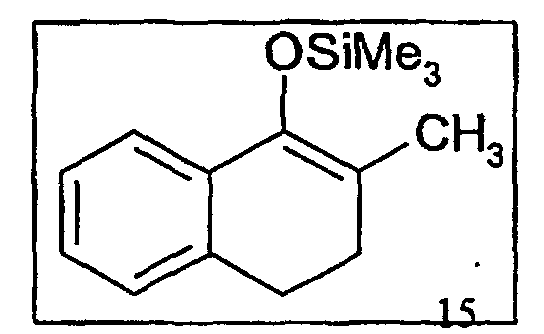
RMN13C (75 MHz, CD3CN): 142.83 (Cq), 136.35 (CH), 134.78 (Cq), 127.13 (CH), 126.59 (Cq), 126.48 (CH), 121.91 (Cq), 117.35 (CH), 29.52 (CH2), 28.68 (CH2), 17.77 (CH3), 1.02 (CH3).

RMN19F (282 MHz, CDCl3/TFA) :9.81 (1 F).
CCM : Et2O/Heptane : 1/1 ; Rf = 0.4.
CPG Chirale : programmation de température : température initiale 65°C, 2 mn à 65°C, puis 5°/mn jusqu'à 170°C, 2-méthyl-1-tétralone : 20.70, 2-fluoro-2-méthyl-1-tétralone : 21.05 et 21.40.

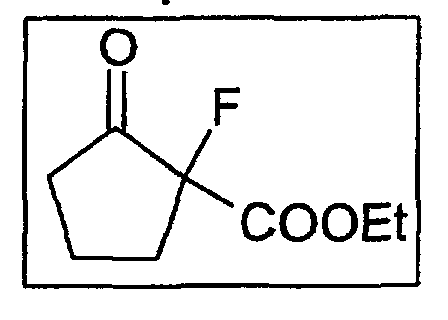
RMN19F (282 MHz, CDCl3/TFA) :-164.54 (t, 1 F).
CCM : Et2O/Heptane : 1/1, Rf = 0.5.
CPG Chirale : programmation de température : température initiale 65°C, 2 mn à 65°C, puis 5°/mn jusqu'à 170°C, 2-fluorocyclopentanone-2-carboxylate d'éthyle :
14.70 et 14.85, cyclopentanone-2-carboxylate d'éthyle : 14.91.

Claims (23)
- Ammonium quaternaire présentant au moins un atome asymétrique dont la fonction ammonium quaternaire est porteuse d'un fluor et n'est distante dudit atome asymétrique par le chemin le plus court que d'au plus 4 chaínons, avantageusement au plus 3, de préférence au plus 2.
- Ammonium selon la revendication 1, caractérisé par le fait que l'atome asymétrique est un atome de carbone.
- Ammonium selon les revendications 1 et 2, caractérisé par le fait que l'atome asymétrique est un atome de carbone porteur d'une fonction hydrogénophore non oxydable.
- Ammonium selon les revendications 1 à 3, caractérisé par le fait que l'atome asymétrique un atome de carbone porteur d'une fonction hydroxyle.
- Ammonium selon les revendications 1 à 2, caractérisé par le fait que l'atome asymétrique un atome de carbone porteur d'une fonction hydrogénophore, avantageusement hydroxyle, protégée.
- sous Ammonium selon les revendications 1, 2 et 5, caractérisé par le fait que l'atome asymétrique un atome de carbone porteur d'une fonction hydroxyle, protégée sous la forme d'un ether ou d'un ester.
- Ammonium selon les revendications 1 à 6, caractérisé par le fait que l'atome asymétrique un atome de carbone porteur d'une un radical arylique ou aralcoylique.
- Ammonium selon les revendications 1 à 7, caractérisé par le fait que l'azote de la fonction ammonium porteuse du fluor est intracyclique.
- Ammonium selon les revendications 1 à 8, caractérisé par le fait que l'azote de la fonction ammonium porteuse du fluor est intracyclique à au moins deux cycles.
- Ammonium selon les revendications 1 à 9, caractérisé par le fait qu'il présente un atome de carbone asymétrique relié à la fois à un radical porteur de la fonction ammonium fluorée, à un radical, distinct du précédent, porteur d'un noyau aromatique, et à une fonction hydrogénophore, avantageusement à une fonction alcool.
- Ammonium selon les revendications 1 à 10, caractérisé par le fait qu'il est associé à un contre-ion non polarisant et mauvais nucléophile
- Ammonium selon les revendications 1 à 11, caractérisé par le fait qu'il est associé à un contre-ion dont l'acide associé présente un pKa au plus égal à 2, avantageusement à 1, de préférence à 0.
- Ammonium selon les revendications 1 à 12, caractérisé par le fait qu'il est associé à un contre-ion polyatomique.
- Ammonium selon les revendications 1 à 13, caractérisé par le fait qu'il est associé à un contre-ion fluoré.
- Réactif utile pour une fluoration électrophile, caractérisé par le fait qu'il comporte un ammonium quaternaire selon les revendications 1 à 14.
- Réactif selon la revendication 15, caractérisé par le fait qu'il comporte en outre un solvant aprotique polaire.
- Réactif selon les revendications 15 et 16, caractérisé par le fait qu'il comporte en outre pour addition successive ou simultanée une base.
- Réactif selon les revendications 15 et 17, caractérisé par le fait qu'il comporte en outre, pour addition successive ou simultanée, une base dont l'acide associé présente un pKa au moins égal à 18.
- Réactif selon les revendications 15 et 18, caractérisé par le fait qu'il comporte en outre, pour addition successive ou simultanée, une base engendrée in situ, avantageusement par un ion fluorure réagissant sur un alcool ou une amine silylée.
- Synthèse des composés selon les revendications 1 à 12, caractérisée par le fait qu'ils consistent à mettre en contact dans un solvant polaire l'amine correspondante audit ammonium quaternaire avec un N-fluoro-1,4-diazoniabicyclooctane sous forme d'un sel dissocié.
- Procédé de fluoration, caractérisé par le fait qu'il consiste à mettre en contact un réactif selon les revendications 13 à 17 avec un substrat riche en électrons.
- Procédé selon la revendication 18, caractérisé par le fait que la réaction est menée à une température d'au plus 20°C.
- Utilisation du réactif selon les revendications 13 à 17 pour une fluoration électrophile énantiosélective.
Applications Claiming Priority (3)
| Application Number | Priority Date | Filing Date | Title |
|---|---|---|---|
| FR0006557 | 2000-05-23 | ||
| FR0006557A FR2810034B1 (fr) | 2000-05-23 | 2000-05-23 | Ammoniums porteurs d'un fluor electrophile, reactif en contenant, procede les mettant en oeuvre et procede de synthese pour les obtenir |
| PCT/FR2001/001578 WO2001090107A1 (fr) | 2000-05-23 | 2001-05-22 | Ammoniums porteurs d'un fluor electrophile, reactif en contenant, procede les mettant en oeuvre et procede de synthese pour les obtenir |
Publications (2)
| Publication Number | Publication Date |
|---|---|
| EP1284975A1 EP1284975A1 (fr) | 2003-02-26 |
| EP1284975B1 true EP1284975B1 (fr) | 2004-08-18 |
Family
ID=8850503
Family Applications (1)
| Application Number | Title | Priority Date | Filing Date |
|---|---|---|---|
| EP01938303A Expired - Lifetime EP1284975B1 (fr) | 2000-05-23 | 2001-05-22 | Ammoniums porteurs d'un fluor electrophile, reactif en contenant, procede les mettant en oeuvre et procede de synthese pour les obtenir |
Country Status (8)
| Country | Link |
|---|---|
| US (1) | US20050075501A1 (fr) |
| EP (1) | EP1284975B1 (fr) |
| JP (1) | JP2004505893A (fr) |
| AT (1) | ATE273977T1 (fr) |
| AU (1) | AU2001263999A1 (fr) |
| DE (1) | DE60105015T2 (fr) |
| FR (1) | FR2810034B1 (fr) |
| WO (1) | WO2001090107A1 (fr) |
Families Citing this family (3)
| Publication number | Priority date | Publication date | Assignee | Title |
|---|---|---|---|---|
| GB201219820D0 (en) | 2012-11-05 | 2012-12-19 | Isis Innovation | Compounds |
| EP2746258A1 (fr) | 2012-12-21 | 2014-06-25 | Basf Se | Composés de [1,2,4]triazole et d'imidazole substitués |
| EP2746257A1 (fr) | 2012-12-21 | 2014-06-25 | Basf Se | Composés de [1,2,4]triazole et d'imidazole substitués |
Family Cites Families (2)
| Publication number | Priority date | Publication date | Assignee | Title |
|---|---|---|---|---|
| US5741715A (en) * | 1995-05-30 | 1998-04-21 | Roche Diagnostic Systems, Inc. | Quinidine immunoassay and reagents |
| JPH09249653A (ja) * | 1996-03-13 | 1997-09-22 | Yakult Honsha Co Ltd | 求電子的不斉フッ素化試薬 |
-
2000
- 2000-05-23 FR FR0006557A patent/FR2810034B1/fr not_active Expired - Fee Related
-
2001
- 2001-05-22 DE DE60105015T patent/DE60105015T2/de not_active Expired - Fee Related
- 2001-05-22 JP JP2001586294A patent/JP2004505893A/ja not_active Withdrawn
- 2001-05-22 WO PCT/FR2001/001578 patent/WO2001090107A1/fr not_active Ceased
- 2001-05-22 US US10/296,361 patent/US20050075501A1/en not_active Abandoned
- 2001-05-22 AT AT01938303T patent/ATE273977T1/de not_active IP Right Cessation
- 2001-05-22 AU AU2001263999A patent/AU2001263999A1/en not_active Abandoned
- 2001-05-22 EP EP01938303A patent/EP1284975B1/fr not_active Expired - Lifetime
Also Published As
| Publication number | Publication date |
|---|---|
| DE60105015D1 (de) | 2004-09-23 |
| WO2001090107A1 (fr) | 2001-11-29 |
| ATE273977T1 (de) | 2004-09-15 |
| DE60105015T2 (de) | 2005-07-14 |
| AU2001263999A1 (en) | 2001-12-03 |
| FR2810034B1 (fr) | 2002-12-20 |
| EP1284975A1 (fr) | 2003-02-26 |
| JP2004505893A (ja) | 2004-02-26 |
| FR2810034A1 (fr) | 2001-12-14 |
| US20050075501A1 (en) | 2005-04-07 |
Similar Documents
| Publication | Publication Date | Title |
|---|---|---|
| EP2802554B1 (fr) | Préparation d'ingrédients pharmaceutiques actifs de type acide aminés ss purs optiquement et intermédiaires associés | |
| EP0729930B1 (fr) | Procédé de synthèse de composés hydrocarbonés fluorés sur un carbone d'une chaíne alcoyle | |
| EP0030528B1 (fr) | Procédé pour la fixation de groupes alkyles, aralkyles ou cycloalkyles sur une chaîne carbonée portant un groupe fonctionnel | |
| EP1284975A1 (fr) | Ammoniums porteurs d'un fluor electrophile, reactif en contenant, procede les mettant en oeuvre et procede de synthese pour les obtenir | |
| EP0573361B1 (fr) | Procédé de préparation d'esters de l'acide 2,2-diméthyl 3-((Z)-2-(alcoxycarbonyl)ethenyl cyclopropane carboxylique et intermédiaires | |
| CN102471239A (zh) | 光学活性的1-氨基-2-乙烯基环丙甲酸酯的制造方法 | |
| EP0510168B1 (fr) | Procede de dedoublement d'hydantoines chirales | |
| US8202417B2 (en) | Chiral stationary phases for chromatography based on aromatic allyl amines | |
| EP0149952A2 (fr) | Procédé de préparation de bromobenzaldéhydes hydroxy et/ou alkoxy substitués | |
| FR2566769A1 (fr) | Agent de fluoration de composes organiques notamment de composes acetyleniques, leur procede de preparation et leur utilisation dans les reactions d'addition ou de substitution nucleophile | |
| JP4104319B2 (ja) | 光学活性2−ヒドロキシ−3−ニトロプロピオン酸の製造方法 | |
| WO2015101452A1 (fr) | Procede de fabrication du bromo methyl cyclopropane et du bromo methyl cyclobutane | |
| EP0912466B1 (fr) | Procede de synthese de composes hydrocarbones fluores sur au moins un carbone d'une chaine alcoyle | |
| EP0187631B1 (fr) | Procédé pour la préparation de dérivés de pyrrolo-pyridine et nouveaux dérivés obtenus | |
| EP0398774B1 (fr) | Procédé de préparation de dérivés bromés notamment à partir d'alcools | |
| EP1196418B1 (fr) | PROCEDE DE PREPARATION DE 1,4]DIAZEPINO 6,7,1- i hi /i ]INDOL-4-ONES SUBSTITUEES | |
| WO2012038515A1 (fr) | Procede de racemisation et d'acetylation de la leucine | |
| JP3004735B2 (ja) | 光学活性カルボン酸エステルのラセミ化方法 | |
| JP2524544B2 (ja) | 光学活性な置換フェノキシアルカン酸アミド類の製造方法 | |
| WO2006048546A1 (fr) | Utilisation d'un acide carboxylique aromatique dans une reaction de catalyse asymetrique | |
| EP0323332A1 (fr) | Perfectionnement à la production d'alcools tertiaires et secondaires par l'action d'un composé organique halogéné et du manganèse sur un composé porteur d'un groupe carbonyle | |
| EP0374014A2 (fr) | Nouveaux composés organo-manganeux, leur préparation et applications | |
| FR2809397A1 (fr) | Procede de preparation d'un compose de type benzofuranne ou benzothiophene | |
| JPH061751A (ja) | ラセミ化トリフルオロ乳酸類の製造方法 | |
| FR2843113A1 (fr) | Addition electrophile d'un halogene sur une double liaison carbone-carbone. |
Legal Events
| Date | Code | Title | Description |
|---|---|---|---|
| PUAI | Public reference made under article 153(3) epc to a published international application that has entered the european phase |
Free format text: ORIGINAL CODE: 0009012 |
|
| 17P | Request for examination filed |
Effective date: 20021122 |
|
| AK | Designated contracting states |
Kind code of ref document: A1 Designated state(s): AT BE CH CY DE DK ES FI FR GB GR IE IT LI LU MC NL PT SE TR |
|
| AX | Request for extension of the european patent |
Extension state: AL LT LV MK RO SI |
|
| RIN1 | Information on inventor provided before grant (corrected) |
Inventor name: CAHARD, DOMINIQUE Inventor name: PLAQUEVENT, JEAN-CHRISTOPHE Inventor name: AUDOUARD, CHRISTOPHE Inventor name: DESMURS, JEAN-ROGER Inventor name: HEBRAULT, DOMINIQUE |
|
| GRAP | Despatch of communication of intention to grant a patent |
Free format text: ORIGINAL CODE: EPIDOSNIGR1 |
|
| GRAS | Grant fee paid |
Free format text: ORIGINAL CODE: EPIDOSNIGR3 |
|
| GRAA | (expected) grant |
Free format text: ORIGINAL CODE: 0009210 |
|
| AK | Designated contracting states |
Kind code of ref document: B1 Designated state(s): AT BE CH CY DE DK ES FI FR GB GR IE IT LI LU MC NL PT SE TR |
|
| PG25 | Lapsed in a contracting state [announced via postgrant information from national office to epo] |
Ref country code: FI Free format text: LAPSE BECAUSE OF FAILURE TO SUBMIT A TRANSLATION OF THE DESCRIPTION OR TO PAY THE FEE WITHIN THE PRESCRIBED TIME-LIMIT Effective date: 20040818 Ref country code: IT Free format text: LAPSE BECAUSE OF FAILURE TO SUBMIT A TRANSLATION OF THE DESCRIPTION OR TO PAY THE FEE WITHIN THE PRESCRIBED TIME-LIMIT;WARNING: LAPSES OF ITALIAN PATENTS WITH EFFECTIVE DATE BEFORE 2007 MAY HAVE OCCURRED AT ANY TIME BEFORE 2007. THE CORRECT EFFECTIVE DATE MAY BE DIFFERENT FROM THE ONE RECORDED. Effective date: 20040818 Ref country code: TR Free format text: LAPSE BECAUSE OF FAILURE TO SUBMIT A TRANSLATION OF THE DESCRIPTION OR TO PAY THE FEE WITHIN THE PRESCRIBED TIME-LIMIT Effective date: 20040818 |
|
| REG | Reference to a national code |
Ref country code: GB Ref legal event code: FG4D Free format text: NOT ENGLISH |
|
| REG | Reference to a national code |
Ref country code: CH Ref legal event code: NV Representative=s name: KIRKER & CIE SA Ref country code: CH Ref legal event code: EP |
|
| REG | Reference to a national code |
Ref country code: IE Ref legal event code: FG4D Free format text: FRENCH |
|
| REF | Corresponds to: |
Ref document number: 60105015 Country of ref document: DE Date of ref document: 20040923 Kind code of ref document: P |
|
| PG25 | Lapsed in a contracting state [announced via postgrant information from national office to epo] |
Ref country code: GR Free format text: LAPSE BECAUSE OF FAILURE TO SUBMIT A TRANSLATION OF THE DESCRIPTION OR TO PAY THE FEE WITHIN THE PRESCRIBED TIME-LIMIT Effective date: 20041118 Ref country code: DK Free format text: LAPSE BECAUSE OF FAILURE TO SUBMIT A TRANSLATION OF THE DESCRIPTION OR TO PAY THE FEE WITHIN THE PRESCRIBED TIME-LIMIT Effective date: 20041118 Ref country code: SE Free format text: LAPSE BECAUSE OF FAILURE TO SUBMIT A TRANSLATION OF THE DESCRIPTION OR TO PAY THE FEE WITHIN THE PRESCRIBED TIME-LIMIT Effective date: 20041118 |
|
| PG25 | Lapsed in a contracting state [announced via postgrant information from national office to epo] |
Ref country code: ES Free format text: LAPSE BECAUSE OF FAILURE TO SUBMIT A TRANSLATION OF THE DESCRIPTION OR TO PAY THE FEE WITHIN THE PRESCRIBED TIME-LIMIT Effective date: 20041129 |
|
| GBT | Gb: translation of ep patent filed (gb section 77(6)(a)/1977) |
Effective date: 20041129 |
|
| LTIE | Lt: invalidation of european patent or patent extension |
Effective date: 20040818 |
|
| PG25 | Lapsed in a contracting state [announced via postgrant information from national office to epo] |
Ref country code: CY Free format text: LAPSE BECAUSE OF FAILURE TO SUBMIT A TRANSLATION OF THE DESCRIPTION OR TO PAY THE FEE WITHIN THE PRESCRIBED TIME-LIMIT Effective date: 20050522 |
|
| PG25 | Lapsed in a contracting state [announced via postgrant information from national office to epo] |
Ref country code: MC Free format text: LAPSE BECAUSE OF NON-PAYMENT OF DUE FEES Effective date: 20050531 |
|
| PLBE | No opposition filed within time limit |
Free format text: ORIGINAL CODE: 0009261 |
|
| STAA | Information on the status of an ep patent application or granted ep patent |
Free format text: STATUS: NO OPPOSITION FILED WITHIN TIME LIMIT |
|
| 26N | No opposition filed |
Effective date: 20050519 |
|
| PGFP | Annual fee paid to national office [announced via postgrant information from national office to epo] |
Ref country code: NL Payment date: 20060503 Year of fee payment: 6 |
|
| PGFP | Annual fee paid to national office [announced via postgrant information from national office to epo] |
Ref country code: AT Payment date: 20060511 Year of fee payment: 6 |
|
| PGFP | Annual fee paid to national office [announced via postgrant information from national office to epo] |
Ref country code: FR Payment date: 20060515 Year of fee payment: 6 Ref country code: IE Payment date: 20060515 Year of fee payment: 6 |
|
| PGFP | Annual fee paid to national office [announced via postgrant information from national office to epo] |
Ref country code: GB Payment date: 20060517 Year of fee payment: 6 |
|
| PGFP | Annual fee paid to national office [announced via postgrant information from national office to epo] |
Ref country code: DE Payment date: 20060518 Year of fee payment: 6 |
|
| PGFP | Annual fee paid to national office [announced via postgrant information from national office to epo] |
Ref country code: CH Payment date: 20060530 Year of fee payment: 6 |
|
| PGFP | Annual fee paid to national office [announced via postgrant information from national office to epo] |
Ref country code: LU Payment date: 20060601 Year of fee payment: 6 |
|
| PGFP | Annual fee paid to national office [announced via postgrant information from national office to epo] |
Ref country code: BE Payment date: 20060712 Year of fee payment: 6 |
|
| BERE | Be: lapsed |
Owner name: *RHODIA CHIMIE Effective date: 20070531 |
|
| PG25 | Lapsed in a contracting state [announced via postgrant information from national office to epo] |
Ref country code: PT Free format text: LAPSE BECAUSE OF NON-PAYMENT OF DUE FEES Effective date: 20050118 |
|
| REG | Reference to a national code |
Ref country code: CH Ref legal event code: PL |
|
| GBPC | Gb: european patent ceased through non-payment of renewal fee |
Effective date: 20070522 |
|
| PG25 | Lapsed in a contracting state [announced via postgrant information from national office to epo] |
Ref country code: NL Free format text: LAPSE BECAUSE OF NON-PAYMENT OF DUE FEES Effective date: 20071201 |
|
| NLV4 | Nl: lapsed or anulled due to non-payment of the annual fee |
Effective date: 20071201 |
|
| REG | Reference to a national code |
Ref country code: IE Ref legal event code: MM4A |
|
| PG25 | Lapsed in a contracting state [announced via postgrant information from national office to epo] |
Ref country code: CH Free format text: LAPSE BECAUSE OF NON-PAYMENT OF DUE FEES Effective date: 20070531 Ref country code: AT Free format text: LAPSE BECAUSE OF NON-PAYMENT OF DUE FEES Effective date: 20070522 Ref country code: LI Free format text: LAPSE BECAUSE OF NON-PAYMENT OF DUE FEES Effective date: 20070531 |
|
| REG | Reference to a national code |
Ref country code: FR Ref legal event code: ST Effective date: 20080131 |
|
| PG25 | Lapsed in a contracting state [announced via postgrant information from national office to epo] |
Ref country code: BE Free format text: LAPSE BECAUSE OF NON-PAYMENT OF DUE FEES Effective date: 20070531 |
|
| PG25 | Lapsed in a contracting state [announced via postgrant information from national office to epo] |
Ref country code: DE Free format text: LAPSE BECAUSE OF NON-PAYMENT OF DUE FEES Effective date: 20071201 |
|
| PG25 | Lapsed in a contracting state [announced via postgrant information from national office to epo] |
Ref country code: IE Free format text: LAPSE BECAUSE OF NON-PAYMENT OF DUE FEES Effective date: 20070522 Ref country code: GB Free format text: LAPSE BECAUSE OF NON-PAYMENT OF DUE FEES Effective date: 20070522 |
|
| PG25 | Lapsed in a contracting state [announced via postgrant information from national office to epo] |
Ref country code: FR Free format text: LAPSE BECAUSE OF NON-PAYMENT OF DUE FEES Effective date: 20070531 |
|
| PG25 | Lapsed in a contracting state [announced via postgrant information from national office to epo] |
Ref country code: LU Free format text: LAPSE BECAUSE OF NON-PAYMENT OF DUE FEES Effective date: 20070522 |