EP1285475B1 - Herstellungsverfahren von niedertemperatur- brennstoffzellenelektroden - Google Patents
Herstellungsverfahren von niedertemperatur- brennstoffzellenelektroden Download PDFInfo
- Publication number
- EP1285475B1 EP1285475B1 EP01917981A EP01917981A EP1285475B1 EP 1285475 B1 EP1285475 B1 EP 1285475B1 EP 01917981 A EP01917981 A EP 01917981A EP 01917981 A EP01917981 A EP 01917981A EP 1285475 B1 EP1285475 B1 EP 1285475B1
- Authority
- EP
- European Patent Office
- Prior art keywords
- electrode
- ink
- fuel cell
- conducting
- propanediol
- Prior art date
- Legal status (The legal status is an assumption and is not a legal conclusion. Google has not performed a legal analysis and makes no representation as to the accuracy of the status listed.)
- Expired - Lifetime
Links
Images


Classifications
-
- H—ELECTRICITY
- H01—ELECTRIC ELEMENTS
- H01G—CAPACITORS; CAPACITORS, RECTIFIERS, DETECTORS, SWITCHING DEVICES, LIGHT-SENSITIVE OR TEMPERATURE-SENSITIVE DEVICES OF THE ELECTROLYTIC TYPE
- H01G11/00—Hybrid capacitors, i.e. capacitors having different positive and negative electrodes; Electric double-layer [EDL] capacitors; Processes for the manufacture thereof or of parts thereof
- H01G11/22—Electrodes
- H01G11/26—Electrodes characterised by their structure, e.g. multi-layered, porosity or surface features
- H01G11/28—Electrodes characterised by their structure, e.g. multi-layered, porosity or surface features arranged or disposed on a current collector; Layers or phases between electrodes and current collectors, e.g. adhesives
-
- H—ELECTRICITY
- H01—ELECTRIC ELEMENTS
- H01G—CAPACITORS; CAPACITORS, RECTIFIERS, DETECTORS, SWITCHING DEVICES, LIGHT-SENSITIVE OR TEMPERATURE-SENSITIVE DEVICES OF THE ELECTROLYTIC TYPE
- H01G11/00—Hybrid capacitors, i.e. capacitors having different positive and negative electrodes; Electric double-layer [EDL] capacitors; Processes for the manufacture thereof or of parts thereof
- H01G11/22—Electrodes
- H01G11/30—Electrodes characterised by their material
- H01G11/32—Carbon-based
- H01G11/38—Carbon pastes or blends; Binders or additives therein
-
- H—ELECTRICITY
- H01—ELECTRIC ELEMENTS
- H01M—PROCESSES OR MEANS, e.g. BATTERIES, FOR THE DIRECT CONVERSION OF CHEMICAL ENERGY INTO ELECTRICAL ENERGY
- H01M4/00—Electrodes
- H01M4/86—Inert electrodes with catalytic activity, e.g. for fuel cells
- H01M4/96—Carbon-based electrodes
-
- H—ELECTRICITY
- H01—ELECTRIC ELEMENTS
- H01M—PROCESSES OR MEANS, e.g. BATTERIES, FOR THE DIRECT CONVERSION OF CHEMICAL ENERGY INTO ELECTRICAL ENERGY
- H01M8/00—Fuel cells; Manufacture thereof
- H01M8/10—Fuel cells with solid electrolytes
- H01M8/1004—Fuel cells with solid electrolytes characterised by membrane-electrode assemblies [MEA]
-
- H—ELECTRICITY
- H01—ELECTRIC ELEMENTS
- H01G—CAPACITORS; CAPACITORS, RECTIFIERS, DETECTORS, SWITCHING DEVICES, LIGHT-SENSITIVE OR TEMPERATURE-SENSITIVE DEVICES OF THE ELECTROLYTIC TYPE
- H01G11/00—Hybrid capacitors, i.e. capacitors having different positive and negative electrodes; Electric double-layer [EDL] capacitors; Processes for the manufacture thereof or of parts thereof
- H01G11/84—Processes for the manufacture of hybrid or EDL capacitors, or components thereof
- H01G11/86—Processes for the manufacture of hybrid or EDL capacitors, or components thereof specially adapted for electrodes
-
- H—ELECTRICITY
- H01—ELECTRIC ELEMENTS
- H01M—PROCESSES OR MEANS, e.g. BATTERIES, FOR THE DIRECT CONVERSION OF CHEMICAL ENERGY INTO ELECTRICAL ENERGY
- H01M2300/00—Electrolytes
- H01M2300/0017—Non-aqueous electrolytes
- H01M2300/0065—Solid electrolytes
- H01M2300/0082—Organic polymers
-
- Y—GENERAL TAGGING OF NEW TECHNOLOGICAL DEVELOPMENTS; GENERAL TAGGING OF CROSS-SECTIONAL TECHNOLOGIES SPANNING OVER SEVERAL SECTIONS OF THE IPC; TECHNICAL SUBJECTS COVERED BY FORMER USPC CROSS-REFERENCE ART COLLECTIONS [XRACs] AND DIGESTS
- Y02—TECHNOLOGIES OR APPLICATIONS FOR MITIGATION OR ADAPTATION AGAINST CLIMATE CHANGE
- Y02E—REDUCTION OF GREENHOUSE GAS [GHG] EMISSIONS, RELATED TO ENERGY GENERATION, TRANSMISSION OR DISTRIBUTION
- Y02E60/00—Enabling technologies; Technologies with a potential or indirect contribution to GHG emissions mitigation
- Y02E60/13—Energy storage using capacitors
-
- Y—GENERAL TAGGING OF NEW TECHNOLOGICAL DEVELOPMENTS; GENERAL TAGGING OF CROSS-SECTIONAL TECHNOLOGIES SPANNING OVER SEVERAL SECTIONS OF THE IPC; TECHNICAL SUBJECTS COVERED BY FORMER USPC CROSS-REFERENCE ART COLLECTIONS [XRACs] AND DIGESTS
- Y02—TECHNOLOGIES OR APPLICATIONS FOR MITIGATION OR ADAPTATION AGAINST CLIMATE CHANGE
- Y02E—REDUCTION OF GREENHOUSE GAS [GHG] EMISSIONS, RELATED TO ENERGY GENERATION, TRANSMISSION OR DISTRIBUTION
- Y02E60/00—Enabling technologies; Technologies with a potential or indirect contribution to GHG emissions mitigation
- Y02E60/30—Hydrogen technology
- Y02E60/50—Fuel cells
-
- Y—GENERAL TAGGING OF NEW TECHNOLOGICAL DEVELOPMENTS; GENERAL TAGGING OF CROSS-SECTIONAL TECHNOLOGIES SPANNING OVER SEVERAL SECTIONS OF THE IPC; TECHNICAL SUBJECTS COVERED BY FORMER USPC CROSS-REFERENCE ART COLLECTIONS [XRACs] AND DIGESTS
- Y02—TECHNOLOGIES OR APPLICATIONS FOR MITIGATION OR ADAPTATION AGAINST CLIMATE CHANGE
- Y02P—CLIMATE CHANGE MITIGATION TECHNOLOGIES IN THE PRODUCTION OR PROCESSING OF GOODS
- Y02P70/00—Climate change mitigation technologies in the production process for final industrial or consumer products
- Y02P70/50—Manufacturing or production processes characterised by the final manufactured product
Definitions
- the invention relates to the production of an electrode, the most important components of which consist of a noble metal catalyst and a proton-conducting polymer.
- electrodes are used, inter alia, in fuel cells which contain a proton-conducting polymer membrane as electrolyte (SPFC, Solid Polymer Fuel Cell).
- SPFC Solid Polymer Fuel Cell
- a fuel cell of this type is able to convert chemical energy into electrical energy and heat in a clean, quiet and efficient manner.
- Possible applications are, inter alia, electric transport, heat/power generation on a scale of 1 - 250 kW and portable equipment.
- Such a fuel cell has two electrodes, an anode and a cathode, at which, respectively, a fuel is oxidised and oxidant is reduced.
- the fuel used can be hydrogen, a hydrogencontaining gas or an organic compound, for example methanol.
- the oxidant used is usually atmospheric oxygen.
- the optimum operating temperature of a low-temperature fuel cell based on a proton-conducting polymer is around 60 - 80 °C.
- the majority of active electrodes for the oxidation of hydrogen and the reduction of oxygen at such temperatures and in an acid medium contain platinum as catalytically active material.
- Hydrogen-containing gases which are produced by the reaction of a hydrocarbon in a so-called reformer also contain, inter alia, carbon dioxide and carbon monoxide in addition to hydrogen. Carbon monoxide in particular has a highly adverse effect on the activity of platinum for the electrochemical conversion of hydrogen to protons.
- catalysts consisting of a mixture of platinum and a second metal for example chromium or nickel, can have a higher activity than catalysts based on platinum alone.
- the surface area/mass ratio of the noble metal used is as high as possible. This is achieved by applying the noble metal from a solution to a support material in such a controlled manner that the crystallite diameter is approximately 2 -4 nm.
- the support material used is generally carbon because of the requisite electrical conductivity.
- Widely used support materials are Vulcan® XC-72, a carbon powder with a BET surface area of approximately 250 m 2 /g, Shawinigan Acetylene Black, a carbon powder with a BET surface area of approximately 80 m 2 /g, and Black Pearls, a carbon powder with a BET surface area of approximately 1475 m 2 /g.
- the requirement for a high electrochemical rate of reaction per unit catalytic surface area is that the catalytic surface area is readily accessible to the gaseous reactants, and to protons and electrons.
- the electrode In addition, in the case of the oxygen reduction reaction it must be possible efficiently to discharge the water produced in order thus to keep the accessibility to oxygen high.
- the electrode For good accessibility to gaseous reactants, the electrode must have a certain porosity, which in SPFCs which function well is of the order of 50 %.
- electrodes which, in addition to platinum on carbon, also contain the same proton-conducting polymer as that used to produce the electrolytic membrane.
- the percentage of proton-conducting polymer must not be too high, since the electronic conductivity and the gas accessibility decrease as the content of proton-conducting polymer increases.
- a concentration of proton-conducting polymer of 10 - 50 %, in particular 20 - 30 %, based on dry weight, is suitable.
- An SPFC electrode consists roughly of two different layers: a thin catalytic layer approximately 5 - 20 ⁇ m thick, where the actual electrochemical reaction takes place, and a thick porous layer approximately 100 - 300 ⁇ m thick, which is termed the electrode backing.
- the function of this thick layer is to distribute the gas to electrode sections which are not opposite a gas channel, to guide electrons in the lateral direction and to ensure effective water transport from and to the electrode.
- the catalytic layer can be applied either to the electrode backing or to the electrolytic membrane.
- Various techniques for application are known, including atomising, screen printing and coating.
- the noble metal-containing carbon particles and the proton-conducting polymer must have been dispersed in a suitable solvent.
- This dispersion is termed ink.
- the entire dispersion must have a rheology which makes it possible to process the ink in the manufacturing equipment used.
- the solvents used must evaporate within a practical timescale. Evaporation that is too rapid leads to a changing rheology during electrode production, with the consequence that the production of electrodes is not reproducible.
- a binder is in general a component that has the effect of increasing the viscosity.
- components which have the effect of increasing the viscosity are carboxymethylcellulose, polyethelene glycol, polyvinyl alcohol, polyvinylpyrrolidone and other polymer compounds.
- these compounds form part not only of the electrode ink but also of the final electrode.
- an electrode constituent that has no function in the final electrode but, by interaction with the noble metal surface of the active phase, such a component can also have an adverse effect on the electrochemical activity of the electrode. This results in a reduced capacity per unit of electrode surface.
- An electrode ink which consists of two immiscible components is described in EP-A 0 945 910.
- One of the components is an ink which contains the catalyst with the conducting polymer (ionomer) in a polar solvent such as an alcohol or diol, for example propylene glycol, dipropylene glycol, glycerol or hexylene glycol.
- the other component is an ink containing catalyst without ionomer in an apolar solvent, such as fatty acid esters, for example methyl dodecanoate.
- an electrode having an inhomogeneous microstructure is produced, the inhomogeneity serving to improve the gas transport in the catalytic layer and thus to increase the capacity of the fuel cell.
- the method according to EP-A 0 945 910 is laborious and, moreover, the electrode performance is not yet completely satisfactory.
- a homogeneous electrode can be obtained very suitably using an electrode ink based on an alkanediol, in particular 1,2-propanediol (propylene glycol), optionally mixed with solvents miscible therewith, which electrode can, moreover be produced more simply and/or has a better performance than the fuel cell electrodes known to date.
- an electrode ink based on an alkanediol, in particular 1,2-propanediol (propylene glycol), optionally mixed with solvents miscible therewith, which electrode can, moreover be produced more simply and/or has a better performance than the fuel cell electrodes known to date.
- the invention therefore relates to a method for the production of an electrode using an electrode ink which contains the customary constituents discussed above, in particular a carbon support or other suitable support with one or more catalyst metals optionally bonded thereto, and an ion-conducting polymer, the solvent at least partially consisting of an alkanediol, preferably 1,2-propanediol.
- the invention also relates to the electrodes and fuel cells, or capacitors, obtainable by this method. The invention is described in more detail in the appended claims.
- the solvent of the electrode ink therefore consists to at least 3 % of an alkanediol.
- the ink fluid also contains water, for example 80 - 96 % water and 4 - 20 % 1,2-propanediol.
- the fluid can, however, also be a mixture of alkanediols, or of alkanediols on the onc hand and other polar solvents, such as alcohols, alcohol ethers, ethers, esters, amides or sulphoxides, on the other hand, with preferably at least 50 %, in particular at least 70 % alkanediol.
- the fluid can also consist completely of alkanediol.
- the very low vapour tension of 1,2-propanediol, at room temperature, of 0.2 mbar ensures that no 1,2-propanediol evaporates in discernible amounts during the use of an electrode ink containing 1,2-propanediol as solvent.
- the viscosity and processibility of such an ink consequently remains constant for a prolonged period of a few hours.
- this compound can be adequately removed at elevated temperature, 80 - 90 °C, within a timescale of a few minutes, as a result of which the final electrode can be further processed.
- 1,2-propanediol is an acceptable compound.
- the toxicity of 1,2-propanediol is low; it is also used for the preparation of foodstuffs and dermatological products. Because of its very low vapour tension, exposure by inhalation is very easy to prevent.
- the polarity of the compound is such that ink based on 1,2-propanediol can be applied easily to both hydrophobic and hydrophilic surfaces. Hydrophobic surfaces such as electrode backings can consequently be printed without too much pressure using an electrode ink based on 1,2-propanediol.
- the electrolytic membrane which is usually hydrophilic, can also be printed using the electrode ink of this invention. In general, swelling of the membrane takes place during the application of electrodes to an electrolytic membrane.
- the degree of swelling depends on the solvent. According to the study by R.S. Yeo, published in the journal Polymer , Vol. 21, (1980), page 433, the most important parameter determining this degree of swelling is the solubility parameter. According to this study the solubility parameter would have to be close to 0 for minimum swelling, and maximum swelling occurs for solvents with a solubility parameter of 10 ((cal.cm -3 ) 0.5 ).
- 1,2-propanediol ought to produce a swelling comparable to that of primary alcohols such as 1-propanol and ethanol.
- a membrane does not swell at all on absorbing 1,2-propanediol, which is of extremely great importance for obtaining dimensionally stable electrodes when these are applied directly to the membrane.
- the increase in the length of a rectangular piece of membrane was taken as a measure of the swelling. Whilst the increase in water is 10 % and that in 1-propanol 18 %, the increase in 1,2-propanediol is 0 %.
- the method according to the invention can be carried out in a manner known per se.
- the carbon powder is loaded with 5 - 60 % (m/m), in particular 10 - 45 % (m/m), of at least one platinum metal, preferably platinum itself.
- a second metal such as ruthenium or molybdenum, or chromium, nickel, palladium, cobalt or iridium, can be added hereto in an amount of 0.1 to 75 % (m/m), based on the total weight of catalyst metal.
- the requisite amount of the proton- or ion-conducting polymer in particular a polymer that contains perfluoralkylsulphonic acid groups (-C n F 2n SO 3 H), is added to this, for example 10 - 40 % (m/m) based on the carbon/catalyst mixture.
- the solvent is added, for example in an amount which leads to a catalyst solids content of 0.1 - 2 g/ml, in particular 0.5 - 1.0 g/ml. If necessary, one or more dispersion steps are carried out.
- the ink in liquid or paste form is then applied in a known manner to either an electrode backing, in a layer having a thickness of 2 - 50, in particular 4 - 30, ⁇ m, or an electrolyte layer, after which drying is carried out at a temperature of between 75 and 150 °C.
- the electrolyte layer or the electrode backing is then applied, usually with heating (75 - 150 °C) and optionally under pressure (2 - 100 bar).
- a super-capacitor electrode can be produced in a comparable manner, with the proviso that the substrate then usually consists of an electron-conducting film or foam.
- the following examples illustrate the use of electrode inks based on 1,2-propanediol and demonstrate that fuel cells produced using this electrode ink have performances comparable to those of fuel cells that have been produced using electrode inks containing water as solvent.
- the fuel cell tests were carried out under the following test conditions: Type of fuel hydrogen Type of oxidant air Pressure 1.5 or 1.0 bar Current density 470 mA/cm 2 Type of flow counterflow Cell temperature 65 °C Wetting temperature 65 °C Hydrogen/air reactant stochiometry 1.5/2.0
- the electrode surface area tested was 7 cm 2 . However, production was also carried out up to surface areas of 310 cm 2 without the electrode loading becoming inhomogeneous at this scale.
- the electrode backings used were all of the ETEK-Elat double-sided or single-sided type. These electrode backings consist of a carbon cloth with a microporous, hydrophobic layer on one or two sides. This layer can be inked well without the electrode ink penetrating deeply into the entire structure. This deep penetration of the electrode ink has an adverse effect on the transport of oxygen to the electrochemically active part of the fuel cell cathode. It also leads to inefficient use of the catalyst containing noble metal.
- Electrode backings based on macroporous graphite paper, as sold by Toray.
- This graphite paper can be used, following a step for rendering it hydrophobic, as electrode backing in a solid polymer fuel cell (SPFC).
- SPFC solid polymer fuel cell
- the problem outlined can be solved by adding water to the electrode ink.
- an electrode ink in which the fluid consists of 90 % water and 10 % 1,2-propanediol is exceedingly suitable for applying electrodes to electrode backings without this ink penetrating deeply into the electrode backing.
- a fluid consisting of 5 % propanediol and 95 % water is also found to be extremely suitable.
- an after-treatment step is required in order to obtain adhesion of this electrode to the hydrophobic graphite paper, which after-treatment step essentially consists in a heat treatment at 130 °C for one hour.
- this electrode must be impregnated with a Nafion solution that predominantly consists of water.
- An electrode ink suitable for screen printing on an electrolytic membrane or on an electrode backing is prepared as follows. 16 g heptane is added to an amount of 2.0 g 40 % (m/m) Pt/Vulcan® XC72. The whole is mixed well until a dispersed mixture forms. The heptane is evaporated under a gentle stream of nitrogen. An amount of 9.6 g 5 % Nafion solution, obtainable from DuPont or Solution Technology Inc., is evaporated to dryness at room temperature. 9.6 g methanol is added to the Nafion® that has been evaporated to dryness and the mixture is then treated in an ultrasonic bath for 20 minutes, if necessary at an elevated temperature of, for example 60 °C.
- 1,2-propanediol 1 g 1,2-propanediol is then added.
- the methanol is evaporated at 60 °C in a vacuum rotary evaporator until no further distillate is collected.
- the residue is diluted with 1,2-propanediol to a final concentration of 7.5 % Nafion® in 1,2-propanediol, which corresponds to 6.4 g solution.
- 2.0 g 40 % Pt-on-Vulcan is added to this 6.4 g 7.5 % Nafion® in 1,2-propanediol.
- the resulting mixture is heated at 100 °C for 2 minutes, followed by a dispersing step for one minute. After cooling, for example in a refrigerator, the ink is ready for use.
- the ink prepared in accordance with Example 1 was applied with the aid of screen printing on a DEK 247 screen printing machine to an electrode backing, purchased from E-TEK Inc. under the name single-sided ELAT-electrode-Carbon only. After applying the electrode to the electrode backing, the ink was dried for 3 minutes at 90 °C under inert conditions (nitrogen atmosphere). A screen printed electrode was then applied by means of a hot pressing step (130 °C, 40 kg/cm 2 ) to two sides of a 50 ⁇ m thick electrolytic membrane of the Aciplex-S1002 type, purchased from Asahi Chemical. The fuel cell thus obtained had a platinum loading of approximately 0.3 mg/cm 2 on both electrodes. The resulting fuel cell was tested under the conditions described above. The current/voltage plot of this cell is shown in Figure 1 and the voltage at a given current density against time is shown in Figure 2.
- the ink prepared according to Example 1 was applied with the aid of screen printing on a DEK 247 screen printing machine to both sides, precisely opposite one another, of a proton-conducting membrane of the Nafion® 115 type, purchased from DuPont de Nemours Inc. After applying the electrode to the electrolytic membrane, the ink was dried for 3 minutes at 90 °C under inert conditions (nitrogen atmosphere). The resulting membrane/electrode combination was stored for 24 hours in 0.1 M H 2 SO 4 to remove 1,2-propanediol from the membrane. An electrode backing, purchased from E-TEK Inc.
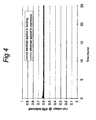
- a fuel cell was produced in a manner identical to the method described in Example 2, but on an electrode backing, purchased from E-TEK Inc. under the name double-sided ELAT-electrode-Carbon only, and making use of a Nafion® 115 membrane. Both fuel cells were tested under the conditions described above. The current/voltage plot and the voltage measured as a function of time are shown in Figure 3 and 4. From the comparison both the short-term performance and the long-term stability yield a virtually identical result for both application methods.
- An electrode ink suitable for screen printing on an electrolytic membrane or on an electrode backing is prepared as follows: an amount of 8.8 g 1,2-propanediol is added to an amount of 2.0 g 30 % (m/m) Pt/Vulcan® XC72. 2.0 g of a solution of 25 % (m/m) Nafion® in 1,2-propanediol is added to this mixture and the whole is dispersed until a thick paste has formed.
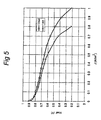
- the ink prepared according to Example 4 was applied with the aid of screen printing on a DEK 247 screen printing machine to an electrode backing consisting of graphite paper of the Toray make, provided with a carbon layer of a thickness of approximately 5 ⁇ m and rendered hydrophobic. After applying the electrode to this electrode backing, the ink was dried for 3 minutes at 90 °C under inert conditions (nitrogen atmosphere). A screen-printed electrode was then applied to two sides of a 50 ⁇ m thick electrolytic membrane, of the Nafion® 112 type purchased from DuPont, by means of a hot pressing step (130 °C, 40 kg/cm 2 ). The fuel cell thus obtained had a platinum loading of approximately 0.22 mg/cm 2 on both electrodes. The resulting fuel cell was tested under the conditions described above, both under 1.5 bar and under 1 bar. The current/voltage plot of this cell under both conditions is shown in Figure 5.
Landscapes
- Engineering & Computer Science (AREA)
- Power Engineering (AREA)
- Chemical & Material Sciences (AREA)
- General Chemical & Material Sciences (AREA)
- Microelectronics & Electronic Packaging (AREA)
- Chemical Kinetics & Catalysis (AREA)
- Electrochemistry (AREA)
- Life Sciences & Earth Sciences (AREA)
- Materials Engineering (AREA)
- Manufacturing & Machinery (AREA)
- Sustainable Development (AREA)
- Sustainable Energy (AREA)
- Inert Electrodes (AREA)
- Fuel Cell (AREA)
- Secondary Cells (AREA)
- Electric Double-Layer Capacitors Or The Like (AREA)
- Battery Electrode And Active Subsutance (AREA)
Claims (12)
- Verfahren zum Herstellen einer Elektrode, wobei eine Tinte, welche mindestens ein Kohlenstoffpulver, ein protonenleitendes Polymer und ein Lösungsmittel enthält, auf ein elektronen- oder ionenleitendes Substrat aufgebracht wird, dadurch gekennzeichnet, daß die Tinte homogen ist und das Lösungsmittel mindestens 3 Gew.-% eines Alkandiols mit 3 bis 6 Kohlenstoffatomen enthält.
- Verfahren nach Anspruch 1, wobei das Alkandiol 1,2-Propandiol ist.
- Verfahren nach Anspruch 1 oder 2, wobei das protonenleitende Polymer eine perfluorierte Sulfonsäure ist, vorzugsweise ein Copolymer aus Tetrafluorethylen und Perfluorsulfoethylvinylether ist.
- Verfahren nach einem der Ansprüche 1 bis 3, wobei ein oder mehr katalytisch aktive Metalle auf das Kohlenstoffpulver aufgetragen worden sind.
- Verfahren nach Anspruch 4, wobei der Katalysator ein Edelmetall oder eine Legierung aus einem Edelmetall mit einem zweiten Metall und wahlweise mit einem dritten Metall enthält.
- Elektrode erhältlich durch das Verfahren nach Anspruch 4 oder 5.
- Elektrode nach Anspruch 6, wobei das Substrat aus einem Elektrodenträger besteht.
- Elektrode nach Anspruch 6, wobei das Substrat aus einer ionenleitenden Membran besteht.
- Elektrode nach Anspruch 8, wobei die ionenleitende Membran protonenleitend ist.
- Brennstoffzelle enthaltend Elektroden nach einem der Ansprüche 6 bis 9.
- Elektrode erhältlich durch das Verfahren nach einem der Ansprüche 1 bis 3, wobei das Substrat elektronenleitend ist.
- Superkondensator enthaltend Elektroden nach Anspruch 11.
Applications Claiming Priority (3)
| Application Number | Priority Date | Filing Date | Title |
|---|---|---|---|
| NL1014696 | 2000-03-20 | ||
| NL1014696A NL1014696C2 (nl) | 2000-03-20 | 2000-03-20 | Vervaardiging van lage-temperatuur brandstofcel elektroden. |
| PCT/NL2001/000225 WO2001071840A2 (en) | 2000-03-20 | 2001-03-20 | Production of low-temperature fuel cell electrodes |
Publications (2)
| Publication Number | Publication Date |
|---|---|
| EP1285475A2 EP1285475A2 (de) | 2003-02-26 |
| EP1285475B1 true EP1285475B1 (de) | 2004-01-14 |
Family
ID=19771040
Family Applications (1)
| Application Number | Title | Priority Date | Filing Date |
|---|---|---|---|
| EP01917981A Expired - Lifetime EP1285475B1 (de) | 2000-03-20 | 2001-03-20 | Herstellungsverfahren von niedertemperatur- brennstoffzellenelektroden |
Country Status (13)
| Country | Link |
|---|---|
| US (1) | US7186665B2 (de) |
| EP (1) | EP1285475B1 (de) |
| JP (1) | JP2003528438A (de) |
| AT (1) | ATE257980T1 (de) |
| AU (1) | AU2001244853A1 (de) |
| CA (1) | CA2403598C (de) |
| DE (1) | DE60101797T2 (de) |
| DK (1) | DK1285475T3 (de) |
| ES (1) | ES2213110T3 (de) |
| NL (1) | NL1014696C2 (de) |
| PT (1) | PT1285475E (de) |
| TR (1) | TR200400346T4 (de) |
| WO (1) | WO2001071840A2 (de) |
Families Citing this family (11)
| Publication number | Priority date | Publication date | Assignee | Title |
|---|---|---|---|---|
| DE10037074A1 (de) | 2000-07-29 | 2002-02-14 | Omg Ag & Co Kg | Tinte zur Herstellung von Membran-Elektroden-Einheiten für PEM-Brennstoffzellen |
| DE10320320B4 (de) * | 2003-05-06 | 2007-08-16 | Forschungszentrum Jülich GmbH | Katalysatorschicht, geeignete Katalysatorpaste, sowie Herstellungsverfahren derselben |
| DE10345260A1 (de) * | 2003-09-29 | 2005-04-21 | Daimler Chrysler Ag | Verbesserung des Ausnutzungsgrades von Platin in PEM-Brennstoffzellen |
| US20060110631A1 (en) * | 2004-02-18 | 2006-05-25 | Polyfuel, Inc. | Catalyst ink, process for making catalyst ink and for preparing catalyst coated membranes |
| JP2006012476A (ja) * | 2004-06-23 | 2006-01-12 | Nissan Motor Co Ltd | 燃料電池用膜−電極接合体 |
| KR20090083337A (ko) | 2006-10-30 | 2009-08-03 | 아사히 가라스 가부시키가이샤 | 액체 조성물 |
| US7981319B2 (en) * | 2009-03-19 | 2011-07-19 | Los Alamos National Security, Llc | Non-aqueous liquid compositions comprising ion exchange polymers |
| JP5454050B2 (ja) * | 2009-09-28 | 2014-03-26 | 凸版印刷株式会社 | 固体高分子形燃料電池の高分子電解質およびこの製造方法、ならびにこの高分子電解質を含む膜電極接合体およびこの製造方法 |
| US9709867B2 (en) | 2010-10-05 | 2017-07-18 | Rise Acreo Ab | Display device |
| JP6035458B2 (ja) * | 2011-04-05 | 2016-12-07 | リンテック株式会社 | 電極上での自己整列電解質に基づく電気化学デバイスの製造方法 |
| JP6048015B2 (ja) * | 2012-09-05 | 2016-12-21 | 凸版印刷株式会社 | 膜電極接合体の製造方法 |
Family Cites Families (27)
| Publication number | Priority date | Publication date | Assignee | Title |
|---|---|---|---|---|
| US4568442A (en) * | 1985-02-01 | 1986-02-04 | The Dow Chemical Company | Gas diffusion composite electrode having polymeric binder coated carbon layer |
| JPH01309213A (ja) * | 1987-12-10 | 1989-12-13 | Matsushita Electric Works Ltd | イオン導伝膜の製法 |
| US5136474A (en) * | 1990-04-03 | 1992-08-04 | Giner, Inc. | Proton exchange membrane electrochemical capacitors |
| US5211984A (en) * | 1991-02-19 | 1993-05-18 | The Regents Of The University Of California | Membrane catalyst layer for fuel cells |
| US5982609A (en) * | 1993-03-22 | 1999-11-09 | Evans Capacitor Co., Inc. | Capacitor |
| US5415888A (en) * | 1993-04-26 | 1995-05-16 | E. I. Du Pont De Nemours And Company | Method of imprinting catalytically active particles on membrane |
| US5547911A (en) * | 1994-10-11 | 1996-08-20 | E. I. Du Pont De Nemours And Company | Process of imprinting catalytically active particles on membrane |
| GB9504713D0 (en) * | 1995-03-09 | 1995-04-26 | Johnson Matthey Plc | Improved electrocatalytic material |
| JP3273591B2 (ja) * | 1996-02-05 | 2002-04-08 | 本田技研工業株式会社 | 燃料電池用電極構造体の製造方法 |
| US5882810A (en) * | 1996-03-08 | 1999-03-16 | The Dow Chemicalcompany | Active layer for membrane electrode assembly |
| US5728181A (en) * | 1996-11-04 | 1998-03-17 | Motorola, Inc. | Electrodes for electrochemical cells and method of making same |
| US6134760A (en) * | 1997-09-22 | 2000-10-24 | Mushiake; Naofumi | Process for manufacturing electric double layer capacitor |
| DE19812592B4 (de) * | 1998-03-23 | 2004-05-13 | Umicore Ag & Co.Kg | Membran-Elektroden-Einheit für Polymer-Elektrolyt-Brennstoffzellen, Verfahren zu ihrer Herstellung sowie Tinte |
| US6074692A (en) * | 1998-04-10 | 2000-06-13 | General Motors Corporation | Method of making MEA for PEM/SPE fuel cell |
| DE19837669A1 (de) * | 1998-08-20 | 2000-03-09 | Degussa | Katalysatorschicht für Polymer-Elektrolyt-Brennstoffzellen |
| US6583022B1 (en) * | 1998-08-27 | 2003-06-24 | Micron Technology, Inc. | Methods of forming roughened layers of platinum and methods of forming capacitors |
| EP0987552A3 (de) * | 1998-08-31 | 2000-06-07 | Pfizer Products Inc. | Diarylsulphonylharnstoff-Bindungsproteine |
| JP3614077B2 (ja) * | 2000-03-22 | 2005-01-26 | トヨタ自動車株式会社 | 燃料電池用の電極触媒溶液およびその製造方法 |
| DE10037072A1 (de) * | 2000-07-29 | 2002-02-14 | Omg Ag & Co Kg | Membran-Elektrodeneinheit für Polymerelektrolyt-Brennstoffzellen und Verfahren zu ihrer Herstellung |
| DE10037074A1 (de) * | 2000-07-29 | 2002-02-14 | Omg Ag & Co Kg | Tinte zur Herstellung von Membran-Elektroden-Einheiten für PEM-Brennstoffzellen |
| DE10042744A1 (de) * | 2000-08-31 | 2002-03-28 | Omg Ag & Co Kg | PEM-Brennstoffzellenstapel |
| US6524736B1 (en) * | 2000-10-18 | 2003-02-25 | General Motors Corporation | Methods of preparing membrane electrode assemblies |
| WO2002039533A2 (en) * | 2000-11-09 | 2002-05-16 | Ird A/S | Membrane electrode assemblies for direct methanol fuel cells and methods for their production |
| EP1263073A1 (de) * | 2001-05-31 | 2002-12-04 | Asahi Glass Co., Ltd. | Membran-Elektroden-Einheit für Festelektrolyt-Brennstoffzelle und Verfahren zu ihrer Herstellung |
| DE60230979D1 (de) * | 2002-07-31 | 2009-03-12 | Umicore Ag & Co Kg | Wässrige Katalysatortinten und ihre Verwendung für die Herstellung von mit Katalysator beschichteten Substraten |
| EP1387422B1 (de) * | 2002-07-31 | 2016-04-06 | Umicore AG & Co. KG | Verfahren zur Herstellung von mit Katalysator beschichteten Substraten |
| US7189341B2 (en) * | 2003-08-15 | 2007-03-13 | Animas Technologies, Llc | Electrochemical sensor ink compositions, electrodes, and uses thereof |
-
2000
- 2000-03-20 NL NL1014696A patent/NL1014696C2/nl not_active IP Right Cessation
-
2001
- 2001-03-20 CA CA002403598A patent/CA2403598C/en not_active Expired - Fee Related
- 2001-03-20 AU AU2001244853A patent/AU2001244853A1/en not_active Abandoned
- 2001-03-20 WO PCT/NL2001/000225 patent/WO2001071840A2/en not_active Ceased
- 2001-03-20 DE DE60101797T patent/DE60101797T2/de not_active Expired - Lifetime
- 2001-03-20 AT AT01917981T patent/ATE257980T1/de active
- 2001-03-20 US US10/239,238 patent/US7186665B2/en not_active Expired - Fee Related
- 2001-03-20 EP EP01917981A patent/EP1285475B1/de not_active Expired - Lifetime
- 2001-03-20 PT PT01917981T patent/PT1285475E/pt unknown
- 2001-03-20 ES ES01917981T patent/ES2213110T3/es not_active Expired - Lifetime
- 2001-03-20 TR TR2004/00346T patent/TR200400346T4/xx unknown
- 2001-03-20 JP JP2001569917A patent/JP2003528438A/ja active Pending
- 2001-03-20 DK DK01917981T patent/DK1285475T3/da active
Also Published As
| Publication number | Publication date |
|---|---|
| NL1014696C2 (nl) | 2001-09-28 |
| EP1285475A2 (de) | 2003-02-26 |
| ATE257980T1 (de) | 2004-01-15 |
| US7186665B2 (en) | 2007-03-06 |
| WO2001071840A2 (en) | 2001-09-27 |
| CA2403598A1 (en) | 2001-09-27 |
| US20040086773A1 (en) | 2004-05-06 |
| WO2001071840A3 (en) | 2001-12-06 |
| AU2001244853A1 (en) | 2001-10-03 |
| CA2403598C (en) | 2007-11-06 |
| TR200400346T4 (tr) | 2004-08-23 |
| DE60101797D1 (de) | 2004-02-19 |
| JP2003528438A (ja) | 2003-09-24 |
| ES2213110T3 (es) | 2004-08-16 |
| DE60101797T2 (de) | 2005-04-28 |
| PT1285475E (pt) | 2004-05-31 |
| DK1285475T3 (da) | 2004-04-13 |
Similar Documents
| Publication | Publication Date | Title |
|---|---|---|
| US7419740B2 (en) | Membrane electrode unit for polymer electrolyte fuel cells and a process for the production thereof | |
| KR100638498B1 (ko) | 중합체 전해질 연료 전지용 막 전극 유니트, 당해 막 전극 유니트의 제조방법 및 당해 막 전극 유니트 제조용 잉크 | |
| EP1387423B1 (de) | Wässrige Katalysatortinten und ihre Verwendung für die Herstellung von mit Katalysator beschichteten Substraten | |
| US7132385B2 (en) | High loading supported carbon catalyst, method of preparing the same, catalyst electrode including the same, and fuel cell including the catalyst electrode | |
| EP2990105B1 (de) | Katalysator und elektrodenkatalysatorschicht, filmelektrodenanordnung und brennstoffzelle mit diesem katalysator | |
| US6803143B2 (en) | Gas diffusion structures and gas diffusion electrodes for polymer electrolyte fuel cells | |
| JPH05251086A (ja) | 燃料電池及びその応用装置 | |
| JP2002083605A (ja) | Pem−燃料電池用の膜−電極ユニットの製造のためのインキ及びその使用 | |
| JP2010257929A (ja) | 燃料電池用電極触媒スラリーの製造方法ならびに固体高分子型燃料電池用の電極および膜・電極接合体 | |
| EP1285475B1 (de) | Herstellungsverfahren von niedertemperatur- brennstoffzellenelektroden | |
| US20060177727A1 (en) | Gas diffuser substrate containing catalysts for fuel cells, in addition to a method for the production thereof | |
| EP1872425B1 (de) | Tinte zur herstellung von katalysatorschichten | |
| CN101183718A (zh) | 用于燃料电池的阴极催化剂、其制备方法以及包含它的膜电极组件和燃料电池 | |
| JP2005294175A (ja) | 電極触媒層およびその製造方法 | |
| JP2021190402A (ja) | 触媒インク | |
| JP2001300324A (ja) | 複合触媒とその製造方法およびその複合触媒を使用した燃料電池用電極の製造方法 | |
| KR101128560B1 (ko) | 개선된 촉매층을 갖는 연료전지용 전극의 제조방법 | |
| JP2008130394A (ja) | 燃料電池用膜電極接合体および燃料電池 | |
| JP2005251701A (ja) | 固体高分子形燃料電池用電極の製造方法 | |
| JP2007141528A (ja) | 燃料電池の電極用ペーストと燃料電池 | |
| JP2011228007A (ja) | 燃料電池用触媒インクおよびその製造方法、それを用いて作製された触媒電極、膜・電極接合体ならびに燃料電池 | |
| JP2011228006A (ja) | 燃料電池用触媒インクおよびその製造方法、それを用いて作製された触媒電極、膜・電極接合体ならびに燃料電池 |
Legal Events
| Date | Code | Title | Description |
|---|---|---|---|
| PUAI | Public reference made under article 153(3) epc to a published international application that has entered the european phase |
Free format text: ORIGINAL CODE: 0009012 |
|
| 17P | Request for examination filed |
Effective date: 20020911 |
|
| AK | Designated contracting states |
Kind code of ref document: A2 Designated state(s): AT BE CH CY DE DK ES FI FR GB GR IE IT LI LU MC NL PT SE TR |
|
| AX | Request for extension of the european patent |
Extension state: AL LT LV MK RO SI |
|
| GRAH | Despatch of communication of intention to grant a patent |
Free format text: ORIGINAL CODE: EPIDOS IGRA |
|
| GRAS | Grant fee paid |
Free format text: ORIGINAL CODE: EPIDOSNIGR3 |
|
| GRAA | (expected) grant |
Free format text: ORIGINAL CODE: 0009210 |
|
| AK | Designated contracting states |
Kind code of ref document: B1 Designated state(s): AT BE CH CY DE DK ES FI FR GB GR IE IT LI LU MC NL PT SE TR |
|
| PG25 | Lapsed in a contracting state [announced via postgrant information from national office to epo] |
Ref country code: CY Free format text: LAPSE BECAUSE OF FAILURE TO SUBMIT A TRANSLATION OF THE DESCRIPTION OR TO PAY THE FEE WITHIN THE PRESCRIBED TIME-LIMIT Effective date: 20040114 |
|
| REG | Reference to a national code |
Ref country code: GB Ref legal event code: FG4D |
|
| REG | Reference to a national code |
Ref country code: CH Ref legal event code: EP |
|
| REG | Reference to a national code |
Ref country code: IE Ref legal event code: FG4D |
|
| REG | Reference to a national code |
Ref country code: CH Ref legal event code: NV Representative=s name: DR. GRAF & PARTNER INTELLECTUAL PROPERTY |
|
| REF | Corresponds to: |
Ref document number: 60101797 Country of ref document: DE Date of ref document: 20040219 Kind code of ref document: P |
|
| PGFP | Annual fee paid to national office [announced via postgrant information from national office to epo] |
Ref country code: TR Payment date: 20040226 Year of fee payment: 4 |
|
| REG | Reference to a national code |
Ref country code: GR Ref legal event code: EP Ref document number: 20040400435 Country of ref document: GR |
|
| PG25 | Lapsed in a contracting state [announced via postgrant information from national office to epo] |
Ref country code: LU Free format text: LAPSE BECAUSE OF NON-PAYMENT OF DUE FEES Effective date: 20040320 |
|
| PG25 | Lapsed in a contracting state [announced via postgrant information from national office to epo] |
Ref country code: IE Free format text: LAPSE BECAUSE OF NON-PAYMENT OF DUE FEES Effective date: 20040322 |
|
| PG25 | Lapsed in a contracting state [announced via postgrant information from national office to epo] |
Ref country code: MC Free format text: LAPSE BECAUSE OF NON-PAYMENT OF DUE FEES Effective date: 20040331 |
|
| REG | Reference to a national code |
Ref country code: DK Ref legal event code: T3 |
|
| REG | Reference to a national code |
Ref country code: SE Ref legal event code: TRGR |
|
| REG | Reference to a national code |
Ref country code: PT Ref legal event code: SC4A Free format text: AVAILABILITY OF NATIONAL TRANSLATION Effective date: 20040329 |
|
| LTIE | Lt: invalidation of european patent or patent extension |
Effective date: 20040114 |
|
| ET | Fr: translation filed | ||
| REG | Reference to a national code |
Ref country code: ES Ref legal event code: FG2A Ref document number: 2213110 Country of ref document: ES Kind code of ref document: T3 |
|
| PG25 | Lapsed in a contracting state [announced via postgrant information from national office to epo] |
Ref country code: GR Free format text: LAPSE BECAUSE OF NON-PAYMENT OF DUE FEES Effective date: 20041006 |
|
| PLBE | No opposition filed within time limit |
Free format text: ORIGINAL CODE: 0009261 |
|
| STAA | Information on the status of an ep patent application or granted ep patent |
Free format text: STATUS: NO OPPOSITION FILED WITHIN TIME LIMIT |
|
| 26N | No opposition filed |
Effective date: 20041015 |
|
| REG | Reference to a national code |
Ref country code: IE Ref legal event code: MM4A |
|
| PG25 | Lapsed in a contracting state [announced via postgrant information from national office to epo] |
Ref country code: PT Free format text: LAPSE BECAUSE OF NON-PAYMENT OF DUE FEES Effective date: 20051220 |
|
| PG25 | Lapsed in a contracting state [announced via postgrant information from national office to epo] |
Ref country code: PT Free format text: LAPSE BECAUSE OF NON-PAYMENT OF DUE FEES Effective date: 20040320 |
|
| PG25 | Lapsed in a contracting state [announced via postgrant information from national office to epo] |
Ref country code: TR Free format text: LAPSE BECAUSE OF FAILURE TO SUBMIT A TRANSLATION OF THE DESCRIPTION OR TO PAY THE FEE WITHIN THE PRESCRIBED TIME-LIMIT Effective date: 20040114 |
|
| REG | Reference to a national code |
Ref country code: CH Ref legal event code: PFA Owner name: STICHTING ENERGIEONDERZOEK CENTRUM NEDERLAND Free format text: STICHTING ENERGIEONDERZOEK CENTRUM NEDERLAND#WESTERDUINWEG 3#1755 ZG PETTEN (NL) -TRANSFER TO- STICHTING ENERGIEONDERZOEK CENTRUM NEDERLAND#WESTERDUINWEG 3#1755 ZG PETTEN (NL) |
|
| PGFP | Annual fee paid to national office [announced via postgrant information from national office to epo] |
Ref country code: DK Payment date: 20110324 Year of fee payment: 11 |
|
| PGFP | Annual fee paid to national office [announced via postgrant information from national office to epo] |
Ref country code: FR Payment date: 20110401 Year of fee payment: 11 Ref country code: IT Payment date: 20110322 Year of fee payment: 11 Ref country code: NL Payment date: 20110329 Year of fee payment: 11 Ref country code: FI Payment date: 20110328 Year of fee payment: 11 Ref country code: SE Payment date: 20110325 Year of fee payment: 11 Ref country code: AT Payment date: 20110328 Year of fee payment: 11 |
|
| PGFP | Annual fee paid to national office [announced via postgrant information from national office to epo] |
Ref country code: CH Payment date: 20110405 Year of fee payment: 11 Ref country code: GB Payment date: 20110324 Year of fee payment: 11 Ref country code: DE Payment date: 20110411 Year of fee payment: 11 Ref country code: BE Payment date: 20110328 Year of fee payment: 11 Ref country code: ES Payment date: 20110324 Year of fee payment: 11 |
|
| BERE | Be: lapsed |
Owner name: *STICHTING ENERGIEONDERZOEK CENTRUM NEDERLAND Effective date: 20120331 |
|
| REG | Reference to a national code |
Ref country code: NL Ref legal event code: V1 Effective date: 20121001 |
|
| REG | Reference to a national code |
Ref country code: SE Ref legal event code: EUG |
|
| PG25 | Lapsed in a contracting state [announced via postgrant information from national office to epo] |
Ref country code: SE Free format text: LAPSE BECAUSE OF NON-PAYMENT OF DUE FEES Effective date: 20120321 Ref country code: FI Free format text: LAPSE BECAUSE OF NON-PAYMENT OF DUE FEES Effective date: 20120320 |
|
| REG | Reference to a national code |
Ref country code: CH Ref legal event code: PL |
|
| REG | Reference to a national code |
Ref country code: DK Ref legal event code: EBP |
|
| GBPC | Gb: european patent ceased through non-payment of renewal fee |
Effective date: 20120320 |
|
| REG | Reference to a national code |
Ref country code: AT Ref legal event code: MM01 Ref document number: 257980 Country of ref document: AT Kind code of ref document: T Effective date: 20120320 |
|
| REG | Reference to a national code |
Ref country code: FR Ref legal event code: ST Effective date: 20121130 |
|
| REG | Reference to a national code |
Ref country code: DE Ref legal event code: R119 Ref document number: 60101797 Country of ref document: DE Effective date: 20121002 |
|
| PG25 | Lapsed in a contracting state [announced via postgrant information from national office to epo] |
Ref country code: CH Free format text: LAPSE BECAUSE OF NON-PAYMENT OF DUE FEES Effective date: 20120331 Ref country code: GB Free format text: LAPSE BECAUSE OF NON-PAYMENT OF DUE FEES Effective date: 20120320 Ref country code: BE Free format text: LAPSE BECAUSE OF NON-PAYMENT OF DUE FEES Effective date: 20120331 Ref country code: AT Free format text: LAPSE BECAUSE OF NON-PAYMENT OF DUE FEES Effective date: 20120320 Ref country code: LI Free format text: LAPSE BECAUSE OF NON-PAYMENT OF DUE FEES Effective date: 20120331 Ref country code: FR Free format text: LAPSE BECAUSE OF NON-PAYMENT OF DUE FEES Effective date: 20120402 |
|
| PG25 | Lapsed in a contracting state [announced via postgrant information from national office to epo] |
Ref country code: IT Free format text: LAPSE BECAUSE OF NON-PAYMENT OF DUE FEES Effective date: 20120320 |
|
| PG25 | Lapsed in a contracting state [announced via postgrant information from national office to epo] |
Ref country code: NL Free format text: LAPSE BECAUSE OF NON-PAYMENT OF DUE FEES Effective date: 20121001 |
|
| PG25 | Lapsed in a contracting state [announced via postgrant information from national office to epo] |
Ref country code: DK Free format text: LAPSE BECAUSE OF NON-PAYMENT OF DUE FEES Effective date: 20120331 |
|
| REG | Reference to a national code |
Ref country code: ES Ref legal event code: FD2A Effective date: 20130823 |
|
| PG25 | Lapsed in a contracting state [announced via postgrant information from national office to epo] |
Ref country code: ES Free format text: LAPSE BECAUSE OF NON-PAYMENT OF DUE FEES Effective date: 20120321 |
|
| PG25 | Lapsed in a contracting state [announced via postgrant information from national office to epo] |
Ref country code: DE Free format text: LAPSE BECAUSE OF FAILURE TO SUBMIT A TRANSLATION OF THE DESCRIPTION OR TO PAY THE FEE WITHIN THE PRESCRIBED TIME-LIMIT Effective date: 20121002 |