EP1288741A2 - Arbeitseinheit, elektrophotographisches Gerät und Bilderzeugungsverfahren - Google Patents
Arbeitseinheit, elektrophotographisches Gerät und Bilderzeugungsverfahren Download PDFInfo
- Publication number
- EP1288741A2 EP1288741A2 EP02019377A EP02019377A EP1288741A2 EP 1288741 A2 EP1288741 A2 EP 1288741A2 EP 02019377 A EP02019377 A EP 02019377A EP 02019377 A EP02019377 A EP 02019377A EP 1288741 A2 EP1288741 A2 EP 1288741A2
- Authority
- EP
- European Patent Office
- Prior art keywords
- photosensitive drum
- intermediate transferring
- transferring belt
- belt
- surface roughness
- Prior art date
- Legal status (The legal status is an assumption and is not a legal conclusion. Google has not performed a legal analysis and makes no representation as to the accuracy of the status listed.)
- Granted
Links
- 238000000034 method Methods 0.000 title claims abstract description 120
- 230000008569 process Effects 0.000 title claims abstract description 72
- 230000003746 surface roughness Effects 0.000 claims abstract description 53
- 238000010521 absorption reaction Methods 0.000 claims description 39
- 238000012546 transfer Methods 0.000 claims description 22
- 238000004140 cleaning Methods 0.000 claims description 18
- 239000000463 material Substances 0.000 claims description 18
- 238000011156 evaluation Methods 0.000 description 23
- 239000006258 conductive agent Substances 0.000 description 21
- 239000008188 pellet Substances 0.000 description 21
- XLOMVQKBTHCTTD-UHFFFAOYSA-N Zinc monoxide Chemical compound [Zn]=O XLOMVQKBTHCTTD-UHFFFAOYSA-N 0.000 description 18
- 229920005989 resin Polymers 0.000 description 16
- 239000011347 resin Substances 0.000 description 16
- 239000011164 primary particle Substances 0.000 description 15
- 230000000052 comparative effect Effects 0.000 description 14
- -1 ethylene-tetrafluoroethylene Chemical group 0.000 description 13
- 238000005259 measurement Methods 0.000 description 10
- KRHYYFGTRYWZRS-UHFFFAOYSA-M Fluoride anion Chemical compound [F-] KRHYYFGTRYWZRS-UHFFFAOYSA-M 0.000 description 9
- 229920006146 polyetheresteramide block copolymer Polymers 0.000 description 9
- 229920000131 polyvinylidene Polymers 0.000 description 9
- 239000011787 zinc oxide Substances 0.000 description 9
- 239000000126 substance Substances 0.000 description 8
- 238000012545 processing Methods 0.000 description 7
- 239000010410 layer Substances 0.000 description 6
- 239000002245 particle Substances 0.000 description 6
- 239000004417 polycarbonate Substances 0.000 description 6
- 229910052782 aluminium Inorganic materials 0.000 description 5
- XAGFODPZIPBFFR-UHFFFAOYSA-N aluminium Chemical compound [Al] XAGFODPZIPBFFR-UHFFFAOYSA-N 0.000 description 5
- 230000008020 evaporation Effects 0.000 description 5
- 238000001704 evaporation Methods 0.000 description 5
- 238000004519 manufacturing process Methods 0.000 description 5
- 238000000465 moulding Methods 0.000 description 5
- 229920000139 polyethylene terephthalate Polymers 0.000 description 5
- 239000005020 polyethylene terephthalate Substances 0.000 description 5
- 239000005995 Aluminium silicate Substances 0.000 description 4
- 235000012211 aluminium silicate Nutrition 0.000 description 4
- 238000001125 extrusion Methods 0.000 description 4
- NLYAJNPCOHFWQQ-UHFFFAOYSA-N kaolin Chemical compound O.O.O=[Al]O[Si](=O)O[Si](=O)O[Al]=O NLYAJNPCOHFWQQ-UHFFFAOYSA-N 0.000 description 4
- 229920000515 polycarbonate Polymers 0.000 description 4
- 230000035945 sensitivity Effects 0.000 description 4
- 229920005992 thermoplastic resin Polymers 0.000 description 4
- 229910018879 Pt—Pd Inorganic materials 0.000 description 3
- 239000006229 carbon black Substances 0.000 description 3
- 230000008859 change Effects 0.000 description 3
- 239000006185 dispersion Substances 0.000 description 3
- 230000000694 effects Effects 0.000 description 3
- 239000000945 filler Substances 0.000 description 3
- 229910052733 gallium Inorganic materials 0.000 description 3
- IEQIEDJGQAUEQZ-UHFFFAOYSA-N phthalocyanine Chemical compound N1C(N=C2C3=CC=CC=C3C(N=C3C4=CC=CC=C4C(=N4)N3)=N2)=C(C=CC=C2)C2=C1N=C1C2=CC=CC=C2C4=N1 IEQIEDJGQAUEQZ-UHFFFAOYSA-N 0.000 description 3
- 238000012360 testing method Methods 0.000 description 3
- 239000002033 PVDF binder Substances 0.000 description 2
- 239000004952 Polyamide Substances 0.000 description 2
- 239000004698 Polyethylene Substances 0.000 description 2
- 238000010276 construction Methods 0.000 description 2
- 230000007547 defect Effects 0.000 description 2
- 229920001971 elastomer Polymers 0.000 description 2
- 238000005516 engineering process Methods 0.000 description 2
- 229920000840 ethylene tetrafluoroethylene copolymer Polymers 0.000 description 2
- 238000010438 heat treatment Methods 0.000 description 2
- 238000012423 maintenance Methods 0.000 description 2
- 239000000289 melt material Substances 0.000 description 2
- 239000000203 mixture Substances 0.000 description 2
- 229920002647 polyamide Polymers 0.000 description 2
- 229920001707 polybutylene terephthalate Polymers 0.000 description 2
- 229920000573 polyethylene Polymers 0.000 description 2
- 229910010271 silicon carbide Inorganic materials 0.000 description 2
- 239000002356 single layer Substances 0.000 description 2
- 239000000758 substrate Substances 0.000 description 2
- 238000004627 transmission electron microscopy Methods 0.000 description 2
- 230000000007 visual effect Effects 0.000 description 2
- 239000002699 waste material Substances 0.000 description 2
- GYHNNYVSQQEPJS-UHFFFAOYSA-N Gallium Chemical compound [Ga] GYHNNYVSQQEPJS-UHFFFAOYSA-N 0.000 description 1
- 229920006778 PC/PBT Polymers 0.000 description 1
- 239000004721 Polyphenylene oxide Substances 0.000 description 1
- 239000004743 Polypropylene Substances 0.000 description 1
- 239000005862 Whey Substances 0.000 description 1
- 102000007544 Whey Proteins Human genes 0.000 description 1
- 108010046377 Whey Proteins Proteins 0.000 description 1
- 229920006243 acrylic copolymer Polymers 0.000 description 1
- 230000008901 benefit Effects 0.000 description 1
- 238000007664 blowing Methods 0.000 description 1
- 230000015556 catabolic process Effects 0.000 description 1
- 239000011248 coating agent Substances 0.000 description 1
- 238000000576 coating method Methods 0.000 description 1
- 230000008094 contradictory effect Effects 0.000 description 1
- 229920001577 copolymer Polymers 0.000 description 1
- 230000003247 decreasing effect Effects 0.000 description 1
- 238000001514 detection method Methods 0.000 description 1
- 238000007598 dipping method Methods 0.000 description 1
- 238000007599 discharging Methods 0.000 description 1
- 239000000806 elastomer Substances 0.000 description 1
- 238000009998 heat setting Methods 0.000 description 1
- 238000009434 installation Methods 0.000 description 1
- 238000011835 investigation Methods 0.000 description 1
- 238000000691 measurement method Methods 0.000 description 1
- 238000013208 measuring procedure Methods 0.000 description 1
- 229910044991 metal oxide Inorganic materials 0.000 description 1
- 150000004706 metal oxides Chemical class 0.000 description 1
- 229910052755 nonmetal Inorganic materials 0.000 description 1
- 229920000728 polyester Polymers 0.000 description 1
- 229920001225 polyester resin Polymers 0.000 description 1
- 239000004645 polyester resin Substances 0.000 description 1
- 229920000570 polyether Polymers 0.000 description 1
- 229920000098 polyolefin Polymers 0.000 description 1
- 229920001155 polypropylene Polymers 0.000 description 1
- 229920002981 polyvinylidene fluoride Polymers 0.000 description 1
- 239000005060 rubber Substances 0.000 description 1
- 150000003839 salts Chemical class 0.000 description 1
- 238000005070 sampling Methods 0.000 description 1
- 238000005507 spraying Methods 0.000 description 1
- 238000003892 spreading Methods 0.000 description 1
- 230000007480 spreading Effects 0.000 description 1
- 238000003860 storage Methods 0.000 description 1
- 229920001187 thermosetting polymer Polymers 0.000 description 1
- 239000010936 titanium Substances 0.000 description 1
- 229910052719 titanium Inorganic materials 0.000 description 1
- XLYOFNOQVPJJNP-UHFFFAOYSA-N water Substances O XLYOFNOQVPJJNP-UHFFFAOYSA-N 0.000 description 1
Images




Classifications
-
- G—PHYSICS
- G03—PHOTOGRAPHY; CINEMATOGRAPHY; ANALOGOUS TECHNIQUES USING WAVES OTHER THAN OPTICAL WAVES; ELECTROGRAPHY; HOLOGRAPHY
- G03G—ELECTROGRAPHY; ELECTROPHOTOGRAPHY; MAGNETOGRAPHY
- G03G21/00—Arrangements not provided for by groups G03G13/00 - G03G19/00, e.g. cleaning, elimination of residual charge
- G03G21/16—Mechanical means for facilitating the maintenance of the apparatus, e.g. modular arrangements
- G03G21/18—Mechanical means for facilitating the maintenance of the apparatus, e.g. modular arrangements using a processing cartridge, whereby the process cartridge comprises at least two image processing means in a single unit
- G03G21/1803—Arrangements or disposition of the complete process cartridge or parts thereof
- G03G21/181—Manufacturing or assembling, recycling, reuse, transportation, packaging or storage
-
- G—PHYSICS
- G03—PHOTOGRAPHY; CINEMATOGRAPHY; ANALOGOUS TECHNIQUES USING WAVES OTHER THAN OPTICAL WAVES; ELECTROGRAPHY; HOLOGRAPHY
- G03G—ELECTROGRAPHY; ELECTROPHOTOGRAPHY; MAGNETOGRAPHY
- G03G15/00—Apparatus for electrographic processes using a charge pattern
- G03G15/14—Apparatus for electrographic processes using a charge pattern for transferring a pattern to a second base
- G03G15/16—Apparatus for electrographic processes using a charge pattern for transferring a pattern to a second base of a toner pattern, e.g. a powder pattern, e.g. magnetic transfer
- G03G15/1605—Apparatus for electrographic processes using a charge pattern for transferring a pattern to a second base of a toner pattern, e.g. a powder pattern, e.g. magnetic transfer using at least one intermediate support
-
- G—PHYSICS
- G03—PHOTOGRAPHY; CINEMATOGRAPHY; ANALOGOUS TECHNIQUES USING WAVES OTHER THAN OPTICAL WAVES; ELECTROGRAPHY; HOLOGRAPHY
- G03G—ELECTROGRAPHY; ELECTROPHOTOGRAPHY; MAGNETOGRAPHY
- G03G2215/00—Apparatus for electrophotographic processes
- G03G2215/01—Apparatus for electrophotographic processes for producing multicoloured copies
- G03G2215/0167—Apparatus for electrophotographic processes for producing multicoloured copies single electrographic recording member
- G03G2215/0174—Apparatus for electrophotographic processes for producing multicoloured copies single electrographic recording member plural rotations of recording member to produce multicoloured copy
- G03G2215/0177—Rotating set of developing units
-
- G—PHYSICS
- G03—PHOTOGRAPHY; CINEMATOGRAPHY; ANALOGOUS TECHNIQUES USING WAVES OTHER THAN OPTICAL WAVES; ELECTROGRAPHY; HOLOGRAPHY
- G03G—ELECTROGRAPHY; ELECTROPHOTOGRAPHY; MAGNETOGRAPHY
- G03G2221/00—Processes not provided for by group G03G2215/00, e.g. cleaning or residual charge elimination
- G03G2221/16—Mechanical means for facilitating the maintenance of the apparatus, e.g. modular arrangements and complete machine concepts
- G03G2221/1642—Mechanical means for facilitating the maintenance of the apparatus, e.g. modular arrangements and complete machine concepts for the transfer unit
Definitions
- the present invention relates Lo a process cartridge, an electrophotographic apparatus and image forming method.
- an electrophotographic apparatus As a mode of a color image forming apparatus (color electrophotographic apparatus) of electrophotographic system, there is an electrophotographic apparatus with an intermediate transferring member (intermediate transferring belt or intermediate transferring drum).
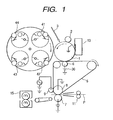
- reference numeral 1 denotes a photosensitive drum (drum-shaped electrophotographic photosensitive member) as a first image bearing member, which is rotatively driven at a predetermined rotation speed (process speed) in the direction of an arrow.
- the photosensitive drum 1 undergoes electrifying processing uniformly at a predetermined polarity and potential with an (primary) electrifying means 2 during the rotation process, then receives exposure light 3 by not-shown exposing means (for example, laser beams or LEDs).
- an electrostatic latent image is formed corresponding to the first color component image (for example, the yellow color component image) of the target full color image.
- the electrostatic latent image is developed with the toner (yellow toner) of first developing means (yellow color developing means 41) so that a toner image (yellow component image) is formed.
- the intermediate transferring belt 5 is rotatively driven at a surface speed almost equal to that of the photosensitive drum (for example, 97 to 103% based on the rotation speed of the photosensitive drum) in the direction of an arrow.
- transfer is carried out to the external circumference face of the intermediate transferring belt 5 from the photosensitive drum 1 by the primary transferring bias applied onto the intermediate transferring belt 5 via the primary transferring means 6 from the bias battery 30.
- the primary transferring bias is for example 100 to 3,500 V.
- transfer residual toner is removed from the photosensitive drum 1 with photosensitive drum cleaning means 13 so as to get prepared for electrifying, exposing, developing, transferring step of the next color component.
- the second to the forth color toner images are sequentially transferred and superimposed onto the intermediate transferring belt 5.
- the secondary transferring means (secondary transferring roller) 7 and the electric charge giving means 9 are apart from the surface of the intermediate transferring belt 5.
- the secondary transferring means 7 are brought into contact with the intermediate transferring belt 5, transfer medium P is conveyed to the gap between the intermediate transferring belt 5 and the secondary transferring means 7 from a sheet feeding roller 11 at a predetermined timing and that toner image is transferred to the transfer medium P (secondary transfer).
- the transfer medium P having the toner image transferred thereto is introduced into a fixing means 15 to undergo heat fixing.
- the electric charge giving means 9 are brought into contact with the intermediate transferring belt 5.
- a roller is used as the electric charge giving means 9.
- a voltage (for example, a direct voltage + an alternate voltage) of a reverse polarity to the surface potential of the photosensitive drum 1 is applied to the roller so that transfer residual toner on the intermediate transferring belt 5 is charged in the reverse polarity to the photosensitive drum 1.
- the transferring residual toner charged to the reverse polarity is electrostatically transferred onto the photosensitive drum 1 from the intermediate transferring belt 5 in the contact part with the photosensitive drum 1 (contact part) and in the vicinity thereof. Thereby, intermediate transferring belt 5 is cleaned (electrostatic cleaning).
- Japanese Patent Application Laid-Open No. 9-292812 proposes such a trial that an electrophotographic photosensitive member and an intermediate transferring belt are combined together into one unit to reduce the number of disposals to improve user's jam handling performance or efficiency of replacement work of respective units. And already, process cartridges in which the electrophotographic photosensitive member and the intermediate transferring belt are combined together have been put on the market.
- electrophotographic photosensitive members mounted on these process cartridges are belt-shaped (photosensitive belts), and therefore the size of a process cartridge itself gets larger and none can be said to be easy to replace. In addition, it is disadvantageous in reducing the size of the main body of an electrophotographic apparatus.
- the present inventors investigated a process cartridge integrally supporting an intermediate transferring belt and a photosensitive drum (an intermediate transferring belt-photosensitive drum integrated process cartridge) using a photosensitive drum.
- Moisture in an intermediate transferring belt intensifies sensitivity in the contact part on an electrophotographic photosensitive member, giving rise to sensitivity difference from the non-contact part, which constitutes dense longitudinal belts in the image to appear in a cycle corresponding to the periphery length of the electrophotographic photosensitive member.
- the thickness of its supporting member (an aluminum cylinder is frequently used) must be made comparatively thick (for example, 0.5 to 3 mm) for maintaining its shape as a rigid material, and the electrophotographic photosensitive member cannot allow the moisture received from the intermediate transferring belt to escape through the supporting member of the electrophotographic photosensitive member.
- the supporting member of the photosensitive belt is comparatively thin (polyester resin etc. having a thickness of 0.05 to 0.2 mm is frequently used), hence can allow the moisture received from the intermediate transferring belt to escape through the supporting member without difficulty.
- a photosensitive belt is more advantageous than a photosensitive drum from the contact irregularity viewpoint.
- the present inventors tried to solve the problem of the contact irregularity with an intermediate transferring belt-photosensitive drum integrated process cartridge.
- An object of the present invention is to provide a process cartridge in which an intermediate transferring belt and an electrophotographic photosensitive member are integrally held together, which is more miniaturized, but does not bring about image defects such as banding or coarseness, and prevents the contact irregularity from occurring to provide uniform image density, an electrophotographic apparatus having the process cartridge and an image forming method using the electrophotographic apparatus.
- the present invention provides a process cartridge detachably mountable on the main body of an electrophotographic apparatus, comprising:
- an electrophotographic apparatus comprising:
- the present invention provides an image forming method comprising:
- the present inventors have already proposed in Japanese Patent Application Laid-Open No. 11-327316 that the contact irregularity can be solved by reducing the moisture absorption rate of an intermediate transferring member to not more than 5% by weight. Accordingly, the present inventors used an intermediate transferring belt of a moisture absorption rate less than 5% by weight to experimentally produced an intermediate transferring belt-photosensitive drum integrated process cartridge.
- the process cartridge was left standing under a normal temperature and normal humidity (23°C/50%RH) environment for 24 hours and thereafter was relocated to a low temperature/low humidity (1.5°C/10%RH) environment and images were evaluated three hours after from the relocation. As a result, it was found that contact unevenness occurred.
- the intermediate transferring belt was left standing in a low temperature-low humidity (15°C/10%RH) environment for 24 hours in a state that it was attached to the electrophotographic apparatus main body.
- the photosensitive drum process cartridge having the photosensitive drum having been previously left standing under a normal temperature/normal humidity (23°C/50%RH) environment for 24 hours was relocated to the low temperature/low humidity (15°C/10%RH) place where the electrophotographic apparatus was left, and immediately after the relocation, the process cartridge having the photosensitive drum was incorporated in the electrophotographic apparatus so that the photosensitive drum and the intermediate transferring belt were brought into contact with each other.
- the moisture in the photosensitive drum at the non-conLact part between the photosensitive drum and the intermediate transferring belt is released to the air in a comparatively short time and the sensitivity of the photosensitive drum is lowered.
- the moisture contained in the photosensitive drum may be hard to release to the air, and besides, the moisture contained in the intermediate transferring belt moves to the photosensitive drum at the contact part, the state that the sensitivity of the photosensitive drum is high is maintained for a comparatively long time.
- the contact irregularity is deemed to take place when image evaluation is made in a short time after the environment is changed.
- the present inventors tried to solve the problem of the contact irregularity by making rough the surfaces of the photosensitive drum and the intermediate transferring member and providing a minute space capable of leasing the moisture to the air also at the contact part.
- the sum of the surface coarseness Ra of the photosensitive drum and the surface coarseness Ra of the intermediate transferring belt should be not less than 0.8 ⁇ m so that the contact irregularity could be prevented.
- the intermediate transferring belt surface is made rough until no contact irregularity appears, it was observed to result in such a bad effect that the secondary transferring efficiency decreased and coaseness occurred in the image (particularly, a high density image expressed by superposing a plurality of color toners). That is, in the case of making the surface of the intermediate transferring belt rough, the roughness and contact irregularity are contradictory (trade off relationship), and only the control of the surface roughness of the intermediate transferring belt cannot satisfy the two.
- the sum of the surface coarseness Ra of the photosensitive drum and the surface coarseness Ra of the intermediate transferring belt is preferred to be as small as possible, and need to be less than 0.8 ⁇ m and is preferably not more than 0.5 ⁇ m and further preferably not more than 0.25 ⁇ m.
- the contact irregularity not less than 0.05 ⁇ m is preferable.
- the surface roughness Ra of the intermediate transferring belt itself in order not to cause coaseness, less than 0.5 ⁇ m is preferable and not more than 0.2 ⁇ m is further preferable. On the other hand, in order not to cause the contact irregularity, not less than 0.03 ⁇ m is preferable.
- the surface roughness Ra of the intermediate transferring belt is preferably larger than the surface coarseness Ra of the photosensitive drum.
- the surface roughness Ra of the photosensitive drum and the intermediate transferring belt are measured as follows.
- the present inventors paid their attention to the moisture amount of the intermediate transferring belt. It was based on the thought that the moisture amount contained in the intermediate transferring belt at normal temperature/normal humidity (23°C/50%RH) should be directly related to the image evaluation results rather than the moisture absorption rate (the measuring method in which an intermediate transferring belt is dipped into water is described in detail in JIS-K7209), under such a condition that image evaluation is made when three hours have passed after it is left standing for 24-hour at normal temperature/normal humidity (23°C/50%RH), and relocated into the low temperature/low humidity (15°C/10%RH) environment.
- the preferable range of the moisture amount of the intermediate transferring belt is not more than 0.45% by weight, and the further preferable range is not more than 0.4% by weight.
- the moisture amount is preferably as small as possible and 0% by weight is the most preferable.
- the moisture amount in 23°C/50%RH of the present invention refers to the value measured with the following method.
- Heating temperature of main resins constituting the intermediate transferring belt :
- the moisture absorption rate not more than 4.1% is preferable, and also the moisture absorption rate should be preferably as small as possible and 0% is the most preferable.
- Japanese Patent Application Laid-Open No. 9-292812 discloses a process cartridge in which the electrophotographic photosensitive member and the intermediate transferring belt are integrally held together, but does not go beyond the description viewed from the easy replacement performance of the process cartridge and jam handling, and does not state not only solution means by way of moisture amount and surface roughness are not described but also even the fact that the technological problems are different between the case where the photosensitive drum is used and for the case where the photosensitive belt is used.
- Japanese Patent Application Laid-Open No. 3087723 indicates that the moisture amount of the seamless belt should be preferably not more than 0.5% by weight, but ends only by describing very general matters concerning handling (at the time of manufacturing and at the time of storage) of resin molding products.
- this publication has not described at all how the surface roughness and moisture amount influence image quality and the like.
- the present inventors found, as a result of further investigation, that when the intermediate transferring belt with the moisture amount of less than 1% by weight is used for the process cartridge further having electric charge giving means and photosensitive drum cleaning means, not only the contact irregularity in the contact part between the intermediate transferring belt and the photosensitive drum but also the contact irregularity in the contact part between the intermediate transferring belt and the electric charge giving means can be prevented from occurring and is preferable.
- the electric charge giving means are a roller type (electric charge giving roller), that effect is particularly remarkable.
- the electric charge giving means is a means for providing the toner on the intermediate transferring belt with the electric charge a polarity reverse to the polarity of the toner at the time of the primary transfer in order to return the toner on the intermediate transferring belt (transferring residual toner) to the photosensitive drum in the contact part between the intermediate transferring belt and the photosensitive drum to clean the intermediate transferring belt
- a photosensitive drum cleaning means is a means for cleaning the toner on the photosensitive drum (the toner that did not undergo primary transfer onto the intermediate transferring belt and the above described transferring residual toner returned from the intermediate transferring belt).
- the moisture of the intermediate transferring belt may be hard to release to the air also in the contact part between the intermediate transferring belt and the electric charge giving means as the contact part between the intermediate transferring belt and the photosensitive drum, and therefore the resistance value of the intermediate transferring belt in the contact part with the electric charge giving means becomes lower than that in the non-contact part.
- the present inventors have found that if the resistance irregularity of volume resistivity in the periphery direction of the intermediate transferring belt was less than 100, the contact irregularity was hard to bring about and it was preferable.
- the large resistance irregularity proves that a portion with a low resistance is locally present, and in such a portion, a conductive agent exists densely.
- a conductive agent has such a feature that it tends to absorb moisture. Therefore, the portion with a low resistance is deemed to get a larger moisture amount so that the contact irregularity is apl to occur.
- the resistance irregularity of volume resistivity in the periphery direction refers to values measured in the following method.
- Eight sheets of circular pieces with a diameter of 56 mm in the periphery direction are cut out of the central part in the axis direction of the intermediate transferring belt. At this time, the eight pieces are cut at phases of 45°.
- One face of each of the cut test sample pieces is provided with an electrode all over its face with a Pt-Pd evaporation film, and the other face is provided with a main electrode having a diameter of 25 mm and a guard ring electrode having an inner diameter of 38 mm and an outer diameter of 50 mm with a Pt-Pd evaporation film.
- the main electrode and the guard ring electrode are on a concentric circle.
- the Pt-Pd evaporation film is obtained by carrying out evaporation operation for two minutes with the mild sputter E1030 (produced by Hitachi Manufacturing). Those having been subjected to the evapolation operation are used as measuring samples.
- the applying voltage can be selected from any of 1 to 1,000 V which is part of the voltage range applied to the intermediate transferring belt used in the electrophotographic apparatus of the present invention.
- the applying voltage at the time of measuring can be timely changed.
- the intermediate transferring belt of the present invention may be comprised of a single layer or two layers or more.
- a multi-layer intermediate transferring belt it may be obtained by extrusion from a multi-layer dice, or by extruding a single layer tube and thereafter adding a new layer (for example, laminate, spray coating, dipping coating etc.) to the front face or the rear face of the tube.
- Thickness of the intermediate transferring belt of the present invention is preferably 50 to 200 ⁇ m, and more preferably 60 to 160 ⁇ m. With less than 50 ⁇ m, the belt is short of mechanical intensity (tension intensity) and tends to be torn during use. With thickness of more than 200 ⁇ m, the absolute value of moisture held by the belt becomes too large, and the contact irregularity is apt to occur easily.
- the photosensitive drum used in the process cartridge of the present invention there may be used a photosensitive drum containing non-metal phthalocyanine, gallium phthalocyanine, oxy-titanium phthalocyanine, azo compound, etc. in the electric charge producing layer.
- a photosensitive drum containing non-metal phthalocyanine, gallium phthalocyanine, oxy-titanium phthalocyanine, azo compound, etc. in the electric charge producing layer.
- the materials will not be limited to them.
- the intermediate transferring belt of the present invention is preferably manufactured by the use of resin, rubber or elastomer.
- resin is preferable.
- Resin can be roughly divided into thermosetting resin and thermoplastic resin, but in general, since the heat hardening resin is harder than the thermoplastic resin, scratches on the photosensitive drum may occur in the contact part with the photosensitive drum.
- the intermediate transferring belt is preferably manufactured by the use of thermoplastic resin.
- thermoplastic resin polyvinylidene fluoride
- polyester for example, polyethylene terephthalate and polybutylene terephthalate, etc.
- polycarbonate acrylic copolymer
- polyolefin for example, polyethylene and polypropylene
- polyamide or a mixture thereof the materials will not be limited to them.
- a conductive agent In order to adjust the resistance value of the intermediate transferring belt, a conductive agent will be required, but from the resistance irregularity viewpoint, an organic conductive agent is preferable.
- the organic conductive agent causes a large change in resistance values depending on environments (moisture in particular), and the amount of moisture is also large, and attention must be paid.
- polyetheresteramid polyetherester, polyetheramid, etc.
- Any salts may be added.
- fillers such as carbon black and metal oxides etc. may be used.
- the filler is difficult to uniformly disperse, the resistance irregularity of the intermediate transferring belt is apt to occur and attention must be paid.
- the particle diameter of the filler is preferably 0.05 to 2 ⁇ m in primary particle diameter. Such particle diameter can be obtained by splitting the produced belt and observing the section with a Scanning Electron Microscope (SEM) or a Transmission Electron Microscopy (TEM).
- SEM Scanning Electron Microscope
- TEM Transmission Electron Microscopy
- ten particles are selected within any visual field, and the diameters of circumscribed circles of the selected particles are found, and the average value of the diameters of the found circumscribed circles is regarded as the primary particle diameter.
- the SEM is preferably used when the average particle diameter is not less than 0.1 ⁇ m and the TEM is preferably used when the average particle diameter is less than 0.1 ⁇ m.
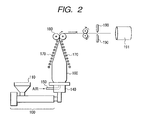
- a method which is known as the so-called inflation method (also called as blown film extrusion molding, or tubular film extrusion molding), may be named in which molding is continuously carried out while inflating a tube by blowing a gas at the atmospheric pressure or more inside the tube at the time of extrusion in tube form from the tip of a cylindrical dice with an extruder.
- inflation method also called as blown film extrusion molding, or tubular film extrusion molding
- the inflation method which is a kind of molding method for continuously drawing out tubular melt materials, enables the intermediate transferring belt to be continuously produced, and can manufacture the intermediate transferring belts in a low price.
- a double-screw extruder is used as an extruder for extruding tubular melt materials, whereby dispersion and mixture of materials can be performed well, so that labor for the dispersion step can be saved.
- resistance changes due to dispersion irregularity become small and the contact irregularity is hard to bring about, which is preferable.
- a crease caused by the pinch roll may be left in the intermediate transferring belt.
- the tube (tube 160) obtained in the above described. manufacturing method is attached to the gap between an internal mold 201 and an external mold 200 respectively made of materials different in thermal expansion coefficient and the tube is heated and cooled together with the above described molds so that the crease can be removed.
- the roughness of the inner face of the external mold 200 is changed so that the surface roughness of the tube is made to a desired value (FIG. 11).
- the obtained pellet was dried at 100°C for two hours and was fed into a hopper 110 of the extruder 100 shown in FIG. 2.
- the temperature of the extruder 100 was set at 180 to 210°C.
- D1 100 mm, die gap 300 ⁇ m
- the tube 160 was expanded.
- the diameter D2 of the tube 160 after expansion was 140 mm.
- the tube 160 was gradually crushed with a stable plate 170 and was drawn out upward.
- the drive source for drawing out was a pinch roll 180.
- the width of the roll was 600 mm.
- the tube 160 was crushed with this roll. Therefore, the air introduced to the inside of the tube 160 did not leak outside the tube. Accordingly, once the air was taken in, the diameter of the tube 160 was stabilized without any air being introduced from the gas intake path 150.
- the tube 160 after passing through the pinch roll 180 was shaped into a folded tube with a lay flat width of 220 mm. Thereafter, it was cut with a cutter 190 cut intermittently at an angle of tube's machine direction (MD) ⁇ 10° so that tubes with a thickness of 150 ⁇ m and a width (length) of 300 mm were obtained.
- reference numeral 191 denotes a tube in a folded state after being cut with cutter 190.
- the obtained tube was caused to cover the center part of the aluminum cylinder of an external diameter of 142.00 mm and a length of 330 mm to become an inner mold.
- the above described secondary processing was finished to such a level that the crease (ascribable to the pinch roll) of the tube could not be distinguished by visual detection.
- the obtained belt was cut into belt pieces having a width of 240 mm, and a meandering-prevention guide (rib) was attached to the inner periphery face of one end so that the intermediate transferring belt of the present invention with a thickness of 100 ⁇ m was obtained.
- rib meandering-prevention guide
- the resistance irregularity of the volume resistivity in the periphery direction of the obtained belt was 6.6 while the average value of the volume resistivity was 2 ⁇ 10 11 ⁇ cm.
- the moisture amount of the intermediate transferring belt was measured to reveal that the moisture amount was 0.225% by weight. Measurement of the moisture amount was conducted at 130°C.
- the moisture absorption rate was measured to reveal that the rate was 3.6% by weight.
- the measurement was made with the rib being cut out so as to be excluded from the measuring samples.
- the obtained intermediate transferring belt was incorporated into an intermediate transferring belt-photosensitive drum integrated process cartridge shown in FIG. 3.
- One is a photosensitive drum unit 50 shown in FIG. 9.
- This is composed of main parts comprising a photosensitive drum frame 59 integrally combined with a waste toner container 52, a photosensitive drum 1, a charging means (charging roller) 2, a photosensitive drum cleaning means (cleaning blade) 53, a screw 54 and a drum shutter 55.
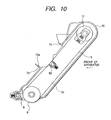
- the other is an intermediate transferring belt unit 51 shown in FIG. 10.
- an intermediate transferring belt 5 is placed over and around a secondary transferring facing roller 8 and a driven roller 12 along an intermediate transferring belt frame 45, and a primary transferring means (primary transferring roller) 58 is disposed inside the intermediate transferring belt facing the photosensitive drum 1 and an electric charge giving means 9 are disposed beside the secondary transferring facing roller 8.
- the secondary transferring facing roller 8 also functions as a drive roller to rotate the intermediate transferring belt 5
- protrusions 71 provided at both left and right ends of the photosensitive drum frame 59 are respectively inserted into positioning holes 72 formed in the intermediate transferring belt frame 45, and on the other hand, a hook part nail 73 of a snap fit type provided in the center in the longitudinal direction of the photosensitive drum frame 59 are engaged into a lock hole 74 of the intermediate transferring belt frame 45 for connection.
- the positioning holes 72 provided in the intermediate transferring belt frame 45 and the lock hole 74 are provided with holes larger by a predetermined size than the hook part nail 73 and the protrusions 71 provided in the photosensitive drum frame 59, so that relative positional movement is permitted in a predetermined fashion between the photosensitive drum unit 50 and the intermediate transferring belt unit 51.
- positioning holes 72 are provided with taper parts 72a for easy attachment/detachment.
- the protrusions 71 of the photosensitive drum unit 50 are inserted into the positioning holes 72 of the intermediate transferring belt unit 51 and rotation in the opposite direction to the case of removal is conducted and the hook part nail 73 is pushed into the lock hole 74 to connect the two units.
- the electric charge giving means 9 are brought into contact with a not-shown feeder plate, and when the process cartridge is incorporated into the image forming apparatus main body, power can be supplied to the electric charge giving means 9 from the image forming apparatus main body through the not-shown feeder plate, whereby the transferring residual toner on the intermediate transferring belt 5 can be charged to an opposite polarity to the photosensitive member.
- the electric charge giving means 9 are brought into contact with the intermediate transferring belt 5 which is so disposed as to be freely separated and contacted state and a bias of a polarity reverse to the photosensitive drum 1 is applied so that charges of a polarity reverse to the polarity in the primary transfer are imparted to the transferring residual toner remaining on the intermediate transferring belt 5 without being transferred onto the transferring material P.
- a direct current is superimposed on an alternate current and applied.
- the photosensitive drum is a photosensitive drum with a diameter of 37.5 mm containing a gallium phthalocyanine compound as a charge producing matter, and its substrate is made of an aluminum cylinder with a thickness of 1 mm.
- the surface roughness Ra of the photosensitive drum is 0.050 ⁇ m.
- the process cartridge was left standing in the environment of 23°C/55 ⁇ 5%RH for 24 hours, and thereafter, was relocated to a room of low temperature/low humidity (15°C/10%RH) and was immediately attached to the electrophotographic apparatus shown in FIG. 4 which was left standing in advance in the low temperature/low humidity (15°C/10%RH) environment and images were evaluated in three hours after attachment.
- a bias power source is in contact with the primary transferring roller 58, the secondary transferring means 7 and the electric charge giving means 9 as in FIG. 1.
- the voltage applied to the primary transferring means is around 500 to 3,500 V.
- the voltage applied to the secondary transferring means 7 is around 1,000 to 3,500 V (constant: current control of 10 ⁇ A). A direct current and an alternate current were superimposed and applied to the electric charge giving means.
- Example 2 The above described pellet was molded as in Example 1 to obtain an intermediate transferring belt of this Example with a thickness of 100 ⁇ m.
- the resistance irregularity of the volume resistivity in the periphery direction of the obtained belt was 7.5 and the average value of the volume resistivity was 1 ⁇ 10 11 ⁇ cm.
- the moisture amount of the intermediate transferring belt was measured to reveal that the moisture amount was 0.415% by weight.
- the moisture amount was measured at 130°C.
- the moisture absorption rate was measured to reveal that the rate was 4.1% by weight.
- the rib was cut out so as to be excluded from the measuring samples.
- Example 1 With the obtained intermediate transferring belt and the photosensitive drum used in Example 1, evaluation was made in the same way as in Example 1.
- Example 2 The above described pellets were molded in the same way as in Example 1 to obtain an intermediate transferring belt of this Example with a thickness of 100 ⁇ m.
- the resistance irregularity of the volume resistivity in the periphery direction of the obtained belt was 8.8 and the average value of the volume resistivity was 3 ⁇ 10 10 ⁇ cm.
- the moisture amount of the intermediate transferring belt was measured to reveal that the moisture amount was 0.452% by weight.
- the moisture amount was measured at 130°C.
- the moisture absorption rate was measured to reveal that the rate was 4.4% by weight.
- the rib was cut out so as to be excluded from the measuring samples.
- Example 1 With the obtained intermediate transferring belt and the photosensitive drum used in Example 1, evaluation was made in the same way as in Example 1.
- Example 2 The above described pellet was molded as in Example 1 to obtain an intermediate transferring belt of this Example with a thickness of 100 ⁇ m.
- the thickness of the obtained belt was 100 ⁇ m and the surface roughness Ra was 0.568 ⁇ m.
- Example 1 With the obtained intermediate transferring belt and the photosensitive drum used in Example 1, evaluation was made in the same way as in Example 1.
- Example 2 The above described pellet was molded as in Example 1 to obtain an intermediate transferring belt of this Example with a thickness of 100 ⁇ m.
- the resistance irregularity of the volume resistivity in the periphery direction of the obtained belt was 96 and the average value of the volume resistivity was 4 ⁇ 10 9 ⁇ cm.
- the moisture amount of the intermediate transferring belt was measured to reveal that the moisture amount was 0.492% by weight.
- the moisture amount was measured at 130°C.
- the moisture absorption rate was measured to reveal that the rate was 2.1% by weight.
- the rib was cut out so as to be excluded from the measuring samples.
- Example 1 With the obtained intermediate transferring belt and the photosensitive drum used in Example 1, evaluation was made in the same way as in Example 1.
- the moisture amount was nearly the same as in Example 3, but the conductive agent was segregated at the part where resistance was low, the moisture amount at that part slightly locally increased, and the resistance irregularity was as large as 96.
- Example 2 The above described pellets were molded in the same way as in Example 1 to obtain an intermediate transferring belt of this Example with a thickness of 100 ⁇ m.
- the resistance irregularity of the volume resistivity in the periphery direction of the obtained belt was 215 and the average value of the volume resistivity was 1 x 10 9 ⁇ cm.
- the moisture amount of the intermediate transferring belt was measured to reveal that the moisture amount was 0.496% by weight.
- the moisture amount was measured at 130°C.
- the moisture absorption rate was measured to reveal that the rate was 2.7% by weight.
- the rib was cut out so as to be excluded from the measuring samples.
- Example 1 With the obtained intermediate transferring belt and the photosensitive drum used in Example 1, evaluation was made in the same way as in Example 1.
- Example 3 The moisture amount is nearly the same as in Example 3, but the resistance irregularity was as large as 215, and therefore when compared with Example 9, the level of longitudinal line irregularity (banding) got worse a little.
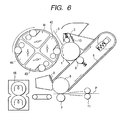
- an intermediate transferring belt-photosensitive drum integrated process cartridge was assembled in the same way as in Example 4 except that the electric charge giving means was shaped into a blade, not a roller, which was attached to the electrophotographic apparatus shown in FIG. 6 and image evaluation was made in the same way as in Example 1.
- a bias power source is connected to the primary transferring means 6, the secondary transferring means 7 and the electric charge giving means 9 as in FIG. 1.
- the voltage applied to the primary transferring means 6 is around 500 to 3,500V.
- the voltage applied to the secondary transferring means 7 is around 1,000 to 3,500 V (constant current control of 10 ⁇ A). A direct current and an alternate currents were superimposed and applied to the electric charge giving means 9.
- the contact irregularity between the intermediate transferring belt and the photosensitive drum was in the same level as in Example 4.
- the electric charge giving means was shaped into a blade.
- the width of the contact part between the electric charge giving means and the intermediate transferring belt is narrow as compared with Example 4, and no contact irregularity between the intermediate transferring belt and the electric charge giving means was seen.
- the present process cartridge required a waste toner box in order to store the transferring residual toner scraped off with the above described blade, and when compared with the process cartridge in the other Examples, became a little larger, and was rather disadvantageous from the miniaturization viewpoint, but was not so large as the process cartridge in the later-described Comparative Example 4.
- the resistance irregularity of the volume resistivity in the periphery direction of the obtained belt was 6.6 and the average value of the volume resistivity was 2 x 10 11 ⁇ cm.
- the moisture amount of the intermediate transferring belt was measured to reveal that the moisture amount was 0.225% by weight.
- the moisture amount was measured at 130°C.
- the moisture absorption rate was measured to reveal that the rate was 3.6% by weight.
- the rib was cut out so as to be excluded from the measuring samples.
- the obtained intermediate transferring belt was evaluated in the same way as in Example 1.
- the intermediate transferring belt-photosensitive drum integrated process cartridge was assembled with the intermediate transferring belt used in Example 5 and the photosensitive drum used in Example 7, and evaluation was made in the same way as in Example 1.
- Example 3 The pellets in Example 3 were used to extrude a tube with a thickness of 160 ⁇ m in the same way as in Example 1 (provided the inner diameter of the stainless cylinder was 142.43 mm), and the intermediate transferring belt with a thickness of 160 ⁇ m was obtained in the same way as in Example 1.
- the resistance irregularity of the volume resistivity in the periphery direction of the obtained belt was 8.8 and the average value of the volume resistivity was 3 ⁇ 10 10 ⁇ cm.
- the moisture amount of the intermediate transferring belt was measured to reveal that the moisture amount was 0.452% by weight.
- the moisture amount was measured at 130°C.
- the moisture absorption rate was measured to reveal that the rate was 4.4% by weight.
- the rib was cut out so as to be excluded from the measuring samples.
- the obtained intermediate transferring belt was evaluated in the same way as in Example 1.
- Thickness of the belt was a little thicker, and the occurrence of the contact irregularity was just slight.
- the thickness was changed to 200 ⁇ m, but otherwise, the intermediate transferring belt with a thickness of 200 ⁇ m was obtained in the same way as in Example 14 (provided the inner diameter of the stainless cylinder is 142.51 mm).
- the resistance irregularity of the volume resistivity in the periphery direction of the obtained belt was 8.8 and the average value of the volume resistivity was 3 ⁇ 10 10 ⁇ cm.
- the moisture amount of the intermediate transferring belt was measured to reveal that the moisture amount was 0.452% by weight.
- the moisture amount was measured at 130°C.
- the moisture absorption rate was measured to reveal that the rate was 4.4% by weight.
- the rib was cut out so as to be excluded from the measuring samples.
- the obtained intermediate transferring belt was evaluated in the same way as in Example 1.
- Thickness of the belt was a little thick, and a little contact irregularity was seen.
- Example 2 The pellets in Example 2 was used and the apparatus in FIG. 2 as in Example 1 was used, and a tube with a thickness of 80 ⁇ m was obtained by inflation molding. Next, a stainless cylinder whose inner periphery face was carefully polished (electropolishing after buffing) was used, but otherwise, the intermediate transferring belt was obtained in the same way as in Example 1.
- the thickness of the obtained intermediate transferring belt was 80 ⁇ m.
- the resistance irregularity of the volume resistivity in the periphery direction of the obtained belt was 7.5 and the average value of the volume resistivity was 1 ⁇ 10 11 ⁇ cm.
- the moisture amount of the intermediate transferring belt was measured to reveal that the moisture amount was 0.415% by weight.
- the moisture amount was measured at 130°C.
- the moisture absorption rate was measured to reveal that the rate was 4.1% by weight.
- the rib was cut out so as to be excluded from the measuring samples.
- Example 2 The above described pellets were molded in the same way as in Example 1 to obtain an intermediate transferring belt of this Example with a thickness of 100 ⁇ m.
- the resistance irregularity of the volume resistivity in the periphery direction of the obtained belt was 3.6 and the average value of the volume resistivity was 8 ⁇ 10 13 ⁇ cm.
- the moisture amount of the intermediate transferring belt was measured to reveal that the moisture amount was 0.085% by weight.
- the moisture amount was measured at 130°C.
- the moisture absorption rate was measured to reveal that the rate was 1.3% by weight.
- the rib was cut out so as to be excluded from the measuring samples.
- Example 1 Using the obtained intermediate transferring belt and the photosensitive drum used in Example 1, evaluation was made in the same way as in Example 1.
- Example 2 The above described pellets were molded in the same way as in Example 1 to obtain an intermediate transferring belt of the present Comparative Example with thickness of 100 ⁇ m.
- the resistance irregularity of the volume resistivity in the periphery direction of the obtained belt was 9.5 and the average value of the volume resistivity was 1 ⁇ 10 10 ⁇ cm.
- the moisture amount of the intermediate transferring belt was measured to reveal that the moisture amount was 1.124% by weight.
- the moisture amount was measured at 130°C.
- the moisture absorption rate was measured to reveal that the rate was 4.6% by weight.
- the rib when measuring the volume resistivity, the moisture amount and the moisture absorption rate, the rib was cut out so as to be excluded from the measuring samples.
- the obtained intermediate transferring belt was evaluated as in Example 1.
- the resistance irregularity of the volume resistivity in the periphery direction of the obtained belt was 9.2 and the average value of the volume resistivity was 1 ⁇ 10 10 ⁇ cm.
- the moisture amount of the intermediate transferring belt was measured to reveal that the moisture amount was 0.997% by weight.
- the moisture amount was measured at 130°C.
- the moisture absorption rate was measured to reveal that the rate was 4.6% by weight.
- the rib was cut out so as to be excluded from the measuring samples.
- Example 7 The obtained intermediate transferring belt and the photosensitive drum used in Example 7 were used and evaluation was made in the same way as in Example 1.
- Example 2 The above described pellets were molded in the same way as in Example 1 to obtain an intermediate transferring belt with a thickness of 100 ⁇ m.
- the resistance irregularity of the volume resistivity in the periphery direction of the obtained belt was 9.3 and the average value of the volume resistivity was 3 ⁇ 10 9 ⁇ cm.
- the moisture amount of the intermediate transferring belt was measured to reveal that the moisture amount was 1.215% by weight. Measurement of the moisture amount was measured at 130°C.
- the moisture absorption rate was measured to reveal that the rate was 5.6% by weight.
- the rib was cut out so as to be excluded from the measuring samples.
- the obtained intermediate transferring belt was evaluated in the same way as in Example 1.
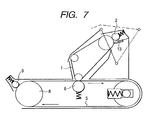
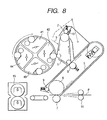
- Example 4 The intermediate transferring belt and the photosensitive belL obtained in Example 4 were incorporated into the all-in-one process cartridge as shown in FIG. 7, then the cartridge was attached to the electrophotographic apparatus as shown in FIG. 8, and evaluation was made in the same way as in Example 1.
- a bias power source was connected to the primary transferring means 6, the secondary transferring means 7 and the electric charge giving means 9 as shown in FIG. 1.
- the voltage applied to the primary transferring means 6 was around 500 to 3,500 V.
- the voltage applied to the secondary transferring means 7 was around 1,000 to 3,500 V (constant current control of 10 ⁇ A).
- a direct current and an alternate current were superimposed and applied to the electric charge giving means 9.
- the photosensitive belt has the surface roughness Ra of 0.050 ⁇ m, and as the substrate of the photosensitive belt used in this Comparative Example, used was a polyethylene telephtalate film with a thickness of 70 ⁇ m on which an aluminum evaporation film with a thickness of 100 nm was, with a gallium phthalocyanine compound being contained as an electric charge producing matter.
- a process cartridge comprising an intermediate transferring belt and a photosensitive drum which are integrally held together to form one unit, which is more compact, and does not bring about image defects such as banding or coarseness, prevents contact irregularity from occurring and can form images with uniform density
- an electrophotographic apparatus having the process cartridge and an image forming method using the electrophotographic apparatus.
- the present invention provides a process cartridge detachably mountable on the main body of an electrophotographic apparatus, which integrally supports a photosensitive drum for bearing toner images, and an intermediate transferring belt having a contact part with the photosensitive drum.
- the moisture amount of the intermediate transferring belt at 23°C/50%RH is less than 1% by weight and the sum of the surface roughness Ra of the photosensitive drum and the surface roughness Ra of the intermediate transferring belt is less than 0.8 ⁇ m.
- the present invention also provides an electrophotographic apparatus having the process cartridge and an image forming method using the electrophotographic apparatus.
Landscapes
- Engineering & Computer Science (AREA)
- Physics & Mathematics (AREA)
- General Physics & Mathematics (AREA)
- Life Sciences & Earth Sciences (AREA)
- Manufacturing & Machinery (AREA)
- Sustainable Development (AREA)
- Computer Vision & Pattern Recognition (AREA)
- Electrostatic Charge, Transfer And Separation In Electrography (AREA)
- Electrophotography Configuration And Component (AREA)
- Discharging, Photosensitive Material Shape In Electrophotography (AREA)
Applications Claiming Priority (2)
| Application Number | Priority Date | Filing Date | Title |
|---|---|---|---|
| JP2001263906A JP3927781B2 (ja) | 2001-08-31 | 2001-08-31 | プロセスカートリッジ及び中間転写ベルト |
| JP2001263906 | 2001-08-31 |
Publications (3)
| Publication Number | Publication Date |
|---|---|
| EP1288741A2 true EP1288741A2 (de) | 2003-03-05 |
| EP1288741A3 EP1288741A3 (de) | 2006-11-29 |
| EP1288741B1 EP1288741B1 (de) | 2011-10-12 |
Family
ID=19090589
Family Applications (1)
| Application Number | Title | Priority Date | Filing Date |
|---|---|---|---|
| EP02019377A Expired - Lifetime EP1288741B1 (de) | 2001-08-31 | 2002-08-29 | Arbeitseinheit, elektrophotographisches Gerät und Bilderzeugungsverfahren |
Country Status (3)
| Country | Link |
|---|---|
| US (1) | US6766127B2 (de) |
| EP (1) | EP1288741B1 (de) |
| JP (1) | JP3927781B2 (de) |
Cited By (1)
| Publication number | Priority date | Publication date | Assignee | Title |
|---|---|---|---|---|
| US6766127B2 (en) * | 2001-08-31 | 2004-07-20 | Canon Kabushiki Kaisha | Image forming apparatus having process cartridge with intermediate transfer belt |
Families Citing this family (4)
| Publication number | Priority date | Publication date | Assignee | Title |
|---|---|---|---|---|
| US6928256B2 (en) * | 2002-09-30 | 2005-08-09 | Canon Kabushiki Kaisha | Electrophotographic endless belt, process cartridge, and electrophotographic apparatus |
| JP4501374B2 (ja) * | 2003-07-14 | 2010-07-14 | 富士ゼロックス株式会社 | 画像形成装置 |
| JP4979058B2 (ja) * | 2005-04-06 | 2012-07-18 | キヤノン株式会社 | 電子写真装置に用いられるベルト及び電子写真装置 |
| JP5424795B2 (ja) * | 2008-10-27 | 2014-02-26 | キヤノン株式会社 | 帯電部材及びその製造方法、プロセスカートリッジ及び電子写真装置 |
Citations (1)
| Publication number | Priority date | Publication date | Assignee | Title |
|---|---|---|---|---|
| EP1237057A2 (de) | 2001-02-28 | 2002-09-04 | Canon Kabushiki Kaisha | Arbeitseinheit, Bilderzeugungsgerät und Zwischenübertragungsband |
Family Cites Families (24)
| Publication number | Priority date | Publication date | Assignee | Title |
|---|---|---|---|---|
| JPS61279871A (ja) | 1985-06-06 | 1986-12-10 | Canon Inc | 画像形成装置 |
| JP2837450B2 (ja) | 1989-08-31 | 1998-12-16 | オプトレックス株式会社 | 液晶表示素子 |
| US5331373A (en) | 1992-03-13 | 1994-07-19 | Canon Kabushiki Kaisha | Image forming apparatus, process cartridge mountable within it and method for attaching photosensitive drum to process cartridge |
| JP3352155B2 (ja) | 1992-06-30 | 2002-12-03 | キヤノン株式会社 | プロセスカートリッジ及び画像形成装置 |
| US5966566A (en) | 1993-03-24 | 1999-10-12 | Canon Kabushiki Kaisha | Recycle method for process cartridge and image forming apparatus |
| JPH07140874A (ja) | 1993-06-25 | 1995-06-02 | Canon Inc | 像担持体の取付部材及び像担持体の取付方法及びプロセスカートリッジ及び画像形成装置 |
| US5752131A (en) | 1993-06-25 | 1998-05-12 | Canon Kabushiki Kaisha | Developing apparatus with a removable sealing film and process cartridge and image forming apparatus including such a developing apparatus |
| JP3119047B2 (ja) * | 1993-09-03 | 2000-12-18 | ミノルタ株式会社 | 画像形成装置 |
| JPH07210009A (ja) * | 1994-01-21 | 1995-08-11 | Minolta Co Ltd | 中間転写体 |
| JPH07302034A (ja) | 1994-03-08 | 1995-11-14 | Canon Inc | トナーカートリッジ及びプロセスカートリッジ及び電子写真画像形成装置 |
| JPH07319362A (ja) | 1994-05-19 | 1995-12-08 | Canon Inc | プロセスカートリッジの再生産方法及びプロセスカートリッジ |
| JP3337836B2 (ja) * | 1994-12-06 | 2002-10-28 | キヤノン株式会社 | 画像形成装置 |
| TW331675B (en) | 1994-12-22 | 1998-05-11 | Canon Kk | Electrophotographic apparatus |
| JPH09292812A (ja) | 1996-04-26 | 1997-11-11 | Ricoh Co Ltd | カラー画像形成装置 |
| US5887228A (en) | 1995-10-16 | 1999-03-23 | Ricoh Company, Ltd. | Color image forming apparatus including process cartridge |
| JP4114991B2 (ja) * | 1997-02-21 | 2008-07-09 | キヤノン株式会社 | 画像形成装置 |
| US5965314A (en) * | 1997-04-03 | 1999-10-12 | Minnesota Mining And Manufacturing Company | Intermediate transfer element for liquid electrophotography |
| JPH1184893A (ja) * | 1997-07-07 | 1999-03-30 | Fuji Xerox Co Ltd | 中間転写体及び中間転写体を用いた画像形成装置 |
| JPH11327316A (ja) | 1998-05-13 | 1999-11-26 | Canon Inc | 画像形成装置 |
| JP2000137388A (ja) * | 1998-10-30 | 2000-05-16 | Canon Inc | 中間転写体、中間転写体の製造方法及び画像形成装置 |
| US6470165B2 (en) * | 2000-02-03 | 2002-10-22 | Canon Kabushiki Kaisha | Process for producing transfer member, transfer member, and image forming apparatus |
| US6615015B2 (en) * | 2001-05-24 | 2003-09-02 | Canon Kabushiki Kaisha | Process cartridge, electrophotographic apparatus and image-forming method |
| JP3927781B2 (ja) * | 2001-08-31 | 2007-06-13 | キヤノン株式会社 | プロセスカートリッジ及び中間転写ベルト |
| US6643487B1 (en) * | 2002-09-05 | 2003-11-04 | Kabushiki Kaisha Toshiba | Image forming apparatus using intermediate transfer body |
-
2001
- 2001-08-31 JP JP2001263906A patent/JP3927781B2/ja not_active Expired - Fee Related
-
2002
- 2002-08-29 EP EP02019377A patent/EP1288741B1/de not_active Expired - Lifetime
- 2002-08-30 US US10/231,034 patent/US6766127B2/en not_active Expired - Fee Related
Patent Citations (1)
| Publication number | Priority date | Publication date | Assignee | Title |
|---|---|---|---|---|
| EP1237057A2 (de) | 2001-02-28 | 2002-09-04 | Canon Kabushiki Kaisha | Arbeitseinheit, Bilderzeugungsgerät und Zwischenübertragungsband |
Cited By (1)
| Publication number | Priority date | Publication date | Assignee | Title |
|---|---|---|---|---|
| US6766127B2 (en) * | 2001-08-31 | 2004-07-20 | Canon Kabushiki Kaisha | Image forming apparatus having process cartridge with intermediate transfer belt |
Also Published As
| Publication number | Publication date |
|---|---|
| JP3927781B2 (ja) | 2007-06-13 |
| EP1288741B1 (de) | 2011-10-12 |
| EP1288741A3 (de) | 2006-11-29 |
| JP2003076152A (ja) | 2003-03-14 |
| US20030099484A1 (en) | 2003-05-29 |
| US6766127B2 (en) | 2004-07-20 |
Similar Documents
| Publication | Publication Date | Title |
|---|---|---|
| US8420003B2 (en) | Method of manufacturing a belt member and the belt member | |
| EP1431838A2 (de) | Aufladevorrichtung mit Aufladerolle und und hiermit versehenes Bilderzeugungsgerät | |
| CN110874035A (zh) | 显影辊、处理盒和电子照相图像形成设备 | |
| US6615015B2 (en) | Process cartridge, electrophotographic apparatus and image-forming method | |
| EP1237057A2 (de) | Arbeitseinheit, Bilderzeugungsgerät und Zwischenübertragungsband | |
| EP1288741B1 (de) | Arbeitseinheit, elektrophotographisches Gerät und Bilderzeugungsverfahren | |
| KR0171166B1 (ko) | 대전 부재, 대전 부재 제조 프로세스 및 대전 부재를 갖고 있는 프로세스 카트리지 | |
| US7320822B2 (en) | Electrophotographic conductive member and electrophotographic apparatus | |
| KR20120030920A (ko) | 대전 부재, 프로세스 유닛 카트리지 및 화상 형성 장치 | |
| EP0708382B1 (de) | Verfahren zur Wiederherstellung eines Aufladungselements | |
| JP2000275980A (ja) | 中間転写体、中間転写体の製造方法及び画像形成装置 | |
| EP1288742A2 (de) | Arbeitseinheit und elektrophotographisches Gerät | |
| JP2002214928A (ja) | エンドレスベルト、画像形成装置用ベルト及び画像形成装置 | |
| JP2003316174A (ja) | 中間転写体及び転写部材、中間転写体及び転写部材の製造方法、並びに中間転写体及び転写部材を用いた画像形成装置 | |
| US20060127138A1 (en) | Semiconductive endless belt and electrophotographic apparatus | |
| JP2003287964A (ja) | 中間転写ベルト、中間転写ベルト−電子写真感光体ドラム一体カートリッジ、画像形成装置及び画像形成方法 | |
| JP2003149957A (ja) | プロセスカートリッジ、電子写真装置、画像形成方法および中間転写ベルト | |
| JP4683611B2 (ja) | 電子写真導電性部材および電子写真装置 | |
| US12436483B2 (en) | Endless belt, belt unit, and image forming apparatus | |
| JP3278331B2 (ja) | 帯電部材、該帯電部材の製造方法及び該帯電部材を有するプロセスカートリッジ | |
| JP4136507B2 (ja) | 電子写真用ベルト、画像形成装置及びプロセスカートリッジ | |
| JP2002174933A (ja) | 電子写真ベルト部材、電子写真ベルト部材の製造方法および電子写真装置 | |
| JP2002251081A (ja) | 潜像担持体−中間転写回転体一体型カートリッジ及び画像形成装置及び画像形成方法 | |
| JP2003029538A (ja) | 導電性エンドレスベルトおよびこれを用いた画像形成装置 | |
| JP2002328543A (ja) | プロセスカートリッジ、画像形成装置及び中間転写ベルト |
Legal Events
| Date | Code | Title | Description |
|---|---|---|---|
| PUAI | Public reference made under article 153(3) epc to a published international application that has entered the european phase |
Free format text: ORIGINAL CODE: 0009012 |
|
| AK | Designated contracting states |
Kind code of ref document: A2 Designated state(s): AT BE BG CH CY CZ DE DK EE ES FI FR GB GR IE IT LI LU MC NL PT SE SK TR |
|
| AX | Request for extension of the european patent |
Extension state: AL LT LV MK RO SI |
|
| PUAL | Search report despatched |
Free format text: ORIGINAL CODE: 0009013 |
|
| AK | Designated contracting states |
Kind code of ref document: A3 Designated state(s): AT BE BG CH CY CZ DE DK EE ES FI FR GB GR IE IT LI LU MC NL PT SE SK TR |
|
| AX | Request for extension of the european patent |
Extension state: AL LT LV MK RO SI |
|
| 17P | Request for examination filed |
Effective date: 20070529 |
|
| AKX | Designation fees paid |
Designated state(s): DE FR GB IT |
|
| 17Q | First examination report despatched |
Effective date: 20091113 |
|
| GRAP | Despatch of communication of intention to grant a patent |
Free format text: ORIGINAL CODE: EPIDOSNIGR1 |
|
| GRAS | Grant fee paid |
Free format text: ORIGINAL CODE: EPIDOSNIGR3 |
|
| GRAA | (expected) grant |
Free format text: ORIGINAL CODE: 0009210 |
|
| AK | Designated contracting states |
Kind code of ref document: B1 Designated state(s): DE FR GB IT |
|
| REG | Reference to a national code |
Ref country code: GB Ref legal event code: FG4D |
|
| REG | Reference to a national code |
Ref country code: DE Ref legal event code: R096 Ref document number: 60241291 Country of ref document: DE Effective date: 20111215 |
|
| PLBE | No opposition filed within time limit |
Free format text: ORIGINAL CODE: 0009261 |
|
| STAA | Information on the status of an ep patent application or granted ep patent |
Free format text: STATUS: NO OPPOSITION FILED WITHIN TIME LIMIT |
|
| 26N | No opposition filed |
Effective date: 20120713 |
|
| REG | Reference to a national code |
Ref country code: DE Ref legal event code: R097 Ref document number: 60241291 Country of ref document: DE Effective date: 20120713 |
|
| PGFP | Annual fee paid to national office [announced via postgrant information from national office to epo] |
Ref country code: DE Payment date: 20130831 Year of fee payment: 12 |
|
| PGFP | Annual fee paid to national office [announced via postgrant information from national office to epo] |
Ref country code: GB Payment date: 20130822 Year of fee payment: 12 Ref country code: FR Payment date: 20130823 Year of fee payment: 12 |
|
| PGFP | Annual fee paid to national office [announced via postgrant information from national office to epo] |
Ref country code: IT Payment date: 20130802 Year of fee payment: 12 |
|
| REG | Reference to a national code |
Ref country code: DE Ref legal event code: R119 Ref document number: 60241291 Country of ref document: DE |
|
| GBPC | Gb: european patent ceased through non-payment of renewal fee |
Effective date: 20140829 |
|
| PG25 | Lapsed in a contracting state [announced via postgrant information from national office to epo] |
Ref country code: IT Free format text: LAPSE BECAUSE OF NON-PAYMENT OF DUE FEES Effective date: 20140829 |
|
| REG | Reference to a national code |
Ref country code: DE Ref legal event code: R119 Ref document number: 60241291 Country of ref document: DE Effective date: 20150303 |
|
| REG | Reference to a national code |
Ref country code: FR Ref legal event code: ST Effective date: 20150430 |
|
| PG25 | Lapsed in a contracting state [announced via postgrant information from national office to epo] |
Ref country code: GB Free format text: LAPSE BECAUSE OF NON-PAYMENT OF DUE FEES Effective date: 20140829 Ref country code: DE Free format text: LAPSE BECAUSE OF NON-PAYMENT OF DUE FEES Effective date: 20150303 |
|
| PG25 | Lapsed in a contracting state [announced via postgrant information from national office to epo] |
Ref country code: FR Free format text: LAPSE BECAUSE OF NON-PAYMENT OF DUE FEES Effective date: 20140901 |