EP1288921A2 - Optisches Plattenlaufwerk - Google Patents
Optisches Plattenlaufwerk Download PDFInfo
- Publication number
- EP1288921A2 EP1288921A2 EP02017713A EP02017713A EP1288921A2 EP 1288921 A2 EP1288921 A2 EP 1288921A2 EP 02017713 A EP02017713 A EP 02017713A EP 02017713 A EP02017713 A EP 02017713A EP 1288921 A2 EP1288921 A2 EP 1288921A2
- Authority
- EP
- European Patent Office
- Prior art keywords
- voltage
- optical disc
- output
- input
- laser beam
- Prior art date
- Legal status (The legal status is an assumption and is not a legal conclusion. Google has not performed a legal analysis and makes no representation as to the accuracy of the status listed.)
- Withdrawn
Links
Images


Classifications
-
- G—PHYSICS
- G11—INFORMATION STORAGE
- G11B—INFORMATION STORAGE BASED ON RELATIVE MOVEMENT BETWEEN RECORD CARRIER AND TRANSDUCER
- G11B27/00—Editing; Indexing; Addressing; Timing or synchronising; Monitoring; Measuring tape travel
- G11B27/02—Editing, e.g. varying the order of information signals recorded on, or reproduced from, record carriers
- G11B27/031—Electronic editing of digitised analogue information signals, e.g. audio or video signals
- G11B27/034—Electronic editing of digitised analogue information signals, e.g. audio or video signals on discs
-
- G—PHYSICS
- G11—INFORMATION STORAGE
- G11B—INFORMATION STORAGE BASED ON RELATIVE MOVEMENT BETWEEN RECORD CARRIER AND TRANSDUCER
- G11B19/00—Driving, starting, stopping record carriers not specifically of filamentary or web form, or of supports therefor; Control thereof; Control of operating function ; Driving both disc and head
- G11B19/02—Control of operating function, e.g. switching from recording to reproducing
- G11B19/04—Arrangements for preventing, inhibiting, or warning against double recording on the same blank or against other recording or reproducing malfunctions
- G11B19/041—Detection or prevention of read or write errors
- G11B19/044—Detection or prevention of read or write errors by using a data buffer
-
- G—PHYSICS
- G11—INFORMATION STORAGE
- G11B—INFORMATION STORAGE BASED ON RELATIVE MOVEMENT BETWEEN RECORD CARRIER AND TRANSDUCER
- G11B20/00—Signal processing not specific to the method of recording or reproducing; Circuits therefor
- G11B20/10—Digital recording or reproducing
-
- G—PHYSICS
- G11—INFORMATION STORAGE
- G11B—INFORMATION STORAGE BASED ON RELATIVE MOVEMENT BETWEEN RECORD CARRIER AND TRANSDUCER
- G11B20/00—Signal processing not specific to the method of recording or reproducing; Circuits therefor
- G11B20/10—Digital recording or reproducing
- G11B20/10527—Audio or video recording; Data buffering arrangements
-
- G—PHYSICS
- G11—INFORMATION STORAGE
- G11B—INFORMATION STORAGE BASED ON RELATIVE MOVEMENT BETWEEN RECORD CARRIER AND TRANSDUCER
- G11B7/00—Recording or reproducing by optical means, e.g. recording using a thermal beam of optical radiation by modifying optical properties or the physical structure, reproducing using an optical beam at lower power by sensing optical properties; Record carriers therefor
- G11B7/12—Heads, e.g. forming of the optical beam spot or modulation of the optical beam
- G11B7/125—Optical beam sources therefor, e.g. laser control circuitry specially adapted for optical storage devices; Modulators, e.g. means for controlling the size or intensity of optical spots or optical traces
- G11B7/126—Circuits, methods or arrangements for laser control or stabilisation
-
- G—PHYSICS
- G11—INFORMATION STORAGE
- G11B—INFORMATION STORAGE BASED ON RELATIVE MOVEMENT BETWEEN RECORD CARRIER AND TRANSDUCER
- G11B7/00—Recording or reproducing by optical means, e.g. recording using a thermal beam of optical radiation by modifying optical properties or the physical structure, reproducing using an optical beam at lower power by sensing optical properties; Record carriers therefor
- G11B7/12—Heads, e.g. forming of the optical beam spot or modulation of the optical beam
- G11B7/125—Optical beam sources therefor, e.g. laser control circuitry specially adapted for optical storage devices; Modulators, e.g. means for controlling the size or intensity of optical spots or optical traces
- G11B7/126—Circuits, methods or arrangements for laser control or stabilisation
- G11B7/1267—Power calibration
-
- G—PHYSICS
- G11—INFORMATION STORAGE
- G11B—INFORMATION STORAGE BASED ON RELATIVE MOVEMENT BETWEEN RECORD CARRIER AND TRANSDUCER
- G11B20/00—Signal processing not specific to the method of recording or reproducing; Circuits therefor
- G11B20/10—Digital recording or reproducing
- G11B20/10527—Audio or video recording; Data buffering arrangements
- G11B2020/1062—Data buffering arrangements, e.g. recording or playback buffers
- G11B2020/10675—Data buffering arrangements, e.g. recording or playback buffers aspects of buffer control
- G11B2020/10731—Data buffering arrangements, e.g. recording or playback buffers aspects of buffer control wherein the buffer I/O can be temporarily suspended, e.g. by refusing to accept further data to be buffered
-
- G—PHYSICS
- G11—INFORMATION STORAGE
- G11B—INFORMATION STORAGE BASED ON RELATIVE MOVEMENT BETWEEN RECORD CARRIER AND TRANSDUCER
- G11B20/00—Signal processing not specific to the method of recording or reproducing; Circuits therefor
- G11B20/10—Digital recording or reproducing
- G11B20/10527—Audio or video recording; Data buffering arrangements
- G11B2020/1062—Data buffering arrangements, e.g. recording or playback buffers
- G11B2020/10675—Data buffering arrangements, e.g. recording or playback buffers aspects of buffer control
- G11B2020/1074—Data buffering arrangements, e.g. recording or playback buffers aspects of buffer control involving a specific threshold value
-
- G—PHYSICS
- G11—INFORMATION STORAGE
- G11B—INFORMATION STORAGE BASED ON RELATIVE MOVEMENT BETWEEN RECORD CARRIER AND TRANSDUCER
- G11B20/00—Signal processing not specific to the method of recording or reproducing; Circuits therefor
- G11B20/10—Digital recording or reproducing
- G11B2020/10935—Digital recording or reproducing wherein a time constraint must be met
- G11B2020/10972—Management of interruptions, e.g. due to editing
-
- G—PHYSICS
- G11—INFORMATION STORAGE
- G11B—INFORMATION STORAGE BASED ON RELATIVE MOVEMENT BETWEEN RECORD CARRIER AND TRANSDUCER
- G11B20/00—Signal processing not specific to the method of recording or reproducing; Circuits therefor
- G11B20/10—Digital recording or reproducing
- G11B20/12—Formatting, e.g. arrangement of data block or words on the record carriers
- G11B20/1217—Formatting, e.g. arrangement of data block or words on the record carriers on discs
- G11B2020/1218—Formatting, e.g. arrangement of data block or words on the record carriers on discs wherein the formatting concerns a specific area of the disc
- G11B2020/1238—Formatting, e.g. arrangement of data block or words on the record carriers on discs wherein the formatting concerns a specific area of the disc track, i.e. the entire a spirally or concentrically arranged path on which the recording marks are located
-
- G—PHYSICS
- G11—INFORMATION STORAGE
- G11B—INFORMATION STORAGE BASED ON RELATIVE MOVEMENT BETWEEN RECORD CARRIER AND TRANSDUCER
- G11B20/00—Signal processing not specific to the method of recording or reproducing; Circuits therefor
- G11B20/10—Digital recording or reproducing
- G11B20/12—Formatting, e.g. arrangement of data block or words on the record carriers
- G11B20/1217—Formatting, e.g. arrangement of data block or words on the record carriers on discs
- G11B2020/1218—Formatting, e.g. arrangement of data block or words on the record carriers on discs wherein the formatting concerns a specific area of the disc
- G11B2020/1238—Formatting, e.g. arrangement of data block or words on the record carriers on discs wherein the formatting concerns a specific area of the disc track, i.e. the entire a spirally or concentrically arranged path on which the recording marks are located
- G11B2020/1239—Formatting, e.g. arrangement of data block or words on the record carriers on discs wherein the formatting concerns a specific area of the disc track, i.e. the entire a spirally or concentrically arranged path on which the recording marks are located the track being a pregroove, e.g. the wobbled track of a recordable optical disc
-
- G—PHYSICS
- G11—INFORMATION STORAGE
- G11B—INFORMATION STORAGE BASED ON RELATIVE MOVEMENT BETWEEN RECORD CARRIER AND TRANSDUCER
- G11B20/00—Signal processing not specific to the method of recording or reproducing; Circuits therefor
- G11B20/10—Digital recording or reproducing
- G11B20/12—Formatting, e.g. arrangement of data block or words on the record carriers
- G11B2020/1264—Formatting, e.g. arrangement of data block or words on the record carriers wherein the formatting concerns a specific kind of data
- G11B2020/1265—Control data, system data or management information, i.e. data used to access or process user data
- G11B2020/1267—Address data
- G11B2020/1269—Absolute time in pregroove [ATIP] information
-
- G—PHYSICS
- G11—INFORMATION STORAGE
- G11B—INFORMATION STORAGE BASED ON RELATIVE MOVEMENT BETWEEN RECORD CARRIER AND TRANSDUCER
- G11B2220/00—Record carriers by type
- G11B2220/20—Disc-shaped record carriers
- G11B2220/21—Disc-shaped record carriers characterised in that the disc is of read-only, rewritable, or recordable type
- G11B2220/215—Recordable discs
-
- G—PHYSICS
- G11—INFORMATION STORAGE
- G11B—INFORMATION STORAGE BASED ON RELATIVE MOVEMENT BETWEEN RECORD CARRIER AND TRANSDUCER
- G11B2220/00—Record carriers by type
- G11B2220/20—Disc-shaped record carriers
- G11B2220/25—Disc-shaped record carriers characterised in that the disc is based on a specific recording technology
- G11B2220/2537—Optical discs
- G11B2220/2545—CDs
-
- G—PHYSICS
- G11—INFORMATION STORAGE
- G11B—INFORMATION STORAGE BASED ON RELATIVE MOVEMENT BETWEEN RECORD CARRIER AND TRANSDUCER
- G11B7/00—Recording or reproducing by optical means, e.g. recording using a thermal beam of optical radiation by modifying optical properties or the physical structure, reproducing using an optical beam at lower power by sensing optical properties; Record carriers therefor
- G11B7/004—Recording, reproducing or erasing methods; Read, write or erase circuits therefor
- G11B7/0045—Recording
Definitions
- the present invention relates to an optical disc drive.
- optical disc drives for recording data onto and reading data out from a recordable optical disc such as a CD-R, a CD-RW, and the like.
- optical disc drives comprise a rotational driving mechanism for rotating a loaded optical disc; an optical pick-up (optical head) which is movable in a radial direction of the loaded optical disc for emitting a laser beam to record data (information) to, and read data from the optical disc; and an optical pick-up moving mechanism, which is equipped with a sled motor for moving the optical pick-up in a radial direction of the disc.
- the optical pick-up comprises an optical pick-up body (optical pick-up base), which is equipped with a laser diode and a split photodiode; an objective lens, which is supported by suspension springs on the optical pick-up body to enable the lens to move in the direction of the optical axis of a loaded optical disc (rotational axis direction), as well as in a radial direction of the optical disc; a focusing actuator for moving the objective lens in the optical axis direction; and a tracking actuator for moving the objective leans in the radial direction.
- optical pick-up body optical pick-up base
- an objective lens which is supported by suspension springs on the optical pick-up body to enable the lens to move in the direction of the optical axis of a loaded optical disc (rotational axis direction), as well as in a radial direction of the optical disc
- a focusing actuator for moving the objective lens in the optical axis direction
- a tracking actuator for moving the objective leans in the radial direction.
- an optical pick-up is moved to a target track (target address), and at the target track data is recorded (written) onto the optical disc and/or read out (reproduced) from the optical disc, while a focus control operation and a tracking control operation are carried out.
- optical disc drives data is recorded onto an optical disc by being sequentially transferred from an external device, such as a personal computer, to a memory of the optical disc drive, and then being sequentially recorded onto the optical disc from the memory.
- an external device such as a personal computer
- this system suffers from a problem in that an amount of data stored in the memory of the optical disc drive may, at any time during a recording operation, become insufficient due to latency in transfer of data from the external device.
- an output of a laser beam must be raised from the read level to a write level (record level) when the data recording operation is resumed, which requires a predetermined amount of time to be completed.
- the recording operation to record data onto an optical disc from a position consecutive to that where a recording operation was suspended (record restart position), the recording operation must be resumed from a predetermined position before the record restart position so that a level of the laser beam becomes a required write level (optimum level for recording) at the record restart position.
- the laser beam is being emitted along a track of the optical disc over a predetermined distance, i.e., the distance from the predetermined position to the record restart position for a predetermined time.
- data may be recorded onto an area of the track of the optical disc corresponding to the predetermined distance before the record restart position with a laser beam output that is increasing to the write level. Consequently, there is a problem that the data previously recorded in the area is overwritten with the laser beam so that the previously recorded data cannot be reproduced correctly.
- an object of the present invention to provide an optical disc drive wherein data recording can be resumed after suspension without any overwriting of data on an optical disc.
- the present invention is directed to an optical disc drive that can read put data from or record and read out data to and from an optical disc when the optical disc is loaded into the optical disc drive.
- the optical disc drive comprises a rotational driving mechanism for rotating the loaded optical disc; an optical pick-up having emitting means that emits a laser beam for recording data to the optical disc; a laser control circuit for controlling an output of the laser beam; a drive circuit for driving the emitting means; and voltage hold means provided between the laser control circuit and the drive circuit for holding a voltage to be input to the drive circuit at a voltage value at which an output of the laser beam becomes an optimum level for recording data onto the optical disc.
- the voltage hold means holds the voltage to be input to the drive circuit to the voltage value, at which the output of the laser beam becomes the optimum level for recording, after trial writing is carried out onto the optical disc by changing the output of the laser beam in a stepwise manner to determine the optimum level of the output of the laser beam for recording data onto the optical disc.
- the optical disc drive in the present invention may further comprise detection means for detecting voltage values corresponding to a plurality of output levels of the laser beam during the trial writing, in which said voltage hold means is configured so as to hold the voltage to be input to said drive circuit to a voltage value corresponding to the optimum level among the voltage values detected by said detection means.
- the optical disc drive may further comprise a memory for storing data.
- the optical disc drive may be configured so that a recording operation is suspended when an amount of data stored in the memory becomes equal to or less than a predetermined amount during the recording operation.
- the voltage hold means holds may be configured so as to hold the voltage to be input to the drive circuit just before the recording operation is suspended.
- the voltage hold means includes a circuit having a first input terminal to which the voltage output from the laser control circuit is input, a second input terminal to which an impressed voltage is input, and an output terminal for outputting the voltage to be input to the drive circuit.
- the optical disc drive is constructed so as to apply the impressed voltage to the second input terminal so that the voltage to be input to the drive circuit becomes the voltage at which the output of the laser beam becomes the optimum level.
- the voltage hold means may have a voltage adjustment circuit that can adjust the voltage to be input to the drive circuit.
- the optical disc drive may be configured so that the voltage to be input to the drive circuit is raised by the voltage adjustment circuit if it is necessary to raise the voltage to be input to the drive circuit after the impressed voltage has been applied.
- the voltage adjustment circuit has a transistor between the first input terminal and the output terminal. It is also preferred that the voltage adjustment circuit has a resistance element between the second input terminal and the output terminal.
- the transistor is a PNP bipolar transistor having a base terminal, a collector terminal and an emitter terminal. The base terminal of the transistor is connected to the first input terminal, and the collector terminal of the transistor is connected to the output terminal.
- the optical disc drive may further comprise a digital/analog converter that is used for applying the impressed voltage.
- the optical disc drive of the present invention may further comprise an analog/digital converter that is used for detecting the voltage to be input to the drive circuit.
- the emitting means has a laser diode.
- the drive circuit may be configured so as to increase the output of the laser beam when the voltage to be input to the drive circuit is raised, and so as to decrease the output of the laser beam when the voltage to be input to the drive circuit drops.
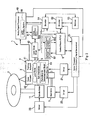
- Fig. 1 is a block diagram illustrating a circuit configuration (principal part) of an embodiment of an optical disc drive according to the present invention.
- the optical disc drive 1 as shown in Fig. 1 may record and/or reproduce data (information) to and/or from an optical disc 2 (for example, CD-R, CD-RW).
- an optical disc 2 for example, CD-R, CD-RW.
- a spiral pre-groove (WOBBLE) (not shown) is formed along a track in the optical disc 2.
- the spiral pre-groove is recorded with Absolute Time In Pre-groove (ATIP) information (time information), and meanders for a predetermined period (22.05 kHz as a reference speed) in a radial direction of the optical disc 2. More specifically, the ATIP information to be recorded is biphase modulated and frequency-modulated at a carrier frequency of 22.05 kHz.
- ADP Absolute Time In Pre-groove
- the pre-groove may function as a guide groove to form pits and/or lands (recording of pits and lands) for optical disc 2. Further, information recorded in the pre-groove may be utilized for controlling a rotational speed of the optical disc 2. Additionally, the information recorded may be reproduced and used to specify a recording position (absolute time) on the optical disc 2.
- the optical disc drive 1 has a rotation driving mechanism for rotating a turntable on which an optical disc 2 is loaded, the rotation driving mechanism has a spindle motor 11 for rotating the turntable, a driver 23 for driving the spindle motor 11, and the turntable (not shown) on which the optical disc 2 is provided.
- the optical disc drive 1 comprises an optical pick-up (optical head) 3 capable of moving in a radial direction of the optical disc 2 (a radial direction of a turntable with respect to the optical disc 2, which is loaded on the turntable); an optical pick-up moving mechanism for moving the optical pick-up 3 in the radial direction (two subject: disc and turntable; they should be unified); a control means (CPU) 9; an analog signal processor (ASP) 40; a laser diode driver 43; a servo processor (DSP) 51; a decoder 52; a memory 53 (e.g.
- RAM Random Access Memory
- encoder 54 an encoder 54; a voltage adjustment circuit 91; a digital/analog converter 92 for application; and an analog/digital converter 93 for detection.
- a voltage adjustment circuit 91 for application
- a digital/analog converter 92 for application
- an analog/digital converter 93 for detection.
- the optical pick-up moving mechanism comprises a sled motor 7, a driver 22 for driving the sled motor 7, and a power transmission mechanism (not shown).
- a rotational speed of the sled motor 7 can be decelerated and transmitted to the optical pick-up 3 by the power transmission mechanism, and the rotational movement of the sled motor 7 may be converted to the linear movement of the optical pick-up 3.
- the optical pick-up 3 further comprises an optical head body (optical pick-up base) (not shown) that may be equipped with a laser diode 5 for emitting a laser beam; a split photodiode 6; and a photodiode for detecting a laser beam 61, which receives the laser beam emitted from the laser diode 5 and converts the amount of received light to an electric current.
- the optical pick-up 3 comprises an objective lens (condenser) (not shown).
- the laser diode 5 is driven by means of a laser diode driver 43; and the drive of the laser diode driver 43 is controlled by means of the analog signal processor 40.
- the analog signal processor 40 has a laser control section 55 (laser control circuit) for controlling an output of the laser beam when recording or reproducing data to or from the optical disc 2.
- laser control section 55 laser control circuit
- the objective lens is supported by suspension springs (not shown in the drawings) provided on the optical pick-up base. Further, the objective lens is arranged so as to be movable with respect to the optical pick-up body in both a radial direction and an optical axis direction of the objective lens.
- the direction of the optical axis of the objective lens will be referred to simply as --- the optical axis direction ---, and the direction of the rotational axis of the optical disc 2 will be referred to simply as --- the rotational axis direction ---.
- the objective lens is initially set at a reference position (center point), which is predetermined on the optical pick-up body, i.e., a neutral position (hereinafter, referred to simply as --- the reference position ---).
- the optical pick-up 3 has an actuator 4 for moving the objective lens with respect to the optical pick-up base.
- the actuator 4 comprises a tracking actuator 41 for moving the objective lens in a radial direction with respect to the optical pick-up base, and a focus actuator 42 for moving the objective lens in the optical axis direction (rotational axis direction).
- the actuator 4, i.e., the tracking actuator 41 and the focus actuator 42 may be independently driven by the driver 21.
- the control means 9 usually includes a microcomputer (CPU).
- the control means 9 carries out overall control of the optical disc drive 1. Namely, the control means 9 controls the optical pick-up 3 (including the actuator 4, the laser diode 5, and so on), the sled motor 7, the spindle motor 11, the analog signal processor 40, a servo processor 51, a decoder 52, a memory 53, an encoder 54, the voltage adjustment circuit 91, the digital/analog converter 92, and the like.
- the voltage hold means comprises the control means 9, the voltage adjustment circuit 91, the digital/analog converter 92, and the analog/digital converter 93.
- the voltage hold means holds the voltage to be input to the laser diode driver 43 at a voltage equivalent to a record output level of the laser beam.
- the optical disc drive 1 may be removably connected to an external device (e.g., a computer) via an interface control section (not shown).
- an external device e.g., a computer
- the optical disc drive 1 When the optical disc drive 1 records data onto the optical disc, the data to be recorded is sequentially transferred from the external device to the memory 53 via the interface control section, and then sequentially stored in the memory 53. The data stored in the memory 53 is then sequentially recorded onto the optical disc.
- the optical disc drive 1 employs a system whereby the data recording operation can be suspended and then resumed at a record restart position on the optical disc in a consecutive manner.
- the voltage hold means holds the voltage to be input to the laser diode driver 43 immediately prior to suspension of a data recording operation.
- the structure of the part for controlling an output of the laser beam while the optical disc drive records data i.e., the structure of the laser diode 5, the photodiode for detecting a laser beam 61, the control means 9, the laser control section 55, the laser diode driver 43, the voltage adjustment circuit 91, the digital/analog converter 92, and the analog/digital converter 93 will be described.
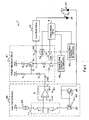
- Fig. 2 is a circuit diagram illustrating an example of the structure of the section for controlling an output of the laser beam during recording of data in an optical disc drive according to the present invention.
- the laser control section 55 controls an output of the laser beam during recording of data in the sections of the overall laser control section 55. (data is not recorded into these sections.)
- the laser control means 55 comprises a current mirror circuit 82 having two transistors Tr2 and Tr3, a current generator 83, an interlock switch 71 having two switches 711 and 712, and integration circuit 81 having an operational amplifier 811 and a condenser C1.
- the interlock switch 71 is constructed so that the switches 711 and 712 work in cooperation. When the switches 711 and 712 are closed together, the interlock switch 71 is turned ON. When the switches 711 and 712 are opened together, the interlock switch 71 is turned OFF.
- the photodiode for detecting a laser beam 61 and the interlock switch 71 are connected to the current mirror circuit 82.
- the reference voltage Vref having a predetermined level is applied to the non-inverting input terminal (+) of the operational amplifier 811 in the integration circuit 81; and the inverting input terminal (-) of the operational amplifier 81 is connected to the interlock switch 71.
- the inverting input terminal (-) of the operational amplifier 81 is also connected to one terminal of the condenser C1; and the other terminal of the condenser C1 is connected to the output terminal of the operational amplifier 811.
- the voltage adjustment circuit 91 comprises four resistance elements R1, R2, R3 and R4, a transistor Tr1, and a first switch for detection 72 and a second switch for detection 73.
- the transistor Tr1 is a PNP bipolar transistor having a base terminal B1, a collector terminal CL1and an emitter terminal E1.
- the voltage adjustment circuit 91 has a first input terminal 100 to which a voltage V1 output from the laser control section 55 is input, a second input terminal 110 to which an impressed voltage Vin is input, and an output terminal for outputting a voltage V3 to be input to the laser diode driver 43.
- the voltage adjustment circuit 91 has the transistor Tr1 between the first input terminal 100 and the output terminal 120, and the voltage adjustment circuit 91 also has the resistance element R4 between the second input terminal 110 and the output terminal 120.
- the base terminal B1 of the transistor Tr1 is connected to the first input terminal 100 via the resistance element R2, and the collector terminal CL1 of the transistor Tr1 is connected to the output terminal 120. Further, the second input terminal 110 is connected to the output terminal 120 via the resistance element R4.
- the first and second switches for detection 72 and 73 are configured so as to be opened independently.
- the control means 9 controls the open and/or close operation of these switches 72 and 73.
- the second input terminal 110 of the voltage adjustment circuit 91 is connected to the digital/analog converter 92 that is used for applying the impressed voltage Vin to the voltage adjustment circuit 91, and the output terminal 120 is connected to the analog/digital converter 93 that is used for detecting the voltage V3 to be input to the laser diode driver 43.
- analog/digital converter 93 is also connected to the second input terminal 110, and the analog/digital converter 93 is used for detecting the voltage V2 of the second input terminal 110.
- the control means 9 is connected to both the digital/analog converter 92 and the analog/digital converter 93.
- the control means 9 causes the output terminal 120 and the analog/digital converter 93 to be conducted by closing the first switch for detection 72 and opening the second switch for detection 73. Therefore, the control means 9 can detect the voltage V3 of the output terminal 120, i.e., the voltage to be input to the laser diode driver 43 via the analog/digital converter 93.
- control means 9 causes the second input terminal 110 and the analog/digital converter 93 to be conducted by opening the first switch for detection 72 and closing the second switch for detection 73. Therefore, the control means 9 can detect the voltage V2 of the second input terminal 110 via the analog/digital converter 93.
- control means 9 raises the voltage V2 of the second input terminal 110 from a predetermined voltage value (for example, 0 V) in a stepwise manner.
- a predetermined voltage value for example, 0 V
- the control means 9 detects that the voltage V2 of the second input terminal 110 becomes a voltage equal to the impressed voltage to be applied to the voltage adjustment circuit 91, the voltage V2 of the second input terminal 110 is holds at the voltage value of the impressed voltage Vin.
- the voltage adjustment circuit 91 is connected to the laser control section 55 and laser diode driver 43.
- the voltage adjustment circuit 91 adjusts the voltage V3 of the output terminal 120 based on the voltage value of the voltage V1 of the first input terminal 100, i.e., the voltage V1 that is output from the laser control section55.
- the laser diode driver 43 changes an output of the laser beam emitted from the laser diode 5 on the basis of the voltage V3 of the output terminal 120.
- the laser diode driver 43 causes the output of the laser beam to increase when the voltage V3 of the output terminal 120 increases, and the laser diode driver 43 causes the output of the laser beam to decrease when the voltage V3 of the output terminal 120 decreases.
- the laser diode driver 43 is connected to the section (not shown) of the laser control section 55.
- the laser diode driver 43 receives a voltage for setting an output of the laser beam to a current necessary to become the output power for recording, and a voltage for setting an output of the laser beam to a current necessary to become the output power for reproducing.
- the optical disc drive 1 moves the optical pick-up 3 to the target track (target address).
- the optical disc drive 1 records (writes on) and reproduces (reads out) information (data) to and from a predetermined track of the optical disc 2.
- the pre-groove that is formed on the optical disc 2 is reproduced (read out). Additionally, the data is recorded onto the optical disc 2 along the pre-groove.
- the data to be recorded onto the optical disc 2 is input to the optical disc drive 1 via an interface control section (not shown), the data is input to the encoder 54.
- the data is encoded in the encoder 54, and modulated (EFM modulation) in the modulation method called EFM (Eight to Fourteen Modulation) to form an ENCODE EFM signal.
- the ENCODE EFM signal is a signal formed from pulses. More specifically, each pulse has a predetermined length (period) of any one of 3T 11T.
- the ENCODE EFM signal is input from the encoder 54 to the laser diode driver 43.
- the control means 9 set a given value for the current generator 83.
- the integration circuit 81 is then charged by causing a current to flow that is derived by subtracting a current flowing from the current generator 83 to the current mirror circuit 82 from the output current Iref of the current generator 83.
- the WRITE POWER signal that is analog voltage signal is output.
- the Sampling signal that is generated in the encoder 54 based on the ENCODE EFM signal is input to the laser control section 55. Then, the laser control section 55 carries out sampling of the pit portions during writing in the laser control of recording system, and carries out sampling of the land portions during both reading and writing in the laser control of the reproducing system, thereby determining a current that flows to the laser diode 5, so that a value of the output of the laser diode 5 becomes a predetermined value.
- the laser control section 55 outputs the WRITE POWER signal when the ENCODE EFM signal is at a high level (H), and the laser control section 55 outputs the READ POWER signal when the ENCODE EFM signal is at a low level (L).
- a pit having a given length is formed (written) in the optical disc 2 when the level of the ENCODE EFM signal is high (H), while a land having a given length is formed (written) in the optical disc 2 when the level of the ENCODE EFM signal is low (L).
- Data is recorded from the inner side of the optical disc 2 to the outer side along the pre-groove in the optical disc 2.
- a predetermined ENCODE EFM signal (random EFM signal) is generated in addition to the ENCODE EFM signal mentioned above.
- the random EFM signal is used for output adjustment (power control) of the laser when trial writing in a test area is carried out under OPC (Optimum Power Control) procedure for determining an optimum laser output during recording of data.
- the OPC procedure will be described.
- a Lead-in Area having the ATIP specific information a PMA (Program Memory Area), and a PCA (Power Calibration Area) are arranged in this order from the outer side to the inner side in a program area to record data.
- the PMA is an area to write a start time and an end time of a track, and so on.
- the PCA is further divided into a Test Area for trial writing and a Count Area for recording the count number.
- optical disc drives for these optical discs are configured so that an optical laser output for recording can be changed, for example, within 15 levels in a stepwise manner, and an optimum laser output that is most suitable to an optical disc is selected from the 15 levels, and a recording operation of data to the optical disc is carried out based on the optimum laser output.
- the trial writing in a Test Area can be carried out.
- the random EFM signal is input to the laser diode driver 43 from the encoder 54.
- the control means 9 can change the level of a digital/analog converter (not shown) in the laser control section 55, into a plurality of levels by using serial communication.
- values of current in the plurality of levels can be generated, whereby WRITE POWER signals each having any one of a plurality of levels can be generated. Since the output current during writing is determined on the basis of the WRITE POWER signals, laser beams each having any one of a plurality of output power levels can be derived.
- the laser diode driver 43 Based on the EFM signal to be input to the laser diode driver 43, it is determined whether the current during writing will flow to the laser diode 5 or the GND (ground) terminal. This determination is carried out on the basis of the WRITE POWER signals, each of which may have any one of the plurality of levels.
- the trial writing to the test area is carried out with laser beams having any one of the plurality of output levels (i.e., with the output of the laser beam being changed in a stepwise manner).
- Such trial writing may be carried out a number of times (e.g., 100 times).
- a flag indicating one trial writing is established in the Count Area with each trial writing.
- ⁇ as the amount of displacement between the centers of the waveforms of the signal with a period corresponding to 3T and the signal with a period corresponding to 11T in the random EFM signals, it is determined that an optimum laser output is the laser output of the laser beam corresponding to ⁇ that is the closest to the predetermined value ⁇ 0 (e.g., four percent) within a plurality of ⁇ values corresponding to the WRITE POWER signals each having any one of the plurality of levels.
- control means 9 detects a voltage value of the output terminal 120 in response to an output of the laser beam at each level when carrying out trial writing, with the outputs of the laser beams having the plurality of levels. The control means 9 then stores the voltage value in the memory 53.
- the voltage value of the output terminal 120 corresponding to the optimum laser output in all detected voltage values of the output terminal 120 is applied to the second input terminal 110 in the voltage adjustment circuit 91.
- the voltage of the output terminal 120 in the voltage adjustment circuit 91 becomes equal to the impressed voltage Vin applied to the second input terminal 110.
- the voltage V3 of the output terminal 120 is held during recording to a voltage corresponding to the optimum laser output for recording in all detected voltage values of the output terminal 120 by the control means 9.
- the voltage V3 of the output terminal 120 is held to a voltage corresponding to the optimum laser output for recording before data is actually recorded to the program area.
- the data can be recorded from a given position, e.g., an initial record start position or a record restart position, at an optimum laser output.
- the laser beam is emitted to a given track of the optical disc 2 from the laser diode 5 in the optical pick-up 3.
- the laser beam is reflected on the optical disc 2, and the reflected beam is received by means of the split photodiode 6 in the optical pick-up 3.
- the current in response to the amount of received light is output from the split photodiode 6. This current is then converted with an I-V amplifier (not shown) into the voltage to be output from the optical pick-up 3.
- the voltage output from the optical pick-up 3 (a detection signal) is input to the analog signal processor 40.
- An HF (RF) signal is generated by carrying out predetermined operations such as addition, amplification, and so on with the analog signal processor 40.
- the HF signal is an analog signal corresponding to pits and lands written onto the optical disc 2.
- the HF signal is input to the servo processor 51.
- the HF signal is digitized, and also EFM demodulated (Eight to Fourteen Modulation). As a result, an EFM signal may be obtained.
- the EFM signal is converted (decoded) into a predetermined form of data (DATA signal) in the servo processor 51, and then input to the decoder 52.
- the data is decoded to a predetermined form for communication (transmission) in the decoder 52, and transmitted to the external device (e.g., computer) via the interface control section.
- the external device e.g., computer
- Tracking control, sled control, focus control, and rotation number control (rotational speed control) in the reproducing operation, which are mentioned above, are carried out as follows.
- the voltage signal into which the current signal from the split photodiode 6 in the optical pick-up 3 is converted, is input to the analog signal processor 40.
- the analog signal processor 40 generates the tracking error (TE) signal (voltage signal) based on the current-voltage converted signal from the split photodiode 6.
- TE tracking error
- the tracking error signal is a signal that represents an amount of displacement of the objective lens in a radial direction from the center of the track (i.e., an amount of displacement of the objective lens in a radial direction from the center of the track) and the direction thereof.
- the tracking error signal is input to the servo processor 51.
- the tracking error signal may undergo predetermined signal processing, such as, for example inversion of phase, amplification and the like. Therefore, the tracking servo signal (voltage signal) is generated.
- a given drive voltage is applied to the tracking actuator 41 via the driver 21 as a result of the tracking servo signal.
- the objective lens moves toward the center of the track by driving the tracking actuator 41. Namely, the tracking servo is engaged.
- the objective lens may be controlled so as to be returned to the reference position (carry out the sled control) by moving, under the drive of the sled motor 7 via the driver 22, the optical pick-up base toward the direction equal to the mobile direction of the objective lens.
- the analog signal processor 40 generates a focusing error (FE) signal (voltage signal) based on the current-voltage converted signal from the split photodiode 6.
- FE focusing error
- the focus error signal is a signal that represents an amount of the displacement of the objective lens in the optical axis direction (rotational axis direction) from a focus position (i.e., the amount of the displacement of the objective lens from the focus position in the optical axis direction (rotational axis direction)).
- the focus error signal is input to the servo processor 51.
- the focus error signal may undergo predetermined signal processing, such as, for example, inversion of phase, amplification, and the like.
- a focus servo signal (voltage signal) is generated.
- the given driving voltage is applied to the focus actuator 42 via the driver 21 based on the focus servo signal.
- the objective lens moves toward the focus position by driving the focus actuator 42. Namely, the focus servo is engaged.
- the control signal (voltage signal) to control the rotation number (rotational speed) of the spindle motor 11, i.e., the control signal to set to a target value the rotation number of the spindle motor 11, is generated. Then the control signal is input to the driver 23.
- the driving signal (voltage signal) to drive the spindle motor 11 based on the control signal is generated in the driver 23.
- the driving signal output from the driver 23 is input to the spindle motor 11.
- the spindle motor 11 is then driven based on the driving signal. Further, the spindle servo is engaged so that the rotation number of the spindle motor 11 becomes equal to a target value.
- Fig. 3 shows a flow of an electric current in the circuit shown in Fig. 2 when an output of a laser beam becomes a predetermined laser output level.
- Fig. 4 is a timing chart illustrating a WRITE POWER signal and an output of a laser beam that is increasing from a reproduction level to a record level.
- the optical disc 2 is rotated at a predetermined rotational speed, and the laser diode 5 is driven such that an output of the laser beam of the laser diode 5 is that used during reproduction by means of the reproducing circuit (not shown) in the laser diode driver 43.
- the voltage V3 of the output terminal 120 is automatically adjusted by the voltage adjustment circuit 91.
- the output of the laser beam can be kept constant at an optimum level for recording during the recording of data to the optical disc 2.
- the optical disc drive 1 can handle an increase in temperature (temperature change) of the laser diode 5.
- a data recording operation can be started when an output of a laser beam becomes an optimum laser output for recording.
- the optical disc drive 1 when recording data onto an optical disc 2, the optical disc drive 1 can resume from a consecutive position i.e., record restart position after suspension of the data recording operation without overwriting. Therefore, in the optical disc drive having a buffer underrun error proof (BURN-Proof) function, a data recording operation can be suspended and then resumed so that the data is consecutively written onto the optical disc with an optimum output level for recording.
- BURN-Proof buffer underrun error proof
- the optical disc drive 1 holds the voltage value to make it an optimum laser output for recording. Therefore, when data is actually recorded to the program area, the output of the laser beam can be set to the optimum laser output for recording from an initial record start position.
- the optical disc drive 1 can handle an increase in temperature (temperature change) of the laser diode 5.
- the optical disc drive of the present invention is not limited to the device capable of recording and/or reproducing data to and/or from an optical disc.
- the present invention can be applied to record only optical disc drives.
- optical disc drive of the present invention may also be applied to other various optical disc drives for recording and/or reproducing to and/or from various types of optical disc.
- the voltage of the node to be held (the section for determining the output of the laser beam) is detected during trial writing operation, but the present invention is not limited to such an operation.
- the voltage of the node to be held may be detected when data is actually being recorded to the program area, e.g., at the start of record.
- the voltage equal to the voltage detected at the output terminal (the voltage to be input to a driver circuit) is applied to the second input terminal, but the present invention is not limited to thereof.
- the voltage less than the voltage detected at the output terminal may be applied to the second input terminal.
- the voltage of the output terminal can be automatically caused to drop less than the detected voltage value of the output terminal, and the output of the laser beam can be kept constant at an optimum level for recording during the recording of data to the optical disc.
- the optical disc drive of the present invention utilizes a laser diode driver (driver circuit), which is configured so as to increase an output of a laser beam if a voltage of an output terminal (a voltage to be input to the driver circuit) increases, and to decrease the output of the laser beam if the voltage of the output terminal drops.
- a laser diode driver which is configured so as to increase an output of a laser beam if a voltage of an output terminal drops, and to decrease the output of the laser beam if the voltage of the output terminal increases.
Landscapes
- Physics & Mathematics (AREA)
- Optics & Photonics (AREA)
- Engineering & Computer Science (AREA)
- Multimedia (AREA)
- Signal Processing (AREA)
- Optical Head (AREA)
- Optical Recording Or Reproduction (AREA)
Applications Claiming Priority (2)
| Application Number | Priority Date | Filing Date | Title |
|---|---|---|---|
| JP2001239601A JP2003051117A (ja) | 2001-08-07 | 2001-08-07 | 光ディスク装置 |
| JP2001239601 | 2001-08-07 |
Publications (2)
| Publication Number | Publication Date |
|---|---|
| EP1288921A2 true EP1288921A2 (de) | 2003-03-05 |
| EP1288921A3 EP1288921A3 (de) | 2004-06-30 |
Family
ID=19070326
Family Applications (1)
| Application Number | Title | Priority Date | Filing Date |
|---|---|---|---|
| EP02017713A Withdrawn EP1288921A3 (de) | 2001-08-07 | 2002-08-07 | Optisches Plattenlaufwerk |
Country Status (3)
| Country | Link |
|---|---|
| US (1) | US20030031105A1 (de) |
| EP (1) | EP1288921A3 (de) |
| JP (1) | JP2003051117A (de) |
Cited By (1)
| Publication number | Priority date | Publication date | Assignee | Title |
|---|---|---|---|---|
| CN100419880C (zh) * | 2004-11-02 | 2008-09-17 | 联发科技股份有限公司 | 一种光学储存装置及相关的激光驱动信号处理电路 |
Families Citing this family (3)
| Publication number | Priority date | Publication date | Assignee | Title |
|---|---|---|---|---|
| US20060187769A1 (en) * | 2003-03-12 | 2006-08-24 | Koninklijke Philips Electronics N.V. | Code-adaptive magneto-optical write strategy |
| JP2005251334A (ja) * | 2004-03-05 | 2005-09-15 | Yamaha Corp | 光ディスク記録装置及びプログラム |
| US7414929B2 (en) * | 2004-09-22 | 2008-08-19 | Lsi Corporation | Optical disc tilt detection and tilt servo control method |
Family Cites Families (8)
| Publication number | Priority date | Publication date | Assignee | Title |
|---|---|---|---|---|
| JPS56153488A (en) * | 1980-04-28 | 1981-11-27 | Mitsubishi Electric Corp | Recording device |
| EP0289004B1 (de) * | 1987-04-28 | 1994-03-23 | Sharp Kabushiki Kaisha | Aufzeichnungs- und Wiedergabegerät |
| US5184341A (en) * | 1989-03-03 | 1993-02-02 | Matsushita Electric Industrial Co., Ltd. | Information recording method having successive data write and data verify operations |
| JPH04229425A (ja) * | 1990-12-27 | 1992-08-18 | Sony Corp | オートパワーコントロール回路 |
| JP2827855B2 (ja) * | 1993-11-12 | 1998-11-25 | ヤマハ株式会社 | 光ディスク記録装置 |
| US5640381A (en) * | 1996-03-08 | 1997-06-17 | International Business Machines Corporation | Laser power-drive circuit having a scaling DAC supplying a scaled reference signal to a plurality of scaled DAC's that supply a plurality of scaled output signals |
| JP2001155341A (ja) * | 1999-11-24 | 2001-06-08 | Sanyo Electric Co Ltd | ディスク記録装置 |
| JP2001283439A (ja) * | 2000-03-31 | 2001-10-12 | Sanyo Electric Co Ltd | 光ディスク記録装置の光学ヘッド発光出力設定方法 |
-
2001
- 2001-08-07 JP JP2001239601A patent/JP2003051117A/ja active Pending
-
2002
- 2002-08-07 EP EP02017713A patent/EP1288921A3/de not_active Withdrawn
- 2002-08-07 US US10/213,712 patent/US20030031105A1/en not_active Abandoned
Cited By (1)
| Publication number | Priority date | Publication date | Assignee | Title |
|---|---|---|---|---|
| CN100419880C (zh) * | 2004-11-02 | 2008-09-17 | 联发科技股份有限公司 | 一种光学储存装置及相关的激光驱动信号处理电路 |
Also Published As
| Publication number | Publication date |
|---|---|
| US20030031105A1 (en) | 2003-02-13 |
| EP1288921A3 (de) | 2004-06-30 |
| JP2003051117A (ja) | 2003-02-21 |
Similar Documents
| Publication | Publication Date | Title |
|---|---|---|
| US7215617B2 (en) | Optical disc drive for erasing the power calibration area of an optical disc | |
| US7035185B2 (en) | Optical information recording apparatus, information processing apparatus, optical information recording medium, optical information recording method, and computer-readable storage medium | |
| EP1288921A2 (de) | Optisches Plattenlaufwerk | |
| US5126741A (en) | Reproduction apparatus having circuit for accurately detecting a binary waveform from a varying level analog signal | |
| US5128920A (en) | Optical disk apparatus with a laser beam controllable in accordance with a specification area on a disk | |
| US20030031104A1 (en) | Optical disc drive | |
| US7362670B2 (en) | Optical disc drive | |
| US6414926B1 (en) | Optical disc drive | |
| US20040120235A1 (en) | Recording/reproducing apparatus and method for laser power control during CAV recording | |
| JPH09198660A (ja) | 光ディスク装置 | |
| US7440376B2 (en) | Operation condition setting system | |
| JP4140418B2 (ja) | 光ディスク装置 | |
| JP2003331426A (ja) | 光ディスク装置 | |
| KR100726565B1 (ko) | 광디스크 기록 및 재생 장치의 최적 기록 전압 설정 방법 | |
| JPH11259871A (ja) | 光ディスクドライブの欠陥補償装置及び方法 | |
| JP2002109780A (ja) | 光学ヘッド検査装置 | |
| JP2002150558A (ja) | 光ディスク装置 | |
| KR20070064826A (ko) | 광디스크의 기록 전압 조정 방법 | |
| KR20040019644A (ko) | 광디스크 매체 및 이의 목표트랙 억세스방법 | |
| JP2002367209A (ja) | 光ディスク装置 | |
| JP2005203030A (ja) | 光ディスク装置 | |
| KR20070064827A (ko) | 광디스크의 기록 전압 설정 방법 | |
| JPH08138256A (ja) | 光ディスク装置 | |
| JP2002288834A (ja) | 光ディスク装置 | |
| JPH11176006A (ja) | レーザ制御装置及びこれを有する光ディスク装置 |
Legal Events
| Date | Code | Title | Description |
|---|---|---|---|
| PUAI | Public reference made under article 153(3) epc to a published international application that has entered the european phase |
Free format text: ORIGINAL CODE: 0009012 |
|
| AK | Designated contracting states |
Kind code of ref document: A2 Designated state(s): AT BE BG CH CY CZ DE DK EE ES FI FR GB GR IE IT LI LU MC NL PT SE SK TR Designated state(s): AT BE BG CH CY CZ DE DK EE ES FI FR GB GR IE IT LI LU MC NL PT SE SK TR |
|
| AX | Request for extension of the european patent |
Extension state: AL LT LV MK RO SI |
|
| RAP1 | Party data changed (applicant data changed or rights of an application transferred) |
Owner name: MITSUMI ELECTRIC CO., LTD. |
|
| PUAL | Search report despatched |
Free format text: ORIGINAL CODE: 0009013 |
|
| AK | Designated contracting states |
Kind code of ref document: A3 Designated state(s): AT BE BG CH CY CZ DE DK EE ES FI FR GB GR IE IT LI LU MC NL PT SE SK TR |
|
| AX | Request for extension of the european patent |
Extension state: AL LT LV MK RO SI |
|
| RIC1 | Information provided on ipc code assigned before grant |
Ipc: 7G 11B 7/125 B Ipc: 7G 11B 7/00 B Ipc: 7G 11B 7/0045 A |
|
| AKX | Designation fees paid | ||
| REG | Reference to a national code |
Ref country code: DE Ref legal event code: 8566 |
|
| STAA | Information on the status of an ep patent application or granted ep patent |
Free format text: STATUS: THE APPLICATION IS DEEMED TO BE WITHDRAWN |
|
| 18D | Application deemed to be withdrawn |
Effective date: 20050503 |