EP1293220B1 - Céramique poreuse à base de phosphate de calcium pour utilisations in vivo - Google Patents
Céramique poreuse à base de phosphate de calcium pour utilisations in vivo Download PDFInfo
- Publication number
- EP1293220B1 EP1293220B1 EP02020423A EP02020423A EP1293220B1 EP 1293220 B1 EP1293220 B1 EP 1293220B1 EP 02020423 A EP02020423 A EP 02020423A EP 02020423 A EP02020423 A EP 02020423A EP 1293220 B1 EP1293220 B1 EP 1293220B1
- Authority
- EP
- European Patent Office
- Prior art keywords
- pores
- cells
- ceramics
- calcium phosphate
- less
- Prior art date
- Legal status (The legal status is an assumption and is not a legal conclusion. Google has not performed a legal analysis and makes no representation as to the accuracy of the status listed.)
- Expired - Lifetime
Links
- 238000001727 in vivo Methods 0.000 title claims description 20
- 239000004068 calcium phosphate ceramic Substances 0.000 title 1
- 239000011148 porous material Substances 0.000 claims description 74
- 239000000919 ceramic Substances 0.000 claims description 28
- 230000035699 permeability Effects 0.000 claims description 25
- 239000001506 calcium phosphate Substances 0.000 claims description 22
- QORWJWZARLRLPR-UHFFFAOYSA-H tricalcium bis(phosphate) Chemical compound [Ca+2].[Ca+2].[Ca+2].[O-]P([O-])([O-])=O.[O-]P([O-])([O-])=O QORWJWZARLRLPR-UHFFFAOYSA-H 0.000 claims description 22
- 229910000389 calcium phosphate Inorganic materials 0.000 claims description 20
- 235000011010 calcium phosphates Nutrition 0.000 claims description 20
- 210000004027 cell Anatomy 0.000 description 46
- 230000000052 comparative effect Effects 0.000 description 10
- 238000000034 method Methods 0.000 description 10
- 239000002002 slurry Substances 0.000 description 9
- 210000000988 bone and bone Anatomy 0.000 description 8
- 238000002474 experimental method Methods 0.000 description 6
- 229910052588 hydroxylapatite Inorganic materials 0.000 description 5
- XYJRXVWERLGGKC-UHFFFAOYSA-D pentacalcium;hydroxide;triphosphate Chemical compound [OH-].[Ca+2].[Ca+2].[Ca+2].[Ca+2].[Ca+2].[O-]P([O-])([O-])=O.[O-]P([O-])([O-])=O.[O-]P([O-])([O-])=O XYJRXVWERLGGKC-UHFFFAOYSA-D 0.000 description 5
- 238000003756 stirring Methods 0.000 description 4
- 230000015572 biosynthetic process Effects 0.000 description 3
- 150000001875 compounds Chemical class 0.000 description 3
- 238000005187 foaming Methods 0.000 description 3
- 238000004519 manufacturing process Methods 0.000 description 3
- 239000000203 mixture Substances 0.000 description 3
- 239000002994 raw material Substances 0.000 description 3
- 210000001519 tissue Anatomy 0.000 description 3
- 241000283973 Oryctolagus cuniculus Species 0.000 description 2
- 239000011324 bead Substances 0.000 description 2
- 229910010293 ceramic material Inorganic materials 0.000 description 2
- 238000004891 communication Methods 0.000 description 2
- 238000004132 cross linking Methods 0.000 description 2
- 230000009931 harmful effect Effects 0.000 description 2
- 239000000463 material Substances 0.000 description 2
- 238000005259 measurement Methods 0.000 description 2
- QSHDDOUJBYECFT-UHFFFAOYSA-N mercury Chemical compound [Hg] QSHDDOUJBYECFT-UHFFFAOYSA-N 0.000 description 2
- 229910052753 mercury Inorganic materials 0.000 description 2
- 235000015097 nutrients Nutrition 0.000 description 2
- 230000008520 organization Effects 0.000 description 2
- 238000011084 recovery Methods 0.000 description 2
- 238000002834 transmittance Methods 0.000 description 2
- 229910000391 tricalcium phosphate Inorganic materials 0.000 description 2
- 235000019731 tricalcium phosphate Nutrition 0.000 description 2
- 229940078499 tricalcium phosphate Drugs 0.000 description 2
- 210000000689 upper leg Anatomy 0.000 description 2
- XLYOFNOQVPJJNP-UHFFFAOYSA-N water Substances O XLYOFNOQVPJJNP-UHFFFAOYSA-N 0.000 description 2
- BVKZGUZCCUSVTD-UHFFFAOYSA-L Carbonate Chemical compound [O-]C([O-])=O BVKZGUZCCUSVTD-UHFFFAOYSA-L 0.000 description 1
- 239000004593 Epoxy Substances 0.000 description 1
- JOYRKODLDBILNP-UHFFFAOYSA-N Ethyl urethane Chemical compound CCOC(N)=O JOYRKODLDBILNP-UHFFFAOYSA-N 0.000 description 1
- 239000011149 active material Substances 0.000 description 1
- 229910052586 apatite Inorganic materials 0.000 description 1
- 238000001354 calcination Methods 0.000 description 1
- -1 calcium phosphate compound Chemical class 0.000 description 1
- 238000004113 cell culture Methods 0.000 description 1
- 239000003431 cross linking reagent Substances 0.000 description 1
- 230000001186 cumulative effect Effects 0.000 description 1
- 230000003247 decreasing effect Effects 0.000 description 1
- 230000007547 defect Effects 0.000 description 1
- 239000002612 dispersion medium Substances 0.000 description 1
- 238000001035 drying Methods 0.000 description 1
- 239000000945 filler Substances 0.000 description 1
- 239000012530 fluid Substances 0.000 description 1
- 239000006260 foam Substances 0.000 description 1
- 238000000227 grinding Methods 0.000 description 1
- 210000005260 human cell Anatomy 0.000 description 1
- 230000006872 improvement Effects 0.000 description 1
- 230000001939 inductive effect Effects 0.000 description 1
- 238000005342 ion exchange Methods 0.000 description 1
- 239000007788 liquid Substances 0.000 description 1
- 239000002736 nonionic surfactant Substances 0.000 description 1
- 239000011368 organic material Substances 0.000 description 1
- 230000002642 osteogeneic effect Effects 0.000 description 1
- 239000002245 particle Substances 0.000 description 1
- VSIIXMUUUJUKCM-UHFFFAOYSA-D pentacalcium;fluoride;triphosphate Chemical compound [F-].[Ca+2].[Ca+2].[Ca+2].[Ca+2].[Ca+2].[O-]P([O-])([O-])=O.[O-]P([O-])([O-])=O.[O-]P([O-])([O-])=O VSIIXMUUUJUKCM-UHFFFAOYSA-D 0.000 description 1
- 230000002093 peripheral effect Effects 0.000 description 1
- 238000006116 polymerization reaction Methods 0.000 description 1
- 239000011347 resin Substances 0.000 description 1
- 229920005989 resin Polymers 0.000 description 1
- 238000005245 sintering Methods 0.000 description 1
- 239000004094 surface-active agent Substances 0.000 description 1
- 239000011800 void material Substances 0.000 description 1
Images
Classifications
-
- A—HUMAN NECESSITIES
- A61—MEDICAL OR VETERINARY SCIENCE; HYGIENE
- A61L—METHODS OR APPARATUS FOR STERILISING MATERIALS OR OBJECTS IN GENERAL; DISINFECTION, STERILISATION OR DEODORISATION OF AIR; CHEMICAL ASPECTS OF BANDAGES, DRESSINGS, ABSORBENT PADS OR SURGICAL ARTICLES; MATERIALS FOR BANDAGES, DRESSINGS, ABSORBENT PADS OR SURGICAL ARTICLES
- A61L27/00—Materials for grafts or prostheses or for coating grafts or prostheses
- A61L27/02—Inorganic materials
- A61L27/10—Ceramics or glasses
-
- A—HUMAN NECESSITIES
- A61—MEDICAL OR VETERINARY SCIENCE; HYGIENE
- A61L—METHODS OR APPARATUS FOR STERILISING MATERIALS OR OBJECTS IN GENERAL; DISINFECTION, STERILISATION OR DEODORISATION OF AIR; CHEMICAL ASPECTS OF BANDAGES, DRESSINGS, ABSORBENT PADS OR SURGICAL ARTICLES; MATERIALS FOR BANDAGES, DRESSINGS, ABSORBENT PADS OR SURGICAL ARTICLES
- A61L27/00—Materials for grafts or prostheses or for coating grafts or prostheses
- A61L27/50—Materials characterised by their function or physical properties, e.g. injectable or lubricating compositions, shape-memory materials, surface modified materials
- A61L27/56—Porous materials, e.g. foams or sponges
-
- A—HUMAN NECESSITIES
- A61—MEDICAL OR VETERINARY SCIENCE; HYGIENE
- A61L—METHODS OR APPARATUS FOR STERILISING MATERIALS OR OBJECTS IN GENERAL; DISINFECTION, STERILISATION OR DEODORISATION OF AIR; CHEMICAL ASPECTS OF BANDAGES, DRESSINGS, ABSORBENT PADS OR SURGICAL ARTICLES; MATERIALS FOR BANDAGES, DRESSINGS, ABSORBENT PADS OR SURGICAL ARTICLES
- A61L27/00—Materials for grafts or prostheses or for coating grafts or prostheses
- A61L27/02—Inorganic materials
- A61L27/12—Phosphorus-containing materials, e.g. apatite
Definitions
- the present invention relates to a porous calcium phosphate type ceramics, and, particularly, to a ceramics for in vivo use such as artificial bones, fillers for bones and cell culture supports, which is suitable for the purpose intended to fix and support cells and to allow these cells to grow and to be cultured.
- a calcium phosphate type ceramics has no harmful action on a living body and a tendency to replace for natural bones. It is therefore a preferable material as artificial bones.
- a current calcium phosphate type ceramics used for artificial bones has large strength but involves a difficulty in fixing cells in the case where it is produced as a densified body. Also, when it is produced as a porous body, it allows cells to enter it, but it has less strength and therefore tends to be handled with difficulty.
- US 4,654,314 discloses a porous ceramic material composed of a sintered porous body of a calcium phosphate compound, wherein a multiplicity of capillary void paths having a diameter of 1-30 ⁇ m and a multiplicity of pores having a diameter of 1-600 ⁇ m are formed. The pores are at least partially connected to the exterior space of the sintered body through at least a part of the capillary voids.
- the ceramic material is suitable for inducing new-born bone, controlling resorption of bone with age and remedying bond defects.
- DE-A1-100 18 394 discloses a porous calcium phosphate sintered body comprising spherical pores having a diameter of 150 ⁇ m or more, which are interconnected with each other through communicating portions having a diameter of 50 ⁇ m or more.
- the porosity of the sintered body is 55-90 %.
- the present invention is preferably used in such an application method and provides a ceramics for in vivo use which allows cells to intrude thereinto easily and to be fixed easily, with the result that an early recovery and the like are expected.
- the raw material of the calcium phosphate type meant in the present invention is preferably, although not particularly limited to, any one of hydroxyapatite, apatite carbonate and tricalcium phosphate or mixtures of two or more of these compounds or those containing one or more of these compounds as main component.
- the tricalcium phosphate is preferably those having a ⁇ -phase in view of strength.
- a calcium phosphate type porous ceramics for in vivo use comprising pores (1), (1a) having an almost globular form, which are contacted and communicated with each other so that the ceramics has a permeability of 1.48 x 10 -8 to 78.96 x 10 -8 m 2 (150-8,000 centidarcy), measured according to ASTM C577-68, and the ceramics further complies with either one or both of the following two requirements:
- a calcium phosphate type porous ceramics as defined above is preferred, wherein both requirements (i) and (ii) are fulfilled.
- the permeability which can be measured relatively simply using a method which has been surely established and indicates the penetrability of gas is designed to fall in a specified range and/or each proportion of the pores having a pore diameter or communicating pore diameter falling in a specified range in all pores is designed to fall in a specified range, thereby making the ceramics suitable to the intrusion of cells such as osteogenetic cells into a material for in vivo use and making it easy to fix the intruded cells.
- this ceramics for in vivo use comprises a calcium phosphate type porous sintered body, has no harmful action on a living body and has relatively high strength even if it is porous.
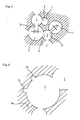
- the ceramics has a good many of almost globular pores 1, in which these pores 1 are in contact among them to form a communicating portions (holes) 2.
- the permeability (transmittance) is designed to be 1.48 ⁇ 10 -8 m 2 or more and 78.96 ⁇ 10 -8 m 2 or less (150 centidarcy or more and 8000 centidarcy or less) by setting the hole diameter D 2 of the communicating portion (hole) 2, by selecting the number of the communicating portions.
- the permeability is preferably 5.92-10 -8 m 2 (600 centidarcy) or more and 49.35 ⁇ 10 -8 m 2 (5000 centidarcy) or less and particularly preferably 9.87 ⁇ 10 -8 m 2 (1000 centidarcy) or more and 19.74 ⁇ 10 -8 m 2 (2000 centidarcy)or less.
- the pore ratio is preferably 50% or more and 90% or less and particularly preferably 65% or more and 85% or less.
- the ceramics have a proper amount of pores and moderate permeability (excessive flow is rather undesirable) to allow cells to be intruded and fixed.
- a human cell is around 10 ⁇ m in size and therefore the pore 1 provided with the communicating hole 2 having a size of 5 ⁇ m does not contribute to the fixation of the cell.
- the communicating hole 2 has a size of about 8 ⁇ m, the cells can somehow intrude into the ceramics. Although the intrusion is not easily done, the cells which intruded into the pores 1 through communication holes 2 having a diameter of as small as 8 micron ( ⁇ m) or more and 20 micron ( ⁇ m) or less tend to stay relatively longer than those which intruded into the pores 1 through communication holes 2 having a diameter of 20 micron ( ⁇ m) or more.
- the inside face (inner wall surface) of the pores is formed of calcium phosphate type sintered body to which cells find easy to attach. Therefore, cells are able to stay therein for a long time such that the attachment of such cells to the inside face of the pores is prompted such that the fixation thereof within the pores tend to result.
- the cell strongly tends to be fixed easily. Therefore, if the range of the diameter D 2 of the communicating hole is designed to be around 10 ⁇ m, this is very advantageous in the fixation of the cells.
- the communicating hole 2 less than 8 ⁇ m in size has a particular difficulty in the intrusion of the cells whereas if the size of the communicating hole 2 exceeds 20 ⁇ m, the cells once intruded into the pore 1 tend to flow out again. Therefore, an appropriate control during the manufacturing process such that the pores have preferable dimensions will increase the efficiency of the cell fixation therewithin.
- the proportion of the volume of the pores 1 communicated with a communicating hole diameter D 2 of 8 ⁇ m or more and 20 ⁇ m or less in size be 2% or more and 18% or less of the whole pore volume in terms of cumulative volume percentage (requirement (i)).
- the proportion of the hole 1 to which the cells are firmly fixed becomes too small and therefore the holes cannot contribute to the fixation of the cells
- the proportion exceeds 18% the proportion of the holes 1 into which the cells can be intruded with difficulty becomes too large (this implies that almost all the pores are associated with communicating holes having a hole diameter of 8 ⁇ m or more and 20 ⁇ m or less which is a diameter of a hole into which the cells can be inherently scarcely intruded), so that the intrusion of the cells requires more time
- the proportion exceeds 18% the quantity (proportion) of the pore 1 having a large communicating hole 2 is decreased with the result that a fluid containing nutrients and the like cannot be extended all over the whole of the calcium phosphate type sintered body.
- a preferable range of the proportion is 3% or more and 15% or less.
- the cells are easily intruded into the whole of the ceramics for in vivo use and also the cells once intruded are firmly fixed.
- the ceramics for in vivo use according to the present invention is desirably an aggregate of a large number of (many) pores 1 each having a relatively uniform size and is also desirably an aggregate of the pores 1 each having a shape close to a globular form, wherein adjacent pores 1 are communicated with each other in such a manner as to allow the whole body to have permeability.
- the pore having an almost globular form contributes to an improvement in strength.
- a method of the production of such a porous body are a method in which flammable globular beads and the like are added to a calcium phosphate type rawmaterial, which is then molded under pressure and the beads are burned out during sintering and a method in which a slurry containing a calcium phosphate type raw material is made and is then stirred with controlling the viscosity of the slurry and air cells are introduced into the slurry, which is then sintered while keeping the foaming state.
- the latter method is preferable because the permeability is easily controllable.
- the pore having a communicating hole diameter D 2 of 8 ⁇ m or more and 20 ⁇ m or less which is a diameter of a pore in which cells are easily fixed are obtained as a globular one and the latter method is therefore preferable also in this point.
- the ceramics for in vivo use has a structure in which globular pores 1a each having its own diameter of 8 ⁇ m or more and 15 ⁇ m or less exist and the volume of these pores is 0.5% or more and 15% or less of the volume of the whole pores (requirement (ii)).
- small pores 1a are formed cavity-wise on the inner surface of a relatively large pore 1 and each own diameter of these small pores 1a is 8 ⁇ m or more and 15 ⁇ m or less which is close to the size of a cell.
- the size of the inlet of each pore 1a may be either slightly narrow or the same as the pore diameter of the pore 1a.
- a cell is tightly fitted in the pore 1a and easily stabilized. Also, the pore 1a faces the large pore 1. This is convenient to take in nutrients and the like. To say in other words, (plural) small pores 1a are arranged small-cavity-wise on the inside peripheral surface of each of the large pores 1 and the diameter of the pore 1a is set to 8 ⁇ m or more and 15 ⁇ m or less.
- the permeability is designed to be (1.48 ⁇ 10 -8 m 2 (150 centidarcy) or more and 78.96 ⁇ 10 -8 m 2 (8000 centidarcy)or less. This ensures that cells are easily intruded into the whole of the ceramics for in vivo use and the cells once intruded are firmly fixed.
- the present invention is not limited to the aforementioned embodiments.
- the ceramics of the present invention may be either combined with other dense members or may contain active materials in the surface of the pore or the calcium phosphate type ceramics itself.
- a hydroxyapatite powder having an average particle diameter of 1 ⁇ m or less, ion exchange water which was a dispersion medium and polyethylenimide which was a cross linking polymerizable organic material were compounded in a ratio by weight of 10:8:1 and these components were mixed for 10 hours using a ball mill to prepare a slurry.
- a nonionic surfactant was added to this slurry, which was then mechanically stirred to incorporate air cells into the slurry.
- the intensity and speed of the stirring and the amount of the surfactant to be added at this time were varied to prepare different six slurries.
- the resulting calcined body was divided into plural products, which were then molded and thereafter washed.
- Each resulting member in vivo use was measured by a mercury porosimeter to find the condition of pores and also the permeability of each member was measured according to ASTM C577-68.
- each member was embedded in the femur of a rabbit and taken out after two weeks and six weeks respectively to observe the state of cells.
- permeability was 1.48 ⁇ 10 -8 m 2 (150 centidarcy) or more, particularly 1.87 ⁇ 10 -8 m 2 (190 centidarcy) or more, cells were intruded effectively.
- members for in vivo use which had a permeability exceeding 78.96 ⁇ 10 -8 m 2 (8000 centidarcy), particularly, 98.7 ⁇ 10 -8 m 2 (10000 centidarcy) were broken before and after the experiment. Although it was thought that cells are easily intruded, the members were not practical.
- each member was embedded in the femur of a rabbit and taken out after two weeks and six weeks respectively to observe the state of cells.
- the quantities of fixed cells obtained after two weeks and six weeks were each one-half of those of the member of the present invention.
- the proportion of pores having a pore diameter of 8 ⁇ m or more and 20 ⁇ m or less to all pores was 30% or more in the case of the member of A company and 20% or more in the case of the member of B company.
- each permeability, proportion of the volume of pores and result of the experiment (observation) are shown in the following Table 1.
- Table 1 RESULT OF EXPERIMENT Permeability (10 -8 m 2 (centidarcy)), 1 atm, 25°C N 2 gas Proportion of the volume of pores having a communicating hole diameter of 8 ⁇ m or more and 20 ⁇ m or less to the volume of all pores (%) Easiness of intrusion of an organization of a living body after two weeks Formation of a myeloid tissue after tissue after 6 weeks Comparative Example 1 98.7 (10000) 5 ⁇ ⁇ Example 1 69.1 (7000) 5 ⁇ ⁇ Example 2 39.5 (4000) 8 ⁇ ⁇ Example 3 12.8 (1300) 10 ⁇ ⁇ Example 4 6.42 (650) 10 ⁇ ⁇ Example 5 1.87 (190) 13 ⁇ ⁇ Comparative Example 2 0.99 (100) 24 ⁇ ⁇ Comparative Example 3 0.49 (50) 35 ⁇
- One member for in vivo use which was produced by stirring and foaming in the same manner as in the above Example and made of hydroxyapatite was prepared to measure the diameters of the pores in the member. Said measurement was done by bodily embedding the member for in vivo use within the resin and subjecting the same to a microscopic observation after grinding the same. Further, the image of the pores was analyzed to correct from a two dimensional aspect to a three dimensional one in accordance with the Johnson-Saltokov method to find the ratio of the volumes of pores having a size of 8 to 15 ⁇ m. Then, the permeability of the member was measured according to ASTM C577-68.
- Example 3 a sample (a cylindrical body having a diameter of 30 mm and a height of 10 mm formed from hydroxyapatite having a porosity of 75 %) similar to one in Example 3 was subjected to measurement in the following condition: pressure difference: 620 mm H 2 O and 24 to 34 °C, to find that the amount of permeated water was 105 (cc/cm 2 ⁇ min).
- the intrusion of liquids is facilitated such that nourishments for cells are preferably carried thereto.
- the permeability can be measured according to the method as described in Japanese Patent Publication No. H4-77609.
Landscapes
- Health & Medical Sciences (AREA)
- Chemical & Material Sciences (AREA)
- Life Sciences & Earth Sciences (AREA)
- Public Health (AREA)
- Medicinal Chemistry (AREA)
- Oral & Maxillofacial Surgery (AREA)
- Transplantation (AREA)
- Epidemiology (AREA)
- Veterinary Medicine (AREA)
- Animal Behavior & Ethology (AREA)
- General Health & Medical Sciences (AREA)
- Dermatology (AREA)
- Inorganic Chemistry (AREA)
- Dispersion Chemistry (AREA)
- Engineering & Computer Science (AREA)
- Ceramic Engineering (AREA)
- Compositions Of Oxide Ceramics (AREA)
- Materials For Medical Uses (AREA)
- Porous Artificial Stone Or Porous Ceramic Products (AREA)
Claims (2)
- Céramique poreuse de type à base de phosphate de calcium pour une utilisation in vivo, comprenant des pores (1), (1a) ayant une forme pratiquement globulaire, qui sont en contact et en communication les uns avec les autres de sorte que la céramique a une perméabilité de 1,48 x 10⁻⁸ à 78,96 x 10⁻⁸ m2 (150 - 8 000 centidarcy), mesurée selon ASTM C577-68, et la céramique satisfait en outre l'une ou les deux exigences suivantes :(i) le volume des pores (1) en communication avec la partie de communication (2) ayant un diamètre de trou (D2) de 8 - 20 µm est de 2 - 18 % du volume de tous les pores ;(ii) le volume des pores (1a) ayant un diamètre de pore de 8 - 15 µm est de 0,5 - 15 % du volume de tous les pores.
- Céramique poreuse de type phosphate de calcium selon la revendication 1, dans lequel les deux exigences (i) et (ii) sont satisfaites.
Applications Claiming Priority (2)
| Application Number | Priority Date | Filing Date | Title |
|---|---|---|---|
| JP2001277798 | 2001-09-13 | ||
| JP2001277798 | 2001-09-13 |
Publications (2)
| Publication Number | Publication Date |
|---|---|
| EP1293220A1 EP1293220A1 (fr) | 2003-03-19 |
| EP1293220B1 true EP1293220B1 (fr) | 2006-11-08 |
Family
ID=19102268
Family Applications (1)
| Application Number | Title | Priority Date | Filing Date |
|---|---|---|---|
| EP02020423A Expired - Lifetime EP1293220B1 (fr) | 2001-09-13 | 2002-09-11 | Céramique poreuse à base de phosphate de calcium pour utilisations in vivo |
Country Status (4)
| Country | Link |
|---|---|
| US (1) | US6821916B2 (fr) |
| EP (1) | EP1293220B1 (fr) |
| KR (1) | KR100854661B1 (fr) |
| DE (1) | DE60215895T2 (fr) |
Families Citing this family (11)
| Publication number | Priority date | Publication date | Assignee | Title |
|---|---|---|---|---|
| EP1293220B1 (fr) * | 2001-09-13 | 2006-11-08 | Akira Myoi | Céramique poreuse à base de phosphate de calcium pour utilisations in vivo |
| JP3739715B2 (ja) * | 2002-03-19 | 2006-01-25 | オリンパス株式会社 | 人工骨および組織工学用担体 |
| DE10328892A1 (de) | 2003-06-26 | 2005-05-12 | Curasan Ag | Knochenaufbaumittel und Herstellungsverfahren |
| JP2007537007A (ja) | 2004-05-12 | 2007-12-20 | マサチューセッツ インスティテュート オブ テクノロジー | 溶剤蒸気膜形成を含んだ立体印刷法等の製法 |
| JP4095584B2 (ja) * | 2004-06-15 | 2008-06-04 | 本田技研工業株式会社 | セラミック成形体及び金属基複合部材 |
| KR100805303B1 (ko) | 2006-10-27 | 2008-02-20 | 한국기계연구원 | 다중적 기공구조를 가지는 다공성 세라믹 재료 및 그제조방법 |
| JP2011509157A (ja) * | 2008-01-09 | 2011-03-24 | イノベイテイブ ヘルス テクノロジーズ エルエルシー | 骨造成および保存のためのインプラントペレットおよび方法 |
| AU2010330909B2 (en) | 2009-12-18 | 2014-09-11 | Howmedica Osteonics Corp. | Post irradiation shelf-stable dual paste direct injectable bone cement precursor systems and methods of making same |
| US10182973B2 (en) | 2010-11-10 | 2019-01-22 | Stryker European Holdings I, Llc | Polymeric bone foam composition and method |
| DE102015209007A1 (de) | 2015-05-15 | 2016-11-17 | Aesculap Ag | Knochenersatzmaterialien, Verfahren zur Herstellung eines Knochenersatzmaterials sowie medizinische Kits zur Behandlung von Knochendefekten |
| EP3338815A1 (fr) * | 2016-12-23 | 2018-06-27 | Sunstar Suisse SA | Substitut de greffe osseuse |
Family Cites Families (14)
| Publication number | Priority date | Publication date | Assignee | Title |
|---|---|---|---|---|
| US4654314A (en) * | 1983-07-09 | 1987-03-31 | Sumitomo Cement Co., Ltd. | Porous ceramic material and processes for preparing same |
| JPS62281953A (ja) * | 1986-05-28 | 1987-12-07 | 旭光学工業株式会社 | 骨補填材 |
| JPS62295666A (ja) * | 1986-06-16 | 1987-12-23 | 呉羽化学工業株式会社 | 連続二次元多孔型インプラント材及びその製造法 |
| JP2767487B2 (ja) | 1990-07-20 | 1998-06-18 | コニカ株式会社 | 変位計 |
| DE69207198C5 (de) | 1991-08-12 | 2007-12-06 | Dytech Corp. Ltd., Stannington | Poröse gegenstände |
| FR2744020B1 (fr) * | 1996-01-31 | 1998-04-10 | S H Ind | Procede de preparation d'un substitut osseux a base d'un produit apte a former une matrice ceramique |
| GB2317887A (en) | 1996-10-04 | 1998-04-08 | Dytech Corp Ltd | Porous ceramic articles; bone cell growth and drug carriers |
| US5866155A (en) * | 1996-11-20 | 1999-02-02 | Allegheny Health, Education And Research Foundation | Methods for using microsphere polymers in bone replacement matrices and composition produced thereby |
| CA2221195A1 (fr) * | 1997-11-14 | 1999-05-14 | Chantal E. Holy | Matrice en polymere biodegradable |
| JP3400740B2 (ja) * | 1999-04-13 | 2003-04-28 | 東芝セラミックス株式会社 | リン酸カルシウム系多孔質焼結体およびその製造方法 |
| KR100331990B1 (ko) * | 1999-05-29 | 2002-04-10 | 정종평 | 생분해성 다공질 칼슘 메타포스페이트로 구성된 골이식재 제조방법 |
| JP4070951B2 (ja) * | 2000-12-07 | 2008-04-02 | ペンタックス株式会社 | 多孔質リン酸カルシウム系セラミックス焼結体の製造方法 |
| EP1293220B1 (fr) * | 2001-09-13 | 2006-11-08 | Akira Myoi | Céramique poreuse à base de phosphate de calcium pour utilisations in vivo |
| JP2003088576A (ja) * | 2001-09-20 | 2003-03-25 | Tokuko Naoi | 有機性消臭材およびその製造方法 |
-
2002
- 2002-09-11 EP EP02020423A patent/EP1293220B1/fr not_active Expired - Lifetime
- 2002-09-11 DE DE60215895T patent/DE60215895T2/de not_active Expired - Lifetime
- 2002-09-13 US US10/242,423 patent/US6821916B2/en not_active Expired - Fee Related
- 2002-09-13 KR KR1020020055663A patent/KR100854661B1/ko not_active Expired - Fee Related
Also Published As
| Publication number | Publication date |
|---|---|
| EP1293220A1 (fr) | 2003-03-19 |
| KR20030023568A (ko) | 2003-03-19 |
| DE60215895D1 (de) | 2006-12-21 |
| KR100854661B1 (ko) | 2008-08-27 |
| DE60215895T2 (de) | 2007-05-31 |
| US20030050171A1 (en) | 2003-03-13 |
| US6821916B2 (en) | 2004-11-23 |
Similar Documents
| Publication | Publication Date | Title |
|---|---|---|
| US5549123A (en) | Process for producing biocompatible implant material by firing a mixture of a granulated powder and a combustible substance | |
| US8613876B2 (en) | Foamed ceramics | |
| US6340648B1 (en) | Calcium phosphate porous sintered body and production thereof | |
| EP1293220B1 (fr) | Céramique poreuse à base de phosphate de calcium pour utilisations in vivo | |
| EP0975285B1 (fr) | Microsupports et microspheres a base de phosphate de calcium | |
| CA1300028C (fr) | Osteo-obturateurs a base d'hydroxy-apatite | |
| US5030396A (en) | Process for production of porous ceramic article | |
| JP3897220B2 (ja) | リン酸カルシウム系多孔質焼結体とその製造方法 | |
| US20050119761A1 (en) | Porous calcium phosphate ceramic and method for producing same | |
| EP1197233B1 (fr) | Corps céramique poreux pour l'utilisation in vivo et in vitro | |
| US7687138B2 (en) | Porous calcium phosphate ceramic and method for producing same | |
| JPH07124241A (ja) | 骨誘導と骨形成の場を提供するセラミックス機能材料及びその製造方法 | |
| US6776860B2 (en) | Ceramic composite and manufacturing method thereof | |
| CN108144113A (zh) | 一种生物活性玻璃多孔骨修复体材料及其制备方法 | |
| WO2002056929A2 (fr) | Implant | |
| JP3873085B2 (ja) | リン酸カルシウム系多孔質焼結体およびその製造方法 | |
| US7056968B2 (en) | Calcium phosphate-synthetic resin composite body containing calcium phosphate block and method for production thereof | |
| JPH0566909B2 (fr) | ||
| JP2003159319A (ja) | 生体用セラミックス | |
| JP4281997B2 (ja) | 生体用部材 | |
| KR950010812B1 (ko) | 인산 칼슘계 다공질 세라믹스 소결체의 제조방법 | |
| RU2303580C2 (ru) | Способ изготовления гидроксиапатитовой керамики с бимодальным распределением пор | |
| JP2006198276A (ja) | 生体用セラミックス部材およびその製造方法 | |
| JP2004043243A (ja) | セラミックス部材およびその製造方法 | |
| JP4281996B2 (ja) | 生体用部材 |
Legal Events
| Date | Code | Title | Description |
|---|---|---|---|
| PUAI | Public reference made under article 153(3) epc to a published international application that has entered the european phase |
Free format text: ORIGINAL CODE: 0009012 |
|
| AK | Designated contracting states |
Kind code of ref document: A1 Designated state(s): AT BE BG CH CY CZ DE DK EE ES FI FR GB GR IE IT LI LU MC NL PT SE SK TR Designated state(s): AT BE BG CH CY CZ DE DK EE ES FI FR GB GR IE IT LI LU MC NL PT SE SK TR |
|
| AX | Request for extension of the european patent |
Extension state: AL LT LV MK RO SI |
|
| 17P | Request for examination filed |
Effective date: 20030711 |
|
| AKX | Designation fees paid |
Designated state(s): DE FR GB |
|
| 17Q | First examination report despatched |
Effective date: 20031219 |
|
| GRAP | Despatch of communication of intention to grant a patent |
Free format text: ORIGINAL CODE: EPIDOSNIGR1 |
|
| RAP1 | Party data changed (applicant data changed or rights of an application transferred) |
Owner name: TOSHIBA CERAMICS CO., LTD. Owner name: MMT CO., LTD Owner name: AKIRA MYOI |
|
| GRAS | Grant fee paid |
Free format text: ORIGINAL CODE: EPIDOSNIGR3 |
|
| GRAA | (expected) grant |
Free format text: ORIGINAL CODE: 0009210 |
|
| AK | Designated contracting states |
Kind code of ref document: B1 Designated state(s): DE FR GB |
|
| REG | Reference to a national code |
Ref country code: GB Ref legal event code: FG4D |
|
| REF | Corresponds to: |
Ref document number: 60215895 Country of ref document: DE Date of ref document: 20061221 Kind code of ref document: P |
|
| ET | Fr: translation filed | ||
| PLBE | No opposition filed within time limit |
Free format text: ORIGINAL CODE: 0009261 |
|
| STAA | Information on the status of an ep patent application or granted ep patent |
Free format text: STATUS: NO OPPOSITION FILED WITHIN TIME LIMIT |
|
| 26N | No opposition filed |
Effective date: 20070809 |
|
| REG | Reference to a national code |
Ref country code: FR Ref legal event code: TQ |
|
| PGFP | Annual fee paid to national office [announced via postgrant information from national office to epo] |
Ref country code: GB Payment date: 20120808 Year of fee payment: 11 |
|
| PGFP | Annual fee paid to national office [announced via postgrant information from national office to epo] |
Ref country code: DE Payment date: 20120917 Year of fee payment: 11 Ref country code: FR Payment date: 20121004 Year of fee payment: 11 |
|
| REG | Reference to a national code |
Ref country code: GB Ref legal event code: 732E Free format text: REGISTERED BETWEEN 20130919 AND 20130925 |
|
| GBPC | Gb: european patent ceased through non-payment of renewal fee |
Effective date: 20130911 |
|
| REG | Reference to a national code |
Ref country code: DE Ref legal event code: R119 Ref document number: 60215895 Country of ref document: DE Effective date: 20140401 |
|
| REG | Reference to a national code |
Ref country code: FR Ref legal event code: ST Effective date: 20140530 |
|
| PG25 | Lapsed in a contracting state [announced via postgrant information from national office to epo] |
Ref country code: GB Free format text: LAPSE BECAUSE OF NON-PAYMENT OF DUE FEES Effective date: 20130911 |
|
| PG25 | Lapsed in a contracting state [announced via postgrant information from national office to epo] |
Ref country code: FR Free format text: LAPSE BECAUSE OF NON-PAYMENT OF DUE FEES Effective date: 20130930 Ref country code: DE Free format text: LAPSE BECAUSE OF NON-PAYMENT OF DUE FEES Effective date: 20140401 |