EP1295899A2 - Strahlungshärtbare Zusammensetzung, Tinte die diese Zusammensetzung enthält, und Drucker der diese Tinte enthält - Google Patents
Strahlungshärtbare Zusammensetzung, Tinte die diese Zusammensetzung enthält, und Drucker der diese Tinte enthält Download PDFInfo
- Publication number
- EP1295899A2 EP1295899A2 EP20020020072 EP02020072A EP1295899A2 EP 1295899 A2 EP1295899 A2 EP 1295899A2 EP 20020020072 EP20020020072 EP 20020020072 EP 02020072 A EP02020072 A EP 02020072A EP 1295899 A2 EP1295899 A2 EP 1295899A2
- Authority
- EP
- European Patent Office
- Prior art keywords
- ink
- photo
- group
- compound
- produced
- Prior art date
- Legal status (The legal status is an assumption and is not a legal conclusion. Google has not performed a legal analysis and makes no representation as to the accuracy of the status listed.)
- Withdrawn
Links
Images


Classifications
-
- C—CHEMISTRY; METALLURGY
- C08—ORGANIC MACROMOLECULAR COMPOUNDS; THEIR PREPARATION OR CHEMICAL WORKING-UP; COMPOSITIONS BASED THEREON
- C08L—COMPOSITIONS OF MACROMOLECULAR COMPOUNDS
- C08L71/00—Compositions of polyethers obtained by reactions forming an ether link in the main chain; Compositions of derivatives of such polymers
- C08L71/02—Polyalkylene oxides
-
- C—CHEMISTRY; METALLURGY
- C08—ORGANIC MACROMOLECULAR COMPOUNDS; THEIR PREPARATION OR CHEMICAL WORKING-UP; COMPOSITIONS BASED THEREON
- C08G—MACROMOLECULAR COMPOUNDS OBTAINED OTHERWISE THAN BY REACTIONS ONLY INVOLVING UNSATURATED CARBON-TO-CARBON BONDS
- C08G59/00—Polycondensates containing more than one epoxy group per molecule; Macromolecules obtained by polymerising compounds containing more than one epoxy group per molecule using curing agents or catalysts which react with the epoxy groups
- C08G59/18—Macromolecules obtained by polymerising compounds containing more than one epoxy group per molecule using curing agents or catalysts which react with the epoxy groups ; e.g. general methods of curing
- C08G59/68—Macromolecules obtained by polymerising compounds containing more than one epoxy group per molecule using curing agents or catalysts which react with the epoxy groups ; e.g. general methods of curing characterised by the catalysts used
-
- C—CHEMISTRY; METALLURGY
- C08—ORGANIC MACROMOLECULAR COMPOUNDS; THEIR PREPARATION OR CHEMICAL WORKING-UP; COMPOSITIONS BASED THEREON
- C08G—MACROMOLECULAR COMPOUNDS OBTAINED OTHERWISE THAN BY REACTIONS ONLY INVOLVING UNSATURATED CARBON-TO-CARBON BONDS
- C08G65/00—Macromolecular compounds obtained by reactions forming an ether link in the main chain of the macromolecule
- C08G65/02—Macromolecular compounds obtained by reactions forming an ether link in the main chain of the macromolecule from cyclic ethers by opening of the heterocyclic ring
- C08G65/04—Macromolecular compounds obtained by reactions forming an ether link in the main chain of the macromolecule from cyclic ethers by opening of the heterocyclic ring from cyclic ethers only
- C08G65/06—Cyclic ethers having no atoms other than carbon and hydrogen outside the ring
- C08G65/08—Saturated oxiranes
- C08G65/10—Saturated oxiranes characterised by the catalysts used
- C08G65/105—Onium compounds
-
- C—CHEMISTRY; METALLURGY
- C08—ORGANIC MACROMOLECULAR COMPOUNDS; THEIR PREPARATION OR CHEMICAL WORKING-UP; COMPOSITIONS BASED THEREON
- C08G—MACROMOLECULAR COMPOUNDS OBTAINED OTHERWISE THAN BY REACTIONS ONLY INVOLVING UNSATURATED CARBON-TO-CARBON BONDS
- C08G65/00—Macromolecular compounds obtained by reactions forming an ether link in the main chain of the macromolecule
- C08G65/02—Macromolecular compounds obtained by reactions forming an ether link in the main chain of the macromolecule from cyclic ethers by opening of the heterocyclic ring
- C08G65/04—Macromolecular compounds obtained by reactions forming an ether link in the main chain of the macromolecule from cyclic ethers by opening of the heterocyclic ring from cyclic ethers only
- C08G65/06—Cyclic ethers having no atoms other than carbon and hydrogen outside the ring
- C08G65/16—Cyclic ethers having four or more ring atoms
- C08G65/18—Oxetanes
-
- C—CHEMISTRY; METALLURGY
- C08—ORGANIC MACROMOLECULAR COMPOUNDS; THEIR PREPARATION OR CHEMICAL WORKING-UP; COMPOSITIONS BASED THEREON
- C08L—COMPOSITIONS OF MACROMOLECULAR COMPOUNDS
- C08L63/00—Compositions of epoxy resins; Compositions of derivatives of epoxy resins
-
- C—CHEMISTRY; METALLURGY
- C09—DYES; PAINTS; POLISHES; NATURAL RESINS; ADHESIVES; COMPOSITIONS NOT OTHERWISE PROVIDED FOR; APPLICATIONS OF MATERIALS NOT OTHERWISE PROVIDED FOR
- C09D—COATING COMPOSITIONS, e.g. PAINTS, VARNISHES OR LACQUERS; FILLING PASTES; CHEMICAL PAINT OR INK REMOVERS; INKS; CORRECTING FLUIDS; WOODSTAINS; PASTES OR SOLIDS FOR COLOURING OR PRINTING; USE OF MATERIALS THEREFOR
- C09D11/00—Inks
- C09D11/02—Printing inks
- C09D11/10—Printing inks based on artificial resins
- C09D11/101—Inks specially adapted for printing processes involving curing by wave energy or particle radiation, e.g. with UV-curing following the printing
-
- C—CHEMISTRY; METALLURGY
- C08—ORGANIC MACROMOLECULAR COMPOUNDS; THEIR PREPARATION OR CHEMICAL WORKING-UP; COMPOSITIONS BASED THEREON
- C08G—MACROMOLECULAR COMPOUNDS OBTAINED OTHERWISE THAN BY REACTIONS ONLY INVOLVING UNSATURATED CARBON-TO-CARBON BONDS
- C08G2650/00—Macromolecular compounds obtained by reactions forming an ether link in the main chain of the macromolecule
- C08G2650/02—Macromolecular compounds obtained by reactions forming an ether link in the main chain of the macromolecule characterized by the type of post-polymerisation functionalisation
- C08G2650/16—Photopolymerisation
Definitions
- the present invention relates to an active energy beam-curable composition which is quickly cured by irradiation with an active energy beam such as ultraviolet radiation and electron beam, which causes neither odor nor cloudiness even when the cured composition is heated, and which has a low viscosity with good operation performance.
- the present invention also relates to an ink which contains the energy beam-curable composition, and a printer which accommodates the ink.
- the active energy beam curing technique is extremely important in a variety of industries including, for example, wood coating, metal painting, and printing, because of various characteristics including, for example, the quick curing speed, the good operation performance generally brought about by the absence of solvent, and the extremely low amount of required energy.
- the photo-cationic polymerization is attractive, because of the sufficient possibility to realize a variety of chemical and physical characteristics by means of polymerization of various monomers.
- the photo-cationic polymerization the polymerization is not inhibited by oxygen. Therefore, it is unnecessary to carry out the polymerization in an inert atmosphere.
- the photo-cationic polymerization is advantageous in that the polymerization can be performed quickly and completely in the air.
- the conventional active energy beam-curable composition involves the following problem. That is, when the active energy beam-curable composition is further heated after being subjected to coating and curing on a base material such as wood, metal, and paper, any odor is caused by the volatile component thereof, for example, any uncured remaining monomer.
- the active energy beam-curable composition When the active energy beam-curable composition is used at the inside of an instrument or the like, the following-problem also arises. That is, when the active energy beam-curable composition itself undergoes a high temperature, any cloudiness appears in the instrument due to the volatile component of the active energy beam-curable composition.
- the active energy beam-curable composition itself has a low viscosity before being cured. Therefore, when the active energy beam-curable composition contains a photo-cationic polymerizable substance and a polymerization initiator, a low viscosity polymerizable substance such as vinyl ether is used as a diluent in order to lower the viscosity.
- a low viscosity polymerizable substance such as vinyl ether
- the following problem arises. That is, when the cured composition is heated as described above, then the volatilization occurs, and the odor and the cloudiness are caused.
- the present invention has been made in order to solve the problems as described above, an object of which is to provide an active energy beam-curable composition which has a low viscosity with good operation performance, which avoids the appearance of the volatile component even when the active energy beam-curable composition is cured and heated thereafter, and which makes it possible to avoid the occurrence of the odor and the cloudiness, an ink containing the composition, and an ink discharging apparatus with an ink container which accommodates the ink.
- an active energy beam-curable composition comprising:
- the active energy beam-curable composition which comprises the photo-cationic polymerizable substance and the photo-cationic polymerization initiator, contains the polymerizable compound having the ethylenic unsaturated double bond.
- the polymerizable compound having the ethylenic unsaturated double bond may be, for example, monomethacrylate, dimethacrylate, monoacrylate, or diacrylate.
- the polymerizable compound having the ethylenic unsaturated double bond as described above is polymerized by the irradiation with the active energy beam (radical polymerization), and the polymerizable compound having the ethylenic unsaturated double bond forms a bonding state by means of any chemical reaction together with the photo-cationic polymerizable substance. Therefore, even when the composition, which has been cured by the irradiation with the active energy beam, is heated again, then the volatile component, which is any remaining monomer, exists in an extremely small amount, and thus the odor and the cloudiness are scarcely caused. Further, the compound as described above has a relatively low viscosity. Therefore, it is easy to handle the active energy beam-curable composition.
- the photo-cationic polymerizable substance preferably contains an epoxy resin compound.
- an alicyclic epoxy resin compound is preferred, because it enhances the crosslinking degree of the active energy beam-curable composition.
- the photo-cationic polymerizable substance may be an oxetane compound. When the oxetane compound is used, it is possible to more effectively avoid the cloudiness and the odor when the cured composition is heated.
- the photo-cationic polymerization initiator may contain an onium salt.
- the onium salt When the onium salt is used, then the crosslinking degree of the active energy beam-curable composition is enhanced, and it is possible to more effectively avoid the cloudiness and the odor when the cured composition is heated.
- the active energy beam-curable composition may be a color or colorless (transparent) ink, for example, an ink to be preferably used for the ink-jet (or ink discharging) application.
- the composition may contain, for example, a coloring agent of a synthetic dye or a pigment, an inorganic filler, a surface-treating agent (a surfactant and/or a dispersing agent), a viscosity-adjusting agent, a treating agent, and an ultraviolet radiation-blocking agent, in addition to the photo-cationic polymerizable substance and the polymerization initiator.
- the composition When the composition is used as the ink for the ink-jet application, the composition is prepared so that the viscosity of the composition upon discharging the ink from an ink jet head (ink discharging head) is 2 cps to 30 cps.
- the content of the polymerizable compound having the ethylenic unsaturated double bond is preferably about 5 % by weight to about 58 % by weight, in view of the fact that the occurrence of the odor and the cloudiness is avoided. Further, when the composition is used for an ink head of an ink jet apparatus (or ink discharging apparatus) which performs photo-molding or photo-curing printing, the content of the polymerizable compound having the ethylenic unsaturated double bond is preferably about 10 % by weight to about 48 % by weight. The content of the polymerizable compound having the ethylenic unsaturated double bond affects the viscosity of the composition.
- the content is preferably adjusted within a range in which the viscosity of the composition upon discharging the ink from an ink jet head is 2 cps to 30 cps.
- an ink discharging apparatus comprising:
- the ink which has been discharged by the ink discharging head, for example, onto the impermeable surface of those of wood, metal or the like, is cured with the light source such as the ultraviolet radiation.
- the ink contains the photo-cationic polymerizable substance, the photo-cationic polymerization initiator, and the polymerizable compound having the ethylenic unsaturated double bond. Therefore, the ink has a preferred viscosity to be discharged from the ink discharging head. Even when the cured ink is heated, neither odor nor cloudiness is caused.
- the ink discharging apparatus may be provided, for example, as a dispenser, a coater, and a printer.
- the ink tank may be an ink container fixedly provided in the apparatus or an ink cartridge which is replaceable.
- the photo-cationic polymerizable substance (A) (hereinafter referred to as "component (A)" as well) is an organic compound which causes the polymerization reaction and/or the crosslinking reaction by being irradiated with light in the presence of the cationic photopolymerization initiator.
- the photo-cationic polymerizable substance (A) includes, for example, epoxy compound, oxetane compound, oxolane compound, cyclic acetal compound, cyclic lactone compound, thiirane compound, thietane compound, spiro ortho ester compound as reaction product of epoxy compound and lactone, cyclic ether compound, and cyclic thioether compound.
- the photo-cationic polymerizable substance based on the oxetane compound is a compound having one or more oxetane ring or oxetane rings represented by the following formula (1).
- the compound causes the polymerization reaction and/or the crosslinking reaction by being irradiated with light in the presence of the cationic polymerizable photopolymerization initiator.
- Various compounds may be used as the compound having the oxetane ring as described above, provided that the compound has one or more oxetane ring or oxetane rings.
- the compound will be exemplified below.
- the compound, which has one oxetane ring includes, for example, compounds represented by the following general formula (2).
- Z represents oxygen atom or sulfur atom.
- R 1 represents hydrogen atom; fluorine atom; alkyl group having a number of carbon atom or carbon atoms of 1 to 6 such as methyl group, ethyl group, propyl group, and butyl group; fluoroalkyl group having a number of carbon atom or carbon atoms of 1 to 6 such as trifluoromethyl group, perfluoroethyl group, and perfluoropropyl group; aryl group having a number of carbon atoms of 6 to 18 such as phenyl group and naphthyl group; furyl group; and thienyl group.
- R 2 represents, for example, hydrogen atom; alkyl group having a number of carbon atom or carbon atoms of 1 to 6 such as methyl group, ethyl group, propyl group, and butyl group; alkenyl group having a number of carbon atoms of 2 to 6 such as 1-propenyl group, 2-propenyl group, 2-methyl-1-propenyl group, 2-methyl-2-propenyl group, 1-butenyl group, 2-butenyl group, and 3-butenyl group; aryl group having a number of carbon atoms of 6 to 18 such as phenyl group, naphthyl group, anthranyl group, and phenanthryl group; substituted or unsubstituted aralkyl group having a number of carbon atoms of 7 to 18 such as benzyl group, fluorobenzyl group, methoxybenzyl group, fenetyl group, styryl group, cinnamyl group,
- the compound which has two oxetane rings, includes, for example, compounds represented by the following general formula (3).
- R 1 represents those as defined in the general formula (2) described above.
- R 3 represents, for example, linear or branched alkylene group usually having a number of carbon atom or carbon atoms of 1 to 20 such as ethylene group, propylene group, and butylene group; linear or branched poly(alkyleneoxy) group usually having a number of carbon atom or carbon atoms of 1 to 120 such as poly(ethyleneoxy) group and poly(propyleneoxy) group; linear or branched unsaturated hydrocarbon group such as propenylene group, methylpropenylene group, and butenylene group; carbonyl group; alkylene group containing carbonyl group; alkylene group containing carboxyl group at intermediate position of molecular chain; and alkylene group containing carbamoyl group at intermediate position of molecular chain.
- R 3 may be polyvalent group selected from groups represented by the following general formulas (4), (5), and (6).
- R 4 represents hydrogen atom; alkyl group having a number of carbon atom or carbon atoms of 1 to 4 such as methyl group, ethyl group, propyl group, and butyl group; alkoxy group having a number of carbon atom or carbon atoms of 1 to 4 such as methoxy group, ethoxy group, propoxy group, and butoxy group; halogen atom such as chlorine atom and boron atom; nitro group; cyano group; mercapto group; lower alkylcarboxyl group; carboxyl group; or carbamoyl group.
- x represents an integer of 1 to 4.
- R 5 represents oxygen atom, sulfur atom, methylene group, -NH-, -SO-, -SO 2 -, -C(CF 3 ) 2 -, or -C(CH 3 ) 2 -.
- R 6 represents alkyl group having a number of carbon atom or carbon atoms of 1 to 4 such as methyl group, ethyl group, propyl group, and butyl group; or aryl group having a number of carbon atoms of 6 to 18 such as phenyl group and naphthyl group.
- y is an integer of 0 to 200.
- R 7 represents alkyl group having a number of carbon atom or carbon atoms of 1 to 4 such as methyl group, ethyl group, propyl group, and butyl group; or aryl group having a number of carbon atoms of 6 to 18 such as phenyl group and naphthyl group.
- R 7 may be a group represented by the following general formula (7).
- R 8 represents alkyl group having a number of carbon atom or carbon atoms of 1 to 4 such as methyl group, ethyl group, propyl group, and butyl group; or aryl group having a number of carbon atoms of 6 to 18 such as phenyl group and naphthyl group.
- z is an integer of 0 to 100.
- the compound, which has two oxetane rings includes, for example, compounds represented by the following general formulas (8), (9), and (10).
- R 1 represents those as defined in the general formula (2) described above.
- the compound which has three or more oxetane rings, includes, for example, compounds represented by the following general formula (11).
- R 1 represents those as defined in the general formula (2) described above.
- R 9 represents trivalent to decavalent organic groups including, for example, branched or linear alkylene group having a number of carbon atom or carbon atoms of 1 to 30 such as groups represented by the following formulas (12) to (14), branched poly(alkyleneoxy) group such as groups represented by the following formula (15), and linear or branched polysiloxane-containing groups represented by the following formula (16) or (17).
- j represents an integer of 3 to 10 equal to the valency number of R 9 .
- R 10 represents alkyl group having a number of carbon atom or carbon atoms of 1 to 6 such as methyl group, ethyl group, and propyl group.
- L's are the same or different from each other, each of which is an integer of 1 to 10.
- the compound which has four or more oxetane rings, includes, for example, a compound represented by the following formula (18).
- the compound represented by the following general formula (19) may have 1 to 10 oxetane ring or oxetane rings.
- R 1 represents those as defined in the general formula (2).
- R 8 represents those as defined in the general formula (7).
- R 11 represents alkyl group having a number of carbon atom or carbon atoms of 1 to 4 such as methyl group, ethyl group, propyl group, and butyl group; or trialkylsilyl group (in this case, alkyl groups are the same or different from each other, including those having a number of carbon atoms of 3 to 12 such as trimethylsilyl group, triethylsilyl group, tripropylsilyl group, and tributylsilyl group), and r represents an integer of 1 to 10.
- the compound (A) having the oxetane ring further includes compounds having a high molecular weight, i.e., a number average molecular weight of about 1000 to 5000 as converted into a value of polystyrene measured by the gel permeation chromatography.
- a compound includes compounds represented by the following formulas (20), (21), and (22) by way of example.
- 3-ethyl-3-hydroxymethyloxetane 3-(meta)allyloxymethyl-3-ethyloxetane, (3-ethyl-3-oxetanylmethoxy)methylbenzene, 4-fluoro-[1-(3-ethyl-3-oxetanylmethoxy)methyl]benzene, 4-methoxy-[1-(3-ethyl-3-oxetanylmethoxy)methyl]benzene, [1-(3-ethyl-3-oxetanylmethoxy)ethyl]phenyl ether, isobutoxymethyl(3-ethyl-3-oxetanylmethyl) ether, isobornyloxyethyl(3-ethyl-3-oxetanylmethyl) ether, isobornyl(3-ethyl-3-oxetanylmethyl) ether, 2-ethylhe
- the compound having the oxetane ring which may be used especially preferably as the component
- One species of the compound having the oxetane ring as described above may be used singly. Alternatively, two or more species of the compounds having the oxetane ring as described above may be used in combination.
- 3-ethyl-3-hydroxymethyloxetane di[1-ethyl(3-oxetanyl)]methyl ether, or 3-ethyl-3-(2-ethylhexyloxymethyl)oxetane.
- 3-ethyl-3-hydroxymethyloxetane, di[1-ethyl(3-oxetanyl)]methyl ether, or 3-ethyl-3-(2-ethylhexyloxymethyl)oxetane is used, then the reaction velocity of the photo-cationic polymerization is quickened in the present invention, and it is possible to quickly obtain the active energy beam-curable composition of the present invention.
- the oxetane compound is disclosed in detail in U.S. Patent No. 5,463,084, the content of which has been incorporated herein by reference.
- the alicyclic epoxy resin compound may include, for example, 3,4-epoxycyclohexylmethyl-3',4'-epoxycyclohexane carboxylate, 2-(3,4-epoxycyclohexyl-5,5-spiro-3,4-epoxy)cyclohexane-meta-dioxane, bis(3,4-epoxycyclohexylmethyl)adipate, vinylcyclohexene oxide, 4-vinylepoxycyclohexane, bis(3,4-epoxy-6-methylcyclohexylmethyl)adipate, 3,4-epoxy-6-methylcyclohexyl-3',4'-epoxy-6'-methylcyclohexane carboxylate, methylenebis(3,4-epoxycyclohexane), dicyclopentadiene diepoxide, di(3,4-epoxycyclohexylmethyl) ether of ethylene glycol, ethylenebis(3,
- the cationic polymerizable substance which is especially preferred as the alicyclic epoxy resin compound, is the epoxy compound having two or more alicyclic epoxy groups in one molecule, including, for example, 3,4-epoxycyclohexylmethyl-3',4'-epoxycyclohexane carboxylate and bis(3,4-epoxycyclohexylmethyl)adipate.
- UVR-6100, UVR-6105, UVR-6110, and UVR-6128 all produced by Union Carbide Corporation
- Celloxide 2021, Celloxide 2021P, and Celloxide 2021A all produced by Daicel Chemical Industries, Ltd.
- KRM-2100 and KRM-2199 both produced by Asahi Denka Co., Ltd.
- the use of the epoxy resin compound makes it possible to further avoid the appearance of the volatile component and further avoid the occurrence of the odor and the cloudiness, even when the active energy beam-curable composition of the present invention is heated after being cured.
- the alicyclic epoxy resin compound when used, it is possible to enhance the crosslinking degree of the active energy beam-curable composition of the present invention.
- the occurrence of the odor and the cloudiness has been successfully avoided, when the active energy beam-curable composition of the present invention is heated after being cured.
- the photo-cationic polymerizable substance other than the vinyl ether compound is used as the photo-cationic polymerizable substance to be used for the present invention, for the following reason. That is, if the vinyl ether compound is contained in the composition, when the cured composition is heated, then acetaldehyde and crotonaldehyde are volatilized, and they cause the odor and the cloudiness. However, it is allowable that the photo-cationic polymerizable substance other than the vinyl ether compound is used as a major component of the photo-cationic polymerizable substance, and a minute amount of the vinyl ether compound is contained within a range in which no harmful influence is exerted on the odor and the cloudiness.
- the photo-cationic polymerization initiator (B) (hereinafter referred to as "component (B)" as well), which constitutes the active energy beam-curable composition of the present invention, is the compound capable of releasing the substance to initiate the cationic polymerization by receiving the energy beam such as light.
- Especially preferred compounds may include the onium salt having the structure represented by the general formula (1).
- the onium salt is the compound which releases Lewis acid when it receives light.
- General formula (1) [R 1 a R 2 b R 3 c R 4 d Z] +m [MX n+m ] -m
- the cation is onium.
- Z is S, Se, Te, P, As, Sb, Bi, O, I, Br, Cl, or N ⁇ N.
- R 1 , R 2 , R 3 , and R 4 are identical or different organic groups.
- a, b, c, and d are integers of 0 to 3 respectively. (a+b+c+d) is equal to the valency number of Z.
- M represents metalloid or metal to constitute the central atom of the halide complex, including, for example, B, P, As, Sb, Fe, Sn, Bi, Al, Ca, In, Ti, Zn, Sc, V, Cr, Mn, and Co.
- X represents halogen atom.
- the anion (MX n+m ) in the general formula (1) described above includes, for example, tetrafluoroborate (BF 4 - ), hexafluorophosphate (PF 6 - ), hexafluoroantimonate (SbF 6 - ), hexafluoroarsenate (AsF 6 - ), and hexachloroantimonate (SbCl 6 - ).
- ClO 4 - perchlorate ion
- CF 3 SO 3 - trifluoromethanesulfonate ion
- FSO 3 - fluorosulfonate ion
- toluenesulfonate ion trinitrobenzenesulfonate anion
- trinitrotoluenesulfonate anion trinitrotoluenesulfonate anion
- the onium salt which is especially effective as the component (B), is the aromatic onium salt.
- aromatic halonium salt described, for example, in Japanese Patent Application Laid-open No. 50-151996 corresponding to England Patent No. 1516351 and Japanese Patent Application Laid-open No. 50-158680 corresponding to United States Patent No. 4,394,403; VIA group aromatic onium salt described, for example, in Japanese Patent Application Laid-open No. 50-151997 corresponding to England Patent No. 1516511, Japanese Patent Application Laid-open No. 52-30899 corresponding to United States Patent No. 4,256,828, Japanese Patent Application Laid-open No.
- UVI-6950, UVI-6970, UVI-6974, and UVI-6990 are preferably usable as the component (B)
- ADEKA Optomer SP-150, SP-151, SP-170, and SP-171 all produced by Asahi Denka Co., Ltd.
- Irgacure 261 produced by Ciba-Geigy Corporation
- CI-2481, CI-2624, CI-2639, and CI-2064 all produced by NIPPON SODA CO., LTD.
- CD-1010, CD-1011, and CD-1012 are produced by Sartomer Company
- DTS-102, DTS-103, NAT-103, NDS-103, TPS-103, MDS-103, MPI-103, and BBI-103 all produced by Midori Kagaku Co., Ltd.
- UVI-6970, UVI-6974, ADEKA Optomer SP-170, SP-171, CD-1012, and MPI-103 are especially preferred, because it is possible to allow the resin composition containing each of them to express the high curing sensitivity.
- the onium salt When the onium salt is contained, then it is possible to enhance the crosslinking degree of the active energy beam-curable composition of the present invention, and the occurrence of the odor and the cloudiness has been successfully avoided when the composition is heated after being cured.
- the polymerizable compound having the ethylenic unsaturated double bond (C) (hereinafter referred to as "component (C)" as well), which constitutes the active energy beam-curable composition of the present invention, may include, for example, monomethacrylate, dimethacrylate, monoacrylate, diacrylate monomer, multifunctional monomer, and oligoacrylate.
- the multifunctional monomer may include, for example, trimethylolpropane triacrylate, pentaerythritol triacrylate, trimethylolpropane EO-added triacrylate, glycerol PO-added triacrylate, trisacryloyloxyethyl phosphate, and pentaerythritol tetraacrylate.
- the oligoacrylate may include, for example, tetra furfuryl alcohol oligoacrylate, ethylcarbitol oligoacrylate, 1,4-butanediol oligoacrylate, neopentyl glycol oligoacrylate, 1,6-hexanediol oligoacrylate, trimethylolpropane oligoacrylate, and pentaerythritol oligoacrylate.
- V#295, V#300, V#360, V#GPT, V3PA, V#400, V#150D, V#190d, V#195D, V#215D, V#230D, V#295D, and V#400D (all produced by Osaka Organic Chemical Industry Ltd.)
- TMPT, TMM-360, A-TMPT, A-TMPT-3EO, AT-30E, A-TMPT-3PO, A-9300, A-TMM-3, A-TMM-3L, A-TMM-T, ATM-2.4E, ATM-4E, ATM-35E, ATM-4P, AD-TMP, AD-TMP-L, and A-9530 all produced by Shin-Nakamura Chemical Co., Ltd.).
- the content of the polymerizable compound having the ethylenic unsaturated double bond is preferably about 5 % by weight to about 58 % by weight, in view of the fact that the occurrence of the odor and the cloudiness is avoided. Further, when the composition is used for an ink head of an ink jet apparatus (or ink discharging apparatus) which performs photo-molding or photo-curing printing, the content of the polymerizable compound having the ethylenic unsaturated double bond is preferably about 10 % by weight to about 48 % by weight. The content of the polymerizable compound having the ethylenic unsaturated double bond affects the viscosity of the composition.
- the content is preferably adjusted within a range in which the viscosity of the composition upon discharging the ink from an ink jet head is 2 cps to 30 cps.
- the active energy beam-curable composition of the present invention may be optionally blended with inactive components such as an inorganic filler, a dye, a pigment, a viscosity-adjusting agent, a treating agent, and an ultraviolet radiation-blocking agent. Further, if necessary, it is possible to blend a component capable of radical polymerization with the active energy beam, such as a radical photopolymerization initiator and a compound having (meth)acryloyl group.
- inactive components such as an inorganic filler, a dye, a pigment, a viscosity-adjusting agent, a treating agent, and an ultraviolet radiation-blocking agent.
- a component capable of radical polymerization with the active energy beam such as a radical photopolymerization initiator and a compound having (meth)acryloyl group.
- a photosensitizing agent When the active energy beam-curable composition of the present invention is cured with ultraviolet radiation, a photosensitizing agent may be blended in order to further improve the curing performance.
- Typical sensitizing agents which are usable in the present invention, include compounds disclosed by "Crivello” in Adv. in Polymer Sci., 62, 1 (1984).
- the sensitizing agent includes, for example, pyrene, perylene, acridine orange, thioxanthone, 2-chlorothioxanthone, and benzoflavin.
- the active energy beam-curable composition of the present invention may contain, for example, a coloring agent such as a synthetic dye or a pigment, an inorganic filler, a surface-treating agent (a surfactant and/or a dispersing agent), a viscosity-adjusting agent, a treating agent, and an ultraviolet radiation-blocking agent, in addition to the photo-cationic polymerizable substance, the photo-cationic polymerization initiator, and the polymerizable compound having the unsaturated double bond.
- the composition When the composition is used as an ink for ink jet application, the composition is prepared so that the viscosity of the composition upon ink jetting from an ink jet head is 2 cps to 30 cps.
- United States Patent No. 5,059,266 discloses, for example, additives, contents thereof, and characteristics of the ink when the active energy beam-curable composition is used as an ink for ink-jet printing. The content of this United States Patent has been incorporated herein by reference.
- the active energy beam which is used to cure the composition of the present invention, includes, ultraviolet radiation, infrared radiation, and electron beam (EB).
- a transparent liquid composition was obtained by mixing and agitating, at room temperature in a dark room, a photo-cationic polymerizable substance, i.e., 30 parts by weight of 3,4-epoxycyclohexylmethyl-3',4'-epoxycyclohexane carboxylate (trade name: UVR-6110, produced by Union Carbide Corporation), 30 parts by weight of limonene dioxide (produced by elf atochem), 40 parts by weight of triethylene glycol divinyl ether (trade name: DVE-3, produced by ISP), and a photo-cationic polymerization initiator, i.e., 4 parts by weight of a mixture of triarylsulfonium hexafluorophosphate salts and propylene carbonate (trade name: UVI-6990, produced by Union Carbide Corporation, active ingredient: 50 %).
- a photo-cationic polymerizable substance i.e., 30 parts by weight of 3,4-epoxycyclohexylmethyl
- a transparent liquid composition was obtained in the same manner as in Comparative Example 1 except that a photo-cationic polymerizable substance, i.e., 20 parts by weight of 3,4-epoxycyclohexylmethyl-3',4'-epoxycyclohexane carboxylate (trade name: UVR-6110, produced by Union Carbide Corporation), 80 parts by weight of ethylene glycol dimethacrylate (trade name: 1G, produced by Shin-Nakamura Chemical Co., Ltd.), and a photo-cationic polymerization initiator, i.e., 4 parts by weight of a mixture of triarylsulfonium hexafluorophosphate salts and propylene carbonate (trade name: UVI-6990, produced by Union Carbide Corporation, active ingredient: 50 %) were used.
- a photo-cationic polymerizable substance i.e., 20 parts by weight of 3,4-epoxycyclohexylmethyl-3',4'-epoxycyclohex
- a transparent liquid composition was obtained in the same manner as in Comparative Example 1 except that a photo-cationic polymerizable substance, i.e., 30 parts by weight of 3,4-epoxycyclohexylmethyl-3',4'-epoxycyclohexane carboxylate (trade name: UVR-6110, produced by Union Carbide Corporation), 70 parts by weight of ethylene glycol dimethacrylate (trade name: 1G, produced by Shin-Nakamura Chemical Co., Ltd.), and a photo-cationic polymerization initiator, i.e., 4 parts by weight of a mixture of triarylsulfonium hexafluorophosphate salts and propylene carbonate (trade name: UVI-6990, produced by Union Carbide Corporation, active ingredient: 50 %) were used.
- a photo-cationic polymerizable substance i.e., 30 parts by weight of 3,4-epoxycyclohexylmethyl-3',4'-epoxycyclohex
- a transparent liquid composition was obtained in the same manner as in Comparative Example 1 except that a photo-cationic polymerizable substance, i.e., 20 parts by weight of 3,4-epoxycyclohexylmethyl-3',4'-epoxycyclohexane carboxylate (trade name: UVR-6110, produced by Union Carbide Corporation), 80 parts by weight of 1,3-butylene glycol dimethacrylate (trade name: BG, produced by Shin-Nakamura Chemical Co., Ltd.), and a photo-cationic polymerization initiator, i.e., 4 parts by weight of a mixture of triarylsulfonium hexafluorophosphate salts and propylene carbonate (trade name: UVI-6990, produced by Union Carbide Corporation, active ingredient: 50 %) were used.
- a photo-cationic polymerizable substance i.e., 20 parts by weight of 3,4-epoxycyclohexylmethyl-3',4'-epoxy
- a transparent liquid composition was obtained in the same manner as in Comparative Example 1 except that a photo-cationic polymerizable substance, i.e., 30 parts by weight of 3,4-epoxycyclohexylmethyl-3',4'-epoxycyclohexane carboxylate (trade name: UVR-6110, produced by Union Carbide Corporation), 70 parts by weight of 1,3-butylene glycol dimethacrylate (trade name: BG, produced by Shin-Nakamura Chemical Co., Ltd.), and a photo-cationic polymerization initiator, i.e., 4 parts by weight of a mixture of triarylsulfonium hexafluorophosphate salts and propylene carbonate (trade name: UVI-6990, produced by Union Carbide Corporation, active ingredient: 50 %) were used.
- a photo-cationic polymerizable substance i.e., 30 parts by weight of 3,4-epoxycyclohexylmethyl-3',4'-epoxy
- a transparent liquid composition was obtained in the same manner as in Comparative Example 1 except that a photo-cationic polymerizable substance, i.e., 30 parts by weight of 3,4-epoxycyclohexylmethyl-3',4'-epoxycyclohexane carboxylate (trade name: UVR-6110, produced by Union Carbide Corporation), 30 parts by weight of limonene dioxide (produced by elf atochem), 40 parts by weight of isobornyl acrylate (trade name: IBXA, produced by Kyoeisha Chemical Co., Ltd.), and a photo-cationic polymerization initiator, i.e., 4 parts by weight of a mixture of triarylsulfonium hexafluorophosphate salts and propylene carbonate (trade name: UVI-6990, produced by Union Carbide Corporation, active ingredient: 50 %) were used.
- a photo-cationic polymerizable substance i.e., 30 parts by weight of 3,4-epoxy
- a transparent liquid composition was obtained in the same manner as in Comparative Example 1 except that a photo-cationic polymerizable substance, i.e., 30 parts by weight of 3,4-epoxycyclohexylmethyl-3',4'-epoxycyclohexane carboxylate (trade name: UVR-6110, produced by Union Carbide Corporation), 30 parts by weight of limonene dioxide (produced by elf atochem), 40 parts by weight of methoxydiethylene glycol methacrylate (trade name: M20G, produced by Shin-Nakamura Chemical Co., Ltd.), and a photo-cationic polymerization initiator, i.e., 4 parts by weight of a mixture of triarylsulfonium hexafluorophosphate salts and propylene carbonate (trade name: UVI-6990, produced by Union Carbide Corporation, active ingredient: 50 %) were used.
- a photo-cationic polymerizable substance i.e., 30 parts by weight of 3,4
- a transparent liquid composition was obtained in the same manner as in Comparative Example 1 except that a photo-cationic polymerizable substance, i.e., 30 parts by weight of 3,4-epoxycyclohexylmethyl-3',4'-epoxycyclohexane carboxylate (trade name: UVR-6110, produced by Union Carbide Corporation), 30 parts by weight of limonene dioxide (produced by elf atochem), 40 parts by weight of ethylene glycol dimethacrylate (trade name: 1G, produced by Shin-Nakamura Chemical Co., Ltd.), and a photo-cationic polymerization initiator, i.e., 4 parts by weight of a mixture of triarylsulfonium hexafluorophosphate salts and propylene carbonate (trade name: UVI-6990, produced by Union Carbide Corporation, active ingredient: 50 %) were used.
- a photo-cationic polymerizable substance i.e., 30 parts by weight of 3,4-epoxy
- a transparent liquid composition was obtained in the same manner as in Comparative Example 1 except that a photo-cationic polymerizable substance, i.e., 30 parts by weight of 3,4-epoxycyclohexylmethyl-3',4'-epoxycyclohexane carboxylate (trade name: UVR-6110, produced by Union Carbide Corporation), 30 parts by weight of limonene dioxide (produced by elf atochem), 40 parts by weight of polyethylene glycol 200 dimethacrylate (trade name: 4G, produced by Shin-Nakamura Chemical Co., Ltd.), and a photo-cationic polymerization initiator, i.e., 4 parts by weight of a mixture of triarylsulfonium hexafluorophosphate salts and propylene carbonate (trade name: UVI-6990, produced by Union Carbide Corporation, active ingredient: 50 %) were used.
- a photo-cationic polymerizable substance i.e., 30 parts by weight of 3,4-ep
- a transparent liquid composition was obtained in the same manner as in Comparative Example 1 except that a photo-cationic polymerizable substance, i.e., 30 parts by weight of 3,4-epoxycyclohexylmethyl-3',4'-epoxycyclohexane carboxylate (trade name: UVR-6110, produced by Union Carbide Corporation), 30 parts by weight of limonene dioxide (produced by elf atochem), 40 parts by weight of neopentyl glycol dimethacrylate (trade name: NPG, produced by Shin-Nakamura Chemical Co., Ltd.), and a photo-cationic polymerization initiator, i.e., 4 parts by weight of a mixture of triarylsulfonium hexafluorophosphate salts and propylene carbonate (trade name: UVI-6990, produced by Union Carbide Corporation, active ingredient: 50 %) were used.
- a photo-cationic polymerizable substance i.e., 30 parts by weight of 3,
- a transparent liquid composition was obtained in the same manner as in Comparative Example 1 except that a photo-cationic polymerizable substance, i.e., 30 parts by weight of 3,4-epoxycyclohexylmethyl-3',4'-epoxycyclohexane carboxylate (trade name: UVR-6110, produced by Union Carbide Corporation), 30 parts by weight of limonene dioxide (produced by elf atochem), 40 parts by weight of 1,3-butylene glycol dimethacrylate (trade name: BG, produced by Shin-Nakamura Chemical Co., Ltd.), and a photo-cationic polymerization initiator, i.e., 4 parts by weight of a mixture of triarylsulfonium hexafluorophosphate salts and propylene carbonate (trade name: UVI-6990, produced by Union Carbide Corporation, active ingredient: 50 %) were used.
- a photo-cationic polymerizable substance i.e., 30 parts by weight of 3,4
- a transparent liquid composition was obtained in the same manner as in Comparative Example 1 except that a photo-cationic polymerizable substance, i.e., 30 parts by weight of 3,4-epoxycyclohexylmethyl-3',4'-epoxycyclohexane carboxylate (trade name: UVR-6110, produced by Union Carbide Corporation), 30 parts by weight of limonene dioxide (produced by elf atochem), 40 parts by weight of 1,6-hexanediol dimethacrylate (trade name: HD, produced by Shin-Nakamura Chemical Co., Ltd.), and a photo-cationic polymerization initiator, i.e., 4 parts by weight of a mixture of triarylsulfonium hexafluorophosphate salts and propylene carbonate (trade name: UVI-6990, produced by Union Carbide Corporation, active ingredient: 50 %) were used.
- a photo-cationic polymerizable substance i.e., 30 parts by weight of
- a transparent liquid composition was obtained in the same manner as in Comparative Example 1 except that a photo-cationic polymerizable substance, i.e., 30 parts by weight of 3,4-epoxycyclohexylmethyl-3',4'-epoxycyclohexane carboxylate (trade name: UVR-6110, produced by Union Carbide Corporation), 30 parts by weight of limonene dioxide (produced by elf atochem), 40 parts by weight of tripropylene glycol diacrylate (trade name: APG-200, produced by Shin-Nakamura Chemical Co., Ltd.), and a photo-cationic polymerization initiator, i.e., 4 parts by weight of a mixture of triarylsulfonium hexafluorophosphate salts and propylene carbonate (trade name: UVI-6990, produced by Union Carbide Corporation, active ingredient: 50 %) were used.
- a photo-cationic polymerizable substance i.e., 30 parts by weight of 3,4-e
- a transparent liquid composition was obtained in the same manner as in Comparative Example 1 except that a photo-cationic polymerizable substance, i.e., 30 parts by weight of 3,4-epoxycyclohexylmethyl-3',4'-epoxycyclohexane carboxylate (trade name: UVR-6110, produced by Union Carbide Corporation), 10 parts by weight of limonene dioxide (produced by elf atochem), 60 parts by weight of ethylene glycol dimethacrylate (trade name: 1G, produced by Shin-Nakamura Chemical Co., Ltd.), and a photo-cationic polymerization initiator, i.e., 4 parts by weight of a mixture of triarylsulfonium hexafluorophosphate salts and propylene carbonate (trade name: UVI-6990, produced by Union Carbide Corporation, active ingredient: 50 %) were used.
- a photo-cationic polymerizable substance i.e., 30 parts by weight of 3,4-epoxy
- a transparent liquid composition was obtained in the same manner as in Comparative Example 1 except that a photo-cationic polymerizable substance, i.e., 30 parts by weight of 3,4-epoxycyclohexylmethyl-3',4'-epoxycyclohexane carboxylate (trade name: UVR-6110, produced by Union Carbide Corporation), 20 parts by weight of limonene dioxide (produced by elf atochem), 50 parts by weight of ethylene glycol dimethacrylate (trade name: 1G, produced by Shin-Nakamura Chemical Co., Ltd.), and a photo-cationic polymerization initiator, i.e., 4 parts by weight of a mixture of triarylsulfonium hexafluorophosphate salts and propylene carbonate (trade name: UVI-6990, produced by Union Carbide Corporation, active ingredient: 50 %) were used.
- a photo-cationic polymerizable substance i.e., 30 parts by weight of 3,4-epoxy
- a transparent liquid composition was obtained in the same manner as in Comparative Example 1 except that a photo-cationic polymerizable substance, i.e., 20 parts by weight of 3,4-epoxycyclohexylmethyl-3',4'-epoxycyclohexane carboxylate (trade name: UVR-6110, produced by Union Carbide Corporation), 75 parts by weight of limonene dioxide (produced by elf atochem), 5 parts by weight of ethylene glycol dimethacrylate (trade name: 1G, produced by Shin-Nakamura Chemical Co., Ltd.), and a photo-cationic polymerization initiator, i.e., 4 parts by weight of a mixture of triarylsulfonium hexafluorophosphate salts and propylene carbonate (trade name: UVI-6990, produced by Union Carbide Corporation, active ingredient: 50 %) were used.
- a photo-cationic polymerizable substance i.e., 20 parts by weight of 3,4-epoxy
- a transparent liquid composition was obtained in the same manner as in Comparative Example 1 except that a photo-cationic polymerizable substance, i.e., 30 parts by weight of 3,4-epoxycyclohexylmethyl-3',4'-epoxycyclohexane carboxylate (trade name: UVR-6110, produced by Union Carbide Corporation), 10 parts by weight of limonene dioxide (produced by elf atochem), 60 parts by weight of 1,3-butylene glycol dimethacrylate (trade name: BG, produced by Shin-Nakamura Chemical Co., Ltd.), and a photo-cationic polymerization initiator, i.e., 4 parts by weight of a mixture of triarylsulfonium hexafluorophosphate salts and propylene carbonate (trade name: UVI-6990, produced by Union Carbide Corporation, active ingredient: 50 %) were used.
- a photo-cationic polymerizable substance i.e., 30 parts by weight of 3,4
- a transparent liquid composition was obtained in the same manner as in Comparative Example 1 except that a photo-cationic polymerizable substance, i.e., 30 parts by weight of 3,4-epoxycyclohexylmethyl-3',4'-epoxycyclohexane carboxylate (trade name: UVR-6110, produced by Union Carbide Corporation), 20 parts by weight of limonene dioxide (produced by elf atochem), 50 parts by weight of 1,3-butylene glycol dimethacrylate (trade name: BG, produced by Shin-Nakamura Chemical Co., Ltd.), and a photo-cationic polymerization initiator, i.e., 4 parts by weight of a mixture of triarylsulfonium hexafluorophosphate salts and propylene carbonate (trade name: UVI-6990, produced by Union Carbide Corporation, active ingredient: 50 %) were used.
- a photo-cationic polymerizable substance i.e., 30 parts by weight of 3,4
- a transparent liquid composition was obtained in the same manner as in Comparative Example 1 except that a photo-cationic polymerizable substance, i.e., 20 parts by weight of 3,4-epoxycyclohexylmethyl-3',4'-epoxycyclohexane carboxylate (trade name: UVR-6110, produced by Union Carbide Corporation), 75 parts by weight of limonene dioxide (produced by elf atochem), 5 parts by weight of 1,3-butylene glycol dimethacrylate (trade name: BG, produced by Shin-Nakamura Chemical Co., Ltd.), and a photo-cationic polymerization initiator, i.e., 4 parts by weight of a mixture of triarylsulfonium hexafluorophosphate salts and propylene carbonate (trade name: UVI-6990, produced by Union Carbide Corporation, active ingredient: 50 %) were used.
- a photo-cationic polymerizable substance i.e., 20 parts by weight of 3,4
- the obtained composition was applied to a polyester film so that the thickness was about 15 ⁇ m, and then the composition was cured by allowing the composition to pass through twice an ultraviolet radiation-irradiating apparatus of the conveyer type, the apparatus being installed with a super high voltage mercury lamp of 80 W/cm (lamp height: 155 mm, conveyer speed: 7.5 m/min., radiation intensity: 80 mW/cm 2 , 160 mJ/cm 2 ).
- Test machine was Eye Mini Grandage ECS-151U (lamp output: 1.0 kW, belt conveyer type, produced by Eye Graphics Co., Ltd.).
- test piece (cured composition) was placed on a hot plate heated to 110 °C, and the test piece was covered with a glass vessel arranged thereon.
- the cloudiness in the glass vessel which possibly appeared after being left to stand for 24 hours, was visually confirmed.
- the case with no cloudiness is indicated by "+”
- the case with any cloudiness was indicated by "-”.
- the liquid compositions obtained in Examples 1 to 14 were used as transparent inks to perform the printing by using a printer which will be explained later. As a result, good output results were successfully obtained, in which neither odor nor cloudiness appeared. On the other hand, the liquid compositions obtained in Comparative Examples 1 to 5 were used as inks to perform the printing by using a printer. As a result, both of odor and cloudiness were confirmed.
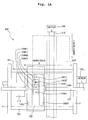
- a color ink jet printer 100 of a first embodiment includes a carriage 102 that can move in a main scanning direction (an X-axis direction) while guided by X-axis guide bars 101, 101 fixed to a frame F.
- a print head 104 as an ink discharging head and ultraviolet (UV) lamps 105L, 105R are provided on the carriage 102.
- the print head 104 includes a Y head 104Y for yellow (Y) ink, an M head 104M for magenta (M) ink, a C head 104C for cyan (C) ink and a K head 104K for black (K) ink.
- the ink to be ejected from the heads 104Y, 104M, 104C, 104K is an ultraviolet curing type ink (UV ink).
- the ink can be prepared by adding an coloring agent to the transparent liquid compositions prepared in the above examples.
- the heads 104Y, 104M, 104C and 104K are aligned in a sub scanning direction (a Y-axis direction), which is perpendicular to the main scanning direction, on the carriage 102.
- the UV lamps 105L, 105R are provided on right and left sides of the print head 104 so as to sandwich the print head 104 therebetween.
- the UV lamps 105L, 105R irradiate the UV ink, ejected from the respective ink heads onto a recording medium 103, with ultraviolet light to increase its viscosity to cure the ink.
- Each of the heads 104Y, 104M, 104C, 104K is formed with a plurality of nozzles, which face a platen 108 (described later) and are basically aligned in parallel to the sub scanning direction.
- the Y head 104Y, the M head 104M, the C head 104C and the K head 104K are connected with an yellow ink tank 104Y1 containing UV yellow ink, a magenta ink tank 104M1 containing UV magenta ink, a cyan ink tank 104C1 containing UV cyan ink, a black ink tank 104K1 containing UV black ink, respectively.
- Each UV ink is supplied from the respective ink tanks 104Y1, 104M1, 104C1, 104K1 to the respective nozzles through each ink flow path in the respective heads 104Y, 104M, 104C, 104K. Therefore, when one-line printing is performed by ejecting ink droplets of the UV ink from each head 104Y, 104M, 104C, 104K while the carriage 102 is moved in the main scanning direction, a printed portion is formed on the recording medium 103.
- a width of the printed portion is equal to a carriage traveling distance in the main scanning direction.
- a length of the printed portion is equal to a width of ink ejection from each head (a width of ink ejection from the nozzles in each head at a time).
- An X-axis motor 106 that moves the carriage 102 in the sub scanning direction is attached to one of side walls the frame F.
- a driven pulley R is rotatably provided to the other side wall of the frame F.
- a timing belt 107 is stretched between the driven pulley R and a drive pulley P fixed to an output shaft of the X-axis motor 106. The timing belt 107 is engaged with the carriage 102.
- the carriage 102 travels from side to side along the X-axis guide bars 101, 101, that is, the X-axis guide bars 101, 101 and the X-axis motor 106 moves the carriage 102 in the main scanning direction with respect to the recording medium 103.
- the platen 108 is supported by the frame F, under the carriage 102 and the X-axis guide bars 101, 101 so as to be movable in the sub scanning direction perpendicular to the main scanning direction.
- the platen 108 is formed with a plurality of air-intakes at its top, and a recording medium 103, such as a plastic plate, is placed on the top. Air is taken in from the air-intakes with the recording medium 103 placed on the top (a surface for placing the recording medium 103), so that a negative pressure is generated and thus the recording medium 103 is statically held on the platen 108.
- the platen 108 is provided with an air taking mechanism for holding the recording medium 103.
- the air taking mechanism also functions as a holding device for holding the recording medium 103.
- the holding device is not limited to the air taking mechanism. However, various types of holding devices can be adopted. For example, a clamp mechanism that mechanically presses and holds the recording medium 103 on the platen 108 can be adopted.
- a screw shaft 110 extending in a direction perpendicular to the main scanning direction, is rotatably supported by the frame F.
- One end of the screw shaft 110 is secured to an output shaft of a Y-axis motor 109.
- a bearing 111 into which the screw shaft 110 is threaded, is fixed under the platen 108.
- the platen 108 is moved in the sub scanning direction.
- a screw mechanism having the screw shaft 110, the bearing 111 and the Y-axis motor 109 moves the platen 108 in the sub scanning direction with respect to the carriage 102.
- the amount and direction of travel of the carriage 102 is controlled by controlling the amount and direction of rotation of the X-axis motor 106.
- a pulse motor is preferably used as the X-axis motor 106.
- the amount and direction of travel of the platen 108 is controlled by controlling the amount and direction of rotation of the Y-axis motor 109.
- a pulse motor is preferably used as the Y-axis motor 109.
- An area 112 is a maintenance area in which purging, wiping, flushing and the like are performed.
- the UV lamps 105L, 105R are longer than the print head 104 in a direction of feeding the recording medium 103 by a predetermined length.
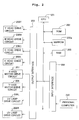
- a control system of the color ink jet printer 100 includes a CPU 201, a ROM 202, an EEPROM 202a, a RAM 203, an input interface 204 and an output interface 205.
- the output interface 205 is connected with a Y head drive circuit 206Y, an M head drive circuit 206M, a C head drive circuit 206C, a K head drive circuit 206K, an X-axis motor drive circuit 207, a Y-axis motor drive circuit 208 and UV lamp drive circuits 209L, 209R.
- a control signal and data from a personal computer 220 are inputted to the input interface 204.
- FIG. 3 is a flowchart for performing print control processing.
- the CPU 201 determines whether a command to start printing has been issued from the personal computer 220 (S301). When the CPU 201 determines that the command to start printing has been issued (S301:YES), the CPU 201 receives print data (S302). After the CPU 201 receives a page of print data, the CPU 201 stores the print data in the RAM 203 and develops the print data into one page of data of each color of Y, M, C, K (S303). Then, the CPU 201 lights the UV lamps 105L, 105R (S304). After that, based on the Y data, while outputting one line of dot data to the Y head drive circuit 206Y, the CPU 201 performs one-line printing in the UV yellow ink by moving the carriage 102 in the main scanning direction (S305).
- One-line printing is performed as described below.
- a print data developing area for one page is provided according to color in the RAM 203.
- One page of dot data is developed into each print data developing area in the bitmap format in which dots are aligned in the main scanning direction and in the sub scanning direction.
- Each dot in the dot data represents ejection (nonejection) of an ink droplet from one nozzle.
- One-line printing of dot data is that dots equal to the number of nozzles aligned in the sub scanning direction are selected in the sub scanning direction and rows of the selected dots are aligned in the main scanning direction from a print start side to a print end side. Dots equal to the number of nozzles aligned in the sub scanning direction are selected and referred to as dot rows.
- the print head 104 While the dot rows are sequentially read from the print data developing area from the print start side to the print end side and supplied to each heads 104Y, 104M, 104C, 104K, the print head 104 is moved in the main scanning direction, thereby one line of a printed portion is formed on a recording medium 103. Upon performing the printing, a printed portion is irradiated with ultraviolet light by the UV lamps 105L, 105R disposed adjacent to the print head 104 to increase its viscosity.
- the CPU 201 moves the platen 108 in the sub scanning direction by one line (by the width of the ink ejection from the print head 104). Then, while outputting each one line of the dot data to the respective Y and M head drive circuits 206Y and 206M based on each Y and M data, respectively, the CPU 201 performs one-line printing in each of the UV yellow ink and the UV magenta ink by moving the carriage 102 in the main scanning direction (S306).
- the viscosity of the UV yellow ink ejected prior to the ejection of the UV magenta ink has already been increased by the irradiation by the UV lamps 105L, 105R, so that the UV yellow ink and the UV magenta ink do not intermix and clarity of the ink colors is not degraded.
- the UV yellow ink and the UV magenta ink ejected at S306 are irradiated with ultraviolet light by the UV lamps 105L, 105R to increase their viscosity.
- the CPU 201 moves the platen 108 in the sub scanning direction by one line. Then, while outputting each one line of the dot data to the respective Y, M and C head drive circuits 206Y, 206M and 206C based on each Y, M and C data, respectively, the CPU 201 performs one-line printing in each of the UV yellow ink, the UV magenta ink and the UV cyan ink by moving the carriage 102 in the main scanning direction (S307).
- dot data of the Y data for a third line, dot data of the M data for a second line and dot data of the C data for a first line are selected and supplied to the Y head drive circuit 206Y, the M head drive circuit 206M and the C head drive circuit 206C, respectively.
- ink droplets of the UV cyan ink to be ejected according to the C data are ejected on the first line of the UV magenta ink ejected at S306.
- the viscosity of the UV magenta ink has already been increased by the irradiation by the UV lamps 105L, 105R, so that the UV magenta ink and the UV cyan ink do not intermix and clarity of the ink colors is not degraded.
- the first line of the UV magenta ink is ejected over the first line of the UV yellow ink, and the first line of the UV cyan ink is ejected over the first line of the UV magenta ink.
- One-line printing according to the M and Y data is also performed in the same manner described above.
- the CPU 201 moves the platen 108 in the sub scanning direction by one line. Then, while outputting each one line of the dot data to the respective Y, M, C and K head drive circuits 206Y, 206M, 206C and 206K based on each Y, M, C and K data, respectively, the CPU 201 performs one-line printing in each of the UV yellow ink, the UV magenta ink, the UV cyan ink and the UV black ink by moving the carriage 102 in the main scanning direction. (S308).
- dot data of the Y data for a fourth line, dot data of the M data for a third line, dot data of the C data for a second line and dot data of the K data for a first line are selected and supplied to the Y head drive circuit 206Y, the M head drive circuit 206M, the C head drive circuit 206C and the K head drive circuit 206K, respectively.
- the K data to be read is dot data for a Nth line (N is a whole number)
- the Y dot data is dot date for N + 3th line
- the M data is dot data for N + 2th line
- the C data is dot data for N +1th line.
- the CPU 201 If the CPU 201 makes a determination in the negative at S309 described later, the CPU 201 sequentially increments N and reads dot data.
- the ejected ink droplets are irradiated with the ultraviolet light to increase their viscosity immediately after the ink droplets are ejected.
- the CPU 201 determines whether all printing has completed (S309). If the printing has not completed yet (S309:NO), dot data of each of the Y, M, C and K data for a next line is read and printing is performed according to the data at 5308 until the printing is completed.
- the repetition of the one-line printing and the transport of the platen 108 will make the printing operation reach a last line in order of the Y head 104Y, the M head 104M, the C head 104C and the K head 104K.
- the CPU 201 determines that the printing has completed.
- dot data of each color is read.
- the CPU 201 outputs dot data that means nonejection of ink as to the dot data of each color.
- the CPU 201 determines that the printing has completed (5309:YES)
- the CPU 201 moves the carriage 102 at idle by three lines without ejecting ink droplets from the heads 104Y, 104M, 104C, 104K (S312).
- the UV black ink ejected last is irradiated with the ultraviolet light for the time of the one-line printing at the moment. That is, the irradiation time of the ultraviolet light to the last printed portion in the UV black ink is shorter than that to the other printed portion, so that the carriage 102 is moved at idle to irradiate the ultraviolet light to cover a shortfall.
- the UV yellow ink is irradiated with ultraviolet light three times before the UV black ink is ejected
- the UV magenta ink is irradiated twice before the UV black ink is ejected
- the UV cyan ink is irradiated once before the UV black ink is ejected. Therefore, if the irradiation of the ultraviolet light is finished when the ejection of the UV black ink in the last line is completed, the irradiation amount of the ultraviolet light to the area of three lines from the last printed line is less than that to the other portions.
- the viscosity of the UV black ink ejected in the last line may not be sufficiently increased or the ink may not be sufficiently cured.
- the carriage 102 is moved at idle the number of times that is one less than the number of heads to average the time of the irradiation of the ultraviolet light. By doing so, the inks ejected onto the recording medium 103 are equally cured. After that, the CPU 201 extinguishes the UV lamps 105L, 105R (S310), and thus this processing has completed.
- the UV lamps 105L, 105R are mounted on the carriage 102 to be placed front and/or behind of the heads 104Y, 104M, 104C, 104K in the main scanning direction.
- cure of ink can be performed in parallel with ink ejection from each heads 104Y, 104M, 104C, 104K.
- the color ink jet printer 100 does not become large in size, and the time required for printing can be shortened. Further, the colors of the printing can be clearly represented.
- the UV lamps 105L, 105R are longer than the heads 104Y, 104M, 104C, 104K in the sub scanning direction, so that cure of ink can be performed with respect to all heads 104Y, 104M, 104C, 104K at a time in parallel with ink ejection from the heads 104Y, 104M, 104C, 104K. Further, the substantially same amount of energy can be irradiated to each color of ink on a recording medium 103, so that the ink can be evenly cured.
- the active energy beam-curable composition of the present invention has been explained with reference to Examples. However, the present invention is not limited thereto.
- the active energy beam-curable composition can be constituted by using other components and compositions within appended claims.
- 3,4-Epoxycyclohexylmethyl-3',4'-epoxycyclohexane carboxylate has been used as the photo-cationic polymerizable substance.
- the active energy beam-curable composition of the present invention can be applied to a variety of objectives. Even when the composition is heated after being cured, the occurrence of the odor and the cloudiness is suppressed.
Landscapes
- Chemical & Material Sciences (AREA)
- Organic Chemistry (AREA)
- Health & Medical Sciences (AREA)
- Chemical Kinetics & Catalysis (AREA)
- Medicinal Chemistry (AREA)
- Polymers & Plastics (AREA)
- Materials Engineering (AREA)
- Engineering & Computer Science (AREA)
- Life Sciences & Earth Sciences (AREA)
- Wood Science & Technology (AREA)
- Polyethers (AREA)
- Inks, Pencil-Leads, Or Crayons (AREA)
- Ink Jet (AREA)
- Other Resins Obtained By Reactions Not Involving Carbon-To-Carbon Unsaturated Bonds (AREA)
- Epoxy Resins (AREA)
- Addition Polymer Or Copolymer, Post-Treatments, Or Chemical Modifications (AREA)
Applications Claiming Priority (2)
| Application Number | Priority Date | Filing Date | Title |
|---|---|---|---|
| JP2001269988A JP2003073481A (ja) | 2001-09-06 | 2001-09-06 | 活性エネルギー線硬化型組成物、それを含有するインク及びそのインクを使用するプリンタ |
| JP2001269988 | 2001-09-06 |
Publications (2)
| Publication Number | Publication Date |
|---|---|
| EP1295899A2 true EP1295899A2 (de) | 2003-03-26 |
| EP1295899A3 EP1295899A3 (de) | 2003-08-27 |
Family
ID=19095707
Family Applications (1)
| Application Number | Title | Priority Date | Filing Date |
|---|---|---|---|
| EP20020020072 Withdrawn EP1295899A3 (de) | 2001-09-06 | 2002-09-06 | Strahlungshärtbare Zusammensetzung, Tinte die diese Zusammensetzung enthält, und Drucker der diese Tinte enthält |
Country Status (3)
| Country | Link |
|---|---|
| US (1) | US6805439B2 (de) |
| EP (1) | EP1295899A3 (de) |
| JP (1) | JP2003073481A (de) |
Cited By (7)
| Publication number | Priority date | Publication date | Assignee | Title |
|---|---|---|---|---|
| EP1302499A2 (de) * | 2001-09-28 | 2003-04-16 | Brother Kogyo Kabushiki Kaisha | Strahlungshärtbare zusammensetzung, tinte die diese zusammensetzung enthält und drucker der diese tinte enthält |
| WO2004099286A1 (ja) | 2003-05-07 | 2004-11-18 | Mitsui Chemicals, Inc. | 光カチオン重合性樹脂組成物及び光ディスク表面保護用材料 |
| EP1484370A1 (de) * | 2003-06-02 | 2004-12-08 | Konica Minolta Medical & Graphic, Inc. | Photohärtbare Tinte, und Bildaufzeichnungsgerät und Bildaufzeichnungsverfahren unter Verwendung derselben |
| EP1721943A1 (de) * | 2005-05-11 | 2006-11-15 | Fuji Photo Film Co., Ltd. | Tintenzusammensetzung, Tintenstrahldruckverfahren, bedrucktes Material, Verfahren zur Herstellung einer lithographischen Druckplatte, lithographische Druckplatte |
| EP1754758A3 (de) * | 2005-08-17 | 2007-07-18 | FUJIFILM Corporation | Tintenzusammensetzung enthaltend ein Oniumsalz und eine kationisch polymerisierbare Verbindung, Tintenstrahldruckverfahren, bedrucktes Material, Verfahren zur Herstellung einer lithographischen Druckplatte, und lithographische Druckplatte |
| WO2010029351A1 (en) * | 2008-09-09 | 2010-03-18 | Sericol Limited | A printing ink |
| KR101320780B1 (ko) * | 2006-10-30 | 2013-10-22 | 소니 주식회사 | 액체 토출형 기록 헤드 및 액체 토출 장치 |
Families Citing this family (33)
| Publication number | Priority date | Publication date | Assignee | Title |
|---|---|---|---|---|
| JP2003285530A (ja) * | 2002-03-28 | 2003-10-07 | Konica Corp | インクジェット画像形成方法およびインクジェットインク |
| KR100475162B1 (ko) * | 2002-05-09 | 2005-03-08 | 엘지.필립스 엘시디 주식회사 | 액정표시장치 및 그 제조방법 |
| US7021754B2 (en) * | 2002-05-15 | 2006-04-04 | Konica Corporation | Ink-jet recording method |
| US7084184B2 (en) * | 2002-08-30 | 2006-08-01 | Konica Corporation | Actinic ray curable composition, actinic ray curable ink, image forming method, and ink jet recording apparatus |
| JP2004168961A (ja) * | 2002-11-22 | 2004-06-17 | Konica Minolta Holdings Inc | 活性エネルギー線硬化型インク及びそれを用いた印刷物 |
| US20040189769A1 (en) * | 2003-03-31 | 2004-09-30 | Oce Display Graphics Systems, Inc. | Methods, systems, and devices for drying ink deposited upon a medium |
| JP2004352980A (ja) * | 2003-05-07 | 2004-12-16 | Mitsui Chemicals Inc | 光カチオン重合性樹脂組成物及び光ディスク表面保護用材料 |
| JP2004358953A (ja) * | 2003-05-15 | 2004-12-24 | Konica Minolta Medical & Graphic Inc | インクジェット記録装置 |
| JP2005041892A (ja) * | 2003-07-22 | 2005-02-17 | Konica Minolta Medical & Graphic Inc | 活性エネルギー線硬化型インクジェットインク及び印刷物 |
| JP2005074878A (ja) * | 2003-09-02 | 2005-03-24 | Konica Minolta Medical & Graphic Inc | 画像記録装置 |
| JP2005263897A (ja) * | 2004-03-17 | 2005-09-29 | Konica Minolta Medical & Graphic Inc | インクジェット用インク組成物及び画像形成方法 |
| JP2006008791A (ja) * | 2004-06-24 | 2006-01-12 | Konica Minolta Medical & Graphic Inc | 活性光線硬化型組成物、活性光線硬化型インク、それを用いた画像形成方法及びインクジェット記録装置 |
| JP2006124636A (ja) * | 2004-06-28 | 2006-05-18 | Konica Minolta Medical & Graphic Inc | 活性光線硬化型組成物、活性光線硬化型インクジェットインク、該活性光線硬化型インクジェットインクを用いた画像形成方法及びインクジェット記録装置 |
| JP4375401B2 (ja) * | 2004-08-06 | 2009-12-02 | コニカミノルタエムジー株式会社 | インクジェット記録装置 |
| JP4686692B2 (ja) * | 2005-02-24 | 2011-05-25 | フジコピアン株式会社 | インクジェット記録方式に用いられる活性エネルギー線硬化型白インク組成物 |
| JP2006272297A (ja) * | 2005-03-30 | 2006-10-12 | Seiko Epson Corp | 液滴吐出装置 |
| JP4026652B2 (ja) * | 2005-04-08 | 2007-12-26 | コニカミノルタエムジー株式会社 | インクジェット記録装置及びインクジェット記録方法 |
| KR100708164B1 (ko) * | 2005-07-20 | 2007-04-17 | 삼성전자주식회사 | 건조장치를 포함하는 잉크젯 화상형성장치 및 인쇄매체의건조방법 |
| JP4713269B2 (ja) * | 2005-08-08 | 2011-06-29 | ソニー株式会社 | 液体吐出型記録ヘッドの製造方法 |
| US7914108B2 (en) * | 2005-08-24 | 2011-03-29 | Fujifilm Corporation | Image forming apparatus and method, and ink set |
| EP2103639A1 (de) * | 2005-11-04 | 2009-09-23 | Fujifilm Corporation | Härtbare polyzyklische Epoxidzusammensetzung, Tinte und Tintenstrahldruckverfahren damit |
| JP5068454B2 (ja) * | 2005-12-06 | 2012-11-07 | 富士フイルム株式会社 | インク組成物、インクジェット記録方法、印刷物、平版印刷版の製造方法、及び平版印刷版 |
| JP2007262178A (ja) * | 2006-03-28 | 2007-10-11 | Fujifilm Corp | インク組成物、インクジェット記録方法、印刷物、及び、平版印刷版の製造方法 |
| JP2008162072A (ja) * | 2006-12-27 | 2008-07-17 | Dainippon Screen Mfg Co Ltd | 印刷装置および印刷方法 |
| JP5173273B2 (ja) * | 2007-06-19 | 2013-04-03 | キヤノン株式会社 | インクジェットヘッド用封止剤、インクジェットヘッドおよびインクジェット記録装置 |
| US8324319B2 (en) * | 2007-11-20 | 2012-12-04 | Sridhar Laxmisha M | Redox-induced cationically polymerizable compositions with low cure temperature |
| WO2009067112A1 (en) * | 2007-11-20 | 2009-05-28 | Henkel Ag & Co. Kgaa | Redox-induced cationically polymerizable compositions with low cure temperature |
| EP2292430B1 (de) | 2008-06-23 | 2015-01-07 | Konica Minolta Holdings, Inc. | Tintenstrahlaufzeichnungsvorrichtung und tintenstrahlaufzeichnungsverfahren |
| JP2011213934A (ja) * | 2010-04-01 | 2011-10-27 | Seiko Epson Corp | 放射線硬化型インクジェット印刷用インク組成物 |
| JP5687964B2 (ja) * | 2010-07-27 | 2015-03-25 | 富士フイルム株式会社 | インクジェットインク組成物、インクジェット記録方法、及び、印刷物 |
| KR20130089039A (ko) | 2012-02-01 | 2013-08-09 | 삼성디스플레이 주식회사 | 증착 소스, 증착 장치 및 유기 발광 표시 장치 제조 방법 |
| JP6889560B2 (ja) | 2017-01-16 | 2021-06-18 | サカタインクス株式会社 | 活性エネルギー線硬化型オフセット印刷用インキ組成物、及びそれを用いた印刷物の製造方法 |
| DE102018210113B3 (de) * | 2018-06-21 | 2019-07-11 | Heidelberger Druckmaschinen Ag | Tintenstrahl-Druckverfahren zur Erzeugung homogen aussehender Druckbilder auf sphärischen Körpern |
Citations (1)
| Publication number | Priority date | Publication date | Assignee | Title |
|---|---|---|---|---|
| EP1262506A1 (de) * | 2001-05-28 | 2002-12-04 | Dainippon Ink And Chemicals, Inc. | Photopolymerisierbare Initiatorkombination |
Family Cites Families (41)
| Publication number | Priority date | Publication date | Assignee | Title |
|---|---|---|---|---|
| US3835003A (en) * | 1968-08-20 | 1974-09-10 | American Can Co | Photopolymerization of oxetanes |
| JPS4917040A (de) | 1972-06-10 | 1974-02-15 | ||
| AU497960B2 (en) | 1974-04-11 | 1979-01-25 | Minnesota Mining And Manufacturing Company | Photopolymerizable compositions |
| GB1516351A (en) | 1974-05-02 | 1978-07-05 | Gen Electric | Curable epoxide compositions |
| GB1512982A (en) | 1974-05-02 | 1978-06-01 | Gen Electric | Salts |
| GB1516511A (en) | 1974-05-02 | 1978-07-05 | Gen Electric | Curable epoxide compositions |
| US4256828A (en) | 1975-09-02 | 1981-03-17 | Minnesota Mining And Manufacturing Company | Photocopolymerizable compositions based on epoxy and hydroxyl-containing organic materials |
| US4139655A (en) | 1978-05-09 | 1979-02-13 | W. R. Grace & Co. | Photocurable epoxy compositions containing thiopyrylium salts |
| US4197174A (en) | 1979-03-14 | 1980-04-08 | American Can Company | Method for producing bis-[4-(diphenylsulfonio) phenyl] sulfide bis-MX6 |
| JPS568428A (en) | 1979-06-19 | 1981-01-28 | Ciba Geigy Ag | Photopolymerizing and thermopolymerizing composition |
| ZA805273B (en) | 1979-09-28 | 1981-11-25 | Gen Electric | Process of deep section curing photocurable compositions |
| JPH0245641B2 (ja) | 1980-03-07 | 1990-10-11 | Ciba Geigy | Hikarijugoseisoseibutsuoyobisonojugoho |
| US4387216A (en) | 1981-05-06 | 1983-06-07 | Ciba-Geigy Corporation | Heat-polymerizable compositions comprising epoxide resins, aromatic sulfoxonium salts, and organic oxidants |
| JPS60199025A (ja) | 1984-03-22 | 1985-10-08 | Toshiba Corp | 光硬化性樹脂組成物 |
| DE3621477A1 (de) * | 1985-06-26 | 1987-01-08 | Canon Kk | Durch strahlen mit wirksamer energie haertbare harzmischung |
| JPS6351472A (ja) | 1986-08-22 | 1988-03-04 | Nippon Kayaku Co Ltd | ソルダ−レジストインキ樹脂組成物 |
| US5178996A (en) * | 1988-12-29 | 1993-01-12 | Konica Corporation | Method of making photographic element having epoxy overlayer |
| GB2233928B (en) | 1989-05-23 | 1992-12-23 | Brother Ind Ltd | Apparatus and method for forming three-dimensional article |
| JPH0411626A (ja) | 1990-04-27 | 1992-01-16 | Takeshi Endo | 樹脂組成物、ソルダーレジスト樹脂組成物及び硬化物 |
| US5463084A (en) | 1992-02-18 | 1995-10-31 | Rensselaer Polytechnic Institute | Photocurable silicone oxetanes |
| US5302439A (en) * | 1993-03-19 | 1994-04-12 | Xerox Corporation | Recording sheets |
| JPH08165441A (ja) * | 1994-10-13 | 1996-06-25 | Canon Inc | 活性エネルギー線重合性組成物、これを含む記録媒体及びこれを用いた画像形成方法 |
| JP3428187B2 (ja) | 1994-11-18 | 2003-07-22 | 東亞合成株式会社 | 活性エネルギー線硬化型インキ用組成物 |
| JP3364915B2 (ja) | 1995-02-15 | 2003-01-08 | 東亞合成株式会社 | 紙被覆用活性エネルギー線硬化型組成物 |
| US5750590A (en) * | 1995-02-22 | 1998-05-12 | Heraeus Kulzer Gmbh | Polymerizable material |
| JP3161583B2 (ja) * | 1995-07-21 | 2001-04-25 | 東亞合成株式会社 | 活性エネルギー線硬化型組成物 |
| KR100418453B1 (ko) * | 1995-10-02 | 2005-02-07 | 간사이 페인트 가부시키가이샤 | 캔용자외선-경화코팅조성물 |
| DE69604643T2 (de) * | 1995-12-07 | 2000-06-15 | E.I. Du Pont De Nemours And Co., Wilmington | Empfangsschicht für Tintenstrahlaufzeichnung |
| CN1195356A (zh) | 1996-06-12 | 1998-10-07 | 日本化药株式会社 | 光聚合引发剂和包含它的可能量射线固化的组合物 |
| JPH10195117A (ja) | 1996-12-27 | 1998-07-28 | Nippon Soda Co Ltd | 光硬化性組成物および硬化方法 |
| US5889084A (en) * | 1997-01-30 | 1999-03-30 | Ncr Corporation | UV or visible light initiated cationic cured ink for ink jet printing |
| US6092890A (en) * | 1997-09-19 | 2000-07-25 | Eastman Kodak Company | Producing durable ink images |
| JPH11140279A (ja) | 1997-10-31 | 1999-05-25 | Toagosei Co Ltd | 活性エネルギー線硬化型組成物 |
| JP3671658B2 (ja) | 1998-02-27 | 2005-07-13 | 東亞合成株式会社 | シート状光学物品用活性エネルギー線硬化型組成物 |
| JP2000144043A (ja) | 1998-11-09 | 2000-05-26 | Toyo Ink Mfg Co Ltd | 紫外線硬化型塗料、及びその利用 |
| US6232361B1 (en) * | 1998-12-11 | 2001-05-15 | Sun Chemical Corporation | Radiation curable water based cationic inks and coatings |
| US6331056B1 (en) | 1999-02-25 | 2001-12-18 | Kimberly-Clark Worldwide, Inc. | Printing apparatus and applications therefor |
| WO2001012745A1 (fr) | 1999-08-12 | 2001-02-22 | Mitsui Chemicals, Inc. | Composition de resine photodurcissable pour materiau d'etancheite et procede correspondant |
| ATE337375T1 (de) | 2001-03-19 | 2006-09-15 | Brother Ind Ltd | Strahlenhärtbare zusammensetzung und tinte |
| JP2002317139A (ja) | 2001-04-19 | 2002-10-31 | Riso Kagaku Corp | 活性エネルギー線硬化型インキ |
| JP4382364B2 (ja) | 2002-04-24 | 2009-12-09 | 株式会社東芝 | 液体インク |
-
2001
- 2001-09-06 JP JP2001269988A patent/JP2003073481A/ja active Pending
-
2002
- 2002-09-05 US US10/234,212 patent/US6805439B2/en not_active Expired - Lifetime
- 2002-09-06 EP EP20020020072 patent/EP1295899A3/de not_active Withdrawn
Patent Citations (1)
| Publication number | Priority date | Publication date | Assignee | Title |
|---|---|---|---|---|
| EP1262506A1 (de) * | 2001-05-28 | 2002-12-04 | Dainippon Ink And Chemicals, Inc. | Photopolymerisierbare Initiatorkombination |
Cited By (12)
| Publication number | Priority date | Publication date | Assignee | Title |
|---|---|---|---|---|
| EP1302499A2 (de) * | 2001-09-28 | 2003-04-16 | Brother Kogyo Kabushiki Kaisha | Strahlungshärtbare zusammensetzung, tinte die diese zusammensetzung enthält und drucker der diese tinte enthält |
| WO2004099286A1 (ja) | 2003-05-07 | 2004-11-18 | Mitsui Chemicals, Inc. | 光カチオン重合性樹脂組成物及び光ディスク表面保護用材料 |
| EP1630189A4 (de) * | 2003-05-07 | 2011-06-22 | Mitsui Chemicals Inc | Kationisch copolymerisierbare harzzusammensetzung und schutzmaterial für die oberfläche einer optischen disk |
| EP1484370A1 (de) * | 2003-06-02 | 2004-12-08 | Konica Minolta Medical & Graphic, Inc. | Photohärtbare Tinte, und Bildaufzeichnungsgerät und Bildaufzeichnungsverfahren unter Verwendung derselben |
| EP1721943A1 (de) * | 2005-05-11 | 2006-11-15 | Fuji Photo Film Co., Ltd. | Tintenzusammensetzung, Tintenstrahldruckverfahren, bedrucktes Material, Verfahren zur Herstellung einer lithographischen Druckplatte, lithographische Druckplatte |
| US7538149B2 (en) | 2005-05-11 | 2009-05-26 | Fujifilm Corporation | Ink composition, inkjet recording method, printed material, process for producing lithographic printing plate, and lithographic printing plate |
| EP1754758A3 (de) * | 2005-08-17 | 2007-07-18 | FUJIFILM Corporation | Tintenzusammensetzung enthaltend ein Oniumsalz und eine kationisch polymerisierbare Verbindung, Tintenstrahldruckverfahren, bedrucktes Material, Verfahren zur Herstellung einer lithographischen Druckplatte, und lithographische Druckplatte |
| US7470502B2 (en) | 2005-08-17 | 2008-12-30 | Fujifilm Corporation | Ink composition, inkjet recording method, printed material, process for producing lithographic printing plate, and lithographic printing plate |
| KR101320780B1 (ko) * | 2006-10-30 | 2013-10-22 | 소니 주식회사 | 액체 토출형 기록 헤드 및 액체 토출 장치 |
| WO2010029351A1 (en) * | 2008-09-09 | 2010-03-18 | Sericol Limited | A printing ink |
| GB2474816A (en) * | 2008-09-09 | 2011-04-27 | Sericol Ltd | A printing ink |
| GB2474816B (en) * | 2008-09-09 | 2012-10-24 | Sericol Ltd | A printing ink |
Also Published As
| Publication number | Publication date |
|---|---|
| JP2003073481A (ja) | 2003-03-12 |
| US6805439B2 (en) | 2004-10-19 |
| US20030112307A1 (en) | 2003-06-19 |
| EP1295899A3 (de) | 2003-08-27 |
Similar Documents
| Publication | Publication Date | Title |
|---|---|---|
| US6805439B2 (en) | Active energy beam-curable composition, ink containing the same, and printer accommodating the same ink | |
| US6866376B2 (en) | Active energy beam-curable composition, ink containing the same, and printer accommodating the same ink | |
| EP2294145B1 (de) | Ultraviolett-härtbare tintenstrahlaufzeichnungstinte und farbbilderzeugungsvorrichtung | |
| US6790875B2 (en) | Photocurable aqueous resin composition, ink, recording unit, ink cartridge, ink-jet recording apparatus and photopolymerization initiator | |
| EP1502155B1 (de) | Strahlungshärtbare harzzusammensetzung und schnelles prototypierungsverfahren unter verwendung derselben | |
| US8197053B2 (en) | Active energy beam-curable ink and ink-jet recording method using active energy beam-curable ink | |
| US20030158286A1 (en) | Active energy beam-curable composition | |
| EP1913339B1 (de) | Kationische farbstoffformulierungen | |
| JP2016117807A (ja) | 活性エネルギー線硬化型組成物、収容体、インクジェット記録装置、記録物及び立体硬化物 | |
| US20030218269A1 (en) | Image-receiving layer composition and overcoat layer composition for ink-jet recording | |
| JP2004051924A (ja) | インクジェット記録用インクの保存方法及び画像形成方法 | |
| US6852767B2 (en) | Active energy beam curable composition having predetermined acid value or amine value and ink containing the same | |
| JP2003055449A (ja) | 活性エネルギー線硬化型組成物、それを含有するインク及びそのインクを使用するプリンタ。 | |
| EP1243629B1 (de) | Strahlenhärtbare Zusammensetzung und Tinte | |
| EP1348727A2 (de) | Bildempfangsschichtzusammensetzung und Schutzschichtzusammensetzung für Tintenstrahlaufzeichnungsmedien | |
| JP2003292880A (ja) | オーバーコート層用組成物及び印刷物 | |
| JP3975805B2 (ja) | インクジェット記録媒体及びインクジェット記録方法 | |
| JP2015040282A (ja) | 活性光線硬化型インクジェットインク及びこれを用いたインクジェット記録方法 | |
| JP5554074B2 (ja) | インクジェット印刷インク用重合性化合物及びインク組成物 | |
| JP2003055448A (ja) | 活性エネルギー線硬化型組成物、それを含有するインク及びそのインクを使用するプリンタ | |
| JP2006282764A (ja) | インク組成物及びそれを用いた画像形成方法、記録物 | |
| JP2007002130A (ja) | カチオン硬化性組成物およびその硬化物 | |
| JP2007002131A (ja) | カチオン硬化性組成物および硬化物 | |
| JP2003285531A (ja) | インクジェット記録方法及び印刷物 | |
| JP2003055462A (ja) | 活性エネルギー線硬化型組成物、それを含有するインク及びそのインクを使用するプリンタ |
Legal Events
| Date | Code | Title | Description |
|---|---|---|---|
| PUAI | Public reference made under article 153(3) epc to a published international application that has entered the european phase |
Free format text: ORIGINAL CODE: 0009012 |
|
| AK | Designated contracting states |
Kind code of ref document: A2 Designated state(s): AT BE BG CH CY CZ DE DK EE ES FI FR GB GR IE IT LI LU MC NL PT SE SK TR Designated state(s): AT BE BG CH CY CZ DE DK EE ES FI FR GB GR IE IT LI LU MC NL PT SE SK TR |
|
| AX | Request for extension of the european patent |
Extension state: AL LT LV MK RO SI |
|
| RIC1 | Information provided on ipc code assigned before grant |
Ipc: 7C 08G 59/68 B Ipc: 7C 08G 65/10 B Ipc: 7C 08L 71/02 B Ipc: 7C 08L 63/02 B Ipc: 7C 09D 11/10 B Ipc: 7B 41J 2/17 B Ipc: 7C 08G 65/18 B Ipc: 7C 09D 11/00 B Ipc: 7C 08F 283/00 A |
|
| PUAL | Search report despatched |
Free format text: ORIGINAL CODE: 0009013 |
|
| AK | Designated contracting states |
Designated state(s): AT BE BG CH CY CZ DE DK EE ES FI FR GB GR IE IT LI LU MC NL PT SE SK TR |
|
| AX | Request for extension of the european patent |
Extension state: AL LT LV MK RO SI |
|
| 17P | Request for examination filed |
Effective date: 20040225 |
|
| AKX | Designation fees paid |
Designated state(s): CH DE FR GB LI |
|
| 17Q | First examination report despatched |
Effective date: 20061115 |
|
| STAA | Information on the status of an ep patent application or granted ep patent |
Free format text: STATUS: THE APPLICATION IS DEEMED TO BE WITHDRAWN |
|
| 18D | Application deemed to be withdrawn |
Effective date: 20130910 |