EP1298254A1 - Procédé de préparation d'un remblai autocompactant - Google Patents
Procédé de préparation d'un remblai autocompactant Download PDFInfo
- Publication number
- EP1298254A1 EP1298254A1 EP20020292390 EP02292390A EP1298254A1 EP 1298254 A1 EP1298254 A1 EP 1298254A1 EP 20020292390 EP20020292390 EP 20020292390 EP 02292390 A EP02292390 A EP 02292390A EP 1298254 A1 EP1298254 A1 EP 1298254A1
- Authority
- EP
- European Patent Office
- Prior art keywords
- self
- compacting
- weight
- cement
- backfill
- Prior art date
- Legal status (The legal status is an assumption and is not a legal conclusion. Google has not performed a legal analysis and makes no representation as to the accuracy of the status listed.)
- Granted
Links
- 239000000463 material Substances 0.000 title claims abstract description 81
- 238000000034 method Methods 0.000 title claims description 35
- 238000002360 preparation method Methods 0.000 title description 2
- XLYOFNOQVPJJNP-UHFFFAOYSA-N water Substances O XLYOFNOQVPJJNP-UHFFFAOYSA-N 0.000 claims abstract description 56
- 239000000203 mixture Substances 0.000 claims abstract description 27
- 239000004568 cement Substances 0.000 claims abstract description 25
- 238000004519 manufacturing process Methods 0.000 claims abstract description 16
- 238000002156 mixing Methods 0.000 claims abstract description 16
- RBTBFTRPCNLSDE-UHFFFAOYSA-N 3,7-bis(dimethylamino)phenothiazin-5-ium Chemical compound C1=CC(N(C)C)=CC2=[S+]C3=CC(N(C)C)=CC=C3N=C21 RBTBFTRPCNLSDE-UHFFFAOYSA-N 0.000 claims abstract description 10
- 229960000907 methylthioninium chloride Drugs 0.000 claims abstract description 10
- 238000005086 pumping Methods 0.000 claims abstract description 10
- 239000003795 chemical substances by application Substances 0.000 claims abstract description 8
- 239000004927 clay Substances 0.000 claims abstract description 6
- 238000000605 extraction Methods 0.000 claims abstract description 6
- 238000011084 recovery Methods 0.000 claims abstract description 4
- 238000005520 cutting process Methods 0.000 claims description 24
- 230000008569 process Effects 0.000 claims description 15
- 239000002671 adjuvant Substances 0.000 claims description 8
- GNFTZDOKVXKIBK-UHFFFAOYSA-N 3-(2-methoxyethoxy)benzohydrazide Chemical compound COCCOC1=CC=CC(C(=O)NN)=C1 GNFTZDOKVXKIBK-UHFFFAOYSA-N 0.000 claims description 5
- 238000004898 kneading Methods 0.000 claims description 5
- 238000003860 storage Methods 0.000 claims description 5
- 239000003638 chemical reducing agent Substances 0.000 claims description 4
- 229920002972 Acrylic fiber Polymers 0.000 claims description 3
- 239000000049 pigment Substances 0.000 claims description 3
- 239000002689 soil Substances 0.000 claims description 3
- 241001417527 Pempheridae Species 0.000 claims description 2
- 239000000843 powder Substances 0.000 claims description 2
- 238000012546 transfer Methods 0.000 claims description 2
- 238000005067 remediation Methods 0.000 claims 1
- 238000011049 filling Methods 0.000 abstract description 10
- 239000008187 granular material Substances 0.000 abstract description 3
- 238000012795 verification Methods 0.000 abstract description 3
- 239000000945 filler Substances 0.000 abstract description 2
- 238000001035 drying Methods 0.000 abstract 2
- 238000012360 testing method Methods 0.000 description 35
- 230000006870 function Effects 0.000 description 8
- 230000006835 compression Effects 0.000 description 7
- 238000007906 compression Methods 0.000 description 7
- 239000000835 fiber Substances 0.000 description 6
- 238000007654 immersion Methods 0.000 description 6
- 241001589086 Bellapiscis medius Species 0.000 description 5
- 238000011065 in-situ storage Methods 0.000 description 5
- 238000009412 basement excavation Methods 0.000 description 4
- 230000007547 defect Effects 0.000 description 4
- 238000005259 measurement Methods 0.000 description 4
- 239000008239 natural water Substances 0.000 description 4
- 239000002245 particle Substances 0.000 description 4
- 238000007789 sealing Methods 0.000 description 4
- 238000005303 weighing Methods 0.000 description 4
- 241000879777 Lynx rufus Species 0.000 description 3
- 239000011230 binding agent Substances 0.000 description 3
- 230000000740 bleeding effect Effects 0.000 description 3
- 238000005056 compaction Methods 0.000 description 3
- 238000005336 cracking Methods 0.000 description 3
- 238000012423 maintenance Methods 0.000 description 3
- 235000008733 Citrus aurantifolia Nutrition 0.000 description 2
- 235000011941 Tilia x europaea Nutrition 0.000 description 2
- 238000004140 cleaning Methods 0.000 description 2
- 239000004567 concrete Substances 0.000 description 2
- 239000000470 constituent Substances 0.000 description 2
- 230000007423 decrease Effects 0.000 description 2
- 230000000694 effects Effects 0.000 description 2
- 229920001971 elastomer Polymers 0.000 description 2
- 238000009533 lab test Methods 0.000 description 2
- 239000004571 lime Substances 0.000 description 2
- 230000007774 longterm Effects 0.000 description 2
- 238000007665 sagging Methods 0.000 description 2
- 238000005406 washing Methods 0.000 description 2
- QYLJIYOGHRGUIH-CIUDSAMLSA-N Arg-Ile Chemical compound CC[C@H](C)[C@@H](C(O)=O)NC(=O)[C@@H](N)CCCNC(N)=N QYLJIYOGHRGUIH-CIUDSAMLSA-N 0.000 description 1
- 206010003830 Automatism Diseases 0.000 description 1
- 241000861223 Issus Species 0.000 description 1
- 239000004743 Polypropylene Substances 0.000 description 1
- 239000011398 Portland cement Substances 0.000 description 1
- 229910000831 Steel Inorganic materials 0.000 description 1
- 241001080024 Telles Species 0.000 description 1
- 239000004067 bulking agent Substances 0.000 description 1
- 239000011248 coating agent Substances 0.000 description 1
- 238000000576 coating method Methods 0.000 description 1
- 238000012669 compression test Methods 0.000 description 1
- 230000021615 conjugation Effects 0.000 description 1
- 238000010276 construction Methods 0.000 description 1
- 238000001816 cooling Methods 0.000 description 1
- 239000013256 coordination polymer Substances 0.000 description 1
- 230000001934 delay Effects 0.000 description 1
- 238000013461 design Methods 0.000 description 1
- 238000011161 development Methods 0.000 description 1
- 238000010586 diagram Methods 0.000 description 1
- 238000005553 drilling Methods 0.000 description 1
- 239000000428 dust Substances 0.000 description 1
- 239000000806 elastomer Substances 0.000 description 1
- 239000011798 excavation material Substances 0.000 description 1
- 239000010881 fly ash Substances 0.000 description 1
- 239000011440 grout Substances 0.000 description 1
- 238000007689 inspection Methods 0.000 description 1
- 239000008188 pellet Substances 0.000 description 1
- 230000035515 penetration Effects 0.000 description 1
- -1 polypropylene Polymers 0.000 description 1
- 229920001155 polypropylene Polymers 0.000 description 1
- 230000009467 reduction Effects 0.000 description 1
- 238000005096 rolling process Methods 0.000 description 1
- 239000004576 sand Substances 0.000 description 1
- 238000007790 scraping Methods 0.000 description 1
- 238000012216 screening Methods 0.000 description 1
- 230000011664 signaling Effects 0.000 description 1
- 239000002002 slurry Substances 0.000 description 1
- 238000001179 sorption measurement Methods 0.000 description 1
- 239000010959 steel Substances 0.000 description 1
- 229920002994 synthetic fiber Polymers 0.000 description 1
- 229920001059 synthetic polymer Polymers 0.000 description 1
- 230000009974 thixotropic effect Effects 0.000 description 1
- 230000002747 voluntary effect Effects 0.000 description 1
- 239000002351 wastewater Substances 0.000 description 1
Images

Classifications
-
- C—CHEMISTRY; METALLURGY
- C04—CEMENTS; CONCRETE; ARTIFICIAL STONE; CERAMICS; REFRACTORIES
- C04B—LIME, MAGNESIA; SLAG; CEMENTS; COMPOSITIONS THEREOF, e.g. MORTARS, CONCRETE OR LIKE BUILDING MATERIALS; ARTIFICIAL STONE; CERAMICS; REFRACTORIES; TREATMENT OF NATURAL STONE
- C04B14/00—Use of inorganic materials as fillers, e.g. pigments, for mortars, concrete or artificial stone; Treatment of inorganic materials specially adapted to enhance their filling properties in mortars, concrete or artificial stone
- C04B14/02—Granular materials, e.g. microballoons
- C04B14/36—Inorganic materials not provided for in groups C04B14/022 and C04B14/04 - C04B14/34
- C04B14/361—Soil, e.g. laterite
-
- C—CHEMISTRY; METALLURGY
- C04—CEMENTS; CONCRETE; ARTIFICIAL STONE; CERAMICS; REFRACTORIES
- C04B—LIME, MAGNESIA; SLAG; CEMENTS; COMPOSITIONS THEREOF, e.g. MORTARS, CONCRETE OR LIKE BUILDING MATERIALS; ARTIFICIAL STONE; CERAMICS; REFRACTORIES; TREATMENT OF NATURAL STONE
- C04B28/00—Compositions of mortars, concrete or artificial stone, containing inorganic binders or the reaction product of an inorganic and an organic binder, e.g. polycarboxylate cements
- C04B28/02—Compositions of mortars, concrete or artificial stone, containing inorganic binders or the reaction product of an inorganic and an organic binder, e.g. polycarboxylate cements containing hydraulic cements other than calcium sulfates
-
- E—FIXED CONSTRUCTIONS
- E02—HYDRAULIC ENGINEERING; FOUNDATIONS; SOIL SHIFTING
- E02D—FOUNDATIONS; EXCAVATIONS; EMBANKMENTS; UNDERGROUND OR UNDERWATER STRUCTURES
- E02D17/00—Excavations; Bordering of excavations; Making embankments
- E02D17/06—Foundation trenches ditches or narrow shafts
- E02D17/12—Back-filling of foundation trenches or ditches
-
- E—FIXED CONSTRUCTIONS
- E02—HYDRAULIC ENGINEERING; FOUNDATIONS; SOIL SHIFTING
- E02D—FOUNDATIONS; EXCAVATIONS; EMBANKMENTS; UNDERGROUND OR UNDERWATER STRUCTURES
- E02D3/00—Improving or preserving soil or rock, e.g. preserving permafrost soil
- E02D3/12—Consolidating by placing solidifying or pore-filling substances in the soil
-
- E—FIXED CONSTRUCTIONS
- E02—HYDRAULIC ENGINEERING; FOUNDATIONS; SOIL SHIFTING
- E02F—DREDGING; SOIL-SHIFTING
- E02F5/00—Dredgers or soil-shifting machines for special purposes
- E02F5/22—Dredgers or soil-shifting machines for special purposes for making embankments; for back-filling
- E02F5/223—Dredgers or soil-shifting machines for special purposes for making embankments; for back-filling for back-filling
- E02F5/226—Dredgers or soil-shifting machines for special purposes for making embankments; for back-filling for back-filling with means for processing the soil, e.g. screening belts, separators; Padding machines
-
- C—CHEMISTRY; METALLURGY
- C04—CEMENTS; CONCRETE; ARTIFICIAL STONE; CERAMICS; REFRACTORIES
- C04B—LIME, MAGNESIA; SLAG; CEMENTS; COMPOSITIONS THEREOF, e.g. MORTARS, CONCRETE OR LIKE BUILDING MATERIALS; ARTIFICIAL STONE; CERAMICS; REFRACTORIES; TREATMENT OF NATURAL STONE
- C04B2111/00—Mortars, concrete or artificial stone or mixtures to prepare them, characterised by specific function, property or use
- C04B2111/00474—Uses not provided for elsewhere in C04B2111/00
- C04B2111/00724—Uses not provided for elsewhere in C04B2111/00 in mining operations, e.g. for backfilling; in making tunnels or galleries
-
- Y—GENERAL TAGGING OF NEW TECHNOLOGICAL DEVELOPMENTS; GENERAL TAGGING OF CROSS-SECTIONAL TECHNOLOGIES SPANNING OVER SEVERAL SECTIONS OF THE IPC; TECHNICAL SUBJECTS COVERED BY FORMER USPC CROSS-REFERENCE ART COLLECTIONS [XRACs] AND DIGESTS
- Y02—TECHNOLOGIES OR APPLICATIONS FOR MITIGATION OR ADAPTATION AGAINST CLIMATE CHANGE
- Y02W—CLIMATE CHANGE MITIGATION TECHNOLOGIES RELATED TO WASTEWATER TREATMENT OR WASTE MANAGEMENT
- Y02W30/00—Technologies for solid waste management
- Y02W30/50—Reuse, recycling or recovery technologies
- Y02W30/91—Use of waste materials as fillers for mortars or concrete
Definitions
- the present invention relates to backfilling techniques, in particular to using self-compacting backfill.
- non-essable embankment means any material whose bearing capacity is obtained by setting and hardening of the binder.
- Methylene blue value as used herein means invention the measurement of the adsorption capacity of methylene blue materials debris. This measurement is carried out according to standard NF P 94-068 by the test at the task. In order to be able to carry out the method according to the present invention and to obtain a self-compacting backfill, it is necessary that this value be less than 8. advantageously, this value must be lower than 6. Even more advantageously, it is less than 2.5. Indeed, the materials of cuttings usable in the process according to the present invention are those qualified by the technical guide embankments and shape layers (GTR), published by the LCPC and the SETRA, September 1992 issue), sandy loam or loam.
- GTR technical guide embankments and shape layers
- step d) is carried out so as to obtain a material of cuttings with particle size 0 / 20mm to 0 / 50mm, advantageously 0/20 mm or 0/40 mm.
- This particle size is measured according to standard NF P 18-560.
- cement means any cement ensuring the binder function of the mixture.
- the cement used is a cement with a clinker percentage between approximately 95% and 100%, of advantageously it is Portland cement. Even more advantageously, he This is CPA-CEM 1 52.5 R cement (measured according to the NF P cement standard 15-101-1). This cement is commercially available from HOLCIM.
- Binking agent of the mixture means invention, any agent allowing the setting of the mixture in mass and obtaining a index bearing immediate high in a short time, at rest, giving the product a thixotropic character.
- this agent consists of fibers in synthetic polymer whose size is chosen by those skilled in the art so as to perform the function desired.
- it is acrylic fibers.
- these fibers are polypropylene fibers of the type monofilament. In particular, they have the following characteristics: 20 mm of length, 0.35 g by 450 m of wire. They are available commercially at HFT.
- the quantity of water added in step e) is that required to obtain after mixing a backfill material having a water content between 44.5% and 47.5% by weight relative to the total weight of the materials dry.
- an adjuvant with respect to the total weight of the cement is added in step c).
- this adjuvant is chosen from the group consisting of reducing agents of water and air coaches.
- Water reducers and air entrainers are available commercially from Chryso and Sika under the trademarks Sikafluid®, Intraplast® RCC, Viscocrete®, Sikament® 305 etc.
- step c 1 to 4% by weight of pigment relative to the total weight of the cement is added in step c). This pigment helps dye the embankment in whole or in part so as to eliminate the warning rollers from network presence.
- the pH of the cuttings material is modified by adding the cement (pH basic). It decreases by itself over time to be around 90 days less than or equal to 11.
- the self-compacting of step g) lasts less than three hours, advantageously about 2:30 and the embankment obtained thus has a lift sufficient in less than 3 hours, preferably in about 2.5 hours.
- step fl of setting up and altimetric adjustment of stops able to control the movement of said pipes, said step being performed before step g).
- the stops come to cover the pipes preventing their lateral movements and limiting their upward vertical movements. This step is described in the patent application FR2758378.
- the present invention also relates to an autocompacted backfill characterized in that it is obtainable by the method according to the present invention.
- the embankment according to the present invention has a bearing index greater than 10 (measured 24 hours after manufacture of this backfill according to standard NF P 94-078), advantageously greater than or equal to 13.
- This parameter determines the necessary time between the laying of the embankment and the realization of the layers of form.
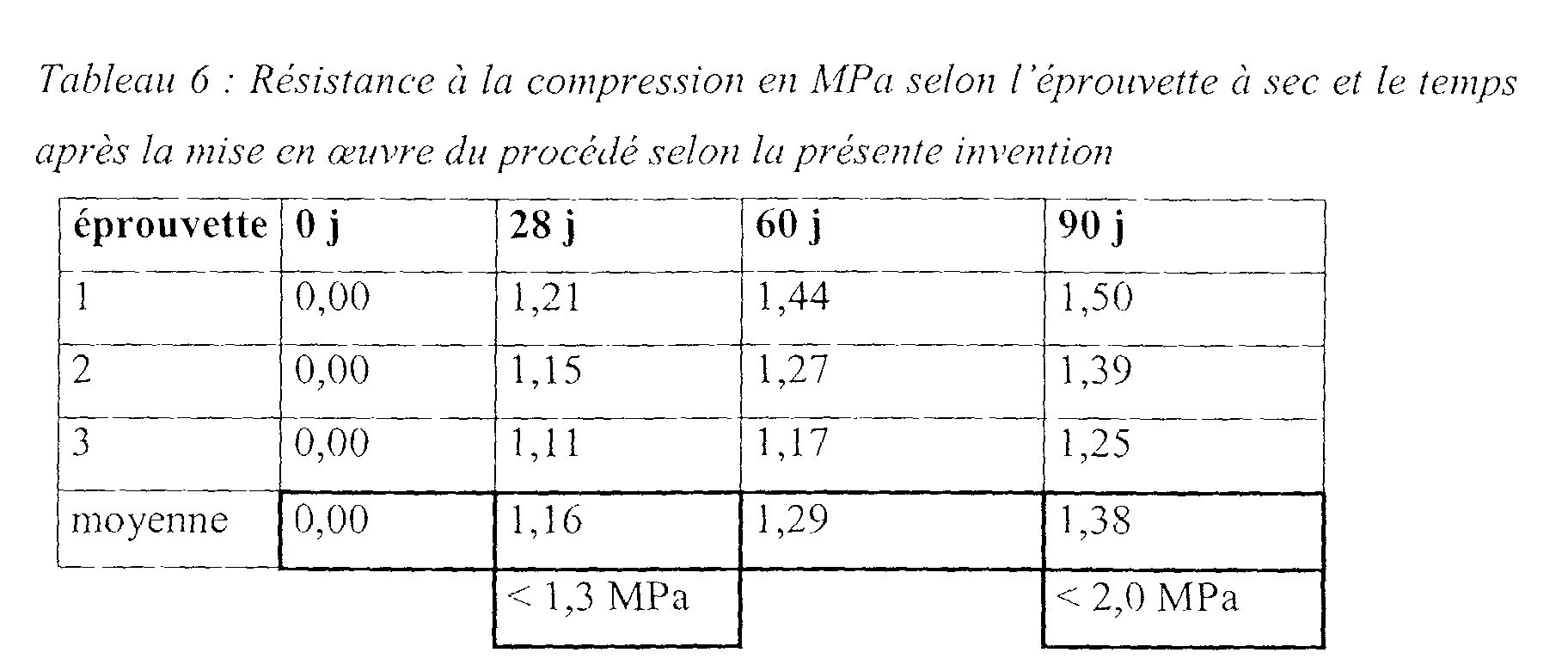
- the compressive strength 28 days after the manufacture of this backfill is between 0.1 MPa and 1.3 MPa (measured according to standard NF P 98-232.1) and advantageously its compressive strength 90 days after the fabrication of this backfill is between 0.1 and 2 MPa (measured according to the NF P 98-232.1 standard) the autocompacted backfill is thus pieceable.
- the backfill according to the present invention has a cone sag greater than 12 cm (measured according to standard NF P 18-451), advantageously greater than 13.5 cm, the backfill thus being pumpable.
- the autocompacted backfill has a wet density of about 1.8 T / m 3 during its manufacture, advantageously about 1.65 about 28 days after its manufacture and even more advantageously, a dry density of about 1.23.
- the autocompacted backfill according to the present invention has a pH of about 11, advantageously about 10.
- the present invention also relates to the use of the autocompacted backfill according to the present invention as embankment of sanitation trenches, embankment adjacent to buildings, embankment of underground quarries, or in the treatment of soils of small areas.
- this backfill can be used at great depth, in sites far from a landfill and can replace the defects generated during the laying of pipe in the trench since it provides excellent sealing of the assembly constituted by the pipes and the autocompacted embankment.
- Figure 1 shows a block diagram of such a machine.
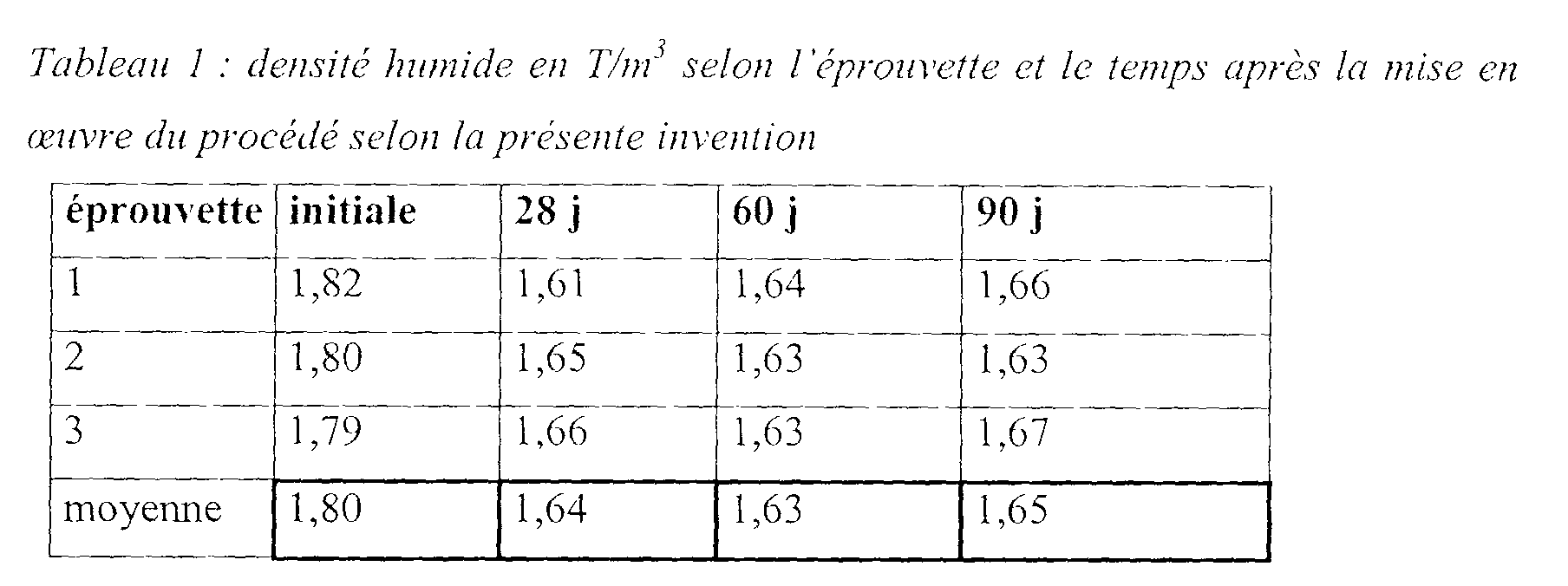
- the wet density of the embankment according to the present invention is measured for several specimens at 28 days, 60 days and 90 days after the implementation of the method according to the present invention. The results are summarized in Table 1.
- the wet density of the product according to the present invention stabilizes at about 1.65T / m 3 from 28 days.
- the dry density is of the order of 1.23 T / m 3
- a value of 12 cm minimum is required to have a pumpable material.
- the cone sagging value of the backfill according to the present invention is measured for different water contents of backfill material after mixing. The results are collated in Table 2.
- cone value as a function of the water content of the backfill material after kneading according to the present invention Moisture content expressed in (wet weight - dry weight) / dry weight cone value (cm) 44% 11 45% 12.5 46% 13.5 47% 14.5 48% 16 49% 17 50% 18
- the evolution of the cone value is therefore a function of the water content.
- Cone value 1.1667 x W% - 40.33, with W representing the water content of the backfill material after mixing, W being expressed in% by weight relative to the total weight of the dry materials.
- the minimum water content to obtain a pumpable material is therefore for the materials considered in the present example, advantageously 44.5% by weight relative to the total weight of the dry materials.
- the pH if it is not very important for the backfill material and its self-compacting, can become very restrictive with regard to the users. This is why it is preferable to have a pH of the order of 11 advantageously less than 10 in the long term.
- the natural pH of the land is 7.4.
- the pH exhibits the evolution indicated in the following Table 3. Evolution of the pH as a function of time after the implementation of the method according to the present invention test tube initial 28 days 60 days 90 days 360 days 1 13,20 12,20 11.40 11.15 10
- the pH decreases sharply up to 360 days but it could not be measured due to lack of time, at what value it stabilized in the long term.
- the 360-day values and the form of the curve suggest that the pH will eventually be less than 11, advantageously less than 10.
- This parameter is one of the most important since it conditions the time required between the end of the implementation of the embankment according to the present invention and the realization of the shape layer. Tests were carried out at 24 h, 48 h, 72 h, and 24 h with a variable water content. The results are summarized in Tables 4 and 5.
- the shape layer should be able to be used in less than 3 hours (These results will be confirmed later in the full-scale test).
- the water content is therefore decisive for the value of the IPI.
- the water content should not exceed about 47.50% by weight relative to the total weight of dry materials for the materials tested in this example.
- the range of use of the method according to the present invention for having a good IPI and a good cone collapse is therefore advantageously between about 44.5% and about 47.5% water content for the materials considered in the present invention. this example. This range is quite small and will therefore require a machine that can accurately weigh the various constituents. 5% error in the weighing of the material gives a difference of 1% on the water content
- Resistance to compression (in MPa) on 10x10 test specimen Resistance to compression in MPa according to the immersion test piece 60 days after the implementation of the method according to the present invention test tube 60 imm. j 1 0.90 2 0.94 3 0.84 average 0.89
- the characteristics of the embankment according to the present invention produced under the conditions indicated above of Example 1, for a water content of 46%, are, for the materials considered: Density 1.8 T / m 3 , Cone collapse 13.5 cm, IPI measured at 24 h 13 Compressive strength at 28 days 1.16 MPa ⁇ 1.30 MPa Compressive strength at 90 days 1.49 MPa ⁇ 2.00 MPa PH at 90 days 11
- the proportions of the various components are those defined for example 1. Only the type of material of excavation varies. measurement of the IPI at 24 hours and cone collapse of the product according to the present invention obtained from different materials of site cuttings having methylene blue values and a different GTR classification No picking GTR classification VBs IPI measured at 24h Sagging cone (in cm) 1 alth 2.13 11 14 2 ClAlth 2.13 15 13.5 3 ClAlth 1.02 13 15 4 ClAlth 1.4 13.5 13.5 5 ClAlth 2.06 13 14
- the next step was the realization of a full-scale test, allowing to appreciate the mass effect on the product and the process according to the present invention.
- a mini sanitation project has been recreated, the aim being to be able to carry out all the tests requested during a real clean-up, to check the hypotheses established in the laboratory, to validate the specifications of the product according to the present invention (characteristics intrinsic) and to evaluate the effect of mass on the mixture.
- the mixture according to the present invention is very easily pumpable, a clipping of the larger elements is however essential. This constraint involves either a screening of the material or a light crushing and breaking.
- the product according to the present invention was poured by a batch of 140 kg into the trench.
- Embankment according to the present invention thus makes it possible to compensate for small defects sealing of networks.
- a machine according to the present invention for making an embankment self-compacting device according to the present invention is for example a mixing plant mobile phone S 15/6 - 1200 whose technical description is as follows:
- the mixer cover is equipped with an opening.
- a flap mounted on the top of the mixer will allow the introduction of fibers safely. It is mounted with a detector for the rest of the cycle: the introduction of the fibers conditions the rest of the cycle. For other cases: waiting and following a time delay commissioning of a light alarm.
- the mixer arms are interchangeable and made of high-strength steel.
- the pallets are made of PVC manufactured by Liebherr. An additional scraping pallet is provided on the periphery.
- Hydraulic component Danfoss Sauer Mounted with oil cooling radiator. Hydraulic unit with variable flow pump: 160 l / min at max. 220 bar and for the sieve: 135 l / min at max. 250 bar
- the hydraulic unit is sized to simultaneously drive the Twister and the Bobcat pump.
- the design will be supervised by Danfoss Sauer.
- High pressure pump 5.5 KW 170 Bars Nozzles on arm and mixing hood The mixer is equipped with a high-pressure washing to perform the fine dosing of water. At the end of the work, only a rinse will be necessary
- the machine is delivered with a high pressure washing lance
- Adjuvant pump Dosage in volumetric mode by gear pump. Equipped with a strainer and a non-return valve.
- Tarpaulin cover made of synthetic material and fastened by strap
- the Twister is equipped with a side hatch to evacuate too bulky material and not passing through the screen. An electrical contact stops the machine if the hatch is opened during the cycle. A side hatch will be provided at the level of the tamper to ensure maintenance.
- the hopper is delivered with extensions increasing the volume to about 3 m 3 .
- the 4 walls will be foldable and lockable for transport.
- the Twister is surrounded by a gateway accessible by a fixed ladder.
- a mat with a safety device automatically stops the operation of the screen
- a key security system will restart the machine by voluntary action.
- a limit switch signaling a defect of material.
- a inspection hatch equipped with a limit switch will stop the screen in case of opening.
- the internal wall under the screen will be delivered with an anti-clogging coating ensuring better sliding of the material.
- the silo is equipped with a vibrator for dosing and a low level limit switch on everything managed by the PLC. It will be equipped with a hatch for emptying and cleaning.
- the silo is intended for filling with big-bag bags or containers INTERCON.
- the drain opening is 1m x 1m.
- Each container is equipped with an elastomer seal that crushes during filling to ensure sealing dust and moisture.
- the mixer is mounted on 3 load cells allowing a weighing accuracy of 1 kg per component.
- the fully automated cycle It manages the manufacture of the self-compacting backfill according to the present invention, the Twister screen and the Bob-Cat concrete pump.
- An indicator of plasticity is provided (Power meter) It indicates the consistency of the mixture
- the PLC and the electrical elements are mounted in an IP55 waterproof cabinet.
- the buttons of the manual operation are mounted on the front The whole is protected by an additional door locked by a padlock. All constituents are standard components of commerce and available from distributors. All engines come from manufacturers known in the art (IP 55 seal).
- the control of the pump is controlled by the production automaton.
- the pump is mounted under the mixer. It is fed by the hydraulic group Danfoss / Sauer.
- a small buffer hopper is placed between the pump and the mixer in order to be able to restart a mixing cycle more quickly (work in time mask).
- the pump is delivered with a bar type grid mounted on the buffer tank and 40 m flexible hose (except part mounted rigidly fixed along the machine).
- the horizontal positioning of the machine is carried out by 4 hydraulic cylinders individually controlled.
Landscapes
- Engineering & Computer Science (AREA)
- Chemical & Material Sciences (AREA)
- Mining & Mineral Resources (AREA)
- Structural Engineering (AREA)
- Ceramic Engineering (AREA)
- Civil Engineering (AREA)
- Life Sciences & Earth Sciences (AREA)
- General Engineering & Computer Science (AREA)
- General Life Sciences & Earth Sciences (AREA)
- Inorganic Chemistry (AREA)
- Paleontology (AREA)
- Materials Engineering (AREA)
- Organic Chemistry (AREA)
- Chemical Kinetics & Catalysis (AREA)
- Mechanical Engineering (AREA)
- Agronomy & Crop Science (AREA)
- Environmental & Geological Engineering (AREA)
- Soil Sciences (AREA)
- Pit Excavations, Shoring, Fill Or Stabilisation Of Slopes (AREA)
- Soil Conditioners And Soil-Stabilizing Materials (AREA)
- Catalysts (AREA)
- Saccharide Compounds (AREA)
- Solid-Sorbent Or Filter-Aiding Compositions (AREA)
- Road Paving Structures (AREA)
- Ceramic Products (AREA)
- Consolidation Of Soil By Introduction Of Solidifying Substances Into Soil (AREA)
- Pigments, Carbon Blacks, Or Wood Stains (AREA)
- Formation And Processing Of Food Products (AREA)
- Curing Cements, Concrete, And Artificial Stone (AREA)
Abstract
Description
- charger les déblais,
- les emmener en décharge,
- ramener d'autres matériaux,
- assurer la mise en oeuvre des remblais,
- la méthode « classique » qui consiste à compacter par des moyens relativement lourds des matériaux d'apport (généralement élaborés en carrière), voire des matériaux du site traité à la chaux,
- la méthode « novatrice » qui utilise des matériaux autocompactants à base de cendres volantes (demande de brevet FR2758378) ou à base de matériaux de carrières et qui suppriment les moyens de compactage. Toutefois, une telle méthode implique d'amener sur place les matériaux autocompactants, augmentant ainsi les coûts et délais de tels chantiers.
En effet, la réutilisation immédiate des déblais en remblais permet d'avoir, de l'extraction à la mise en remblai, une durée de l'ordre de 6 min, sans délai d'attente de camions ou de livraison de remblai.
Un tel procédé permet une réduction jusqu'à 70 % des transports et des frais de décharges et la réalisation d'un remblai économique et écologique.
De plus, le produit obtenu par un tel procédé étant autocompactant, il possède tous les avantages d'un remblai autocompactant :
- aucun défaut de compactage,
- coût de mise en oeuvre faible,
- sécurité (pas de personnel en fond de fouille avec des engins vibrants pour compacter),
- 4 à 10% en poids de ciment par rapport au poids total des matériaux secs,
- 0,05 à 0,15% en poids d'un agent de prise en masse du mélange par rapport au poids total des matériaux secs, et
- la quantité d'eau nécessaire pour obtenir après malaxage un matériau de remblai présentant une teneur en eau comprise entre 40% et 55% en poids par rapport au poids total des matériaux secs,
De façon avantageuse la résistance à la compression 28 jours après la fabrication de ce remblai est comprise entre 0,1 MPa et 1,3 MPa (mesurée selon la norme NF P 98-232.1) et avantageusement sa résistance à la compression 90 jours après la fabrication de ce remblai est comprise entre 0,1 et 2 MPa (mesurée selon la norme NF P 98-232.1) le remblai autocompacté étant donc piochable.
De façon avantageuse le remblai selon la présente invention présente un affaissement au cône supérieur à 12 cm (mesuré selon la norme NF P 18-451), avantageusement supérieur à 13,5 cm, le remblai étant donc pompable.
Avantageusement, le remblai autocompacté a une densité humide d'environ 1,8 T/m3 lors de sa fabrication, de façon avantageuse d'environ 1,65 environ 28 jours après sa fabrication et de façon encore plus avantageuse, une densité sèche d'environ 1,23.
Avantageusement le remblai autocompacté selon la présente invention a un pH d'environ 11, de façon avantageuse d'environ 10.
En effet ce remblai peu être utilisé à forte profondeur, dans des chantiers éloignés d'une décharge et permet de suppléer aux défauts engendrés lors de la pose de canalisation dans la tranchée puisqu'il assure une excellente étanchéité de l'ensemble constitué par les tuyaux et le remblai autocompacté.
Avantageusement cette machine est une centrale mobile qui comprend :
- une trémie réceptrice,
- un émotteur - cribleur,
- un convoyeur de transport,
- un stockage de pulvérulent,
- un stockage d'eau et de produits annexes,
- un mélangeur et
- une pompe de transfert de produit fini.
- elle est dimensionnée pour réaliser des volumes journaliers du remblai autocompactant selon la présente invention ne dépassant pas 100 m3.
- son encombrement est limité au gabarit routier pour permettre un transport aisé et pour accéder facilement aux différents chantiers.
- ses principales caractéristiques sont :
- (a) système de pesée pondérale pour les matériaux à 5% près et pour l'eau à 1% près
- (b) malaxeur à arbres verticaux de 1,2 m3 minimum de capacité
- (c) silo à ciment de 1,5 à 2 T minimum
- (d) silo à eau de 1 m3 minimum
- (e) stockage tampon pour le produit fini de 0,3 m3
- (f) pompage du produit vers la tranchée
- classification GTR du déblai : A1C1th
- valeur au bleu de méthylène : 1,4,
- teneur en eau naturelle : 20%,
- granulométrie 0/50mm.
De l'eau est également rajoutée de façon à obtenir un matériau de déblai ayant une teneur en eau de 46,00% après malaxage en poids par rapport au poids total des matériaux secs.
- les densités sèches et humides,
- les résistances à la compression au bout de 28 jours, 60 jours, 60 jours dont 32 jours en immersion (rapport immersion / compression) et 90 jours,
- le pH,
- l'apparition éventuelle de fissures ou retrait.
La valeur d'affaissement au cône du remblai selon la présente invention est mesurée pour différentes teneurs en eau du matériau de remblai après malaxage. Les résultats sont rassemblés dans le tableau 2.
| valeur au cône en fonction de la teneur en eau du matériau de remblai après malaxage selon la présente invention | |
| Teneur en eau s'exprimant en (poids humide - poids sec)/poids sec | valeur au cône (cm) |
| 44% | 11 |
| 45% | 12,5 |
| 46% | 13,5 |
| 47% | 14,5 |
| 48% | 16 |
| 49% | 17 |
| 50% | 18 |
Valeur au cône = 1,1667 x W% - 40,33,
avec W représentant la teneur en eau du matériau de remblai après malaxage, W étant exprimé en % en poids par rapport au poids total des matériaux secs.
La teneur en eau minimum pour obtenir un matériau pompable est donc pour les matériaux considérés dans le présent exemple, d'avantageusement 44,5% en poids par rapport au poids total des matériaux secs.
Le pH naturel du terrain est ici de 7,4.
Après la mise en oeuvre du procédé selon la présente invention, le pH présente l'évolution indiquée dans le tableau 3 suivant.
| Evolution du pH en fonction du temps après la mise en oeuvre du procédé selon, la présente invention | |||||
| éprouvette | initial | 28 j | 60 j | 90 j | 360 j |
| 1 | 13,20 | 12,20 | 11,40 | 11,15 | 10 |
Des essais ont été effectués à 24h, 48h, 72h, et à 24 h avec une teneur en eau variable. Les résultats sont rassemblés dans les tableaux 4 et 5.

La couche de forme devrait pouvoir être mise en oeuvre dans un délai inférieur à 3 h (Ces résultats seront confirmés par la suite dans l'essai grandeur nature ).
| Evolution de l'IPI mesurée 24 heures après la mise en oeuvre du procédé selon la présente invention en fonction de la teneur en eau en % en poids par rapport au poids total des matériaux secs, du matériau de remblai après malaxage. | |
| teneur en eau s'exprimant en (poids humide - poids sec)/poids sec | IPI |
| 44,00% | 15 |
| 45,00% | 14 |
| 46,00% | 14 |
| 47,00% | 11 |
| 48,00% | 8 |
| 49,00% | 7,2 |
| 50,00% | 7 |
Cette plage est assez réduite et demandera donc une machine pouvant peser précisément les différents constituants. 5% d'erreur sur la pesée du matériau donne une différence de 1% sur la teneur en eau
| Résistance à la compression en MPa selon l'éprouvette en immersion 60 jours après la mise en oeuvre du procédé selon la présente invention | |
| éprouvette | 60 imm. j |
| 1 | 0,90 |
| 2 | 0,94 |
| 3 | 0,84 |
| moyenne | 0,89 |
Tous les essais laboratoire sont donc conformes au cahier des charges fixé permettant d'obtenir un produit autocompactant.
| Densité | 1,8 T/m3, |
| Affaissement de cône | 13,5 cm, |
| IPI mesuré à 24 h | 13, |
| Résistance à la compression à 28 jours | 1,16 MPa < 1,30 MPa |
| Résistance à la compression à 90 jours | 1,49 MPa < 2,00 MPa |
| PH à 90 j | 11 |
| mesure de l'IPI à 24heures et de l'affaissement au cône du produit selon la présente invention obtenu à partir de différents matériaux de déblais de chantier ayant des valeurs de bleu de méthylène et une classification GTR différente | ||||
| N° prélèvement | Classification GTR | VBs | IPI mesurée à 24h | Affaissement au cône (en cm) |
| 1 | Alth | 2,13 | 11 | 14 |
| 2 | ClAlth | 2,13 | 15 | 13,5 |
| 3 | ClAlth | 1,02 | 13 | 15 |
| 4 | ClAlth | 1,4 | 13,5 | 13,5 |
| 5 | ClAlth | 2,06 | 13 | 14 |
La préparation des chantiers demande lors des sondages les vérifications suivantes :
- teneur en eau naturelle des déblais ,
- ajout d'eau permettant d'obtenir un affaissement au cône >12 cm,
- IPI mesuré à 24h,
- classification GTR (pour les courbes de référence pénétrométrique).
- l'absence de retrait,
- la possibilité de pomper le matériau,
- de bons résultats de compactage,
- l'apport possible d'une étanchéité par le produit au réseau d'assainissement.
Pour fabriquer le volume de remblai selon la présente invention nécessaire à l'essai, nous avons utilisé une machine de type Putzmeister® M 750.
Le mélange est malaxé grâce à un axe horizontal muni de 3 pales. Le pompage est effectué par la mise sous pression d'air du malaxeur (de 3 à 5 bars).
Le matériau de déblai est constitué par des terres de déblai ayant les caractéristiques suivantes :
- teneur en eau naturelle de 20 %,
- valeur au bleu de méthylène de 1,4,
- classification GTR du déblai : A1C1th,
- granulométrie 0/50mm.
| Poids matériaux de déblai humides | 111,60 kg |
| Ciment | 7,00 kg |
| Eau naturelle | 18,60 kg |
| Rajout d'eau | 25,00 kg |
| Poids sec des matériaux de déblais | 93,00 kg |
| Eau | 43,60 kg |
| Teneur en eau globale | 46,88% |
- l'ensemble des matériaux (hors eau d'ajout ) est malaxé à sec pendant 1 min,
- l'eau est ajoutée et le mélange est malaxé environ 2 min et
- le mélange est pompé sous forme de coulis vers la tranchée, grâce à la mise en
pression de la machine.
Des échantillons sont prélevés pour réaliser des essais en laboratoires.
Cette contrainte implique soit un criblage du matériau ou un léger concassage et émottage.
Et effectivement il n'a été constaté aucune fissuration ou retrait sur la tranchée ni immédiat ni au fur et à mesure de la prise du produit selon la présente invention.
De plus le matériau obtenu ne présente aucun ressuage
Pour cela après remblayage de la tranchée avec le produit selon la présente invention, des percements ont été effectués dans la canalisation, le but étant de tester l'étanchéité du remblai selon la présente invention et l'interface PVC / remblai selon la présente invention ("collage" de l'interface).
Pour cela la canalisation a été percée à l'aide d'un foret de diamètre 4 mm et la canalisation a été testée sous une pression d'air de 5 Pa pendant 6 min. Les résultats de ce test sont rassemblés dans le tableau 9 suivant.
| Différence de pression d'air entre le début et la fin de l'essai dans une canalisation en fonction du nombre de trous percés dans la canalisation. | |||||
| NB DE TROUS | DIAMETRE DE PERÇAGE | Pa départ | Pa fin | Pa MINI FIN D'ESSAI | DELAI MISE SOUS PRESSION |
| 1 | 4 | 5 | 5 | 4 | 6MIN |
| 2 | 4 | 5 | 5 | 4 | 6MIN |
| 3 | 4 | 5 | 2,3 | 4 | 6MIN |
| Longueur (hors tous) | 6,85 m |
| Largeur | 2,50m |
| Hauteur limitée | 2,70 m (pour le transport par camion AMPLIROLL): |
| Alimentation électrique | 125 A / 400V |
| Volume du malaxeur / volume fini | 1800/1200 litres |
| Puissance malaxeur | 30 KW |
| Réducteur | Brevini planétaire |
| Trappe de vidange | 0,55 KW moteur Nordgear |
| Bâche à eau cloisonnée | 1000 litres minimum, livrée avec 50 m de tuyau monté sur enrouleur |
| Pompe à eau | 1 pièce |
| Paroi extérieure | plaques Hardox 10 mm |
| Fond | plaque Hardox 12 mm |
| Palette de malaxeur | PVC (Liebherr) |
Il est monté avec un détecteur pour la suite du cycle auto : l'introduction des fibres conditionne la suite du cycle. Pour les autres cas: attente et à la suite d'une temporisation mise en service d'une alarme lumineuse.
Les bras du malaxeur sont interchangeables et en acier haute résistance. Les palettes sont en PVC de fabrication Liebherr. Une palette de raclage supplémentaire est prévue à la périphérie.
| Composant hydraulique | Danfoss Sauer |
| Monté avec radiateur de refroidissement d'huile. | |
| Groupe hydraulique avec pompe à débit variable: | 160 l/min à 220 bars maxi |
| et pour le crible : | 135 l/min à 250 bars maxi |
| Pompe haute pression | 5,5 KW 170 Bars |
| Buses sur bras et capot malaxeur Le malaxeur est équipé d'un lavage haute pression permettant de réaliser le dosage fin de l'eau. A la fin du travail, seul un rinçage sera nécessaire |
Equipée d'une crépine et d'un clapet anti-retour.
| 1 Crible / séparateur TWISTER B6 | |
| Longueur | 1740 mm |
| Largeur | 1557 mm |
| Hauteur | 1428 mm |
| Surface de passage | 1,4 m2 |
| Volume de la trémie de base | 1,5 m3 |
| Poids | 2150 kg |
| Puissance hydraulique | 30 KW |
| (avec régulateur de débit maxi 135 l/min et pression maxi de 250 bars) |
Une trappe latérale sera prévue au niveau de l'émotteur pour assurer la maintenance.
Un système de sécurité à clés permettra le redémarrage de la machine par une action volontaire.
| Tapis situé sous le crible | |
| Longueur | 4,5 m |
| Largeur | 1000 mm |
| Puissance tambour moteur | 4KW |
| Rouleau de tête caoutchouté | |
| Racleur de nettoyage |
| Contenance | 1,5 /2 m3 |
| Vis ciment à moto -réducteur | 3 KW |
Il s'agit d'un Automate SIEMENS type 315-2DP avec écran tactile Touchpanel TP 170B5,7
Automate pouvant gérer:
- 1 granulat, 1 adjuvant. 1 ciment, 1 eau
- mémoire pour 25 formules
- dosage gros - fin
- imprimante thermique
- modem pour la télémaintenance
- logiciel d'utilisation entièrement en français
- Conjugaison des produits suivant variation de la consigne de réglage du volume de la gâchée.
Tous les constituants sont des composants standard du commerce et disponibles auprès des distributeurs. Tous les moteurs proviennent de constructeurs connus dans le métier (étanchéité IP 55).
| Pompe de type IR Bob- cat | |
| Type | pompe à piston et basculeur |
| Débit | 15 à 23 m3/h |
| Pression de pompage | 52 bars |
| Diamètre du cylindre de pompage | 127 mm |
| Course de la pompe | 610 mm |
| Puissance | 20 - 30 KW |
| Pilotage | hydraulique |
| Volume bac tampon | 200 litres minimum (Volume à augmenter en fonction de la disposition des éléments de la machine) |
Cette berce devra être compatible aux bras de manutention équipant les camions utilisés en France et répondant à la norme NF 17-108.
Claims (16)
- Procédé de réalisation de remblais autocompactants, non essorable, impliquant les opérations successives suivantes menées sur site :-a) extraction et récupération des matériaux de déblais issus d'une tranchée,-b) vérification de la teneur en argile de ces matériaux de déblais par mesure de la valeur de bleu de méthylène, cette valeur devant être inférieure à 8,-c) détermination de la teneur en eau de ces matériaux de déblais,-d) traitement préalable des matériaux de déblais par concassage ou écrêtage, afin d'obtenir des granulats de diamètre inférieur à 50 mm,-e) ajout aux matériaux de déblais obtenus à l'étape d) de :4 à 10% en poids de ciment par rapport au poids total des matériaux secs,0,05 à 0,15% en poids d'un agent de prise en masse du mélange par rapport au poids total des matériaux secs, etla quantité d'eau nécessaire pour obtenir après malaxage un matériau de remblai présentant une teneur en eau comprise entre 40% et 55% en poids par rapport au poids total des matériaux secs,-f) malaxage,-g) pompage du mélange obtenu dans ladite tranchée pour former un remblai qui subit un autocompactage après une courte période.
- Procédé selon la revendication 1, caractérisé en ce que le ciment est un ciment CPA-CEM 1 52,5 R.
- Procédé selon l'une quelconque des revendications précédentes, caractérisé en ce que 0,05 à 1% en poids d'un adjuvant par rapport au poids total du ciment est ajouté à l'étape e).
- Procédé selon la revendication 3, caractérisé en ce que l'adjuvant est choisit dans le groupe constitué par les réducteurs d'eau et les entraíneurs d'air.
- Procédé selon l'une quelconque des revendications précédentes caractérisé en ce que 1 à 4% en poids de pigment par rapport au poids total du ciment est ajouté à l'étape e).
- Procédé selon l'une quelconque des revendications précédentes caractérisé en ce la quantité d'eau ajoutée à l'étape e) est celle nécessaire pour obtenir après malaxage un matériau de remblai présentant une teneur en eau comprise entre 44,5% et 47,5% en poids par rapport au poids total des matériaux secs.
- Procédé selon l'une quelconque des revendications précédentes caractérisé en ce que l'agent de prise en masse du mélange est constitué par des fibres acryliques.
- Procédé selon l'une quelconque des revendications précédentes, caractérisé en ce que pour prévenir les possibles risques de poussée d'Archimède exercée par le produit obtenu à l'étape g) sur les tuyaux présents dans la tranchée, il comprend une étape supplémentaire f1) de mise en place et réglage altimétrique de butée aptes à contrôler le déplacement desdits tuyaux, ladite étape étant réalisé avant l'étape g).
- Procédé selon la revendication 8, caractérisé en ce que les butées viennent coiffer les tuyaux interdisant leurs déplacements latéraux et limitant leurs déplacements verticaux ascendants.
- Remblai autocompacté caractérisé en ce qu'il est susceptible d'être obtenu par le procédé selon l'une quelconque des revendications 1 à 9.
- Remblai autocompacté selon la revendication 10, caractérisé en ce que son indice portant mesuré à 24 heures est supérieur à 10.
- Remblai autocompacté selon l'une quelconque des revendications 10 ou 11, caractérisé en ce que sa résistance à la compression à 28 jours est comprise entre 0,1 MPa et 1,3 MPa et sa résistance à la compression à 90 jours est comprise entre 0,1 et 2 MPa.
- Remblai autocompacté selon l'une quelconque des revendications 10 à 12, caractérisé en ce que son affaissement au cône est supérieur à 12 cm.
- Utilisation du remblai autocompacté selon l'une quelconque des revendications 10 à 13 en tant que remblai des tranchés d'assainissement, remblai contigu aux bâtiments, remblai de carrières souterraines ou dans le traitement de sols de petites surfaces.
- Machine servant à la fabrication d'un remblai autocompacté selon l'une quelconque des revendications 10 à 13.
- Machine selon la revendication 15 caractérisé en ce qu'il s'agit d'une centrale mobile qui comprend :une trémie réceptrice,un émotteur - cribleur,un convoyeur de transport,un stockage de pulvérulent,un stockage d'eau et de produits annexes,un mélangeur etune pompe de transfert de produit fini.
Applications Claiming Priority (2)
| Application Number | Priority Date | Filing Date | Title |
|---|---|---|---|
| FR0112508A FR2830269B1 (fr) | 2001-09-28 | 2001-09-28 | Procede de preparation d'un remblai autocompactant, remblai autocompactant et utilisation |
| FR0112508 | 2001-09-28 |
Publications (2)
| Publication Number | Publication Date |
|---|---|
| EP1298254A1 true EP1298254A1 (fr) | 2003-04-02 |
| EP1298254B1 EP1298254B1 (fr) | 2010-03-10 |
Family
ID=8867715
Family Applications (1)
| Application Number | Title | Priority Date | Filing Date |
|---|---|---|---|
| EP20020292390 Expired - Lifetime EP1298254B1 (fr) | 2001-09-28 | 2002-09-27 | Procédé de préparation d'un remblai autocompactant |
Country Status (7)
| Country | Link |
|---|---|
| EP (1) | EP1298254B1 (fr) |
| AT (1) | ATE460538T1 (fr) |
| DE (1) | DE60235600D1 (fr) |
| DK (1) | DK1298254T3 (fr) |
| ES (1) | ES2339925T3 (fr) |
| FR (1) | FR2830269B1 (fr) |
| PL (1) | PL209674B1 (fr) |
Cited By (12)
| Publication number | Priority date | Publication date | Assignee | Title |
|---|---|---|---|---|
| EP1679131A1 (fr) * | 2005-01-05 | 2006-07-12 | Mario Kevekordes | Machine pour la préparation de matériau excavé |
| WO2007012741A1 (fr) * | 2005-07-29 | 2007-02-01 | Recymo, Sarl | Installation et procede de traitement de deblais limoneux |
| DE10332249B4 (de) * | 2003-07-11 | 2008-08-14 | Rac-Rohrleitungsbau Altchemnitz Gmbh | Verfahren zur Herstellung von Bodenverfüllmassen, nach dem Verfahren hergestellte Bodenverfüllmasse und deren Verwendung |
| CN102155261A (zh) * | 2011-03-08 | 2011-08-17 | 北京科技大学 | 一种利用矿山固体废弃物的膏体联合充填方法 |
| WO2014122217A1 (fr) * | 2013-02-06 | 2014-08-14 | Etablissements Hublet | Liant pour remblai autocompactant et reexcavable |
| CN107489412A (zh) * | 2017-10-17 | 2017-12-19 | 西南石油大学 | 一种海底浅层天然气水合物井下就地实时分离回填系统 |
| CN111138097A (zh) * | 2020-01-14 | 2020-05-12 | 山东康格能源科技有限公司 | 一种用于充填开采的填充材料 |
| CN112664266A (zh) * | 2021-01-04 | 2021-04-16 | 安徽理工大学 | 一种井下压缩块体堆砌式充填系统及方法 |
| CN113387665A (zh) * | 2021-07-07 | 2021-09-14 | 河南绿岩工程科技有限公司 | 一种液化固结材料及其制备方法 |
| CN114145158A (zh) * | 2021-11-30 | 2022-03-08 | 青海九零六工程勘察设计院有限责任公司 | 一种高寒区煤矿碳渣地的土地复垦结构及实施方法 |
| CN114956693A (zh) * | 2022-06-28 | 2022-08-30 | 窑街煤电集团有限公司 | 一种用于急倾斜特厚煤层分层充采的低泌水率膏体材料 |
| CN115059079A (zh) * | 2022-05-31 | 2022-09-16 | 中国水电建设集团十五工程局有限公司 | 一种均质坝土料制备方法 |
Families Citing this family (1)
| Publication number | Priority date | Publication date | Assignee | Title |
|---|---|---|---|---|
| CN113509995B (zh) * | 2021-07-28 | 2023-11-17 | 烟台杰瑞石油装备技术有限公司 | 采空区充填设备以及充填方法 |
Citations (7)
| Publication number | Priority date | Publication date | Assignee | Title |
|---|---|---|---|---|
| US3607078A (en) * | 1969-09-19 | 1971-09-21 | Dietert Co Harry W | Method of determining the live clay content of foundry sand |
| US5716448A (en) | 1994-07-05 | 1998-02-10 | Mbt Holding Ag | Hydraulic composite |
| FR2758378A1 (fr) * | 1997-01-16 | 1998-07-17 | Lefebvre Jean Ets | Procede de pose de tuyaux |
| JPH10237895A (ja) * | 1997-02-27 | 1998-09-08 | Nitto Seiko Co Ltd | 車載式掘削土埋め戻し装置 |
| JP2000248280A (ja) * | 1999-02-26 | 2000-09-12 | Yoshitaka Tateiwa | 粗骨材の製造に関する土壌改良材及び製造する方法 |
| EP1103533A2 (fr) * | 1999-11-29 | 2001-05-30 | Innovation Holding (U.K.) Limited | Procédé et appareil pour la fabrication de béton mousse |
| EP1146172A2 (fr) * | 2000-04-13 | 2001-10-17 | Heriot-Watt University | Réutilisation de matériaux provenant de l'excavation de sols |
Family Cites Families (1)
| Publication number | Priority date | Publication date | Assignee | Title |
|---|---|---|---|---|
| JP2000008367A (ja) * | 1998-06-19 | 2000-01-11 | Eesukon Kogyo Kk | 粘性土の流動化処理方法 |
-
2001
- 2001-09-28 FR FR0112508A patent/FR2830269B1/fr not_active Expired - Lifetime
-
2002
- 2002-09-27 ES ES02292390T patent/ES2339925T3/es not_active Expired - Lifetime
- 2002-09-27 PL PL356359A patent/PL209674B1/pl not_active IP Right Cessation
- 2002-09-27 DE DE60235600T patent/DE60235600D1/de not_active Expired - Lifetime
- 2002-09-27 EP EP20020292390 patent/EP1298254B1/fr not_active Expired - Lifetime
- 2002-09-27 AT AT02292390T patent/ATE460538T1/de not_active IP Right Cessation
- 2002-09-27 DK DK02292390T patent/DK1298254T3/da active
Patent Citations (7)
| Publication number | Priority date | Publication date | Assignee | Title |
|---|---|---|---|---|
| US3607078A (en) * | 1969-09-19 | 1971-09-21 | Dietert Co Harry W | Method of determining the live clay content of foundry sand |
| US5716448A (en) | 1994-07-05 | 1998-02-10 | Mbt Holding Ag | Hydraulic composite |
| FR2758378A1 (fr) * | 1997-01-16 | 1998-07-17 | Lefebvre Jean Ets | Procede de pose de tuyaux |
| JPH10237895A (ja) * | 1997-02-27 | 1998-09-08 | Nitto Seiko Co Ltd | 車載式掘削土埋め戻し装置 |
| JP2000248280A (ja) * | 1999-02-26 | 2000-09-12 | Yoshitaka Tateiwa | 粗骨材の製造に関する土壌改良材及び製造する方法 |
| EP1103533A2 (fr) * | 1999-11-29 | 2001-05-30 | Innovation Holding (U.K.) Limited | Procédé et appareil pour la fabrication de béton mousse |
| EP1146172A2 (fr) * | 2000-04-13 | 2001-10-17 | Heriot-Watt University | Réutilisation de matériaux provenant de l'excavation de sols |
Non-Patent Citations (2)
| Title |
|---|
| PATENT ABSTRACTS OF JAPAN vol. 1998, no. 14 31 December 1998 (1998-12-31) * |
| PATENT ABSTRACTS OF JAPAN vol. 2000, no. 12 3 January 2001 (2001-01-03) * |
Cited By (16)
| Publication number | Priority date | Publication date | Assignee | Title |
|---|---|---|---|---|
| DE10332249B4 (de) * | 2003-07-11 | 2008-08-14 | Rac-Rohrleitungsbau Altchemnitz Gmbh | Verfahren zur Herstellung von Bodenverfüllmassen, nach dem Verfahren hergestellte Bodenverfüllmasse und deren Verwendung |
| EP1679131A1 (fr) * | 2005-01-05 | 2006-07-12 | Mario Kevekordes | Machine pour la préparation de matériau excavé |
| WO2007012741A1 (fr) * | 2005-07-29 | 2007-02-01 | Recymo, Sarl | Installation et procede de traitement de deblais limoneux |
| FR2889096A1 (fr) * | 2005-07-29 | 2007-02-02 | Recymo Sarl | Installation de traitement de deblais limoneux d'un chantier et procede de traitement de ces deblais limoneux mettant en oeuvre ladite installation |
| CN102155261A (zh) * | 2011-03-08 | 2011-08-17 | 北京科技大学 | 一种利用矿山固体废弃物的膏体联合充填方法 |
| WO2014122217A1 (fr) * | 2013-02-06 | 2014-08-14 | Etablissements Hublet | Liant pour remblai autocompactant et reexcavable |
| BE1021367B1 (fr) * | 2013-02-06 | 2015-11-06 | Etablissements Hublet | Remblais autocompactant reexcavable. |
| CN107489412B (zh) * | 2017-10-17 | 2023-05-16 | 宜宾学院 | 一种海底浅层天然气水合物井下就地实时分离回填系统 |
| CN107489412A (zh) * | 2017-10-17 | 2017-12-19 | 西南石油大学 | 一种海底浅层天然气水合物井下就地实时分离回填系统 |
| CN111138097A (zh) * | 2020-01-14 | 2020-05-12 | 山东康格能源科技有限公司 | 一种用于充填开采的填充材料 |
| CN112664266A (zh) * | 2021-01-04 | 2021-04-16 | 安徽理工大学 | 一种井下压缩块体堆砌式充填系统及方法 |
| CN113387665A (zh) * | 2021-07-07 | 2021-09-14 | 河南绿岩工程科技有限公司 | 一种液化固结材料及其制备方法 |
| CN114145158A (zh) * | 2021-11-30 | 2022-03-08 | 青海九零六工程勘察设计院有限责任公司 | 一种高寒区煤矿碳渣地的土地复垦结构及实施方法 |
| CN115059079A (zh) * | 2022-05-31 | 2022-09-16 | 中国水电建设集团十五工程局有限公司 | 一种均质坝土料制备方法 |
| CN115059079B (zh) * | 2022-05-31 | 2023-06-20 | 中国水电建设集团十五工程局有限公司 | 一种均质坝土料制备方法 |
| CN114956693A (zh) * | 2022-06-28 | 2022-08-30 | 窑街煤电集团有限公司 | 一种用于急倾斜特厚煤层分层充采的低泌水率膏体材料 |
Also Published As
| Publication number | Publication date |
|---|---|
| PL209674B1 (pl) | 2011-10-31 |
| DE60235600D1 (de) | 2010-04-22 |
| PL356359A1 (en) | 2003-04-07 |
| EP1298254B1 (fr) | 2010-03-10 |
| FR2830269A1 (fr) | 2003-04-04 |
| DK1298254T3 (da) | 2010-05-03 |
| FR2830269B1 (fr) | 2004-07-09 |
| ES2339925T3 (es) | 2010-05-27 |
| ATE460538T1 (de) | 2010-03-15 |
Similar Documents
| Publication | Publication Date | Title |
|---|---|---|
| EP1298254B1 (fr) | Procédé de préparation d'un remblai autocompactant | |
| MXPA03005850A (es) | Un metodo para hacer un material de base de rodamiento utilizando material de desecho tratado de petroleo y gas. | |
| CN112723906A (zh) | 一种基于建筑泥浆的轻质填料制备及施工方法 | |
| CN104404838B (zh) | 速度200km以上铁路湿陷性黄土路基基底处理方法 | |
| CN108914912A (zh) | 一种柱锤强夯置换的地基处理施工工法 | |
| CN102677661A (zh) | 一种淤泥质软基现浇箱梁支架基础加固方法 | |
| CN110984079B (zh) | 自密实混凝土堆石坝施工方法 | |
| CN101713189B (zh) | 花管干法灌注桩施工工艺 | |
| CN104532817A (zh) | 一种固化疏浚泥的现场混合吹填方法 | |
| CN112112249A (zh) | 一种新建污水管道与主管道不停水碰接的快速施工方法 | |
| CN111980035A (zh) | 气泡混合轻质土回填法管道施工工法 | |
| EP2954119B1 (fr) | Liant pour remblai autocompactant et reexcavable | |
| CN101831910B (zh) | 一种钢筋混凝土凸缘扩孔型灌注桩的施工方法 | |
| Brown | Zen and the art of drilled shaft construction: The pursuit of quality | |
| CN101363220A (zh) | 建筑垃圾挤淤河塘回填方法 | |
| CN211927632U (zh) | 用于测试随钻跟管桩桩侧注浆液抗水性能的装置 | |
| CN116427470A (zh) | 一种历史固废堆填场污染原位工程防治方法 | |
| CN117345944A (zh) | 大口径pccp管道在复杂地基上的埋置安装工艺 | |
| CN115028404A (zh) | 一种适用于季冻区盐渍土路段桥涵台背回填的流态粉煤灰及其制备方法和应用 | |
| CN115434202A (zh) | 基于双层防水设计的东非不良级配珊瑚土基层施工工法 | |
| CN205134306U (zh) | 一种原位竖向隔离工程屏障材料的制备装置 | |
| Allen | Time dependent effect of drilling slurries on side shear resistance of drilled shafts | |
| ICOLD | Roller-Compacted Concrete Dams | |
| Mullins et al. | Effect of Polymer Slurry Stabilization on Drilled Shaft Side Shear over Time | |
| CN111175209A (zh) | 用于测试随钻跟管桩桩侧注浆液抗水性能的装置及方法 |
Legal Events
| Date | Code | Title | Description |
|---|---|---|---|
| PUAI | Public reference made under article 153(3) epc to a published international application that has entered the european phase |
Free format text: ORIGINAL CODE: 0009012 |
|
| AK | Designated contracting states |
Kind code of ref document: A1 Designated state(s): AT BE BG CH CY CZ DE DK EE ES FI FR GB GR IE IT LI LU MC NL PT SE SK TR |
|
| AX | Request for extension of the european patent |
Extension state: AL LT LV MK RO SI |
|
| 17P | Request for examination filed |
Effective date: 20030623 |
|
| AKX | Designation fees paid |
Designated state(s): AT BE BG CH CY CZ DE DK EE ES FI FR GB GR IE IT LI LU MC NL PT SE SK TR |
|
| 17Q | First examination report despatched |
Effective date: 20080820 |
|
| GRAP | Despatch of communication of intention to grant a patent |
Free format text: ORIGINAL CODE: EPIDOSNIGR1 |
|
| GRAS | Grant fee paid |
Free format text: ORIGINAL CODE: EPIDOSNIGR3 |
|
| GRAA | (expected) grant |
Free format text: ORIGINAL CODE: 0009210 |
|
| AK | Designated contracting states |
Kind code of ref document: B1 Designated state(s): AT BE BG CH CY CZ DE DK EE ES FI FR GB GR IE IT LI LU MC NL PT SE SK TR |
|
| REG | Reference to a national code |
Ref country code: GB Ref legal event code: FG4D Free format text: NOT ENGLISH |
|
| REG | Reference to a national code |
Ref country code: CH Ref legal event code: NV Representative=s name: MICHELI & CIE SA Ref country code: CH Ref legal event code: EP |
|
| REG | Reference to a national code |
Ref country code: IE Ref legal event code: FG4D |
|
| REF | Corresponds to: |
Ref document number: 60235600 Country of ref document: DE Date of ref document: 20100422 Kind code of ref document: P |
|
| REG | Reference to a national code |
Ref country code: DK Ref legal event code: T3 |
|
| REG | Reference to a national code |
Ref country code: SE Ref legal event code: TRGR |
|
| REG | Reference to a national code |
Ref country code: ES Ref legal event code: FG2A Ref document number: 2339925 Country of ref document: ES Kind code of ref document: T3 |
|
| REG | Reference to a national code |
Ref country code: NL Ref legal event code: T3 |
|
| REG | Reference to a national code |
Ref country code: GR Ref legal event code: EP Ref document number: 20100401152 Country of ref document: GR |
|
| REG | Reference to a national code |
Ref country code: SK Ref legal event code: T3 Ref document number: E 7268 Country of ref document: SK |
|
| PG25 | Lapsed in a contracting state [announced via postgrant information from national office to epo] |
Ref country code: FI Free format text: LAPSE BECAUSE OF FAILURE TO SUBMIT A TRANSLATION OF THE DESCRIPTION OR TO PAY THE FEE WITHIN THE PRESCRIBED TIME-LIMIT Effective date: 20100310 Ref country code: AT Free format text: LAPSE BECAUSE OF FAILURE TO SUBMIT A TRANSLATION OF THE DESCRIPTION OR TO PAY THE FEE WITHIN THE PRESCRIBED TIME-LIMIT Effective date: 20100310 |
|
| PG25 | Lapsed in a contracting state [announced via postgrant information from national office to epo] |
Ref country code: CY Free format text: LAPSE BECAUSE OF FAILURE TO SUBMIT A TRANSLATION OF THE DESCRIPTION OR TO PAY THE FEE WITHIN THE PRESCRIBED TIME-LIMIT Effective date: 20100310 Ref country code: EE Free format text: LAPSE BECAUSE OF FAILURE TO SUBMIT A TRANSLATION OF THE DESCRIPTION OR TO PAY THE FEE WITHIN THE PRESCRIBED TIME-LIMIT Effective date: 20100310 |
|
| PG25 | Lapsed in a contracting state [announced via postgrant information from national office to epo] |
Ref country code: BG Free format text: LAPSE BECAUSE OF FAILURE TO SUBMIT A TRANSLATION OF THE DESCRIPTION OR TO PAY THE FEE WITHIN THE PRESCRIBED TIME-LIMIT Effective date: 20100610 |
|
| PLBE | No opposition filed within time limit |
Free format text: ORIGINAL CODE: 0009261 |
|
| STAA | Information on the status of an ep patent application or granted ep patent |
Free format text: STATUS: NO OPPOSITION FILED WITHIN TIME LIMIT |
|
| PG25 | Lapsed in a contracting state [announced via postgrant information from national office to epo] |
Ref country code: PT Free format text: LAPSE BECAUSE OF FAILURE TO SUBMIT A TRANSLATION OF THE DESCRIPTION OR TO PAY THE FEE WITHIN THE PRESCRIBED TIME-LIMIT Effective date: 20100712 |
|
| 26N | No opposition filed |
Effective date: 20101213 |
|
| PGFP | Annual fee paid to national office [announced via postgrant information from national office to epo] |
Ref country code: DK Payment date: 20110817 Year of fee payment: 10 |
|
| PGFP | Annual fee paid to national office [announced via postgrant information from national office to epo] |
Ref country code: LU Payment date: 20120817 Year of fee payment: 11 |
|
| PG25 | Lapsed in a contracting state [announced via postgrant information from national office to epo] |
Ref country code: TR Free format text: LAPSE BECAUSE OF FAILURE TO SUBMIT A TRANSLATION OF THE DESCRIPTION OR TO PAY THE FEE WITHIN THE PRESCRIBED TIME-LIMIT Effective date: 20100310 |
|
| PGFP | Annual fee paid to national office [announced via postgrant information from national office to epo] |
Ref country code: MC Payment date: 20120817 Year of fee payment: 11 Ref country code: IE Payment date: 20120823 Year of fee payment: 11 Ref country code: SE Payment date: 20120918 Year of fee payment: 11 |
|
| PGFP | Annual fee paid to national office [announced via postgrant information from national office to epo] |
Ref country code: GR Payment date: 20120820 Year of fee payment: 11 |
|
| PGFP | Annual fee paid to national office [announced via postgrant information from national office to epo] |
Ref country code: ES Payment date: 20120920 Year of fee payment: 11 Ref country code: IT Payment date: 20120926 Year of fee payment: 11 |
|
| PGFP | Annual fee paid to national office [announced via postgrant information from national office to epo] |
Ref country code: NL Payment date: 20120828 Year of fee payment: 11 |
|
| REG | Reference to a national code |
Ref country code: NL Ref legal event code: V1 Effective date: 20140401 |
|
| REG | Reference to a national code |
Ref country code: SE Ref legal event code: EUG |
|
| PG25 | Lapsed in a contracting state [announced via postgrant information from national office to epo] |
Ref country code: MC Free format text: LAPSE BECAUSE OF NON-PAYMENT OF DUE FEES Effective date: 20130930 Ref country code: SE Free format text: LAPSE BECAUSE OF NON-PAYMENT OF DUE FEES Effective date: 20130928 |
|
| REG | Reference to a national code |
Ref country code: DK Ref legal event code: EBP Effective date: 20130930 |
|
| REG | Reference to a national code |
Ref country code: GR Ref legal event code: ML Ref document number: 20100401152 Country of ref document: GR Effective date: 20140403 |
|
| REG | Reference to a national code |
Ref country code: IE Ref legal event code: MM4A |
|
| PG25 | Lapsed in a contracting state [announced via postgrant information from national office to epo] |
Ref country code: IE Free format text: LAPSE BECAUSE OF NON-PAYMENT OF DUE FEES Effective date: 20130927 |
|
| PG25 | Lapsed in a contracting state [announced via postgrant information from national office to epo] |
Ref country code: GR Free format text: LAPSE BECAUSE OF NON-PAYMENT OF DUE FEES Effective date: 20140403 Ref country code: NL Free format text: LAPSE BECAUSE OF NON-PAYMENT OF DUE FEES Effective date: 20140401 Ref country code: IT Free format text: LAPSE BECAUSE OF NON-PAYMENT OF DUE FEES Effective date: 20130927 |
|
| REG | Reference to a national code |
Ref country code: ES Ref legal event code: FD2A Effective date: 20141008 |
|
| PG25 | Lapsed in a contracting state [announced via postgrant information from national office to epo] |
Ref country code: DK Free format text: LAPSE BECAUSE OF NON-PAYMENT OF DUE FEES Effective date: 20130930 |
|
| PG25 | Lapsed in a contracting state [announced via postgrant information from national office to epo] |
Ref country code: ES Free format text: LAPSE BECAUSE OF NON-PAYMENT OF DUE FEES Effective date: 20130928 |
|
| PG25 | Lapsed in a contracting state [announced via postgrant information from national office to epo] |
Ref country code: LU Free format text: LAPSE BECAUSE OF NON-PAYMENT OF DUE FEES Effective date: 20130927 |
|
| REG | Reference to a national code |
Ref country code: FR Ref legal event code: PLFP Year of fee payment: 15 |
|
| REG | Reference to a national code |
Ref country code: FR Ref legal event code: PLFP Year of fee payment: 16 |
|
| PGFP | Annual fee paid to national office [announced via postgrant information from national office to epo] |
Ref country code: CZ Payment date: 20170831 Year of fee payment: 16 Ref country code: GB Payment date: 20170914 Year of fee payment: 16 Ref country code: CH Payment date: 20170915 Year of fee payment: 16 Ref country code: FR Payment date: 20170907 Year of fee payment: 16 Ref country code: DE Payment date: 20170911 Year of fee payment: 16 Ref country code: SK Payment date: 20170830 Year of fee payment: 16 |
|
| PGFP | Annual fee paid to national office [announced via postgrant information from national office to epo] |
Ref country code: BE Payment date: 20170920 Year of fee payment: 16 |
|
| REG | Reference to a national code |
Ref country code: DE Ref legal event code: R119 Ref document number: 60235600 Country of ref document: DE |
|
| PG25 | Lapsed in a contracting state [announced via postgrant information from national office to epo] |
Ref country code: CZ Free format text: LAPSE BECAUSE OF NON-PAYMENT OF DUE FEES Effective date: 20180927 |
|
| REG | Reference to a national code |
Ref country code: CH Ref legal event code: PL |
|
| GBPC | Gb: european patent ceased through non-payment of renewal fee |
Effective date: 20180927 |
|
| REG | Reference to a national code |
Ref country code: SK Ref legal event code: MM4A Ref document number: E 7268 Country of ref document: SK Effective date: 20180927 |
|
| REG | Reference to a national code |
Ref country code: BE Ref legal event code: MM Effective date: 20180930 |
|
| PG25 | Lapsed in a contracting state [announced via postgrant information from national office to epo] |
Ref country code: DE Free format text: LAPSE BECAUSE OF NON-PAYMENT OF DUE FEES Effective date: 20190402 |
|
| PG25 | Lapsed in a contracting state [announced via postgrant information from national office to epo] |
Ref country code: FR Free format text: LAPSE BECAUSE OF NON-PAYMENT OF DUE FEES Effective date: 20180930 Ref country code: LI Free format text: LAPSE BECAUSE OF NON-PAYMENT OF DUE FEES Effective date: 20180930 Ref country code: CH Free format text: LAPSE BECAUSE OF NON-PAYMENT OF DUE FEES Effective date: 20180930 Ref country code: SK Free format text: LAPSE BECAUSE OF NON-PAYMENT OF DUE FEES Effective date: 20180927 Ref country code: BE Free format text: LAPSE BECAUSE OF NON-PAYMENT OF DUE FEES Effective date: 20180930 |
|
| PG25 | Lapsed in a contracting state [announced via postgrant information from national office to epo] |
Ref country code: GB Free format text: LAPSE BECAUSE OF NON-PAYMENT OF DUE FEES Effective date: 20180927 |