EP1299072B1 - Zusammensetzung zur oxidativen färbung von keratinfasern, die ein anionisches amphiphiles, mit einer fettkette modifiziertes polymer enthält - Google Patents
Zusammensetzung zur oxidativen färbung von keratinfasern, die ein anionisches amphiphiles, mit einer fettkette modifiziertes polymer enthält Download PDFInfo
- Publication number
- EP1299072B1 EP1299072B1 EP01949592A EP01949592A EP1299072B1 EP 1299072 B1 EP1299072 B1 EP 1299072B1 EP 01949592 A EP01949592 A EP 01949592A EP 01949592 A EP01949592 A EP 01949592A EP 1299072 B1 EP1299072 B1 EP 1299072B1
- Authority
- EP
- European Patent Office
- Prior art keywords
- amino
- composition according
- radical
- composition
- diamino
- Prior art date
- Legal status (The legal status is an assumption and is not a legal conclusion. Google has not performed a legal analysis and makes no representation as to the accuracy of the status listed.)
- Expired - Lifetime
Links
- 0 CCC(C)(*)C(O*N(*)*)=O Chemical compound CCC(C)(*)C(O*N(*)*)=O 0.000 description 4
- OTHQSWPYOYACKH-UHFFFAOYSA-N CCC(C)[N](C)(C)C Chemical compound CCC(C)[N](C)(C)C OTHQSWPYOYACKH-UHFFFAOYSA-N 0.000 description 1
Classifications
-
- A—HUMAN NECESSITIES
- A61—MEDICAL OR VETERINARY SCIENCE; HYGIENE
- A61Q—SPECIFIC USE OF COSMETICS OR SIMILAR TOILETRY PREPARATIONS
- A61Q5/00—Preparations for care of the hair
- A61Q5/10—Preparations for permanently dyeing the hair
-
- A—HUMAN NECESSITIES
- A61—MEDICAL OR VETERINARY SCIENCE; HYGIENE
- A61K—PREPARATIONS FOR MEDICAL, DENTAL OR TOILETRY PURPOSES
- A61K8/00—Cosmetics or similar toiletry preparations
- A61K8/18—Cosmetics or similar toiletry preparations characterised by the composition
- A61K8/72—Cosmetics or similar toiletry preparations characterised by the composition containing organic macromolecular compounds
- A61K8/81—Cosmetics or similar toiletry preparations characterised by the composition containing organic macromolecular compounds obtained by reactions involving only carbon-to-carbon unsaturated bonds
- A61K8/8141—Compositions of homopolymers or copolymers of compounds having one or more unsaturated aliphatic radicals, each having only one carbon-to-carbon double bond, and at least one being terminated by only one carboxyl radical, or of salts, anhydrides, esters, amides, imides or nitriles thereof; Compositions of derivatives of such polymers
- A61K8/8152—Homopolymers or copolymers of esters, e.g. (meth)acrylic acid esters; Compositions of derivatives of such polymers
-
- A—HUMAN NECESSITIES
- A61—MEDICAL OR VETERINARY SCIENCE; HYGIENE
- A61K—PREPARATIONS FOR MEDICAL, DENTAL OR TOILETRY PURPOSES
- A61K2800/00—Properties of cosmetic compositions or active ingredients thereof or formulation aids used therein and process related aspects
- A61K2800/40—Chemical, physico-chemical or functional or structural properties of particular ingredients
- A61K2800/54—Polymers characterized by specific structures/properties
- A61K2800/542—Polymers characterized by specific structures/properties characterized by the charge
- A61K2800/5428—Polymers characterized by specific structures/properties characterized by the charge amphoteric or zwitterionic
Definitions
- the present invention relates to a composition for fiber oxidation dyeing keratinous and in particular human keratinous fibers such as the hair, comprising at least one oxidation dye precursor and / or a particular coupler and at least one amphoteric polymer comprising at least one fatty chain.
- oxidation bases in ortho- or para-phenylenediamines, ortho- or para-aminophenols, and heterocyclic bases.
- oxidation dyes are compounds initially little or no colors that develop their dyeing power in the hair in the presence of agents oxidants leading to the formation of colored compounds.
- the formation of these colored compounds results either from an oxidative condensation of "oxidation bases” on themselves, or an oxidative condensation of "oxidation bases” on others oxidation dyes which are color-modifying compounds, or "Couplers", which are generally present in the dye compositions used in oxidation dyeing and are more particularly represented by meta-phenylenediamines, meta-aminophenols and meta-diphenols, and some heterocyclic compounds.
- the dyes must also allow to cover the white hair, and finally be the less selective, ie to obtain the most possible weak throughout the same keratin fiber, which can be indeed differently sensitized (i.e. ab ⁇ mée) between its tip and its root.
- oxidation dye product To locate the oxidation dye product to the application on the hair so that it does not run on the face or outside the areas that are to be dyed, in addition to the use of traditional thickeners such as crosslinked polyacrylic acid, hydroxyethylcelluloses, waxes, and mixtures of nonionic surfactants HLB (Hydrophilic Lipophilic Balance), appropriately selected, associative polymers of anionic, nonionic or cationic type.
- traditional thickeners such as crosslinked polyacrylic acid, hydroxyethylcelluloses, waxes, and mixtures of nonionic surfactants HLB (Hydrophilic Lipophilic Balance), appropriately selected, associative polymers of anionic, nonionic or cationic type.
- HLB Hydrophilic Lipophilic Balance
- Associative polymers of the anionic, nonionic or cationic type represent a important progress in finding a solution to this problem.
- new oxidation dyeing compositions (after mixing with oxidant) that do not flow and therefore remain better located at the point of application and provide powerful and chromatic shades of low selectivity and good tenacity while ensuring a good cosmetic condition to the treated hair, said dyeing compositions comprising an effective amount of an amphoteric polymer comprising at least one fatty chain which is introduced (i) either in the composition containing the oxidation dye precursor (s) and / or particular couplers, either (ii) in the oxidizing composition, or (iii) in both compositions at once.
- the present invention thus relates to a new composition for dyeing oxidation of keratinous fibers, in particular human keratinous fibers, such as hair, comprising, in a medium suitable for dyeing, at least one oxidation dye precursor and / or a coupler selected from paraphenylenediamines, double bases, para-aminophenols, meta-phenylenediamines, meta-aminophenols, meta-diphenols, bases and heterocyclic couplers, and the addition salts of these compounds with an acid, and at least one amphoteric polymer comprising at least one fatty chain having from 8 to 30 carbon atoms.
- at least one oxidation dye precursor and / or a coupler selected from paraphenylenediamines, double bases, para-aminophenols, meta-phenylenediamines, meta-aminophenols, meta-diphenols, bases and heterocyclic couplers, and the addition salts of these compounds with an acid, and at least one am
- Another object of the present invention is to provide a ready-to-use composition for dyeing keratin fibers, which contains at least one dye precursor of oxidation and / or coupler as defined above and at least one amphoteric polymer comprising at least one fatty chain, and furthermore an oxidizing agent.
- ready-to-use composition means any composition intended to be applied immediately to the keratin fibers, and by fatty chain, denotes a chain having from 8 to 30 carbon atoms.
- the invention also relates to a process for dyeing keratinous fibers, and particular of human keratin fibers such as the hair, which consists in applying on the fibers, at least one coloring composition containing, in a suitable medium for dyeing, at least one oxidation dye precursor and / or coupler such as defined above, the color being revealed at alkaline, neutral or acidic pH, using a oxidizing composition containing at least one oxidizing agent which is mixed just moment of use to the coloring composition or which is applied sequentially without intermediate rinsing, at least one amphoteric polymer comprising at least one fatty chain being present in the dye composition or in the composition oxidant or in each of said compositions.
- the invention also relates to dyeing devices or "kits" with several compartments.
- a device with 2 compartments comprises a compartment enclosing a coloring composition containing, in a medium suitable for dyeing, at least an oxidation dye precursor and / or coupler as defined above, and another compartment containing an oxidizing composition containing, in a suitable medium for dyeing, an oxidizing agent, the amphoteric polymer comprising at least one fatty chain being present in the coloring composition or the oxidizing composition, or in each of these compositions.
- Amphoteric polymers having at least one fatty chain before from 8 to 30 atoms of carbon.
- amphoteric polymers generally denotes polymers which comprise K and M units statistically distributed in the polymer chain, where K denotes a unit derived from a monomer comprising at least one basic nitrogen atom and M denotes a unit derived from an acidic monomer having one or more carboxylic or sulfonic groups, or K and M may denote groups derived from zwitterionic monomers of carboxybetaines or sulfobetaines; K and M may also designate a cationic polymer chain comprising primary, secondary, tertiary or quaternary amine groups, in which at least one of the amine groups carries a carboxylic or sulphonic group connected via a hydrocarbon radical, or K and M are part of a chain of an ⁇ , ⁇ -dicarboxylic ethylene polymer, one of which has been reacted with a polyamine having one or more primary or secondary amine groups.
- the amphoteric polymers having at least less a fatty chain having from 8 to 30 carbon atoms are chosen from those comprising at least one non-cyclic cationic unit. And more particularly, those prepared from or comprising 1 to 20 mol% of monomer are preferred comprising a fatty chain, and preferably 1.5 to 15 mole% and more particularly preferably 1.5 to 6 mole%, based on the total number of moles of monomers.
- these monomers being optionally quaternized, for example by a C 1 -C 4 alkyl halide or a C 1 -C 4 dialkyl sulphate.
- the monomer of formula (Ia) is chosen from chloride acrylamidopropyl trimethyl ammonium and methacrylamidopropyl trimethyl chloride ammonium.
- the monomers of formula (II) of the present invention are preferably selected from the group consisting of acrylic acid, methacrylic acid, crotonic acid and 2-methylcrotonic acid. More particularly, the monomer of formula (II) is the acid acrylic.
- the monomers of formula (III) of the present invention are preferably chosen from the group consisting of C 12 -C 22 and more particularly C 16 -C 18 alkyl acrylates or methacrylates.
- the monomers constituting the amphoteric fatty-chain polymers of the invention are preferably already neutralized and / or quaternized.
- the ratio of the number of cationic charges / anionic charges is preferably equal at about 1.
- amphoteric fatty-chain polymers according to the invention preferably comprise from 1 to 10 mol% of the monomer comprising a fatty chain (monomer of formula (Ia), (Ib) or (III)), and preferably from 1.5 to 6 mole%.
- the average molecular weights by weight of amphoteric polymers with a fatty chain according to the invention can vary from 500 to 50,000,000 and are preferably between 10,000 and 5,000,000.
- amphoteric fatty chain polymers according to the invention may also contain other monomers such as nonionic monomers and in particular such as C 1 -C 4 alkyl acrylates or methacrylates.
- Fatty chain amphoteric polymers according to the invention are for example described and prepared in the patent application WO9844012.
- amphoteric polymers with a fatty chain the preferred terpolymers acrylic acid / (meth) acrylamidopropyltrimethylammonium chloride / methacrylate of stearyl.
- amphoteric polymer (s) with a fatty chain according to the invention are used for preferably in an amount of from about 0.05 to 10% by weight of total weight of the composition. More preferably, this quantity is between about 0.1 and 5% by weight relative to the total weight of the composition.
- the couplers that can be used in the dyeing composition according to the invention are chosen meta-phenylenediamines, meta-aminophenols, meta-diphenols, and heterocyclic couplers.
- heterocyclic couplers mention may be made of indole derivatives, derivatives indolinics, sesamol and its derivatives, pyridine derivatives, derivatives pyrazolotriazoles, pyrazolones, indazoles, benzimidazoles, benzothiazoles, benzoxazoles, 1,3-benzodioxoles, quinolines and their addition salts with a acid.
- couplers are more particularly chosen from 2,4-diamino-1- ( ⁇ -hydroxyethyloxy) -benzene, 2-methyl-5-amino-phenol, 5-N- ( ⁇ -hydroxyethyl) amino-2-methyl-phenol, 3-amino-phenol, 1,3-dihydroxybenzene, 1,3-dihydroxy-2-methylbenzene, 4-chloro-1,3-dihydroxybenzene, 2-amino-4- ( ⁇ -hydroxyethylamino) -1-methoxy-benzene, 1,3-diamino-benzene, 1,3-bis (2,4-diaminophenoxy) propane, sesamol, 1-amino-2-methoxy-4,5-methylenedioxy benzene, 6-hydroxy-indole, 4-hydroxy-indole, 4-hydroxy-N-methylindole, 6-hydroxyindoline, 2,6-dihydroxy-4-methylpyridine, 1-H-3-methyl-pyrazol-5-one, 1-pheny
- the coupler or couplers preferably represent from 0.0001 to 15% by weight. about the total weight of the ready-to-use dye composition and even more preferably from 0.001 to approximately 10%.
- the acid addition salts of these oxidation dye precursors and / or coupler are chosen in particular from hydrochlorides, hydrobromides and sulphates. and tartrates, lactates and acetates.
- the dye composition ready for use according to the invention may further contain one or more direct dyes especially to modify the nuances by enriching them with reflections.
- These direct dyes may in particular be chosen from nitro, azo or anthraquinone, neutral, cationic or anionic in weight proportion from about 0.001 to 20% and preferably from 0.01 to 10% of the total weight of the composition.
- the medium of the composition suitable for dyeing is preferably a medium aqueous composition consisting of water which may advantageously contain solvents cosmetically acceptable, including, in particular, alcohols such as ethyl alcohol, isopropyl alcohol, benzyl alcohol, and alcohol phenylethyl, or glycols or glycol ethers such as, for example, ethers monomethyl, monoethyl and monobutyl ethylene glycol, propylene glycol or its ethers such as, for example, propylene glycol monomethyl ether, butylene glycol, dipropylene glycol as well as diethylene glycol alkyl ethers as for example, monoethyl ether or monobutyl ether of diethylene glycol, in concentrations between about 0.5 and 20% and preferably between about 2 and 10% by weight relative to the total weight of the composition.
- solvents cosmetically acceptable including, in particular, alcohols such as ethyl alcohol, isopropyl alcohol, benzyl alcohol, and alcohol phen
- the dyeing composition and / or the oxidizing composition may furthermore particularly contain at least one surfactant in the proportion of at least 0.01% by weight and preferably a surfactant of nonionic nature.
- surfactants are chosen from:
- Nonionic surfactants are nonionic surfactants:
- Nonionic surfactants are also well-known compounds per se (see in particular in this regard "Handbook of Surfactants” by MR PORTER, Blackie & Son editions (Glasgow and London), 1991, pp 116-178) and their nature does not, in the context of the present invention, be critical. Thus, they can be chosen in particular from (non-limiting list) alcohols, alpha-diols, alkylphenols or polyethoxylated fatty acids, polypropoxylated, having a fatty chain comprising for example 8 to 18 carbon atoms, the number of oxide groups. ethylene or propylene oxide which may range from 2 to 50.
- copolymers of ethylene oxide and propylene oxide, condensates of ethylene oxide and propylene oxide on fatty alcohols polyethoxylated fatty amides preferably having from 2 to 30 moles of ethylene oxide, polyglycerolated fatty amides comprising on average 1 to 5 glycerol groups and in particular 1.5 to 4; polyethoxylated fatty amines preferably having 2 to 30 moles of ethylene oxide; oxyethylenated sorbitan fatty acid esters having from 2 to 30 moles of ethylene oxide; sucrose fatty acid esters, polyethylene glycol fatty acid esters, alkylpolyglycosides, N-alkyl glucamine derivatives, amine oxides such as (C 10 -C 14 ) alkylamines, or N-acylaminopropylmorpholine oxides.
- the alkylpolyglycosides constitute nonionic surfactants that fall particularly well within
- anionic surfactants which may be used, alone or as mixtures, in the context of the present invention, mention may be made in particular (nonlimiting list) of the salts (in particular alkaline salts, in particular sodium salts, ammonium salts, amine salts, aminoalcohol salts or magnesium salts) of the following compounds: alkyl sulphates, alkyl ether sulphates, alkyl amido ether sulphates, alkyl aryl polyether sulphates, monoglyceride sulphates; alkylsulfonates, alkylphosphates, alkylamidesulfonates, alkylarylsulfonates, ⁇ -olefin-sulfonates, paraffin-sulfonates; (C 6 -C 24 ) alkylsulphosuccinates, (C 6 -C 24 ) alkylsulphosuccinates, (C 6 -C 24 ) alkylamidesulf
- alkyl polyglycoside carboxylic esters such as alkylglucoside citrates, alkylpolyglycoside tartrate and alkylpolyglycoside sulfosuccinates, alkylsulfosuccinamates; acylisethionates and N-acyltaurates, the alkyl or acyl radical of all these different compounds preferably comprising from 12 to 20 carbon atoms, and the aryl radical preferably denoting a phenyl or benzyl group.
- anionic surfactants that can still be used, mention may also be made of fatty acid salts such as the salts of oleic, ricinoleic, palmitic and stearic acids, coconut oil acid or hydrogenated coconut oil acid; acyl lactylates whose acyl radical has 8 to 20 carbon atoms.
- alkyl D galactoside uronic acids and their salts the polyoxyalkylenated (C 6 -C 24 ) alkyl carboxylic ether acids, the polyoxyalkylenated (C 6 -C 24 ) alkyl aryl ether carboxylic acids and the alkyl (C) alkyl acids. 6 -C 24 ) polyoxyalkylenated carboxylic amido ether and their salts, in particular those containing from 2 to 50 alkylene oxide groups, in particular ethylene, and mixtures thereof.
- cationic surfactants mention may be made in particular (non-limiting list): salts primary, secondary or tertiary fatty amines, optionally polyoxyalkylenated; quaternary ammonium salts such as chlorides or bromides of tetraalkylammonium, alkylamidoalkyltrialkylammonium, trialkylbenzylammonium, trialkylhydroxyalkylammonium or alkylpyridinium; imidazoline derivatives; where the cationic amine oxides.
- the amounts of surfactants present in the composition according to the invention may vary from 0.01 to 40% and preferably from 0.5 to 30% of the total weight of the composition.
- the dyeing composition and / or the oxidizing composition may furthermore more particularly contain at least one cationic polymer or amphoteric (different from those with a fatty chain according to the invention) in the proportion of less 0.01% by weight relative to the total weight of the composition.
- cationic polymer designates all polymer containing cationic groups and / or ionizable groups in cationic groups.
- the cationic polymers that can be used according to the present invention can be selected from all those already known per se as improving the cosmetic properties hair, namely in particular those described in patent application EP-A-337 354 and in French patents FR-2 270 846, 2 383 660, 2 598 611, 2 470 596 and 2 519 863.
- Preferred cationic polymers are selected from those containing having primary, secondary, tertiary and / or quaternary amine groups may either be part of the main polymer chain or be worn by a lateral substituent directly connected to it.
- the cationic polymers used generally have a number-average molecular weight of between about 500 and 5 ⁇ 10 6 , and preferably between about 10 3 and 3 ⁇ 10 6 .
- cationic polymers which can be used in the context of the invention are polyalkylenimines, in particular polyethyleneimines, polymers containing vinylpyridine or vinylpyridinium units, polyamine condensates and epichlorohydrin, quaternary polyureylenes and chitin derivatives.
- cationic polymers that may be used in the context of the present invention, it is preferred to use the polymers of the families (1), (9), (10) (11) and (14) and even more preferentially the recurring pattern polymers of the following formulas (W) and (U): and in particular those whose molecular weight, determined by gel permeation chromatography, is between 9500 and 9900; and especially those whose molecular weight, determined by gel permeation chromatography, is about 1200.
- the concentration of cationic polymer in the composition according to the present invention may vary from 0.01 to 10% by weight relative to the total weight of the composition, preferably from 0.05 to 5% and more preferably from 0.1 to 3%.
- copolymers may also comprise other vinyl comonomers such as than vinylcaprolactam.
- amphoteric polymers that are particularly preferred are those of the family (1).
- the amphoteric polymer (s) other than those with a fatty chain according to the invention may represent from 0.01% to 10% by weight, preferably from 0.05% to 5% by weight. % by weight, and even more preferably from 0.1% to 3% by weight, of the total weight of the composition.
- the coloring composition may further contain an effective amount of other agents, for example previously known in oxidation dyeing, such as various adjuvants commonly used as sequestering agents such as EDTA and etidronic acid, UV filters, waxes, volatile or nonvolatile silicones, cyclic or linear or branched, organomodified (especially with amine groups) or not, preservatives, ceramides, pseudoceramides, vegetable, mineral or synthetic oils, vitamins or provitamins like panthenol, opacifiers, etc.
- agents for example previously known in oxidation dyeing, such as various adjuvants commonly used as sequestering agents such as EDTA and etidronic acid, UV filters, waxes, volatile or nonvolatile silicones, cyclic or linear or branched, organomodified (especially with amine groups) or not, preservatives, ceramides, pseudoceramides, vegetable, mineral or synthetic oils, vitamins or provitamins like panthenol,
- Said composition may also contain reducing agents or antioxidants. These can be chosen in particular from sodium sulphite, thioglycolic acid, thiolactic acid, sodium bisulfite, dehydroascorbic acid, hydroquinone, 2-methyl-hydroquinone, tert-butyl-hydroquinone and acid homogentisic, and they are then generally present in amounts ranging from from about 0.05 to 3% by weight relative to the total weight of the composition.
- reducing agents or antioxidants can be chosen in particular from sodium sulphite, thioglycolic acid, thiolactic acid, sodium bisulfite, dehydroascorbic acid, hydroquinone, 2-methyl-hydroquinone, tert-butyl-hydroquinone and acid homogentisic, and they are then generally present in amounts ranging from from about 0.05 to 3% by weight relative to the total weight of the composition.
- the oxidizing agent is preferably selected from urea peroxide, bromates or ferricyanides of alkali metals, persalts such as perborates and persulfates.
- the use of hydrogen peroxide is particularly preferred.
- This oxidizing agent is advantageously constituted by a hydrogen peroxide solution whose title may vary, more particularly, from about 1 to 40 volumes, and even more preferably from about 5 at 40.
- One or more enzymes can also be used as oxidizing agent such as laccases, peroxidases and 2-oxidoreductases electrons (such as uricase), if present in the presence of their donor or cofactor respective.
- the pH of the ready-to-use composition applied to the keratinous fibers is generally between the values 4 and 11. It is preferably between 6 and 10, and can be adjusted to the desired value by means of acidifying or alkalizing agents well known in the prior art in fiber dyeing keratin.
- alkalinizing agents that may be mentioned, by way of example, are ammonia, alkaline carbonates, alkanolamines such as mono-, di- and triethanolamines and their derivatives, sodium or potassium hydroxides and following formula (IV): in which R is a propylene residue optionally substituted by a hydroxyl group or a C 1 -C 4 alkyl radical; R 11, R 12, R 13 and R 14, identical or different, represent a hydrogen atom, an alkyl radical in C 1 -C 4 hydroxyalkyl or C 1 -C 4.
- Acidifying agents are conventionally, for example, mineral acids or such as hydrochloric acid, orthophosphoric acid, carboxylic acids such as tartaric acid, citric acid, lactic acid, or acids sulfonic.
- the dyeing process according to the invention consists, preferably, in applying a mixture, realized extemporaneously at the time of use, (composition ready to use) from dyeing and oxidizing compositions described above, on keratinous fibers dry or wet, and to let it act during a varying pause, from preferably from 1 to 60 minutes, and more preferably from 5 to 45 minutes approximately, to rinse the fibers, then possibly to wash them with shampoo, then to the rinse again, and dry them.
- the dyeing and / or oxidizing compositions may further contain at least one cationic or amphoteric polymer (different from those with a fatty chain) and minus a surfactant, preferably a nonionic surfactant.
- the dyeing composition according to the invention was prepared as follows: Coloring composition % in weight Nonionic surfactants (oxyethylenated fatty alcohols) 32.5 Glycerin 3 Oleic acid 2 monoethanolamine 0.47 Oleic alcohol 1.8 Fatty amide 4 Fatty chain amphoteric polymer according to the invention [MAPTAC (49) / AA (49) / SMA (1.9994) / MBA (0.0006)] 0.3 MA Cationic polymer 2.4 Amphoteric polymer different from those of the invention 1.2 Vegetal oils 0.6 Sequestering Agent, Antioxidant, Reducer, Perfume qs Ammonia (20% NH 3 ) 8 2-methyl-5-hydroxyethylaminophenol 0.86 p-aminophenol 0.41 4-amino-2-hydroxytoluene 0.57 6-hydroxyindole 0068 p-phenylenediamine 0.49 resorcinol 0.1 Water qs 100
- This coloring composition after mixing with hydrogen peroxide and application on the hair provides a sustained shade, chromatic, weakly selective and tenacious.
Landscapes
- Life Sciences & Earth Sciences (AREA)
- Health & Medical Sciences (AREA)
- Animal Behavior & Ethology (AREA)
- General Health & Medical Sciences (AREA)
- Public Health (AREA)
- Veterinary Medicine (AREA)
- Birds (AREA)
- Epidemiology (AREA)
- Cosmetics (AREA)
Claims (47)
- Zusammensetzung zum oxidativen Färben von Keratinfasern, insbesondere menschlichen Keratinfasern, beispielsweise zum Färben der Haare, die in einem zum Färben geeigneten Medium mindestens ein Farbstoffvorprodukt eines Oxidationsfarbstoffes und/oder einen Kuppler, die unter den p-Phenylendiaminen, Doppelbasen, p-Aminophenolen, m-Phenylendiaminen, m-Aminophenolen, m-Dihydroxybenzolen, heterocyclischen Basen und heterocyclischen Kupplern und den Additionssalzen dieser Verbindungen mit einer Säure ausgewählt sind, und mindestens ein amphoteres Polymer enthält, das mindestens eine Fettkette mit 8 bis 30 Kohlenstoffatomen aufweist.
- Zusammensetzung nach Anspruch 1, dadurch gekennzeichnet, dass das amphotere Polymer, das mindestens eine Fettkette aufweist, ferner mindestens eine nicht cyclische kationische Einheit enthält.
- Zusammensetzung nach den Ansprüchen 1 oder 2, dadurch gekennzeichnet, dass das amphotere Polymer 1 bis 20 Mol-% Monomer mit Fettkette, bezogen auf die Molzahl der Monomere insgesamt, enthält.
- Zusammensetzung nach einem der Ansprüche 1 bis 3, dadurch gekennzeichnet, dass die amphoteren Polymere umfassen:wobei mindestens ein Monomer der Formel (Ia), (Ib) oder (III) mindestens eine Fettkette mit 8 bis 30 Kohlenstoffatomen aufweist.1) mindestens ein Monomer der folgenden Formel (Ia) oder (Ib):
 worin die Gruppen R1 und R2, die gleich oder verschieden sind, ein Wasserstoffatom oder Methyl bedeuten, die Gruppen R3, R4 und R5, die gleich oder verschieden sind, eine geradkettige oder verzweigte Alkylgruppe mit 1 bis 30 Kohlenstoffatomen bedeuten,
Z die Gruppe NH oder ein Sauerstoffatom ist,
n eine ganze Zahl von 2 bis 5 bedeutet, und
A- ein Anion ist, das von einer organischen oder anorganischen Säure stammt;2) mindestens ein Monomer der Formel (II)3) mindestens ein Monomer der Formel (III): - Zusammensetzung nach Anspruch 4, dadurch gekennzeichnet, dass die Monomere der Formel (Ia) und (Ib) unter Dimethylaminoethylmethacrylat, Dimethylaminoethylacrylat, Diethylaminoethylmethacrylat, Diethylaminoethylacrylat, Dimethylaminopropylmethacrylat, Dimethylaminopropylacrylat, Dimethylaminopropylmethacrylamid und Dimethylaminopropylacrylamid ausgewählt sind, die gegebenenfalls quaternisiert sind.
- Zusammensetzung nach einem der Ansprüche 4 oder 5, dadurch gekennzeichnet, dass das Monomer der Formel (Ia) das Acrylamidopropyltrimethylammoniumchlorid oder Methacrylamidopropyltrimethylammoniumchlorid ist.
- Zusammensetzung nach Anspruch 4, dadurch gekennzeichnet, dass das Monomer der Formel (II) unter Acrylsäure, Methacrylsäure, Crotonsäure oder 2-Methylcrotonsäure ausgewählt ist.
- Zusammensetzung nach Anspruch 4, dadurch gekennzeichnet, dass das Monomer der Formel (III) unter den C12-22-Alkylacrylaten oder C12-22-Alkylmethacrylaten ausgewählt ist, wobei die Alkylgruppe vorzugsweise 16 bis 18 Kohlenstoffatome aufweist.
- Zusammensetzung nach einem der Ansprüche 1 bis 8, dadurch gekennzeichnet, dass die amphoteren Polymere mit Fettkette unter den Acrylsäure/(Meth)acrylamidopropyltrimethyl-ammoniumchlorid/Stearylmethacrylat-Terpolymeren ausgewählt sind.
- Zusammensetzung nach Anspruch 1, dadurch gekennzeichnet, dass die amphoteren Polymere mit Fettkette unter den Polymeren ausgewählt sind, die von Polyasparaginsäure abgeleitet sind.
- Zusammensetzung nach einem der vorhergehenden Ansprüche, dadurch gekennzeichnet, dass das amphotere Polymer mit Fettkette in einer Menge von 0,05 bis 10 Gew.-%, bezogen auf das Gesamtgewicht der Zusammensetzung, verwendet wird.
- Zusammensetzung nach Anspruch 11, dadurch gekennzeichnet, dass das amphotere Polymer mit Fettkette in einer Menge von 0,1 bis 5 Gew.-%, bezogen auf das Gesamtgewicht der Zusammensetzung, verwendet wird.
- Zusammensetzung nach Anspruch 1, dadurch gekennzeichnet, dass die p-Phenylendiamine unter den Verbindungen der folgenden Formel (I) und deren Additionssalzen mit einer Säure ausgewählt sind:worin bedeuten:
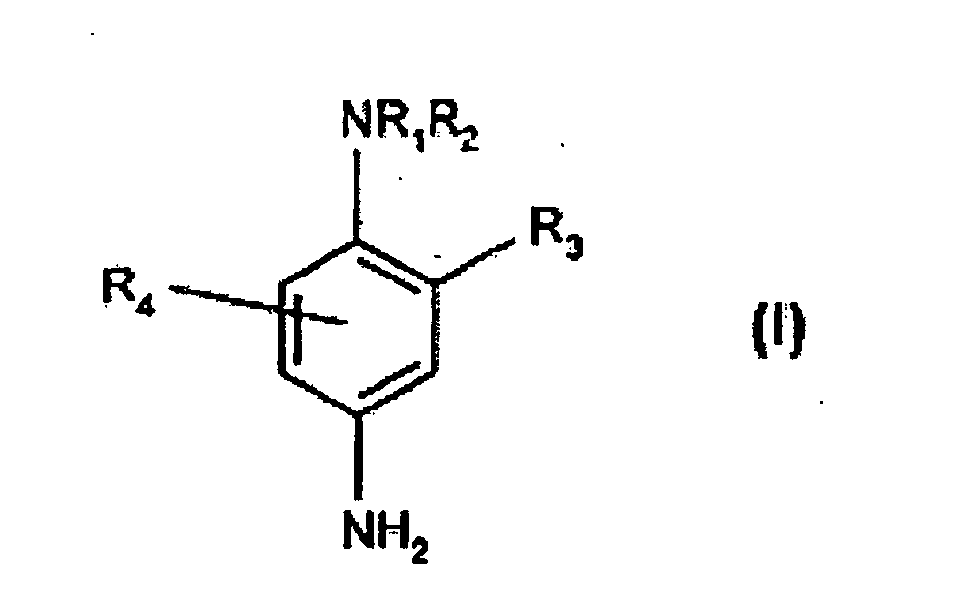 wobei die Gruppen R1 und R2 auch mit dem Stickstoffatom, an das sie gebunden sind, einen stickstoffhaltigen, 5- oder 6-gliedrigen Heterocyclus bilden können, der gegebenenfalls mit einer oder mehreren Gruppen Alkyl, Hydroxy oder Ureido substituiert ist.R1 ein Wasserstoffatom, C1-4-Alkyl, C1-4-Monohydroxyalkyl, C2-4-Polyhydroxyalkyl, Alkoxy(C1-4)alkyl(C1-4), eine mit einer stickstoffhaltigen Gruppe substituierte C1-4-Alkylgruppe, Phenyl oder 4'-Aminophenyl;R2 ein Wasserstoffatom, C1-4-Alkyl, C1-4-Monohydroxyalkyl, C2-4-Polyhydroxyalkyl, Alkoxy(C1-4)alkyl(C1-4) oder eine mit einer stickstoffhaltigen Gruppe substituierte C1-4-Alkylgruppe;R3 ein Wasserstoffatom, ein Halogenatom, wie Chlor, C1-4-Alkyl, Sulfo, Carboxy, C1-4-Monohydroxyalkyl, C1-4-Hydroxyalkoxy, C1-4-Acetylaminoalkoxy, C1-4-Mesylaminoalkoxy oder C1-4-Carbamoylaminoalkoxy,R4 ein Wasserstoffatom, ein Halogenatom oder C1-4-Alkyl;
 - Zusammensetzung nach Anspruch 13, dadurch gekennzeichnet, dass die stickstoffhaltigen Gruppen unter den Gruppen Amino, Monoalkyl(C1-4)amino, Dialkyl(C1-4)amino, Trialkyl(C1-4)amino, Monohydroxyalkyl(C1-4)amino, Imidazolinium und Ammonium ausgewählt sind.
- Zusammensetzung nach einem der Ansprüche 13 oder 14, dadurch gekennzeichnet, dass die p-Phenylendiamine unter p-Phenylendiamin, p-Toluylendiamin, 2-Chlor-p-phenylendiamin, 2,3-Dimethyl-p-phenylendiamin, 2,6-Dimethyl-p-phenylendiamin, 2,6-Diethyl-p-phenylendiamin, 2,5-Dimethyl-p-phenylendiamin, N,N-Dimethyl-p-phenylendiamin, N,N-Diethyl-p-phenylendiamin, N,N-Dipropyl-p-phenylendiamin, 4-Amino-N,N-diethyl-3-methylanilin, N,N-Bis(β-hydroxyethyl)-p-phenylendiamin, 4-N,N-Bis(β-hydroxyethylamino-2-methylanilin, 4-N,N-Bis(β-hydroxyethylamino-2-chloranilin, 2-β-Hydroxyethyl-p-phenylendiamin, 2-Fluor-p-phenylendiamin, 2-Isopropyl-p-phenylendiamin, N-(β-Hydroxypropyl)-p-phenylendiamin, 2-Hydroxymethyl-p-phenylendiamin, N,N-Dimethyl-3-methyl-p-phenylendiamin, N,N-(Ethyl-β-hydroxyethyl)-p-phenylendiamin, N-(β,γ-Dihydroxypropyl)-p-phenylendiamin, N-(4'-Aminophenyl)-p-phenylendiamin, N-Phenyl-p-phenylendiamin, 2-β-Hydroxyethyloxy-p-phenylendiamin, 2-β-Acetylaminoethyloxy-p-phenylendiamin, N-(β-Methoxyethyl)-p-phenylendiamin, 2-Methyl-1-N-β-hydroxyethyl-p-phenylendiamin und deren Additionssalze mit einer Säure ausgewählt sind.
- Zusammensetzung nach Anspruch 1, dadurch gekennzeichnet, dass die Doppelbasen unter den Verbindungen der folgenden Formel (II) und deren Additionssalzen mit einer Säure ausgewählt sind:worin bedeuten:
 mit der Maßgabe, dass die Verbindungen der Formel (II) nur eine Verbindungsgruppe Y pro Molekül aufweisen.die Gruppen Z1 und Z2, die gleich oder verschieden sind, eine Hydroxygruppe oder eine NH2-Gruppe, die mit einer C1-4-Alkylgruppe oder einer Verbindungsgruppe Y substituiert sein kann;die Verbindungsgruppe Y eine geradkettige oder verzweigte Alkylengruppe mit 1 bis 14 Kohlenstoffatomen, die durch eine oder mehrere stickstoffhaltige Gruppen und/oder ein oder mehrere Heteroatome, wie Sauerstoff, Schwefel oder Stickstoff, unterbrochen oder abgeschlossen werden kann und gegebenenfalls mit einer oder mehreren Hydroxygruppen oder C1-6-Alkoxygruppen substituiert ist;R5 und R6 ein Wasserstoffatom, ein Halogenatom, C1-4-Alkyl, C1-4-Monohydroxyalkyl, C2-4-Polyhydroxyalkyl, C1-4-Aminoalkyl oder eine Verbindungsgruppe Y;die Gruppen R7, R8, R9, R10, R11 und R12, die gleich oder verschieden sind, ein Wasserstoffatom, eine Verbindungsgruppe Y oder C1-4-Alkyl;
 - Zusammensetzung nach Anspruch 16, dadurch gekennzeichnet, dass in der Formel (II) die stickstoffhaltigen Gruppen unter Amino, Monoalkyl(C1-4)amino, Dialkyl(C1-4)amino, Trialkyl(C1-4)amino, Monohydroxyalkyl(C1-4)amino, Imidazolinium und Ammonium ausgewählt sind.
- Zusammensetzung nach einem der Ansprüche 16 oder 17, dadurch gekennzeichnet, dass die Doppelbasen unter N,N'-Bis(β-hydroxyethyl)-N,N'-bis(4'-aminophenyl)-1,3-diaminopropanol, N,N'-Bis(β-hydroxyethyl)-N,N'-bis (4'-aminophenyl)-ethylendiamin, N,N'-Bis(4-aminophenyl)-tetramethylendiamin, N,N'-Bis-(β-hydroxyethyl)-N,N'-bis(4-aminophenyl)-tetramethylendiamin, N,N'-Bis(4-methylaminophenyl)-tetramethylendiamin, N,N'-Bis-(ethyl)-N,N'-bis(4'-amino, 3'-methylphenyl)-ethylendiamin, 1,8-Bis-(2,5-diaminophenoxy)-3,5-dioxaoctan und deren Additionssalzen mit einer Säure ausgewählt sind.
- Zusammensetzung nach Anspruch 1, dadurch gekennzeichnet, dass die p-Aminophenole unter den Verbindungen der folgenden Formel (III) und deren Additionssalzen mit einer Säure ausgewählt sind:worin bedeuten:
 R13 ein Wasserstoffatom, ein Halogenatom, wie Fluor, C1-4-Alkyl, C1-4-Monohydroxyalkyl, Alkoxy(C1-4)alkyl(C1-4), C1-4-Aminoalkyl oder Hydroxyalkyl(C1-4)aminoalkyl(C1-4),R14 ein Wasserstoffatom, ein Halogenatom, wie Fluor, C1-4-Alkyl, C1-4-Monohydroxyalkyl, C2-4-Polyhydroxyalkyl, C1-4-Aminoalkyl, C1-4-Cyanoalkyl oder Alkoxy(C1-4)alkyl(C1-4).
 - Zusammensetzung nach Anspruch 19, dadurch gekennzeichnet, dass die p-Aminophenole unter 4-Amino-3-methyl-phenol, 4-Amino-3-fluor-phenol, 4-Amino-3-hydroxymethyl-phenol, 4-Amino-2-methyl-phenol, 4-Amino-2-hydroxymethyl-phenol, 4-Amino-2-methoxymethyl-phenol, 4-Amino-2-aminomethyl-phenol, 4-Amino-2-(β-hydroxyethylaminomethyl)-phenol und deren Additionssalzen mit einer Säure ausgewählt sind.
- Zusammensetzung nach Anspruch 1, dadurch gekennzeichnet, dass die heterocyclischen Basen unter den Pyridinderivaten, Pyrimidinderivaten, Pyrazolo-pyrimidinderivaten, Pyrazolderivaten und deren Additionssalzen mit einer Säure ausgewählt sind.
- Zusammensetzung nach Anspruch 21, dadurch gekennzeichnet, dass die Pyridinderivate unter 2,5-Diaminopyridin, 2-(4-Methoxyphenyl)amino-3-aminopyridin, 2,3-Diamino-6-methoxy-pyridin, 2-(β-Methoxyethyl)amino-3-amino-6-methoxypyridin, 3,4-Diaminopyridin und deren Additionssalzen mit einer Säure ausgewählt sind.
- Zusammensetzung nach Anspruch 21, dadurch gekennzeichnet, dass die Pyrimidinderivate unter 2,4,5,6-Tetraaminopyrimidin, 4-Hydroxy-2,5,6-triaminopyrimidin, 2-Hydroxy-4,5,6-triamino-pyrimidin, 2,4-Dihydroxy-5,6-diaminopyrimidin und 2,5,6-Triaminopyrimidin und die Pyrazolo-pyrimidinderivate unter Pyrazolo[1,5-a]pyrimidin-3,7-diamin, 2,5-Dimethyl-pyrazolo[1,5-a]-pyrimidin-3,7-diamin, Pyrazolo[1,5-a]pyrimidin-3,5-diamin, 2,7-Dimethyl-pyrazolo[1,5-a]pyrimidin-3,5-diamin, 3-Amino-pyrazolo[1,5-a]pyrimidin-7-ol, 3-Aminopyrazolo-[1,5-a]-pyrimidin-5-ol, 2-(3-Amino-pyrazolo[1,5-a]pyrimidin-7-ylamino)-ethanol, 2-(7-Amino-pyrazolo-[1,5-a]pyrimidin-3-ylamino)-ethanol, 2-[(3-Amino-pyrazolo[1,5-a]pyrimidin-7-yl)-(2-hydroxyethyl)amino]-ethanol, 2-[(7-Amino-pyrazolo[1,5]-pyrimidin-3-yl)-(2-hydroxyethyl)amino]-ethanol, 5,6-Dimethyl-pyrazolo[1,5-a]-pyrimidin-3,7-diamin, 2,6-Dimethyl-pyrazolo[1,5-a]pyrimidin-3,7-diamin, 2,5,N7,N7-Tetramethyl-pyrazolo[1,5-a]pyrimidin-3,7-diamin, 3-Amino-5-methyl-7-imidazolylpropylamino-pyrazolo[1,5-a]pyrimidin und deren Additionssalzen und deren tautomeren Formen, falls ein tautomeres Gleichgewicht vorliegt, und deren Additionssalzen mit einer Säure ausgewählt sind.
- Zusammensetzung nach Anspruch 21, dadurch gekennzeichnet, dass die Pyrazolderivate unter 4,5-Diamino-1-methylpyrazol, 3,4-Diaminopyrazol, 4,5-Diamino-1-(4'-chlorbenzyl)-pyrazol, 4,5-Diamino-1,3-dimethylpyrazol, 4, 5-Diamino-3-methyl-1-phenylpyrazol, 4,5-Diamino-1-methyl-3-phenylpyrazol, 4-Amino-1,3-dimethyl-5-hydrazinopyrazol, 1-Benzyl-4,5-diamino-3-methylpyrazol, 4,5-Diamino-3-t-butyl-1-methylpyrazol, 4, 5-Diamino-1-t-butyl-3-methylpyrazol, 4,5-Diamino-1-(β-hydroxyethyl)-3-methylpyrazol, 4,5-Diamino-1-(β-hydroxyethyl)-pyrazol, 4,5-Diamino-1-ethyl-3-methylpyrazol, 4, 5-Diamino-1-ethyl-3-(4'-methoxyphenyl)-pyrazol, 4,5-Diamino-1-ethyl-3-hydroxymethylpyrazol, 4,5-Diamino-3-hydroxymethyl-1-methylpyrazol, 4,5-Diamino-3-hydroxymethyl-1-isopropylpyrazol, 4,5-Diamino-3-methyl-1-isopropylpyrazol, 4-Amino-5-(2'-aminoethyl)amino-1,3-dimethylpyrazol, 3,4,5-Triaminopyrazol, 1-Methyl-3,4,5-triaminopyrazol, 3,5-Diamino-1-methyl-4-methylaminopyrazol, 3,5-Diamino-4-(β-hydroxyethyl)amino-1-methylpyrazol und deren Additionssalzen mit einer Säure ausgewählt sind.
- Zusammensetzung nach einem der vorhergehenden Ansprüche, dadurch gekennzeichnet, dass die Farbstoffvorprodukte der Oxidationsfarbstoffe in Konzentrationen von 0,0005 bis 12 Gew.-%, bezogen auf das Gesamtgewicht der Zusammensetzung, enthalten sind.
- Zusammensetzung nach Anspruch 1, dadurch gekennzeichnet, dass die Kuppler unter den m-Phenylendiaminen, m-Aminophenolen, m-Dihydroxybenzolen, heterocyclischen Kupplern und deren Additionssalzen mit einer Säure ausgewählt sind.
- Zusammensetzung nach Anspruch 26, dadurch gekennzeichnet, dass die Kuppler unter 2,4-Diamino-1-(β-hydroxyethyloxy)-benzol, 2-Methyl-5-aminophenol, 5-N-(β-Hydroxyethyl)amino-2-methylphenol, 3-Aminophenol, 1,3-Dihydroxybenzol, 1,3-Dihydroxy-2-methylbenzol, 4-Chlor-1,3-dihydroxybenzol, 2-Amino-4-(β-hydroxyethylamino)-1-methoxybenzol, 1,3-Diaminobenzol, 1,3-Bis-(2,4-diaminophenoxy)-propan, Sesamol, 1-Amino-2-methoxy-4,5-methylendioxybenzol, 6-Hydroxyindol, 4-Hydroxyindol, 4-Hydroxy-N-methylindol, 6-Hydroxyindolin, 2,6-Dihydroxy-4-methylpyridin, 1-H-3-Methylpyrazol-5-on, 1-Phenyl-3-methylpyrazol-5-on, 2-Amino-3-hydroxypyridin, 3,6-Dimethyl-pyrazolo-[3,2-c]-1,2,4-triazol, 2,5-Dimethylpyrazolo-[1,5-b]-1,2,4-triazol und deren Additionssalzen mit einer Säure ausgewählt sind.
- Zusammensetzung nach einem der vorhergehenden Ansprüche, dadurch gekennzeichnet, dass die Kuppler in Konzentrationen von 0,0001 bis 10 Gew.-%, bezogen auf das Gesamtgewicht der Zusammensetzung, enthalten sind.
- Zusammensetzung nach einem der Ansprüche 1 und 13 bis 28, dadurch gekennzeichnet, dass die Additionssalze der Farbstoffvorprodukte von Oxidationsfarbstoffen und Kuppler mit einer Säure unter den Hydrochloriden, Hydrobromiden, Sulfaten, Tartraten, Lactaten und Acetaten ausgewählt sind.
- Zusammensetzung nach einem der vorhergehenden Ansprüche, dadurch gekennzeichnet, dass sie ferner Direktfarbstoffe in Mengenanteilen von 0,001 bis 20 Gew.-%, bezogen auf das Gesamtgewicht der Zusammensetzung, enthält.
- Zusammensetzung nach einem der vorhergehenden Ansprüche, dadurch gekennzeichnet, dass sie ferner mindestens ein kationisches Polymer oder ein amphoteres Polymer enthält, das von den amphoteren Polymeren mit Fettkette nach einem der Ansprüche 1 bis 10 verschieden ist.
- Zusammensetzung nach Anspruch 31, dadurch gekennzeichnet, dass das kationische Polymer ein quartäres Polyammoniumpolymer ist, das aus wiederkehrenden Einheiten der folgenden Formel (W) besteht:

- Zusammensetzung nach Anspruch 31, dadurch gekennzeichnet, dass das kationische Polymer ein quartäres Polyammoniumpolymer ist, das aus wiederkehrenden Einheiten der folgenden Formel (U) besteht:

- Zusammensetzung nach Anspruch 31, dadurch gekennzeichnet, dass das amphotere Polymer ein Copolymer ist, das als Monomere zumindest Acrylsäure und ein Dimethyldiallylammoniumchlorid enthält.
- Zusammensetzung nach einem der Ansprüche 31 bis 34, dadurch gekennzeichnet, dass das oder die kationische(n) Polymer(e) oder amphoteren Polymere, die von den Polymeren mit Fettkette gemäß der Erfindung verschieden sind, 0,01 bis 10 % des Gesamtgewichts der Zusammensetzung ausmachen.
- Zusammensetzung nach einem der vorhergehenden Ansprüche, dadurch gekennzeichnet, dass sie mindestens einen grenzflächenaktiven Stoff enthält, der unter den anionischen, kationischen, nichtionischen oder amphoteren Tensiden ausgewählt ist.
- Zusammensetzung nach Anspruch 36, dadurch gekennzeichnet, dass der oder die grenzflächenaktive(n) Stoff(e) nichtionisch sind.
- Zusammensetzung nach den Ansprüchen 36 oder 37, dadurch gekennzeichnet, dass die grenzflächenaktiven Stoffe 0,01 bis 40 % des Gesamtgewichts der Zusammensetzung ausmachen.
- Zusammensetzung nach einem der vorhergehenden Ansprüche, dadurch gekennzeichnet, dass sie ferner mindestens ein Reduktionsmittel in Mengenanteilen von 0,05 bis 3 Gew.-%, bezogen auf das Gesamtgewicht der Zusammensetzung, enthält.
- Zusammensetzung nach einem der vorhergehenden Ansprüche, die gebrauchsfertig ist, dadurch gekennzeichnet, dass sie ferner ein Oxidationsmittel enthält.
- Zusammensetzung nach Anspruch 40, dadurch gekennzeichnet, dass sie einen pH-Wert von 4 bis 11 aufweist.
- Zusammensetzung nach Anspruch 40, dadurch gekennzeichnet, dass das Oxidationsmittel unter Wasserstoffperoxid, Harnstoffperoxid, Bromaten oder Ferricyaniden von Alkalimetallen, Salzen von Persäuren und Redox-Enzymen gegebenenfalls zusammen mit ihrem jeweiligen Donor oder Cofaktor ausgewählt ist.
- Zusammensetzung nach Anspruch 42, dadurch gekennzeichnet, dass das Oxidationsmittel Wasserstoffperoxid ist.
- Zusammensetzung nach Anspruch 43, dadurch gekennzeichnet, dass das Oxidationsmittel eine Wasserstoffperoxidlösung ist, deren Titer im Bereich von 1 bis 40 Volumina liegt.
- Verfahren zum Färben von Keratinfasern und insbesondere menschlichen Keratinfasern, wie Haaren, dadurch gekennzeichnet, dass es darin besteht, auf die Fasern mindestens eine färbende Zusammensetzung aufzutragen, die in einem zum Färben geeigneten Medium mindestens ein Farbstoffvorprodukt eines Oxidationsfarbstoffes und/oder einen Kuppler enthält, die unter den p-Phenylendiaminen, Doppelbasen, p-Aminophenolen, m-Phenylendiaminen, m-Aminophenolen, m-Dihydroxybenzolen, heterocyclischen Basen und heterocyclischen Kupplern und den Additionssalzen dieser Verbindungen mit einer Säure ausgewählt sind, wobei die Farbe bei einem alkalischen, neutralen oder sauren pH-Wert mit einer oxidierenden Zusammensetzung entwickelt wird, die mindestens ein Oxidationsmittel enthält und die bei der Anwendung mit der färbenden Zusammensetzung vermischt wird oder die getrennt davon ohne zwischenzeitliches Spülen aufgetragen wird, wobei mindestens ein amphoteres Polymer, das mindestens eine Fettkette aufweist, nach einem der Ansprüche 1 bis 10 in der färbenden Zusammensetzung oder in der oxidierenden Zusammensetzung oder in beiden Zusammensetzungen enthalten ist.
- Verfahren nach Anspruch 30, dadurch gekennzeichnet, dass es darin besteht, auf die trockenen oder feuchten Keratinfasern die gebrauchsfertige Zusammensetzung, die bedarfsgemäß bei der Anwendung aus der färbenden Zusammensetzung und der oxidierenden Zusammensetzung hergestellt wird, aufzubringen, während einer Zeitspanne von etwa 1 bis 60 Minuten und vorzugsweise 5 bis 45 Minuten einwirken zu lassen, die Fasern zu spülen, gegebenenfalls mit Haarwaschmittel zu waschen, nochmals zu spülen und zu trocknen.
- Vorrichtung mit mehrere Abteilungen oder "Kit" zum Färben von Keratinfasern und insbesondere menschlichen Keratinfasern, wie Haaren, dadurch gekennzeichnet, dass sie mindestens zwei Abteilungen enthält, wobei eine Abteilung eine färbende Zusammensetzung enthält, die in einem zum Färben geeigneten Medium mindestens ein Farbstoffvorprodukt eines Oxidationsfarbstoffes und/oder einen Kuppler enthält, die unter den p-Phenylendiaminen, Doppelbasen, p-Aminophenolen, m-Phenylendiaminen, m-Aminophenolen, m-Dihydroxybenzolen, heterocyclischen Basen und heterocyclischen Kupplern und den Additionssalzen dieser Verbindungen mit einer Säure ausgewählt sind, und eine andere Abteilung eine oxidierende Zusammensetzung enthält, die in einem zum Färben geeigneten Medium ein Oxidationsmittel enthält, wobei ein amphoteres Polymer, das mindestens eine Fettkette aufweist, nach einem der Ansprüche 1 bis 10 in der färbenden Zusammensetzung oder der oxidierenden Zusammensetzung oder in beiden Zusammensetzungen enthalten ist.
Applications Claiming Priority (3)
| Application Number | Priority Date | Filing Date | Title |
|---|---|---|---|
| FR0008503A FR2810882B1 (fr) | 2000-06-30 | 2000-06-30 | Composition de teinture d'oxydation pour fibres keratiniques comprenant un polymere amphotere a chaine grasse |
| FR0008503 | 2000-06-30 | ||
| PCT/FR2001/002095 WO2002000181A1 (fr) | 2000-06-30 | 2001-06-29 | Composition de teinture d'oxydation pour fibres keratiniques comprenant un polymere amphotere a chaine grasse |
Publications (2)
| Publication Number | Publication Date |
|---|---|
| EP1299072A1 EP1299072A1 (de) | 2003-04-09 |
| EP1299072B1 true EP1299072B1 (de) | 2005-11-16 |
Family
ID=8851949
Family Applications (1)
| Application Number | Title | Priority Date | Filing Date |
|---|---|---|---|
| EP01949592A Expired - Lifetime EP1299072B1 (de) | 2000-06-30 | 2001-06-29 | Zusammensetzung zur oxidativen färbung von keratinfasern, die ein anionisches amphiphiles, mit einer fettkette modifiziertes polymer enthält |
Country Status (11)
| Country | Link |
|---|---|
| US (1) | US20030172472A1 (de) |
| EP (1) | EP1299072B1 (de) |
| JP (1) | JP2004501172A (de) |
| CN (1) | CN1440267A (de) |
| AT (1) | ATE309778T1 (de) |
| AU (1) | AU2001270718A1 (de) |
| BR (1) | BR0112309A (de) |
| CA (1) | CA2411438A1 (de) |
| DE (1) | DE60115043T2 (de) |
| FR (1) | FR2810882B1 (de) |
| WO (1) | WO2002000181A1 (de) |
Families Citing this family (7)
| Publication number | Priority date | Publication date | Assignee | Title |
|---|---|---|---|---|
| US7276087B2 (en) | 2003-04-29 | 2007-10-02 | L'oreal S.A. | Dye composition comprising 2-chloro-6-methyl-3-aminophenol as coupler, para-aminophenol and 3-methyl-4-aminophenol as oxidation bases and at least one associative thickening polymer |
| US7306630B2 (en) | 2003-04-29 | 2007-12-11 | L'oreal S.A. | Composition comprising at least one coupler chosen from 2-chloro-6-methyl-3-aminophenol and addition salts thereof, at least one oxidation base, and at least one associative polymer comprising at least one C8-C30 fatty chain |
| US7300470B2 (en) | 2003-04-29 | 2007-11-27 | L'oreal S.A. | Dye composition comprising 2-chloro-6-methyl-3-aminophenol, at least two oxidation bases chosen from para-phenylenediamine derivatives and at least one associative thickening polymer |
| FR2902327B1 (fr) * | 2006-06-20 | 2008-08-08 | Oreal | Composition de coloration des fibres keratiniques comprenant la 2,3-diamino-6,7-dihydro-1h,5h-pyrazolo 1,2-a pyrazol-1- one, la para-phenylenediamine ou la para-toluenediamine et un meta-aminophenol substitue |
| FR2902328B1 (fr) * | 2006-06-20 | 2008-08-08 | Oreal | Composition de coloration des fibres keratiniques comprenant la 2,3-diamino-6,7-dihydro-1h,5h-pyrazolo 1,2-a pyrazol-1- one, le 6-chloro 2-methyl 5-amino phenol et un meta-aminophenol substitue |
| EP2111842A1 (de) * | 2008-03-28 | 2009-10-28 | L'Oréal | Färbemittel enthaltend Ammoniumchlorid, Verfahren für die Färbung von keratinischen Fasern und VORRICHTUNG |
| FR2968304B1 (fr) * | 2010-12-01 | 2014-03-14 | Soc Dexploitation De Produits Pour Les Industries Chimiques Seppic | Nouveaux epaississants cationiques, exempts d'huile et de tensioactifs, procede pour leur preparation et composition en contenant. |
Family Cites Families (19)
| Publication number | Priority date | Publication date | Assignee | Title |
|---|---|---|---|---|
| US3860699A (en) * | 1973-02-06 | 1975-01-14 | Shinonaga Kasei Co Ltd | Resin composition suitable for use in hair dressing preparations |
| FR2470596A1 (fr) * | 1979-11-28 | 1981-06-12 | Oreal | Composition destinee au traitement des fibres keratiniques a base de polymeres amphoteres et de polymeres cationiques |
| FR2486394A1 (fr) * | 1979-11-28 | 1982-01-15 | Oreal | Composition destinee au traitement des fibres keratiniques a base de polymeres amphoteres et de polymeres anioniques |
| DE3644097A1 (de) * | 1986-12-23 | 1988-07-07 | Wella Ag | Kosmetisches mittel auf der basis von chitosan und ampholytischen copolymerisaten sowie ein neues chitosan/polyampholyt-salz |
| DE3708451A1 (de) * | 1987-03-16 | 1988-10-06 | Henkel Kgaa | Zwitterionische polymere und deren verwendung in haarbehandlungsmitteln |
| JPH06227955A (ja) * | 1992-12-08 | 1994-08-16 | Kanebo Ltd | 染毛剤又は化粧料及び前処理剤並びに染毛方法 |
| DE4404493C1 (de) * | 1994-02-12 | 1995-01-19 | Kao Corp Gmbh | Verfahren zum Behandeln von menschlichen Haaren |
| FR2717383B1 (fr) * | 1994-03-21 | 1996-04-19 | Oreal | Composition de teinture d'oxydation des fibres kératiniques comprenant un dérivé de paraphénylènediamine et un polymère substantif cationique ou amphotère et utilisation. |
| DE19625982A1 (de) * | 1996-06-28 | 1998-01-02 | Wella Ag | Kosmetisches Mittel zur Haarbehandlung mit Dendrimeren |
| FR2753094B1 (fr) * | 1996-09-06 | 1998-10-16 | Oreal | Composition de teinture d'oxydation pour fibres keratiniques comprenant un polymere amphiphile anionique |
| US5879670A (en) * | 1997-03-31 | 1999-03-09 | Calgon Corporation | Ampholyte polymers for use in personal care products |
| FR2772267A1 (fr) * | 1997-12-16 | 1999-06-18 | Oreal | Compositions de teinture des fibres keratiniques contenant des derives imidazo-pyridines et procede |
| US6361768B1 (en) * | 1998-12-29 | 2002-03-26 | Pmd Holdings Corp. | Hydrophilic ampholytic polymer |
| FR2795315B1 (fr) * | 1999-06-25 | 2001-08-10 | Oreal | Compositions cosmetiques contenant un polymere amphotere et un agent antipelliculaire et leurs utilisations |
| FR2795311B1 (fr) * | 1999-06-25 | 2001-08-10 | Oreal | Composition cosmetique detergente comprenant un polymere amphotere a chaines grasses et un ester et utilisation |
| FR2795310B1 (fr) * | 1999-06-25 | 2003-02-14 | Oreal | Compositions cosmetiques contenant un polymere amphotere et un polymere fixant/conditionneur et leurs utilisations |
| FR2795314B1 (fr) * | 1999-06-25 | 2002-06-14 | Oreal | Composition cosmetique detergente comprenant une silicone et un polymere amphotere a chaines grasses et utilisation |
| FR2795313B1 (fr) * | 1999-06-25 | 2001-11-23 | Oreal | Compositions cosmetiques contenant un polymere amphotere et un agent conditionneur et leurs utilisations |
| FR2796277B1 (fr) * | 1999-07-16 | 2001-09-21 | Oreal | Utilisation en cosmetique de copolymere amphoteres reticules ou branches; compositions mises en oeuvre |
-
2000
- 2000-06-30 FR FR0008503A patent/FR2810882B1/fr not_active Expired - Fee Related
-
2001
- 2001-06-29 CN CN01812146.2A patent/CN1440267A/zh active Pending
- 2001-06-29 CA CA002411438A patent/CA2411438A1/fr not_active Abandoned
- 2001-06-29 DE DE60115043T patent/DE60115043T2/de not_active Expired - Lifetime
- 2001-06-29 WO PCT/FR2001/002095 patent/WO2002000181A1/fr not_active Ceased
- 2001-06-29 AU AU2001270718A patent/AU2001270718A1/en not_active Abandoned
- 2001-06-29 JP JP2002504963A patent/JP2004501172A/ja active Pending
- 2001-06-29 BR BR0112309-2A patent/BR0112309A/pt not_active IP Right Cessation
- 2001-06-29 AT AT01949592T patent/ATE309778T1/de not_active IP Right Cessation
- 2001-06-29 US US10/312,628 patent/US20030172472A1/en not_active Abandoned
- 2001-06-29 EP EP01949592A patent/EP1299072B1/de not_active Expired - Lifetime
Also Published As
| Publication number | Publication date |
|---|---|
| US20030172472A1 (en) | 2003-09-18 |
| DE60115043T2 (de) | 2006-08-03 |
| ATE309778T1 (de) | 2005-12-15 |
| FR2810882A1 (fr) | 2002-01-04 |
| JP2004501172A (ja) | 2004-01-15 |
| CA2411438A1 (fr) | 2002-01-03 |
| EP1299072A1 (de) | 2003-04-09 |
| FR2810882B1 (fr) | 2006-07-14 |
| BR0112309A (pt) | 2003-05-06 |
| AU2001270718A1 (en) | 2002-01-08 |
| CN1440267A (zh) | 2003-09-03 |
| DE60115043D1 (de) | 2005-12-22 |
| WO2002000181A1 (fr) | 2002-01-03 |
Similar Documents
| Publication | Publication Date | Title |
|---|---|---|
| EP1357885B1 (de) | Mittel zum oxidativen färben von keratinfasern, welche ein kationisches polyvinyllactam enthalten | |
| EP1237529B1 (de) | Eine zusammensetzung zur oxidationsfärbung von keratinischen fasern, die ein verdickungspolymer mit einer aminoplastether hauptkette enthält | |
| EP1279395B1 (de) | Oxidationsfärbemittel für keratinische Fasern enthaltend ein Fettalkohol mono-oder poly-glycerol und ein Polyol | |
| EP1142557B1 (de) | Oxidationsfärbemittel für keratinische Fäsern | |
| EP1142555B1 (de) | Oxidationsfärbemittel für keratinische Fasern enthaltend ein Verdickungspolymer mit mindestens einer Fettkette und einem Fettalkohol mtt mehrmals 20 Kohlenstoffatomen | |
| EP1142556B1 (de) | Oxidationsfärbemittel für keratinische Fasern enthaltend ein verdickendes Polymer mit mindestens einer hydrophoben Seitenkette und einen Mono- oder Polyglycerol- Fettalkohol | |
| EP1889606B1 (de) | Farbzusammensetzung für Keratinfasern bestehend aus einem anionischen assoziativen Polymer und einem Polymer mit Acrylamid-Einheiten sowie Dialkyldiallylammoniumhalogenid und Vinylcarbonsäure | |
| EP1179336B1 (de) | Zusammensetzung für die oxidative Färbung von keratinischen Fasern, die ein kationisches amphiphilisches Polymer, eine alkoxylierte oder glyzerinierte Fettsäure, und ein Hydroxyllösungsmittel enhält | |
| EP1341505B1 (de) | Oxidationsfärbezusammensetzung für keratinöse fasern mit glycerin und einem anderen polyol als glycerin in vorgegebenem verhältnis | |
| EP1416908B1 (de) | Zusammensetzung zur färbung von menschlichen keratinischen fasern enthaltend oxidationsfarbstoffe und dikationische verbindungen | |
| FR2831808A1 (fr) | Composition de teinture pour fibres keratiniques comprenant une silicone aminee particuliere | |
| EP1754466B1 (de) | Zusammensetzung zur oxidativen Färbung von Keratinfasern enthaltend: ein Fettalkohol, ein Oxidationsfärbemittel, ein assoziatives Polymer, ein Fettsäureester und/oder ein Metalloxid | |
| EP1335695B1 (de) | Oxidatives färbemittel für keratinische fasern kationisches assoziatives polyurethan enthaltend | |
| EP1341504B2 (de) | Zusammensetzung für die oxidative färbung von keratinischen fasern enthaltend ein assoziatives polymer und ein perlglanzmittel | |
| FR2833835A1 (fr) | Composition pour la teinture d'oxydation des fibres keratiniques comprenant un acide ether carboxylique oxyalkylene, un tensioactif mono-ou poly-glycerole et un tensioactif non ionique oxyalkylene | |
| EP1426032B1 (de) | Zusammensetzung für die oxidative Färbung von keratinischen Fasern, enthaltend einen nicht alkoxylierten Fettalkohol, ein Oxidationsfärbemittel, ein assoziatives Polymer und ein Amid aus Alkanolamin und C14-C30 Fettsäure | |
| FR2833834A1 (fr) | Composition pour la teinture d'oxydation des fibres keratiniques comprenant un acide ether carboxylique oxyalkylene, un tensioactif mono-ou poly-glycerole et un alcool gras insature | |
| EP1413289B1 (de) | Oxidationsfärbemittel für keratinische Fasern enthaltend ein kationisches Polyvinyllactam und wenigstens ein C10-C14 Fettalkohol und Verfahren zur oxidative Färbung und Vorrichtungen | |
| EP1413287B1 (de) | Mittel zum oxidativen färben von keratinfasern, enthaltend ein kationisches polyvinyllactam und mindenstens eine ein C10-C14 fettsäure, sowie verfahren und vorrichtungen zur färbung | |
| FR2845909A1 (fr) | Compositio de teinture d'oxydation pour fibres keratiniques comprenant un poly(vinyllactame) cationique et au moins un colorant d'oxydation sous forme d'ion sulfate | |
| EP1299072B1 (de) | Zusammensetzung zur oxidativen färbung von keratinfasern, die ein anionisches amphiphiles, mit einer fettkette modifiziertes polymer enthält | |
| EP1716841B1 (de) | Zusammensetzung zum oxidativen Färben von Keratinfasern | |
| FR2818537A1 (fr) | Composition de teinture d'oxydation pour fibres keratiniques a base de polymeres amphiphiles d'au moins un monomere a insaturation ethylenique a groupement sulfonique en comportant une partie hydrophobe |
Legal Events
| Date | Code | Title | Description |
|---|---|---|---|
| PUAI | Public reference made under article 153(3) epc to a published international application that has entered the european phase |
Free format text: ORIGINAL CODE: 0009012 |
|
| 17P | Request for examination filed |
Effective date: 20030130 |
|
| AK | Designated contracting states |
Designated state(s): AT BE CH CY DE DK ES FI FR GB GR IE IT LI LU MC NL PT SE TR Kind code of ref document: A1 Designated state(s): AT BE CH CY DE DK ES FI FR GB GR IE IT LI LU MC NL PT SE TR |
|
| AX | Request for extension of the european patent |
Extension state: AL LT LV MK RO SI |
|
| RIN1 | Information on inventor provided before grant (corrected) |
Inventor name: LAURENT, FLORENCE |
|
| GRAP | Despatch of communication of intention to grant a patent |
Free format text: ORIGINAL CODE: EPIDOSNIGR1 |
|
| GRAS | Grant fee paid |
Free format text: ORIGINAL CODE: EPIDOSNIGR3 |
|
| GRAA | (expected) grant |
Free format text: ORIGINAL CODE: 0009210 |
|
| AK | Designated contracting states |
Kind code of ref document: B1 Designated state(s): AT BE CH CY DE DK ES FI FR GB GR IE IT LI LU MC NL PT SE TR |
|
| PG25 | Lapsed in a contracting state [announced via postgrant information from national office to epo] |
Ref country code: IT Free format text: LAPSE BECAUSE OF FAILURE TO SUBMIT A TRANSLATION OF THE DESCRIPTION OR TO PAY THE FEE WITHIN THE PRESCRIBED TIME-LIMIT;WARNING: LAPSES OF ITALIAN PATENTS WITH EFFECTIVE DATE BEFORE 2007 MAY HAVE OCCURRED AT ANY TIME BEFORE 2007. THE CORRECT EFFECTIVE DATE MAY BE DIFFERENT FROM THE ONE RECORDED. Effective date: 20051116 Ref country code: NL Free format text: LAPSE BECAUSE OF FAILURE TO SUBMIT A TRANSLATION OF THE DESCRIPTION OR TO PAY THE FEE WITHIN THE PRESCRIBED TIME-LIMIT Effective date: 20051116 Ref country code: FI Free format text: LAPSE BECAUSE OF FAILURE TO SUBMIT A TRANSLATION OF THE DESCRIPTION OR TO PAY THE FEE WITHIN THE PRESCRIBED TIME-LIMIT Effective date: 20051116 Ref country code: IE Free format text: LAPSE BECAUSE OF FAILURE TO SUBMIT A TRANSLATION OF THE DESCRIPTION OR TO PAY THE FEE WITHIN THE PRESCRIBED TIME-LIMIT Effective date: 20051116 |
|
| REG | Reference to a national code |
Ref country code: GB Ref legal event code: FG4D Free format text: NOT ENGLISH |
|
| REG | Reference to a national code |
Ref country code: CH Ref legal event code: EP |
|
| REG | Reference to a national code |
Ref country code: IE Ref legal event code: FG4D Free format text: LANGUAGE OF EP DOCUMENT: FRENCH |
|
| REF | Corresponds to: |
Ref document number: 60115043 Country of ref document: DE Date of ref document: 20051222 Kind code of ref document: P |
|
| PG25 | Lapsed in a contracting state [announced via postgrant information from national office to epo] |
Ref country code: DK Free format text: LAPSE BECAUSE OF FAILURE TO SUBMIT A TRANSLATION OF THE DESCRIPTION OR TO PAY THE FEE WITHIN THE PRESCRIBED TIME-LIMIT Effective date: 20060216 Ref country code: SE Free format text: LAPSE BECAUSE OF FAILURE TO SUBMIT A TRANSLATION OF THE DESCRIPTION OR TO PAY THE FEE WITHIN THE PRESCRIBED TIME-LIMIT Effective date: 20060216 Ref country code: GR Free format text: LAPSE BECAUSE OF FAILURE TO SUBMIT A TRANSLATION OF THE DESCRIPTION OR TO PAY THE FEE WITHIN THE PRESCRIBED TIME-LIMIT Effective date: 20060216 |
|
| PG25 | Lapsed in a contracting state [announced via postgrant information from national office to epo] |
Ref country code: ES Free format text: LAPSE BECAUSE OF FAILURE TO SUBMIT A TRANSLATION OF THE DESCRIPTION OR TO PAY THE FEE WITHIN THE PRESCRIBED TIME-LIMIT Effective date: 20060227 |
|
| GBT | Gb: translation of ep patent filed (gb section 77(6)(a)/1977) |
Effective date: 20060222 |
|
| PG25 | Lapsed in a contracting state [announced via postgrant information from national office to epo] |
Ref country code: PT Free format text: LAPSE BECAUSE OF FAILURE TO SUBMIT A TRANSLATION OF THE DESCRIPTION OR TO PAY THE FEE WITHIN THE PRESCRIBED TIME-LIMIT Effective date: 20060417 |
|
| NLV1 | Nl: lapsed or annulled due to failure to fulfill the requirements of art. 29p and 29m of the patents act | ||
| REG | Reference to a national code |
Ref country code: IE Ref legal event code: FD4D |
|
| PG25 | Lapsed in a contracting state [announced via postgrant information from national office to epo] |
Ref country code: MC Free format text: LAPSE BECAUSE OF NON-PAYMENT OF DUE FEES Effective date: 20060630 |
|
| PLBE | No opposition filed within time limit |
Free format text: ORIGINAL CODE: 0009261 |
|
| STAA | Information on the status of an ep patent application or granted ep patent |
Free format text: STATUS: NO OPPOSITION FILED WITHIN TIME LIMIT |
|
| 26N | No opposition filed |
Effective date: 20060817 |
|
| PGFP | Annual fee paid to national office [announced via postgrant information from national office to epo] |
Ref country code: AT Payment date: 20070614 Year of fee payment: 7 |
|
| PGFP | Annual fee paid to national office [announced via postgrant information from national office to epo] |
Ref country code: CH Payment date: 20070627 Year of fee payment: 7 |
|
| PGFP | Annual fee paid to national office [announced via postgrant information from national office to epo] |
Ref country code: BE Payment date: 20070814 Year of fee payment: 7 |
|
| PG25 | Lapsed in a contracting state [announced via postgrant information from national office to epo] |
Ref country code: TR Free format text: LAPSE BECAUSE OF FAILURE TO SUBMIT A TRANSLATION OF THE DESCRIPTION OR TO PAY THE FEE WITHIN THE PRESCRIBED TIME-LIMIT Effective date: 20051116 Ref country code: LU Free format text: LAPSE BECAUSE OF NON-PAYMENT OF DUE FEES Effective date: 20060629 |
|
| PG25 | Lapsed in a contracting state [announced via postgrant information from national office to epo] |
Ref country code: CY Free format text: LAPSE BECAUSE OF FAILURE TO SUBMIT A TRANSLATION OF THE DESCRIPTION OR TO PAY THE FEE WITHIN THE PRESCRIBED TIME-LIMIT Effective date: 20051116 |
|
| BERE | Be: lapsed |
Owner name: L'OREAL Effective date: 20080630 |
|
| REG | Reference to a national code |
Ref country code: CH Ref legal event code: PL |
|
| PG25 | Lapsed in a contracting state [announced via postgrant information from national office to epo] |
Ref country code: BE Free format text: LAPSE BECAUSE OF NON-PAYMENT OF DUE FEES Effective date: 20080630 |
|
| PG25 | Lapsed in a contracting state [announced via postgrant information from national office to epo] |
Ref country code: AT Free format text: LAPSE BECAUSE OF NON-PAYMENT OF DUE FEES Effective date: 20080629 |
|
| PG25 | Lapsed in a contracting state [announced via postgrant information from national office to epo] |
Ref country code: CH Free format text: LAPSE BECAUSE OF NON-PAYMENT OF DUE FEES Effective date: 20080630 Ref country code: LI Free format text: LAPSE BECAUSE OF NON-PAYMENT OF DUE FEES Effective date: 20080630 |
|
| PGFP | Annual fee paid to national office [announced via postgrant information from national office to epo] |
Ref country code: FR Payment date: 20110621 Year of fee payment: 11 |
|
| PGFP | Annual fee paid to national office [announced via postgrant information from national office to epo] |
Ref country code: GB Payment date: 20110629 Year of fee payment: 11 |
|
| PGFP | Annual fee paid to national office [announced via postgrant information from national office to epo] |
Ref country code: DE Payment date: 20110622 Year of fee payment: 11 |
|
| GBPC | Gb: european patent ceased through non-payment of renewal fee |
Effective date: 20120629 |
|
| REG | Reference to a national code |
Ref country code: FR Ref legal event code: ST Effective date: 20130228 |
|
| REG | Reference to a national code |
Ref country code: DE Ref legal event code: R119 Ref document number: 60115043 Country of ref document: DE Effective date: 20130101 |
|
| PG25 | Lapsed in a contracting state [announced via postgrant information from national office to epo] |
Ref country code: FR Free format text: LAPSE BECAUSE OF NON-PAYMENT OF DUE FEES Effective date: 20120702 Ref country code: DE Free format text: LAPSE BECAUSE OF NON-PAYMENT OF DUE FEES Effective date: 20130101 Ref country code: GB Free format text: LAPSE BECAUSE OF NON-PAYMENT OF DUE FEES Effective date: 20120629 |