EP1299373B1 - Cyclische substituierte aminomethylverbindungen und diese verbindungen enthaltende arzneimittel - Google Patents
Cyclische substituierte aminomethylverbindungen und diese verbindungen enthaltende arzneimittel Download PDFInfo
- Publication number
- EP1299373B1 EP1299373B1 EP01947447A EP01947447A EP1299373B1 EP 1299373 B1 EP1299373 B1 EP 1299373B1 EP 01947447 A EP01947447 A EP 01947447A EP 01947447 A EP01947447 A EP 01947447A EP 1299373 B1 EP1299373 B1 EP 1299373B1
- Authority
- EP
- European Patent Office
- Prior art keywords
- alkyl
- compounds
- denotes
- general formula
- process step
- Prior art date
- Legal status (The legal status is an assumption and is not a legal conclusion. Google has not performed a legal analysis and makes no representation as to the accuracy of the status listed.)
- Expired - Lifetime
Links
Classifications
-
- C—CHEMISTRY; METALLURGY
- C07—ORGANIC CHEMISTRY
- C07D—HETEROCYCLIC COMPOUNDS
- C07D335/00—Heterocyclic compounds containing six-membered rings having one sulfur atom as the only ring hetero atom
- C07D335/04—Heterocyclic compounds containing six-membered rings having one sulfur atom as the only ring hetero atom condensed with carbocyclic rings or ring systems
- C07D335/06—Benzothiopyrans; Hydrogenated benzothiopyrans
-
- A—HUMAN NECESSITIES
- A61—MEDICAL OR VETERINARY SCIENCE; HYGIENE
- A61P—SPECIFIC THERAPEUTIC ACTIVITY OF CHEMICAL COMPOUNDS OR MEDICINAL PREPARATIONS
- A61P1/00—Drugs for disorders of the alimentary tract or the digestive system
- A61P1/12—Antidiarrhoeals
-
- A—HUMAN NECESSITIES
- A61—MEDICAL OR VETERINARY SCIENCE; HYGIENE
- A61P—SPECIFIC THERAPEUTIC ACTIVITY OF CHEMICAL COMPOUNDS OR MEDICINAL PREPARATIONS
- A61P13/00—Drugs for disorders of the urinary system
-
- A—HUMAN NECESSITIES
- A61—MEDICAL OR VETERINARY SCIENCE; HYGIENE
- A61P—SPECIFIC THERAPEUTIC ACTIVITY OF CHEMICAL COMPOUNDS OR MEDICINAL PREPARATIONS
- A61P13/00—Drugs for disorders of the urinary system
- A61P13/02—Drugs for disorders of the urinary system of urine or of the urinary tract, e.g. urine acidifiers
-
- A—HUMAN NECESSITIES
- A61—MEDICAL OR VETERINARY SCIENCE; HYGIENE
- A61P—SPECIFIC THERAPEUTIC ACTIVITY OF CHEMICAL COMPOUNDS OR MEDICINAL PREPARATIONS
- A61P13/00—Drugs for disorders of the urinary system
- A61P13/06—Anti-spasmodics
-
- A—HUMAN NECESSITIES
- A61—MEDICAL OR VETERINARY SCIENCE; HYGIENE
- A61P—SPECIFIC THERAPEUTIC ACTIVITY OF CHEMICAL COMPOUNDS OR MEDICINAL PREPARATIONS
- A61P17/00—Drugs for dermatological disorders
-
- A—HUMAN NECESSITIES
- A61—MEDICAL OR VETERINARY SCIENCE; HYGIENE
- A61P—SPECIFIC THERAPEUTIC ACTIVITY OF CHEMICAL COMPOUNDS OR MEDICINAL PREPARATIONS
- A61P17/00—Drugs for dermatological disorders
- A61P17/04—Antipruritics
-
- A—HUMAN NECESSITIES
- A61—MEDICAL OR VETERINARY SCIENCE; HYGIENE
- A61P—SPECIFIC THERAPEUTIC ACTIVITY OF CHEMICAL COMPOUNDS OR MEDICINAL PREPARATIONS
- A61P25/00—Drugs for disorders of the nervous system
-
- A—HUMAN NECESSITIES
- A61—MEDICAL OR VETERINARY SCIENCE; HYGIENE
- A61P—SPECIFIC THERAPEUTIC ACTIVITY OF CHEMICAL COMPOUNDS OR MEDICINAL PREPARATIONS
- A61P25/00—Drugs for disorders of the nervous system
- A61P25/02—Drugs for disorders of the nervous system for peripheral neuropathies
-
- A—HUMAN NECESSITIES
- A61—MEDICAL OR VETERINARY SCIENCE; HYGIENE
- A61P—SPECIFIC THERAPEUTIC ACTIVITY OF CHEMICAL COMPOUNDS OR MEDICINAL PREPARATIONS
- A61P25/00—Drugs for disorders of the nervous system
- A61P25/20—Hypnotics; Sedatives
-
- A—HUMAN NECESSITIES
- A61—MEDICAL OR VETERINARY SCIENCE; HYGIENE
- A61P—SPECIFIC THERAPEUTIC ACTIVITY OF CHEMICAL COMPOUNDS OR MEDICINAL PREPARATIONS
- A61P27/00—Drugs for disorders of the senses
- A61P27/16—Otologicals
-
- A—HUMAN NECESSITIES
- A61—MEDICAL OR VETERINARY SCIENCE; HYGIENE
- A61P—SPECIFIC THERAPEUTIC ACTIVITY OF CHEMICAL COMPOUNDS OR MEDICINAL PREPARATIONS
- A61P29/00—Non-central analgesic, antipyretic or antiinflammatory agents, e.g. antirheumatic agents; Non-steroidal antiinflammatory drugs [NSAID]
-
- C—CHEMISTRY; METALLURGY
- C07—ORGANIC CHEMISTRY
- C07C—ACYCLIC OR CARBOCYCLIC COMPOUNDS
- C07C211/00—Compounds containing amino groups bound to a carbon skeleton
- C07C211/01—Compounds containing amino groups bound to a carbon skeleton having amino groups bound to acyclic carbon atoms
- C07C211/26—Compounds containing amino groups bound to a carbon skeleton having amino groups bound to acyclic carbon atoms of an unsaturated carbon skeleton containing at least one six-membered aromatic ring
- C07C211/29—Compounds containing amino groups bound to a carbon skeleton having amino groups bound to acyclic carbon atoms of an unsaturated carbon skeleton containing at least one six-membered aromatic ring the carbon skeleton being further substituted by halogen atoms or by nitro or nitroso groups
-
- C—CHEMISTRY; METALLURGY
- C07—ORGANIC CHEMISTRY
- C07C—ACYCLIC OR CARBOCYCLIC COMPOUNDS
- C07C215/00—Compounds containing amino and hydroxy groups bound to the same carbon skeleton
- C07C215/46—Compounds containing amino and hydroxy groups bound to the same carbon skeleton having hydroxy groups bound to carbon atoms of at least one six-membered aromatic ring and amino groups bound to acyclic carbon atoms or to carbon atoms of rings other than six-membered aromatic rings of the same carbon skeleton
- C07C215/64—Compounds containing amino and hydroxy groups bound to the same carbon skeleton having hydroxy groups bound to carbon atoms of at least one six-membered aromatic ring and amino groups bound to acyclic carbon atoms or to carbon atoms of rings other than six-membered aromatic rings of the same carbon skeleton with rings other than six-membered aromatic rings being part of the carbon skeleton
-
- C—CHEMISTRY; METALLURGY
- C07—ORGANIC CHEMISTRY
- C07C—ACYCLIC OR CARBOCYCLIC COMPOUNDS
- C07C217/00—Compounds containing amino and etherified hydroxy groups bound to the same carbon skeleton
- C07C217/54—Compounds containing amino and etherified hydroxy groups bound to the same carbon skeleton having etherified hydroxy groups bound to carbon atoms of at least one six-membered aromatic ring and amino groups bound to acyclic carbon atoms or to carbon atoms of rings other than six-membered aromatic rings of the same carbon skeleton
- C07C217/74—Compounds containing amino and etherified hydroxy groups bound to the same carbon skeleton having etherified hydroxy groups bound to carbon atoms of at least one six-membered aromatic ring and amino groups bound to acyclic carbon atoms or to carbon atoms of rings other than six-membered aromatic rings of the same carbon skeleton with rings other than six-membered aromatic rings being part of the carbon skeleton
-
- C—CHEMISTRY; METALLURGY
- C07—ORGANIC CHEMISTRY
- C07D—HETEROCYCLIC COMPOUNDS
- C07D311/00—Heterocyclic compounds containing six-membered rings having one oxygen atom as the only hetero atom, condensed with other rings
- C07D311/02—Heterocyclic compounds containing six-membered rings having one oxygen atom as the only hetero atom, condensed with other rings ortho- or peri-condensed with carbocyclic rings or ring systems
- C07D311/04—Benzo[b]pyrans, not hydrogenated in the carbocyclic ring
- C07D311/58—Benzo[b]pyrans, not hydrogenated in the carbocyclic ring other than with oxygen or sulphur atoms in position 2 or 4
-
- C—CHEMISTRY; METALLURGY
- C07—ORGANIC CHEMISTRY
- C07D—HETEROCYCLIC COMPOUNDS
- C07D313/00—Heterocyclic compounds containing rings of more than six members having one oxygen atom as the only ring hetero atom
- C07D313/02—Seven-membered rings
- C07D313/06—Seven-membered rings condensed with carbocyclic rings or ring systems
- C07D313/08—Seven-membered rings condensed with carbocyclic rings or ring systems condensed with one six-membered ring
-
- C—CHEMISTRY; METALLURGY
- C07—ORGANIC CHEMISTRY
- C07D—HETEROCYCLIC COMPOUNDS
- C07D337/00—Heterocyclic compounds containing rings of more than six members having one sulfur atom as the only ring hetero atom
- C07D337/02—Seven-membered rings
- C07D337/06—Seven-membered rings condensed with carbocyclic rings or ring systems
- C07D337/08—Seven-membered rings condensed with carbocyclic rings or ring systems condensed with one six-membered ring
-
- C—CHEMISTRY; METALLURGY
- C07—ORGANIC CHEMISTRY
- C07C—ACYCLIC OR CARBOCYCLIC COMPOUNDS
- C07C2602/00—Systems containing two condensed rings
- C07C2602/02—Systems containing two condensed rings the rings having only two atoms in common
- C07C2602/04—One of the condensed rings being a six-membered aromatic ring
- C07C2602/10—One of the condensed rings being a six-membered aromatic ring the other ring being six-membered, e.g. tetraline
-
- C—CHEMISTRY; METALLURGY
- C07—ORGANIC CHEMISTRY
- C07C—ACYCLIC OR CARBOCYCLIC COMPOUNDS
- C07C2602/00—Systems containing two condensed rings
- C07C2602/02—Systems containing two condensed rings the rings having only two atoms in common
- C07C2602/04—One of the condensed rings being a six-membered aromatic ring
- C07C2602/12—One of the condensed rings being a six-membered aromatic ring the other ring being at least seven-membered
Definitions
- the present application relates to cyclic substituted aminomethyl compounds, Process for their preparation, intermediates of these Process, drugs containing at least one of the cyclic substituted Aminomethyl compounds containing the use of cyclic substituted Aminomethyl compounds for the manufacture of a medicament for the treatment of pain, urinary incontinence, itching, tinnitus aurium and / or diarrhea as well as pharmaceutical compositions containing these compounds Compositions.
- Opioids develop their analgesic effect by binding to membranous Receptors that belong to the family of so-called G protein-coupled Belong to receptors.
- the biochemical and pharmacological Characterization of, for example, ⁇ , K and ⁇ subtypes of these Receptors has aroused the hope that subtype-specific opioids about a different effect / side effect profile than the classical ones Opioids such as e.g. Morphine. Morphine binds selectively to the so-called ⁇ receptors.
- compounds with antinociceptive Potentials are known which do not or hardly bind to ⁇ receptors and their analgesic effect exclusively or predominantly via ⁇ receptors is taught.
- DE 197 55 480 A1 discloses substituted heterocyclic benzocycloalkenes, their analgesic activity largely or exclusively is mediated via ⁇ receptors.
- Substituted amino compounds with corresponding biological activity are known from DE 198 05 370 A1 known.
- the present invention is based on the object, analgesic effective To provide compounds that are used for pain therapy - Especially for the treatment of chronic and neuropathic Pain - suitable.
- these substances should be as possible none of the side effects usually associated with the use of Opioids with ⁇ receptor affinity occur, e.g. Nausea, vomiting, Dependence, respiratory depression or constipation.
- the compounds according to the invention show no affinity for ⁇ receptors a clear analgesic effect, without at the same time one have specific activity on ⁇ receptors. It is not so far clarified in what way and about which opiate receptor subtypes the Compounds of the invention mediate their analgesic effect.
- C 2-6 -alkyl in the context of this invention comprises acyclic saturated or unsaturated hydrocarbon radicals which may be branched or straight-chain and unsubstituted or mono- or polysubstituted, having 2, 3, 4, 5 or 6 carbon atoms, ie C 2-6 alkanyls, C 2-6 alkenyls and C 2-6 alkynyls.
- C 3-7 cycloalkyl for the purposes of this invention means cyclic hydrocarbons having 3, 4, 5, 6 or 7 carbon atoms which may be saturated or unsaturated, unsubstituted or mono- or polysubstituted.
- C 3-7 cycloalkyl is selected from the group consisting of cyclopropyl, cyclobutyl, cyclopentyl, cyclohexyl, cycloheptyl, cyclopentenyl, cyclohexenyl and cycloheptenyl.
- aryl in the context of this invention means, inter alia, phenyls, naphthyls or anthracenyls.
- the aryl radicals can also be condensed with further saturated, (partially) unsaturated or aromatic ring systems.
- Each aryl radical may be unsubstituted or monosubstituted or polysubstituted, where the aryl substituents may be in any position of the aryl.
- aryl is selected from the group consisting of phenyl, p-toluyl, p-methoxyphenyl, xylyl, 1-naphthyl, 2-naphthyl, 4-biphenyl.
- Preferred substituents are OH, F, Cl, Br, C 1-6 -alkyl, C 3-7 -cycloalkyl, CH 2 F, CHF 2 , CF 3 , OC 1-6 -alkyl, OC 3-7 -cycloalkyl, O -CH 2 -C 3-7 -cycloalkyl, heterocyclyl, phenyl, naphthyl.
- heterocyclyl means a 5-, 6- or 7-membered one cyclic organic radical having at least 1, optionally also 2, 3, 4 or 5 Heteroatoms, wherein the heteroatoms are the same or different and the cyclic residue is saturated, unsaturated or aromatic, unsubstituted or may be monosubstituted or polysubstituted.
- the heterocycle can also Be part of a bi- or polycyclic system. Preferred heteroatoms are nitrogen, oxygen and sulfur.
- the Heterocyclyl radical is selected from the group consisting of pyrrolyl, furyl, Thienyl, pyrazolyl, imidazolyl, pyridinyl, pyridazinyl, pyrimidinyl, pyrazinyl, Pyranyl, indolyl, indazolyl, purinyl, pyrimidinyl, indolizinyl, quinolinyl, Isoquinolinyl, quinazolinyl, carbazolyl, phenazinyl, phenothiazinyl, Pyrrolidinyl, piperidinyl, piperazinyl, morpholinyl, wherein the bond to the nitrogen atom, the / the aryl ring / e, the phenyl ring or the aromatic ring of the compounds of the invention of the general Formulas IA and IB over any ring member of the heterocyclyl radical can be done.
- C 1-6 -alkyl-aryl and "C 1-6 -alkyl-heterocyclyl” mean for the purposes of the present invention that C 1-6 -alkyl, aryl and heterocyclyl have the meanings defined above and a C 1-6 alkyl group are bonded to the aromatic ring or the nitrogen atom of the aminomethyl radical of the compounds of the formula IA and / or IB.
- the radicals R 1 and R 2 may each be provided in the 2-, 3-, 4-, 5- or 6-position of the phenyl ring, ie in the ortho, meta or para position.
- the radicals R 3 and R 4 may each be provided in ⁇ -, ⁇ -, ⁇ - or ⁇ -position of the aromatic ring.
- X in the compounds according to the invention of the formulas IA and IB denotes CH 2 (methylene), O (oxygen), S (sulfur), SO (sulfoxide) or SO 2 (sulfone), while n in the case where X denotes CH 2 , 0, 1, 2 or 3, or in the case that X is O, S, SO or SO 2 , 1, 2 or 3.
- X SO
- the cyclic substituted aminomethyl compounds of the general formula IB according to the invention can be present both in the E and in the Z configuration as well as a mixture of both configurations.
- E-configuration is understood to mean that stereochemical arrangement in which the phenyl ring substituted with R 1 and R 2 and the aromatic ring substituted with R 3 and R 4 are trans to each other while in the Z configuration the two Rings are arranged cis to each other:
- Pharmaceutically acceptable salts for the purposes of this invention are those salts of the compounds according to the invention of the general formulas IA and / or IB which are physiologically compatible in pharmaceutical use, in particular when used on mammals and / or humans.
- Such pharmaceutically acceptable salts may be formed, for example, with inorganic or organic acids, preferably with hydrochloric, hydrobromic, sulfuric, phosphoric, methanesulfonic, p-toluenesulfonic, carbonic, formic, acetic, oxalic, succinic, tartaric, mandelic, fumaric, lactic, citric, Glutamic acid or aspartic acid.
- the salts formed include hydrochlorides, hydrobromides, phosphates, carbonates, bicarbonates, formates, acetates, oxalates, succinates, tartrates, fumarates, citrates and glutaminates.
- the hydrates of the compounds according to the invention which can be obtained, for example, by crystallization from aqueous solution.
- a group of preferred compounds of the present invention are formed from those cyclic substituted aminomethyl compounds of general formula IA in which independently of one another R 1 is OH, O-CH 3 or Cl, R 2 is H or Cl, R 3 is H or OH, R 4 is H , R 5 and R 6 are CH 3 and X is CH 2 , O, S or SO and n is 1 or 2, and their pharmaceutically acceptable salts.
- R 1 is 3-OH, 2-O-CH 3 , 3-O-CH 3 or 4-Cl
- R 2 is H, 2-Cl or 4-Cl
- R 3 is H, ⁇ -OH or ⁇ -OH
- R 4 is H
- R 5 and R 6 are CH 3 and X is CH 2 , O, S or SO
- n is 1 or 2, and pharmaceutically acceptable salts thereof.
- Another group of preferred compounds of the present invention is formed from those cyclic substituted aminomethyl compounds of general formula IB in which R 1 is OH, O-CH 3 or Cl, R 2 , R 3 and R 4 are H, R 5 and R 6 are CH 3 and X is CH 2 , O or S, n is 1 or 2 and the configuration of the exocyclic double bond is E- or Z-, as well as their pharmaceutically acceptable salts.
- cyclic substituted aminomethyl compounds of the formula IB in which R 1 is 3-OH, 2-O-CH 3 , 3-O-CH 3 or 4-Cl, R 2 , R 3 and R 4 are H, R 5 and R 6 is CH 3 and X is CH 2 , O or S, n is 1 or 2 and the configuration of the exocyclic double bond is E- or Z- , as well as their pharmaceutically acceptable salts.
- the compounds of the general formulas IA and / or IB according to the invention are present as a mixture of the isomers having an endocyclic and exocyclic double bond, ie as a mixture of compounds which contain only the position of the aliphatic double bond in which the group X contains Ring or outside of the ring containing the group X differ, but in which the definition of R 1 to R 6 , X and n matches.
- the ratio of isomers in this mixture may vary.
- the ratio of the endo and exo compounds of Formulas IA and IB can range from 100: 1 to 1: 100.
- the ratio is preferably 1: 1, 1: 2, 2: 1, 1:10, 10: 1, 1: 100 or 100: 1.
- the compounds of the general formulas IA and / or IB according to the invention can be present in the form of their racemates, in the form of the pure enantiomers and / or diastereomers or in the form of mixtures of these enantiomers or diastereomers, insofar as they are optically active substances, both in substance and as pharmaceutically acceptable salts of these compounds.
- the mixtures can be contained in any mixing ratio of Enantiomers or diastereomers are present.
- HCl Hydrochloric acid
- HBr concentrated Hydrobromic acid
- HOAc concentrated Hydrobromic acid
- HBr / HOAc concentrated Hydrobromic acid
- methanesulfonic acid methanesulfonic acid with methionine and formic acid.
- the process step (a) at a temperature of about 0 ° C to about 120 ° C executed.
- the preferred formation may also be either the endo isomer of the formula IA or of the exo isomer (s) of the Formula IB can be achieved.
- HBr in Glacial acetic acid as acid in process step (a) prefers the endo compound IA, while, for example, when using 6N HCl mainly form the exo products IB.
- the compounds of the general formulas IA and IB formed by the process according to the invention and present after the implementation of process step (a) can also be separated from one another by means of conventional separation methods, wherein the separation of the respective exo- E isomers of the formula IB of the corresponding exo- Z isomers of the formula IB can be achieved.
- suitable methods are chromatographic separation processes, in particular liquid chromatography processes under atmospheric pressure or elevated pressure, preferably MPLC and HPLC processes, and also crystallization processes.
- the enantiomers and / or diastereomers of the compounds IA and IB according to the invention can also be synthesized by means of these and other methods known in the art, eg HPLC on chiral phases or fractional crystallisation of optically active acids such as (+) - tartaric acid , (-) - tartaric acid or (+) - 10-camphorsulfonic acid, formed diastereomeric salts, are separated from each other.
- optically active acids such as (+) - tartaric acid , (-) - tartaric acid or (+) - 10-camphorsulfonic acid, formed diastereomeric salts
- a determination and assignment of the stereochemistry of the products according to the invention ie the identification of the respective endo and exo double bond as well as the E and Z isomers, is carried out by means known in the art, for example by means well known in the art nuclear magnetic resonance (NMR) method.
- NMR nuclear magnetic resonance
- the distinction of the exo-isomers of the formula IB from the endo-isomers of the formula IA by means of the chemical shift of the benzylic hydrogen atoms or in the 1 H-NMR spectrum.
- the assignment of the E / Z isomerism on the basis of anisotropy effects different chemical shifts of the phenyl ring protons in the 1 H-NMR spectrum is possible.
- a preferred embodiment of the process according to the invention is characterized in that the process step (a) the reaction of a tertiary alcohol of the general formula II, in which at least one of R 1 , R 3 and R 4 is O-CH 3 , to compounds of the general Formulas IA and / or IB, in which the radicals R 1 , R 3 and R 4 are OH, when the corresponding radicals R 1 , R 3 and R 4 in the tertiary alcohol of the general formula II mean O-CH 3 , with a Reagent from the group comprising hydrogen bromide in glacial acetic acid, concentrated hydrobromic acid and methanesulfonic acid / methionine.
- the process step is preferably carried out at a temperature between 0 ° C and 120 ° C, in particular at a temperature between 20 ° C and 50 ° C.
- R 1 , R 3 and R 4 are each OH, if the corresponding radical R 7 , R 8 or R 9 in the formula III O-CH 3 , O- (C 2 -6- alkyl), O- (C 3-7 -cycloalkyl), O-CH 2 -phenyl or O-SiR 10 R 11 R 12 .
- O-SiR 10 R 11 R 12 is preferably a trimethylsilyloxy, tert-butyldiphenylsilyloxy or tert-butyldimethylsilyloxy group.
- process step (b) expediently comprises a reductive debenzylation with catalytically activated hydrogen.
- Platinum or palladium may serve as catalyst, it being possible for the transition metal to be absorbed, for example, on a suitable support material, such as activated carbon.
- the reaction is preferably carried out in an organic solvent, for example acetic acid, methanol, ethanol, 2-propanol, 1-propanol, 1-butanol, 2-butanol or tert-butanol, at pressures of 1 bar (10 5 Pa) to 100 bar (10 7 Pa) and temperatures of about 20 ° C to about 100 ° C performed.
- organic solvent for example acetic acid, methanol, ethanol, 2-propanol, 1-propanol, 1-butanol, 2-butanol or tert-butanol, at pressures of 1 bar (10 5 Pa) to 100 bar (10 7 Pa) and temperatures of about 20 ° C to about 100 ° C performed.
- the tertiary alcohols of the general formula III are preferably used in the form of one of their salts.
- process step (b) is preferably carried out either by treating the tertiary alcohol III with fluoride anion, in particular tetra-n-butylammonium fluoride, in an inert solvent, such as Tetrahydrofuran (THF), 1,4-dioxane or diethyl ether, preferably at room temperature, or by the action of methanolic hydrochloric acid.
- fluoride anion in particular tetra-n-butylammonium fluoride
- an inert solvent such as Tetrahydrofuran (THF), 1,4-dioxane or diethyl ether, preferably at room temperature, or by the action of methanolic hydrochloric acid.
- process step (b) may be carried out by reacting compound III with diisobutylaluminum hydride in an aromatic hydrocarbon such as toluene, preferably at a temperature between about 60 ° C and 130 ° C.
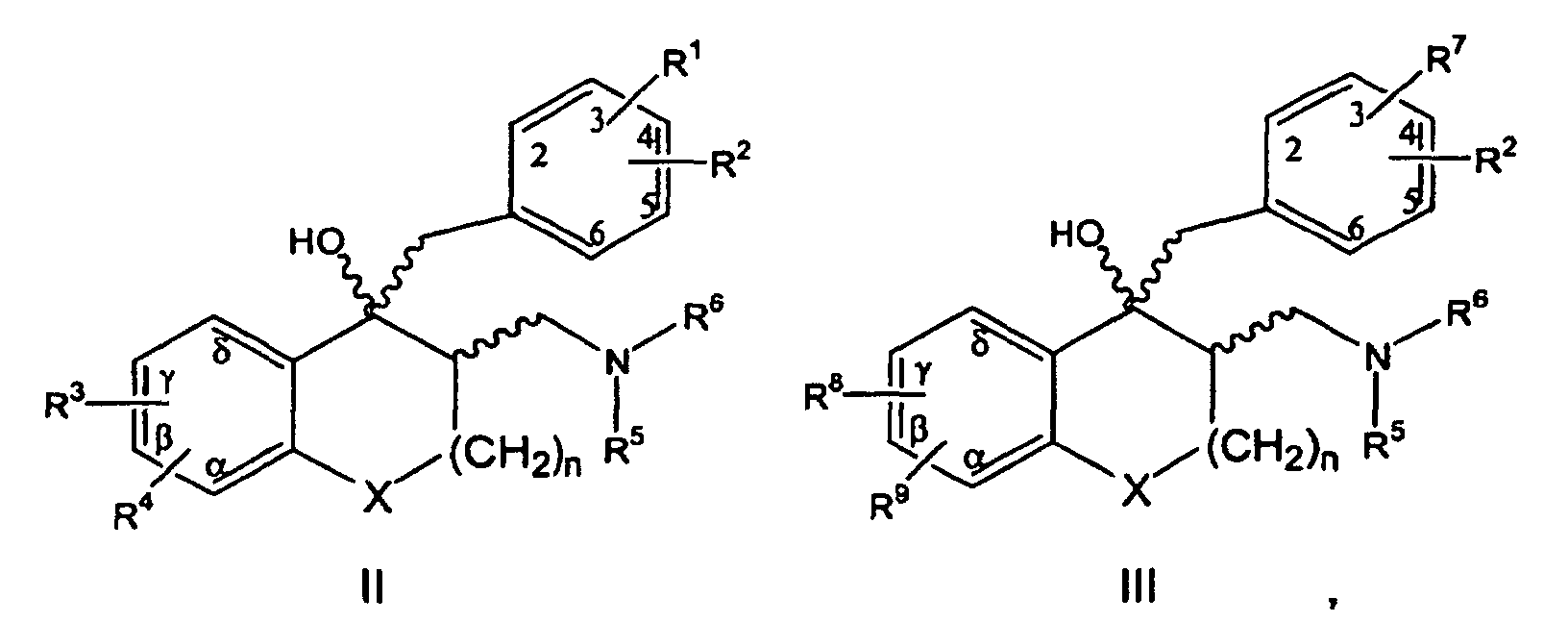
- Aminomethyl compounds of the general formulas IA and IB useful tertiary alcohols of the general formulas II and III form one Part of the present invention and can be in another Process step (c), which will be explained below, as intermediates and then either purified by known methods and isolated or directly by carrying out the method steps described above (a) or (a) and (b) into the compounds of the formulas IA and / or IB.
- the tertiary alcohols II or III are preferably obtained via a process step (c) which comprises the reaction of a ketone of the general formula IV wherein R 5 , R 6 , R 8 and R 9 , X and n are as defined above, with an organometallic compound of the general formula V wherein R 2 and R 7 are as defined above and Z is MgCl, MgBr, MgI or Li.
- the process step (c) in an ether solvent preferably an aliphatic or cycloaliphatic ether, e.g. Diethyl ether or THF, at a temperature of in particular between -70 ° C and + 60 ° C executed.
- an ether solvent preferably an aliphatic or cycloaliphatic ether, e.g. Diethyl ether or THF
- ketones of the general formula IV used in step (c) are known as Mannich bases, for example, according to a general, for example from DE 197 55 480 A1 and DE 198 05 370 A1 and others of P. Horstmann and B. maintenance, Arch. Pharm. Med. Chem . 330, 362-364 (1997), from the corresponding ketone VI, formaldehyde and amine VII (see Scheme 1):
- R 5 , R 6 , R 8 , R 9 , X and n are as defined above.
- the compounds of the formula VI are, as far as they are not commercially available, for example, from the corresponding carboxylic acids of the general formula VIII by intramolecular Friedel-Crafts acylation by means of a Lewis acid or a protic acid, such as polyphosphoric available (see, eg, J. March Advanced Organic Chemistry, 3rd Ed., John Wiley & Sons, New York, Chichester, Brisbane, Toronto, Singapore (1985), pp. 484-487):
- Compounds of Formula V with Z Cl, Br or I, with magnesium in an inert Solvent according to Grignard or with an organolithium reagent, e.g. n-Butyllithium in n-hexane, accessible.
- organolithium reagent e.g. n-Butyllithium in n-hexane, accessible.
- R 7 , R 8 and / or R 9 is O-CH 3 , O- (C 2-6 -alkyl), O- (C 3-7 -cycloalkyl) , O-CH 2 -phenyl or O-SiR 10 R 11 R 12 , these alkoxy, benzyloxy and silanyloxy compounds can be prepared by introducing suitable protective groups according to well-known methods, as described, for example, in TW Greene, PGM Wuts: Protective Groups in Organic Synthesis, 1st Ed., John Wiley & Sons, New York, Chichester, Brisbane, Toronto, Singapore (1991), from the corresponding hydroxy compounds, ie, such compounds of general formulas IV, V, VI and VIII, in which R 7 , R 8 and / or R 9 are OH, can be obtained.
- suitable oxidizing agents include sodium perborate, t-butyl hypochlorite, sodium periodate, and potassium persulfate (Oxone®) (see also J. March: Advanced Organic Chemistry, 3rd ed., John Wiley & Sons, New York, Chichester, Brisbane, Toronto, Singapore ( 1985), pages 1089 and 1090).
- a process step (e) is carried out after process step (a) and optionally before or after process step (d).
- This process step (e) can be carried out, for example, by using diisobutylaluminum hydride in an aromatic hydrocarbon such as toluene or xylene at a temperature of 60 ° C to 130 ° C.
- An alternative procedure of step (e) is the reaction with methanesulfonic acid / methionine at a temperature of 20 ° C to 50 ° C.
- a method step (f) is carried out, the transfer of the Compounds IA and / or IB according to the invention in their pharmaceutical acceptable salts.
- the method step (f) is preferably carried out by reacting the compounds IA and / or IB in liquid or solid phase with inorganic or organic acids - the optionally also be bound to a solid phase - how preferably hydrochloric acid, hydrobromic acid, sulfuric acid, Phosphoric acid, carbonic acid, p-toluenesulfonic acid, methanesulfonic acid, Formic acid, acetic acid, oxalic acid, succinic acid, tartaric acid, Mandelic acid, fumaric acid, lactic acid, citric acid, glutamic acid or Aspartic acid with the compounds of the invention IA and / or IB physiologically acceptable and therefore pharmaceutically acceptable Form salts.
- the salts formed are, inter alia. around Hydrochlorides, hydrobromides, phosphates, carbonates, bicarbonates, Formates, acetates, oxalates, succinates, tartrates, fumarates, citrates and Glutaminate.
- the salt formation takes place in an organic Solvent, e.g. Diethyl ether, diisopropyl ether, Acetic acid alkyl ester, acetone or methyl ethyl ketone.
- the most special preferred hydrochlorides of the compounds of the invention are in particular by carrying out the method step (f) with Trimethylchlorosilane in a water-containing organic solvent accessible.
- the hydrates e.g. Mono-, sesqui-, di-, triund Tetrahydrates, preferred salts of the compounds of the invention, obtained, for example, by crystallization from aqueous solution can be
- a further preferred process step (g) which can take place after process step (a) or before or after process step (d) or before or after process step (e) or after process step (f), the compounds of the general formulas IA and IB or their pharmaceutically acceptable salts are separated from one another.
- the separation can be carried out by means of known separation processes, whereby the separation of the respective exo E isomers of the formula IB from the corresponding exo Z isomers of the formula IB can be achieved.
- Suitable methods are, for example, chromatographic separation processes, in particular liquid chromatography processes under normal or elevated pressure, preferably MPLC and HPLC processes, and fractional crystallization processes.
- the enantiomers and / or diastereomers of the compounds IA and IB according to the invention can also be prepared by means of these and other methods known in the art, eg HPLC on chiral phases or fractional crystallization of with chiral acids, such as (+) - tartaric acid, (-) - tartaric acid or (+) - 10-camphorsulfonic acid, formed diastereomeric salts, are separated from each other.
- chiral acids such as (+) - tartaric acid, (-) - tartaric acid or (+) - 10-camphorsulfonic acid, formed diastereomeric salts
- a drug that is at least one of the invention cyclic substituted aminomethyl compounds of the general Formulas IA and / or IB and their pharmaceutical acceptable salts, object of the invention.
- The can Compounds according to the invention in the medicament of the invention as isomerically pure, in particular enantiomerically pure or diastereomerically pure, Compounds, but also as racemic or non-racemic Mixture present. It is preferred that the drug is a pharmaceutically acceptable salt of the compounds of the invention contains, in particular a hydrochloride.
- Another object of the invention is the use of at least one inventive cyclic substituted aminomethyl compound of the general formulas IA and / or IB, including their diastereomers or enantiomers, as racemates or mixtures of enantiomers in the form of their free base or a salt formed with a physiologically acceptable acid, in particular of the hydrochloride salt, for the manufacture of a medicament for the treatment of pain.
- the compounds according to the invention have proved to be analgesic in vivo.
- the compounds according to the invention do not or hardly bind to ⁇ receptors and have no specific activity on ⁇ receptors.
- PL Wood PL Wood et al., Neuropharmacology , Vol.
- the compounds of the general formulas IA and IB according to the invention do not show (0-20% inhibition in a Concentration of 1 ⁇ M) or only very weakly (K i > 1 ⁇ M) bind to the ⁇ receptor.
- K i > 1 ⁇ M very weakly bind to the ⁇ receptor.
- the compounds according to the invention show no specific activity at the ⁇ receptor (0-30% inhibition at a concentration of 1 ⁇ M; K i > 1 ⁇ M).
- inventive cyclic substituted aminomethyl compounds of the general Formulas IA and / or IB for further indications, in particular for the treatment of urinary incontinence, itching, tinnitus aurium and / or Diarrhea are very suitable.
- Another object of the application is therefore the use of at least one cyclic according to the invention substituted aminomethyl compound of the general formulas IA and / or IB including a pharmaceutically acceptable salt for Manufacture of a medicament for the treatment of urinary incontinence, Itching, tinnitus aurium and / or diarrhea.
- compositions are also subject matter the present invention, the at least one compound of the like above defined general formulas IA and / or IB or one of their pharmaceutically acceptable salts and one or more contain pharmaceutical excipients.
- the medicaments and pharmaceutical compositions according to the invention can be used as liquid, semisolid or solid dosage forms and in Form of e.g. Injection solutions, drops, juices, syrups, suspensions, Sprays, granules, tablets, pellets, patches, capsules, patches, Suppositories, ointments, creams, lotions, gels, emulsions or aerosols be present and administered and contain in addition to at least one cyclic substituted aminomethyl compound of the invention general formulas IA and / or IB depending on the galenic form pharmaceutical Adjuvants, e.g.
- auxiliaries may be, for example: water, ethanol, 2-propanol, Glycerol, ethylene glycol, propylene glycol, polyethylene glycol, Polypropylene glycol, glucose, fructose, lactose, sucrose, dextrose, Molasses, starch, modified starch, gelatin, sorbitol, inositol, mannitol, microcrystalline cellulose, methylcellulose, carboxymethylcellulose, Cellulose acetate, shellac, cetyl alcohol, polyvinylpyrrolidone, paraffins, Waxes, natural and synthetic gums, acacia gums, alginates, Dextran, saturated and unsaturated fatty acids, stearic acid, Magnesium stearate, zinc stearate, glycerol, ethylene glycol, propylene glycol, polyethylene glycol, Polypropylene glycol, glucose, fructose, lactose, sucrose, dextrose, Molasses, star
- excipients and the amounts to be used depends on whether the drug oral, peroral, subcutaneous, parenteral, intravenous, intraperitoneal, intradermal, intramuscular, intranasal, buccal, rectal or local, for example Infections on the skin, mucous membranes and on the eyes, applied shall be.
- oral administration u.a. Preparations in Form of tablets, dragees, capsules, granules, drops, juices and Syrups, for parenteral, topical and inhalative application solutions, Suspensions, easily reconstitutable dry preparations as well Sprays.
- Cyclic substituted aminomethyl compounds according to the invention of the general formulas IA and / or IB in a depot in dissolved form or in a plaster, optionally with the addition of the Skin penetration promoting agents are suitable percutaneous application preparations.
- Orally or percutaneously applicable preparations may be the cyclic substituted aminomethyl compounds of the invention delayed release of the general formulas IA and / or IB.
- compositions are made using the prior art pharmaceutical formulation well known devices, devices, Methods and methods, as described, for example, in "Remington's Pharmaceutical Sciences, Ed. A.R. Gennaro, 17th Ed., Mack Publishing Company, Easton, Pa. (1985), in particular in Part 8, Chapters 76 to 93, are described.
- a solid formulation such as a tablet
- the active ingredient of the drug i. a compound of the general formulas IA and / or IB or one of its pharmaceutically acceptable salts
- a pharmaceutical carrier e.g. conventional tablet ingredients, such as corn starch, lactose, sucrose, sorbitol, talc, Magnesium stearate, dicalcium phosphate or gum, and pharmaceutical Diluents, e.g. Water, to be mixed to form a solid preformulation composition comprising a Compound of the invention or a pharmaceutically acceptable Contains salt thereof in homogeneous distribution.
- a homogeneous Distribution is understood here to mean that the active ingredient is uniform over the entire preformulation composition is distributed so that these readily into equally effective unit dose forms, such as tablets, Pills or capsules, can be divided.
- the solid preformulation composition is then subdivided into unit dose forms.
- the tablets or pills of the medicament according to the invention or the Compositions of the invention may also be coated or be compounded in another way with a dose form to provide sustained release.
- Suitable coating agents are u.a. polymeric acids and mixtures of polymeric acids with Materials such as e.g. Shellac, cetyl alcohol and / or cellulose acetate.
- the amount of drug to be administered to the patient varies and is depending on the weight, the age and the history of the disease Patients, as well as the type of application, the indication and the Severity of the disease.
- the antinociceptive activity of the compounds of this invention was demonstrated in the phenylquinone-induced writhing assay in the mouse, modified according to IC Hendershot, J. Forsaith, J. Pharmacol. Exp. Ther. 125, 237-240 (1959).
- male NMRI mice weighing 25-30 g were used.
- Groups of 10 animals per dose of substance 10 minutes after intravenous administration of a compound of the invention 0.3 ml / mouse of a 0.02% aqueous solution of phenylquinone (phenylbenzoquinone, Sigma, Deisenhofen;) Preparation of the solution with the addition of 5% ethanol and Storage in a water bath at 45 ° C) intraperitoneally.
- the animals were placed individually in observation cages.
- the number of pain-induced stretching movements was counted 5-20 minutes after the phenylquinone administration.
Landscapes
- Chemical & Material Sciences (AREA)
- Organic Chemistry (AREA)
- Health & Medical Sciences (AREA)
- Pharmacology & Pharmacy (AREA)
- Animal Behavior & Ethology (AREA)
- Veterinary Medicine (AREA)
- Public Health (AREA)
- Chemical Kinetics & Catalysis (AREA)
- General Chemical & Material Sciences (AREA)
- Medicinal Chemistry (AREA)
- Nuclear Medicine, Radiotherapy & Molecular Imaging (AREA)
- General Health & Medical Sciences (AREA)
- Life Sciences & Earth Sciences (AREA)
- Bioinformatics & Cheminformatics (AREA)
- Engineering & Computer Science (AREA)
- Urology & Nephrology (AREA)
- Biomedical Technology (AREA)
- Neurosurgery (AREA)
- Neurology (AREA)
- Dermatology (AREA)
- Pain & Pain Management (AREA)
- Rheumatology (AREA)
- Anesthesiology (AREA)
- Pharmaceuticals Containing Other Organic And Inorganic Compounds (AREA)
- Acyclic And Carbocyclic Compounds In Medicinal Compositions (AREA)
- Organic Low-Molecular-Weight Compounds And Preparation Thereof (AREA)
- Pyrane Compounds (AREA)
Abstract
Description

- R1
- H, F, Cl, OH, O-CH3, O-(C2-6-Alkyl), O-(C3-7-Cycloalkyl), CH3, C2-6-Alkyl, CH2F, CHF2 oder CF3, jeweils in 2-, 3-, 4-, 5- oder 6-Stellung des Phenylringes, bedeutet,
- R2
- H, F, Cl, CH3, C2-6-Alkyl, CH2F, CHF2 oder CF3, jeweils in 2-, 3-, 4-, 5- oder 6-Stellung des Phenylringes, bedeutet,
- R3 und R4
- unabhängig voneinander H, F, Cl, OH, O-CH3, O-(C2-6-Alkyl), O-(C3-7-Cycloalkyl), CH3, C2-6-Alkyl, CH2F, CHF2, CF3, O-Aryl, Aryl oder Heterocyclyl, jeweils in α-, β-, γ- und/oder δ-Stellung des aromatischen Ringes, bedeuten,
- R5 und R6
- unabhängig voneinander CH3, C2-6-Alkyl, C3-7-Cycloalkyl, CH2-(C3-7-Cycloalkyl), Aryl, (C1-6-Alkyl)-Aryl, Heterocyclyl oder (C1-6-Alkyl)-Heterocyclyl bedeuten,
- X
- CH2, O, S, SO oder SO2 bedeutet,
- n
- 0, 1, 2 oder 3 ist, wenn X CH2 bedeutet, und 1, 2 oder 3 ist, wenn X O, S, SO oder SO2 bedeutet,
sowie ihre pharmazeutisch annehmbaren Salze.


- R1
- H, F, Cl, OH, O-CH3, O-(C2-6-Alkyl), O-(C3-7-Cycloalkyl), CH3, C2-6-Alkyl, CH2F, CHF2 oder CF3, jeweils in 2- ,3-, 4-, 5- oder 6-Stellung des Phenylringes, bedeutet,
- R2
- H, F, Cl, CH3, C2-6-Alkyl, CH2F, CHF2 oder CF3, jeweils in 2-, 3-, 4-, 5- oder 6-Stellung des Phenylringes, bedeutet,
- R3 und R4
- unabhängig voneinander H, F, Cl, OH, O-CH3, O-(C2-6-Alkyl), O-(C3-7-Cycloalkyl), CH3, C2-6-Alkyl, CH2F, CHF2, CF3, O-Aryl, Aryl oder Heterocyclyl, jeweils in α-, β-, γ- und/oder δ-Stellung des aromatischen Ringes, bedeuten,
- R5 und R6
- unabhängig voneinander CH3, C2-6-Alkyl, C3-7-Cycloalkyl, CH2-(C3-7-Cycloalkyl), Aryl, (C1-6-Alkyl)-Aryl, Heterocyclyl oder (C1-6-Alkyl)-Heterocyclyl bedeuten,
- X
- CH2, O, S, SO oder SO2 bedeutet,
- n
- 0, 1, 2 oder 3 ist, wenn X CH2 bedeutet, und 1, 2 oder 3 ist, wenn X O, S, SO oder SO2 bedeutet,
wobei das erfindungsgemäße Verfahren durch einen Verfahrensschritt (a) gekennzeichnet ist, der die Umsetzung eines tertiären Alkohols der allgemeinen Formel II


- R2, R5, R6, X und n
- wie oben definiert sind,
- R7
- H, F, Cl, O-CH3, O-(C2-6-Alkyl), O-(C3-7-Cycloalkyl), O-CH2-Phenyl, O-SiR10R11R12, wobei R10, R11 und R12 unabhängig voneinander CH3, C2-6-Alkyl oder Phenyl sind, CH3, C2-6-Alkyl, CH2F, CHF2 oder CF3, jeweils in 2-, 3-, 4-, 5- oder 6-Stellung des Phenylringes, bedeutet,
- R8 und R9
- unabhängig voneinander H, F, Cl, O-CH3, O-(C2-6-Alkyl), O- (C3-7-Cycloalkyl), O-CH2-Phenyl, O-SiR10R11R12, wobei R10, R11 und R12 unabhängig voneinander CH3, C2-6-Alkyl oder Phenyl sind, CH3, C2-6-Alkyl, CH2F, CHF2, CF3, O-Aryl, Aryl oder Heterocyclyl, jeweils in α-, β-, γ- und/oder δ-Stellung des aromatischen Ringes, bedeuten,
O-CH3, O-(C2-6-Alkyl), O-(C3-7-Cycloalkyl), O-CH2-Phenyl oder O-SiR10R11R12 ist,

mit einer metallorganischen Verbindung der allgemeinen Formel V


- Ausbeute:
- 5,81 g (84,5 % d.Th.)
- Schmelzpunkt:
- 202 -204°C
- Schmelzpunkt:
- 247 - 248°C
- A:
- 4,71 g des Produkts aus Beispiel 1, Stufe 1, in 60 ml einer Lösung von
Bromwasserstoff in Eisessig wurden 5 Stunden zum Rückfluß erhitzt.
Dann wurde im Vakuum eingedampft, der Rückstand in 50 ml Wasser
aufgenommen, durch Zugabe von 1 N Natronlauge neutralisiert, zuletzt
mit Ammoniumhydroxid alkalisiert. Man extrahierte dreimal mit je 30 ml
Essigsäureethylester, trocknete über Natriumsulfat und dampfte im
Vakuum ein. Die zurückbleibende Rohbase der Titelverbindung wurde
mit Trimethylchlorsilan/Wasser in 2-Butanon in das Hydrochlorid
überführt.
- Ausbeute:
- 3,75 g (78,4 % d.Th.)
- Schmelzpunkt:
- 151 - 153°C (Zers.)
- B:
- Eine Suspension von 2,06 g des Produkts aus Beispiel 1 in 20 ml
trockenem Toluol wurde mit 40 ml einer Lösung von Diisobutylaluminiumhydrid
in Toluol (20 Gew.-%) versetzt und das Gemisch 12
Stunden zum Rückfluß erhitzt. Nach dem Abkühlen wurde durch Zutropfen
von Ethanol, zuletzt vermischt mit Wasser, zersetzt und im
Vakuum eingedampft. Den Rückstand versetzte man mit 30 ml
Methanol und filtrierte über Filtererde. Das Filtrat wurde eingedampft
und die so erhaltene Rohbase der Titelverbindung mit Trimethylchlorsilan/Wasser
in 2-Butanon in das Hydrochlorid überführt, dessen
Schmelzverhalten mit dem des oben erhaltenen Produkts identisch
war.
- Ausbeute:
- 1,58 g (79,6 % d.Th.)
- 4a:
- 5-(4-Chlorbenzyl)-6-dimethylaminomethyl-7,8-dihydro-naphth-2-ol-Hydrochlorid
Schmelzpunkt: 110°C (Zers.) - 4b:
- [1-(2,4-Dichlorbenzyl)-3,4-dihydro-naphth-2-ylmethyl]-dimethylamin-Hydrochlorid
Schmelzpunkt: 208 - 209°C
- 4c:
- 5-(4-Chlorbenzyl)-6-dimethylaminomethyl-7,8-dihydro-naphth-1-ol-Hydrochlorid
Schmelzpunkt: 136 - 139°C - 4d:
- [5-(4-Chlorbenzyl)-8,9-dihydro-7H-benzocyclohepten-6-ylmethyl]-dimethylamin-Hydrochlorid
Schmelzpunkt: 240 - 243°C - 4e:
- E-(5RS)-[5-(4-Chlorbenzyliden)-6,7,8,9-tetrahydro-5H-benzocyclohepten-6-ylmethyl]-dimethylamin-Hydrochlorid
Schmelzpunkt: 181 - 183°C
Als Produkte desselben Ansatzes wurden die Beispielsverbindungen 4d und 4e in Form der freien Basen säulenchromatographisch mit Essigsäureethylester/Methanol = 9/1 als Elutionsmittel getrennt. - 4f:
- 6-Dimethylaminomethyl-5-(3-hydroxybenzyl)-7,8-dihydro-naphth-2-ol-Hydrochlorid
Schmelzpunkt: 89°C (Zers.)
- 5a:
-
- Ausbeute:
- 3,12 g (51,5 % d.Th.)
- Schmelzpunkt:
- 181 - 183°C
- 5b:
-
- Ausbeute:
- 2,38 g (39,3 % d.Th.)
- Schmelzpunkt:
- 228 - 230°C
- 6a:
-
- Ausbeute:
- 0,88 g (18,1 % d. Th.)
- Schmelzpunkt:
- 194 - 196°C
- 6b:
-
- Ausbeute:
- 0,76 g (15,7 % d.Th.)
- Schmelzpunkt:
- 120°C (Zers.)
- 6c:
-
- Ausbeute:
- 1,29 g (26,5 % d.Th.)
- Schmelzpunkt:
- 154°C (Zers.)
- 7a:
-
- Ausbeute:
- 3,07 g (40,1 % d.Th.)
- Schmelzpunkt:
- 215 - 217°C
- 7b:
-
- Ausbeute:
- 0,93 g (12,1 % d.Th.)
- Schmelzpunkt:
- 92°C (Zers.)
- 7c:
-
- Ausbeute:
- 1,69 g (22,1 % d.Th.)
- Schmelzpunkt:
- 162- 164°C
- Schmelzpunkt:
- 220 - 222°C
- 9a:
-
- Ausbeute:
- 3,43 g (42,2 % d.Th.)
- Schmelzpunkt:
- 92 % (Zers.)
- 9b:
-
- Ausbeute:
- 1,57 g (19,4 % d.Th.)
- Schmelzpunkt:
- 209 - 210°C
- Schmelzpunkt:
- 96°C (Zers.)
- Schmelzpunkt:
- 223 - 224°C
- Schmelzpunkt:
- 227 - 229°C
- Schmelzpunkt:
- 170 - 172°C
- 14a:
-
- Ausbeute:
- 1,10 g (20,9 % d.Th.)
- Schmelzpunkt:
- 166 - 169°C
- 14b:
-
- Ausbeute:
- 2,56 g (48,7 % d.Th.)
- Schmelzpunkt:
- 164 - 167°C

| Beispiel Nr. | Writhing-Test, Maus, i.v. Abnahme der Writhingreaktionen oder ED50 [mg/kg] |
| 2 | 6,85 (61,5 %) |
| 3 | 93 % |
| 4e | 69 % |
| 4c | 84 % |
| 7c | 79 % |
| 6a | 95 % |
| 6b | 91 % [2,15 mg/kg] |
| 6c | 78 % |
Claims (21)
- Cyclische substituierte Aminomethylverbindungen der allgemeinen Formel IA und/oder IBworin
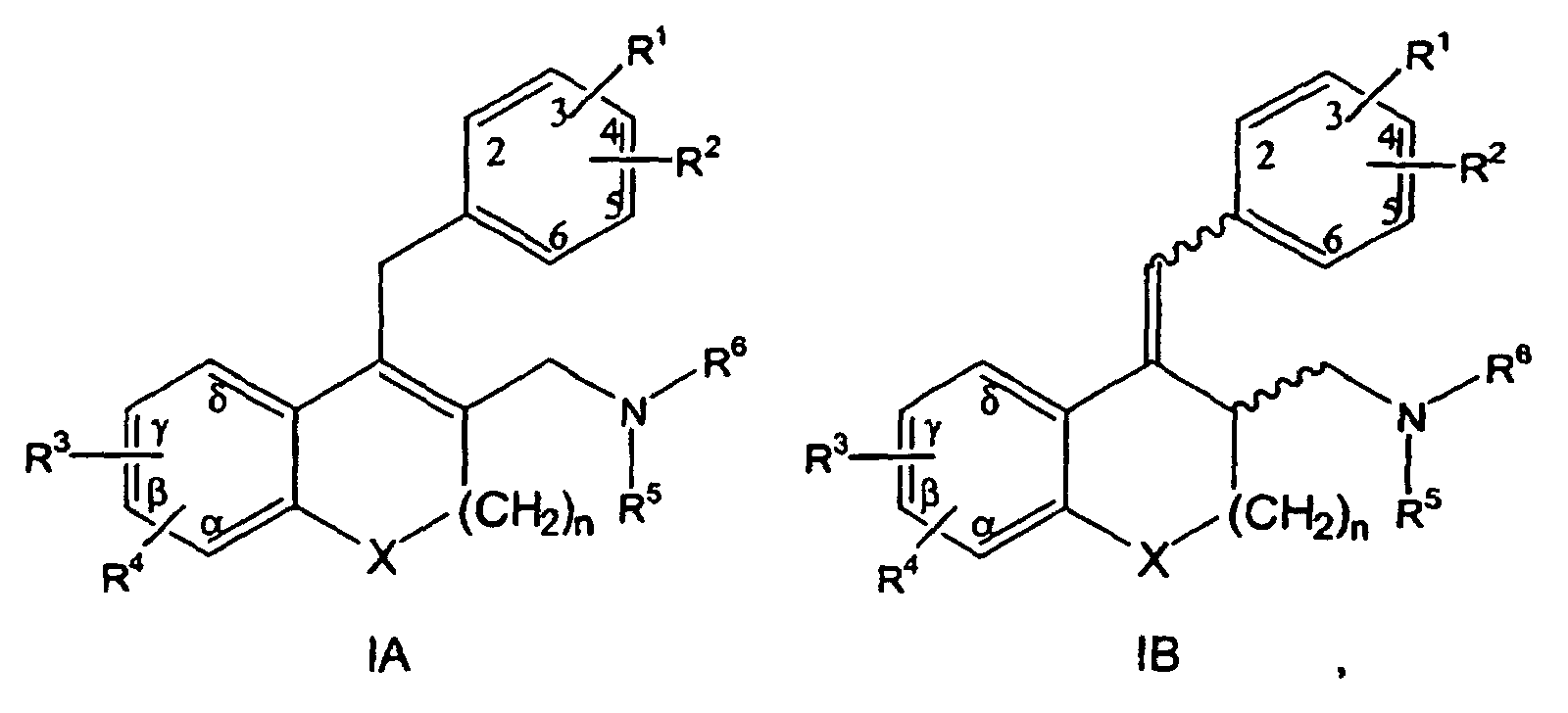
- R1
- H, F, Cl, OH, O-CH3, O-(C2-6-Alkyl), O-(C3-7-Cycloalkyl), CH3, C2-6-Alkyl, CH2F, CHF2 oder CF3, jeweils in 2-, 3-, 4-, 5- oder 6-Stellung des Phenylringes, bedeutet,
- R2
- H, F, Cl, CH3, C2-6-Alkyl, CH2F, CHF2 oder CF3, jeweils in 2-, 3-, 4-, 5- oder 6-Stellung des Phenylringes, bedeutet,
- R3 und R4
- unabhängig voneinander H, F, Cl, OH, O-CH3, O-(C2-6-Alkyl), O-(C3-7-Cycloalkyl), CH3, C2-6-Alkyl, CH2F, CHF2, CF3, O-Aryl, Aryl oder Heterocyclyl, jeweils in α-, β-, γ- und/oder δ-Stellung des aromatischen Ringes, bedeuten,
- R5 und R6
- unabhängig voneinander CH3, C2-6-Alkyl, C3-7-Cycloalkyl, CH2-(C3-7-Cycloalkyl), Aryl, (C1-6-Alkyl)-Aryl, Heterocyclyl oder (C1-6-Alkyl)-Heterocyclyl bedeuten,
- X
- CH2, O, S, SO oder SO2 bedeutet,
- n
- 0, 1, 2 oder 3 ist, wenn X CH2 bedeutet, und 1, 2 oder 3 ist, wenn X O, S, SO oder SO2 bedeutet,
sowie ihre pharmazeutisch annehmbaren Salze. - Cyclische substituierte Aminomethylverbindungen der allgemeinen Formel IA nach Anspruch 1, worin unabhängig voneinander R1 OH, O-CH3 oder Cl, R2 H oder Cl, R3 H oder OH, R4 H, R5 und R6 CH3 und X CH2, O, S oder SO bedeuten und n 1 oder 2 ist, sowie ihre pharmazeutisch annehmbaren Salze.
- Cyclische substituierte Aminomethylverbindungen der allgemeinen Formel IA nach einem der Ansprüche 1 oder 2, worin unabhängig voneinander R1 3-OH, 2-O-CH3, 3-O-CH3 oder 4-Cl, R2 H, 2-Cl oder 4-Cl, R3 H, α-OH oder β-OH, R4 H, R5 und R6 CH3 und X CH2, O, S oder SO bedeuten und n 1 oder 2 ist, sowie ihre pharmazeutisch annehmbaren Salze.
- Cyclische substituierte Aminomethylverbindungen der allgemeinen Formel IB nach Anspruch 1, worin R1 OH, O-CH3 oder Cl, R2, R3 und R4 H, R5 und R6 CH3 und X CH2, O oder S bedeuten, n 1 oder 2 ist und die Konfiguration der exocyclischen Doppelbindung E- oder Z-ist, sowie ihre pharmazeutisch annehmbaren Salze.
- Cyclische substituierte Aminomethylverbindungen der allgemeinen Formel IB nach einem der Ansprüche 1 oder 4, worin R1 3-OH, 2-O-CH3, 3-O-CH3 oder 4-Cl, R2, R3 und R4 H, R5 und R6 CH3 und X CH2, O oder S bedeuten, n 1 oder 2 ist und die Konfiguration der exocyclischen Doppelbindung E- oder Z- ist, sowie ihre pharmazeutisch annehmbaren Salze.
- Cyclische substituierte Aminomethylverbindungen nach einem der Ansprüche 1 bis 5, wobei die Verbindungen als Gemisch der Isomeren mit endocyclischer Doppelbindung nach der allgemeinen Formel IA und mit exocyclischer Doppelbindung nach der allgemeinen Formel IB vorliegen.
- Cyclische substituierte Aminomethylverbindungen der allgemeinen Formeln IA und/oder IB nach einem der Ansprüche 1 bis 6 in Form ihrer Racemate, in Form der reinen Enantiomeren oder in Form von Mischungen der Enantiomeren in einem beliebigen Mischungsverhältnis, sowie ihre pharmazeutisch annehmbaren Salze.
- Cyclische substituierte Aminomethylverbindungen gemäß einem der Ansprüche 1 bis 7, wobei die Aminoverbindungen ausgewählt sind aus
[1-(4-Chlorbenzyl)-3,4-dihydro-naphth-2-ylmethyl]-dimethylamin,
3-(2-Dimethylaminomethyl-3,4-dihydro-naphth-1-yl-methyl)-phenol,
5-(4-Chlorbenzyl)-6-dimethylaminomethyl-7,8-dihydro-naphth-1-ol,
E-(5RS)-[5-(4-Chlorbenzyliden)-6,7,8,9-tetrahydro-5H-benzocyclohepten-6-ylmethyl]-dimethylamin,
Z-(4RS)-[5-(4-Chlorbenzyliden)-2,3,4,5-tetrahydrobenzo[b]oxepin-4-ylmethyl]-dimethylamin,
3-(4-Dimethylaminomethyl-2,3-dihydro-benzo[b]oxepin-5-ylmethyl)-phenol,
E-(4RS)-3-(4-Dimethylaminomethyl-3,4-dihydro-2H-benzo[b]oxepin-5-ylidenmethyl)-phenol oder
Z-(4RS)-3-(4-Dimethylaminomethyl-3,4-dihydro-2H-benzo[b]oxepin-5-ylidenmethyl)-phenol,
sowie ihre pharmazeutisch annehmbaren Salze, insbesondere ihre Hydrochloride. - Verfahren zur Herstellung von Verbindungen der allgemeinen Formeln IA und/oder IBworin
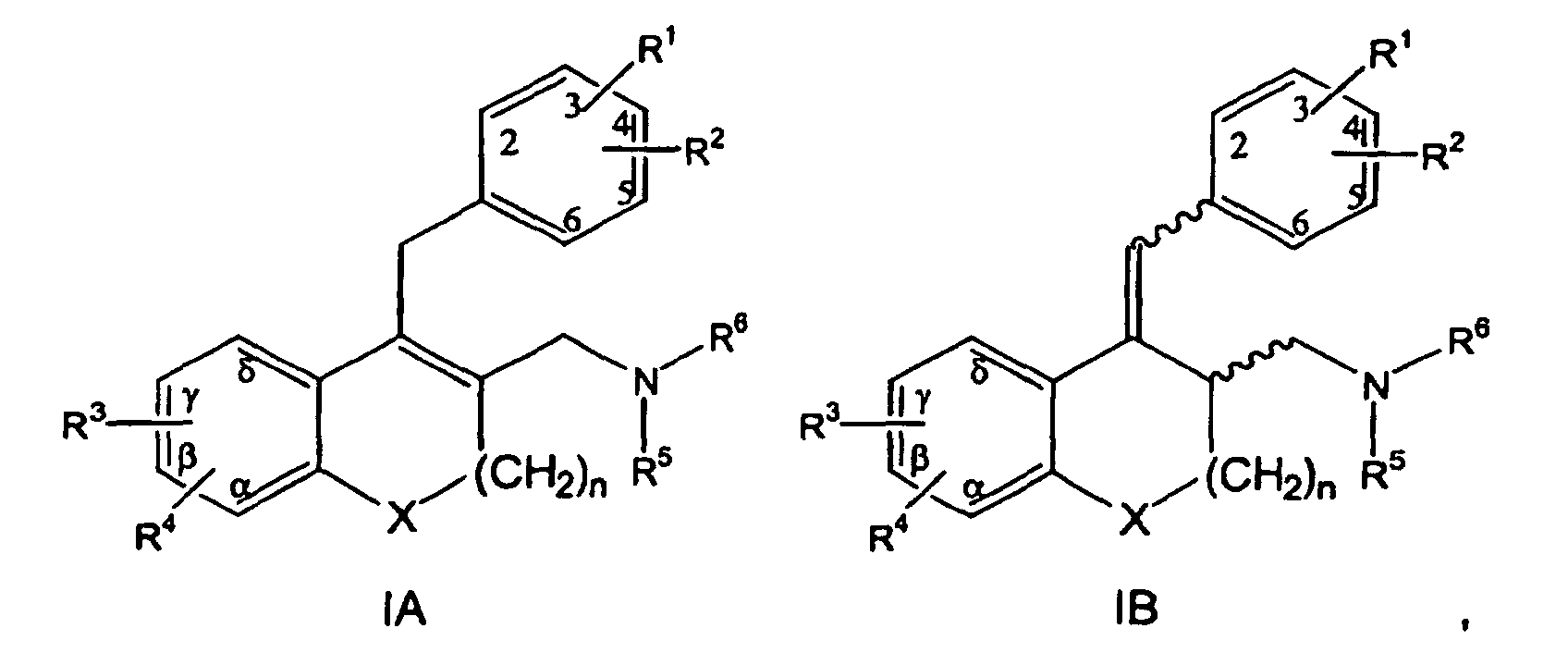
- R1
- H, F, Cl, OH, O-CH3, O-(C2-6-Alkyl), O-(C3-7-Cycloalkyl), CH3, C2-6-Alkyl, CH2F, CHF2 oder CF3, jeweils in 2-, 3-, 4-, 5- oder 6-Stellung des Phenylringes, bedeutet,
- R2
- H, F, Cl, CH3, C2-6-Alkyl, CH2F, CHF2 oder CF3, jeweils in 2-, 3-, 4-, 5- oder 6-Stellung des Phenylringes, bedeutet,
- R3 und R4
- unabhängig voneinander H, F, Cl, OH, O-CH3, O-(C2-6-Alkyl), O-(C3-7-Cycloalkyl), CH3, C2-6-Alkyl, CH2F, CHF2, CF3, O-Aryl, Aryl oder Heterocyclyl, jeweils in α-, β-, γ- und/oder δ-Stellung des aromatischen Ringes, bedeuten,
- R5 und R6
- unabhängig voneinander CH3, C2-6-Alkyl, C3-7-Cycloalkyl, CH2-(C3-7-Cycloalkyl), Aryl, (C1-6-Alkyl)-Aryl, Heterocyclyl oder (C1-6-Alkyl)-Heterocyclyl, bedeuten,
- X
- CH2, O, S, SO oder SO2 bedeutet,
- n
- 0, 1, 2 oder 3 ist, wenn X CH2 bedeutet, und 1, 2 oder 3 ist, wenn X O, S, SO oder SO2 bedeutet,
gekennzeichnet durch einen Verfahrensschritt (a), der die Umsetzung eines tertiären Alkohols der allgemeinen Formel IIworin R1 bis R6, X und n wie oben definiert sind,
mit einer Säure umfaßt. - Verfahren nach Anspruch 9, dadurch gekennzeichnet, daß der Verfahrensschritt (a) die Umsetzung eines tertiären Alkohols der allgemeinen Formel II, in der mindestens einer der Reste R1, R3 und R4 O-CH3 bedeutet, zu Verbindungen der allgemeinen Formeln IA und/oder IB, in denen die Reste R1, R3 und R4 OH bedeuten, wenn die entsprechenden Reste R1, R3 und R4 in dem tertiären Alkohol der allgemeinen Formel II O-CH3 bedeuten, mit einem Reagenz aus der Gruppe, die Bromwasserstoff in Eisessig, konzentrierte Bromwasserstoffsäure und Methansulfonsäure/Methionin enthält, umfaßt.
- Verfahren nach Anspruch 9, dadurch gekennzeichnet, daß vor dem Verfahrensschritt (a) ein Verfahrensschritt (b) ausgeführt wird, der die Überführung eines tertiären Alkohols der allgemeinen Formel IIIworin
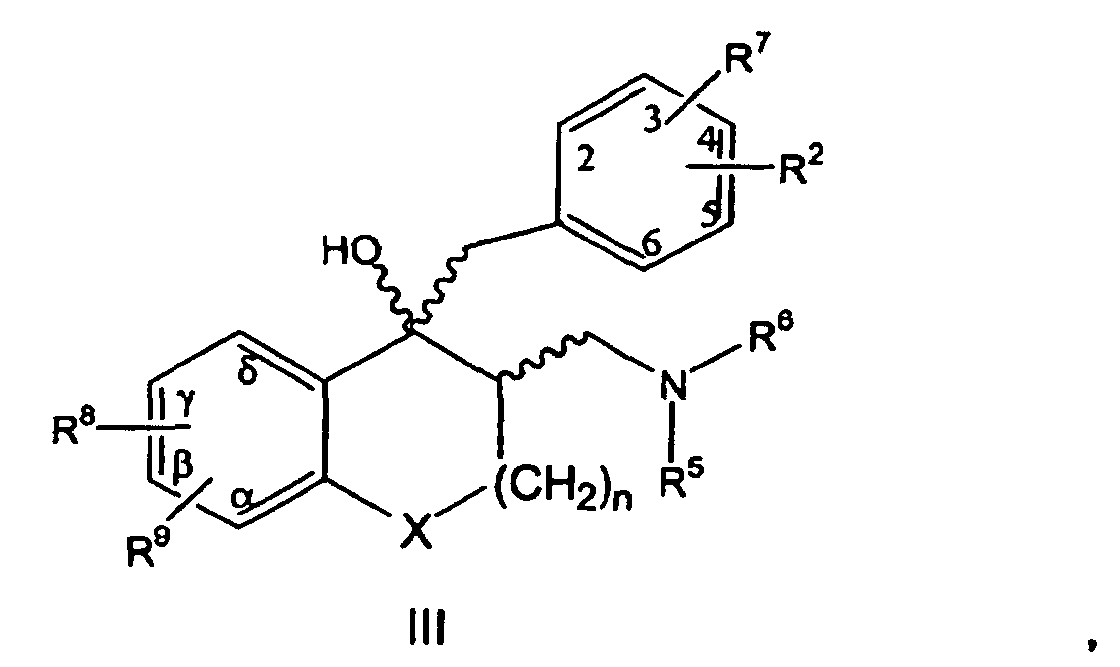
- R2, R5, R6, X und n
- wie in Anspruch 9 definiert sind,
- R7
- H, F, Cl, O-CH3, O-(C2-6-Alkyl), O-(C3-7-Cycloalkyl), O-CH2-Phenyl, O-SiR10R11R12, wobei R10, R11 und R12 unabhängig voneinander CH3, C2-6-Alkyl oder Phenyl sind, CH3, C2-6-Alkyl, CH2F, CHF2 oder CF3, jeweils in 2-, 3-, 4-, 5- oder 6-Stellung des Phenylringes, bedeutet,
- R8 und R9
- unabhängig voneinander H, F, Cl, O-CH3, O-(C2-6-Alkyl), O-(C3-7-Cycloalkyl), O-CH2-Phenyl, O- SiR10R11R12, wobei R10, R11 und R12 unabhängig voneinander CH3, C2-6-Alkyl oder Phenyl sind, CH3, C2-6-Alkyl, CH2F, CHF2, CF3, O-Aryl, Aryl oder Heterocyclyl, jeweils in α-, β-, γ- und/oder δ-Stellung des aromatischen Ringes, bedeuten,
O-CH3, O-(C2-6-Alkyl), O-(C3-7-Cycloalkyl), O-CH2-. Phenyl oder O-SiR10R11R12 ist,
in einen tertiären Alkohol der allgemeinen Formel II nach Anspruch 9, in der R1, R3 und R4 jeweils OH ist, wenn der entsprechende Rest R7, R8 bzw. R9 in Formel III O-CH3, O-(C2-6-Alkyl), O-(C3-7-Cycloalkyl), O-CH2-Phenyl oder O-SiR10R11R12 ist,
umfaßt. - Verfahren nach einem der Ansprüche 9 bis 11, dadurch gekennzeichnet, daß zur Herstellung der tertiären Alkohole der allgemeinen Formeln II bzw. III vor den Verfahrensschritten (a) bzw. (b) ein Verfahrensschritt (c) ausgeführt wird, der die Umsetzung eines Ketons der allgemeinen Formel IVworin R5, R6, X und n wie in Anspruch 9 und R8 und R9 wie in Anspruch 11 definiert sind,
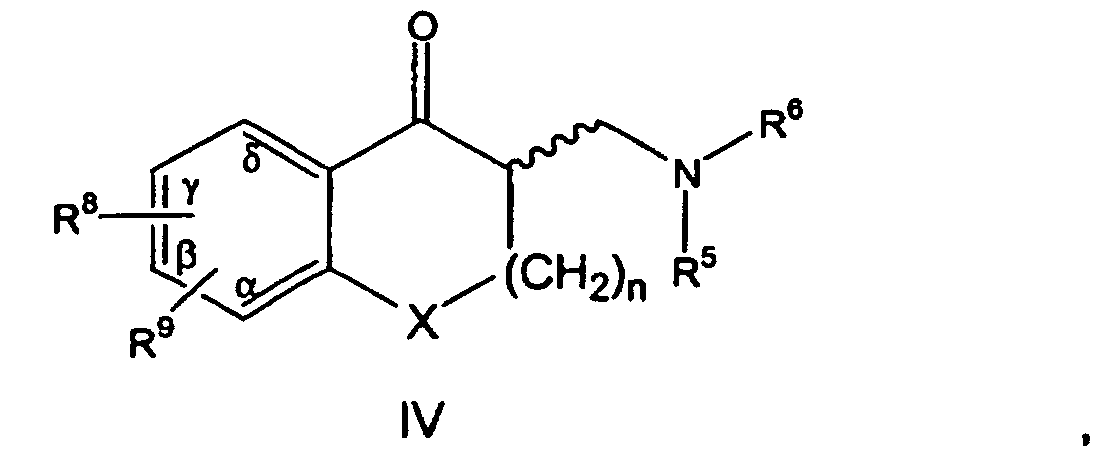
mit einer metallorganischen Verbindung der allgemeinen Formel Vworin R2 wie in Anspruch 9 und R7 wie in Anspruch 11 definiert sind und Z MgCl, MgBr, Mgl oder Li bedeutet,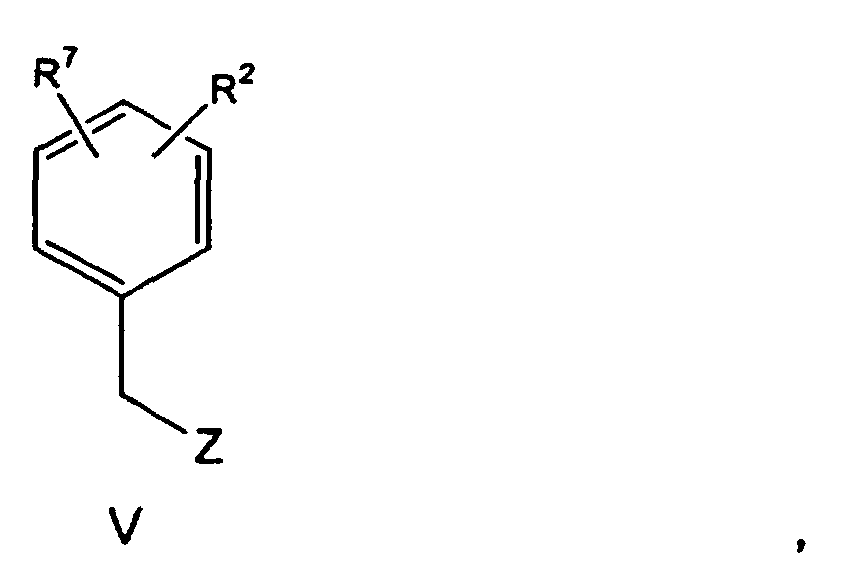
umfaßt. - Verfahren nach einem der Ansprüche 9 bis 12, dadurch gekennzeichnet, daß Verbindungen der allgemeinen Formeln IA und/oder IB mit X = S in einem Verfahrensschritt (d) in Verbindungen der allgemeinen Formeln IA und/oder IB mit X = SO und/oder SO2 unter Verwendung eines Oxidationsmittels überführt werden.
- Verfahren nach einem der Ansprüche 9 bis 13, dadurch gekennzeichnet, daß nach dem Verfahrensschritt (a) und gegebenenfalls vor oder nach dem Verfahrensschritt (d) ein Verfahrensschritt (e) ausgeführt wird, der die Überführung von Verbindungen der allgemeinen Formel IA und/oder IB, in denen mindestens einer der Reste R1, R3 und R4 O-CH3 bedeutet, in Verbindungen der allgemeinen Formeln IA und/oder IB, in denen der/die entsprechende/n Rest/e R1, R3 und R4 OH bedeutet/bedeuten, umfaßt.
- Verfahren nach einem der Ansprüche 9 bis 14, dadurch gekennzeichnet, daß nach dem Verfahrensschritt (a) bzw. (d) bzw. (e) ein Verfahrensschritt (f) ausgeführt wird, der die Überführung der Verbindungen der allgemeinen Formeln IA und/oder IB in ihre pharmazeutisch annehmbaren Salze umfaßt.
- Verfahren nach einem der Ansprüche 9 bis 15, dadurch gekennzeichnet, daß nach dem Verfahrensschritt (a) bzw. vor oder nach dem Verfahrensschritt (d) bzw. vor oder nach dem Verfahrensschritt (e) bzw. nach dem Verfahrensschritt (f) ein Verfahrensschritt (g) ausgeführt wird, der die Trennung der Verbindungen der allgemeinen Formeln IA und IB sowie ggf. ihrer pharmazeutisch annehmbaren Salze umfaßt.
- Tertiärer Alkohol der allgemeinen Formel II oder IIIworin R1 bis R6, X und n wie in Anspruch 9 und R7 bis R9 wie in Anspruch 11 definiert sind.
- Arzneimittel, enthaltend mindestens eine Verbindung der allgemeinen Formeln IA und/oder IB oder eines ihrer pharmazeutisch annehmbaren Salze nach einem der Ansprüche 1 bis 8.
- Verwendung einer Verbindung der allgemeinen Formeln IA und/oder IB oder eines ihrer pharmazeutisch annehmbaren Salze nach einem der Ansprüche 1 bis 8 zur Herstellung eines Arzneimittels zur Behandlung von Schmerz.
- Verwendung einer Verbindung der allgemeinen Formeln IA und/oder IB oder eines ihrer pharmazeutisch annehmbaren Salze nach einem der Ansprüche 1 bis 8 zur Herstellung eines Arzneimittels zur Behandlung von Harninkontinenz, Juckreiz, Tinnitus aurium und/oder Diarrhoe.
- Pharmazeutische Zusammensetzung, die mindestens eine Verbindung der allgemeinen Formeln IA und/oder IB oder eines ihrer pharmazeutisch annehmbaren Salze nach einem der Ansprüche 1 bis 8 und einen oder mehrere pharmazeutische Hilfsstoffe enthält.
Priority Applications (1)
| Application Number | Priority Date | Filing Date | Title |
|---|---|---|---|
| SI200130305T SI1299373T1 (de) | 2000-07-10 | 2001-07-06 |
Applications Claiming Priority (3)
| Application Number | Priority Date | Filing Date | Title |
|---|---|---|---|
| DE10033459 | 2000-07-10 | ||
| DE10033459A DE10033459A1 (de) | 2000-07-10 | 2000-07-10 | Cyclische substituierte Aminomethylverbindungen und diese Verbindungen enthaltende Arzeimittel |
| PCT/EP2001/007750 WO2002008218A1 (de) | 2000-07-10 | 2001-07-06 | Cyclische substituierte aminomethylverbindungen und diese verbindungen enthaltende arzneimittel |
Publications (2)
| Publication Number | Publication Date |
|---|---|
| EP1299373A1 EP1299373A1 (de) | 2003-04-09 |
| EP1299373B1 true EP1299373B1 (de) | 2005-01-12 |
Family
ID=7648406
Family Applications (1)
| Application Number | Title | Priority Date | Filing Date |
|---|---|---|---|
| EP01947447A Expired - Lifetime EP1299373B1 (de) | 2000-07-10 | 2001-07-06 | Cyclische substituierte aminomethylverbindungen und diese verbindungen enthaltende arzneimittel |
Country Status (27)
| Country | Link |
|---|---|
| US (1) | US6890952B2 (de) |
| EP (1) | EP1299373B1 (de) |
| JP (1) | JP2004504394A (de) |
| KR (1) | KR100821113B1 (de) |
| CN (1) | CN1179958C (de) |
| AR (1) | AR032464A1 (de) |
| AT (1) | ATE286891T1 (de) |
| AU (2) | AU6912401A (de) |
| BR (1) | BR0112447A (de) |
| CA (1) | CA2415196A1 (de) |
| CZ (1) | CZ301135B6 (de) |
| DE (2) | DE10033459A1 (de) |
| EC (1) | ECSP034416A (de) |
| ES (1) | ES2234851T3 (de) |
| HU (1) | HUP0302817A3 (de) |
| IL (2) | IL153825A0 (de) |
| MX (1) | MXPA02012925A (de) |
| MY (1) | MY134060A (de) |
| NO (1) | NO20030105L (de) |
| NZ (1) | NZ523089A (de) |
| PE (1) | PE20020255A1 (de) |
| PL (1) | PL204123B1 (de) |
| PT (1) | PT1299373E (de) |
| RU (1) | RU2003102610A (de) |
| SK (1) | SK372003A3 (de) |
| WO (1) | WO2002008218A1 (de) |
| ZA (1) | ZA200301048B (de) |
Families Citing this family (2)
| Publication number | Priority date | Publication date | Assignee | Title |
|---|---|---|---|---|
| DE102004034619A1 (de) | 2004-07-16 | 2006-02-23 | Grünenthal GmbH | Substituierte Aminoverbindungen als 5-HT/NA Uptakehemmer |
| US7378552B2 (en) * | 2005-06-07 | 2008-05-27 | Neurocrine Biosciences, Inc. | Monoamine re-uptake inhibitors and methods relating thereto |
Family Cites Families (8)
| Publication number | Priority date | Publication date | Assignee | Title |
|---|---|---|---|---|
| DE922703C (de) | 1951-02-03 | 1955-01-24 | Hans Kenner | Stanzvorlage zum Ausstanzen von Reissverschlusskrampen und Verfahren sowie Vorrichtung zum Herstellen derselben |
| CH391722A (de) * | 1958-03-20 | 1965-05-15 | Ciba Geigy | Verfahren zur Herstellung von 3-Aralkyl-2-tert.-amino-alkyl-indenen |
| US3072716A (en) * | 1959-03-18 | 1963-01-08 | Ciba Geigy Corp | Substituted indenes |
| US3142682A (en) * | 1961-11-21 | 1964-07-28 | Ciba Geigy Corp | Tertiary amino derivatives of chromans and homo-chromans |
| US3956391A (en) | 1973-06-04 | 1976-05-11 | Sandoz, Inc. | Amino substituted tetrahydropleiadenes |
| JPS61130287A (ja) * | 1984-11-30 | 1986-06-18 | Suntory Ltd | 1−ベンズオキセピン誘導体 |
| DE19805370A1 (de) * | 1997-03-14 | 1998-09-17 | Gruenenthal Gmbh | Substituierte Aminoverbindungen und ihre Verwendung als analgetisch wirksame Substanzen |
| DE19755480A1 (de) * | 1997-12-13 | 1999-06-24 | Gruenenthal Gmbh | Substituierte heterocyclische Benzocycloalkene und ihre Verwendung als analgetisch wirksame Substanzen |
-
2000
- 2000-07-10 DE DE10033459A patent/DE10033459A1/de not_active Withdrawn
-
2001
- 2001-07-05 MY MYPI20013200 patent/MY134060A/en unknown
- 2001-07-06 KR KR1020037000317A patent/KR100821113B1/ko not_active Expired - Fee Related
- 2001-07-06 ES ES01947447T patent/ES2234851T3/es not_active Expired - Lifetime
- 2001-07-06 SK SK37-2003A patent/SK372003A3/sk unknown
- 2001-07-06 BR BR0112447-1A patent/BR0112447A/pt not_active IP Right Cessation
- 2001-07-06 HU HU0302817A patent/HUP0302817A3/hu unknown
- 2001-07-06 RU RU2003102610/04A patent/RU2003102610A/ru not_active Application Discontinuation
- 2001-07-06 NZ NZ523089A patent/NZ523089A/en unknown
- 2001-07-06 AR ARP010103240A patent/AR032464A1/es unknown
- 2001-07-06 IL IL15382501A patent/IL153825A0/xx active IP Right Grant
- 2001-07-06 CN CNB018125557A patent/CN1179958C/zh not_active Expired - Fee Related
- 2001-07-06 PL PL360389A patent/PL204123B1/pl not_active IP Right Cessation
- 2001-07-06 AU AU6912401A patent/AU6912401A/xx active Pending
- 2001-07-06 CA CA002415196A patent/CA2415196A1/en not_active Abandoned
- 2001-07-06 PT PT01947447T patent/PT1299373E/pt unknown
- 2001-07-06 EP EP01947447A patent/EP1299373B1/de not_active Expired - Lifetime
- 2001-07-06 CZ CZ20030088A patent/CZ301135B6/cs not_active IP Right Cessation
- 2001-07-06 AU AU2001269124A patent/AU2001269124B2/en not_active Ceased
- 2001-07-06 AT AT01947447T patent/ATE286891T1/de active
- 2001-07-06 WO PCT/EP2001/007750 patent/WO2002008218A1/de not_active Ceased
- 2001-07-06 MX MXPA02012925A patent/MXPA02012925A/es active IP Right Grant
- 2001-07-06 JP JP2002514124A patent/JP2004504394A/ja active Pending
- 2001-07-06 DE DE50105073T patent/DE50105073D1/de not_active Expired - Lifetime
- 2001-07-09 PE PE2001000678A patent/PE20020255A1/es not_active Application Discontinuation
-
2003
- 2003-01-06 EC EC2003004416A patent/ECSP034416A/es unknown
- 2003-01-07 IL IL153825A patent/IL153825A/en not_active IP Right Cessation
- 2003-01-09 NO NO20030105A patent/NO20030105L/no not_active Application Discontinuation
- 2003-01-10 US US10/339,671 patent/US6890952B2/en not_active Expired - Fee Related
- 2003-02-06 ZA ZA200301048A patent/ZA200301048B/en unknown
Also Published As
Similar Documents
| Publication | Publication Date | Title |
|---|---|---|
| EP0983995B1 (de) | Dimethyl-(3-aryl-but-3-enyl)-aminverbindungen als pharmazeutische Wirkstoffe | |
| EP1758860B1 (de) | Gesättigte und ungesättigte 3-pyridyl-benzocycloalkylmethyl-amine zur behandlung von schmerzen, depressionen und angstzuständen | |
| EP0693475A1 (de) | 1-Phenyl-3-dimethylamino-propanverbindungen mit pharmakologischer Wirkung | |
| DE69820103T2 (de) | Substituierte chromanderivate | |
| DE10000312A1 (de) | Substituierte Aminomethyl-Phenyl-Cyclohexanderivate | |
| EP1246791B1 (de) | Aminomethyl-phenyl-cyclohexanonderivate | |
| EP0922703A1 (de) | Substituierte heterocyclische Benzocycloalkene und ihre Verwendung als analgetisch wirksame Substanzen | |
| EP1157020B1 (de) | Substituierte 1,2,3,4,5,6-hexahydro-2,6-methano-3-benzazocin-10-ole, verfahren zu ihrer herstellung und ihre verwendung als arzneimittel | |
| EP0024560B1 (de) | Neue 3-Amino-1-benzoxepin-Derivate und ihre Salze; Verfahren zu deren Herstellung und diese Verbindungen enthaltende Arzneimittel | |
| DE10033459A1 (de) | Cyclische substituierte Aminomethylverbindungen und diese Verbindungen enthaltende Arzeimittel | |
| EP1406857B1 (de) | Substituierte 1-aryl-but-3-enylamin- und 1-aryl-but-2-enylaminverbindungen | |
| EP1363885B1 (de) | Substituierte propan- 1,3-diamin-derivate und ihre pharmazeutische verwendung | |
| DE69003031T2 (de) | 2-Amino-1,2,3,4-Tetrahydronaphthalin-Derivate mit kardiovaskularer Wirkung, Verfahren zu ihrer Herstellung und pharmazeutische Zusammensetzungen, die sie enthalten. | |
| EP1010689A1 (de) | Substituierte Cycloheptene, deren Herstellung und Verwendung | |
| EP1497256B1 (de) | Substituierte 1,5-diaminopentan-3-ol-verbindungen | |
| DE2513806A1 (de) | Alkylsulfonylphenoxypropanolamine, verfahren zu ihrer herstellung und sie enthaltende mittel | |
| EP1768948B1 (de) | Substituierte aminoverbindungen als 5-ht/na uptakehemmer | |
| DE4019782A1 (de) | 9-amino-2-phenylbicyclo (3.3.1.) und 9-amino-2-phenylbicyclo (3.3.1.) non-2-ene und diese enthaltende therapeutische mittel | |
| CH638173A5 (en) | Process for preparing benzylamine derivatives |
Legal Events
| Date | Code | Title | Description |
|---|---|---|---|
| PUAI | Public reference made under article 153(3) epc to a published international application that has entered the european phase |
Free format text: ORIGINAL CODE: 0009012 |
|
| 17P | Request for examination filed |
Effective date: 20021130 |
|
| AK | Designated contracting states |
Kind code of ref document: A1 Designated state(s): AT BE CH CY DE DK ES FI FR GB GR IE IT LI LU MC NL PT SE TR |
|
| AX | Request for extension of the european patent |
Extension state: AL LT LV MK RO SI |
|
| 17Q | First examination report despatched |
Effective date: 20030716 |
|
| GRAP | Despatch of communication of intention to grant a patent |
Free format text: ORIGINAL CODE: EPIDOSNIGR1 |
|
| GRAS | Grant fee paid |
Free format text: ORIGINAL CODE: EPIDOSNIGR3 |
|
| GRAA | (expected) grant |
Free format text: ORIGINAL CODE: 0009210 |
|
| AK | Designated contracting states |
Kind code of ref document: B1 Designated state(s): AT BE CH CY DE DK ES FI FR GB GR IE IT LI LU MC NL PT SE TR |
|
| AX | Request for extension of the european patent |
Extension state: LT LV RO SI |
|
| REG | Reference to a national code |
Ref country code: GB Ref legal event code: FG4D Free format text: NOT ENGLISH |
|
| REG | Reference to a national code |
Ref country code: CH Ref legal event code: NV Representative=s name: BRAUN & PARTNER PATENT-, MARKEN-, RECHTSANWAELTE Ref country code: CH Ref legal event code: EP |
|
| REF | Corresponds to: |
Ref document number: 50105073 Country of ref document: DE Date of ref document: 20050217 Kind code of ref document: P |
|
| REG | Reference to a national code |
Ref country code: GR Ref legal event code: EP Ref document number: 20050400160 Country of ref document: GR |
|
| REG | Reference to a national code |
Ref country code: IE Ref legal event code: FG4D Free format text: GERMAN |
|
| REG | Reference to a national code |
Ref country code: DK Ref legal event code: T3 |
|
| GBT | Gb: translation of ep patent filed (gb section 77(6)(a)/1977) |
Effective date: 20050331 |
|
| REG | Reference to a national code |
Ref country code: SE Ref legal event code: TRGR |
|
| REG | Reference to a national code |
Ref country code: PT Ref legal event code: SC4A Free format text: AVAILABILITY OF NATIONAL TRANSLATION Effective date: 20050321 |
|
| REG | Reference to a national code |
Ref country code: ES Ref legal event code: FG2A Ref document number: 2234851 Country of ref document: ES Kind code of ref document: T3 |
|
| REG | Reference to a national code |
Ref country code: HK Ref legal event code: GR Ref document number: 1054932 Country of ref document: HK |
|
| PLBE | No opposition filed within time limit |
Free format text: ORIGINAL CODE: 0009261 |
|
| STAA | Information on the status of an ep patent application or granted ep patent |
Free format text: STATUS: NO OPPOSITION FILED WITHIN TIME LIMIT |
|
| ET | Fr: translation filed | ||
| 26N | No opposition filed |
Effective date: 20051013 |
|
| PGFP | Annual fee paid to national office [announced via postgrant information from national office to epo] |
Ref country code: CY Payment date: 20100609 Year of fee payment: 10 |
|
| PGFP | Annual fee paid to national office [announced via postgrant information from national office to epo] |
Ref country code: CH Payment date: 20110712 Year of fee payment: 11 Ref country code: DK Payment date: 20110712 Year of fee payment: 11 |
|
| PGFP | Annual fee paid to national office [announced via postgrant information from national office to epo] |
Ref country code: TR Payment date: 20120621 Year of fee payment: 12 Ref country code: MC Payment date: 20120626 Year of fee payment: 12 |
|
| PGFP | Annual fee paid to national office [announced via postgrant information from national office to epo] |
Ref country code: GR Payment date: 20120619 Year of fee payment: 12 Ref country code: LU Payment date: 20120713 Year of fee payment: 12 |
|
| PGFP | Annual fee paid to national office [announced via postgrant information from national office to epo] |
Ref country code: GB Payment date: 20120704 Year of fee payment: 12 Ref country code: IE Payment date: 20120710 Year of fee payment: 12 Ref country code: SE Payment date: 20120711 Year of fee payment: 12 Ref country code: FI Payment date: 20120710 Year of fee payment: 12 |
|
| PGFP | Annual fee paid to national office [announced via postgrant information from national office to epo] |
Ref country code: IT Payment date: 20120713 Year of fee payment: 12 Ref country code: ES Payment date: 20120824 Year of fee payment: 12 Ref country code: BE Payment date: 20120713 Year of fee payment: 12 Ref country code: FR Payment date: 20120719 Year of fee payment: 12 Ref country code: DE Payment date: 20120731 Year of fee payment: 12 |
|
| PGFP | Annual fee paid to national office [announced via postgrant information from national office to epo] |
Ref country code: PT Payment date: 20120109 Year of fee payment: 12 Ref country code: NL Payment date: 20120710 Year of fee payment: 12 |
|
| PGFP | Annual fee paid to national office [announced via postgrant information from national office to epo] |
Ref country code: AT Payment date: 20120626 Year of fee payment: 12 |
|
| REG | Reference to a national code |
Ref country code: PT Ref legal event code: MM4A Free format text: LAPSE DUE TO NON-PAYMENT OF FEES Effective date: 20140106 |
|
| BERE | Be: lapsed |
Owner name: *GRUNENTHAL G.M.B.H. Effective date: 20130731 |
|
| REG | Reference to a national code |
Ref country code: NL Ref legal event code: V1 Effective date: 20140201 |
|
| REG | Reference to a national code |
Ref country code: DK Ref legal event code: EBP Effective date: 20130731 |
|
| REG | Reference to a national code |
Ref country code: LT Ref legal event code: MM9D Effective date: 20130706 |
|
| PG25 | Lapsed in a contracting state [announced via postgrant information from national office to epo] |
Ref country code: MC Free format text: LAPSE BECAUSE OF NON-PAYMENT OF DUE FEES Effective date: 20130731 |
|
| REG | Reference to a national code |
Ref country code: CH Ref legal event code: PL |
|
| REG | Reference to a national code |
Ref country code: SE Ref legal event code: EUG |
|
| REG | Reference to a national code |
Ref country code: AT Ref legal event code: MM01 Ref document number: 286891 Country of ref document: AT Kind code of ref document: T Effective date: 20130706 |
|
| GBPC | Gb: european patent ceased through non-payment of renewal fee |
Effective date: 20130706 |
|
| REG | Reference to a national code |
Ref country code: SI Ref legal event code: KO00 Effective date: 20140225 |
|
| REG | Reference to a national code |
Ref country code: GR Ref legal event code: ML Ref document number: 20050400160 Country of ref document: GR Effective date: 20140204 |
|
| REG | Reference to a national code |
Ref country code: IE Ref legal event code: MM4A |
|
| REG | Reference to a national code |
Ref country code: DE Ref legal event code: R119 Ref document number: 50105073 Country of ref document: DE Effective date: 20140201 |
|
| REG | Reference to a national code |
Ref country code: FR Ref legal event code: ST Effective date: 20140331 |
|
| PG25 | Lapsed in a contracting state [announced via postgrant information from national office to epo] |
Ref country code: GB Free format text: LAPSE BECAUSE OF NON-PAYMENT OF DUE FEES Effective date: 20130706 Ref country code: LI Free format text: LAPSE BECAUSE OF NON-PAYMENT OF DUE FEES Effective date: 20130731 Ref country code: FI Free format text: LAPSE BECAUSE OF NON-PAYMENT OF DUE FEES Effective date: 20130706 Ref country code: CH Free format text: LAPSE BECAUSE OF NON-PAYMENT OF DUE FEES Effective date: 20130731 Ref country code: DE Free format text: LAPSE BECAUSE OF NON-PAYMENT OF DUE FEES Effective date: 20140201 Ref country code: BE Free format text: LAPSE BECAUSE OF NON-PAYMENT OF DUE FEES Effective date: 20130731 Ref country code: NL Free format text: LAPSE BECAUSE OF NON-PAYMENT OF DUE FEES Effective date: 20140201 Ref country code: SE Free format text: LAPSE BECAUSE OF NON-PAYMENT OF DUE FEES Effective date: 20130707 |
|
| PG25 | Lapsed in a contracting state [announced via postgrant information from national office to epo] |
Ref country code: FR Free format text: LAPSE BECAUSE OF NON-PAYMENT OF DUE FEES Effective date: 20130731 Ref country code: GR Free format text: LAPSE BECAUSE OF NON-PAYMENT OF DUE FEES Effective date: 20140204 Ref country code: IT Free format text: LAPSE BECAUSE OF NON-PAYMENT OF DUE FEES Effective date: 20130706 Ref country code: AT Free format text: LAPSE BECAUSE OF NON-PAYMENT OF DUE FEES Effective date: 20130706 Ref country code: CY Free format text: LAPSE BECAUSE OF NON-PAYMENT OF DUE FEES Effective date: 20130706 |
|
| PG25 | Lapsed in a contracting state [announced via postgrant information from national office to epo] |
Ref country code: PT Free format text: LAPSE BECAUSE OF NON-PAYMENT OF DUE FEES Effective date: 20140106 |
|
| PG25 | Lapsed in a contracting state [announced via postgrant information from national office to epo] |
Ref country code: IE Free format text: LAPSE BECAUSE OF NON-PAYMENT OF DUE FEES Effective date: 20130706 |
|
| REG | Reference to a national code |
Ref country code: ES Ref legal event code: FD2A Effective date: 20140908 |
|
| PG25 | Lapsed in a contracting state [announced via postgrant information from national office to epo] |
Ref country code: DK Free format text: LAPSE BECAUSE OF NON-PAYMENT OF DUE FEES Effective date: 20130731 |
|
| PG25 | Lapsed in a contracting state [announced via postgrant information from national office to epo] |
Ref country code: ES Free format text: LAPSE BECAUSE OF NON-PAYMENT OF DUE FEES Effective date: 20130707 |
|
| PG25 | Lapsed in a contracting state [announced via postgrant information from national office to epo] |
Ref country code: LU Free format text: LAPSE BECAUSE OF NON-PAYMENT OF DUE FEES Effective date: 20130706 |
|
| PG25 | Lapsed in a contracting state [announced via postgrant information from national office to epo] |
Ref country code: TR Free format text: LAPSE BECAUSE OF NON-PAYMENT OF DUE FEES Effective date: 20130706 |