EP1299493B1 - Adhesifs thermofusibles acryliques orientes - Google Patents
Adhesifs thermofusibles acryliques orientes Download PDFInfo
- Publication number
- EP1299493B1 EP1299493B1 EP20010947365 EP01947365A EP1299493B1 EP 1299493 B1 EP1299493 B1 EP 1299493B1 EP 20010947365 EP20010947365 EP 20010947365 EP 01947365 A EP01947365 A EP 01947365A EP 1299493 B1 EP1299493 B1 EP 1299493B1
- Authority
- EP
- European Patent Office
- Prior art keywords
- adhesive
- acrylate
- group
- acrylic
- orientation
- Prior art date
- Legal status (The legal status is an assumption and is not a legal conclusion. Google has not performed a legal analysis and makes no representation as to the accuracy of the status listed.)
- Expired - Lifetime
Links
Classifications
-
- C—CHEMISTRY; METALLURGY
- C09—DYES; PAINTS; POLISHES; NATURAL RESINS; ADHESIVES; COMPOSITIONS NOT OTHERWISE PROVIDED FOR; APPLICATIONS OF MATERIALS NOT OTHERWISE PROVIDED FOR
- C09J—ADHESIVES; NON-MECHANICAL ASPECTS OF ADHESIVE PROCESSES IN GENERAL; ADHESIVE PROCESSES NOT PROVIDED FOR ELSEWHERE; USE OF MATERIALS AS ADHESIVES
- C09J133/00—Adhesives based on homopolymers or copolymers of compounds having one or more unsaturated aliphatic radicals, each having only one carbon-to-carbon double bond, and at least one being terminated by only one carboxyl radical, or of salts, anhydrides, esters, amides, imides, or nitriles thereof; Adhesives based on derivatives of such polymers
- C09J133/04—Homopolymers or copolymers of esters
- C09J133/06—Homopolymers or copolymers of esters of esters containing only carbon, hydrogen and oxygen, the oxygen atom being present only as part of the carboxyl radical
-
- C—CHEMISTRY; METALLURGY
- C09—DYES; PAINTS; POLISHES; NATURAL RESINS; ADHESIVES; COMPOSITIONS NOT OTHERWISE PROVIDED FOR; APPLICATIONS OF MATERIALS NOT OTHERWISE PROVIDED FOR
- C09J—ADHESIVES; NON-MECHANICAL ASPECTS OF ADHESIVE PROCESSES IN GENERAL; ADHESIVE PROCESSES NOT PROVIDED FOR ELSEWHERE; USE OF MATERIALS AS ADHESIVES
- C09J7/00—Adhesives in the form of films or foils
- C09J7/30—Adhesives in the form of films or foils characterised by the adhesive composition
- C09J7/38—Pressure-sensitive adhesives [PSA]
- C09J7/381—Pressure-sensitive adhesives [PSA] based on macromolecular compounds obtained by reactions involving only carbon-to-carbon unsaturated bonds
- C09J7/385—Acrylic polymers
-
- Y—GENERAL TAGGING OF NEW TECHNOLOGICAL DEVELOPMENTS; GENERAL TAGGING OF CROSS-SECTIONAL TECHNOLOGIES SPANNING OVER SEVERAL SECTIONS OF THE IPC; TECHNICAL SUBJECTS COVERED BY FORMER USPC CROSS-REFERENCE ART COLLECTIONS [XRACs] AND DIGESTS
- Y10—TECHNICAL SUBJECTS COVERED BY FORMER USPC
- Y10T—TECHNICAL SUBJECTS COVERED BY FORMER US CLASSIFICATION
- Y10T428/00—Stock material or miscellaneous articles
- Y10T428/28—Web or sheet containing structurally defined element or component and having an adhesive outermost layer
- Y10T428/2852—Adhesive compositions
- Y10T428/2878—Adhesive compositions including addition polymer from unsaturated monomer
- Y10T428/2891—Adhesive compositions including addition polymer from unsaturated monomer including addition polymer from alpha-beta unsaturated carboxylic acid [e.g., acrylic acid, methacrylic acid, etc.] Or derivative thereof
-
- Y—GENERAL TAGGING OF NEW TECHNOLOGICAL DEVELOPMENTS; GENERAL TAGGING OF CROSS-SECTIONAL TECHNOLOGIES SPANNING OVER SEVERAL SECTIONS OF THE IPC; TECHNICAL SUBJECTS COVERED BY FORMER USPC CROSS-REFERENCE ART COLLECTIONS [XRACs] AND DIGESTS
- Y10—TECHNICAL SUBJECTS COVERED BY FORMER USPC
- Y10T—TECHNICAL SUBJECTS COVERED BY FORMER US CLASSIFICATION
- Y10T428/00—Stock material or miscellaneous articles
- Y10T428/31504—Composite [nonstructural laminate]
- Y10T428/31855—Of addition polymer from unsaturated monomers
- Y10T428/31935—Ester, halide or nitrile of addition polymer
-
- Y—GENERAL TAGGING OF NEW TECHNOLOGICAL DEVELOPMENTS; GENERAL TAGGING OF CROSS-SECTIONAL TECHNOLOGIES SPANNING OVER SEVERAL SECTIONS OF THE IPC; TECHNICAL SUBJECTS COVERED BY FORMER USPC CROSS-REFERENCE ART COLLECTIONS [XRACs] AND DIGESTS
- Y10—TECHNICAL SUBJECTS COVERED BY FORMER USPC
- Y10T—TECHNICAL SUBJECTS COVERED BY FORMER US CLASSIFICATION
- Y10T428/00—Stock material or miscellaneous articles
- Y10T428/31504—Composite [nonstructural laminate]
- Y10T428/31855—Of addition polymer from unsaturated monomers
- Y10T428/31938—Polymer of monoethylenically unsaturated hydrocarbon
Definitions
- the invention relates to oriented polyacrylate PSAs having anisotropic properties.
- Hotmelt technology Due to ever greater environmental requirements and cost pressure, there is currently a trend towards the production of PSAs without, or only with small amounts of solvent. This goal can be most easily realized by the hot melt technology (hot melt technology). Another advantage is the production time reduction. Hotmelt systems can laminate adhesives much faster on backing or release paper, saving time and money. However, hotmelt technology is placing ever increasing demands on the adhesives.
- polyacrylates are preferred for high-quality industrial applications since they are transparent and weather-stable.
- acrylate monomers are polymerized in solution and then the solvent is removed in a concentration process in the extruder.
- acrylate PSAs also have to meet high shear strength requirements. This is achieved by high molecular weight polyacrylates, high polarity, and subsequent efficient crosslinking.
- the orientation of the macromolecules also plays an important role.
- the orientation can lead to special properties of the corresponding polymers.
- Some examples of properties which can be influenced by the degree of orientation are the stiffness or stiffness of the polymers or the plastics produced therefrom, thermal conductivity, thermal stability and anisotropic behavior with respect to the permeability to gases and liquids.
- a significant property dependent on the orientation of the building blocks is the refraction of the light (expressed by the corresponding refractive index n) or the delay ⁇ .
- the object of the invention is to provide oriented polyacrylate compositions, which have a sufficient life of the anisotropic state and which their orientation favorable properties regarding their use as a pressure-sensitive adhesive own, in particular with regard to their adhesive properties.
- the task is Furthermore, to offer a method for producing such PSAs.
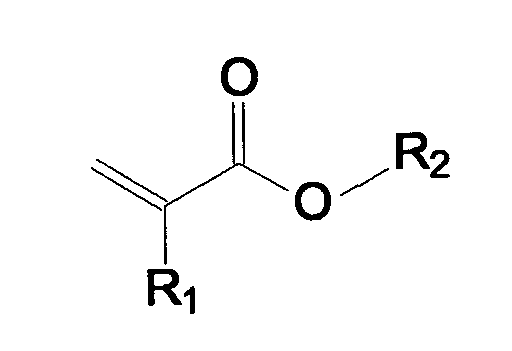
- the radical R 2 is selected from the group of branched or unbranched, saturated alkyl groups having 4-9 carbon atoms.
- alkyl group which may preferably be used for the radical R 2 , mention may hereinafter be made of butyl, pentyl, hexyl, heptyl, octyl, isooctyl, 2-methylheptyl, 2-ethylhexyl -, nonyl, decyl, dodecyl, lauryl, or stearyl (meth) acrylate or (meth) acrylic acid.
- the inventive pressure-sensitive adhesive are as monomers vinyl compounds containing functional groups, with used in a proportion of 0 - 35 weight percent. In this sense, also fall acrylic compounds with functional groups under the name "vinyl compound".
- Such functional groups containing vinyl compounds are maleic anhydride, styrene, Siyrol compounds, vinyl acetate, (meth) acrylamides, N-substituted (meth) acrylamides, ⁇ -acryloyloxypropionic acid, Vinylacetic acid, fumaric acid, crotonic acid, aconitic acid, Dimethylacrylic acid, trichloroacrylic acid, itaconic acid, vinyl acetate, hydroxyalkyl (meth) acrylate, amino group-containing (meth) acrylates, hydroxyl-containing (meth) acrylates, especially preferably 2-hydroxyethyl (meth) acrylate, 2-hydroxypropyl (meth) acrylate, and / or 4-hydroxybutyl
- the extrusion coating is preferably carried out by an extrusion die.
- the extrusion dies used can come from one of the following three categories: T-die, fishtail die and stirrup nozzle. The individual types differ in the shape of their flow channel.
- To produce oriented acrylate adhesives it is particularly preferable to coat a carrier with a stirrup nozzle in such a way that a polymer layer is formed on the carrier by a relative movement from nozzle to carrier.
- the time between the coating and the crosslinking is favorably very low, preferably not greater than 10 s.
- the orientation of the acrylate hot melt in the stirrup nozzle and the exit from the nozzle with a certain film thickness, the stretching of the PSA film on transfer to the carrier material to a thinner film thickness, and the subsequent inline crosslinking result in orientation.
- the composition of the corresponding Monomers is chosen such that the resulting adhesives accordingly D. Satas [Handbook of Pressure Sensitive Adhesive Technology, 1989, publ VAN NOSTRAND REINHOLD, New York] have pressure-sensitive adhesive properties. Therefor the glass transition temperature of the acrylic PSA should be below 25 ° C.
- the free radical polymerization can be carried out in the presence of an organic solvent or in the presence of water or in mixtures of organic solvents and water or in bulk. Preferably, as little solvent as possible is used.
- the polymerization time is - depending on the conversion and temperature - between 6 and 48 h.
- Solvents used in the solvent polymerization are preferably esters of saturated carboxylic acids (such as ethyl acetate), aliphatic hydrocarbons (such as n-hexane or n-heptane), ketones (such as acetone or methyl ethyl ketone), petroleum ether, or mixtures of these solvents.
- the emulsifiers and stabilizers known to the person skilled in the art for the purpose of polymerization are preferably added.
- polymerization initiators customary radical-forming compounds such as peroxides, azo compounds and peroxosulphates are used. Initiator mixtures can also be used.
- other regulators can be used to reduce the molecular weight and reduce the polydispersity.
- polymerization regulators for example, alcohols and ethers can be used.
- the molecular weight of the acrylate PSAs is advantageously between 650,000 and 2,000,000 g / mol, more preferably between 700,000 and 1,000,000 g / mol.
- the polymerization is carried out in polymerization reactors, which are generally provided with a stirrer, several feed vessels, reflux condenser, heating and cooling and are equipped for working under N 2 atmosphere and overpressure.
- the polymerization medium under reduced Pressure removed, this process at elevated temperatures, for example in the range of 80 to 150 ° C is performed.
- the polymers can then in a solvent-free state, in particular as a hotmelt PSA.
- the polymers of the invention in substance manufacture.
- the polymers can be prepared in the usual way be modified.
- tackifying resins such as terpene, terpene phenol, C5, C9, C5 / C9 hydrocarbon, pinene, indene or rosin resins also be added in combination with each other.
- plasticizers various fillers (e.g., fibers, carbon black, zinc oxide, titanium dioxide, microbeads, Solid or hollow glass spheres, silica, silicates, chalk, blocking-free isocyanates etc.), anti-aging agents, light stabilizers, antiozonants, fatty acids, Plasticizers, nucleating agents, blowing agents and / or accelerators used as additives become.
- crosslinkers and promoters can be mixed for crosslinking.
- Suitable crosslinkers for electron beam crosslinking are, for example, bi- or multifunctional acrylates, difunctional or polyfunctional isocyanates or difunctional or polyfunctional ones Epoxides.
- the pure or blended acrylate hotmelts are passed through a variable nozzle Slit width coated on a support and then on the support with electron beams hardened.
- carrier material are in principle BOPP, PET, fleece, PVC, foam or release papers (glassine, HDPE, LDPE).
- the networking takes place in inline operation immediately after application of the PSA to the carrier.
- the measurement of the orientation of the adhesive can be done with a polarimeter, with infrared dichroism or with X-ray scattering.
- the measurements showed that the orientation in acrylate PSAs in unvemetzt state only a few days received remains
- the system relaxes during rest or storage time and loses its preferred direction.
- By the instant electron beam crosslinking after coating the nozzle can be significantly enhanced this effect.
- Relaxation of the oriented Polymer chains converge to zero, and the oriented PSAs can be stored without loss of their preferred direction over a very long period.
- the expression of the orientation within the acrylic PSAs is both of the nozzle and coating temperature as well as the temperature of the carrier material dependent. The best orientation effects are by dropping them on one scored cold surface.
- the substrate should be replaced by a roller during the Coating can be cooled directly.
- the cooling of the roll can be achieved by a liquid film from outside or inside or by a cooling gas.
- Farther should be used to achieve a high degree of orientation, the coating and nozzle temperature be lowered.
- the degree of orientation is through the die gap width freely adjustable. The thicker the PSA film that is forced out of the extrusion die the stronger the adhesive may be on a thinner PSA film are stretched on the substrate. This stretching process can be next to the freely adjustable nozzle width also by the web speed of the decreasing Carrier material can be adjusted freely.
- the coating process is the Adhesive oriented.
- the anisotropy can also be postponed by stretching an acrylic PSA a stretchable carrier are generated.
- test A 180 ° bond strength test
- a 20 mm wide strip of one on a polyester or siliconized release paper coated acrylic PSA was applied to steel panels. It was - ever Direction and orientation - longitudinal or transverse pattern glued to the steel plate Der Pressure-sensitive adhesive tape was pressed onto the substrate twice with a 2 kg weight. The adhesive tape was then immediately at 30 mm / min and at 180 ° angle from the substrate deducted. The steel plates were washed twice with acetone and once with isopropanol washed. The measurement results are given in N / cm and are averaged out of three Measurements. All measurements were taken at room temperature under conditioned conditions carried out.
- the measurement of the birefringence was carried out with a test setup, as described in analogous to Encyclopedia of Polymer Science, John Wiley & Sons, Vol. 10, p. 505, 1987 as Circular Polariscope is described.
- This polarized laser beam is then through the oriented acrylate guided. Since acrylate compounds are highly transparent, the laser beam can make the mass practical pass unhindered.
- Strips of the samples having a width of at least 30 mm and a length of 50 mm were laminated to a sample body to achieve at least a thickness of 0.5 mm. Any air pockets have been largely avoided.
- the resulting laminate was cut to a width of exactly 20 mm and the strip ends glued to paper. The length of the sample piece between the paper strip ends was exactly 25 cm.
- the thickness of the strip was then determined by means of a thickness probe to 10 microns accurate.
- the specimen thus obtained was then subjected to a tensile / elongation measurement with the aid of a universal testing machine (Frank). The determined forces were given in each case on the output cross-section as a voltage.
- the relative strains relate to the initial length of 25 mm.
- the test speeds were set at 100, 300 and 600 mm / min.
- a 200 L reactor conventional for radical polymerizations was charged with 2500 g of acrylic acid, 47.5 kg of 2-ethylhexyl acrylate, and 30 kg of acetone / isopropanol (97: 3). After passing through nitrogen gas with stirring for 45 minutes, the reactor was heated to 58 ° C and 20 g of 2,2'-azoisobutyronitrile (AIBN) was added. Subsequently, the outer heating bath was heated to 75 ° C and the reaction was carried out constantly at this external temperature After 1 h reaction time again 20 g of AIBN was added.
- AIBN 2,2'-azoisobutyronitrile
- the preparation was carried out analogously to Example 1.
- For the polymerization 5000 g of acrylic acid, 45 kg of 2-ethylhexyl acrylate and 30 kg of acetone / isopropanol (97: 3) were used. In the further Course the identical solvent and initiator amounts were used.
- the Samples were irradiated with electron beams of a dose of 30 kGy For analysis The test methods A, B and C were performed.
- Example 4 was concentrated in the drying extruder and coated on a siliconized release paper support with 130 g / m 2 through a nozzle with 300 ⁇ m (Sample A - F) and 780 ⁇ m gap width (G - L) The web speed of the carrier was 80 m / min.
- the release paper carrier with the pressure-sensitive adhesive film was passed over a cooling roller at 25 ° C.
- this roller was heated up to 90 ° C.
- samples A, D, G and J were crosslinked immediately after coating in the in-line process with electron beams of a dose of 30 kGy and an acceleration voltage of 230 kV ESH.
- the samples B, E, H, and K were stored after coating for one hour at room temperature and then electron beam crosslinked with identical process parameters.
- the samples C, F, I, and L were stored after coating for 48 hours at room temperature and then electron beam crosslinked with identicalmaschinesparametem.
- test methods A, B and C were performed on all samples.
- Example 1 The procedure was analogous to Example 6.
- the adhesive used was Example 1.
- the coating is carried out by a 300 .mu.m wide nozzle with 130 g / m 2 mass application, a chill roll temperature of 25 ° C (outside temperature of the steel roller on which the carrier material is coated) and a web speed of 80 m / min. It was crosslinked with electron beams of a dose of 40 kGy and the test methods A, B, C, D and E were carried out for analysis.
- Example 2 The procedure was analogous to Example 6.
- the adhesive used was Example 2.
- the coating is carried out through a 300 ⁇ m wide nozzle with 130 g / m 2 mass application, a chill roll temperature of 25 ° C and a web speed of 80 m / min. It was crosslinked with electron beams of a dose of 30 kGy and the test methods A, B, C, D and E were carried out for analysis.
- Example 3 The procedure was analogous to Example 6.
- the adhesive used was Example 3.
- the coating is carried out through a 300 ⁇ m wide nozzle with 130 g / m 2 mass application, a chill roll temperature of 25 ° C and a web speed of 80 m / min. It was cross-linked with electron beams of a dose of 30 kGy and the test methods A, B, C, D and E were carried out for analysis.
- Example 5 The procedure was analogous to Example 6.
- the adhesive used was Example 5.
- the coating is carried out through a 300 ⁇ m wide nozzle with 130 g / m 2 mass application, a chill roll temperature of 25 ° C and a web speed of 80 m / min. It was crosslinked with electron beams of a dose of 50 kGy and the test methods A, B, C, D and E were carried out for analysis.
- Examples 1-5 The average molecular weight of Examples 1-5 was about 800,000 g / mol.
- Examples 1-5 were applied from solution to a primer provided with a polyester film at 130 g / m 2 , dried at 120 ° C, cured with electron beam radiation and then tested by adhesive technology. To assess the efficiency of crosslinking, the gel value of the adhesives was measured. The gel value reflects the insoluble portion of the PSA in toluene. Furthermore, the instant adhesives were measured on steel. The results of the tests are shown in Table 2.
- the gel values vary between 55 and 72% depending on comonomer composition and dose. Due to the relatively high proportion of polar monomers, the adhesives are cohesive and therefore have relatively low instantaneous bond strengths on steel of about 6 to 6.5 N / cm. Measurements in the transverse and longitudinal directions showed almost the same adhesive forces within the scope of the measuring errors. The measurement of birefringence showed no orientation within the adhesives. No different polarizabilities in the longitudinal and transverse direction were found. To investigate the orientation effect, Examples 1-5 were concentrated to 100% systems in the drying extruder and coated through a die having a different slot width.
- the PSA was pre-oriented by the flow within the die. Subsequently, the adhesive film is transferred to the carrier material with a certain layer thickness. To set the layer thickness, a specific stretching ratio between the nozzle width and the layer thickness is required. This effect can be enhanced by increasing the coating speed (web speed of the receiving carrier material). By the ratio of die gap width and layer thickness of the adhesive on the carrier material, the degree of orientation of the polymer chains can be varied freely.
- the adhesives were coated with different stretching ratios and other experimental parameters. To minimize the relaxation time, the PSAs were crosslinked with electron beams after the coating inline process. The relaxation times were thus clearly below 10 s.
- the stretch ratio was adjusted by varying the nozzle width.
- the mass application remained constant at 130 g / m 2 .
- the samples were each irradiated with an electron beam dose of 30 kGy. All stretched patterns are listed alphabetically.
- the orientation within the acrylic PSAs was determined by quantification of birefringence.
- the corresponding An value is dependent on the comonomer composition and the degree of branching of the polymer.
- the PSA is oriented according to the invention if the ⁇ n value is> 1 ⁇ 10 -5 .
- the orientation within the acrylate PSAs in the degree indicated above could thus be detected by the birefringence measurement for the measured samples.
- Figure 1 shows the tensile / strain diagrams of the patterns 1 #, 2 #, 3 #, and 5 #. Patterns 1 #, 2 #, 3 #, and 5 # show significantly less elongation after orientation in the direction of stretching (MD). The tension increases quickly over a very short distance and the patterns break. In the transverse direction (CD), examples can be stretched with well over 1000% elongation and are significantly less tear-resistant in this direction.
- MD direction of stretching
- CD transverse direction
- Table 7 demonstrates that orientation is frozen by electron beam crosslinking and can be used for product applications even after 2 months storage by the shrinkback.
- the comparison with the respective unvarnished patterns makes it clear that the PSAs relax without crosslinking and thus the shrinkback no longer exists.
- the shrinkback can still be accelerated by the effect of temperature.
- the shrinkage of the samples was measured as a function of temperature and time.
- Patterns reach a temperature of 60 ° C after a relatively short time (3 h) a shrinkage of over 80% and thus almost a value that would otherwise only at Storage of several days is achieved. This may be preferred in tension-free Bonding can be used on curved surfaces.
- the PSAs according to the invention likewise offer a wide range for applications which exploit the advantages of low elongation in the longitudinal direction and the possibility of shrinkback in an advantageous manner.
- the property of the pre-stretching of the PSAs can also be used outstandingly.
- Another exemplary field of use for such highly oriented acrylic PSAs are stripable double-sided bonds.
- the oriented PSA is already pre-stretched to several 100%, so that in order to remove the double-sided bond, the acrylate PSA in the direction of stretching (MD) only has to be stretched by a few percent.
- these products are produced as Acrylathotmelts with a layer thickness of several 100 microns.
- pure acrylates are used.
- the oriented acrylate strips are transparent, resistant to aging and inexpensive to manufacture.
Landscapes
- Chemical & Material Sciences (AREA)
- Organic Chemistry (AREA)
- Chemical Kinetics & Catalysis (AREA)
- Adhesives Or Adhesive Processes (AREA)
- Adhesive Tapes (AREA)
- Laminated Bodies (AREA)
- Addition Polymer Or Copolymer, Post-Treatments, Or Chemical Modifications (AREA)
Claims (7)
- Masse autoadhésive que l'on peut obtenir par polymérisation radicalaire, caractérisée en ce quedans laquelle R1 = H ou CH3 et le radical R2 = H ou CH3 ou est choisi dans le groupe des groupements alkyle saturés, ramifiés ou non ramifiés, comportant de 2 à 20 atomes de carbone,la masse autoadhésive est, à raison d'au moins 65% en poids, à base d'au moins un monomère acrylique du groupe des composés de la formule générale suivante :
 le poids moléculaire moyen de la masse autoadhésive est d'au moins 650.000,la masse autoadhésive appliquée sur un support possède une direction préférentielle, l'indice de réfraction ηMD mesuré dans la direction préférentielle étant supérieur à l'indice de réfraction ηCD mesuré dans une direction perpendiculaire à la direction préférentielle, et le différence Δη = ηMD - ηCD étant d'au moins 1.10-5.
 - Masse autoadhésive selon la revendication 1, caractérisée en ce que l'on met en oeuvre en tant que monomère acrylique au moins l'un du groupe des composés de la formule générale suivantedans laquelle R1 = H ou CH3 et le radical R2 est choisi dans le groupe des groupements alkyle saturés, ramifiés ou non ramifiés, comportant de 4 à 9 atomes de carbone.
- Masse autoadhésive selon l'une quelconque des revendications qui précèdent, caractérisée en ce que on met en oeuvre en tant que monomères des composés vinyliques en une fraction allant jusqu'à 35% en poids, en particulier un ou plusieurs composés choisis dans les groupes suivants :esters vinyliques, halogénures de vinyle, halogénures de vinylidène, nitriles d'hydrocarbures éthyléniquement insaturés.
- Masse autoadhésive selon l'une quelconque des revendications qui précèdent, caractérisée en ce que l'on ajoute des résines ou d'autres additifs, tels que des agents de protection contre le vieillissement, des agents de protection contre la lumière, des agents de protection contre l'ozone, des acides gras, des plastifiants, des agents de formation de germes cristallins, des agents porogènes, des accélérateurs et/ou des matières de remplissage.
- Masse autoadhésive selon l'une quelconque des revendications qui précèdent, caractérisée en ce que, pour la réticulation de la masse de polyacrylate, on ajoute des réticulants, en particulier des acrylates et/ou des méthacrylates bi- ou multifonctionnels, des isocyanates bi- ou multifonctionnels ou des époxydes bi- ou multifonctionnels.
- Procédé de préparation de masses autoadhésives acryliques orientées, caractérisé par les étapes suivantes :polymérisation d'un mélange contenant au moins un monomère à base de vinyle, d'acryle ou de méthacryle ou une combinaison de ces monomères, le poids moléculaire moyen des polymères formés étant de plus de 650.000,couchage subséquent par extrusion de la masse de polymère,réticulation subséquente de la masse de polymère sur le support par irradiation par faisceau électronique.
- Bande adhésive comportant une masse autoadhésive acrylique selon l'une quelconque des revendications qui précèdent, appliquée d'un côté ou des deux côtés sur un support.
Applications Claiming Priority (5)
| Application Number | Priority Date | Filing Date | Title |
|---|---|---|---|
| DE10031868 | 2000-06-30 | ||
| DE10031868 | 2000-06-30 | ||
| DE10034069 | 2000-07-13 | ||
| DE10034069A DE10034069A1 (de) | 2000-06-30 | 2000-07-13 | Orientierte Acrylathotmelts |
| PCT/EP2001/006682 WO2002002709A1 (fr) | 2000-06-30 | 2001-06-13 | Adhesifs thermofusibles acryliques orientes |
Publications (2)
| Publication Number | Publication Date |
|---|---|
| EP1299493A1 EP1299493A1 (fr) | 2003-04-09 |
| EP1299493B1 true EP1299493B1 (fr) | 2005-09-07 |
Family
ID=26006239
Family Applications (1)
| Application Number | Title | Priority Date | Filing Date |
|---|---|---|---|
| EP20010947365 Expired - Lifetime EP1299493B1 (fr) | 2000-06-30 | 2001-06-13 | Adhesifs thermofusibles acryliques orientes |
Country Status (6)
| Country | Link |
|---|---|
| US (1) | US7022408B2 (fr) |
| EP (1) | EP1299493B1 (fr) |
| JP (1) | JP2004502825A (fr) |
| DE (1) | DE50107376D1 (fr) |
| ES (1) | ES2248352T3 (fr) |
| WO (1) | WO2002002709A1 (fr) |
Families Citing this family (17)
| Publication number | Priority date | Publication date | Assignee | Title |
|---|---|---|---|---|
| DE10052955A1 (de) | 2000-10-25 | 2002-06-06 | Tesa Ag | Verwendung von Haftklebemassen mit anisotropen Eigenschaften für Stanzprodukte |
| SG125066A1 (en) | 2001-04-19 | 2006-09-29 | Lintec Corp | Adhesive sheet for precision electronic member |
| DE10157154A1 (de) * | 2001-11-22 | 2003-05-28 | Tesa Ag | Verfahren zur Herstellung orientierter Acrylathotmelts |
| DE10157152A1 (de) * | 2001-11-22 | 2003-10-16 | Tesa Ag | Verfahren zur Herstellung haftklebriger Stanzprodukte |
| DE10157153A1 (de) * | 2001-11-22 | 2003-09-04 | Tesa Ag | Verfahren zur Herstellung haftklebriger Stanzprodukte |
| DE10221093A1 (de) * | 2002-05-11 | 2003-11-20 | Tesa Ag | Verwendung von Makromonomeren für die Herstellung von Acrylathaftklebemassen |
| DE10237000A1 (de) * | 2002-08-13 | 2004-02-26 | Tesa Ag | Verfahren zur Herstellung von Acrylathaftklebemassen unter Nutzung von Metall-Schwefel-Verbindungen |
| DE10259549A1 (de) * | 2002-12-19 | 2004-07-08 | Tesa Ag | Haftklebeartikel mit wenigstens einer Schicht aus einer elektrisch leitfähigen Haftklebemasse und Verfahren zu seiner Herstellung |
| DE10259451A1 (de) * | 2002-12-19 | 2004-07-08 | Tesa Ag | Haftklebeartikel mit wenigstens einer Schicht aus einer thermisch leitfähigen Haftklebemasse und Verfahren zu seiner Herstellung |
| DE10312062A1 (de) * | 2003-03-18 | 2004-09-30 | Tesa Ag | Schmelzhaftkleber mit geringem Rückschrumpf, Verfahren zu seiner Herstellung und Verwendung |
| DE10314764A1 (de) * | 2003-03-31 | 2004-10-14 | Tesa Ag | Verfahren zur Herstellung von strukturierten Haftklebemassen sowie deren Verwendung |
| DE10359349A1 (de) * | 2003-12-16 | 2005-07-14 | Tesa Ag | Verfahren zur Herstellung von Acrylatschmelzhaftklebern |
| JP4410055B2 (ja) * | 2004-08-02 | 2010-02-03 | 日東電工株式会社 | 位相差粘着剤層、その製造方法、粘着型光学フィルム、その製造方法および画像表示装置 |
| DE102005050104A1 (de) * | 2005-10-18 | 2007-04-19 | Tesa Ag | Verfahren zur Herstellung anisotroper Haftklebemassen |
| DE102005054032A1 (de) * | 2005-11-10 | 2007-05-16 | Tesa Ag | Verfahren zur Herstellung von Haftklebemassen hoher Anisotropie |
| DE102005054054A1 (de) * | 2005-11-10 | 2007-05-16 | Tesa Ag | Verfahren zur Herstellung von Haftklebemassen geringer Anisotropie |
| US12384939B1 (en) | 2019-01-22 | 2025-08-12 | Iowa State University Research Foundation, Inc. | Kirigami-inspired structures for smart adhesion |
Family Cites Families (7)
| Publication number | Priority date | Publication date | Assignee | Title |
|---|---|---|---|---|
| US4619979A (en) * | 1984-03-28 | 1986-10-28 | Minnesota Mining And Manufacturing Company | Continuous free radial polymerization in a wiped-surface reactor |
| US5866249A (en) * | 1995-12-18 | 1999-02-02 | Minnesota Mining And Manufacturing Company | Pressure-sensitive adhesive based on partially oriented and partially crystallized elastomer |
| US5876855A (en) * | 1995-12-22 | 1999-03-02 | Minnesota Mining And Manufacturing Company | Pressure-sensitive adhesive suitable for skin and method of preparing |
| US6103316A (en) * | 1998-07-17 | 2000-08-15 | 3M Innovative Properties Company | Method of making electron beam polymerized emulsion-based acrylate pressure sensitive adhesives |
| DE10156088A1 (de) * | 2001-11-16 | 2003-06-05 | Tesa Ag | Orientierte Acrylatblockcopolymere |
| DE10157152A1 (de) * | 2001-11-22 | 2003-10-16 | Tesa Ag | Verfahren zur Herstellung haftklebriger Stanzprodukte |
| DE10157153A1 (de) * | 2001-11-22 | 2003-09-04 | Tesa Ag | Verfahren zur Herstellung haftklebriger Stanzprodukte |
-
2001
- 2001-06-13 DE DE50107376T patent/DE50107376D1/de not_active Expired - Lifetime
- 2001-06-13 ES ES01947365T patent/ES2248352T3/es not_active Expired - Lifetime
- 2001-06-13 US US10/312,124 patent/US7022408B2/en not_active Expired - Lifetime
- 2001-06-13 JP JP2002507955A patent/JP2004502825A/ja active Pending
- 2001-06-13 WO PCT/EP2001/006682 patent/WO2002002709A1/fr not_active Ceased
- 2001-06-13 EP EP20010947365 patent/EP1299493B1/fr not_active Expired - Lifetime
Also Published As
| Publication number | Publication date |
|---|---|
| JP2004502825A (ja) | 2004-01-29 |
| US7022408B2 (en) | 2006-04-04 |
| ES2248352T3 (es) | 2006-03-16 |
| WO2002002709A8 (fr) | 2002-04-18 |
| WO2002002709A1 (fr) | 2002-01-10 |
| EP1299493A1 (fr) | 2003-04-09 |
| DE50107376D1 (en) | 2005-10-13 |
| US20040038061A1 (en) | 2004-02-26 |
| WO2002002709A9 (fr) | 2004-08-05 |
Similar Documents
| Publication | Publication Date | Title |
|---|---|---|
| EP1299493B1 (fr) | Adhesifs thermofusibles acryliques orientes | |
| EP1332192B1 (fr) | Utilisation de masses auto-adhesives presentant des proprietes anisotropes dans la production de produits de poinconnage | |
| EP0436159B2 (fr) | Adhésive sensible à la pression thermofusible à base acrylique | |
| DE68910056T2 (de) | Klebriggemachte Terpolymer-Klebstoffe. | |
| DE60210368T2 (de) | Sehr klebrige druckempfindliche Klebstoffzusammensetzungen und Folien | |
| DE69303733T2 (de) | Druckempfindlicher Klebstoff auf Basis eines feuchtigkeitsunempfindlichen Latex mit hohem Feststoffgehalt | |
| DE3544790C2 (fr) | ||
| EP2379664B1 (fr) | Matières auto-adhésives à base de caoutchouc naturel et de polyacrylates | |
| EP0937761B1 (fr) | Ruban adhésif n'émettant pas de buée | |
| DE69506654T2 (de) | Druckempfindliche Klebstoffzusammensetzung und daraus hergestellte Folien | |
| DE3015463C2 (de) | Verfahren zur Herstellung von Haftschmelzkleberbeschichtungen auf Substraten | |
| DE69722520T2 (de) | Druckempfindliche Klebstoffzusammensetzung sowie druckempfindliche Klebefolien | |
| EP0344659B1 (fr) | Dispersions de copolymères de (meth)acrylate de butyle non tertiaire à température de transition vitreuse en dessous de -10 degrés C | |
| DE102015217131A1 (de) | Klebharz-modifizierte Haftklebemasse | |
| WO2018154106A1 (fr) | Ruban adhésif | |
| WO2018154103A1 (fr) | Ruban adhésif | |
| DE10203885A1 (de) | Verpackungs-Klebeband | |
| DE10259457B4 (de) | Verfahren zum Aufbringen von Haftklebebändern auf raue und/oder unebene Oberflächen | |
| DE69919829T2 (de) | Acrylische druckempfindliche Klebstoff-Zusammensetzung und Verfahren zu ihrer Herstellung | |
| EP3543307A1 (fr) | Bande adhésive en mousse libérable | |
| EP2308937A1 (fr) | Bande adhésive avec ruban laminé flexible | |
| DE10034069A1 (de) | Orientierte Acrylathotmelts | |
| DE69931307T2 (de) | Freie Radikale-Polymerisationsverfahren durch monochromatische Strahlung | |
| DE102024110804B4 (de) | Haftklebmasse, ihre Verwendung und Verfahren zu ihrer Herstellung | |
| WO2025132700A1 (fr) | Matière auto-adhésive |
Legal Events
| Date | Code | Title | Description |
|---|---|---|---|
| PUAI | Public reference made under article 153(3) epc to a published international application that has entered the european phase |
Free format text: ORIGINAL CODE: 0009012 |
|
| AK | Designated contracting states |
Kind code of ref document: A1 Designated state(s): AT BE CH CY DE DK ES FI FR GB GR IE IT LI LU MC NL PT SE TR |
|
| AX | Request for extension of the european patent |
Extension state: AL LT LV MK RO SI |
|
| 17P | Request for examination filed |
Effective date: 20030130 |
|
| RIN1 | Information on inventor provided before grant (corrected) |
Inventor name: BARGMANN, RENKE Inventor name: HUSEMANN, MARC Inventor name: ZOELLNER, STEPHAN |
|
| RBV | Designated contracting states (corrected) |
Designated state(s): DE ES FR GB IT |
|
| RAP1 | Party data changed (applicant data changed or rights of an application transferred) |
Owner name: TESA AG |
|
| GRAP | Despatch of communication of intention to grant a patent |
Free format text: ORIGINAL CODE: EPIDOSNIGR1 |
|
| RTI1 | Title (correction) |
Free format text: ORIENTED ACRYLIC HOTMELTS |
|
| GRAS | Grant fee paid |
Free format text: ORIGINAL CODE: EPIDOSNIGR3 |
|
| GRAA | (expected) grant |
Free format text: ORIGINAL CODE: 0009210 |
|
| AK | Designated contracting states |
Kind code of ref document: B1 Designated state(s): DE ES FR GB IT |
|
| REG | Reference to a national code |
Ref country code: GB Ref legal event code: FG4D Free format text: NOT ENGLISH |
|
| REF | Corresponds to: |
Ref document number: 50107376 Country of ref document: DE Date of ref document: 20051013 Kind code of ref document: P |
|
| GBT | Gb: translation of ep patent filed (gb section 77(6)(a)/1977) |
Effective date: 20051010 |
|
| REG | Reference to a national code |
Ref country code: ES Ref legal event code: FG2A Ref document number: 2248352 Country of ref document: ES Kind code of ref document: T3 |
|
| ET | Fr: translation filed | ||
| PLBE | No opposition filed within time limit |
Free format text: ORIGINAL CODE: 0009261 |
|
| STAA | Information on the status of an ep patent application or granted ep patent |
Free format text: STATUS: NO OPPOSITION FILED WITHIN TIME LIMIT |
|
| 26N | No opposition filed |
Effective date: 20060608 |
|
| REG | Reference to a national code |
Ref country code: FR Ref legal event code: CD Ref country code: FR Ref legal event code: CJ |
|
| REG | Reference to a national code |
Ref country code: ES Ref legal event code: PC2A Owner name: TESA SE Effective date: 20110415 |
|
| REG | Reference to a national code |
Ref country code: DE Ref legal event code: R081 Ref document number: 50107376 Country of ref document: DE Owner name: TESA SE, DE Free format text: FORMER OWNER: TESA SE, 20253 HAMBURG, DE |
|
| REG | Reference to a national code |
Ref country code: FR Ref legal event code: PLFP Year of fee payment: 16 |
|
| REG | Reference to a national code |
Ref country code: FR Ref legal event code: CA Effective date: 20170201 |
|
| REG | Reference to a national code |
Ref country code: FR Ref legal event code: PLFP Year of fee payment: 17 |
|
| REG | Reference to a national code |
Ref country code: FR Ref legal event code: PLFP Year of fee payment: 18 |
|
| PGFP | Annual fee paid to national office [announced via postgrant information from national office to epo] |
Ref country code: ES Payment date: 20180723 Year of fee payment: 18 Ref country code: IT Payment date: 20180627 Year of fee payment: 18 |
|
| PGFP | Annual fee paid to national office [announced via postgrant information from national office to epo] |
Ref country code: DE Payment date: 20190619 Year of fee payment: 19 |
|
| PGFP | Annual fee paid to national office [announced via postgrant information from national office to epo] |
Ref country code: FR Payment date: 20190619 Year of fee payment: 19 |
|
| PGFP | Annual fee paid to national office [announced via postgrant information from national office to epo] |
Ref country code: GB Payment date: 20190619 Year of fee payment: 19 |
|
| PG25 | Lapsed in a contracting state [announced via postgrant information from national office to epo] |
Ref country code: IT Free format text: LAPSE BECAUSE OF NON-PAYMENT OF DUE FEES Effective date: 20190613 |
|
| REG | Reference to a national code |
Ref country code: ES Ref legal event code: FD2A Effective date: 20201028 |
|
| REG | Reference to a national code |
Ref country code: DE Ref legal event code: R119 Ref document number: 50107376 Country of ref document: DE |
|
| PG25 | Lapsed in a contracting state [announced via postgrant information from national office to epo] |
Ref country code: ES Free format text: LAPSE BECAUSE OF NON-PAYMENT OF DUE FEES Effective date: 20190614 |
|
| GBPC | Gb: european patent ceased through non-payment of renewal fee |
Effective date: 20200613 |
|
| PG25 | Lapsed in a contracting state [announced via postgrant information from national office to epo] |
Ref country code: FR Free format text: LAPSE BECAUSE OF NON-PAYMENT OF DUE FEES Effective date: 20200630 Ref country code: GB Free format text: LAPSE BECAUSE OF NON-PAYMENT OF DUE FEES Effective date: 20200613 |
|
| PG25 | Lapsed in a contracting state [announced via postgrant information from national office to epo] |
Ref country code: DE Free format text: LAPSE BECAUSE OF NON-PAYMENT OF DUE FEES Effective date: 20210101 |