EP1299587B1 - Non-tisse a plusieurs composants s'utilisant dans des articles absorbants jetable - Google Patents
Non-tisse a plusieurs composants s'utilisant dans des articles absorbants jetable Download PDFInfo
- Publication number
- EP1299587B1 EP1299587B1 EP01984171A EP01984171A EP1299587B1 EP 1299587 B1 EP1299587 B1 EP 1299587B1 EP 01984171 A EP01984171 A EP 01984171A EP 01984171 A EP01984171 A EP 01984171A EP 1299587 B1 EP1299587 B1 EP 1299587B1
- Authority
- EP
- European Patent Office
- Prior art keywords
- liquid
- layer
- fibers
- nonwoven fabric
- accordance
- Prior art date
- Legal status (The legal status is an assumption and is not a legal conclusion. Google has not performed a legal analysis and makes no representation as to the accuracy of the status listed.)
- Expired - Lifetime
Links
Images



Classifications
-
- A—HUMAN NECESSITIES
- A61—MEDICAL OR VETERINARY SCIENCE; HYGIENE
- A61F—FILTERS IMPLANTABLE INTO BLOOD VESSELS; PROSTHESES; DEVICES PROVIDING PATENCY TO, OR PREVENTING COLLAPSING OF, TUBULAR STRUCTURES OF THE BODY, e.g. STENTS; ORTHOPAEDIC, NURSING OR CONTRACEPTIVE DEVICES; FOMENTATION; TREATMENT OR PROTECTION OF EYES OR EARS; BANDAGES, DRESSINGS OR ABSORBENT PADS; FIRST-AID KITS
- A61F13/00—Bandages or dressings; Absorbent pads
- A61F13/15—Absorbent pads, e.g. sanitary towels, swabs or tampons for external or internal application to the body; Supporting or fastening means therefor; Tampon applicators
- A61F13/53—Absorbent pads, e.g. sanitary towels, swabs or tampons for external or internal application to the body; Supporting or fastening means therefor; Tampon applicators characterised by the absorbing medium
- A61F13/534—Absorbent pads, e.g. sanitary towels, swabs or tampons for external or internal application to the body; Supporting or fastening means therefor; Tampon applicators characterised by the absorbing medium having an inhomogeneous composition through the thickness of the pad
-
- A—HUMAN NECESSITIES
- A61—MEDICAL OR VETERINARY SCIENCE; HYGIENE
- A61F—FILTERS IMPLANTABLE INTO BLOOD VESSELS; PROSTHESES; DEVICES PROVIDING PATENCY TO, OR PREVENTING COLLAPSING OF, TUBULAR STRUCTURES OF THE BODY, e.g. STENTS; ORTHOPAEDIC, NURSING OR CONTRACEPTIVE DEVICES; FOMENTATION; TREATMENT OR PROTECTION OF EYES OR EARS; BANDAGES, DRESSINGS OR ABSORBENT PADS; FIRST-AID KITS
- A61F13/00—Bandages or dressings; Absorbent pads
- A61F13/15—Absorbent pads, e.g. sanitary towels, swabs or tampons for external or internal application to the body; Supporting or fastening means therefor; Tampon applicators
- A61F13/53—Absorbent pads, e.g. sanitary towels, swabs or tampons for external or internal application to the body; Supporting or fastening means therefor; Tampon applicators characterised by the absorbing medium
- A61F13/534—Absorbent pads, e.g. sanitary towels, swabs or tampons for external or internal application to the body; Supporting or fastening means therefor; Tampon applicators characterised by the absorbing medium having an inhomogeneous composition through the thickness of the pad
- A61F13/535—Absorbent pads, e.g. sanitary towels, swabs or tampons for external or internal application to the body; Supporting or fastening means therefor; Tampon applicators characterised by the absorbing medium having an inhomogeneous composition through the thickness of the pad inhomogeneous in the plane of the pad, e.g. core absorbent layers being of different sizes
- A61F13/536—Absorbent pads, e.g. sanitary towels, swabs or tampons for external or internal application to the body; Supporting or fastening means therefor; Tampon applicators characterised by the absorbing medium having an inhomogeneous composition through the thickness of the pad inhomogeneous in the plane of the pad, e.g. core absorbent layers being of different sizes having discontinuous areas of compression
-
- A—HUMAN NECESSITIES
- A61—MEDICAL OR VETERINARY SCIENCE; HYGIENE
- A61F—FILTERS IMPLANTABLE INTO BLOOD VESSELS; PROSTHESES; DEVICES PROVIDING PATENCY TO, OR PREVENTING COLLAPSING OF, TUBULAR STRUCTURES OF THE BODY, e.g. STENTS; ORTHOPAEDIC, NURSING OR CONTRACEPTIVE DEVICES; FOMENTATION; TREATMENT OR PROTECTION OF EYES OR EARS; BANDAGES, DRESSINGS OR ABSORBENT PADS; FIRST-AID KITS
- A61F13/00—Bandages or dressings; Absorbent pads
- A61F13/15—Absorbent pads, e.g. sanitary towels, swabs or tampons for external or internal application to the body; Supporting or fastening means therefor; Tampon applicators
- A61F13/53—Absorbent pads, e.g. sanitary towels, swabs or tampons for external or internal application to the body; Supporting or fastening means therefor; Tampon applicators characterised by the absorbing medium
- A61F13/539—Absorbent pads, e.g. sanitary towels, swabs or tampons for external or internal application to the body; Supporting or fastening means therefor; Tampon applicators characterised by the absorbing medium characterised by the connection of the absorbent layers with each other or with the outer layers
-
- B—PERFORMING OPERATIONS; TRANSPORTING
- B32—LAYERED PRODUCTS
- B32B—LAYERED PRODUCTS, i.e. PRODUCTS BUILT-UP OF STRATA OF FLAT OR NON-FLAT, e.g. CELLULAR OR HONEYCOMB, FORM
- B32B3/00—Layered products comprising a layer with external or internal discontinuities or unevennesses, or a layer of non-planar shape; Layered products comprising a layer having particular features of form
- B32B3/10—Layered products comprising a layer with external or internal discontinuities or unevennesses, or a layer of non-planar shape; Layered products comprising a layer having particular features of form characterised by a discontinuous layer, i.e. formed of separate pieces of material
-
- B—PERFORMING OPERATIONS; TRANSPORTING
- B32—LAYERED PRODUCTS
- B32B—LAYERED PRODUCTS, i.e. PRODUCTS BUILT-UP OF STRATA OF FLAT OR NON-FLAT, e.g. CELLULAR OR HONEYCOMB, FORM
- B32B5/00—Layered products characterised by the non- homogeneity or physical structure, i.e. comprising a fibrous, filamentary, particulate or foam layer; Layered products characterised by having a layer differing constitutionally or physically in different parts
- B32B5/22—Layered products characterised by the non- homogeneity or physical structure, i.e. comprising a fibrous, filamentary, particulate or foam layer; Layered products characterised by having a layer differing constitutionally or physically in different parts characterised by the presence of two or more layers which are next to each other and are fibrous, filamentary, formed of particles or foamed
- B32B5/24—Layered products characterised by the non- homogeneity or physical structure, i.e. comprising a fibrous, filamentary, particulate or foam layer; Layered products characterised by having a layer differing constitutionally or physically in different parts characterised by the presence of two or more layers which are next to each other and are fibrous, filamentary, formed of particles or foamed one layer being a fibrous or filamentary layer
- B32B5/26—Layered products characterised by the non- homogeneity or physical structure, i.e. comprising a fibrous, filamentary, particulate or foam layer; Layered products characterised by having a layer differing constitutionally or physically in different parts characterised by the presence of two or more layers which are next to each other and are fibrous, filamentary, formed of particles or foamed one layer being a fibrous or filamentary layer another layer next to it also being fibrous or filamentary
-
- D—TEXTILES; PAPER
- D04—BRAIDING; LACE-MAKING; KNITTING; TRIMMINGS; NON-WOVEN FABRICS
- D04H—MAKING TEXTILE FABRICS, e.g. FROM FIBRES OR FILAMENTARY MATERIAL; FABRICS MADE BY SUCH PROCESSES OR APPARATUS, e.g. FELTS, NON-WOVEN FABRICS; COTTON-WOOL; WADDING ; NON-WOVEN FABRICS FROM STAPLE FIBRES, FILAMENTS OR YARNS, BONDED WITH AT LEAST ONE WEB-LIKE MATERIAL DURING THEIR CONSOLIDATION
- D04H1/00—Non-woven fabrics formed wholly or mainly of staple fibres or like relatively short fibres
- D04H1/40—Non-woven fabrics formed wholly or mainly of staple fibres or like relatively short fibres from fleeces or layers composed of fibres without existing or potential cohesive properties
- D04H1/44—Non-woven fabrics formed wholly or mainly of staple fibres or like relatively short fibres from fleeces or layers composed of fibres without existing or potential cohesive properties the fleeces or layers being consolidated by mechanical means, e.g. by rolling
- D04H1/46—Non-woven fabrics formed wholly or mainly of staple fibres or like relatively short fibres from fleeces or layers composed of fibres without existing or potential cohesive properties the fleeces or layers being consolidated by mechanical means, e.g. by rolling by needling or like operations to cause entanglement of fibres
- D04H1/48—Non-woven fabrics formed wholly or mainly of staple fibres or like relatively short fibres from fleeces or layers composed of fibres without existing or potential cohesive properties the fleeces or layers being consolidated by mechanical means, e.g. by rolling by needling or like operations to cause entanglement of fibres in combination with at least one other method of consolidation
- D04H1/49—Non-woven fabrics formed wholly or mainly of staple fibres or like relatively short fibres from fleeces or layers composed of fibres without existing or potential cohesive properties the fleeces or layers being consolidated by mechanical means, e.g. by rolling by needling or like operations to cause entanglement of fibres in combination with at least one other method of consolidation entanglement by fluid jet in combination with another consolidation means
-
- D—TEXTILES; PAPER
- D04—BRAIDING; LACE-MAKING; KNITTING; TRIMMINGS; NON-WOVEN FABRICS
- D04H—MAKING TEXTILE FABRICS, e.g. FROM FIBRES OR FILAMENTARY MATERIAL; FABRICS MADE BY SUCH PROCESSES OR APPARATUS, e.g. FELTS, NON-WOVEN FABRICS; COTTON-WOOL; WADDING ; NON-WOVEN FABRICS FROM STAPLE FIBRES, FILAMENTS OR YARNS, BONDED WITH AT LEAST ONE WEB-LIKE MATERIAL DURING THEIR CONSOLIDATION
- D04H1/00—Non-woven fabrics formed wholly or mainly of staple fibres or like relatively short fibres
- D04H1/40—Non-woven fabrics formed wholly or mainly of staple fibres or like relatively short fibres from fleeces or layers composed of fibres without existing or potential cohesive properties
- D04H1/44—Non-woven fabrics formed wholly or mainly of staple fibres or like relatively short fibres from fleeces or layers composed of fibres without existing or potential cohesive properties the fleeces or layers being consolidated by mechanical means, e.g. by rolling
- D04H1/46—Non-woven fabrics formed wholly or mainly of staple fibres or like relatively short fibres from fleeces or layers composed of fibres without existing or potential cohesive properties the fleeces or layers being consolidated by mechanical means, e.g. by rolling by needling or like operations to cause entanglement of fibres
- D04H1/492—Non-woven fabrics formed wholly or mainly of staple fibres or like relatively short fibres from fleeces or layers composed of fibres without existing or potential cohesive properties the fleeces or layers being consolidated by mechanical means, e.g. by rolling by needling or like operations to cause entanglement of fibres by fluid jet
- D04H1/495—Non-woven fabrics formed wholly or mainly of staple fibres or like relatively short fibres from fleeces or layers composed of fibres without existing or potential cohesive properties the fleeces or layers being consolidated by mechanical means, e.g. by rolling by needling or like operations to cause entanglement of fibres by fluid jet for formation of patterns, e.g. drilling or rearrangement
-
- D—TEXTILES; PAPER
- D04—BRAIDING; LACE-MAKING; KNITTING; TRIMMINGS; NON-WOVEN FABRICS
- D04H—MAKING TEXTILE FABRICS, e.g. FROM FIBRES OR FILAMENTARY MATERIAL; FABRICS MADE BY SUCH PROCESSES OR APPARATUS, e.g. FELTS, NON-WOVEN FABRICS; COTTON-WOOL; WADDING ; NON-WOVEN FABRICS FROM STAPLE FIBRES, FILAMENTS OR YARNS, BONDED WITH AT LEAST ONE WEB-LIKE MATERIAL DURING THEIR CONSOLIDATION
- D04H1/00—Non-woven fabrics formed wholly or mainly of staple fibres or like relatively short fibres
- D04H1/40—Non-woven fabrics formed wholly or mainly of staple fibres or like relatively short fibres from fleeces or layers composed of fibres without existing or potential cohesive properties
- D04H1/44—Non-woven fabrics formed wholly or mainly of staple fibres or like relatively short fibres from fleeces or layers composed of fibres without existing or potential cohesive properties the fleeces or layers being consolidated by mechanical means, e.g. by rolling
- D04H1/46—Non-woven fabrics formed wholly or mainly of staple fibres or like relatively short fibres from fleeces or layers composed of fibres without existing or potential cohesive properties the fleeces or layers being consolidated by mechanical means, e.g. by rolling by needling or like operations to cause entanglement of fibres
- D04H1/498—Non-woven fabrics formed wholly or mainly of staple fibres or like relatively short fibres from fleeces or layers composed of fibres without existing or potential cohesive properties the fleeces or layers being consolidated by mechanical means, e.g. by rolling by needling or like operations to cause entanglement of fibres entanglement of layered webs
-
- A—HUMAN NECESSITIES
- A61—MEDICAL OR VETERINARY SCIENCE; HYGIENE
- A61F—FILTERS IMPLANTABLE INTO BLOOD VESSELS; PROSTHESES; DEVICES PROVIDING PATENCY TO, OR PREVENTING COLLAPSING OF, TUBULAR STRUCTURES OF THE BODY, e.g. STENTS; ORTHOPAEDIC, NURSING OR CONTRACEPTIVE DEVICES; FOMENTATION; TREATMENT OR PROTECTION OF EYES OR EARS; BANDAGES, DRESSINGS OR ABSORBENT PADS; FIRST-AID KITS
- A61F13/00—Bandages or dressings; Absorbent pads
- A61F13/15—Absorbent pads, e.g. sanitary towels, swabs or tampons for external or internal application to the body; Supporting or fastening means therefor; Tampon applicators
- A61F13/53—Absorbent pads, e.g. sanitary towels, swabs or tampons for external or internal application to the body; Supporting or fastening means therefor; Tampon applicators characterised by the absorbing medium
- A61F13/534—Absorbent pads, e.g. sanitary towels, swabs or tampons for external or internal application to the body; Supporting or fastening means therefor; Tampon applicators characterised by the absorbing medium having an inhomogeneous composition through the thickness of the pad
- A61F13/537—Absorbent pads, e.g. sanitary towels, swabs or tampons for external or internal application to the body; Supporting or fastening means therefor; Tampon applicators characterised by the absorbing medium having an inhomogeneous composition through the thickness of the pad characterised by a layer facilitating or inhibiting flow in one direction or plane, e.g. a wicking layer
- A61F2013/53765—Absorbent pads, e.g. sanitary towels, swabs or tampons for external or internal application to the body; Supporting or fastening means therefor; Tampon applicators characterised by the absorbing medium having an inhomogeneous composition through the thickness of the pad characterised by a layer facilitating or inhibiting flow in one direction or plane, e.g. a wicking layer characterized by its geometry
- A61F2013/53778—Absorbent pads, e.g. sanitary towels, swabs or tampons for external or internal application to the body; Supporting or fastening means therefor; Tampon applicators characterised by the absorbing medium having an inhomogeneous composition through the thickness of the pad characterised by a layer facilitating or inhibiting flow in one direction or plane, e.g. a wicking layer characterized by its geometry with grooves
-
- A—HUMAN NECESSITIES
- A61—MEDICAL OR VETERINARY SCIENCE; HYGIENE
- A61F—FILTERS IMPLANTABLE INTO BLOOD VESSELS; PROSTHESES; DEVICES PROVIDING PATENCY TO, OR PREVENTING COLLAPSING OF, TUBULAR STRUCTURES OF THE BODY, e.g. STENTS; ORTHOPAEDIC, NURSING OR CONTRACEPTIVE DEVICES; FOMENTATION; TREATMENT OR PROTECTION OF EYES OR EARS; BANDAGES, DRESSINGS OR ABSORBENT PADS; FIRST-AID KITS
- A61F13/00—Bandages or dressings; Absorbent pads
- A61F13/15—Absorbent pads, e.g. sanitary towels, swabs or tampons for external or internal application to the body; Supporting or fastening means therefor; Tampon applicators
- A61F13/53—Absorbent pads, e.g. sanitary towels, swabs or tampons for external or internal application to the body; Supporting or fastening means therefor; Tampon applicators characterised by the absorbing medium
- A61F13/534—Absorbent pads, e.g. sanitary towels, swabs or tampons for external or internal application to the body; Supporting or fastening means therefor; Tampon applicators characterised by the absorbing medium having an inhomogeneous composition through the thickness of the pad
- A61F13/537—Absorbent pads, e.g. sanitary towels, swabs or tampons for external or internal application to the body; Supporting or fastening means therefor; Tampon applicators characterised by the absorbing medium having an inhomogeneous composition through the thickness of the pad characterised by a layer facilitating or inhibiting flow in one direction or plane, e.g. a wicking layer
- A61F2013/53765—Absorbent pads, e.g. sanitary towels, swabs or tampons for external or internal application to the body; Supporting or fastening means therefor; Tampon applicators characterised by the absorbing medium having an inhomogeneous composition through the thickness of the pad characterised by a layer facilitating or inhibiting flow in one direction or plane, e.g. a wicking layer characterized by its geometry
- A61F2013/53782—Absorbent pads, e.g. sanitary towels, swabs or tampons for external or internal application to the body; Supporting or fastening means therefor; Tampon applicators characterised by the absorbing medium having an inhomogeneous composition through the thickness of the pad characterised by a layer facilitating or inhibiting flow in one direction or plane, e.g. a wicking layer characterized by its geometry with holes
-
- A—HUMAN NECESSITIES
- A61—MEDICAL OR VETERINARY SCIENCE; HYGIENE
- A61F—FILTERS IMPLANTABLE INTO BLOOD VESSELS; PROSTHESES; DEVICES PROVIDING PATENCY TO, OR PREVENTING COLLAPSING OF, TUBULAR STRUCTURES OF THE BODY, e.g. STENTS; ORTHOPAEDIC, NURSING OR CONTRACEPTIVE DEVICES; FOMENTATION; TREATMENT OR PROTECTION OF EYES OR EARS; BANDAGES, DRESSINGS OR ABSORBENT PADS; FIRST-AID KITS
- A61F13/00—Bandages or dressings; Absorbent pads
- A61F13/15—Absorbent pads, e.g. sanitary towels, swabs or tampons for external or internal application to the body; Supporting or fastening means therefor; Tampon applicators
- A61F13/53—Absorbent pads, e.g. sanitary towels, swabs or tampons for external or internal application to the body; Supporting or fastening means therefor; Tampon applicators characterised by the absorbing medium
- A61F13/539—Absorbent pads, e.g. sanitary towels, swabs or tampons for external or internal application to the body; Supporting or fastening means therefor; Tampon applicators characterised by the absorbing medium characterised by the connection of the absorbent layers with each other or with the outer layers
- A61F2013/53975—Absorbent pads, e.g. sanitary towels, swabs or tampons for external or internal application to the body; Supporting or fastening means therefor; Tampon applicators characterised by the absorbing medium characterised by the connection of the absorbent layers with each other or with the outer layers by Hydraulic entanglement
-
- Y—GENERAL TAGGING OF NEW TECHNOLOGICAL DEVELOPMENTS; GENERAL TAGGING OF CROSS-SECTIONAL TECHNOLOGIES SPANNING OVER SEVERAL SECTIONS OF THE IPC; TECHNICAL SUBJECTS COVERED BY FORMER USPC CROSS-REFERENCE ART COLLECTIONS [XRACs] AND DIGESTS
- Y10—TECHNICAL SUBJECTS COVERED BY FORMER USPC
- Y10T—TECHNICAL SUBJECTS COVERED BY FORMER US CLASSIFICATION
- Y10T442/00—Fabric [woven, knitted, or nonwoven textile or cloth, etc.]
- Y10T442/60—Nonwoven fabric [i.e., nonwoven strand or fiber material]
- Y10T442/659—Including an additional nonwoven fabric
- Y10T442/66—Additional nonwoven fabric is a spun-bonded fabric
- Y10T442/663—Hydroentangled
-
- Y—GENERAL TAGGING OF NEW TECHNOLOGICAL DEVELOPMENTS; GENERAL TAGGING OF CROSS-SECTIONAL TECHNOLOGIES SPANNING OVER SEVERAL SECTIONS OF THE IPC; TECHNICAL SUBJECTS COVERED BY FORMER USPC CROSS-REFERENCE ART COLLECTIONS [XRACs] AND DIGESTS
- Y10—TECHNICAL SUBJECTS COVERED BY FORMER USPC
- Y10T—TECHNICAL SUBJECTS COVERED BY FORMER US CLASSIFICATION
- Y10T442/00—Fabric [woven, knitted, or nonwoven textile or cloth, etc.]
- Y10T442/60—Nonwoven fabric [i.e., nonwoven strand or fiber material]
- Y10T442/659—Including an additional nonwoven fabric
- Y10T442/664—Including a wood fiber containing layer
-
- Y—GENERAL TAGGING OF NEW TECHNOLOGICAL DEVELOPMENTS; GENERAL TAGGING OF CROSS-SECTIONAL TECHNOLOGIES SPANNING OVER SEVERAL SECTIONS OF THE IPC; TECHNICAL SUBJECTS COVERED BY FORMER USPC CROSS-REFERENCE ART COLLECTIONS [XRACs] AND DIGESTS
- Y10—TECHNICAL SUBJECTS COVERED BY FORMER USPC
- Y10T—TECHNICAL SUBJECTS COVERED BY FORMER US CLASSIFICATION
- Y10T442/00—Fabric [woven, knitted, or nonwoven textile or cloth, etc.]
- Y10T442/60—Nonwoven fabric [i.e., nonwoven strand or fiber material]
- Y10T442/659—Including an additional nonwoven fabric
- Y10T442/668—Separate nonwoven fabric layers comprise chemically different strand or fiber material
-
- Y—GENERAL TAGGING OF NEW TECHNOLOGICAL DEVELOPMENTS; GENERAL TAGGING OF CROSS-SECTIONAL TECHNOLOGIES SPANNING OVER SEVERAL SECTIONS OF THE IPC; TECHNICAL SUBJECTS COVERED BY FORMER USPC CROSS-REFERENCE ART COLLECTIONS [XRACs] AND DIGESTS
- Y10—TECHNICAL SUBJECTS COVERED BY FORMER USPC
- Y10T—TECHNICAL SUBJECTS COVERED BY FORMER US CLASSIFICATION
- Y10T442/00—Fabric [woven, knitted, or nonwoven textile or cloth, etc.]
- Y10T442/60—Nonwoven fabric [i.e., nonwoven strand or fiber material]
- Y10T442/689—Hydroentangled nonwoven fabric
Definitions
- the present invention relates generally to nonwoven fabrics, and more particularly to a nonwoven fabric which can be configured to include multiple components which are integrated to facilitate liquid-acceptance, liquid-distribution, and liquid-retention, thus facilitating use of the fabric in disposable absorbent articles, such as disposable diapers and feminine hygiene products.
- Disposable absorbent products such as disposable diapers, feminine protection products, incontinence products, and similar articles have met with very widespread acceptance in the marketplace. These types of products have significantly supplanted other types of absorbent articles, such as woven cloth materials, in products such as described above. Development of nonwoven fabric materials, as well as absorbent materials including wood pulp fluff and superabsorbent polymers (SAP) have permitted disposable absorbent products to provide very high levels of absorption and containment, as well as economical and comfortable use by consumers.
- SAP superabsorbent polymers
- a typical disposable absorbent product includes a quantity of absorbent material, ordinarily comprising cellulosic fibrous material such as wood pulp fibers.
- the use of superabsorbent polymers, ordinarily in particulate form, has been found to desirably enhance liquid-retention.
- a typical disposable absorbent article includes an outer, substantially liquid-impermeable layer, and an inner, substantially liquid-permeable layer through which liquids are introduced into the absorbent material.
- the outer, liquid-impermeable layer acts to contain the liquid within the absorbent structure.
- typical absorbent disposable products include a number of distinct components to achieve fluid management, but efficient manufacture of such products is complicated as the number of distinct components increases.
- These types of products are typically fabricated from webs of the various constituent layers, with high-speed manufacture requiring efficient handling, registration, and cutting of such webs. It is ordinarily necessary to replenish the supply of each of the constituent webs during manufacture, with an increase in the number of constituent layers requiring a like increase in the periodic replacement of the rolls on which the webs of material are typically stored. Web replenishment can be labor intensive since the rolls themselves may be relatively large and bulky, with each new roll requiring splicing into the end of the previous web.
- absorbent structures in such articles may be provided in web-like form, such structures are frequently individually formed from comminuted wood pulp, by air-laying, with the absorbent structures individually cut from a vacuum-formed batt, or individually formed by use of a pocket-forming vacuum apparatus. Again, juxtaposition and registration of each of the absorbent structures with the associated webs of facing and backing materials complicates high-speed manufacture of disposable absorbent articles. Additionally, air-laid absorbent structures typically exhibit very little structural integrity, further complicating high-speed handling after formation.
- EP 02 35 309 discloses a facing for absorptive articles comprising non-woven fabric having two layers of different fiber-compositions, i.e. a first layer defining a surface to be in contact with the wearer's skin and having a pattern of apertures, and a second layer defined at a rear side with respect to said surface and having no aperture.
- a process for making said facing comprises steps of forming said first layer by subjecting fibrous web to high velocity water jet treatment on a support carrying thereon aperture formation elements, forming said second layer by subjecting fibrous web to said treatment or heat fusion treatment, and simultaneously combining said first layer integrally with said second layer with either of said treatments.
- EP 0 577 156 discloses composite non-woven web materials and methods of forming the same.
- the composite non-woven web materials are formed by hydraulically entangling a laminate of (a) at least one layer of meltblown fibers and (b) at least one layer of none-woven material.
- the non-woven material con comprise at least one of pulp fibers, staple fibers, meltblown fiber and substantially continuous filaments.
- the non-woven material can also be a net, foam, etc.
- liquid transport material composed of pulp fibers hydraulically needled into a woven fiber structure adapted to have a liquid transport value of at least 12 grams of liquid per gram of material over 30 minutes.
- the liquid transport material may contain up to about 50 percent, by weight, short staple length fibers as well as effective amount of various particulates.
- the liquid transport material may be used as a liquid transport component of an absorbent structure which may be part of, for example, a personal care product.
- the present invention contemplates a multi-component nonwoven material that acts to efficiently integrate plural components of a disposable absorbent article, thus promoting efficient manufacture, while obtaining the desired level of product performance.
- a further aspect of the present invention contemplates formation of absorbent structures exhibiting desirably high performance and structural integrity.
- a multi-component nonwoven fabric embodying the principles of the present invention is particularly suited for use in disposable absorbent articles, and is intended to promote efficient fluid management in such articles, while facilitating economical, high-speed manufacture by reduction in the number of separate components in each article.
- the fabric is formed with an array of three-dimensional surface projections that minimize contact with a wearer to promote comfort, with the projections further promoting enhanced fluid management.
- the fabric may optionally be provided with a network of apertures, which are configured to cooperate with the surface projections for control of liquid flow.
- the fabric includes fibers having liquid acceptance and liquid distribution performance integrated into the layers to promote efficient fluid management, with the fabric optionally including an additional liquid-retention layer. Said aforementioned fibers are provided in layers during nonwoven fabric formation.
- a further aspect of the present invention contemplates formation of a multi-component nonwoven fabric, by hydroentanglement, which exhibits very high structural integrity without the application of adhesive binder, while providing excellent absorbent capacity.
- the present three-dimensional, multi-component nonwoven fabric includes two or more "layers" for receiving, distributing and possibly retaining liquids introduced into the article.
- These layers may comprise thermoplastic fibers preferentially selected from the group consisting of polyolefins, polyesters, polyamides, and blends thereof, bi-component, splittable thermoplastic fibers of the pie or side-by-side variety, cellulosic fibers such as rayon, wood pulp and blends thereof, and surface profiled fibers such as 4DG.
- Heat fusible fibers may be introduced into any of the layers to stabilize the structure and enhance the retention of the three-dimensional surface projections of the fabric.
- a lower layer can be configured to extend into the array of three-dimensional surface projections defined by the upper surface of the fabric.
- the fabric can be formed with a plurality of apertures that extend from the upper surface through at least a portion of the nonwoven fabric.
- the apertures extend from the network of liquid-accepting channels that surround the upstanding projections defined by the upper surface. This arrangement desirably functions such that liquid is channeled and directed by the upstanding projections for passage through the network of apertures defined by the fabric.
- the present multi-component fabric includes a lower liquid-retention layer.
- the liquid retention layer preferably at least partially comprises cellulosic fibers selected from the group consisting of wood pulp fibers and rayon fibers. More preferably, the liquid-retention layer comprises a blend of cellulosic fibers, and thermoplastic fibers having a denier of about 6 and 18, preferentially selected from the group consisting of polyolefins, polyesters, polyamides, and blends thereof.
- the absorptive capacity of the liquid-retention layer can be enhanced by the provision of superabsorbent polymer within the fibrous structure of the layer.
- Absorbent materials formed in accordance with the present invention exhibit desirably high absorbency relative to the thickness of the material, thus permitting disposable products to exhibit the desired degree of absorbency without excessive bulkiness.
- the present invention contemplates a multi-component nonwoven fabric that is particularly suited for use in disposable absorbent products, such as disposable diapers, sanitary napkins, incontinence products, and the like.
- the present nonwoven fabric facilitates efficient fluid management in such disposable products, effectively accepting, distributing, and retaining liquid.
- Formation through hydroentanglement of the multi-component fabric as an integrated structure facilitates its efficient use in high-speed manufacture of disposable absorbent products, since the present fabric can be used in roll form in converting applications.
- Fabric imaging and patterning, achieved through hydroentanglement on three-dimensional image transfer devices, permits the fabric to be formed with structural features which promote efficient fluid management and wearer comfort.
- an absorbent structure By hydroentanglement of a fibrous structure, including cellulosic fibers such as wood pulp fluff and/or rayon, an absorbent structure can be formed which exhibits a desirably high degree of structural integrity, as well as high absorbent capacity relative to the thickness of the structure.
- the fabric is formed from a fibrous matrix, which comprises fibers selected to promote economical manufacture, while achieving the desired fluid management capabilities for the resultant fabric.
- the fibrous matrix is preferably carded and subsequently aid-randomized to form a precursor web, designated P.
- FIGURE 1 illustrates a hydroentangling apparatus for forming nonwoven fabrics in accordance with the present invention.
- the apparatus includes a foraminous forming surface in the form of a flat bed entangler 12 upon which the precursor web P is positioned for pre-entangling.
- Precursor web P is then sequentially passed under entangling manifolds 14, whereby the precursor web is subjected to high-pressure water jets 16.
- This process is well known to those skilled in the art and is generally taught by U.S. Patent No. 3,485,706, to Evans .
- the entangling apparatus of FIGURE 1 further includes an imaging and patterning drum 18 comprising a three-dimensional image transfer device for effecting imaging and patterning of the now-entangled precursor web.
- an imaging and patterning drum 18 comprising a three-dimensional image transfer device for effecting imaging and patterning of the now-entangled precursor web.
- the precursor web is trained over a guide roller 20 and directed to the image transfer device 18, where a three-dimensional image is imparted into the fabric on the foraminous forming surface of the device.
- the web of fibers is juxtaposed to the image transfer device 18, and high pressure water from manifolds 22 is directed against the outwardly facing surface from jet spaced radially outwardly of the image transfer device 18.
- the image transfer device 18, and manifolds 22, may be formed and operated in accordance with the teachings of commonly assigned U.S. Patents No. 5,098,764 , No.
- the precursor web P be given a three-dimensional image suitable to provide fluid management, as will be further described, to promote use of the present nonwoven fabric in disposable absorbent articles.
- the entangled fabric can be vacuum dewatered at 24, and dried at an elevated temperature on drying cans 26.
- the formation of a multi-component nonwoven fabric embodying the principles of the present invention is effected by forming the precursor fibrous web P to include a first fibrous layer comprising thermoplastic fibers preferentially selected from the group consisting of polyolefins, polyesters, polyamides, and blends thereof; splittable thermoplastic fibers of the pie type; or cellulosic fibers preferentially selected from the group consisting of wood pulp, rayon and blends thereof.
- the precursor web further includes a second fibrous layer comprising at least one of the following or a blend thereof; thermoplastic fibers having a denier of about 6 to 18, preferentially selected from the group consisting of polyolefins, polyesters, polyamides, and blends thereof; heat-fusible fibers; profiled thermoplastic fibers; or cellulosic fibers.
- a multi-component nonwoven fabric having cooperating liquid-acceptance and liquid-distribution layers. It is within the purview of the present invention that a multi-component nonwoven fabric can be formed with a third, liquid-retention layer.
- the precursor web P can be formed with a third fibrous layer at least partially comprising cellulosic fibers selected from the group consisting of wood pulp fibers, rayon fibers, and blends thereof.
- the second fibrous layer of the precursor web is positioned between the first and third fibrous layers for formation of such a three-component fabric.
- Formation of the present fabric is effected by positioning the precursor web P on the image transfer device 18 with the first fibrous layer of the precursor web positioned adjacent to the foraminous forming surface of the image transfer device.
- the forming surface of the image transfer device defines an array of surface depressions by which an array of three-dimensional upstanding surface projections is formed on the fabric.
- the array of upstanding projections defined by the surface of the fabric extends above a network of liquid-accepting channels surrounding the upstanding projections.
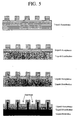
- One or more layers of the nonwoven fabric may extend into the projections defined by the liquid-acceptance layer, as depicted in FIGURE 5 .
- This arrangement desirably acts to channel and control the flow of liquid introduced into the nonwoven fabric, and desirably minimizes the "land" areas of the fabric, which contact the skin of the wearer of a disposable absorbent article.
- the fluid management capabilities of the present nonwoven fabric can be further enhanced by providing the fabric with a plurality of apertures that preferably extend from the upper surface layer through at least a portion of the nonwoven fabric. Most preferably, these apertures extend from the network of channels that surround the upstanding projections. The apertures cooperate with the upstanding projections to channel and direct liquid into the apertures so that it can be directed into the associated liquid-retaining structure.
- the precursor web P is optionally provided with a third cellulosic fibrous layer, as described above, hydroentanglement of the precursor web results in formation of the present nonwoven fabric.
- the liquid retention layer at least partially comprises cellulosic fibers selected from the group consisting of wood pulp fibers, rayon fibers, or blends thereof
- the liquid-retention layer may further comprise a blend of such cellulosic fibers, and thermoplastic fibers having a denier between about 6 and 18 preferentially selected from the group consisting of polyolefins, polyesters, polyamides, and blends thereof.
- Hydroentanglement of the liquid-retention layer can act to diminish void volumes within the layer that would be expected to reduce the liquid-retaining characteristics of the layer.
- the desired level of liquid-retention can be achieved by selecting fibers that exhibit inherent absorptivity (such as rayon fibers or profiled fibers).
- the liquid-retention layer can be surface napped, at the outwardly facing surface thereof, for enhancing absorbent capacity. Ordinarily, such surface napping can diminish the structural integrity of an absorbent structure.
- surface napping of the retention layer does not unacceptably diminish its structural integrity.
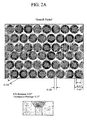
- FIGURE 2A illustrates a forming surface referred to as “smooth tacks", wherein the forming surface comprises an array of surface depressions which taper generally downwardly from an outside diameter of 0,86 cm (0.34 inches) to a lower, for aminous grid-like circular region having a diameter of 0,053 cm (0.021 inches).
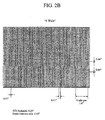
- FIGURE 2B illustrates a forming surface designated “8 wale”, having a series of upstanding rails which are positioned above and intersect with a lower series of rails, whereby an array of surface depressions is defined.
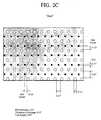
- FIGURE 2C showing a pattern designated as “dots”, shows,a forming surface including an array of depressions (light colored) each having a diameter of 8,35 cm (0.14 inches), spaced 0,64 cm (0.25 inches) apart, with “nubs” (dark colored) extending upwardly from the forming surface for formation of apertures in a nonwoven fabric formed thereon.
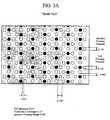
- FIGURE 3A shows a forming surface designated "multi-nub” including an array of surface depressions (light colored) each having a diameter of 0.396 cm (0.156 inches) and an array of aperture-forming projections (dark colored).
- FIGURE 3B illustrates a foraminous forming surface designated "double-hole bar", including an array of generally elongated surface depressions of two different sizes (light colored) and an array of circular, upstanding projections each having a diameter of 0,478 cm (0.188 inches) (dark colored) for formation of apertures in a nonwoven fabric hydroentangled thereon.
- FIGURE 3C illustrates a foraminous forming surface designated "diagonal bar” wherein an array of elongated surface depressions, each having a length of 1,588 cm (0.625 inches), is arranged with an array of upstanding circular projections each having a diameter of 0,478 cm (0.188 inches) for formation of apertures in a nonwoven fabric formed thereon.
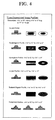
- the surface depressions defined by the forming surfaces of the image transfer device used for practicing the present invention can be configured in accordance with the image profiles as shown in FIGURE 4 .
- the profiles can be selected to optimize fluid management, particularly optimizing control and direction of liquid into the network of channels and associated apertures, which surrounds the upstanding projections of the liquid-acceptance layer of the present nonwoven fabric.
- this layer may comprise superabsorbent polymer for enhancing the absorbent capacity of the layer.
- superabsorbent polymers are well known in the art, and frequently are employed in particulate form. However, these types of materials are also available in fiber form, and can be heat-activated after fabric formation so that the polymer exhibits the desired superabsorbency.
- the fibrous superabsorbent polymer can be heat-activated by drying cans 26 of an apparatus which is illustrated in FIGURE 1 .
- a multi-component fabric is formed with an apparatus such as illustrated in FIGURE 1 by forming a prebond web from carded webs, two of which were air-randomized, comprising 50% by weight 6.0 denier by 5.08 cm (2.0 inch) T-216 PET fibers, and 50% by weight 1.5 denier by 3,99 cm (1.57 inch) staple length Type 8192 rayon, available from Lenzing.
- the carded webs are integrated on a flat bed entangler 12 by subjecting the prebond web structure to fluid entanglement under 12 successive manifolds, three each operated at 6.89 bar, 20,68 bar, 41,37 bar and 55,16 bar (100 psi, 300 psi, 600 psi, and 800 psi).
- Each manifold defines orifices of 0,127 mm (0.005-inch) diameter, with 43.3 orifices per 2,54 cm (inch). Line speed was 0.23 m/s (15 yards per minute) with the web subjected to drying at an elevated temperature by three drying cans each operated at 149°C (300° F).
- Additional carded web of the same construction as above was layered onto the above-described prebond web, with the resultant precursor web hydroentangled on flat bed entangler 12 by twelve manifolds, three each operated at 6,89 bar, 20,68 bar, 41,37 bar and 68,95 bar (100 psi, 300 psi, 600 psi, and 1000 psi).
- the final fabric was formed by adding four carded webs, two of which were air-randomized, to the above-described ebond web, with each of these fluther card webs comprising 1.5 denier by 3,99 cm (1.57 inch) staple length Type 8192 rayon, with each of these cards being air-randomized.
- These four, carded webs were layered onto the above-described prebond web, with the resultant precursor web hydroentangled on flat bed entangler 12 by twelve manifolds configured as described above and operated at 6,89 bar, 20,68 bar, 41,37 bar and 68,95 bar (100 psi, 300 psi, 600 psi, and 1000 psi).
- This precursor web was then imaged and patterned on image transfer device 18 having a "smooth tacks" pattern as illustrated in FIGURE 2A , with three entangling manifolds 22 each operated at 275,8 bar (4000 psi), with each manifold having an orifice strip having orifices of 0,127 mm (0.005 inch) diameter, with 43.3 orifices per 2,54 cm (inch).
- the fabric was dried at an elevated temperature by three drying cans operate at 149°C at (300° F), with a formation line speed of 0,23 m/s (15 yards per minute), and a final fabric basis weight of 0,17 kg/m 2 (8.5 ounces per square yard).
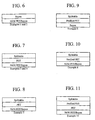
- the first fibrous layer of the precursor web consisted of all rayon fibers, and were positioned against the forming surface of the image transfer device to form the surface projections, as shown schematically in FIGURES 6 .
- the combined cellulosic layers result in a fabric having a high degree of wickability, and to be particularly useful in the rapid relocation of fluid away from the imaged rayon surface.
- a multi-component fabric was formed as described above in connection with Example 1, except that the additional carded web comprising 50% by weight 6.0 denier by 5,08 cm (2.0 inch) T-216 PET fibers, and 50% by weight 1.5 denier by 3,99 cm (1.57 inch) staple length Type 8192 rayon, available from Lenzing was not added to the prebond web and an image transfer device having a forming surface configured in accordance with the "8 wale" configuration illustrated in Figures 2B was employed, with three entangling manifolds 22 each operated at 165,5 bar (2400 psi).
- the resultant multi-component fabric had a basis weight of 0,10 kg/m 2 (5.1 ounces per square yard).
- a multi-component fabric is formed with an apparatus such as illustrated in FIGURE 1 by forming prebond web from first and second carded webs each comprising air-randomized 6.0 denier by 5,08 cm (2.0 inch) T-216 PET fibers available from Wellman. Third and fourth carded webs are placed on the first two carded webs, with each of the third and fourth webs comprising 40% by weight 6.0 denier by 5,08 cm (2.0 inch) T-216 PET fibers, and 60% by weight 1.5 denier by 3,99 cm (1.57 inch) staple length Type 8192 rayon, available from Lenzing.
- the carded webs are integrated on a flat bed entangler 12 by subjecting the prebond web structure to fluid entanglement under 12 successive manifolds, three each operated at 6,89 bar, 20,68 bar, 41,37 bar and 55,16 bar (100 psi, 300 psi, 600 psi, and 800 psi).
- Each manifold defines orifices of 0,127 mm (0.005-inch) diameter, with 43.3 orifices per 2,54 cm (inch).
- Line speed was 0,23 m/s (15 yards per minute), with the web subjected to drying at an elevated temperature by three drying cans each operate at 149°C (300° F).
- the final basis weight of the prebond was 0,064 kg/m 2 (3.2 ounces per square yard).
- the final fabric was formed by adding two additional carded webs to the above-described prebond web; the first carded web comprising air-randomized 6.0 denier by 5,08 cm (2.0 inch) T-216 PET fiber, randomized and the total weight being 0,026kg/m 2 (1.3 ounces per square yard), the second carded web comprising 3.0 denier by 5,08 cm (2.0 inch) T-502 splittable fiber (16 sub-denier, PET/nylon, 0.19 denier sub-denier, segmented pie, available from Fiber Innovation Technology, Inc.), with each of these cards being air-randomized and the total weight being 0,026 kg/m 2 (1.3 ounces per square yard).
- the fabric was dried at an elevated temperature by three drying cans operated a 149°C (300° F), with a formation line speed of 0,23 m/s (15 yards per minute), and a final fabric basis weight of 0,124 kg/m 2 (6.2 ounces per square yard).
- the splittable fibers provided the first fibrous layer of the precursor web, and were positioned against the forming surface of the image transfer device for formation of the liquid-acceptance layer.
- the two layers of PET fibers formed the second fibrous layer of the precursor web, and formed the liquid-distribution layer of the resultant fabric.
- the PET/rayon fibers formed the third, cellulosic fibrous layer of the precursor web, and formed the liquid-retention layer of the resultant fabric.
- a multi-component fabric was formed as described above in connection with Example 3, except that an image transfer device having a forming surface configured in accordance with the "dots" configuration illustrated in FIGURE 2C was employed.
- the resultant multi-component fabric had a basis weight of 0,124 kg/m 2 (6.2 ounces per square yard).
- a prebond web was formed from four carded, air-randomized webs, two of which were air-randomized, each comprising 50% by weight 11.0 denier by 5,08 cm (2.0 inch) T-261 PET fibers from Wellman, and 50% by weight 1.5 denier by 3,99 cm (1.57 inch) staple Type 8191 from Lenzing.
- the webs were hydroentangled on the flat bed entangler 12 by twelve manifolds 0,127 mm (0.005-inch) orifices by 43.3 orifices per 2,54 cm (inch), with three each operated at 6,89 bar, 20,68 bar, 41,37 bar, and 41,37 bar (100 psi, 300 psi, 600 psi, and 600 psi).
- Three drying cans were operated at 149°C (300° F), with a line speed of 0,31 m/s (20 yards per minute).
- the resultant prebond web had a basis weight of 0,07 kg/m 2 (3.5 ounces per square yard).
- the final nonwoven fabric embodying the present invention was formed by adding two additional carded webs, the first carded web comprising 6.0 denier by 5,08 (2.0 inch) T-216 PET fibers, and the second carded web comprising air-randomized 2.5 denier by 5.08 cm (2.0 inch) N-91 splittable fiber (20 sub-denier, segmented pie, PET/nylon, 0.12 denier sub-denier fibers from Unitika).
- carded webs were layered onto the above-described prebond web, and hydroentangled therewith on the flat bed entangler 12 with orifice strips as described above, with three each of the twelve manifolds successively operated at 6,89 bar, 20,68 bar, 41,37 bar and 75,85 bar (100 psi, 300 psi, 600 psi, and 1100 psi).
- the precursor web was then positioned on the image transfer device 18, having the "smooth tacks" forming surface illustrated in FIGURE 2A .
- the precursor web was imaged and patterned by operation of three manifolds 22 at 171,0 bar 2480 psi, with each manifold including 0,127 mm (0.005-inch) diameter orifices, 43.3 orifices per 2,54 cm (inch).
- the splittable fibers were positioned on the forming surface of the image transfer device, and provided the first fibrous layer of the precursor web.
- the 6 denier PET fibers provided the second fibrous layer of the precursor web, with the PET/rayon (large denier) fibers providing the third, cellulosic fibrous layer of the precursor web.
- the resultant nonwoven fabric having liquid-acceptance, liquid-distribution, and liquid-retention layers, was dried at an elevated temperature by drying cans 26 operated at 149°C (300° F) (two cans), with a line speed of 0,155 m/s (10 yards per minute).
- Final fabric basis weight was 0,14 kg/m 2 (7.0 ounces per square yard).
- a prebond web was formed from three carded webs, two of which were air-randomized, each comprising 50% by weight, 1.5 denier by 3,99 cm (1.57 inch) staple 8192 rayon, and 50% by weight, 1.5 denier by 3,99 mm (1.57 inch) staple 8191 rayon.
- the card webs were hydroentangled on flat bed entangler 12 with manifolds configured as described above, with three each of the manifolds operated at 3,45 bar, 20,68 bar and 27,56 bar (50 psi, 300 psi, and 400 psi).
- the prebond web was dried on two drying cans operated at 149°C at (300° F), with a line speed of 0,31 m/s (20 yards per minute), and a final basis weight of 68,7 g/m 2 of (2.0 ounces per square yard).
- a second prebond web was formed from 3 carded webs, two of which were air-randomized, each comprising 3.0 denier by 1.5 inch staple 4DG fiber available from Fiber Innovation Technology, Inc., a profiled fiber configured in accordance with U.S. Patent No. 5,855,798 and 5,977,429 .
- the card webs were hydroentangled on flat bed entangler 12 with manifolds configured as described above, with three each of the manifolds operated at 3,45 bar, 20,68 bar and 27,56 bar (50 psi, 300 psi, and 400 psi).
- the prebond web was dried on two drying cans operated at 282°C (300°F), with a line speed of 0,31 m/s (20 yards per minute), and a final basis weight of 0,03 kg/m 2 (1.5 ounces per square yard).
- a third prebond web was formed from 3 carded webs, two of which were air-randomized, with each of the carded webs comprising 3.0 denier by 5,08 cm (2.0 inch) staple T-502 splittable fiber (16 sub-denier, PET/nylon, 0.19 denier sub-denier, segmented pie, from Fiber Innovation Technology, Inc.).
- the carded webs were hydroentangled on the flat bed entangler, having manifolds as described above, with three each of the manifolds operated at 3,45 bar, 20,68 bar, 41,37 bar and 55,16 bar (50 psi, 300 psi, 600 psi, and 800 psi).
- the web was positioned on a 100-mesh screen, and subjected to the action of water jets (three manifolds, 0,127 mm (0.005 inch) diameter orifices, 43.3 orifices per 2,54 cm (inch), operated at 137,9 bar (2500 psi), to effect splitting of the splittable fibers.
- the prebond web was dried on two drying cans operated at 149°C at (300° F), with a line speed of 0,30 m/s (20 yard per minute), and a final basis weight of 0,037 kg/m 2 (1.83 ounces per square yard).
- the three prebond fabrics described above were layered in the following given above, and were pre-entangled on the flat bed entangler 12 as described above, with each of three manifolds operated at 3,75 bar, 20,68 bar, 41,37 bar and 55,16 bar (50 psi, 300 psi, 600 psi, and 800 psi).
- This precursor web was then positioned on the image transfer device 18 having a forming surface of "dots" configured in accordance with FIGURE 2C , with each of the three manifolds 22 operated at 110,3 bar (1600 psi).
- the splittable fibers were positioned adjacent the image transfer device, with the 3 denier 4DG PET fibers positioned in the next layer, and with the rayon fibers positioned in the next layer.
- the fabric was dried at an elevated temperature on three drying cans operated at 149°C (300° F), with the fabric formed At a line speed of 0,23 m/s (15 yards per minute).
- Final fabric basis weight was 0,122 kg/m 2 (6.05 ounces per square yard).
- a material was formed as described in Example 6. Application of a teasel brush was employed to the rayon-containing side of the material until the material reached the bulk shown in Table 3.
- a multi-component fabric is formed as described in Example 6 except the first prebond web was formed from four carded webs, two of which were air-randomized, each comprising 50% by weight 11.0 denier by 5,08 cm (2.0 inch) T-261 PET fibers from Wellman, and 50% by weight 1.5 denier by 3,99 cm (1.57 inch) rayon staple Type 8191 from Lenzing.
- the resultant prebond web had a basis weight of 0,071 kg/m 2 (3.5 ounces per square yard).
- the final fabric basis weight was 0,141 kg/m 2 (6.98 ounces per square yard).
- a material was formed as described in Example 8. Application of a teasel brush was employed to the rayon-containing side of the material until the material reached the bulk shown in Table 3.
- a multi-component fabric is formed as described in Example 6 except the first prebond web was formed from two carded webs each comprising air-randomized 6.0 denier by 5,08 cm (2.0 inch) T-216 PET fibers available from Wellman. Third and fourth carded webs are placed on the first two carded webs, with each of the third and fourth webs comprising 50% by weight 6.0 denier T-216 PET fibers, and 50% by weight 1.5 denier by 3,99 cm (1.57 inch) staple length Type 8192 rayon, available from Lenzing.
- the line speed was 0,23 m/s (15 yards per minute), with the web subjected to drying at an elevated temperature by three drying cans each operated at 149°C (300° F).
- the final basis weight of the prebond was 0,064 kg/m 2 (3.2 ounces per square yard).
- the final fabric basis weight was 0,134 kg/m 2 (6.67 ounces per square yard).
- a material was formed as described in Example 10. Application of a teasel brush was employed to the rayon-containing side of the material until the material reached the bulk shown in Table 3.
- Test Method Basis Weight ( oz / sy ) ASTM D3776 Thickness (mils ASTM D5729 Tensiles - MD and CD Grab (lb/in) ASTM D5034 Elongation - MD and CD Grab (%) ASTM D5034 Absorbency - Time (sec) ASTM D1117 Absorbency - Capacity (%) ASTM D1117 Strike Through (sec) EDANA 150.3 Rewet (grams EDANA 151.1
- No Load Capacity (gr. Liquid / gr. Fabric): This test entails the following procedure. A 12.7 cm by 12,7 cm (5 inch by 5 inch) sample is weighed. Then it is submerged into a saline solution (0.9%) for 15 minutes. The sample is removed from the solution and allowed to drain vertically for one minute. The sample is then weighed again. The no load capacity is reported as the ratio of the fabric weight after submersion to the weight of fabric before submersion.
- a disposable "swimmer” absorbent product i.e., a disposable absorbent swimwear article
- fabrics formed in accordance with the present invention provided excellent absorbent characteristics, particularly by comparison of the absorbency of the fabrics (as a percentage of fabric weight), relative to the thickness of the fabrics. Additionally, fabrics formed in accordance with the present invention exhibited excellent structural integrity especially compared to the disposable "swimmer” absorbent product, thus facilitating their efficient use in high-speed manufacture of disposable absorbent products.
- Exemplary disposable absorbent articles which can be configured in accordance with the present invention include disposable diapers, disposable training pants and "swimmers", sanitary protection products, adult incontinent products, incontinence pads, and like disposable absorbent structures.
- U.S. Patents No. 4,695,278, to Lawson , and No. 4,704,116, to Enloe illustrate exemplary disposable diapers.
- U.S. Patents No. 4,938,753 , No. 4,938,757 , and No. 4,940,464, all to Van Gompel illustrate exemplary disposable training pants.
- U.S. Patents No. 4,589,876 , and No. 4,687,478, both to Van Tilburg illustrate exemplary sanitary napkin constructions.
- Example 2 "Target" Face Up Face Down Face Up Face Down TEST Fiber Composition Consumer Product Rayon Face 50% PET 50%Rayon Back Rayon Face 50% PET 50%Rayon Back Image Tacks 8 Wales Basis Weight (oz/sy) 10.45 8.5 6.3 (kg/cm 2 ) 0,211 0,171 0,127 Thickness (mils) 1457.5 90 60
Landscapes
- Health & Medical Sciences (AREA)
- Engineering & Computer Science (AREA)
- Heart & Thoracic Surgery (AREA)
- Textile Engineering (AREA)
- Epidemiology (AREA)
- Biomedical Technology (AREA)
- Mechanical Engineering (AREA)
- Vascular Medicine (AREA)
- Life Sciences & Earth Sciences (AREA)
- Animal Behavior & Ethology (AREA)
- General Health & Medical Sciences (AREA)
- Public Health (AREA)
- Veterinary Medicine (AREA)
- Nonwoven Fabrics (AREA)
- Laminated Bodies (AREA)
Abstract
Claims (18)
- Tissu non tissé à composants multiples destiné à être utilisé pour des articles absorbants jetables, ledit tissu comprenant :une couche de réception de liquide supérieure possédant une surface supérieure destinée à recevoir les liquides introduits dans ledit article absorbant, ladite couche supérieure comprenant des fibres choisies parmi des polymères thermoplastiques, des fibres thermoplastiques séparables, ou des fibres cellulosiques,ladite surface supérieure de la couche supérieure définissant un ensemble de saillies verticales s'étendant au dessus d'un réseau de canaux de réception de liquide entourant lesdites saillies verticales ; etune couche suivante de répartition de liquide juxtaposée à ladite couche supérieure, et hydroenchevêtrée avec cette dernière en une relation de transfert de liquide afin de recevoir le liquide provenant de ladite couche supérieure pour le distribuer vers ledit article absorbant,ladite couche suivante comprenant un mélange de fibres comprenant : (1) des fibres choisies parmi le groupe constitué des polymères thermoplastiques, (2) des fibres thermoplastiques profilées, ou (3) des fibres cellulosiques.
- Tissu non tissé à composants multiples selon la revendication 1, comprenant : une couche inférieure de rétention de liquide juxtaposée à ladite couche de répartition de liquide sur le côté de cette dernière opposé à ladite couche de réception de liquide, ladite couche de rétention de liquide étant hydroenchevêtrée en une relation de transfert de liquide avec ladite couche de répartition de liquide, ladite couche de rétention de liquide comprenant au moins en partie des fibres cellulosiques choisies parmi le groupe constitué de fibres de pâte de bois, de fibres de rayonne, ou de mélanges de ces dernières.
- Tissu non tissé à composants multiples selon la revendication 2, dans lequel : ladite couche de rétention de liquide comprend un mélange desdites fibres cellulosiques et fibres de polymère thermoplastique possédant un denier compris entre environ 6 et 18.
- Tissu non tissé à composants multiples selon la revendication 3, dans lequel : les polymères thermoplastiques sont choisis parmi le groupe constitué des polyoléfines, des polyesters, des polyamides, et de mélanges de ces derniers.
- Tissu non tissé à composants multiples selon la revendication 4, dans lequel : les polyoléfines sont choisies parmi le groupe constitué du polypropylène, du polyéthylène, et de mélanges de ces derniers.
- Tissu non tissé à composants multiples selon la revendication 4, dans lequel : les polyesters sont choisis parmi le groupe constitué du polyéthylène téréphtalate, du polybutylène téréphtalate, et de mélanges de ces derniers.
- Tissu non tissé à composants multiples selon la revendication 4, dans lequel : le polyamide comprend le nylon.
- Tissu non tissé à composants multiples selon la revendication 2, dans lequel : ladite couche suivante comprend un mélange de fibres comprenant : (1) des fibres possédant un denier d'environ 6 à 18 choisies parmi le groupe constitué des polymères thermoplastiques, (2) des fibres thermoplastiques profilées, ou (3) des fibres cellulosiques.
- Tissu non tissé à composants multiples selon la revendication 1, dans lequel : ladite couche de répartition de liquide s'étend dans ledit ensemble de saillies définies par la surface supérieure de ladite couche de réception de liquide.
- Tissu non tissé à composants multiples selon la revendication 2, dans lequel : une surface inférieure de ladite couche de rétention de liquide, opposée à ladite couche de répartition de liquide, est grattée en surface pour améliorer le gonflant.
- Tissu non tissé à composants multiples selon la revendication 1, dans lequel : ledit tissu définit une pluralité d'ouvertures s'étendant depuis ledit réseau de canaux de réception du liquide au travers de ladite couche inférieure de répartition du liquide.
- Procédé de fabrication d'un tissu non tissé à plusieurs composants, comprenant les étapes consistant à :◆ former une bande fibreuse précurseur stratifiée comprenant une première couche fibreuse comprenant des fibres choisies parmi le groupe constitué du polypropylène, du polyester, du polyéthylène téréphtalate, et du nylon et possédant une masse surfacique comprise entre environ 0,010 et 0,030 kg/m2 (0,5 et 1,5 oz/ yd2), et une deuxième couche fibreuse comprenant un mélange de fibres comprenant (1) des fibres ayant un denier allant d'environ 6 à 18 choisies parmi le groupe constitué des polyoléfines, des polyesters, et des polyamides, et (2) une fibre thermofusible, ladite deuxième couche possédant une masse surfacique comprise entre environ 0,010 et 0,020 kg/m2 (0,5 et 1,0 oz/yd2) ;◆ fournir un dispositif de transfert d'image tridimensionnelle possédant une surface de formation foraminée définissant un ensemble de dépressions superficielles ;◆ positionner ladite bande fibreuse précurseur sur ledit dispositif de transfert d'image avec ladite première couche fibreuse positionnée de manière adjacente à ladite surface de formation foraminée, et◆ hydroenchevêtrer ladite bande précurseur moyennant quoi ladite bande précurseur est imagée et formée sur ledit dispositif de transfert d'image, afin de former un tissu non tissé à composants multiples, ladite première couche fibreuse formant une couche de réception de liquide dudit tissu possédant un ensemble de saillies verticales s'étendant au dessus d'un réseau de canaux de réception de liquide, ledit ensemble de saillies correspondant audit ensemble de dépressions superficielles définies par ladite surface de formation foraminée, ladite deuxième couche fibreuse formant une couche de répartition de liquide dudit tissu juxtaposée à ladite couche de réception du liquide et hydroenchevêtrée à cette dernière en une relation de transfert de liquide.
- Procédé de fabrication d'un tissu non tissé à composants multiples selon la revendication 12, comprenant :la formation de ladite bande précurseur avec une troisième couche fibreuse comprenant au moins partiellement des fibres cellulosiques choisies parmi le groupe constitué de fibres de pâte de bois, de fibres de rayonne, et de mélanges de ces dernières, ladite deuxième couche fibreuse étant positionnée entre lesdites première et troisième couches fibreuses,ladite étape d'hydroenchevêtrement comprenant la formation de ladite troisième couche fibreuse en tant que couche de rétention de liquide dudit tissu.
- Procédé de fabrication d'un tissu non tissé à composants multiples selon la revendication 13, comprenant : la formation de ladite troisième couche fibreuse à partir d'un mélange desdites fibres cellulosiques et des fibres possédant un denier allant de 6 à 18 choisie parmi le groupe constitué des fibres polyesters, des fibres polyoléfines, et des fibres polyamides.
- Procédé de fabrication d'un tissu non tissé à composants multiples selon la revendication 13, comprenant : la formation de ladite couche de réception du liquide contenant un polymère superabsorbant.
- Procédé de fabrication d'un tissu non tissé à composants multiples selon la revendication 15, comprenant les étapes consistant à :◆ disposer ledit polymère superabsorbant sous une forme fibreuse dans ladite troisième couche fibreuse de ladite bande précurseur, et◆ sécher ledit tissu non tissé à température élevée afin d'activer ledit polymère superabsorbant.
- Procédé de fabrication d'un tissu non tissé à composants multiples selon la revendication 13, comprenant l'étape consistant à : gratter la surface de ladite couche de rétention de liquide.
- Procédé de fabrication d'un tissu non tissé à composants multiples selon la revendication 12, comprenant l'étape consistant à : former une pluralité d'ouvertures s'étendant depuis ledit réseau de canaux de réception de liquide au travers desdites couches de réception de liquide et de répartition de liquide.
Applications Claiming Priority (3)
| Application Number | Priority Date | Filing Date | Title |
|---|---|---|---|
| US21752300P | 2000-07-11 | 2000-07-11 | |
| US217523P | 2000-07-11 | ||
| PCT/US2001/021840 WO2002004729A1 (fr) | 2000-07-11 | 2001-07-11 | Non-tisse a plusieurs composants s'utilisant dans des articles absorbants jetable |
Publications (3)
| Publication Number | Publication Date |
|---|---|
| EP1299587A1 EP1299587A1 (fr) | 2003-04-09 |
| EP1299587A4 EP1299587A4 (fr) | 2006-08-30 |
| EP1299587B1 true EP1299587B1 (fr) | 2008-10-01 |
Family
ID=22811429
Family Applications (1)
| Application Number | Title | Priority Date | Filing Date |
|---|---|---|---|
| EP01984171A Expired - Lifetime EP1299587B1 (fr) | 2000-07-11 | 2001-07-11 | Non-tisse a plusieurs composants s'utilisant dans des articles absorbants jetable |
Country Status (5)
| Country | Link |
|---|---|
| US (2) | US20020034914A1 (fr) |
| EP (1) | EP1299587B1 (fr) |
| AU (1) | AU2002218777A1 (fr) |
| DE (1) | DE60135989D1 (fr) |
| WO (1) | WO2002004729A1 (fr) |
Families Citing this family (65)
| Publication number | Priority date | Publication date | Assignee | Title |
|---|---|---|---|---|
| US6725512B2 (en) * | 2001-06-05 | 2004-04-27 | Polymer Group, Inc. | Imaged nonwoven fabric for cleaning applications |
| US7191500B2 (en) * | 2001-11-09 | 2007-03-20 | Polymer Group, Inc. | Disposable nonwoven undergarments |
| AU2002364065A1 (en) * | 2001-12-28 | 2003-07-24 | Polymer Group, Inc. | Nonwoven fabrics having a durable three-dimensional image |
| FR2834725B1 (fr) | 2002-01-15 | 2004-06-11 | Rieter Perfojet | Machine de production d'un produit textile a motifs et produit non tisse ainsi obtenu |
| WO2003085184A2 (fr) * | 2002-04-05 | 2003-10-16 | Polymer Group, Inc. | Non-tisse double face comportant une image tridimensionnelle |
| US6629340B1 (en) * | 2002-04-05 | 2003-10-07 | Polymer Group, Inc. | Acoustic underlayment for pre-finished laminate floor system |
| WO2003095730A1 (fr) * | 2002-05-08 | 2003-11-20 | Polymer Group, Inc. | Non-tissés avec intercalage d'images tridimensionnelles |
| DE50302622D1 (de) | 2002-07-05 | 2006-05-04 | Fleissner Gmbh | Produkt und verfahren zur herstellung eines vliesstoffes mittels hydrodynamischer vernadelung |
| US6739023B2 (en) * | 2002-07-18 | 2004-05-25 | Kimberly Clark Worldwide, Inc. | Method of forming a nonwoven composite fabric and fabric produced thereof |
| WO2004073430A2 (fr) * | 2003-02-14 | 2004-09-02 | Polymer Group, Inc. | Sous-vêtement à jeter en non tissé et structure de couche absorbant |
| US20040258844A1 (en) * | 2003-04-11 | 2004-12-23 | Polymer Group, Inc. | Nonwoven cleaning articles having compound three-dimensional images |
| US20050025936A1 (en) * | 2003-04-11 | 2005-02-03 | Jerry Snider | Nonwoven cleaning articles having intercalated three-dimensional images |
| ITMI20030805A1 (it) * | 2003-04-17 | 2004-10-18 | Orlandi Spa | Non-tessuto a base di fibre esplose o fibre multicomponenti splittabili. |
| FI121182B (fi) * | 2004-06-18 | 2010-08-13 | Suominen Nonwovens Ltd | Menetelmä kuitukankaan valmistamiseksi |
| DE102004030393A1 (de) * | 2004-06-23 | 2006-01-26 | Carl Freudenberg Kg | Verfahren zur Herstellung eines dreidimensional geformten Vliesstoffes, Vorrichtung zur Benutzung in dem Verfahren, danach erhaltener dreidimensional geformter Vliesstoff und seine Verwendung |
| US20060100593A1 (en) * | 2004-08-26 | 2006-05-11 | Clifford Bridges | Disposable nonwoven undergarments for administering a medicinal agent |
| FR2877679B1 (fr) * | 2004-11-10 | 2007-04-27 | Rieter Perfojet Sa | Tambour natamment pour une machine d'enchevetrement d'un nontisse par jets d'eau. |
| FR2885915B1 (fr) * | 2005-05-20 | 2007-08-03 | Rieter Perfojet Sa | Tambour pour machine de fabrication d'un non tisse a motifs et non tisse obtenu |
| WO2007030601A2 (fr) | 2005-09-06 | 2007-03-15 | Tyco Healthcare Group Lp | Pansement pour plaies autonome muni d'une micropompe |
| US7478463B2 (en) * | 2005-09-26 | 2009-01-20 | Kimberly-Clark Worldwide, Inc. | Manufacturing process for combining a layer of pulp fibers with another substrate |
| US20080261476A1 (en) * | 2005-12-07 | 2008-10-23 | Sca Hygiene Products Ab | Nonwoven Material and a Method for Producing Nonwoven Material |
| CN101325936A (zh) | 2005-12-07 | 2008-12-17 | Sca卫生产品股份公司 | 无纺材料以及包括无纺材料的吸收制品 |
| DE102006007834A1 (de) * | 2006-02-17 | 2007-09-06 | Fleissner Gmbh | Trommelschale zur Erzeugung von Strukturen und/oder Reliefmuster auf der Oberfläche eines gewebten oder nicht gewebten Zellenmaterials oder Vlieses |
| US20070254145A1 (en) * | 2006-05-01 | 2007-11-01 | The Procter & Gamble Company | Molded elements |
| US20080082071A1 (en) * | 2006-10-03 | 2008-04-03 | Kimberly-Clark Worldwide, Inc. | Absorbent articles with graphic variety |
| US7518032B2 (en) * | 2006-11-14 | 2009-04-14 | Tredegar Film Products Corporation | Three-dimensional apertured film for transmitting dynamically-deposited and statically-retained fluids |
| EP2005921A1 (fr) * | 2007-06-21 | 2008-12-24 | ALBIS Spa | Plaquette en surface absorbant les liquides |
| TW200936108A (en) * | 2008-02-29 | 2009-09-01 | Chen-Cheng Huang | Thin-layer with liquid diversion function |
| US20100062671A1 (en) * | 2008-09-05 | 2010-03-11 | Nutek Disposables, Inc. | Composite wipe |
| US20140144171A1 (en) * | 2011-06-30 | 2014-05-29 | Bha Altair, Llc | Method of Wetting Evaporative Cooler Media Through a Fabric Distribution Layer |
| AU2012282287B2 (en) | 2011-07-14 | 2017-06-01 | Smith & Nephew Plc | Wound dressing and method of treatment |
| US9216117B2 (en) * | 2012-03-30 | 2015-12-22 | Kimberly-Clark Worldwide, Inc. | Absorbent article with point fusion bonding |
| EP3650055B1 (fr) | 2012-05-23 | 2026-01-07 | Smith & Nephew plc | Appareils et procédés pour le traitement de plaies par pression négative |
| WO2014020443A2 (fr) | 2012-08-01 | 2014-02-06 | Smith & Nephew Pcl | Pansement et méthode de traitement |
| HUE033329T2 (en) | 2012-08-01 | 2017-11-28 | Smith & Nephew | Wound dressing |
| US9327473B2 (en) | 2012-10-31 | 2016-05-03 | Kimberly-Clark Worldwide, Inc. | Fluid-entangled laminate webs having hollow projections and a process and apparatus for making the same |
| US9480608B2 (en) | 2012-10-31 | 2016-11-01 | Kimberly-Clark Worldwide, Inc. | Absorbent article with a fluid-entangled body facing material including a plurality of hollow projections |
| US9480609B2 (en) | 2012-10-31 | 2016-11-01 | Kimberly-Clark Worldwide, Inc. | Absorbent article with a fluid-entangled body facing material including a plurality of hollow projections |
| US9474660B2 (en) * | 2012-10-31 | 2016-10-25 | Kimberly-Clark Worldwide, Inc. | Absorbent article with a fluid-entangled body facing material including a plurality of hollow projections |
| US10070999B2 (en) | 2012-10-31 | 2018-09-11 | Kimberly-Clark Worldwide, Inc. | Absorbent article |
| JP5596769B2 (ja) * | 2012-11-06 | 2014-09-24 | 株式会社太陽機械製作所 | 不織布成型品の製造装置 |
| USD728245S1 (en) * | 2013-03-11 | 2015-05-05 | Reynolds Consumer Products LLC | Embossed film with surface pattern |
| USD725916S1 (en) | 2013-03-11 | 2015-04-07 | Reynolds Consumer Products LLC | Embossed film with surface pattern |
| USD725915S1 (en) | 2013-03-11 | 2015-04-07 | Reynolds Consumer Products LLC | Embossed film with surface pattern |
| USD708860S1 (en) * | 2013-07-12 | 2014-07-15 | Medline Industries, Inc. | Paper product with surface pattern |
| ES2476166B1 (es) * | 2014-06-18 | 2015-07-09 | Bc Nonwovens, S.L. | Sustrato filtrante |
| WO2015193257A1 (fr) | 2014-06-18 | 2015-12-23 | Smith & Nephew Plc | Pansement et procédé de traitement |
| CN107072835B (zh) * | 2014-11-06 | 2021-03-02 | 宝洁公司 | 包括面向衣服的层合体的吸收制品 |
| WO2017039629A1 (fr) * | 2015-08-31 | 2017-03-09 | Kimberly-Clark Worldwide, Inc. | Bande non tissée de faible masse surfacique présentant des motifs visiblement distincts |
| GB2555584B (en) | 2016-10-28 | 2020-05-27 | Smith & Nephew | Multi-layered wound dressing and method of manufacture |
| CN107326536B (zh) * | 2016-11-22 | 2020-06-23 | 上海缔荣纺织品有限公司 | 异型涤纶纤维与木浆纤维复合水刺湿巾布及其制备方法 |
| CN110248628A (zh) * | 2017-01-31 | 2019-09-17 | 宝洁公司 | 成型的非织造织物和包括所述织物的制品 |
| WO2018160161A1 (fr) * | 2017-02-28 | 2018-09-07 | Kimberly-Clark Worldwide, Inc. | Procédé de fabrication de nappes stratifiées enchevêtrées par fluide comportant des projections creuses et des ouvertures |
| BR112019017624B1 (pt) | 2017-03-30 | 2023-03-14 | Kimberly-Clark Worldwide, Inc | Artigo absorvente. |
| USD858040S1 (en) * | 2017-05-17 | 2019-09-03 | Nike, Inc. | Garment |
| WO2019005910A1 (fr) | 2017-06-30 | 2019-01-03 | The Procter & Gamble Company | Procédé de fabrication d'un non-tissé mis en forme |
| WO2019005906A1 (fr) | 2017-06-30 | 2019-01-03 | The Procter & Gamble Company | Non-tissé façonné |
| WO2019067649A1 (fr) * | 2017-09-29 | 2019-04-04 | The Procter & Gamble Company | Couche pour article absorbant |
| CN112638341A (zh) * | 2018-09-27 | 2021-04-09 | 宝洁公司 | 衣服样的吸收制品 |
| WO2020112968A1 (fr) | 2018-11-30 | 2020-06-04 | Kimberly-Clark Worldwide, Inc. | Matériaux non tissés tridimensionnels et procédés de fabrication de ceux-ci |
| USD900485S1 (en) * | 2019-01-28 | 2020-11-03 | Dongguan Shichang Metals Factory Ltd. | Woven fabric |
| CN113473955B (zh) | 2019-03-18 | 2023-03-28 | 宝洁公司 | 表现出高视觉分辨率的成型非织造布 |
| US11306419B2 (en) | 2019-11-18 | 2022-04-19 | Dongguan Shichang Metals Factory Ltd. | Woven fabric |
| WO2022016051A1 (fr) * | 2020-07-17 | 2022-01-20 | Berry Global, Inc. | Couche de répartition d'acquisition |
| CN114164559A (zh) * | 2021-12-07 | 2022-03-11 | 福建恒安卫生材料有限公司 | 一种异形纤维木浆复合水刺布及其制备方法 |
Family Cites Families (33)
| Publication number | Priority date | Publication date | Assignee | Title |
|---|---|---|---|---|
| US3485706A (en) * | 1968-01-18 | 1969-12-23 | Du Pont | Textile-like patterned nonwoven fabrics and their production |
| US4589876A (en) * | 1983-07-05 | 1986-05-20 | The Procter & Gamble Company | Sanitary napkin |
| US4687478A (en) * | 1984-03-20 | 1987-08-18 | The Procter & Gamble Company | Shaped sanitary napkin with flaps |
| CA1341430C (fr) * | 1984-07-02 | 2003-06-03 | Kenneth Maynard Enloe | Couche avec poches laterales elasticisees |
| DE3666140D1 (en) * | 1986-01-31 | 1989-11-16 | Uni Charm Corp | Facing for absorptive articles and process for making it |
| US4808467A (en) * | 1987-09-15 | 1989-02-28 | James River Corporation Of Virginia | High strength hydroentangled nonwoven fabric |
| US4938753A (en) * | 1987-12-16 | 1990-07-03 | Kimberly-Clark Corporation | Seam construction in a disposable training pant, incontinence garment, or diaper |
| US4940464A (en) * | 1987-12-16 | 1990-07-10 | Kimberly-Clark Corporation | Disposable incontinence garment or training pant |
| US4938757A (en) * | 1987-12-16 | 1990-07-03 | Kimberly-Clark Corporation | Disposable training pant or incontinence garment |
| US4950531A (en) * | 1988-03-18 | 1990-08-21 | Kimberly-Clark Corporation | Nonwoven hydraulically entangled non-elastic web and method of formation thereof |
| US5632072A (en) * | 1988-04-14 | 1997-05-27 | International Paper Company | Method for hydropatterning napped fabric |
| US5972505A (en) * | 1989-04-04 | 1999-10-26 | Eastman Chemical Company | Fibers capable of spontaneously transporting fluids |
| US5244711A (en) * | 1990-03-12 | 1993-09-14 | Mcneil-Ppc, Inc. | Apertured non-woven fabric |
| US5098764A (en) * | 1990-03-12 | 1992-03-24 | Chicopee | Non-woven fabric and method and apparatus for making the same |
| US5328759A (en) * | 1991-11-01 | 1994-07-12 | Kimberly-Clark Corporation | Process for making a hydraulically needled superabsorbent composite material and article thereof |
| US5459912A (en) * | 1992-03-31 | 1995-10-24 | E. I. Du Pont De Nemours And Company | Patterned spunlaced fabrics containing woodpulp and/or woodpulp-like fibers |
| CA2107169A1 (fr) * | 1993-06-03 | 1994-12-04 | Cherie Hartman Everhart | Materiau permettant le passage de liquides |
| EP0640330B1 (fr) * | 1993-06-30 | 2000-05-24 | The Procter & Gamble Company | Produits absorbants hygiéniques |
| US5585017A (en) * | 1993-09-13 | 1996-12-17 | James; William A. | Defocused laser drilling process for forming a support member of a fabric forming device |
| US5817394A (en) * | 1993-11-08 | 1998-10-06 | Kimberly-Clark Corporation | Fibrous laminated web and method and apparatus for making the same and absorbent articles incorporating the same |
| US6025050A (en) * | 1994-06-15 | 2000-02-15 | Bba Nonwovens Simpsonville, Inc. | Thermally appertured nonwoven laminates for wipes and coverstock for hygienic articles |
| CA2153125A1 (fr) * | 1994-08-31 | 1996-03-01 | Frank Paul Abuto | Article absorbant |
| US5674587A (en) * | 1994-09-16 | 1997-10-07 | James; William A. | Apparatus for making nonwoven fabrics having raised portions |
| US6022818A (en) * | 1995-06-07 | 2000-02-08 | Kimberly-Clark Worldwide, Inc. | Hydroentangled nonwoven composites |
| KR100266489B1 (ko) * | 1995-08-07 | 2000-09-15 | 데이비드 엠 모이어 | 정합성및유체이동성능을갖는일회용흡수제품 |
| US5822823A (en) * | 1995-08-11 | 1998-10-20 | Newell Operating Company | Apparatus and method for applying coatings to planar and non-planar surfaces |
| AU7211296A (en) * | 1995-10-11 | 1997-04-30 | Jacob Holm Industries (France) Sas | Composite nonwovens and methods for the preparation thereof |
| US5977429A (en) * | 1996-08-22 | 1999-11-02 | Eastman Chemical Company | Synthetic polyester absorbent materials |
| US5990377A (en) * | 1997-03-21 | 1999-11-23 | Kimberly-Clark Worldwide, Inc. | Dual-zoned absorbent webs |
| US5981410A (en) * | 1997-04-08 | 1999-11-09 | Fibervisions A/S | Cellulose-binding fibres |
| ATE256415T1 (de) * | 1997-05-23 | 2004-01-15 | Procter & Gamble | Dreidimensionale strukturen zum gebrauch als waschtücher |
| WO1999063925A1 (fr) * | 1998-06-08 | 1999-12-16 | Bki Holding Corporation | Structure unitaire absorbante renfermant un polymere ultra-absorbant |
| EP1268906A4 (fr) * | 2000-02-11 | 2008-05-28 | Polymer Group Inc | Tissus non-tisses vus par instrument |
-
2001
- 2001-07-11 EP EP01984171A patent/EP1299587B1/fr not_active Expired - Lifetime
- 2001-07-11 DE DE60135989T patent/DE60135989D1/de not_active Expired - Fee Related
- 2001-07-11 AU AU2002218777A patent/AU2002218777A1/en not_active Abandoned
- 2001-07-11 US US09/903,215 patent/US20020034914A1/en not_active Abandoned
- 2001-07-11 WO PCT/US2001/021840 patent/WO2002004729A1/fr not_active Ceased
-
2007
- 2007-03-02 US US11/681,361 patent/US20070149940A1/en not_active Abandoned
Also Published As
| Publication number | Publication date |
|---|---|
| EP1299587A1 (fr) | 2003-04-09 |
| US20070149940A1 (en) | 2007-06-28 |
| AU2002218777A1 (en) | 2002-01-21 |
| EP1299587A4 (fr) | 2006-08-30 |
| US20020034914A1 (en) | 2002-03-21 |
| DE60135989D1 (de) | 2008-11-13 |
| WO2002004729A1 (fr) | 2002-01-17 |
Similar Documents
| Publication | Publication Date | Title |
|---|---|---|
| US20020034914A1 (en) | Multi-component nonwoven fabric for use in disposable absorbent articles | |
| EP2996654B1 (fr) | Structures fibreuse hydro-enchevêtrées | |
| US6673418B1 (en) | Absorbent product having a non-woven fabric cover with a three-dimensional profile region | |
| KR101654496B1 (ko) | 중공형 돌출부를 갖는 유체-엉킴된 적층체 웹 및 그 제조 공정 및 장치 | |
| US5470640A (en) | High loft and high strength nonwoven fabric | |
| CA2278591C (fr) | Structure absorbante etirable pour produits d'hygiene corporelle | |
| US11389336B2 (en) | Absorbent structure with stratified distribution layer | |
| US11365495B2 (en) | Process for making fluid-entangled laminate webs with hollow projections and apertures | |
| EP3688215B1 (fr) | Couche pour article absorbant | |
| JPH07502433A (ja) | メルトブローン部品を有する衛生吸収性製品 | |
| EP2901993B1 (fr) | Structure ondulée pour article absorbant | |
| EP0729330B1 (fr) | Nappe de plastique expansée de façon macroscopique, tridimensionelle, fibreuse et ajourée | |
| JPH09562A (ja) | 吸収性物品 | |
| US11643764B2 (en) | Nonwoven, and process and apparatus for producing the same | |
| JP3505868B2 (ja) | 吸収性物品 | |
| US11479889B2 (en) | Process for producing nonwoven and apparatus suitable therefor | |
| HK1029511A (en) | An absorbent product having a non-woven fabric cover with a three-dimensional profile region |
Legal Events
| Date | Code | Title | Description |
|---|---|---|---|
| PUAI | Public reference made under article 153(3) epc to a published international application that has entered the european phase |
Free format text: ORIGINAL CODE: 0009012 |
|
| 17P | Request for examination filed |
Effective date: 20030108 |
|
| AK | Designated contracting states |
Kind code of ref document: A1 Designated state(s): AT BE CH CY DE DK ES FI FR GB GR IE IT LI LU MC NL PT SE TR |
|
| AX | Request for extension of the european patent |
Extension state: AL LT LV MK RO SI |
|
| RBV | Designated contracting states (corrected) |
Designated state(s): AT BE CH CY DE FR IT LI NL SE |
|
| A4 | Supplementary search report drawn up and despatched |
Effective date: 20060731 |
|
| 17Q | First examination report despatched |
Effective date: 20061110 |
|
| 17Q | First examination report despatched |
Effective date: 20061110 |
|
| GRAP | Despatch of communication of intention to grant a patent |
Free format text: ORIGINAL CODE: EPIDOSNIGR1 |
|
| RBV | Designated contracting states (corrected) |
Designated state(s): DE FR IT NL SE |
|
| GRAS | Grant fee paid |
Free format text: ORIGINAL CODE: EPIDOSNIGR3 |
|
| GRAA | (expected) grant |
Free format text: ORIGINAL CODE: 0009210 |
|
| AK | Designated contracting states |
Kind code of ref document: B1 Designated state(s): DE FR IT NL SE |
|
| REF | Corresponds to: |
Ref document number: 60135989 Country of ref document: DE Date of ref document: 20081113 Kind code of ref document: P |
|
| PLBI | Opposition filed |
Free format text: ORIGINAL CODE: 0009260 |
|
| PLAX | Notice of opposition and request to file observation + time limit sent |
Free format text: ORIGINAL CODE: EPIDOSNOBS2 |
|
| 26 | Opposition filed |
Opponent name: SCA HYGIENE PRODUCTS AB Effective date: 20090630 |
|
| PG25 | Lapsed in a contracting state [announced via postgrant information from national office to epo] |
Ref country code: SE Free format text: LAPSE BECAUSE OF FAILURE TO SUBMIT A TRANSLATION OF THE DESCRIPTION OR TO PAY THE FEE WITHIN THE PRESCRIBED TIME-LIMIT Effective date: 20090101 Ref country code: IT Free format text: LAPSE BECAUSE OF FAILURE TO SUBMIT A TRANSLATION OF THE DESCRIPTION OR TO PAY THE FEE WITHIN THE PRESCRIBED TIME-LIMIT Effective date: 20081001 |
|
| NLR1 | Nl: opposition has been filed with the epo |
Opponent name: SCA HYGIENE PRODUCTS AB |
|
| PGFP | Annual fee paid to national office [announced via postgrant information from national office to epo] |
Ref country code: FR Payment date: 20090717 Year of fee payment: 9 |
|
| PGFP | Annual fee paid to national office [announced via postgrant information from national office to epo] |
Ref country code: DE Payment date: 20090729 Year of fee payment: 9 Ref country code: NL Payment date: 20090724 Year of fee payment: 9 |
|
| PLBB | Reply of patent proprietor to notice(s) of opposition received |
Free format text: ORIGINAL CODE: EPIDOSNOBS3 |
|
| REG | Reference to a national code |
Ref country code: NL Ref legal event code: V1 Effective date: 20110201 |
|
| REG | Reference to a national code |
Ref country code: FR Ref legal event code: ST Effective date: 20110331 |
|
| PG25 | Lapsed in a contracting state [announced via postgrant information from national office to epo] |
Ref country code: DE Free format text: LAPSE BECAUSE OF NON-PAYMENT OF DUE FEES Effective date: 20110201 |
|
| REG | Reference to a national code |
Ref country code: DE Ref legal event code: R119 Ref document number: 60135989 Country of ref document: DE Effective date: 20110201 |
|
| PG25 | Lapsed in a contracting state [announced via postgrant information from national office to epo] |
Ref country code: FR Free format text: LAPSE BECAUSE OF NON-PAYMENT OF DUE FEES Effective date: 20100802 Ref country code: NL Free format text: LAPSE BECAUSE OF NON-PAYMENT OF DUE FEES Effective date: 20110201 |
|
| PLBD | Termination of opposition procedure: decision despatched |
Free format text: ORIGINAL CODE: EPIDOSNOPC1 |
|
| PLBM | Termination of opposition procedure: date of legal effect published |
Free format text: ORIGINAL CODE: 0009276 |
|
| STAA | Information on the status of an ep patent application or granted ep patent |
Free format text: STATUS: OPPOSITION PROCEDURE CLOSED |
|
| 27C | Opposition proceedings terminated |
Effective date: 20110929 |