EP1305907B1 - Procédé et appareil de stockage et de récuperation de clés privéees de cryptographie - Google Patents
Procédé et appareil de stockage et de récuperation de clés privéees de cryptographie Download PDFInfo
- Publication number
- EP1305907B1 EP1305907B1 EP01963747A EP01963747A EP1305907B1 EP 1305907 B1 EP1305907 B1 EP 1305907B1 EP 01963747 A EP01963747 A EP 01963747A EP 01963747 A EP01963747 A EP 01963747A EP 1305907 B1 EP1305907 B1 EP 1305907B1
- Authority
- EP
- European Patent Office
- Prior art keywords
- private key
- mod
- processor
- cooperation
- calculating
- Prior art date
- Legal status (The legal status is an assumption and is not a legal conclusion. Google has not performed a legal analysis and makes no representation as to the accuracy of the status listed.)
- Expired - Lifetime
Links
- 238000011084 recovery Methods 0.000 title claims abstract description 23
- 238000000034 method Methods 0.000 title claims abstract description 10
- 238000004364 calculation method Methods 0.000 description 16
- 238000007792 addition Methods 0.000 description 2
- 230000008901 benefit Effects 0.000 description 2
- 238000010586 diagram Methods 0.000 description 1
- 238000005516 engineering process Methods 0.000 description 1
- 230000004044 response Effects 0.000 description 1
Images






Classifications
-
- H—ELECTRICITY
- H04—ELECTRIC COMMUNICATION TECHNIQUE
- H04L—TRANSMISSION OF DIGITAL INFORMATION, e.g. TELEGRAPHIC COMMUNICATION
- H04L9/00—Cryptographic mechanisms or cryptographic arrangements for secret or secure communications; Network security protocols
- H04L9/30—Public key, i.e. encryption algorithm being computationally infeasible to invert or user's encryption keys not requiring secrecy
- H04L9/3006—Public key, i.e. encryption algorithm being computationally infeasible to invert or user's encryption keys not requiring secrecy underlying computational problems or public-key parameters
- H04L9/302—Public key, i.e. encryption algorithm being computationally infeasible to invert or user's encryption keys not requiring secrecy underlying computational problems or public-key parameters involving the integer factorization problem, e.g. RSA or quadratic sieve [QS] schemes
-
- H—ELECTRICITY
- H04—ELECTRIC COMMUNICATION TECHNIQUE
- H04L—TRANSMISSION OF DIGITAL INFORMATION, e.g. TELEGRAPHIC COMMUNICATION
- H04L9/00—Cryptographic mechanisms or cryptographic arrangements for secret or secure communications; Network security protocols
-
- H—ELECTRICITY
- H04—ELECTRIC COMMUNICATION TECHNIQUE
- H04L—TRANSMISSION OF DIGITAL INFORMATION, e.g. TELEGRAPHIC COMMUNICATION
- H04L9/00—Cryptographic mechanisms or cryptographic arrangements for secret or secure communications; Network security protocols
- H04L9/08—Key distribution or management, e.g. generation, sharing or updating, of cryptographic keys or passwords
- H04L9/0894—Escrow, recovery or storing of secret information, e.g. secret key escrow or cryptographic key storage
-
- H—ELECTRICITY
- H04—ELECTRIC COMMUNICATION TECHNIQUE
- H04L—TRANSMISSION OF DIGITAL INFORMATION, e.g. TELEGRAPHIC COMMUNICATION
- H04L2209/00—Additional information or applications relating to cryptographic mechanisms or cryptographic arrangements for secret or secure communication H04L9/00
- H04L2209/12—Details relating to cryptographic hardware or logic circuitry
-
- Y—GENERAL TAGGING OF NEW TECHNOLOGICAL DEVELOPMENTS; GENERAL TAGGING OF CROSS-SECTIONAL TECHNOLOGIES SPANNING OVER SEVERAL SECTIONS OF THE IPC; TECHNICAL SUBJECTS COVERED BY FORMER USPC CROSS-REFERENCE ART COLLECTIONS [XRACs] AND DIGESTS
- Y04—INFORMATION OR COMMUNICATION TECHNOLOGIES HAVING AN IMPACT ON OTHER TECHNOLOGY AREAS
- Y04S—SYSTEMS INTEGRATING TECHNOLOGIES RELATED TO POWER NETWORK OPERATION, COMMUNICATION OR INFORMATION TECHNOLOGIES FOR IMPROVING THE ELECTRICAL POWER GENERATION, TRANSMISSION, DISTRIBUTION, MANAGEMENT OR USAGE, i.e. SMART GRIDS
- Y04S40/00—Systems for electrical power generation, transmission, distribution or end-user application management characterised by the use of communication or information technologies, or communication or information technology specific aspects supporting them
- Y04S40/20—Information technology specific aspects, e.g. CAD, simulation, modelling, system security
Definitions
- the present invention relates generally to cryptography systems. More particularly, the present invention relates to an RSA private key recovering device according to claim 1, 10 or 12 and to a method for recovering the private key in a public-key/private-key cryptography system using this recovery device.
- the RSA (Rivest, Shamir, and Adelman) scheme is a popular form of public-key cryptography.
- the RSA scheme uses: a public key, consisting of a public modulus n and a public exponent e; and a private key, consisting of the modulus n and a private exponent d
- the factors are secret information and not disclosed by the holder of the private key.
- the public exponent e is an integer that is relatively prime to the values (p - 1) and (q - 1).
- ⁇ ⁇ ⁇ ⁇ ⁇ n ⁇ ⁇ n ⁇ ⁇ n ⁇ ⁇ n.
- party A wishing to send an encrypted message to party B would encrypt the message by obtaining party B's public key. Since the message can only be decrypted with the correct party B private key that will be associated with the party B public key, only party B is able to decrypt the message.
- Another application of the RSA scheme is to sign messages.
- the holder of the private key can apply a signature to a message that can be verified by any party using the public key.
- m be the message to be signed, where m is an integer in the range of 0 ⁇ m ⁇ n.
- the difficulty of the factoring problem increases as the size of p and q increases.
- p and q each consist of hundreds or thousands of binary digits (bits); since n is the product of p and q, it, too, consists of hundreds or thousands of bits.
- the modular exponentiation operation used in RSA is a computationally expensive operation.
- the complexity of the operation increases approximately linearly with the number of bits in the exponent and quadratically with the number of bits in the modulus. Fortunately, there are some well-known methods that reduce the computational expense.
- the public exponent To reduce the expense of the public-key operation, it is common to pick the public exponent to be a small number. This is acceptable because the security of the RSA scheme is largely independent of the size of the public exponent.
- the computational expense of the RSA public-key operation is relatively small. In other words, it is relatively inexpensive to encrypt a message or verify a signature.
- d is an integer of a size comparable to that of the public modulus n. This makes the expense of the private-key operation relatively high. In other words, it is relatively expensive to decrypt a message or create a signature.
- CTR Chinese Remainder Theorem
- d p d mod ( p ⁇ 1 )
- d q d mod ( q ⁇ 1 )
- the computational expense of the private-key operation using the CRT is about one-fourth that of the private-key operation not using the CRT. This is a large reduction in computational expense, and it makes the CRT desirable for many applications.
- storing the private key as ⁇ p, q, d p , d q , v ⁇ is not desirable because of the amount of storage space required. If the application instead stores the private key as ⁇ p, q ⁇ , the private-key storage space is reduced from 5b bits to 2b bits, a reduction by a factor of 2.5. However, the application must then compute d p , d q , and v each time it performs a private-key operation. This may be an undesirable computational expense.
- the card stores a set of RSA private keys, with each key used to create signatures for a different purpose. For example, one key might be used to sign purchases made with a particular credit card; another key may be used to sign electronic mail messages; another key might be used to sign bank transactions; and so on. Because of its low cost, the smart card has a limited amount of storage space. It is desirable for the card to store as many private keys as possible in the limited space. Furthermore, because of its low cost, the smart card has a simple processor with limited computing capability. Since it is undesirable for the signature computation to take an inordinate amount of time, it is important to minimize the computational expense of the RSA private-key operation.
- the card includes an arithmetic coprocessor that accelerates the modular exponentiation operations used in RSA.
- the modular exponentiation is vulnerable to attacks of the type just described.
- the coprocessor is carefully designed to ensure that its sequence of operations does not depend on the values of the operands. If, however, the smart card is also required to compute d p , d q , and v during an RSA private-key operation, then the computation of d p , d q , and v is an additional source of potential vulnerability.
- the private key could be stored simply as ⁇ p, q ⁇ , where p and q are the prime factors of n.
- n and d are computed from the stored values of p and q.
- the private key requires 2b bits. This is a savings by a factor of 2 over storing the key as ⁇ n, d ⁇ .
- the computation of d from p and q may be a significant computational expense, and it may introduce a security vulnerability due to a computational sequence that varies with the values of p and q.
- the system of the present invention provides a means for deriving the private key from stored parameters not previously employed and provides a means for computing certain parameters while at the same time reducing security vulnerabilities.
- One aspect of this invention is to replace the CRT parameters d p and d q , and the non-CRT parameter d, with smaller parameters k p , k q , and k, respectively.
- d p and d q each require b bits of storage, and d requires 2b bits of storage, where b is the number of bits in a prime factor p or q.
- a typical value for b is 512, corresponding to a public modulus having 1024 bits.
- d p and d q each require 32 times more storage space than k p and k q , and d requires 64 times more storage space than k.
- "/" represents integer division; in each case, the dividend is a multiple of the divisor, so there is no remainder. A proof that these calculations yield the correct results is given at the end of this summary.
- u or t is a fixed value, so it can simply be stored once for all private keys and retrieved as needed. Even if the private keys of interest are of different lengths, that is, the value of b varies according to the private key, only one value for u or t needs to be stored, that value being the one that corresponds to the largest value of b. For values of b other than the maximum value, the stored value can simply be truncated using "mod 2 b " for u or "mod 2 2b " for t.
- the application must calculate u or t using a general-purpose algorithm that computes the multiplicative inverse of a number with respect to a modulus that is a power of 2 (such as 2 b or 2 2b ).
- a general-purpose algorithm that computes the multiplicative inverse of a number with respect to a modulus that is a power of 2 (such as 2 b or 2 2b ).
- Such algorithms are well-known and computationally inexpensive.
- such an algorithm is already implemented as part of the modular exponentiation operation; in particular, many applications that use Montgomery multiplication, which is a popular means for implementing modular exponentiation, include such an algorithm.
- the computational expense of executing such an the algorithm is usually small.
- n is the product of two primes, p and q.
- the RSA scheme can be generalized to a modulus that is the product of j primes, where j is an integer, j ⁇ 2.
- j is an integer, j ⁇ 2.
- the invention here applies to the generalized scheme. For example, consider a CRT application with prime factors p 1 , p 2 , ..., p j .
- a cryptosystem private key recovery device comprising in combination, a processor, a nonvolatile memory space operatively coupled to said processor, and a set of private key parameters stored in said nonvolatile memory space utilizing less storage space than the full parameter set ⁇ p ,q ,d p ,d q , v ⁇ and providing better computational efficiency than the minimal parameter set ⁇ p, q ⁇ , wherein the private key can be recovered from said set of stored private key parameters.
- a method for recovering a private key comprising in combination, storing private key parameters in a memory space, utilizing less storage space for said private key parameters than the full parameter set ⁇ n, d ⁇ , and providing better computational efficiency than the minimal parameter set ⁇ p, q ⁇ .
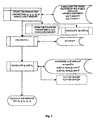
- Fig. 1 illustrates a cryptosystem 10 capable of taking advantage of the invention.
- the cryptosystem 10 signs and decrypts messages provided to it via an I/O port 12.
- the cryptosystem 10 uses the RSA scheme to perform the signing and decrypting.
- the cryptosystem 10 has a processor 14 that controls all operations of the cryptosystem 10.
- the cryptosystem 10 has an arithmetic coprocessor (ACP) 16 that facilitates the computations used in the RSA scheme when signing and decrypting.
- ACP arithmetic coprocessor
- the private key used to perform the signing and decrypting is stored in nonvolatile storage 18 within the crytposystem 10.
- the cryptosystem 10 is capable of storing a collection of private keys in the nonvolatile storage 18 and selecting a private key to be used for a particular signing or decryption, according to commands given to it via the I/O port 12.
- the crytposystem 10 is capable of computing the public key that corresponds to any private key stored in the nonvolatile storage 18 and transmitting the public key to an external device 20 via the I/O port 12.
- the cryptosystem 10 is capable of generating private keys and storing them in the nonvolatile storage 18.
- the cryptosystem uses a random number generator (RNG) 22 to ensure that the prime factors p and q of the private key are arbitrarily picked.
- RNG 22 provides a random seed that is applied to an algorithm that generates p and q.
- the cryptosystem 10 may store the seed instead of storing p and q, recovering the values of p and q by applying the algorithm to the seed each time the private key is used to sign or decrypt.
- the crytposystem 10 is also capable of accepting private keys provided to it by external devices 20 via the I/O port 12 and storing the private keys in the nonvolatile storage 18.
- An externally provided private key may itself be encrypted by the external device using the public key that corresponds to one of the private keys already present in the nonvolatile storage 18 of the cryptosystem 10.
- the cryptosystem 10 decrypts the encrypted private key using the private key already in nonvolatile storage 18, then stores the decrypted private key in nonvolatile storage 18.
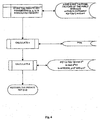
- the cryptosystem 10 is capable of using the invention to reduce the amount of nonvolatile storage 18 needed to store the private key, and to recover the private key quickly and without introducing security vulnerabilities.
- the crytposystem 10 has many related variations of how the invention can be applied to trade off storage space versus recovery speed.
- each could be computed using Euclid's algorithm, or a common variation thereof, although this may introduce a security vulnerability because the sequence of operations depends on p and q.
- e prime
Landscapes
- Engineering & Computer Science (AREA)
- Computer Security & Cryptography (AREA)
- Computer Networks & Wireless Communication (AREA)
- Signal Processing (AREA)
- Computing Systems (AREA)
- Theoretical Computer Science (AREA)
- Storage Device Security (AREA)
- Complex Calculations (AREA)
- Mobile Radio Communication Systems (AREA)
- Refuse Collection And Transfer (AREA)
- Two-Way Televisions, Distribution Of Moving Picture Or The Like (AREA)
- Vending Machines For Individual Products (AREA)
- Exchange Systems With Centralized Control (AREA)
- Stored Programmes (AREA)
- Medical Preparation Storing Or Oral Administration Devices (AREA)
- Lock And Its Accessories (AREA)
Claims (15)
- Dispositif de récupération de clé privée RSA en utilisant le Théorème du Reste Chinois (TRC) comprenant, de façon combinée :un processeur ;un espace mémoire non volatil fonctionnellement relié audit processeur ;un ensemble de paramètres de clés privées stockés dans ledit espace mémoire non volatil en utilisant moins d'espace de stockage que l'ensemble complet de paramètres {p, q, dp, dq, v} et fournissant une meilleure efficacité de calcul que l'ensemble minimal de paramètres {p, q}, p et q étant des facteurs premiers donnés d'un module public, dans lequel la clé privée peut être récupérée à partir dudit ensemble de paramètres de clés privées stockés ; etun moyen pour calculer dp à partir de dp = [1 + (p-1)(e-kp)] u mod 2b en coopération avec ledit processeur ; etun moyen pour calculer dq à partir de dq = [1 + (q-1)(e-kq)] u mod 2b en coopération avec ledit processeur ;
dans lequel b est un entier tel que p est inférieur à 2b et que q est inférieur à 2b, et ue mod 2b - 1, kp et kq sont déduits de kp (p-1) mod e=1 et kq (q-1) mod e=1, et e est un exposant public donné. - Dispositif de récupération de clé privée RSA selon la revendication 1, dans lequel ledit ensemble de paramètres de clés privées stockés comprend les paramètres {p, q, kp, kq}.
- Dispositif de récupération de clé privée RSA selon la revendication 1, dans lequel ledit ensemble de paramètres de clés privées stockés comprend les paramètres {germe, kp, kq}, où le germe est une valeur déduite d'un générateur de nombres aléatoires.
- Dispositif de récupération de clé privée RSA selon la revendication 1, dans lequel ledit ensemble de paramètres de clés privées stockés comprend le paramètre {germe}, dans lequel le germe est une valeur déduite d'un générateur de nombres aléatoires ; et comprenant en outre un moyen pour calculer kp à partir de kp (p-1) mod e=1 en coopération avec ledit processeur et un moyen pour calculer kq à partir de kq (q-1) mode e=1 en coopération avec ledit processeur.
- Dispositif de récupération de clé privée RSA selon la revendication 3 ou 4, comprenant en outre un moyen pour calculer p à partir dudit germe en coopération avec ledit processeur et un moyen pour calculer q à partir dudit germe en coopération avec ledit processeur.
- Dispositif de récupération de clé privée RSA selon la revendication 1, dans lequel ledit ensemble de paramètres de clés privées stockés comprend les paramètres {p, q}; et comprenant en outre un moyen pour calculer kp à partir de kp (p-1) mod e=1 en coopération avec ledit processeur et un moyen pour calculer kq à partir de kq (q-1) mod e=1 en coopération avec ledit processeur.
- Dispositif de récupération de clé privée RSA selon l'une quelconque des revendications 2 à 6, dans lequel ledit ensemble de paramètres de clés privées stockés comprend en outre le paramètre v qui est déduit de pv mod q=1.
- Dispositif de récupération de clé privée RSA selon l'une quelconque des revendications 2 à 6, comprenant en outre un moyen pour calculer le paramètre v à partir de pv mod q=1 en coopération avec ledit processeur.
- Dispositif de récupération de clé privée RSA selon l'une quelconque des revendications 6 à 8, comprenant en outre un moyen pour assembler les paramètres de clés privées {p, q, dp, dq, v} à partir desdites valeurs stockées et calculées.
- Dispositif de récupération de clé privée RSA n'utilisant pas le Théorème du Reste Chinois (TRC), comprenant, de façon combinée :un processeur ;un espace mémoire non volatil fonctionnellement relié audit processeur ;un ensemble de paramètres de clés privées stockés dans ledit espace mémoire non volatil en utilisant moins d'espace de stockage que l'ensemble complet de paramètres {n, d} et fournissant une meilleure efficacité de calcul que l'ensemble minimal de paramètres {p, q}, dans lequel ledit ensemble de paramètres de clés privées stockés comprend les paramètres {p, q, k}, dans lequel p et q sont des facteurs premiers donnés d'un module public, k est déduit de k (p-1) (q-1) mod e=1, et e est un exposant public donné ;un moyen pour calculer n à partir de n = pq en coopération avec ledit processeur ; etun moyen pour calculer d à partir de d = [1 + (p-1)(q-1)] t mod 22b en coopération avec ledit processeur,dans lequel te mod 22b =1 et b est un entier tel que p est inférieur à 2b et que q est inférieur à 2b.
- Dispositif de récupération de clé privée RSA selon la revendication 10, comprenant en outre un moyen pour assembler les paramètres de clés privées {n, d} à partir desdites valeurs stockées et calculées.
- Dispositif de récupération de clé privée RSA utilisant le Théorème du Reste Chinois (TRC), comprenant, de façon combinée :un processeur ;un espace mémoire non volatil fonctionnellement relié audit processeur ;un ensemble de paramètres de clés privées stockés dans ledit espace mémoire non volatil en utilisant moins d'espace de stockage que l'ensemble complet de paramètres {n, d} et fournissant une meilleure efficacité de calcul que l'ensemble minimal de paramètres {p, q}, dans lequel ledit ensemble de paramètres de clés privées stockés comprend les paramètres {p, q, k}, dans lequel p et q sont des facteurs premiers donnés d'un module public, k est déduit de k(p-1)(q-1) mod e=1, et e est un exposant public donné ;un moyen pour calculer n à partir de n=pq en coopération avec ledit processeur ;un moyen pour calculer d à partir de d = [1 + (p-1)(q-1)] t mod 22b en coopération avec ledit processeur, dans lequel te mod 22b = 1 et b est un entier tel que p est inférieur à 2b et que q est inférieur à 2b ;un moyen pour calculer dp à partir de dp = d mod(p-1) en coopération avec ledit processeur ; etun moyen pour calculer dq à partir de dq = d mod (q - 1) en coopération avec ledit processeur.
- Dispositif de récupération de clé privée RSA selon la revendication 12, comprenant en outre un moyen pour calculer le paramètre v à partir de pv mod q = 1 en coopération avec ledit processeur.
- Dispositif de récupération de clé privée RSA selon la revendication 13, comprenant en outre un moyen pour assembler les paramètres de clés privées {p, q, dp, dq, v} à partir desdites valeurs stockées et calculées.
- Procédé pour récupérer une clé privée en utilisant le dispositif de récupération de clé privée RSA selon l'une quelconque des revendications précédentes.
Applications Claiming Priority (3)
| Application Number | Priority Date | Filing Date | Title |
|---|---|---|---|
| US09/627,927 US6959091B1 (en) | 2000-07-28 | 2000-07-28 | Cryptography private key storage and recovery method and apparatus |
| US627927 | 2000-07-28 | ||
| PCT/US2001/023676 WO2002011360A2 (fr) | 2000-07-28 | 2001-07-26 | Procede et appareil de stockage et de recuperation de cles privees de cryptographie |
Publications (2)
| Publication Number | Publication Date |
|---|---|
| EP1305907A2 EP1305907A2 (fr) | 2003-05-02 |
| EP1305907B1 true EP1305907B1 (fr) | 2006-03-08 |
Family
ID=24516709
Family Applications (1)
| Application Number | Title | Priority Date | Filing Date |
|---|---|---|---|
| EP01963747A Expired - Lifetime EP1305907B1 (fr) | 2000-07-28 | 2001-07-26 | Procédé et appareil de stockage et de récuperation de clés privéees de cryptographie |
Country Status (16)
| Country | Link |
|---|---|
| US (1) | US6959091B1 (fr) |
| EP (1) | EP1305907B1 (fr) |
| JP (1) | JP2004505548A (fr) |
| KR (1) | KR100737667B1 (fr) |
| CN (1) | CN1314223C (fr) |
| AT (1) | ATE320124T1 (fr) |
| AU (1) | AU2001284673A1 (fr) |
| CA (1) | CA2417520A1 (fr) |
| CY (1) | CY1105328T1 (fr) |
| DE (1) | DE60117813T2 (fr) |
| DK (1) | DK1305907T3 (fr) |
| ES (1) | ES2255568T3 (fr) |
| NO (1) | NO20030415L (fr) |
| PT (1) | PT1305907E (fr) |
| RU (1) | RU2279766C2 (fr) |
| WO (1) | WO2002011360A2 (fr) |
Families Citing this family (14)
| Publication number | Priority date | Publication date | Assignee | Title |
|---|---|---|---|---|
| US6959091B1 (en) * | 2000-07-28 | 2005-10-25 | Atmel Corporation | Cryptography private key storage and recovery method and apparatus |
| FR2841411B1 (fr) * | 2002-06-19 | 2004-10-29 | Gemplus Card Int | Procede de generation de cles electroniques pour procede de crytographie a cle publique et objet portatif securise mettant en oeuvre le procede |
| CN1682484B (zh) * | 2002-09-11 | 2012-03-21 | 德国捷德有限公司 | 受保护的密码计算 |
| US7634659B2 (en) * | 2002-09-20 | 2009-12-15 | Cable Television Laboratories, Inc. | Roaming hardware paired encryption key generation |
| CN101243388A (zh) | 2005-08-19 | 2008-08-13 | Nxp股份有限公司 | 用于在加密计算中执行求逆运算的电路结构和方法 |
| CN101421973B (zh) * | 2006-04-12 | 2014-01-29 | 艾利森电话股份有限公司 | 具有共享事务处理的多个远程通信功能的方法和装置 |
| KR101491681B1 (ko) * | 2007-02-27 | 2015-02-09 | 톰슨 라이센싱 | 압축된 rsa 계수들을 발생시키기 위한 방법 및 디바이스 |
| EP1998491A1 (fr) * | 2007-05-31 | 2008-12-03 | Thomson Licensing | Procédé pour calculer des modules RSA compressés |
| TWI350454B (en) * | 2007-12-10 | 2011-10-11 | Phison Electronics Corp | Anti-attacking method for private key, controller and storage device executing the same |
| US9444622B2 (en) * | 2008-09-15 | 2016-09-13 | Hewlett Packard Enterprise Development Lp | Computing platform with system key |
| US8737617B2 (en) * | 2009-09-29 | 2014-05-27 | Panasonic Corporation | Encryption apparatus, decryption apparatus, encryption method, decryption method, and encryption/decryption system |
| CN104506506B (zh) * | 2014-12-15 | 2017-12-29 | 齐宇庆 | 一种电子信息安全存储系统及存储方法 |
| FR3088452B1 (fr) * | 2018-11-08 | 2023-01-06 | Idemia France | Procede de verification d'integrite d'une paire de cles cryptographiques et dispositif cryptographique |
| KR102851084B1 (ko) * | 2021-10-05 | 2025-08-28 | 주식회사 크립토랩 | 격자전자서명의 비밀 키 생성 방법 및 이를 이용한 장치 |
Family Cites Families (10)
| Publication number | Priority date | Publication date | Assignee | Title |
|---|---|---|---|---|
| RU2071180C1 (ru) * | 1993-08-02 | 1996-12-27 | Томский государственный университет | Способ шифрования сообщений открытым ключом и система для его осуществления |
| US5848159A (en) | 1996-12-09 | 1998-12-08 | Tandem Computers, Incorporated | Public key cryptographic apparatus and method |
| US6154541A (en) * | 1997-01-14 | 2000-11-28 | Zhang; Jinglong F | Method and apparatus for a robust high-speed cryptosystem |
| FR2759806B1 (fr) * | 1997-02-19 | 1999-04-23 | Gemplus Card Int | Systeme cryptographique comprenant un systeme de chiffrement et dechiffrement et un systeme de sequestre de cles, et les appareils et dispositifs associes |
| US5991415A (en) * | 1997-05-12 | 1999-11-23 | Yeda Research And Development Co. Ltd. At The Weizmann Institute Of Science | Method and apparatus for protecting public key schemes from timing and fault attacks |
| JPH1127253A (ja) * | 1997-07-07 | 1999-01-29 | Hitachi Ltd | 鍵回復システム、鍵回復装置、鍵回復プログラムを記憶した記憶媒体、および鍵回復方法 |
| US6708273B1 (en) * | 1997-09-16 | 2004-03-16 | Safenet, Inc. | Apparatus and method for implementing IPSEC transforms within an integrated circuit |
| US6081598A (en) * | 1997-10-20 | 2000-06-27 | Microsoft Corporation | Cryptographic system and method with fast decryption |
| RU2141169C1 (ru) * | 1997-10-30 | 1999-11-10 | Центральный Научно-Исследовательский Институт Связи | Способ передачи и приема с обеспечением подлинности сообщения |
| US6959091B1 (en) * | 2000-07-28 | 2005-10-25 | Atmel Corporation | Cryptography private key storage and recovery method and apparatus |
-
2000
- 2000-07-28 US US09/627,927 patent/US6959091B1/en not_active Expired - Lifetime
-
2001
- 2001-07-26 KR KR1020037001270A patent/KR100737667B1/ko not_active Expired - Fee Related
- 2001-07-26 ES ES01963747T patent/ES2255568T3/es not_active Expired - Lifetime
- 2001-07-26 PT PT01963747T patent/PT1305907E/pt unknown
- 2001-07-26 EP EP01963747A patent/EP1305907B1/fr not_active Expired - Lifetime
- 2001-07-26 JP JP2002515768A patent/JP2004505548A/ja not_active Abandoned
- 2001-07-26 RU RU2003105700/09A patent/RU2279766C2/ru not_active IP Right Cessation
- 2001-07-26 CA CA002417520A patent/CA2417520A1/fr not_active Abandoned
- 2001-07-26 CN CNB01816482XA patent/CN1314223C/zh not_active Expired - Fee Related
- 2001-07-26 AU AU2001284673A patent/AU2001284673A1/en not_active Abandoned
- 2001-07-26 DK DK01963747T patent/DK1305907T3/da active
- 2001-07-26 WO PCT/US2001/023676 patent/WO2002011360A2/fr not_active Ceased
- 2001-07-26 AT AT01963747T patent/ATE320124T1/de not_active IP Right Cessation
- 2001-07-26 DE DE60117813T patent/DE60117813T2/de not_active Expired - Lifetime
-
2003
- 2003-01-27 NO NO20030415A patent/NO20030415L/no not_active Application Discontinuation
-
2006
- 2006-04-13 CY CY20061100522T patent/CY1105328T1/el unknown
Also Published As
| Publication number | Publication date |
|---|---|
| ES2255568T3 (es) | 2006-07-01 |
| CN1466830A (zh) | 2004-01-07 |
| RU2279766C2 (ru) | 2006-07-10 |
| NO20030415L (no) | 2003-03-28 |
| WO2002011360A2 (fr) | 2002-02-07 |
| PT1305907E (pt) | 2006-07-31 |
| EP1305907A2 (fr) | 2003-05-02 |
| CA2417520A1 (fr) | 2002-02-07 |
| HK1062510A1 (en) | 2004-11-05 |
| WO2002011360A3 (fr) | 2002-06-13 |
| CY1105328T1 (el) | 2010-03-03 |
| KR100737667B1 (ko) | 2007-07-09 |
| AU2001284673A1 (en) | 2002-02-13 |
| NO20030415D0 (no) | 2003-01-27 |
| DE60117813T2 (de) | 2006-10-05 |
| ATE320124T1 (de) | 2006-03-15 |
| DE60117813D1 (de) | 2006-05-04 |
| DK1305907T3 (da) | 2006-06-26 |
| JP2004505548A (ja) | 2004-02-19 |
| KR20030075146A (ko) | 2003-09-22 |
| US6959091B1 (en) | 2005-10-25 |
| CN1314223C (zh) | 2007-05-02 |
Similar Documents
| Publication | Publication Date | Title |
|---|---|---|
| US5159632A (en) | Method and apparatus for public key exchange in a cryptographic system | |
| US5463690A (en) | Method and apparatus for public key exchange in a cryptographic system | |
| EP0997016B1 (fr) | Procede et appareil permettant le cryptage elliptique rapide par integration directe | |
| US7499544B2 (en) | Use of isogenies for design of cryptosystems | |
| US6618483B1 (en) | Elliptic curve encryption systems | |
| EP0946018B1 (fr) | Procédé de réalisation rapide d'un d'un déchiffrage ou d'une authentification | |
| US6252959B1 (en) | Method and system for point multiplication in elliptic curve cryptosystem | |
| US6266688B1 (en) | Scheme for arithmetic operations in finite field and group operations over elliptic curves realizing improved computational speed | |
| EP1305907B1 (fr) | Procédé et appareil de stockage et de récuperation de clés privéees de cryptographie | |
| Chang et al. | Parallel computation of the generating keys for RSA cryptosystems | |
| Vanstone et al. | Elliptic curve cryptosystems using curves of smooth order over the ring Z/sub n | |
| US6721771B1 (en) | Method for efficient modular polynomial division in finite fields f(2{circumflex over ( )}m) | |
| US7248692B2 (en) | Method of and apparatus for determining a key pair and for generating RSA keys | |
| EP3503459A1 (fr) | Dispositif et procédé pour protéger l'exécution d'une opération cryptographique | |
| JP2004304800A (ja) | データ処理装置におけるサイドチャネル攻撃防止 | |
| EP0952697A2 (fr) | Procédé et systèmede chiffrage utilisant une courbe elliptique | |
| Chou et al. | Elliptic curve cryptography and its applications to mobile devices | |
| US6826586B2 (en) | Method for efficient computation of point doubling operation of elliptic curve point scalar multiplication over finite fields F(2m) | |
| El-Kassar et al. | Modified RSA in the Domains of Gaussian Integers and Polynomials Over Finite Fields. | |
| US20040258240A1 (en) | Cryptosystems | |
| Kayode et al. | Efficient RSA cryptosystem decryption based on Chinese remainder theorem and strong prime | |
| Reddy | RM-RSA algorithm | |
| McIvor et al. | A high-speed, low latency RSA decryption silicon core | |
| CA2129203C (fr) | Chiffrement a cle revelee utilisant des courbes elliptiques | |
| El-Kassar et al. | ElGamal Public-Key cryptosystem in multiplicative groups of quotient rings of polynomials over finite fields |
Legal Events
| Date | Code | Title | Description |
|---|---|---|---|
| PUAI | Public reference made under article 153(3) epc to a published international application that has entered the european phase |
Free format text: ORIGINAL CODE: 0009012 |
|
| 17P | Request for examination filed |
Effective date: 20030205 |
|
| AK | Designated contracting states |
Designated state(s): AT BE CH CY DE DK ES FI FR GB GR IE IT LI LU MC NL PT SE TR |
|
| AX | Request for extension of the european patent |
Extension state: AL LT LV MK RO SI |
|
| 17Q | First examination report despatched |
Effective date: 20040514 |
|
| GRAP | Despatch of communication of intention to grant a patent |
Free format text: ORIGINAL CODE: EPIDOSNIGR1 |
|
| RTI1 | Title (correction) |
Free format text: CRYPTOGRAPHY PRIVATE KEY STORAGE AND RECOVERY METHOD AND APPARATUS |
|
| GRAS | Grant fee paid |
Free format text: ORIGINAL CODE: EPIDOSNIGR3 |
|
| GRAA | (expected) grant |
Free format text: ORIGINAL CODE: 0009210 |
|
| AK | Designated contracting states |
Kind code of ref document: B1 Designated state(s): AT BE CH CY DE DK ES FI FR GB GR IE IT LI LU MC NL PT SE TR |
|
| REG | Reference to a national code |
Ref country code: GB Ref legal event code: FG4D |
|
| REG | Reference to a national code |
Ref country code: CH Ref legal event code: EP |
|
| REG | Reference to a national code |
Ref country code: IE Ref legal event code: FG4D |
|
| REG | Reference to a national code |
Ref country code: SE Ref legal event code: TRGR |
|
| REF | Corresponds to: |
Ref document number: 60117813 Country of ref document: DE Date of ref document: 20060504 Kind code of ref document: P |
|
| REG | Reference to a national code |
Ref country code: GR Ref legal event code: EP Ref document number: 20060400873 Country of ref document: GR |
|
| REG | Reference to a national code |
Ref country code: DK Ref legal event code: T3 |
|
| REG | Reference to a national code |
Ref country code: ES Ref legal event code: FG2A Ref document number: 2255568 Country of ref document: ES Kind code of ref document: T3 |
|
| REG | Reference to a national code |
Ref country code: PT Ref legal event code: SC4A Effective date: 20060518 |
|
| ET | Fr: translation filed | ||
| PLBE | No opposition filed within time limit |
Free format text: ORIGINAL CODE: 0009261 |
|
| STAA | Information on the status of an ep patent application or granted ep patent |
Free format text: STATUS: NO OPPOSITION FILED WITHIN TIME LIMIT |
|
| 26N | No opposition filed |
Effective date: 20061211 |
|
| PGFP | Annual fee paid to national office [announced via postgrant information from national office to epo] |
Ref country code: CH Payment date: 20080730 Year of fee payment: 8 Ref country code: DK Payment date: 20080729 Year of fee payment: 8 Ref country code: ES Payment date: 20080728 Year of fee payment: 8 Ref country code: LU Payment date: 20080804 Year of fee payment: 8 Ref country code: PT Payment date: 20080708 Year of fee payment: 8 |
|
| PGFP | Annual fee paid to national office [announced via postgrant information from national office to epo] |
Ref country code: AT Payment date: 20080702 Year of fee payment: 8 Ref country code: FI Payment date: 20080730 Year of fee payment: 8 Ref country code: IE Payment date: 20080725 Year of fee payment: 8 Ref country code: IT Payment date: 20080724 Year of fee payment: 8 Ref country code: MC Payment date: 20080702 Year of fee payment: 8 Ref country code: NL Payment date: 20080724 Year of fee payment: 8 |
|
| PGFP | Annual fee paid to national office [announced via postgrant information from national office to epo] |
Ref country code: CY Payment date: 20080721 Year of fee payment: 8 |
|
| PGFP | Annual fee paid to national office [announced via postgrant information from national office to epo] |
Ref country code: TR Payment date: 20080704 Year of fee payment: 8 |
|
| PGFP | Annual fee paid to national office [announced via postgrant information from national office to epo] |
Ref country code: BE Payment date: 20080818 Year of fee payment: 8 Ref country code: SE Payment date: 20080729 Year of fee payment: 8 |
|
| PGFP | Annual fee paid to national office [announced via postgrant information from national office to epo] |
Ref country code: GR Payment date: 20080729 Year of fee payment: 8 |
|
| PGFP | Annual fee paid to national office [announced via postgrant information from national office to epo] |
Ref country code: FR Payment date: 20090717 Year of fee payment: 9 |
|
| PGFP | Annual fee paid to national office [announced via postgrant information from national office to epo] |
Ref country code: GB Payment date: 20090727 Year of fee payment: 9 |
|
| BERE | Be: lapsed |
Owner name: *ATMEL CORP. Effective date: 20090731 |
|
| REG | Reference to a national code |
Ref country code: PT Ref legal event code: MM4A Free format text: LAPSE DUE TO NON-PAYMENT OF FEES Effective date: 20100126 |
|
| PG25 | Lapsed in a contracting state [announced via postgrant information from national office to epo] |
Ref country code: MC Free format text: LAPSE BECAUSE OF NON-PAYMENT OF DUE FEES Effective date: 20090731 |
|
| REG | Reference to a national code |
Ref country code: CH Ref legal event code: PL |
|
| REG | Reference to a national code |
Ref country code: DK Ref legal event code: EBP |
|
| EUG | Se: european patent has lapsed | ||
| NLV4 | Nl: lapsed or anulled due to non-payment of the annual fee |
Effective date: 20100201 |
|
| PG25 | Lapsed in a contracting state [announced via postgrant information from national office to epo] |
Ref country code: PT Free format text: LAPSE BECAUSE OF NON-PAYMENT OF DUE FEES Effective date: 20100126 Ref country code: CH Free format text: LAPSE BECAUSE OF NON-PAYMENT OF DUE FEES Effective date: 20090731 Ref country code: LI Free format text: LAPSE BECAUSE OF NON-PAYMENT OF DUE FEES Effective date: 20090731 Ref country code: FI Free format text: LAPSE BECAUSE OF NON-PAYMENT OF DUE FEES Effective date: 20090726 |
|
| PG25 | Lapsed in a contracting state [announced via postgrant information from national office to epo] |
Ref country code: CY Free format text: LAPSE BECAUSE OF NON-PAYMENT OF DUE FEES Effective date: 20090726 |
|
| PG25 | Lapsed in a contracting state [announced via postgrant information from national office to epo] |
Ref country code: BE Free format text: LAPSE BECAUSE OF NON-PAYMENT OF DUE FEES Effective date: 20090731 Ref country code: AT Free format text: LAPSE BECAUSE OF NON-PAYMENT OF DUE FEES Effective date: 20090726 |
|
| PG25 | Lapsed in a contracting state [announced via postgrant information from national office to epo] |
Ref country code: IE Free format text: LAPSE BECAUSE OF NON-PAYMENT OF DUE FEES Effective date: 20090727 Ref country code: DK Free format text: LAPSE BECAUSE OF NON-PAYMENT OF DUE FEES Effective date: 20090731 |
|
| REG | Reference to a national code |
Ref country code: ES Ref legal event code: FD2A Effective date: 20090727 |
|
| PG25 | Lapsed in a contracting state [announced via postgrant information from national office to epo] |
Ref country code: GR Free format text: LAPSE BECAUSE OF NON-PAYMENT OF DUE FEES Effective date: 20100204 Ref country code: ES Free format text: LAPSE BECAUSE OF NON-PAYMENT OF DUE FEES Effective date: 20090727 |
|
| GBPC | Gb: european patent ceased through non-payment of renewal fee |
Effective date: 20100726 |
|
| PG25 | Lapsed in a contracting state [announced via postgrant information from national office to epo] |
Ref country code: IT Free format text: LAPSE BECAUSE OF NON-PAYMENT OF DUE FEES Effective date: 20090726 |
|
| REG | Reference to a national code |
Ref country code: FR Ref legal event code: ST Effective date: 20110331 |
|
| PG25 | Lapsed in a contracting state [announced via postgrant information from national office to epo] |
Ref country code: LU Free format text: LAPSE BECAUSE OF NON-PAYMENT OF DUE FEES Effective date: 20090726 |
|
| PG25 | Lapsed in a contracting state [announced via postgrant information from national office to epo] |
Ref country code: SE Free format text: LAPSE BECAUSE OF NON-PAYMENT OF DUE FEES Effective date: 20090727 Ref country code: FR Free format text: LAPSE BECAUSE OF NON-PAYMENT OF DUE FEES Effective date: 20100802 |
|
| PG25 | Lapsed in a contracting state [announced via postgrant information from national office to epo] |
Ref country code: GB Free format text: LAPSE BECAUSE OF NON-PAYMENT OF DUE FEES Effective date: 20100726 |
|
| PG25 | Lapsed in a contracting state [announced via postgrant information from national office to epo] |
Ref country code: NL Free format text: LAPSE BECAUSE OF NON-PAYMENT OF DUE FEES Effective date: 20100201 |
|
| PG25 | Lapsed in a contracting state [announced via postgrant information from national office to epo] |
Ref country code: TR Free format text: LAPSE BECAUSE OF NON-PAYMENT OF DUE FEES Effective date: 20090726 |
|
| PGFP | Annual fee paid to national office [announced via postgrant information from national office to epo] |
Ref country code: DE Payment date: 20190620 Year of fee payment: 19 |
|
| REG | Reference to a national code |
Ref country code: DE Ref legal event code: R119 Ref document number: 60117813 Country of ref document: DE |
|
| PG25 | Lapsed in a contracting state [announced via postgrant information from national office to epo] |
Ref country code: DE Free format text: LAPSE BECAUSE OF NON-PAYMENT OF DUE FEES Effective date: 20210202 |