EP1310567A2 - Nukleinsäure-Array - Google Patents
Nukleinsäure-Array Download PDFInfo
- Publication number
- EP1310567A2 EP1310567A2 EP02090348A EP02090348A EP1310567A2 EP 1310567 A2 EP1310567 A2 EP 1310567A2 EP 02090348 A EP02090348 A EP 02090348A EP 02090348 A EP02090348 A EP 02090348A EP 1310567 A2 EP1310567 A2 EP 1310567A2
- Authority
- EP
- European Patent Office
- Prior art keywords
- acc
- protein
- receptor
- kinase
- factor
- Prior art date
- Legal status (The legal status is an assumption and is not a legal conclusion. Google has not performed a legal analysis and makes no representation as to the accuracy of the status listed.)
- Withdrawn
Links
Classifications
-
- C—CHEMISTRY; METALLURGY
- C12—BIOCHEMISTRY; BEER; SPIRITS; WINE; VINEGAR; MICROBIOLOGY; ENZYMOLOGY; MUTATION OR GENETIC ENGINEERING
- C12Q—MEASURING OR TESTING PROCESSES INVOLVING ENZYMES, NUCLEIC ACIDS OR MICROORGANISMS; COMPOSITIONS OR TEST PAPERS THEREFOR; PROCESSES OF PREPARING SUCH COMPOSITIONS; CONDITION-RESPONSIVE CONTROL IN MICROBIOLOGICAL OR ENZYMOLOGICAL PROCESSES
- C12Q1/00—Measuring or testing processes involving enzymes, nucleic acids or microorganisms; Compositions therefor; Processes of preparing such compositions
- C12Q1/68—Measuring or testing processes involving enzymes, nucleic acids or microorganisms; Compositions therefor; Processes of preparing such compositions involving nucleic acids
- C12Q1/6876—Nucleic acid products used in the analysis of nucleic acids, e.g. primers or probes
- C12Q1/6883—Nucleic acid products used in the analysis of nucleic acids, e.g. primers or probes for diseases caused by alterations of genetic material
-
- C—CHEMISTRY; METALLURGY
- C12—BIOCHEMISTRY; BEER; SPIRITS; WINE; VINEGAR; MICROBIOLOGY; ENZYMOLOGY; MUTATION OR GENETIC ENGINEERING
- C12Q—MEASURING OR TESTING PROCESSES INVOLVING ENZYMES, NUCLEIC ACIDS OR MICROORGANISMS; COMPOSITIONS OR TEST PAPERS THEREFOR; PROCESSES OF PREPARING SUCH COMPOSITIONS; CONDITION-RESPONSIVE CONTROL IN MICROBIOLOGICAL OR ENZYMOLOGICAL PROCESSES
- C12Q1/00—Measuring or testing processes involving enzymes, nucleic acids or microorganisms; Compositions therefor; Processes of preparing such compositions
- C12Q1/68—Measuring or testing processes involving enzymes, nucleic acids or microorganisms; Compositions therefor; Processes of preparing such compositions involving nucleic acids
- C12Q1/6813—Hybridisation assays
- C12Q1/6834—Enzymatic or biochemical coupling of nucleic acids to a solid phase
- C12Q1/6837—Enzymatic or biochemical coupling of nucleic acids to a solid phase using probe arrays or probe chips
-
- C—CHEMISTRY; METALLURGY
- C12—BIOCHEMISTRY; BEER; SPIRITS; WINE; VINEGAR; MICROBIOLOGY; ENZYMOLOGY; MUTATION OR GENETIC ENGINEERING
- C12Q—MEASURING OR TESTING PROCESSES INVOLVING ENZYMES, NUCLEIC ACIDS OR MICROORGANISMS; COMPOSITIONS OR TEST PAPERS THEREFOR; PROCESSES OF PREPARING SUCH COMPOSITIONS; CONDITION-RESPONSIVE CONTROL IN MICROBIOLOGICAL OR ENZYMOLOGICAL PROCESSES
- C12Q2600/00—Oligonucleotides characterized by their use
- C12Q2600/158—Expression markers
Definitions
- the invention relates to tools for diagnostic, prognostic and chronic therapy monitoring analysis inflammatory diseases, bacterially induced chronic inflammatory diseases, arteriosclerosis, tumor diseases, organ and tissue transplants, and sepsis to examine blood, tissue, purified or cultured cells.
- Acute and chronic inflammatory processes in the blood and vascular system, as well as in the tissue can lead to pathological deposits, fibrotic remodeling processes and also for direct Destruction of tissues and organs.
- the cells of the monocyte / macrophage system are on the activation and maintenance of inflammatory cascades in blood and tissue e.g. in the context of inflammatory rheumatic Diseases, bacterially induced inflammatory Diseases, tumor diseases, organ and tissue transplantation, arteriosclerosis and the sepsis is significantly involved.
- monocytes and macrophages are highly activated, show Changes in the build-up of their surface molecules occur in contact with other cells and secrete certain ones Messenger substances that ensure the inflammatory process to chat. In addition to unspecific inflammatory reactions also for specific stimulation of the immune system.
- Autoimmune diseases and / or inflammatory diseases can in principle affect every organ system.
- diseases of the skeletal and Supporting apparatus rheumatoid arthritis, reactive arthritis, Bechterew's disease, osteoarthritis and abrasion synovitis
- the liver autoimmune hepatitis, chronic viral hepatitis, primary biliary cirrhosis
- endocrine organs pancreas: Juvenile Type I Diabetes; Thyroid: Hashimoto's thyroiditis, Graves' disease
- the skeletal muscles polymyositis, with skin involvement dermatomyositis
- the heart muscle rheumatic fever, dilated cardiomyopathy, viral Myocarditis
- the skin scleroderma, psoriasis, neurodermatitis
- the lungs pulmonary fibrosis, goodpasture syndrome, chronic obstructive pulmonary disease, sarcoidos
- Rheumatoid arthritis is an inflammatory, chronic inflammatory joint disease, which is progressive Destruction of the affected joints leads. It show both the circulating monocytes in peripheral blood a cell activation on as well as the more differentiated Cells of the monocyte / macrophage system, the in the joint as synovial macrophages and dentritic cells available. This is reflected in comparable transcription patterns for inflammatory characteristic proteins (Messenger substances, proteases, etc.) again. So far rheumatoid arthritis based only on clinical ACR criteria and through pathohistological examinations of the affected tissue can be diagnosed. Frequently the disease is already relatively advanced and already irreversible damage to the joint occurred. Thereby, therapeutic measures do not come rarely used too late at the the autoagressive damage has already occurred and are irreversible.
- the characteristic gene expression pattern include. This gene expression pattern contain both inflammation-specific gene expressions, on the other hand also tumor-specific gene regulations.
- monocytes are already in the peripheral Blood activated and stimulated to be destroyed, to bind inflammation-specific regions of the arteries. Communication through cell-cell contact with endothelial cells contributes to the activation and recruitment of the Maintain monocyte / macrophage system.
- tools are provided according to the invention which are designed using the sequences of a selection of genes mentioned below or using the sequences of all genes mentioned below, also using other genes or RNA complementary to said genes: Cytokines and factors and ligands: Interleukin-1 ⁇ (Acc. # NM_000575) Interleukin-1 ⁇ (Acc. # NM_000576) Interleukin-6 (Acc. # AF372214) Interleukin-8 (Acc. # L19591) Interleukin-10 (Acc. # XM_001409) Interleukin-13 (Acc. # HSU62858) Interleukin-15 (Acc. # XM_003529) Interleukin-16 (Acc. # AF053412) Interleukin-18 (Acc.
- Angiopoietin-like factor CTD6
- CCD6 Angiopoietin-like factor
- IHBB Inhibin ⁇ -B
- Tumor necrosis factor- ⁇ Acc. # NM_000595
- Tumor necrosis factor- ⁇ Acc. # D12614
- TGF- ⁇ Transforming Growth Factor- ⁇
- Latent TGF- ⁇ binding prot. LTBP4 (Acc. # NM_003573, XM_008868) Melanoma stimulating activity (MGSA) (Acc.
- Chemokine Gro- ⁇ / MGSA (Acc. # X12510, XM_003504) Chemokine (CXC motif) ligand 16 (Acc. # NM_022059) Chemokine alpha-3 (CKA3) (Acc. # NM_002993) CC Chemokine (SLC) (Acc. # AB002409) EBI-1 ligand chemokines (Acc. # AB000887) Small inducible cytokine subfamily A (SCYA21) (Acc. # XM_048450) Small inducible cytokine (SCYA21) (Acc. # NM_002989) Megakaryocyte stimulating factor (Acc.
- M-CSF Monocyte colony stimulating factor
- GM-CSF Granulo- / Monocyte colony stimu. factor
- MIP-1 Macrophage inflammatory protein
- MIP-2 Macrophage inflammatory protein
- MIF Monocyte migration inhibitory factor
- M16553 Monocyte tissue factor
- MCP-1 Monocyte Chemoattractant Protein-1 (MCP-1) (Acc. # S71513) Monocyte Chemoattractant Protein-2 (MCP-2) (Acc.
- MCP-3 Monocyte Chemoattractant Protein-3 (MCP-3) (Acc. # X72308; S57464)
- MCP-3 Monocyte Chemoattractant Protein-3
- SDF-1 Stromal derived factor-1
- Insulin-like growth factor-5 bind. protein
- Receptors, ion channels and associated proteins Angiotensin Receptor II Homolog (ATR-IIh) (Acc. # L48211) Great-like receptor-2 (Acc. # XM_003304) Great-like receptor-4 (Acc. # XM_005336) Kappa opoid receptor (Acc.
- Interleukin-1 receptor (Acc. # XM_002686) Interleukin-2 receptor ⁇ subunit (Acc. # XM_043149) Interleukin-2 Receptor ⁇ subunit (Acc. # XM_009962, M26062) Interleukin-2 Receptor ⁇ subunit (Acc. # XM_047675) Interleukin-7 receptor (Acc. # AH007043, NM_008372) Interleukin-8 receptor ⁇ (IL8RA) (Acc. # XM_058007) Interleukin 8 receptor ⁇ (IL8RB) (Acc. # NM_001557 Fc receptor I (Acc.
- Fc receptor II (Acc. # M28696, M28697) Fc receptor III (Acc. # Z46223, Z46223) Tumor necrosis factor- ⁇ receptor (Acc. # S63368) C-Chemokine (CC motif) receptor-5 (CCR5) (Acc. # NM_000579, XM_030397) C-Chemokine (CC motif) Receptor-7 (CCR7) (Acc. # XM_049959) XC chemokine receptor-4 (CXCR-4) (Acc. # NM_003467) Progesterone Recept.-assoc. Immunophilin (FKBP54) (Acc.
- NK receptor Partial p58 gene for NK receptor (Acc. # AJ000542) Vascular endothial growth factor (Acc. # AY047581) Vascular endothial growth factor- ⁇ (Acc. # BC008818) Calcium activated potassium channel (KCNN3) (Acc. # AF031815, AY049734) G protein-coupled cytokine receptor EBI1 (Acc. # L31581) G protein-coupled cytokine receptor EBI3 (Acc. # XM_012857, L08187) EBI3-associated protein (Acc. # U41806) Membrane proteins and associated proteins: CD14 (Acc. # XM_003822) CD68 (Acc. # XM_008237) CD69 (Acc.
- CD11b (Acc. # J03925) Adhesion receptor CD44 (Acc. # M31165) Actin binding coronin like protein (HCORO1) (Acc. # U34690) Integral membrane protein (Acc. # L32185) Epithelial membrane prot.-3 (EMP-3) / HMPMP-1 (Acc. # X94771, U87947) Mac-2 binding protein (Acc. # L13210) Integral membrane protein E16 (Acc. # M80244) HLA-D II beta chain (Acc. # X03066) desmin (Acc. # HSU59167, XM_002601) Fibronectin precursor (Acc. # X02761) Adducin 1 ⁇ (Acc.
- HLA DRB1 (Acc. # X88971) Integrin- ⁇ 5 subunit (Acc. # X06256) Integrin cytopl. domain assoc. protein (Icap-1 ⁇ ) (Acc. # AF012023) Integrin cytopl. domain assoc. protein (Icap-1 ⁇ ) (Acc. # AF012024) titin (Acc. # X69490, NM_003319) Thrombospondin-1 (TSP-1) (Acc. # XM_007606) Semaphorin 3 (Acc. # AB000220) Semaphorin-F homolog (Acc. # U52840) TSP-2 (Acc.
- TSP-1 / Semaphorin-5a homolog (Acc. # NM_003966) VCAM-1 (Acc. # X53051) Periplakin (PPL) (Acc. # XM_032727, NM_002705) Envoplakin (EVPL) (Acc. # XM_008135) Peripheral myelin protein 22 (PMP-22) (Acc. # XM_052499) (Proto) -onoco-, tumor-suppressor, differentiation genes & associated proteins: H19 RNA (Acc. # M32053) Tumor suppressor Brush-1 (Acc. # S69790) Pim-2 proto-oncogene (Acc.
- c-fos related antigen fra-1 (Acc. # X16707) c-fos related antigen (fra-2) (Acc. # X16706)
- Acute phase protein Large-ferritin subunit (Acc. # M11146) Small-ferritin subunit (Acc. # NM_000146)
- Enzymes, enzyme-associated proteins and inhibitors Activation-induced cytidine deaminase (Acc. # AB040431, NM_020661) Phospholipase C (Acc. # XM_041310) Prostaglandin G / H synthase (Acc.
- Metallothionein 1L (Acc. # NM_002450) Manganese superoxide dismutase (Mn-SOD) (Acc. # S77127) Superoxide dismutase 1 (Acc. # K00065) Superoxide dismutase 2 (Acc. # NM_000636) Superoxide dismutase 3 (Acc. # NM_003102) Copper / zinc-superoxide dismutase (Cu / Zn-SOD) (Acc. # M13267) Catalane (Acc. #) Monoamine oxidase-A (MAOA) (Acc. # M68840, XM_055485) Fatty acid synthetase (Acc.
- Glutathione peroxidase (Acc. # X13710) Glutathione peroxidase 3 (Acc. # NM_002084) glucocerebrosidase (Acc. # M16328) Inducible nitric oxide synthase (Acc. # AB022318) Transglutaminase 1 (K polypeptide) (Acc. # XM_007310) Transglutaminase (TGase) (Acc. # M55153, SEG_HUMETG) * ⁇ -1-antitrypsin (Acc. # HSATPR1) Protein tyrosine phosphatase (Acc. # U27193) Carbonic anhydrase precursor (CA 12) (Acc.
- Metallothionein IG gene (MT1G) (Acc. # J03910) Lymphocyte phosphatase assoc. Protein (LPAP) (Acc. # X97267, AA011257) Flap Endonuclease 1 DNA repair gene (FEN1) (Acc. # AC004770) Flap structure-specific endonuclease 1 (FEN1) (Acc. # L37374, XM_043386) Kinases, protein kinases (PKN) and PKN inhibitors: Protein Kinase C-alpha subunit (Acc. # X52479) Protein kinase C-beta-1 subunit (Acc.
- Protein kinase C-beta-2 subunit (Acc. # M13975) Protein Kinase C-gamma subunit (Acc. # M34182) Protein kinase C-delta subunit (Acc. # D10495) Protein Kinase-C inhibitor (Acc. # U51004 Ik kinase ⁇ (Acc. # AF029684 PI3 kinase (Acc. # Y13892) MAP Kinase-11 (Acc. # XM_035889) p38 MAP kinase (Acc. # AF031135) p38 MAP kinase interacting protein (Acc.
- Thyrosine kinase 1 (Acc. # XM_002037) Thyrosine kinase 2 (TIE-2) (Acc. # XM_005480)
- WNT 6 (Acc. # AY009401, AB059570)
- WNT-13 (Acc. # Z71621)
- BMP-4 (Acc. # M22490)
- MMP matrix metalloproteinases
- Cathepsin B (Acc. # XM_035662) Cathepsin G (Acc. # M16117)
- Cathepsin K (Acc. # NM000396)
- Cathepsin L (Acc.
- Apoptosis and cell cycle regulators Annexin A-2II (Acc. # BC001388) Growth arrest DNA damage induc. prot. (GADD45) (Acc. # M60974) Growth arrest DNA damage induc. prot. ⁇ (GADD45A) (Acc. # XM_056975, XM_040594) Growth arrest DNA damage induc. prot. ⁇ (GADD45B) (Acc. # NM_015675, AF087853) Growth arrest DNA damage indcu. prot.g (GADD45G) (Acc. # NM_006705) Lymphocyte G0 / G1 switch gene (GOS-3) (Acc. # L49169) Signal transduction regulators: STAT-1 (Acc.
- AK1 Adenylate kinase 1 (AK1) (Acc. # NM_000476) Inositol 1,4,5-trisphosphate 3-kinase (ITPKC) (Acc. # XM_047369, XM_047368) Phosphatidylinositol-3'-kinase (PI3K) (Acc. # Y11312) Transcription factors, translation factors and associated proteins: Transcription factor AREB6 (Acc. # D15050) Transcription factor 8 (TCF8) (Acc. # XM_030006) Nuclear factor kappa-B (Acc. # M58603) AP-1 (Acc.
- snRNA activating protein complex (Acc. # AF032387) oct-binding factor-1 (OBF-1) (Acc. # Z49194) Early Growth Response protein 1 (EGR-1) (Acc. # R75775) Ribosomal / ribonuke regulatory genes and associated proteins: hnRNP pseudogene (gp43) (position: 97.026-98.073) (Acc. # AL034397) Ribosomal protein L19 (Acc. # XM_002758) Ribosomal protein S13 (Acc. # XM_039215) Histone H1 (0) family mRNA (Acc.
- PLAB / MIC-1 (Acc. # NM_004864) PLAB / MIC-1 (Acc. # NM_004864) EAP (HBp15 / L22) (Acc. # NM_006755) Small Proline-rich protein-1 (Acc. # L05187) NAG-1 (Acc. # AF173860) BST-1 (Acc. # D21878) II56KD (Acc. # M24594) Fibulin-1 D (Acc. # NM_006486) Nebulin (Acc. # XM_040435) VDUP1 upregulated by 1,25-dihydroxyvitamin D-3 (Acc. # XM_002093, XP_002093) Tumor necrosis factor stimulated gene (TSG-6) (Acc.
- TSG-37 Tumor necrosis factor stimulated gene
- osteopontin Acc. # AF0521214
- TTP Tristan Traoline
- Nephropontin Acc. # M83248
- Tonsillar lymphocyte LD78 mRNA Acc. # X03754
- MB-1 gene CD79a-B cell
- Human glycoprotein gp39
- Glia derived nexin precursor Acc. # AI743134
- Heat shock protein 70B HSP-70B
- Apolipoprotein D Acc.
- DR1-associated corepressor DR1-associated protein 1 (neg. Cofactor 2 ⁇ )
- FK506 bind.- 12-rapamycin assoc.prot.1 (FRAP1) (Acc. # XM_001528, XM_042283) Microfibril-associated glycoprotein-2 (MAGP-2) (Acc.
- Adrenomedullin (ADM) precursor (Acc. # NM_001124, XM_051743) DNA damage inducible transcript 3, clone MGC: 4154 (Acc. # BC003637) Calretinin - calcium binding protein (Acc. # X56667) Breakpoint cluster region (BCR) mRNA (Acc. # XM_017097) Adipose most abundant gene transcript 1 (APM1) (Acc. # NM_004797, XM_003191) Novel adipose specific collagen-like factor (Acc. # D45371) Functionally unknown genes and ESTs: IMAGE 745750 (Acc. # AA420624) KIAA0935 (Acc.
- beta-actin Acc. # XM_037239
- gamma-actin Acc. # NM_001614
- Glyceraldehyde-3-phosphate dehydrogenase Acc. # XM_033258
- Glucose-6-phosphate dehydrogenase Acc. # XM_013149
- 28S rRNA Acc. # M27830
- 18S rRNA Acc. # M10098
- genes or tools that use these genes are preferably used to characterize the molecular Processes especially in the monocyte / macrophage system used in diseases mentioned.
- genes or gene sequences can be used according to the invention also about alleles, derivatives or splicing variants act.
- genes were derived from differential gene expression analyzes using gene subtraction methods from blood and tissue samples chronic inflammatory diseases and more suitable Controls (samples from normal donors or patients with degenerative diseases).
- the molecular tool provides the ability to molecularly characterize a disease and derive from it 1.) a molecular Classification and stage classification of a clinically defined inflammatory disease, 2.) the establishment of a individual forecast profile, 3.) suggestions for the molecular pathogenesis, 4.) therapeutic effects and possibilities therapy monitoring and 5.) development new therapy strategies and pharmacological concepts to allow.
- DNA / RNA microarrays and fluorescence cytometric Procedures, diagnostics, prognostics and Therapy monitoring can be used.
- DNA / RNA microarrays are arrays of molecular species a carrier, the finding of interacting species (e.g. complementary nucleic acids).
- Carrier materials (glass, plastic) used and chemically activated or modified, with amino link core binding reactive groups, metal compounds or alloys reactively coated for a permanent bond from the cDNA, partial cDNA sequences, oligonucleotides and RNA from the selective gene segments of the investigated To reach genes.
- the individual cDNAs, RNAs or Oligonucleotides are made by suitable printing methods applied site-specifically. Alternatively, lithographic Synthetic processes are used to provide appropriate Oligonucleotide sequences direct and site-specific to synthesize on the carrier.
- amino linkers are preferred coupled cDNA's as well as modified DNA oligomers and chemically activated glass surfaces of the biochips applied.
- a DNA microarray for diagnostic, prognostic and therapy monitoring analysis of chronic inflammatory diseases, bacterial induced inflammation, tumor diseases, arteriosclerosis and the sepsis provided, on the surface of which Many selective monocyte / macrophage genes, their Gene sections or oligomer sequences bound for detection are.
- Selective genes or their gene segments are involved it is preferably a solid phase Gene library, which is preferably cloned as a cDNA library is present in phages or plasmids.
- the cDNA library has at least the following Genes or sections of genes relevant to the diseases mentioned are representative.
- Carrier materials glass, plastic used and chemically activated or modified, with amino link core binding reactive groups, metal compounds or alloys reactively coated for a permanent bond from the cDNA, RNA or oligonucleotides from the selective To reach gene segments of the genes to be examined.
- carrier materials Non membranes
- the individual cDNAs, RNAs or Oligonucleotides are made by suitable printing methods (Piezo or needle technology) applied site-specifically.
- in situ oligonucleotide synthesis methods can be used are used to generate appropriate oligonucleotides to synthesize directly and site-specifically on the carrier.
- the beads chemically activated or modified, binding with amino linker reactive groups, or other reactive groups coated in the form of metal compounds or alloys to be a permanent binding of the cDNAs, or RNAs To ensure oligonucleotides.
- Binding the cDNAs, RNAs or oligonucleotides are made by incubating the respective beads of a size in suitable solutions, the respective cDNA, RNA or the oligonucleotide included and a tight bond to the pearls Convey (beads).
- the different populations of nucleotide sequence load-bearing beads, each individual nucleotide sequence of a defined pearl size or assigned fluorescent dyes is mixed in equal proportions of pearls so that a defined selection of genes simultaneously in one approach can be examined.
- the sample to be examined is marked e.g. directly with a fluorescent dye or with a bridge molecule such as. Biotin or digoxigenin for later Binding of the fluorescent dye with or without signal amplification preferably over streptavidin or anti-digoxigenin antibodies coupled to streptavidin.
- a fluorescent dye or with a bridge molecule such as. Biotin or digoxigenin for later Binding of the fluorescent dye with or without signal amplification preferably over streptavidin or anti-digoxigenin antibodies coupled to streptavidin.
- the Fluorescence cytometry can be used for this purpose also about fluorescence-specific antibodies on the Recognize a defined target antigen on the surface of the beads, with or without reinforcements with the biotin streptavidin System.
- it can also be based on filter membranes Technology with radioactivity in the detection process be worked.
- Hybridization of the labeled sample with the array or the nucleotide sequence carrying beads quantitative and can after final marking with a fluorescent dye using an appropriate laser scanner on the array or in a FACS analyzer be read out quantitatively.
- the tools of the invention are as follows Process made:
- the selective molecular used in the process cell / tissue and inflammation-specific tools were generated by gene subtraction.
- the cDNA is produced by transcribing the mRNA by reverse transcription.
- the mRNA is derived from inflammatory human blood monocytes or the inflammatory tissue area with high macrophage infiltration from patients with inflammatory diseases, which are cleaned conventionally or alternatively via positive or negative selection. In particular, negative selection is used to avoid activation artifacts that can arise during cleaning.
- the reverse-transcribed cDNA single strands are transcribed into cDNA double strands with DNA polymerase.
- the cloning takes place in plasmid and / or phage vectors, unidirectionally or bidirectionally directed via adapter or linker molecules.
- the differential hybridization with labeled cDNA probes (radioactivity, digoxigenin, biotin or others) takes place.
- the differential expression analysis is carried out alternatively via DD or RDA or via classic gene subtraction methods by hybridizing the mRNA of the one with the complementary cDNA of the second cell pool.
- either the cloned units are preferably amplified by means of PCR using NH 2 -labeled standard primers for lambda, T3 / T7 / SP6 / M13 and then purified using column exclusion methods. The NH2-labeled DNA is then concentrated by precipitation followed by centrifugation.
- the mask is applied in a first step to the substrate wafer, which is positioned with the aid of alignment marks.
- the individual pressure pores are controlled microfluidically via a channel.
- the corresponding sample substance eg oligomer nucleotides with a length of 20-50 nucleotides
- the mask is removed and rinsed. After repositioning (moving by a corresponding spot unit), the cycle can be run through again.
- reproducibly low-integrated DNA arrays with 400 spots per unit or highly integrative arrays with a size of up to 20,000 spots can be produced.
- the invention is based on the consideration that a selective differential gene spot pattern, its underlying Sequences by a strongly selective Methods generated were used on a microarray can be, compared to previously used DNA microarrays the advantage in a reduced production and an effort and cost-reduced analysis consists.
- RNA microarrays are blood or tissue-specific RNA molecules that are chronic from patient materials inflammatory diseases, bacterially induced inflammatory diseases, tumor diseases, atherosclerosis, organ and tissue transplants and sepsis bound.
- the qualitative / quantitative proof of Relevant genes are then transcripted with the species those selected in the section DNA microarray Genes, gene segments or oligomers.
- the RNA samples are spotted on coupling carriers and put composed of total RNA or messenger RNA.
- the RNA serves as a target for those derived from DNA microarrays highly significant expressed genes as labeled Probes are used for hybridization. proposed is coupling biotinylated RNA or messenger RNA on streptavidin coated glass slides (Slides).
- the RNA treated on poly-L-lysine is preferred but on glass or plastic slides coated with streptavidin applied by spotting and dried. A This prevents degradation of the RNA.
- alternative offers a covalent coupling of the RNA through binding of reactive carrier materials to the preferably through UV radiation is catalyzed.
- RNA species with different fluorescent dyes are possible in parallel.
- enzymatic or radioactive probe labels can be mentioned.
- Labeled household genes (alpha, beta, gamma actin, GAPDH, etc.) are used for quantification and quality control.
- the detection here is preferably carried out in parallel and simultaneously with a maximum of 50 gene probes per batch.
- this system allows quick diagnostics and offers complex diagnostics, prognostics and therapy control that are individually fast for the patient.
- the system enables rapid, high-throughput implementation, particularly with pharmacological development strategies.
- the marker functions of the molecular tools in DNA microarray / DNA fluorescence cytometric microarray, RNA microarray or reverse transcription polymerase chain reaction (RT-PCR) make it possible to generate a disease-specific gene expression pattern of each individual inflammatory process and the relevance of certain biologically active substances and theirs
- RT-PCR reverse transcription polymerase chain reaction
- species-specific disease courses of all of the diseases mentioned can be recorded or analyzed in an inflammation-relevant and disease-specific genotype and the disease-specific treatment can be individually adjusted depending on the inflammatory activity.
Landscapes
- Chemical & Material Sciences (AREA)
- Life Sciences & Earth Sciences (AREA)
- Proteomics, Peptides & Aminoacids (AREA)
- Health & Medical Sciences (AREA)
- Organic Chemistry (AREA)
- Wood Science & Technology (AREA)
- Analytical Chemistry (AREA)
- Zoology (AREA)
- Genetics & Genomics (AREA)
- Engineering & Computer Science (AREA)
- Pathology (AREA)
- Immunology (AREA)
- Microbiology (AREA)
- Molecular Biology (AREA)
- Biotechnology (AREA)
- Biophysics (AREA)
- Physics & Mathematics (AREA)
- Biochemistry (AREA)
- Bioinformatics & Cheminformatics (AREA)
- General Engineering & Computer Science (AREA)
- General Health & Medical Sciences (AREA)
- Measuring Or Testing Involving Enzymes Or Micro-Organisms (AREA)
Abstract
Description
| Zytokine und Faktoren und Liganden: | |
| Interleukin-1α | (Acc.# NM_000575) |
| Interleukin-1β | (Acc.# NM_000576) |
| Interleukin-6 | (Acc.# AF372214) |
| Interleukin-8 | (Acc.# L19591) |
| Interleukin-10 | (Acc.# XM_001409) |
| Interleukin-13 | (Acc.# HSU62858) |
| Interleukin-15 | (Acc.# XM_003529) |
| Interleukin-16 | (Acc.# AF053412) |
| Interleukin-18 | (Acc.# E17135) |
| Angiopoietin-like factor (CTD6) | (Acc.#XM_001529,XM_042319) |
| Inhibin β-B (INHBB) | (Acc.# NM_002193) |
| Tumor-Nekrosefaktor-α | (Acc.# NM_000595) |
| Tumor-Nekrosefaktor-β | (Acc.# D12614) |
| Transforming Growth Factor-β (TGF-β) | (Acc.# XM_008912,NM_00660) |
| Latent TGF-β binding prot. LTBP4 | (Acc.# NM_003573,XM_008868) |
| Melanoma stimulating activity (MGSA) | (Acc.# X54489) |
| Chemokine Gro-α/MGSA | (Acc.# X12510,XM_003504) |
| Chemokine (C-X-C motif) ligand 16 | (Acc.# NM_022059) |
| Chemokine alpha-3 (CKA3) | (Acc.# NM_002993) |
| CC-Chemokine (SLC) | (Acc.# AB002409) |
| EBI-1-Ligand Chemokine | (Acc.# AB000887) |
| Small inducible cytokine subfamily A(SCYA21) | (Acc.# XM_048450) |
| Small inducible cytokine(SCYA21) | (Acc.# NM_002989) |
| Megakaryocyte stimulating factor | (Acc.# U70136) |
| Monocyte colony stimulating factor (M-CSF) | (Acc.# NM_000757) |
| Granulo-/Monocyte colony stimu. factor (GM-CSF) | (Acc.#: E01817) |
| Macrophage inflammatory Protein (MIP-1) | (Acc.# HUMMIP1A) |
| Makrophage inflammatory Protein (MIP-2 | (Acc.# AF106911) |
| Monocyte migration inhibitory factor (MIF) | (Acc.# L19686) |
| Monocyte Tissue factor | (Acc.# M16553) |
| Monocyte Chemoattractant Protein-1 (MCP-1) | (Acc.# S71513) |
| Monocyte Chemoattractant Protein-2 (MCP-2) | (Acc.# NM_005623) |
| Monocyte Chemoattractant Protein-3 (MCP-3) | (Acc.# X72308;S57464) |
| Fraktalin small inducible cytokine | (Acc.# NM_002996) |
| Stromal derived factor-1 (SDF-1) | (Acc.# HSU16752) |
| Insulin-like growth factor-5 bind. Protein | (Acc.# NM_000599) |
| Rezeptoren, Ionenkanäle und assoziierte Proteine: | |
| Angiotensin Rezeptor-II Homolog (ATR-IIh) | (Acc.# L48211) |
| Toll-like Rezeptor-2 | (Acc.# XM_003304) |
| Toll-like Rezeptor-4 | (Acc.# XM_005336) |
| Opoid-Rezeptor Kappa | (Acc.# XM_011716) |
| Interleukin-1 receptor | (Acc.# XM_002686) |
| Interleukin-2 receptor α-Untereinheit | (Acc.# XM_043149) |
| Interleukin-2 Receptor β-Untereinheit | (Acc.# XM_009962,M26062) |
| Interleukin-2 Receptor γ-Untereinheit | (Acc.# XM_047675) |
| Interleukin-7 Receptor | (Acc.# AH007043,NM_008372) |
| Interleukin-8 receptor α (IL8RA) | (Acc.# XM_058007) |
| Interleukin 8 receptor β (IL8RB) | (Acc.# NM_001557 |
| Fc-Rezeptor-I | (Acc.# J03619,AF200220) |
| Fc-Rezeptor-II | (Acc.# M28696,M28697) |
| Fc-Rezeptor-III | (Acc.# Z46223,Z46223) |
| Tumor-Nekrosefaktor-α Rezeptor | (Acc.# S63368) |
| C-Chemokine (C-C motif) Rezeptor-5 (CCR5) | (Acc.# NM_000579,XM_030397) |
| C-Chemokine (C-C motif) Receptor-7 (CCR7) | (Acc.# XM_049959) |
| Chemokin-X-C-Rezeptor-4(CXCR-4) | (Acc.# NM_003467) |
| Progesterone Recept.-assoc. Immunophilin(FKBP54) | (Acc.# U42031) |
| Partial p58 gene for NK receptor | (Acc.# AJ000542) |
| Vascular endothial growth factor | (Acc.# AY047581) |
| Vascular endothial growth factor-β | (Acc.# BC008818) |
| Calcium activated potassium channel (KCNN3) | (Acc.# AF031815,AY049734) |
| G protein-coupled cytokine receptor EBI1 | (Acc.# L31581) |
| G protein-coupled cytokine receptor EBI3 | (Acc.# XM_012857,L08187) |
| EBI3-associated protein | (Acc.# U41806) |
| Membranproteine und assoziierte Proteine: | |
| CD14 | (Acc.# XM_003822) |
| CD68 | (Acc.# XM_008237) |
| CD69 | (Acc.# BC007037) |
| CD11b | (Acc.# J03925) |
| Adhesion receptor CD44 | (Acc.# M31165) |
| Actin binding coronin like protein (HCORO1) | (Acc.# U34690) |
| Integral membrane protein | (Acc.# L32185) |
| Epithelial membrane prot.-3 (EMP-3) / HMPMP-1 | (Acc.# X94771,U87947) |
| Mac-2 binding protein | (Acc.# L13210) |
| Integral membrane protein E16 | (Acc.# M80244) |
| HLA-D II beta chain | (Acc.# X03066) |
| Desmin | (Acc.# HSU59167,XM_002601) |
| Fibronectin precursor | (Acc.# X02761) |
| Adducin 1α | (Acc.# X58141,NM_014190) |
| HLA DRB1 | (Acc.# X88971) |
| Integrin-α 5 subunit | (Acc.# X06256) |
| Integrin cytopl. domain assoc. protein (Icap-1α) | (Acc.# AF012023) |
| Integrin cytopl. domain assoc. protein (Icap-1β) | (Acc.# AF012024) |
| Titin | (Acc.# X69490,NM_003319) |
| Thrombospondin-1 (TSP-1) | (Acc.# XM_007606) |
| Semaphorin-3 | (Acc.# AB000220) |
| Semaphorin-F Homolog | (Acc.# U52840) |
| TSP-2 | (Acc.# NM_003247) |
| TSP-1 / Semaphorin-5a Homolog | (Acc.# NM_003966) |
| VCAM-1 | (Acc.# X53051) |
| Periplakin (PPL) | (Acc.# XM_032727,NM_002705) |
| Envoplakin (EVPL) | (Acc.# XM_008135) |
| Peripheral myelin protein 22 (PMP-22) | (Acc.# XM_052499) |
| (Proto)-Onoko-, Tumor-Suppressor-, Differenzierungsgene & assoz.Proteine: | |
| H19 RNA | (Acc.# M32053) |
| Tumor suppressor Brush-1 | (Acc.# S69790) |
| Pim-2 Protoonkogen | (Acc.# U77735,XM_010208) |
| HOX-B3 | (Acc.# N70814) |
| MEL-18 | (Acc.# D13969) |
| c-fos | (Acc.# V01512) |
| c-jun | (Acc.# NM_002229) |
| c-myc | (Acc.# AH001511) |
| c-myc related oncogen (pHL-1) | (Acc.# X54629) |
| c-Ret tyrosine kinase receptor ligand 2 (RETL2) | (Acc.# U97145) |
| c-Ret tyrosine kinase receptor ligand 1 (RETL1) | (Acc.# U97144) |
| jun-B | (Acc.# XM_009064) |
| c-Jun activation domain binding protein | (Acc.# U65928) |
| Desmoyokin/AHNAK | (Acc.# X74818,M80899) |
| Rad mRNA | (Acc.# L24564) |
| PTEN | (Acc.# AH005966,XM_005867) |
| c-ras homolog gene family, member B (ARHB) | (Acc.# XM_002689,NM_004040) |
| Transforming activity oncogene (TRE-2) | (Acc.# X63596) |
| Transforming activity oncogene (TRE-17 | (Acc.# HSTRE213) |
| Kruppel-like fetal globin gene activator (FKLF) | (Acc.# AF272830) |
| c-fos related antigen (fra-1) | (Acc.# X16707) |
| c-fos related antigen (fra-2) | (Acc.# X16706) |
| Akut Phase Protein: | |
| Large-Ferritin Untereinheit | (Acc.# M11146) |
| Small-Ferritin Untereinheit | (Acc.# NM_000146) |
| Enzyme, Enzym-assoziierte Proteine und Inhibitoren: | |
| Activation-induced cytidine deaminase | (Acc.# AB040431,NM_020661) |
| Phospholipase-C | (Acc.# XM_041310) |
| Prostaglandin G/H Synthase | (Acc.# S36271) |
| Prostaglandin-Endoperoxide Synthase-1 | (Acc.# NM_000962) |
| Cyclooxygenase-1 | (Acc.# HSU63846) |
| Cyclooxygenase-2 | (Acc.# M90100) |
| Endothelin-1 (EDN1) | (Acc.# NM_001955) |
| Endothelin-1 (EDN2) | (Acc.# NM_001956) |
| Clustrin (complement lysis inhibitor, SP-40,40) | (Acc.# XM_027447,X14723) |
| Fettsäure Desaturase 1 (FADS1) | (Acc.# AF084558) |
| Cysteine dioxygenase 1 (CDO-1) | (Acc.# U80055) |
| Histidine biosynthesis protein | (Acc.# NM_007016) |
| Chitinase 1 | (Acc.# NM_003465) |
| Chitinase precursor | (Acc.# AF290004) |
| L-glycerol-3-phosphat: NAD oxidoreductase | (Acc.# L34041) |
| Alcohol dehydrogenase class I gamma subunit | (Acc.# M12272) |
| Procarboxypeptidase B1 | (Acc.# NM_001871) |
| Phosphoenolpyruvate carboxykinase (PCK1) | (Acc.# XM_009672,L05144) |
| Lysozym | (Acc.# BC004147) |
| Transaldolase | (Acc.# NM_006755) |
| Thymosin-β4 | (Acc.# M17733) |
| Metallothionein 1L (MT1L) | (Acc.# NM_002450) |
| Manganese-superoxide dismutase (Mn-SOD) | (Acc.# S77127) |
| Superoxide Dismutase 1 | (Acc.# K00065) |
| Superoxide Dismutase 2 | (Acc.# NM_000636) |
| Superoxide Dismutase 3 | (Acc.# NM_003102) |
| Copper/zinc-superoxide dismutase (Cu/Zn-SOD) | (Acc.# M13267) |
| Catalane | (Acc.# ) |
| Monoamine oxidase-A (MAOA) | (Acc.# M68840,XM_055485) |
| Fatty acid synthetase | (Acc.# U29344) |
| Glutathion peroxidase | (Acc.# X13710) |
| Glutathion peroxidase 3 | (Acc.# NM_002084) |
| Glucocerebrosidase | (Acc.# M16328) |
| Induzierbare Nitric oxide Synthase | (Acc.# AB022318) |
| Transglutaminase 1 (K polypeptide) | (Acc.# XM_007310) |
| Transglutaminase (TGase) | (Acc.# M55153,SEG_HUMETG)* |
| α-1-Antitrypsin | (Acc.# HSATPR1) |
| Protein Tyrosin-Phosphatase | (Acc.# U27193) |
| Carbonic anhydrase precursor(CA 12) | (Acc.# AF037335) |
| Metallothionein-IG gene (MT1G) | (Acc.# J03910) |
| Lymphocyte phosphatase assoc. Protein (LPAP) | (Acc.# X97267,AA011257) |
| Flap Endonuclease 1 DNA repair gene (FEN1) | (Acc.# AC004770) |
| Flap structure-specific endonuclease 1 (FEN1) | (Acc.# L37374, XM_043386) |
| Kinasen, Protein Kinasen (PKN) und PKN-Inhibitoren: | |
| Protein Kinase C-alpha Untereinheit | (Acc.# X52479) |
| Protein Kinase C-beta-1 Untereinheit | (Acc.# XM_047187) |
| Protein Kinase C-beta-2 Untereinheit | (Acc.# M13975) |
| Protein Kinase C-gamma Untereinheit | (Acc.# M34182) |
| Protein Kinase C-delta Untereinheit | (Acc.# D10495) |
| Protein Kinase-C Inhibitor | (Acc.# U51004 |
| Ik-Kinase-κ | (Acc.# AF029684 |
| PI3-Kinase | (Acc.# Y13892) |
| MAP Kinase-11 | (Acc.# XM_035889) |
| p38 MAP Kinase | (Acc.# AF031135) |
| p38 MAP Kinase interacting protein | (Acc.# XM_035930) |
| Serin/Threonin Kinase | (Acc.# AB015982) |
| Thyrosin Kinase-1 | (Acc.# XM_002037) |
| Thyrosin Kinase-2 | (Acc.# XM_005480) |
| Non-receptor protein tyrosine kinase tyk2 | (Acc.# X54637) |
| Mitogen- and stress-activated protein kinase-1 | (Acc.# AF074393) |
| Mitogen- and stress-activated Protein Kinase-2 | (Acc.# AF074715) |
| Casein Kinase 1, alpha 1 (CSNK1A1) | (Acc.# NM_001892,L37042) |
| Thyrosine kinase 1 (TIE-1) | (Acc.# XM_002037) |
| Thyrosine kinase 2 (TIE-2) | (Acc.# XM_005480) |
| Differenzierungsgene: | |
| WNT-6 | (Acc.# AY009401,AB059570) |
| WNT-13 | (Acc.# Z71621) |
| BMP-4 | (Acc.# M22490) |
| Proteinasen, Matrixmetalloproteinasen (MMP) und MMP-Inhibitoren: | |
| Cathepsin-B | (Acc.# XM_035662) |
| Cathepsin-G | (Acc.# M16117) |
| Cathepsin-K | (Acc.# NM000396) |
| Cathepsin-L | (Acc.# NM_001912) |
| Cathepsin-S | (Acc.# M86553) |
| Matricx metalloproteinase-1 (MMP-1) | (Acc.# NM_002421) |
| MMP-3 | (Acc.# X05232) |
| MMP-9 | (Acc.# XM_009491) |
| Disintrigin Protease | (Acc.# Y13323) |
| Tissue inhibtor of MMP type 1 (TIMP-1) | (Acc.# NM_003254) |
| TIMP-2 | (Acc.# NM_003255) |
| TIMP-3 | (Acc.# MM_000362) |
| TIMP-4 | (Acc.# NM_003256) |
| Serin Protease like mRNA | (Acc.# M17016) |
| Apoptose- und Zellzyklus Regulatoren: | |
| Annexin A-2II | (Acc.# BC001388) |
| Growth arrest DNA-damage-induc. prot. (GADD45) | (Acc.# M60974) |
| Growth arrest DNA-damage-induc. prot.α(GADD45A) | (Acc.# XM_056975,XM_040594) |
| Growth arrest DNA-damage-induc. prot.β(GADD45B) | (Acc.# NM_015675,AF087853) |
| Growth arrest DNA-damage-indcu. prot.g(GADD45G) | (Acc.# NM_006705) |
| Lymphocyte G0/G1 switch gene (GOS-3) | (Acc.# L49169) |
| Signaltransduktions-Regulatoren: | |
| STAT-1 | (Acc.# NM_007315) |
| STAT-4 | (Acc.# XM_002711) |
| Adenylate kinase 1 (AK1) | (Acc.# NM_000476) |
| Inositol 1,4,5-trisphosphate 3-kinase (ITPKC) | (Acc.# XM_047369,XM_047368) |
| Phosphatidylinositol-3'-kinase (PI3K) | (Acc.# Y11312) |
| Transkriptionsfaktoren, Translationsfaktoren und assoziierte Proteine: | |
| Transcription factor AREB6 | (Acc.# D15050) |
| Transcription factor 8 (TCF8) | (Acc.# XM_030006) |
| Nuklear factor kappa-B | (Acc.# M58603) |
| AP-1 | (Acc.# AB015319,AB015320) |
| PU.1 | (Acc.# X66079) |
| SPI-B | (Acc.# X66079) |
| v-maf musculoaponeurotic fibrosarcoma (MAFF) | (Acc.# XM_039249,XM_039250) |
| Zinc finger transcription factor (GKLF) | (Acc.# AF105036,AK026253) |
| Zinc finger Protein | (Acc.# M80583) |
| CCAATA enhancer binding Protein-beta | (Acc.# NM_005194) |
| RNA-polymerase II elongationsfactor | (Acc.# L47345) |
| Translation elongation factor-1 α-1 (EEF1A1) | (Acc.# BC009733) |
| Translation elongation factor-1 α-2 (EEF1A2) | (Acc.# XM_028863) |
| Translation elongation factor 2 (EEF2) | (Acc.# NM_001961) |
| L1-Element (L1.20) | (Acc.# U93569) |
| Leukemia Zink Finger PLZF | (Acc.# AF060568) |
| Activating transcription factor 3 (ATF3) | (Acc.# XM_016795,XM_034219) |
| Zinc finger transcriptional regulator (GOS-24) | (Acc.# M92843) |
| TGF-β-inducing early growth response 2 | (Acc.# AA427597) |
| SP1-like zinc finger transcript, factor(TIEG2) | (Acc.# AF028008) |
| snRNA activating protein complex | (Acc.# AF032387) |
| oct-binding factor-1 (OBF-1) | (Acc.# Z49194) |
| Early Growth Response protein 1 (EGR-1) | (Acc.# R75775) |
| Ribosomale- / Ribonukeäre Regulatorgene und assoziierte Proteine: | |
| hnRNP pseudogen(gp43) (Position: 97.026-98.073) | (Acc.# AL034397) |
| Ribosomal protein L19 | (Acc.# XM_002758) |
| Ribosomal protein S13 | (Acc.# XM_039215) |
| Histon-H1 (0) family mRNA | (Acc.# X03473) |
| H4-histone family, member H (H4FH), mRNA | (Acc.# NM_003543) |
| Andere: | |
| IER-3 | (Acc.# NM_003897) |
| Endoplasmatic glykoprotein Gp36 | (Acc.# U10362) |
| Natural resist.-assoc. Macroph.protein (Nramp1) | (Acc.# D50402) |
| Calgranulin - S100A12 protein | (Acc.# XM_001682,NM_005621) |
| 14-3-3 gamma Protein | (Acc.# AF142498) |
| Serum amyloid-A | (Acc.# M81349,M81451) |
| GDF-1 | (Acc.# NM_001492) |
| Solute carrier family 7 mRNA (SLC7A5) | (Acc.# NM_003486) |
| PLAB/MIC-1 | (Acc.# NM_004864) |
| EAP-(HBp15/L22) | (Acc.# NM_006755) |
| Small Proline-rich protein-1 | (Acc.# L05187) |
| NAG-1 | (Acc.# AF173860) |
| BST-1 | (Acc.# D21878) |
| II56KD | (Acc.# M24594) |
| Fibulin-1 D | (Acc.# NM_006486) |
| Nebulin | (Acc.# XM_040435) |
| VDUP1 upregulated by 1,25-dihydroxyvitamin D-3 | (Acc.# XM_002093,XP_002093) |
| Tumor nekrosis factor stimulated gene (TSG-6) | (Acc.# NM_007115) |
| Tumor nekrosis factor stimulated gene (TSG-37) | (Acc.# M31164) |
| Osteopontin | (Acc.# AF052124) |
| Tristetraproline (TTP) | (Acc.# M63625) |
| Nephropontin | (Acc.# M83248) |
| Tonsillar lymphocyte LD78 mRNA | (Acc.# X03754) |
| MB-1 gene (CD79a-B cell) | (Acc.# U05259) |
| Human Glykoprotein (gp39) | (Acc.# M80927,Y08374) |
| Glia derived nexin precursor | (Acc.# AI743134) |
| Heat shock protein 70B (HSP-70B) | (Acc.# X51757) |
| Apolipoprotein D | (Acc.# XM_049984,XM_003067) |
| Dead box, Y isoform (DBY), altern.transcr. 2 | (Acc.# AF000984) |
| Myocilin (GLC1A) | (Acc.# AH006047) |
| DR1-associated corepressor (DRAP1) | (Acc.# U41843) |
| DR1-associated protein 1 (neg. cofactor 2 α) | (Acc.# XM_055156) |
| FK506 bind.- 12-rapamycin assoc.prot.1 (FRAP1) | (Acc.# XM_001528,XM_042283) |
| Microfibril-associated glycoprotein-2 (MAGP-2) | (Acc.# AH007047,NM_003480) |
| Adrenomedullin (ADM) precursor | (Acc.# NM_001124,XM_051743) |
| DNA-damage-inducible transcript 3,clone MGC:4154 | (Acc.# BC003637) |
| Calretinin - calcium binding protein | (Acc.# X56667) |
| Breakpoint cluster region (BCR) mRNA | (Acc.# XM_017097) |
| Adipose most abundant gene transcript 1 (APM1) | (Acc.# NM_004797,XM_003191) |
| Novel adipose specific collagen-like factor | (Acc.# D45371) |
| Funktionell unbekannte Gene und EST's: | |
| IMAGE 745750 | (Acc.# AA420624) |
| KIAA0935 | (Acc.# AB023152) |
| KIAA0618 | (Acc.# AB014518) |
| Homolog zu FLJ23382 fis Klon HEP16349 | (Acc.# AK027035) |
| Hypothetical gene mRNA | (Acc.# XM_005331) |
| HDCMB07P/PCM-1 | (Acc.# AF068293) |
| cDNA clone DKFZp762M2311 | (Acc.# AL512760) |
| cDNA clone PP2684 | (Acc.# AF218004) |
| cDNA clone MGC:1811 (IMAGE:3506276) | (Acc.# BC015961) |
| cDNA clone IMAGE:979127 | (Acc.# AA522530) |
| cDNA clone IMAGE:4279495 5', mRNA sequence | (Acc.# Bf667722) |
| cDNA clone 137308 mRNA, partial cds | (Acc.# U60873) |
| cDNA clone IMAGE:159541 | (Acc.# H15814) |
| cDNA clone MAMMA1001272 | (Acc.# AU147646) |
| cDNA clone IMAGE:2419382 | (Acc.# AI826771) |
| cDNA clone IMAGE: 3941411 | (Acc.# BE797145 |
| cDNA clone IMAGE:3834583 | (Acc.# BE743390) |
| cDNA clone IMAGE:4565371 | (Acc.# BG397372) |
| cDNA clone MGC:2460 IMAGE:2964524 | (Acc.# BC009504) |
| cDNA clone RC3-HT0585-010400-013-all HT0585 | (Acc.# BE176664) |
| cDNA clone similar to CG8974 gene product | (Acc.# XM_018516) |
| cDNA clone BSK-65 | (Acc.# W99251) |
| cDNA clone IMAGE:3844696 | (Acc.# BE730665) |
| FLJ23382 fis, clone HEP16349 | (Acc.# AK027035) |
| FLJ20500 fis, clone KAT09159 | (Acc.# AK000507,BC015236) |
| GABBR1 Region von AL031983 | (Acc.# 12329558) |
| cDNA clone CS0DE006YI10 5' prime end | (Acc.# AL541302) |
| cDNA clone CS0DE006YI10 3' prime end | (Acc.# AL541301) |
| EST371586 IMAGE resequences | (Acc.# Aw959516) |
| MEN1 region clone epsilon/beta | (Acc.# Af001892) |
| Kontrollen zum Quantifizierungsabgleich: | |
| alpha-Aktin | (Acc.# M20543) |
| beta-Aktin | (Acc.# XM_037239) |
| gamma-Aktin | (Acc.# NM_001614) |
| Glyceraldehyd-3-phosphat-Dehydrogenase | (Acc.# XM_033258) |
| Glucose-6-phosphat-Dehydrogenase | (Acc.# XM_013149) |
| 28S rRNA | (Acc.# M27830) |
| 18S rRNA | (Acc.# M10098) |





















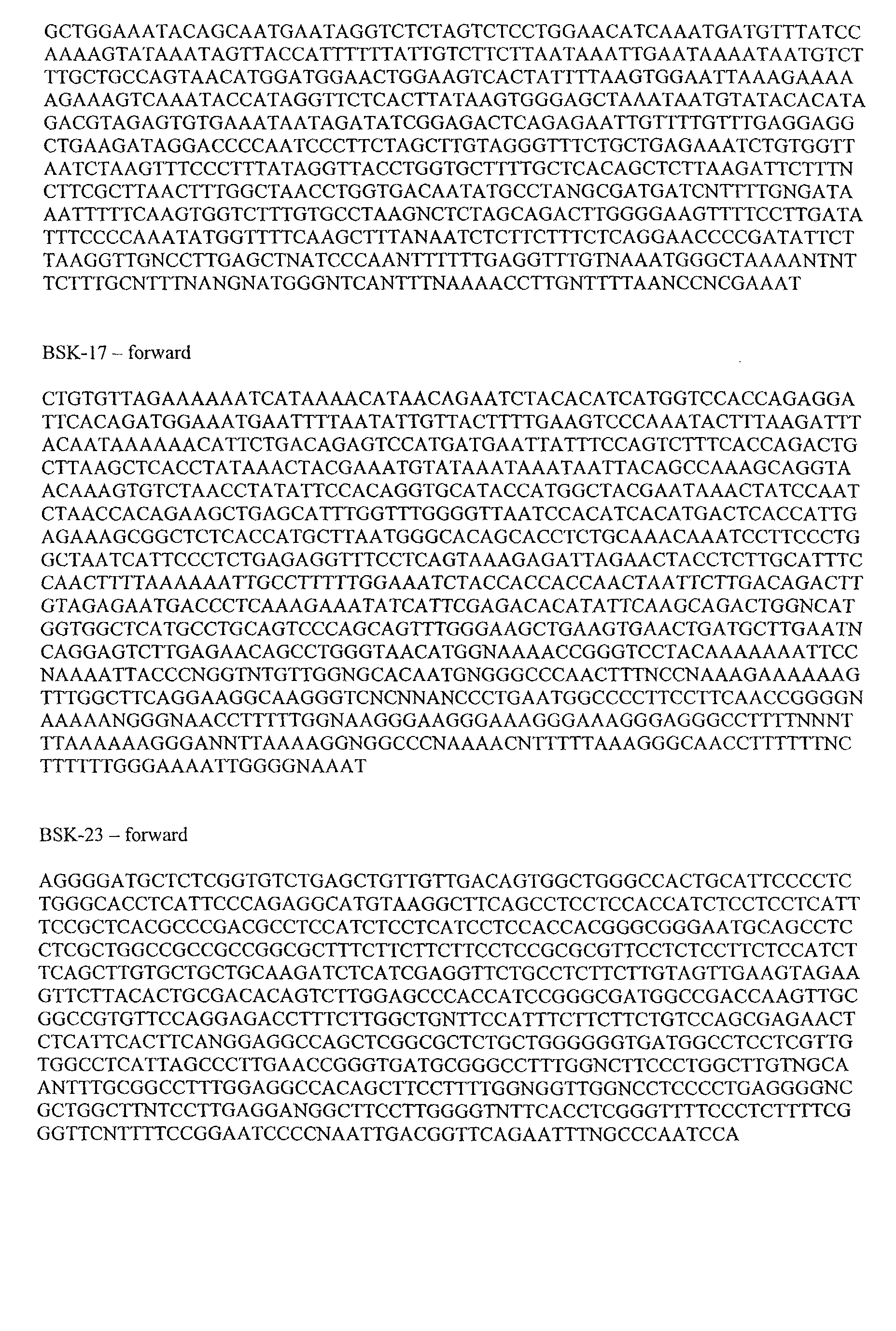
- Zytokine, lösliche Faktoren, Botenstoffe und Liganden, die einen steuernden Einfluß auf das Entzündungsgeschehen haben;
- Rezeptoren, Ionenkanäle und assoziierte Proteine, die eine Signalkette aktivieren, sobald sie selbst aktiviert werden;
- Kinasen, Proteinkinasen und deren Gegenspieler, die für die Aktivierung und Weiterleitung bzw. die Blokkierung der intrazellulären Signalübertragung Schaltstellen sind;
- Signaltransduktionsmoleküle, die Teil der intrazellulären Signalkette sind und zur Steuerung der Genexpression bzw. anderer Folgemechanismen beitragen (Aktivierung präformierter Moleküle);
- Transkriptions- und Translationsfaktoren sowie assoziierte Moleküle, die an der Regulation der spezifischen Genexpression und Proteinsynthese beteiligt sind;
- Ribosomale und ribonukleäre Regulatorproteine, die an der Proteinbiosynthese beteiligt sind;
- Enzyme und Enzym-assoziierte Proteine, die eine regulatorische Funktion für weitere Signalmoleküle besitzen;
- Proteinasen, Matrixmetalloproteinasen, Enzyme und deren Inhibitoren, die den Abbau der Gewebematrix beeinflussen und damit die Organschädigung;
- Onkogene, Protoonkogene, Differenzierungsfaktoren und Gene aus der embryonalen Entwicklung, die Einfluß auf die Zellentwicklung nehmen; (Proliferation, Differenzierung, Dedifferenzierung);
- Apoptosegene und Regulatoren des Zellzyklus und Zelltods;
- akute Phase Proteine; die Ausruck von Zellaktivierung und Entzündung sind;
- Oberflächenmembranmoleküle, die einen spezifischen Zelltyp bzw. eine Zellpopulation charakterisieren;
- andere Moleküle, die bei den genannten entzündlichen Erkrankung erhöht sind, aber keiner der oben genannten Gruppen zugeordnet werden können;
- bislang nicht näher charakterisierte Gensequenzen, die sich in den eigenen differentiellen Genexpressionsanalysen unterschiedlich exprimiert zeigen;
- Kontrollgene, die keine differentielle Genexpression zwischen chronischer Entzündung und Kontrollen zeigen und zur Standardisierung, Vergleichbarkeit und Quantifizierung einer Array-Analyse erforderlich sind.
Insbesondere die Negativselektion wird benutzt, um Aktivierungsartefakte, die während der Reinigung entstehen können, zu vermeiden.
Für die Differentielle Hybridisierung erfolgt die Klonierung in Plasmid- und/oder Phagen-Vektoren, uni- oder bidirektional gerichtet über Adapter- oder Linkermoleküle. Nach Transformation der Plasmide oder Verpackung der Phagenvektoren erfolgt die Differentielle Hybridisierung mit markierten cDNA Sonden(Radioaktivität, Digoxigenin, Biotin oder andere).
Für die Nutzung der selektiven differentiellen cDNAs werden entweder die klonierten Einheiten vorzugsweise mit NH2-markierten Standardprimern für Lambda, T3 / T7 / SP6 / M13 und anderen vektorspezifischen Sequenzen über PCR amplifiziert, und dann über Säulenauschlußverfahren gereinigt. Danach erfolgt die Konzentrierung der NH2-markierten DNA durch Präzipitation mit anschließender Zentrifugation.
Zur Quantifizierung und Qualitätskontrolle werden markierte Haushaltsgene (alpha-, beta, gamma-Aktin, GAPDH usw.) eingesetzt. Bevorzugt wird der Nachweis hier parallel und gleichzeitig mit maximal 50 Gensonden pro Ansatz gleichzeitig durchgeführt.
Neben der Vereinfachung der biometrischen Analyse durch Kopplung von RNA Spezies an Trägermaterialien erlaubt dieses System eine schnelle Diagnostik und bietet eine komplexe für den Patienten individuell schnelle Diagnostik, Prognostik und Therapiesteuerung. Insbesondere bei pharmakologischen Entwicklungsstrategien erlaubt das System eine schnelle Durchführung mit hohem Durchsatz.
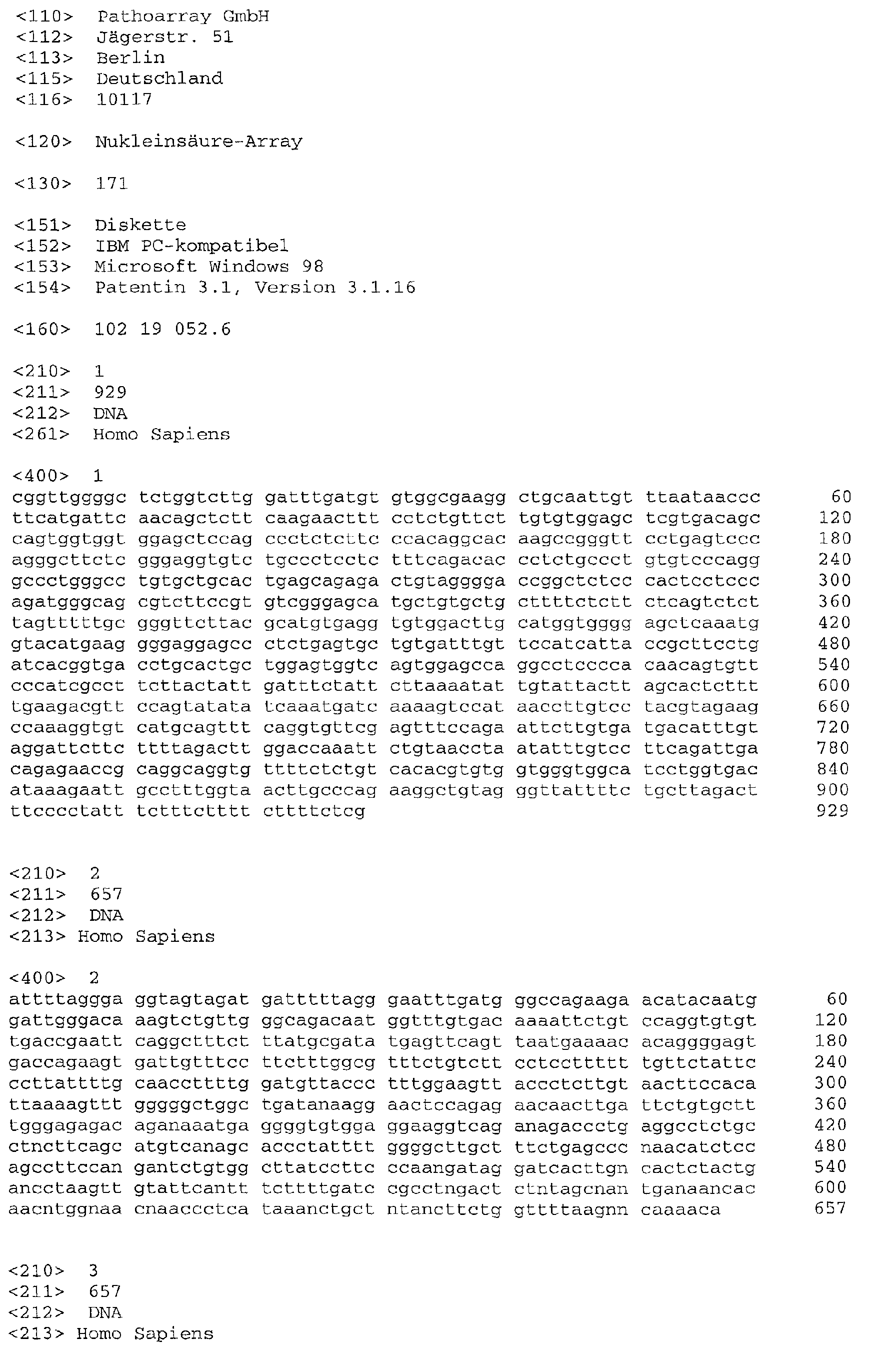
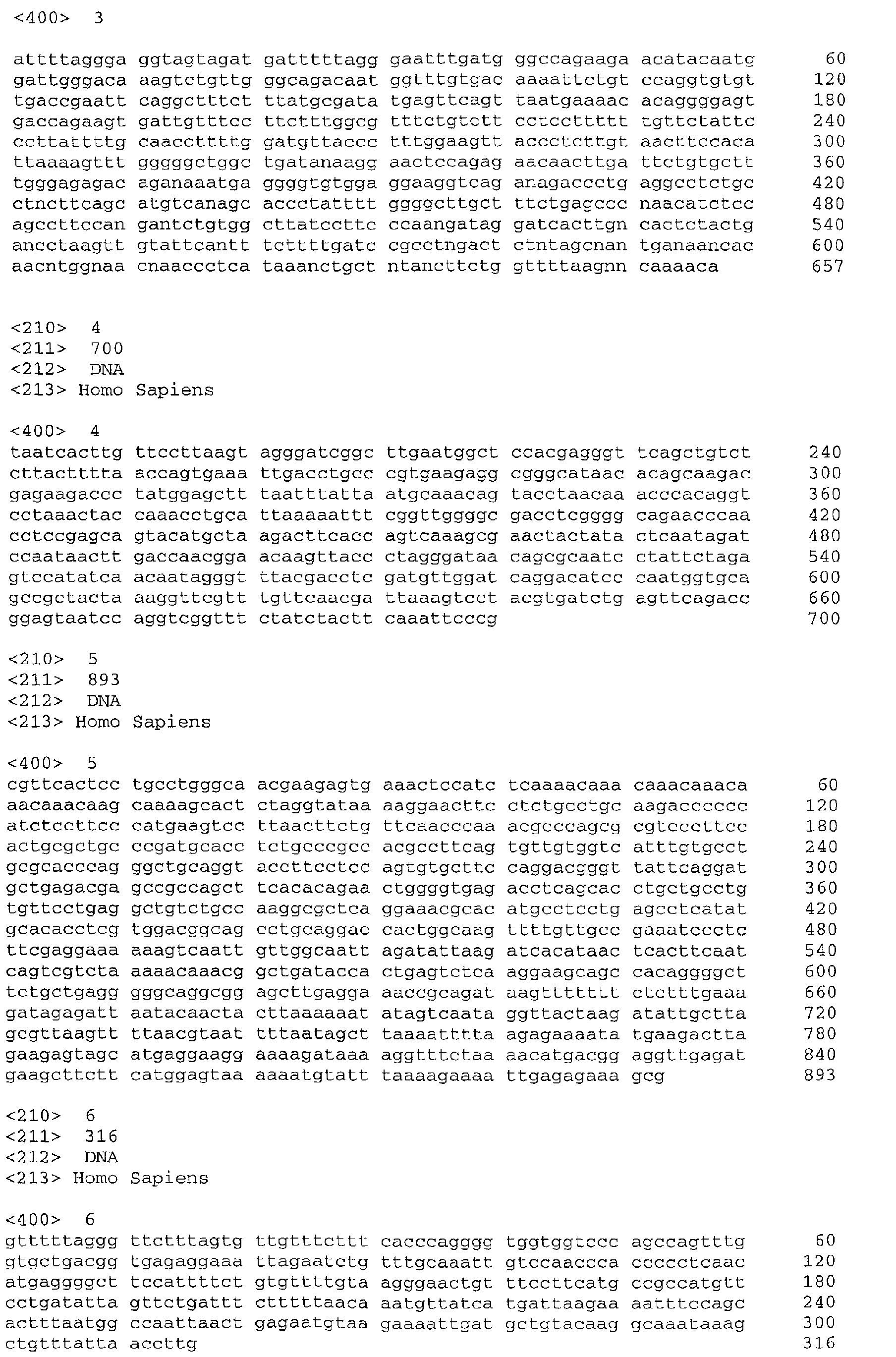
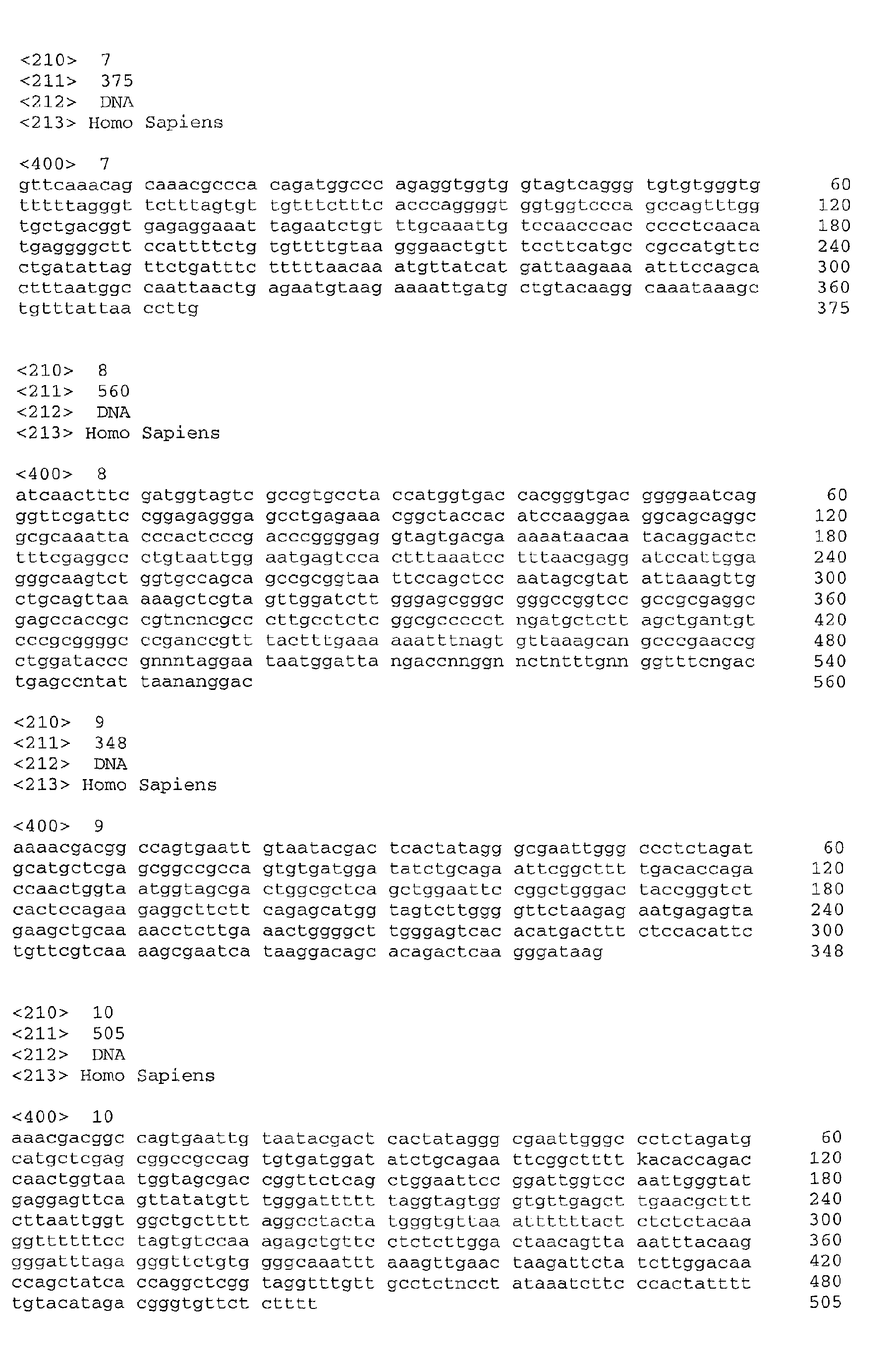













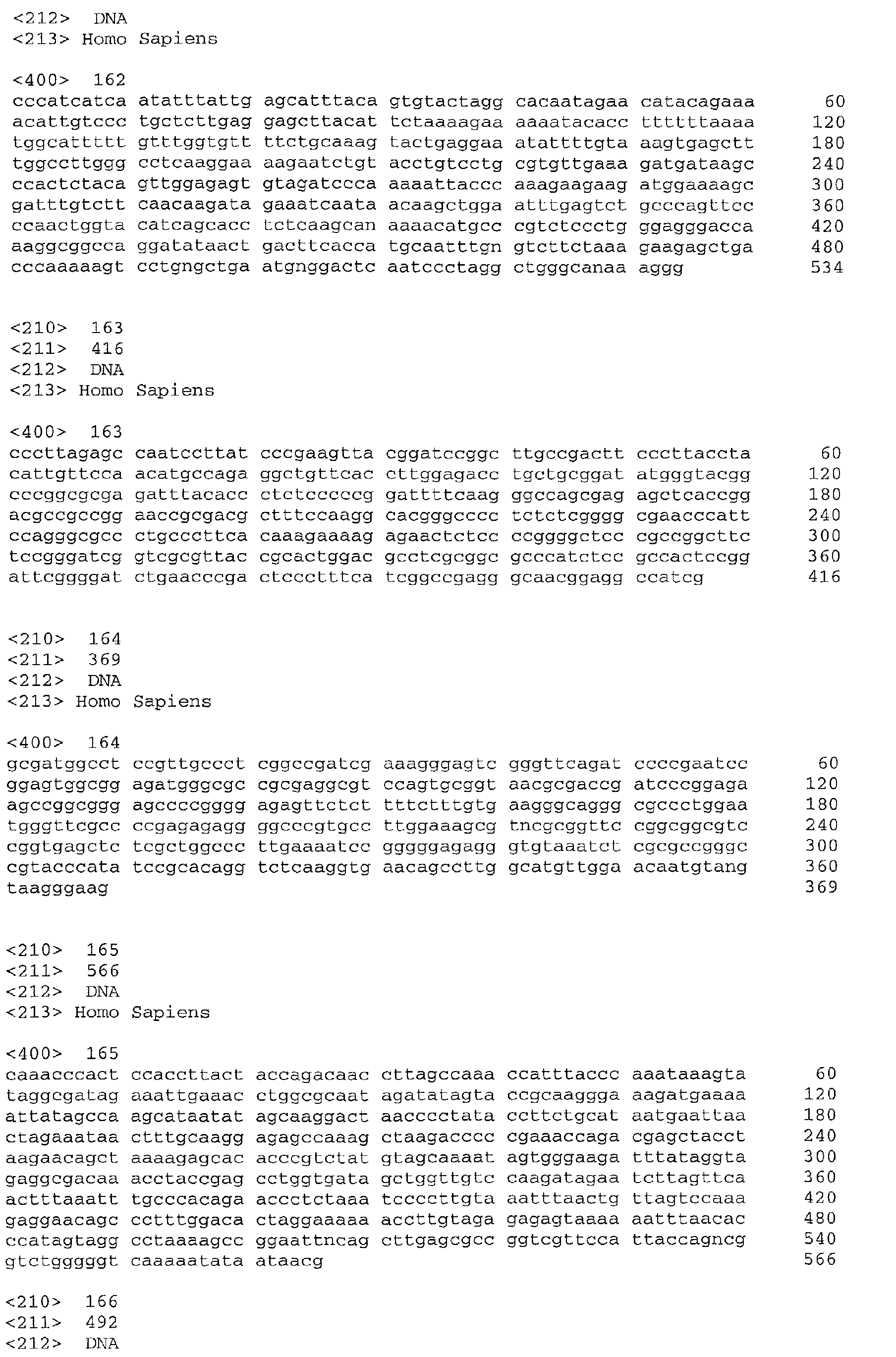
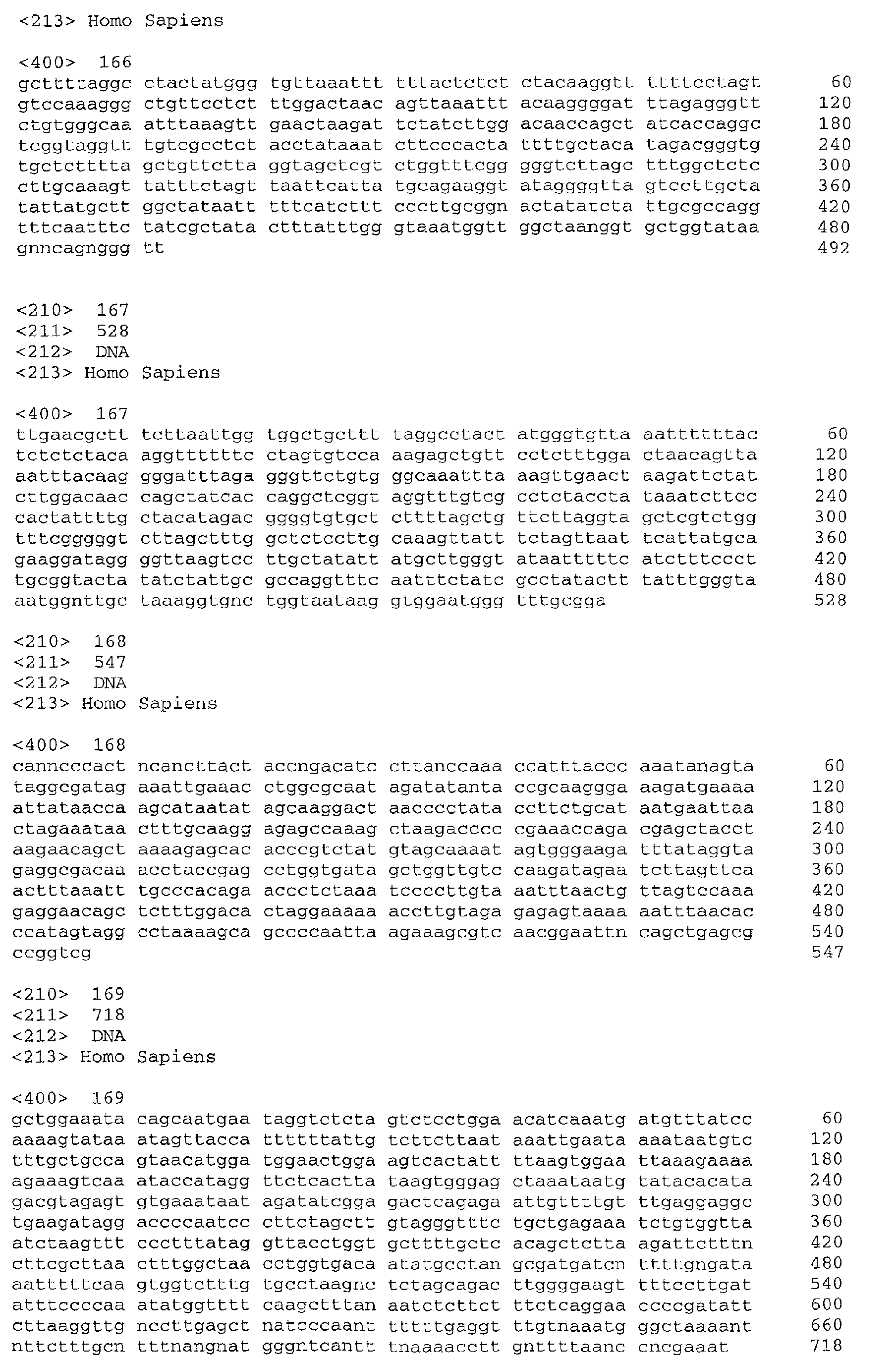
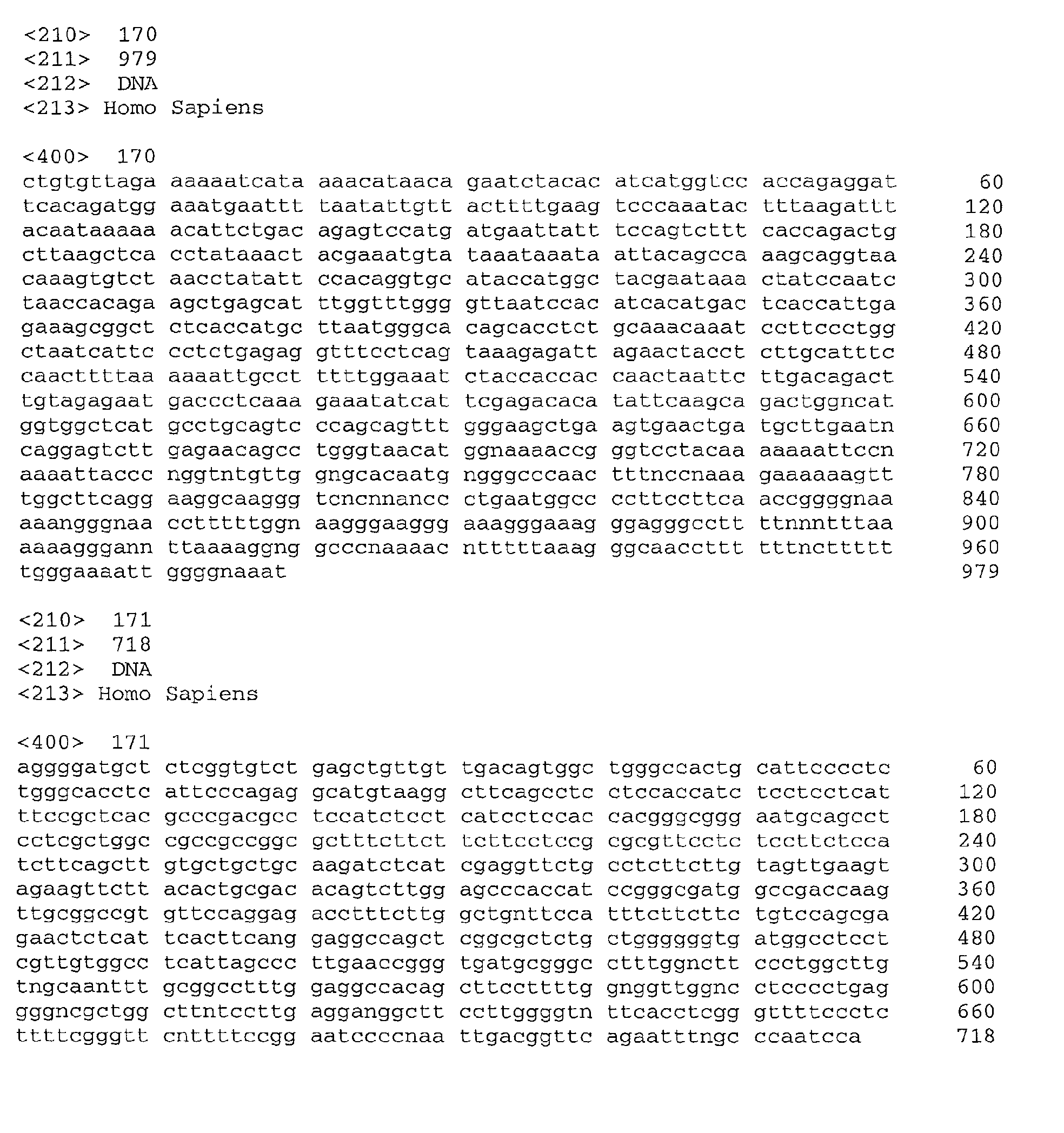
Claims (29)
- Werkzeuge zur diagnostischen, prognostischen und therapieüberwachenden Analyse sowie zur Durchführung von Screeningverfahren für pharmakologisch wirksame Substanzen und Substanzklassen der rheumatoiden Arthritis, chronisch entzündlicher Erkrankungen, bakteriell induzierter chronisch entzündlicher Erkrankungen, Arteriosklerose, Tumorerkrankungen, Organ- und Gewebstransplantationen, und der Sepsis, dadurch gekennzeichnet, dass auf der Oberfläche des Werkzeuges Sequenzen einer Auswahl nachfolgend genannter selektiver Monozyten-Makrophagen Gene oder Sequenzen aller nachfolgend genannter Gene, auch unter Verwendung weiterer Gene, gebunden sind oder dass mit genannten Genen komplementäre RNA auf der Oberfläche des Werkzeuges gebunden ist.
- Werkzeuge nach Anspruch 1, dadurch gekennzeichnet, dass es sich bei den Genen, deren Teilsequenzen und Oligomersequenzen um selektionierte / subtrahierte Gene handelt.
- Werkzeuge nach Anspruch 1 oder 2 dadurch gekennzeichnet, dass auf der Oberfläche des Werkzeugs alternativ auch Allele, Derivate und/oder Splicingvarianten der Gen bzw. Genteilsequenzen und Oligomersequenzen vorliegen können.
- Werkzeuge nach einem der Ansprüche 1 bis 3, dadurch gekennzeichnet, dass die Werkzeuge Gensequenzen einbeziehen, die mindestens eine Teil-Sequenzidentität in den Protein-kodierenden Abschnitten der mRNA besitzen.
- Werkzeuge nach Anspruch 4, dadurch gekennzeichnet, dass die Werkzeuge Gensequenzen einbeziehen, die mindestens 80% Sequenzidentität in den Protein-kodierenden Abschnitten der korrespondierenden Nukleinsäure besitzen.
- Werkzeuge nach den Ansprüchen 1 bis 5, dadurch gekennzeichnet, dass sie auf der Verwendung eines High-Throughput Verfahres der DNA-Array-Hybridisierung,
High-Throughput Verfahrens unter Verwendung der fluoreszenzzytometrischen Technologie (cytometric bead array)
High Throughput Verfahrens der RNA-Array-Hybri disierung, oder
High-Throughput Verfahrens mit Techniken der Polymerase-Ketten-Reaktion zur (Semi-) Quantifizierung beruhen. - Werkzeuge nach einem der Ansprüche 1 bis 6, dadurch gekennzeichnet, dass die Gene kovalent auf der Oberfläche gebunden sind.
- Werkzeuge nach einem der Ansprüche 1 bis 7, dadurch gekennzeichnet, dass die Oberfläche aus Glas oder Kunststoff besteht, die chemisch aktiviert oder modifiziert ist.
- Werkzeuge nach Anspruch 8, dadurch gekennzeichnet, dass die Oberfläche mit Aminolinkern bindenden reaktiven Gruppen, Metallverbindungen oder Legierungen reaktiv beschichtet ist.
- Werkzeuge nach Anspruch 8 oder 9, dadurch gekennzeichnet, dass das Trägermaterial bzw. die Oberfläche aus einer Nylonmembran besteht.
- Werkzeuge nach einem der Ansprüche 1 bis 10, dadurch gekennzeichnet, dass die cDNA durch reverse Transkription aus Total-RNA oder messenger-RNA menschlicher Zellen des Monozyten / Makrophagen Systems hergestellt ist
- Werkzeuge nach einem der Ansprüche 1 bis 11, dadurch gekennzeichnet, dass die Gene durch Spottingverfahren von cDNA, Immobilisierungsverfahren und Syntheseverfahren von Oligomeren oder spiegelbildlich in Form von RNA aufgebracht sind.
- Werkzeuge nach einem der Ansprüche 1 bis 12, dadurch gekennzeichnet, dass der Nachweis über cDNA-, deren Sequenzanteile oder über Oligosonden erfolgt.
- Werkzeuge nach Anspruch 10, dadurch gekennzeichnet, dass die Sequenzen Abweichungen enthält.
- Werkzeuge nach Anspruch 11, dadurch gekennzeichnet, dass die Abweichung von cDNA- und Oligosonden zum Nachweis bis zu 20% beträgt.
- Werkzeuge nach einem der Ansprüche 1 bis 15, dadurch gekennzeichnet, dass die Sonden zum Nachweis fluoreszenzfarbstoff-, Enzym-, Protein- oder radioaktiv markiert sind und Verstärkung zulassen.
- Werkzeuge nach Anspruch 1 bis 16, dadurch gekennzeichnet, dass Verstärkung über gekoppelte Biotin-, Digoxigenin-, (Edel-)Metallchelat- und Protein (Moleküle) erfolgt.
- Werkzeuge nach Anspruch 17, dadurch gekennzeichnet, dass zur Verstärkung Streptavidin, (Edel-) Metallchellat oder Antikörper eingesetzt werden.
- Werkzeuge nach Anspruch 18, dadurch gekennzeichnet, dass der Nachweis über Fluoreszenzfarbstoff, Radioaktivität oder enzymatisch erfolgt.
- Werkzeuge nach einem der Ansprüche 1 bis 19, dadurch gekennzeichnet, dass die Werkzeuge durch ein DNA-Array ausgebildet sind.
- Werkzeuge nach einem der Ansprüche 1 bis 19, dadurch gekennzeichnet, dass die Werkzeuge durch ein Zytofluoreszenz-DNA-Array (Beads) ausgebildet sind.
- Werkzeuge nach einem der Ansprüche 1 bis 19, dadurch gekennzeichnet, dass die Werkzeuge durch einen DNA-Array spiegelbildlichen RNA-Array ausgebildet sind.
- Werkzeuge nach Anspruch 1 bis 22, dadurch gekennzeichnet, dass die selektiven Gene, deren Teilsequenzen oder Oligomere zum Nachweis festphasengebundener Total-RNA oder messenger-RNA benutzt werden.
- Werkzeuge nach Anspruch 1 bis 23, dadurch gekennzeichnet, dass die Sonden durch reverse Transkription aus messenger-RNA menschlicher Zellen des Monozyten / Makrophagen-Systems hergestellt wird
- Werkzeuge nach einem der Ansprüche 1 bis 24, dadurch gekennzeichnet, dass RNA von bis zu 500 Gewebsund/oder Blutproben auf dem Array aufgebracht sind.
- Werkzeug nach einem der Ansprüche 1 bis 25, dadurch gekennzeichnet, dass die Sondenmarkierung mit Fluoreszenzfarbstoffen, Biotin, Digoxigenin, Peroxidase, alkalischer Phosphatase und Radioaktivität durchgeführt ist.
- Werkzeug nach einem der Ansprüche 1 bis 26, dadurch gekennzeichnet, dass Nachweisverfahren der genannten Sequenzen über reverse Transkriptions PCR (RT-PCR) durchzuführen sind.
- Werkzeuge nach einem der Ansprüche 1 bis 27, dadurch gekennzeichnet, daß die Gene oder Gensequenzen mit einer Markierung oder einer Reporterfunktion ausgestattet sind, so dass diese für andere Nachweisverfahren nutzbar sind.
- Verwendung der Werkzeuge nach einem der Ansprüche 1 bis 27, dadurch gekennzeichnet, dass die Werkzeuge zur Messung der Monozyten/Makrophagen Aktivierung resp. der Entzündungsaktivität im Blut oder aber im Zellgewebe verwendet werden.
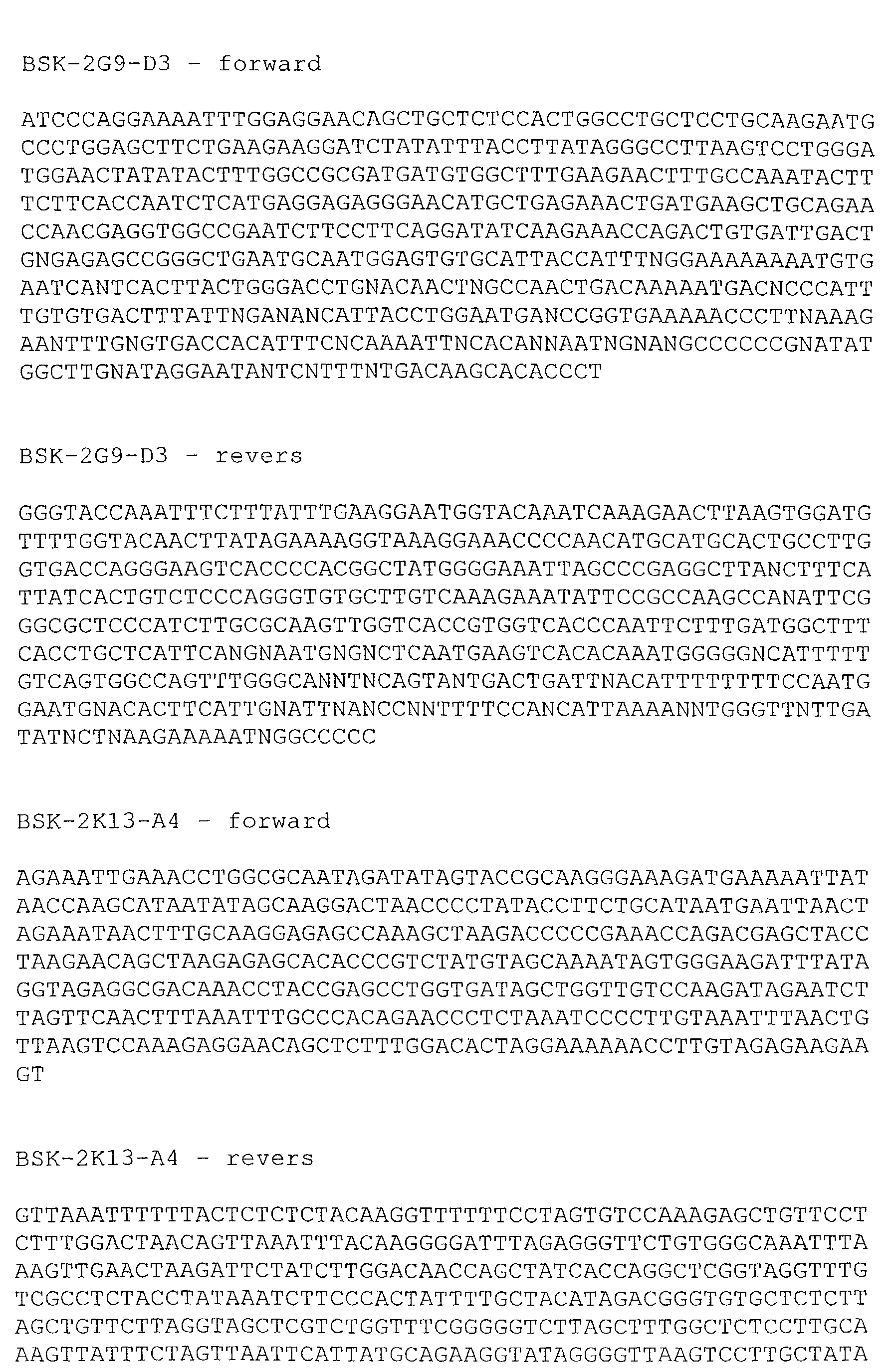
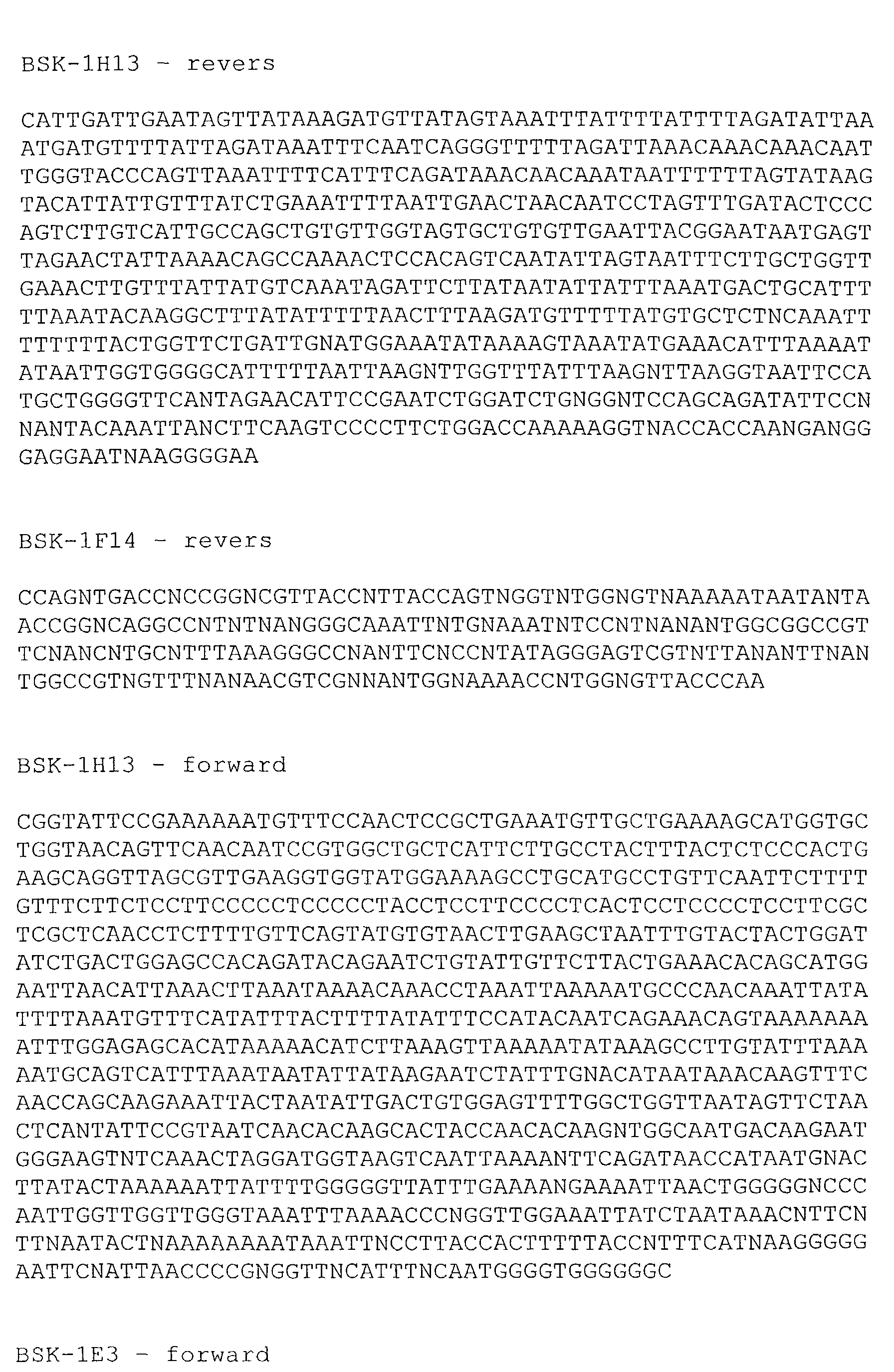
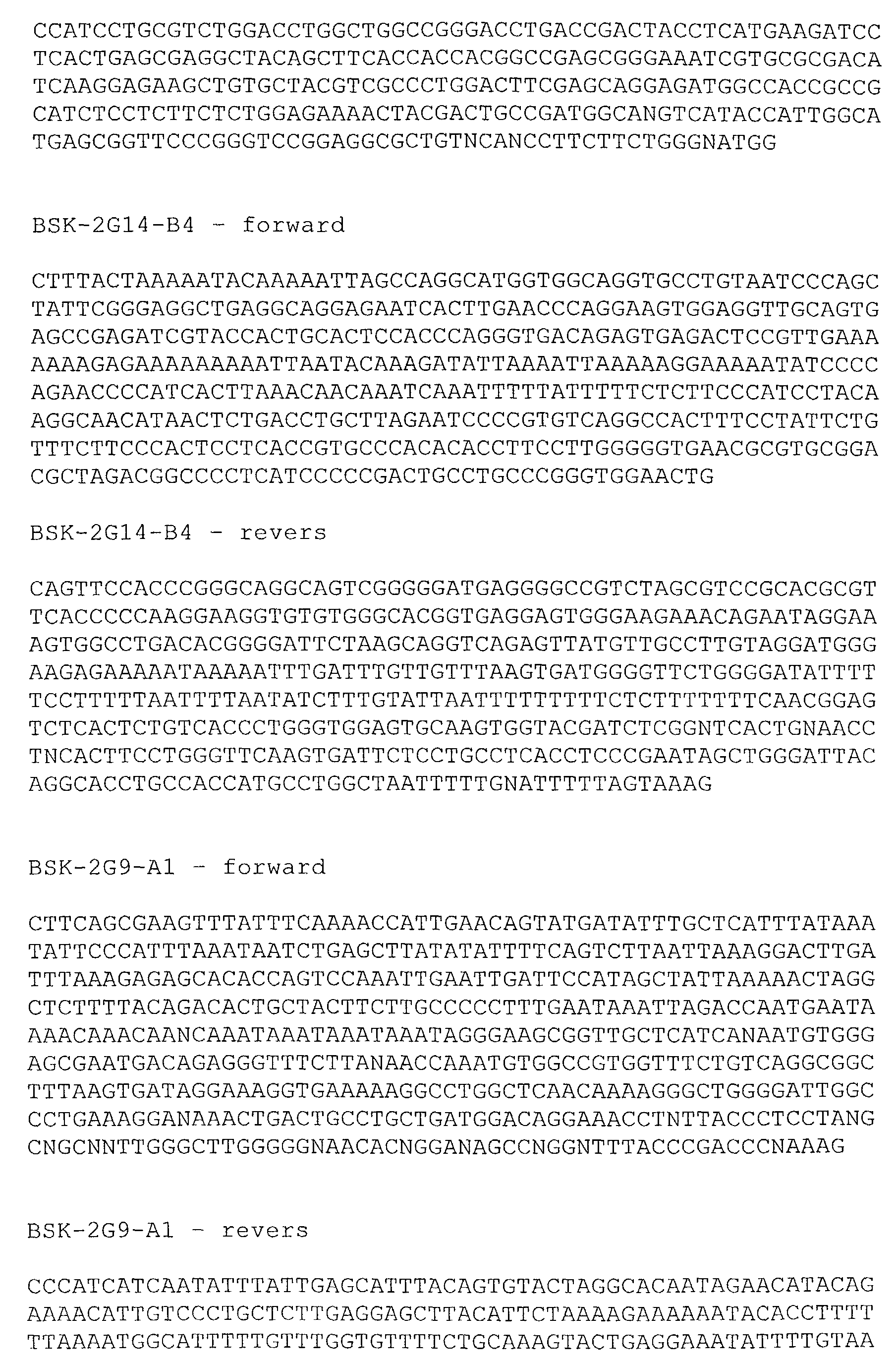
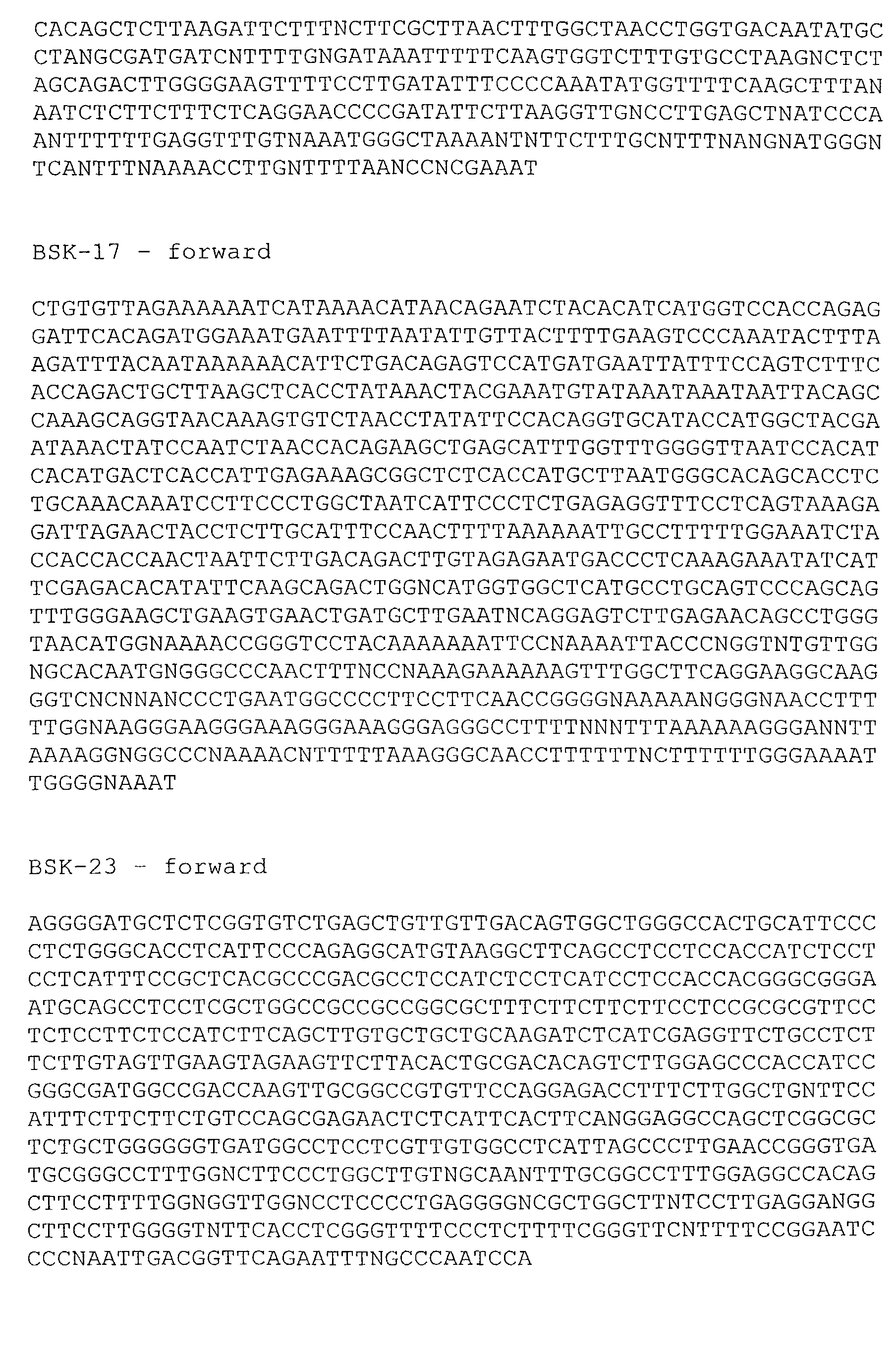
Zytokine und Faktoren und Liganden: Interleukin-1α (Acc.# NM_000575) Interleukin-1β (Acc.# NM_000576) Interleukin-6 (Acc.# AF372214) Interleukin-8 (Acc.# L19591) Interleukin-10 (Acc.# XM_001409) Interleukin-13 (Acc.# HSU62858) Interleukin-15 (Acc.# XM_003529) Interleukin-16 (Acc.# AF053412) Interleukin-18 (Acc.# E17135) Angiopoietin-like factor (CTD6) (Acc.# XM_001529,XM_042319) Inhibin β-B (INHBB) (Acc.# NM_002193) Tumor-Nekrosefaktor-α (Acc.# NM_000595) Tumor-Nekrosefaktor-β (Acc.# D12614) Transforming Growth Factor-β (TGF-β) (Acc.# XM_008912,NM_00660) Latent TGF-β binding prot. LTBP4 (Acc.# NM_003573,XM_008868) Melanoma stimulating activity (MGSA) (Acc.# X54489) Chemokine Gro-α/MGSA (Acc.# X12510,XM_003504) Chemokine (C-X-C motif) ligand 16 (Acc.# NM_022059) Chemokine alpha-3 (CKA3) (Acc.# NM_002993) CC-Chemokine (SLC) (Acc.# AB002409) EBI-1-Ligand Chemokine (Acc.# AB000887) Small inducible cytokine subfamily A(SCYA21) (Acc.# XM_048450) Small inducible cytokine(SCYA21) (Acc.# NM_002989) Megakaryocyte stimulating factor (Acc.# U70136) Monocyte colony stimulating factor (M-CSF) (Acc.# NM_000757) Granulo-/Monocyte colony stimu. factor (GM-CSF) (Acc.#: E01817) Macrophage inflammatory Protein (MIP-1) (Acc.# HUMMIP1A) Makrophage inflammatory Protein (MIP-2 (Acc.# AF106911) Monocyte migration inhibitory factor (MIF) (Acc.# L19686) Monocyte Tissue factor (Acc.# M16553) Monocyte Chemoattractant Protein-1 (MCP-1) (Acc.# S71513) Monocyte Chemoattractant Protein-2 (MCP-2) (Acc.# NM_005623) Monocyte Chemoattractant Protein-3 (MCP-3) (Acc.# X72308; S57464) Fraktalin small inducible cytokine (Acc.# NM_002996) Stromal derived factor-1 (SDF-1) (Acc.# HSU16752) Insulin-like growth factor-5 bind. Protein (Acc.# NM_000599) Rezeptoren, Ionenkanäle und assoziierte Proteine: Angiotensin Rezeptor-II Homolog (ATR-IIh) (Acc.# L48211) Toll-like Rezeptor-2 (Acc.# XM_003304) Toll-like Rezeptor-4 (Acc.# XM_005336) Opoid-Rezeptor Kappa (Acc.# XM_011716) Interleukin-1 receptor (Acc.# XM_002686) Interleukin-2 receptor α-Untereinheit (Acc.# XM_043149) Interleukin-2 Receptor β-Untereinheit (Acc.# XM_009962,M26062) Interleukin-2 Receptor γ-Untereinheit (Acc.# XM_047675) Interleukin-7 Receptor (Acc.# AH007043, NM_008372) Interleukin-8 receptor α (IL8RA) (Acc.# XM_058007) Interleukin 8 receptor β (IL8RB) (Acc.# NM_001557 Fc-Rezeptor-I (Acc.# J03619, AF200220) Fc-Rezeptor-II (Acc.# M28696,M28697) Fc-Rezeptor-III (Acc.# Z46223,Z46223) Tumor-Nekrosefaktor-α Rezeptor (Acc.# S63368) C-Chemokine (C-C motif) Rezeptor-5 (CCR5) (Acc.# NM_000579,XM_030397) C-Chemokine (C-C motif) Receptor-7 (CCR7) (Acc.# XM_049959) Chemokin-X-C-Rezeptor-4(CXCR-4) (Acc.# NM_003467) Progesterone Recept.-assoc. Immunophilin(FKBP54) (Acc.# U42031) Partial p58 gene for NK receptor (Acc.# AJ000542) Vascular endothial growth factor (Acc.# AY047581) Vascular endothial growth factor-β (Acc.# BC008818) Calcium activated potassium channel (KCNN3) (Acc.# AF031815, AY049734) G protein-coupled cytokine receptor EBI1 (Acc.# L31581) G protein-coupled cytokine receptor EBI3 (Acc.# XM_012857,L08187) EBI3-associated protein (Acc.# U41806) Membranproteine und assoziierte Proteine: CD14 (Acc.# XM_003822) CD68 (Acc.# XM_008237) CD69 (Acc.# BC007037) CD11b (Acc.# J03925) Adhesion receptor CD44 (Acc.# M31165) Actin binding coronin like protein (HCORO1) (Acc.# U34690) Integral membrane protein (Acc.# L32185) Epithelial membrane prot.-3 (EMP-3) / HMPMP-1 (Acc.# X94771,U87947) Mac-2 binding protein (Acc.# L13210) Integral membrane protein E16 (Acc.# M80244) HLA-D II beta chain (Acc.# X03066) Desmin (Acc.# HSU59167, XM_002601) Fibronectin precursor (Acc.# X02761) Adducin 1α (Acc.# X58141, NM_014190) HLA DRB1 (Acc.# X88971) Integrin-α 5 subunit (Acc.# X06256) Integrin cytopl. domain assoc. protein (Icap-1α) (Acc.# AF012023) Integrin cytopl. domain assoc. protein (Icap-1β) (Acc.# AF012024) Titin (Acc.# X69490, NM_003319) Thrombospondin-1 (TSP-1) (Acc.# XM_007606) Semaphorin-3 (Acc.# AB000220) Semaphorin-F Homolog (Acc.# U52840) TSP-2 (Acc.# NM_003247) TSP-1 / Semaphorin-5a Homolog (Acc.# NM_003966) VCAM-1 (Acc.# x53051) Periplakin (PPL) (Acc.# XM_032727, NM_002705) Envoplakin (EVPL) (Acc.# XM_008135) Peripheral myelin protein 22 (PMP-22) (Acc.# XM_052499) (Proto)-Onoko-, Tumor-Suppressor-, Differenzierungsgene & assoz.Proteine: H19 RNA (Acc.# M32053) Tumor suppressor Brush-1 (Acc.# S69790) Pim-2 Protoonkogen (Acc.# U77735,XM_010208) HOX-B3 (Acc.# N70814) MEL-18 (Acc.# D13969) c-fos (Acc.# V01512) c-jun (Acc.# NM_002229) c-myc (Acc.# AH001511) c-myc related oncogen (pHL-1) (Acc.# X54629) c-Ret tyrosine kinase receptor ligand 2 (RETL2) (Acc.# U97145) c-Ret tyrosine kinase receptor ligand 1 (RETL1) (Acc.# U97144) jun-B (Acc.# XM_009064) c-Jun activation domain binding protein (Acc.# U65928) Desmoyokin/AHNAK (Acc.# X74818,M80899) Rad mRNA (Acc.# L24564) PTEN (Acc.# AH005966,XM_005867) c-ras homolog gene family, member B (ARHB) (Acc.# XM_002689,NM_004040) Transforming activity oncogene (TRE-2) (Acc.# X63596) Transforming activity oncogene (TRE-17 (Acc.# HSTRE213) Kruppel-like fetal globin gene activator (FKLF) (Acc.# AF272830) c-fos related antigen (fra-1) (Acc.# X16707) c-fos related antigen (fra-2) (Acc.# X16706) Akut Phase Protein: Large-Ferritin Untereinheit (Acc.# M11146) Small-Ferritin Untereinheit (Acc.# NM_000146) Enzyme, Enzym-assoziierte Proteine und Inhibitoren: Activation-induced cytidine deaminase (Acc.# AB040431,NM_020661) Phospholipase-C (Acc.# XM_041310) Prostaglandin G/H Synthase (Acc.# S36271) Prostaglandin-Endoperoxide Synthase-1 (Acc.# NM_000962) Cyclooxygenase-1 (Acc.# HSU63846) Cyclooxygenase-2 (Acc.# M90100) Endothelin-1 (EDN1) (Acc.# NM_001955) Endothelin-1 (EDN2) (Acc.# NM_001956) Clustrin (complement lysis inhibitor, SP-40,40) (Acc.# XM_027447, X14723) Fettsäure Desaturase 1 (FADS1) (Acc.# AF084558) Cysteine dioxygenase 1 (CDO-1) (Acc.# U80055) Histidine biosynthesis protein (Acc.# NM_007016) Chitinase 1 (Acc.# NM_003465) Chitinase precursor (Acc.# AF290004) L-glycerol-3-phosphat: NAD oxidoreductase (Acc.# L34041) Alcohol dehydrogenase class I gamma subunit (Acc.# M12272) Procarboxypeptidase B1 (Acc.# NM_001871) Phosphoenolpyruvate carboxykinase (PCK1) (Acc.# XM_009672, L05144) Lysozym (Acc.# BC004147) Transaldolase (Acc.# NM_006755) Thymosin-β4 (Acc.# M17733) Metallothionein 1L (MT1L) (Acc.# NM_002450) Manganese-superoxide dismutase (Mn-SOD) (Acc.# S77127) Superoxide Dismutase 1 (Acc.# K00065) Superoxide Dismutase 2 (Acc.# NM_000636) Superoxide Dismutase 3 (Acc.# NM_003102) Copper/zinc-superoxide dismutase (Cu/Zn-SOD) (Acc.# M13267) Catalane (Acc.# ) Monoamine oxidase-A (MAOA) (Acc.# M68840,XM_055485) Fatty acid synthetase (Acc.# U29344) Glutathion peroxidase (Acc.# X13710) Glutathion peroxidase 3 (Acc.# NM_002084) Glucocerebrosidase (Acc.# M16328) Induzierbare Nitric oxide Synthase (Acc.# AB022318) Transglutaminase 1 (K polypeptide) (Acc.# XM_007310) Transglutaminase (TGase) (Acc.# M55153, SEG_HUMETG)* α-1-Antitrypsin (Acc.# HSATPR1) Protein Tyrosin-Phosphatase (Acc.# U27193) Carbonic anhydrase precursor(CA 12) (Acc.# AF037335) Metallothionein-IG gene (MT1G) (Acc.# J03910) Lymphocyte phosphatase assoc. Protein (LPAP) (Acc.# X97267,AA011257) Flap Endonuclease 1 DNA repair gene (FEN1) (Acc.# AC004770) Flap structure-specific endonuclease 1 (FEN1) (Acc.# L37374, XM_043386) Kinasen, Protein Kinasen (PKN) und PKN-Inhibitoren: Protein Kinase C-alpha Untereinheit (Acc.# X52479) Protein Kinase C-beta-1 Untereinheit (Acc.# XM_047187) Protein Kinase C-beta-2 Untereinheit (Acc.# M13975) Protein Kinase C-gamma Untereinheit (Acc.# M34182) Protein Kinase C-delta Untereinheit (Acc.# D10495) Protein Kinase-C Inhibitor (Acc.# U51004 Ik-Kinase-κ (Acc.# AF029684 PI3-Kinase (Acc.# Y13892) MAP Kinase-11 (Acc.# XM_035889) p38 MAP Kinase (Acc.# AF031135) p38 MAP Kinase interacting protein (Acc.# XM_035930) Serin/Threonin Kinase (Acc.# AB015982) Thyrosin Kinase-1 (Acc.# XM_002037) Thyrosin Kinase-2 (Acc.# XM_005480) Non-receptor protein tyrosine kinase tyk2 (Acc.# X54637) Mitogen- and stress-activated protein kinase-1 (Acc.# AF074393) Mitogen- and stress-activated Protein Kinase-2 (Acc.# AF074715) Casein Kinase 1, alpha 1 (CSNK1A1) (Acc.# NM_001892, L37042) Thyrosine kinase 1 (TIE-1) (Acc.# XM_002037) Thyrosine kinase 2 (TIE-2) (Acc.# XM_005480) Differenzierungsgene: WNT-6 (Acc.# AY009401,AB059570) WNT-13 (Acc.# Z71621) BMP-4 (Acc.# M22490) Proteinasen, Matrixmetalloproteinasen (MMP) und MMP-Inhibitoren: Cathepsin-B (Acc.# XM_035662) Cathepsin-G (Acc.# M16117) Cathepsin-K (Acc.# NM000396) Cathepsin-L (Acc.# NM_001912) Cathepsin-S (Acc.# M86553) Matricx metalloproteinase-1 (MMP-1) (Acc.# NM_002421) MMP-3 (Acc.# X05232) MMP-9 (Acc.# XM_009491) Disintrigin Protease (Acc.# Y13323) Tissue inhibtor of MMP type 1 (TIMP-1) (Acc.# NM_003254) TIMP-2 (Acc.# NM_003255) TIMP-3 (Acc.# NM_000362) TIMP-4 (Acc.# NM_003256) Serin Protease like mRNA (Acc.# M17016) Apoptose- und Zellzyklus Regulatoren: Annexin A-2II (Acc.# BC001388) Growth arrest DNA-damage-induc. prot. (GADD45) (Acc.# M60974) Growth arrest DNA-damage-induc. prot.α(GADD45A) (Acc.# XM_056975, XM_040594) Growth arrest DNA-damage-induc. prot.β(GADD45B) (Acc.# NM_015675, AF087853) Growth arrest DNA-damage-indcu. prot.g(GADD45G) (Acc.# NM_006705) Lymphocyte G0/G1 switch gene (GOS-3) (Acc.# L49169) Signaltransduktions-Regulatoren: STAT-1 (Acc.# NM_007315) STAT-4 (Acc.# XM_002711) Adenylate kinase 1 (AK1) (Acc.# NM_000476) Inositol 1,4,5-trisphosphate 3-kinase (ITPKC) (Acc.# XM_047369, XM_047368) Phosphatidylinositol-3'-kinase (PI3K) (Acc.# Y11312) Transkriptionsfaktoren, Translationsfaktoren und assoziierte Proteine: Transcription factor AREB6 (Acc.# D15050) Transcription factor 8 (TCF8) (Acc.# XM_030006) Nuklear factor kappa-B (Acc.# M58603) AP-1 (Acc.# AB015319, AB015320) PU.1 (Acc.# X66079) SPI-B (Acc.# X66079) v-maf musculoaponeurotic fibrosarcoma (MAFF) (Acc.# XM_039249,XM_039250) Zinc finger transcription factor (GKLF) (Acc.# AF105036, AK026253) Zinc finger Protein (Acc.# M80583) CCAATA enhancer binding Protein-beta (Acc.# NM_005194) RNA-polymerase II elongationsfactor (Acc.# L47345) Translation elongation factor-1 α-1 (EEF1A1) (Acc.# BC009733) Translation elongation factor-1 α-2 (EEF1A2) (Acc.# XM_028863) Translation elongation factor 2 (EEF2) (Acc.# NM_001961) L1-Element (L1.20) (Acc.# U93569) Leukemia Zink Finger PLZF (Acc.# AF060568) Activating transcription factor 3 (ATF3) (Acc.# XM_016795, XM_034219) Zinc finger transcriptional regulator (GOS-24) (Acc.# M92843) TGF-β-inducing early growth response 2 (Acc.# AA427597) SP1-like zinc finger transcript. factor (TIEG2) (Acc.# AF028008) snRNA activating protein complex (Acc.# AF032387) oct-binding factor-1 (OBF-1) (Acc.# Z49194) Early Growth Response protein 1 (EGR-1) (Acc.# R75775) Ribosomale- / Ribonukeäre Regulatorgene und assoziierte Proteine: hnRNP pseudogen(gp43) (Position: 97.026-98.073) (Acc.# AL034397) Ribosomal protein L19 (Acc.# XM_002758) Ribosomal protein S13 (Acc.# XM_039215) Histon-H1 (0) family mRNA (Acc.# X03473) H4-histone family, member H (H4FH), mRNA (Acc.# NM_003543) Andere: IER-3 (Acc.# NM_003897) Endoplasmatic glykoprotein Gp36 (Acc.# U10362) Natural resist.-assoc. Macroph.protein (Nrampl) (Acc.# D50402) Calgranulin - S100A12 protein (Acc.# XM_001682, NM_005621) 14-3-3 gamma Protein (Acc.# AF142498) Serum amyloid-A (Acc.# M81349,M81451) GDF-1 (Acc.# NM_001492) Solute carrier family 7 mRNA (SLC7A5) (Acc.# NM_003486) PLAB/MIC-1 (Acc.# NM_004864) EAP-(HBp15/L22) (Acc.# NM_006755) Small Proline-rich protein-1 (Acc.# L05187) NAG-1 (Acc.# AF173860) BST-1 (Acc.# D21878) II56KD (Acc.# M24594) Fibulin-1 D (Acc.# NM_006486) Nebulin (Acc.# XM_040435) VDUP1 upregulated by 1,25-dihydroxyvitamin D-3 (Acc.# XM_002093, XP_002093) Tumor nekrosis factor stimulated gene (TSG-6) (Acc.# NM_007115) Tumor nekrosis factor stimulated gene (TSG-37) (Acc.# M31164) Osteopontin (Acc.# AF052124) Tristetraproline (TTP) (Acc.# M63625) Nephropontin (Acc.# M83248) Tonsillar lymphocyte LD78 mRNA (Acc.# X03754) MB-1 gene (CD79a-B cell) (Acc.# U05259) Human Glykoprotein (gp39) (Acc.# M80927,Y08374) Glia derived nexin precursor (Acc.# AI743134) Heat shock protein 70B (HSP-70B) (Acc.# X51757) Apolipoprotein D (Acc.# XM_049984,XM_003067) Dead box, Y isoform (DBY), altern.transcr. 2 (Acc.# AF000984) Myocilin (GLC1A) (Acc.# AH006047) DR1-associated corepressor (DRAP1) (Acc.# U41843) DR1-associated protein 1 (neg. cofactor 2 α) (Acc.# XM_055156) FK506 bind.- 12-rapamycin assoc.prot.1 (FRAP1) (Acc.# XM_001528, XM_042283) Microfibril-associated glycoprotein-2 (MAGP-2) (Acc.# AH007047, NM_003480) Adrenomedullin (ADM) precursor (Acc.# NM_001124,XM_051743) DNA-damage-inducible transcript 3,clone MGC:4154 (Acc.# BC003637) Calretinin - calcium binding protein (Acc.# X56667) Breakpoint cluster region (BCR) mRNA (Acc.# XM_017097) Adipose most abundant gene transcript 1 (APM1) (Acc.# NM_004797,XM_003191) Novel adipose specific collagen-like factor (Acc.# D45371) Funktionell unbekannte Gene und EST's: IMAGE 745750 (Acc.# AA420624) KIAA0935 (Acc.# AB023152) KIAA0618 (Acc.# AB014518) Homolog zu FLJ23382 fis Klon HEP16349 (Acc.# AK027035) Hypothetical gene mRNA (Acc.# XM_005331) HDCMB07P/PCM-1 (Acc.# AF068293) cDNA clone DKFZp762M2311 (Acc.# AL512760) cDNA clone PP2684 (Acc.# AF218004) cDNA clone MGC:1811 (IMAGE:3506276) (Acc.# BC015961) cDNA clone IMAGE:979127 (Acc.# AA522530) cDNA clone IMAGE:4279495 5', mRNA sequence (Acc.# Bf667722) cDNA clone 137308 mRNA, partial cds (Acc.# U60873) cDNA clone IMAGE:159541 (Acc.# H15814) cDNA clone MAMMA1001272 (Acc.# AU147646) cDNA clone IMAGE:2419382 (Acc.# AI826771) cDNA clone IMAGE: 3941411 (Acc.# BE797145 cDNA clone IMAGE:3834583 (Acc.# BE743390) cDNA clone IMAGE:4565371 (Acc.# BG397372) cDNA clone MGC:2460 IMAGE:2964524 (Acc.# BC009504) cDNA clone RC3-HT0585-010400-013-all HT0585 (Acc.# BE176664) cDNA clone similar to CG8974 gene product (Acc.# XM_018516) cDNA clone BSK-65 (Acc.# W99251) cDNA clone IMAGE:3844696 (Acc.# BE730665) FLJ23382 fis, clone HEP16349 (Acc.# AK027035) FLJ20500 fis, clone KAT09159 (Acc.# AK000507, BC015236) GABBR1 Region von AL031983 (Acc.# 12329558) cDNA clone CS0DE006YI10 5' prime end (Acc.# AL541302) cDNA clone CS0DE006YI10 3' prime end (Acc.# AL541301) EST371586 IMAGE resequences (Acc.# Aw959516) MEN1 region clone epsilon/beta (Acc.# Af001892) Kontrollen zum Quantifizierungsabgleich: alpha-Aktin (Acc.# M20543) beta-Aktin (Acc.# XM_037239) gamma-Aktin (Acc.# NM_001614) Glyceraldehyd-3-phosphat-Dehydrogenase (Acc.# XM_033258) Glucose-6-phosphat-Dehydrogenase (Acc.# XM_013149) 28S rRNA (Acc.# M27830) 18S rRNA (Acc.# M10098) 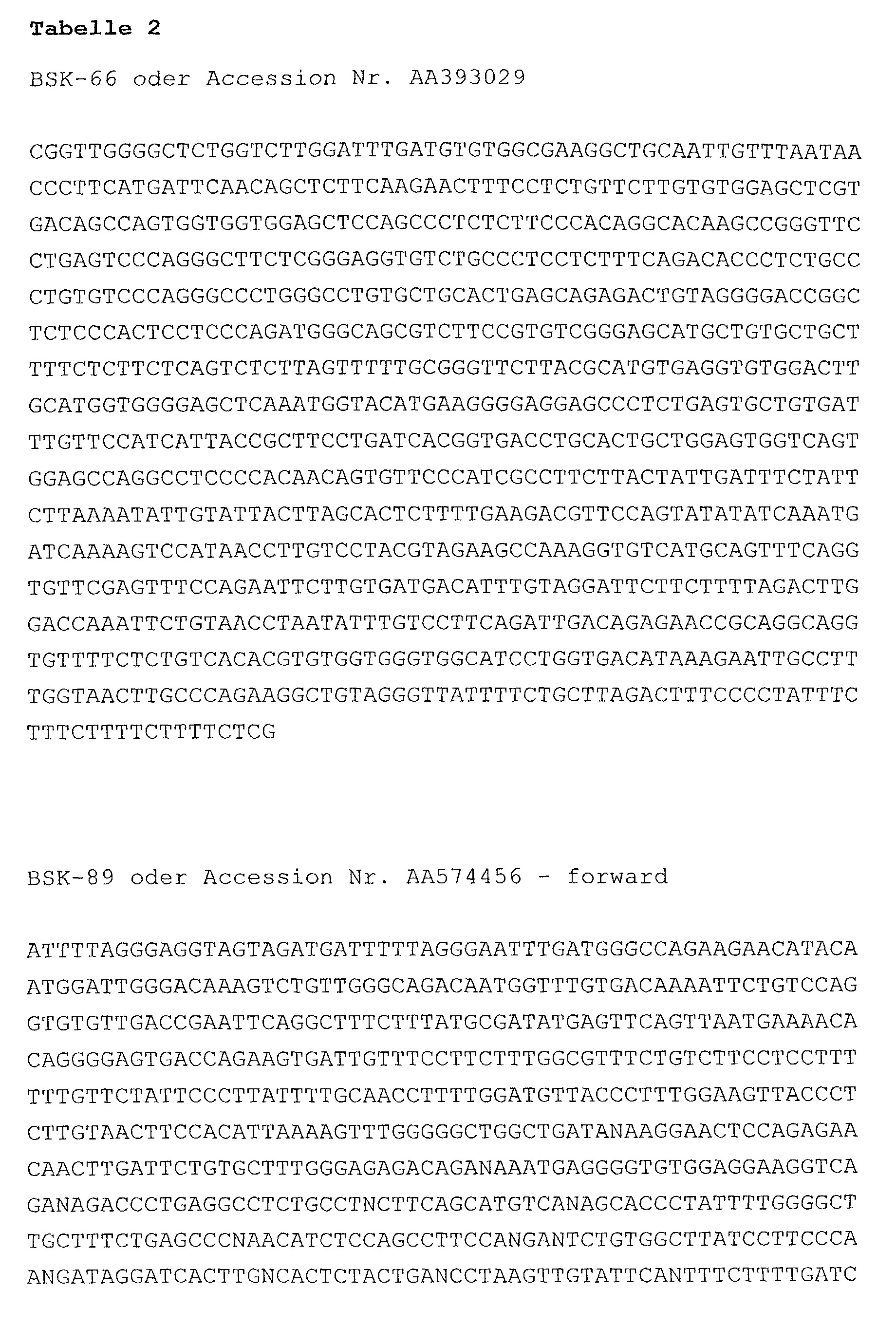





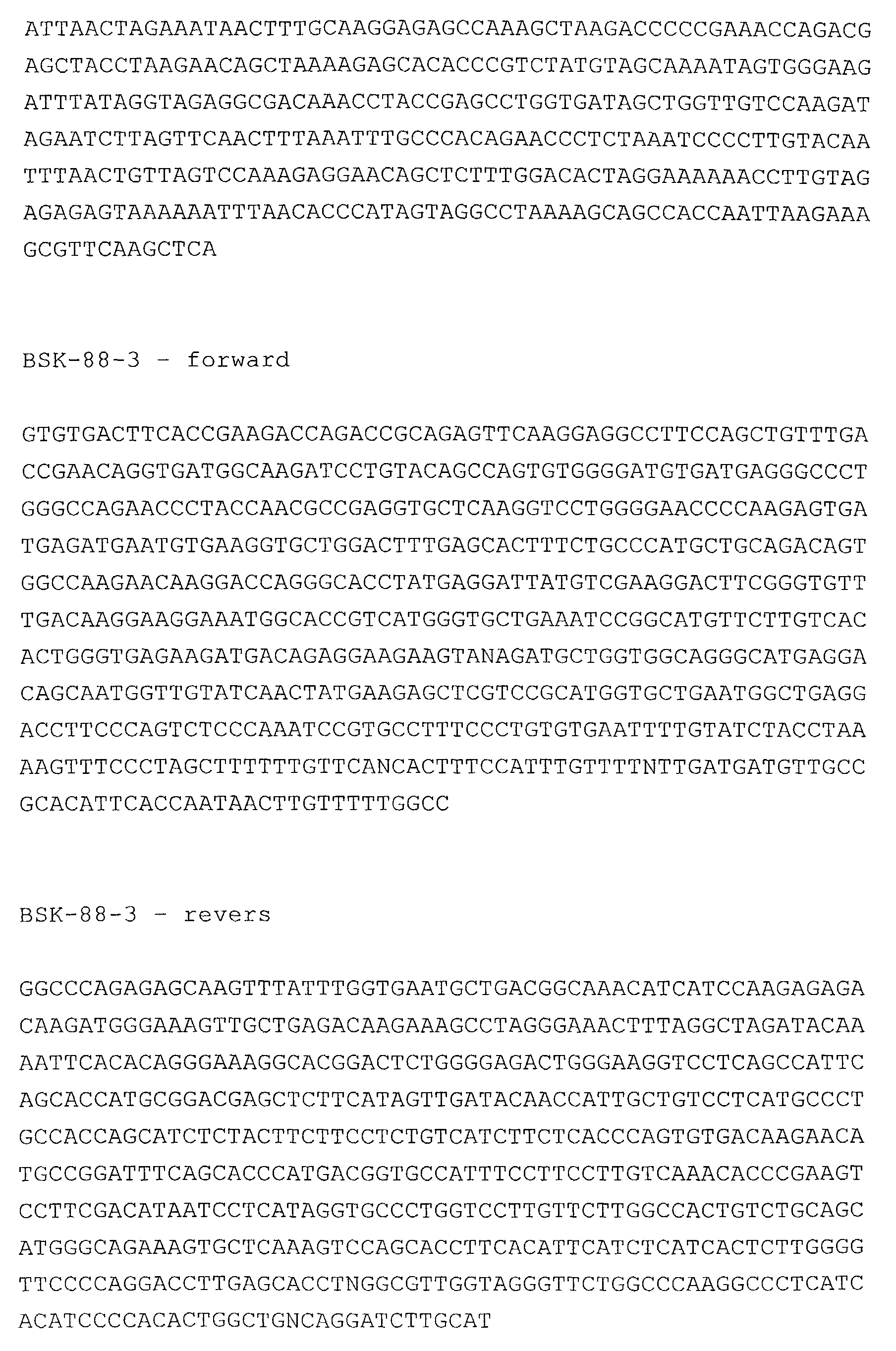
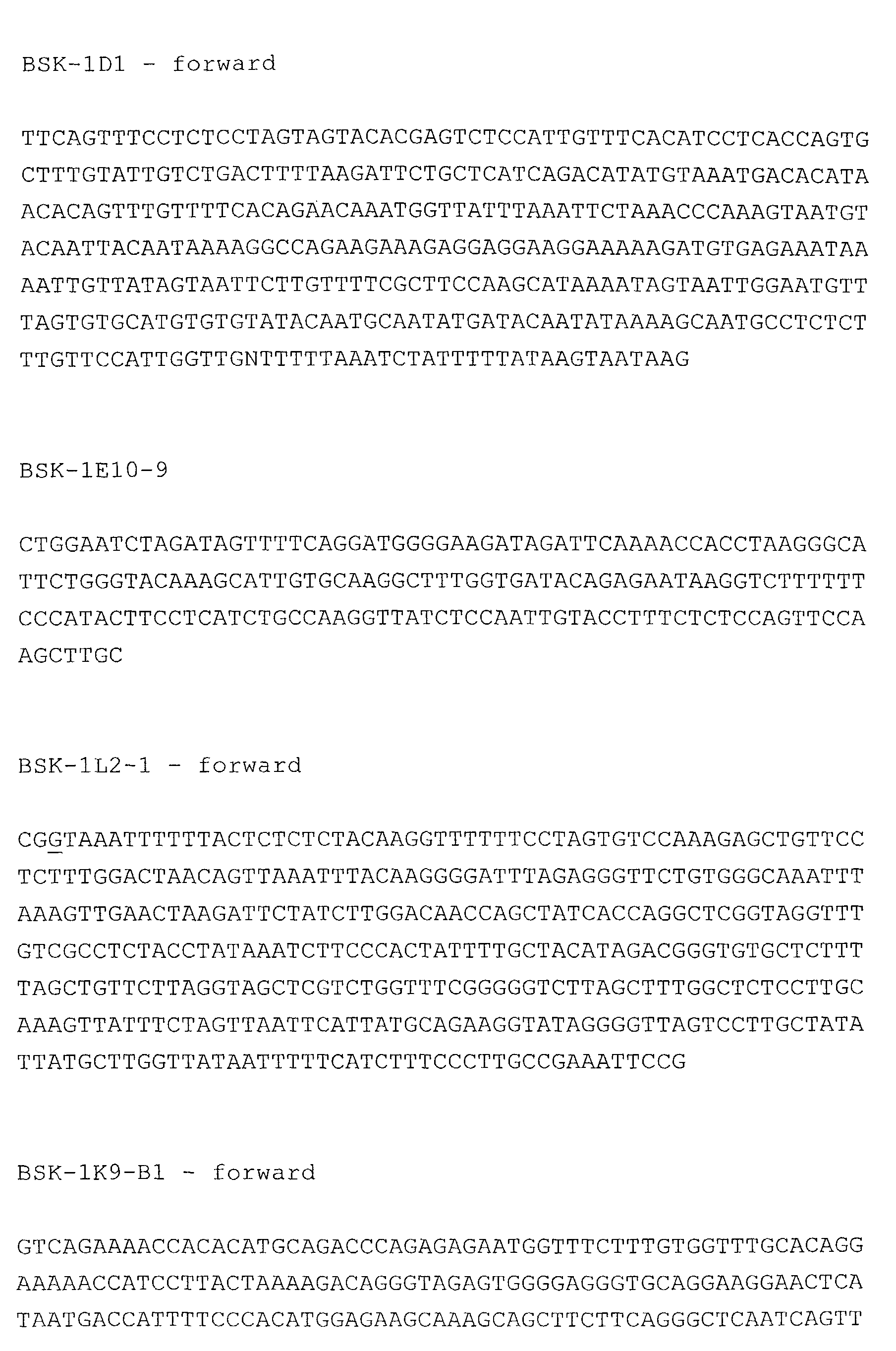
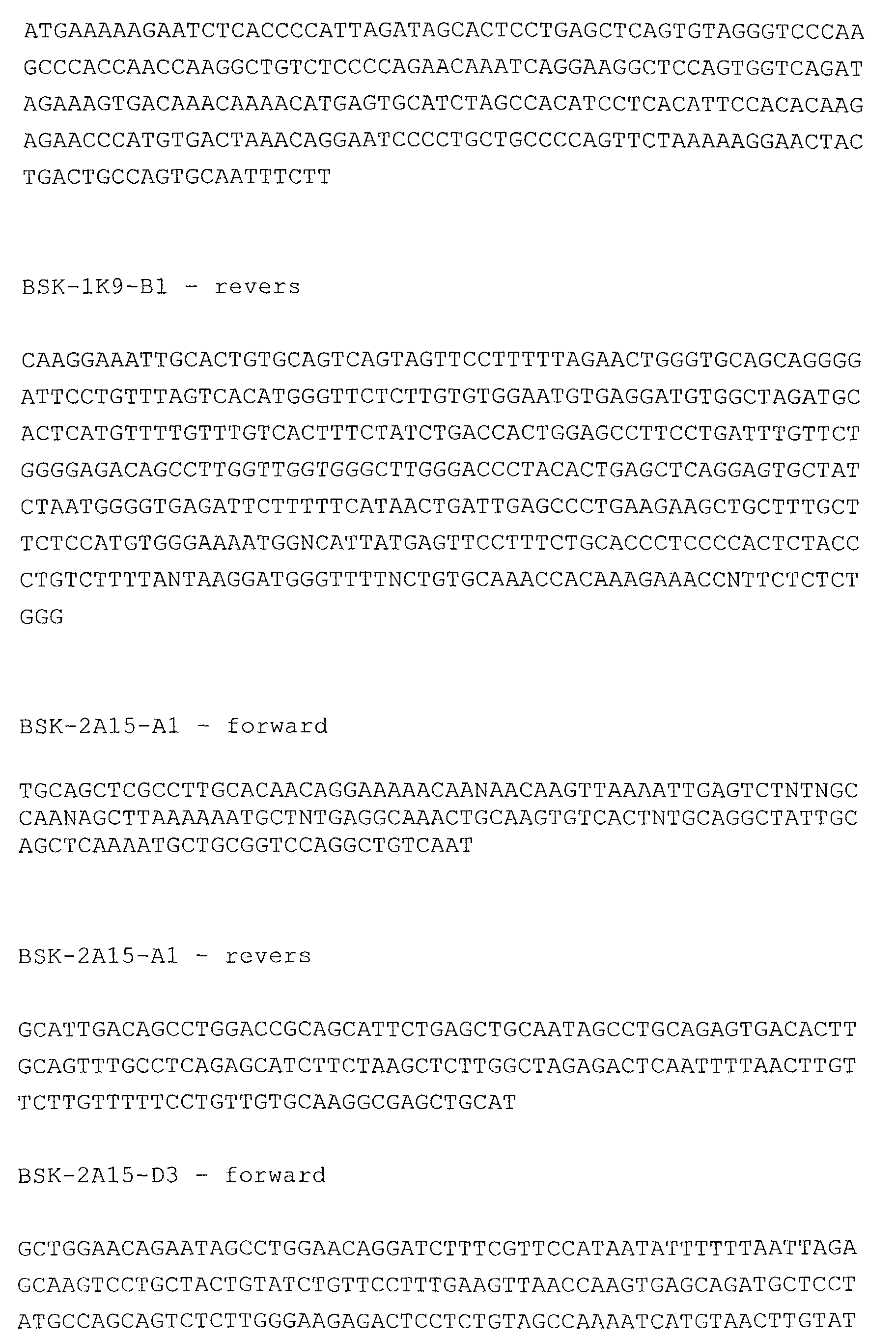
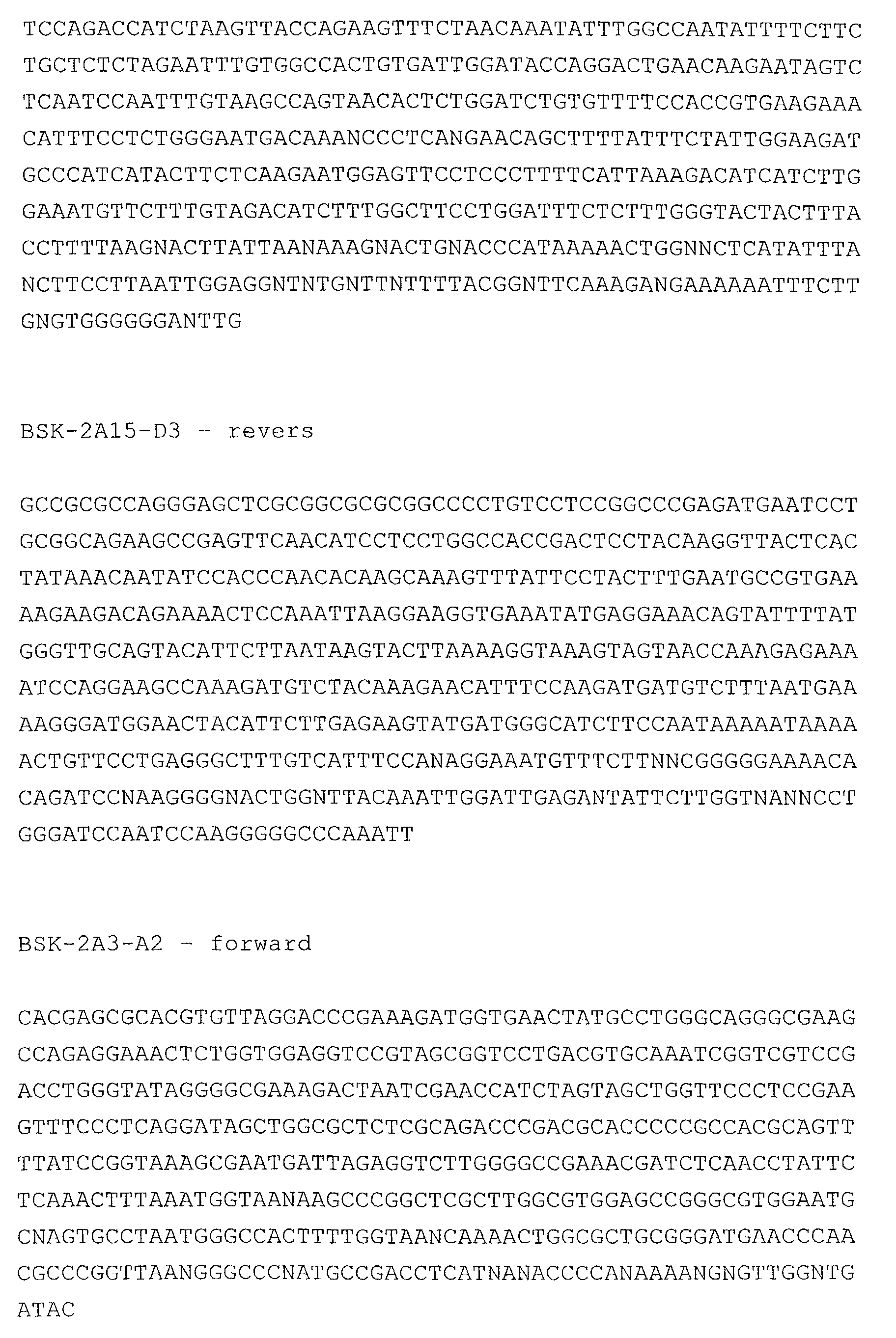













Applications Claiming Priority (2)
| Application Number | Priority Date | Filing Date | Title |
|---|---|---|---|
| DE10155600A DE10155600B4 (de) | 2001-11-09 | 2001-11-09 | Nukleinsäure-Array |
| DE10155600 | 2001-11-09 |
Publications (2)
| Publication Number | Publication Date |
|---|---|
| EP1310567A2 true EP1310567A2 (de) | 2003-05-14 |
| EP1310567A3 EP1310567A3 (de) | 2004-02-25 |
Family
ID=7705526
Family Applications (1)
| Application Number | Title | Priority Date | Filing Date |
|---|---|---|---|
| EP02090348A Withdrawn EP1310567A3 (de) | 2001-11-09 | 2002-10-02 | Nukleinsäure-Array |
Country Status (3)
| Country | Link |
|---|---|
| US (1) | US20050037344A1 (de) |
| EP (1) | EP1310567A3 (de) |
| DE (1) | DE10155600B4 (de) |
Cited By (6)
| Publication number | Priority date | Publication date | Assignee | Title |
|---|---|---|---|---|
| FR2855832A1 (fr) * | 2003-06-03 | 2004-12-10 | Biomerieux Sa | Procede de diagnostic et/ou de pronostic d'un syndrome septique |
| WO2006023312A3 (en) * | 2004-08-20 | 2006-04-20 | Carl Deirmengian | Diagnostic assay for source of inflammation |
| WO2006079760A1 (fr) * | 2005-01-31 | 2006-08-03 | Biomerieux | Procede pour le diagnostic/pronostic d'un syndrome septique |
| WO2007060647A3 (en) * | 2005-11-25 | 2007-07-19 | Trinity College Dublin | A method for detecting or monitoring sepsis by analysing cytokine mrna expression levels |
| US8295392B2 (en) | 2005-12-14 | 2012-10-23 | Nec Corporation | Digital communication system, indoor unit, and outdoor unit |
| US10139405B2 (en) | 2012-01-24 | 2018-11-27 | Cd Diagnostics, Inc. | System for detecting infection in synovial fluid |
Families Citing this family (14)
| Publication number | Priority date | Publication date | Assignee | Title |
|---|---|---|---|---|
| CA2505843A1 (en) * | 2002-11-12 | 2004-05-27 | Becton, Dickinson And Company | Diagnosis of sepsis or sirs using biomarker profiles |
| MXPA05005073A (es) * | 2002-11-12 | 2005-11-17 | Becton Dickinson Co | Diagnostico de la sepsis o sirs usando perfiles de biomarcadores. |
| BR0316232A (pt) | 2002-11-12 | 2005-10-04 | Becton Dickinson Co | Métodos para determinar o estado de sepsia, para prognosticar o começo de sepsia e para diagnosticar a sìndrome de resposta inflamatória sistêmica em um indivìduo |
| US20050014165A1 (en) * | 2003-07-18 | 2005-01-20 | California Pacific Medical Center | Biomarker panel for colorectal cancer |
| GB0426982D0 (en) * | 2004-12-09 | 2005-01-12 | Secr Defence | Early detection of sepsis |
| JP2008538007A (ja) | 2005-04-15 | 2008-10-02 | ベクトン,ディッキンソン アンド カンパニー | 敗血症の診断 |
| WO2007047408A2 (en) * | 2005-10-12 | 2007-04-26 | Pathologica, Llc. | Promac signature application |
| GB0610078D0 (en) * | 2006-05-20 | 2006-06-28 | Secr Defence | Sepsis detection microarray |
| US8669347B2 (en) * | 2007-05-01 | 2014-03-11 | Ucl Business Plc | Truncated variant of the mammalian target for rapamycin (MTOR) protein |
| EP2167683A4 (de) * | 2007-05-31 | 2010-10-20 | California Pacific Med Center | Verfahren zur vorhersage oder diagnose einer magen-darm-störung oder -krankheit |
| US8669113B2 (en) | 2008-04-03 | 2014-03-11 | Becton, Dickinson And Company | Advanced detection of sepsis |
| DE102008048036A1 (de) * | 2008-09-19 | 2010-03-25 | Meurer, Heinrich, Dr. | Verfahren zur Detektion ionisierender Strahlung |
| EP3013985A4 (de) * | 2013-06-28 | 2017-07-19 | Acumen Research Laboratories Pte. Ltd. | Sepsisbiomarker und verwendungen davon |
| WO2020026026A1 (en) * | 2018-07-30 | 2020-02-06 | Cna Diagnostics, Inc. | Methods for treating and detecting sepsis in humans |
Family Cites Families (8)
| Publication number | Priority date | Publication date | Assignee | Title |
|---|---|---|---|---|
| US6582908B2 (en) * | 1990-12-06 | 2003-06-24 | Affymetrix, Inc. | Oligonucleotides |
| RU2048522C1 (ru) * | 1992-10-14 | 1995-11-20 | Институт белка РАН | Способ размножения нуклеиновых кислот, способ их экспрессии и среда для их осуществления |
| EP0902885A4 (de) * | 1996-05-16 | 2006-09-27 | Affymetrix Inc | System und verfahren zur erkennung markierter materialien |
| US5917019A (en) * | 1997-02-13 | 1999-06-29 | The Rockefeller University | Altered telomere repeat binding factor 2 |
| JP2002504812A (ja) * | 1997-05-21 | 2002-02-12 | クローンテック ラボラトリーズ,インコーポレイテッド | 核酸アレイ |
| US5989860A (en) * | 1997-12-12 | 1999-11-23 | Incyte Pharmaceuticals, Inc. | Human isomerase homologs |
| AU2001257591A1 (en) * | 2000-03-31 | 2001-10-15 | Biogen, Inc. | Methods of identifying integrin ligands using differential gene expression |
| DE10127572A1 (de) * | 2001-05-30 | 2002-12-05 | Pathoarray Gmbh | Werkzeuge zur Diagnostik, molekularen Definition und Therapieentwicklung chronischer entzündlicher Gelenkerkrankungen |
-
2001
- 2001-11-09 DE DE10155600A patent/DE10155600B4/de not_active Expired - Fee Related
-
2002
- 2002-10-02 EP EP02090348A patent/EP1310567A3/de not_active Withdrawn
- 2002-10-23 US US10/278,698 patent/US20050037344A1/en not_active Abandoned
Cited By (17)
| Publication number | Priority date | Publication date | Assignee | Title |
|---|---|---|---|---|
| US7622249B2 (en) | 2003-06-03 | 2009-11-24 | Biomerieux | Method for diagnosing and/or predicting of a septic syndrome |
| WO2004108957A3 (fr) * | 2003-06-03 | 2005-07-21 | Biomerieux Sa | Procede de diagnostic et/ou de pronostic d'un syndrome septique |
| FR2855832A1 (fr) * | 2003-06-03 | 2004-12-10 | Biomerieux Sa | Procede de diagnostic et/ou de pronostic d'un syndrome septique |
| WO2006023312A3 (en) * | 2004-08-20 | 2006-04-20 | Carl Deirmengian | Diagnostic assay for source of inflammation |
| EP2336356A1 (de) * | 2005-01-31 | 2011-06-22 | bioMérieux | Verfahren zur Prognose eines septischen Syndroms |
| JP2008528018A (ja) * | 2005-01-31 | 2008-07-31 | ビオメリュー | 敗血症症候群の診断及び/又は予後診断方法 |
| FR2881437A1 (fr) * | 2005-01-31 | 2006-08-04 | Biomerieux Sa | Procede pour le diagnostic/pronostic d'un syndrome septique |
| WO2006079760A1 (fr) * | 2005-01-31 | 2006-08-03 | Biomerieux | Procede pour le diagnostic/pronostic d'un syndrome septique |
| JP2014140374A (ja) * | 2005-01-31 | 2014-08-07 | Biomerieux | 敗血症症候群の診断及び/又は予後診断方法 |
| JP2014140375A (ja) * | 2005-01-31 | 2014-08-07 | Biomerieux | 敗血症症候群の診断及び/又は予後診断方法 |
| US11060143B2 (en) | 2005-01-31 | 2021-07-13 | Biomerieux | Method for diagnosis and/or prognosis of a septic syndrome |
| US11821038B2 (en) | 2005-01-31 | 2023-11-21 | Biomerieux | Method for diagnosis and/or prognosis of a septic syndrome |
| WO2007060647A3 (en) * | 2005-11-25 | 2007-07-19 | Trinity College Dublin | A method for detecting or monitoring sepsis by analysing cytokine mrna expression levels |
| US8295392B2 (en) | 2005-12-14 | 2012-10-23 | Nec Corporation | Digital communication system, indoor unit, and outdoor unit |
| US10139405B2 (en) | 2012-01-24 | 2018-11-27 | Cd Diagnostics, Inc. | System for detecting infection in synovial fluid |
| US11499970B2 (en) | 2012-01-24 | 2022-11-15 | Cd Diagnostics, Inc. | System for detecting infection in synovial fluid |
| US12385909B2 (en) | 2012-01-24 | 2025-08-12 | Cd Diagnostics, Inc. | System for detecting infection in synovial fluid |
Also Published As
| Publication number | Publication date |
|---|---|
| DE10155600B4 (de) | 2009-08-27 |
| DE10155600A1 (de) | 2003-05-22 |
| EP1310567A3 (de) | 2004-02-25 |
| US20050037344A1 (en) | 2005-02-17 |
Similar Documents
| Publication | Publication Date | Title |
|---|---|---|
| EP1310567A2 (de) | Nukleinsäure-Array | |
| DE69535428T2 (de) | Verfahren zum Auffinden von differentiel exprimierte Gene | |
| DE10296990B4 (de) | Verwendung eines Biochips zur Diagnose von Sepsis und sepsisähnlichem Syndrom | |
| US6759197B2 (en) | Microchip arrays of regulatory genes | |
| DE69918072T2 (de) | P53-regulierte gene | |
| DE10100121A1 (de) | Verfahren zur Bestimmung des Hautstreß oder der Hautalterung in vitro | |
| WO2003008647A2 (en) | Blood assessment of injury | |
| US20070020623A1 (en) | Method for determining homeostasis of the skin | |
| EP2118315B1 (de) | Kontrollgene zur normalisierung von genexpressionsanalysedaten | |
| EP1863928B1 (de) | Verwendung von genaktivitäts-klassifikatoren für die in vitro klassifizierung von genexpressionsprofilen von patienten mit infektiösem/nichtinfektiösem multiorganversagen | |
| EP2179054A1 (de) | Verwendung von polynukleotiden zur erfassung von genaktivitäten für die unterscheidung zwischen lokaler und systemischer infektion | |
| DE10234524A1 (de) | Nukleinsäurearray | |
| AT507402A1 (de) | Verfahren zur prüfung des irritierenden oder allergenen potentials eines produkts | |
| JP5301281B2 (ja) | 臓器特異的遺伝子、その同定方法およびその用途 | |
| CA2525179A1 (en) | A gene equation to diagnose rheumatoid arthritis | |
| DE10340373A1 (de) | Verfahren zur Bestimmung von Haarzyklus-Marken | |
| KR20030009531A (ko) | 중간엽 줄기 세포를 사용하는 독성 타이핑 | |
| DE10158517A1 (de) | Verfahren zur Analyse der translationskontrollierten Genexpression | |
| DE10336511A1 (de) | Verfahren zur Erkennung von schwerer Sepsis | |
| KR102193658B1 (ko) | 사상체질 중 소음인 진단용 snp 마커 및 이의 용도 | |
| DE102018001796A1 (de) | Gene in sanderia malayensis, die auf steigende temperatur von meerwasser reagieren, und verfahren zur vorhersage von physiologischer oder metabologischer änderung von sanderia malayensis | |
| KR102193657B1 (ko) | 사상체질 중 태음인 진단용 snp 마커 및 이의 용도 | |
| DE10340395A1 (de) | Verfahren zur Erkennung akuter generalisierter entzündlicher Zustände (SIRS) | |
| Ubaldi et al. | 18 Microarrays in Neuroscience | |
| Ubaldi et al. | Chapter Microarrays in Neuroscience |
Legal Events
| Date | Code | Title | Description |
|---|---|---|---|
| PUAI | Public reference made under article 153(3) epc to a published international application that has entered the european phase |
Free format text: ORIGINAL CODE: 0009012 |
|
| AK | Designated contracting states |
Designated state(s): AT BE BG CH CY CZ DE DK EE ES FI FR GB GR IE IT LI LU MC NL PT SE SK TR |
|
| AX | Request for extension of the european patent |
Extension state: AL LT LV MK RO SI |
|
| PUAL | Search report despatched |
Free format text: ORIGINAL CODE: 0009013 |
|
| AK | Designated contracting states |
Kind code of ref document: A3 Designated state(s): AT BE BG CH CY CZ DE DK EE ES FI FR GB GR IE IT LI LU MC NL PT SE SK TR |
|
| AX | Request for extension of the european patent |
Extension state: AL LT LV MK RO SI |
|
| 17P | Request for examination filed |
Effective date: 20040824 |
|
| 17Q | First examination report despatched |
Effective date: 20041001 |
|
| AKX | Designation fees paid |
Designated state(s): AT BE BG CH CY CZ DE DK EE ES FI FR GB GR IE IT LI LU MC NL PT SE SK TR |
|
| STAA | Information on the status of an ep patent application or granted ep patent |
Free format text: STATUS: THE APPLICATION IS DEEMED TO BE WITHDRAWN |
|
| 18D | Application deemed to be withdrawn |
Effective date: 20050611 |